Woodshop Diaries

  • Shop
  • About
    • Work With Me
    • Frequently Asked Questions
  • DIY Projects
    • DIY Furniture Plans
      • DIY Bed Plans
      • DIY Dresser Plans
      • DIY Nightstand Plans
      • DIY Desk Plans
      • DIY TV Stand Plans
      • Coffee and Side Table Plans
      • Tables
      • Shelves and Bookcase Plans
      • DIY Storage Trunk Plans
      • DIY Bench Plans
      • DIY Storage Cabinet Plans
      • DIY Bathroom Vanity Plans
      • Kids Projects and Furniture
    • DIY Scrap Wood Projects
    • DIY Workshop Projects
    • DIY Home Decor Projects
  • Getting Started
    • Cabinet Building
    • Woodworking Basics
    • Furniture Finishing Tips
    • Tool Guides & Reviews
  • Blog
menu icon
go to homepage
  • Shop
  • About
    • Work With Me
    • Frequently Asked Questions
  • DIY Projects
    • DIY Furniture Plans
      • DIY Bed Plans
      • DIY Dresser Plans
      • DIY Nightstand Plans
      • DIY Desk Plans
      • DIY TV Stand Plans
      • Coffee and Side Table Plans
      • Tables
      • Shelves and Bookcase Plans
      • DIY Storage Trunk Plans
      • DIY Bench Plans
      • DIY Storage Cabinet Plans
      • DIY Bathroom Vanity Plans
      • Kids Projects and Furniture
    • DIY Scrap Wood Projects
    • DIY Workshop Projects
    • DIY Home Decor Projects
  • Getting Started
    • Cabinet Building
    • Woodworking Basics
    • Furniture Finishing Tips
    • Tool Guides & Reviews
  • Blog
search icon
Homepage link
  • Shop
  • About
    • Work With Me
    • Frequently Asked Questions
  • DIY Projects
    • DIY Furniture Plans
      • DIY Bed Plans
      • DIY Dresser Plans
      • DIY Nightstand Plans
      • DIY Desk Plans
      • DIY TV Stand Plans
      • Coffee and Side Table Plans
      • Tables
      • Shelves and Bookcase Plans
      • DIY Storage Trunk Plans
      • DIY Bench Plans
      • DIY Storage Cabinet Plans
      • DIY Bathroom Vanity Plans
      • Kids Projects and Furniture
    • DIY Scrap Wood Projects
    • DIY Workshop Projects
    • DIY Home Decor Projects
  • Getting Started
    • Cabinet Building
    • Woodworking Basics
    • Furniture Finishing Tips
    • Tool Guides & Reviews
  • Blog
×
Home

How to DIY a Gallery Rail for a Bookshelf

August 23, 2024 by Shara, Woodshop Diaries

In this post, I’m sharing how I saved hundreds of dollars by making my own DIY gallery rail for my bookshelf!

Have you seen those shelves with the railings on the front? They are sometimes called gallery rails, shelf rails, tipping rails–they have several names.
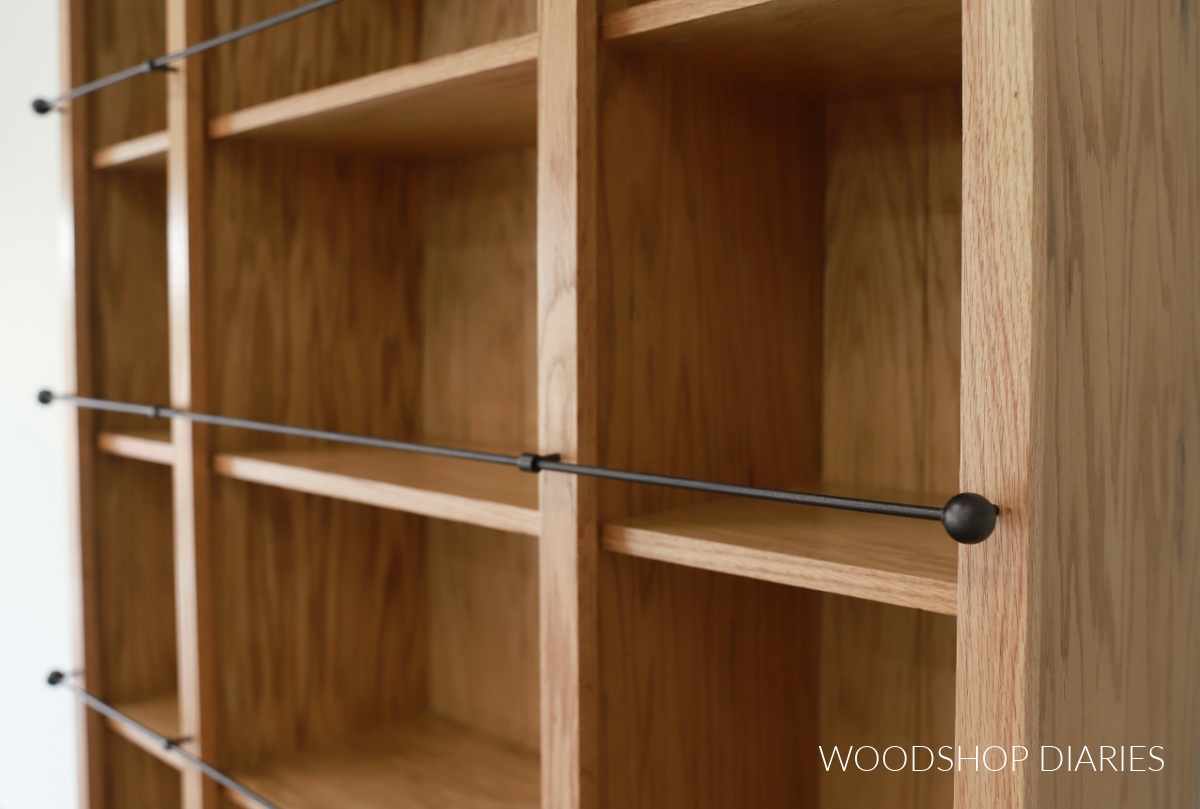
Close up of faux DIY gallery railing on the front of bookcase

Normally, they’re used on smaller shelves to prevent things from sliding off (like drink glasses, for example).

But often, they’re just for decoration and provide a cute accent. That’s the case with my bookshelf. Check out how to build this classic bookcase here.

This simple DIY bookcase would have been completely fine without shelf railing–stuff slipping off isn’t a likely possibility.
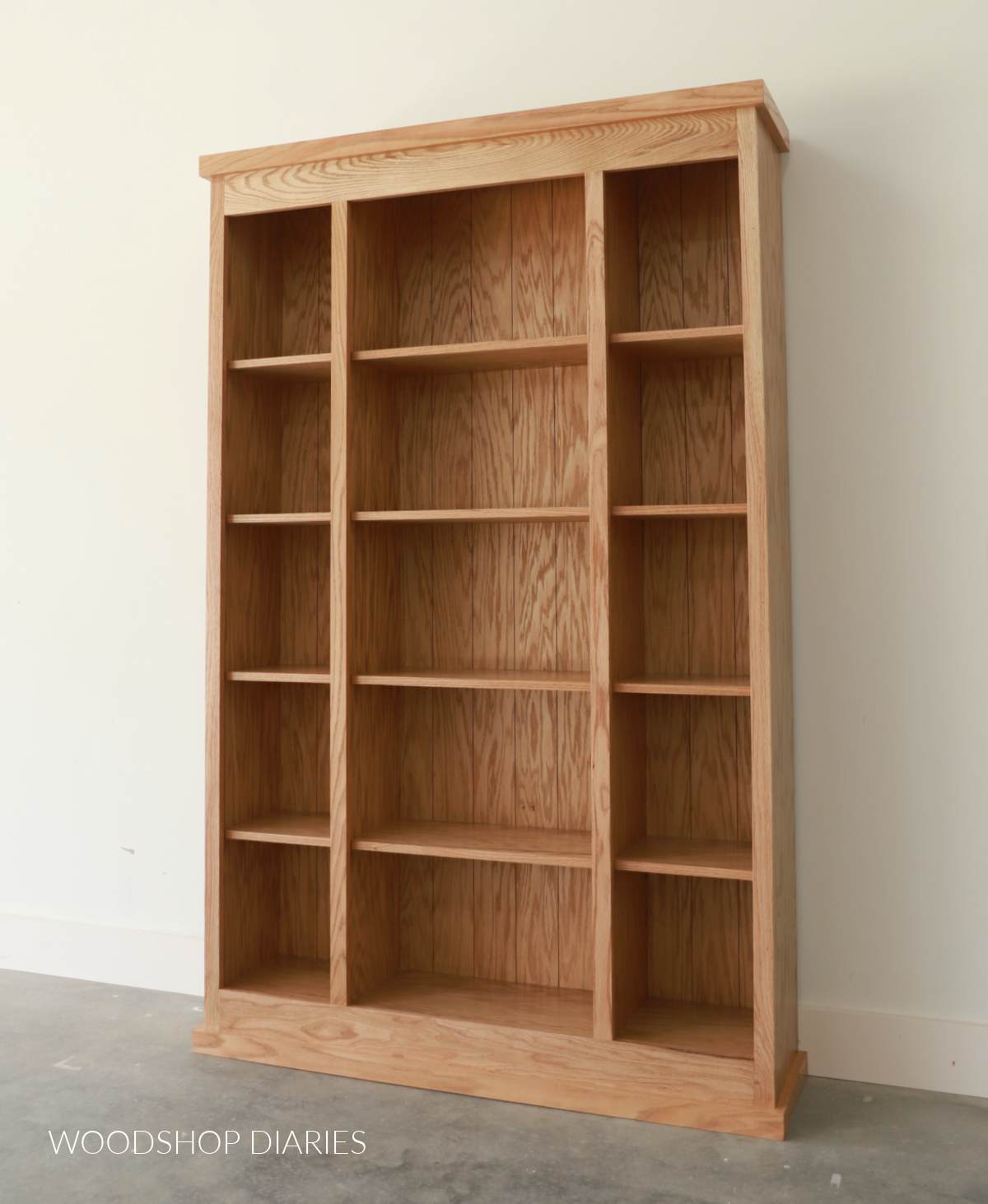
Finished bookcase without railings

But I had seen a similar one online with rails across each shelf that I LOVED. I wanted to replicate that idea on my own bookcase, but the problem was that when I looked into buying them, the railings were pushing $1000. (No wonder that bookcase was so pricey!)

That was not in my budget. Not even close. So I made my own for about $30. And I’m excited to show you how below.

*This post contains affiliate links. See website policies.

What to know before starting

This is a simple project that you can customize however you need. Here are a few tips to consider before starting.

Drill Bits

First and foremost, you will need a forstner bit to drill your holes. Don’t attempt this with a regular drill bit or a spade bit. You will rip, split, or shred your pieces and likely your fingers, too.
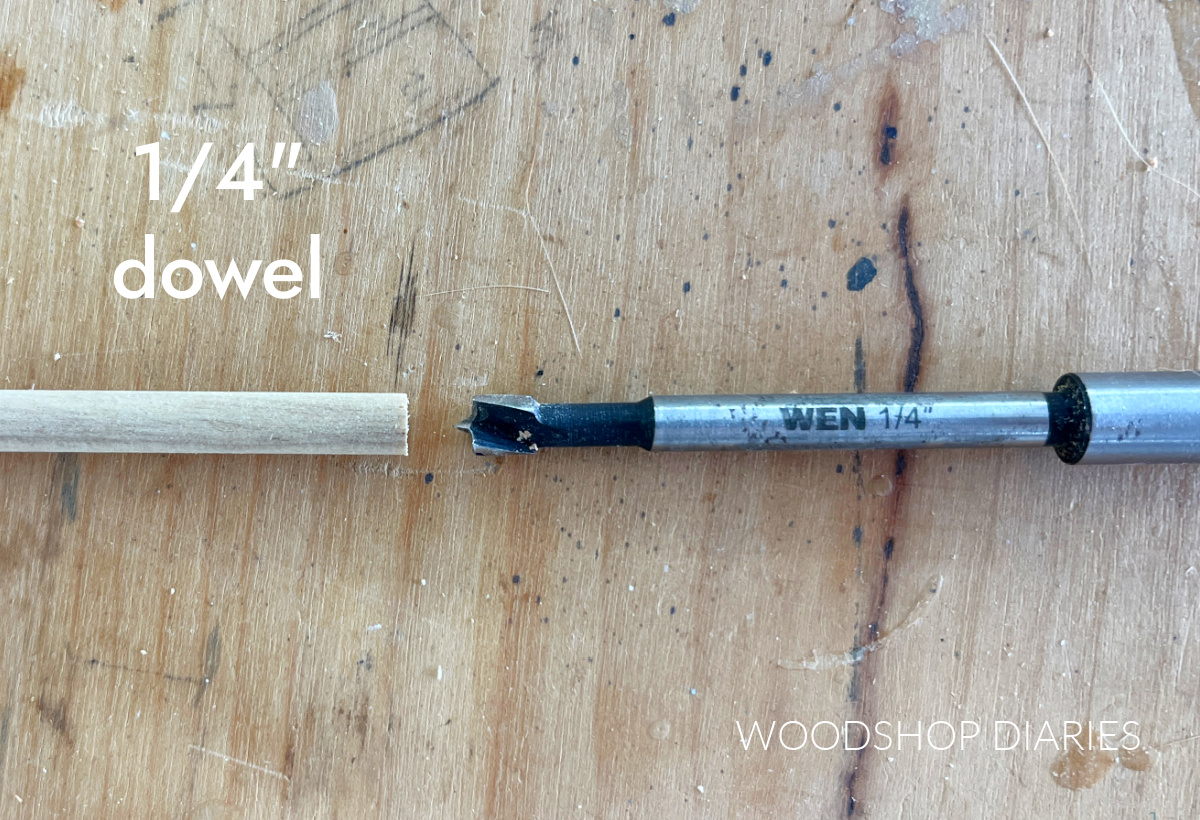
Close up of ¼" dowel rod next to ¼" Forstner bit on workbench

The size forstner bit you need will be based on the size dowel you use for your railing. I used ¼″ diameter dowel for my railing. It worked great, but if you wanted chunkier rails, you could also use ⅜″ or ½″ dowel rods instead.

Here’s a visual of them all side by side to get an idea of the difference.
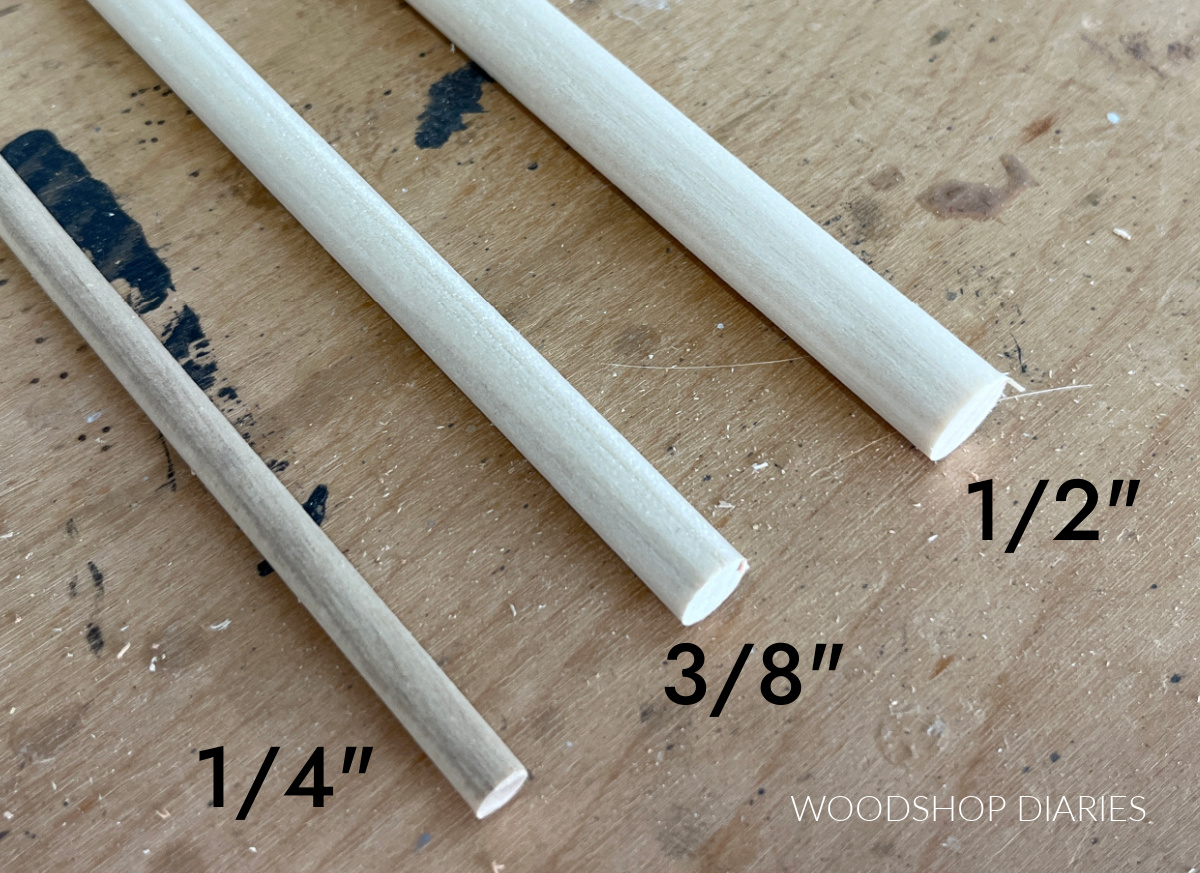
¼", ⅜" and ½" dowel rod laying side by side on workbench

You’ll need a forstner bit the same size as the diameter of the dowel you want to use for your railing. Since I used ¼″ railing, I used a ¼″ forsner bit.

Cutting Small Pieces

This project required cutting some small, delicate wood pieces. This can sometimes be a little tricky.

You can use a hand saw if you feel more comfortable with that, but a band saw, scroll saw, or miter saw would also work if you’re careful.

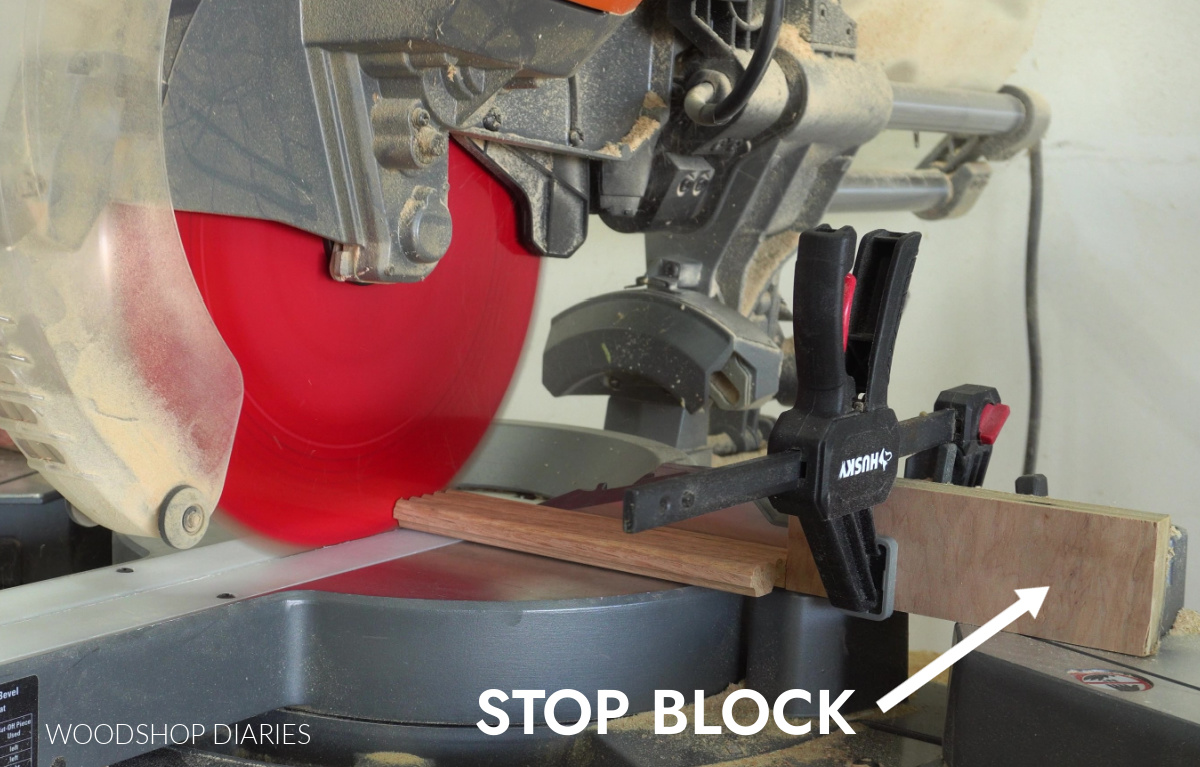
I used a miter saw to cut my small pieces, but I highly recommend clamping some scrap blocks to the saw’s fence on each side to prevent the blade from flinging the pieces backwards.
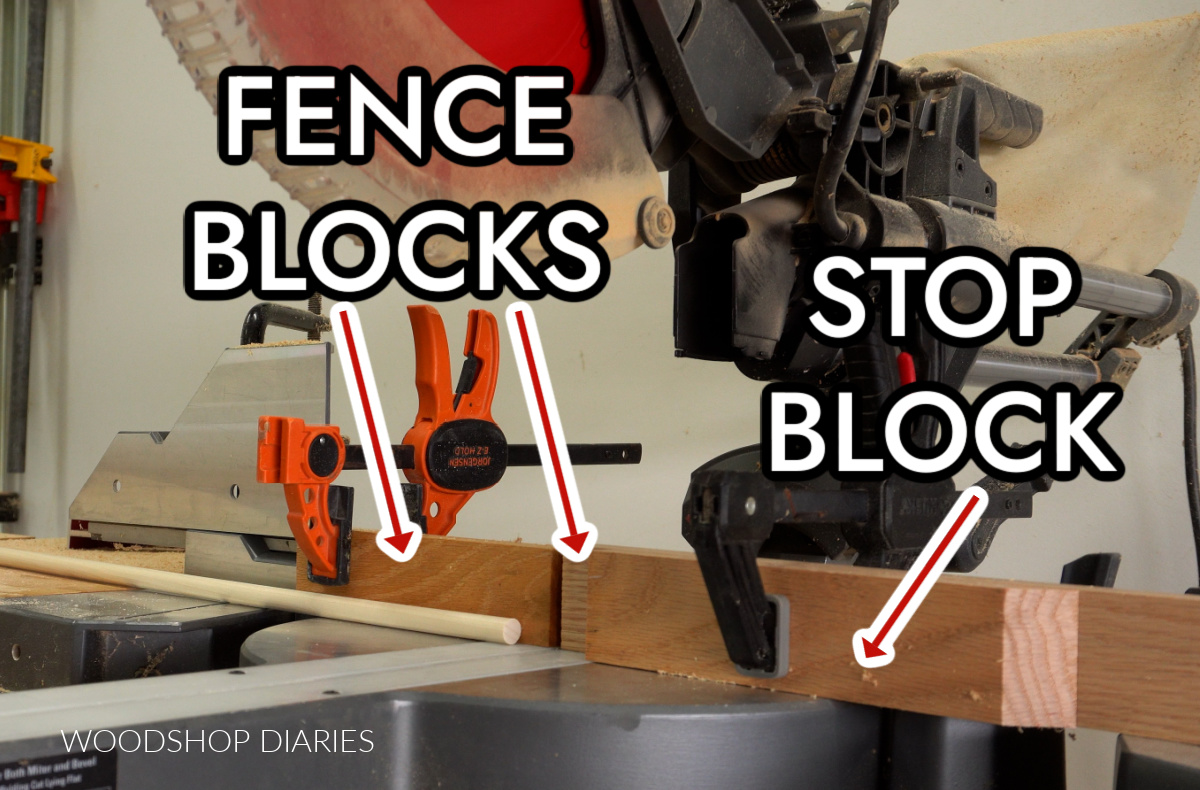
Miter saw with fence blocks and stop block clamped to back

Or, if you have a miter saw sled, that would be great to use here. I also recommend clamping a stop block in place to help you cut consistent lengths for these short pieces.

Enjoy DIY projects and woodworking plans? Sign up for priority access for the latest posts on Woodshop Diaries!

How to make DIY gallery rails for Bookcase

If you prefer to watch, I detailed this entire process at the end of the bookshelf build video on my YouTube Channel here.

YouTube thumbnail image of bookcase with gallery railing

Love watching how-to videos? Subscribe to my YouTube channel for plenty more where that came from!

Tools & Materials

Tools:

  • Drill
  • ¼″ forstner bit
  • Measuring tape
  • Saw (see notes above)
  • Rubber mallet (optional)

Materials: (amounts depend on the number and length of railings)

  • Wooden Balls (1″ diameter used here)
  • ¼″ diameter dowel rod (or other size as desired)
  • ½″ diameter dowel rod
  • Wood Glue
  • Metallic Spray Paint

TIP: You can buy dowel rods online, but I recommend swinging by your local Home Depot or Lowes and picking up a few. They’re much cheaper there than I’ve found online.

Step 1: Cut Gallery Rail Pieces

First, I gathered and cut my pieces for each railing. My bookcase was approximately 4′ wide, so I used a 4′ long ¼″ diameter dowel rod for each rail.

(I made five rails total–one for each shelf of my bookcase.)
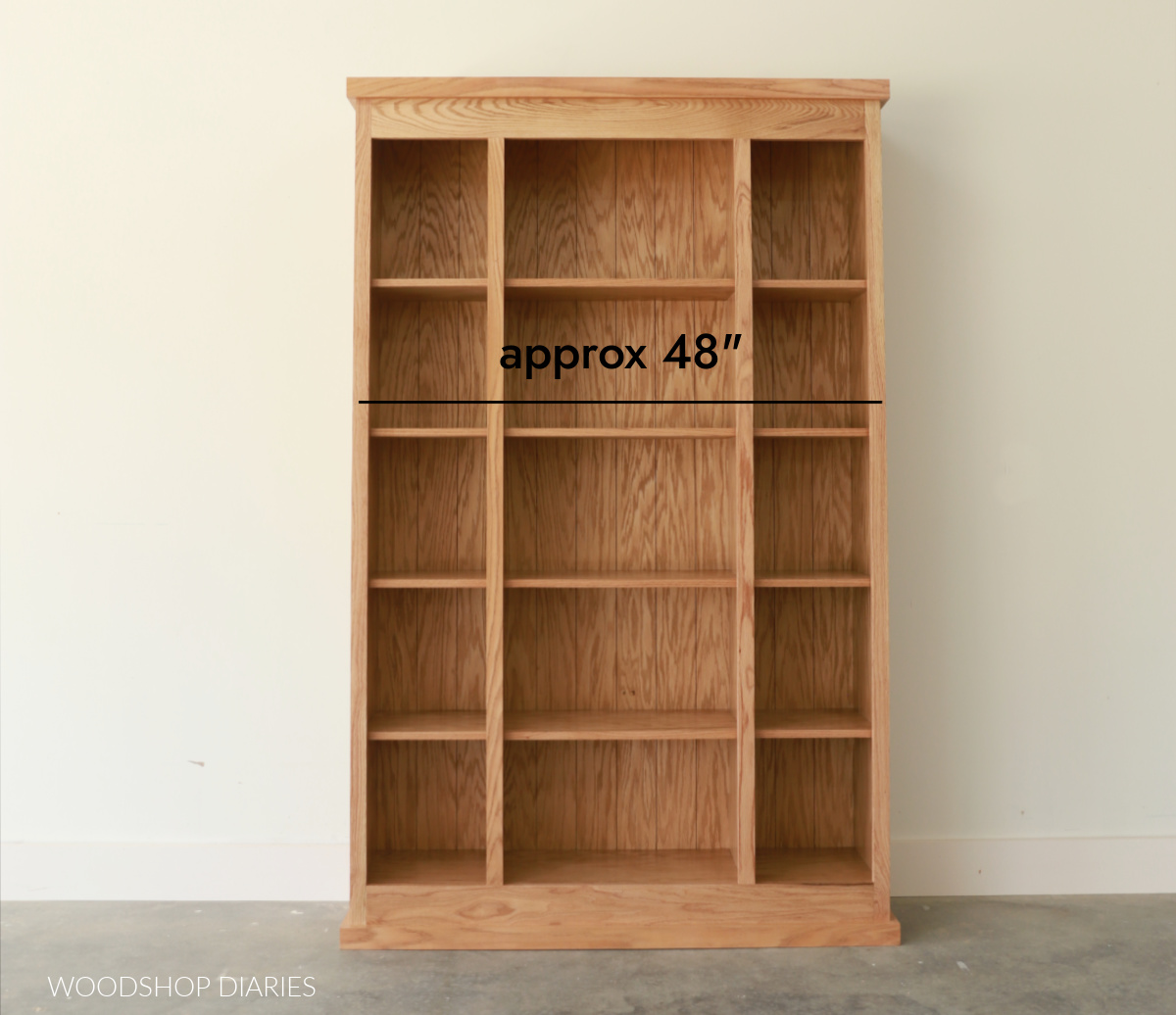
Empty bookcase with text "approx 48" above a line drawn across shelf

If your shelf is a different size, you can trim your dowel or buy a longer one to fit. And if you prefer a chunkier rail, ⅜″ or ½″ diameter rod could work instead.

For each rail, I gathered/cut:

  • (1) ¼″ diameter x 4′ long dowel rod
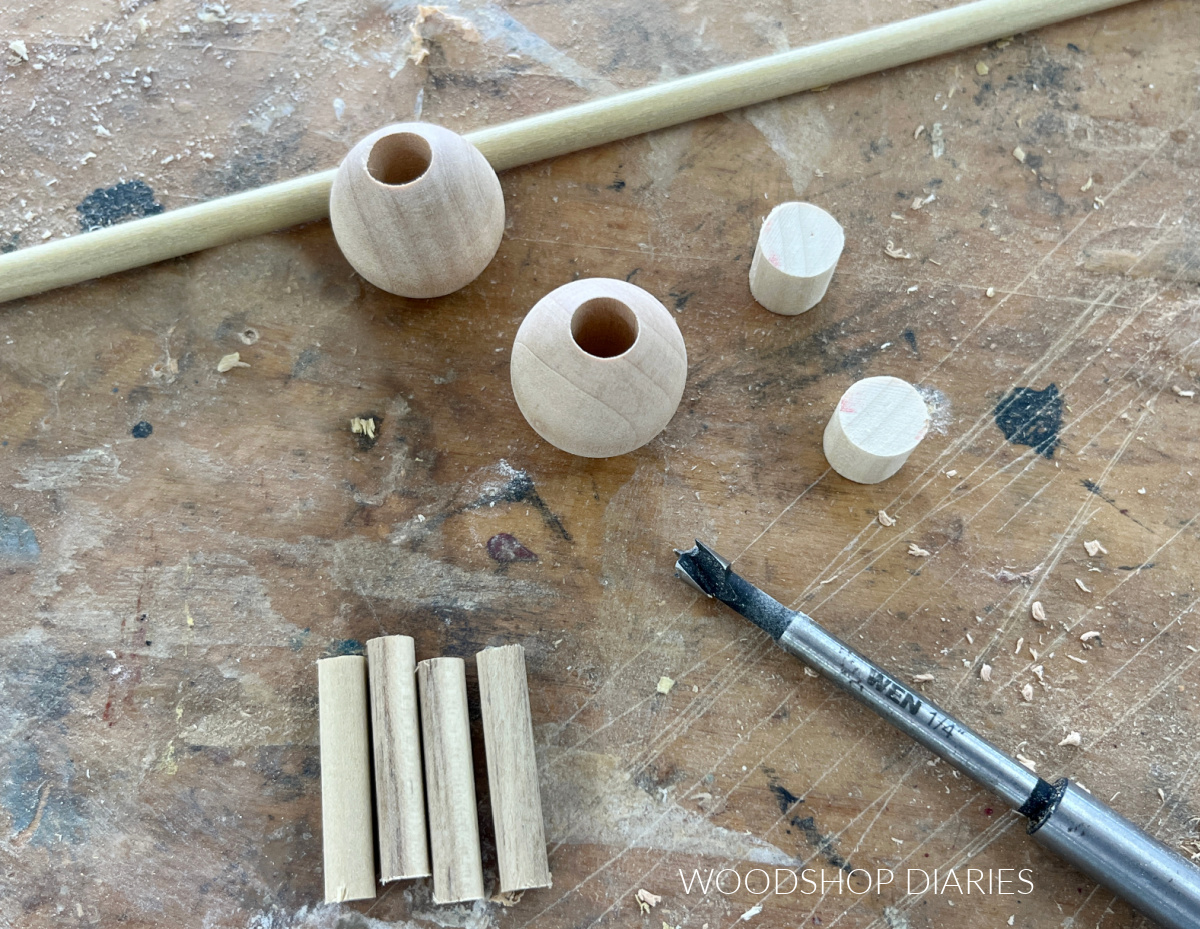
  • (2) 1″ diameter wooden balls (with a pre drilled ¼″ diameter hole–not all the way through)
  • (2) ½″ diameter dowel rod ½″ long
  • (4) ¼″ dowel rods cut 1″ long
wooden balls and dowels--pieces needed to create DIY gallery shelf rail

Step 2: Drill Out Center Supports

This railing will attach to the bookshelf in four places–at each end and at both dividers.
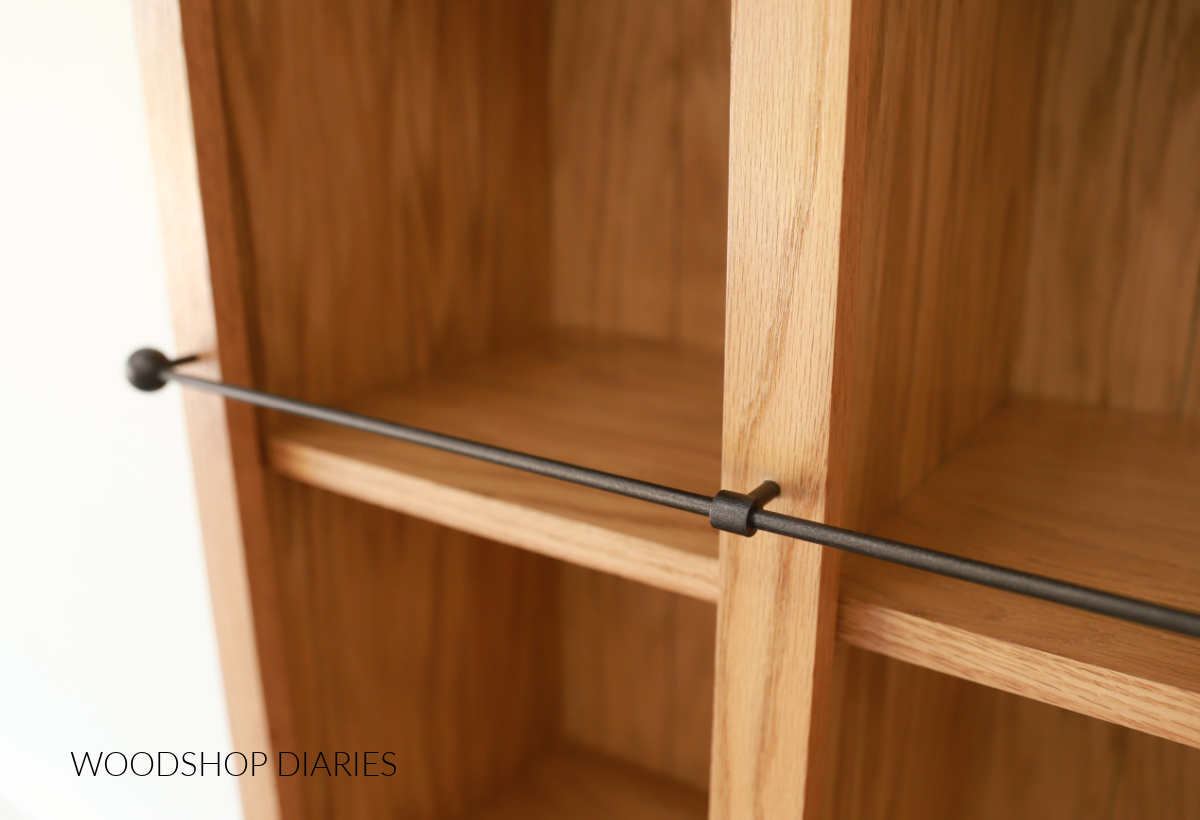
Close up of DIY shelf pain on bookcase shelf frame

The wooden balls will serve as the “end caps” of the rail, but for the pieces that go on the dividers, I used ½″ diameter dowels.

I cut these to ½″ long and carefully marked the center of each one.
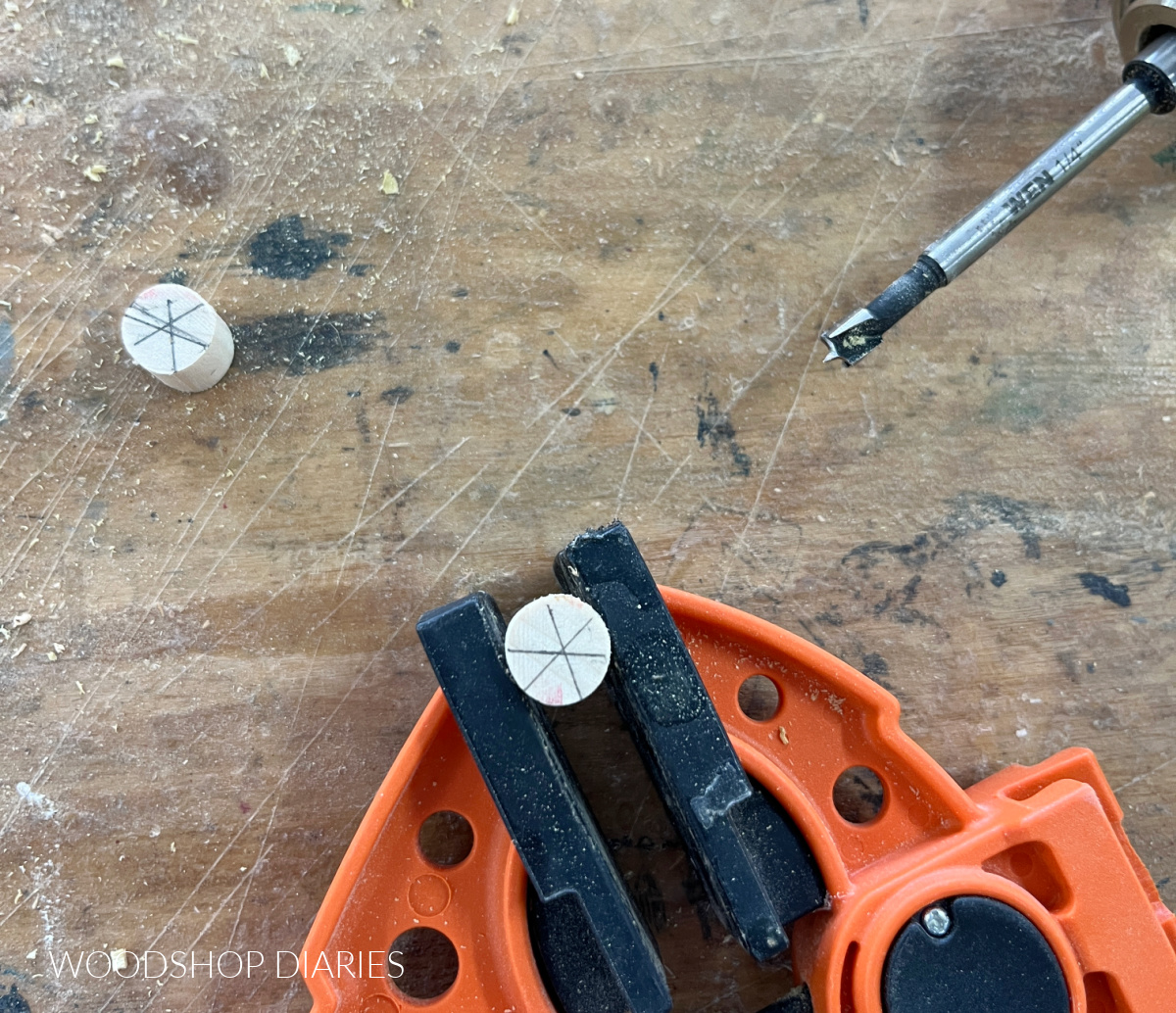
½" dowel clamped with ¼" forstner bit laying next to it

I used a ¼″ forstner bit to drill a hole through the center of the dowel. Here’s a tip–I held the dowel in a clamp to get my hole started. But I found that if I tried to drill all the way through with it clamped, the pressure would break it.

So instead, once I got my hole started, I removed it from the clamps.
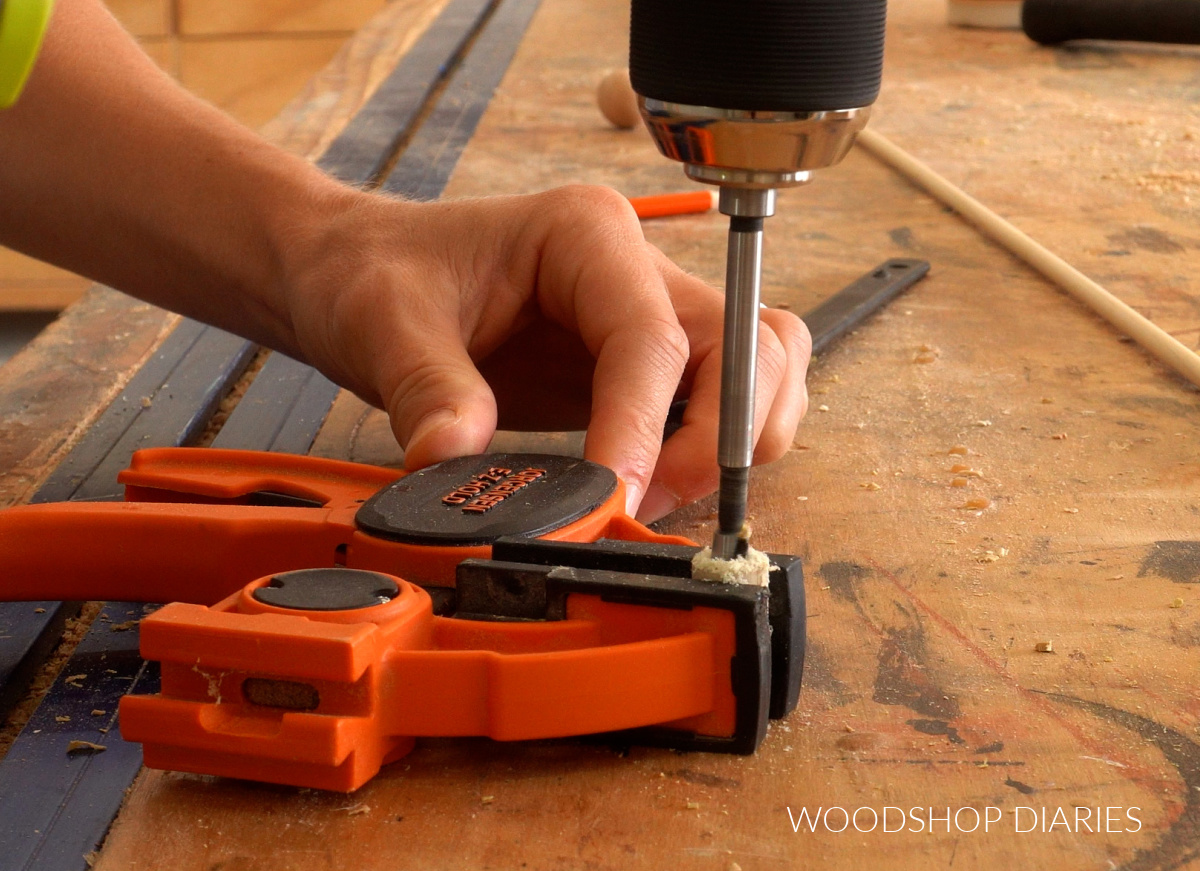
Drilling ¼" hole through ½" dowel on workbench

At that point, I CAREFULLY held it between my fingers to drill the rest of the hole. Drill SLOWLY. Do not attempt this with a regular drill bit or a spade bit.

If you didn’t want to use your fingers, a pair of pliers could work, but use some tape between the pliers and the wood so it doesn’t scratch it up–and don’t squeeze too hard!
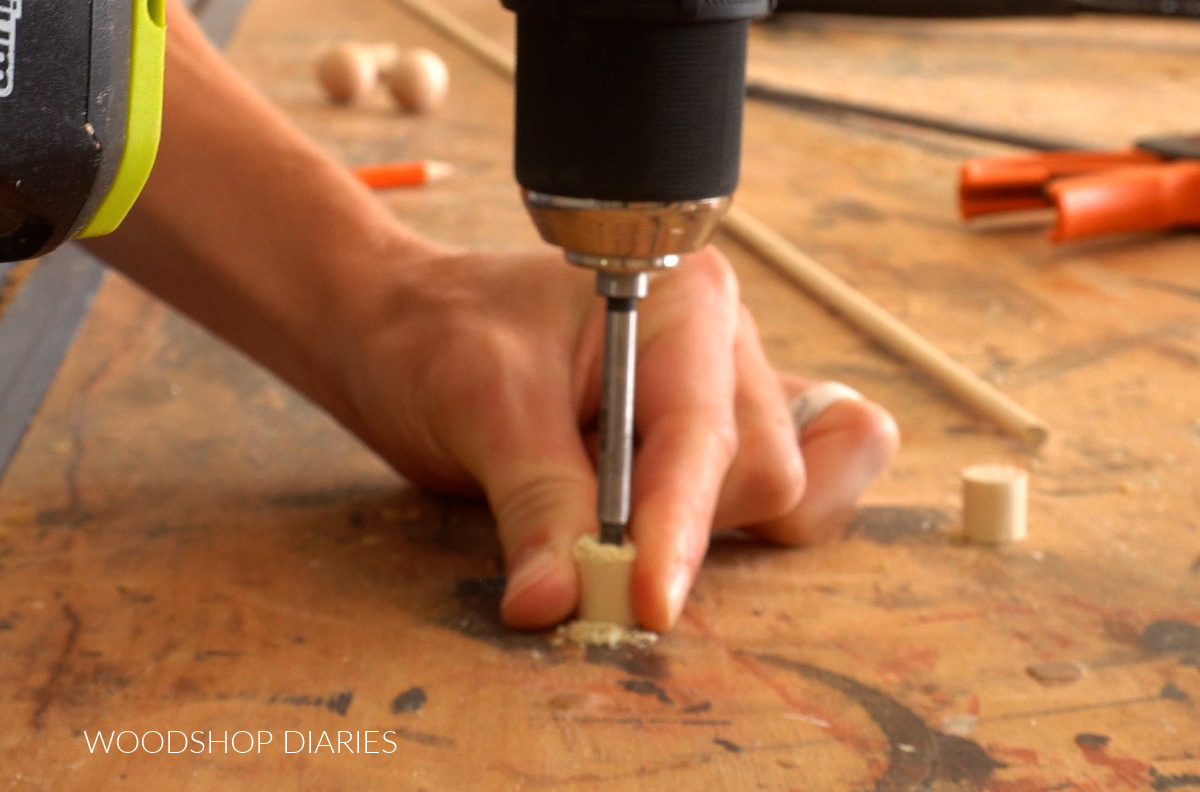
drilling through dowel with forstner bit

It’s important to try your best to drill straight so you can keep the hole centered through the dowel. But if it’s a little off, that’s okay. It doesn’t have to be PERFECT–just close.
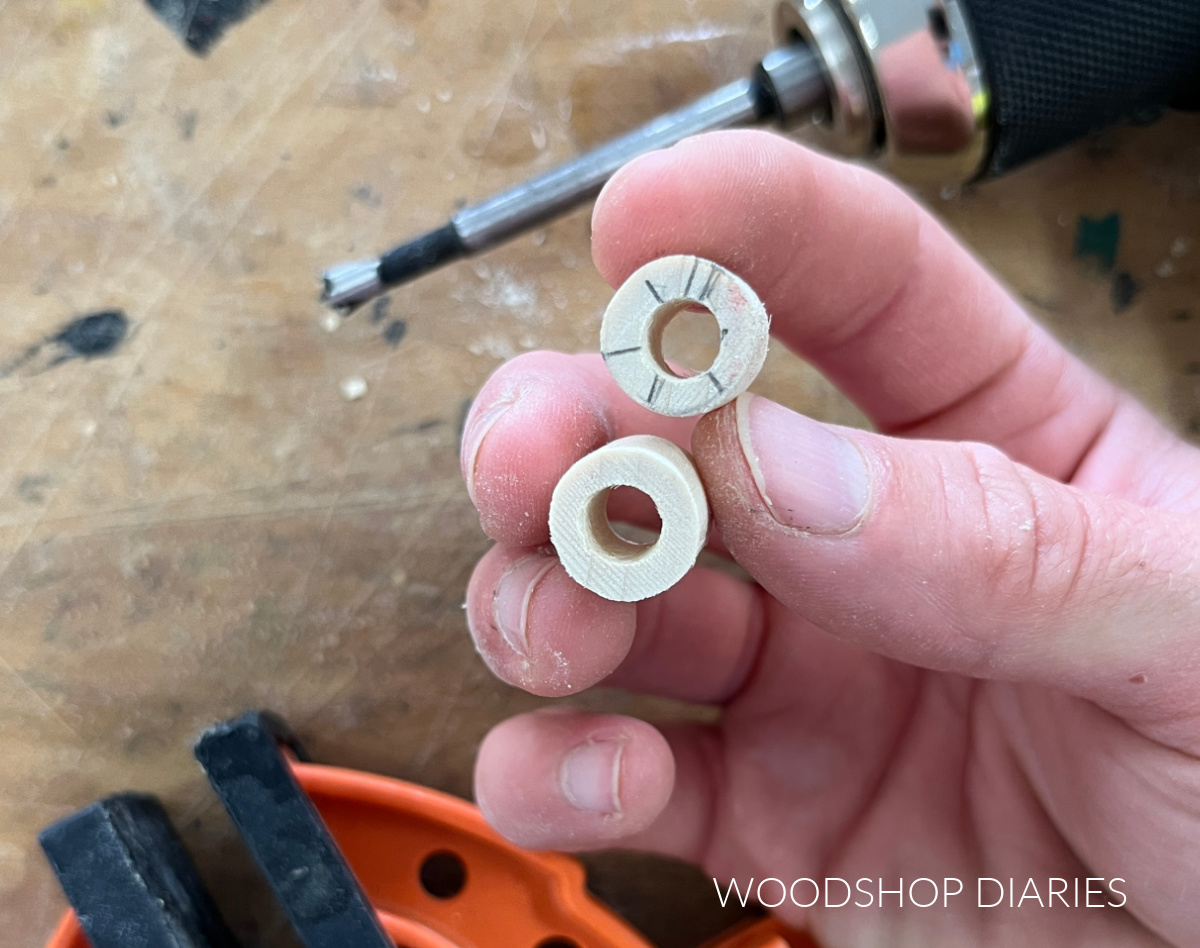
through holes drilled in ½" dowels for gallery railing

Sand these pieces lightly with 220 grit sandpaper by hand before moving to step 3.

Step 3: Install Pegs on Back

Next, I slipped the ½″ dowels onto the ¼″ dowel rod I was using for the railings and slipped the wooden balls onto each end. Don’t glue anything in place yet.

I recommend taking this rail to your bookshelf and sliding the ½″ dowels and the balls on the rail so that they’re centered on the bookcase framing–or in whatever position you’d like them to be for your project.
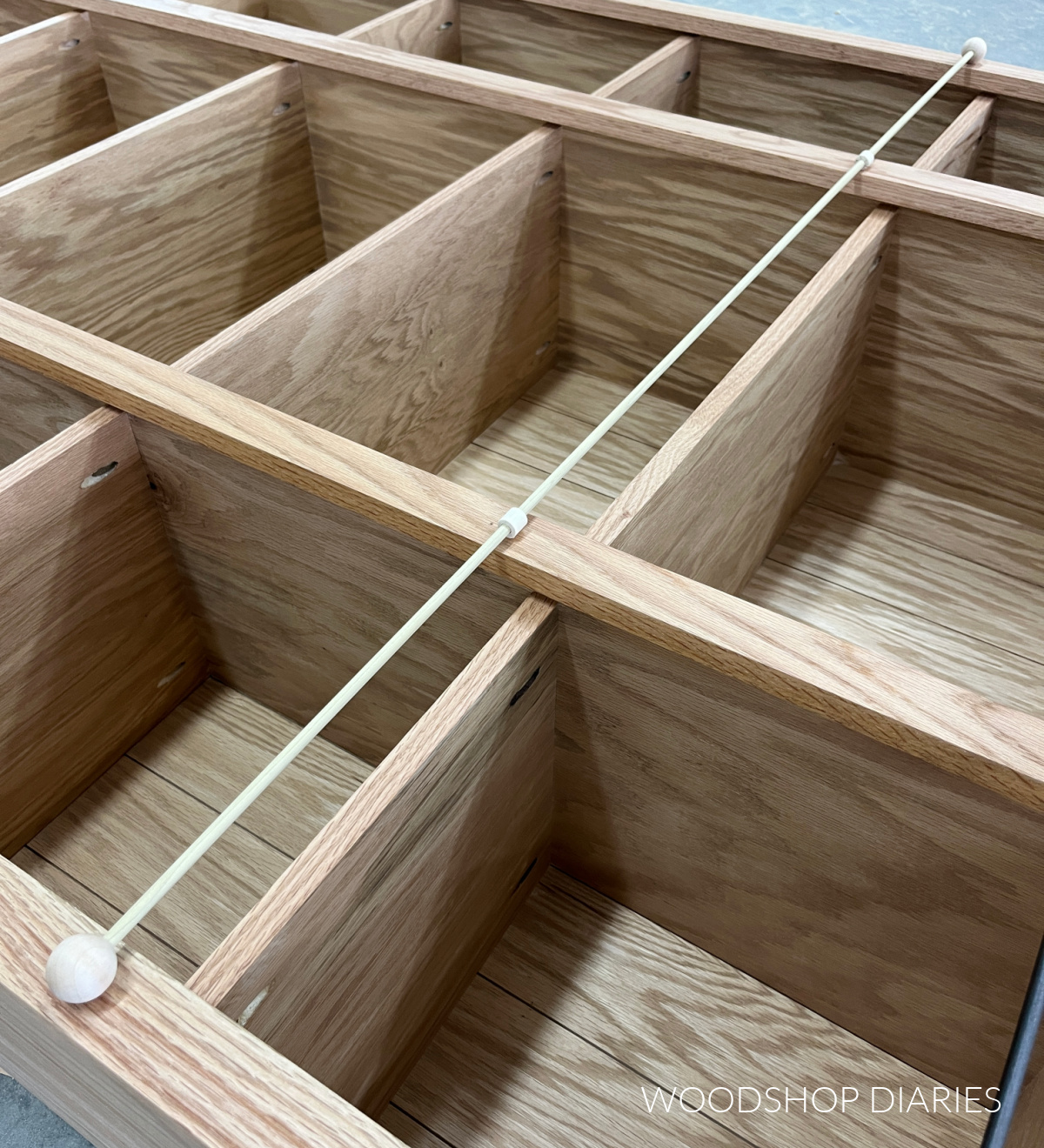
gallery rail mock up placed across bookcase to space pieces properly

Without sliding the pieces on the rail, bring the rail back to the workbench to install the pegs on the back.

I clamped the wood balls to hold them still and carefully drilled a hole about ¼″ deep straight into the back of each one. Then I slipped in a 1″ long ¼″ dowel (don’t glue these!).
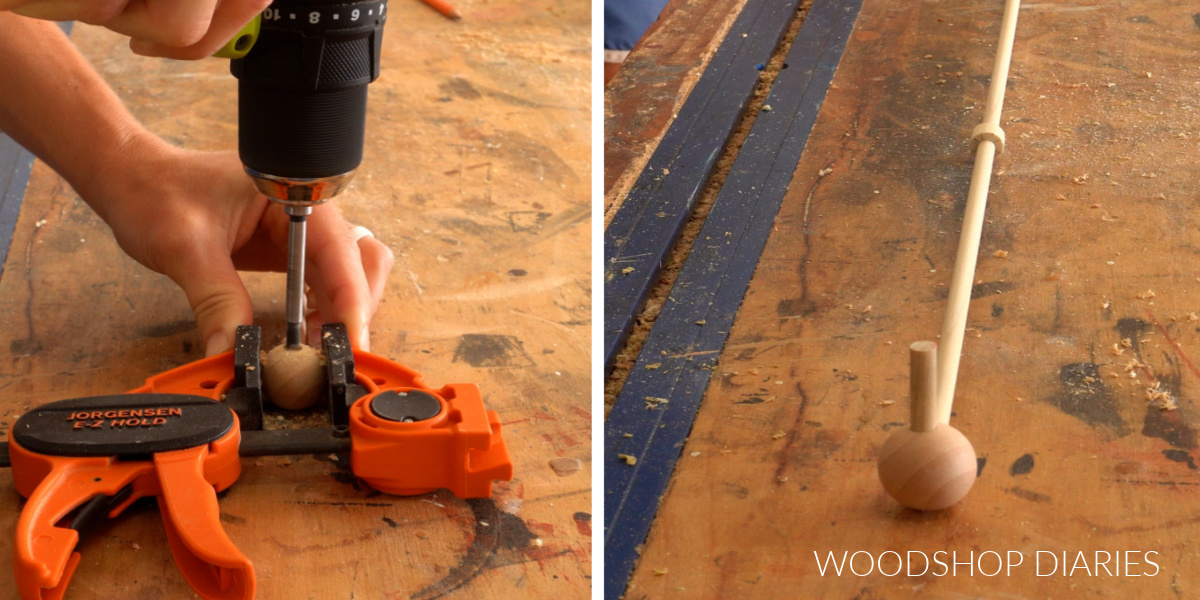
collage image showing drilling hole in wood dowel on left and pegs placed in wood dowel on right

Then, I did the same thing on the back of each ½″ dowel piece. Carefully drill just deep enough that a ¼″ dowel will go into the hole.
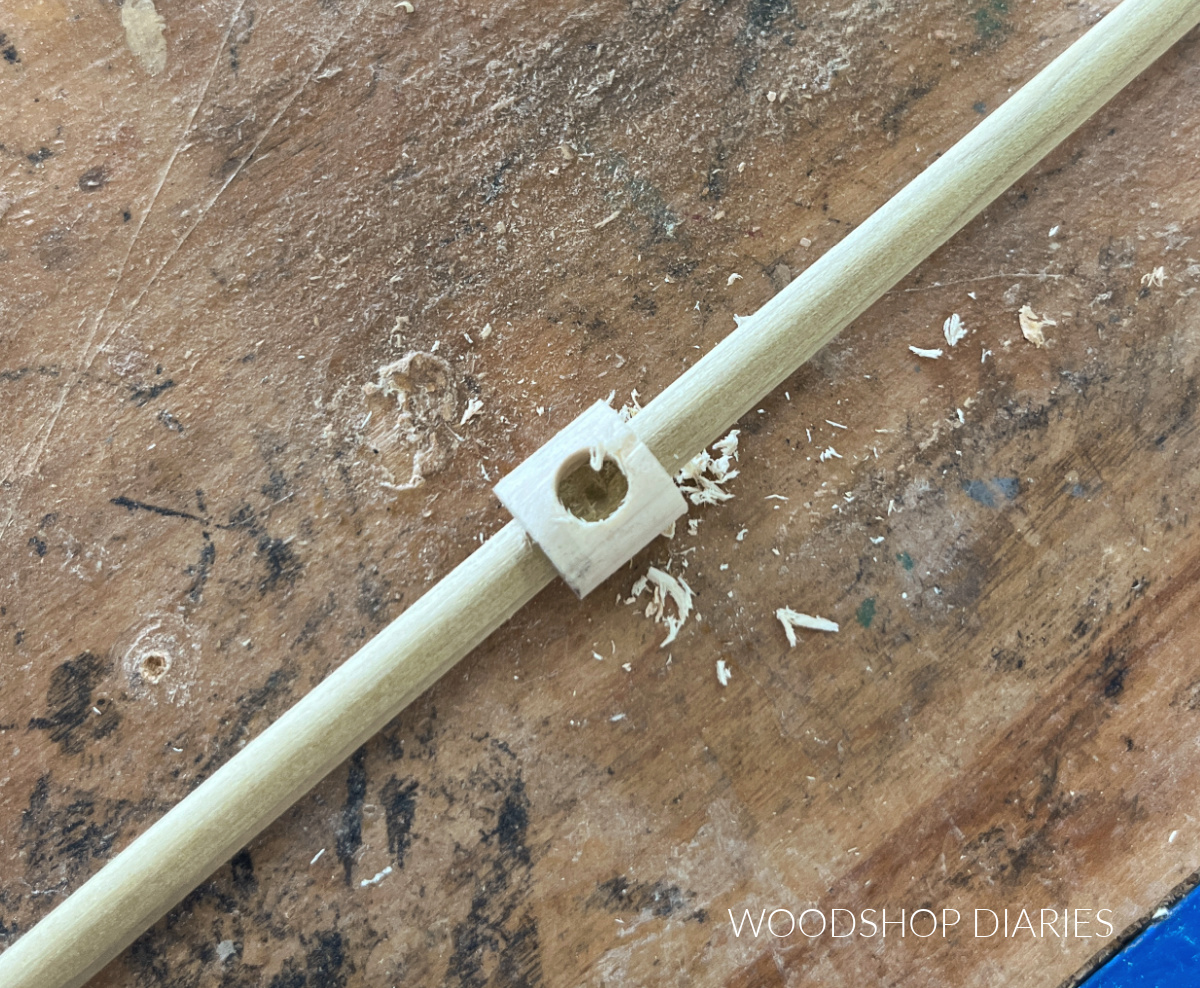
¼" hole drilled into ½" dowel support on gallery railing

I glued the 1″ long ¼″ dowels into these pieces and before allowing to dry, I made sure they looked straight and square.
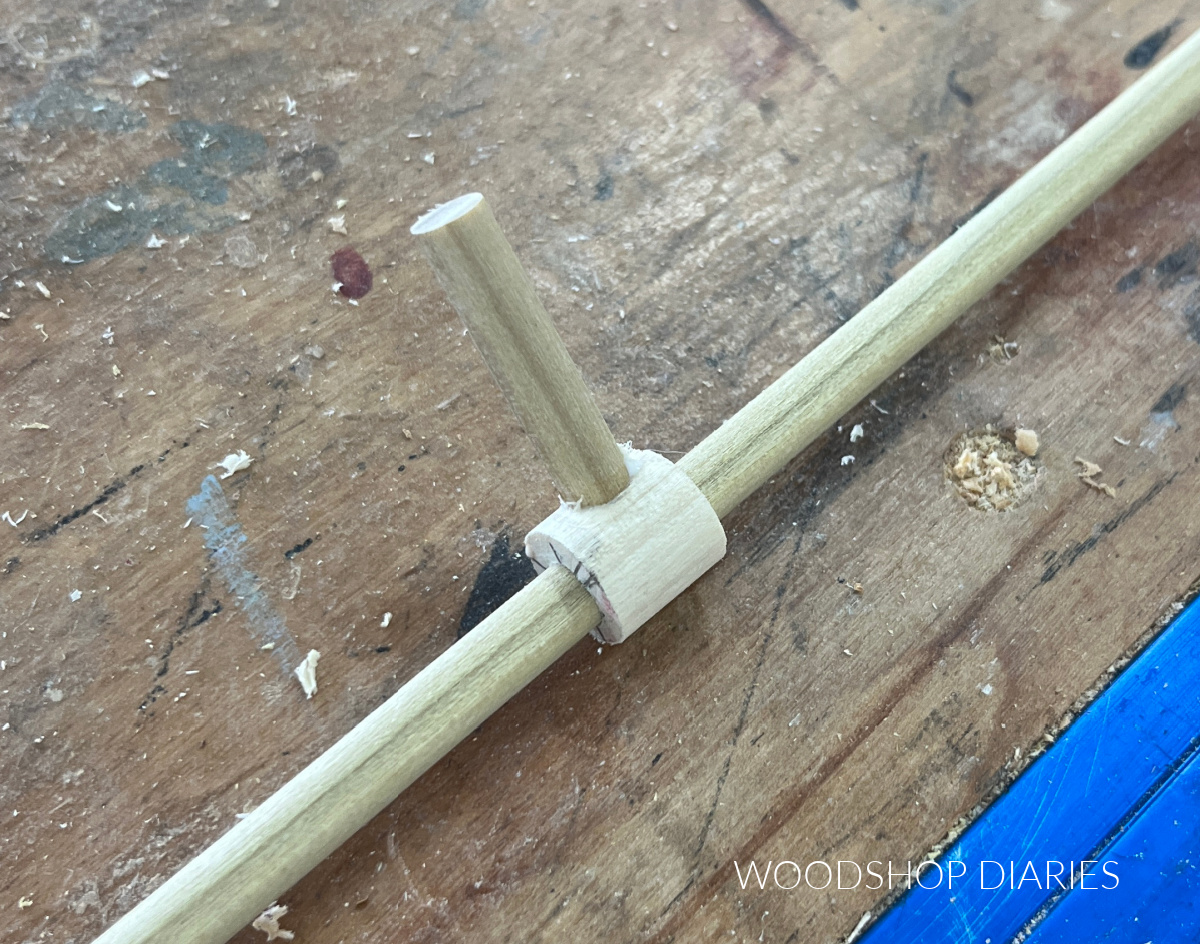
peg glued into ½" dowel

The balls on the end aren’t glued, so they can be moved/adjusted for alignment as needed (this is intentional). But since these middle pieces are glued, it’s important to make sure they’re aligned before letting them dry.

Eyeball down the rail to see if they line up with each other and adjust if needed.

Step 4: Paint Rails

Once the glue had dried on the pegs, I took these out to spray paint them with metallic spray paint. Make sure to cover them well.
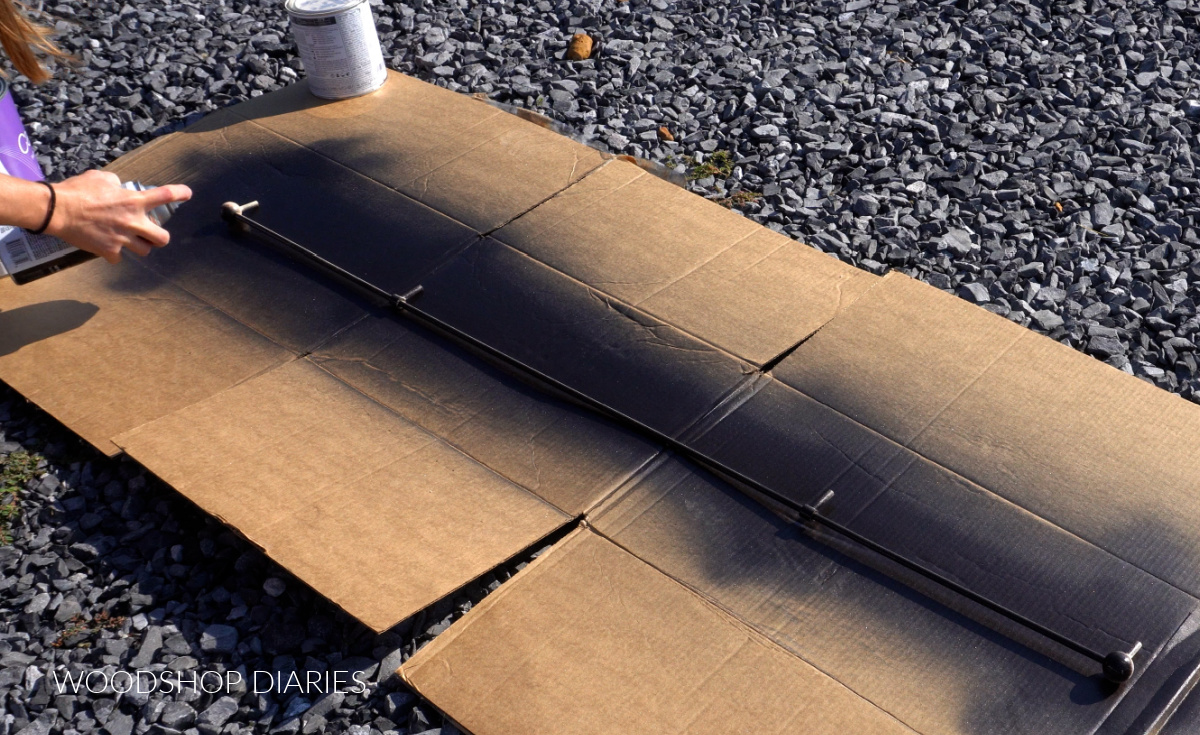
Shara Woodshop Diaries spray painting handmade shelf rail on cardboard with metallic spray paint

Feel free to choose a color that compliments your project–rose gold, brass, oil rubbed bronze. There are a lot of metallic paint options, so get creative!

Step 5: Install Gallery Rails to Shelf

Once the paint had dried, all that’s left is installing them to the actual bookcase!

I recommend laying the bookcase on it’s back for this part to make things easier to measure and lay out.

I measured out where I wanted the railings to go. Really, this was just a matter of deciding how far above the shelves I wanted them to be. I settled on about 2″ above each shelf.
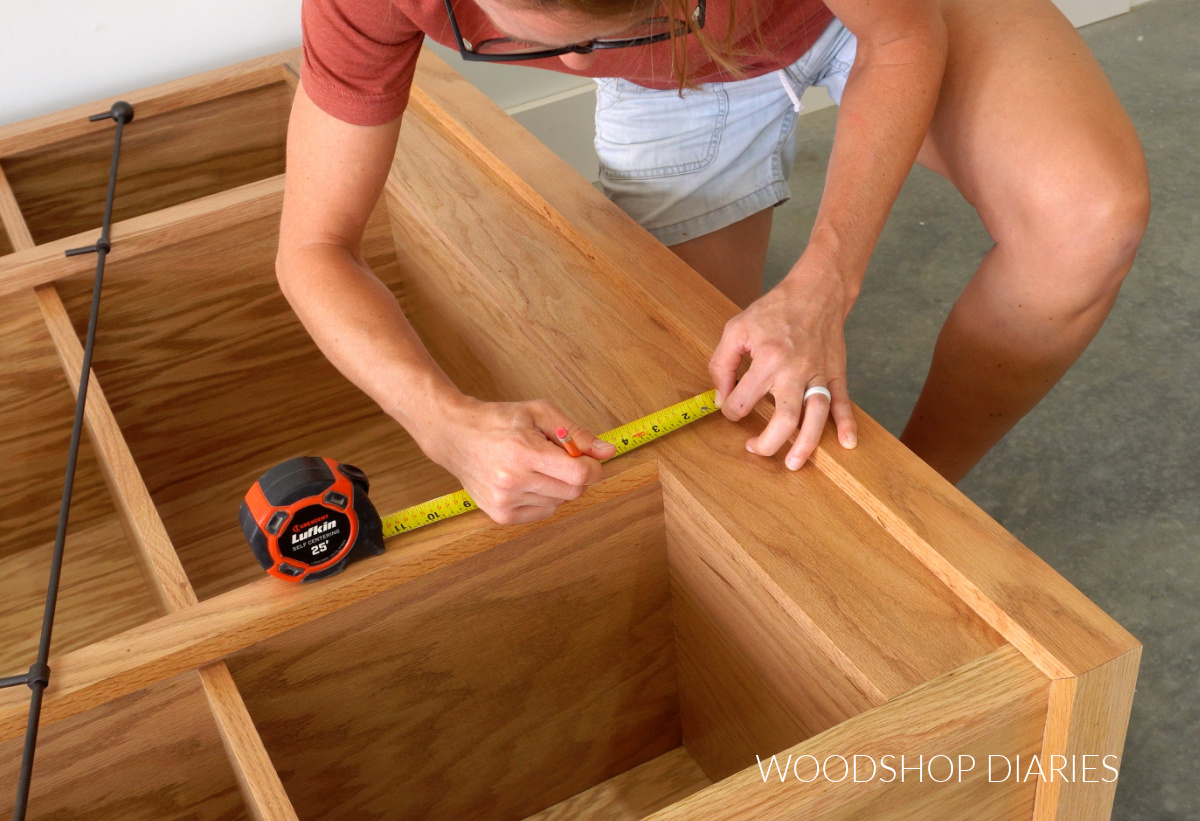
Shara Woodshop Diaries marking where to drill holes on bookcase to install gallery railing

So I measured from the bottom of the bookcase and marked where 2″ above each shelf would be on the center of each vertical face frame piece.

After I made my marks, I placed the railing across them to make sure the pegs did in fact line up with the marks.
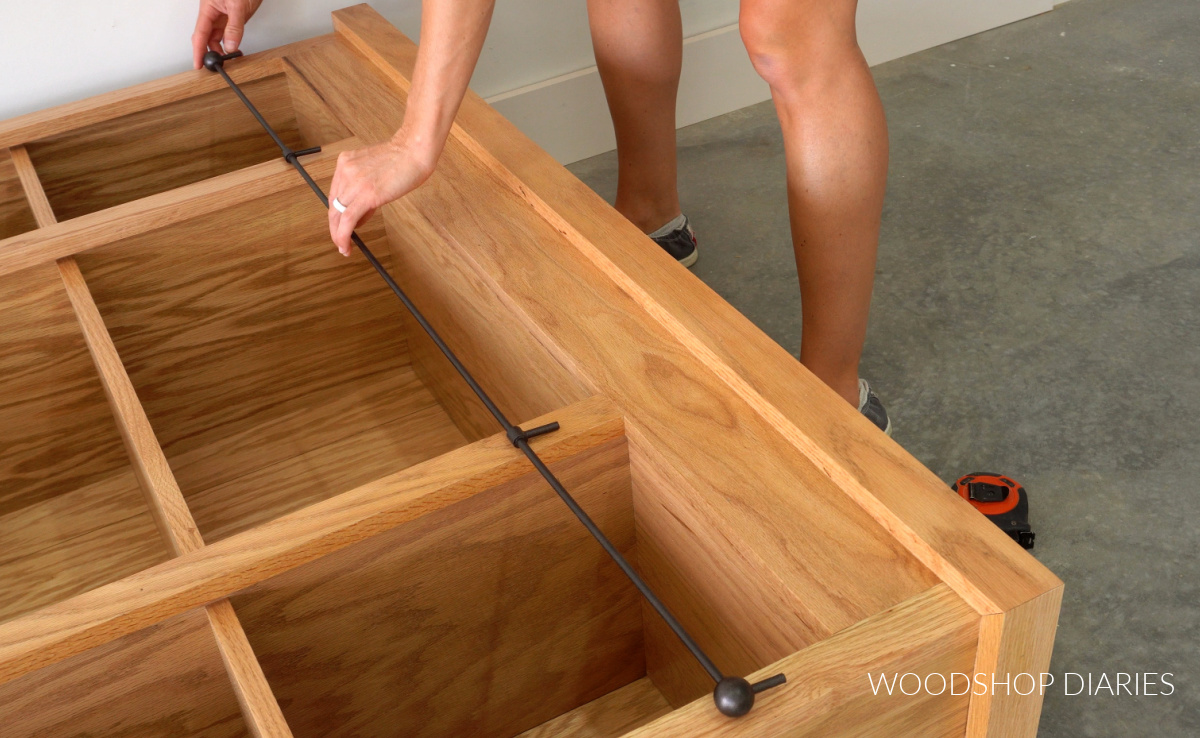
Shara Woodshop Diaries making sure railing lines up with marked holes on bookcase

Once I made sure everything lined up, I drilled holes (again with my ¼″ forstner bit) about ¼″ deep at each mark.
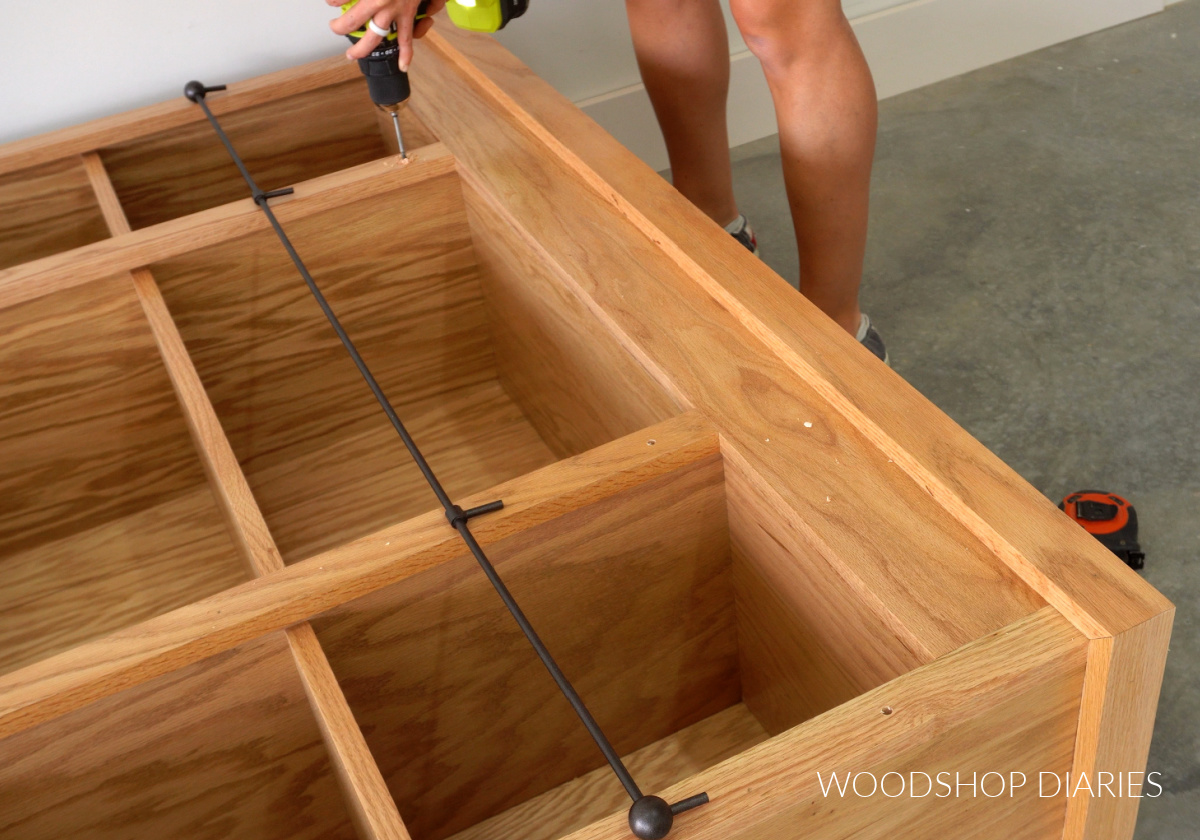
Drilling holes in bookcase to install shelf railing

Then I used a rubber mallet to carefully tap the back pegs into the holes. I didn’t use wood glue here. It’s a pretty snug fit, so I don’t think it’s needed.
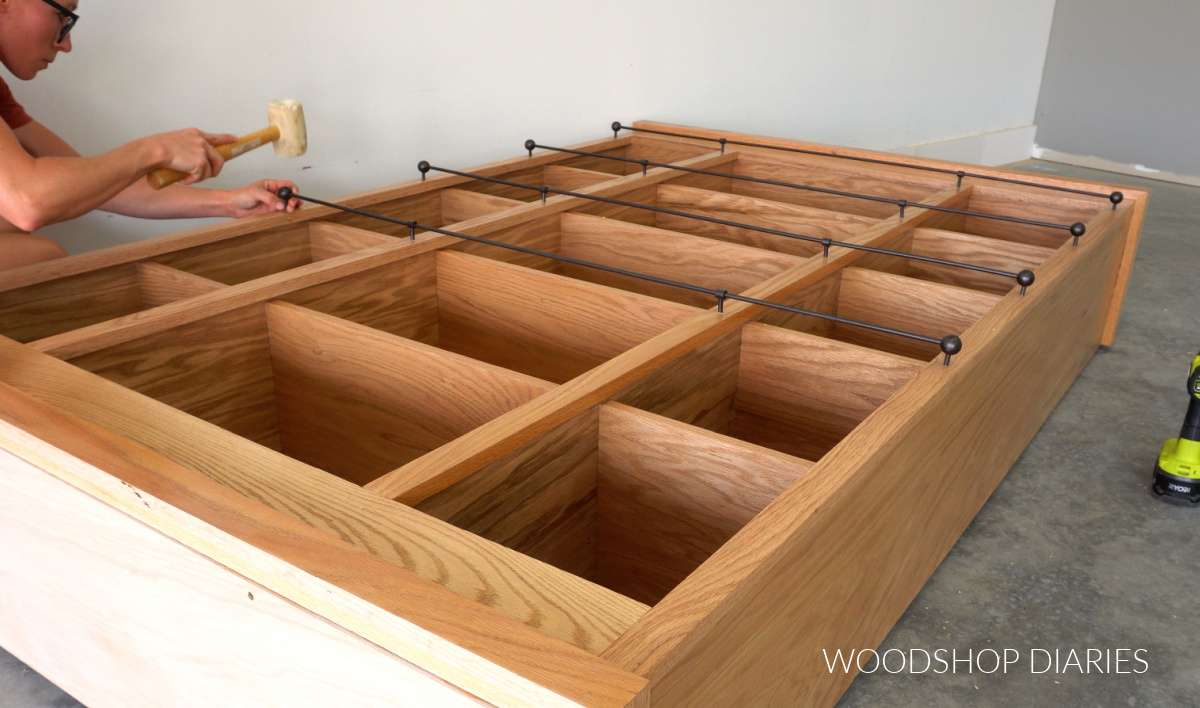
Shara Woodshop Diaries using a rubber mallet to tap DIY shelf railing into bookcase

Not gluing allows me to to be able to remove them later if needed to repair/replace if one gets broken, if I change my mind and don’t want them anymore, or if I decide to spray paint them a different color.

Once the last rail was in place, I flipped it back up and was impressed to see how realistic it looked!
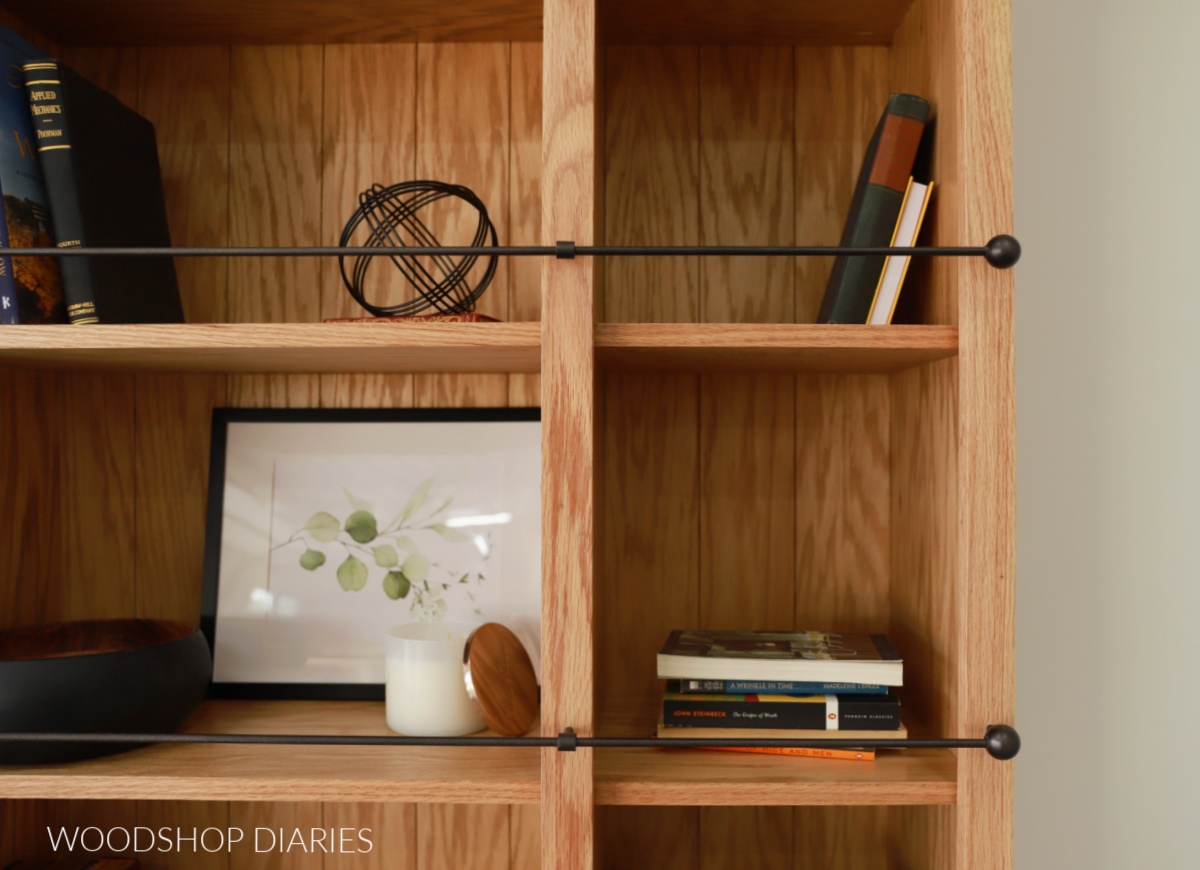
Close up of wooden bookcase with black metallic shelf railing along the front

So many people have told me they can’t believe it’s wood–it looks just like the fancy, expensive metal railings you see online. But it cost SO much less!
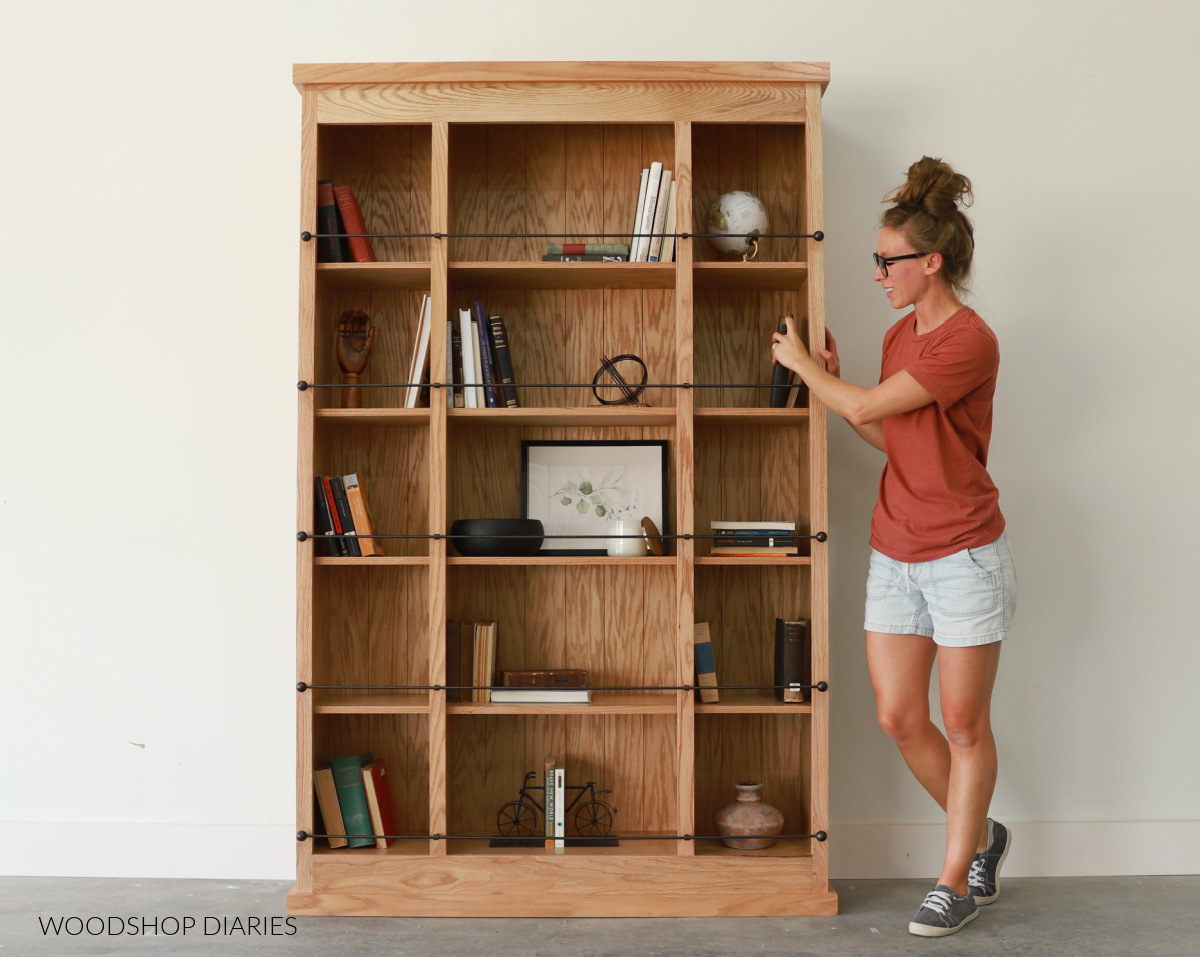
Shara Woodshop Diaries standing next to bookcase with shelf railing across five shelves

While this was installed on a bookcase, it would work well on wall shelves, too! You can turn the pegs down and install them in the top of a wall shelf, or add them to a bookshelf that way instead of across the front.
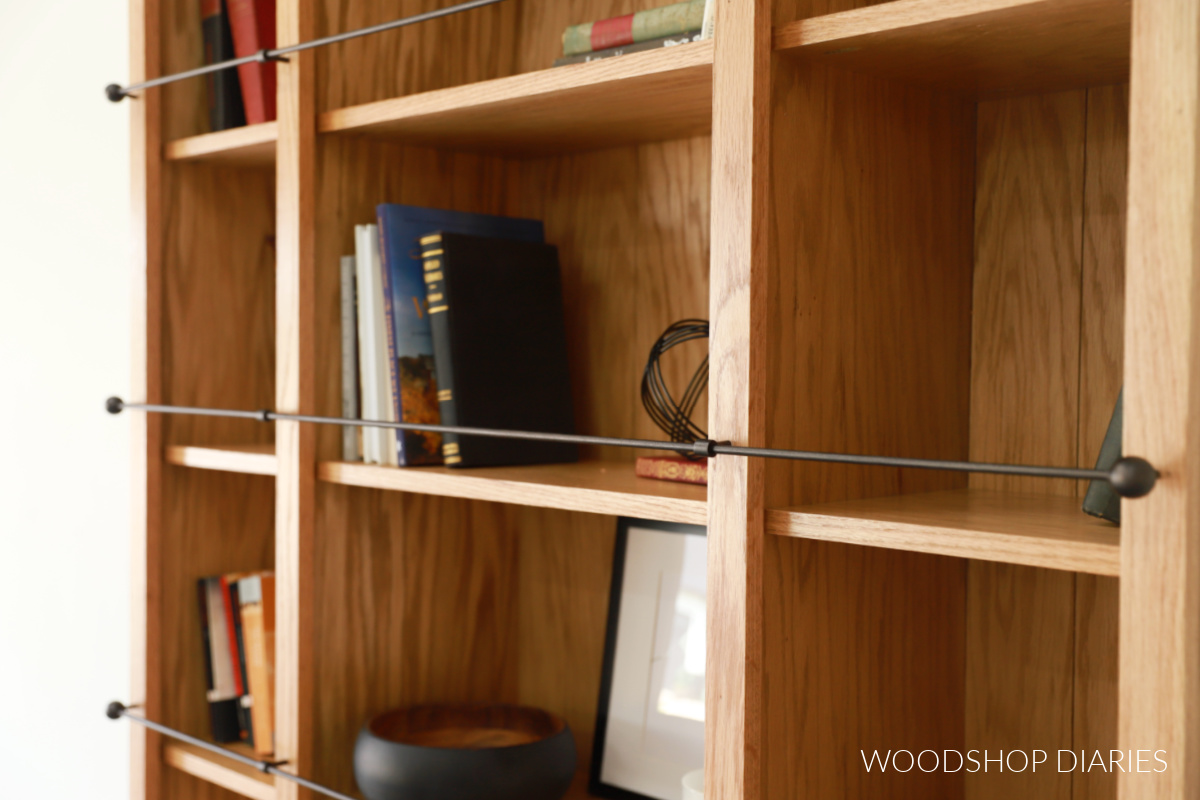
Close up of gallery railing above shelf in bookcase--railing in front of books

I hope this gives you some ideas and inspiration to try on your next shelving project!
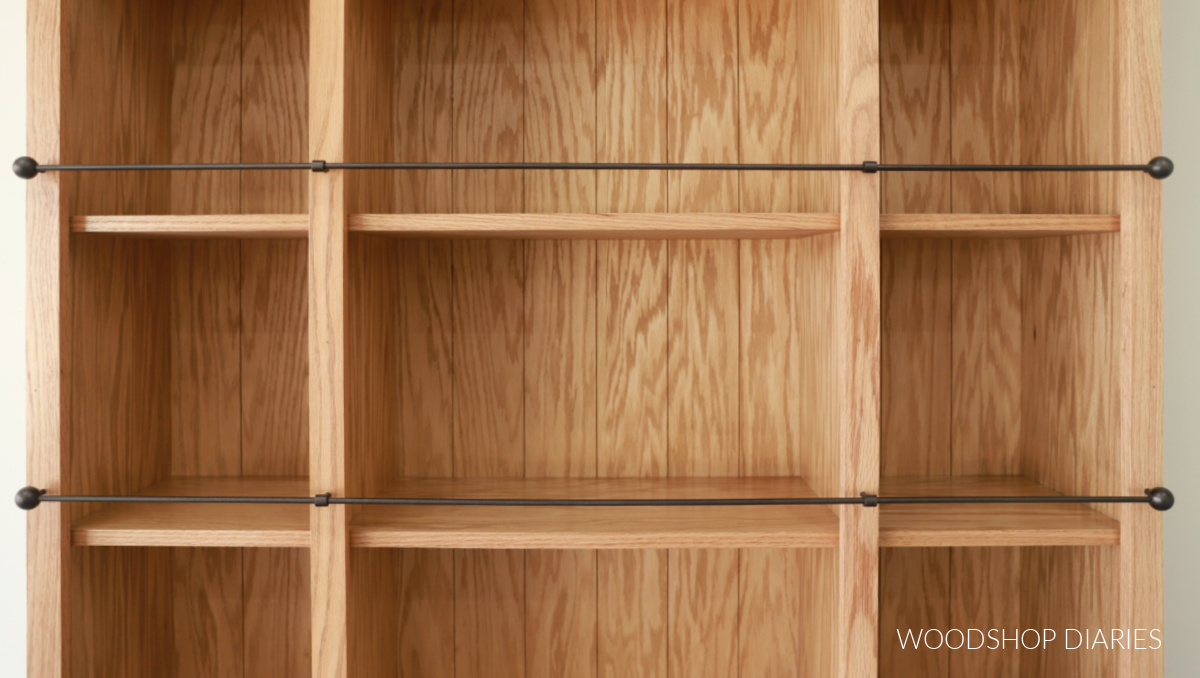
Empty bookshelf with gallery rails running in front of shelves

Looking for more DIY shelving projects?

Looking for some unique shelving ideas? Each of these projects are unique in their own way and are easy to build. Click on the images below to see how to build each one.
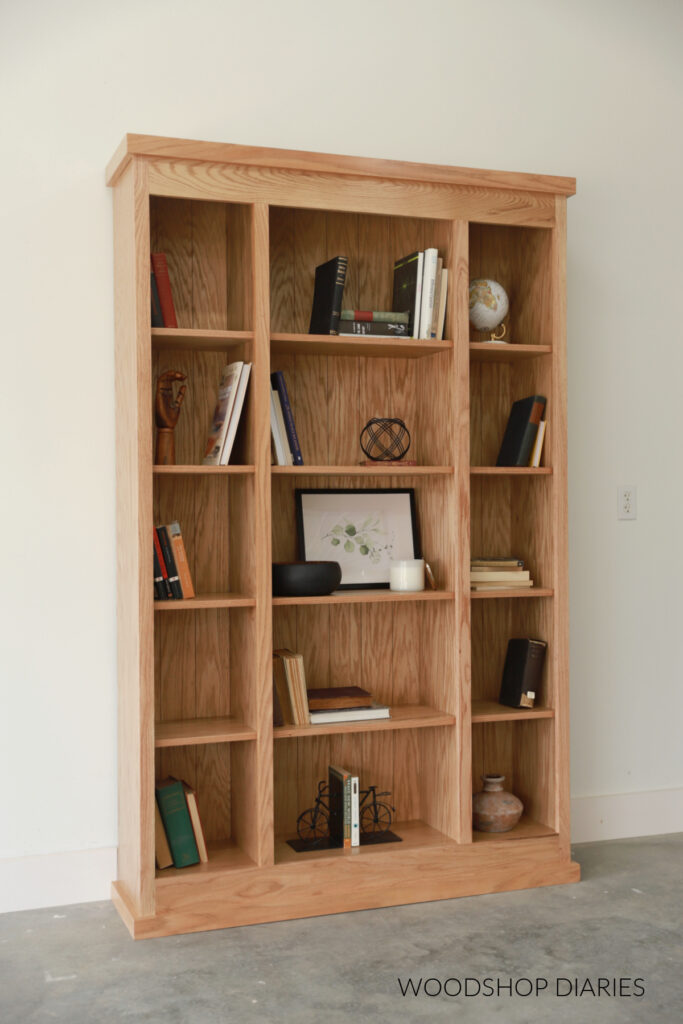
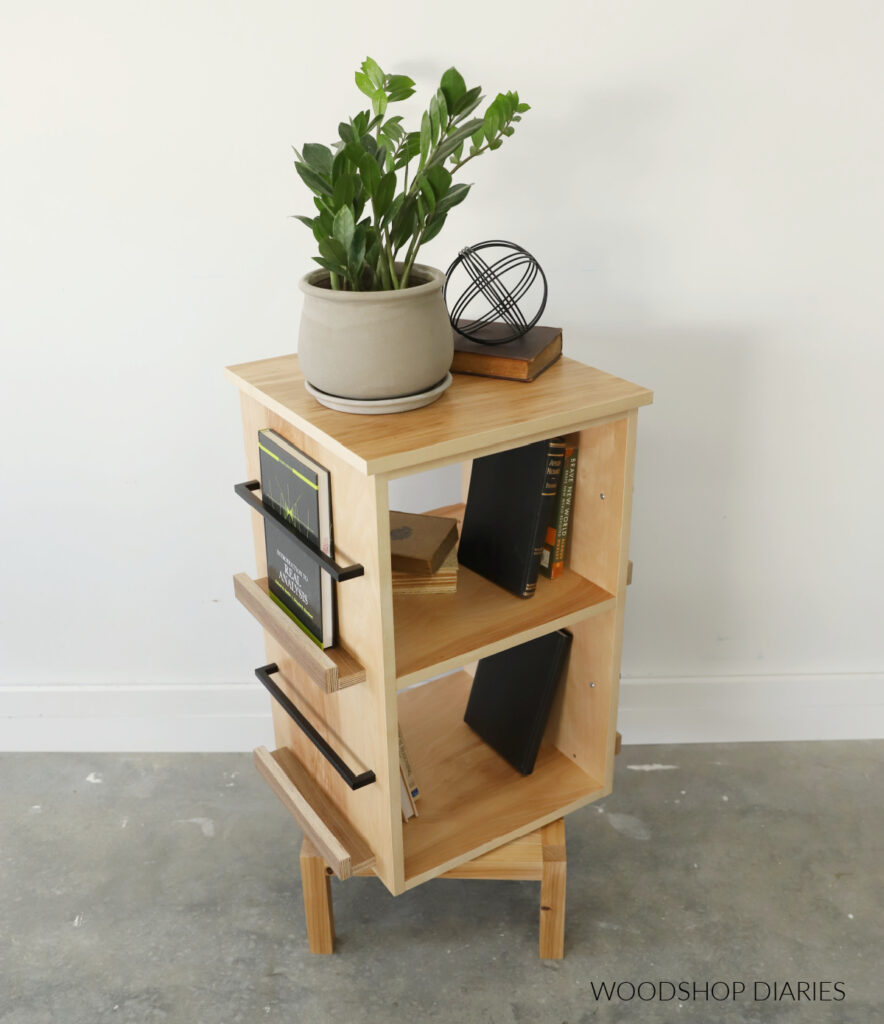
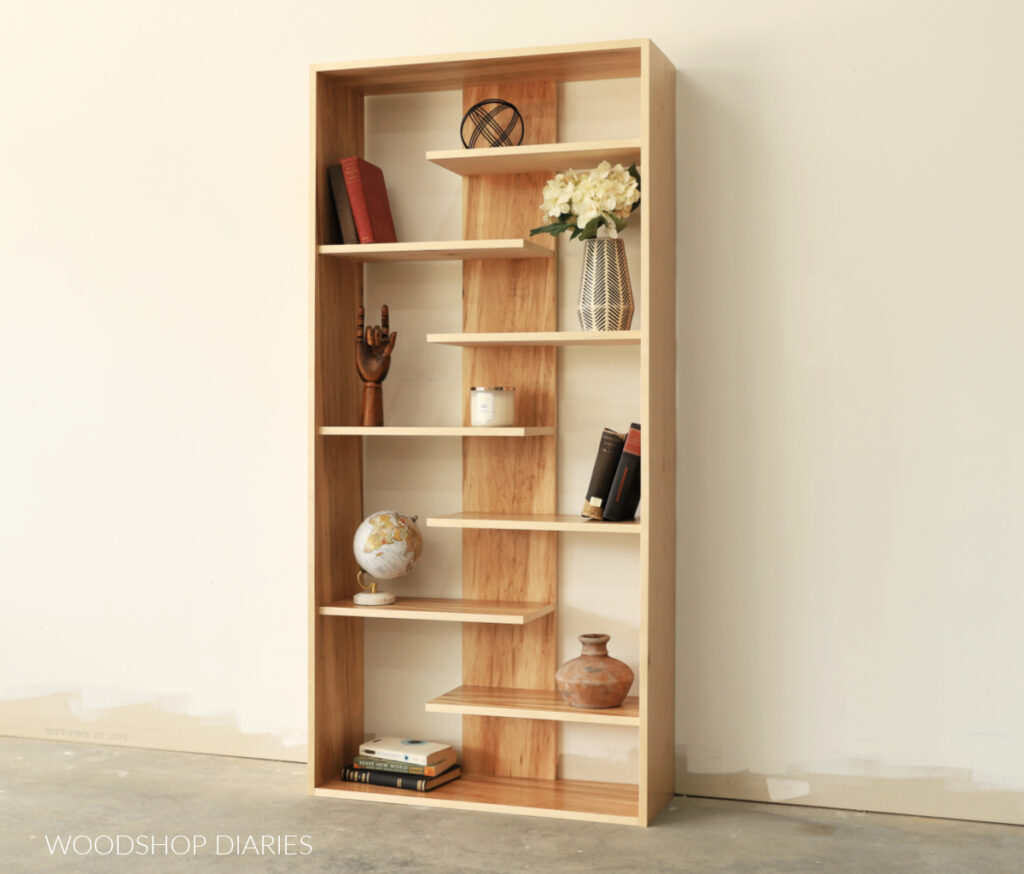
DIY Classic Bookcase
DIY Rotating Bookshelf
Modern Plywood Shelf
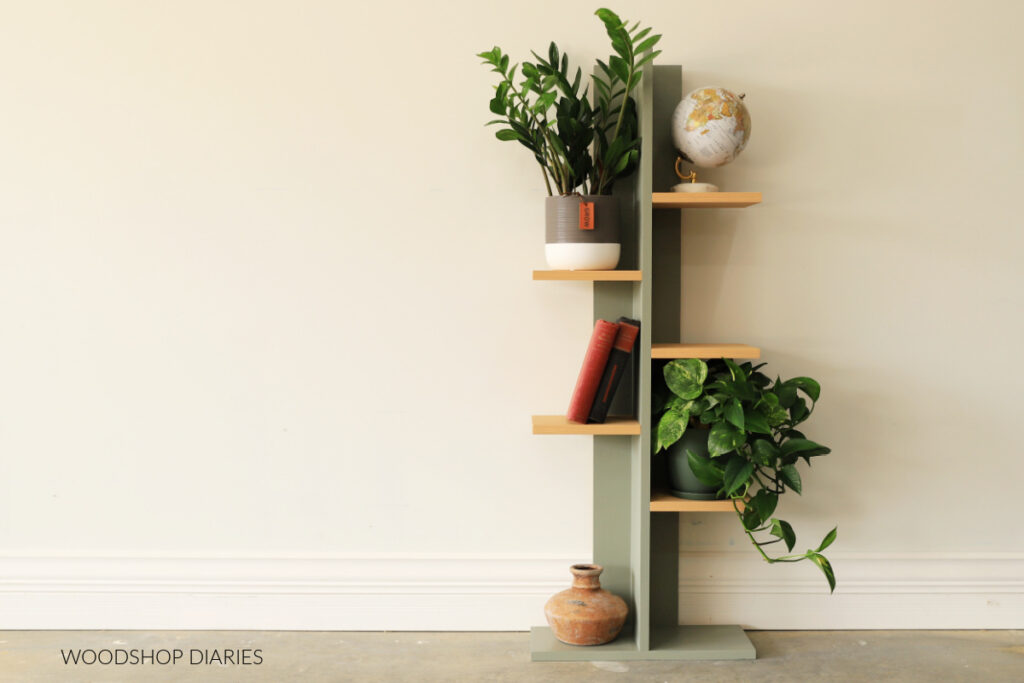
DIY Plant Shelf
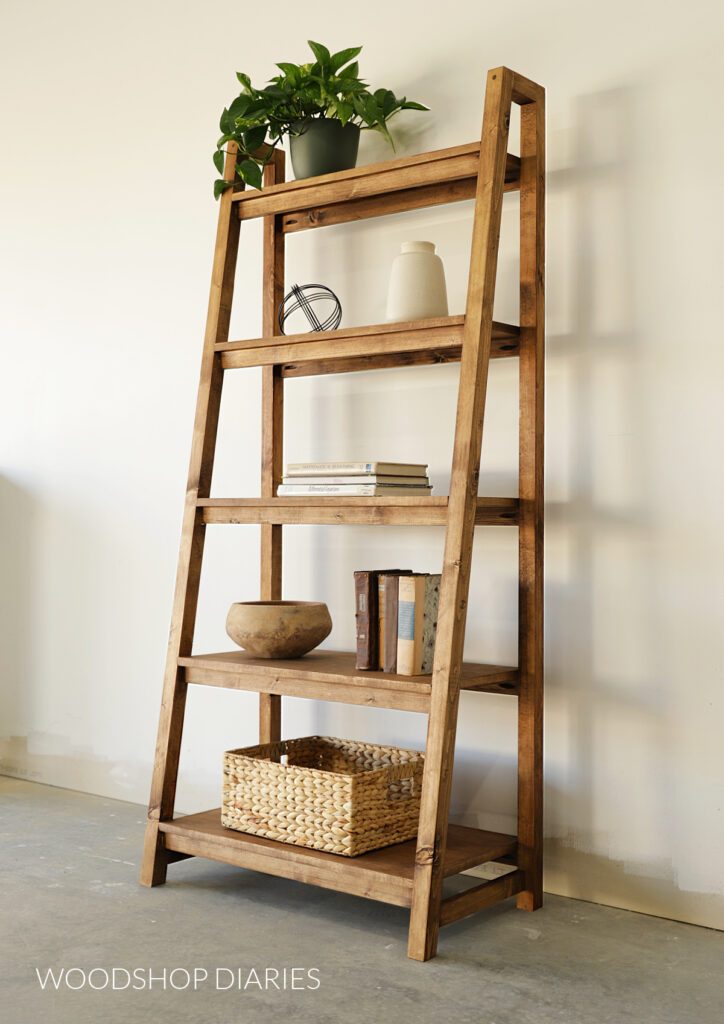
DIY Ladder Bookshelf
Geometric Bookshelf

Enjoyed this DIY gallery rail hack and want to save it for later? Be sure to pin it or share it to your favorite social channel!
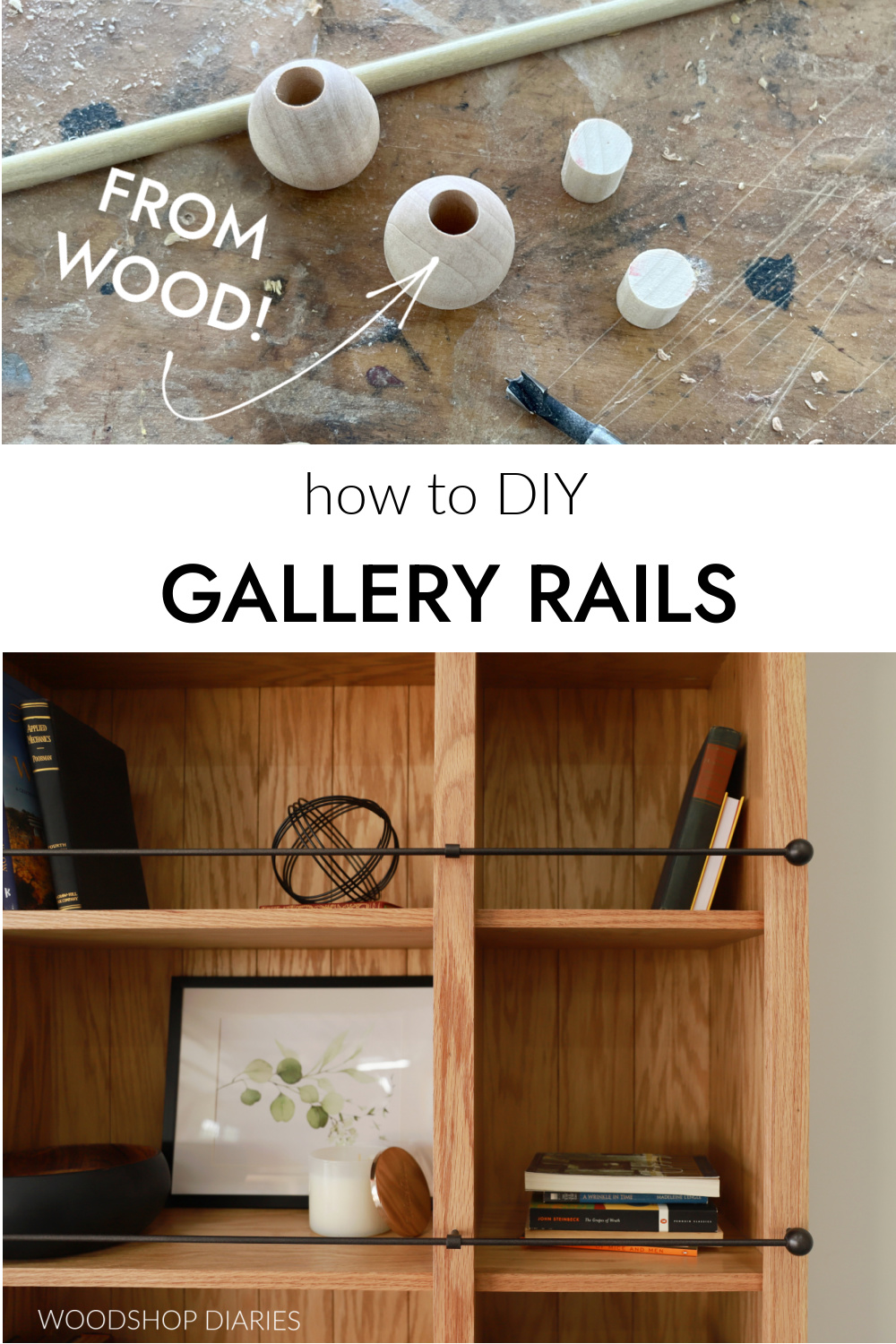
Pinterest collage image showing wood balls and dowels at top and completed gallery rail at bottom with text "how to DIY gallery rails from wood"

Until next time, friend, happy building!

How to Build a Classic Bookcase

August 23, 2024 by Shara, Woodshop Diaries

In this post, I’ll share how you can build a classic style bookcase using basic tools and materials.

This simple, modern bookshelf is the same exact style so many furniture stores are selling for thousands of dollars. You know the ones…

Finished red oak bookcase with books and decor on shelves

But what if I told you that you can build it for a fraction of that cost? (Seriously, like $300 vs $4000.)

How impressed will your guests be when they come over and ask where you bought that classy piece? And you tell them “oh, that old thing? I MADE it!” *wink wink*

If you’re ready to get building, let’s dive in. I’ve got all the details for you below.

*This post contains affiliate links. See website policies.

What to know before building

This easy to build DIY bookcase comes together quickly and is a great option for a weekend woodworking project.

Despite it’s simplicity, the result is a sturdy heirloom piece that is solid, strong and stylish enough for any room of the house.

Material Choices

I made this bookcase using solid red oak and red oak plywood. However, pretty much any wood type you’d like to use here would work just fine.

Close up look at a piece of red oak lumber

Oak tends to be a bit pricey depending on your location, but pine and birch plywood make a nice combination that’s a little more budget friendly.

Either way, I recommend using cabinet grade plywood for best results. Learn how to choose the best plywood for your project here.

DIY Bookcase Shelving Options

The shelves in this bookcase are stationary–as in, they are screwed in, so you can’t adjust them once they’re installed.

Close up of bookcase with stationary shelves

If you’d prefer to have adjustable shelves, this is an easy modification. Instead of screwing the shelves in using pocket holes, just drill shelf pin holes into the bookcase and cut the shelves about ¼″ smaller than the width of the openings.

Then, you can use shelf pins to install them wherever you’d like. Learn more about how to install adjustable shelves here.

Faking a Shiplap Back Panel

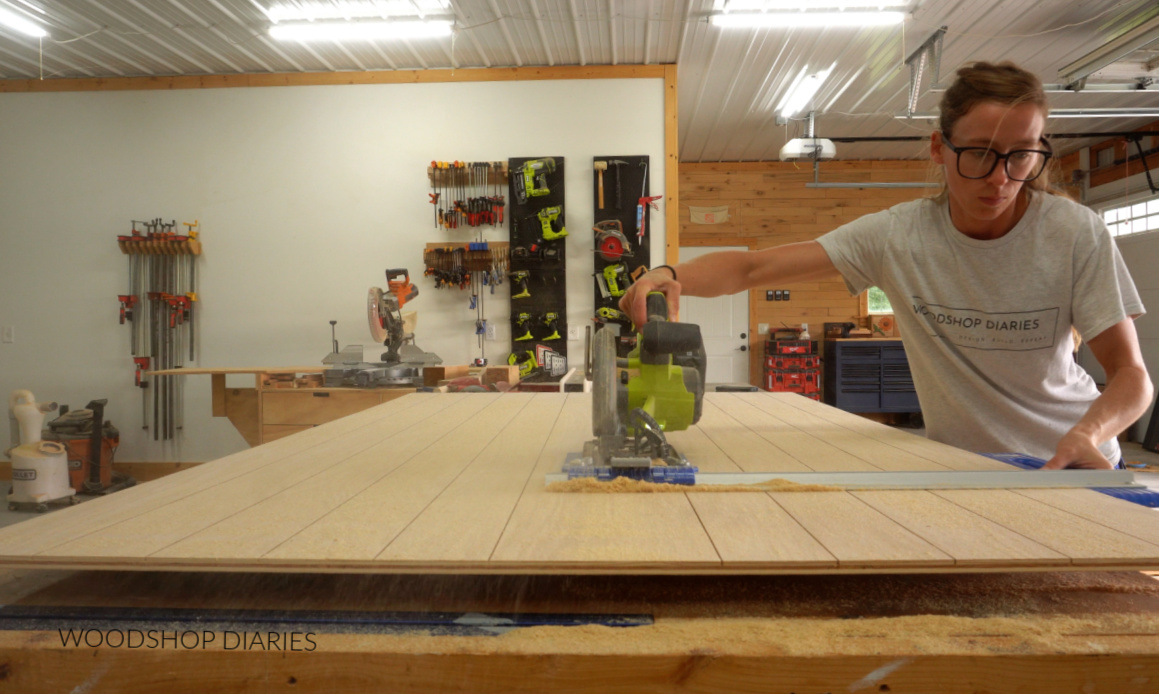
The back panel of this bookshelf is simply a piece of ½″ plywood. For some added detail, I cut shallow dadoes along the panel to “fake” a shiplap pattern.

This is totally optional, but was super easy using my circular saw and Kreg Rip Cut. Check out the build video here to see it in action.

Shara Woodshop Diaries cutting shiplap pattern in plywood back panel for DIY bookcase

I basically set my blade depth to about ⅛″, then set my Rip Cut to 4″. I ran the saw through on both sides, then adjusted to 8″ and repeated, then 12″, then 16″, 20″ and 24″.

This gave me “slats” about 4″ wide across my panel. Learn how to set up and use the Kreg Rip Cut here.

If you don’t want to do this, you can definitely skip this step. It’s just an extra decorative detail.

Overall Dimensions

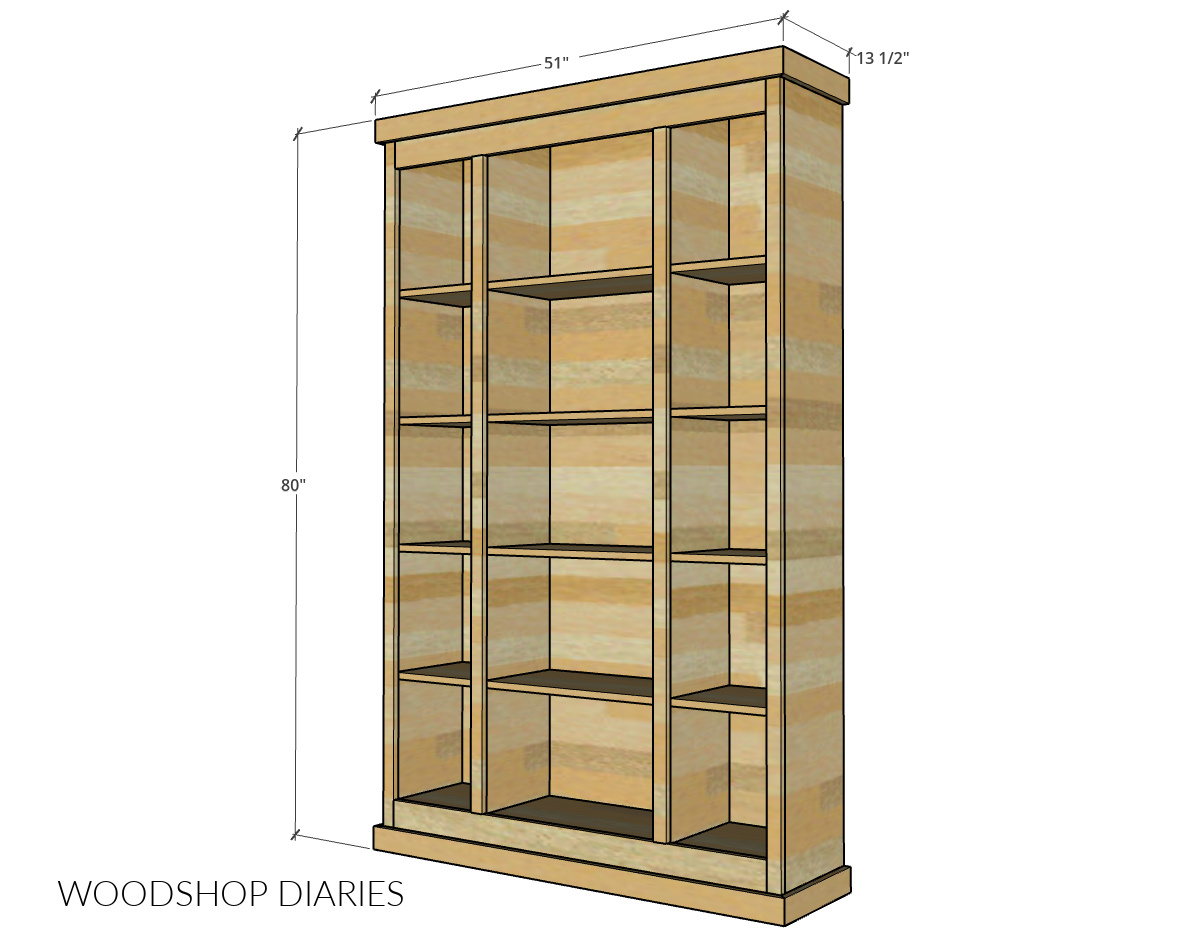
The overall dimensions of this DIY bookcase are approximately 13 ½″ deep x 51″ wide x 80″ tall.

Overall dimensional diagram showing bookcase final dimensions once assembled

Enjoy DIY projects and woodworking plans? Sign up for priority access for the latest posts on Woodshop Diaries!

Helpful Resources for this Project:

You may find the following posts helpful throughout the build:

  • How to cut plywood
  • How to use a pocket hole jig
  • How, when, and why to use the Kreg Micro Jig
  • How to apply edge banding

How to Build a Basic Bookcase

If you prefer to watch, I’ve shared the full build video with tons of tips, behind the scenes, and additional details on my YouTube Channel here.

YouTube thumbnail image for basic bookcase build video

Love watching how-to videos? Subscribe to my YouTube channel for plenty more where that came from!

Prefer to print? Grab the printable bookcase building plans available here:

Tools & Materials

Tools:

  • Drill/Driver
  • Miter Saw
  • Circular Saw
  • Kreg Rip Cut
  • Pocket Hole Jig
  • Brad OR Finish Nailer

Materials:

  • (2) 4×8 sheets ¾″ plywood
  • (1) 4×8 sheet ½″ plywood
  • (4) 1x2x8 boards
  • (2) 1x3x8 boards (optional for trim)
  • (1) 1x6x8 board
  • 1″ pocket hole screws
  • 1 ¼″ pocket hole screws
  • 1 ¼″ wood screws
  • 1 ¼″ long brad or finish nails
  • Wood Glue
  • Edge banding

TIP: Struggling to pick the right screws? Check out this guide to choosing the right screw for your DIY projects.

Step 1: Build the Bookcase Body

To get started, I began cutting down my plywood. You can find the full cut diagram for the plywood sheets in the printable plans.

The sides and top panels are cut from ¾″ plywood and the back panel is cut from ½″ plywood.

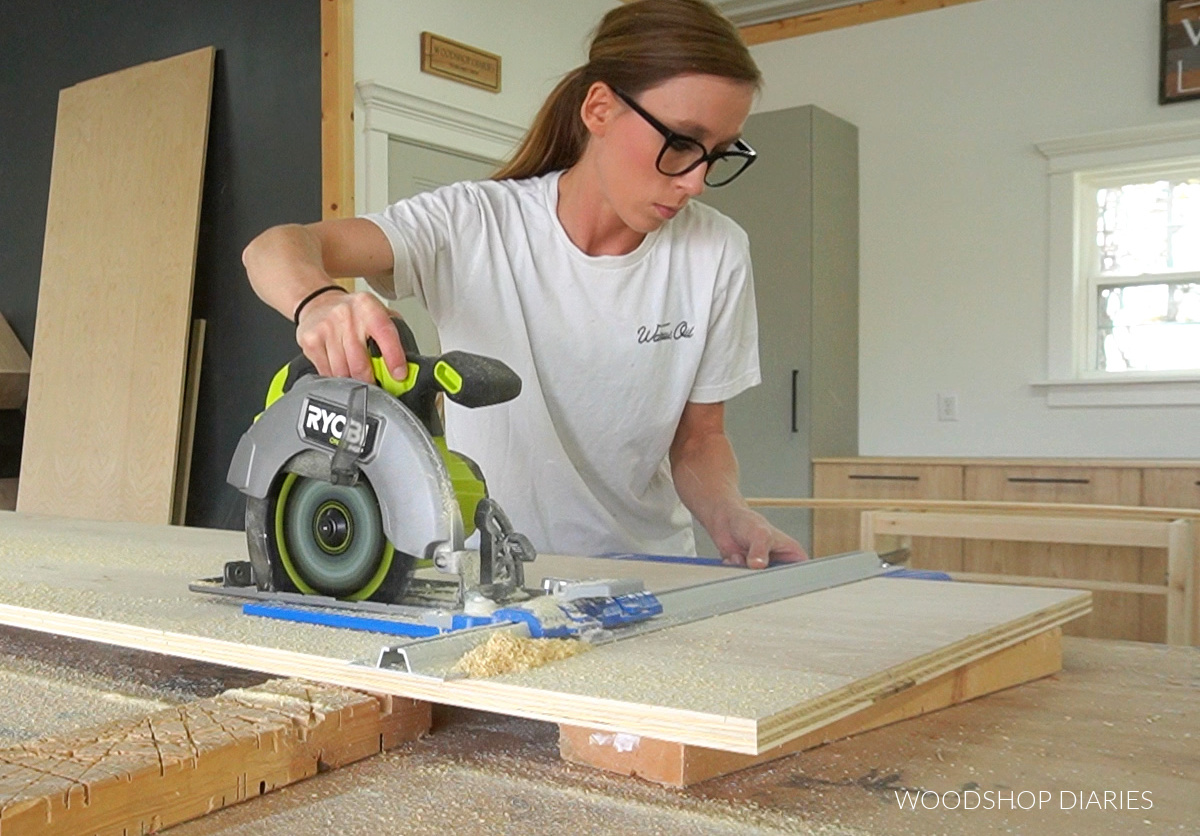
Shara Woodshop Diaries cutting plywood on workbench with circular saw

To save me another cut, I opted to use the full width (48″) of the ½″ plywood sheet for the back, but because I was only making the shelf 80″ tall, I needed to trim its length to 79 ¼″.

I mentioned earlier in the notes above that I cut some dadoes to “fake” a shiplap pattern, but that’s completely optional.

½" plywood panel on workbench with dadoes cut on 4" intervals for faux shiplap back panel

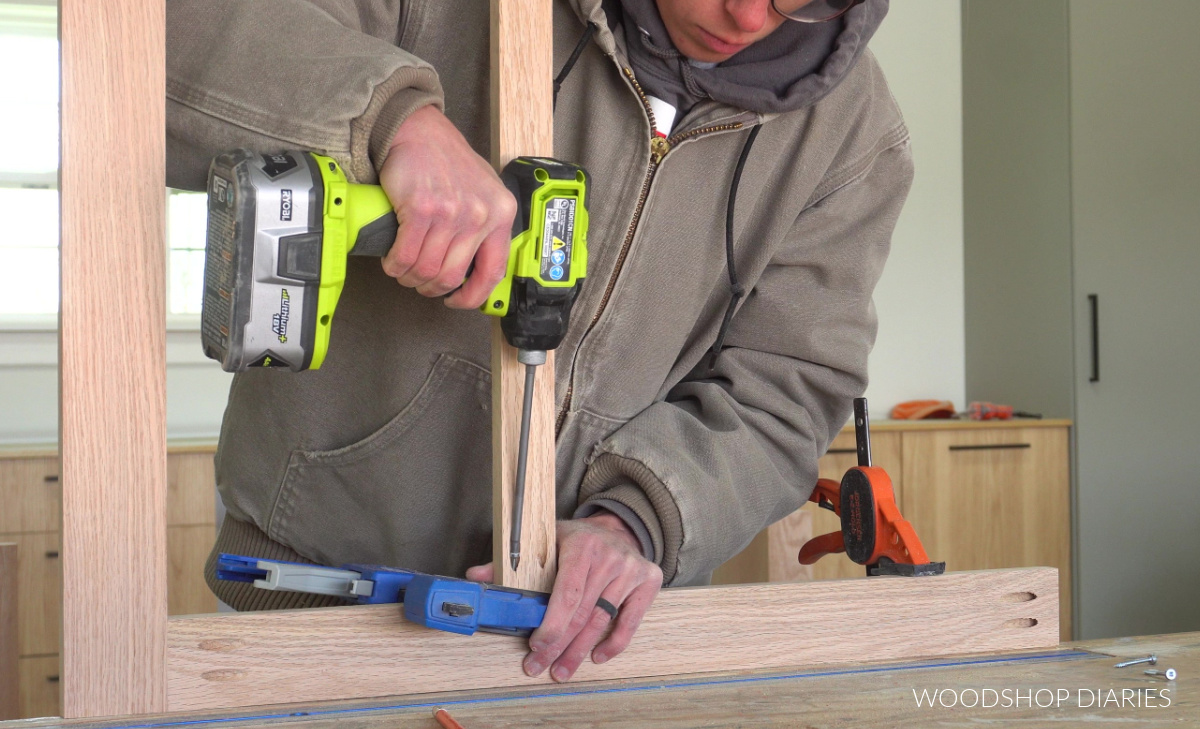
I drilled ¾″ pocket holes into the ends of the top panel and ½″ pocket holes along the sides and top edges of the back panel. (These should be drilled on the back side!)

Shara Woodshop Diaries drilling pocket holes with Kreg Micro Pocket Hole Jig

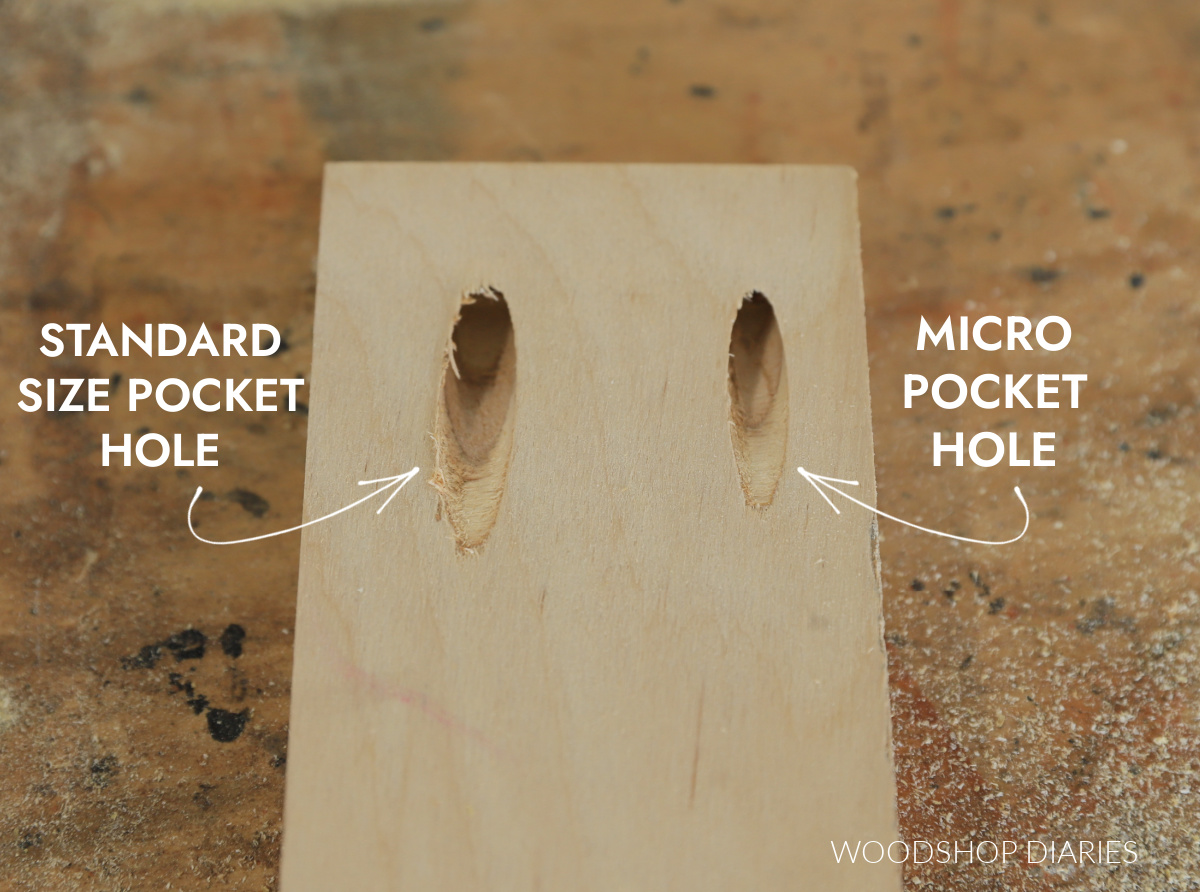
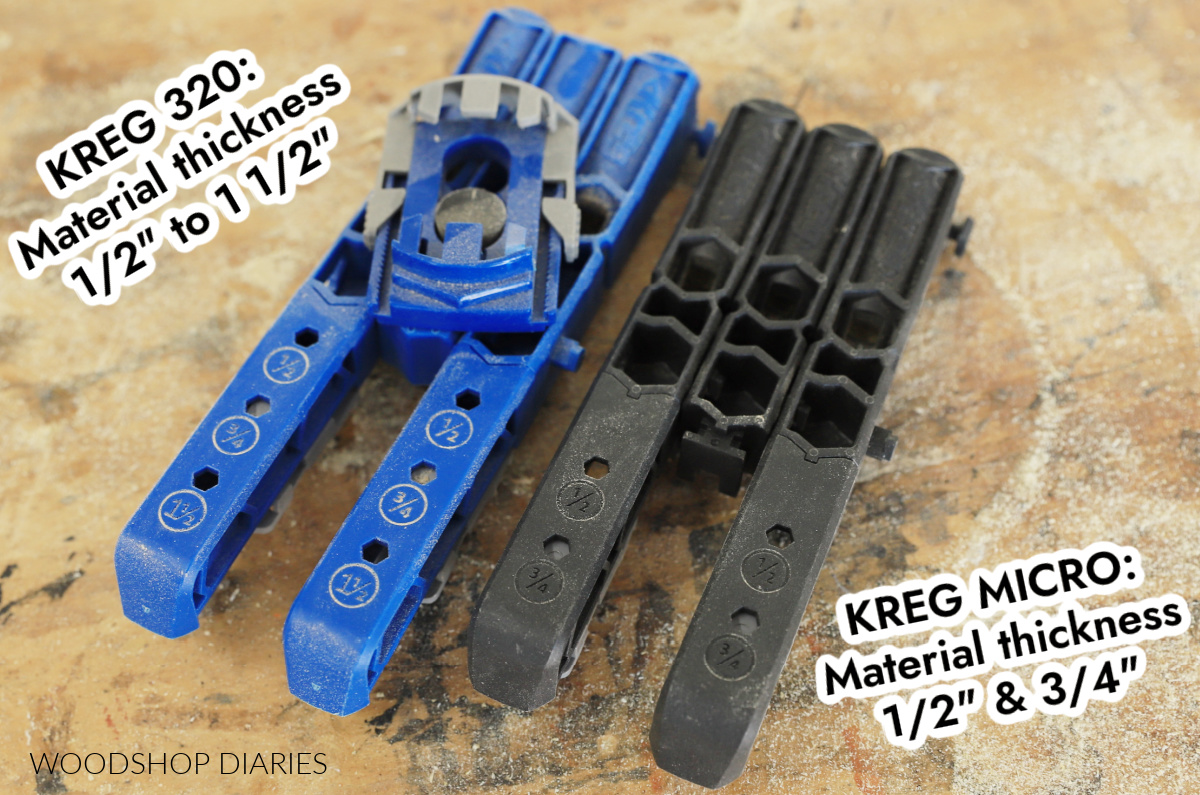
NOTE: You can use a standard size pocket hole jig to drill both ¾″ and ½″ pocket holes. But, I recommend (not require) using the Kreg Micro Pocket Hole Jig for the ½″ material.

This smaller jig is designed for use in thinner material (like ½″ plywood) and makes smaller holes.

RELATED: How, when, and why to use the Kreg Micro Pocket Hole Jig

Then, I assembled the top panel between the sides using 1 ¼″ pocket hole screws.

Shara Woodshop Diaries assembling top panel of bookcase to side panel on workshop floor

And I installed the back panel to the top and sides using 1″ pocket hole screws.

Shara Woodshop Diaries installing back panel of bookcase with pocket hole screws

Step 2: Install Dividers and Bottom Bookshelves

Next, I cut two pieces of ¾″ plywood for the two vertical dividers. These panels will divide the bookcase into three sections.

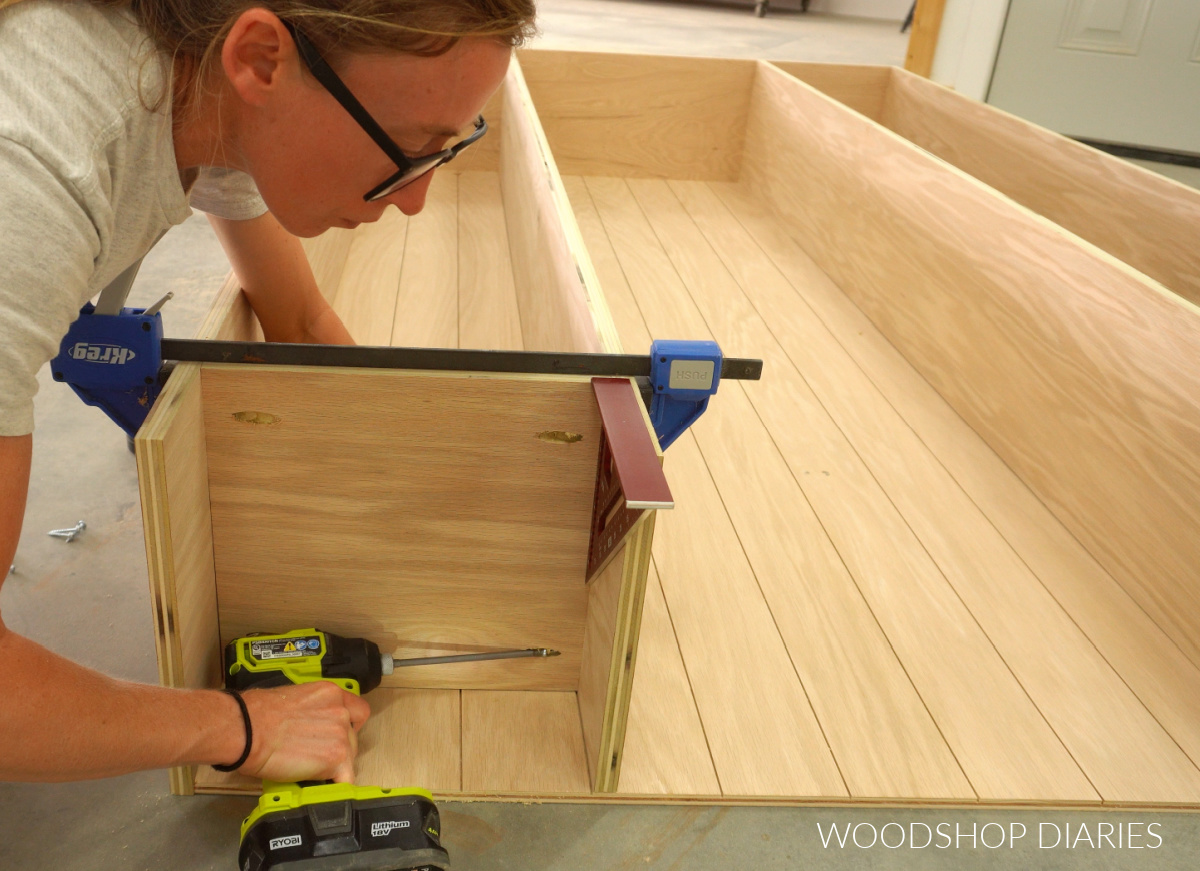
The left and right sections will be 12″ wide, so I cut two 12″ wide shelves and used these as spacers to help me get my dividers installed to the top with wood screws.

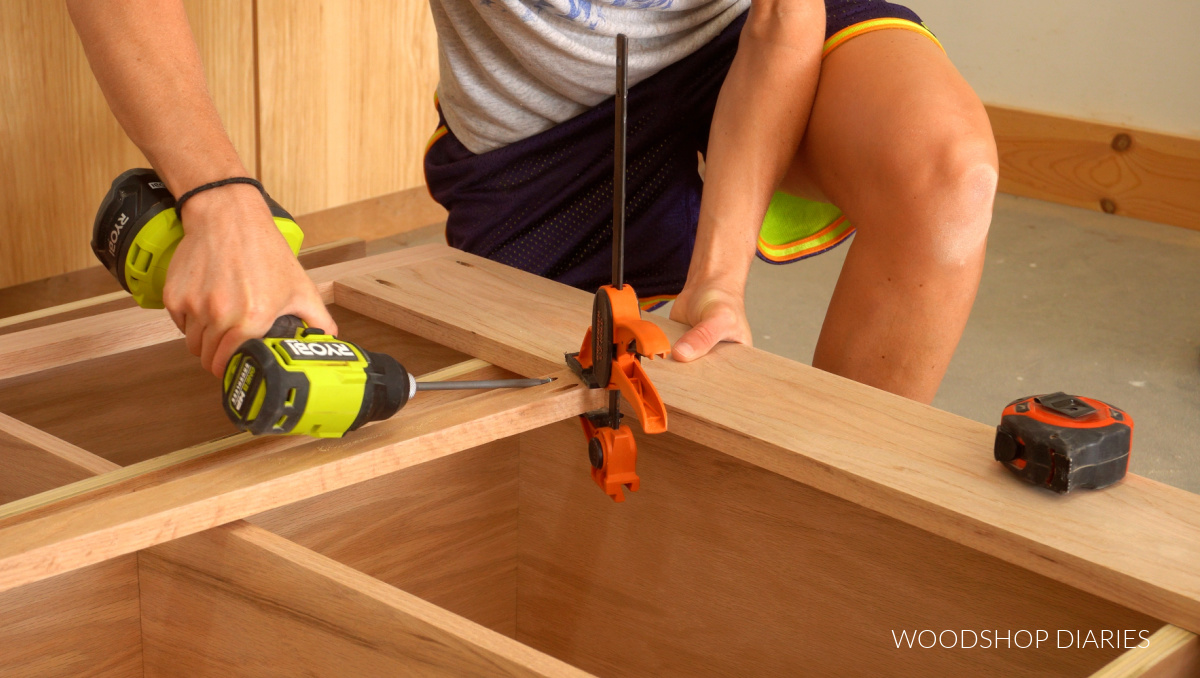
Shara Woodshop Diaries securing bookcase dividers to top panel with screws

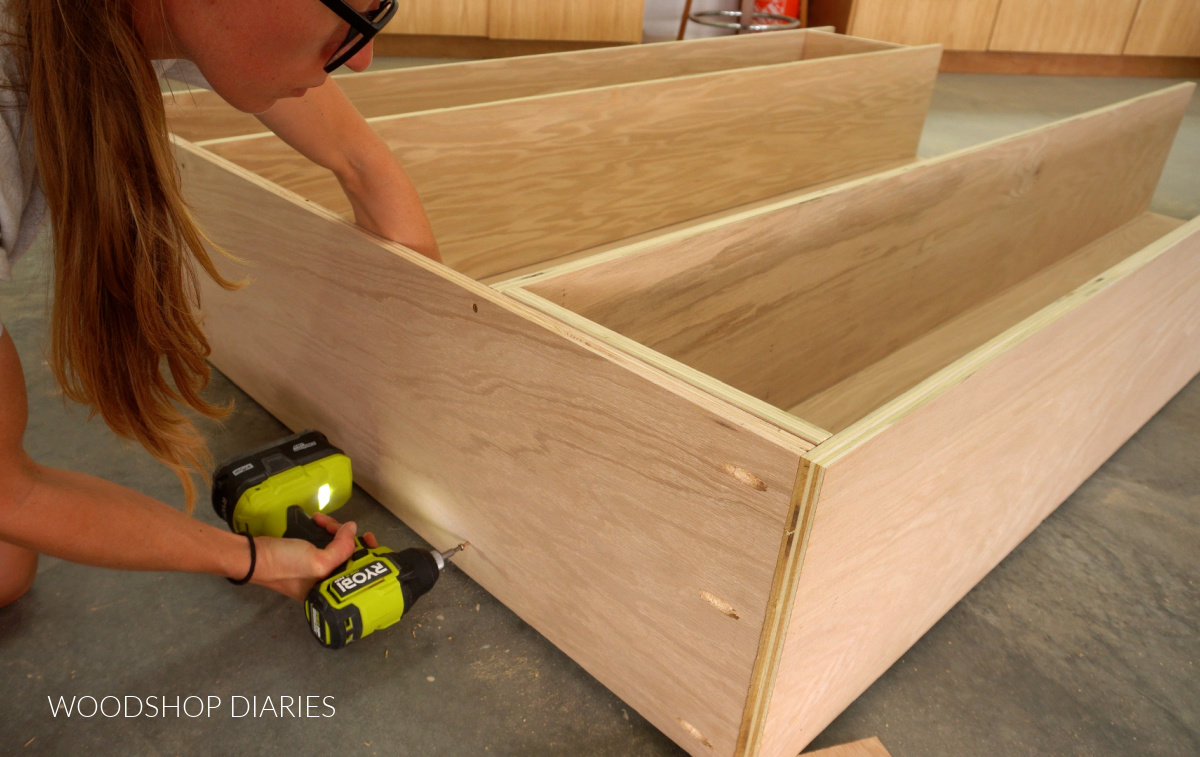
Then, I installed these on each side toward the bottom with pocket holes and screws.

TIP: Use a speed square as you install to help ensure your shelves are square front to back.

Shara Woodshop Diaries driving pocket holes to attach bottom bookshelves to frame

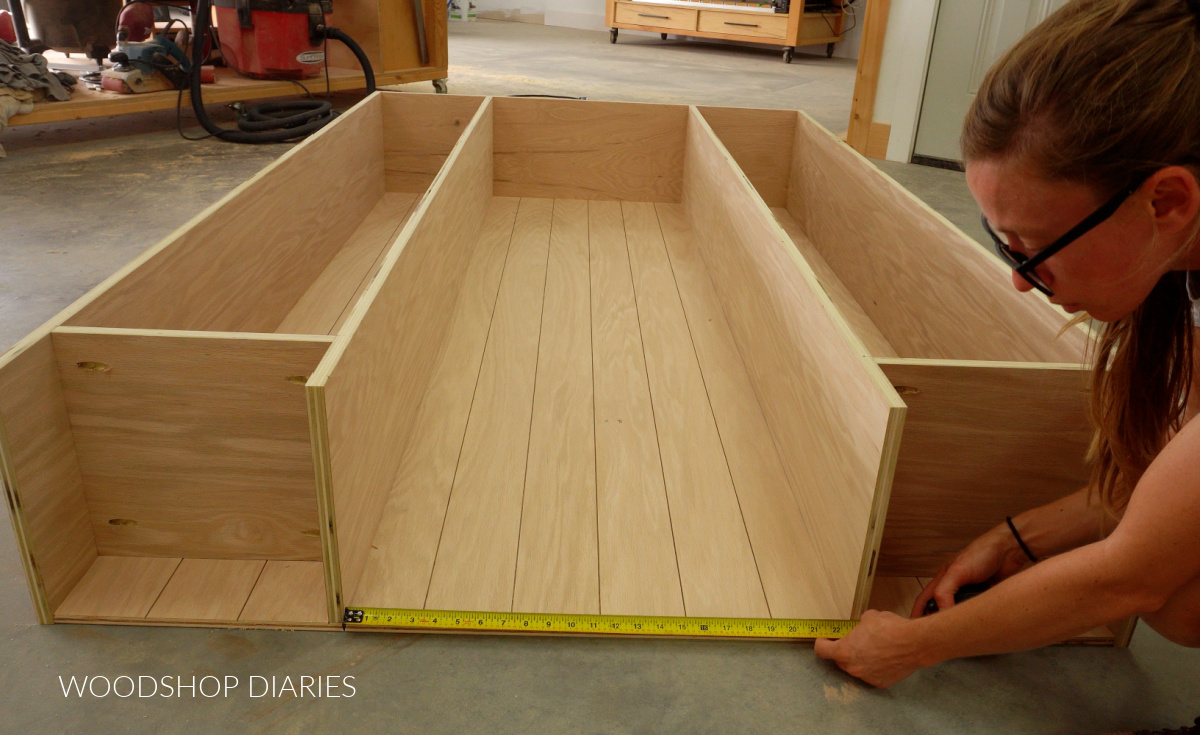
Once I had my left and right bottom shelves in, I measured to cut my middle bottom shelf to fit exactly between the dividers. It’s important here to cut these shelf lengths precisely for a tight fit.

Measuring length to cut middle shelf for bookcase

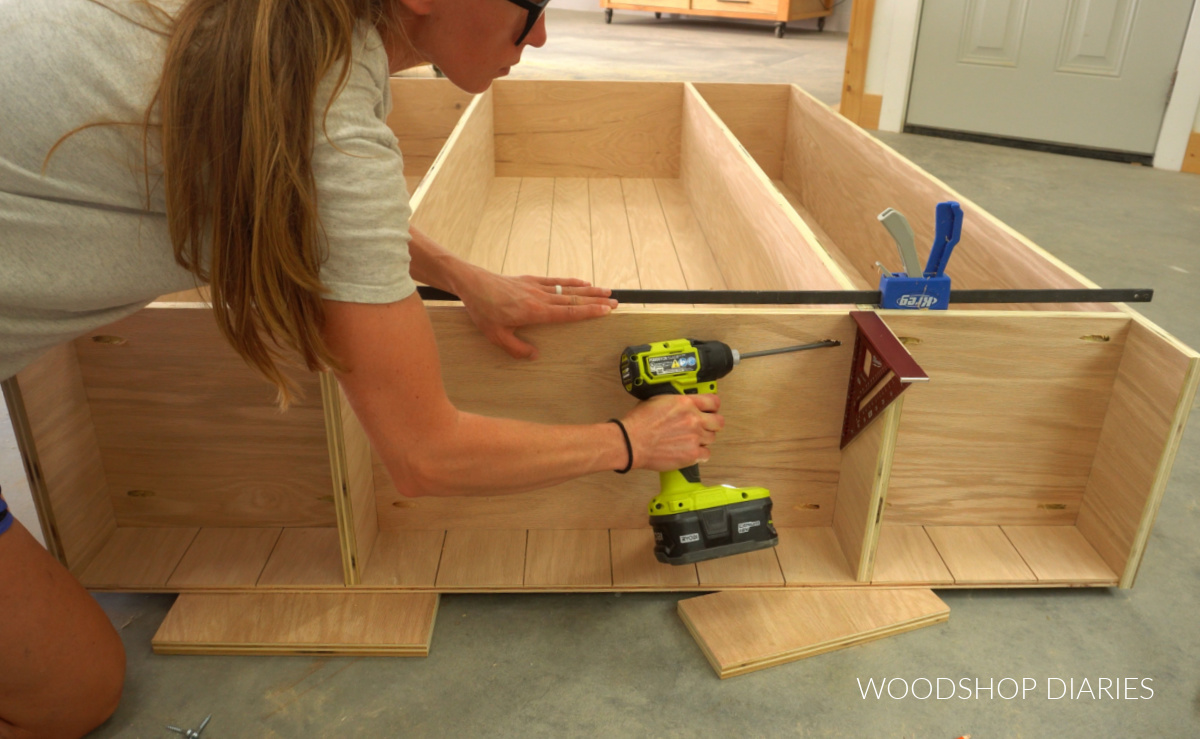
Then, I installed it using pocket holes and screws just like the other two shelves.

NOTE: I am using a 1×6 for the bottom of the face frame in a later step. 1×6 boards are 5 ½″ wide, so I installed these bottom shelves so that the top of them was 5 ¼″ up from the bottom. That way, the 1×6 will cover it and leave a little lip on the front once installed.

RELATED: Understanding lumber sizing

Shara Woodshop Diaries driving screws to attach bottom middle shelf

Step 3: Install Stationary Shelves

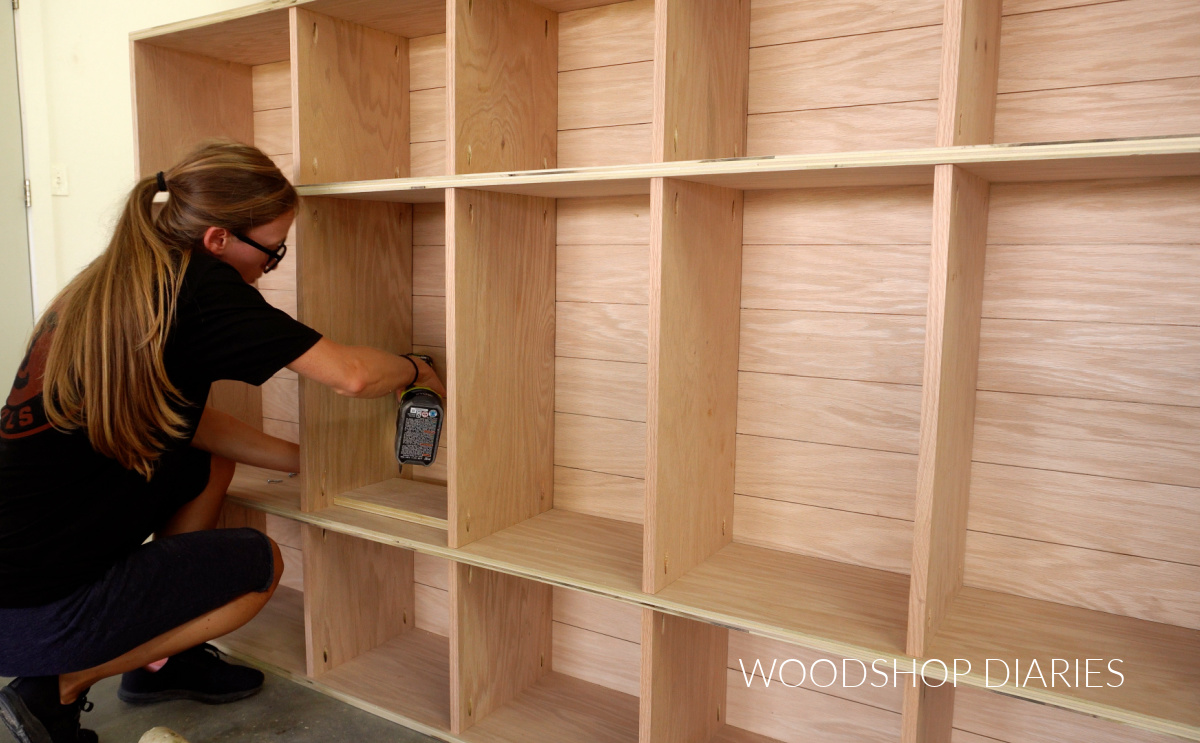
Now that the bottom shelves are in place, I worked my way up installing the remaining shelves with equal spacing.

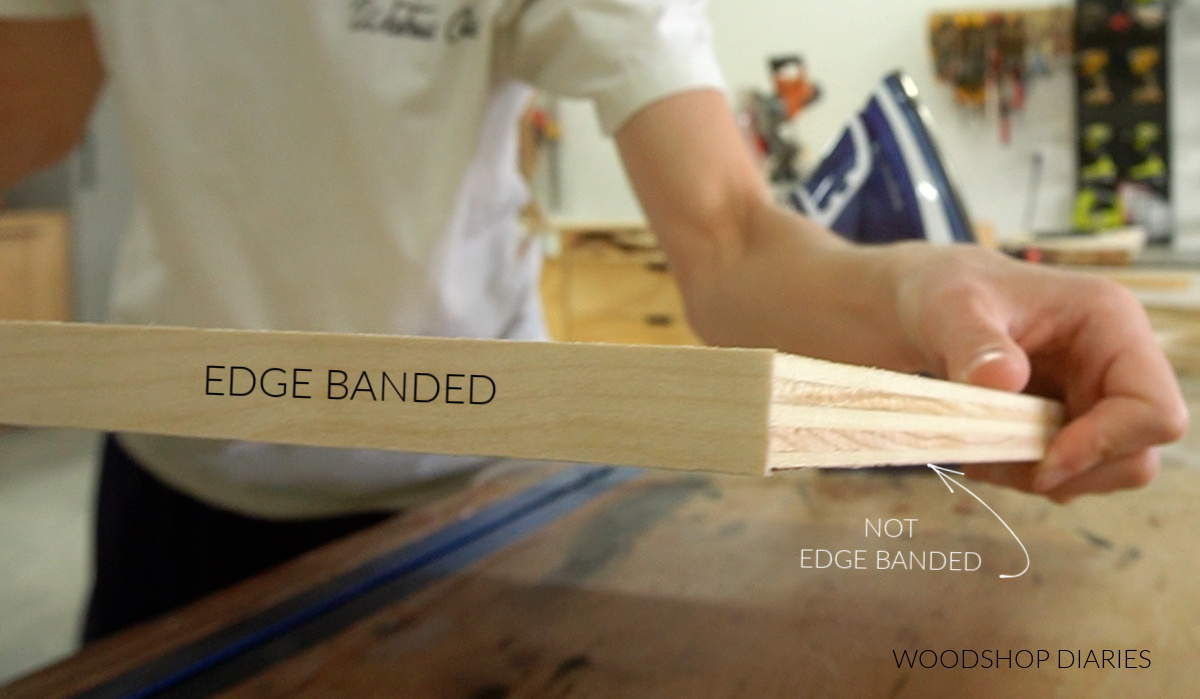
I cut these shelves the same length as the bottom shelves but before installing, I added edge banding on the front edges. These shelves will not be covered by the face frame in the next step, so edge banding will help hide the plies for a cleaner look.

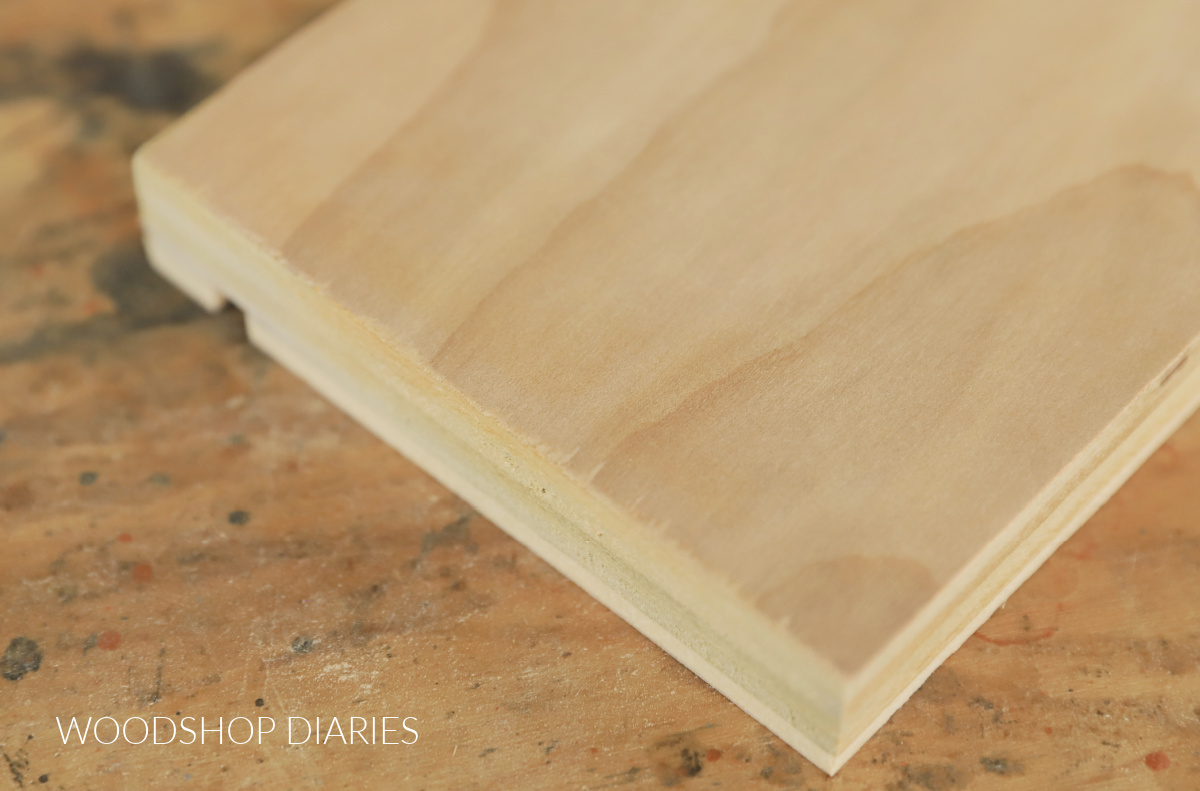
Close up of plywood corner showing one side edge banded and the other not edge banded

RELATED: How to apply edge banding to cover plywood edges

To help me keep my spacing even, I cut a piece of scrap plywood the distance I wanted my shelves to be apart. This helped me quickly and easily work my way up installing each shelf in the proper location.

Shara Woodshop Diaries installing shelves in bookcase with pocket hole screws

NOTE: If you wanted to go with adjustable shelves instead of stationary shelves that’s an easy swap! I explained how in the notes above under “Shelving Options.”

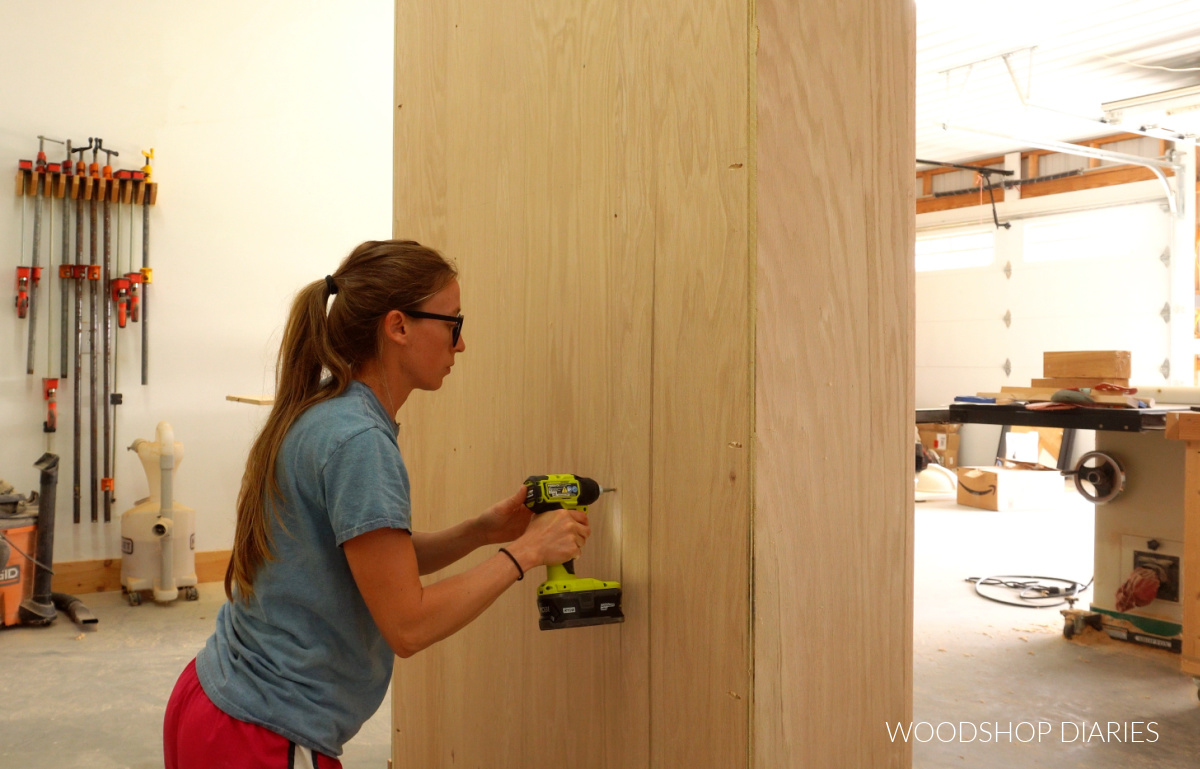
Once the shelves were in, I went back to secure the back panel to the dividers. I just drove a few screws through the back to make sure it stayed tight.

Securing back panel of bookcase to dividers using screws through back side

I didn’t want to do this before the shelves were in because I took a chance on accidentally securing them in a bowed position.

Step 4: Add Face Frame

I built the face frame here using 1x2s on the vertical parts and 1x6s at the top and bottom. I cut the pieces so that when assembled, they would be the exact same size as the front of the bookcase.

Prefer to print? Detailed dimensions, cut lists, diagrams and more can be found here in the printable bookcase building plans!

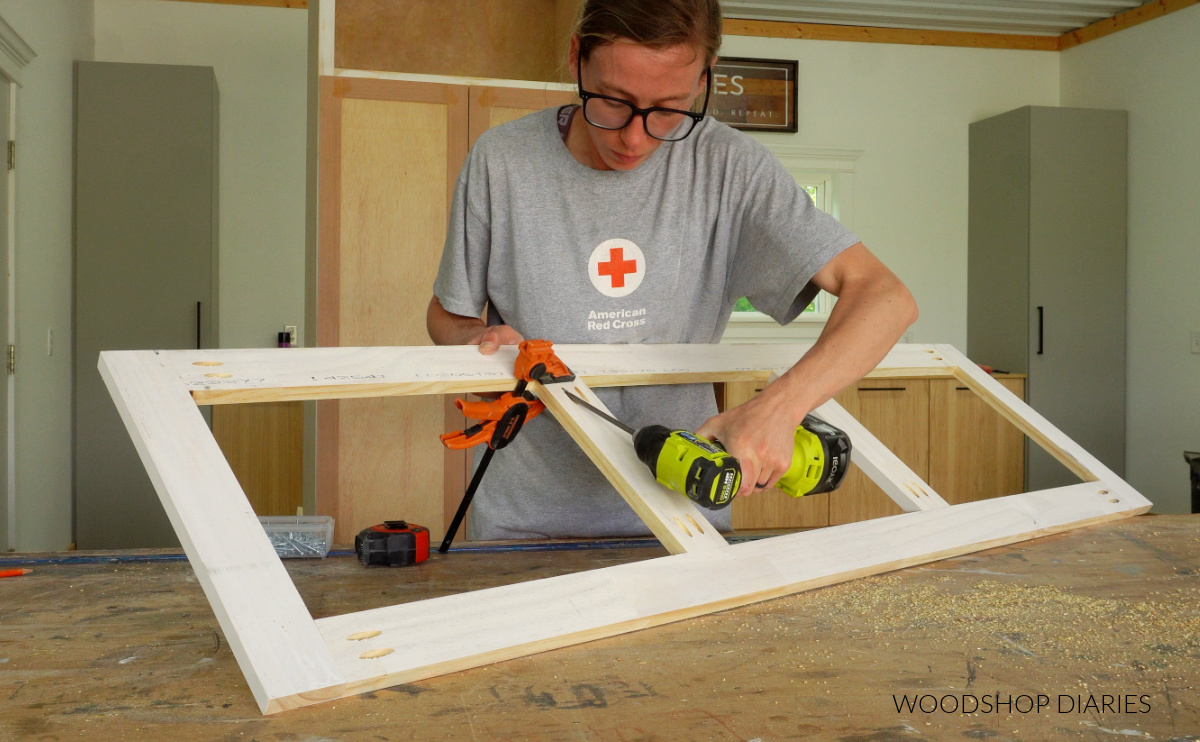
This frame was pretty huge, so I found it easiest to flip the bookcase on its back and assemble this frame on top of it. It was just too big for the workbench.

Shara Woodshop Diaries assembling face frame of bookcase

NOTE: This is another place I recommend (if possible) using the Kreg Micro Pocket Hole Jig. A standard size pocket hole jig will work fine, but the smaller holes with the Micro Jig are less likely to split these thin pieces.

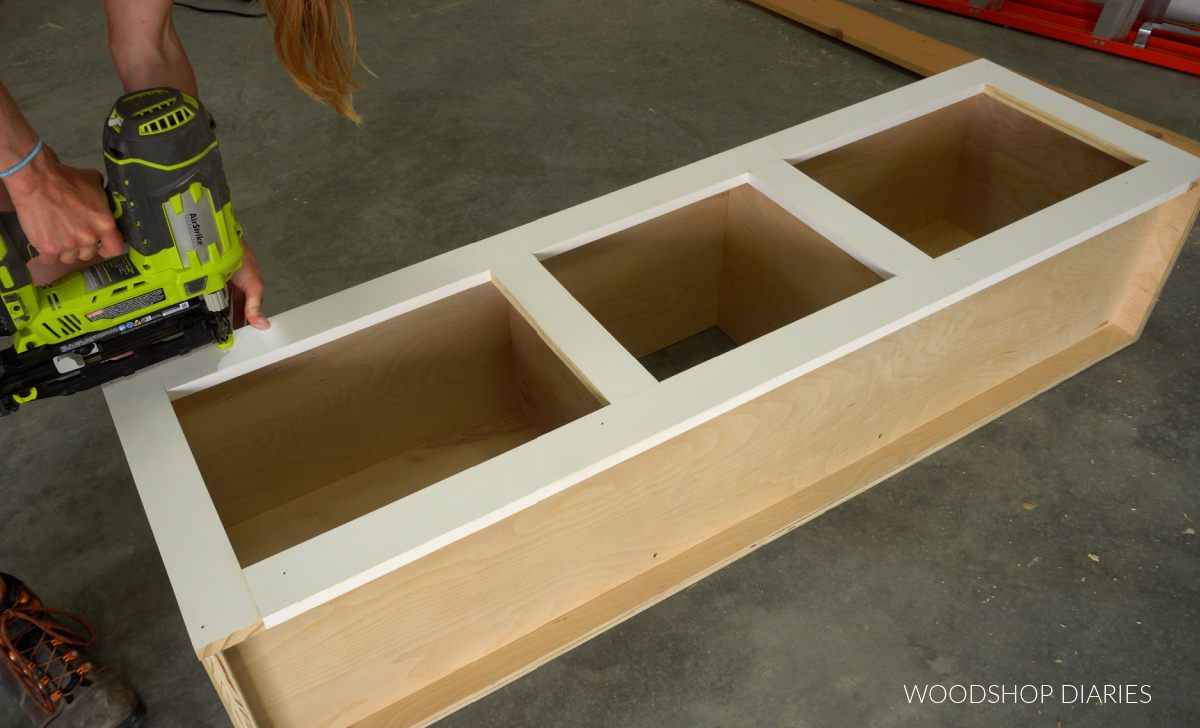
Once the face frame was together, I applied glue to the front of the bookcase and nailed this on. I used a finish nailer, but a brad nailer would work as well.

Shara Woodshop Diaries nailing face frame onto front of bookshelf with finish nailer

RELATED: What’s the difference between a finish and brad nailer?

Be sure to sand away any glue squeeze out and fill the nail holes. When I’m staining, I like to mix a little wood glue with saw dust to make my own “wood filler.” But store bought fillers work great, too.

Step 5: Add Bookcase Trim

The final part of the bookcase build was adding some trim at the top and bottom. This is completely optional, but it adds a little extra detail.

Shara Woodshop Diaries nailing trim around top of bookcase with brad nailer

I used 1×3 trim and cut to fit it around the sides and front. But if you wanted to use base and/or crown molding for trim instead, that would look great!

I glued and nailed these pieces around the top and the bottom, allowed to dry, then filled and sanded over the nail holes.

Step 6: Finish

At this point, the shelf is ready for finish. I opted to stain it in Minwax Weathered Oak Wood Stain, but you can stain, paint, or clear coat any color you’d like.

RELATED: How to stain wood furniture

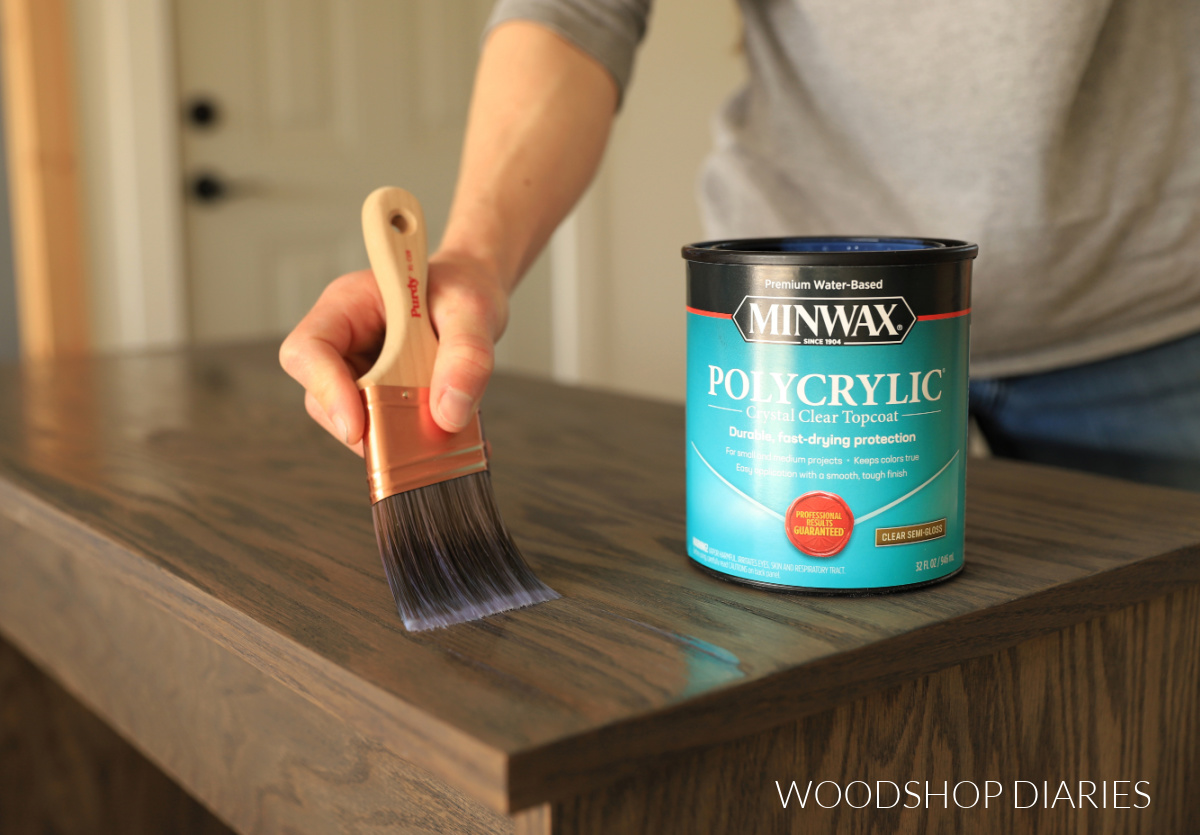
Once the stain dried, I applied a few coats of Minwax Polycrylic to seal it.

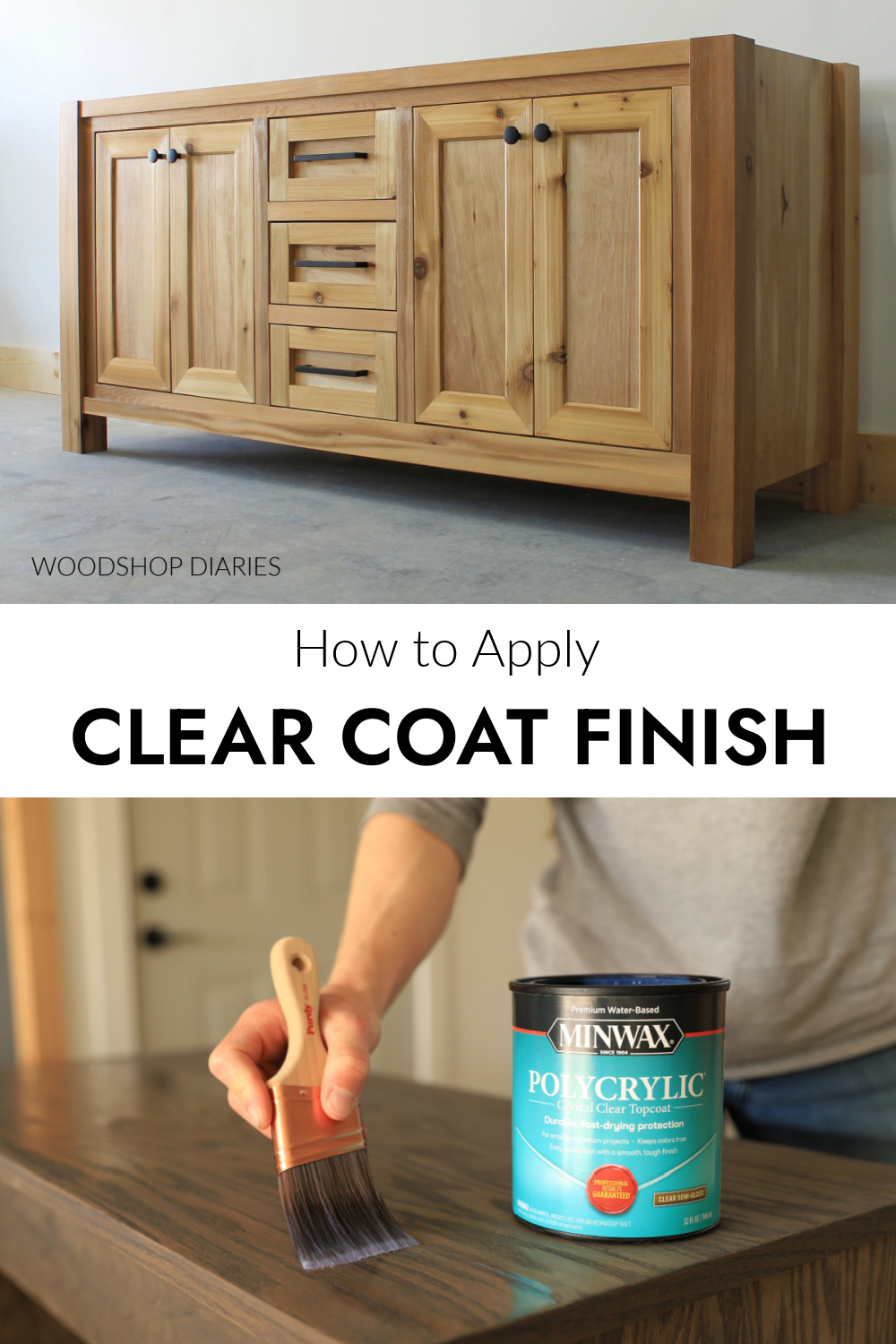
RELATED: How to apply clear coat to DIY furniture

Empty finished red oak bookcase with three sections and five shelves in each

And with that, this bookcase was ready to display all my favorite knick knacks and classic reads!

Close up of bookcase with books and decor on shelves

Since this is such a tall piece, I recommend securing it to the wall to prevent tip over.

Shara Woodshop Diaries standing next to classic DIY bookcase reading a book

This classic piece would fit perfectly in a home office, a cozy living room, or even in a pantry. You can use it to display your favorite books, trinkets, or artwork.

For even more detail, consider adding gallery railing to the front of the shelves. While it’s not really a necessary addition, it gives this shelf a TON of character and I’ll show you how to make and add faux metal gallery rails in this post!

Close up of gallery rails installed on front of bookcase

Looking for More Bookcase and Shelving Ideas?

Not quite what you had in mind? No worries! Here are a few of my favorite shelving projects you might enjoy browsing:

Modern Plywood Shelf
DIY Ladder Bookshelf
DIY Rotating Bookshelf
DIY Corner Shelf
Hidden Drawer Bookshelf
Library Bookshelf with Desk
Vinyl Record Shelf

If you enjoyed this post and want to save it for later, don’t forget to pin it or share to your favorite social channel!

Completed DIY bookcase with text overlay "how to build a basic bookcase"

Until next time, happy building!

Choosing What Screw to Use for DIY Furniture Projects

August 21, 2024 by Shara, Woodshop Diaries

In this post, you’ll learn how to decide which screws to use for your DIY furniture and cabinet projects.

When you’re first getting started in DIY, you may be overwhelmed with the hundreds of different screws–different sizes, head types, materials, threads.

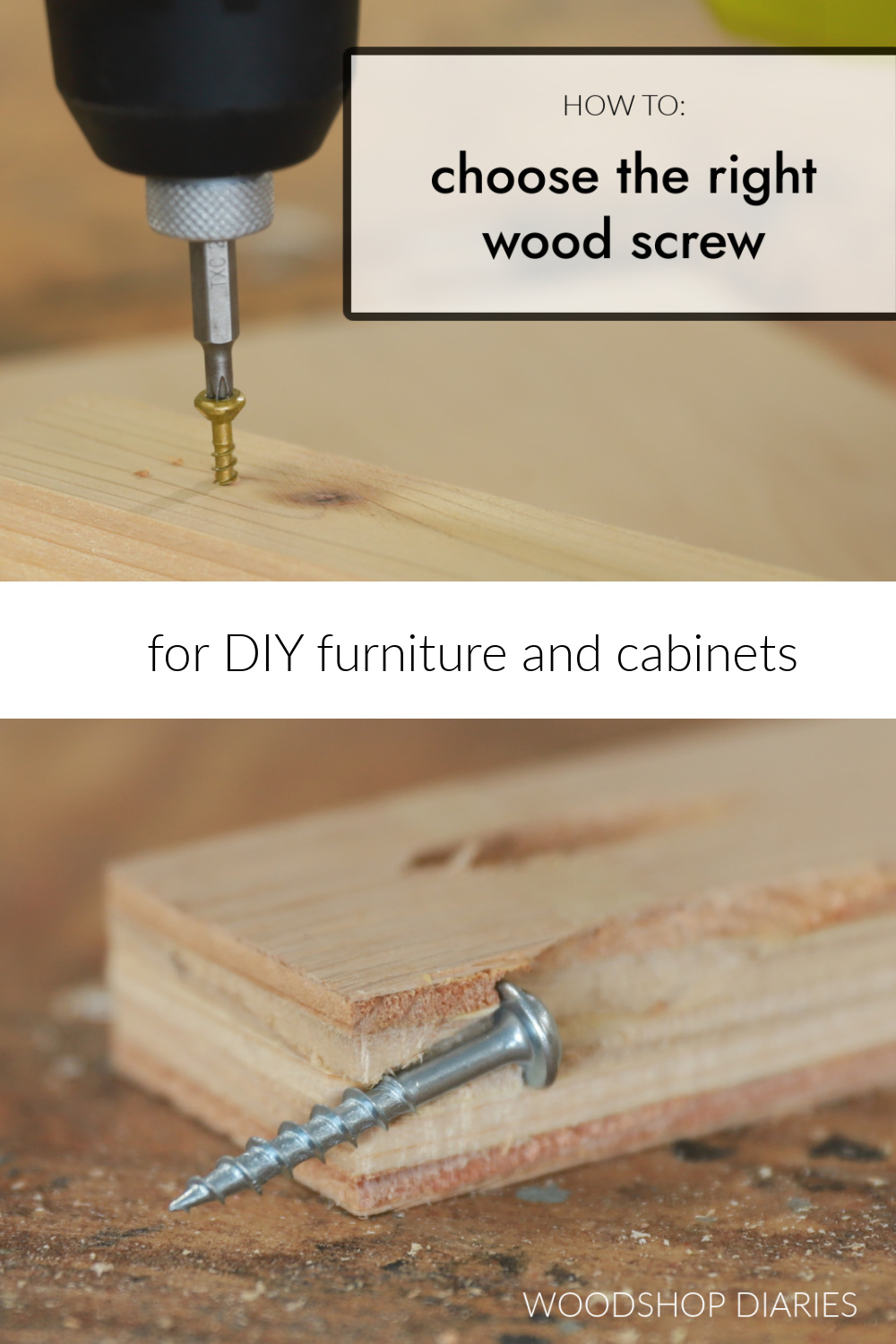
Close up image of driver driving screw into wood with text "how to choose the right wood screw"

What does it all mean? How do you know which one to use? What happens if you use the wrong one?

Luckily, it’s not as complex as you might think and I actually only use a few basic types and sizes of screws when I’m building all my own cabinets and furniture.

I’m sharing all the details below on what I use to help you simplify the subject of “screws.”

*This post contains affiliate links. See website policies.

NOTE: I’m sharing what I use for my projects based on my own experience. Of course, this isn’t the one and only option.

It’s worked well for me over the years, but someone else may do things differently, and that’s okay.

Parts of a Screw

Here’s a little screw terminology before we get started:

  • Head: the top of the screw. These come in different shapes, sizes, and styles and can have different drives.
  • Drive: the indention in the head of the screw that allows you to drive it with a screwdriver bit. These come in various shapes like flathead, Phillips, star head, square, etc.
  • Shank: the solid, round part that extends out from the head. It resembles a nail, except it’s covered in threads.
  • Threads: the spirals that wrap around the shank.
  • Tip: the end of the screw. These come in different shapes. For example, machine screws are often flat, wood screws are often pointed.
Close up image of screw with arrows pointing to each part

Enjoy DIY projects and woodworking plans? Sign up for priority access for the latest posts on Woodshop Diaries!

Screw Specifications

When you go to the store to buy screws, you’ll notice the boxes are labeled with several specifications to identify what’s inside.

Three different boxes of screws on workbench with labels showing

These key identifiers are:

  • Gauge: thickness of the screw
  • Threads: coarse or fine (more on that below)
  • Length
  • Head Type
  • Drive Type
  • Material

Screw Size

The first three items on that list have to do with screw size. For small DIY projects like furniture and cabinets, the main concern is the length. The other two aren’t quite as critical and aren’t always specified on the box.

Length: This one is pretty self explanatory. BUT, you may be asking whether the length includes the head or not. And–it depends.

Usually, if it’s a countersinking screw (more on that below), the length is from top of the head to end of the tip. But if it’s a washer head screw, the length is measured from the bottom of the head to the end of the tip.

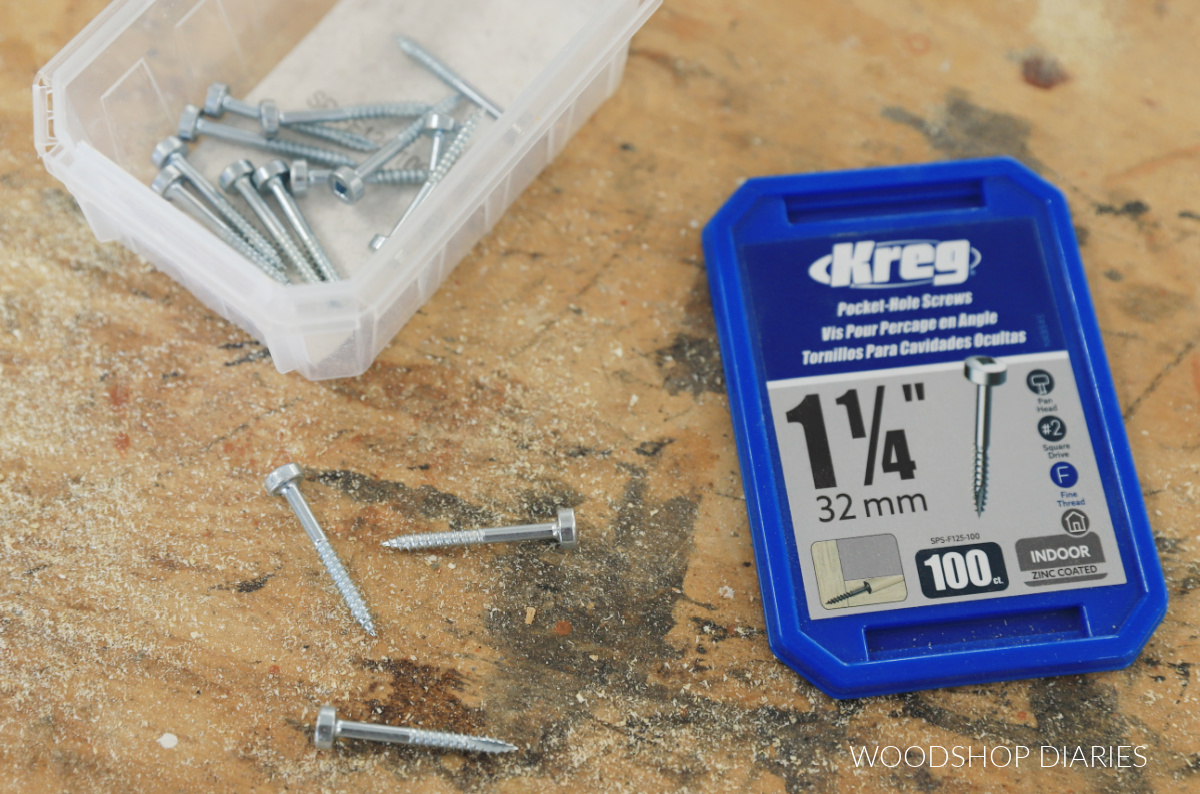
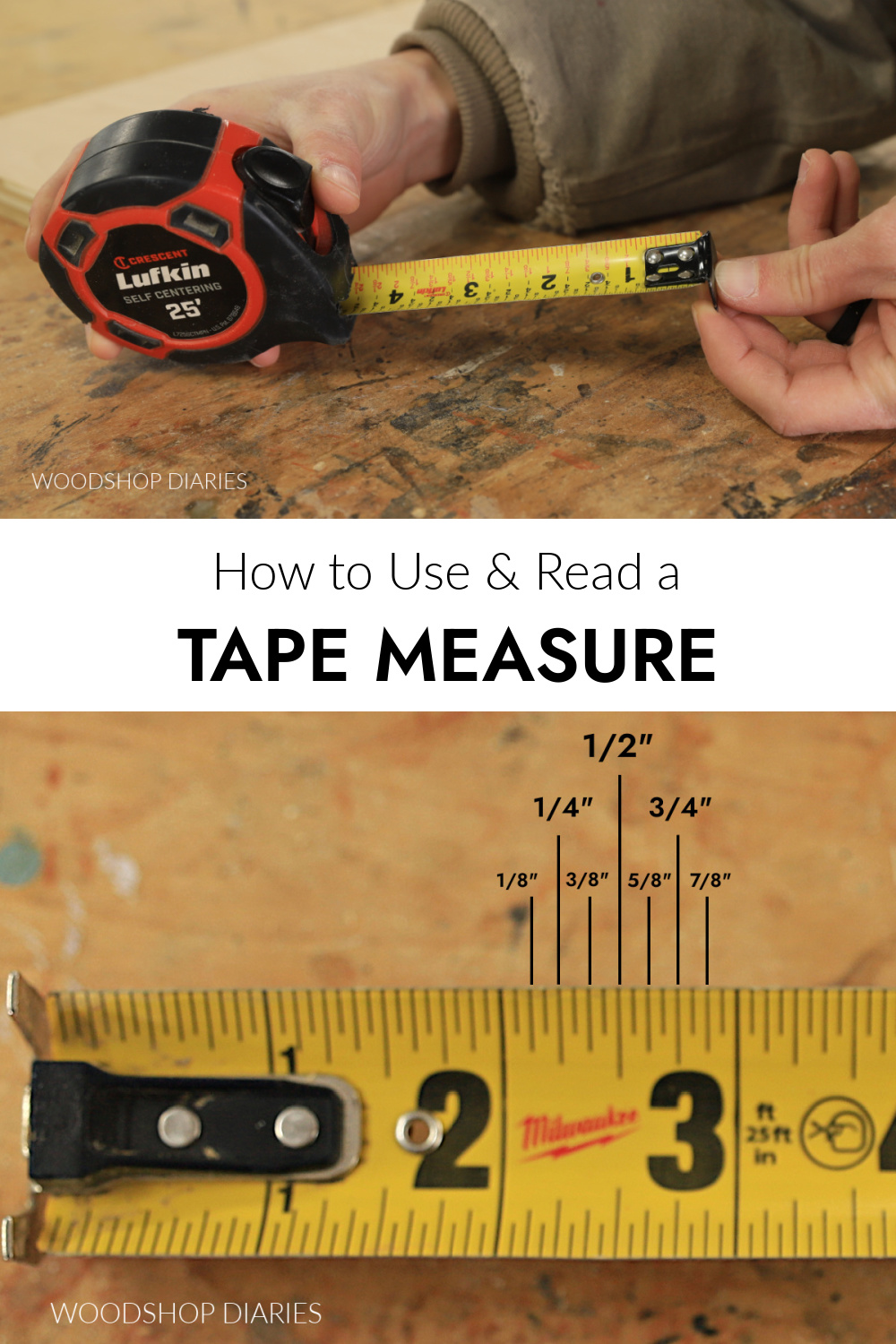
two 1 ¼" screws next to measuring tape showing lenghts

Gauge: Screw gauge is the diameter of the screw (including the threads). For screws under ¼″ in diameter, they’re labeled as numbers (example #7, #8, #9). The larger the number, the “thicker” the screw. For screws over ¼″, they’re labeled as their diameter in fractions.

Threads: Sometimes, the threads will be listed as a number–in the U.S., this is what’s called threads per inch (or TPI). The more threads per inch, the “finer” the threads.

With the screws I use for DIY furniture and cabinets, this number isn’t normally specified. Instead, wood screws are often labeled as “fine” or “coarse” thread. Fine thread is best for use in hardwoods and coarse thread is best for plywood and softwoods.

a fine thread pocket hole screw next to a coarse thread pocket hole screw on a piece of wood

Screw Head Shape

Screw heads come in several shapes, but the most common types found DIY woodworking projects are conical (or countersinking), washer head, and pan head.

three different screws placed side by side to show the different head shapes--washer, pan, and conical

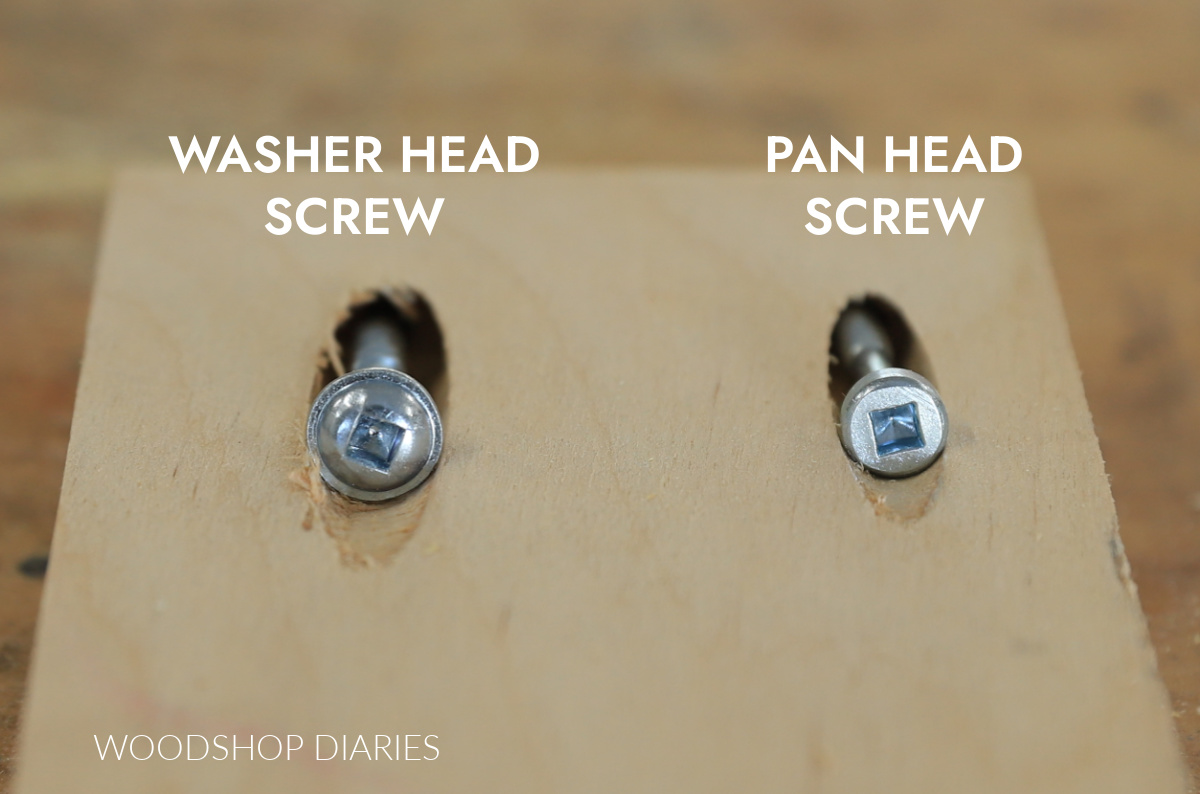
Pan and washer head screws have a flat bottom on the head so they won’t sink into the wood. This is most commonly used in pocket holes so they will pull the joint tight without driving too far.

Cone shaped screw heads are designed to sink into the wood so they sit flat across the surface.

Countersinking screw sunk into wood to show it's flush across top

Screw Drive Types

Some common drive types for screws are flathead, Phillips, square, star head (or Torx). The pocket hole screws I use have square drives and the wood screws I use have star head drives.

three screws with different drives--one square, one star, and one phillips

Phillips head is also common in wood screws, but these strip easy, so I avoid them when possible. Square and star drives are less prone to stripping out and/or slipping.

Screw material

The material of the screw is mostly important if you’re planning to use your project outdoors. The screw box will specify what kind of material they’re made from, what kind of coating they have, and/or whether they’re intended for indoor or outdoor use.

The key thing here is to check whether the screws are rated for outdoor use if you’re using them outdoors.

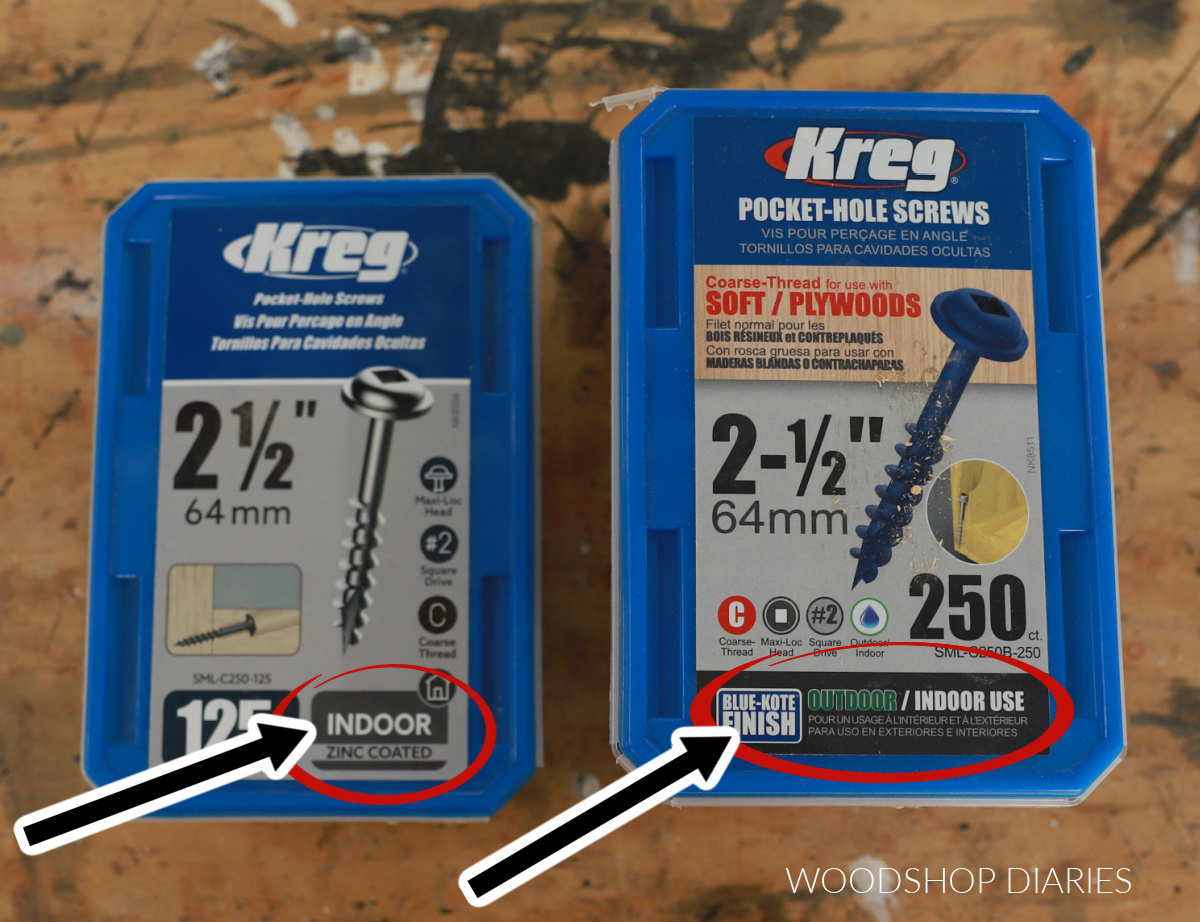
two screw boxes side by side showing one labeled as indoor and one labeled as indoor/outdoor

NOTE: Outdoor screws can be used indoors, too. But indoor screws shouldn’t be used outdoors.

Stainless steel and galvanized screws are often used for exterior applications. While zinc coated and brass are generally for indoor use.

Common Woodworking Screws

There are hundreds of screws out there, so it would be impossible to go into detail about every single one. Instead, here’s a short list of the screws I use in my own woodworking projects.

Wood Screws

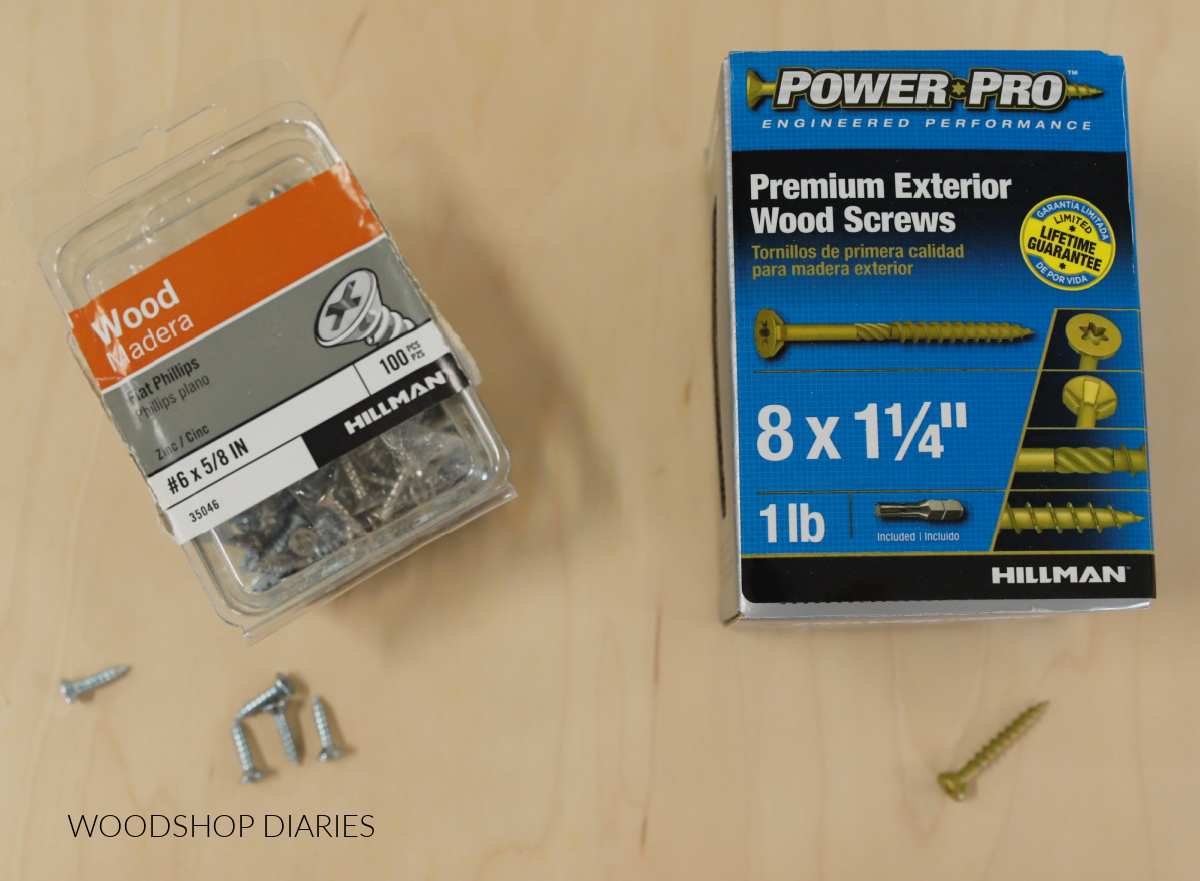
I only use two types of basic wood screws in my own projects. For installing drawer slides and hinges, I use indoor rated ⅝″ long wood screws.

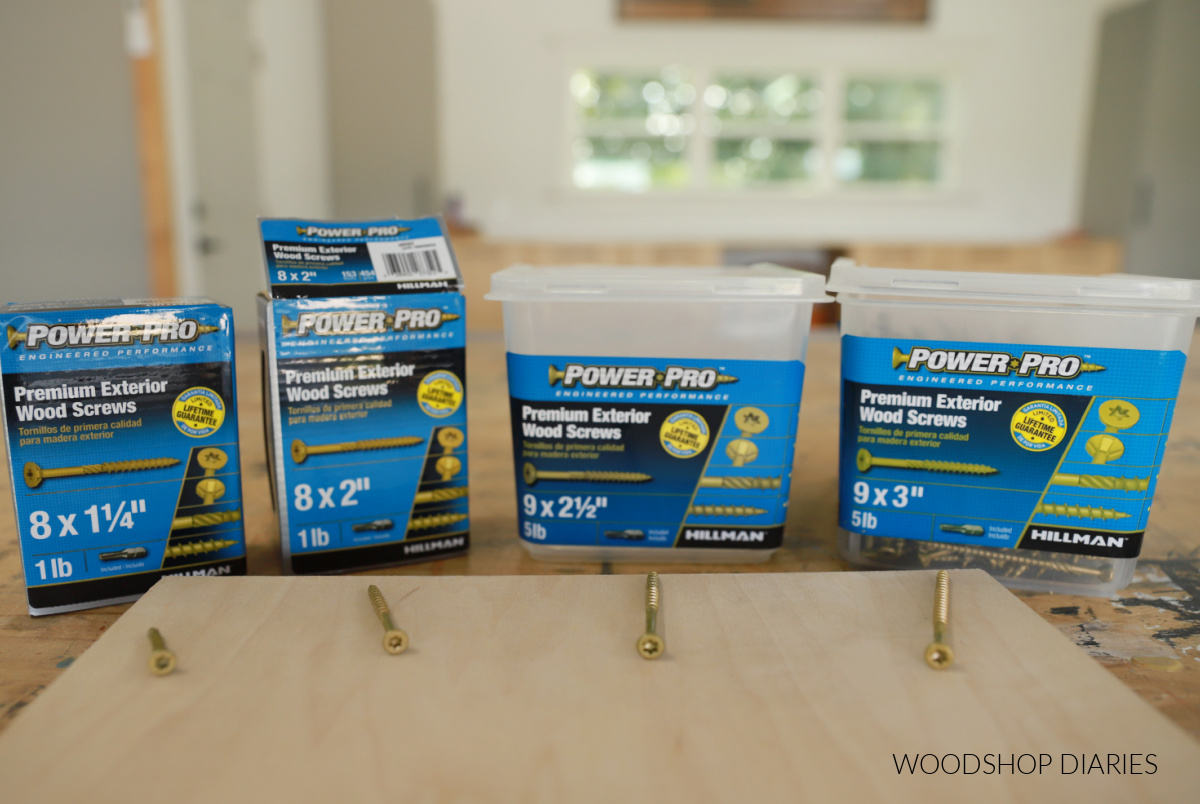
And for assembling wood pieces together, I use PowerPro Exterior Premium Wood Screws. They have a star head drive (each box includes a driver bit!), countersinking head, and can be used both indoor and out.

two types of wood screws placed side by side

I keep the following wood screw sizes stocked in my shop as these are the ones I use most often*:

  • #8 x 1 ¼″ long screws
  • #8 x 2″ long screws
  • #9 x 2 ½″ long screws
  • #9 x 3″ long screws
power pro exterior wood screw boxes set up on workbench showing four different sizes

*These screws are all coarse thread screws. Coarse thread screws aren’t the best option for use in hardwoods, but will work fine if you’re careful. Be sure to predrill pilot holes before driving to help prevent the large threads from splitting the hardwood.

Pocket Hole Screws

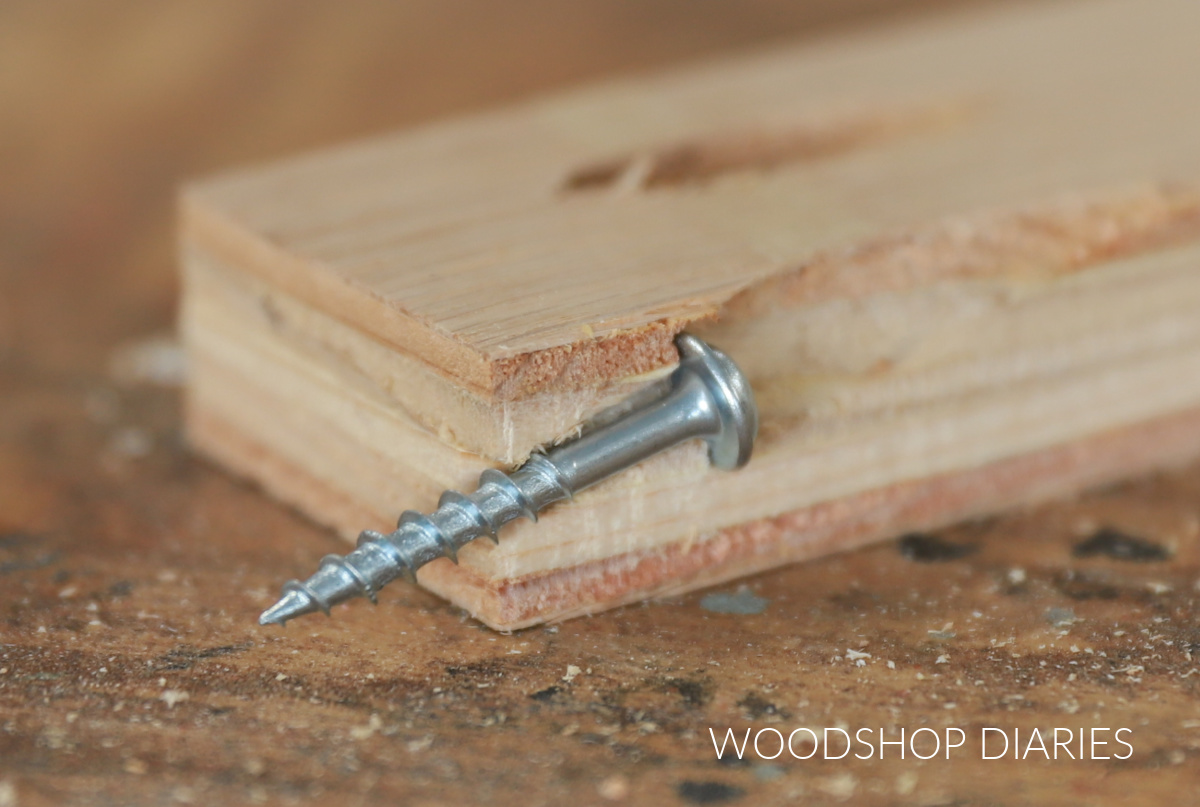
The way that pocket holes are drilled, there’s a flat part at the bottom of the pocket that the screw should seat against to pull the adjacent board tight.

close up of pocket hole screw inside pocket hole cut open

For this reason, pocket hole screws have either a pan or washer head so that they stop at this point instead of countersinking deeper into the hole.

Pocket hole screws aren’t just for pocket holes–you can use them for other applications, too. But it’s important when using pocket holes, that you only use pocket hole screws.

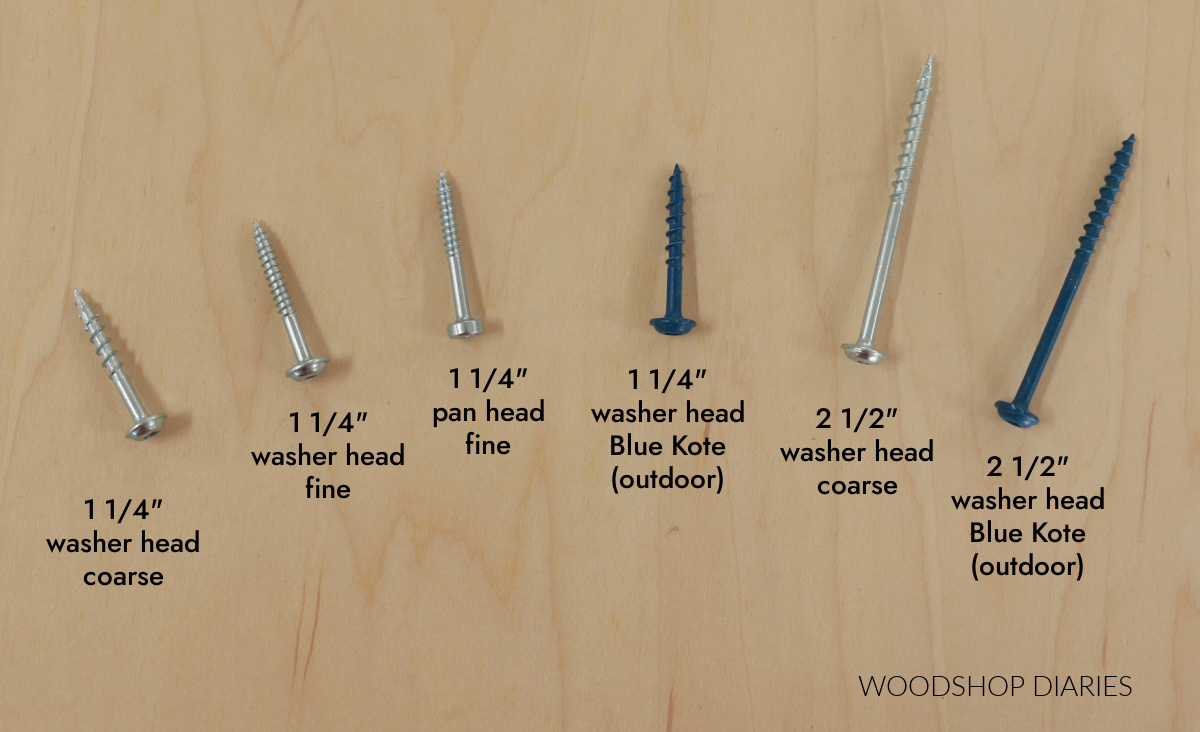
I keep the following pocket hole screws stocked in my shop as these are the ones I use most often:

1 ¼″ Lengths:

  • 1 ¼″ Washer Head
    • Coarse Thread (indoor use)
    • Fine Thread (indoor use)
  • 1 ¼″ Pan Head Fine Thread (indoor–use with Kreg Micro Jig)
  • 1 ¼″ Washer Head Blue Kote (coarse thread, outdoor use)

2 ½″ Lengths:

  • 2 ½″ Washer Head Zinc Coated (coarse thread)
  • 2 ½″ Washer Head Blue Kote (coarse thread, outdoor use)
six types of pocket hole screws laid out on wood with text labeling each one

A Note About Drywall Screws

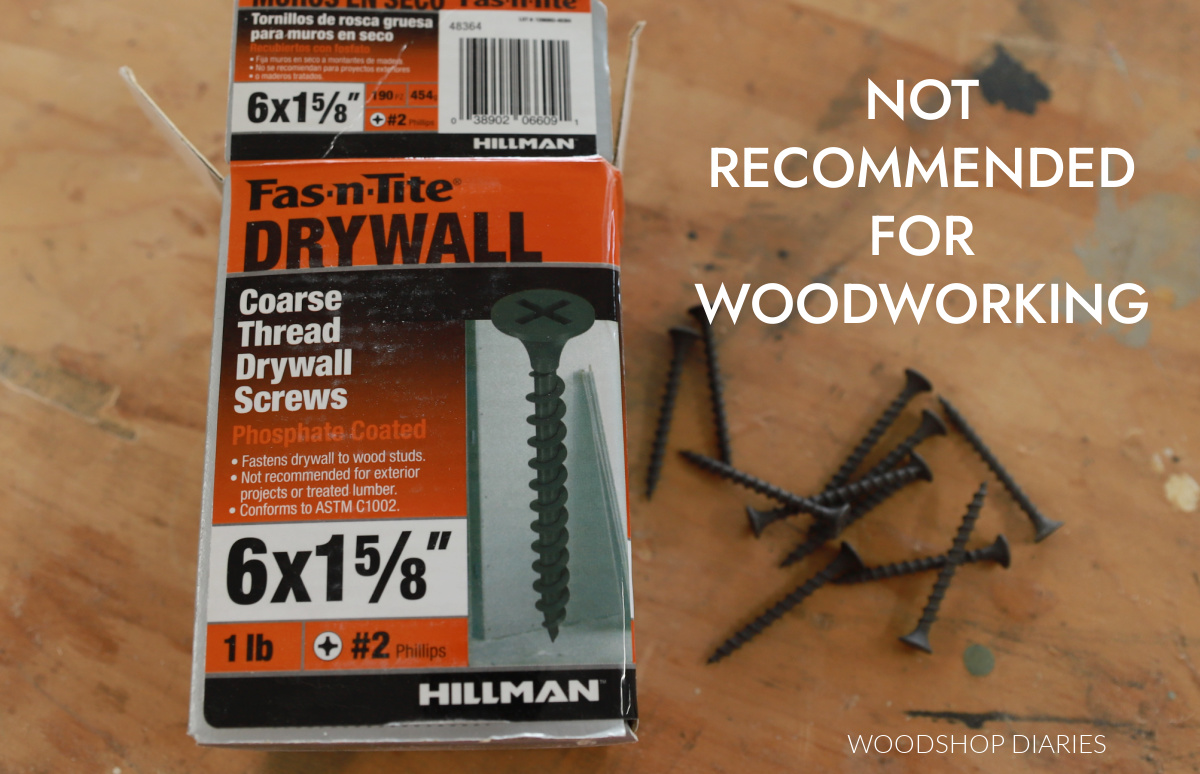
Drywall screws are designed to be used for hanging (you guessed it) drywall. They’re inexpensive, readily available, and come in many sizes.

You often see them in cabinet and furniture projects, but it’s not great practice. I recommend using them ONLY for drywall.

drywall screws spread out on workbench

These screws are brittle, break and corrode easily and are threaded all the way up–which can force wood pieces apart instead of pulling them tight.

How to decide which screw you need

Here’s a quick example of how I decide which screw to use in my projects. Of course, keep in mind each project will vary and this may not apply to every single unique situation.

It’s a general guide to get you started.

Consider joinery method

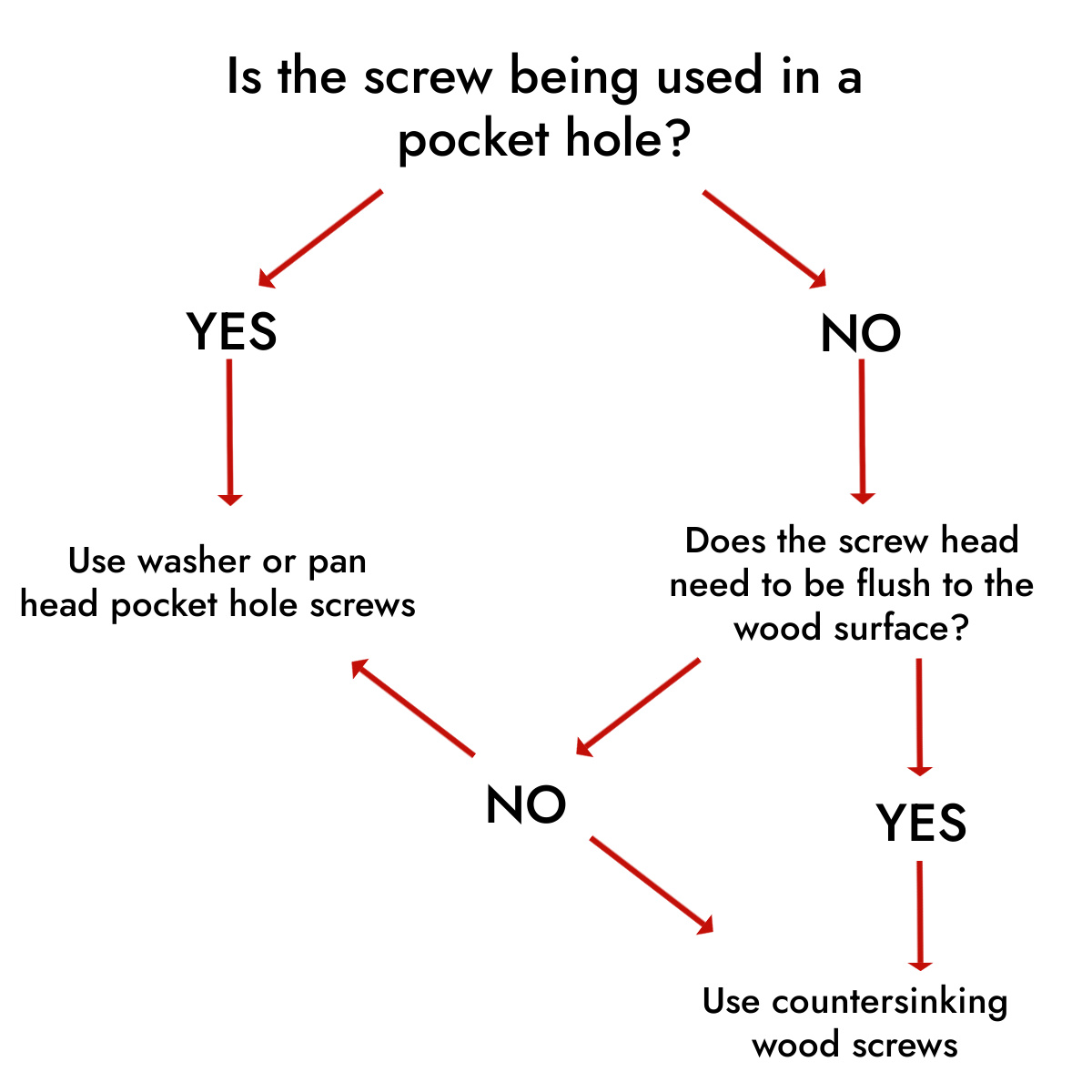
First, you need to consider how you’re using the screw. Will it be inside a pocket hole? If so, you need to use a pocket hole screw.

Are you joining boards without a pocket hole? If the screw head needs to be flush to the wood surface, opt for countersinking wood screws.

If it doesn’t matter if the screw head is flush, either option would work–take your pick.

flow chart showing how to choose the type of wood screw you need

Consider wood thickness

Next, consider the wood thickness to determine the length screw you need. You want to make sure your screws are long enough to securely join the boards, but not too long so that it pokes through the other side!

Measure your board thicknesses to help you determine what length screw to use.

There are exceptions, but the general rule of thumb is that the screw should go through the first board and at least half the thickness of the second.

For pocket holes with 1x or ¾″ material, 1 ¼″ long pocket hole screws work well and with 2x or 1 ½″ thick material, 2 ½″ long pocket hole screws work well.

RELATED: Understanding lumber sizing

Consider Wood type

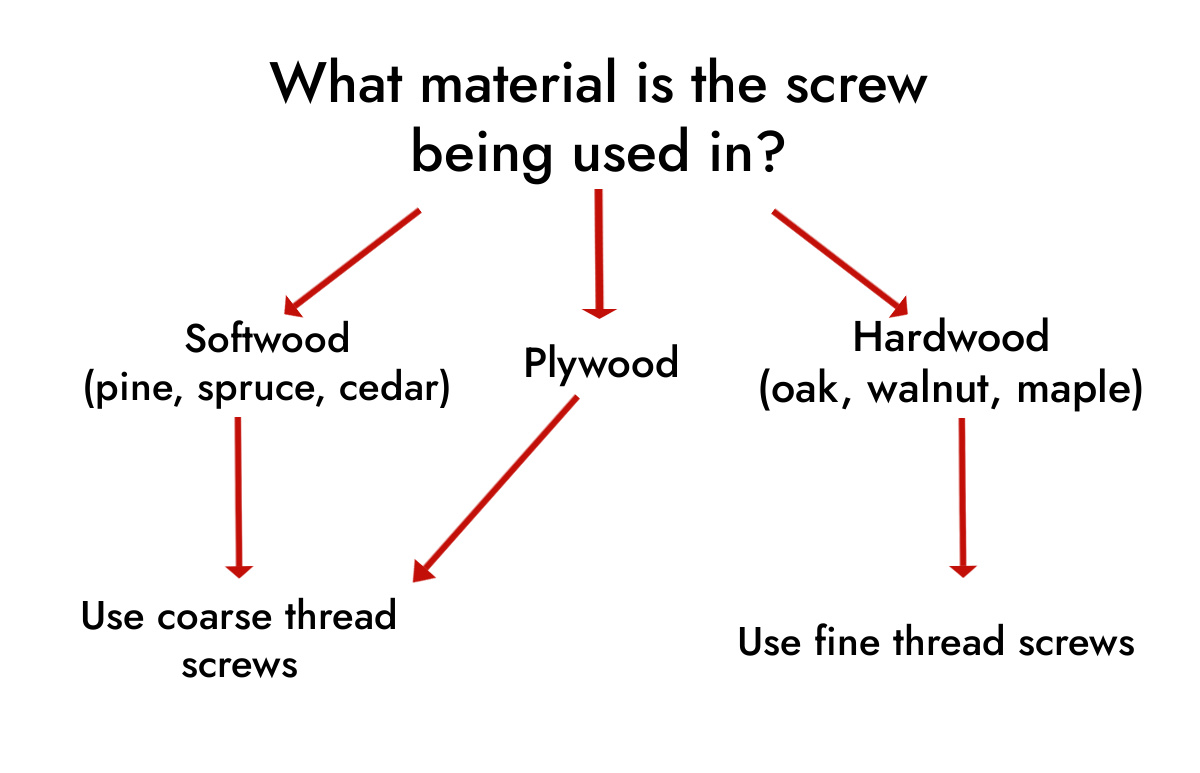
If you’re drilling/driving into softwoods (like pine and cedar) or plywood, coarse thread screws are best.

If you’re drilling/driving into hardwoods, fine thread screws are best if they’re available. If they’re not available in the style/size you need, coarse thread screws can work, but be careful to predrill to prevent splits.

flow chart showing how to choose between fine and coarse thread screws

Consider location

If this project will be used outdoors, make sure to choose a screw that’s rated for outdoor use. If using indoors, either indoor or outdoor screws should work fine.

Additional tips when using screws in woodworking

Here are a few additional tips to consider when choosing and using screws in your project.

Avoid Phillips and Flat Head Screws

While these screws may work fine, Phillips and flat head drives are very prone to stripping, making them difficult to drive, especially if they’re made of soft metals.

When possible I personally recommend using square or star head (Torx) head screws. These are less likely to slip and strip which makes them easier to drive into wood.

Pre drill pilot holes

While pilot holes aren’t necessary with every single screw, a pilot hole can help prevent the wood from splitting as the screw goes in. It can also make it easier to drive.

This is especially recommended when driving large screws, driving screws into hardwood, or driving screws close to the edge of a board where splits are more likely.

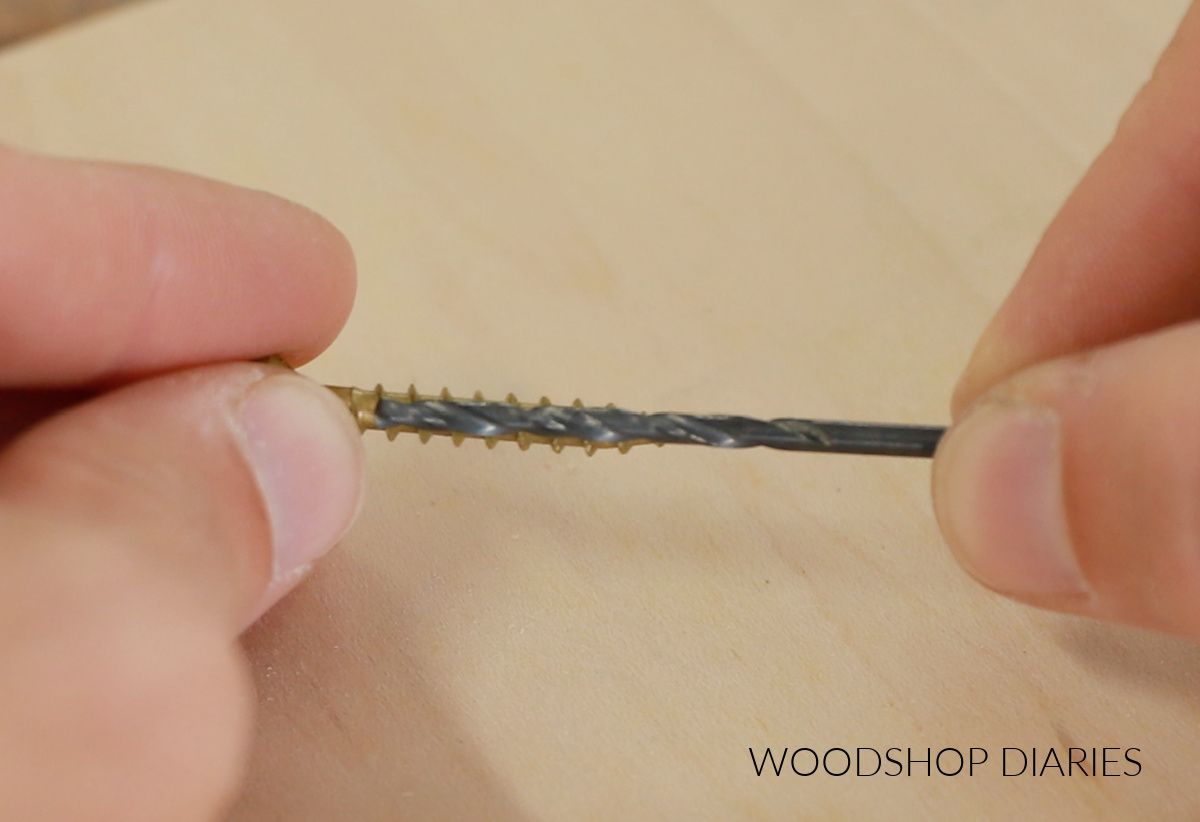
To drill a pilot hole, you want to find a drill bit that is about the same size as the screw SHANK, but not bigger than the threads. A good way to do this is hold the screw up and hold the drill bit directly in front of it.

Close up of drill bit against screw to choose right size for pilot hole

If the bit covers the shank (or at least most of it), but you can still see the threads behind it, that bit will work for a pilot hole. Drill a hole with that bit where you want your screw, then drive the screw into the hole.

NOTE: Pilot holes aren’t usually recommended with pocket holes.

Buying Screws

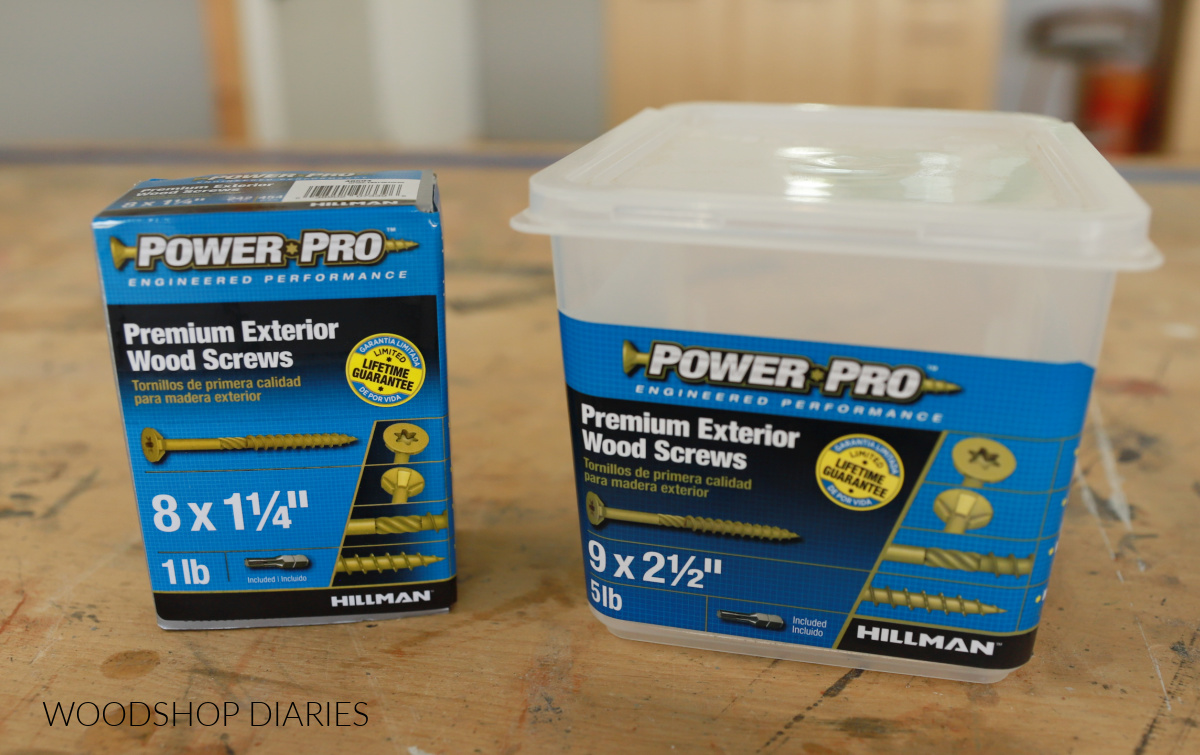
Wood screws come in various size packages and/or quantities. I normally buy mine from my local lumber yard because they’re the cheapest place I’ve found. They carry the PowerPro wood screws in 1 lb or 5 lb boxes.

1 lb vs 5 lb box of screw containers

Obviously, since these are measured by weight, 1 lb of 1 ¼″ screws will contain more screws than 1 lb of 3″ screws. Check the box label to see what the estimated quantity is inside.

The 5 lb boxes can be pricey, but will save you money in the long run if you plan to use them for several projects.

Looking for Projects to Practice on?

Now that you better understand which screws to use for your project, here are a few ideas to practice your new skills on:

Scrap Wood Plant Stand
DIY Corner Shelf
DIY Fall Planter Boxes
Simple Bench with Shoe Shelf
Scrap Wood Tiered Plant Stand
DIY Plant Shelf

And if you’re new to DIY, check out our Getting Started page for more tips, guides, and helpful resources.

If you’d like to save this for later, don’t forget to pin it or share it to your favorite social channel!

Pinterest collage image showing close up of driving screw at top and close up of pocket hole screw at bottom with text "how to choose the right wood screw for DIy furniture and cabinets"

Until next time, happy building!

Easy DIY Cutting Board Drink Coasters

August 15, 2024 by Shara, Woodshop Diaries

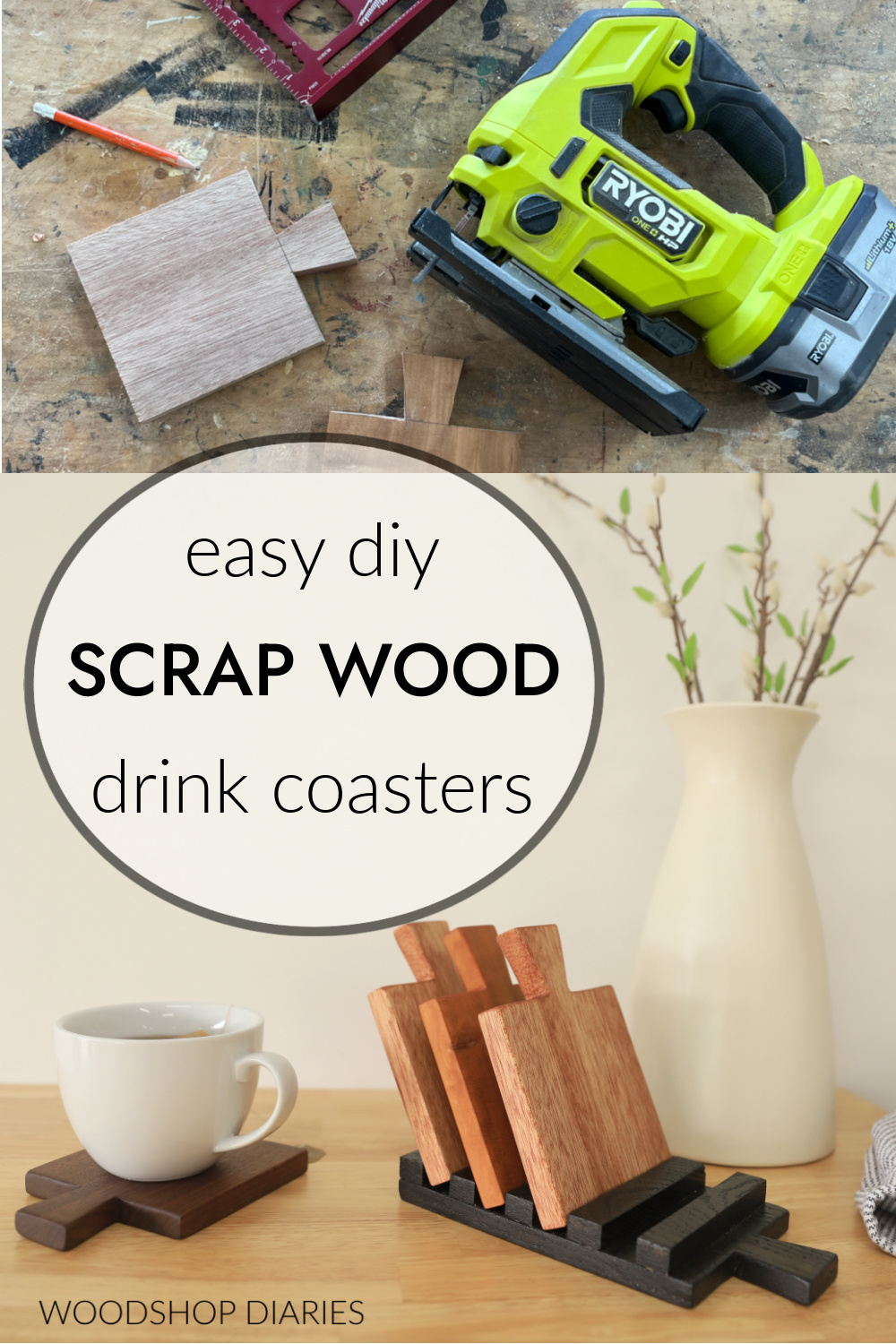
In this post, I’m showing you how easy it is to make these adorable scrap wood DIY drink coasters shaped like a cutting board!

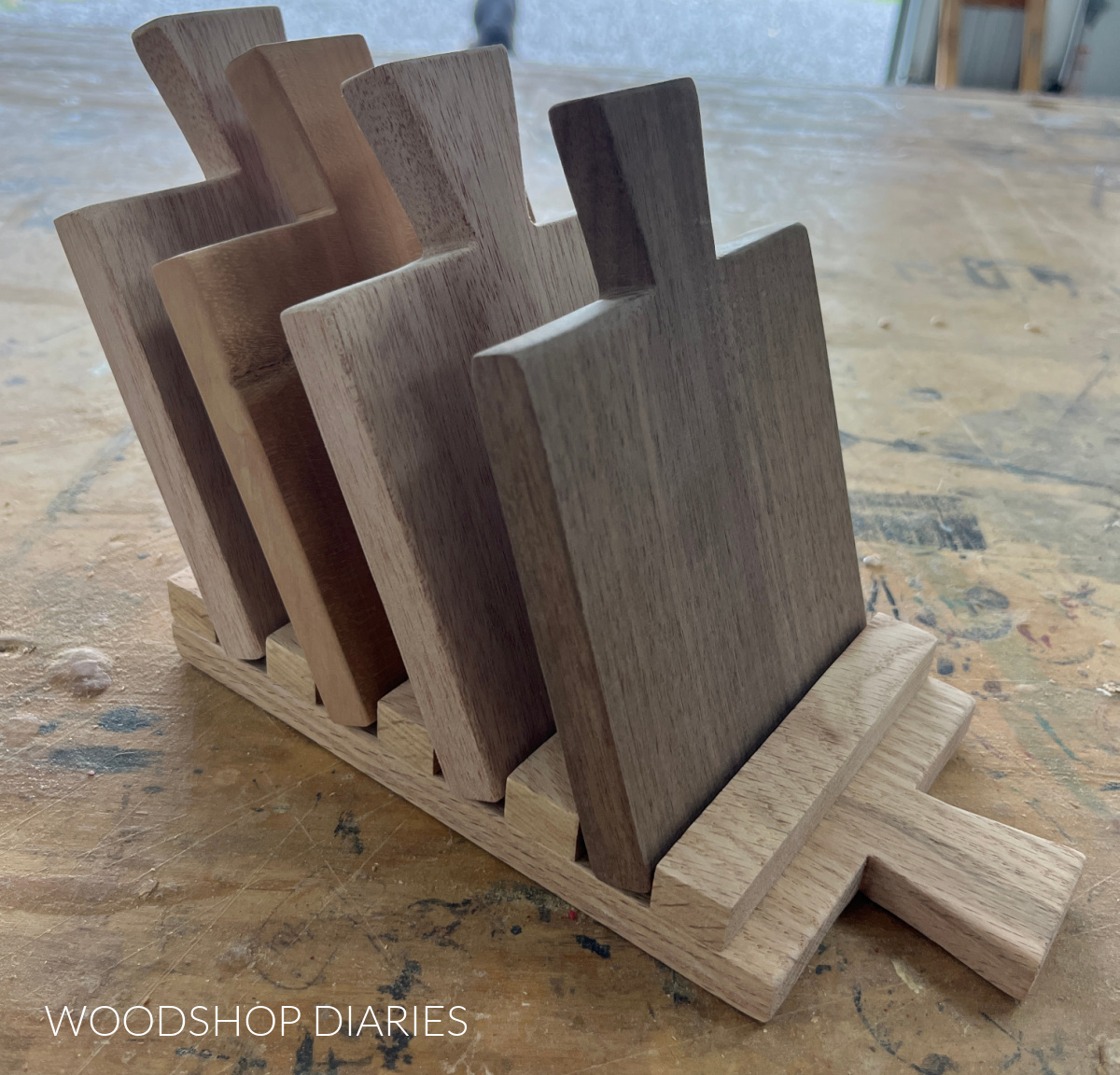
You can even make a matching cutting board tray to hold them all in for display and easy storage.

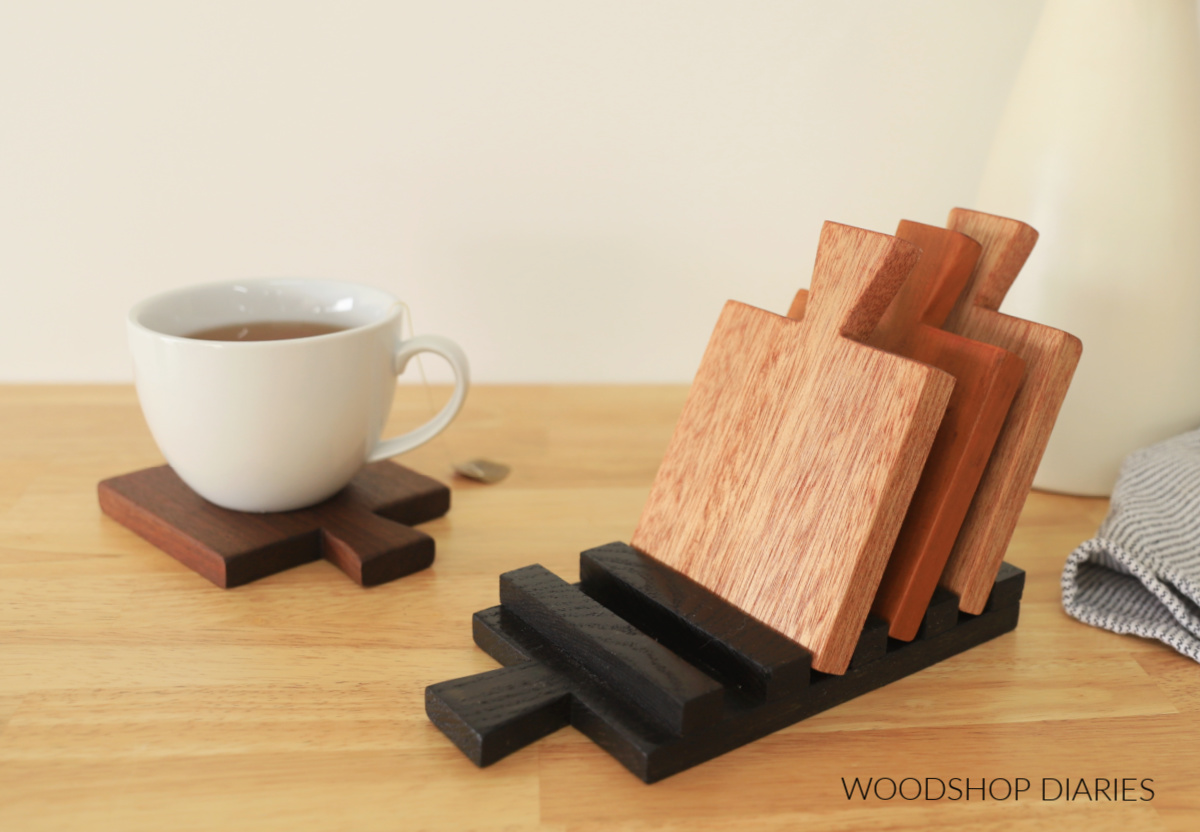
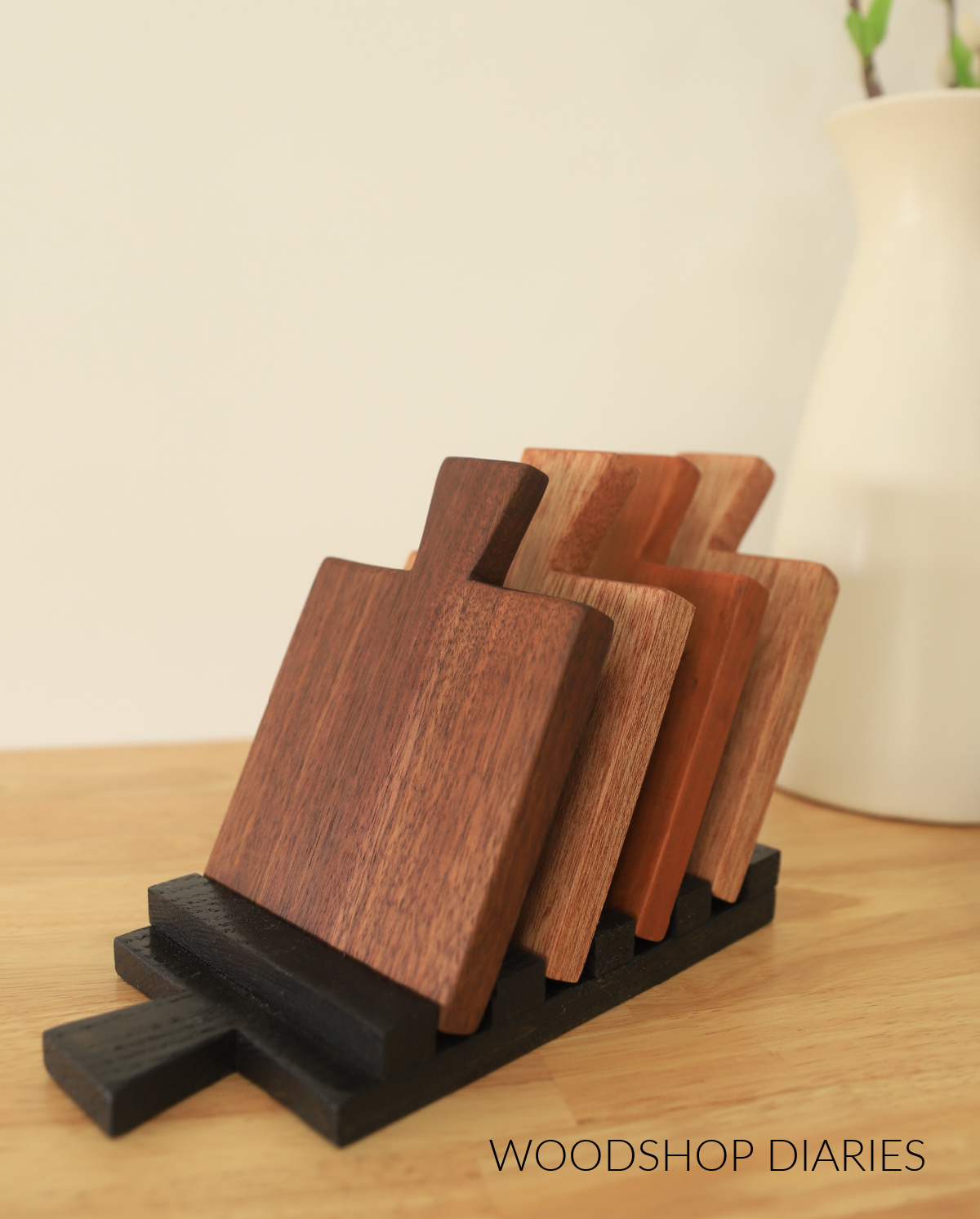
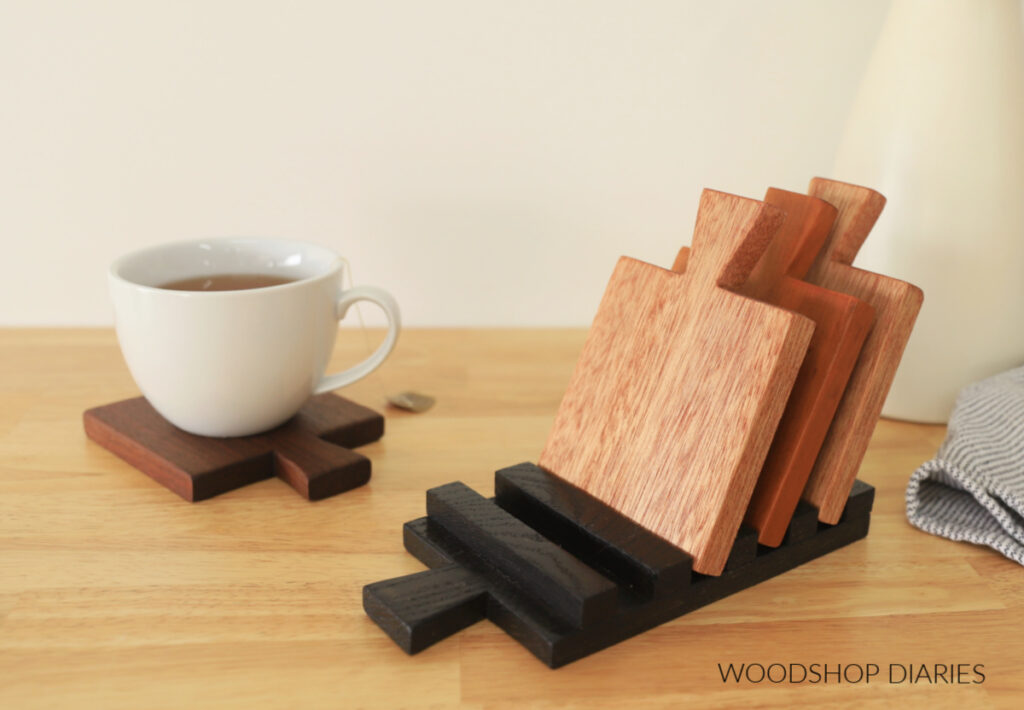
cutting board shaped wooden drink coaster set with wooden display tray in different wood types with mug of tea sitting on one

I love, Love, LOVE a good scrap wood project. I think if I could say there was a “perfect project for scraps,” this would be it.

You only need a tiny piece of wood for each coaster and they don’t even have to be the same wood type. In fact, it’s more fun if they aren’t!

This drink coaster project is a great way to get rid of all those tiny off cuts you have such a hard time just tossing in the trash (or is it just me with that problem?).

So if you’re ready to shrink your scrap pile (at least by a little bit), let’s get building with the how-to below.

*This post contains affiliate links. See website policies.

What Wood is Best for Drink Coasters?

You can use pretty much any type of wood you want for coasters, but it’s best to stick with solid wood (hardwood is ideal, but softwood can work, too)–not plywood.

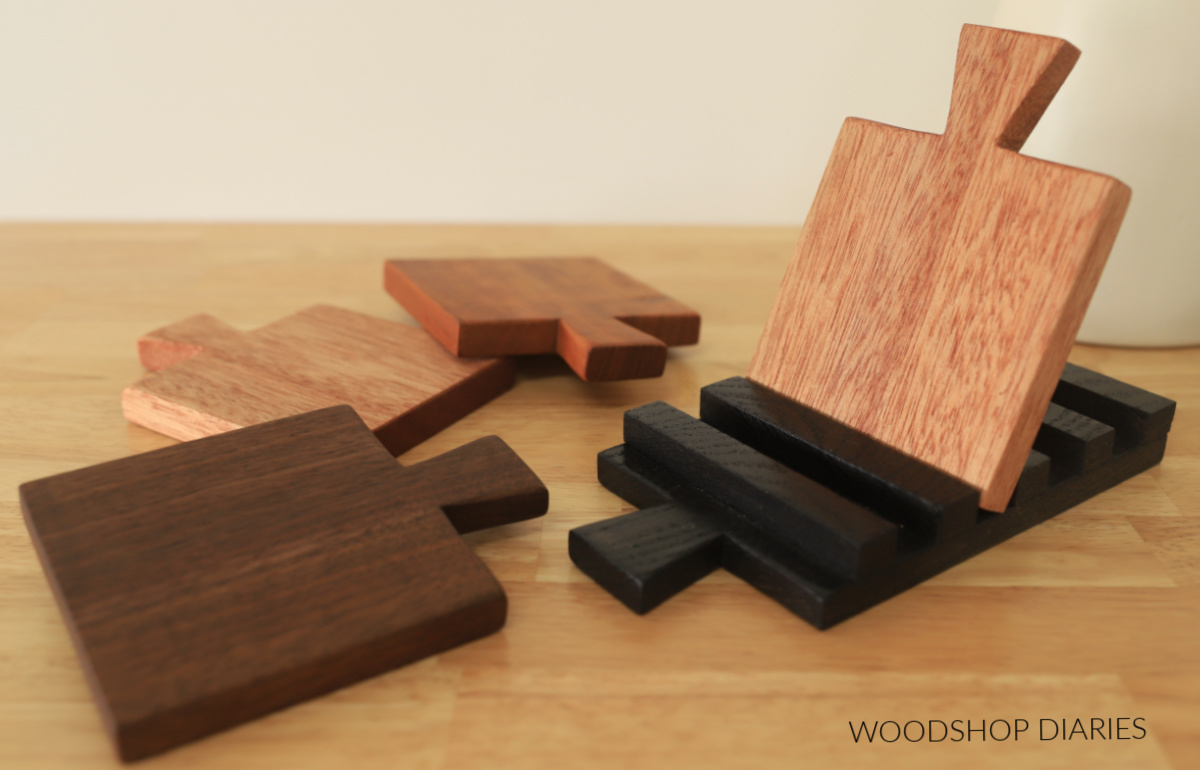
different wood types cut into miniature cutting board shaped for scrap wood drink coaster project

Plywood may last a little while, but if your drinks sweat on them very much, the moisture can cause the plies to peel apart.

That said, moisture isn’t really great for solid wood either, but if sealed well, it shouldn’t be an issue (see step 4 below). And if it becomes one, a light sanding and re sealing is a quick fix to restore your solid wood coasters to brand new.

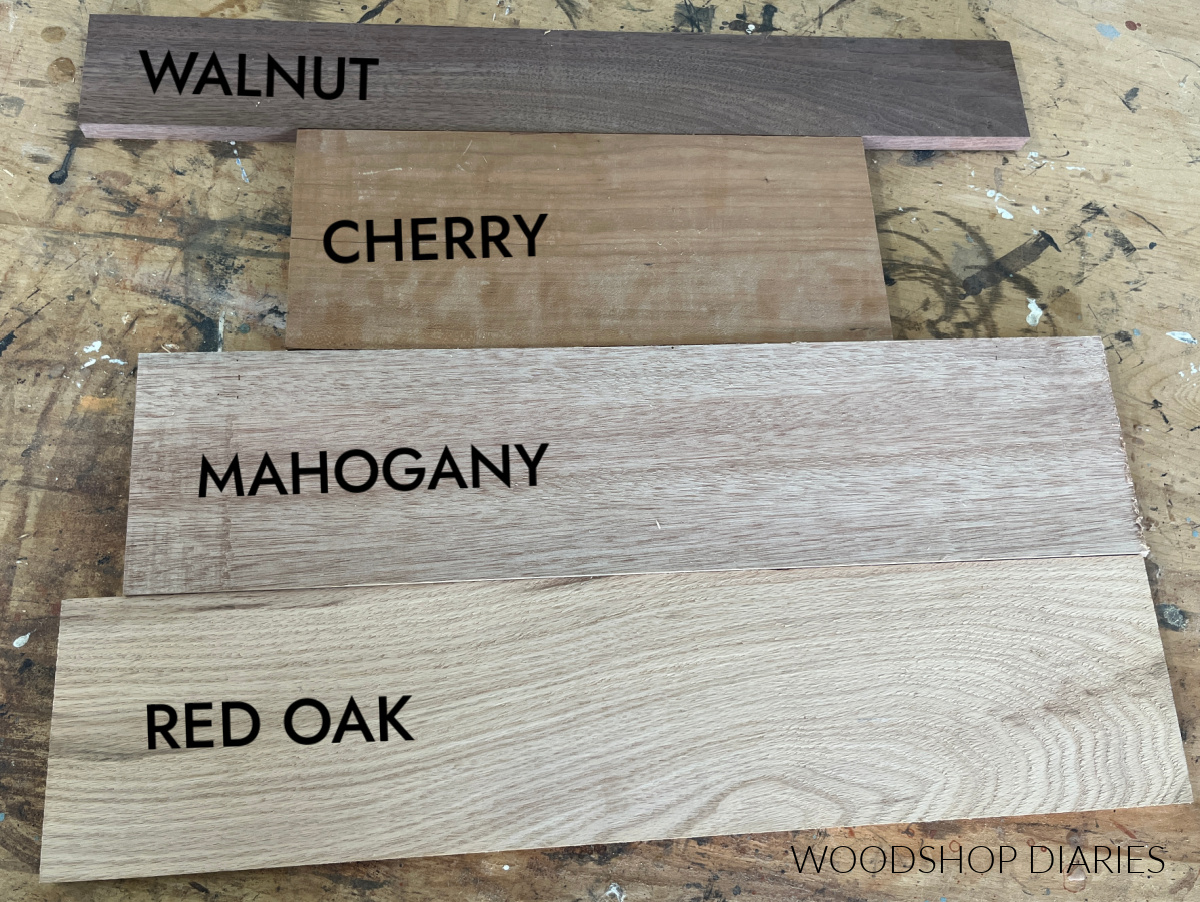
To make this project more interesting, try using different types of wood if you have them available. I used mahogany, walnut, and cherry for the coasters here and red oak for the tray.

Enjoy DIY projects and woodworking plans? Sign up for priority access for the latest posts on Woodshop Diaries!

What size should coasters be?

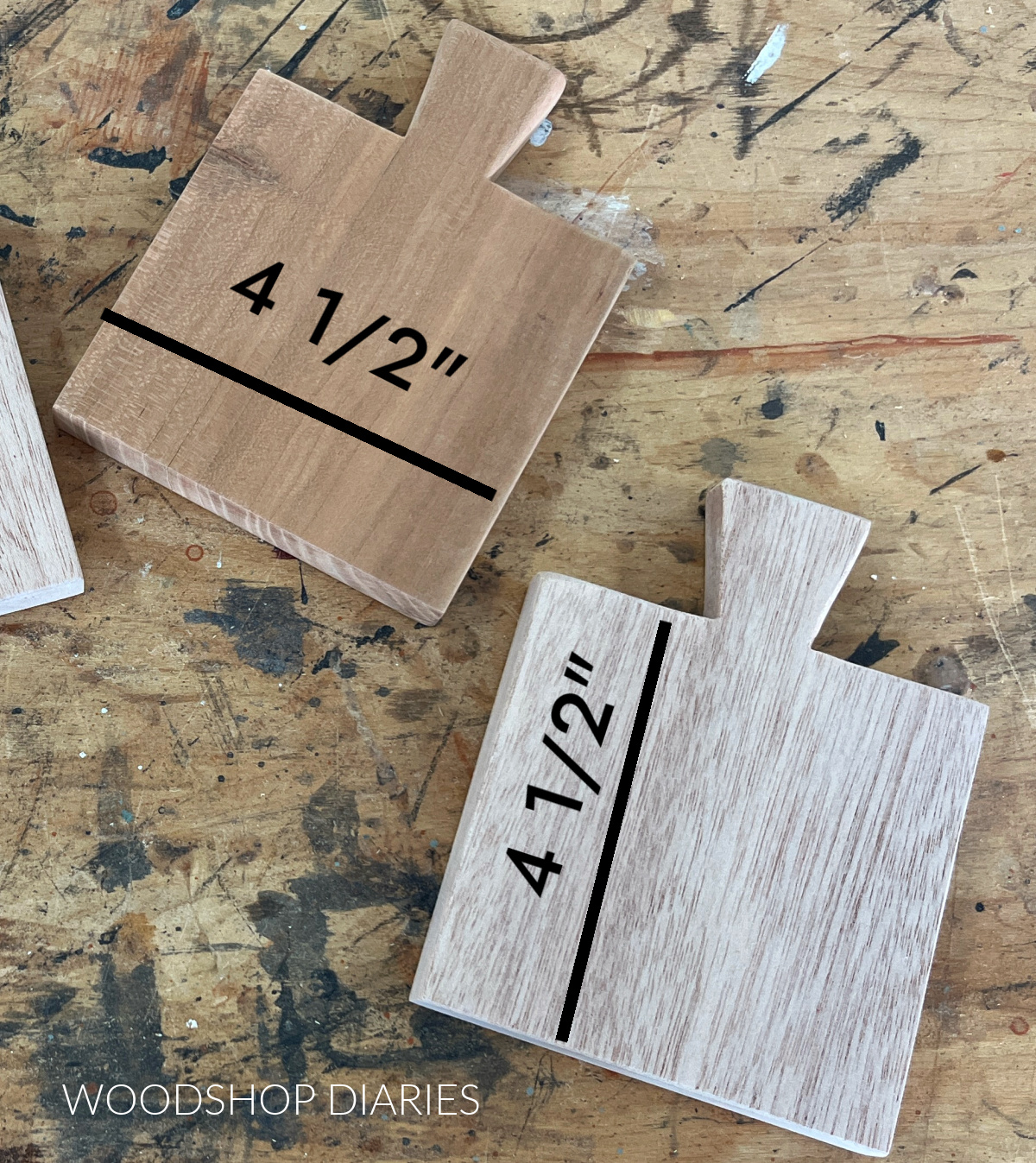
Coasters don’t have an “standard” size, but they usually range from 3-5″. I like drinking my coffee and tea from large mugs, so I lean toward the larger size and make mine at least 4 ½″ square.

DIY drink coasters cut to size with dimensions showing 4 ½" x 4 ½"

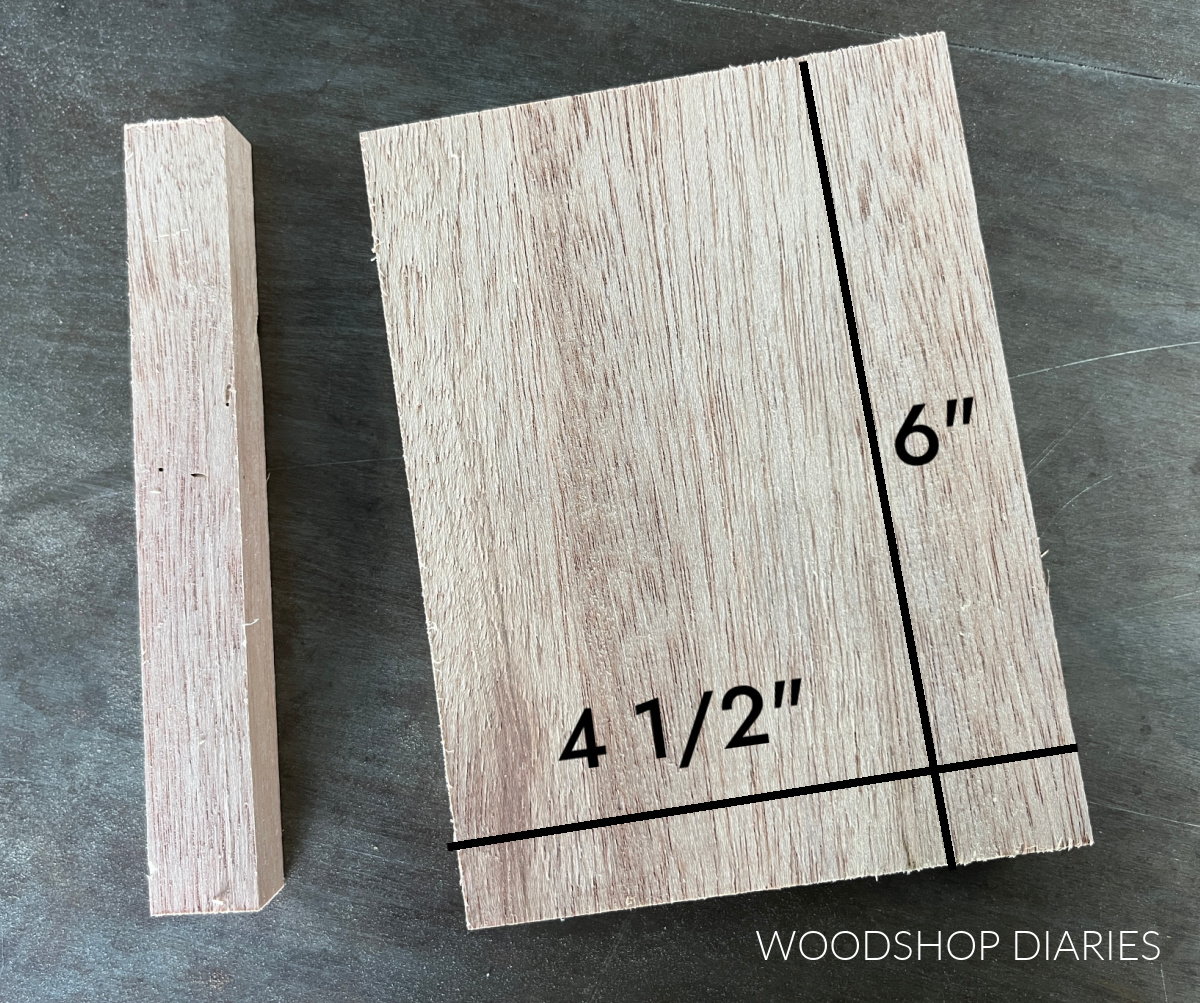
For these cutting board shaped drink coasters, I needed to initially cut them longer than they were wide so that I could cut a handle shape on one end.

So my coasters ended up being 4 ½″ wide x 6″ long. Of course, if you want to make yours a different size, go for it! There’s no hard rule about coaster size.

REMEMBER: If the scraps you have are narrower than 4 ½″, you can glue them together to make them the size you need. My walnut board was 2 ¼″ wide, so I cut two pieces from it to glue together for one of my coasters.

How to DIY a Scrap Wood Cutting Board Coaster Set

These drink coasters are a super fun (and quick!) project that makes the perfect handmade gift idea. You can easily make a few sets in a weekend or an afternoon.

And it requires minimal tools and materials! Here’s what you need:

Tools & Materials

Tools:

  • Jig Saw
  • Miter Saw (optional–makes straight cuts faster)
  • Sander

Materials:

  • Scrap wood* (pieces at least 4 ½″ x 6″–1x6s work great)
  • Wood Glue

*NOTE: If you use different woods for your coasters, the pieces should all be the same thickness–½″ or ¾″ thick material is ideal. The tray can be a different thickness, but the coasters should be the same.

Step 1: Cut coasters to size

First, I cut my coaster pieces to size. The scraps I had were 1x6s (except for the walnut piece), so they were 5 ½″ wide. Why are 1x6s not 6″ wide? Check out this post to help you understand lumber sizing.

different types of wood on workbench--walnut, cherry, mahogany, red oak

I had some small scraps of different woods, so I cut one of these from cherry, two from mahogany, and I cut two pieces of my walnut board to glue together to make my fourth.

I used a miter saw to cut these into 6″ long pieces first, then trimmed a little off the edge to make them 4 ½″ wide. Be careful when cutting small pieces!

scrap wood drink coaster cut down to size on metal surface

Keep in mind that you can make your coasters any size you want. I recommend measuring your favorite mug or glass if you’re not sure what will fit it.

Step 2: Cut handles

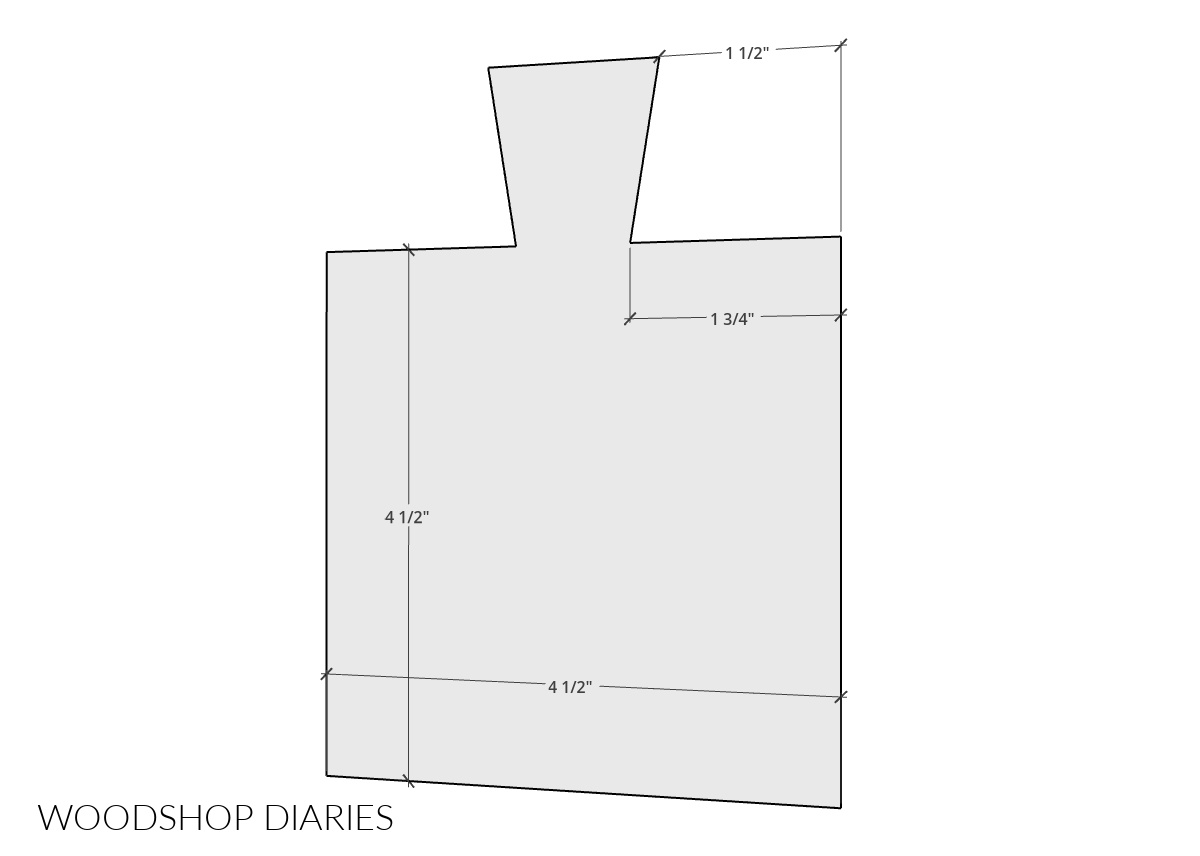
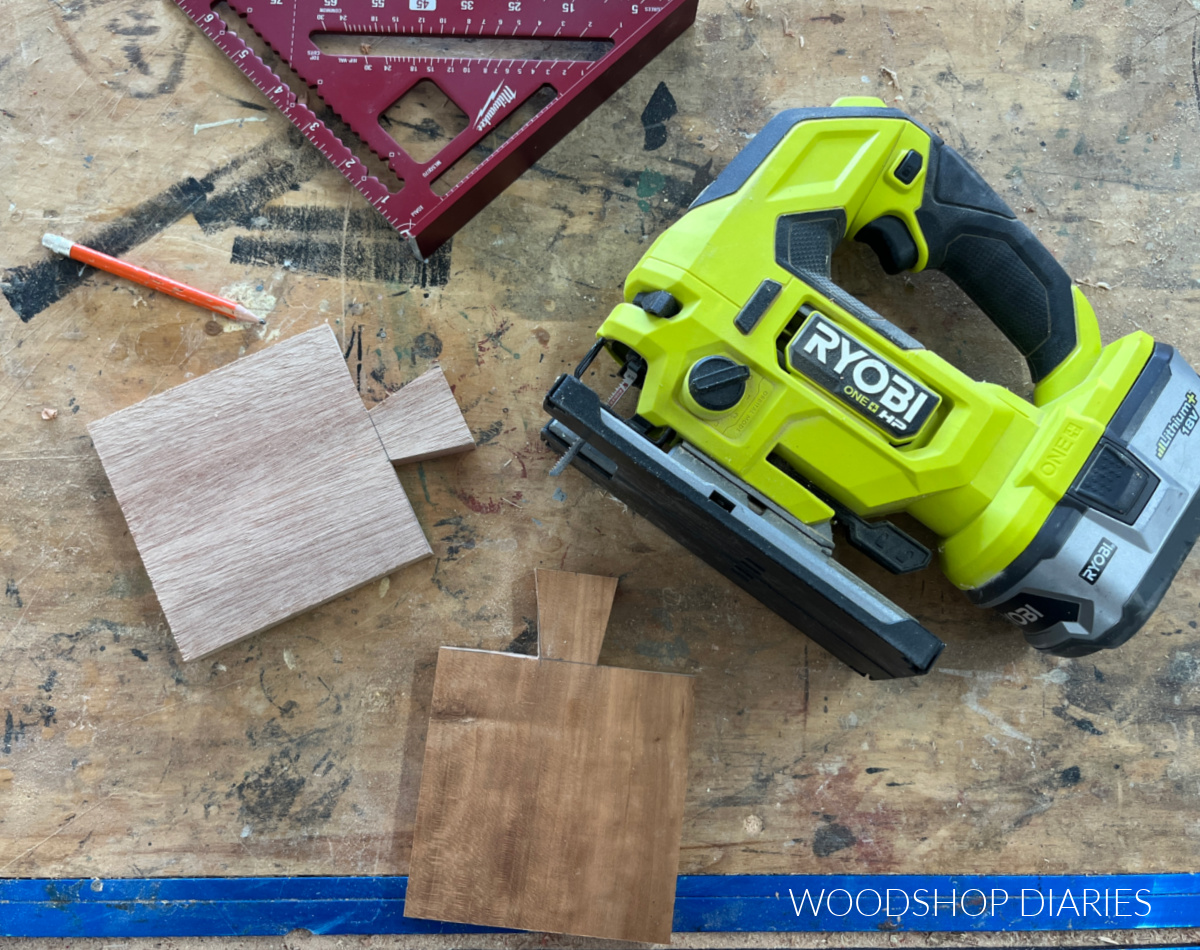
Once the coasters were cut to size, I cut out the handle that makes them look like a cutting board. You can cut your handle shape however you want, but these straight lines were easier to cut with a jig saw than a curve, so I kept it simple.

diagram of cutting board coaster handle dimensions

I measured out and connected the lines for my coaster handle using a pencil and a straight edge (a straight piece of scrap wood works great!).

Then, I cut along the lines with my jig saw.

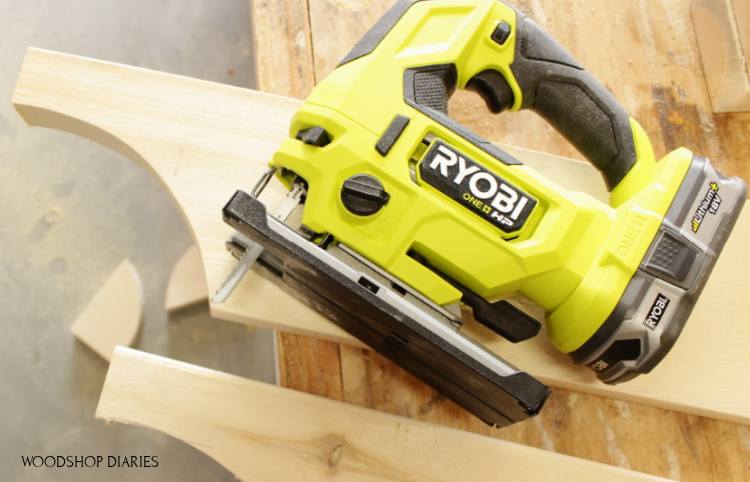
jig saw on workbench with coasters cut to final shape

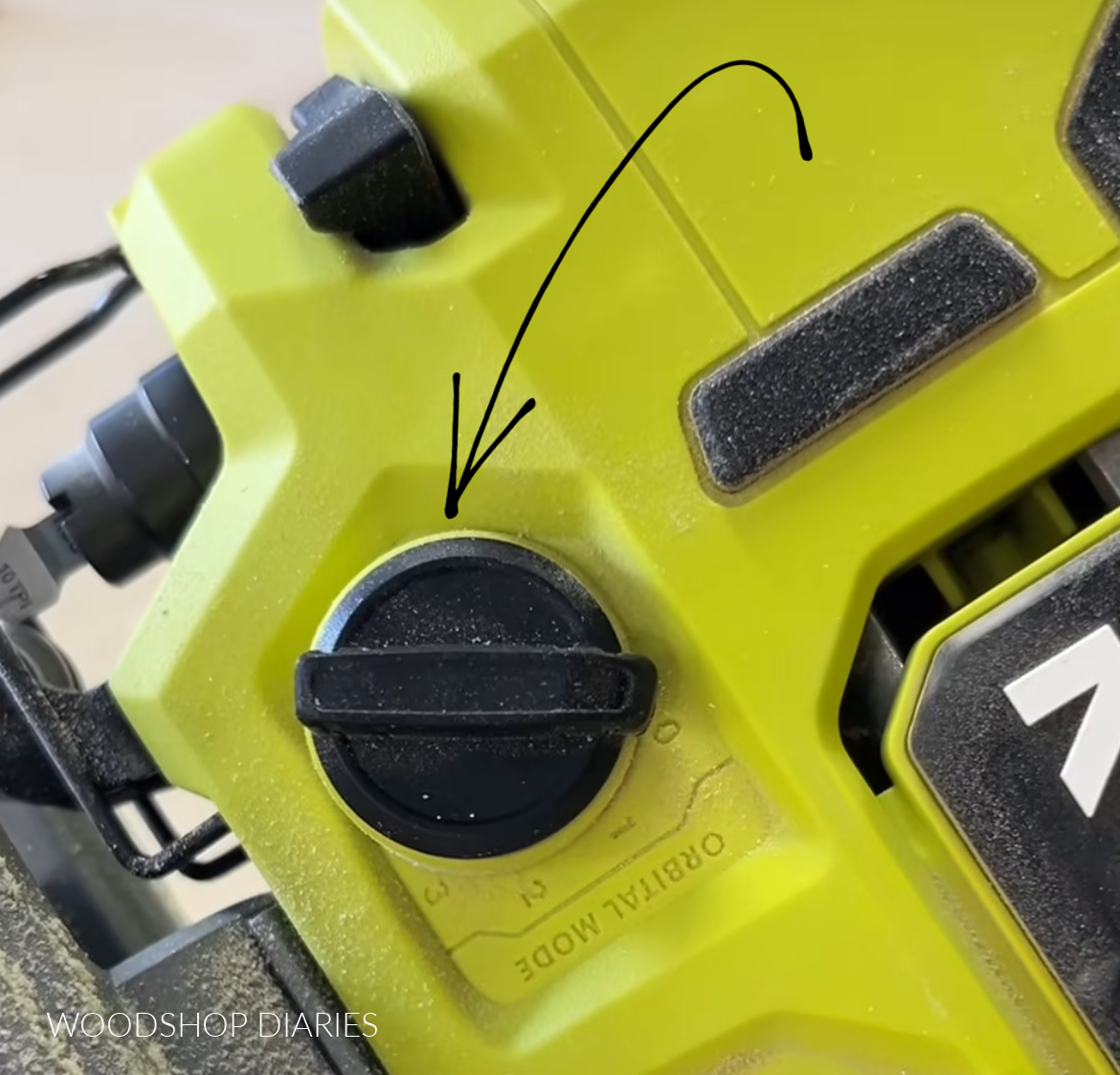
TIP: I recommend a fine finish wood blade or a scroll blade to cut this. If your jig saw has orbital settings, make sure they’re turned off for the cleanest cuts.

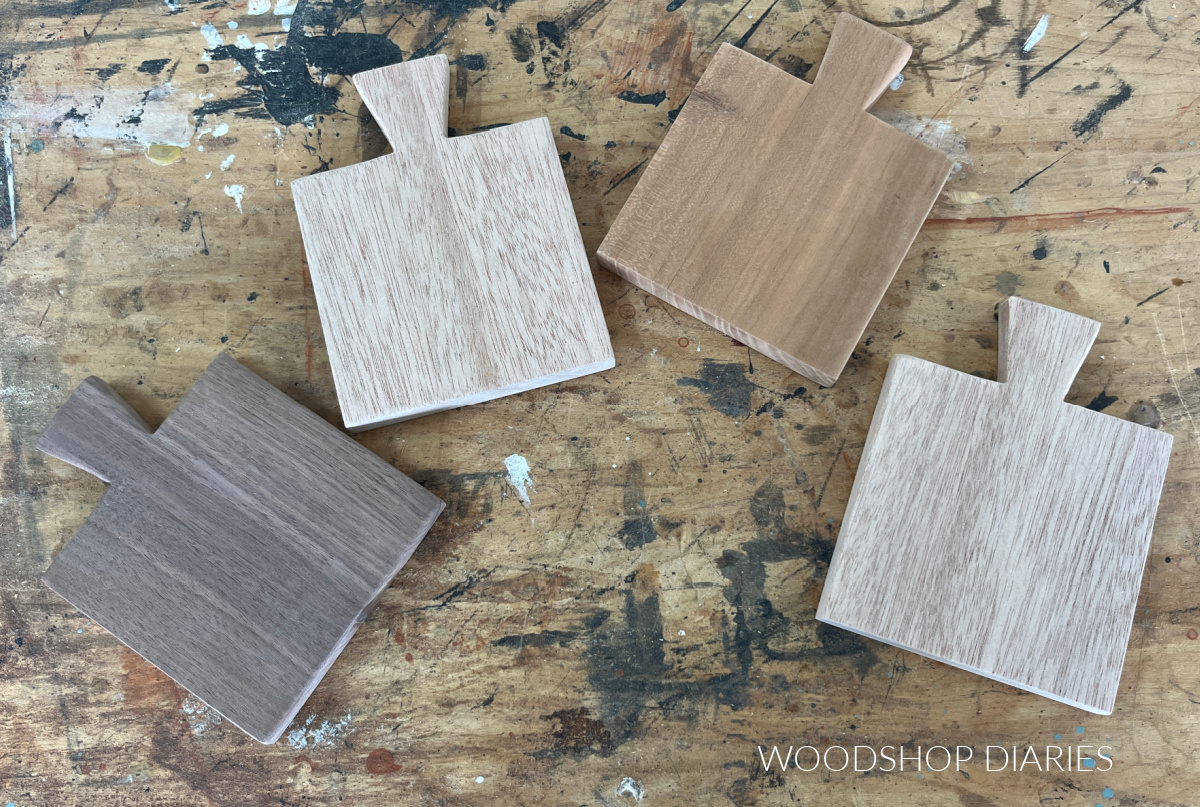
After cutting, I sanded each coaster well and used the sander to help me kind of round over the corner edges a little so they weren’t so sharp.

four different wood coasters cut and sanded spread out on workbench

Step 3: Make Coaster Tray (optional)

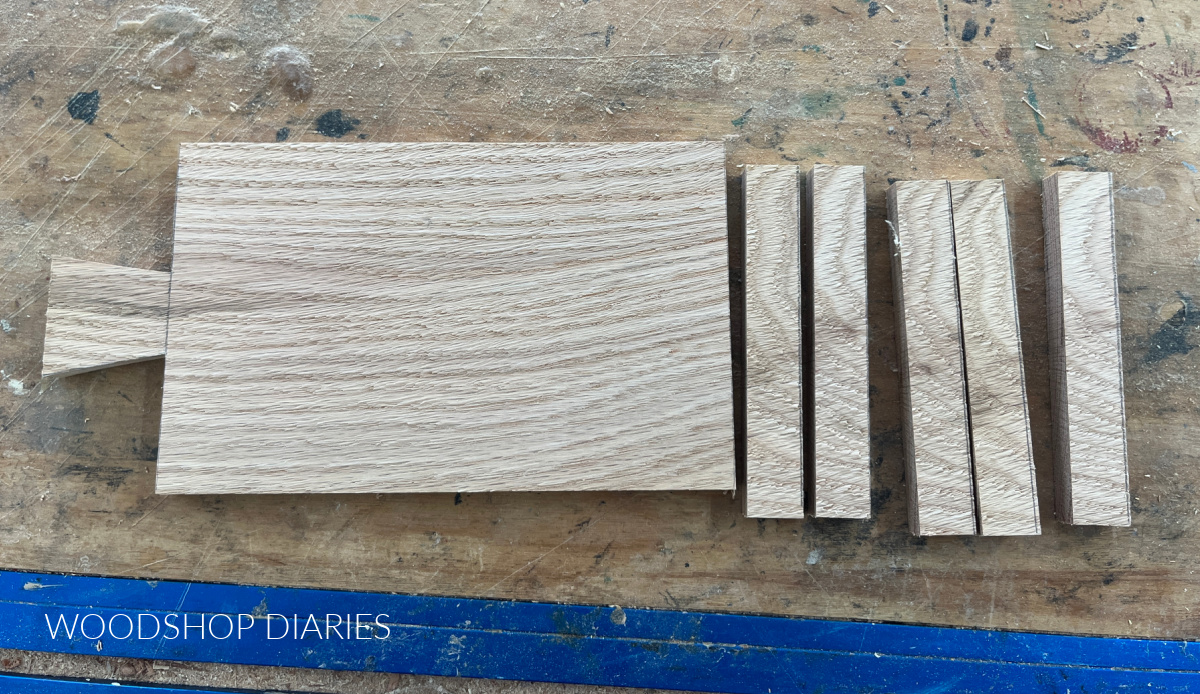
For the tray, I used a piece of ½″ thick red oak scrap. But another piece of 1×6 would work fine, too!

I trimmed this piece to about 10″ long, then ripped it down to 4 ½″ wide (the same width as the coasters).

From one end, I cut five pieces ¾″ long. Then, I cut a handle in the other end of the board to match the coasters.

DIY drink coaster tray pieces cut and laid out on workbench

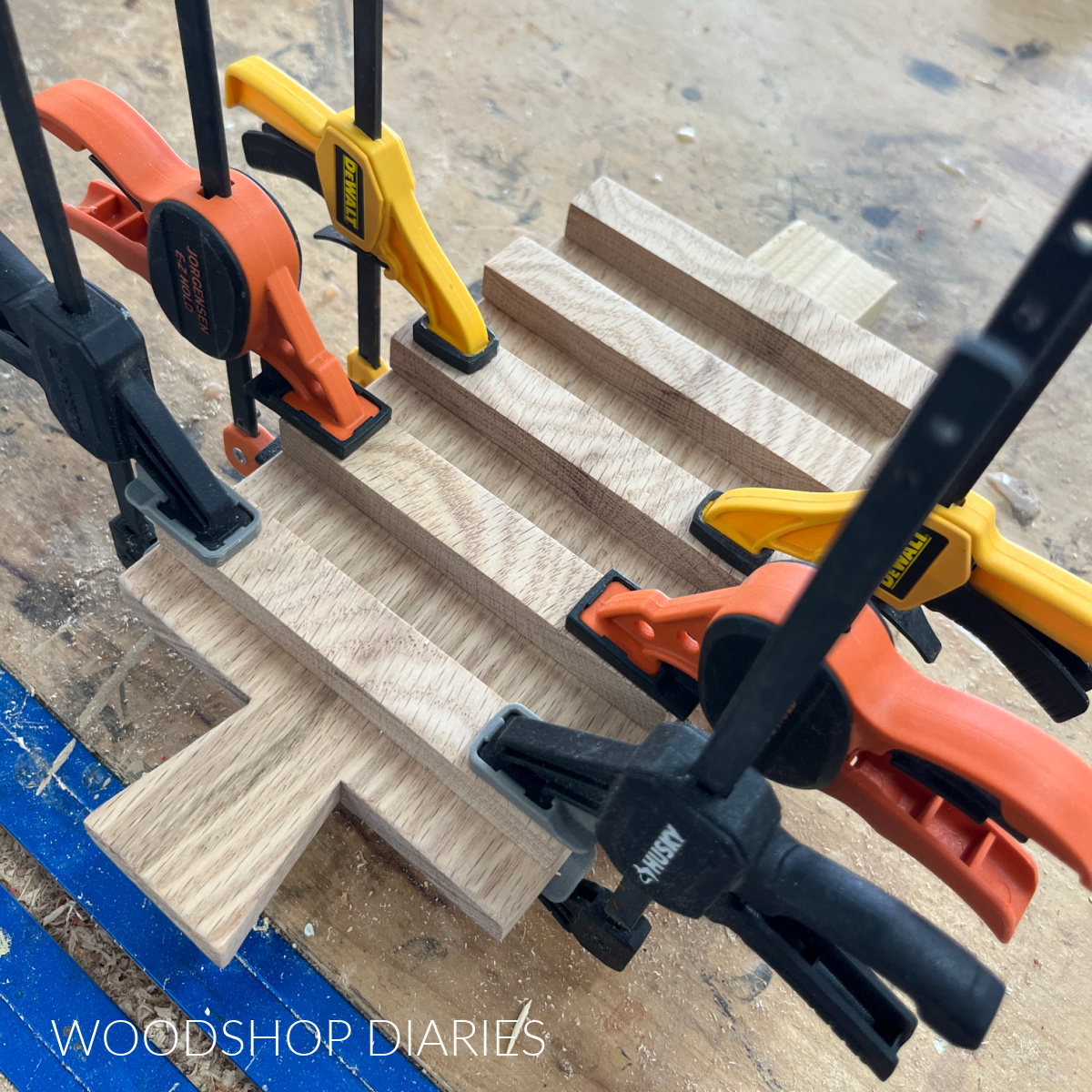
These ¾″ pieces will be what holds/divides the coasters on the tray. I sanded all the pieces well, then started at the back gluing the strips across the tray so that they were about ⅞″ apart.

divider strips glued onto drink coaster tray with clamps

NOTE: Before gluing, especially if you use different board thicknesses than I did, I recommend laying your pieces out on the tray and seeing how your coasters sit between them. You may want to space your blocks out differently.

You’ll want your coasters to fit snug enough between the blocks that they will stand on their own, but not so snug that they’re difficult to place in or get out.

Completed unfinished DIY wooden drink coaster set looks like miniature cutting boards

After I glued all five strips across my tray, I allowed these pieces to dry, then lightly sanded away any glue squeeze out.

Step 4: Finish

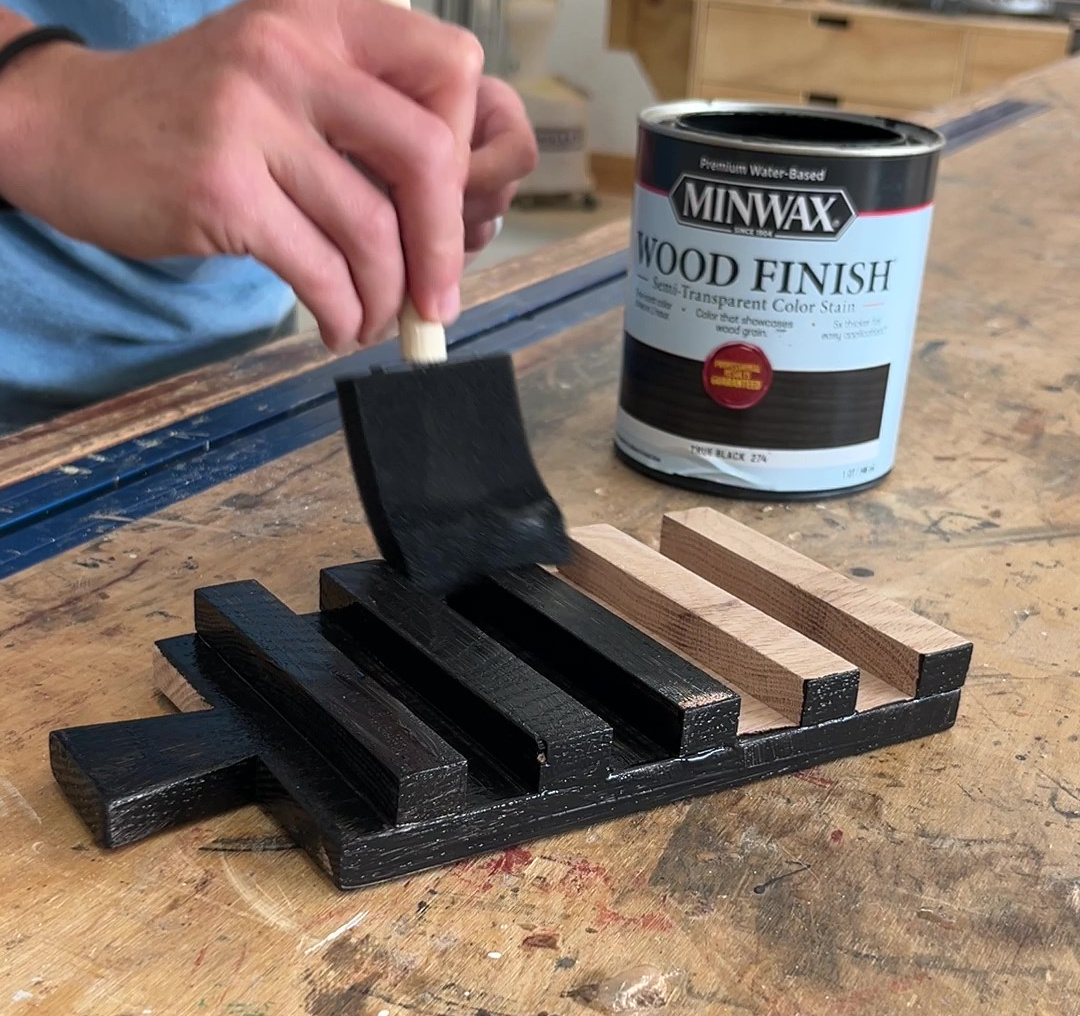
I stained my tray using Minwax True Black Water Based Wood Stain. Once dry, I applied a couple coats of Minwax Polycrylic (I used the spray kind since it would have been challenging to brush all these little grooves).

applying black stain to drink coaster tray

For the coasters, I wanted to make sure they were well sealed to withstand sweat from drinks/glasses. Just to be clear, no finish is going to last forever or be 100% waterproof.

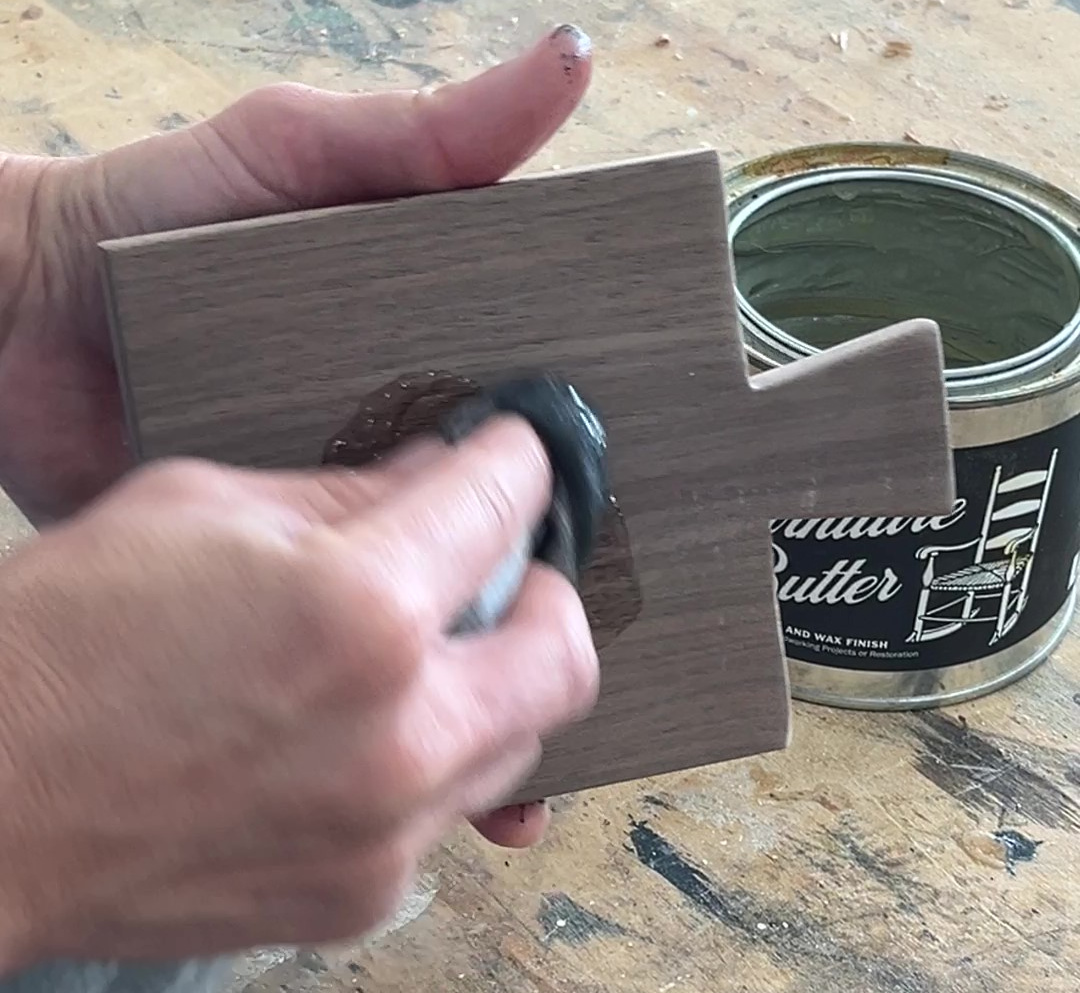
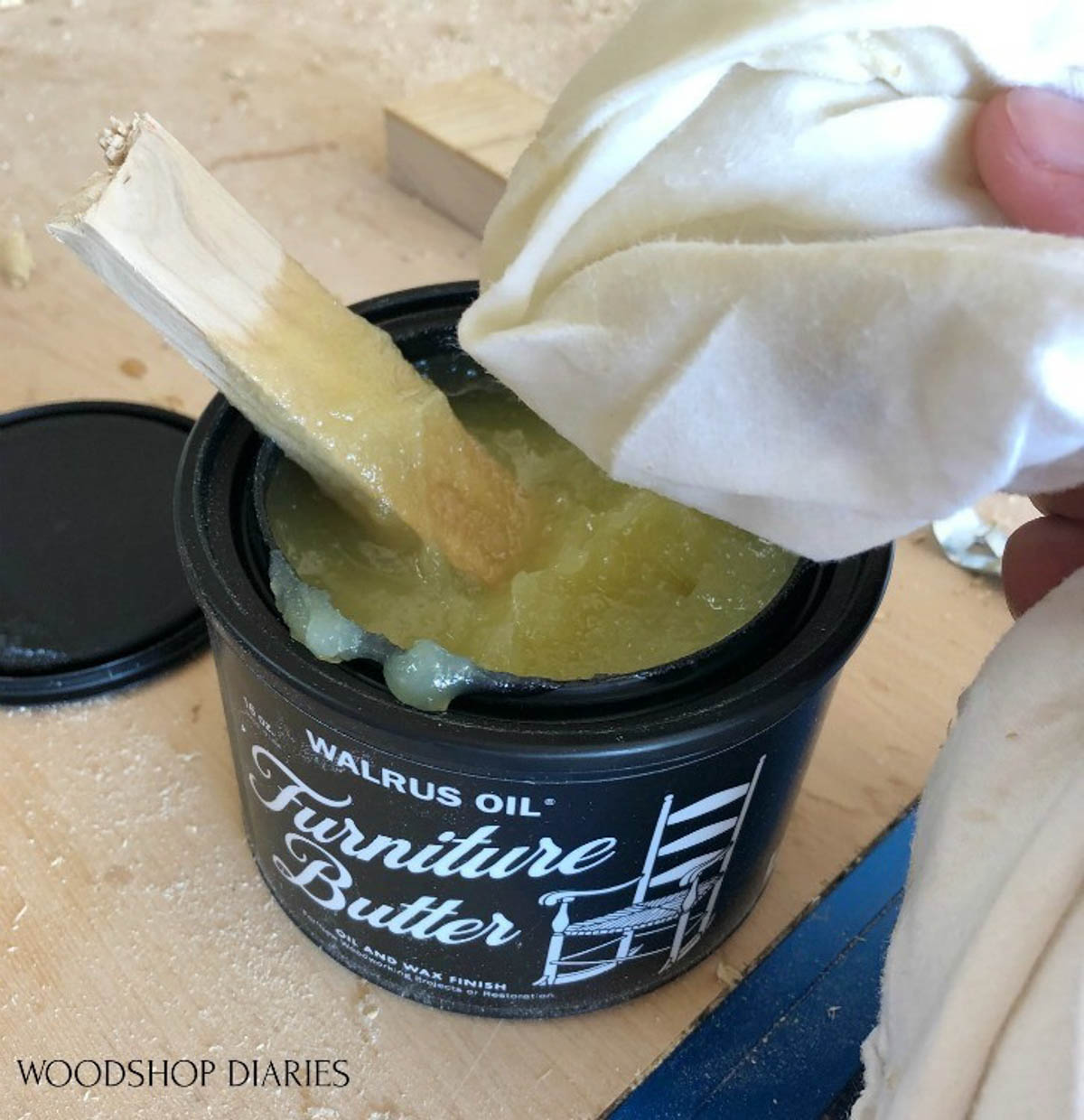
Many finishes will last for a good while, but will need an additional coat eventually if it gets wet very often. I used Walrus Oil Furniture Butter on these coasters. It’s an oil based sealer that is durable, and easy to apply and reapply. I love using it for hardwoods.

Applying furniture butter to drink coaster

In the past, I’ve also used Walrus Oil Furniture Wax on coasters and it works excellent as well. A good quality furniture oil, or wax will work for coasters and be easy to apply again later when needed.

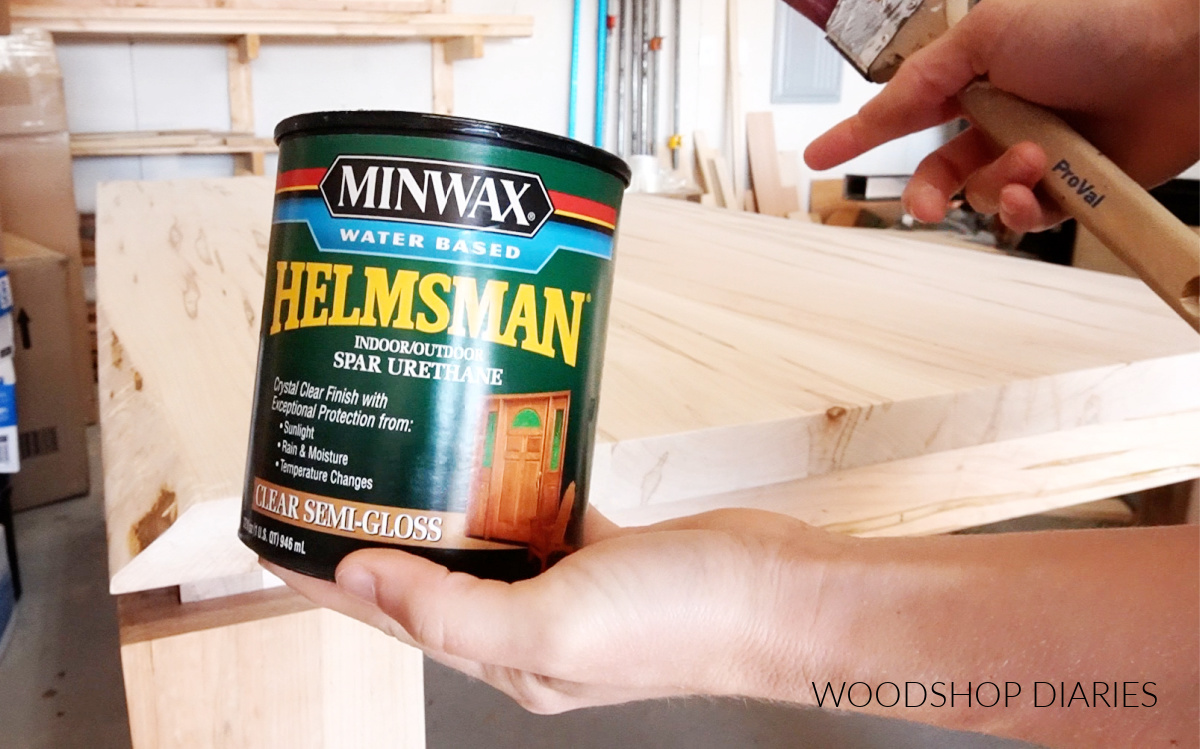
If you prefer something other than an oil, Minwax Helmsman Water Based Sealer is another great option. It’s durable and easy to apply/reapply as well.

When you begin noticing the water not beading up on the coaster anymore or they’re feeling a bit rough, it’s time for a light sand and recoat.

completed five piece drink coaster set with four coasters and a display/storage tray finished on wood top

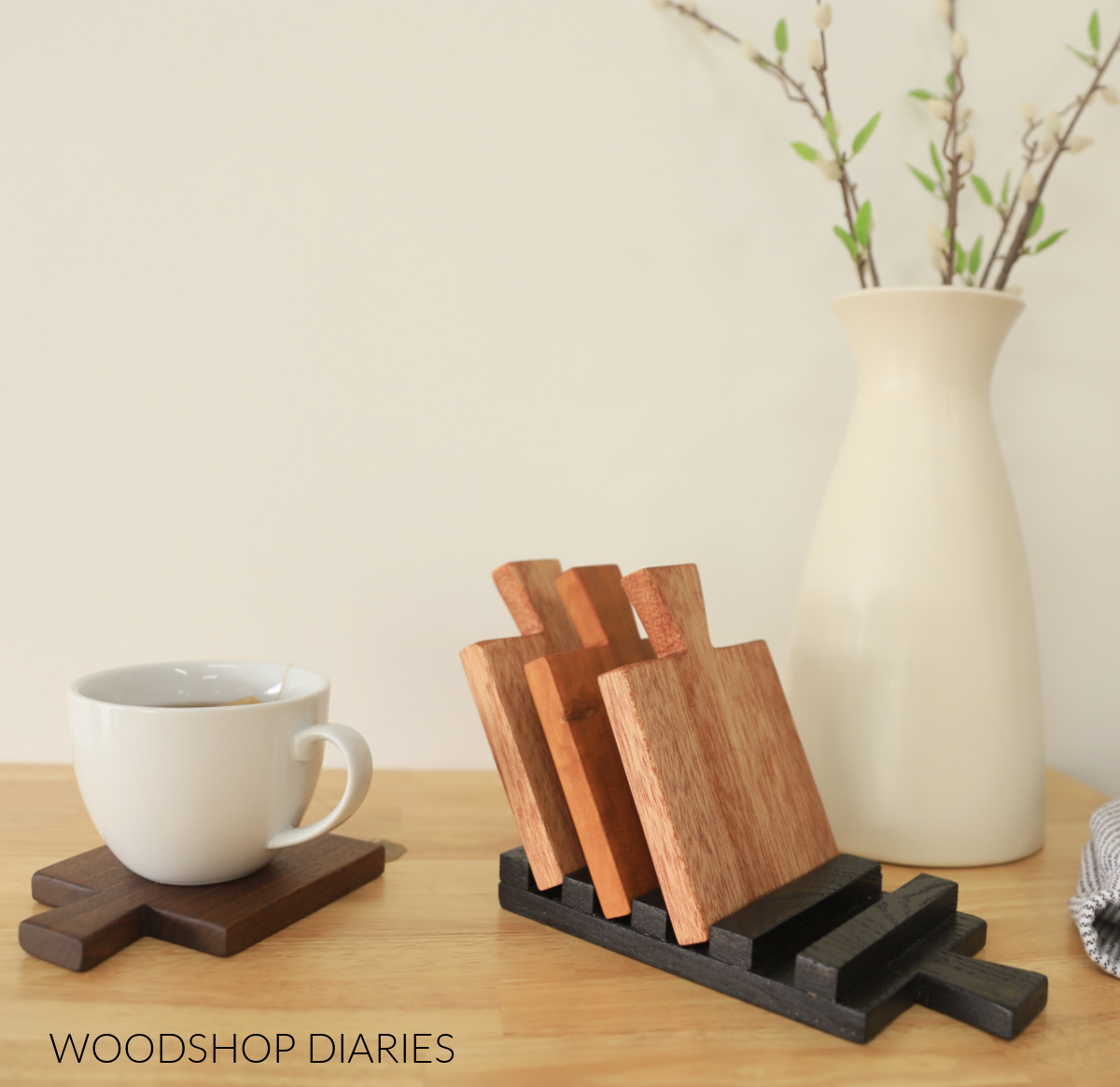
Once these finishes were dry, this set is ready to use and is just in time for my afternoon tea *sigh…sip sip*

three coasters placed in coaster tray, one coaster sitting on table top with cup of tea on top, vase in background

These were SO much fun to make and look so cute on display in the kitchen!

DIY wooden drink coaster set with all four coasters standing in coaster tray

Looking for More Scrap Wood DIYs?

Can’t get enough scrap wood projects?? I’m teaming up with my friend, Kati, from Houseful of Handmade all month long for “Scrap Wood Summer!”

Check out all the projects in the series below. Click on the images to learn how to make each one!

DIY Arched Lanterns
Stacking Shoe Storage Boxes
Scrap Wood Plant Stand
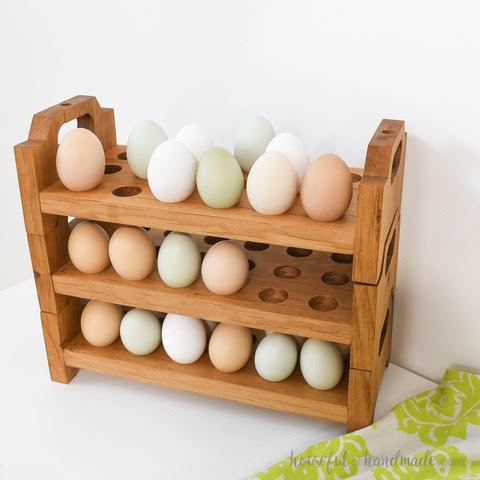
DIY Scrap Wood Egg Trays
Cutting Board Drink Coasters
DIY Pasta Drying Rack
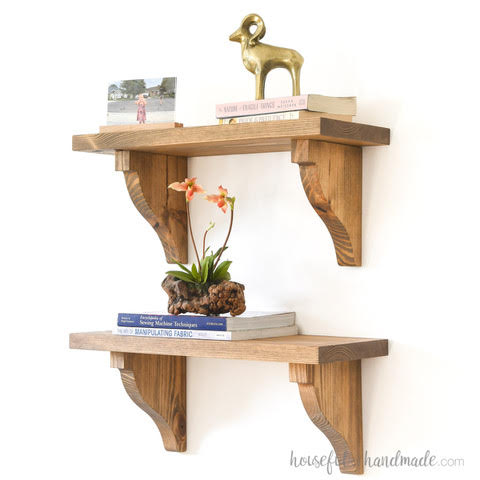
ScraP Wood Corbels
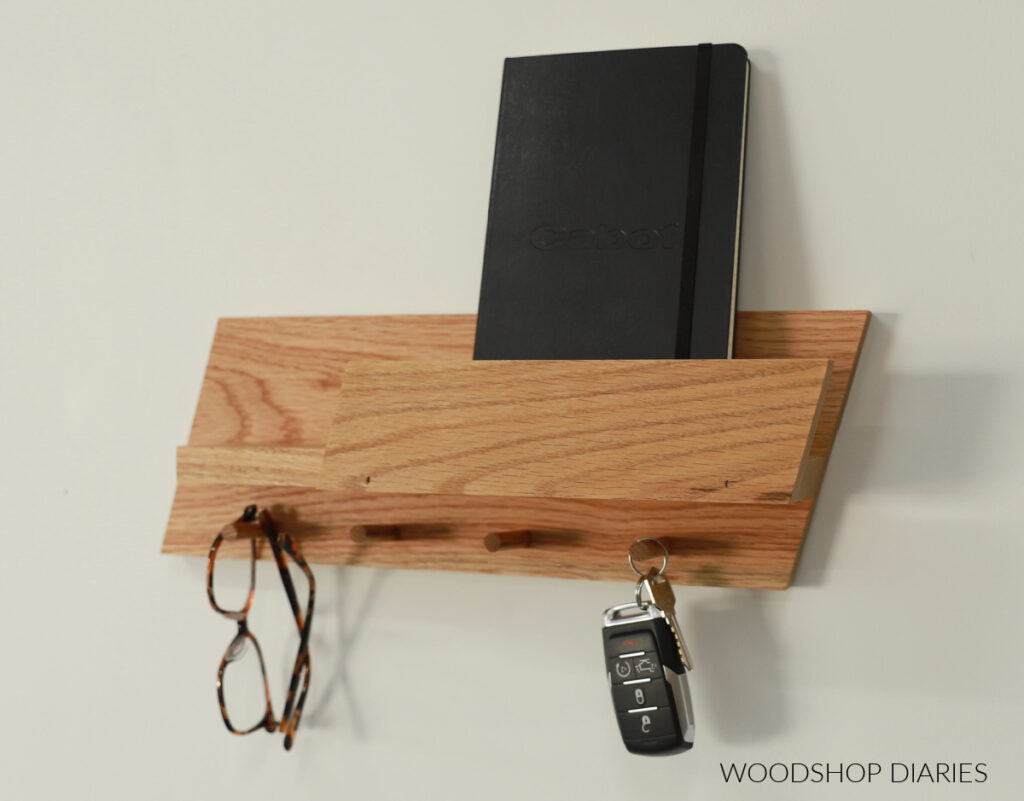
DIY Key Holder Organizer

This is our third year hosting Scrap Wood Summer and I enjoy it a little more each time. But, if you’ve never heard of it before, that’s okay!

Essentially, we each share a new scrap wood project every Tuesday throughout the month of August (2024). So by the end of the month, you’ve got 8 new project ideas to try.

So stay tuned to see all the other fun ideas we are so excited to share with you!

Can’t wait? Check out previous Scrap Wood Summer projects plus other scrap wood ideas here.

If you’d like to save this DIY cutting board coaster project for later, be sure to pin it or share to your favorite social channel!

Pinterest collage image showing in process photo at top with jig saw and completed finished DIY drink coasters at bottom with text "easy DIY scrap wood drink coasters"

Until next time, happy building!

DIY Arched Door Console Cabinet

August 8, 2024 by Shara, Woodshop Diaries

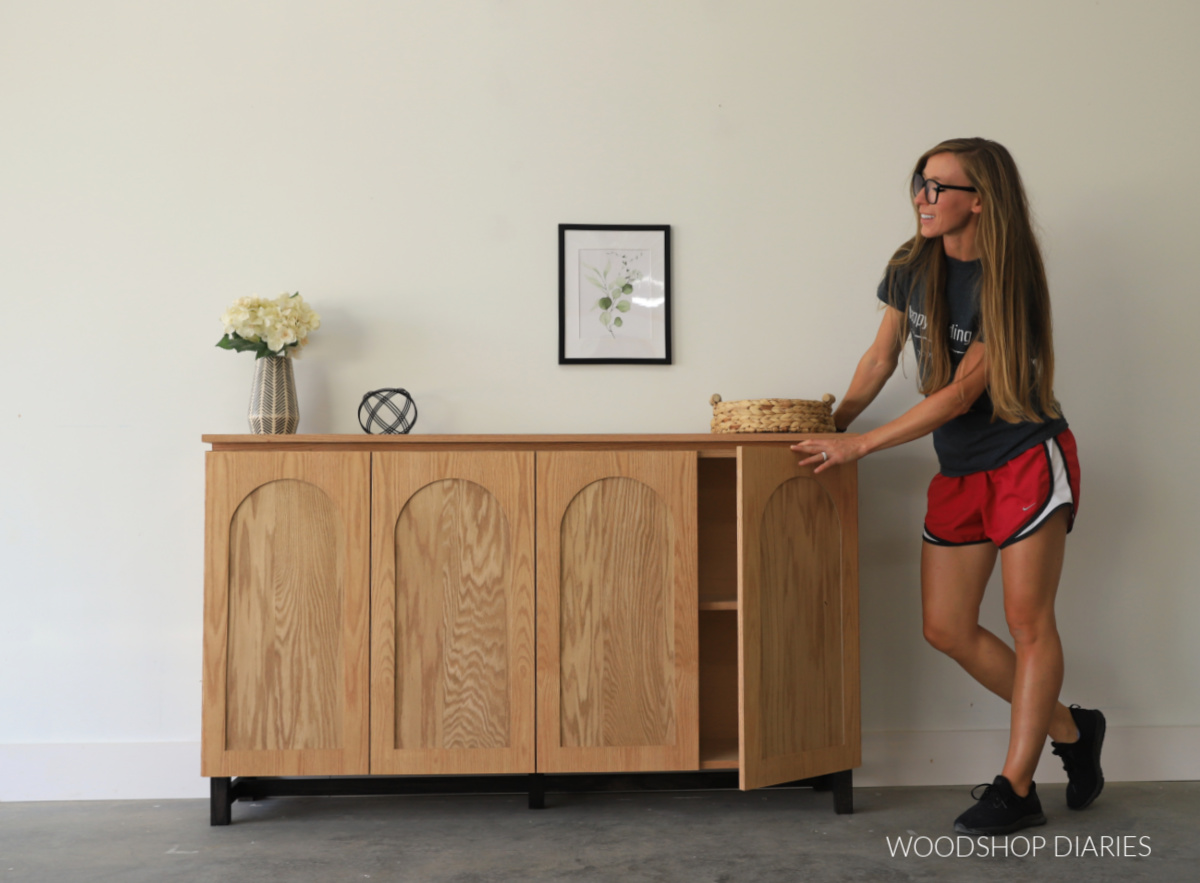
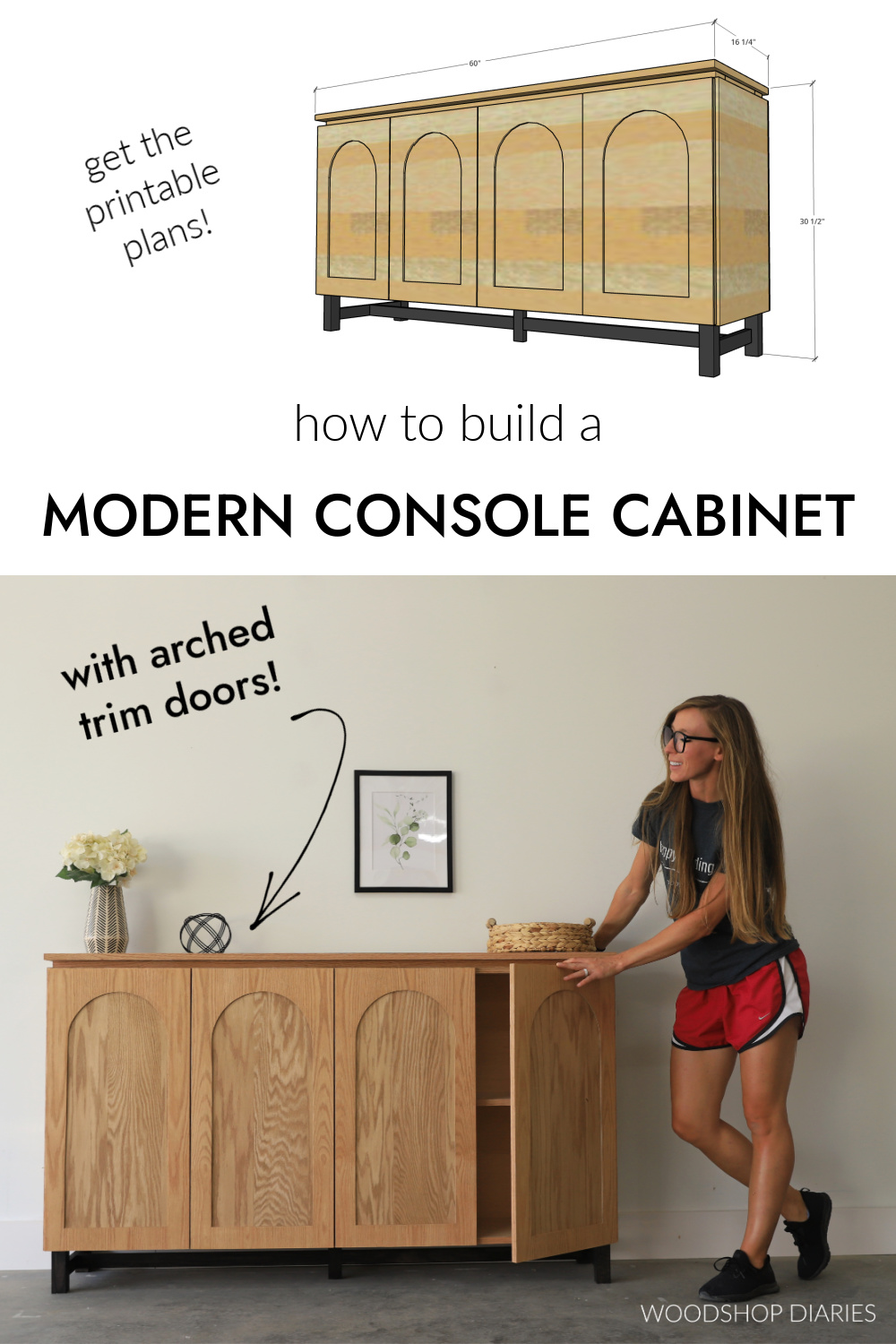
In this post, I’m sharing how to build a console cabinet with arched trim doors!

This basic console cabinet is a very simple design, but the arched detail on the doors makes it look high-end, classy and unique.

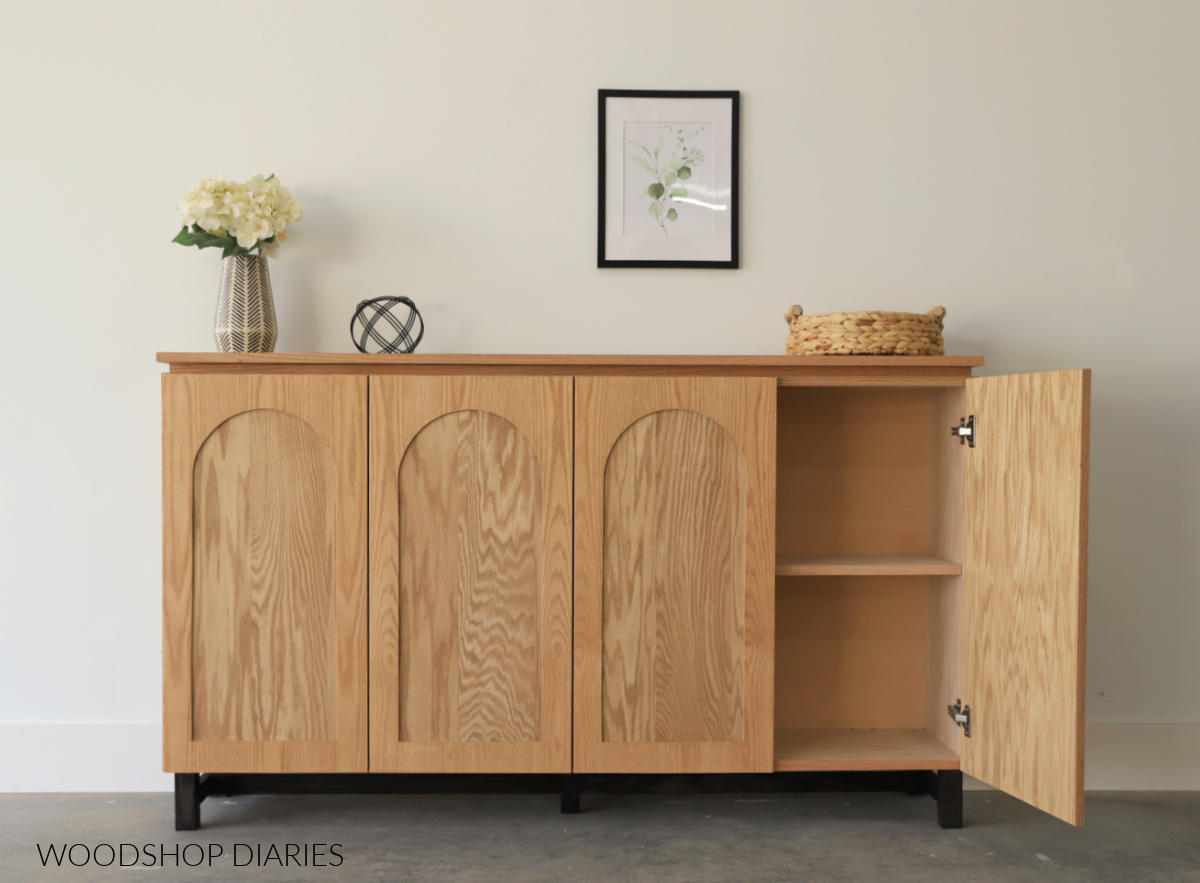
Shara Woodshop Diaries opening door of arched trim console cabinet to reveal shelves inside

This project would be an eye catching accent piece for a dining room, living room, or home office. And of course, the extra storage inside is always nice to have in these spaces, too.

It’s hard to believe this console was built almost entirely from plywood! Which means it’s both easy to build and easy on the budget*.

*If you didn’t already know, plywood is much cheaper than the equivalent amount of solid wood in just about every instance.

I’m excited to share tips and plans to how to build your own below.

This post contains affiliate links. See website policies.

What to know before building

This simple console cabinet is a project you can reasonably complete in a weekend. I’d consider it an intermediate level build simply due to its size, not it’s complexity.

The assembly methods used here are pretty basic and it requires minimal tools. It’s a great project to get some practice on using your jig saw!

Material Choices

This modern console project was made almost entirely from plywood except for the base. The base uses 1×2 and 2×2 lumber.

I used red oak for this project, however any wood type you’d like to use here would work fine. Birch and/or pine are also great choices.

Close up of a piece of red oak lumber

For the plywood, I always recommend using cabinet grade hardwood for furniture. Learn more about how to choose plywood for furniture and cabinets here.

I used a combination of ¼″, ½″, and ¾″ plywood to build this console. The ¾″ plywood is for the main body, and the thinner material is for the back panel and the doors.

The printable plans detail the cut diagrams for each plywood sheet to make things easy.

Overall Console Cabinet Size

The overall size of this console storage cabinet as detailed in the plans below are approximately 16 ¼″ deep x 30 ½″ tall x 60″ wide.

Dimensional diagram showing overall dimensions of modern console cabinet with arched trim doors

*NOTE: The finished console shown in the images was built to a kind of odd custom size for a friend of mine. It was only a foot deep and 36″ tall. This isn’t a practical size for most applications.

So I adjusted the plans I’m sharing here to make it deeper and slightly shorter so it’s more of a “standard” console cabinet size.

A Note About Hinges

While this is a simple build, one thing that can be a little confusing are the hinges. I highly recommend checking out this video for additional information on this part.

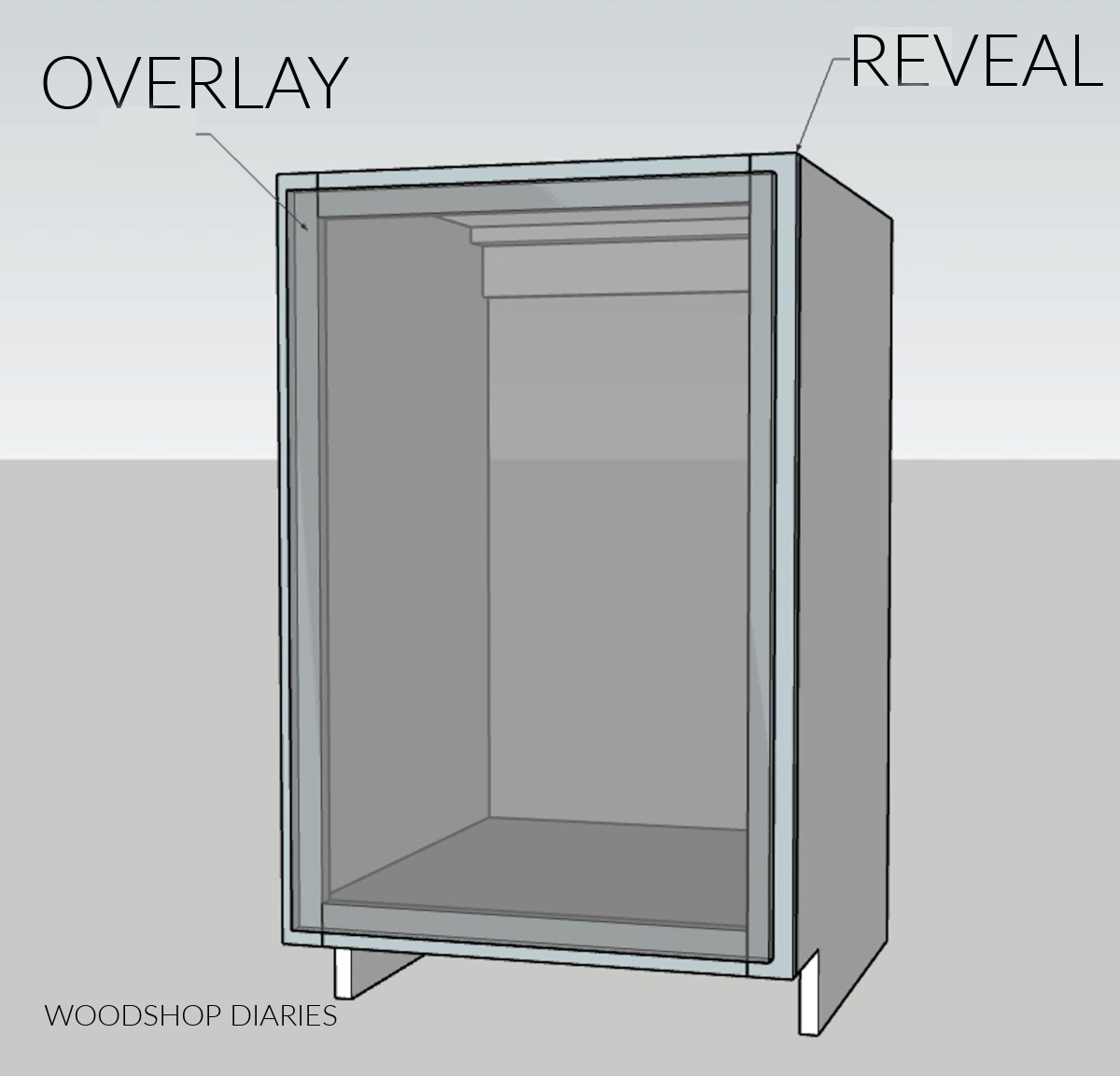
The cabinet is frameless and has overlay doors. Typically frameless overlay doors overlay the entire front edge of the cabinet like you see below. See this post about how to size cabinet doors.

Diagram of full overlay door on cabinet box

But in this case, since two doors both share the middle divider panel, I had to build these doors so that they’d only overlay the middle divider about ¼″ each.

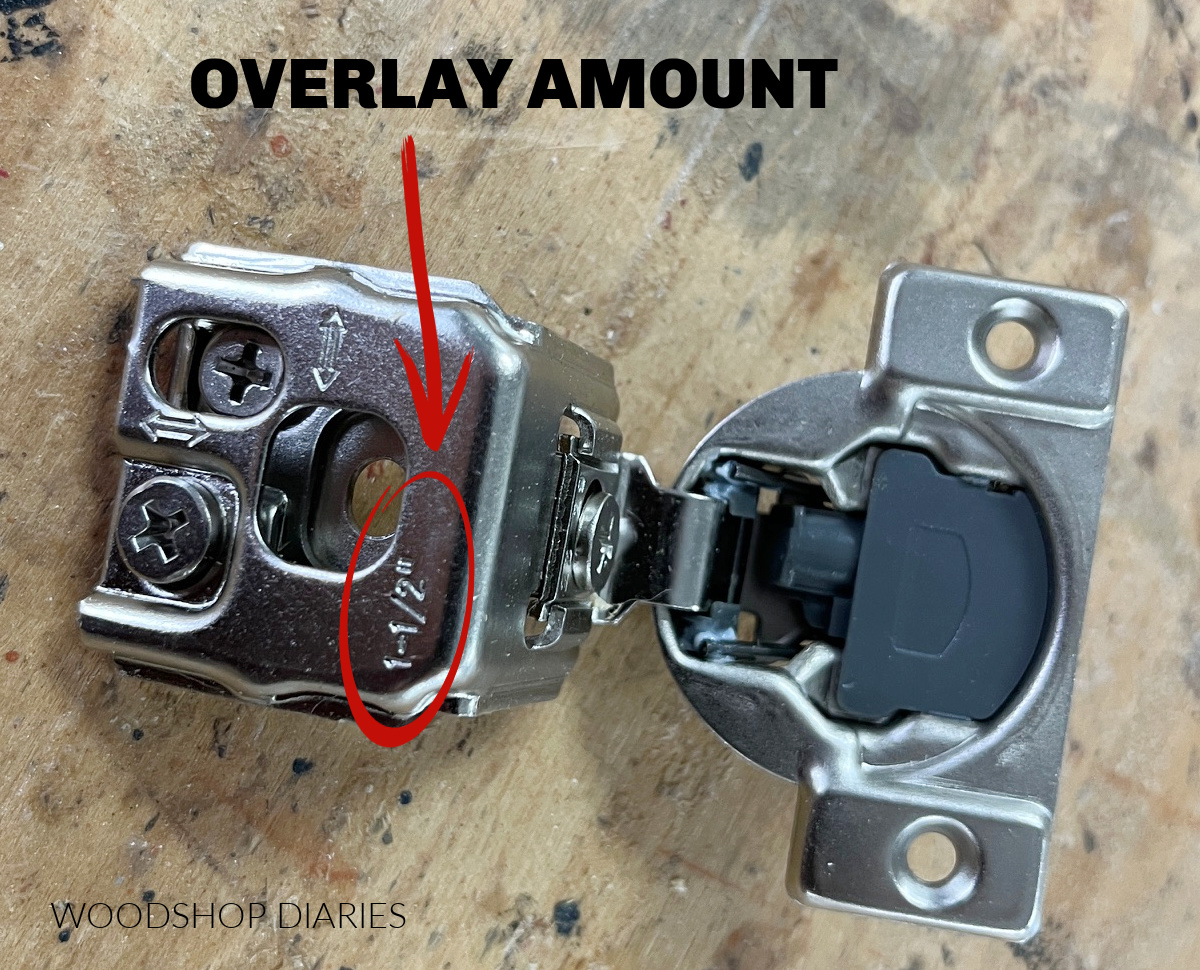
Even though the center doors are only “partially” overlaying the middle divider, you still use full overlay hinges.

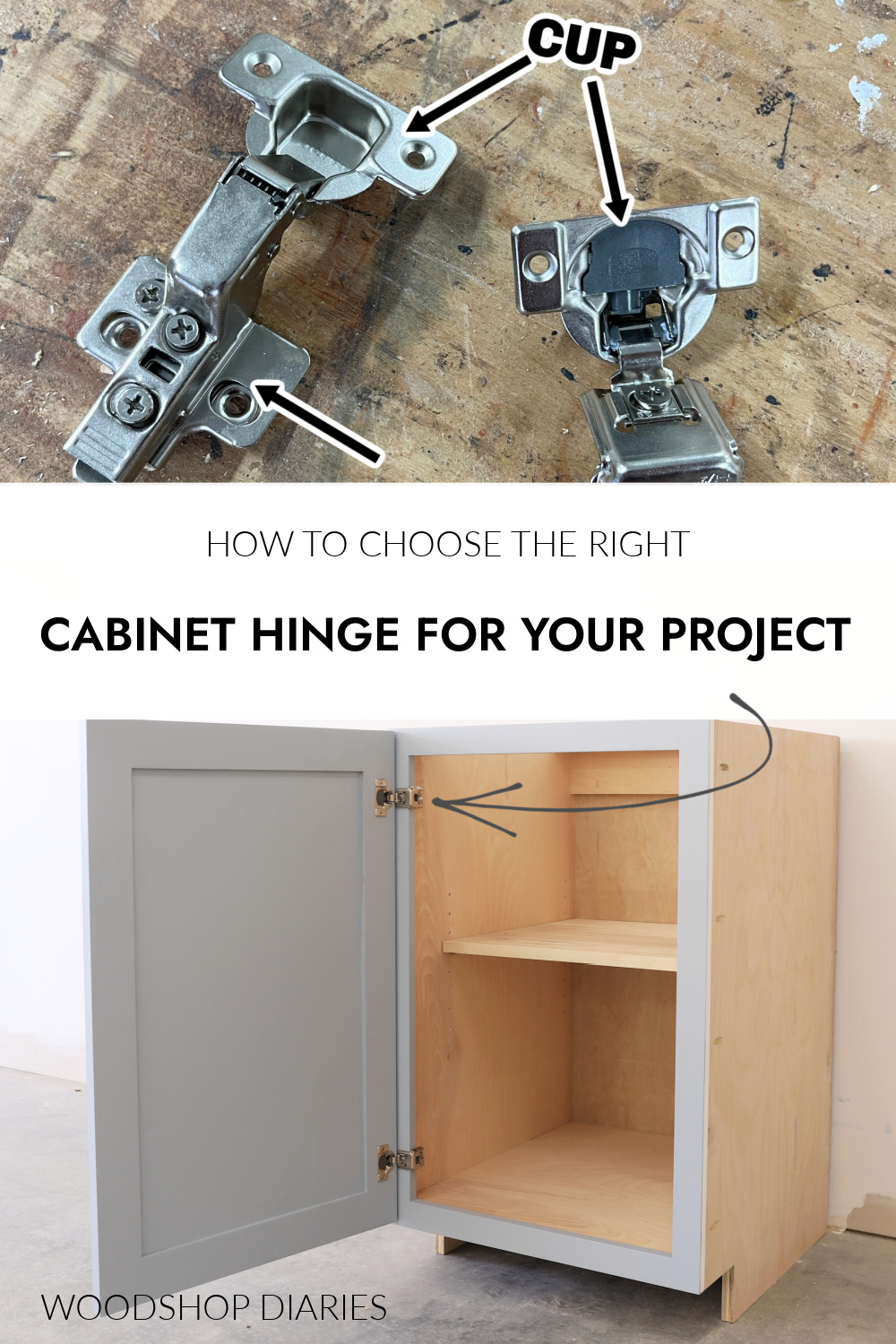
If you’re new to concealed hinges, check out this post on how to choose the right hinges for your project.

That’s because frameless concealed cabinet hinges only come with one overlay option. But there is enough adjustment in the hinge that they still work here even if they’re only overlaying ¼″.

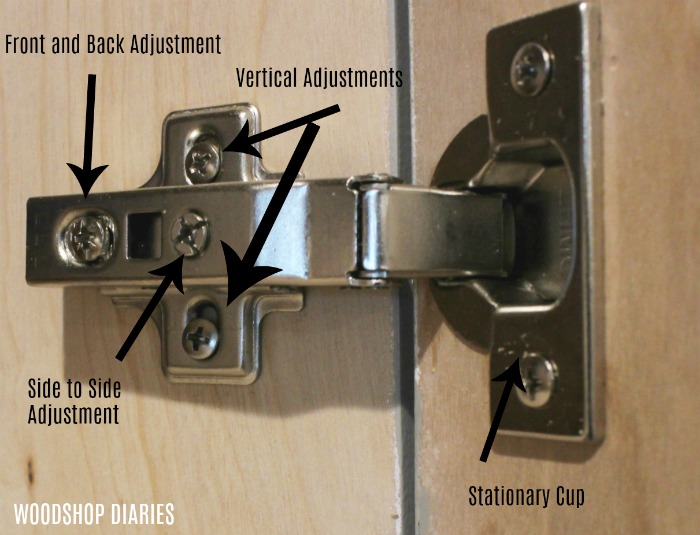
Close up of concealed hinge with arrows pointing to each adjustment screw

Check out this post to learn how to install and adjust concealed hinges.

Helpful Resources To Use With This Project

You may find the following posts helpful throughout the build:

  • How to cut plywood
  • How to cover plywood edges
  • How to use a pocket hole jig
  • How to install concealed hinges
  • How to add adjustable shelves
  • How to stain furniture

Enjoy DIY projects and woodworking plans? Sign up for priority access for the latest posts on Woodshop Diaries!

How to Build an Arched Door Console

I’ve included a ton of helpful tips and behind the scenes info in the build video. You can check it out on my YouTube Channel here.

Youtube thumbnail image for arched door console cabinet sideboard video

Love watching how-to videos? Subscribe to my YouTube channel for plenty more where that came from!

Prefer to print? Grab the printable modern console cabinet building plans available here:

Tools & Materials

Tools:

  • Drill/Driver
  • Circular Saw and plywood cutting guides
  • Miter Saw
  • Pocket Hole Jig
  • Brad nailer or stapler (optional)
  • Jig Saw
  • Concealed Hinge Jig
  • Shelf Pin Jig

Materials:

  • (1 + ¼) 4’x8′ sheet ¾″ plywood (red oak used here)
  • (1) 4’x4′ sheet ½″ plywood (red oak used here)
  • (1) 4’x8′ sheet ¼″ plywood (red oak used here)
  • (1) 1x2x8 boards
  • (1) 2x2x8 board
  • 1 ¼” pocket hole screws
  • 1 ¼” and 2″ long wood screws
  • 1 ¼” long brad or finish nails
  • Wood glue
  • (4) pair frameless overlay hinges
  • Shelf pins
  • Edge banding (optional, but recommended)

Step 1: Assemble Console Cabinet Box

To kick off the project, I started by cutting down my ¾″ plywood sheet. I’ve included the full cut diagram and cut list in the printable plans.

I trimmed down the bottom, two side panels, and the top supports first to assemble the main body of the cabinet.

Shara Woodshop Diaries cutting plywood on workbench with circular saw and Kreg Rip Cut

I edge banded the front edges that will be exposed in the finished build and I also edge banded the tops of the side panels. These will be partially revealed after the top is installed.

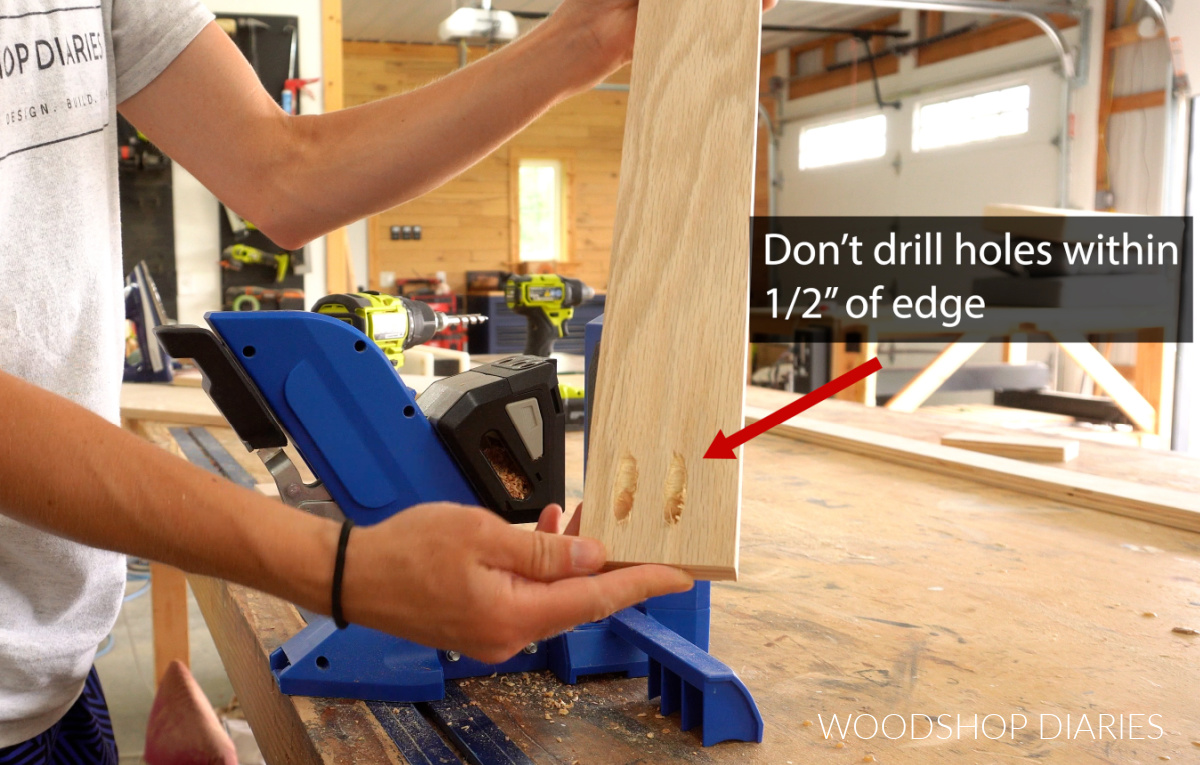
Then I drilled pocket holes in the ends of the two top supports and the bottom panel.

Close up of pocket holes drilled into ends of top support boards

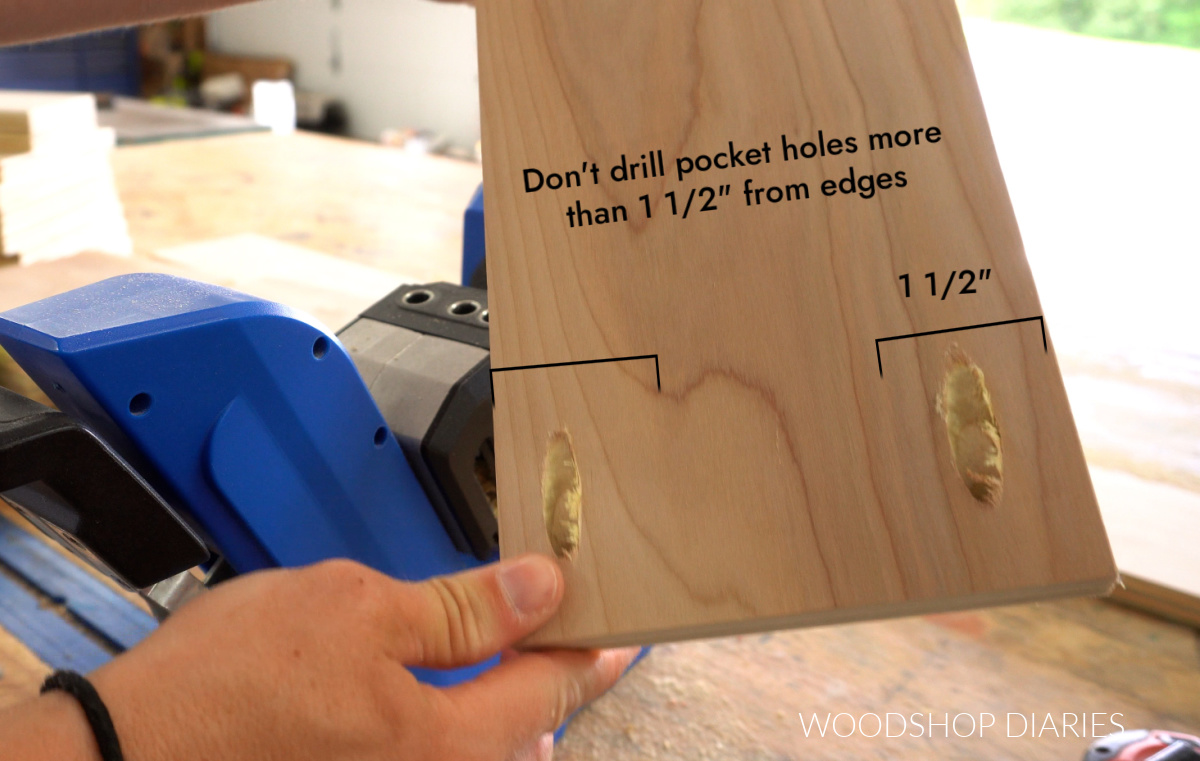
Note that the pocket holes on the top supports need to be drilled at least ½″ away from the edge of the board.

RELATED: How to drill pocket holes

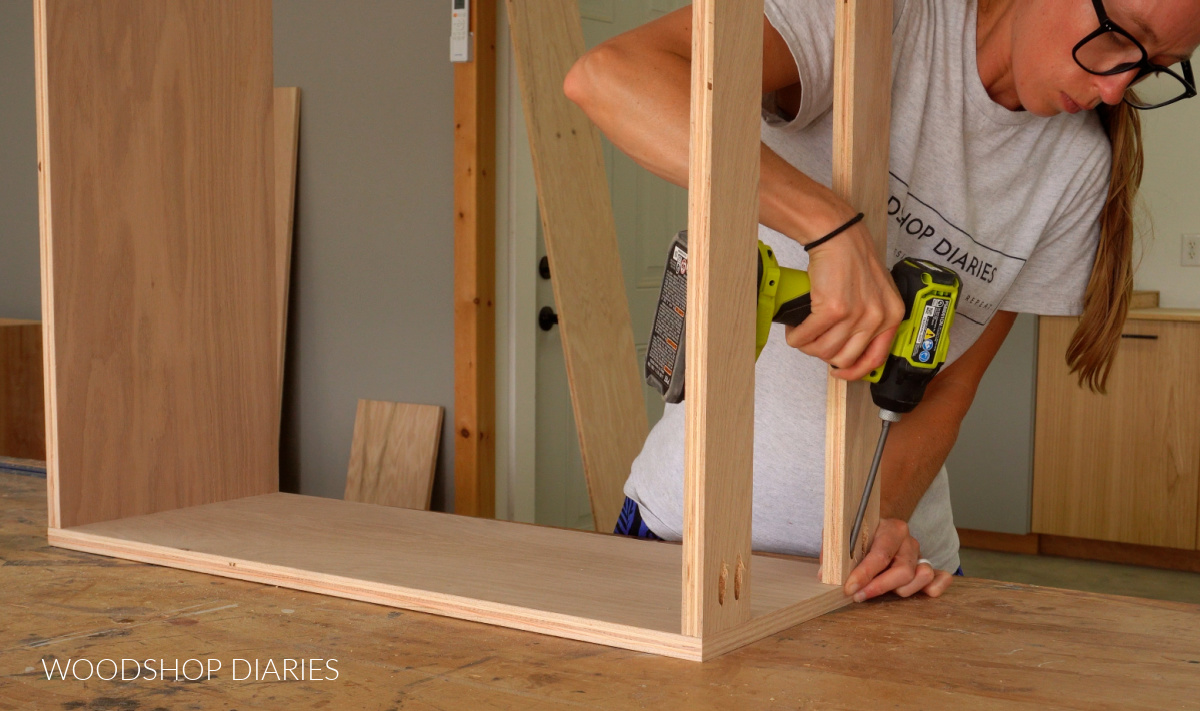
At this point, I could assemble the cabinet box using pocket hole screws.

Shara Woodshop Diaries installing top supports to sideboard console cabinet

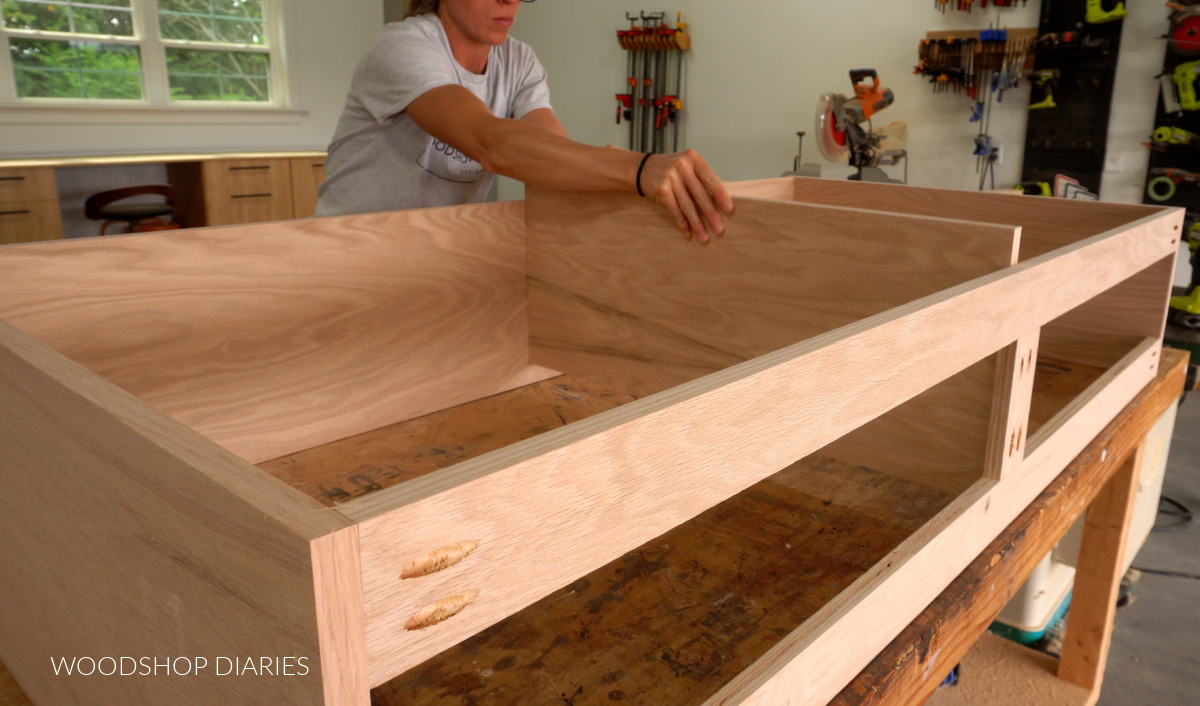
For the middle, I added a piece of plywood strip between the top supports with pocket holes and screws, then cut a divider panel to fit inside the box.

Placing middle divider inside sideboard console cabinet project on workbench

I just screwed this in using screws through the top and bottom instead of bothering with any pocket holes.

Step 2: Assemble and Attach Top

The top is a little…different haha. I made the top with a “riser” frame that raises it up above the cabinet ¾″.

To do this, I built a simple frame from some plywood strips ½″ smaller than the top of the cabinet on all sides.

Shara Woodshop Diaries assembling spacer frame from plywood strips for top of console

I assembled this frame using pocket holes and screws, then applied edge banding around the outside edges.

I also cut the ¾″ plywood top panel to size and edge banded it, too.

By the way, edge banding is totally optional, but it really makes your finished project look so much cleaner.

Check out this post to learn my top 5 tips to more professional looking DIYs.

I flipped the top panel upside down on my workbench and centered the frame on top. Then I screwed these two together.

Driving screws through spacer block into top panel of cabinet build

Then I flipped it back over and added it onto the top of the cabinet. The spacer frame should be inset ½″ on all sides.

Shara Woodshop Diaries driving screws through top supports of console cabinet to attach top panel

I secured this in place using screws through the bottom side of the top supports.

Step 3: Install Back Panel & Drill Shelf Pin Holes

Next, I finished up the main cabinet part of the build by attaching a ¼″ plywood back panel with a few staples (brad nails and glue would work too!).

Shara Woodshop Diaries stapling back panel onto cabinet box

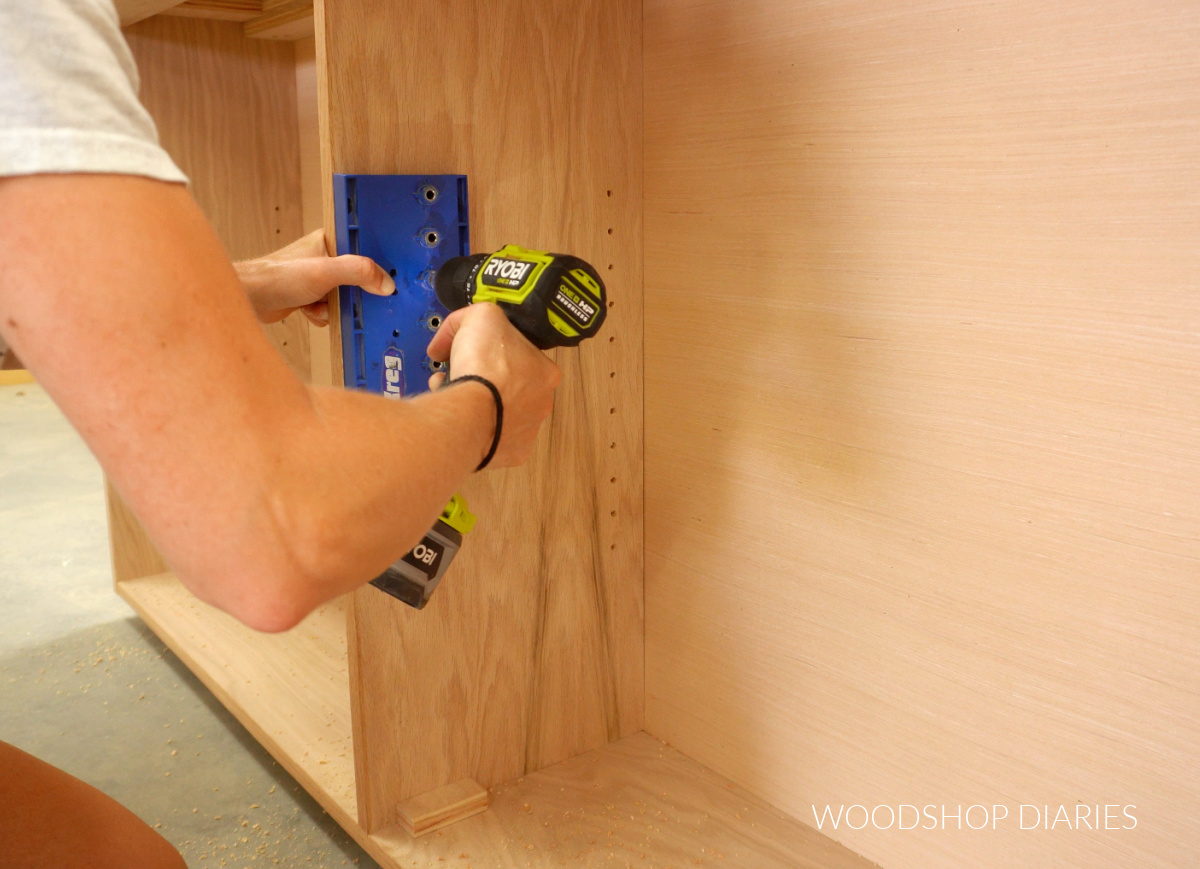
Then, I drilled shelf pin holes into both sections of the cabinet.

Using a shelf pin jig to drill shelf pin holes into cabinet box divider

NOTE: I mention this in more detail in the build video, but since you’ll be drilling holes in both sides of the middle divider, it’s best to offset the holes on one side so they don’t run into the holes on the other.

An easy way to offset the holes is to simply start them at different heights. Using a scrap block underneath the jig on one side of the cabinet is an easy way to do this.

RELATED: How to drill shelf pin holes

Step 4: Assemble Arched Trim Doors

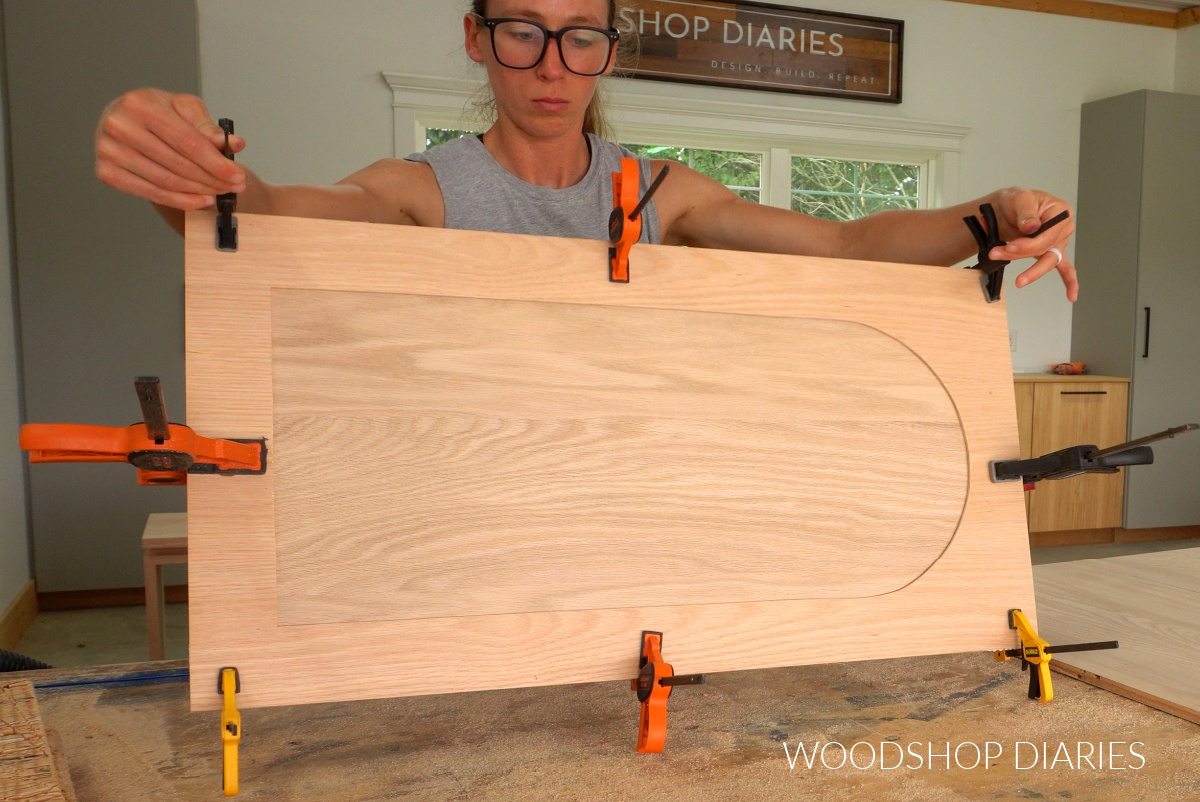
This step is the most fun–let’s make those arched trim doors! These doors are simply ¼″ plywood glued onto ½″ plywood. The ¼″ panel just has an arched shape cut out of it.

To do this, I cut my ¼″ plywood down to the overall size I wanted my doors to be. Dimensions are detailed in the printable plans.

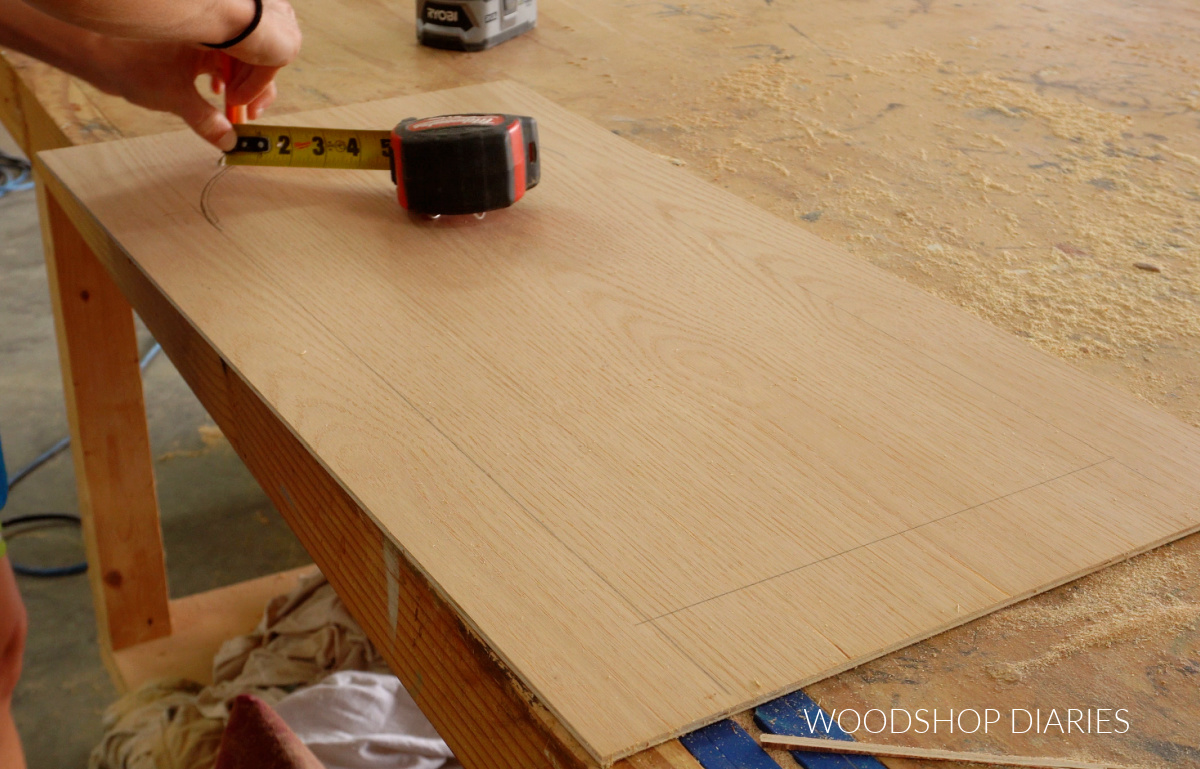
I used a scrap piece of 1×3 to trace a line 2 ½″ from each outside edge.

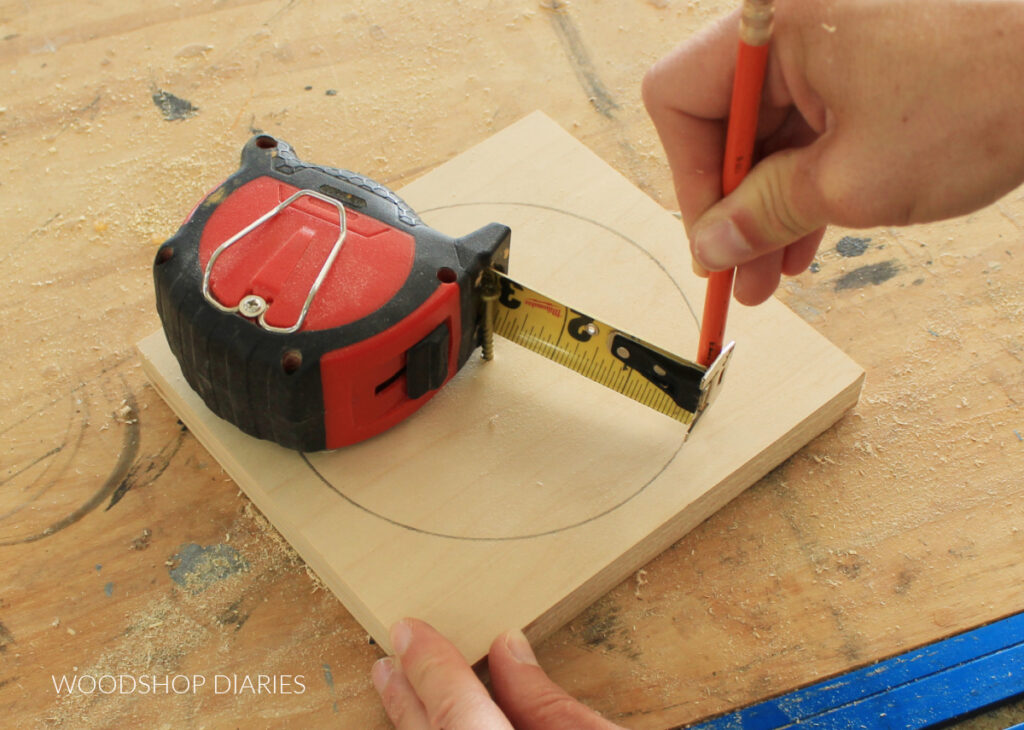
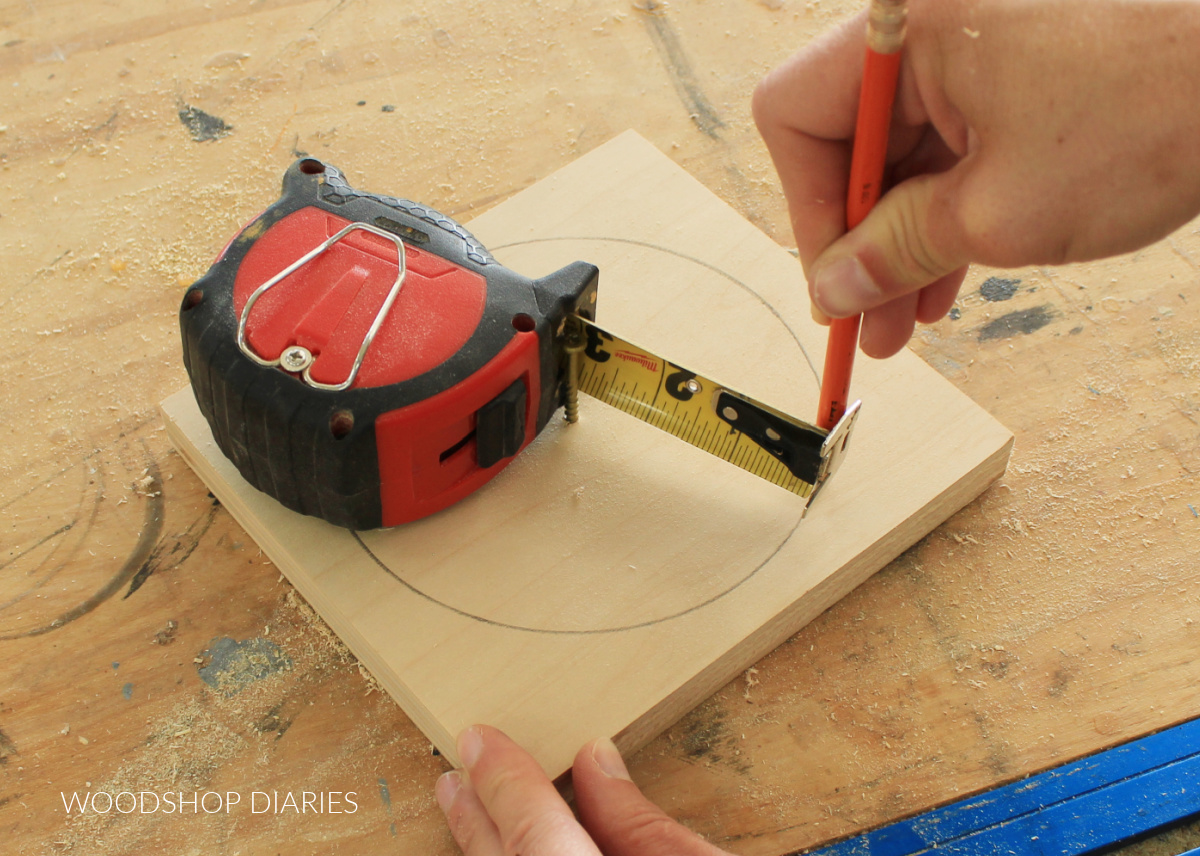
Then, I used a screw and a tape measure to trace an arc around the top. You can see how to draw a circle with a tape measure in this post.

Drawing arc on plywood door using tape measure rotating around screw

You could also use a round object to simply trace your arc instead. Or skip the arch shape and keep it square–feel free to customize how you’d like.

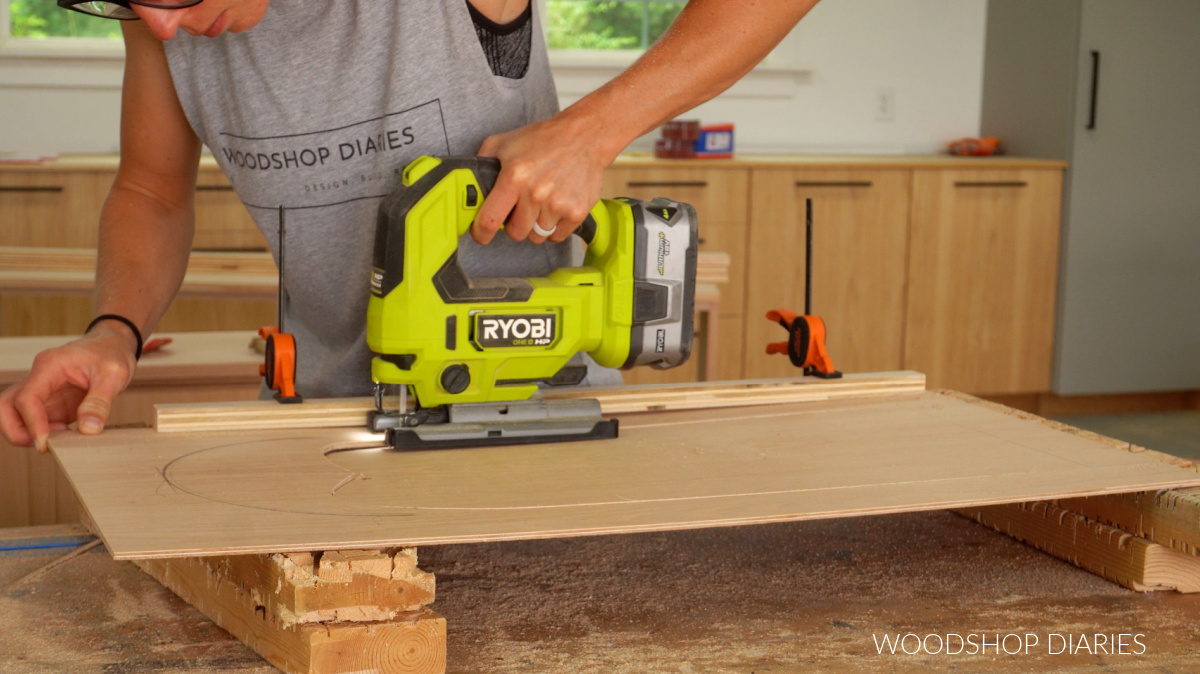
I drilled a hole in the center of the door to start my jig saw blade, then cut along the lines I just drew.

Shara Woodshop Diaries using a jig saw to cut out inside of cabinet door with straight edge

A scrap block clamped to the edge of the door gives you something to run your saw along to keep your straight cuts straight.

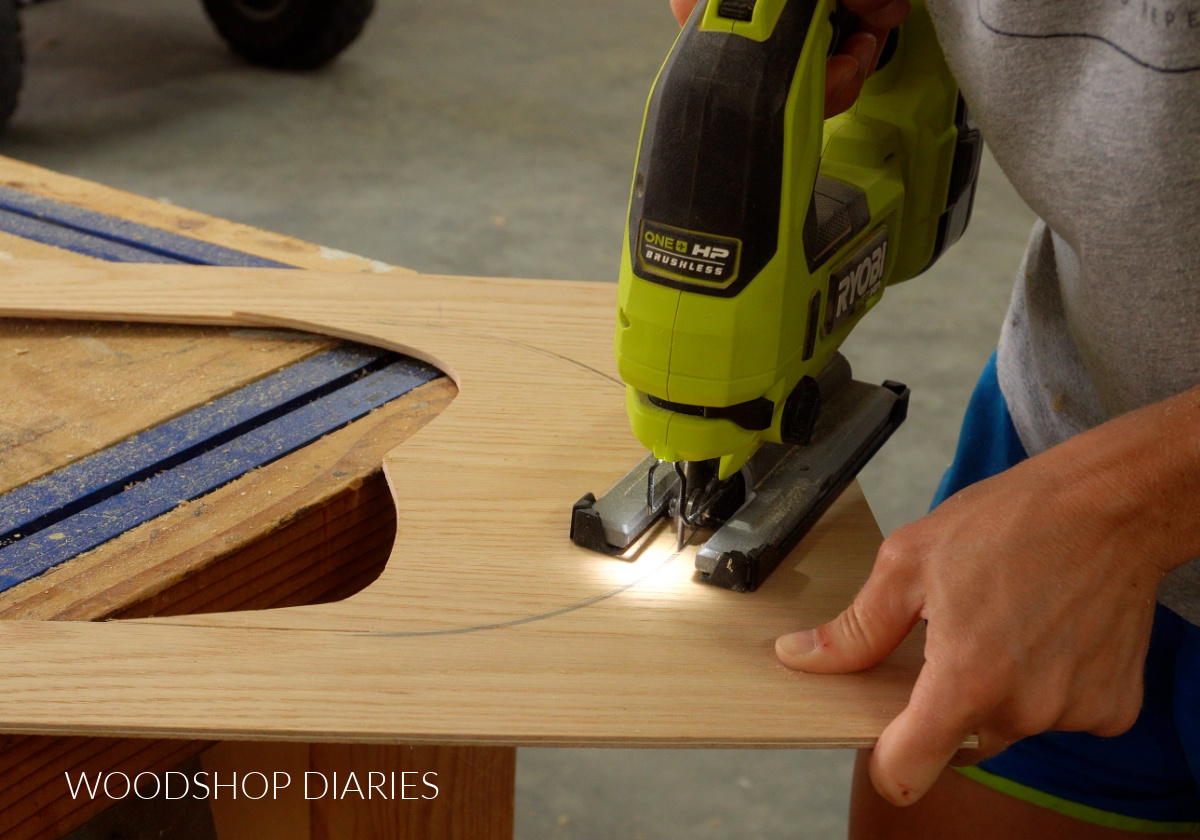
But for the arch, I just had to freehand that part. A good sanding after cutting can help smooth out any odd spots, but don’t panic if it isn’t PERFECT.

Close up of jig saw cutting around arch in plywood panel

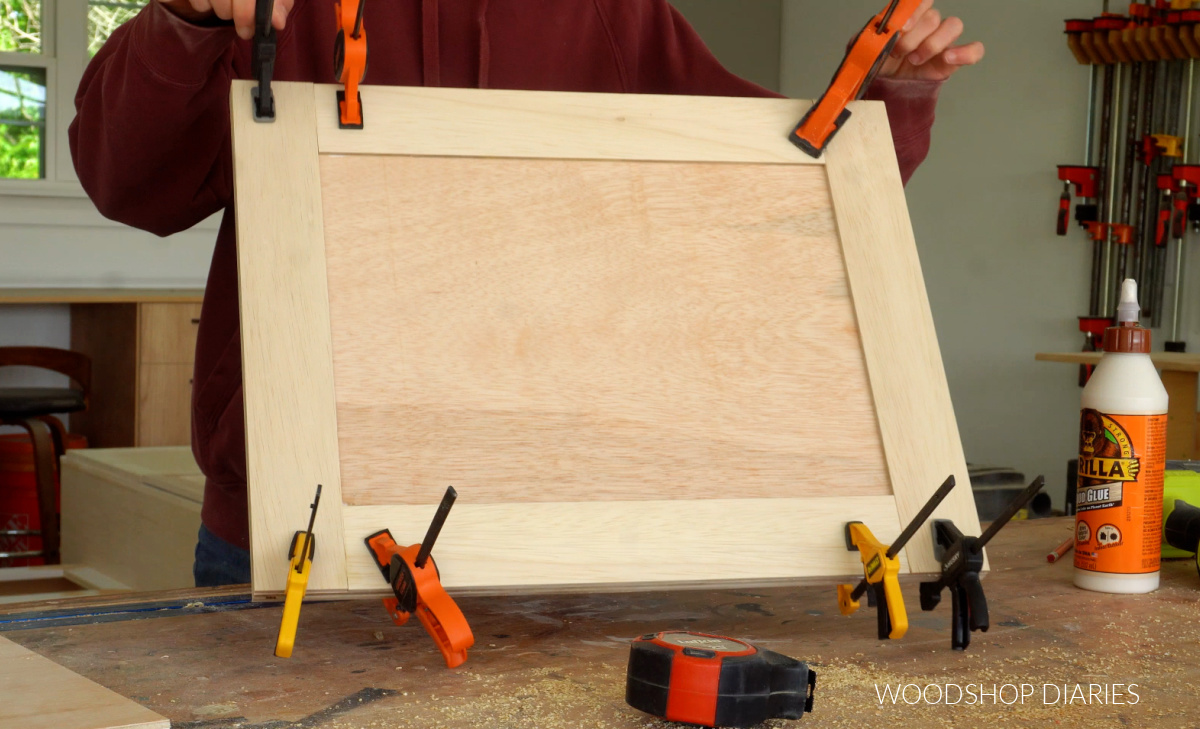
I glued this piece onto a piece of ½″ thick plywood cut the same size.

Shara Woodshop Diaries holding arched trim cabinet door with clamps on workbench

After the glue dries, I recommend edge banding the outside edges to make the doors look nice and clean. Sand well, but be careful not to sand through the veneer on the plywood.

RELATED: How to sand wood

Step 5: Build and Attach Cabinet Base

The base is the only part of the project that’s not made from plywood. I built the base using 2x2s for the four corner legs and 1x2s for everything else.

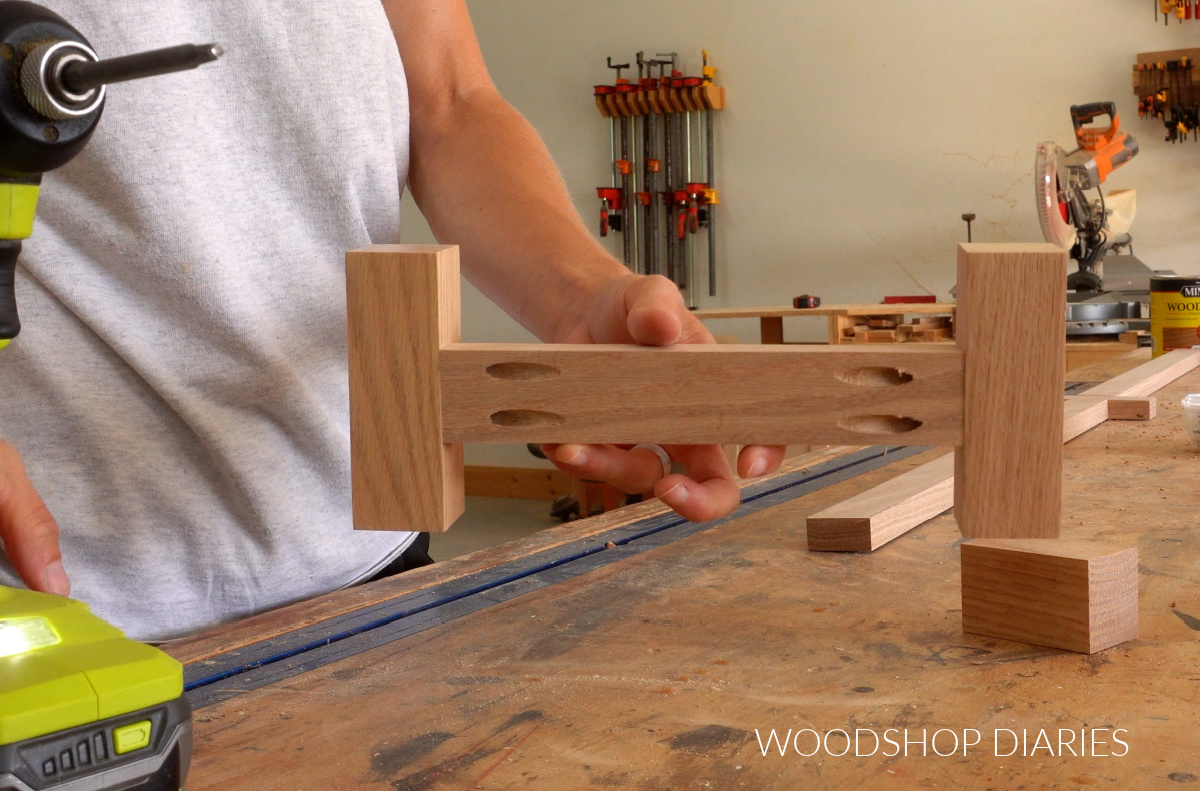
I assembled the base using pocket holes (just like the cabinet), BUT since these small boards are so narrow, I recommend using the Kreg Micro Pocket Hole Jig for this part.

Close up of drilling pocket holes with Kreg Micro Pocket Hole Jig

It’s definitely not NECESSARY (a standard size pocket hole jig works fine), but it’s helpful. Check out this post to learn when and how to use the Kreg Micro Jig.

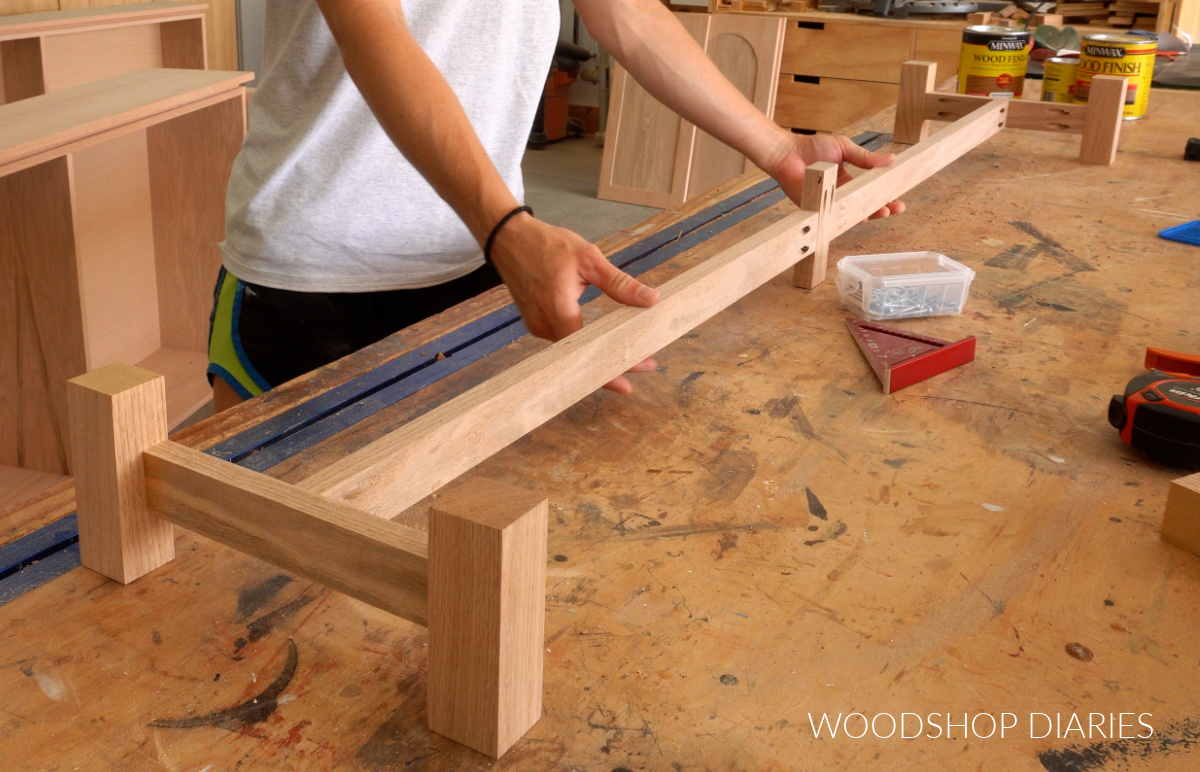
I attached a 1×2 between the 2×2 legs first using pocket holes and screws.

Side of cabinet base assembled

Then, I attached two longer 1x2s to a middle support leg to connect the two sides of the base.

Console cabinet base assembled on workbench

Once the base was together, I stained everything before attaching. I stained the base in Minwax True Black and the cabinet and doors in Minwax Weathered Oak.

RELATED: How to stain wood furniture

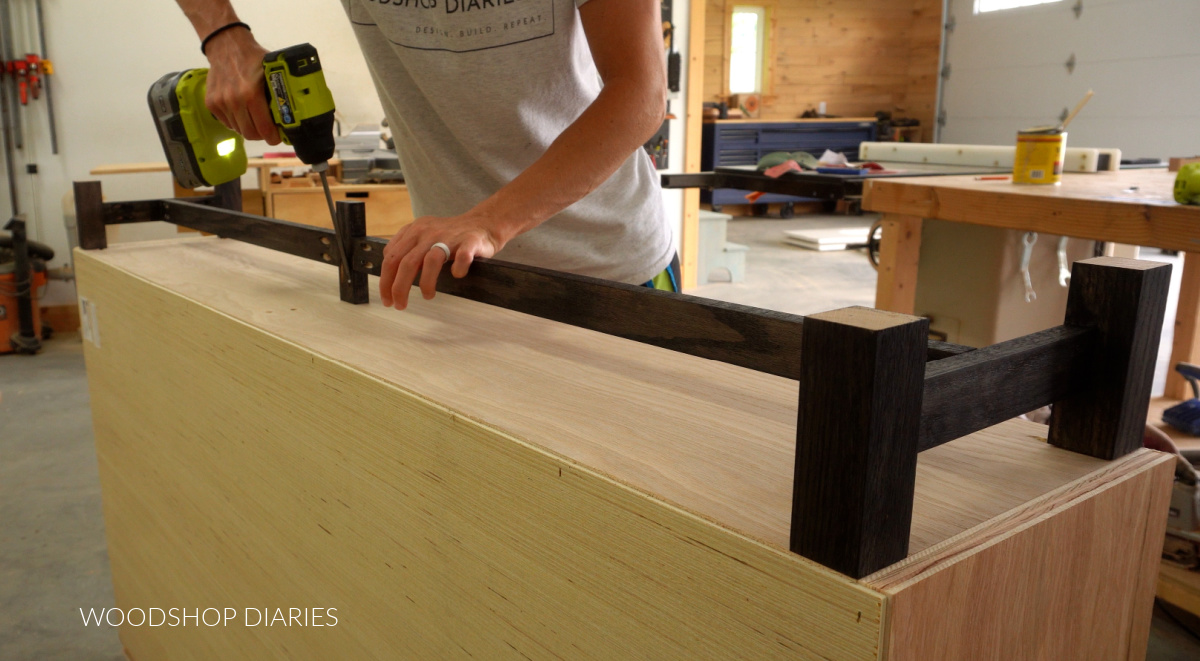
After this had dried, I installed the base to the bottom of the cabinet using pocket hole screws in the center leg.

Installing base to bottom of console cabinet with pocket hole screws

And I attached the four corner legs using wood screws through the bottom panel.

Step 6: Attach Doors

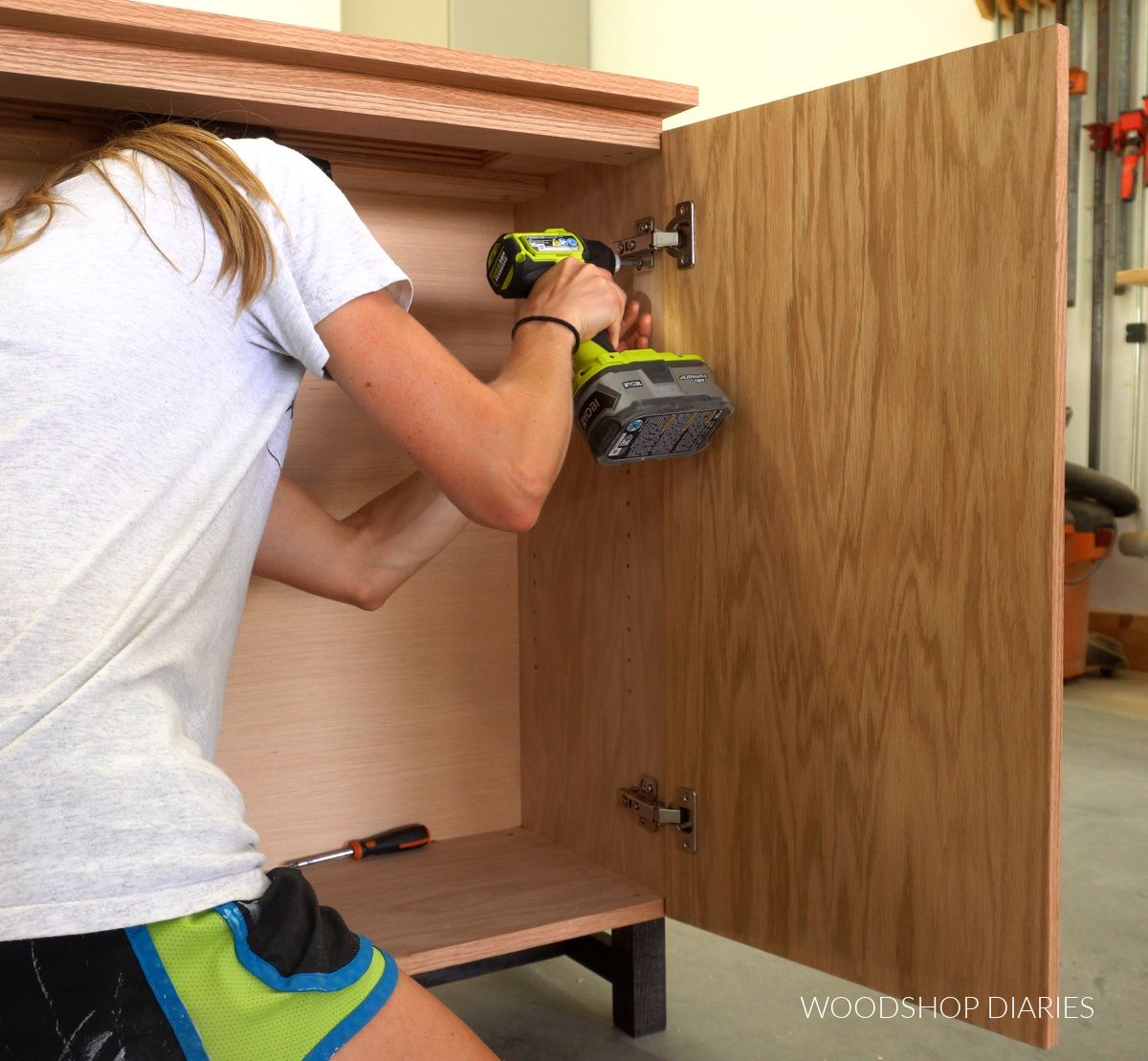
I used overlay concealed hinges for frameless cabinets to install the doors. First, I drilled concealed hinge cup holes using a Kreg Concealed Hinge Jig.

Then, I screwed the hinges into each door. Keep in mind the hinges should be on the left side of the door for two of them and on the right side of the door for the other two.

Shara Woodshop Diaries installing doors onto console cabinet project

Then, I installed these doors to the cabinet and adjusted the hinges to even out the gaps between each one.

Step 7: Finish and Install Shelves

I waited until the doors were on before adding a few coats of Minwax Polycrylic clear coat to seal the cabinet.

Then, I could install the shelves using shelf pins placed in the holes I drilled earlier. I cut these shelves from ¾″ plywood.

Completed DIY modern console cabinet with arched trim doors. Far right door open to reveal shelves inside

You can certainly add multiple shelves, but I just added one on each side.

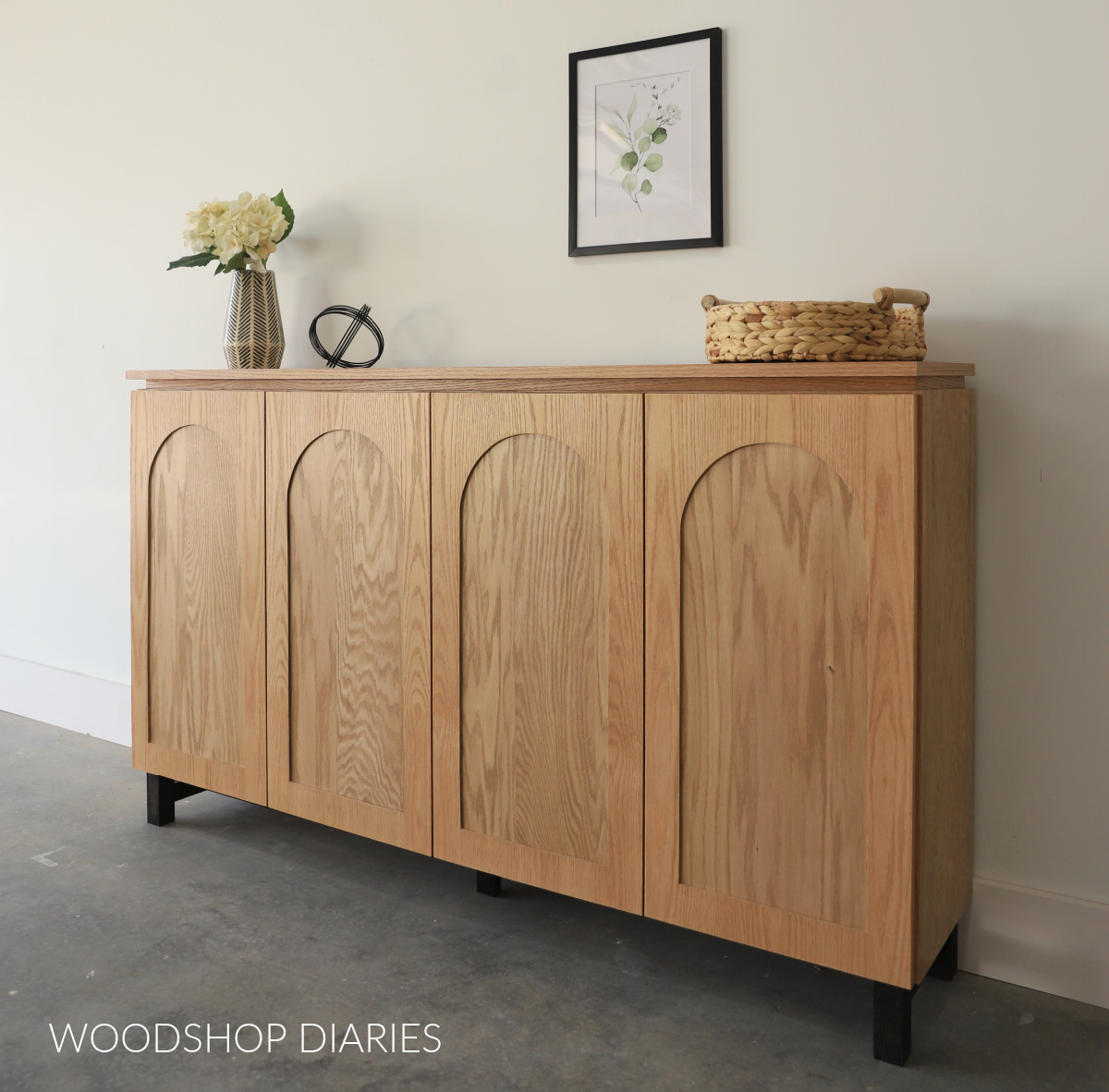
Side board cabinet with 4 doors. Each door has arched cut out on trim. Light stained top cabinet on black stained wooden base

This project packs plenty of storage space in a classy and unique cabinet. It would make an excellent sideboard for dishes in the dining room, a TV console in the living room, or an accent piece in the office.

Looking for more DIY storage cabinet plans?

Here are a few of my favorite storage cabinet designs you may enjoy browsing. Click on the images below to see how to build each one!

Mid Century Lowboy Console
Stenciled Door Console
DIY Display Console Cabinet
DIY Modern Console Cabinet
DIY Display Shelf with Storage

If you enjoyed this project and would like to save it for later, be sure to pin it or share to your favorite social channel!

Pinterest collage image showing dimensional diagram at top and completed sideboard DIY console cabinet at bottom

Until next time, friends, happy building!

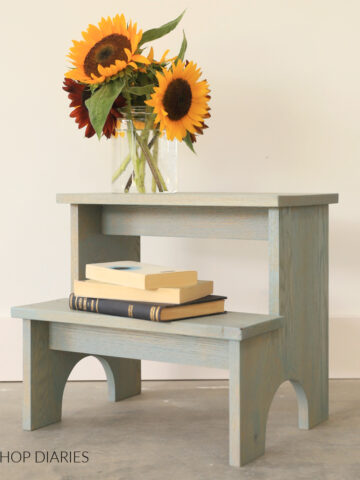
DIY Side Table Plant Stand

August 5, 2024 by Shara, Woodshop Diaries

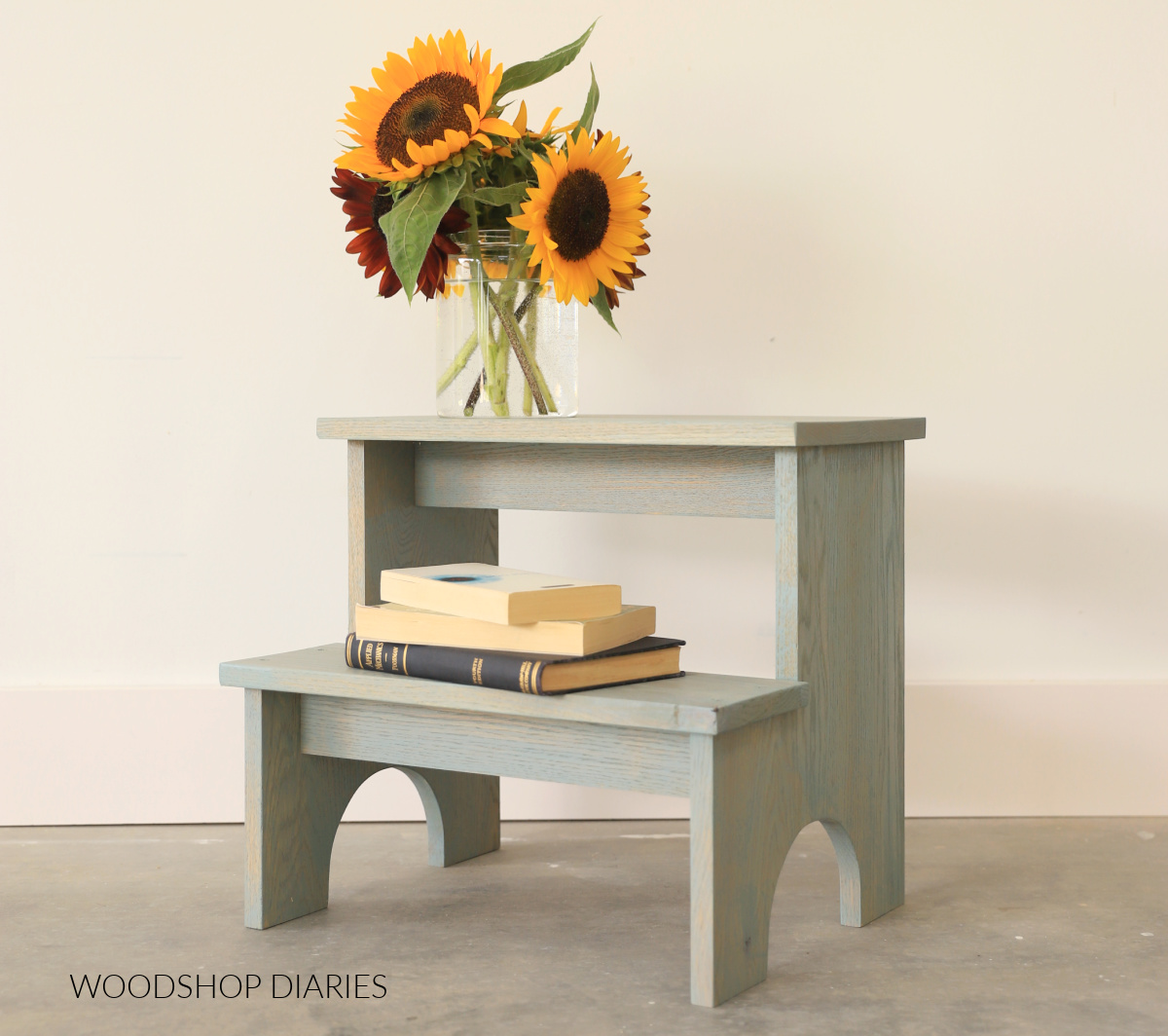
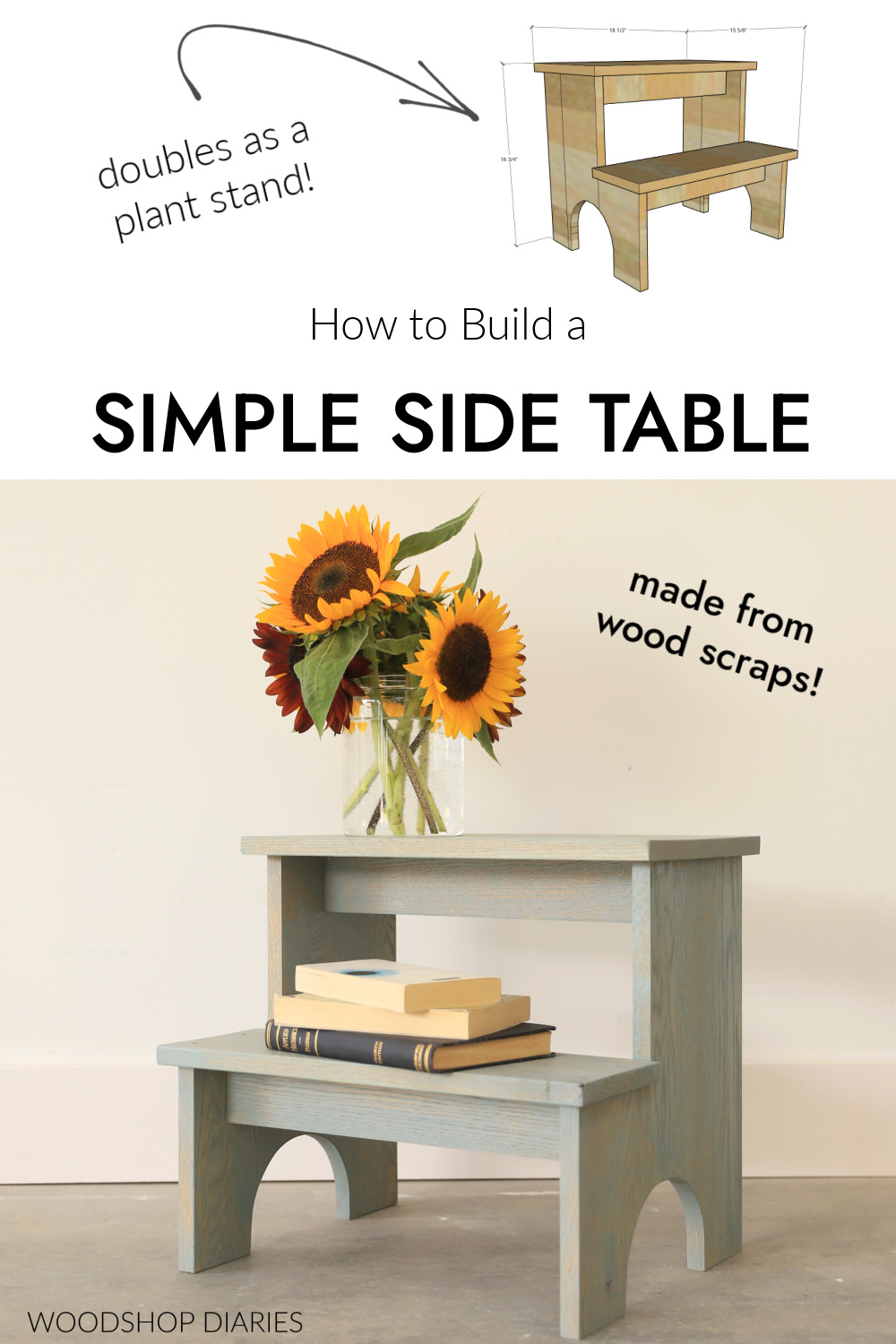
In this post, I’m sharing how to build a simple DIY side table that could also double as a plant stand!

This easy scrap wood project features two tiers for displaying or storage and can be customized to just about any size you’d need.

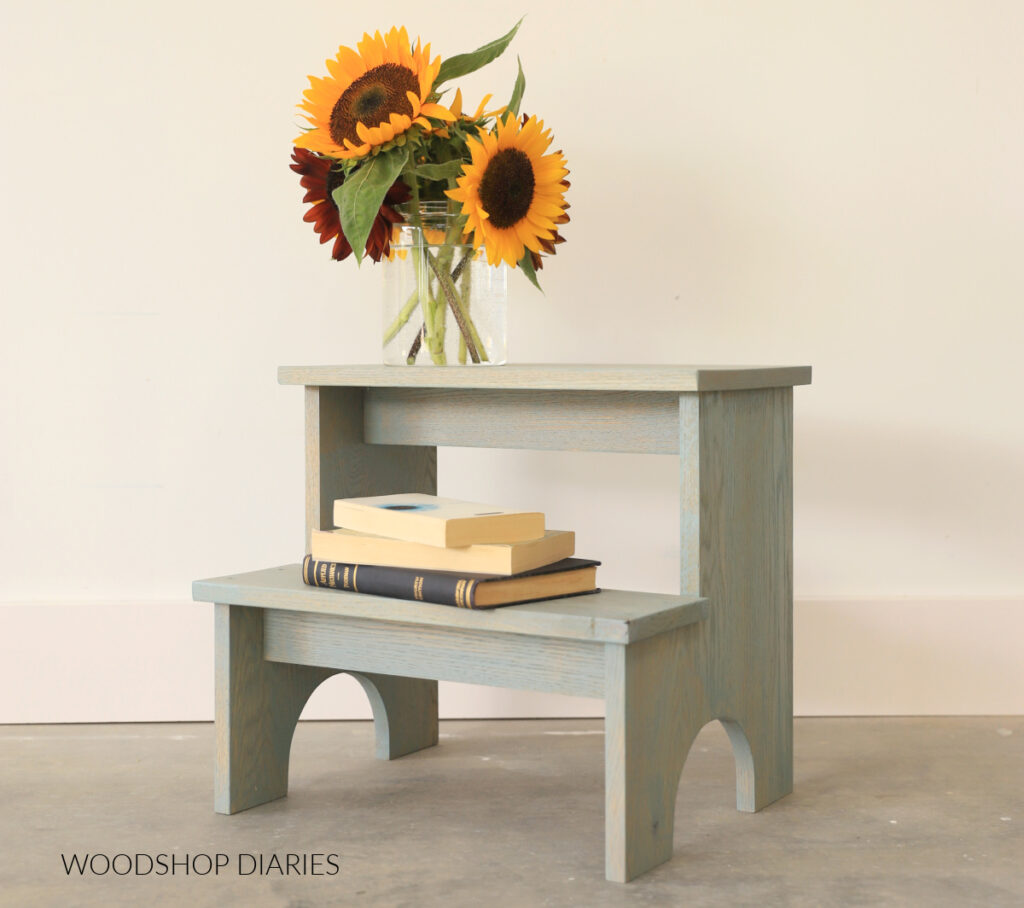
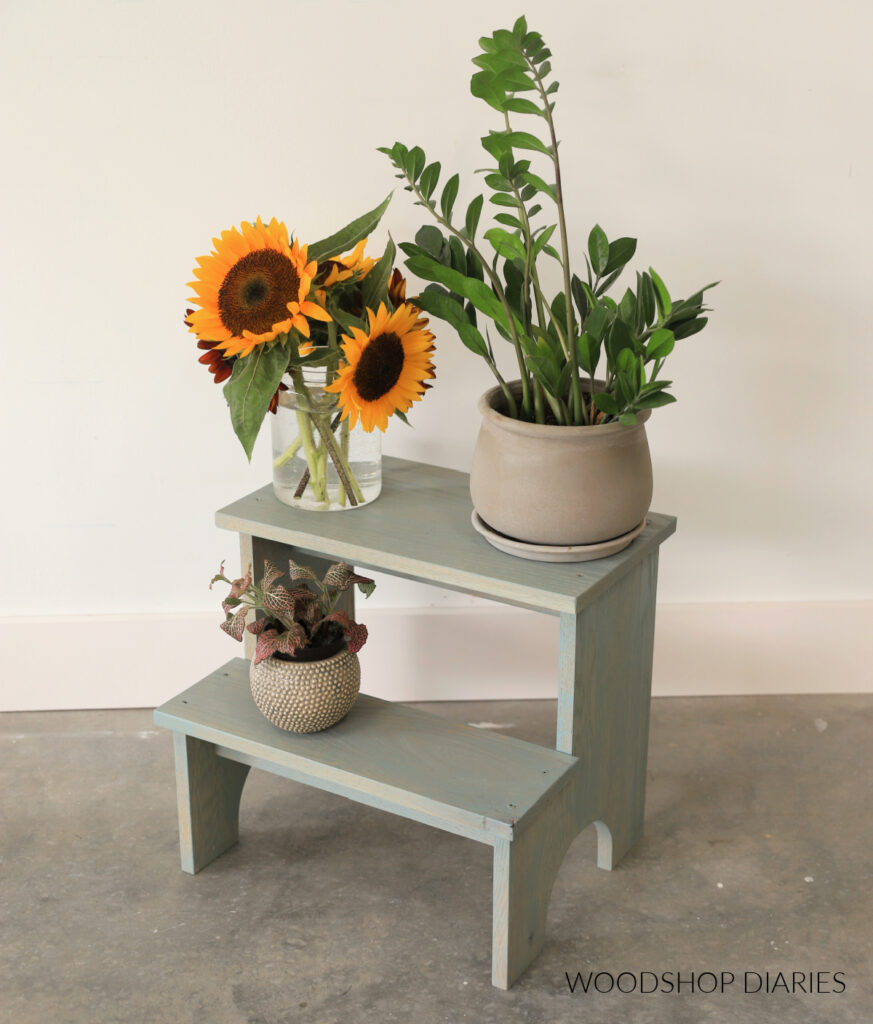
green stained side table with sunflowers and books against white wall

I’ve been loving arches lately, so I used a jig saw to add some cut outs to each for some added detail.

But you could customize tons of fun shapes in the sides to give it an antique or vintage look.

This would be perfect on the porch, next to the couch, or even as a decorative step stool! If you’re ready to build one of your own, I’m sharing the “how-to” below.

*This post contains affiliate links. See website policies.

A few notes before building

This simple side table is intended to be a scrap wood project made from 1×6 scraps. However, if you don’t have any 1×6 scraps to use for this, you can certainly purchase a 1×6 board (you’ll need approximately 12′ of board) to build this with.

Alternatively, you can also use ¾″ plywood scraps or any other 1x thick lumber scraps instead. Just note some of your dimensions may need to be adjusted from what’s shown below.

I used scrap red oak wood for this project, but any wood type you had available would work fine. You can even mix and match wood types for some extra character!

Overall dimensions

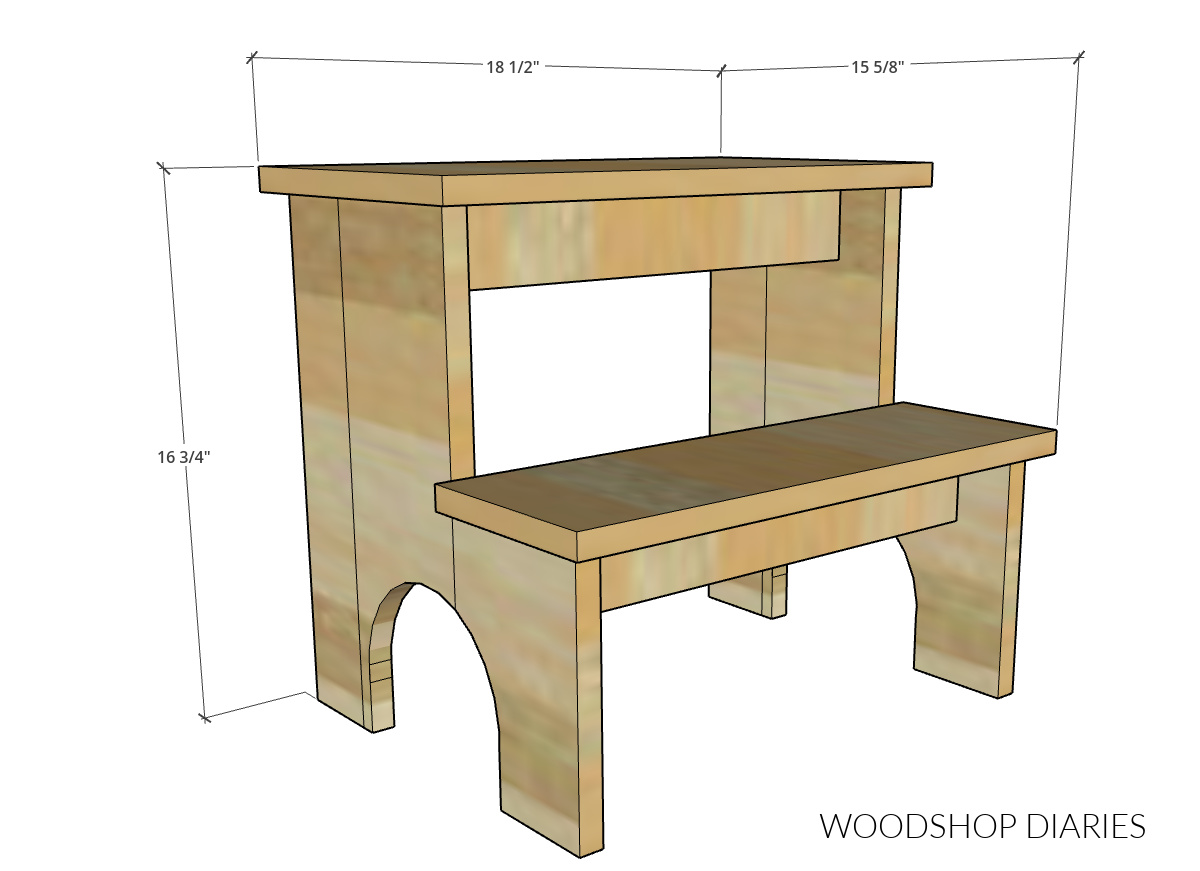
The overall dimensions of this simple side table plant stand are approximately 15 ⅝″ deep x 16 ¾″ tall x 18 ½″ wide.

Overall dimensional diagram of step stool shaped side table

Side tables and plant stands come in hundreds of sizes. Feel free to modify your table to fit your needs as there isn’t really a “standard” size.

The 16 ¾″ height may work great for some applications, but may be a little short for others. You can easily adjust the overall height by cutting the pieces in step 1 longer or shorter as desired.

Enjoy DIY projects and woodworking plans? Sign up for priority access for the latest posts on Woodshop Diaries!

How to Build a Plant Stand Side Table

This is a great beginner woodworking project that requires minimal tools. It’s simple, fun to build, and provides several options for customizations.

A miter and/or table saw are helpful for some of the straight cuts, but not necessary. You can make all the cuts shown here using only a jig saw if that’s all you have.

And if you don’t have large clamps to glue up your panels in step 1, you could also use pocket holes and screws to act as a temporary clamp. Once the glue is dry, remove the pocket hole screws to avoid cutting into one in the steps following.

Tools & Materials

Tools:

  • Jig Saw
  • Pocket Hole Jig
  • Drill/Driver
  • Clamps

Materials:

  • 1×6 scraps
  • Wood Glue
  • 1 ¼″ wood screws
  • 1 ¼″ pocket hole screws

Step 1: Glue up Wood Panels

This project was built entirely of 1×6 scraps that I glued together. If you don’t have 1x6s, any combination of 1x board widths (or even ¾″ plywood) would also work for this.

I created the two sides and the top panel by cutting the boards to length, then gluing them together.

For the two side panels, I cut:

  • (4) 1×6 boards to 16″ long
  • (2) 1×6 board to 8″ long

*each side consists of 2 long and 1 short board

For the top panel, I cut:

  • (3) 1×6 boards to 18 ½″ long

Once the pieces were cut, I glued the edges and clamped them into the shapes shown below.

RELATED: How to glue up wood panels

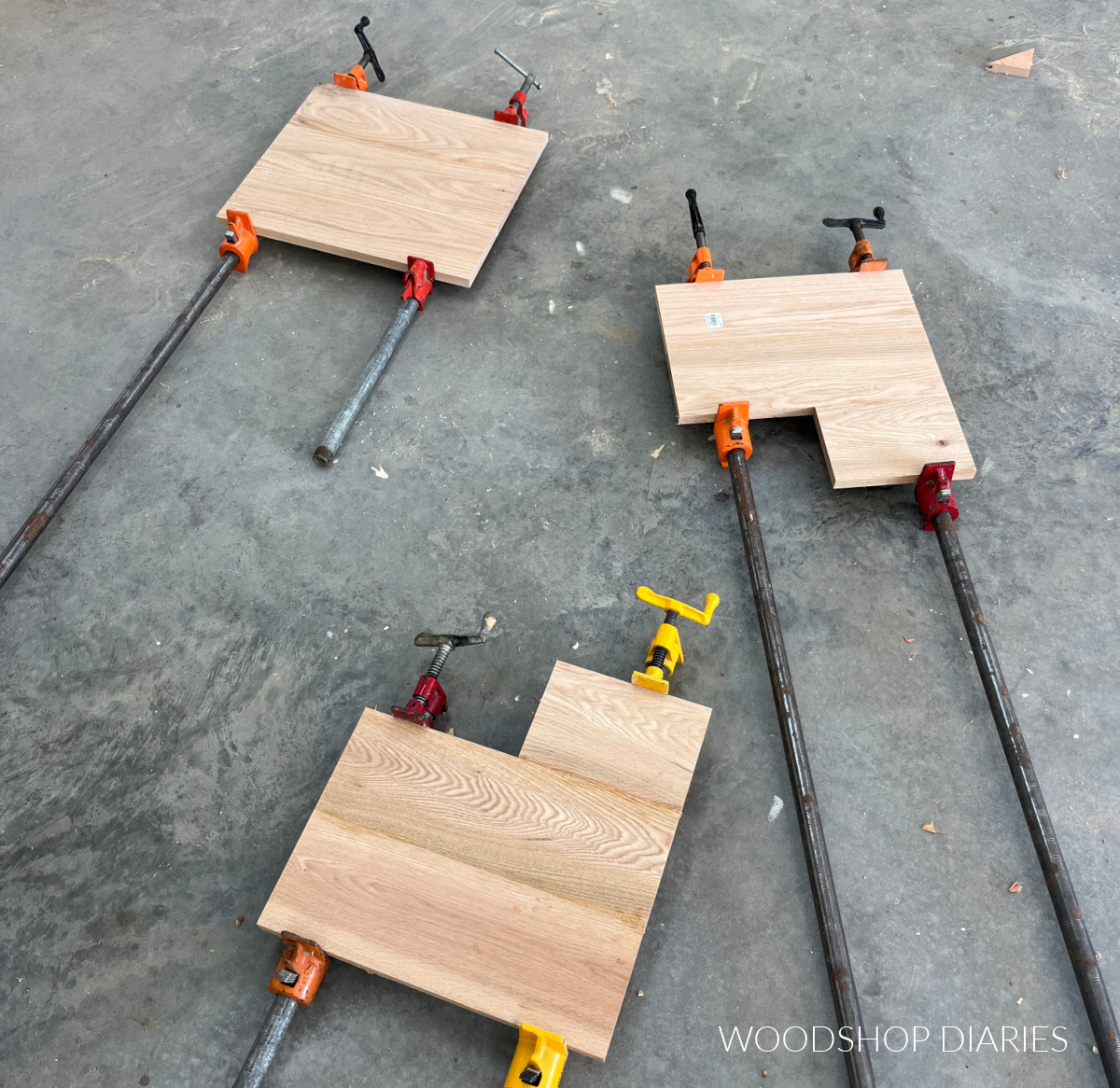
Three red oak 1x6 glued up panels on the concrete shop floor

Notice that the two side panels consist of two 16″ and one 8″ long board. Allow panels to fully cure before removing from clamps.

Step 2: Cut Out Side Table Pieces

After the glue had dried, I removed each panel from the clamps and sanded them smooth.

RELATED: How to sand wood

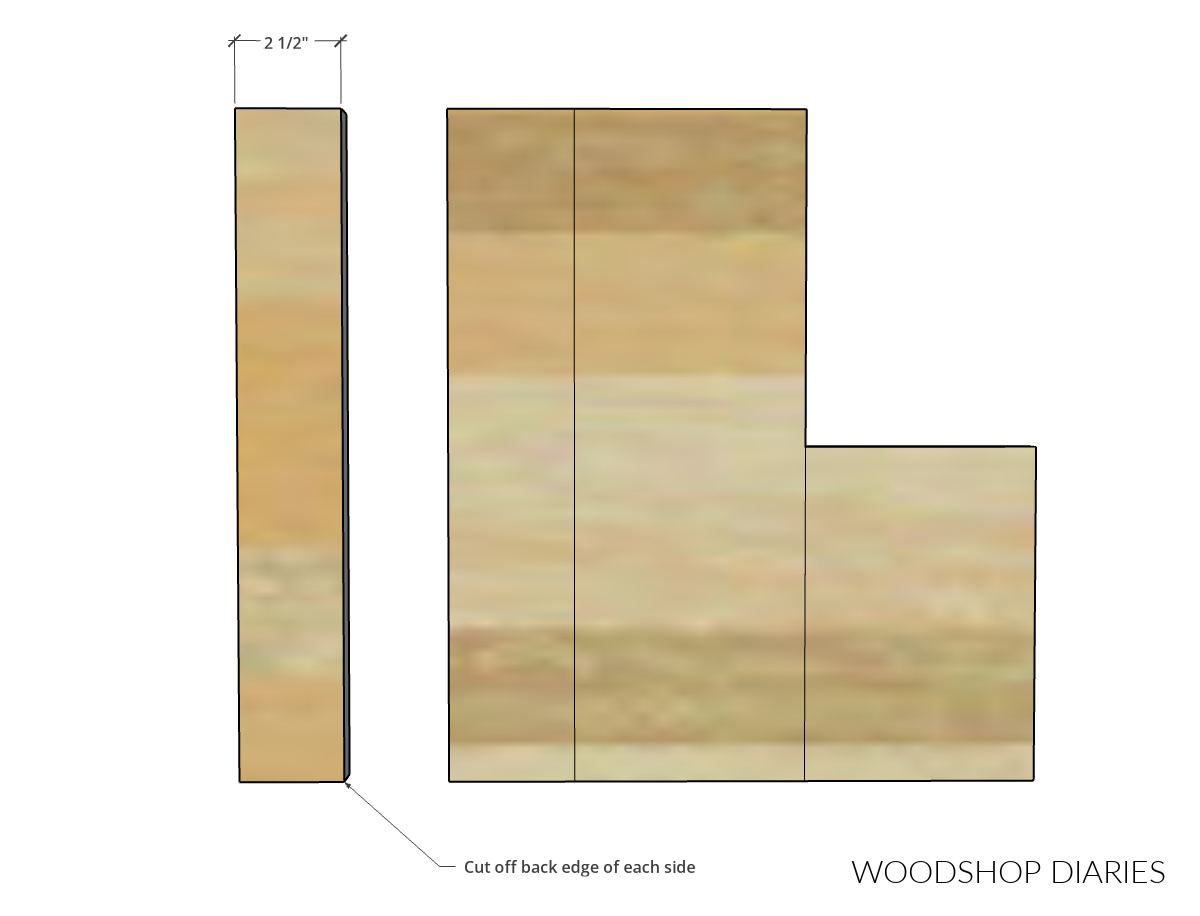
Then, I trimmed 2 ½″ off the back edge (the longer side) of each side panel. (Don’t trim the top panel just yet!)

Side table side panels showing trimming strip off back edge

I set the two 2 ½″ x 16″ long strips to the side for now.

TIP: You can trim this with a jig saw, circular saw, table saw, or any saw that you prefer to cut a straight line.

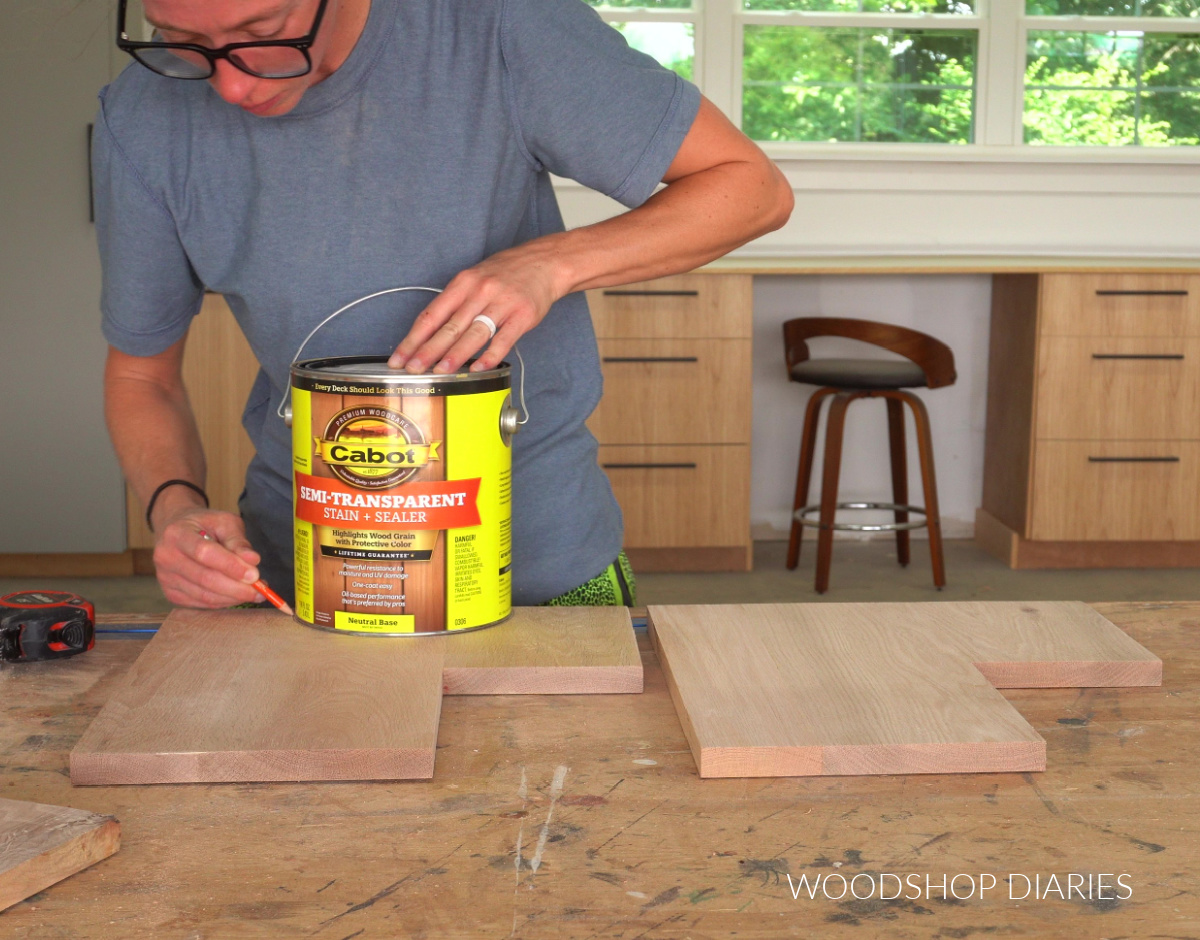
Then, I used a gallon size stain can to trace an arch on the two sides along the bottom edge.

Shara Woodshop Diaries tracing around stain can on side panels of plant stand on workbench

Feel free to get creative here if you’d like a different shape or size cut out. A diamond, heart, or V shape would work well, too.

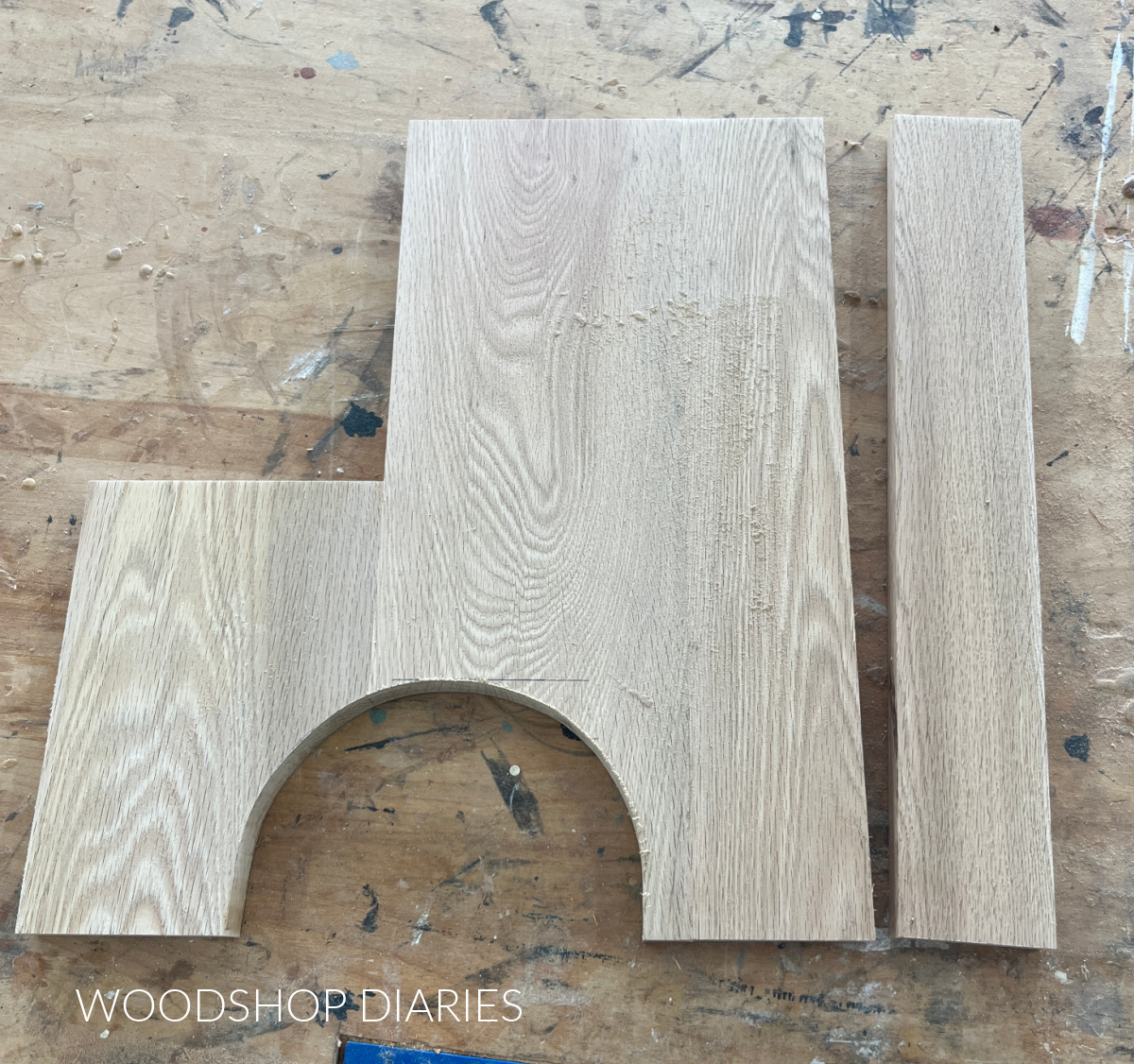
I cut along the curved line with a jig saw, then hand sanded to smooth out around the cut. So those two side panels from step 1 should now look like this:

Side panels of plant stand with strip cut off back edge and arched cut out at bottom

Step 3: Assemble Table Frame

I drilled ¾″ pocket holes into the ends of the 2 ½″ wide strips I trimmed from the side panels in step 2.

RELATED: How to drill pocket holes

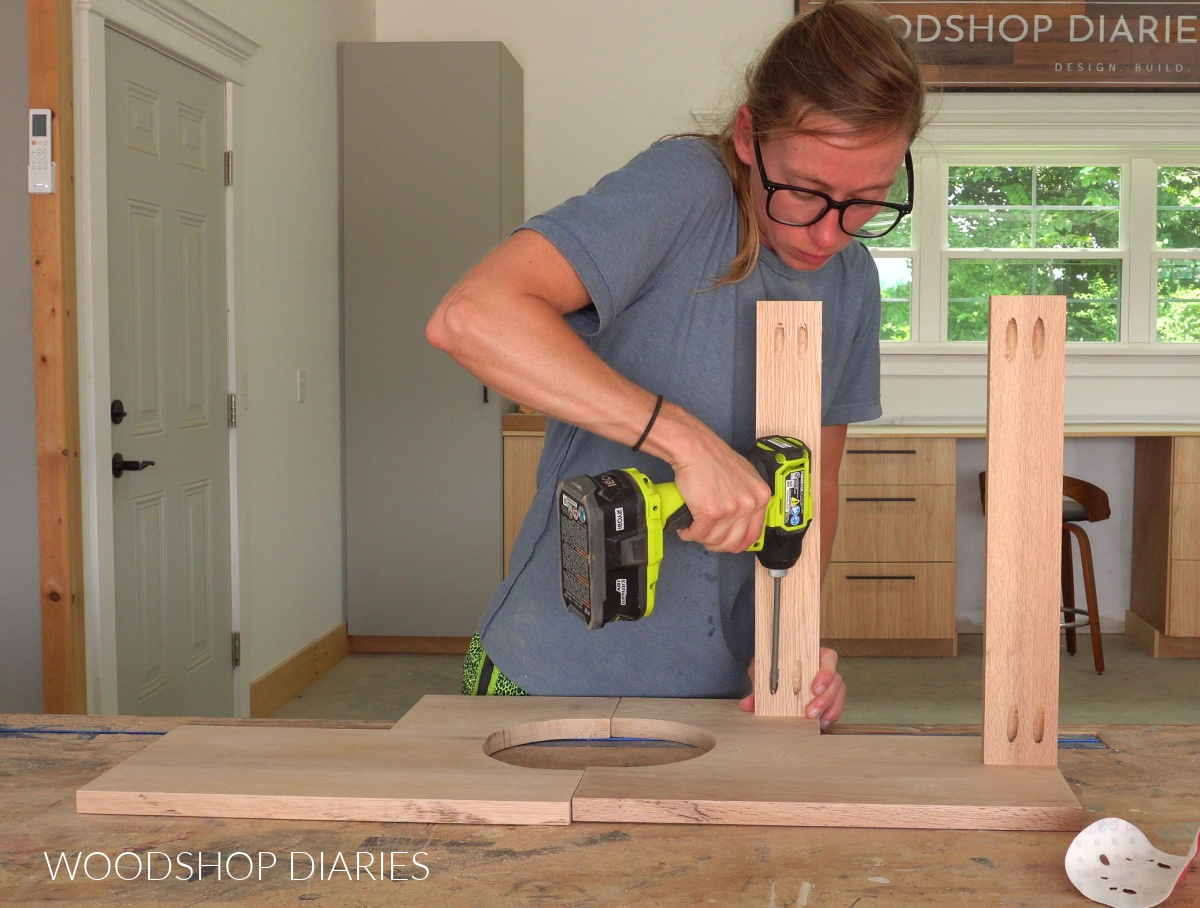
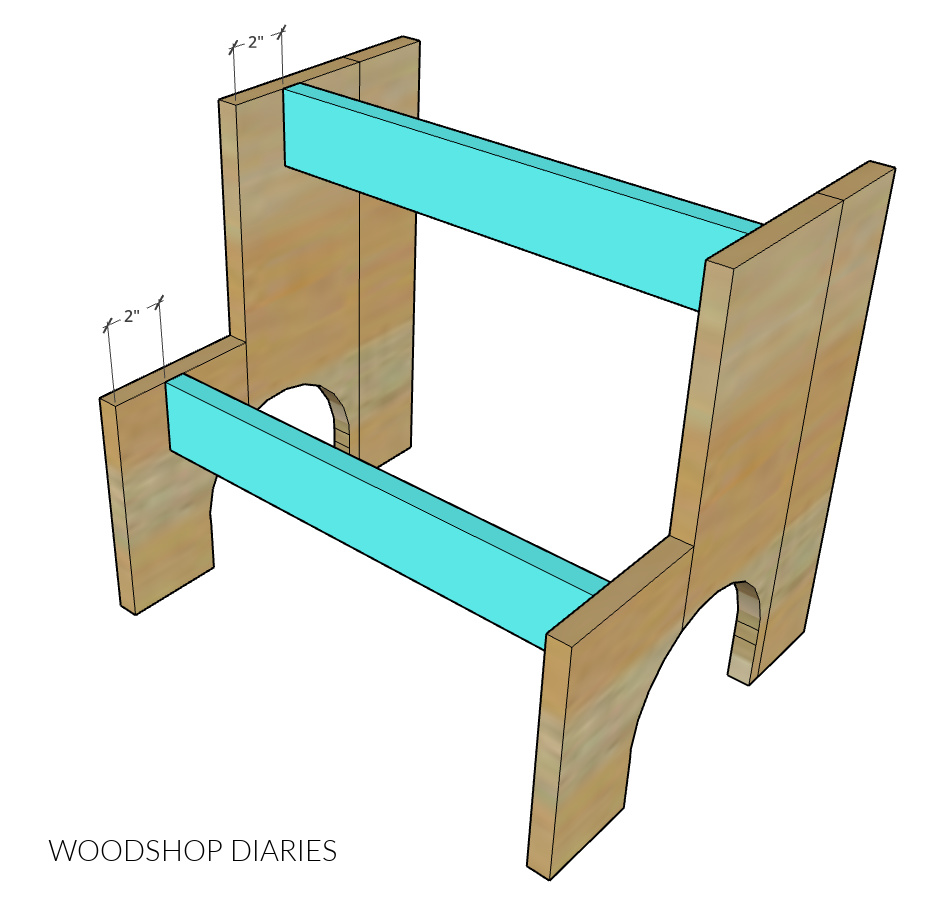
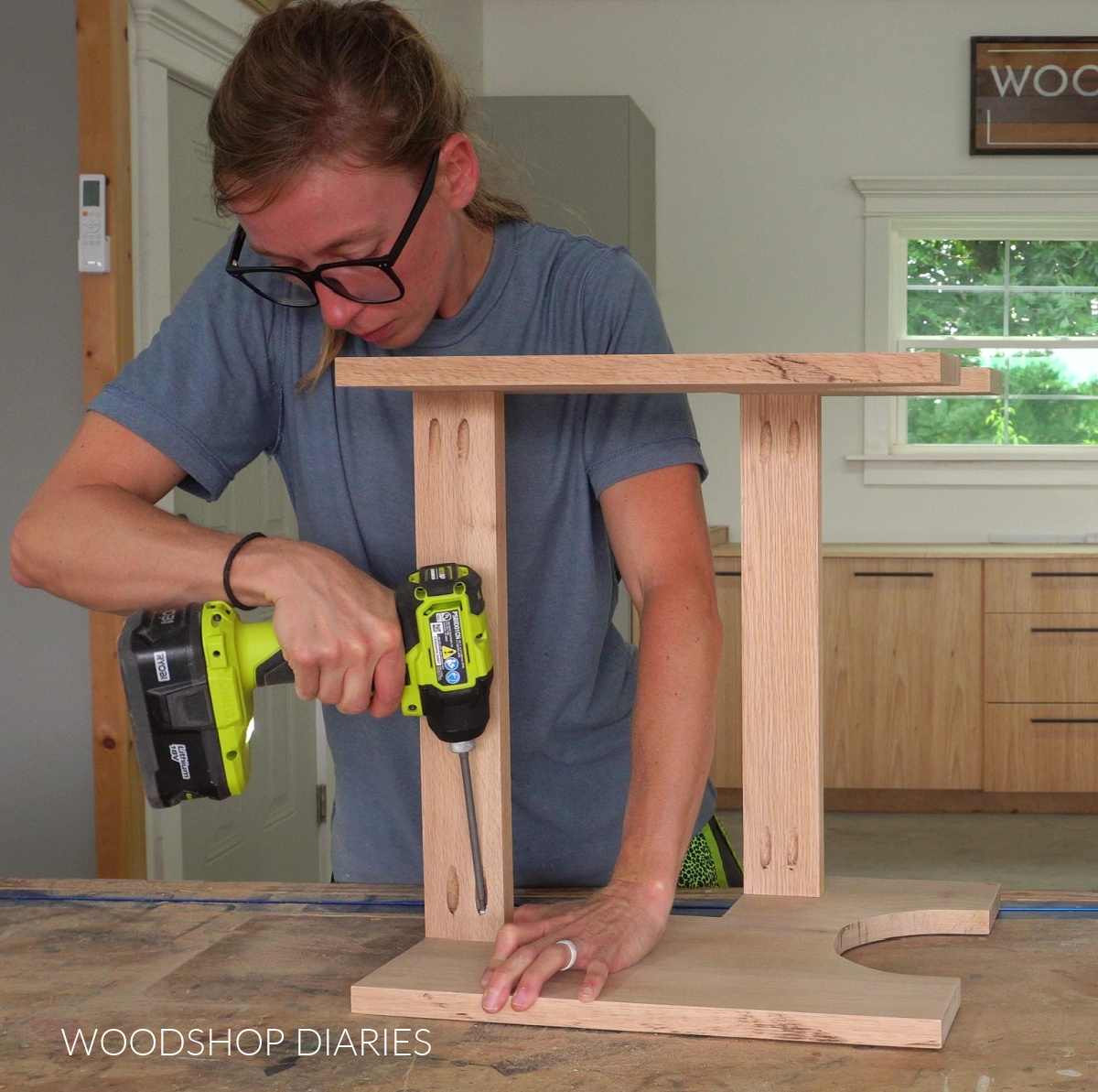
I attached these between the two side panels using 1 ¼″ pocket hole screws so that they were approximately 2″ inset from the front edge. Face the pocket holes toward the back.

Shara Woodshop Diaries installing DIY side table supports between sides with pocket hole screws

Exact placement here isn’t critical. Feel free to install these as close or as far away from the front as you want as long as they’re flush to the top of each tier.

Diagram showing where to attach top supports of side table plant stand
Shara installing support strips between plant stand sides

Step 4: Add Tops

Once the “frame” of the table was together, all that’s left is adding the tops.

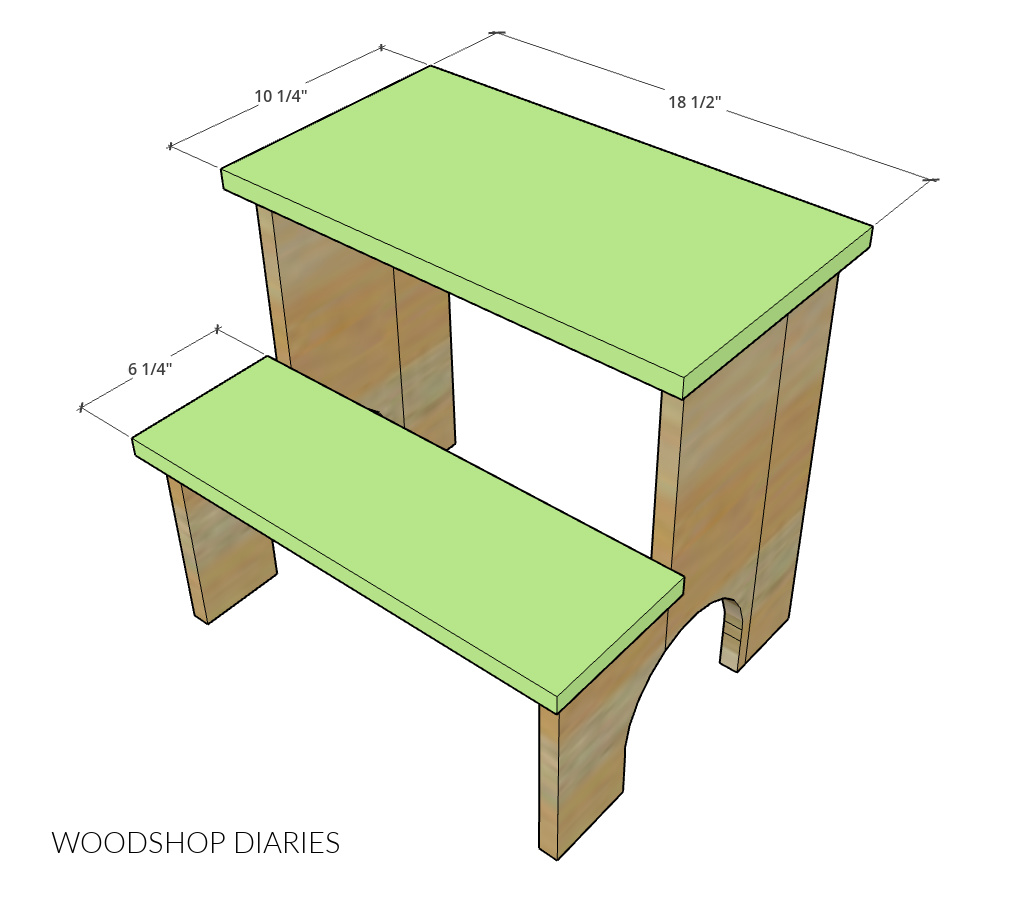
I trimmed the top glued up panel from step 1 down into two pieces–one was approximately 10 ¼″ wide and the other approximately 6 ¼″ wide.

Then I centered the smaller one on the front tier and the larger one on the back.

Diagram showing top dimensions of two tier DIY side table build

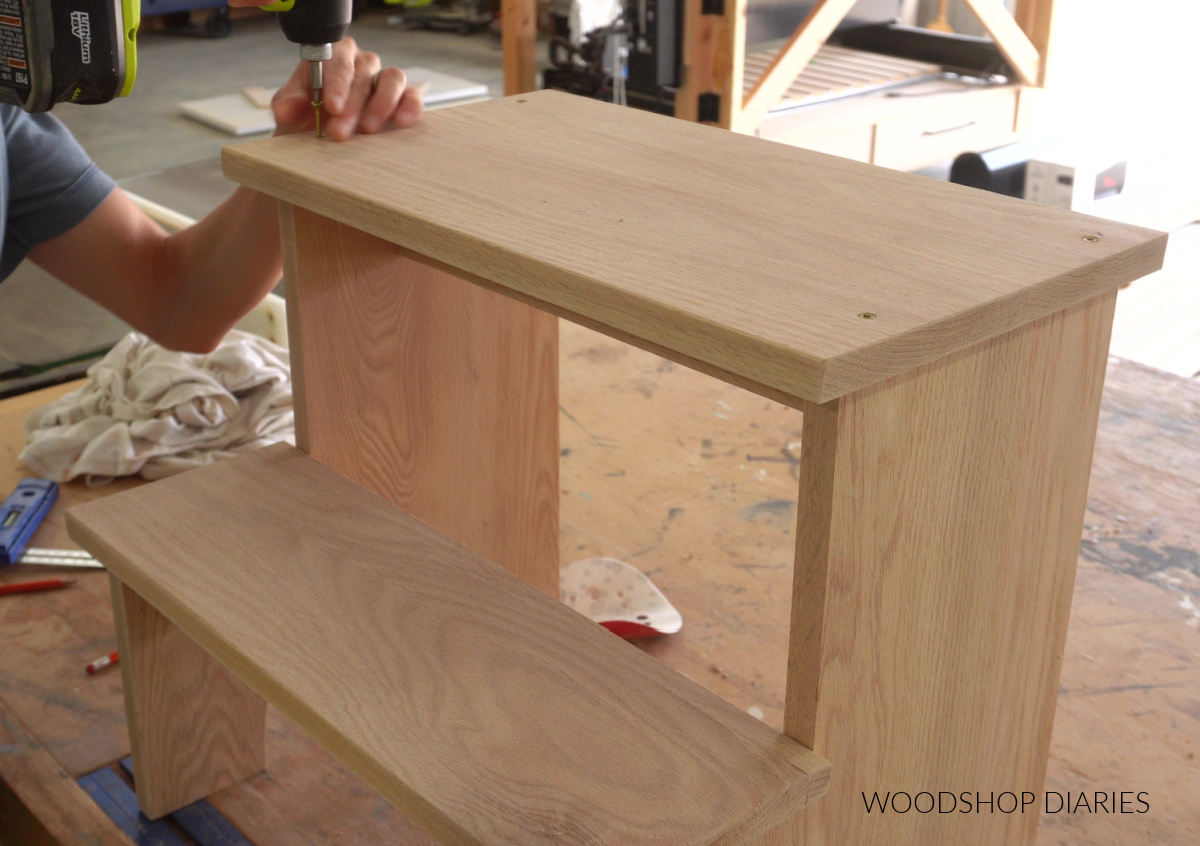
I secured these in place using 1 ¼″ wood screws from the top. Be sure to predrill pilot holes to prevent wood splits!

Attaching top of table with screws

If you didn’t want to see the screw heads, you can certainly countersink your holes and add wood plugs. These were barely noticeable after adding finish, so I left them.

Step 5: Finish

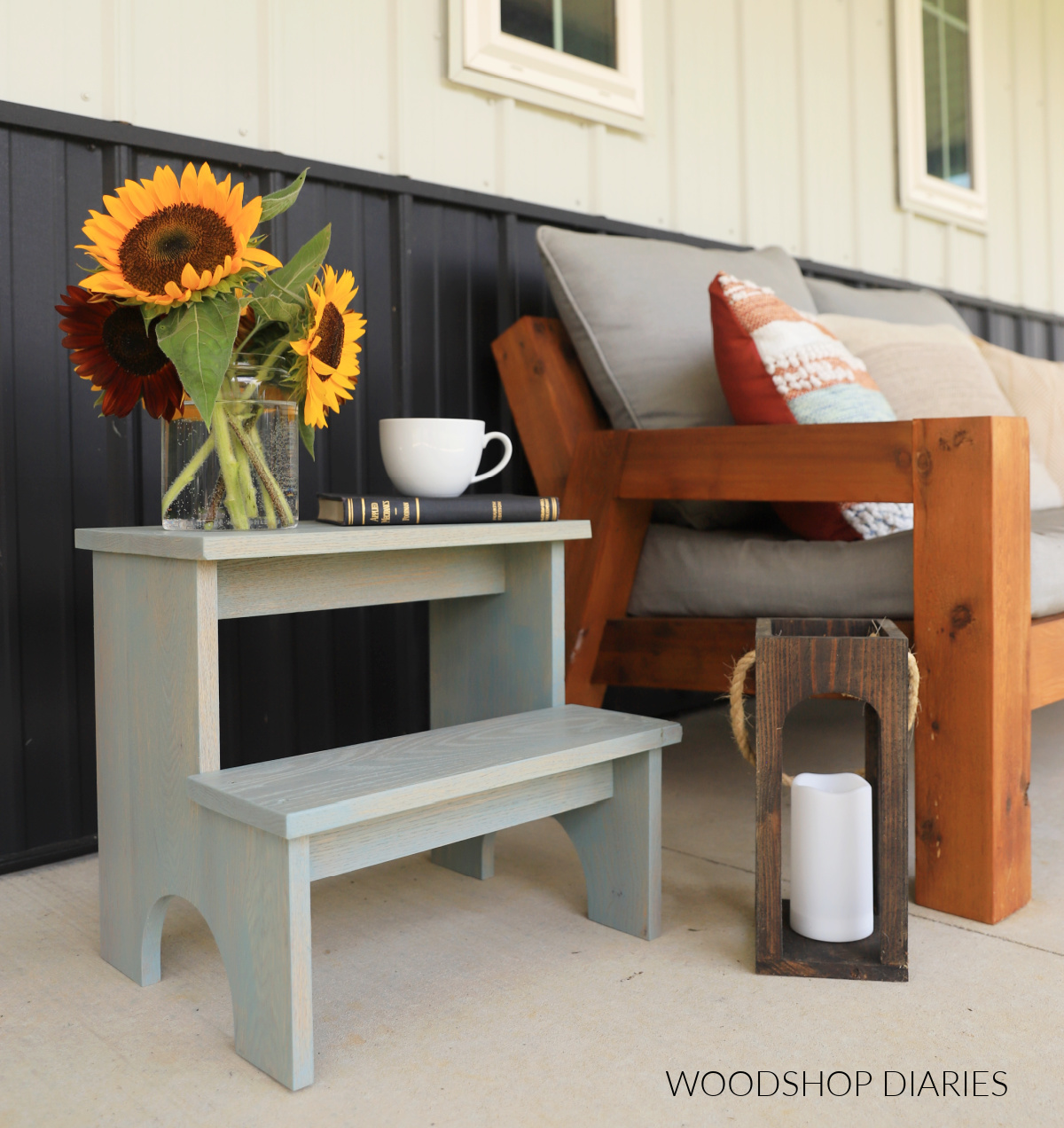
Since I was planning to use this outdoors with my outdoor loveseat, I finished it with an outdoor stain and sealant. I used Cabot Semi Transparent in Arboretum.

Green stained side table next to outdoor sofa with sunflowers in vase

Of course, feel free to paint/stain yours however you’d like. This is where you can really let your creativity shine!

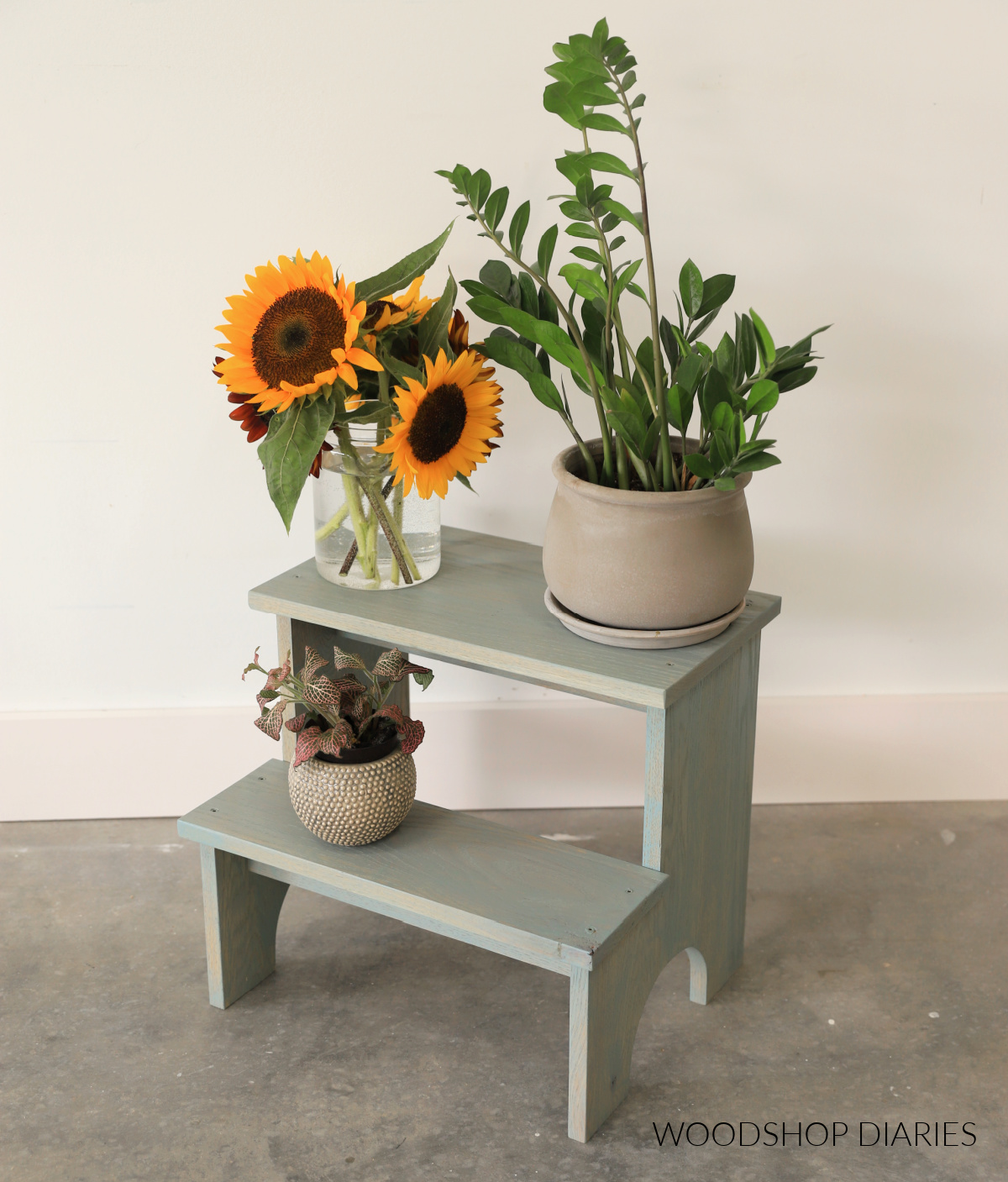
Two tiered DIY plant stand side table shaped like step stool

I think this would be adorable in different colors. If using indoors, I highly recommend checking out Minwax Water Based Stains as they come in TONS of fun colors.

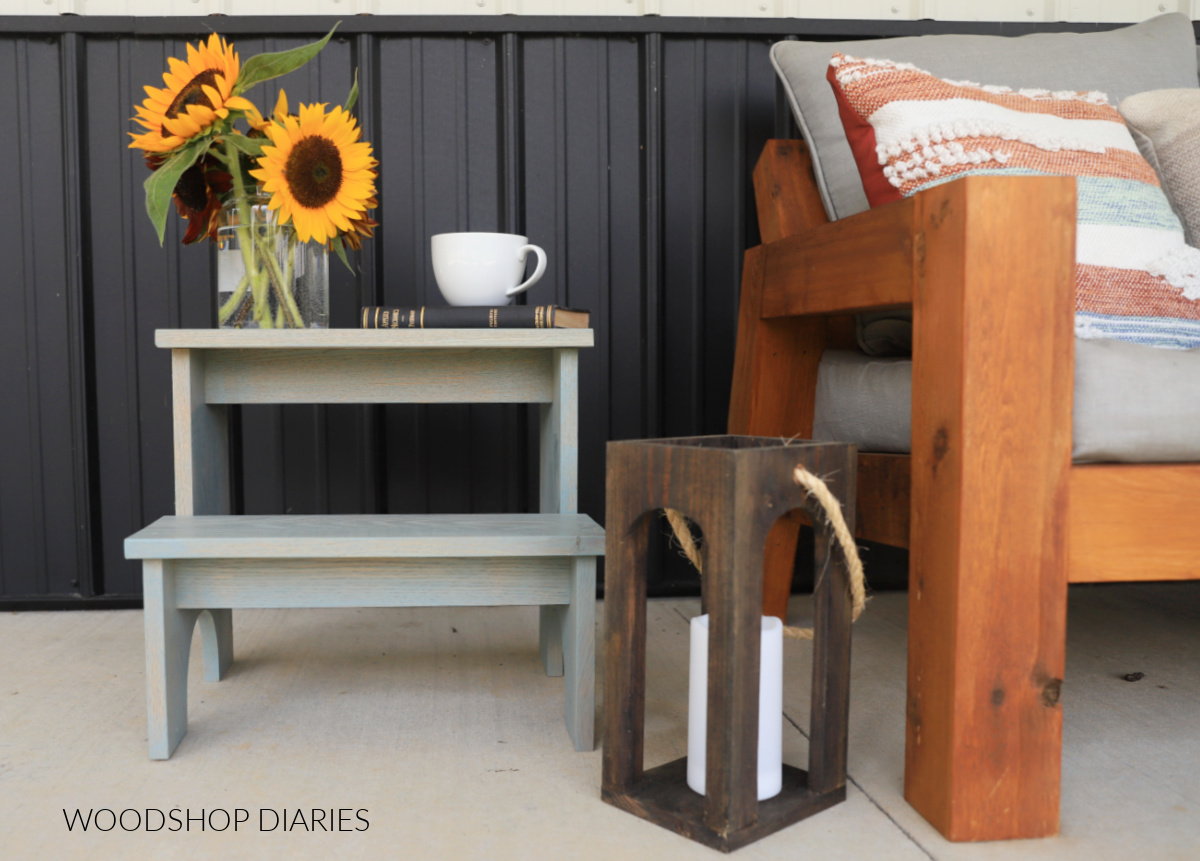
front view of DIY side table with two tiers next to outdoor loveseat

But with that, this simple side table/plant stand is ready for use! Stack, display, and show off your favorite trinkets, plants, books, and décor.

Simple DIY side table with two tiers with sunflowers in vase on top and books stacked on lower tier below

Looking for More Scrap Wood DIYs?

Can’t get enough scrap wood projects?? I’m teaming up with my friend, Kati, from Houseful of Handmade all month long for “Scrap Wood Summer!”

Check out all the projects in the series below. Click on the images to learn how to make each one!

DIY Arched Lanterns
Stacking Shoe Storage Boxes
Scrap Wood Plant Stand
DIY Scrap Wood Egg Trays
Cutting Board Drink Coasters
DIY Pasta Drying Rack
ScraP Wood Corbels
DIY Key Holder Organizer

This is our third year hosting Scrap Wood Summer and I enjoy it a little more each time. But, if you’ve never heard of it before, that’s okay!

Essentially, we each share a new scrap wood project every Tuesday throughout the month of August (2024). So by the end of the month, you’ve got 8 new project ideas to try.

So stay tuned to see all the other fun ideas we are so excited to share with you!

Can’t wait? Check out previous Scrap Wood Summer projects plus other scrap wood ideas here.

If you’d like to save this simple side table for later, be sure to pin it or share to your favorite social channel!

Pinterest collage image showing completed DIY side table at bottom and dimensional diagram at top with text "how to build a simple side table"

Until next time, friends, happy building!

DIY Scrap Wood Arched Lanterns

July 23, 2024 by Shara, Woodshop Diaries

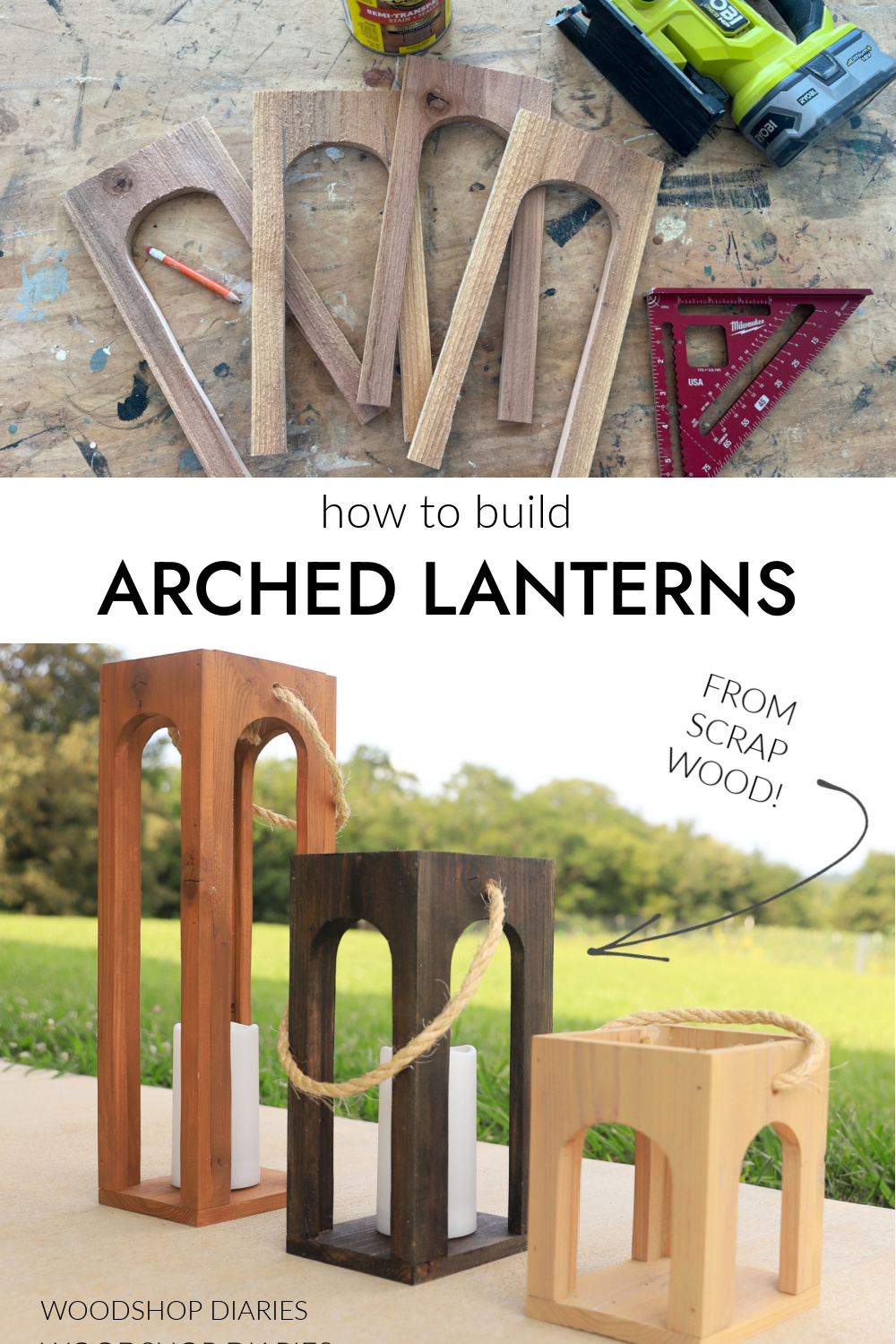
In this post, I’m sharing how to build simple arched lanterns using scrap wood!

These DIY wooden lanterns are SOOOO easy to make and you can customize them to whatever sizes and colors you’d like.

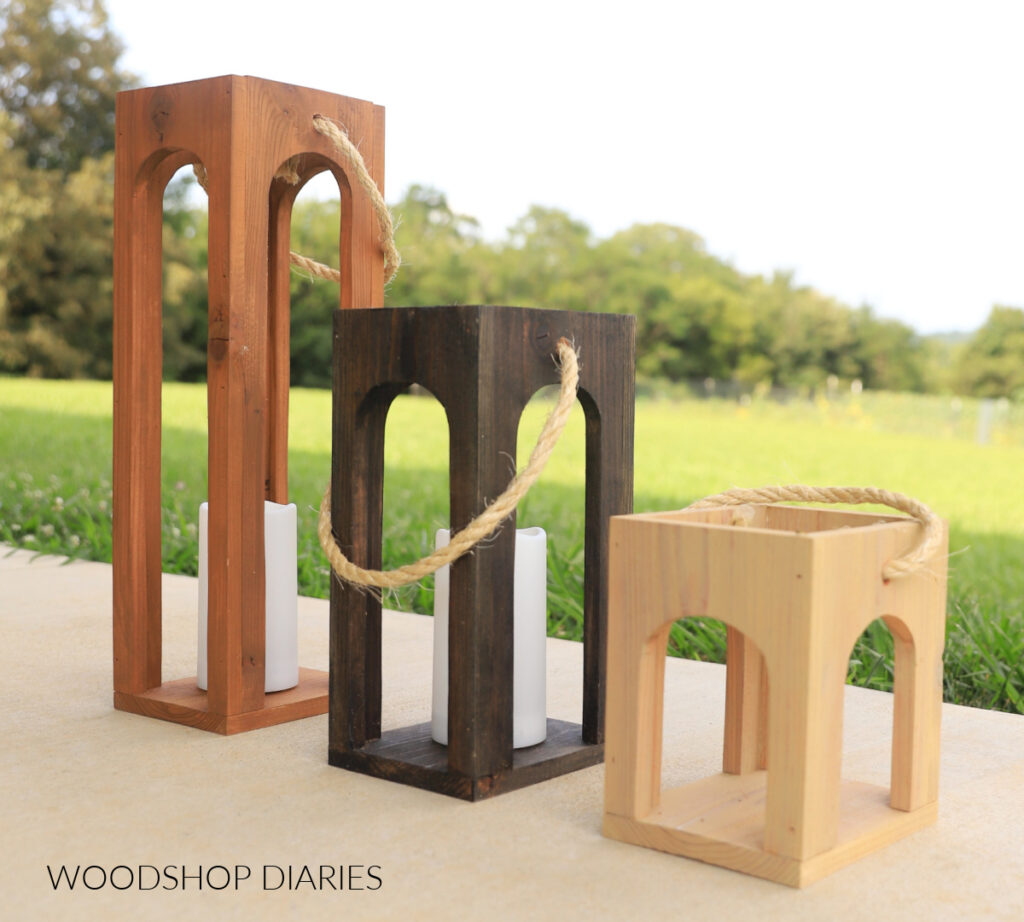
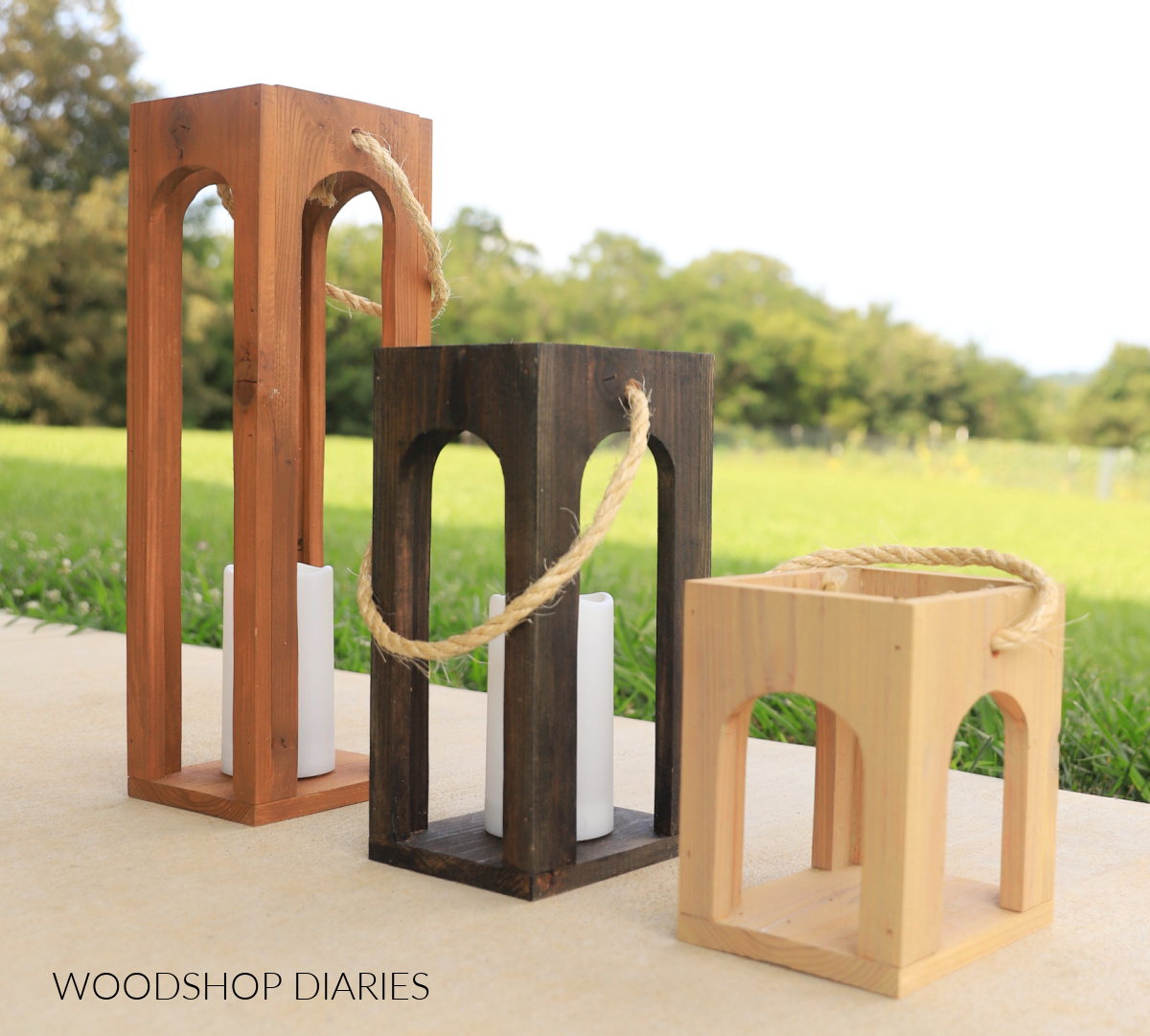
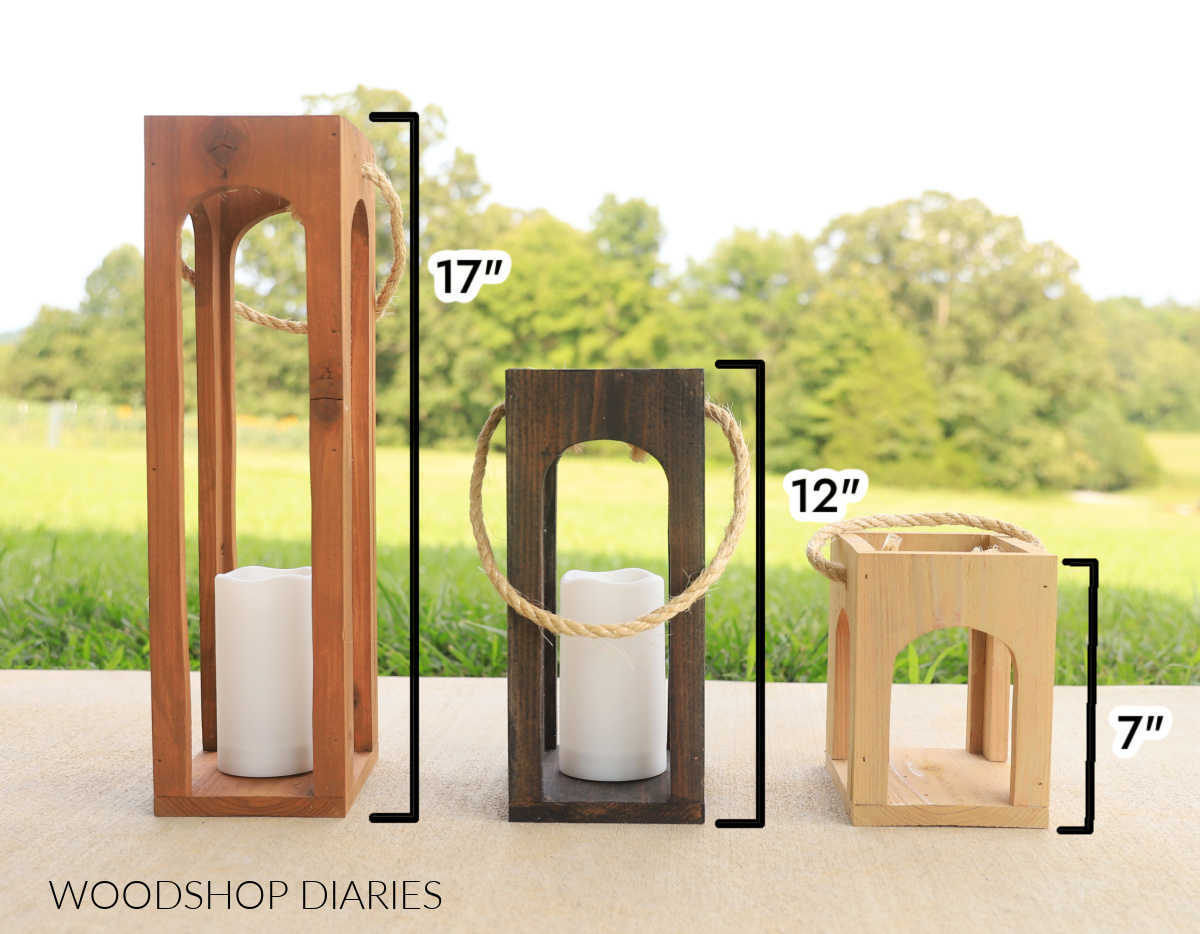
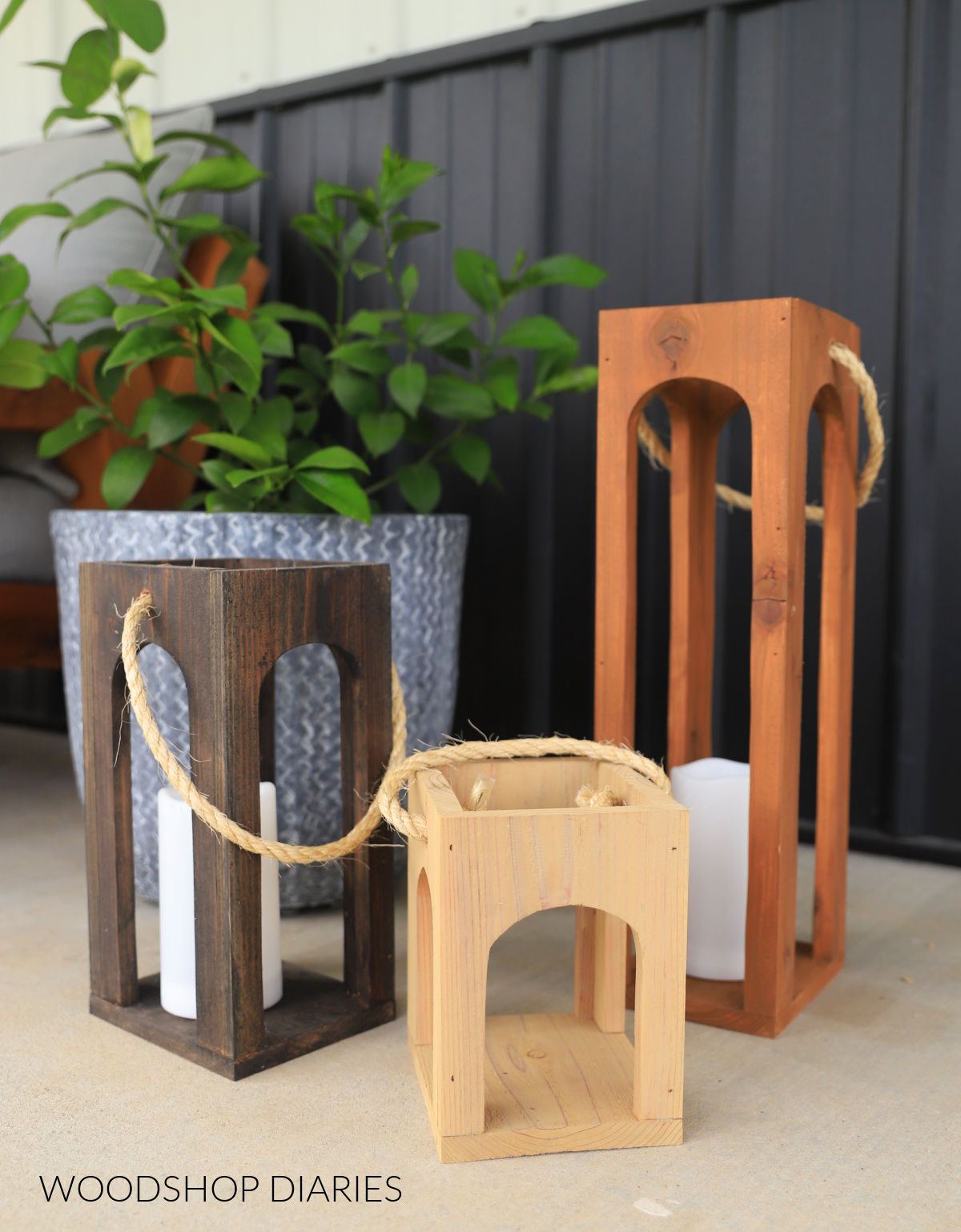
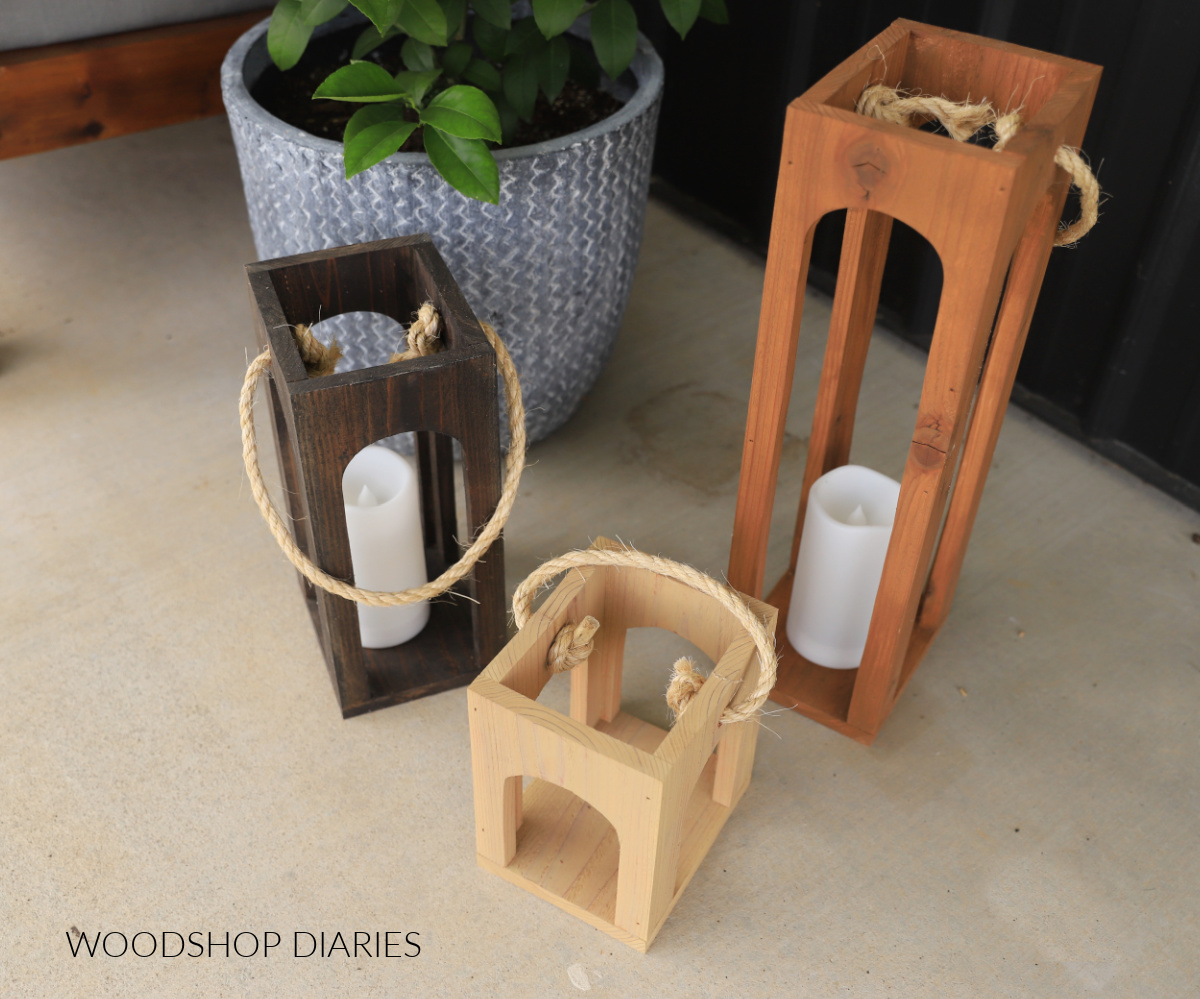
three lanterns of different size and color with arched sides on porch

Plus, you only need three basic tools to build them: a jig saw, a drill and a brad nailer! Of course, if you didn’t want to add the rope handles, you can also skip the drill.

I made these three lanterns in different sizes to dress up my front porch a little, but they’d be perfect either inside OR outside as a simple, but eye catching accessory.

If you’re ready to see how easy they are to build, I’m sharing all the details below.

*This post contains affiliate links. See website policies.

A Few Notes Before Building

These DIY arched lanterns are an EASY beginner woodworking project and you can build a few of them in less than an hour.

They would make an excellent weekend woodworking project and could be a great handmade (and inexpensive!!) gift idea as well.

Material Choices

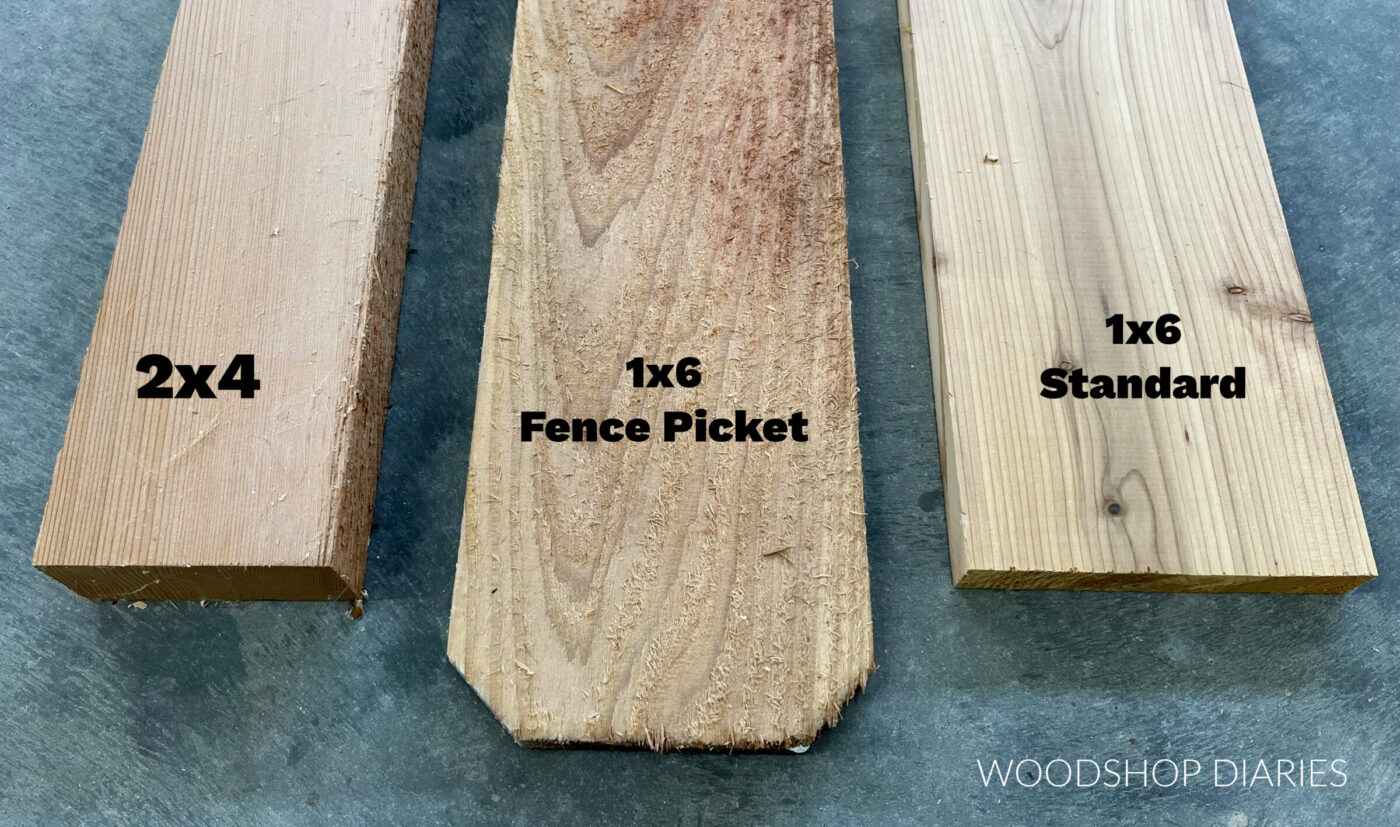
I made these simple wood lanterns from cedar fence picket scraps.

Fence pickets are roughly the same size as a 1×6, so if you don’t have fence picket scraps, 1x6s would be a great substitute.

side by side comparison of 2x4, fence picket, and 1x6 board

NOTE: 1×6 lumber is actually ¾″ x 5 ½″. Fence pickets are roughly ⅝″ x 5 ½″. So fence pickets are a little thinner than standard 1x material, but for this project, either one would work just fine.

RELATED: Understanding lumber sizing

Fence pickets are readily available year round, so if you don’t have any scraps, you can pick up a few picket boards from your local home improvement or building store for pretty cheap.

Fence pickets are sold (at least where I live) in two options: pressure treated and cedar. Pressure treated fence pickets are a little cheaper than cedar, but cedar usually looks nicer. Either option works great for outdoor use.

They’re generally only a few bucks each, and you just need 2-3 boards (depending on what size lanterns you make) for this project.

If you plan to use your lanterns inside, feel free to choose whatever wood species you prefer (in fence pickets or 1×6 lumber), but I don’t recommend using pressure treated lumber for indoor projects.

DIY Lantern Size

You can build your lanterns any size you wish. I built my smallest one about 7″ tall, the middle one about 12″ tall, and the largest one about 17″ tall (each size is 5″ taller than the last).

Three scrap wood arched lanterns finished sitting next to each other with height dimension next to each one

But, after building, I realized that the solar candles I bought to use with these were too tall for my smallest lantern.

That was a bit disappointing, but not a huge deal. I can get a smaller candle for that one. They still fit my other two sizes perfectly.

So, with that said, I encourage you to keep in mind how and what you plan to use these for and size them accordingly as needed.

Enjoy DIY projects and woodworking plans? Sign up for priority access for the latest posts on Woodshop Diaries!

How to Build Arched Scrap Wood Lanterns

This is an excellent easy and inexpensive weekend woodworking project you can complete in about an hour (minus the time for the stain to dry). And it requires minimal tools and materials.

But it provides plenty of options for customization and creativity. I hope you enjoy this one as much as I did! Here’s how they came together.

Tools & Materials

Tools:

  • Jig Saw
  • Brad Nailer
  • Drill (optional for rope handles)
  • Miter Saw (optional–makes straight cuts faster)

Materials:

  • Fence picket or 1×6 scraps (amount depends on lantern sizes)
  • Wood glue
  • 1″ or 1 ¼″ brad nails
  • Rope (optional for handles)
  • Solar candles (optional)

Step 1: Cut Lantern Sides to Length

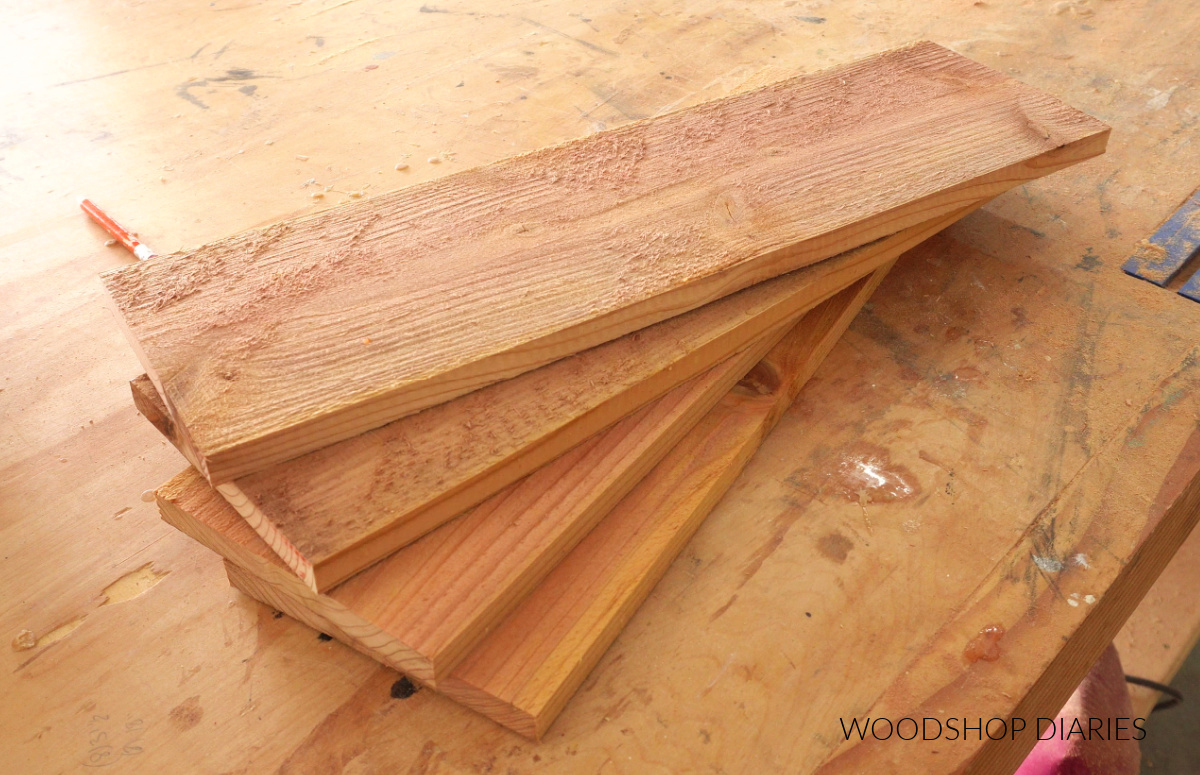
Each lantern has 4 sides (which I know is an obvious statement). So I started the project by cutting the four sides to length for each lantern.

  • For the smallest lantern, I cut four pieces of fence picket to 7″ long.
  • For the middle lantern, I cut four pieces of fence picket to 12″ long.
  • For the tallest lantern, I cut four pieces of fence picket to 17″ long.
four cedar fence pickets laid out on workbench

And again, feel free to modify your lantern size however you’d like.

TIP: You can cut these pieces using a jig saw, but if you have a miter saw, it’s probably quicker to use that for these simple, straight cuts.

Step 2: Cut out Arches

Once the sides were cut to length, I started drawing the arches on them to cut out.

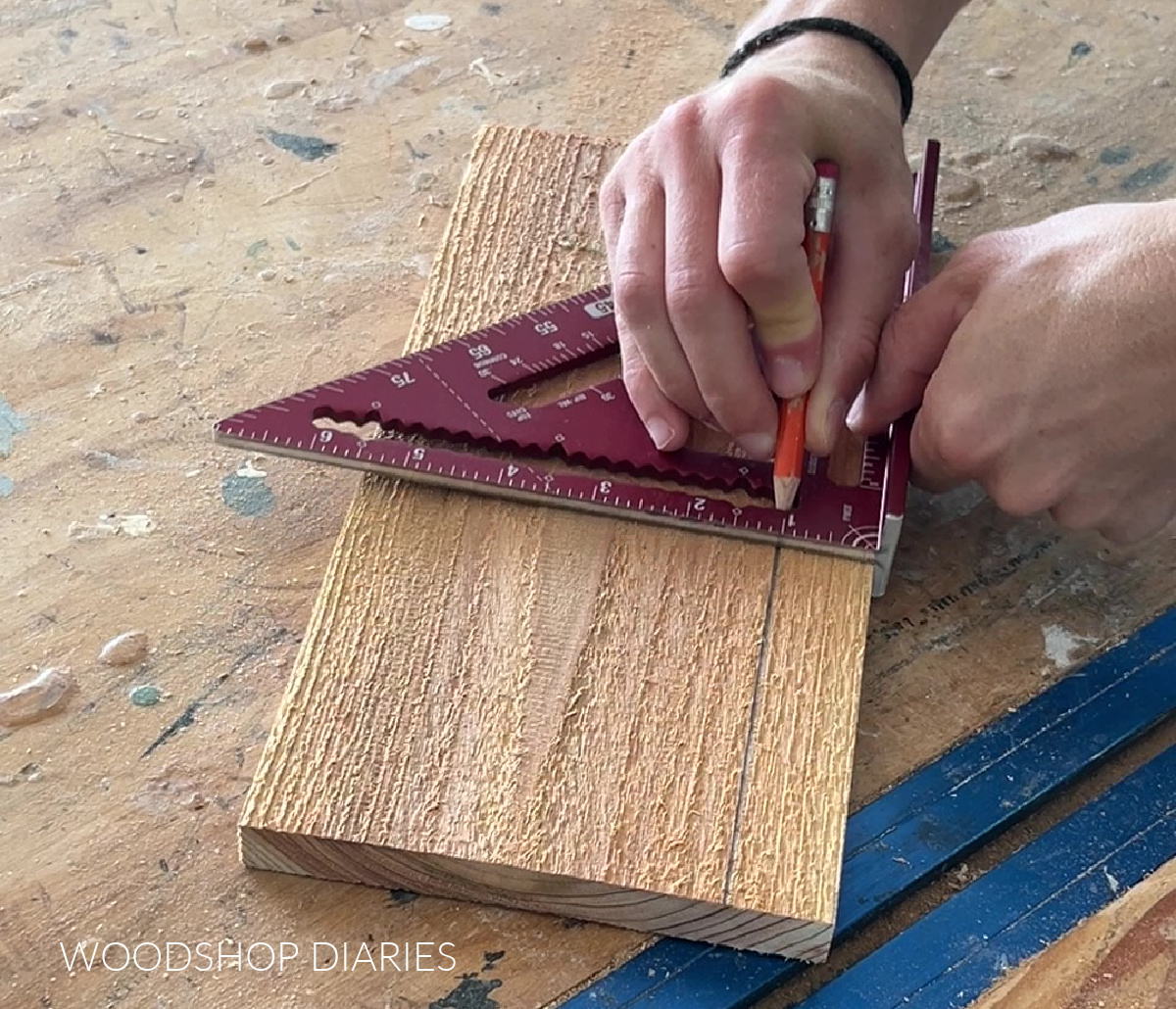
First, I used a speed square to help me draw a straight line down each side of the boards 1″ offset from the edge.

RELATED: How to use a speed square

Marking 1" offset line on board using a speed square

If you don’t have a speed square, I highly recommend adding one to the shop as it’s a SUPER useful tool.

But, an alternative method is to simply make a mark at each end of the board 1″ from the edge, then use a straight edge to draw a line between them.

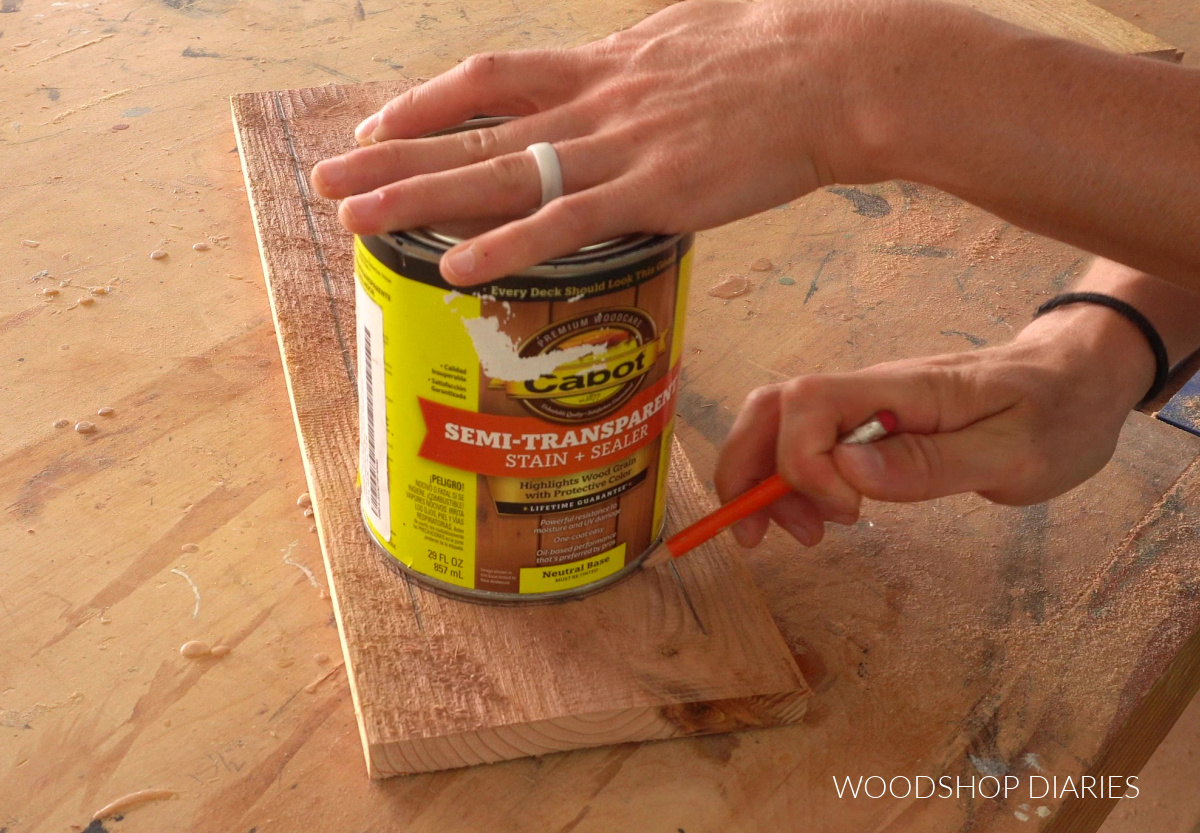
After I marked lines 1″ from each edge, I made another mark 2″ from the top edge of the board. I lined the edge of a 1 quart stain can with this mark and used it to help me draw my arch.

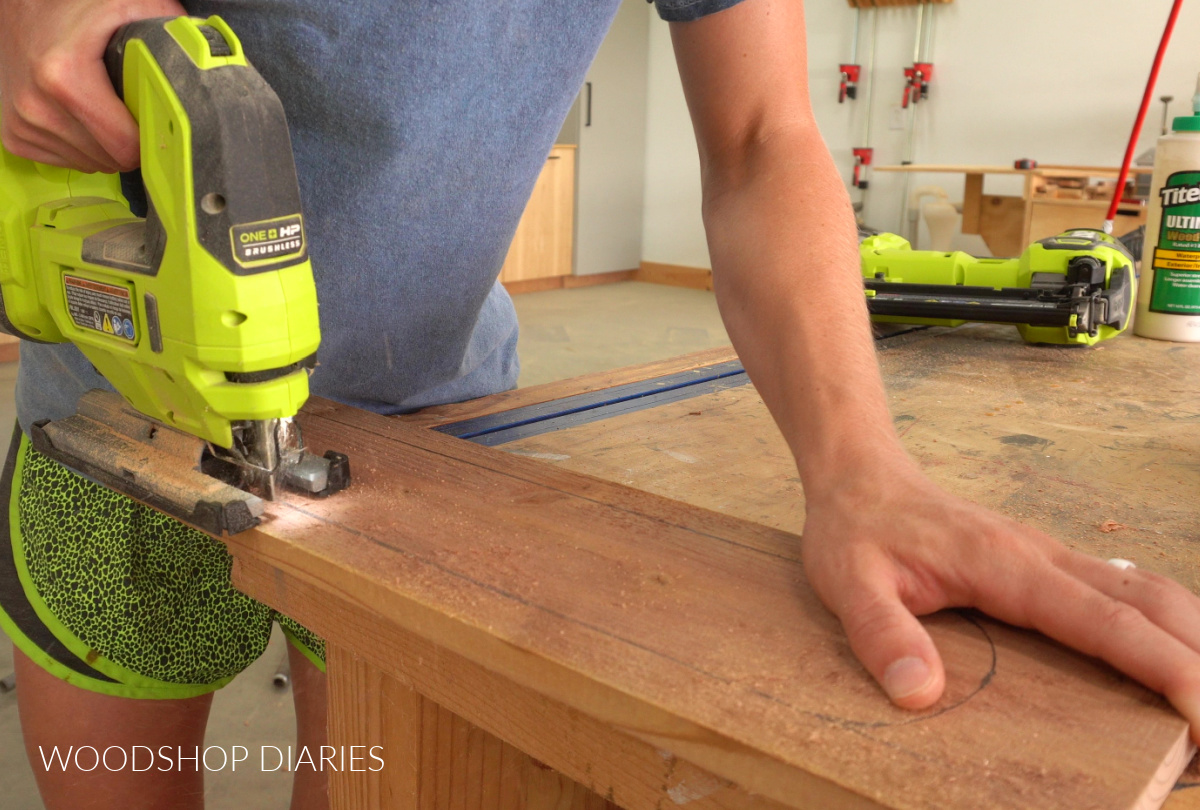
Using a stain can to trace an arch on lantern board on workbench

NOTE: You can use a roll of tape, paint can, cup, any round object to help draw your arch.

Then, I cut this out using my jig saw. Take your time and follow the lines as best you can, but don’t panic if it’s not perfect.

Shara Woodshop Diaries cutting arched sides of lantern from fence picket

TIP: I recommend using fine finish blades in your jig saw for this project. If your jig saw has orbital settings, set it on the 0 setting for the cleanest cuts.

four fence pickets on workbench with arches cut out with jig saw, square, pencil, and stain can laying around

I repeated for all four sides for all three lanterns. Then I sanded each piece well using 80 grit sand paper.

A sander is helpful here, but hand sanding is fine. Fence pickets are pretty rough, so using 80 grit paper will help smooth them out pretty quickly.

However, if you’re using regular, already smooth 1×6 material, you can probably skip up to 120 or 180 grit.

Step 3: Assemble Lantern Sides

Then, I glued and brad nailed the four sides of each lantern together. DON’T SKIP THE GLUE.

Make sure if you’re using these outside, that you use wood glue rated for exterior use. Gorilla Wood Glue or Titebond III are great options.

Shara Woodshop Diaries nailing arched lantern sides together on workbench

Be careful as you’re assembling to keep your fingers out of the way of the nails. I recommend using 1″ brad nails if you’re building with fence pickets.

If you’re building with 1x thick material, I recommend using 1 ¼″ long brad nails since the material is a little thicker.

Shara Woodshop Diaries nailing arched sides of lantern together on workbench

Step 4: Attach Bottom

After the lantern sides were all attached, I cut to fit another piece of fence picket to go on the bottom.

I flipped the lantern upside down, applied wood glue to the “legs” at leach corner, then placed the bottom on and nailed it in place.

Shara Woodshop Diaries brad nailing bottom onto arched wooden lantern

I repeated for all three lanterns and wiped away all the glue squeeze out before moving on.

Step 5: Finish & Add Rope Handles

One of my favorite “features” of these lanterns was that I stained each size a different color. This made them feel like a fun mix and match set and the colors paired together SO well.

I used Cabot Semi Transparent stain + sealer for these lanterns. The tiny 7.25 oz cans of stain are more than enough for each lantern.

I used their Desert Sand color for the smallest lantern, Black for the middle lantern (shown below), and Bark Mulch for the tallest lantern.

Staining scrap wood lantern on workbench

This part is completely optional, but the rope handles looked so cute! So in case you want to add those, too, here’s how I did it.

After the stain had dried on each one, I drilled a couple holes (in two opposite sides) in each lantern large enough to fit my rope through.

Rope comes in a ton of sizes, so choose a drill bit slightly larger than your rope’s diameter.

Drilling holes in scrap wood lantern for rope handle

TIP: Be super careful when drilling large holes as these boards are thin and can tend to split. You may want to drill a pilot hole and work your way up to the final hole size.

I cut a piece of rope a little longer than I wanted my handles (you need to leave enough length to tie the knots on each end). Then, I slid the ends of the rope into the holes, and tied a knot on the inside.

And with that, these lanterns were finished! They make the perfect addition to my front porch and a great place to add some solar candles for evening hang outs.

Three arched sided wooden lanterns on porch--all stained a different color

If you want to keep them indoors, they’d also be adorable next to the fireplace, or as a centerpiece on the dining table.

Three wooden lanterns in different sizes stained different colors on porch next to planter

These were such a fun DIY project that I may make a few more sets to put in all the places haha!

Looking for More Scrap Wood DIYs?

Can’t get enough scrap wood projects?? I’m teaming up with my friend, Kati, from Houseful of Handmade all month long for “Scrap Wood Summer!”

Check out all the projects in the series below. Click on the images to learn how to make each one!

DIY Arched Lanterns
Stacking Shoe Storage Boxes
Scrap Wood Plant Stand
DIY Scrap Wood Egg Trays
Cutting Board Drink Coasters
DIY Pasta Drying Rack
ScraP Wood Corbels
DIY Key Holder Organizer

This is our third year hosting Scrap Wood Summer and I enjoy it a little more each time. But, if you’ve never heard of it before, that’s okay!

Essentially, we each share a new scrap wood project every Tuesday throughout the month of August (2024). So by the end of the month, you’ve got 8 new project ideas to try.

So stay tuned to see all the other fun ideas we are so excited to share with you!

Can’t wait? Check out previous Scrap Wood Summer projects plus other scrap wood ideas here.

If you’d like to save these fun DIY arched wood lanterns for later, be sure to pin it or share to your favorite social channel!

Pinterest collage of scrap wood lanterns with text "how to build arched lanterns"

Until next time, friends, happy building!

DIY Single Sink Bathroom Vanity

July 12, 2024 by Shara, Woodshop Diaries

In this post, I’m sharing DIY single sink bathroom vanity plans packed with both cabinet and drawer storage.

DIY Single sink bathroom vanity with cabinet and drawer storage made from cedar and birch plywood

I designed this single sink vanity cabinet to match the double sink version I shared a few years ago. I wanted to “re-create” it as a coordinating single sink piece.

Ironically, I built a pair of these–so it was still a “two sink project” HA! But, the reason I made two is to replace the pair of vanities I built for my parents’ bathroom several years back.

You probably don’t remember them, so here’s a peek at their previous vanities:

Modern bathroom with white oak vanities and vessel sinks

You can find the build plans for the previous vanities here.

My mom still loved the vanities, but she was tired of the vessel sinks on top (I don’t really blame her), so we are replacing them new vanities, which are taller and have an undermount sink.

An added bonus is the fact that these new vanities also have significantly more storage space! And who doesn’t love extra storage in the bathroom??

So if you’re ready to dive into building one (or two!), I’ll show you how below.

*This post contains affiliate links. See website policies.

What to know before building

After building the vanity, we are adding a granite top and undermount sink to complete it.

Many home improvement and big box stores (like Lowe’s or Home Depot) have off-the-shelf countertop and sink combos you can purchase to use with this build.

However, I recommend checking with your local granite countertop suppliers as they usually have leftovers or “remnants” they can custom cut a small vanity top from for cheaper.

Bathroom vanity cabinet with drawers and doors open with view of countertop set in place

Our granite supplier also included the undermount sink to go with the countertop. (We will attach it once the vanities are installed in the bathroom.)

*Double check that your countertop, sink, and existing plumbing will work or can be modified to work with the vanity dimensions before building!

OVERALL DIMENSIONS

The overall dimensions of this vanity (not including countertop) are 21″ deep x 34 ½″ tall x 48″ wide.

Dimensional diagram of single sink vanity cabinet

This works great with a 22″ deep x 49″ wide x 1 ¼″ thick countertop.

The cabinet opening in the middle is 20 ½″ wide–make sure the sink used with the top will fit into this opening (OR you can trim a little out of the middle divider panels for it to fit).

Material Choices

This project was built using cedar lumber and birch plywood. You’re welcome to use whatever type of lumber you prefer for this build.

I’ve found that if you buy birch plywood with some darker color streaks in it, this matches cedar wood really well once sealed.

birch plywood with dark streaks in lumber

I cut my own 2x2s and 2x3s from cedar 2x4s. This cuts down on material waste, but if you prefer to buy them precut, you certainly can. I’ve included the cut diagrams for this in the printable plans.

RELATED: Check out this post on how to cut your own 2x2s from 2x4s

I also used the T&G boards to cut the pieces for the door frames and the drawer front trim. Essentially, I ripped them in half and used the groove side for the door frames and the tongue side for the drawer trim.

Close up of tongue and groove lumber with a line drawn down middle and text "groove side: use for door frames"

RELATED: 7 Ways to Build a Cabinet Door (the T&G method is number 5)

But again, if you prefer to use precut 1x2s and 1x3s for that instead, that’s totally fine.

Helpful resources for the build

These posts and how to guides may be helpful throughout the build process:

  • How to cut plywood sheets
  • How to use a pocket hole jig
  • How to build a drawer box
  • How to install drawer slides
  • How to use a dowel jig
  • How to build cabinet doors 7 different ways
  • How to install concealed hinges
  • How to add a clear coat sealer to DIY furniture

Are DIY projects your thing? Sign up for our newsletter for priority access to the latest projects and build plans!

How to Build a Single Sink Bathroom Vanity Cabinet

I’ve included several helpful tips and some behind the scenes info in the build video. You can check it out on my YouTube Channel here.

Faux youtube thumbnail image linked to youtube video for vanity cabinet build video

Love watching how-to videos? Subscribe to my YouTube channel for plenty more where that came from!

Prefer to print? Grab the printable bathroom vanity building plans available here:

Tools & Materials

Tools:

  • Circular Saw and Saw Guide(s)
  • Miter Saw
  • Table Saw
  • ⅜″ dowel jig
  • Pocket Hole Jig
  • Concealed Hinge Jig
  • Drill/Driver
  • Clamps

Materials:

  • (1 + ½) sheet ¾″ plywood (birch used here)
  • (1) sheet ¼″ plywood (birch used here)
  • (6) 2x4x8 boards (cedar used here)
  • (2) 1x6x8 tongue and groove boards (cedar used here)
  • (5) pair 18″ drawer slides
  • (2) pair inset concealed hinges for frameless cabinets
  • 1 ¼″ pocket hole screws
  • 2 ½″ pocket hole screws
  • 2″ wood screws
  • ⅜″ x 1 ½″ wood dowels (for assembling doors)
  • Wood Glue

Step 1: Assemble Single Sink Vanity Frame

I glued up my own vanity legs by gluing together 4 pair of 2x4s. After the glue was dry, I trimmed the edges to clean them off and give me 2 ½″ x 2 ½″ square posts.

Since I was building two vanities, I made 8 legs, but if you’re just building one, you’d only need four.

cedar 2x4s glued into vanity legs stacked on workbench

NOTE: In the video, I mentioned that I ripped these 2x4s down before gluing up, but that in hindsight I wouldn’t have done that. If I did it again, I’d just glue up full width 2x4s.

Then, I cut two pieces of ¾″ plywood to assemble between the legs to give me two side panels using pocket holes and screws.

Vanity cabinet side panels with plywood and cedar posts attached with pocket holes

RELATED: How to cut plywood sheets

You can find the complete plywood cut diagram for this project in the printable plans.

For the vanity frame, I used 2x3s at the front and ¾″ plywood strips at the back. (Using thinner material at the back allows more room for the faucets to be installed in the countertop.)

I cut my 2x3s from a 2×4. I recommend squaring the edge of the 2x4s for the front framing on the table saw, then cutting off a ¼″ – ½″ thick piece to use for trim later.

Then, rip what’s left to 2 ½″ wide to make the actual 2×3 board. I attached the front and back framing between the side panels using pocket holes and screws.

Single sink DIY bathroom vanity frame assembled in workshop

Then, remember those ¼″-½″ strips I mentioned I cut from the 2x4s? I glued those onto the front 2x3s–one at the top and one at the bottom.

Close up of gluing lattice trim onto front of vanity cabinet frame

To add just a little more trim and dimension to the front, I also glued 2x2s vertically between the 2x3s on each front leg.

Shara Woodshop Diaries attaching 2x2 trim to front of vanity cabinet

Prefer to print? Grab the printable building plans for this single sink vanity here.

Step 2: Install Divider Framing and Panels

Once the main frame was together, I began adding some pieces to divide it up. This bathroom vanity design had 5 drawers and the top middle section will be doors.

So I cut and installed 2×2 pieces to divide up the large bottom drawer, and each top drawer.

Shara Woodshop Diaries attaching drawer divider pieces into front of vanity cabinet framing

I attached each piece with pocket holes and screws. By the way, when drilling pocket holes in 2x2s, I’ve found they’re much more likely to split if I use two holes in each end.

So normally, I just use one and some wood glue to help keep it from twisting.

After everything was framed out around the front, I added couple plywood strips to frame out the back.

Shara Woodshop Diaries installing back supports to cabinet

Then, I installed ¾″ plywood divider panels to run between the framing and separate the vanity into three sections.

The middle section will be where the doors will go, so to complete this “cabinet” part of the vanity, I also added a bottom panel between the dividers.

Completed DIY single sink bathroom vanity cabinet with divider and bottom panels installed

Step 3: Add Drawers to Vanity Cabinet

Now that the main body of the vanity is together, all that’s left is to fill it with drawers and doors. Let’s start with the drawers, first.

Because I added the extra 2×2 trim on the sides in step 1, that meant I needed to add some additional spacer blocks to the sides to be able to mount the drawer slides.

So I glued and screwed 2x2s to each side right above the front dividers.

Close up of Shara Woodshop Diaries installing spacer blocks to side panels

Then, I installed the drawer slides into the vanity cabinet onto these spacer blocks and to the middle divider panels.

If you’re new to installing drawer slides, check out this detailed guide on installing drawers and drawer slides.

Shara Woodshop Diaries installing drawer slides to vanity cabinet

Then, I began building the drawer boxes. This vanity required two different sizes of drawer box–a shallow, but wide bottom drawer, and four narrow, but tall top drawers.

Normally, I assemble my drawer box sides using ¾″ plywood and install a ¼″ plywood bottom into dadoes I cut on the sides.

RELATED: How to build a drawer box

But this time, to save a little extra space inside the drawer, I decided to skip the dadoes. I screwed the four sides of each drawer together using pocket holes and screws.

NOTE: You can certainly assemble the drawers using a different method than pocket holes if you’d like.

However, if you do use pocket holes, make sure not to drill the holes more than about 1 ½″ from the edges of the board. You’ll see why in step 5.

Close up of pocket holes drilled on end of drawer box board

Then, just glued and stapled the ¼″ plywood bottom on.

Shara Woodshop Diaries stapling bottom panel onto drawer box on workbench

Once the drawer boxes were together, I added them into the vanity by attaching them to the slides.

Drawers installed into bathroom vanity cabinet for single sink

RELATED: How to install drawer boxes

Ready to build your own? Grab printable building plans with all the dimensions, cut list, and step by step diagrams here.

Step 4: Build Doors

I mentioned earlier that for the doors, I trimmed down some tongue and groove 1×6 cedar and used the groove edge of the board for the door frame.

Close up of tongue and groove lumber showing groove side for door frame

This saves a bit of time since the dadoes are already cut (they’re the groove).

I cut these strips with ends mitered 45 degrees and cut a ¼″ plywood panel to fit inside. Check out this post for 7 ways to build a cabinet door (this method is number 5).

After I test fit the pieces, I assembled using wood glue and dowels.

Shara Woodshop Diaries assembling cedar cabinet door with dowels

RELATED: How to use a dowel jig

I clamped the joints tight and allowed to dry.

Step 5: Install Drawer Fronts and Doors

The leftover tongue side of the tongue and groove boards is what I used for the drawer front. I trimmed them down on the table saw to remove the tongue edge–this made them about 2″ wide.

Then, I cut pieces to fit around the front of the drawers so that when put together, there was ⅛″ gap between all sides.

Shara Woodshop Diaries placing drawer front trim onto drawer boxes of vanity cabinet

I found it easiest to install these pieces by laying the vanity on its back, then applying wood glue along the edge of the drawers. Then I could position the trim as needed and allow to dry.

This is why I suggested drilling pocket holes close to the board edges. These trim pieces will cover them once installed.

After the glue had fully cured on the drawer front trim, I flipped the vanity back up to install the doors.

I used a concealed hinge jig to install concealed hinges for inset doors on frameless cabinets to each door.

Drilling concealed hinge holes on cabinet door

RELATED: How to install concealed hinges

Now, this isn’t technically a frameless cabinet. But, it’s not a typical face frame cabinet, either, since the frame is a 2×2 and face frames are supposed to be ¾″ thick.

RELATED: How to know what type of hinge to use

So, I’m using some spacer blocks to “fake” a frameless cabinet. I glued and nailed some scrap ¾″ plywood blocks to go behind each hinge inside the cabinet.

Spacer blocks added into vanity cabinet where hinges will mount

Then, I can mount the hinges directly to these blocks. This way, it will function like a frameless cabinet.

Shara Woodshop Diaries installing cabinet door hinges to spacer blocks in vanity

At this point, once the doors are on, the build is complete and it’s ready for finish. I opted for a simple clear coat, but you can paint/stain/finish as desired.

I applied three coats of Minwax Helmsman Water Based Clear Coat to the vanities and allowed to dry.

RELATED: How to apply a clear finish to wood furniture

Step 6: Add Hardware

Once the finish was dry, I added some knobs to the doors and top drawers, and a drawer pull to the bottom drawer.

I also added a simple magnetic catch behind the doors to help prevent them from “kicking in” (this tends to happen with inset doors).

Magnetic catch as stop block behind cabinet door

Unless it needs it, I usually don’t attach the metal piece of the catch to the door, so it’s not really a magnetic catch (since there’s no metal for the magnet to pull on) so much as it’s just a little stop block.

But if the door is a little warped and needs help pulling in flat, you can definitely use the magnetic feature to pull it flat.

Step 7: Install Vanity and Add Countertop

Before I can install these into my parents’ bathroom, I need to remove the old ones, remove the backsplash, patch the drywall, and paint. So we aren’t quite there yet–I’ve got some more work to do.

However, when we get ready to install them, we will position them in place and secure to the wall studs through the back supports/framing of each vanity.

Then, we will attach the countertop, sink, faucet, and reconnect the plumbing. You’ll need to check your countertop, sink, and faucet instructions for details on how to install those to the vanity.

Shara Woodshop Diaries opening cabinet door of DIY single sink bathroom vanity

But, this post details how we installed a granite top and sink to our vanity a few years ago.

Completed DIY cedar and birch plywood single sink bathroom vanity against white wall with black framed mirror above

I’ll share an update soon once we get these put in! In the mean time, if you’d like to build one of your own, be sure to grab the printable building plans here.

Looking for more DIY bathroom Projects?

Here are a few of my favorite projects you can build for the bathroom:

DIY Double Vanity
Simple Bathroom Cabinet
DIY Fluted Bathroom Vanity
DIY Single Sink Vanity with Drawer
Scrap Wood Towel Rack

If you enjoyed this build and would like to save it for later, be sure to pin it or share to your favorite social channel!

Pinterest collage image showing dimensional diagram of vanity at top and completed vanity cabinet at bottom with text "how to build a bathroom vanity"

Until next time, friends, happy building!

How to Build a 9 Drawer Dresser

June 28, 2024 by Shara, Woodshop Diaries

In this post, I’m sharing how to build a simple modern 9 drawer dresser with basic tools and materials!

This 9 drawer dresser design is part of a matching bedroom furniture set that I shared a few months ago.

DIY completed red oak 9 drawer dresser against white wall with vase and flowers on top

After building a modern 6 drawer dresser for that set, I got to thinking that a 9 drawer version would actually match the bed a little better. So I wanted to add that option to the collection, too.

I know that dressers can be an intimidating project for some–especially one with so many drawers! But, I like to think of dressers as a box (the dresser frame) with a bunch of smaller boxes inside (the dresser drawers).

So if you can build a box, you can build a dresser. You got this, friend! I’ll show you how to build this modern 9 drawer dresser in the post below.

*This post contains affiliate links. See website polices.

What to know before building this Dresser

Because there are a lot of parts and pieces that require some careful measuring (learn how to accurately use a tape measure here), I’d consider this an intermediate build.

It’s definitely not difficult, but it might not be the best option for a very first build.

What Type of Wood To Build a Dresser With

This dresser build is made entirely from plywood except for the front and back frames, which are solid lumber. I used red oak for this particular dresser, but any wood type you prefer would work fine.

Close up of a piece of red oak lumber

Construction lumber (like pine, spruce, fir) and birch plywood is a more budget friendly option that would work great as well.

For plywood thickness, I prefer using ¾″ plywood for everything except drawer bottoms (I use ¼″ plywood for those).

If you want to, you can save a little money and weight by using ½″ plywood for the drawer boxes, but for supports and side panels on the main dresser body, I definitely recommend the added strength of ¾″ thick plywood.

If you’re new to DIY, check out this post to learn more about choosing plywood for your projects and this post about how and where to buy lumber.

Material Sizing Notes

This plan calls for using 2x2s and 2x3s. (Did you know 2x2s aren’t 2″ x 2″? Learn more about understanding lumber sizing here.)

However, in many cases, 2x3s are difficult to find precut in the stores. Sometimes you can find them in the construction lumber aisle, but not every store carries them.

So I recommend ripping the 2×2 and 2×3 pieces down from 2x4s and/or 2x6s if you have a table saw.

RELATED: How to cut your own 2x2s

red oak 2x2 boards on workbench

This saves on materials and you can reuse the off cuts for trim on the sides, too! See tutorial video for more information.

Matching Bedroom Furniture Set

If you’re looking to build the whole set, you can find the plans for the matching pieces here:

  • Matching Storage Bed
  • Matching Modern Nightstand
  • Matching 6 Drawer Dresser
Collage image showing matching storage bed, nightstand, and 6 drawer dresser collection

Overall Dimensions

Overall dimensions of this dresser as shown in the plans below are 21″ deep x 34 ¾″ tall x 66″ wide.

Overall dimensional diagram showing size of 9 drawer dresser build

Helpful Resources for the Build

If you’re new to building drawers, don’t worry! I’ll walk you through the entire drawer building process from start to finish in this drawer building series (with videos!). I’ve broken it down into four parts:

  • How to measure for and size drawer boxes
  • How to assemble a drawer box
  • How to install drawer slides
  • How to install drawer fronts

Prefer to print the whole series? Grab the Ultimate Drawer Building Guide which includes all four parts in a printable e-book you can take to the shop with you.

Shara Woodshop Diaries holding drawer box in workshop

Additional helpful resources for this build:

  • How to cut plywood sheets
  • How to apply edge banding
  • How to use a pocket hole jig
  • How to use a dowel jig (optional)

Are DIY projects your thing? Sign up for our newsletter for priority access to the latest projects and build plans!

How to Build a Modern 9 Drawer Dresser

I’ve included the step by step building instructions below along with printable building plans. But, if you prefer to watch, I’ve also included a build video as well. 

Check out the video for tips, visuals, and some extra clips from behind the scenes!

YouTube thumbnail image of 9 drawer dresser build video

Love watching how-to videos? Subscribe to my YouTube channel for plenty more where that came from!

Prefer to print? Grab the printable modern 9 drawer dresser building plans here:

Tools & Materials:

Tools:

  • Drill/Driver
  • Circular Saw
  • Cutting Guides (optional): Kreg Rip Cut & Kreg AccuCut
  • Pocket Hole Jig
  • Miter Saw
  • Dowel Jig (optional)
  • Clamps
  • Table Saw (optional)

Materials:

  • (2 ½) 4’x8′ sheets ¾″ plywood
  • (1) 4’x8′ sheet ¼″ plywood
  • (3) 2x4x8 boards
  • (1) 1x2x8 board (optional for side trim)
  • ¼″ x 1 ½″ lattice trim (optional)
  • 1 ¼″ pocket hole screws
  • Dowel Pins (optional)
  • 2″ Wood Screws
  • Wood Glue
  • (9) Pair 18″ Drawer Slides
  • Edge Banding
  • Knobs/Drawer Pulls

Step 1: Glue Up Front & Back Frames

To start this build, first, I needed to assemble two frames for the dresser. These are the parts of the build that are made from solid wood and will be the front and back.

I used 2x3s for the legs and 2x2s to go between them at the top and about 4″ up from the bottom. So first, I ripped these pieces down from 2×4 boards (see notes above), and trimmed them to length.

Note: 2x4s are 3 ½″ wide and 2x3s are 2 ½″ wide. So if you rip these down, you’ll have a ~1″ thick piece left. And if you rip down 2x2s (which are 1 ½″ wide), you’ll have a ~ ¼″ thick piece left. Save these pieces to use as trim later!

Diagram showing front and back DIY dresser frame made from 2x3s and 2x2s

All the dimensions, cut diagrams, and cut lists can be found in the printable building plans here.

Then, I assembled the two identical frames using dowel pins and glue. But, you could also assemble using 1 ½″ pocket holes and 2 ½″ pocket hole screws if you’d rather.

Shara holding front and back dresser frames in workshop

NOTE: If you don’t have a table saw, you can use precut 2x2s and just use full width 2x4s (if you can’t find 2x3s) for the legs. Keep in mind that using 2×4 legs will make the dresser body 2″ wider.

Step 2: Assemble 9 Drawer Dresser Frame

From here, the rest of the dresser build is assembled with plywood. So I cut two ¾″ plywood side panels to attach between the frames from step 1 using pocket holes and screws.

RELATED: How to use a pocket hole jig

Be sure if driving into hardwood, like oak, you use fine thread pocket hole screws!

Shara Woodshop Diaries attaching side panels of 9 drawer dresser between front and back frames on workbench

I divided this dresser into three sections–a smaller left and right section and a wider center section. To separate them, I installed four strips (2 ½″ wide) between the top and bottom 2x2s–two at the front and two at the back.

These are installed using pocket holes and screws and it’s important to make sure the dividers at the front are in line with the dividers at the back (equal distance from the legs).

Dresser frame with four dividers installed to separate left, center, and right sections

I inset the front dividers ¼″ from the front of the 2×2 to add some extra dimension.

Then, I attached 12 plywood strips (what I’ll call “runners”) between these pieces like shown below–6 between the left dividers and 6 between the right dividers.

Shara Woodshop Diaries installing drawer slide runners in dresser frame

These will be used to mount the drawer slides onto, so they need to be placed where the slides will go. Dimensions are detailed in the printable plans.

drawer slide runners installed in red oak dresser frame in workshop

I also added some dividers to separate out the 9 individual drawers. These were simply plywood strips I cut and installed with pocket holes and screws.

To add some extra dimension (like I did with the front dividers), I inset these drawer dividers another ¼″ in from the vertical dividers.

Installing drawer divider strips ¼" inset from framing

But I had to pay careful attention because that means that they should be ½″ inset from the front legs to keep them square.

Installing drawer divider strips ½" inset from front dresser legs

Step 3: Install Drawer Slides

I installed nine pair of 18″ ball bearing drawer slides into the dresser to mount the drawers to.

These drawers will be inset and the drawer front will be ¾″ plywood with a piece of ¼″ lattice trim on the front (more on that in just a minute), so it will be 1″ thick total. 

PS this Kreg MultiMark tool is super handy to have in the shop for quick measurements and offsets.

Close up of Kreg MultiMark tool measuring thickness of drawer front

So I installed the slides 1″ inset from the drawer dividers so that the drawer fronts will be flush to them once installed.

RELATED: How to install drawer slides

Drawer slides installed onto 9 drawer dresser frame

Step 4: Add Dresser Supports

Before adding the drawers into the dresser, I needed to add some additional support to handle the weight (9 drawers will be HEAVY!).

So I glued and screwed a couple pieces of 2×3 to a couple strips of plywood and placed these under the bottom drawer runners of the dresser.

Shara Woodshop Diaries installing middle supports into dividers of 9 drawer dresser frame

I secured these to the runners with screws. This will help prevent the dresser frame from sagging once the drawers are in place.

Step 5: Build and Install 9 Dresser Drawers

I made 9 drawer boxes to fit into this dresser–4 deep, but narrow drawers for the left and right bottom, 2 deep and wide drawers for the bottom center, 2 shallow and narrow drawers for the top left and right, and a shallow but wide drawer for the top center.

It got a bit confusing haha. So here’s a color coded map.

Color coded diagram of 9 drawer dresser to differentiate between various sizes

RELATED: How to determine drawer sizing for any project

I assembled the drawer boxes from ¾″ plywood (for the sides) and ¼″ plywood (for the bottom) using pocket holes and screws.

Check out how to assemble drawer boxes here.

Shara Woodshop Diaries assembling drawer box on workbench

Then, I installed the drawer boxes into the dresser. There are several ways to install drawer boxes, but I like to place some ¼″ scrap plywood pieces on the divider below the drawer, pull the slides flush to the front, and simply screw them in.

Shara Woodshop Diaries installing drawer box into dresser frame

This is a quick and easy way to do it that gives you consistent spacing and maximizes the space above for storage.

Step 6: Attach Drawer Fronts

Once the boxes were in, I cut drawer fronts from ¾″ plywood to fit the openings. They should be ¼″ shorter and ¼″ narrower than the opening.

Then I applied iron on edge banding to the sides. Edge banding is optional, but it makes plywood edges look really nice–like solid wood! Learn how to apply edge banding here.

To give the drawer fronts some extra detail, I cut some ¼″ thick x 1 ½″ wide strips to glue onto the front flush to the left and right edges.

Close up of lattice trim on drawer fronts

Then I placed these into the openings, made sure the gaps on all sides were even (⅛″), and screwed them in from the inside of the drawer box.

Shara Woodshop Diaries installing drawer fronts onto drawer boxes with screws from the inside

Step 7: Add Dresser Top & Trim

I trimmed a piece of ¾″ plywood 1″ wider and ½″ deeper than the dresser base and edge banded the front and sides. This will be the dresser top.

I placed it on the dresser frame with ½″ overhang on the sides and front and screwed it in from the bottom side. (You’ll have to remove the drawer boxes to have room for the drill/driver.)

Shara Woodshop Diaries securing dresser top to dresser base

Adding trim onto the sides is optional, but helps dress this up a little. Remember those off cuts I mentioned that will be left if you cut your 2x2s and 2x3s from a 2×4 board?

This is where those come back into play! I cut to fit the thicker strips to go along the top and bottom of the side panels and the thinner strips to go vertically between them.

Shara Woodshop Diaries installing trim to dresser sides

I just glued and clamped these in place until they were dry on each side. If you didn’t rip your boards and you don’t have these pieces, a simple 1×2 and some precut lattice trim would work just as well!

Step 8: Finish 9 Drawer Dresser

While the drawers were still out, I applied a wood stain (Minwax Weathered Oak) to the drawer fronts and the dresser body, then sealed it with a few coats of Minwax Polycrylic.

Once that was dry, I slid the drawers back in place and added some simple black knobs to finish it up.

Completed DIY 9 drawer dresser with top center drawer open

I’m really loving how this version matches the head and footboard of the storage bed with the drawer spacing.

Collage image showing matching bed frame at top and matching dresser at bottom to compare design

I think it’s the perfect combination for a simple, modern, and classic bedroom set.

9 drawer dresser built from red oak lumber finished in Minwax Weathered Oak with black knobs against white wall

If you want to build your own, don’t forget to grab the printable plans for this 9 drawer dresser here. Or if you want to build them all, grab the bedroom build plan bundle with all the pieces.

Close up of left side of DIY 9 drawer dresser build

Looking for More Dresser Builds?

Dressers are my favorite projects to build! So I have several fun styles and sizes to choose from if you’re looking for more DIY dresser ideas.

Here are a few of my personal favorite dresser builds you may enjoy browsing:

6 Drawer Dresser
DIY Mid-Century Modern Dresser
Sliding Door Storage Cabinet
3 Drawer Dresser
DIY 5 Drawer Dresser
DIY Modern Dresser

If you enjoyed the post and want to save it for later, don’t forget to pin it or share to your favorite social channel!

Pinterest collage image showing dimensional diagram of 9 drawer dresser at top right and Shara Woodshop Diaries with completed dresser build at bottom with text "how to build a 9 drawer dresser"

Until next time, friend, happy building!
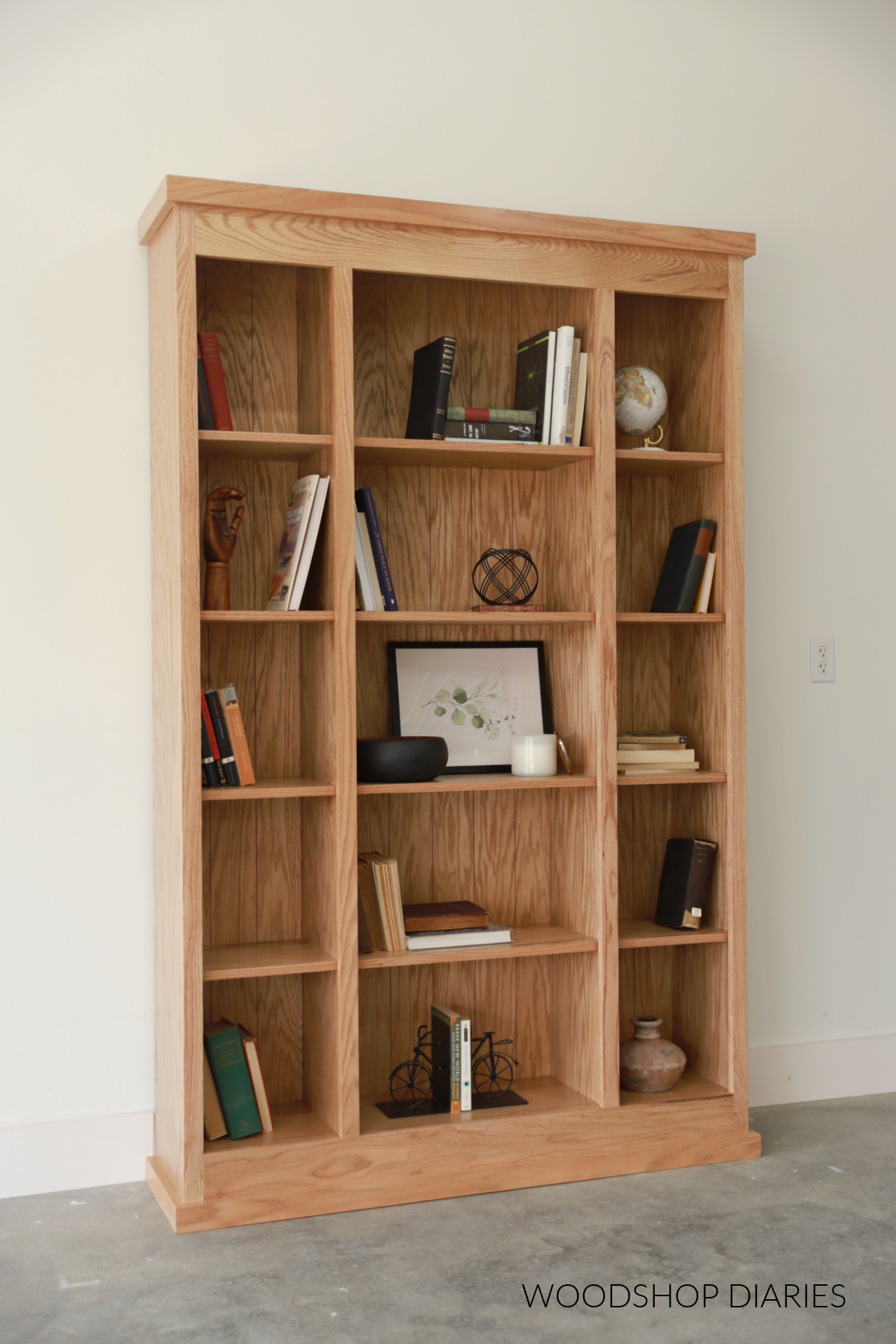
DIY Outdoor Chaise Lounge Chair

June 21, 2024 by Shara, Woodshop Diaries

In this post, I’m sharing how to build a chunky style DIY outdoor chaise lounge chair with basic materials and minimal tools!

This design is perfect for casual, comfortable seating on your porch, patio, deck, or yard.

Outdoor wooden chaise lounge chair in grass with tan cushions

These simple outdoor chairs are a great weekend woodworking project that you can easily start, finish, and enjoy before the weekend is over.

The chunky frame gives it a unique and substantial look. And the subtle angles make for a comfortable and eye catching design.

But the best part is–they’re so easy to build! If you’re ready to see how, let’s dive in!

*This post contains affiliate links. See website policies.

What to know before building

If you’re thinking this design looks familiar, you may be remembering the matching outdoor furniture collection I shared last year.

Collage image showing matching outdoor wooden furniture--chair, loveseat, sofa, coffee and side table included in collage

More recently, I also added a DIY outdoor chaise sectional and a modular DIY L shaped outdoor sectional to the mix.

And after building the chaise sectional, I thought, why not add a stand alone chaise lounge, too? It fits perfectly into the collection!

Be the first to know about new posts, plans, and woodworking tips on Woodshop Diaries. Sign up to our newsletter for priority access!

OUTDOOR CUSHION OPTIONS & SIZING

This outdoor chaise lounge fits standard 24″ x 24″ outdoor seat cushion sets. These are the EXACT same cushions I used for the matching sofa, loveseat, and chair I mentioned earlier.

The cushion sets I used come with both a deep seat cushion and a matching back pillow. You can find the cushions sets I used for this sectional here.

Shara Woodshop Diaries sitting on DIY wooden outdoor chaise lounge chair

Note that the chaise needs two seat cushions, but only one back cushion. So you’ll end up with one extra back cushion, but it’s always nice to have a spare.

The seat cushions come with ties so that you can tie the two seat cushions to the chair frame, but they aren’t connected to each other.

However, if you didn’t want to use two separate seat cushions for the bottom, you can certainly opt for a chaise lounge cushion like this one.

Chaise lounge cushions come in various sizes, so you may want to modify the size of the chair slightly if you use a chaise lounge cushion.

OVERALL DIMENSIONS

The overall dimensions of this chaise lounge chair are approximately 31 ¼″ tall x 30 ½″ wide x 57 ¼″ long.

Dimensional diagram of DIY outdoor chaise lounge chair showing overall dimensions

These dimensions don’t include the seat cushions and the seat height is 12″. I know 12″ seems short, but 1.) The seat cushion adds about 5″ to that and 2.) Outdoor seating is normally lower to the ground than indoor seating.

What Type of Wood to Use for Outdoor Furniture

You can build outdoor projects from any wood type, but some will last MUCH longer than others.

RELATED: How to shop for lumber

Close up of sanding rough cedar lumber on workbench

Untreated pine (basic construction lumber) will work fine for outdoor furniture, but is best for projects that will be under cover–like on a porch. If exposed to a lot of sun and rain, it will deteriorate quickly.

It’s the most budget friendly option, but may not be the most durable for outdoor use.

Pressure treated pine is a little more expensive, but is made specifically for outdoor use. It’s a very common material to build decks with.

It’s treated with chemicals to make it more rot resistant and will usually last SEVERAL years outdoors even if left uncovered.

While durable and budget friendly, this material is heavy and can take a while to dry out.

Cedar, red wood, and teak are all naturally decay and insect resistant wood options that look really nice.

But, these wood types can be quite expensive and sometimes hard to find depending on where you live.

So when building for outdoors, consider your budget, availability, and the pros and cons of each option before choosing your wood type.

Don’t forget when building outdoor projects–make sure the hardware (screws), glues and finish you use are rated for exterior use.

Approximate Cost to Build a Chaise Lounge Chair

For this project, I opted for cedar lumber. As of May 2024, when this was built, the lumber cost to build this chaise lounger with cedar (where I live) was approximately $150.

The cost using pressure treated lumber would have been about $45.

Helpful resources for this project

You may find these posts helpful throughout the project:

  • Understanding lumber sizing
  • How to sand wood
  • How to cut angles on a miter saw
  • How to use a standard pocket hole jig
  • How to use the Kreg XL pocket hole jig

How to Build an Outdoor Chaise Lounge Chair

Prefer to watch? I didn’t make a video of building the stand alone chaise chair, but the assembly process is almost identical to building the chaise for the outdoor sectional.

The only difference is that the freestanding chaise lounge chair (that I’m sharing in this post) has two arm rests instead of one.

So you can check out how the chaise for the sectional was built in this YouTube video and get the general idea.

Youtube thumbnail image showing black dog on chaise sectional in yard

Are videos your thing? Subscribe to my YouTube Channel for more project and how to videos!

I’m sharing the step by step process to build this DIY outdoor chaise lounge chair below. But if you prefer to print out and take the plans to the shop with you, I’ve got you covered! Grab the outdoor chaise lounge printable building plans here.

Tools & Materials

Tools:

  • Miter Saw
  • Drill/Driver
  • Pocket Hole Jig (both standard and XL jig)
  • Sander

Materials:

  • (2) 4x4x8 posts
  • (1) 1x2x8 board
  • (5) 2x4x8 boards
  • 4″ exterior pocket hole screws
  • 2 ½” exterior wood screws
  • 2 ½” exterior pocket hole screws
  • 4 ½” long timber screws or lag screws
  • Wood Glue (exterior rated)
  • (2) 24″ x 24″ seat & back cushion set (optional)
  • Foot Levelers

Step 1: Assemble Chaise Lounge Side Frames

First, I cut a front leg, a back leg, and an arm rest from one of my 4×4 posts. The back leg has both ends mitered 20 degrees and one end of the arm rest is also mitered 20 degrees.

Shara Woodshop Diaries holding arm rest assembling on workbench for chaise chair

You can find all the dimensions with diagrams for the project in the printable plans.

I assembled these together using pocket holes and screws. BUT, standard size pocket hole jigs aren’t designed to use with 4x4s.

So to drill the pocket holes in the 4×4 at the top (the arm rest piece), I used a Kreg XL Pocket Hole Jig.

RELATED: How to use the Kreg XL Jig

close up of drilling pocket holes in 4x4 board using Kreg XL pocket hole jig

This jig has settings for 3 ½″ material, which is what a 4×4 is. Confused? Don’t worry. Check out this post about how to understand lumber sizing.

So I drilled 3 ½″ pocket holes on the bottom side of the top 4×4 and attached it between the two legs using 4″ XL pocket hole screws.

Close up of driving pocket hole screws in XL pocket hole on workbench to assemble arm rests

Once the legs and top were together, I cut and installed a piece of 2×4 to run between them using standard size pocket holes and screws–1 ½″ pocket holes with 2 ½″ pocket hole screws. This piece should be flush to the INSIDE of the legs.

RELATED: How to use a pocket hole jig

Shara Woodshop Diaries securing chaise lounge seat slat with pocket holes and screws

Then, I cut another 4×4 post for the back support–one end is mitered 20 degrees and the other end square.

This piece should go on the INSIDE of the side frame so that the mitered edge is lined up with the bottom of the 2×4 and the front edge is in line with the corner.

Installing 4x4 back post to chaise lounge arm rest using 4 ½" timber screws on workbench

I secured this in place with wood glue and 4 ½″ timber screws. You could also use 4 ½″ long lag screws. Don’t forget to predrill pilot holes as these large screws can easily split the wood.

Once one side frame was assembled, I built another just like it, only mirrored. One will be for the left side of the chair and one for the right.

two mirrored side supports for chaise lounge sitting side by side on workshop floor

Step 2: Assemble Long Seat Supports

This chaise lounge is basically a long chair. So while both side frames from step 1 already have a seat support (the 2×4), I need to add longer ones to extend further out the front.

And I also need some small legs to support these long seat supports.

To make the legs, I cut four pieces of 2×4 to about 12″ long and glued these into pairs. Once the glue was dry, I trimmed both ends just slightly so they were flush.

Diagram showing how to attach chaise lounge seat supports to front legs

This gave me two 12″ long front legs about 3″ x 3 ½″ (2x4s are 1 ½″ x 3 ½″ so when glued together, it’s 3″ x 3 ½″). Shown in pink above.

Then, I cut and attached two long 2x4s (I cut these long enough for two chair cushions) to run between the 12″ posts and the back legs. Shown in blue above.

Shara Woodshop Diaries securing long seat supports to chaise lounge arm rests

Step 3: Attach Chaise Lounge Frame

Now that the two sides are assembled, I needed to connect them together. So first, I cut and installed the front 2×4 support to run between the two 12″ legs.

I installed this using pocket holes and screws.

Shara Woodshop Diaries securing front support between legs with pocket holes and screws

Then, I installed one seat slat toward the front the same way. I’ll come back and add the rest of the seat slats later, but this one helps keep the frame together for now.

Diagram showing back seat support installed between side frames from underside

Step 4: Attach Back Slats

For the back slats, you could install these using pocket holes and screws, but I didn’t want to see the pocket holes on either the front or the back side.

So instead, I glued and screwed 2x2s along the back posts.

Close up of 2x2 back slat supports installed on DIY chaise lounge back posts

Then, I could attach the back slats to those. You still see the screw heads, but it’s much less obvious than large pocket holes

Shara Woodshop Diaries securing back slats to 2x2 supports on chaise lounge chair

Make sure to predrill pilot holes before driving screws in these back slats. Drilling and driving in thin boards so close to the edge can easily cause splits. Predrilling helps prevent that.

Prefer to print? Grab the printable chaise lounge chair plans here!

Step 5: Install Seat Slats

I finished up the chaise lounge by adding the remaining seat slats using pocket holes and screws.

Shara Woodshop Diaries installing seat slats between side frames using pocket holes and screws

I just eye-balled the spacing between each slat so that they looked even. I didn’t measure them exactly.

Step 6: Finish Chaise Lounge

When you complete your project, if you flip it back over on your workbench or your shop floor and it rocks a little, I know that can be frustrating, but don’t panic!

The truth is, even if your chair is perfectly level on the bottom, the workbench and the floor may not be. And the patio, deck, or porch you put this on likely isn’t flat either.

Since this chunky outdoor lounge chair is built so…well, chunky, it’s really sturdy and rigid. So if you place it on an uneven surface, it’s not going to give and it’ll rock.

Shara Woodshop Diaries installing foot levelers onto chair legs--drilling hole to insert threaded piece

To help with this, I installed some foot levelers on each foot of the chair. These are the levelers I used and I simply drilled a 5/16″ hole into the center of each foot, tapped the insert into the hole and screwed the foot in.

Shara Woodshop Diaries screwing foot leveler foot into threaded insert on bottom of chaise lounge chair legs

You can twist the foot clockwise or counterclockwise as needed to raise or lower each leg as needed once you get it to where it’s going.

To keep your project looking nice for years to come, I recommend sealing it with some kind of outdoor finish. You can paint if you’d like, but I love using outdoor stains.

Can of Cabot Australian Timber Oil on workbench

They’re just easier to apply and reapply later as needed. My personal favorite is Cabot Australian Timber Oil. It comes in various colors, but Honey Teak is my go-to.

That’s what I used here and on my recent outdoor sectionals I built. It looks great on cedar!

And with that, I tossed in the cushions and I was ready to lounge!

Completed DIY outdoor chaise lounge chair in grass with tan cushions--side view

I’m not going to lie–this is one of the most comfortable outdoor lounge chairs I’ve sat in. The back angle is just right for relaxing and the cushions are a perfect fit.

DIY outdoor wooden chaise lounge chair with chunky legs and beefy frame in grass with tan cushions

If you want to build your own, grab the DIY outdoor chair printable plans here!

Looking for more Outdoor DIYs?

Looking for more outdoor DIY projects? Here are a few of my favorites you may enjoy browsing:

DIY Outdoor Chaise Sectional
DIY Modular Sectional Sofa
DIY Outdoor Sofa
DIY Outdoor Coffee Table
DIY Garden Arbor
mobile bbq cart prep table small
2 Tool Outdoor Grill Cart

If you’d like to save this project for later, don’t forget to pin it or share it to your favorite social channel!

Pinterest collage image showing dimensional diagram at top and completed DIY outdoor chaise lounge chair at bottom

Until next time, friends, happy building!

DIY Modular Outdoor Sectional Sofa

June 14, 2024 by Shara, Woodshop Diaries

In this post, I’m sharing how to build a DIY modular outdoor sectional!

I designed this L shaped outdoor sofa in three pieces to make it easy to build and move and easy to customize to fit your space.

Shara Woodshop Diaries sitting on modular outdoor sectional in yard

The back corner piece has two “open sides” (or simply sides without an arm rest). So the one armed sofa pieces can simply butt up to it on each side.

You can add two three seater sofas to the corner for a 7 seat option, or two 2 seater sofas for a 5 seat option. Or mix and match one of each for a 6 seat option–which is what I did here.

Last week, I shared plans for a chaise version of outdoor sectional. And these pieces go right along with it so you can mix and match two different styles of sectional in multiple sizes.

So be sure to check that one out, too! But in the mean time, let’s dive into building this 3 piece modular sectional!

*This post contains affiliate links. See website policies.

WHAT TO KNOW BEFORE BUILDING

If you’re thinking this design looks familiar, you may be remembering the matching outdoor furniture collection I shared last year.

Collage image showing matching outdoor chair, loveseat, sofa, coffee table and side table

So many people requested a matching sectional after I shared this collection that I finally decided to build and share–not just one, but TWO different versions!

You can find the chaise sectional version here. But below, I’m sharing the L shaped sectional version that’s a little different style.

Are DIY projects your thing? Sign up for our newsletter for priority access to the latest projects and build plans!

MODULAR SECTIONAL DESIGN

I designed this sectional to be built in pieces. This makes it easy to assemble, easy to move, and easy to mix and match.

For this design, I built a corner chair piece–with two open sides (or, simply sides without arm rests).

Corner sectional chair without cushions sitting in yard

Then, I built two one armed sofas to butt up to it on each side. One sofa is a 2 seater and the other is a 3 seater. But these could be mix and matched.

Three piece DIY modular sectional sofa frame pieced together in yard without cushions

So this outdoor sectional is in three total pieces.

Sectional Cushions

These seats fit standard 24″ x 24″ outdoor seat cushion sets. These are the EXACT same cushions I used for the matching sofa, loveseat, and chair I mentioned earlier.

The cushion sets I used here come with both a deep seat cushion and a matching back pillow. You can find the cushions sets I used for this sectional here.

Black and white dog laying on outdoor sectional with tan cushions

Note that the corner chair needs two back cushions, but only one seat cushion.

You can purchase two sets and just have a spare seat cushion (which is always handy to have). Or, you could just purchase one set and use other pillows to fill the space.

OVERALL DIMENSIONS

The overall dimensions of the sectional as shown is approximately 31 ¼″ tall x 83 ¾″ wide on the left side x 107″ long on the right side.

Overall dimensional diagram of modular outdoor sectional showing height, width, and the length dimensions

These dimensions don’t include the seat cushions and the seat height is 12″.

I know 12″ seems short, but 1.) The seat cushion adds about 5″ to that and 2.) Outdoor seating is normally lower to the ground than indoor seating.

WHAT TYPE OF WOOD TO BUILD AN OUTDOOR SOFA WITH

Untreated pine is the most budget friendly option to build with, but I personally don’t recommend it for outdoor projects unless it’s going to be under cover (like on a covered porch).

It can last several seasons outdoors if properly finished (sealed and/or painted) and kept under cover, but will deteriorate quickly if exposed to a lot of sun and moisture.

RELATED: How to shop for lumber

Pressure treated wood is another budget friendly option and is intended for use outdoors. It will last a long while even when exposed to the elements. However, it’s heavy and is treated with chemicals you may not want to handle.

Pressure treated lumber laying on concrete floor
Treated Lumber

Cedar, red wood, and teak are all naturally decay and insect resistant wood options that look really nice. But, that comes with a price tag. These wood types can be quite expensive and sometimes hard to find depending on where you live.

So when building for outdoors, consider your budget, availability, and the pros and cons of each option before choosing your wood type.

For this project, I opted for cedar. As of May 2024 when this was built, the lumber cost to build this sofa with cedar (where I live) was approximately $330.

Cedar lumber on workbench
Cedar Lumber

The cost to build it from pressure treated wood would have been approximately $112.

Don’t forget when building outdoor projects–make sure the hardware (screws), glue and finish you use are rated for exterior use.

How to build a Modular Outdoor Sectional

Prefer to watch? Watch the full build video with helpful tips along the way on my YouTube channel here:

YouTube thumbnail with photo of DIY outdoor sectional with text "how to build a modular outdoor sectional"

Are videos your thing? Subscribe to my YouTube Channel for more project and how to videos!

I’m sharing the step by step tutorial to build this outdoor sectional below. But if you prefer to print it out and take the plans to the shop with you, I’ve got you covered! Grab the outdoor modular sectional building plans here.

Front page photo of building plans for outdoor sectional

Tools & materials

Tools:

  • Miter Saw
  • Drill/Driver
  • Pocket Hole Jig (both the standard size jig and the XL jig)
  • Sander

Materials:

  • (2) 4x4x8 posts
  • (2) 2x2x8 board
  • (20) 2x4x8 boards
  • 4″ exterior pocket hole screws
  • 2 ½” exterior wood screws
  • 2 ½” exterior pocket hole screws
  • 4 ½” long timber screws or lag screws
  • Wood Glue (exterior rated)
  • (5-7) 24″ x 24″ seat & back cushion sets (optional)

NOTE: Materials are for one corner piece, one 2 seater sofa, and one 3 seater sofa.

Step 1: Assemble Angled Back Legs

The open sides are simply the sides without an arm rest. To build this entire project, I needed four open side frames total–two for the corner piece and one for each of the sofas.

And each of these open side frames needs an angled back leg. I built these from 2x4s, but you could also half lap 4x4s instead (4x4s were much more expensive, though, so I opted to go with 2x4s).

I cut four pieces of 2×4 to glue together to make a post. These four pieces will overlap in the middle like shown below.

color coded diagram of how to assemble angled back leg

I first attached the pink and blue pieces together using wood glue and pocket holes/screws.

Then I attached the yellow and green pieces together (from the image above) the same way.

Then, I glued the two assemblies together to make the angled post.

Angled back post of sectional glued together on workbench

All the dimensions and angles for these pieces are found in the printable plans here.

Once the glue was dry, I trimmed the ends so they were flush and sanded away all the glue squeeze out–it was kind of a lot of sanding, but worth it!

RELATED: How to sand wood

I repeated to make four identical posts, but I made sure that two of them were mirrored to the other two.

This is important because the end grains where they meet in the middle don’t need to both go on the same side of the post.

Two mirrored back leg posts--close up showing grains mirrored

Then, I glued up three pair of 12″ long 2x4s to make the front legs. One will be for the corner piece and one will go on each of the sofas.

Step 2: Assemble Sectional Corner Chair

The corner chair is the most challenging part of the entire sectional. And it’s not that it’s DIFFICULT.

It’s just that it involves some compound angles since both backs are meeting at the corner on a slant.

If you’re not familiar with compound angles and how to cut them, check out this guide to cutting angles on a miter saw. You can also check out the video I linked above for some super helpful tips and visuals.

First, I assembled the seat framing by attaching 2x4s between one of the little 12″ posts and two of the angled back posts from step 1.

Shara Woodshop Diaries assembling side frame of corner chair of outdoor sectional.

I added a 2×4 on each side to make the front corner. I used pocket holes and screws to assemble the majority of this build.

RELATED: How to use pocket hole jig

Shara Woodshop Diaries assembling front corner of seat frame on workbench

Then, I added two more 2x4s (turned on their sides) between the angled back posts to create the back corner.

This back corner needed some sort of leg to support it, so I glued and screwed on a post at the back.

The ends of this post are mitered 20 degrees so it slanted to match the angled back supports.

Shara Woodshop Diaries attaching back corner leg to sectional chair

Here is where the compound angles came in. I cut two 2x4s to go at the back corner with bottom ends mitered AND beveled both 20 degrees.

I secured these at the back corner with pocket holes and screws to create the angled back brace. Both of these 2×4 should be slanting outward and the should meet at the corner.

Shara Woodshop Diaries installing back corner bracing on corner chair

I also cut to fit a 2×2 to run along the back corner between these two 2x4s. I screwed this 2×2 to each board to connect them together and keep them sturdy.

Next, I cut and installed seat slats between the seat supports with pocket holes and screws from the bottom side.

You can run these slats either direction since this chair is square.

Shara Woodshop Diaries driving screws to install seat slats

Now I can add the back slats. The slats that run across the back have one end cut square and the other end (the one that goes in the corner) mitered 20 degrees and beveled 45 degrees.

Prefer to print? Grab the printable building plans for this sectional here.

Close up of end of board mitered 20 degrees and beveled 45 degrees

I cut each slat to fit (I found that much easier than trying to actually measure anything).

To install these to the post, you could use pocket holes and screws, but I didn’t want to see the pocket holes.

So instead, I screwed 2x2s into the angled back posts to attach the back slats to. Then I could screw them directly to the corner brace in the middle.

Shara Woodshop Diaries installing back slats on corner sectional chair

Step 3: Assemble Arm Rest Sides

This process is exactly the same as step 1 of this post. I won’t repeat every detail again here, but the arm rest sides are built mostly with 4×4 lumber except for the 2×4 seat support.

Shara Woodshop Diaries assembling arm rest side frames of outdoor sectional

I need two of these side frames–one for the left sofa and one for the right sofa.

The back posts are screwed onto the insides of the arm rests and it’s important to mirror them since one goes on each side.

Mirrored side frames assembled for outdoor sofa build

Step 4: Assemble Left Sectional Sofa

In this case, I built a 2 seater for the left sofa, but you could also swap it for a 3 seater.

The assembly of each size is very similar, only the 3 seater has a middle divider for extra support.

For the left sofa, I needed one arm rest side from step 3 and one open side frame. The arm rest will go on the left side.

Left side of sectional side frames set out in workshop--arm rest side on left

I attached them together by running a 2×4 across the front between the two legs using pocket holes and screws. This should be 12″ up from the ground.

Then, I added four evenly spaced 2×4 boards behind that one for the seat slats.

Shara Woodshop Diaries installing seat slats into 2 seater sectional sofa piece

These are screwed into the 2×4 seat supports on each side frame so that they are flush along the top edge.

Then, just like for the corner piece, I added some 2x2s on the back posts to run the back slats across to screw into.

I cut and attached three 2×4 back slats using 2 ½″ long decking screws. BE SURE TO PREDRILL to help prevent the wood from splitting.

Shara Woodshop Diaries installing back slats onto 2 seater outdoor sectional

Step 5: Assemble Right Sectional Sofa

The right sectional is simply a mirrored version of the left sofa. You can build this as either a two or three seater.

I used the 3 seater version that I shared in step 4 of this post. But if you wanted to build the two seater, simply repeat step 4 “flip flopped” using the other arm rest from step 3.

3 seater outdoor sectional piece without cushions in grass

For specific dimensions, details, and diagrams for each size, grab the printable building plans here.

Step 6: Finish and Attach Pieces

Cedar can be left outside unfinished, but it will quickly turn gray and weathered looking, especially if exposed to a lot of sunlight.

So I sealed these pieces with a coat of Cabot Australian Timber Oil in Honey Teak. I LOVE this finish and it’s super easy to apply.

Close up of Cabot Australian Timer Oil in Honey Teak on workbench

Of course, there are TONS of great outdoor stain and sealant (or paint if you want that instead!) options and colors so feel free to pick your favorite. Cabot and Olympic are great brands and are available at the big box stores.

Once finished, these pieces are ready to piece together and put to use. Make sure to screw the pieces together once you get them where you want them so they don’t scoot apart during use.

DIY modular outdoor sectional finished with cushions sitting in yard

If placing on an uneven surface, consider adding some simple foot levelers to the legs.

These are the levelers I used and I simply drilled a 5/16″ hole into the center of each foot, tapped the insert into the hole and screwed the foot in.

Shara Woodshop Diaries installing foot levelers on feet of outdoor furniture

Once the cushions were in place, this sectional was the perfect place to rest (with friends!) after the build.

Shara and Lucy sitting on modular DIY outdoor sectional together in yard
Back view of DIY modular outdoor sectional with cushions in yard

Looking for More Outdoor DIYs?

Looking more for outdoor DIY projects? Here are a few of my personal favorites you might enjoy browsing:

DIY Outdoor Chaise Sectional
Raised Garden Beds with Trellis
DIY Fall Planter Boxes
DIY Outdoor Coffee Table
DIY Outdoor Chair
DIY Louvered Planter Box

If you enjoyed this project and want to save it for later, don’t forget to pin it or share to your favorite social channel!

Pinterest collage image showing front and back views of sofa with text "how to build a modular outdoor sectional"

Until next time, friend, happy building!
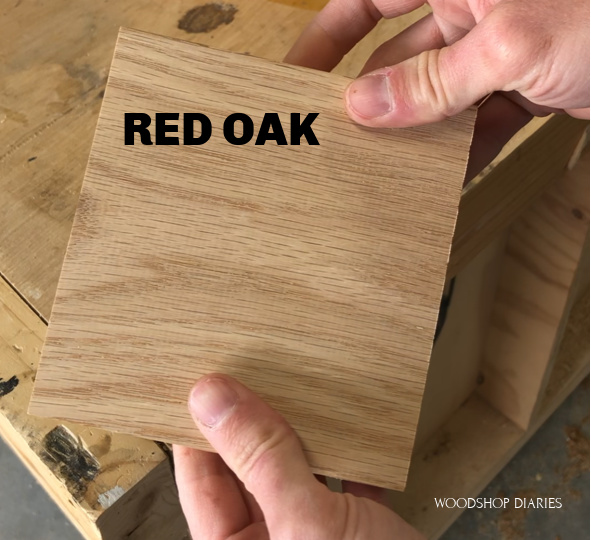
DIY Outdoor Chaise Sectional

June 7, 2024 by Shara, Woodshop Diaries

In this post, I’m sharing how to build a chunky, modern outdoor chaise sectional!

This modular sofa design consists of two individual pieces–a 3 seater sofa on the right and a chaise lounge on the left.

Modern wooden outdoor chaise sectional sofa with tan cushions on grass yard

Each piece has one open side and one arm rest so they can butt together to create a sectional.

Not enough room for the three seater PLUS the chaise? No worries! I made this design modular so you can mix and match pieces as needed.

In another post, I’m sharing plans for a smaller 2 seater version and a different style corner piece so you can mix and match two different styles of sectional in multiple sizes.

But, if you’d like to see how this chaise sectional was built, I’m sharing the how to below.

*This post contains affiliate links. See website policies.

What to know before building

If you’re thinking this design looks familiar, you may be remembering the matching outdoor furniture collection I shared last year.

Collage of 5 matching wooden outdoor furniture pieces--sofa, loveseat, chair, coffee table, and side table

Since sharing those projects, I’ve received so many requests to add a matching sectional to the collection. But, in my mind, there are two different types of sectionals–a chaise sectional and an L shaped sectional.

Since I wasn’t sure which one people wanted most, I decided to build both–starting with the chaise version I’m sharing here.

Be the first to know about new posts, plans, and woodworking tips on Woodshop Diaries. Sign up to our newsletter for priority access!

Modular Design

I designed this sectional to be built in pieces. This makes it easy to assemble, easy to move, and easy to mix and match.

For the chaise sectional, I made a chaise lounge–with one side open and one side with an arm rest.

Chaise lounge sectional piece by itself in grass without cushions

Then, I built a sofa to butt up to it–again with one side open and one side with an arm rest.

3 seater sectional sofa piece by itself in grass without cushions

You could also build these “flip flopped” so that the chaise is on the right side, instead.

Outdoor CUSHION OPTIONS & SIZING

This outdoor sectional fits standard 24″ x 24″ outdoor seat cushion sets. These are the EXACT same cushions I used for the matching sofa, loveseat, and chair I mentioned earlier.

The cushion sets I used come with both a deep seat cushion and a matching back pillow. You can find the cushions sets I used for this sectional here.

Black and white dog on wooden chunky outdoor chaise sectional sofa in yard with cushions

Note that the chaise needs two seat cushions, but only one back cushion. So you’ll end up with one extra back cushion, but it’s always nice to have a spare.

OVERALL DIMENSIONS

The overall dimensions of the chaise and 3 seater sofa together are approximately 101″ wide x 57 ¼″ deep x 31 ¼″ tall.

Overall dimensional diagram of DIY outdoor chaise sectional

These dimensions don’t include the seat cushions and the seat height is 12″. I know 12″ seems short, but 1.) The seat cushion adds about 5″ to that and 2.) Outdoor seating is normally lower to the ground than indoor seating.

WHAT TYPE OF WOOD TO BUILD AN OUTDOOR SOFA WITH

Untreated pine is the most budget friendly option to build with, but it usually doesn’t last very long in outdoor projects.

It can last a few seasons if properly finished (sealed and/or painted) and kept under cover, but will deteriorate quickly if exposed to a lot of sun and moisture.

RELATED: How to shop for lumber

Pressure treated wood is another budget friendly option and is intended for use outdoors. It will last a long while even when exposed to the elements. However, it’s heavy and is treated with chemicals you may not want to handle.

treated lumber laying on concrete floor
Treated lumber

Cedar, red wood, and teak are all naturally decay and insect resistant wood options that look really nice. But, that comes with a price tag. These wood types can be quite expensive and sometimes hard to find depending on where you live.

So when building for outdoors, consider your budget, availability, and the pros and cons of each option before choosing your wood type.

For this project, I opted for cedar. As of May 2024 when this was built, the lumber cost to build this sofa with cedar (where I live) was approximately $240. The cost to build it from pressure treated wood would have been approximately $90.

cedar lumber on workbench
Cedar lumber

Don’t forget when building outdoor projects–make sure the hardware (screws), glue and finish you use are rated for exterior use.

How to Build an Outdoor Chaise Sectional

Prefer to watch? Watch the full build video with helpful tips along the way on my YouTube channel here:

Youtube Thumbnail image for how to build an outdoor chaise sectional video

Are videos your thing? Subscribe to my YouTube Channel for more project and how to videos!

I’m sharing the step by step process to build this couch below. But if you prefer to print it out and take the plans to the shop with you, I’ve got you covered! Grab the outdoor sectional printable building plans here.

Tools & Materials

Tools:

  • Miter Saw
  • Drill/Driver
  • Pocket Hole Jig (both the standard size jig and the XL jig)
  • Sander

Materials:

  • (2) 4x4x8 posts
  • (1) 2x2x8 board
  • (13) 2x4x8 boards
  • 4″ exterior pocket hole screws
  • 2 ½” exterior wood screws
  • 2 ½” exterior pocket hole screws
  • 4 ½” long timber screws or lag screws
  • Wood Glue (exterior rated)
  • (5) 24″ x 24″ seat & back cushion sets (optional)

Step 1: Assemble the Arm Rest Side Frames

Although I’m building two separate pieces, these first two steps apply to both. I began by assembling the two “end caps” of the sectional.

These side frames are assembled from 4×4 lumber and are the arm rests for each side.

First, I cut a front leg from the 4×4 post. Then, I cut a back leg with ends mitered 20 degrees. Then, I cut another piece to run between them at the top.

Shara Woodshop Diaries assembling 4x4 cedar side frame for sectional on workbench

I assembled these together using pocket holes and screws. BUT, standard size pocket hole jigs aren’t designed to use with 4x4s. So to drill the pocket holes in the 4×4 at the top, I used a Kreg XL Pocket Hole Jig.

RELATED: How to use the Kreg XL Pocket Hole Jig

This jig has settings for 3 ½″ material, which is what a 4×4 is. Confused? Don’t worry. Check out this post about how to understand lumber sizing.

Shara Woodshop Diaries drilling 3 ½" pocket holes with Kreg XL pocket hole jig

So I drilled 3 ½″ pocket holes on the bottom side of the top 4×4 and attached it between the two legs using 4″ XL pocket hole screws.

Close up of driving 4" pocket hole screws in cedar 4x4s

Once the legs and top were together, I cut and installed a piece of 2×4 to run between them using standard size pocket holes and screws–1 ½″ pocket holes with 2 ½″ pocket hole screws. This piece should be flush to the INSIDE of the legs.

RELATED: How to use a pocket hole jig

Shara Woodshop Diaries assembling seat supports between side frame of DIY outdoor chaise sectional

Then, I cut another 4×4 post for the back support–one end is mitered 20 degrees and the other end square.

This piece should go on the INSIDE of the side frame so that the mitered edge is lined up with the bottom of the 2×4 and the front edge is in line with the corner.

back post placement for supports on chaise sectional cedar couch

I secured this in place with wood glue and 4 ½″ timber screws. You could also use 4 ½″ long lag screws. Don’t forget to predrill pilot holes as these large screws can easily split the wood.

Once one side frame was assembled, I built another just like it, only mirrored. One will be for the left side of the chaise and one for the right side of the sofa.

two mirrored cedar side frames to build chaise and sofa parts of sectional project

Step 2: Assemble the Open Side Frames

For the sides of each piece that butt together, I needed to assemble a back leg/back support but it couldn’t have an arm rest.

So I cut four pieces of 2×4 to glue together to make a post. These four pieces will overlap in the middle like shown below.

Diagram showing assembly of angled back supports for DIY sectional frames

I first attached the pink and blue pieces together and then I attached the yellow and green pieces together (from the image above) using wood glue and pocket holes and screws. Then, I glued the two assemblies together.

Gluing up 2x4 posts on workbench with clamps

All the dimensions and angles for these pieces are found in the printable plans here.

I repeated to make two identical posts, but I made sure one was mirrored to the other one. This is important because the end grains where they meet in the middle don’t need to both go on the same side of the post.

Angled back supports for sectional frame on workbench showing mirrored orientation

Then, I glued up three pair of 12″ long 2x4s to make the front legs. Two will be for the chaise and one will be for the sofa.

Step 3: Build the Chaise Part of the Sectional

After the side frames were made for both parts, I focused on building the chaise lounge first. Essentially, the chaise is a really deep chair.

So I cut and attached two long 2x4s (I cut these long enough for two chair cushions) to run between the 12″ posts from step 2 and the back legs.

I attached these using pocket holes and screws, then added a few extra screws through the arm rest side.

Shara Woodshop Diaries assembling chaise lounge frame

Note that when I attached the 2×4 to the angled back leg that I didn’t drive the screws into the end grain.

Then I tied these two sides together with a 2×4 across the front (between the front legs) and a seat slat toward the back.

front and back supports installed on chaise sectional frame

For the back slats, you could install these using pocket holes and screws, but I didn’t want to see the pocket holes, so instead, I glued and screwed 2x2s along the back posts.

Then, I could attach the back slats to those. You still see the screw heads, but it’s much less obvious than large pocket holes.

Shara Woodshop Diaries screwing back slats onto chaise part of sectional

I finished up the chaise by adding the remaining seat slats using pocket holes and screws.

Installing chaise lounge seat slats

Step 4: Build the Sofa Part of the Sectional

Now I needed to switch gears and focus on building the sofa part. This is very similar to assembling the chaise, only instead of the seat being deep, it’s wide.

I cut and installed a short seat support to run between the other angled back leg and 12″ tall post from step 2. This will be the left side of the sofa.

Shara Woodshop Diaries securing seat slats to sofa side of sectional build

The span of the 3 seater frame was too wide to go without a center support. So I attached two equal length 2x4s to a 4×4 post to run between the two sides.

Shara Woodshop Diaries assembling frame of sectional sofa piece

Then I tied the two side frames together at the back by adding the back seat slat with pocket holes and screws (from the bottom side) and the top and bottom back slats.

The reason I attached these first is that it makes adding the middle support brace much easier. I show how this helps in the video here.

Shara Woodshop Diaries installing back slats to 3 seater sectional sofa

The back slats are attached to 2x2s just like I did for the chaise in step 3, but if you wanted to use pocket holes instead, that would work as well.

Just like for the outdoor sofa build, I assembled a middle support brace by attaching two 2x4s together–one for the bottom and one for the back.

Shara Woodshop Diaries installing 4x4 leg to middle support brace

Then, I glued and screwed this to a short back leg like shown above.

Now this support can simply slide in behind the back slats and run underneath the seat slats. It attaches to the front 4×4 center post using pocket holes and screws so that it’s 1 ½″ down from the top.

Installing middle support brace to front support leg

Then I screwed it to the slats.

Screwing back slats of DIY outdoor sectional to middle support

Now all that’s left is adding the remaining seat slats on the seat and the back.

Shara Woodshop Diaries placing seat slats in 3 seater sectional

Prefer to print? Grab the printable building plans for this chaise sectional here.

Step 5: Seal and Finish

Now both parts of the sectional are built and ALMOST ready to go. But they still need to be finished.

Cedar can be left outside unfinished, but it will quickly turn gray and weathered looking, especially if exposed to a lot of sunlight.

So I sealed both pieces with a coat of Cabot Australian Timber Oil in Honey Teak. I LOVE this finish and it’s super easy to apply.

Applying Cabot Timber Oil to cedar chaise sectional parts

Of course, there are TONS of great outdoor stain and sealant (or paint if you want that instead!) options and colors so feel free to pick your favorite. Cabot and Olympic are great brands and are available at the big box stores.

Step 6: Piece Sectional Together

Once finished, these pieces are ready to piece together and put to use. Make sure to screw the two pieces together once you get them where you want them so they don’t scoot apart during use.

Shara Woodshop Diaries placing sectional pieces together in yard

If placing on an uneven surface, consider adding some simple foot levelers to the legs.

These are the levelers I used and I simply drilled a 5/16″ hole into the center of each foot, tapped the insert into the hole and screwed the foot in.

installing foot levelers in 4x4 leg

Once the cushions were in place, this chaise sectional was the perfect place to rest after the build haha.

Shara Woodshop Diaries sitting on chaise sectional with cushions
View of back side of DIY outdoor chaise sectional in yard

Looking for more Outdoor DIYs?

Looking more for outdoor DIY projects? Here are a few of my personal favorites you might enjoy browsing:

DIY Enclosed Garden
DIY Garden Arbor
DIY Outdoor Coffee Table
DIY Outdoor Sofa
DIY Outdoor Chair
mobile bbq cart prep table small
2 Tool Outdoor Grill Cart

If you enjoyed this project and want to save it for later, don’t forget to pin it or share to your favorite social channel!

Pinterest collage image showing back view at top and front view at bottom with text How to build an outdoor chaise sectional

Until next time, friends, happy building!

How to Build a DIY Wood Range Hood

May 31, 2024 by Shara, Woodshop Diaries

In this post, I’m sharing how to build a wooden range hood cover for a ducted insert.

I built this range hood as one whole unit so it would be easy and quick to install in my parents’ kitchen once assembled.

Shara Woodshop Diaries standing next to DIY range hood cover installed in kitchen between cabinets

There are a million brands, styles, sizes, and types of fan inserts that can be used above a stove, so this is definitely not a one-size-fits-all project.

But, it’s pretty simple to modify the frame of this project to fit the insert you’re going with and I’ll show you how below.

*This post contains affiliate links. See website policies.

What to consider before building a range hood cover

Building a range hood cover is a great project to DIY and can save hundreds (potentially thousands!) of dollars. And it’s fairly simple to build!

But, not every install, insert, or space is exactly the same. So, make sure to take your time, think it through, and pay careful attention to build your cover in a way that fits your application.

Ducted vs Ductless Fan Inserts

Before building, keep in mind that you can have either ductless or ducted range hood inserts. It’s important to know which one you are using before building a cover.

  • Ductless fans are also called recirculating fans and they basically just recirculate the air–like a microwave above a stove would.
    • Ductless fans don’t require any ducting pipes, but they do need a hole cut out of the hood somewhere to allow for air flow.
  • Ducted fans should have ducting pipes connected to it (that usually run up through the ceiling) that extend to an exterior wall to allow the air to vent outside the building.

In this application, we are installing a ducted fan, so I needed to consider the duct pipe locations in this project.

Sizing the Range Hood Cover

The open space between the cabinets was about 30 ½″, so I made my range hood 29 ½″ wide to allow a little wiggle room on both sides.

kitchen with white cabinets installed showing dimensions of space available for custom range hood between cabinets

I found varying information online about installation height. Some say 20-24″ above the stove top and some say 28-36″ above the stove height. So check your specific fan for manufacturer’s recommendations.

We opted to install ours 32″ above the stove top, and we wanted it to go all the way to the ceiling, so our hood needed to be about 28″ tall.

And I chose to make it about 18 ½″ deep overall–the depth will depend on the size of your insert size and your personal preference on design.

Shara Woodshop Diaries with range hood fan insert on workbench showing 12" x 20" size

Our insert was ROUGHLY 12″ x 20″.

Are DIY projects your thing? Sign up for our newsletter for priority access to the latest projects and build plans!

How to Build a Range Hood

I’m breaking down the steps to build a range hood cover below, but if you prefer to watch, I’ve also got a full video on the build on my YouTube channel here:

YouTube thumbnail for how to build a range hood video

Love watching how-to videos? Subscribe to my YouTube channel for plenty more where that came from!

Tools & Materials

Tools:

  • Miter saw
  • Jig Saw
  • Table Saw (optional)
  • Drill/Driver
  • Pocket Hole Jig
  • Brad Nailer
  • Clamps

Materials:

  • 2x4x8 boards (amount depends on size, but I used roughly 3 boards)
  • 1x6x8 board
  • 1x2x8 board
  • 1x4x8 board
  • 2 ½″ pocket hole screws
  • 2 ½″ & 3″ wood screws
  • Brad nails
  • Wood Glue
  • Crown Molding, Bead Molding, Corner Trim, Lattice Trim (as desired for the look and style you want)
  • ¼″ plywood (amount depends on size)
  • ¾″ plywood (roughly ¼ sheet)
  • Stainless steel sheet (cut to fit–see step 5)
  • Wood Finish

Step 1: Measure the Insert

Before building anything, I took detailed measurements of my insert and studied how it will be mounted. Make sure to understand how the insert will attach to the cover once it’s built.

Our insert had holes in the sides to install these L brackets. So it won’t install directly to the framing, but will install to the bottom panel I’ll show in step 5.

Close up of fan insert showing L brackets on the sides for mounting

For now, I just needed to make sure that the opening in the frame was going to be large enough to fit the fan housing.

Step 2: Assemble Hood Frame

I assembled the entire hood frame using 2x4s. First, I assembled the bottom frame so that it was about 17″ x 26″.

I attached the pieces together using pocket holes and screws so that the opening here was about 14″ x 20″. Make sure this opening is large enough to fit your insert into.

Shara Woodshop Diaries assembling the frame for the bottom of range hood cover

RELATED: How to use pocket holes

The hood design I was building slanted in on both sides 15 degrees and slanted back from the front 20 degrees.

So I cut two 2x4s with mitered ends 15 degrees and two 2x4s with ends mitered 15 degrees AND beveled 20 degrees (this is a compound angle).

RELATED: How to cut angles on a miter saw

These four 2x4s should all be the same HEIGHT when they’re standing up on their ends, but they won’t be the same length. I cut mine so that when they stood up on their ends, they were about 15 ½″ tall overall.

Shara Woodshop Diaries securing corner posts of range hood cover on workbench

I screwed these boards to two 2x4s the same depth as the bottom frame (mitered boards at the back and compound angle boards at the front). Then, I screwed these onto the bottom frame.

Shara Woodshop Diaries assembling range hood cover frame in workshop

Finally, I cut to fit 2x4s across the top–between the front two 2x4s and the back two 2x4s. I attached these using pocket holes and screws.

Then I installed two more 2x4s between these to complete the frame.

DIY range hood cover frame assembled from 2x4s on workbench

At this point, I set this frame over the insert to make sure it would fit and that the duct pipe hole would line up with the opening at the top.

Once I made sure the frame would fit, it was time to cover it all up to make it look nice.

Step 3: Install Top and Bottom Trim

I wanted the range hood to have a two tone look–stained wood on the top and bottom, but painted wood in the middle.

For the stained wood parts, I used red oak to kind of “wrap” around the frame. I glued a 1×2 to the bottom of a 1×6 board and allowed it to fully dry.

red oak 1x2 and 1x6 glued up in clamps on workbench

Then, I trimmed this board to fit around the bottom of the hood frame with 45 degree mitered corners.

Once they were cut, I glued and nailed these pieces around the bottom of the frame so that the top of the board was JUST below the angled braces.

trim cut to fit around bottom of range hood cover frame to trim it out

This will come down past the bottom of the frame on the sides and front–that is intentional.

Then I cut some 1×4 to wrap around the top. I glued and nailed this in place, then clamped until dry.

red oak trim on top and bottom of cover frame

To give this a little more detail, I also added some small trim along the top of the bottom section and the bottom of the top section.

This was trim I had leftover from my fluted oak bathroom vanity build, but half round, beaded trim, or cove molding would work fine for this.

Shara Woodshop Diaries nailing trim around bottom of range hood cover frame

I actually forgot about the crown molding until later in the build (as you can see in the image below), but now would be the best time to add it.

When installing the crown molding, I made sure to install it so that the overall height of the cover (including the molding) was about 28″.

Installing crown molding on fan cover

Then, I stained all the wood trim in Minwax Weathered Oak and gave it several coats of Minwax Helmsman clear coat.

Step 4: Cover Middle Section

For the middle section, I measured the distance between the wood trim from step 3 and cut some ¼″ thick plywood this width. Then, I could place this along the frame and mark where to cut for it to fit.

marking to cut plywood around middle section of cover frame

I cut this with a jig saw because I didn’t need it to be perfect. I’ll be covering all the joints with trim.

I cut to fit and glued and nailed the plywood on both sides and the front.

gluing front panel onto range hood frame

Then I cut some corner trim to fit along the joints on the front. These pieces will need to be cut just like the compound angle 2x4s–mitered 15 degrees and beveled 20 degrees.

NOTE: You can certainly use precut corner trim–it comes in various sizes. But, if you have a table saw, you can cut your own corner trim from 2×2 material.

I basically notched out a 1″ square from one corner of my 2×2 to make mine. See video for more details.

Shara Woodshop Diaries nailing corner trim onto range hood cover

After the corner trim was glued and nailed in place, I trimmed the rest of the box out with additional trim the same thickness as the corner pieces.

Pay attention to the angles–remember the front is slanting 20 degrees and the sides slant 15 degrees, so miter/bevel the trim pieces accordingly.

Shara Woodshop Diaries puttying nail holes in trim

Finally, I cut some thin strips of ¼″ plywood to run vertically on the front. After everything was glued and nailed on, I puttied the joints and the nail holes and sanded smooth.

Then, I primed, caulked around all the trim, and painted.

RELATED: How to paint without a sprayer

Step 5: Cut & Test Fit Bottom

At this point, the cover is complete, but I needed a piece to fill in the bottom. The fan itself did not cover the entire opening on the bottom of the cover, so I needed a “filler.”

I decided to cut a piece of ¾″ plywood to fit inside the cover opening and used a jig saw to cut out a rectangle in the middle so it would fit snuggly around the fan housing.

using a jig saw to cut out bottom panel to fit around fan

However, plywood will warp and come unglued if exposed to continuous moisture and heat (think…steam from the stove), so I needed something to protect the plywood.

I called a local metal shop and had them cut me a piece of stainless steel sheet metal the same size as my plywood. I again used a jig saw and a metal cutting blade to cut the same opening to fit around the fan.

I placed the fan right side up on some Styrofoam, then placed the steel sheet over it, then slid the plywood panel over that.

Then, I used the L brackets included with the fan to mount the fan housing to the plywood sheet.

Installing fan insert to plywood panel

I drilled holes through the steel sheet, and through the plywood so that they would hit on the framing inside the range hood cover.

Then, I test fit the bottom (with fan housing attached) into the cover to make sure everything fit properly and secured with screws.

fan insert test fit into range hood cover on workbench

Once I made sure everything fit, I removed the bottom panel and fan and brought it to my parents’ house to install.

Step 6: Install Range Hood

This part will vary based on your stud locations. Make sure the hood cover is SECURED TO WALL STUDS. It’s very heavy.

My parents had two wall studs in the opening we were installing the hood. Luckily, they were both pretty much centered in the space (equal distance from the cabinets on each side).

So we lifted the cover in place, made sure it was level and drove 3″ long screws through the bottom of the frame into the wall studs.

installing range hood cover to wall

Then, I drove two more 3″ long screws through each mitered 2×4 on the back of the frame where they intersected the studs.

Because we were installing a ducted fan, we attached a pipe to the fan housing long enough to stick out through the hole in the ceiling to get to the attic, then raised the bottom panel up into the cover and screwed it in through the bottom.

securing ran insert into range hood cover with screws through the bottom

We had to wire the fan in as well before raising it up in place.

At this point, the ducting connections can be completed in the attic to vent it outside and it was ready to test out.

Step 7: Add Final Details

This is just a small part of my parents’ kitchen remodel, so once the range hood cover was in place, they would install the backsplash around it.

And finally, because my mom liked this extra detail, we attached some simple corbels to the bottom of the cover.

I glued and screwed these to a small board, then screwed them in through the bottom. That way, they will be easy to remove should we ever need to later and it won’t affect the backsplash.

adding decorative corbels to bottom of range hood with screws

And with that, this cover is complete and ties into this new kitchen perfectly. Mom is happy with it and that’s really all that matters, anyway 🙂

Completed two tone wooden range hood cover with wood stained top and bottom and painted middle section

If you’re looking into building your own range hood cover, I hope this gave you some ideas to help you get started!

Completed DIY range hood cover installed in kitchen with white cabinets and brick backsplash

Looking for more DIY kitchen projects?

Here are a few of my favorite kitchen related DIYs you might enjoy browsing:

How to Build a Pantry Cabinet
How to Build Wall Cabinets
How to Build Base Cabinets
DIY Book Stand
Tea Box with Mug Holder
DIY Basic Cutting Board

If you enjoyed this project and want to save it for later, be sure to pin it or share it to your favorite social channel!

Shara Woodshop Diaries standing next to range hood cover for pinterest image with text "how to build a range hood cover"

Until next time, friends, happy building!

5 Ways to Prevent Tear Out When Cutting Wood

May 16, 2024 by Shara, Woodshop Diaries

In this post, I’m sharing some simple tips to prevent tear out when cutting wood for your DIY projects.

And if you can’t prevent it, I’m also sharing a few tips to dealing with it so it doesn’t ruin your build.

Two boards--one with clean cut end and one with tear out on cut end with text and arrows "make cuts like this...not this"

One of my most asked questions is how to prevent tear out. Or often, it’s phrased more like “why do my cuts look so rough?”

So if you’re struggling with tear out, know it’s a very common problem. But luckily, it’s easy to prevent.

*This post contains affiliate links. See website policies.

What is tear out

Tear out is basically when the saw blade tears the wood fibers instead of cuts them. So the cut ends look rough and “shredded.”

Close up of rough tear out cut on plywood panel

This can happen on any type of wood, but it’s very common with plywood since plywood is made with thin layers, which are easy to tear.

Tear out is also far more common on cross cuts vs rip cuts. Rip cuts are cuts that are parallel to (or along) the wood grain. Cross cuts cut across the wood grain.

Plywood sheet showing grain direction and arrows pointing showing rip cuts and cross cuts

Tear out can also happen when drilling holes. When the drill bit breaks through the back side, it can often tear some pieces out with it.

This is usually referred to as “blow out” instead of tear out, but the concept is the same.

drill bit tore wood on exit hole

What causes tear out

Tear out is caused when wood is torn or ripped instead of cut clean.

A few of the most common causes of tear out are:

  • A dull or poor quality blade or bit
  • Trying to cut too fast
  • Not properly supporting the wood

Another cause, though, that you may not think as much about is the type/quality of wood you are cutting.

Poor quality plywood that isn’t well glued together and brittle/splintery wood types (like oak) may tear out no matter what kind of blade or cutting speed you use.

How to Prevent Tear Out When Cutting Wood

Is tear out preventable? Luckily, yes! In most cases, a few simple steps can help keep your cuts clean.

Here are some tips to prevent tear out when cutting wood for your projects.

Use a Fine Finish Blade

My number one tip for preventing tear out, especially with plywood, is to use a high quality finish blade.

Finish blades are sometimes even referred to as “plywood” blades and generally have a high tooth count. The higher the tooth count, the cleaner the cut.

Circular saw with finish/plywood blade installed

Keep in mind that a 40 tooth 7 ¼″ blade is not the same as a 40 tooth 10″ saw blade. So you’re not looking for a specific number of teeth, as this will vary depending on blade size.

Instead, look for a blade that says “finish,” “fine finish,” “clean,” or “plywood.”

This applies to blades for any tool–whether you’re cutting with a circular saw, table saw, miter saw, jig saw, etc.

three saw blades laid out on workbench--a fine finish jig saw blade, finish circular saw blade and fine finish miter saw blade

Finish blades are more expensive than general purpose blades, but make a HUGE difference in cut quality.

If you’re using a finish blade but getting tear out, it may be dull and time for a swap. Sharp blades cut…dull blades tear.

Adjust Cut Speed and Settings

Another way to help prevent tear out is to cut slower–and I don’t mean blade speed. You usually want to keep the blade at full speed, but don’t force the saw.

Pushing the saw blade too fast through the wood can cause tear out because it doesn’t allow enough time to properly cut–so it tears.

Shara Woodshop Diaries cutting plywood with circular saw and kreg accucut

Take your time when cutting. Bring the blade to full speed before contacting the wood and move the saw slowly, not forcefully. Practice helps you get a good feel for this.

If you’re having to push the saw very hard, you’re probably trying to cut too fast OR you have a dull blade.

A note about jig saws: If your jig saw blade has orbital settings, make sure to read the manual for specifics on when and how to adjust these settings. My jig saw has 4 settings, but some jig saws have more or less.

close up of jig saw orbital setting knob on 0

An orbital setting of 0 means the blade moves straight up and down. This cuts wood slower, but cleaner. I normally keep my saw on 0 or 1 when cutting wood.

Jig saw laid on 2x6 after cutting an arch out of end

The highest setting moves the blade in more of a circle/oval shape. This cuts wood faster, but much messier.

Use Painters Tape On the Cut Line

Another way to help prevent tear out when cutting wood is to use painters tape across the cut line.

The tape helps hold the wood fibers down while the blade passes over so they’re less likely to shred and tear.

painters tape peeled back after cut showing no tear out

Before applying, make sure the surface is free of dust so it sticks well. Depending on the type of saw you’re using, you may want to apply tape on the top, bottom and the edges where the cut will take place.

This also helps prevent blow out when drilling holes. Place painters tape on the back side to help prevent the wood from tearing as the drill bit passes through.

Cut with the Good Side Down

This applies when using a circular saw. The blade on a circular saw spins so that it cuts from the bottom side up.

Arrow on circular saw blade showing cut direction

That means that the blade “exits” the wood on the top side, so tear out (when using a circular saw) is most common on this side.

For this reason, I recommend turning the board/plywood so that the “good side” (the side you want most prominent in the overall project) is on the bottom when making your cuts.

Collage showing top side of circular saw cut on left and bottom side on right comparing differences in tear out on each

That way, the tear out that does occur won’t be on the side you want most seen in your build.

Use a Sacrificial Backer Block

Another great way to help prevent tear out (or blow out) is to use a sacrificial backer block behind the cut.

This sacrificial scrap block helps support the good piece during the cut and takes the brunt of the tear out.

Miter saw with sacrificial backer board and good piece being cut at same time

Tear out usually occurs most at the end of a cut–or wherever the blade or bit comes out of the piece. So this sacrificial piece should be placed or clamped on the side of the board that the blade (or bit) will exit.

This is often used when cutting on a miter saw (shown above) or with a router or when drilling holes.

Collage image showing drilling hole in board with backer block on left and showing hold drilled with no blow out on back side on right

A sacrificial scrap block (similar to painters tape) holds the wood fibers of board you’re cutting (or drilling) tight. So the backer block will end up taking the tear out instead of the good piece you’re cutting (or drilling).

This set up may look a little different depending on what tool you’re using, but think of it as adding an extra layer your board. Then you cut them both at once and the scrap board takes the tear out.

How to Fix Wood Tear Out

Sometimes you end up with a little tear out no matter how hard you try to prevent it. Here are a few ways to work with tear out so it doesn’t ruin your project.

Whenever possible, face the torn out side of the wood in the project where it will be least noticeable. If it can be placed where it won’t be seen (like the inside of a dresser, for example), there’s no need to repair it.

Another option is to cover it with trim. For example, if the plywood you cut for the side panel of a dresser had tear out, you may be able to add a piece of trim at the top or bottom to hide it like shown below.

RELATED: Check out this 6 drawer dresser build here.

Shara Woodshop Diaries gluing trim around dresser side panel

But if there’s no way to hide or cover the tear out in your project, you can try to patch it to make it less noticeable. Keep in mind that while patching can help, it’s definitely not going to be a perfect solution.

First, examine the cut. Are the shreds fine or chunky?

Collage image showing "chunky" tear out on left and fine tear out on right

If it appears to have torn out in larger chunks, you may be able to salvage a few of the larger pieces and glue these back in place. Use tweezers and carefully pick off the larger chunks along the cut line, then lightly sand what’s left smooth.

If the tear out is in fine slivers, lightly sand (by hand or with a sander) with 220 paper to remove all the rough fibers.

Close up of sanding tear out on board end

If you had larger chunks, apply a small amount of wood glue to the areas they came off and glue these pieces back in. Use painters tape or a clamp to hold them tight and flat while they dry.

For fine slivers, use wood filler and a putty knife to fill in the rough edges. Make sure to use stainable wood filler if you’re staining your project. Once dry, wrap sandpaper around a piece of scrap wood and sand it smooth and flat.

Close up of sanding puttied board end to repair tear out

*An alternative to store bought wood filler is to mix some fine sawdust and wood glue into your own putty.

Repaired tear out on board end

Looking for your Next DIY Project Idea?

Now that you know how to make clean cuts without tear out, here are a few projects you might enjoy practicing on:

6 Drawer Dresser
Simple Modern Nightstand
DIY Tic Tac Toe Game
DIY Puzzle Table
DIY Shoe Bench

If you enjoyed this post and want to save it for later, don’t forget to pin it or share to your favorite social channel!

Pinterest collage image showing clean vs rough cut at top and cutting on miter saw at bottom with text "5 ways to get cleaner cuts for your DIY projects

Until next time, friends, happy building!

DIY Small Bathroom Makeover

May 11, 2024 by Shara, Woodshop Diaries

In this post, I’m sharing how I gave my small, basic guest bathroom a modern makeover!

We kept this update budget and DIY friendly by sticking to mostly simple cosmetic changes (and removing an existing closet).

Modern bathroom with charcoal grey tile floor, wood vanity, and white walls

While I would have loved to have replaced the shower tub while we were at it, that wasn’t in the timeline or the budget at the moment.

I LOVE how this bathroom update turned out and this space feels so much more high end (even without replacing the cheap tub!).

If you want to see this bathroom transformation, I’m sharing the details below.

*This post contains affiliate links. See website policies.

The Bathroom Before

While this bathroom is fairly small, it’s not unusually small–it’s a fairly common size for a basic bathroom.

The floored space is about 5′ wide and 9′ long. If you add the tub in, the room itself (wall to wall) is about 11 ½″ long.

Small guest bathroom before the makeover--white vanity, grey walls, wood floor

My biggest irritant about this bathroom was the layout. You walk into the room straight into the closet door.

Before I replaced the swing door with this modern wood slat sliding door, the entry door had to be closed to even open the closet door. So the sliding door was the first improvement.

Shara Woodshop Diaries with modern wood slat sliding door

BY THE WAY: I know a lot of people have strong opinions about sliding doors, especially on bathrooms, but we are really happy with it and would definitely do it again. This bathroom is only accessible from the guest bedroom, so privacy isn’t really a concern as there are two doors to shut it off from the main part of the house.

But even fixing the door situation, this closet was still on my nerves. I’d rather have that storage built into a larger vanity and make that the focal point of the room instead of a boring closet door.

Bathroom Design Plan

So first thing was first–I planned to tear out this closet. This would make room for a larger vanity that can serve as the focal point of the new space and make the entrance feel less cramped.

Here’s the vanity I built for the space:

Modern red oak bathroom vanity with offset center sink and tall cabinet on countertop with fluted drawer fronts

But, tearing out the closet meant I’d have to patch the drywall on two of the walls and the ceiling.

And since the floor was laid around the framing and the old vanity, I knew I’d have to replace (or patch) the flooring, too.

So here was our basic to do list:

  • Tear out closet
  • Remove old vanity, mirror, light fixture
  • Patch drywall
  • Paint
  • Replace flooring
  • Install new vanity, mirror, light fixture

Remodeling the Bathroom

To kick things off, I headed to the bathroom with a hammer and a prybar and started removing the trim, the door, and the shelves from the closet. This was the most fun part!

Small bathroom closet with door and trim removed

Then, I unscrewed the vanity from the walls and disconnected all the plumbing, so I could pull it out, too.

I used my prybar and hammer to start pulling the drywall panels off the closet framing. Some of these pieces came off in big sections (which was nice), and other parts came off in little chunks.

I just worked away until I had removed all the drywall from the framing on the inside and out.

Shara Woodshop Diaries ripping drywall off closet framing in bathroom remodel

Then, I could get rid of the framing, too. The bottom 2x4s were anchored to the concrete, so I unscrewed those.

But the rest of the boards were just nailed together, so I did my best to carefully pry them apart and out.

NOTE: This closet wasn’t load bearing. Before removing any framing in your own home, make sure it’s not load bearing.

Closet removed from bathroom revealing gaps that need to be patched in drywall

This left two vertical strips on the walls and an L shape on the ceiling between the existing drywall. These needed to be patched.

The ceiling was ⅝″ thick drywall and the walls were ½″ thick. I only had a tiny piece of ⅝″ drywall, so I pieced the ceiling together the best I could with what I had.

Drywall patched after closet removal

Then, I mudded and taped the joints. I did 3 coats of mud on the walls and the ceiling and did my best to smooth/sand everything out.

I used a knockdown sponge and large paddle to try to match the knockdown texture on the ceiling like in this video. It’s definitely not perfect, but it’s not too noticeable unless you’re looking for it.

Shara Woodshop Diaries sponging knockdown texture onto ceiling

Then, I painted the ceiling (Behr Flat Ceiling Paint) and the walls (SW Pure White) before installing the new floor.

I installed LifeProof Vinyl Tile in Overlook Slate and I LOVED it. It’s super easy to install–just like vinyl plank.

It just clicks and snaps together–no mortar, no grout. But it looks just like real tile.

Small bathroom painted white with new vinyl tile floor laid in charcoal grey color

After the new floor was in, I was finally able to bring in the new vanity, install the new toilet and light fixture, and hang the mirror. Then–replace the trim.

Putting everything back in is always the easiest part–it’s getting to the point where it’s ready for the new stuff that tests your patience haha!

Small Bathroom Makeover After

And with that, this bathroom was finished and I can’t believe how much brighter and bigger it feels!

Finished modern makeover of small bathroom showing white walls, new toilet, corner of wood vanity and mirror

This view looking in is sooooo much more eye catching than the old closet, and I love the contrast between the white walls, wood vanity, and charcoal floor.

View into small updated bathroom showing view of fluted drawer front vanity and tall cabinet on countertop
Completed DIY modern bathroom makeover with white walls, grey floor, and wood vanity
Side by side collage of before and after bathroom remodel

If you’d like a list of everything we used here, I’ll link what I can below! (I bought some items from local shops so I don’t have a link.)

  • Bathroom Vanity
  • Countertop & Sink (custom cut from local granite shop)
  • LifeProof Vinyl Tile
  • Light Fixture
  • Faucet
  • Toilet
  • Shower Curtain, Hooks, Rod, Mirror (from TJ Maxx)
  • Picture Frame
  • Art in Frame

Looking for more bathroom DIYs? Here are a few favorites you might enjoy browsing!

DIY Single Sink Vanity with Drawer
Simple Bathroom Cabinet
DIY Double Vanity
Scrap Wood Towel Rack

If you enjoyed this DIY bathroom remodel and want to save it for later, don’t forget to pin it or share to your favorite social channel!

DIY Bathroom makeover pin image showing completed bathroom with text on top

Until next time, friends, happy building!

How to Make a Fluted Drawer Front

May 8, 2024 by Shara, Woodshop Diaries

In this post, I’m sharing how to make a fluted drawer front to add detail and dimension to your DIY furniture projects!

Adding this extra dimension of trim to a drawer front or door is a simple and stunning way to take your DIY furniture project to the next level.

Red oak vanity with three fluted drawer fronts

First of all–is it fluted or reeded? To be honest, I don’t really know and when I researched it, I got varying answers from various experts.

Some say that reeded patterns are more concave and hollowed out while fluted patterns are more convex and outward. And some say the complete opposite.

And some say that the terms fluted and reeded are completely interchangeable and that they’re the same thing. Seems everyone is confused ha!

So while I can’t tell you which term is correct, I can show you how to use it to create a beautiful drawer front to upgrade your project. If that’s what you’re looking for, let’s dive in.

*This post contains affiliate links. See website policies.

What to know before building

This style of drawer front can be made for EITHER inset or overlay drawer fronts. If you aren’t sure what that means, this post explains the difference in inset vs overlay.

diagram showing inset vs overlay drawer fronts on small table--inset on the left and overlay on the right

Now, to be clear, there are many ways to make a reeded (or fluted…whichever this is) drawer front. I’m just sharing one way I’ve made them.

The ones I’m sharing here are how I made them for my recent bathroom vanity build and they were about 1 ¼″-1 ⅜″ thick.

Shara Woodshop Diaries closing top fluted drawer front on bathroom vanity

Usually drawer fronts are closer to ¾″ thick, but there’s no “standard” thickness and they can vary depending on style.

So as you’re building, keep in mind they’re a little thicker than you might normally use. But they would still function just fine.

When building a drawer front, first you need to determine what size it needs to be. This post goes in depth to help you determine how to measure and size your drawer front for any project.

Are DIY projects your thing? Sign up for our newsletter for priority access to the latest projects and build plans!

How to make a Simple Fluted Drawer Front

I mentioned earlier in the post that there are many ways you can make a fluted drawer front using many different materials.

This is just one possible way and it involves using fluted trim casing. In this method, the casing is ripped into sections and one part is used to frame out the drawer front and the other part is used for the fluted center design.

If you prefer to watch, I show this process in this video on my YouTube channel at about the 8:46 mark

YouTube thumbnail image for fluted drawer front bathroom vanity

Love watching how-to videos? Subscribe to my YouTube channel for plenty more where that came from!

Tools & Materials

Tools:

  • Table Saw
  • Miter Saw
  • Clamps

Materials:

  • ½″ or ¾″ plywood (for drawer front backer)
  • ⅝″ x 3 ¼″ fluted trim casing (amount depends on drawer front size)
  • Wood Glue
  • Edge banding (optional, but recommended)

NOTES ON MATERIALS: The type of plywood (oak, pine, maple, etc) isn’t critical as it will be covered with trim.

The fluted trim casing I linked above is red oak. I recommend looking for this fluted trim casing in the same wood type you’re using for the rest of your project so the wood types match.

You likely wouldn’t (for example) want to build your project with poplar and have red oak drawer fronts.

Step 1: Cut Plywood Backer

After I determined the height and width to make my drawer front, I cut a piece of ¾″ plywood to this size. (You could also use ½″ plywood. Either thickness would work fine.)

Not sure what size to make your drawer front? This guide explains how to figure your drawer front size.

applying iron on edge banding to plywood drawer front

The type of plywood you use here isn’t critical as it will be covered with trim in the next steps.

If desired, apply iron on edge banding to the edges of this piece. These edges will be seen in the finished drawer front, so edge banding helps hide the plies and makes it look cleaner.

edge banded vs not edge banded plywood corner close up

Learn how to apply iron on edge banding here.

TIP: Match the edge banding to the same wood type as the fluted trim you’re using. For example, if the trim is red oak, use red oak edge banding (it’s okay if the plywood isn’t red oak).

Step 2: Trim Fluted Boards

The trim boards I used here have a profile like shown below. Notice that the left and right edges are flat and the middle section is fluted/reeded.

Fluted trim casing profile on red oak board

NOTE: These specific boards are about 3 ¼″ wide, but if you find a similar trim casing, it may vary in size and exact profile–that’s okay!

Using a table saw, I carefully ripped the two flat sides off the board. I did my best to cut these edges off so they were exactly the same width.

fluted trim casing board ripped into three pieces--two flat sides and a center fluted piece

How much/many boards do you need to cut like this? That’s 100% dependent on the size of your drawer front.

To estimate, measure the width of the fluted middle section. Divide your drawer front width by this amount. That will give you how many pieces you will need to cover it.

Then, take the length of your trim board and divide by the height of your drawer front. That tells you about how many pieces you can get from one board.

Then you can figure out how many boards you need to cut down this way for your drawer front(s).

Step 3: Cut and Glue Trim Onto Front

I adjusted my miter saw’s angle to 45 degrees and cut four pieces from the “flat ends” I trimmed down in step 2 to fit around the front of the drawer front.

These pieces should meet at the corners at a 45 degree angle and should run flush to the edges on each side.

Once I had dry fit this frame around the edge, I measured the height of the inside opening and trimmed the middle fluted section of trim casing board into pieces this length.

Fluted drawer front trim cut to fit on front of plywood panel

TIP: I clamped a stop block on my miter saw so I could quickly cut consistent length pieces to fill the inside.

stop block clamped to miter saw for cutting fluted trim for drawer front

After I had trimmed enough pieces to completely fill the inside, I made sure everything lined up and fit well before gluing.

NOTE: When you get to the ends, you may have to trim the last fluted piece(s) narrower to fit. Be careful if/when trimming this as it’s already fairly small and may be difficult to trim on a table saw.

If available, a hand saw, band saw or scroll saw, etc may be an easier option to trim this with.

Once everything fit well, I removed the pieces from the drawer front and applied wood glue to the plywood and carefully pieced everything back in place, clamping the edges to hold them in place.

Shara Woodshop Diaries gluing fluted drawer front trim onto plywood panel

I allowed this to fully dry before moving on. Be sure to clamp the frame pieces so that they are flush to the plywood edges.

red oak casing trim glued onto plywood for fluted drawer front

Step 4: Install Drawer Front

Once the glue was completely dry, I gave the edges and front a light sanding. RELATED: How to sand wood

Then, I installed it onto the drawer boxes using screws from the inside. Learn more about how to install drawer fronts here.

screwing drawer front onto bathroom vanity drawer box using screws from the inside

Then you can finish as desired. Due to the uneven texture of the trim, it may be challenging to apply a finish.

Be patient and use a foam or bristle brush to get into all the little grooves and make sure to wipe away any puddling in the grooves before it dries.

Learn more about how to stain wood furniture projects here.

Then, add handles or knobs as desired. Keep in mind that the handles and knobs may not sit completely flat due to the fluting, but that’s okay.

Close up of black knob on fluted drawer front
Bathroom vanity made from red oak with fluted drawers on left and fluted doors on right

Projects to try fluted drawer fronts on

If you’re looking for some ideas to try fluted drawer fronts on, here are a few of my favorite projects with drawers. You can customize the drawer fronts with fluting or trim to give them some added detail:

DIY Fluted Bathroom Vanity
3 Drawer Dresser
6 Drawer Dresser
DIY Modern Dresser

If you enjoyed this project and want to save it for later, be sure to pin it or share to your favorite social channel!

Pinterest collage image showing close up of fluted drawer front at top and vanity with fluted drawers at bottom with text "how to make a fluted drawer front"

Until next time, happy building!

DIY Garage Makeover with Storage Cabinets

May 8, 2024 by Shara, Woodshop Diaries

In this post, I’m sharing how I helped my parents transform their cluttered garage into an organized and practical workspace packed with storage!

This corner of the garage was out of control. Without anything to really store or hang these items in, they all just ended up piled on the floor.

Garage makeover before image with cluttered paint cans and other items scattered on the floor

And that’s exactly why we are here–to fix that!

So the goal with this project was to add some storage to get these items up off the ground (and behind doors!). And add a functional workspace since this is, after all, a garage.

If you’re ready to dive into this garage remodel and see the before and after, I’m sharing all the details below.

*This post contains affiliate links. See website policies.

Cleaning out the Garage

The first step to any kind of cleaning and organization project (at least for me) is always to clear everything out.

I like to remove everything from the space so it’s a completely blank slate to work with.

Empty garage wall with concrete blocks and white painted drywall

This is a great opportunity to clean the walls, remove spider webs and dust bunnies, and give the area a good general cleaning and maybe even a fresh coat of paint.

Then, we sorted through the stuff to see what all we really needed storage for. A lot of what we sorted through could be thrown away (or combined–like multiple cans of the exact same paint).

After I took inventory of what all needed to go back into the space, I began designing.

Garage Cabinet Design & Layout

This space had a few “non negotiables.” So I made a list of must haves that needed to be included in the design.

Must Haves:

  • Customizable storage for paint, cleaning supplies, etc (hidden behind doors)
  • A worksurface/workbench
  • Tool storage
  • A place to charge tool batteries
  • Room for dog food bowls

This wall was approximately 9′ long and I didn’t measure the ceiling, but it was well over 8′ tall.

Garage wall with dimensions noted on the width and height

And with the car pulled in, we had about 4′ of space to work with out from the wall. I only used about 2′ of that space, though, so there would still be plenty of room to stand and/or walk between the cabinets and the car.

My idea was to add a tall pantry-style cabinet in the corner and a small upper cabinet next to it. This would provide a ton of storage space and keep everything hidden neatly behind doors.

Then I’ll add some narrow cubby/shelves to the right of the pantry to fill the gap above the lip on the concrete blocks.

Sketchup image of garage storage and organization makeover idea

For a worksurface and additional tool storage, I’ll add a tool chest next to the pantry and some pegboard above.

This will leave room for Hank’s (my parents’ dog) food bowls next to the steps and I can create a simple battery charging station to hang on the adjacent wall.

Are DIY projects your thing? Sign up for our newsletter for priority access to the latest projects and build plans!

Building the Garage Storage

If you prefer to watch, check out the full before and after video of this transformation on my YouTube channel.

YouTube thumbnail image showing garage makeover with text "how I built out my parents' garage"

Love watching how-to videos? Subscribe to my YouTube channel for plenty more where that came from!

Assembling the Garage Cabinets

I started by building the pantry cabinet since it was the largest piece. This will be kind of the “anchor piece” of the space.

Essentially, this is just a large box (like most cabinets). I divided it into a smaller top section and a larger bottom section and made it a full 8′ tall, about 30″ wide and about 24″ deep.

Tall pantry cabinet with four doors against white wall

I left the top section as is for storing larger, bulkier items, but in the bottom, I added a couple adjustable shelves and pull out drawers toward the bottom.

I always like having various options for storage, so I liked the idea of both adjustable shelves for random odds and ends and pull out drawers for things like paint cans and cleaning supplies.

Shara Woodshop Diaries opening pantry cabinet doors showing adjustable shelves and pull out drawers inside

I shared the details and plans for how to build a basic pantry cabinet here.

Once that was built, I moved on to building the simple upper cabinet that will go above the tool chest.

If you saw my DIY mudroom cabinets from last year, this upper cabinet is almost identical to the one I built for that. (At the end of the day, most cabinets are pretty much the same.)

The tool chest that will go underneath was about 56″ long. So I made this cabinet about 57″ long. That leaves a little wiggle room on each side.

Shara Woodshop Diaries assembling upper cabinet for garage makeover update

Side note: The 56″ long tool chest I gave my parents here is my old one. It’s since been discontinued, so it’s no longer available. But, you can find the exact same tool chest, only in a 52″ long version here.

I assembled this cabinet from ¾″ plywood using pocket holes and screws. Learn how to use a pocket hole jig here.

Then I added two dividers to separate the cabinet into three sections and added two supports at the back to be able to screw this into the wall later.

Shara Woodshop Diaries assembling face frame on workbench

Once the box was assembled, I assembled a face frame from 1x3s to glue and nail onto the front.

Shara Woodshop Diaries nailing face frame onto cabinet

This cabinet had three sections, but I chose to leave the middle section open and only add doors onto the left and right.

So I assembled two cabinet doors to fit the cabinet. Check out 7 ways to build a cabinet door here. For this cabinet, I used method number 2.

Plywood cabinet door in clamps on workbench

I painted both of these cabinets in SW Software, attached the doors and set them aside for now while I built the other pieces.

RELATED: How to install cabinet doors with concealed hinges

Assembling Paint Can Cubby

Earlier, I mentioned this little lip on the concrete blocks in the garage. This space above will be empty when the pantry is in place, so I wanted to fill it with something useful.

Empty garage wall with arrow pointing to the lip over concrete blocks

It’s a narrow space, but it’s the perfect size for spray paint cans, caulk tubes, or quart size paint cans.

So I built a simple little shelf with cubbies from some scrap ½″ plywood I had in the shop already. You could build something similar from ¾″ plywood or 1x material, too.

Shara Woodshop Diaries screwing together plywood cubby shelf on workbench for garage makeover

I didn’t want to make this really deep since it was so narrow, I felt like it might be difficult to reach very far back. But I made it about 10″ deep and tall enough to come to the top of the pantry when it sits on the blocks.

I carefully screwed together a shelf like you see above with wood screws.

Securing back panel to plywood cubby shelf

Then, I cut a piece of ½″ plywood to go across the back side to finish it up. I didn’t paint or stain this shelf–I just left it as is.

Assembling Peg Board Panel

Above the tool chest, I thought some peg board might give my dad somewhere to hang a few of his most used tools like the drill, driver and hammer.

So I cut some scrap ¾″ plywood strips and assembled a simple rectangle frame using pocket holes.

Shara Woodshop Diaries applying glue to plywood frame

Then I cut to fit some pegboard (I had a scrap piece I brought with me from my previous shop) over this frame. I glued and screwed it onto the front.

Screwing pegboard panel to plywood frame

FYI: In case you were wondering why I attached the pegboard onto a frame, it’s because pegboard can’t be installed flat to the wall. There needs to be open space behind it to be able to insert pegs.

Making a Simple Battery Charging Station

This battery charging station may not be the most fun or attractive piece of this garage makeover, but it might just be the most practical.

RELATED: Check out this mobile battery charging station on wheels

It’s literally just a piece of ¾″ plywood scrap that I mounted all the batteries and a power strip to. So simple, but it works!

First, I arranged all the chargers so they’d all fit on the board.

locating slots on back of battery charger with painters tape

On the back of most battery chargers are some slots for mounting. I placed painters tape across these slots and made holes in the slots so I could use this as a template for screw spacing.

Screws through painters tape to mount battery charger

I placed the tape on the board and drove screws (make sure the screws you use fit into the slots on the charger) into these holes so that they stuck up about ¼″ out of the board.

Then, I could slide the charger(s) on. I mounted each one this way, and a power strip to plug them all in. I used a few zip ties to contain the cords and keep them semi-organized.

attaching power strip to battery charger board

Installing the Garage Storage

Once all the pieces for the garage were assembled, we loaded them up and brought them over to my parents’ house to install.

First, I moved the pantry cabinet to the corner and placed the small paint cubby shelf next to it on the concrete blocks.

Shara Woodshop Diaries sliding paint cubby shelf next to tall pantry cabinet in garage

I used a couple screws through the side of the pantry cabinet into this shelf cubby to attach them together to keep the cubby from sliding around.

Then, I secured the pantry cabinet to the wall studs through the back supports of the cabinet. It’s important to secure this cabinet to the wall to prevent tip over!

Shara Woodshop Diaries securing cabinet to wall studs

I hung the pegboard next to the pantry by driving screws through the frame and into the wall studs behind it.

Then, we installed the top cabinet above it using screws through the back supports and into the wall studs.

Installing top cabinet in garage makeover above peg board panel

A that point, all that was left was rolling the tool cart into place. This tool cart/workbench has lockable casters, so after we rolled it in place, we locked the wheels so it’ll stay put until they need to move it again.

And finally, I screwed the battery charging station to the wall using a couple screws through the plywood board and into a wall stud close to an outlet.

securing battery charging station to wall stud

Now Dad can plug in the power strip and turn it on to charge or turn it off when it’s not in use.

Oh, and there was still room for a simple little stand for Hank’s dog bowls next to the tool chest.

Completed garage makeover with pantry cabinet, peg board, and tool chest

And with that everything–except filling it all back up–was finished. My parents reorganized all their things in the cabinets–paint cans on the pull out trays and all Dad’s car cleaning stuff on the shelves.

DIY garage makeover pantry cabinet with door open showing items stored inside

This simple update made a huge difference and added a ton of storage to grow into. It’s nice that Dad finally has a place for his tools and a convenient place to charge everything, too.

DIY garage makeover complete with tool chest, tall storage cabinet, upper cabinet, peg board, and battery charging station

I hope this update gave you some ideas and inspiration for your own workshop or garage!

Looking for more garage and workshop organization ideas?

Here are a few more fun garage ideas you might enjoy browsing:

Easy Garage Shelves
DIY Garage Cabinets
Lazy Susan Garage Cabinet
How to build a mobile Miter Saw Stand with storage drawers, and fold down extension wings
Mobile Miter Saw Stand
Workbench with Drawers

If you enjoyed this before and after and want to save it for later, don’t forget to pin it or share it to your favorite social channel!

Completed garage makeover with cabinet storage and tool chest with text "DIY garage makeover" for pinterest

Until next time, friends, happy building!

How to Build a Basic Pantry Cabinet

May 3, 2024 by Shara, Woodshop Diaries

In this post, I’m sharing how to build a basic pantry cabinet with adjustable shelves OR pull out drawers!

The great thing about a basic pantry design like this one is that you can mix and match and customize as needed.

Shara Woodshop Diaries opening pantry cabinet door to show shelves inside

In this cabinet, I installed adjustable shelves AND pull out drawers, but you could stick to one or the other if you didn’t want both options in one cabinet.

This particular cabinet is going into my parents’ garage for extra storage.

But this exact same design would work perfectly in a kitchen, bathroom, home office, or built in and it’s easy to adjust the sizing to fit your space.

*This post contains affiliate links. See website policies.

What to know before building a pantry cabinet

This is a very basic design that is super easy to customize to fit your needs and your space.

Pantry Cabinet Size

I built the cabinet shown a full 8′ tall, but standard pantry cabinet height is about 84″.

The plans I’m sharing below are for a standard 84″ tall pantry, but to make it taller, simply adjust the length of the side panels up to 96″ (which is 8 ft).

Diagram showing pantry cabinet overall dimensions--84" tall, 23" deep, 30" wide.

You can easily modify the width of the cabinet as well. To adjust the width, cut the top, middle, and bottom shelves 1 ½″ shorter than you want your overall cabinet width to be.

The plans shown are for a 23″ deep cabinet BOX. The doors on the front add an additional ~1″ to the overall depth. To make it deeper/shallower, adjust the width of the side panels and top, middle, bottom shelves.

This design can be used as a freestanding cabinet for extra storage or can be integrated in with your existing cabinets. Just make sure however you use it that it’s secured to the wall to prevent it from tipping over.

Shelving Customizations

The pull out drawer shelves are made SUPER beefy to hold heavy weights, but if you didn’t plan to store heavy items in here, you can make them with ¼″ plywood bottoms like I build basic drawer boxes here.

If you’d rather skip adjustable shelves and install pull out drawer shelves all the way up, you certainly can.

Pantry cabinet with doors open showing adjustable shelves and pull out drawer shelves inside

Or if you’d rather keep it a little simpler and just have adjustable shelves throughout the cabinet, you can skip the drawer slides and drawers.

This is your cabinet, so make it however fits your needs the best. I’d encourage you to measure the items you plan to store here to get a better idea of how far apart you may want to space your drawers and shelves.

Helpful Resources

These resources and guides may be helpful throughout the build if you get stuck or have a question:

  • How to cut plywood sheets
  • How to use a pocket hole jig
  • How to install concealed hinges
  • 7 ways to build a cabinet door
  • How to install side mount drawer slides
  • How to add adjustable shelves
  • How to build base cabinets
  • How to build wall cabinets

Are DIY projects your thing? Sign up for our newsletter for priority access to the latest projects and build plans!

How to Build a Pantry Cabinet

This basic pantry cabinet build is a great intermediate project. It’s definitely not difficult, but it covers a lot of aspects of cabinet building.

It may be helpful to have some experience with doors, shelves, and drawers before building. BUT, even if you don’t, this is a great project to get some practice on.

If you prefer to watch, check out the full build video here:

YouTube Thumbnail for video: how to build a basic pantry cabinet

Love watching how-to videos? Subscribe to my YouTube channel for plenty more where that came from!

Prefer to print? Grab the printable pantry cabinet building plans available here:

Tools & Materials:

Tools:

  • Drill/Driver
  • Circular Saw and plywood cutting guides
  • Pocket Hole Jig
  • Brad or Finish nailer
  • Jig Saw
  • Concealed Hinge Jig
  • Shelf Pin Jig
  • Miter Saw

Materials:

  • (2) 4’x8′ sheet ¾″ plywood
  • (1) 4’x8′ sheet ½″ plywood (optional for doors)
  • (1) 4’x8′ sheet ¼″ plywood
  • (3) 1x2x8 boards
  • (1) 1x3x8 board
  • 1 ¼” pocket hole screws
  • 1 ¼” & 2 ½″ wood screws
  • 1 ¼” long brad or finish nails
  • Wood glue
  • (5) pair face frame 1 ¼” overlay (or other as desired) hinges
  • (2) pair 20″ drawer slides
  • Shelf pins
  • Edge banding (optional, but recommended)
  • Drawer pulls/knobs

Step 1: Assemble Pantry Cabinet Box

As is the case with most cabinet building projects, the first step was cutting down the plywood.

RELATED: How to cut plywood sheets

Shara Woodshop Diaries cutting plywood with Kreg Rip Cut

TIP: I recommend using cabinet grade hardwood plywood (like birch or maple) for this as it finishes nicely and is strong.

Learn how to choose the right plywood for your projects here.

I’ve provided the plywood cut diagrams in the printable plans, but I cut the two side panels from one sheet and the top, middle and bottom panels from another sheet.

I also cut two pieces of plywood scraps to use for the two back supports. These are used to secure the cabinet to the wall once built.

Just like when building base cabinets, I measured and marked a notch in the front bottom corner of the two side panels and cut it out with a jig saw.

Plywood side panel with notched out toe kick

This is a toe kick and is common in most cabinets that set on the floor, but it’s not NECESSARY if you don’t want to add it.

After all the pieces were cut, I assembled the cabinet using ¾″ pocket holes and 1 ¼″ pocket hole screws. Learn how to use a pocket hole jig here.

Since I’m adding a face frame onto the front of the cabinet, I installed the bottom panel so that it was about ⅝″ up from bottom edge of the toe kick.

Shara Woodshop Diaries installing the bottom panel of pantry cabinet with pocket holes and screws

I installed the “middle” panel about 24″ down from the top panel. But you can definitely adjust how how or low you want it to go.

Shara Woodshop Diaries assembling pantry cabinet on workbench

Step 2: Install Face Frame

Once the cabinet body was assembled, I measured the overall cabinet width and height from the top of the cabinet to the bottom of the toe kick.

Then, I assembled a face frame this size to fit over the front using pocket holes and screws.

RELATED: Why I recommend using the Kreg Micro Pocket Hole Jig for face frames

Shara Woodshop Diaries assembling face frame on workbench

I used 1x2s for the face frame except for the piece on the right side and the piece at the top–for those, I used 1x3s.

Why? Using a 1×3 at the top leaves room after the doors are installed to be able to add crown molding, if desired.

But the reason I used a 1×3 on the right side is because when this is installed (in my parent’s garage later), the right side will butt up against a wall.

Using a 1×3 on that side of the face frame allows me to overhang the right side of the cabinet box 1″, creating a built in filler strip. Below shows this on a base cabinet, but this applies to pantry cabinets, too.

Base cabinet with built in filler strip--arrow pointing to the overhang

This filler strip allows room to add a baseboard, allows the doors plenty of room to open without rubbing, and accounts for unsquare drywall corners.

So, if you’re installing in a corner where one side will be against the wall, I recommend using a 1×3 for this side of the face frame. Keep in mind this does add an additional 1″ to the overall cabinet width.

Once assembled, I glued and nailed this face frame onto the front of the pantry cabinet.

Shara Woodshop Diaries nailing face frame onto front of pantry cabinet

Make sure to putty and fill all the nail holes, then sand well.

Step 3: Add Back Panel

Then I flipped the cabinet over, and cut a piece of ¼″ plywood to cover the back side. I stapled this in place, but you could also glue and nail, or screw it instead.

Shara Woodshop Diaries stapling back panel onto pantry cabinet

OR, if you wanted to route out a rabbet or dado to insert the back panel into, you could do that as well.

Step 4: Install Pull Out Drawer Shelves

The pull out drawer shelves are basically really shallow drawer boxes. Because of the face frame, I needed to add some spacer blocks to mount the slides to.

So I flipped the cabinet on its side and measured and marked out where I wanted my drawer shelves to go. I glued and screwed ¾″ plywood strips at these marks.

Installing spacer blocks for pull out drawer shelves in pantry cabinet

Feel free to space these out however you want/need. I spaced mine out about 12″ apart.

Then, I installed 20″ side mount slides onto these blocks. Learn how to install drawer slides here.

I did this for both sides. Make sure the slides are mounted at the same height on both sides of the cabinet.

Drawer slides installed into cabinet for pull out drawer shelves

After the slides were in, I assembled two simple trays/drawer boxes using ¾″ plywood and pocket holes and screws.

Essentially, I attached the 2″ tall sides to the bottom panel using pocket holes and screws.

Shara Woodshop Diaries assembling drawer shelves using pocket holes and screws

Then, at each corner, I drove a 1 ¼″ wood screw to attach the sides together.

Attaching corners of drawer shelves with screws

Then, I installed these two drawer shelves onto the slides in the cabinet.

Pull out pantry shelves installed into cabinet on side mount slides

Prefer to print? Grab the printable pantry cabinet building plans here.

Step 5: Install Adjustable Shelves

Now that the pull out shelves are installed, I added the adjustable shelves above them.

Adding adjustable shelves to a cabinet is simple using a shelf pin jig.

Shara Woodshop Diaries drilling shelf pin holes with shelf pin jig

I drilled shelf pin holes up both sides of the cabinet above the pull out drawers, then cut two ¾″ plywood shelves to fit.

I installed these using shelf pins. The great thing about installing shelves this way is that you can easily adjust them up or down by moving the shelf pins to different holes.

Adjustable plywood shelves installed into pantry cabinet using shelf pins

Learn more about how to install adjustable shelves here.

Step 6: Build and Install Cabinet Doors

There are a hundred (probably more, actually) ways to build a cabinet door. I share 7 ways to build a cabinet door in this post.

For this particular cabinet, I cut my four doors from ½″ plywood, then cut strips of ¼″ plywood to 2 ½″ wide to glue onto the front.

Shara Woodshop Diaries gluing trim onto front of cabinet doors on workbench

This created a “faux frame and panel” style door. Once the glue was dry, I applied iron on edge banding to the sides to hide the plies on the edges.

I detail the door sizing in the printable plans, but this post explains how to determine your cabinet door size for any project.

These doors will be hung with concealed hinges, so I installed concealed hinges for face frame cabinets onto the doors, first.

RELATED: How to install concealed hinges

Close up of installing concealed hinge onto cabinet door

I installed two hinges on the top, smaller doors, but I used three hinges on the bottom taller doors.

The middle hinge should be close to the center, but doesn’t have to be exact. Make sure to install this hinge where it won’t interfere with where you placed your pull out drawer shelves.

Shara Woodshop Diaries installing cabinet door onto cabinet using concealed hinges

Then, I installed these doors onto the cabinet to ensure they fit. After making sure everything fit well, I removed them to make finishing in the next step a little easier.

Step 7: Finish & Install Pantry Cabinet

I primed and painted this cabinet and the doors separately. I always find it easier to paint projects if they’re in pieces.

I painted it SW Software, but of course, you can paint or stain it however you wish. Learn how to paint DIY furniture without a sprayer here.

Once the finish is dry, I recommend installing the pantry before adding the doors back on. To install, move the cabinet to its desired location and use shims around the bottom as needed to ensure it’s sitting level and square on the floor.

Secure pantry cabinet to wall studs using 2 ½″ screws through the back supports of the cabinet.

Cut a piece of ¾″ plywood for the toe kick, finish, and nail it along the front of the cabinet to complete.

Completed tall pantry cabinet with four doors painted grey

TIP: If you needed to use shims to level the cabinet and you have gaps around the bottom, you can wrap the cabinet base with baseboard molding, quarter round, cove, or shoe molding to hide these gaps and make it look more finished.

Shara Woodshop Diaries opening pantry cabinet doors showing adjustable and pull out drawer shelves inside

Looking for more cabinet building guides?

If you enjoyed this build but are looking for more cabinet building and pantry ideas, here are a few favorites:

Workshop cabinets
How to Build Workshop Cabinet Boxes
How to Build Base Cabinets
How to Build Wall Cabinets
DIY Armoire Cabinet
DIY Wardobe with Drawer

If you want to save this project for later, be sure to pin it or share it to your favorite social channel!

Pinterest collage image showing diagram of overall pantry dimensions at top and Shara opening pantry doors at bottom with text "how to build a basic pantry cabinet"

Until next time, friends, happy building!

Easy DIY Garage Wall Shelves

April 13, 2024 by Shara, Woodshop Diaries

In this post, I’m sharing how to add extra storage to your garage with these easy DIY wall shelves made from 2x4s and plywood!

My parents’ garage has high ceilings and plenty of wall space for storage. But…until this project, they were empty.

Shara Woodshop Diaries placing storage tote on garage wall shelves made from 2x4s and plywood

So we decided to add some super quick and easy storage space with these simple, but sturdy wooden shelves.

They only took about 10 minutes to build and 10 minutes to hang and are easy to customize to any size you need.

So if you need an easy weekend project to add some organization and storage to your space, I’m sharing how we made these below.

*This post contains affiliate links. See website policies.

What to know before building

These shelves are easily customizable to whatever length(s) you need. You can also install multiple rows of shelves, if you want them to go floor to ceiling.

The shelf supports install directly to the wall studs, so you can add more supports to make a longer shelf, or less to make a shorter shelf.

Keep in mind that wall studs are typically spaced out 16″ on center. In our case, I installed them to every other stud so they were approximately 32″ apart.

If you’re planning to store totes on your shelf (or shelves) like we did, I recommend measuring your totes before building so that you can modify the depth/length as needed to fit.

These are the storage totes I used for this project, and I made this shelf 19″ deep.

As far as weight limits, I’m not sure exactly how much these will hold–it depends on several factors. But, I hung on the supports after I screwed them to the wall, so I know each support can hold over 100 lbs.

Shara Woodshop Diaries hanging from garage wall shelf support

Are DIY projects your thing? Sign up for our newsletter for priority access to the latest projects and build plans!

How to Build Easy Wall Shelves for Garage

This is such a quick and practical build you can easily complete in under an hour.

It only takes about 10 minutes to assemble and 10 minutes to install (at least that’s about what it took for my one shelf).

Tools & Materials

Tools:

  • Miter Saw
  • Drill/Driver
  • Circular Saw
  • Plywood Cutting Guides (optional)
  • Stud Finder
  • Level

Materials:

  • (3) 2x4x8 boards (for one 8′ long shelf)
  • (1) 2’x8′ (half sheet) ¾″ plywood (for one 8′ long shelf)
  • 1 ¼″ long wood screws
  • 3″ long wood screws
  • 3 ½″ long lag screws
  • Storage Totes

Step 1: Cut Bracing Pieces from 2×4

The shelf supports are assembled from 2x4s. So first, I cut three pieces of 2×4 for each support–4 total.

The top piece was 19″, the back piece was 17 ½″. And I cut the third piece with 45 degree mitered ends so that the longest side was about 22 ½″.

Garage wall shelf support pieces cut and laid on workbench with text on each piece indicating the length

Step 2: Assemble Shelf Supports

Once the pieces were cut, I assembled them together using 3″ wood screws.

I found it easiest to screw the straight pieces together at a right angle first. Then, I added the angled piece between them.

Driving a screw through 2x4 to attach shelf supports

Make sure when assembling, the supports stay square. I made four of these supports total.

Triangle shaped shelf support assembled on concrete floor

Step 3: Install Shelf Supports

I marked the height on the wall I wanted to mount the shelf, then used a level to draw a line across the wall at this height. You can install yours however high you’d like.

Then I used a stud finder to locate the wall studs along this line. Once I found the wall studs, I used the level to mark a vertical line on the wall at each stud.

Shara Woodshop Diaries marking wall studs for shelf supports

You don’t have to do that, but I helps me see better to line up the supports vertically.

I screwed each shelf support into a wall stud with three 3 ½″ lag screws making sure to keep them level to each other.

Garage wall shelf supports screwed to the wall studs

TIP: Keep in mind that if you hang them up high, you’ll need a ladder to access. I don’t recommend storing heavy items up high as they may be difficult to get down using a ladder.

Use the level to ensure the shelves are level to each other, but also level vertically.

Step 4: Add Plywood Shelf

After the shelving supports were installed, I needed to add the actual shelf. For this, I ripped a piece of ¾″ plywood to 19″ wide x 96″ long to fit over the supports.

RELATED: How to cut plywood sheets

Shara Woodshop Diaries placing plywood on wall shelf supports

Once the shelf was placed on top, I secured them to the supports using 1 ¼″ wood screws from the top.

NOTE: You don’t have to use plywood for the shelf if you’d rather use a different material. You can use 1x lumber or 2x lumber laid across the supports for shelving instead.

Garage wall shelf installed--2x4 bracing supports with plywood panel on top

Step 5: Store & Organize

And now this simple garage shelf is installed and ready for storage! We used these large storage totes to store seasonal decorations up high and out of the way.

Garage wall shelf with black and yellow storage totes on top

If you wanted, you could add several rows of shelves all down the wall for tons of storage for

Looking for more Garage Storage and Organization Ideas?

Looking for more garage storage and organization ideas for your space? Here are a few of my favorites!

DIY Garage Cabinets
Scrap Wood Cart
EASY DIY Lumber Rack
Workbench with Drawers
Lazy Susan Garage Cabinet
Scrap Wood Clamp Rack

If you enjoyed this post and would like to save it, don’t forget to pin it or share to your favorite social channel!

Pinterest collage image showing Shara installing plywood on supports at top and placing storage totes on shelf at bottom with text "easy DIY garage shelf"

Until next time, friends, happy building!

How to Use the Kreg XL Pocket Hole Jig

April 10, 2024 by Shara, Woodshop Diaries

In this post, I’m sharing when and how to use the Kreg XL Pocket Hole Jig!

The XL pocket hole jig is a specialty size in the Kreg line up of pocket hole jigs. And as you may have guessed by the name, it’s designed to drill EXTRA LARGE pocket holes for use in thicker materials.

Kreg XL Pocket hole jig on workbench with accessories and screws

While this jig may not be useful in every workshop, it’s a must have if you’re ever building with 4x4s. This is the only pocket hole jig Kreg makes that’s designed to be used in materials up to 3 ½″ thick.

In case you didn’t already know, nominal 4x4s are 3 ½″ x 3 ½″. Learn more about lumber sizing standards here.

So if you’re looking to build BIG, I’m sharing when and how to use the Kreg XL pocket hole jig below.

*This post contains affiliate links. See website policies.

Parts of the XL Pocket Hole Jig

Before we dive into how the XL pocket hole jig works, let’s first discuss the various parts and some terminology.

The Kreg XL Pocket Hole Jig comes with a jig, a drill bit, stop collar, driving bit, and a hex wrench.

Parts of Kreg XL Pocket hole jig with text and arrows pointing out each accessory

It also comes with a little attachment that fits on the top for clamping (I don’t really use this piece, but it’s included in the package).

The jig itself is in two sections that snap and lock together. So, you can snap them apart and use just one at a time or snap them together and use them both.

Kreg XL pocket hole jig broken into two pieces

SIDE NOTE: I honestly can’t really think of a good reason to use just one at a time, but the option is there.

Also, if you bought multiple XL jigs, you could also snap them together to double up or extend the jig even wider–but again, not really sure why you’d want that, either haha. Just letting you know you could if you wanted 🙂

Are DIY projects your thing? Sign up for our newsletter for priority access to the latest projects and build plans!

WHAT MAKES THE XL JIG DIFFERENT?

If you’re familiar with the Kreg line of pocket hole jigs, you may notice the micro looks very similar to the Kreg 320.

They are ALMOST the same jig except for two things:

  • The XL Pocket Hole jig’s drill guide is larger than the standard drill guide
  • The XL Pocket Hole jig is only designed for use in 1 ½″ and 3 ½″ thick materials

Larger Pocket Hole Size

Standard size pocket hole jigs have a ⅜″ diameter drill guide hole and use a ⅜″ diameter drilling bit. But the XL pocket hole jig has a ½″ diameter drill guide hole and uses a ½″ diameter drilling bit.

standard vs XL pocket hole jig drill bits side by side for size comparison

You can tell from the image above that the XL drill bit is significantly thicker and longer than the standard size drill bit.

That means the diameter of the pocket holes they make are also different. XL pocket holes are larger than standard pocket holes.

XL pocket hole screw and standard size pocket hole screw drilled into same board showing size difference

NOTE: It’s important to remember that the XL jig has its own drilling bit (it comes with the jig when purchased). You cannot use the the standard size drilling bit with the XL jig and you cannot use the XL drilling bit with a standard size jig.

Be sure not to mix these up if you have both standard and XL jigs in your shop.

FYI: You can purchase replacement (or spare) XL drill bits here.

Larger Screws

Because of the difference in pocket hole size, this also means, you’ll need to use a pocket hole screw with a larger head.

With standard size pocket holes, you want to use washer head screws. But with the XL, you need to use XL pocket hole screws.

XL pocket hole screw and standard washer head pocket hole screw side by side size comparison

XL pocket hole screws have a larger shank and a larger head that fits into the larger pocket holes. Screw length is based on material thickness and is discussed more later.

XL screws also have a larger square “hole” in the screw head than the standard washer head screws. So in addition to a larger drill bit, the drive bit that comes with the XL is also larger.

Standard washer head pocket hole screws use a #2 square drive, but XL pocket hole screws use a #3 square drive bit. This drive bit is included with the jig when purchased, but you can also buy spares separately, if needed.

standard and XL washer head screws side by side with square drive bits

NOTE: Just like with the drill bits, it’s important to remember that the XL jig comes with its own square drive bit. You can’t use the standard #2 square driver bit with XL screws and you can’t use the XL #3 square driver bit with standard screws.

Be sure not to mix these up if you have both standard and XL jigs in your shop.

Material Thickness

The other main difference with the XL pocket hole jig is that it’s only designed for use with 1 ½″ and 3 ½″ thick materials.

The standard size pocket hole jigs (like the Kreg 320, 520, and 720) work with materials up to 1 ½″ thick.

Kreg 320 next to Kreg XL pocket hole jig

WHEN & WHY TO USE THE KREG XL JIG

The Kreg XL jig can be used in any material 1 ½″ or 3 ½″ thick. Keep in mind that 2x lumber is actually 1 ½″ thick and 4x lumber is actually 3 ½″ thick, this jig is designed specifically for use in these types of materials.

Personally, I only use the XL jig when drilling pocket holes in 4×4 material.

While the XL jig works great in 2x material as well, I generally opt for using standard size pocket holes when I can.

The larger pocket holes and screws in 2x material do make for stronger pocket hole joints, but are also more likely to cause splits in the wood.

So for those 2x joints where you feel like you need a little extra strength, the XL is a great choice. But unless you really need it, I wouldn’t recommend it.

However, for 4×4 joints, the XL jig is ideal–and pretty much the only option of pocket hole jig in that case haha.

HOW TO SET UP AND USE THE XL POCKET HOLE JIG

Setting up and using the Kreg XL pocket hole jig is quick and easy. I’ve got a quick video here if you prefer to watch:

And I’m explaining the steps below if you prefer to read.

STEP 1: SET JIG FOR BOARD THICKNESS

First, decide where/what pieces you’re drilling your pocket holes in. Set the pocket hole jig for the thickness of the board(s) you’ll be drilling the pocket holes into.

To set material thickness on the jig, slide the grey tabs on the back up or down until they click. There are two settings they’ll click into–1 ½″ or 3 ½″.

Sliding adjustment tabs on back of Kreg XL Jig to adjust board thickness

When you adjust, make sure both tabs are on the same setting.

When the jig is set for 1 ½″, the holes on the front next to the 1 ½″ mark will be grey.

Board thickness indicators on Kreg XL jig

When the jig is set for 3 ½″, the holes on the front next to the 3 ½″ mark will be grey.

STEP 2: SET BIT FOR BOARD THICKNESS

Once the jig is set for the correct material thickness, you’ll need to set the drill bit for the correct thickness.

The drill bit has a stop collar with a set screw. When you tighten the set screw with the hex wrench, it locks it in place. This stop collar helps give you the correct drilling depth.

The drill bit has two markings–one for 1 ½″ and one for 3 ½″.

Close up of XL Drill bit with 1 ½" and 3 ½" markings

To set the drill bit on the correct thickness, loosen the set screw on the stop collar.

Slide the stop collar up or down on the bit so that the window in the collar is lined up with the correct thickness marked on the bit.

Stop collar window set on 1 ½" on XL drill bit

THE DRILL BIT SETTING SHOULD MATCH THE JIG SETTING FROM STEP 1. For example, if the jig is set for 3 ½″ material, the drill bit should also be set for 3 ½″ material.

Set both the jig and the drill bit to the thickness of the material the pocket holes will be drilled in.

FYI: You can purchase replacement (or spare) XL drill bits here.

STEP 3: DRILL POCKET HOLES

Once the jig and drill bit are set, insert the drill bit into your drill. Place the jig onto the end of the board so that the grey tabs are firmly against the edge and clamp tight.

Kreg XL jig placed on end of board with tabs against edge

Drill into the drill guides of the jig to drill pocket holes where desired. Make sure to drill until the stop collar makes contact with the jig.

Shara Woodshop Diaries drilling pocket holes with Kreg XL pocket hole jig on cedar 4x4 post

Unclamp the jig from the board.

STEP 4: DRIVE POCKET HOLE SCREWS

Now that the pocket holes are drilled, you can begin assembling your pieces. Remember to use XL pocket hole screws with XL pocket holes.

Screw length:

  • When attaching 3 ½″ thick to 3 ½″ thick material, use 4″ long pocket hole screws.
  • When attaching 1 ½″ thick to 1 ½″ thick material, use 2 ½″ long pocket hole screws.
  • When attaching 1 ½″ thick to 3 ½″ thick material, use 2 ½″ long pocket hole screws.

Basically, if 1 ½″ thick material is involved, use 2 ½″ long screws. If not, then use 4″ long screws.

Kreg XL pocket hole screws--2 ½" and 4" laying out on workbench next to containers

Clamp your pieces as needed and use the square driving bit included with the jig to drive the pocket hole screws through the pocket holes and into the adjoining board.

You can use EITHER a drill or a driver to drive the screws, but be careful to drive slowly and not overtighten.

Driving 4" XL pocket hole screw through cedar 4x4s on outdoor sofa frame

Cranking down on the screws can cause splits or misalignment. Tighten until the screw is firmly seated, then stop.

And now you’ve joined boards using an XL pocket hole jig! It’s as simple as drill, drive, and done.

For more information on pocket holes and how to use them in DIY furniture projects, see this post on how to use pocket holes.

Projects to use the XL Pocket Hole Jig With

If you’re interested to see this jig in action, below is a list of project I’ve used the Kreg XL Jig with:

DIY Outdoor Sofa
DIY Outdoor Chair
DIY Outdoor Loveseat

If you found this post helpful and want to save it for later, be sure to pin it or share to your favorite social channel!

Pinterest collage image showing XL and standard size pocket hole size comparison at top and driving pocket hole screws through 4x4 on bottom with text "how and when to use a Kreg XL pocket hole jig"

Until next time, friends, happy building!

How to Use the Kreg Micro Pocket Hole Jig

April 10, 2024 by Shara, Woodshop Diaries

In this post, I’m sharing how, why, and when to use the Kreg Micro Pocket Hole Jig!

The Micro size is a fairly new addition to the Kreg line up of pocket hole jigs. And as you may have guessed by the name, it’s designed to drill “micro” holes 33% smaller than standard size.

Kreg Micro Pocket Hole jig with accessories laid out on workbench

When this tiny pocket hole jig first came on the market, I honestly thought, “why would anyone need this?” It seemed like a specialty size I’d rarely ever use. But I got one, anyway…just to see.

I’m not lying when I tell you that I’ve used it SO MANY TIMES since then and it’s truly been a game changer. (I’ll give you a list of projects I’ve used it on later in this post.)

So, I thought it would be helpful to explain why, when, and how to use this tiny jig so you can see if it might be a useful addition to your own toolbox.

*This post contains affiliate links. See website policies.

Parts of the Micro Pocket Hole Jig

Before we dive into how the micro pocket hole jig works, let’s first discuss the various parts and some terminology.

The Kreg Micro Pocket Hole Jig comes with a jig, a drill bit, stop collar, driving bit, and a hex wrench.

Kreg Micro Pocket Hole Jig and accessories laid out on workbench with labels showing names of each piece

It also comes with a little attachment that fits on the top for clamping (I don’t really use this piece, but it’s included in the package).

The jig itself is in three sections that snap and lock together. So, you can snap them apart and rearrange if desired. For example, I usually remove the center piece when drilling into 1x2s.

Kreg Micro pocket hole jig with center guide piece removed

Are DIY projects your thing? Sign up for our newsletter for priority access to the latest projects and build plans!

What makes this jig Different?

If you’re familiar with the Kreg line of pocket hole jigs, you may notice the micro looks very similar to the Kreg 320.

They are practically the same jig except for two things:

  • The Micro Pocket Hole jig’s drill guide is smaller than the standard drill guide
  • The Micro Pocket Hole jig is only designed for use in ½″ and ¾″ thick materials

Pocket Hole Size

Standard size pocket hole jigs have a ⅜″ diameter drill guide hole and use a ⅜″ diameter drilling bit. But the micro pocket hole jig has a 19/64″ diameter drill guide hole and uses a 19/64″ diameter drilling bit.

Standard pocket hole drill bit next to micro pocket hole drill bit showing size comparison

It doesn’t look a whole lot different from the photos, but if you look close, you’ll definitely see the bottom (micro) drill bit is smaller than the top (standard) drill bit.

That means the diameter of the pocket holes are different. Micro pocket holes are smaller.

Plywood board with standard side pocket hole drilled on left side and micro pocket hole drilled on right side

NOTE: It’s important to remember that you cannot use the the standard size drilling bit with the micro jig–it has it’s own micro drilling bit (it comes with the jig when purchased).

Be sure not to mix these up if you have both standard and micro jigs in your shop.

FYI: You can purchase replacement (or spare) Micro drill bits here.

Screw Style

Because of the difference in pocket hole size, this also means, you’ll need to use a pocket hole screw with a smaller head.

With standard size pocket holes, you want to use washer head screws. But with the micro, you need to use pan head screws.

Close up of washer head vs pan head pocket hole screws showing size difference

Pan head screws have a smaller head that fits into the smaller pocket holes. Screw length is based on material thickness and is discussed more later.

Material Thickness

The other main difference with the micro jig is that it’s only designed for use with ½″ and ¾″ thick materials.

The standard size pocket hole jigs (like the Kreg 320, 520, and 720) work with materials up to 1 ½″ thick.

Kreg 320 pocket hole jig sitting on workbench next to Kreg Micro pocket hole jig

When & Why to use the Kreg Micro Jig

The Kreg Micro jig can be used in any material ½″ or ¾″ thick. Keep in mind that nominal 1x lumber is actually ¾″ thick, so this is perfect for use in 1x material.

RELATED: Understanding lumber sizing

I recommend using the micro pocket hole jig when drilling pocket holes into:

  • 1x2s, 1x3s and 1x4s
  • Hardwoods
  • ½″ thick material

The micro jig is ideal when working with thin and narrow boards because the smaller pocket holes and smaller screws are less likely to split the wood.

One situation this is really useful with is assembling face frames or thin cabinet door frames since these are usually made from 1x2s and 1x3s.

Similarly, hardwoods (especially woods like oak) are often somewhat brittle and prone to splitting. So using smaller pocket holes and screws can help prevent the wood from cracks or splits when driving the screws.

The smaller pocket holes and screws also seat better in ½″ thick material making them much easier to fill and sand smooth. Washer head screws can sometimes “stick out” in ½″ thick wood even after they’re fully driven.

How to Set Up and Use the Micro Pocket Hole Jig

Setting up and using the Kreg Micro pocket hole jig is quick and easy. I’ve got a quick video here if you prefer to watch:

And I’m explaining the steps below if you prefer to read.

Step 1: Set Jig for Board Thickness

First, decide where/what pieces you’re drilling your pocket holes in. Set the pocket hole jig for the thickness of the board(s) you’ll be drilling the pocket holes into.

To set material thickness on the jig, slide the grey tabs on the back up or down until they click. There are two settings they’ll click into–½″ or ¾″.

Close up of sliding tabs on back side of Kreg Micro pocket hole jig

When you adjust, make sure both tabs are on the same setting.

When the jig is set for ½″, the holes on the front next to the ½″ mark will be grey.

Close up of board thickness indicators on front of Kreg Micro Jig showing set for ¾" thick material

When the jig is set for ¾″, the holes on the front next to the ¾″ mark will be grey.

Step 2: Set Bit for Board Thickness

Once the jig is set for the correct material thickness, you’ll need to set the drill bit for the correct thickness.

The drill bit has a stop collar with a set screw. When you tighten the set screw with the hex wrench, it locks it in place. This stop collar helps give you the correct drilling depth.

The drill bit has two markings–one for ½″ and one for ¾″.

Close up of easy set pocket hole drill bit showing stop collar and ½" and ¾" markings

To set the drill bit on the correct thickness, loosen the set screw on the stop collar.

Slide the stop collar up or down on the bit so that the window in the collar is lined up with the correct thickness marked on the bit.

Close up of window on stop collar on drill bit set to ¾"

THE DRILL BIT SETTING SHOULD MATCH THE JIG SETTING FROM STEP 1. For example, if the jig is set for ¾″ material, the drill bit should also be set for ¾″ material.

Set both the jig and the drill bit to the thickness of the material the pocket holes will be drilled in.

FYI: You can purchase replacement (or spare) Micro drill bits here.

Step 3: Drill Pocket Holes

Once the jig and drill bit are set, insert the drill bit into your drill. Place the jig onto the end of the board so that the grey tabs are firmly against the edge and clamp tight.

Kreg Micro Pocket Hole Jig placed on end of board with tabs against edge

Drill into the drill guides of the jig to drill pocket holes where desired. Make sure to drill until the stop collar makes contact with the jig.

Shara Woodshop Diaries drilling pocket holes with Micro pocket hole jig

Unclamp the jig from the board.

Step 4: Drive Pocket Hole Screws

Now that the pocket holes are drilled, you can begin assembling your pieces. Remember to use PAN HEAD pocket hole screws with micro pocket holes.

Screw length:

  • When attaching ¾″ thick to ¾″ thick material, use 1 ¼″ long pocket hole screws.
  • When attaching ½″ thick to ½″ thick material, use 1″ long pocket hole screws.
  • When attaching ½″ thick to ¾″ thick material, use 1″ long pocket hole screws.

Basically, if ½″ material is involved, use 1″ long screws. If not, use 1 ¼″ screws.

1 ¼" pan head pocket hole screws container on workbench with screws laid out around it

Clamp your pieces as needed and use the square driving bit included with the jig to drive the pocket hole screws through the pocket holes and into the adjoining board.

You can use EITHER a drill or a driver to drive the screws, but be careful to drive slowly and not overtighten.

Shara Woodshop Diaries driving pocket hole screws in micro pocket holes on oak face frame

Cranking down on the screws can cause splits or misalignment. Tighten until the screw is firmly seated, then stop.

And now you’ve joined boards using a micro pocket hole jig! It’s as simple as drill, drive, and done.

For more information on pocket holes and how to use them in DIY furniture projects, see this post on how to use pocket holes.

Projects I used the Kreg Micro Jig With

If you’re interested to see this jig in action, below is a list of project I’ve used the Kreg Micro Jig with recently:

DIY Fluted Bathroom Vanity
DIY Single Sink Vanity with Drawer
How to Build Base Cabinets
DIY Christmas Sled
DIY Built In Hallway Cabinets

If you found this post helpful and want to save it for later, don’t forget to pin it or share to your favorite social channel!

Pinterest collage image showing different size pocket holes at top and Shara Woodshop Diaries drilling pocket holes at bottom with text "when, why, and how to use the Kreg Micro Pocket Hole Jig"

Until next time, friends, happy building!

DIY Bathroom Vanity with Fluted Doors and Drawers

April 5, 2024 by Shara, Woodshop Diaries

In this post, I’m sharing how to build this GORGEOUS bathroom vanity with a countertop cabinet and off-center sink.

This vanity design includes fluted trim detail on the doors and drawers and an additional glass (well, its actually acrylic!) door and drawer in the countertop cabinet.

red oak bathroom vanity with off center sink, fluted trim on the drawers and doors and a glass door cabinet on the countertop against white wall

You may notice this doesn’t look quite like a bathroom haha. I took photos of it here–against the blank wall in my shop–because once it’s installed, it’ll be difficult to get the entire vanity in one photo with the walls in the way.

I wanted to capture the entire project in the photo since there’s a lot of detail to show.

This large single sink vanity packs a ton of storage between the three drawers on the bottom and the extra cabinet on top. I am SO excited about this project and I’m showing you how to build it below.

*This post contains affiliate links. See website policies.

What to know before building

You may be curious about the unique design of this build. The vanity is large enough for two sinks, but it only has one…and it’s off center.

Let me explain–the guest bathroom this is going into currently has a closet and an existing vanity that we need to remove.

Bathroom before image showing existing closet in corner with white vanity on the right

Basically, I’m tearing out the closet in order to install this larger vanity, but I didn’t want to move or modify the existing plumbing. So the sink is offset, or not centered.

And, since the sink is off center, I added an additional cabinet on the left side to give some extra storage since the closet will be gone.

This vanity is designed to fit into a corner so that the back and left sides are against a wall.

Overall dimensions & Countertop Size

The overall dimensions of this project are approximately 21 ½″ deep x 65″ wide x 92″ tall. The vanity height (not including countertop) is 34″ tall.

Overall dimensional diagram of bathroom vanity with off center sink including tall cabinet

We purchased our countertop and sink from a local granite countertop supplier who was able to custom cut it from a remnant he had on his lot. We had him cut it to 22″ x 66″.

Since this is designed to go into a corner, it is flush on the left side and the back, but overhangs the front ½″ and the right side 1″.

Countertop dimensional diagram showing overall size and sink location

The sink was cut out so that it’s centered 17 ½″ from the right side. Due to the unique measurements with the offset sink, it’s unlikely you’ll find a countertop off the shelf to fit this design. So having it custom cut is probably the best and only option.

Helpful Resources

You may find these resources useful as you build to make your DIY the best it can be:

  • 5 secrets to professional looking DIYs
  • How to sand wood
  • How to buy lumber
  • 7 ways to make cabinet doors
  • How to install a drawer
  • How to cut crown molding

Are DIY projects your thing? Sign up for our newsletter for priority access to the latest projects and build plans!

How to Build a Bathroom Vanity with Cabinet

This is an intermediate to advanced level build. That’s not because it’s difficult, but it’s because there are so many parts and details.

You probably aren’t going to be able to knock this one out in a weekend. But, it is incredibly fun and well worth the time (and all the sanding!) invested.

If you’re planning to tackle it, I highly recommend checking out the video for helpful tips along the way.

YouTube thumbnail image for how to build a bathroom vanity video

Love watching how-to videos? Subscribe to my YouTube channel for plenty more where that came from!

Prefer to print? Grab the printable vanity with top cabinet building plans available here:

Tools & Materials

This project was built using solid red oak lumber and plywood. However, any wood type would work fine for this if you wanted to use something different.

For a more budget friendly option, pine wood and birch plywood is a great option. Learn how to choose the right plywood for your project here.

Tools:

  • Drill/Driver
  • Circular Saw and plywood cutting guides
  • Pocket Hole Jig (I also recommend the Kreg Micro for face frames)
  • Dowel Jig
  • Concealed Hinge Jig
  • Shelf Pin Jig
  • Miter Saw
  • Brad Nailer
  • Router & ⅜″ Rabbeting Bit
  • Chisel
  • Table Saw

Materials:

  • (2) 4’x8′ sheet ¾″ plywood
  • (1) 4’x4′ sheet ¼″ plywood
  • (2) 1x6x8 boards
  • (4) 1x2x8 boards
  • (8) 1x3x8 boards
  • (6) ⅝″ x 3 ¼″ fluted trim casing (8′ boards)
  • (1) 3 ⅝″ crown molding (6′ board)
  • 12 ¾″ x 37 ½″ acrylic or glass panel ⅛″ thick (This is a 2 pack, so you’ll have leftovers, but it’s the best price I could find for the size needed)
  • 1 ¼” pocket hole screws (coarse thread for softwood and plywood, fine thread for hardwood)
  • 1 ½″ Dowel pins
  • 1 ¼″ brad nails
  • 1 ¼″ wood screws
  • 2 ½″ wood screws (to install)
  • Turn buttons (to install acrylic/glass panel)
  • Wood glue
  • Shelf Pins
  • (3) pair 16″ drawer slides
  • (1) pair 10″ drawer slides
  • (2) pair concealed inset hinges for face frame cabinets
  • (1) pair concealed inset hinges for frameless cabinets
  • Edge banding (optional, but recommended)
  • Drawer pulls/knobs

Step 1: Building Bathroom Vanity Frame

The legs of this vanity were made by ripping a 1×6 board into a 3″ wide piece and a 2 ⅜″ wide piece.

I glued the two pieces together into an “L shaped leg.” After the glue dried, I sanded them smooth and trimmed them into four 34″ long legs.

Then I cut two side panels to run between these legs and secured them on the inside using wood glue and screws.

Shara Woodshop Diaries securing side panels to vanity legs on workbench

The vanity is split into two sections–the left side will contain three drawers and the right side is an open cabinet with doors.

So I cut some 1x3s and 1x2s to assemble a basic face frame to divide out the front of the vanity using pocket holes and screws.

Shara Woodshop Diaries building face frame for bathroom vanity frame on workbench in workshop

RELATED: How to use a pocket hole jig

For complete details on all parts, dimensions, and cut diagrams, grab the printable building plans.

TIP: When assembling face frames and parts with narrow boards, I like to use the Kreg Micro Pocket Hole Jig because it drills 30% smaller holes.

You use these with pan head pocket hole screws (which are smaller than the standard size) and it’s much less likely to split the boards.

After the face frame was together, I screwed it between the side panels on the inside of the front legs to attach the two sides together.

Then, I added 1x3s and 1x2s to frame across the back side. The 1x3s went at the top and bottom, but I used the 1×2 as a vertical divider.

Shara Woodshop Diaries building bathroom vanity frame--securing divider piece on back side

Now the frame was together, but I needed to add a divider to separate the door and drawer sections.

I installed some scrap plywood supports at the top and bottom of the frame using pocket holes and screws. Then I cut a plywood panel to fit into the opening.

I secured this panel in place using pocket holes and screws so it was flush to the left side of the 1x2s on the front and back.

Vanity base frame built with middle divider panel installed

For the right side, where the cabinet is, I also needed to add a bottom. I like having removeable bottoms in my vanities because it makes cleaning out the p-traps easier.

I screwed a plywood strip along the right side panel so that I could place a plywood bottom panel across it and the middle divider at the bottom.

Shara Woodshop Diaries installing bottom panel of vanity frame under sink

If you wanted to permanently secure it, you could add a few screws. But I left mine just resting here.

Step 2: Adding Drawers to Vanity

To add the drawer slides, first, I needed to add some framing on the left side to support the slides.

So I used some scrap plywood to attach a piece vertically across the back, then secured three slide supports between it and the face frame.

Shara Woodshop Diaries assembling drawer slide framing on left side of vanity

These supports give me somewhere to mount the slides to on the left side. The slides can mount directly to the divider panel on the right side.

I installed 3 pair of 16″ drawer slides into the vanity 1 ½″ inset from the front of the face frame.

installing drawer slides into bathroom vanity frame

RELATED: How to install side mount drawer slides

Then I assembled and installed three drawers to fit into these openings.

RELATED: How to build a drawer box

Shara Woodshop Diaries installing drawer boxes onto drawer slides in bathroom vanity in workshop

Step 3: Building & Installing Fluted Drawer Fronts

This was my favorite step! I cut ¾″ plywood to use as the drawer fronts for each drawer–three total.

RELATED: How to size drawer fronts

For the fluted trim, I used these red oak casing boards. They come with this profile–notice the fluting in the middle, but the flat pieces on each side.

Close up image of fluted oak casing molding

To make this work, I ripped the flat pieces off each side of the board–these made strips almost like square dowels.

I cut these pieces with mitered ends to go on the plywood drawer fronts flush to the edges to kind of frame them out.

Then, I cut the middle fluted part of the board down into small pieces to fill inside the frame.

Drawer front laid on workbench with fluted trim detail on front

After making sure the pieces all fit together well, I glued and clamped them on each plywood drawer front and allowed to dry.

Then, I installed these into the vanity onto each drawer box using screws from the inside.

Shara Woodshop Diaries Securing drawer fronts to drawer boxes in vanity frame

Step 4: Building & Installing Fluted Cabinet Doors

I cut 1x3s to assemble two door frames for the vanity. I used wood glue and dowels to glue the frames together. Learn how to use a dowel jig here.

Then, after the glue dried, I routed a ⅜″ wide x ¼″ deep rabbet on the back side to install a ¼″ plywood panel into. Learn 7 ways to build a cabinet door here.

Shara Woodshop Diaries building vanity doors--installing ¼" plywood center panel on back side of door frame

After gluing the plywood panel into the rabbet, I added the fluted trim onto the front.

Just like with the drawer fronts, I ripped the flat parts off the oak casing molding and used these pieces to outline the opening on the front of the door.

Then, I cut the fluted parts down to fill the inside. After making sure everything fit well, I glued and clamped all the pieces on both doors.

Installing fluted trim detail to front of vanity cabinet doors

To install, I drilled concealed hinge cup holes using my Kreg Concealed Hinge Jig and screwed inset hinges for face frame cabinets to the doors.

I installed the doors to the vanity frame from the inside.

RELATED: How to install concealed hinges

Shara Woodshop Diaries installing inset cabinet doors from inside of vanity using a drill

NOTE: I didn’t love how the seam looked between the door frame and the plywood panel on the back side. So I cut and glued some thin lattice trim around the edges as you can see in the image above. This is completely optional.

Step 5: Assembling Top Cabinet

The top cabinet of this vanity is much simpler to build than the base. Basically, I assembled a tall, skinny cabinet box using pocket holes and screws.

The bottom panel of the cabinet is installed about 8 ⅞″ up from the bottom of the sides to leave room to install a drawer box later.

Shara Woodshop Diaries assembling top cabinet box for bathroom vanity using pocket holes an screws

After the cabinet box was together, I assembled and glued a face frame onto the front so that it overhangs both sides of the cabinet ¾″.

The left side of this cabinet will go against the wall, so this overhang acts as a spacer block. But on the right side, I added some additional trim, so this overhang ties into that.

Shara Woodshop Diaries placing face frame onto cabinet box with glue

I glued 1×2 trim along the front and bottom and 1×3 trim along the back and top of the cabinet box.

Then, I cut, glued, and nailed some crown molding along the front and right side. Again, since the left side is going against a wall, I didn’t wrap the molding around that side.

RELATED: How to cut crown molding

Shara Woodshop Diaries nailing crown molding around top of bathroom cabinet

To add adjustable shelves to the cabinet, I drilled shelf pin holes along both sides to be able to install shelves using shelf pins later.

RELATED: How to add adjustable shelves to cabinets

Step 6: Building Top Cabinet Glass Door

Once the cabinet box was together, I built a door frame to go into the top opening. Just like with the doors of the vanity, I assembled the door frame using 1x3s and wood glue with dowel pins.

But, instead of routing a rabbet on the back side of this door, I cut to fit and glued some of the flat parts of the fluted casing around the inside of the frame.

Shara Woodshop Diaries clamping dowels around inside of door frame

I had quite a bit of this material left and it was about ⅝″ thick. So I could line the inside of this door frame with it so that it was ⅛″ inset from the back edge of the door frame.

I was using ⅛″ thick acrylic, so it fit into this ⅛″ deep recess perfectly. I cut a piece of acrylic to fit and secured it on the back of the door using turn buttons.

Cutting acrylic sheet with circular saw

TIP: You can cut acrylic/plexiglass/plastic sheeting using a circular saw a fine finish (or plywood) blade.

If you wanted a more permanent hold, you could also glue the acrylic, but I like the option of removing it to clean, replace, etc. as needed.

Close up of turn buttons used to install plexiglass panel into door frame

Then, I installed this door onto the cabinet using inset frameless concealed hinges.

Step 7: Adding Top Cabinet Drawer Box

The last part was adding the tiny drawer box in the bottom of the cabinet. I installed 10″ slides into the opening ¾″ inset from the front edge.

This cabinet is very shallow, so 10″ was the longest drawer slide that would fit.

I built a small drawer box to install onto these slides. This little drawer may be the smallest drawer I’ve ever made haha. It’s so tiny and cute!

Driving screws to install drawer box onto drawer slides in countertop bathroom cabinet

Once installed, I added the flat drawer front onto it using screws from the inside (see video for additional tips). And now it’s ready for finishing touches!

Step 8: Finishing and Installing Bathroom Vanity

I actually built all the pieces first–vanity, drawers, doors, top cabinet. Then, before installing the doors and putting everything together, I finished everything separately to make it a little easier.

I stained this vanity using Minwax Weathered Oak wood stain, then gave it three coats of Minwax Water Based Helmsman to seal it.

RELATED: How to stain wood furniture

After it was stained and sealed, I installed the doors and drawers back into the vanity and added some simple black knobs to finish it up.

Completed red oak vanity base with large drawers and reeded drawer fronts

This is obviously not installed in the bathroom yet in these photos. Once installed, it will be impossible to get the entire vanity in one photo due to the layout of the space.

Bathroom vanity with off center sink and tall countertop cabinet with reeded or fluted trim details on the drawer fronts and doors

I also have to do some renovation work in the bathroom before installation as well and I haven’t gotten to that part yet…

But, when we get ready to install, we will secure the vanity base to the wall studs through the back 1x3s. Then install the countertop, sink, and plumbing.

Finally, we will set the top cabinet on the counter and secure it to the wall studs to finish up.

Close up of red oak bathroom vanity fluted wood doors and drawers

Even if you didn’t want to use this in an actual bathroom, the design would be perfect for a dresser, accent cabinet, or built ins, too!

If you want to build your own, grab the printable building plans here!

Looking for more bathroom DIY project ideas?

If you enjoyed this post, but are looking for more bathroom DIY projects and inspiration, check out these fun builds:

DIY Single Sink Vanity with Drawer
Simple Bathroom Cabinet
Scrap Wood Towel Rack
DIY Double Vanity
Small Linen Cabinet
Glass Door Linen Cabinet

If you’d like to save this project for later, don’t forget to pin it or share it to your favorite social channel!

Pinterest collage image showing close up of fluted trim detail at top and Shara Woodshop Diaries standing next to completed vanity build at bottom with text "how to build a bathroom vanity with cabinet"

Until next time, friends, happy building!

How to Build a Single Sink Vanity with Drawer

March 28, 2024 by Shara, Woodshop Diaries

In this post, I’m sharing how to build a simple DIY single sink vanity with a large storage drawer and open shelving!

I built this adorable vanity for my parents’ powder room, so it needed to be small, but still have plenty of storage.

Blue single sink vanity with two large drawers and open shelf with granite top

And it needed to be extra cute since this is going in the main guest bathroom of the home. Priorities, you know? *WINK WINK*

So if you’ve got a small bathroom you’d like to spruce up with a new vanity, I’m sharing how to build this one below.

*This post contains affiliate links. See website policies.

What to know before building

After building the vanity, we added a granite top and undermount sink to complete it.

Many home improvement and big box stores (like Lowe’s or Home Depot) have off-the-shelf countertop and sink combos you can purchase to use with this build.

However, I recommend checking with your local granite countertop suppliers as they usually have leftovers or “remnants” they can custom cut a small vanity top from for cheaper.

Small blue bathroom vanity with two large drawers and a slatted bottom shelf with granite top

Our granite supplier also included the undermount sink to go with the countertop.

*Double check that your countertop, sink, and existing plumbing will work or can be modified to work with the vanity dimensions before building!

Overall dimensions

The overall dimensions of this vanity (not including countertop) are 35″ wide x 34″ tall x 21″ deep.

Overall dimensional diagram of single sink bathroom vanity

The countertop we used was 22″ deep x 36″ wide x 1 ¼″ thick.

Helpful resources

You may find these additional resources helpful as you build:

  • How to cut plywood sheets
  • How to use a pocket hole jig
  • How to install drawer slides
  • How to apply edge banding
  • How to paint DIY furniture projects

Are DIY projects your thing? Sign up for our newsletter for priority access to the latest projects and build plans!

How to Build a Simple Single Sink Vanity with Drawer

This is a great weekend project that you can build with basic construction lumber and materials.

If you prefer to watch, check out the full build video on my YouTube Channel here:

YouTube thumbnail for how to build a simple vanity video

Love watching how-to videos? Subscribe to my YouTube channel for plenty more where that came from!

Prefer to print? Grab the printable bathroom vanity building plans available here:

Tools & Materials

Tools:

  • Circular Saw
  • Cutting Guides: Kreg Rip Cut & Kreg AccuCut
  • Table Saw
  • Miter Saw
  • Jig Saw
  • Drill/Driver
  • Pocket Hole Jig
  • Brad Nailer

Materials:

  • (1) 2’x8′ (½ sheet) ¾″ plywood (birch plywood used here)
  • (1) 2’x4′ (¼ sheet) ¼″ plywood
  • (3) 2x4x10 boards OR (2) 4x4x8 boards (see step 1)
  • (2) 1x4x8 boards
  • (3) 1x3x8 boards
  • (1) 1x2x8 board
  • (1) 8′ long piece ¼″ x 1 ½″ lattice trim (optional)
  • 1 ¼″ pocket hole screws
  • 1 ¼″ & 2 ½″ wood screws
  • 1 ¼″ brad nails
  • (1) pair 16″ ball bearing side mount drawer slides
  • Edge Banding (optional)
  • Wood Glue

Step 1: Assemble Vanity Frame

I started the build by making the legs. These legs were 3″ x 3″ square posts and I made them by gluing up two pieces of 2×4, then ripping the edges down on the table saw to square them off.

Clamping glued together 2x4 boards to make leg posts for bathroom vanity

If you don’t have a table saw or don’t want to mess with gluing up 2x4s, you can use a 4×4 post instead. Often people ask why I don’t do that and it’s because where I live, you can’t find untreated 4x4s off the shelf.

If I want an untreated 4×4 post, I have to special order it, it’s expensive, and it usually comes in looking pretty…beat up. So I prefer to just glue up 2x4s and make my own thick posts.

Once the posts were trimmed down, I cut two ¾″ plywood side panels and some 1x3s and 1x2s to make the vanity frame.

I assembled the frame using pocket holes and screws, so I drilled ¾″ pocket holes into the edges of the plywood panel and into the ends of the 1x pieces.

Then, I built two sides using the plywood panels and 1x2s, securing with pocket hole screws.

Shara Woodshop Diaries assembling sides of simple bathroom vanity

RELATED: How to use pocket holes in DIY furniture projects

Then, I installed the 1x3s and 1x2s between the sides to make the whole frame. Note that the 1x3s frame out the top section where the drawers will go and 1x2s make the shelf supports toward the bottom of the vanity.

Shara Woodshop Diaries assembling framing for small bathroom vanity on workbench with pocket holes and screws

Prefer to print? Grab the printable plans with all the dimensions, diagrams, and cut list here.

Step 2: Install Drawer Supports and Spacer Blocks

This vanity has two “drawers.” The top one is fake–that’s where the sink will be. But the bottom one is functional.

In order to install the fake drawer front for the top, I needed to add some kind of supports to screw it to. So I cut some scrap plywood blocks to install between the top 1×3 framing piece and the drawer divider below it.

Faux drawer front supports installed into top of bathroom vanity

This will give me something to attach the fake drawer front to later.

For the bottom drawer, I installed the plywood side panels ¾″ inset from the inside of the legs, so I first needed to install a scrap wood spacer block onto the side panel to be able to mount the 16″ side mount drawer slide to.

RELATED: How to install drawer slides

Installing drawer slides into sides of bathroom vanity

I installed the slides 1 ½″ inset from the front edge of the vanity. Once the supports and slides were in, I could move on to adding the drawer(s).

Step 3: Assemble Bathroom Vanity Drawer Box

Adding drawers under a sink can be tricky because you have to make sure the drawer won’t interfere with the plumbing and pipes.

I took a look at the existing plumbing in the bathroom this was going into and thankfully, it was all pretty close together and centered, so I could build a drawer box to kind of fit around it.

I cut ¾″ plywood to make a “U shaped” drawer box. I carefully laid out my pieces and marked where to drill the pocket holes so I didn’t get confused.

Shara Woodshop Diaries laying out drawer box pieces on workbench

After drilling the pocket holes, I assembled this box using pocket hole screws, then cut a piece of ¼″ plywood the overall size of the box.

I laid the drawer on top of it and traced out the shape. Then, I used a jig saw to cut out the opening.

Then, I glued and nailed this plywood piece onto the bottom of the drawer box.

Building drawer for vanity--attaching plywood panel on drawer bottom

TIP: Check your plumbing set up to determine how much space you need behind the drawer box for the drain and water lines before building your drawer.

Step 4: Install Drawer & Drawer Fronts

After the drawer was assembled, I installed it into the vanity. I removed the part of the slides that mounts to the drawer and screwed it into each side of the drawer.

Installing drawer slides onto sides of drawer box

But there are also other ways to install a drawer box. Check out how to install drawer boxes onto drawer slides here.

Then, I slid the drawer box into the vanity and it was ready for the drawer fronts.

These drawer fronts were cut from ¾″ plywood. I cut them ¼″ smaller in height and width than the opening so they’d have ⅛″ gap around all sides once installed.

Apply iron on edge banding if you’d like–it makes the plywood edges look nice and clean! Learn how to apply edge banding here.

Securing top faux drawer front into supports of single sink vanity with drawer

Then, I installed the top drawer front to the supports from step 2 using 1 ¼″ screws from the inside (make sure to leave ⅛″ gaps on all sides!)

I secured the bottom drawer front to the drawer box using 1 ¼″ screws from the inside making sure to leave ⅛″ gaps around all sides.

Step 5: Add Trim

Adding some extra trim is completely optional, but it dresses it up a little. I glued some ¼″ thick x 1 ½″ wide lattice trim along the front 1x3s–above and below the drawers.

Shara Woodshop Diaries nailing trim onto sides of bathroom vanity

Then, I cut some 1×3 boards to line the top and bottom of the side panels on each side. I glued and brad nailed these pieces in place and allowed to dry.

Step 6: Cut & Install Shelf Slats

The last part of the project was adding the shelf slats! If you wanted a solid shelf, you could cut and install a piece of plywood in here instead, but I opted for slats.

I cut 7 pieces of 1×4 to line the 1×2 supports at the bottom. But I notched out the far left and right pieces on the front and back so they fit around the legs a little.

Bottom shelf slats spaced out on 1x2 framing supports--not installed yet

After making sure everything fit, I went ahead and painted these slats and the vanity separately. I figured it would be a PAIN to try and paint between all the slats after they were attached.

RELATED: How to paint DIY furniture

I primed and painted the vanity and the slats in SW Stardew and allowed to dry overnight.

Brad nailing bottom shelf slats in place after painted

After it was painted, I spaced out the slats out and brad nailed them in place.

Prefer to print? Grab the printable plans with all the dimensions, diagrams, and cut list here.

Step 7: Finish & Install Vanity

To finish up, I added drawer pulls to the drawers, and now it’s ready to install!

This obviously isn’t shown in the actual bathroom–it’s so small, it was hard to photograph.

Completed bathroom vanity with large bottom drawer open

But, once we are ready to install, I’ll place the vanity where it’s going, level it with shims, then use 2 ½″ long screws through the back 1×3 supports and into the wall studs.

Finished DIY bathroom vanity with two large drawers and a slatted shelf painted blue

Then we can add the granite top, sink, and faucet and it’ll be ready to use!

Tips on vanity installation

Make sure to secure the vanity into at least two wall studs. Be careful when driving screws into the wall studs as there will be plumbing behind the walls and you don’t want to nick anything.

Make sure the vanity is level before attaching the countertop. Follow manufacturer’s instructions for installing countertop, sink and faucet to vanity.

Learn how we installed a granite top to a previous vanity build here.

More Bathroom Project Inspiration

Looking for more bathroom project ideas? Here are a few you might enjoy!

DIY Double Vanity
Simple Bathroom Cabinet
DIY Shower Remodel
Small Linen Cabinet
Scrap Wood Towel Rack

Enjoyed this project and want to save it for later? Don’t forget to pin it or share to your favorite social channel!

Pinterest collage image showing vanity with drawer open at top and Shara Woodshop Diaries with completed vanity at bottom with text "how to build a vanity with drawer"

Until next time, friend, happy building!
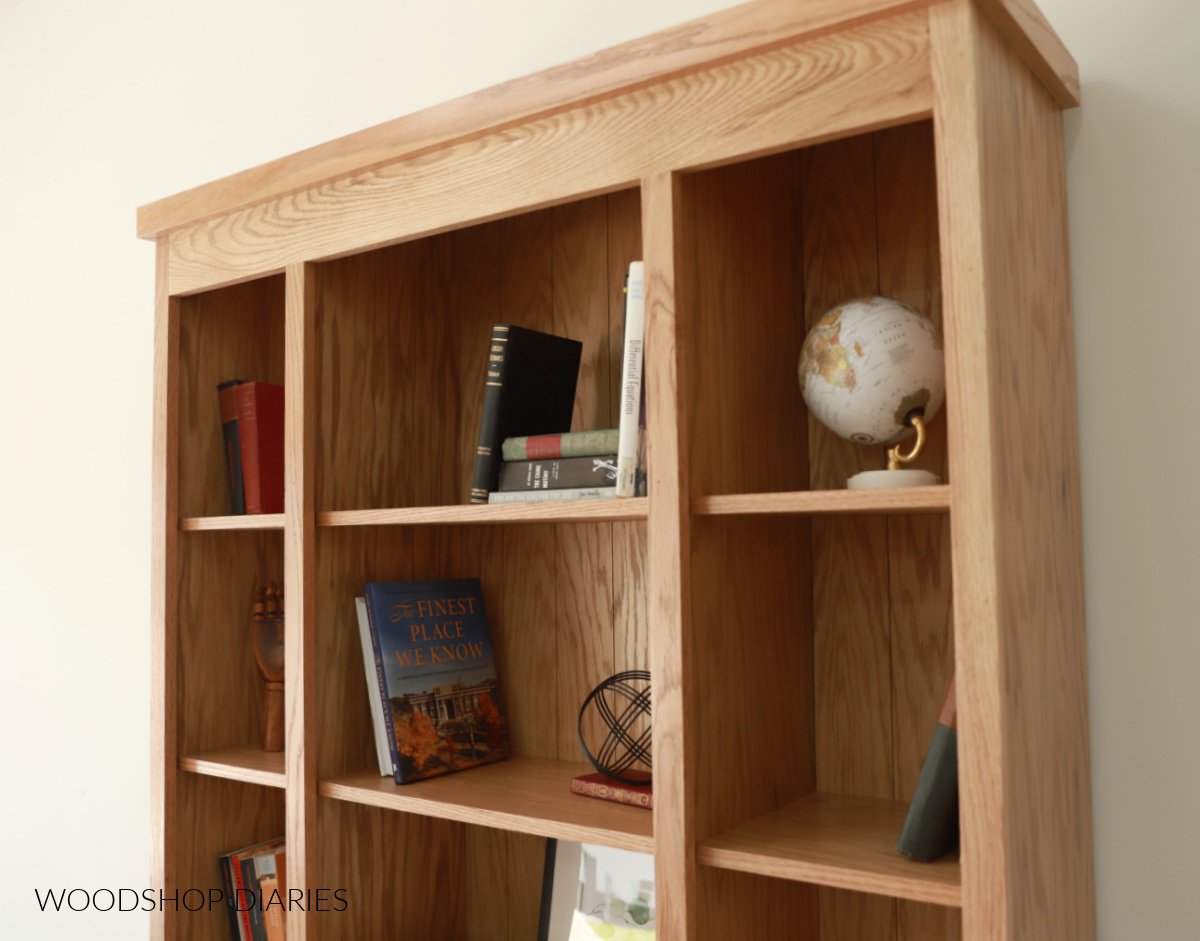
DIY Bathroom Wall Cabinet

March 22, 2024 by Shara, Woodshop Diaries

In this post, I’m sharing how to build a simple DIY bathroom wall cabinet that would be perfect for over the toilet storage.

I made this bathroom wall cabinet just wide enough to fit comfortably in a toilet nook in my parent’s tiny powder room. This gave them extra storage for toilet paper, soaps, and hand towels.

SW Stardew painted bathroom wall cabinet with double doors and crown molding

I know the photo above isn’t showing the cabinet in that nook. BUT…the lighting here was better than in my parent’s tiny powder room.

And in a bathroom that small, I literally couldn’t get a photo of the whole thing once it was installed ha! So you’ll just have to trust me–it fit in there perfectly.

I’m sharing how to build this simple bathroom storage cabinet below, so if you’re looking to add some extra storage over your toilet (or anywhere in the house, garage, workshop, etc), let’s dive in!

*This post contains affiliate links. See website policies.

What to know before building

You can easily customize the size and shape of this cabinet, play around with different types of moldings and different styles of doors.

It’s a super simple project, so it’s a great one to “flex your creative muscles” with to make it fit your style and your space.

Bathroom wall cabinet with double doors. One door open to reveal two adjustable shelves inside

Inside the cabinet, I added two adjustable shelves, but of course, you can customize the inside for your own storage needs as desired.

Overall dimensions

The overall dimensions of the cabinet shown here is APPROXIMATELY 34″ wide x 16″ deep x 32″ tall.

Overall bathroom wall cabinet dimensional diagram

Note that the actual cabinet part is 14″ deep x 30″ tall x 30″ wide. The crown molding adds some width and depth and the exact amount will depend on the exact type and size molding you use.

Wood Type

I assembled this cabinet using ¾″ cabinet grade hardwood plywood (maple). And I used pre-primed pine for the door frames and the crown molding since I was painting it.

If you don’t plan to paint, don’t use preprimed lumber for the door frames or trim. You’ll want to use clear, unfinished lumber so you can apply a stain or clear coat.

Check out this post for more information on choosing the right plywood for your project.

The exact wood type here isn’t critical and is really up to your own personal preference. Pine, oak, maple, birch–these would all work well, so feel free to use what you have available in your area and within your budget.

Helpful Resources

You may find these resources helpful as you build this wall cabinet:

  • How to cut plywood
  • How to cover plywood edges
  • How to use a pocket hole jig
  • How to add adjustable shelving to cabinets
  • How to build cabinet doors (7 different ways!)
  • How to install concealed hinges
  • How to cut crown molding
  • How to paint furniture (without a sprayer)

Are DIY projects your thing? Sign up for our newsletter for priority access to the latest projects and build plans!

How to Build a Bathroom Wall Cabinet

This is a great beginner project you can easily complete in a weekend. If you don’t feel comfortable with crown molding, you can skip it or use something else for trim.

And if you don’t feel comfortable with doors, you can also skip them and make it an open cabinet instead.

However, I encourage you to give both doors and crown molding a try and make this project a great opportunity to practice!

In the links above under “helpful resources,” I’ve included guides to walk you through how to cut crown molding and how to build doors (7 different ways!). You got this, friend!

Prefer to print? Grab the printable building plans for this simple wall cabinet with shelves here:

Tools & Materials

Tools:

  • Circular Saw
  • Cutting Guides–Kreg Rip Cut & Kreg AccuCut (optional)
  • Miter Saw
  • Drill/Driver
  • Pocket Hole Jig
  • Brad Nailer
  • Shelf Pin Jig
  • Concealed Hinge Jig

Materials:

  • (1) 4’x8′ sheet ¾″ plywood (maple plywood used here)
  • (1) 2’x4′ piece ¼″ plywood
  • (2) 1×3 pine boards (for the door frames)
  • (1) 8′ stick crown molding (optional)
  • 1 ¼″ pocket hole screws
  • 1 ¼″ & 2 ½″ wood screws
  • Shelf Pins
  • Edge Banding
  • (2) pair concealed hinges for frameless overlay doors
  • Wood Finish of your choosing

Step 1: Cut Plywood Pieces for Cabinet

The first step to building is simply to cut down the plywood pieces. Normally, I don’t recommend cutting down all the pieces at once, but in this case, it makes sense to.

Everything for the cabinet box and shelves can be cut from a single sheet of ¾″ plywood. Learn how to cut plywood sheets in this post.

Shara Woodshop Diaries cutting down plywood sheet on workbench using circular saw and Kreg Rip Cut

Prefer to print? I’ve included the cut diagram and dimensions in the printable plans.

This cabinet needs:

  • (2) side panels
  • (2) smaller top/bottom cabinet box pieces
  • (2) larger top/bottom panels
  • (2) back support strips
  • (2) shelves

Before assembling, I applied edge banding to the FRONT edges of the side panels and smaller top/bottom pieces. I also applied edge banding to the front and side edges of the larger top/bottom panels.

Edge banding is always optional, but it makes the plywood edges look cleaner. So I recommend applying it to the edges that will be exposed in the finished build.

Close up of edge banded vs not edge banded plywood piece

Learn how to apply iron on edge banding here.

Step 2: Assemble Wall Cabinet Box

I drilled ¾″ pocket holes into the ends of the support strips and the smaller top/bottom pieces.

RELATED: How to use a pocket hole jig

Then, I assembled the main cabinet box like shown below using 1 ¼″ pocket hole screws.

Shara Woodshop Diaries assembling bathroom wall cabinet on workbench with pocket hole screws

I made sure to place pocket holes toward the outside and back of the cabinet box so they’ll be hidden in the finished build.

Next, I used wood glue and 1 ¼″ screws to secure the larger top/bottom panels onto the cabinet box. These should overhang the sides ¾″ and the front 1 ½″.

Securing top panel to bathroom cabinet using screws

I puttied over the screw holes and sanded well once it was dry.

Then, for some extra detail, I opted to add some crown molding around the top. If you didn’t want to use a large molding, you could also go with half round or cove molding–or skip adding molding altogether.

Shara Woodshop Diaries installing crown molding around top of bathroom cabinet

Learn how to cut crown molding here.

Step 3: Assemble Cabinet Doors

Next, I assembled two doors for the cabinet. I made these so that they would overlay the cabinet box.

Shara Woodshop Diaries assembling cabinet door on workbench

Learn about how to size cabinet doors in this post.

There are hundreds of ways to make a cabinet door depending on your style, skillset, and what tools you’re working with.

This post shows 7 ways to build a cabinet door, so feel free to pick the method (or use your own!) that works best for you.

Step 4: Finish Cabinet as Desired

Before attaching the doors, I recommend finishing the cabinet and doors separately.

So, at this point, I painted the cabinet and doors with SW Stardew (the same color as my laundry room cabinets).

Shara Woodshop Diaries painting cabinet with paint roller

Learn how to paint furniture and cabinets here.

I didn’t paint the inside of the cabinet, but you could if you’d like. For some reason, I just always really love the look of wood in the inside of my cabinets, so I rarely paint them.

Step 5: Add Shelves and Attach Doors

I used a shelf pin jig to drill shelf pins along the insides of the cabinet sides to be able to install adjustable shelves.

Shara Woodshop Diaries drilling shelf pin holes in cabinet with Kreg Shelf Pin Jig

Learn how to use a shelf pin jig here.

At this point, you could go ahead and hang the cabinet on the wall before putting the shelves in and adding the doors.

Or, you can go ahead and install the doors, then hang the cabinet. It’s up to you!

I installed concealed hinges for frameless overlay doors onto my two cabinet doors, then installed these onto the cabinet.

Shara Woodshop Diaries installing concealed hinges to cabinet door

Learn how to install concealed hinges here.

Step 6: Hang Bathroom Wall Cabinet

And now this cabinet is ready to hang! I used 2 ½″ wood screws through the back supports and into the wall studs to hang the cabinet.

I made sure to hit AT LEAST two wall studs and secured through BOTH the top and bottom supports (4 screws total).

Completed bathroom wall cabinet with one door closed and one door open revealing two shelves inside

Adjust doors as needed to ensure proper alignment once hung and use shelf pins to place shelves where desired inside the cabinet.

And with that, this cabinet is ready for storage! It’s such a simple, practical, but cute storage solution for small spaces like a powder room or bathroom, laundry room, or even in a garage.

Front view of simple bathroom wall cabinet with double doors and crown molding hanging on white wall

If you’d like to build one (or a few!) of your own, don’t forget to grab the printable building plans here!

Looking for more bathroom storage ideas?

Looking for more storage ideas for the bathroom? Here are a few fun ideas you might like to check out!

DIY Double Vanity
Turn a Closet Into Built Ins
Close up of industrial details of DIY scrap wood wall shelf
Scrap Wood Industrial Shelves
Scrap Wood Towel Rack
Small Linen Cabinet
Glass Door Linen Cabinet

If you enjoyed this post and want to save it for later, be sure to pin it or share to your favorite social channel!

Pinterest collage image showing closed door wall cabinet at top and open door cabinet at bottom with text "how to build a basic wall cabinet"

Until next time, friends, happy building!
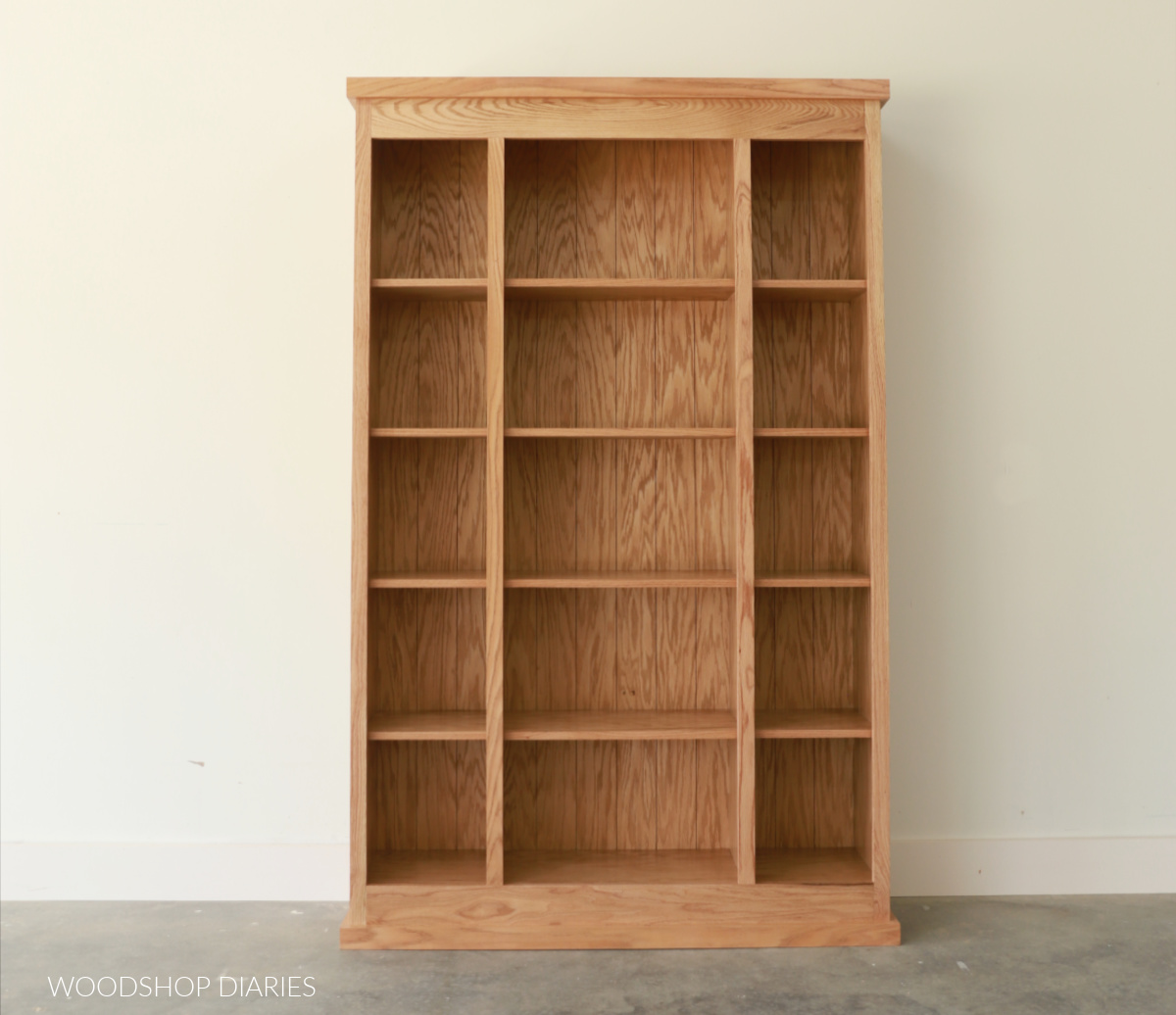
How to Add a Clear Finish to DIY Furniture

March 17, 2024 by Shara, Woodshop Diaries

In this post, I’m sharing how to seal and finish your DIY furniture to keep it’s natural color, but still add protection.

Have you ever built a project that you just didn’t really want to paint or stain. But you just weren’t sure what other options you have?

cedar double vanity finished with a clear coat sealer against white wall in workshop
Cedar Vanity Sealed with Minwax Helmsman Water Based

A clear finish seems so simple, but with so many options, it’s not always easy to know what’s best for your project.

Below I’ll discuss some of my favorite clear finish options for DIY furniture, how to choose what’s right for your build, and how to apply them to get the best results.

*This post contains affiliate links. See website policies.

Clear Finish Options

This is certainly not a comprehensive guide on every possible clear finish available on the market–that would be a million pages long!

But, here’s a simple list of some of my personal favorite clear finishes that I’ve used on my projects over the years:

  • Minwax Polycrylic (water based)
  • Minwax Helmsman (available in both oil and water based)
  • Walrus Oil Furniture Butter
  • Walrus Oil Furniture Finish
  • Danish Oil
  • Mineral Oil
  • Cutting Board Oil

Are DIY projects your thing? Sign up for our newsletter for priority access to the latest projects and build plans!

How to choose a clear finish for your project

What kind of clear finish to use on your project depends on several factors. Here are just a few things to consider:

  • Will it be used outdoors?
  • Will it be exposed to a lot of water?
  • Will it be used with food prep?
  • How do you want it to feel?

Water Based Finishes

Water based clear coats are my usual go to because they are easy to clean up, don’t have a strong odor, and don’t yellow over time. However, in some cases, they may not be as durable as oil based finishes.

For indoor furniture applications, water based options work well and help enhance the natural wood color while providing a hard, protective layer over the wood. Think of this like paint, only it’s clear.

For small outdoor projects or interior projects that will be exposed to a lot of moisture (like a bathroom vanity or countertop), I usually opt for Minwax Helmsman water based finish.

Minwax Helmsman water based finish can in front of unfinished maple dining table

This finish is rated for exterior use, so it protects well against water. It provides a hard, clear, protective layer over the wood to block out the moisture (kind of like paint, only it’s clear).

For general indoor furniture pieces, I normally use Minwax Polycrylic. It’s similar to Helmsman, but isn’t quite as “heavy duty.” It’s a crystal clear, water based sealer that works well on unfinished wood, but also on stained wood.

Shara Woodshop Diaries applying Minwax Polycrylic to a stained piece of furniture

Both of these options come in different sheens (flat, satin, semi-gloss, gloss) and form a hard, clear, protective layer over the wood.

As far as sheen goes, this is really a personal preference. There are pros and cons to each one:

  • Flat: This option has no shine to it. It shows the least amount of imperfections, but is the most difficult to clean since it’s not slick.
  • Satin: Has a slight shine to it. Shows minimal imperfections, and is reasonably easy to clean.
  • Semi-gloss: Leaves wood shiny and smooth. Will show some imperfections, but is easy to clean since it’s so slick.
  • Gloss: Very shiny. Shows the most imperfections, but is the easiest to clean.

Personally, I use semi-gloss most often, with satin being a close second.

Oil Based Finishes

Oil based finishes are generally more durable than water based options, but can be messy, challenging to clean up, and usually have strong fumes that can be combustible.

Personally, I don’t love oil based finishes unless it’s on colorful hardwoods, like poplar, cherry, or walnut…or it’s an outdoor project.

Red oak glass door cabinet finished with Walrus Oil furniture finish
Red Oak Cabinet Sealed with Walrus Oil Furniture Finish

Often oil based finishes will give the wood a more yellow-y tone and make the natural color a little warmer. Sometimes this is desirable, but sometimes it’s not.

Oily finishes like Walrus Oil Furniture Butter, Furniture Finish (shown in the image above), and Danish Oil absorb into the wood and give a flat or slightly satiny sheen.

Walrus oil furniture butter can

If the project will be involved in food prep–like a cutting board, or a serving tray, etc–you want to make sure the finish is food safe. Most cutting board oils and mineral oils are food safe (check labels to be sure!).

Applying cutting board oil to cutting board on workbench

These food safe oily finishes absorb into the wood and don’t form a layer on top. They’ll need to be reapplied periodically as the wood gets dry.

For projects that will be exposed to the elements constantly (like an outdoor furniture set not under cover), if you want to use a clear coat, I recommend using an outdoor oil-based deck sealant like Cabot Australian Timber Oil in Natural.

Something to consider: Oily finishes can sometimes leave the surfaces somewhat greasy depending on the type of oil used. Some oils will harden over time, but others won’t. For example, Danish oil will harden, but mineral oil won’t.

HOW TO APPLY A CLEAR FINISH TO RAW Wood FURNITURE

How to properly apply a clear finish to your project will be based on the type of finish you’re using.

In every case, no matter what finish you choose, I always recommend reading the manufacturer’s instructions on the product label. This will give you more specific instructions, but below, I’ll share an overview and some tips from my experience.

Step 1: Sand

Just like with painting or staining, it’s still important to sand before clear coat as well. Check out this post to learn how to properly sand your projects.

Before applying finish, I sand my entire piece to at least 220 grit WITH THE GRAIN. Sanding against the grain will leave scratches on the wood that will be noticeable when finish is applied.

Close up of sanding cutting board on workbench

It’s important to sand EVENLY as uneven sanding can result in an uneven or splotchy finish. So don’t sand one spot for twenty minutes and another for just 5 seconds.

Make sure to remove ALL glue and glue residue from wood surfaces before sealing. Glue seals the wood surface, which can cause an uneven finish application–especially with oil based finishes.

Remove all dust after sanding with a clean cloth.

Step 2: Apply Clear Coat

Make sure to follow the instructions on the can/bottle of finish before applying.

Applying Water Based Finishes

In general, if using a water based clear coat like Minwax Helmsman or Polycrylic, I use a high quality brush designed for water based finishes, or a foam roller to apply.

Shara Woodshop Diaries applying a clear finish--Minwax Helmsman--to a round wood serving plate

Make sure to stir well before applying! Skipping stirring can cause a chalky or cloudy look to your clear coat. (Trust me–I’ve learned that the hard way.)

I apply these water based clear coats basically as I would paint–brush or roll in the same direction as the wood in long, smooth strokes.

TIP: Don’t overapply too much finish at once, but do apply liberally. With some hands on practice, you’ll get a feel for it. Basically, you don’t want to overapply the finish so that it pools up in a puddle.

But, if the brush feels dry, rough, or scratchy as you run it across the wood, you probably need more finish on it. The brush should feel like it’s smoothly gliding across the wood leaving a full layer of finish behind.

After the first coat, I allow to dry until no longer tacky and lightly sand (by hand) with 400 grit sandpaper.

Polycrylic used to seal dining table top
Walnut Dining Table Sealed with Minwax Polycrylic

Water based finishes cause the grain to raise, so sanding between coats helps smooth them back out and reduces brush strokes.

Then, I apply another coat exactly the same way. Apply 3-4 coats (sanding between each one) for best results. DON’T SAND AFTER THE FINAL COAT.

Applying Oil Based Finishes

When applying oil based finishes like Danish oil, Walrus Oil Furniture Butter or Furniture Finish, or cutting board oils, normally, I like to use an old (but clean!) t-shirt or a rag.

Pouring Danish oil onto hickory wood

Since these types of finishes absorb into the wood, basically you just need to apply the oil liberally, then spread it around to cover the entire surface (again, using a rag or cloth).

Then, let it soak in (check the labels for exact soaking times–it may vary by product), and wipe off what hasn’t been absorbed with a clean cloth.

As you can see, the application process isn’t as “careful” as with water based clear coats.

Buffing Walrus Oil furniture butter onto walnut and maple board

In some cases, you may need a second application to properly saturate the wood if everything soaked in from the first coat.

You can reapply most oil based finishes at any time by simply removing any dust on the surface and applying another coat. Since oils absorb into the wood, you can just wipe on where needed.

Walnut plywood console cabinet finished with Walrus Oil furniture butter
Walnut console sealed with Walrus Oil Furniture Butter

NOTE: Check the label on your particular finish for proper disposal of saturated rags as many oil based finishes are combustible.

Step 3: Allow to Cure

Once the finish is applied, allow to cure according to the instructions on the product label. Note that water based finishes dry quickly (like paint). Oil based finishes may take a few days to cure.

Maple plywood bookshelf finished with Minwax Polycrylic
Bookshelf made from maple plywood sealed with Minwax Polycrylic

Once cured, your project is ready to use!

Looking for more finishing tips?

If you’re looking for more tips on finishing and making your DIY look its best, here are a few helpful posts!

How to Paint Furniture & Cabinets
How to Stain Wood
How to Sand Wood
How to Cover Plywood Edges
5 Secrets to Professional Looking DIYs

If you’d like to save this post for later, don’t forget to pin it or share to your favorite social channel!

Pinterest collage image showing clear finished vanity at top and applying Minwax Polycrylic on bottom with text "how to apply clear coat finish"

Until next time, friends, happy building!
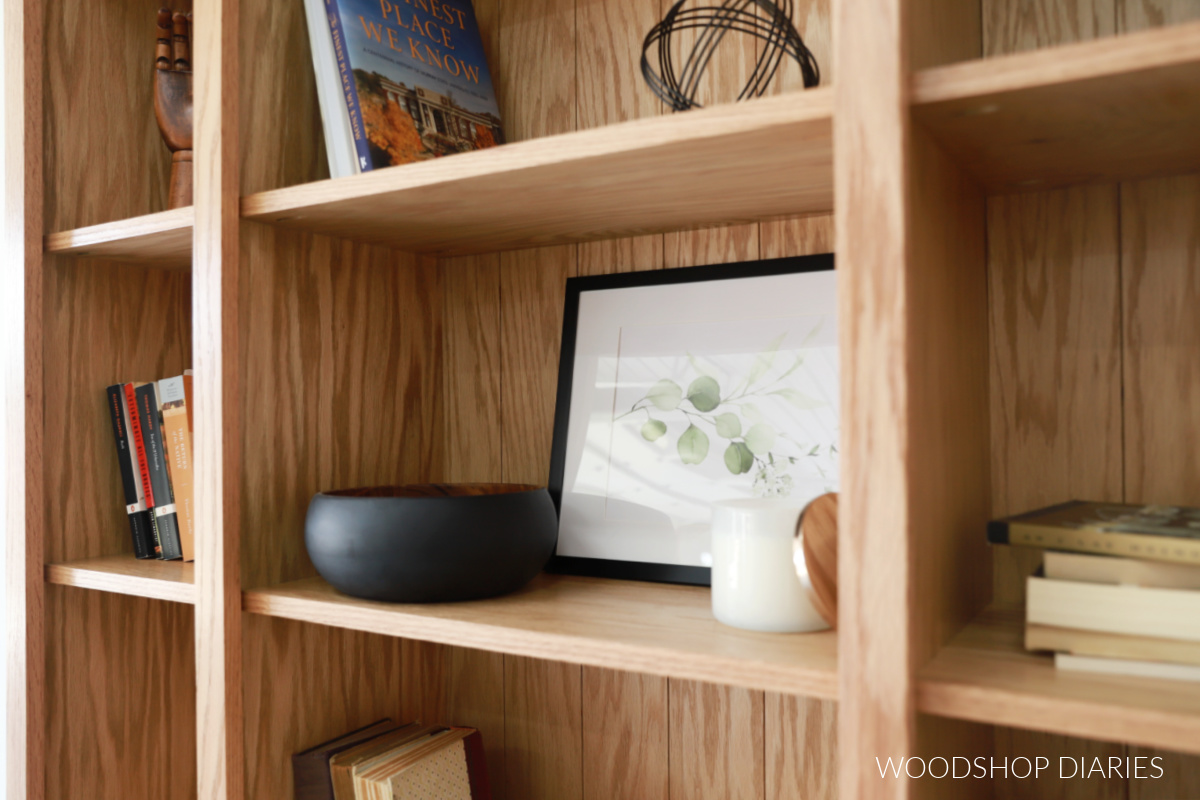
7 Ways To Build a Cabinet Door

March 12, 2024 by Shara, Woodshop Diaries

In this post, I’m sharing how to build a cabinet door 7 different ways!

When it comes to building doors for cabinets and furniture, there are many different ways to make them.

Shara Woodshop Diaries holding a door with 6 more doors leaning against the wall in the background

The great thing about building your own doors is that you can choose the style and technique that works best for your project, your skill level, and uses the tools you already have available.

Below I’m sharing 7 ways to build basic cabinet doors for any skill level (both with AND without a table saw or a router) for your DIY furniture and cabinet projects.

*This post contains affiliate links. See website polices.

Determining your cabinet door size

The first step to building your cabinet door is determining the overall size it needs to be.

I normally use concealed hinges to install cabinet doors, and with those, the doors typically need to be about ¾″ thick. That’s the thickness I’ll be making all seven doors in this tutorial.

But finding the height and width of your doors will depend on the style and size of your project. This post contains a comprehensive guide to determining your cabinet (or furniture!) door size.

RELATED POSTS:

  • How to determine what type of hinge to use
  • How to install concealed cabinet hinges

Are DIY projects your thing? Sign up for our newsletter for priority access to the latest projects and build plans!

Styles of Cabinet Doors

Cabinet doors come in MANY shapes and styles. However, there are two styles that are most common. These are the two styles I’ll be sharing how to build below.

A flat panel door, or sometimes called a “slab” door, is exactly what it sounds like–a flat, solid panel.

Frameless cabinets with slab style flat panel doors in Woodshop Diaries workshop

These types of doors are common on contemporary style cabinets and/or utility style cabinets.

I’ve used them on my kitchen cabinets, my workshop cabinets, and these garage cabinets.

A frame and panel door, or sometimes called “shaker” style, is a simple design where the door is framed around the outside, with a recessed panel in the middle.

Frame and panel (shaker) style cabinet door on base cabinet

Frame and panel style doors can be customized with decorative edges, trim, etc. or left simple, square and straight like the one shown above.

Below I’ll show how to make a slab cabinet door and 6 ways to make a frame and panel style cabinet door.

Cabinet door terminology

Before we dive into building, I wanted to clarify a few terms in regards to frame and panel style doors.

  • The stiles are vertical parts of the frame–the left and right pieces.
  • The rails are the horizontal parts of the frame–the top and bottom pieces.
  • The panel is the center piece.
parts of a shaker style cabinet door

The rails and stiles are often made using 1x boards–my preferred size is a 1×3. And the panel is often ¼″ or ½″ plywood.

RELATED: Understanding lumber sizing

I recommend using a high quality cabinet grade (smooth) plywood when building doors. Learn how to choose plywood for your project here.

For the 1x3s, if you’re painting, pre-primed pine boards work great. But if you’re staining or using a clear sealer, you typically want to use the same wood type for the 1x3s and the plywood so they’ll match.

PRO TIP: When assembling frame and panel doors, make sure the stiles are at least 1 ¾″ wide. If they’re not, when you drill holes for the concealed hinges, you’ll risk drilling through the inside edge of the frame.

How to Build a Cabinet Door–7 Ways

If you prefer to watch, check out the video tutorial for all 7 doors on my YouTube channel here:

YouTube thumbnail for 7 ways to build a cabinet door video

Love watching how-to videos? Subscribe to my YouTube channel for plenty more where that came from!

Prefer to print? You can grab the printable building plans including all 7 ways to build a cabinet door, with dimensions, plus a sizing guide to help you determine the size door you need here:

How to Build a Slab Style Cabinet Door

A flat panel or slab cabinet door is the easiest to build and requires the least amount of tools. All you need to build a slab style cabinet door is:

Tools & Materials:

  • ¾″ plywood
  • Saw to cut plywood (circular saw or other)
  • Edge banding & Iron (optional)

Simply cut a ¾″ plywood panel to the size you want your cabinet door, apply edge banding, if desired, and you’ve got a door!

Flat panel wooden cabinet door against white wall with text "cabinet door #1 simple slab"

There are many ways and tools you can use to cut plywood, but this post details how I cut down my plywood sheets.

In case you’re wondering…I cut my plywood to the size I want my door and ignore the thickness of the edge banding. Iron on edge banding is very thin. It will add a little to the overall size of the door once applied, but in most cases, it’s negligible.

If you don’t want to use plywood, you can use solid wood instead–simply glue up a panel and trim down to the size you need.

Frame & Panel Door Made with Lattice Trim

This is probably the easiest way to make a “frame and panel” door. It’s technically a slab door with a fake frame. For this door, you’ll need:

Tools & Materials:

  • ½″ plywood
  • ¼″ thick x 1 ¾″ wide (or wider) lattice trim
  • Saw to cut materials (circular saw or other)
  • Wood Glue
  • Edge Banding & Iron (optional)
Frame and panel cabinet door against white wall with text "cabinet door #2 frame & panel style made with lattice trim"

To make this type of door, simply cut a slab door from ½″ thick plywood. Then cut to fit and glue ¼″ thick lattice trim onto the front flush to the edges.

Painters tape works great to hold the pieces while the glue dries, but clamps or heavy objects placed on top would work as well.

Shara Woodshop Diaries gluing lattice trim piece onto front of ½" plywood panel on workbench

The lattice trim mimics a frame, so that it looks like a frame and panel on the front side, but the back side is solid like a slab.

Once the glue is dry, I like to apply iron on edge banding to cover the sides and make it look like a solid piece. This is optional.

PRO TIP: The lattice trim needs to be 1 ¾″ or wider if using concealed hinges to install. If it’s narrower, when you drill the hinge cup holes, you risk drilling past the inside edge and through the ½″ plywood panel.

Frame & Panel Cabinet Door Using Pocket Holes

This method is a great beginner-friendly option that doesn’t require a router or a table saw. For this door, you’ll need:

Tools & Materials:

  • 1×3 board
  • ½″ plywood
  • 1″ pocket hole screws
  • 1 ¼″ pocket hole screws
  • Saw to cut materials (circular saw or other)
  • Drill/Driver
  • Pocket Hole Jig
Back side of cabinet door assembled with pocket holes against white wall with text "Cabinet door #3 frame and panel style made using pocket holes"

I like to use 1x3s for my door frame pieces, but you can use another size if you’d rather. Nominal 1x3s are actually 3×4″ x 2 ½″ wide.

So for this style door, I cut two pieces of 1×3 to the height I want my door (for the stiles). Then, I cut two more pieces the width I want my door MINUS 5″ (for the rails). PREFER TO PRINT? Grab the cabinet door building plans including all 7 methods with dimensions and diagrams here.

I drill ¾″ pocket holes into the ends of the rails. New to pocket holes? Learn how to use a pocket hole jig here.

Then I cut a ½″ plywood panel to fit inside the door frame and drill ½″ pocket holes around the edges. Space pocket holes approximately 1 ½″ – 2″ from the corners and no more than 6″ apart for best results.

Then I assemble the door using 1 ¼″ pocket hole screws through the holes on the rails and 1″ pocket hole screws through the holes in the panel.

Shara Woodshop Diaries assembling cabinet door using pocket holes and screws

NOTE: Since the rail and panel materials are different thicknesses, they need different size pocket holes and different size screws.

I like to assemble these so that the panel is flush to the back edge of the frame. This makes a really nice looking cabinet door on the front side, but the back side isn’t quite as pretty.

Front side of pocket hole cabinet door shaker style

I recommend smoothing out the joints with wood filler and filling the pocket holes to smooth out the back side. Sand smooth after the putty/filler dries.

RELATED: 4 ways to fill a pocket hole

Frame & Panel Cabinet Door with Routed Back Side

This method of building frame and panel doors also works great for shaker style drawer fronts and glass cabinet doors, too. For these doors, you’ll need:

Tools & Materials:

  • 1×3 boards
  • ¼″ OR ½″ plywood
  • Wood Glue & Dowel Pins
  • Saw to cut materials (circular saw or other)
  • Drill
  • Dowel Jig
  • Router & Rabbeting Bit
  • Chisel
  • Clamps
Shaker style cabinet door leaning against white wall with text "cabinet door #4 frame & panel style made by routing back side"

For this type of door, I cut the rails and stiles from 1x3s exactly like the last style door. But I assemble the frame using wood glue and dowels instead of pocket holes. (Don’t cut the plywood panel yet.)

RELATED: How to use a dowel jig

Shara Woodshop Diaries clamping 1x3 door frame together with dowel pins

Once the glue is dry on the frame, I remove from the clamps, sand away the glue squeeze out, then flip it face down on the workbench.

I use a ⅜″ rabbeting bit in my router to route a rabbet around the inside of the frame.

Close up of rabbeting bit installed in router

I cut about ¼″ deep on the first pass, then adjust another ¼″ deep and cut again so the rabbet is ½″ deep.

RELATED: How to use a router

Shara Woodshop Diaries routing rabbet along inside of back of cabinet door frame

The rabbeting bit leaves a curve at the corners, so I use a chisel to square each corner (optional), then measure the opening and cut EITHER ¼″ or ½″ plywood to fit inside.

Normally, for doors, I prefer to use ¼″ plywood for the panel, but if making drawer fronts, I recommend ½″ plywood for the panel.

I apply wood glue into the rabbet, place the plywood panel inside, then clamp tight until dry. This makes a nice looking door on both the back and the front side.

¼" plywood panel being installed into rabbet on back side of cabinet door frame

PRO TIP: For painted projects, make sure to apply a small bead of caulk between the frame and panel on both the front and back side. This will help smooth things out and cover any gaps.

RELATED: How to paint cabinets and furniture

FOR GLASS DOORS: follow this same process, but only route as deep as the thickness of the glass, then use turn buttons around the edges to hold the panel in place.

Close up of back side of glass panel door showing turn buttons keeping it in place

RELATED: How to build a glass door cabinet

Frame & Panel Cabinet Door with Mitered Corners

This method of building cabinet doors isn’t the most common, but I like to use it sometimes if I want to add a decorative edge along the inside of the door frame.

Cabinet door assembled with mitered corners and decorative inside edge leaning against white wall with text "cabinet door #5 frame and panel style with mitered corners"

I used this style door when I built the cabinets for my sisters kitchen. For this type of door, you’ll need:

Tools & Materials:

  • 1×3 boards
  • ¼″ plywood
  • Wood Glue & Dowel Pins
  • Miter Saw
  • Table Saw OR Router Table (to cut dadoes)
  • Router with Decorative Bit (optional)
  • Drill
  • Dowel Jig
  • Clamps

First, before trimming down my 1×3 into the rails and stiles, I cut a ¼″ dado about ⅜″ deep on the table saw right down the center of the edge of the entire board.

I cut this on the table saw, but you could also use a router table if you had one. The dado needs to be wide enough to fit the ¼″ plywood panel.

1x3 with dado cut in middle of edge with ¼" plywood panel sliding through

This part is optional, but I like to use a roundover bit in my router and route along the edge of the board on one side JUST ABOVE THE DADO.

Then, I trim the board down into my rail and stile pieces to build the door. The ends need to be mitered 45 degrees with dadoes on the short side.

The long side of two pieces will be same length as the height I want my door and the long sides of the other two pieces will be the same length as the width I want my door.

mitered corner cabinet door pieces fit together on workbench

Before assembling, I cut a piece of ¼″ plywood to fit into the dadoes for the panel and test fit the pieces together.

Once I’m certain of my fit, I assemble using wood glue and dowels at the corner. Make sure to insert the panel into the dadoes before adding the last side.

Shara Woodshop Diaries assembling cabinet door using dowel pins in mitered corners on workbench

RELATED: How to use a dowel jig

After the glue dries, I sand the joints smooth and it’s ready to hang!

Shaker style cabinet door made with dowels

PREFER TO PRINT? Grab the cabinet door building plans including all 7 methods with dimensions and diagrams here.

Frame & Panel Cabinet Door using Tongue & Groove Lumber

I like to call this the “cheater’s method” of making a cabinet door. It’s exactly like the last door, only instead of using 1x3s, I use tongue and groove lumber.

cedar and birch cabinet door leaning against white wall with text "cabinet door #6 frame and panel style using tongue and groove lumber"

Tongue and groove lumber already has a precut dado and usually a decorative edge, so I use this to same time cutting my own. For this door, you’ll need:

Tools & Materials

  • Tongue & Groove lumber (usually comes in 1×6)
  • ¼″ plywood
  • Wood Glue & Dowel Pins
  • Table Saw
  • Miter Saw
  • Drill
  • Dowel Jig
  • Clamps

I rip 2 ½″ off the groove side of the tongue and groove lumber to use for my “1×3” door frame.

Tongue and groove lumber stacked on table saw with line drawn down middle showing 2 ½" on groove side of board with text "groove side use for door frames"

Then I follow the exact same process as the mitered corner door method I shared just before this one.

I used this method for my bathroom vanity build and my hallway closet built in.

Shara Woodshop Diaries clamping mitered corner cabinet door together on workshop floor

Frame & Panel Cabinet Door Assembled with Tongue & Groove

This method is a more traditional way of making DIY cabinet doors, but requires a little more precision than the previous options. For this door, you’ll need:

Tools & Materials

  • 1×3 board
  • ¼″ plywood
  • Wood Glue
  • Saw to cut materials (miter saw or other)
  • Router & Rabbeting Bit
  • Table Saw OR Router Table (to cut dadoes)
  • Clamps
Blue painted shaker style cabinet door against white wall with text "cabinet door #7 frame and panel style tongue and groove assembly"

For this door, I’ll be assembling it using tongue and groove joinery at the corners. The stiles will have the “grooves” and the rails will have the “tongues.”

So first, I cut my door frame pieces from 1x3s. I cut two pieces the height I want my door (for the stiles) and two pieces the width I want my door MINUS 5″ PLUS ¾″.

Diagram showing dimensions of rail pieces for tongue and groove cabinet door

This is similar to the dimensions in the pocket hole method in door #3, but with a little extra length for the tongues.

I set a ⅜″ rabbeting bit in my router to cut ¼″ deep. I clamped the rails onto my workbench (TIP: clamp scrap blocks on each side to prevent tear out) and routed along the ends on one side.

Then, I flipped them over and routed the other side (see video for more information).

rails clamped to workbench with routed ends to create tongue

This basically cut a ⅜″ long x ¼″ wide tongue on the ends of my rail pieces. You could also cut these out on a router table or a table saw instead.

close up of cabinet door rails with tongues cut in ends

Now the tongues are cut, so I need to cut the grooves–which are dadoes.

I used my table saw to cut a ¼″ wide dado ⅜″ deep on the table saw on one edge of both my rails and my stiles. The dado should be cut exactly from the center so that it’s in line with the tongue on the rail.

close up of cabinet door rail showing tongue and dado cuts lined up

That way, the tongues on the rails should fit snugly into the grooves on the stiles.

rails and stiles fit together with tongue and groove

NOTE: If you didn’t want to cut these dadoes on the table saw, you could also cut these on a router table instead.

I cut a ¼″ plywood panel to fit into the dadoes, then assembled using wood glue where the tongues go into the grooves at the corners.

Shara Woodshop Diaries assembling cabinet door on workbench with wood glue

Clamp until dry, then sand joints smooth and it’s ready to hang!

Looking for more cabinet and furniture building tips?

Whew! That was a lot of information! These are certainly not the ONLY 7 ways to build a cabinet door, but I hope this helps get you started.

If you’re looking to dive deeper into more cabinet and furniture building, here are some additional guides you might find helpful!

How to Determine Cabinet Door Size
What Type of Hinge Do You Need?
How to Install Cabinet Hinges
How to Paint Furniture & Cabinets
How to Build Base Cabinets
How to Use a Dowel Jig

If you’d like to save this post for later, don’t forget to pin it or share to your favorite social channel!

Pinterest collage image showing cabinet door frame pieces fit together at top and Shara Woodshop Diaries with 7 cabinet doors at bottom with text "7 ways to build a cabinet door"

Until next time, friends, happy building!
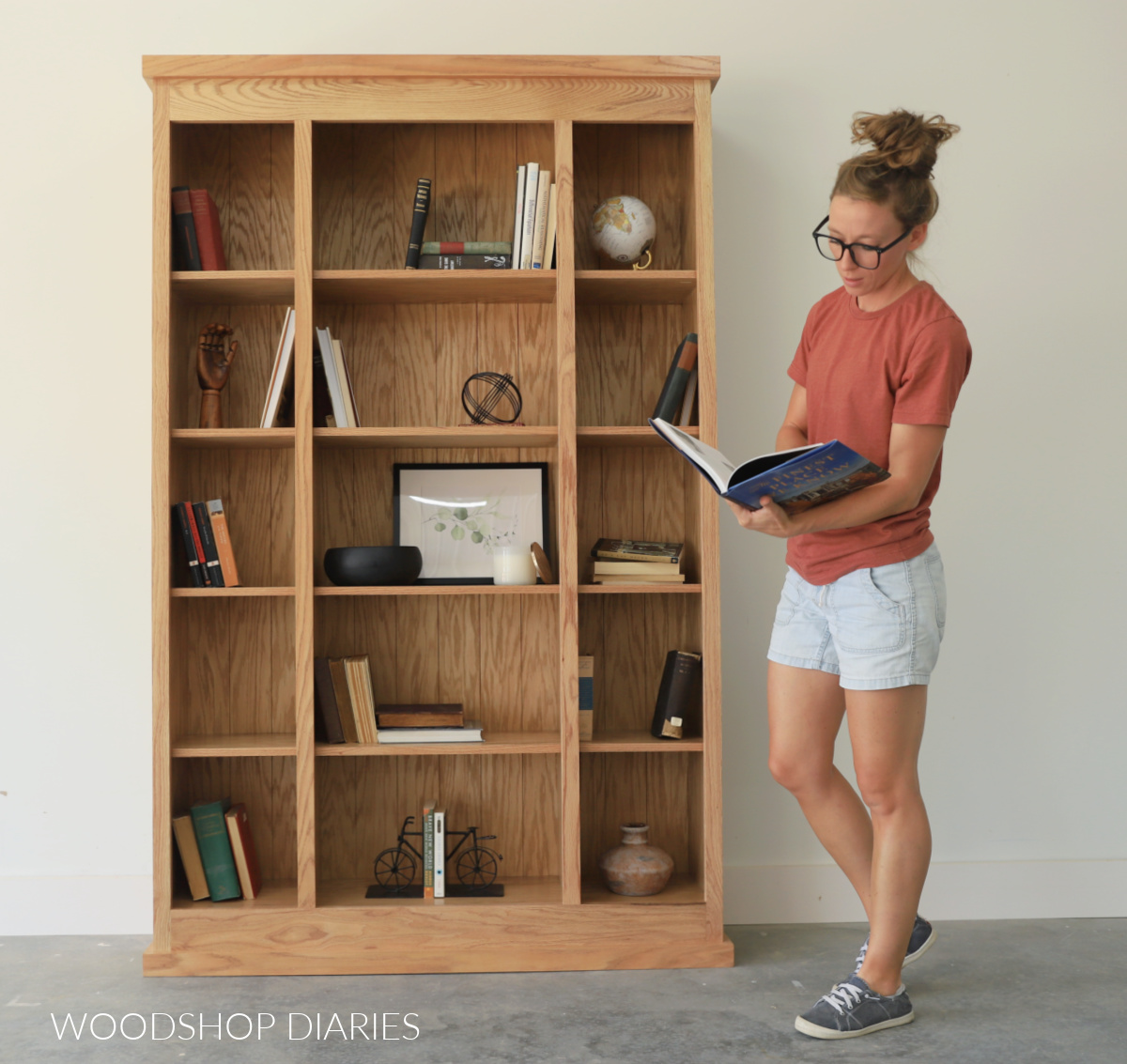
DIY Laundry Room Remodel With Built In Cabinets

March 9, 2024 by Shara, Woodshop Diaries

In this post, I’m sharing how I transformed our boring, builder grade laundry room with custom built in storage cabinets!

Our laundry room was a dark, sad, poorly utilized space in our home. The room was a nice size, but so much of it was basically empty.

Laundry room before image showing dark room with shelving on right side

It packed so much potential, but as it was, it just looked very much like a thrown together afterthought.

So I set out to brighten it up, add some practical (and pretty!) storage, and turn it into a place I didn’t mind folding clothes in.

Laundry room after image showing white walls with blue cabinets and wood countertops throughout

Below, I’ll share my plans for the space and how I brought them to life to give you some ideas and inspiration for your own laundry room!

*This post contains affiliate links. See website policies.

Prefer to watch? I’m sharing the whole laundry room transformation in this video on my YouTube channel!

YouTube Thumbnail for laundry room before and after video

Love watching how-to videos? Subscribe to my YouTube channel for plenty more where that came from!

The Laundry Room Before

It’s hard to appreciate the after without seeing the before. So, let’s take a closer look at the laundry room before.

I had previously already replaced the swing door on the room with a DIY modern sliding door.

Shara Woodshop Diaries opening swing door on laundry room

The swing door was annoying because when you opened it into the room, it hit the washing machine.

Then you had to shut the door back to be able to open the washer door.

Modern frosted glass sliding door on laundry room entrance

So replacing the entrance was the first improvement to the space. But now we needed to work on the INSIDE of the room.

This laundry room is approximately 7′ deep and 9′ wide–which is a great size.

Laundry room before--left side above washer and dryer empty

But the only things in here were the washer and dryer on one side. And on the other side, two cheap particle board cabinets, and a countertop supported by some screwed together scrap shelving.

Laundry room before right side wall cabinets and shelving

The storage offered just wasn’t very practical, the space was poorly laid out, and it just felt dark and dreary.

So while there’s not much here to salvage and reuse, the good news is that it’ll be easy to tear out to start with a completely blank slate.

Are DIY projects your thing? Sign up for our newsletter for priority access to the latest projects and build plans!

Laundry Room Design Plan

When I decided to update the laundry room, I knew I wanted three things that this existing space didn’t have.

Must haves in the new laundry room:

  • Practical Storage (that’s hidden behind doors)
  • More Countertop Space
  • Brightness + Some Color

First, I planned to add wall to wall base cabinets across the left side of the room where the open shelving was previously.

This would give me plenty of “hidden” storage for cleaning supplies, and other odds and ends.

Diagram showing laundry room cabinets installed on right wall across from washer and dryer

Then, I planned to add a countertop over the washer and dryer, plus some wall cabinets above.

But that left an awkward space in the back left corner beside the dryer that I wasn’t sure what to do with.

So, I decided to build another simple base cabinet, a few inches shorter than the cabinets on the right side of the room.

Then, I could slide it into this corner and run another countertop across it to connect it to the other base cabinets. This would fill the awkward space, but also give me even more countertop space–which I wanted to maximize anyway.

Laundry room diagram showing room complete with countertops on three sides and cabinets on wall above washer and dryer

To be honest, this was WAY more storage than I actually needed (of course, you can never have too much storage), so I decided to leave the space underneath the back countertop open for now.

Additional cabinets underneath here felt like it might be a little TOO much. But if it ended up looking odd, I can always add them.

Spoiler alert: it was fine without cabinets. But, it’s always nice to have options and to plan for the “what ifs” haha!

Adding Custom Built Ins to Laundry Room

To kick off this laundry room renovation, first, I emptied the room. So basically, I removed the existing two wall cabinets, shelving, and the trim.

Then I could start completely fresh with a coat of paint. I painted the walls in here SW Pure White to brighten it up.

Shara Woodshop Diaries painting dark grey laundry room white

Paint alone made a huge difference and this room felt so much cleaner and brighter. Paint works wonders.

Adding Base Cabinets to the Right Wall

Then, I built the custom base cabinets for the laundry room. I built these to fit perfectly between the walls on the right side of the room so they would feel built in.

I built four cabinets total–two with doors, one with drawers, and I left the one that will go against the back wall open.

four base cabinets painted SW Stardew with butcherblock countertop--one open cabinet, two with doors and one with drawers

Check out this post to see how I built these base cabinets.

The top of the face frame was intentionally left taller on this open cabinet. It’ll make more sense once we get to the next part of the room.

Since I was putting these cabinets in the laundry room, I decided to get a little creative and I also turned one of my drawers into a drying rack.

I’m personally not a huge fan of the wall mounted drying racks and I don’t one often. But it’s nice to have when I do need it, so I thought adding it into a drawer so I could hide it away when not in use was a neat idea for the laundry room.

You can check out how to turn a new or existing drawer into a drying rack here.

pulling drying rack drawer out of cabinet

Once the base cabinets were assembled, I wanted them to be modern and clean, but with a touch of color. So I painted them SW Stardew.

I really like this color, but I went back and forth on using a darker blue for a more classy look or a lighter blue for a more fun and playful feel. Ultimately, I went with the lighter, but a navy color would have looked nice, too, I think.

Shara Woodshop Diaries installing base cabinets in laundry room

I installed the cabinets into the room, making sure they were level and securing to the wall studs. Then, I added a premade butcherblock countertop cut to fit over the top.

Shara Woodshop Diaries installing butcherblock countertop on base cabinets in laundry room

Installing Countertop Along the Back Wall

With the right side of the room together, I moved to the back. In the design plan, I mentioned that the space in the back left corner of the room was kind of awkward.

I built and installed a simple base cabinet in that corner between the washer and the wall that was about 2 ½″ shorter than the height of my other base cabinets.

open base cabinet installed next to washing machine in corner of laundry room

Once it was in place, I could cut and install another butcher block countertop to fit along the back.

You may have been wondering why the top of the face frame on the open shelf base cabinet was taller than usual. I made it that way so that I could screw a scrap block into it to hold the other end of this countertop.

Shara Woodshop Diaries securing countertop support on top of base cabinet

I installed the countertop below the other as you can see, making sure it was level side to side. Once it was installed, I felt like it needed an apron underneath–more for looks than for support.

So I used pocket holes and screws to run a 1×3 apron piece along the front and attached to the face frame between the two back base cabinets.

Shara Woodshop Diaries installing apron underneath countertop in laundry room

Adding Cabinets and Countertop Above Washer and Dryer

Now, I finally shifted focus to the washer and dryer part of the room. I had planned to add a countertop here above the machines, so first, I needed a support on both sides.

I screwed a piece of scrap plywood to the wall to support the left side of the countertop. Then, I cut a piece of ¾″ plywood and nailed a 1×3 on the front to support the right side.

Shara Woodshop Diaries assembling countertop support for next to washing machine using nailer to attach 1x3 to plywood panel

I screwed the plywood panel to the back cabinet in the corner so it would stay in place.

Then I cut to fit another butcherblock countertop to rest across these supports. This one had to be quite a bit deeper to cover the washer and dryer, so I cut it from an island top (which was 39″ x 72″ originally).

Shara Woodshop Diaries cutting butcherblock countertop to size for over washer and dryer

Now, I attached the other two countertops to the cabinets below them.

However, for this one above the washer and dryer, I didn’t want to attach it because I wanted it to be easy to remove if we needed to get behind the machines to check for leaks, clean the dryer duct, etc.

It’s SUPER heavy, so it’s hard to move even with it not being secured. So this one is just resting on the supports and not attached.

If we decide later to attach, some corner brackets from the bottom side or a few screws through the top down into the supports below would work well.

Shara Woodshop Diaries installing doors onto wall cabinets in laundry room

Then, I added two wall cabinets above the washer and dryer to finish this side of the room.

You can see how I built these simple DIY wall cabinets here.

I made these cabinets so they they go all the way to the ceiling. This really made our short 8′ ceilings feel much higher.

I didn’t build these cabinets to run wall to wall because with the countertop across the back, a cabinet in the back corner would be difficult to get to. So this far corner is a bit awkward since it’s empty.

Shara Woodshop Diaries opening doors on wall cabinets above washer and dryer

I may come back later and add some shelving there just for decoration, but practically speaking, it’s a difficult to access space, so it’s not great for storage. But it may be a fun place to display some decorative jars or some art work.

Finally, I installed the toe kicks around the cabinets, baseboards and door trim, then stepped back to look it over.

Finishing Details and Final Reveal

After stepping back and looking, the right side of the room felt like it still needed something on the wall. It just looked…bare.

I didn’t want to add any more cabinets because I just really didn’t need any more storage. Full transparency, 5 of the 7 cabinets in this room are empty!

But, I thought a simple shelf across the wall would be nice. So I used some basic shelf brackets to hang a piece of leftover butcherblock countertop as a shelf.

Shara Woodshop Diaries installing shelf on J brackets in laundry room

I sealed all the countertops and the shelf with Minwax Polycrylic and with that, this room is complete and ready for all the laundry!

I actually am still on the lookout for a large piece of art to hang on the back wall. I want something simple, but large art is expensive!

Completed laundry room with built in base cabinets, countertop and wall cabinets painted blue

So I have a good feeling we will revisit this space again soon and I’ll make my own art for the wall.

Base cabinets built into laundry room with shelf above

Until then, I’m more than happy to do my laundry in this space and the difference between the before and after is amazing! I wish I could show you this in person–the lighting doesn’t allow the pictures to do it justice.

Washer and dryer with countertop and wall cabinets above it

But trust me–the after is a definite improvement. The cabinets and countertop add so much function and storage to this space while also making it look clean, organized, and inviting.

I hope this gives you some inspiration and ideas for your own laundry space!

Just looking for links to everything? I got you! Here are the links and info to everything used for the space:

Paint Colors:

  • SW Pure White on walls
  • SW Stardew on cabinets

Countertops:

  • Butcherblock countertops
  • Minwax Polycrylic clear coat sealer (no stain)

Other Parts & Accessories:

  • Shelf brackets
  • Door Knobs
  • Drawer Pulls
  • Base Cabinets
  • Wall Cabinets
  • Drying Rack Drawer
  • Baskets–Home Goods

Looking for more Laundry Room Ideas?

Here are a few more laundry room ideas you might enjoy browsing through if you’re looking for inspiration for your own laundry room remodel!

DIY Drying Rack Drawer
Laundry Room Storage Solutions
How to Build a DIY Tilt Out Laundry Hamper Cabinet with Hamper Baskets and Laundry Room Storage--Free Plans and Video Tutorial
DIY Tilt Out Laundry Hamper
Sliding Door to Laundry Room

If you’d like to save this for later, be sure to pin it or share to your favorite social channel!

Pinterest collage image showing before laundry room at top and after laundry room remodel with built in cabinets at bottom

Until next time, friends, happy building!
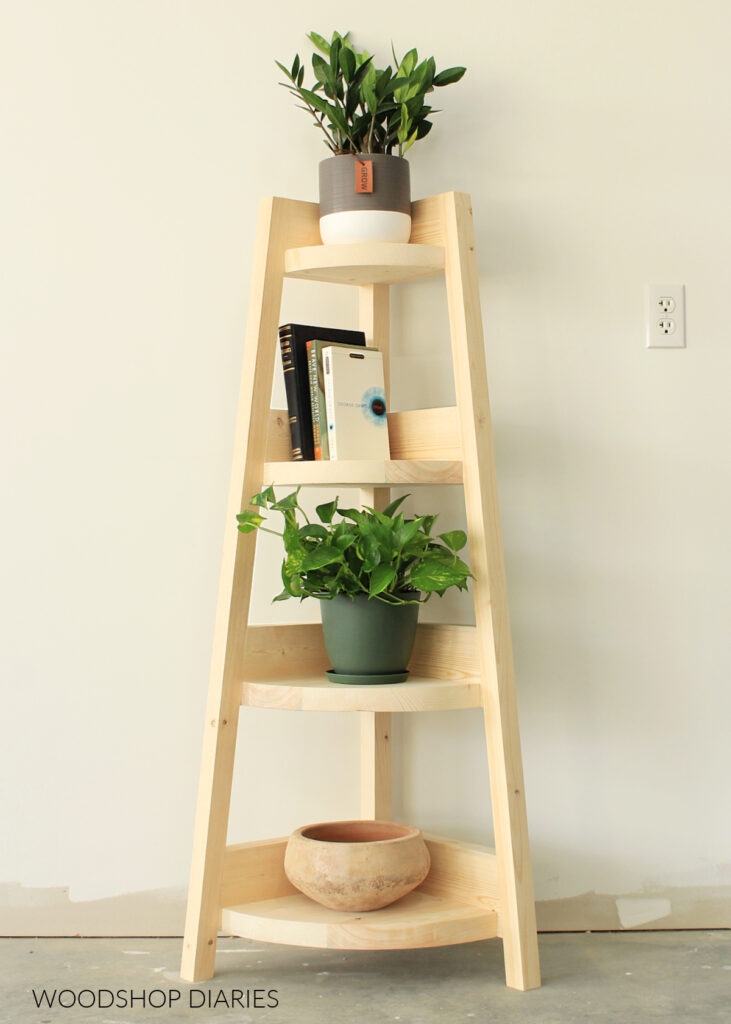
How to Choose Cabinet Door Hinges

March 5, 2024 by Shara, Woodshop Diaries

In this post, I’m going to help you determine which kind of concealed cabinet door hinge is right for your DIY project.

Choosing the right type of concealed hinge can seem tricky–I get it! There are lots of options and it can be confusing to know which one will work with your build.

Face Frame cabinet with overlay door opened to reveal hinges inside

Whether you are simply replacing an existing hinge or building a brand new piece of furniture from scratch, let’s break down how to choose the right concealed cabinet door hinge so you can shut the door (get it??) on your project.

*This post contains affiliate links. See website policies.

Types of Concealed Cabinet Hinges

Concealed hinges are popular in furniture and cabinets because they are easy to install, easy to adjust, and are hidden in the finished project (hence the name “concealed” hinge).

Overlay cabinet door on basic base cabinet

Concealed cabinet door hinges come in four main styles:

  • Inset for Frameless Cabinets
  • Full Overlay for Frameless Cabinets
  • Inset for Face Frame Cabinets
  • Overlay for Face Frame Cabinets (available in varying overlay amounts)
Collage showing the four types of concealed hinges--inset frameless, overlay frameless, inset face frame and overlay face frame

The hinge will specify what type of cabinet (frameless or face frame) and what type of door (inset or overlay) they’re to be used with. Take note that overlay hinges for face frame cabinets also come in various overlay amounts.

RELATED: How to install & adjust concealed hinges

Below, I’ll show you how to identify which of these four options will work for your project.

PS: I recommend choosing soft close concealed hinges. They usually aren’t much more expensive than basic hinges and are just as easy to install. The links above are all soft close options.

Parts of a Concealed Hinge

Concealed hinges consist of two main parts–the cup that mounts to the door, and the mounting plate that attaches to the cabinet.

two hinges on workbench with arrows pointing to the cups and mounting plates on each

The four types of hinges mentioned above may be shaped a little differently, but they each have a cup and mounting plate.

Enjoy woodworking tips and new project plans? Sign up below for priority access to new plans and posts from Woodshop Diaries.

How to Determine Which Hinge You Need

If you prefer to watch, check out the full video on how to choose and install hinges with tons of tips, behind the scenes, and additional details on my YouTube Channel here.

Before you can pick the correct hinge, you need to ask two questions:

  1. Is the cabinet/furniture frameless or face frame style?
  2. Is the door inset or overlay?

In most cases, these are simple questions to answer, but in some cases, it might be a little confusing.

So let’s break down how to determine what you’re working with.

Is the Cabinet Frameless or Face Frame?

Cabinets and furniture can be built either frameless or with a face frame. The diagram below shows a very basic example of the two styles side by side.

diagram showing Frameless vs face frame cabinets side by side

In general, frameless cabinets and furniture don’t have an additional frame on the front like shown in the diagram above.

Or, if they do have an additional frame, it doesn’t overhang the inside opening.

For example, the cabinet below has side panels installed flush to the INSIDE of the legs. So while it does technically have additional framing on the front, it’s considered frameless because everything is flush along the inside.

Partially completed cabinet with inside panels flush showing example of a frameless cabinet

Face frame cabinets and furniture have an additional frame on the front that overhangs the inside edge.

For example, notice the face frame I’m nailing onto the cabinet below is wider than the side panel. It hangs over the INSIDE edge, so the frame and the side panel aren’t flush along the inside. This would be a face frame cabinet.

Shara Woodshop Diaries nailing face frame onto the front of large cabinet in workshop

The reason this overhang on the inside edge matters is because frameless and face frame hinges have different styles of mounting plates.

Frameless hinges have a longer, flat mounting plate designed to mount into a flat, flush surface without any offsets like shown below.

Frameless cabinet door open to reveal frameless hinges inside

But face frame hinges have a mounting plate that is designed kind of “wrap around” the edge of the face frame when installed. See image below. These types of hinges require that offset so the frame needs to overhang the inside opening.

Face frame cabinet with door open showing face frame hinge mounting location

To determine whether you need frameless or face frame hinges, look at the side of the cabinet THAT THE HINGES WILL MOUNT TO. Is it frameless (flush across the inside) or does it have a face frame that overhangs the inside opening?

Once you know whether you need frameless or face frame hinges, the next question is: what type of door will you have?

Is the Door Inset or Overlay?

Cabinet doors can be either inset or overlay. Inset cabinet doors sit inside the opening and overlay doors lay over the front. In most cases, this is pretty easy to identify.

Diagram showing inset vs overlay cabinet doors side by side

But, in some cases, depending on the overall design, it may not be so straightforward. The door may overlay some parts of the build, but be inset other parts.

To determine whether you need inset or overlay hinges, consider the part of the cabinet the HINGES WILL BE MOUNTED TO. Will the door be inset or overlay this particular piece?

Here is an example–the cabinet doors on the display console below are inset to the top panel and the base, but they overlay the sides. Since the doors are mounted to the side panels and they overlay this part, they’ll need overlay hinges.

Display console cabinet with double overlay cabinet doors

So now we’ve determined whether we need frameless or face frame hinges and whether it’s an inset or overlay door.

At this point, you should be able to choose between the four concealed hinge options:

  • Frameless Hinges for Inset Doors
  • Frameless Hinges for Overlay Doors
  • Face Frame Hinges for Inset Doors
  • Face Frame Hinges for Overlay Doors (available in varying overlay amounts)

This flow chart kind of sums it all up.

Flow chart for determining which type of hinge to use

BUT, you’ll notice there’s an extra question in the chart. If you have a face frame cabinet with overlay doors, you still have to answer: How much overlay will you have?

How to determine Face Frame Overlay Amount

With frameless hinges, you don’t really get to choose an overlay amount. They come as “full overlay.” See this post to learn more about overlay options and how to size cabinet doors.

But with face frame hinges, there are multiple options of overlay amount.

Basically, the overlay amount is the amount of the face frame the door will cover. For example, if you have a 1 ½″ wide face frame and you want the door to cover 1″ of it on all sides, you’d choose a face frame hinge with a 1″ overlay.

Diagram of overlay door on base cabinet with transparent door. Arrow pointing to overlay and reveal to point out what they are

Face frame hinges usually come with overlay options ranging from ½″ to 1 ½″.

If you’re building a project from scratch, choosing your overlay amount is completely up to you, your design and your style. See this post for more information on choosing an overlay and determining cabinet door size.

But if you’re replacing the hinges on an existing door, you’ll need to determine the existing overlay amount. Sometimes the old hinges will have the overlay amount marked on them–which makes things super easy.

Close up of overlay hinge with overlay amount noted on the mounting plate

But, if it’s not marked on the previous hinges, you can find it yourself pretty easily by taking a couple measurements.

To find overlay amount of existing door:

(Door width – width of cabinet opening) ÷ 2

For example, if your cabinet door is 12″ wide, and your cabinet opening is 10″ wide, that means your door is 2″ wider than your opening. Divide that by two and you find that the door overlays the face frame 1″ on both sides.

So you’d need 1″ overlay hinges for face frame cabinets.

For double doors, you can do the same thing, just add the two door widths together, subtract the cabinet opening, then divide by 2.

An alternative to inset face frame hinges

Face frame hinges for inset doors are pretty pricey and challenging to install. Personally, I avoid them when possible.

An alternative option to inset face frame hinges is to use some spacer blocks and frameless inset hinges instead.

If I’m adding inset doors to a cabinet with a face frame, I’ll often cut a piece of scrap block to install behind the face frame where my hinge will mount.

This scrap block should be thick enough to come just to the inside edge of the frame. Then, I can install the frameless hinges onto these blocks to hang the door.

Inset door hinges mounted to spacer blocks inside cabinet

It’s not always the prettiest option, but it works great, saves quite a bit of money, and you only see it when you open the door.

More information on building and installing cabinet doors

With that, you should be able to determine what type of hinge you need for your project and be on your way to installing and hanging your doors.

If you’re interested in learning more about building and installing cabinet and furniture doors, check out these helpful resources:

How to Determine Cabinet Door Size
How to Build Cabinet Doors
How to Install Cabinet Hinges

If you’d like to save this post for reference later, be sure to pin it or share to your favorite social channel!

Pinterest collage image showing two concealed hinges at top and cabinet with door open at bottom with text "how to choose the right cabinet hinge for your project"

Until next time, friends, happy building!
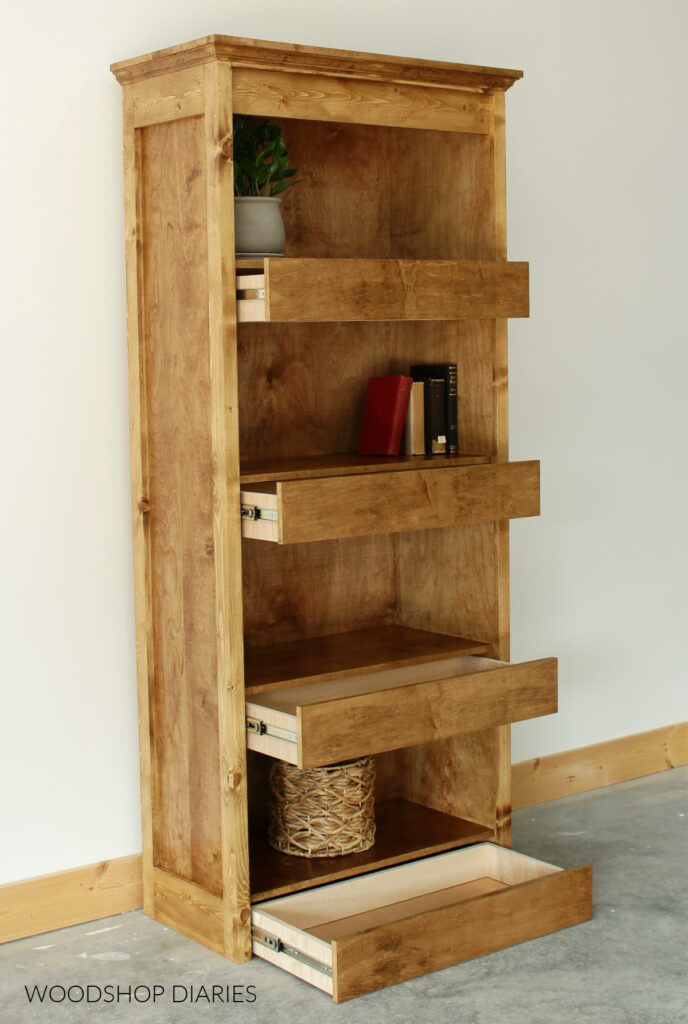
How to Stain Wood Furniture

February 21, 2024 by Shara, Woodshop Diaries

In this post, I’m sharing how to apply stain to new DIY furniture projects to give them a beautiful and durable finish.

Imagine you’ve just completed your latest DIY project. You step back and admire it with pride. The hard part may be over, but it’s not finished yet!

Stained coffee table with flip open top showing a checkerboard underneath

You still need to stain it! Staining your new furniture piece can enhance the grain and natural beauty of the wood while also giving it a color that fits your personal style.

I’ll be honest, I don’t love the finishing process of any project, but I do love staining much more than I love painting! Staining furniture is a little easier (in my opinion) than painting and seems to go a little quicker.

My process for staining raw wood furniture is pretty simple and can be summed up in three basic steps:

  1. Sand
  2. Stain
  3. Poly

I’ll discuss each part in detail below. If you’re looking for details on painting, check out how to paint DIY furniture here.

*This post contains affiliate links. See policies.

WHAT YOU NEED TO STAIN FURNITURE

You don’t need anything fancy to stain wood furniture. Since stain soaks into the wood it’s application is not as intricate as paint. You don’t have to be as careful applying it since you basically just wipe it on, then wipe off whatever doesn’t soak in.

Here is a basic list of the tools and materials I recommend when staining your DIY furniture projects.

  • 220 & 400 grit sandpaper
  • Wood Conditioner
  • Stain
  • Stain rag and gloves
  • Poly/Clear Coat
  • High Quality Brush
Christmas sled against wall with Minwax water based finishing products in front of it on table

This post is focused on finishing indoor furniture. For staining outdoor furniture, the process is similar, but slightly different. For outdoor furniture, I recommend using an outdoor stain and sealant combo (these are often referred to as deck stains).

When using outdoor stains, you don’t usually need to apply wood conditioner or poly. So you can skip step 2 & 4 below. I’ll provide additional details on staining outdoor furniture at the end of this post.

NOTE: If you are staining an OUTDOOR project, you CAN use an indoor stain as long as you cover it with an exterior rated sealant. However, both are likely to fade over time.

WATER VS OIL BASED WOOD STAINS

Wood stains come in water based, oil based, and gel options. I don’t typically use gel stain because it only comes in very limited color options. So below I’ll discuss only water and oil based stains.

One isn’t necessarily better than the other, but they both have their pros and cons. The biggest difference between the two is dry time and color options. Personally, I use Minwax brand stains for most of my projects so that’s what I’m showing below.

Water based stains come in hundreds of colors and can even be custom color matched like paint. It’s also thick like paint, so it’s perfect for staining stencils as it won’t seep underneath them.

Applying water based stains to a stencil using a foam brush

Water based stains dry REALLY fast, so you have to wipe away the excess within minutes. This is fine for small projects, but difficult to do on large pieces. It definitely takes some practice.

You can get water based stains in semi-transparent and solid opacities. Semi-transparent will show more wood grain, but less color. Solid wood stains will have a deeper color, but show less wood grain.

Water Based Wood Stains

PROS:CONS:
No strong odors or fumesDries SUPER fast–not great for large surfaces
Hundreds of color options
Easy clean up
Best for staining stencils

Oil based wood stains are a tried and true classic. They’ve been a go-to finish for years and are less expensive than water based stains. They come in several colors from several different brands, but are mostly only in natural wood color options.

Shara Woodshop Diaries applying oil based stain to dresser frame with an old t shirt

Oil based stains have a long workability so you can work a little slower and not be rushed to wipe it off.

Oil Based Wood Stains

PROS:CONS:
Long workability–great for large surfacesStrong odors and fumes
Richer, deeper colorRags and brushes can combust
Fewer color options

NOTE: Oil based stains have a strong smell during and after application. However, this smell will dissipate once sealed (see step 4 below).

HOW TO STAIN RAW WOOD FURNITURE

Once you’ve chosen your stain type and color, it’s time to apply it. If you’re brand new to staining and a little nervous to try it out on your brand new build, test it out on some small scrap pieces.

You can test different colors on different wood types and get a feel for how to apply it and what it looks like before tackling staining an entire piece.

Staining is really pretty simple, but you learn best by doing, so don’t be afraid to give it a try.

STEP 1: SAND

Just like with painting, it’s still important to sand before staining as well. Check out this post to learn how to properly sand your projects.

Before staining, I sand my entire piece to at least 220 grit WITH THE GRAIN. Sanding against the grain will leave scratches on the wood that will be noticeable when stain is absorbed into them.

Shara Woodshop Diaries sanding plywood on workbench

It’s important to sand EVENLY as uneven sanding can result in uneven staining. Don’t sand one spot for twenty minutes and another for just 5 seconds.

Make sure to remove ALL glue and glue residue from wood surfaces before staining. Glue seals the wood surface, preventing stain from absorbing.

STEP 2: APPLY WOOD CONDITIONER

I’ll admit that I don’t always follow this step and I didn’t used to ever use wood conditioner. However, I’ve grown to understand the importance of it more recently.

Wood conditioner (also called Pre-Stain) is like a primer for stain. You apply it before stain to prevent uneven absorption so you get a more uniform finish. This isn’t *quite* as important with hardwoods (like oak), but softwoods are notorious for splotchy-ness.

rag dipped in Minwax prestain dripping into can

Note that if you’re using water based stain, use water based wood conditioner. If using oil based stain, use oil based wood conditioner.

When I apply it, I like to use a foam brush or a rag and just kind of wipe it over the surface.

Shara Woodshop Diaries applying Minwax wood conditioner to oak cabinet with rag

Make sure to read the label for exact instructions as dry times vary by brand, type, and temperature at application.

After a few minutes, you’ll want to wipe away the excess what hasn’t absorbed into the wood with a clean rag. DON’T SKIP THIS STEP–whatever hasn’t absorbed after a few minutes needs to be wiped off.

*OIL BASED FINISHES CAN SPONTANEOUSLY COMBUST. Make sure to discard brushes and rags appropriately. See product labels for details.

Then, allow the wood conditioner to dry the specified time according to the label before applying stain.

*If you used a water based conditioner, lightly sand with 220 grit sandpaper and remove all dust before staining.

STEP 3: APPLY STAIN

Stain is absorbed into the wood when applied, so it’s not super critical what you apply it with. I’ve had good results from using a brush, an old t-shirt, a stain rag, a sponge. Just make sure to stir the stain before applying.

Wood stain is applied to the wood, allowed time to absorb/soak in, then wiped off. Unlike paint, the stain shouldn’t be allowed to just sit on the surface until it’s dry–the excess that isn’t absorbed should be wiped away.

For oil based stains, I simply apply the stain over the surface of the wood (using a brush or a rag) then come back and wipe away the excess after about 15-30 minutes. Oil based stains don’t dry very quickly, so you have a longer working time.

Close up of applying oil based stain to oak plywood with a brush

*If using a brush, make sure to use a brush designed for oil based finishes.

Since oil based stains can take hours to dry, you have plenty of time to apply, then come back and wipe away/smooth out the stain. This makes it really easy to kind of blend it all together for an even finish.

Shara Woodshop Diaries applying oil based wood stain to shelf with a rag

TIP: If you use an old t shirt or rag with oil based stains, I recommend using gloves as the stain can and will soak into your skin and is sometimes difficult to remove.

But for water based stains, they dry REALLY quickly. It’s important to wipe away the excess almost immediately. (This is why water based stains are tricky on larger projects–you can’t allow it to sit very long.)

I prefer to apply water based stains with an inexpensive foam brush. Once applied, quickly wipe away the excess with a clean rag in the same direction as the wood grain.

Water based stains are tricky to “blend.” So if you stain one section of a board, then move onto another section, where they meet, it may not blend together seamlessly. So when possible, it’s best to apply stain to one entire piece or board at a time (work quickly!), then wipe it off.

If you run into issues where the water based stain isn’t blending, if it hasn’t fully dried yet, you can apply a fresh (wet) coat of stain on top and try again. Adding a fresh coat kind of loosens up those dry spots to give you a little extra working time to smooth things out.

It’s difficult to smooth out water based stains on inside corners, so when working with water based stains, it’s often best to stain pieces individually before assembling.

Whether using water or oil based stains, the stain needs to dry before applying a clear coat on top. Check the can for appropriate dry times. Oil based stains need a much longer dry time than water based stains.

STEP 4: APPLY A CLEAR COAT

Once the stain is dry, I add a clear coat to protect the finish and brighten the grain.

You can apply waxes or oils as a clear coat, but when I use stain, I like to seal it in using a water based clear coat. Oil based clear coats tend to yellow over time. Water based stains stay clear.

Also, yes, you can apply a water based clear coat over an oil based stain as long as the stain has had adequate time to dry (check the label).

For indoor projects, Minwax Polycrylic works well and for outdoor projects or projects that will be exposed to water (like countertops or vanity tops), I use Minwax Water Based Helmsman.

Follow the directions on the can and stir well before applying.

Close up of applying Minwax Polycrylic to stained DIY project made of oak plywood

I brush with the grain in long, even swipes with a HIGH QUALITY BRUSH to minimize brush strokes. Then, I allow to dry and sand with 400 grit paper between coats. Apply 3-4 coats for best results.

You can learn more about finishing table tops with poly in this post.

Polycrylic used to seal dining table top

As time goes on and the finish wears, you can reapply a fresh coat of poly by cleaning (remove any grease or dirt) and sanding the surface evenly with 400 grit sandpaper and applying 1-2 coats as needed.

Staining Outdoor Furniture

When you build a piece of furniture for use outdoors, you want to make sure it’s properly protected from weather damage from sun, rain, and snow.

The easiest way to do this is to apply an outdoor sealant. These come in a wide variety of brands, colors, and opacities. Thompson’s Water Seal, Olympic, Cabot, Valspar are all common outdoor stain and sealant brands you can find readily available in the big box store or local hardware stores.

Cabot Australian timer oil can sitting on workbench

Most of the options you see available off the shelf come in a clear transparent, a tinted transparent, a tinted semi-transparent, and a tinted solid.

Basically anything with a tint is a stain and sealant all-in-one and the “less transparent” you go, the more protection it provides. Solids provide more protection than transparent. However, transparent allows you to see the wood grain more.

So choosing one is mostly based on how you want it to look and how often you want to reapply. Transparent stains will need to be reapplied more often than solids. But, none of these products will last forever, so be prepared to reapply every 2-5 years regardless.

Once water no longer beads up on the surface, it’s time for another coat.

To apply, follow step 1 above–you still need to sand outdoor projects! Then skip to step 3 and apply the outdoor stain and sealant. There’s no need to follow up with a clear coat since this is already built into the stain.

More Projects to Practice Staining

If you’re looking for some projects to practice your new staining skills, here are some unique project ideas!

Scrap Wood Sunflowers
DIY Christmas Sled
DIY Tic Tac Toe Game
Game Board Coffee Table
Scrap Wood Pumpkin Sign

If you’d like to save this post for later, be sure to pin it or share it to your favorite social channel!

Pinterest collage showing close up of staining plywood on top and applying clear coat to plywood on bottom with text "how to simply stain furniture"

Until next time, friends, happy building!
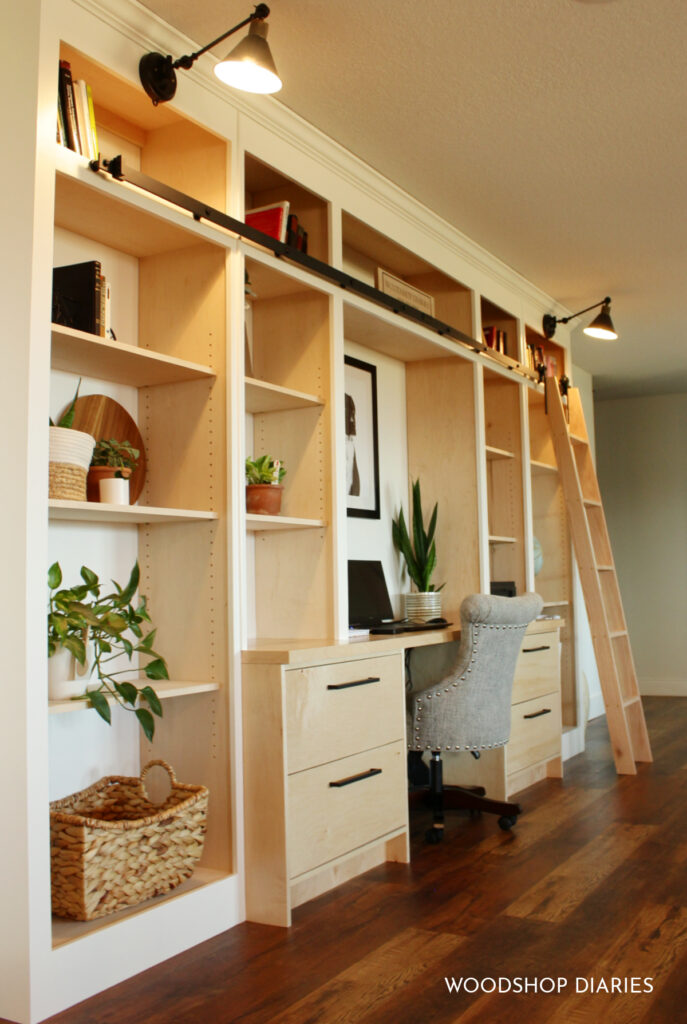
How to Make a Drying Rack Drawer

February 20, 2024 by Shara, Woodshop Diaries

In this post, I’m sharing how add a drying rack to a new or existing drawer!

This is a simple and fun addition to your laundry room, but could also be handy in a bathroom vanity or kitchen cabinet as well!

Drying rack installed as a drawer in base cabinet in laundry room

Have you ever wanted to air dry a delicate piece of clothing or a decorative item that you didn’t want to shrink in the dryer? A drying rack is the perfect solution.

But…maybe you’re not a fan of them hanging on the wall–like me! Here’s a simple solution to give you a place to air dry that you can pull out when you need it and hide away when you don’t.

This drying rack drawer is an easy DIY project that you can add to a new cabinet or an existing cabinet and I’ll show you how to make it in the steps below!

*This post contains affiliate links. See policies.

What to consider before building

Whether you’re wanting to add this drying rack to an existing cabinet where a drawer is already or you want to add this from scratch, either way is doable.

But there are a few things to look at and consider differently in each case.

Replacing an existing drawer box with a drying rack

If you’re wanting to replace an existing drawer box in one of your cabinets with a drying rack, first check to see what type of drawer slides you have. If you have side mount slides, this will be really easy to swap out.

For existing side mount slides:

Remove the drawer box from the cabinet. Then unscrew the slide brackets from the existing drawer box.

driving screws into side mount drawer slides in drawer box

If you have undermount drawer slides on your existing drawers, I recommend swapping for side mount slides for this particular drawer.

Undermount slides mount along the bottom of the drawer and this drying rack doesn’t have a bottom, so side mount slides work best in this case.

For existing undermount slide drawers:

Remove the drawer box from the cabinet, then remove the slides. Measure the length of the slides, and pick up a pair of side mount slides this same length or shorter to replace them with.

Learn how to install side mount drawer slides into new or existing cabinets here.

Adding a drying rack to a new cabinet

If you’re installing a drying rack into a new base cabinet that you are building from scratch, you will install it just like you would a basic drawer box using side mount slides.

drying rack drawer installed into new base cabinet in workshop

The only difference is that the drying rack will be shorter in height than a typical drawer box.

How to Build a Drying Rack Drawer

Building the drying rack is very simple and should only take 10-15 minutes to assemble. Feel free to modify the spacing between dowels to suit your own needs and preferences.

Tools & Materials

Tools:

  • Drill/Driver
  • Miter Saw (or any saw to cut straight lines)
  • ¾″ Forstner bit
  • Pocket Hole Jig (optional)

Materials:

  • 1x2s or 1x3s (amount depends on drawer size–see step 2)
  • ¾″ dowel rods (amount depends on drawer side–see step 2)
  • 1 ¼″ pocket hole screws or wood screws

Step 1: Determine Drawer Size

First, determine the size to make the drying rack. You really just need to find what length and width to make it because the height won’t matter in this case.

Basically, you can think of this drying rack as a drawer box. This guide details how to determine drawer size to fit your cabinet.

Normally, with side mount slides, the width of the drawer is the width of the opening -1″. The length of the drawer should match the length of the drawer slides.

Step 2: Cut Drying Rack Pieces

Once you have the overall dimensions for the drying rack, you’ll need to cut down your pieces. For the drawer/drying rack sides, 1x2s or 1x3s would work great, but you could also use scrap ¾″ plywood strips, too.

Cut two pieces the length you want your drying rack for the sides. Then, cut two more pieces 1 ½″ shorter than the width you want your drying rack for the front/back pieces.

Shara Woodshop Diaries holding boards together in a square on workbench

Then, determine how many dowels you want for the drying rack–these are the pieces you’d hang your things on to dry. Cut your dowels ¾″ longer than the front/back pieces.

Step 3: Drill Holes for Rack Dowels

The dowels will be installed into holes drilled along the sides.

Determine how far apart you can (and want to) place your dowels. Mark their locations along the centerline of the boards.

Marking where to drill dowel holes on sides of drying rack using a Kreg Multimark

TIP: If you don’t like math, here’s how to figure your spacing.

(Length of sides – 1 ½″) / (Number of dowels + 1) = Distance between centers

I had 7 dowels and spaced them about 2″ apart center to center. PRO TIP: Use an odd number of dowels and make your first mark in the middle of the board. Then mark out your spacing from there on each side.

Diagram showing dimensions of spacing for drying rack dowels

Use a ¾″ Forstner bit to drill holes ⅜″ – ½″ deep at these marks.

Close up of Forstner bit drilling holes in sides of drying rack

Step 4: Assemble Drying Rack

Drill ¾″ pocket holes into the ends of the front and back pieces from step 2 to assemble. If you don’t have a pocket hole jig, you can just use 1 ¼″ wood screws to assemble instead.

RELATED: How to use a pocket hole jig

Attach the front and back pieces to one side using 1 ¼″ pocket hole screws. Then, install the dowels into the holes.

Shara Woodshop Diaries installing dowels into drying rack drawer to assemble

Place the other side on so that the dowels seat securely into each hole, then attach with 1 ¼″ pocket hole screws.

Assembling drying rack drawer with dowel rods using pocket holes and screws

You can add glue to the dowels if you’d like , but it’s not necessary.

Step 5: Finish & Install Drying Rack Drawer

Apply a clear coat sealer to the drying rack (a spray clear coat is easiest to apply to these dowels).

Then, install onto the drawer slides. In this case, I like to install the part of the slides that mount to the drawer onto the sides of the rack.

Attaching side mount drawer slides to drying rack

Then you can just slide the rack into the slides in the cabinet.

RELATED: How to install drawers on side mount slides

Sliding drying rack into cabinet on side mount drawer slides

Finish up by adding the drawer front. If this is replacing an existing drawer box, reattach the old drawer front using screws through the front of the drying rack.

If you’re adding this to a brand new cabinet, build and install a drawer front whatever style you like. I screwed in a solid ¾″ plywood drawer front using 1 ¼″ screws through the inside of the front piece of the drying rack.

RELATED: How to attach drawer fronts

Attaching Drawer front using screws from the inside

And now your drying rack is ready to use! I love how simple this is, but it’s such a handy addition in the kitchen, laundry, or bathroom to dry clothes, rags, and towels.

Completed drying rack drawer installed into base cabinet in laundry room with rag and shirt hanging from it

Looking for More Simple DIYs for the Home?

Here are a few more simple and practical DIYs for the home you might enjoy building, too!

Easy DIY Boot Tray
Tea Box with Mug Holder
DIY Book Stand
DIY Serving Tray with Handles
DIY Basic Cutting Board
Freestanding Boot Rack
Scrap Wood Key Holder Catch All

If you’d like to save this project for later, don’t forget to pin it or share to your favorite social channel!

Pinterest collage image showing drying rack drawer sliding into cabinet at top and completed rack on bottom in laundry room

Until next time, friends, happy building!
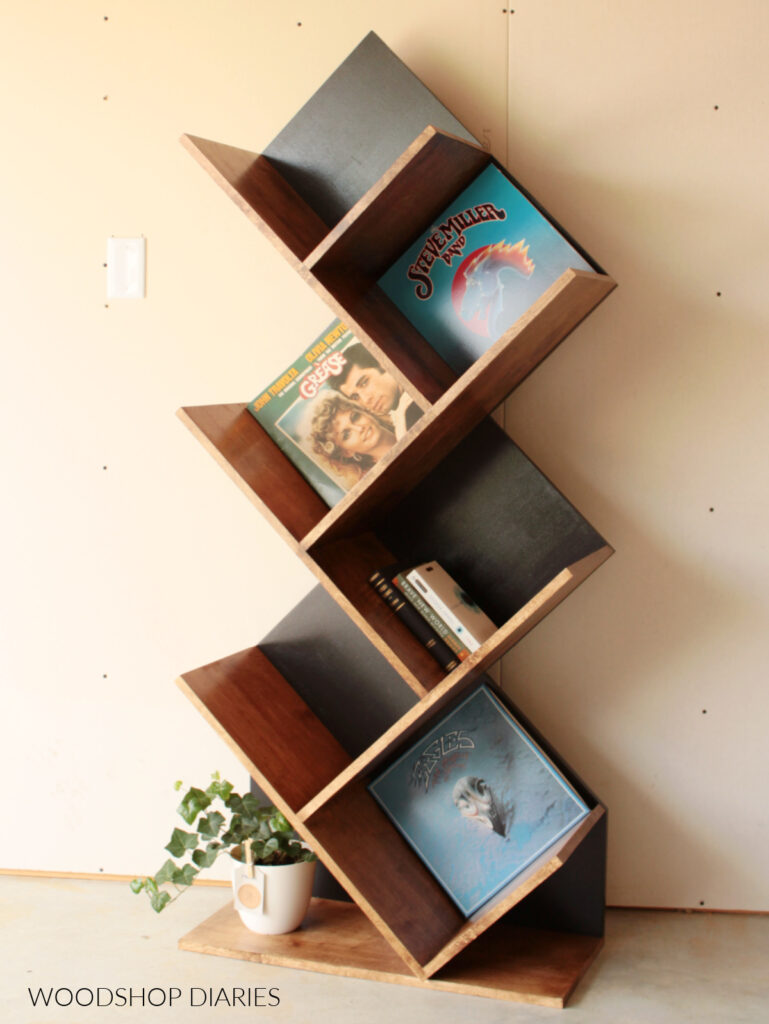
How to Build Upper Cabinets

February 16, 2024 by Shara, Woodshop Diaries

In this post, I’m sharing how to build simple upper cabinets with face frames.

Upper cabinets are common for storage in kitchens, laundry rooms, bathrooms, garages, and pantries. This basic style of cabinet is easy to build and customize to fit your space and your needs.

Shara opening DIY upper cabinet door to show adjustable shelving inside

I built these particular cabinets to go above the washer and dryer in my laundry room to give me extra storage for detergent and cleaning supplies.

For this particular post, we are focusing on upper cabinets. But, if you’d like to learn about lower cabinets as well, check out this tutorial on building basic base cabinets to match!

*This post contains affiliate links. See policies.

Standard Sizing for Upper Cabinets

While there are some “standards” to follow when building upper cabinets, there are also a lot of ways to customize them depending on your space and how you plan to use them. I’ll share some tips, ideas, and how to implement them below.

Upper Cabinet Height

There isn’t one standard cabinet height for upper cabinets. You sometimes see shorter ones above a fridge or microwave. But in most cases, they’re usually 30″-42″ tall.

How tall you make your upper cabinets is a factor of three things:

  1. Ceiling height
  2. Whether you’re adding molding at the top
  3. Personal preference

The general rule of thumb with upper cabinets is that they should be installed at least 18″ above countertops. Countertops are typically 36″ off the floor, so the bottom of upper cabinets are usually 54″ off the floor.

Diagram showing basic cabinet layout with space between upper cabinets and countertop and max cabinet height

So if your ceilings are 96″ tall, that means your upper cabinets could be UP TO 42″ tall.

If you’re adding trim (like crown molding) around the top, the cabinet boxes would need to be a little shorter to allow room for that.

Then, of course, it also depends on your personal preference. If you don’t want to take your cabinets all the way to the ceiling, you don’t have to! Feel free to make them only as tall as you can easily reach.

Upper Cabinet Depth

Standard upper cabinet depth is 12″. However in more recent years, I’ve seen 14″ become more and more common.

Personally, I like to make mine about 13″ since it’s right there in the middle.

Take note that cabinets above refrigerators and microwaves are often deeper since they’re more of a “specialty” type cabinet.

One thing I like to note about cabinet depth is to consider whether you’re going with inset or overlay doors. Learn the difference between inset and overlay here.

Diagram of upper cabinet showing overall depth with overlay door

If I’m building cabinets with overlay doors, I include the door in my overall cabinet depth. So I make my overlay cabinet boxes slightly shallower (about 1″) than my inset cabinet boxes. That way when the door is added on the front, it’s still only 13″ deep overall.

Upper Cabinet Width

Upper cabinet width varies greatly and is usually where most customizations take place to fit your space.

However, if you’re buying premade cabinets, they do come in some standard width options: 12″, 15″, 18″, 21″, 24″, 30″, 36″. You may sometimes find them in a few other sizes, but these are most common.

Diagram of upper cabinet showing cabinet width dimension

If you’re building them yourself, the size possibilities are endless. The best part about building your own base cabinets is that you can customize them to fit your exact space and make them whatever width you need.

Face Frame vs. Frameless Cabinets

Cabinets can be made with or without face frames. In the United States, face frame cabinets are most common, but in other parts of the world, frameless (also sometimes called “Euro”) cabinets are used often.

Construction of the cabinet box is very similar, but cabinets with face frames have an extra frame added onto the front.

Diagram of frameless upper cabinet vs face frame upper cabinet

In this post, I’m sharing how to build cabinets with face frames, but you can check out this tutorial for how to build frameless cabinets as well.

What to consider before building upper cabinets

Building your own upper cabinets is a pretty simple project. But, while the cabinet assembly itself is easy, a little pre-planning of your design can help you avoid common “oops” moments during assembly and installation.

Creating Built In Filler Strips

Often, built ins and cabinets will have some filler strips in certain places. These are basically spacers to either fill a gap between cabinets, or create space for clearance.

When upper cabinets are going against a wall, they will often need a filler strip for a few reasons:

  • to accommodate for unsquare inside drywall corners
  • to allow clearance for cabinet doors and drawers

If you can think ahead in your design, you can build these “filler strips” into the face frame instead of having to piece them together after they’re built.

In this example, I am installing two cabinets above my washer and dryer. The far left cabinet will be against a wall, so I used a wider piece on the face frame there and let it overhang the cabinet sides by about 1″.

Shara Woodshop Diaries nailing face frame onto front of upper cabinet with overhang on left side

That’s essentially building a 1″ wide filler strip right into the face frame.

Inset vs Overlay Doors

Cabinets can have either inset or overlay doors. Inset door set inside the face frame and overlay components lay over the front of the face frame.

Diagram of upper cabinets showing inset doors on left and overlay doors on right

Overlay doors and drawers can lay over the face frame by varying amounts. It’s important to choose how much overlay you want before building so you know what size to make your pieces and what type of hinges to use.

  • Learn more about sizing inset and overlay cabinet doors here.

Are DIY projects your thing? Sign up for our newsletter for priority access to the latest projects and build plans!

How to Build Upper Cabinets with Face Frames

Prefer to watch? I’ve put together a full build video showing how to build basic upper cabinets here on my YouTube channel:

Youtube thumbnail image for video on how to build basic upper cabinets

Love watching how-to videos? Subscribe to my YouTube channel for plenty more where that came from!

Helpful resources for this build:

  • How to cut plywood sheets
  • How to use a pocket hole jig
  • How to size cabinet doors
  • How to build a cabinet door
  • How to install a cabinet door
  • How to add adjustable shelves to furniture and cabinets

Prefer to print? Grab printable wall cabinet box building plans here:

Tools & Materials

Tools:

Check out this post for the top ten tools I recommend for cabinet building

  • Circular Saw
  • Cutting Guides–Kreg Rip Cut & Kreg AccuCut (optional)
  • Miter Saw (optional)
  • Pocket Hole Jig
  • Drill/Driver
  • Stapler or Brad Nailer (optional)
  • Shelf Pin Jig
  • Concealed Hinge Jig

Materials*:

  • ¾″ plywood for cabinet boxes (birch or maple recommended for cabinets)
  • ¼″ plywood for back panels
  • 1x2s & 1x3s (for face frames)
  • 1 ¼″ pocket hole screws
  • Wood Glue
  • Shelf Pins
  • Concealed Hinges (type will depend on door style–learn more about hinge types here)
  • Material for doors–varies depending on style. See notes above.

*Material amounts will vary depending on your cabinet size and number of cabinets needed. In most cases, one ¾″ sheet of plywood will make about 2 cabinet boxes.

Step 1: Cut Plywood to Size

The first step to building cabinets is simply cutting down the plywood. Below I’ve shared an example plywood cut diagram for the ¾″ plywood.

plywood cut diagram for upper cabinet assembly

First, I ripped my sheet into four 11″ wide strips using a Kreg Rip Cut with my circular saw. These strips can be cut down into side panels and cabinet top/bottoms as you can see in the diagram above.

In my case, I cut my sides to 40″ and I cut my top/bottom pieces 1 ½″ smaller than I wanted my overall cabinet width to be. You can adjust this to make whatever size cabinet you wish. The remaining pieces can be used for shelving and supports.

Note that you can get almost two cabinet boxes from one sheet in most cases unless you’re building a really wide cabinet.

Each cabinet box needs two side panels, a top and bottom panel, a top support strip, and a bottom support strip (both strips cut the same length as the top/bottom panels).

exploded view of upper cabinet box assembly

The support strips will be what you screw through to install. I made my bottom strip 1 ½″ wide and my top approximately 3 ½″–but the exact widths aren’t critical if you want to make them different sizes.

Grab the printable wall cabinet building plans here!

Step 2: Assemble Upper Cabinet Box

There are many ways you can assemble an upper cabinet box, but I prefer to use pocket holes and screws.

RELATED: How to use a pocket hole jig for cabinets

So I drilled ¾″ pocket holes into the ends of my top and bottom panels and support strips. If you’d like to attach the face frame (see step 3) using pocket holes, I suggest drilling pocket holes along the front edges of the sides, bottom and top now, before assembling.

Then I assembled the cabinet box using pocket hole screws like shown below. Note that the bottom panel sits on top of the bottom support. It won’t be flush to the bottom of the sides.

Shara Woodshop Diaries assembling upper cabinet box on workbench

Once it was assembled, I used a brad nailer to kind of “tack” the bottom panel to the bottom support just to pull them nice and tight.

Shara Woodshop Diaries brad nailing bottom panel to bottom support of upper cabinet box on workbench

Step 3: Assemble & Attach Upper Cabinet Face Frame

Once the upper cabinet box was together, I measured the overall size of the front of the cabinet, and cut 1xs to make face frames this size. I used 1x2s for the sides, but 1x3s for the top and bottom pieces.

RELATED: Understanding lumber sizing–why a 1×2 isn’t 1″ x 2″

diagram showing 1x2s and 1x3s used to assemble upper cabinet face frame

*See notes above about adding a built in filler strip. If you need to add filler onto one side of your face frames, I recommend using a 1×3 instead of a 1×2 for that piece and making the face frame 1″ wider than the cabinet. Allow the extra 1″ of material to overhang the wall side of the cabinet when attaching.

I assembled my face frames with pocket holes and screws. Then, I glued and nailed them onto the front of the cabinets.

Shara Woodshop Diaries nailing face frame onto front of cabinets

When I assembled my DIY base cabinets, I used pocket holes and screws to attach the face frames. You can certainly use that method here instead of wood glue and nails.

PRO TIP: When building and attaching face frames, it’s better to err on the side of a little too big than a little too small. If your face frame overhangs the edges of your cabinet a little, that’s okay! But if it doesn’t completely cover the front of your cabinet, you’ll have gaps when you install and it will be difficult to hide.

Step 4: Add Adjustable Shelving

I drilled shelf pin holes along the sides of the cabinet boxes to allow for adjustable shelves to be added later. I find it easier to drill these holes before adding the back panel.

Check out this post for more information on adding adjustable shelves to cabinets and furniture.

Shara Woodshop Diaries drilling shelf pin holes with a shelf pin jig into the sides of cabinet box

Step 5: Attach Back Panel

I measured the back side of the cabinets and cut ¼″ plywood panels to cover them. You can skip adding back panels if you didn’t want to grab any ¼″ plywood. But back panels to help to strengthen the cabinets a little and hold them square.

Shara Woodshop Diaries nailing back panel onto upper cabinet box

I stapled these over the back side, but you could also screw or brad nail them if you don’t have a stapler.

PRO TIP: Make sure the back panel is cut square (check that the diagonals are equal) and use it to help pull your cabinet square to it if it’s not already.

Prefer to print? Grab the printable plans to build your own custom size wall cabinets here.

Step 6: Build & Install Cabinet Doors (optional)

Next, I assembled doors for the cabinets. This is a great place to customize your style.

Learn more about how to add cabinet doors in these posts:

  • How to determine cabinet door size
  • How to build a cabinet door
  • How to install concealed hinges
Shara Woodshop Diaries assembling cabinet door on workbench

Step 7: Finish, Install & Trim Upper Cabinets

Once you’re finished assembling everything, putty and sand all nail holes and joints smooth, then prime, caulk, and paint as desired. I painted the cabinets shown in SW Stardew.

Here are some tips for making your DIY cabinets look their best:

  • How to sand wood
  • How to finish raw wood furniture
  • 5 secrets to more professional looking DIYs

Then, I hung the cabinets in my laundry room. To install, locate the wall studs, and raise your cabinet box to the height you want. Make sure the cabinet is level, then screw into the wall studs through the top and bottom supports.

If installing multiple cabinets side by side, screw them together through the face frames (be sure to predrill to avoid splitting the wood!).

Then, I installed my doors onto my cabinets with concealed hinges. Learn how to install concealed hinges here.

Shara Woodshop Diaries installing cabinet door onto upper cabinets in laundry room

I added the shelves into the cabinets using shelf pins, then finished up by nailing trim around the top. I used 1x4s to trim the top, but crown molding would also work well.

Shara Woodshop Diaries attaching trim around top of upper cabinets after installation

And with that, these basic upper cabinets are finished and ready to fill up!

Looking for more information about building cabinets?

Building upper cabinets can seem overwhelming, but don’t let it intimidate you! Building a cabinet is simply building a box.

Here are some resources for cabinet building to help you tackle your project with confidence!

How to Build Base Cabinets
How to Add Adjustable Shelves
How to Determine Cabinet Door Size
How to Build Cabinet Doors
How to Install Cabinet Hinges

If you’d like to save this post for later, don’t forget to pin it or share it to your favorite social channel!

Pinterest collage showing Shara Woodshop Diaries assembling upper cabinet box at top and completed DIY cabinet boxes at bottom with text "how to build basic upper cabinets"

Until next time, friends, happy building!
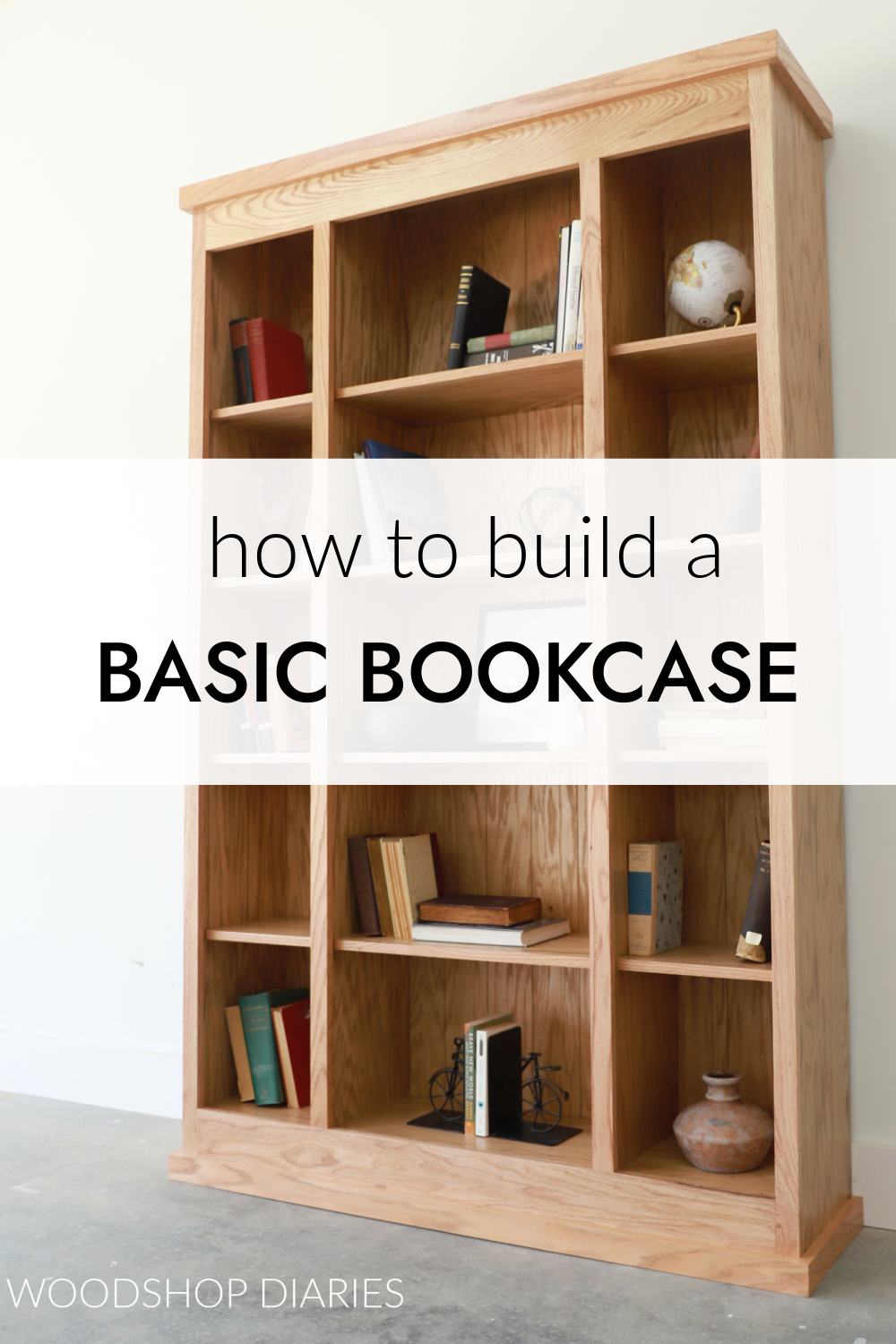
DIY Base Cabinets for Laundry Room

February 9, 2024 by Shara, Woodshop Diaries

In this post, I’m showing you how to build base cabinets with face frames. This basic style of cabinets are simple to build and easy to customize to fit your space and your needs.

And the best part is–you don’t need a ton of fancy tools or equipment to build them!

Simple basic base cabinets--one open, two with doors, and one with drawers--against white wall with butcherblock countertop

I built these particular cabinet boxes to go in my laundry room, however, this exact same style, size, and design of cabinets can be used in a kitchen, bathroom, home office, garage, or anywhere you want to add some storage!

For this tutorial, we are focusing on building base cabinets. Base cabinets are also sometimes called lower cabinets–they are the bottom, deeper cabinets that set on the floor and what the countertop is installed on.

**This post contains affiliate links. See policies.

Standard Sizing for Base Cabinets

While there are some “standards” to follow when building base cabinets, there are also a lot of ways to customize them depending on your space and how you plan to use them. I’ll share some tips, ideas, and how to implement them below.

Base Cabinet Height:

Typically, for spaces where you stand and work at a countertop–like a kitchen, bathroom, or laundry room–standard base cabinet height is 34 ½″ tall.

diagram showing standard base cabinet height

This allows for a 1 ¼″-1 ½″ thick countertop to be placed on top making the total height from floor to countertop about about 36″.

Years ago, standard bathroom vanity height was 30″, but in recent years, 36″ has become more common. So older bathrooms may vary in cabinet height.

Base Cabinet Depth:

Standard base cabinet depth varies depending on where/how they’re being used.

Typical kitchen and laundry room base cabinet depth is about 24″. However, bathroom cabinets are usually closer to 21″ deep.

diagram showing standard base cabinet depth

Standard countertop depth is 25″ for kitchens, laundry rooms, etc. and 22″ for bathrooms. This allows about 1″ countertop overhang off the front of the cabinets.

Base cabinets used in built ins, bookshelves, offices, etc can really vary as needed and don’t have a “standard depth.”

One thing I like to note about cabinet depth is to consider whether you’re going with inset or overlay doors. Learn the difference between inset and overlay here.

If I’m building cabinets with overlay doors, I include the door in my overall cabinet depth. So I make my overlay cabinet boxes slightly shallower (about 1″) than my inset cabinet boxes. That way when the door is added on the front, it’s still only 24″ deep overall.

diagram showing cabinet depth with overlay door

Base Cabinet Width:

There is no “standard” base cabinet width. This varies greatly and is usually where most customizations take place to fit your space.

However, if you’re buying premade cabinets, they do come in some standard width options: 12″, 15″, 18″, 21″, 24″, 30″, 36″. You may sometimes find them in a few other sizes, but these are most common.

diagram showing cabinet width

If you’re building them yourself, the size possibilities are endless. The best part about building your own base cabinets is that you can customize them to fit your exact space and make them whatever width you need.

Face Frame vs Frameless Cabinets

Cabinets can be made with or without face frames. In the United States, face frame cabinets are most common, but in other parts of the world, frameless (also sometimes called “Euro”) cabinets are used often.

Construction of the cabinet box is very similar, but cabinets with face frames have an extra frame added onto the front.

diagram showing frameless vs face frame cabinet boxes side by side

In this post, I’m sharing how to build cabinets with face frames, but you can check out this tutorial for how to build frameless base cabinets as well.

What to Consider Before Building Face Frame Base Cabinets

Building your own cabinets is a pretty simple project. But, while the cabinet assembly itself is easy, a little pre-planning of your design can help you avoid common “oops” moments during installation.

Consider these parts of your space and design before diving in: What kind of toe kick do you want? Do you need any filler strips? What style of doors and drawers will you make?

How to Create a Toe Kick

Most cabinets have what’s called a “toe kick.” This is basically a notch out of the front corner to prevent your feet from kicking the cabinet when you’re standing at it.

There are a few ways to create this notch. You could build a simple 2×4 frame to go under your cabinet box. This frame would be a few inches smaller than the depth of your cabinet boxes and you’d need to make them little shorter since they would rest on this frame.

diagram of two cabinet boxes--one with a separate toe kick frame and one with a notched toe kick in the side panels

OR, you could cut a notch out of the front of the side panels of each cabinet. I prefer this method personally, so that’s what I’m showing below.

Creating Built In Filler Strips

Often, built ins and cabinets will have some filler strips in certain places. These are basically spacers to either fill a gap between cabinets, or create space for clearance.

When base cabinets are going against a wall, they will often need a filler strip for a few reasons:

  • to accomodate for unsquare inside drywall corners
  • to allow clearance for cabinet doors and drawers
  • to allow room to add a baseboard after installation

If you can think ahead in your design, you can build these “filler strips” into the face frame instead of having to piece them together after they’re built.

diagram of cabinets in nook space with arrows pointing to end cabinets. Text says " cut thicker face frames and allow extra overhand on end cabinets

In this example, I am installing four cabinets into a nook in my laundry room. The far left and right cabinets will both be against a wall, so I used wider pieces on the face frames here and let them overhang the cabinet sides by about 1″.

up close image showing built in filler strip added on face frame of cabinet box

That’s essentially building a 1″ wide filler strip right into the face frame.

Inset vs. Overlay Doors and Drawers

Cabinets can have either inset or overlay doors and drawers. Inset components set inside the face frame and overlay components lay over the front of the face frame.

diagram showing inset vs overlay door cabinets side by side

Overlay doors and drawers can lay over the face frame by varying amounts. It’s important to choose how much overlay you want before building so you know what size to make your pieces and what type of hinges to use.

  • Learn more about sizing inset and overlay drawers here.
  • Learn more about sizing inset and overlay cabinet doors here.

Are DIY projects your thing? Sign up for our newsletter for priority access to the latest projects and build plans!

How to Assemble Base Cabinets with Face Frames

Prefer to watch? I’ve put together a full build video showing how to build basic base cabinets here on my YouTube channel:

faux youtube thumbnail of how to build base cabinets video

Love watching how-to videos? Subscribe to my YouTube channel for plenty more where that came from!

Helpful resources for this build:

  • How to cut plywood sheets
  • How to use a pocket hole jig
  • How to size drawer boxes
  • How to size cabinet doors
  • How to build a drawer box
  • How to build a cabinet door
  • How to install a drawer box
  • How to install a cabinet door
  • How to install a drawer front
  • How to add adjustable shelves to furniture and cabinets

Prefer to print? Grab the printable base cabinet building plans here!

Tools & Materials

Tools:

Check out this post for the top ten tools I recommend for cabinet building

  • Circular Saw
  • Cutting Guides–Kreg Rip Cut & Kreg AccuCut (optional)
  • Miter Saw (optional)
  • Jig Saw
  • Pocket Hole Jig
  • Drill/Driver
  • Stapler or Brad Nailer (optional)
  • Shelf Pin Jig
  • Concealed Hinge Jig

Materials*:

  • ¾″ plywood for cabinet boxes (birch or maple recommended for cabinets)
  • ¼″ plywood for back panels
  • 1x2s (for face frames)
  • 1 ¼″ pocket hole screws
  • Wood Glue
  • Shelf Pins
  • Concealed Hinges (type will depend on door style–learn more about hinge types here)
  • Material for doors and drawers–varies depending on style. See notes above.

*material amounts will vary depending on your cabinet size and number of cabinets needed. In most cases, one ¾″ sheet of plywood will make about 2 cabinet boxes.

Step 1: Cut Plywood to Size

The first step to building cabinets is simply cutting down the plywood. Below I’ve shared an example plywood cut diagram for the ¾″ plywood.

plywood cut diagram for basic base cabinets

First, I ripped my sheet into two 22″ wide strips using a Kreg Rip Cut with my circular saw. These strips can be cut down into two side panels and a bottom. I cut my sides the standard cabinet height of 34 ½″.

Then, I cut the bottom 1 ½″ shorter than the overall width I wanted my cabinet box. You can adjust this to make whatever size cabinet you wish.

Note that you can get almost two cabinet boxes from one sheet in most cases unless you’re building a really wide cabinet.

The leftover strip on the right can be saved to cut down for top/back cabinet supports.

plywood pieces for cabinet box cut and being sanded on workbench

Each cabinet box needs two side panels, one bottom panel, and three top support strips (cut to the same length as the bottom panel).

Step 2: Cut Toe Kick

I mentioned in the notes above that you can create your toe kick multiple ways, but I prefer to notch from front corners with a jig saw.

I marked 3 ½″ up and 4 ½″ in on the front bottom corners of each cabinet side panel and cut these out with a jig saw.

close up of jig saw cutting toe kick on base cabinet side panel

Grab the premium printable base cabinet box building plans here!

Step 3: Assemble Base Cabinet Box

There are many ways you can assemble a base cabinet box, but I prefer to use pocket holes and screws.

RELATED: How to use a pocket hole jig for cabinets

So I drilled ¾″ pocket holes into the ends of my bottom panel and top supports. If you’d like to attach the face frame (see step 5) using pocket holes, I suggest drilling pocket holes along the front edges of the sides, bottom and top front support now, before assembling.

Since I am adding a face frame on the front of these cabinets, I needed to consider where to install the bottom panel because I want the top of it to be flush to the opening.

I didn’t want the face frame to hang off the bottom of the toe kick, so I installed the bottom panel up a little (about ¾″) from the toe kick. That way, I can install the face frame flush to it.

diagram showing cabinet without face frame--bottom panel installed up from toe kick. Next to it is a cabinet with face frame showing it's installed flush to toe kick

I attached the bottom panel and three support strips between the side panels using 1 ¼″ pocket hole screws like shown.

Shara Woodshop Diaries assembling base cabinet box on workbench using pocket holes and screws

Note that two support strips run across the top–one at the front and one at the back. These are for installing the countertop later. And the third support strip runs along the back, just below the top support. It’s used for securing the cabinet to the wall studs during installation.

Step 4: Assemble Face Frame

Once the cabinet box was together, I measured the overall size of the front of the cabinet (not including the toe kick), and cut 1x2s to make a frame exactly this size.

*See notes above about adding a built in filler strip. If you need to add filler onto one side of your face frames, I recommend using a 1×3 instead of a 1×2 for that piece and making the face frame 1″ wider than the cabinet. Allow the extra 1″ of material to overhang the wall side of the cabinet in the next step.

I assembled my face frames using pocket holes and screws. Note that this thin material can split pretty easily.

Shara Woodshop Diaries assembling face frame on workbench with pocket holes and screws

A standard size pocket hole jig can work if you’re careful, but I recommend using a Kreg Micro Jig for these thin pieces with pan head pocket hole screws. The smaller holes and screws are less likely to cause splits.

Test fit the face frame over the front of the cabinet before installing. Grab the printable base cabinet plans to get the cut lists for 5 standard sizes plus tips on how to customize your own size.

Step 5: Attach Face Frame

I applied wood glue along the front of my cabinet box, placed the face frame on, then secured using pocket holes through the side and bottom panels and the top front support.

Shara Woodshop Diaries installing face frame onto front of base cabinet with pocket holes and screws.

My cabinets are going into a nook so all the sides will be hidden. I wasn’t worried about seeing the pocket holes here.

However, if the sides of your cabinets will be exposed, you could install using wood glue and finish or brad nails instead. That way, you won’t see a bunch of pocket holes on the sides.

PRO TIP: When building and attaching face frames, it’s better to err on the side of a little too big than a little too small. If your face frame overhangs the edges of your cabinet a little, that’s okay! But if it doesn’t completely cover the front of your cabinet, you’ll have gaps when you install and it will be difficult to hide.

Step 6: Attach Back Panel

I measured the back side of the cabinets and cut ¼″ plywood panels to cover them. You can skip adding back panels if you didn’t want to grab any ¼″ plywood. But back panels to help to strengthen the cabinets a little and hold them square.

I stapled these over the back side, but you could also screw or brad nail them if you don’t have a stapler.

Shara Woodshop Diaries stapling back panel on base cabinets in workshop

PRO TIP: Make sure the back panel is cut square (check that the diagonals are equal) and use it to help pull your cabinet square to it if it’s not already.

Step 7: Install Drawers, Doors, Shelves as Desired

At this point, the actual cabinet boxes are built and it’s time to add the extra components as desired. This is where you can customize the look, style, and function of your basic cabinets.

If you’d like to add shelving inside, learn how to add adjustable shelves to cabinets here.

Base cabinet box with door open showing adjustable shelf inside on shelf pins

If you’d like to add drawers, learn more about how to add those in these posts:

  • How to measure for drawers and drawer fronts
  • How to build a drawer box
  • How to install drawers and drawer slides
  • How to install drawer fronts
Base cabinet with two deep drawer boxes and one top shallow drawer box

If you’d like to add doors, learn more about how to add cabinet doors in these posts:

  • How to determine cabinet door size
  • How to build a cabinet door
  • How to install concealed hinges
base cabinet box with shaker style cabinet door on front

Step 8: Finish and Install

Once you’re finished assembling everything, putty and sand all nail holes and joints smooth, then prime, caulk, and paint as desired. I painted the cabinets shown in SW Stardew.

Here are some tips for making your DIY cabinets look their best:

  • How to sand wood
  • How to finish raw wood furniture
  • 5 secrets to more professional looking DIYs

Level cabinets in their desired location using shims as needed, then secure through the back supports into wall studs to install.

Once cabinets are installed in place, cut to fit a piece of ¾″ plywood strip (or 1×4) to go across the front of the toe kick notches. Paint or stain to match the cabinets, then nail or screw in place.

four base cabinets sitting side by side with butcherblock countertop set on top

Add desired countertop and secure through top supports. You could install granite, quartz, laminate, etc. I’ll be installing these cabinets into my laundry room soon (so stay tuned to see them in their final location!) and adding this butcherblock countertop.

Want to Learn More About Building Cabinets?

Building cabinets is simply building boxes. It can seem overwhelming, but don’t let it intimidate you!

Here are some resources for cabinet building to help you tackle your project with confidence!

How to Add Adjustable Shelves
How to Build a Drawer Box
How to Determine Cabinet Door Size
DIY Cabinet Doors
How to Install Cabinet Hinges

If you’d like to save this post for later, don’t forget to pin it or share it to your favorite social channel!

Pinterest collage image showing Shara Woodshop Diaries assembling cabinet box at top and completed DIY base cabinets against white wall at bottom with text "how to build simple base cabinets"

Until next time, friends, happy building!
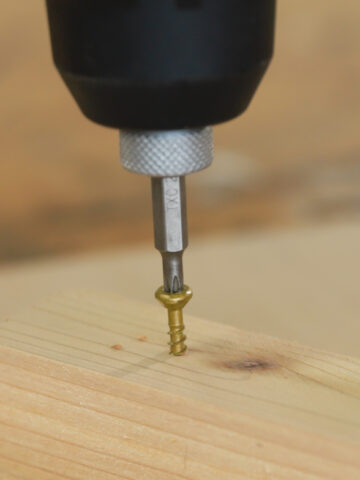
How to Use a Square for Woodworking

January 26, 2024 by Shara, Woodshop Diaries

In this post, I’m showing you a few common and helpful ways to use a basic square in your woodworking projects!

Squares come in various sizes and are often referred to as a speed, a carpenter, a rafter, a quick, and/or a triangle square.

Shara Woodshop Diaries using a square to check board on shoe bench side

No matter what you call them, they’re a must have for woodworking and DIY projects and have many uses.

Below, I’ll show you some of the ways I use a square in my shop for marking, measuring, finding angles, cutting, and checking projects for accuracy.

*This post contains affiliate links. See policies.

What is a Square?

A square is a triangular tool commonly used for measuring, marking, and finding angles.

Squares come in various sizes and with varying features. Most are made from aluminum or heavy duty plastic and have the following features:

  • Fence/Lip: This edge of the square has a lip on both sides so you can rest it flat against a board edge.
  • Pivot Point: This point is the 90° corner of the square. It’s the point you pivot around to find or mark specific angles (more on that later in the post).
  • Ruler: This edge of the square has a ruler etched along it. This measures the distance from the pivot point.
  • Protractor/Angle Markings: The diagonal edge of the square has angle markings from 0° (at the lip) to 90° (at the tip).
  • Scribe Bar: This section of the square has notches (usually every ¼″) starting about 1″ from the lip.
anatomy of a square showing the various parts

Every square may not have every feature, but these are the most common.

PRO TIP: I personally recommend opting for an aluminum square as I’ve found the plastic ones don’t hold up as well (or maybe I’m just too rough on things haha).

My Favorite Square

I have a few different squares in the shop, but my personal favorite is this Milwaukee trim square set–it comes with a larger 7″ and a smaller 4 ½″ square. The bright red color makes them easy to find and the marks are super easy to read.

Milwaukee trim square set--one large and one small

Are DIY projects your thing? Sign up for our newsletter for priority access to the latest projects and build plans!

What Can You Use a Square For?

Speed squares can be useful for so many applications. In this post, we are focusing on basic woodworking, furniture building, and basic DIY applications. But squares also have tons of additional uses in framing and building roofs, large structures and homes.

I frequently use a speed square for:

  • Marking a quick 90° (square) line
  • Marking a quick 45° line
  • Checking a project for square
  • A cutting guide for a saw
  • Finding or marking specific angles
  • Drawing straight lines and offsets

Let’s discuss these uses in more detail below.

How to Mark 90° Lines with a Square

The most common (at least for me) use for a square is to simply draw a square line on a board.

First, just to clarify–when something is “square,” it means it’s at a 90° angle (also called a “right” angle.).

diagram showing straight line vs 90 degree lines

Squares are designed so that the pivot corner is exactly 90°. So if you align the lip of the square against the edge of your board, you can quickly mark a 90° line by running your pencil along the square.

Shara Woodshop Diaries marking 90° line on board with a square

This is super handy for marking basic cross cut lines. First, use a measuring tape to mark the length you want to cut, then come behind it with a square to make that mark a line that’s easier to see.

PRO TIP: Hold the pencil on your measurement mark, then bring the square up to it before marking the whole line. This ensures your line isn’t off a little to the left or right.

This helps line up your saw to make more accurate cuts. Be sure to cut on the WASTE side of the line!

Miter saw shadow line on marked board

It’s also very helpful for lining up a track saw or straight edge when cutting large panels.

Shara Woodshop Diaries using circular saw and Kreg AccuCut to cut plywood panel on shop floor
How to Choose the Right Plywood

How to Mark 45° Lines with a Square

45° angles are very common in woodworking because two 45° angles, when put together, make a 90° angle. These angles are common in picture frames, cabinetry, trim work, and more.

Making 45° marks with a square is exactly like making 90° marks, only you use the other side of the square.

The two other angles of a square are 45°, so if you butt the lip up to a board edge, and mark the angled edge, it’ll be a 45° line.

Drawing a 45 degree line on board using a square

How to Check a Project for Square

When someone says they’re “checking for square,” they’re checking that the corner(s) are 90°.

NOTE: That doesn’t necessarily mean whatever they are checking is an actual square–all sides are equal length. A rectangle is “square” at the corners even though it’s not, by definition, a square.

I often use my square to check that a cabinet box, drawer box, face frame, door frame, etc. has 90° corners after or during assembly. It’s a quick way to make sure you’re on the right track and if not, adjust as needed.

checking dining table legs for square after glue up

To do this, simply place the pivot corner of the square inside the corner of whatever you’re building (like shown in the image above). OR, place it on the outside corner–depending on what you’re checking.

If both sides line up perfectly with the square, the corner is 90°. If the opening is larger or smaller than the square, it needs some adjusting.

How to Use a Square as a Cutting Guide

Just like using a square to make 90° and 45° marks, you can also use it to help make 90° and 45° cuts. While I’d recommend using a miter saw when possible, you can use a jig saw or circular saw with a square to make straight cuts in a pinch.

To do so, mark you board where you want to cut. Make sure to pay attention to which side is the “waste” side of the board–the part of the board you’re wanting to cut off. You want the blade to cut on that side of the line.

Line the blade of your saw up so that it is just to the waste side of the line. Place the lip of the square against the board edge and slide it up to the edge of the saw plate.

Using a jig saw and a speed square to cut a straight line on 2x4

Clamp or hold it tightly in place. Then (make sure your fingers are out of the way!) CAREFULLY cut across the board keeping the saw plate flat against the square.

How to Find and Mark Angles with a Square

You can also use a square to find and mark angles besides just 45° and 90°. This is my absolute favorite feature of the square!

NOTE: Keep in mind that this method may not be SUPER accurate (to the exact tenth of a degree), but it’ll be close enough to work fine in most applications.

Let’s take a look at an example: If you have a board and you want to mark it at 20°, you can place the lip of the square flat against the board edge. Then, keeping the pivot corner tight against the board, pivot the square until the angle mark for 20° is even with the board edge.

Speed square on board pivoted to 20 degrees

By the way, this same process applies for any angle you’d like to mark, not just 20°.

Then, mark your line against the square edge.

marking 20° line on 2x4 board with pencil

Keep in mind that this mark is 20° OFF SQUARE. So if you take this to the miter saw and adjust to 20°, you’ll cut right along this line. New to DIY? Learn how to cut angles on a miter saw here!

20° line marked off square on 2x4 board

You can use the same method to FIND an angle as well. Let’s say you marked a board where it needs to be cut, but you aren’t sure what angle it is.

You can line up the square’s lip on the edge of the board, rotate along the pivot corner until the edge meets your mark. Then, read what angle the edge intersects on the square.

square on 2x4 showing how to find an angle by lining it up with a marked line

Now, you can take this to the miter saw, adjust to that angle, and cut along the line.

For a great real life application of this, check out this quick video where I share how I used a square to easily figure out the angles to install X trim on these DIY planter boxes:

You can also do the same to figure out the angle of a board that’s already been cut, too! The square is such a valuable tool for finding and marking angles in various projects.

How to Use a Square to Draw Offsets

Another feature on most squares are these scribe marks. These are little notches at (usually) every ¼″. These notches typically start around 1″ away from the lip and span a few inches depending on the size, style, brand of your square.

These allow you to draw straight, even lines a certain offset distance from the edge of a board.

Let’s say you want to draw a straight line 1 ½″ from the edge of a board. You can place the square lip against the edge of the board, and place your pencil in the notch at 1 ½″.

Pencil in scribe notches drawing an offset on 2x4 board

Run the square’s lip along the edge of the board, keeping the pencil tight in the notch. Now you’ve drawn a 1 ½″ offset.

There are a lot of ways this might come in handy, but one common application is drawing corner notches. Maybe you need to notch out 2″ x 2″ corners of a piece of plywood.

You can use the scribe lines on the square to quickly mark 2″ offsets from each edge to cut out without having to grab the measuring tape.

Using a square to mark 2" notch on plywood corner

And while a little challenging, you can also use a square on rounded objects to draw an offset following the outside of the curve.

More Beginner DIY Tips to Get Started

I hope this post has been helpful in introducing you to the square and shown you it’s value in the workshop, home, and tool box!

If you’re ready to tackle a simple project and put these new skills to use, here are a few fun ones that I recommend:

DIY Book Stand
DIY Fall Planter Boxes
DIY Shoe Bench
DIY Ladder Shelf Plant Stand
DIY Plant Shelf

And if you’re new to DIY and looking for more tips on getting started, check out these helpful guides:

How to Read a Tape Measure
How to Cut Angles on a Miter Saw
How to Sand Wood
How to Buy Lumber
How to Draw ANY Size Circle

If you’d like to save this post for later, don’t forget to pin it or share to your favorite social channel!

Pinterest collage image showing using square as cutting guide at top and drawing an angle at bottom with text "how to use a carpenter square for beginners"

Until next time, friends, happy building!
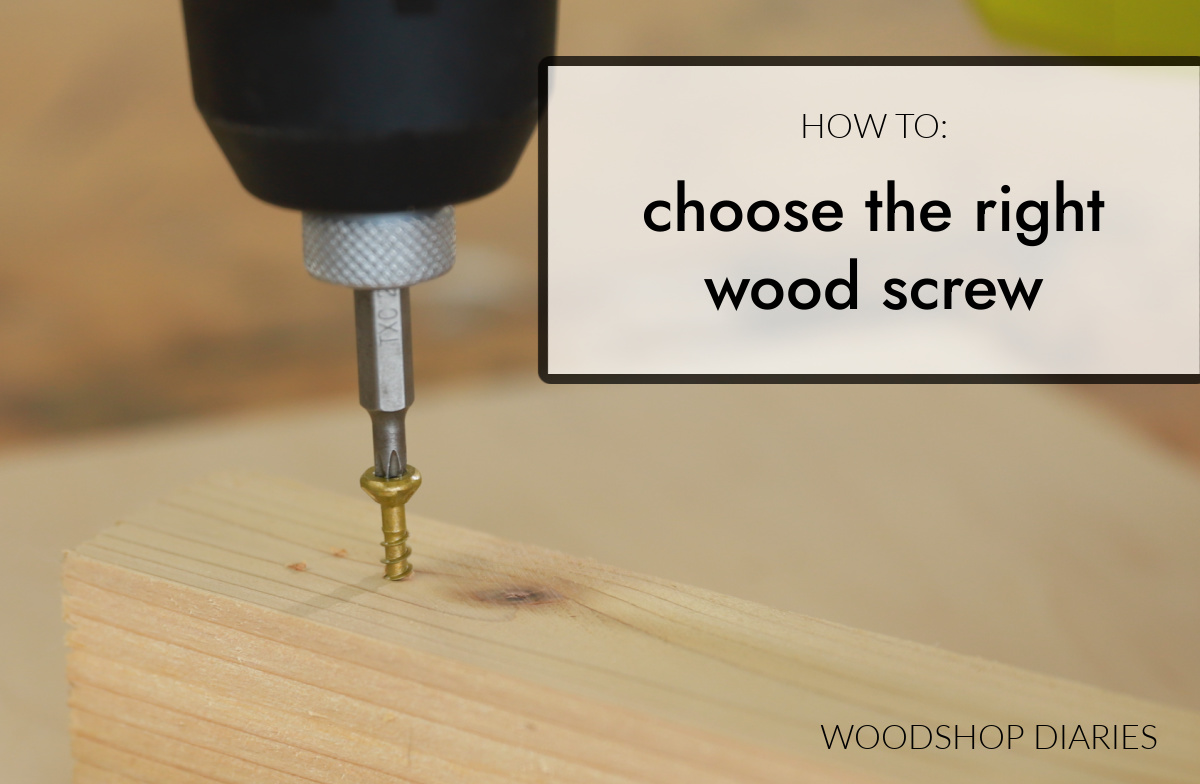
DIY Modern 6 Drawer Dresser

January 24, 2024 by Shara, Woodshop Diaries

In this post, I’m sharing how to build a simple modern dresser with 6 drawers using basic tools and materials!

This particular dresser is part of a matching bedroom furniture series I’ve been sharing. I tried to use clean lines, matching wood types, and similar trim details to tie each piece together–the storage bed, the nightstands, and now, this dresser.

Red oak 6 drawer dresser with 4 larger bottom drawers and 2 smaller top drawers against white wall with vase, basket and framed photo on top

If you’ve seen many of my past projects or followed along very long, you’ve probably heard me mention that dressers are my favorite projects to build. I’ve got several dresser designs to choose from here!

I know dressers can be an intimidating project for some, but I like to think of it as a box (the dresser body) with several more boxes inside (the dresser drawers).

So, if you can build a box, you can build a dresser! There are a million different ways and styles to build a basic dresser, but I’ll show you exactly how this one came together in the post below.

*This post contains affiliate links. See website policies.

Some notes before building

Because there are a lot of parts and pieces that require some careful measuring (learn how to accurately use a tape measure here), I’d consider this an intermediate build. It’s definitely not difficult, but it’s probably not the best option as a very first project.

What kind of wood do you need to build this simple dresser?

This dresser build is made entirely from plywood except for the front and back frames, which are solid. I used red oak for this particular dresser, but any wood type you prefer would work fine.

close up of red oak scrap piece

Construction lumber (like pine, spruce, fir) and birch plywood is a more budget friendly option that would work great as well.

If you’re new to DIY, check out this post to learn more about choosing plywood for your projects and this post about how and where to buy lumber.

Material Sizing

This plan calls for using 2x2s and 2x3s. (Did you know 2x2s aren’t 2″ x 2″? Learn more about understanding lumber sizing here.)

However, in many cases, 2x3s are difficult to find precut. Sometimes you can find them in the construction lumber, but not every store carries them. So I recommend ripping the 2×2 and 2×3 pieces down from 2x4s if you have a table saw.

RELATED: How to cut your own 2x2s

red oak 2x2s ripped on table saw for dresser build

This saves on materials and you can reuse the off cuts for trim on the sides, too! See tutorial video for more information.

Overall Dresser Size

Overall dimensions of this dresser as shown in the plans below are 21 ½″ deep x 30 ¾″ tall x 60″ wide.

Overall dimensional diagram of simple dresser build--60" wide, 21 ½" deep, 30 ¾" tall

Building Dresser Drawers

If you’re new to building drawers, don’t worry! I’ll walk you through the entire drawer building process from start to finish in this drawer building series (with videos!). I’ve broken it down into four parts:

  • How to measure for and size drawer boxes
  • How to assemble a drawer box
  • How to install drawer slides
  • How to install drawer fronts

Prefer to print the whole series? Grab the Ultimate Drawer Building Guide which includes all four parts in a printable e-book you can take to the shop with you.

Matching Bedroom Set

If you’re looking to build the whole set, you can find the plans for the matching pieces here:

  • Matching Storage Bed
  • Matching Modern Nightstand
matching storage bed and nightstands to go with this DIY dresser build project

Helpful resources for this build:

  • How to cut plywood sheets
  • How to apply edge banding
  • How to use a pocket hole jig
  • How to use a dowel jig (optional)
  • How to install drawer slides
  • How to build a drawer box

Are DIY projects your thing? Sign up for our newsletter for priority access to the latest projects and build plans!

How to Build a Simple Dresser

I’ve included the step by step building instructions below along with printable building plans. But, if you prefer to watch, I’ve also included a build video as well. Check out the video for tips, visuals, and some extra clips from behind the scenes!

YouTube thumbnail for simple modern dresser

Love watching how-to videos? Subscribe to my YouTube channel for plenty more where that came from!

Prefer to print? Grab the printable modern 6 drawer dresser building plans here:

Tools & Materials

Tools:

  • Drill/Driver
  • Circular Saw
  • Cutting Guides (optional): Kreg Rip Cut & Kreg AccuCut
  • Pocket Hole Jig
  • Miter Saw
  • Dowel Jig (optional)
  • Clamps
  • Table Saw (optional)

Materials:

  • (2) 4’x8′ sheet ¾″ plywood
  • (1) 4’x8′ sheet ¼″ plywood
  • (3) 2x4x8 boards
  • (1) 1x2x8 board (optional for side trim)
  • ¼″ x 1 ½″ AND ¼″ x ¾″ lattice trim (optional)
  • 1 ¼″ pocket hole screws
  • Dowel Pins (optional)
  • 2″ Wood Screws
  • Wood Glue
  • (6) Pair 18″ Drawer Slides
  • Edge Banding
  • Knobs/Drawer Pulls

Step 1: Assemble Dresser Frame

To start this build, first, I needed to assemble two frames for the dresser. These are the parts of the build that are made from solid wood and will be the front and back.

I used 2x3s for the legs and 2x2s to go between them at the top and about 3″ up from the bottom. So first, I ripped these pieces down from 2×4 boards (see notes above), trimmed them to length and laid them out on the workbench.

Note: 2x4s are 3 ½″ wide and 2x3s are 2 ½″ wide. So if you rip these down, you’ll have a ~1″ thick piece left. And if you rip down 2x2s (which are 1 ½″ wide), you’ll have a ~ ¼″ thick piece left. Save these pieces to use as trim in step 5!

diagram showing assembly of dresser front and back frames

All the dimensions, cut diagrams, and cut lists can be found in the printable building plans here.

You can assemble these frames using 1 ½″ pocket holes and 2 ½″ pocket hole screws if you’d like. But, I assembled them using dowel pins and glue. I built two identical frames.

Shara Woodshop Diaries holding dresser frames assembled in front of workbench

Then, I cut two ¾″ plywood side panels to attach between them using pocket holes and screws. Be sure if driving into hardwood, like oak, you use fine thread pocket hole screws!

RELATED: How to use a pocket hole jig

Shara Woodshop Diaries assembling dresser side panels between frames on workbench with pocket holes and screws

Step 2: Install Drawer Dividers

Once the main body was together, I added the dividers. I installed two strips (2 ½″ wide) between the top and bottom 2x2s–one at the front and one at the back–in the center using pocket holes and screws.

Shara Woodshop Diaries building dresser frame on workbench with pocket holes and screws

I inset the front divider ¼″ from the front of the 2×2 to add some extra dimension.

Then, I attached six strips (what I’ll call “runners”) between these pieces like shown below.

Shara Woodshop Diaries installing dresser drawer runner strips to mount drawer slides onto

These will be used to mount the drawer slides onto, so they need to be placed where the slides will go. Dimensions are detailed in the printable plans.

To divide the drawers up, I also installed some strips between these runners and the sides, again with pocket holes and screws.

Dresser drawer dividers diagram showing installation locations

And again, to add some extra dimension, I installed these ½″ inset from the front of the legs and ¼″ inset from the middle divider.

Step 3: Assemble 6 Dresser Drawer Boxes

At this point, it’s time for the best part (my personal favorite part haha)–building the drawers! I made 6 drawer boxes to fit into this dresser–4 deeper drawers for the middle and bottom and 2 shallower drawers for the top.

I assembled the drawer boxes from ¾″ plywood (for the sides) and ¼″ plywood (for the bottom) using pocket holes and screws.

Check out how to assemble drawer boxes here.

Shara Woodshop Diaries building dresser drawer on workbench

The shallower drawer boxes for the top and the deeper boxes for the bottom are exactly the same dimensions except for the height.

RELATED: How to determine drawer sizing for any project

dresser drawers stacked on top of dresser frame in workshop

Step 4: Install Drawer Boxes

I installed six pair of 18″ ball bearing drawer slides into the dresser to mount the drawers to.

These drawers will be inset and the drawer front will be ¾″ plywood with a piece of ¼″ lattice trim on the front (more on that in just a minute), so it will be 1″ thick total. PS this Kreg MultiMark tool is super handy to have in the shop.

using a MultiMark tool to gauge drawer front thickness

So I installed the slides 1″ inset from the dividers so that the drawer fronts will be flush to them once installed.

RELATED: How to install drawer slides

using a Kreg MultiMark to install slides 1" inset from front edge

Then, I installed the drawer boxes into the dresser. There are several ways to install drawer boxes, but I like to place some ¼″ scrap plywood pieces on the divider below the drawer, pull the slides flush to the front, and simply screw them in.

Shara Woodshop Diaries installing dresser drawers onto drawer slides

This is a quick and easy way to do it that gives you consistent spacing and maximizes the space above for storage.

Shara Woodshop Diaries installing top drawer into dresser frame

Once the boxes were in, I cut drawer fronts from ¾″ plywood to fit the openings. They should be ¼″ shorter and ¼″ narrower than the opening.

Then I applied iron on edge banding to the sides. Edge banding is optional, but it makes plywood edges look really nice–like solid wood! Learn how to apply edge banding here.

To give the drawer fronts some extra detail, I cut some ¼″ thick x ¾″ wide strips to glue onto the front flush to the left and right edges. This is similar to the trim I added on the head and footboards of the matching storage bed.

Screwing drawer front onto drawer box from inside

Then I placed these into the openings, made sure the gaps on all sides were even (⅛″), and screwed them in from the inside of the drawer box.

Step 5: Add Side Panel Trim

Adding trim onto the sides is optional, but helps dress this up a little. Remember those off cuts I mentioned that will be left if you cut your 2x2s and 2x3s from a 2×4 board?

This is where those come back into play! I cut to fit the thicker strips to go along the top and bottom of the side panels and the thinner strips to go vertically between them.

gluing trim onto side panels of red oak dresser build

I just glued and clamped these in place until they were dry on each side. If you didn’t rip your boards and you don’t have these pieces, a simple 1×2 and some precut lattice trim would work just as well!

Step 6: Attach Top

Finally, I trimmed a piece of ¾″ plywood 1″ wider and ½″ deeper than the dresser base and edge banded the front and sides.

I flipped it all upside down and made sure there was ½″ overhang on the top (it should be flush across the back) and ½″ overhang on each side.

driving 2" wood screws to attach top to dresser frame

Then, I secured the top using 2″ wood screws through the top 2x2s of the dresser. NOTE: I recommend removing the drawers (using the tabs on the sides of the slides) to make this part much easier.

Step 7: Finish

While the drawers were still out, I applied a wood stain (Minwax Weathered Oak) to the drawer fronts and the dresser body, then sealed it with a few coats of Minwax Polycrylic.

Shara Woodshop Diaries staining simple dresser with Minwax Weathered Oak

I added some simple black knobs to the drawers, then slid them back into the dresser to complete.

AND THEN, I completely forgot to add a support in the middle until the VERY END. Whoops!

I made this little support block to attach to the bottom drawer runners in the middle to help prevent this from sagging over time. Basically, I cut a piece of 2×3 and screwed it to a piece of plywood to make kind of like a “T” shape.

Installing middle support onto simple dresser build to prevent sagging

Then I screwed the plywood to the runners on the dresser. That way, when it’s flipped back upright, the 2×3 helps prop the middle up so it won’t sag.

And with that, this dresser is complete and ready to go!

Close up of completed DIY 6 drawer dresser build looking at top left drawer front
6 drawer dresser completed with top and middle drawer open slightly
Finished 6 drawer red oak modern dresser build against white wall stained in Weathered Oak

A Note About Adding a Back Panel on the Dresser

Adding a back is optional. Some people have really strong feelings that all dressers should have backs. However, I don’t like adding backs onto things that have drawers–it’s just always been a peeve of mine. I know–kind of weird haha.

So, I didn’t add a back to this project, but if you’d like to, it’s easy to do. Simply cut a ¼″ plywood piece to fit over the back side and staple/screw it in place.

Looking for More DIY Dresser Ideas?

I love building dressers, so I’ve got plenty more styles, sizes, and designs to share. If you’re looking for more, check out a few of my favorites here:

3 Drawer Dresser
DIY Mid-Century Modern Dresser
DIY Modern Dresser
DIY 5 Drawer Dresser
Simple DIY Dresser

If you enjoyed the project and want to save it for later, don’t forget to pin it or share to your favorite social channel!

Pinterest collage image showing overall dimensional diagram at top and Shara Woodshop Diaries at bottom with completed dresser build with text "how to build a simple dresser with printable building plans"

Until next time, friends, happy building!
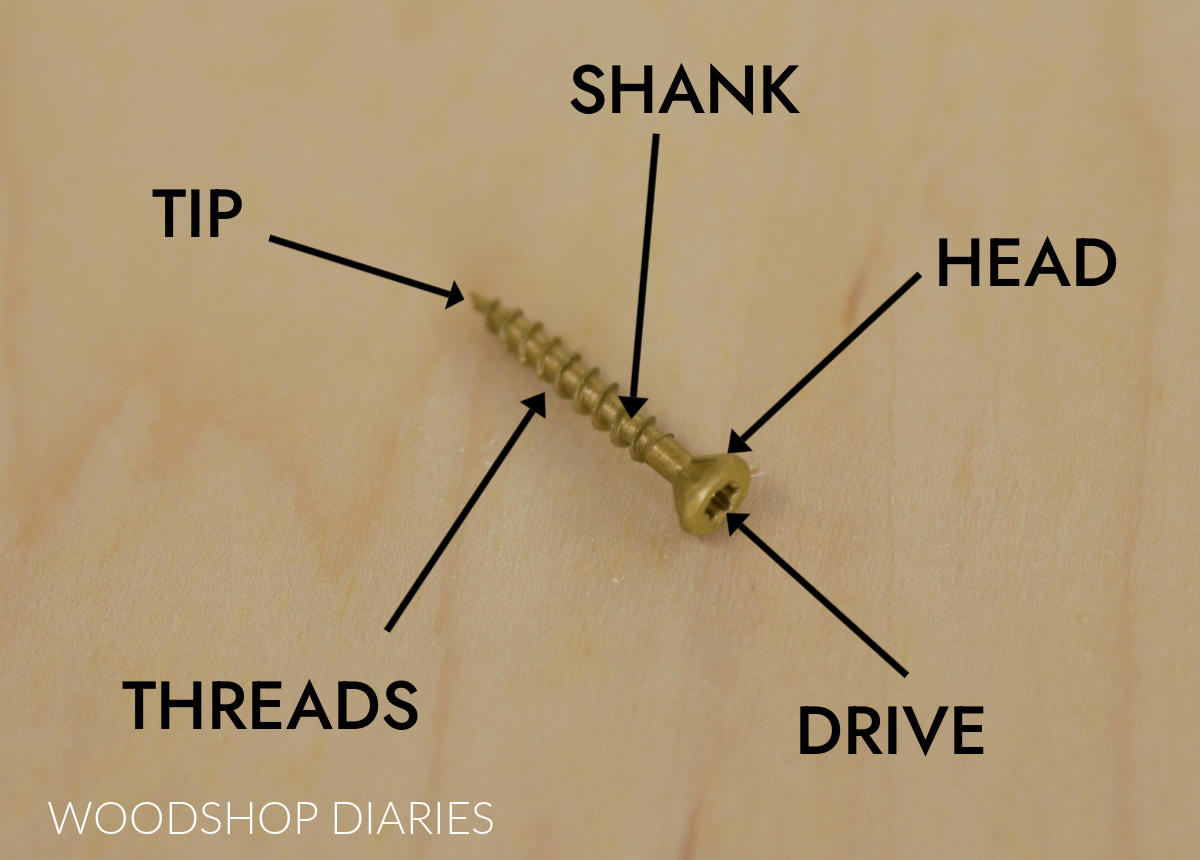
How to Build a Modern Nightstand

January 17, 2024 by Shara, Woodshop Diaries

In this post, I’m sharing how to build a simple modern nightstand with a drawer and two open shelves!

This simple, but stunning bedside table was designed to match the DIY storage bed that I shared recently. And as you can see below, I think they go together nicely.

Red oak modern nightstand sitting next to DIY storage bed in bedroom with vase on top and blanket on bottom shelf

This design is clean and modern and the combination of drawer storage and shelving make it versatile and convenient.

Use the drawer for keys and glasses, the shallow top shelf for books, and the larger bottom shelf for baskets or blankets.

I’m sharing the step by step instructions below to build your own, along with a video tutorial and plenty of helpful tips. So…let’s get building!
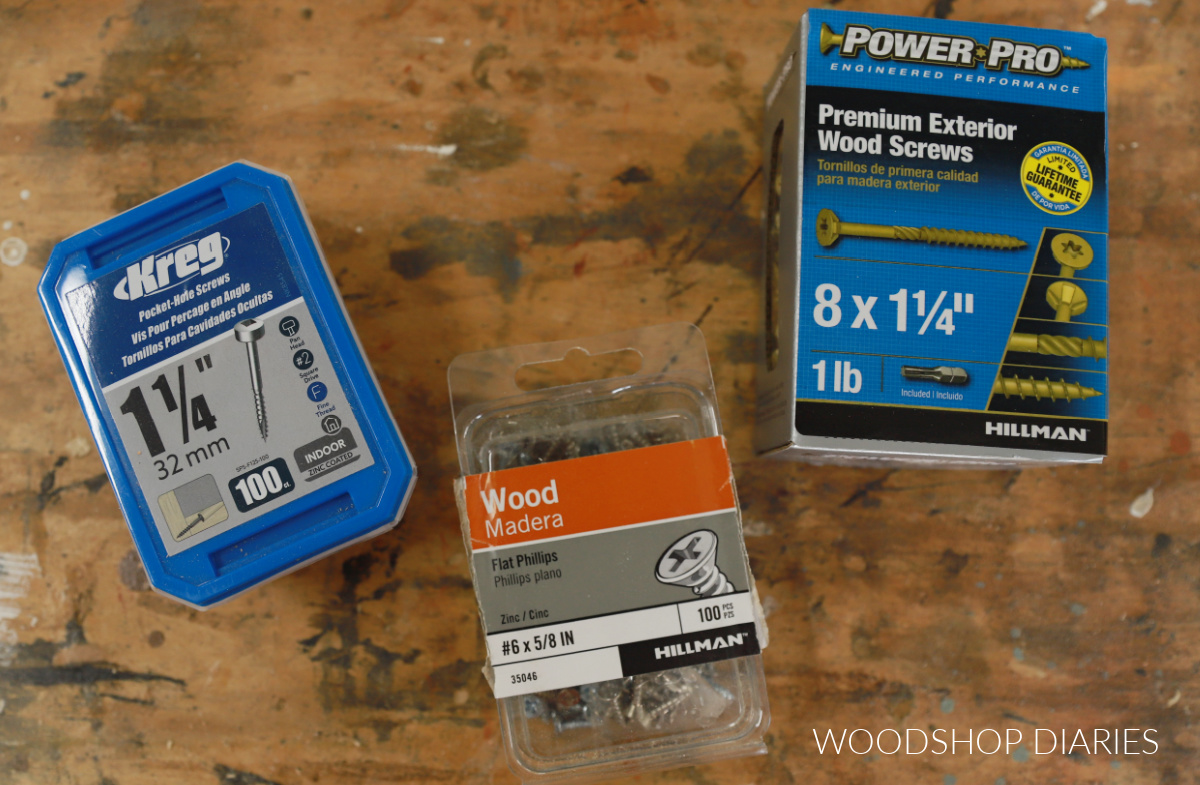
*This post contains affiliate links. See website policies.

What to know before building Modern Nightstand

This DIY modern nightstand project is a simple build you can easily complete in a weekend. It works great as a bedside table, but you could also use it as an end table or small entryway table, too.

It’s versatile and an excellent beginner to intermediate build! Overall dimensions of this nightstand are 17 ½″ deep x 24 ¾″ tall x 27″ wide.

Overall dimensions of DIY modern nightstand design with drawer and two shelves

Choosing a wood type

The nightstand shown here was made using both solid red oak and red oak plywood–just like the matching storage bed. However, if you’d prefer to use another wood type for your build, that’s perfectly fine!

close up image of a piece of red oak lumber

Birch plywood (or pine plywood in a pinch) and construction lumber (pine/spruce/fir) would work great as a more budget friendly option.

RELATED: How to choose plywood for your project

Keep in mind when using pocket holes and screws that you need to use fine thread pocket hole screws when driving into hardwoods (like oak). You need to use coarse thread pocket hole screws when driving into softwoods (like pine) and plywood.

Dowels vs Pocket Hole Assembly

The front and back frames are made from 2x2s in step 1. You can assemble these using EITHER dowel pins and glue OR pocket holes and screws.

The majority of this nightstand build was assembled using pocket holes and screws. However, I used dowel pins and glue when assembling the frames in step 1. You can certainly use another joinery method to build this project if you’d rather.

RELATED: How to use a dowel jig

Dowel jig, square, dowel pins and clamp on workbench top

Note in the tools and materials list below–if you use dowels for this part, you’ll need a dowel jig and dowel pins. But if you use pocket holes and screws to assemble them, you don’t need either of those. You’ll need 2 ½″ pocket hole screws instead.

Building a Pair of Nightstands vs One

The plans and materials list below are for a single table–not a pair. However, if you wanted to build a pair, you only need one additional pair of 14″ drawer slides, one additional 2x2x8 board and ¼ sheet more of ¾″ plywood.

Pair of matching modern DIY nightstands with drawer in top and shelves on bottom--built from red oak lumber

Are DIY projects your thing? Sign up for our newsletter for priority access to the latest projects and build plans!

How to Build a Modern Nightstand with Shelves

You can find the step by step building instructions below along with printable building plans. But, if you prefer to watch, I’ve also included a build video as well. Check out the video for tips, visuals, and some extra clips from behind the scenes!

YouTube thumbnail of "how to build modern nightstands" video

Love watching how-to videos? Subscribe to my YouTube channel for plenty more where that came from!

Helpful resources for this build:

  • How to cut plywood sheets
  • How to apply edge banding
  • How to use a pocket hole jig
  • How to use a dowel jig (optional)
  • How to install drawer slides
  • How to build a drawer box

Prefer to print? Grab the printable modern nightstand building plans here:

TOOLS & MATERIALS

Tools:

  • Drill/Driver
  • Circular Saw and cutting guides (Kreg Rip Cut and AccuCut used here)
  • Pocket Hole Jig
  • Dowel Jig (optional)
  • Miter Saw
  • Clamps
  • Table Saw (optional)

Materials: (materials list is for ONE nightstand)

  • (1) 4’x8′ sheet ¾″ plywood
  • (1) 2’x4′ (¼ sheet) ¼″ plywood
  • (2) 2x2x8 boards
  • 1 ¼” pocket hole screws
  • 2 ½” pocket hole screws OR 1 ½” dowel pins (see notes)
  • 2” wood screws
  • Wood glue
  • Edge banding (optional)
  • (1) pair 14″ drawer slides 
  • Drawer Pulls/Knobs

Step 1: Assemble Front and Back Nightstand Frames

First, I assembled the front and back frames of the nightstand. These parts are made from 2x2s and form basically like an upside down “U” shape–two legs on the sides and a support at the top that runs between them.

As I mentioned in the notes above, I attached these pieces using dowel pins and glue. However, you could also use pocket holes and screws instead.

RELATED: How to use a pocket hole jig

Computer drawn diagram of front and back nightstand frames

Dimensions can be found in the printable plans here. However you can easily modify the overall size of the nightstands by simply adjusting the length of the legs and the length of the top supports here.

Step 2: Assemble Nightstand Sides

Once the front and back frames are assembled, everything else on this build is cut from ¾″ plywood (except the drawer bottom which is cut from ¼″ plywood).

So I cut down my plywood sheet to continue. If you’re new to using plywood, check out this guide to learn how to easily break down your plywood sheets.

Once I had cut my two side panels, I marked out where to drill the pocket holes so they’ll be covered by the drawer and/or shelves in the finished build.

Shara Woodshop Diaries marking pocket hole locations on plywood side panels to build modern nightstand

Basically I marked out where I wanted the shelves to go and drilled the pocket holes between these lines.

pocket holes drilled into side panels of nightstand on workbench

Then, I installed them between the front and back frames from step 1 using pocket hole screws.

Shara Woodshop Diaries assembling nightstand side panels on workbench top with pocket holes and screws

Step 3: Add Shelves into Modern Nightstand

Next, I cut two pieces of ¾″ plywood for the shelves. I applied iron on edge banding to the front edge of the top shelf (the one directly under the drawer) and set it aside for now.

RELATED: How to apply iron on edge banding

But for the bottom shelf, I covered the front edge with a trim piece instead. I drilled ¾″ pocket holes along the sides and the front edge and attached a 1×2 onto the front so that it appeared thicker.

Shara Woodshop Diaries attaching front trim piece on bottom shelf of DIY nightstand build

Full transparency–this “1×2″ was actually just a piece of ¾″ plywood I cut to 1 ½″ wide. Either ¾” plywood OR a solid 1×2 would work fine.

RELATED: Understanding lumber sizing

Then I cut a piece of 1×3 (again, this was actually just ¾″ plywood ripped to 2 ½″ wide, but solid wood or plywood would work fine) to go underneath the drawer.

Shara Woodshop Diaries building modern nightstand on workbench top--attaching bottom shelf with pocket holes and screws

I drilled pocket holes into the end of this 1×3 and the top shelf, then installed them into the nightstand along with the bottom shelf using pocket hole screws.

Prefer to print? Grab the printable building plans for this modern nightstand with shelves here.

Step 4: Build and Install Drawer into Nightstand

Now the main nightstand body is assembled and I needed to add the drawer. I installed 14″ ball bearing drawer slides into the nightstand in the drawer section at the top.

Shara Woodshop Diaries securing drawer slide into nightstand base

These were inset 1 ½″ from the front edge. Learn how to install drawer slides here.

Then, I assembled a basic drawer box to fit the opening. Learn how to measure for drawer boxes here.

Shara Woodshop Diaries assembling drawer box for nightstand

RELATED: Learn how to build a basic drawer box here.

I installed this drawer box onto the drawer slides in the nightstand so that they were 1 ½″ inset from the front edge of the legs.

Close up of driver driving screws to attach drawer box to drawer slides

Finally, I cut a drawer front to fit into the opening and secured it from the inside of the drawer box using 1 ¼″ screws. There should be ⅛″ gap around all sides of the drawer front.

Shara Woodshop Diaries driving screws from inside drawer box to attach drawer fronts

The shims that come with the Kreg drawer front installation jig (the blue shims shown in the image above) are handy, but any ⅛″ shims would work to help with placement as you install. Learn more about installing drawer fronts here.

Step 5: Attach Top

For the top, I cut a ¾″ plywood panel about 1″ wider and ½″ deeper than the nightstand body. This will allow ½″ overhang on the sides and front.

I applied iron on edge banding to the sides and front. Iron on edge banding is always optional, but it makes your plywood edges look clean and finished.

close up of plywood edge--one side exposed and one side edge banded

I flipped this top panel upside down on my workbench and flipped the nightstand base upside down on top of it. In order to be able to have access to attach the top, I removed the drawer box using the tabs on the drawer slides.

I made sure the overhang was even on both sides and ½″ on the front, then drove 2″ wood screws through the top supports to secure the top in place.

Shara Woodshop Diaries attaching top panel of nightstand build with screws

Step 6: Finish Nightstand

Once the top was on, it was ready for stain/paint/finish. I opted to stain my nightstands with Minwax Weathered Oak to match the storage bed these will go next to.

Then I sealed them with Minwax Polycrylic, added a knob to the drawer, and slid the drawer box back in place.

Shara Woodshop Diaries between two red oak nightstands in Weathered Oak stain

With that, this build is complete and ready for use! I love the small drawer for odds and ends, the shallow shelf for books, and the large bottom space for blankets or baskets.

Red Oak Modern Nightstand with drawer and two shelves against white wall with vase on top and books, blankets on shelves

Simple, clean, modern, and gorgeous–I hope you enjoyed seeing it come together and I hope it inspired you to build your own!

Looking for more DIY nightstand ideas?

Enjoyed this design but looking for more inspiration? Here are a few favorites in different sizes and styles:

Oversized 3 Drawer Nightstand
DIY One Drawer Nightstand
Mid Century Nightstand
DIY Modern Nightstand
Dog Crate Nightstand

Want to save this project for later? Don’t forget to pin it or share it to your favorite social channel!

Pinterest collage image showing overall nightstand dimensions at top and pair of completed DIY nightstands at bottom with text "how to build a modern nightstand"

Until next time, friends, happy building!
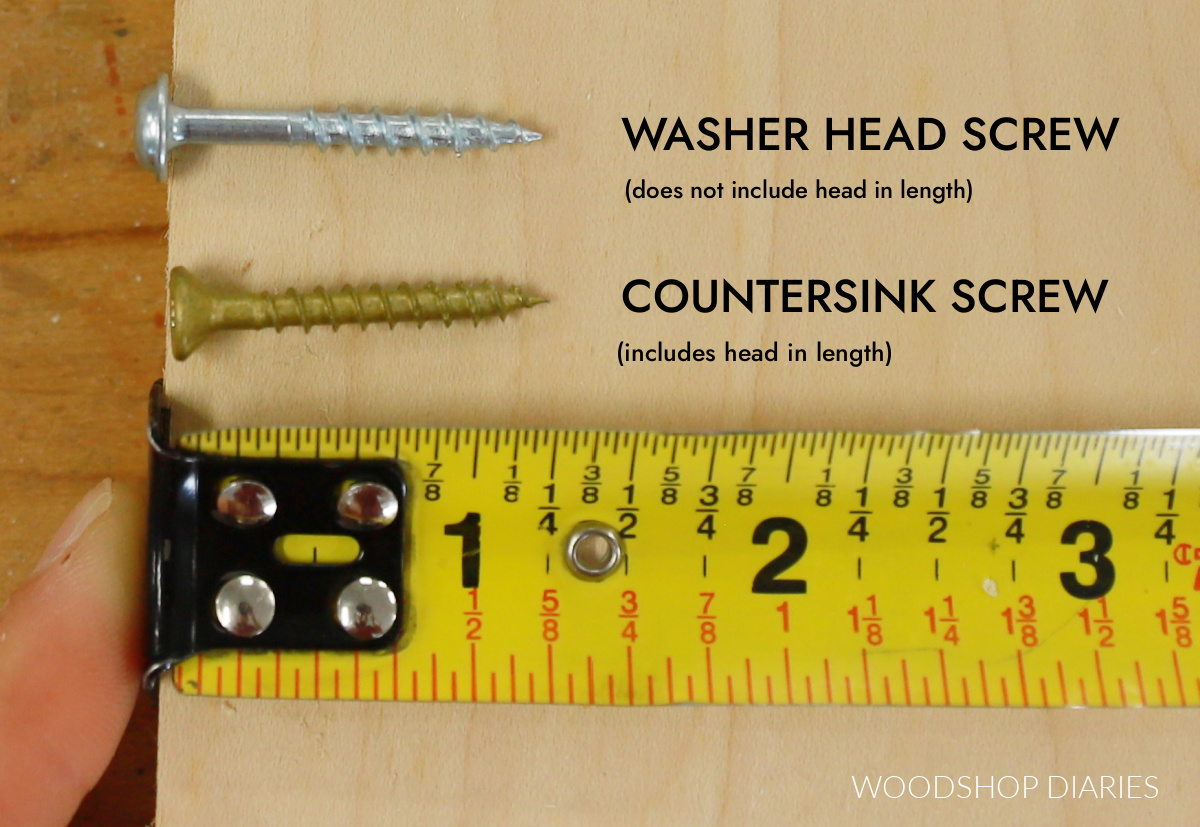
How to Read a Tape Measure

January 12, 2024 by Shara, Woodshop Diaries

In this post, I’m sharing how to read a basic tape measure, plus some tips for getting the most accurate measurements for your DIY projects!

Reading a tape measure is a foundational must-have skill not just for woodworking and DIY projects, but for all kinds of tasks in your day to day life.

various tape measures laid out on workbench

Below you’ll learn how to use and read a tape measure confidently!

What is a Tape Measure?

First, let’s start with the very basics–what is a tape measure? The tape measure is the most common, basic, and versatile tool for measuring distance. It’s a must-have in any homeowner or tradesperson’s tool box and can come in many shapes and sizes.

Depending on where you live, you can find tape measures in Imperial units (inches/feet) or metric units (centimeters/meters). Mine are in inches/feet since I’m in the U.S.

The tape is basically a long ruler that rolls up into the case or body. So it will show whole units, but also has tick marks for partial units so you can measure precisely.

Two tape measures extended on workbench--one showing tick marks every 1/16" and one showing every 1/32"

Most tape measures have markings down to at least every 1/16″ but some go as low as every 1/32″. You can see in the image above that the tape on the top has tick marks for 1/16″ but the one on the bottom goes a step further and has tick marks every 1/32″.

My Favorite Tape Measure

People often ask what tape measure I like to use. And while I have several different kinds in the shop, this Lufkin Self Centering Tape Measure is my go-to.

Lufkin self centering tape measure extended on workbench showing fractional labels

The reason I love this particular tape measure is because it has the fractions labeled on the tick marks of the tape. Most other tape measures I’ve found only label the inch marks, not the fractions, too.

Labeling the fractions makes it quicker and easier (at least for me) to get accurate measurements vs having to count the tick marks and figure the fractions in my head.

Are DIY projects your thing? Sign up for our newsletter for priority access to the latest projects and build plans!

Love watching how-to videos? Subscribe to my YouTube channel for plenty more where that came from!

How to Use a Tape Measure

The tape on a tape measure is rolled up into the case and the tab sticks out from one corner. To take a measurement, you’ll need to pull the tab to extend the tape. The tape will automatically retract if you let go of the tab.

Shara Woodshop Diaries pulling tab on tape measure out of casing

Most tape measures have a sliding “lock” that will lock the tape in the extended position if needed. Slide down to lock and slide back up to unlock.

Two tape measures on workbench with arrows pointing to the body, lock, tab, and tape parts to identify them

Consider the tab

The tab on the end of the tape is purposefully “wiggly.” You’ll notice you can kind of push/pull the tab and it will move. It’s not broken–this is intentional. The amount of movement is equal to the thickness of the tab.

Collage image showing tape measure tab pulled out vs tab pushed in

The reason this has some play in it is because you can use a tape measure on either the inside or outside of an edge. The thickness of the tab needs to be accounted for in either case, so it adjusts itself.

If you’re measuring from the outside of an edge, you want to hang the tab on the edge and pull the tape. The tab will extend so that your measurement will start from the inside of the tab.

Demonstrating how to use a tape measure on the outside edge of a board

However, if you’re measuring from the inside of an edge (for example the inside of a cabinet), you extend the tape, but push the tab against the edge. The tab will retract so that the measurement starts on the outside of the tab.

Demonstrating how to use a tape measure on the inside of a board edge

Take note that tape measures also have a measurement written on them to indicate the size of the body.

Close up with arrow pointing to tape measure case size label on back side

This may be helpful when measuring (especially on inside dimensions) because you can add this to the measurement on the tape to get the total length from the tab to edge of tape measure.

For example, if I was measuring the inside dimension of this side panel, I can extend the tape so that the tab is pushed against one side and the edge of the tape body is against the other side.

Tape measure extended to measure inside opening of workbench

Then I can add the size of the tape measure body to the length of the tape to get the full distance. I don’t find this method particularly accurate, so I rarely use it. However, it is sometimes handy to know what the measurement of the tape measure case is.

How to Read a Tape Measure

Different tape measures may have different colors or extra markings, and depending on where you live, they may be in metric OR standard units. But every tape measure will be labeled with some units of distance.

I live in the US, so my tape measures are in inches/feet.

When you pull out the tape, you can see larger marks indicating inches with smaller marks between them. This is just like a basic ruler.

  • The longest tick marks indicate whole inches.
  • Halfway between the whole inches is a slightly shorter mark indicating the ½″.
  • The next shortest tick marks designate ¼″ increments (these will be at the ¼″ and the ¾″).
  • The next shortest tick marks designate ⅛″ increments (these will be at ⅛″, ⅜″, ⅝″, and ⅞″).
  • The next shortest tick marks designate 1/16″ increments (these will be at 1/16″, 3/16″, 5/16″, 7/16″, 9/16″, 11/16″, 13/16″, and 15/16″).

And so on. Each smaller tick mark indicates a smaller increment of a whole inch. And at every 12″ increment, you’ll also see some sort of foot indicator mark (1 ft at 12″, 2 ft at 24″, 3 ft at 36″, etc).

As I mentioned before, some tape measures label the fractional tick marks, but most don’t.

If they don’t have fractions labeled, you’ll need to count the tick marks to determine them yourself. Here is a visual:

fractional labels on tape measure markings

Reading a tape measure is just like reading a ruler–once you pull the tape across what you’re measuring, look at the numbers to determine the length. Find the last whole number (inch) that it crosses, then add the fraction to that.

As an example, you can see this board is about 3 ½″ wide.

reading a tape measure stretched across a 1x4 board

Stud Marks

Many tape measures will have special markings or colors on 16″ increments–like at 16″, 32″ 48″, 64″, etc. In construction, wall studs are often placed on 16″ centers, so these special markings are useful for framing and in home building.

tape measures extended with arrows pointing to foot indicators and stud markers on each one

For furniture building and basic DIY projects, this probably doesn’t matter to you, but in case you were wondering what these marks were for, it’s for wall stud placement/location.

Self Centering Marks

Some tape measures (like the one I like to use) are “self centering”–which kind of sounds a lot cooler than it actually is ha!

This simply means that in addition to the typical length measurements on the tape, it also lists the “centers” of these measurements as well.

For example, if I measure a board with my tape and want to quickly figure out what the center of that board would be, I can simply look at the tape. This board is 4 ⅜″ wide (you can see at the top of the tape in black), so the center would be 2 3/16″ (you can see on the bottom of the tape in red).

Tape measure stretched across board with arrow pointing to self centering marks on tape

Basically the top numbers are the measurements and the self centering numbers are those measurements divided in half. This is an optional feature you may come across on SOME tape measures, but not all of them have it.

Additional Tape Measure Tips:

As odd as it may sound, not all tape measures are exactly the same. While theoretically an inch is an inch, you may find some slight variations between brands and styles of tapes. Because of this, it’s best to use the same tape measure throughout your project. Don’t mix and match them.

Damaged, bent, or ripped tape measures will cause inaccurate measurements.

When measuring (especially on long distances–like a wall or a room), keep the tape as straight as possible. If the tape is crooked, twisted, bowed, or bent, the measurement won’t be accurate.

For accurate measurements, pay attention to the tab. Make sure the tab is free to extend/retract as needed. If measuring from the inside of an edge, the tab should be pushed in. If measuring from the outside of an edge, the tab should be pulled out.

Measure twice, cut once. I know you’ve heard it before, but those tick marks on the tape measure can run together sometimes. That ⅜″ can look an awfully lot like a ⅝″ when you’re in a hurry. Take the time to double check your measurements before cutting your pieces.

The tab has a hole in the end that is handy for hanging on a screw if you’re measuring long distances and need something to hang the tape on.

You can use a tape measure to draw a circle of any size using this trick!

Using a tape measure to draw a circle on a piece of wood
How to Draw ANY Size Circle

More Beginner Woodworking Tips

Now that you know what a tape measure is and how to use and read it, it’s time to put that new skill to the test!

Check out more beginner woodworking guides and tips on the Getting Started Page. Then, dive into one of these easy DIYs to practice using and reading a tape measure.

DIY Tic Tac Toe Game
DIY Book Stand
Freestanding Boot Rack
DIY Tea Pot and Mug Stand
Scrap Wood Key Holder Catch All

Want to save this post for later? Don’t forget to pin it or share to your favorite social channel!

How to use and read a tape measure pinterest collage showing pulling tape out at top and fractional labels on tape at bottom

Until next time, friends, happy building!
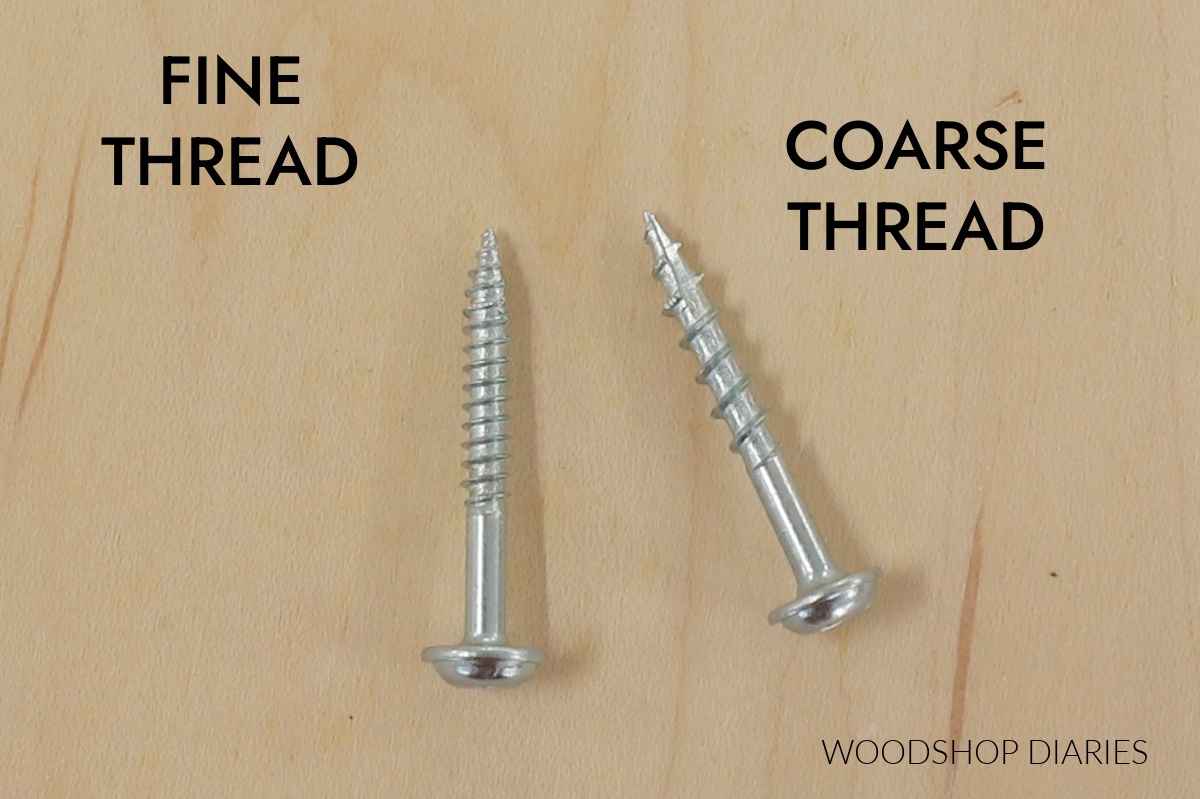
How to Build a Bed with Storage Drawers

December 14, 2023 by Shara, Woodshop Diaries

In this post, I’m sharing how to build a simple DIY bed with storage drawers built into the sides!

This bed design packs style and storage into one and it’s built in sections to make assembly (and disassembly) quick and easy.

DIY Oak storage bed assembled with slats against white wall--no mattress on top yet

I’ve shared several bed builds over the years, but I think this one may be my favorite!

The large storage drawers on the side of the bed give you a place to store spare blankets, sheets, or clothes while keeping the foot of the bed open.

Drawers in the side rails are less noticeable than drawers in the footboard to keep this design clean and minimal. I actually designed the drawers to fit into the trim on the side rails, so without the knobs, you wouldn’t even know they were drawers!

Weathered oak stained oak storage bed with built in drawers on the side panels shown assembled with mattress on top

I’m sharing how to build your own classic DIY storage bed with built in drawers in the steps below. So if you’re ready to get building, let’s dive in!

*This post contains affiliate links. See website policies.

Basic Anatomy of a Bed Frame

Bed frames can come in many shapes, sizes, and styles. But most bed frames consist of four basic parts–headboard, footboard, side rails, and slats. Sometimes a box spring is substituted for slats depending on the design.

Below shows an exploded view of these parts on a basic bed design with an arched headboard.

Exploded diagram of bed assembly showing the different parts and how they connect together

For storage beds, these 4 parts are still used. However, drawers are also built into either the footboard or the side rails.

In this case, I built two drawers into the side rails–one on each side toward the footboard end.

Completed DIY storage bed with drawer in side rail open

You may be asking why I didn’t maximize the storage space and add drawers at the headboard end, too? That’s absolutely a possibility, BUT, drawers at the front wouldn’t be able to open if you add a nightstand next to the bed.

I plan to build matching nightstands to go with this bed soon, so I opted to only add drawers on the footboard half of the bed.

What to know before building a storage bed

This DIY storage bed is a great intermediate level build. It’s not difficult, but it is rather large and has several parts and pieces to it, so it may not be the best build for beginners.

I built this project with red oak plywood and red oak lumber to match. However, if you’re looking for a less expensive option, birch plywood and pine/spruce (construction grade) lumber would also work fine.

I used bed brackets at each corner to make assembly (and disassembly) easy. These brackets simply slide together (or apart) to attach (or detach) the side rails between the head and footboards.

Close up of bed rail brackets shown in workshop--arrow pointing to the piece that goes on the side rails and another arrow pointing to the piece that goes on the head and footboard

No box spring is needed for this bed design. The mattress will sit directly on the bed slats.

Bed Frame Sizing

Mattresses come in various sizes, so it makes sense that bed frames also come in multiple sizes to accommodate. Twin, full, queen, and king are the most common. Below are standard mattress dimensions for these sizes:

  • Twin: 38″ x 75″
  • Full: 54″ x 75″
  • Queen: 60″ x 80″
  • King: 76″ x 80″

NOTE: This bed frame design is built ½″ wider and ½″ longer than the standard mattress dimensions to allow some wiggle room on all sides.

Overall dimensions and material amounts will vary based on the size bed you’re building. However, the assembly process remains the same no matter the size.

If you’d like specifics, I’ve included the dimensions, materials lists, and cut diagrams for all four sizes in the printable plans below.

Are DIY projects your thing? Sign up for our newsletter for priority access to the latest projects and build plans!

How to build a Bed with Storage Drawers

I know I’m biased, but I really think the video is incredibly helpful for this particular build in order to watch the process. I’ve included tons of tips, visuals, and extra info here in the YouTube video.

Faux YouTube thumbnail image for storage bed linked to actual video

Love watching how-to videos? Subscribe to my YouTube channel for plenty more where that came from!

Helpful resources for this build:

  • How to cut plywood sheets
  • How to apply edge banding
  • How to use a pocket hole jig
  • How to use a dowel jig (optional)
  • How to install drawer slides
  • How to build a drawer box

Prefer to print? Grab the printable storage bed building plans here:

Tools & Materials

Tools:

  • Drill/Driver
  • Circular Saw and cutting guides (Kreg Rip Cut and AccuCut used here)
  • Pocket Hole Jig
  • Dowel Jig (optional)
  • Miter Saw
  • Jig Saw
  • Brad nailer (optional)
  • Clamps
  • Table Saw (optional)

Materials:

  • (2) 4’x8′ sheets ¾″ plywood
  • (1) 4’x4′ (½ sheet) ¼″ plywood
  • (2) 1x2x8 boards
  • (7) 1x3x8 boards
  • 1×4 boards (quantity depends on bed size–refer to plans)
  • 2x2x8 boards (quantity depends on bed size–refer to plans)
  • 2x4x8 boards (quantity depends on bed size–refer to plans)
  • 1 ¼” pocket hole screws
  • 2 ½” pocket hole screws
  • 1 ¼” & 2 ½” wood screws
  • 1 ½” dowel pins (optional)
  • Wood glue
  • Edge banding (optional)
  • (2) pair 22″ ball bearing drawer slides (twin size uses 14″ slides instead)
  • Bed rail brackets
  • Drawer Pulls/Knobs

Step 1: Assemble Storage Bed Side Rails

To start this project, I cut two pieces of ¾″ plywood for the side rails of the bed. Dimensions for this will depend on the bed size you’re building–refer to the printable plans for specifics.

RELATED: How to cut plywood sheets

These side rails will be trimmed out with 1x3s on the top, sides, and in the center. Nominal 1x3s are actually 2 ½″ wide (not sure why? Check out this post on Understanding Lumber Sizing), so I drew out where the trim will go on these side rails and cut out one of the sections between the trim on each panel.

Diagram showing cut outs on storage bed side rails for drawer opening

I discuss this a little more in the video, but in order to cut this out with a jig saw, I needed to drill a couple holes to get my blade started. However, I wanted to save these cut outs to use as drawer fronts later, so I didn’t want to drill or cut into them.

So I drilled my holes just outside the marks in order to cut around these lines. The trim will cover these holes later.

Jig saw cutting out drawer opening in side panels--arrow pointing to the hole drilled outside the line to start the blade from

Once these sections were cut out, I cut and glued 1x3s onto the front sides to trim them out. I ran one piece along the top, one along the bottom, one on each end between them, then one in the middle (vertically).

Then, I cut one more to run across the top to kind of “cap” the side rails off (see image below). Keep in mind as you install the trim that the side rails should be mirrored–the openings should both be toward the footboard end of the bed.

Shara Woodshop Diaries clamping 1x3 to top of side rail panel of storage bed

After both side rails were trimmed out, I cut and assembled a 2×4 frame with two sides and a back. These will be the framing to house the drawer boxes.

I attached these frames onto the side rails around the opening using pocket holes and screws.

RELATED: How to use a pocket hole jig

Shara Woodshop Diaries assembling drawer framing onto side rail with pocket holes and screws

Once the drawer framing was installed on the side rails, I glued and screwed a 1×2 to each side rail just above the drawer cut out opening.

These 1x2s will support the bed slats I’ll add later. If you wanted, you could use a 2×2 here instead.

Two mirrored side rails assembled laid next to each other on workbench floor

Step 2: Add Drawers to Side Rails

Next, I installed ball bearing drawer slides onto the 2x4s framing on each side. These should be inset 1 ½″ from the front edge of the trim.

RELATED: How to install drawer slides

Shara Woodshop Diaries installing drawer slides onto drawer framing

I assembled two identical drawer boxes–one for each side rail. Learn how to build simple drawer boxes here. Then, I installed these onto the slides. The front of the drawer box should be 1 ½″ inset from the front of the trim.

Shara Woodshop Diaries assembling drawer box on workbench

Prefer to print? Grab the Printable Building Plans for this bed in your specific size here.

Next, remember those cut outs from step 1? I trimmed the edges straight using my table saw (because right from the jig saw, they were a bit wiggly). If you don’t have a table saw, a circ saw and straight edge or Kreg AccuCut would work as well!

These are the drawer fronts, so I installed them onto my drawer boxes using wood screws from the inside. There should be ⅛″ gap around all sides for clearance to open and close without rubbing.

Shara Woodshop Diaries installing drawer front onto drawer box in storage bed side rails

Step 3: Build Headboard

The headboard consists of a 2×4 frame–two legs and a top–with a plywood panel attached inside.

So first, I assembled the frame using dowel pins and glue. Learn how to use a dowel jig here. You could also assemble the frame using pocket holes and screws instead of dowels if you preferred.

Once the frame was assembled, I cut and installed a ¾″ plywood panel inside of it flush to the back edge using pocket holes and screws.

Shara Woodshop Diaries installing plywood panel into headboard frame with pocket holes and screws

Similar to how I trimmed out the side rails, I also trimmed out the headboard using a 1×4 at the bottom and two 1x3s vertically to add some extra detail.

I simply glued these pieces on to the front side of the plywood panel (you could also brad nail, but I didn’t want to deal with filling nail holes, so I just used glue).

Trim glued onto front of storage bed headboard

Step 4: Build Footboard

I assembled the footboard exactly like the headboard–2×4 frame, plywood panel, plus 1×4 and 1×3 trim. The only difference was that the footboard was obviously shorter in height.

I discuss this more in the video, but I also cut some ⅜″ x ¾″ strips to add on each side of the 1x3s and on the outside edges of the head and footboard panels.

Shara Woodshop Diaries installing trim pieces on footboard of bed with drawers

This gave the piece a little extra dimension and detail, but also helped hide any gaps between the plywood and the trim/framing. These pieces are completely optional.

Step 5: Assemble Bed Frame/Attach Bed Rail Brackets

Now that the side rails, headboard, and footboard are all assembled, it’s time to bring them together.

The side rails should be installed so they are 3″ off the ground, so I set them up on scrap blocks, then clamped the pieces together.

Shara Woodshop Diaries clamping bed with drawers parts together to assemble with brackets

Once I had my bed pieces in place, I installed bed rail brackets at each corner using 1 ¼″ wood screws. The part with the “teeth” attaches to the side rails and the part with the slots attaches to the head/footboard legs.

The “teeth” slide into the slots to connect the two pieces when assembling and they slide apart to disconnect when disassembling.

Screwing bed rail brackets into the headboard leg to assemble

There is plenty of room to install these on the headboard end, but on the footboard end, it’s a little cramped. I removed the drawer to give me a little more room to work with.

Once the four sides of the bed were connected, I screwed 2×4 blocks into the back of the drawer framing to support the drawer.

Arrow pointing to support block on back of drawer framing on bed side rails

Basically, these blocks are needed to help hold the drawer framing level from front to back.

At this point, the bed is ready for paint/stain/finish. I disassembled the pieces at the brackets, stained them with Minwax Weathered Oak wood stain and sealed them with a few coats of Minwax Polycrylic.

Once dry, added some knobs to the drawers, then carried the pieces inside and attached them together where I wanted the bed to go.

Step 6: Install Bed Slats

The final part is adding the bed slats to the frame. I cut 1×4 bed slats to run between the side rails. Because these span pretty far, I added 2×2 supports in the center to keep them from sagging.

Then I spaced these out along the 1×2 on the side rails in the bed frame and screwed them in with 1 ¼″ wood screws.

Shara Woodshop Diaries installing bed slats onto bed frame using screws

After the slats are secured, it’s ready to add the mattress and bedding. And then, it’s ready for a nap after all that hard work ha!

This bed design is so simple, but the drawers and the trim really add function and style making it perfect for any bedroom.

Shara Woodshop Diaries pulling out drawer on storage bed side panel

Looking for more DIY bed builds?

Enjoyed this build, but looking for more DIY bed frame ideas and inspiration? Here are a few favorites both with and without storage:

DIY Curved Head Board Bed
DIY Modern Bed
Mid Century Bed
Free Building plans to build your own DIY King size storage bed
DIY Footboard Storage Bed
Shara Woodshop Diaries reading in DIY Kids House Bed Frame
DIY House Bed
DIY Kids Bed

Want to save this project for later? Don’t forget to pin it or share it to your favorite social channel!

Pinterest collage image showing completed bed with drawers at top without mattress and finished storage bed at bottom with drawer open with text "how to build a storage bed"

Until next time, friends, happy building!
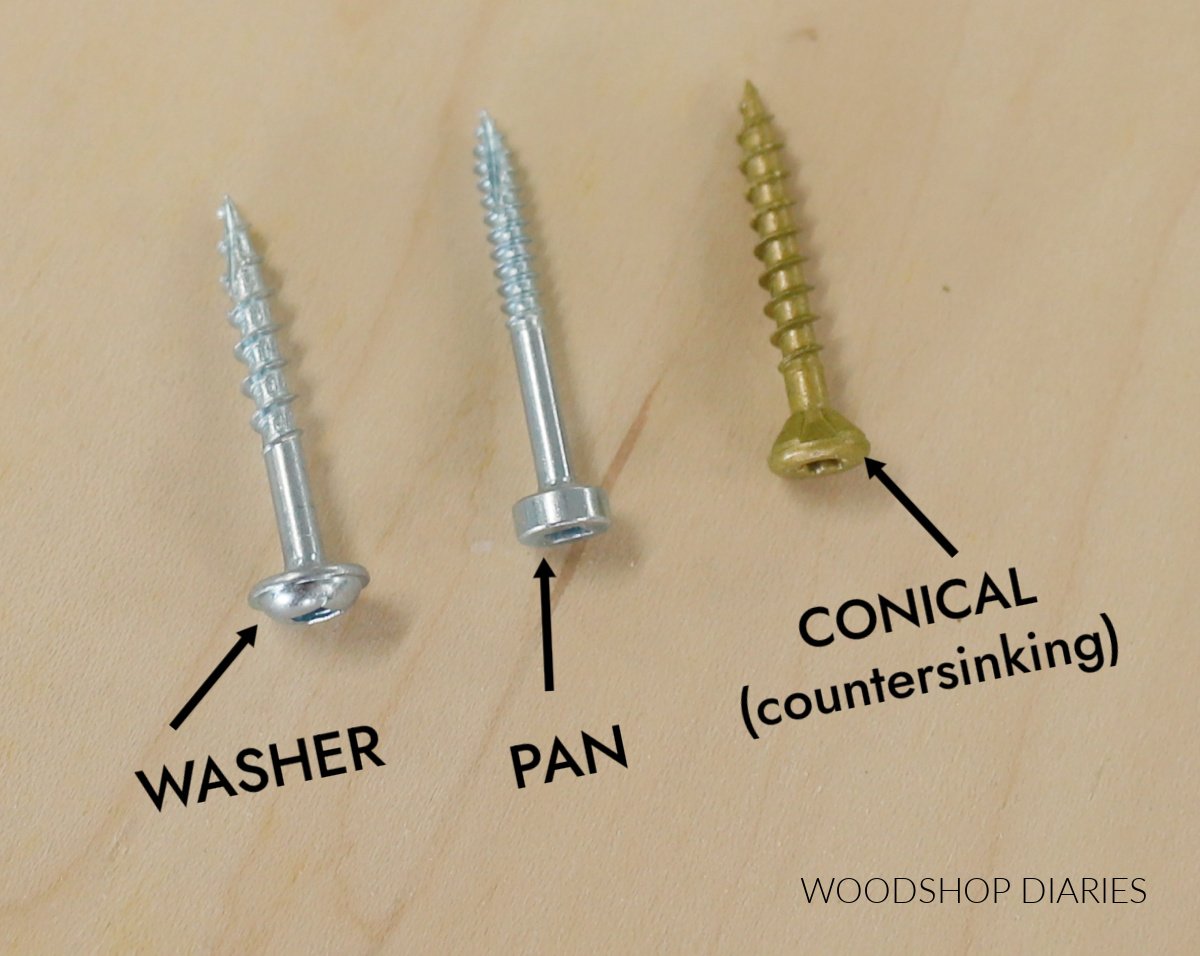
Decorative DIY Wooden Sled

December 5, 2023 by Shara, Woodshop Diaries

In this post, I’m sharing how to build a decorative DIY wooden sled perfect for use as a centerpiece, a door hanger, or décor by the Christmas tree!

Tis the season for all the fun Christmas DIYs. Even better if they’re made from scrap wood like this simple wooden sled!

*This post is sponsored by Kreg Tool and contains affiliate links. See website policies.

Decorative wooden sled propped up against fireplace next to Christmas tree with stenciled design that says "Christmas Trees Pine Spruce Fir"

This adorable decorative sled is a super easy project and you can likely find everything you need to build it from your scrap pile with just a few basic tools.

Then once it’s built, feel free to add a custom logo, festive design, or monogram to make it your own. If you’re ready to see how you can build your own, let’s dive in to the how-to!

What to know before Building

This decorative DIY wooden sled is easy to customize to whatever shape, size, and style you’d like. Here, I used a jig saw to cut arches, and curves in the pieces to give it some extra details. Feel free to shape and style this however you’d like!

If you have a 5 gallon bucket (or the lid of a 5 gallon bucket), that works great as a template to trace these curves.

Shara Woodshop Diaries tracing around lid of 5 gallon bucket onto 1x12 board

Most of the pieces needed are small (see step 1), so be sure to browse your scrap pile as you may find everything you need already there without having to purchase new lumber.

The boards I used here are all pine/spruce (the basic white board lumber from the big box store) except for the rails. I cut the rails from a scrap red oak 1×2 board I had in the shop (but pine would have worked fine for these parts, too!).

The overall dimensions of this wooden sled are approximately 3 ¼″ tall x 16″ wide x 31 ½″ long.

Diagram showing overall dimensions of wooden sled

Are DIY projects your thing? Sign up for our newsletter for priority access to the latest projects and build plans!

How to Build a Decorative DIY Wooden Sled

This is a great beginner woodworking project that only takes an hour or so to complete. Add a little extra time if you plan to stencil it with a custom design, but the build itself is really quick!

Tools & Materials

Be sure to check your scrap pile before building. Most of these pieces are fairly small (see step 1), so you might find everything you need in your scraps.

However, if you’re starting from scratch, I’ve listed the length of each size board you’d need if you’re buying them from the store.

Tools:

  • Miter Saw
  • Jig Saw
  • Drill/Driver
  • Kreg Micro Pocket Hole Jig
  • Brad Nailer (optional)

Materials:

  • (1) 1×12 board (2 ft long)
  • (1) 1×2 board (6 ft long)
  • (1) 1×3 board (6 ft long)
  • 1 ¼″ pan head pocket hole screws
  • Wood Glue
  • 1 ¼″ long brad nails (optional)

Step 1: Cut Wood Sled Pieces

First, I cut down the sled pieces. Everything was cut from 1x2s, 1x3s and a 1×12 board.

Sled Rails:

I cut two 1x2s to 30″ long with ends mitered 45° parallel to each other for the sled rails. Mitered ends are optional, but it adds a little detail to the design.

RELATED: How to cut angles on a miter saw

Sled Runners:

Then, I cut three 1x3s to 12 ¾″ for the sled runners (the pieces that go between the rails). After these were cut to length, I used a jig saw to notch out the bottom two corners of each so they’d fit around the 1×2 rails.

To give it a little extra character, I used the lid of a 5 gallon bucket to trace an arch along the bottom of each and cut this out with a jig saw.

Sled runner pieces cut to shape laid on workbench with pocket holes drilled into the ends. Kreg Micro Pocket hole jig laying next to boards with Kreg Clamp

Then, I used the Kreg Micro Pocket Hole Jig (shown above) to drill ¾″ pocket holes into the ends of the three sled runners.

Sled Front Brace:

For the front brace, I cut another piece of 1×3 to 16″ long and used a jig saw to slope the top corners down from the middle like shown.

Diagram of wooden sled front brace profile cut out

You can certainly leave it straight, but these cuts just gave it some extra detail.

Sled Seat:

Finally, I cut the sled seat from a 1×12 about 22″ long. I used the 5 gallon bucket lid again to trace some arches at the top and bottom of the board and cut these out with a jig saw.

Wooden sled pieces cut and shaped laid out on workbench ready to assemble

Once all the pieces were cut, I sanded them well before assembling.

Step 2: Add Custom Design to Sled Seat (Optional)

To make it a little more festive, I applied a “Christmas Tree Farm” design to the sled seat. This is completely optional, but if you’d like to customize your sled, this is one way to do it.

Stain/Finish Products Used Here:

  • Cricut Machine (to cut vinyl stencil)
  • Cricut Vinyl (to cut staining stencil from)
  • Cricut Transfer Tape
  • Cricut Tool Set
  • Minwax Water Based Stains
    • Pecan
    • Spice
    • True Black
    • Early Spring

First, I designed my stencil in Cricut Design Space. I simply drew some boxes for the outline, added some text, and some trees. You can check out my design here. But feel free to create your own design instead.

Screenshot of Cricut Design Space wooden sled design

Then, I cut it out on permanent vinyl using my Cricut Explore 3. The color of the vinyl doesn’t matter here since it’ll all be removed in the finished project–it’s just for stencil.

I used transfer tape to transfer the full vinyl stencil (don’t remove any of the parts yet) to the sled seat making sure it is centered. It should be smooth and well adhered to the wood.

Shara Woodshop Diaries applying vinyl stencil to wooden sled seat board on workbench

Then, I stained sled seat in sections. (You could also paint, but I love to keep the wood grain, so I opted for stain.)

TIP: When using vinyl as a staining stencil, I’ve found that water based stains provide much crisper lines than oil based stains. They go on thicker, so they don’t tend to seep under the stencil as bad. A foam brush is a great way to apply these.

I stained the seat around the vinyl with Minwax Water Based Wood Stain in Semi-Transparent Pecan. Water based wood stains dry quick, so you want to apply, then wipe away the excess within just a few minutes.

Once the outside was stained around the vinyl, I removed the parts of the stencil I wanted to stain red, and stained these with Minwax Water Based Wood Stain in Semi-Transparent Spice.

Shara Woodshop Diaries applying red stain to stencil on wooden sled seat board

TIP: Use some painters tape to protect surrounding parts from accidental stain overlap.

Then I repeated to stain the lettering with Minwax Water Based Wood Stain in Semi-Transparent True Black and the trees with Minwax Water Based Wood Stain in Solid Early Spring.

Shara Woodshop Diaries applying green stain to Christmas tree stencil on wood board

After the stain had been applied, I removed the rest of the stencil to reveal the whole design!

Removing stencil from board after staining Christmas Tree design onto sled seat

Step 3: Assemble Sled Frame

Before assembling, I finished the rest of the sled pieces. I stained the two rails the same red I used in step 2 (spice), the three sled runners the same black I used in step 2 (true black), and the sled front brace the same brown I used in step 2 (pecan).

Once these pieces were dry, I secured the sled runners between the rails using 1 ¼″ pan head pocket hole screws through the pocket holes I drilled in step 1.

Diagram showing attaching DIY wooden sled runners between sled rails

Check out the plan on KregTool.com for exact dimensions and placement of these pieces.

Step 4: Attach Seat and Front Brace

Once the runners were secured between the rails, I applied wood glue to the tops of them and placed the sled seat and front brace on top. I simply set them in place and allowed the glue to dry.

Placing finished Wooden Sled seat onto sled frame to glue in place

However, if you wanted to also add a couple brad nails to secure while the glue dried, that would be fine, too.

Once the glue was dry, I applied a couple coats of Minwax Polycrylic to the sled and it was ready to use!

Completed wooden Christmas Sled decoration on table top with faux Christmas tree

If you wanted, you could add a little rope at the top for some extra decoration. And now this sled is ready for the dining table as a centerpiece, beside the tree as fun décor, or hang it on the door or the wall for the winter season.

DIY Wooden Sled propped up against wall next to faux Christmas tree. Sled seat has stenciled design showing Christmas Trees

Grab the free plans to build this simple wooden sled on KregTool.com!

Looking for more Holiday DIYs?

It’s the best time of the year for some fun projects. Here are some more holiday themed DIYs you’re sure to love!

Stackable Christmas Tree
DIY Wooden Snowflake
DIY Christmas Candy Tray
How to make your own DIY wooden Christmas village perfect for Scandinavian Christmas decor. Easy and free project tutorial
DIY Wooden Christmas Village

If you’d like to save this post for later, don’t forget to pin it or share it to your favorite social channel!

Pinterest collage image showing overall dimensional diagram of wooden sled at top and completed DIY wooden sled at bottom with text "how to build a decorative wooden sled"

Until next time, friends, happy building!
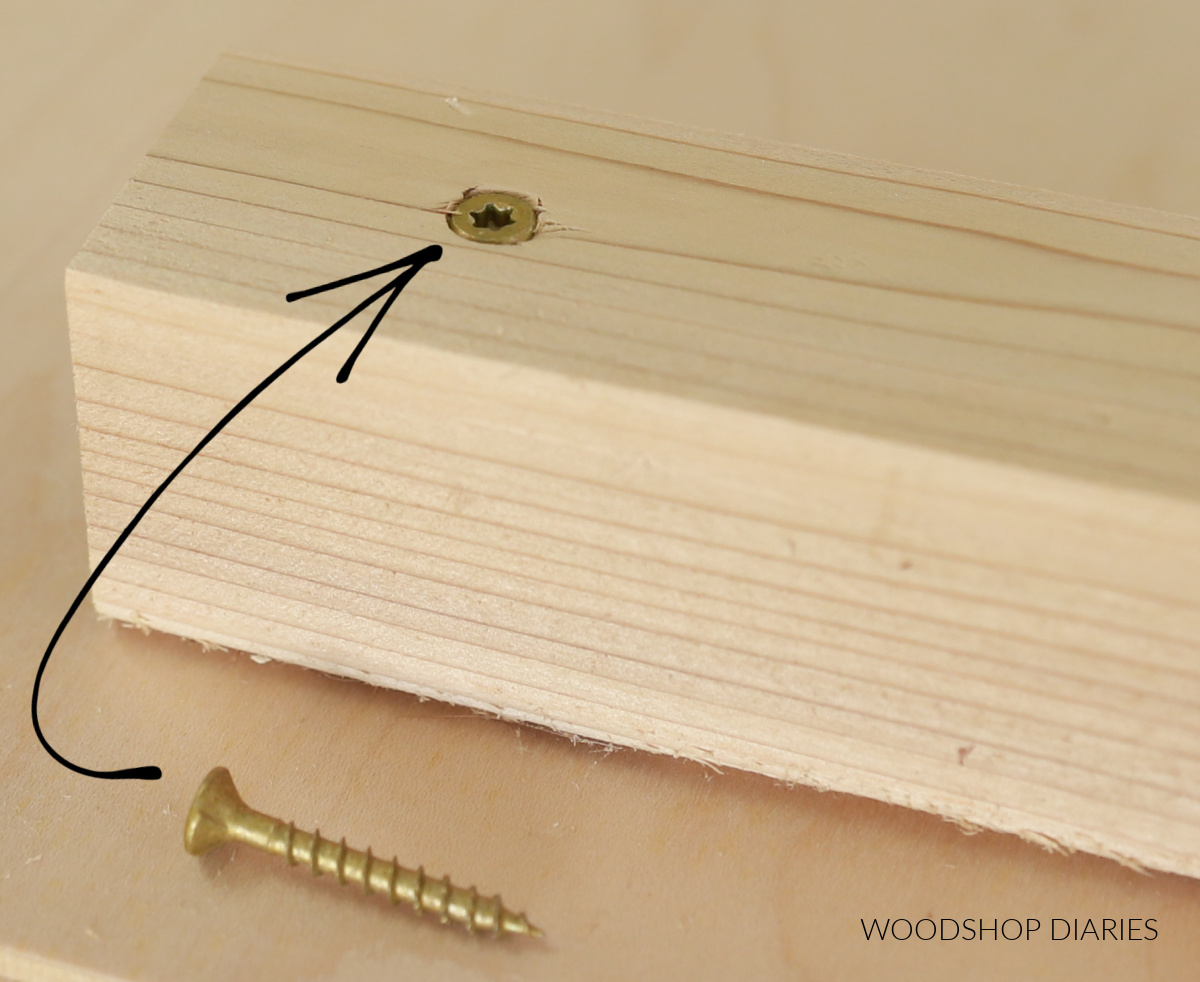
How to Use a Dowel Jig

November 28, 2023 by Shara, Woodshop Diaries

In this post, I’ll show you how to use a basic dowel jig to join boards in your DIY furniture building projects!
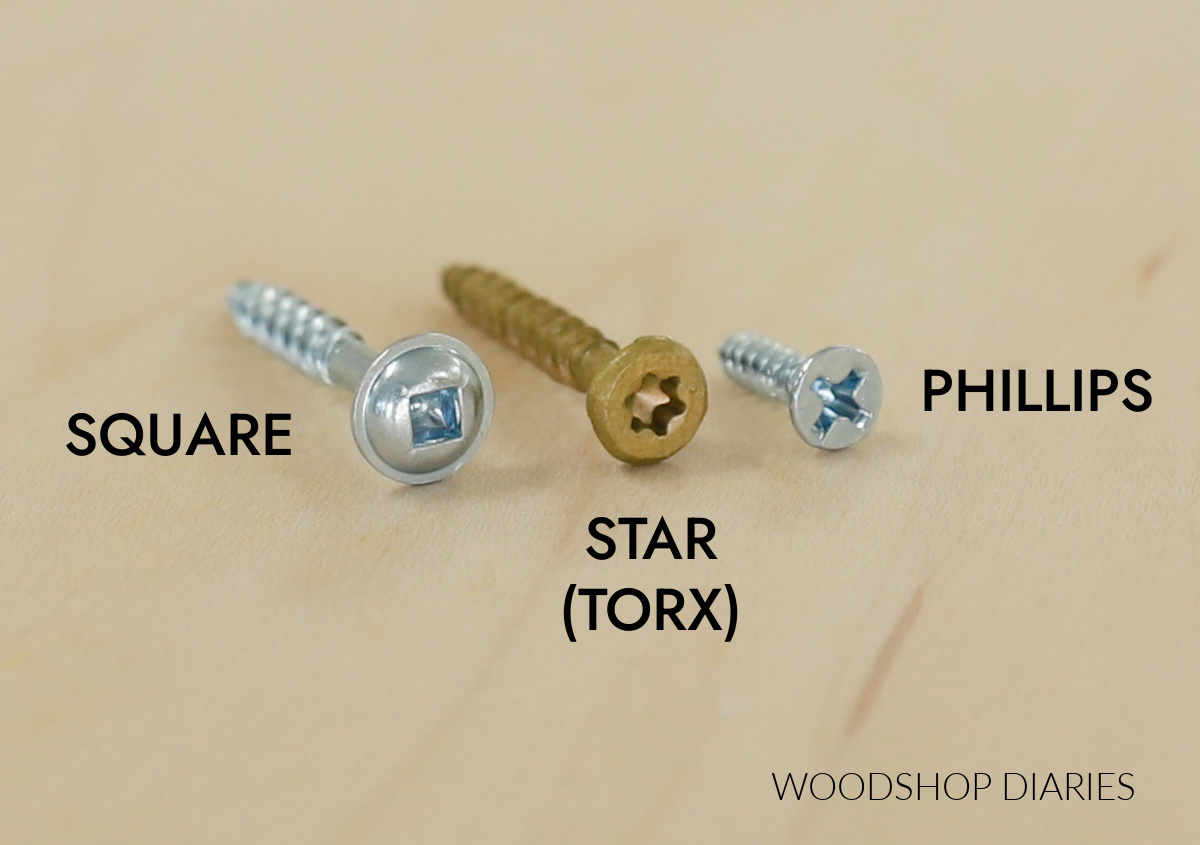
Using dowels to join wood is method that requires very few tools. Basically, you just need a square, a jig, and a drill. And some clamps, of course.

Dowel jig, drill, clamp, and square laying on workbench with two boards with dowel holes drilled out and dowel pins inserted

Below, I’ll show you how to set up and use a basic dowel jig, plus some tips about dowel sizing, drill depth, and joining angled boards.

*This post contains affiliate links. See website policies.

What is dowel joinery?

Dowel joinery in woodworking is simply joining boards using wooden dowel pins and glue. A dowel pin is simply a small wooden rod–usually fluted or with grooves. These are what I use.

Close up of fluted wooden dowel pins

Dowels are often used in furniture building as it’s a simple, but strong method of joining wood without any visible evidence in the finished product.

In order to successfully join two boards using dowels, you first need to drill out corresponding holes in each board to insert the dowel pin. Part of the pin will go into each board, so the placement of these holes is critical for proper alignment.

Close up of two boards with dowel holes drilled. Pins inserted into one of the boards showing alignment with the other

That’s why a dowel jig is handy.

Types of dowel jigs

Dowel jigs come in various styles and sizes, but in every case, the purpose of the jig is to drill precisely placed holes, to a consistent depth and diameter, that are perfectly straight.

Self centering dowel jigs are handy if you’re often working with boards of different thicknesses, but they’re more expensive than other options and require a little more set up before using.

However, if you stick with the same wood thickness for almost every project (like ¾″ and/or 1 ½″), a simple clamp on dowel drilling jig like shown below is inexpensive and easy to use.

Rockler dowel jig on workbench with clamp, drill big, and square

This is the type of dowel jig I’ll be discussing in this post as it’s the type I personally use in my shop. These jigs come in various sizes, and the size refers to the diameter of the holes. I use the ⅜″ size for pretty much everything.

That means the holes in the jig and the drill bit that comes with it are ⅜″ diameter. So you’d use it with ⅜″ diameter dowel pins. You often see this same style jig in ¼″ and ½″ sizes as well.

NOTE: The exact jig I’m showing here is several years old and Rockler doesn’t make them anymore. However, POWERTEC makes an almost identical jig here.

Rockler still makes dowel jigs, but they changed their design and you can see the new Rockler dowel jig here. It works the same way as discussed below, but it’s no longer clear.

Are DIY projects your thing? Sign up for our newsletter for priority access to the latest projects and build plans!

Dowel Pin Sizing

Choosing the size dowel pin to use will depend most on the thickness of your wood. Typically, the rule of thumb is that you want your dowel pin diameter between ⅓ to ½ the thickness of your board(s).

For example, if you’re working with 1x material, it’s ¾″ thick. (Not sure why? Check out this post about understanding lumber sizing.) So you’d want to use a dowel pin between ¼″ to ⅜″ diameter.

If you’re working with 2x material, it’s 1 ½″ thick. So you’d want to use a dowel pin between ½″ to ¾″ in diameter.

2x material with ⅜" dowel pin laying on workbench next to 1x material with ⅜" dowel pin to show sizing difference

Full transparency, I use ⅜″ in both sizes of boards so I don’t have to keep multiple sizes of jigs and dowel pins on hand. It seems like a close enough happy medium and has worked great for me so far.

If you’re working with thicker material, you may consider upgrading to a self centering dowel jig and going with bigger dowel pins. OR, another option I’ve used in the past is simply drilling multiple ⅜″ dowel pin holes on each side like on this bed frame.

Dowel pin holes drilled into 3x3 bed frame pieces

How to Use a Basic Dowel Jig

Using a dowel jig is really simple as long as you’re paying attention. You want to make sure you drill your holes consistently, in the correct location, and that you keep track of which boards go where.

PRO TIP: Label everything well. I cannot stress this enough. There’s nothing more frustrating than marking and drilling all these holes, then getting the boards out of order so you don’t know which holes line up at which location.

I promise this is one of those things that will make a lot more sense once you do it a few times. Practice on some scrap boards to get the hang of it and you’ll quickly realize how simple it is to join boards with dowels.

Tools Needed For Dowel Joinery

Here is what you need to mark, drill, and assemble boards using dowels:

  • Dowel Jig
  • Drill
  • Pencil
  • Speed Square
  • Dowel Pins
  • Wood Glue
  • Clamps to assemble
  • Rubber Mallet (optional)

Step 1: Lay Out Boards

First, I lay out my boards on my workbench exactly how I want to assemble them. Make sure the placement is exactly how you want it in the finished project.

Shara Woodshop Diaries laying out door frame pieces on workbench to assemble with dowel pins

If you’d like, clamp the pieces together so they don’t move while you work on the next step.

Step 2: Mark Each Joint

With the boards lined up, I use a speed square to mark a line at each joint.

Shara Woodshop Diaries marking dowel pin location on door frame joint using a speed square

If I’m working with narrow boards, I try to mark close to the center (doesn’t have to be exact, but try to keep it close).

If working with wider boards (~3 ½″ or wider), I recommend marking multiple lines at the joint to spread out the dowel pins for better alignment.

Dowel marks on narrow board vs wider board

The exact number of dowel pins you need depends on the application you’re using them on. If you’re assembling large panels, I’d recommend spacing them about every 6-8″.

Dowel marks on cabinet panel top and sides showing 6-8" apart

For thick material: I mentioned earlier that sometimes I drill multiple dowel holes in boards thicker than 1 ½″. For these instances, I make a mark on one side, then flip it over and mark again on the other side.

This is where it’s EXTRA IMPORTANT to label everything really well to keep track of which side is the front, back, left, right, etc. so you can make sure the holes are lined up correctly when you’re ready to assemble.

Marking 45° Miters

NOTE: You can also use dowels on mitered joints. Just keep in mind that all these marks should be square to the board ends.

In the case shown below, these boards come together to make a 90° angle and each end is mitered 45°. (This is how I make cabinet doors.)

So to mark, I can just use my speed square to make a 45° mark at each corner and these marks will be square to the board ends. It’s easy with 45° ends.

Marking door frame corners for dowel locations using speed square

Marking Other Angled Boards

In the case of other angles, it’s just slightly more involved. In the image below, these boards are both cut with 30° miters. But this same process applies to any other angle, too.

First, line up the boards and mark a small dot where you want your lines.

30 degree mitered board ends together on workbench with two small marks on joint

Then use a speed square on the board ends to draw a line at the dot(s) square to the ends of each board.

Shara Woodshop Diaries drawing square line to board end for dowel location

Then, when the boards are placed together, the lines should be straight like shown below.

mitered boards together with dowel marks completed

Step 3: Set the Drill Depth

Make sure to set your drill bit depth before drilling. These dowel jigs usually include the drill bit and come with a stop collar.

In most cases, to set the drill depth, insert the bit into the jig so that it sticks out the bottom a little more than half the length of the dowel pins you’re using. Then, slide the stop collar to the top of the jig and tighten it in place.

close up of dowel jig with drill bit inserted showing stop collar and drill depth compared to dowel pin

That will allow you to drill into both boards deep enough to insert the pin and still get a tight fit. I typically keep 1 ½″ long dowel pins handy in my shop, so I drill my holes about ⅞″-1″ deep.

However, in some cases, if you’re working with thin material, there is a little more to consider when setting the drill depth.

If you’re drilling into boards that are the same thickness or thinner than half the length of your dowel pin, you have three options:

  • Purchase shorter pins.
    • Dowel pins come in various lengths, so you can purchase shorter pins for your project if needed.
  • Drill through and use the dowel pin as a visual feature.
    • In this case, simply drill completely through the board and allow the dowel pin to run through (called a “through dowel”). The dowel will be visible in the finished project.
  • Adjust the drill depth a little shallower for the thinner material so it doesn’t go all the way through.
    • In this case, you’ll also need to adjust the drill depth a little longer into the adjoining board to accommodate OR trim your dowel pin shorter to fit. This option allows the joinery to stay hidden, but requires more tedious adjustments.

I used the third option when building this glass door cabinet. I used dowels to assemble the main body and adjusted the drill bit depth on the side panels so that it wouldn’t drill all the way through. See image below.

Setting drill bit depth on side panel with dowel jig

But, that meant that when it was time to drill into the joining boards, I needed to adjust the drill bit a little longer to ensure the holes were deep enough to accommodate the full length of the dowel pin.

Drilling dowel holes into end of wood panel using dowel jig

TIP: When setting your drill depth, test drilling into some scrap boards first to make sure the holes are deep enough for the pins to fit (about half the length in each board), but not too deep that it drills through if you don’t want it to.

Step 4: Line Up Dowel Jig & Drill Holes

The jig has three lines. The mark on the left is the centerline of the left hole. The mark in the center is the centerline between the holes. The mark on the right is the centerline of the right hole.

Close up of Rockler dowel jig showing centerline of jig and centerlines of dowel holes

For narrow boards, if I only made one mark, I line up the center line of the jig and drill both holes. In this case, the marks from step 2 designate the center of the jig.

For wider boards, if I made multiple marks, I line up either the left or the right line on the jig and only drill that hole at each mark. In this case, the marks designate the centerline of each hole.

There’s no specific right or wrong way to do it as long as the holes line up. So just stay consistent line to line whether you choose to make that the center of the jig or the center of a hole.

Once I get the jig lined up, I clamp it tight and drill using the designated bit. The bit should be the same diameter as the holes in the jig. For example, if using a ⅜″ jig, use a ⅜″ bit, etc.

Shara Woodshop Diaries drilling dowel holes in board with clamp on dowel jig

Drill until the stop collar hits the jig so you make sure the holes are deep enough. Repeat for each mark on each board.

Dowel holes drilled in edge of board

Step 5: Assemble Pieces With Dowel Pins

Once the holes are drilled, it’s time for assembly. To assemble a dowel joint, I simply apply wood glue around the dowel pin, then insert into the holes. I like to use a rubber mallet to tap them in if needed.

Gluing dowel pins into dowel holes on edge of door frame

Then, I apply a little wood glue around the holes, to the parts of the dowel sticking out and to the end of the board that’s joining. You want to make sure there’s glue both on the board surfaces and on the dowel pins.

Once there’s glue on everything, I line up the holes with the dowel pins and tap in place. This process is the same whether you’re gluing up square or mitered boards. You can see below I’m assembling a cabinet door with mitered boards the same way.

Assembling cabinet door using wood dowels with board ends mitered 45 degrees

If joining several boards at once, plan ahead what order to join them. Once the glue dries, they’ll be difficult to move later if needed.

Once all my joints have glue and dowel pins, I clamp together and wipe away excess glue squeeze out. Make sure to check for square, then allow to dry completely.

clamping door frame on workbench after assembled using dowels

After it’s dry, I sand away any remaining glue and now I’ve joined wood using dowels!

Projects Using Dowel Joinery

Now that you know how to use a dowel jig, here are some great projects to practice and gain experience using your new skill!

Projects using dowel joinery:

DIY Modern C Table
How to Build Cabinet Doors
DIY Display Console Cabinet
DIY Display Cabinet
DIY Curved Head Board Bed
DIY Modern Dresser
DIY Modern Bed

Want to save this post for later? Be sure to pin it or share it to your favorite social channel so you can find it again for easy reference!

Pinterest collage image showing two boards with dowel holes drilled at top and dowel jig on workbench at bottom with text "how to use a basic dowel jig"

Until next time, friends, happy building!
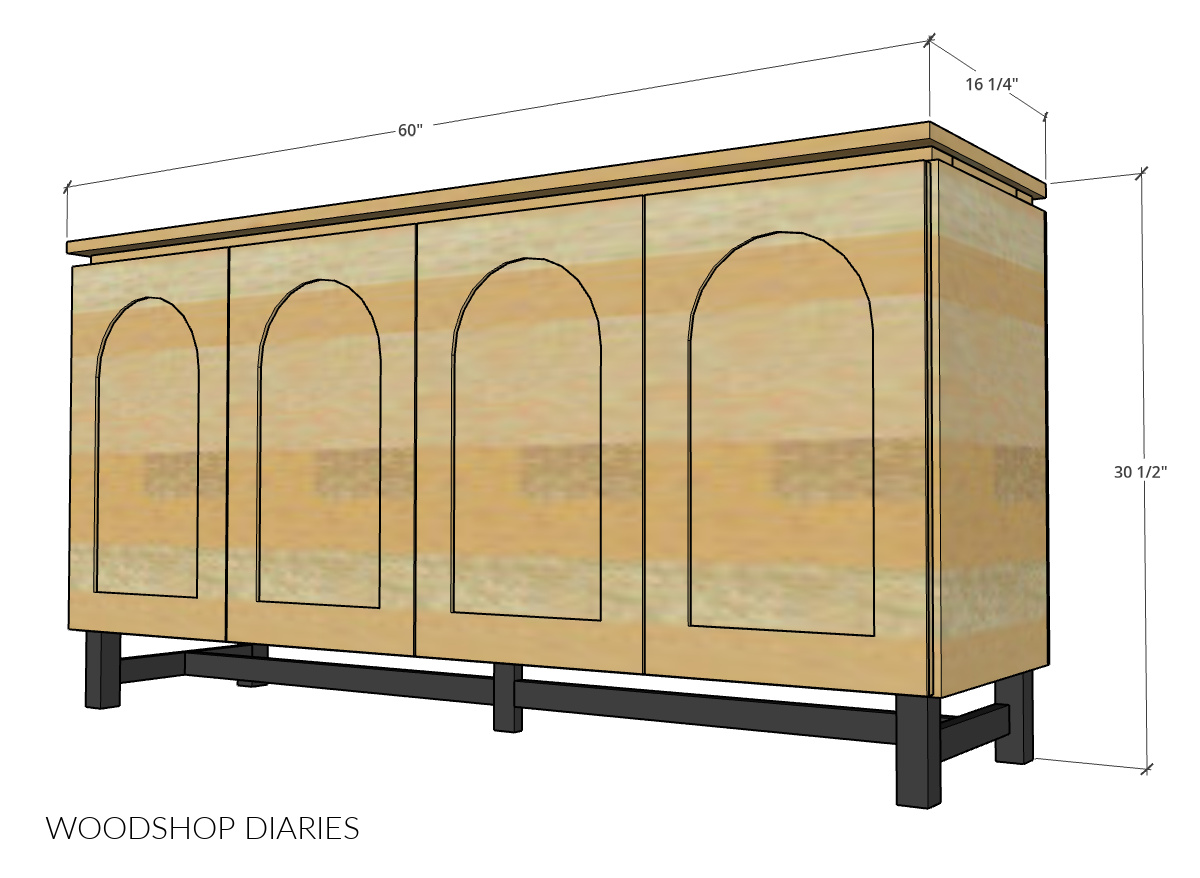
DIY Hallway Closet Built Ins

November 24, 2023 by Shara, Woodshop Diaries

In this post, I’m sharing how to turn a basic hallway closet into gorgeous custom built ins!

Our main hallway had a double door closet that was just…not ideal. The doors were difficult (and incredibly loud) to open and close. And the shelves inside weren’t adjustable, which resulted in a lot of poorly utilized space between them.

Hallway closet before image showing plain white double doors in hallway

I wanted to improve both the looks and the function of this closet, so I replaced it with a custom built in linen cabinet!

I designed these cabinets to be perfectly built into this closet opening with adjustable shelves at the top and large storage drawers at the bottom.

Warm wood custom built in cabinets in hallway with white walls

Not only is this storage much more organized, but this also made an absolutely gorgeous focal point in my hallway–much better than the basic white hollow core doors.

I’m excited to show you how I made them below so if you’re ready to tackle your own DIY closet transformation, let’s dive in.

*This post contains affiliate links. See website policies.

What to know before turning a closet into built ins

This project is an excellent way to add some custom touches to your home to fit your own storage needs and design style.

It’s an intermediate to advanced project–not because it’s difficult, but because it involves building and installing drawers, doors, shelves, and trim work–plus some detailed custom measurements in order to fit it into your specific space.

Closet Built In Size Considerations

Before we get too far, in full disclosure, this project did cause me to lose some cubic feet of storage space. The VOLUME of space inside the “new” closet is a little less than the existing closet.

Shara Woodshop Diaries looking into hallway closet full of stuff--the before

However, the adjustable shelves and storage drawers in the new built ins allowed me to utilize the space much more efficiently, so I was able to put everything back in and actually still had room leftover.

So, it’s not always about the AMOUNT of space you have. It’s about how you use the space you have. However, if you feel that you need every square inch of space you can get, this may not be the project for you.

That said, for reference, this closet was roughly 84″ (which is 7′) wide, about 18″ deep, and 96″ (which is 8′) tall INSIDE.

diagram showing hallway closet dimensions

I built these built in cabinets to kind of “slide” into the door opening, so the cabinets themselves ended up being roughly 72 ½″ wide, 21 ½″ deep, and 81″ tall. Most of the space lost was just the very top–which was hard to access anyway, so losing it wasn’t a big deal.

Closet Cabinet Organization Options

In this design, I installed four deep drawers along the bottom with a taller open section above for adjustable shelving behind some simple shaker style cabinet doors.

Completed built in closet cabinets with drawers at bottom and doors on top--one set of doors open to reveal shelves inside

This is all completely adjustable and you could make the entire thing a bunch of drawers (which would be a little weird, but hey–it’s doable haha). Or you could make the entire thing shelving and have your doors run top to bottom.

I encourage you to think through what makes the most sense for the things you’re already storing in your closet to figure out what types of storage will work best for you in your built ins. Then customize as needed to make that happen.

Are DIY projects your thing? Sign up for our newsletter for priority access to the latest projects and build plans!

How to turn a hallway closet into built ins

Since this is one of those “custom” type projects, I’m going to share the overview of how I made hallway closet built ins below, but I didn’t create specific printable plans since everyone’s measurements will vary (all closets are not the same size).

While this wasn’t an overly complicated project, there are a lot of parts, and I highly recommend watching the video first to see a lot of the details in the process.

But, I’ve included several additional helpful tips in the written steps below. Check out the full build video on my YouTube Channel here:

YouTube Thumbnail for hallway closet built ins video

Love watching how-to videos? Subscribe to my YouTube channel for plenty more where that came from!

Helpful resources to use with this build:

  • How to cut plywood sheets
  • How to use a pocket hole jig
  • How to build cabinet doors
  • How to build drawer boxes
  • How to install drawer boxes
  • How to install cabinet doors
  • How to add adjustable shelves to cabinets
  • How to trim out windows and doors

Tools & Materials

Tools:

  • Circular Saw & Cutting Guides (Kreg Rip Cut & AccuCut used here)
  • Drill/Driver
  • Miter Saw
  • Table Saw
  • Brad nailer
  • Pocket Hole Jig
  • Dowel Jig (optional)
  • Shelf Pin Jig
  • Concealed Hinge Jig

Materials:

For Cabinet:

  • (3) 4×8 sheets ¾″ plywood
  • (2) 4×8 sheets ¼″ plywood
  • (8) 1x6x8 tongue & groove boards OR (16) 1x3x8 boards (cedar used here)
  • 1 ¼″ pocket hole screws
  • 2 ½″ wood screws
  • Shims
  • (4) pair 18″ drawer slides
  • (4) pair concealed hinges for inset doors
  • Dowel Pins
  • Wood Glue
  • Shelf Pins

For Trim:

  • (3) 1x4x8 boards
  • (1) 1x6x8 board
  • Cove, half round, and crown moldings

Step 1: Demo Existing Closet

The first thing I needed to do here was remove everything from the existing closet. I emptied the shelves, then removed them from the closet along with the brackets that supported them.

Shara Woodshop Diaries removing shelves and brackets from hallway closet

Then, I removed the door trim, the doors, the door jambs, and everything back to the bare drywall and the door framing.

It doesn’t show in the photo, but I also came back and removed the baseboards on each side of the door opening as well. I’ll be replacing them with 1×6 once installed.

hallway closet demoed to framing and drywall--door opening exposed

Step 2: Assemble Bottom Built In Drawer Cabinet

Once demoed, I took detailed measurements of the opening and the depth of the closet. The door opening was roughly 74 ½″ wide x 82″ tall. And the depth from the back of the closet to the front edge of the drywall was about 22 ½″.

So, I made my cabinets about 72 ½″ wide x 81″ tall x 21 ½″ deep. This leaves me some wiggle room on all sides to be able to slide this into the closet opening. I’ll cover up the gaps with trim later.

NOTE ABOUT CABINET DEPTH: I planned to add a ¾″ thick face frame on the front of these cabinets, so 21 ½″ cabinet + ¾″ face frame = 22 ¼″ overall. And that leaves me with about ¼″ for wiggle room and shimming (because no walls are ever 100% flat).

Because this would be a MASSIVE cabinet as one piece (and impossible to get through the doorways and into the house), I built it in two pieces–the bottom drawer cabinet and the top shelf cabinet.

I assembled the drawer cabinet first using ¾″ plywood and pocket hole screws. I cut three panels for the sides and middle divider, then used plywood strips between them–two at the bottom, two at the top, and one along the back.

Shara Woodshop Diaries assembling drawer cabinet for closet built ins

This is a similar concept to how you’d build basic kitchen cabinets, just without a toe kick and without a solid bottom panel.

Completed drawer cabinet for hallway closet built in in workshop

Once the main drawer cabinet was assembled, I added drawer slides into them. Because I’m adding a face frame to this later, I knew I’d have to use some spacer blocks to mount the slides to.

So I just glued and screwed some scrap ¾″ plywood strips to the inside of the cabinet to mount the slides onto.

RELATED: How to install drawer slides.

I was adding four drawers total, so I installed four pairs of slides–two on the left and two on the right.

Installing drawer slides into drawer cabinet on side panels

Then, I built and installed large, deep drawer boxes to install into the cabinet. Learn how to measure for drawer boxes here and learn how to assemble a drawer box here.

Note that when I assembled the drawer boxes, I drilled the pocket holes as close to the top and bottom edges as I could. Later, I’ll be adding a simple frame around the edges as the drawer front and I wanted to make sure it covered these holes.

NOTE: In the image below, you can see that I went ahead and assembled the face frame (which is detailed in step 4) and clamped it onto the cabinet before adding the drawers.

There are a lot of little steps in this build that can be completed in any order. I actually recommend assembling and test fitting the face frame before adding the drawer boxes.

This helps make sure the spacer blocks are accurately placed and the slides can move freely.

Installing large drawers into the drawer cabinet of closet built ins

I will come back and add the drawer fronts toward the end, but for now, I moved on to the top section of the cabinets.

Step 3: Assemble Top Built In Cabinets

The top section of the built ins is quite a bit simpler as it’s basically just a large box with a divider and a ¼″ plywood panel stapled on the back.

I assembled it so that it was the same overall width of the drawer cabinet and when placed together (like shown below), the two cabinets would be the total overall height I needed.

Two large cabinets assembled on workshop floor--top cabinets open for shelves bottom cabinet for drawers

NOTE: Since the top panel has a ¼″ plywood back panel stapled on, this will add ¼″ to the overall depth. So you may need to cut your sides, top, bottom, and divider panels ¼″ narrower.

Step 4: Build Face Frame

If you check out the video, you’ll see I made the face frame for this build from cedar tongue and groove lumber. But you could certainly make this from any type of 1x material you wanted.

I chose cedar because I love the color–but it can be pricey. Cedar 1×6 T&G is much cheaper than standard 1x6s, and when I built my bathroom vanity, I realized that if you rip the groove side off the board, these are perfect for making door frames.

Close up of cedar tongue and groove boards with arrow pointing to groove side and text "Use this side for face frame" on left side

They already have a precut dado for the door panel and a chamfered edge. Then, you can use the other half of the board to trim down for a face frame. So that’s what I did here.

I ripped 2 ¼″ off the groove side of the board on my table saw, then ripped the leftover strips into 2″ wide pieces for the face frame.

Shara Woodshop Diaries assembling face frame for built in cabinets

I made the overall width of the face frame about 1″ wider than the cabinets so it would overhang the left and right sides about ½″ on each side.

So, I cut to fit the cedar board pieces to make a frame this size, and assembled it using pocket holes and screws. But I didn’t install it YET. I just laid it on the cabinets to make sure everything fit properly, then set it off to the side for now.

Face Frame for built in cabinets assembled and test fit onto front of cabinet boxes

Step 5: Install Built In Cabinets into Closet

Once the drawer cabinet, top cabinet and face frame were assembled, I began installing them into the closet opening. First, I removed the drawer boxes from the cabinet (to make it easier to carry inside).

Then, I slid the drawer cabinet into the closet opening, shimmed it as needed to be level, and screwed it into the wall studs through the back supports.

Shara Woodshop Diaries installing drawer cabinet into closet opening

Once the drawer cabinet was in place, I slid the top cabinet in and used some 1 ¼″ wood screws through the top supports of the drawer cabinet to attach them together. Then, I screwed it to the wall studs as well.

Next, I applied wood glue to the front edges of the cabinets, placed the face frame on, and brad nailed it in place. Below you can see both the top cabinet and the face frame are in place.

Top cabinet installed into opening and Shara Woodshop Diaries nailing face frame onto front

The face frame should come flush (or close to it) to the front edge of the drywall around the closet opening. Some small gaps are okay, but if it’s pretty far off from flush, adjust shims as needed to get it flush.

Step 6: Add Drawer Fronts, Doors, and Shelves

After the cabinets were in place, I added the drawer boxes back in and assembled four simple frames from the same material I used for the face frames–the 1x cedar. I just screwed these frames together using pocket holes and screws.

Then, I used 1 ¼″ screws to secure the drawer front frames in place from the inside of each drawer box.

Shara Woodshop Diaries installing face frame onto drawer boxes in built in closet cabinets

Then, I assembled four doors using the tongue and groove cedar boards I ripped in step 4. Learn how to assemble cabinet doors here.

To save a few steps, I used the precut groove as the dado to install the ¼″ birch plywood panel instead of cutting my own. Then I assembled the doors using 45° mitered corners and dowel pins.

Just a tip–if you use cedar for the frames, birch plywood matches color pretty well if you look for the most colorful birch you can find. Usually birch plywood is light with some darker streaks. Those darker parts match cedar really well.

Shara Woodshop Diaries assembling cabinet door with cedar tongue and groove with ¼" plywood panel with dowels and wood glue on workbench

After the glue dried and the doors were sanded, I installed them into the cabinet using concealed hinges for inset doors. You can see some tips for installation in the video here.

RELATED: How to install cabinet doors

For the shelves, I always like to add adjustable shelves so I can rearrange as needed depending on what I’m storing on them. So I used a Kreg Shelf Pin Jig to drill shelf pin holes in the cabinets.

Shara Woodshop Diaries drilling shelf pin holes into built in cabinet

Then I cut some plywood panels for the shelves and installed them with shelf pins. Learn how to add adjustable shelves to cabinets and furniture here.

Step 7: Add Trim

Finally, it was time to trim out the closet to finish things up. I added a 1×6 board (painted white) along the bottom to replace the baseboards that I removed during demo in step 1.

Shara Woodshop Diaries installing 1x6 baseboard along bottom of closet

Then, I nailed 1x4s vertically along the sides and one along the top to trim out the closet opening. These boards should cover all the gaps between the face frame and the door framing from the original closet.

To dress it up, I also added some crown molding along the top similar to how I trim out my windows in this post.

Shara Woodshop Diaries installing crown molding on closet built in trim

After installing the trim around the sides, I felt like it needed one more detail, so I also cut and nailed cove molding around the cabinet between the face frame and the trim. This helps hide any remaining gaps and adds some detail to the trim work.

Step 8: Finish Closet Built Ins

Finally, I applied a few coats of Minwax Helmsman Water Based clear coat to seal the drawer fronts, doors, and face frame, added some simple black knobs, and it was ready to fill back up.

This closet transformation was a huge improvement to the look and function of this hallway and I love having these large storage drawers in addition to the shelving.

Completed cabinet built ins with four doors at top and four drawers at bottom built into hallway closet opening
Angled view down hallway focusing on wood built ins in closet

Looking for More DIY Closet Ideas?

Enjoy this hallway closet built in project, but still looking for more? Here are a few more closet themed projects to check out!

Turn a Closet Into Built Ins
Built In Closet Cabinets
DIY Closet System
How to Build Your Own Stand Alone DIY Closet Cabinets With Clothes rod and adjustable shelves and even a shoe rack!
DIY Closet Cabinets

If you enjoyed this project and want to save it for later, be sure to pin it or share to your favorite social channel!

Hallway closet to built ins pin image collage showing before closet doors at top left and completed built in cabinets at bottom right with text "how to turn a boring closet into custom built ins"

Until next time, friends, happy building!
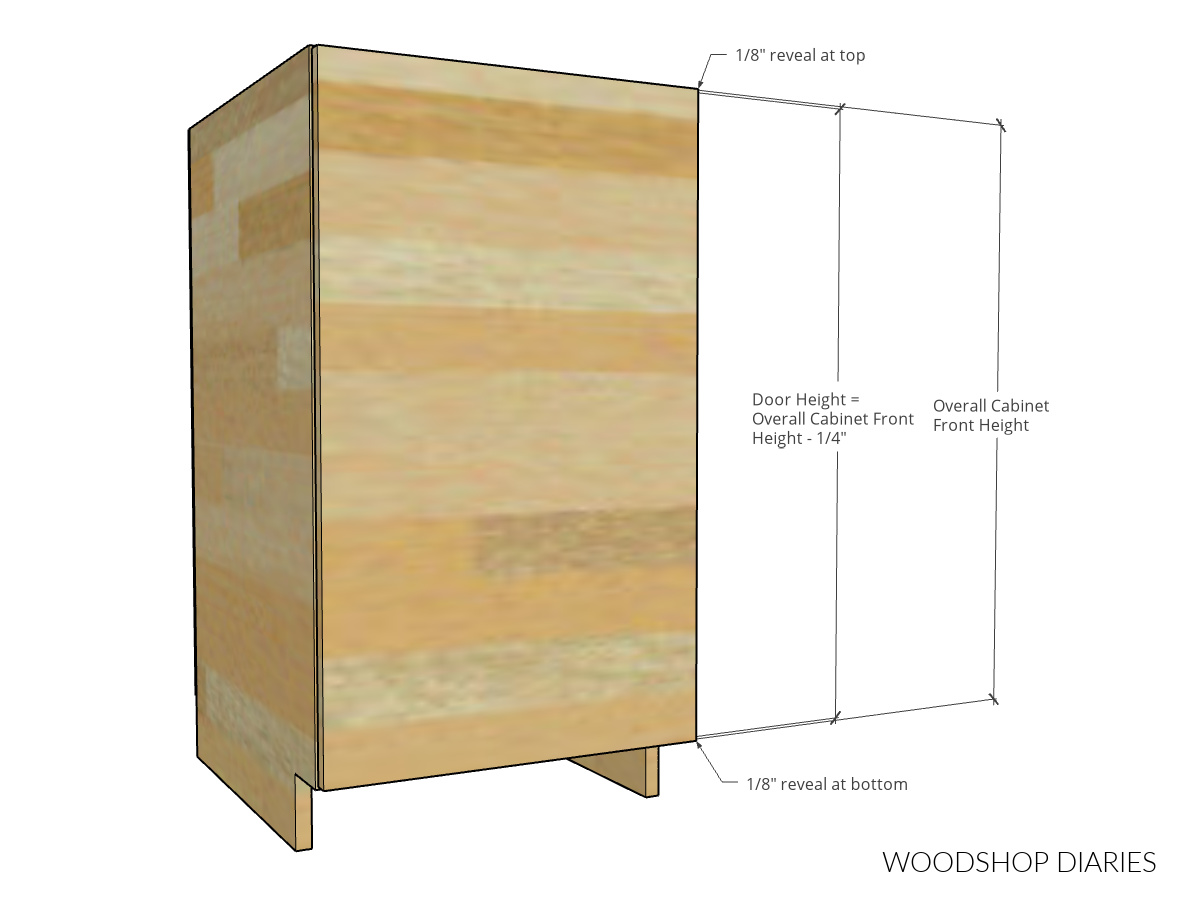
  • « Previous Page
  • 1
  • 2
  • 3
  • 4
  • 5
  • …
  • 16
  • Next Page »

Hi! I'm Shara, the designer, maker, and videographer behind Woodshop Diaries. Let's get building, friends :)
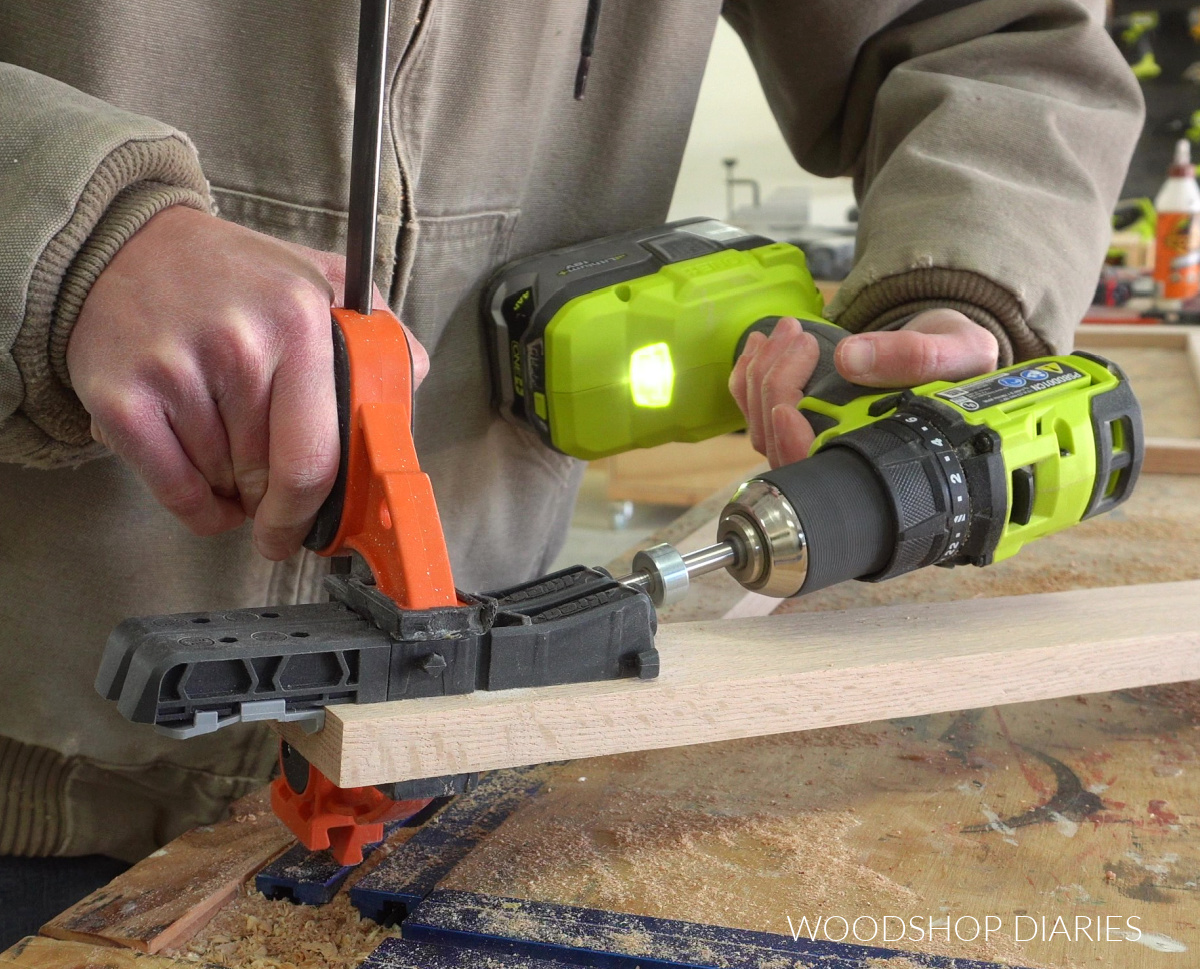
Learn more →

Woodworking Tips & Guides

  • How to make simple Shaker style cabinet doors!!
    DIY Simple Shaker Cabinet Doors
  • 5 Tools To Get Started Woodworking
  • DIY Kitchen Cabinets–From Only Plywood
  • How to Square Board Edges and Make Your Own 2x2s

Footer

↑ back to top

Tips to Take Your Projects to the Next Level

--5 Secrets to Professional Looking DIY Furniture

--How to Properly Paint Wood Furniture

--How to EASILY Cover Plywood Edges

--How to Sand Wood

--10 Must Have Tools for Furniture and Cabinet Building

Printable Building Plans

Check out our shop to browse printable PDF building plans!

Website Policies

This website is for entertainment purposes. Using any information provided is to be at your own risk.

This site uses cookies to provide you with a better experience.

All images and text on this site are property of Woodshop Diaries, LLC. Please be respectful and don't steal this content.

See Policies and Privacy page on this site for more information.

Want to get in touch? Contact Us Here

Copyright © 2026