Woodshop Diaries

  • Shop
  • About
    • Work With Me
    • Frequently Asked Questions
  • DIY Projects
    • DIY Furniture Plans
      • DIY Bed Plans
      • DIY Dresser Plans
      • DIY Nightstand Plans
      • DIY Desk Plans
      • DIY TV Stand Plans
      • Coffee and Side Table Plans
      • Tables
      • Shelves and Bookcase Plans
      • DIY Storage Trunk Plans
      • DIY Bench Plans
      • DIY Storage Cabinet Plans
      • DIY Bathroom Vanity Plans
      • Kids Projects and Furniture
    • DIY Scrap Wood Projects
    • DIY Workshop Projects
    • DIY Home Decor Projects
  • Getting Started
    • Cabinet Building
    • Woodworking Basics
    • Furniture Finishing Tips
    • Tool Guides & Reviews
  • Blog
menu icon
go to homepage
  • Shop
  • About
    • Work With Me
    • Frequently Asked Questions
  • DIY Projects
    • DIY Furniture Plans
      • DIY Bed Plans
      • DIY Dresser Plans
      • DIY Nightstand Plans
      • DIY Desk Plans
      • DIY TV Stand Plans
      • Coffee and Side Table Plans
      • Tables
      • Shelves and Bookcase Plans
      • DIY Storage Trunk Plans
      • DIY Bench Plans
      • DIY Storage Cabinet Plans
      • DIY Bathroom Vanity Plans
      • Kids Projects and Furniture
    • DIY Scrap Wood Projects
    • DIY Workshop Projects
    • DIY Home Decor Projects
  • Getting Started
    • Cabinet Building
    • Woodworking Basics
    • Furniture Finishing Tips
    • Tool Guides & Reviews
  • Blog
search icon
Homepage link
  • Shop
  • About
    • Work With Me
    • Frequently Asked Questions
  • DIY Projects
    • DIY Furniture Plans
      • DIY Bed Plans
      • DIY Dresser Plans
      • DIY Nightstand Plans
      • DIY Desk Plans
      • DIY TV Stand Plans
      • Coffee and Side Table Plans
      • Tables
      • Shelves and Bookcase Plans
      • DIY Storage Trunk Plans
      • DIY Bench Plans
      • DIY Storage Cabinet Plans
      • DIY Bathroom Vanity Plans
      • Kids Projects and Furniture
    • DIY Scrap Wood Projects
    • DIY Workshop Projects
    • DIY Home Decor Projects
  • Getting Started
    • Cabinet Building
    • Woodworking Basics
    • Furniture Finishing Tips
    • Tool Guides & Reviews
  • Blog
×
Home

DIY Wooden Lazy Susan

November 20, 2023 by Shara, Woodshop Diaries

In this post, I’m sharing how to make a DIY wooden lazy Susan from a single 2×4 board!

I’ve been making and giving these as gifts for years and everyone always loves them. They’re easy and inexpensive to make and can be customized with an initial or shape!
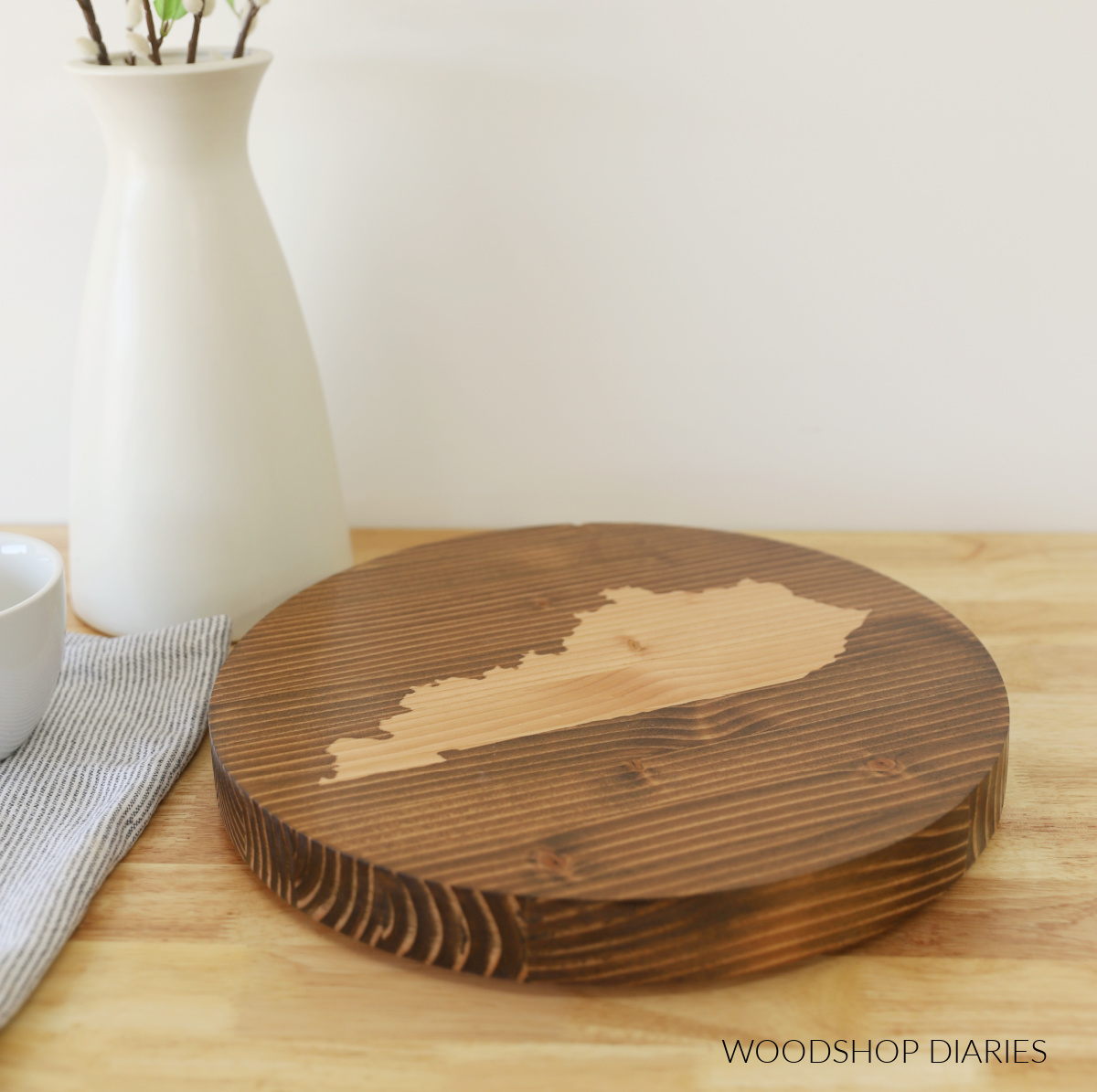
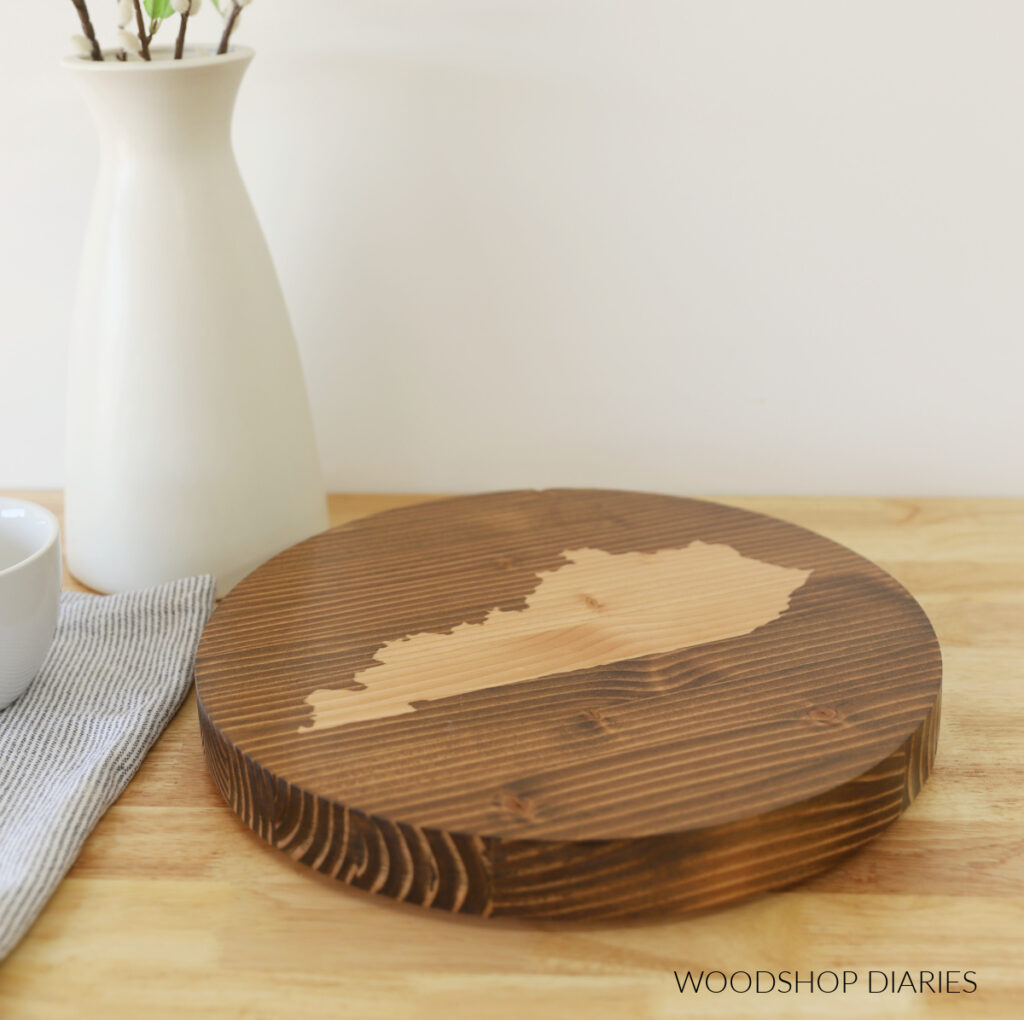
Round wooden lazy susan with Kentucky shape stained on top

.*This post contains affiliate links. See website policies.

What to consider before building a wooden Lazy Susan

This wooden lazy Susan is a simple project and can be assembled and cut many different ways.

If you didn’t have the tools needed or are running low on time, you can purchase a precut wooden round for this instead of making your own. Using a precut round allows you to skip all the cutting and sanding and simply stain/finish and add a lazy Susan to the bottom.

But, if you already have the tools, creating your own wooden round allows you to customize the size and wood type and saves quite a bit of money as precut rounds can be a bit pricey.

Wood Type

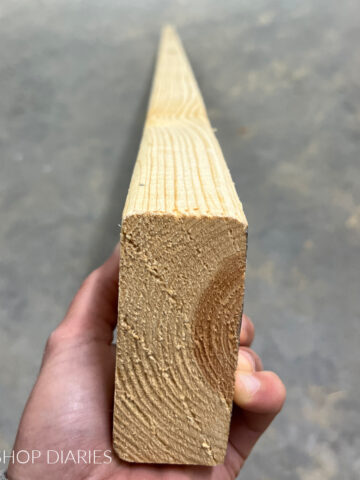
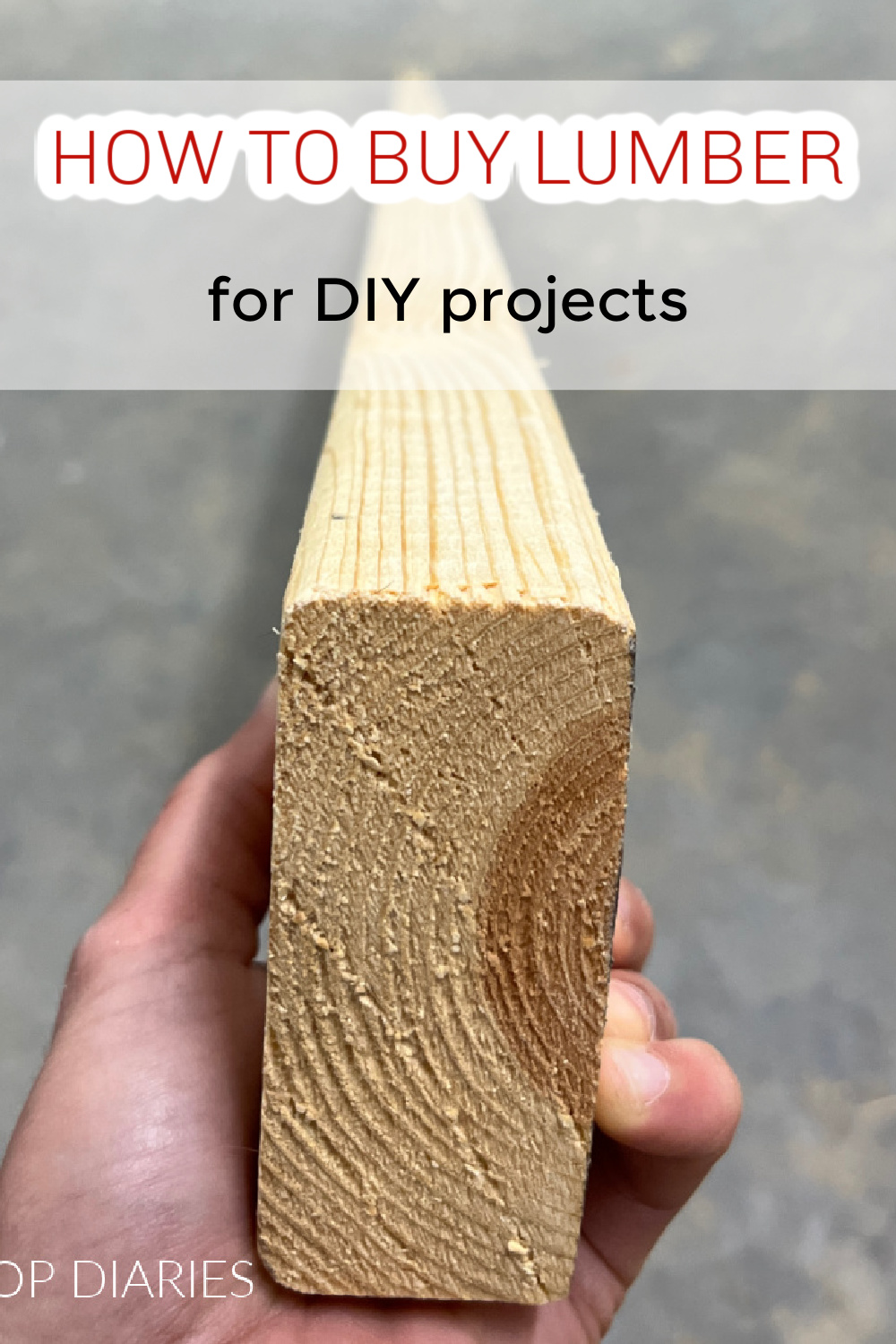
For this project, I used a basic 2x4x8 construction board from Home Depot. Depending on where you live, you typically find 2x4s in pine, spruce, or fir. These are common softwoods and are fairly inexpensive.

RELATED: How to buy lumber
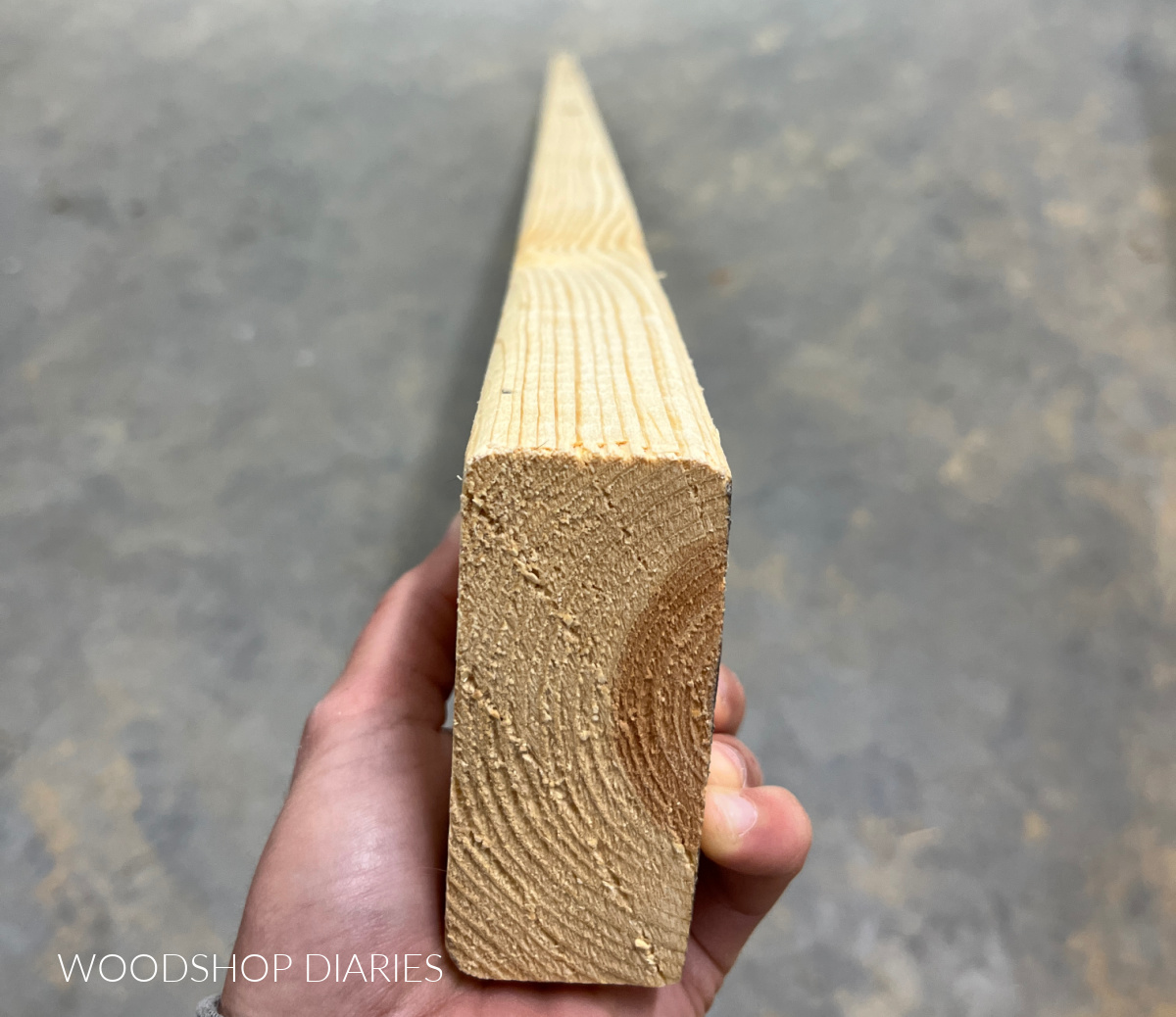
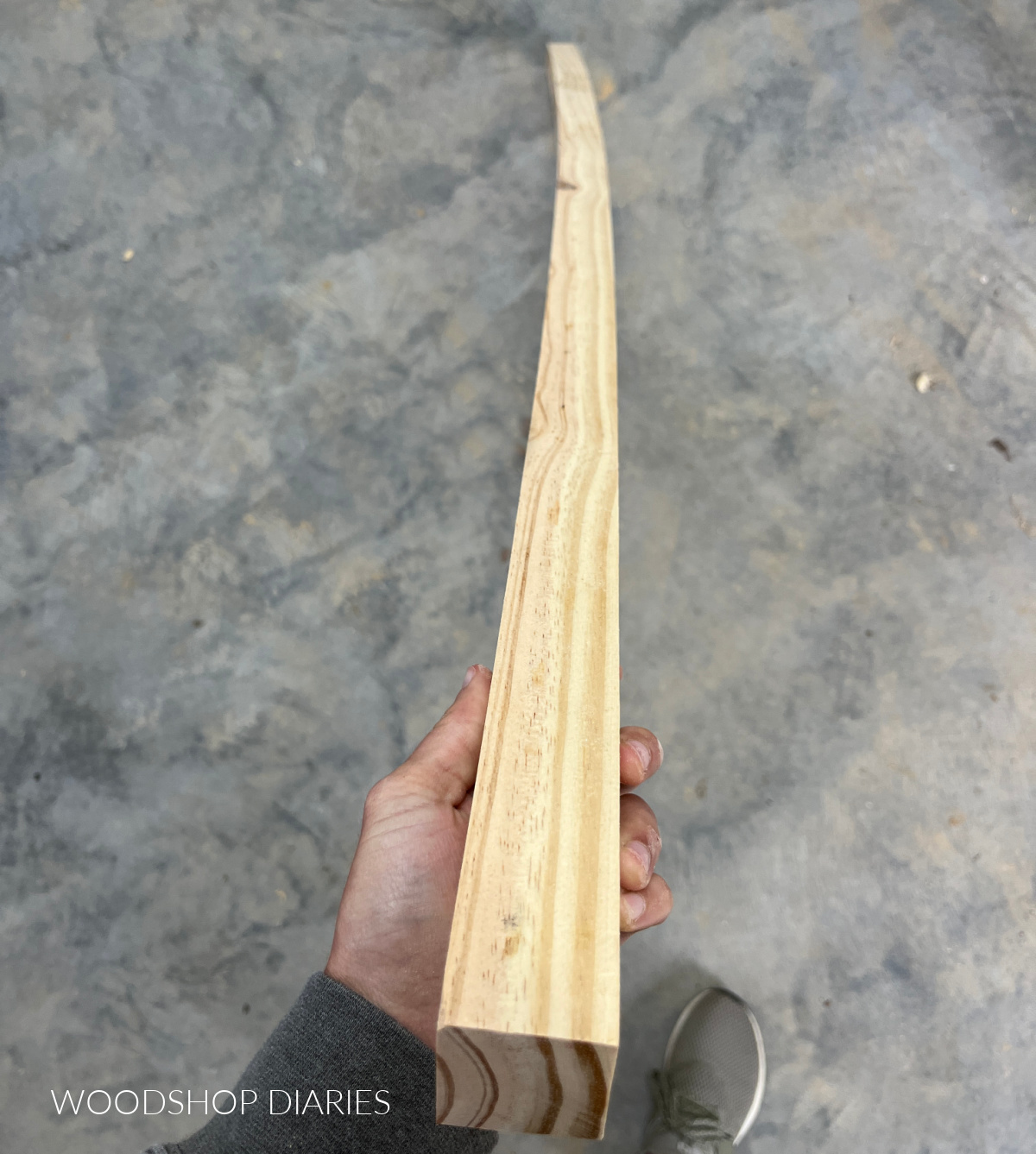
2x4 board--looking down board edge for straightness
How to Buy Lumber

However, if you preferred something different, any wood type would work fine for this simple DIY.

To make these wooden lazy Susans, I rip my lumber into 1 ½″ x 1 ½″ squares on the table saw (these are 2x2s). Then, I glue them back up.

RELATED: How to cut 2x2s from a 2×4

I know this may seem silly and unnecessary, BUT there are a couple of reasons I do it this way:

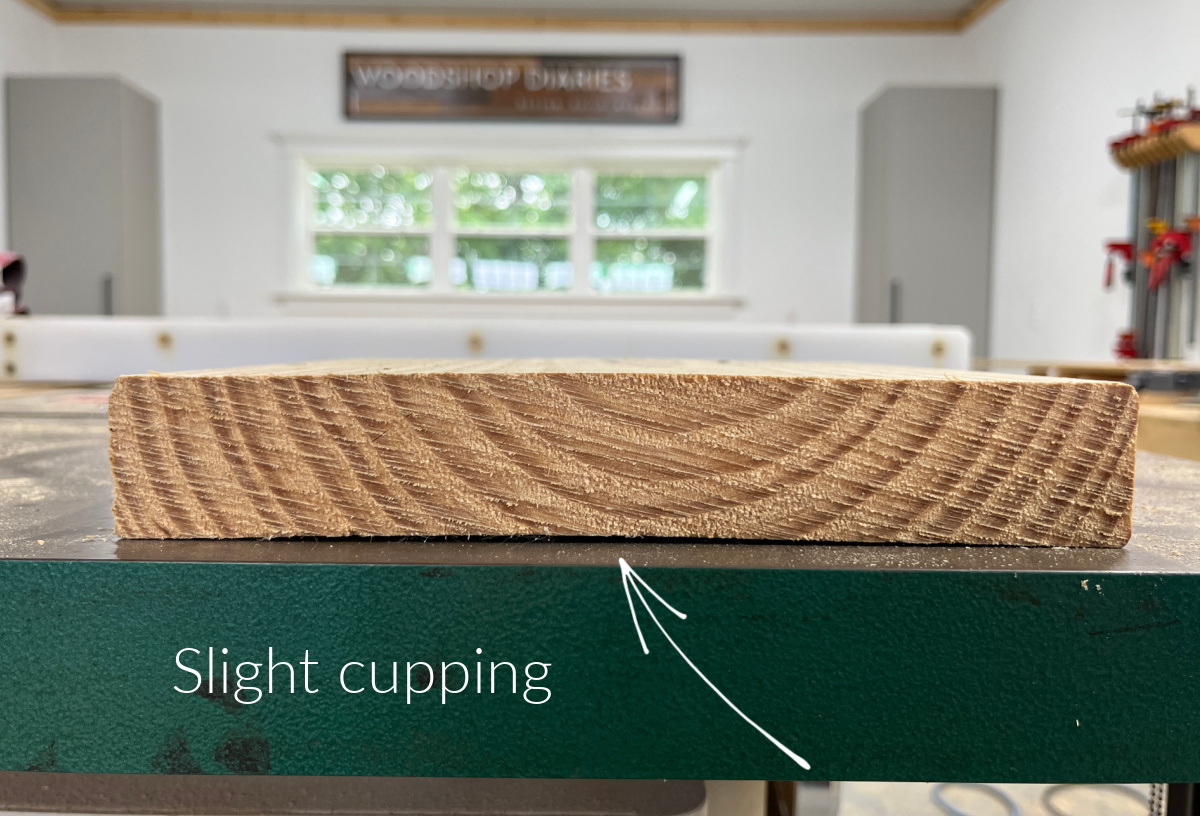
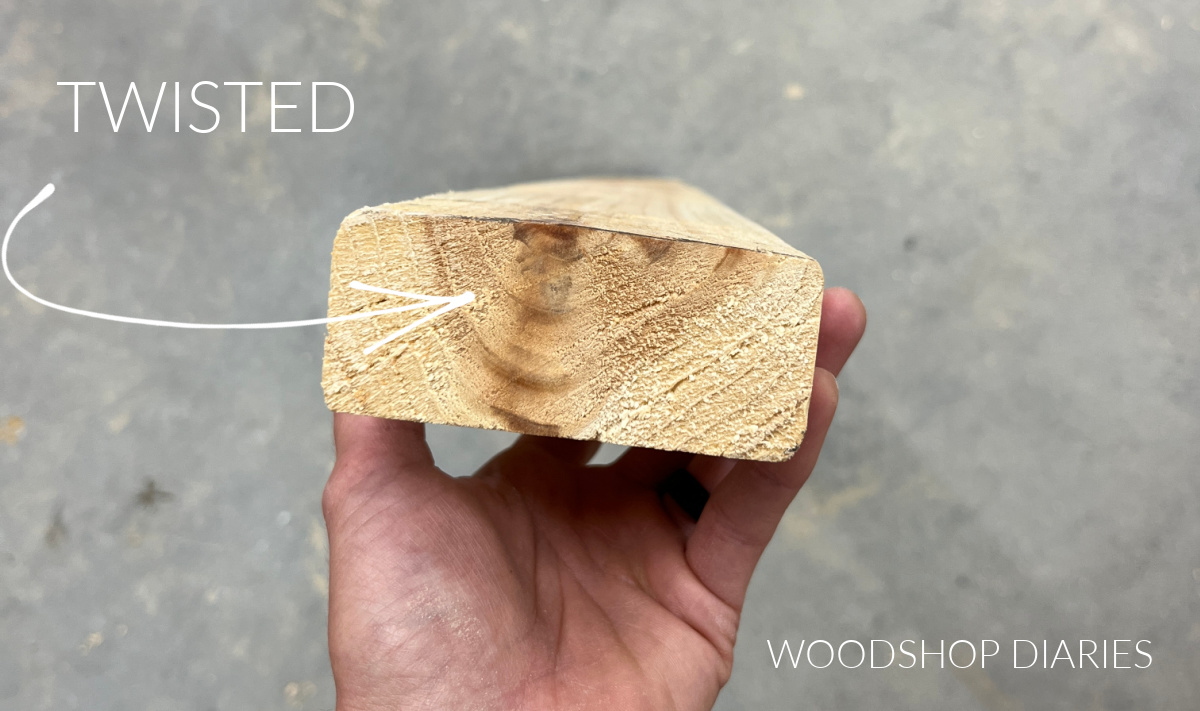
  • Wider boards are more likely to have cups, bows, or twists, which makes glue ups more challenging. Ripping them into smaller pieces makes it easier to get a flat panel.
  • These smaller pieces when glued together look more like butcherblock to give it more character.

Overall, this is really about looks, so if you wanted to just use wider boards, feel free.

Cutting a Perfect Wooden Circle

Once the panel is glued up in step 1, it needs to be cut in a circle. You can cut a perfect wooden circle with a router and a straight bit using an easy DIY circle jig.
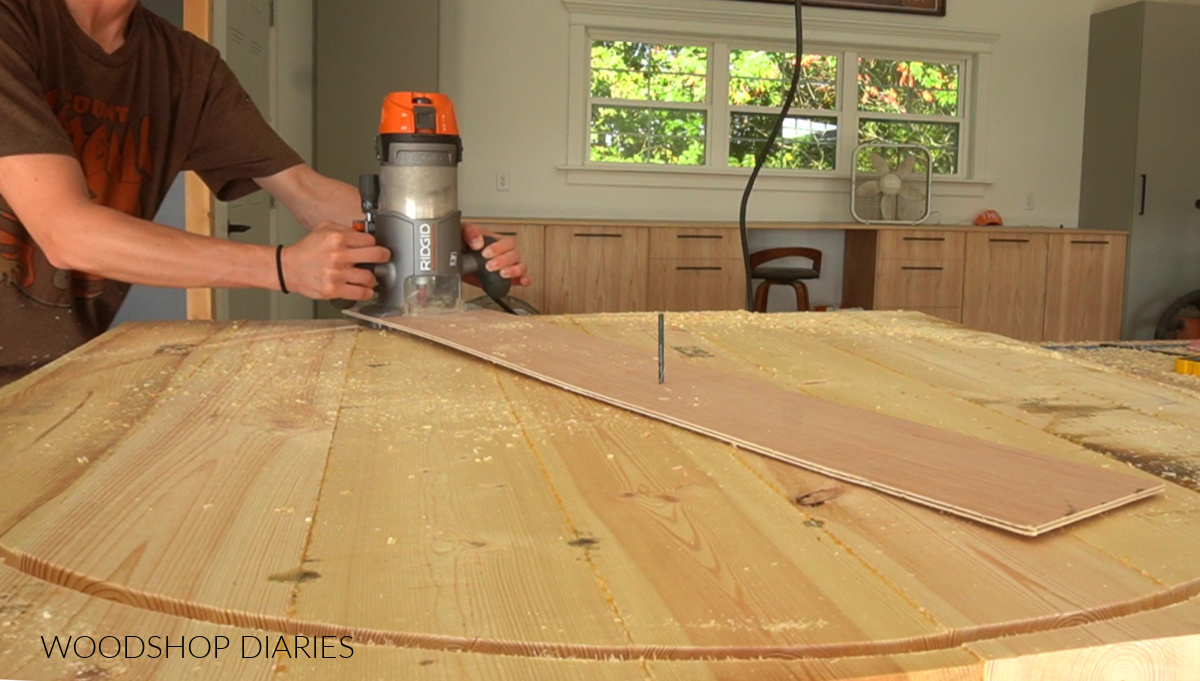
using a homemade circle jig with router to cut a wooden circle in large panel on workbench

If you don’t have a router (or you don’t like using one), this post shows you how to draw any size circle and once it’s drawn, you can simply follow the line with a jig or band saw to cut it out.

Cutting the circle with a router is usually a little more accurate than using a jig saw, but it does take a little longer.

Typically, I use my router to cut a few shallow passes to give me my perfect circle shape, then, I’ll cut the remaining material using a jig saw and smooth it out with a router and a flush cut bit.

Learn how to cut perfect wooden circles in this post.

Customizing your Project

You can customize these in a hundred different ways. Here are a few easy ways you may consider making them your own:

  • Use different wood types in contrasting colors
    • Instead of gluing up pieces of the same wood type to make your circle, consider using two different types (like maple and walnut) for contrast.
  • Change up the size
    • I made these about 14″ diameter, but feel free to make them bigger or smaller to fit your needs.
  • Add an initial or a shape
    • Use a Cricut or vinyl cutter to cut a stencil for staining or use a CNC or router to carve a design on top.
  • Add a decorative trim piece around the outside
    • Add a metal band around the outside for an industrial look (see step 4 below)

Are DIY projects your thing? Sign up for our newsletter for priority access to the latest projects and build plans!

How to make a wooden lazy Susan

I’m sharing the steps below to make a this wooden lazy Susan, but if you prefer to watch, I’ve also got a video tutorial here as well.

Tools & Materials

Tools:

  • Table Saw
  • Miter Saw
  • Drill/Driver
  • Router (with straight and flush cut bits) and/or Jig Saw
  • Sander
  • Clamps
  • Cricut Machine or vinyl cutter (optional)

Materials:

  • (1) 2x4x8 board
  • (1) 6″ lazy Susan Hardware
  • (4) 1 ¼″ wood screws
  • Cricut Vinyl (optional)
  • Wood Finish

Step 1: Glue up Wooden Panel

To kick off this project, I started my cutting down my 2×4 into strips to glue into a panel (see notes above).

First, I ripped about 3/16″ off the edge of the board to give me a nice square edge to start with. (See step 4 for an idea to reuse this ~⅛″ thick strip that’s left!)
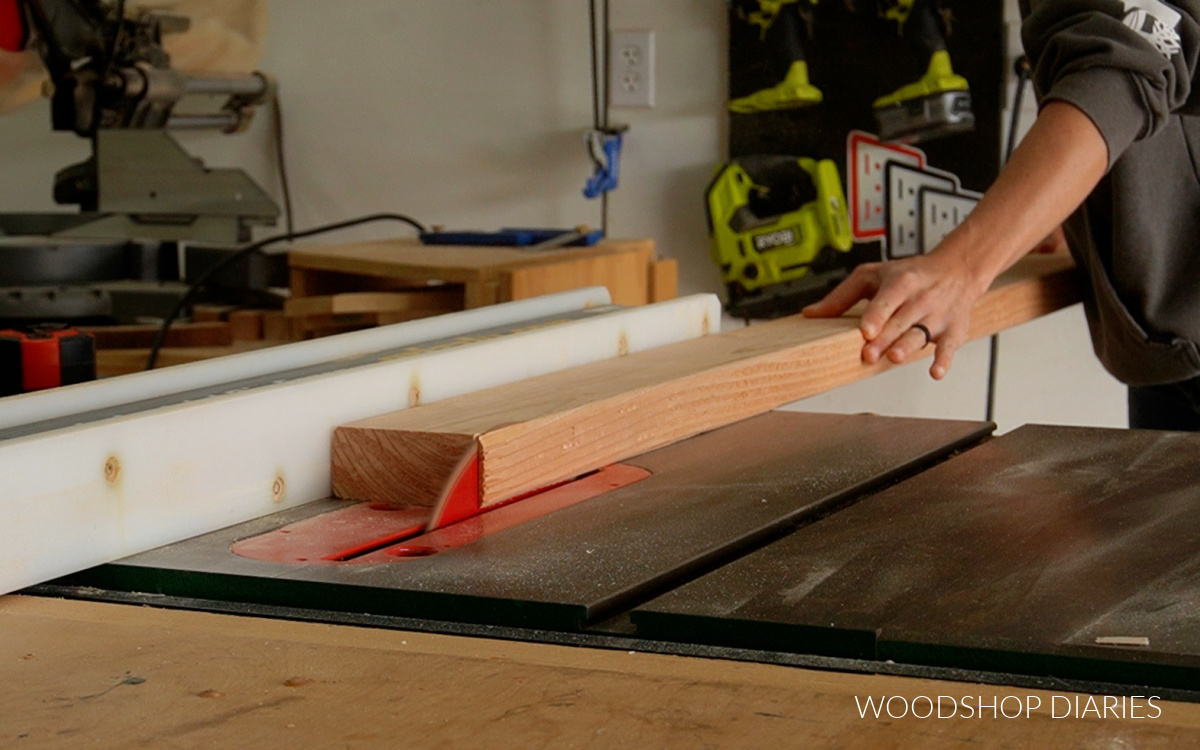
running 2x4 board through table saw to remove rounded edges

Then, I ripped this board into two 1 ½″ wide strips on the table saw. This essentially gave me two 2x2s with nice square edges.

RELATED: How to square board edges and cut 2x2s.
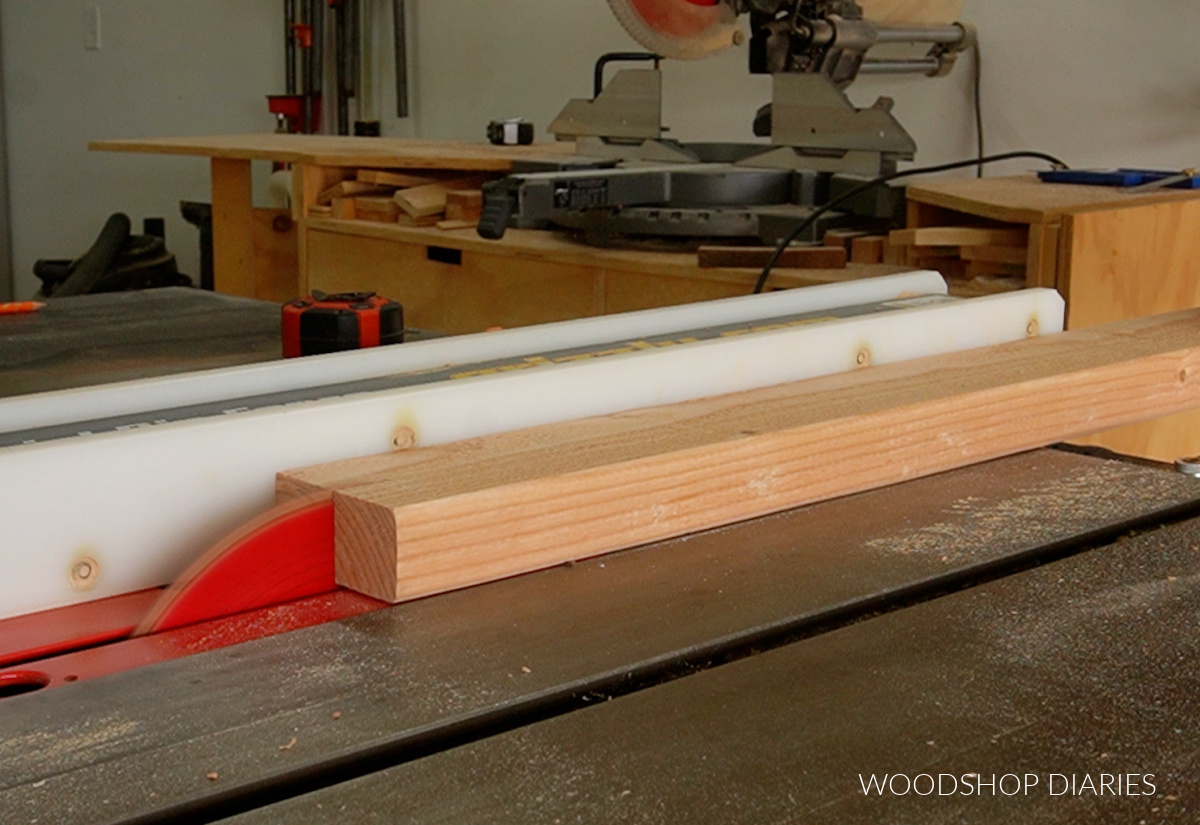
cutting 2x4 board into 2x2 strips on table saw

Again, the reason I ripped this into thinner strips to glue back up was mostly for aesthetics–you can simply glue up wider boards if you want.

Then, I cut these 2x2s down into 10 pieces about 16″ long on the miter saw.
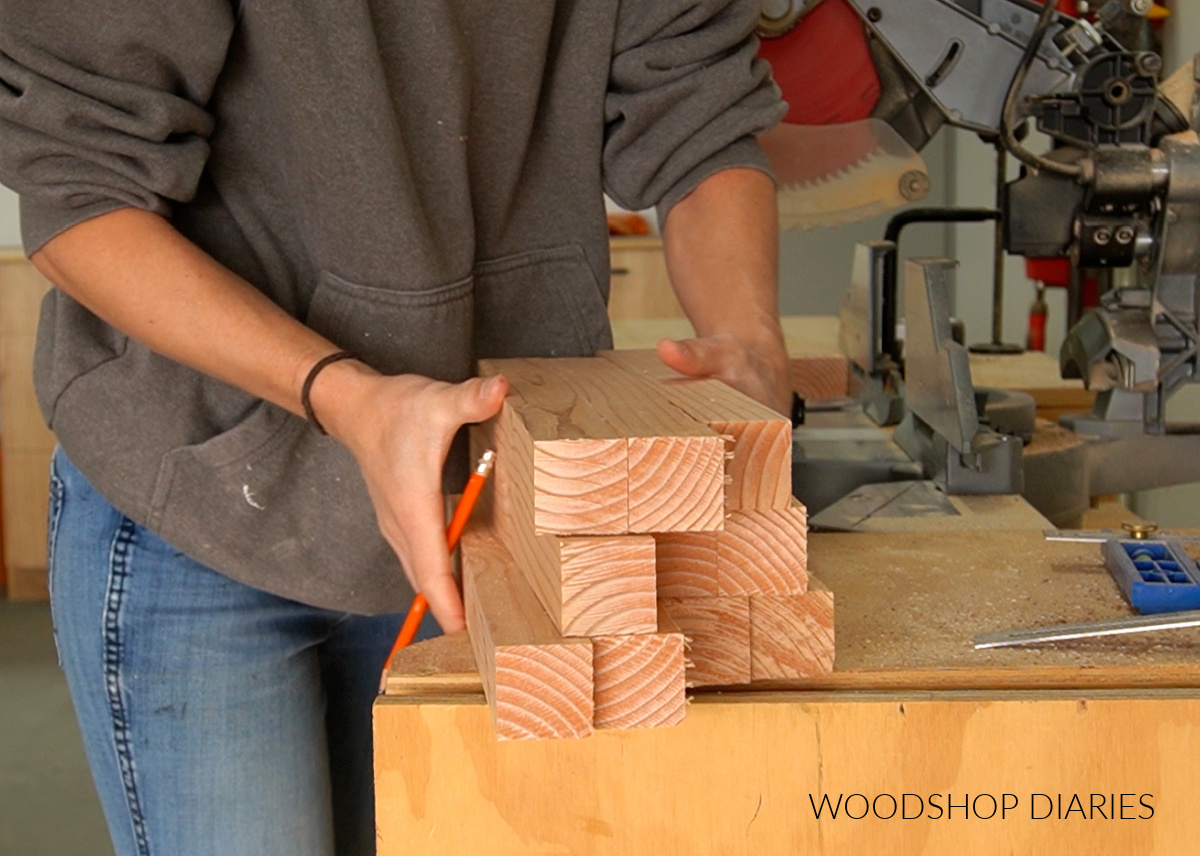
ten 2x2s stacked together on miter saw station

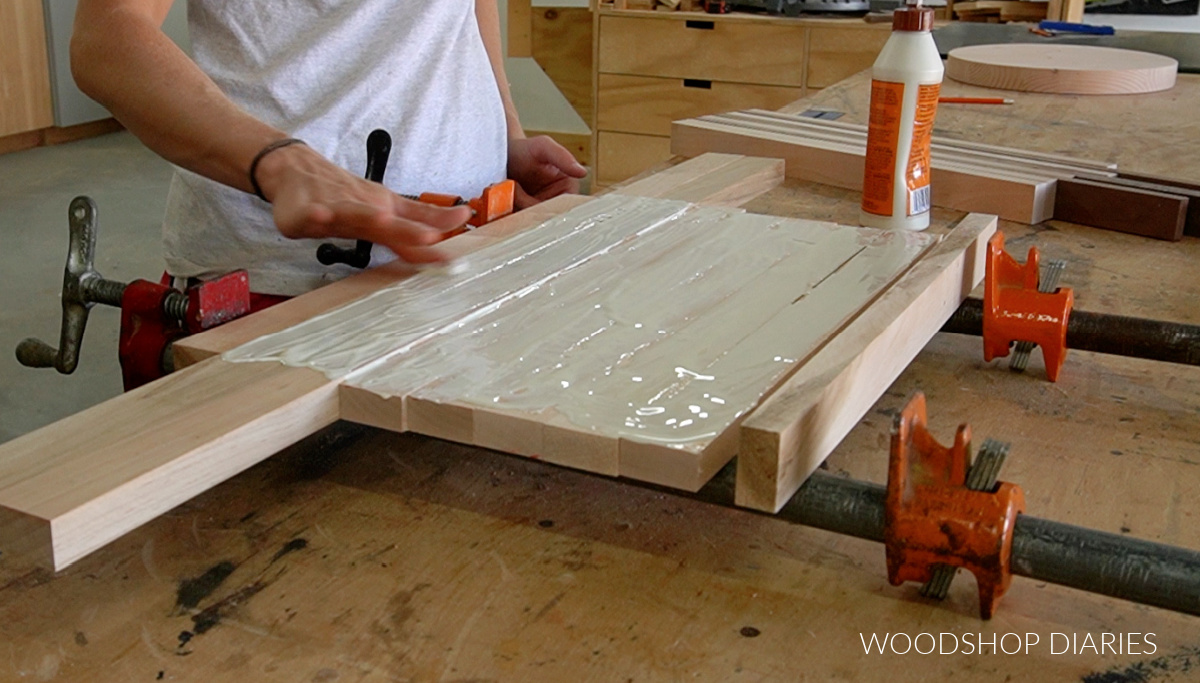
I grabbed a couple pipe clamps and glued these 10 boards together into a panel, keeping the pieces as flat as possible while clamping.
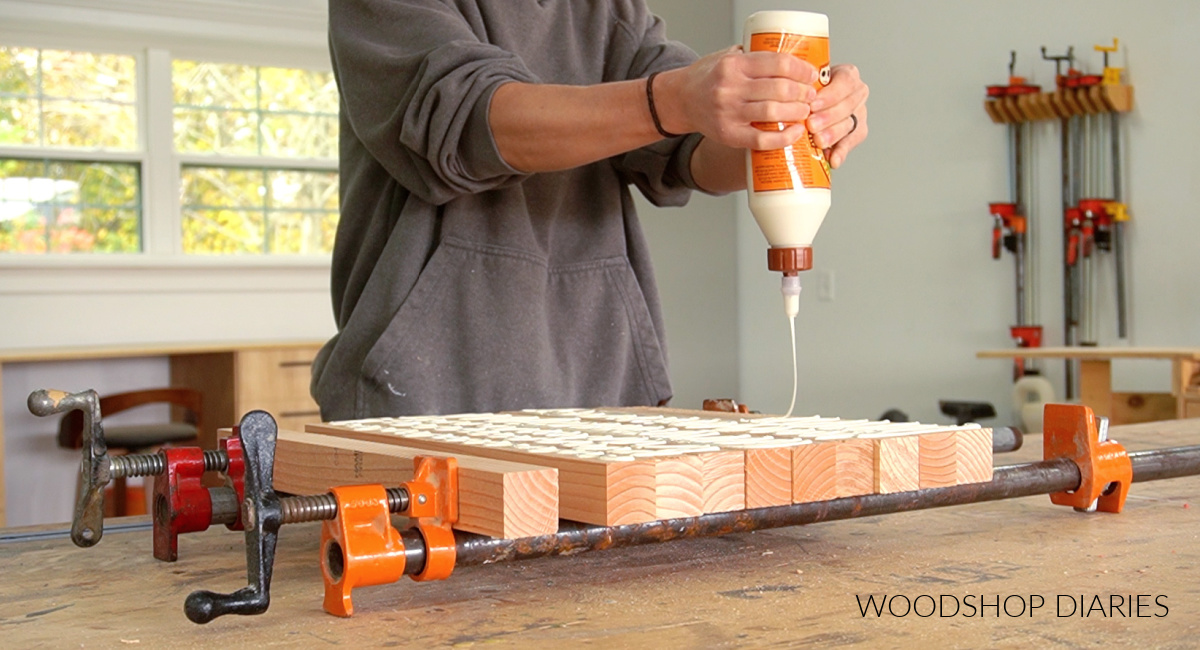
Shara Woodshop Diaries applying wood glue to 2x2s in pipe clamps

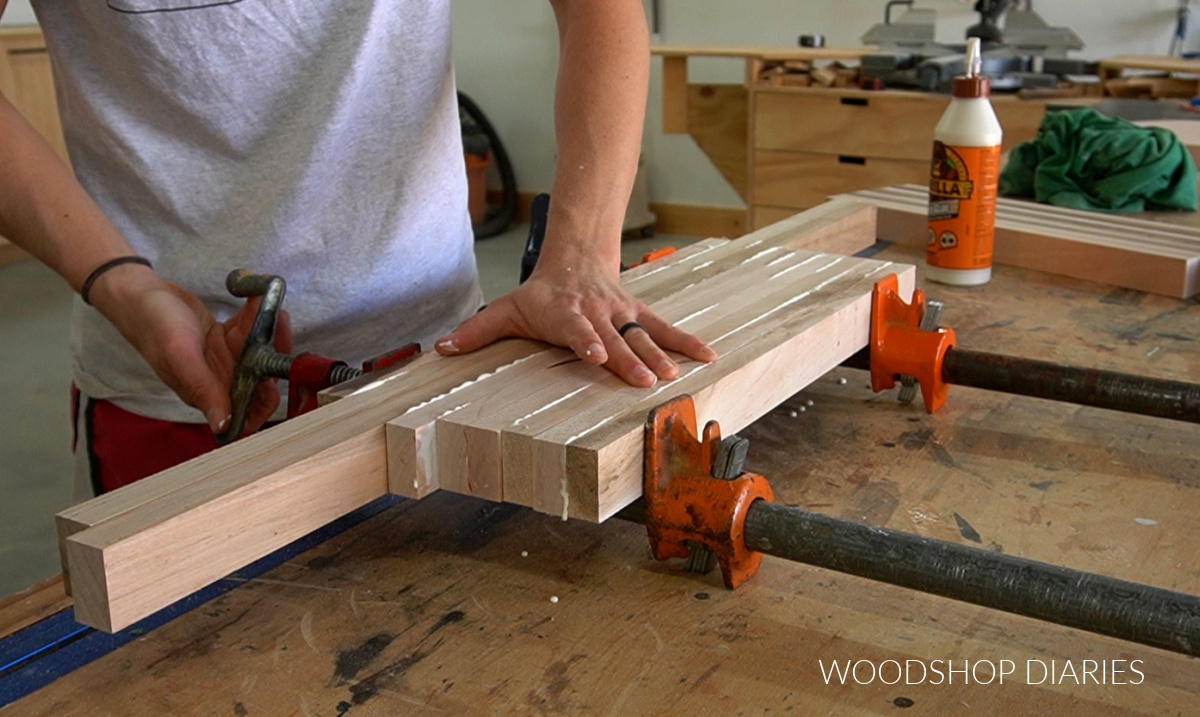
This gave me a 1 ½″ thick panel roughly 15″ x 16″. I allowed the glue to cure before moving on.
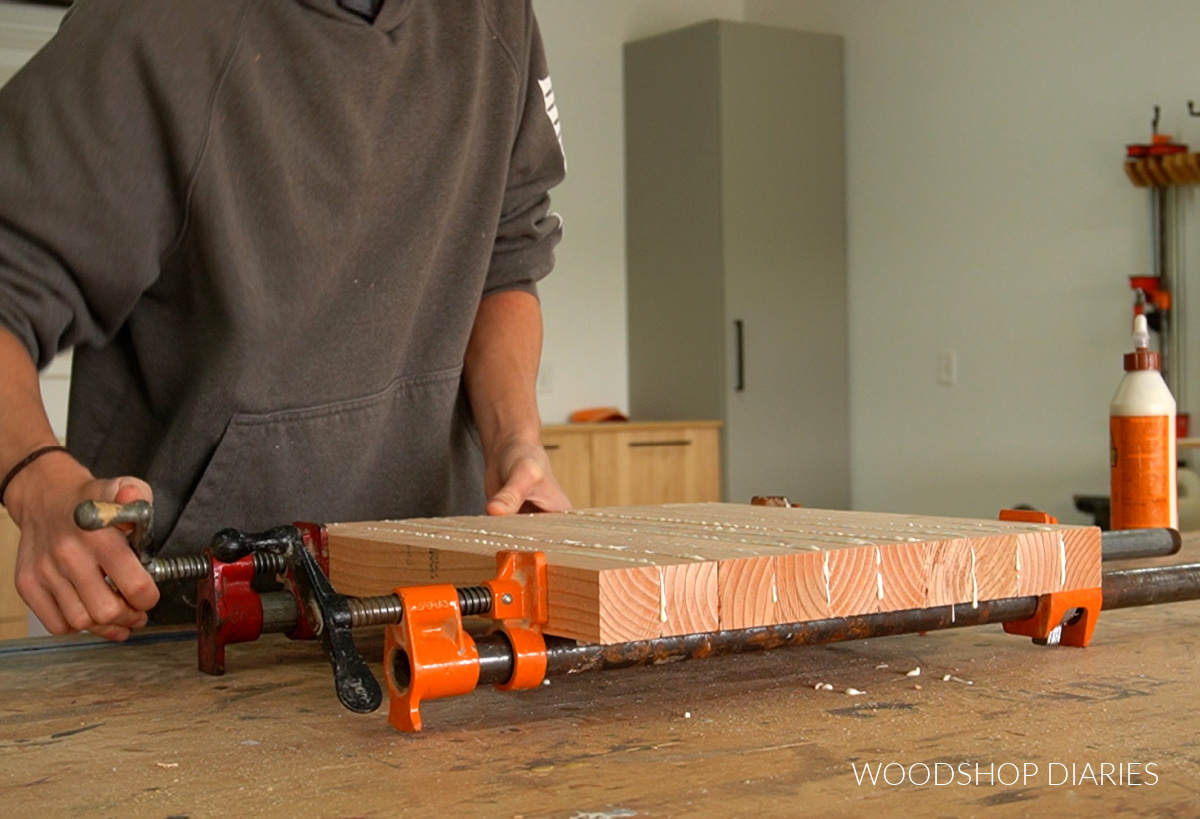
Clamping 2x2s together into a panel on workbench in pipe clamps

Step 2: Cut Wooden Circle

Once the panel from step 1 was dry, I cut a 14″ diameter circle from it. As I mentioned above, you can draw a circle and cut this out with a jig saw or band saw.

But I opted to cut it first using a router. First, I flipped this panel upside down and found the center.
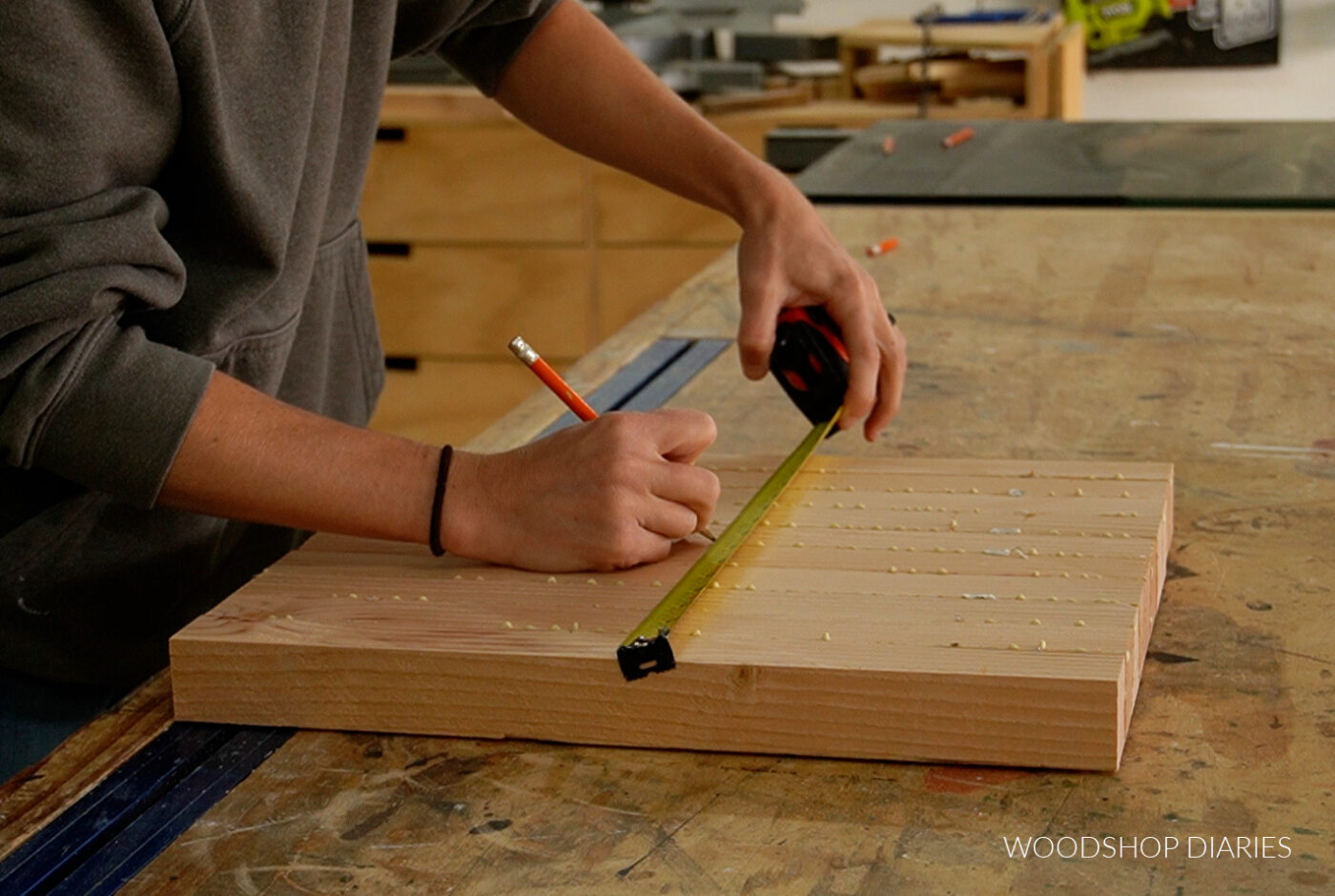
finding center of glued up panel with measuring tape

Then I drilled a hole (and left the drill bit in it) in the center to pivot my router and circle jig on. See this post on how to make and use a circle jig with your router.

I used a straight bit in my router to make a few shallow passes in the panel to give me my circle shape.
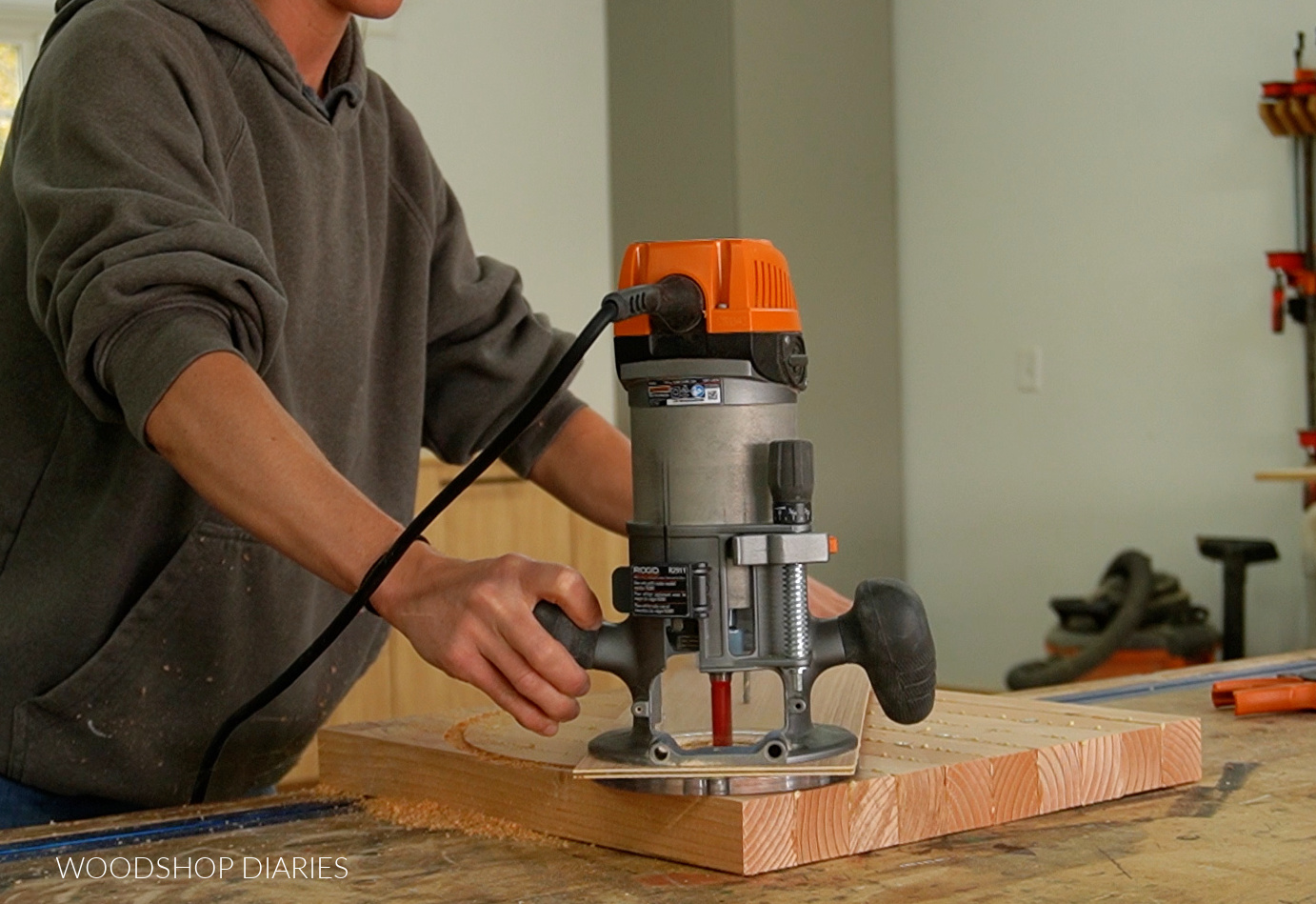
Using router and homemade circle jig to cut out round lazy susan on wooden panel on workbench

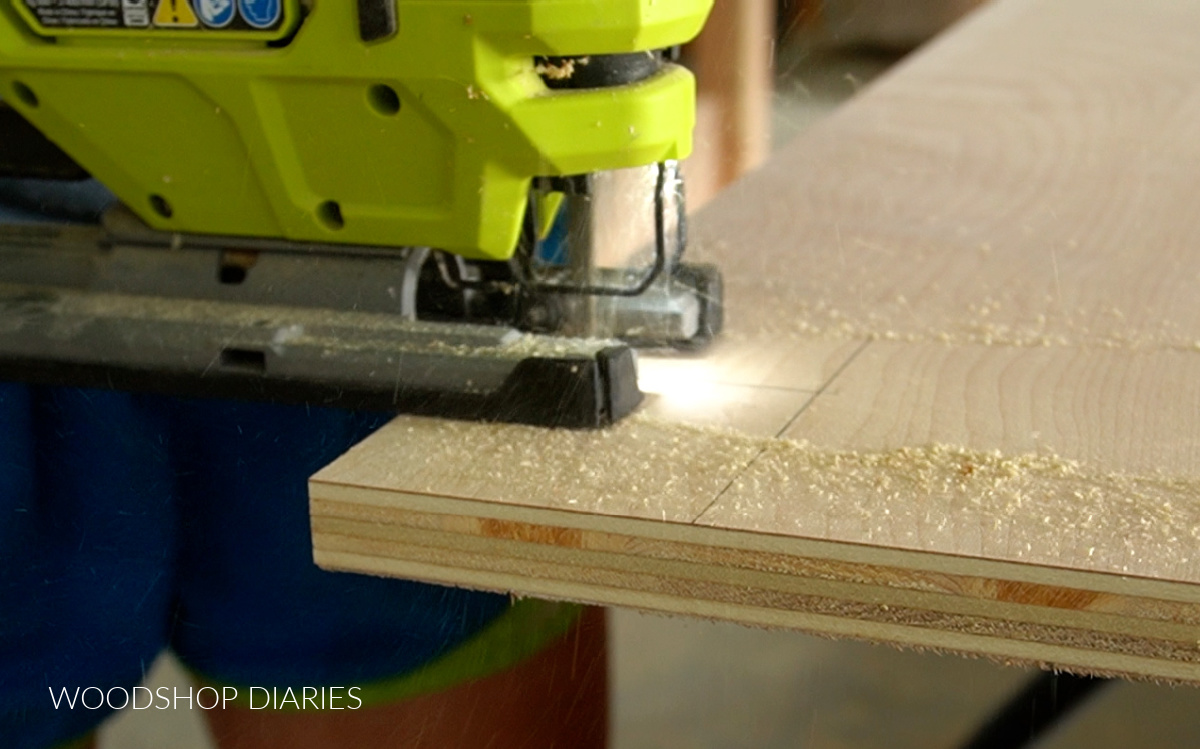
Then, I cut the rest of the material with a jig saw to save some time.
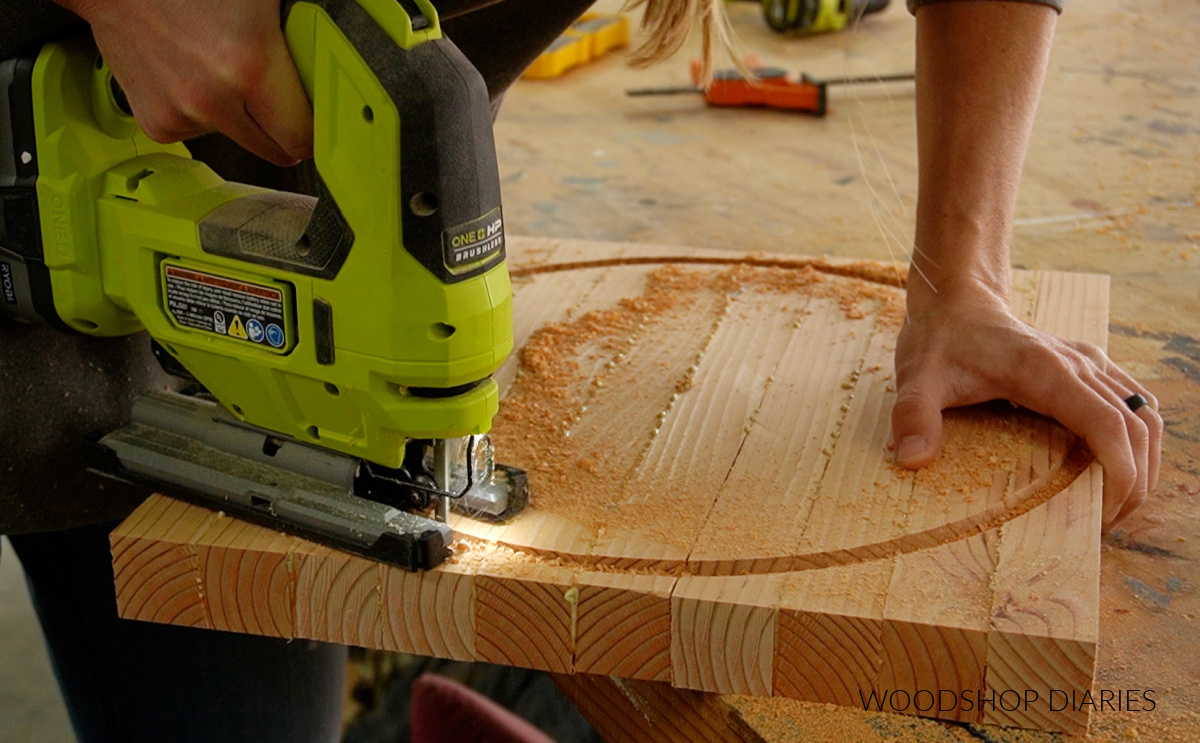
Using Jig saw to cut circle out of glued up panel

I cleaned up the edges with a flush cut bit in my router, then sanded the panel nice and smooth.

RELATED: How to sand wood
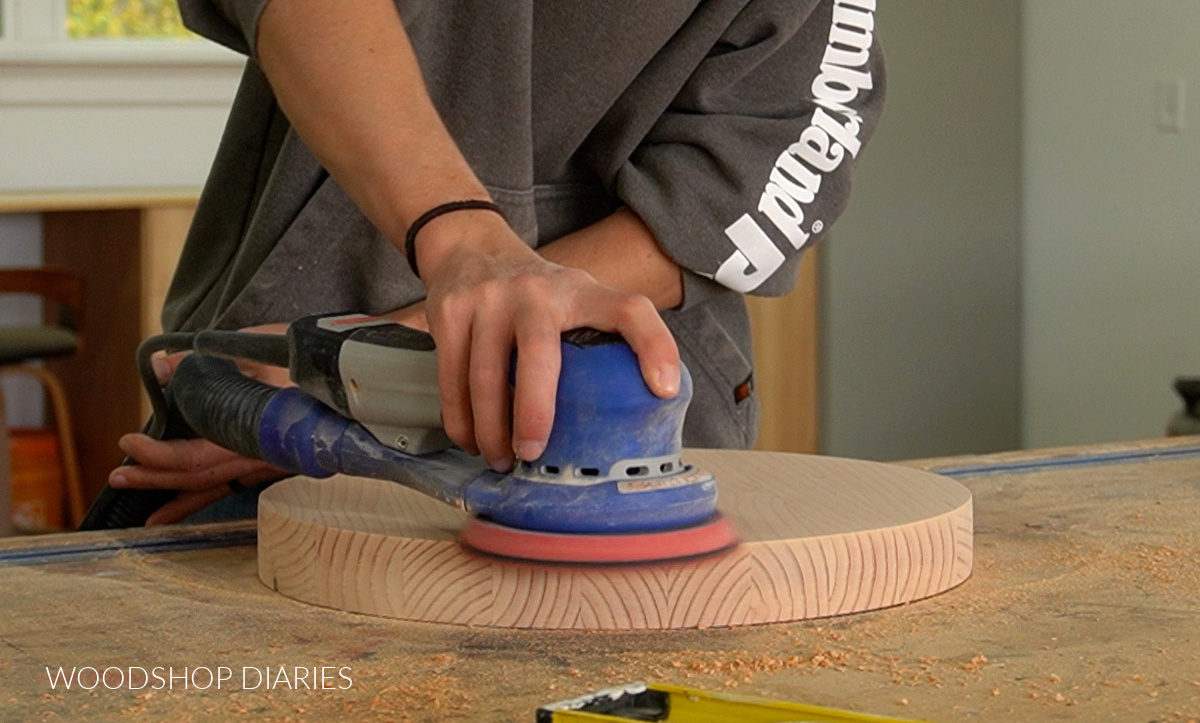
Shara Woodshop Diaries using orbital sander to sand round wooden lazy susan

Step 3: Attach Lazy Susan Hardware

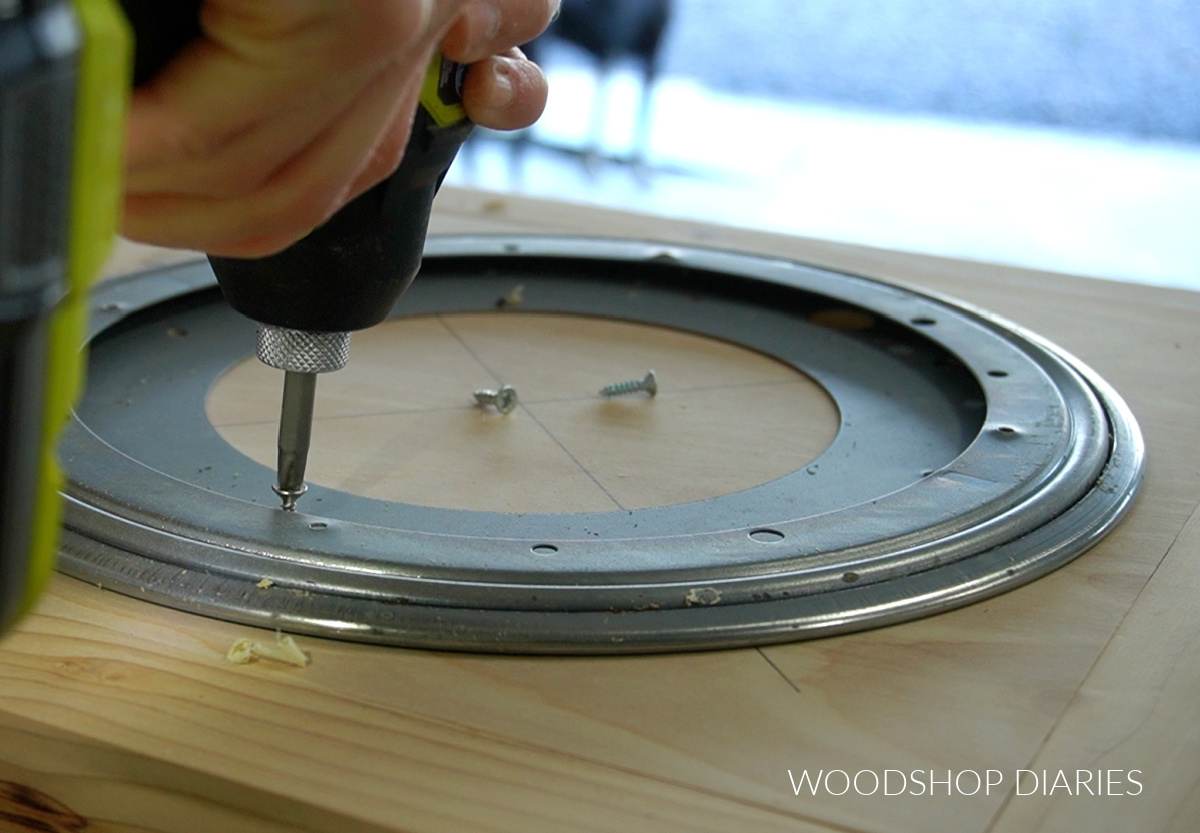
After the lazy Susan circle was cut and sanded, I flipped it upside down and centered a 6″ lazy Susan on it like shown below.

I secured this to the bottom using four 1 ¼″ wood screws through the holes in the hardware.
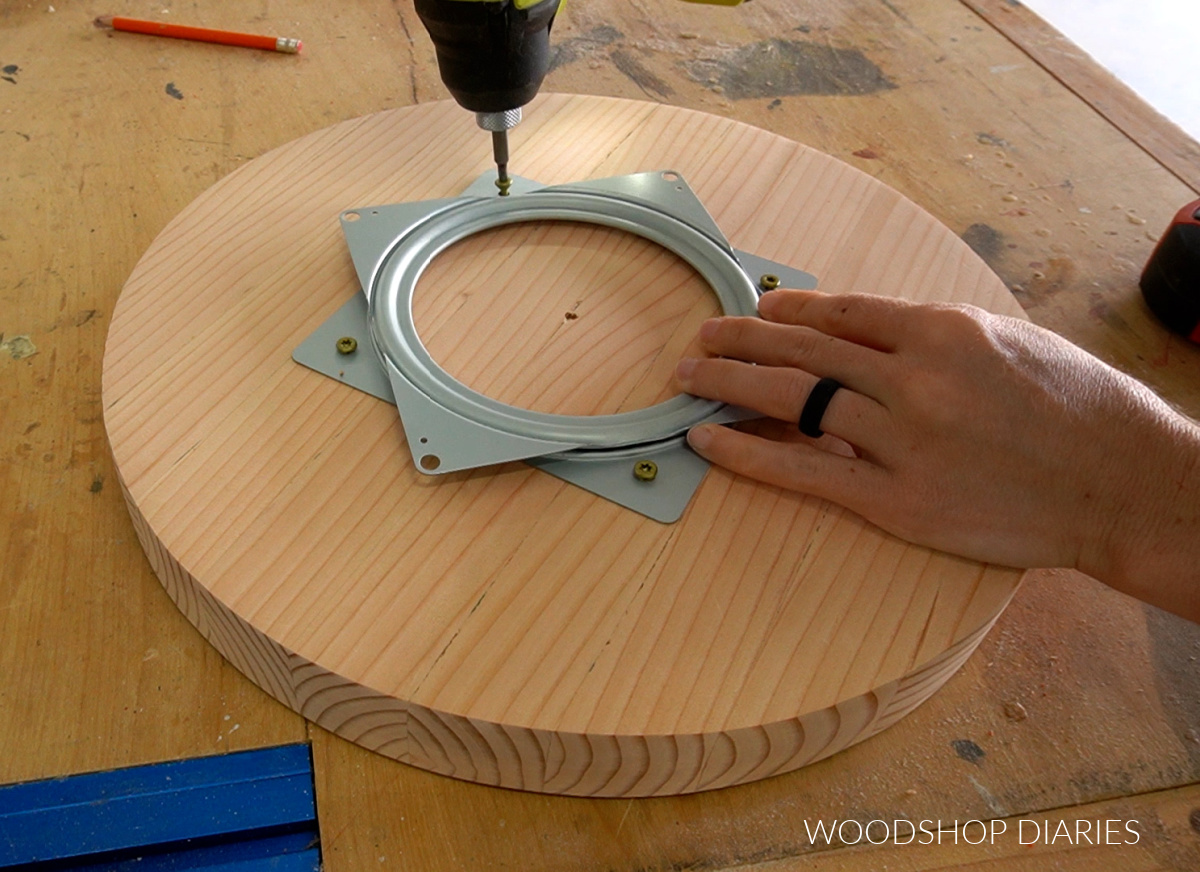
installing lazy susan hardware onto bottom of round wooden circle

NOTE: If you’d like, add some rubber feet to the corners of the hardware so that when you flip it over, it stays in place and doesn’t scratch the surface of whatever you set it on.

Step 4: Finish and Add Customizations

Now it’s time to finish the wooden round. I mentioned earlier there are several ways to customize/personalize this and one of them is a stencil to add a shape or initial.

In this case, I used my Cricut Explore 3 to cut a simple Kentucky shape on some black vinyl to use as a staining stencil.
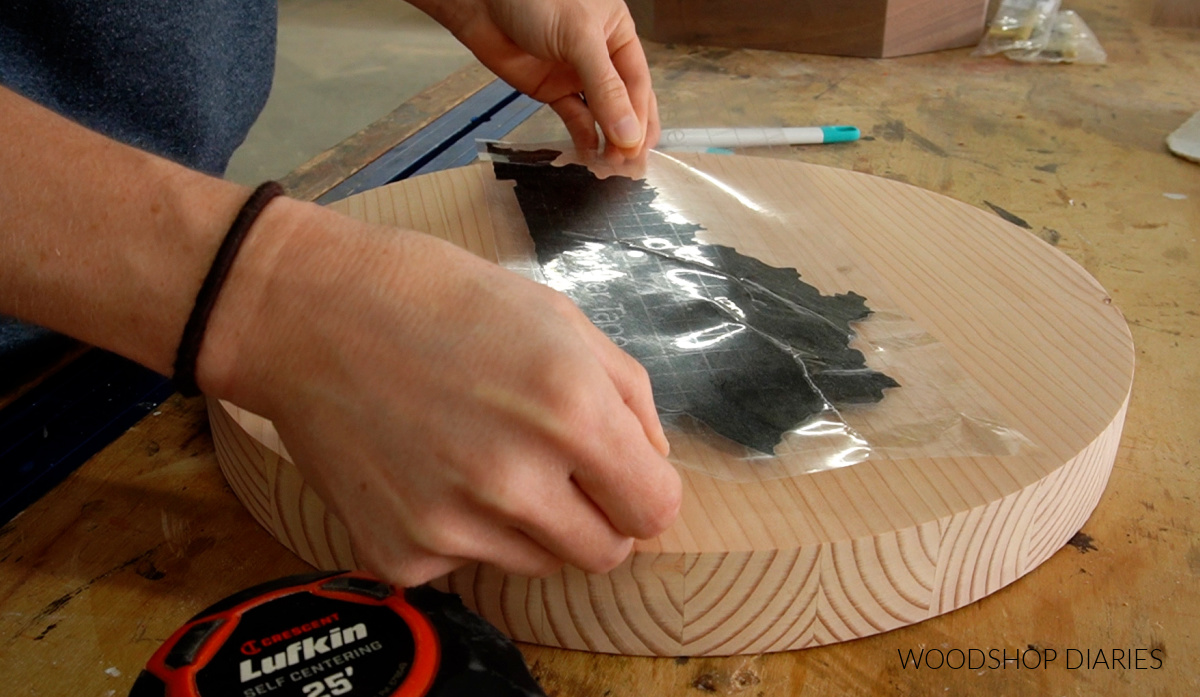
Applying Cricut vinyl stencil to wood circle as staining template

I placed this in the center of my lazy Susan, then stained around it with Minwax Provincial wood stain.
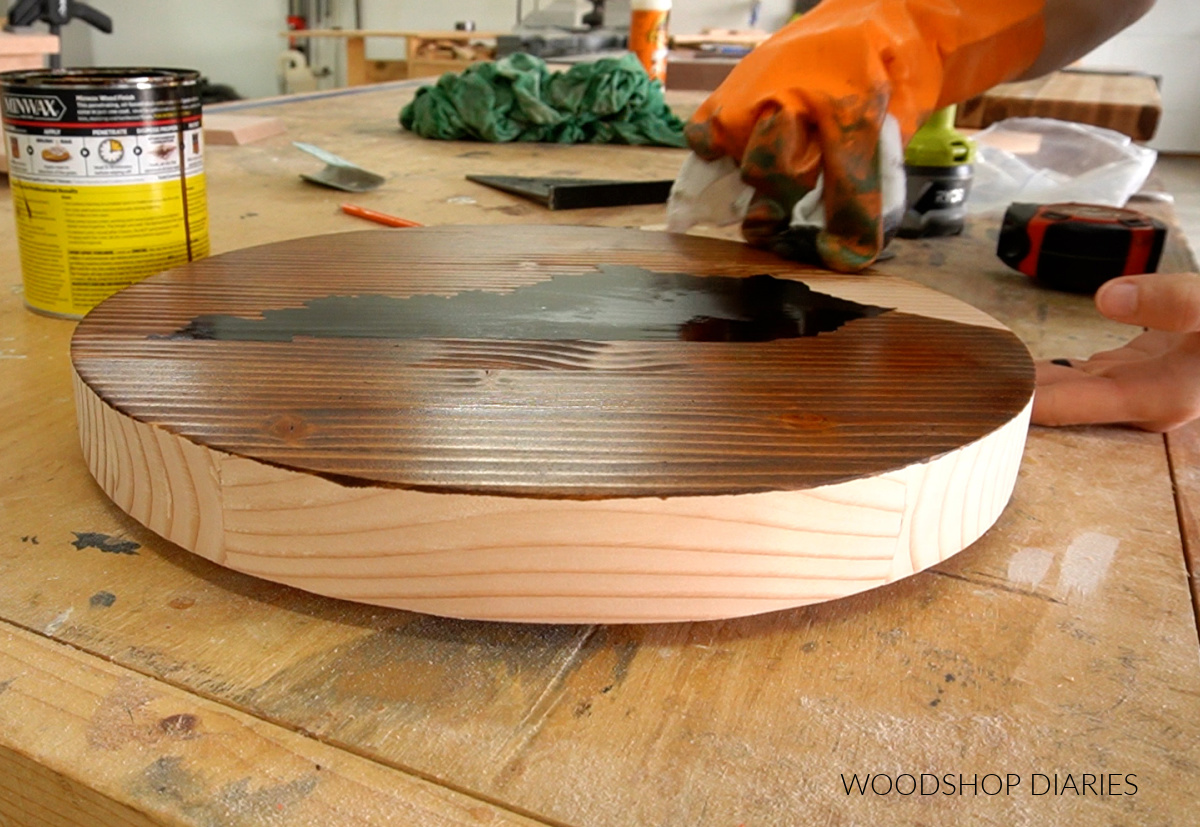
applying wood stain to lazy susan

Once the stain was dry, I removed the stencil to reveal the state. You could do this same thing for a monogram, a quote, or another state or shape.

After the stain dried, I applied a few coats of Minwax Helmsman clear coat to seal it.
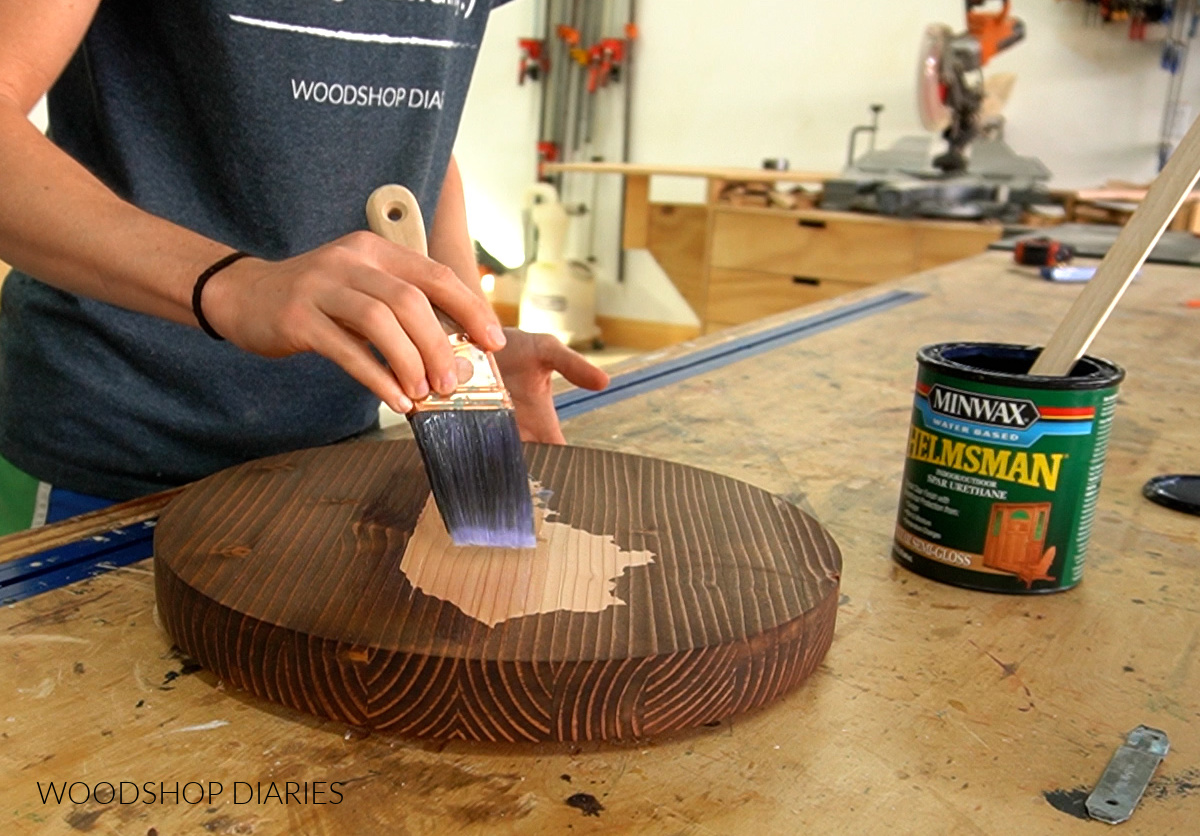
brushing clear coat onto stained wooden lazy susan

At this point, it’s ready for use! These would be great on a desk, on a coffee table, as a centerpiece, a serving tray–so many options!

Adding an optional metal band

I have been making these for years and some of my early ones also had one more unique feature/customization you may consider adding–a metal (or faux metal) band around the outside. You can make this from actual metal or from wood.
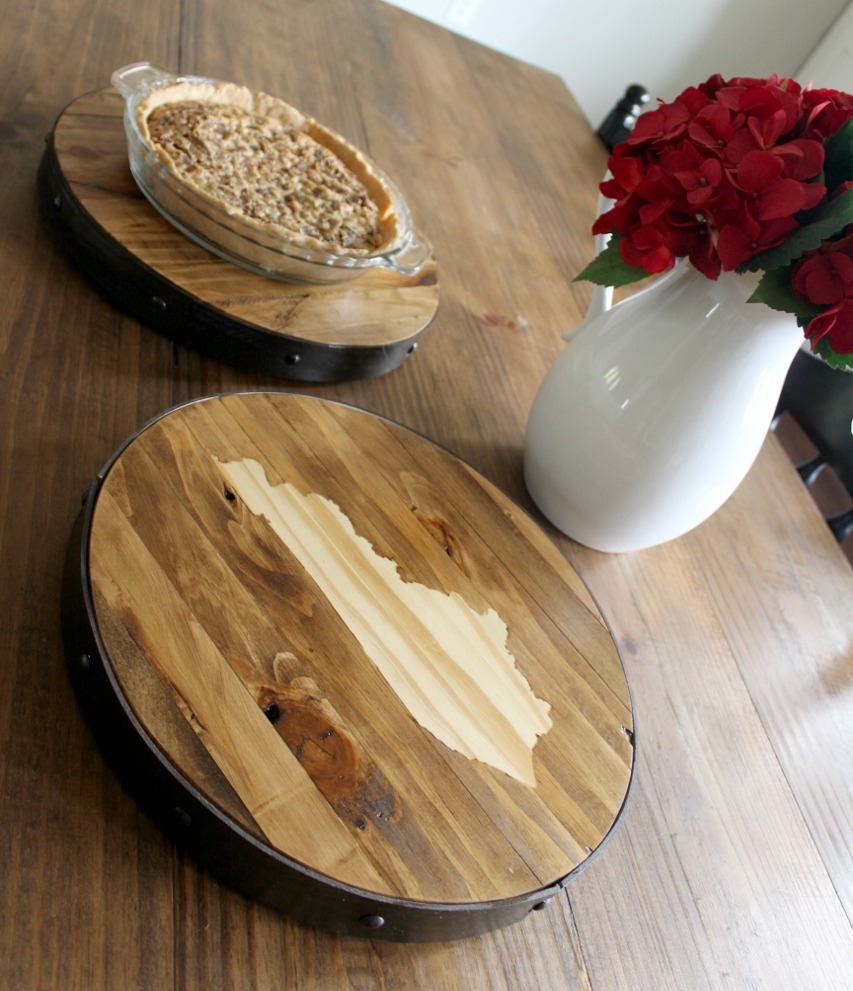
Wooden lazy susans on table with faux metal band around edges

To do this with wood, I used my table saw to rip an ⅛” (or slightly thinner) wide wood strip off some scrap 2x material that I had around the shop. It needs to be long enough to wrap around the edge of the wooden round–about 44″ long for a 14″ diameter circle.

This strip will be challenging to bend smoothly without cracking. I recommend soaking the strip in water (I literally soaked it in my bathtub) overnight, then take it out and CAREFULLY bend it into a circle and clamp the ends together until it’s dry.

OR, if you’re having trouble with that, you could also use 1 ½″ wide edge banding instead and it won’t require soaking. It’s much thinner, so it’s much easier to bend.

OR, skip the wood altogether and use actual metal. You can find ⅛″ thick x 1 ½″ wide flat stock steel or aluminum in most big box stores or local metal shops. This will bend a lot smoother (especially if you heat it with a torch) than a wood strip.

Check out this tutorial for how I bent a metal band in a circle if you want to try this with metal.

I painted my strip with oil rubbed bronze spray paint so it looked like metal.
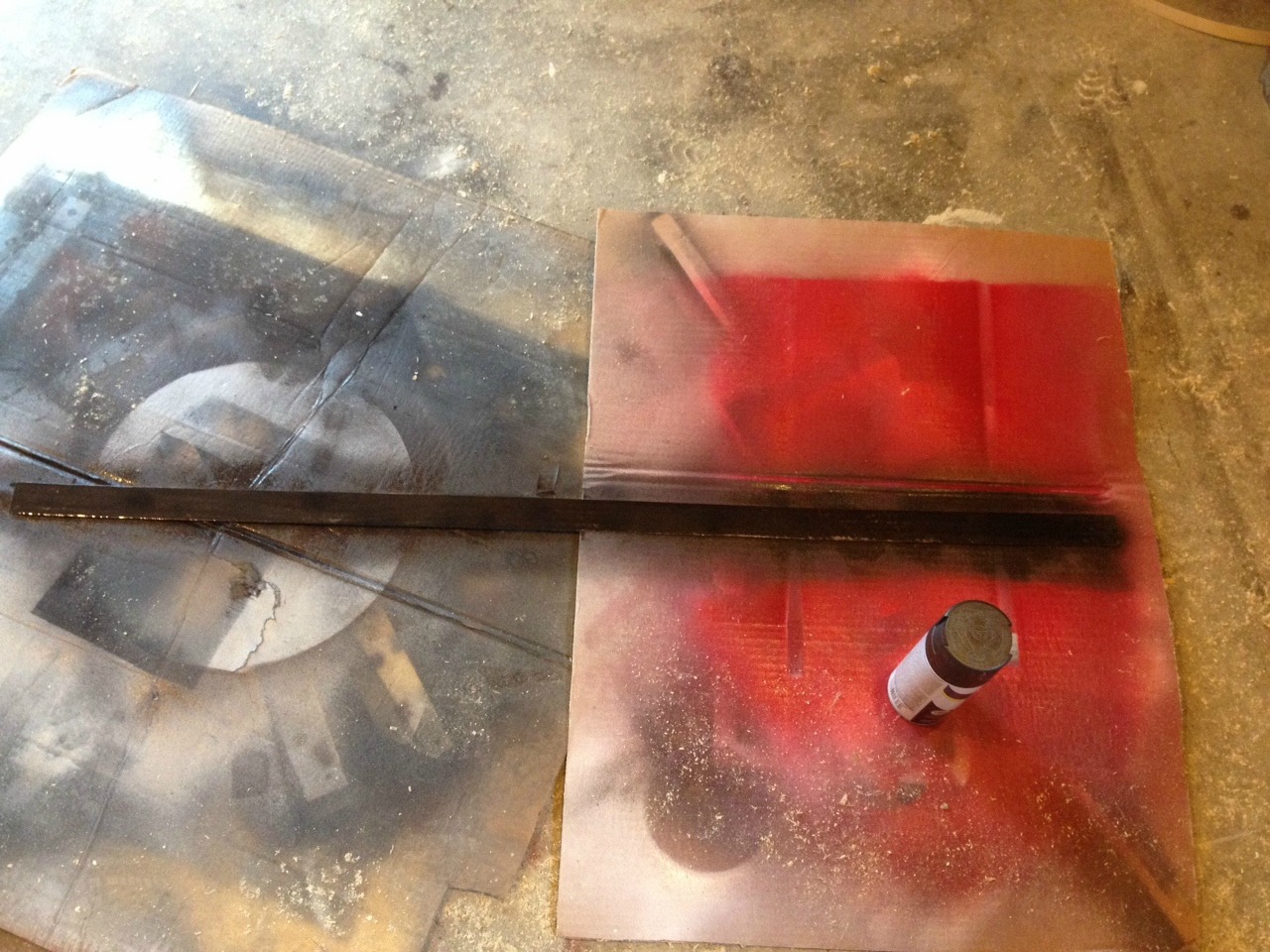
wood strip on cardboard while spray paint dries

Once the paint was dry, I added some wood glue to the back and used a staple gun to staple it around the edge of the round.

I tried to space the staples evenly around the edge. (NOTE: If using metal, you’ll need to drill holes and use screws instead of staples here to secure.)
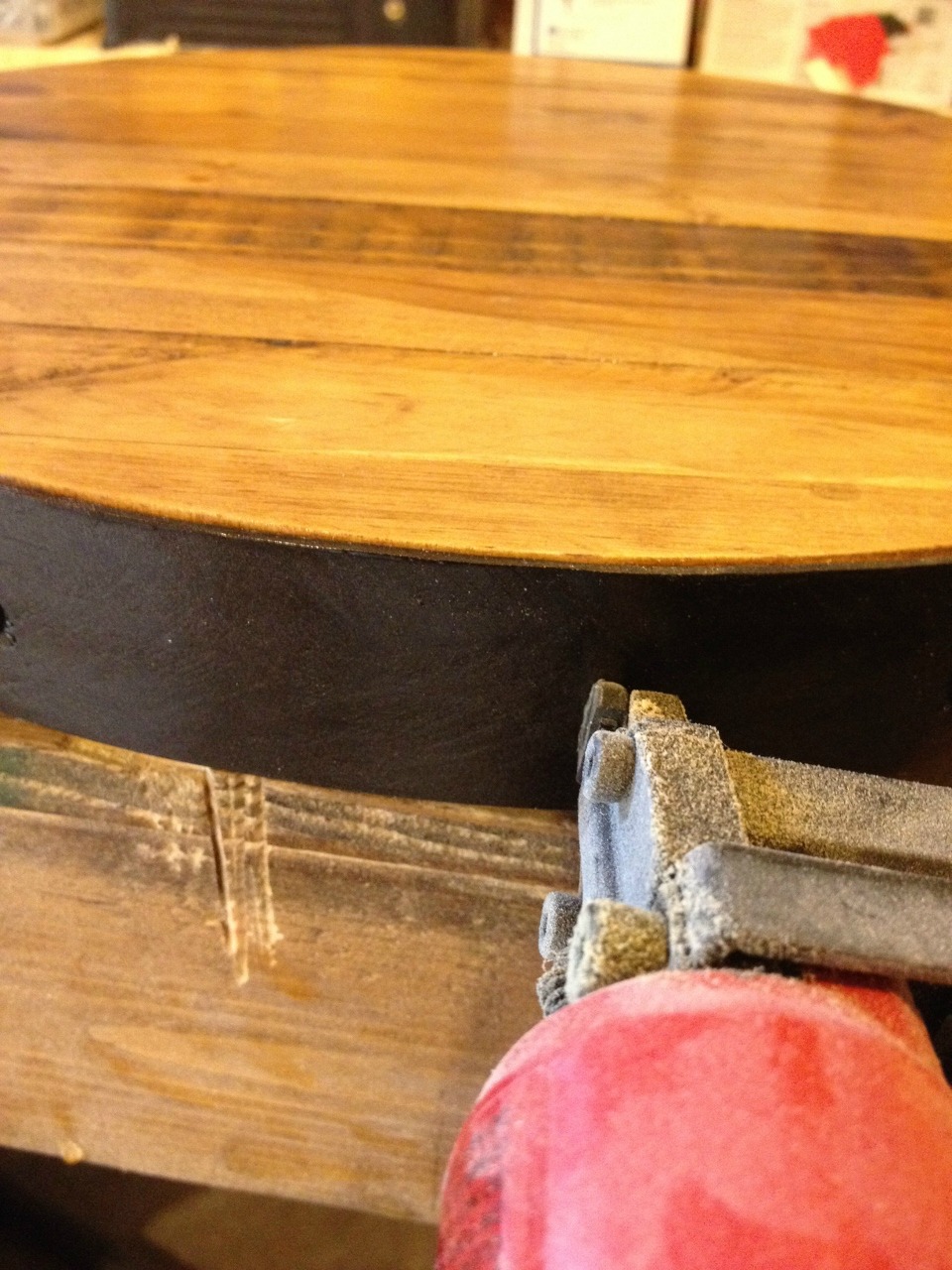
Using a stapler to attach fake metal band around wooden lazy susan

Then, I used a hammer and some decorative nail heads to cover the staples.
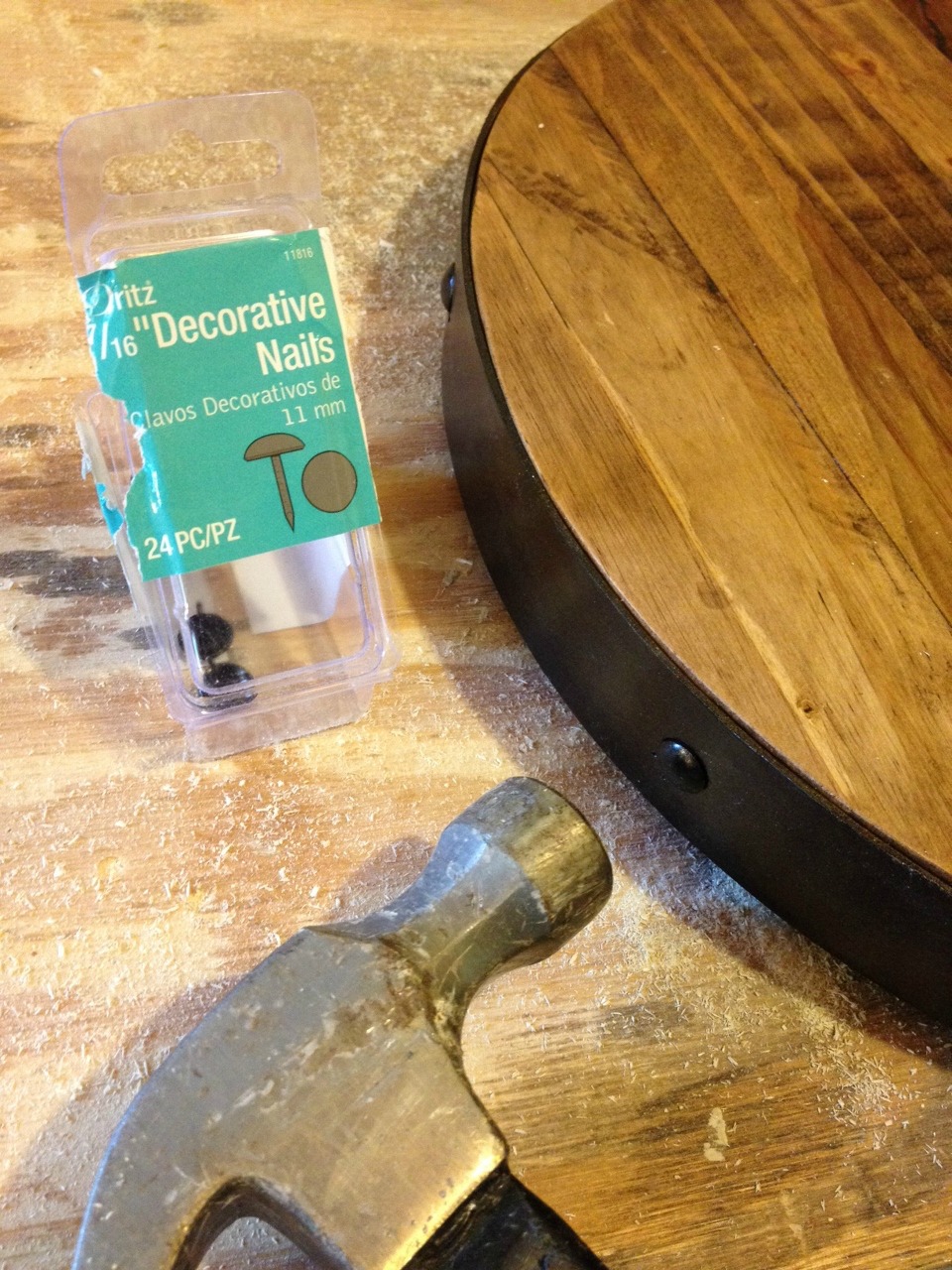
Adding decorative nails to fake metal band on wooden lazy susan

This DIY wooden lazy Susan looks great with or without the band and makes such a great handmade gift for Christmas, weddings, housewarmings, or any special occasion.
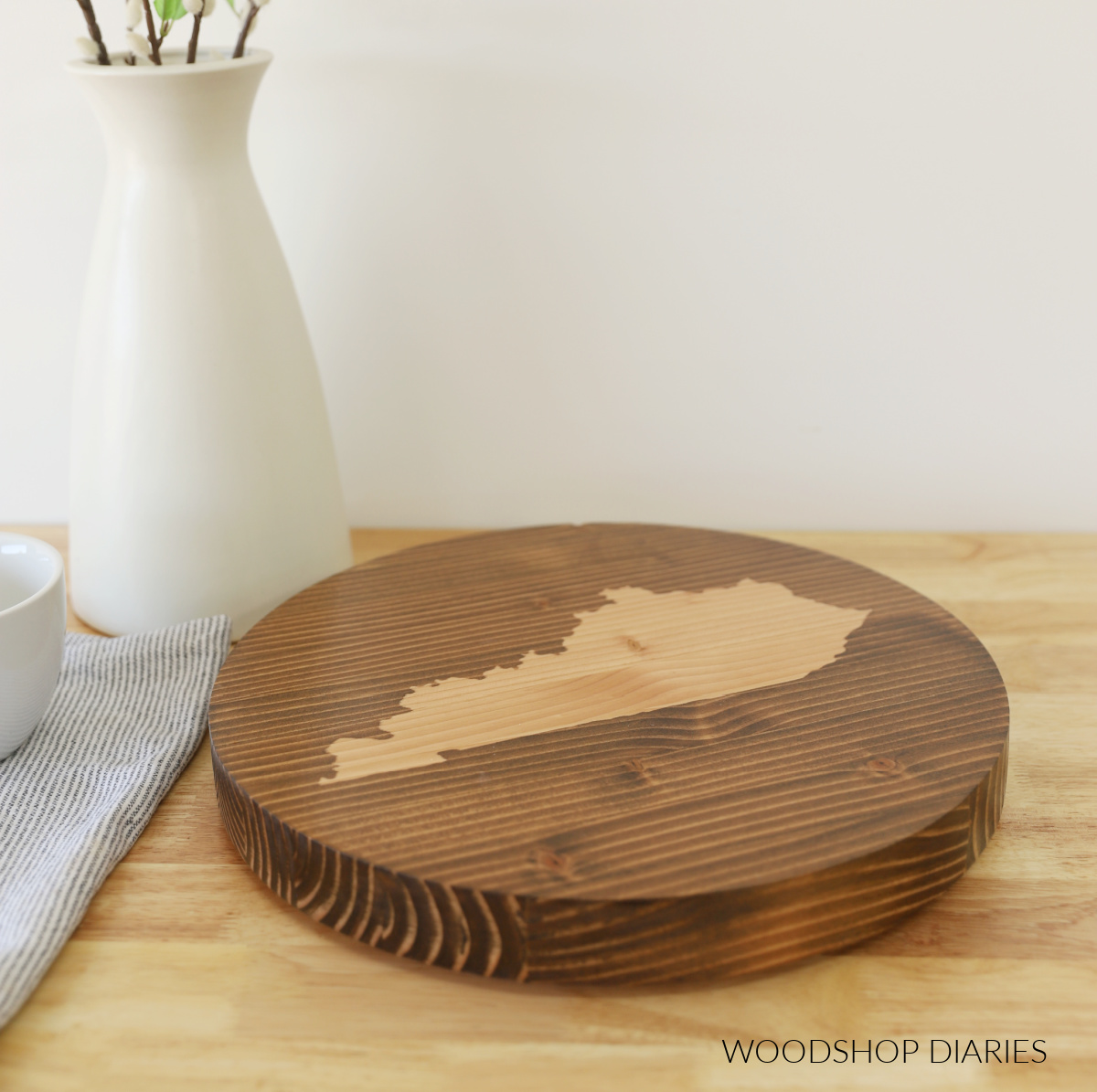
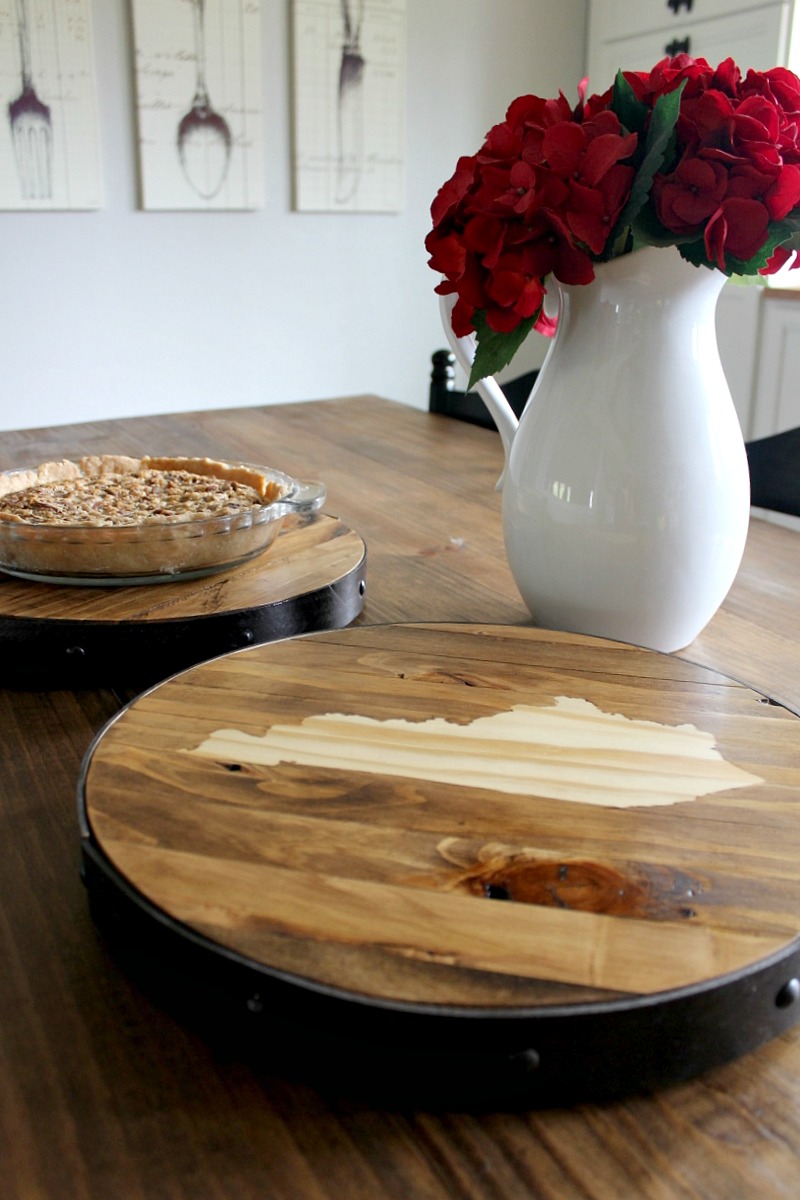
Completed DIY wooden lazy susan with Kentucky stained on top
Wooden lazy susan circles on table with fake metal band around sides

Looking for more Handmade Gift Ideas?

With the upcoming holidays, I’ve teamed up with my friend, Kati, from Houseful of Handmade to share some easy and fun gift ideas you can make this season!

I’ve included our gift ideas in the gallery below (click on the images to see how to make each one). Each day between November 18-22, we will be adding more projects to the list so keep an eye out!
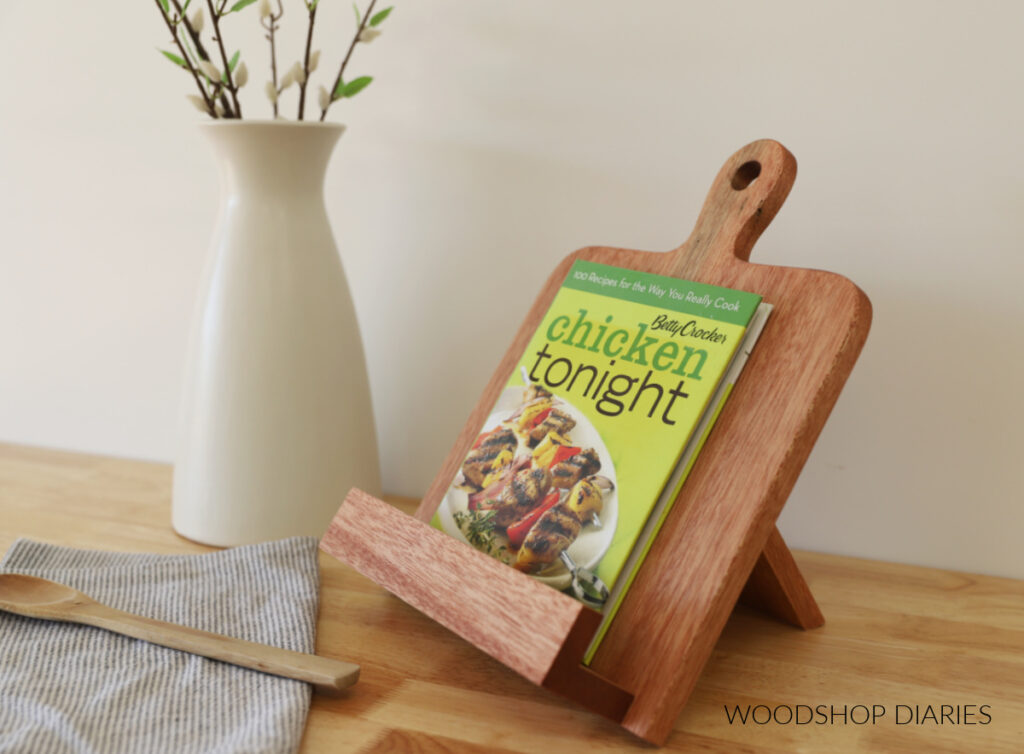
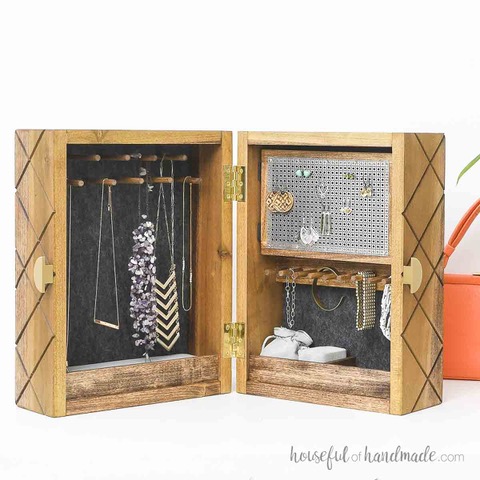
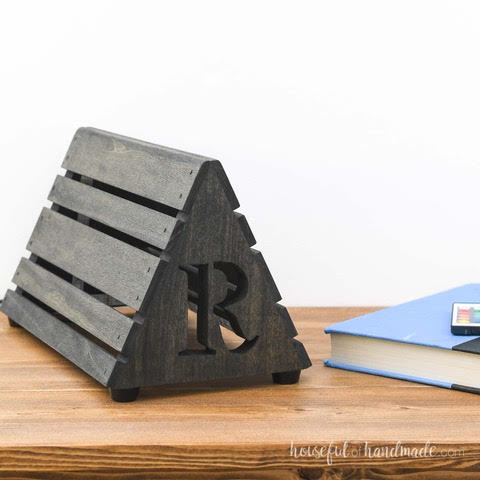
DIY Book Stand
DIY Jewelry Box
DIY Basic Cutting Board
DIY Cheese Slicer
DIY Serving Tray
DIY Cooking Utensiles
DIY Lazy Susan
DIY Book Rest
DIY Tic Tac Toe Game
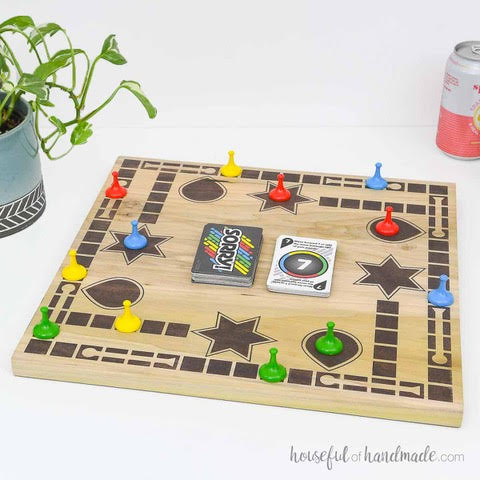
DIY Wood Game Board

If you enjoyed this project and want to save it for later, don’t forget to pin it or share to your favorite social channel!

Pinterest image showing wooden DIY lazy susan with text "DIY wooden lazy susan" above it

Until next time, friends, happy building!

DIY Modern Serving Tray with Handles

November 19, 2023 by Shara, Woodshop Diaries

In this post, I’m sharing how to make a simple DIY modern serving tray with handles!

This eight sided design is modern, classy and easy to make from scrap wood you probably already have in your shop!

Modern DIY walnut serving tray with brass handles finished on countertop with vase, book and candle

After you make one for yourself, try a second one to give away. This serving tray is the perfect handmade gift idea for Christmas, weddings, and housewarmings!

Learn how to make it in the plans below.

*This post contains affiliate links. See website policies.

What to know before building

This DIY modern serving tray project is simple and easy to customize the size. Basically, you cut the bottom panel for your tray and then you cut to fit the sides around it.

So feel free to modify your tray size as desired–the steps wouldn’t change.

What kind of wood do you need?

You can make this modern tray from any wood species you’d like. In my case, I used walnut.

All you need to build the tray is a scrap piece of ¾″ plywood (roughly 12″ x 18″–or whatever size you’d like your tray) and some 1x material (FYI 1x material is just ¾″ thick lumber–any width is fine).

plywood and 1x materials on workbench needed to assemble modern serving tray

I ripped my 1x material into 2″ wide strips using a table saw to make the sides of the tray. However, if you didn’t want to rip down your strips or don’t have a table saw, you can just use precut 1x2s or 1x3s and they’d would work just fine.

You need enough of these strips to be able to “wrap around” the outside of the plywood panel you plan to use for the bottom. In my case, that was about 5′ (or 60″) worth.

Overall size

The overall size of this modern serving tray is 2″ tall x 12 ¾″ wide x 18 ¾″ long (not including handles).

modern serving tray overall dimensional diagram

Are DIY projects your thing? Sign up for our newsletter for priority access to the latest projects and build plans!

How to Build a Modern Serving Tray with Handles

I’m sharing the steps below as well as a printable version if you prefer to print your plans. And if you prefer to watch, here’s a how to video as well.

Prefer to print? Grab the printable building plans for this DIY modern serving tray project here.

Tools & Materials

Tools:

  • Miter Saw
  • Table Saw
  • Ratchet Clamp
  • Small Clamps
  • Drill/Driver

Materials:

  • Scrap ¾″ plywood panel (roughly 12″x18″)
  • 1x lumber cut to 2″ wide strips (roughly 60″ length)
  • Wood Glue
  • (2) modern handles (optional)

Step 1: Cut Modern Serving Tray Bottom

First, I cut my piece of plywood to about the side I wanted my tray. It’ll end up being slightly larger than this once complete, but I cut my plywood to 12″ x 18″.

Then, I marked in from the corners about 2″ and used a square to draw a line between them. These lines should all be at 45°.

Miter saw cutting corners off serving tray bottom panel

So I set my miter saw’s miter angle to 45° and cut each corner along the lines.

RELATED: How to cut angles on a miter saw

Plywood panel for serving tray cut and sitting on workbench

Step 2: Cut Tray Side Pieces

The sides of the tray are cut from ¾″ x 2″ strips. So, first, I ripped 2″ wide strips from my 1x walnut board to use for these sides.

rip 1x boards into 2" wide strips on table saw to make tray sides

I needed roughly 6′ of strips and my board was about 4′ long. So I ripped 2 strips and had a little leftover at the end.

Once I had my strips ripped to 2″ wide, I used the table saw to notch out one corner of each about ⅜″ deep x ¾″ tall.

diagram showing notch dimensions to cut out for serving tray sides

This should allow the plywood panel to sit inside nice and snug.

plywood panel sitting into notch on wood side

Then, I cut to fit these strips around the plywood panel so that it fit inside the notches with ends beveled 22.5°.

Miter saw cutting 22.5 degree bevel on board end

TIP: Make sure to pay attention to the direction of your bevel. On each piece, the bevels are NOT parallel to each other. The notched side of the board should face inside, so it will always be the short side.

side pieces dry fit together around plywood panel

Once all pieces were cut, I made sure it was a tight fit all the way around, then sanded them well before gluing.

Step 3: Assemble Tray Sides

I carefully applied wood glue to the ends of each of the tray sides from step 2 and pressed each end together until all 8 sides were glued. You want to work quickly, but carefully so that the glue doesn’t have time to dry before you get all the way around.

Shara Woodshop Diaries applying glue to tray sides on workbench

Once all joints were glued, I used a Rockler Ratchet Clamp to tighten everything together while it dried.

This clamp holds the pieces snug, but don’t overtighten or they can slip out of place.

clamping tray sides with ratchet clamp

Allow to dry completely, then remove the clamp and sand away any glue squeeze out as needed.

Step 4: Attach Serving Tray Bottom

I flipped the tray frame upside down and test that the plywood panel still fits into the notches. Trim as needed until it fits.

Once I was sure the panel would fit, I removed it, applied a small bead of glue into the notched section of the frame, then placed the panel back inside.

applying wood glue along tray bottom edge

I used some small clamps around the outside to hold it until it was dry. You could use a few brad nails as well if you didn’t want to wait for the glue to dry.

clamping bottom panel onto tray frame

Step 5: Install Handles and Finish

If you don’t want to add handles, then, at this point, it’s ready for finish!

I installed some modern brass handles on each side of the tray at the end of the build. However, since the sides here are 2″ thick, the screws that came with the handles obviously wouldn’t go all the way through from the bottom.

So I measured and marked the holes for them on each side so that they would be centered (your hole locations will vary based on the type, style and size handles you use).

measuring and marking handle locations on sides

Then, I drilled holes at these marks all the way through the sides of the tray large enough for the shank of the screw to fit through.

Then, I flipped the tray upside down and drilled a hole large enough for the head of the screw to fit into about 1″ deep (I used painters tape as a “stop” to know how deep to drill).

drilling handle screw holes in bottom side of tray frame

This allowed me to install the screws through the bottom side so that they stuck up through the top enough to attach the handles.

installing handles onto tray sides

After the handles were secure, I applied Walrus Oil Furniture Butter to finish and seal the tray.

completed walnut serving tray with brass handles

And now it’s ready for use! Use it for serving, for décor, give it as a gift–this versatile and classy tray is perfect for any occasion.

Completed walnut modern DIY serving tray with book, vase, and candle on butcherblock countertop

Looking for more Handmade Gift Ideas?

With the upcoming holidays, I’ve teamed up with my friend, Kati, from Houseful of Handmade to share some easy and fun gift ideas you can make this season!

I’ve included our gift ideas in the gallery below (click on the images to see how to make each one). Each day between November 18-22, we will be adding more projects to the list so keep an eye out!
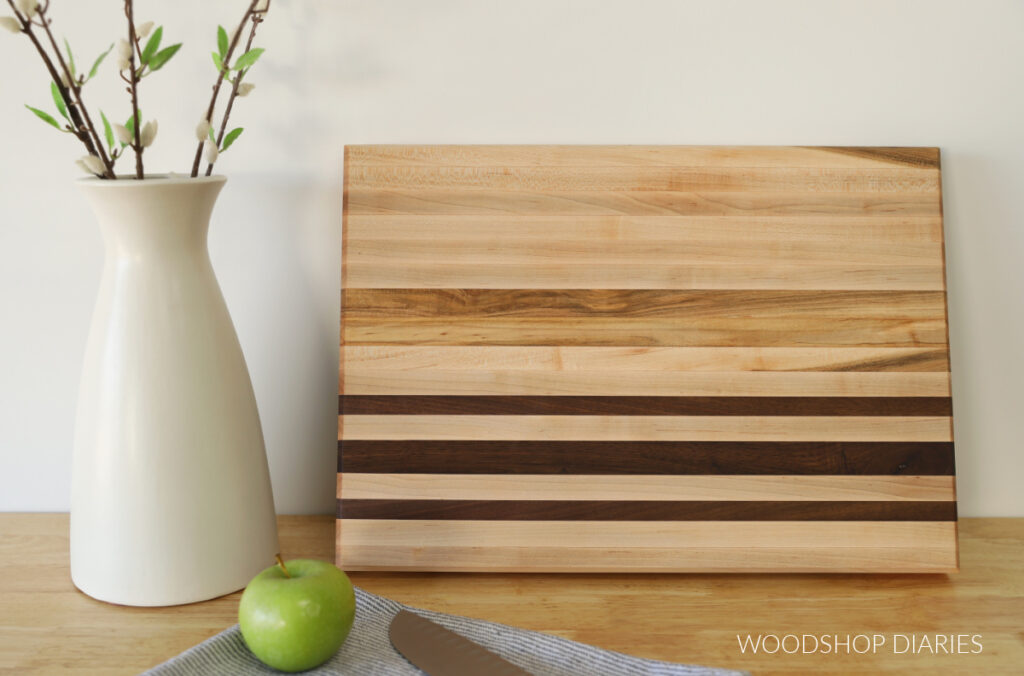
DIY Book Stand
DIY Jewelry Box
DIY Basic Cutting Board
DIY Cheese Slicer
DIY Serving Tray
DIY Cooking Utensiles
DIY Lazy Susan
DIY Book Rest
DIY Tic Tac Toe Game
DIY Wood Game Board

If you’d like to save this project for later, be sure to pin it or share to your favorite social channel!

Pinterest collage image showing tray leaning against wall at top and decorated tray with vase on bottom with text "how to build a modern serving tray"

Until next time, friends, happy building!

Scrap Wood Tic Tac Toe Board

November 17, 2023 by Shara, Woodshop Diaries

In this post, I’m sharing how to build a scrap wood tic tac toe game!

This easy DIY makes a great handmade gift idea, but is also nice enough to use as functional décor in your home or on your desk.

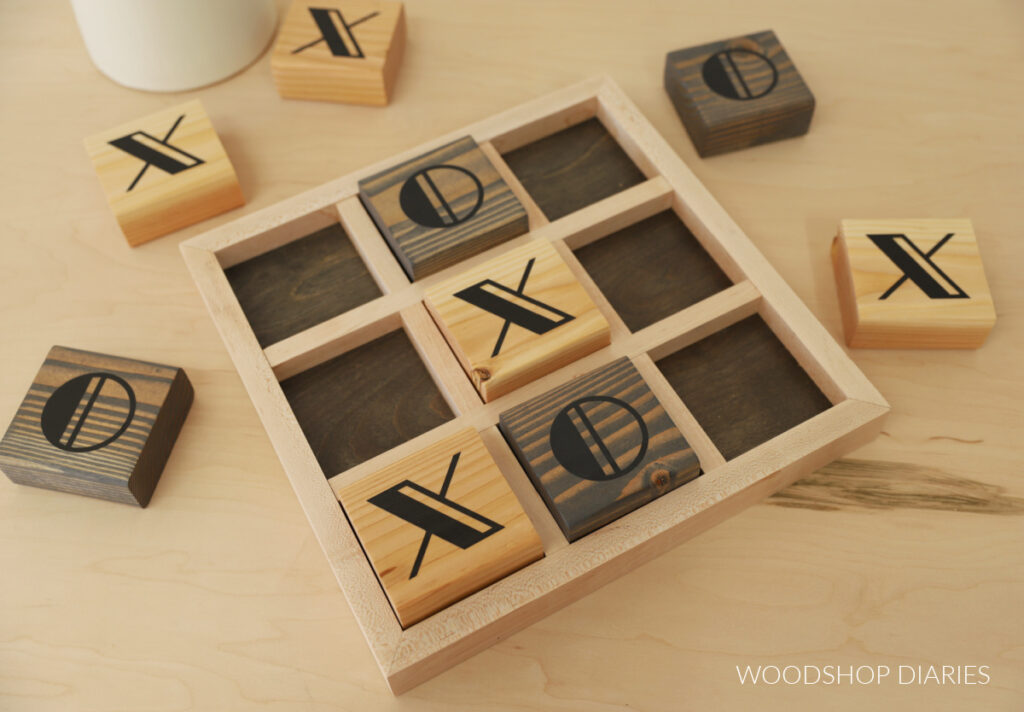
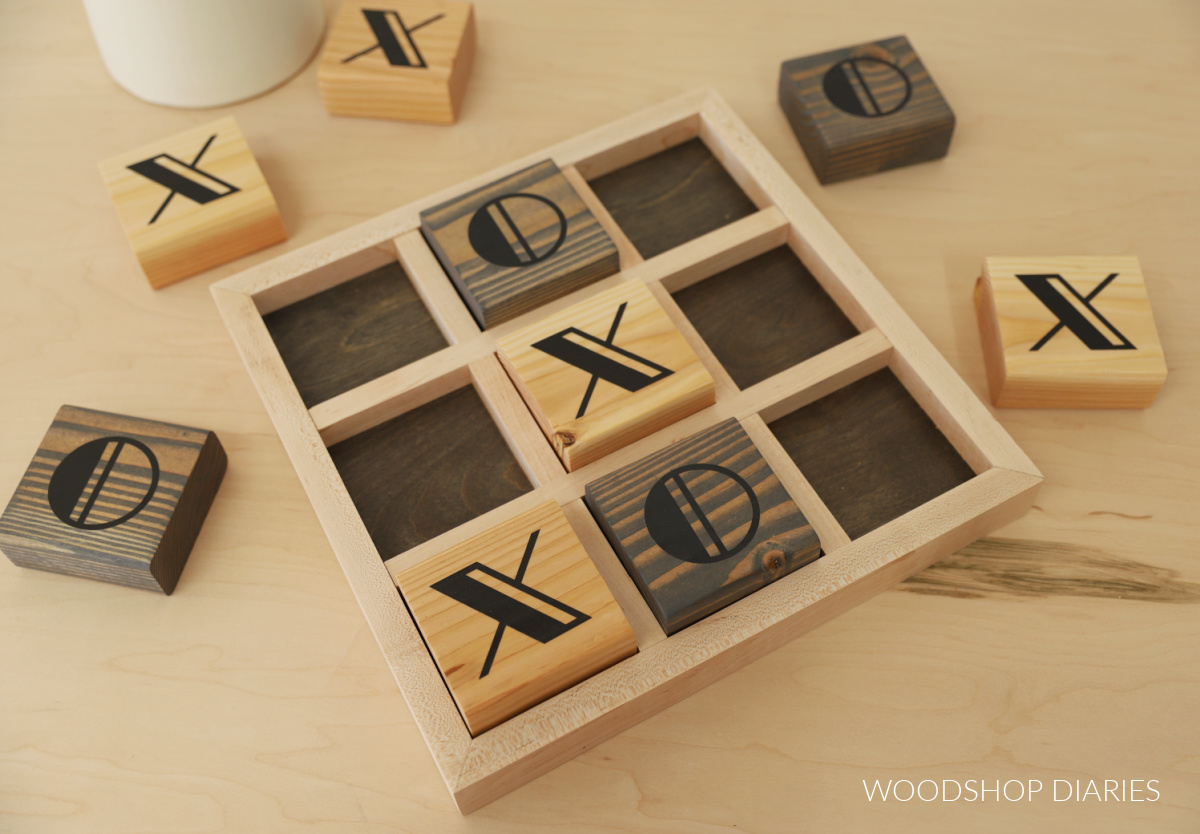
Wooden tic tac toe board with contrasting colors--black and gray stain with natural wood tones. Xs and Os game pieces spread out around the board

Tic Tac Toe is a classic game that everyone knows and loves. So you can keep this out on your coffee table or console table for spur-of-the-moment gaming fun with your kids or with guests!

You can make this in about an hour using wood scraps and size it up or down to fit your needs. I’m sharing the how to below!

*This post contains affiliate links. See website policies.

What Kind of Wood do you need?

This wooden tic tac toe game can likely be made from scrap wood you already have in your shop.

You’ll need a piece of ¾″ plywood about 12″ x 12″ for the bottom. I used some scrap birch plywood, but sanded pine, oak, or maple would work great, too.

Birch plywood used for bottom of tic tac toe tray

Then, you’ll need enough 1×2 board to trim around the sides of the plywood–approximately 48″ worth. I used maple for this, but any wood type would work fine.

TIP: If you have a table saw, you can rip down your own 1x2s from another size board if you don’t have any precut.

To divide the sections, I used some ½″ x ½″ square dowel. You can purchase this precut, OR you could rip your own ½″ square dowel from whatever scraps you already have. You’ll need approximately 48″ of it. Any species of wood would work fine here.

And finally, for the actual tic tac toe game pieces, I used some scrap 2x4s. I just cut these to 3 ½″ square, so you could cut any scraps you have (not just 2x4s) to this size to work for the pieces.

Feel free to get creative here and use what you’ve got in your scrap pile!

Are DIY projects your thing? Sign up for our newsletter for priority access to the latest projects and build plans!

How to Make a Wooden Tic Tac Toe Game

I’m sharing the steps below to make a this wooden tic tac toe board, but if you prefer to watch, I’ve also got a video tutorial here as well.

Tools & Materials

Tools:

  • Miter Saw
  • Brad Nailer
  • Cricut Machine (optional)

Materials:

  • Scrap ¾″ plywood (12″ x 12″ piece)
  • 1×2 board (about 48″ long)
  • ½″ square dowel (about 48″ long)
  • 2×4 scraps (9 pieces 3 ½″ long)
  • Brad nails
  • Wood Glue
  • Wood stain/finish
  • Cricut Vinyl (optional for Xs and Os)

Step 1: Build Tic Tac Toe Tray

First, I cut down a piece of ¾″ plywood to 12″ x 12″ to use for the bottom of the tray and sanded it.

RELATED: How to sand wood

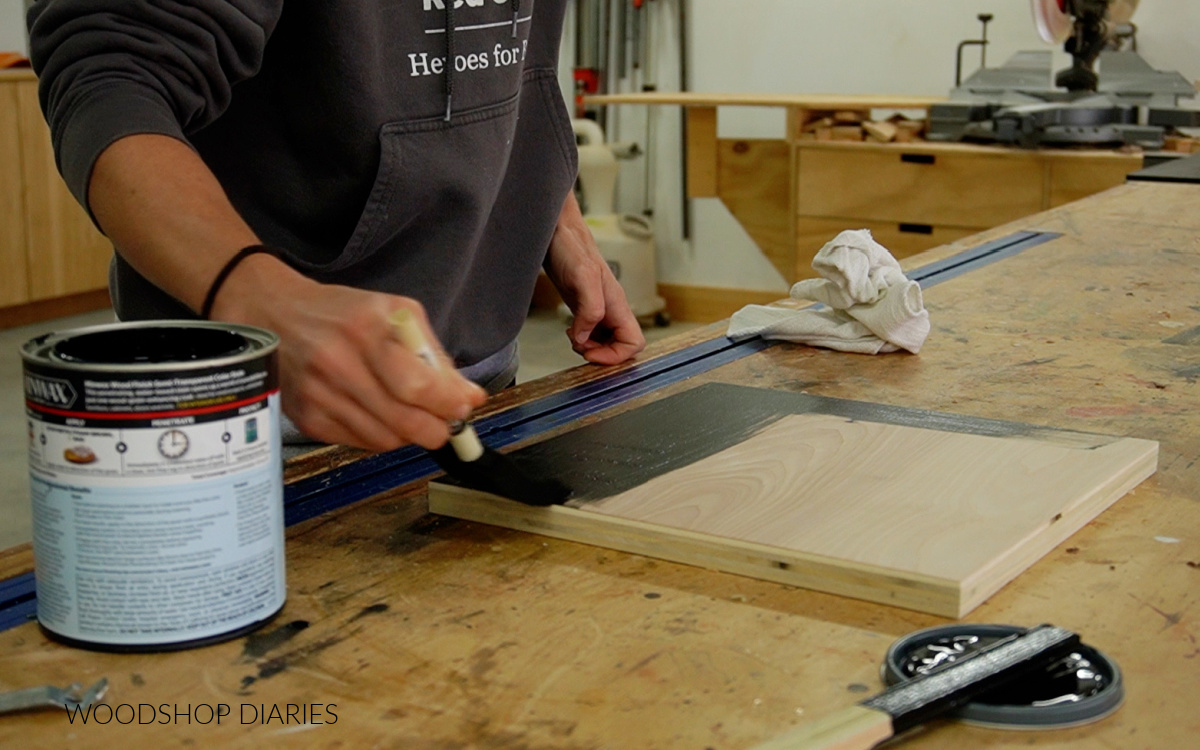
Then, I applied some Minwax Water Based Wood Stain in True Black to this piece. Feel free to stain/paint this any color you’d like.

Shara Woodshop Diaries staining plywood panel black

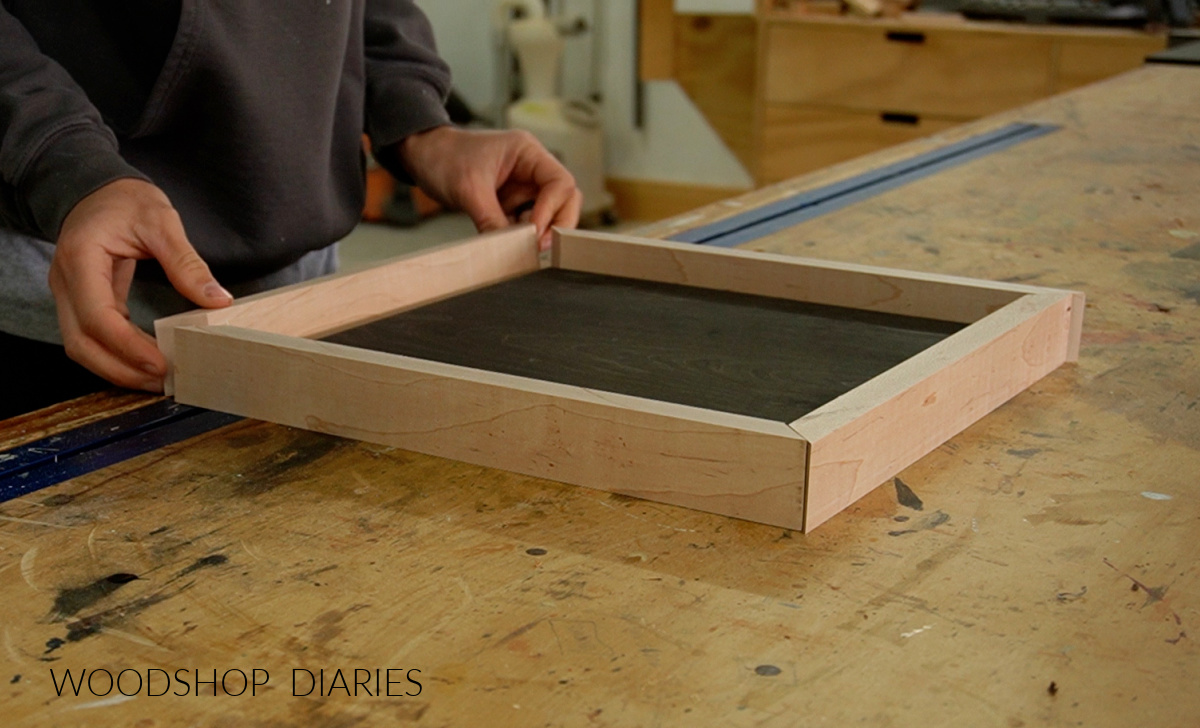
Once dry, I cut to fit 1×2 around it with mitered ends 45 degrees. You don’t have to miter the ends of the 1×2, but it makes the corners look a little cleaner if you do.

RELATED: How to cut angles on a miter saw

dry fitting 1x2 pieces to trim out tic tac toe board on workbench

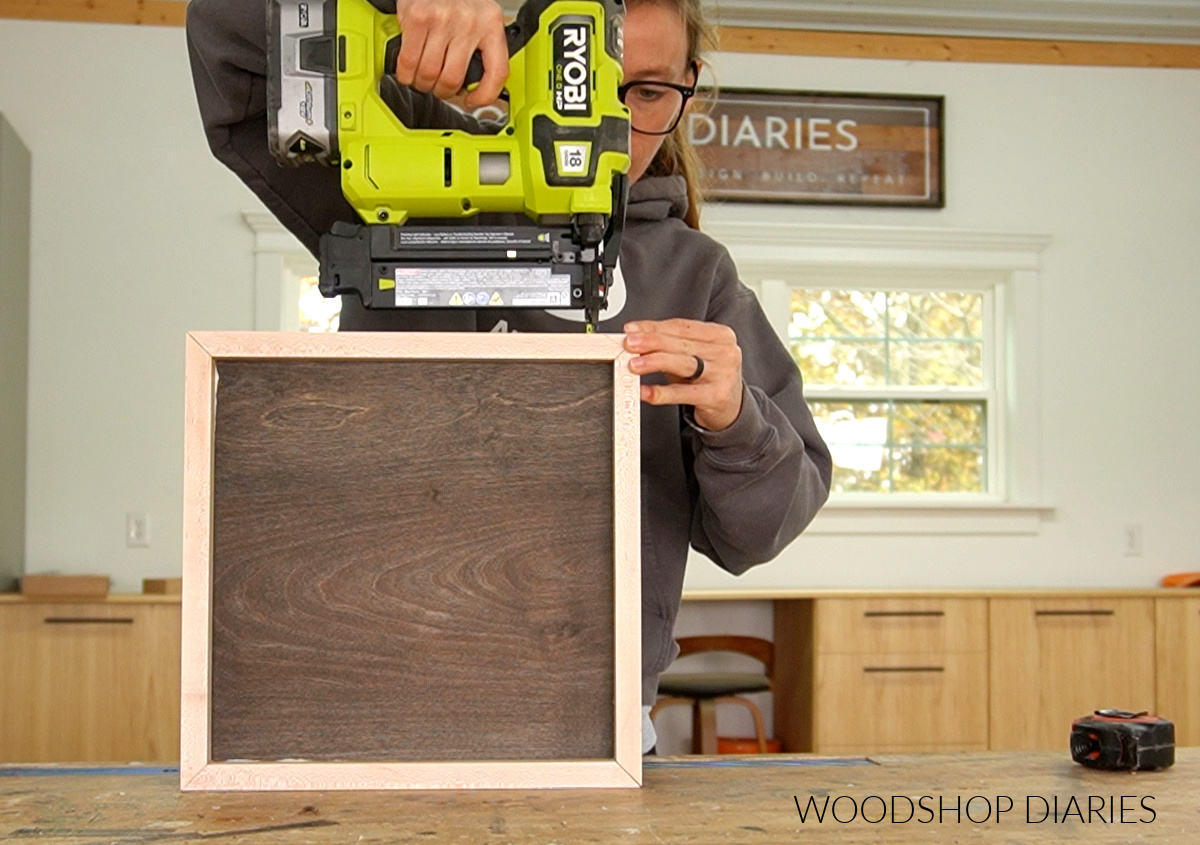
Then, I glued and brad nailed these 1x2s around the plywood panel to trim it out. These pieces should be flush to the bottom edge. This creates a simple square tray.

Shara Woodshop Diaries brad nailing trim boards around edges of wooden tic tac toe board tray

NOTE: Feel free to paint/stain the 1x2s before attaching if you’d like. I left it natural to contrast the black stain on the bottom.

Step 2: Cut Tic Tac Toe Game Pieces

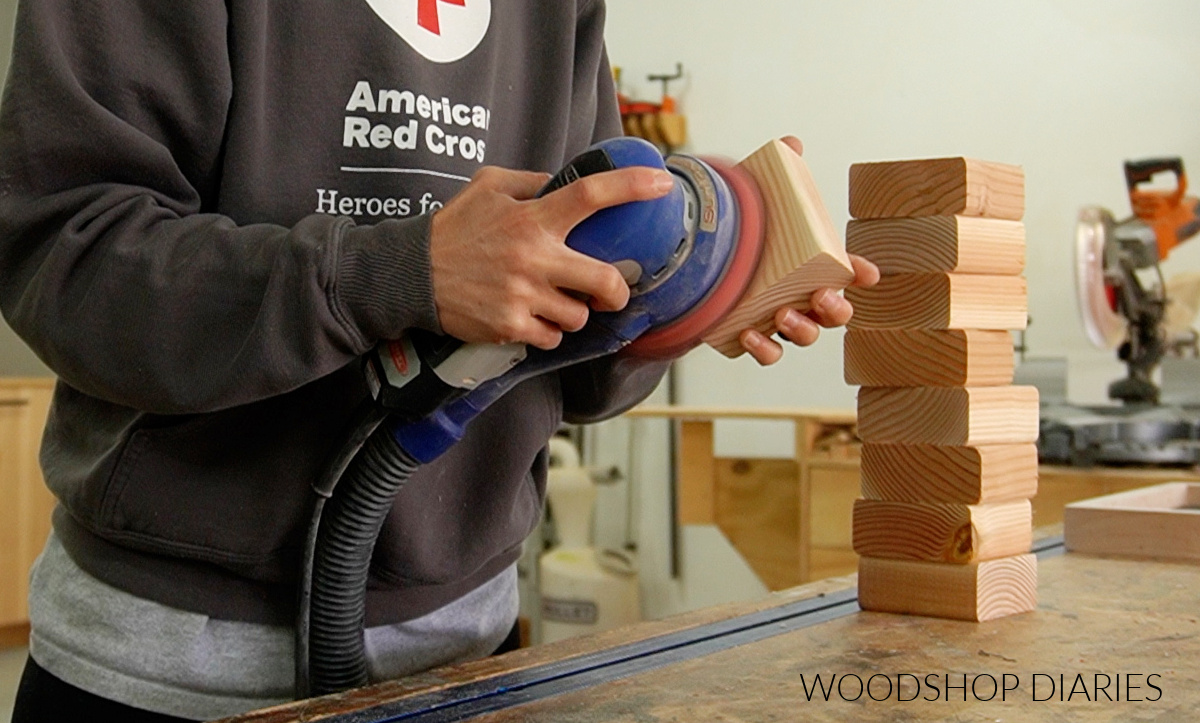
Next, I cut 9 pieces of 2×4 to 3 ½″ long to make the game pieces. Note that 2x4s are 3 ½″ wide, so cutting them 3 ½″ long creates square game pieces.

RELATED: Understanding lumber sizing

Shara Woodshop Diaries sanding 2x4 tic tac toe game pieces

After cutting, I sanded these well and placed them inside the tray.

Step 3: Cut and Install Dividers

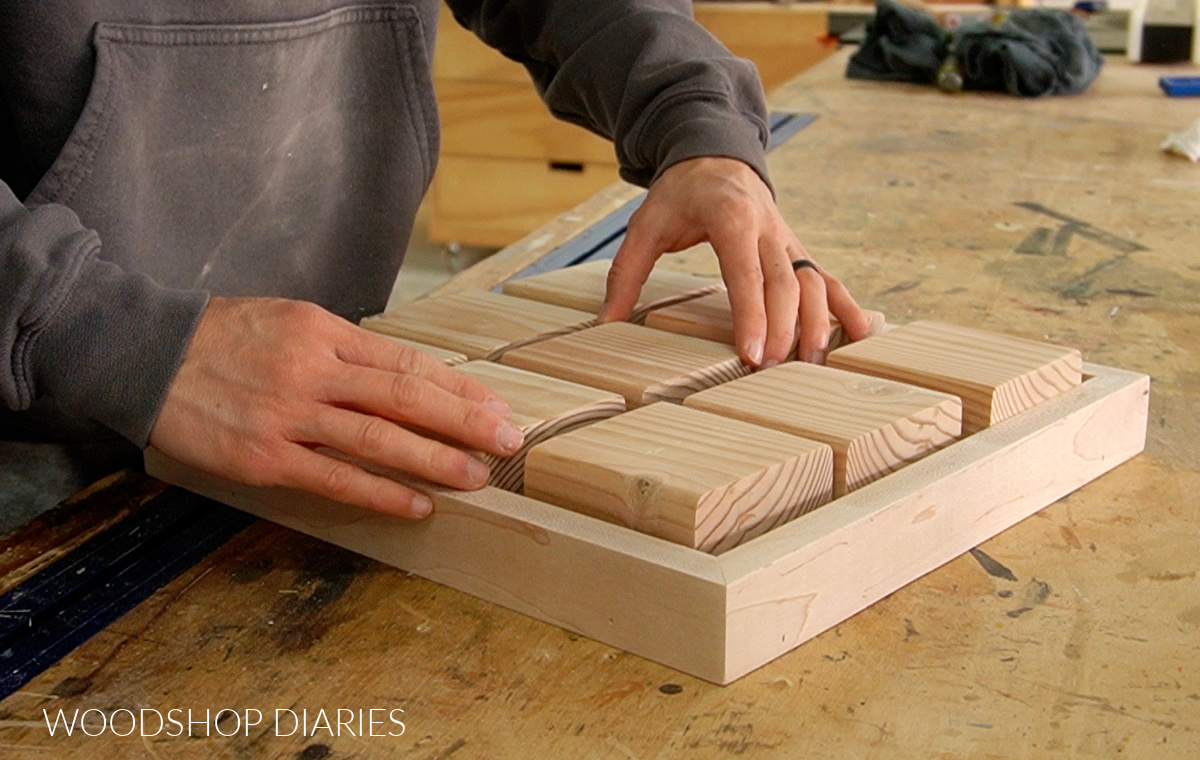
I needed to divide the tray into 9 equal sections to create the tic tac toe board. After placing all my 2×4 blocks inside the tray, I found that using a ½″ square dowel as the dividers would fit perfect.

Placing 2x4 blocks inside tic tac toe tray

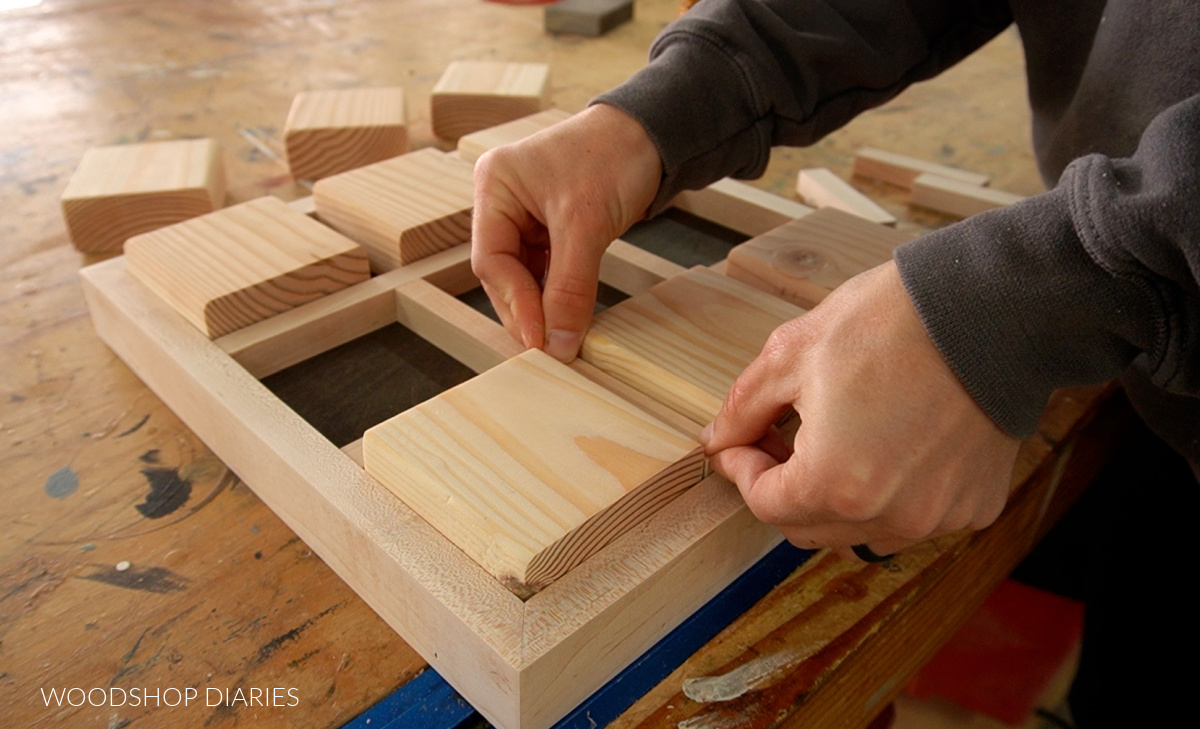
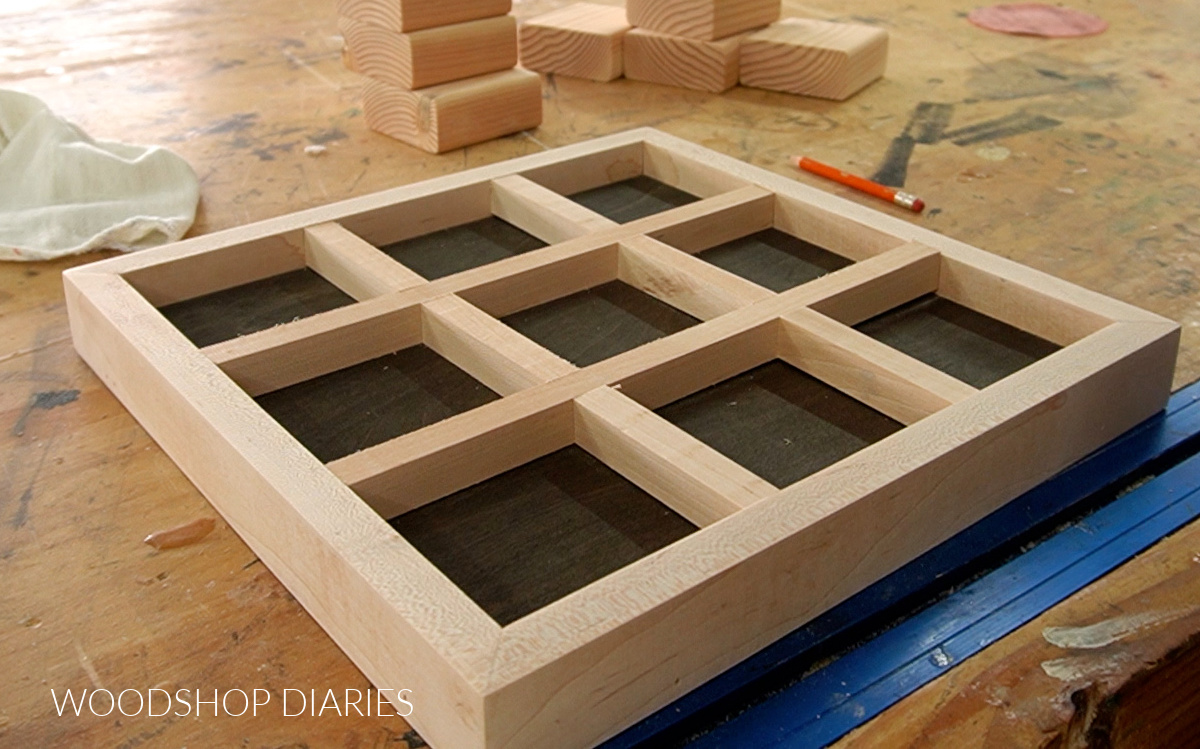
I left my blocks inside the tray, then cut to fit my square dowel around them. Two pieces should be 12″ long to span the whole distance across the tray, then 6 equal length pieces should run between them to divide the tray into 9 sections.

After I cut and test fit these pieces into the tray, I pulled them back out, applied a small bead of wood glue to each one and glued them back in place.

installing ½" square dowel dividers between 2x4 blocks in tray

I kept my game pieces inside the tray while gluing to make sure the pieces would fit into each section.

If you wanted to also brad nail after gluing, feel free. But if not, the glue alone should be fine!

½" square dowels glued into the tic tac toe tray on workbench

Step 4: Add Xs and Os

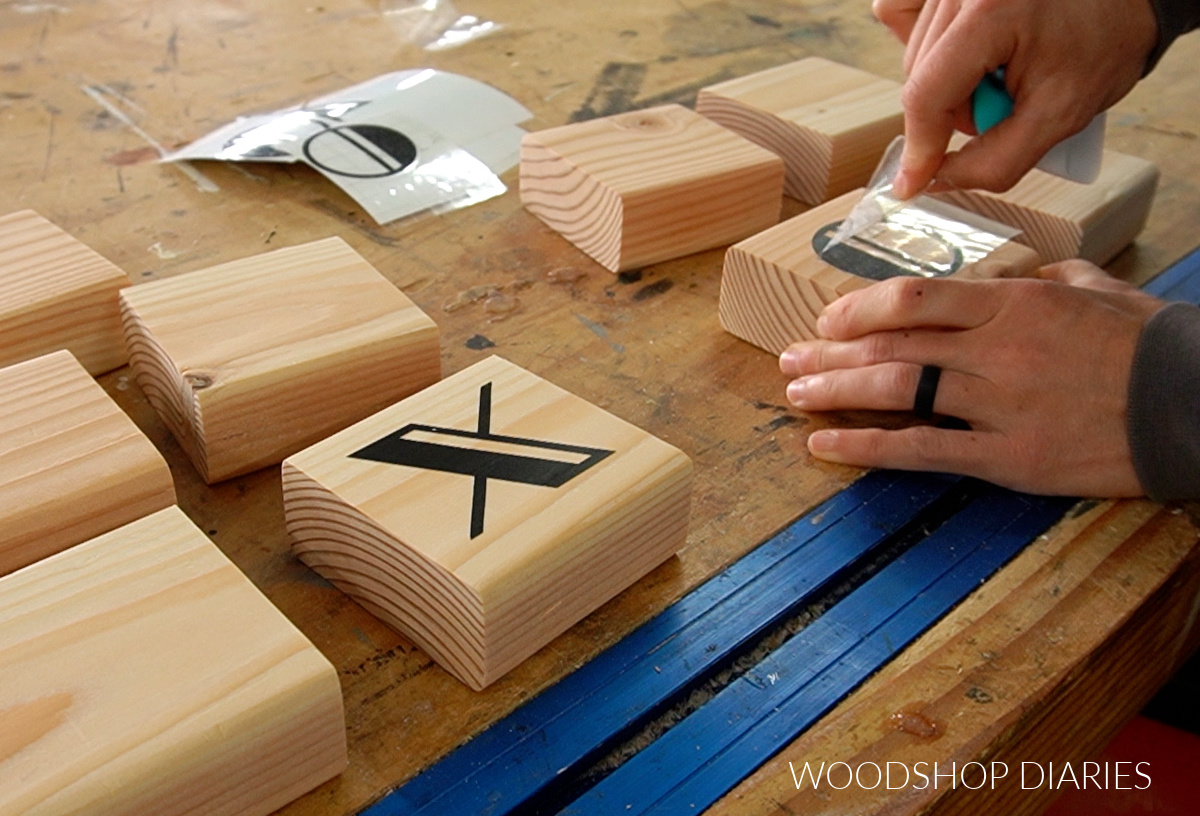
Once my dividers were glued in, I removed the 2x4s from the tray. I cut out some Xs and Os on permanent vinyl using my Cricut Explore 3 to apply to the pieces–5 Xs and 4 Os.

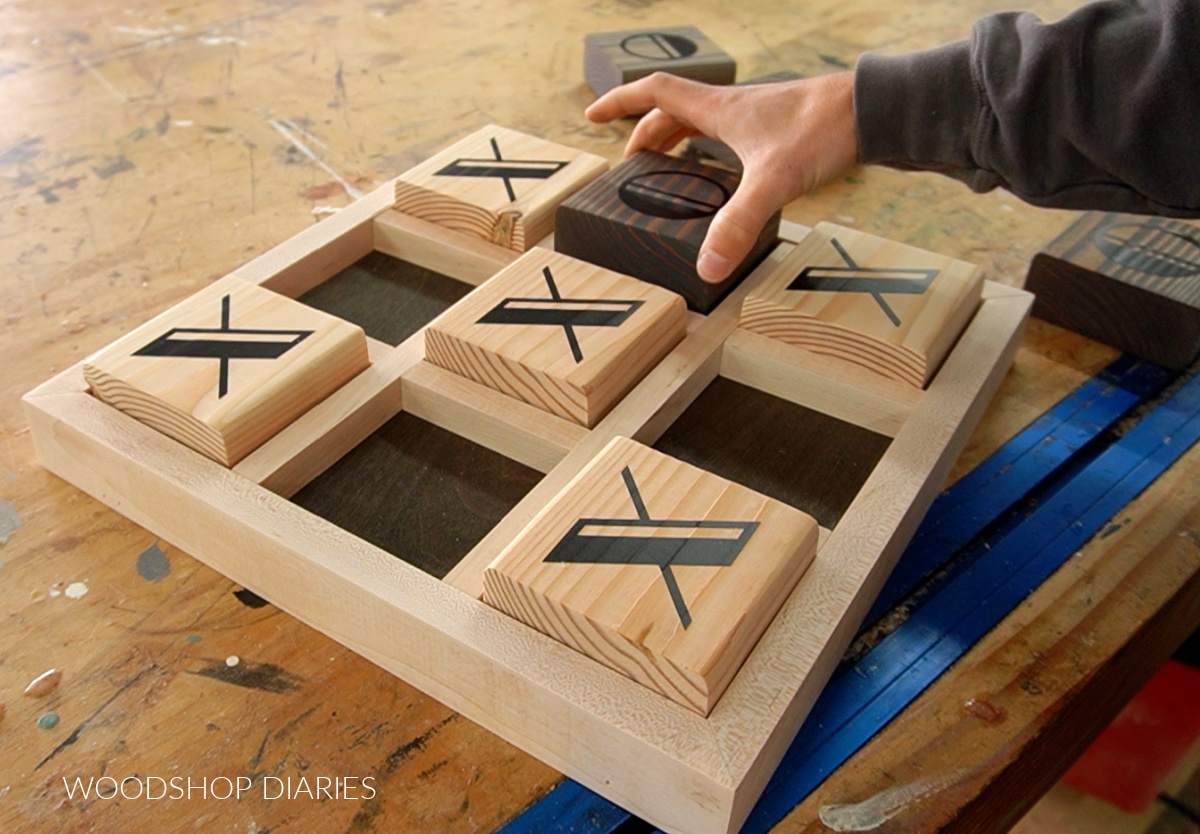
Applying vinyl Xs and Os to 2x4 game board blocks on workbench

Then, I stained the Os in Minwax Aged Barrel Wood Stain. I left the Xs their natural color for contrast.

Tic Tac Toe Xs and Os--Os stained and Xs left natural color placing inside wooden tray

If you don’t have a Cricut, you can simply stain your game pieces two different colors to differentiate between “Xs” and “Os,” or you could draw or carve out Xs and Os on the pieces or use a stencil to paint them.

Vinyl isn’t necessary, but since I had the Cricut, I figured I’d use it. As long as you distinguish 5 of one kind and 4 of another, it doesn’t matter HOW you distinguish them.

Step 5: Finish Wooden Tic Tac Toe Game

The final step was simply applying a clear coat to seal the pieces and give it some protection. I applied two coats of Minwax Polycrylic to the game pieces and the tray, allowed to dry, then it was ready for game time!

Black and wood two tone wooden tic tac toe game board on workbench with game pieces spread out around it

This simple game board is so cute and makes a unique gift that you can customize with initials, fun shapes, colors, etc.

DIY Wooden tic tac toe board with pieces in place--contrasting game board colors

Looking for More Handmade Gift Ideas?

With the upcoming holidays, I’ve teamed up with my friend, Kati, from Houseful of Handmade to share some easy and fun gift ideas you can make this season!

I’ve included our gift ideas in the gallery below (click on the images to see how to make each one). Each day between November 18-22, we will be adding more projects to the list so keep an eye out!
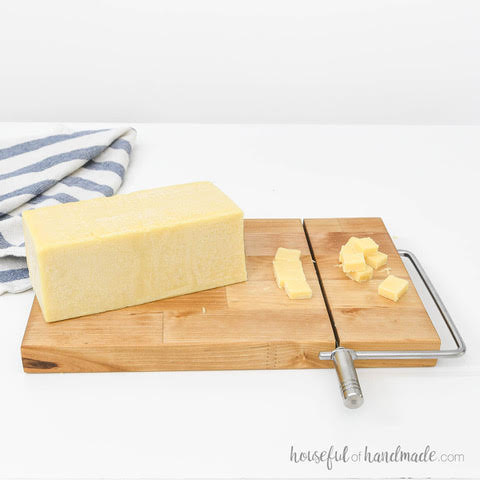
DIY Book Stand
DIY Jewelry Box
DIY Basic Cutting Board
DIY Cheese Slicer
DIY Serving Tray
DIY Cooking Utensiles
DIY Lazy Susan
DIY Book Rest
DIY Tic Tac Toe Game
DIY Wood Game Board

If you’d like to save this project for later, be sure to pin it or share to your favorite social channel!

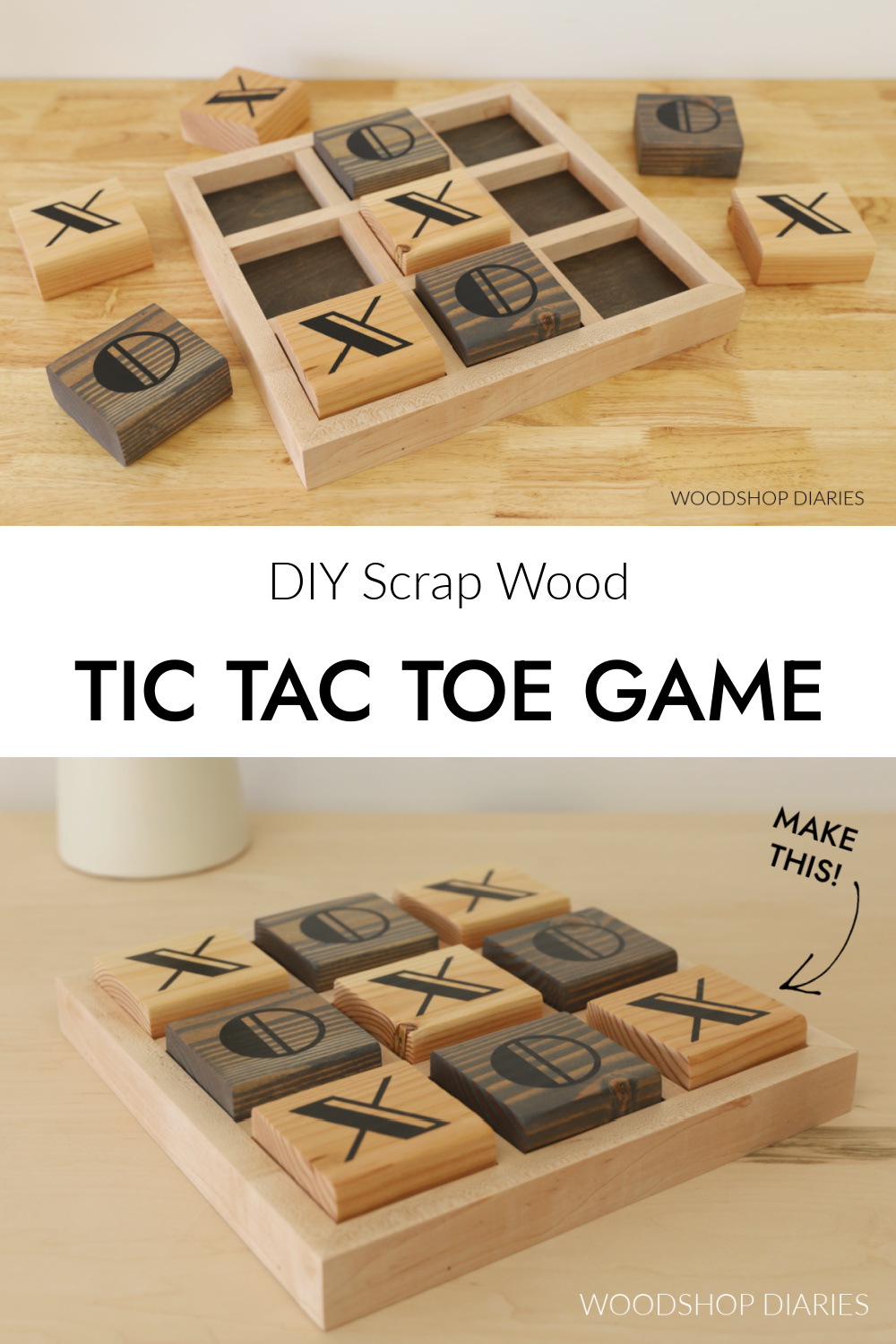
Pinterest collage image showing DIY wooden tic tac toe game at top with pieces scattered around and same board game at bottom with all game pieces in place. Text in the middle "DIY scrap wood tic tac toe game"

Until next time, friends, happy building!

How to Make a Basic Cutting Board

November 17, 2023 by Shara, Woodshop Diaries

In this post, I’m sharing how to make a simple beginner cutting board with just a few basic tools.

Cutting boards are such a great woodworking project whether you’re just starting out or have years of experience. They give you the opportunity to mix and match and try out different wood species.

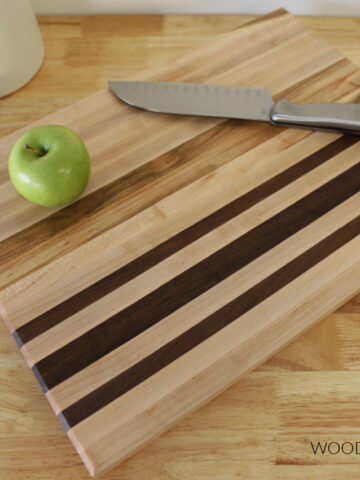
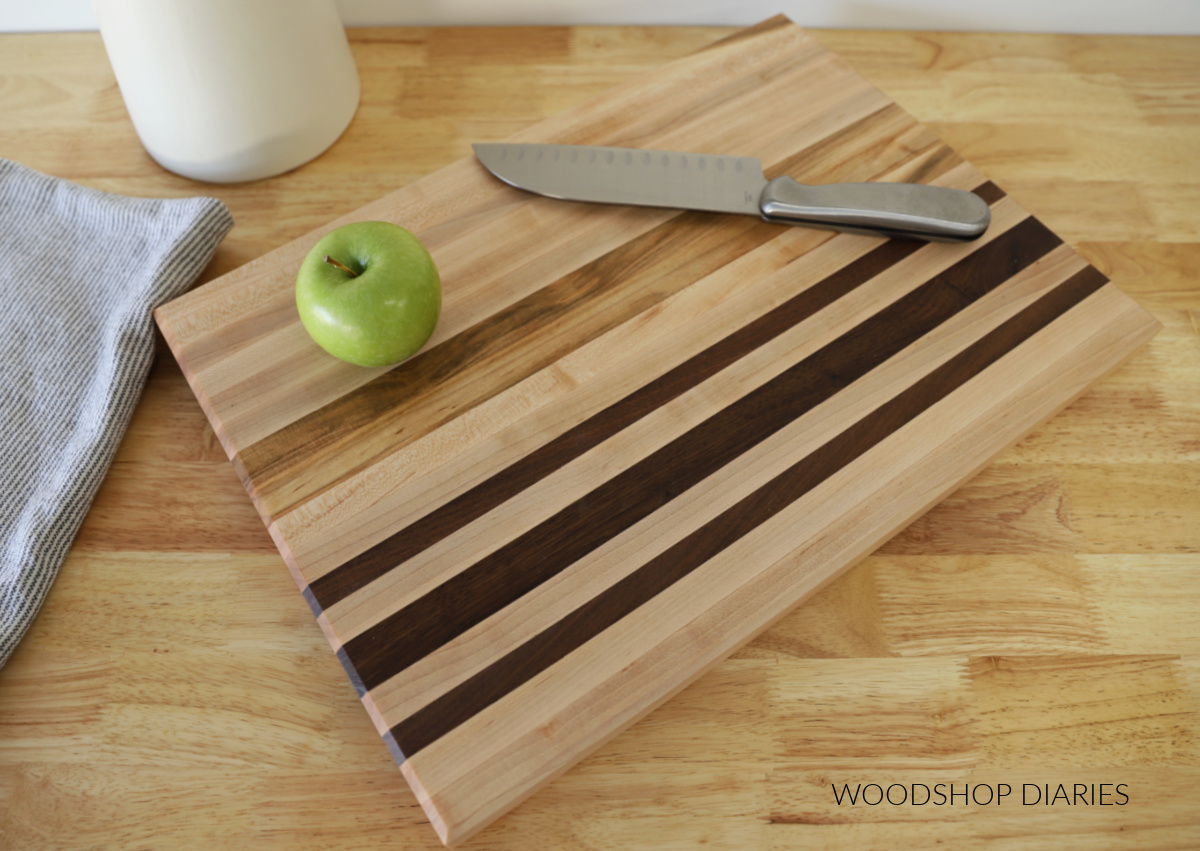
Maple and walnut cutting board laying on butcherblock countertop with green apple and cutting knife on top

And they also make amazing holiday, wedding, and housewarming gifts that everyone loves.

And the best part? They require minimal tools! If you’re ready to dive into creating a beautifully simple basic cutting board, let’s get building.

*This post contains affiliate links. See website policies.

What type of wood should you use for cutting boards?

You can use many different types of wood to make a cutting board. However, in most cases, hardwoods are recommended.

There are a couple reasons hardwoods are best for cutting boards:

  • Hardwoods are denser than softwoods and won’t scratch as easily. This prevents knives from scratching/gouging your board and allowing bacteria to get down into them.
  • Hardwoods have tighter grain patterns and are generally more moisture resistant than soft woods.

But, not all hardwoods are good options for cutting boards. Some hardwoods are toxic or have have deep grains or large pores (which can harbor bacteria).

Common wood types recommended for cutting boards are:

  • Maple
  • Walnut
  • Cherry
  • Acacia

In this case, I’m using a combination of maple and walnut. Feel free to mix and match wood types for fun patterns on your cutting board.

walnut and maple lumber laying together on workbench

Are DIY projects your thing? Sign up for our newsletter for priority access to the latest projects and build plans!

What size should a cutting board be?

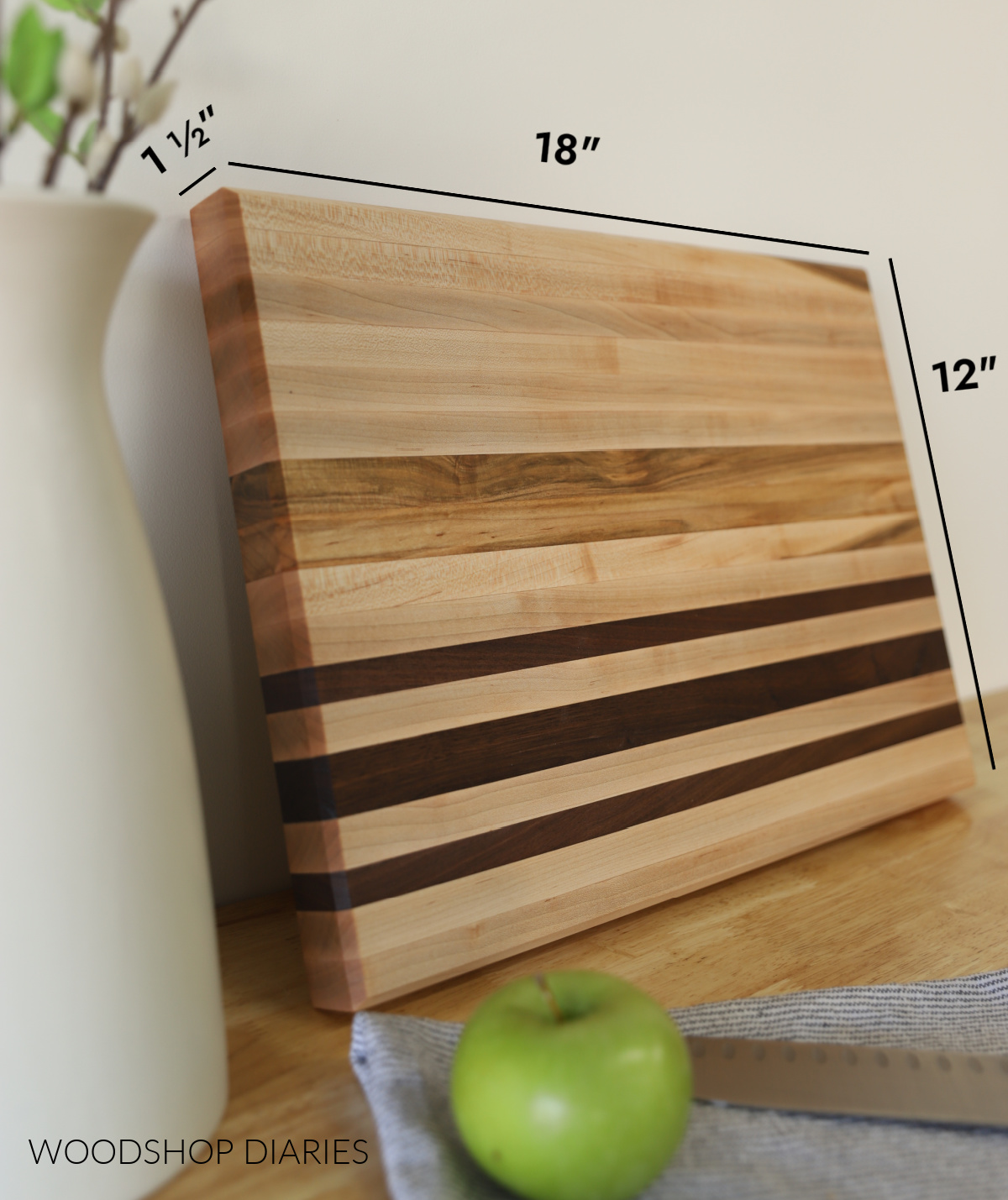
Cutting boards can be just about any shape or size you want. A common size for a standard cutting board is about 1 ½″ thick x 12″ wide x 18″ long.

cutting board propped against the wall with dimensions showing 1 ½" thick, 18" long and 12" wide

Of course, that’s not a “rule” so you can make yours larger or smaller to suit your needs. But I made mine about this size.

How to Make a Simple Cutting Board

I’m sharing the steps below to make a simple DIY cutting board, but if you prefer to watch, I’ve also got a video tutorial here as well.

Tools & Materials

Tools:

  • Table Saw (optional)
  • Miter Saw (or any saw to cut straight)
  • Clamps
  • Belt Sander (or planer)
  • Orbital Sander
  • Router and chamfer bit (optional)

Materials:

  • Hardwood of your choice
    • Amounts may vary based on your desired size, but I used (1) 1x6x8 maple board PLUS 3 strips of walnut about 19″ long to make this board
  • Wood Glue
  • Cutting Board Oil

Step 1: Cut Boards to Size

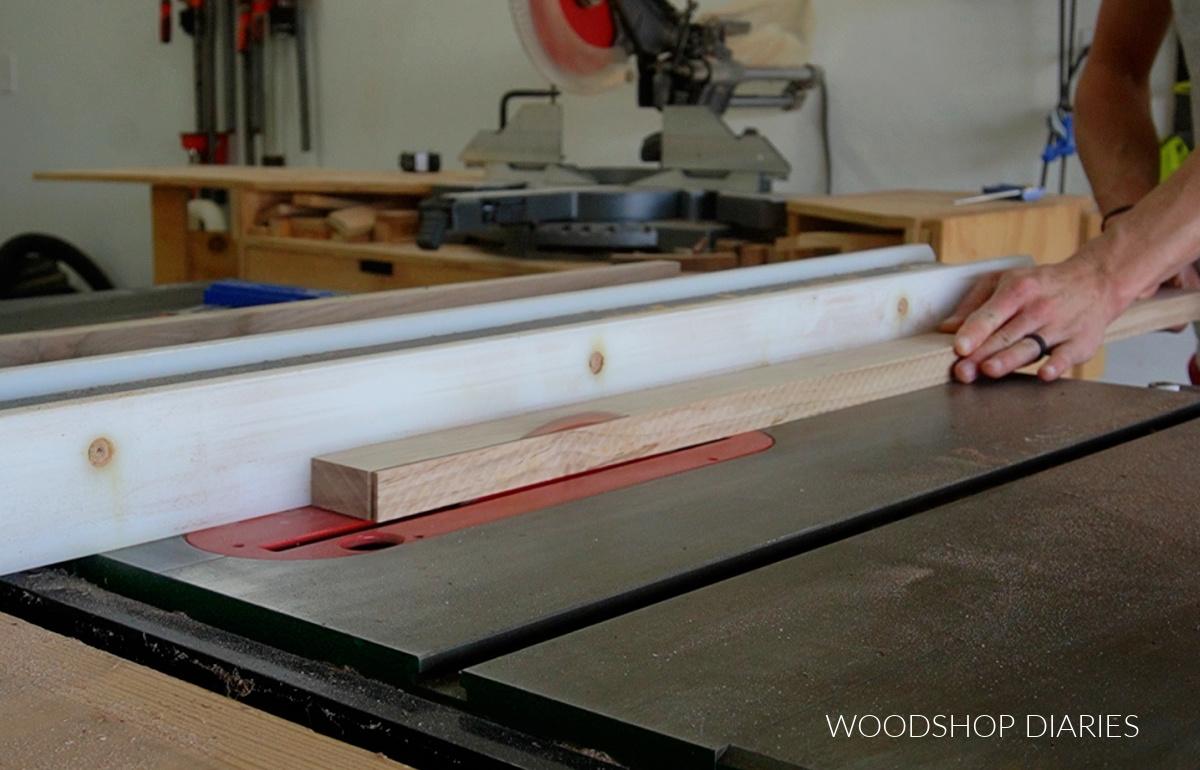
I made my cutting board about 1 ½″ thick, so the first thing I did was rip all of my boards down to 1 ½″ wide strips on my table saw. I used a 1x6x8 maple board, so I was able to rip this into 3 strips 1 ½″ wide.

ripping maple wood on table saw to 1 ½" wide

Then, I had three random pieces of walnut in my scrap pile that I also ripped to the same width to mix in.

If you don’t have a table saw, you could simply purchase your boards in 1x2s instead of ripping them down. If you didn’t know, nominal size 1x2s are actually ¾″ x 1 ½″.

NOTE: I used 1xs here turned on their side to make my board. If you wanted to use 2x2s instead, that’s totally fine.

Once all my boards were ripped into 1 ½″ wide strips, I trimmed them to approximately 19″ long pieces on my miter saw. Some pieces I left a little long–they’ll be trimmed down in step 3.

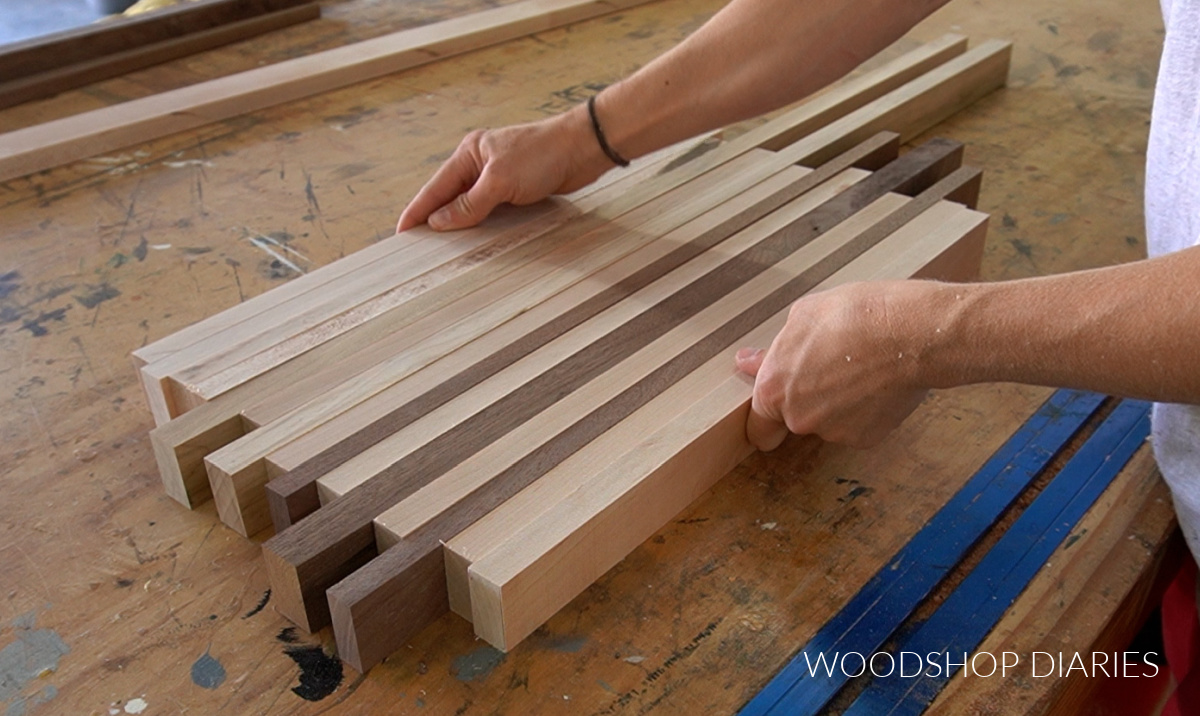
I cut down enough boards so that when laid out together side by side (standing on their edges), they made a board approximately 12 ¾″ x 19″. (This was basically 17 strips of 1×2).

laying maple and walnut boards out together on workbench to make cutting board design

Fourteen of these strips were maple and 3 were walnut.

Step 2: Glue up Cutting Board

If I’m gluing up more than a few boards at a time, I like to do it in sections. So I laid out my boards how I wanted, then split them (about) in half.

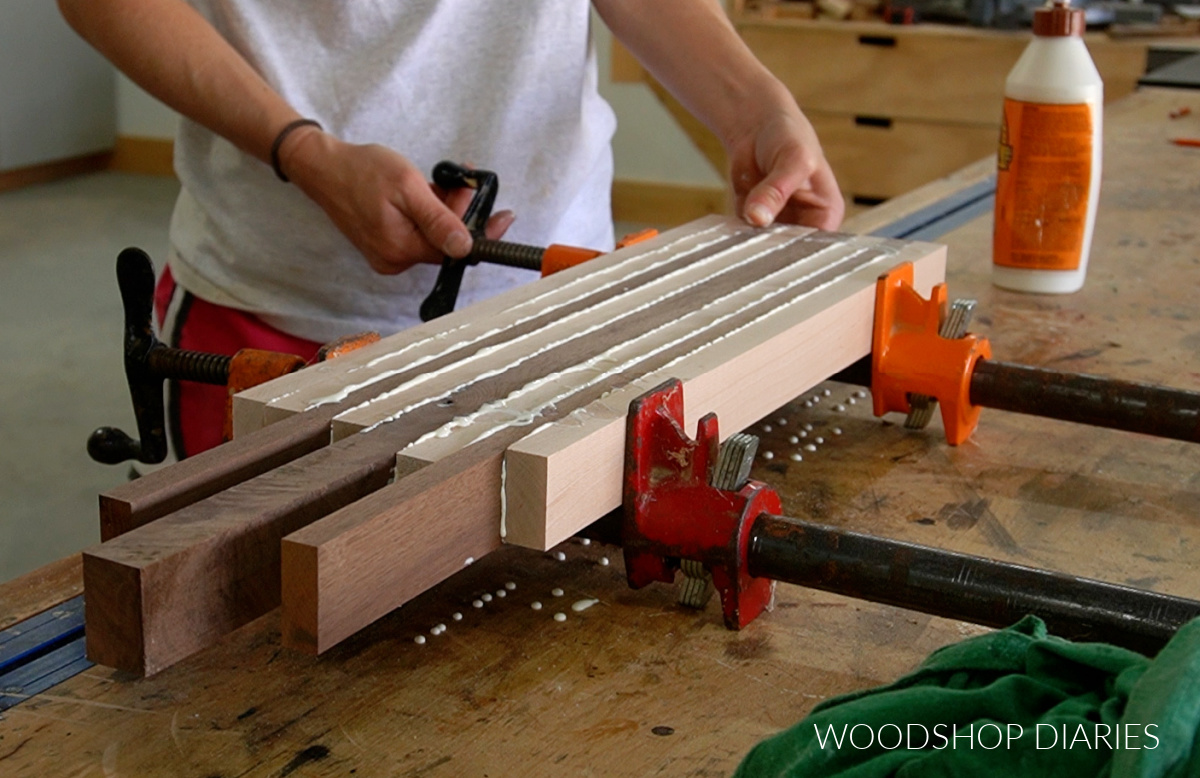
I glued up these two sections separately. To glue them, I applied wood glue liberally to the faces of each board, then clamped them with pipe clamps making sure to adjust them as flat as possible.

applying glue to cutting board pieces on clamps
clamping up half of basic cutting board pieces in pipe clamps

This will be messy–be prepared haha.

Once I glued half of the pieces, I repeated for the other half.

Gluing up the other half of cutting board pieces in pipe clamps

After both sections had dried (a few hours), I glued them together the same way making sure to keep them as flat as possible.

Step 3: Trim Cutting Board to Size

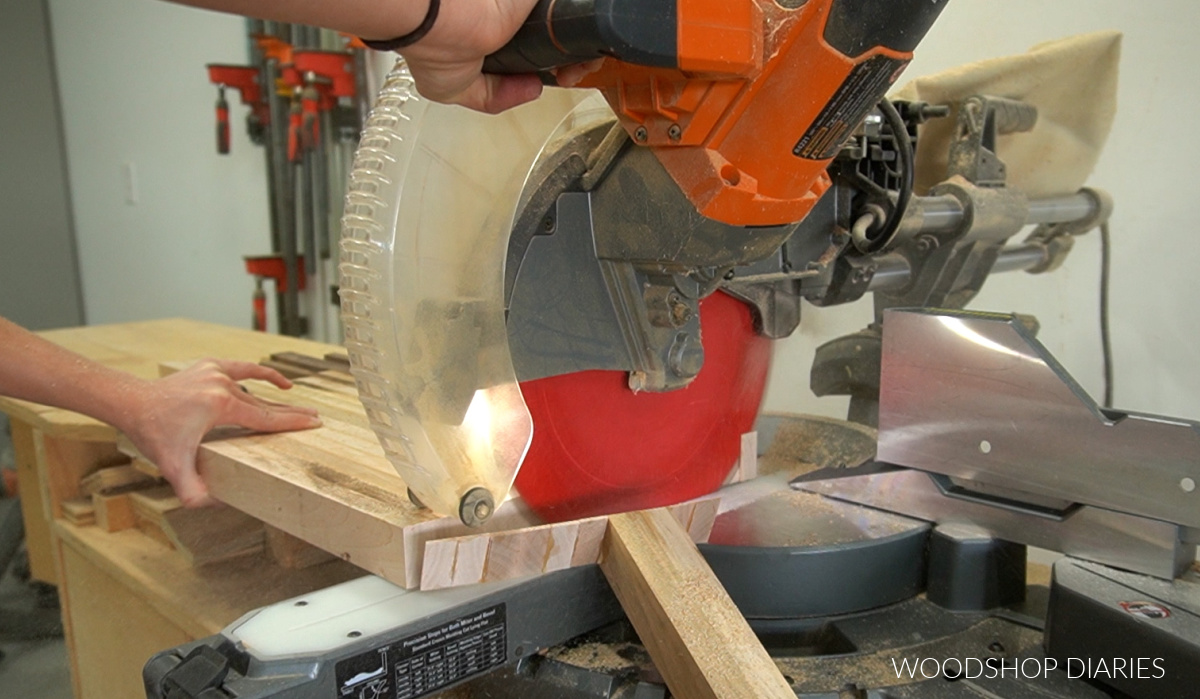
After the glue had fully dried on the cutting board (overnight), I trimmed the edges square on my miter saw so that the board was about 18″ long overall.

trimming basic beginner cutting board to size on miter saw

I didn’t trim the width, but you can if you wanted to.

Step 4: Flatten and Sand Cutting Board

If you have a planer, you can run this through the planer to flatten the top and bottom of the board to prep it for final sanding.

However, if you don’t have a planer or don’t want to run this through it, a belt sander and a little patience works just fine, too.

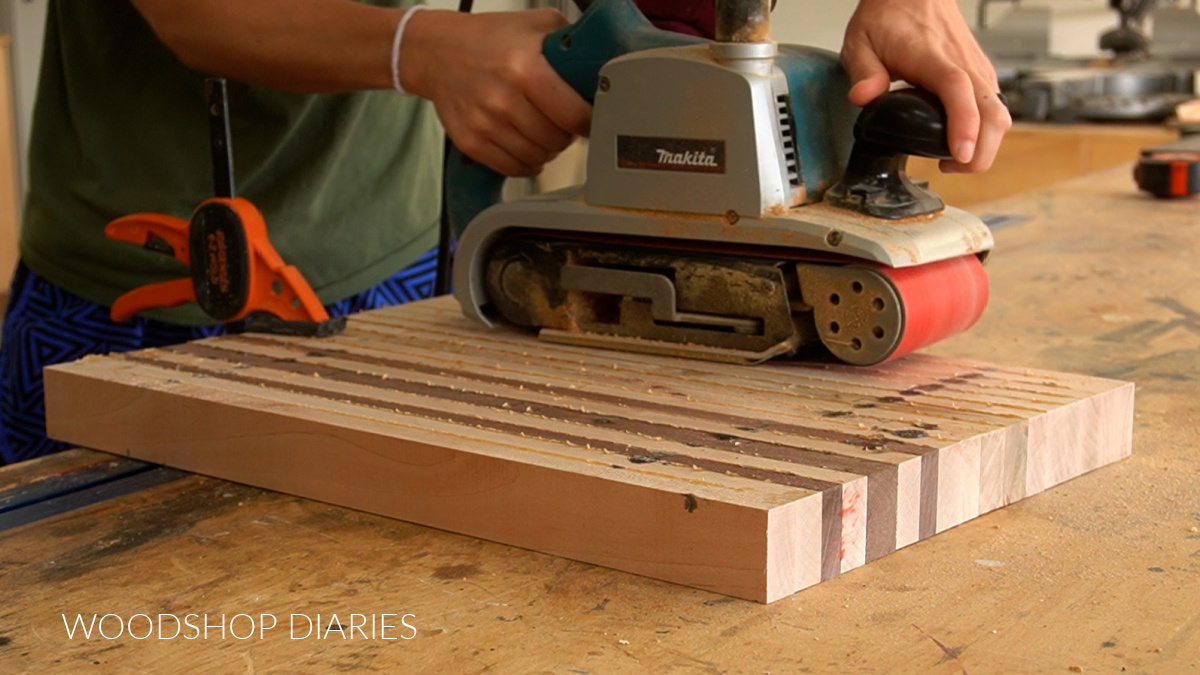
using a belt sander to flatten cutting board on workbench

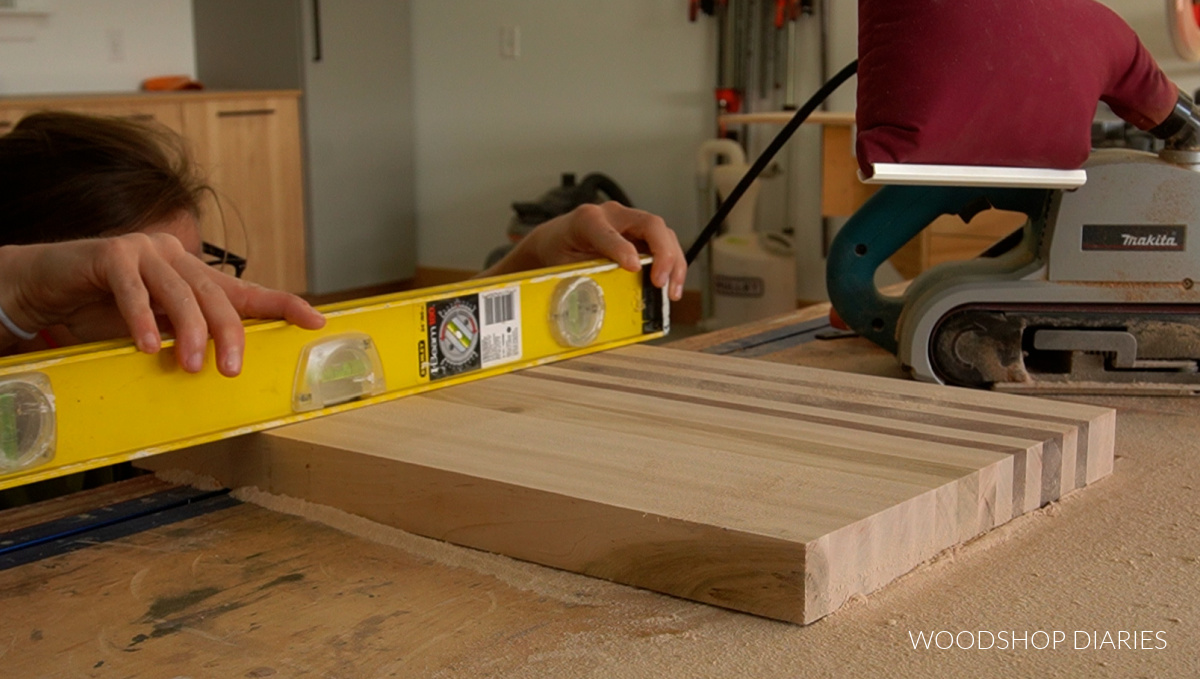
I used my belt sander with some 80 grit paper to sand down the bottom side of my cutting board first. I used a level to help me identify high and low spots and sanded down the high spots until it was flat.

using a level to check flatness of cutting board

Once one side was flat, I flipped it over and repeated for the other side.

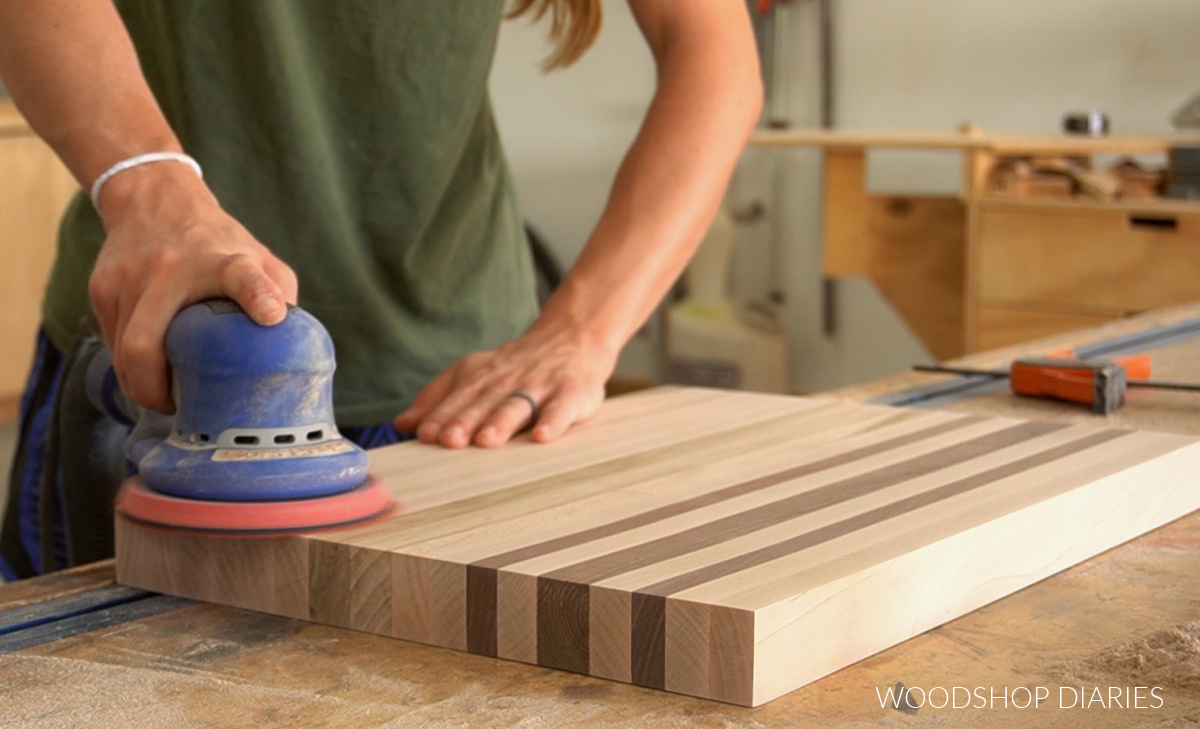
Then I followed up sanding the entire board with the orbital sander through 120, 180, and 220 grit until all sides were smooth and ready for finish.

RELATED: How to sand wood

orbital sander sanding cutting board on workbench

Step 5: Add Edge and Finish

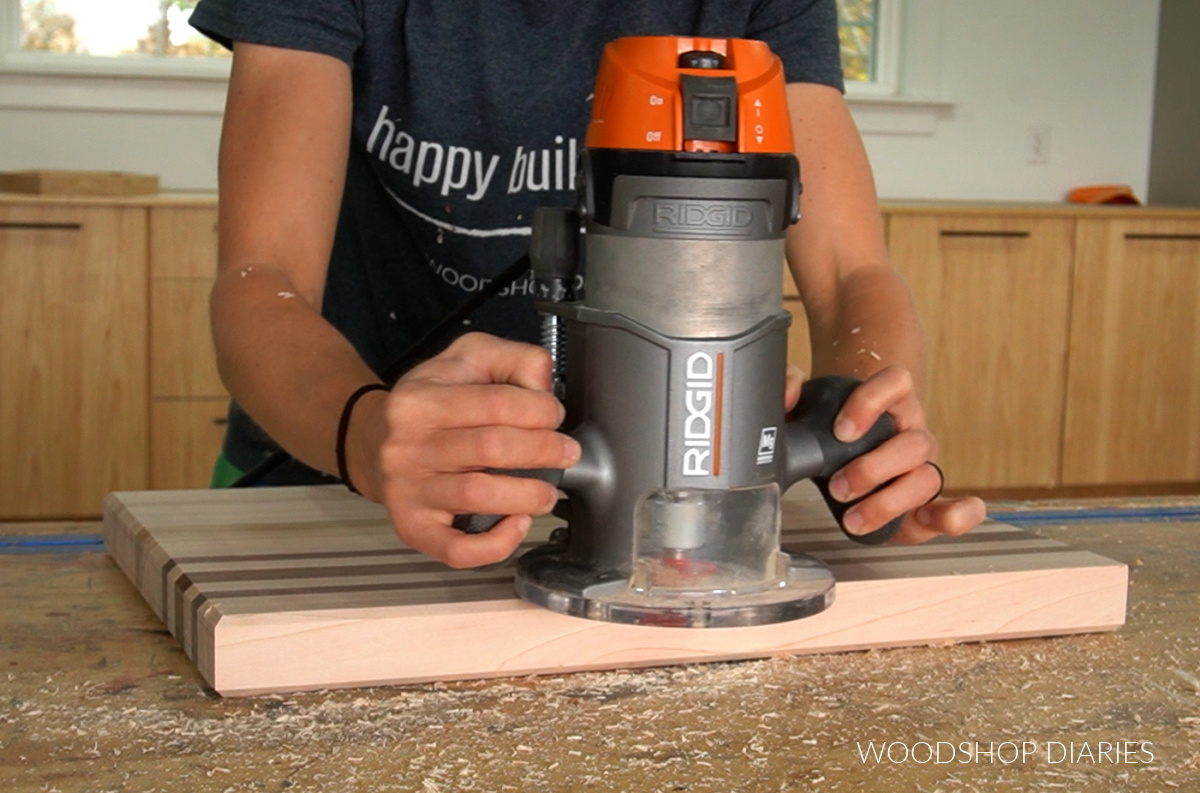
After it’s sanded, It’s ready for finish. But, if you wanted to add a little extra detail, you can add an edge with a router and your favorite edging profile. I know a lot of people like round over edges on cutting boards, but I’m not a big fan of them.

So I used a chamfer bit to just kind of remove the sharp edges, then hand sanded over them lightly.

RELATED: How to use a router

using a router to add chamfer detail to cutting board edges

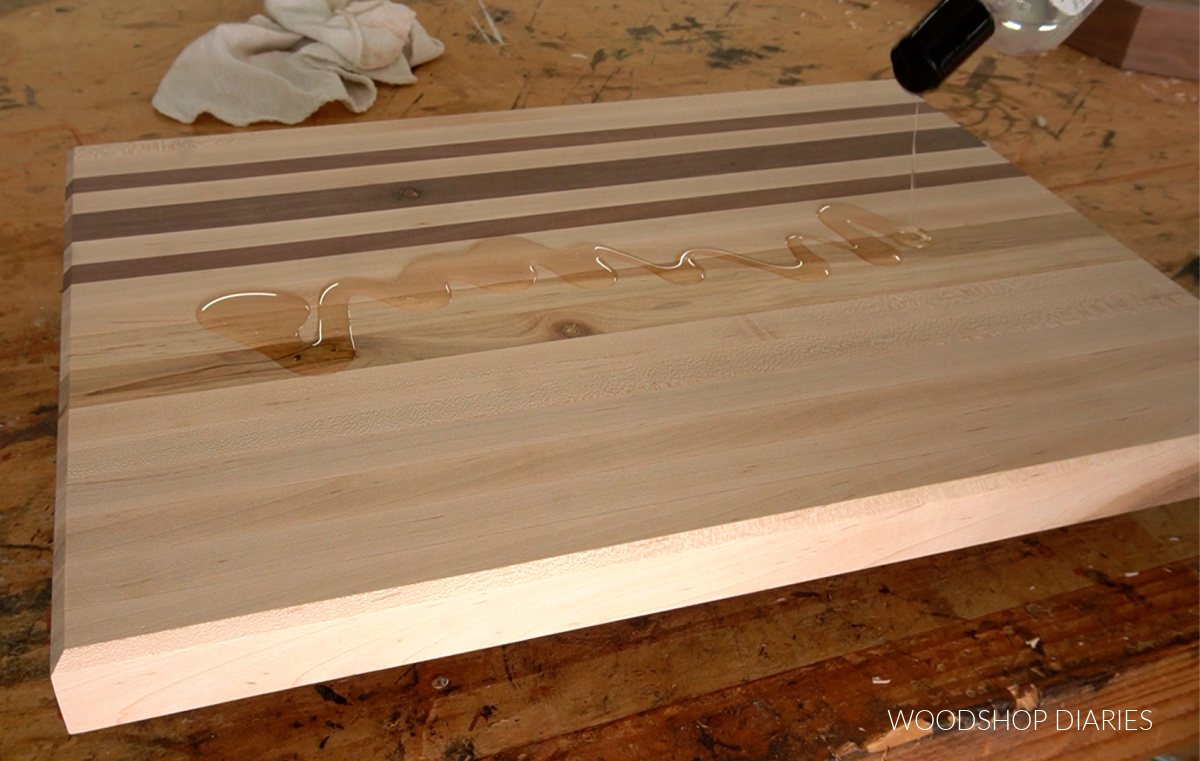
And finally, it was ready for a coating of cutting board oil. This is what I used, but there are tons of options out there for cutting board oils.

applying cutting board oil to top of maple and walnut cutting board

Just make sure whatever you use is food safe if you plan to actually cut on it.

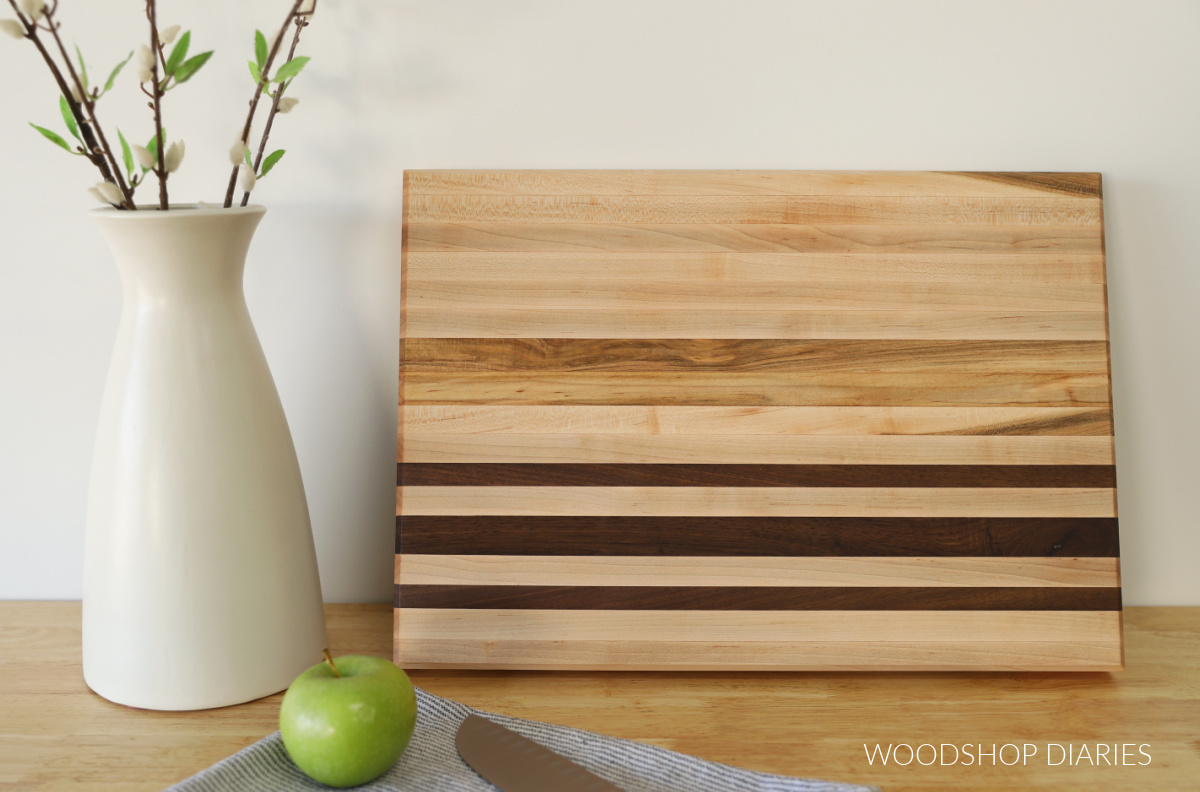
And with that, this cutting board is ready to use or ready to give away.

completed maple and walnut cutting board leaning against the wall next to white vase with green apple, knife and towel on countertop
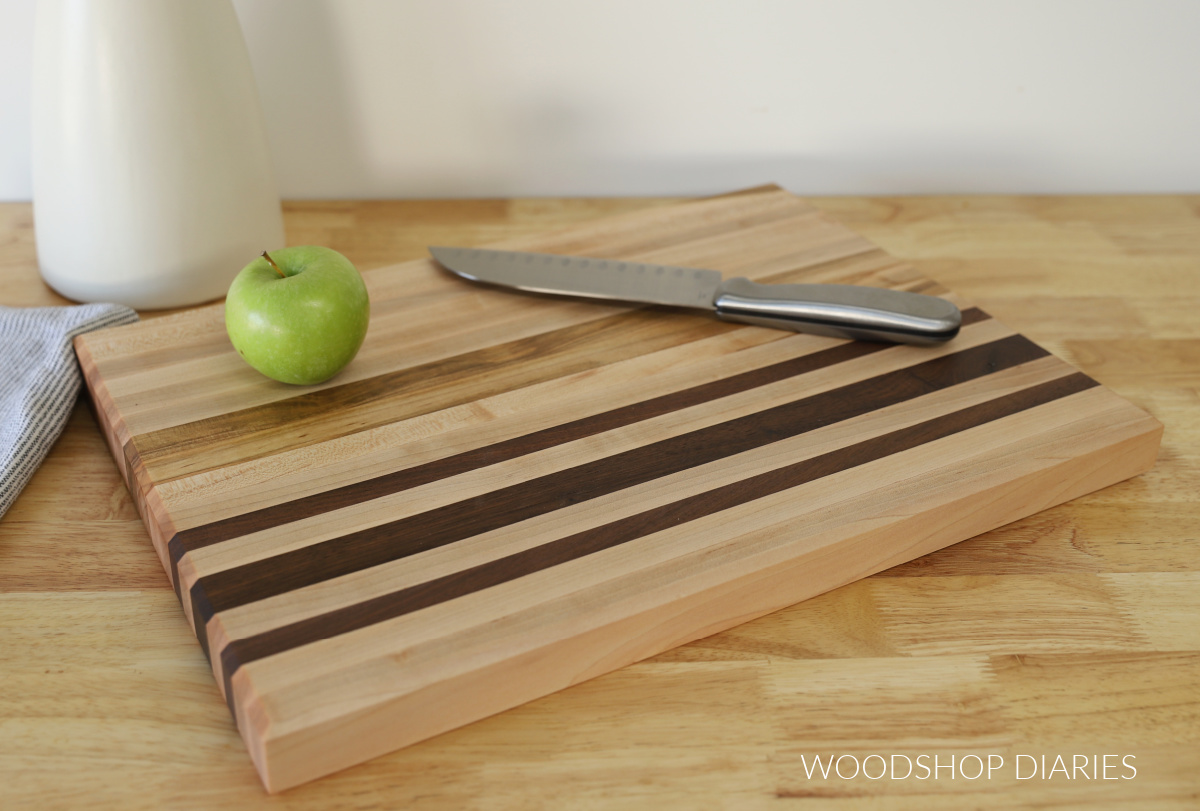
basic DIY beginner cutting board laying on butcherblock countertop with apple and knife on top

Looking for more Handmade Gift Ideas?

With the upcoming holidays, I’ve teamed up with my friend, Kati, from Houseful of Handmade to share some easy and fun gift ideas you can make this season!

I’ve included our gift ideas in the gallery below (click on the images to see how to make each one). Each day between November 18-22, we will be adding more projects to the list so keep an eye out!
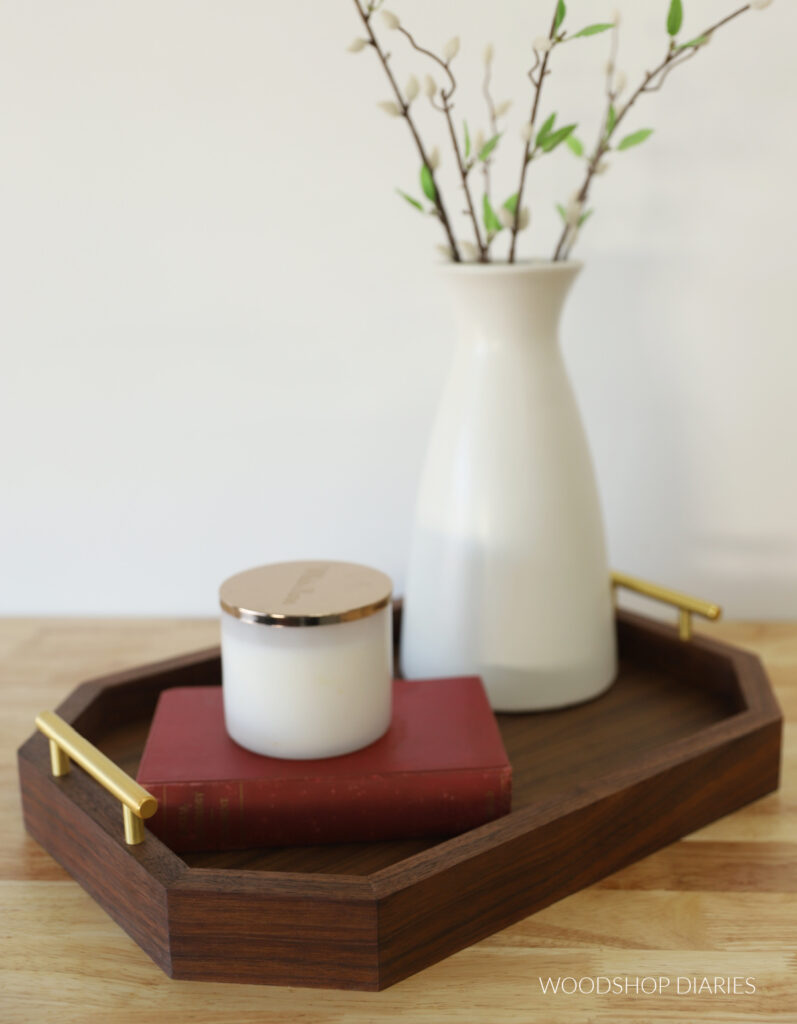
DIY Book Stand
DIY Jewelry Box
DIY Basic Cutting Board
DIY Cheese Slicer
DIY Serving Tray
DIY Cooking Utensiles
DIY Lazy Susan
DIY Book Rest
DIY Tic Tac Toe Game
DIY Wood Game Board

If you’d like to save this project for later, be sure to pin it or share it to your favorite social platform!

Pinterest collage showing overhead view of cutting board at top and cutting board leaning against white wall at bottom with text "how to make a cutting board"

Until next time, happy building!

How to Make a Book Stand

November 17, 2023 by Shara, Woodshop Diaries

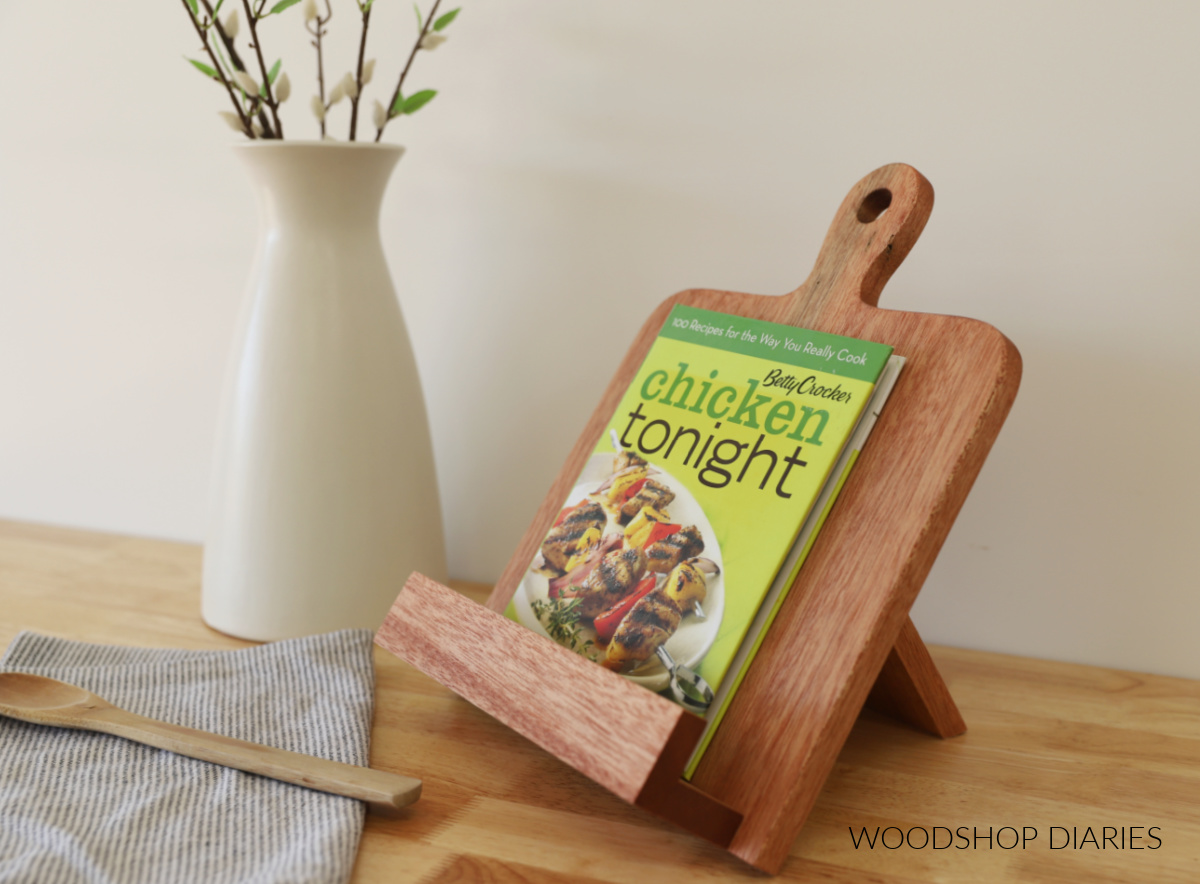
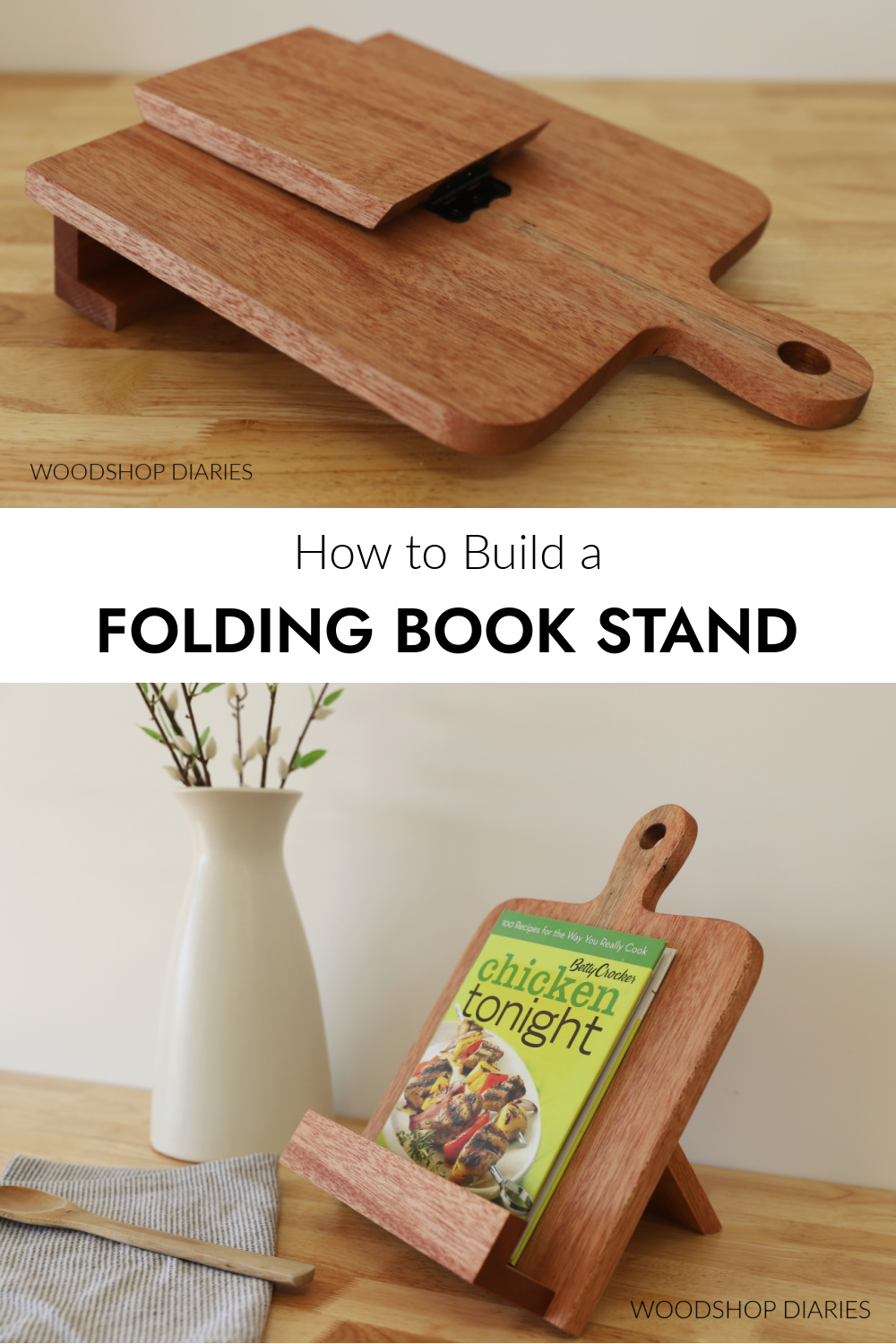
In this post, I’m showing you how to make a simple DIY book stand from scrap wood!

This easy woodworking project makes the perfect handmade hostess or Christmas gift idea.

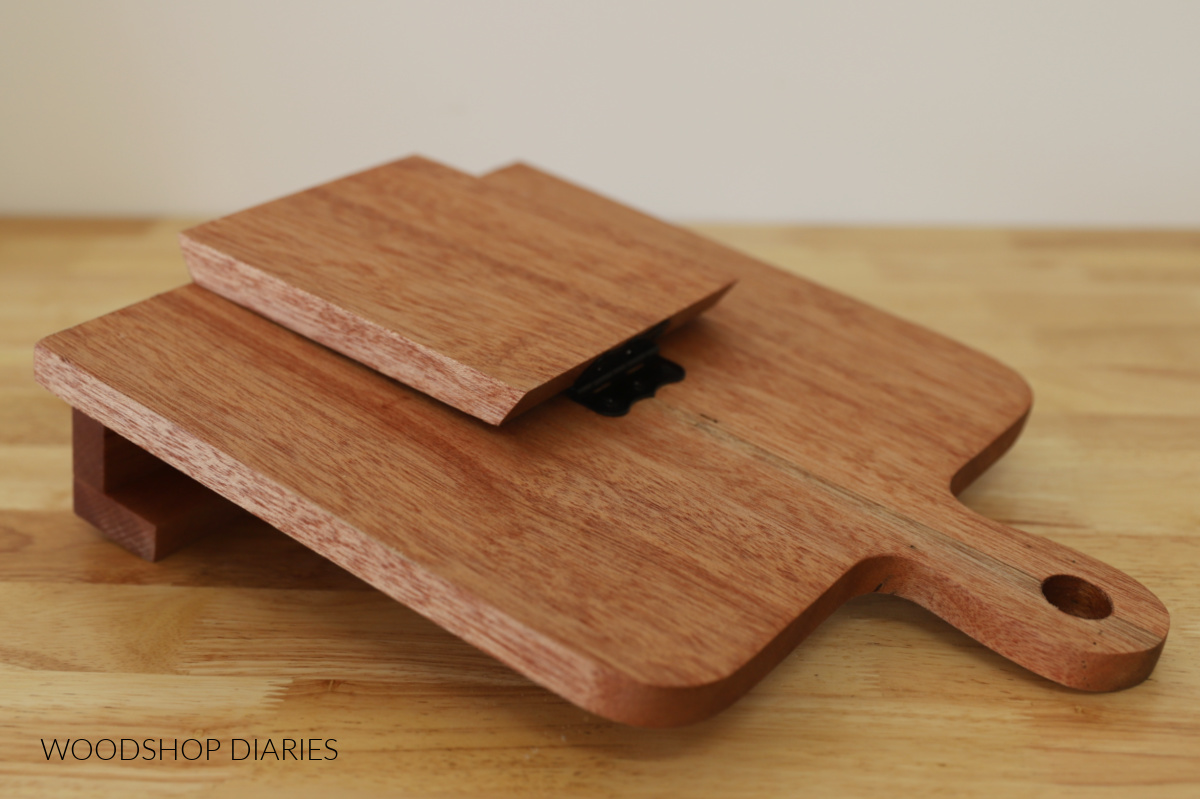
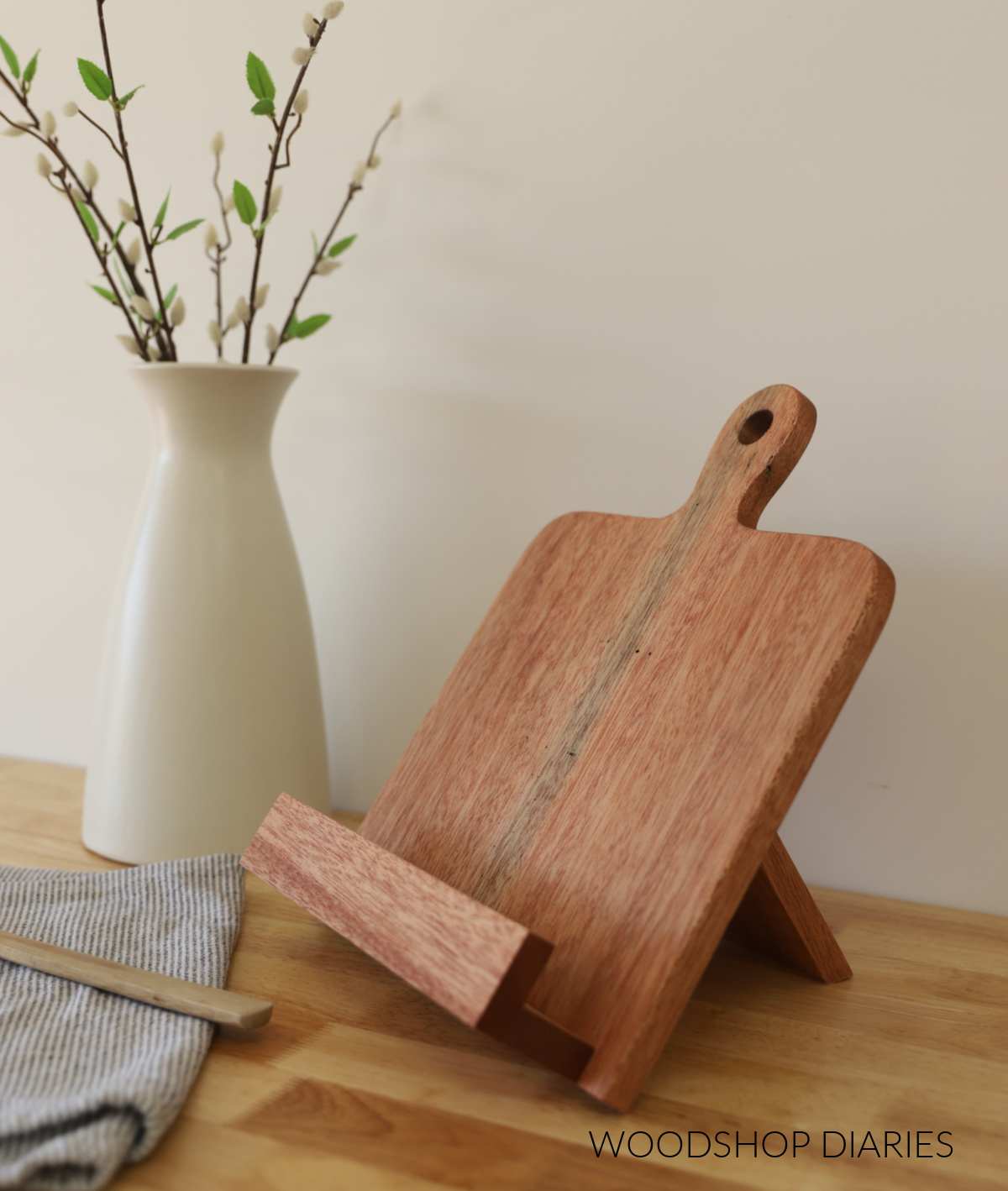
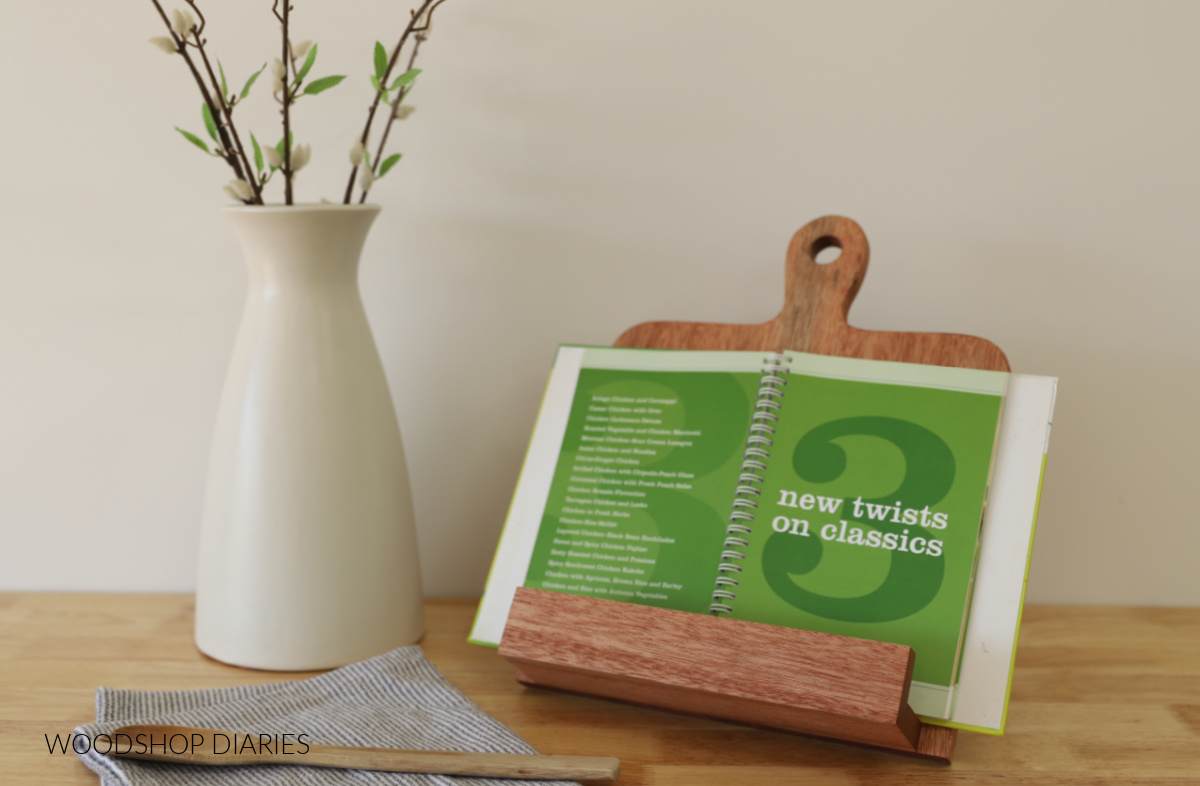
The hinged back support can fold up for easy storage, but when propped up, provides a sturdy support for large cookbooks, iPads, or even use it as a photo stand.

What type of wood do you need?

You can build this simple DIY book stand with just about any species of wood you’d like.

I purchased a 1x6x6 mahogany wood board recently to try out since I’ve never worked with it before. So I cut all my pieces from that board (and had quite a bit left over!).

But 1x pine, oak, maple, or even ¾″ plywood would work great as well. I recommend checking your scrap pile before building because you likely have everything you need to build this already in there.

If you have a table saw, you can cut everything you need from a 4 foot long piece of 1×6. But if you don’t have a table saw, that’s totally fine. You can use 1x2s for the book ledge and 1x6s for the back.

Are DIY projects your thing? Sign up for our newsletter for priority access to the latest projects and build plans!

How to Build a Scrap Wood Book Stand

I’m sharing the steps below as well as a printable version if you prefer to print your plans. And if you prefer to watch, here’s a how to video as well.

Tools & Materials

**This post contains affiliate links. See website policies.

Tools:

  • Miter saw
  • Drill/Driver
  • Jig Saw
  • Small screwdriver (optional)
  • Clamps

Materials:

  • 48″ of 1×6 board OR 36″ of 1×6 board + 20″ of 1×2 board*
  • Wood glue
  • (1) cabinet butt hinge

*If you have a table saw, you can rip part of your 48″ long 1×6 into 1x2s for the book ledge (details below). If you don’t have a table saw, you can use precut 1x2s instead.

Cut List:

  • 1×6 boards
    • (2) 14″ long (back panel)
    • (1) 6 ½″ long (ends beveled 30 degrees–back support)
  • 1×2 boards
    • (2) 10″ long (book ledge)

Prefer to print? Grab the printable building plans for this book stand project here.

Step 1: Assemble Back Panel of Book Stand

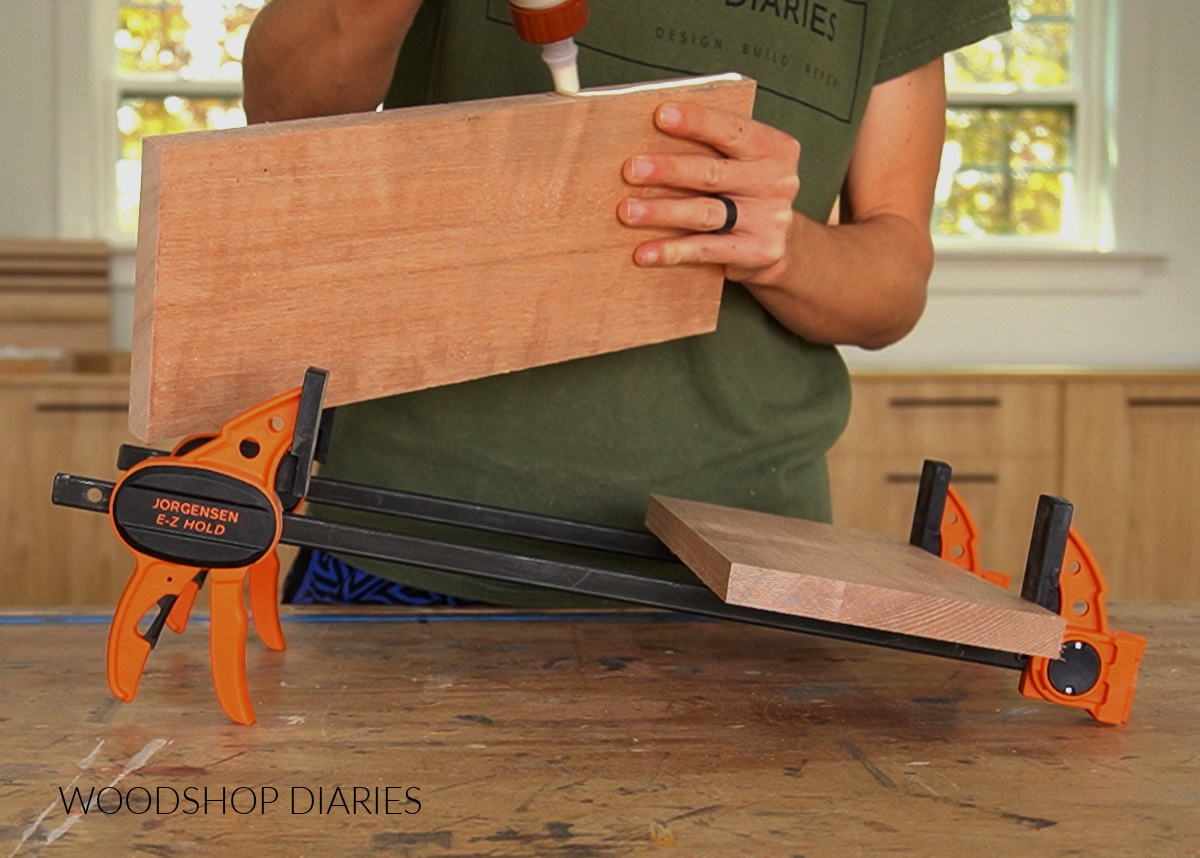
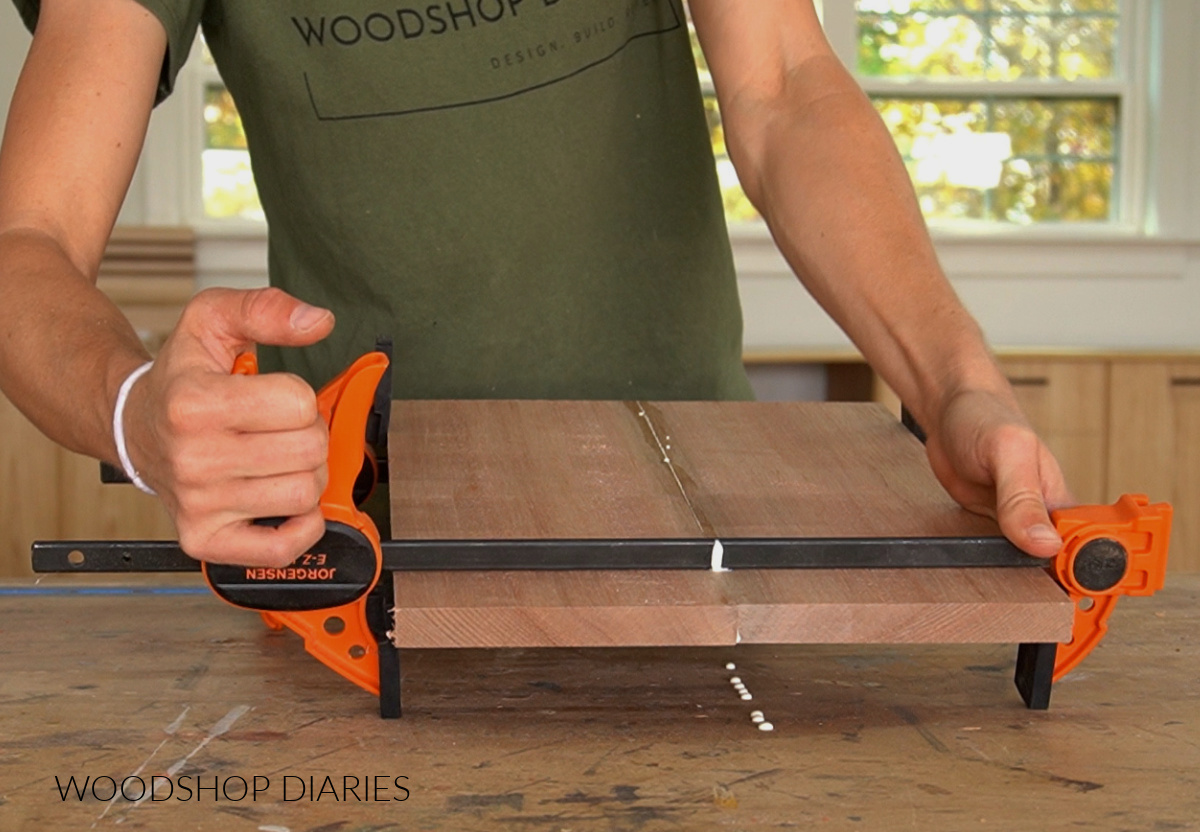
The back panel of this book stand is made from 1x6s glued together. I cut two pieces of 1×6 to 14″ long (you can make it longer if you want a taller bookstand).

Then, I glued and clamped them together to make a panel about 11″ wide (if you didn’t know, 1x6s are 5 ½″ wide, so two together gives you 11″) x 14″ tall.

Once the glue dried, I trimmed one end square on the miter saw–this will be the bottom.

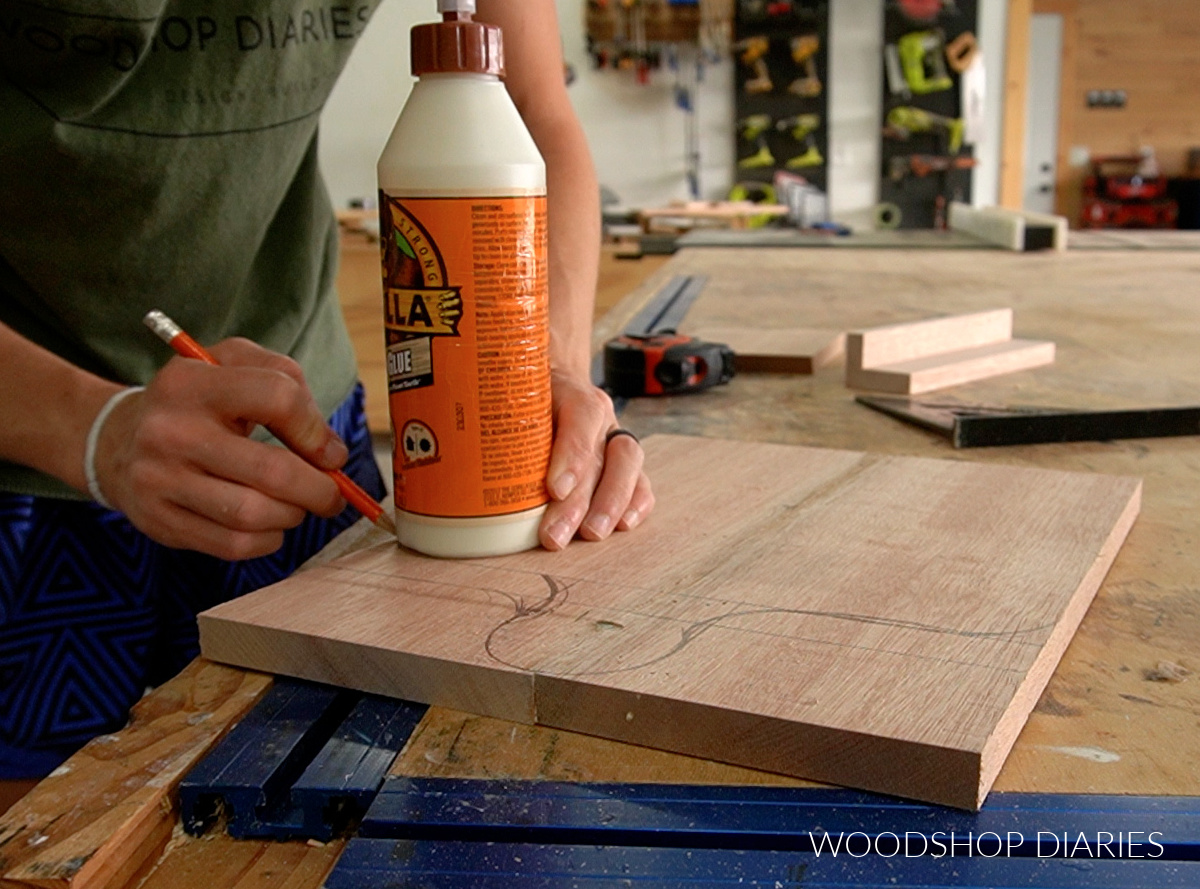
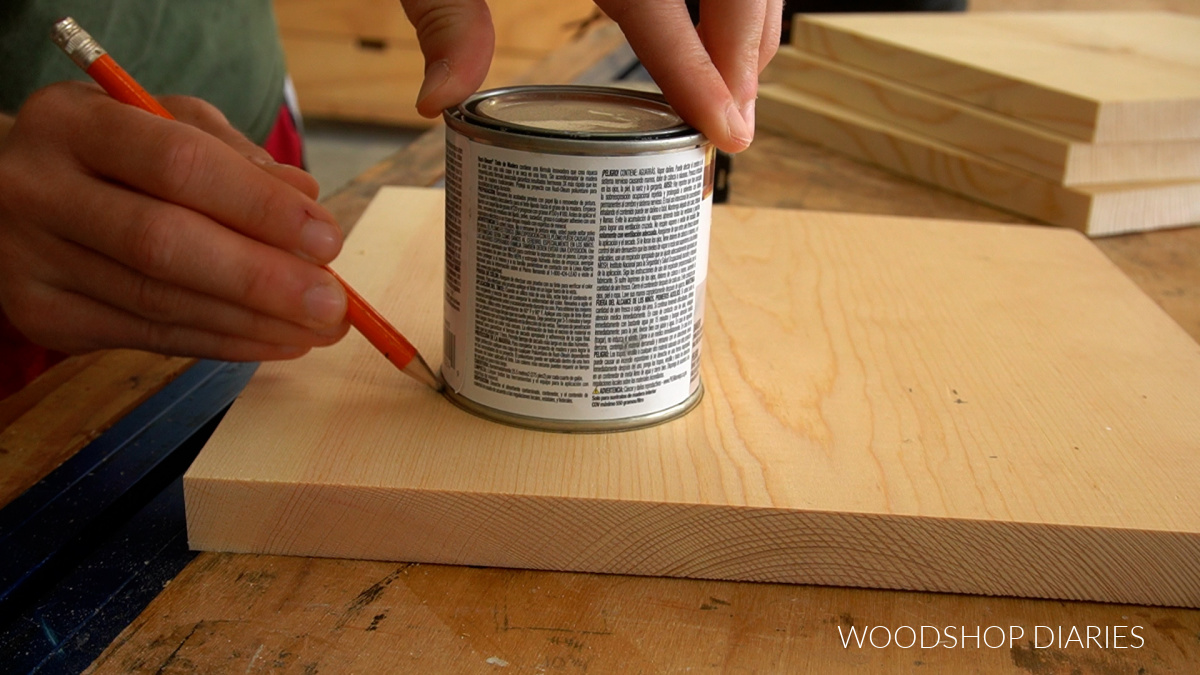
On the top side, I used some round objects (like a glue bottle and some small stain cans) to just kind of trace out a “handle” on the top.

This is COMPLETELY optional and if you wanted, you can simply cut the top end square just like the bottom.

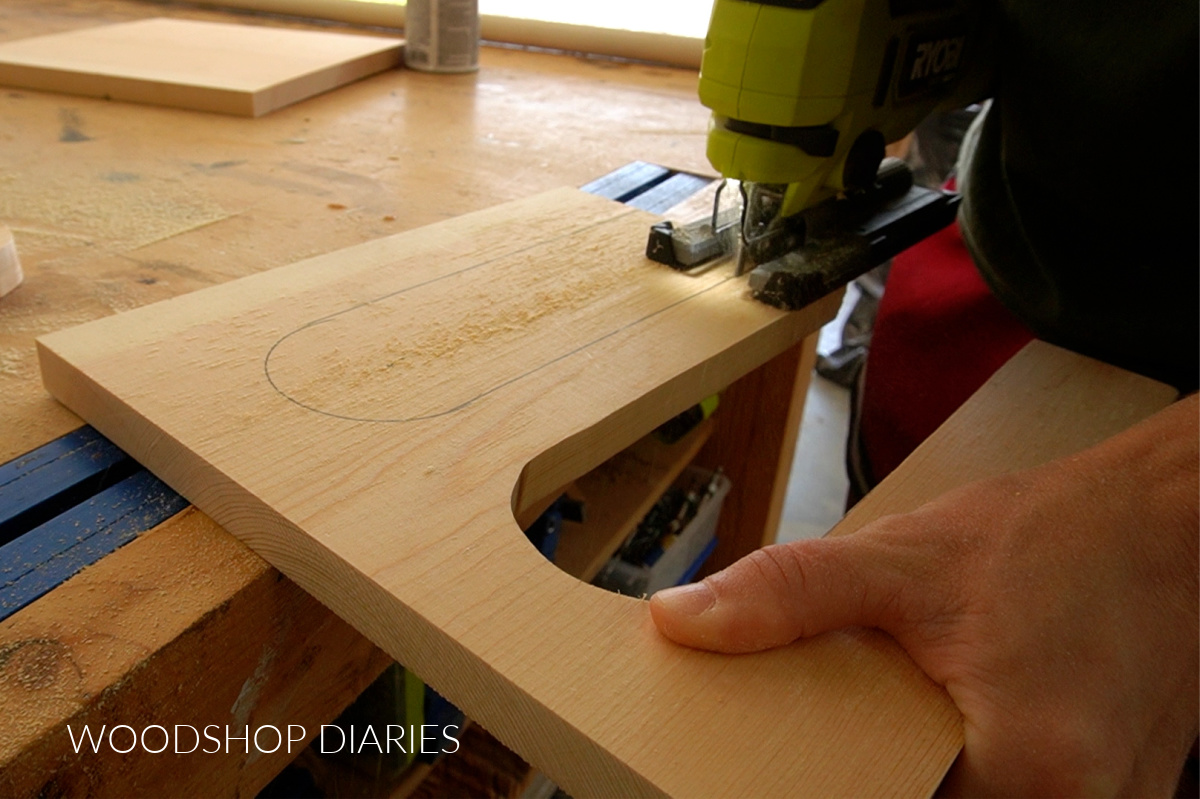
I didn’t use a template–just kind of drew out a shape I thought looked good. I made my handle about 3″ tall so the main part of the panel was about 11″ tall. Feel free to customize your design and sizing however you’d like.

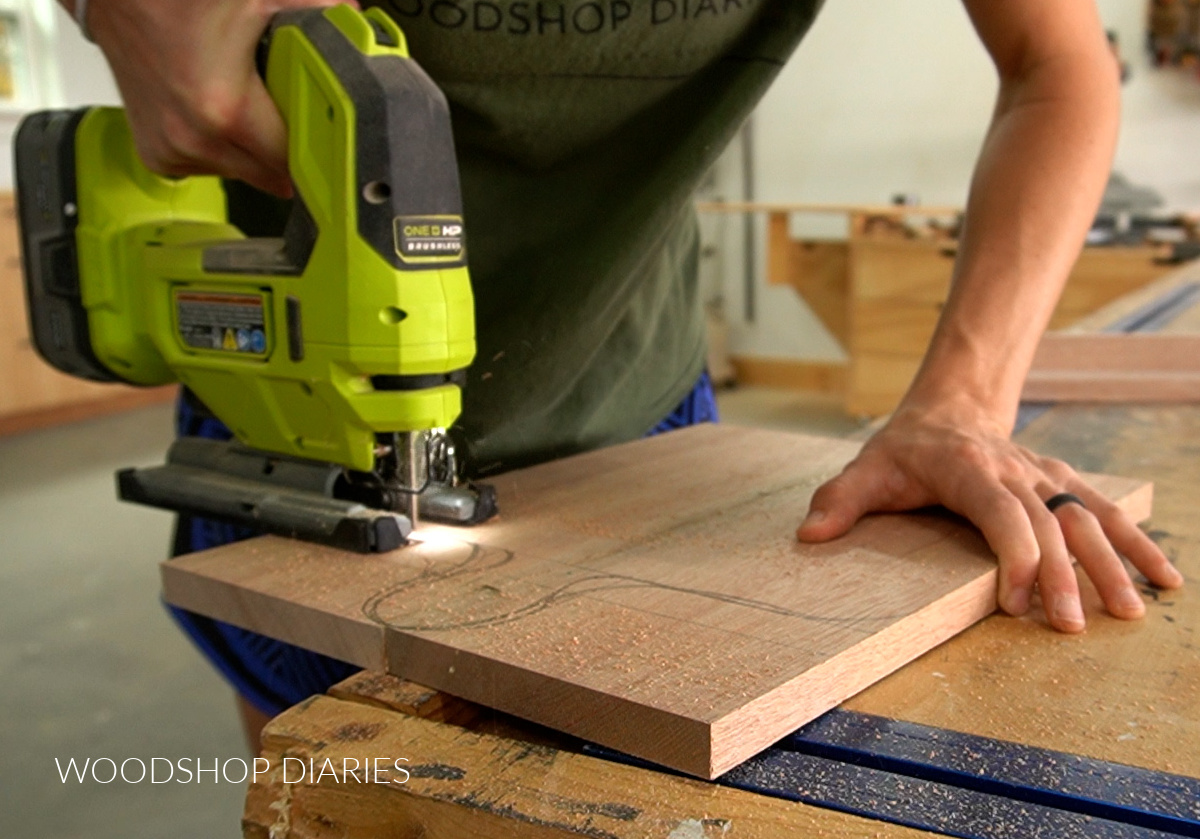
Once I was happy with my drawing, I cut it out with a jig saw.

TIP: Use a fine finish blade on your jig saw to minimize tear out as you cut.

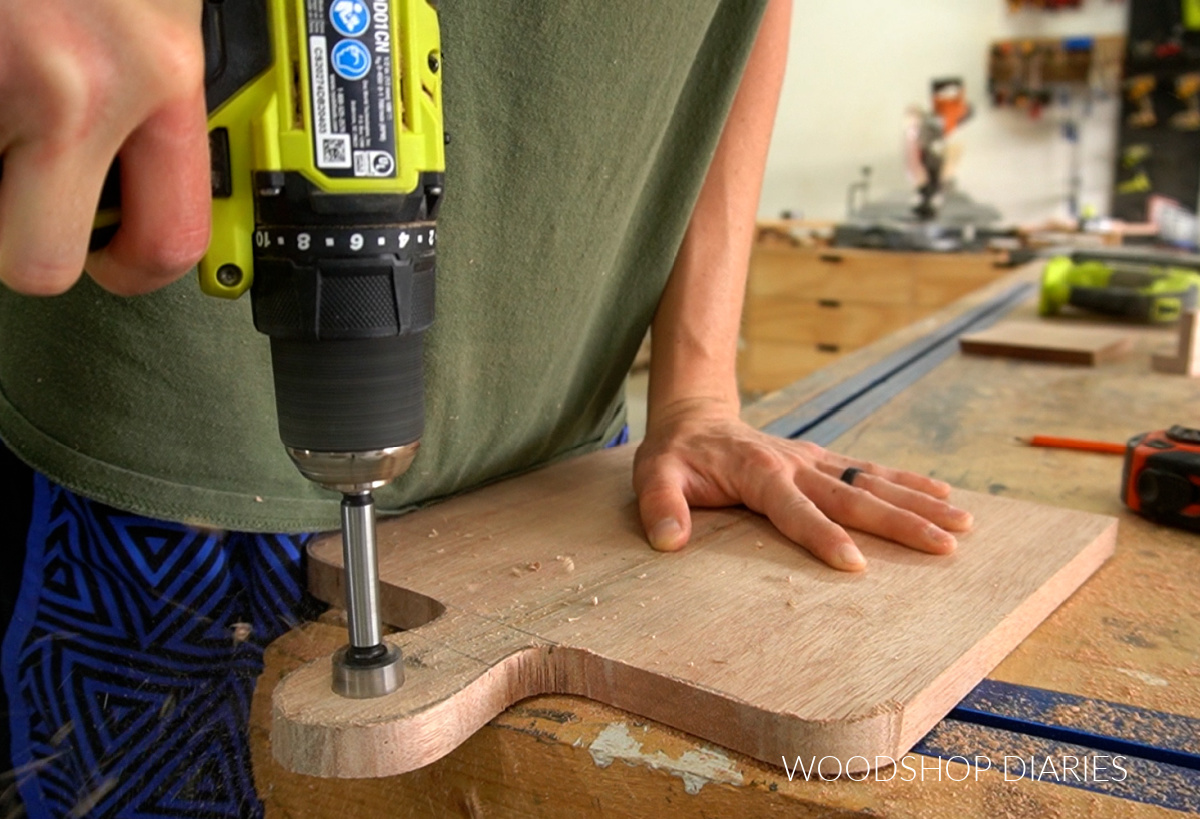
Then, I used a forstner bit to drill a hole in the center of the handle as another optional detail. If you wanted, you could tie a small rope through the hole for an extra decorative touch.

Finally, I sanded the panel and the edges well to smooth everything out.

Step 2: Attach Book Ledge

After the back panel was assembled, I moved on to making the book ledge. I cut two pieces of 1×2 to about 10″ long–one will be for the bottom and one will be for the front.

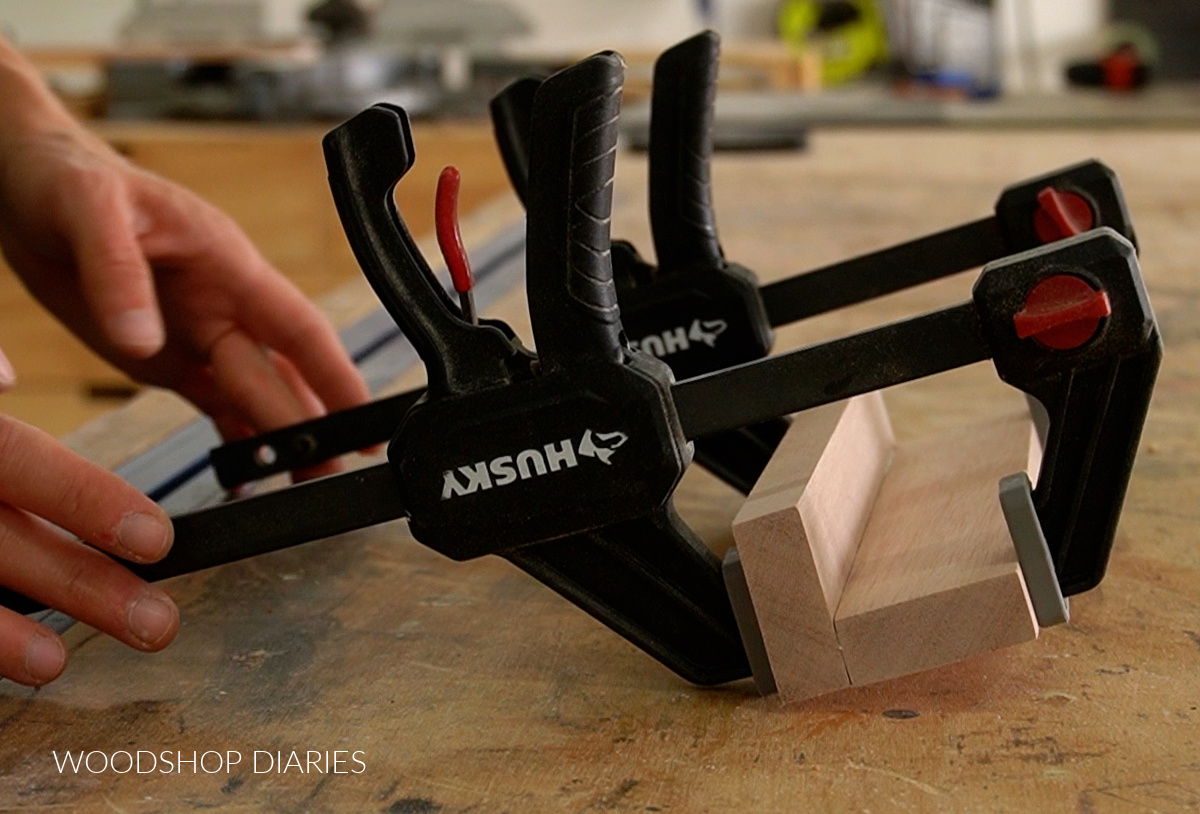
I glued them together like shown below. If you wanted, you can certainly add a few brad nails to help secure it as well.

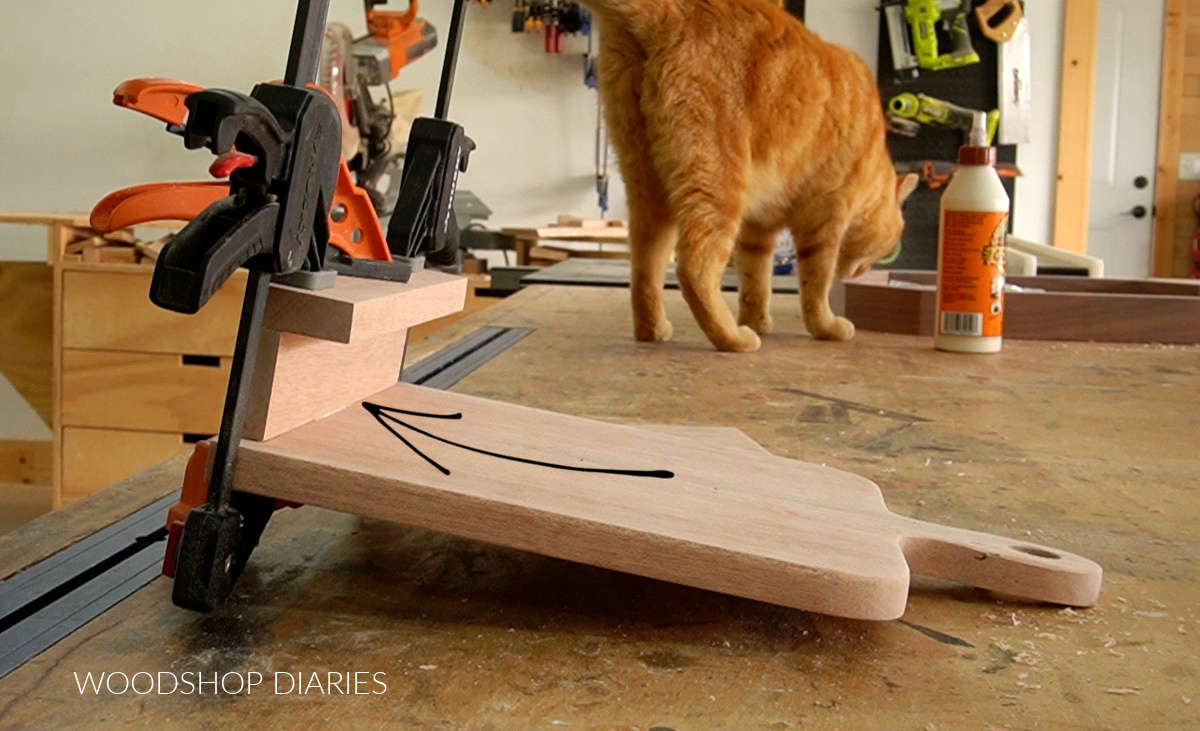
Once the glue was dry, I glued this piece onto the front of the back panel from step 1 so that it was centered and flush to the bottom edge. Please ignore the cat in the background of the photo–he likes to be in the middle of everything HA!

Again, you can add a few brad nails through the back if you’d like.

Step 3: Install Hinged Support

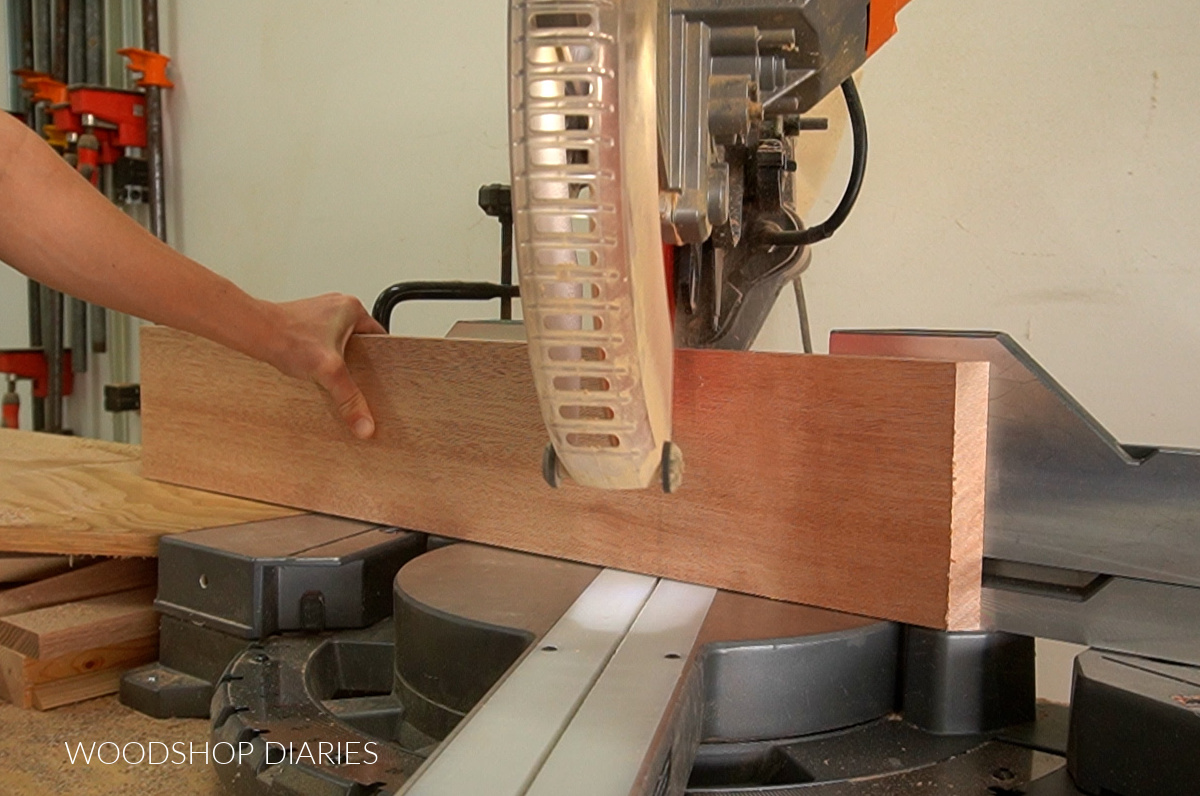
I adjusted my miter saw to 30 degrees and cut a piece of 1×6 to 6 ½″ long (on the longest side) with both ends beveled 30 degrees NOT parallel to each other.

RELATED: How to cut angles on a miter saw

NOTE: I can cut 1x6s on my miter saw standing up, but if yours isn’t large enough to do that, you can lay it flat and adjust your bevel angle to 30 degrees to cut that way instead.

Now, you can install this as a hinged support so it folds up flat, or as a stationary support so it doesn’t fold. Either way works fine, but I thought the hinged feature was helpful, so that’s how I installed it.

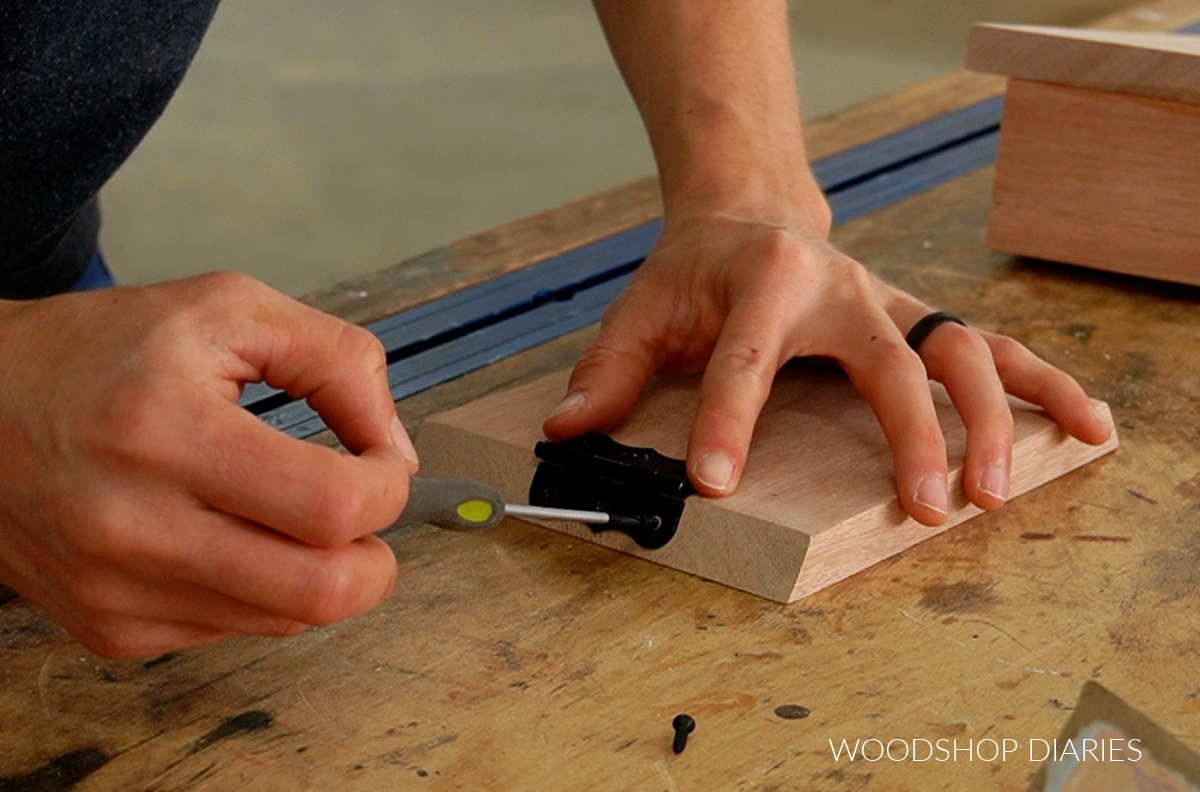
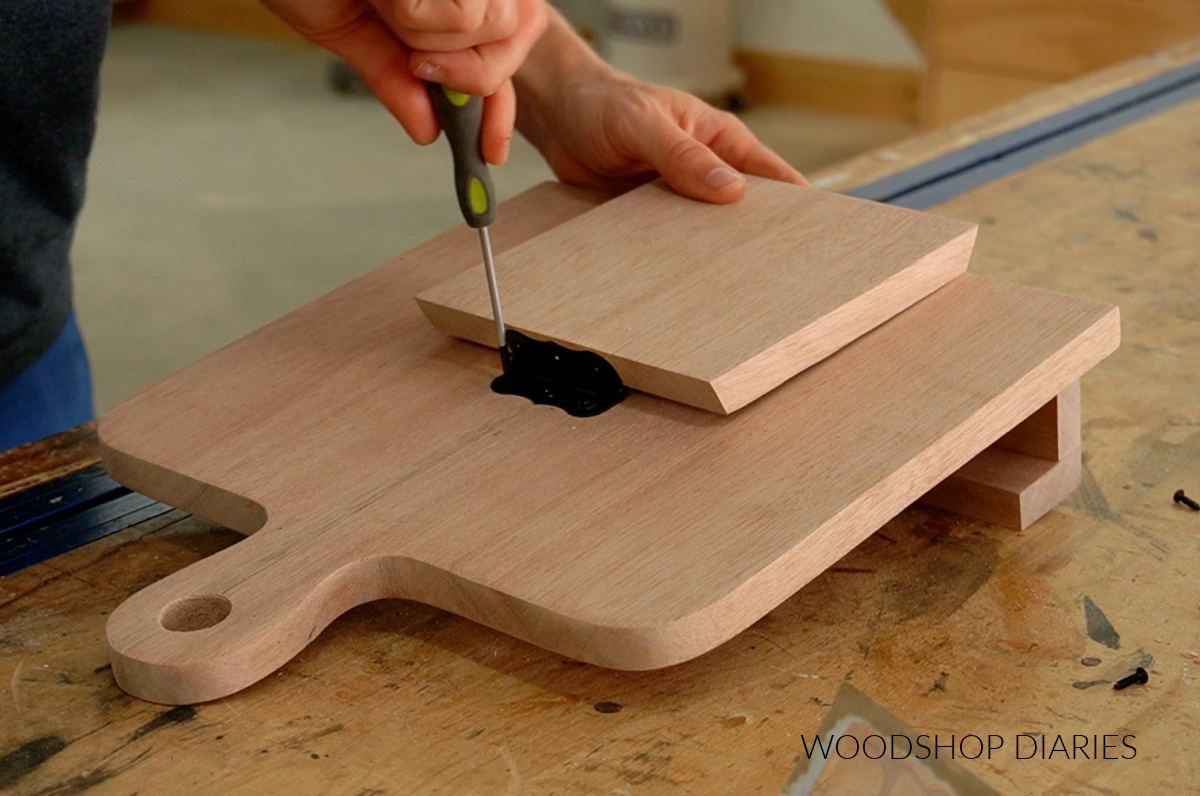
First, I installed the hinge into one end of the beveled 1×6 like shown below. Make sure the hinge is centered left to right.

TIP: Be sure to predrill your holes. It might be helpful to use a small screwdriver as the screws that come with these hinges tend to be pretty small and may easily strip if you use a drill or driver.

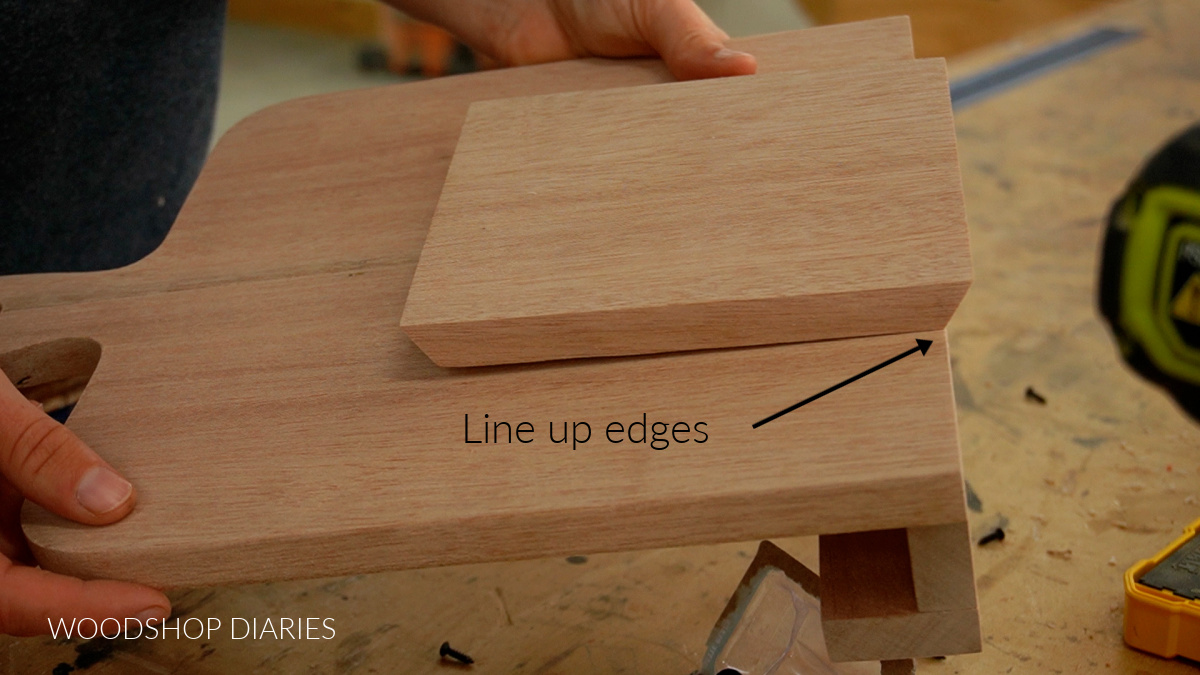
Once the hinge was attached to the end of the support, I centered it on the back side of my bookstand, lined up the edge with the bottom and secured the other side of the hinge.

Step 4: Finish Book Stand

At this point, the book stand is complete and ready for paint, stain, finish as desired. Since this was mahogany wood, I wanted to keep it’s natural color, but give it a protective finish.

So, I wiped on some Walrus Oil Furniture Butter to finish. Feel free to paint, stain, or customize your book stand however you’d like.

And with that, it’s ready to use for yourself or give as a gift! This would be perfect for use in a kitchen, on a desk, or to display your favorite book, artwork, or photo on a shelf.

Looking for more Handmade Gift Ideas?

With the upcoming holidays, I’ve teamed up with my friend, Kati, from Houseful of Handmade to share some easy and fun gift ideas you can make this season!

I’ve included our gift ideas in the gallery below (click on the images to see how to make each one). Each day between November 18-22, we will be adding more projects to the list so keep an eye out!
DIY Book Stand
DIY Jewelry Box
DIY Basic Cutting Board
DIY Cheese Slicer
DIY Serving Tray
DIY Cooking Utensiles
DIY Lazy Susan
DIY Book Rest
DIY Tic Tac Toe Game
DIY Wood Game Board

If you’d like to save this project for later, be sure to pin it or share to your favorite social channel!

Until next time, happy building!

How to Cut Angles on a Miter Saw

November 2, 2023 by Shara, Woodshop Diaries

In this post, I’m showing you how to cut angles on a miter saw for your DIY woodworking projects.

I’ll also show you how to better understand the miter saw settings and how to confidently add angled elements into your next project.

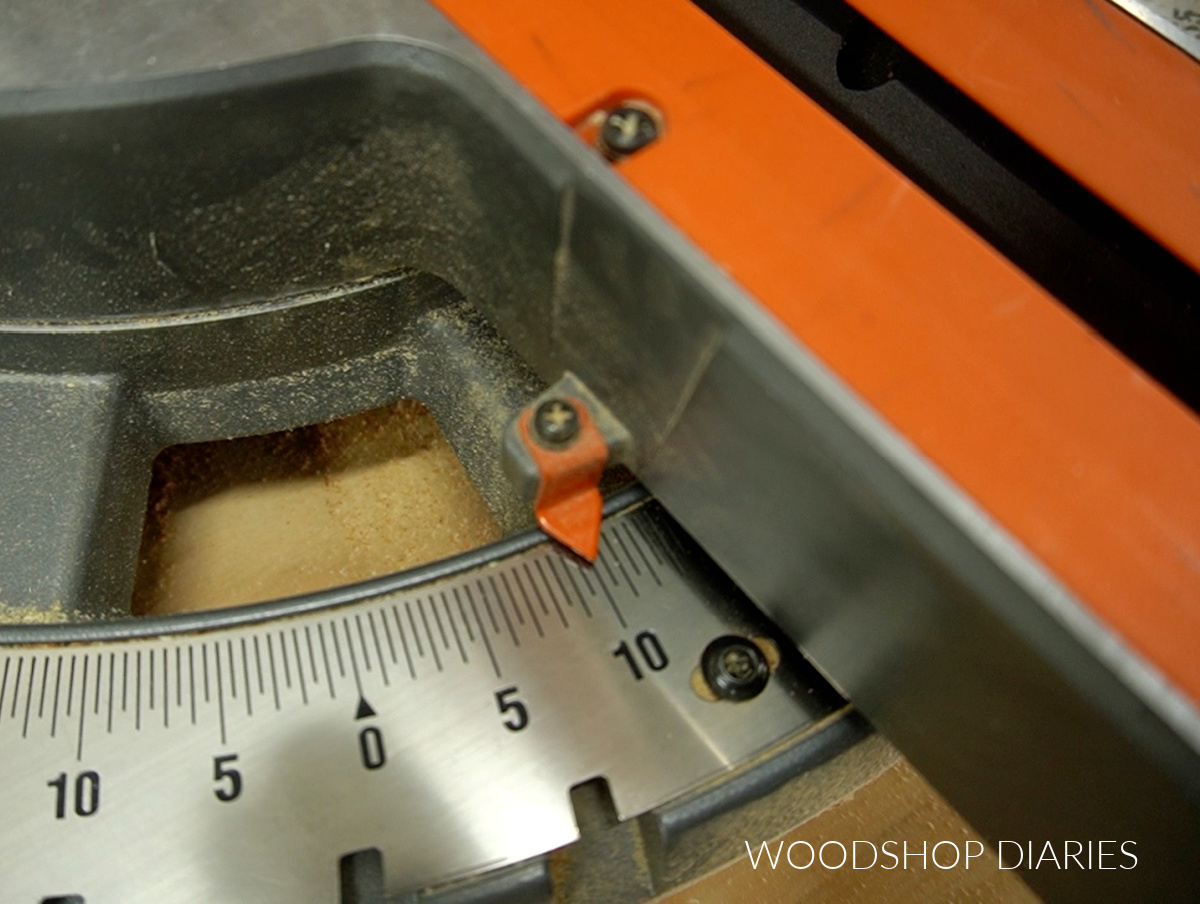
Close up of miter saw miter angle set to 10 degrees with board end cut on base

A miter saw is one of the most versatile and most used tools in many woodworking shops. It’s one of the top 5 tools I recommend starting with and is incredibly valuable for quick and accurate cuts.

*This post contains affiliate links. See website policies.

What is a Miter Saw?

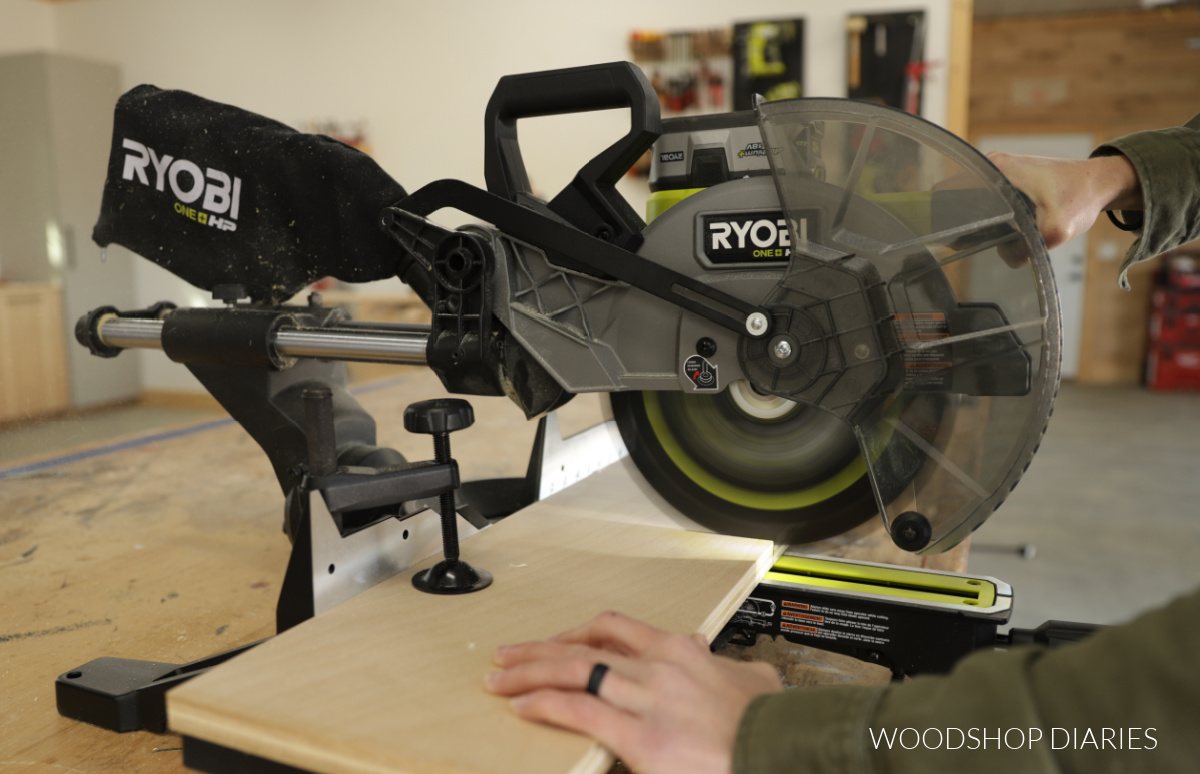
A miter saw is a saw that allows you to make quick and accurate cross cuts at varying angles. To cut, you place the board against the saw’s back plate and lower the blade to cut across it.

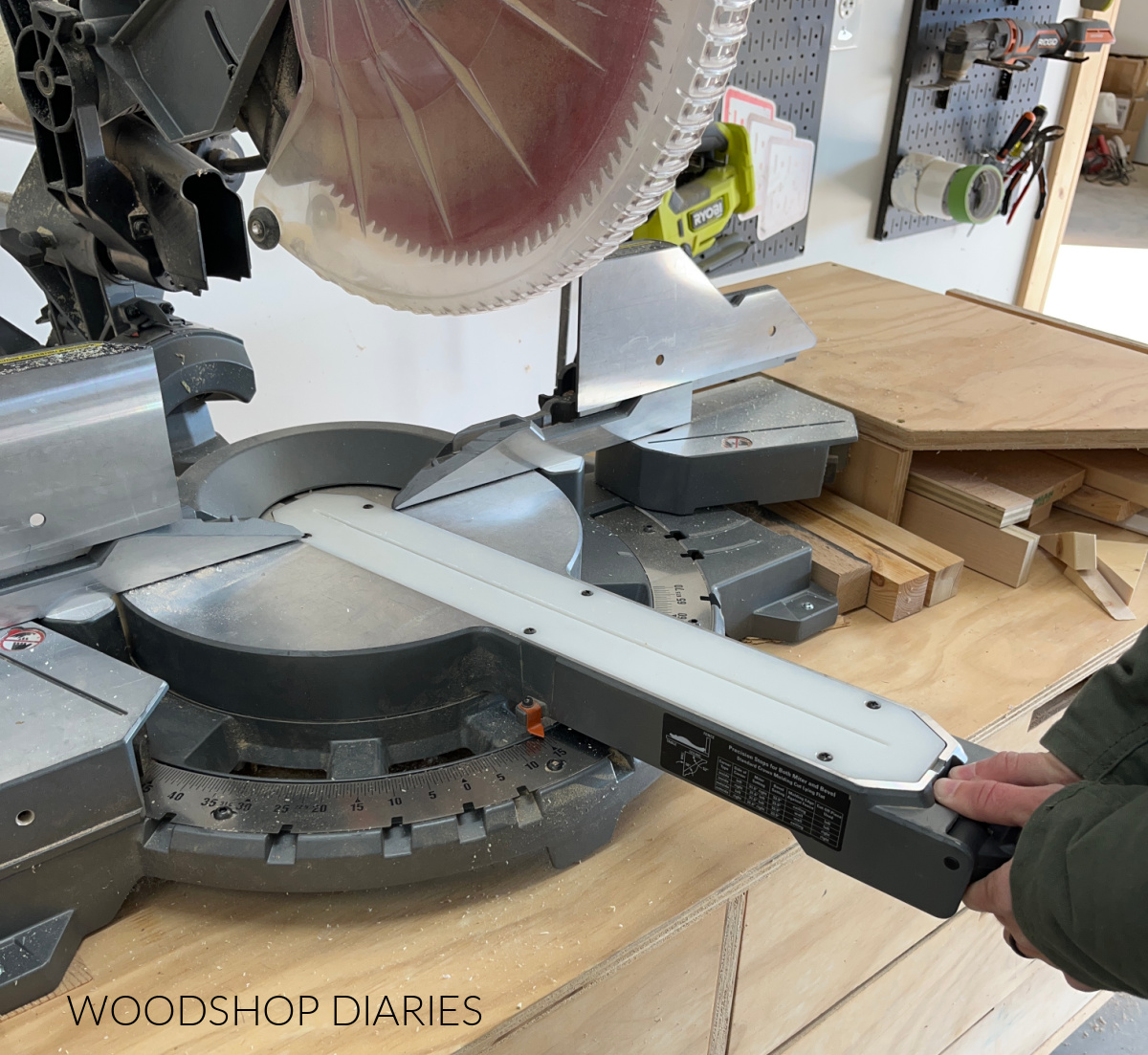
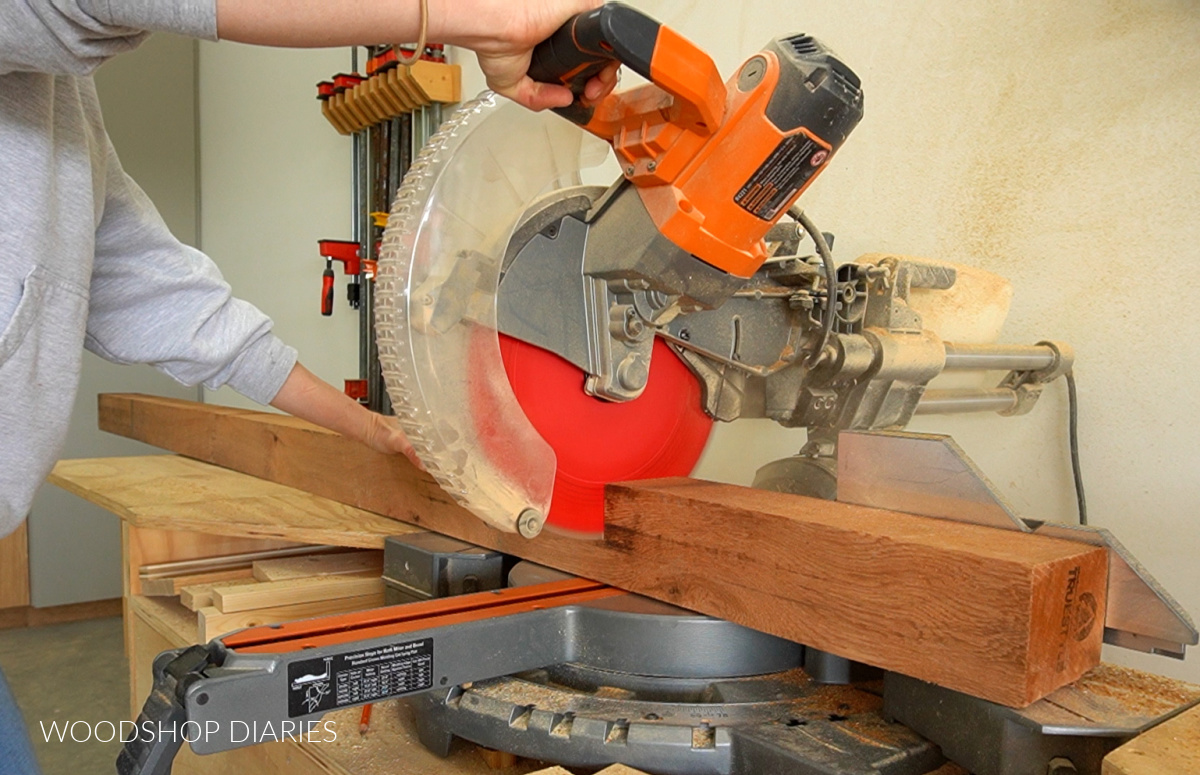
Ryobi battery miter saw cutting plywood on workbench

Some miter saws slide along a rail (like the one shown above) to allow a greater cutting capacity for wider boards.

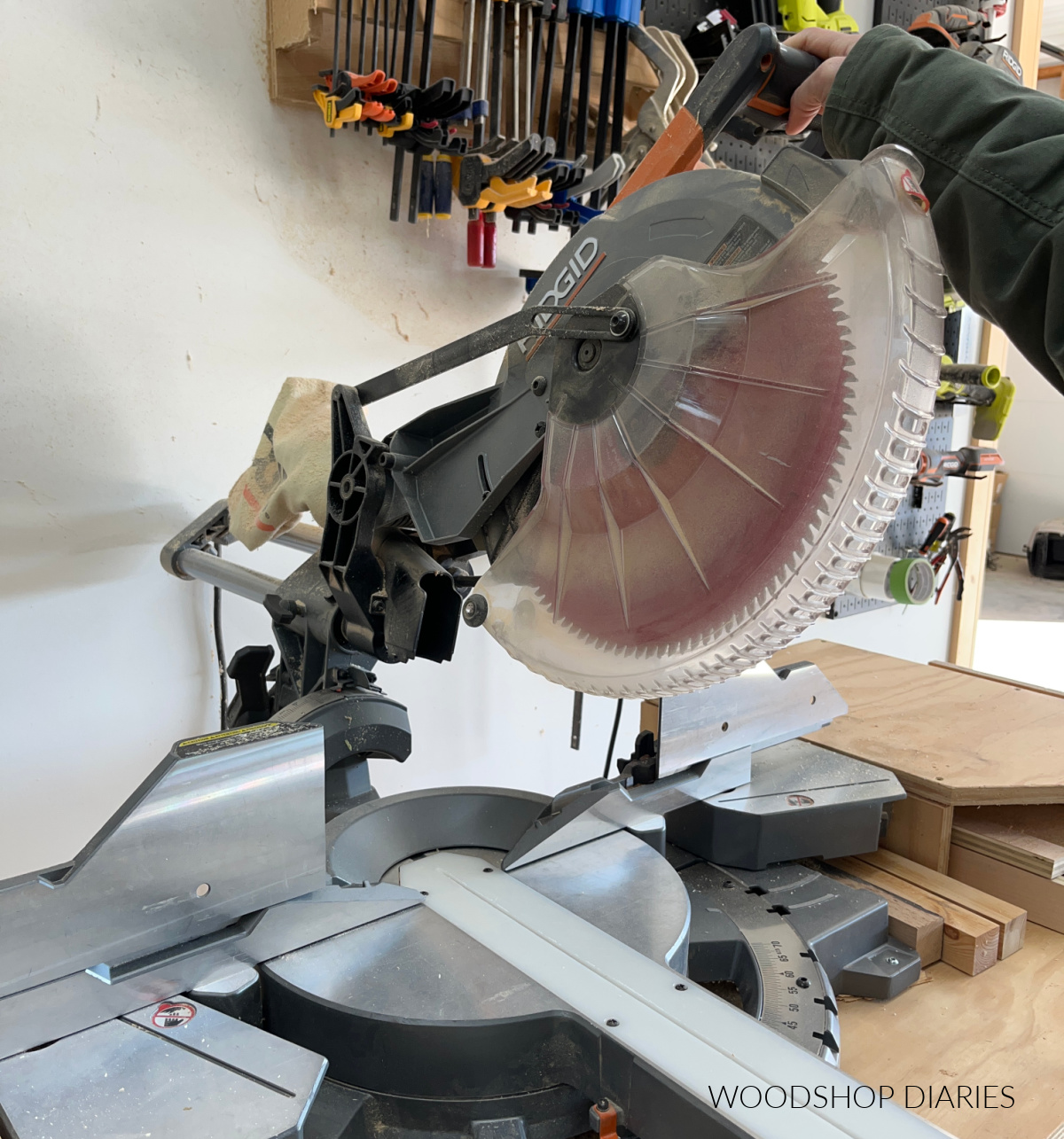
Most miter saws are compound miter saws meaning that they can cut either miters or bevels or both at the same time. Common miter saw sizes are 10″ and 12″ and these refer to the blade diameter.

Miter vs Bevel Cuts

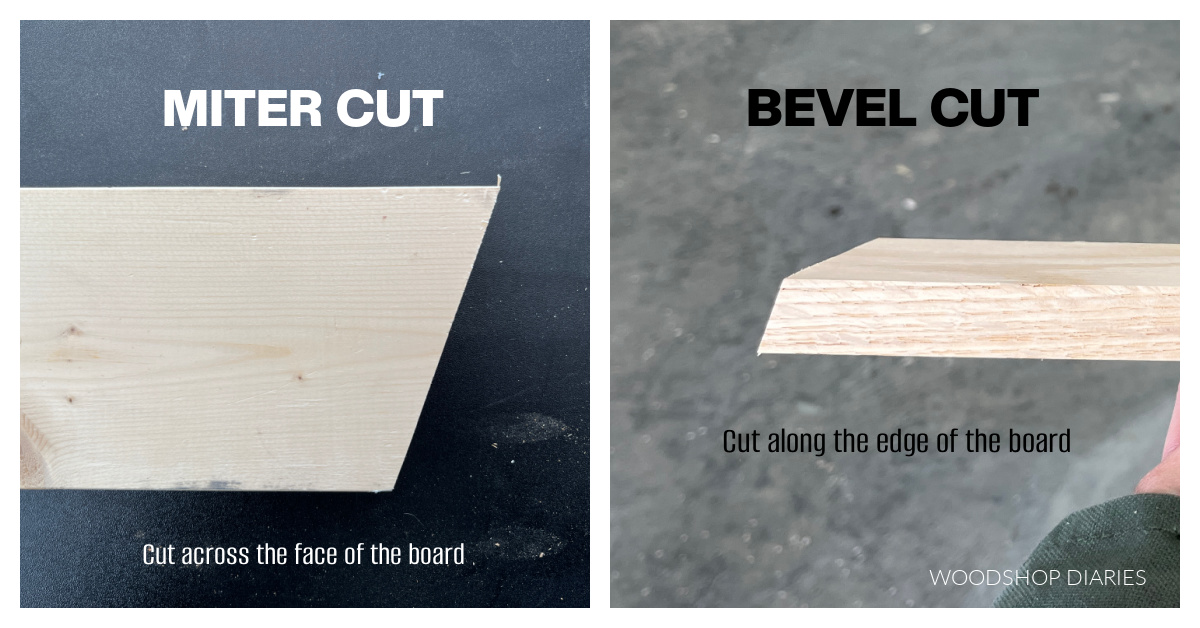
In short, miter cuts are cuts across the face of the board and bevel cuts are cuts along the edge of a board.

Image showing miter vs bevel cut--miter cut on left and bevel cut on right

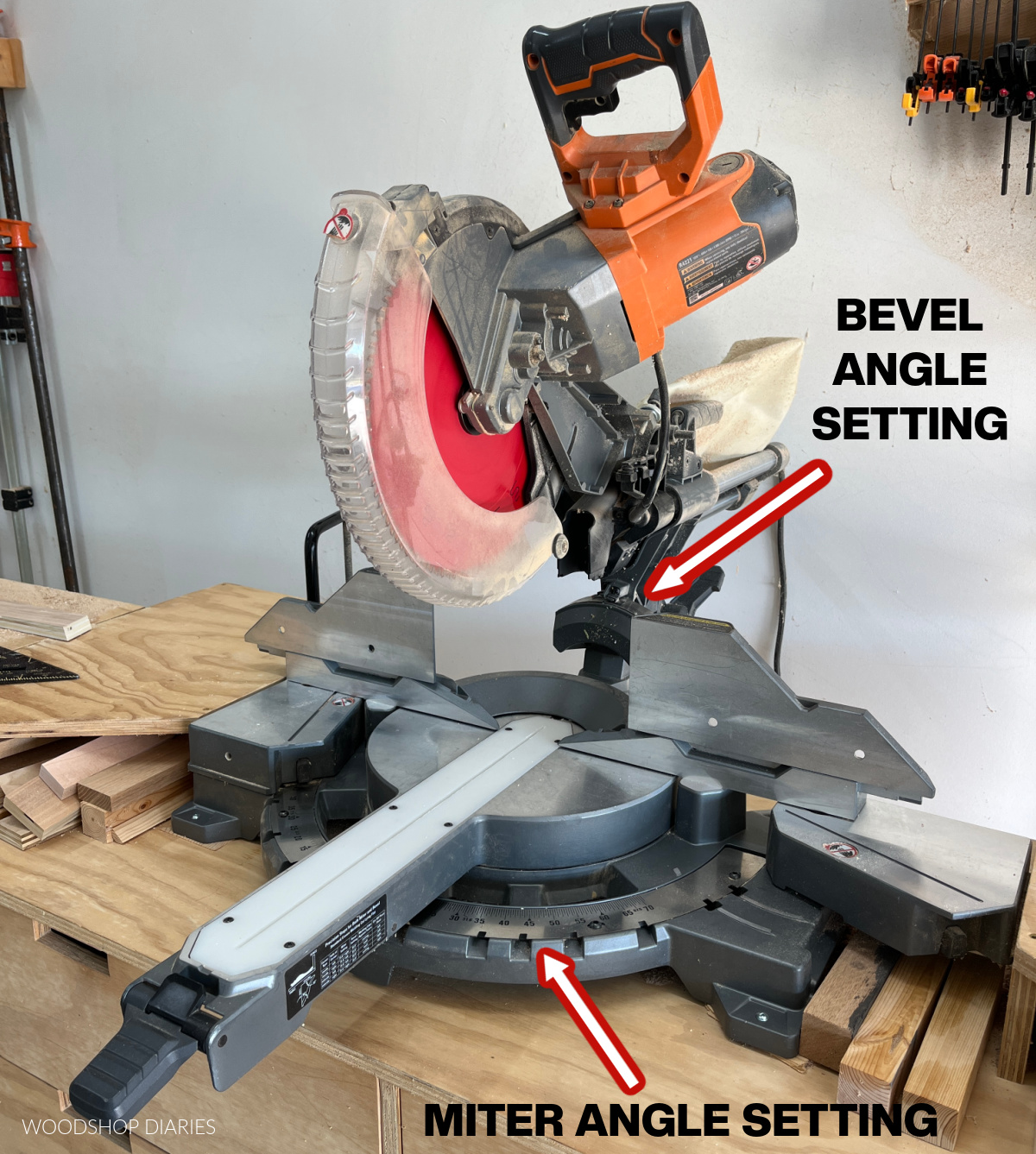
Typically you make miter cuts by swiveling the saw base left or right and you make bevel cuts by tilting the saw’s head at the back.

Miter saw with arrows pointing to miter and bevel adjustment settings

Understanding Your Miter Saw Angle Settings

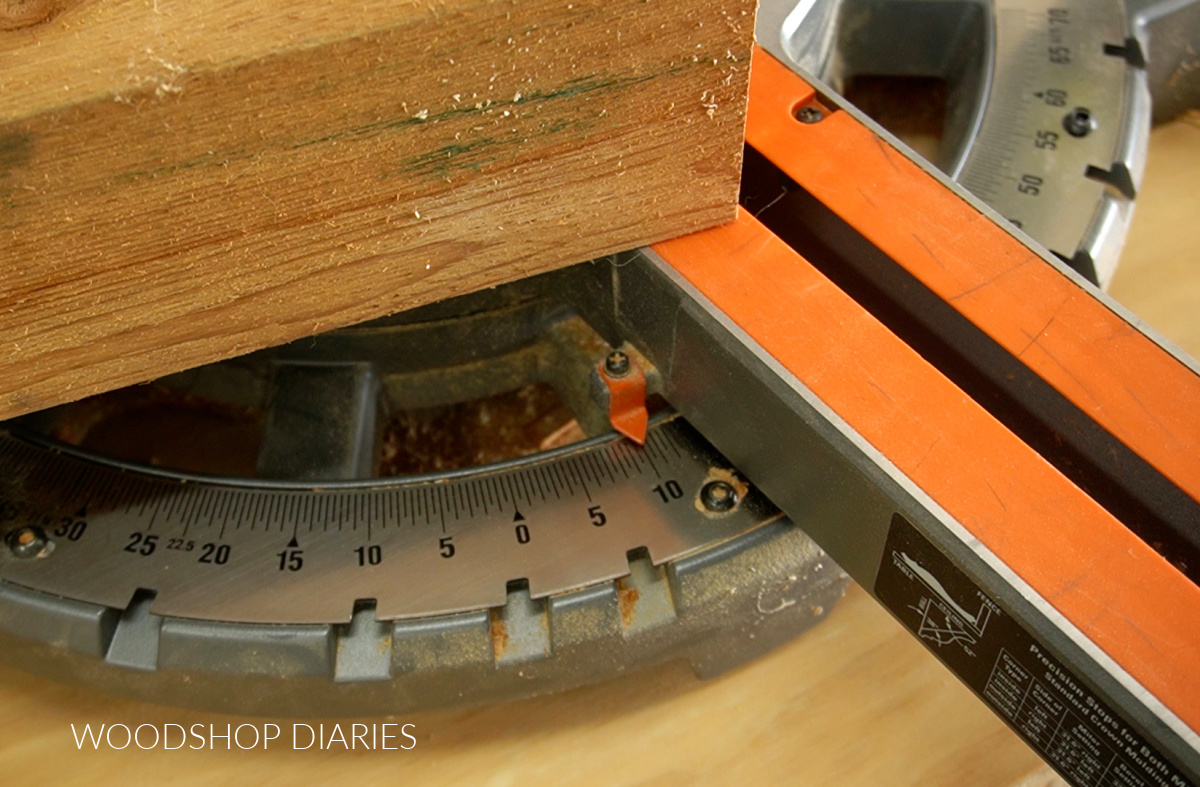
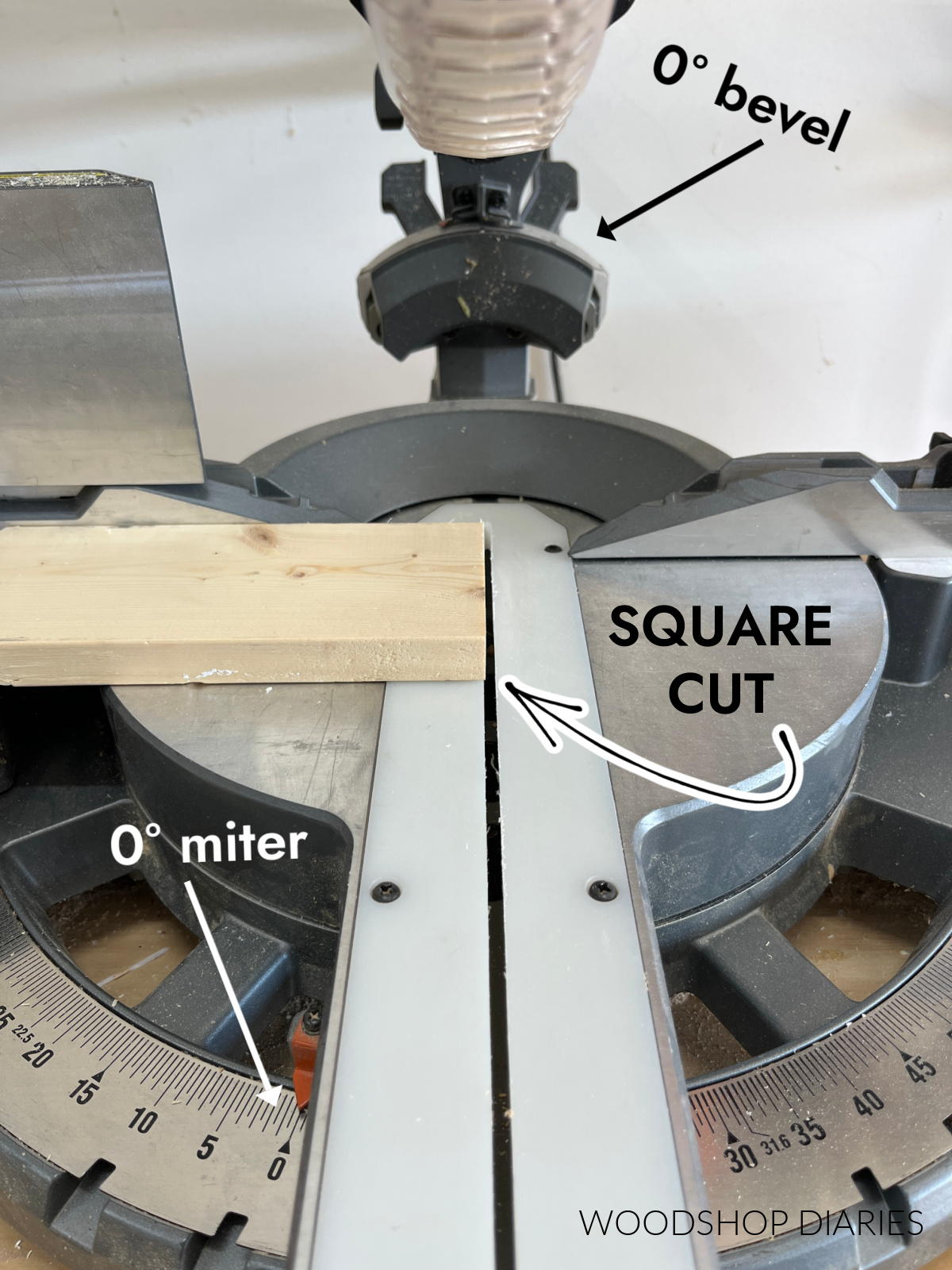
The confusing thing about miter saws is that the 0° mark is actually a 90° square cut.

Arrows pointing to 0 degree bevel and miter on saw with square cut board on saw base

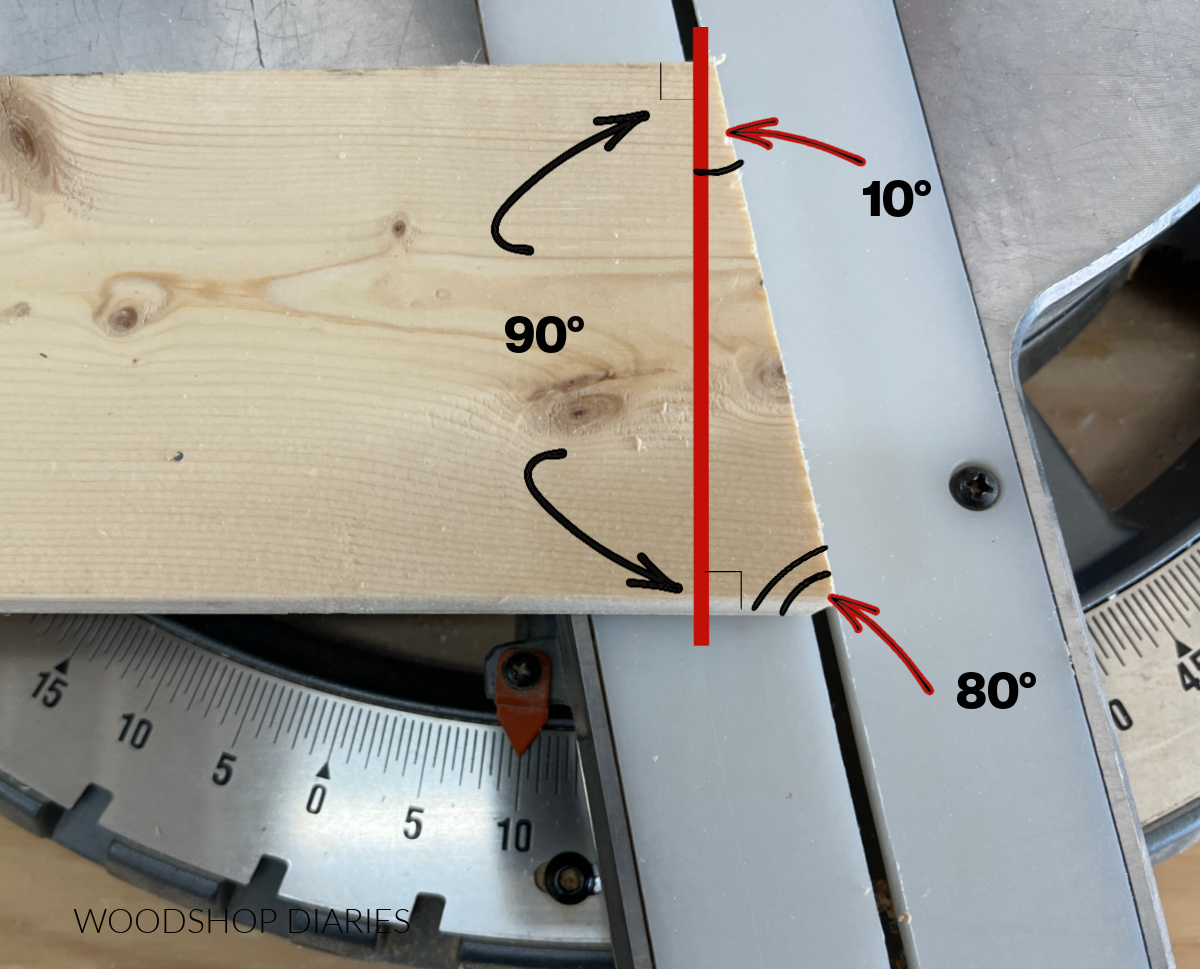
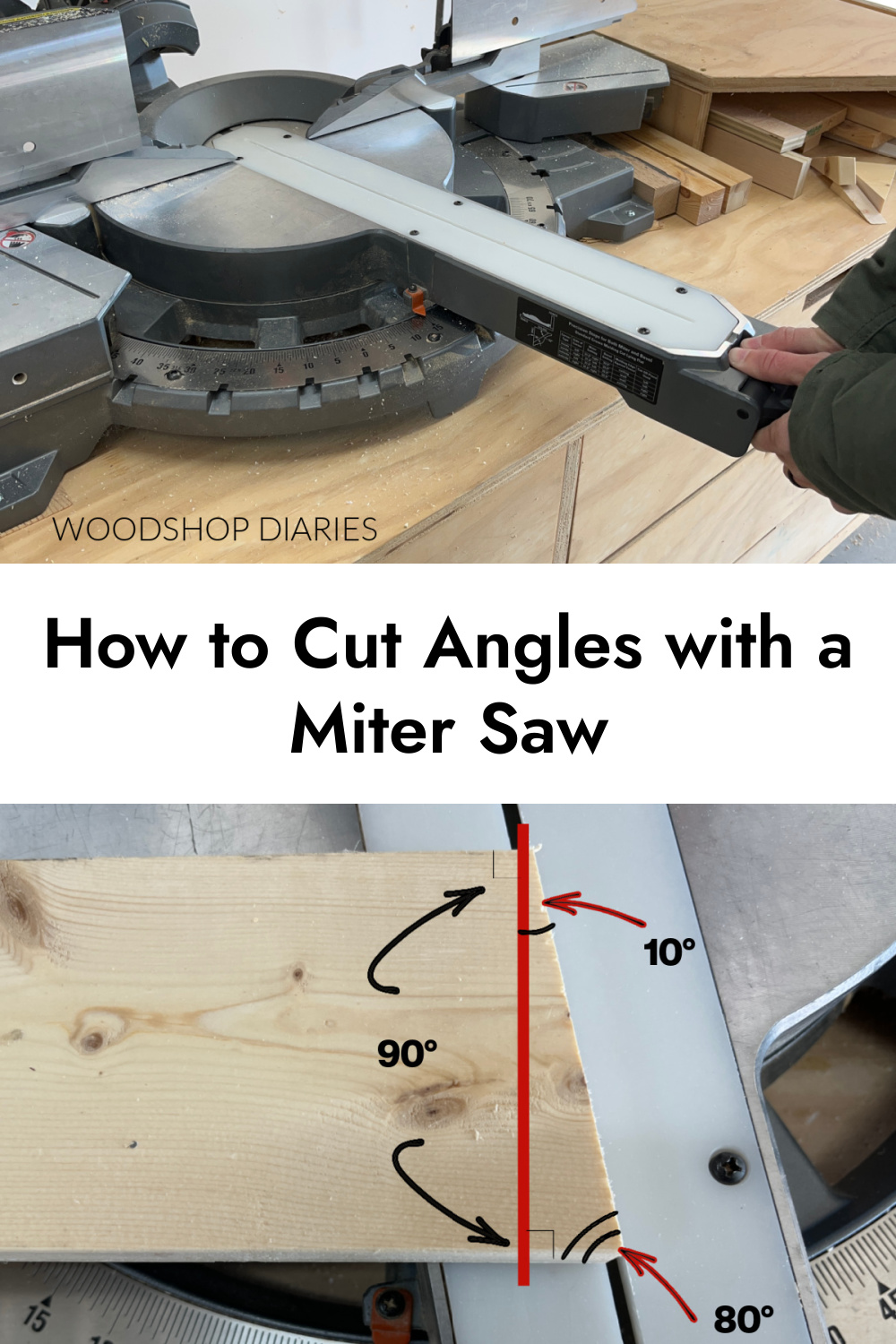
So, for example, if you set your saw’s miter angle to 10°, it’s actually 10° OFF SQUARE. The angles on the board aren’t 10°.

To give you a visual, here’s what you’re actually cutting. One angle is 90° + 10° = 100°. And the other angle is 90° – 10° = 80°.

Diagram showing angles of board end after making miter cut

This may seem kind of odd at first, but it’s not too bad once you get used to it. I’ll share a real life example at the end of the post.

Are DIY projects your thing? Sign up for our newsletter for priority access to the latest projects and build plans!

Basic Geometry Overview

I’m a math nerd so I love this stuff, but I know most people don’t, so don’t worry. I won’t bog down this post with math lessons.

But, there are a few key geometry principles that are incredibly helpful to remember when learning how to use a miter saw and working with angles.

Most of these you’ve probably learned already, so this is just a brief refresher and a look at how they apply to real life/woodworking.

What is Parallel vs Perpendicular?

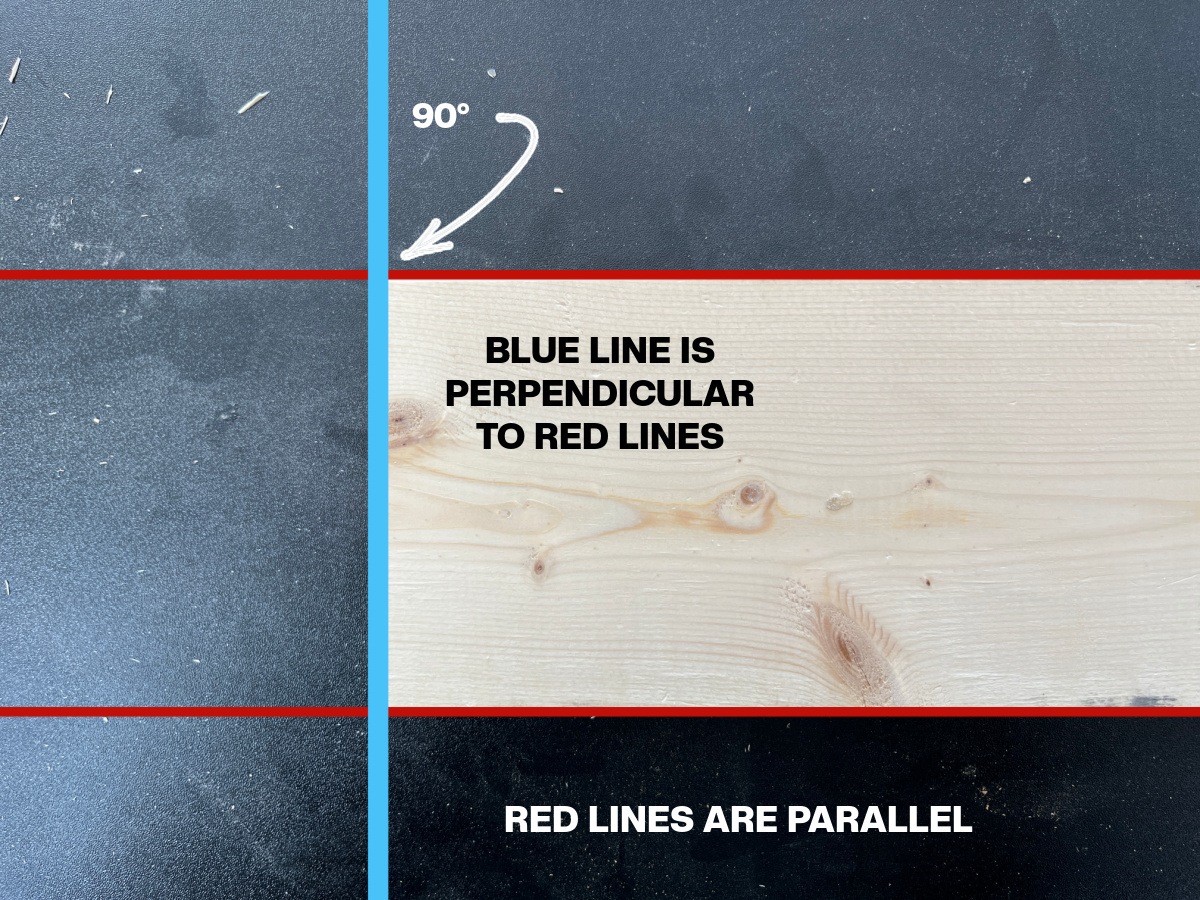
Two lines are parallel if they can go on forever in either direction and never intersect. They will always be equal distance apart–like the two edges of a board.

Two lines are perpendicular if they intersect at a right–or 90° angle.

wooden board with lines drawn along the edges showing parallel lines and a blue perpendicular line intersecting it at the cut

Straight and Right Angles

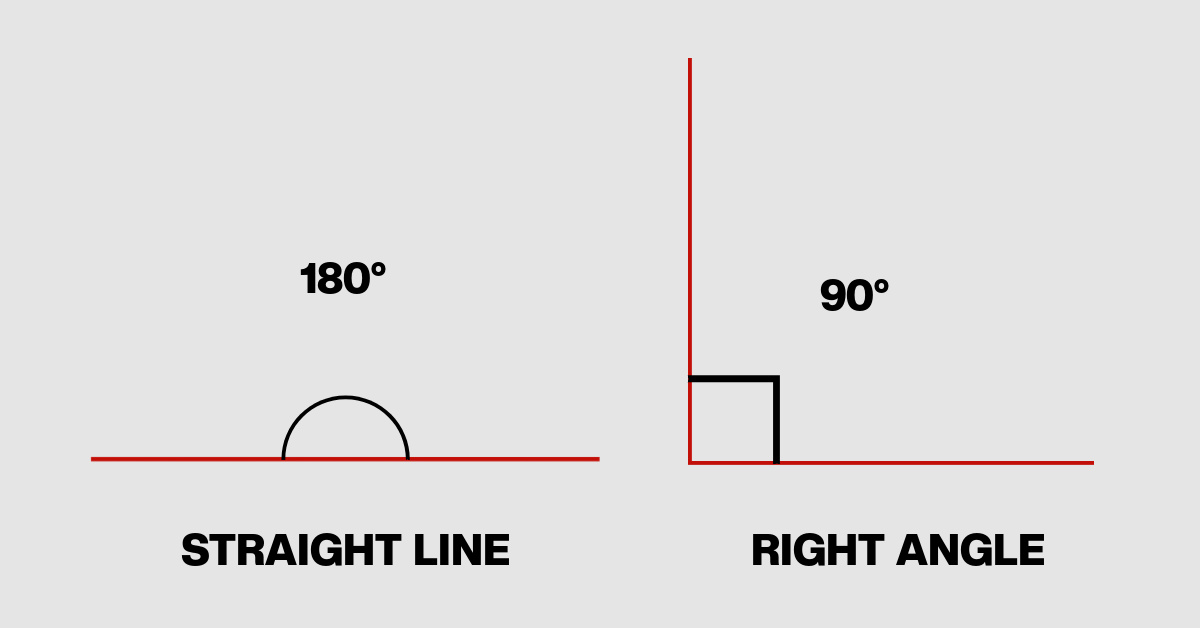
A straight line has 180° and a right angle has 90°.

Diagram showing straight line with 180 degrees and a right angle with 90 degrees

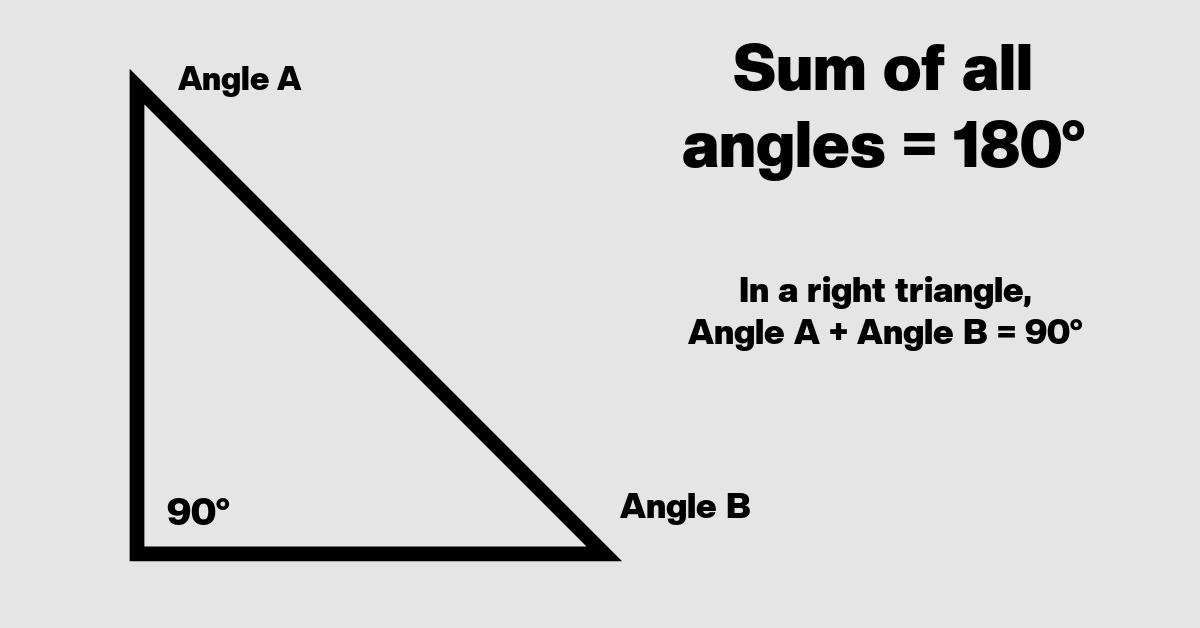
The sum of all angles in a triangle = 180°

In a right triangle, one angle is already 90° (by definition), so the sum of the other two angles must be 90°. This is helpful to remember when making miter cuts because it allows you to easily determine all the board angles after a cut.

Diagram with right angle and text saying "sum or all angles = 180 degrees in a right triangle, angle a and angle b = 90 degrees"

Identifying Congruent Angles

This post is a great resource for explaining this in more depth. But congruent angles are angles that have the same number of degrees.

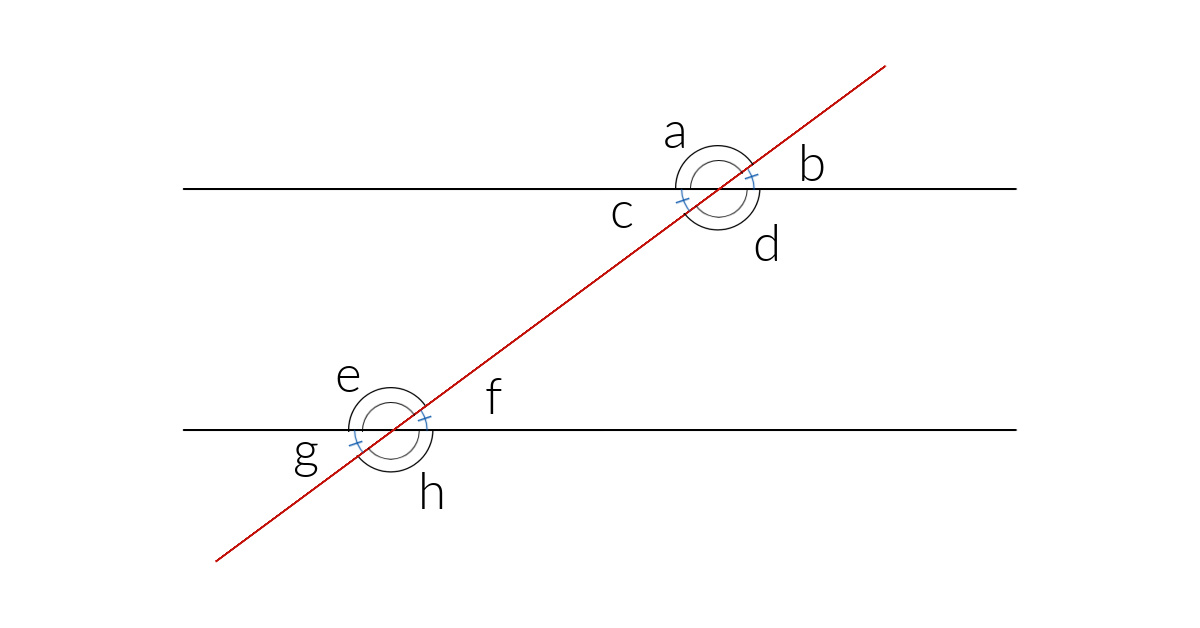
In this example, the black lines are parallel and the red line intersects them both. So we know that angles a, d, e, and h are congruent (they have the same number of degrees) and the angles b, c, f, and g are congruent (they have the same number of degrees).

Diagram of congruent angles

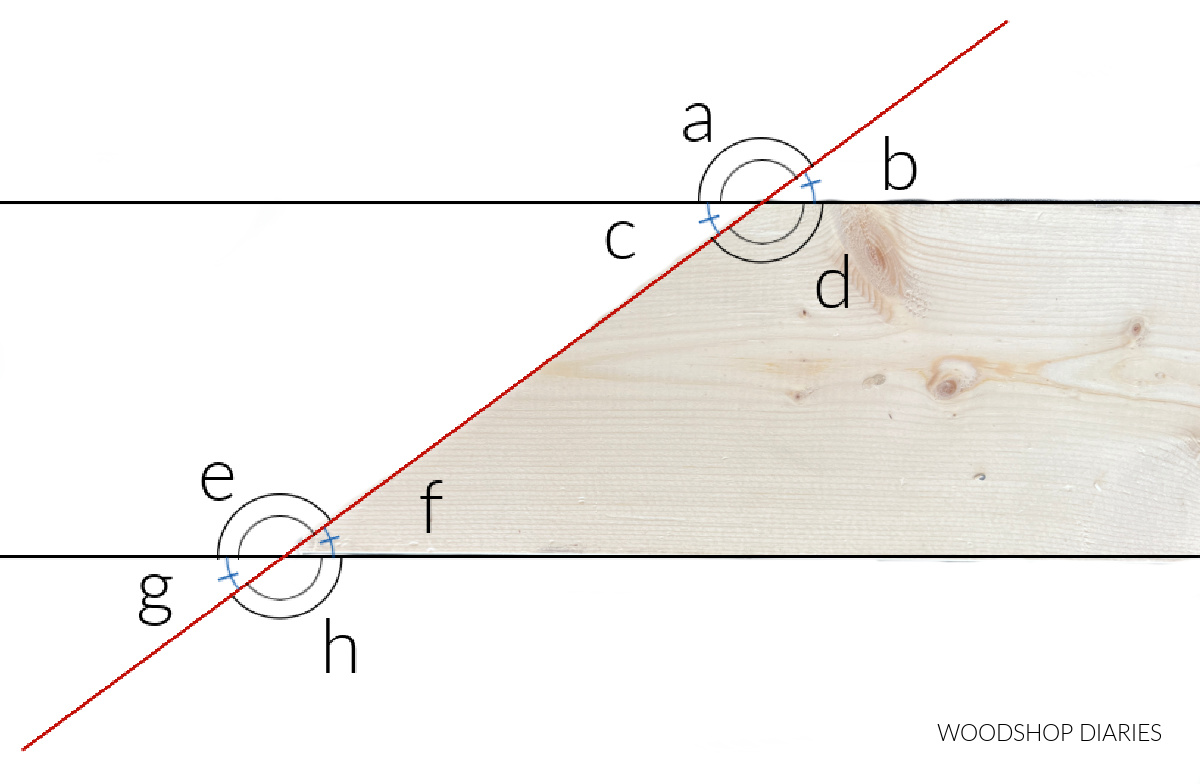
What does this have to do with woodworking? Imagine the black lines are board edges and the red line is a miter cut. If you know what your saw’s miter angle was set to when it was cut, you can determine all the angles in question in this drawing.

diagram of congruent angles overlaid a board showing how to determine miter angles

How to Make Miter Cuts

To cut a miter angle, pivot your saw’s base left or right along the gauge until the indicator is set at your desired degree. Keep in mind this will be a degree OFF SQUARE.

Shara Woodshop Diaries adjusting miter saws miter angle at saw base

Then, place your board flat in the saw (make sure both ends of the board are properly supported), and against the back plate.

NOTE: Make sure your hands, clamps, and supports are all out of the way of the blade before cutting.

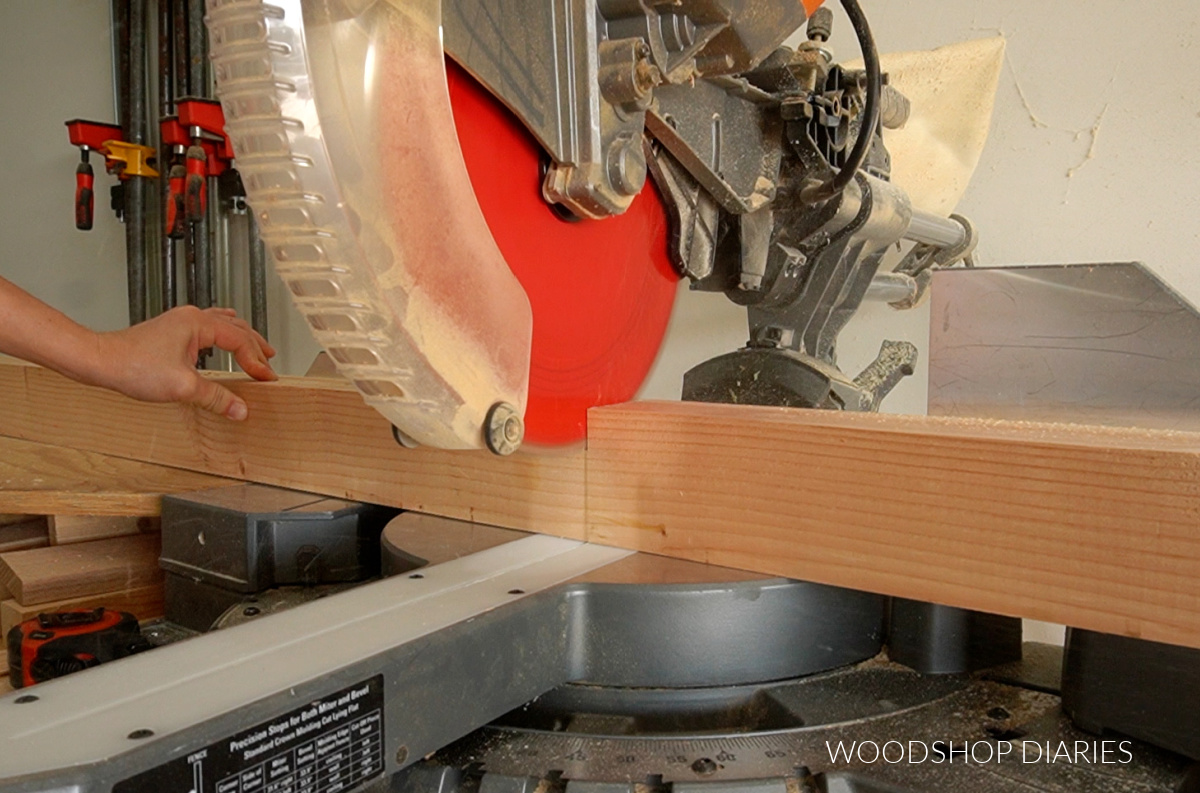
Bring the blade to full speed before making contact with the wood, then slowly lower the blade to cut across the board. If using a sliding saw, start at the front, then slide it toward the back to cut through.

Shara Woodshop Diaries making a miter cut with miter saw

What if your saw doesn’t cut the angle you need?

Miter saws will vary as far as their miter angle capacity. Some saws go all the way up to 70° and some stop at 45°.

If your miter saw doesn’t go up to the degree you’re wanting to cut, you can use some of the geometry tips above to help you get there.

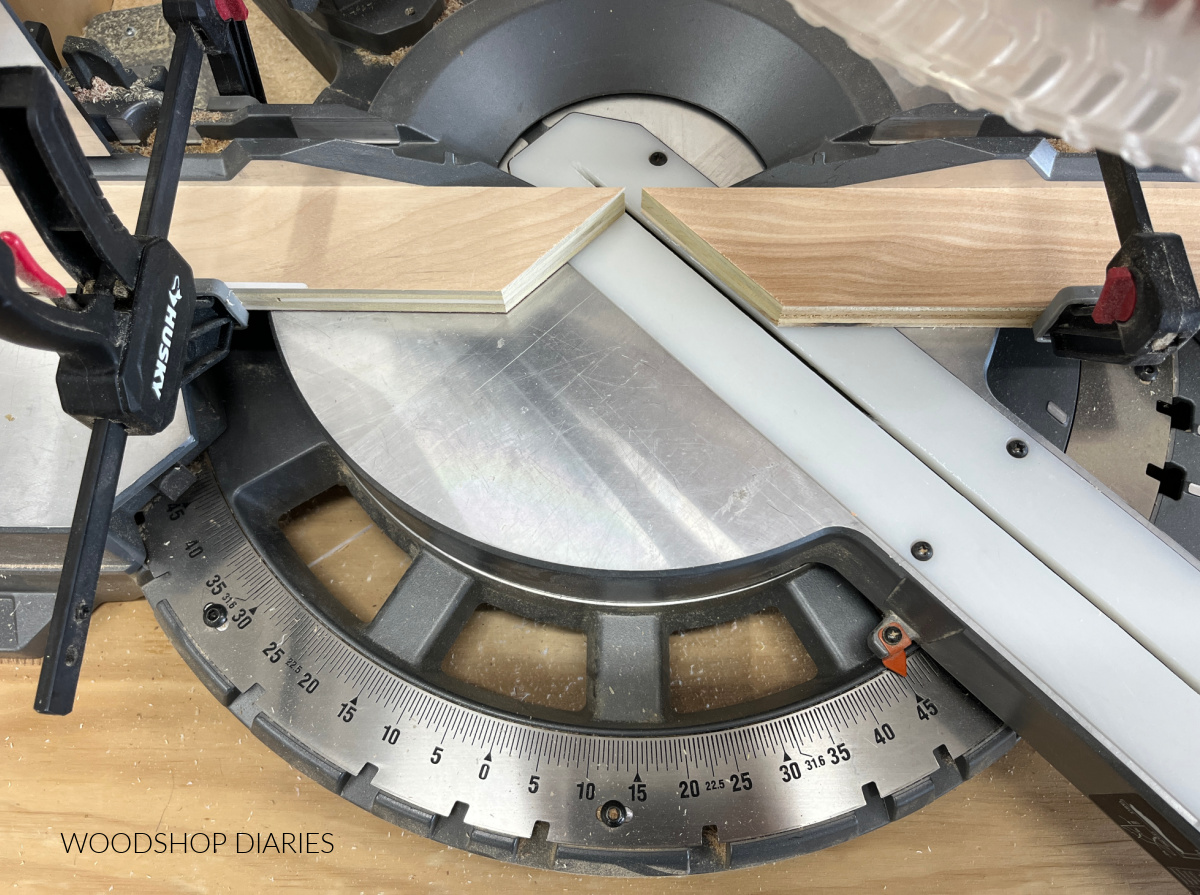
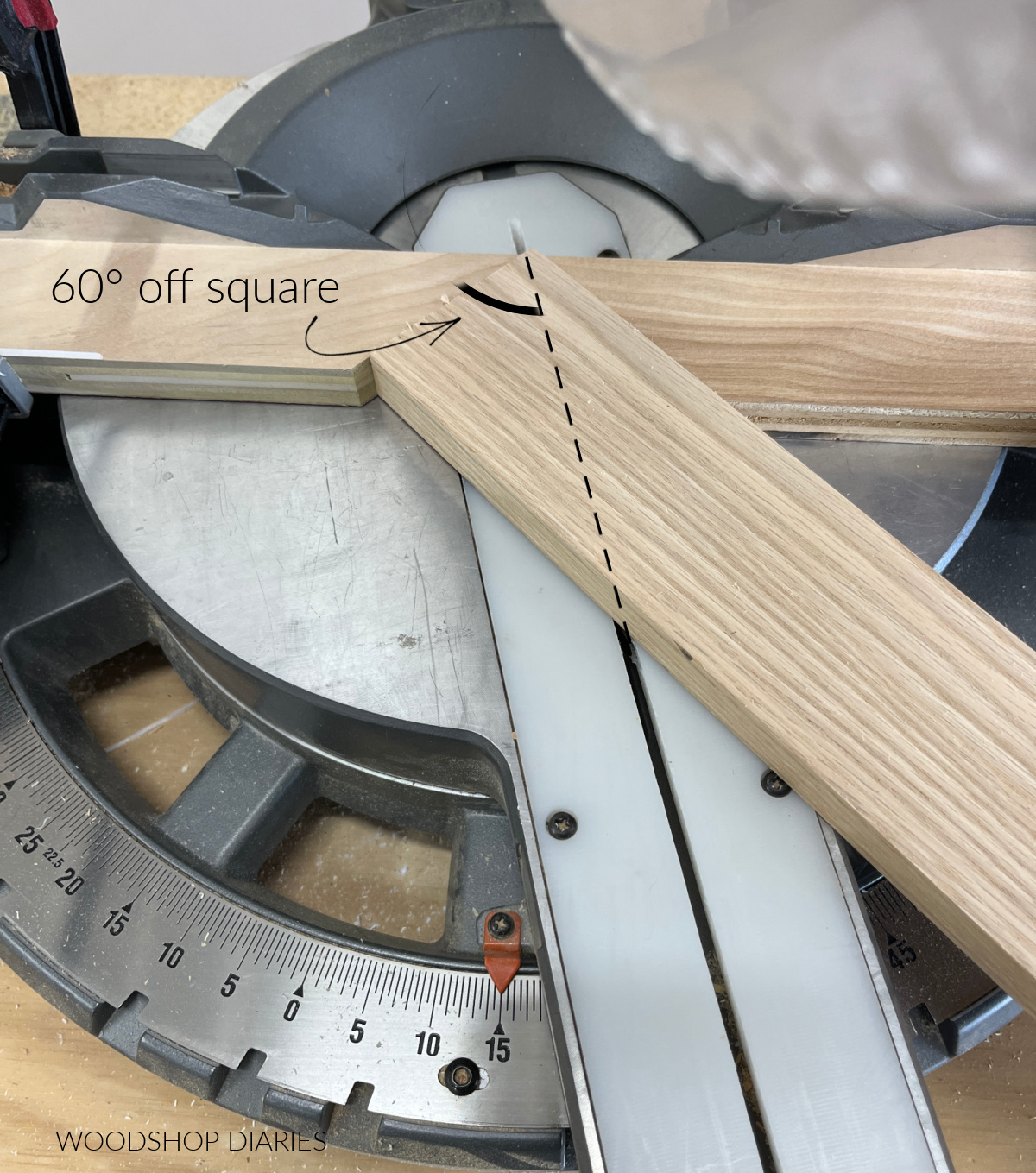
For example, if I want to cut a 60° miter angle, but my saw only goes to 45°, I can cut 45° mitered scrap pieces and clamp (or use heavy duty double sided tape) them to the saw base.

scrap blocks on miter saw base cut at 45 degree angles

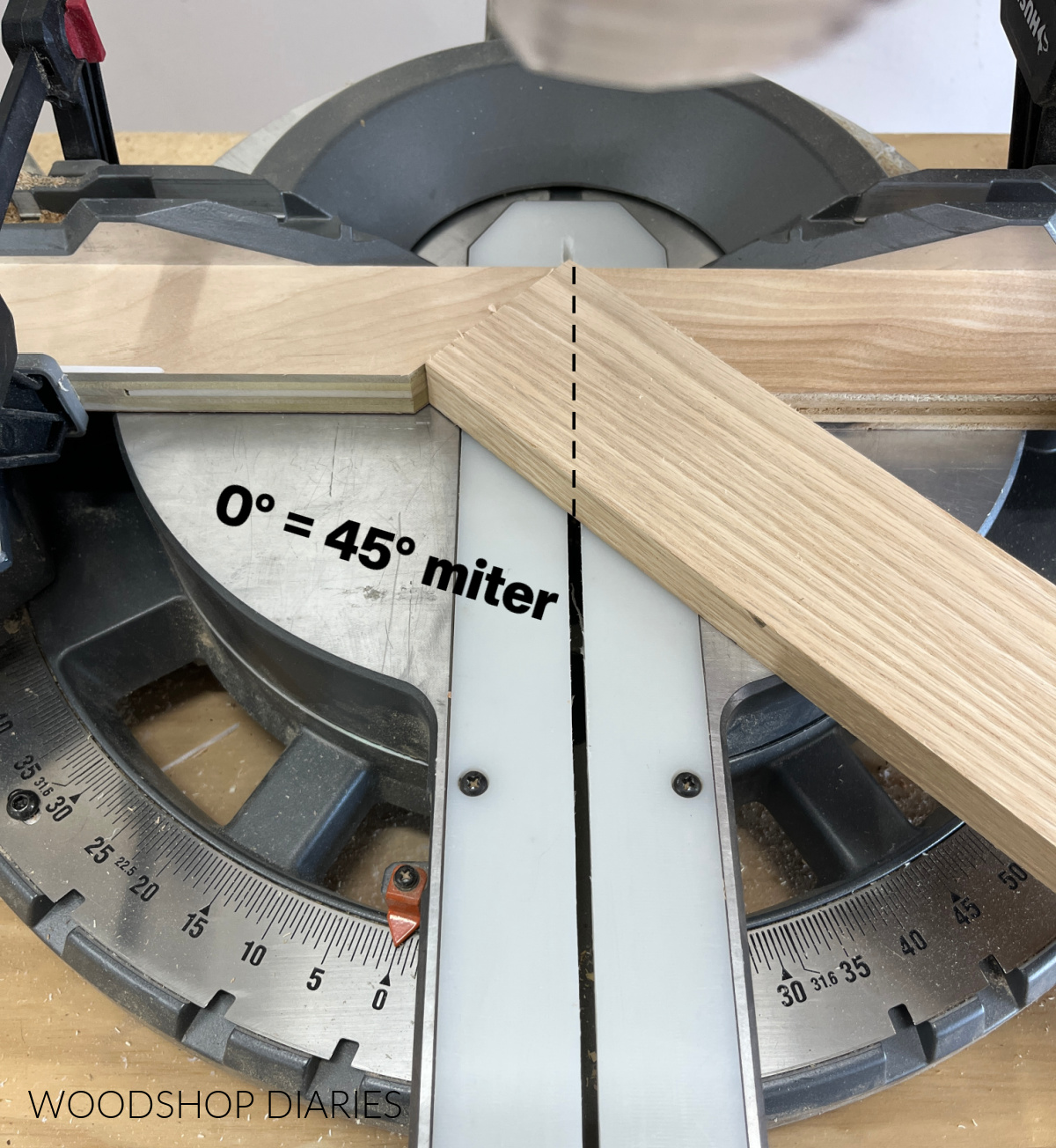
Then, I can use these scrap boards as my “back plate.” If I place the board I’m wanting to cut against these pieces now and cut it with my miter set to 0°, it’s going to cut it 45°.

board placed in scrap blocks on miter saw showing 0 degree setting is a 45 degree cut

So if I adjust the miter angle to 15°, it will cut 45° + 15° = 60° off square. Of course, you can adjust the angle as needed to cut your desired degree.

board placed in miter saw scrap blocks showing 15 degree angle setting is 60 degree cut

NOTE: BE VERY CAREFUL when attempting cuts like this to make sure everything is well supported, clamped, and sturdy before making a cut.

Miter cuts parallel to each other

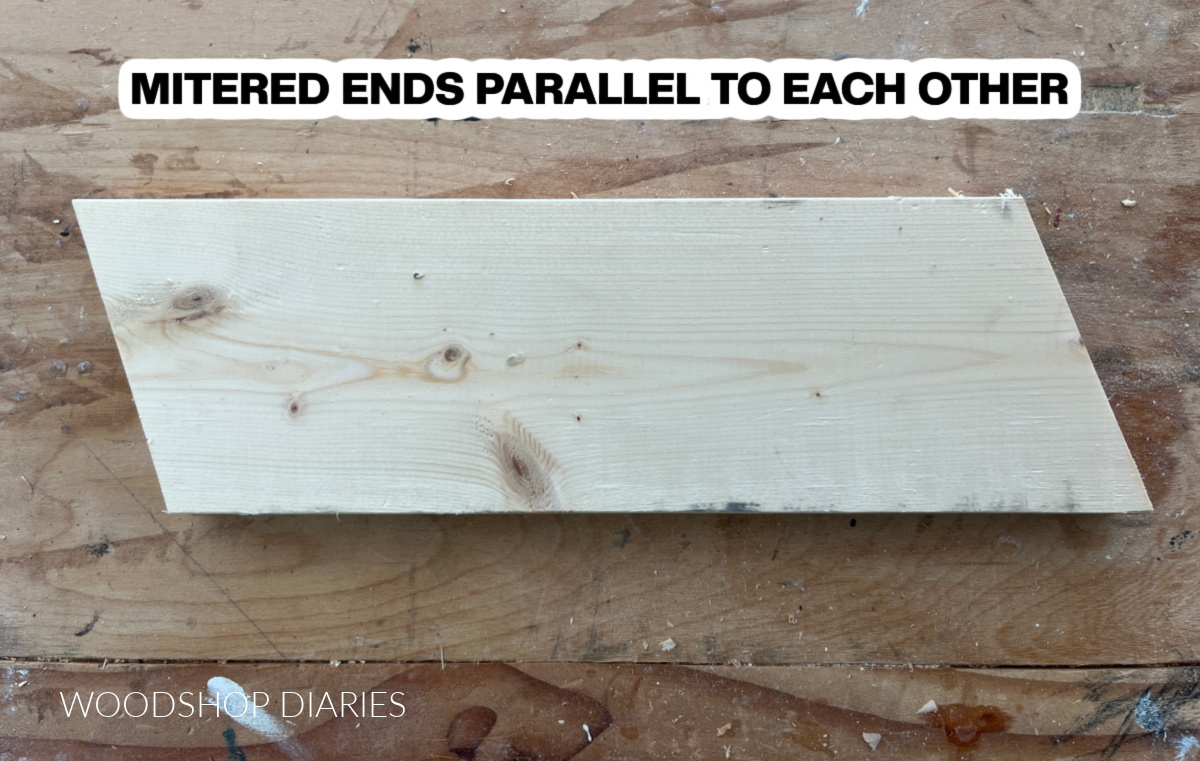
If you’re mitering both ends of a board and the plans tell you to miter them parallel to each other, that means the ends should both slant the same direction at the same degree.

Here’s an example–both ends are mitered 10 degrees the same direction.

image example of mitered board ends parallel to each other

Miter cuts NOT parallel to each other

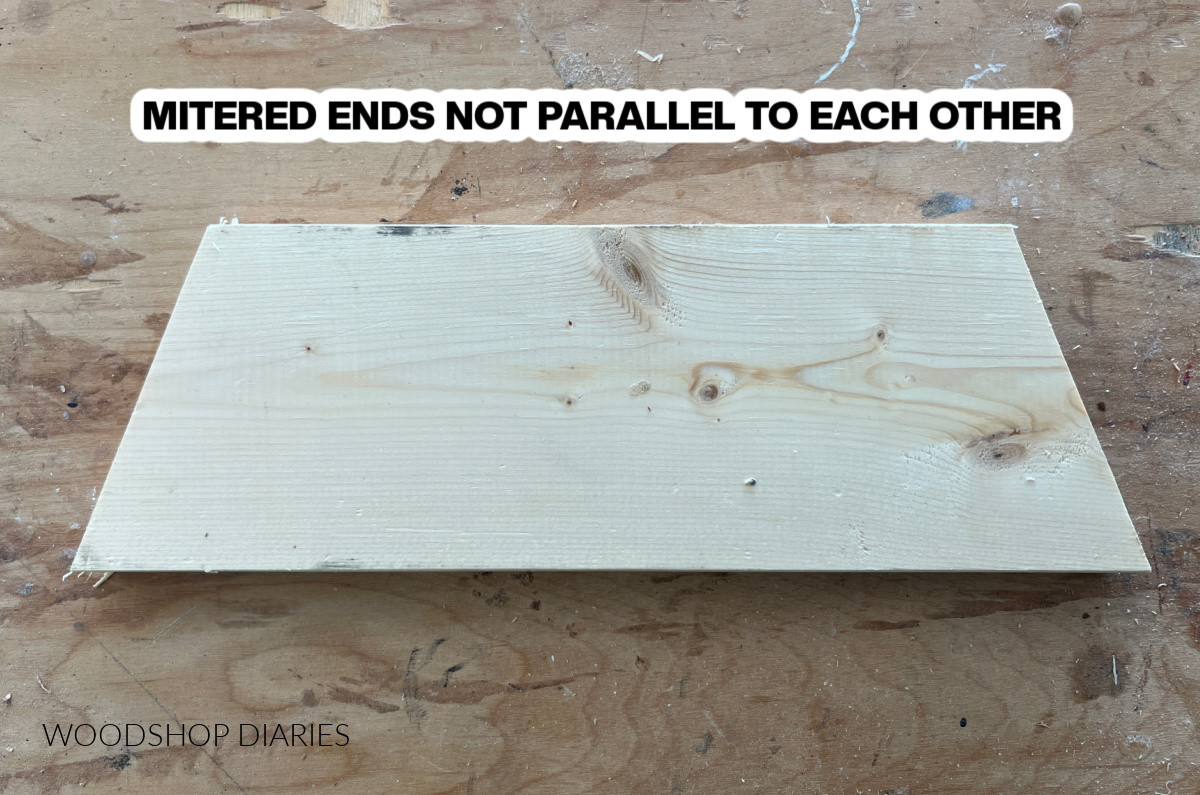
If you’re mitering both ends of a board and the plans tell you to miter them NOT parallel to each other, that means the ends do not go in the same direction.

Here’s an example of mitered ends not parallel.

image example of mitered ends not parallel to each other

How to Make Bevel Cuts

You likely won’t make beveled cuts as often as miter cuts on the miter saw (at least not in my experience). Often you see bevel cuts on wide panels–like table tops or desks–and these are usually cut with a circular saw or table saw.

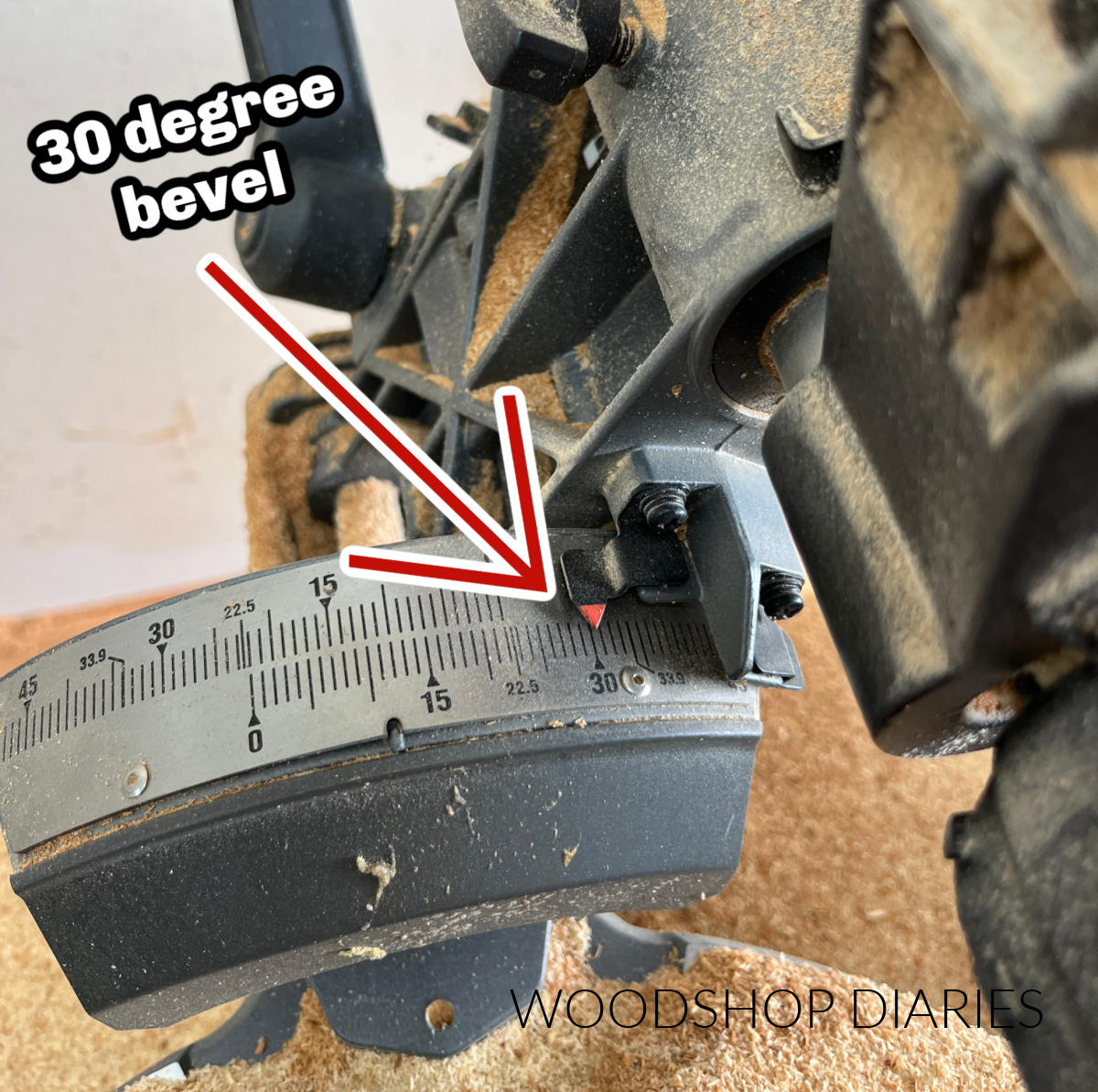
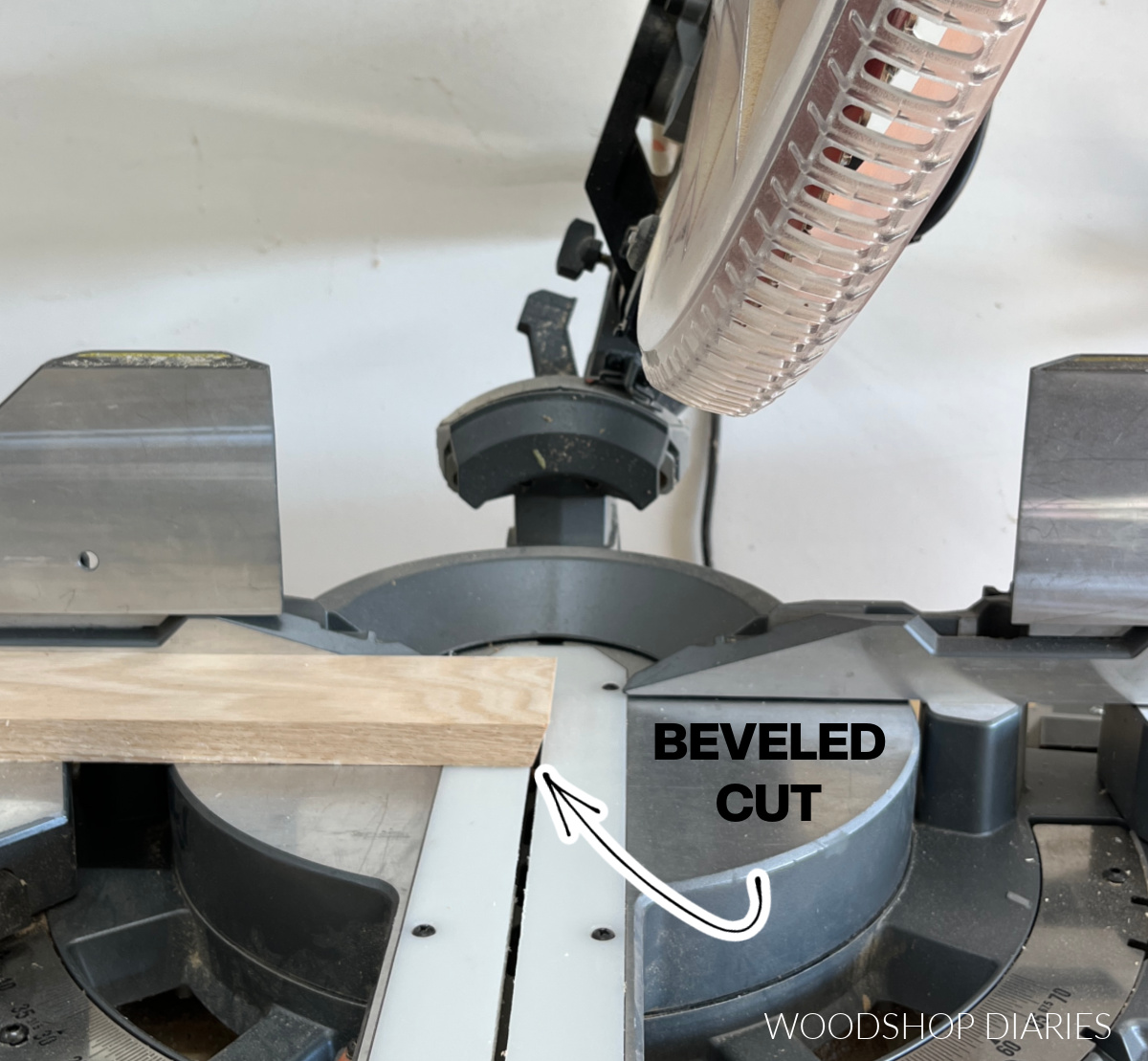
However, for smaller pieces, a miter saw works great to cut a bevel. To do so, adjust the saw’s head tilt to the desired angle. Usually this setting is toward the back of the saw. Keep in mind this will be a degree OFF SQUARE.

Shara Woodshop Diaries adjusting miter saw bevel angle
close up of bevel angle adjustment showing 30 degree bevel

Then, place your board flat in the saw (make sure both ends of the board are properly supported), and against the back plate.

Bring the blade to full speed before making contact with the wood, then slowly lower the blade to cut across the board. If using a sliding saw, start at the front, then slide it toward the back to cut through.

board in miter saw with beveled end

TIP: If the board you are cutting isn’t very wide, you can also cut bevels by standing the board upright against the back plate and adjusting the miter angle instead of the bevel angle on the saw.

Bevel cuts parallel to each other

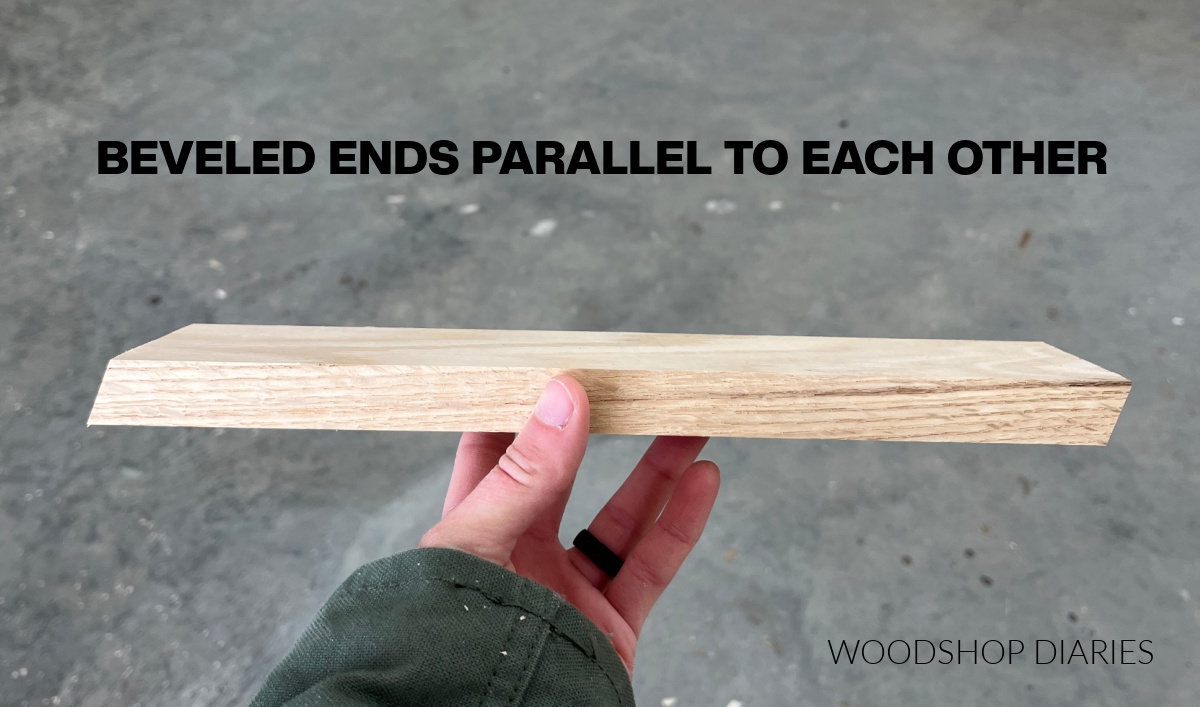
Just like with miters, if you’re beveling both ends of a board parallel to each other, that means the bevels should slant the same direction at the same degree.

image example of beveled board ends parallel to each other

Bevel cuts NOT parallel to each other

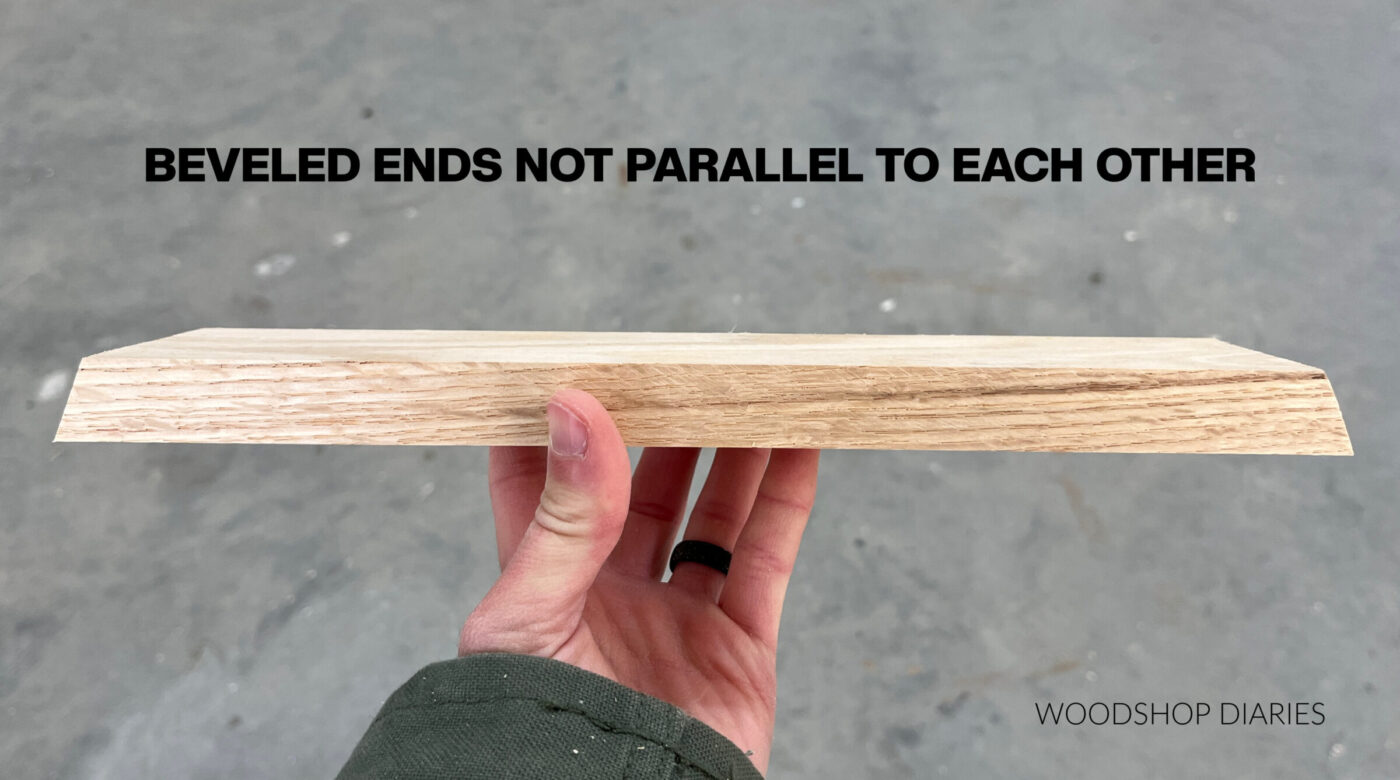
If you’re beveling both ends of a board not parallel to each other, that means the bevels don’t slant the same direction.

image example of beveled ends not parallel to each other

Determining Miter Angles in a Project–EXAMPLE

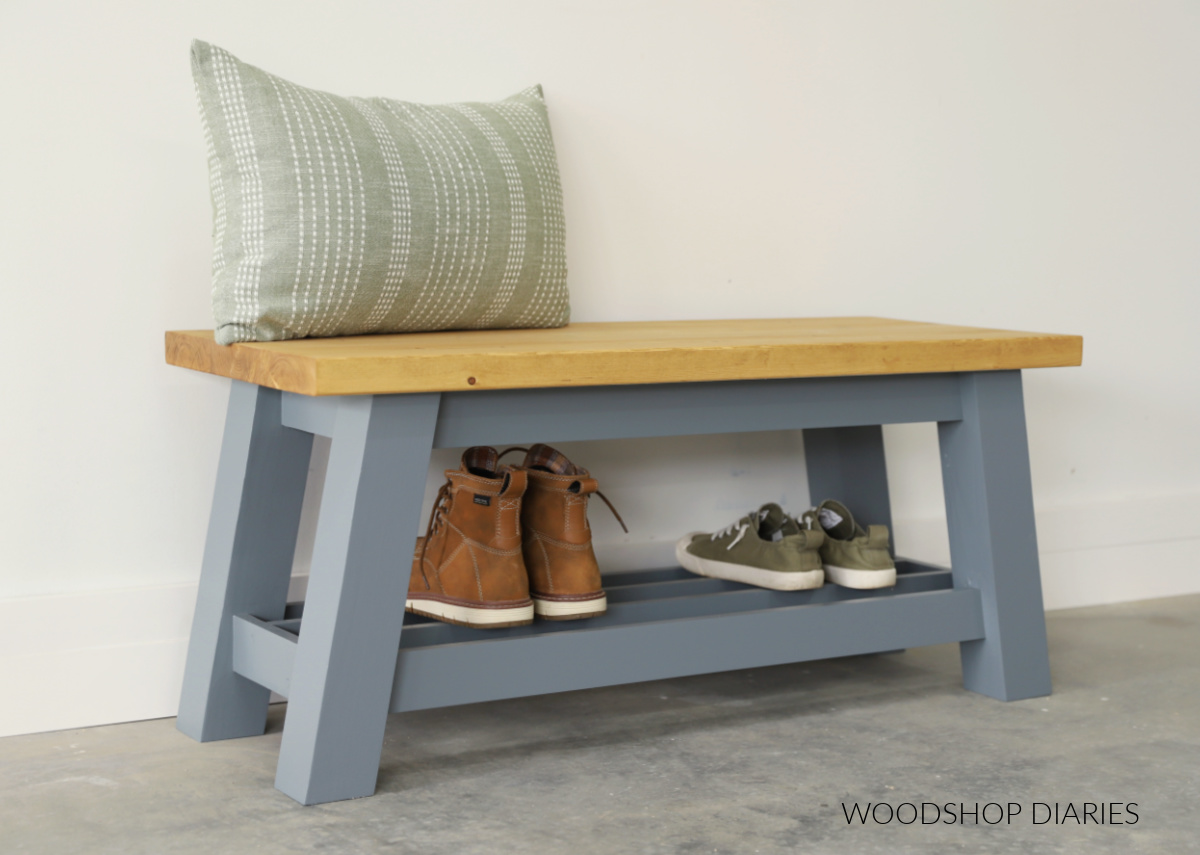
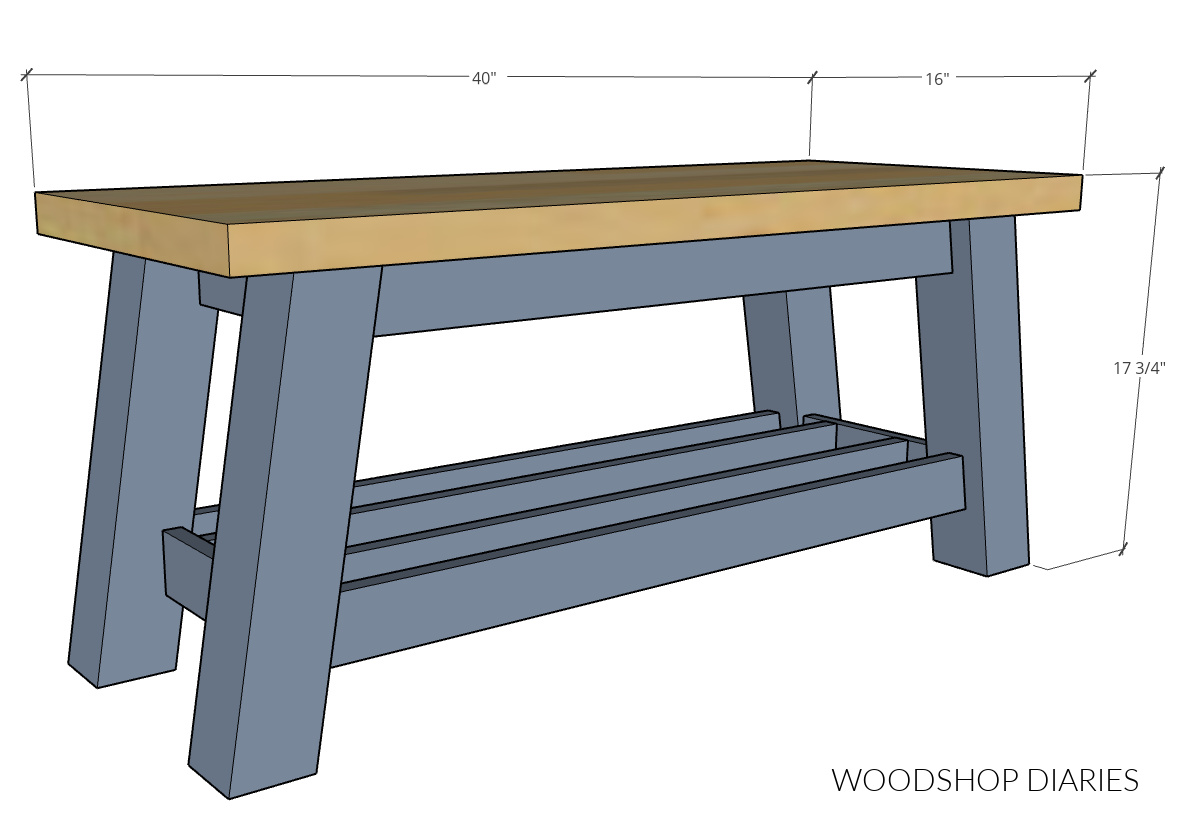
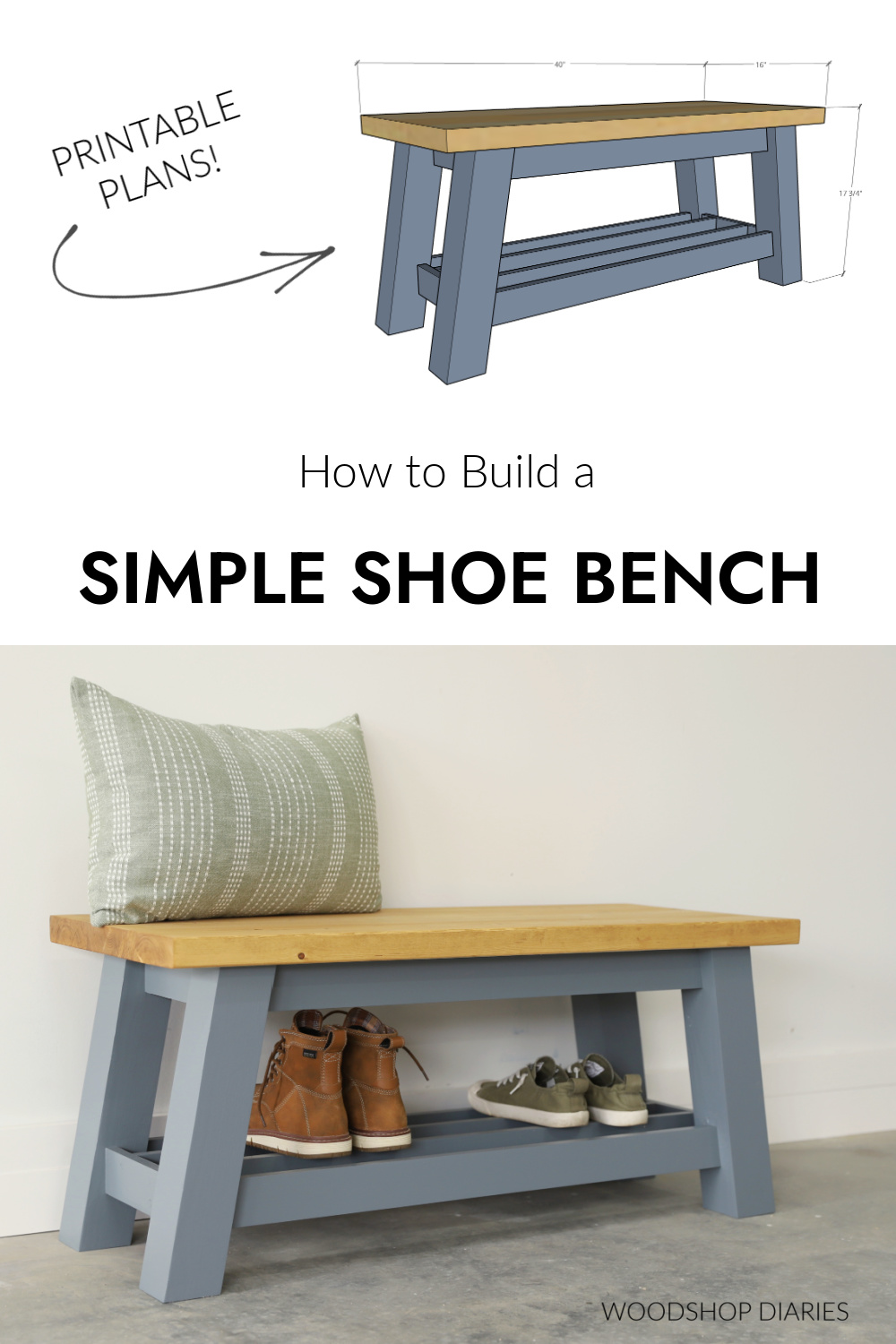
Let’s take a look at a recent project as an example and discuss how I determined what angles to use here. Here I have a simple bench with angled legs.

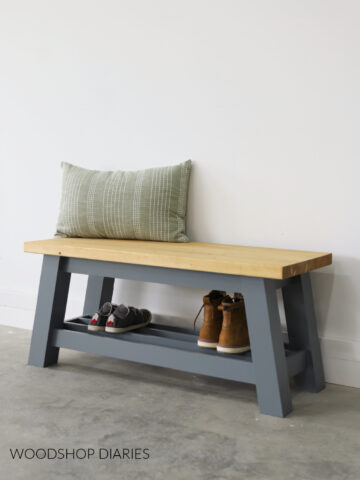
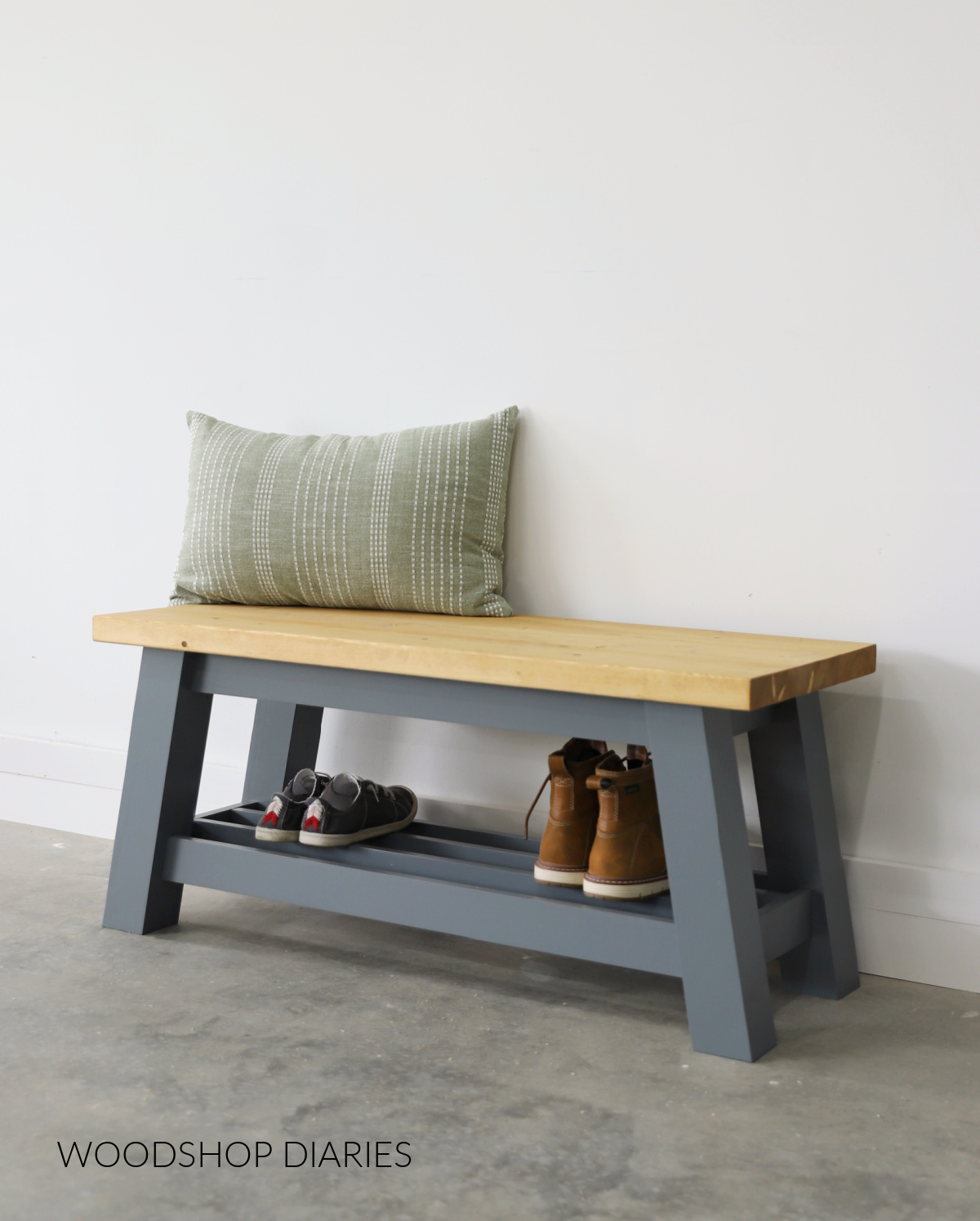
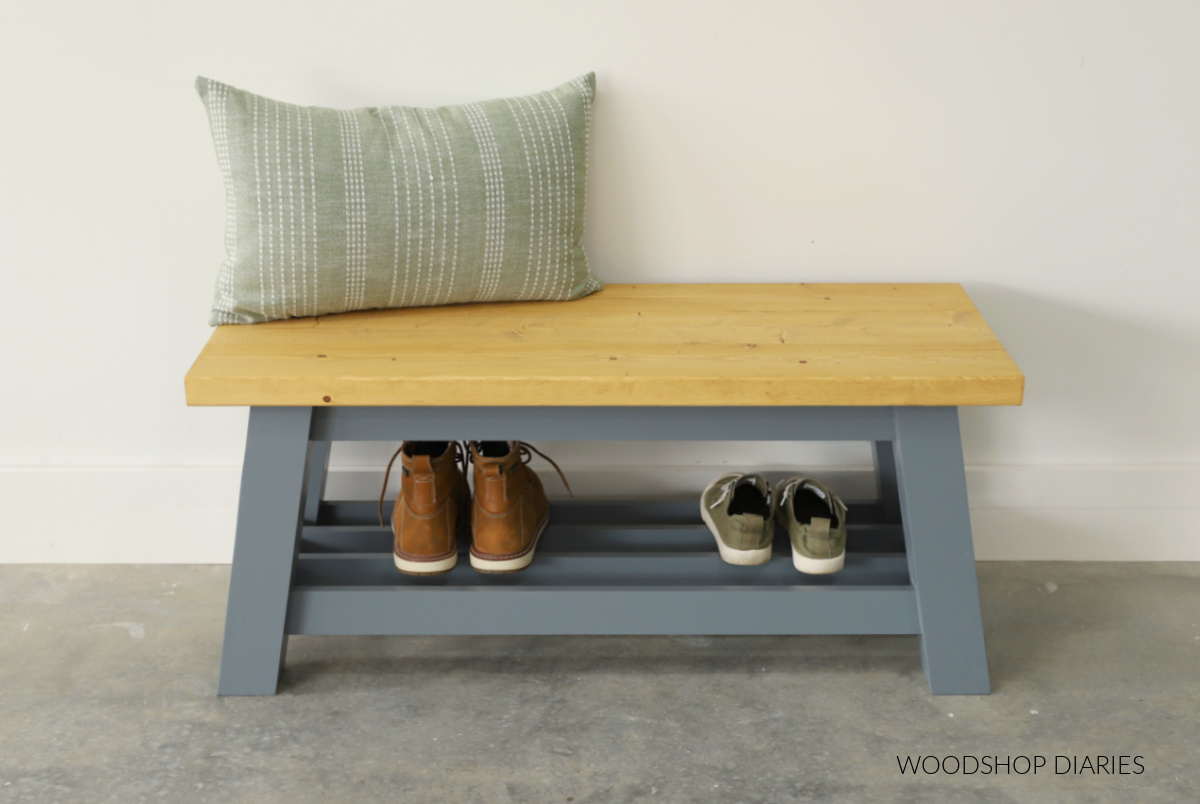
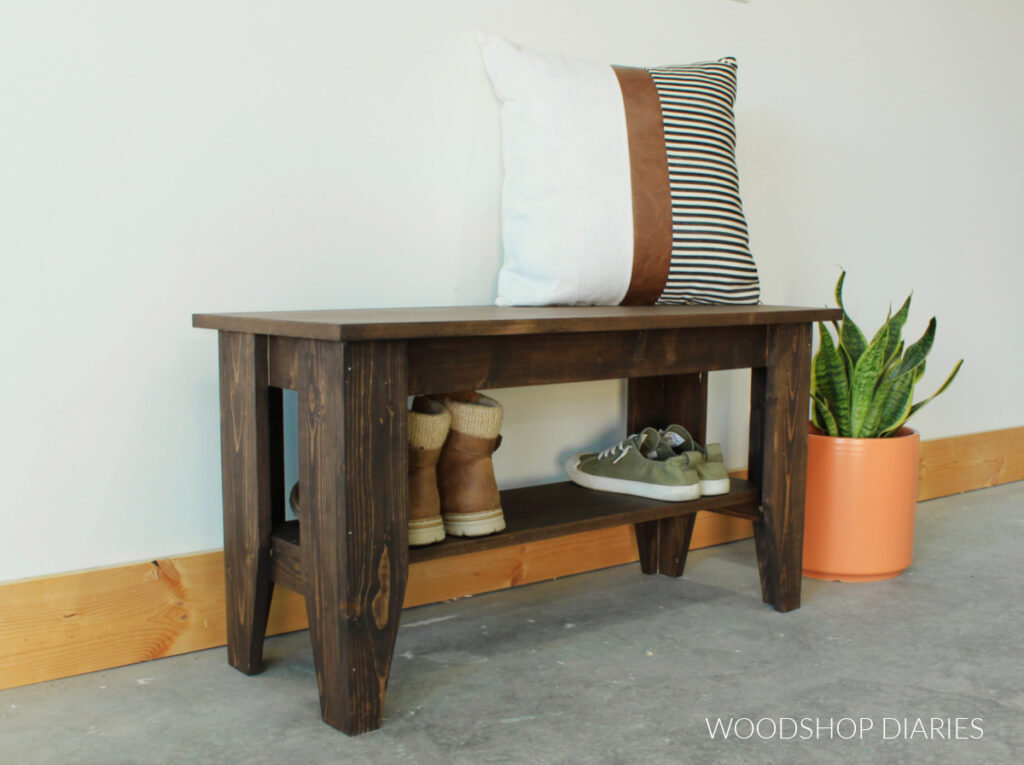
shoe bench with angled legs
DIY Shoe Bench

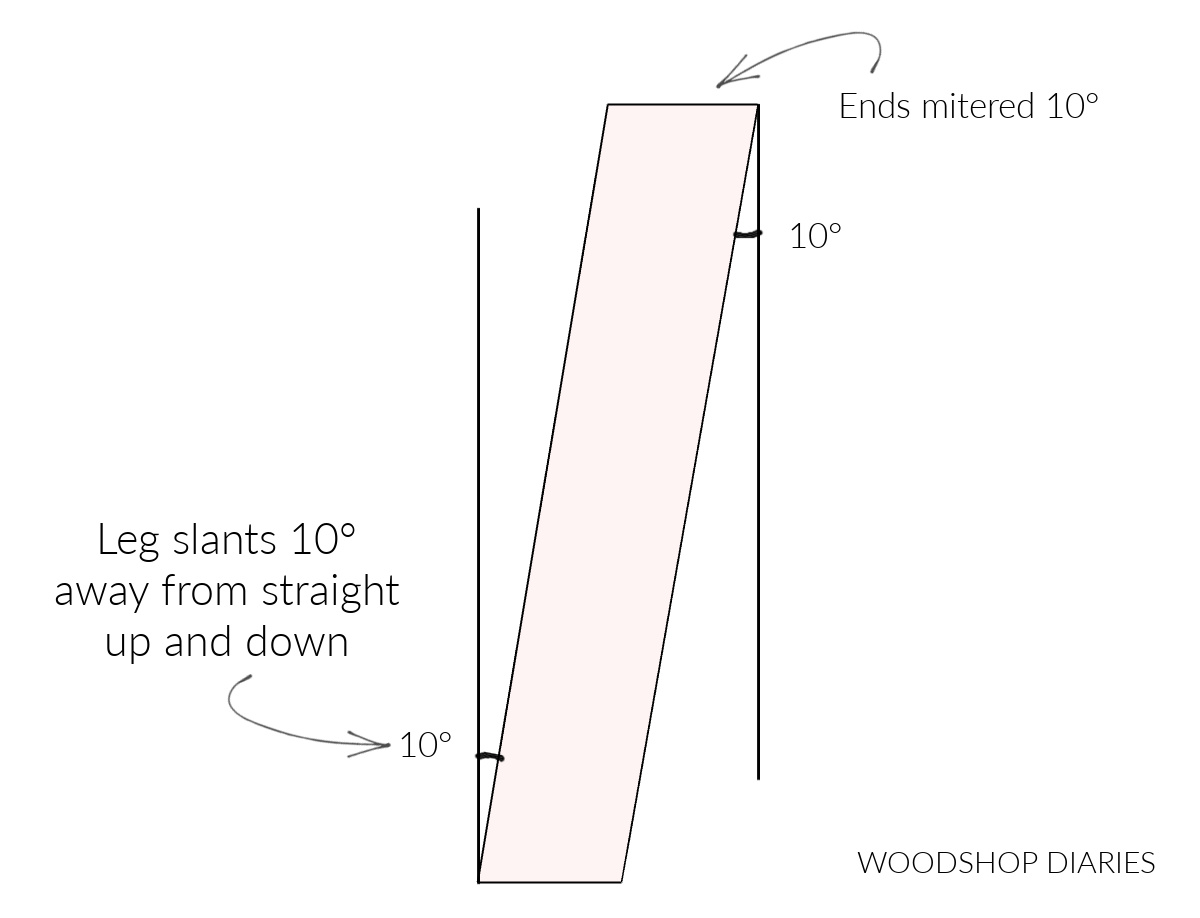
If I cut the legs with a miter angle of 0°, they’d stand straight up, which is square. But, I cut the legs with a 10 degree miter so they would slant OFF SQUARE 10°.

diagram showing angled legs and how the angle is the degree off square

Why 10? I just picked 10° because it was an easy number to work with and looked like a good amount of slope. No other reason–you could pick 5 or 7 or 12 or 15 if you wanted. It just depends on how much slope you want your legs to have.

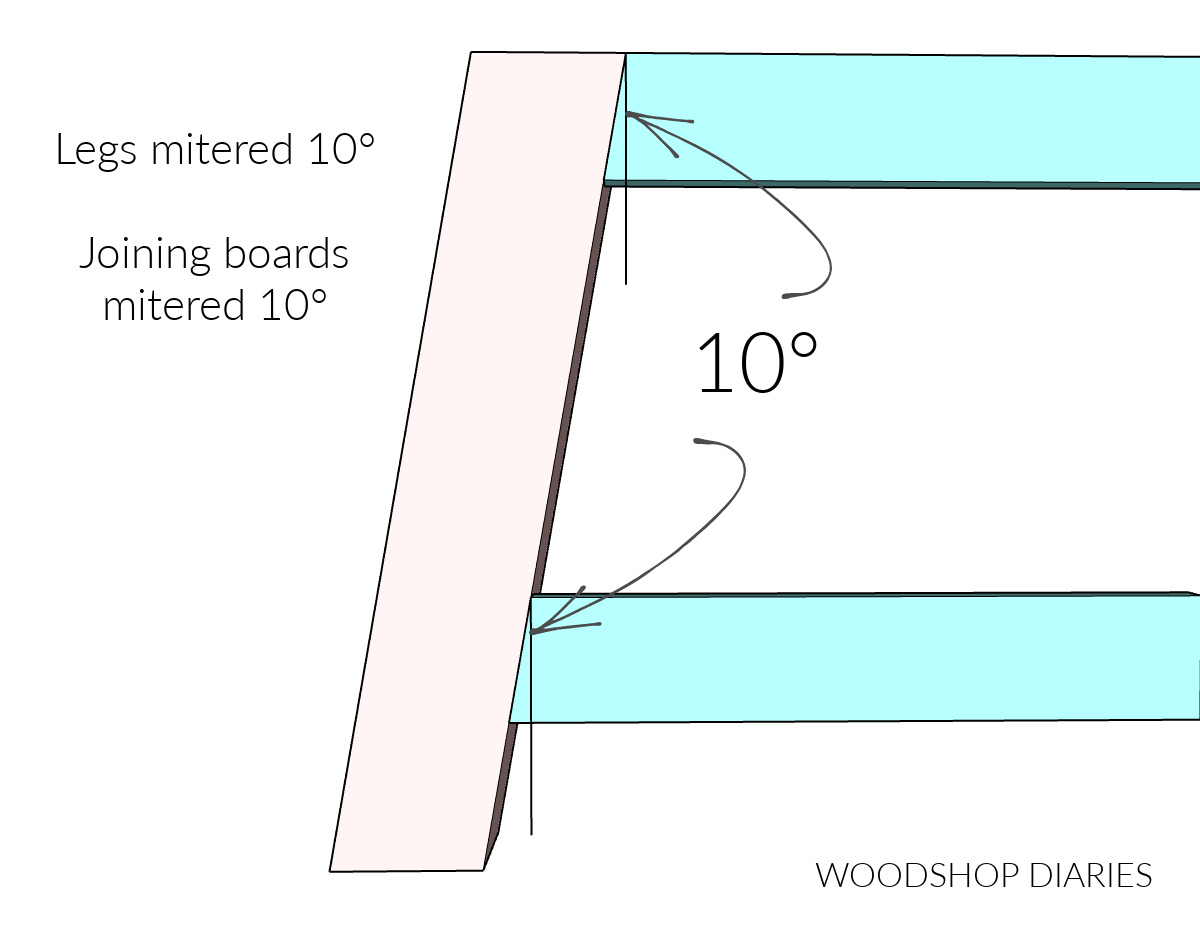
Now I need to determine what angle to cut the ends of my top and bottom supports that will join each leg. Based off the image above, it’s easy! Those need to be mitered 10°, too.

diagram showing joining boards have same miter angle as sloping bench leg

In most cases, in basic projects like this (not all, but most), whatever angle one piece is mitered, the angled pieces that join it are mitered the same.

I think people get really overwhelmed with angles thinking you need to figure each one out for every piece. But most of the time, if there’s an angle in the build, it’s the same angle for everything.

Looking for more DIY woodworking Tips for beginners?

Getting started in woodworking can be intimidating. Check out these helpful beginners guides to getting started so you can confidently build your next DIY masterpiece! Head to the Getting Started page for even more resources.

Understanding Wood Sizing
How to Buy Lumber
Top 5 Tools to Get Started
How to Sand Wood
How to Use a Pocket Hole Jig
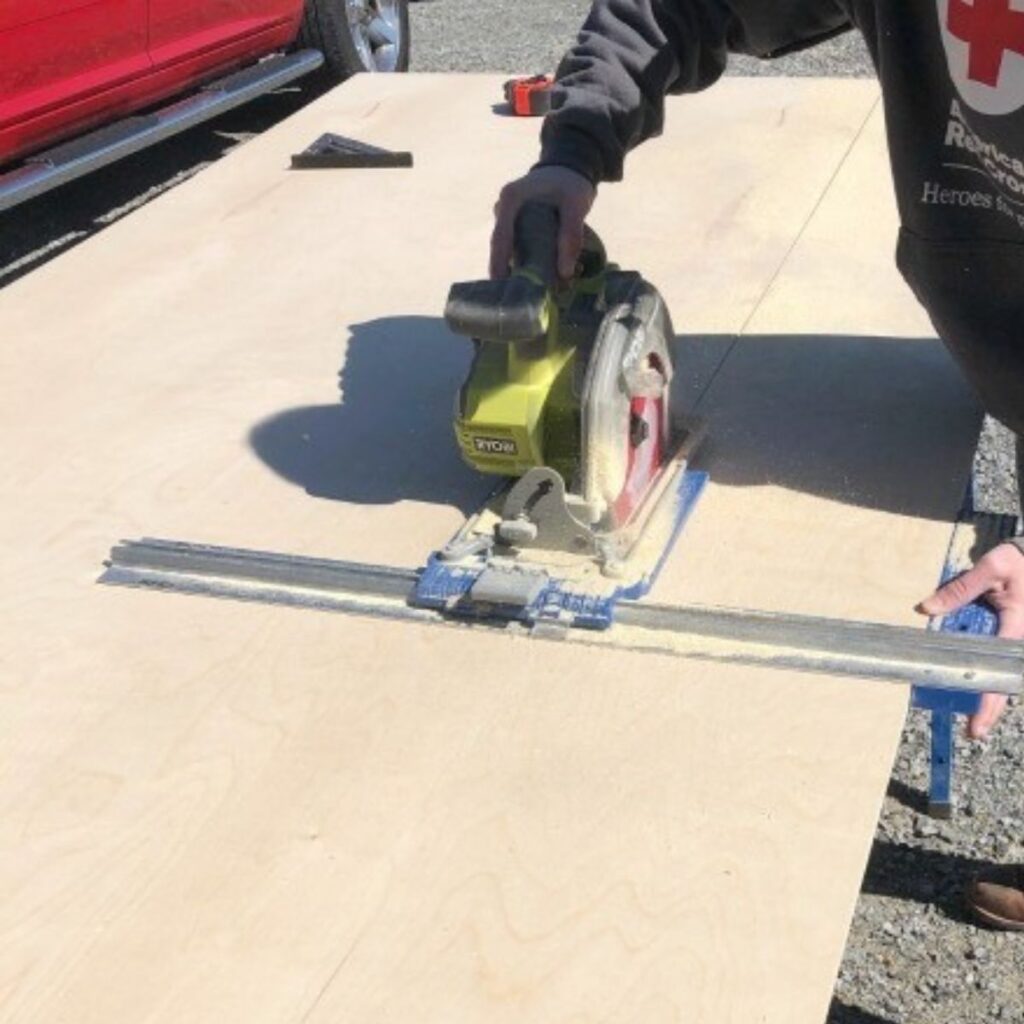
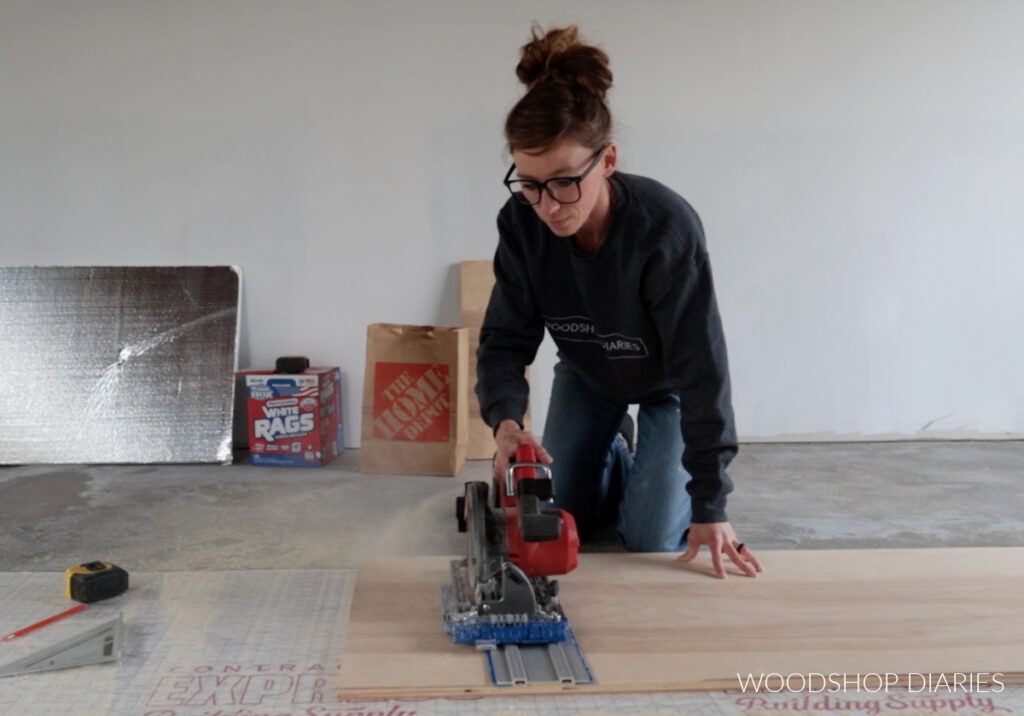
cutting plywood with a circular saw
How to Use Plywood Cutting Guides

If you’d like to save this post for later, be sure to pin it or share it to your favorite social platform!

pinterest collage image of adjusting miter angle on saw at top and diagram of angled cuts at bottom with text "how to cut angles with a miter saw"

Until next time, friends, happy building!

How to Sand Wood

October 31, 2023 by Shara, Woodshop Diaries

Sanding is one of the MOST important parts of every DIY project that is often overlooked.

In this post, I’m sharing how, when, and why to properly sand your DIY woodworking projects.

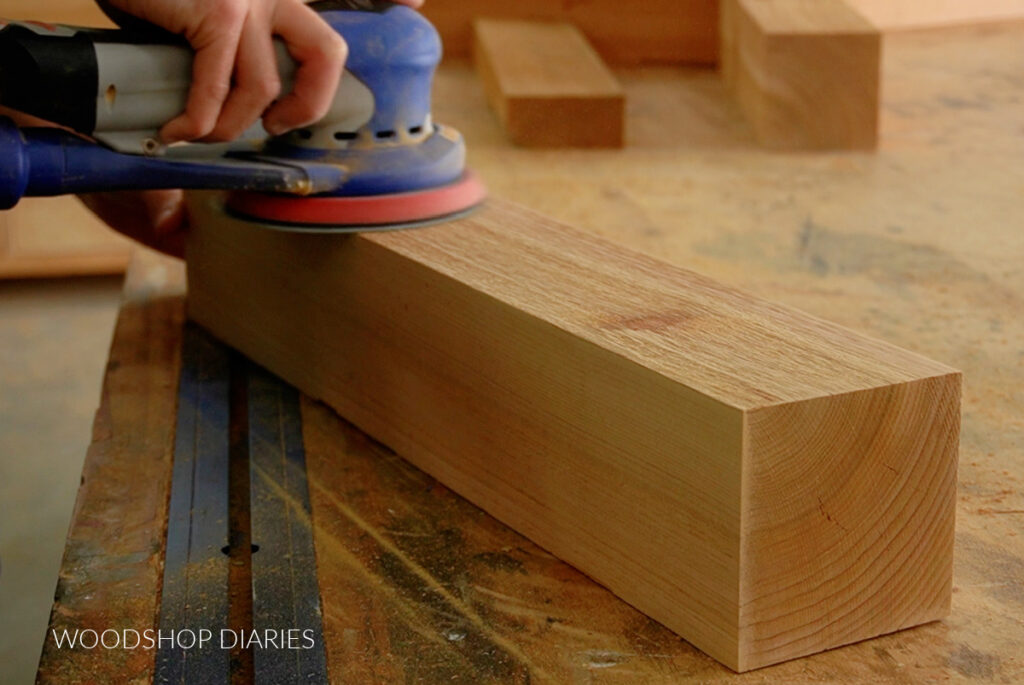
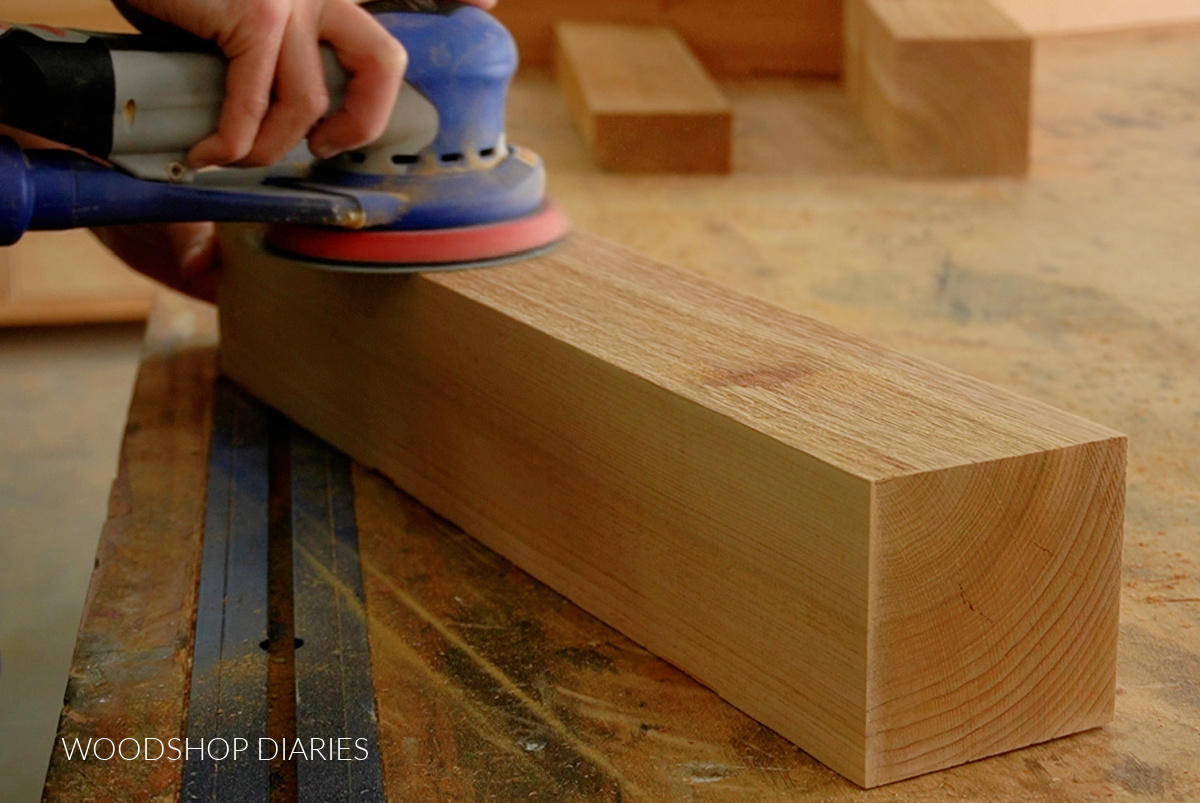
Orbital sander sanding rough cedar 4x4 on workbench

*This post contains affiliate links. See website policies.

Why is sanding important?

Before we talk about HOW to sand, I feel like you need to first know WHY it’s worth doing.

Most people (myself included) do not enjoy the task of sanding–it’s boring, it’s dusty, it makes a project take longer to build. However, sanding is the number one thing that will take your project from “that was definitely DIYed” to “wow–that’s a nice piece!”

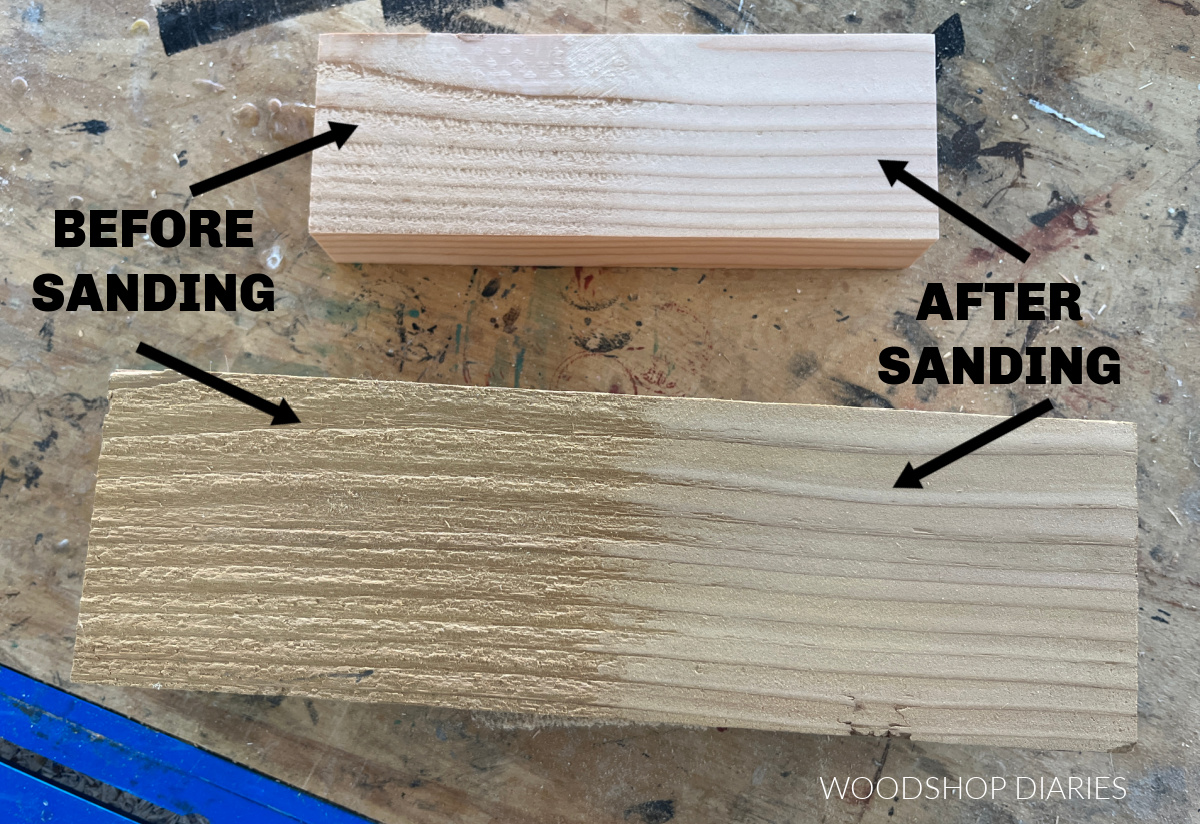
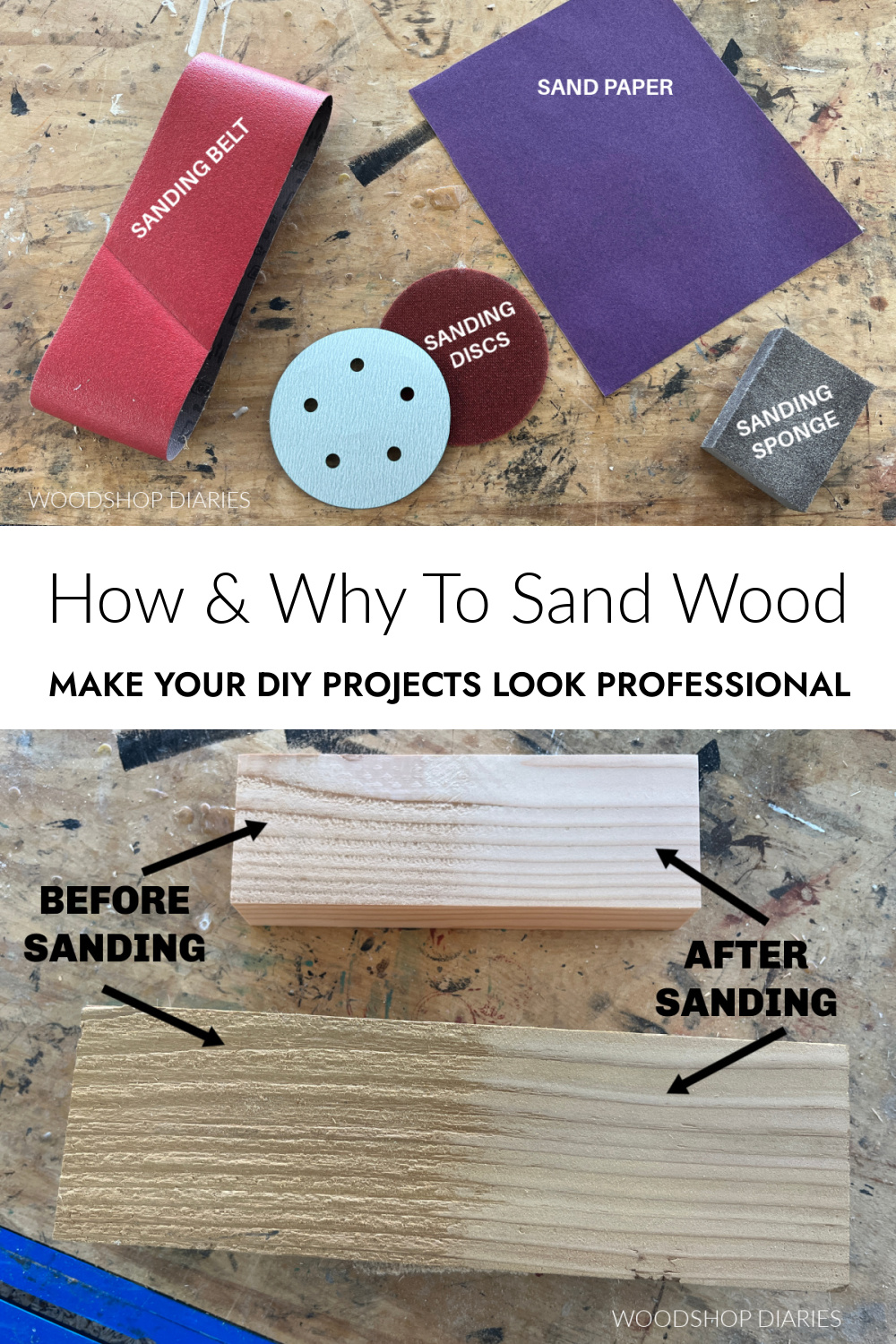
rough 2x4 at top and rough 4x4 at bottom showing left side before sanding and right side after sanding

Sanding helps smooth out rough material (see image above) so your finish will go on nicer. It can level out uneven joints, so that your projects look seamless and more professionally built.

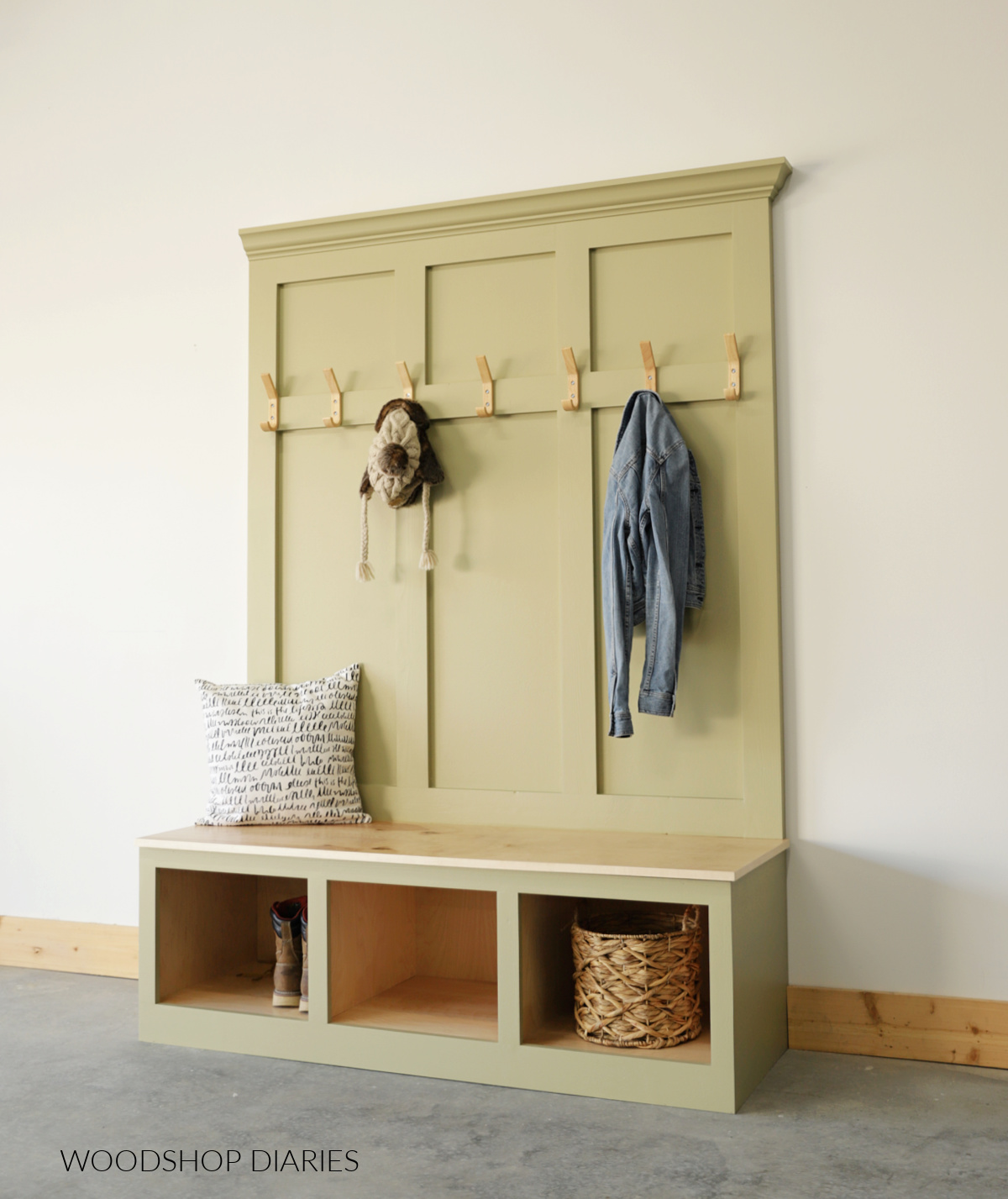
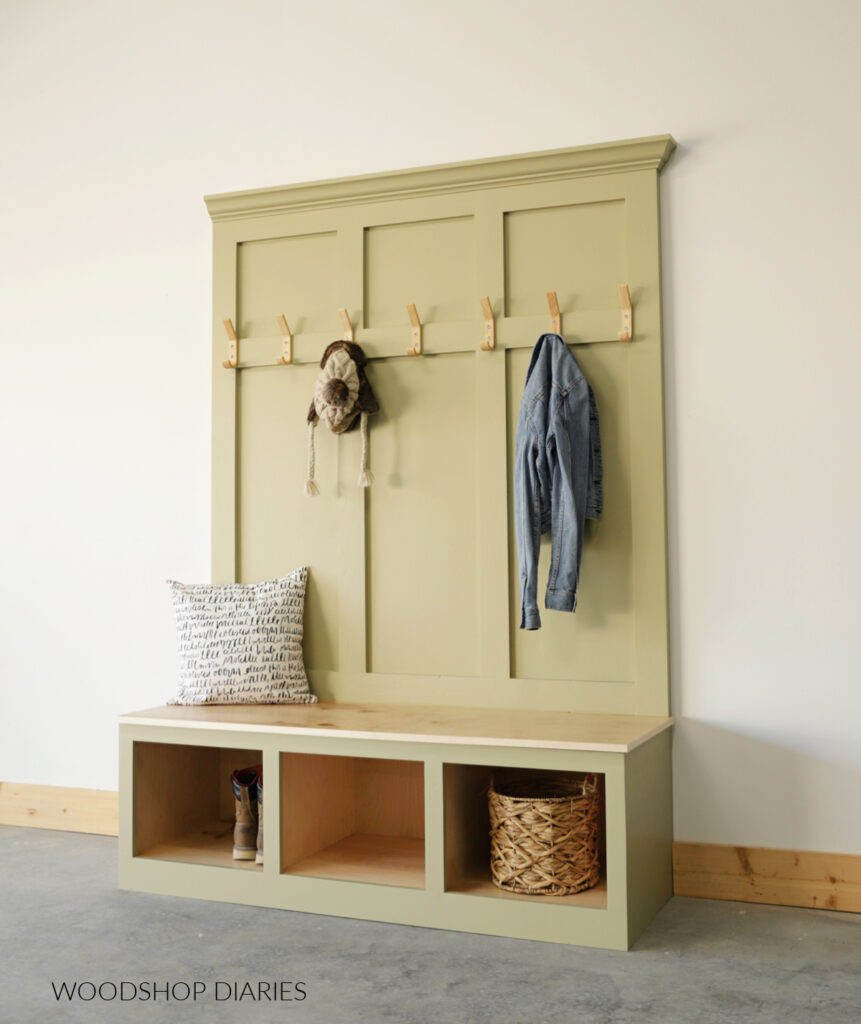
Hall tree with shoe storage bench with trim on back side painted green
DIY Mudroom Bench

And it can sand away imperfections as if they were never there. It’s like a literal magic eraser!

What tools do you need to sand wood?

Theoretically, all you need to sand is some sandpaper and your hands. Hand sanding is better than no sanding at all and will still make a huge difference in your project quality.

But to save (a LOT of) time and wear on your elbows, a power sander is kind of essential.

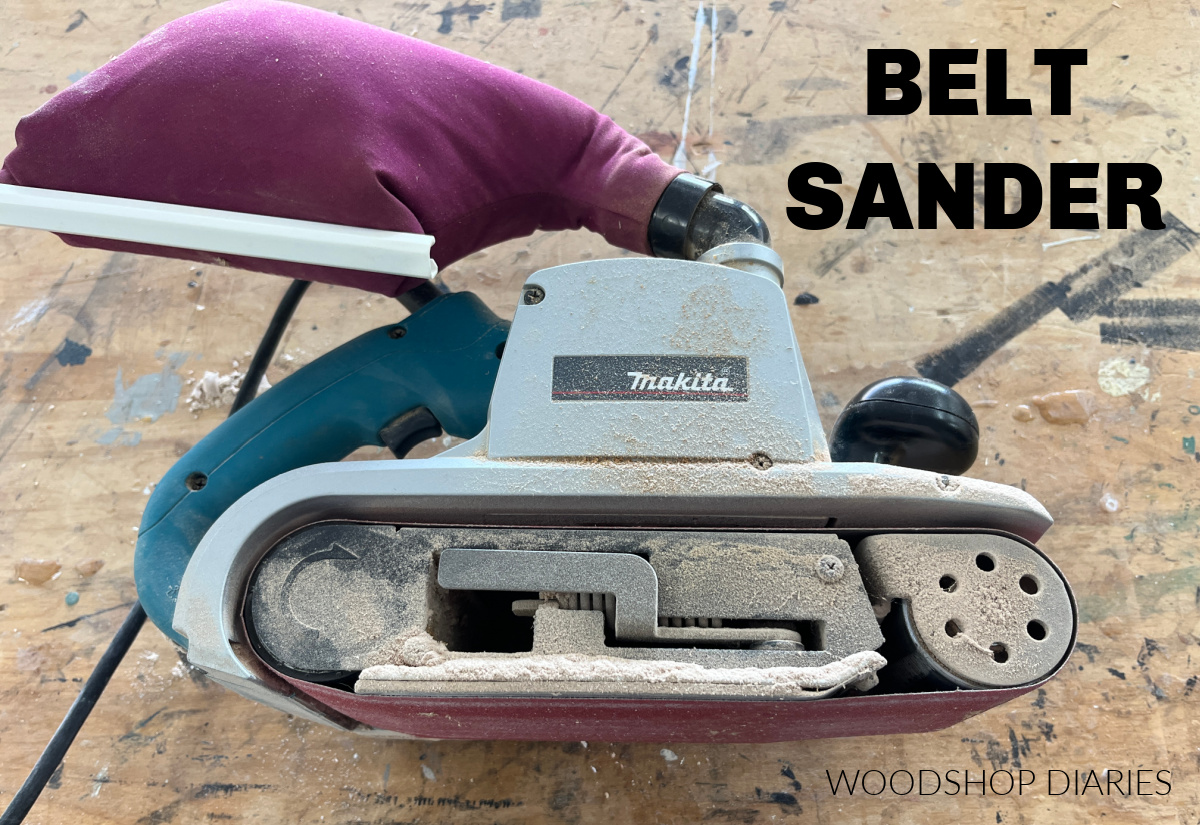
Sanders come in various sizes and types. Common sanders in most woodworking shops are belt sanders, orbital sanders, and palm sanders.

Makita Belt sander on workbench

Types of sanders:

  • Belt sanders are typically used for aggressive sanding.
    • They are great for large surfaces and for flattening. This type of sander spins a sandpaper belt along it’s rollers to sand wood in one direction. I usually use my belt sander when sanding large panels like table tops.
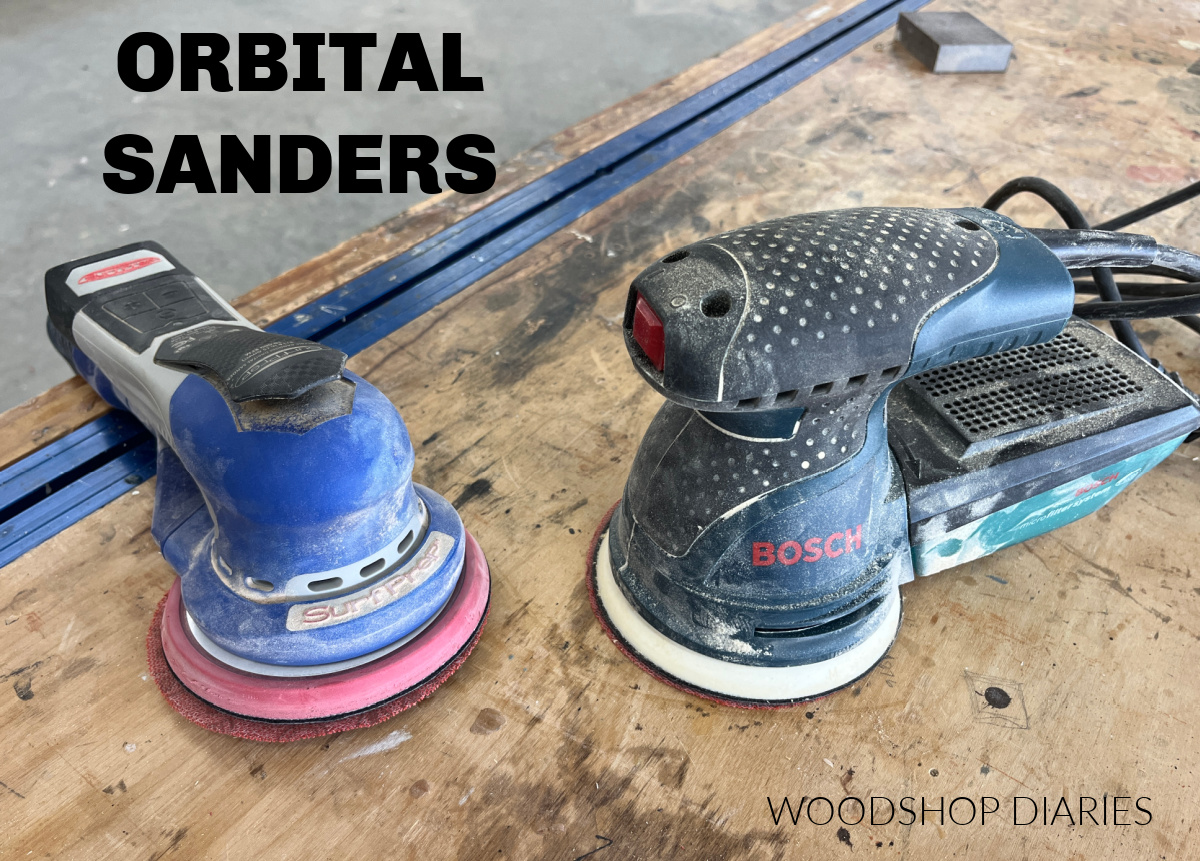
  • Orbital sanders are versatile and are used for both aggressive and delicate sanding.
    • These sanders spin round sandpaper discs in a random orbit to sand the wood. These are the most common every-day-use sanders and are what I use most often.
  • Palm sanders are more of a specialty type sander used for small, delicate pieces.
    • I personally don’t have one as I don’t see the need. However, people often buy them in place of an orbital sander because they are typically cheaper–but they’ll take a lot longer to get the job done.

I personally use my orbital sander for about 95% of all my sanding and my belt sander for the other 5%. So if you’re trying to decide which one you need to get started with, I highly recommend starting with an orbital sander.

two orbital sanders on workbench

My recommended sanders:

  • Orbital Sanders
    • I’m currently using a SurfPrep sander. It’s a little pricey, but works great. However, I also have this Bosch orbital sander and highly recommend it if you’re looking for a more budget friendly option.
  • Belt Sanders:
    • I’ve had a few belt sanders over the years and I’m currently using this Makita belt sander. It’s a little pricey as well, but I’ve also used this belt sander in the past and loved it.

For what it’s worth, the cheaper sanders I’ve used over the years have worked just as well as the more expensive ones. BUT, in my experience, they do not last nearly as long.

Understanding sandpaper grits

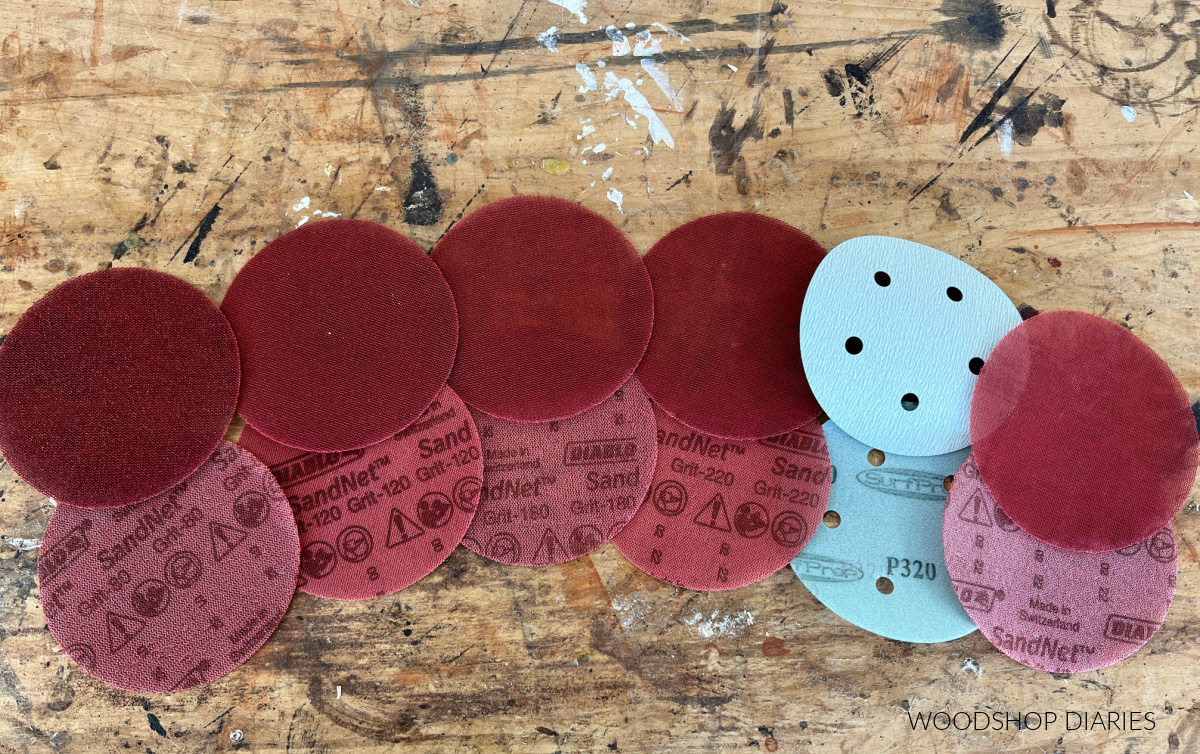
Sandpaper comes in various grits labeled by numbers. You can think of “grit” as the “roughness” of sandpaper. The lower the grit number, the rougher the paper. The higher the grit number, the smoother the paper.

sandpaper discs laid out on workbench from 80 grit on the left up to 400 grit on the right

Common sandpaper grits used in woodworking range from 60-400. Of course, you’ll find sandpaper grits available outside that range, but this is what’s most commonly used for wood.

Sandpaper grits and their general uses:

  • 60-100 grit: Used for aggressive sanding and when you need to remove a lot of material quickly.
    • These grits are used to sand very rough material, to level uneven surfaces, and to remove existing finish (like paint or stain).
  • 120-180 grit: Used for general purpose sanding.
    • These grits are great for sanding semi-smooth material (like a 2×4) prior to assembly and for smoothing out uneven joints after assembly. Sandpaper in this grit range will remove material, but not as quickly or as aggressively as a lower grit, so it’s much easier to control.
  • 220-400 grit: Used for finish sanding.
    • These grits are what you use to give your piece a final sanding before finish and what you’d use between finish coats. They will remove minimal material, but leave a piece feeling super smooth.

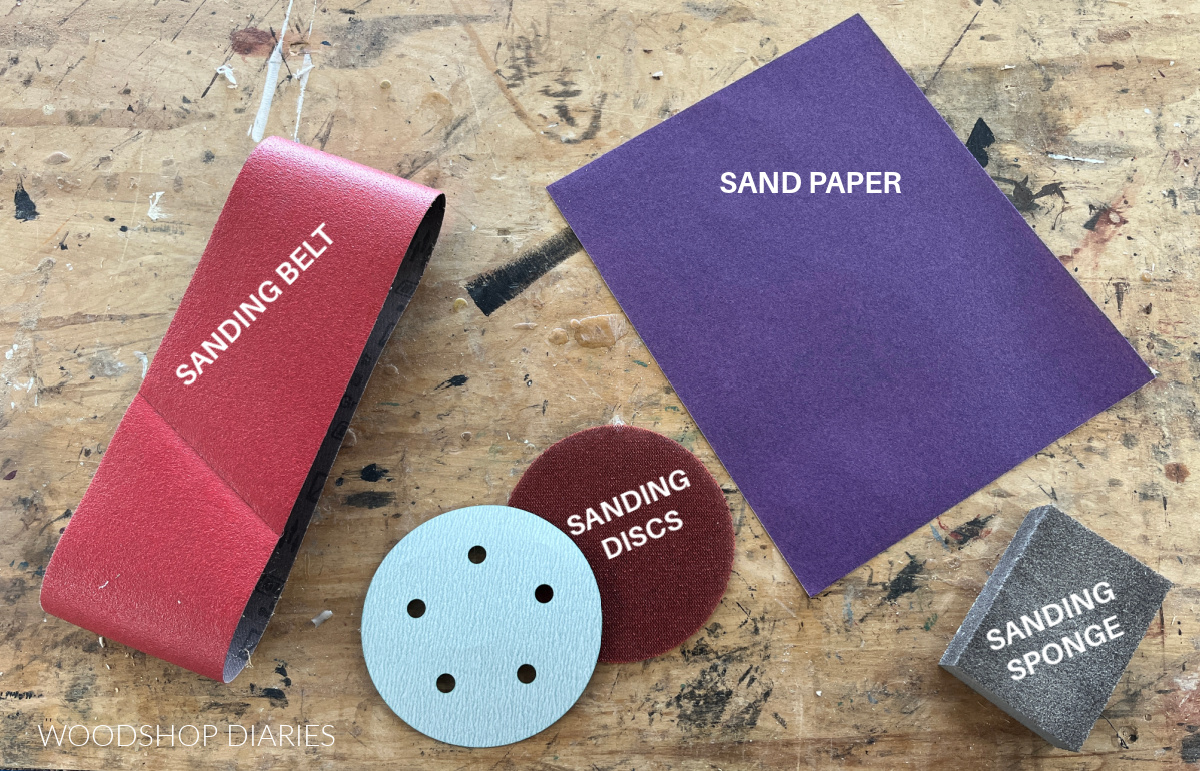
Sandpaper comes in belts (for belt sanders), discs (for orbital sanders), sheets (for hand sanding or palm sanders), and sponges or blocks (for hand sanding).

sanding belt, sand paper, sanding discs and sanding sponge laid out on workbench

Personally, I love Diablo brand sandpaper and that’s what I use most in my shop.

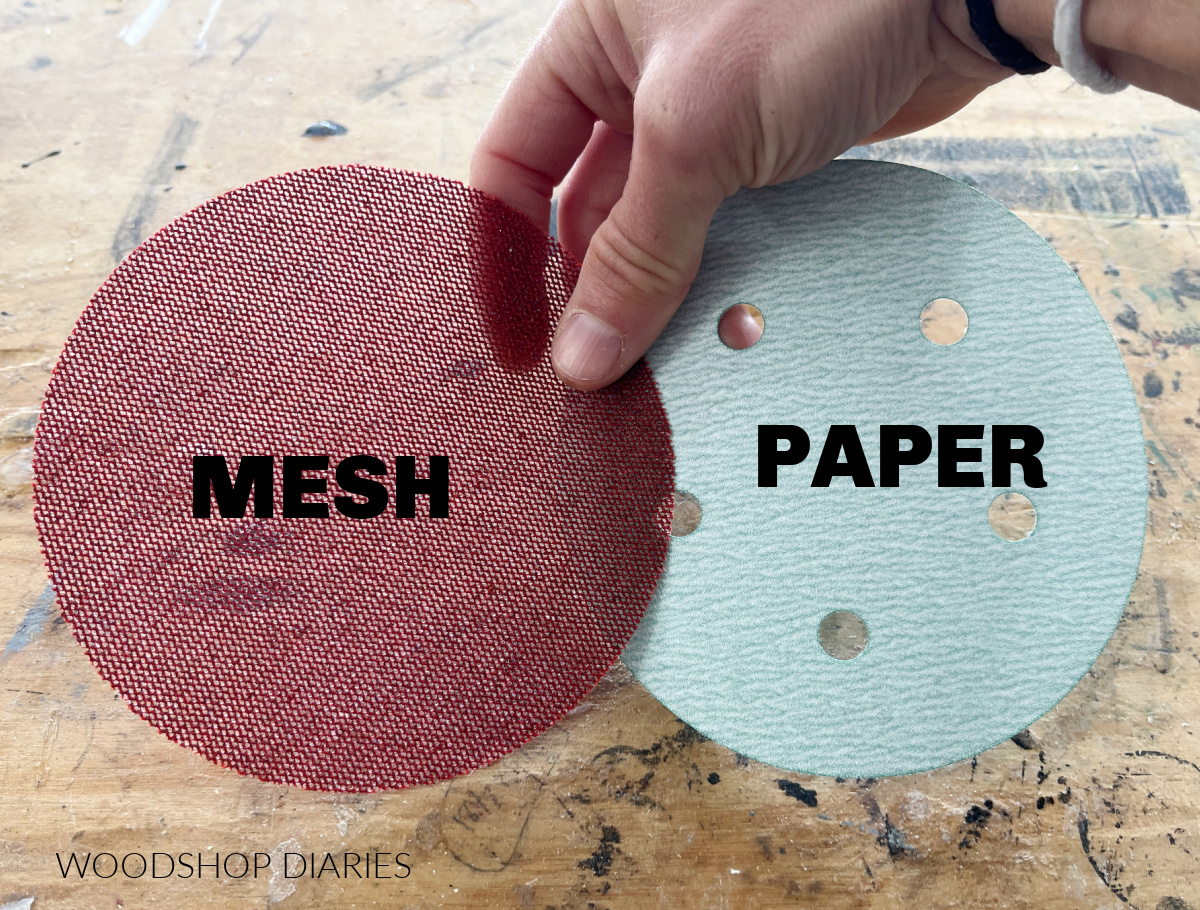
You can find orbital sanding discs as paper discs, or in a mesh-like material. Both work great. Paper discs are usually cheaper and in my experience work just as well.

close up of mesh sanding disc next to paper sanding disc

Are DIY projects your thing? Sign up for our newsletter for priority access to the latest projects and build plans!

When should you sand wood?

This is a tricky question and many people may have differing opinions. Honestly, it will depend on what kind of project you’re working on and the materials you’re using.

However, I recommend sanding multiple times during a project.

When should you sand?

  • After cutting/Before assembling
  • After assembling
  • After puttying/Before finish
  • Between coats of finish

Of course, every project is a little different, so in some cases, it may not be necessary to sand in every instance. So, this is just a general guideline to help you get the hang of it.

Below, I’ll share my tips for how to sand in each of these situations.

How to sand your DIY Woodworking Projects

Before we dive into HOW to sand wood, keep in mind that every project, material, situation is different, so don’t stress about a RIGHT or WRONG way to sand.

Just remember the goal is to create smooth joints and a smooth finish. There are many ways to get there.

But, there are two “rules” to sanding:

  • When hand sanding or belt sanding, sand WITH (or parallel to) the wood grain.
  • When sanding, work your way from low grits to higher grits, skipping no more than 60 grits at a time.

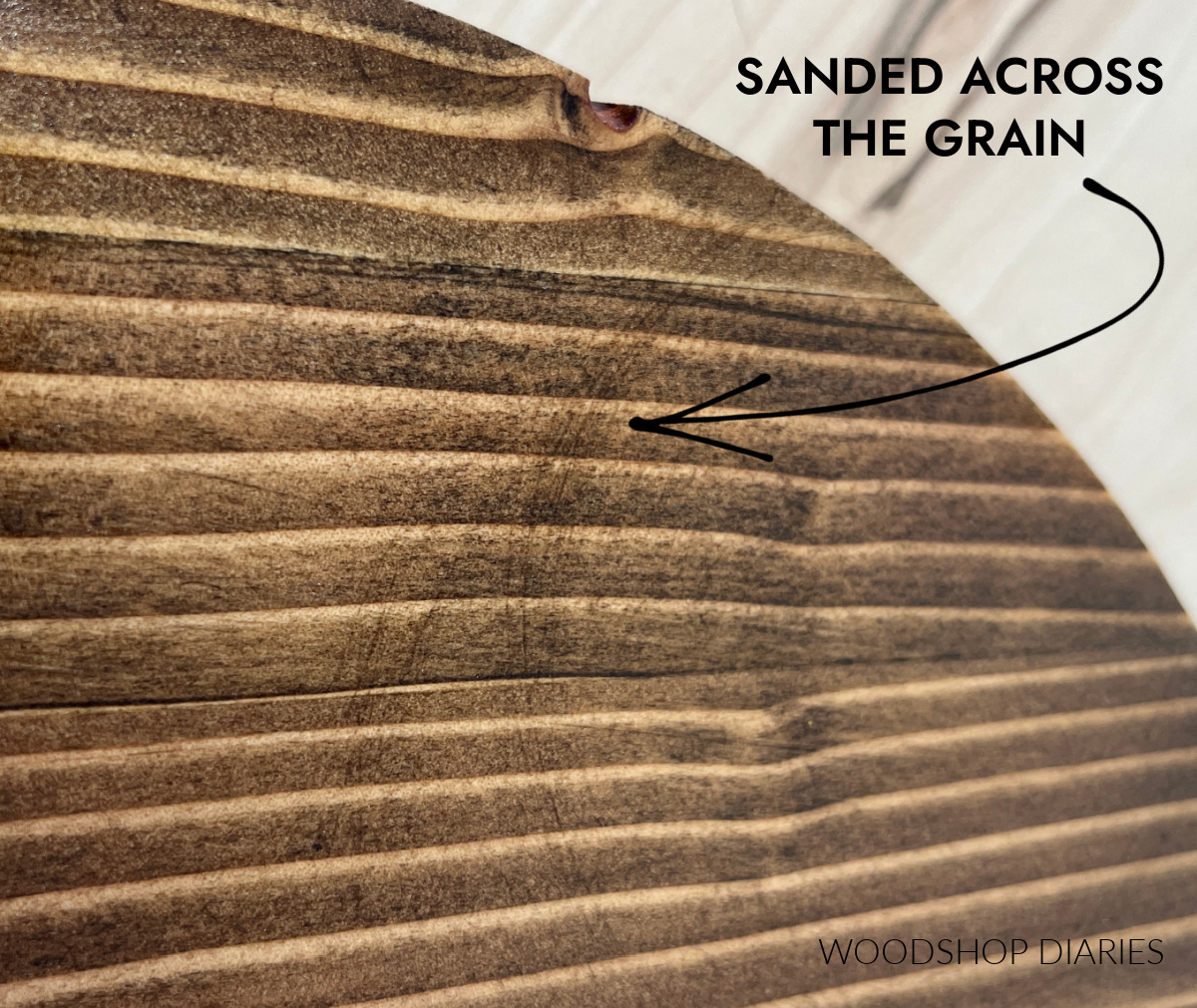
Why should you sand with the wood grain? Sandpaper is literally scratching the wood’s surface. If these scratches go in the same direction as the wood grain, they will blend in. But if they go across the wood grain, they’ll be quite noticeable, especially if you apply a wood stain as you can see below.

example showing across grain sanding marks on pine after stain

With orbital sanders, since the sanding direction is random, this isn’t so much a concern as much as it is with belt sanders or hand sanding.

Why should you work your way up the grits? I just mentioned that sandpaper scratches the surface. So, as you work your way up, each higher grit will remove the scratches left from the previous grit until the scratches are practically gone (at about 220 grit).

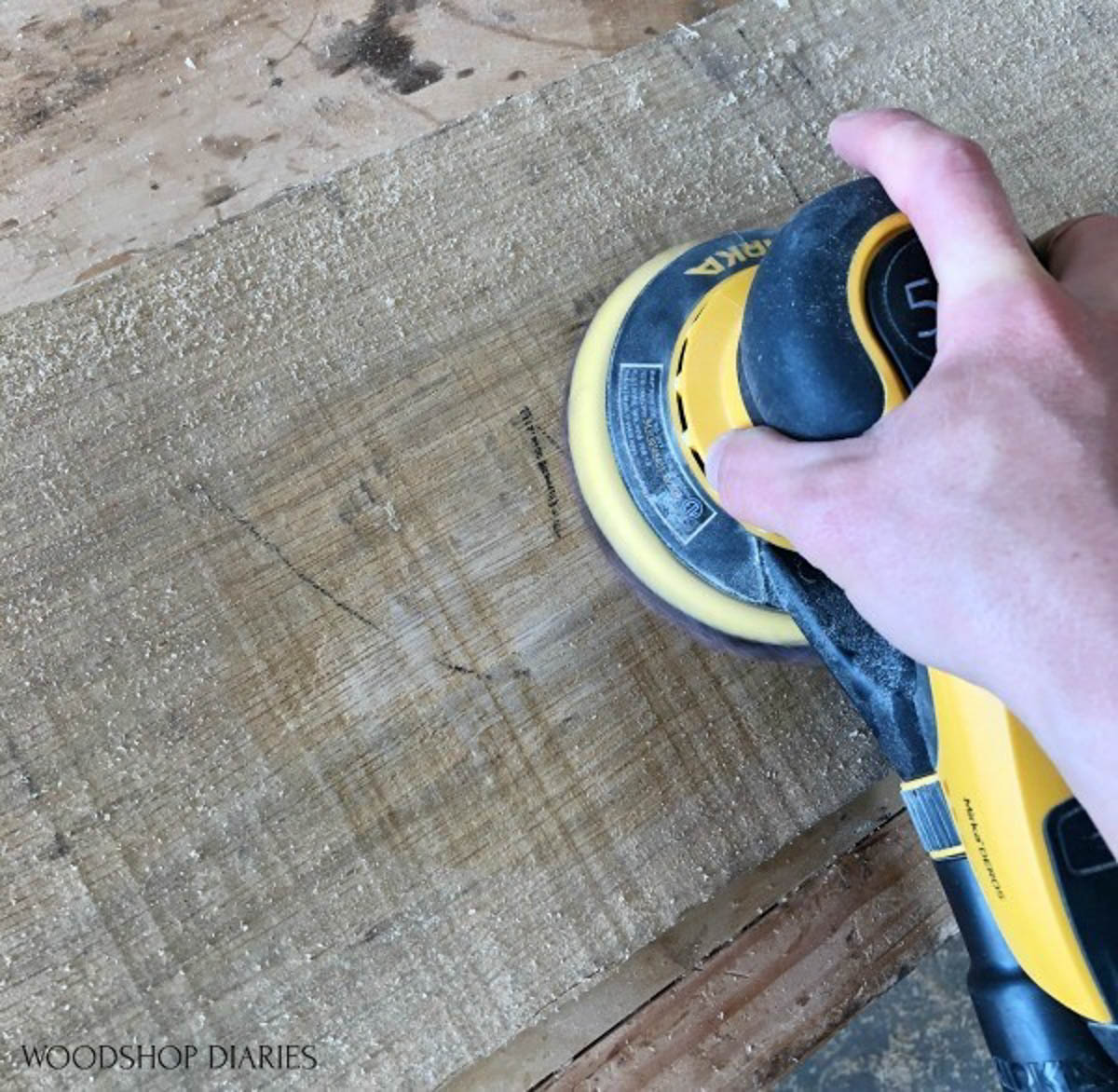
For example, if I’m working with some pretty rough lumber like you see below, I may start with 80 grit sandpaper to level it out.

sanding a piece of wood with a orbital sander

That will leave some pretty big surface scratches on the wood. So, next I’ll go over it with 120 grit which will sand away those big scratches, and leave smaller ones.

So I’ll follow up with 180 grit, which will remove those small scratches and leave even smaller ones. Then, I’ll finish up with 220 grit which will remove those scratches and leave the wood smooth enough for finish.

Usually, the last grit I sand with before applying a finish is 220. Not every material needs to be sanded with lower grits. If they’re already pretty smooth, you can skip directly to 220. I’ll explain more below.

Sanding wood before assembling

Personally, this is the “main” sanding I do for every project, no matter what.

I like to sand all of my pieces before assembling because after it’s assembled, it may be challenging to get into all the little corners and surfaces.

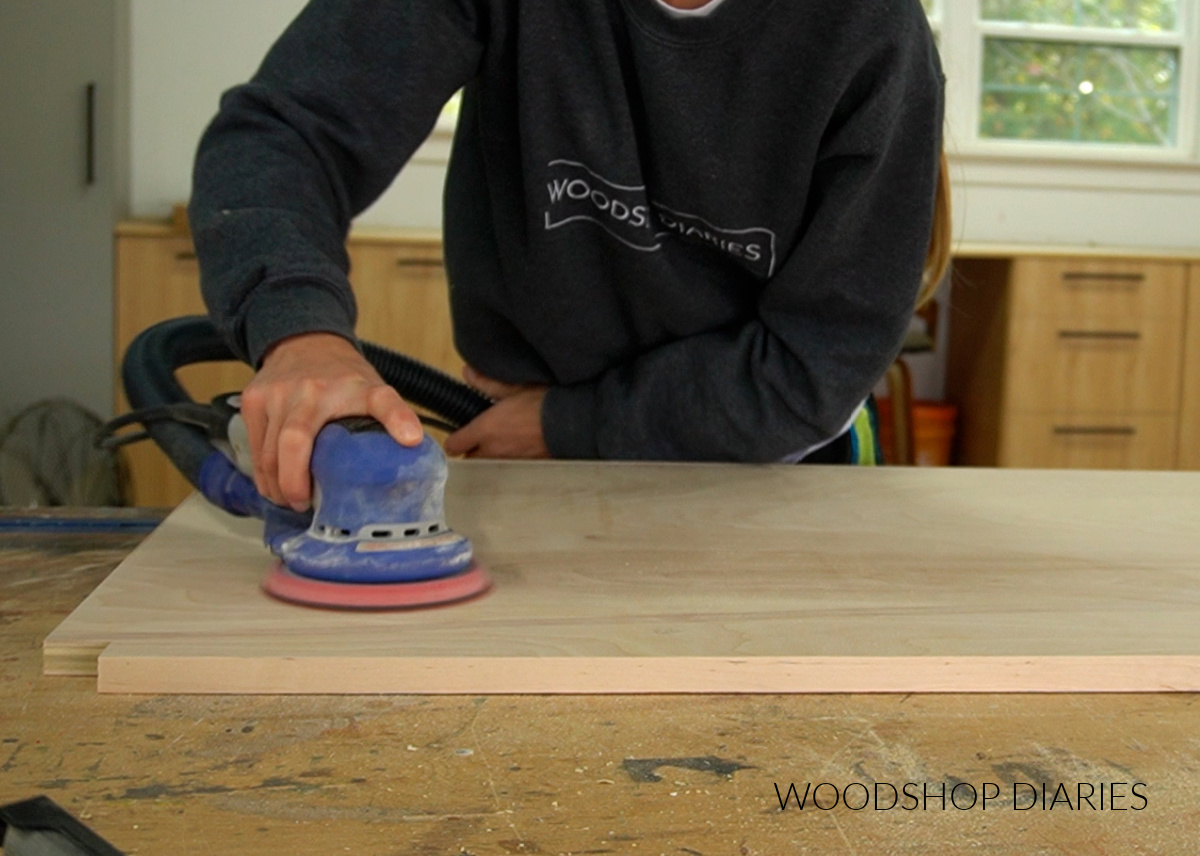
Sanding before assembling allows me to make sure every surface is sanded at least once. I use an orbital sander for this.

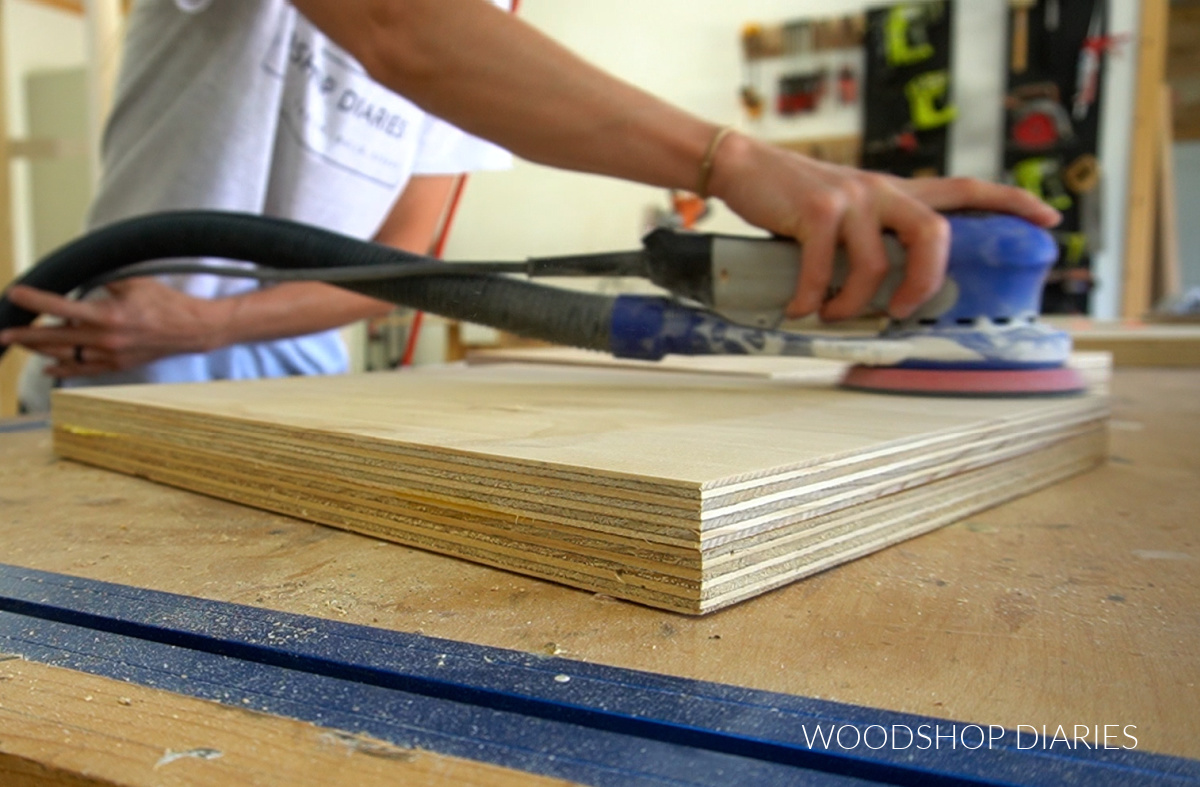
Generally, for cabinet grade plywood, I skip straight to sanding with 220 grit sandpaper. You don’t want to sand plywood too aggressively because you can accidentally remove the top veneer layer since it’s so thin.

Shara Woodshop Diaries sanding plywood panel with orbital sander

Stick with higher grits when sanding plywood. It’s usually pretty smooth anyway, so a light 220 grit sanding is all it needs.

For solid woods or rougher materials, I do sometimes sand initially with a lower grit–like 120, 150, or 180–if the material isn’t very smooth already. You can run your hand over it and if you feel bumps, or rough spots, make sure to smooth those out.

Then, I work my way to 220 before assembling. Or, if you prefer, you can just wait until final sanding. (I think doing it before assembling is easier.)

Sanding wood after assembling

Sanding after assembling isn’t always necessary. I usually only sand after assembling if I need to clean up any “not so perfect” joints.

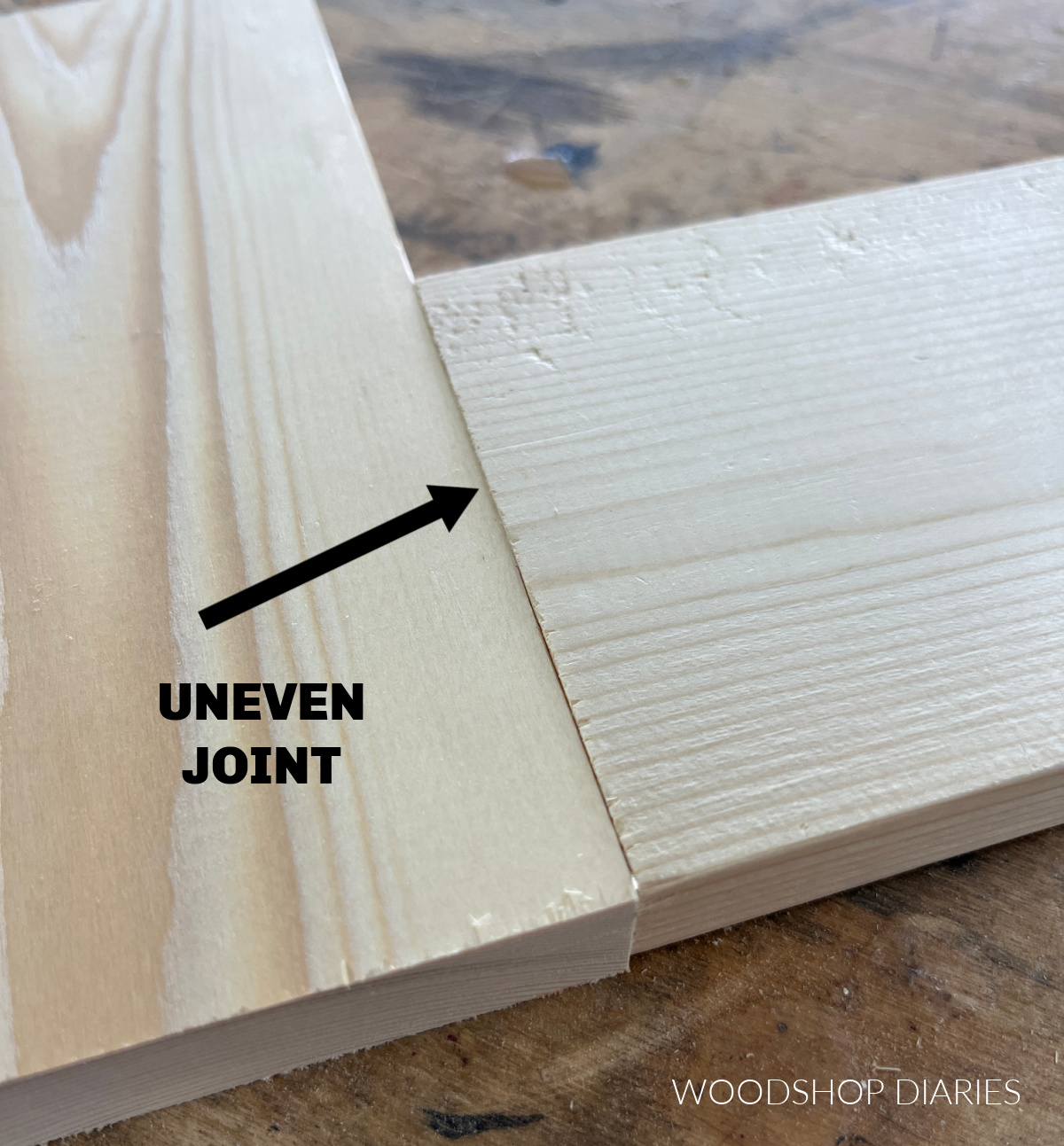
I examine all my joints and if I see any that are uneven, I’ll smooth these out with some 120 or 150 grit sandpaper with my orbital sander, and work up to 220.

close up image showing an uneven joint where two boards run together

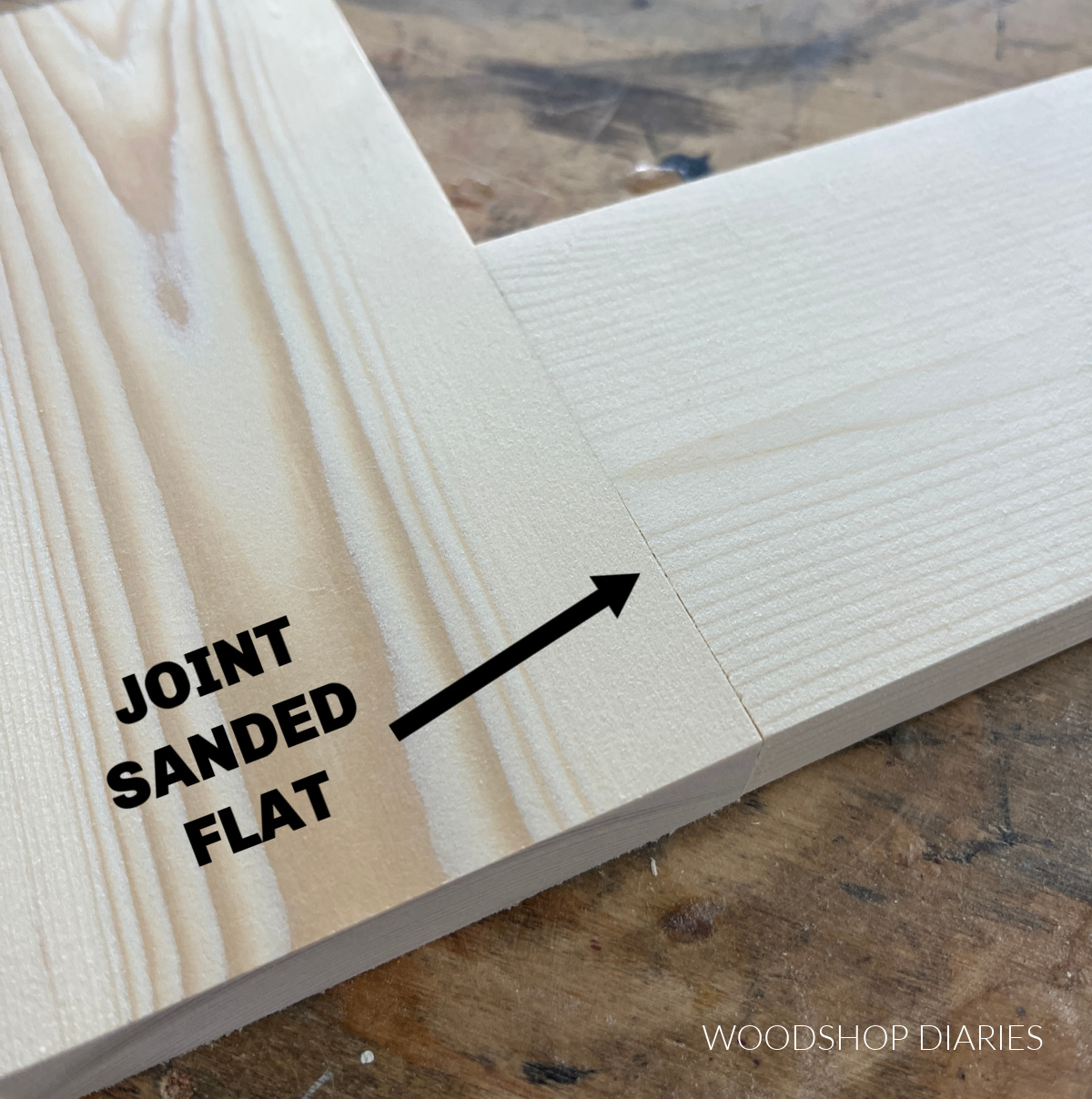
Smoothing out uneven joints will make a WORLD of difference in your finished project–especially when painting. Flat joints makes your build look much more professional and seamless.

close up image showing a wood joint sanded smooth and flat

Just be careful to sand EVENLY. If you concentrate the sander in one area, you can create a divot or dip in the wood that’s just as noticeable as an uneven joint. Move the sander over the whole area evenly so it’s flat and smooth.

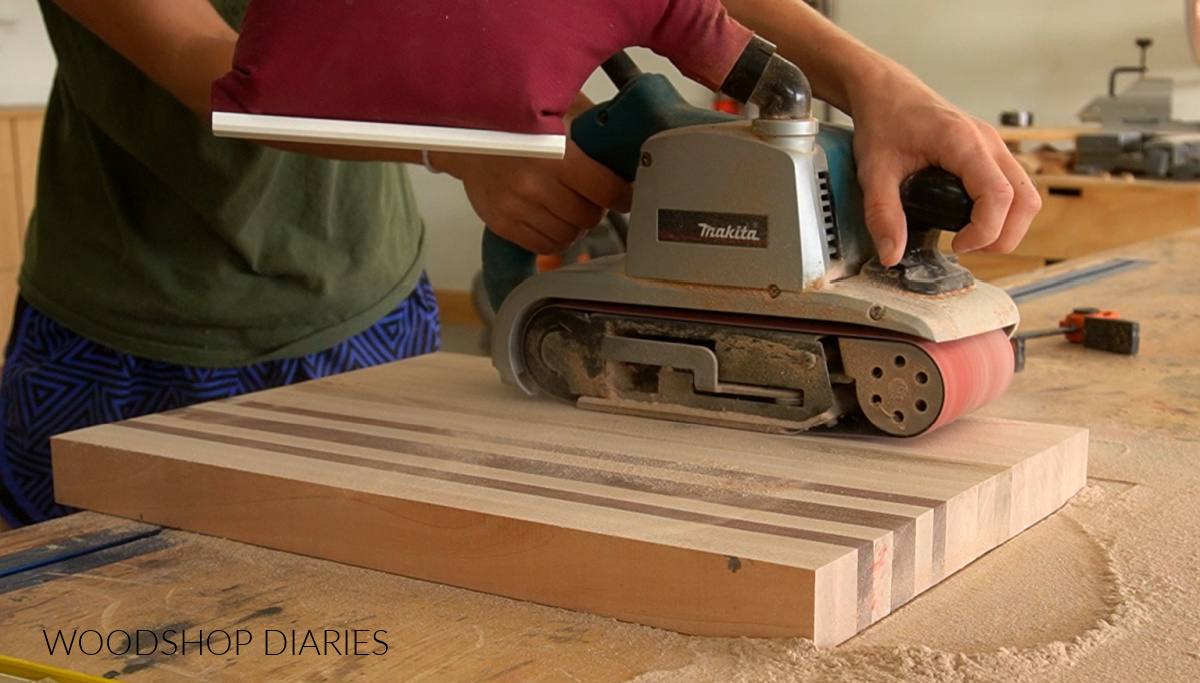
If I’m assembling a large glue up, like a table top, once it’s dry, I’ll often use a belt sander first to remove the glue squeeze out and flatten out the surface.

Shara Woodshop Diaries using a belt sander on a cutting board

Normally, I use 80 or 100 grit sandpaper on my belt sander. Then, I’ll follow up with my orbital sander to work my way through the grits up to 220.

Sanding wood before finish

Sanding before finish is similar to sanding after assembly–it’s not always necessary. If everything has already been sanded in the build process, another sanding now isn’t required.

However, if you’ve applied any wood filler, have some glue residue left on the surface, or haven’t sanded everything to a high grit (220 or higher), now is the time to sand that down to give you the best smooth surface for applying a finish.

I like to take a close look at the entire build and give it a light hand sanding with 220 grit paper while running my hands along the surface. If you can feel an uneven spot or imperfection, it’ll likely show up with finish, so make sure to smooth it out now.

Sanding wood between finish coats

Make sure to sand lightly between finish coats IF USING A WATER BASED FINISH.

Water based finishes cause the wood grain to raise as it soaks in. To test this out, apply a water based primer to a raw wood surface, and once it’s dry, run your hand across it. It will feel very rough.

To smooth this out, I hand sand every surface with 320 or 400 grit sand paper between coats of water based finish. The grain won’t really raise after the first coat since the first coat of finish kind of “seals” it.

Shara Woodshop Diaries hand sanding primed wood trim on hall tree project
Sanding After Primer Coat

However, sanding between all coats will smooth out any brush strokes or uneven application to give you the smoothest finish possible.

So make sure to sand between primer and paint, between coats of paint, and between coats of poly or clear coat.

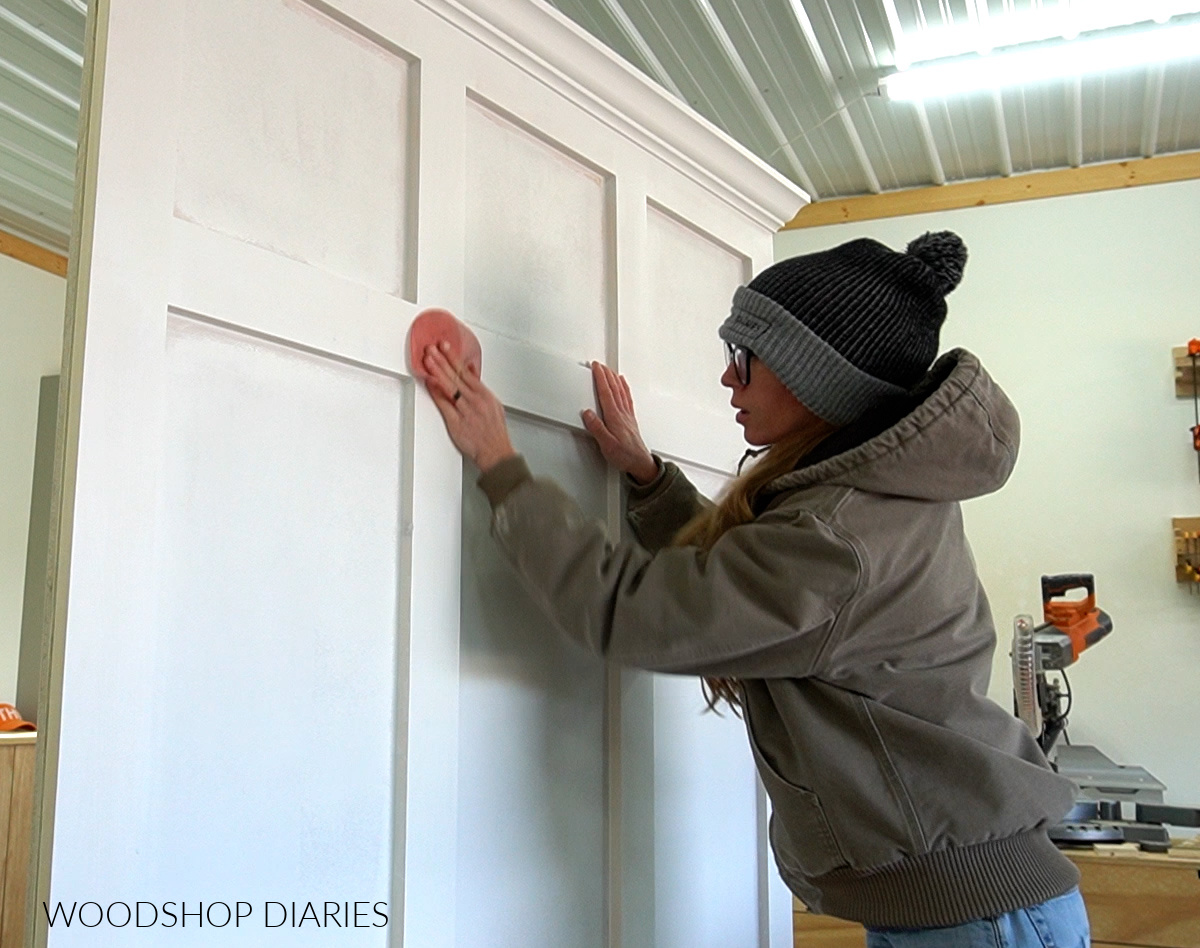
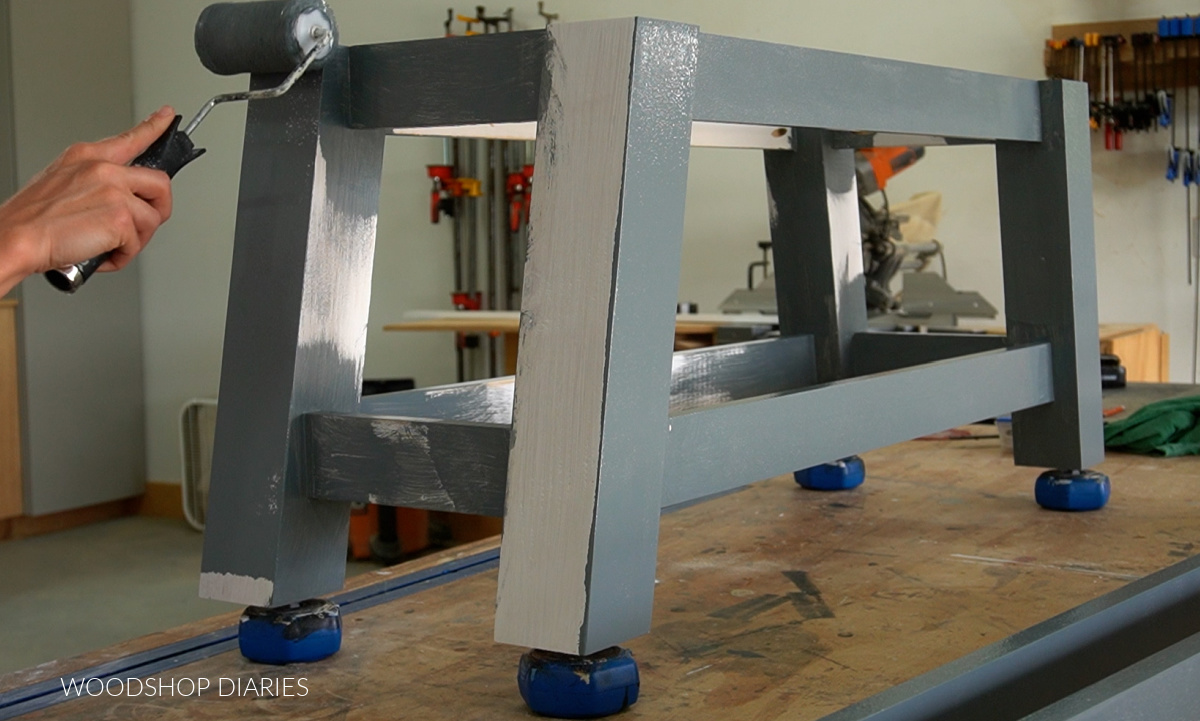
Shara Woodshop Diaries rolling paint onto shoe bench project

An exception is for finishes that wipe on or soak into the wood–like stains and oils. Sanding between coats of this type of finish aren’t really required.

**Make sure to read application instructions for your specific finish to see if they recommend sanding between coats.

Looking for more DIY and woodworking tips?

Looking for more tips to get started woodworking? Here are some helpful guides you’ll enjoy! Or check out the Getting Started Page Here for more information!

How to Buy Lumber
Understanding Wood Sizing
Top 5 Tools to Get Started
How to Choose the Right Plywood
How to Cover Plywood Edges
How to Use a Pocket Hole Jig

If you want to save this post for later, be sure to pin it or share it to your favorite social channel!

Pinterest collage image showing types of sandpaper at top and before and after sanding example image at bottom with text "how and why to sand wood make your DIY projects look professional"

Until next time, friends, happy building!

How to Build a Board Game Table

October 25, 2023 by Shara, Woodshop Diaries

In this post, I’m sharing how to make a board game table with storage!

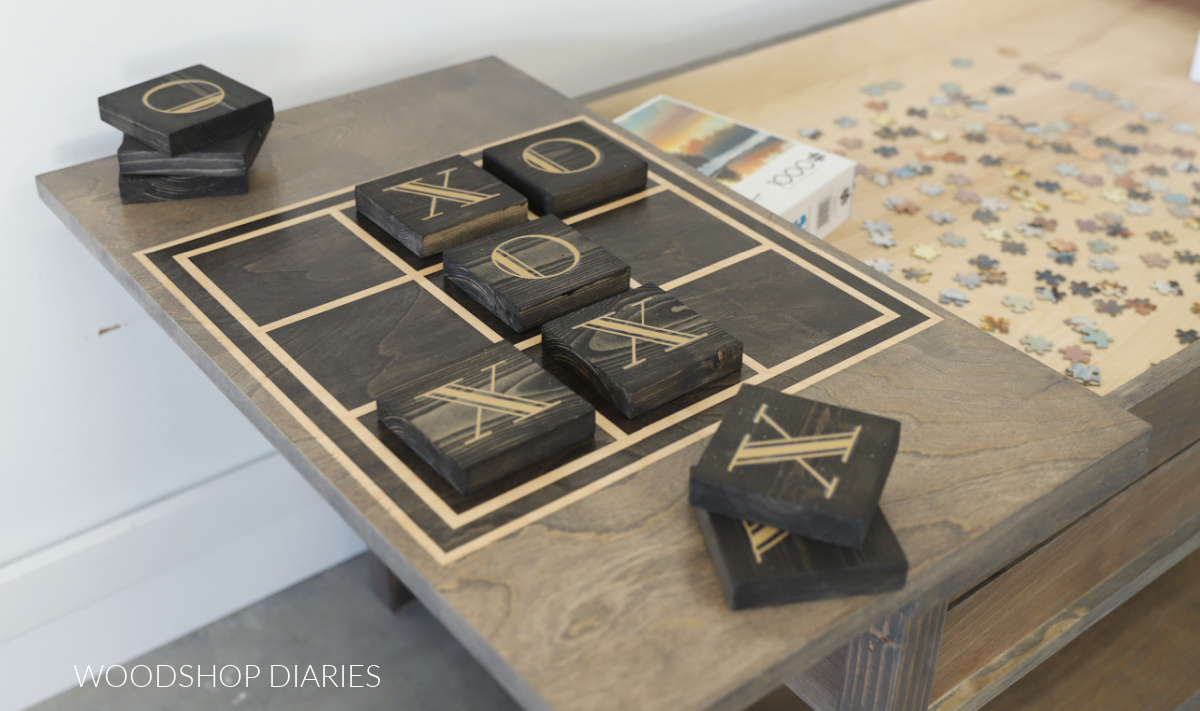
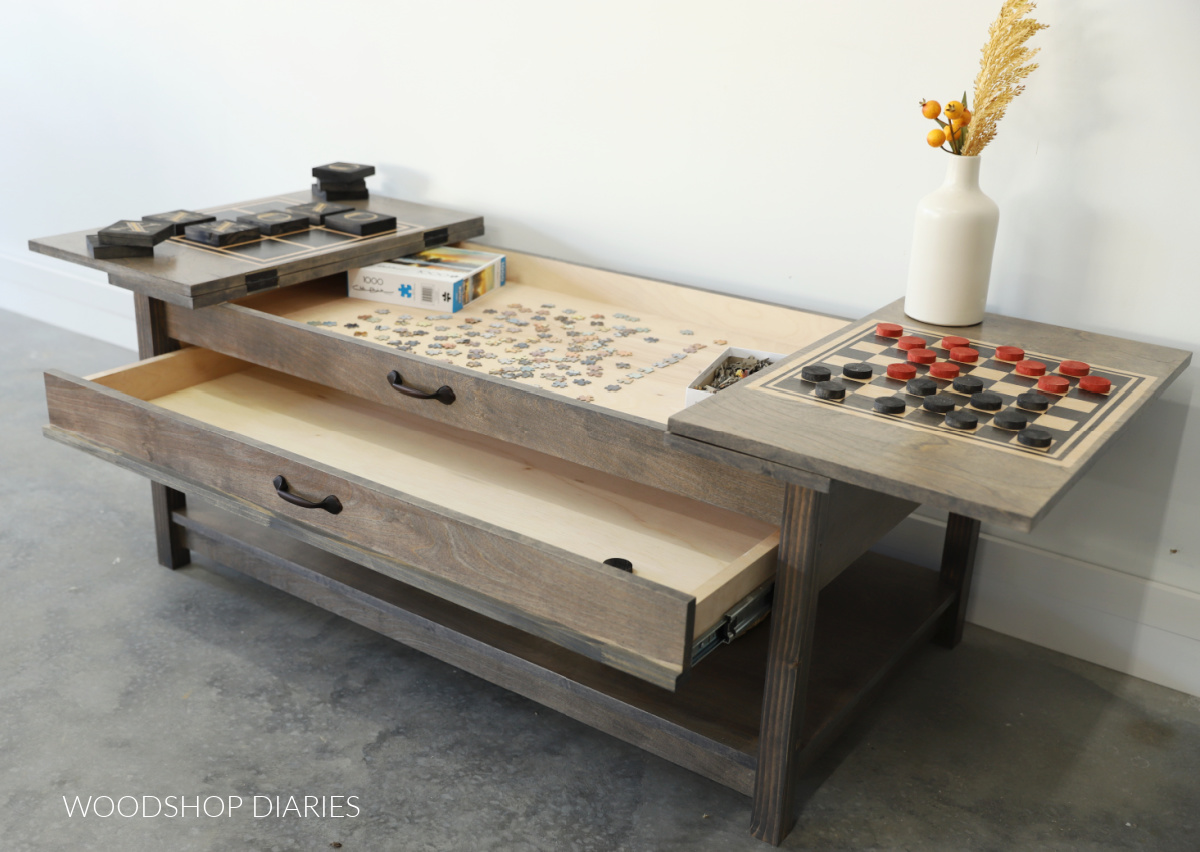
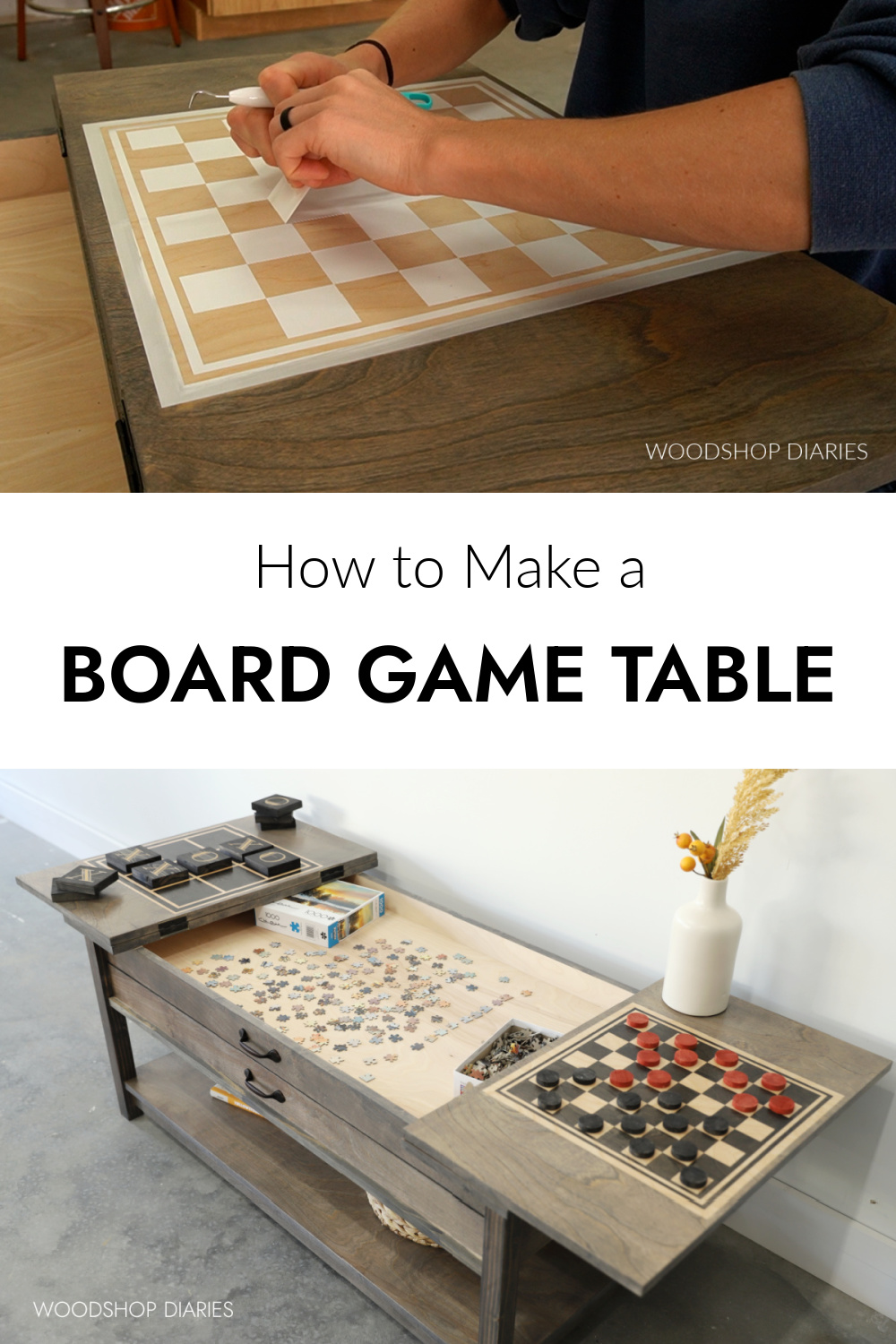
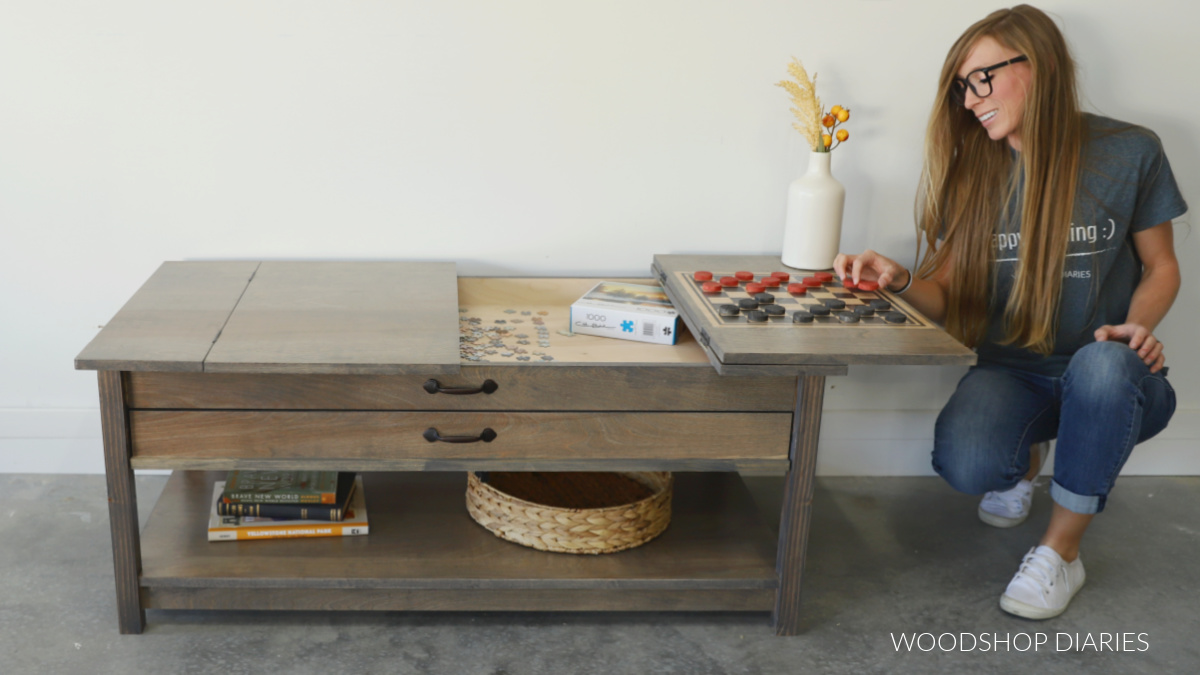
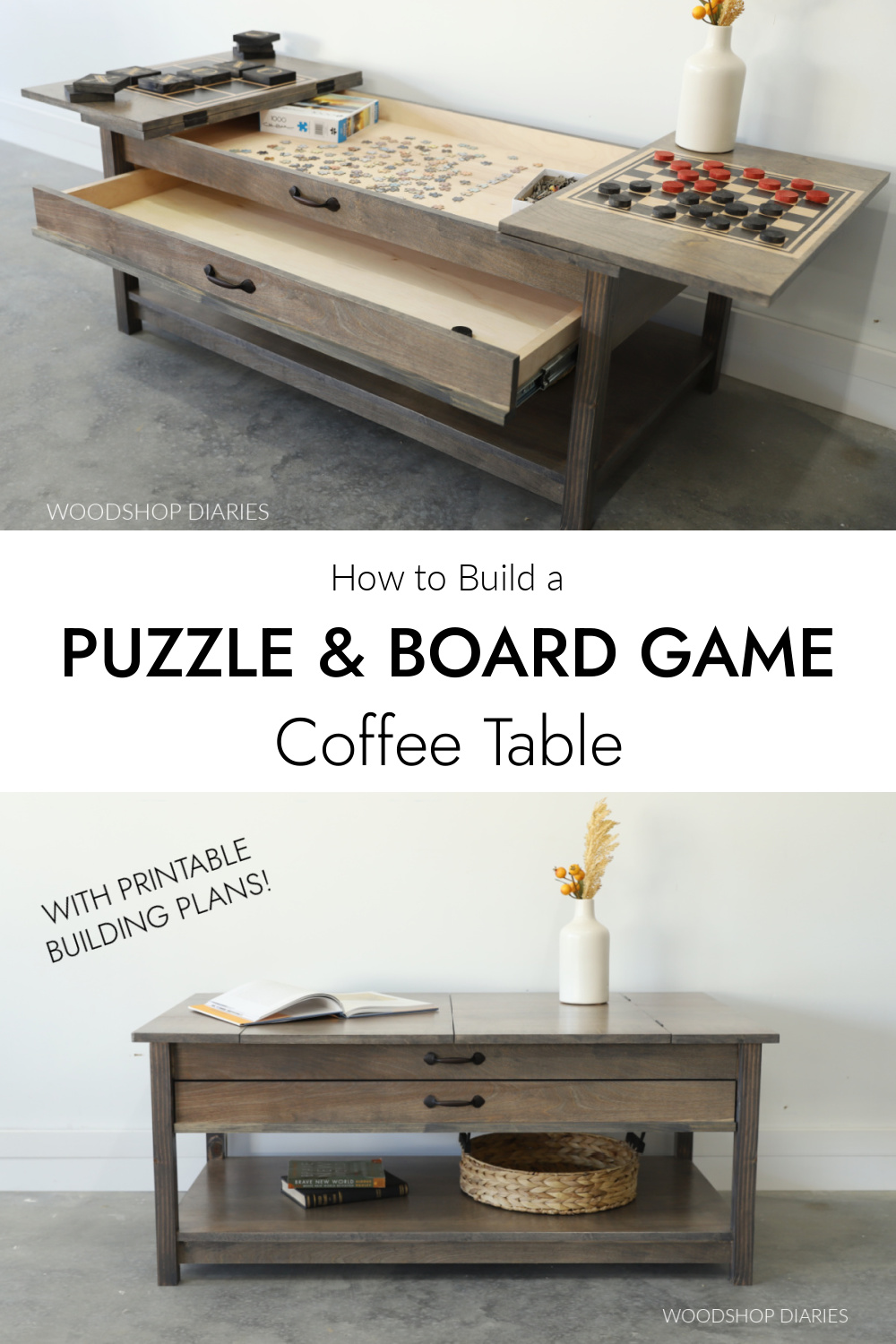
This flip top coffee table opens up for puzzles or playing board games inside, but the flip tops also have built in game boards for tic tac toe and chess/checkers.

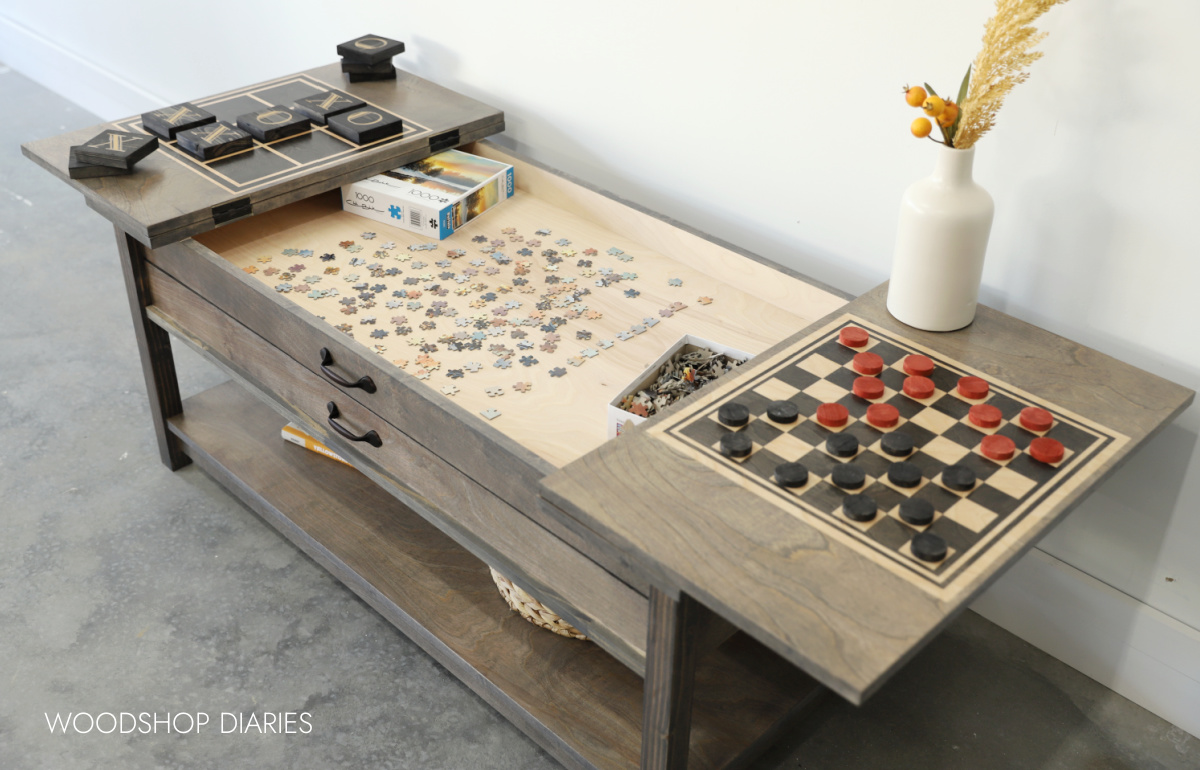
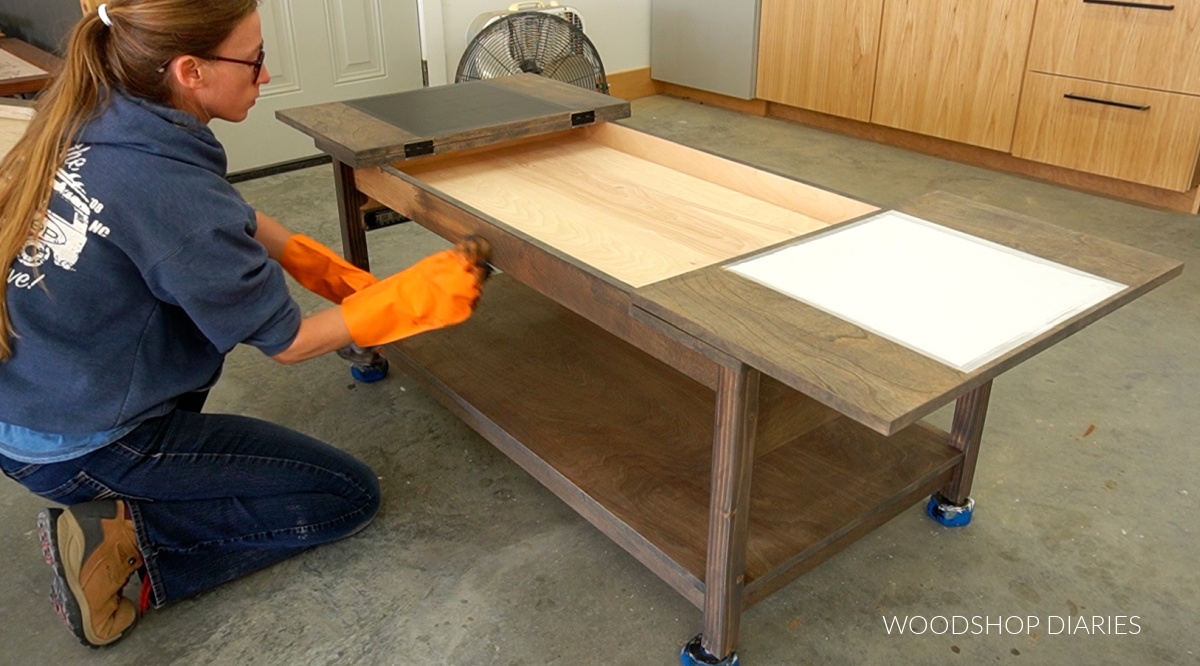
DIY board game table with tops flipped open showing checkers on one side and tic tac toe on the other side with a puzzle underneath

I love playing board games. But often, it’s a pain to get them out and set up because there just never seems to be a great place for it.

The dining table and kitchen island seem to always be occupied, and I’m too old to play sitting in the floor (too hard on these old knees ha!).

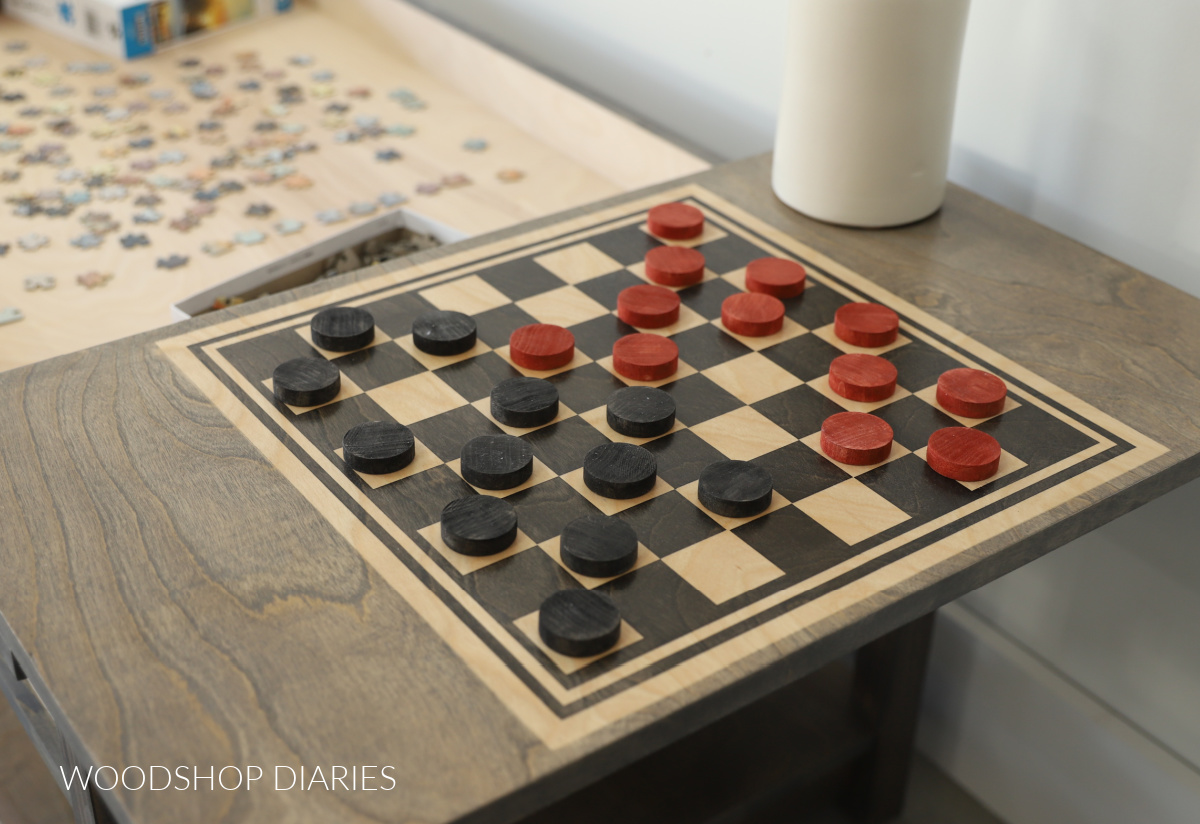
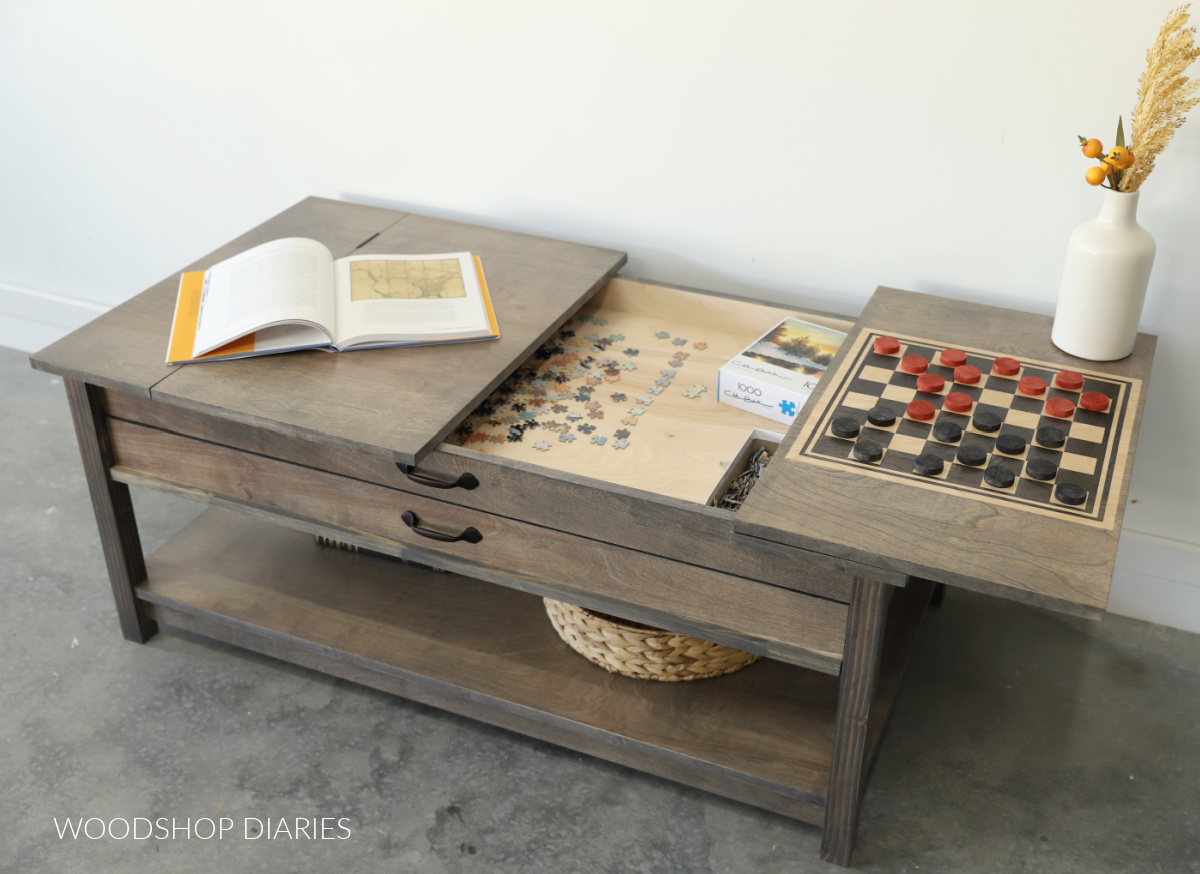
So I decided to build a coffee table designed specifically to host board games. If you flip the top open, chess/checkers and tic tac toe are built directly into the wood.

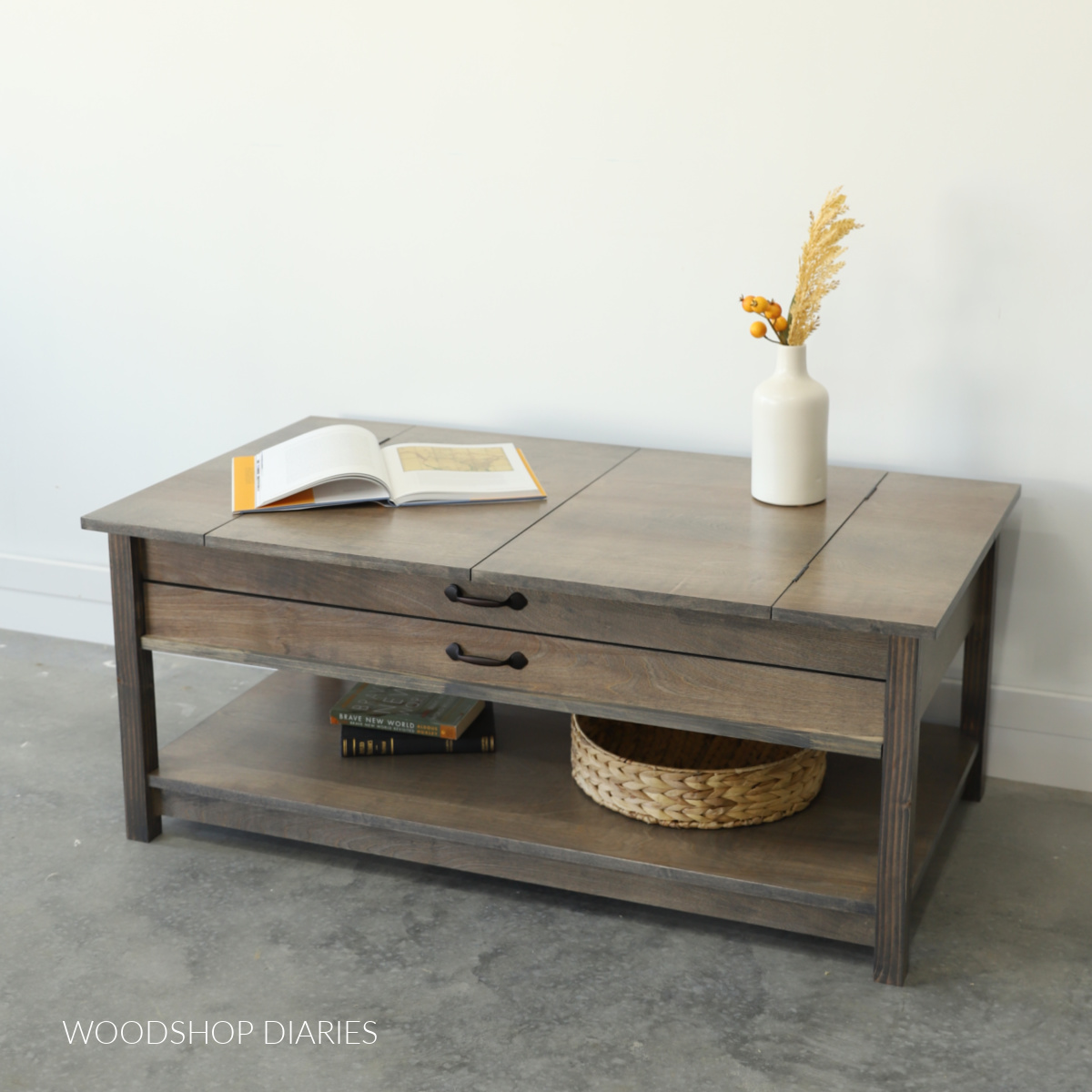
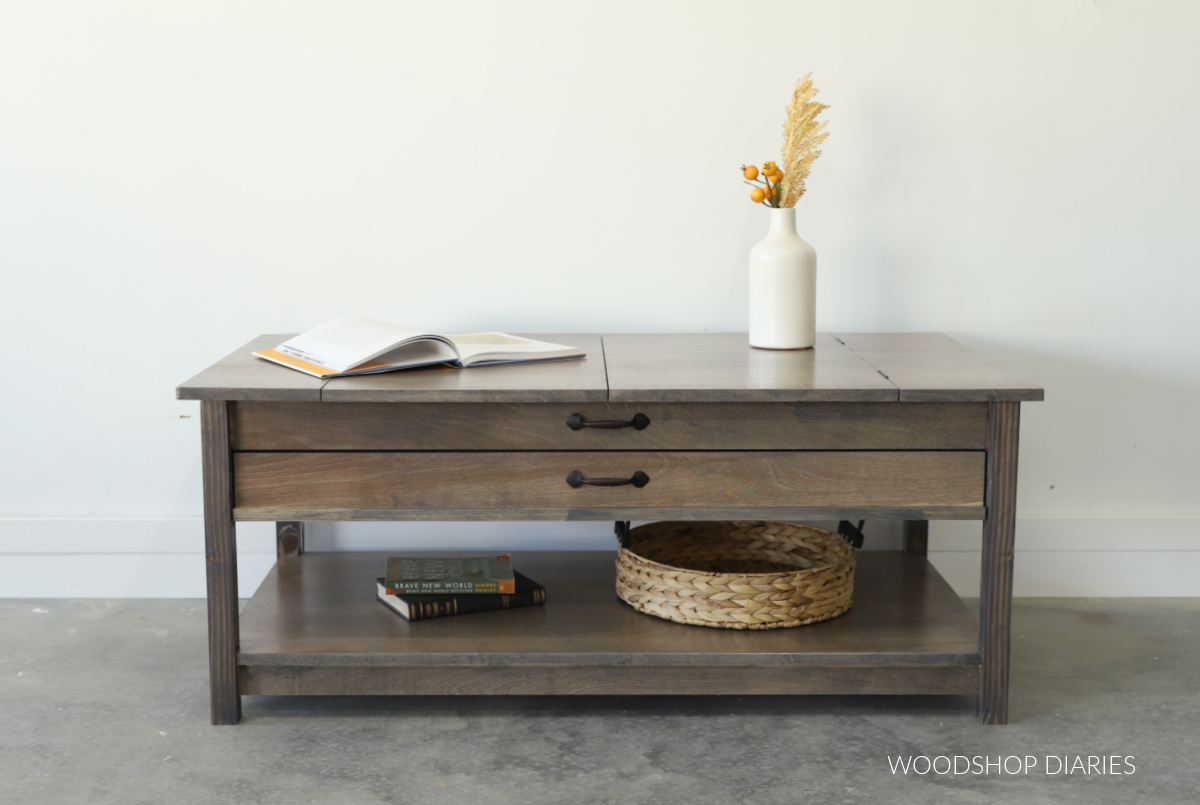
But, there’s also space inside to work a puzzle or set up a different board game, too. And when you’re finished, close it back up for a classy looking coffee table that looks great in any living room.

If you’re ready to learn how to build your own, I’m sharing all the details below.

Building the Board Game Table

I actually shared how to build the table in a previous post. Check out this post to grab the building plans for the flip top coffee table.

To keep that post from being super long, I broke this project into two parts–building the table and adding the board games.

The table can stand alone without the game boards and makes the perfect puzzle table. But if you wanted to add some extra fun to it, I’ve detailed how to add the board games to the flip tops in this post.

KEEP IN MIND: You can add these game boards to your own existing table if you didn’t want to build one, or you can simply put them on a piece of plywood. These don’t have to be added to the table design shown here.

How to Add Game Boards to the Table

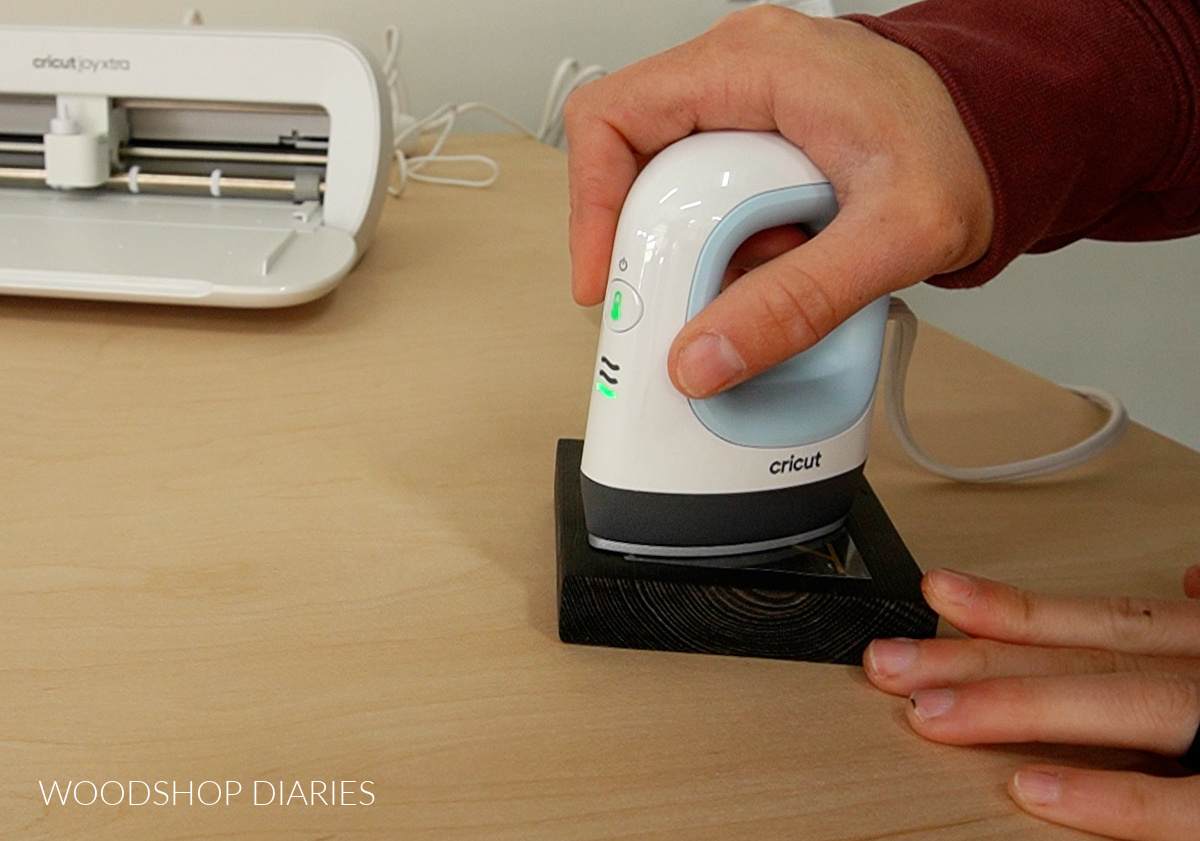
I’m sharing how to add a tic tac toe and checker board to wood below as well as how to create your own playing pieces. I did this using stencils I made using my Cricut.

If you’re new to using a Cricut to create stencils, I HIGHLY recommend checking out the video to get a better visual of the process. If you don’t want to see the whole build, you can skip straight to adding the game boards at 4:11.

YouTube Thumbnail for Puzzle Table video

Love watching how-to videos? Subscribe to my YouTube channel for plenty more where that came from!

Tools & Materials

*This post contains affiliate links. See website polices.

Tools listed below are what you need to create the game boards and game pieces. For tools and materials for the flip top table, see this post.

Tools:

  • Cricut Joy Xtra (or other Cricut machine)
  • Cricut Starter Toolset
  • Cricut Easy Press Mini (or small iron)

Materials:

  • Cricut Smart Vinyl (3 ft per game board–in any color in either permanent or removeable)
  • Cricut Smart Iron On (Gold)
  • Transfer Tape (3 ft per game board)
  • 1 ¼″ dowel rod
  • 1×4 scraps
  • Stain or finish of your choosing
  • Painter’s Tape
  • Foam Brush

Are DIY projects your thing? Sign up for our newsletter for priority access to the latest projects and build plans!

Step 1: Build the Board Game Table

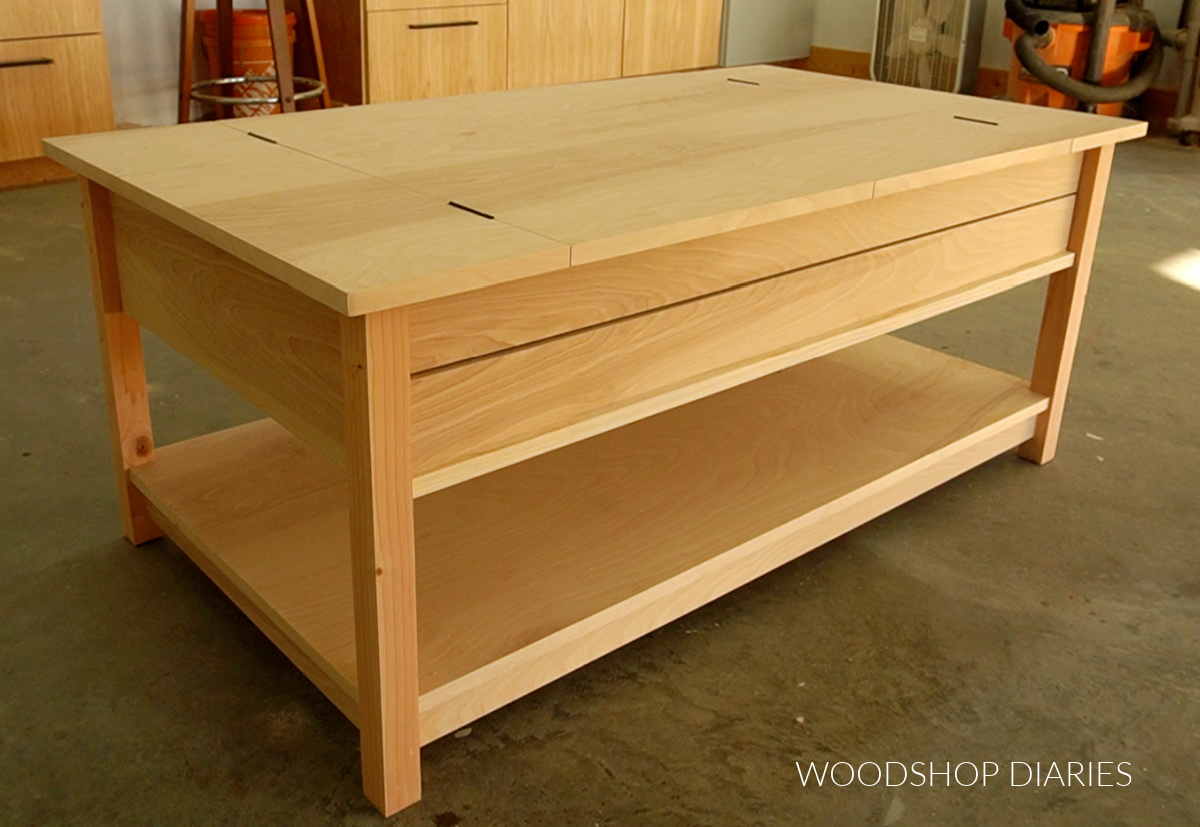
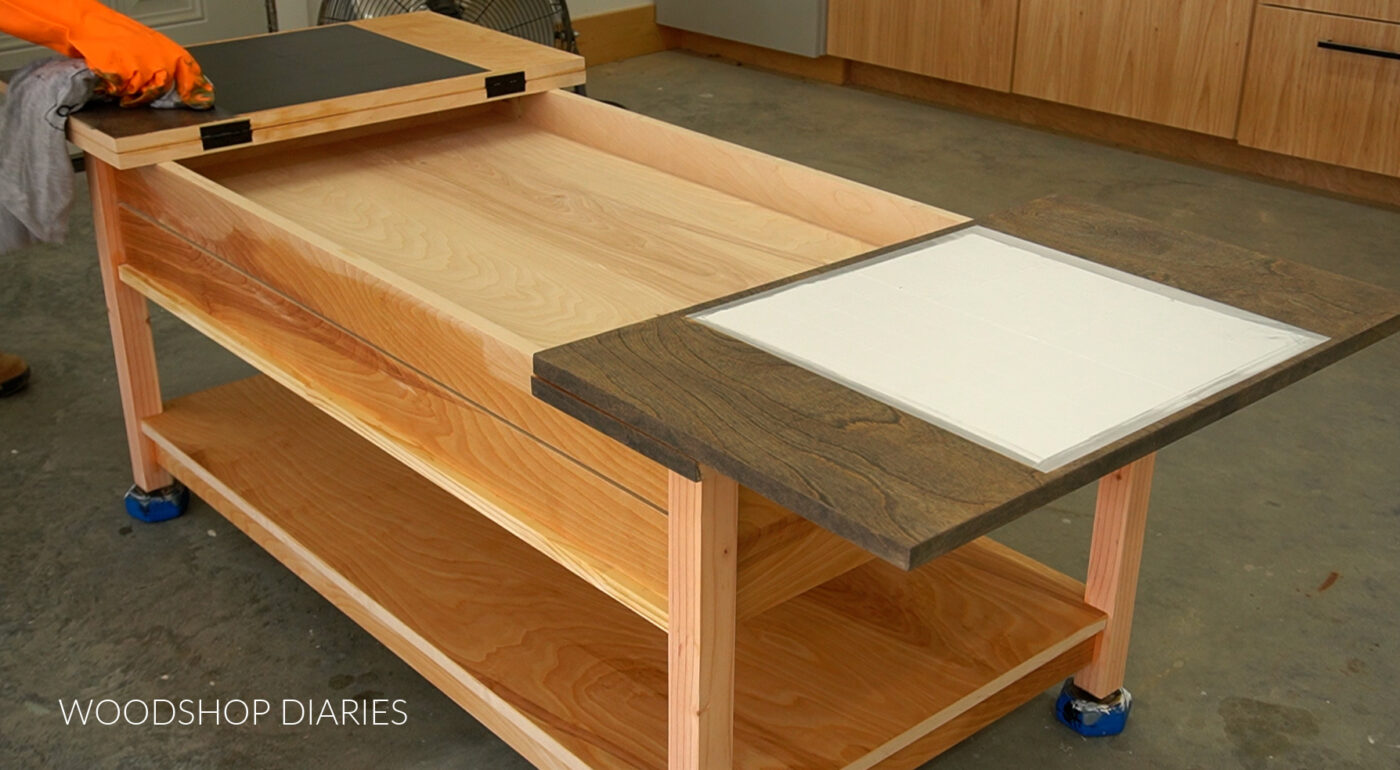
First, build the flip top coffee table according to these plans, but don’t apply a finish yet.

Unfinished puzzle table assembled in workshop with flip tops

Or, if you prefer to add these game boards to your own table or a simple piece of plywood and not to a table at all, that is fine, too!

Make sure whatever surface you’re applying this too is sanded well, all dust is removed, and if you plan to stain it, make sure all previous finish (if applicable) is removed as well.

Step 2: Cut and Apply Board Game Stencils to Table Top

I used vinyl stencil to create the game boards on the table and used contrasting stain colors to make them stand out.

I used the Cricut Joy Xtra machine to cut my vinyl. And, this machine will only cut up to 8 ½″ wide, so I did have to cut the game board designs in half and apply them to the wood in two pieces since they were about 15″ x 15″.

When working with a Cricut machine, you design your projects in Cricut Design Space. It’s an easy to use software so you can certainly design your own game boards if you’d like.

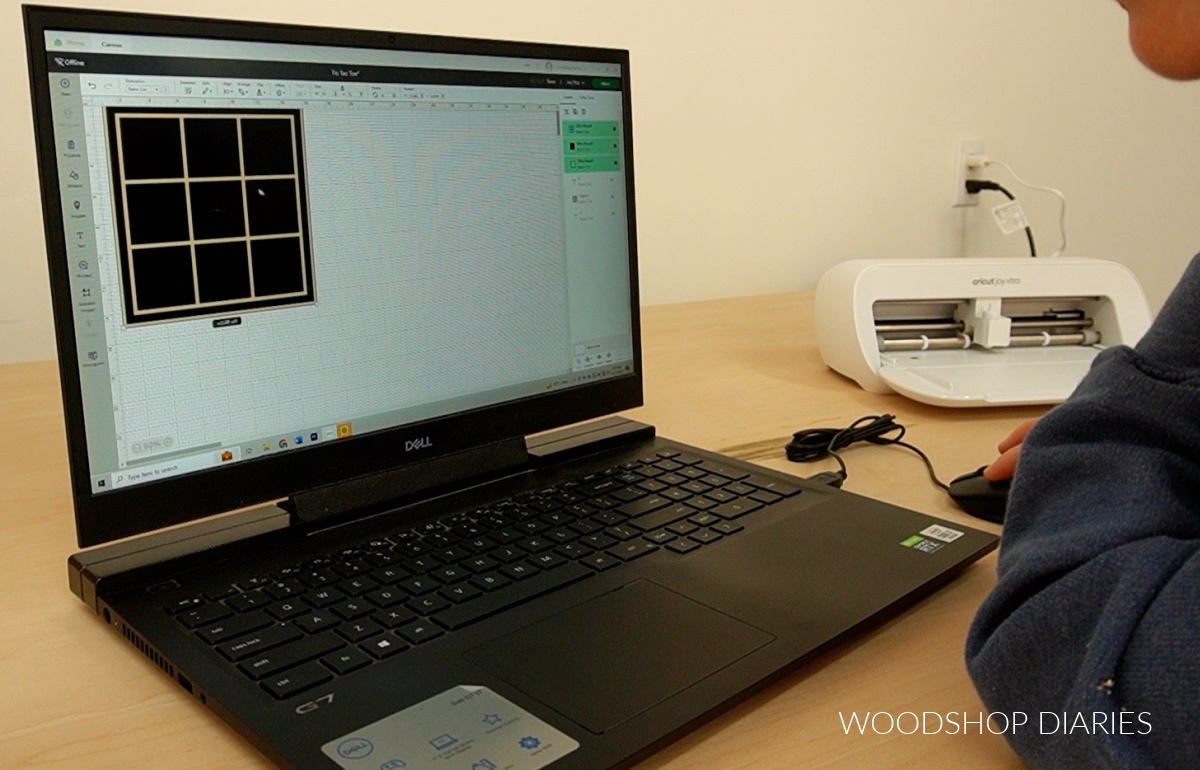
designing tic tac toe board on Cricut Design Space

However, to make things easy for you, I’ve shared my designs for the Tic Tac Toe board and the checker board publicly so you can open them and use the exact template as I did (and they’re already cut in half for you for easy cutting) with your Cricut.

  • Open the Tic Tac Toe Board Design here.
  • Open the Checker Board Design here.

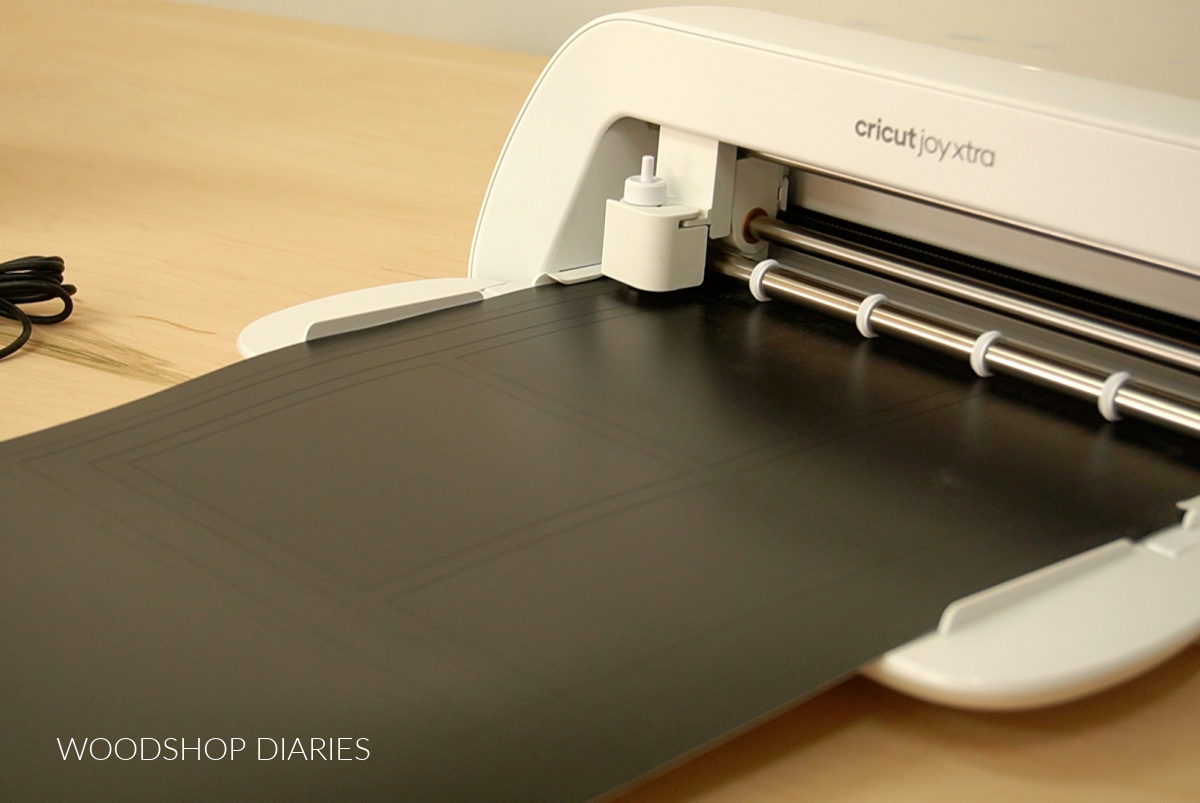
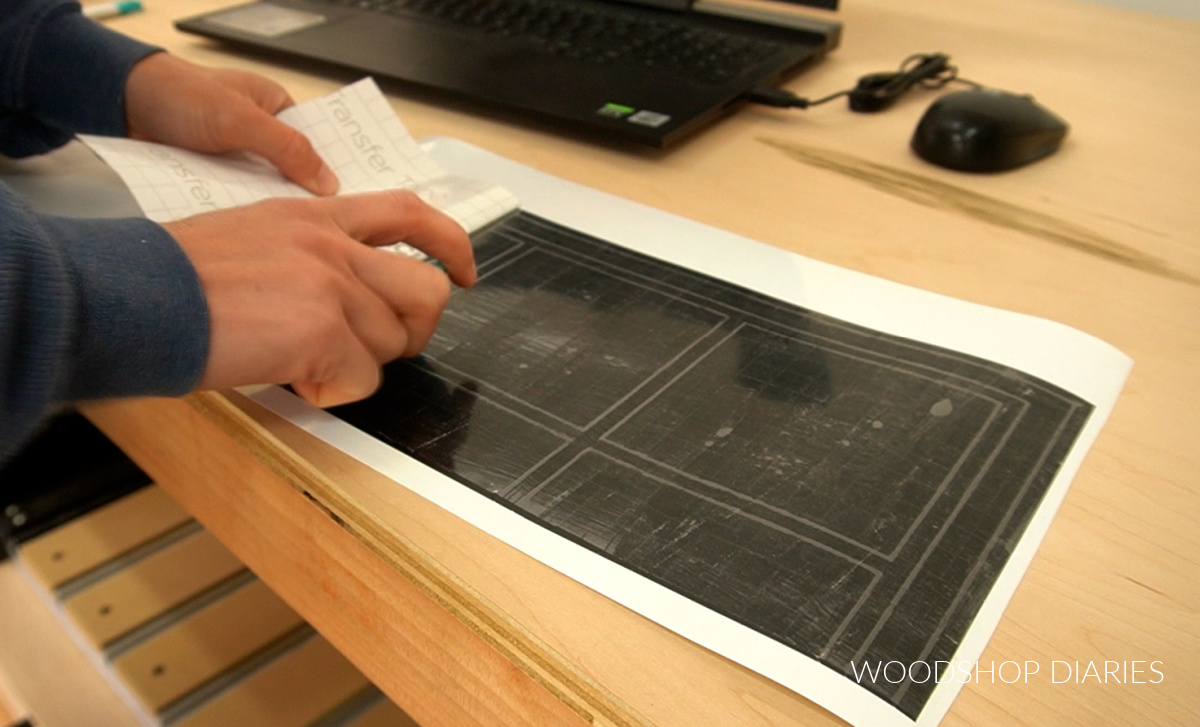
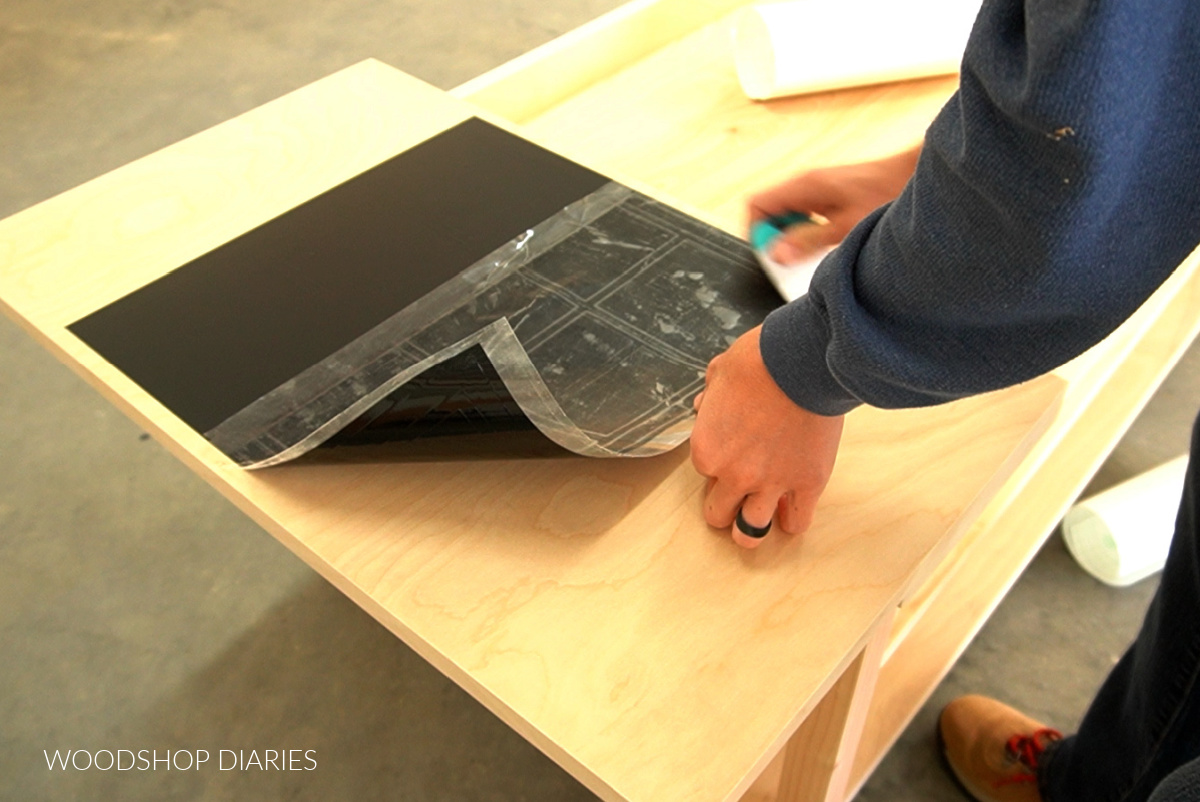
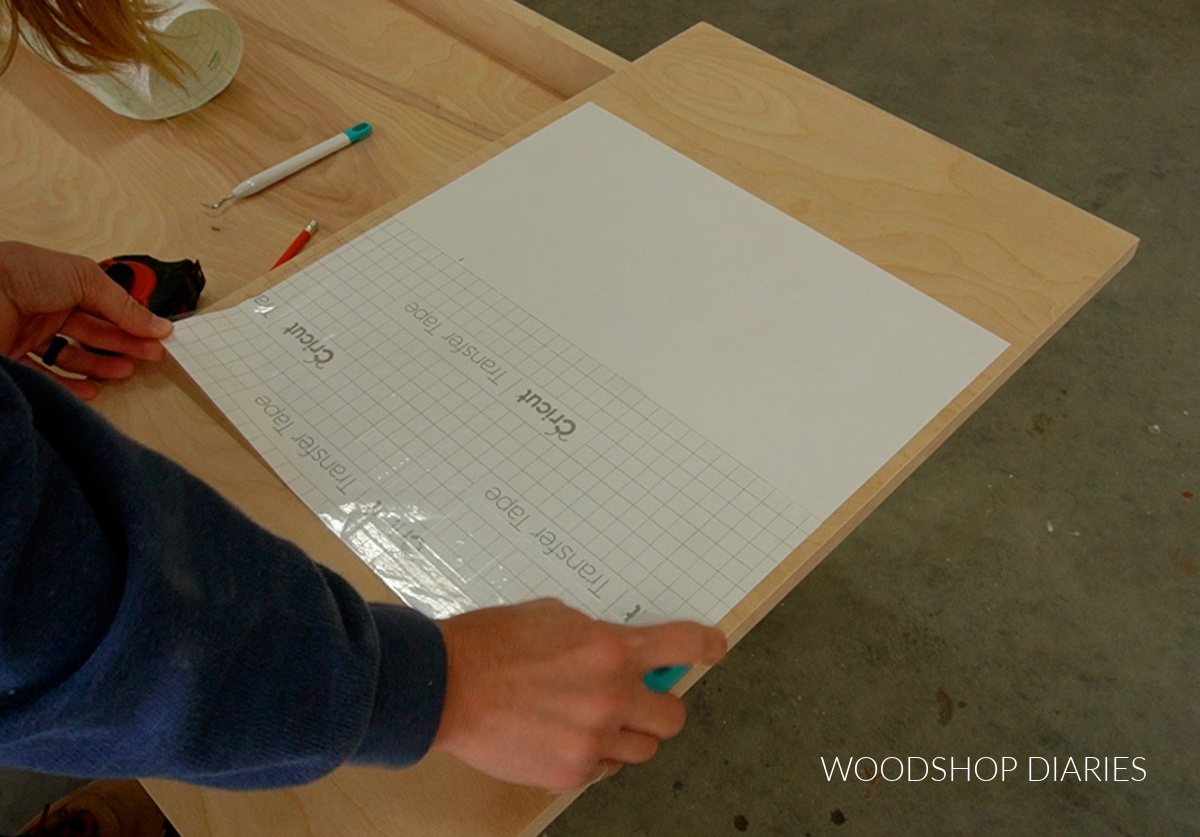
I cut out my Tic Tac Toe design on black permanent vinyl (but any color in EITHER permanent or removeable would work fine), weeded away the outside pieces, then applied transfer tape to it.

Cricut Joy Xtra cutting vinyl stencil for board games
Shara Woodshop Diaries applying transfer tape to board game stencils

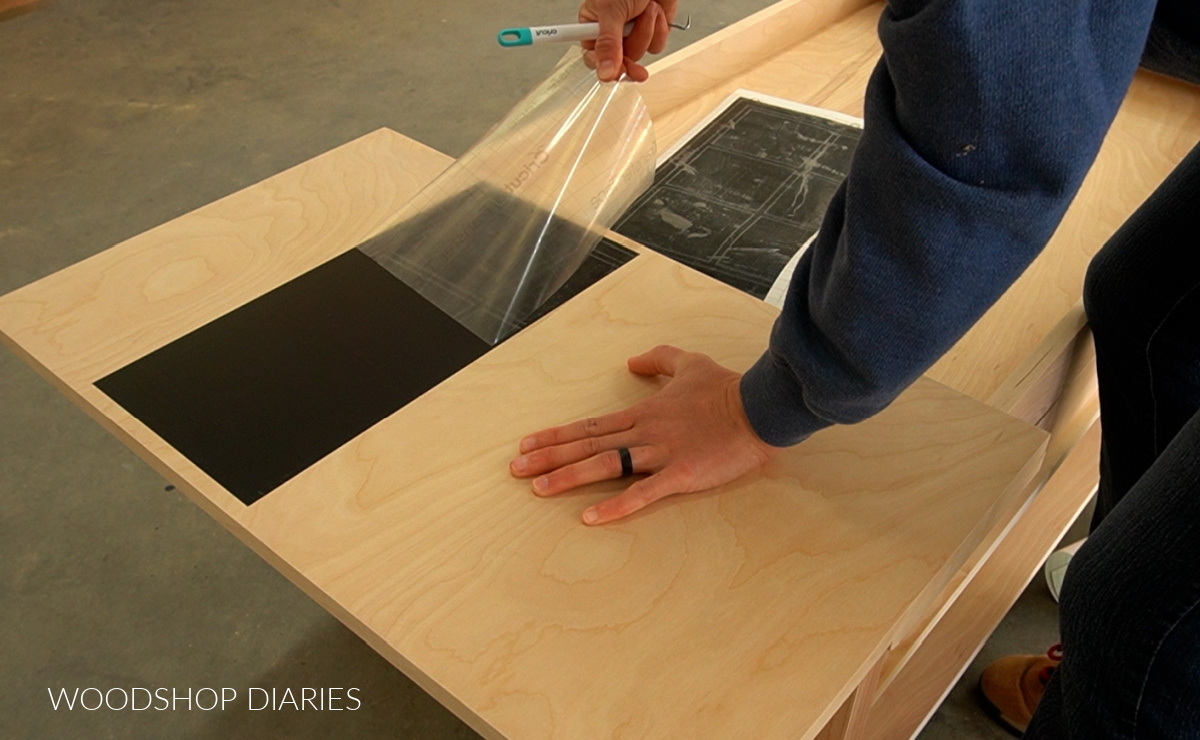
Transfer tape allows me to transfer the vinyl stencil to the wood without losing the design. I mentioned that I had to cut this design in two sections, so I applied the first section to the table making sure it was straight, then removed the transfer tape.

Removing transfer tape from tic tac toe stencil on coffee table flip top

Then, I applied the second part of the stencil making sure to line up the edges with the first one and removed the transfer tape. The little scraper in the Cricut toolset is really helpful to smooth out the vinyl so you don’t get air bubbles.

Applying second half of board game stencil to table top

I repeated the same process for the checker board, only this time, I used white vinyl. Since these are just stencils, the color doesn’t matter. I’ve used both removeable and permanent vinyl for stencils in the past, and both work fine for this.

I didn’t remove any parts on the inside of the board game squares YET. Once applied, make sure the edges are nice and flat and pressed down all the way.

applying checker board stencil to wooden table top

Step 3: Finish the Table

Then, I stained the table with Minwax Aged Barrel wood stain. I used a rag and carefully stained around the outside edges of the board games making sure not to apply the stain too heavily.

staining around board game stencils

As strange as it might sound, oil based stains are actually quite a bit thinner than water based stains and can tend to “seep” into the wood grains underneath the stencils if applied too heavily.

I actually recommend using water based stains with stencils over oil based, but I already had this particular oil based stain on hand and I really wanted to use this color.

After carefully staining around my stencils, I stained the rest of the table and allowed to dry.

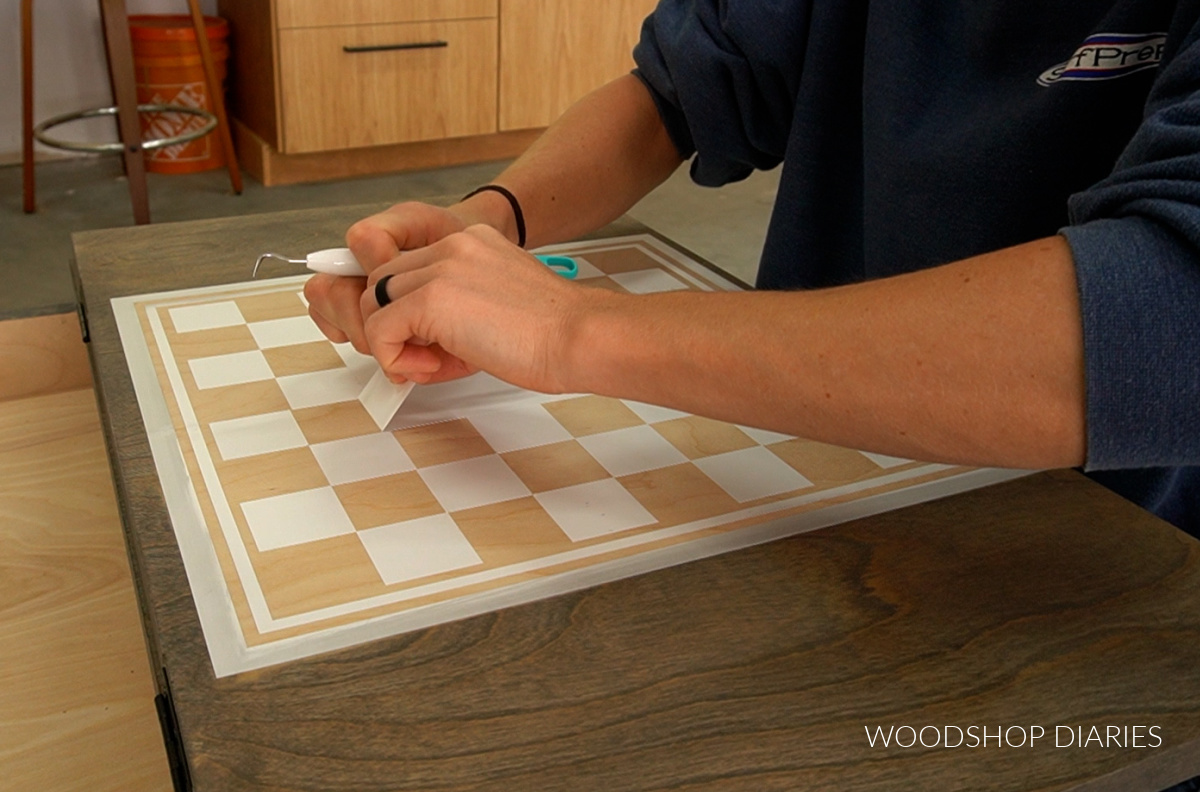
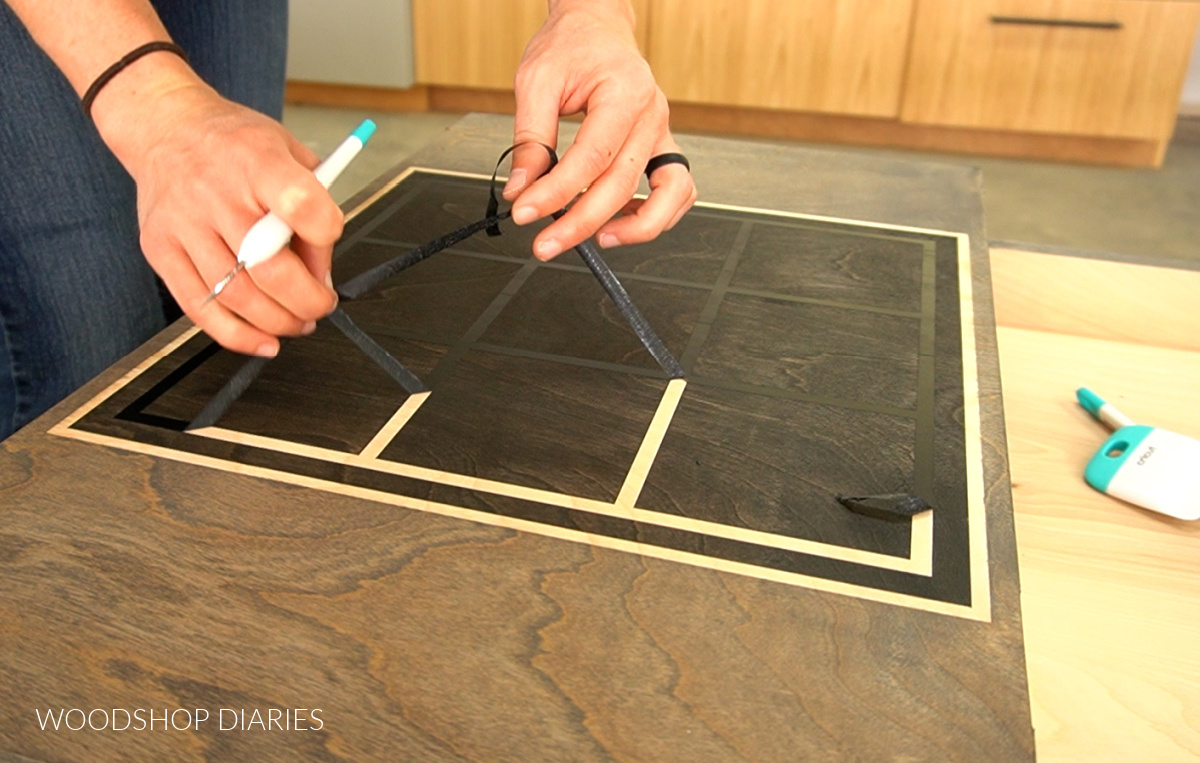
Once the stain had dried, I used a picking tool from the beginners toolset to pick out and remove the parts of the game boards I wanted to stain black.

Shara Woodshop Diaries removing parts of stencil that need to be stained

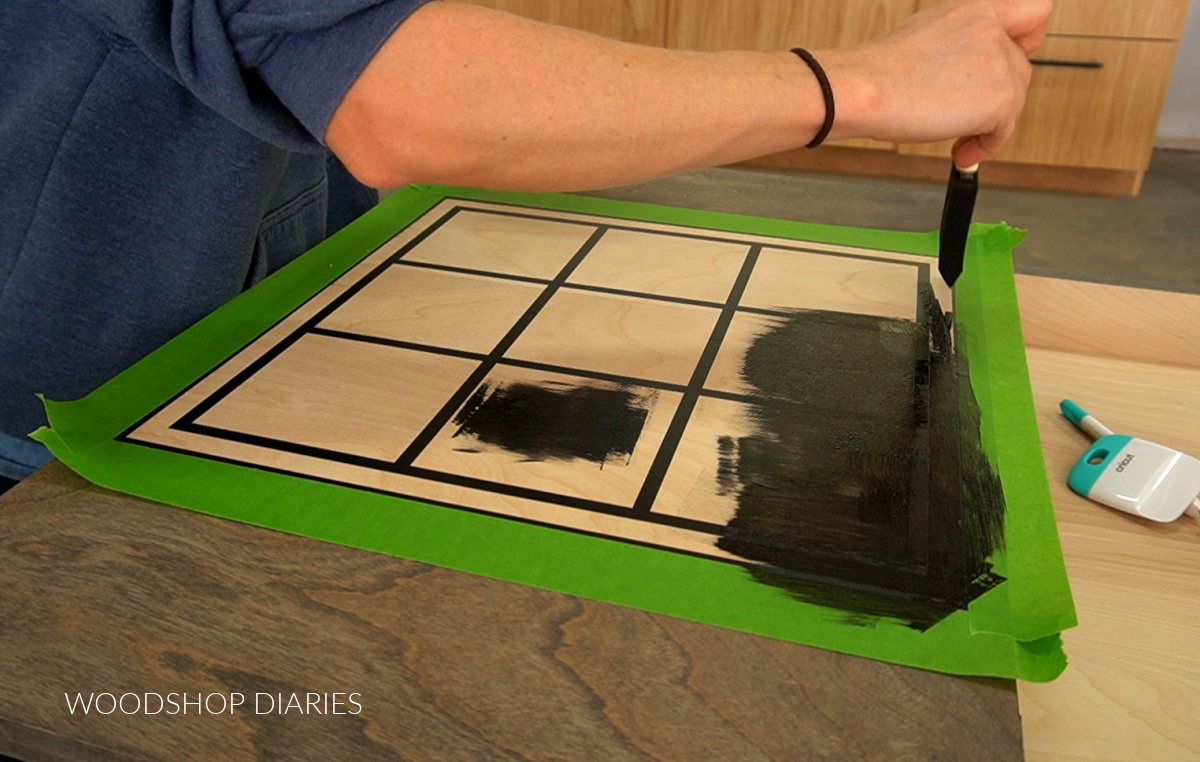
I protect the surrounding area, I used some painters tape to tape off around the outside edge before applying a water based black wood stain to the game boards with a foam brush.

using a foam brush to stain tic tac toe game board onto table top

You want to make sure to wipe off the excess stain quickly as water based stains dry really fast.

Once the game boards were stained, I carefully removed all the remaining vinyl on the table.

Removing vinyl stencil from table top to reveal tic tac toe board

Step 4: Make the Board Game Pieces

Now the game boards are applied to the table, but they still need the game pieces.

How to Make Easy DIY Checkers

The checkers I made for this board game were cut from a 1 ¼″ diameter wooden dowel rod. I cut 26 pieces of dowel to about ⅜″ thick. These don’t have to be a specific thickness as long as they’re all the same.

TIP: Clamp a stop block on your miter saw to easily cut consistent thicknesses from the dowel.

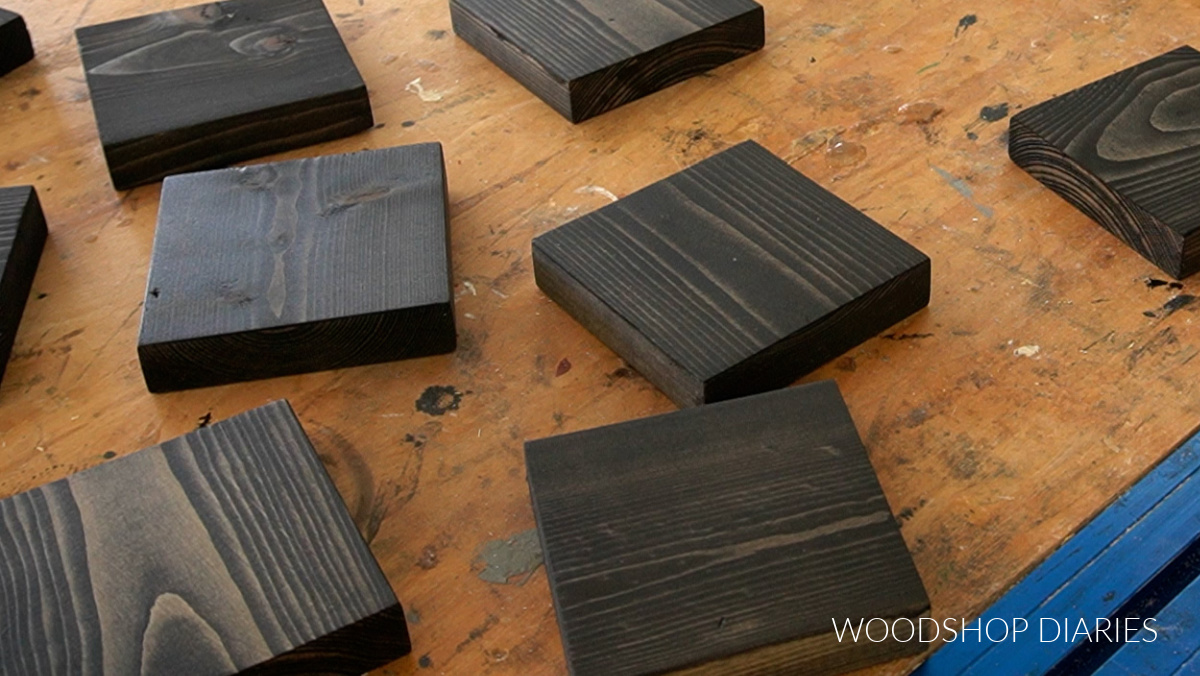
Once the pieces were cut, I hand sanded them to remove any rough edges, then stained 13 of them with Minwax Water Based Stain in Spice and 13 Minwax Water Based Stain in True Black.

NOTE: You only need 12 of each color, but I made an extra of each so I had some spares.

wood dowels cut and stained for checkers on board game table

I like water based stains here because they dry really quick, but you could also use spray paint, or another finish if you’d like.

How to Make Easy Tic Tac Toe Pieces

For the tic tac toe board pieces, I cut 10 pieces of 1×4 to 3 ½″ long (this makes them squares). OR, feel free to cut some plywood scraps to 3 ½″ x 3 ½″. Either works fine.

I stained these Minwax True Black (but you could stain or paint any color you’d like).

1x4 scrap squares stained black on workbench

And once they dried, I headed back to my Cricut Joy Xtra to cut out some Xs and Os. These Xs and Os are included in the original Tic Tac Toe design I linked in step 2.

I cut these out on Cricut Smart Iron On in Gold. FYI: If you’d rather, you can simply use vinyl for the Xs and Os or create a stencil and paint them on. Iron on will kind of “melt” into the contours of the wood to adhere really smooth.

Cricut Easy Press Mini ironing on Xs and Os to tic tac toe pieces

Once cut, I ironed them onto each piece–5 Xs and 5 Os–using my Cricut Easy Press Mini. But a small iron would work as well.

Close up of tic tac toe game pieces on flip top board game coffee table

Step 5: Seal the Table

The final step is applying a sealer to the table, game boards, and game pieces to protect the surfaces. I used a couple coats of Minwax Water Based Helmsman to seal.

And with that, the table is ready for all the fun and games!

DIY Board Game Coffee Table with flip tops and drawer open. Built in checkers on the right side and built in tic tac toe on the left side with a puzzle in the middle

I love the contrasting stain colors on these boards and how much character they add to this table.

Gaming coffee table with puzzle compartment and checker board open

It’s the perfect place to gather around the living room and have a family game night.

Looking for more Cricut Projects?

If you’re looking for more fun ways to use a Cricut, here are a few projects you might enjoy!

DIY Plant Ladder with Tags
Hello Pumpkin Sign
Stenciled Door Console
DIY Life Size Ruler
DIY Huge Wooden Shop Sign

If you enjoyed this project and want to save it for later, don’t forget to pin it or share to your favorite social channel!

Board game table pinterest collage image showing stencil at top and completed table at bottom with text "how to make a board game table"

Until next time, happy building!

How to Build a Puzzle Coffee Table

October 23, 2023 by Shara, Woodshop Diaries

In this post, I’m sharing how to build a hidden puzzle coffee table with a storage drawer and open shelving!

This fun take on a basic coffee table features two flip tops that also have built in board games–tic tac toe on the left and checkers/chess on the right.

Coffee table with top flipped open to reveal a shallow compartment for puzzles inside. Flipped top section contains a built in checker board

When it’s closed up, this table is simple and clean and classy. Even if you didn’t want this as a puzzle table, the design makes the perfect DIY coffee table for any living space.

And the shallow bottom drawer is handy for storing game pieces, cards, magazines, books, and remotes.

This project was SO much fun to put together, and I can’t wait to show you how to build your own in the plans below.

Simple modern puzzle coffee table with top closed

*This post contains affiliate links. See policies.

What to know before building a Puzzle Coffee Table

This project was made almost entirely of plywood–except for the legs and a couple trim pieces. I used birch ply for this build, but maple, oak or any other cabinet grade plywood would work well, too.

RELATED: How to choose the right plywood for your project

It’s a great intermediate level build–certainly not difficult, but does have several parts and pieces.

If you check out the video below, you’ll notice that I ran into some issues installing the bottom panel because I attached the top supports first.

After building it, I recommend installing the bottom supports and shelf first, then installing the top supports.

Overall Dimensions

The overall dimensions of this puzzle coffee table are 19 ¾″ tall x 26 ½″ deep x 48″ wide.

Overall dimensional diagram of simple puzzle coffee table with flip tops

Puzzles come in various sizes, but many 1000+ piece puzzles are roughly 20″ x 26″ when finished. So when the top two sections of the table are flipped over, the opening is about 21 ½″ x 32″. This allows plenty of room to work most standard size puzzles.

Are DIY projects your thing? Sign up for our newsletter for priority access to the latest projects and build plans!

A Tip on Installing the Hinges

The table top was assembled in four pieces. The two outside pieces are stationary and attach to the table base. The two center pieces are hinged to these outside pieces and are not attached to the base. This allows them to flip open and close freely.

For this project, I used some simple cabinet butt hinges for the flip tops. They’re great, but they have a downside–once installed between two pieces, it creates a rather large gap (about ¼″).

The gap doesn’t affect the function of the table, but I just didn’t love how it looked. So, to help close the gap a little, I used a router to cut about ⅛″ mortise into my stationary top pieces for these hinges to recess into.

Mortise cut into plywood to install hinge

This is not a necessary step of the build, but this does make it look a little nicer if you’d like smaller gaps at the hinged joints.

HELPFUL RESOURCES TO USE DURING THIS BUILD

  • How to cut plywood
  • How to apply edge banding
  • How to use a pocket hole jig
  • How to build a drawer box
  • How to install drawer slides
  • How to add board games to table top

How to Build a Puzzle Table

If you’re ready to build your own unique puzzle coffee table, I’m sharing the plans and step by step tutorial below.

But if you prefer to watch, check out the build video on my YouTube channel here. The video contains additional details on adding the game boards plus tips for the build.

YouTube Thumbnail of puzzle coffee table video

Love watching how-to videos? Subscribe to my YouTube channel for plenty more where that came from!

Prefer to print? Grab the printable puzzle table building plans here:

Tools & Materials

Tools:

  • Circular Saw
  • Cutting Guides (Kreg Rip Cut and Kreg AccuCut used here)
  • Pocket Hole Jig
  • Drill/Driver
  • Miter Saw (optional)
  • Jig Saw
  • Brad Nailer (optional)
  • Router & Straight Bit (optional)

Materials:

  • (1) 4×8 PLUS (1) 2×4 sheet ¾″ plywood–1 ¼ sheet total
  • (1) 2×4 sheet ¼″ plywood
  • (1) 2x2x8
  • (1) 1x2x8
  • 1 ¼″ pocket hole screws
  • (1) pair 20″ drawer slides
  • (2) pair butt hinges OR (2) 24″ piano hinges
  • Wood Glue
  • Edge Banding
  • (2) drawer pulls/knobs

Although it’s not really a “step,” the first part of this project was cutting down my plywood sheet(s). This project used 1 ¼ sheets of ¾″ plywood and I began by cutting down my pieces according to the cut list in the printable plans.

I cut my plywood down using my circular saw and Kreg Rip Cut and AccuCut. You can learn more about them and how to cut down plywood in this post.

Shara Woodshop Diaries cutting down plywood with Kreg Rip Cut

Step 1: Install Bottom Shelf

I mentioned earlier that when I built this, I installed the top supports first, but when I got ready to install the bottom panel, I had to remove two sides in order for it to fit.

So in hindsight, I recommend installing the bottom supports and panel first. The next step will be installing the top pieces. Just ignore them in the pictures for now.

I installed 2″ wide plywood strips between the 2×2 leg posts using pocket holes and screws. All the supports should be flush to the inside about 2″ up from the bottom of the legs.

RELATED: How to use pocket holes to build furniture

Coffee table base frame assembled on workbench with pocket holes

Then, I cut a plywood panel to place on top of these. I cut this about ½″ smaller in both dimensions than the overall size of the base. That will allow the panel to sit INSET the legs about ¼″ on all sides.

In order to fit around the legs, each corner will need to be notched out about 1 ¼″ square. I used a jig saw to carefully cut each corner.

TIP: Use a fine finish blade on the jig saw to help prevent tear out when cutting plywood.

Close up of corner notched out of plywood panel

Once cut, I applied edge banding to the long edges of the panel. These long sides will be exposed in the finished project, so edge banding makes these plywood edges look more finished.

RELATED: How to apply edge banding

I test fit to make sure this panel will properly fit along these bottom supports. After I made sure it fit, I applied a bead of glue along the top edges of the bottom supports, placed the panel on top, and clamped until dry.

Applying wood glue to coffee table bottom supports to install bottom shelf

Step 2: Install Top Supports

This is the point where I recommend actually attaching the top supports. I cut the top supports from ¾″ plywood according to the cut list in the plans.

Note that the front piece is only half as tall as the back piece (about 3″) because I’ll be adding a drawer below it later.

Shara Woodshop Diaries installing top supports of puzzle table

I drilled pocket holes into the ends of the supports and installed them even with the top of the legs using pocket hole screws, making sure to keep them flush to the inside.

Step 3: Attach Puzzle Table Top

I cut a piece of ¾″ plywood to 26 ½″ x 48″ for the top. Then, I trimmed this piece into four pieces like shown below.

The two outside pieces will be stationary (attached to the table base), and the two middle pieces will be the parts that flip open to reveal the puzzle compartment.

Top panel diagram showing dimensions of 4 sections

Once this was trimmed into 4 pieces, I installed the hinges between the outside and middle pieces. I used some simple cabinet butt hinges for this, but piano hinges would also work really well.

NOTE: These hinges are super easy to install, however, the downside is that when you put them between the boards, the gaps are fairly large (about ¼″).

If you wanted to minimize the gaps, you could use a router to cut about ⅛″ mortise into the edge of one piece to kind of recess the hinges into. See video for more details.

I applied edge banding to the four pieces of the top everywhere EXCEPT where the hinges will go (see image below). The edge banding will help fill the gaps caused by the hinges.

Installing butt hinges to flip tops for puzzle table

Once the hinges are installed between the two outside sections and the inside sections, I made sure when they were placed flat across the table base, they were flush across the top. Adjust as needed to the top lays as flat at possible (the hinges will stick up slightly).

After the hinges are adjusted, I flipped the pieces upside down leaving about ⅛″ between the two middle sections. Then I drilled ¾″ pocket holes around the top supports and flipped it over on the top pieces.

Make sure the pocket holes are only drilled where they will be only on the outside sections of the top are. Then I secured with pocket hole screws.

attaching the flip top to the coffee table base

I flipped the table back upright and made sure the flip tops open and close properly without rubbing.

Prefer to print? Grab the printable puzzle coffee table plans here.

Step 4: Install Puzzle Compartment Panel

Once the top is installed, I could add the bottom panel of the “puzzle compartment.” I cut a ¾″ plywood panel to fit into the opening between the top supports and drilled ¾″ pocket holes around the edges.

Then, I inserted this panel into the table base so that the bottom edge was flush to the bottom of the front top support and secured with pocket hole screws.

Diagram showing puzzle compartment bottom panel installed with pocket holes and screws

This is the part you’ll see when you flip open the table top. This is where you can work your puzzles or play a board game. Or, if you aren’t into games, hide away your remotes, books, etc.

Flip tops of puzzle table open to reveal shallow top compartment

Step 5: Install Drawer Into Coffee Table

Finally, the last part of the build is adding the drawer box. I assembled this drawer box with ¾″ plywood for the drawer box sides and ¼″ plywood for the bottom.

All the dimensions can be found in the plans. I usually cut dadoes in my drawer box pieces to install the bottom panel.

But, since this drawer was already so shallow, I didn’t want to take up any drawer space with the dado. So instead, I assembled the box with pocket holes and screws, then glued and nailed the plywood bottom onto it.

RELATED: How to build a drawer box

Shara Woodshop Diaries assembling drawer box on workbench

Then, I installed 20″ ball bearing drawer slides into the table so that they were 1 ½″ inset from the front edge of the legs.

RELATED: How to install drawer slides

Installing drawer slides to coffee table build

I installed the drawer box onto these slides, then added a ¾″ plywood drawer front using screws from the inside.

RELATED: How to install drawer fronts

Shara Woodshop Diaries installing drawer box onto drawer slides in coffee table
Securing drawer front to shallow coffee table drawer

To add some extra dimension and detail to the build, I cut and glued 1x2s to run along the bottom edge of the back top support and the drawer front.

Step 6: Finish Coffee Table

Finally, I finished the table with a final sanding and applied Minwax Aged Barrel stain before a few coats of Minwax Helmsman poly.

Shara Woodshop Diaries applying wood stain to puzzle coffee table

Then I added some drawer pulls to the top fake drawer and the real bottom drawer.

If you’re interested in how I added the checkers and tic tac toe sections to the bottom side of the flip tops, be sure to check out the YouTube video and this post where I show the process and link the Cricut files so you can try it out for yourself!

Shara Woodshop Diaries playing checkers on flip top of puzzle table

And with that, this table is ready for play! I absolutely love how this turned out and I think it’s safe to say this is one of my all time favorite builds ever!

Puzzle coffee table with tops and drawer open. Puzzle partially completed in top compartment and tic tac toe and checkers being played on flip tops
Front view of puzzle coffee table with top and drawer closed

Looking for more coffee table ideas?

Enjoyed the build and looking for more coffee table ideas? Here are a few favorites!

DIY Coffee Table
Modern Round Coffee Table
DIY Outdoor Coffee Table
DIY X Base Coffee Table
How to Build a DIY Round Wooden Pedestal Coffee Table
DIY Pedestal Coffee Table

If you enjoyed the project and want to save it for later, don’t forget to pin it or save to your favorite social platform!

Puzzle table pinterest collage showing open coffee table at top and closed table at bottom with text "how to build a puzzle and board game coffee table"

Until next time, friends, happy building!

DIY Vertical Shoe Organizer

October 13, 2023 by Shara, Woodshop Diaries

In this post, I’m sharing how to build this versatile freestanding DIY shoe organizer shelf with just 2 boards and a dowel rod!

You can easily customize to fit your own shoes and boots, but this design incorporates posts for rainboots, slotted shelves for work boots, and solid shelves for sneakers.

Shara Woodshop Diaries sliding boot into slot on shoe organizer shelf

And the best part? It’s perfect for small spaces since it has a very small footprint. Vertical shoe storage for the win!

This simple shelf would work great in a mudroom, garage, or small entryway and can store boots and shoes of all shaped and sizes.

If you’d like to see how to build one of your own, I’ve got the plans below!

*This post contains affiliate links. See website policies.

What to know before building

This project is SO simple and (besides the painting part) can easily be assembled in about an hour. It took me about a day to complete since I had to paint the pieces separately and allow to dry before putting it all together.

So it’s a great weekend woodworking project if you’ve got a little time to spare.

This vertical shoe shelf organizer is very similar to this plant shelf I shared earlier this year. The concept is exactly the same only this one uses wider boards to accommodate larger shoes.

Material Choices

To keep things simple and inexpensive, I used basic 1×12 construction lumber from the big box store for this build. Standard 1×12 boards are 11 ¼″ wide, which is a good size to fit most adult shoes.

RELATED: Understanding lumber sizing

construction grade 1x12 boards laid on workbench

In addition to the 1×12 lumber, I also used a 1 ¼″ diameter dowel rod (6 ft long) to make the boot posts on the bottom.

Two 1x12x8 boards is enough to build the shelf body plus 6 shelves. I only used 5 shelves, but there will be enough material to add a 6th one if you wanted.

Keep in mind that 1x12s are generally not the best looking boards and are almost always a little warped or twisted. So take your time to look for the straightest ones, and remember–you’re building a shoe shelf, so this doesn’t have to be perfect.

If you wanted, you can swap the 1×12 material for ¾″ cabinet grade plywood, instead. This will be more expensive and you’ll have a lot leftover if you buy a whole sheet. But it will likely be flatter, straighter and have fewer imperfections.

Overall dimensions

The overall dimensions of this simple shoe shelf are 12″ deep x 24″ wide x 48″ tall.

Overall dimensions of DIY shoe organizer with shelves

Customizing your shoe organizer

I mentioned earlier that I used two 1x12x8 boards for this build, which will give you the main body plus 6 shelves.

If you wanted to purchase more material, you can make this shoe shelf taller and add even more shelves as needed. This is so easy to customize, so feel free to get creative.

Completed shoe organizer with shoes on left and boots on right painted two tone--shelves black and main body blue grey

I cut slots in the shelves on the right side to store boots upside down and left the shelves on the left side solid for sneakers. But, depending on the types of footwear you have, you could cut slots in all of them, leave them all solid, or do without the boot posts on the bottom.

Also, feel free to space out your shelves differently as well. You can install them closer together, further apart–whatever you need for your particular shoes.

Are DIY projects your thing? Sign up for our newsletter for priority access to the latest projects and build plans!

How to build a shoe and boot organizer

I’ve sharing the plans below, but if you prefer to watch, I’ve also got a video here on my YouTube channel.

YouTube thumbnail of shoe organizer

Love watching how-to videos? Subscribe to my YouTube channel for plenty more where that came from!

Tools & Materials

Tools:

  • Miter saw (or any saw to cut straight lines)
  • Drill/Driver
  • Pocket Hole Jig
  • Countersinking Bit (I used a Kreg Quick Flip)
  • Clamps (optional, but helpful)
  • Jig Saw

Materials:

  • (2) 1x12x8 boards
  • (1) 1 ¼″ diameter x 6 ft dowel rod
  • 1 ¼″ pocket hole screws
  • 2 ½″ wood screws
  • Wood glue
  • Paint or stain (as desired)

Step 1: Assemble Back and Divider

First, I cut one of my 1×12 boards into a 48″ long piece and a 47 ¼″ long piece. The longer piece will be for the back and the shorter piece will be the divider.

These 1x12s are usually pretty rough, so I sanded them well before moving on.

I laid the 48″ long piece on the workbench and marked the center at the top and the bottom (the center should be about 5 ⅝″ from the edge).

marking centerline of back shoe organizer board on workbench

Then, I marked a straight line along these marks from top to bottom. This is my centerline.

I applied wood glue along this line, then placed my 47 ¼″ long board on it and clamped it in place. Note that the middle board should be flush to the top edge, but will be ¾″ up from the bottom edge.

applying wood glue along centerline of board

I flipped this on its side and predrilled 5 holes along the back in the center. I countersunk these holes with my Kreg Quick Flip. Then I secured with 1 ¼″ screws through the holes.

Securing divider panel to back panel using wood screws on back side

Step 2: Add Bottom

For the bottom, I cut another piece of 1×12 to 24″ long and centered it on the bottom of the piece from step 1. I clamped it in place, then flipped it on its side and secured through the back panel with 1 ¼″ screws.

Shara Woodshop Diaries driving screws to secure bottom of shoe organizer on back side

Once it was secured to the back, I flipped it back over and screwed it in through the bottom into the divider as well. Note that these screws need to be countersunk so it’ll sit flat on the ground.

Driving screws through bottom of shelf shelf into middle divider piece

With that, the shelf body is complete and if you want to go ahead and paint it, now is a great time. I painted mine with Dwil Blue Grey furniture paint.

Step 3: Cut Shoe Shelves

From the remaining 1×12, I cut 5 shelves to 11 ¼″ long–that way, they are squares. I left three of my shelves solid, but I cut slots for boots in two of them.

This is totally optional, but if you want to cut slots, here’s how I did it. First, I measured my boots to see how wide they were. I figured that 2 ¾″ slots would be good to fit my boots.

You want the slots to be small enough so that the sole won’t fall through, but large enough so that the ankle part will easily slide in. You may need to make yours wider or narrower depending on your boot style.

I found a small stain can was just about 2 ¾″ diameter, so I used it to trace two half circles on two of my shelves for the slots.

tracing along small stain can onto board

Then I used a straight edge to draw straight lines down the board to make 2 “U” shapes.

Once I drew out my slots, I cut them with a jig saw.

cutting out boot slots on shoe shelf with jig saw

Then, I drilled ¾″ pocket holes into one end of each shelf. For the slotted shelves, I drilled them like shown below between the slots. For the solid shelves, I just drilled two pocket holes along one edge.

pocket holes drilled on slotted shelf board

At this point, I recommend finishing the shelves if desired. I painted mine with Dwil Black Furniture Paint.

Step 4: Install Shelves

Once the finish on the main body and the shelves is dry, it’s time to screw them in. Feel free to customize your spacing to fit your own boots, but I installed my solid shelves on the left side spaced about 8″ apart.

Shara Woodshop Diaries installing solid shelves on left side of shoe organizer

I used a speed square to help keep these square as I drove the 1 ¼″ pocket hole screws.

After I had the solid shelves installed on the left, I installed the slotted shelves on the right. The top shelf was installed 3″ down from the top of the back panel. And I installed the next shelf about 16″ down from it.

Installing slotted shelves on right side of shoe organizer

Again, feel free to adjust yours as you’d like. Once the shelves were attached to the middle divider, I used the speed square to make sure they were square and not tilted, then secured with 1 ¼″ screws through the back panel.

Securing shelves through back board

Step 5: Install Boot Posts

The very last part was adding these optional boot posts. I cut my dowel rod into two pieces about 16″ tall and two more pieces about 12″ tall.

Then, I flipped the shelf on it’s back and measured and marked along the bottom panel about 6″ from the edge on the left and right side. I predrilled 2 holes along this line about 4″ apart and installed my posts with 2 ½″ screws through those holes.

Installing boot posts on bottom of shoe shelf

I put the longer posts on the right side and the shorter posts on the left. The exact placement of these isn’t critical as long as you can easily stick two boots or shoes on them.

And with that, this simple shoe shelf is complete and ready to load up!

Close up of boots hanging upside down in slotted shelves on shoe shelf organizer

I actually made this for my parent’s garage so they have a place to store their boots and shoes that have piled up by the steps. Being able to get their shoes off the ground will help keep critters from crawling inside, too!

Completed shoe organizer with slotted shelves on right side and solid shelves on left side full of sneakers and boots

This is a great space saving way to store and organize shoes of all shapes and sizes.

Looking for more shoe storage ideas?

Love this idea but looking for more? These shoe storage projects are some of my favorites!

DIY Shoe Bench
Easy DIY Boot Tray
Freestanding Boot Rack
Simple Shoe/Book Rack
One Board Shoe Bench

If you want to save this DIY shoe organizer project for later, be sure to pin it or share to your favorite social platform!

Pinterest collage image of shoe organizer showing close up of boots at top and Shara Woodshop Diaries placing shoes on shelf on bottom

Until next time, friends, happy building!
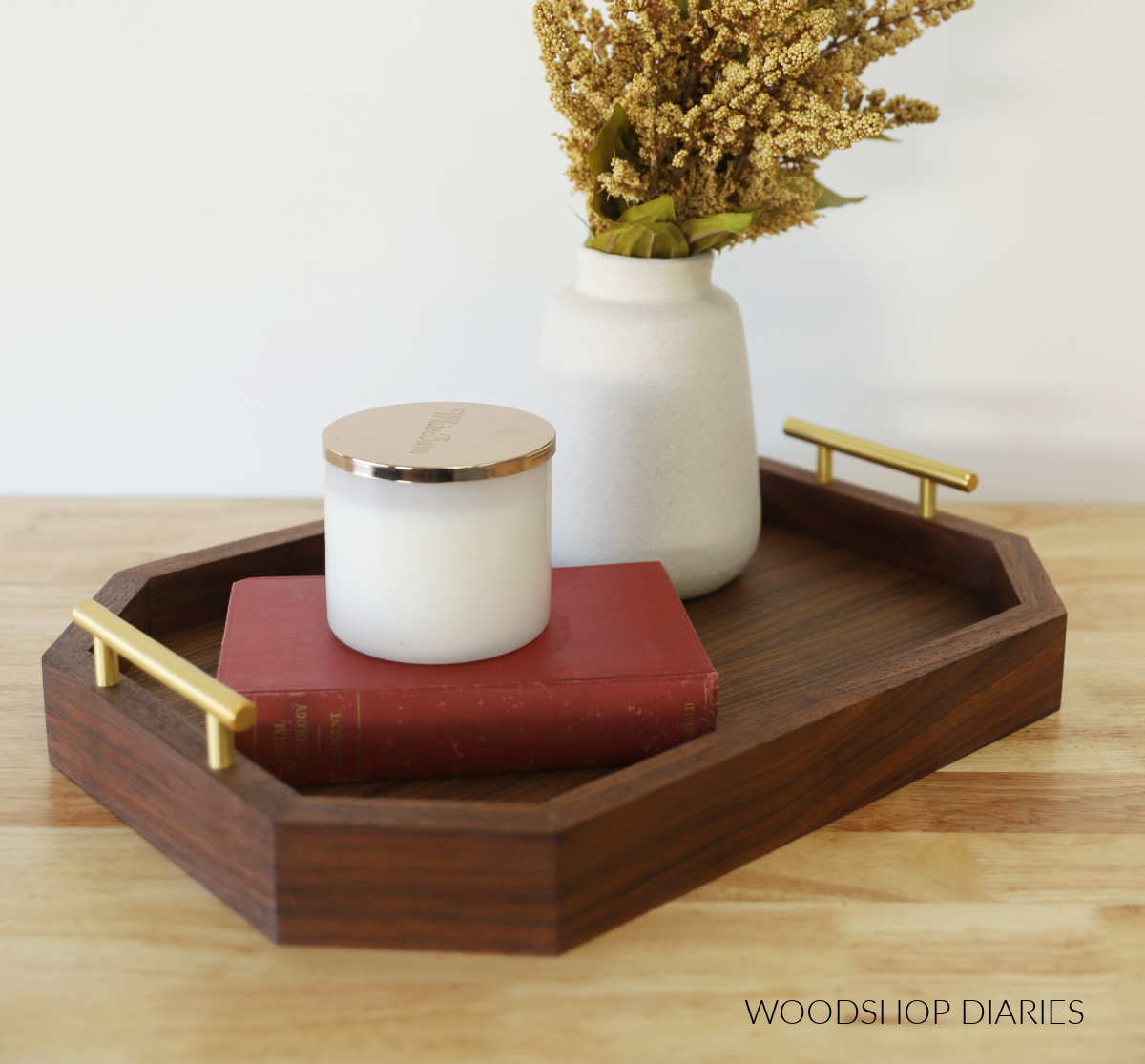
DIY Workbench for Small Shop

October 10, 2023 by Shara, Woodshop Diaries

In this post, I’m sharing how to build a DIY workbench for a small shop or garage!

This steel frame workbench takes up a small footprint, but has plenty of open space below to add your own customizations–like a drawer and open shelving.

*This post was sponsored by Kreg Tool and contains affiliate links. See website policies.

Kreg Universal Workbench with hardwood top and caster wheels built out with large drawer at top and a wooden shelf along bottom

Finding great options for a workstation in a small shop can be challenging. You want something sturdy, versatile, and as practical as possible while still being minimal in size.

This simple design allows for storage of larger, bulkier items (like a circular saw, drill, some jigs) on the bottom shelf, while offering storage for smaller parts (like screws and accessories) in the drawer at the top.

Optional casters provide mobility–which is always a plus, in my opinion! And you can grab this metal workbench frame in a variety of sizes if you have room for something a little bigger.

This same concept can be adapted to fit any size Kreg Universal Workbench frame, but I’m showing the smallest size in this post.

What to consider before building a metal frame workbench

This workbench set up was built on the Kreg Universal Workbench frame. These come in a variety of sizes, but are just a simple frame–4 legs with top and bottom braces.

The downside is that, on its own, it’s pretty basic. But the upside is that it allows for endless customizations to suit your own needs. In this example, I added a drawer and open shelf.

However, I hope this serves as kind of a “starting point” to give you just one idea of how this could be built out.

Project cost

Full disclosure–this is not the most budget friendly workbench option. The steel frame plus butcherblock work top will run you about $380 (as of Oct. 2023). And the caster wheels will add an additional $70 if you’d like it mobile.

Kreg Universal Workbench frame with casters and hardwood top

You can certainly build your own wooden workbench frame and add casters for less. But, the Kreg Universal Workbench frame and hardwood top do offer some pretty nice advantages to consider:

  • It’s a SUPER quick assembly. All pieces are already cut to exact lengths and ready to simply bolt together. It took about 10 minutes to assemble mine and it’s incredibly sturdy.
  • It’s got adjustable height legs. Adjust bench height from 32 ½″ – 40 ½″ (not including casters).
  • The hardwood top comes prefinished with a stain and glue resistant coating. You can get this solid or with predrilled dog holes.

Plus, a steel workbench frame can last for decades while a wood one will eventually get beat up and worn out (if it’s anything like the ones I have already) and need to be replaced.

In addition to the cost of the workbench frame, for this particular project, you’ll also need to factor in the other materials from the materials list below.

This will be the plywood, screws, and drawer slides you’ll need to add the shelf and drawer into the frame once assembled. The rest of the materials should only run about $60 or so and you likely have many of these items already in your shop or scrap pile.

Overall dimensions of workbench

The overall dimensions of this small space workbench are 24″ deep x 32″ wide x 36″ tall. Keep in mind that the height is adjustable on this frame so you can change that.

The Kreg Universal workbench frame comes in various sizes, so you can apply this same concept to any of them if you’d prefer another size. I’m showing this project on their smallest size bench.

Overall dimensional diagram showing workbench for small space design with drawer and open shelf

Helpful resources to use during this build

  • How to cut plywood
  • How to use a pocket hole jig
  • How to build a drawer box
  • How to install drawer slides
  • How to choose the right plywood for your projects

Are DIY projects your thing? Sign up for our newsletter for priority access to the latest projects and build plans!

How to build a small mobile workbench with metal frame

This workbench build only takes a few hours to assemble and since you don’t need to worry with finishing (unless you want to), there’s no need to spend time edge banding, staining, or painting.

Below I’m sharing how to build out the smallest of the Kreg Workbench frames, but this same concept can be applied to any of the other sizes. You’ll just need to modify the dimensions accordingly.

I’m sharing the step by step and building plans below, but if you prefer watching, I’ve also got a video tutorial on my YouTube channel with additional tips and resources.

Love watching how-to videos? Subscribe to my YouTube channel for plenty more where that came from!

Tools & Materials

Tools:

  • Circular Saw
  • Kreg Rip Cut & AccuCut (optional cutting guides)
  • Pocket Hole Jig
  • Drill/Driver

Materials:

  • Kreg Universal Workbench Frame
  • Kreg Butcherblock Work Top
  • Kreg Workbench Caster Wheels
  • 4’x4′ (½ sheet) ¾″ plywood
  • 2’x2′ (⅛ sheet) ¼″ plywood
  • ¾″ pocket hole screws
  • 1 ¼″ pocket hole screws
  • (1) pair 16″ ball bearing drawer slides
  • (1) drawer pull

Step 1: Assemble Metal Workbench Frame

Since this workbench is built onto the Kreg Universal Workbench frame, the first step was simply assembling that frame together.

The workbench frame comes as 4 adjustable legs and you simply use the included nuts and bolts (per the instructions) to assemble the braces between them–4 at the top and 4 toward the bottom.

Metal workbench frame assembled without feet

The bench comes with adjustable feet that you can add to the bottom of each leg, but if you prefer this workbench to be mobile, you can add caster wheels instead.

These wheels have a threaded rod that goes through the hole on the bottom of each leg and tighten with a nut.

Close up of installing caster wheels on workbench legs with nut

Step 2: Add Work Surface

Once the workbench frame was together, I added a hardwood worktop to it. Kreg offers these prefinished, precut bench tops with or without dog holes. They come in different sizes to fit whichever size bench frame you have.

Now, you can certainly glue up your own top, purchase a hardwood top of your own, or simply use a piece of plywood for your work top if you wanted something different. These would all work fine on this frame.

I flipped my worktop upside down and flipped the workbench frame upside down on top of it, making sure it was centered. Then, I used ¾″ pocket hole screws through the holes in the frame to attach.

Shara Woodshop Diaries installing hardwood work top onto metal workbench frame

Step 3: Install Bottom Shelf

Here’s where I recommend doing as I say and not as I did. When I was building this, I did steps 4, 5 & 6 before doing this step. But when when I went to install the shelf, it wouldn’t fit.

So I suggest installing the shelf first, then adding the top drawer. I cut a piece of ¾″ plywood to install along the bottom braces in the workbench frame.

RELATED: How to cut plywood sheets

Workbench frame with plywood panel installed as bottom shelf

Once it was cut to fit, I placed it in the frame and used ¾″ pocket hole screws through the holes in the bottom braces to secure it in place.

Using screws from underside to secure plywood shelf to bottom of workbench bracing

Step 4: Install Bracing For Drawers

In order to install a drawer, I had to add some wood bracing to the workbench. First, I cut a piece of ¾″ plywood to run between the back legs.

I made this 5 ½″ tall, but if you wanted to deeper or shallower drawer, simply adjust the height however you’d like. I placed this on the INSIDE of the back legs flush against the top brace and used ¾″ pocket holes through the holes in the legs to secure.

Shara Woodshop Diaries installing back plywood panel to workbench frame through predrilled holes

Then, I cut two spacer blocks approximately 1 ⅞″ wide x 5 ½″ tall to screw onto the inside of each leg at the front the same way. These are simply here to give me something to screw the side braces into next.

Small scrap plywood spacer blocks installed onto front legs with screws

Then, I cut two pieces of ¾″ plywood to run between the front and back pieces in the frame. This will give me something to mount the drawer slides onto.

I cut these 5 ½″ tall (to match the height of the front and back pieces I already added) and about 18 ¼″ long. It’s best to measure between the front and back braces and cut these to fit that distance.

Once I made sure they’d fit, I drilled ¾″ pocket holes into the ends of each piece.

RELATED: How to use a pocket hole jig

Drilling pocket holes into plywood panels for drawer framing sides

I installed these between the front and back pieces–one on each side–using 1 ¼″ pocket hole screws.

These should be flush to the INSIDE edge of the front spacer blocks and should be square to the back piece. Please ignore the shelf pin holes already drilled into these pieces. I reused this wood from an old project I took apart.

Installing drawer framing side panels into metal workbench

Step 5: Build Drawer Box

Once the framing for the drawer was added to the workbench, it was time to build the drawer box. I built this box using ¾″ plywood for the four sides and used pocket holes and screws to assemble.

Check out the FREE printable building plans here for exact dimensions.

Shara Woodshop Diaries assembling basic drawer box on workbench using pocket holes and screws

Once the box was together, I glued and nailed ¼″ plywood onto the bottom. Check out this post for more information on how to build a drawer box.

Shara Woodshop Diaries brad nailing plywood panel onto bottom of drawer box

Step 6: Install Drawer into Workbench

I installed 16″ ball bearing drawer slides onto the side braces so that they were flush to the bottom edge and ¾″ inset from the front.

Check out this post to learn more about how to install drawer slides.

Securing drawer slides into small space workbench using wood screws

Ball bearing drawer slides have a small plastic tab on the sides that allow you to lift up and detach the part of the slide that mounts to the drawer box.

I removed this section from the slides, and mounted them on each side of the drawer box so that they were flush to the bottom edge.

securing drawer slides to drawer box sides

Then, I slid the rails on the side of the drawer back onto the slides in the workbench to install. The front of the drawer box should be ¾″ inset from the front of the bench frame once pushed closed all the way.

Installing drawer box into small DIY workbench at top with slides

Then, I cut a piece of ¾″ plywood to add as the drawer front. This piece is 5 ½″ tall and ¼″ smaller than the opening the drawer fits into.

I used 1 ¼″ pocket hole screws from the inside to attach this drawer front so that there is ⅛″ gap between it and the frame on the sides and top.

Securing drawer front to drawer box in small workbench build

Then, I added a simple modern drawer pull and that completed the build! You can certainly finish this project however you’d like, but since this is a shop project, I left it as is.

And now you can load up the drawer with accessories, screws, and all those small pieces you want to keep track of!

Top view of small shop workbench with drawer open showing screws and accessories inside

And load up the bottom shelf with tools you want to keep readily available to grab and use. Roll this small space workbench in and out of the way as you need for a sturdy, durable workstation to build on.

Shara Woodshop Diaries pushing mobile workbench built on Kreg Universal Workbench frame with drawer and open shelving

If you prefer to print, grab these workbench building plans on KregTool.com here!

Looking for more workshop projects?

Want to check out some more workshop and garage organization projects? I’ve got a few favorites you might enjoy here! Click on the images below to check out the plans to build each one!

Scrap Wood Cart
Workbench with Drawers
DIY Garage Cabinets
How to build a mobile Miter Saw Stand with storage drawers, and fold down extension wings
Mobile Miter Saw Stand
EASY DIY Lumber Rack
Mobile Workbench

If you want to save this project for later, don’t forget to pin it or share to your favorite social channel!

Pinterest collage image showing workbench with drawer open at top and completed metal frame workbench for small shop at bottom with text "how to build a small space workbench"

Until next time, friends, happy building!
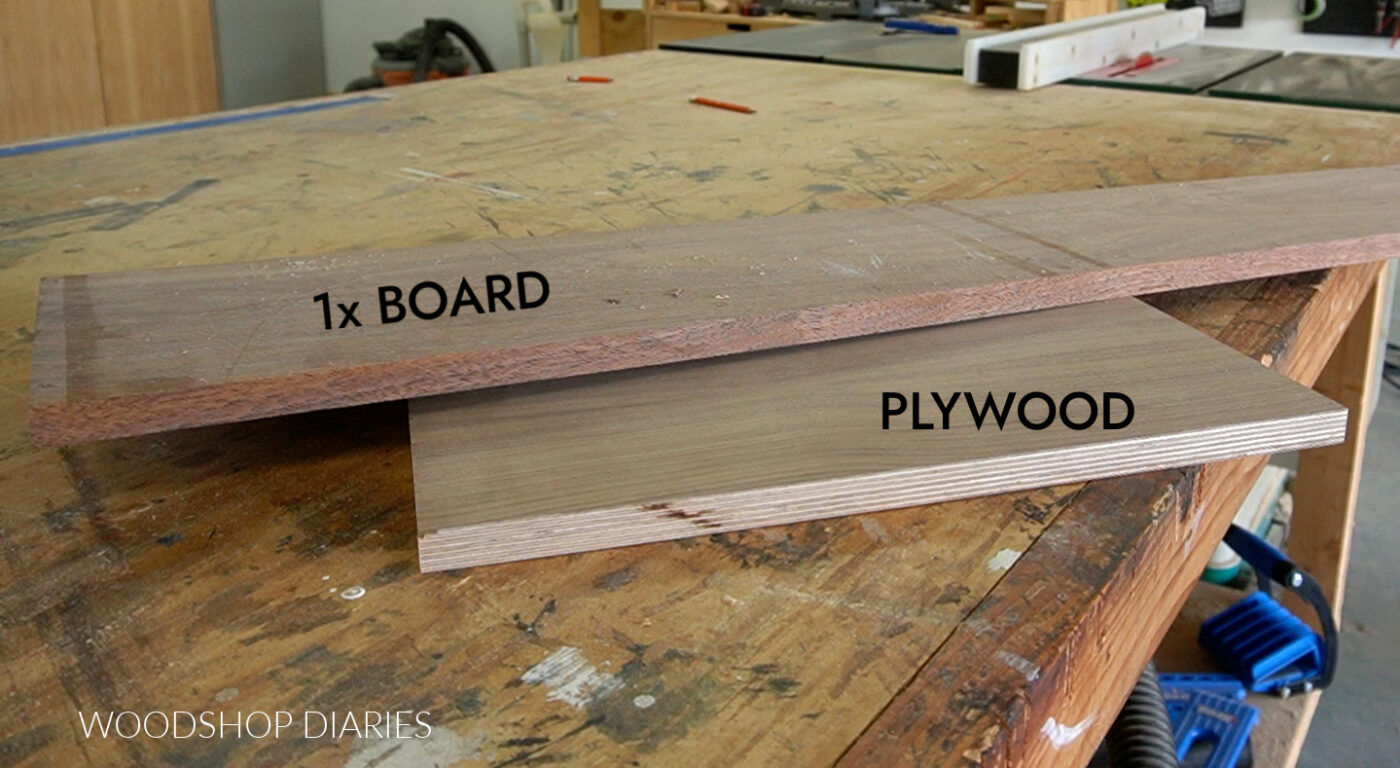
Simple DIY Shoe Bench

October 6, 2023 by Shara, Woodshop Diaries

In this post, I’m sharing how to build a simple DIY shoe bench perfect for a small entryway or hallway!

This design uses basic lumber to build and is a great weekend woodworking project.

Simple wooden bench with shoe shelf--painted blue grey with a stained wood seat

It’s always nice to have a place to sit down and take off or put on your shoes by the door (or at the end of the bed). It gives you a place to relax for a moment when coming home from a long day.

But it’s also nice if that seat has a place to actually store the shoes, too.

So I built this simple bench with a “slatted” shelf underneath–the perfect size for shoes.

This classic, but modern bench would be perfect in an entryway or on the porch. Or, you could skip the shoes altogether and use it at the dining table.

*This post contains affiliate links. See policies.

What to consider before building this bench

This simple DIY bench is a great beginner to intermediate build. It uses basic tools and techniques and can be completed in about a day.

Material Choices

I built this bench from basic construction lumber–spruce/pine wood. I used 2x4s to make the legs, 2x6s to make the bench top, and 1x3s for the bench frame.

construction lumber laid out on workbench

But, you could build this bench from whatever species of wood you prefer.

RELATED: How to buy lumber

My 1x3s were pre-primed (that’s what I already had in the shop), but unfinished, regular 1x3s would work just as well. That’s why mine are white in the photos below.

Making the bench legs

For the legs, I created my own 3″ square posts by gluing up two 2x4s. Once they were glued together, this gave me a post 3″ x 3 ½″ (see below).

RELATED: Understanding lumber sizing

Clamping 2x4s together on workbench to make bench legs

To make it 3″ square, I used my table saw to trim ¼″ off each side. Then, I cut my bench legs from this post in step 1 below.

If you don’t have a table saw or don’t want to make these yourself, you could substitute a 4×4 post here instead. Just keep in mind that 4x4s are 3 ½″ x 3 ½″ so you’ll need to modify the dimensions in the plans here slightly.

OR, sometimes, the big box stores carry pre-glued and surfaced 3″ square posts. They’re usually a little pricey, but that’s another option.

Overall shoe bench dimensions

The overall dimensions of this simple shoe bench are 16″ deep x 17 ¾″ tall x 40″ wide.

Overall dimensional diagram of DIY shoe bench

You may find these resources helpful during the build

  • How to use a pocket hole jig
  • How to fill pocket holes
  • How to glue up a panel
  • How to paint or stain DIY furniture

Are DIY projects your thing? Sign up for our newsletter for priority access to the latest projects and build plans!

How to build a simple shoe bench

I’m sharing the step by step and building plans below, but if you prefer watching, I’ve also got a video tutorial on my YouTube channel with additional tips and resources.

YouTube Thumbnail for how to build a simple bench video

Love watching how-to videos? Subscribe to my YouTube channel for plenty more where that came from!

For detailed dimensions, diagrams, and cut list, Grab the printable building plans for this simple shoe bench here.

Tools and Materials

Tools:

  • Miter saw
  • Drill/Driver
  • Pocket hole jig
  • Sander
  • Clamps
  • Table Saw (optional)
  • Forstner bits (optional–for installing figure 8 fasteners)

Materials:

  • (2) 2x4x8 boards
  • (3) 1x3x8 boards
  • (2) 2x6x8 boards
  • 1 ¼″ pocket hole screws
  • Wood glue
  • Figure 8 fasteners OR corner brackets (to attach top)
  • Wood finish (paint, stain, etc.)

Step 1: Assemble Bench Legs

I mentioned in the notes above that I made my own 3″ square posts to use for the bench legs on this build. First, I cut two 2x4s to about 72″ long (which was a little more than I needed to cut the 4 legs from).

Then, I glued these together to make a 3″ x 3 ½″ post. Once the glue was dry, I ran this post through the table saw to cut about ¼″ off each side so that I had a 3″ x 3″ square post.

Check out this post to learn more about squaring board edges on the table saw.

Tape measure showing post width is 3"

Once I had my post trimmed, I cut my four legs from it. I adjusted the miter angle of my miter saw to 10 degrees to cut these legs. The slight angle on the legs gives this otherwise basic bench some nice dimension.

Miter saw angle set at 10 degrees

I cut four legs about 16 ½″ long with ends mitered 10 degrees parallel to each other.

To cut these parallel, simply trim one end, then just slide the board down (WITHOUT FLIPPING IT or adjusting the miter angle) and trim the other end.

Miter saw cutting 3" square post to make shoe bench legs

Step 2: Assemble Bench Frame Sides

Next, I cut my 1x3s down for the rest of the bench frame pieces. Exact dimensions can be found in the plans here.

I cut four short 1×3 pieces (8″ long) with square ends for the bench sides. Then, I cut four longer 1×3 pieces with ends mitered 10 degrees (not parallel) for the front and back frame pieces.

Shoe bench legs and frame pieces cut to length and laid out on workbench

The two bottom front/back pieces are slightly longer than the top since the legs are angled. Once cut, I sanded them before assembly.

I assembled this bench frame using pocket holes and screws, so I drilled ¾″ pocket holes into the ends of all the 1×3 pieces. NOTE: See video for tips on drilling pocket holes in boards with mitered ends.

RELATED: How to drill pocket holes

Then, I installed the short pieces between the bench legs using pocket hole screws to make two bench sides. The bottom support is installed 3″ up from the bottom of the leg.

Shara Woodshop Diaries installing short side supports between bench legs with pocket holes and screws

These pieces should be installed between the legs so that they are square to the top and bottom–not angled with the legs. Notice how the bottom support is square to the table in the image below.

Shara Woodshop Diaries demonstrating bottom support is square to workbench surface

Step 3: Build Bench Base Frame

Once the sides were assembled, I installed the front and back supports between them using pocket holes and screws.

Shara Woodshop Diaries installing front and back bench frame supports with pocket holes and screws

I screwed these in so that they were 1″ inset from the outside edge of the legs. The two top pieces are flush to the top of the legs and the two bottom pieces were 3″ up from the bottom of the legs.

Shara Woodshop Diaries placing assembled shoe bench frame on workbench

This is totally optional, but I used some pocket hole plugs to fill the pocket holes on the bottom front, back and side supports. Here are 4 ways to fill a pocket hole.

You can fill the pocket holes on the top as well, but they won’t be seen in the finished project once the top is in place.

Close up of installing pocket hole plugs into pocket holes on bench frame

Prefer to print? Grab the printable shoe bench building plans here.

Step 4: Finish and Attach Shoe Rails

After the pocket holes were filled and sanded smooth, I cut to fit two pieces of 1×3 to run between the two bottom side supports. These pieces will kind of create the “shoe shelf” of the bench.

I didn’t install these yet because I was going to paint the bench and I knew it would be difficult to get in between them with a brush and roller (I don’t have a sprayer). So I primed and painted these two rails and the bench base separately, first.

Rolling paint onto DIY shoe bench legs

Check out this post to learn how to finish DIY furniture. I gave the bench two coats of paint in Behr Ocean Swell and allowed them to dry well before moving on.

Once the paint was dry, I used a rubber mallet to carefully tap the two 1x3s into the bench frame so that they were evenly spaced between the front and back bottom supports.

Then I drilled some countersunk holes through the side supports and secured with 1 ¼″ wood screws like shown below. If you wanted, you could also install these with pocket holes and screws, BUT it might be challenging to get a drill/driver into these tight spaces.

Driving screws to install shoe rails on bottom shoe shelf of bench

After the shoe shelf rails were in, I filled the countersunk holes on the side supports, sanded them smooth, and touched up the paint.

If you planned to stain or you have a paint sprayer, I’d recommend attaching the shoe shelf rails before finishing to avoid having to do paint touch ups.

Step 5: Build and Attach Bench Seat

The bench seat was made using 2x6s. First, I trimmed three 2x6s to about 42″ long. I’ll be trimming the seat down to 40″ overall later, so this gives me a little to trim off the ends after they’re glued.

Then, I trimmed ⅛″ off both edges of the middle board and off one edge of the two outside boards on the table saw. That way, all the edges that will be glued are trimmed.

The reason I trim the edges is because 2×6 construction lumber typically comes with rounded corners. When you glue them together, the joints will have a “dip.” So I like to square the edges off before gluing so that the panel is nice and flat across the surface.

Close up of board end--one side with rounded corners and the other side with square corners

Check out this post to learn how to square board edges.

Once I squared the edges of my 2x6s, I applied some glue and clamped them together into a panel.

Shara Woodshop Diaries clamping bench seat boards together

After the glue dried, I trimmed the edges so that I had a 16″ x 40″ seat. Make sure to sand well to remove the glue squeeze out and flatten out the joints.

To attach this panel to the base, I used figure 8 fasteners. However, corner brackets would also work great. I installed these fasteners to the top of the bench base.

Installing figure 8 fasteners onto top of bench frame

Then, I flipped the bench seat panel upside down and centered the bench base upside down on top of it.

I used wood screws through the fasteners to attach them together.

Securing figure 8 fasteners to bottom of bench seat

Step 6: Final Touches

I debated on whether I wanted to just apply a clear coat or stain the bench seat. Ultimately, I decided to give it a coat of Minwax Golden Oak before a few coats of poly to seal it.

Feel free to finish however you’d like–a darker stain would look nice, too! Once it was dry, it was ready to use.

Completed DIY bench with shoe shelf against white wall--bottom of bench painted Behr Ocean Swell and top stained Minwax Golden Oak

The shelf underneath is perfect for sneakers and short boots and it large enough to fit 3-4 pair of shoes. I really like the slatted shelf here. It allows air flow to help dry off wet shoes, but it also gives it a unique take on the typical solid shelf.

Blue gray wooden DIY shoe bench with boots and sneakers on bottom shelf and green pillow on bench seat.

This would be perfect at the end of the bed, in a hallway, or by the door. Don’t forget to grab the printable plans here to build your own!

Looking for more entryway and bench ideas?

Enjoyed the project, but looking for more ideas? I got you! Here are a few favorite entryway and bench ideas you might enjoy!

Freestanding Boot Rack
DIY Mudroom Bench
DIY Storage Bench
One Board Shoe Bench
Mudroom Built Ins
Simple Bench with Shoe Shelf

If you’d like to save this project for later, don’t forget to pin it or share it to your favorite social platform!

Pinterest collage image showing overall dimensional diagram at top with completed DIY shoe bench at bottom with text "how to build a simple shoe bench printable plans"

Until next time, friends, happy building!
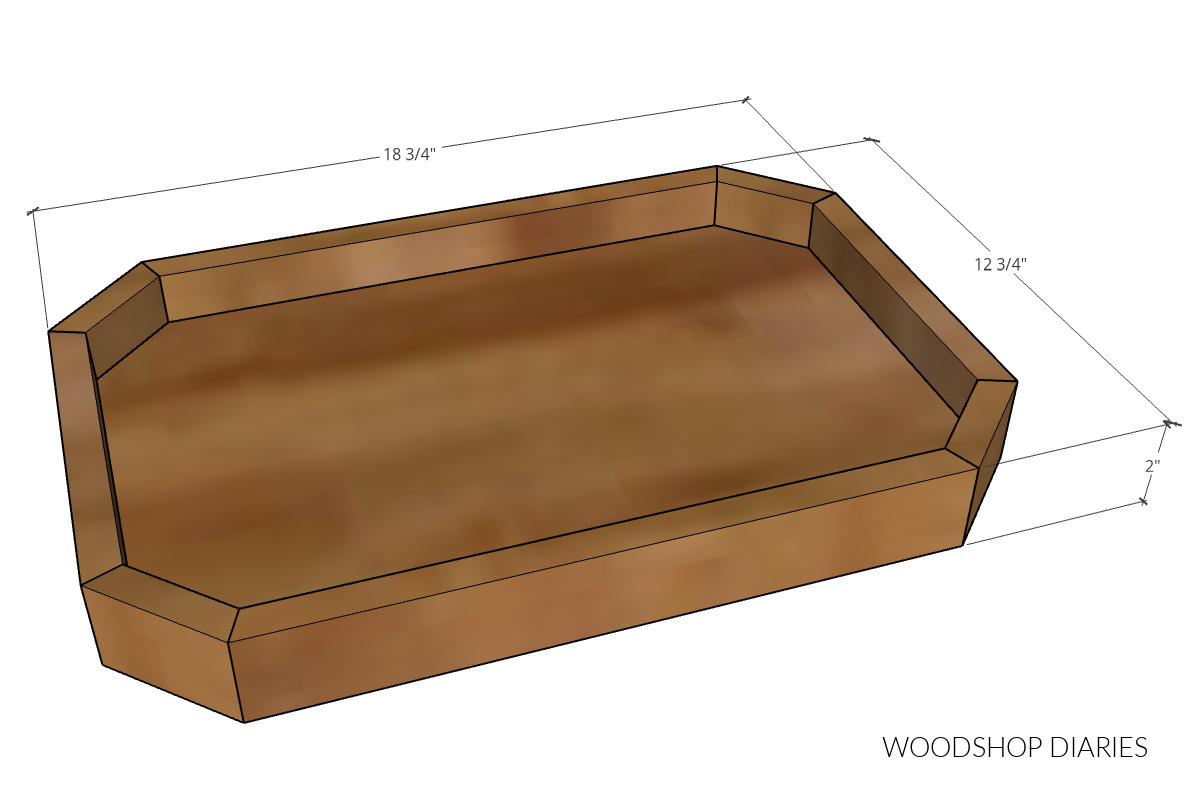
DIY Freestanding Boot Rack

October 2, 2023 by Shara, Woodshop Diaries

Tired of muddy boots piled up by the door? This DIY freestanding boot rack can help keep your entryway neat and organized.

The best part of this project is that it’s SO easy to customize to fit your space, your needs, and your collection of boots and shoes.

Wood stained DIY boot rack with 2x2 posts to place boots on--next to front door on floor

We keep several pair of rain and work boots by our front door. It’s just nice to be able to throw them on and off.

But, a pile of dirty boots by the door is an eyesore, and is annoying to dig through to find the matching pair.

So I wanted a way to keep them neat and organized, but still easy to access. And I also didn’t want to put any more holes in the wall–so this needed to stand on its own.

This simple boot rack worked perfect and can fit 6 pair of boots or shoes! Plus, storing them upside down will help keep critters from crawling inside–which is nice if you plan to keep this on the porch or in the garage.

*This post contains affiliate links. See policies.

What to know before building

Before building, I recommend taking inventory of the shoes you usually keep by your door. How many pair, what style, what size?

This will help you figure out how many boot posts you need and how tall you need to make them. The boot posts here are the vertical 2x2s. Each post will hold one boot or shoe.

Customizing the size

In my case, we typically keep a couple pair of tall rain boots, and some shorter work boots close to the door. My rain boots are about 15″ tall and my work boots are about 6-8″ tall.

Yard stick next to rain boot showing 15" height

So I made the back posts 16″ tall for my rain boots and the front posts 10″ tall for my work boots. However, you can customize the heights of these posts as needed to fit your own boots/shoes.

NOTE: I recommend making the front posts at least 6″ (or more) shorter than the back posts. This prevents the shoes in the back from interfering with the shoes in the front.

I made my boot rack about 36″ long and spaced 6 posts (three pair of shoes) across it in the front and the back. However, I could have fit four pair across this span if I had spaced my posts closer together.

Overall dimensions of DIY boot rack with 12 posts

Each pair of shoes/boots needs at least 9-10″ of space (measure across your own shoes to double check). But I spaced mine out a little extra so the boots weren’t rubbing together.

Depending on your available floor space and the number of shoes you’re trying to store, you may want to space the posts closer together to fit more shoes or make your boot rack longer to accommodate.

Material options

For this project, I highly recommend checking your scrap pile! I used scrap 2x2s and 2x3s to make this, but feel free to get creative to use whatever wood you may already have.

For the base, 1x3s, 1x4s, 2x3s, or 2x4s would all work great. And for the posts, 1x2s, 2x2s, or even dowel rods would work great, too.

Are DIY projects your thing? Sign up for our newsletter for priority access to the latest projects, plans, and new videos!

How to Build a Freestanding Boot Rack

This project is SO EASY and you can assemble it in under an hour. It’s a great scrap wood project and would make a great gift, too!

Tools & Materials

Tools:

  • Miter Saw (or any saw that can cut straight lines)
  • Drill/Driver

Materials:

  • (1) 2x3x8 OR 2x4x8 (OR use scraps–see cut list below)
  • (2) 2x2x8 boards (OR use scraps–see cut list below)
  • 2 ½″ wood screws
  • Wood Glue

Step 1: Cut Boot Rack Pieces

See notes above about size customizations. You may want to change up your sizing, but I cut the following pieces to assemble my boot rack.

Cut List:

  • (2) 2x3s @ 12″ long
  • (2) 2x3s @ 36″ long
  • (6) 2x2s @ 10″ long
  • (6) 2x2s @ 16″ long

Since these pieces are fairly small, I encourage you to check out your scrap pile first before buying any lumber.

Pieces cut on workbench to assemble scrap wood boot rack

The 2x3s will make up the base and the 2x2s will be the posts that the boots/shoes will rest on.

Sand these pieces well before moving on to the next step.

Step 2: Attach Boot Posts

I laid out my two long 2x3s and marked the following locations on each. Again, feel free to customize as you’d like.

Predrill locations for boot rack posts on base pieces

I found a drill bit about the size of the shank of the 2 ½″ screws I was going to be using. Then, I used it to drill through the boards at these marks. Make sure you drill all the way through.

Using a drill to predrill pilot holes for boot rack posts

Then I sanded off the pencil marks and used wood glue and 2 ½″ wood screws through the bottom side of these boards, through the predrilled holes, to attach the 2x2s.

TIP: Draw an X across the diagonals on the bottom of the 2x2s and make sure the screw hits right at the center as you screw these in place. That will just help ensure your posts are spaced properly.

Diagram showing X marked across 2x2 post to help alignment

I installed all the 12″ long posts to one board and all the 16″ posts to the other board. One of these assemblies will go in the front and one will go in the back in the next step.

Shara Woodshop Diaries driving screws into boot rack posts

NOTE: I actually made the two posts in the middle on the back 18″ long instead of 16″ long because I had one pair of rainboots a little taller than my others. (Just in case you wondered why the middle two posts were a little taller in the next step.)

Step 3: Assemble Boot Rack Base

I placed my 12″ long 2x3s on the workbench–flat. Then I laid my two boards from step 3 across them–the tall posts in the back and the short posts in the front. I lined everything up at the corners like shown below.

Shara Woodshop Diaries placing boot racks across base pieces on workbench

Then, I predrilled two holes at each corner and used 2 ½″ wood screws to attach. If you wanted to flip this over and use screws from the bottom side instead of the top so the screws are hidden, go for it!

Driving screws with driver to assemble base of boot rack

This is going to be used for muddy boots by the door, so I wasn’t too worried about looks here haha.

Step 4: Finish Boot Rack

If desired, apply finish (paint, stain, poly) to the boot rack. Sealing the wood is a good idea here, especially if you plan to store wet or muddy boots. A coat of finish will help protect it and make it easier to clean.

I applied a coat of Minwax Water Based Pecan stain and a topcoat of Minwax Polycrylic on top.

And once it was dry, it was ready to use. This is such a great way to be able to store your bulky (usually dirty) rain and work boots neatly by the door!

Completed scrap wood boot rack next to front door with rain boots and work boots on posts

Funny side story–one time my Dad went to put on his boots he leaves on the steps of the garage and he stuck his foot in to find a frog in the toe!

Needless to say, he stores his boots upside down now. So this DIY boot rack is also a great way to keep creatures from crawling (or hopping) into your shoes, too!

Looking for more entryway organization ideas?

Here are a few of my personal favorite ideas to help keep your entryway neat and organized!

Easy DIY Boot Tray
DIY Mudroom Bench
Simple Bench with Shoe Shelf
DIY Storage Bench
One Board Shoe Bench

If you’d like to save this project for later, don’t forget to pin it or share it to your favorite social channel!

Pinterest collage showing dimensional diagram at top and completed boot rack on bottom with text "build it from scrap wood easy DIY boot rack"

Until next time, friends, happy building!
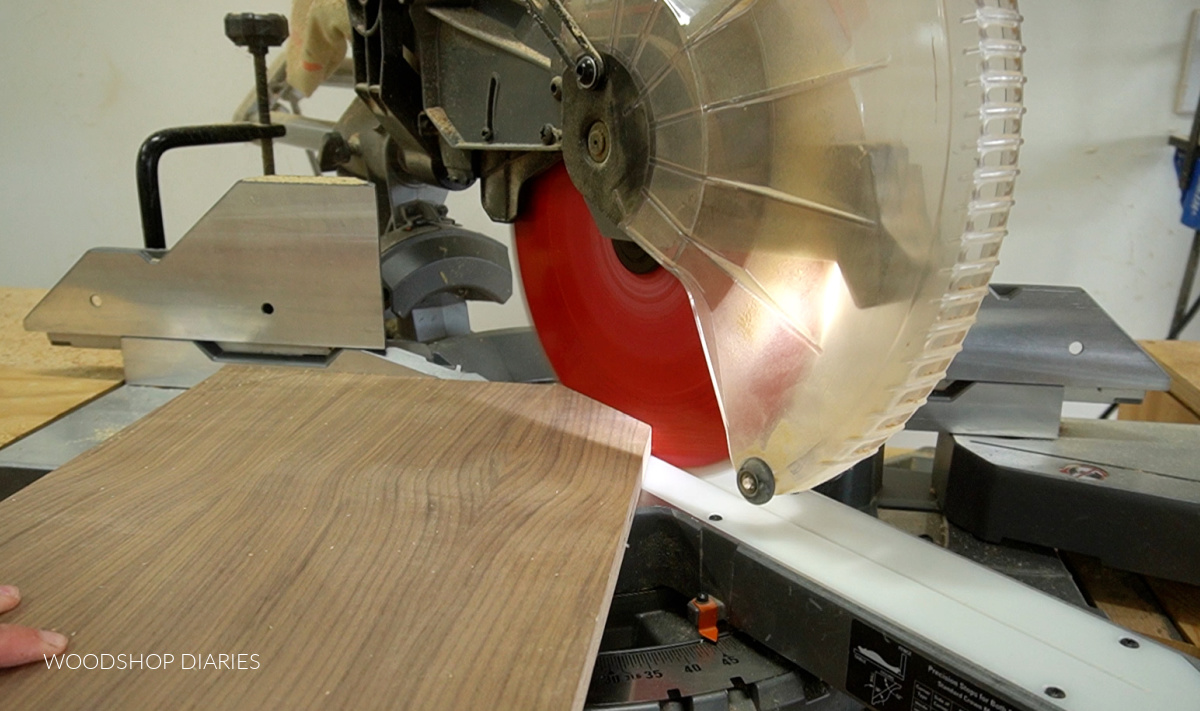
DIY Rotating Bookshelf

September 23, 2023 by Shara, Woodshop Diaries

In this post, I’m showing you how to build this simple DIY rotating bookshelf using basic tools and materials!

Built on Lazy Susan hardware, this shelf spins either direction for easy access to all sides. What a unique way to store your favorite books and magazines!

DIY Rotating bookshelf assembled with plywood--open cubbies in the middle with book ledges on the sides

What a fun an unique way to store and display your favorite books, records, DVDs or even board games!

This rotating shelf is a fun addition to any room of the house with plenty of storage inside and out.

I’m excited to share how to build your own, so if you’re ready, let’s dive in!

*This post contains affiliate links. See policies.

What to know before building

This DIY rotating bookshelf is a great beginner to intermediate build. It uses basic tools and techniques and is a great project to learn more about installing Lazy Susan hardware.

I built this project using birch plywood for the main body, pine/fir 2x2s for the base, and walnut plywood scraps for the ledges on the sides.

Check out this post to learn how to choose the correct plywood for your projects.

However, this can be built from whatever species of wood you prefer. I highly recommend checking your scrap piles as you may have almost everything you need already there. The pieces of this project are all fairly small.

If you didn’t want this to rotate, you can totally skip the Lazy Susan hardware and simply screw the base to the bottom of the bookshelf instead.

Overall dimensions

The overall dimensions of this project are approximately 17″ x 20 ½″ x 35 ¼″.

Overall dimensional diagram of rotating bookshelf

How to Build a Rotating Bookshelf

I’m sharing the step by step below, but if you prefer watching, I’ve also got a video tutorial on my YouTube channel with tons of tips and helpful resources.

YouTube Thumbnail for rotating bookshelf video

Love watching how-to videos? Subscribe to my YouTube channel for plenty more where that came from!

Are DIY projects your thing? Sign up for our newsletter for priority access to the latest projects and build plans!

You may find these guides helpful throughout this build:

  • How to cut plywood
  • How to apply iron on edge banding
  • How to use a pocket hole jig

Tools & Materials

Tools:

  • Miter Saw
  • Circular Saw
  • Cutting Guides (Kreg Rip Cut & AccuCut)
  • Drill/Driver
  • Pocket Hole Jig
  • 1″ diameter Forstner drill bit

Materials:

  • (1) 2x2x8 board
  • (1) 4×8 sheet ¾” plywood
  • Iron on edge banding
  • (4) 12” drawer pulls
  • 12″ Lazy Susan
  • ⅝″, 1 ¼” and 2” wood screws
  • 1 ¼” pocket hole screws
  • Wood Glue

Step 1: Assemble Bookshelf Box

First, I ripped my ¾″ birch plywood sheet into a 16″ wide strip. Check out this post to see how I cut my plywood down.

Shara Woodshop Diaries using Rip Cut to cut plywood sheet

From this strip, I cut two pieces 26″ long for the bookshelf sides and three pieces 14 ½″ long–one for the top, one for the bottom, and one for the middle shelf.

I applied iron on edge banding to the front and back edges of each of these pieces (the 26″ long sides and 14 ½″ long sides). Iron on edge banding is optional, but it’s easy to apply and makes your plywood edges look nice and clean.

Learn how to apply iron on edge banding here.

Close up shot of edge banded vs not edge banded plywood

Then, I drilled ¾″ pocket holes into the 16″ long ends of the top, bottom, and middle pieces using my Kreg Pocket Hole Jig. Learn how to use a pocket hole jig here.

I assembled the sides, top and bottom into a basic box using 1 ¼″ pocket hole screws.

Shara Woodshop Diaries assembling basic plywood box to use as bookshelf

This will be the main body of the top section of the rotating bookshelf.

Step 2: Attach Book Ledges

I added some narrow bookshelf ledges on the sides of this box to store thin books or magazines. To make the ledges, I ripped some walnut plywood scraps I had leftover from this console project into 1 ½″ wide strips.

From these strips, I cut 8 pieces about 12″ long and glued them into pairs to make four simple ledges.

Diagram of bookshelf ledge made with 1 ½" wide strips

Once the glue was dry, I placed them on the sides of the main bookshelf box from step 1 (two ledges will go on each side). I used 2″ wood screws through the bookshelf sides to install the bottom ledge about ¾″ up from the bottom of the box.

Then, I measured up from it 12″ and installed another one there. Make sure to predrill before driving the screws to prevent splitting the wood.

Shara Woodshop Diaries attaching bookshelf ledge to side of shelf box

Once I had two on one side, I flipped the box over and installed two the same way on the other side.

Step 3: Add Middle Shelf & Top

There should be one 14 ½″ x 16″ piece left from step 1 that wasn’t installed yet. That is the middle shelf.

Once the ledges were in place, I installed this panel into the box about 13″ up from the bottom with 1 ¼″ pocket hole screws.

Shara Woodshop Diaries installing the middle shelf into the rotating bookshelf box

This panel should cover the screw heads from installing the top ledges in step 2.

For the top panel, I cut a piece of ¾″ plywood to 17″ x 17″ and applied iron on edge banding to all sides (of course, that’s totally optional!).

I centered this on the top of the bookshelf box and clamped it in place while I secured from the bottom side using 1 ¼″ wood screws.

Shara Woodshop Diaries attaching top panel to rotating bookshelf with screws on workbench

At this point, the top section of the bookshelf is complete, so I set it aside to work on the base.

Step 4: Assemble Bookshelf Base

The bookshelf base is made with 2x2s for the frame and a piece of plywood in the center. So first, I cut four pieces of 2×2 to 8″ long for the legs and four more pieces 13″ long for the sides.

I drilled 1 ½″ pocket holes into the ends of the 13″ long pieces and assembled a simple frame between the legs using wood glue and 2 ½″ pocket hole screws.

Dimensional diagram of bookshelf base made using 2x2s and pocket holes

NOTE: I’ve personally found that using 2 pocket hole screws in 2x2s are much more likely to split. So I like to use wood glue and 1 pocket hole screw in 2x2s instead. Either method works fine here.

Once the frame was assembled, I cut a piece of ¾″ plywood to 13″ square to install inside of it. I drilled ¾″ pocket holes on all four sides and installed it into the frame with 1 ¼″ pocket hole screws so that it was flush across the top.

Shara Woodshop Diaries installing center plywood panel into 2x2 bookshelf base frame

At this point, if you want to paint or stain, I recommend going ahead and finishing the top and base separately before attaching. I gave these pieces a couple coats of Minwax Polycrylic to seal them.

Step 5: Install Lazy Susan Hardware

I used a 12″ Lazy Susan to connect the bookshelf to the base. First, I used a straight edge to draw a diagonal line from corner to corner. This makes a large X in the center of the base.

I centered the Lazy Susan hardware on the base and found the two oversized holes in the ring–these should be on the bottom side. I used a pencil to mark them.

Then I removed the hardware and used a 1″ diameter Forstner bit to drill through the base at these marks.

Using a drill and forstner bit to drill access holes in plywood center of base

Then, I centered the hardware back on the top of the base making sure to line up the oversized holes in the hardware with the holes I just drilled.

I secured the Lazy Susan to the top of the bookshelf base using ⅝″ long screws through the small holes in the ring. I used at least 4 screws.

Driving screws in lazy susan hardware to attach to base

Once the hardware was attached to the base, I flipped the bookshelf box upside down and flipped the base upside down on top of it. I made sure to line up the edges on all sides.

Shara Woodshop Diaries placing base on bottom of bookshelf box

Without MOVING the base left or right, I carefully ROTATED it on the Lazy Susan while looking through the access holes to locate screw holes on the hardware. (Please ignore my nasty plywood tear out.)

View inside access hole on base plywood to screw holes in lazy susan hardware

Once I located the screw holes, I used ⅝″ long wood screws to secure the Lazy Susan to the bottom of the bookshelf.

NOTE: If you locate a screw hole through one of the access holes, there will also be on in the other access hole–the screw holes are directly opposite each other.

Driving screws through base access holes to attach lazy susan to bottom of bookshelf

I made sure to get at least four screws through the hardware and into the bookshelf. There are various size screw holes in the hardware. It doesn’t matter which you use as long as the holes aren’t larger than your screw head.

Then, I flipped the rotating bookshelf back over and added a few finishing touches. To prevent the books from tipping over on the ledges, I added 12″ long drawer pulls about 6″ up from each edge.

Shara Woodshop Diaries installing drawer pulls on side of rotating bookshelf

These are actually not as deep as I would have liked, BUT it would work perfect for thin notebooks and magazines.

And with that, this project is complete and ready to use! This would be the perfect addition to an office, a game room (store games instead of books!), or a living room. You could even add it in the kitchen for cookbooks!

4 sided rotating bookshelf with magazine ledges on sides and open cubbies in center

It’s such a fun way to store and display your favorite books, games, records, or DVDs!

Looking for more simple bookshelf ideas?

Enjoyed this project and looking for more ideas? Here are a few of our favorite simple DIY bookshelf designs. Click on an image to see how to build each one!

Modern Plywood Shelf
Easy DIY Shelf with Baskets
DIY Ladder Bookshelf
DIY Corner Shelf
DIY Plant Shelf
Hidden Drawer Bookshelf

If you enjoyed this project, don’t forget to save it by pinning or sharing to your favorite social channel!

Pinterest collage showing diagram of bookshelf at top and finished 4 sided rotating bookshelf at bottom with text "how to build a rotating bookshelf"

Until next time, friends, happy building!
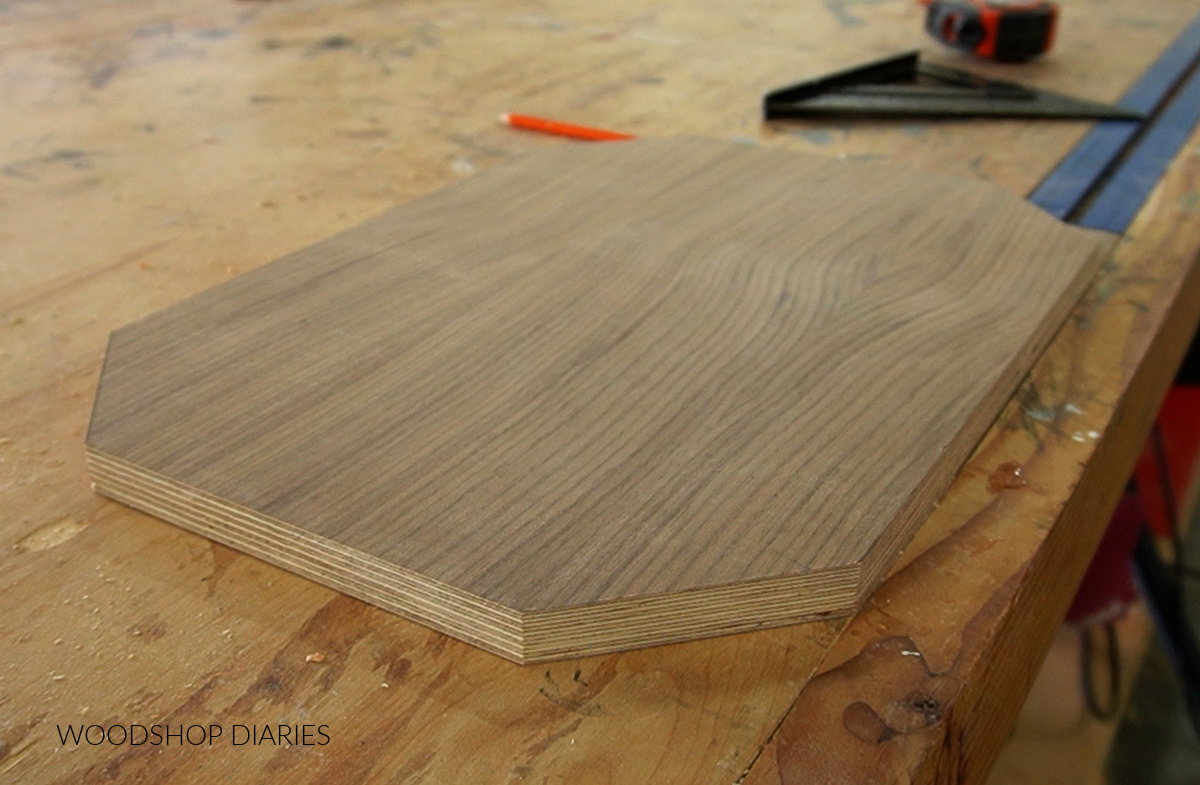
Easy DIY Modern Boot Tray

September 21, 2023 by Shara, Woodshop Diaries

Tired of muddy boots next to the front door? In this post, I’m sharing how to build a simple wooden DIY boot tray with just 2 boards!

*This post is sponsored by Kreg Tool and contains affiliate links. See policies for details.

Wooden boot tray with black decorative rocks inside next to front door--two pair of rainboots and a pair of work boots on top

*This post was originally shared on October 22, 2018 and was updated on September 21, 2023.

Plastic boot trays are inexpensive and work great. However, they don’t always look so nice.

This modern boot tray offers both function and style and is still an inexpensive option to help protect your floors from wet and muddy boots.

The rocks on the top not only look nice, but also allow water to drain off of wet rain boots and shoes.  Underneath the rocks is a moisture barrier so the water should never get all the way down to the floor.

Simple wooden boot tray with white decorative rocks--overhead view with shoes and boots placed in tray

If you’re ready to see how to make your own, let’s dive in!

What to know before building a DIY boot tray

This is a great beginner woodworking project you can easily complete in just about an hour or so.

Love DIY projects? Join our newsletter for priority access to new projects and building plans!

What type of wood to use for a boot tray

This project can be made from just about any type of wood you’d like. Although, I do recommend using a solid wood (not plywood) for the main frame portion of the tray.

I’ve made three of these over the years (see FAQ below). My first two were made from basic, inexpensive pine/whitewood that you get at the big box store. And I made my most recent one with cedar for the frame and birch plywood scraps for the bottom.

All of them have held up great, so feel free to pick your favorite wood (be sure to check your scrap pile!) and whatever fits your budget.

Overall dimensions

This boot tray is approximately 1 ½″ tall (not including the rocks) x 13 ⅜″ deep x 36″ long once assembled.

Overall dimensional diagram of boot tray showing 1 ½" tall x 13 ⅜" deep by 36" wide

How much did it cost?

This project can be made from a one1x2x8 board and one 1x4x8 board plus a bag of rock. As of September 2023, this would cost approximately $15-20 depending on the type of wood and type of rock you use.

Of course, you’ll also need a moisture barrier to go under the rocks, but if you have a spare roll of tar paper (like they use for roofing), you can cut off a small piece, or even use a thick plastic bag or tray you already have on hand.

Frequently asked questions

I’ve had several questions over the years about this boot tray. Here are a few of the most common and my honest answers to them.

How do you clean it?

To be honest, it doesn’t really get that dirty. It does collect some grass clippings and a little dirt here and there, but most of the mud just dries on the boots/shoes and doesn’t get down into the rocks.

About once a month (or just when I notice it looks a little dirty), I’ll use my household vacuum and put the smallest attachment on the end of the hose (so it won’t suck the rocks up) and simply vacuum out any debris.

Do you have issues with mold?

I’ve had three of these over the last 8 years. I left my first one behind when we moved. I’ve had my second one for 5 years now (still using it) and I made a third one last year because we needed one for both the front door AND the garage door.

I’ve not seen mold in any of them–even after 5 years. I think the large rocks allow enough air flow that the moisture dries pretty quickly.

Now, that’s not to say it’s not possible to have mold. Everyone’s situation and the environment it’s placed in will vary. But, we’ve not experienced any mold with ours and we use it heavily.

Do pets/kids bother it?

Our dog doesn’t bother it at all. But, she doesn’t bother much of anything–we got lucky with a super well behaved rescue mutt! Of course, some dogs (or children) may want to eat the rocks or dig around in them.

So, if you have small children or mischievous pets, this may not be a great option.

How to build a modern boot tray

I’m sharing the steps to build this simple boot tray below along with some tips on the process.

But, if you prefer to watch, I’ve got a quick video showing how to assemble this tray here:

Are DIY project videos your thing? Subscribe to the Woodshop Diaries YouTube channel for new project videos and behind the scenes content!

Tools & Materials

Tools:

  • Miter saw (or any saw that can cut straight lines)
  • Pocket Hole Jig
  • Drill/Driver
  • Utility Knife

Materials:

  • (1) 1x2x8 board
  • (1) 1x4x8 board (or ¾″ thick scraps of any width)
  • Tar paper (or other moisture barrier as desired–a plastic tray would work, too!)
  • (1) bag decorative rocks (1″ diameter or larger are best)

Step 1: Assemble the Boot Tray Frame

First, I cut my 1×2 into the following pieces:

  • (2) 11 ⅞″ long
  • (2) 36″ long

If you’re cutting from a 1x2x8 board, it will be 96″ long. These pieces will take the entire board length with no scraps to spare.

Due to blade kerf, the 36″ long pieces may end up being SLIGHTLY (1/16″ or so) short. That’s okay. The measurements here don’t have to be extra precise.

I drilled ¾″ pocket holes into the ends of the short pieces, and assembled a simple frame like shown below using 1 ¼″ pocket hole screws.

Wooden 1x2 frame assembled on workbench with pocket holes and screws

RELATED: How to use a pocket hole jig

Note that the pocket holes should face the inside. Feel free to use some wood glue on this joint for a little extra hold if desired.

Step 2: Install the Bottom Slats

Next, I cut some slats to run along the bottom of the tray. Originally, I used 1×4 pieces for these slats. But in my most recent version of this project, I just used some scrap ¾″ plywood pieces.

Feel free to use any ¾″ thick material you have on hand–you can even make this a solid plywood panel, if you’d like. But if you don’t have any scraps to work with and don’t want a lot of leftover material, a 1x4x8 board would work perfect.

Simply cut the 1×4 into eight 11 ⅞″ long pieces and drill ¾″ pocket holes into the ends.

Shara Woodshop Diaries installing boot tray slats into frame with pocket holes and screws

I evenly spaced the slats (it doesn’t have to be PERFECT) in the frame from step 1 and secured with 1 ¼″ pocket hole screws. The bottom of the slats should be flush along the bottom edge of the frame.

If you’d like to paint or stain, go ahead and do so before adding the liner and rocks. I never finished any of my trays–I left them as is.

Step 3: Add Liner

I keep a roll of tar paper in my shop because it just comes in handy quite often. Tar paper comes in a roll and is used in roofing as a waterproofing membrane between the sheathing and the shingles.

I used a utility knife to cut a piece off the roll to fit down into my tray to use as a moisture barrier.

Tar paper placed inside boot tray frame on concrete floor

However, if you don’t have tar paper handy, there’s no need to buy a whole roll just for this project. You could also use a heavy duty trash bag, or even grab one of those cheap plastic boot trays to fit down into this wooden tray.

Basically you just need something to help hold the rocks in place and catch the water that drains off the shoes so it doesn’t get to the floor.

I placed my moisture barrier into the tray. I didn’t staple or secure it as the rocks will hold it in place.

Step 4: Add Drainage Rocks

The final step is simply adding the rocks. I grabbed a bag of decorative landscape rock from my local big box store (The Home Depot) and poured onto the liner.

Feel free to pick any color or style of rock you’d like, but I do recommend going with some larger rocks (1″ diameter or larger) for best results. Smaller rocks won’t stay in place as well and won’t dry out as easily.

I just spread these out evenly across the tray and with that, it’s ready for use!

Wooden boot tray with white decorative rocks with boots and shoes on top

This simple project has been one of my all time favorites over the years and I’ve loved having it in our entryways–especially during snowy seasons!

If you’re ready to build your own, grab the full build plans (with a printable version) over on Kreg Tool.

Looking for more DIY entryway ideas?

You may also enjoy these projects for shoe storage and entryway organization!

DIY Mudroom Bench
Simple Bench with Shoe Shelf
Mudroom Built Ins
DIY Storage Bench
One Board Shoe Bench
Simple Shoe/Book Rack

If you’d like to save this project for later, be sure to pin it or share to your favorite social channel!

Wooden boot tray with white decorative rocks next to entryway door with text "DIY modern boot tray from just 2 boards"

Until next time, happy building! 🙂

How to Build a Scrap Wood Storage Cart

September 15, 2023 by Shara, Woodshop Diaries

In this post, I’m sharing how to build a simple mobile storage cart for your wood scraps!

This project is the perfect addition to any workshop for storing and organizing your wood scraps and making them easy to move out of the way.

Shara Woodshop Diaries putting scrap plywood into scrap wood storage cart in workshop

If you have followed along for very long, you may have figured out that I love to build with plywood.

But, the problem with plywood is that the scraps can end up being ANY SIZE–which makes it difficult to store and organize. Some plywood scraps are long and skinny, others square, some pieces small, some pieces huge.

For years, I just made do by leaning my plywood scraps against the shop wall and just digging through them any time I needed something. But I finally decided it was time for something better and I built this storage cart.

Although I made this scrap wood cart with plywood in mind, it would also work great for storing your other scrap boards, too!

Empty scrap wood storage cart on caster wheels in workshop against white wall

This was a huge game changer in my own shop, so I’m excited to share how to build it in the post below so that you can make one for your shop, too!

*This post contains affiliate links. See website policies.

What to know before building

This is my second scrap wood cart. You may remember this mobile plywood and wood scraps cart from years past.

I still use that cart in my shop, but since building it, I realized two things: 1. I needed more scrap wood storage that that could hold and 2. It’s easier to organize pieces by size if you section it off.

So for this cart, I made a few changes/improvements by adding multiple sections to help me sort pieces by size.

Scrap wood storage size considerations

Depending on what you’re building, how you’re building it, and what materials you’re using, your scrap wood usage may vary from mine.

This is how I arranged the sections in my scrap wood cart: larger panels in the back (up to 38″ wide), thin strips on the left, pieces 16″ or longer in the middle, and pieces 10″-16″ long in the front.

Scrap wood storage cart on wheels full of plywood scraps

I don’t typically have a use for pieces smaller in both dimensions than 10″, so I usually toss these.

However, feel free to modify the placement of the dividers and section supports in step 3 to accommodate your scraps and how you’d prefer to sort them.

Choosing your materials

Since this is a workshop project, there’s no need to use the nicest plywood (unless you’d like to!). Of course, if you want to get “fancy,” birch, oak, and other hardwood plywoods would be great.

But to save some money, sanded pine plywood would also work fine–that’s what I used here.

RELATED: How to choose the right plywood for your project

Sanded pine plywood

This build requires one full 4×8 sheet of ¾″ plywood plus a 24″ square panel. Most big box stores will sell these smaller 24″ square project panels so you don’t have to buy a whole second sheet.

See building plans for cut diagrams. You may also be able to find some of the pieces you need for this project in your scrap pile and avoid having to grab this extra plywood panel altogether.

Caster wheel options

Caster wheels are optional, but I always recommend them on just about any shop cart for easy mobility.

You can find caster wheels in tons of brands, sizes, and styles–and each one will have slightly different dimensions. So the overall height of this cart will vary based on the exact wheels you go with.

For best results, I’d suggest grabbing 3-5″ heavy duty caster wheels. Larger wheels are more expensive, but are easier to roll with heavy loads.

In this case, the exact wheels I used are no longer available, but these are a similar option.

Overall dimensions

The overall dimensions of this cart (not including the caster wheels) is 24 ¾″ x 25 ½″ x 48″.

Scrap wood storage cart overall dimensional diagram

Caster wheels come in MANY different styles, and sizes, so the overall height with wheels will vary based on what casters you use. See notes above.

Here are some resources you might find helpful throughout the build:

  • How to cut plywood
  • How to use a pocket hole jig

Enjoy building your own furniture and DIY projects? Sign up for priority access to the latest how-tos straight to your inbox!

How to Build a Scrap Wood Cart

Ready to get building? I’m sharing the step by step instructions below along with a video and printable plans.

If you prefer to watch, I’m sharing the full scrap wood cart build video plus some helpful tips and bloopers on my YouTube channel. Watch the DIY Scrap Wood Cart Build Video here.

YouTube thumbnail for scrap wood cart video

Are videos your thing? Subscribe to my YouTube Channel for more project and how to videos!

If you prefer to print it out and take the plans to the shop with you, I’ve got you covered. Grab the scrap wood cart building plans here!

Tools & Materials

Tools:

  • Drill/Driver
  • Circular Saw and cutting guides
  • Pocket Hole Jig
  • Speed Square
  • Miter Saw (optional)

Materials:

  • (1) 4×8 sheet ¾″ plywood
  • (1) 24″ x 24″ piece ¾″ plywood
  • 1 ¼″ pocket hole screws
  • 1 ¼″ wood screws
  • Washers
  • (4) Caster Wheels

Step 1: Assemble Cart Sides to Bottom

To get started, I cut my plywood down according to the cut list and diagrams in the building plans. I gathered the bottom panel (24″ x 48″) and two side panels (24″ x 24″ each).

RELATED: How to cut down plywood sheets

I wanted the sides of this cart to slope down from back to front, so I grabbed the 24″ square side panels and marked 8″ up from the bottom edge (along the front) and 5″ from the back edge (along the top).

I used a straight edge to draw a line between these marks, then cut along the line using my circular saw and Kreg Accu-Cut.

Shara Woodshop Diaries cutting plywood side panels using circular saw and Kreg Accu-Cut

Then, I drilled ¾″ pocket holes along the bottom edge of each of these side panels and secured them to the bottom panel with 1 ¼″ pocket hole screws.

RELATED: How to use a pocket hole jig

Note: The right side panel is installed flush to the right edge of the bottom panel, but the left side panel is installed 38″ from it. That leaves room on the left side to add an additional storage cubby later.

Shara Woodshop Diaries driving pocket hole screws in side panels to assemble shop cart

Notice the left panel installed above is not flush to the edge.

Step 2: Add Back Supports

To save on lumber, I didn’t add a solid panel in the back of this cart. Instead, I cut two plywood strips to run between the side panels to serve as the back.

I drilled ¾″ pocket holes into the ends of these strips.

Drilling pocket holes with Kreg 720 pocket hole jig

Then, I installed one at the top between the left and right sides like shown in the image below using pocket hole screws. I added the second strip about halfway up.

Shara Woodshop Diaries driving pocket hole screws through back support strips on scrap wood cart assembly

Since I planned to use the back section of the cart for large panels, I wasn’t concerned about any small pieces falling through the gaps. However, if you planned to store small pieces in the back section, feel free to install a solid panel back here instead.

Prefer to print? Grab the printable scrap wood storage cart plans here!

Step 3: Install Divider and Section Supports

Next, I cut a divider panel like shown in the diagram below from ¾″ plywood. I cut the front top corner off just like the side panels from step 1.

I installed this divider panel to the bottom using pocket holes and screws making sure it was centered between the left and right sides and flush to the front edge.

Diagram showing dimensions and placement of scrap wood car divider panel

Then, I cut 4 strips of plywood to run between this divider panel and each side. Just like the back strips, I drilled ¾″ pocket holes into the ends of each to install with pocket hole screws.

You can customize the placement of these strips how you see fit for your own needs. However, I installed two 16″ up from the bottom (which makes them flush to the top of the divider panel) and 5″ in from the back edge.

Shara Woodshop Diaries installing divider strips into scrap cart to separate sections

Then, I installed the other two toward the front about 10″ up from the bottom and 8″ in from the front edge.

This basically divided the cart into 5 sections–one wide section in the back, and 4 smaller sections in the front. So I can store my smallest pieces in the two front sections, my longer pieces in the middle and my larger panels in the back.

Partially assembled scrap wood storage cart on workshop floor

Step 4: Assemble Left Side Cubby

I used the far left section to store my thinner plywood strips. I like to keep long skinny plywood strips to use as spacer blocks, paint stirrers, and as blocks to set projects on when I’m painting.

So I cut another panel just like the sides to install on the far left edge of the bottom panel with pocket holes and screws.

Shara Woodshop Diaries driving pocket hole screws into left side panel

Because the strips I plan to store here tend to be small, I went with a solid panel back here to keep the pieces contained.

I cut a plywood panel to fit into the back section and installed with pocket holes and screws between the side panels flush to the back edge.

Installing solid back plywood panel into scrap wood cart assembly

Step 5: Attach Front

Finally, I cut a piece of plywood to cover the front and used 1 ¼″ wood screws to secure it into the front of each side and divider panel.

Driving screws to attach front panel to cart

Step 6: Add Caster Wheels

You can skip adding caster wheels if you don’t want your cart to be mobile–but then I guess you can’t really call it a cart haha.

I was installing caster wheels with mounting plates and for these, I like to use 1 ¼″ long wood screws. However, if I screwed them directly into the bottom panel as is, those screws would poke through the top side because they’re too long.

So to fix that, I cut two plywood pieces to attach to the bottom of the cart–one on each side. This basically just gives me some extra thickness for my caster wheel screws to go into.

Shara Woodshop Diaries attaching bottom scrap wood plates to shop cart to install caster wheels

Then I attached the wheels at each corner using 1 ¼″ screws with washers. Make sure to check your specific wheels manufacturer’s instructions. If they suggest a different installation method, follow their recommendations.

Close up driving screws to install caster wheels to scrap wood cart

And once the wheels were on, it was ready to flip over and fill up!

This cart really isn’t that big, but it stores way more than I expected it to. I’m hoping to helps hold me accountable to stop hoarding every scrap piece.

Front view of scrap wood storage cart full of plywood scraps in workshop

Once it’s full, I’ll know it’s time to purge because there’s no reason to keep much more than this plus my other wood cart can hold!

Ready to build your own? Check out the printable scrap cart building plans here.

Looking for more workshop projects?

If you’re looking for more projects to build for your garage or workshop, here are a few favorites!

Workbench with Drawers
EASY DIY Lumber Rack
How to build a mobile Miter Saw Stand with storage drawers, and fold down extension wings
Mobile Miter Saw Stand
Scrap Wood Clamp Rack
How to Build a DIY Rolling Scrap Wood Cart
Scrap and Plywood Storage Cart
DIY Garage Cabinets

If you want to save this project for later, be sure to pin it or share it to your favorite social channel!

Pinterest collage image showing overall dimensional diagram at top and full scrap wood cart at bottom with text "How to build a scrap wood storage cart printable plans"

Until next time, friends, happy building!
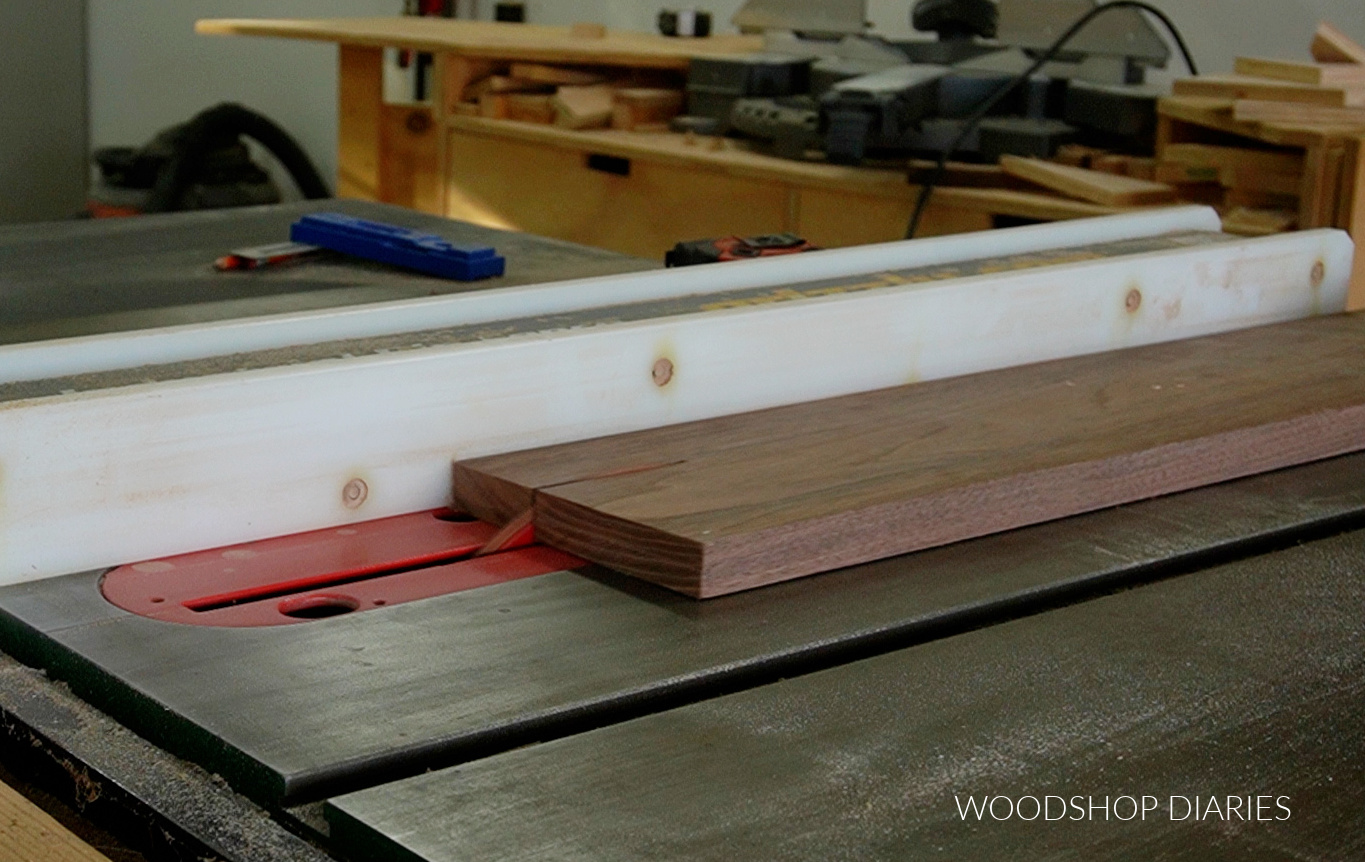
How to Build a Mid Century Console

August 24, 2023 by Shara, Woodshop Diaries

In this post, I’m sharing how to build a Mid-Century style console cabinet from plywood!

This wide, but shorter-than-usual cabinet has the coolest mid century vibe and makes a great tv stand, dining room console, or storage cabinet for an office.

Mid century style modern walnut console cabinet with legs and center shelving

I built this modern console with walnut plywood and left the edges exposed on purpose (as you can see above) to give it an even more contemporary feel.

But of course, if you prefer covered edges, you can always apply edge banding when you build yours. The best part about building your own projects is you can customize however you’d like!

My favorite part is the continuous grain pattern on the sides and the top! But those angled, modern legs are a close second favorite.

Close up of continuous grain on mid century modern plywood console

If you love mid century style and a good plywood project, this one’s for you and I’m sharing all the details and plans below.

*This post contains affiliate links. See website policies.

What to know before building

This is a great intermediate level weekend woodworking project. It’s certainly not a difficult build, but it will involve making some precise measurements and cuts, and installing doors and shelves.

I have included several really helpful tips and additional information in the video below, so I definitely recommend checking it out before building.

Material Choices

For this project, I used PureBond EuroPly Walnut plywood. It’s absolutely beautiful, but it’s pretty pricey.

Close up of unfinished walnut plywood with tape measure on table saw

If you’re not interested in splurging on walnut plywood, that’s okay! Maple, birch, or oak plywood options are also great options. These are much cheaper options and more readily available at most lumber yards and big box stores.

Either way, I definitely recommend using a hardwood cabinet grade plywood for this project. Check out this post to learn how to choose the best plywood for your DIY projects.

What to do about the plywood edges

I almost always cover my plywood edges when I’m building a furniture project. I like to use iron on edge banding for this–it’s inexpensive, easy to apply, and looks amazing.

Learn how to apply iron on edge banding here.

Close up of plywood edges showing one edge banded and one not edge banded

However, edge banding is certainly not REQUIRED. Sometimes people like to leave the plywood edges exposed as a design element–like in this case. I built this mid century console with exposed plywood edges to try something different than I usually do.

So when it comes to your own project, cover the edges or leave them exposed. It’s totally up to you!

Overall Dimensions

The overall dimensions of this project are 16″ x 20″ x 60″.

Dimensional diagram of mid century modern console cabinet

Here are some resources you may find helpful throughout the build:

  • How to cut plywood
  • How to use a pocket hole jig
  • How to apply iron on edge banding
  • How to install concealed hinges
  • How to add adjustable shelves
  • Must have cabinet building tools

Enjoy building your own furniture and DIY projects? Sign up for priority access to the latest how-tos straight to your inbox!

How to Build a Mid Century Lowboy Console

I’ve got the details and steps below to see how it’s made, but I’ve also got the printable plans and video as well to make this as easy to build as possible!

If you prefer to watch, check out the full build video here. It’s packed full of helpful tips along the way:

Are videos your thing? Subscribe to my YouTube Channel for more project and how to videos!

If you prefer to print it out and take the plans to the shop with you, I’ve got you covered. Grab the Mid Century Modern Console Cabinet building plans here!

Tools & Materials

Tools:

  • Drill/Driver
  • Circular Saw and cutting guides
  • Pocket Hole Jig
  • Shelf Pin Jig
  • Concealed Hinge Jig
  • Jig Saw
  • Speed Square
  • Miter Saw (optional)
  • Corner Clamps

Materials:

  • (2) 4×8 sheets ¾″ plywood (walnut plywood used here)
  • (2) pair concealed hinges for full overlay doors on frameless cabinets
  • Shelf Pins
  • 1 ¼” pocket hole screws
  • 1 ¼” & 2″ wood screws
  • Wood Glue
  • Edge Banding (optional)
  • Painters Tape

Step 1: Build Outside Console Cabinet Box

This project is made of two “boxes.” One is the main cabinet–the inside box. And the outside box is basically a top and two sides that kind of “wraps around” the main box.

In the video, I made the inside box first, then cut and glued up the outside box to fit around it. The problem was that when I glued up the outside box, the opening ended up being ⅛″ smaller than the inside box–so they wouldn’t fit together.

Diagram showing outside cabinet in blue vs inside cabinet in green

I had to take the inside box apart, trim it down, and reassemble it–which was a pain. So I recommend doing exactly the opposite of what I did. Make the outside box first, then build the inside box to fit the opening.

To make the outside box, I ripped a strip from my plywood sheet to 16″ wide using a circular saw and Kreg Rip Cut. RELATED: How to cut plywood sheets

Shara Woodshop Diaries cutting plywood sheet with circular saw and Kreg Rip Cut

I wanted this box to have a continuous grain pattern, so needed to cut my pieces from this strip with a 45 degree bevel. That way, they can kind of “fold together” at the corners.

I used a straight edge and my circular saw to cut these pieces and I set the circ saw’s bevel angle to 45 degrees. I highly recommend checking out the video for more information on cutting these pieces.

I cut a side piece first to 12″ at the longest point, then I cut the top piece to 60″ long, then another side piece 12″ long. The side pieces have one end square and one end beveled.

Using circular saw with bevel set to 45 degrees to cross cut plywood strip

Note that you’re basically just cutting “Vs” out of the plywood sheet. I marked them with pencil on the board edge (as you can see in the image above) so I could keep track of how I needed to cut my pieces.

I laid these pieces out on my workbench so the long sides were together and the grain was running continuously across them on the top. Then I applied some painters tape along the joints to help hold them together during glue up.

Applying painters tape to mitered joints on plywood panels on workbench

I flipped this over and added some more painters tape on the edges of the joints. This will help keep the glue squeeze out from getting all over the wood.

I applied wood glue to the Vs, then folded them over and clamped them square with corner clamps.

Applying wood glue to V joints of mitered corner console cabinet box
Shara Woodshop Diaries clamping corner clamps to assemble outside MCM console cabinet box

Once the glue was FULLY DRY, I removed the clamps and the tape and sanded and smoothed out the corners. Then I measured the inside opening of this box before moving on.

Prefer to print? Grab the printable building plans for this mid century modern console here.

Step 2: Build Inside Console Cabinet Box

I built the inside box to fit into this opening–it should fit snug, but SLIGHTLY smaller than the opening works too. It just can’t be larger than the opening. This inside box depth is 14 ½″.

I assembled the inside console cabinet box using pocket holes and screws.

RELATED: How to use pocket holes in DIY projects

Shara Woodshop Diaries assembling plywood box for modern console cabinet

Note that the side panels are ¾″ inset from the back edge of the box. I divided the cabinet along the front with two pieces of plywood cut to 2″ wide.

Then I cut two divider panels to install into this cabinet to separate the three sections. Just like the side panels, these are inset from the back edge ¾″ as well.

Shara Woodshop Diaries installing middle divider shelf into console cabinet with measuring tape

I secured these in place using 1 ¼″ screws through the top and bottom panels.

Then, I cut a back panel to install along the back (this is why the dividers and sides are inset). I used 1 ¼″ wood screws to secure this panel to the sides, dividers, and through the top and bottom.

Shara Woodshop Diaries driving screws through back panel of cabinet box

Step 3: Cut and Attach Mid Century Legs

The next part is adding the mid century style legs. I cut these legs from solid ¾″ thick walnut wood, but you could certainly cut them from some of the ¾″ plywood leftovers instead. Or, get creative and cut the legs from a contrasting color wood.

I drew out the leg template onto my board and cut it out with a jig saw. Once I had one cut, I traced it three times on the board and cut those out to make 4 legs total.

Dimensional diagram of mid century modern leg template

I flipped the box from step 2 upside down and used my speed square to locate these legs at a 30 degree angle, 4″ in from the corners.

Speed square on bottom of cabinet corner showing leg locations

Once I positioned the legs, I traced around each one. Tracing the locations allows me to predrill two holes at each leg through the bottom panel.

I applied wood glue, and used 2″ wood screws through these predrilled holes from inside the cabinet to install each leg.

Shara Woodshop Diaries driving screws through bottom of mid century console cabinet to attach legs

Printable building plans for this project are available here!

Step 4: Attach Outside Box to Inside Box

Now it was time to bring the pieces together and attach the outside box around the inside box.

In the video, I didn’t use glue and I explain why there. But I recommend (if you plan to keep this project for a while) slathering wood glue all over the top and sides of the inside box, then placing the outside box over it and clamping until dry.

Shara Woodshop Diaries placing outside box on inside box to assemble console cabinet

You could also use a couple screws through the inside of the cabinet to help hold this while the glue dries, too.

The back edges of these boxes should be flush, so the outside box will overhang the front edge about 1 ½″

Step 5: Add Doors

Next, I cut two ¾″ plywood doors for the left and right sides of the cabinet. I cut these a bit “out of the ordinary” for overlay doors.

I cut these so they would fully overhang the bottom edge, but only overlay the top ⅛″. They overlay the outside edge ¼″ and the face frame divider piece about ½″. This is not “standard” sizing, but was done intentionally.

RELATED: How to determine cabinet door size

The video linked above has some great tips and information on installing the doors. I used my Kreg Concealed Hinge Jig to drill concealed hinge cup holes in my doors as close to the edge as possible.

Shara Woodshop Diaries screwing door hinges into cabinet to install doors

Then, I installed the concealed hinges for full overlay on frameless cabinets into these holes and onto the doors and adjusted as needed to get my overlays how I wanted.

Notice below how the door overhangs the whole bottom, but barely overhangs the top.

RELATED: How to install and adjust concealed hinges

Cabinet doors closed to show proper overlay spacing

Step 6: Add Shelf

And the final part was adding an adjustable shelf for the middle section of the console cabinet. This section is pretty small, so there isn’t a whole lot of room for adjustment.

I used my Kreg Shelf Pin Jig to drill a few holes into each side of this middle section and cut a shelf to place inside with shelf pins.

RELATED: How to add adjustable shelves to a cabinet

Middle shelf placed inside DIY mid century console

If you didn’t want an adjustable shelf, you could also install this as a stationary shelf with pocket holes and screws.

Step 7: Finish

And finally, this project was ready for paint, stain, and/or finish. For this walnut plywood, I wanted to keep the natural color, so I used Walrus Oil Furniture Butter to finish it.

Finished walnut plywood mid century modern console cabinet with two doors and a middle shelf

But feel free to paint or stain your project however you’d like! And now it’s ready to display! This cabinet would be the perfect TV console in a modern style living room.

But, it could also be great under some large wall art in a dining room or office.

Modern walnut console cabinet with legs

Don’t forget to grab the printable plans to build your own here.

Looking for more Mid Century Designs?

Mid century style is making a come back. I’ve been trying to incorporate some of these modern designs in my builds the last few years. Here are a few more mid century style projects you may enjoy!

Mid Century Nightstand
DIY Mid-Century Modern Dresser
Mid Century Bed
Stenciled Door Console
Mid Century Bookcase
DIY Dog Bed

If you want to save this project for later, be sure to pin it or share it to your favorite social channel!

Pinterest collage image of DIY mid century modern console--top image showing continuous grain plywood and bottom image showing full console completed with text "how to build a mid century console"

Until next time, friends, happy building!
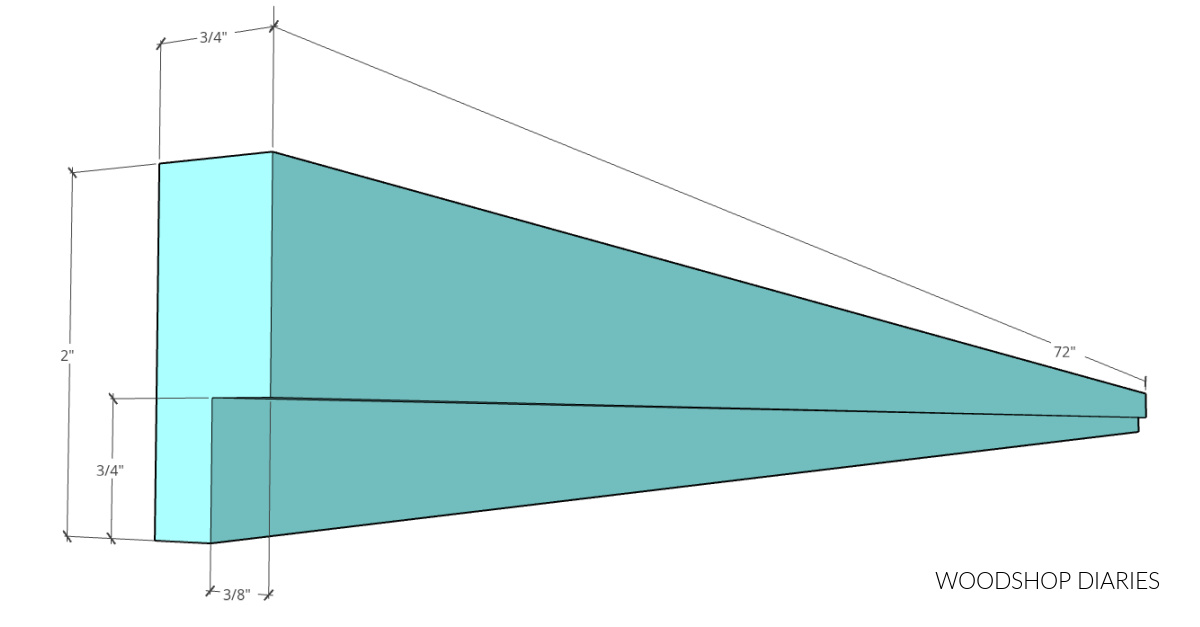
DIY Tea Station Tray

August 21, 2023 by Shara, Woodshop Diaries

In this post, I’m sharing how to build a DIY tea station tray from scrap wood!

This simple wooden tea tray has a place for hanging mugs, storing coasters, and resting a tea kettle. Plus it’s a perfect DIY gift idea for a friend, host, or a wedding!

Wooden tea station tray with coaster storage underneath tea kettle platform with mug holder post made from oak scraps

My tea kettle has been taking up valuable space on my stove for a while now. It was not only in the way, but every time I cooked, it would get dirty from splatters from the pans (gross, I know).

So I wanted to create a designated spot (a DIY tea station) for my tea kettle–that wasn’t on my stove–and that also kept my coasters and mugs readily accessible.

But, whatever I made couldn’t be anything big or bulky that would take up a bunch of countertop space in my kitchen.

I think I found a great solution with this little wooden DIY tea station tray and I’m excited to share how I made from just a few wood scraps!

*This post contains affiliate links. See website policies.

What to know before building a tea station tray

This easy weekend woodworking project makes the perfect inexpensive DIY gift idea, but it’s also a great addition to your own kitchen or pantry as well. I made mine for keeps!

Here are a few notes about the build before diving in.

Angled view of tea station tray with one mug on coaster with tea poured

What kind of wood to use for a DIY tea station tray

I made this little tray from scrap oak wood I had leftover from previous projects. While oak is a great option for this project, you can also use just about any type of wood you’d like.

All you need to build this project are a few pieces of 1×6, a small piece of 2×2 and a wooden dowel. So it’s a great project to use up whatever off cuts you may have in your scrap pile!

Scrap oak 1x6, 2x2 and dowel rod

Softer woods (like pine/spruce) and plywood are more likely to be damaged from heat and moisture than hard woods. But either option will work fine here are long as you’re careful.

IMPORTANT NOTE: Setting a hot tea kettle directly onto the wood surface isn’t advised as it can burn the wood and damage the finish. Make sure to use a trivet, tile, or pot holder between a hot kettle and the wood surface.

Whether you opt for a soft wood or a hard wood, you should still place a trivet or pot holder under the tea kettle if it’s hot.

Overall Dimensions

The overall dimensions of this tray are 5 ½″ wide x 12 ¾″ tall x 16″ long. Note that (depending on the size of it) your kettle may stick up further than 12 ¾″ so with the kettle in place, it may be taller.

Overall dimensional diagram of tea station tray with mug holder

Are new DIY projects your thing? Sign up for priority access to the latest projects and plans on Woodshop Diaries!

How to build a tea station tray

This is an excellent beginner woodworking project that you can easily complete in just about an hour or so. And it uses minimal tools!

The brad nailer in the tools list is optional. If you wanted to use screws instead of nails, that would work just fine.

Prefer to print? This project is available as a printable build plan if you’d prefer to print and take the instructions to the shop with you.

But I’ve also detailed the step by step instructions below as well.

Tools & Materials

Tools:

  • Miter Saw (or any saw that can cut straight lines)
  • Drill/Driver
  • Brad Nailer
  • Forstner drill bit

Materials:

  • Scrap 1×6 boards (see step 1 for lengths)
  • Scrap 2×2 board
  • ½″ diameter dowel rod
  • Wood Glue
  • 1 ¼″ Brad Nails
  • 1 ¼″ Wood Screw

Step 1: Assemble Tea Tray Base

The tea station base is made from 1×6 scraps. You need approximately 34″ of 1×6 OR enough 1×6 scraps to cut down the following pieces.

1×6 Cut List:

  • (1) 18″ long piece for the bottom
  • (1) 7 ½″ long piece for the top
  • (2) 4″ long pieces for the sides

Once I cut my four pieces, I used glue and brad nails to attach the 7 ½″ long piece and the 4″ pieces like shown below. These will make kind of like an upside down U shape.

Diagram showing how to assemble the tea kettle stand

A note on sizing: This “U shaped piece” is what the tea pot will sit on top of and the coasters will sit inside. Adjust the sizing of this piece as needed to accommodate your particular kettle and coasters.

Make sure to remove or wipe off any glue squeeze out and sand the edges if needed. It’ll be a lot easier to sand now than later.

Then I used wood glue and brad nails to attach the 18″ long piece to the bottom side so that the “U shape” was all the way flush to one end of the board.

Wooden tea tray with box on end of board made from oak wood on workbench

If you’d rather, you can certainly use wood screws here instead, just make sure they are countersunk so the screw head will sit at or below the wood surface.

I made sure to remove all glue squeeze out and set this piece aside to allow the wood glue dry.

Step 2: Assemble Mug Holder Post

The mug holder is made of a piece of 2×2 for the post and four ½″ diameter dowels for the pegs.

I grabbed a few of my mugs and laid them out on my workbench to figure out how far apart to space my dowels and how long to make them so that my mugs would hang on them, but not hit each other.

I highly recommend checking the spacing needed for your own mugs as yours may be smaller or larger than mine.

In my case, I determined that a 12″ long 2×2 would work perfect and my dowel pegs needed to be at least 3″ long. So I cut these pieces down and sanded them well.

Then, I marked where to drill my dowel holes on my 2×2 based on the mug spacing I figured earlier. I ended up drilling my holes at 5 ½″ and 11 ¼″ up from the bottom.

Marking 11 ¼" from bottom edge of board with pencil

I used a ½″ forstner bit to drill holes about ½″ deep at these marks. I drilled two holes on one side of the 2×2 and two more at the same locations on the opposite side.

Drilling ½" diameter holes in 2x2 with forstner bit

Then, I glued my dowel pegs into these holes, made sure they were straight and square, and allowed the glue to fully dry before moving on.

Mug holder post assembled--a 2x2 with 4 pegs made from ½" diameter dowels

Prefer to print? Grab the printable building plans for this tea station with mug holder here!

Step 3: Attach Mug Holder to Tea Tray

With the tray from step 1 assembled and the mug holder post from step 2 finished, all that’s left is attaching them together.

To do this, I flipped the tea station tray upside down and predrilled a hole on the opposite end as the tea pot stand to attach the mug holder post. I drilled this hole 3 ¾″ from the end and 2 ¾″ from the front edge.

Predrilling holes into end of bottom of tea station tray

I also predrilled a hole into the center of the bottom end of the 2×2 post. This will make it easier to line up the screw.

Then, I applied wood glue to the bottom of the 2×2 and used a 1 ¼″ wood screw to secure the post to the tray through the predrilled holes. This screw should be countersunk so it’s at or below the wood surface on the bottom of the tray.

Shara Woodshop Diaries driving screw through bottom of tray board to attach mug holder post

Make sure the post is located far enough away from the tea pot stand that you can slide a mug onto the pegs.

Step 4: Make Coasters (optional)

At this point, the tea station tray is ready for finish. Apply a finish of your choice to the tray (or leave unfinished if desired).

Tea station tray made from scrap oak sitting on butcherblock with coasters and mugs and a tea kettle

Then, hang up your mugs, store away your tea kettle and stock a few coasters so they’re ready when you need them.

If you don’t have any coasters, don’t worry! These simple two tone coasters are SUPER easy to make and all you need are some scrap 1x2s. Learn how to make these easy DIY wooden coasters here.

two tone scrap wood coasters on table top

And if you need somewhere to store your favorite teas, this DIY tea box is another great tea related scrap wood project you’ll love.

MORE FUN WITH SCRAP WOOD

Can’t get enough scrap wood projects? Me either! That’s why I’m teaming up with my friend, Kati, from Houseful of Handmade all month long to share some “Scrap Wood Summer” Projects!

Check out all the projects in the series so far below. Click on an image to learn how to make each one!

DIY Modern C Table
DIY Entryway Shelf with Mirror
DIY Yard Tool Organizer
DIY Side Table with Wheels
DIY Floating Shelves
DIY Organizer Tray
DIY Wooden Sunflower Art
DIY Paper Towel Holder
DIY Tea Pot and Mug Stand
DIY Tortilla Press

We will be posting new Scrap Wood Summer projects every Tuesday through the month of August (2023). Check out last years’ Scrap Wood Summer projects plus other scrap wood ideas here.

Don’t forget to save this project for later by pinning it or sharing to your favorite social channel!

Pinterest collage image showing scrap oak boards cut on workbench at top and assembled DIY tea station tray at bottom with text "DIY tea station from scrap wood!"

Until next time, happy building!

Modern DIY Floating Shelves

August 14, 2023 by Shara, Woodshop Diaries

In this post, I’m sharing how to make simple, modern DIY floating shelves from scrap wood!

This is a great project to use up some of those small boards and you can get creative with different species or wood stains to make them different colors, too!

Three different colored wooded angled DIY floating shelves on white wall with books, vase, and plant sitting on them

I don’t know about you, but I like to keep my wall décor pretty minimal. But, I had a blank wall in my living room that I’ve been considering adding something to.

I definitely didn’t want anything excessive, so I thought some small floating shelves might work well. But, I wanted them to be unique somehow while still being pretty minimalist.

After digging around my wood scrap pile, I had a lightbulb moment–make three shelves in different colors! The “fade” from light to dark is such a neat feature that doesn’t take away from the minimal design.

But of course, you are welcome to make more (or less) than three and customize the colors however fits your style. I’m just excited to show you how easy they are to make below!

*This post contains affiliate links. See website policies.

What to Consider Before Building

These are a super fun and simple build and there are a million ways to customize them.

Here are some things to think about before building and tips to make this project go smoothly.

What type of wood to use for floating shelves

The short answer is: any of them! When it comes to making simple floating shelves, there’s no “right” or “wrong” wood type to use.

But since this is a great scrap wood project, I suggest diving into your scrap wood pile and seeing what you’ve got available.

In this case, I thought it would be fun to make three separate shelves. I made each of them from a different wood since I had a small piece of three different species available–cypress, cherry, and walnut.

Cypress, cherry, walnut boards laying side by side on workbench

These boards were all about 1″ thick. But, if all you have in your scrap pile are standard size boards, you could certainly use 1x or 2x boards for this, too.

RELATED: Understanding lumber sizing

I don’t recommend making these shelves very deep, so a board width of approximately 6-8″ wide would work great.

A Tip to Give Your Shelves Some Extra Character:

Choose boards with imperfections like a large knot, a chipped edge, etc. as these are cool features to highlight here. These modern floating shelves are a great project to use up those “discarded” off cuts.

Are new DIY projects your thing? Sign up for priority access to the latest projects and plans on Woodshop Diaries!

How long should floating shelves be?

Your floating shelves can be just about any length you’d like. However, since these were made of scrap wood, they were fairly short.

I made each of these shelves approximately 24″ long and they were about 5 ½″ deep.

Walnut floating shelf hanging on wall with plant. Text and bracket showing length dimension of shelf to be about 24" long

If your scraps aren’t long enough to make your shelves 24″ long, try to at least make them 18″ or more so they can span across at least two wall studs.

NOTE: Normally, wall studs are spaced 16″ on center. But not ALL of them are. Double check your wall studs where you plan to hang these to determine how far apart they are. Make your shelves long enough to span across at least two of them.

If you’re not limiting yourself to scraps and have longer boards to work with, feel free to make them as long as you’d like to fit in whatever space you’re adding them to.

I do recommend that no matter how long you make them, you secure them into each wall stud that they span across.

How do I hang these floating shelves?

These floating shelves are hung by simply driving a screw through the back board of the shelf and into the wall studs behind it. Personally, I think this is a little easier and cheaper than using metal brackets.

But, if you prefer to use brackets, these floating shelf brackets are another great option.

Either of these installation methods are simple and create strong and sturdy shelves without needing any additional tools.

How to Build Modern DIY Floating Shelves

This is a simple and quick DIY project perfect for the weekend or an evening build. The worst part is simply waiting for the glue to dry.

Tools required here are minimal and listed below. The table saw is only needed to rip down your boards to different widths. If you have another method for ripping, or don’t need to trim your board widths, a table saw is not required.

Tools & Materials

Tools:

  • Miter Saw
  • Drill/Driver
  • Table Saw (optional)
  • Stud Finder

Materials:

  • Scrap wood (see step 1 and notes above)
  • Wood Glue
  • Painters Tape
  • 2″ Wood Screws
  • 3″ Wood Screws

Step 1: Choose Your Shelving Material

First, select the wood you want to use for your shelf. I recommend checking your scrap pile for ¾″ or 1″ thick boards. Thicker boards will work, too, but may make these shelves quite heavy.

For each shelf, I grabbed a piece 5-8″ wide and about 28″ long. See notes above.

If your boards are 5-6″ wide, you’ll need to find some scrap 1x2s or 1x3s to use for the back supports OR use floating shelf brackets to hang them. If your boards are wider, you’ll need to rip them down in the next step.

Step 2: Cut Floating Shelf Pieces

I mentioned earlier that I made my shelves about 5 ½″ deep. You can certainly make yours narrower or wider, but I recommend keeping it under 6″ unless you use floating shelf brackets to hang them.

My boards were all between 6 ½″ to 8″ wide, so first, I ripped them down to 5 ½″ wide so they were all the same.

Cherry, walnut, and cypress wood on workbench with tape measure showing the width

I saved the strips I ripped off to use as the back supports in step 4. But if you don’t rip your shelf boards down, you can use other scraps for the back supports instead. There are a million ways to make these.

Then, I took these boards to the miter saw to trim them to length. I mentioned earlier that I made my shelves approximately 24″ long, but feel free to modify your length as desired.

To give these floating shelves a modern feel, I set my miter saw’s bevel angle to 30 degrees for all of these cuts.

close up of miter saw bevel angle set at 30 degrees

Then I cut a shelf piece 24″ long and a side piece 4″ long like shown in the diagram below. Note that all the cuts are made with bevel of 30 degrees.

I repeated this for all three boards paying attention to which end I cut the side pieces from. The side piece can go on the left or right side of the shelf board, but cutting them so it’s a continuous grain along the bottom is ideal.

Diagram showing board cuts to assemble modern DIY floating shelf

For two of my shelves, I cut the side piece from the left (opposite of what’s shown in the diagram above) and for the third shelf, I cut the side on the right (like what’s shown in the diagram above).

Step 3: Glue Up Floating Shelf

Once the pieces for each shelf were cut, I needed to glue them together. So I laid them out on the workbench upside down so that the long sides of the boards faced up.

floating shelf pieces laid long side up on workbench side by side with arrow pointing to edge with text reading "place tape along edge"

I lined up the edges of the board and placed some painters tape along the joint where they met. Then, I flipped it over, and applied some wood glue to the joint.

Then I folded the side piece over like shown below and allowed the glue to dry.

Close up of side piece glued and taped onto shelf bottom on workbench with glue bottle

The glue should squeeze out a little (this is a good sign everything inside is covered if it squeezes out the edges), so make sure to wipe away the excess before it cures.

Once the glue was dry, I removed the tape and gave the piece a good sanding to remove any remaining glue residue.

Three unfinished floating shelves made from different woods laying on concrete floor

Step 4: Attach Back Shelf Support

If you plan to use brackets to hang your shelves, you can skip this step. This back support is only here to give you something to screw through to attach these to the wall.

Remember those strips I cut from my boards in step 2? Here is where they come back into play. If you didn’t rip your boards in step 2, a scrap 1×2 or 1×3 piece would work fine for this, too.

I cut a piece from these thin strips to run along the back edge of each shelf. Note that the ends are mitered 30 degrees.

Diagram showing back support piece added to DIY floating shelf design

To attach these, I applied a bead of wood glue along the edge of the board, placed it on the shelf so it was flush to the back edge, then clamped it tight while it dried.

For a little extra holding power, I also added two 2″ wood screws through the bottom (shown below) up into these back support pieces.

Image of underside of wooden DIY floating shelf showing locations of screws

Step 5: Finish and Hang Floating Shelves

Before hanging, I finished these shelves with a couple coats of Minwax Polycrylic clear coat. Feel free to paint or stain your shelves as desired.

If you didn’t have different species of wood to work with, an alternative way to make these in different colors is to use different color wood stains!

Once the finish was dry, I used a stud finder to locate and mark my wall studs where I wanted to hang these. I used 3″ wood screws through the back supports from step 4 to secure these to the wall studs.

Modern DIY floating shelves hanging on white wall with text and arrows pointing out where screw locations are to install them to wall studs

Use at least two screws per shelf and use a level to ensure they’re straight and level while installing. You can obviously space your shelves out however you’d like, but mine are approximately 14″ apart here.

And with that, these shelves are finished and ready for decorating! My shelves, once installed, felt really secure. I wouldn’t hesitate to put books, plants, or any kind of décor on them.

DIY wooden modern floating shelf made from cherry wood against white wall with vase and decor sitting on it

The exact amount of weight they’ll hold will vary depending on the type of wood, type of screw, thickness of material, depth of shelf, etc.

If you opted to use brackets for hanging, the amount the shelves will hold will be based on what the bracket is rated for.

These are perfect for displaying photos, small plants, home décor, maybe even cutting boards or mugs.

Cypress and cherry wood floating shelves hung on white wall

More Fun With Scrap Wood

Can’t get enough scrap wood projects? Me either! That’s why I’m teaming up with my friend, Kati, from Houseful of Handmade all month long to share some “Scrap Wood Summer” Projects!

Check out all the projects in the series so far below. Click on an image to learn how to make each one!

DIY Modern C Table
DIY Entryway Shelf with Mirror
DIY Yard Tool Organizer
DIY Side Table with Wheels
DIY Floating Shelves
DIY Organizer Tray
DIY Wooden Sunflower Art
DIY Paper Towel Holder
DIY Tea Pot and Mug Stand
DIY Tortilla Press

We will be posting new Scrap Wood Summer projects every Tuesday through the month of August (2023). Check out last years’ Scrap Wood Summer projects plus other scrap wood ideas here.

Don’t forget to save this project for later by pinning it or sharing to your favorite social channel!

Pinterest collage image showing three wood types at top and completed floating shelves at bottom with text "how to turn scrap wood into floating shelves"

Until next time, happy building!

How to Build an Outdoor Side Table

August 10, 2023 by Shara, Woodshop Diaries

In this post, I’m sharing how to build an easy DIY outdoor side table as part of a matching outdoor furniture set!

I’ve been sharing a five piece matching outdoor furniture set over the last few weeks and this simple side table is the perfect way to wrap up the series!

Simple wooden outdoor side table with books and mug on top sitting in grassy area outside

This chunky style end table pairs perfectly with the coffee table and outdoor seating I’ve shared already and is the perfect combination of simple, modern, sophisticated and rustic.

If you missed it, check out these matching pieces:

  • DIY Outdoor Chair (seats 1)
  • DIY Outdoor Loveseat (seats 2)
  • DIY Outdoor Sofa (seats 3)
  • DIY Outdoor Coffee Table

After sharing the three matching seating projects first, matching side and coffee tables were highly requested, so I’m excited to be sharing this with you to complete the set!

Shara Woodshop Diaries sitting on wooden outdoor loveseat with feet propped up on outdoor coffee table reaching for mug on top of matching side table

If you’re ready to get building, let’s go!

*This post contains affiliate links. See website policies.

What to consider before building an outdoor side table

As always, you can find the materials list in the tutorial and building plans below, but I encourage you to check your scrap wood pile before buying any lumber.

Most of the pieces used to build this little end table are common sizes and fairly short lengths, so you may already have everything you need!

Enjoy building your own furniture and DIY projects? Sign up for priority access to the latest how-tos straight to your inbox!

WHAT TYPE OF WOOD SHOULD YOU BUILD AN OUTDOOR Side TABLE WITH?

When building an outdoor project, it’s always good to consider the type of wood you want to use.

Untreated pine is readily available, common in DIY projects, looks nice and is very budget friendly. However, when exposed to the elements outdoors, it can deteriorate quickly.

unfinished pine boards stacked on table saw

If left unfinished, untreated pine wood will likely only last you a season or two. But if properly finished and sealed (with an outdoor sealant or paint), you may get several years out of it depending on how harsh the weather is where you live and if it’s under porch cover.

Pressure treated wood is wood that is treated with special chemicals to prevent it from deteriorating so quickly. It’s readily available and budget friendly, but it’s not always the nicest to work with and it’s pretty heavy.

pressure treated wood laying on concrete floor

Cedar, red wood, and teak are all naturally decay and insect resistant wood options that look really nice and are great for outdoor furniture projects. But, that comes with a price tag.

These wood types can be quite expensive and sometimes hard to find depending on where you live.

cedar wood laid out on workbench

I built the matching chair, loveseat, and sofa with cedar, so I made this side table from cedar as well since that’s what I had leftover in my scrap pile.

TIP: Don’t forget when building project for outdoors, make sure to use outdoor rated hardware (screws), and outdoor rated finishes!

Outdoor Side Table Size

Much like indoor side tables, outdoor side tables can be found in a ton of various sizes to fit your needs. There is no “standard side table size.”

However, side and end tables do tend to be a few inches taller than coffee tables and usually come up close to the height of the arm rest on the chair it sits next to.

In this case, I made this table 18″ deep x 19 ½″ tall x 22 ¼″ wide (at the widest point between the legs). The table top is 18″ x 18 ¾″.

overall dimensional diagram of outdoor side table

It’s not uncommon to find many outdoor side tables a couple inches shorter than indoor side tables. Typically, outdoor seating is lower to the ground, so it makes sense that the side tables that go with them are also a little shorter as well.

This simple coffee table is SUPER easy to customize to any size you’d like with just a few basic adjustments that I’ll discuss below.

FINISHING YOUR OUTDOOR Side TABLE

Once your project is built, you want to make sure it’s properly protected from weather damage from sun, rain, and snow.

The easiest way to do this is to apply an outdoor sealant (or paint) to ALL surfaces (especially end grain). I prefer outdoor stain and sealants because they allow you to seal and protect the wood, but still see the wood grain underneath.

Can of Cabot Australian Timber Oil

Outdoor stain and sealants come in a wide variety of brands, colors, and opacities. You can find many of them readily available in the big box store or local hardware stores.

Most of the options you see available off the shelf come in a clear transparent, and a tinted transparent, semi-transparent or solid.

Basically anything with a tint is a stain and sealant all-in-one and the “less transparent” you go, the more protection it provides. Solids provide more protection than transparent. However, transparent allows you to see the wood grain more.

So choosing one is mostly based on how you want it to look and how often you want to reapply. Once water no longer beads up on the surface, it’s time for another coat. For this project, I used Cabot Australian Timber Oil in Honey Teak.

How to build an outdoor side table

This side table build is simple and straightforward and can easily be assembled in an hour or two. It’s a great weekend project for a beginner to intermediate DIYer.

If you prefer to watch, check out the full build video here with helpful tips and along the way!

Are videos your thing? Subscribe to my YouTube Channel for more project and how to videos!

I’m sharing the step by step process to build this DIY outdoor side table below. But if you prefer to print it out and take the plans to the shop with you, I’ve got you covered! Grab the outdoor side table printable building plans here.

Tools & Materials

Tools:

  • Miter Saw
  • Drill/Driver
  • Pocket Hole Jig
  • Sander
  • Brad Nailer (optional)

Materials:

  • (1) 4x4x8 post
  • (1) 2x2x8 board
  • (1) 1x2x8 board
  • (1) 2x4x8 boards
  • (1) 1x6x8 board (or a 1x6x6 fence picket)
  • 1 ¼″ exterior wood screws or brad nails
  • 2 ½” exterior wood screws
  • 2 ½” exterior pocket hole screws
  • Wood Glue (exterior rated)
  • Exterior wood finish

Step 1: Assemble Side Table Base

Just like with the matching coffee table, this smaller side table base is made from 4x4s for the legs.

A Note from Behind the Scenes: I actually built this exact same table design three times–once using 2x2s for the legs, once using 2x4s for the legs and finally this one with 4x4s for the legs.

I thought the smaller legs might look better, but they looked kind of odd next to the matching loveseat and coffee table. So, ultimately, I decided to stick with the 4×4 legs here.

I used 2x2s for the side frame pieces and 2x4s on the front and back frame pieces in order to connect the legs together to make the base.

If you want to adjust the sizing of your table, here are some tips:

  • To make the table taller/shorter: Adjust the length of the legs
  • To change the table width: Adjust the length of the 2x4s
  • To change the table depth: Adjust the length of the 2x2s

I cut the 4×4 legs with 10 degree mitered ends so that they would slant outward slightly instead of just being straight up and down. Make sure to miter both ends parallel to each other.

miter saw miter angle shown set to 10 degrees

Since these legs were mitered, I also had to bevel the ends of the 2x4s that run between them 10 degrees. These need to be beveled so they are NOT parallel to each other.

All the dimensions and angle details can be found in the printable plans.

I drilled 1 ½″ pocket holes into the ends of the 2×4 boards and the 2×2 boards in order to assemble. Notice that the pocket holes in the 2x4s need to be drilled within 2 ½″ of the outside edge of the board. I know that seems odd, but there’s a reason!

RELATED: How to use a pocket hole jig

Shara Woodshop Diaries holding 2x4 with pocket holes drilled into the end with bracket showing 2 ½" spacing where pocket holes are placed

When I assembled the 2x4s between the legs, I installed them so that they were 1″ inset from the outside edge of the legs.

This added some extra dimension to the table base and also allowed a “ledge” to place the slats on later.

Shara driving screws in pocket holes to assemble top frame of outdoor side table on workbench

I made the two front and back sides of the outdoor coffee table base by securing the 2x4s between the 4×4 legs like shown above. Then I attached the sides together with pocket hole screws in the 2x2s like shown below.

Shara Woodshop Diaries assembling outdoor side table frame on workbench with 2x4s and 2x2s

By the way, when drilling pocket holes in 2x2s, I like to just use one pocket hole as I have found that using two tends to cause the wood to split. If you use one pocket hole in 2x2s like I do, make sure not to skip using wood glue with it!

Step 2: Assemble Side Table Top Frame

The outdoor side table top consists of a simple 2×4 frame with slats running along the inside. Before I could add the slats, I needed to build the outside frame.

So, I assembled a basic 2×4 frame using pocket holes and screws. I made the overall size of this frame about 2″ deeper and 2 ½″ wider than the top of the table base. This will allow for some overhang on all sides.

2x4 frame assembled for top frame of outdoor table

Step 3: Attach Table Top and Base Together

Then, I flipped the frame from step 2 upside down on the workbench and flipped the table base from step 1 upside down on top of it.

I made sure the base was centered on the frame, then used 2 ½″ screws to secure them together through the bottom side of the table base.

Close up of driving a screw through the bottom of the side table base to attach the top

Step 4: Add Top Slats

The top frame from step 2 is made from a 2×4 so it’s about 1 ½″ thick. You could use 2x thick slats and simply cut these and place them inside the opening.

However, cedar 2xs are pretty expensive, so I really didn’t want to do that. Instead, I used cedar 1×6 fence pickets (which are really cheap–and I already had some in my shop).

The downside is that cedar fence pickets are about ⅝″ thick. So if I just cut them and place them in the frame, they’d sit well below the surface, which isn’t ideal.

RELATED: Understanding lumber sizing for beginners

To fix this, I cut some 1x2s as “spacer blocks” to place inside this opening and screwed them into the 2×4 on the table base.

top of outdoor side table with arrows pointing to the 1x2 spacer blocks installed into the frame

Then, I could cut my fence picket boards and place them on top. These may still sit a little lower than the frame, but just barely.

TIP: If you wanted to use a standard 1×6 board instead of a fence picket, that would work fine as well (but regular 1×6 cedar boards are pretty pricey too, so fence pickets are a great substitute).

Placing fence picket slats into the top of an outdoor side table

I didn’t attach these just yet because I thought it would be easier to stain before they were secured in place.

Step 5: Finish

I applied a coat of Cabot Australian Timber Oil in Honey Teak to the side table frame and the slats individually.

Once everything was sealed and dry, the slats were ready to attach. You can attach these several different ways.

One way to attach the slats here is to simply apply a bead of exterior rated wood glue along the 1×2 spacer blocks from step 4 and just place the slats on top. Then, allow the glue to fully cure before moving.

Finished outdoor side table with chunky legs and Cabot Australian Timber Oil finish next to loveseat in grassy area

Another option is to apply wood glue and use brad nails or wood screws to secure the slats to the 1×2. Personally, I suggest using brad nails as screws are more likely to split or crack the wood.

Once the slats are secured, it’s ready to put to use on your deck, porch or patio! Pair it with some matching seating and the matching coffee table to create a cozy outdoor gathering space!

Outdoor side table sitting next to matching loveseat with angled legs made from 4x4s and 2x4s

Grab the printable building plans to build your own DIY outdoor side table here!

Looking for more outdoor project ideas?

Outdoor projects are always in season! You can enjoy building them all year long. Here are a few of my favorites that would pair great with this fun table:

DIY Outdoor Coffee Table
DIY Outdoor Loveseat
DIY Outdoor Chair
DIY Outdoor Sofa
DIY Fall Planter Boxes

If you’d like to save this project for later, don’t forget to pin it or share it to your favorite social channel!

Pinterest collage image showing overall dimensional diagram at top and completed outdoor side table at bottom with text "how to build a simple outdoor side table"

Until next time, friends, happy building!
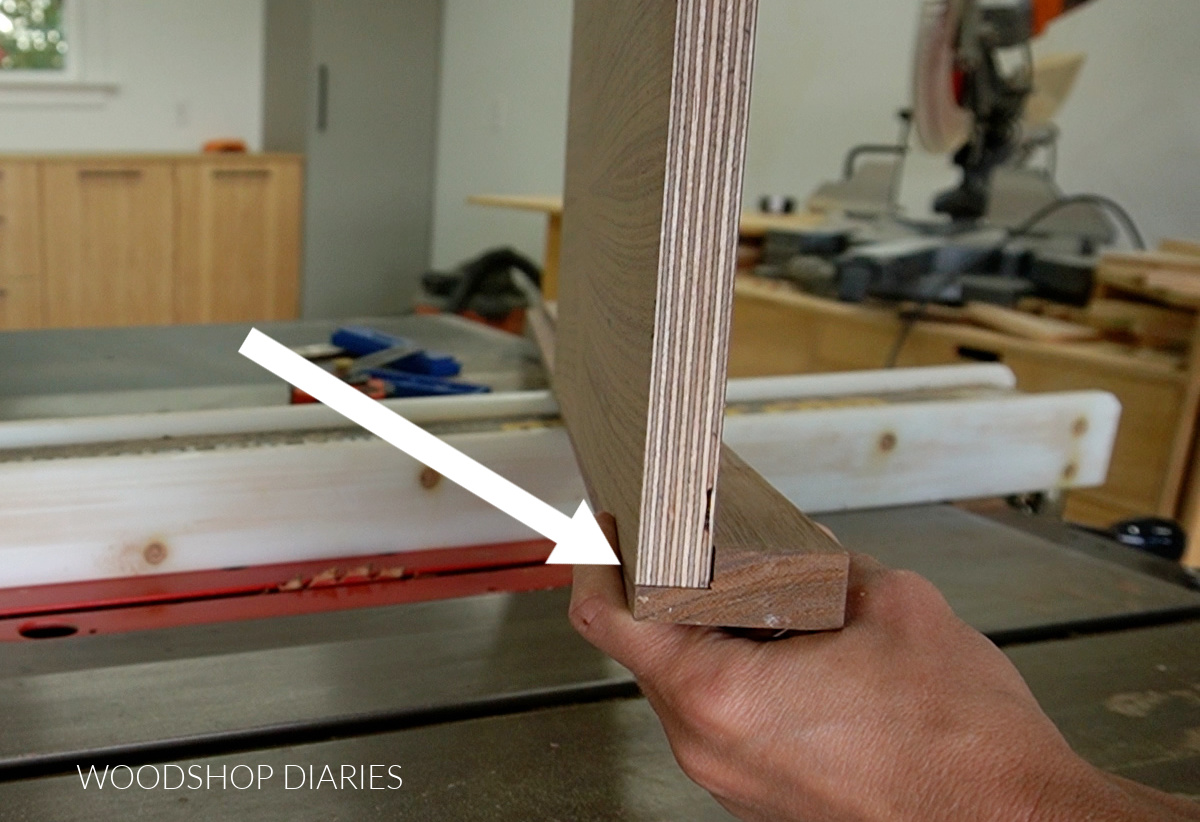
DIY Chunky Outdoor Coffee Table

August 9, 2023 by Shara, Woodshop Diaries

In this post, I’m sharing how to build a chunky style DIY outdoor coffee table!

This coffee table is a simple, but adorable addition to the matching outdoor furniture set I’ve been putting together over the last few weeks.

Beautiful wooden outdoor coffee table with wicker tray in front of wooden loveseat in grassy area

This coffee table may actually be my favorite piece of the whole set! It pairs perfectly with the DIY outdoor seating I’ve shared already and is the perfect combination of simple, modern, sophisticated and rustic.

If you missed it, check out these matching outdoor seating options:

  • DIY Outdoor Chair (seats 1)
  • DIY Outdoor Loveseat (seats 2)
  • DIY Outdoor Sofa (seats 3)

After I shared the seating, I had so many requests for a matching table, and I’m SO excited to be sharing this one with you now.

Shara Woodshop Diaries sitting on wooden outdoor loveseat with feet propped on outdoor coffee table reaching for mug on outdoor side table

This is a great weekend project that you can easily complete in about an hour with basic tools and materials.

So if you’re ready to get building, I’ll show you how to make it below!

*This post contains affiliate links. See website policies.

What to consider before building an outdoor coffee table

I’ve included the materials list in the tutorial and plans below, but I highly encourage you to check your scrap wood pile before buying any lumber.

Most of the pieces used to build this table are common sizes and fairly short lengths, so you may already have everything you need!

Enjoy building your own furniture and DIY projects? Sign up for priority access to the latest how-tos straight to your inbox!

What type of wood should you build an outdoor coffee table with?

When building outdoor projects, always consider the type of wood you use. There are several options, and like most things, there are pros and cons to each one.

You can use untreated pine for outdoor builds, but keep in mind that it doesn’t hold up great in the elements long term.

untreated pine boards on workbench

Untreated pine is the most budget friendly option, but will likely only last you a few seasons outdoors depending on how it’s finished and how much exposure to rain, snow, and sun it gets.

Pressure treated wood is intended for use outdoors and will last a long while. However, it’s not always the nicest to work with, it’s heavy, and it’s treated with special chemicals to prevent it from deteriorating so quickly. It’s a good low budget option for outdoor furniture that you want to last a while.

Cedar, red wood, and teak are all naturally decay and insect resistant wood options that look really nice. But, that comes with a price tag. These wood types can be quite expensive and sometimes hard to find depending on where you live.

cedar wood laid out on workbench

For this entire matching outdoor furniture set, I opted for cedar as that’s what I had in my scrap pile to build with.

TIP: Don’t forget when building project for outdoors, make sure to use outdoor rated hardware (screws), and outdoor rated finishes!

Outdoor coffee table sizing

Much like indoor coffee tables, outdoor coffee tables can be made in various sizes to fit your needs. There’s no specific “standard size coffee table.”

Width and length vary quite a bit. Some of them are fairly small (like the one I’m sharing here) and some can be pretty massive. However, coffee table height tends to stay within a pretty small range.

Indoor coffee tables tend to average around 16″ – 18″ in height. Outdoor coffee tables tend to be a few inches shorter and average about 13-15″ tall. (At least from my observations…). But again, there isn’t a “standard,” so this isn’t a hard rule.

Outdoor coffee table with dimensional bracket and text "outdoor coffee table height typical 13" - 15"

Why are outdoor tables shorter? Outdoor seating tends to be a little lower to the ground than indoor seating, so it’s common to see outdoor tables a little shorter than indoor tables.

This simple DIY outdoor coffee table as shown in the plans below is 15 ½″ tall x 18 ½″ wide x 38″ long (note that the table top is 36″ long).

Dimensional diagram of DIY outdoor coffee table

This simple coffee table is SUPER easy to customize to any size you’d like with just a few basic adjustments.

Finishing your outdoor coffee table

Once your project is built, you want to make sure it stays looking nice. But more importantly, you want to make sure it’s properly protected from weather damage from sun, rain, and snow.

The easiest way to do this is to apply an outdoor sealant to ALL surfaces (especially end grain). These come in a wide variety of brands, colors, and opacities. You can find many of them readily available in the big box store or local hardware stores.

Most of the options you see available off the shelf come in a clear transparent, and a tinted transparent, semi-transparent or solid.

Basically anything with a tint is a stain and sealant all-in-one and the “less transparent” you go, the more protection it provides. Solids provide more protection than transparent. However, transparent allows you to see the wood grain more.

So choosing one is mostly based on how you want it to look and how often you want to reapply. Once water no longer beads up on the surface, it’s time for another coat. For this project, I used Cabot Australian Timber Oil in Honey Teak.

How to Build an Outdoor Coffee Table

This build is simple and straightforward and can easily be assembled in an hour or two. It’s a great beginner to intermediate DIY project.

If you prefer to watch, check out the full build video here with helpful tips and along the way!

Are videos your thing? Subscribe to my YouTube Channel for more project and how to videos!

I’m sharing the step by step process to build this DIY outdoor coffee table below. But if you prefer to print it out and take the plans to the shop with you, I’ve got you covered! Grab the outdoor coffee table printable building plans here.

Tools & Materials

Tools:

  • Miter Saw
  • Drill/Driver
  • Pocket Hole Jig
  • Sander
  • Brad Nailer (optional)

Materials:

  • (1) 4x4x8 post
  • (1) 2x2x8 board
  • (1) 1x2x8 board
  • (2) 2x4x8 boards
  • (1) 1x6x8 board (or a 1x6x6 fence picket)
  • 1 ¼″ exterior wood screws or brad nails
  • 2 ½” exterior wood screws
  • 2 ½” exterior pocket hole screws
  • Wood Glue (exterior rated)
  • Exterior wood finish

Step 1: Assemble Coffee Table Base

The DIY outdoor coffee table base is assembled with 4x4s for the legs, and with 2x4s for the long sides and 2x2s for the short sides of the base frame.

If you want to adjust the sizing of your table, here are some tips:

  • To make the table taller/shorter: Adjust the length of the legs
  • To change the table length: Adjust the length of the 2x4s
  • To change the table width: Adjust the length of the 2x2s

I cut the 4×4 leg posts with 10 degree mitered ends so that they would slant outward slightly instead of just being straight up and down. Make sure to miter both ends parallel to each other.

miter saw miter angle 10 degrees

Since these legs were mitered, I also had to bevel the ends of the 2x4s that run between them 10 degrees. These need to be beveled so they are NOT parallel to each other.

All the dimensions and angle details can be found in the printable plans.

I drilled 1 ½″ pocket holes into the ends of the 2×4 boards and the 2×2 boards in order to assemble. Notice that the pocket holes in the 2x4s need to be drilled within 2 ½″ of the outside edge of the board. I know these seems odd, but there’s a reason!

RELATED: How to use a pocket hole jig

pocket holes drilled into 2x4 board off center--showing 2 ½" from edge

When I assembled the 2x4s between the legs, I installed them so that they were 1″ inset from the outside edge of the legs.

This added some extra dimension to the table base and also allowed a “ledge” to place the slats on later.

Assembling long sides of outdoor coffee table on workbench with pocket hole screws

I made the two long sides of the outdoor coffee table base by securing the 2x4s between the 4×4 legs like shown above. Then I attached the two long sides together with pocket hole screws in the 2x2s like shown below.

Shara Woodshop Diaries driving screws through side supports of outdoor coffee table base frame

This completed the table base. Everything else from here is SUPER easy.

Step 2: Assemble Table Top Frame

The outdoor coffee table top consists of a simple 2×4 frame with slats running along the inside. Before I could add the slats, I needed to build the outside frame.

So, I assembled a basic 2×4 frame using pocket holes and screws. I made the overall size of this frame about 1″ wider and 3″ longer than the top of the table base. This will allow for some overhang on all sides.

Cedar 2x4s assembled into simple frame using pocket holes and screws

Step 3: Attach Base to Top

Then, I flipped the frame from step 2 upside down on the workbench and flipped the table base from step 1 upside down on top of it.

I made sure the base was centered on the frame, then used 2 ½″ screws to secure them together through the bottom side of the table base.

Shara Woodshop Diaries attaching coffee table base to top frame on workbench

Step 4: Add Coffee Table Slats

Now all that’s left is adding the slats in the top! The top frame from step 2 is made from a 2×4 so it’s about 1 ½″ thick. So, you could use 2x thick slats and simply cut these and place them inside the opening.

However, cedar 2xs are pretty pricey so I really didn’t want to do that. So instead, I used cedar 1×6 fence pickets (which are really cheap).

The downside is that cedar fence pickets are about ⅝″ thick. So if I just cut them and place them in the frame, they’d sit well below the surface, which isn’t ideal.

RELATED: Understanding lumber sizing for beginners

To fix this, I cut some 1x2s as “spacer blocks” to place inside this opening and screwed them into the 2×4 on the table base.

Installing spacer blocks underneath coffee table slats in top frame with screws

Then, I can cut my fence picket boards and place them on top. These may still sit a little lower than the frame, but just barely.

TIP: If you wanted to use a regular 1×6 board instead of a fence picket, that would work fine as well (but regular 1×6 cedar boards are pretty pricey too, so fence pickets are a great substitute).

Cedar fence picket slats installed into top frame of coffee table

I didn’t attach these just yet because I thought it would be a lot easier to stain before they were secured in place.

Step 5: Finish

I applied a coat of Cabot Australian Timber Oil in Honey Teak to the coffee table frame and the slats individually.

Once everything was sealed and dry, the slats were ready to attach. One way to attach the slats is to simply apply a bead of exterior rated wood glue along the 1×2 spacer blocks from step 4 and place the slats on top. Allow the glue to fully cure before moving.

Another option is to apply wood glue and use brad nails or wood screws to secure the slats to the 1×2. Personally, I suggest using brad nails as screws are more likely to split or crack the wood.

Once the slats are secured, it’s ready for your deck, porch, or patio!

Completed DIY outdoor coffee table sitting in grass in front of loveseat with wicker basket and candle on top

Grab the printable building plans to build your own DIY outdoor coffee table here.

Looking for more outdoor project ideas?

It’s always a good time to build an outdoor DIY. Want to check out more outdoor projects to go with this? Here are a few of my favorites!

DIY Outdoor Sofa
DIY Enclosed Garden
DIY Adirondack Chair
DIY Outdoor Garden Cart
Raised Garden Beds with Trellis
mobile bbq cart prep table small
2 Tool Outdoor Grill Cart
DIY outdoor lanterns small
Scrap Wood Lanterns

If you want to save this for later, be sure to pin it or share it to your favorite social channel!

Pinterest collage image showing finished outdoor coffee table on bottom with dimensional diagram on top with text "printable building plans" and "how to build a simple outdoor coffee table"

Until next time, friends, happy building!
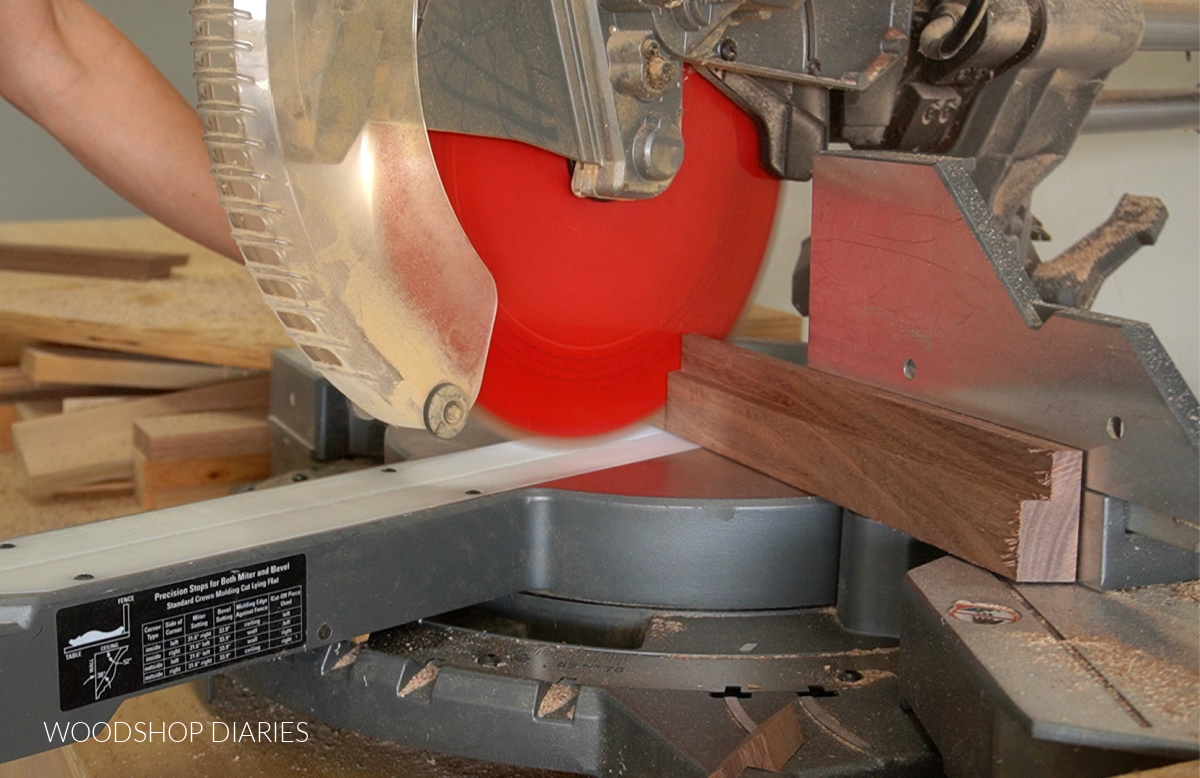
DIY Outdoor Loveseat

August 4, 2023 by Shara, Woodshop Diaries

In this post, I’m sharing how to make this super comfy DIY outdoor loveseat with basic materials and minimal tools!

This two seater outdoor couch is perfect for lounging with a friend or a couple of spoiled pets. And even better? You can easily start, finish, and enjoy it before the weekend is over.

Shara Woodshop Diaries sitting on DIY outdoor loveseat made from cedar wood in grassy area with grey seat cushions

In case you missed it, I recently shared a chunky style outdoor chair and a matching 3 seater outdoor sofa that I built for my parents. But I loved this design so much, I decided to build a matching DIY outdoor loveseat to keep for myself.

As expected, this loveseat build is very similar to the matching chair and sofa I’ve already shared (after all, it is a MATCHING set haha). But this loveseat design is modified to fit two standard 24×24 cushions (see notes below).

This is my absolute favorite outdoor seating design because it’s super comfortable for lounging with the sloped back and angled seat. Plus, it’s sturdy, stylish, and easy to build.

Shara Woodshop Diaries sitting on loveseat and placing mug on side table with feet propped on matching wooden outdoor coffee table

I’ll be sharing the matching coffee and side tables soon, too so be sure to follow along!

Be the first to know about new posts, plans, and woodworking tips on Woodshop Diaries. Sign up to our newsletter for priority access!

If you’re ready to see how to build this DIY outdoor loveseat, I’m sharing the details below.

*This post contains affiliate links. See website policies.

What to consider before building a DIY Outdoor Loveseat

This DIY outdoor loveseat project requires only 4 basic tools (listed below) and a few standard size boards you can easily find at the big box store or local lumber yard.

RELATED: How to shop for lumber

I was able to build this loveseat in a couple of hours, so it’s a really great weekend woodworking project. You can opt to seal (with an outdoor finish) the pieces prior to assembly or after.

Here are a few things to consider before building an outdoor loveseat.

SEAT CUSHION OPTIONS & SIZING

I built this loveseat to fit standard size 24″ x 24″ seat cushions. If you saw the outdoor sofa build, I used the exact same cushions here for the loveseat (just a different color).

It’s always easier to build the project to fit the cushion than to build the project and try to find cushions that fit!

The cushion sets I used came with both a seat cushion and a matching back pillow. You can find the cushions sets I used for this loveseat here.

Close up of outdoor cushions on left side of wooden outdoor sofa

Note that the seat cushions I used are advertised as 24″ x 24″ but when I got them and actually measured, they were 23 ½″ x 23 ½″. So I built the opening of the loveseat a little undersized at 47″ so they’d fit snug and not have gaps between them.

If your seat cushions are actually 24″ x 24″, they will still work fine. Pillows and cushions can “squish” a little to fit. Better to be snug than to have gaps.

WHAT WOOD SHOULD YOU BUILD AN OUTDOOR CHAIR WITH?

When building outdoor projects, always consider the type of wood you use. There are several options, and like most things, there are pros and cons to each one.

You can certainly use untreated pine for outdoor builds, but keep in mind that it doesn’t hold up great in the elements long term. This is the most budget friendly option, but will likely only last you a few seasons outdoors depending on how it’s finished and how much exposure to rain, snow, and sun it gets.

Pressure treated wood is intended for use outdoors and will last a long while. However, it’s not always the nicest to work with, it’s heavy, and it’s treated with special chemicals to prevent it from deteriorating so quickly. It’s a good low budget option for outdoor furniture that you want to last a while.

Pressure treated wood lying on concrete floor in workshop

Cedar, red wood, and teak are all naturally decay and insect resistant wood options that look really nice. But, that comes with a price tag. These wood types can be quite expensive and sometimes hard to find depending on where you live.

cedar lumber laid out on workbench with pencil and measuring tape

TIP: Don’t forget when building project for outdoors, make sure to use outdoor rated hardware (screws), and outdoor rated finishes!

APPROXIMATE COST TO BUILD the OUTDOOR Loveseat

For this loveseat (and the matching chairs and sofa), I opted for cedar. As of July 2023 when this was built, the lumber cost to build this loveseat with cedar (where I live) was approximately $170.

The cost to build it from pressure treated wood would have been approximately $60.

Overall Loveseat Dimensions

The overall dimensions of this loveseat design are 29 ½″ tall x 35″ deep x 54″ wide. The seat height (without cushions) is 12″.

overall dimensions of DIY outdoor wooden loveseat

HOW TO BUILD AN OUTDOOR LOVESEAT

Prefer to watch? Since the matching chair and loveseat are assembled the same way, the outdoor chair video details the assembly process for this loveseat as well.

The only change is that the seat and back slats are longer in this case to accommodate two seats instead of just one. These measurements are detailed in the plans below.

Are videos your thing? Subscribe to my YouTube Channel for more project and how to videos!

I’m sharing the step by step process to build this DIY outdoor loveseat below. But if you prefer to print out and take the plans to the shop with you, I’ve got you covered! Grab the outdoor loveseat printable building plans here.

TOOLS & MATERIALS

Tools:

  • Miter Saw
  • Drill/Driver
  • Pocket Hole Jig (both standard and XL jig)
  • Sander

Materials:

  • (2) 4x4x8 posts
  • (1) 2x2x8 board
  • (5) 2x4x8 boards
  • 4″ exterior pocket hole screws
  • 2 ½” exterior wood screws
  • 2 ½” exterior pocket hole screws
  • 4 ½” long timber screws or lag screws
  • Wood Glue (exterior rated)
  • (2) 24″ x 24″ seat & back cushion set (optional)
  • Foot Levelers

Step 1: Assemble Outdoor Loveseat Side Frames

The side frames are built from 4x4s for the front, back and top and a 2×4 for the seat frame. You can find all the details and dimensions in the printable building plans here.

For more details on building these side frames, check out step 1 of the DIY outdoor chair as these are identical.

Side frame of loveseat laid out on workbench--cedar 4x4s and 2x4s dry fit together

I assembled these side frames together using pocket holes and screws. BUT, take note that standard size pocket hole jigs aren’t designed to use with 4x4s since they’re so thick.

So to drill the pocket holes in the 4×4s, I used a Kreg XL Pocket Hole Jig. This XL jig has settings for 3 ½″ material, which is what a 4×4 is.

Confused about lumber sizing? Don’t worry. Check out this post on how to understand lumber sizing.

Close up of Shara Woodshop Diaries drilling pocket holes in 4x4 cedar post with Kreg XL Jig

So I drilled 3 ½″ pocket holes on the bottom side of the top 4×4 and attached it between the two legs using 4″ XL pocket hole screws.

Then I attached a 2×4 a seat support between the front and back legs with standard 1 ½″ pocket holes and 2 ½″ exterior pocket hole screws.

RELATED: How to use a pocket hole jig

This seat support is angled 4 degrees so the seat slopes back just slightly.

Shara Woodshop Diaries assembling loveseat side frame using pocket holes and screws on workbench

I cut and installed another 4×4 for the back post using 4 ½″ timber screws. This post is installed on the INSIDE of the side frame and will help support the back slats when added later.

I repeated this process to make two side frames that mirror each other like shown below. One will be the left side of the loveseat and one will be the right side.

Shara Woodshop Diaries placing two side frames together showing that they are mirrored--one for the left side and one for the right side

Step 2: Install Back Slat Supports

The back slats of this loveseat will run between the two inside 4×4 posts. However, I didn’t want to use pocket holes to secure these slats to the posts because no matter whether you put them on the front or back side, they’ll be visible in the finished project.

And I didn’t want to bother trying to fill them. So instead, I added some “braces” to these posts that will allow me to screw the slats onto in a later step.

So I cut and installed 2x2s to run along the inside of each of the side frames along the back 4×4. You can see below that I used a scrap 1×2 and a clamp to help me space this 1 ½″ from the front edge as I screwed it in.

Shara Woodshop Diaries securing 2x2 back slat braces to back posts of side frames on DIY Loveseat Build

Step 3: Secure Seat Slats Between Sides

I cut five 2×4 seat slats and drilled 1 ½″ pocket holes into the ends of each. I cut these long enough to accommodate two of my seat cushions. Dimensions and details can be found in the printable plans here.

If you’d like to go ahead and finish the side frames and slats before attaching them together, feel free. Check out the notes on the sofa build for more tips and information on weatherproofing your outdoor loveseat.

I secured one of the 2×4 slats running vertically between the side frames at the front using 2 ½″ exterior pocket hole screws. Then, I secured another running horizontally at the back of the side frames into the seat support.

Close up driving pocket holes to secure seat slats on loveseat build

Once the front and back slats were secured between the two sides of the loveseat, I evenly spaced the other three slats between them and secured with 2 ½″ pocket hole screws.

Step 4: Add Loveseat Back Slats

The final part was adding the back slats to wrap this loveseat build up. I cut 3 more 2x4s to run between the side frames along the back posts.

Diagram showing how back slats of DIY outdoor loveseat are installed between back posts on side frames

Again, feel free to seal and finish these before attaching if you’d like. I secured these into the braces from step 2 using 2 ½″ screws making sure they were evenly spaced.

Step 5: Finish & Install Foot Levelers

At this point, if you didn’t go ahead and finish the pieces as you built it, it’s time to apply an outdoor finish to seal your project.

NOTE: If you’re using pressure treated wood, you may need to wait for it to dry before finishing. If water beads up on the surface, it’s not ready for finish yet.

I waited until I was finished building before I stained and sealed this loveseat. I applied Cabot Australian Timber Oil in Honey Teak to all surfaces.

Once finished, if you notice that your loveseat doesn’t sit flat, or the surface you’re putting it on isn’t totally flat, don’t worry!

Close up drilling holes for foot levelers in outdoor loveseat posts

To help with this, I installed some foot levelers on each foot of the loveseat. These are the levelers I used and I simply drilled a 5/16″ hole into the center of each foot, tapped the insert into the hole and screwed the foot in.

Threading foot levelers into inserts on bottom of loveseat legs

This will also help protect from potential water damage by raising the legs off the ground slightly as well.

You can twist the foot clockwise or counterclockwise as needed to raise or lower each leg as needed once you get it to where it’s going.

Once the levelers are in, flip it back over, adjust as needed, toss in your cushions and enjoy your new DIY outdoor loveseat!

DIY cedar wood outdoor loveseat 2 seater sofa in grassy area with grey cushions and blanket

I’m not going to lie–this is one of the most comfortable outdoor seats I’ve sat in. The seat angle is slight so it’s easy to get in and out of and the cushions are a perfect fit.

Adding optional supports

This loveseat spans 47″ wide without a middle support and can hold at least 275 pounds evenly distributed across the seat without significant sagging.

(I wouldn’t hesitate to add more weight, but it held my husband and I and I just know that’s what we both weigh together.) So, I did not add any additional bracing here on my loveseat build.

However, if you notice your slats sagging more than you’d like them to, you can add a middle brace to provide additional support at the center.

Diagram showing attaching optional middle support brace in center of slats on outdoor loveseat

The dimensions of these pieces are detailed in the printable plans, but this is similar to the 2×4 bracing I added to the outdoor sofa build.

These two 2x4s connect together, then can be attached at the center underneath the seat slats and behind the back slats. Adding this will allow the back slats to help support the seat slats to prevent potential sagging.

Looking for more outdoor project ideas?

I’ve got outdoor projects for all year round! Check out a list of all of our outdoor projects here. But below I’ve shared a few favorites!

DIY Outdoor Chair
DIY Outdoor Sofa
DIY Enclosed Garden
DIY Fall Planter Boxes
DIY Louvered Planter Box
DIY Outdoor Table & Bench

If you’d like to save this project for later, don’t forget to pin it or share it to your favorite social channel!

Pinterest collage image showing completed DIY outdoor loveseat with 2 outdoor cushions on bottom and dimensional diagram at top with text "how to build an outdoor loveseat printable plans"

Until next time, friends, happy building!
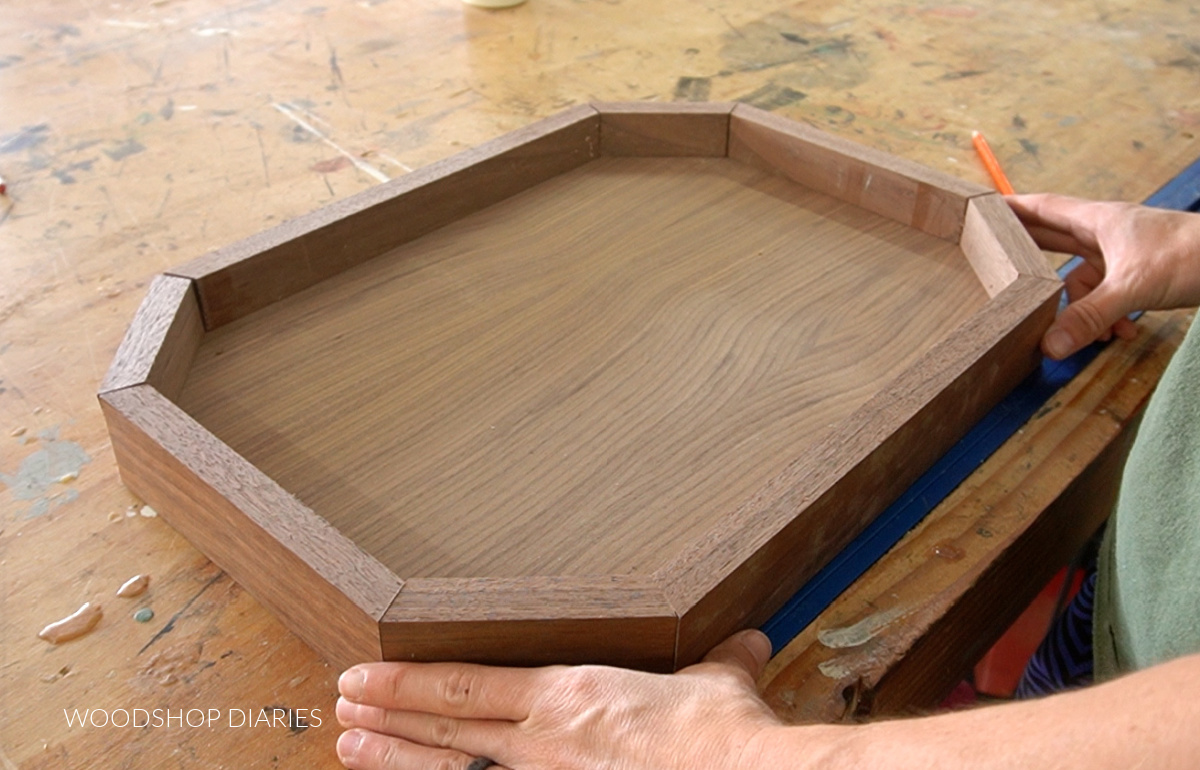
Easy DIY Yard Tool Organizer

August 2, 2023 by Shara, Woodshop Diaries

In this post, I’ll show you how to make this easy DIY yard tool organizer from scrap wood!

If you have some leftover plywood pieces in your scrap pile, this is a great way to use them!

DIY Plywood yard tool organizer hanging on wall with shovels and rakes hanging on it

This organizer may not fall in the “prettiest projects” category, but it certainly falls in the “definitely practical” category. I’ve been meaning to make one of these for YEARS.

I’ve tripped over the pile of shovels in the garage for the LAST TIME haha.

I have no idea why I waited so long because it literally took me 20 minutes to assemble this yard tool organizer and hang it on the wall. That’s just a 20 minute investment to both make my life a little easier and clear up some floor space in my garage. Well worth it.

So if you’re like me and you’re tired of tripping over your shovels and rakes, let me show you how to easily hang them up with wood you likely already have in your scrap pile. Ready to build? Let’s dive in.

*This post contains affiliate links. See policies.

What to Consider before building a Yard Tool Organizer

This is the PERFECT super easy weekend project for summer. It’s a quick win that helps make those summertime yard projects a little less frustrating.

Plus…it’s summertime. It’s hot and you want a quick project you won’t be melting in the shop for hours making. This checks both the boxes.

Feel free to get creative with your wood scraps here. I used ¾″ plywood because I always have a ton of plywood scraps. However, 1x boards would also work great for this in place of plywood.

This DIY yard tool organizer is designed to be wall mounted so it will need to be screwed or anchored to the wall.

Are new DIY projects your thing? Sign up for priority access to the latest projects and plans on Woodshop Diaries!

How to Build a Wall Mounted Yard Tool Organizer

This project doesn’t have an exact “plan” with dimensions and cut list and diagrams.

Since everyone’s collection, quantity, style, size, and brand of yard tools will vary, I’m sharing this tutorial as a general guide, not a specific building plan. I’ll show you how to customize it to fit your own tools in steps 1 & 2 below.

I actually think this method is much easier as you don’t really even have to measure or cut anything to exact sizes.

Tools & Materials

Tools:

  • Miter Saw (or any saw that cuts straight lines)
  • Drill/Driver
  • Pocket Hole Jig
  • Stud Finder
  • Level

Materials:

  • Scrap ¾″ plywood (size based on steps 1 & 2)
  • 1 ¼″ pocket hole screws
  • 2 ½″ screws or appropriate wall anchors (to mount to wall)

Step 1: Lay out your Yard tools

Because everyone’s collection of yard tools will vary, I think this method makes it really easy to customize no matter what you’re working with.

First, I recommend collecting all your yard tools and laying them out on the floor. Try to space them as close together as you can without them interfering with each other.

shovels, rakes and yard tools laid out on concrete floor

Arrange them so that whatever you plan to hang them from are all close together and toward the top. Some tools may be able to hang from either end, but some may only be able to hang one way.

Step 2: Measure and Cut Wood Scraps to Size

Once your tools are laid out, measure across them at the top to see about how far they span from one side to the other. This will tell you how long you need to make your backer panel.

Then, measure the other way to see about how tall your backer needs to be so everything will have room to hang on it.

In my case, I figured my back panel needed to be about 12″ tall x 48″ wide. So I headed to my scrap pile to see what I could find.

Measuring a piece of ¾" plywood with tape measure

TIP: If you don’t have anything in your scrap pile big enough for what you need, keep in mind that you can make multiple back pieces. It doesn’t have to be all on one big piece.

I found a piece of ¾″ sanded pine plywood roughly the size I needed for the back. Then, I grabbed some small scrap plywood strips to cut down for the hangers that I’ll use to hang the tools on.

These hangers don’t have to be a specific size. I cut mine from approximately 2 ½″ wide plywood strips. If you have some scrap 1x3s, these would work great, too!

Once you have your backer piece (or pieces) picked out and trimmed down (if needed), lay it on the ground and place your tools on it (keeping your original arrangement).

Make sure everything will fit well, then cut hanger pieces from scrap plywood strips the length you need to hold each tool. Again, these don’t have to be a certain size as long as they are long enough to support the tool they’re under.

Yard tools laid out on plywood with hanger pieces cut to size under each tool

Step 3: Attach Hanger Braces to Backer

After everything is laid out how you’d like it, drill ¾″ pocket holes into each hanger piece on the edge that will be against the backer.

RELATED: How to use a pocket hole jig

Drilling pocket holes with pocket hole jig into ends of each hanger piece

You don’t have to use pocket holes here. Wood screws from the back side to attach these pieces would work just fine.

But the pocket holes allow you to screw in from the top side without flipping it over–which makes this much easier.

Attach each hanger piece to the backer based on your layout from step 2 using 1 ¼″ pocket hole screws.

Installing yard tool hangers onto organizer back panel using pocket hole screws

Step 4: Mount Organizer to Wall

Once all hangers are attached, it’s ready to mount to the wall. Use a stud finder to locate at least 2 studs, preferably 3, in the area you’d like to hang your organizer.

For wood studs, use 2 ½″ screws through the backer and into the wall studs to secure. Use at least 3 screws. Use a level to ensure it’s straight while securing–you don’t want to hang it crooked!

Installing yard tool organizer on wall into studs with wood screws

If you don’t have wood studs or are installing into a cement block wall, use appropriate anchors to mount the organizer based on what you’re installing onto.

Then, hang up your yard tools and enjoy taking back the extra floor space these tools aren’t taking up anymore!

Completed yard tool organizer with shovels and rakes hanging on it against white wall

This is such a useful and simple addition to any garage or garden shed to help keep those tools stored up and out of the way. I hope you enjoyed watching it come together!

More fun with scrap wood

Can’t get enough scrap wood projects? Me either! That’s why I’m teaming up with my friend, Kati, from Houseful of Handmade all month long to share some “Scrap Wood Summer” Projects!

Check out all the projects in the series so far below. Click on an image to learn how to make each one!

DIY Modern C Table
DIY Entryway Shelf with Mirror
DIY Yard Tool Organizer
DIY Side Table with Wheels
DIY Floating Shelves
DIY Organizer Tray
DIY Wooden Sunflower Art
DIY Paper Towel Holder
DIY Tea Pot and Mug Stand
DIY Tortilla Press

We will be posting new Scrap Wood Summer projects every Tuesday through the month of August (2023). Check out last years’ Scrap Wood Summer projects plus other scrap wood ideas here.

Don’t forget to save this project for later by pinning it or sharing to your favorite social channel!

Pinterest image showing yard tool organizer hanging on white wall with text "DIY yard tool organizer" in green outline in center

Until next time, happy building!

DIY Scrap Wood Sunflowers

August 2, 2023 by Shara, Woodshop Diaries

In this post, I’m sharing how to make these ADORABLE wood sunflowers from scraps you probably already have in your shop!

These colorful wooden flowers are perfect for decorating your home for fall.

Three wooden sunflower art pieces against weathered wood backdrop--one yellow, one red, one orange flower

Last year, I made a wooden pumpkin from scrap wood and although it was so small and simple, it’s been one of my favorite projects I’ve ever made. It just turned out so cute!

So this year, I thought I’d like to try the same concept, but make wooden sunflowers instead of pumpkins! And I’ll be honest, these turned out so much cuter than I even imagined!

I’m SO excited to share with you how I made them, so if you’re ready to dive into the how to, let’s go!

*This post contains affiliate links. See website policies.

What to consider before making scrap wood sunflowers

These wooden sunflowers are ADORABLE. I love them a little more every time I look at them.

Close up of wood sunflower art with red stained wooden petals made from scrap wood

BUT…sunflowers aren’t the only option here. Feel free to get as creative as you want with different kinds of flowers, seasonal décor, or any items you’d like to create and display.

The best scraps for this project

There is no right or wrong way to make this project–any type and size of wood could work. However, the thickness of the wood here is something to consider.

Thicker material will work well for the backer and the frame, but for the petals and small flower parts, I recommend searching your scrap pile for some thinner material that’s easier to cut tiny pieces from.

Both ¼″ and/or ½″ thick material would work well.

Close up of ¼" and ½" thick solid oak scraps on workbench

For the flower parts, I suggest cutting from solid wood (like shown above) if possible. Plywood would work okay for this, but when cutting out these small pieces, the veneers are pretty easy to chip. So, using plywood may not give the best results.

Oak is a great option for cutting the flowers out because the deep grain lines give these petals some really nice dimension and character.

If you don’t have any oak scraps in your shop, most big box stores carry small pieces of ¼″ and ½″ thick oak for a few bucks, so you could “cheat” and buy a few of your materials instead of using only scraps.

But, you can certainly use other wood types instead. If you’re not using oak, consider using a wire brush to scuff your pieces up a little to kind of “mimic” the deep grains.

For these wooden sunflowers, I used ¼″ solid oak for the petals, ½″ solid oak for the flower centers and stems, ¾″ maple plywood for the backers (the solid pieces I glued the flowers onto), and 1x2s oak scraps for the frames around the outside.

Creating a Sunflower template

This is the fun part where you can get really creative. You can freehand draw your own flower or find one to use as your template.

If you’re looking for a template, check online for a shape you like, check in a coloring book, or even use an actual or artificial flower and pluck a petal or two off to trace it.

Basically, you just need a shape to cut. Since the center is just a circle, really, you only need a template for the petal and stem.

I found a sunflower shape I liked in a coloring book and cut the petals, the center, and the stem out to trace around on my board.

Sunflower template on paper cut into individual petals and center with painters tape on top

NOTE: I covered the paper in painters tape before cutting out the pieces because this makes them thicker, more durable, and easier to trace around.

I’ll use this as my template when I’m ready to cut my flowers. See step 1.

Enjoy DIY projects and woodworking plans? Sign up for priority access for the latest posts on Woodshop Diaries!

Tools for Cutting the flowers

I used a jig saw with a scrolling blade to cut my pieces. I like using the jig saw and when cutting these from ¼″ thick material, it was pretty quick and easy.

But, I know many people don’t enjoy using a jig saw for things like this. If you’re not a jig saw fan, you can certainly use a scroll saw instead.

If you’re using a jig saw, make sure to use a scroll or fine finish blade for best results. These types of blades are thin and have more teeth for cleaner cuts especially on these tight turns around the petals.

Close up of jig saw cutting sunflower petals out of oak scraps

Stain Colors

What makes these pieces really “pop” are the colors. I LOVED bringing each of these three different sunflower colors to life.

If you’re curious what colors are used here, I’ve listed them below. These are all Minwax Water Based Stains.

Completed wooden sunflowers displayed next to minwax stain cans

These come in either Semi-Transparent or Solid opacities. Solid provides a deeper color and hides more wood grain and semi-transparent provides a lighter color that shows more wood grain.

Stain Colors Used Here:

  • Stems: Early Spring in Solid
  • Centers: Pecan in Semi-Transparent
  • Yellow Petals: Lemon in Semi-Transparent
  • Orange Petals: Cinnamon in Semi-Transparent
  • Red Petals: Spice in Semi-Transparent

These water based stains are easy to apply and clean up, but fair warning–they dry QUICK, so make sure to follow the directions and wipe off the excess before it dries.

How to Make Scrap Wood Sunflower Art

These are SO much fun to make. But, be prepared–since there are a lot of small pieces, it’s not the quickest project to complete.

Take your time and enjoy the process. It’s worth it!

Tools & Materials

Tools:

  • Jig Saw
  • Sander
  • Brad Nailer

Materials:

  • ¼″ thick oak scraps (solid wood works best–for the flower petals)
  • ½″ thick oak scraps (solid wood works best–for the flower center and stem)
  • Plywood scraps (½″ or ¾″ recommended–for the backer)
  • 1×2 scraps (for the frame)
  • 1 ¼″ brad nails
  • Wood Glue
  • Stain (see notes above)

Step 1: Gather Supplies and Trace Flower Parts

First, I gathered the oak scraps that I planned to cut my flower pieces from.

I used ½″ thick solid oak scraps to cut the center and stem from. I used ¼″ thick solid oak scraps to cut the petals from. See notes above.

Then, I cut out my sunflower template (see notes above). Feel free to get creative with your template shape and size.

Oak board with petals traced out on top next to jig saw on workbench

I traced the pieces of my template onto these scrap boards (see image above) and labeled each one so I didn’t get anything mixed up.

Step 2: Cut out wooden Sunflower Parts

I CAREFULLY cut these pieces out using a jig saw. A scroll saw would probably be easier for this if you have one, but I don’t.

TIP: Don’t worry too much about getting these cuts perfect. Imperfections add character and you can always sand down any rough spots after cutting.

Oak flower petals and pieces cut out laid out on workbench next to jig saw and labeled

Once everything was cut, I used an orbital sander to sand these pieces smooth and kind of “shape” them. In some tight spots and on the really small pieces, hand sanding may be necessary.

Close up of sanding wooden flower center piece

If you want to knock down some of the sharp edges and give the pieces more character, use a low grit (like 80 or 120) sandpaper to kind of shape them how you’d like.

Step 3: Stain flower pieces

Once the pieces are sanded, it’s time to add some color! I stained the stems, center, and petals of these wooden sunflowers separately before attaching them to the backer.

I used Minwax Water Based Stains for these pieces and just applied with a shop rag.

Applying red wood stain to wooden flower petal with rag

I stained the centers in Pecan, the stems in Early Spring. I made three different sets of petals and stained one Lemon (yellow), one Cinnamon (orange), and one Spice (red).

Make sure to follow the instructions on the can and work quickly as these water based stains dry fast. Allow pieces to dry fully before moving on.

Step 4: Assemble and Frame Wood Sunflowers

I found some scrap ¾″ maple plywood in my scrap pile and cut these large enough to fit my flowers. If you make several flowers, you can arrange them all on one piece or on separate pieces.

There’s no right or wrong way to make these.

Once I had my plywood backers cut to size, I arranged the flowers on each one how I liked them, and glued them in place piece by piece.

Applying wood glue to back side of wood sunflower petal

You can use a fast dry wood glue for this if you’d like, but I recommend using a regular wood glue with a longer working time so you can get everything in proper place.

I added a dot or two of glue on the back of each piece and placed it on the backer.

Once all the pieces were glued, I still had a little time to move the pieces around and space the petals out how I liked them before the glue cured.

Using a brad nailer to attach 1x2 frame around plywood backer

After the glue on the flower was dry, I added 1x2s around the edges of the plywood backers using brad nails. And with that, these pieces are complete!

I plan to put these on a shelf, but if you wanted to hang them on the wall, you can simply add a small sawtooth hanger on the back side or use some Command Strips to stick it to the wall.

Three different color wooden sunflower art pieces laid against weathered wood backdrop--one yellow, one orange, one red flower with green stem

More Fun with Scrap Wood

Can’t get enough scrap wood projects?? I’m teaming up with my friend, Kati, from Houseful of Handmade all month long to share some “Scrap Wood Summer” Projects!

Check out all the projects in the series so far below. Click on an image to learn how to make each one!

DIY Modern C Table
DIY Entryway Shelf with Mirror
DIY Yard Tool Organizer
DIY Side Table with Wheels
DIY Floating Shelves
DIY Organizer Tray
DIY Wooden Sunflower Art
DIY Paper Towel Holder
DIY Tea Pot and Mug Stand
DIY Tortilla Press

We will be posting new Scrap Wood Summer projects every Tuesday through the month of August (2023). Check out last years’ Scrap Wood Summer projects plus other scrap wood ideas here.

If you’d like to save these fun DIY wooden sunflowers to check out again later, be sure to pin it or share to your favorite social channel!

Pinterest collage showing flower pieces cut out on top left, completed red sunflower on top right, and all three together on bottom with text "DIY wooden sunflowers from wood scraps!"

Until next time, friends, happy building!
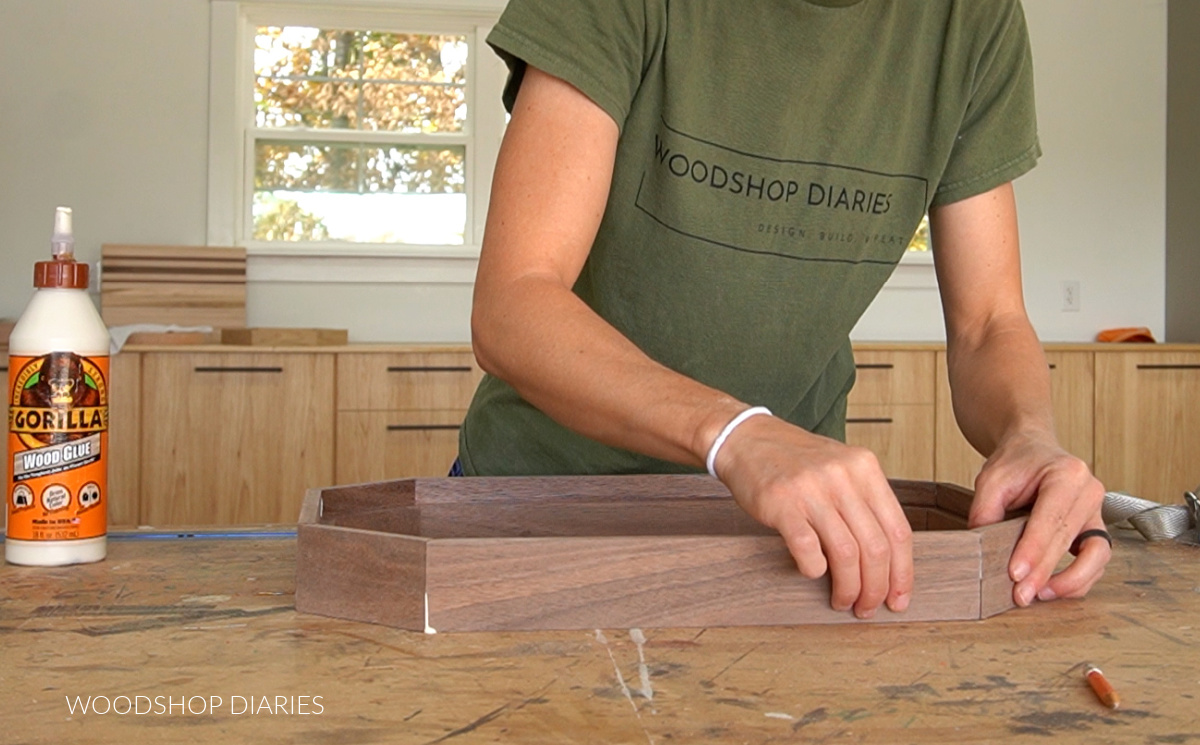
DIY Built In Mudroom Cabinets

July 22, 2023 by Shara, Woodshop Diaries

In this post, I’m sharing how I took an empty hallway and turned it into a built in mudroom with cabinets, a bench seat, and tons of storage!

To keep things simple, this project was built in four pieces, then assembled together once we got it inside.

Built in mudroom cabinets painted SW evergreen fog against white wall--two tall cabinets, with bench and open cubbies between

This addition was such a great upgrade to this previously empty hallway. The tall cabinets allow plenty of hidden storage to tuck away coats, hats, etc.

And the bench seat is a great place to store away shoes and boots.

The drawers and cubbies are perfect for keeping gloves, hats, dog leashes, etc stored away, but still easy to access before heading out the door.

If you’re ready to get building, let’s dive in to how this came together!

*This post contains affiliate links. See policies.

Things to consider before building DIY mudroom cabinets

This mudroom design has two tall cabinets that anchor each side, an open bench seat between them, and an open cubby cabinet in the middle. These pieces were assembled separately, then carried into the house to install.

Building everything in sections makes initial assembly and transportation (like carrying it from the workshop to the mudroom) much easier.

Of course, everyone’s needs and how they will use a space like this will vary, so feel free to customize these cabinets as you see fit. I used the tall cabinets for coat storage, so I added some hooks inside and a shelf above.

Close up of tall mudroom cabinet with door open revealing shelving and hanging hooks inside

But, if you’d rather use the whole thing as shelves, or swap the hooks for a closet rod, both of those are great options and easy changes.

Overall Size of Mudroom Cabinets

The overall size of this project was approximately 96″ tall (including the crown molding) x 16 ⅝″ deep x 111″ wide. Depth and width here do not include crown molding.

Overall dimensional diagram of built in DIY mudroom cabinets

The ceiling height where I was installing these was 96″ (which is an 8′ ceiling), so I made the tall cabinets about 94″ tall and used crown molding to cover the gaps once they were in place.

The reason I didn’t make these cabinets a full 96″ tall is because once they get inside, they need to tilt upright into position.

If they were 96″ tall, there wouldn’t be room to tilt them upright without scraping the ceiling. However, if you had 9′ or 10′ (or higher) ceilings, this wouldn’t be an issue.

Bench Seat Material

I used a premade butcherblock countertop for the bench seat. It’s the same butcherblock used with these DIY garage cabinets.

This top was originally 25″ x 74″, but I trimmed it down to 16″ x 72″ for the bench seat. I used the leftover strip of this butcher block as a simple, shallow shelf underneath the middle cabinet, but that’s totally optional.

DIY mudroom cabinets in hallway with open bench seat and tall storage cabinet

I thought it was a good way to use up the leftover material and this little shelf would be handy for throwing keys, gloves, phones, mail, etc on.

But you could also save the leftover wood and make something else with it later. To each their own 🙂

Also, I just noticed that Lucy’s dog toy is barely sticking out from behind the tall cabinet in the image above. It’s a squeaky stuffed ear of corn. I was going to go back and edit it out, but I left it in for a little laugh haha!

Cabinet Materials

I used plywood to build these cabinets as it’s a really great material for projects like this. In this case, I used a sanded pine plywood because I was painting and this saved a little money.

Learn how to choose the right plywood for your projects here.

sanded pine plywood on workshop floor

I used preprimed 1x2s, 1x3s, and 1x4s for the face frames on the front of these cabinets and for the door frames and drawer fronts.

Since I was painting, using preprimed lumber saved me some time during finishing since it’s already smooth and primed. However, unfinished 1xs would work just as well here if you wanted to prime them yourself.

Learn how to finish raw wood furniture here.

Love new DIY projects, plans, and how tos? Join our newsletter to be the first to know when new posts are out!

How to Build Mudroom Cabinets

People always ask how long a project took to build. Building mudroom cabinets is a fairly large project. This took me about a week from start to finish–and painting was a large portion of that haha.

So this may not be a project you can complete in a weekend. But it’s not a difficult build, and I’ll try to break it down in easy to digest sections below.

I built this in sections in my workshop, then carried these pieces into the house to install. This kept things easily manageable (in both size and weight), so I’ll discuss each section below.

If you prefer to watch, I put together a full build video of the process plus some bloopers, tips and behind the scenes here:

Like watching projects come to life? Subscribe to my YouTube Channel for the latest project videos, and lots of bloopers along the way!

For detailed dimensions, diagrams, and cut lists, grab the printable building plans for this project here:

You may find these resources helpful throughout the build:

  • How to cut plywood
  • How to use a pocket hole jig
  • How to use a router
  • How to install crown molding
  • How to build a drawer box
  • How to install drawers
  • How to install concealed hinges
  • How to add adjustable shelves
  • 5 tips to professional looking DIY furniture

Tools & Materials:

Tools:

  • Miter Saw
  • Drill/Driver
  • Circular Saw and cutting guides
  • Pocket Hole Jig
  • Shelf Pin Jig
  • Concealed Hinge Jig
  • Brad or Finish Nailer
  • Router with ⅜″ rabbeting bit
  • Dowel jig
  • Chisel
  • Stud finder

Materials:

  • (4) 4×8 sheets ¾″ plywood
  • (1) 4×8 sheet ¼″ plywood
  • (1) 25″ x 74″ butcherblock countertop (see notes above)
  • (4) 1x2x8 boards
  • (9) 1x3x8 boards
  • (2) 1x4x8 boards
  • (2) 8′ pieces crown molding (3 ⅝″ crown molding works well)
  • (3) pair concealed hinges for ½″ overlay doors on face frame cabinets
  • (2) pair 16″ ball bearing drawer slides
  • (4) knobs/handles
  • Shelf Pins
  • 1 ½″ dowel pins
  • 1 ¼” pocket hole screws
  • 1 ¼” wood screws
  • 1 ¼” brad or finish nails
  • 3″ wood screws (to install)
  • Wood Glue
  • Figure 8 brackets or 90 degree corner brackets
  • Shims

Step 1: Assemble Tall Mudroom Cabinets

I made two tall cabinets to kind of “anchor” each side of the mudroom. These cabinets contain a small drawer at the bottom and the top section is open to allow you to either add adjustable shelves, or use for hanging coats/clothes.

I’ve provided the detailed measurements in the printable plans here, but, first, I cut down ¾″ plywood to assemble these cabinets from.

RELATED: How to cut plywood sheets.

I made these approx. 16″ deep and 20 ½″ wide overall, but you can certainly customize as needed to fit your space.

Shara Woodshop Diaries assembling tall mudroom cabinet with pocket holes and screws

Then, I assembled a basic cabinet carcass using pocket holes and screws. Learn how to use a pocket hole jig here. I added a panel at the top, and two toward the bottom–one below and one above the drawer.

I built two of these–one for the left and one for the right of these built ins. Once they were both together, I assembled a basic face frame using 1x2s on the sides, a 1×4 at the top and 1x3s above and below the drawer section.

Shara Woodshop Diaries assembling face frame using preprimed trim boards and pocket holes and screws

Just in case you wondered…The reason I used a 1×4 at the top is to allow for some extra wiggle room for the crown molding once installed.

I glued and nailed this onto the front of both tall cabinets to frame it out and cover the exposed plywood edges.

Shara Woodshop Diaries attaching face frame to front of cabinet with finish nailer

Don’t forget to putty over the joints, seams, and nail holes and sand once dry.

Step 2: Add Doors and Drawers

Next, I added a drawer into the bottom section of each cabinet. I used 16″ ball bearing drawer slides and secured these to the sides of each cabinet.

RELATED: How to install drawer slides

Shara Woodshop Diaries installing drawer slides into mudroom cabinets

Then, I assembled and installed a simple drawer box onto them. Note that I drilled the pocket holes for these drawers as close to the top and bottom as possible so that when I add the drawer front, it’ll cover these holes.

RELATED: How to build a drawer box

Shara Woodshop Diaries installing drawer box into tall mudroom cabinets

Speaking of drawer fronts, I assembled a drawer front “frame” using 1x3s and pocket holes and screws. There are many ways to make a drawer front, so feel free to get creative with your own design.

I glued and nailed this frame onto the drawer box making sure the pocket holes were covered. Find detailed diagrams, dimensions, and cut lists for this project in the printable plans.

Glue and nail drawer front onto drawer box of mudroom cabinet

To cover the open section above, I added a tall door onto the cabinet. There are many ways to build a cabinet door, but for this, I tried something different.

I used wood glue and dowels to assemble a door frame using 1x3s. You could certainly use pocket holes and screws to assemble the frame, however, after the glue was dry, I routed a ⅜″ rabbet on the back side of the openings.

RELATED: How to use a router

Using router to cut rabbet in back side of cabinet door on workbench

I didn’t want to take a chance on routing into a screw, so I opted against pocket holes.

Once these rabbets were cut, I glued ¼″ plywood panels into these open sections to complete the doors.

I’ve never tried this method of door assembly before. It wasn’t difficult, but if painting, I suggest making sure to caulk where the panels meet the frame on both the front and back for the smoothest results.

Shara Woodshop Diaries placing plywood panels into door frame

I waited until after painting to install the doors, but once I had painted everything, I installed three ½″ overlay concealed hinges for face frame cabinets onto the doors.

RELATED: How to install concealed hinges

I tried just using two hinges per door, but since these were so large, it needed three–so don’t skip the third hinge!

Mudroom cabinets with door open showing 3 hinges used to install door

Then I installed the doors onto the cabinet and finished up by drilling shelf pin holes and adding a shelf.

RELATED: How to add shelves using a shelf pin jig

Step 3: Assemble Middle Cubby Cabinet

The middle open cubby cabinet is much simpler than the taller cabinets as it consists of just a cabinet box and a face frame.

I made this cabinet 12″ deep so it is a little inset the two tall cabinets it will go between. This just adds a little extra dimension to the project.

I cut ¾″ plywood pieces to assemble a cabinet about 18″ tall x 72″ wide. Feel free to customize to fit your own space.

Shara Woodshop Diaries driving screws to assemble plywood cabinet

You can certainly use pocket holes and screws to assemble this cabinet, but no matter where you put them, they’ll be visible in the finished project. So instead, I opted to simply screw these pieces together through the sides, top and bottom.

Shara Woodshop Diaries placing mudroom cubby cabinet on workbench

I separated this cabinet into three sections by adding two evenly spaced dividers and I also added two 1x3s at the back of the left and right sections to be able to secure it to the wall later during installation.

After the cabinet was together, just like with the tall cabinet, I assembled a face frame to glue and nail on to the front of this. This face frame was all 1x3s.

Shara Woodshop Diaries nailing face frame on front of cabinet on workshop floor

Step 4: Assemble Mudroom Bench Seat

I mentioned earlier that this bench seat top was cut from a butcherblock countertop. So first, I ripped my countertop down to 16″ x 72″ to make the bench seat.

Then, I cut 8 pieces of ¾″ plywood about 15″ x 16 ½″ and glued them in pairs so it was about 1 ½″ thick. Two of these will go on each end of the bench seat, and the other two will be evenly spaced in the middle.

Close up of sanding bench seat supports on workbench

I glued and nailed 1x3s onto the fronts of these supports to cover the plywood edges and so that they would kind of “match” the cubby cabinet that goes above it.

You can install these to the bench seat top several ways. 90 degree corner brackets would work fine, but I didn’t have any in the shop, so instead I used these figure 8 fasteners.

Close up of installing figure 8 fasteners on top of bench seat supports

I installed these onto the top of the bench seat supports, then secured them to the bench seat from the bottom side.

Prefer to print? Grab the printable building plans here.

Step 5: Install Built In Mudroom Cabinets

At this point, the various sections of the mudroom cabinets are assembled and it’s ready to install. Before installing, make sure to locate and mark the wall studs in the area you are working in.

You’ll need to remove the baseboard in this area as well so the cabinets can sit flush against the wall.

I suggest painting everything before installing–it’s not required, but I personally think it makes things much easier. I primed and painted my cabinets in SW Evergreen Fog.

RELATED: How to finish raw wood furniture

I recommend installing one of the tall cabinets first by scooting it in place, shimming if needed, then using wood screws through the back supports into the wall studs behind it.

Once one tall cabinet is in place, I recommend adding the bench seat next. I secured the end of the bench seat to the tall cabinet with screws through the inside of the drawer section. You’ll have to slide the drawer out in order to access it.

Diagram showing installing tall cabinet and bench seat next to it

Then, you can use some scrap wood pieces to help you position the middle cubby cabinet about 48″ above the bench seat. This cabinet should be secured to the wall studs behind it and to the tall cabinet beside it.

Shara Woodshop Diaries securing middle cubby cabinet to wall studs in hallway

Once I had the middle sections in place, I scooted the other tall cabinet up to them and secured it to the wall studs, the bench seat, and the middle cubby cabinet.

To wrap things up, I cut to fit and brad nailed crown molding around the top of the tall cabinets and along the top of the middle cabinet.

RELATED: How to cut and install crown molding

Shara Woodshop Diaries nailing crown molding onto tall cabinets.

Then, I reinstalled the baseboard to but up to the cabinets and to run between the bench seat supports at the back.

Tips on Finishing and Installation

Once everything is installed, putty, caulk, touch up paint as needed. There are always lots of little finishing details with installation haha.

Here are a few tips you might consider when installing this project.

When installing the crown molding, cut it and make sure it fits well, but don’t install yet. Label each piece, paint them separately, and once the paint is dry, nail them in place. This will minimize the chances of you getting paint on the ceiling.

If the middle bench seat supports are “floating” or don’t fit snug once installed, use some shims on the bottom to tighten them up. If there are gaps on the floor, add some shoe or quarter round molding to cover them.

If the floor isn’t square to the walls (no house is perfect, and this is a common issue), you may need some shims during installation of the tall cabinets. If you have large gaps either on the wall or on the floor, simply cover these with cove, quarter round, shoe or other molding. No one will ever notice 😉

I recommend painting all pieces separately–the tall cabinets, the doors, the drawers, the middle cubby cabinet, the bench seat supports before putting them all together and before installing. This just makes things easier and minimizes the chances of getting paint on the floor, walls, or ceiling.

Looking for more entryway and storage ideas?

Want to see more entryway and storage ideas? Here are a few favorites you’ll enjoy! Simply click on the images below to check out how to make each one.

DIY Mudroom Bench
Simple Bench with Shoe Shelf
DIY Storage Bench
One Board Shoe Bench
Simple Shoe/Book Rack
Scrap Plywood Coat Rack
DIY EASY Coat Rack

Be sure to save this project by pinning it for later or sharing to your favorite social channel.

Vertical photo of mudroom built in cabinets for Pinterest with text "how to build mudroom cabinets"

Until next time, happy building!

DIY Modern Plywood Bookshelf

July 6, 2023 by Shara, Woodshop Diaries

In this post, I’m sharing how to build a modern DIY bookshelf from a single sheet of plywood!

I don’t know about you, but I love a fun DIY plywood project. It’s even better when all you need is one sheet and a few basic tools.

Shara Woodshop Diaries standing next to completed simple modern plywood bookshelf with alternating shelves on each side

*This post contains affiliate links. See website policies.

I built this DIY plywood bookshelf for my dad to display his collection of model cars in his office. But even if you don’t have a collection of toys to display (that makes me giggle a little), it’s perfect for books, shoes, and/or décor.

This simple plywood bookshelf is a fun, modern take on your basic shelf design with taller sections on the left and right for larger items and shorter, overlapping sections for smaller items.

The open back and clean lines give it a minimal look, too. Assembling this bookshelf is a quick and easy project, so if you’re ready to dive into the how to, let’s go.

What You’ll Need

Prefer to print? You can find the complete cut, tools, and materials list plus dimensions and diagrams in the printable building plans here.

Tools:

  • Circular saw
  • Kreg Rip Cut (optional, but helpful)
  • Miter saw (optional–can cut everything with circular saw if needed)
  • Drill/Driver
  • Pocket Hole Jig
  • Square

Materials:

  • (1) 4×8 sheet ¾″ plywood (maple used here)
  • 1 ¼″ pocket hole screws
  • 1 ¼″ wood screws
  • Iron on edge banding (optional)
  • Wood Glue
  • Pocket Hole Plugs (optional)

Want to be the first to know when new project and plans are out? Subscribe to the newsletter for priority access!

What to know before building

This simple DIY plywood bookshelf can be made from a single sheet of ¾″ plywood. I recommend using a hardwood plywood for best results.

RELATED: How to choose the right plywood for your project

In this case, I used maple plywood because I found a sheet that had some really pretty color variations. But oak or birch would work great, too.

I’d consider this project a good beginner to intermediate project. It’s a super easy assembly, but it’s rather large in size. Edge banding is by far the most time consuming part of the build, but it’s optional.

You should easily be able to complete this build in a few hours or less.

Overall Bookshelf Size

The overall dimensions of this bookshelf are 10 ½″ deep x 31 ½″ wide x 66″ tall.

Overall dimensional diagram showing height, width, and depth dimensions of DIY plywood bookshelf

The individual shelves are approximately 9″ deep and 19 ½″ long.

Securing Bookshelf to the Wall

Because this shelf is fairly lightweight, tall, and narrow, it can tend to be top heavy. To prevent accidental tip over, I recommend securing the shelf to the wall once complete.

You can do this several ways. There are several different styles of anti tip over hardware kits available online for use with furniture.

But, an easy way to secure it is to simply drive a screw or two through the back panel of the shelf into a wall stud behind it. You may need a shim to go between the shelf and the wall to accommodate for the thickness of the baseboard if you don’t want to cut it out.

How to Build a Modern Plywood Bookshelf

I’m sharing the step by step guide to assembling this shelf below, but if you prefer to watch, I’ve also included a video tutorial here as well with additional tips and behind the scenes footage.

If you enjoy project videos, subscribe to my YouTube channel for plenty more where that came from!

And if you prefer to print your plans, I’ve got printable DIY bookshelf building plans available here. Printable plans include cut list, materials list, detailed diagrams, dimensions and step by step instructions.

Cutting the Plywood

In most cases, I don’t recommend cutting all your pieces at the beginning of the project. But for this shelf, it’s a good idea to go ahead and cut everything down first.

I’ve provided a plywood cut diagram and cut list in the printable plans, but first, I ripped my plywood sheet into 5 strips using my circular saw and Kreg Rip Cut–two wider for the body and three narrower strips for the shelves.

Learn how to cut plywood sheets in this post!

Shara Woodshop Diaries cutting down plywood sheet using circular saw and Kreg Rip Cut

Once the plywood sheet was cut into these strips, I trimmed them to length on the miter saw. But, if you wanted, you could also cut these to length with a circular saw as well.

Step 1: Assemble Bookshelf Body

The bookshelf body is assembled from the wider plywood strips I cut from my sheet. I cut these two pieces into two short and two long pieces to make the bookshelf body.

The shorter pieces are the top and bottom and the longer pieces are the bookshelf sides.

Before assembling, I applied iron on edge banding to the front edges of these pieces. Edge banding is optional, but it hides the plies and makes the edges look a little nicer.

Learn how to apply iron on edge banding in this post.

Close up of edge banded vs not edge banded piece of plywood

After a light sanding, I drilled ¾″ pocket holes into the ends of the top and bottom pieces and assembled the bookshelf body using 1 ¼″ pocket hole screws.

Learn how to use pocket holes in your DIY projects here.

Shara Woodshop Diaries assembling bookshelf body on workbench using pocket holes and screws

TIP: Make sure to face the pocket holes toward the outside here so that they’ll be hidden in the finished project.

Step 2: Install Back Panel

The “back panel” here is simply a piece of plywood that runs between the top and bottom of the shelf body. So I cut a piece from one of my plywood strips to fit inside this shelf.

I edge banded both long sides and centered this piece flush to the back edge between the two long sides.

NOTE: The shelf is laid on it’s side on the workbench in the image below.

Shara Woodshop Diaries securing back panel of plywood bookshelf using wood screws on workbench

To secure this in place, I predrilled pilot holes (this helps prevent the wood from splitting) and drove 1 ¼″ wood screws through the top and bottom shelf panels.

TIP: Make sure to keep this back piece centered between the sides of the bookshelf while attaching.

Step 3: Add Left Shelves

You can certainly adjust the shelf spacing and add more or less here as you’d like. But, in my case, I added three shelves on the left side and 4 shelves on the right.

I found it easiest to attach all the shelves on the left side first. I trimmed these shelf boards from the remaining plywood strips to span across the middle board.

I applied edge banding to the front and right side of each shelf and drilled ¾″ pocket holes into the left side. You only need pocket holes in one end.

Shara Woodshop Diaries spacing left side shelves into bookshelf with tape measure on workbench

With the shelf body laying on it’s left side on the workbench, I evenly spaced these shelf boards out and secured them to the side of the bookshelf using 1 ¼″ pocket hole screws.

TIP: Make sure the back edge of each shelf is flat against the front of the back panel.

Then, I moved around to the back side and used a couple 1 ¼″ wood screws per shelf to secure them to the back panel.

Driving screws through the back panel to secure the plywood shelves

I recommend using a speed square to make sure these shelves stay square to the side panel while securing.

Step 4: Add Right Shelves

The right side shelves are cut the same size, but this time, I edge banded the front and left edges and drilled ¾″ pocket holes in the right end.

I flipped the bookshelf on its right side and evenly spaced these shelves out between the others.

Then I secured them to the right side of the shelf using 1 ¼″ pocket hole screws just like I did on the left side.

Shara Woodshop Diaries attaching right side shelves into bookshelf body with pocket holes and screws

I added two more screws per shelf to secure them to the back panel–again, just like the left side. Make sure to keep these shelves square to the side panel while securing at the back.

Shara Woodshop Diaries driving wood screws through back panel to secure individual shelves

And with this, the assembly is complete! All that’s left are a few final details.

Step 5: Finish Bookshelf

Plugging the pocket holes on the shelves is completely optional. Since they’re on the underside, they’re not really noticeable, but I went ahead and plugged mine just so it looked a little cleaner.

I flipped the bookshelf upside down to make this a little easier and simply applied some wood glue and worked in a pocket hole plug into each hole.

Close up of pocket hole plugs glued into pocket holes

Once the glue had dried, I sanded these flush.

TIP: These precut plugs are usually a little long, so you may have to sand quite a bit off. Be careful not to sand too aggressively on the plywood surface. You can also cut these flush with a flush cut blade on an oscillating saw if you have one.

Learn 4 ways to plug a pocket hole here.

You can stain or paint however you’d like. Feel free to get creative! I kept mine super simple and just applied a couple coats of clear coat poly to seal it but keep the natural color.

And at this point, it was ready to fill up with all the things! See notes above about securing bookshelf to the wall.

Finished DIY modern maple plywood bookshelf with books and décor against white wall

I love love love how simple, but unique this bookshelf is. It would be the perfect addition to a home office or living room. It’s even the perfect size for extra storage in a closet for clothes and/or shoes!

Close up of plywood bookshelf with alternating left and right shelves on each side

If you’d like to build your own, don’t forget to grab the printable building plans for a fun and easy weekend woodworking project!

Looking for more DIY Bookshelf Projects?

Love this project, but looking for more shelving project ideas? Here are a few favorites of different shapes and sizes you might enjoy as well!

DIY Ladder Bookshelf
DIY Corner Shelf
Geometric Bookshelf
Hidden Drawer Bookshelf
Vinyl Record Shelf

Be sure to save this post for later by pinning it or sharing to your favorite social channel!

Pinterest collage image showing overall dimensional diagram at top and completed plywood bookshelf at bottom with text "how to build a easy modern bookshelf from 1 sheet of plywood"

Until next time, happy building!

Easy DIY Workbench With Drawers

June 30, 2023 by Shara, Woodshop Diaries

In this post, I’m sharing building plans for an easy DIY workbench with drawers and a flip open top!

This medium sized mobile workbench design is a great addition to any garage or workshop for some added work surface plus plenty of storage.

DIY mobile workbench with drawers at bottom and open middle shelf made from 2x4s and plywood

I designed this workbench to eventually house a CNC machine (once I get it assembled), but I didn’t want the machine to take up all my work surface.

So I built this workbench with a large open shelf in the middle. I can place the CNC on this shelf and still keep my entire worksurface on top.

But, just in case I need access from the top side, I made the top so that it flips open and rests on these corner brackets that swing out to support it.

Shara Woodshop Diaries standing next to flip top workbench with top flipped open and supports underneath

Obviously, the flip open top may not be necessary (or useful) for every workshop, so you can totally skip that part if you don’t want it.

But the open shelf and storage drawers on this bench are super handy for tools, scrap wood, sanding vacuums, accessories, whatever. So…flip top or not, it’s a great project for your shop.

I’m sharing DIY workbench building plans, video, and extra tips below, so if you’re ready, let’s get building!

*This post contains affiliate links. See website policies.

What to consider before building a workbench

The great thing about shop projects is that they don’t have to look extra nice. So normally, I’ll skip the time consuming details like edge banding and I’ll leave it unfinished, which saves a ton of time!

This workbench only takes about a day to build, so it’s a great weekend woodworking project!

Full disclosure: I took 1 ½ days to build it because 1. I was filming it (which makes everything take longer) and 2. It was 100 degrees in the shop and I had all that I could take after a few hours the first day.

But, weather permitting (and minus the camera), you can definitely build this in just a few hours.

Want to be the first to know about new projects and plans? Subscribe to the newsletter for priority access!

What size should your workbench be?

Workbenches can be just about any size you want to make them. So there’s no set “standard” to follow.

For this DIY workbench, the overall dimensions are approximately 36 ¾″ tall x 36 ½″ deep x 71″ long.

Overall dimensional diagram of DIY workbench with drawers and caster wheels

Length and width can vary greatly and as needed to fit whatever space you’re working with. So feel free to adjust these dimensions as needed.

However, typical workbench height is between 34″-38″. For reference, standard height for kitchen countertops is 36″. So if you feel that’s a comfortable working height for you, then stick with 36″.

Or, be a rebel and go lower or higher a few inches. Whatever height you feel comfortable working at is an acceptable height.

I actually built my other mobile workbench to serve as an outfeed table for my table saw, so I made it the same height as my saw top. There’s no right or wrong here, so feel free to customize to fit your needs.

What type of wood are workbenches made from?

Workbenches can be made from pretty much any type of wood. Some people like to get fancy and build it from really nice hardwoods.

However, in my shop, my workbenches usually get beat up with constant use, so I don’t like to sink a ton of money into nice wood to build them with.

So I personally recommend using basic construction lumber (like 2x4s or 2x6s) and plywood. These materials are budget friendly, readily available, and strong (they literally build houses out of them).

2x6 construction boards laying on workbench

Sanded pine plywood is a great budget option for workshop projects. But hardwood ply will take a little more wear and tear. It’s a fairly small price difference, so I went with hardwood ply for this build.

Learn more about choosing plywood for your projects here.

Should you build a mobile or stationary workbench?

Personally, I prefer mobile over built in workbench set ups. I change my mind too much to be anchored to one spot haha.

But ultimately, this question really comes down to personal preference and your shop space.

If you’re working in a garage that you share with your cars, you may like to go mobile so you can roll your bench out of the way when you pull your car in.

Workbench with shelving on the end in garage workshop

If you have a dedicated shop space, you may prefer built in, since you don’t need to move it out of the way.

The only difference between this DIY workbench design I’m sharing with you here being mobile or stationary is the caster wheels. Add them for mobility. Don’t add them to keep it stationary. The choice is yours 🙂

Is it cheaper to buy or DIY a workbench?

Whether it’s cheaper to build or buy a workbench depends on the material, the size, the brand, if it’s new or used, etc. So there are a lot of factors to consider when determining which is cheaper.

And in most cases, you’re comparing apples to oranges because most DIY workbenches are custom built and you won’t find an exact match in a store to compare it to.

But, for what it’s worth, the approximate cost to build this workbench was $250 as of June 2023, when it was built.

*Lumber and material prices vary greatly by location and change daily, so your cost may be different.

How to Build an Easy DIY Workbench with Drawers

You’ll find the step by step building instructions below, but if you prefer to watch, check out the full build video plus additional tips and bloopers here:

Are new project videos your thing? Subscribe to my YouTube Channel for the latest project and plan videos.

Prefer to print your plans? Grab the DIY workbench printable building plans with full cut list, dimensions and diagrams here.

Some helpful resources for the build:

  • Understanding lumber sizing for beginners
  • How to cut plywood sheets
  • How to use a pocket hole jig
  • How to build a drawer box
  • How to install drawer slides and drawer boxes
  • How to install drawer fronts

Tools & Materials:

Tools:

  • Circular Saw
  • Cutting Guides (Kreg Rip Cut & Kreg Accu-Cut used here)
  • Miter Saw
  • Jig Saw
  • Drill/Driver
  • Pocket Hole Jig

Materials:

  • (7) 2x4x8 boards (add 2 more if you want the flip open top)
  • (2) 4×8 sheets ¾″ plywood
  • (1) 4×8 sheet ¼″ plywood
  • 1 ¼″ wood screws
  • 1 ¼″ pocket hole screws
  • 2 ½″ wood screws
  • 2 ½″ pocket hole screws
  • (4) pair 16″ ball bearing drawer slides
  • (4) caster wheels
  • Wood Glue
  • 48″ piano hinge (optional for flip open top)
  • (4) 3 ½″ door hinges (optional for flip open top)

Step 1: Assemble Workbench Frame

To get started with this build, I assembled the main workbench frame using 2x4s.

For the legs, I cut 8 pieces of 31″ long 2×4 and paired them up using wood glue and screws to make four leg posts.

Close up of driving screw through 2x4s to create workbench legs

Then, I cut four 2×4 pieces to 30″ long and four more at 62″ long and drilled 1 ½″ pocket holes into the ends of each board.

RELATED: How to use a pocket hole jig

I attached the short 2x4s between the legs first using 2 ½″ pocket holes to make 2 identical sides. Note that the bottom 2x4s are run horizontally and the top are run vertically.

Side frame of DIY workbench laying on concrete shop floor assembled with pocket holes

Then, I attached the long 2x4s between these sides the same way to complete the frame. Note that the frame is upside down in the image below.

completed DIY workbench frame on shop floor assembled with pocket holes upside down

To make this mobile, I added some caster wheels onto the bottom of this frame using 1 ¼″ screws with washers.

These are the caster wheels I used here, but any heavy duty caster wheels would work fine for this, so you don’t have to have anything specific.

Close up driving screws to install caster wheels on workbench corners

Keep in mind that caster wheels come in various sizes, so if you use a different type of wheel, it may change your workbench height.

Step 2: Install Workbench Drawer Dividers

After the frame was assembled, I cut down ¾″ plywood panels to fit into the sides of the workbench. I made my panels 6 ½″ tall, but you can adjust shorter or taller as needed.

RELATED: How to cut plywood sheets

I installed these into the short sides of the workbench using ¾″ pocket holes and screws. I positioned these ¾″ inset from the inside of the 2×4 frame–you can see I used a scrap plywood block as a spacer to help me keep this inset while I drove the screws.

Using pocket holes to secure side panels into workbench between corner posts

Then, I attached a long ¾″ plywood support piece between these panels using pocket holes and screws. This piece should be centered side to side on each end.

Shara Woodshop Diaries Installing long center workbench drawer support using pocket holes

To divide the drawers into two on each side, I installed two more ¾″ plywood panels between the bottom 2×4 and this long center support.

I made sure these panels were centered side to side so that each of the 4 sections here are the same size.

Shara Woodshop Diaries installing drawer divider panels into workbench frame

That allows me to build 4 identical drawer boxes to make things easy.

Prefer to print? Grab the complete cut list, diagrams, and project details in the printable building plans here.

Step 3: Build and Install Workbench Drawers

Because the side panels weren’t flush to the inside of the frame, I had to add some small ¾″ plywood scrap pieces into each section (only on the side panels) like shown below.

I simply glued and screwed these in place, then added 4 pair of ball bearing drawer slides–one pair in each drawer section. These slides are inset 1 ½″ from the outside edge.

Scrap plywood pieces screwed into side panels of workbench for drawer slides

Check out this post for more information on installing drawer slides!

I built the drawer boxes from ¾″ plywood for the four sides and ¼″ plywood for the drawer bottoms. Normally, I cut dadoes into the drawer box sides to install the bottom panel.

However, since these were just workshop drawers, I kept it simple and just assembled the four drawer box sides with pocket holes and screws, then glued and stapled the bottom panel in place.

Shara Woodshop Diaries stapling drawer bottom panels onto drawer box

Check out this post for more information on building drawer boxes.

Once assembled, I installed these into the workbench. There are several ways to install drawer boxes, but I dettached the section of the slide that mounts to the drawer box and screwed these into the side of each box.

That way, I could work standing up vs crawling around on the floor haha.

Shara Woodshop Diaries installing drawer slide onto side of drawer box

Finally, I cut ¾″ plywood drawer fronts for each drawer box and installed these using screws from the inside of the drawer boxes. I used some ⅛″ shims on the bottom here to help me keep my gaps even.

Check out this post to learn more about how to measure and size your drawer boxes and drawer fronts.

Driving screws through front of drawer box to attach drawer fronts in workbench

At this point, they’re ready for knobs, drawer pulls, or you could cut some notches in the top of the drawer fronts to open and close them.

Step 4: Attach Bottom Shelf

The shelf that will go above these drawer boxes will kind of “wrap around” the corner leg posts.

So first, I cut a ¾″ plywood panel to 36″ x 68″. Then, I marked 3″ squares on each corner and cut these out with a jig saw.

Close up of jig saw cutting corner out of plywood panel

This panel should fit snuggly onto the drawer framing from step 2. However, you’ll need to temporarily remove one of the top 2×4 framing pieces in order to get it in place.

I just backed out the pocket hole screws in one of the top 62″ framing pieces, placed this shelf inside, then reattached the 2×4. Since the screw holes are already there, it’s easy to get it back exactly where it was before.

Shara Woodshop Diaries placing plywood panel onto drawer framing in workbench

I secured the shelf to the drawer framing pieces below using 1 ¼″ wood screws. It was helpful to use a measuring tape here to locate where these pieces were so I didn’t miss then while driving the screws.

Step 5: Add Flip Open (or Stationary) Top

The last part is simple adding the top. If you want a stationary top, simply cut a piece of ¾″ plywood to fit over the top of the workbench and screw it in place.

OR, if you didn’t want screw heads showing on the top surface, use some 90 degree corner brackets on the underside to secure it to the framing.

However, if you want a flip top like I made, it’s a few extra steps. First, to make the top “flipable,” I installed a 48″ piano hinge to connect the top plywood panel to the framing.

Attaching top plywood panel with piano hinge

Now, the top can flip, but it needed something to support it once it was flipped open.

So I assembled two basic corner braces from 2x4s with 2 pieces at 90 degrees and another piece running between them for support–nothing fancy.

I wanted these braces to be able to swing open and closed, so I installed them onto the legs of the workbench using basic door hinges–two hinges per brace.

Installing corner braces with door hinges on corner posts

That way, these can fold in when not in use, but they can swing out when I need to open the top.

And with that, this DIY mobile workbench with drawers and a flip open top is complete and ready for work!

Shara Woodshop Diaries standing next to flip top workbench with top flipped open onto supports at corners

I love this simple design–plenty of open storage for tools and lumber, but still some drawers for small parts and accessories.

Completed DIY workbench with drawers at bottom and open shelving at top on caster wheels against white wall

Grab the printable workbench with drawers building plans to build your own here!

Looking for more DIY workshop projects?

Need some more DIY ideas for your workshop or garage? Here are a few favorites to help make the most of your shop space!

Workshop cabinets
How to Build Workshop Cabinet Boxes
Scrap Wood Clamp Rack
How to build a mobile Miter Saw Stand with storage drawers, and fold down extension wings
Mobile Miter Saw Stand
How to Build a DIY Rolling Scrap Wood Cart
Scrap and Plywood Storage Cart
Mobile Workbench
DIY Garage Cabinets

If you’d like to save this project for later, don’t forget to pin it or share it to your favorite social channel!

Pinterest collage image showing overall dimensional diagram at top and Shara next to completed DIY workbench at bottom with text "how to build a mobile workbench with drawers"

Until next time, happy building!

Modern DIY C Table

June 25, 2023 by Shara, Woodshop Diaries

In this post, I’m sharing how to build a unique, modern DIY C-Table from just one 1x6x8 board!

This little table is such a fun and unique design that would be the perfect side table, accent table, or even a simple plant stand.

Simple modern C table with natural wood top and blue and green stained table base against white wall

I played around with both design and color with this little table–as you can see. But if you like to keep things more neutral, this would also look great with a black or white base, too!

Since it’s such a small project and it’s assembled in sections, it’s a great opportunity to get creative with it. Customize the size and color to match your own style.

If you’re ready to see how to build it from JUST ONE BOARD, let’s dive in.

*This post contains affiliate links. See website policies.

What You’ll Need

Tools:

  • Miter saw
  • Table saw (or circular saw and straight edge)
  • Jig saw
  • Drill/Driver
  • Pocket hole jig OR Dowel jig
  • Clamps

Materials:

  • (1) 1x6x8 board
  • 1 ¼″ pocket hole screws OR 1 ½″ dowel pins
  • Wood Glue
  • Figure 8 fasteners OR 90 degree corner brackets (to attach top)

What to know before building

You should be able to complete this build in a few hours–most of which is spent waiting on glue to dry haha.

This project is not difficult, but the angles may seem a big confusing. Don’t let them intimidate you!

Close up of 10 degree miter on miter saw

All angles in this project are mitered 10 degrees to keep things simple.

NOTE: You’ll notice, if you watch the video below, that I mention that I beveled AND mitered some of the pieces. However, the bevel only made things more complicated but made little to no difference in the overall design.

If I were to build this again, I wouldn’t bother with the bevels, so in the instructions below, I omitted the bevel to keep things simpler. All angles are MITERED ONLY–no bevels.

Assemble with Pocket Holes or Dowels

You can assemble these pieces using pocket holes or dowels. Either would work fine.

If you use dowels, you’ll need a dowel jig and dowel pins. But if you use pocket holes, you’ll need a pocket hole jig and 1 ¼″ pocket hole screws.

RELATED: How to use a pocket hole jig

Overall dimensions:

The overall dimensions of this small DIY C-Table is 16″ diameter x 20″ tall.

C table overall dimensional diagram showing 20" tall x 16" diameter

Want to be the first to know about new projects and plans? Join our newsletter for priority access to new posts, tips, and projects!

How to Build a Modern C-Table

If you prefer to watch, I’ve got a complete build video on my YouTube channel here:

Are DIY project videos your thing? Subscribe to my YouTube channel for the latest project videos, bloopers, and behind the scenes action.

Step 1: Cut C-Table Pieces

First, I cut three 16″ long pieces from the 1×6 board to glue up for the table top in step 2. I set these aside for now.

I ripped the remaining 1×6 into two 2 ½″ wide strips (which makes them 1x3s) using a table saw. If you don’t have a table saw, you can CAREFULLY use a jig saw or circular saw and straight edge to rip these instead.

Two pieces of white oak on table saw

From these 2 ½″ wide boards, I cut the following pieces:

  • (2) 19 ½″ with ends mitered 10 degrees
  • (1) 5 ¼″ with one end mitered 10 degrees
  • (1) 6″ with one end mitered 10 degrees
  • (1) 8 ¼″ with one end mitered 10 degrees
  • (1) 9″ with one end mitered 10 degrees
One board cut diagram for C table pieces

Step 2: Assemble Table Top

To make the table top, I simple edge glued the three 16″ long pieces together to make a panel about 16″ x 16 ½″.

Shara Woodshop Diaries gluing up table top on workbench

You can use dowels, biscuits, or pocket holes and screws to join these boards, but just wood glue and some time in the clamps works just fine.

RELATED: How to build a table top

Once the glue had dried (refer to your specific glue type and environmental factors for dry times), I removed it from the clamps. You can keep this table top as a rectangle if you’d like, but I wanted mine round.

So I found the center, drove a screw in, and used a tape measure to draw a circle with diameter about 16″ (or slightly less). Check out this post to learn how to draw a perfect circle in any size.

Close up of jig saw cutting circle on white oak panel

I used a jig saw to carefully cut out this circle, then sanded it well and set it aside.

TIP: When cutting circles using a jig saw, it’s difficult to cut it PERFECT. That’s okay! I recommend cutting a little outside the line, then using a sander to smooth it out and remove the material just up to the line.

Or, if you prefer using a router to a jig saw, you can make a circle jig for your router and cut it out that way instead.

Step 3: Assemble Table Base

The table base is made up of two separate pieces. One short and one long piece attach to one leg. And another short and long piece attach to the other leg.

Shara Woodshop Diaries using rubber mallet to assemble table base with wood glue and dowels

You can attach these pieces using pocket holes or wood glue and dowels (see notes above). I used wood glue and dowels because I didn’t want to see the pocket holes in the finished project.

You can always plug your pocket holes if you don’t want to see them, but I didn’t have any oak plugs to match the oak I was using here.

But it’s important to make sure that the 5 ¼″ and 8 ¼″ pieces are attached to one leg. And the 6″ x 9″ pieces should be attached to the other leg.

Dimensional diagram showing dimensions of C table base assemblies

Once these two assemblies were made, I attached them together to complete the table base.

I just added a bead of wood glue and butted the short side up to the long side and clamped until dry.

Shara Woodshop Diaries gluing up C table base on workbench

My base seems to be holding up well with just glue. However, if you want some additional holding power besides glue alone, a couple finish nails or screws at the joint won’t hurt.

NOTE: If you want to finish your pieces in separate colors, apply finish BEFORE attaching them together. This will make it much easier than trying to stain/paint them different colors after they’re glued up.

I stained my table leg assemblies separately with Minwax Water Based Solid Wood Stain–one was Early Spring and the other was Royal Pine.

Step 4: Attach Table Top to Table Base

Once the table top and table base are both assembled, the last part is simply putting them together to complete the table!

There are several ways to attach the top to the base. An easy option is simply using 90 degree corner brackets–attach one end to the table base and the other to the underside of the table top.

Using figure 8 fasteners is another option and that’s what I used in this case. Figure 8 fasteners are a simple way to attach a table top to a base and still allow for wood movement.

I used a ⅝″ forstener bit to drill two very shallow holes on the top of the table base. These should be just deep enough that the fastener sits into them and is flush across the top.

Close up of figure 8 fasteners on table base top

Then I chiseled out the edges a little so that the figure 8 fastener is able to swivel in these holes. I secured the fasteners to the base with two small wood screws.

Close up of figure 8 fasteners installed with screws

Then I flipped the table top upside down on the workbench and centered the table base upside down on it. I secured the fasteners to the top with two more small wood screws.

Close up of Shara Woodshop Diaries using screws to attach table to to C table base

Step 5: Finish and Enjoy

And at that point, the assembly is complete and all that’s left is the finishing. I had already stained the base, but I applied a couple coats of Minwax Polycrylic Semi-Gloss to the top and the base to seal it and give it a little shine.

Once this was dry, this little DIY C table was ready for use! This makes such a fun little plant stand table, side table, or even a simple minimalist nightstand.

Modern C Table next to chair used as a side table with plant, candle and book on top

You could even use it as a stool!

No matter how you plan to use it, I hope you enjoyed watching how it was made!

Blue, green, and white oak side table used as a plant stand with ZZ plant on top

Looking for more project ideas?

Can’t get enough scrap wood projects?? I’m teaming up with my friend, Kati, from Houseful of Handmade all month long to share some “Scrap Wood Summer” Projects!

Check out all the projects in the series so far below. Click on an image to learn how to make each one!

DIY Modern C Table
DIY Entryway Shelf with Mirror
DIY Yard Tool Organizer
DIY Side Table with Wheels
DIY Floating Shelves
DIY Organizer Tray
DIY Wooden Sunflower Art
DIY Paper Towel Holder
DIY Tea Pot and Mug Stand
DIY Tortilla Press

We will be posting new Scrap Wood Summer projects every Tuesday through the month of August (2023). Check out last years’ Scrap Wood Summer projects plus other scrap wood ideas here.

Want to save this DIY C Table project for later? Don’t forget to pin it or share to your favorite social channel!

Pinterest collage image showing dimensional C table diagram at top and modern side table next to chair at bottom with text "how to build a modern table from just 1 board"

Looking for more DIY projects? Here are a few more one board builds you’ll enjoy!

How to Build a DIY Bar Cart from One Board
One Board Bar Cart
One Board Shoe Bench
DIY Wooden Centerpiece Box

And if you’re looking for similar projects, here are few more small table projects you’ll love!

4 Drawer End Table
DIY Plant Stand
Modern Round Coffee Table

Until next time, friends, happy building!
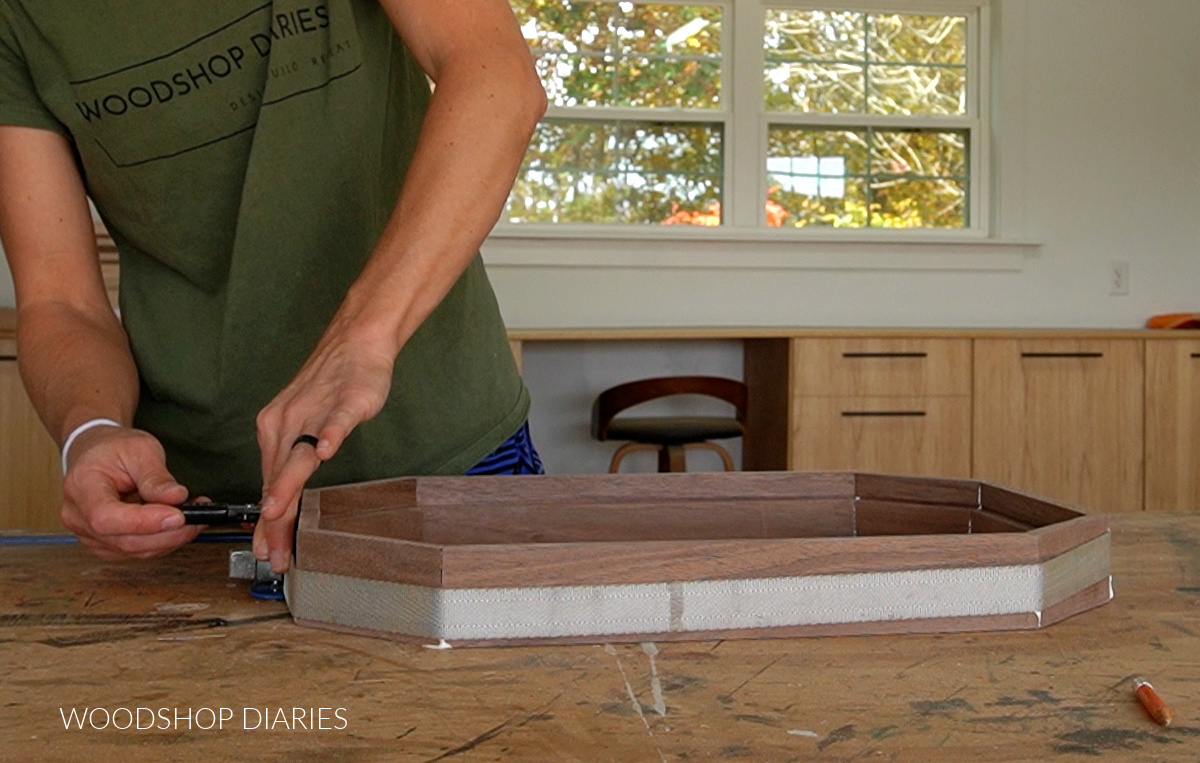
Easy DIY Plant Shelf

June 21, 2023 by Shara, Woodshop Diaries

In this post, I’m sharing how to build this SUPER SIMPLE DIY plant shelf with just 2 boards!!

If you’ve got several small plants that you want to get off the ground or off your windowsill, this is the perfect little plant shelf for the job!

Vertical DIY plant shelf painted green with 5 tiered wooden shelves--3 on right and 2 on left

*This post is sponsored by my friends at Kreg Tool and contains affiliate links. See website policies.

Obviously, you can use it for plants, books, décor, even shoes! The size is easy to customize, as well as the number of shelves.

This is an excellent beginner woodworking project that’s easy on the budget and only requires a few basic tools.

So if you’re ready to get building, let’s dive in to the how-to!

What You’ll Need

Tools:

  • Miter Saw (or any saw that can cut straight lines)
  • Drill/Driver
  • Kreg Pocket Hole Jig
  • Kreg Quick Flip Drill Bit (or any countersinking drill bit)

Materials:

  • (2) 1x8x8 boards
  • 1 ¼″ pocket hole screws
  • Wood Glue

What to know before building

This is an incredibly simple DIY project, but just in case you want to add your own touches, here are some tips to take note of before building.

This project is intended for smaller, lighter weight pots.

While it can structurally hold larger, heavier pots, this plant shelf is tall and skinny and adding large pots can cause it to be top heavy and easier to accidentally knock over.

Keep that in mind if you make modifications.

It’s easy to customize the sizing

I made this project from 1×8 boards, but if you’d like a deeper shelf, feel free to use 1x10s or 1x12s or even strips of plywood ripped to the depth you’d prefer.

And if you’d like to make it taller and add more shelves, you certainly can! Space them closer together or further apart. Feel free to get creative with your sizing.

Just keep in mind the taller the shelf, the more top heavy it can tend to be. So consider anchoring it to the wall if you plan to load it down or make it taller.

Overall Dimensions

The overall dimensions of this DIY plant shelf is 8″ deep x 18″ wide x 48″ tall.

Overall dimensional diagram of plant shelf made from 2 boards

How to Build a Simple Plant Shelf

This simple plant shelf can be built in under an hour with just two basic boards. The step by step tutorial with details and tips can be found below.

Or head to KregTool.com for the FREE building plans.

Love a good DIY project? Subscribe to our email list to be the first to know when new projects, plans, and woodworking tips are posted!

Step 1: Cut and Sand DIY Plant Shelf Pieces

For this shelf, I cut my two 1x8s into three pieces for the bottom and vertical frame. Then I cut 5 shelves from the remaining lumber.

1x8s

  • (1) piece 18″ long for the bottom
  • (1) piece 48″ long for the back
  • (1) piece 47 ¼″ long for the middle divider
  • (5) pieces 8 ½″ long for the shelves

I sanded all of these pieces well before assembling. It’s always good to sand individual pieces before assembling because getting in the corners after pieces are together is difficult.

If you’d like to finish these in different colors, consider staining or painting them now before moving on to putting them together. Just like with sanding, getting in all the corners after the pieces are together is challenging.

Step 2: Assemble Back and Middle Divider

I laid the back panel flat on the workbench and marked the center line from top to bottom. I like using my Kreg Multimark for this, but a measuring tape and a straight edge would work as well.

Shara Woodshop Diaries marking centerline of 1x8 back piece of plant shelf on workbench using Kreg MultiMark

Then I applied a bead of wood glue along this line and centered the middle divider on it. I lined up the top edges of the divider and back panel so they are flush along the top. panel.

NOTE: The middle divider is ¾″ shorter than the back. The top edges should be flush and the bottom of the back piece should overhang the divider by ¾″.

I clamped these together, then used a Kreg Quick Flip drill bit to predrill and countersink 5 holes along the back side of the back panel down the middle.

Using a Kreg Quick Flip countersinking drill bit to drill holes on back of plant shelf to attach

Then, I could drive 1 ¼″ pocket hole screws through these holes to attach the pieces together.

Driving pocket hole screws through countersunk holes to secure back panel to divider

NOTE: The Kreg Quick Flip bit is a great little countersinking bit, but you can also use another type of countersinking bit or countersinking screws instead.

Step 3: Attach Bottom Panel to Shelf

The bottom panel will go under the middle divider and in front of the back piece–which is why the middle divider is ¾″ shorter than the back.

I applied a bead of wood glue along the back piece and middle divider and centered the bottom piece on them.

Applying wood glue to bottom of shelf

Just like for step 2, I used the Kreg Quick Flip to predrill and countersink two holes through the back and two holes through the bottom to attach this piece to each using 1 ¼″ pocket hole screws.

Plant shelf back divider and bottom panels assembled on workshop floor

I wanted this main plant shelf assembly to be green, so first, I stained it green using Minwax Water Based Stain in Early Spring. So you’ll notice in the photos in the next step, it’s stained green.

However, after attaching the shelves, I changed my mind and went back and painted it in SW Evergreen Fog to tone it down a bit.

If you want this piece a different color from your shelves, I recommend finishing it now before adding the shelves in the next step.

Step 4: Add Shelves

I drilled ¾″ pocket holes into ONE end of each shelf. Not sure how to drill pocket holes? Check out this post to learn how to use a pocket hole jig.

Close of of drilling pocket holes in 1x8 board on workbench

I started on the right side of the shelf and secured the bottom shelf to the middle divider 12″ up from the bottom panel using 1 ¼″ pocket hole screws.

Then, I installed another 12″ up from the bottom shelf, and a third 12″ up from the middle shelf.

Shara Woodshop Diaries attaching shelves to divider using pocket holes and screws

Once the right side was finished, I installed the bottom left shelf 18″ up from the bottom panel.

And finally, I installed the top left shelf 12″ up from the one below it.

Of course, feel free to adjust your spacing, your layout and number of shelves as you’d like.

After these shelves were attached to the middle divider, I secured the back side of each shelf to the back panel by predrilling and countersinking holes (with the Kreg Quick Flip again), and driving 1 ¼″ pocket hole screws.

Arrows pointing out screw locations to secure back of shelves on back panel of DIY plant shelf assembly

And at this point, the shelf is complete! If you plan to load this down with books, heavy plants, or décor, I recommend anchoring it to the wall to prevent tip over.

Stain/paint as desired if you haven’t already and once it’s dry, display your favorite things!

Shara Woodshop Diaries placing plant on top left of DIY plant shelf

Don’t forget to grab the FREE building plans on KregTool.com!

Looking for more project inspiration?

Check out some of our favorite easy DIYs below or click here for a full list of simple, beginner DIY project ideas!

Easy Modern Propagation Station
Scrap Wood Tiered Plant Stand
Scrap Wood Key Holder Catch All
DIY Plant Stand
Tea Box with Mug Holder
DIY Corner Shelf

Save this DIY plant stand shelf project for later by pinning it or sharing to your favorite social channel!

Pinterest collage image showing overall dimensional diagram at top and Shara with completed plant shelf at bottom with text "how to build a plant shelf from just two boards"

Until next time, happy building!

DIY Chunky Outdoor Chair

June 19, 2023 by Shara, Woodshop Diaries

In this post, I’m sharing how to build a chunky wood DIY outdoor chair with basic materials and minimal tools!

These simple outdoor chairs are a great weekend woodworking project that you can easily start, finish, and enjoy before the weekend is over.

Shara Woodshop Diaries sitting in chunky modern wood outdoor chair with seat and back cushion in grassy yard with trees in the background

I cannot get enough of this simple, chunky outdoor chair design. I loved it so much, I built two of them! They’re sturdy and stylish and make a really nice looking seat for your deck, porch, or patio.

In case you missed it, I already built the matching outdoor sofa to go with it. Check out the matching DIY outdoor sofa build here.

The two builds are very similar (since they’re a matching set, that only makes sense haha), but the chair is obviously a little narrower and doesn’t need a middle support. And that means, it’s an even easier build!

If you’re ready to tackle building your own outdoor chair, I’m sharing all the details below!

*This post contains affiliate links. See website policies.

What to know before building an outdoor chair

This outdoor chair project requires only 4 basic tools (listed below) and a few standard size boards you can easily find at the big box store or local lumber yard.

RELATED: How to shop for lumber

I was able to build two of these in just a few hours. But, full disclosure: I did finish/seal the pieces between cutting and assembling to make it easier to get into all the nooks and crannies.

Waiting for the sealer to dry did add a couple hours to the process, but you can always do this at the end if you’d like. Assembly alone only takes a couple hours so it’s a great weekend project!

Here are a few things to consider before building an outdoor chair.

Be the first to know about new posts, plans, and woodworking tips on Woodshop Diaries. Sign up to our newsletter for priority access!

Seat Cushion Options & Sizing

I built these chairs to fit standard size 24″ x 24″ seat cushions. If you saw the outdoor sofa build, I used the exact same cushions here for the chairs.

It’s always easier to build the chair to fit the cushion than to build the chair and try to find cushions that fit!

The cushion sets I used here came with both a seat cushion and a matching back pillow. You can find the cushions sets I used for this chair here.

Modern chunky wooden DIY outdoor chair with seat and back cushion made from cedar

Note that the seat cushions I used are advertised as 24″ x 24″ but when I got them and actually measured, they were 23 ½″ x 23 ½″. So I built the opening of the chair a little undersized at 23 ½″ so they’d fit snug and not have gaps between them.

If your seat cushions are actually 24″ x 24″, they will still work fine. Pillows and cushions can “squish” a little to fit. Better to be snug than to have gaps.

What wood should you build an outdoor chair with?

When building outdoor projects, always consider the type of wood you use. There are several options, and like most things, there are pros and cons to each one.

You can use untreated pine for outdoor builds, but it does not hold up well in the elements long term. This is the most budget friendly option, but will likely only last you a couple seasons outdoors depending on how much exposure to rain, snow, and sun it gets.

Pressure treated wood is intended for use outdoors and will last a long while. However, it’s not always the nicest to work with, it’s heavy, and it’s treated with special chemicals to prevent it from deteriorating so quickly. It’s a good low budget option for outdoor furniture that you want to last a while.

treated lumber laying on concrete floor

Cedar, red wood, and teak are all naturally decay and insect resistant wood options that look really nice. But, that comes with a price tag. These wood types can be quite expensive and sometimes hard to find depending on where you live.

cedar lumber laid out on workbench top

Approximate Cost to Build an Outdoor Chair

For these outdoor chairs and the matching sofa, I opted for cedar. As of June 2023 when this was built, the lumber cost to build one chair with cedar (where I live) was approximately $130. The cost to build it from pressure treated wood would have been approximately $47.

However, if you only build one, there will be some lumber leftover. If you build two chairs, you can use some of this lumber on the second one, so two would actually only cost $240 in cedar or $87 in treated.

The cost to build two chairs plus the matching sofa was approximately $430 in cedar and $150 in treated wood. Building all three allows you to better utilize the material so there is less waste. You’ll be able to use several off cuts from the sofa to build the chairs, etc.

Overall chair dimensions

The overall dimensions of this DIY outdoor chair are approximately 29 ½″ tall x 30 ½″ wide x 35″ deep. The seat height (without the cushions) is 12″.

Overall dimensional diagram of DIY outdoor chair

How to Build an Outdoor Chair

Prefer to watch? Check out the build video with helpful tips and some bloopers along the way on my YouTube channel here:

Are videos your thing? Subscribe to my YouTube Channel for more project and how to videos!

I’m sharing the step by step process to build this DIY outdoor chair below. But if you prefer to print out and take the plans to the shop with you, I’ve got you covered! Grab the outdoor chair printable building plans here.

Tools & Materials

Tools:

  • Miter Saw
  • Drill/Driver
  • Pocket Hole Jig (both standard and XL jig)
  • Sander

Materials:

  • (2) 4x4x8 posts
  • (1) 1x2x8 board
  • (3) 2x4x8 boards
  • 4″ exterior pocket hole screws
  • 2 ½” exterior wood screws
  • 2 ½” exterior pocket hole screws
  • 4 ½” long timber screws or lag screws
  • Wood Glue (exterior rated)
  • 24″ x 24″ seat & back cushion set (optional)
  • Foot Levelers

Step 1: Assemble Outdoor Chair Side Frames

First, I cut a front leg from the 4×4 post. Then, I cut a back leg from the 4×4 post with ends mitered 20 degrees. Then, I cut another piece of 4×4 to run between them at the top.

Outdoor chair side frame dry fit together on workbench

You can find all the dimensions with diagrams for the project in the printable plans.

I assembled these together using pocket holes and screws. BUT, standard size pocket hole jigs aren’t designed to use with 4x4s. So to drill the pocket holes in the 4×4 at the top, I used a Kreg XL Pocket Hole Jig.

This jig has settings for 3 ½″ material, which is what a 4×4 is. Confused? Don’t worry. Check out this post about how to understand lumber sizing.

Shara Woodshop Diaries drilling 3 ½" pocket holes into 4x4 posts to assemble chair

So I drilled 3 ½″ pocket holes on the bottom side of the top 4×4 and attached it between the two legs using 4″ XL pocket hole screws.

Close up image driving pocket hole screws in 4x4 posts

Once the legs and top were together, I cut and installed a piece of 2×4 to run between them using standard size pocket holes and screws–1 ½″ pocket holes with 2 ½″ pocket hole screws. This piece should be flush to the INSIDE of the legs.

RELATED: How to use a pocket hole jig

I cut the front end with a 4 degree miter and the back with a 24 degree miter so that it would slope slightly from front to back.

Shara Woodshop Diaries driving pocket hole screws to install seat support of DIY outdoor chair side frame on workbench

Then, I cut another 4×4 post for the back support–one end is mitered 20 degrees and the other end square.

This piece should go on the INSIDE of the side frame so that the mitered edge is lined up with the bottom of the 2×4 and the front edge is in line with the corner.

Installing 4x4 back post on outdoor chair side frames on workbench

I secured this in place with wood glue and 4 ½″ timber screws. You could also use 4 ½″ long lag screws. Don’t forget to predrill pilot holes as these large screws can easily split the wood.

Once one side frame was assembled, I built another just like it, only mirrored. One will be for the left side of the chair and one for the right.

Two chunky outdoor chair side frames side by side in workshop

Step 2: Attach Back Slat Supports

The back slats of this chair will run between the back posts. But I needed something to be able to screw them into.

On the matching sofa build, I used 2x2s screwed into the back 4×4 posts. However, since these chairs are so much narrower, adding these 2x2s to the already chunky 4×4 post looked odd.

Dimensional diagram showing where and how to install back slat supports of outdoor chair

So instead, I screwed 1x2s to the back 4×4 posts. I used 1 ¼″ decking screws to secure these 1 ½″ from the front edge. That way, the slats can screw to them (in step 4) and it’ll still be flush across the front.

Step 3: Attach the Chair Seat Slats

I cut five 2×4 seat slats and drilled 1 ½″ pocket holes into the ends of each. But before attaching these, I went ahead and applied an exterior stain/sealant to the side frames and slats first.

Check out the notes on the sofa build for more tips and information on weatherproofing your outdoor chair. Sealing this now makes it a little easier to cover all surfaces vs trying to get between all the slats once it’s assembled.

I used Thompson’s Water Seal in Transparent Natural Cedar. I liked the color, but I’ve never used it before, so I’m not sure how long or how well it lasts. Time will tell!

After the sealant had dried, I secured one of the 2×4 slats running vertically between the side frames at the front using 2 ½″ pocket hole screws. I secured another running horizontally at the back of the side frames into the seat support.

Close up driving pocket hole screws in seat slat of DIY outdoor chair

Once the front and back slats were secured between the two sides of the chair, I evenly spaced the other three slats between them and secured with 2 ½″ pocket hole screws.

Step 4: Attach the Chair Back Slats

Then, I cut to fit three more 2x4s to run between the back posts for the back slats. Before installing, I applied a coat of exterior stain/sealer to them as well.

I evenly spaced these along the 1×2 on the back posts and secured with 2 ½″ exterior screws. MAKE SURE TO PREDRILL PILOT HOLES. Since the holes will be so close to the edge and go into such a narrow board, it’s likely to split.

Securing 2x4 back slats to chair back posts using screws

Predrilling holes will help prevent splits and cracks in the wood.

Step 5: Installing Feet Levelers on Chairs

When you complete your project, if you flip it back over on your workbench or your shop floor and it rocks a little, I know that can be frustrating, but don’t panic!

The truth is, even if your chair is perfectly level on the bottom, the workbench and the floor may not be. And the patio, deck, or porch you put this on likely isn’t flat either.

Since this chunky outdoor chair is built so…well, chunky, it’s really sturdy and rigid. So if you place it on an uneven surface, it’s not going to give and it’ll rock.

Close up of drilling a hole in bottom of chair legs

To help with this, I installed some foot levelers on each foot of the chair. These are the levelers I used and I simply drilled a 5/16″ hole into the center of each foot, tapped the insert into the hole and screwed the foot in.

Shara Woodshop Diaries screwing feet levelers into threaded inserts on the bottom of outdoor chair legs

You can twist the foot clockwise or counterclockwise as needed to raise or lower each leg as needed once you get it to where it’s going.

Once the levelers are in, flip it back over, adjust as needed, toss in your cushions and enjoy your new DIY outdoor chair!

Two DIY wooden chunky style outdoor chairs with seat and back cushions in grassy area with trees in background

I’m not going to lie–this is one of the most comfortable outdoor chairs I’ve sat in. The seat angle is slight so it’s easy to get in and out of and the cushions are a perfect fit.

Back side of outdoor chair showing seat slats running between back posts

If you want to build your own, grab the DIY outdoor chair printable plans here!

Looking for more outdoor project ideas?

Check out a list of all of our outdoor projects here. But below I’ve shared a few favorites!

DIY Enclosed Garden
DIY Garden Arbor
Raised Garden Beds with Trellis
DIY Outdoor Garden Cart

If you’d like to save this project for later, don’t forget to pin it or share it to your favorite social channel!

Pinterest collage image showing overall dimensional diagram of chair at top and Shara Woodshop Diaries sitting in chair at bottom with text "how to build an outdoor chair"

Until next time, friends, happy building!
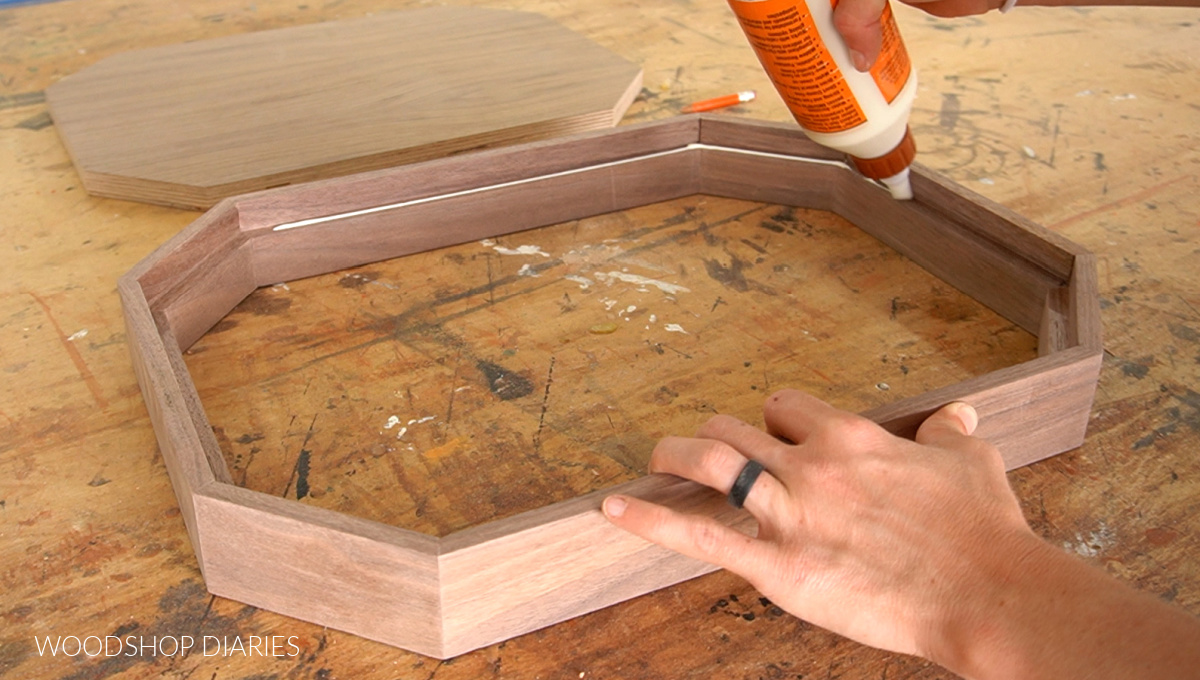
How to Build an Outdoor Sofa

June 9, 2023 by Shara, Woodshop Diaries

In this post, I’m showing you how to build an outdoor sofa couch with building plans!

Need some extra seating for your outdoor space? Maybe a comfortable place to wind down in the evenings on the porch, patio, or deck?

Shara Woodshop Diaries sitting on wooden outdoor sofa in yard with beige seat cushions

This EASY DIY outdoor sofa checks all the boxes and is the perfect weekend build to kick off your summer projects!

I built this (and some matching outdoor chairs) for my parents’ patio and made it big enough to fit three standard size outdoor couch cushions. Perfect size for three people–or keep it all to yourself and lay down for a nap ha!

If you’re looking for a sturdy, stylish, and super quick weekend woodworking project, let’s dive in and I’ll show you how to build your own outdoor couch!

Looking for matching chairs? Grab the matching chair plans here!

Be sure to sign up to the newsletter for priority access to the latest projects and plans (like the chairs) right to your inbox.

*This post contains affiliate links. See website policies.

What to know before building an outdoor sofa

Building this outdoor couch only takes a few hours and is a pretty easy DIY project that requires minimal tools. The angles may seem intimidating, but don’t worry! I’ve detailed everything in the building plans.

Here are a few things to consider before building an outdoor sofa.

Couch cushion options & sizing

I built this outdoor sofa to fit three standard 24″ x 24″ seat cushions. I thought it would be easier to build the couch to fit the cushions than to try to find cushions to fit the couch!

The cushion sets I used here came with both a seat cushion and a matching back pillow. You can find the cushions sets I used for the sofa here.

Close up of left side of wooden outdoor sofa with beige seat and back cushions

Note that the seat cushions I used are advertised as 24″ x 24″ but when I got them and actually measured, they were 23 ½″ x 23 ½″. So I built the opening of the sofa a little undersized at 70 ½″ so they’d fit snug and not have gaps between them.

If your seat cushions are actually 24″ x 24″, they will still work fine. Pillows and cushions can “squish” a little to fit. Better to be snug than to have gaps.

Overall dimensions

The overall dimensions of this DIY outdoor couch are approximately 29 ½″ tall x 35″ deep x 77 ½″ wide.

Overall outdoor sofa dimensional diagram

What type of wood to build an outdoor sofa with

When building outdoor projects, consider the type of wood you use. There are several options and there are pros and cons to each.

RELATED: How to shop for lumber

You can use untreated pine for outdoor builds, but it does not hold up well in the elements long term. This is the most budget friendly option, but will likely only last you a couple seasons outdoors depending on how much exposure to rain, snow, and sun it gets.

Pressure treated wood is intended for use outdoors and will last a long while. However, it’s not always the nicest to work with, it’s heavy, and it’s treated with special chemicals to prevent it from deteriorating so quickly. It’s a good low budget option for outdoor furniture that you want to last a while.

pressure treated lumber on concrete floor

Cedar, red wood, and teak are all naturally decay and insect resistant wood options that look really nice. But, that comes with a price tag. These wood types can be quite expensive and sometimes hard to find depending on where you live.

cedar boards laid out on workbench

For this project, I opted for cedar. As of June 2023 when this was built, the lumber cost to build this sofa with cedar (where I live) was approximately $220. The cost to build it from pressure treated wood would have been approximately $85.

Don’t forget when building for exterior use to make sure the hardware (screws) and finish you use are rated for exterior use as well.

Weatherproofing your outdoor sofa

Once your project is built, you want to make sure it stays looking nice. But more importantly, you want to make sure it’s properly protected from weather damage from sun, rain, and snow.

The easiest way to do this is to apply an outdoor sealant. These come in a wide variety of brands, colors, and opacities. Thompson’s Water Seal, Olympic, Cabot, Valspar are all common outdoor stain and sealant brands you can find readily available in the big box store or local hardware stores.

Most of the options you see available off the shelf come in a clear transparent, a tinted transparent, a tinted semi-transparent, and a tinted solid.

Basically anything with a tint is a stain and sealant all-in-one and the “less transparent” you go, the more protection it provides. Solids provide more protection than transparent. However, transparent allows you to see the wood grain more.

So choosing one is mostly based on how you want it to look and how often you want to reapply. Transparent stains will need to be reapplied more often than solids. But, none of these products will last forever, so be prepared to reapply every 2-5 years regardless.

Once water no longer beads up on the surface, it’s time for another coat. For this project, I used Thompson’s Water Seal Transparent in Natural Cedar. It was my first time using it, so we will see how well it lasts long term.

How to build an outdoor sofa

Prefer to watch? Watch the full build video with helpful tips along the way on my YouTube channel here:

https://youtu.be/CdjZ3MLiC1o

Are videos your thing? Subscribe to my YouTube Channel for more project and how to videos!

I’m sharing the step by step process to build this couch below. But if you prefer to print it out and take the plans to the shop with you, I’ve got you covered! Grab the outdoor sofa printable building plans here.

Tools & Materials

Tools:

  • Miter Saw
  • Drill/Driver
  • Pocket Hole Jig (both the standard size jig and the XL jig)
  • Sander

Materials:

  • (2) 4x4x8 posts
  • (1) 2x2x8 board
  • (8) 2x4x8 boards
  • 4″ exterior pocket hole screws
  • 2 ½” exterior wood screws
  • 2 ½” exterior pocket hole screws
  • 4 ½” long timber screws or lag screws
  • Wood Glue (exterior rated)
  • (3) 24″ x 24″ seat & back cushion sets (optional)

Step 1: Build the Outdoor Couch Sides

The side frames are assembled from 4x4s for the legs, top and back post and a 2×4 that serves as the seat support. You can find all the dimensions for the cuts in the printable plans.

First, I cut a front leg from the 4×4 post. Then, I cut a back leg from the 4×4 post with ends mitered 20 degrees. Then, I cut another piece of 4×4 to run between them at the top.

Outdoor sofa side frame dimensional diagram

I assembled these together using pocket holes and screws. BUT, standard size pocket hole jigs aren’t designed to use with 4x4s. So to drill the pocket holes in the 4×4 at the top, I used a Kreg XL Pocket Hole Jig.

This jig has settings for 3 ½″ material, which is what a 4×4 is. Confused? Don’t worry. Check out this post about how to understand lumber sizing.

Drilling pocket holes with Kreg XL Pocket Hole Jig in cedar 4x4 post

So I drilled 3 ½″ pocket holes on the bottom side of the top 4×4 and attached it between the two legs using 4″ XL pocket hole screws.

Close up of driving 4" pocket hole screws in cedar 4x4 post

Once the legs and top were together, I cut and installed a piece of 2×4 to run between them using standard size pocket holes and screws–1 ½″ pocket holes with 2 ½″ pocket hole screws. This piece should be flush to the INSIDE of the legs.

RELATED: How to use a pocket hole jig

I cut the front end with a 4 degree miter and the back with a 24 degree miter so that it would slope slightly from front to back.

Shara Woodshop Diaries securing 2x4 seat slat on outdoor sofa side frame with pocket holes on workbench

Then, I cut another 4×4 post for the back support–one end is mitered 20 degrees and the other end square.

This piece should go on the INSIDE of the side frame so that the mitered edge is lined up with the bottom of the 2×4 and the front edge is in line with the corner.

Securing back post frame to side panels  on workbench

I secured this in place with wood glue and 4 ½″ timber screws. You could also use 4 ½″ long lag screws. Don’t forget to predrill pilot holes as these large screws can easily split the wood.

Once one side frame was assembled, I built another just like it, only mirrored. One will be for the left side of the couch and one for the right.

Two mirrored sofa side frames sitting next to each other in workshop

Step 2: Install Front Seat Support

This sofa was too long to span without a middle support. So I cut a piece of 4×4 post to 12″ long and attached two 2x4s on each side of it with 1 ½″ pocket holes and 2 ½″ pocket hole screws.

Shara Woodshop Diaries holding 2x4s secured to 4x4 center post with pocket holes and screws

This will serve as the front support of the seat.

I drilled 1 ½″ pocket holes into both ends of each 2×4 so that I could install it between the side frames flush to the front edge with pocket hole screws from the inside (so they’re hidden).

Front seat support with center post attached between two outdoor sofa side frames

Step 3: Attach Back Slat Supports

I needed something to attach the back slats to between the 4×4 posts and didn’t want to use pocket holes because I didn’t want to see them in the finished project.

So I cut 2×2 pieces to install onto the back 4×4 posts. I used a scrap piece clamped on the post to help me make sure these were installed 1 ½″ back from the front edge.

Shara Woodshop Diaries installing 2x2s onto back post frame

Step 4: Install Middle Sofa Support

I know this seems out of order, but it was really helpful to attach the back seat slat and the bottom back slat at this point to help me get the middle support positioned correctly.

So I cut a 2×4 seat slat and drilled 1 ½″ pocket holes into the ends. I secured these flush to the top of the 2×4 on the side frames against the back post using 2 ½″ pocket hole screws.

I flipped the sofa on its back to make this easier.

Installing back seat slat on outdoor couch using pocket holes and screws

Then I cut a back slat to fit between the back posts and secured this onto the 2x2s with 2 ½″ wood screws.

Bottom back outdoor sofa slat installed onto 2x2s on back post frame

These slats will make installing the middle support much easier. The middle support is made of two 2x4s and a 4×4 “leg.” You can find the dimensions with the specific angles noted in the printable building plans.

I attached the bottom piece of the support to the back with 1 ½″ pocket holes and 2 ½″ pocket hole screws. Then I used wood glue and 2 ½″ screws to secure the 4×4 post at the back corner.

Middle support assembly diagram for outdoor couch support

Once the middle support was assembled, I attached it to the sofa. I positioned it underneath and behind the slats I just installed and clamped it in place.

Clamping middle support assembly to seat and back slats

Then, I flipped the sofa frame over on its front and used pocket holes and screws on the bottom 2×4 to secure it to the front center post of the sofa frame 1 ½″ down from the top.

Securing middle support to center front post using pocket holes and screws

Then I flipped the sofa back over and secured this middle support assembly to the slats using 2 ½″ screws.

At this point, all that’s left is adding a few more slats to finish up the build!

Step 5: Attach Back and Seat Slats

I cut two more 2×4 back slats and secured to the 2x2s and the middle support with 2 ½″ screws. I just added one at the top and then centered the second one between the top and bottom slats.

Driving screws to secure back slats on outdoor sofa

Then, I cut three more 2x4s for the seat slats and evenly spaced them out along the side frames on the 2×4.

I secured to each side using pocket holes and screws, then flipped it over and secured the center to the middle support. And at that point, the assembly process was complete!

building outdoor couch--installing Seat slats evenly spaced on side frames with pocket holes drilled in ends

Step 6: Finish & Seal Outdoor Couch

I applied a coat of Thompson’s Water Seal Transparent in Natural Cedar to the sofa to give it some color and protect it from weathering. And after it was dry, it was ready to use!

Back side view of finished DIY outdoor couch with 3 sets of cushions for seat and back
3 seater outdoor couch made with cedar wood sitting in yard with seat cushions

Looking for more outdoor project inspiration?

Enjoyed this outdoor sofa build and want some more summertime project ideas? Here are a few fan favorites you’ll enjoy!

DIY Enclosed Garden
DIY Garden Arbor
DIY Fall Planter Boxes
Raised Garden Beds with Trellis
DIY Adirondack Chair

If you enjoyed learning how to build an outdoor sofa and want to save this post for later, don’t forget to pin it or share it to your favorite social channel!

Pinterest collage image showing back side of outdoor sofa at top and front side of outdoor sofa at bottom with text "how to build an outdoor sofa printable building plans"

Until next time, friends, happy building!
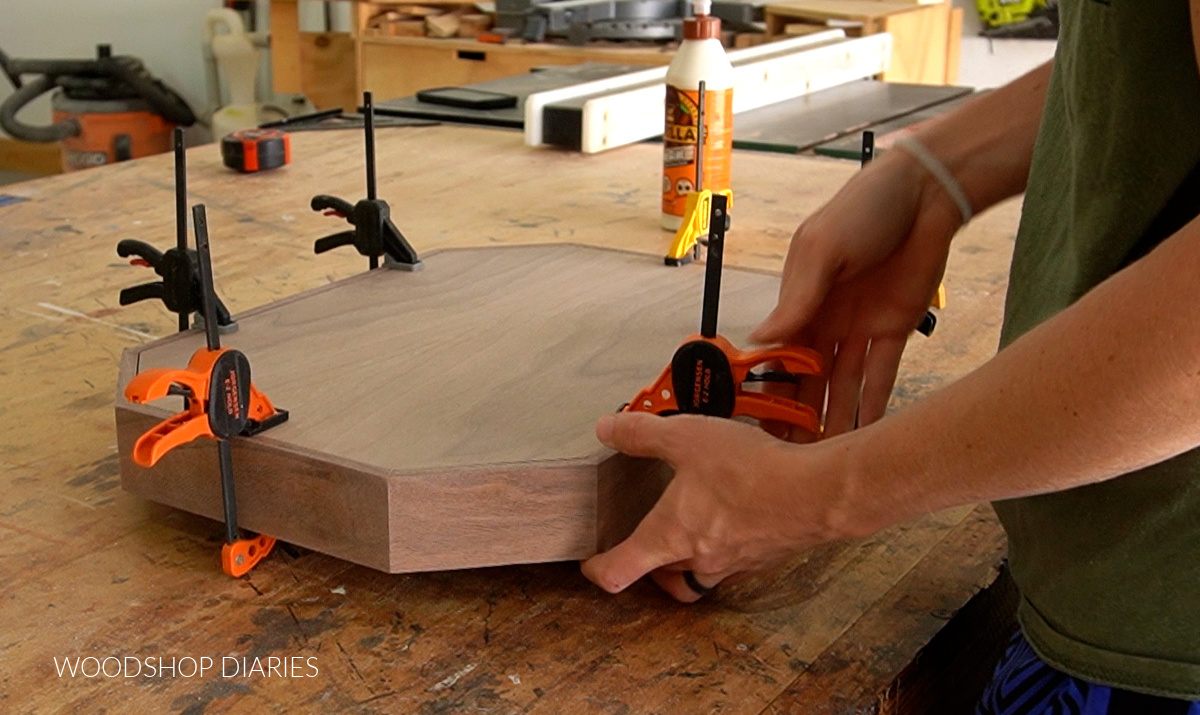
How to Add Adjustable Shelves To Cabinets and Furniture

June 2, 2023 by Shara, Woodshop Diaries

In this post, I’ll share how easy it is to add adjustable shelves into your cabinets and furniture with just a couple basic tools!

I don’t know about you, but I’m indecisive. One of the things I love most about installing adjustable shelves is that I can move them around however I want and as many times as I want to suit my needs.

Garage cabinets with two doors open revealing adjustable shelves inside

Stationary shelves just don’t give me that option.

So when I get ready to add shelves into my DIY and furniture projects, I almost always add adjustable shelves to give me options.

The best part? I think they’re even easier to install than stationary shelves, anyway! I’ll show you how to add adjustable shelves to your own furniture and cabinet projects below.

What Do You Need To Install Adjustable Shelves?

The tools and materials needed to add adjustable shelves to either new OR existing cabinets are very minimal. You only need a few items!

*This post contains affiliate links. See website policies.

WHAT YOU NEED TO INSTALL ADJUSTABLE SHELVES

Tools:

  • Drill
  • Shelf Pin Jig
  • Saw (to cut shelving material as needed)

Materials:

  • ¾″ plywood or desired shelving material
  • Shelf Pins

NOTE: I use a Kreg shelf pin jig. There are several brands that make similar jigs as well. Kreg recently updated their shelf pin jig design, so you’ll see two different looking jigs in this post. Don’t be confused–they’re the same thing, one is just the newer version, so it looks a little different.

Shelf Pin Types and Sizing

Shelf pins and shelf pin jigs some in two common sizes–5mm and ¼″. It’s important to know what size jig you’re using to know what size shelf pins to use.

5mm is smaller than ¼″ so if you use 5mm shelf pins in ¼″ holes, they’ll just fall out. But ¼″ shelf pins won’t fit into 5mm holes.

5mm shelf pins on workbench next to ¼" shelf pins to show size difference

Both work fine for most cabinet and furniture applications, so it doesn’t make a big difference which one you decide to go with.

If you’re using a 5mm jig, use 5mm shelf pins. If you’re using ¼″ jig, use ¼″ shelf pins.

  • Check out the 5mm shelf pin jig here.
  • Check out the ¼″ shelf pin jig here.

Personally, I prefer ¼″ sizing for my shelf pins.

In addition to the different sizing options, shelf pins also come in a few different styles. Some are just simple rods, some are like L shaped brackets. But I prefer the “spoon” style like shown on the right below.

three types of shelf pins laid out on workbench

How to Drill Shelf Pin Holes

Drilling shelf pin holes is SUPER easy with a shelf pin jig. This jig helps you drill equally spaced holes perfectly sized for shelf pins.

The shelf pin jig comes with a drilling guide (or jig), a drill bit with stop collar, and an indicator pin.

Shelf pin jig with drill bit and indicator pin labeled

Install the drill bit into your drill and set the stop collar to the depth you want to drill. See frequently asked questions at the bottom of this post for drill depth tips.

Step 1: Determine shelf pin hole locations

You’ll need to drill 4 sets of holes–two on each side of the cabinet toward the back and two on each side of the cabinet toward the front. Each shelf will rest on 4 pins placed in these holes.

Looking at shelf pin holes drilled inside cabinet

For the two sets of holes along the back, I like to just line up the edge of the jig with the back of the cabinet when drilling. That way, I know I’m drilling straight up and down along this edge.

For the holes at the front, I like to drill these about 1″ closer to the back than the depth of the shelves. So if the shelves are 12″ deep, I’ll drill my holes about 11″ from the back of the cabinet.

You can use some scrap blocks placed along the front or back edge of the cabinet to help you keep the jig properly spaced and square while drilling.

Drilling shelf pin holes inside cabinet with scrap block on front edge

Make sure you start each set of holes at the same height. For example, if you started your first set of shelf pin holes 6″ from the bottom of the cabinet, start the other three sets of holes 6″ from the bottom of the cabinet.

See frequently asked questions at the bottom of this post for more shelf pin location tips.

Are DIY and woodworking projects your thing? Sign up for our newsletter to be the first to know when new projects and plans are out!

Step 2: Drill Out Shelf Pin Holes

To use the jig, simply hold it tightly (or clamp) onto the side of the cabinet at the locations mentioned in step 1 and drill into each hole of the jig. I like to start at the bottom of the cabinet and work my way up.

After you drill the top hole in the jig, move the jig up and place the indicator pin through the bottom hole of the jig into the last hole drilled.

This helps keep the holes consistently spaced as you drill your way up the side of the cabinet. By the way, you can drill your shelf pin holes while the cabinet is standing up like shown above or laying down like shown below.

Drilling out shelf pin holes on inside of cabinet laid on its side for adjustable shelves

If you don’t want holes going all the way to the bottom of your cabinet, you can use a piece of scrap wood under the jig to raise it where you want to start your shelf pin holes.

Using a scrap block underneath shelf pin jig to adjust height of shelf pin holes

Once all four sets of holes are drilled, lightly sand the area to smooth out any rough spots around these holes.

How to Install Shelves with Shelf Pins

Installing the shelves is even easier than drilling the holes. Simply place shelf pins into the holes where you’d like to place your shelf or shelves.

Use 4 pins per shelf and make sure they’re all in corresponding holes so your shelf isn’t lopsided.

Placing shelf pin in shelf pin holes in plywood cabinet for adjustable shelves

Cut your shelving material (I recommend ¾″ hardwood plywood) to the depth you want your shelves to be and trim the width to about ¼″ less than the width of the inside of the cabinet.

For example, if the inside of the cabinet is 24″ wide, cut your shelves about 23 ¾″ long. This allows about ⅛″ wiggle room on both sides to be able to easily remove and adjust the shelves.

installing adjustable shelf onto shelf pins in cabinet

Place the shelves on the pins and now they’re ready to use!

Frequently Asked Questions About Installing Adjustable Shelves

Drilling shelf pins and installing adjustable shelves is a really easy task, but there are several questions people often ask about the process that I’ve answered below.

If you think of an additional question while you’re installing your own shelves, feel free to reach out and ask so I can add that question to this list!

How deep do I drill my shelf pin holes?

The drill bit on the shelf pin jig comes with a stop collar that you can adjust to set your drill depth.

Close up of drill bit and stop collar

The depth you drill your holes will depend on the type of shelf pin you’re using and the thickness of the material you’re drilling into.

What I suggest is sticking the bit through the jig so that it sticks out just barely more than the length of the shelf pin peg (the back portion of the pin that will go into the hole). Set the stop collar at this location and drill a couple test holes.

Close up showing how to adjust your drill bit stop collar

Insert the shelf pin and see if it seems to fit well. If so, you’re set to drill! If it goes a little too deep or not deep enough, adjust the stop collar and drill another test hole until you get it where you want it.

If you’re drilling through the panel, I suggest using thicker material. For example, ½″ plywood may not work well for some shelf pins.

Can I drill shelf pins on both sides of plywood?

For example, maybe you have a divider panel in the middle of a cabinet and you want to drill shelf pin holes on both sides of it to be able to install shelves on both sides of the cabinet. Like in this example:

Small cabinet with door open showing adjustable shelves on each side of middle divider

Yes, you can drill on both sides! However, it’s best to offset the holes on each side so that you aren’t drilling in exactly the same spot.

One way to “offset” the holes on each side is to drill the set of holes on the left side of the panel 1″ further back from where you drilled the holes on the right side of the panel.

For example, if you drilled holes 2″ in from the front edge on the right side, then drill them 3″ in from the front edge on the left. That way, the holes won’t interfere with each other.

Another option is to start your holes on the left side ½″ higher than where you started your holes on the right side. That way the holes on left side will be offset the holes on the right.

Where should I drill my shelf pin holes?

The exact location that you drill your shelf pin holes isn’t critical in most cases. There is a lot of wiggle room. So it’s kind of up to you where you want them! However, there are a few things to keep in mind with shelf pin location.

Remember that you will drill 4 sets of holes–two along each side of the cabinet toward the back and two along each side of the cabinet toward the front. I recommend drilling the front set of holes about 1″ less than the depth of the shelf from the back of the cabinet.

For example, if you will have 12″ deep shelves, drill the front holes about 11″ from the back of the cabinet.

You can drill your holes as high or as low in the cabinet that you think you’d want to place any shelves. Just make sure that you keep the holes on the left side of the cabinet at the same heights as the holes on the right side.

For example, if you start your holes on the left side of the cabinet 6″ up from the bottom, then be sure to start the holes in the right side of the cabinet 6″ up from the bottom as well.

How much weight can shelf pins hold?

This will depend on the type of shelf pin you’re using, the depth of your shelf pin hole and the material you’re using. In most cases, the shelf will give before the shelf pins will. The pins can hold a SIGNIFICANT amount of weight.

How do I avoid tear out when drilling shelf pin holes?

Most cases of tear out when drilling shelf pin holes are caused by a dull bit, not enough clamping pressure on the jig, or poor quality wood.

First, check your drill bit for chips–make sure it’s sharp and in good shape.

Next, make sure you’re holding or clamping your jig TIGHT to the wood surface when drilling your holes. The jig pushing tight against the wood helps prevent the wood fibers from tearing.

If you’re still struggling with tear out, try drilling some shelf pin holes on another type of material and see if it tears out, too. It may be that the plywood or lumber you’re drilling into is just poor quality and prone to tearing (it may have a really thin veneer layer that rips easy).

One way to help with this issue is to apply painters tape where you plan to drill your holes. The tape can help keep the wood fibers from ripping as it’s drilled into. Always sand after drilling shelf pin holes. Often, a quick sanding removes most of the tear out and it’s not noticeable anymore.

Looking for shelving project ideas?

Now that you know how to use a shelf pin jig and install adjustable shelves, it’s time to practice on a new project!

Here are a few great shelving project ideas to practice your new skills!

DIY Garage Cabinets
DIY Armoire Cabinet
Library Bookshelf with Desk
DIY Accent Cabinet
DIY Display Console Cabinet

If you’d like to save this for later, don’t forget to pin it or share to your favorite social channel!

Cabinets with door open at bottom and shelf pin jig at top with text "how to add adjustable shelves" pin image

Until next time, friends, happy building!
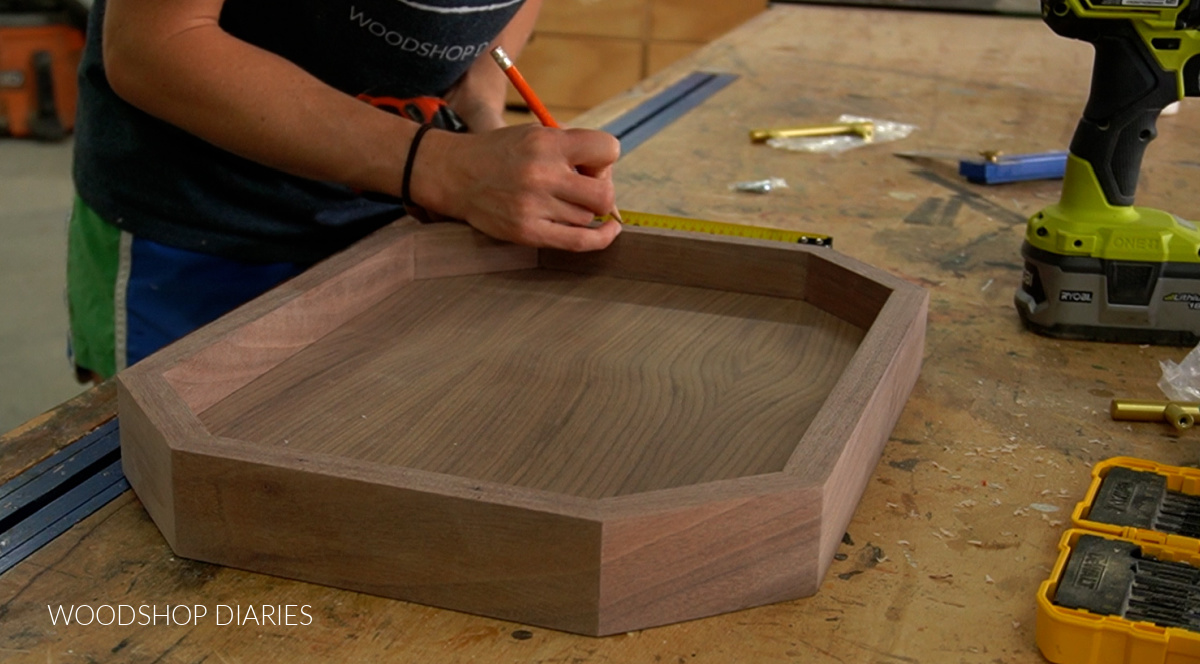
DIY Enclosed Walk-In Garden

June 1, 2023 by Shara, Woodshop Diaries

In this post, I’m sharing how to build an enclosed walk-in garden with raised beds!

If you’re ready to take your garden to the next level (and protect it from pesky critters and wildlife), I’ll show you how with these fenced garden building plans and a step by step video.

Shara Woodshop Diaries walking in enclosed garden under arbor with gate open

Walking into my new DIY enclosed garden feels like a dream. I’ve wanted to build a permanent garden fence for years. And I don’t know why I waited so long, because it really wasn’t that difficult!

If you’re reading this post, I bet you’ve been in the same boat as me–wanting to build your own fenced garden, but unsure how and where to start.

That’s why I’m so excited to share this easy to digest step by step process along with printable plans and a build video so you can confidently tackle building your own DIY enclosed walk-in garden.

What to know before building a walk in garden

Building a fence around your garden may seem like a large, overwhelming project, but the assembly process is really pretty basic. It just takes a little time and a little digging.

NOTE: Before digging anything, check your local rules and regulations. Contact 811 to mark your utility lines BEFORE breaking ground.

Benefits of fencing in your garden

Fencing your garden isn’t necessary, but it does provide many benefits. First, it helps keep critters and wildlife (deer, rabbits, raccoons, etc) from snacking on your produce.

Adding fencing can also help protect your garden from heavy winds, and allows a little extra support for growing “vine-y” plants like cucumbers and grapes.

Enclosed garden with two arbors with gates. Gravel in middle and garden beds around fencing

Temporary fences can be installed around a garden using simple T-posts and fencing wire paneling or hardware cloth. So a permanent fence isn’t the only option.

However, having a permanent fenced garden like this one ready for planting every season saves a lot of set up time, is durable, looks really nice, and will last for years to come.

Are DIY and woodworking projects your thing? Sign for for your newsletter to be the first to know when new projects and plans are out!

Overall Dimensions

The overall dimensions of this fenced garden was approximately 15′ deep and 23′ wide.

Overall dimensional diagram of enclosed walk-in garden

Preparing the area for an enclosed garden

It’s best to choose a place for your enclosed garden that is already pretty flat. It doesn’t have to be PERFECTLY flat, but it shouldn’t have significant sloping.

I recommend tilling up the area first to remove all the grass and loosen up the dirt before planting.

You can plant your veggies and fruits directly in ground or add them into raised beds after the fencing is up. We were planting berry bushes and grapes, so we planted all of ours in ground.

Tools & Materials

*This post contains affiliate links. See website policies.

Since this is an outdoor project, be sure to use wood suitable for exterior use. Treated wood, cedar wood, and redwood are all great options that can withstand the elements.

Treated wood is the most inexpensive option, but I encourage you to do your own research when deciding how and when to use it with your food garden.

For this project, I used cedar for the arbors and for the garden beds and treated wood for the fence posts and framing.

Make sure to use exterior rated hardware (screws, hinges, etc) and finishes for this project as well.

Tools:

  • Miter Saw
  • Drill/Driver
  • Jig Saw
  • Pocket Hole Jig
  • Stapler
  • Wire Cutters
  • Post Hole Digger
  • Shovel & Rake
  • Level
  • String and scrap wood stakes

Materials:

FOR THE ARBOR: (I used cedar for the arbor material)

  • (8) 4x4x8 posts
  • (8) 2x2x8 boards
  • (10) 2x4x8 boards

FOR THE FENCING: (I used pressure treated lumber for the fencing)

  • (8) 4x4x8 posts
  • (20) 2x4x8 boards
  • (20) 2x2x8 boards
  • (8) fence post caps (optional)

OTHER MATERIALS NEEDED:

  • (25) cedar fence pickets (to build garden beds inside fence)
  • Welded wire fencing material (you’ll need 4 ft wide x 100 ft)
  • 1 ¼″ exterior wood screws
  • 2 ½” exterior wood screws
  • 2 ½” exterior pocket hole screws
  • 2 ⅞″ timber screws (optional–see notes)
  • ¾″ staples
  • (2) pair heavy duty gate hinges
  • (2) gate latches
  • Weed barrier fabric, gravel, pavers, mulch, soil as desired for inside
  • (4) 80 lb bags concrete to set posts

Everyone always wants to know the total cost of each project. Lumber and material prices vary GREATLY by location and change daily. So these numbers may not match your numbers.

However, the rough estimate cost in lumber and fencing material to build this in May 2023 where I live was approximately $1200. This doesn’t include gravel or pavers. Replacing the arbors with treated wood instead of cedar would save approximately $400.

How to build an enclosed garden

Building a walk-in garden is a great spring, summer, or fall project. A permanent garden fence can be used and enjoyed season after season and will protect plants year round.

I’m sharing how to build one below, but if you’d like to watch, I also have a complete project video here on my YouTube Channel:

Love videos? Subscribe to my channel for the latest project videos!

If you prefer to print your plans, I’ve got the printable building plans with complete cut list, diagrams and project details here:

Step 1: Assemble Garden Arbors for Entrance

For the entrance to the walk in garden, I built two arbors. The reason I built two of these was because they went between our three already established grapevines. This will give the vines something to grow up and around.

Cedar garden arbor with fencing on each side and grapevines growing on left and right

I shared the plans to build the simple garden arbors with gate in this post. For this enclosed garden, I assembled two of these and carried them to the spot I wanted the front of the garden to be.

To keep things in a straight line, I used scrap wood stakes in the ground and pulled a string tight between them–see the bright orange string in the image below.

Shara Woodshop Diaries placing garden arbors at front of fenced garden along pulled string

Then I could bring the front of the arbors so they were just touching the string and use a little dirt or sand to level them out.

NOTE: Cedar can rot over time when in direct contact with the ground, so if you build these with decar, you may consider setting the legs on gravel or something that will help water drain away.

Step 2: Assemble Front Section of Fencing

I set these arbors 60″ apart and secured two pieces of 2×4 cut to 60″ long between them using 1 ½″ pocket holes and 2 ½″ exterior pocket hole screws.

RELATED: How to use a pocket hole jig

Diagram showing two arbors with fencing framing 2x4s between them assembled with pocket holes

One 2×4 will run vertically between them at the bottom and the other will run horizontally between them about 46 ½″ up from the bottom 2×4.

This mimics the side frame design on the arbors. The top 2×4 should be even with the one on the arbor.

Step 3: Set Fence Posts

Next, I set my fence posts. I used treated 4x4x8 posts for the fence posts and trimmed them all 8 of them to 84″ (which is 7′) long before installing.

They will go into the ground about 2′ and stick out of the ground about 5′.

I already had my string pulled straight across the front, so I set the front corner posts first. I measured out about about 5′ (or 60″) from each arbor and in line with the string. This is where I dug my post holes.

treated 4x4 post in post hole with front edge touching pulled string

I dug all my post holes 24″ deep and set the posts with concrete (basically, set the pole in the hole and fill the sides with dry bagged concrete) making sure to check that they were straight up and down using a level on all sides.

If you prefer not to set the posts with concrete, a quick Google search can show you several alternative methods to set fence posts.

Shara Woodshop Diaries checking plumb on garden fence post

Then, I installed 2x4s cut to fit between the arbors and the posts just like in step 2–one at the bottom and one toward the top.

Shara Woodshop Diaries installing fencing framing between garden arbor and post

Once the front corner posts were set, I measured down each side about 178 ½″ and across the back 273″. I set two back corner posts here–again 24″ deep and set with concrete.

Then, I wrapped my string tight around all the corners and installed two more posts on each side and two across the back like shown below making sure to keep them in line with the string so they stayed straight.

Post hole locations for enclosed garden arbor-dimensional diagram

NOTE: It’s impossible to be extra precise when digging these holes and installing these posts. These dimensions are a good guide, but don’t worry if you’re a little off.

Everything will be cut to fit in the next steps, so try to get it close, but +/- a couple inches is close enough.

Step 4: Install Fence Framing

I cut to fit 2x4s between all these posts just like on the front–one 2×4 vertically along the bottom and another horizontally about 46 ½″ up.

These are secured using 1 ½″ pocket holes and 2 ½″ exterior pocket hole screws.

Shara Woodshop Diaries installing bottom fence framing 2x4 between 4x4 posts for enclosed walk in garden

If your ground is sloping a little, that’s okay. Run your bottom 2x4s along the ground as straight as possible on each side. They don’t have to be LEVEL, but it’ll look better if they’re running STRAIGHT between posts.

Prefer to print? Printable building plans for this project are available here!

Step 5: Add Inside Supports and Garden Fencing Panel

Next, I lined the sides and top of each fence opening with 2x2s cut to fit. I installed these using 2 ½″ exterior screws.

These should run up the sides of the posts and underneath the top 2x4s in each section.

Shara Woodshop Diaries installing 2x2s to line fence framing to enclose garden

The purpose of these pieces is to 1. give a little extra detail and dimension and 2. give me something to staple the fence paneling onto.

After the 2x2s were added into each open section, I cut to fit welded wire fencing to cover them. I stapled these onto the bottom 2×4 and the 2x2s I just added on the INSIDE of the fence.

Shara Woodshop Diaries stapling welded wire fencing panel onto framing of enclosed garden

Welded wire fencing is easy to cut using basic wire cutters, so I cut these a little bigger than I needed, stapled them in place, then trimmed as needed.

Step 6: Assemble Garden Beds

The garden beds inside the fence are completely customizable so you may want something totally different than what I added here. But I lined the inside of the fence framing with cedar fence pickets.

I just cut these to fit around all the sides and secured with 1 ¼″ exterior screws.

Shara Woodshop Diaries securing cedar fence pickets to bottom of fence framing on inside

This both adds a little height, keeps the wire fencing nice and secure, and creates an edging.

I used some more fence pickets (by the way, I used cedar fence pickets because they are pretty inexpensive), to build boxes around my grapevines on each side the arbors, and to create a U-shaped garden bed down the sides and along the back.

Shara Woodshop Diaries assembling garden beds inside enclosed area with cedar fence pickets

You can use wood stakes and/or scrap wood 2x2s to secure the corners or on sections where two boards meet. I actually just cut some 12″ long pieces of fence picket to “sister” two boards together where I needed to. This worked pretty well.

I also built a 36″x60″ box with 2×2 corner stakes to tack into the ground in the middle here that we will grow wildflowers inside. Below is my general layout and dimensions for the garden beds I added.

Dimensional diagram showing garden bed locations

Feel free to get as creative as you want with your garden bed layout. If you want deeper beds, simply double up on the fence pickets and stack them 2-3 high.

Step 7: Add Walkway to Enclosed Garden & Finish

Once the beds were laid out, I lined everything with weed barrier fabric and added a few inches of crushed rock paver base in the middle.

We had bought this for another project that we ended up not doing, so this was a great place to use some of this up. But decorative rock, gravel, turf, or whatever else you’d like to walk on in here would work just fine.

Shara Woodshop Diaries spreading paver base rock inside enclosed garden area

I added some pavers, then filled it all in with a little more crushed rock on top. To be completely transparent, the pavers were a little pricey, so I used them sparingly and filled in the gaps with more rock.

This is not how you would install an actual paver patio, but, again, we had the rock and needed to do something with it, so this worked out well. It looks really great for a simple walkway!

Enclosed walk in garden with paver walkway and cedar arbors with treated wood fence framing. Gate open on arbors and grapevines growing on each side

For an extra detail, I attached post caps to the top of each fence post (exterior wood glue, caulk or silicone works well for attaching these). You could do this at any point after the posts are set.

And finally, to finish up, I built a simple 2×4 frame for the gates. The garden arbor post here has the details on building the gate. But it’s just a simple frame with wire fencing stapled onto the back side.

I installed the gates onto each arbor with heavy duty gate hinges and added a simple gate latch and this build was complete!

Cedar arbor with fencing and gate cracked open to reveal paver walkway inside garden

Once the treated wood has had time to dry a little more, I’ll go back and apply an outdoor stain and sealant to give it a little more color and keep it looking nice all year long.

Walk in garden with paver and gravel walkway and two arbors--one gate open and one gate closed with garden beds inside

I am absolutely in love with how this project turned out and I hope this post shows you that it’s not really as overwhelming of a project as you might think!

I cannot wait to walk out here and pick berries and grapes this summer. I’m so excited to see what all we can grow out here over the years.

If you’d like to build one of your own, grab the printable building plans for this enclosed walk in garden here.

Looking for more outdoor project and garden DIYs?

Outdoor projects are always in season *wink wink* If you’re looking for more project inspiration, check out a few of these outdoor favorites!

DIY Garden Arbor
DIY Adirondack Chair
DIY Hammock Stand
Raised Garden Beds with Trellis
DIY Fall Planter Boxes
DIY Outdoor Garden Cart

Don’t forget to save this project for later by pinning it or sharing to your favorite social channel!

Pinterest collage showing two finished images of enclosed walk in garden at different angles with text "how to build an enclosed walk in garden with building plans!"

Until next time, friends, happy building!
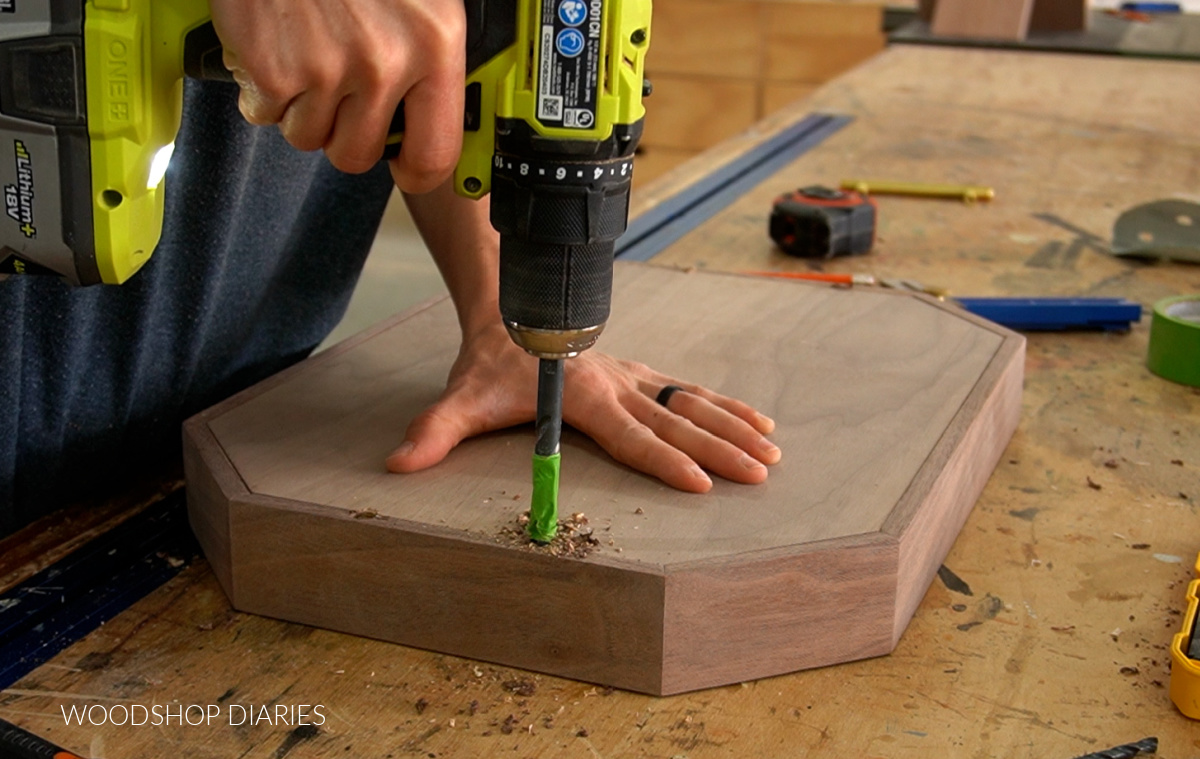
How to Choose Plywood for Furniture and Cabinets

May 26, 2023 by Shara, Woodshop Diaries

In this post, I’m sharing how you can confidently shop the plywood aisle and choose the best plywood for your furniture and cabinet projects!

If you’ve been around me or my projects very much, you know that I use a lot of plywood. Not to brag or anything, but I’ve been called the “plywood princess” on more than one occasion.

Shara Woodshop Diaries cutting down plywood sheet with Kreg AccuCut

I can’t say that I love that title, but I will say that it kind of fits.

While I don’t claim to be an expert on anything in particular, I can tell you from my own experience that plywood is an AMAZING option to use for your DIY and woodworking projects. But the key is finding the RIGHT plywood for the job.

So, in this post, I’m sharing how to identify, choose, and use the best plywood for your build.

*This post contains affiliate links. See website polices.

What is plywood?

Plywood is essentially layers of thin wood veneer glued together into a sheet. The layers are called “plies,” hence the name plywood. These typically come in 4′ x 8′ sheets (but can be other sizes) so they are in the “sheet goods” family of lumber.

exposed plywood edges

Each layer of the plywood has alternating grain patterns making for a more stable lumber option than solid wood boards.

Is plywood a good option for cabinets and furniture?

Plywood is an excellent option for cabinets and furniture. In fact, cabinet grade plywood (which I’ll discuss more below) is what a lot of higher end cabinets and furniture are made from.

Cheaper cabinets and furniture pieces are often made with MDF, particle board, or “fake” wood products. To have your cabinets and furniture made from actual plywood is usually an upgrade.

Shara Woodshop Diaries installing plywood cabinets onto garage wall

Plywood is strong, durable, easy to work with, looks amazing, finishes easily and has the added benefit of being dimensionally stable–as in wood movement is minimal. So it’s ideal for use in both cabinets and furniture.

I build the majority of my projects using plywood and you can see a few of my favorites here:

DIY Mid-Century Modern Dresser
DIY Display Console Cabinet
DIY Mudroom Bench
DIY Garage Cabinets
Hidden Drawer Bookshelf

Common types of plywood

If you go walking down the lumber aisles at your local Home Depot or lumber yard, there are several types of plywood to pick from. But, many of these aren’t suited for furniture or cabinet use.

Structural Plywood

Plywood designed for use on homes, buildings, and other structures as sheathing, framing, subfloors, etc. This type of plywood is designed to be strong, but is not designed to look nice. It’s usually covered up by other, more decorative, materials in the building process.

Sanded Plywood

Plywood that is sanded smooth in the manufacturing process. This type of plywood is typically made from softwoods like pine and is much smoother than structural plywood.

sanded pine plywood sheets

Sanded plywood works well with furniture and cabinet projects, but it’s soft and can dent easily.

The grain pattern isn’t the prettiest, but works well in painted and workshop projects, and it’s usually a quite a bit cheaper than hardwood plywood.

Furniture and Cabinet Grade Plywood

Cabinet grade plywood is sometimes called hardwood plywood or appearance grade plywood. This doesn’t necessarily mean the entire sheet is made from hardwood, but it does mean that the outer veneer layers are hardwood–like birch, maple, or oak.

Nailing plywood trim onto plywood panel to make sliding door

This plywood is usually more expensive and heavier than sanded plywood, but it’s a noticeable upgrade and a great option for cabinets and furniture. It’s what I build 99% of my projects with.

Exterior Plywood

Exterior plywood is plywood that is rated for exterior use. It’s held together with water resistant glue so it doesn’t break down with moisture. It is often used on homes for sheathing.

You can use exterior plywood for outdoor projects and furniture (although, it’s not the nicest) but it will need to be painted/sealed to protect it from eventual rot.

MDF Core Plywood

MDF (or medium density fiberboard) is an engineered wood product (so, not real wood) made from combining wood fibers, resin, and wax. It comes in sheets, like plywood, and is very smooth, very heavy and is not as strong as real wood.

I’m personally not a big fan of MDF, so I avoid using it, but it is good for trim on painted projects.

MDF core plywood is essentially a sheet of MDF with a wood veneer on each side so it LOOKS like real wood.

But, because MDF is not as strong as real wood, I don’t personally use or recommend MDF core plywood for the main body or any structural part of a cabinet or piece of furniture. It may work okay for cabinet doors or drawer fronts.

Plywood Sizing

In most cases, plywood comes in a 4′ x 8′ sheet. However, sometimes stores carry what they call “project panels” and you can grab smaller pieces like a half sheet, a quarter sheet, or even a 12″ x 12″ panel.

I’ll warn you, though…the project panels are quite expensive. You may only buy a quarter of a sheet, but you will likely be pay half or more of what a whole sheet costs. So when possible, I recommend grabbing a full sheet and you can use the leftovers for other projects later.

If you aren’t able to transport full sheets in your vehicle, many places will cut your plywood sheet down for you, but the cuts are rarely accurate. So if you do this, keep in mind that you’ll need to double check the dimensions and cut down to exact sizes once you get back home.

Although they all come in the 4×8 sheet size, plywood has various thicknesses. Structural plywood comes in SO. MANY. OPTIONS. But since you’re not usually using these for furniture and cabinets, I won’t go into detail.

But sanded and cabinet grade plywood usually comes in three main thicknesses: ¼″, ½″ and ¾″ thick.

¾" and ¼" plywood pieces laid out on workbench

Don’t assume that means they’re ACTUALLY that thick, though. For some reason, lumber sizing is weird and what they call ¼″ thick plywood may only be 5mm thick–which is more like 3/16″.

The ¾″ plywood that I buy is actually only 23/32″. Different brands, types and manufacturers will vary by how “off” they are, but keep in mind that plywood is usually slightly less than these standard nominal sizes. It’s just easier to call it ¼″, ½″ or ¾″ thick.

Plywood Grading

Plywood is graded by the letters A, B, C, and D. Grade A plywood is the best of the best, and grade D plywood is not so great.

Plywood Grades:

  • C/D grade plywood is usually structural plywood used for building homes. It’s strong, but has large knots and imperfections.
  • B grade plywood may have some knots and imperfections, but they’re filled. So this is great for paint projects.
  • A grade plywood is smooth, free of knots and imperfections, and is great for staining or projects where the grain will show.

Take these grades with a grain of salt–some hardwood plywood brands have a whole separate grading system of their own that they grade with in addition to this general grading system.

You may also see grades with two letters, like A-B or A-C plywood. This means that one side is grade A and the other side is grade B or grade C. These are often a little cheaper since once side can be “less perfect.”

Number of Plies

Not all plies are created equal. And by that I mean that not all plies are the same thickness. A higher number of plies doesn’t mean a thicker sheet.

For example, a ¾″ plywood sheet can have 7, 11, or even 15 plies and still be the same thickness.

A higher number of plies usually indicates a higher quality of plywood. There are more layers of wood, which means more glue, which means it’s more stable and less likely to splinter and split.

That said, more plies = more money. So you have to weigh the pros and cons. For what it’s worth, I use cheaper 7 layer plywood for pretty much everything I build.

close up of corner of plywood panel with one edge exposed and the other edge banded

Don’t like seeing the plies on your projects? You can easily cover those up! Check out this post to learn how to apply iron on edge banding to hide your plywood edges!

Tips for deciding which type of plywood to use

Deciding what type of plywood to use for your project shouldn’t be complicated. Here are a few suggestions to help you in the right direction.

Choosing your plywood type

First, is your project going outside? If so, grab exterior plywood. Just keep in mind this won’t be the best quality, but it will last the longest.

If you’re building furniture or cabinets that will be stained or left natural, I recommend grabbing hardwood plywood like maple, birch, or oak. Birch is my personal go-to shown below.

birch plywood cabinet with door open

If you’re building a project that will be painted, hardwood plywood is still my recommendation, but if you’re on a budget, sanded plywood is a good choice.

If you’re building a workshop project, again, my suggestion is still hardwood plywood, but if you’re on a budget, sanded plywood is a great choice.

You may have noticed a trend here. For most all furniture and cabinet projects, I personally recommend using hardwood plywood unless it’s going outside. It will give you the nicest looking and strongest projects. Sanded plywood is a close second choice.

Choosing your plywood thickness

As far as the thickness you need, that will depend on what you’re building. Personally, for everything structural in my projects, I use ¾″ plywood–things like side panels, bottom panels, shelving, etc. But, I use ¼″ plywood for drawer bottoms, door panels and cabinet back panels.

People often ask me about using ½″ instead of ¾″ plywood to save a little money. And in some cases, you can swap them. But not in every case. I VERY RARELY EVER use ½″ plywood and I have several reasons.

You can almost always use ¾″ material in place of ½″. But you can’t always use ½″ in place of ¾″. So ¾″ plywood is much more versatile and can be used for most any situation. Maybe, in some cases, it’s a little overkill. But I’d rather have too much strength than not enough.

Shara Woodshop Diaries assembling birch plywood cabinet on workbench

The price difference between ½″ and ¾″ plywood isn’t really that much (maybe $10-15). However, you’ll need to buy different size pocket hole screws, edge banding, nails, etc. for ½″ vs ¾″ plywood.

So in the end, you’ll have to stock a bunch of different supplies for each size which adds to the cost. So the savings is minimal, but you’re losing structural strength in the process. That’s not a trade I’m willing to make.

That’s just my personal take on plywood thickness–that doesn’t mean it’s necessarily right or wrong haha.

Where and how to buy plywood

Depending on your location and what options you have around you, there are lots of places to potentially buy plywood.

Check out this post to learn more about buying lumber!

The first, most obvious option is the big box store or home center–like Home Depot. These stores have a wide variety of plywood options, but because they’re catering to builders, their cabinet grade plywood options are usually pretty limited.

You may be able to find some of the more common options on the shelves–like birch, maple, or oak. But if you can’t find hardwood plywood there, they usually at least carry sanded plywood and can often order some specialty options, too.

Another option is your local building supplier. Many times these local suppliers may not keep hardwood or sanded plywood well stocked, but they can often order it for you if they don’t have it on their shelves.

If you’re fortunate enough to have a hardwood lumber supplier locally who sells plywood, you can likely find some really nice, high end or specialty plywood there. But since we don’t have anything like that where I live, I don’t have a lot of advice to share about buying it that way.

I buy 99.9% of my plywood from The Home Depot. There are very few other places within an hour drive for me to find it ha!

plywood cabinets installed in workshop

No matter where you buy it from, make sure to look at the edges and both sides of each sheet before buying. Check for chips, gouges, splinters, imperfections, bowing, and warping.

Plywood is too pricey for you to not be picky about it. Make sure you take your time to look it over well before adding it to your cart.

Tips for working with plywood

Once you’ve picked out and brought home your plywood, it’s time to cut it down.

Check out this guide for how I cut down my plywood sheets.

Plywood tends to splinter easily when cut due to the thin veneer layers. This splintering is often referred to as “tear out.” Most tear out occurs when making cuts across the grain.

Circular saw cross cutting plywood panel

There are a few ways to combat tear out. My number one tip is to use a fine finish blade when cutting plywood.

The higher the tooth count on the blade, the smoother and cleaner the cut. Fine finish blades have a high tooth count and make a HUGE difference in the cut quality on plywood.

Plywood finish circ saw blade

Another option is to use some painters tape along the surface where you are cutting. The painters tape will help hold the fibers of the plywood down and together as you cut to prevent them from splintering.

When sanding plywood, be careful not to sand too aggressively. The outer veneer is usually thin and you can sand through it if you aren’t careful.

I usually just lightly sand my plywood with 220 grit on my orbital sander. It’s already pretty smooth to begin with, so you shouldn’t need much sanding.

If you want to hide the plywood edges to make your plywood look like solid wood, iron on edge banding is a quick and easy option. Edge banding comes in rolls of pre-glued wood veneer that you literally just iron onto the edges.

Learn how to apply iron on edge banding here.

Plywood project ideas

Ready to dive into your next plywood project? Here are a few great options!

Workshop cabinets
How to Build Workshop Cabinet Boxes
DIY Closet System
DIY Sliding Wood Slat Door
DIY Modular Cabinet Desk
DIY Modern Console Cabinet

Save this post for later by pinning it or sharing to your favorite social channel!

Pinterest image showing Shara cutting plywood at bottom with text "How to choose the right plywood for your project"

Until next time, friends, happy building!
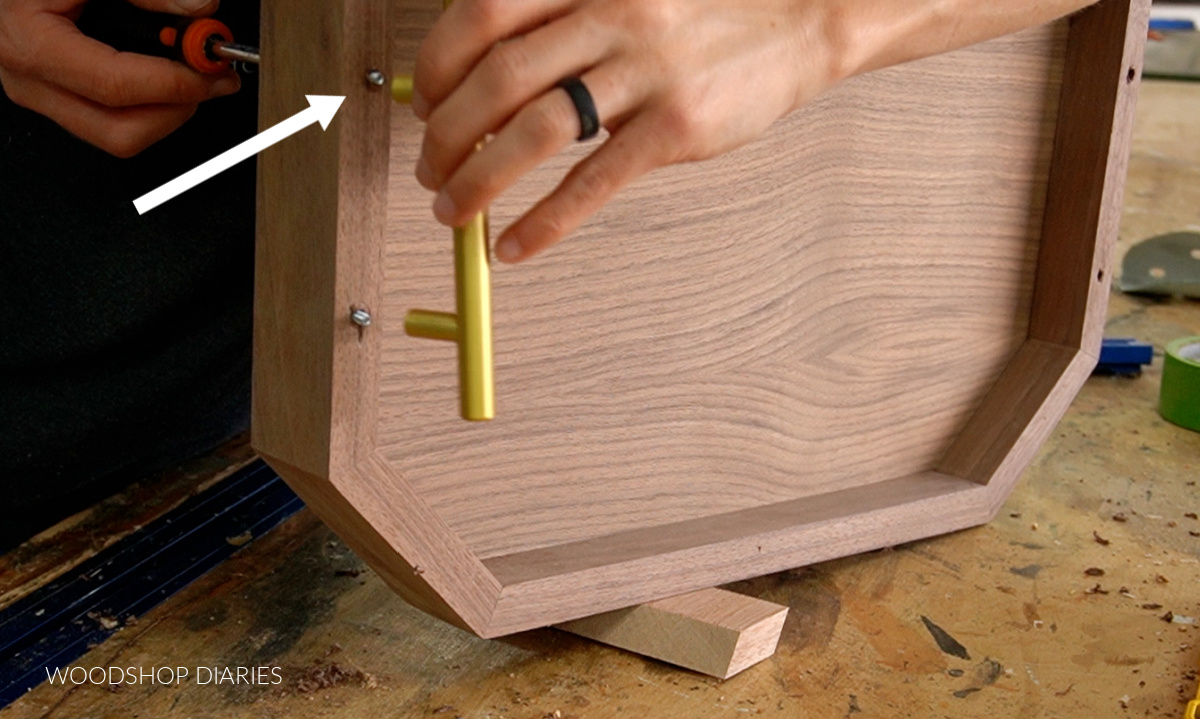
How to Build a Garden Arbor

May 26, 2023 by Shara, Woodshop Diaries

In this post, I’m showing you how to build a garden arbor using basic tools and materials!

I designed this simple garden arbor for our grapes to grow up (and around) and ended up making two of them as part of a large fenced garden area.

Cedar garden arbor with pergola style top with raised garden beds on each side with welded wire fencing panels

This beautifully simple arbor design is perfect for standing alone in your landscaping or flower beds.

But, it would also be great to add to your raised garden beds or as an entrance to a fenced area if you wanted to add a gate. I’m sharing how to add a gate to this arbor in step 6 below!

I’m using mine as the entrance(s) to our fenced berry garden and once the grapes fill up the sides and top, they will be so much fun to walk through!

Shara Woodshop Diaries walking through garden arbor as entrance to fenced garden with pavers

Check out the complete fenced in garden build here. Be the first to know about the latest projects by subscribing to the newsletter below or my YouTube channel!

Building this DIY grape arbor was a really quick and simple project, so if you’re ready to see how it came together, let’s get building!

What Wood Should You Build an Arbor With

Since they’re designed to use outdoors, it’s best to build arbors with wood that is naturally moisture and rot resistant so that they last as long as possible. Cedar and redwood are both great wood options for building a garden arbor.

Usually, depending on where you live, you can find one or the other in your local big box store or lumber yard. I used cedar for this particular project.

RELATED: How to shop for lumber

cedar lumber laid out on workbench

However, if you’re on a budget, treated wood is also a good option. Treated wood will last a long time and is budget friendly, but because it’s treated with special chemicals, you may not want to use it for growing food on.

I encourage you to do your own research when deciding how and when to use treated wood with your food garden.

If you don’t mind replacing it within a few years or you’re not using it outdoors long term (like for a wedding arbor), untreated pine would work as well and is an even more inexpensive option.

What to Know Before Building a Freestanding Garden Arbor

Building this garden arbor only took a couple hours, so it’s an excellent weekend woodworking project for spring or summer.

The overall dimensions of this garden arbor are 36″ deep (at the very top) x 60″ wide x 81 ½″ tall. The opening between posts is 36″.

dimensional diagram of garden arbor showing overall sizing and dimensions of project

This arbor can be built with or without a gate. If you’d like to build a garden arbor with a gate, I’m sharing how easy it is to add on in step 6 below.

When you’re finished building the arbor, make sure to anchor it to prevent it from tipping over. There are several ways you can anchor it depending on how you plan to use it.

You can anchor it into the ground with post anchor brackets and concrete, anchor it to your raised garden beds or an existing structure, or anchor it to a fencing system like I will be doing as I build our fenced garden around it.

How to Build a Garden Arbor

If you prefer to watch, I’m sharing a video tutorial of the build here on my YouTube channel:

If you prefer to print, I’ve got printable building plans for this project with detailed diagrams, cut lists, and dimensions available here:

But, I’ve got you covered with the project details and step by step instructions below.

Tools & Materials

*This post contains affiliate links. See website policies.

When building any outdoor project, make sure the finishes you choose and the hardware (screws, hinges, etc) are rated for exterior use.

I used welded wire fencing on the sides toward the bottom of this arbor. However, feel free to get creative with this part as there are other great options.

Wood lattice paneling, hardware cloth, fencing wire, or even a custom trellis design made with thin scrap wood strips are all great ideas.

Tools:

  • Miter Saw
  • Jig saw (optional)
  • Drill/Driver
  • Pocket Hole Jig
  • Stapler
  • Wire Cutters

Materials:

  • (4) 4x4x8 posts
  • (3) 2x4x8 boards (add two more if building the gate)
  • (4) 2x2x8 boards
  • Welded wire fencing, lattice paneling, hardware cloth (for trellis material)
  • 2 ½” exterior wood screws
  • 2 ½” exterior pocket hole screws
  • 2 ⅞″ timber screws (optional–see notes)
  • ¾″ staples

Step 1: Assemble Arbor Side Frames

The sides of the arbor are assembled from 4×4 posts and 2x4s that run between them. So first, I trimmed down my 4×4 posts to about 80″ long.

cutting 4x3 post for garden arbor on miter saw

This arbor ended up being 81 ½″ tall overall, but if you wanted it taller or shorter, you can simply adjust the length of the 4×4 posts.

Then, I cut 2x4s to 20″ long and drilled 1 ½″ pocket holes into the ends of each.

RELATED: How to use a pocket hole jig

drilling pocket holes into cedar 2x4 to build arbor

I assembled two identical side frames using 2 ½″ exterior pocket hole screws. Notice that the bottom piece is ran vertically and the middle piece is ran horizontally.

Shara Woodshop Diaries assembling side frames of garden arbor on workbench

Step 2: Install Top Arbor Framing

The top of this arbor is assembled like a mini pergola. So I cut two pieces of 2×4 to 60″ to run along the front and back of these side frames.

Before attaching, I used a paint can to help me draw a curve on the corners and cut these with a jig saw. This just added a little extra detail to the arbor design.

curve cut out on end of cedar 2x4 board

I laid the side frames down and spaced them 36″ apart at the top and bottom (make sure they’re square). As a note, you can certainly install these pieces while the sides are standing upright, but I found it a little easier to lay them down for this part.

Prefer to print your plans? Grab the printable building plans for this DIY garden arbor with optional gate here. Printable plans include detailed diagrams, cut list, and step by step instructions.

Then, I positioned these 2x4s along the top edge making sure they had equal overhang on each side, and secured then with 2 ⅞″ black timber screws.

Using black accent timber screws to secure top frame support between sides of garden arbor build

You could use 2 ½″ exterior screws instead, but I liked the black accents for this part.

Once these were installed on both the front and the back, I flipped it back up and cut to fit 2×4 pieces to go between them at the top of the posts. I secured these pieces to the posts with 2 ½″ exterior screws.

Shara Woodshop Diaries installing top supports onto arbor frame in workshop

Step 3: Attach Trellis Framing

Next, I cut to fit 2x2s to kind of “line” each side frame around the bottom section. These pieces will go along the sides and the top of the opening and this is the framing I’ll use to attach the fence panel or lattice to later.

assembly diagram showing 2x2s lining inside bottom frame of garden arbor

I cut each of these pieces to fit and secured with 2 ½″ exterior screws. Be sure to predrill before driving to prevent wood splits!

Step 4: Add Fencing Wire or Lattice

For this project, I used welded wire fencing for the side panels. However, lattice paneling, hardware cloth, or your own DIY trellis design would work great for this.

It’s both for decoration, but also support for any vines, flowers, or vegetables you plan to grow on it.

I cut two pieces of wire fencing to cover the bottom openings on each side panel using wire cutters.

Shara Woodshop Diaries stapling welded wire fence panels onto sides of arbor framing

Then, I stapled these panels onto the 2x2s from step 3.

Step 5: Install Pergola Top Runners

Since the arbor was kind of like a mini pergola, I added these runners along the top to make it look more like a pergola. These also to provide supports for vines or plants to grow on along the top.

I cut 4 pieces of 2×2 to 36″ and spaced these evenly along the top supports making sure they had equal overhang on the front and back.

Then, I used 2 ½″ exterior screws to secure them to the top front and back supports.

Shara Woodshop Diaries installing top 2x2 pergola supports onto garden arbor

At this point, the arbor assembly is complete. If you’d like to add a gate to the arbor, see step 6, but if not, move on to step 7.

Step 6: Add Optional Gate to Arbor

Adding a gate to this arbor is very simple. I cut 2x4s to build a frame whose overall size was 35″ x 48″.

I used 1 ½″ pocket holes and 2 ½″ exterior pocket hole screws to assemble it, then just cut some more fencing panel to cover the opening. I stapled the fencing along the back side.

Shara stapling welded wire panel onto back side of gate frame on grass

The gate is installed using basic gate hinges so that there is ½″ space between the gate and the arbor posts.

It doesn’t really matter how high or low you install the gate as long as it’s at least ½″ or so above the ground so it doesn’t rub on anything when opening and closing.

Garden arbor with gate as entrance to fenced garden area with raised beds

Finally, I added a simple gate latch to keep the gate closed and secure.

Step 7: Finish and Anchor

To keep the arbor looking nice through the weather, I recommend applying an outdoor finish (stain and sealant or paint) to protect it.

I’m going to stain and seal my entire garden all at one once when I get it finished up, so I didn’t stain my arbor just yet.

Fenced garden with arbor used as entrance with gate open

Be sure to anchor the arbor once complete to prevent tip over. You can anchor it to the ground, an existing structure, a raised garden bed, a fencing system, etc.

Just make sure it’s securely anchored before using. Now it’s ready to grow your flowers, veggies, and grapevines!

Want to print these plans to take with you to the shop? Grab the printable DIY garden arbor building plans here.

More Outdoor and Gardening Ideas

Looking for more outdoor and garden related DIYs? Here are a few favorites!

Raised Garden Beds with Trellis
DIY Adirondack Chair
DIY Outdoor Garden Cart
DIY Fall Planter Boxes
DIY Privacy Fence

If you’d like to save this project for later, be sure to pin it or share it to your favorite social channel!

Pinterest collage image showing diagram of arbor at top and completed arbor photo at bottom with text "how to build a garden arbor with plans"

Until next time, friends, happy building!
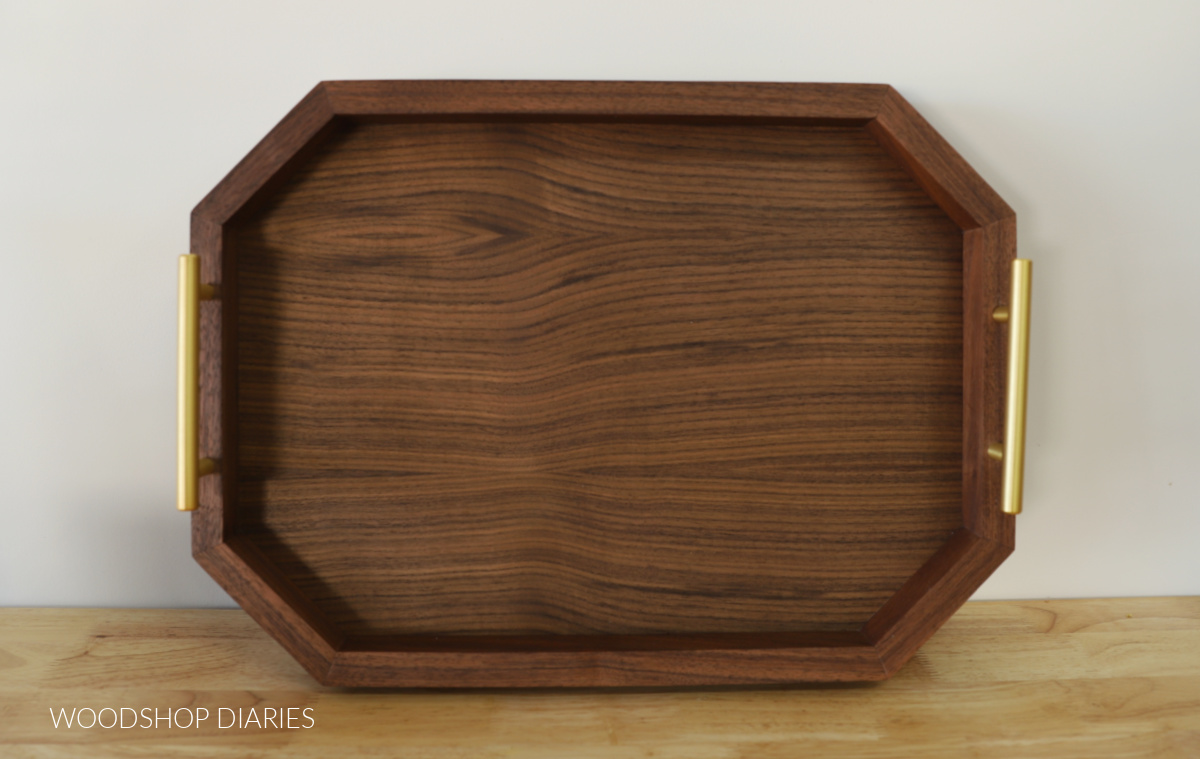
How to Build a Geometric Wood Slat Sliding Door

May 24, 2023 by Shara, Woodshop Diaries

In this post, I’m sharing how to build a modern, geometric wood slat sliding door using basic tools and materials!

Sliding barn doors are trendy. But with most trends, some people love them and some people hate them. I get it.

Shara Woodshop Diaries with black and wood tone geometric wood slat sliding door

I’m not a huge fan of the rustic, barn-style sliding doors, but I do love a fun, modern take on the project–especially when it’s also a space saver!

The previous swing door on our guest bathroom entrance made the space feel cramped and was in the way of opening and closing the closet door.

This modern, geometric wood slat door added a pop of color, some character, and a nice chunk of extra floor space to this guest bathroom entrance directly off our guest bedroom.

If you’d like to build your own sliding door, I’m sharing how I built this one in the steps below! But, first, let’s address a few frequently asked questions.

*This post contains affiliate links. See website policies.

Are DIY projects and woodworking plans your jam? Subscribe to the newsletter for priority access to new projects, plans, and how tos on Woodshop Diaries!

What size do you make your sliding door?

There’s no exact rule for how big or small to make your sliding door. However, I usually measure my door frame opening and add 2″ on each side to the width (so 4″ total) and 1″ to the height.

Door Size:

Width = Door Frame Opening Width + 4″

Height = Door Frame Opening Height + 1″

The diagram below gives a visual so you can see how this size door fits over the opening. Note that the door shown below in blue is transparent so you can see the door frame opening behind it.

Diagram of door opening and door sizing to help determine sliding door size

What size sliding door hardware kit should you use?

Again, just like the size of the door, there’s not an exact rule for this. However, typically, you’d want something about twice the length of your door.

For example, if you make your door 36″ wide, get at least a 72″ (or 6′) rail. But, using one a little longer–like 6′ 6″–would give you a little more wiggle room to work with.

You can purchase sliding door hardware kits in various sizes. If in doubt, I recommend sizing up because you can always adjust the stop blocks on the rail so that the door can’t slide as far. But if you get one too short, you can’t make it longer.

Tools & Materials

Here’s a list of tools and materials needed to build and install this DIY wood slat sliding door.

Tools:

  • Drill/Driver
  • Miter Saw
  • Circular Saw
  • Cutting Guides–Kreg Rip Cut & Kreg AccuCut (optional)
  • Brad Nailer
  • Ratchet & Sockets (various sizes–used to install sliding rail)
  • Wrench (to install sliding rail)
  • Level
  • Stud finder
  • Drill Bits (various sizes to install hardware)

Materials:

  • (1) 4×8 sheet ¾″ plywood
  • Prefinished oak slats (amount will vary based on your design–I used 2 boxes for this door)
  • 1x4x8 board
  • Sliding Door Hardware Kit (length will depend on door size–see notes above)
  • ¾″ edge banding & 1 ½″ edge banding
  • ¾″, 1 ¼″, and 1 ¾″ brad nails
  • Wood Glue
  • Wood Stain/Paint
  • Trim Caulk

How to Build a Geometric Wood Slat Door

Building a simple sliding door is a great weekend project. The actual door only took a day to build. It is a simple project that allows you to get as plain or as “complicated “fancy” as you’d like with your slat design.

If you prefer to watch, check out this video of the whole project from start to finish:

If you enjoy project videos (and bloopers!) be sure to subscribe to my YouTube channel here!

Step 1: Cut Sliding Door Back Panel

This sliding door was made from a single sheet of ¾″ plywood. First, I determined the size I wanted my door. See notes above.

My door ended up being 39″ wide x 82″ tall. A full plywood sheet is 48″ wide, so to make it 39″ wide for my door, I needed to cut off 9″. Instead of cutting a whole 9″ in one pass, I cut two strips 4 ½″ wide off my plywood sheet.

Kreg Rip Cut with circular saw cutting plywood sheet for sliding door

I cut my sheet down using my circular saw and Kreg cutting guides. Check out how to cut plywood sheets in this post.

This left me with a plywood panel about 39″ wide. I set these 4 ½″ wide strips aside to use in step 2.

Then, I trimmed the remaining sheet of plywood to 82″ long. This gave me a plywood panel the overall size I wanted my door–39″ x 82″. I saved this leftover piece to cut the top and bottom trim from in step 2.

Here’s a cut diagram to help visualize these cuts–but you’ll need to determine your own dimensions based on your door size.

Plywood cut diagram for parts to build wood slat sliding door

Step 2: Trim Door Sides

To make the door 1 ½″ thick, I added plywood strips onto the front along the edges to trim it out.

Diagram of plywood door panel with trim attached to front

I cut the 4 ½″ wide plywood strips from step 1 to 82″ long to line the vertical sides of the door (shown in blue above). Then, I ripped two 4 ½″ wide strips from the leftover ¾″ plywood and cut these to fit on the top and bottom of the door (shown in green above).

*Note that the trim pieces around the front don’t have to be any specific width. Just try and use whatever you have left of your plywood sheet after step 1 to trim out the edges.

Before attaching these trim pieces, I applied ¾″ iron on edge banding to the edges of the trim that will be on the inside of the door. Edge banding is optional, but it makes the edges look nicer. Learn how to apply edge banding here.

Then, I used wood glue and 1 ¼″ brad nails to secure each piece around the door.

Shara Woodshop Diaries nailing trim on front of plywood door panel on workbench

After these were nailed on, I applied 1 ½″ iron on edge banding on the vertical sides of the door to cover the exposed plywood edges.

I didn’t bother edge banding the top or bottom of the door since these won’t be seen in the finished project.

Close up of ironing on edge banding on sliding door sides

Step 3: Stain or Paint Sliding Door

At this point, the door is assembled, so it’s ready for finish. You can paint or stain whatever color you’d like here. I stained it black in my case.

If you wanted to leave the door as is at this point, you certainly could. But if you want to add the slats, head to step 4 below.

Step 4: Add Wood Slats

For the slats on this door, I used these Weaber Prefinished Solid Oak Slats. These are ¼″ thick x 1 ½″ wide x 36″ long and one side is already finished.

FYI, the amount of slats you’ll need will depend on the size of your door and your design. I used just barely over 1 box of these to complete this door.

Prefinished oak wood slats for sliding door

The prefinished part makes it really nice because you can just nail in place and not have to worry with staining or painting first–hallelujah haha.

I didn’t have a specific design or pattern I was following for my slats. I just kind of made it up as I went, so feel free to play around with your own design to make something you love.

To minimize waste, I kept all my angles at 45 degrees and 90 degrees and I cut these pieces on the miter saw.

NOTE: Cutting small pieces on the miter saw can be a little scary. To help with this, try clamping a “sacrificial fence” of scrap wood to the fence of the miter saw to help keep the tiny pieces from flying out the back. See video here.

Using a brad nailer to attach diagonal wood slat on front of black stained sliding door

I started by cutting a piece to run diagonally across one of the top corners and used wood glue and ¾″ brad nails to secure it in place. Then, I began working my way out from there.

These slats are ¼″ thick, so I used a small piece of slat as a spacer block to space them ¼″ apart. I cut to fit each piece as I went and I found it easiest to cut a few pieces at a time and lay them out before nailing them in.

Nailing wood slats onto front side of sliding door

Since I didn’t have an exact design or pattern to follow, I’d lay several slats one way, then turn them and lay a few more that way. Here are the kind of “sections” of the door and the order I installed the slats.

Diagram showing sections of wood slats on sliding door panel with numbers ordering which sections to do first

I tried to use up as many of the off cuts as I could so I didn’t waste much material. That’s one benefit of using 45 and 90 degree cuts only–you can recycle the off cuts pretty easily. But, feel free to use other angles if you’d like.

Once the slats were on, the door itself was complete and it was ready to install!

How to Install a Sliding Door

For specific measurements and detailed installation instructions, check your sliding door hardware kit. Always follow manufacturer’s instructions for installation.

However, the following is a general overview of a typical sliding door installation with some helpful tips.

Step 1: Replace Top of Door Trim

If your door frame is trimmed out with wood (like in our case), you will likely need to replace the top piece in order to install the rail onto. This top piece needs to be about the same length as the rail.

Interior door with top trim piece removed

OR, you can make your door taller and install the rail above the trim. However, if you do this, note that you may need to make your door thinner to be able to clear the door trim behind it.

To replace the trim, I used a prybar to carefully remove the top trim piece on my existing door frame. Then, I cut a 1×4 board the same length as the rail I was installing to go in its place.

Before installing this new trim piece, I used a stud finder to locate and mark the studs on the wall along where this piece will be going. The trim should be nailed securely into the studs.

Shara Woodshop Diaries installing new trim piece along top of existing door trim for sliding door rail

Once the new trim piece was nailed on, I puttied the nail holes and primed and painted it. However, this piece can potentially be pulled in or pushed out a little in the process of installing the rail onto it.

So I don’t recommend caulking this trim until AFTER the rail is installed in step 2.

Step 2: Install Sliding Door Rail

Once the paint is dry on the trim, you’ll need to locate your wall studs again and mark the height to drill the holes in order to install the rail.

The instructions with the hardware kit should tell you what height and spacing you need to mark and drill at to install your rail. It should also tell you the size drill bit you need.

Shara Woodshop Diaries drilling holes to mount sliding door rail system for sliding door

These may vary depending on what kit you use. Make sure your marks and holes are level and that every hole lines up with a wall stud!

Personally, I like to drill out the center hole first and snug the rail in place using the spacers and hardware included with the kit. That way, before drilling the rest of the holes, I can line up the rail and double check that my marks match up with the holes in the rail.

Shara Woodshop Diaries using a ratchet to tighten lag bolts on sliding door rail

Once I make sure my marks match up, I drill out the remaining holes and secure the rail with the spacers and lag bolts included with the kit.

I like to use a ratchet to install so that I can make sure it’s tight, but not so tight that it is stripped out.

Applying caulk to door trim

After the rail is secured in place, don’t forget to go back and caulk the new trim piece.

Step 3: Install Rollers onto Sliding Door

The sliding hardware kit includes rollers to install onto the door. These rollers are how you hang the door onto the rail. Install the rollers onto the top of the door according to the instructions included with the kit.

This usually involves drilling holes through the door and securing with bolts. The kit instructions should tell you specifically where to drill these holes for proper hanging height.

Using a ratchet and wrench to install rollers to sliding door

It’s helpful to have several sizes of sockets and/or wrenches for this–the size of these bolts will vary by kit.

Step 4: Hang Door and Adjust Guides

Before hanging the new door, I removed the old door, hinges, and hardware from the door frame. Then, I carefully hung the new sliding door on the rail.

The hardware kit should come with two “end stops” that slide onto the rail on each end to prevent the door from sliding off.

You can adjust these how you’d like to keep the door from sliding too far one way or the other. They simply tighten where you want them with set screws on the bottom.

Tightening end stoppers on sliding door rail

The kit also includes floor guides to prevent the door from swinging back and forth. Usually, these will screw into the floor, but if you don’t want to drill holes into the floor, try some double sided mounting tape to stick the guides on the floor instead.

Floor guides installed on sliding door to prevent swinging

I used mounting tape since we have concrete subfloors and drilling into it is a pain.

Step 5: Add Finishing Touches

Once the sliding door is on, you can add a knob or hardware on the front as you’d like. But, keep in mind there isn’t a lot of room on the back side of the door to add a knob or handle without hitting the wall or trim behind it.

So drilling a shallow “finger hole” on the back of the door to be able to open and close it from the back side works really well.

To cover up the holes left from the old hinges, one option is to simply putty over them and sand them smooth. This may take a few coats of putty.

Another option is to pick up (or cut your own!) some thin lattice trim to glue and nail along the inside of the door frame to cover them up. You can run it from top to bottom so it blends in and isn’t noticeable–you’d just need to paint it to match!

I left mine as is for now because I’m going to take care of it when I replace the bathroom trim when we remodel it soon. Stay tuned for that!

Modern geometric sliding door with wood slat design on white wall

In the meantime, that wraps up this sliding door project and I am SO happy with how much character it adds to this space! I hope you enjoyed seeing how it came together!

Looking more more sliding door projects?

Check out these other fun and unique sliding door projects you might enjoy!

Frosted Glass Sliding Door
How to build your own DIY modern sliding door with mid century style frosted glass panes!
DIY Modern Sliding Door
Double Sliding Doors
Sliding Door Storage Cabinet
Sliding Door Console

If you’d like to save this project for later, don’t forget to pin it or share to your favorite social channel!

Shara Woodshop Diaries standing next to geometric wood slat sliding door with text overlay "how to build a wood slat sliding door"

Until next time, friends, happy building!
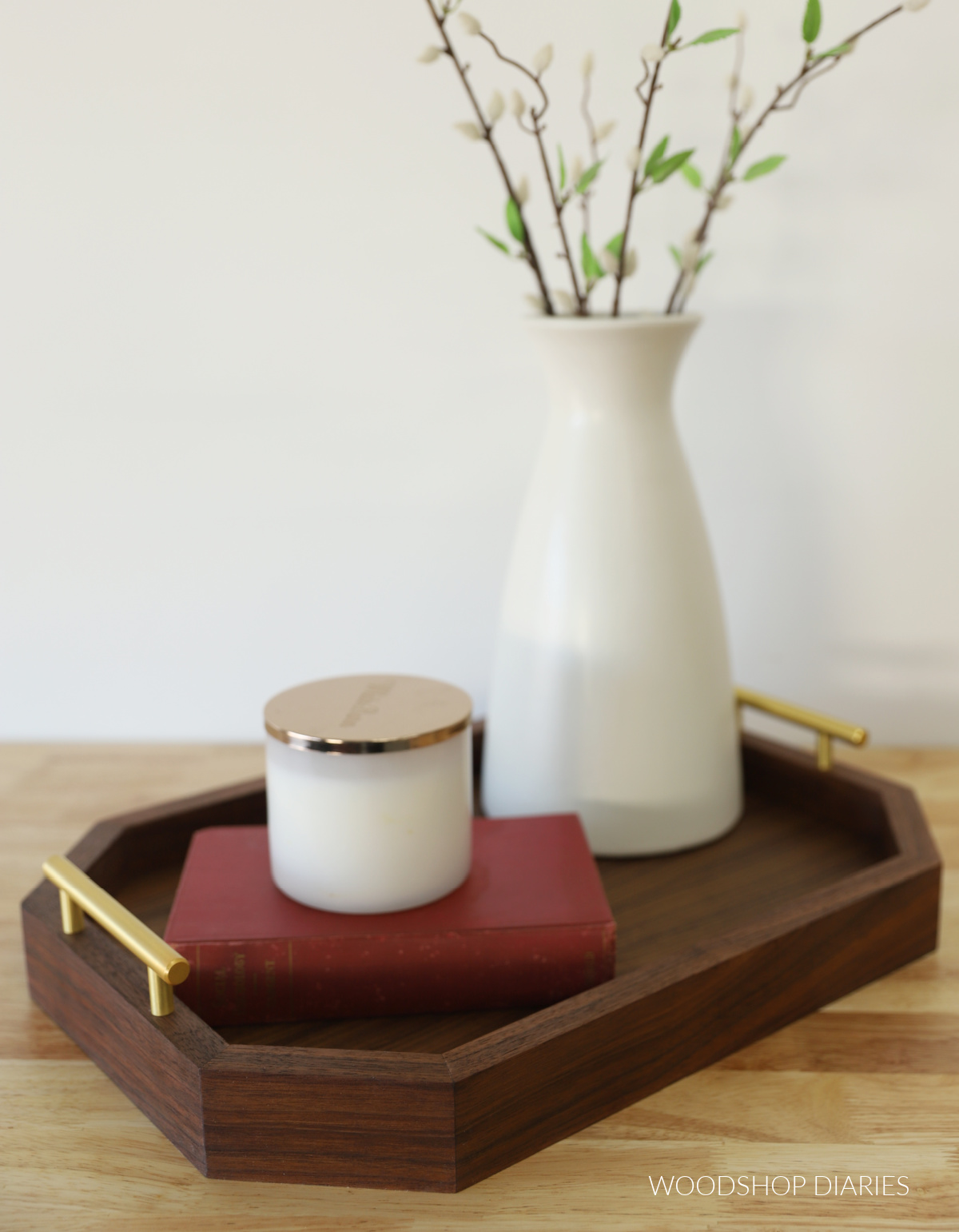
How to Install Drawer Fronts

May 17, 2023 by Shara, Woodshop Diaries

In this post, I’m sharing some tips to help you quickly and easily install a drawer front in any project!

This is the fourth part of the drawer building series I’ve been sharing to help make adding drawers to your projects a little (well, hopefully a lot!) less intimidating.

4 drawer end table with top drawer extended open

*This post contains affiliate links. See website polices.

Drawers are one of my favorite elements to add into any project–cabinets, dressers, end tables, etc. But, I know when you’re first getting started, drawers can be a bit scary.

So I created a whole drawer buildings series to help squash some of those fears. Always remember–drawers are simply boxes. If you can build a box, you can build a drawer.

This post details the last step to adding drawers–installing the fronts! If you’ve missed any of the previous parts of the series, you can check them out here:

  • How to determine drawer size
  • How to build a drawer box
  • How to install drawers and drawer slides

Alright, friends, let’s dive in. If you prefer to watch, I’ve got a video here:

Types & Styles of Drawer Fronts

Before installing the drawer front, first, you need to determine what kind of drawer front you have.

In part 1 of this series–determining drawer dimensions–I explained the difference between inset and overlay drawer fronts. Remember that inset drawer fronts set inside the frame and overlay drawer fronts lay over the frame.

Diagram showing inset drawer fronts vs overlay drawer fronts

But besides determining whether the drawer front is inset or overlay, you also need to think about how the drawer front is actually assembled.

Drawer fronts are very similar to cabinet doors in that they can be made a million different ways.  Here are a few examples of types and styles of drawer fronts I’ve used in the past.

Want the ENTIRE DRAWER BUILDING SERIES in printable form so you can keep it handy in the workshop? Grab the printable drawer building guide here!

Shaker Style (Frame & Panel)

A Shaker style drawer front is also sometimes referred to as a frame and panel or a 5 piece drawer front.

The reason this is sometimes called a 5 piece drawer front is because it’s made of 4 solid wood pieces that make up the outside frame and the 5th piece is the center panel. These can be flat or raised panels.

White shaker style drawer front with black hardware

There are several ways to assemble this style of drawer front, but in many cases, the frame is a 1×3 board and the center panel is either plywood or MDF.

Sometimes the panel is installed into a dado cut in the frame (like shown in this tutorial), sometimes it’s installed into a rabbet cut along the back side of the frame, and sometimes it’s installed using pocket holes and screws (on the back side) like shown below.

Diagram showing how to assemble a Shaker drawer front using pocket holes

Slab

Another type of drawer front can be solid wood or plywood—basically just a solid, flat panel front. You can see an example on the drawer at the bottom right corner.

Accent cabinet with slab style drawer front
DIY Accent Cabinet

If you want to dress these up, you can also add some trim pieces to the drawer front like I did to the door shown in the image above.

This is actually an easy way to “fake” a Shaker style drawer front–use a slab and glue/nail trim around the front to look like a frame and panel. Here’s another example of trim installed on a slab drawer front.

Decorative drawer fronts on DIY nightstand project--arrows pointing to the different types of trim installed on the fronts

The “Cheater” Drawer Front

And another kind of “cheaters” way of adding a drawer front is what I did here on my bathroom vanity drawers.

Shara Woodshop Diaries gluing 1x3s around  bathroom vanity drawer boxes

I simply glued 1x boards around the front of the drawer boxes to kind of “fake” a Shaker style drawer front.

I also did the same thing on the drawer front for this storage bench project.

Storage bench with drawer open

What holds the drawer fronts on?

In most cases, screws are used to install drawer fronts. There are some special cases–like in that “cheater” drawer front example above–that screws aren’t used.

But if the drawer front is a slab or a frame and panel, you typically use screws to secure them to the drawer box. So that the screws don’t show, they’re driven through the inside of the drawer box.

Installing drawer front using screws through drawer box

Should you use wood glue?

A common question I get is whether you should use wood glue with drawer fronts. Personally, I don’t use wood glue when installing my slab or frame and panel drawer fronts unless I’m absolutely 100% confident I’ll never need to adjust or replace anything.

There are some cases where glue may be helpful–like in the “cheater” style drawer front mentioned above–but in most cases, I don’t use it.

What size screws do you need to install drawer fronts?

To determine the length of the screw you need, consider the thickness of the front of the drawer box and the thickness of the drawer front.

You don’t want to use a screw that’s longer than the thickness of these two pieces combined or it’ll poke out the front. But you want to make sure it’s long enough to go through the drawer box and still “bite” into the drawer front so it’ll hold.

Usually I’m using ¾” plywood for my drawer boxes and ¾” thick material for my drawer fronts. So I’ll use 1 ¼” screws.

I like to use pocket hole screws for this because they have this washer head that prevents the screw from countersinking and driving too far, but it pulls the drawer front nice and tight.

Close up of Shara Woodshop Diaries holding a pocket hole screw with washer head

A note about installing Shaker style drawer fronts

I recommend trying to drive your screws into the FRAME portion of the drawer front if you’re installing Shaker style fronts, especially if you’re using ¼″ thick material for your center panel.

The frame will be thicker than the panel, so screwing into it will allow you to use a longer screw and have a better hold.

Also, if your center panel is installed into a dado in the frame and isn’t flush across the back side, I suggest adding a shim or spacer between the panel and the front of the drawer box.

This will prevent the panel from flexing when you add the knob(s) or drawer pull later.

Enjoy helpful tips, woodworking how tos and new project plans? Subscribe to the newsletter for priority access when new posts, videos, projects and plans go live!

3 Easy Ways to Position and Attach Drawer Fronts

The general rule of thumb with drawer fronts is that there should be ⅛” space between drawer fronts and, if it’s inset, ⅛” gaps between the drawer fronts and any surrounding framing.

Check out this post to learn how to figure your drawer front sizing.

Some people use playing cards, coins, or special spacers to help them with these gaps.

But, I’ll be honest with you, I just eye ball it. If the gaps look even, then they’re even.  No one’s coming over your house to measure your drawer front gaps. But, if you want to be extra precise, you can certainly use spacer blocks. 

Anyway, here are 3 tips/ways to help you position your drawer fronts where you want them when installing.

Method #1: Freehand

NOTE: Installing drawer fronts is usually easiest if the top of the project isn’t installed yet. This allows you better access to the inside of the cabinet or piece of furniture.

One way to install drawer fronts is to simply place the front into (or over) the opening so that the gaps (or overlay) look even around all sides.

Positioning a ¾" plywood slab style drawer front onto end table project

Then, just hold the drawer front tightly in place with one hand while driving the screw through the front with the other hand.

This method works for either inset or overlay drawer fronts. It’s the quickest and easiest way, but also the most prone to error if you aren’t careful.

After one screw is in, double check the spacing and adjust as needed, then drive the second screw.

Using a driver to install drawer front with screw through front of drawer box on end table project

This works best if you work from top drawer to bottom. Once the top drawer front is on, you can remove it to access the drawer box(es) below it and repeat the same steps.

If each individual drawer front isn’t framed out, and you need to evenly space several fronts at the same time, I find it easiest (if possible) to lay the project on it’s back to let gravity help you hold the pieces in place while you position them.

Placing drawer fronts onto end table laid on its back

This way, you can lay out all the drawer fronts at once and still access the inside to drive the screws. Secure the top drawer front, carefully remove it, and repeat working your way down.

driving screws from inside end table to install drawer fronts

This is the way you see me installing most of my drawer fronts. There’s really no science to it–just eyeball the spacing, hold in place, and screw in.

Method #2: Pilot Holes or Mounting Tape

This method is really effective and works well for both inset and overlay drawer fronts, too.

For this method, you need to go ahead and drill the pilot holes for the knobs or handles you’re planning to add to your drawer. Measure, mark and drill the holes into the drawer front.

Then, position the fronts where you want them and use screws through these holes to temporarily “tack” them in place.

Driving screws through pilot hole to temporarily position drawer fronts

Double check the spacing and alignment, then, drive screws from the inside to permanently secure the drawer fronts. At that point, you can remove the screws through the pilot holes on the front.

Securing drawer front on end table

This is a great way to help you get your fronts in position and now you already have your pilot holes predrilled for your hardware.

ALTERNATIVE METHOD: Double sided mounting tape

Apply this same concept, but without screws. If you wanted to skip the pilot holes and screws, you can also use double sided mounting tape to temporarily hold your fronts in position while you drive the permanent screws through the inside.

Method #3: Use a Drawer Front Mounting Jig

Another way of installing drawer fronts involves using a drawer front mounting jig. In this case, I’m using the Kreg Drawer Front Mounting Jig.

This jig includes shims to help with installing inset drawer fronts. However, the jig itself is designed to work only with overlay drawer fronts.

For installing new drawer fronts on new projects using a jig like this, it’s best to start at the bottom and work your way up. That way, you can rest the shims on the drawer front below and let gravity help you out a little.

However, I didn’t have a new project at the moment to demonstrate this on, so I’m going to reinstall one of my workshop cabinet drawer fronts to demonstrate how this jig works.

Clamping Kreg Drawer Front Mounting Jig onto drawer box

First, tighten the left and right parts of the jig on the left and right sides of the drawer box like shown above. Note that each part of the jig has two clamps–one clamps to the drawer box and one clamps to the drawer front.

Once the clamps are tight on the drawer box, you can slide the drawer front in. You’ll notice the jigs have a gauge on each side to help you get the proper overlay.

I pulled the drawer above it out (normally, you’d be working from bottom to top, so you’d pull the drawer out below it) and used the shims included with the jig to position the drawer fronts ⅛″ apart.

Then, I tightened the clamps on the front of the jigs to hold the drawer front in place.

Clamping drawer front onto drawer box using Kreg Drawer Front Mounting Jig

Now that the front is clamped in place, you can simply drive the screws to secure it from the inside. If you’re working with multiple drawer fronts, you’d just continue working your way up (or down) to attach each one.

Looking for practice working with drawers?

Now that you know how to install drawer fronts, you’re ready to tackle a new project with drawers!

Want a printable guide to take with you to the shop? Grab the complete drawer building guide printable here.

If you’re looking for some simply projects to start with, here are a few favorites!

4 Drawer End Table
DIY One Drawer Nightstand
Hidden Drawer Bookshelf
DIY Storage Bench
Mid Century Nightstand

Save this guide for later by pinning it or sharing to your favorite social channel!

Install drawer front pinterest image showing driving screws to secure drawer fronts at top and close up of drawer front at bottom

Until next time, friends, happy building!
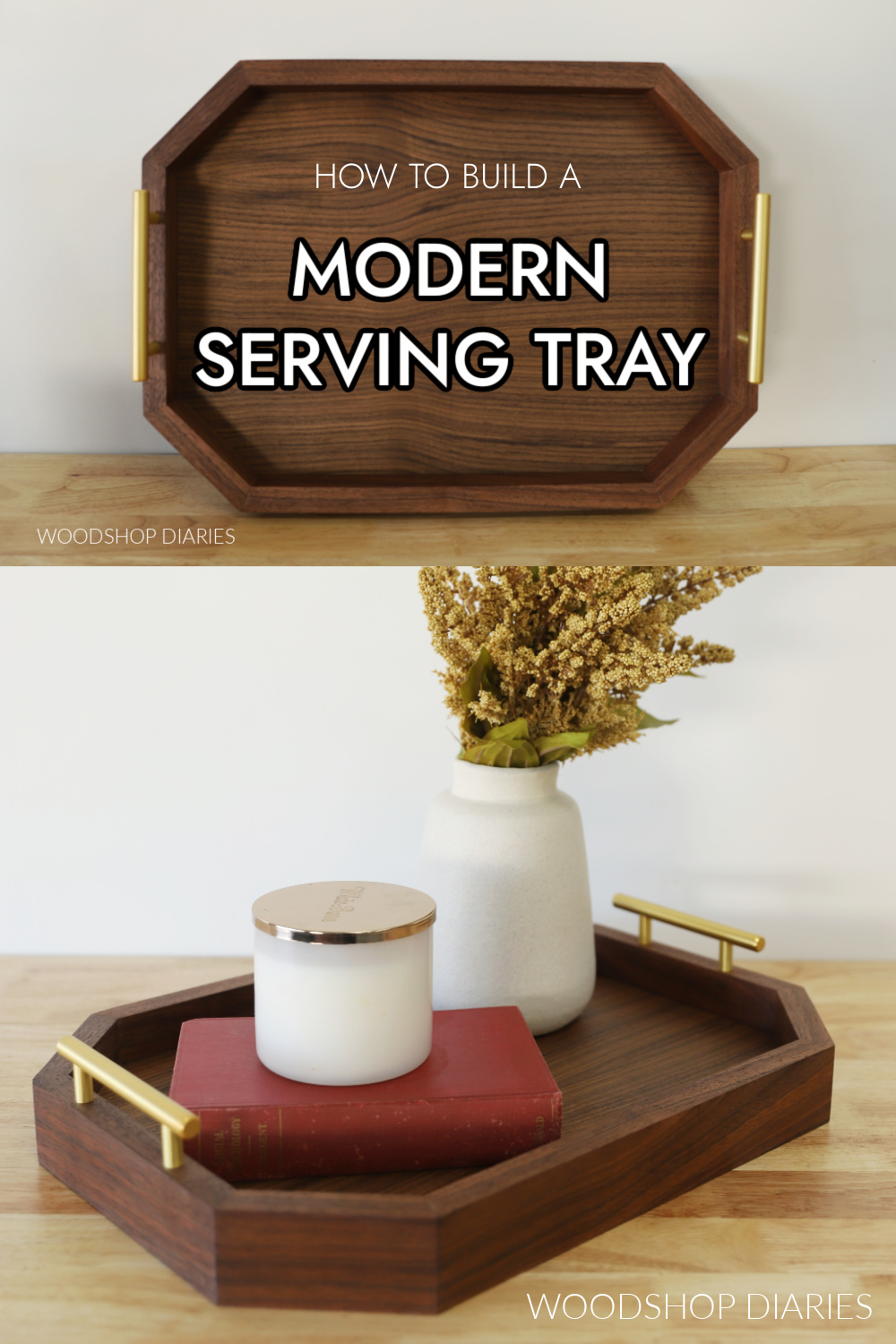
How to Determine Cabinet Door Size

May 15, 2023 by Shara, Woodshop Diaries

In this post, I’m sharing how to measure and size cabinet doors for your next project!

This guide will help you quickly and easily determine your cabinet door size no matter what you’re building.

Shara Woodshop Diaries opening cabinet door on wall cabinets

The first step to adding doors to any project is figuring out your cabinet door size. So in this post, I’m going to discuss cabinet door dimensions and how to find them.

This may seem complicated at first, but the more you work with doors, the easier this will be…I promise!

Fair warning, there is a little math involved here, but don’t get overwhelmed! It’s just basic addition, subtraction and division and I’ll walk you through it.

Before we dive into the numbers, let’s talk about some of the different styles of doors and cabinets that you’ll run into. Understanding this will make figuring your measurements much easier.

*This post contains affiliate links. See website policies.

Enjoy woodworking tips and new project plans? Sign up (for free!) for priority access to new plans and posts from Woodshop Diaries.

CABINET AND DOOR STYLES

Whether you are working with furniture or cabinets, you’ll run into different styles and types of doors and framing.

It’s important to understand the terminology and how to recognize what you’re dealing with in your various projects.

Prefer to watch? Check out this video for details and diagrams to help you determine what size to make your cabinet doors!

Youtube Thumbnail for how to determine cabinet door size video

Love watching how-to videos? Subscribe to my YouTube channel for plenty more where that came from!

FRAMELESS VS FACE FRAME CABINETS

Cabinets and furniture can be either frameless or have a face frame. In cabinet design, frameless means that the front edge of the cabinet box does not have an additional frame—the “frame” is simply the plywood edge. 

This is how I built these frameless garage cabinets shown below.

Shara Woodshop Diaries installing frameless cabinets in garage

On the other hand, face frame cabinets will have an additional frame added onto the front of the box making the front edges thicker.

You can see the face frame is added on the front of this cabinet box.

Door open on face frame base cabinet

This same concept applies to furniture pieces as well—not just cabinets.

Frameless vs face frame base cabinet diagram

INSET VS OVERLAY DOORS

Cabinet doors can be either inset or overlay. In general, inset means that the doors are set inside the frame like this. The door is flush to the front of the cabinet/furniture piece.

Accent cabinet with inset door and inset drawer

And overlay means that the doors lay over the frame like this.

Overlay door on face frame base cabinet

This diagram compares them side by side.

Inset vs overlay cabinet door diagram

Take note that in some cases, doors on cabinets and furniture can be both inset and overlay at the same time. See notes about hinges below for examples.

What is an overlay?

The overlay is the amount of the face frame the door will cover. For example, if you have a 1″ overlay, that means the door will cover 1″ of the face frame on all sides.

The reveal is the amount of the face frame NOT covered by the door. For example, if your face frame is 1 ½″ wide and you have a 1″ overlay, then you’d be left with a ½″ reveal.

Sometimes you’ll hear the term “partial overlay” or “full overlay.”

“Partial overlay” is for face frame cabinets. “Full overlay” is for frameless cabinets.

A full overlay is only used with frameless cabinets and it means the door covers almost the entire front of the cabinet.

The reason you can’t “fully overlay” a face frame cabinet is because face frames can be made different widths–some are 1″ wide, some are 1 ½″ wide, some are 2″ wide, etc. And the hinges don’t know how wide your face frame is.

So with face frame cabinets, you have to specify your overlay amount and use hinges that fit the application. If you size your door for a 1″ overlay, but use hinges for a ½″ overlay, it’s not going to work properly.

A NOTE ABOUT CABINET DOOR HINGES

Concealed cabinet door hinges come in four main types based on the type of door and the type of cabinet they’ll be used on:

  • Inset for Frameless Cabinets
  • Full Overlay for Frameless Cabinets
  • Inset for Face Frame Cabinets
  • Overlay for Face Frame Cabinets (available in varying overlay amounts)

The hinge will specify what type of door (inset or overlay) and what type of cabinet (frameless or face frame) they’re to be used with. Take note that overlay for face frame cabinets also come in various overlay amounts.

RELATED: How to choose and install cabinet door hinges

Door installed onto cabinet with concealed hinges--door open to view inside

In some instances, it may be confusing to determine whether your door is inset or overlay depending on the overall project design. The door may be inset some parts and overlay other parts.

To determine the type of hinge that you need, consider the part of the cabinet the HINGES WILL BE MOUNTED TO. Will the door be inset or overlay this particular piece?

Here is an example–the cabinet doors on the display console below are inset to the top panel, but they overlay the sides. Since the doors are mounted to the side panels, they’ll need overlay hinges.

Display console cabinet with double overlay cabinet doors

For this piece, you’d calculate your door width as if they’re overlay doors (since they overlay the sides), and your height as if they’re inset (since they’re inset the top and base).

FINDING CABINET DOOR WIDTH

Now that we’ve covered some basic definitions and examples, let’s dive into the dimensions. The first dimension I like to find is the cabinet door width.

SINGLE CABINET DOOR WIDTH

Finding the width of a single door is pretty simple. These are the most basic examples.

INSET:

One rule of thumb to remember with inset doors is that you want to leave ⅛” gap around all sides between the doors and any surrounding framing.

To find the width of an inset cabinet door, measure the width of your opening and subtract ¼”—that will allow you ⅛” gap on both sides.

Diagram showing ⅛" gaps between door and face frame on base cabinet

PARTIAL OVERLAY for Face Frame Cabinets:

For partial overlay doors on face frame cabinets, the concept is similar to inset, only instead of subtracting gaps from the opening size, you’ll be adding an overlay to it.

To find the width of a partial overlay cabinet door (for face frame cabinets), add 2x the desired overlay to the opening.  So if the overlay is 1”, then you’d add 2” to the opening.

A note about choosing your overlay amount: For face frame cabinets, you get to choose your overlay amount. This is the amount of the face frame you want your door to cover. This usually ranges from ½″ to 1 ½″.

Take note of your face frame size when deciding your overlay amount. You can overlay the face frame up to ¼″ less than the width of your frame. For example, if your face frame is 1 ½″ wide, you can overlay up to 1 ¼″.

Diagram showing max face frame overlay on base cabinet

You need to leave at least ¼″ reveal on face frame cabinets to allow the doors to open and close without rubbing.

FULL OVERLAY for Frameless Cabinets:

If you want FULL overlay doors on frameless cabinets, basically, you want the doors to cover the entire front so that it’s “fully overlaid.” This is what I did for my shop cabinets. 

With full overlay on frameless cabinets, you leave ⅛″ reveal on both sides. The reveal is the part of the frame left exposed after the overlay.

To find the width of a full overlay door (for frameless cabinets), measure the overall cabinet width, and subtract ¼” so that you have ⅛” reveal on each side.

WHY can frameless cabinets have ⅛″ reveal but face frame cabinets need ¼″ reveal? The hinges for frameless and face frame operate a little differently. Face frame hinges push the door outward as it opens and frameless hinges pull the door inward as it opens.

So you need some extra space on the sides to open face frame doors.

DOUBLE CABINET DOOR WIDTH

To figure the width for double cabinet doors, first calculate the width as you would above for a single door. Then, subtract ⅛″ for the gap between the doors, and divide by 2.

For example, if you’re installing inset double doors into a 24″ wide opening, first subtract ¼″ (for the ⅛″ gaps on each side), to give you 23 ¾″.

Diagram showing double door cabinet sizing example with 24" opening

Then subtract ⅛″ (for the gap between doors), then divide by 2 to give you the width to make each door–which would be 11 13/16″.

A NOTE ABOUT ROUNDING

With cabinet door width, it’s more important for your gaps to be EVEN than that they are ACCURATE.

Your eye won’t notice if the gaps between doors are 1/32” bigger than your standard ⅛″ gaps. So, if I divide and get some weird numbers, I usually round down to the nearest 16th of an inch to keep the math a little simpler.

FINDING CABINET DOOR HEIGHT

Now that we’ve covered the width, let’s dive into the height. Cabinet door height has a few more variables and options.

To find your cabinet door height, you need to ask these questions.

  1. Are there additional components other than the door?
  2. Is your piece frameless or does it have a face frame?
  3. Will your doors be inset or overlay?

Think about the overall design of the project and determine whether there are shelves or drawers going above or below the door. Sometimes, the door will not be the only element in the project, so you’ll need to consider the other parts.

I’ll share some examples below.

HOW TO CALCULATE INSET CABINET DOOR HEIGHT

To find inset cabinet door height, simply measure the height of the opening that the door is going into and subtract ¼″. This works for both frameless AND face frame projects.

Diagram showing inset cabinet door size dimensions

Sometimes you run into situations where the door isn’t the only thing in the opening. I like to say this means the door is not “framed on all sides.” In the example below, the top of the door isn’t framed by the cabinet because there’s a drawer above it.

In that case, you’d take the opening and subtract ⅛″ for a gap at the top, ⅛″ for a gap between the drawer and door, and ⅛″ for a gap at the bottom.

Diagram showing example of inset cabinet with drawer and door and how to determine door size

Then, subtract the drawer front height and what’s left is the height of the door.

HOW TO CALCULATE PARTIAL OVERLAY CABINET DOOR HEIGHT

To find overlay door height, simply measure the height of the door opening and add 2x the desired overlay.

Diagram of base cabinet with partial overlay cabinet door with instructions for figuring cabinet door height

For example, if the opening was 24″ tall and you wanted ½″ overlay at the top and bottom, then the door height would be 24″ + ½″ + ½″ = 25″.

If you have a situation where there’s a drawer above the door and there’s no divider between them, to find the door height, you’d take the height opening and add 2x the overlay–just like shown above.

Diagram showing overlay drawer and door on cabinet box

Then subtract the height of the drawer front and subtract an additional ⅛″ for a gap between the door and drawer. What’s left is the height of the door.

Sometimes you have situations where there’s a divider in the face frame between a drawer and a door. Depending on the size of the divider and the overlay amount, you may have to make adjustments for them to fit.

For example, if you’re using an overlay of 1 ½″ and you have a divider piece 2 ½″ wide, your door and drawer will overlap on the divider. So you need to adjust one or the other (or both!) for them to fit.

Diagram showing door and drawer overlapping divider piece on cabinet

In these cases, you can adjust the height of the door so that it doesn’t overlay the divider as much. Make sure you leave AT LEAST ⅛″ gap between door and drawer.

NOTE: The top and bottom overlay don’t have to match the side overlay with cabinet doors. In most cases, they will, but depending on the overall project design, there is some flexibility and you can adjust the door height and top/bottom overlays to fit your project.

HOW TO CALCULATE FULL OVERLAY CABINET DOOR HEIGHT

To find full overlay cabinet door height, measure the overall height of the cabinet or furniture piece you’re wanting the door to cover and subtract ¼″.

diagram showing full overlay cabinet door size dimensions

That allows you ⅛″ reveal at the top and ⅛″ reveal at the bottom.

Projects with Doors

Now that you know how to calculate cabinet and furniture door sizes, it’s time to put that knowledge into practice with a new project!

Not sure how to build the door now that you know the size? Check out this post to learn how to build Shaker style cabinet doors.

Here are a few basic builds with doors you might enjoy:

DIY Garage Cabinets
DIY Accent Cabinet
DIY Display Console Cabinet
DIY Double Vanity
Stenciled Door Console

If you found this guide helpful, be sure to save it for later by pinning it or sharing to your favorite social channel!

Pinterest collage image showing dimensional diagram at top and full overlay garage cabinets at bottom with text "how to determine cabinet door sizing for any type of project"

Until next time, friends, happy building!
How to Build Garage Cabinets

May 12, 2023 by Shara, Woodshop Diaries

Need some storage for your garage or workshop? In this post, I’m showing you how easy it is to build your own DIY garage cabinets to store and organize all your tools!

Black stained garage cabinets with butcherblock countertop against white wall

If you’re looking for an easy weekend project to help you organize your garage or workshop, this is it! These simple cabinets pack a TON of storage and can easily be built in just a couple days.

The great thing about building your own garage cabinets is that you can customize the size, mix and match pieces, or add extra cabinets to make this work for your own space.

The entire project was made using plywood and a few basic tools–no fancy equipment or expensive tools needed.

For the top, we used an inexpensive, pre-cut wooden countertop from The Home Depot, but you could certainly get creative here and use stone, epoxy, or plywood.

Before we dive into the how-to, let’s address some common questions you may have about building your own cabinets.

*This post contains affiliate links. See policies page.

Is it cheaper to buy or build garage cabinets?

Which is cheaper–building or buying? This is always the number one question I get about projects like this.

This is the 5th set of cabinets I’ve built for either a garage, closet, workshop or a kitchen. Prices have changed a lot over the years, but in every case, building my own was DEFINITELY cheaper than buying them.

Of course, everything depends on your location, the type of cabinets you’re buying/building, how many, and the layout of your space. So the exact savings will vary.

But for reference, these cabinets cost approximately $600 in lumber and materials (in April 2023) and a similar set of prefabbed cabinets (the cheapest option I could find) cost over $1000. Neither of these prices included the countertop.

On top of that, the cabinets I built here were made from hardwood plywood and the prefabbed cabinets were made from particle board. So the ones I built were both cheaper AND better quality.

Want to build your own garage cabinets without the guesswork? Grab the printable building plans here!

What kind of wood do you use for garage cabinets?

Garage cabinets can be made from many different materials–metal, plastic, wood, etc. Wood is a great, inexpensive option to build garage cabinets with.

In this case, I’m building these cabinets using 100% plywood. Cabinet grade hardwood plywood (like the birch plywood I used for these) is a great option for cabinets because it’s dimensionally stable and very strong.

birch plywood laid out on workbench

This means it can stand up to temperature and humidity fluctuations and can hold all those heavy items you’re typically storing in the garage or workshop.

They also come in 4’x8′ sheets, so they’re easy to cut down to just about any size you need!

Learn more about lumber sizing in this post!

I highly recommend using a hardwood plywood (like birch, maple, or oak) for cabinets. However, sanded pine plywood is another option that might save a bit of money.

Note that sanded pine is more likely to warp, can’t hold as much weight, and tends to be much rougher than hardwood plywood. But for garage applications, that might be fine.

If you’d like to see what it looks like, I used sanded pine plywood to build this miter saw station.

TIP: If your garage floor sweats, it can damage the bottom of plywood cabinets over time. If you have a lot of moisture in your shop or garage, be sure to shim up your cabinets so they’re not sitting directly on the ground or consider installing a moisture barrier between them and the floor.

You may also consider building a simple base made of treated wood to rest your cabinets on.

How deep should garage cabinets be?

While kitchen cabinets have standard size specifications in order to fit with appliances and sinks, garage cabinets are a little more flexible.

You’ll typically find garage cabinets between 16″-24″ deep. When building your own, take note of the space have you available (like if you’re parking a car next to them, make sure you can open your doors, etc) and make your cabinets as deep as you’d like to fit your space.

The overall size of this project was 88″ tall x 122 ½″ wide x 25″ deep (at the countertop). The cabinets were 24″ deep including the door.

Overall dimensional diagram showing size of garage cabinet build with two tall cabinets and two base cabinets with countertop

What’s the difference between garage cabinets and kitchen cabinets?

In this case, these garage cabinets are the exact same style and sizes that I build for kitchen cabinets, too! These simple, basic cabinets work great for kitchens, garages, workshops, and built ins.

Plywood kitchen cabinets

One main difference is that with kitchen cabinets, like mentioned earlier, there are standard sizes as far as height and depth.

For garages, workshops and built ins, you usually have a little more flexibility with sizing so you can customize it however you’d like. But, I usually just build them all the same if space allows.

plywood workshop cabinets

Another key difference is that kitchen cabinets are also usually made from wood materials like particle board, plywood and/or solid wood.

But, garage cabinets may be made from various materials–sometimes you’ll see them made of metal, sometimes plastic, sometimes wood, etc.

How to Build Garage Cabinets

Building cabinets may seem like an intimidating project to some, but it’s really pretty easy! Just think of a cabinet as a box–because that’s all they are! If you can build a box, you can build a cabinet. I’ll show you how below.

If you prefer to watch, check out the full video here:

And if you prefer your plans printable, I’ve got printable building plans for these cabinets here:

You may find these tips and tutorials helpful throughout the build:

  • How to cut plywood sheets
  • How to apply iron on edge banding
  • How to use a pocket hole jig
  • Must have cabinet building tools
  • How to install concealed hinges

Tools & Materials

Below is the tools and materials list needed to build this exact set of cabinets.

Tools:

  • Drill/Driver
  • Circular Saw and cutting guides (Kreg Rip Cut & Kreg Accu-Cut)
  • Pocket Hole Jig
  • Shelf Pin Jig
  • Concealed Hinge Jig
  • Brad Nailer (and/or stapler)
  • Jig Saw
  • Speed Square
  • Miter Saw (optional)

Materials:

  • (6) 4×8 sheets ¾″ plywood (birch used here)
  • (2) 4×8 sheets ¼″ plywood
  • (1) 25″ x 74″ butcherblock countertop
  • (5) pair concealed hinges for full overlay doors on frameless cabinets
  • (4) knobs/handles
  • Shelf Pins
  • 1 ¼” pocket hole screws
  • 3″ wood screws
  • Washers
  • Stud finder
  • Level
  • Shims
  • Edge Banding (optional)

Step 1: Assemble Base Cabinets

This project consists of two simple base cabinets for the middle section. I used a circular saw and Kreg cutting guides to cut two ¾″ plywood side panels for each cabinet to 23″ x 34 ½″.

Shara Woodshop Diaries using circular saw and Kreg Rip Cut to cut plywood sheets

Check out this guide for how to cut down plywood sheets.

Cabinets commonly have what’s called a “toe kick.” This is a recess in the bottom of the cabinet that allows you to stand up to it with without bumping your toes.

To add this to these cabinets, I used a jig saw to notch out the front bottom corners of each side panel.

Diagram showing dimensions of panel and toe kick on garage cabient sides

NOTE: An alternative way to create a toe kick is to cut the side panels 3 ½″ shorter and simply build a base from 2x4s that is 19″ deep. Then you can set the cabinet boxes on this base to create basically the same thing. It just requires more lumber.

Then, I cut the bottom panels and three top support strips from ¾″ plywood to assemble each cabinet box. Specific dimensions and cut diagrams can be found in the printable plans.

I drilled ¾″ pocket holes into the ends of each piece and assembled two identical cabinet boxes using 1 ¼″ pocket hole screws. Learn how to use a pocket hole jig here.

Shara Woodshop Diaries drilling pocket holes in plywood panel using Kreg 720

TIP: Apply iron on edge banding to the front edges that will be exposed to hide the plys, if desired. Learn how to apply edge banding here.

Both base cabinets will have a bottom panel, two top supports and one back support like shown. The top supports will be for attaching the countertop later and the back support is for securing the cabinet to the wall.

Garage base cabinet assembly diagram

Adding the back panel is optional, but if you’d like to add a back panel, cut a piece of ¼″ plywood 24″ x 34 ½″ and staple or brad nail onto the back side.

Note that if you add a back panel and place a cabinet over an outlet, you’ll need to cut out a hole in the panel for access! That’s one reason we didn’t add back panels here in our case.

Step 2: Install Base Cabinets

Once the two base garage cabinets are assembled, it’s time to install them.

Before installing, double check the measurement of the countertop you plan to use to see how far apart to space your cabinets.

For this project, we used a pre-cut butcherblock top that was 25″ deep and 74″ long. So we positioned the cabinets so the outside ends were 74″ apart and used some shims to help get them level.

Shara and Sam leveling garage base cabinet with shims

By the way, I worked with Sam from DIY Huntress‘ to build these cabinets for her workshop, so when I say “we,” that’s who I’m talking about.

After the cabinets were leveled, we used 3″ wood screws to secure them into the wall studs through the back support on each cabinet.

Step 3: Attach Countertop

Since the countertop is butcherblock, we wanted to allow for wood movement so it doesn’t split over time. To do this, I drilled oversized (⅜″) holes into the top supports on both cabinets.

Using a pocket hole drill bit to drill oversized holes in cabinet top supports

Then, we placed the butcherblock countertop on so the edges were flush to the sides of the cabinet and used 1 ¼″ wood screws with washers (so the screws didn’t go through the oversized holes) to secure the top from the inside of the cabinet.

Shara Woodshop Diaries installing butcherblock countertop on workshop cabinets

Prefer to print? Grab printable building plans for these garage cabinets here!

Step 4: Assemble Pantry Cabinets

Now that the middle base cabinets are assembled, it was time to add the taller pantry style cabinets.

I cut the sides and toe kicks for these cabinets the same as the base, only I made them 88″ tall.

Shara Woodshop Diaries cutting plywood panel with Kreg AccuCut

I cut three plywood panels for each cabinet–one for the bottom, one for the middle, and one for the top.

These cabinets will have adjustable shelves, but since these are so tall, to help keep the sides from bowing, I added a stationary shelf in the middle to hold the sides in place.

Assembling tall garage storage cabinet using pocket holes on workshop floor

I installed these between the two side panels using ¾″ pocket holes and 1 ¼″ pocket hole screws.

These cabinets will need to be secured to the wall studs in the next step, so I added two back support strips–one under the top shelf and one under the middle–on each of the tall cabinets using pocket holes and screws.

diagram showing installing back supports of tall garage cabinet

Just like with the base cabinets, you can add a back panel of ¼″ plywood here if you’d like, but it’s not necessary.

NOTE: The cabinet boxes are 24 ¼″ wide. If you cut the back panels, cut them to 24″ wide to save on material. It won’t matter if the cabinets are ⅛″ wider than the back on each side.

Step 5: Install Pantry Cabinets

We placed the tall garage cabinets next to the middle cabinets and used shims to get them square and level.

Once they were shimmed, we used 1 ¼″ wood screws through the cabinet sides to secure the tall cabinets to the base cabinets.

Shara and Sam screwing garage cabinets together through side panels

After the cabinets were screwed TOGETHER, we used 3″ wood screws through the back supports to secure them to the wall studs on each side.

Shara Woodshop Diaries securing tall workshop storage cabinet to wall studs

Step 6: Add Adjustable Shelves

To install adjustable shelves, we drilled shelf pin holes along both sides of each cabinet box. A shelf pin jig allows you to easily and quickly drill evenly spaced holes.

Drilling shelf pin holes in shelf pin jig

Once they’re drilled, you place shelf pins into the holes to rest your shelves on. This allows you to adjust your shelf pins in different holes to raise or lower (or remove or add) your shelves.

In this case, be sure not to drill the shelf pin holes toward the front any further than 20″ from the back of the cabinet. We cut ¾″ plywood shelves 21″ deep x 22 ½″ wide to install into the cabinets. You can find the cut diagrams in the plans.

I made sure they fit, but didn’t install them until later so they wouldn’t be in the way while we attached the doors.

Interested in adding drawers instead of shelving? You can definitely do that! Check out these posts to help you measure, build and install them

  • How to measure for drawers in any size cabinet
  • How to build drawer boxes
  • How to install drawers

Step 7: Attach Cabinet Doors

The cabinet doors are all cut from ¾″ plywood. These are full overlay doors. The rule of thumb with full overlay is to cut them ¼″ smaller in height and width than the front overall dimensions of the cabinet.

So the small doors were 24″ x 30 ¾″ and the tall doors were 24″ x 84 ¼″. I cut these doors and applied edge banding to the sides that will show.

SIDE NOTE: You’ll see in the video I shared that the full height doors wouldn’t open in Sam’s shop because the garage door rail was in the way. So we had to cut a piece off the door and nail it on at the top as a “trim piece.”

Before installing your doors, make sure they’ll be able to open in your case and if not, this is a work around you may need to consider.

Once the doors were cut, I used a Kreg concealed hinge jig to install the hinges onto the door. Check out how to install concealed hinges here.

Using a Kreg Concealed hinge jig to drill concealed hinge cup holes

Then I installed these doors onto the cabinets. The small doors just have two hinges–one toward the top and one toward the bottom.

Small door installed on base cabinets

But the taller doors, due to their weight, needed to have 4 hinges on each door. I just evenly spaced the 4 hinges out along the door edge, then installed these onto the tall cabinets.

Tall door installed on tall garage cabinet

Step 8: Install Toe Kicks

Before installing the toe kicks, we went ahead and applied a black gel stain to the cabinets.

I cut the toe kicks from leftover ¼″ plywood we already had in the shop, but ¾″ plywood would work just as well! Use whatever you have left here.

I cut and stained the toe kicks before brad nailing them in place so I didn’t get stain all over the floor.

Shara Woodshop Diaries brad nailing toe kicks onto workshop cabinets

Step 9: Finish

The last step was adding an optional middle trim piece between the middle cabinets. This was a 3″ wide plywood strip secured with pocket holes and screws just to give a little extra detail.

We applied a clear coat to the cabinets and added some modern handles. I often get questions about warping with plywood cabinet doors. So I’ve shared some tips below.

Two suggestions to help prevent and “fix” issues with plywood door warping:

  • Be sure to seal ALL sides of the doors with a clear coat, paint or sealant. Sealing only the front side can cause uneven absorption of moisture and cause warping.
  • If the door is already slightly warped, use a magnetic catch to help pull it in tight when it’s closed.

And finally, we added the shelves and these garage cabinets were ready to be packed full of tools and supplies.

Black workshop cabinets with butcherblock top with right two cabinet doors opened showing adjustable shelves inside

Ready to build your own? Grab the plans here!

Looking for more workshop and garage storage projects?

Enjoyed this project and looking for more workshop and garage storage ideas? Here are a few favorites!

How to build a mobile Miter Saw Stand with storage drawers, and fold down extension wings
Mobile Miter Saw Stand
Mobile Workbench
Workshop cabinets
How to Build Workshop Cabinet Boxes
Battery Charging Station

Be the first to know about new posts! Sign up to our free newsletter for priority access for all new projects, plans, and woodworking tips.

Save this project for later by pinning it or sharing to your favorite social channel!

Pinterest collage image showing overall garage cabinet dimensions at top and Shara and Sam sitting on countertop on cabinets at bottom with text "how to build garage cabinets"

Until next time, friends, happy building!
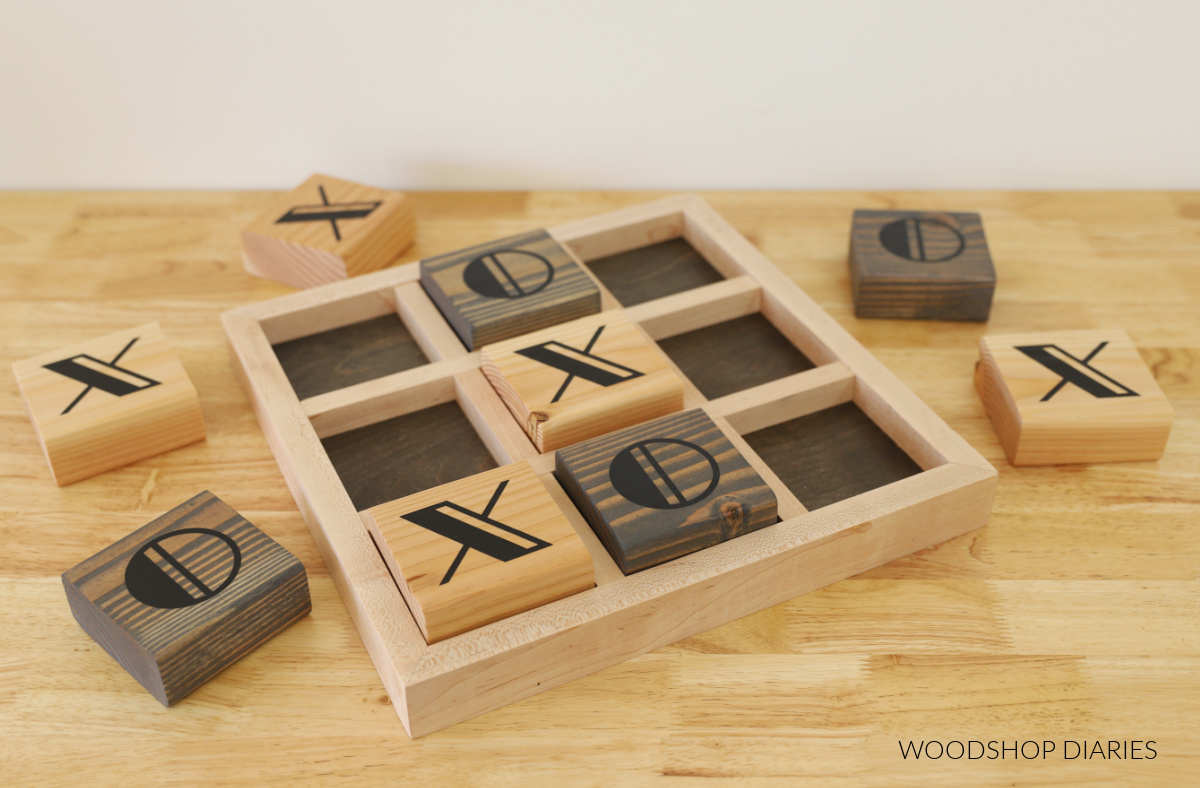
How to Buy Lumber for Your DIY Projects

May 11, 2023 by Shara, Woodshop Diaries

Buying lumber for your DIY and woodworking projects can be confusing. Let me help you make it easy!

This guide will show you how to buy wood for your next DIY woodworking project plus some tips to determine what kind of lumber is best for your project!

Shara Woodshop Diaries placing lumber on lumber rack in workshop
EASY DIY Lumber Rack

When you’re first diving into the world of DIY and woodworking, there are a lot of things that may seem a little confusing. What type of wood do I need? What do the sizes mean? What is pressure treated wood?

These are probably only a few of the many questions you may be asking. But don’t let that intimidate you!

One of the first obstacles you’ll face when first starting your woodworking projects is understanding lumber sizing, lumber types, and determining what type of wood to use for your projects. So, let’s break this down below.

But first…need a project? Check out 60+ printable building plans available here!

Understanding Lumber Sizing

Dimensional lumber (or construction lumber) comes in standard sizes and has both a nominal and an actual dimension. This can be confusing at first.

Why aren’t these the same? When these boards are cut, they’re rough cut to a certain size–the nominal dimension–then they’re surfaced and planed down to a more exact size–the actual dimension.

So these boards are ACTUALLY a little smaller than their nominal size. For example, a 2×4 is actually 1 ½″ x 3 ½″.

How do you know what’s nominal and what’s actual? Nominal dimensions typically will not have units noted and actual dimensions will. So 2×4 is assumed nominal since there aren’t any units. However, 2″ x 4″ is assumed an actual dimension since the units (inches) are specified.

You can check out this post for a more detailed breakdown of lumber sizing.

What kind of wood should I use for my project?

Like many things in woodworking, there is no right or wrong answer here. The kind of wood you choose to use for your project will depend on budget, preference, and availability.

Hardwood vs Softwood

The difference between hardwood and softwood, at the root (pun intended *wink*), is that hardwood trees lose their leaves every year and softwood trees do not. Hardwood trees grow slower and produce denser wood than softwood trees.

In terms of what this means for furniture building, hardwood is heavier, harder, and usually has a tighter grain pattern than softwoods.

Walnut and maple wood laid out on workbench

But, this also means that hardwoods are more difficult to work with, harder to find, and more expensive than softwoods. So, there are pros and cons to each.

Common hardwoods used in furniture and cabinet building are oak, maple, walnut, cherry, and birch.

Common softwoods used in furniture building are pine, spruce, fir, and cedar.

These aren’t the only wood types, just some common ones.

Softwoods like pine and spruce are common in construction and are readily and easily available in most locations.

If you’re just starting out or are on a tight budget, softwoods are a great option and are easy to shop for and work with. I use softwoods on the vast majority of my projects!

Construction Lumber

Construction lumber is wood that is commonly used to build homes and frame structures. This is the wood you see at the big box stores and building supply centers–things like 2x4s and 1x6s, etc.

Depending on your location, construction lumber is usually cut from softwoods like spruce, pine and/or fir wood. Many times, these three are lumped together under the acronym SPF and have their own grades (levels of quality).

Common boards are a lower grade and allowed to have a certain level of defects (like knots). Select boards are a higher grade and allowed little to no defects.

These boards come in standard nominal sizes. Check out this post to learn more about lumber sizing.

1x Construction Lumber

The terms “common” and “select” are actually grades of lumber. However, when people say “common boards,” they’re typically referring to 1x construction lumber.

These are sometimes called “white wood” at the big box stores and are usually spruce. They will have some knots and/or defects. I like to call this “character.”

Select pine comes in the same sizes as common boards, but has minimal defects/knots. Because of the minimal defect, select pine will be a little pricier than common boards.

If you’re staining a project, you may want to opt for select pine 1x material. But if you’re painting or want a more rustic look, common boards will save you a little money. Here’s a look at some projects using common 1x boards:

DIY Window Trim
DIY Mudroom Bench
Simple Bench with Shoe Shelf

2x Construction Lumber

Framing lumber is the 2x thick material like 2x4s and 2x6s, etc. These are great for building furniture with as they’re strong, inexpensive, and easy to work with. I built this corner shelf using entirely 2×6 boards!

Shara next to DIY Corner shelf made from 2x6 boards
DIY Corner Shelf

These boards are great for furniture framing and table tops. Here are a few examples of projects using framing lumber:

Sliding Door Storage Cabinet
DIY Plant Stand
Round Coffee Table with Decorative Legs

Plywood

Plywood is a manufactured material made from laminated wood veneer with alternating grains. The plies, or layers of material, are glued together with alternating grain patterns to promote stability.

For this reason, wood movement with plywood is minimal–but that’s another topic for another day.

When building furniture and cabinets, I HIGHLY recommend opting for a cabinet grade plywood. These can be a little more expensive than construction grade plywood, but well worth it.

plywood laid out on workbench

Cabinet grade plywood is commonly found in hardwood species like maple, birch, and oak. I use birch plywood for 99% of my plywood projects.

However, if you’re painting or building a workshop project, you can save a little money with sanded pine plywood.

Sanded pine plywood sheets

It’s not quite as pretty, but still works well, especially if you’ll be painting it anyway.

Here are a few projects using plywood:

Geometric Bookshelf
Hidden Drawer Bookshelf
Workshop cabinets
How to Build Workshop Cabinet Boxes

PRO TIP: For covering exposed plywood edges, try edge banding! Learn how to cover plywood edges easily here.

If you’re not sure what the best type of plywood to use for your project is, don’t worry! This post helps you choose the right plywood for your project.

Lumber For Outdoor Projects

Pressure treated lumber is wood that has been treated with preservatives to help extend its life and prevent rot and decay. These boards are often used in exterior projects like fencing, decks, and sheds.

DIY Hammock stand made from pressure treated lumber
DIY Hammock Stand

Pressure treated wood comes in the same sizes and wood types as construction lumber. But you’ll also find it in additional sizes like 6×6 posts and 5/4 thick boards (often used for decking).

Once it’s allowed time to dry out, it’ll turn a nice golden color and looks really nice. But, when it’s new, pressure treated wood tends to be an odd color (greenish), have an odd smell (from the chemicals), and be quite heavy (because it’s wet).

For those reasons, many times, you may not want to use it for your outdoor furniture and projects. So, naturally rot and weather resistant woods are a good alternative, but will likely come with a higher price tag.

Depending on your location, cedar, redwood, white oak, and teak are all great outdoor lumber options. Cedar wood options shown below.

cedar lumber laid out on concrete floor

Where do you shop for lumber?

Once you determine what KIND of lumber you need for your project, then you can determine where to shop for it. Keep in mind that availability and lumber options will vary based on location.

I highly encourage you to ask around and research your local options because many times, local suppliers are the best places to shop if you have them available.

Shopping at the Big Box Stores

Big box stores (like Home Depot, Menards, Lowe’s, True Value) will carry mostly construction lumber. They’ll have pretty much all the 1x and 2x material you’ll need.

They usually carry pressure treated lumber and also decorative trim and moldings.

Some of them may carry a few hardwood options–likely in limited quantities and sizes. Selection will vary store to store. The big box stores where I live only carry poplar and red oak in 1x thick pieces.

The prices for hardwood at the big box stores are usually higher than you can find from a local hardwood supplier, but it’s a convenient way to buy it if you don’t want to deal with a lumber yard.

Big box stores typically price lumber by the board. But, for hardwoods, trims and moldings, sometimes they charge by the linear foot so pay careful attention when checking prices.

For more information on lumber sizing, check out this post.

TIP: If you’re new to woodworking and lumber yards intimidate you, shopping at a big box store is great because you are free to browse around and grab what you need on your own.

Big box stores also carry sheet goods like plywood. However, these stores are catering to contractors and home builders, so they may or may not have any nice cabinet grade options. Some carry it and others don’t.

Personally, I buy my plywood and 2x material from the big box stores as the prices are good, and they have a lot of material to pick from.

Shopping at the local building supplier

Local building suppliers will carry basically the same lumber options as the big box stores, BUT can often order you more specialty items like hardwoods and cedar/red wood, etc.

These local places usually deal with various suppliers and have access to tons of items they may not typically keep stocked.

Of course, every building supply store is set up differently, but often, these are places where you go to the desk, order what you need, then drive to the back and they load it up.

These aren’t usually set up where you can casually shop around and browse. So it’s best to know exactly what you need when you go.

I’ve found that the 1x material at my local building suppliers is cheaper and better quality than the 1x material at my big box stores. So I buy my 1x common boards here.

Shopping for Hardwood

Hardwoods aren’t always readily available like construction lumber and you may have to order online or call around to find a local lumber mill. In my rural area, there are limited options for local saw mills.

Some lumber yards are set up where you can walk in and shop around for what you want. Others are simply a giant warehouse of lumber they have to sort through with a forklift.

At my local mill, the owner is SUPER nice, but they’re (understandably) very busy. So they don’t have a lot of time to dedicate to me just browsing around. I expect many local mills are like that, so before making a trip, it helps to call ahead and ask them the species and sizes they carry and their prices.

That way, when you get there, you have a good idea of what you’re wanting and it’s a less frustrating experience for everyone.

Often, they keep the wood stored in these warehouses rough sawn (sawn to rough dimensions and with rough sides). Below is an example of rough sawn material.

rough sawn white oak board on miter saw

Most mills will surface the wood for you (for a fee) if you don’t have a planer and/or jointer, but that will take some time. So be prepared that you may not be able to take home the wood that day.

Hardwoods are usually priced by the board foot or linear foot. This post explains lumber sizing and how to calculate board foot.

How to pick straight boards

When shopping for lumber, you want to take your time and sight each board down the edge and face to check for straightness. This means that you may have to do a little digging to find the best boards for your project!

Hold the board up and look down all four sides checking for the following three problems–bows, cups, and twists.

sighting down the edge of a 2x4 board checking for defects

Checking for bows

A bowed board is one that is warped along the length. Whether it’s warped down the edge or the face, either one is a problem.

You can identify a bow by sighting down the edge and face of the board. If it’s not straight in either direction, then the board is bowed.

sighting down a bowed board

Often, I call these “banana boards” because they will be shaped like a banana.

If you’re cutting this board into short pieces and the bow isn’t severe, it’s not necessarily a deal breaker and may still be okay to use for your project.

Checking for cupping

Cupping is when a board is warped across the width. This is most common in wider boards and is identified by looking to see if the edges are higher or lower than the middle of the board.

cupped board laid on table saw

Whether cupping is a deal breaker depends on what the board will be used for. If you are able to plane the board flat again, then it’s fixable with a little work.

But if the board is severally cupped, I’d recommend avoiding it and finding a different board.

Checking for twists

A twisted board is one that is literally twisted. The two opposite corners will be lifted up and if you place it on a flat surface, it will rock.

You can identify a twist by placing the board on a flat surface and seeing if it rocks. Or, you can hold the board and look down the face to see if the surface is twisted.

sighting down a twisted board

Twists are the worst offender as they’re the most difficult to correct and these are the boards to DEFINITELY avoid buying when at all possible.

Storing Your Lumber

Once you’ve purchased your lumber and brought it home, it’s important to properly store it to keep it in good condition.

Keep all untreated lumber indoors and on a flat surface. This DIY lumber rack is a great way to store lumber flat and without taking up too much floor space.

DIY lumber rack made from 2x4s

For sheet goods, if you lay them flat, add some scrap blocks underneath to allow air flow. I like to stand my sheet upright so they don’t take up so much floor space.

This DIY scrap wood and plywood cart is a great way to store plywood up on wheels so it’s easy to move around and out of the way.

scrap wood storage cart with plywood

Ready to get building?

Now that you know how to shop for lumber, let’s pick out a new project to try! Here are a few favorites to get started!

DIY Accent Cabinet
DIY Adirondack Chair
Sliding Door Storage Cabinet
DIY Mudroom Bench
DIY Corner Shelf

If you want to be the first to know about new projects, plans, and woodworking tips, be sure to subscribe to the newsletter below for priority access!

Save this post for later by pinning it or sharing to your favorite social channel!

Pinterest image showing edge of board with test "how to buy lumber for DIY projects"

Until next time friends, happy building!
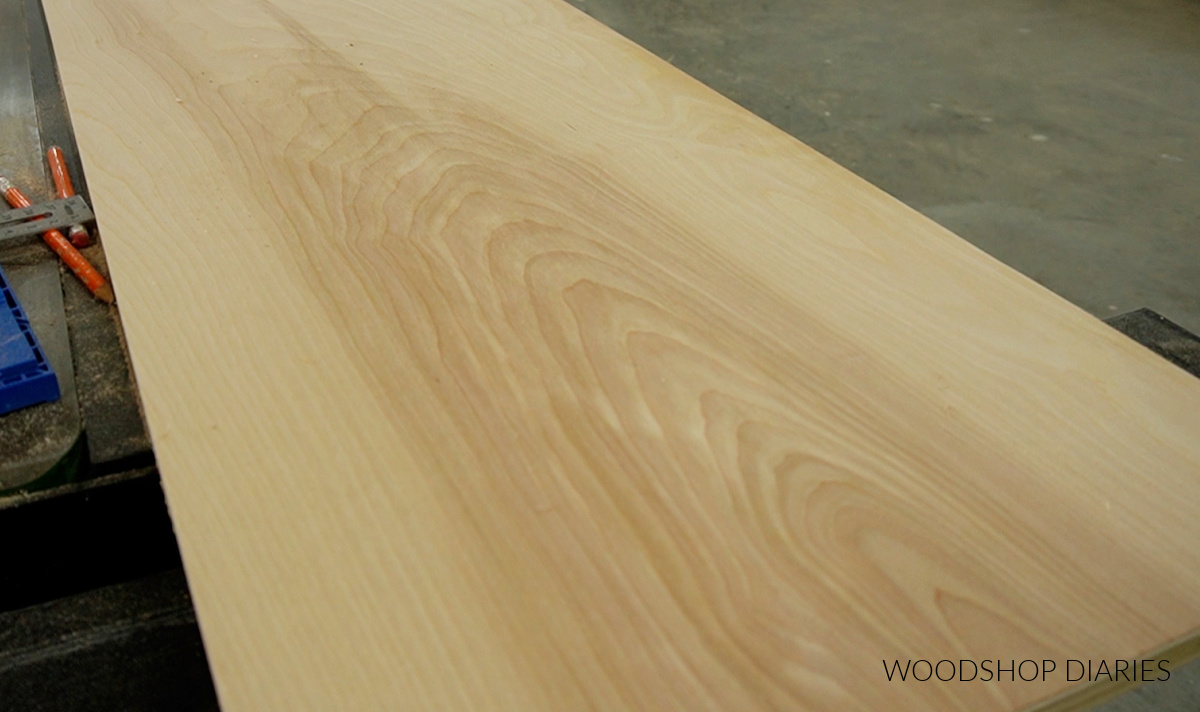
  • « Previous Page
  • 1
  • 2
  • 3
  • 4
  • 5
  • 6
  • …
  • 16
  • Next Page »

Hi! I'm Shara, the designer, maker, and videographer behind Woodshop Diaries. Let's get building, friends :)
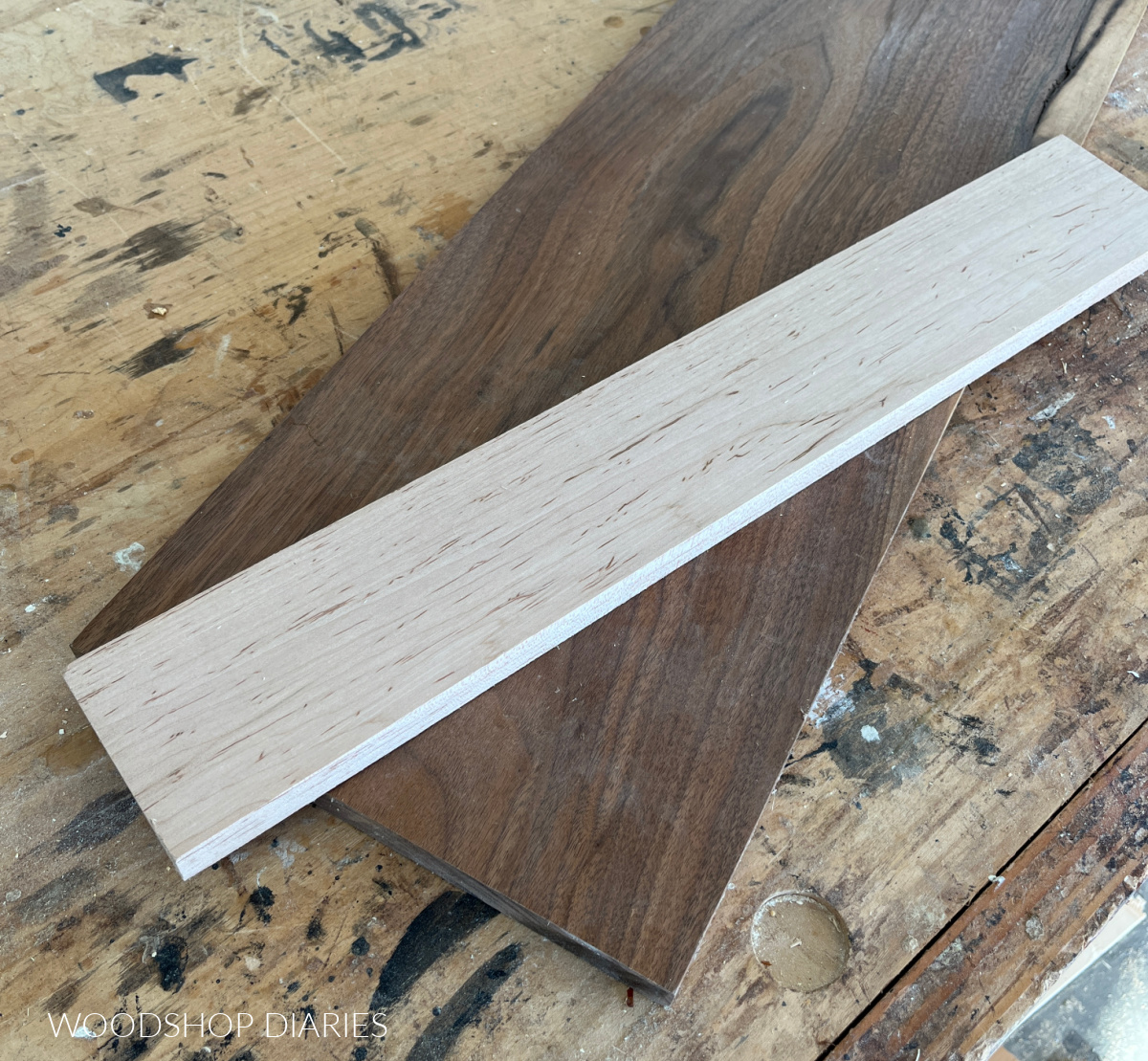
Learn more →

Woodworking Tips & Guides

  • How to make simple Shaker style cabinet doors!!
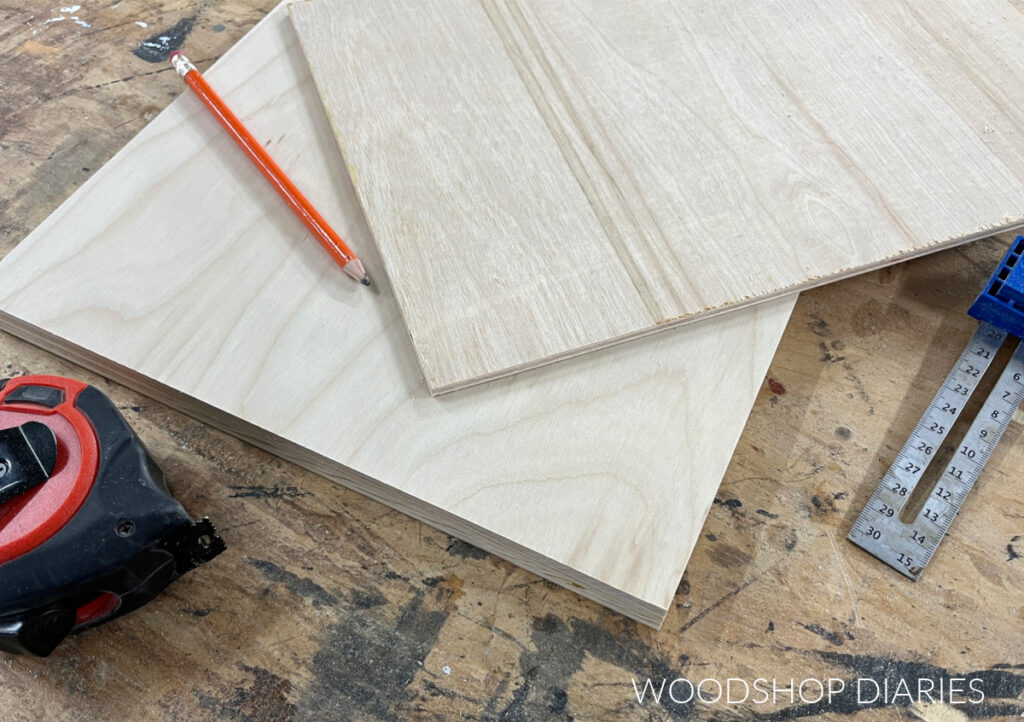
    DIY Simple Shaker Cabinet Doors
  • 5 Tools To Get Started Woodworking
  • DIY Kitchen Cabinets–From Only Plywood
  • How to Square Board Edges and Make Your Own 2x2s

Footer

↑ back to top

Tips to Take Your Projects to the Next Level

--5 Secrets to Professional Looking DIY Furniture

--How to Properly Paint Wood Furniture

--How to EASILY Cover Plywood Edges

--How to Sand Wood

--10 Must Have Tools for Furniture and Cabinet Building

Printable Building Plans

Check out our shop to browse printable PDF building plans!

Website Policies

This website is for entertainment purposes. Using any information provided is to be at your own risk.

This site uses cookies to provide you with a better experience.

All images and text on this site are property of Woodshop Diaries, LLC. Please be respectful and don't steal this content.

See Policies and Privacy page on this site for more information.

Want to get in touch? Contact Us Here

Copyright © 2026