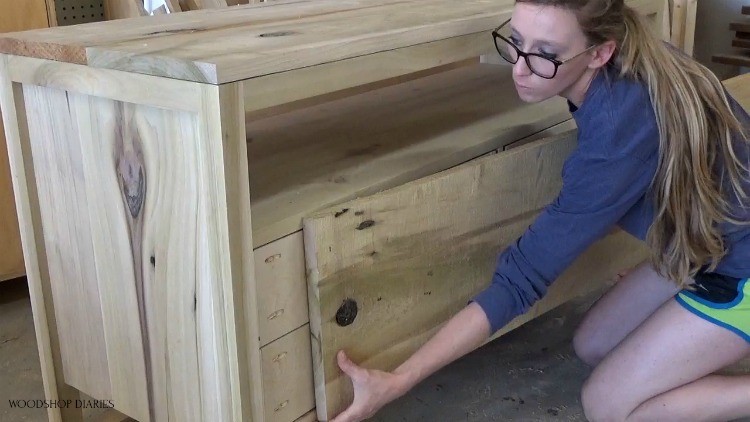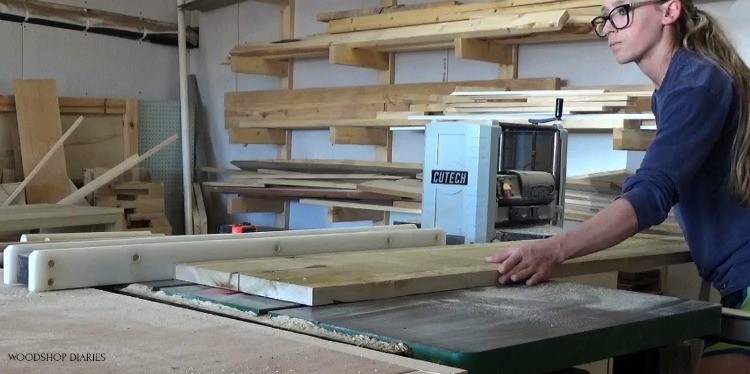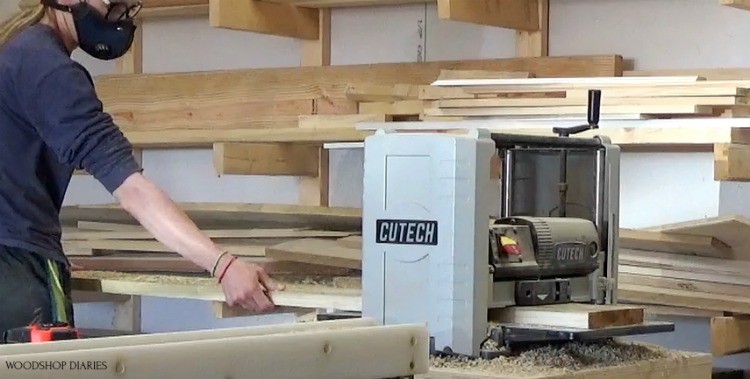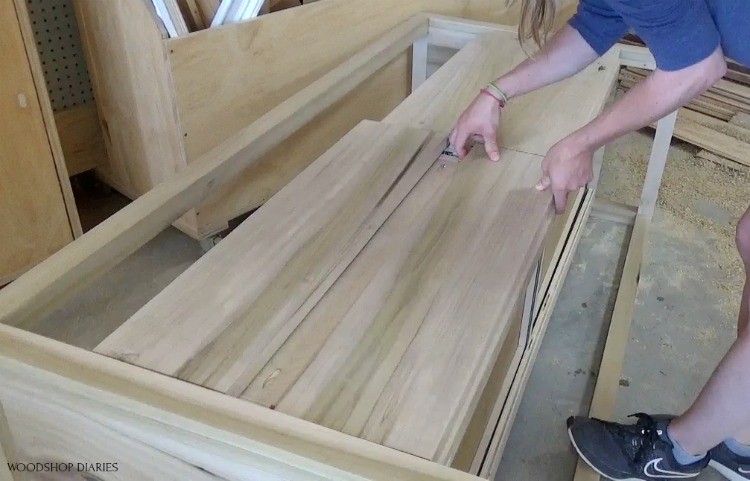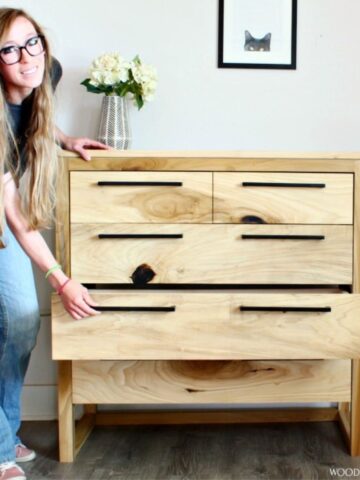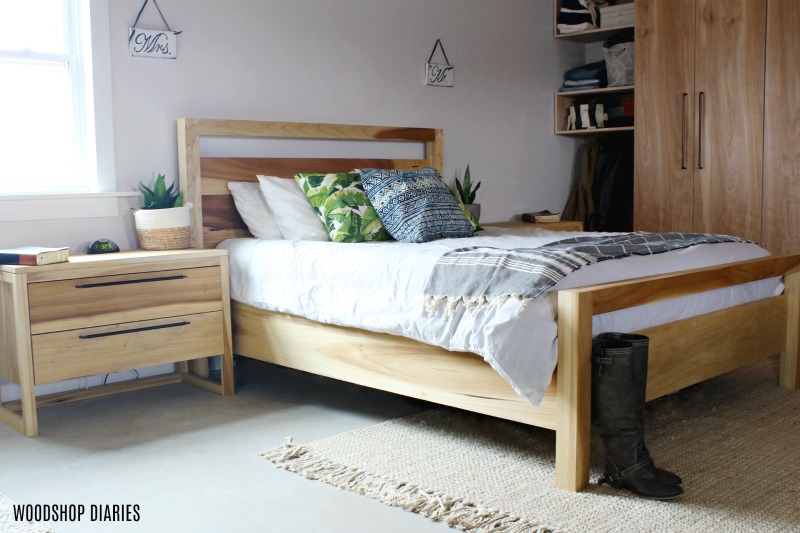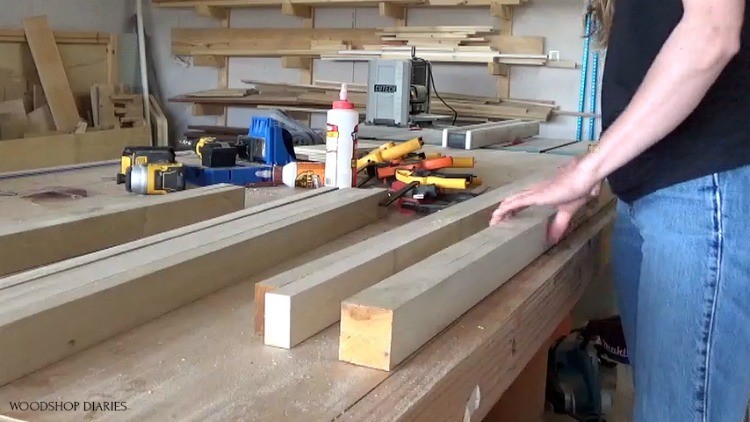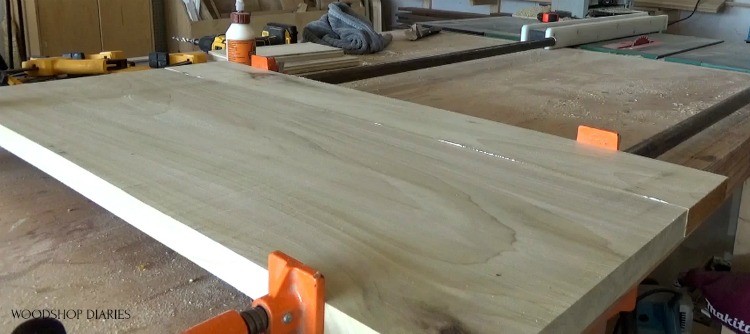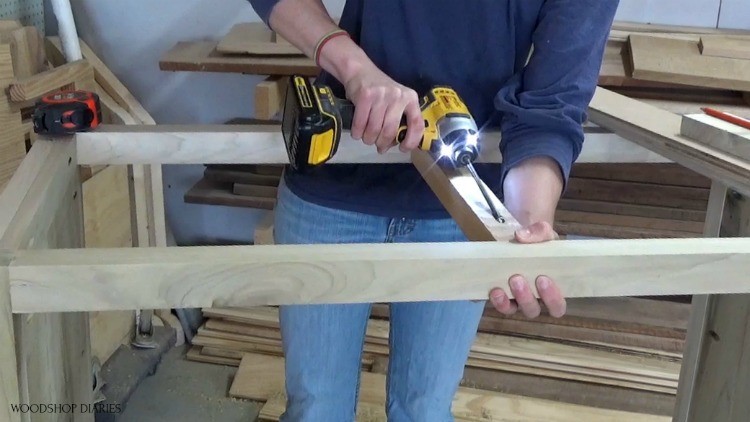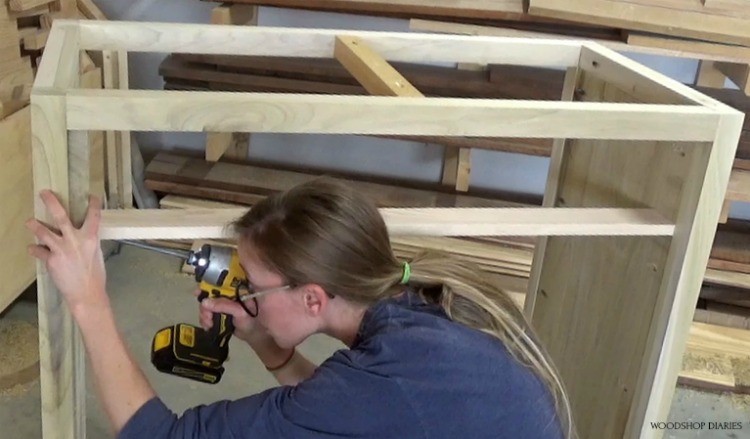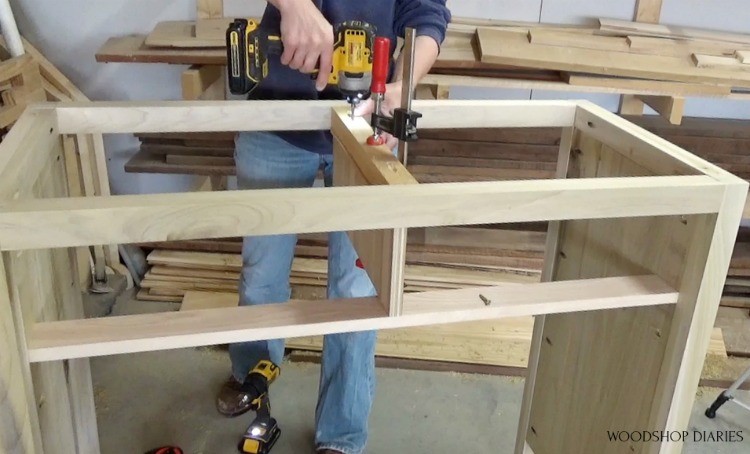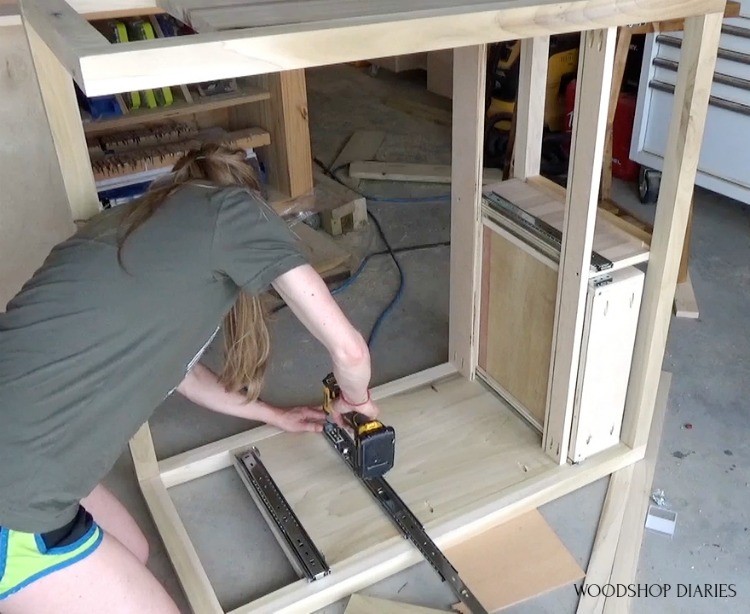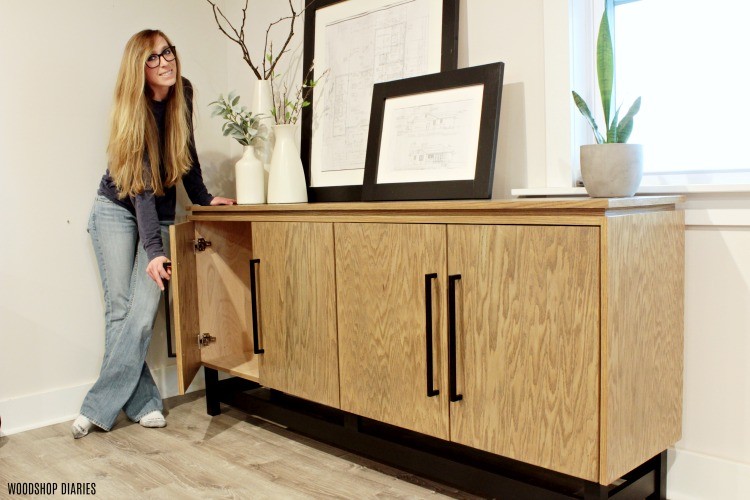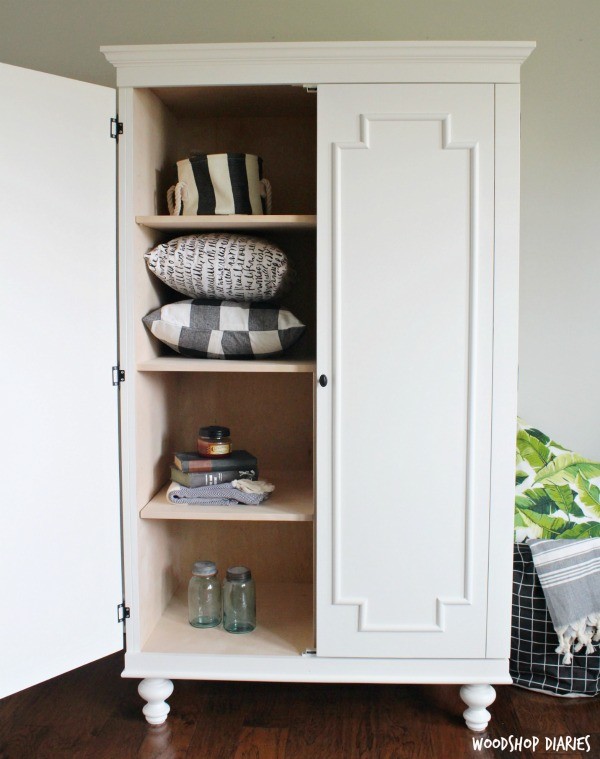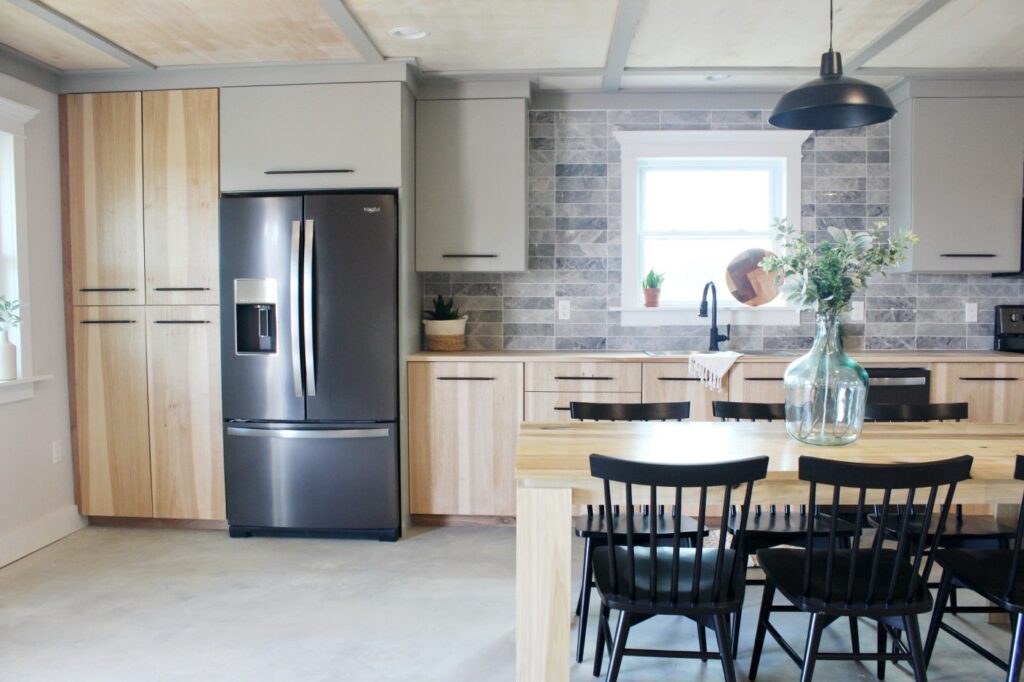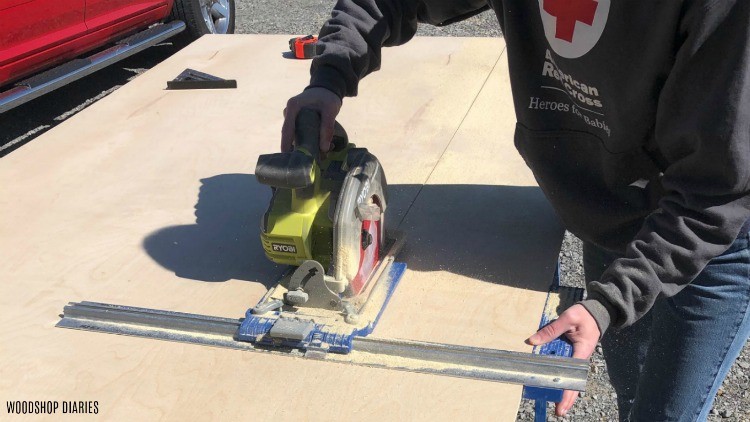
Woodshop Diaries

  • Shop
  • About
    • Work With Me
    • Frequently Asked Questions
  • DIY Projects
    • DIY Furniture Plans
      • DIY Bed Plans
      • DIY Dresser Plans
      • DIY Nightstand Plans
      • DIY Desk Plans
      • DIY TV Stand Plans
      • Coffee and Side Table Plans
      • Tables
      • Shelves and Bookcase Plans
      • DIY Storage Trunk Plans
      • DIY Bench Plans
      • DIY Storage Cabinet Plans
      • DIY Bathroom Vanity Plans
      • Kids Projects and Furniture
    • DIY Scrap Wood Projects
    • DIY Workshop Projects
    • DIY Home Decor Projects
  • Getting Started
    • Cabinet Building
    • Woodworking Basics
    • Furniture Finishing Tips
    • Tool Guides & Reviews
  • Blog
menu icon
go to homepage
  • Shop
  • About
    • Work With Me
    • Frequently Asked Questions
  • DIY Projects
    • DIY Furniture Plans
      • DIY Bed Plans
      • DIY Dresser Plans
      • DIY Nightstand Plans
      • DIY Desk Plans
      • DIY TV Stand Plans
      • Coffee and Side Table Plans
      • Tables
      • Shelves and Bookcase Plans
      • DIY Storage Trunk Plans
      • DIY Bench Plans
      • DIY Storage Cabinet Plans
      • DIY Bathroom Vanity Plans
      • Kids Projects and Furniture
    • DIY Scrap Wood Projects
    • DIY Workshop Projects
    • DIY Home Decor Projects
  • Getting Started
    • Cabinet Building
    • Woodworking Basics
    • Furniture Finishing Tips
    • Tool Guides & Reviews
  • Blog
search icon
Homepage link
  • Shop
  • About
    • Work With Me
    • Frequently Asked Questions
  • DIY Projects
    • DIY Furniture Plans
      • DIY Bed Plans
      • DIY Dresser Plans
      • DIY Nightstand Plans
      • DIY Desk Plans
      • DIY TV Stand Plans
      • Coffee and Side Table Plans
      • Tables
      • Shelves and Bookcase Plans
      • DIY Storage Trunk Plans
      • DIY Bench Plans
      • DIY Storage Cabinet Plans
      • DIY Bathroom Vanity Plans
      • Kids Projects and Furniture
    • DIY Scrap Wood Projects
    • DIY Workshop Projects
    • DIY Home Decor Projects
  • Getting Started
    • Cabinet Building
    • Woodworking Basics
    • Furniture Finishing Tips
    • Tool Guides & Reviews
  • Blog
×
Home

DIY Pocket Door Cabinet

July 17, 2020 by Shara, Woodshop Diaries

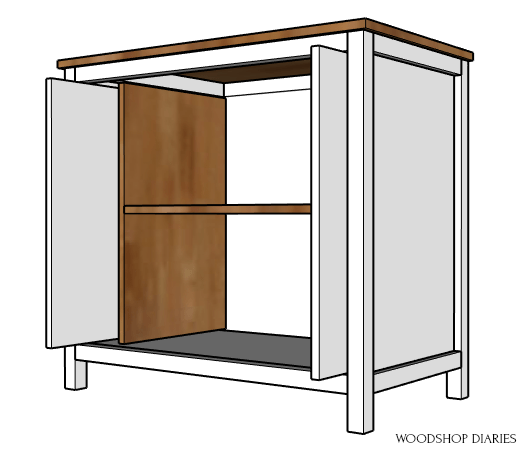
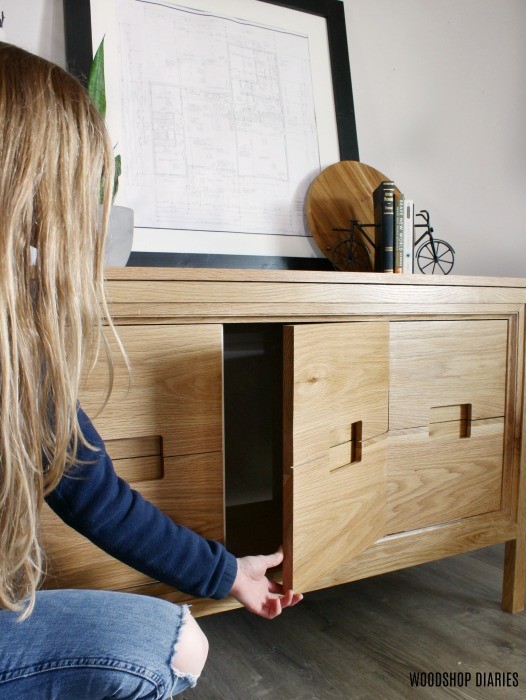
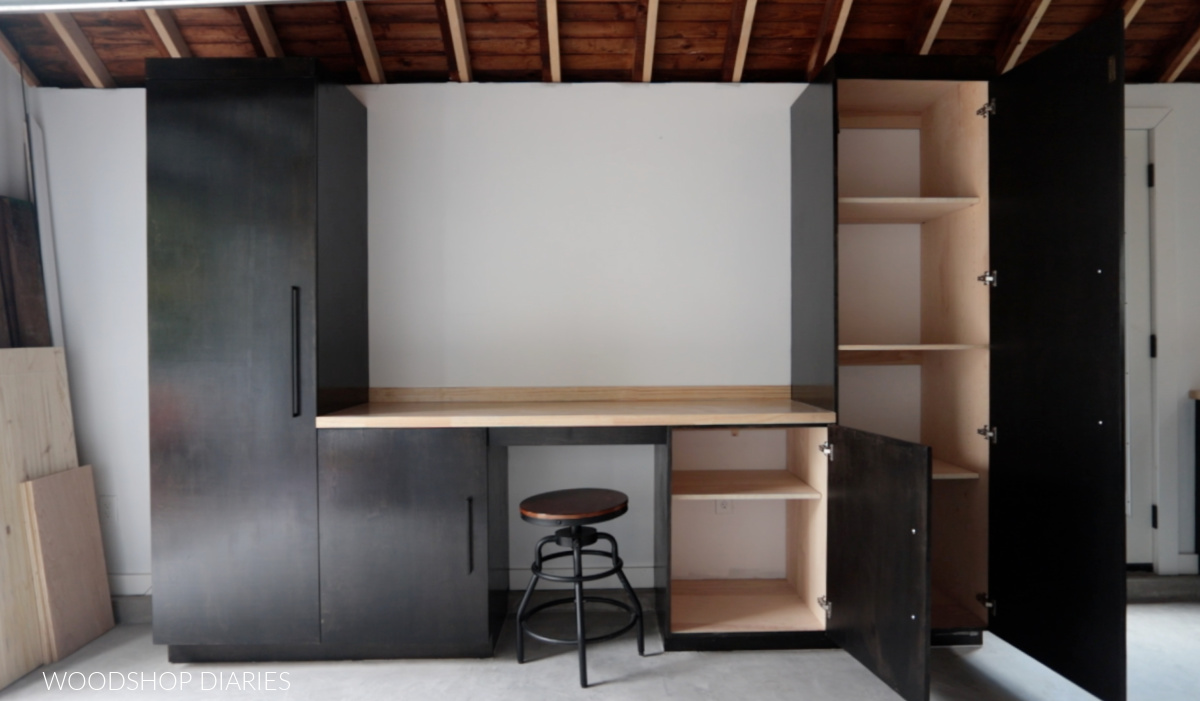
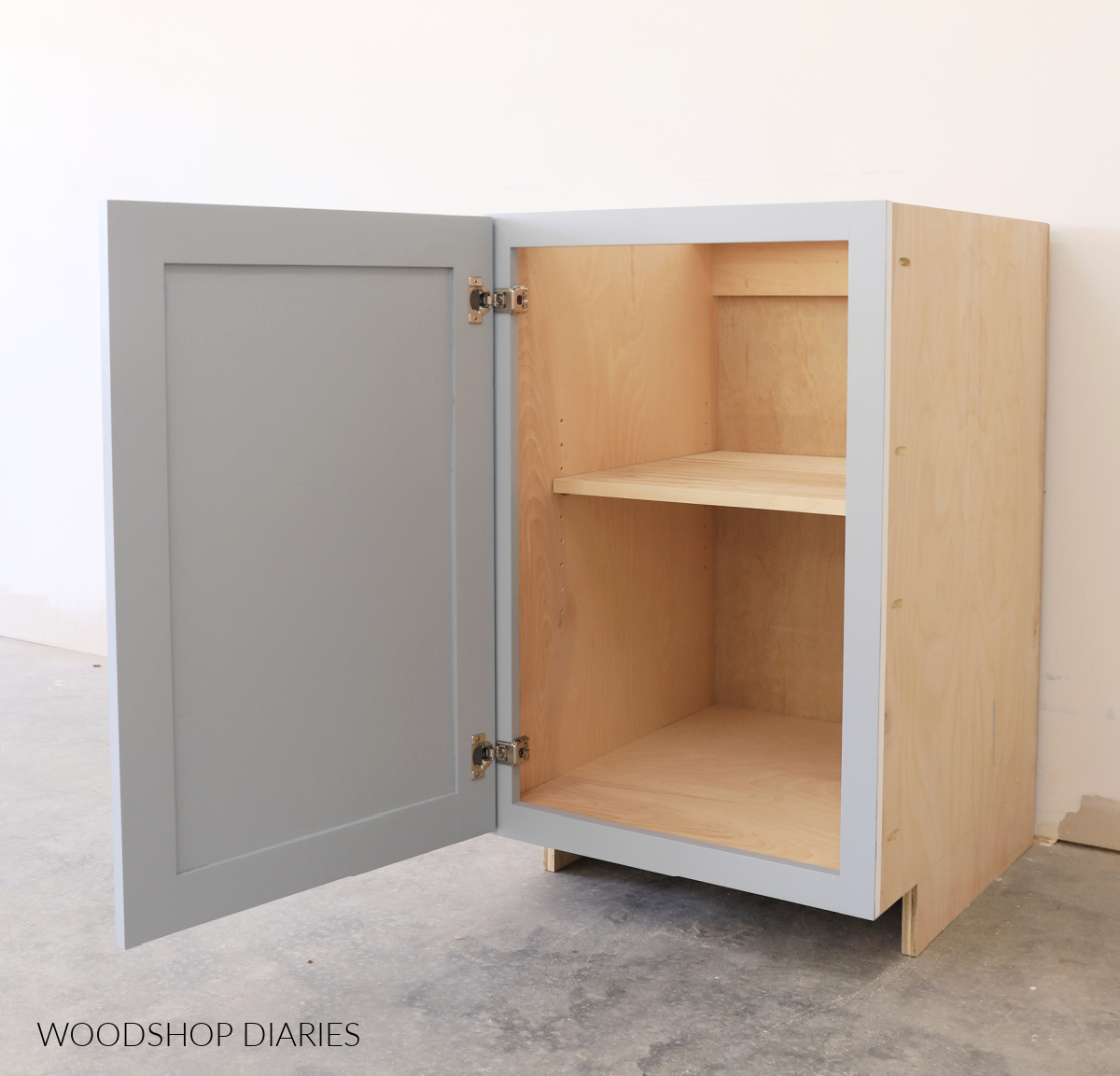
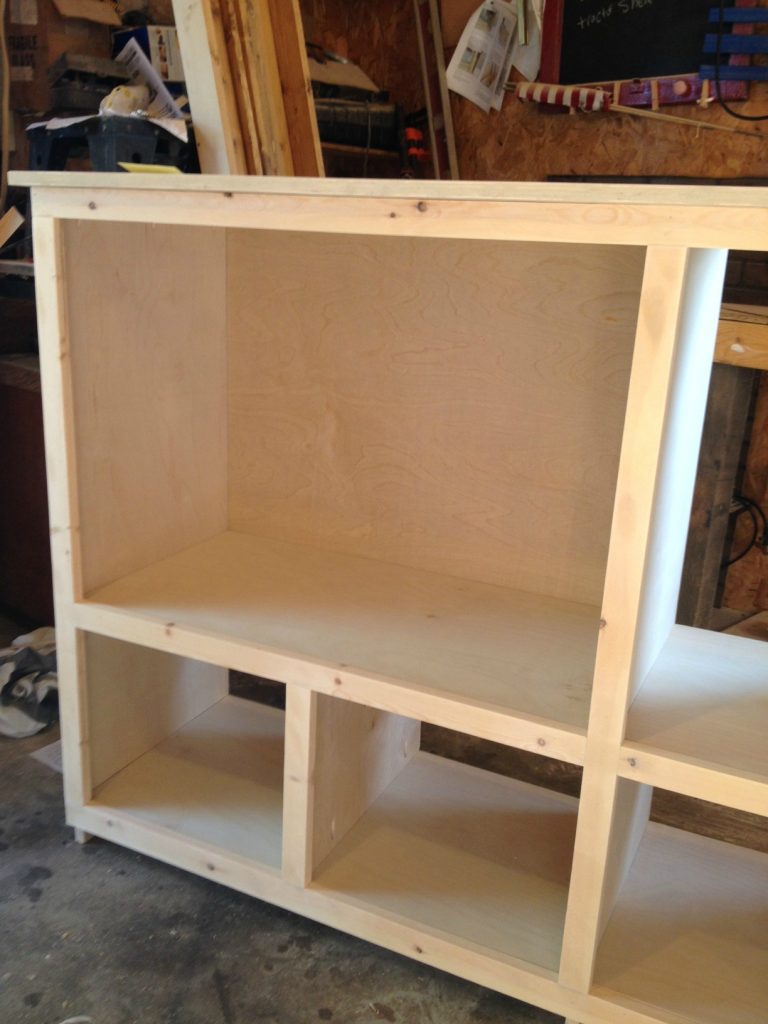
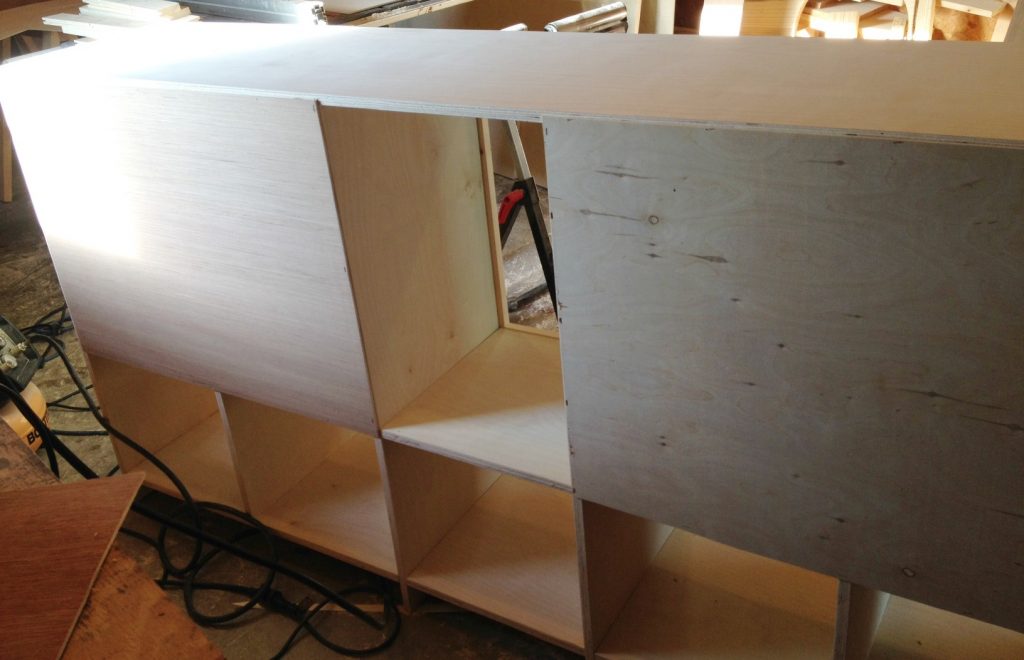
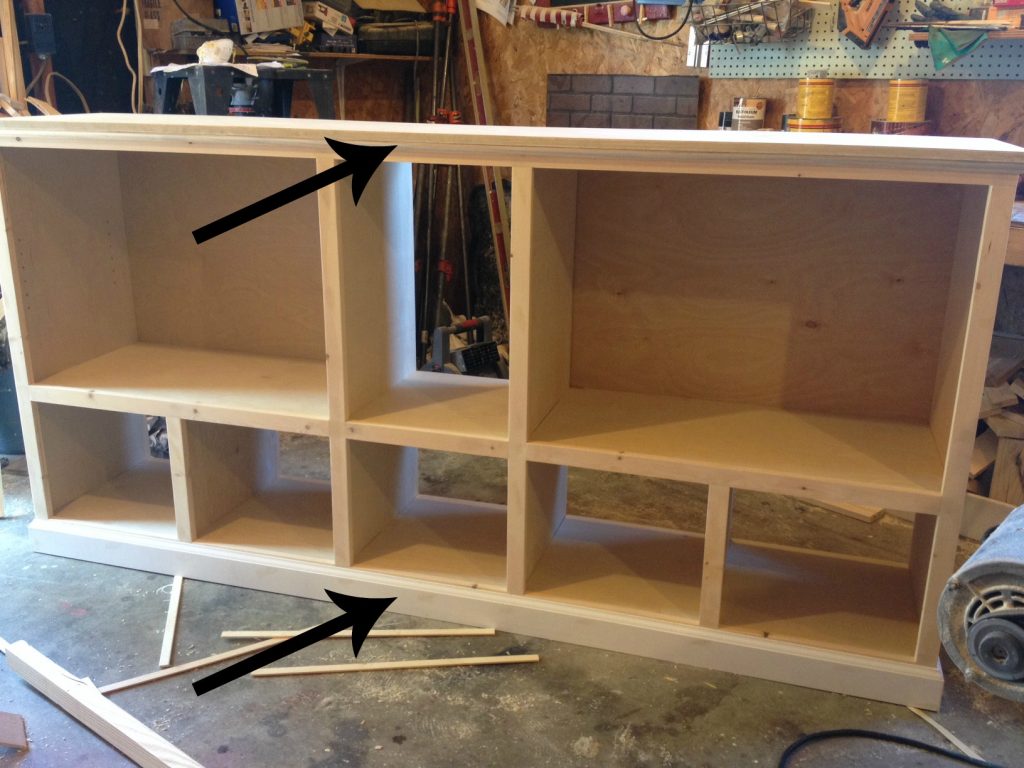
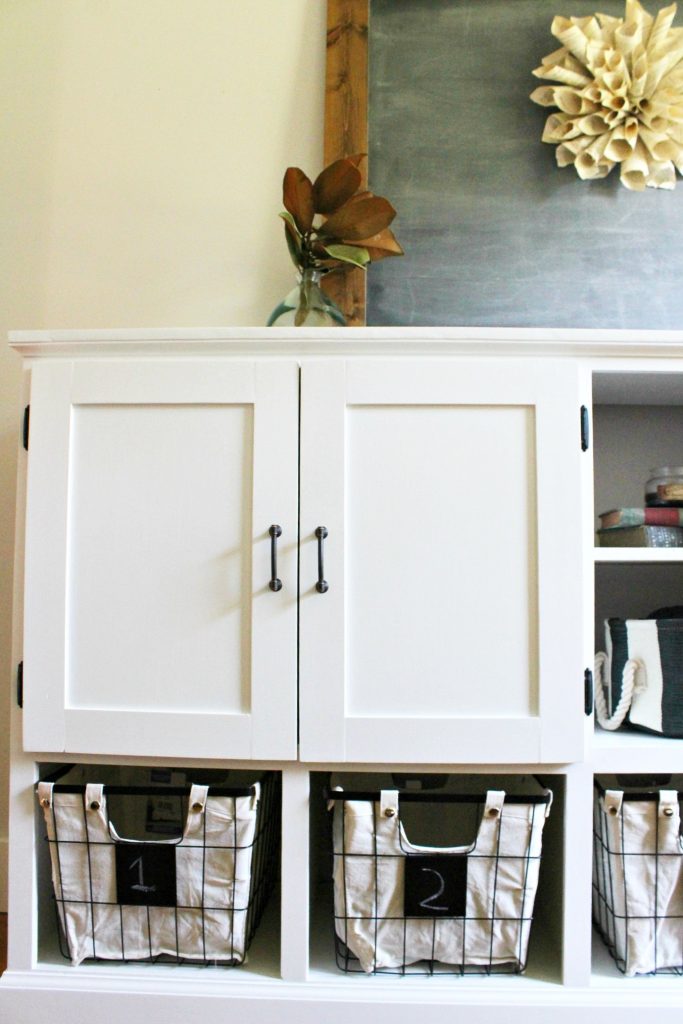
This DIY Pocket Door Cabinet looks simple from the outside. But when you open it up…
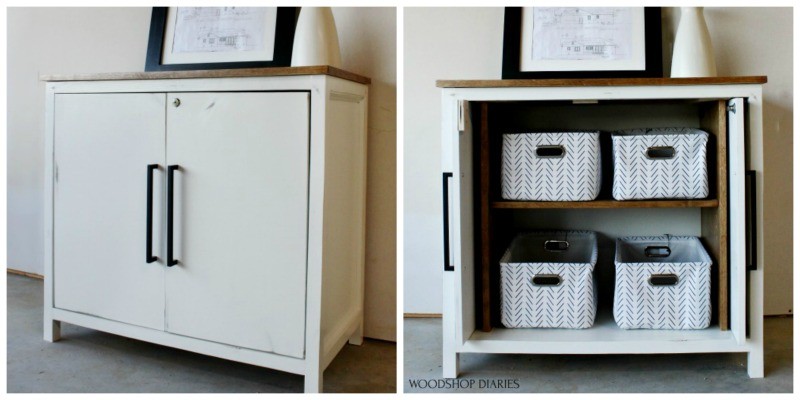
The doors slide back into the cabinet and out of the way! How cool!

.

If you saw my last post, I shared how I built this 6 drawer dresser as kind of the “base” of this large entertainment piece. 
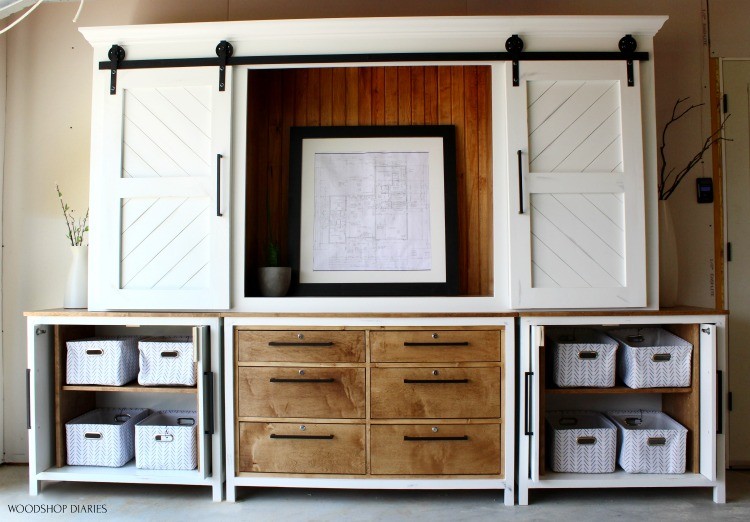
Large four section library entertainment center with dresser in middle and pocket door cabinets on the sides

But today I want to show you how I built these two pocket door cabinets that go on each side.  They work great as simple stand alone cabinets (I’m imagining this as the perfect coffee station cabinet), too!

.

And the final piece of the puzzle that goes on top is in this post here on how to build a sliding door cabinet.

.

If you’re ready to get building, I’ve got the plans below and I’ll show you how it came together in this video.

This post contains affiliate links. See policies.

For this Pocket Door Cabinet, You Will Need:

  • (4) 2x2x8 boards
  • (1) 4×8 sheet ¾″ plywood PLUS ¼ sheet for the top
  • (1) 4×4 sheet ¼″ plywood
  • (1) 1x2x8 board and cove molding (optional trim)
  • (2) pair pocket door hardware
  • (2) pair inset concealed hinges
  • (2) door pulls
  • Shelf pins
  • 1 ¼″ pocket hole screws
  • 2 ½″ pocket hole screws
  • ⅜″ dowels (optional)
  • 2″ wood screws
  • Circular Saw (for cutting down plywood)
  • Miter Saw
  • Drill
  • Nail gun and/or stapler
  • Pocket Hole Jig
  • Dowel Jig (optional)
  • Concealed hinge jig
  • Shelf Pin Jig
  • Edge Banding

Printable plans for the entire entertainment center series (which includes this pocket door cabinet) are here:

Step 1: Assemble Pocket Door Cabinet Side Panels

You’ll notice that the first part of this project looks very similar to the dresser build.  I built these so that they would match so the measurements are the same for the side panels of both projects.

.

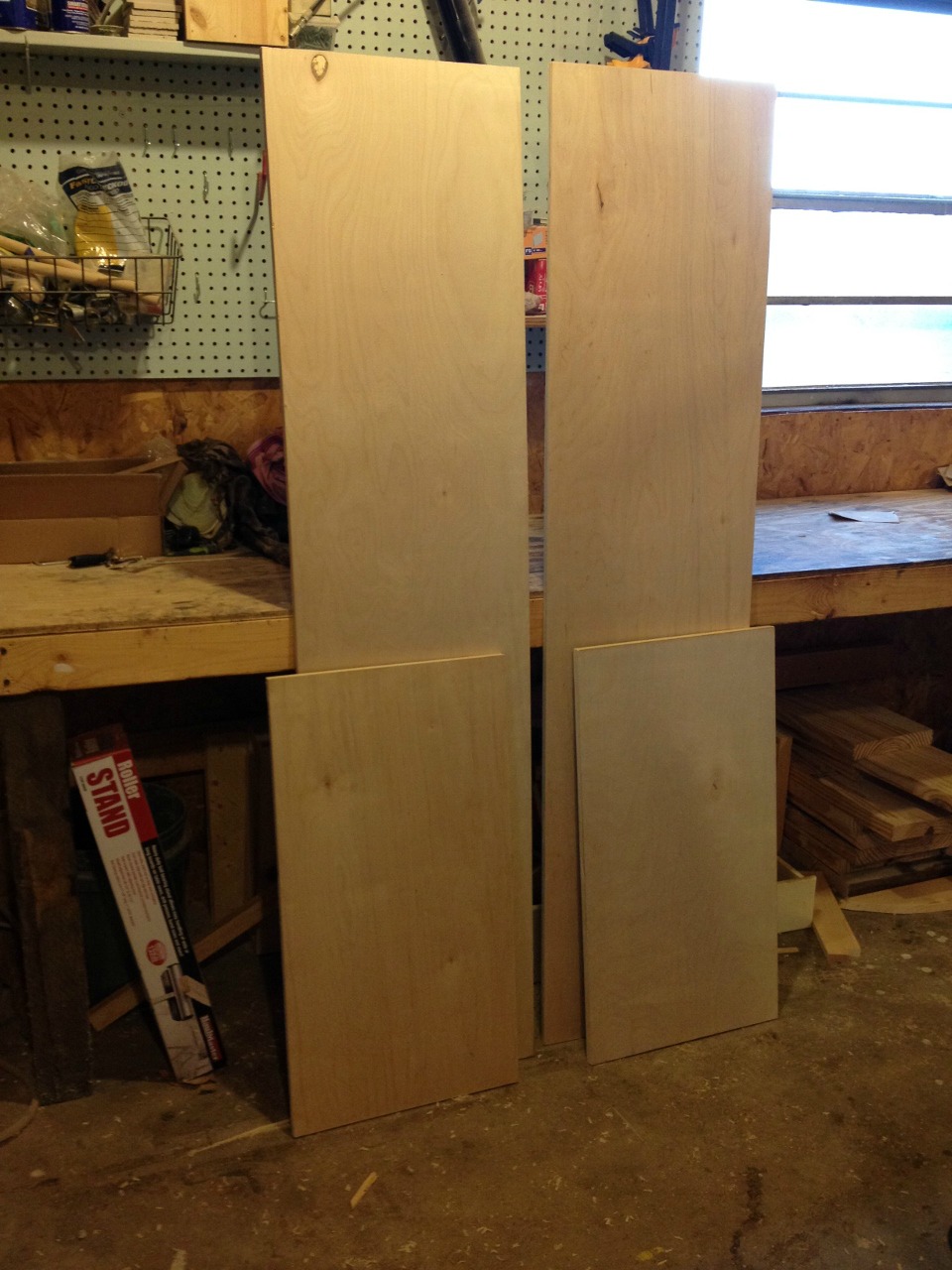
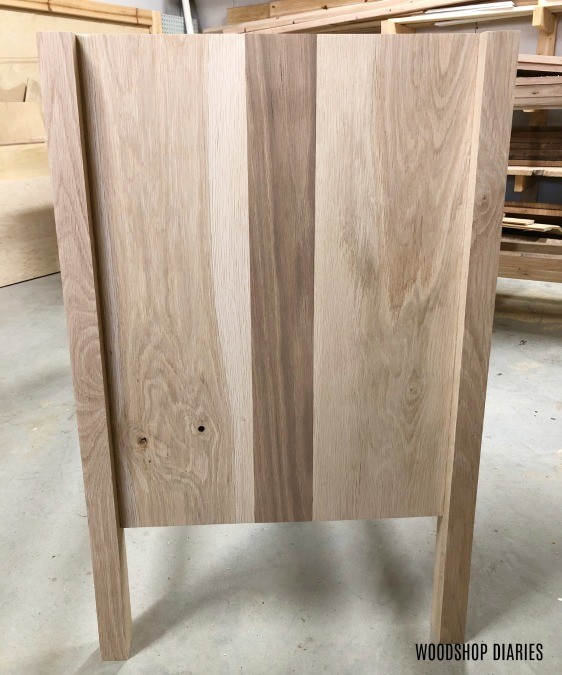
I used 2x2s for the frame and ¾” plywood for the inside panels. 

RELATED: How to Cut Your Own 2x2s

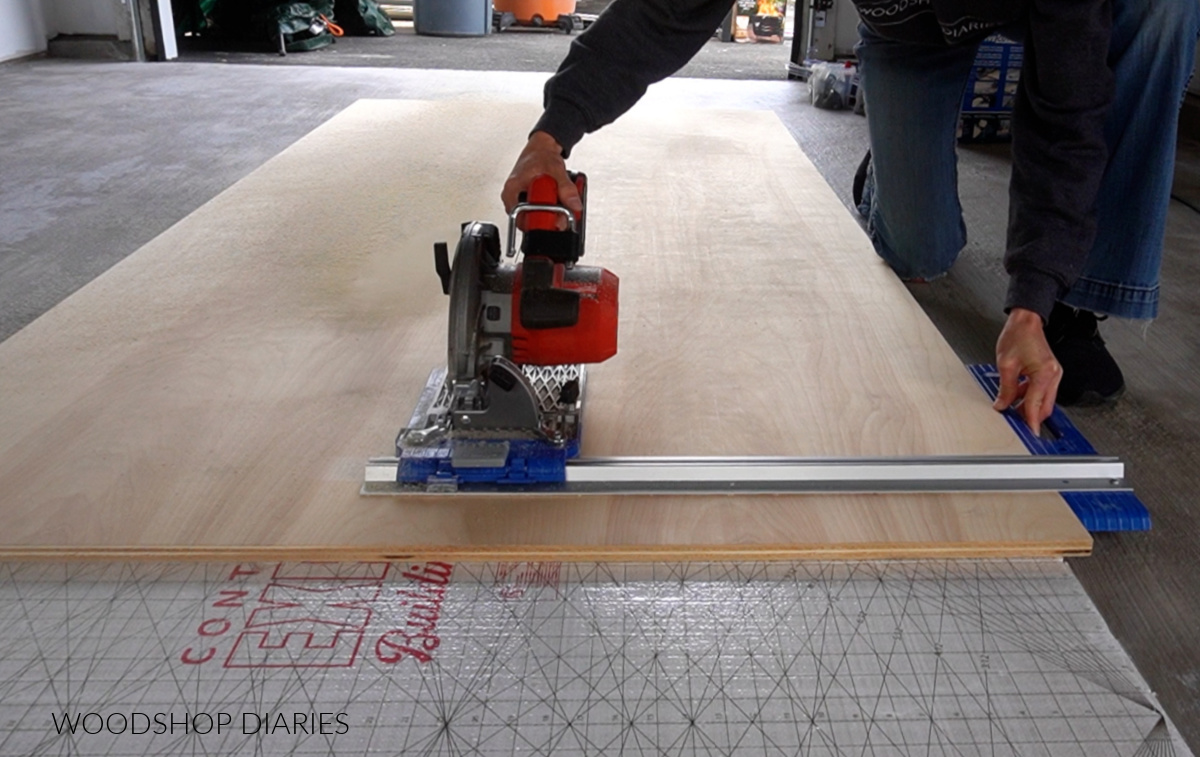
ALSO RELATED: How to Easily Cut Down Plywood Sheets

.

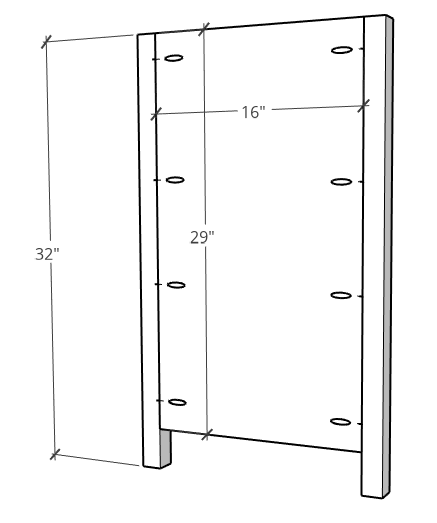
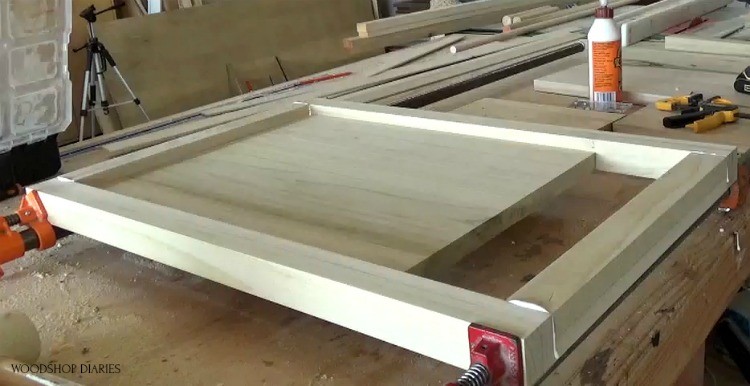
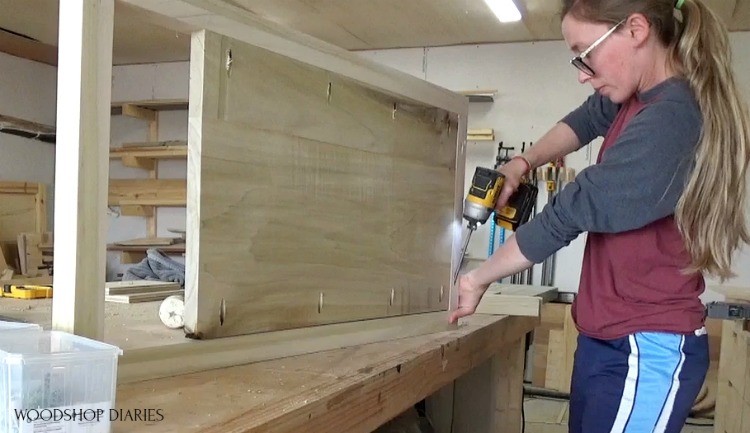
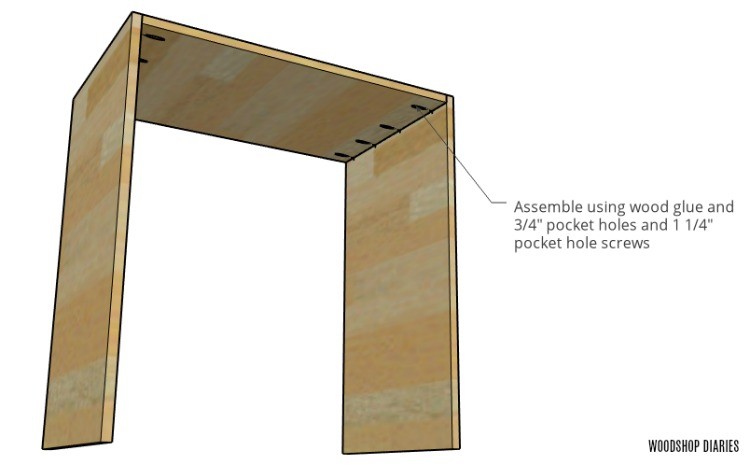
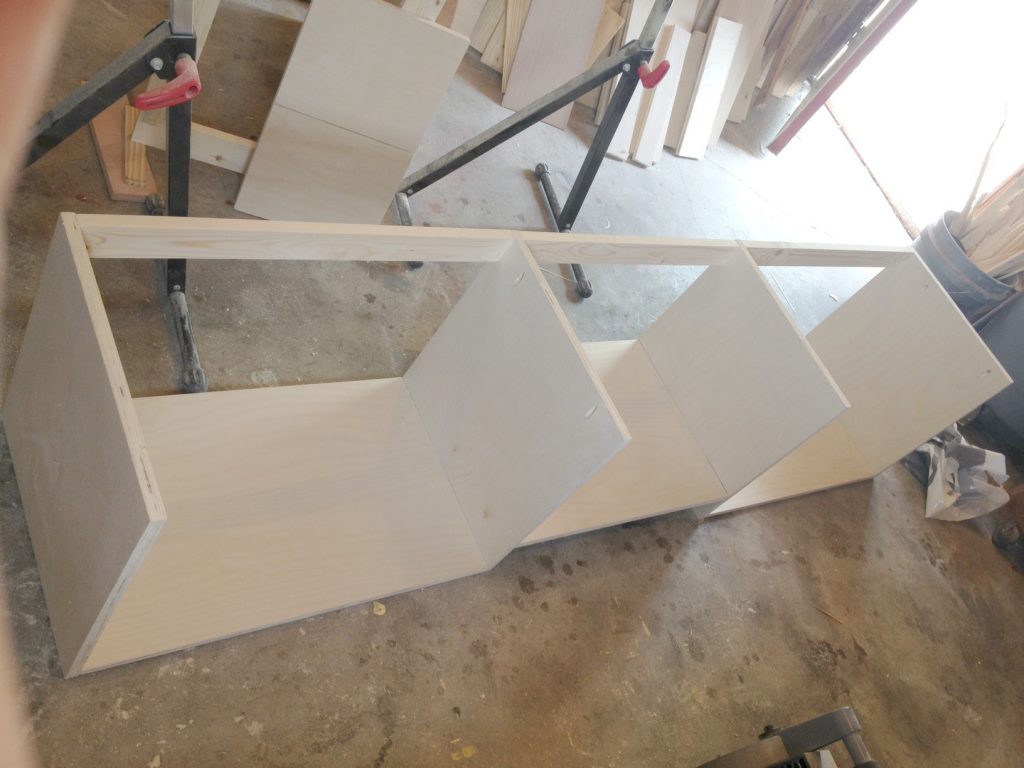
Once I had my 2×2 legs and plywood cut down to size, I assembled the two side panels like shown. 
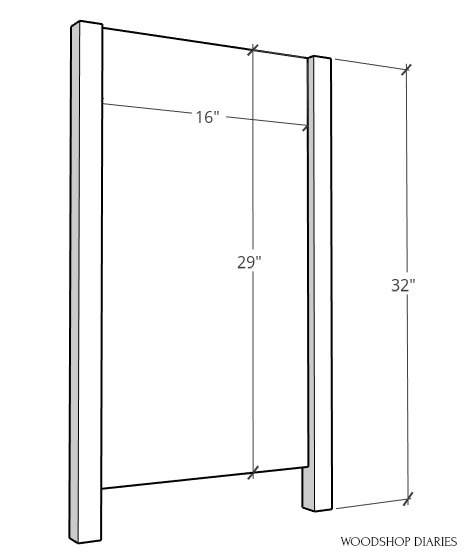
Side panel diagram of pocket door cabinet assembly

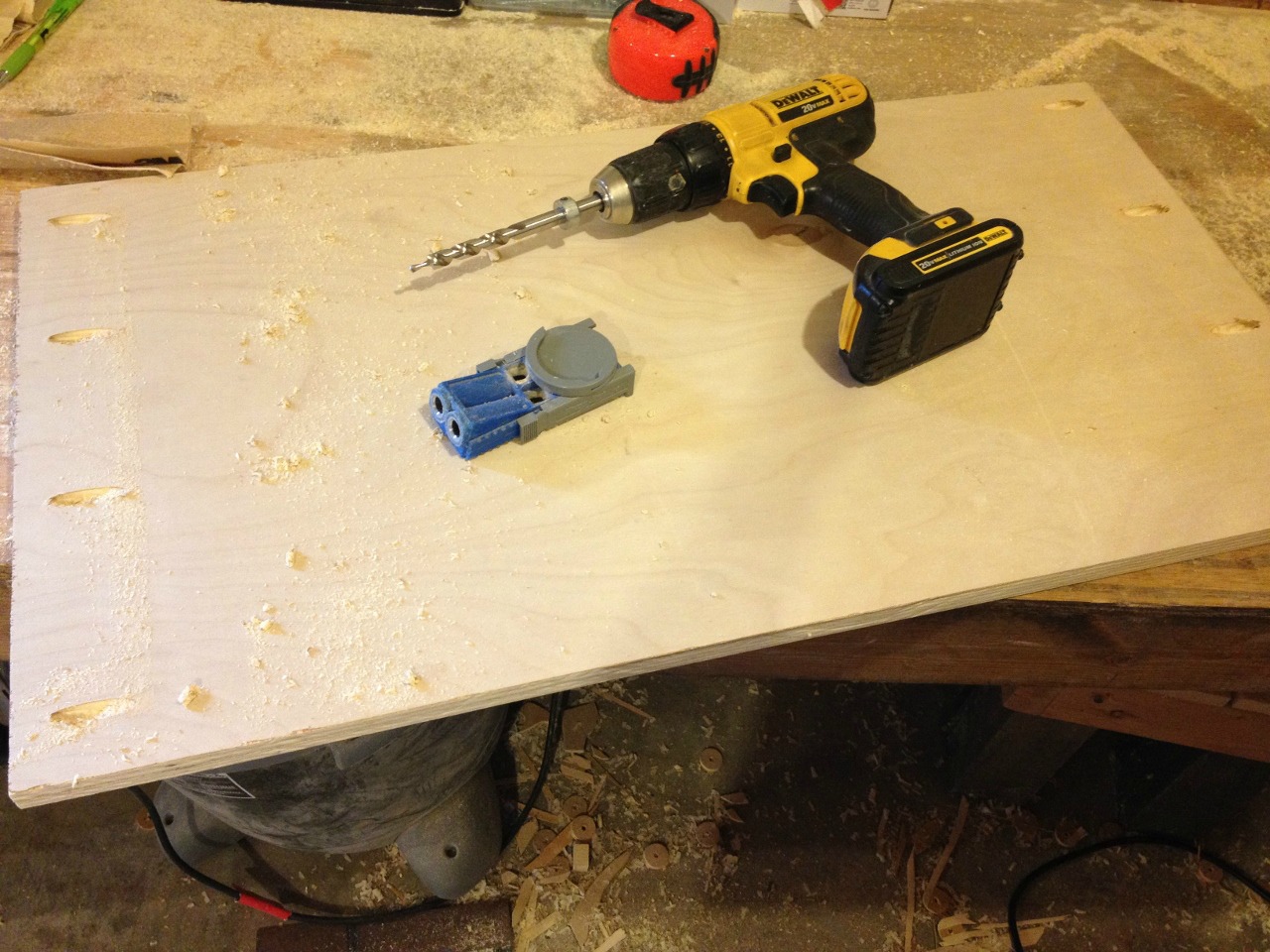
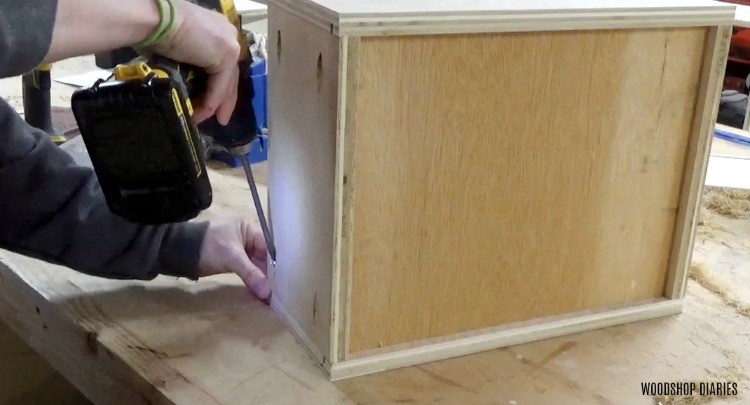
In the dresser build, I used ¾″ pocket holes and 1 ¼″ pocket hole screws for this since they would be covered. But with this project, I used ⅜″ dowels instead so you wouldn’t see the joinery when you opened the doors.

.

If you wanted, you could still use pocket holes here and just plug them.  Or even get fancier with another joinery method. There are plenty of ways to join them.

.

As long as you end up with two side panels with the measurements shown above, you’ll be fine 🙂

Step 2: Assemble Pocket Door Cabinet Frame

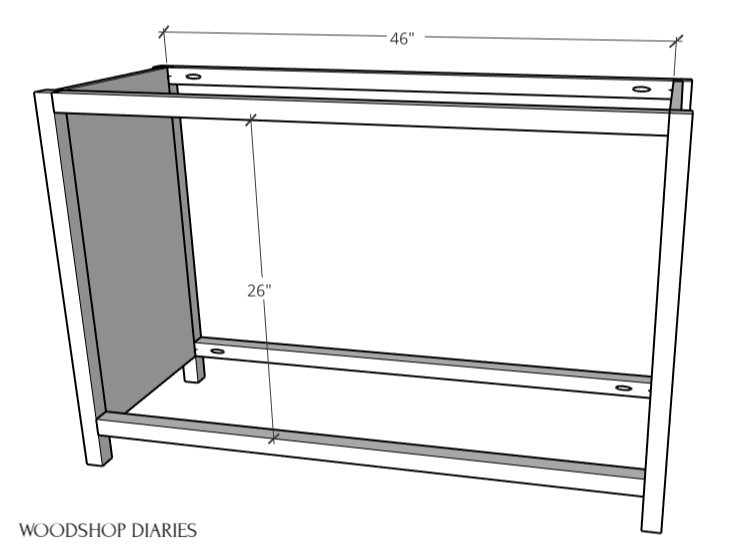
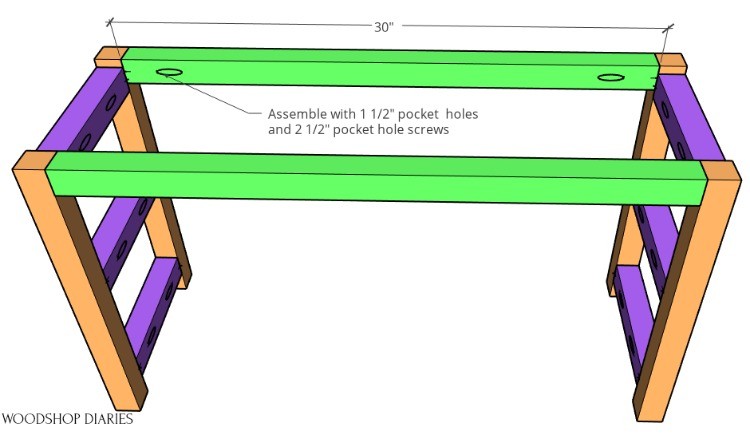
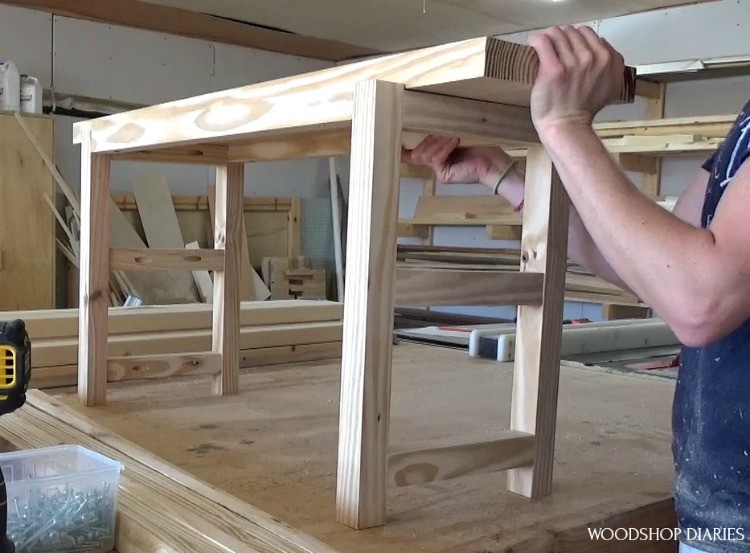
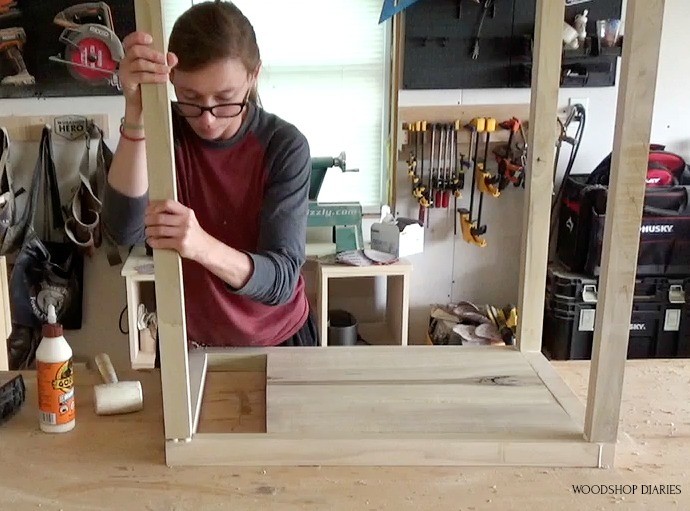
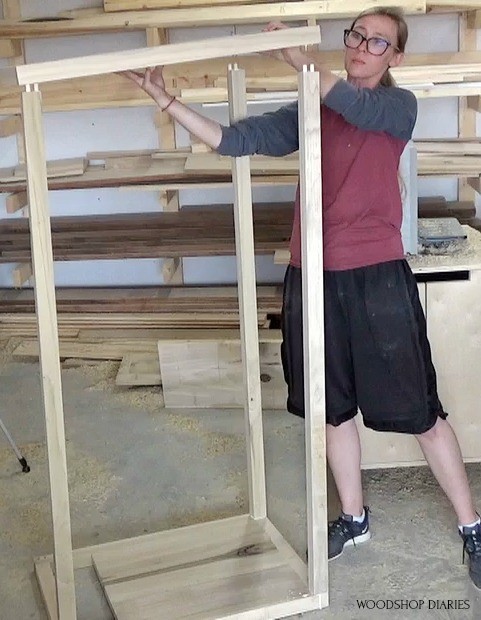
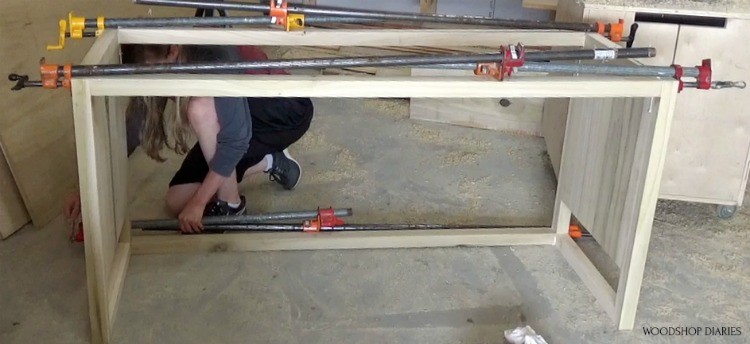
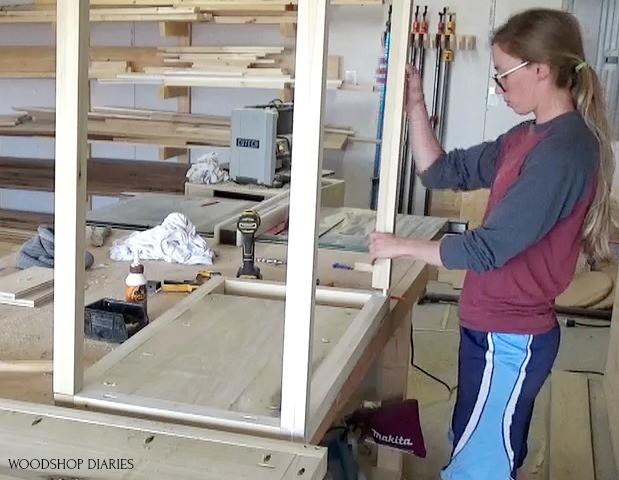
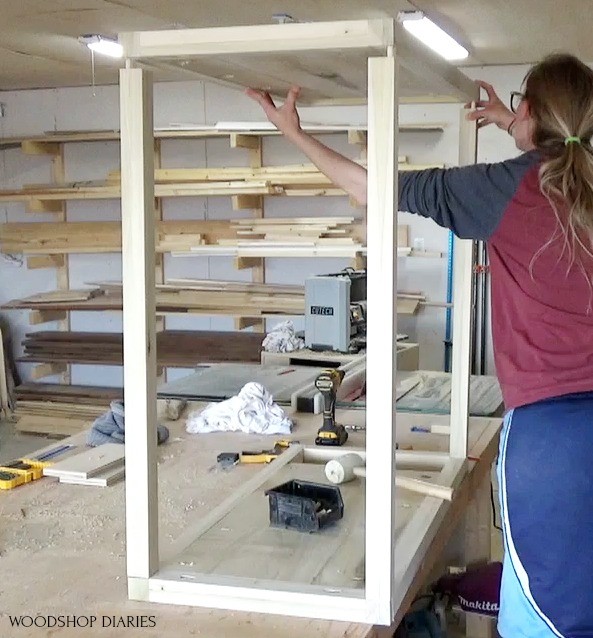
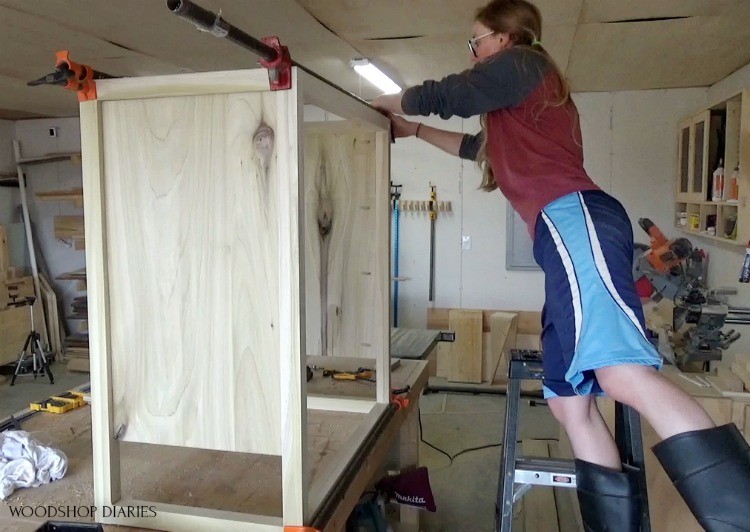
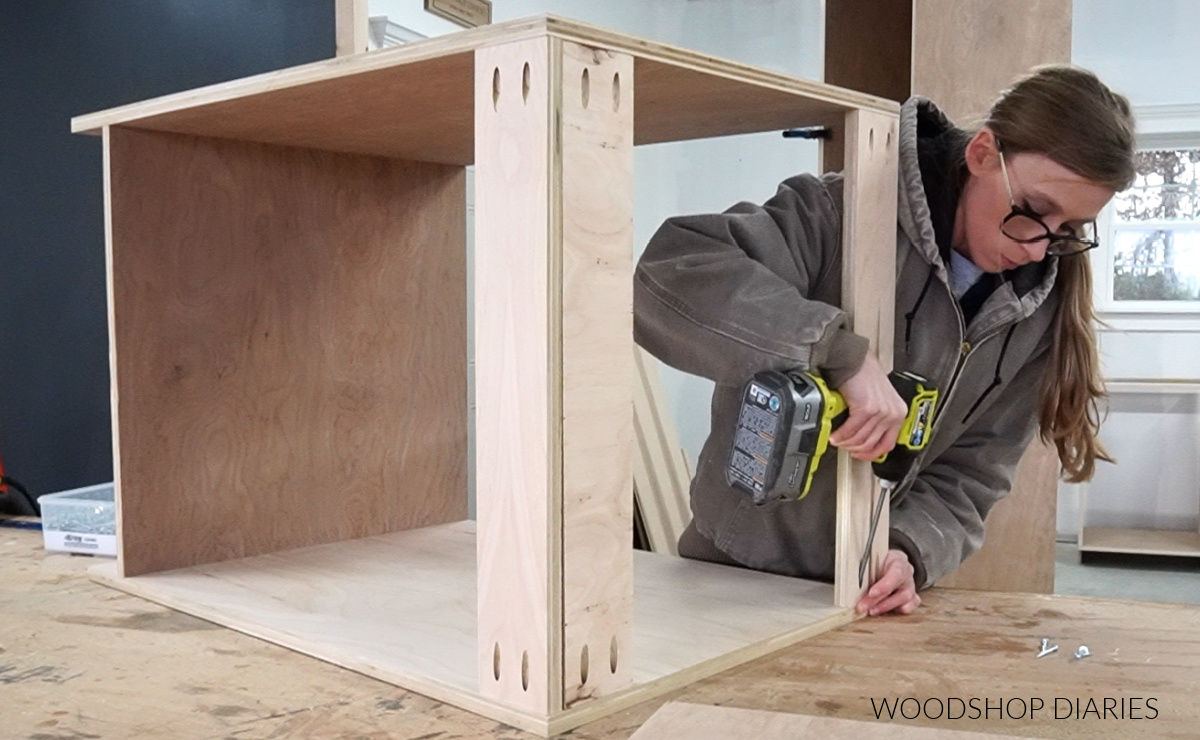
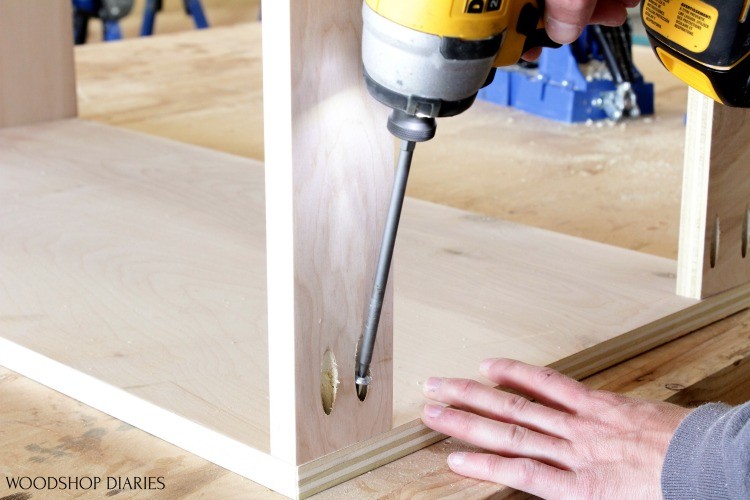
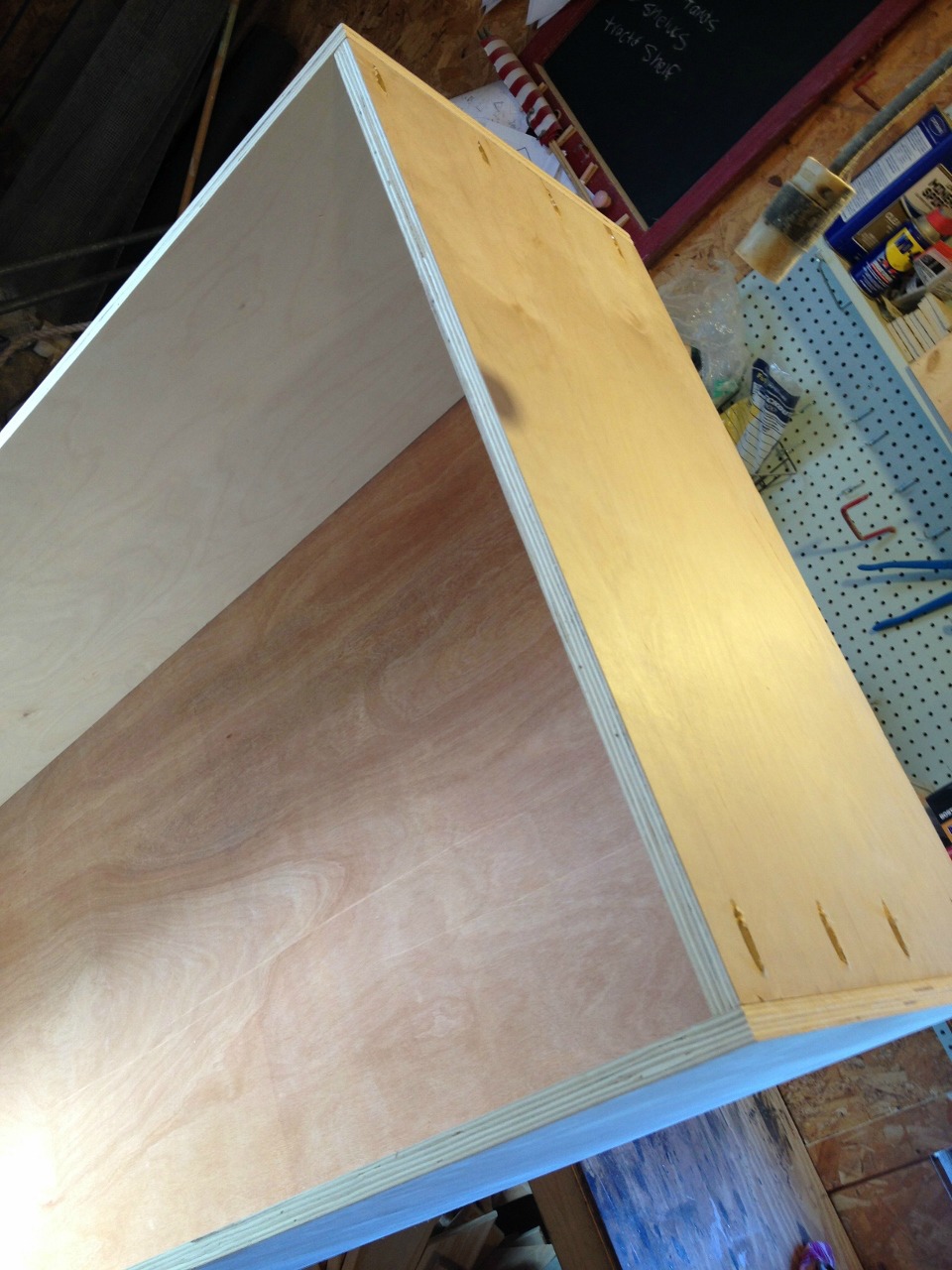
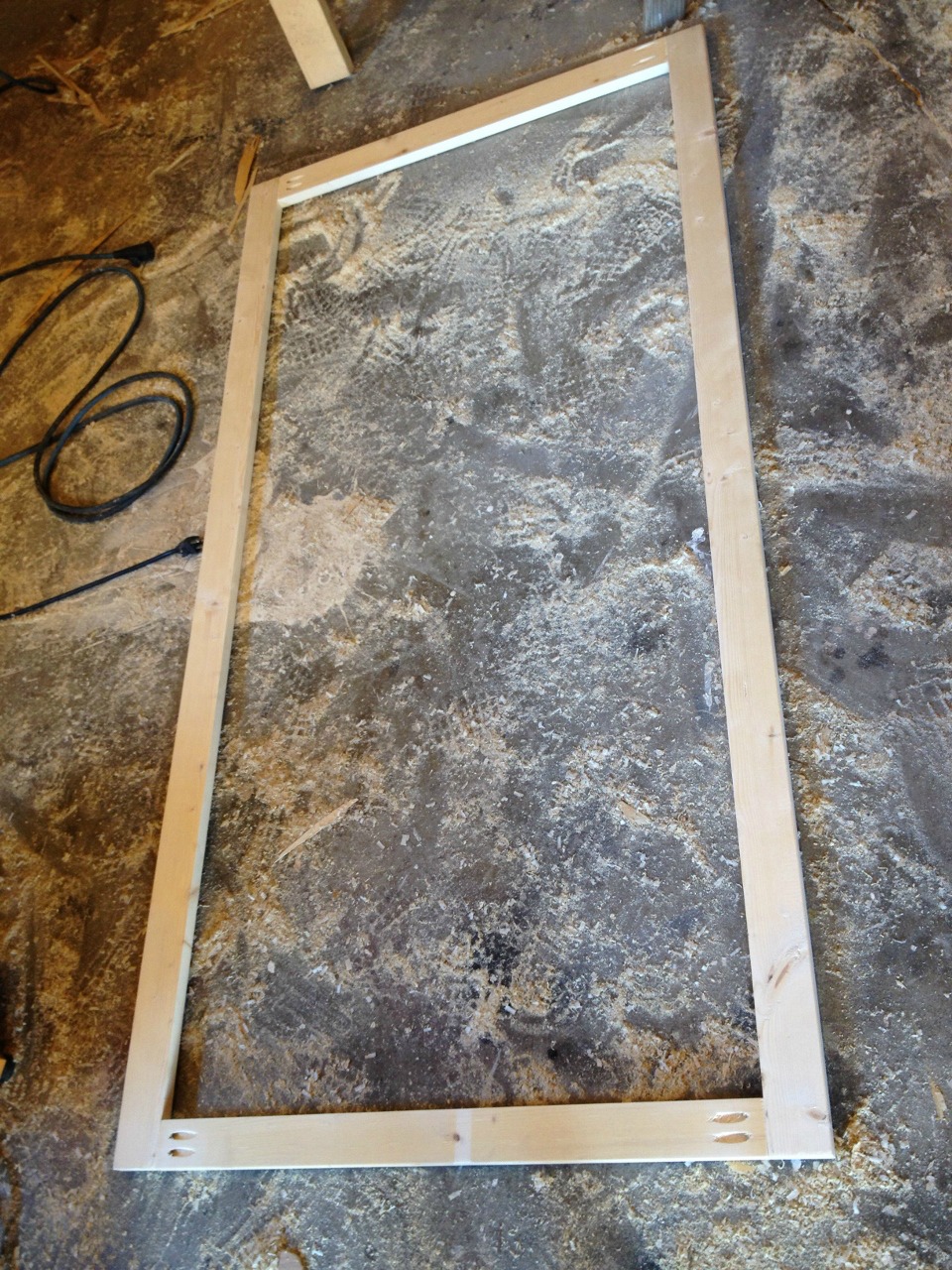
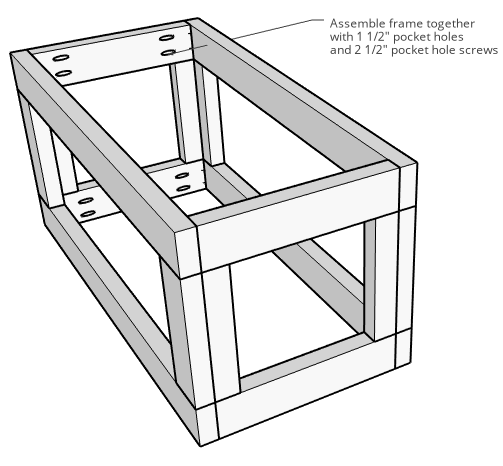
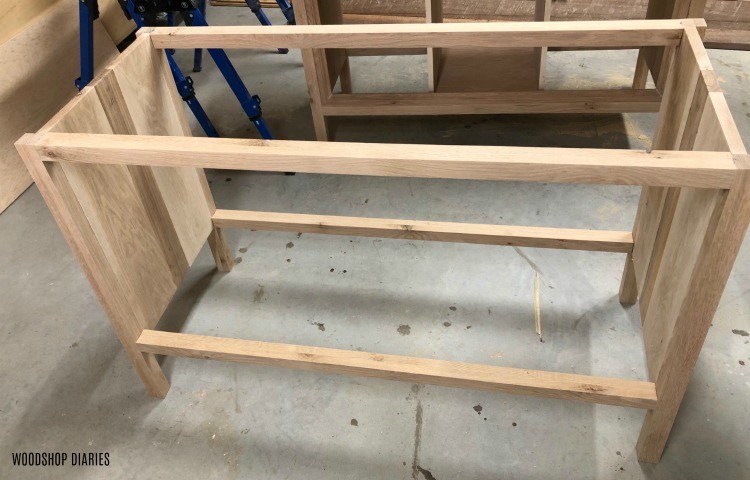
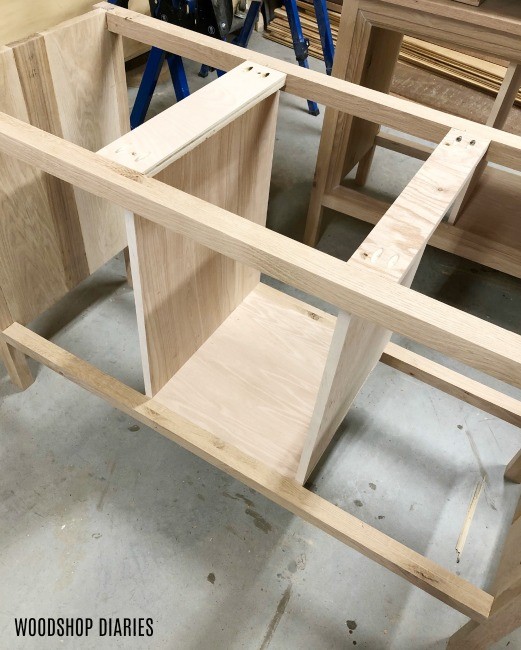
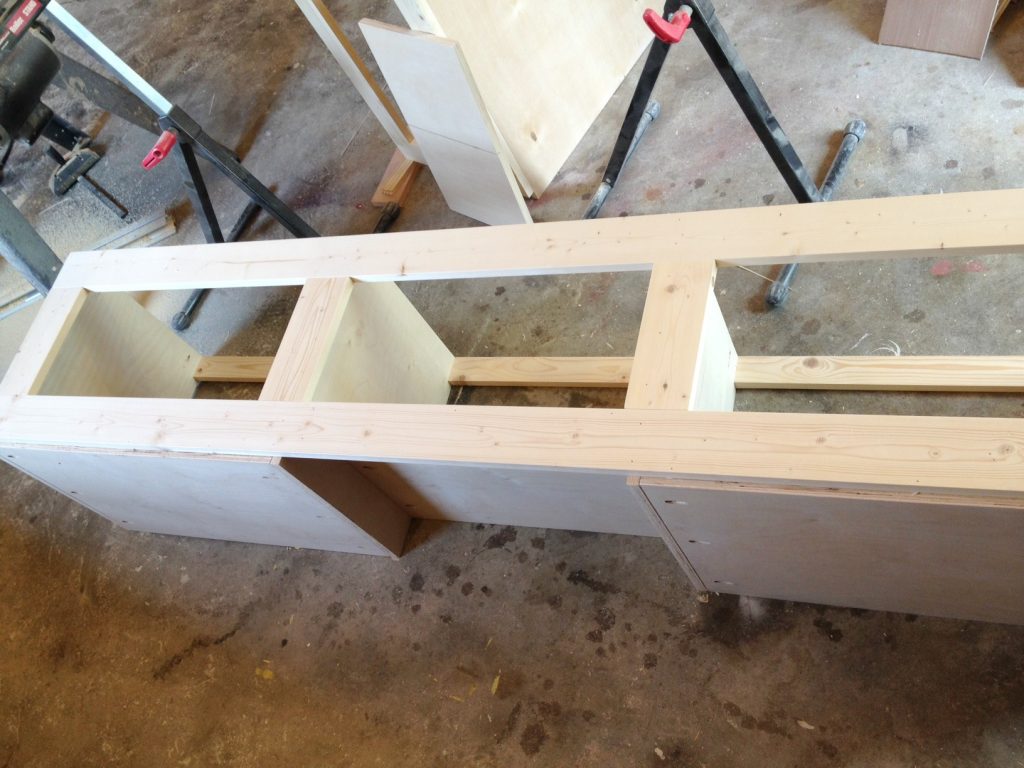
Once the glue was dry on these sides, I assembled the remainder of the cabinet frame using 2x2s.  Just like with the dresser, I assembled this with wood glue, 1 ½″ pocket holes and 2 ½″ pocket hole screws. 
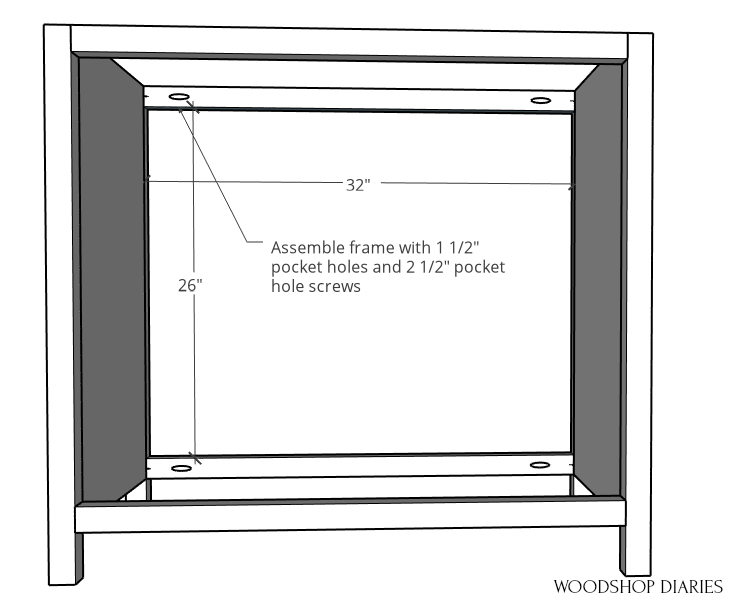
Pocket door cabinet frame assembled with 2x2s diagram with dimensions

Step 3: Add Trim to Side Panels (Optional)

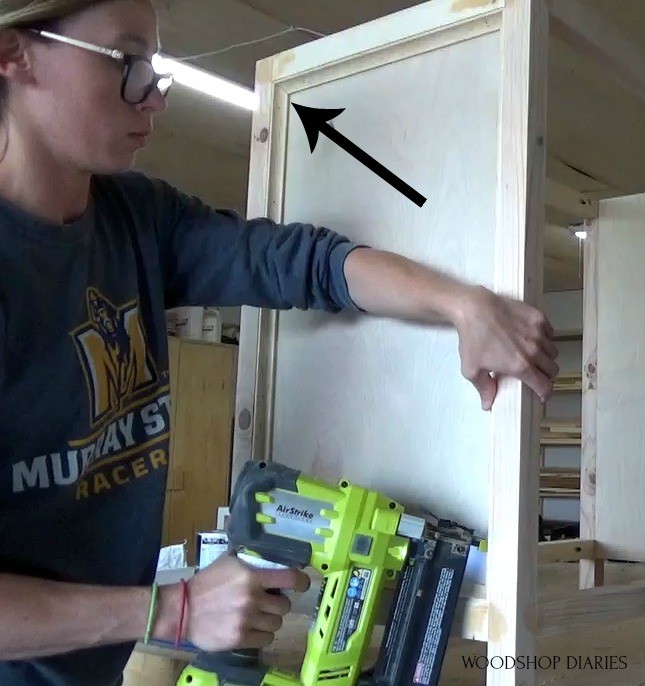
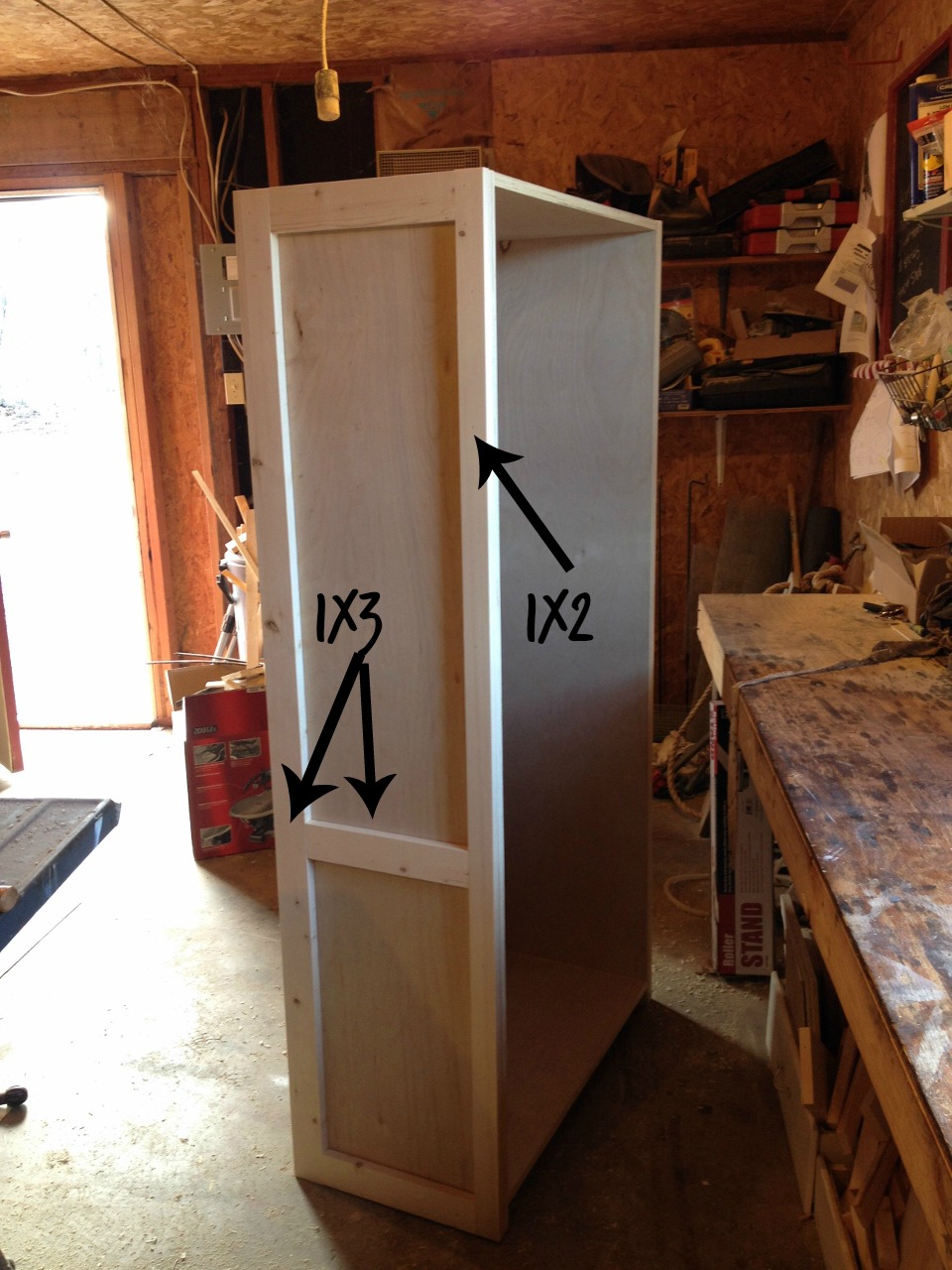
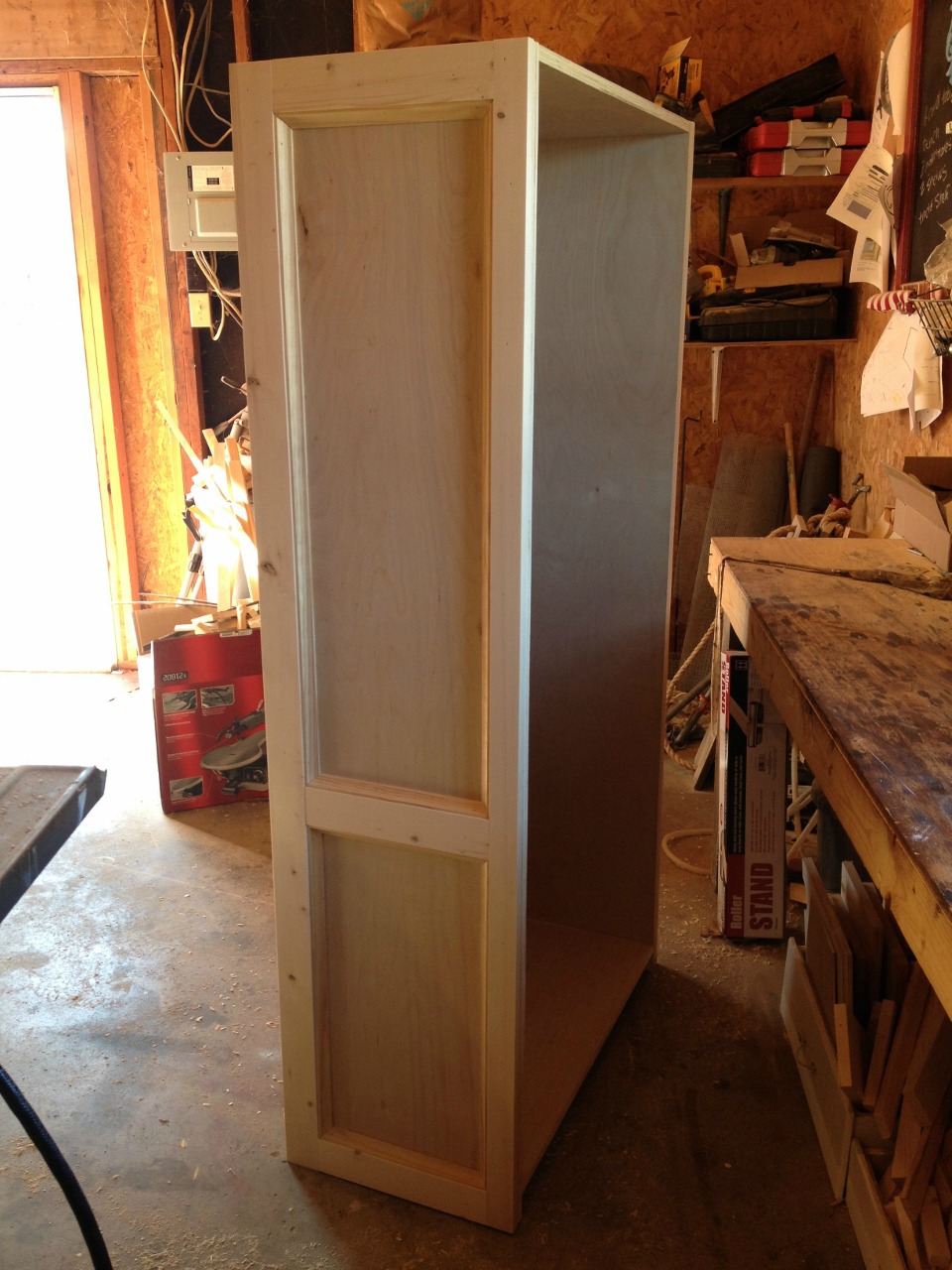
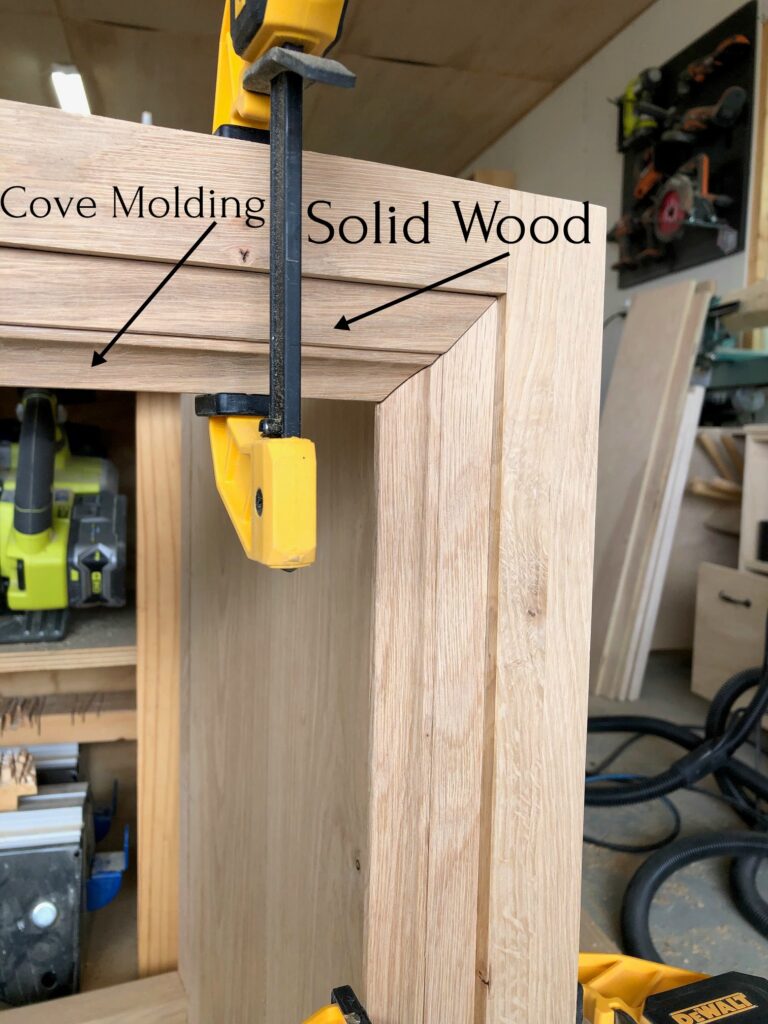
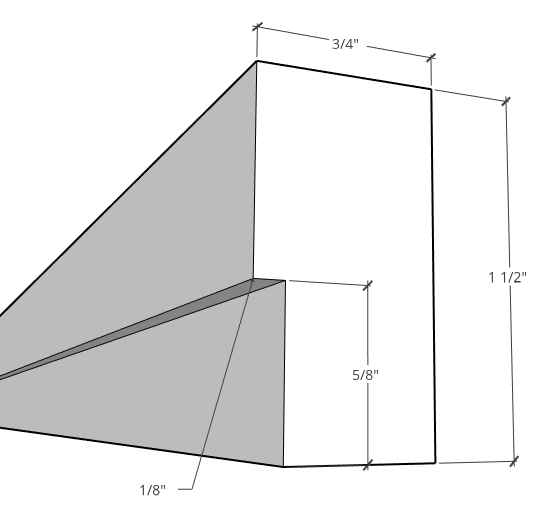
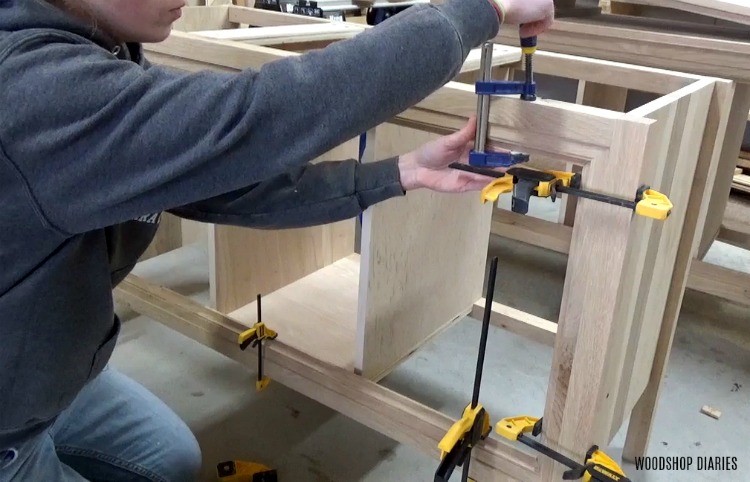
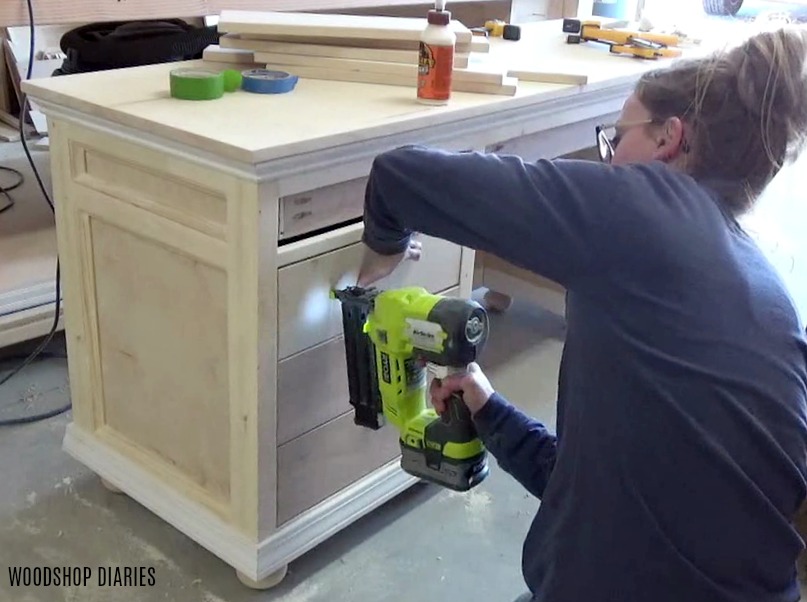
And again, just like the dresser, I glued and nailed on 1×2 trim pieces and cove molding along the sides.  That’s optional, I just thought it looked a little nicer with the trim added.
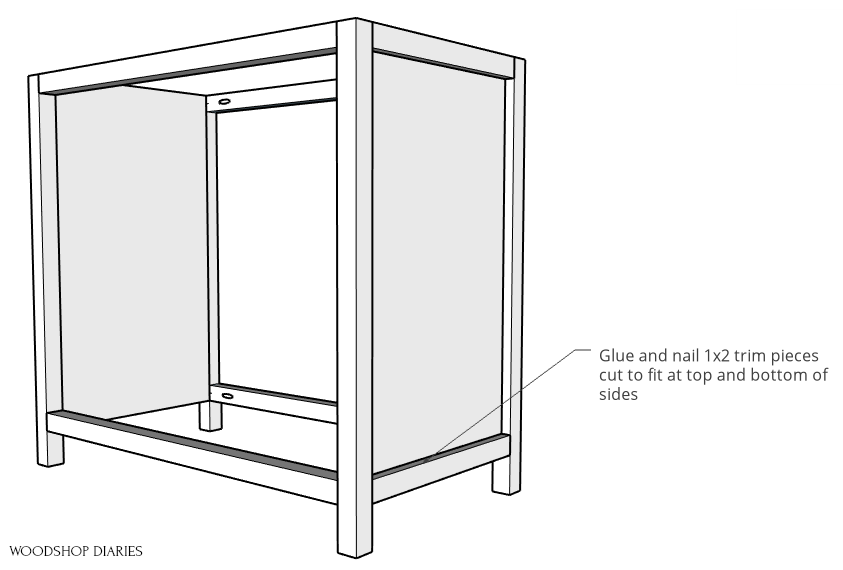
Glue and nail 1x2 trim onto the side of the cabinet panels
Shara nailing cove molding trim along side panels for extra detail

Step 4: Attach Back Panel to Cabinet

Now, finally things start to look a little different than the dresser build from the last post. This piece gets a back panel.

.

I could have just stapled the back directly onto the 2×2 frame and it would have been fine.

.

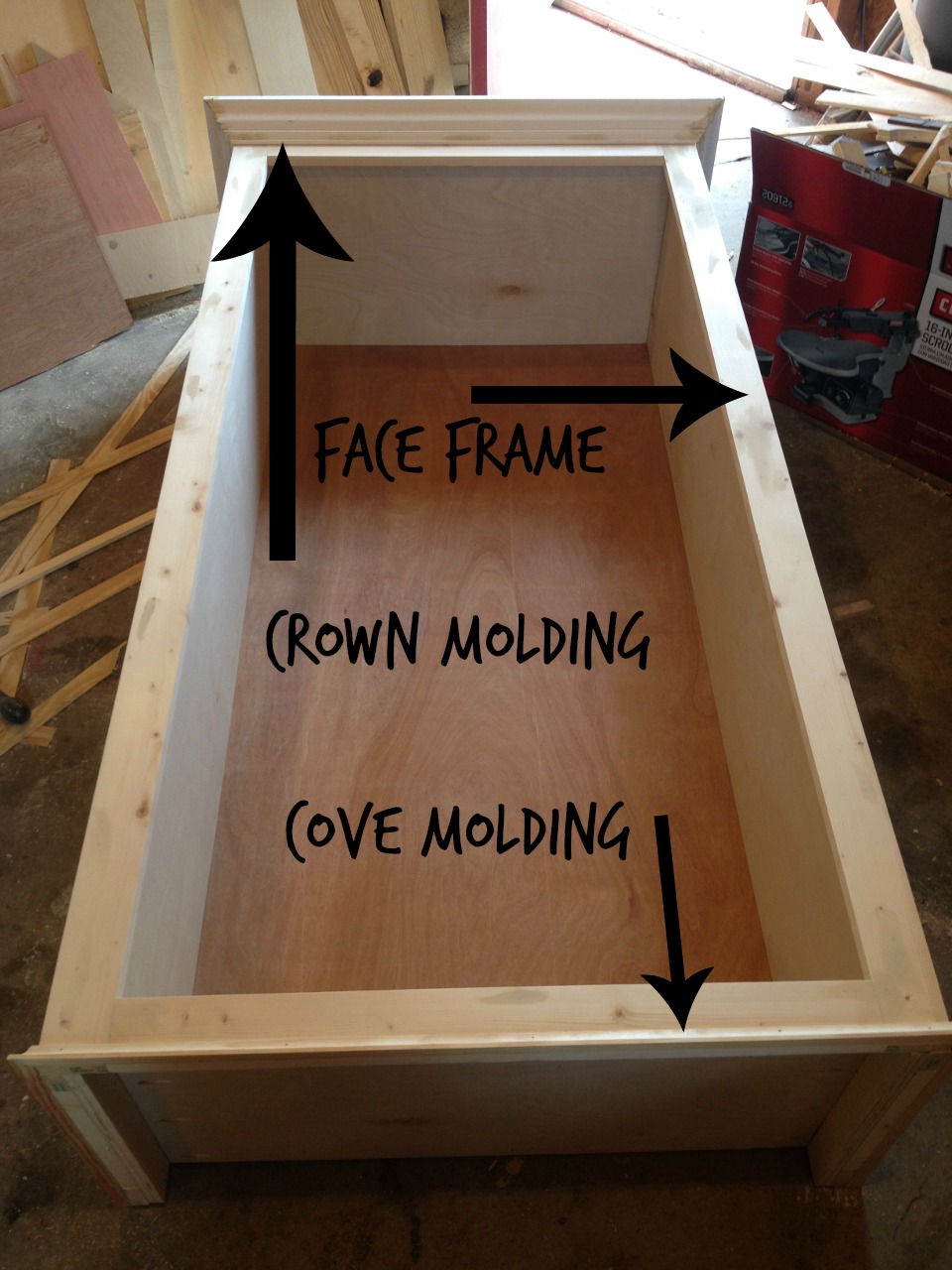
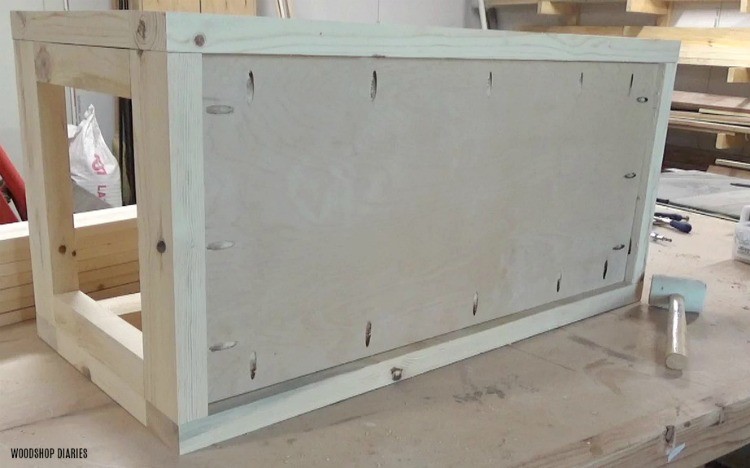
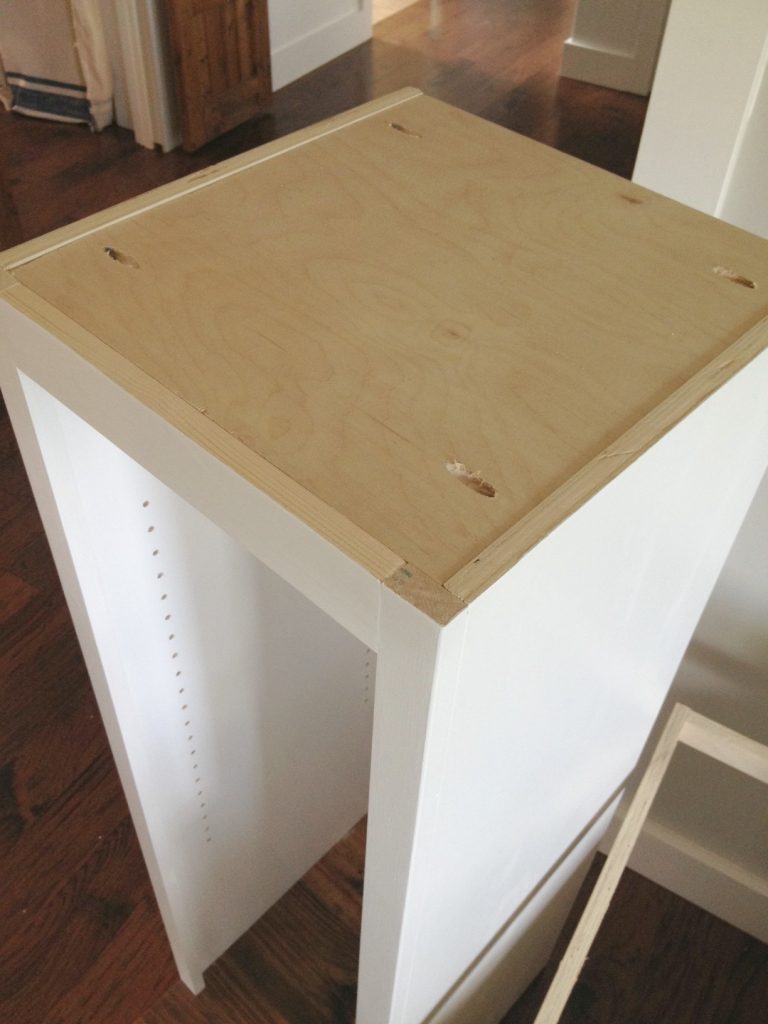
But I got a little fancy and I used a ⅜” rabbeting bit with my router to route out a groove to place the ¼” plywood backer down into so it would be flush across the back.
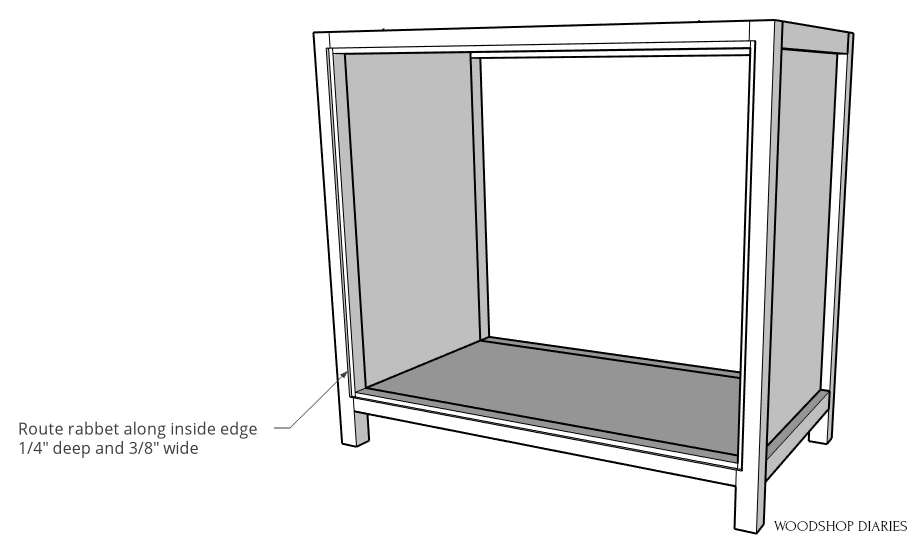
Diagram of rabbet routed along edge of pack of cabinet to install back panel

Once I had routed the groove, I used a chisel to clean up the corners and make them square.
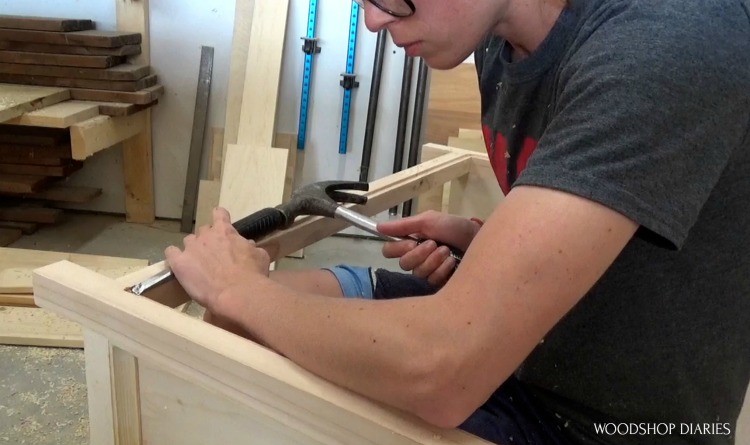
Shara chiseling out corners of rabbeted groove

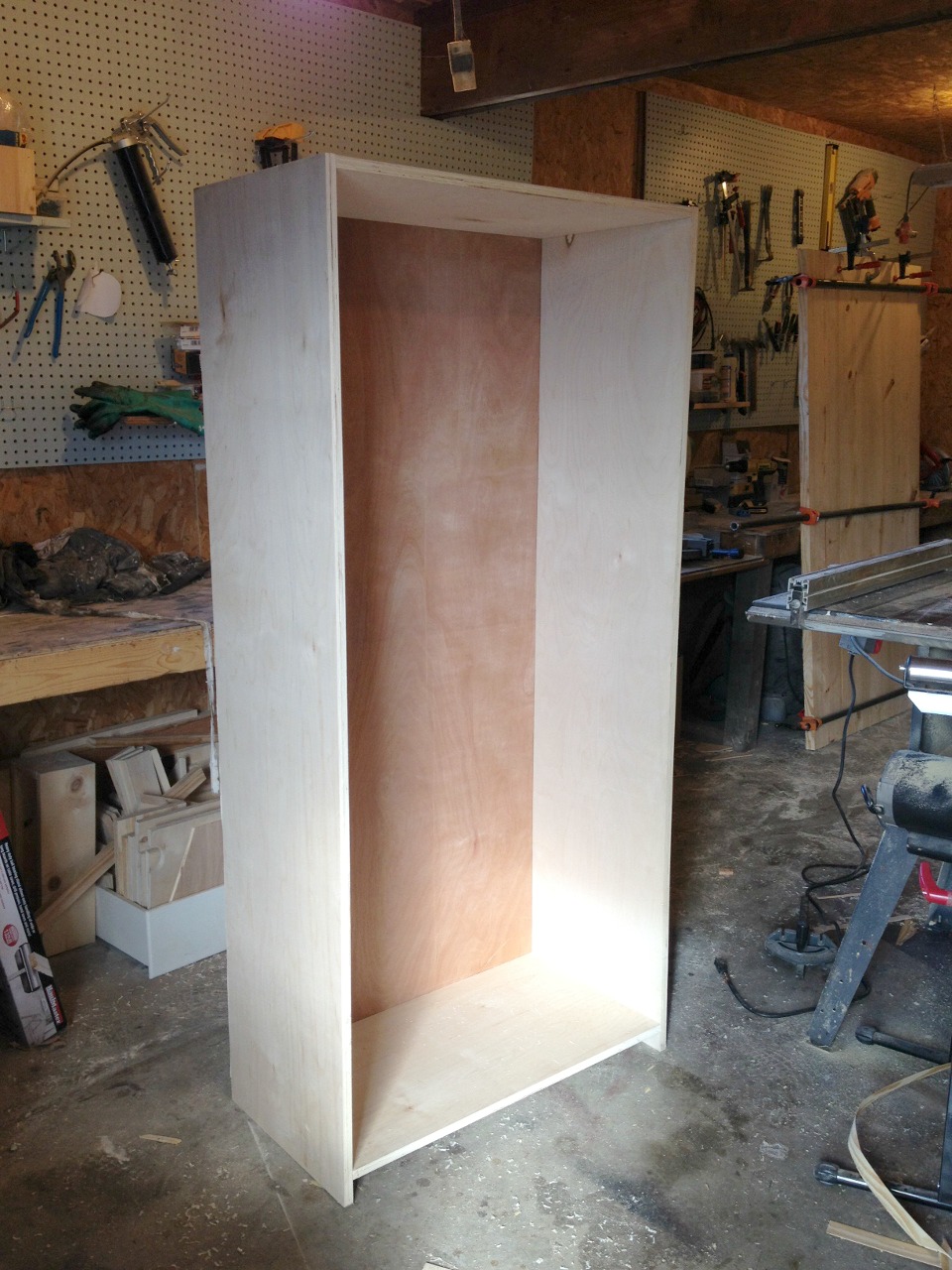
Then I cut to fit a ¼” piece of plywood and stapled it into this groove.
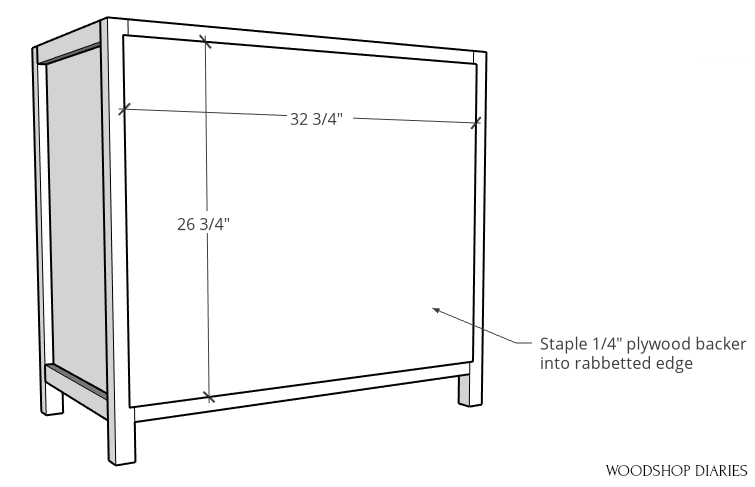
Staple ¼" plywood panel onto back of pocket door cabinet frame

Step 5: Install Pocket Door Cabinet Bottom Panel

Next, it was time to add a bottom into this cabinet.

.

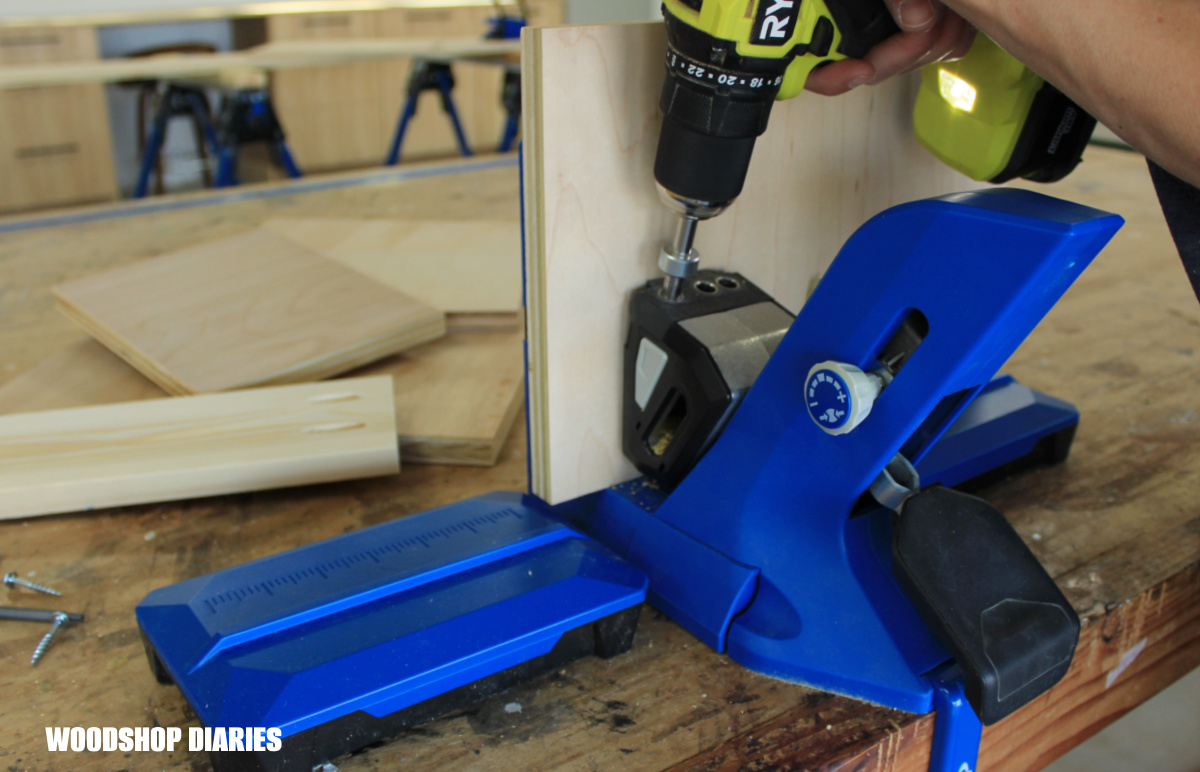
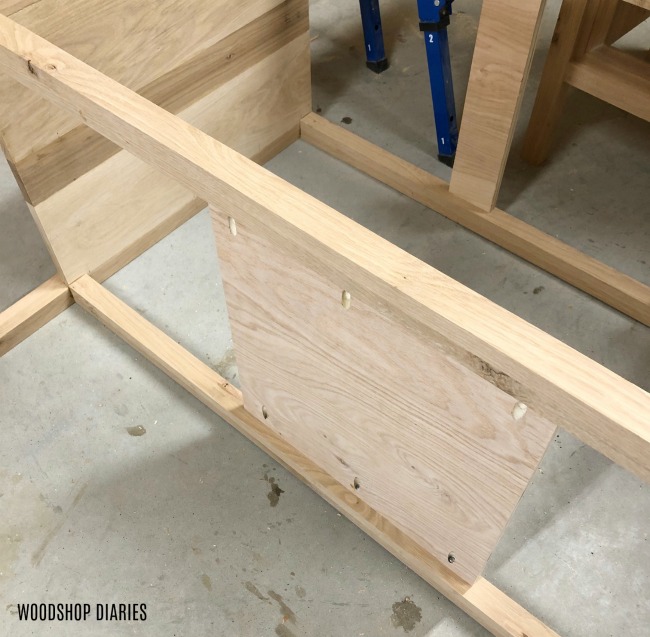
I cut a piece of ¾” plywood to fit inside the bottom frame and drilled ¾″ pocket holes along the edges.  Then, I screwed this in place with 1 ¼″ pocket hole screws so that it was flush with the top of the frame pieces.
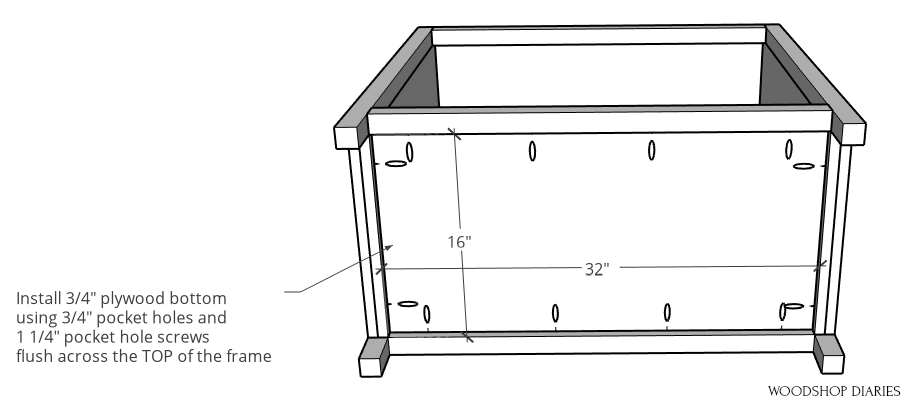
Bottom panel of pocket door cabinet installed using pocket holes and screws diagram

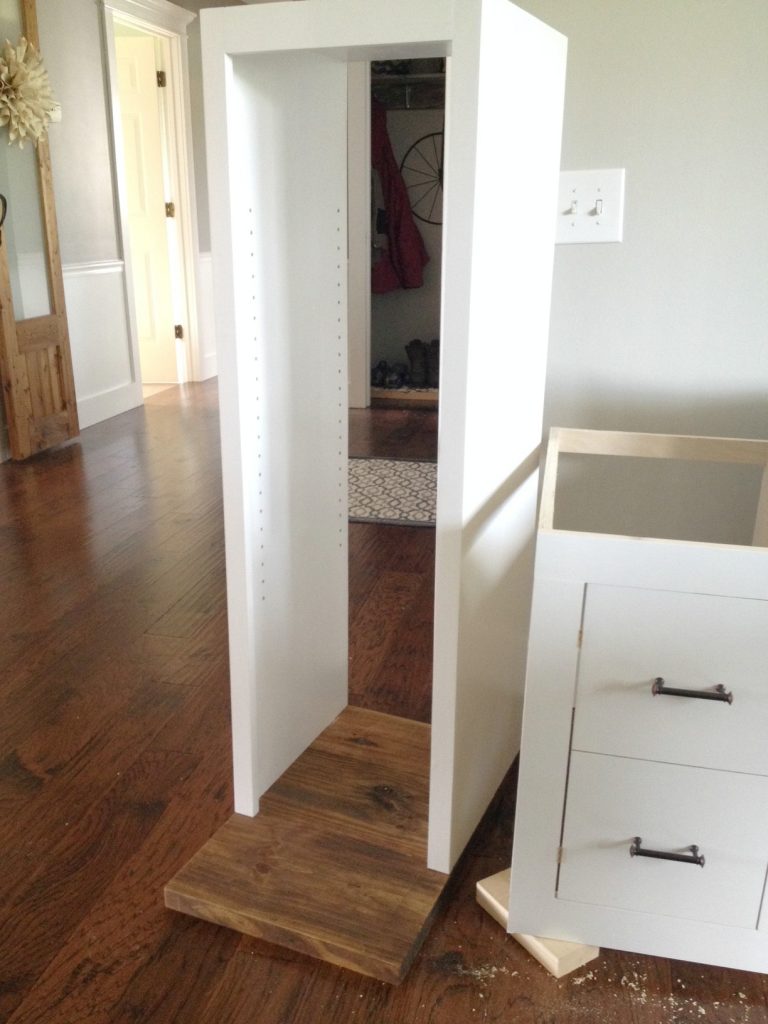
At this point, it’s best to go ahead and finish the inside however you wish.  So I went ahead and painted everything white to match the dresser frame from the last post.

Step 6: Install the Pocket Doors

Once the paint was dry, it was time to start adding everything that will go INSIDE the cabinet.

.

First was the doors.

.

You could use my tutorial to build a paneled door for this project to dress it up a little, but I simply cut my doors from ¾″ plywood for a solid panel style door. I edge banded them before finishing.
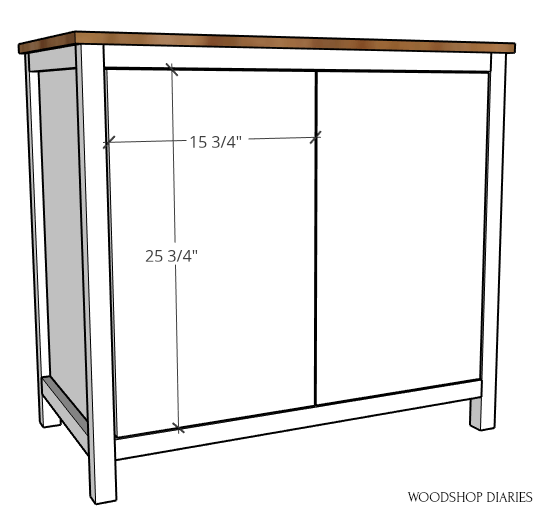
Door dimensions of pocket door cabinet diagram

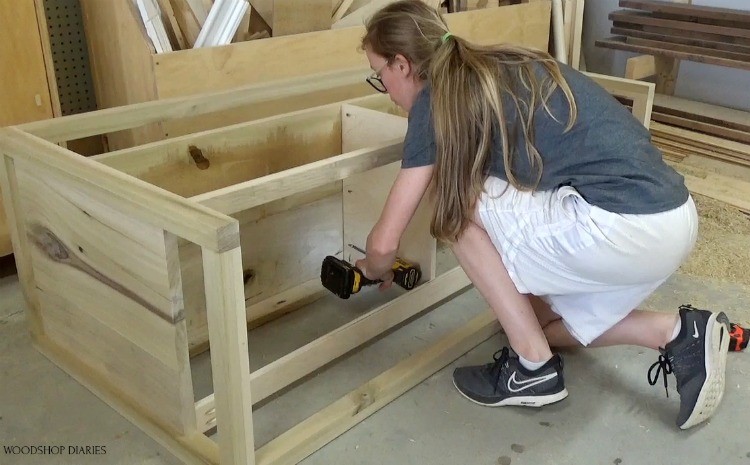
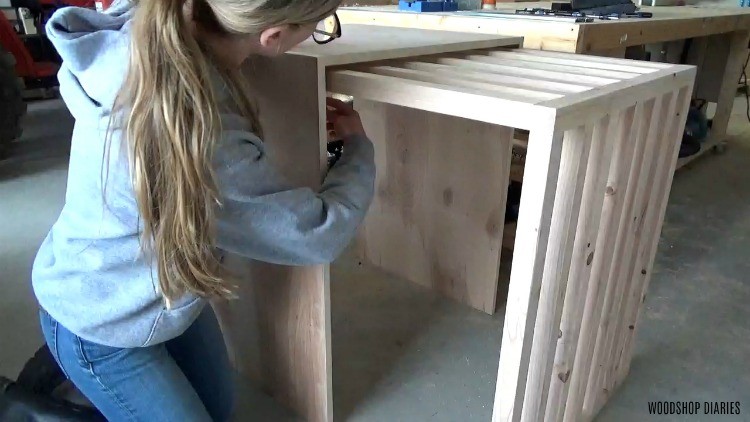
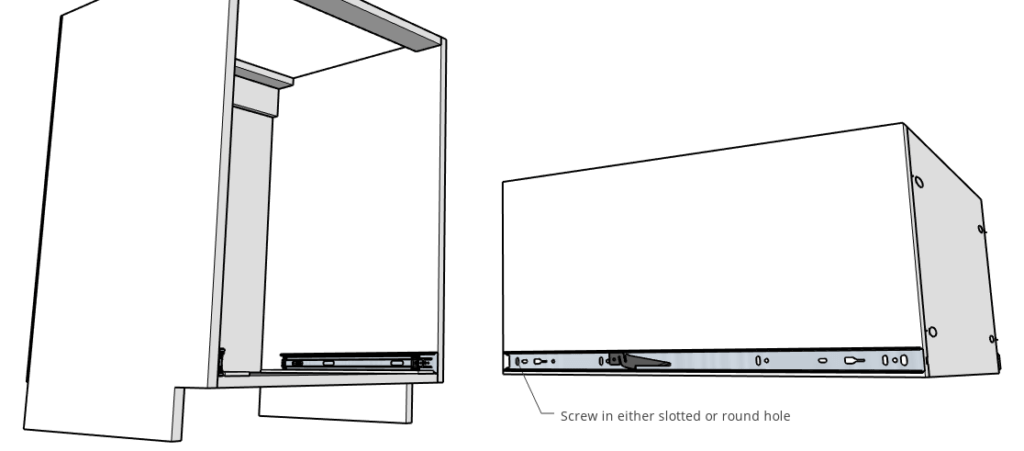
I installed these doors using pocket door hardware so they would open up and slide back into the cabinet.  This was a nice touch, but there was a bit of a learning curve.

.

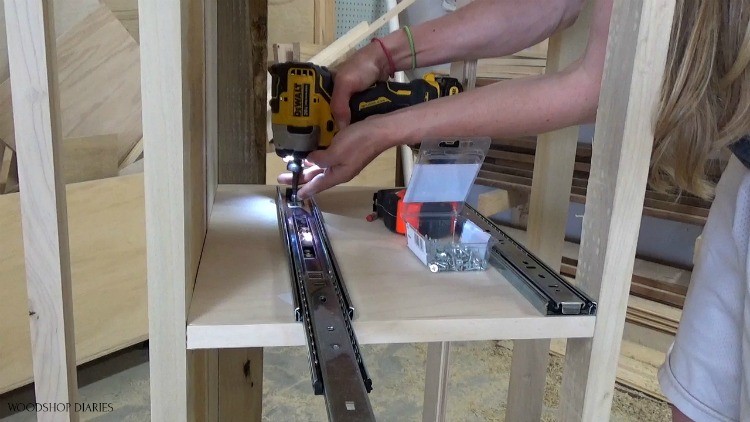
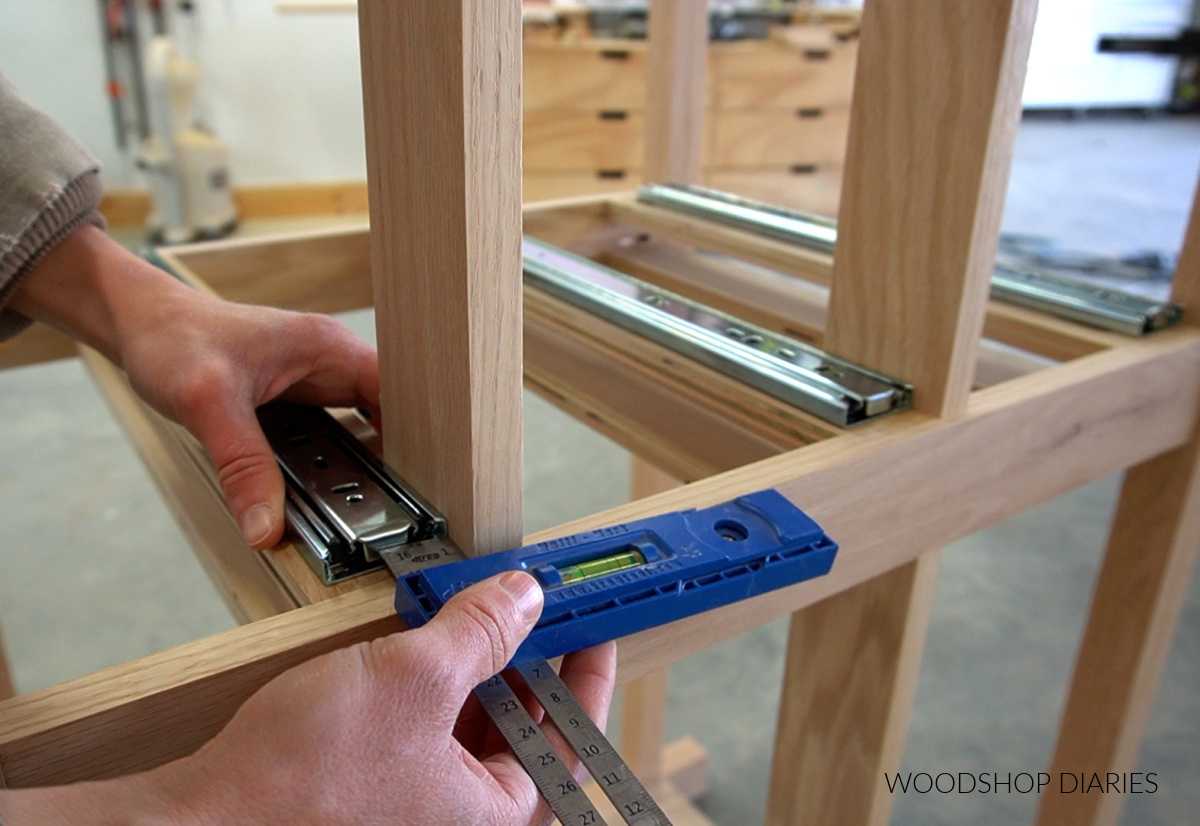
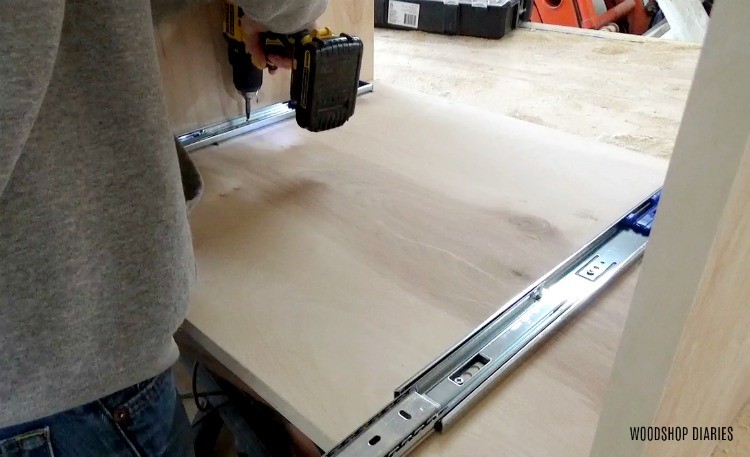
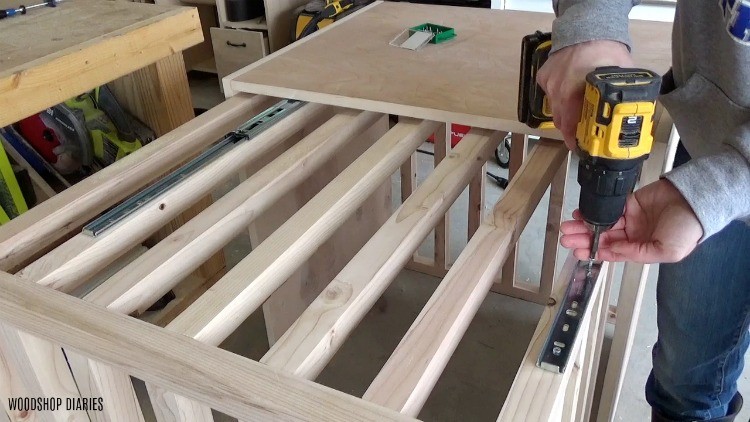
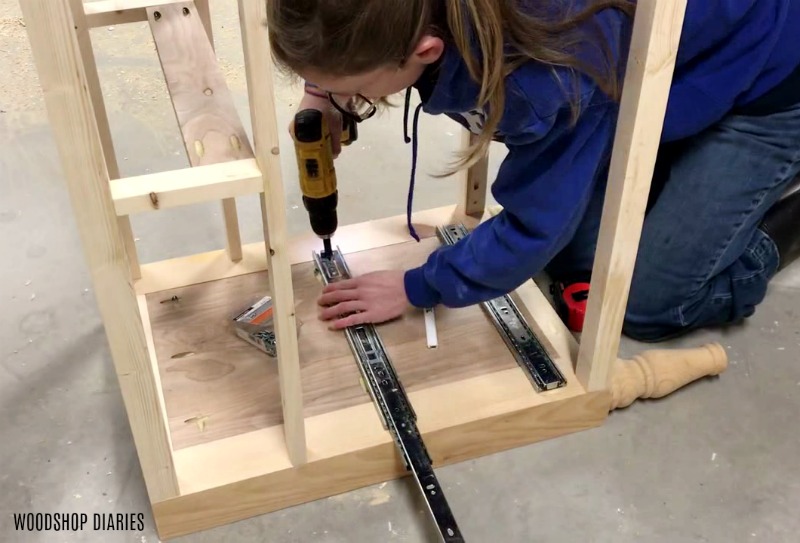
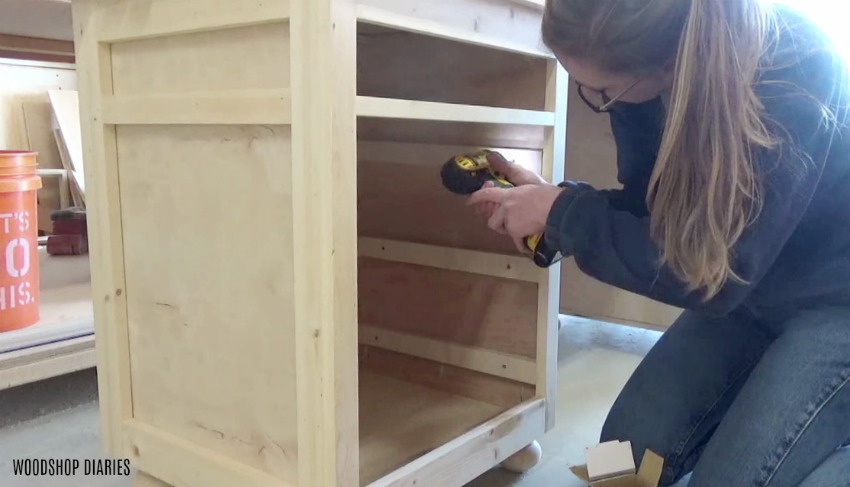
This is a link to the exact slides I used.  The instructions that come with them were very well written and easy to follow.  You have two sides per door—one is installed at the bottom and one at the top of the cabinet.
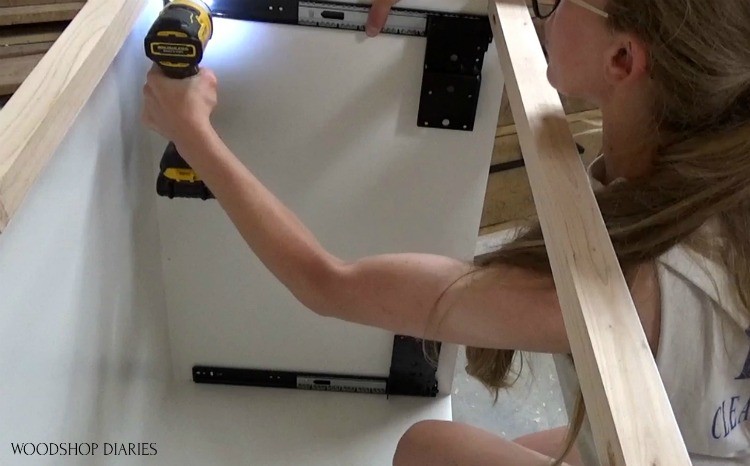
Shara Woodshop Diaries installing the sliding pocket door hardware into cabinet sides

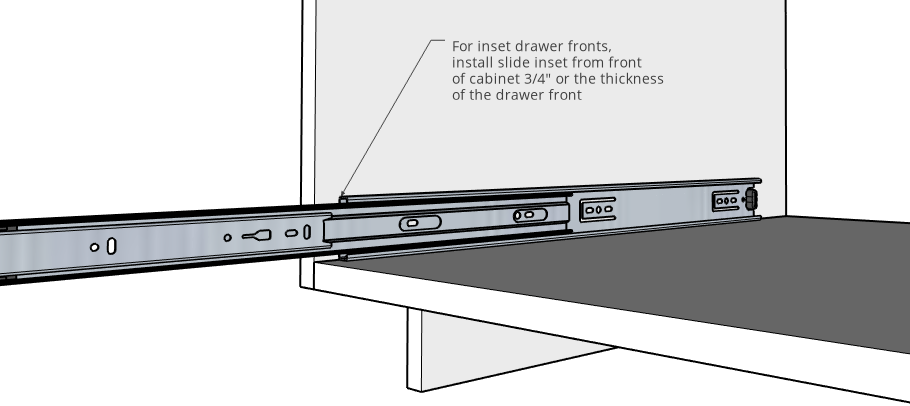
The instructions tell you where to place the slides based on the thickness of your door and whether it’s inset or overlay.  In my case, my doors were ¾” thick and were inset, so the slides were placed 1” inset from the front edge.

.

Once the slides were installed into the cabinet, I cut a scrap piece of 1×4 to screw between the slides like shown. (All of this is in the instructions that come with the slides.)
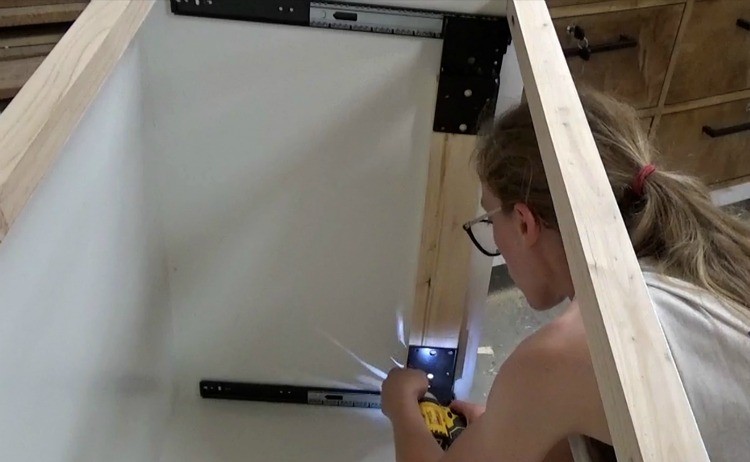
Installing scrap board between pocket door slides

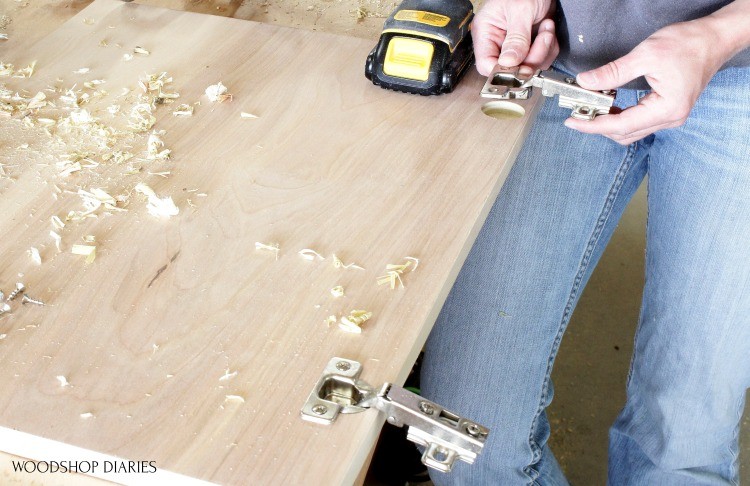
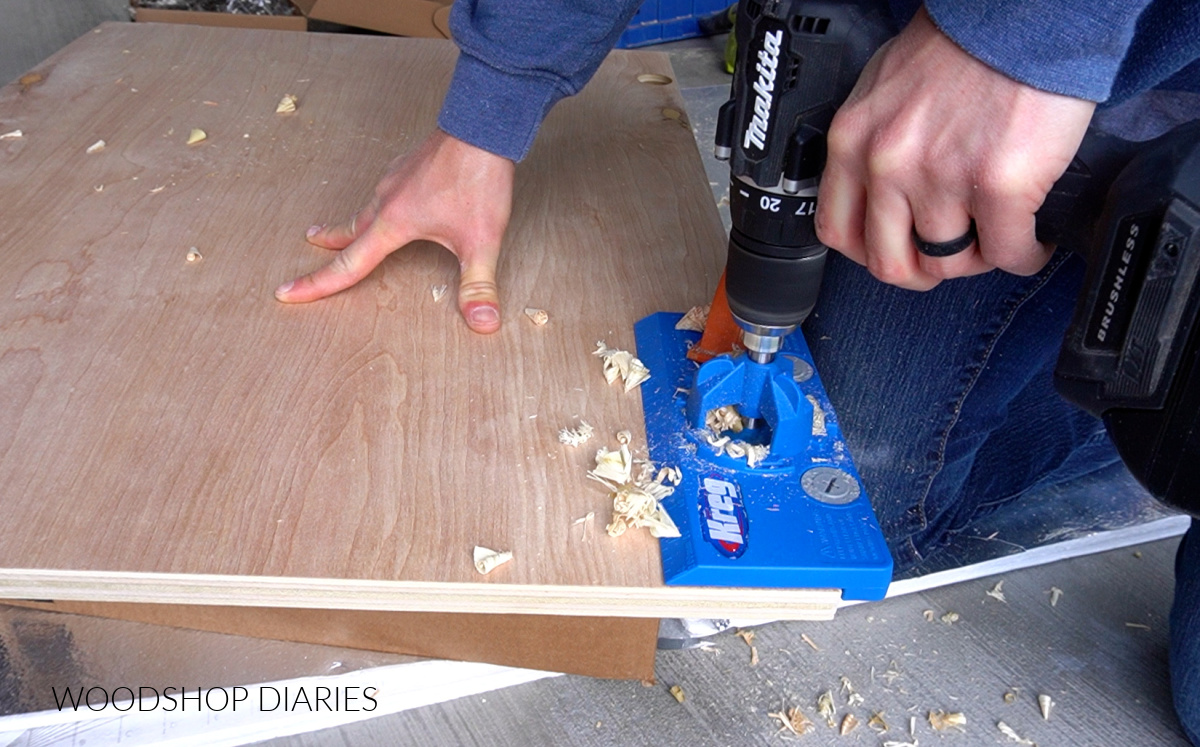
Now, I had to drill the concealed hinge holes in my doors and install them onto the slides.  This is where I had some issues.

.

I realized after the fact that they make specific hinges for this type of slide. The hinges I used, were just generic inset hinges.

.

So I’m guessing maybe this isn’t an issue if you use the correct type of hinge, but according to the instructions, I should have drilled my hinge cup holes 5 mm from the door edge. 

.

I did this on a few test pieces first, and that ended up leaving about ¼” between the cabinet frame and the door.
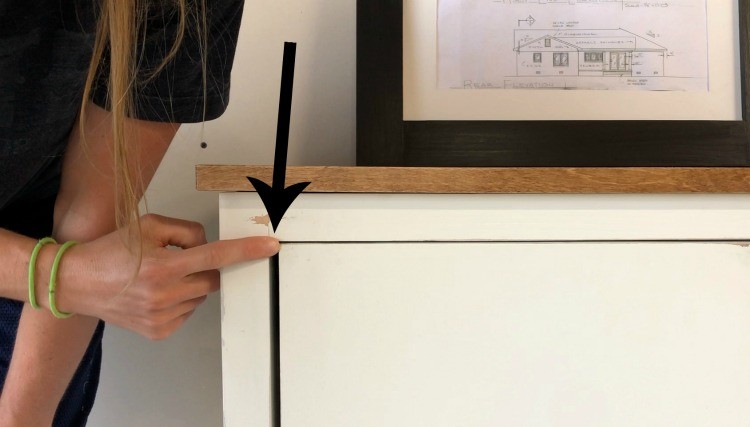
¼" gap on sides of door with ⅛" gap on top of door close up

Typical gaps should have been about ⅛”.  I tried to move my hinge cup hole further in to narrow the gap, but my concealed hinge jig only goes to 5mm.

.

I ended up removing part of my jig and drilling them 6mm in, but it didn’t make much difference. Check out the YouTube Video for more details.
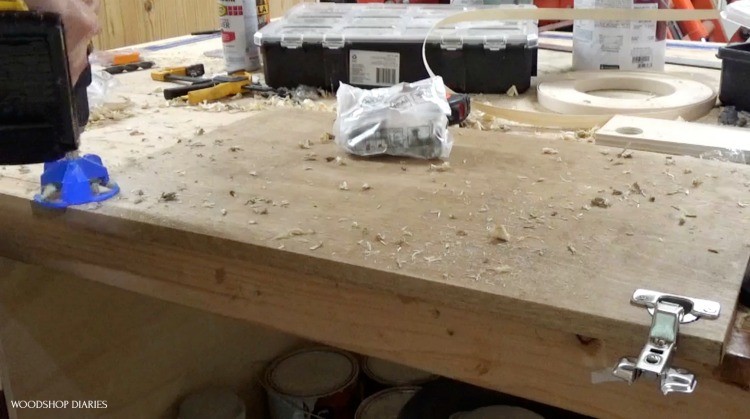
Drilling concealed hinge cup holes into cabinet doors

Long story short, these hinges may be a better option to use with these slides.

.

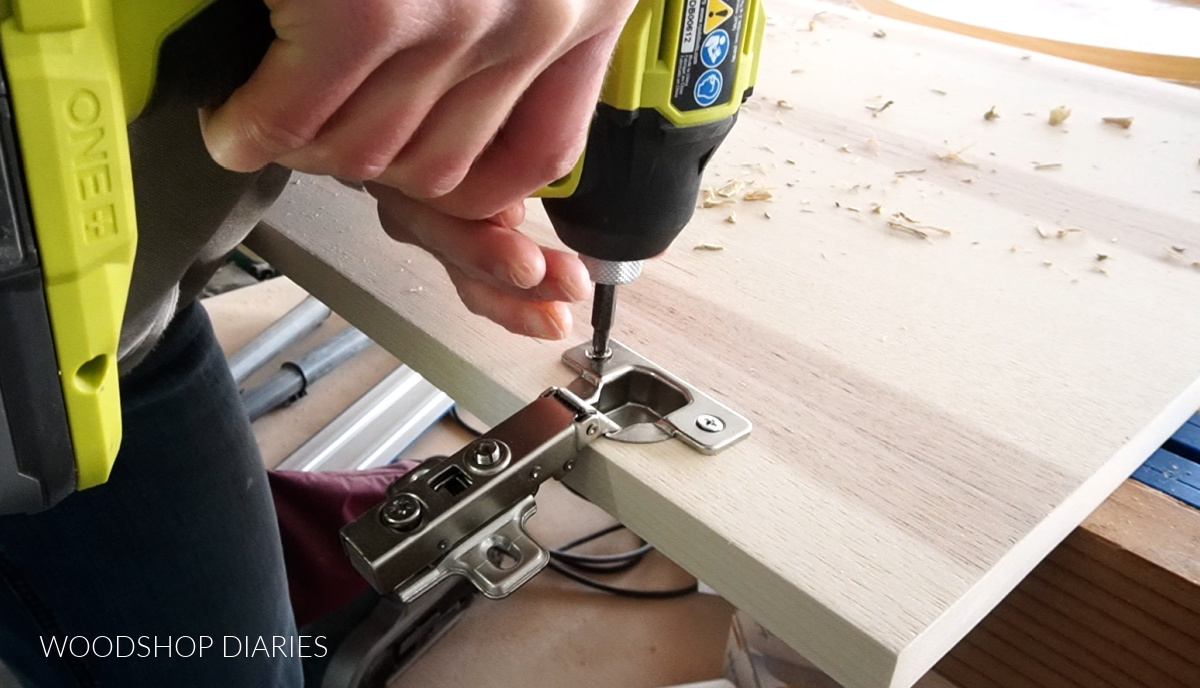
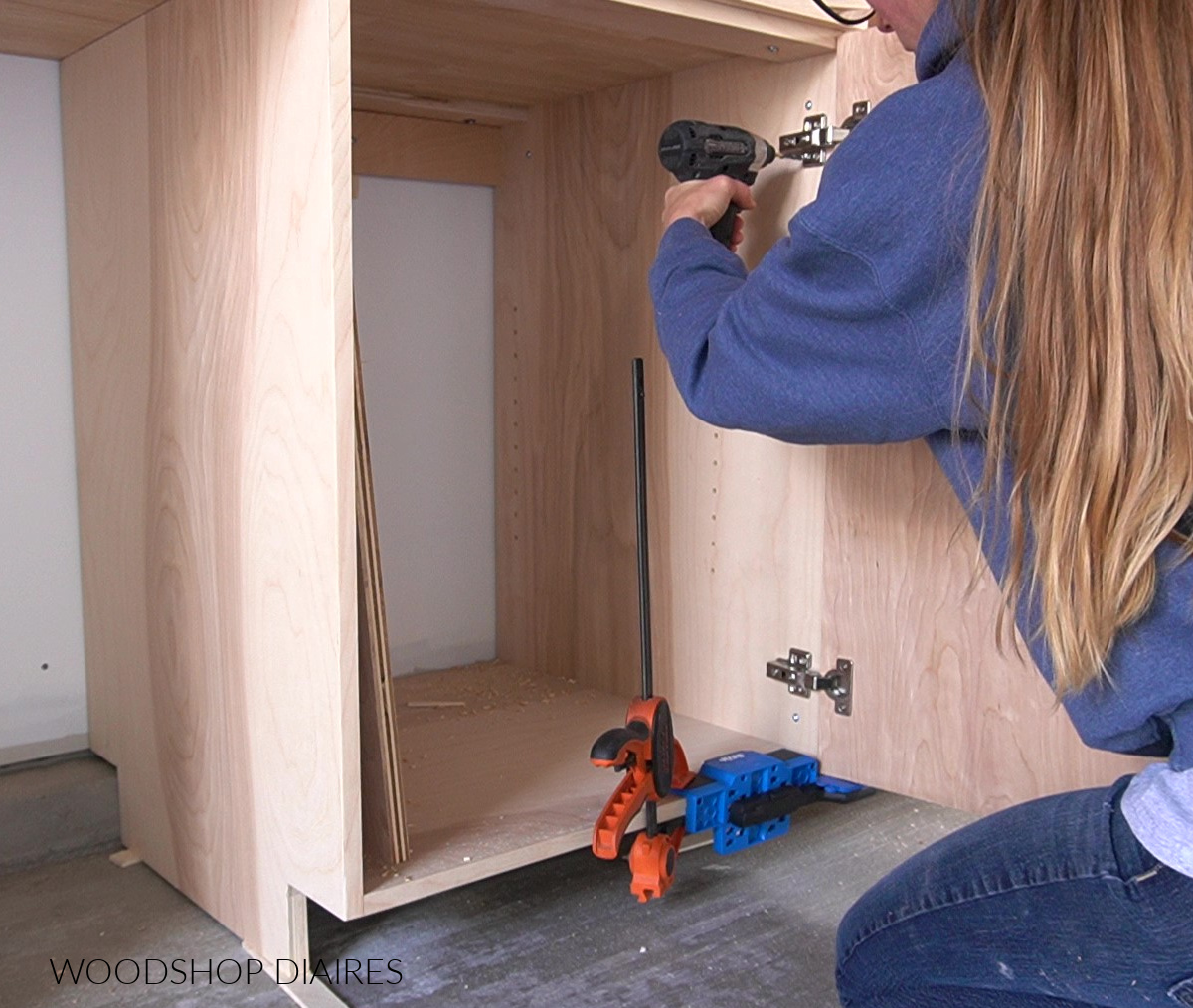
Anyway, once the hinges were attached to the door, I used the included screws to attach the hinges onto the slides.
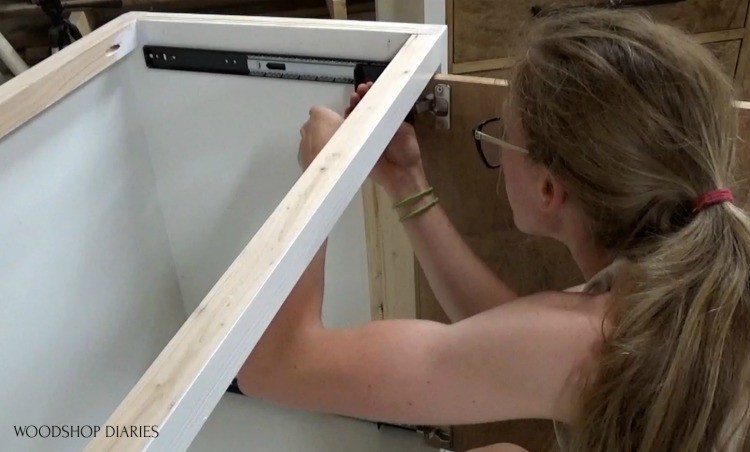
Installing doors onto pocket door slides

Besides the gap issue (which was my own fault), these were really easy to install and work really well.  I highly recommend them, but they are a little pricey.  Hardware always is, I suppose.

.

NOTE: You’ll see I stained the doors above. I changed my mind and removed them later and painted them white to match the cabinet.

Step 7: Install the Inner Shelf Panels

Once the doors were installed, it was time to add what I like to call the “guts” of the cabinet—the shelves inside.

.

Typically, I would just use shelf pins and drill holes for adjustable shelves, but since these doors slide into the cabinet, I basically had to build a cabinet inside the cabinet.

.

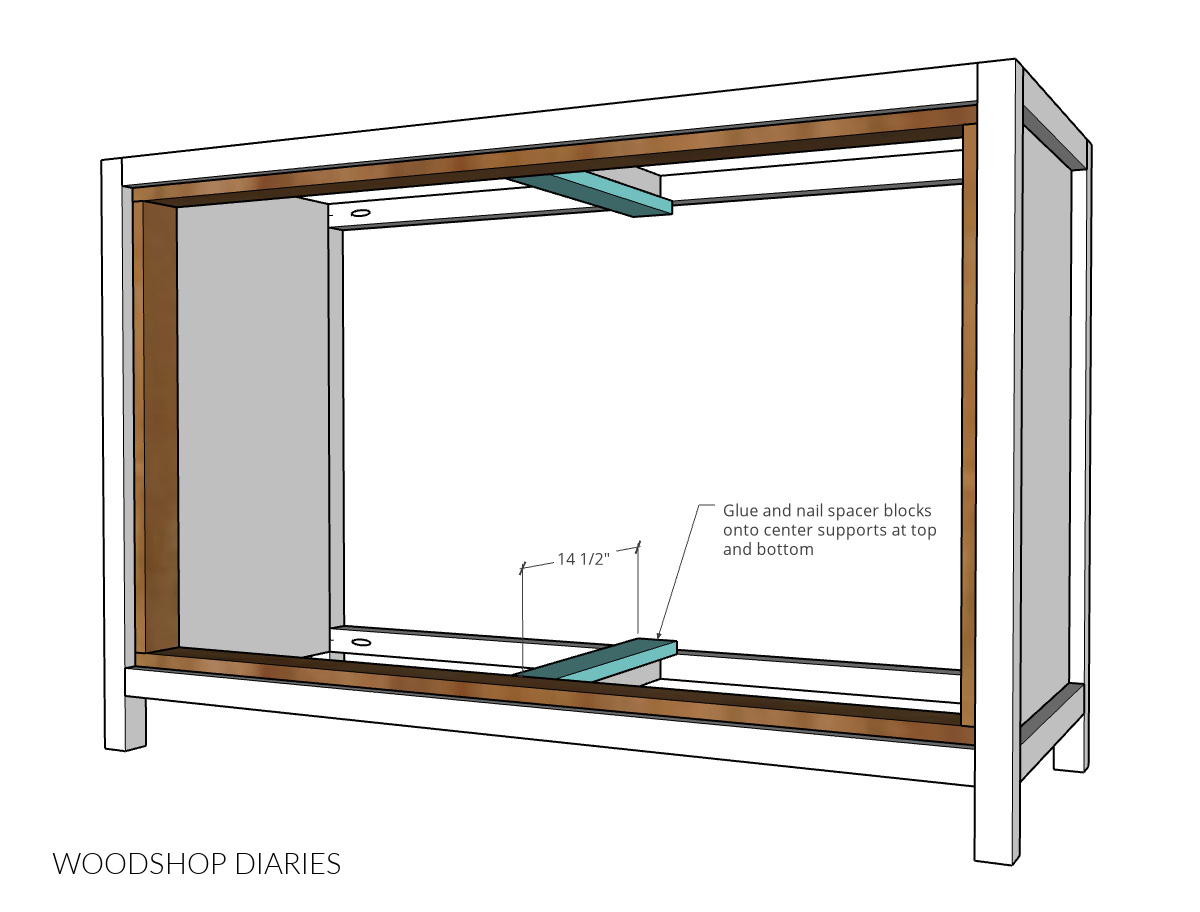
First, I used some scraps at the top here.  I used 2x4s in my project, but I could have used 2x2s, but I was lazy and didn’t want to cut them in half haha. I’m showing this using 2x2s here.
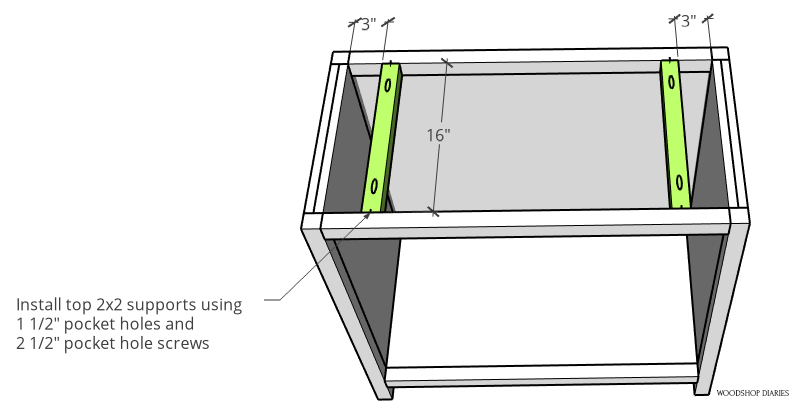
Diagram of 2x2 top supports in cabinet frame

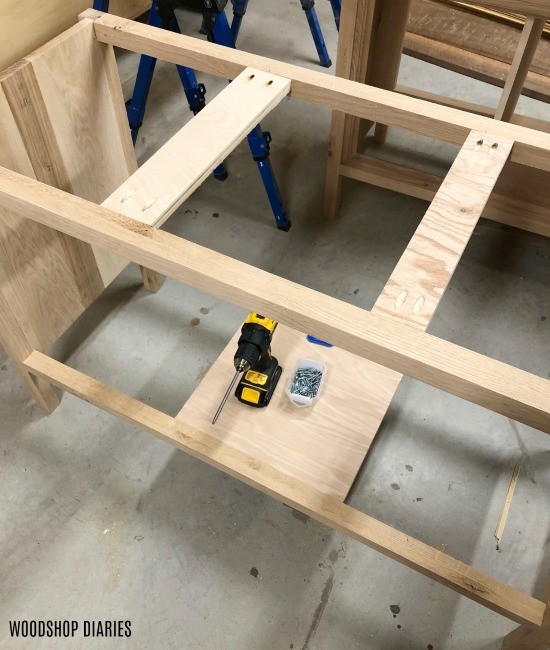
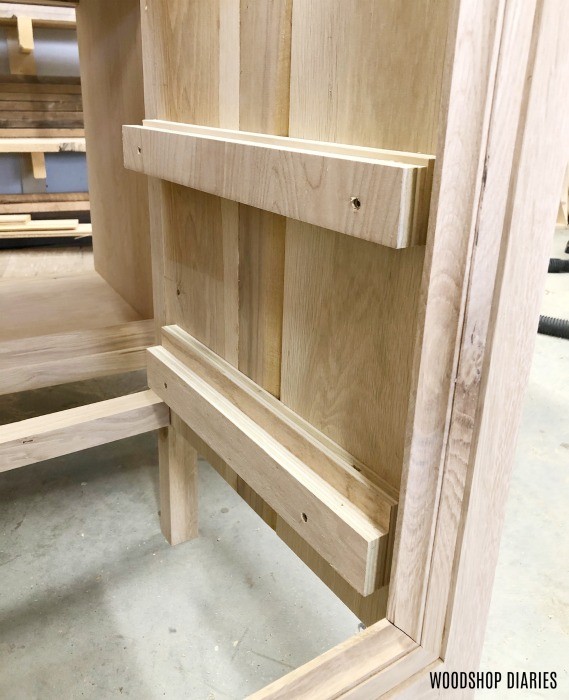
I simply pocket hole screwed them between the frame at the top leaving about 3” open on the sides. These blocks are only here to secure this next piece I added here.
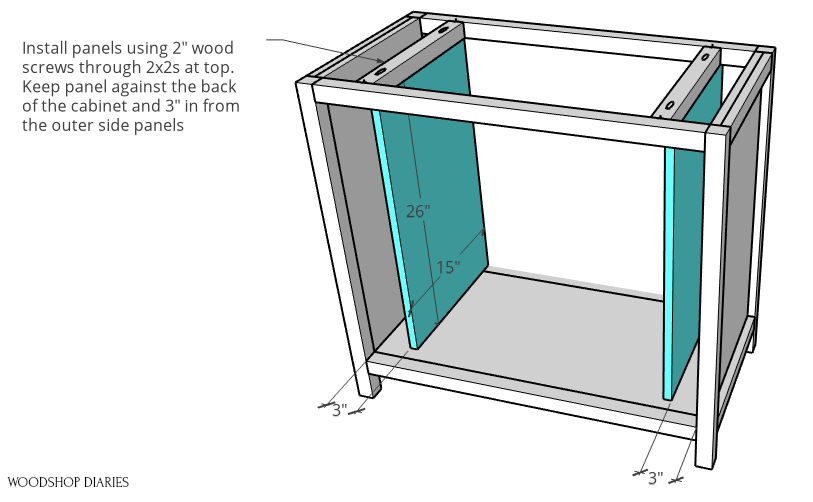
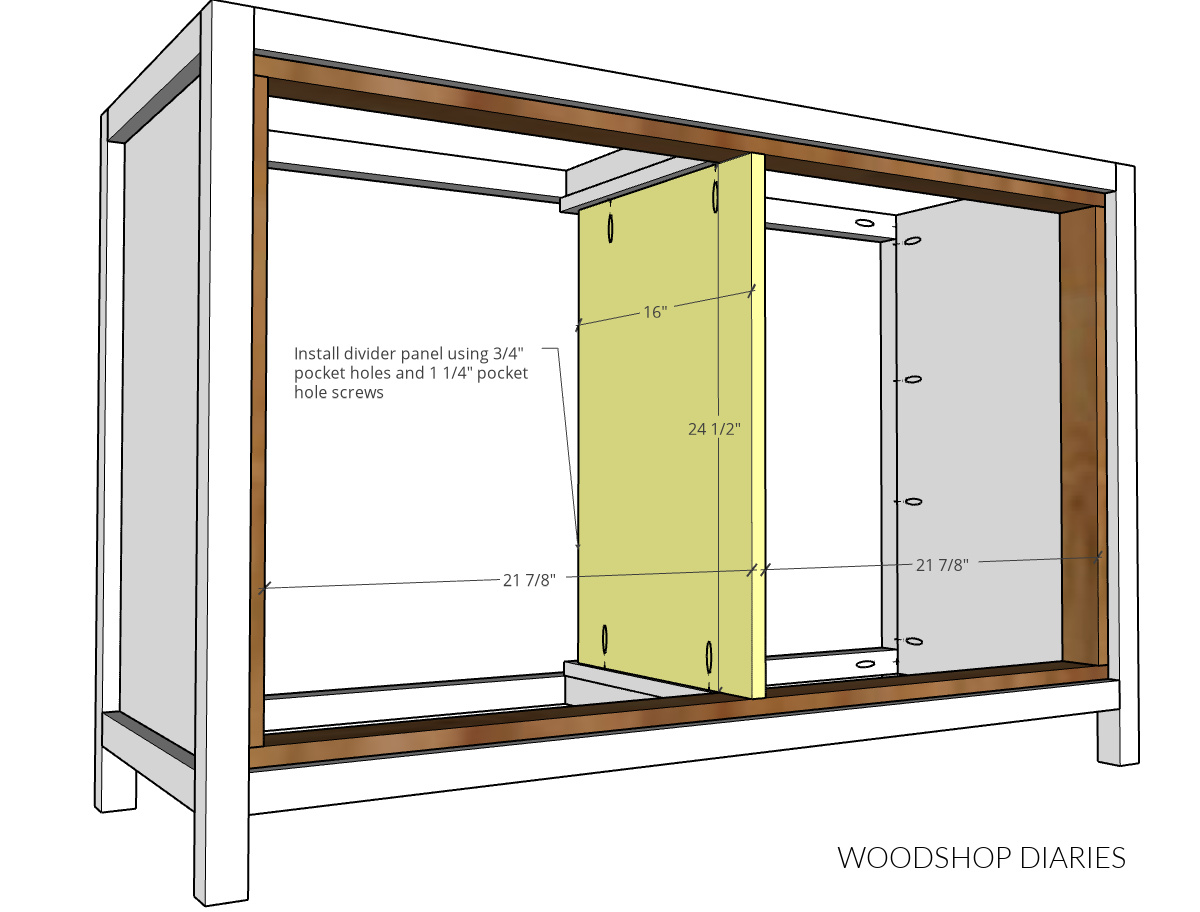
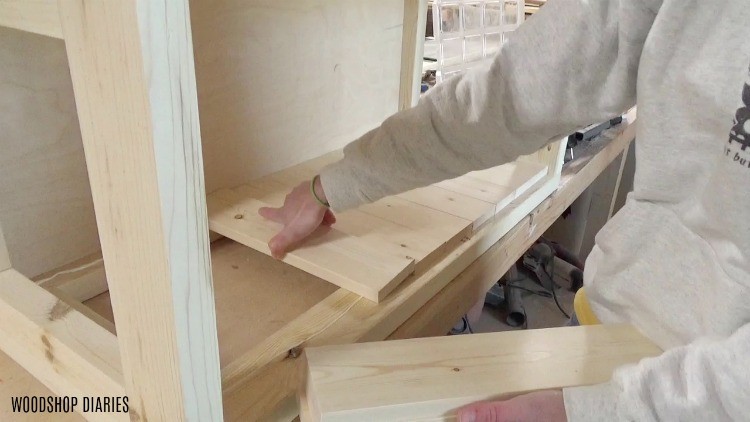
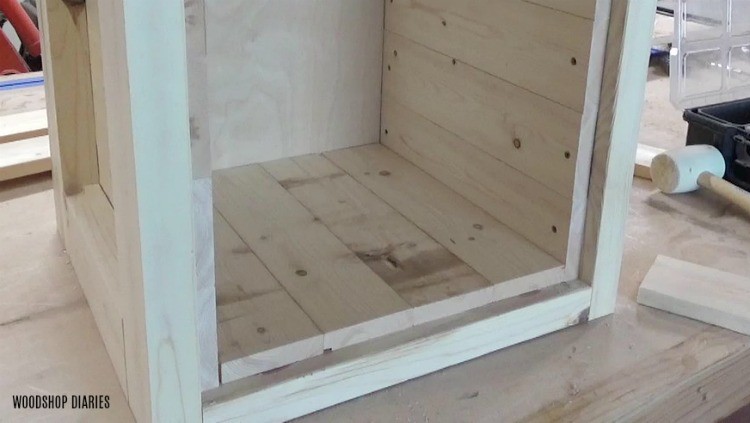
Installing inside panels for pocket door cabinet

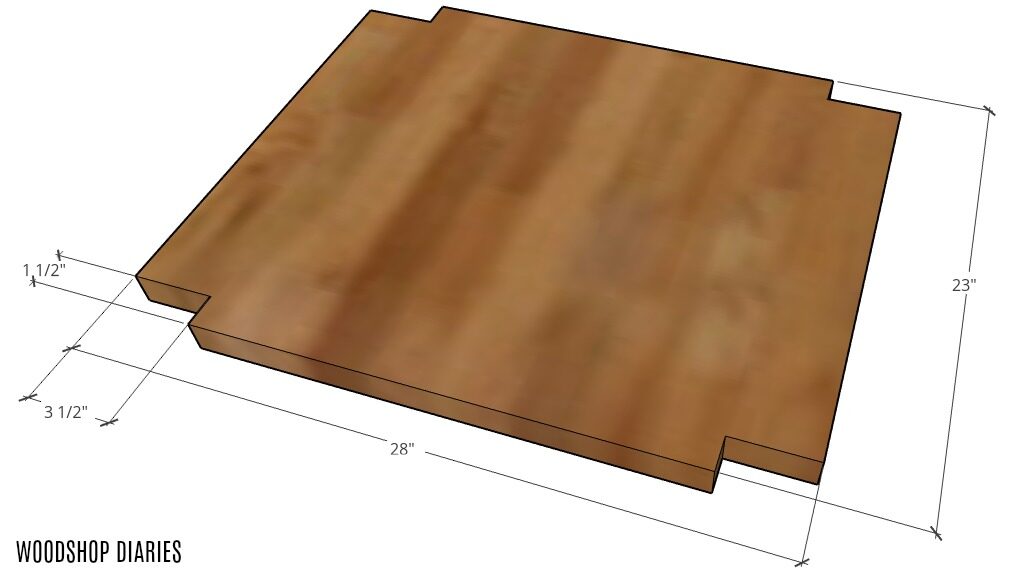
I installed ¾” plywood panels between the bottom cabinet panel and these 2×2 blocks using wood screws.  I edge banded the front edge and stained them before installing because it would have been difficult to do so after the fact.
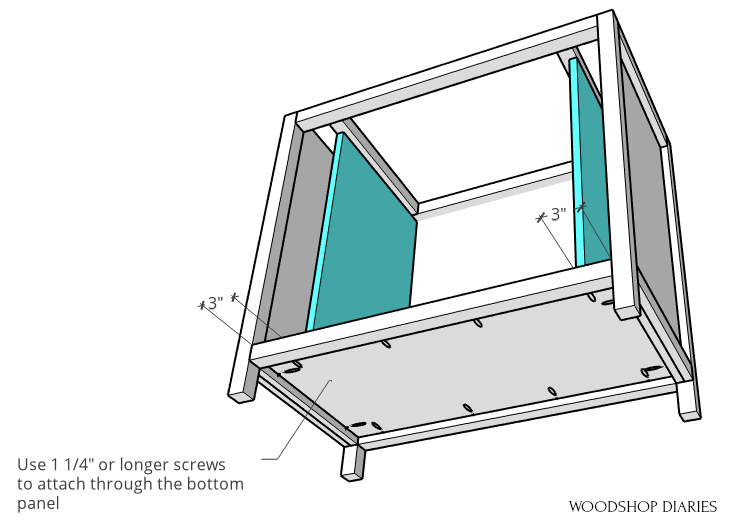
Screw inside panels in place through bottom of cabinet diagram

I kept double checking throughout the process that the doors had enough room to open and slide inside.  Leaving about 3” between the inside and outside panels seemed to work well.

Step 8: Install Top Onto Pocket Door Cabinet

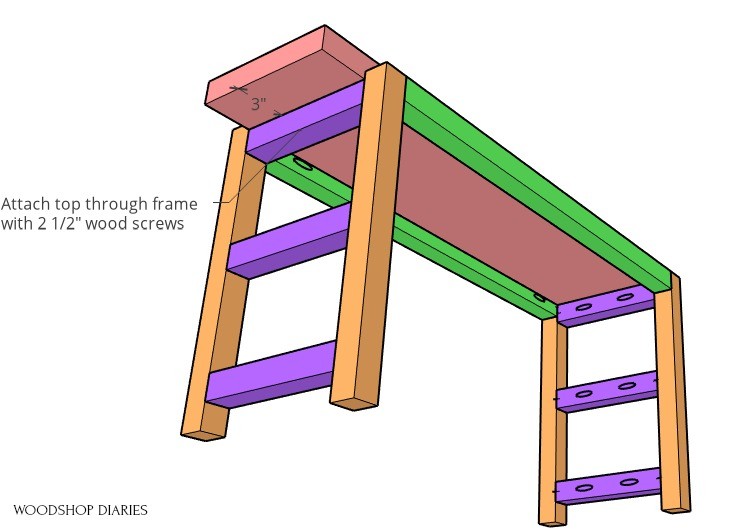
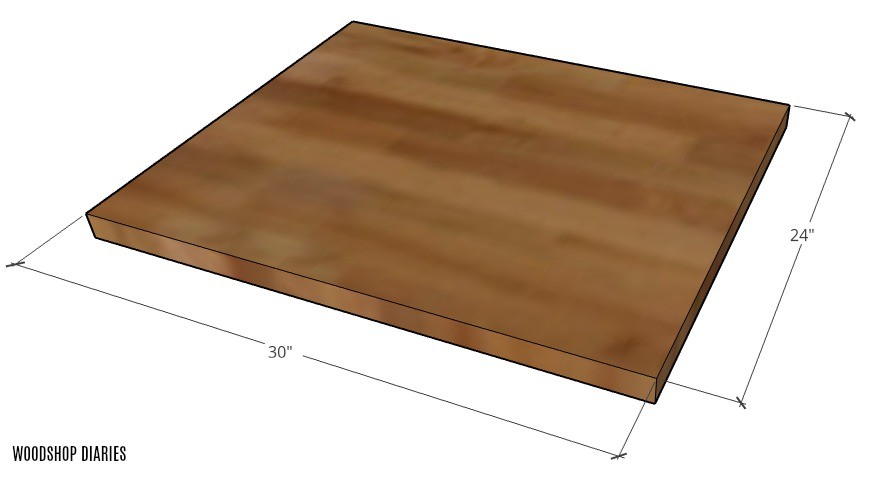
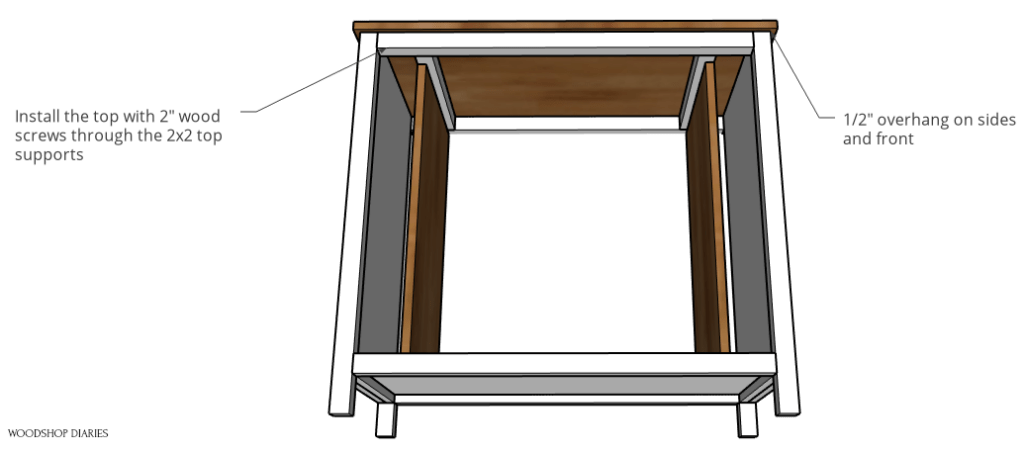
Just like with the last dresser build, I cut a ¾” plywood top for this, edge banded, and stained it, then installed it onto the cabinet using 2” wood screws through the top frame pieces.
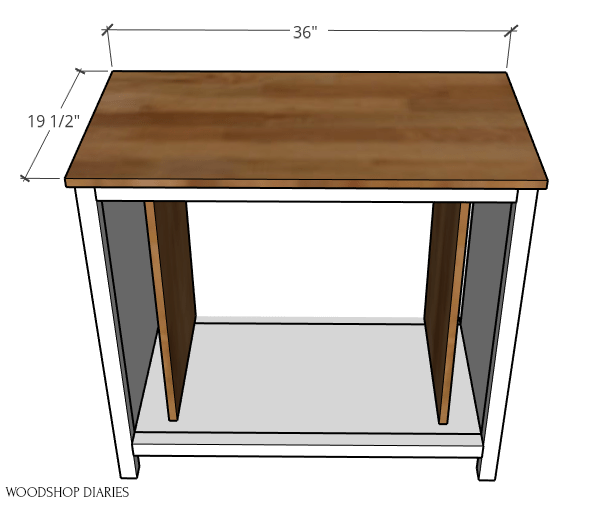
Top panel overall size diagram
Installing top panel through 2x2 frame diagram

Step 9: Add Shelves and Finish

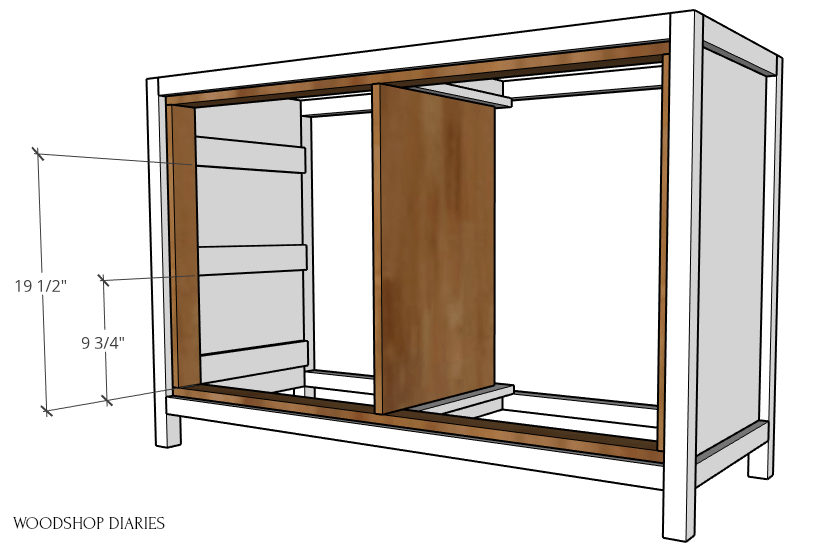
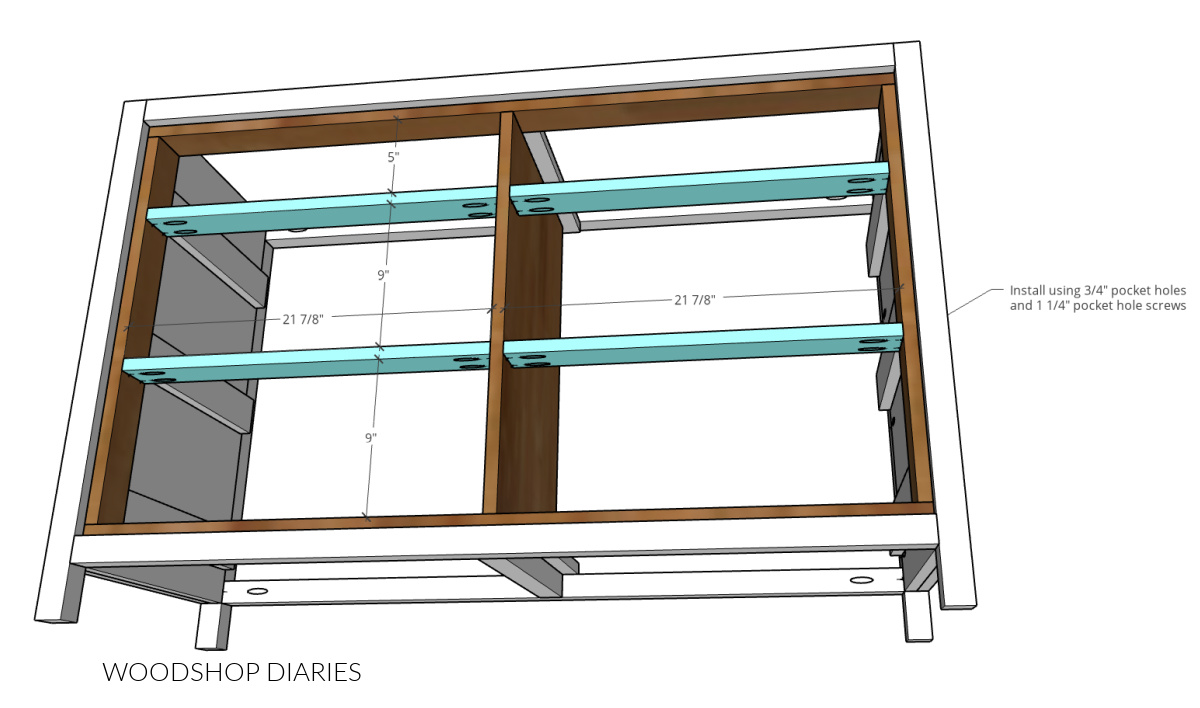
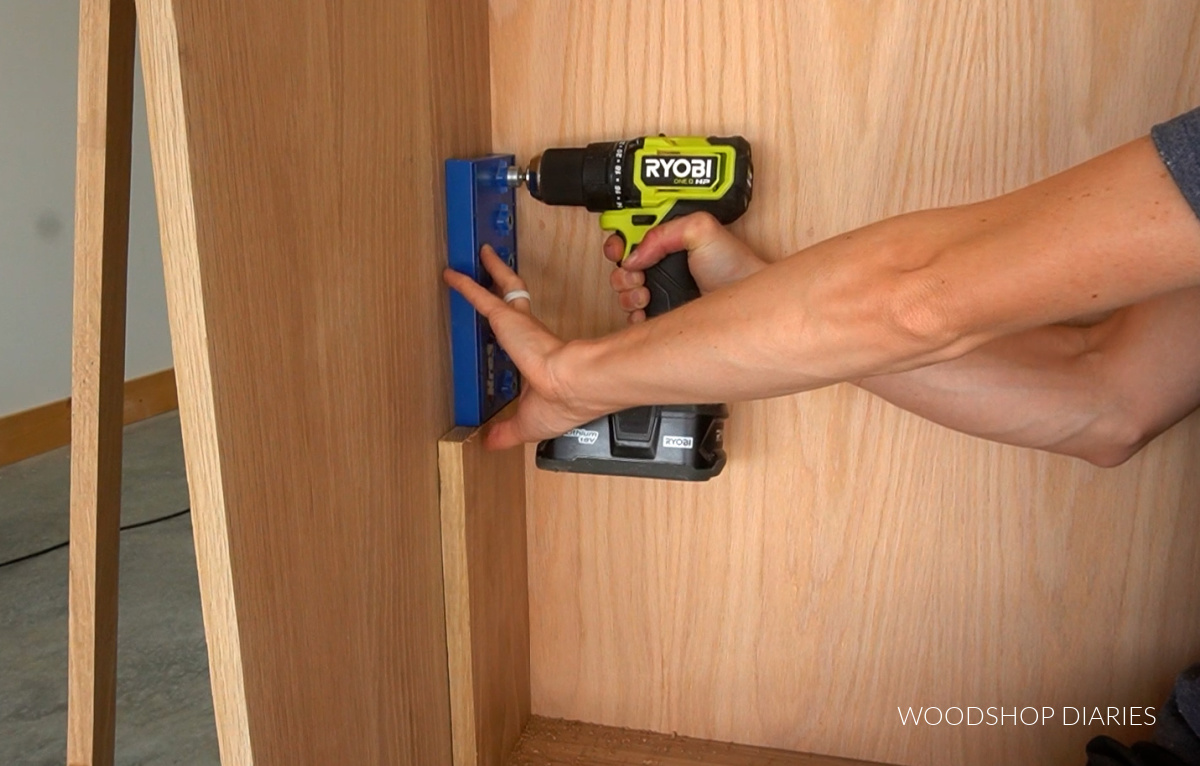
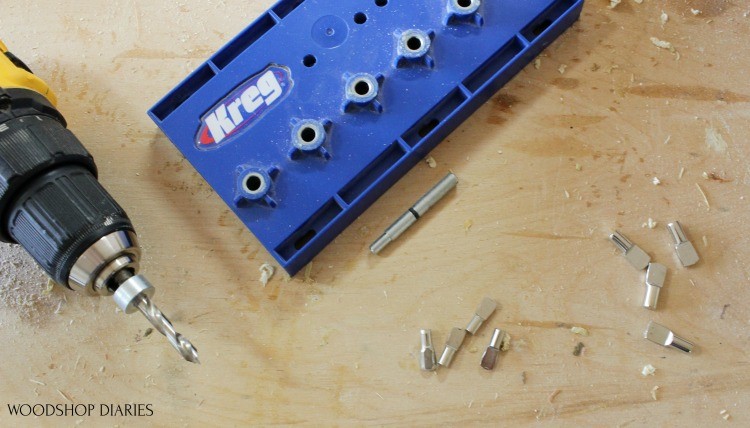
Then I could add the last piece…the shelf.  I drilled shelf pin holes into the sides to place an adjustable shelf without interfering with the doors.

.

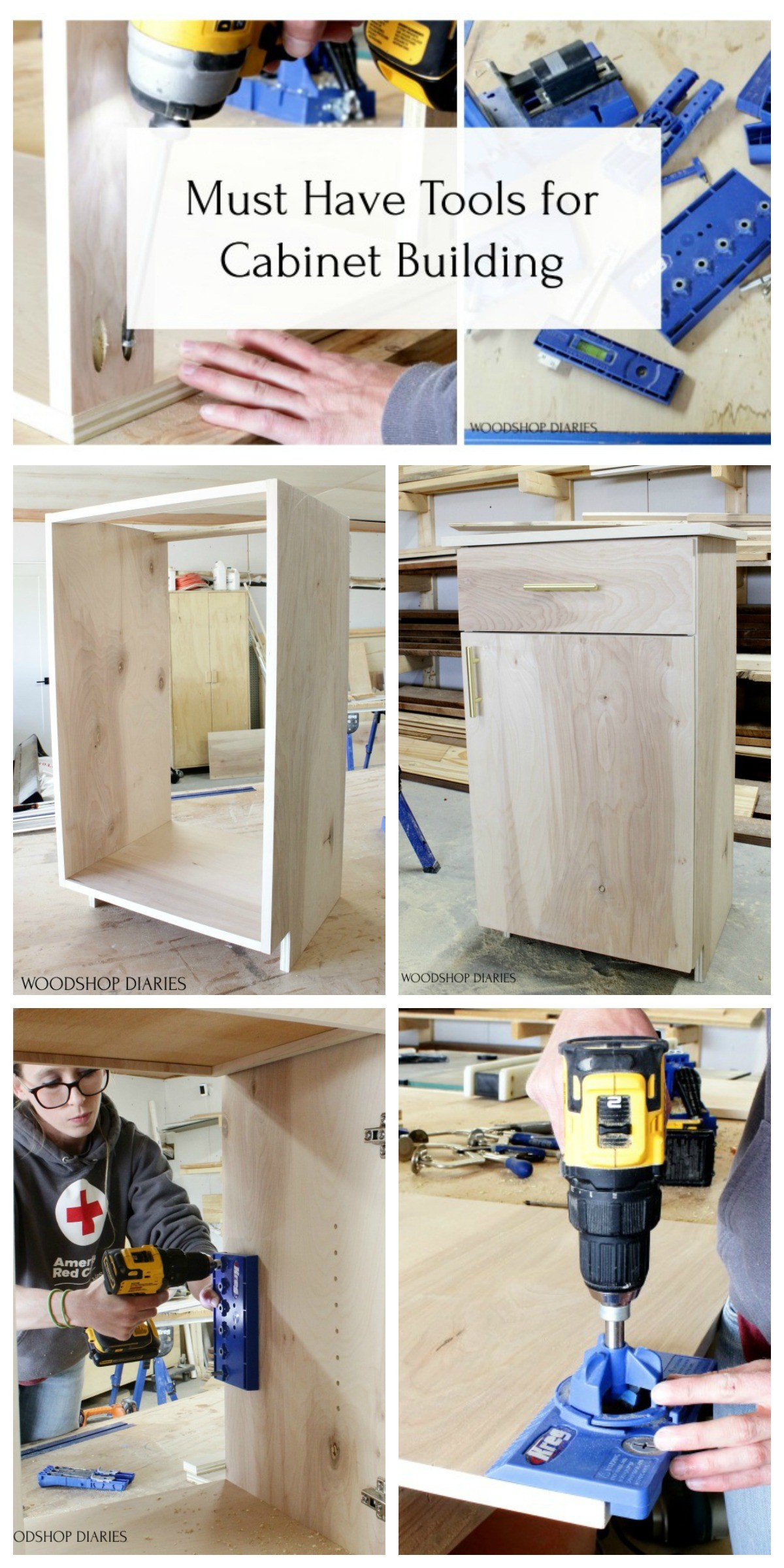
RELATED: Check out the shelf pin jig and other helpful tools for cabinet building in this post.
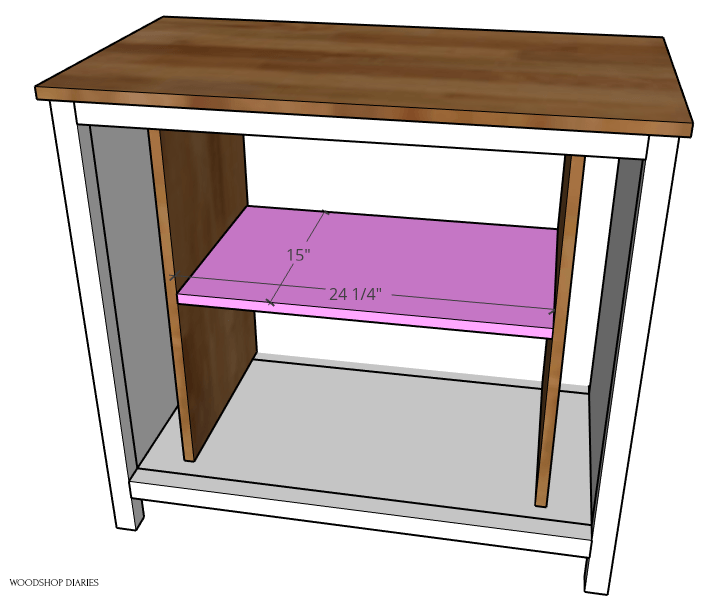
Adjustable shelf dimensions for pocket door cabinet
Finished pocket door cabinet with doors slid into place diagram

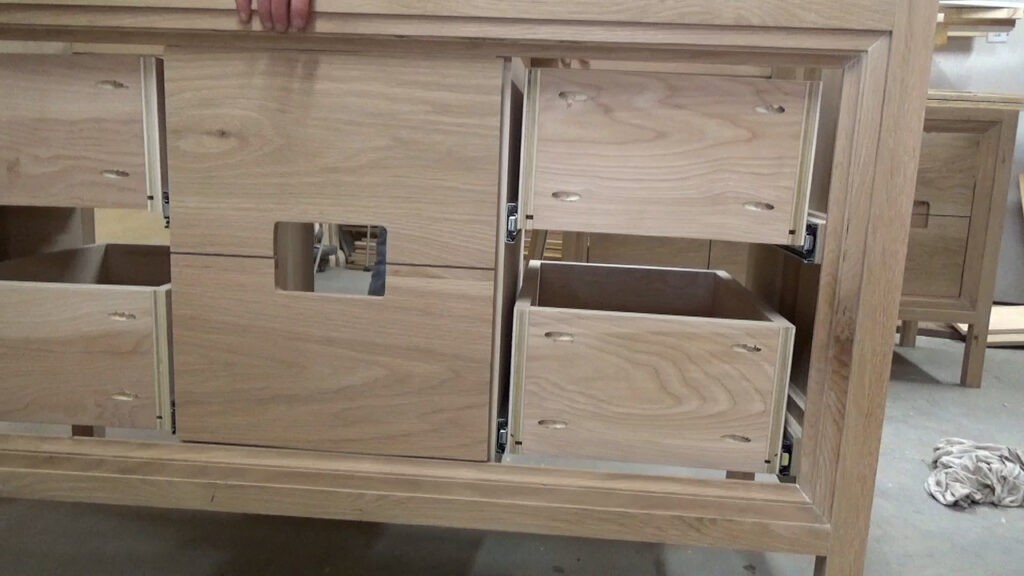
And again, just like the dresser, the library requested these doors to lock as well.  Check out the YouTube Video to see how I installed the lock if you’re interested in adding those onto your project.
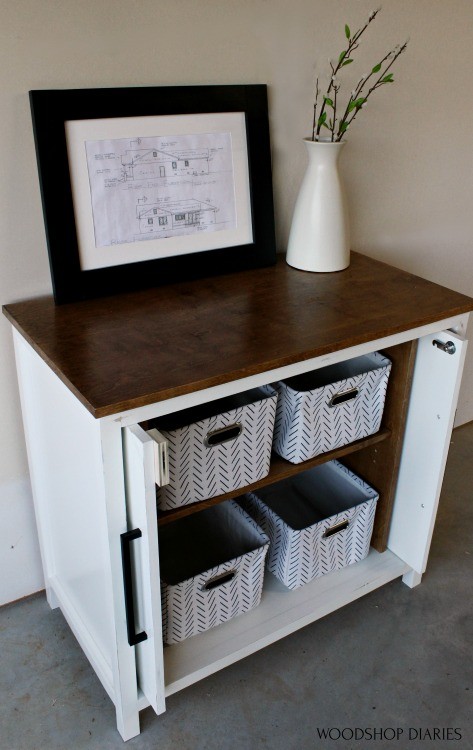
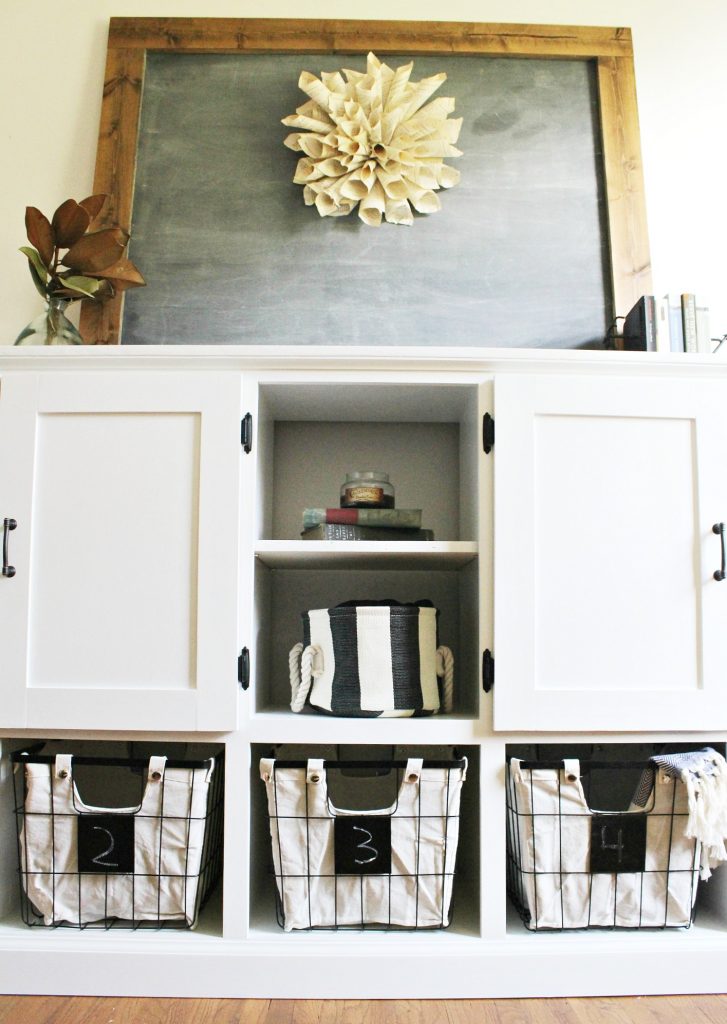
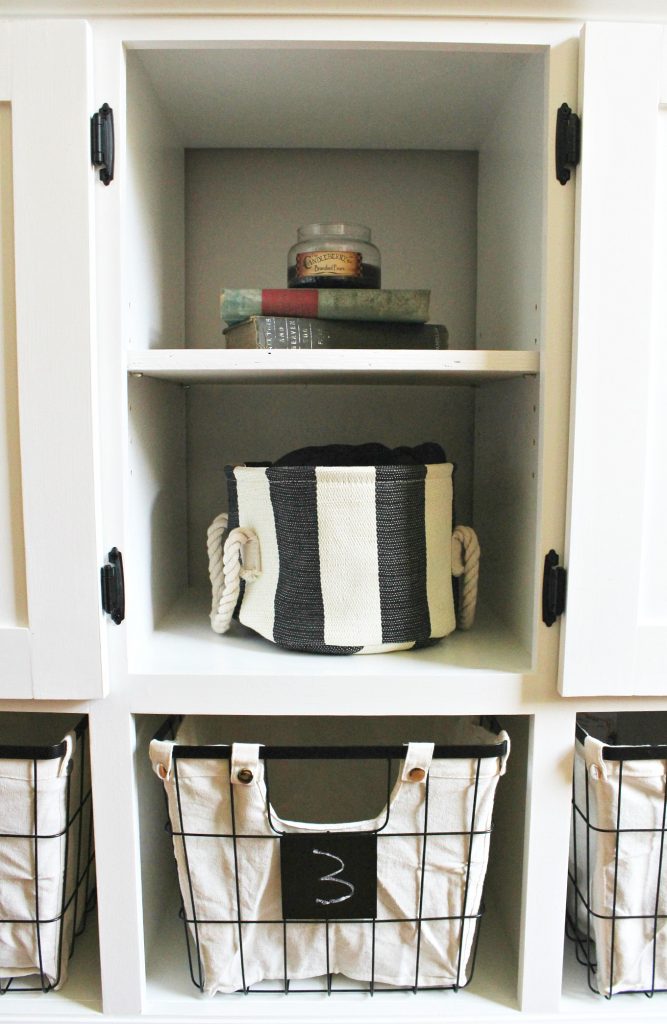
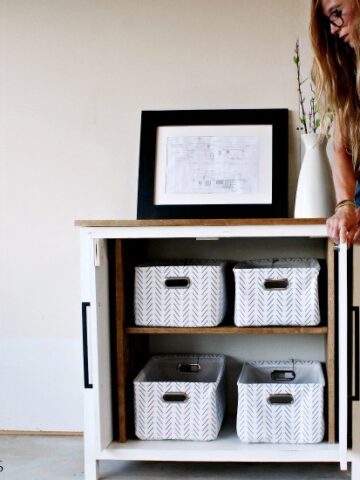
Pocket door cabinet with doors open slid into the cabinet and storage baskets on shelves

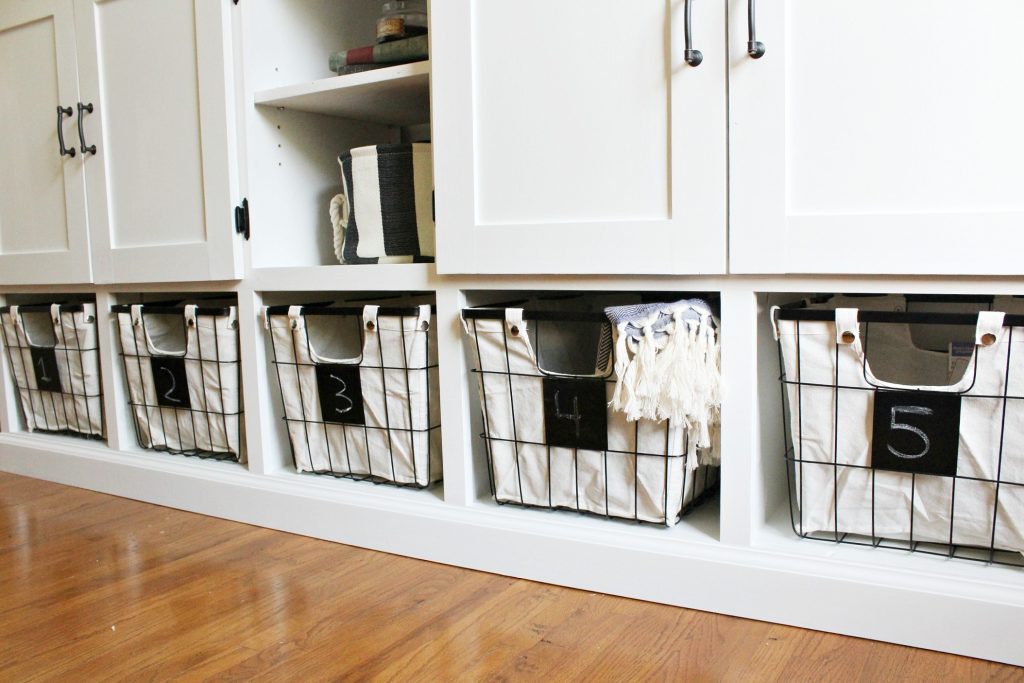
After a little distressing and some clear coat poly, the cabinets were done. I added some little storage baskets I found at Walmart to help them keep things organized.

.

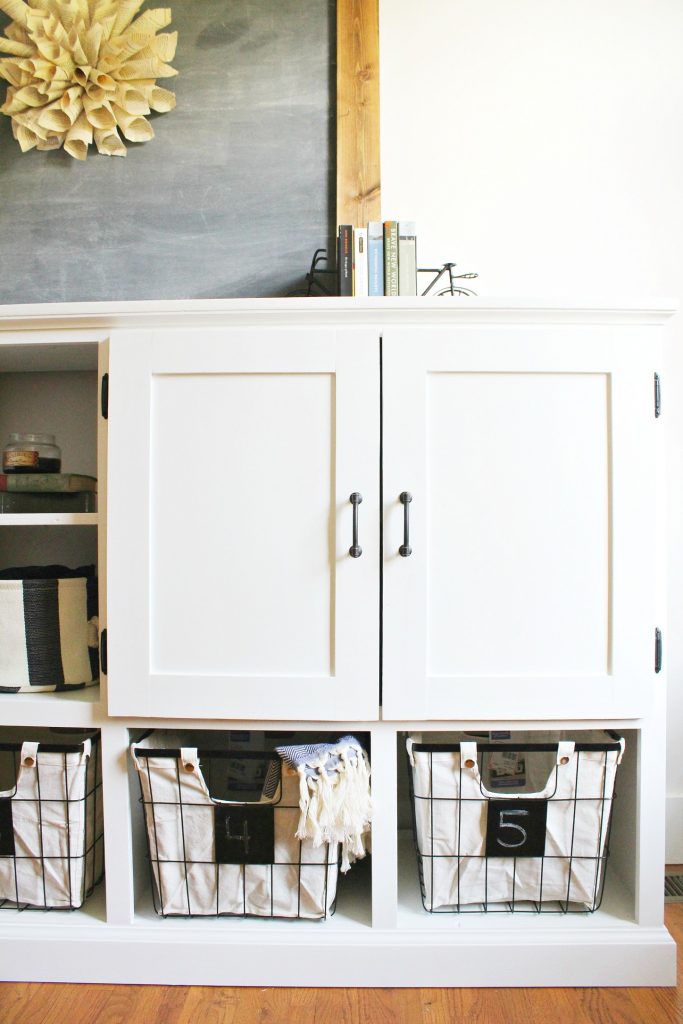
These make great little stand alone storage cabinets, but also look nice as the end sections of this larger piece. 
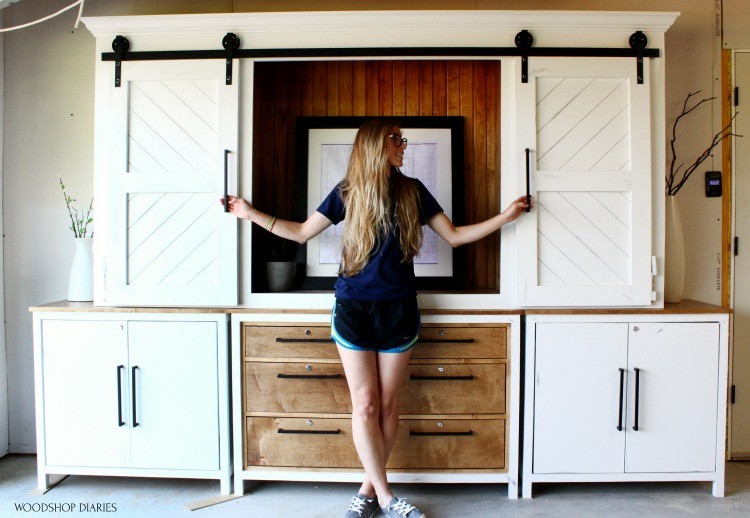
Shara Woodshop Diaries with large entertainment center

And if you’re wanting to build the entire entertainment center, be sure to check it out here:

DIY Sliding Door Entertainment Center
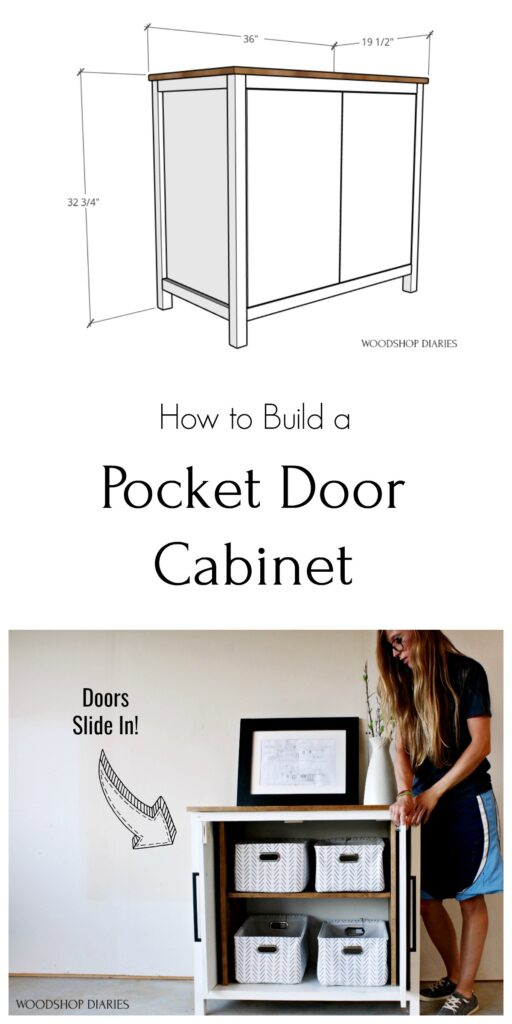
Pinterest collage of overall pocket door cabinet dimensions and Shara with cabinet doors open showing off the inside

Until next time, happy building ????

DIY 6-Drawer Dresser

July 10, 2020 by Shara, Woodshop Diaries

In this post, I’m sharing how to build a simple DIY 6 drawer dresser with building plans!

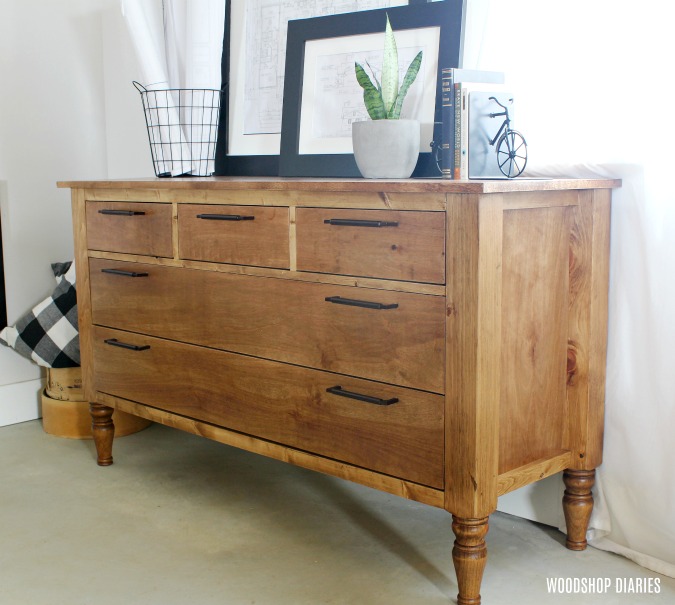
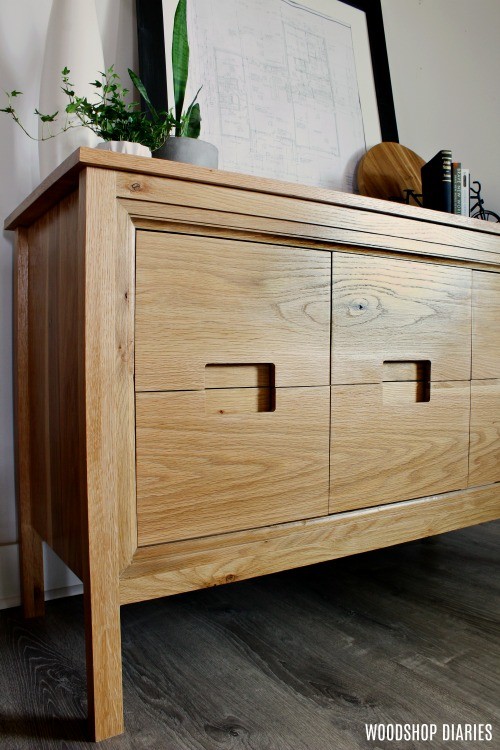
Simple two tone white and wood 6 drawer dresser with modern pulls and locks

If you have followed many of my projects, you may already know how much I love building dressers.

The fun thing about building a dresser is that you can customize just about every single part to fit any size, style, design, or number of drawers that you want.

I’ve built over 19 different sizes and styles of dressers over the years! You can check out all my DIY dresser designs here.

But at the end of the day, a dresser is basically just a box full of drawers…which are other just other boxes haha!

So while it may seem a little intimidating, building a dresser is quite simple.

I’m excited to be sharing the plans, dimensions and details on how to build your own 6 drawer dresser in this post. Let’s dive in!

Tools & Materials:

*This post contains affiliate links. See website policies.

Tools:

  • Miter Saw
  • Circ Saw
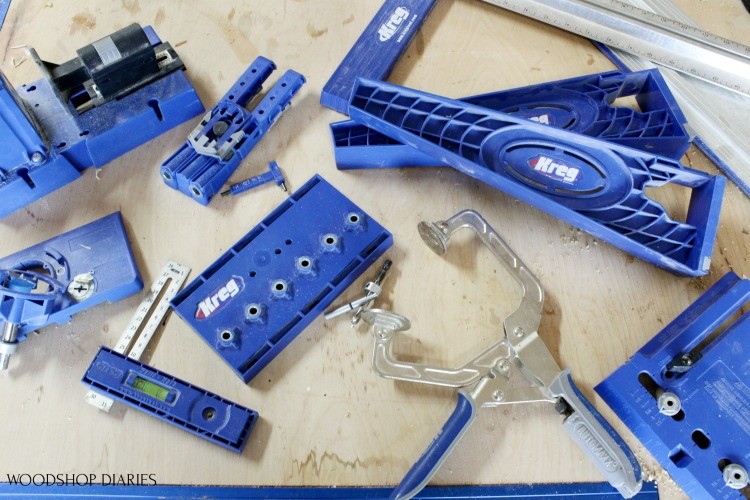
  • Cutting Guides (I use the Kreg Rip Cut and Kreg AccuCut)
  • Kreg pocket hole jig
  • Drill/Driver
  • Brad Nailer

Materials:

  • (1 ½) sheets ¾″ plywood
  • (4) 2x2x8 boards
  • (1) 1x2x8 board
  • (3) 1x3x8 boards
  • Cove molding (optional)
  • (6) 16″ drawer slides (I buy the ten pack because they’re cheaper per slide)
  • (6) drawer pulls (<–you can buy these in bulk for cheaper)
  • (6) locks (optional)
  • 1 ¼″ pocket hole screws
  • 2 ½″ pocket hole screws
  • 1 ¼″ wood screws
  • 2″ wood screws
  • Paint and Stain
  • Edge banding (optional)

What to Know Before Building This 6 Drawer Dresser

This dresser is actually just one part of a larger project that I built for our local library’s children’s center. See it there in the middle at the bottom??

Large Entertainment center two bottom cabinets and a middle dresser with large sliding door top cabinet

That was a HUGE project, so I built it in sections to make it a little easier to manage.

This dresser was the middle of the “base,” then I added the two pocket door cabinets on the side, and the sliding door cabinet at the top.

So this can be made as a stand alone dresser like I’m sharing in this post, or it can be made into a larger project if desired.

Adding Locks to the Dresser

Because this was going in our local library, they requested that I add locks to the dresser–and all other moving parts of the cabinet.

It’s not typical to add locks to your dresser, so just ignore that in the photos if you don’t mind haha.

However, if you are interested in adding the locks, I do explain how I installed them in the steps below and in the video.

Of course, you can skip over that part if you’re not adding them.

Two Tone Finish

I painted the main frame and side panels of this project white (SW Alabaster) and stained the top and drawer fronts (Minwax Early American).

It’s MUCH easier to paint/stain these pieces separately before building the entire project.

I built the main frame of the dresser first, then painted it. Once it was dry, I stained the trim pieces that I added in step 4 before installing them.

Of course, you’re welcome to paint or stain however you’d like and you may prefer to paint or stain the entire project, and skip the two tone finish altogether.

Overall Dimensions

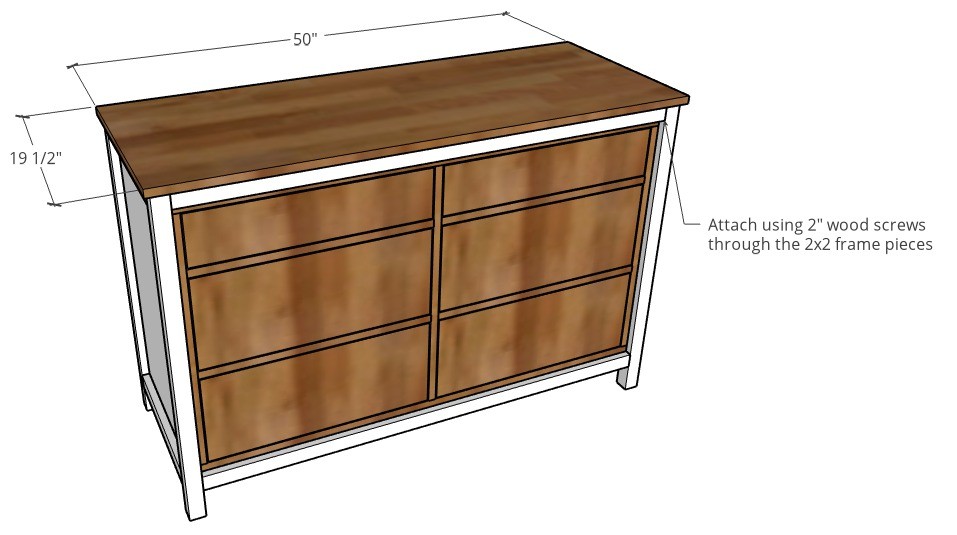
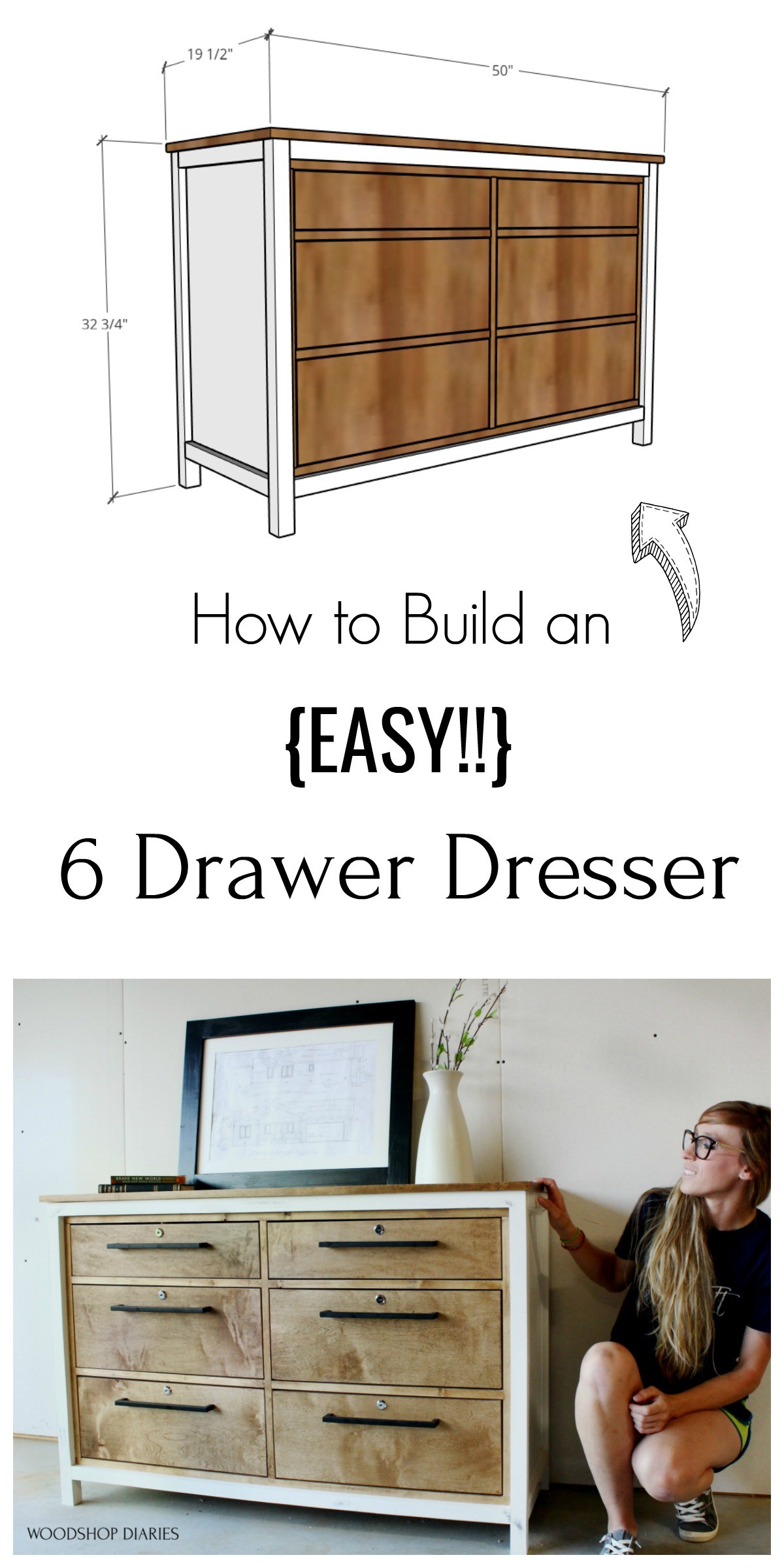
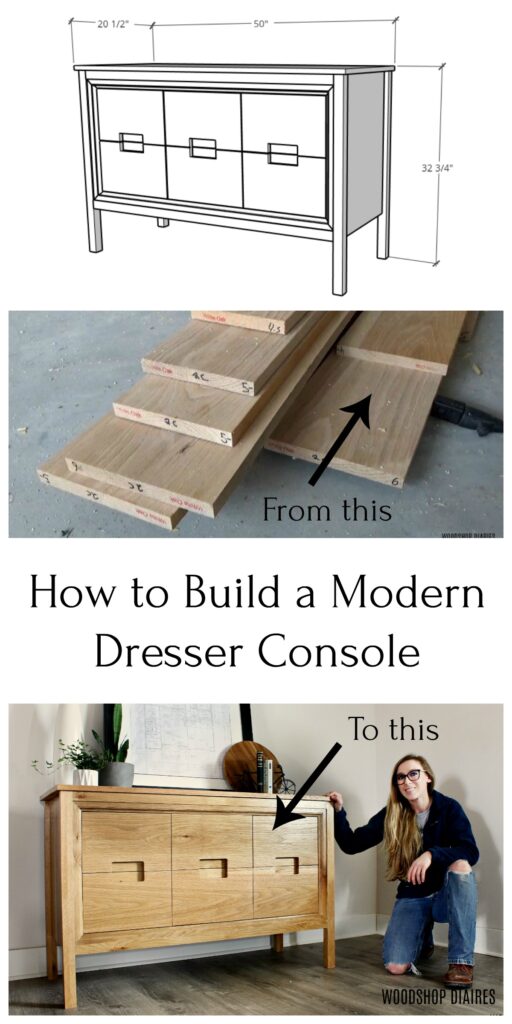
The overall dimensions of this dresser build is 19 ½″ deep x 32 ¾″ tall x 50″ wide.

Helpful Resources to Use with these Dresser Plans:

You may find these guides and articles helpful to reference during the building process:

  • How to Cut Plywood Sheets
  • How to Use a Pocket Hole Jig
  • How to Build and Install Drawers
  • How to Apply Iron On Edge Banding
  • How to Finish Raw Wood Furniture

How to Build a Basic 6 Drawer Dresser

Let’s dive into the building plans! This project is assembled using basic joinery and basic materials.

However, due to the size and number of parts, I’d consider this is an intermediate level project.

If you prefer to watch, I’ve provided a video of the build process here.

*(Please don’t judge too harshly…this is one of my older videos and they have much improved since then…I promise haha).

If you prefer to print your plans, you can grab the printable dresser building plans here:

Step 1: Build 6 Drawer Dresser Side Panels

Like most of my dressers, I started off by building the two side panels. 

I built this dresser frame from 2x2s and used plywood for the inside panels.

RELATED: How to cut your own 2x2s (so they’re straight!)

ALSO RELATED: How to cut plywood sheets

Once I had my dresser legs (2x2s) and side panels (¾″ plywood) cut to length, I simply attached two side panels like shown using wood glue and pocket holes and screws. 

RELATED: How to use a pocket hole jig

Side panel diagram for 6 drawer dresser

Since these will be covered by the drawers, I made this quick by using ¾″ pocket holes and 1 ¼″ pocket hole screws. 

But you could also use wood glue and dowels.  Either way works fine.

Step 2: Assemble Dresser Frame

Once the side panels were together, I assembled the rest of the dresser frame using 2x2s at the front and back. 

I used wood glue and 1 ½″ pocket holes with 2 ½″ pocket hole screws…but again, you could use another joinery method here as well if you wanted. 

6 drawer dresser frame diagram 2x2s between side panels

NOTE: When using pocket holes in 2x2s and 1x2s, I usually only drill one hole on each end. Drilling two holes can be crowded and tends to split more easily when driving the screw.

However, if you only use one screw at a joint, make sure not to skip the wood glue!

Step 3: Add Trim Detail to Dresser Sides

After the frame was assembled, I added a little decorative detail to the sides. 

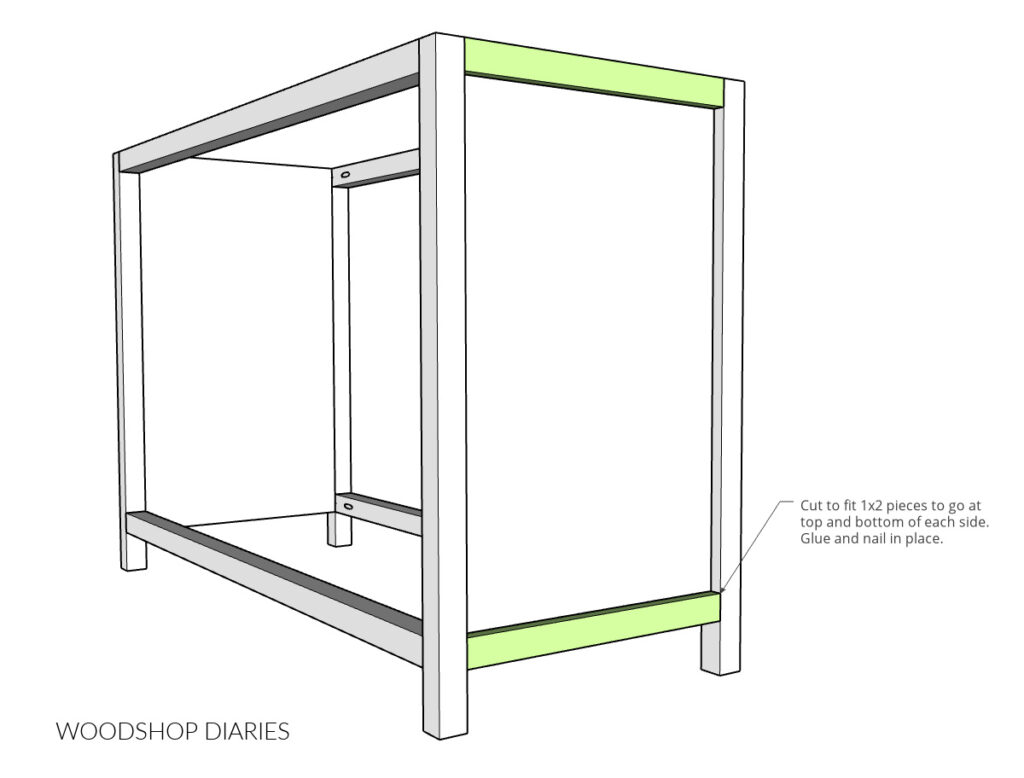
I simply cut to fit 1x2s to go at the top and bottom of each side panel. Then, I glued and brad nailed these in place.

As an extra optional detail, I cut cove molding to fit so that it would line the insides of both side panels. This adds some extra dimension, but isn’t necessary.

I used wood glue and brad nails to secure each piece.

Shara nailing cove molding around side panel frame edges

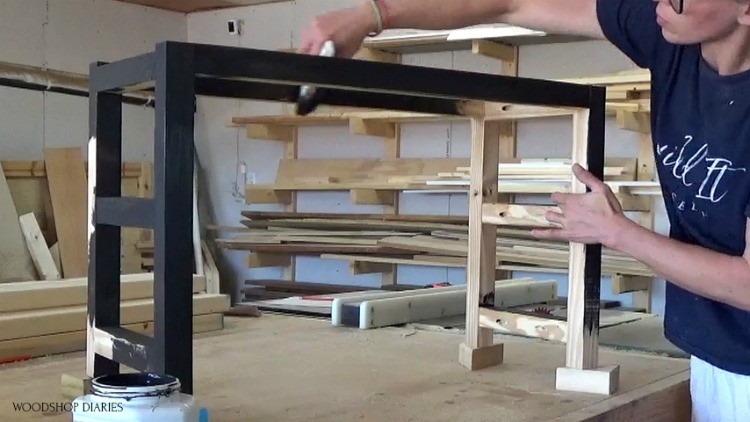
At this point, everything so far was going to be painted white and everything else following this will be stained. 

So I went ahead and painted this frame before moving on to the next step. 

Step 4: Install Middle Divider and Front Trim

Once the paint was dry, I moved on to all the inside details.  The first thing I did was install two more 2x2s into the middle at the top and at the bottom.

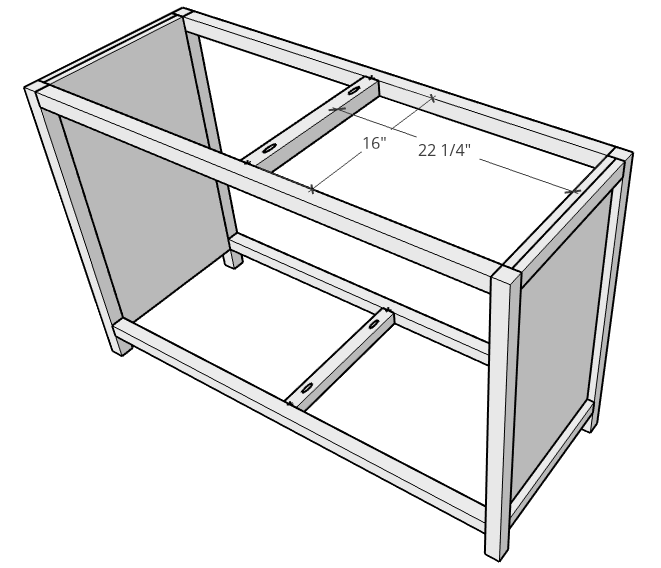
These will allow me to add the middle divider panel. I used 1 ½″ pocket holes and 2 ½″ pocket hole screws to install.

Diagram to install 2x2s in center frame of 6 drawer dresser

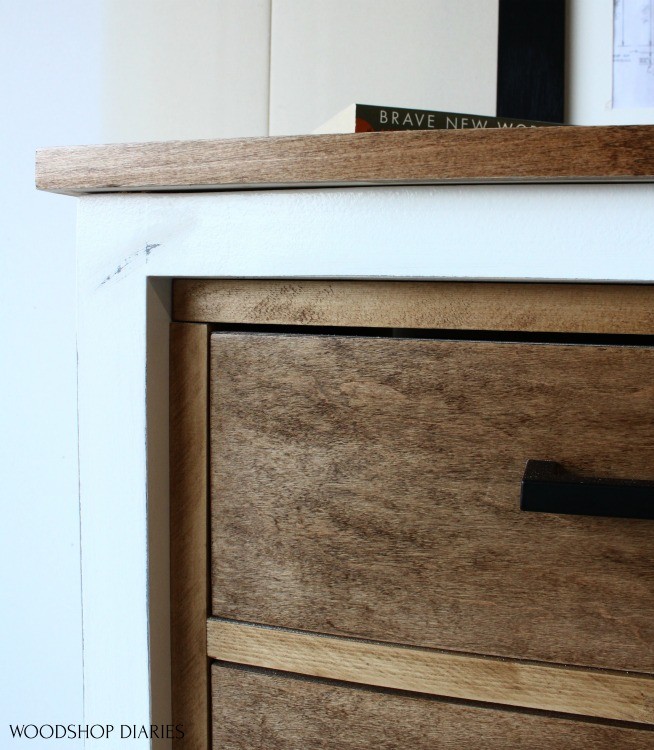
To add some extra dimension to the design, I installed some 1x trim inside the 2×2 frame so it was ¾″ inset. You can see this up close in the image below.

The main 2×2 frame is painted white and there are stained 1x pieces directly on the inside of it. These “framed out” the drawers.

Close up detail of inset drawer frame on 6 drawer dresser

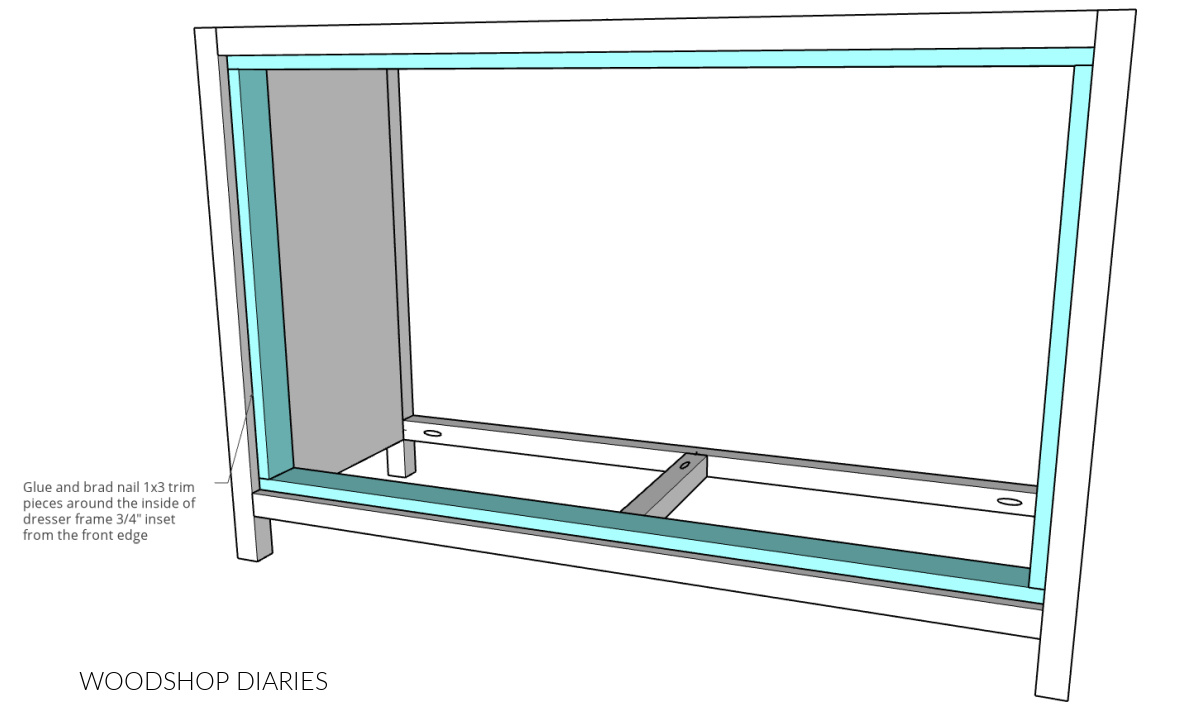
I used some 1x3s for this and cut to fit them to “line” the inside of the main 2×2 frame.

Once I made sure the pieces fit well, I stained them (Minwax Early American Stain for this) before installing. 

I simply glued and nailed the 1×3 front trim pieces in place ¾″ INSET from the front edge of the dresser frame.

Because of the spacing, I needed to add some scrap 1x material to the 2x2s in the middle before I could install the center divider.

So I added some scrap ¾″ plywood in place with wood glue and brad nails.

Then, I could add the middle divider between them. This divider panel was cut from ¾″ plywood and the front edge will be exposed.

So, to hide the plys, I edge banded the front edge. This is optional, but always makes it look a little cleaner.

RELATED: How to apply iron on edge banding

I installed this divider panel in the center using ¾″ pocket holes and 1 ¼″ pocket hole screws like shown.

Step 5: Install Dresser Drawer Spacers and Dividers

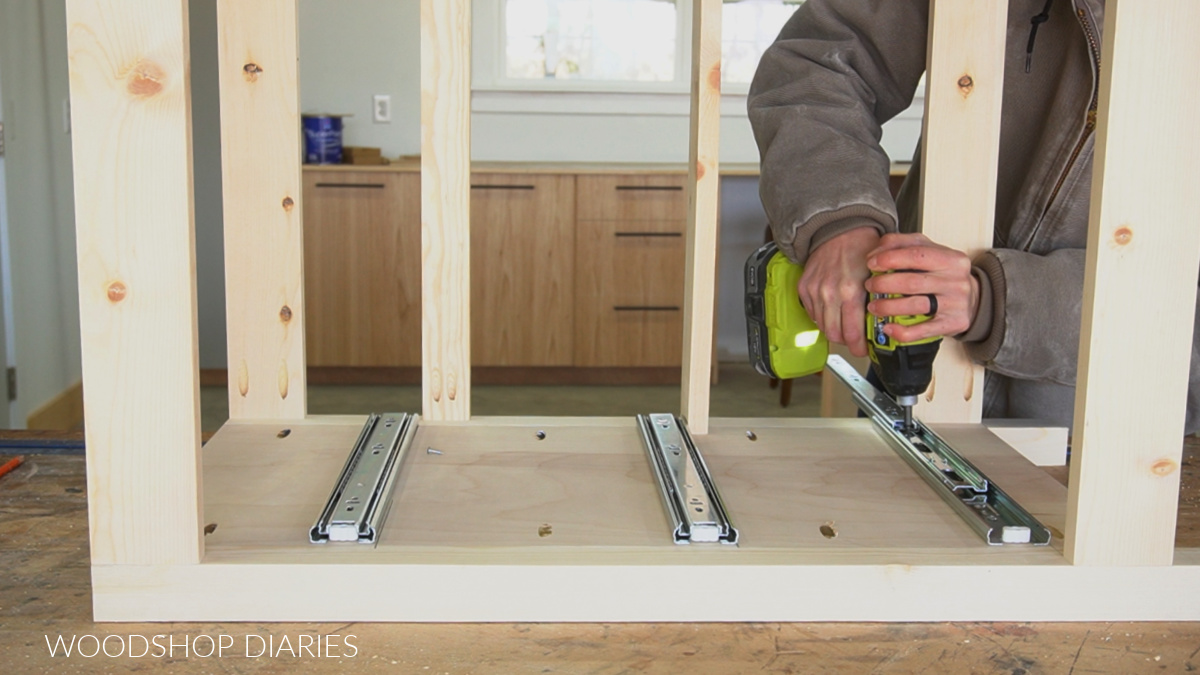
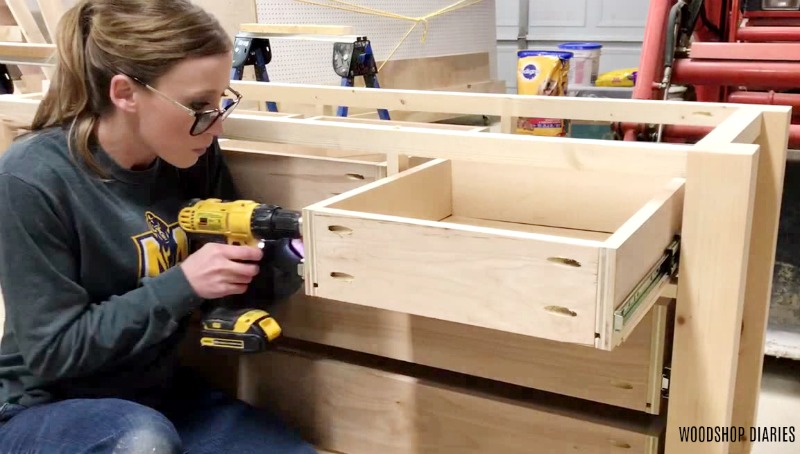
Now, it was time for the drawer slides.  I needed to install 6 pair of 16” soft close drawer slides into the dresser. 

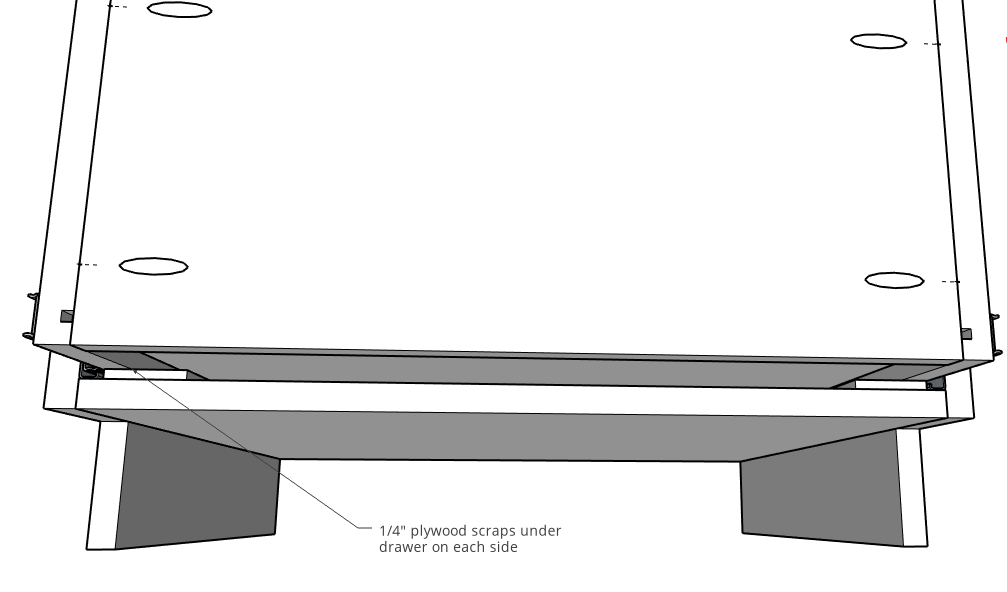
To do this on the sides, though, I had to add some more scrap wood spacer blocks where the slides needed to mount.

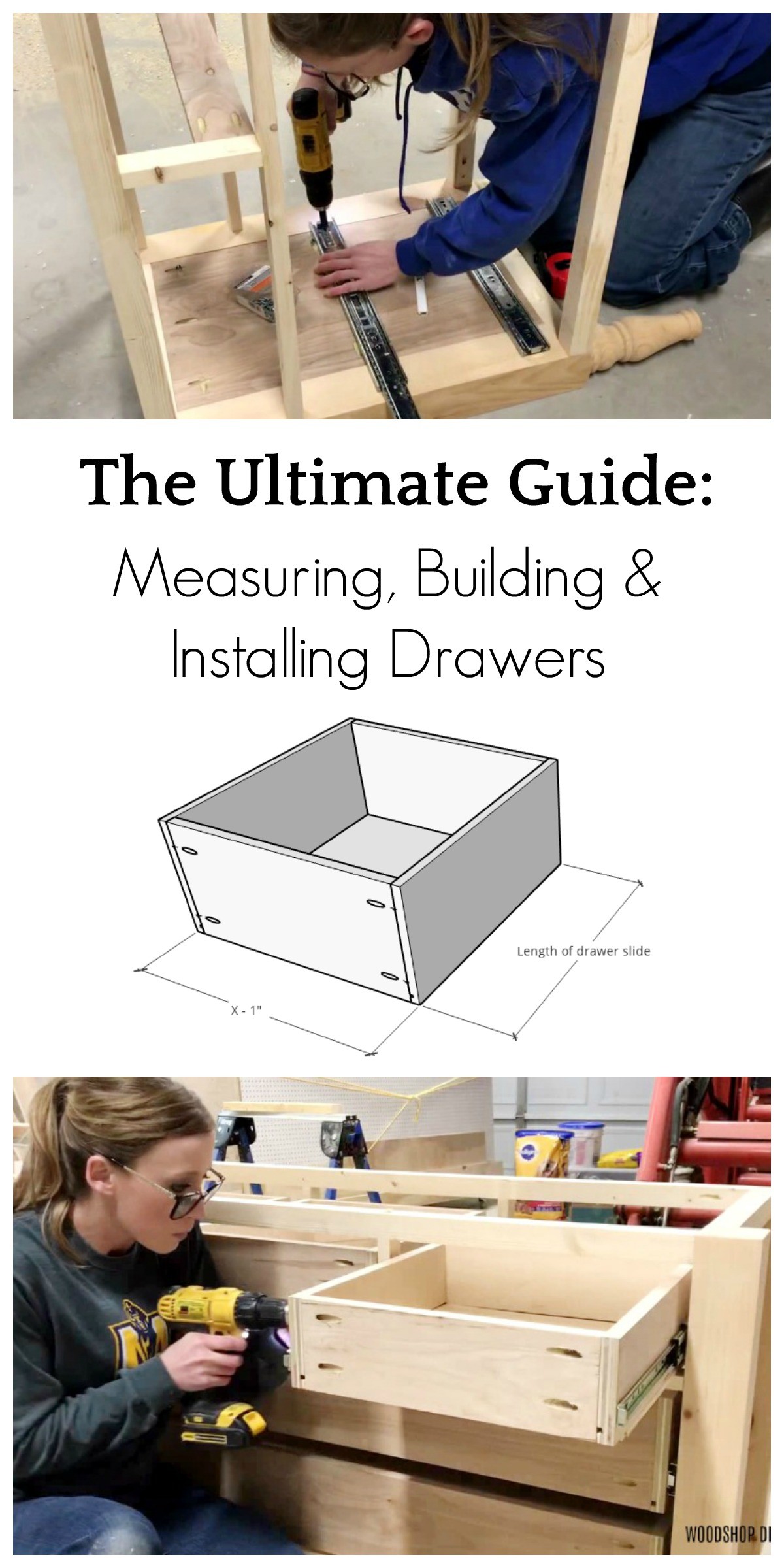
CHECK OUT MY COMPLETE DRAWER BUILDING GUIDE HERE FOR HOW TO BUILD AND INSTALL DRAWER BOXES AND DRAWER SLIDES!

I cut six ¾” plywood pieces approximately 2 ½″ x 15″ for these spacer blocks–exact size isn’t critical as long as it’s big enough to mount a drawer slide onto.

Then, I used wood glue and 1 ¼″ wood screws to install three on each side like shown.

Diagram of scrap blocks for drawer slides on side panel

But in the middle, I could mount these slides directly onto the panel, so no spacer blocks were needed there. 

Before adding the slides, I also added some 1×3 pieces as drawer dividers like shown below. I installed them in place using ¾″ pocket holes and 1 ¼″ pocket hole screws.

Step 6: Install Drawer Slides

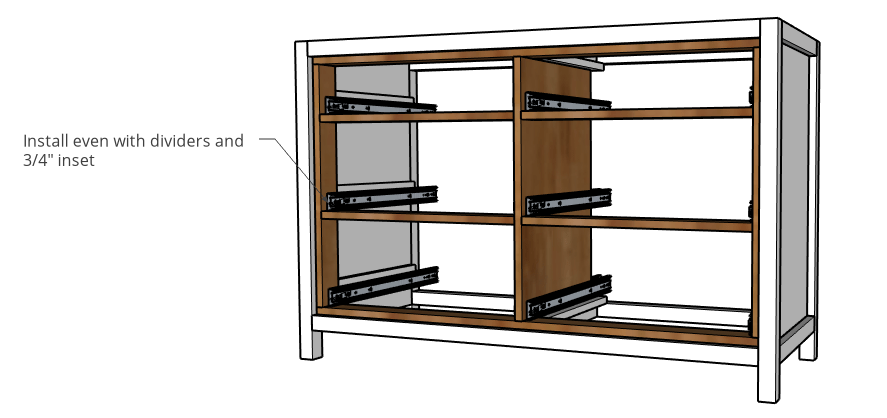
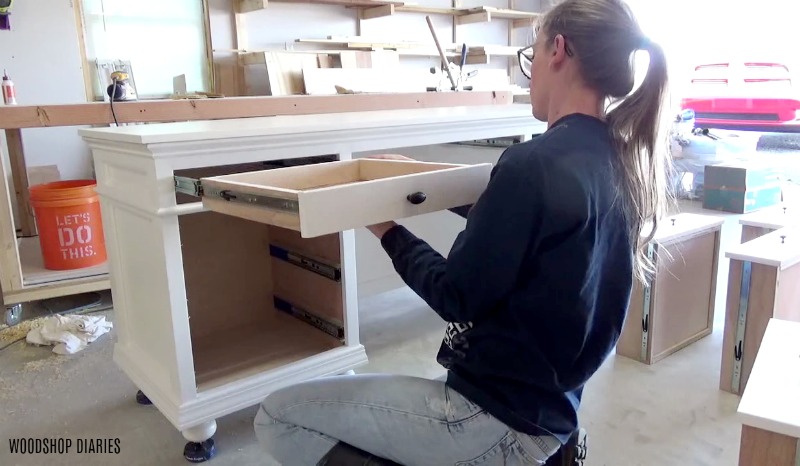
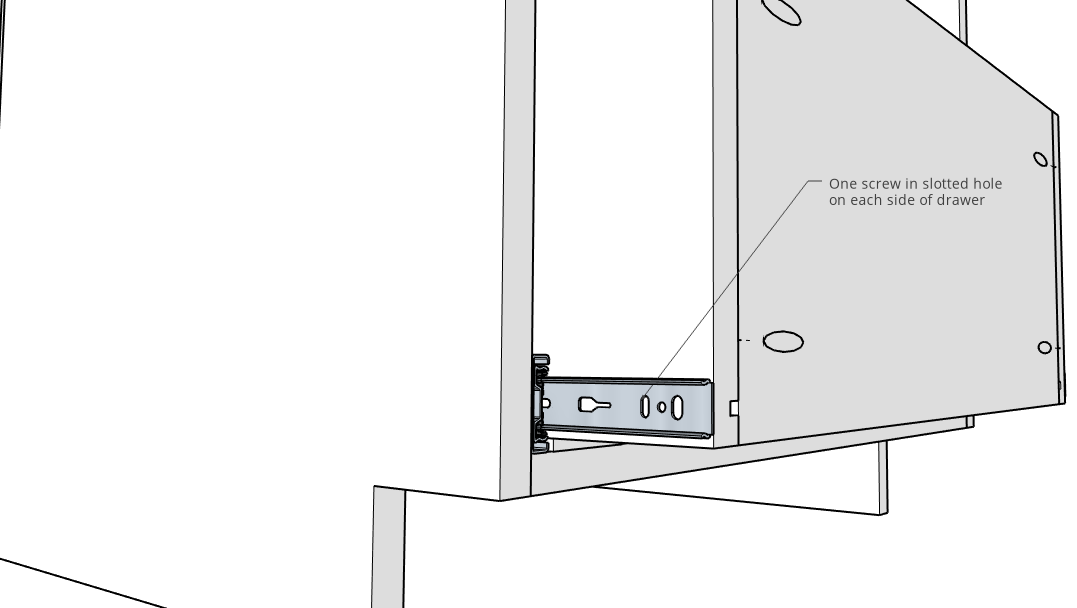
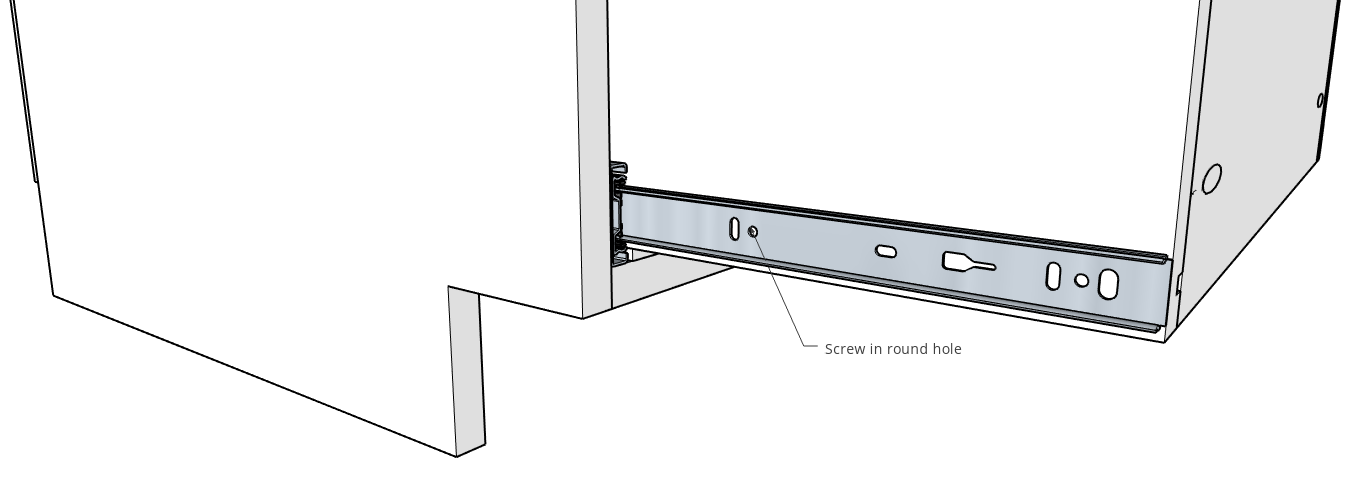
Then I could finally install the drawer slides. I installed each slide ¾″ inset from the front edge of the 1x3s and so that the bottom of each slide was even with the bottom of the trim and divider boards.

For more information on how to install drawers and drawer slides, check out this drawer building guide.

6 Drawer Dresser slides installed into dresser frame

Step 7: Build Drawer Boxes

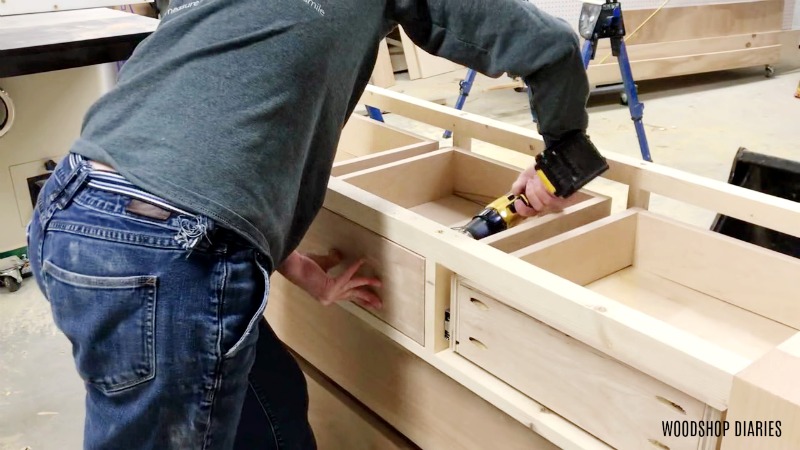
Now it was finally time to build and install the drawers. Be sure to check out the post here on how I like to build drawer boxes.

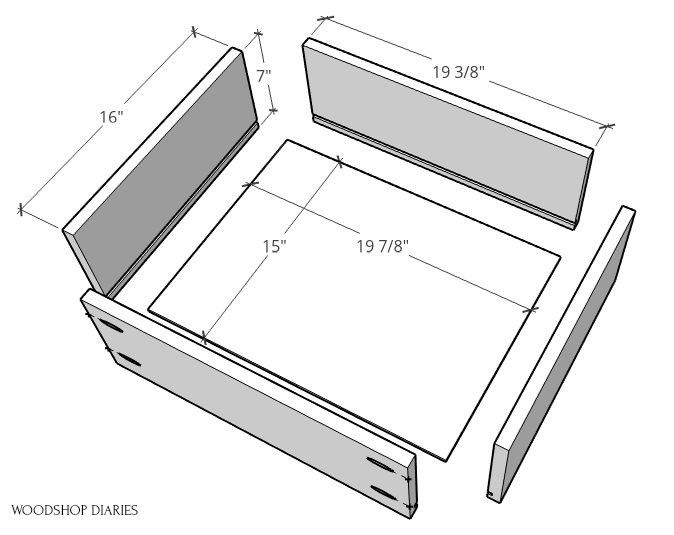
I like to make my drawers from plywood–the sides are ¾″ plywood and the bottoms are ¼″ plywood. 

So I cut down all my ¾″ plywood drawer box pieces, then cut a dado in them for the ¼″ plywood bottom. 

I used pocket holes and screws to assemble like shown.  I also edge banded the top edge of the plywood for a cleaner look…but that’s an optional step.

Exploded view of 6 drawer dresser drawer box pieces

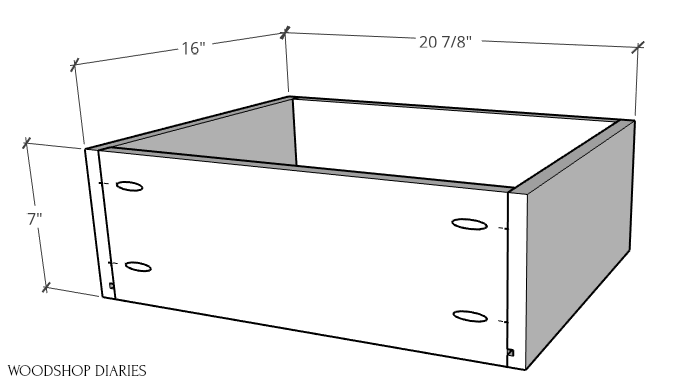
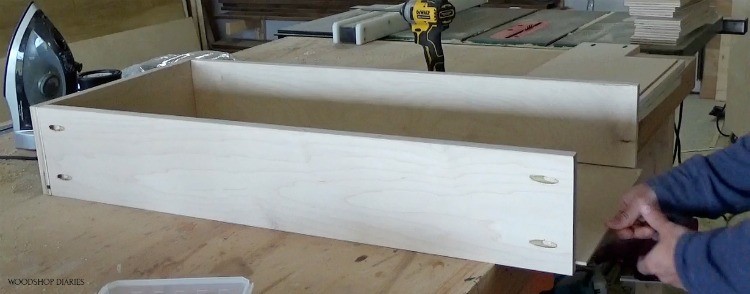
I made four drawer boxes 7″ tall like shown above in an exploded view. And I made two more identical EXCEPT only 4″ tall.

Overall dimensions of drawer boxes assembled

By the way, for this particular dresser, I made my drawer boxes shorter (in height) than I suggest in my drawer building guide.

The only reason for this in this particular case was so that there was more room to place the lock in the drawer front later.

If you aren’t installing locks on your dresser, feel free to make these drawer boxes a little taller, if you’d like.

Step 8: Install Drawer Boxes

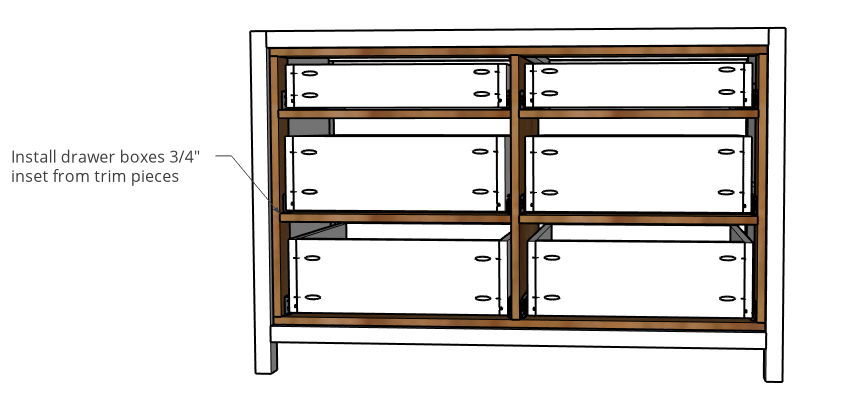
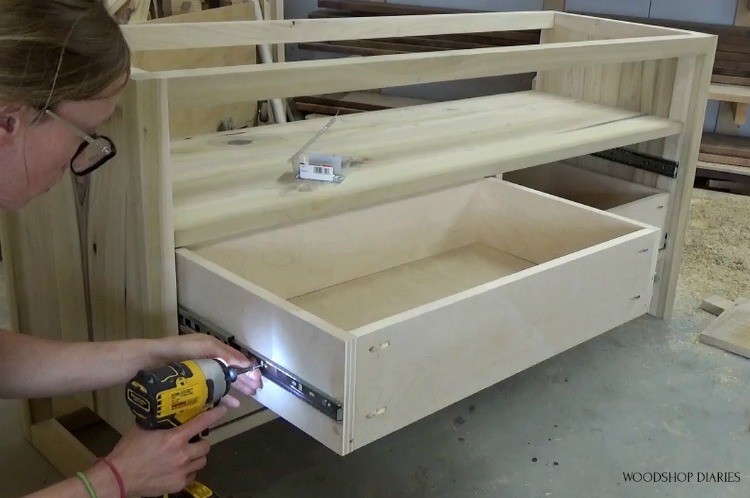
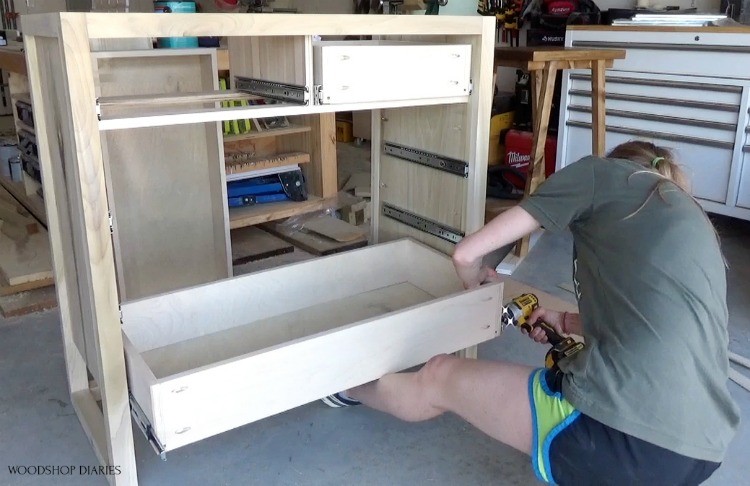
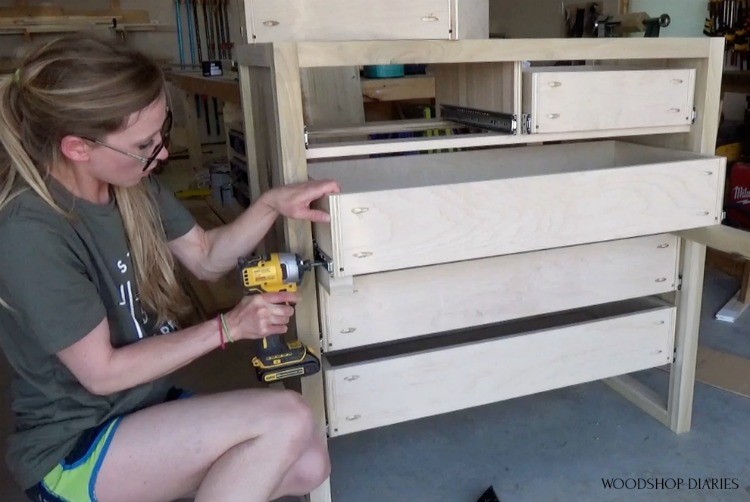
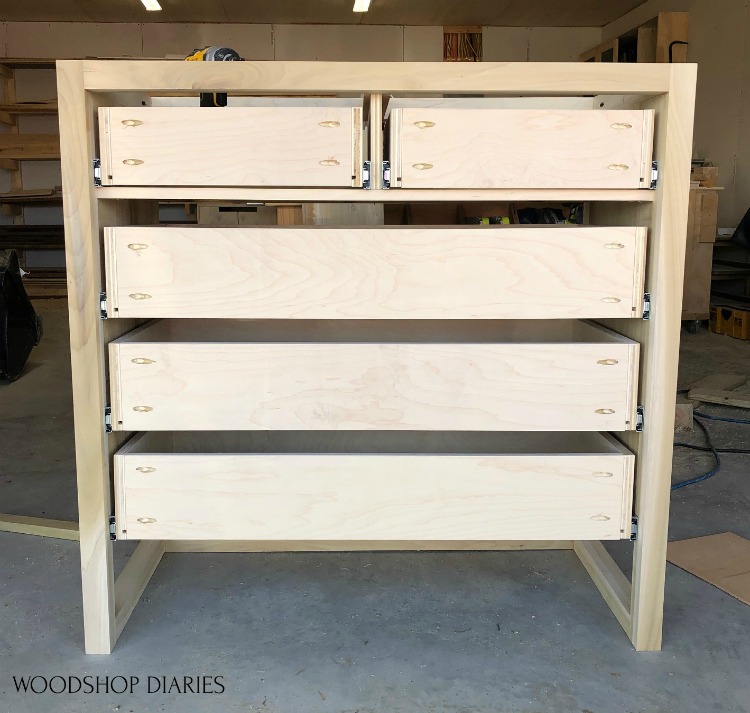
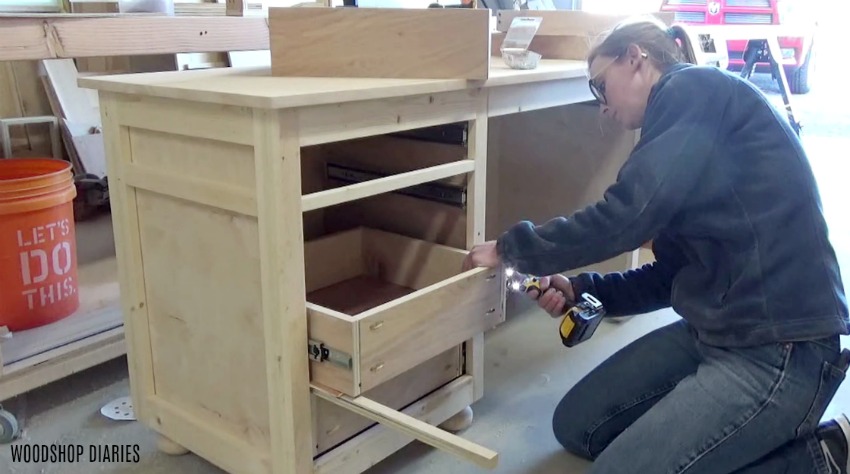
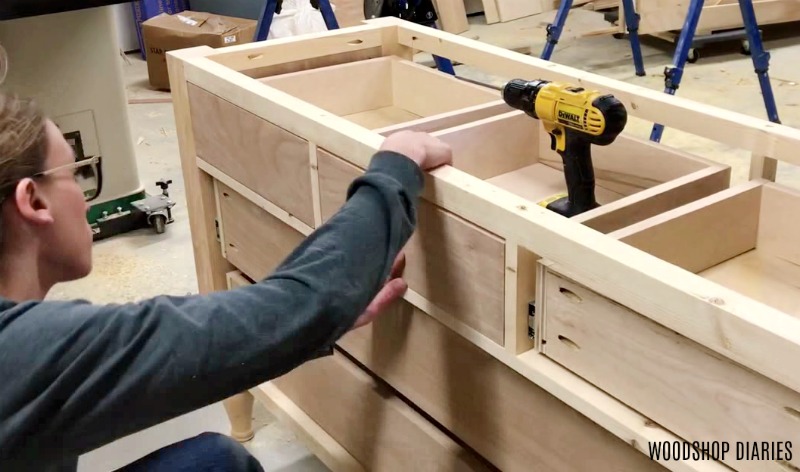
Once all the drawer boxes were assembled, I installed them into the dresser and onto the slides.

6 drawers installed into dresser frame

Step 9: Install Drawer Fronts

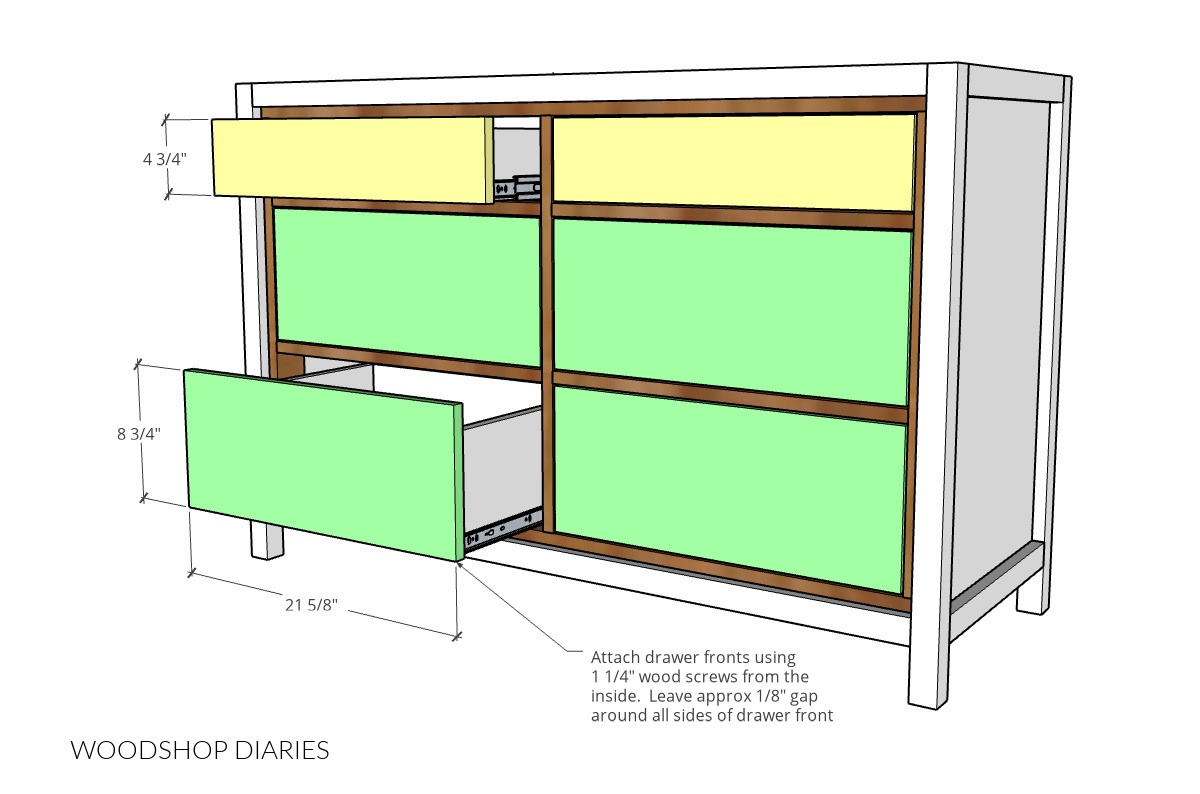
Once the drawers were in place, next was adding the fronts.  I cut these from ¾″ plywood as well and covered all the edges with edge banding. 

Once I made sure they fit, I stained them, then installed them using 1 ¼” wood screws from the inside of the drawer box.

Note that there should be approximately ⅛″ gap around all sides of each drawer front once installed.

Step 10: Install Dresser Top

Next was adding the dresser top.  I cut this from ¾” plywood and edge banded the sides.  Again, edge banding is optional, but it helps hide the exposed plys on the edges.

I figured it would be easier to stain before I installed it, so I went ahead and stained it.

3D diagram of top on dresser frame

I centered it left and right on the base and made sure the back edge was flush to the back of the frame.

Then, I screwed it in place through the 2×2 frame pieces using 2” wood screws at the front and back.

Step 11: Add Hardware and Locks (Optional)

I gave the dresser some simple, modern pulls to keep with the clean lines and finally, it was time to add the locks. 

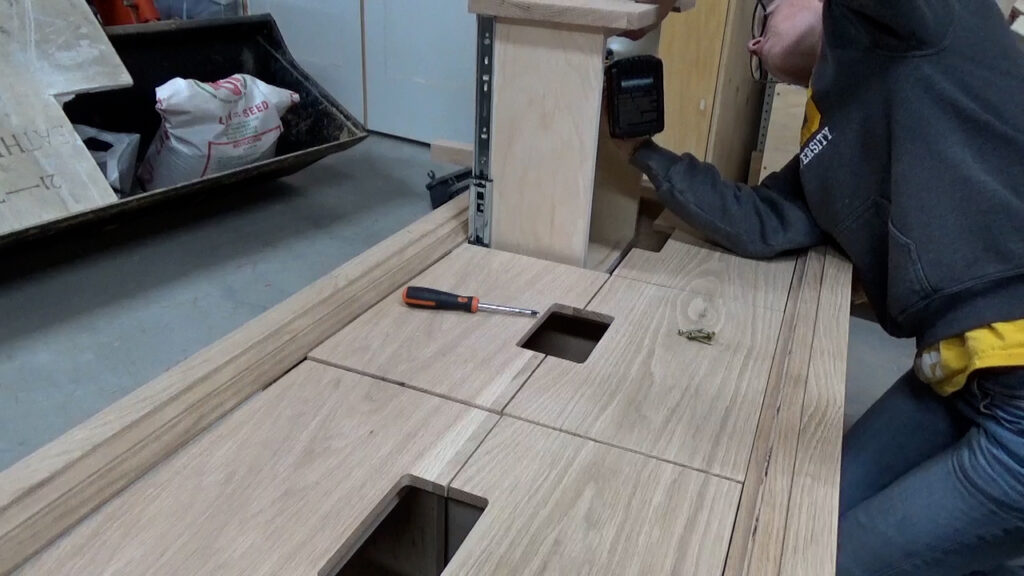
I’ve never installed locks into my furniture before, so it was a little trial and error and I wish I had thought to cut the slots BEFORE installing these pieces, but I guess now I know for next time.

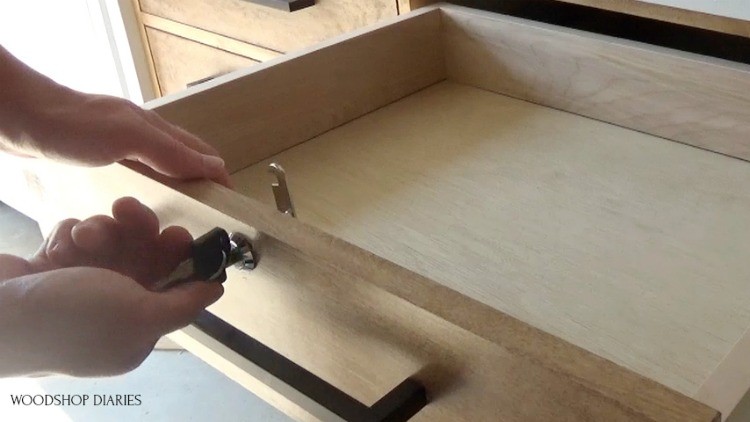
I used a spade bit to drill a hole in the drawer front to insert the lock.  These locks have a tab on the back that rotates 90 degrees. 

Locks installed on drawer boxes of dresser with tab turned up

So once the lock was on the drawer, I closed the drawer, turned the key, and used a pencil to mark where the tab hit the 1×3 above it.

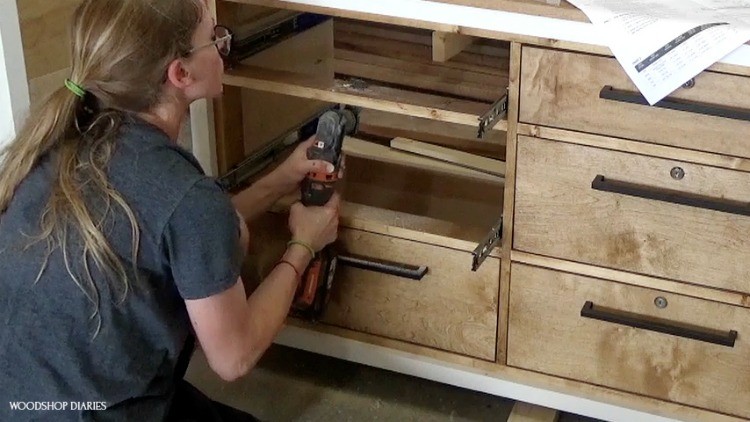
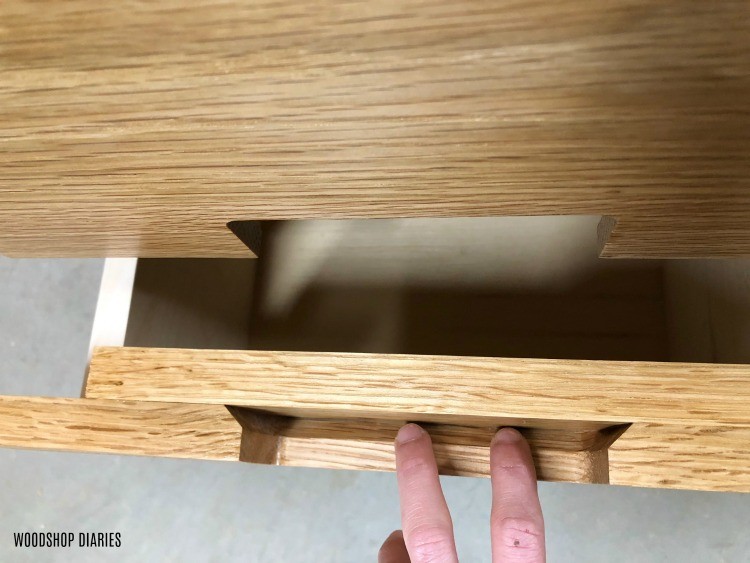
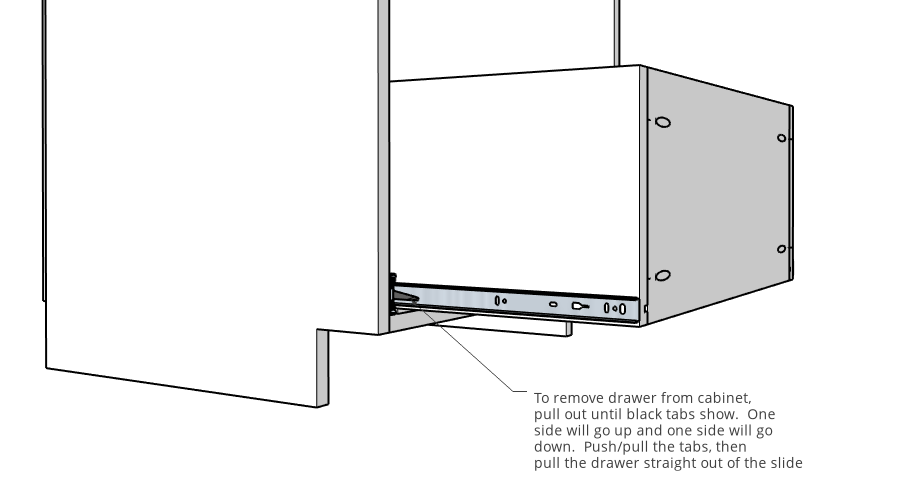
Then I removed the drawer (the slides have tabs on the sides to allow you to remove the drawer easily) and used an oscillating saw with a flush cut blade to cut a slot at that mark. 

I kept putting the drawer in and testing and seeing if or where I needed to take out more material. 

Shara using oscillating saw  to cut slots in dresser frame for lock tab

Once I had the slots cut, the drawers would be able to close and when the tab was turned up (in lock position), it would go into these slots so they would stay locked until the key was used to turn the tab back sideways.

To finish up, I gave it a little distressing and it got a few coats of poly (I used Minwax Polycrylic Water Based Semi Gloss).

Then, it was finished and ready to use.

Step 12: Add Back Panel (OPTIONAL)

Now, personally, I have my own thoughts about adding back panels on dressers. I don’t normally add them to my own projects.

However, if you like to have a back panel on your dresser, you can certainly add one here.

Simply cut a piece of ¼″ plywood to fit over the back side opening and use wood glue and brad nails, staples, or screws to secure.

If you wanted to get “fancy” you could also use a router to rabbet a groove around the edge to inset the panel so it’s flush across the back. Either way would work fine.

All that’s left now is finishing off any touch ups, adding some poly, a little scuffing if you want a distressed look.

If you’d like to build your own, don’t forget to grab the printable building plans here.

Looking for More DIY Dresser Ideas?

If you want to check out more dresser designs and building plans, here are a few favorites below, but you can also check out my DIY Dressers Page here.

3 Drawer Dresser
DIY Mid-Century Modern Dresser
DIY Modern Dresser
DIY 5 Drawer Dresser

If you’d like to be the first to know about the latest projects and plans, be sure to sign up for the newsletter below!

If you’re enjoyed this build, and want to save it for later, don’t forget to pin it or share it on you favorite social media platform!

Pinterest collage of overall dimensions of dresser and Shara with finished 6 drawer dresser

Until next time, friends, happy building!

All Star Renovation Challenge–Master Bathroom FINAL REVEAL

July 8, 2020 by Shara, Woodshop Diaries

Hey friends!  Welcome to the final week of the All-Star Renovation Challenge with Jeffrey Court, FrogTape, and Behr Paint!  This week is the MASTER BATHROOM FINAL REVEAL! This post contains affiliate links. See policies.

Master bathroom renovation challenge final reveal graphic

If you remember from the last five weeks, these brands challenged several bloggers from past renovation challenges (remember my kitchen renovation???) to take on another challenge as the All Stars! I’m so excited to be included in this group and to share with you the journey as we transformed my parents’ master bathroom!  Check out all the designers and their spaces here.

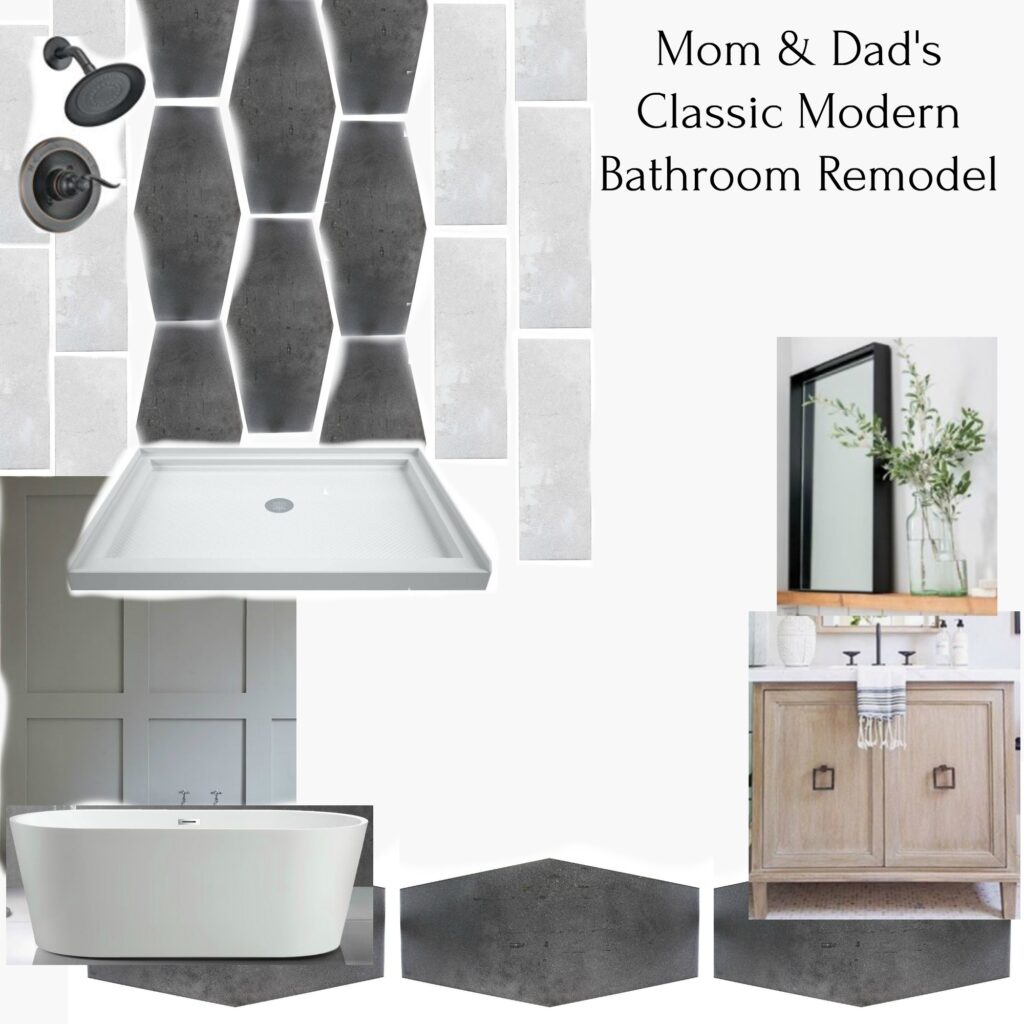
Master bathroom renovation mood board graphic

The last three weeks began fan voting…the winner takes home the grand prize of $5,000 and, of course, bragging rights that they won the ALL STAR Renovation Challenge. The winner this time around will be determined solely by fan votes, so I’d be forever grateful if you’d click on over and cast your vote! You can vote once a day until July 12 and the winner is announced July 15!

Shara tiling floor--Cast Your Vote graphic button

So if you missed the last couple weeks’ updates, head over and check those out first to get the full story. 

  • Week 1&2 Update
  • Week 3 Update
  • Week 4 Update
  • Week 5 Update

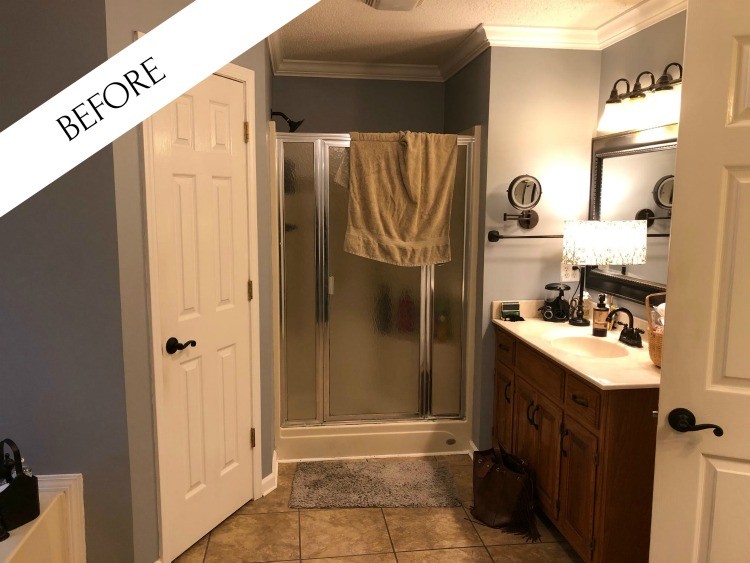
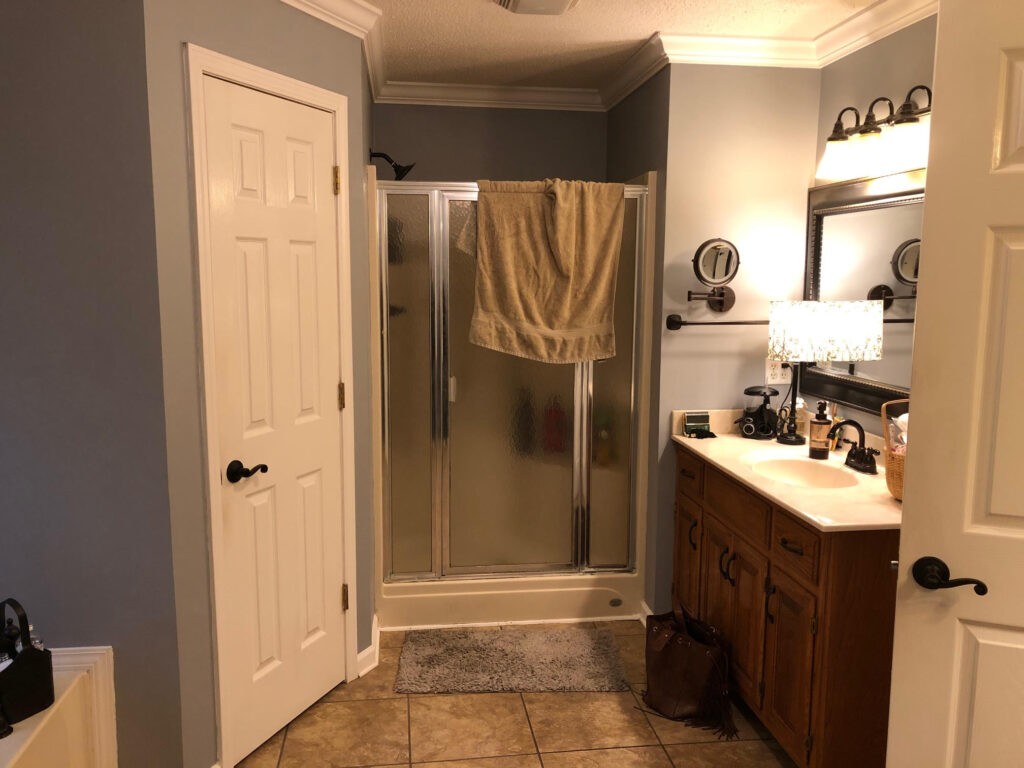
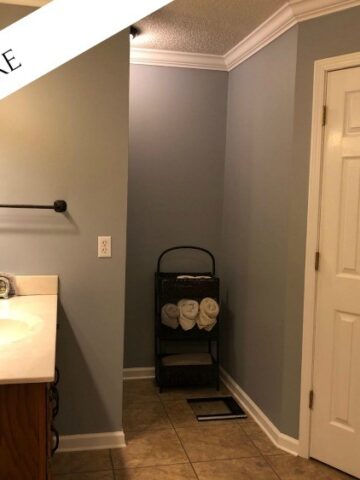
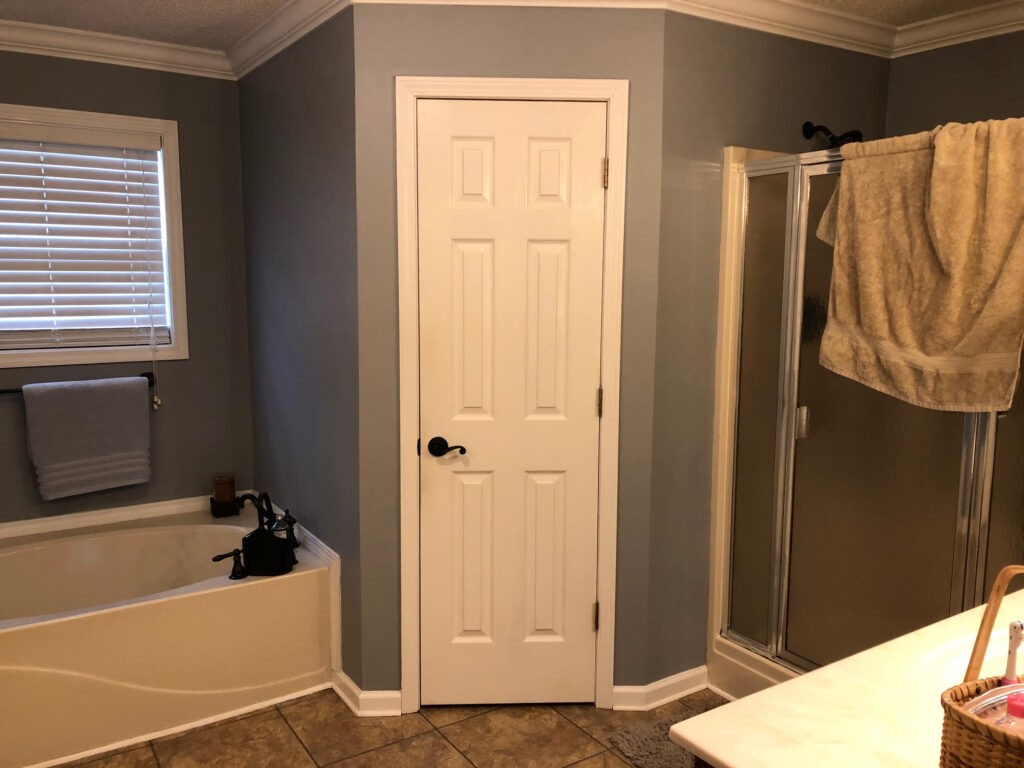
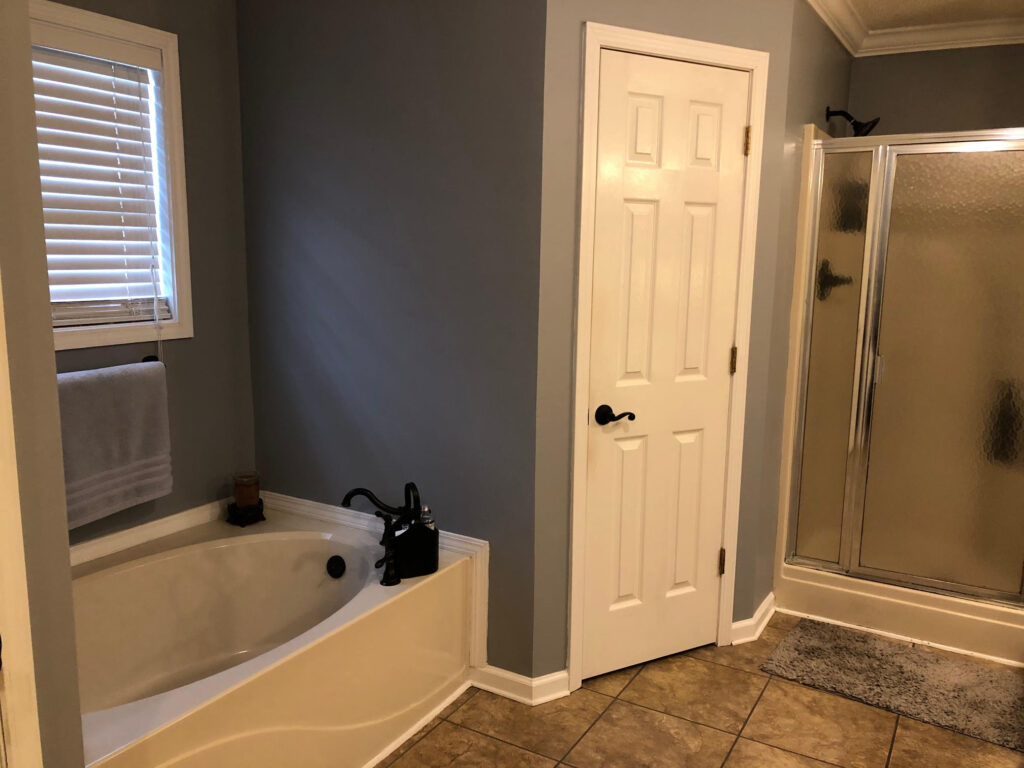
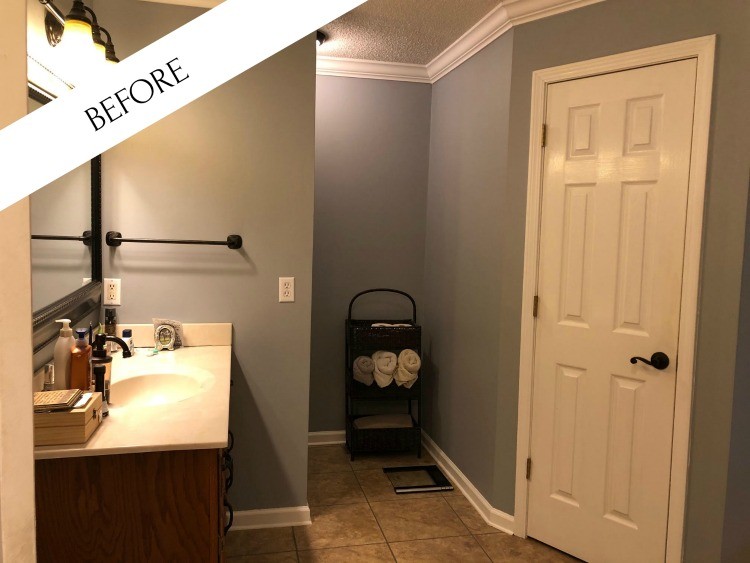
Here’s where we began our journey…the dark and dreary before photo…

Master Bathroom before--blue walls, dark oak vanity and dark mirror and tan floors

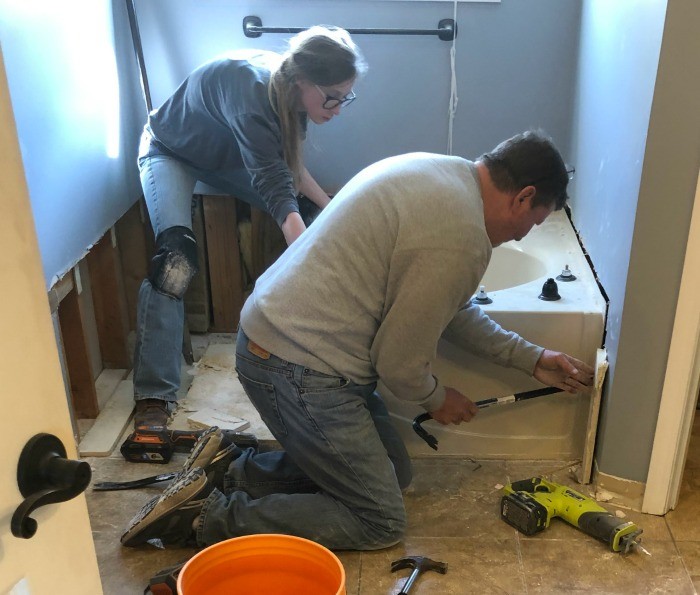
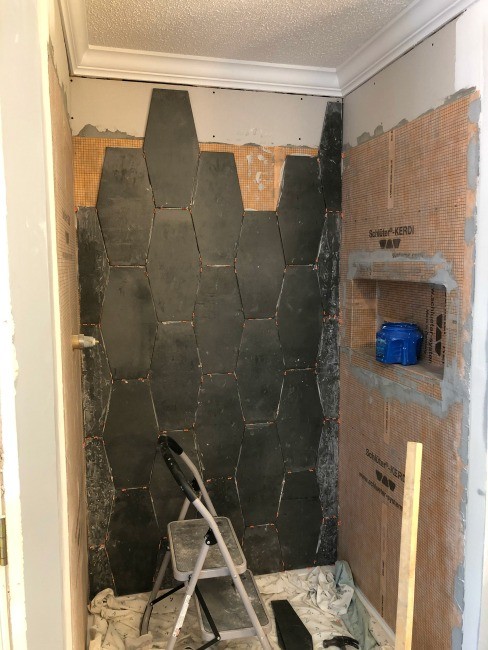
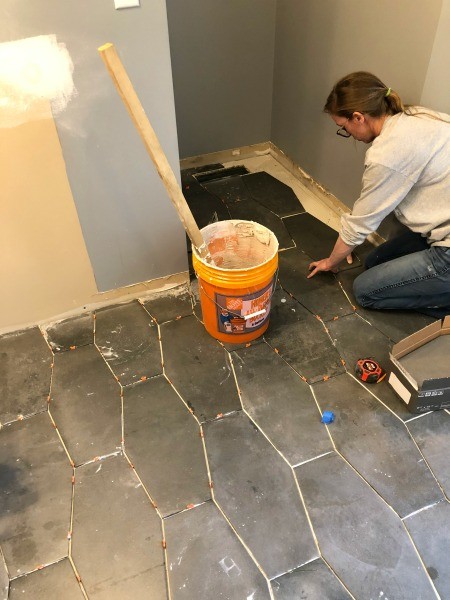
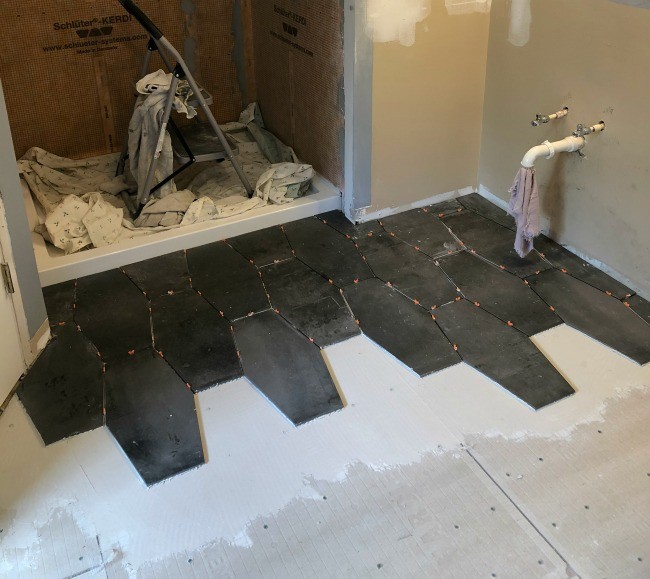
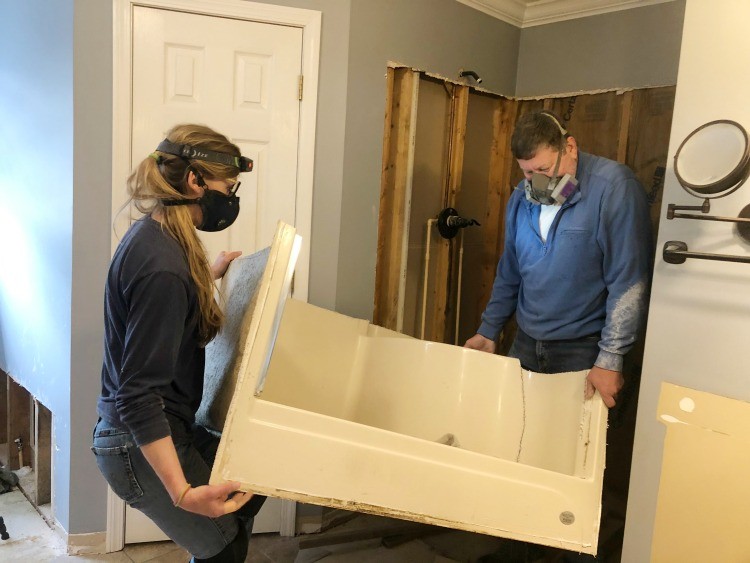
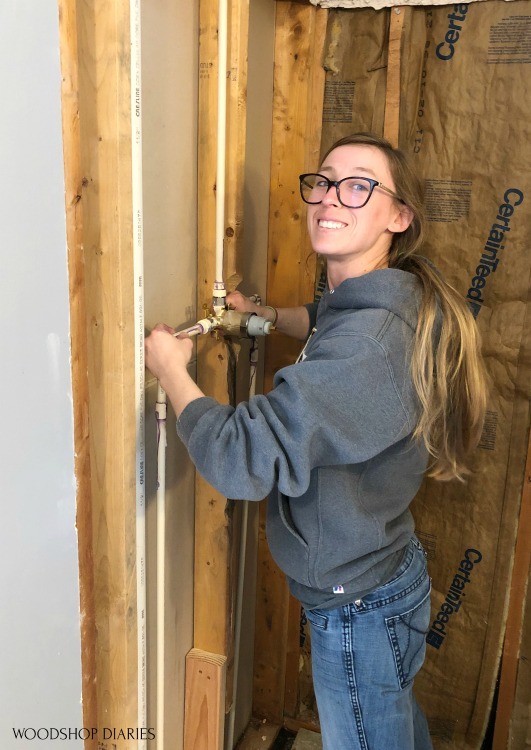
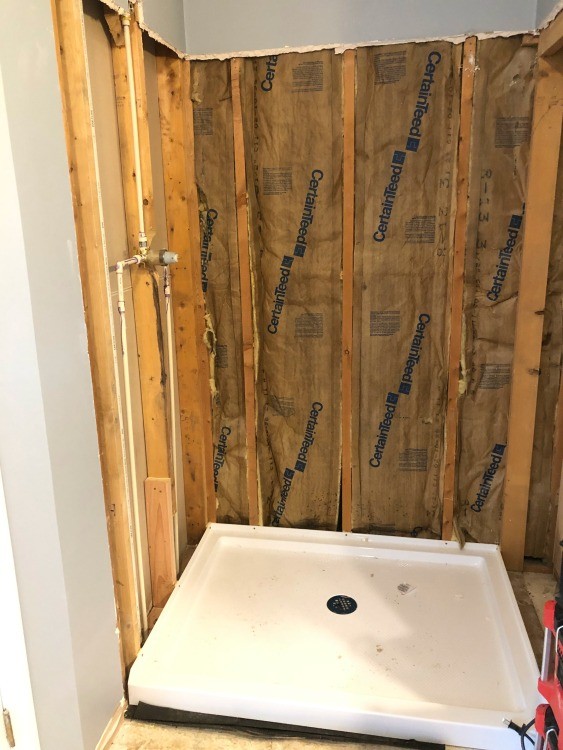
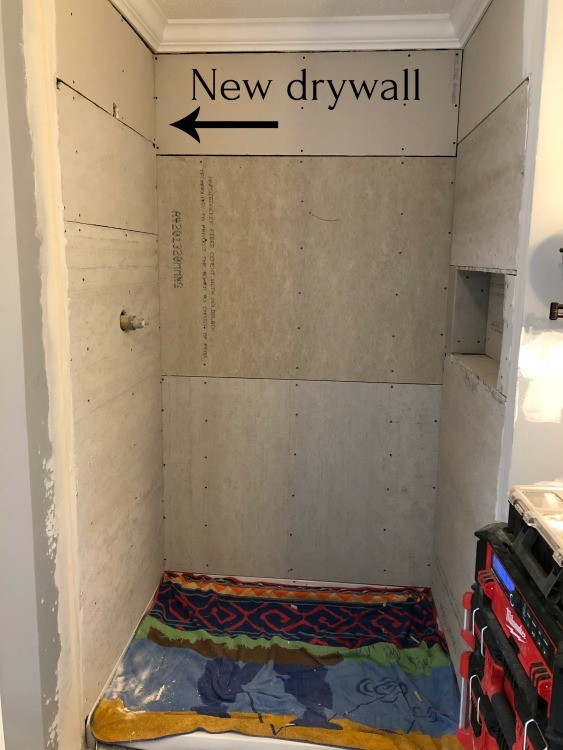
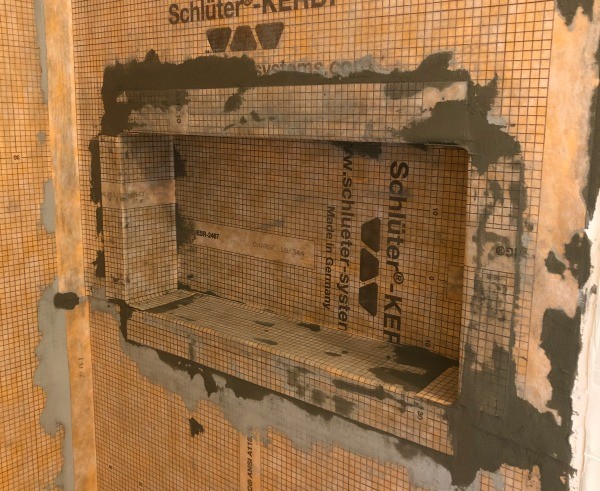
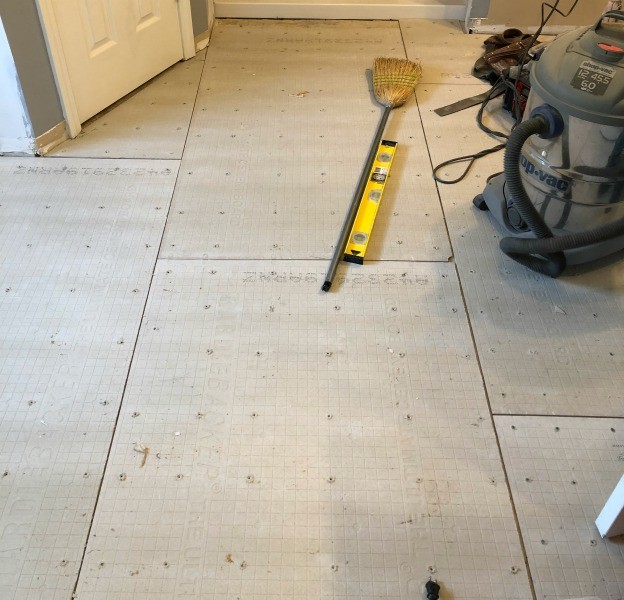
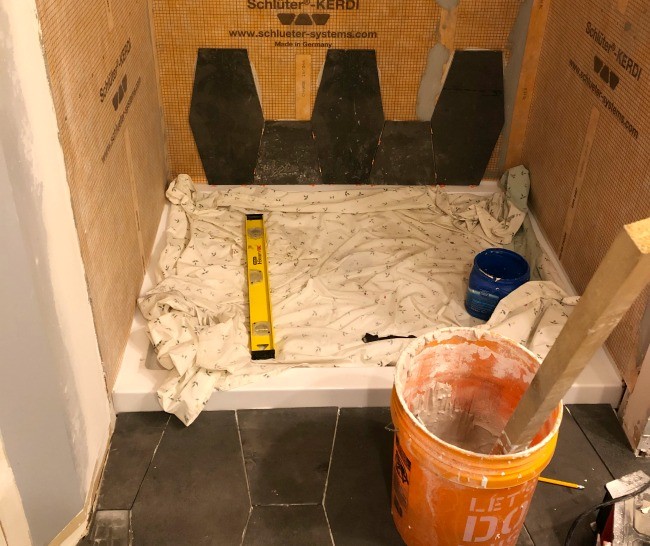
At the end of week two, we had removed everything to the subfloor and taken out the tub and shower stall.  We replumbed the shower water supplies and drain and set the shower pan in place.  I also prepped the floor and shower for tile, laid the floor tile, and one wall of the shower.  It doesn’t sound like a lot, but trust me…it was a busy first two weeks!  There was also some drywall patching in there somewhere, but you get the idea 🙂

Shara and Dad tearing out bathtub in master bathroom

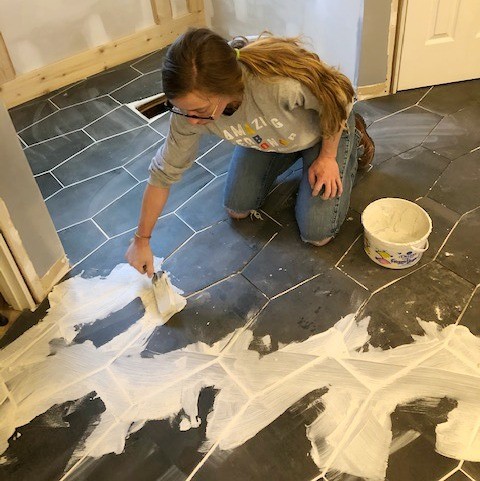
At the end of week three, everything was tiled, grouted, and trimmed out ready for paint.  At the end of week four, we had painted the walls, installed the vanities, tub, and toilet. And we were eager and ready for the finishing touches to come together.

Shara grouting floor tile in master bathroom

And at the end of week five, we finished the bathroom! ONE. WEEK. EARLY!!! But I couldn’t share the master bathroom final reveal until this week 😉

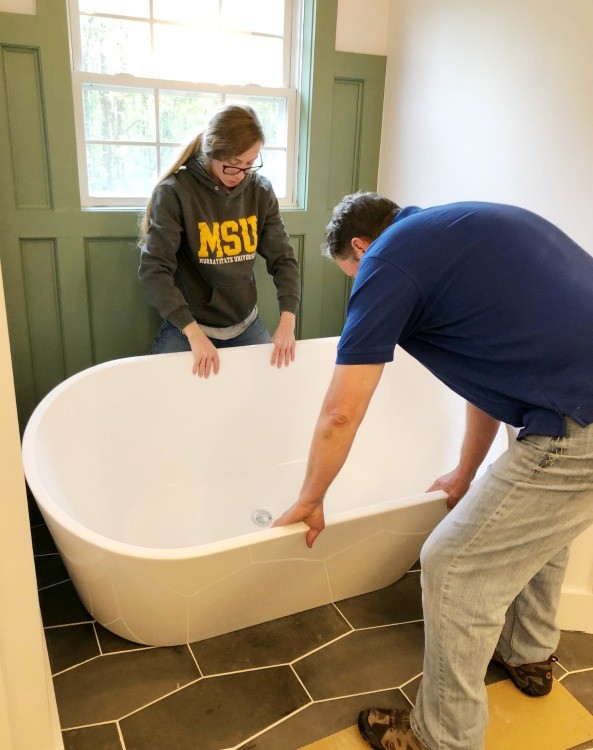
Shara and Dad install freestanding tub in master bathroom

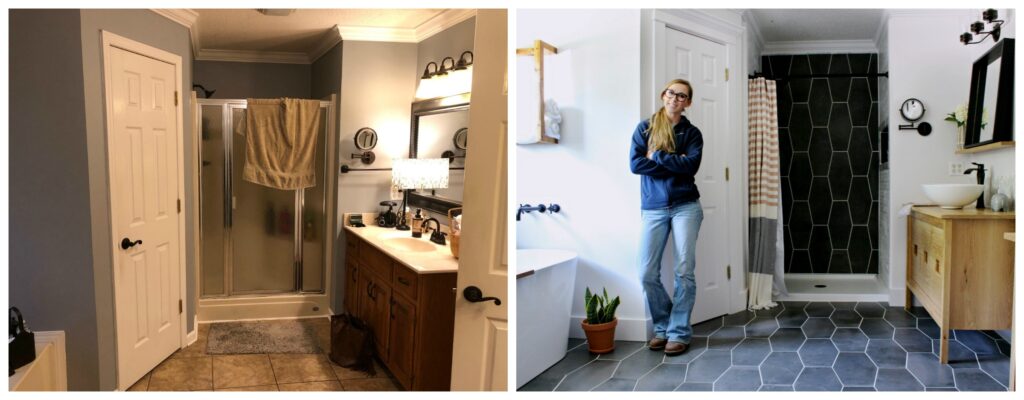
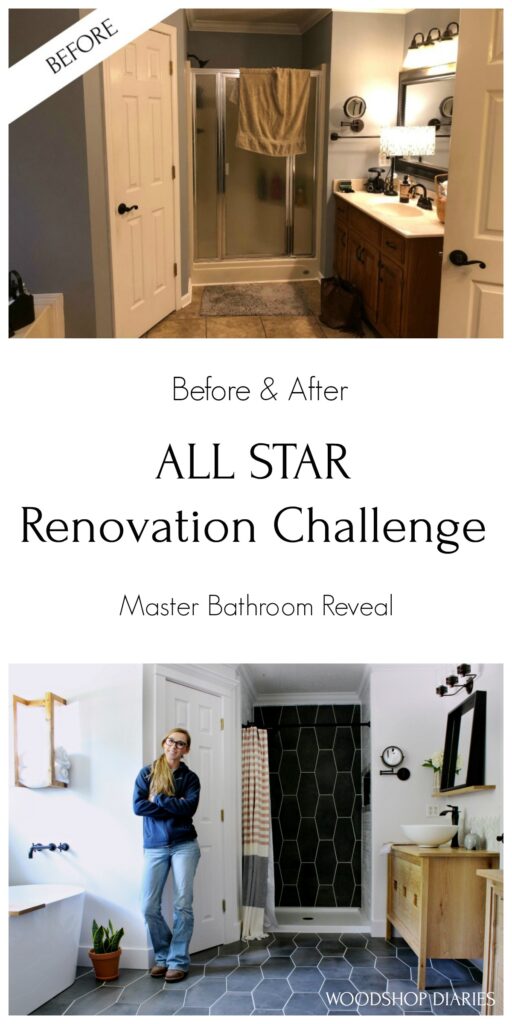
I was TIRED.  I was ready to be back in my workshop (you know…vs my parents master bathroom haha).  But I was SO HAPPY with how it turned out.  Can you believe this before and after???

Side by side before and after master bathroom renovation graphic
Before VS After

I’ve covered pretty much everything in all the previous posts, so this Master Bathroom Final Reveal is just going to be lots of pretty pictures and a trip down memory lane ????

Before and after bathroom renovation vanity and toilet side of room
Before VS After

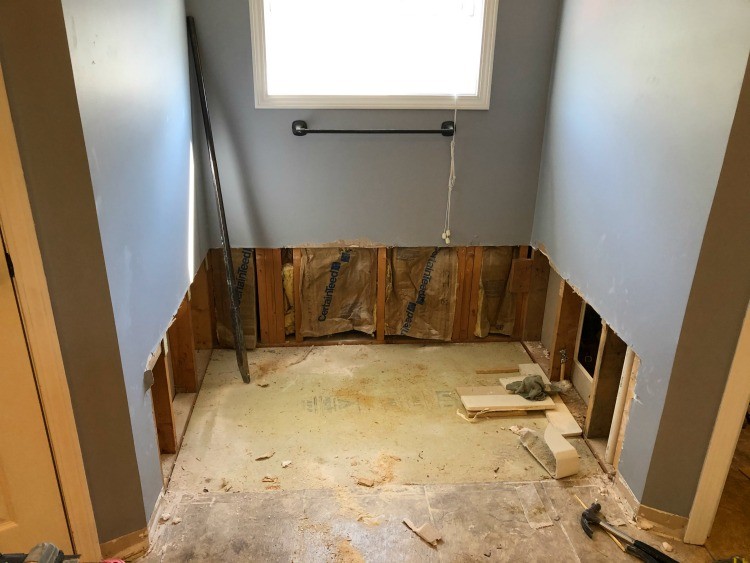
This was a pretty big remodel if you’ve been following along.  We removed everything in here except the drywall (although we did remove some of that, too haha).  It’s always nice starting with a clean slate, but also a little stressful because you don’t know what you’re going to find under all of that. 

Master bathroom before and after side by side bathtub and corner closet side of room
Before VS After

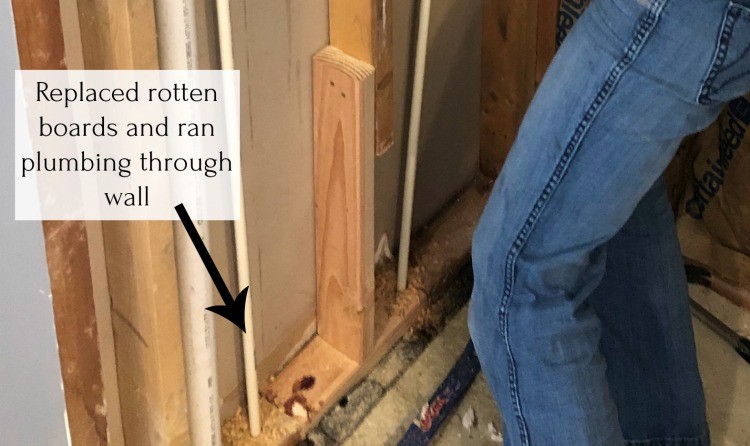
Luckily, we only found one unexpected issue and it was minor (a little rotten wood under the old shower valve…we replaced it and it was good as new).  But, we did spend and entire day moving the shower drain location because the new pan we installed didn’t match up exactly to the old shower stall.  Did you know it could take all day to move a drain 3”?? Plumbing is NOT for the faint of heart.

.

But once we got the shower pan in, the tile shortly followed and this room really started coming together quickly. 

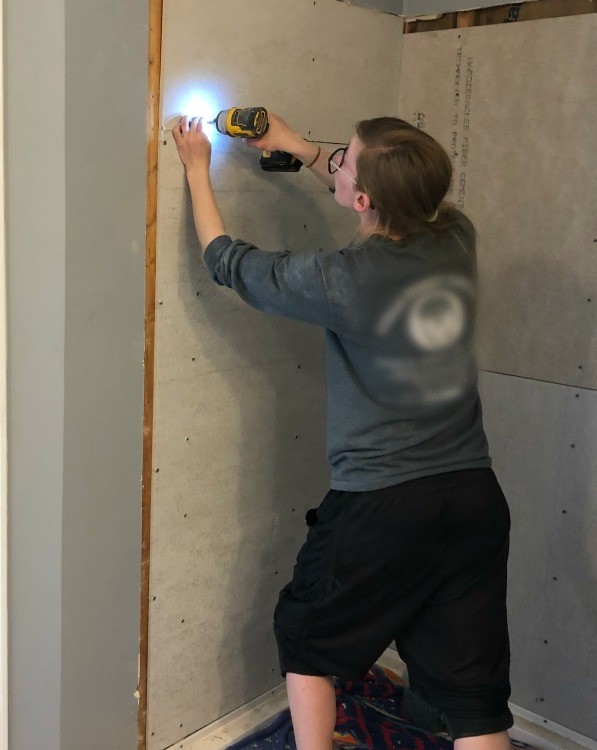
  • Installing cement board on walls
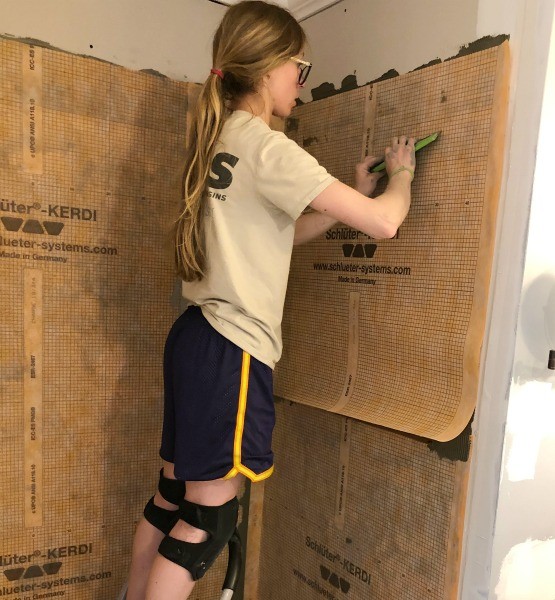
  • Applying waterproof membrane
  • Back shower wall almost finished
  • Shower sides tiled

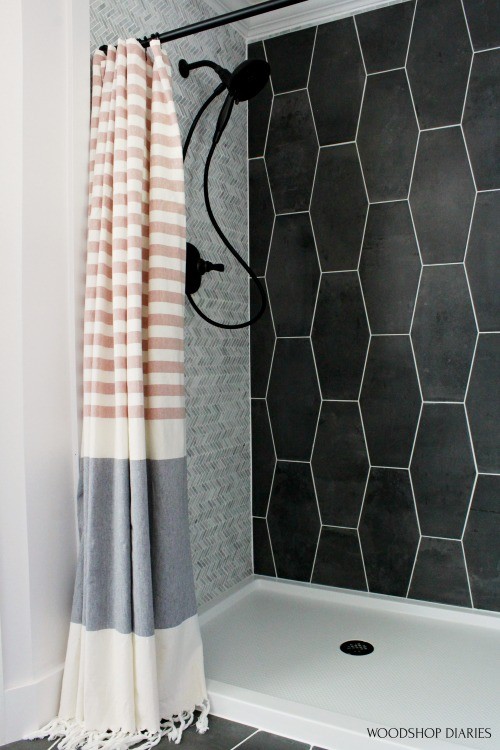
As far as the design in here, I wanted the Castlerock tile on the floor to run up the back wall of the shower. I thought it would be a fun way to add visual interest without being busy. I am really happy with how that turned out.

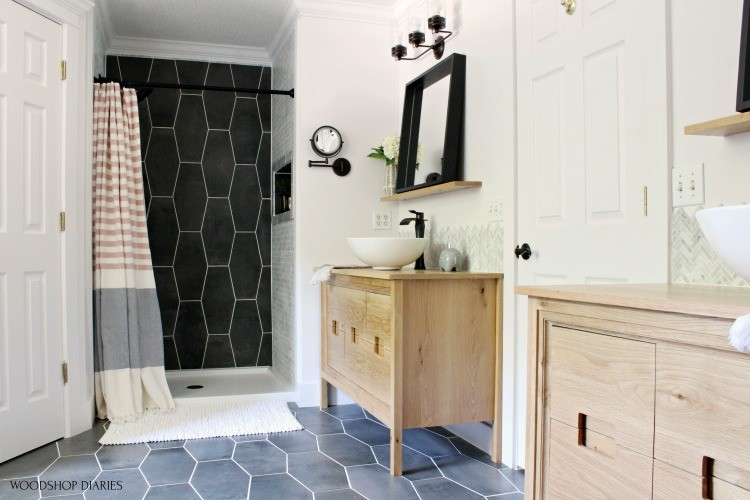
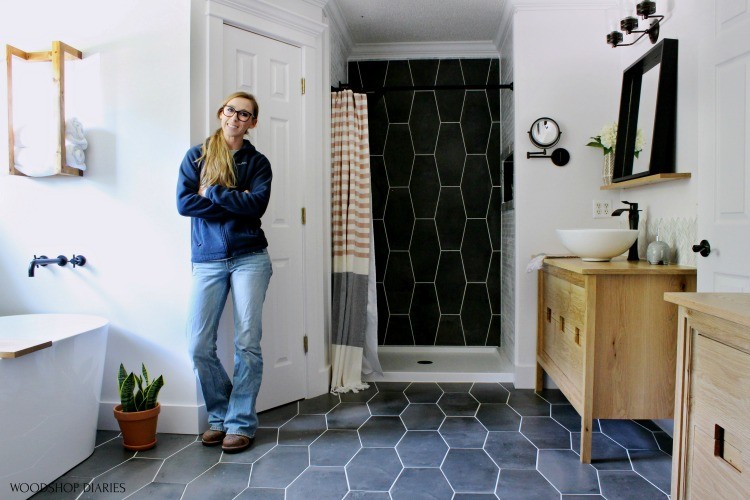
Master Bathroom Final Reveal right side of room shower nook, bathtub nook, vanity and closet view--white oak vanity, dark grey tile

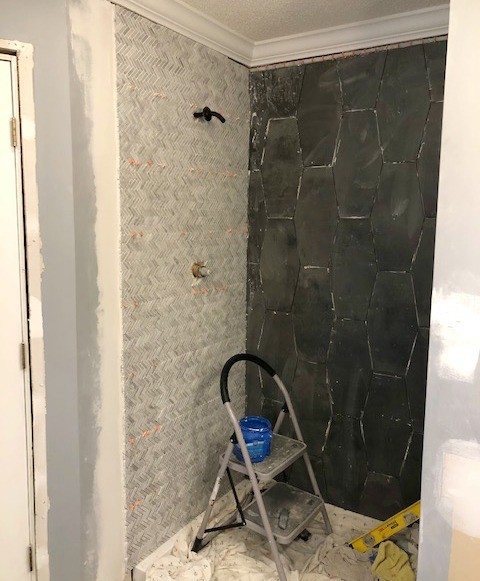
And I wanted the sides of the shower to be a little lighter and give some visual interest.  So I used this Jetstream mosaic tile for that.  We decided to lay it sideways vs the traditional way and it made it a little more challenging to install, but overall I’m happy with the look.

Up close master bathroom shower tile--dark grey back wall and light grey side walls with copper and grey curtain

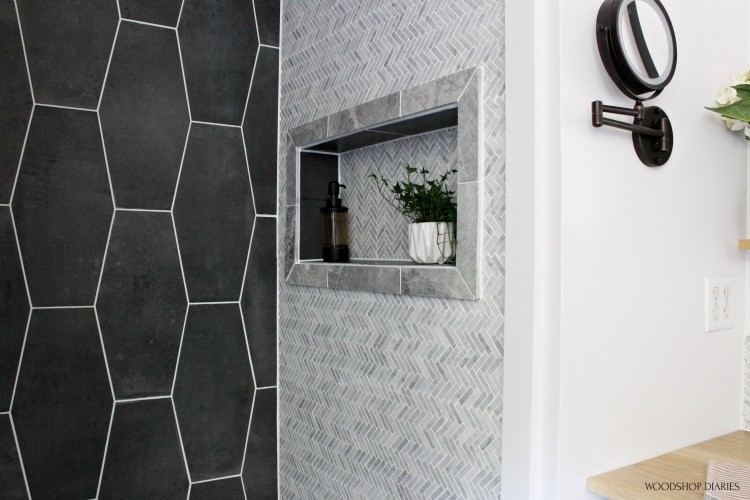
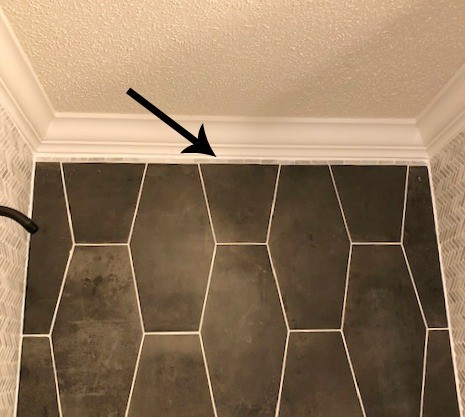
For this little niche, we had some…issues.  I cut the Castlerock tile to line the sides and used the Jetstream tile on the back.  BUT it looked unfinished on the edges once it was grouted. 

.

So I used some Tundra Grey tile I had leftover from our kitchen renovation from the last challenge and used them to frame around the edges.  I’m sure there was a better way to install these, but we used a plumbers epoxy and silicone to attach these tiles.  They seem pretty solid, but if for some reason they come loose over time, they’re just decorative and we can stick them back on.

Up close master bathroom shower tile niche with grey framed trim

I wish I had framed this out prior to grouting and finishing the tiling on this wall, but it is what it is and even though it was kind of an afterthought, I think it turned out really nice.

.

PS do you remember how I added that wooden trim piece on the shower tile edges in week 3?? Do you see it in the photo above? I told you it would blend in nicely *wink wink*

.

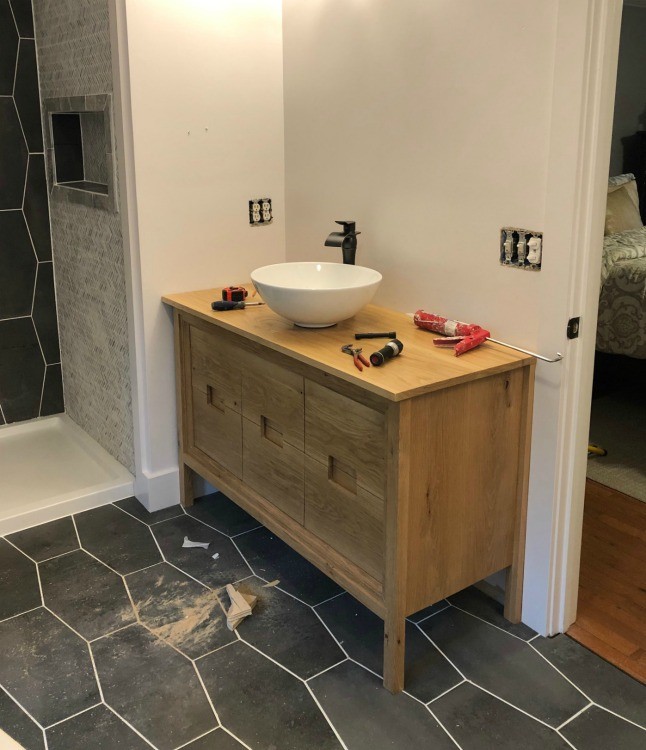
I had built these vanities a couple months ago and was so excited to (get them out of my shop) install them into this bathroom so my parents could finally use them. 

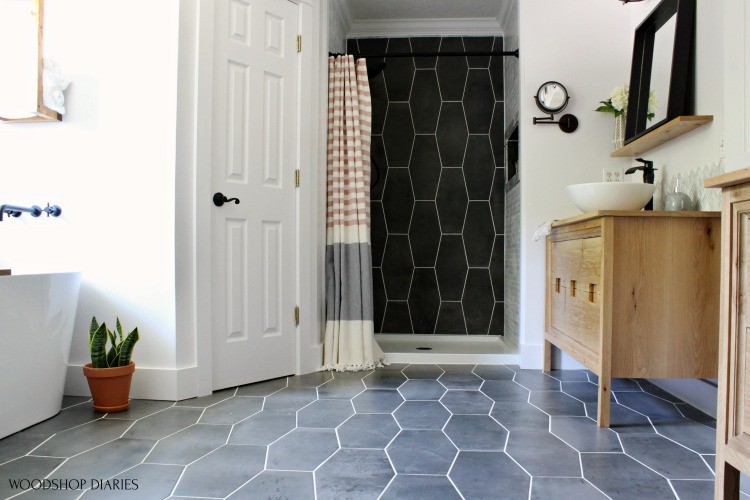
Wide view of master bathroom white oak double vanities, black mirrors, and two tone shower nook

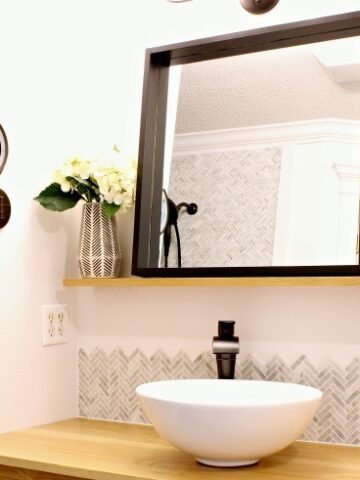
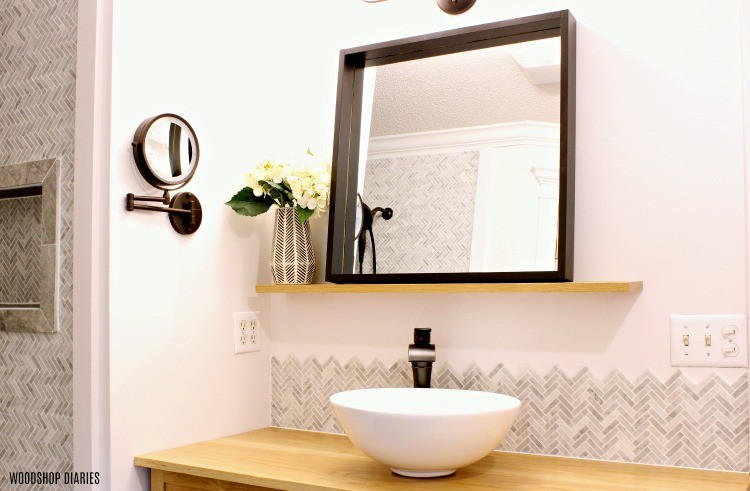
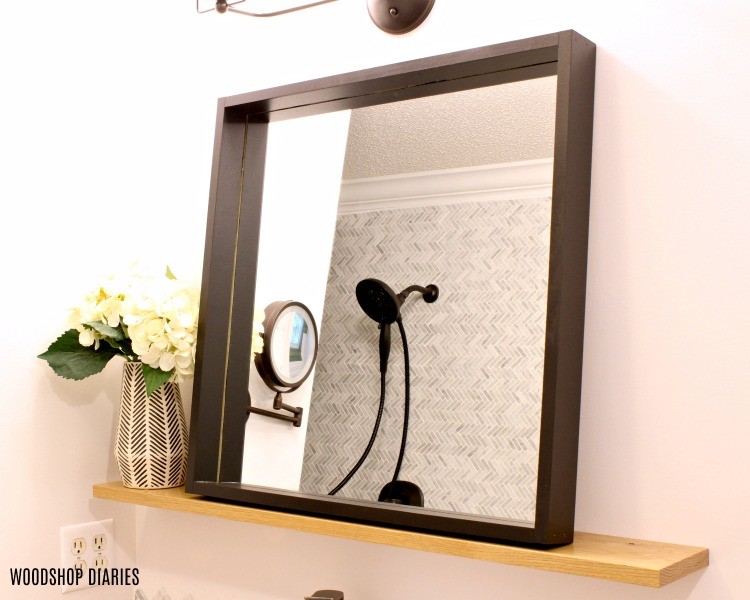
I also built them these mirrors and floating shelves to give them a simple, more modern feel than their old traditional style frames.

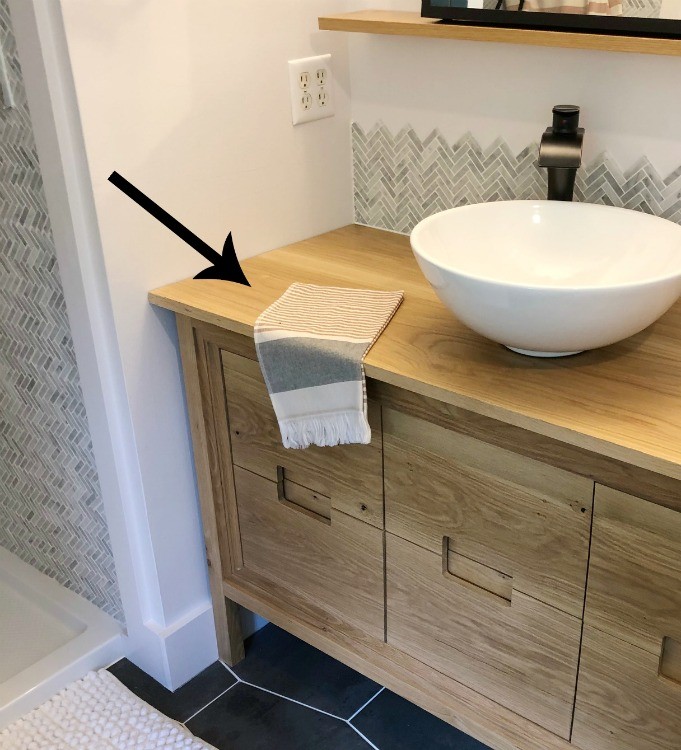
Close up of Jet Stream backsplash tile over top of white oak vanity with black framed mirror on floating shelf

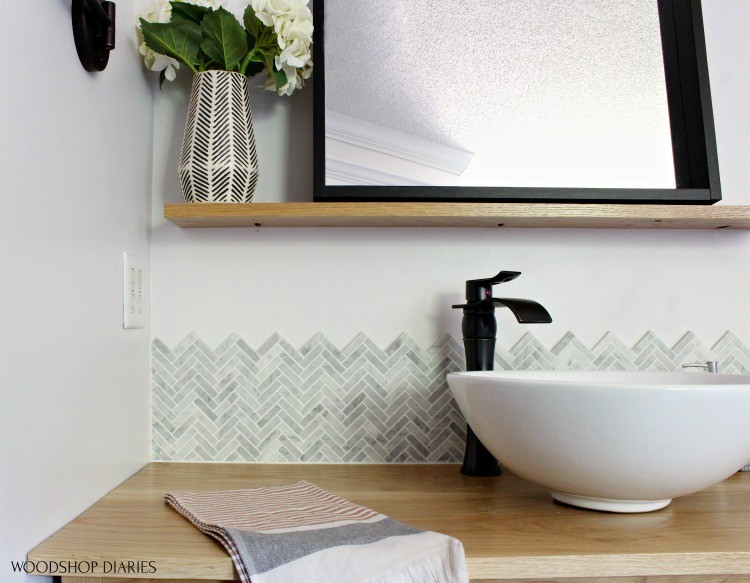
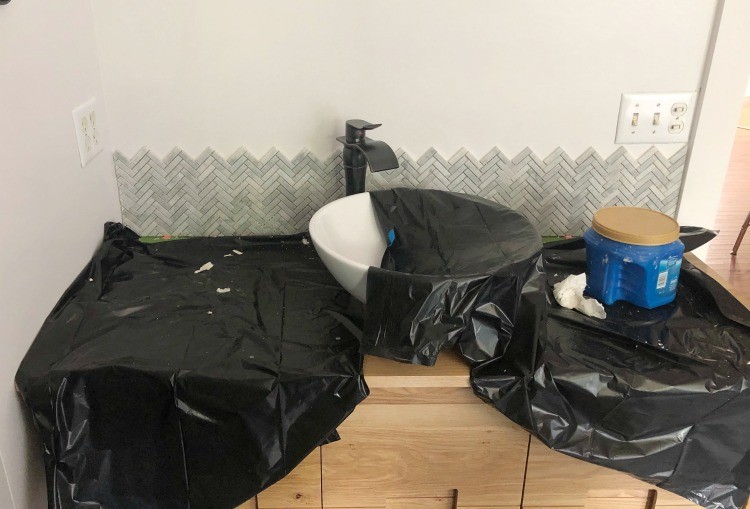
I also really loved how the Jetstream tile backsplash turned out.  I decided to leave the tops jagged for two reasons…it was unique AND it meant I only had to cut one end of the sheets haha. 

.

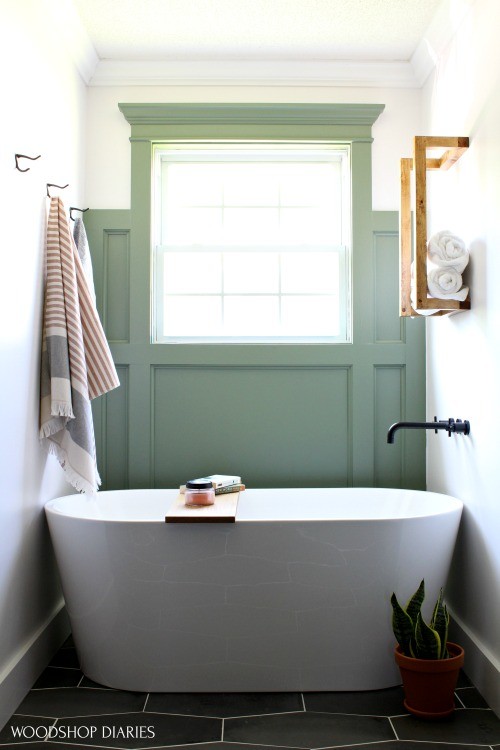
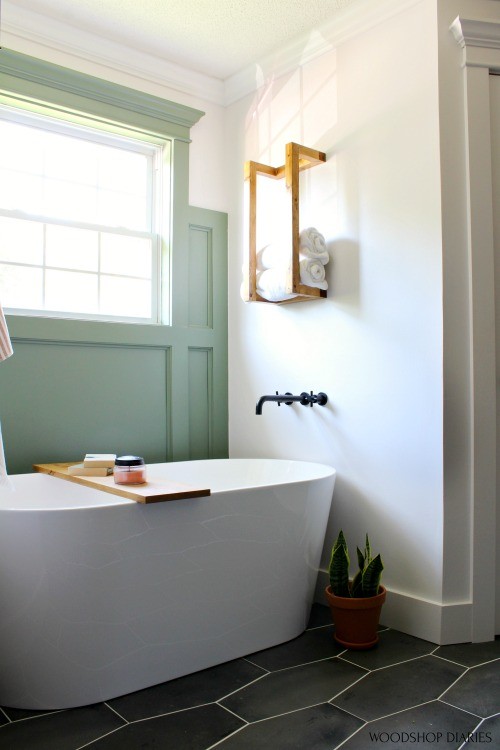
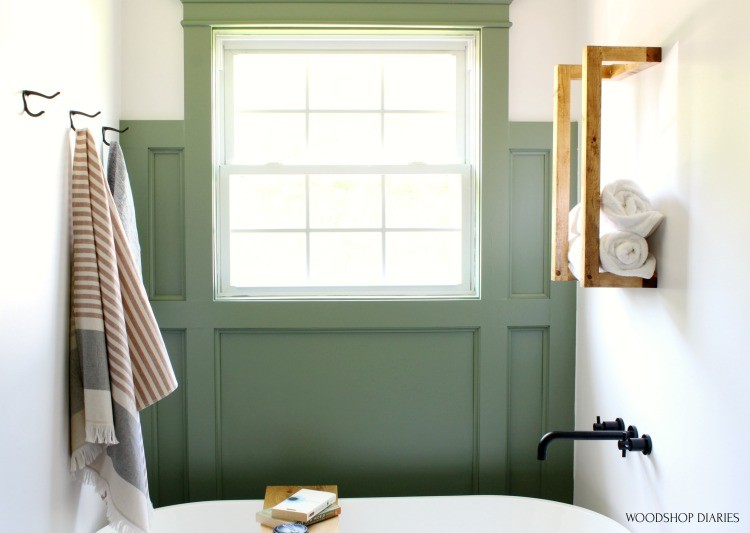
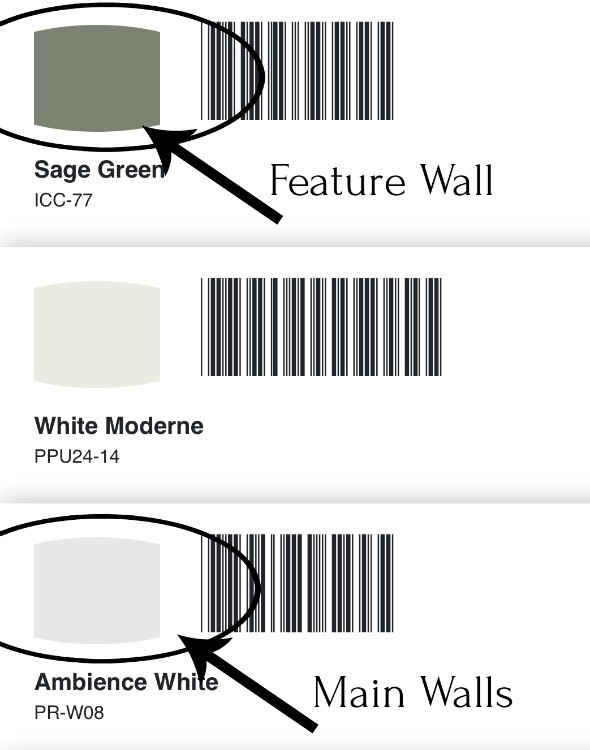
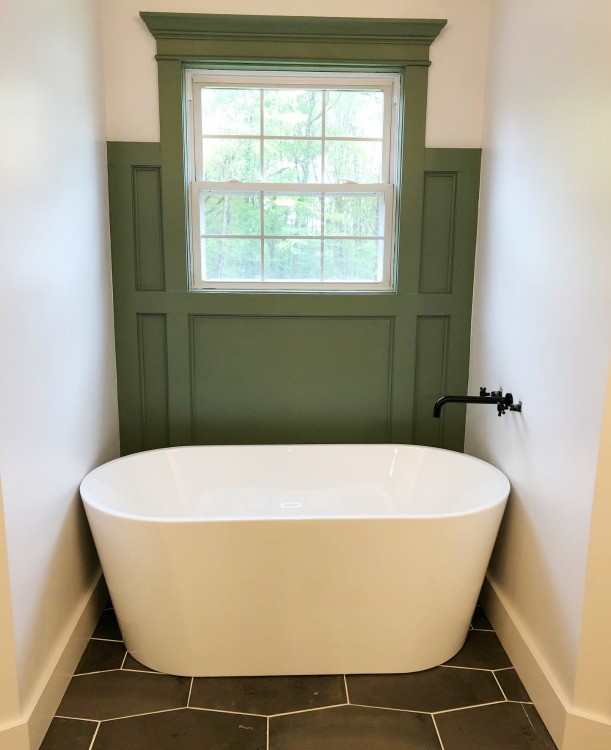
I added this feature wall behind the tub here and had originally thought I was going to paint it dark grey.  But I decided to go a little bold and pick this Behr Sage Green color.  It pairs perfect with the Behr Ambience White that we used on the walls and doors in here and adds a little…life? To the space.  I’m so happy with these colors.  They brightened up this space SO much and makes it look clean and fresh.

Sage Green feature wall behind free standing modern bathtub on Castlerock tile floor and white walls in master bathroom after renovation

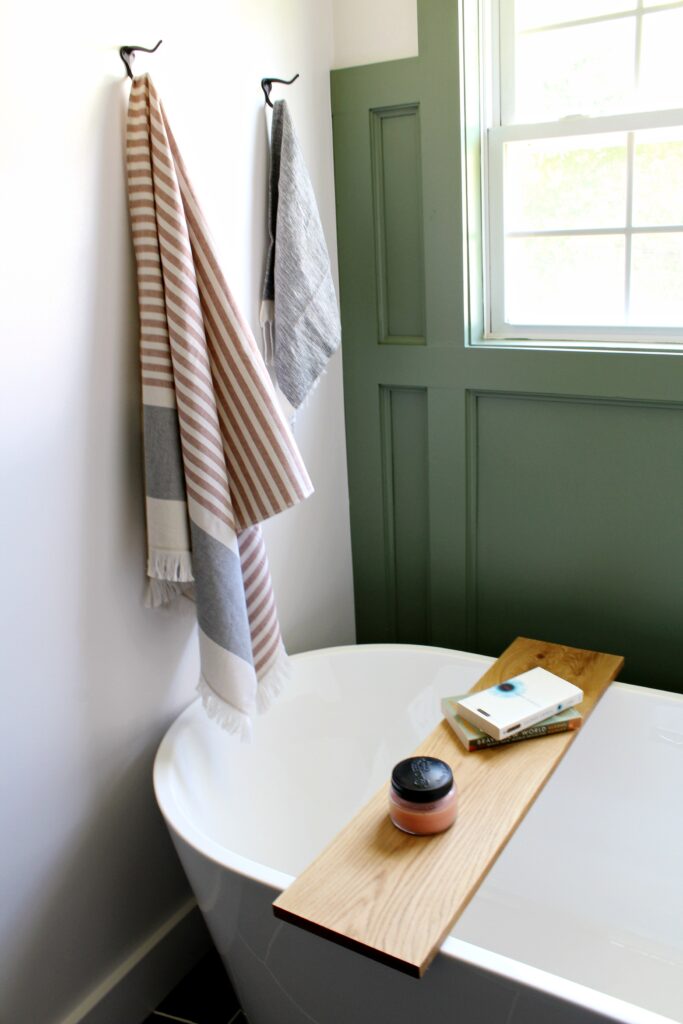
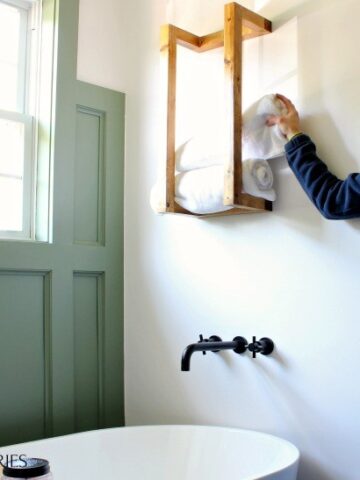
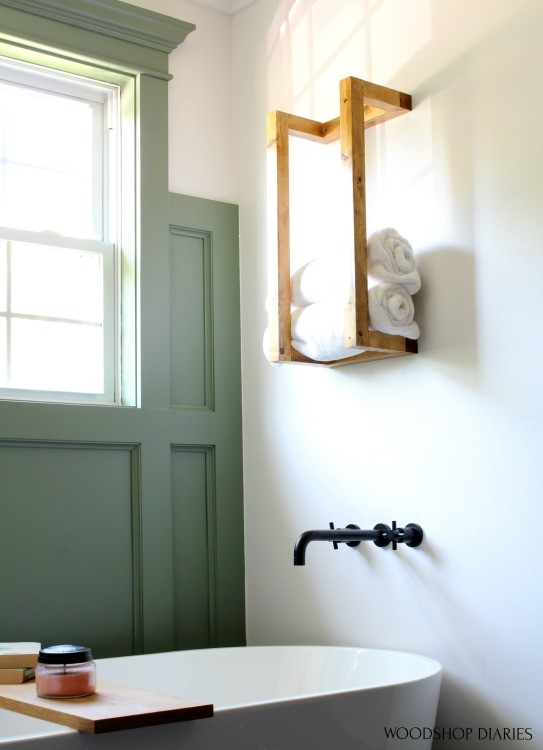
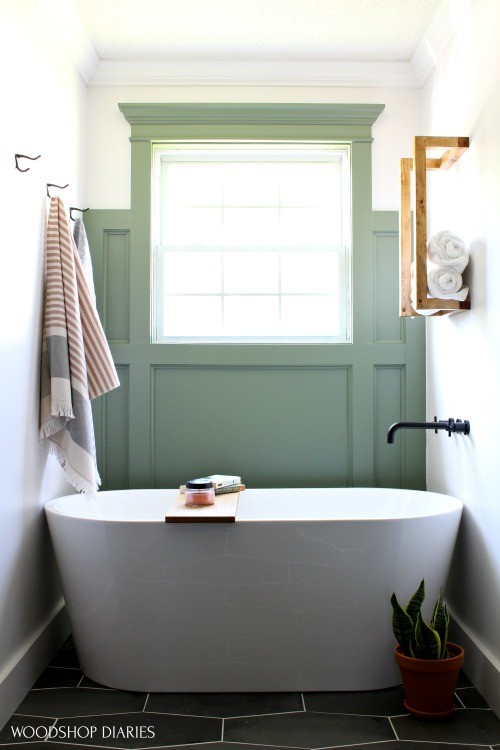
You can check out how I built that scrap wood towel rack in this tutorial post and if you’re wondering about that tub tray, it’s simply a board I cut from the leftover wood from the vanities and laid across the tub…so simple!

Free standing bathtub in bathroom nook with green feature wall and towel rack

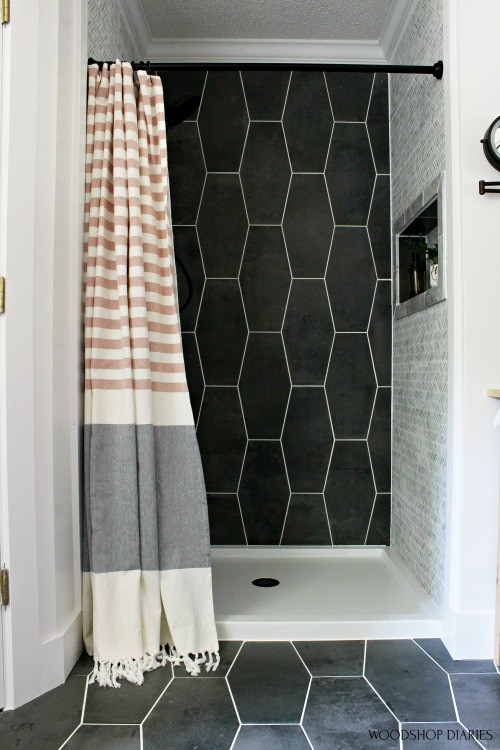
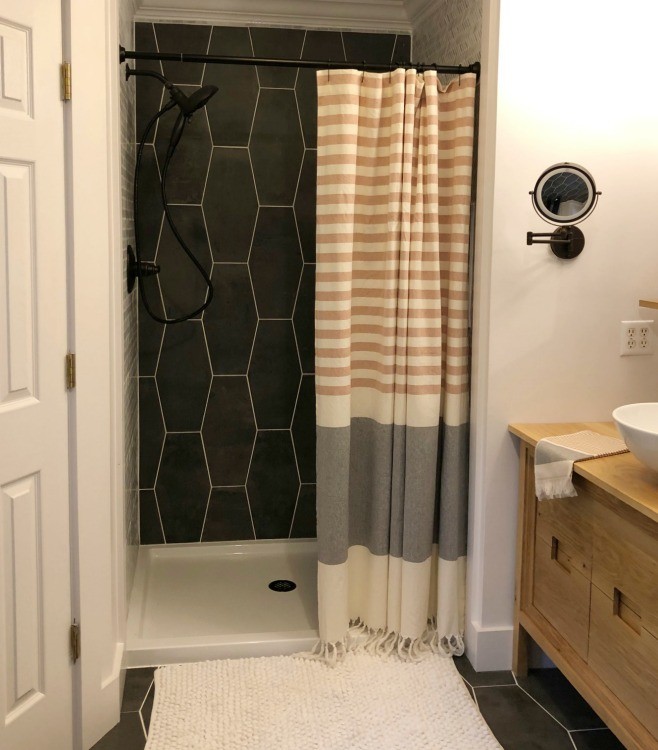
A note about the shower curtain—we intended on getting a glass door for this shower.  But since it was such a narrow shower (only 48” wide), the shower door options were slim and the ones we did find had really narrow doors.  You’d have to turn sideways to walk into the shower…not exactly ideal.

.

So we ended up going with a nice modern shower curtain to match the style in here.  And I’m really happy we did.  I think the colors in the curtains add a lot to this space and I am in love with the matching towels we found to hang on the wall and use with the vanities. 

Copper and grey CB2 shower curtain against light and dark grey shower walls and white shower pan

Personally I’m a fan of the curtain over the glass shower doors because I don’t like to clean shower doors all the time to prevent water spots.  I think my parents agreed and weren’t too upset about the trade off.

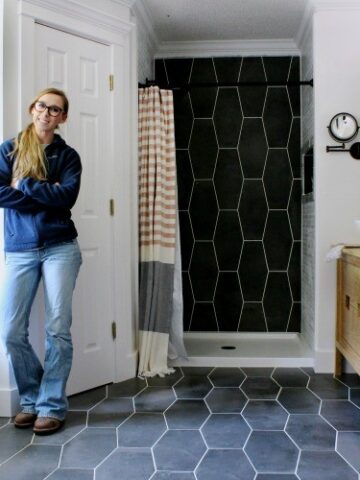
Shara Woodshop Diaries in master bathroom final reveal photo

Now, if you want more details about the process, be sure to check out the previous weeks’ posts.  And if you want a list of parts and materials used in this space, here are links to everything:

  • Castlerock Tile (floor and back wall)
  • Jetstream Tile (shower wall sides)
  • Tundra Grey Tile (shower niche trim)
  • Behr Ambience White (main wall and trim color)
  • Behr Sage Green (feature wall color)
  • Shower Pan
  • Freestanding Tub
  • Vanities
  • Mirror
  • Towel Rack
  • Sinks
  • Vanity faucets
  • Bathtub faucet
  • Shower head faucet
  • Shower Curtain
  • Matching towels
  • Shower curtain rod and hooks and liner

I hope you’ve enjoyed watching this transformation and seeing the master bathroom final reveal and I’d love if you’d take a few seconds to vote for me in this renovation challenge…pretty please 🙂

.

If you want to save this for later, I’d also love if you’d pin any of the images in this post or this pretty graphic!

Pinterest graphic before and after master bathroom final reveal

Until next time, friends, happy renovating ????

Master Bathroom Renovation Challenge–Week 5

July 1, 2020 by Shara, Woodshop Diaries

Hey friends!  Welcome to Week 5 of the All-Star Renovation Challenge with Jeffrey Court, FrogTape, and Behr Paint!  We are talking master bathroom renovation again, and I’m updating you on week FIVE of our progress. This post contains affiliate links. See policies.

All star renovation challenge graphic for week 5

If you remember from the last four weeks, these brands challenged several bloggers from past renovation challenges (remember my kitchen renovation???) to take on another challenge as the All Star Renovation Challenge. I’m so excited to be included in this group and to share with you the journey as we transform my parents’ master bathroom!  Check out all the designers and their spaces here.

Mood board for parents master bathroom renovation

The last two weeks began fan voting…the winner takes home the grand prize of $5,000 and, of course, bragging rights that they won the ALL STAR Renovation Challenge. The winner this time around will be determined solely by fan votes, so I’d be forever grateful if you’d click on over and cast your vote! You can vote once a day until the winner is announced next week!

Cast your vote graphic for the all star renovation challenge

So if you missed last weeks update, head over and check that out first.  But I’ll give you a quick recap of where we started this week.

Master Bathroom BEFORE image

At the end of week two, we had removed everything to the subfloor and taken out the tub and shower stall.  We replumbed the shower water supplies and drain and set the shower pan in place.  I also prepped the floor and shower for tile, laid the floor tile, and one wall of the shower (we used Jeffrey Court Castlerock Tile).  It doesn’t sound like a lot, but trust me…it was a busy first two weeks!  There was also some drywall patching in there somewhere, but you get the idea 🙂

Shara Woodshop Diaries installing floor tiles

At the end of week three, everything was tiled (we also used Jeffrey Court Jetstream tile on the shower walls), grouted, and trimmed out ready for paint.  At the end of week four, we had painted the walls (Behr Ambience White and Behr Sage Green), installed the vanities, tub, and toilet. And we were eager and ready for the finishing touches to come together.

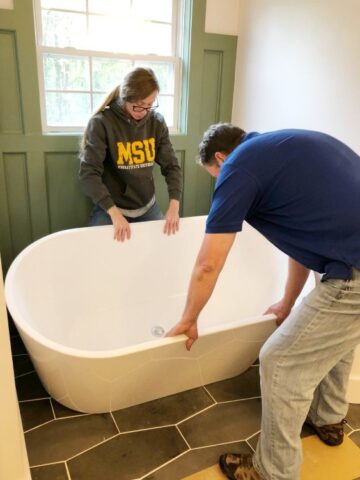
Shara and Dad installing master bathroom stand alone tub

So we started week five antsy and excited and ready to be finished and see our hard work completed!  So, with that, here’s what happened in week five:

We finished the bathroom!

I know…we weren’t really supposed to finish until week 6, BUT we were ahead of schedule and we did. 

.

But don’t get too excited…I’m still saving the final reveal for next week ????  In the mean time, I’ll share a few of the final details we added to the space before sharing the overall space in week 6.

New Bathroom Mirrors:

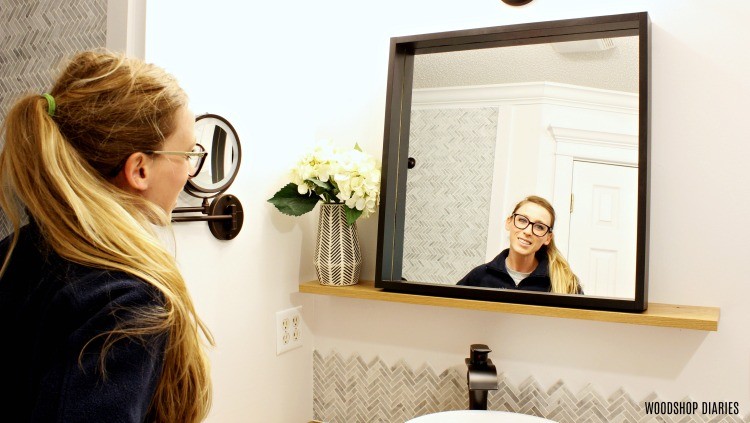
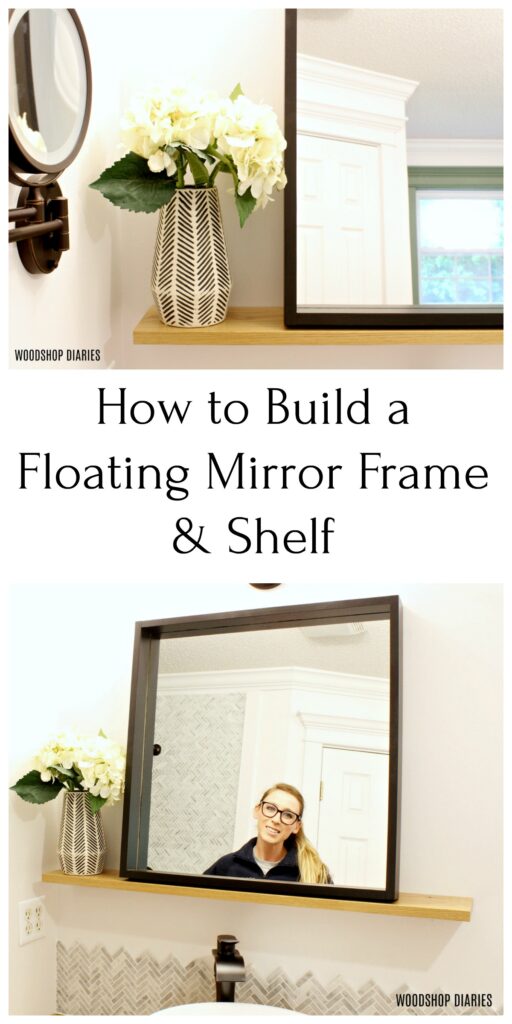
If you remember, from some previous posts, I built my parents’ vanities.  I wanted this bathroom to have an overall modern feel.  So I built them a floating mirror shelf and bathroom frame that would fit a similar style as the vanities.

Shara Woodshop Diaries showing off new bathroom vanities middle door opens

I posted a whole tutorial about the floating shelf and mirror frame here.

Modern floating bathroom mirror installed during all star renovation challenge

I got this installed after installing the backsplash last week and now my parents could finally use their vanities again.  I think I was almost as excited as they were haha.

Scrap Wood Towel Rack:

I also built a SUPER SIMPLE scrap wood towel rack to hang above the tub.  This was more for looks than function as they don’t use the tub often, but I thought the wood tone on the rack brought some warmth to this space with the white walls.

Bathtub feature wall and scrap wood towel rack in all star renovation challenge

I’ve also got a tutorial for the towel rack posted here.

Tub Tray:

I also gave my parents a tub tray (is that what these things are called??) to set on their tub.  I simply cut a white oak (the same wood I used for the vanities so it would match) board a few inches longer than the width of the tub.  Literally the easiest DIY project ever haha.

Tub tray laying across top of bathtub in newly remodeled bathroom

It also adds a little warmth to this modern bathroom.  With the white walls, I didn’t want it to feel too cold.  The wood tones really helped give it some “life” and warmth.

New Shower Curtain:

We weren’t actually supposed to have a curtain in this bathroom.  We had planned to have a glass door on the shower. 

Shower tiled, but no door installed yet

However, when we began shopping for them, since their shower was so narrow (only 48” wide), the glass door options weren’t great because the door widths were so small.  That meant they’d have to turn sideways just to walk into the shower. 

.

Not ideal.

.

So, we decided to actually go with a shower curtain.  And while it’s not as “fancy” as a glass door, I think in the long run, it’ll be a little more practical for this space.  My parents have really hard water and I was a little concerned about it damaging the glass door if it wasn’t cleaned after every use. 

.

With that PLUS the narrow door issue, we ultimately just decided to go with a nice curtain instead. 

Shower curtain installed in tiled shower nook

It was still ten times better than the 20 year old shower door they used to have haha.

Master bathroom shower door before renovation

We found this shower curtain on CB2 and it matched the style I was going for perfectly.  It also had matching towels!!

Matching hand towels to shower curtain in master bathroom

It was the last piece of the bathroom to come in and it really completed the space. And at this point, it’s all over but the cleaning, so I’m off to sweep and mop all the renovation dust off everything and get ready to share the full reveal next week!

.

Get excited…the before and after side by sides will blow you away ????

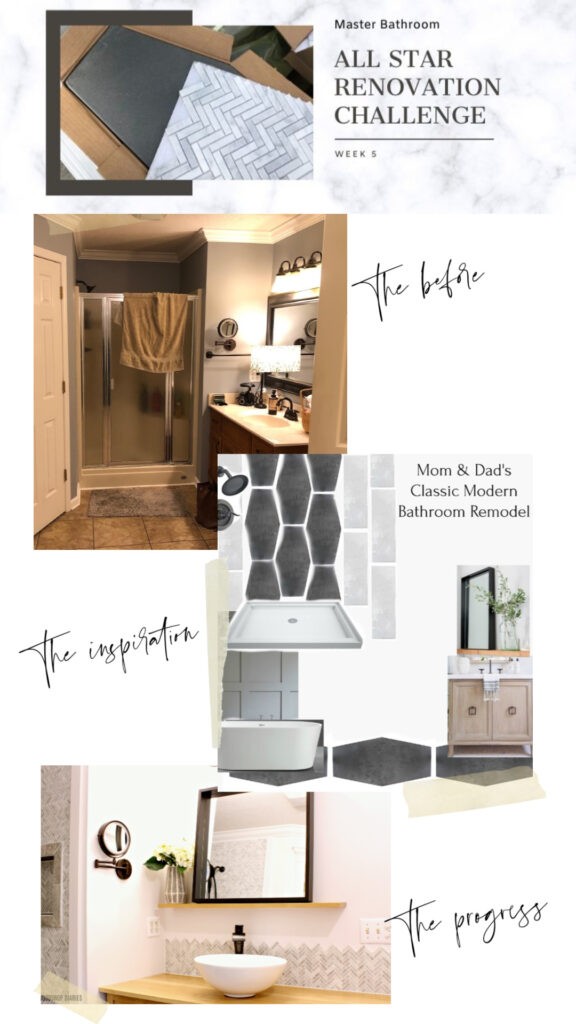
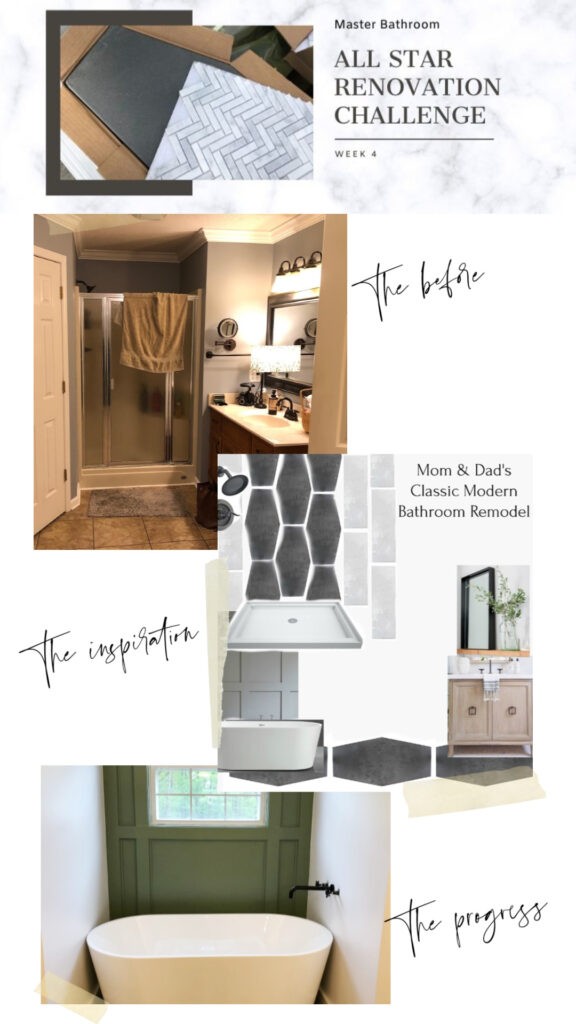
All Star Renovation Challenge before, inspiration, and progress week 5 graphic

So be sure to tune back in next week!  Until next time, happy renovating!

Master Bathroom Renovation Challenge–Week 4

June 24, 2020 by Shara, Woodshop Diaries

Hey friends!  Welcome to Week 4 of the All-Star Renovation Challenge with Jeffrey Court, FrogTape, and Behr Paint!  We are talking master bathroom renovation again, and I’m updating you on week FOUR of our progress. This post contains affiliate links. See policies.

Master bathroom All Star Renovation Challenge Graphic for Week 4

If you remember from the last three weeks, these brands challenged several bloggers from past renovation challenges (remember my kitchen renovation???) to take on another renovation challenge as the “All-Stars.”  I’m so excited to be included in this group and to share with you the journey as we transform my parents’ master bathroom! Check out all the designers and their spaces here.

Mom and Dad's Master Bathroom Renovation Mood Board

Last week began fan voting…the winner of the challenge takes home the grand prize of $5,000 and, of course, bragging rights that they won the ALL STAR Challenge. The winner this time around will be determined solely by fan votes, so I’d be forever grateful if you’d click on over and cast your vote! You can vote once a day until the winner is announced!

Cast Your Vote Graphic for Master Bathroom Renovation Challenge

So if you missed last weeks update, head over and check that out first.  But I’ll give you a quick recap of where we started this week.

.

At the end of week two, we had removed everything to the subfloor and taken out the tub and shower stall.  We replumbed the shower water supplies and drain and set the shower pan in place.  I also prepped the floor and shower for tile, laid the floor tile, and one wall of the shower (we used Jeffrey Court Castlerock Tile).  It doesn’t sound like a lot, but trust me…it was a busy first two weeks!  There was also some drywall patching in there somewhere, but you get the idea 🙂

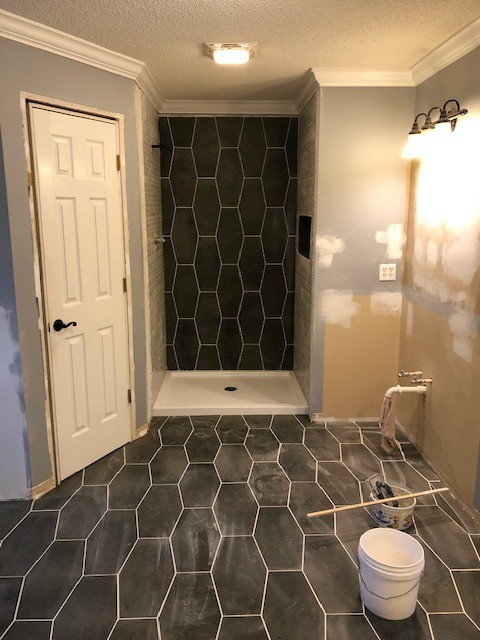
Floor tiled in master bathroom and patchy colored walls

At the end of week three, everything was tiled (we also used Jeffrey Court Jetstream tile on the shower walls), grouted, and trimmed out ready for paint. 

.

So we started week four with high hopes, seeing the light at the end of the tunnel and watching things slowly come back together ????  Here’s what happened in week four:

The Walls Got Paint:

The biggest transformation we saw this week was PAINT.  And what a difference the paint made!  My parent’s before bathroom was a sky-ish color blue.  Once things were demoed, you could see previous shades of tan that the bathroom was originally painted…20+ years ago.

Patchy paint on walls in master bathroom--mix of tan and bluw BEFORE we painted white

Then, I patched the drywall around where the old garden tub was, so the last few weeks were spent looking at a patchwork of wall colors and it was hard to see how everything was really looking together. 

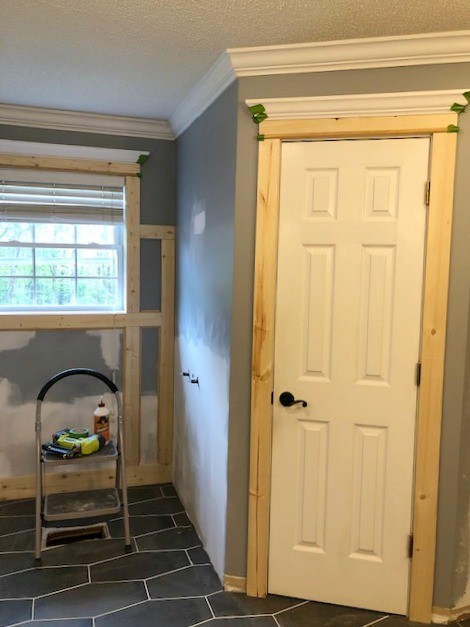
Trim installed in feature wall and doors in master bathroom

But once the paint was applied, it looked like a real room again!

Walls and trim painted Behr Ambience White

I went with Behr Ambience White for the walls and trim.  I hate caulking new trim and being careful to paint the door trim clean around the walls.  So I decided since it all needed to be painted anyway, I’d save time and sanity and tape and just paint the trim the same as the walls.  I’m happy with my choice ????

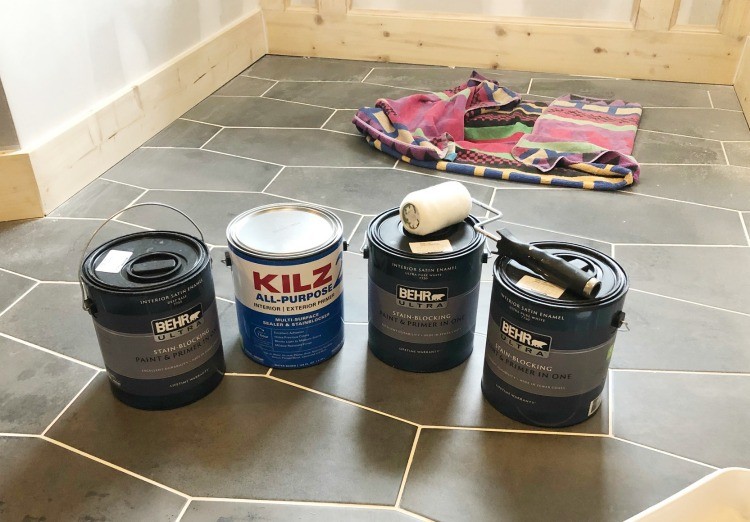
Behr Paint Cans ready to be opened and put to use on the bathroom walls

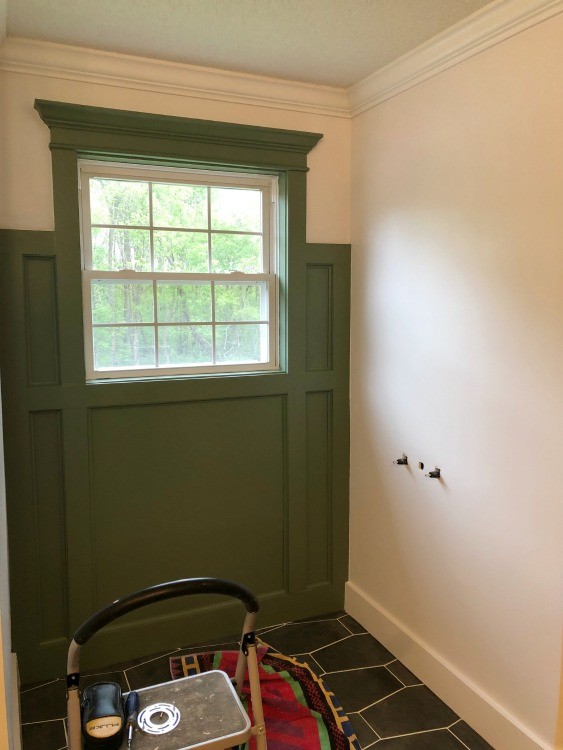
But to give the room a little color, I painted the feature wall behind the tub Behr Sage Green.  I wasn’t sure at first about this color—I’m usually a white walls only type of girl.  But I decided to be a little bold and paint this section green. 

Behr paint options for master bathroom--Sage Green and Ambience White

It looks really good here and isn’t too overwhelming.  I think once it’s paired with some warm wood décor on the wall (stay tuned for that *wink wink*), it’ll really look nice.  I’m glad I decided to be a little…out of the ordinary…here.

Feature wall painted Sage Green

To keep my paint lines nice and clean, I used FrogTape to cover the green painted trim while I painted the white around it.  It’s a little nerve racking around all the fancy trim lines and crown molding, without tape.

Installs:

Once the paint was finished around the main walls, trim, and feature wall, it was time to start putting things back where they go.  The first thing was the vanities.

.

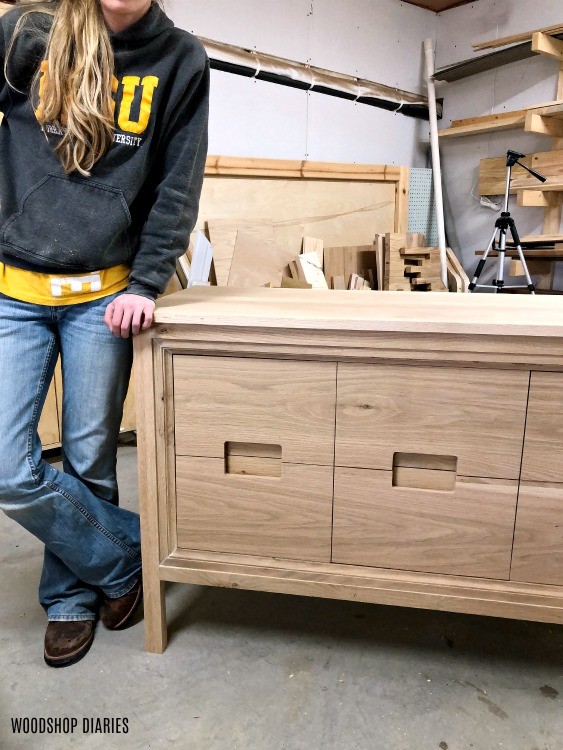
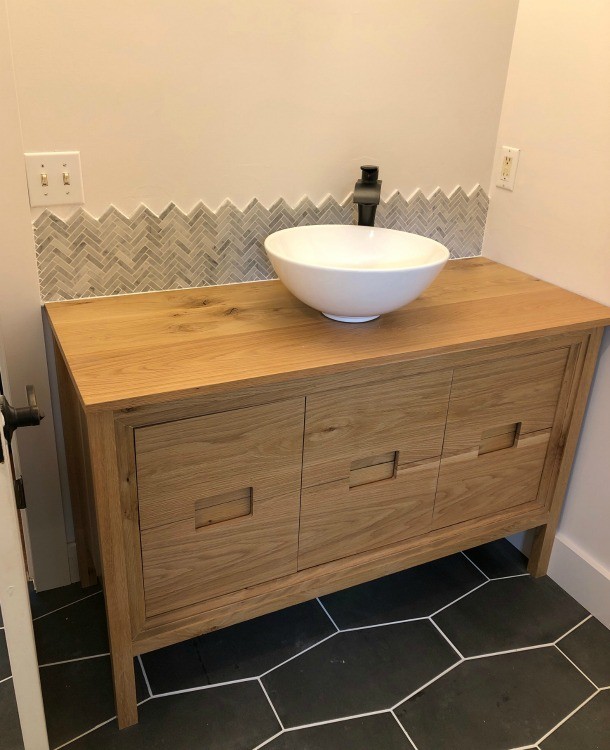
I built my parent’s these white oak vanities a few weeks ago and they’ve been sitting in my shop taking up all my space since then.  I was SO excited to get them to their new home and have my shop back haha.

Shara Woodshop Diaries next to unfinished vanity console in workshop

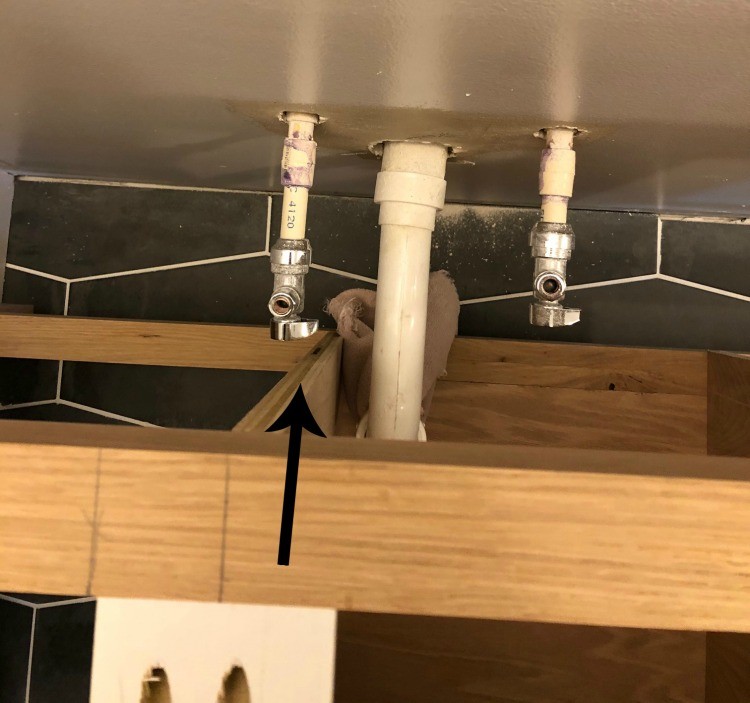
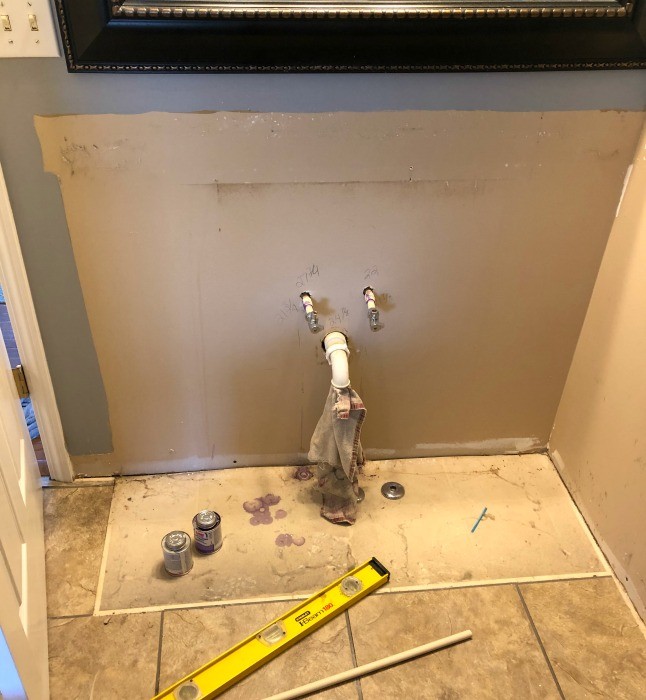
We got these installed with the sinks and faucets fairly easily.  We only ran into one snag with my mom’s side.  Silly me assumed the plumbers centered the plumbing on the wall here and they definitely did not.  So the supply line was going to hit right on the divider panel of the vanity. 

Plumbing pipe lined up perfectly with divider panel in master bathroom vanity

Luckily it hit between where the two drawers go, so we were able to cut out a section of the divider for the water line to go into.  Crisis averted.  I was not about to take these things apart and redo them…and I also wasn’t about to redo the plumbing either haha. You can see below the pieces we cut out on the floor.

Vanity installed with sink and faucet on top

Dad and I installed these bowl sinks and these modern faucets on the top and hooked up the p-traps and water supply lines and Mom was pretty excited to finally have running water in her bathroom again haha.

.

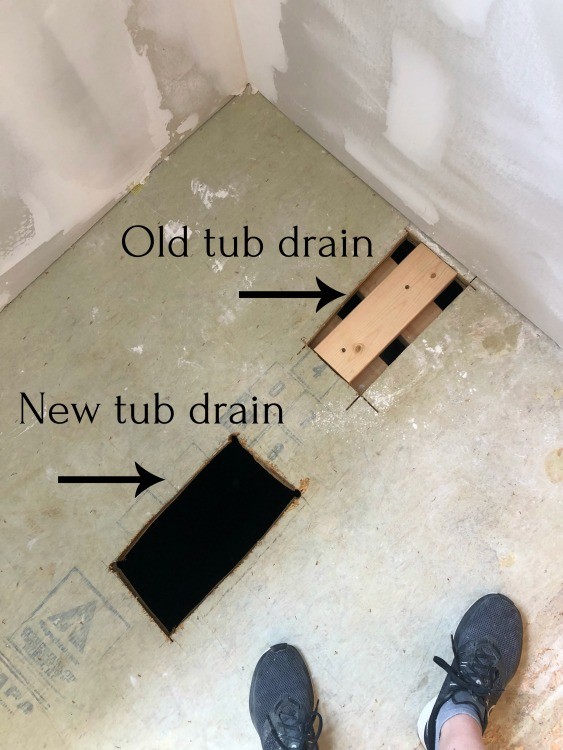
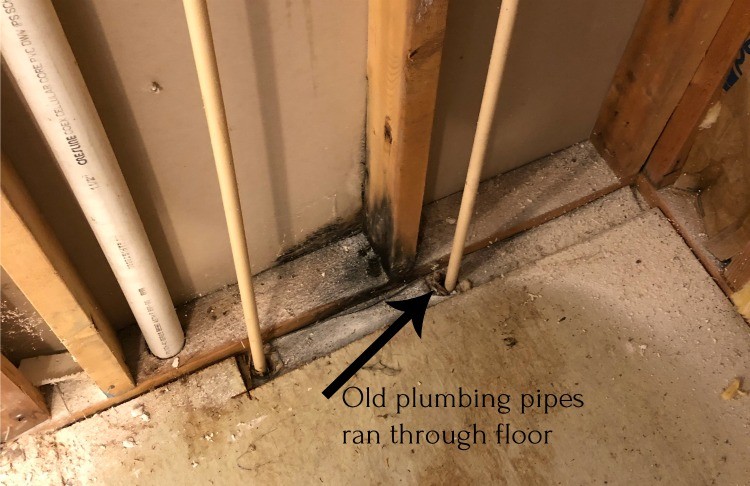
Once the vanities and sinks were installed, we moved to the tub.  After a few trips to the hardware store, we finally got all the parts we needed to redo the tub drain to connect back to the existing P trap.  The old tub drained at the right end of the tub…but this tub drain was in the center. Remember that from week 1?

Old tub drain vs new tub drain locations in bathroom floor

So it was a little challenging to modify the pieces, but we got it worked out…eventually haha.

.

So we set the tub in place and I headed back under the house to hook up all the new plumbing. 

Shara and Dad placing tub in bathroom

All that was left was the faucet and the toilet.  Funny thing…neither of those were easy.  There’s always got to be something that didn’t go as planned, right?

.

First, the toilet.  We installed the toilet just fine.  BUT it took four trips to the hardware store to purchase the correct length braided hose to connect the water supply line to the toilet bowl.  HOW DOES THAT HAPPEN!!??

.

And the tub faucet here had two issues.  One: I cut the drywall holes too large, so the trim pieces on the handles didn’t cover them when it was put on.  That meant I had to putty these holes until I puttied enough that the trim would cover it.  That took a couple rounds of putty and sanding.

Tub installed, but tub faucet drywall needs patching

Two: the faucet supply hook ups were copper. We had to buy several fittings to try to get from the copper outlet to a braided hose connection to run to the cut off valve.  Dad and I both aren’t super familiar with copper plumbing (we’ve mostly done CPVC), so this was a learning experience.  A couple trips to the store and a couple rounds of smashed fingers from tightening copper fittings, and we finally were good to go ????

Backsplash:

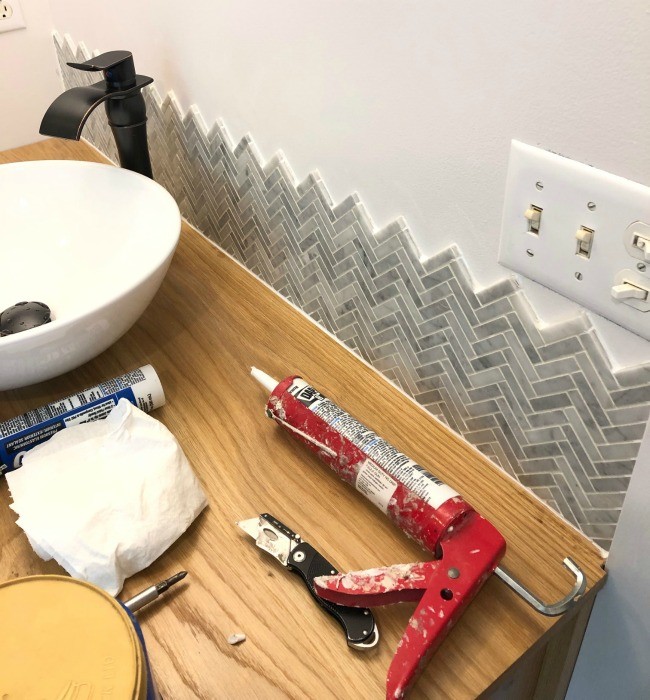
Once of the final touches I added this week was backsplash.  I used some more the of Jeffrey Court Jetstream for the backsplash over the vanities and left a “jagged edge” along the top. 

Backsplash installed over vanity top

I thought it was kind of a unique idea and I like the style…but it was really hard to clean up all the thinset on the wall around the edges haha.  Live and learn.

.

I got it grouted, and caulked, and also finished up caulking any parts of the shower that I missed while I was at it. 

Backsplash installed, grouted, and caulked above vanity

Finishing Touches:

We also installed the thresholds in all the doorways, and switched out some of the light fixtures. LOTS AND LOTS of little touches. Like installing the baseboards around the vanities (see below), paint touch ups, and CLEANING haha.

Baseboards installed around vanity legs

Things are SO CLOSE to being done…but I’ve still got a few design elements left to go before the final reveal.  Stay tuned for the finishing touches, and the full reveal in just two more weeks!

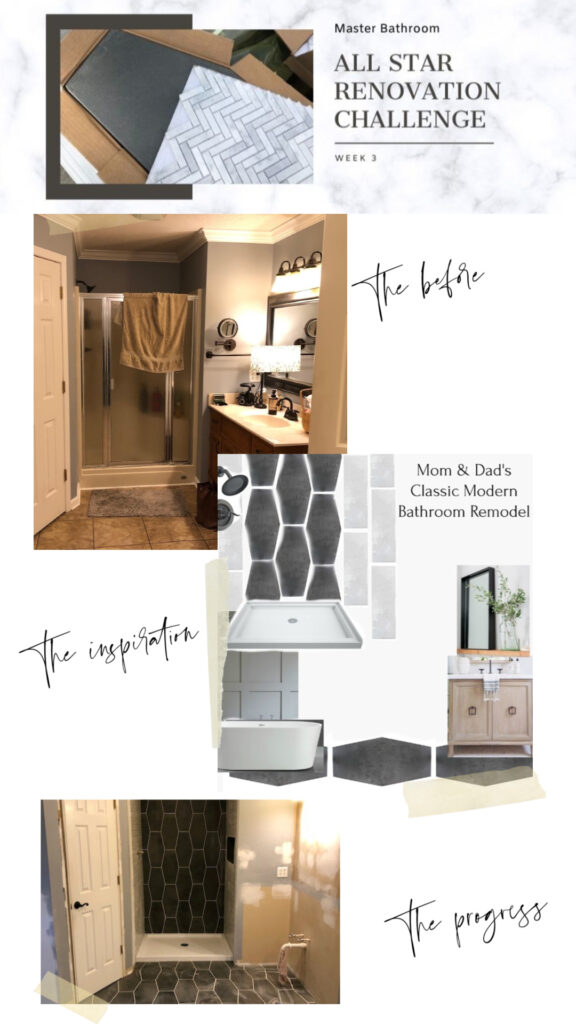
Master Bathroom All Star Renovation Challenge before, inspiration, and progress collage for week 4

Until next time, happy building ????

DIY Trash Can Cover

June 22, 2020 by Shara, Woodshop Diaries

This DIY Trash Can Cover post is sponsored by Build Something. This post contains affiliate links. See policies.

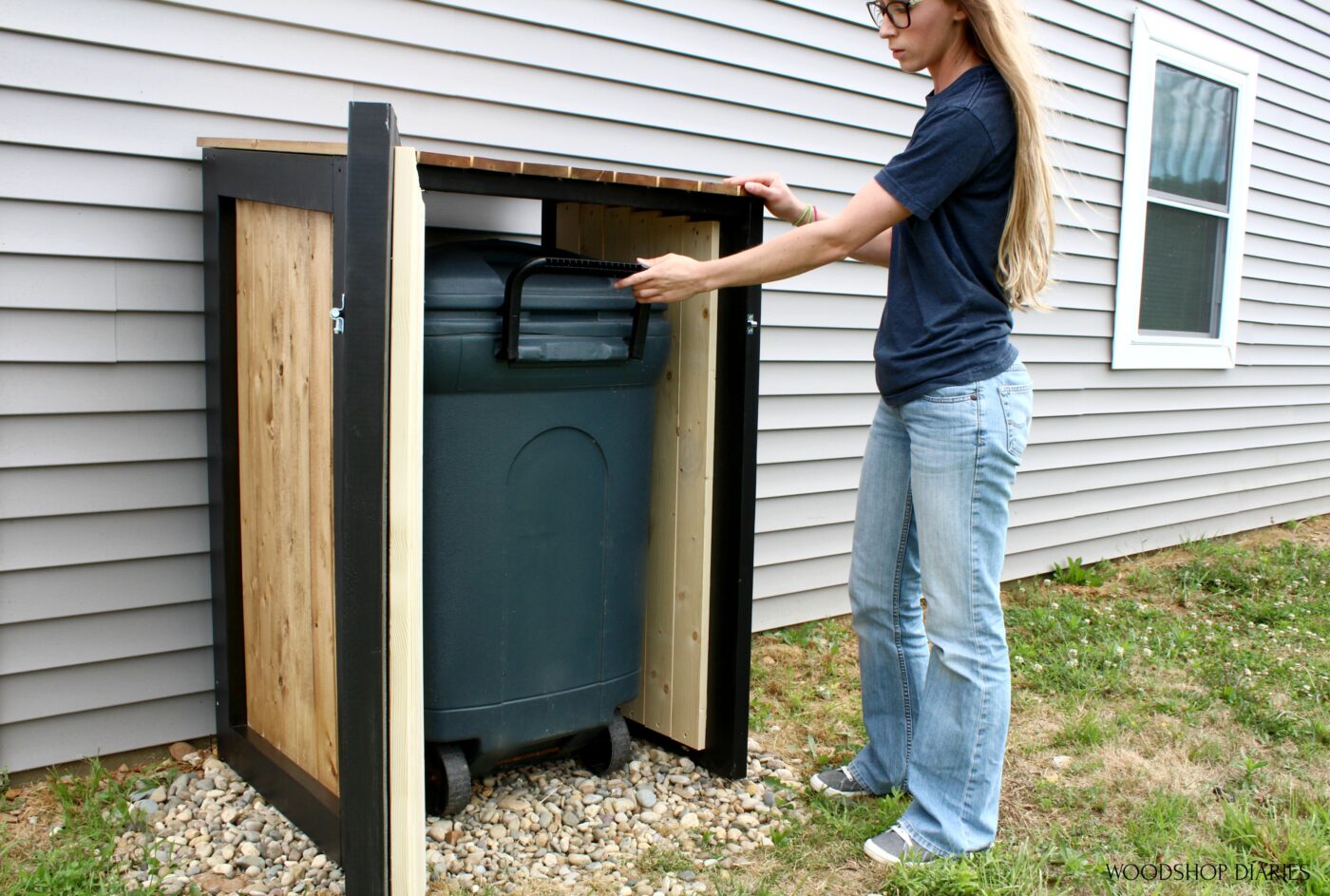
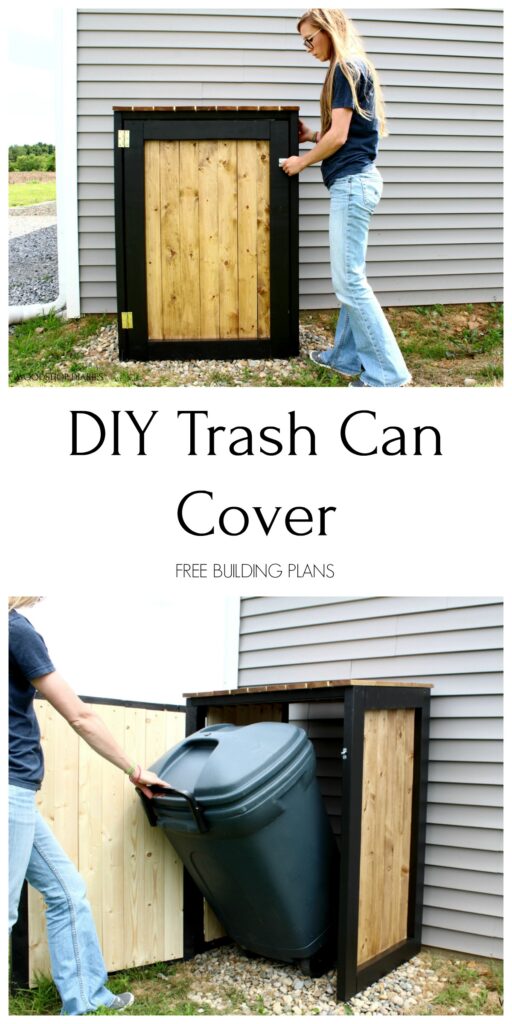
Shara Woodshop Diaries pulling trash can out of trash can cover with door open

I don’t know about the weather where you guys live, but I think the two years since we built out garage house have been the windiest two years I can ever remember.  Everyday seems to be like 40 mph winds around here.

.

Luckily, we don’t have a lot of things outside that can blow around…EXCEPT our trash can.  It’s been somewhat of a battle trying to keep it upright and in our own yard.

.

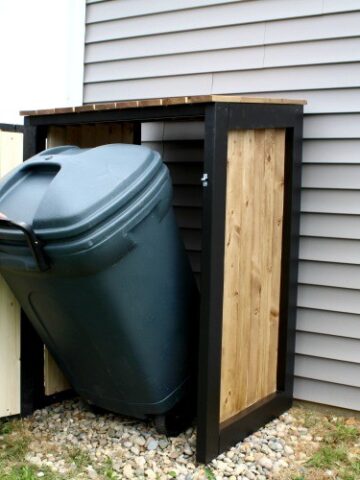
So I built a simple wooden trash can cover box to keep it stored away in next to the house.  Besides keeping it contained, it is a lot nicer to look at than our old, ugly plastic can…I really don’t know why I waited so long to build this.

.

I’ve partnered with my friends at Build Something to bring you the free printable plans for this project and I’ve got the video and details below:

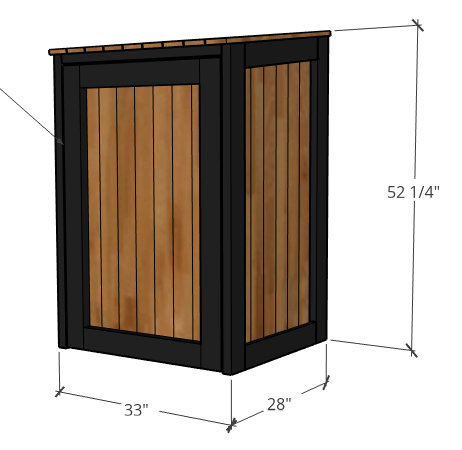
Okay, let’s get building ???? This project accommodates trash cans about 44″ tall, 24″ deep, and 28″ wide. Overall finished trash can cover dimensions are seen here:

Overall dimensions of trash can cover 3d drawing

For this Trash Can Cover, You Will Need:

  • (5) 2x4x8
  • (13) 1x4x8
  • Miter Saw
  • Drill
  • Pocket Hole Jig
  • 2 ½″ Blue Kote Kreg Pocket Hole Screws
  • 1 ¼″ exterior wood screws
  • Hinges and Latch
  • Exterior Finish As Desired

NOTE: If you want this to last practically forever, I’d recommend using treated wood or cedar, but our current home is a temporary living situation and we probably won’t need it for too long, so I used regular untreated lumber.  I did finish it with outdoor sealers and paint, though, so it should still last us at least a couple years, especially if I reapply finish each year.

Step 1: Assemble Side Frames

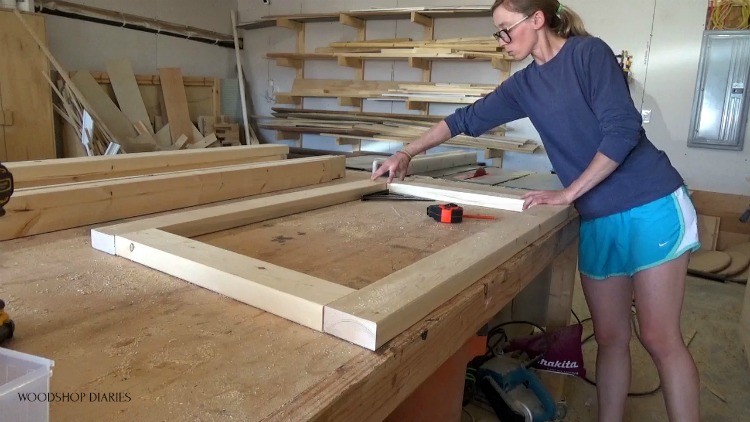
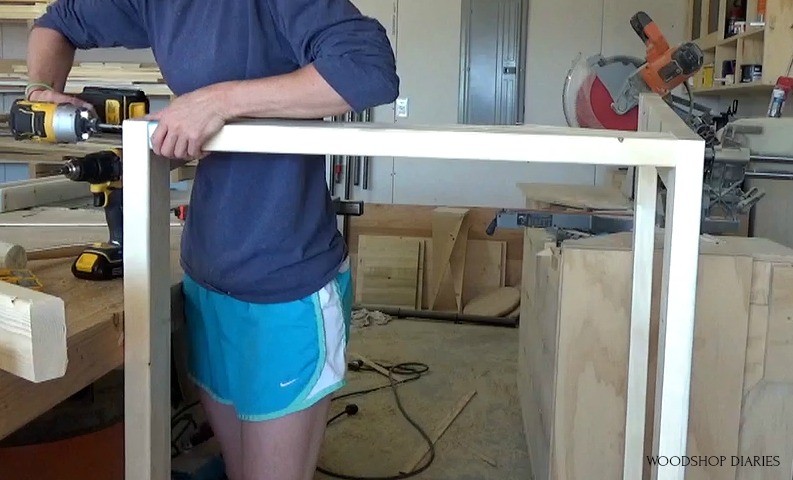
To get started, I began cutting down my 2x4s to create two frames for the sides.  I wanted the top to slant slightly toward the front, so I cut the top pieces with a 7 degree angle on the miter saw.  All of the dimensions and details are in the plans found here on Build Something.

Shara dry fitting 2x4 pieces for side panel

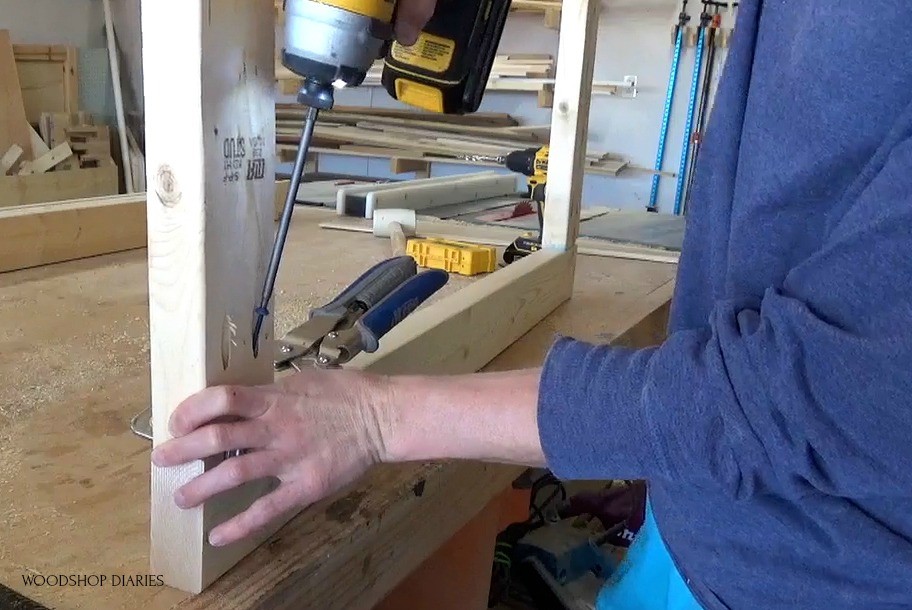
Once I had my pieces cut for the side frames, I used my Kreg Jig to drill 1 ½” pocket holes into the ends of the top and bottom piece, then attached the frame together with 2 ½” pocket hole screws.  By the way, I used the Kreg Blue Kote outdoor screws for this to help prevent them from rusting since it’ll be outdoors.

Shara using pocket holes and screws to assemble side frame for trash can cover

Step 2: Assemble Trash Can Cover Frame

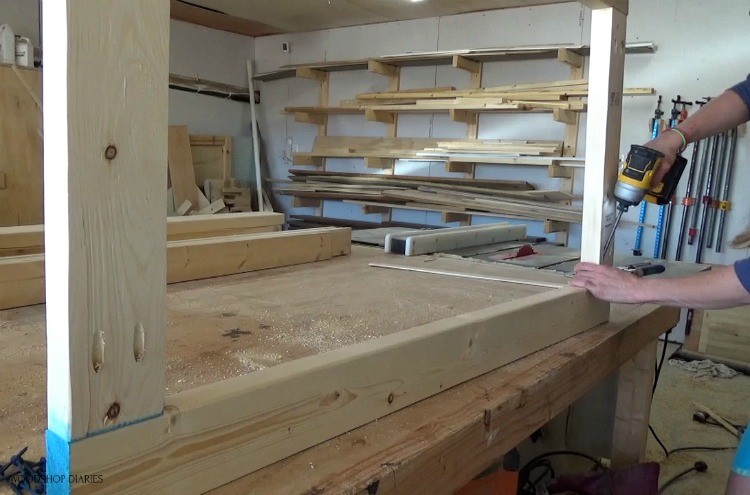
After both frames were assembled, I cut three more 2x4s to put the two frames together.

.

I simply screwed these in place using 3” decking screws.  You could also use pocket holes here if you didn’t want to see the screw heads–that’s what’s shown in the plans.  But I was running low on Blue Kote screws and my order for new ones hadn’t arrived yet. I would have preferred pocket holes here, but it is what it is.

Screwing trash can cover frame together with 3" decking screws

I installed two of these 2x4s at the top and one on the back edge towards the bottom.  I didn’t install this all the way at the bottom, so the board wouldn’t be sitting on the ground…just to help protect it from moisture.

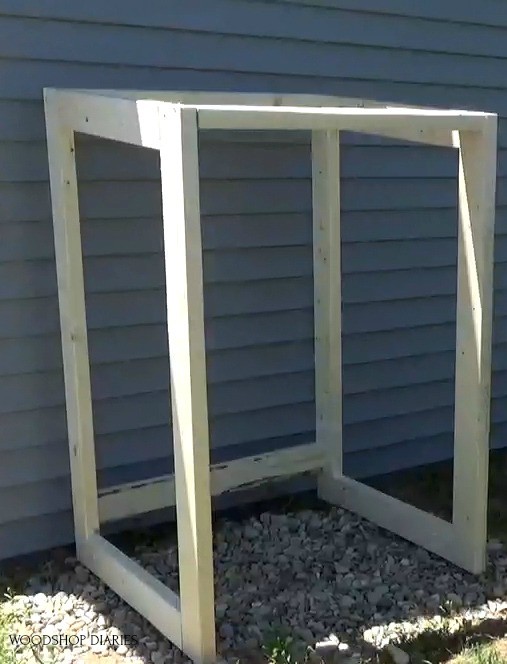
Frame fully assembled

Step 3: Assemble Door Frame

Again, just like the side frame, I built the door frame from 2x4s and used pocket holes and pocket hole screws to assemble.

Assembling door frame with pocket holes and screws

Step 4: Finish Trash Can Cover Parts Separately

Once the box frame and the door frame were together, I applied a couple coats of exterior grade primer and paint.  It’s a lot easier to paint now than later after I add the slats.

.

If you plan to stain or paint the slats as well, I suggest doing that now as well…I didn’t and it made it much harder later on.

Step 5: Install Side Panel, Door & Roof Slats

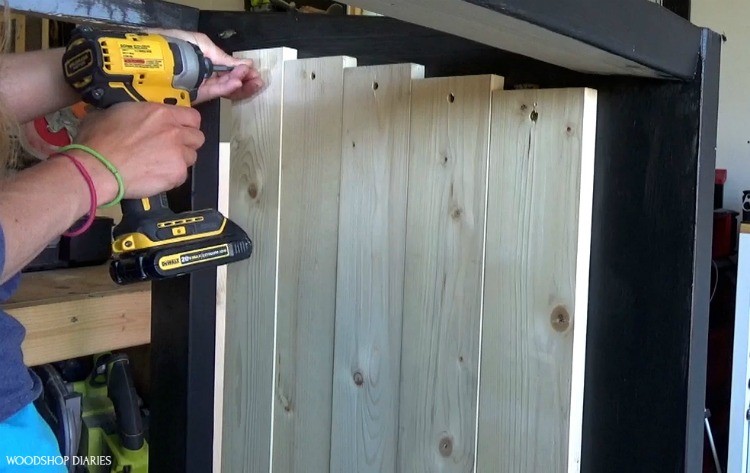
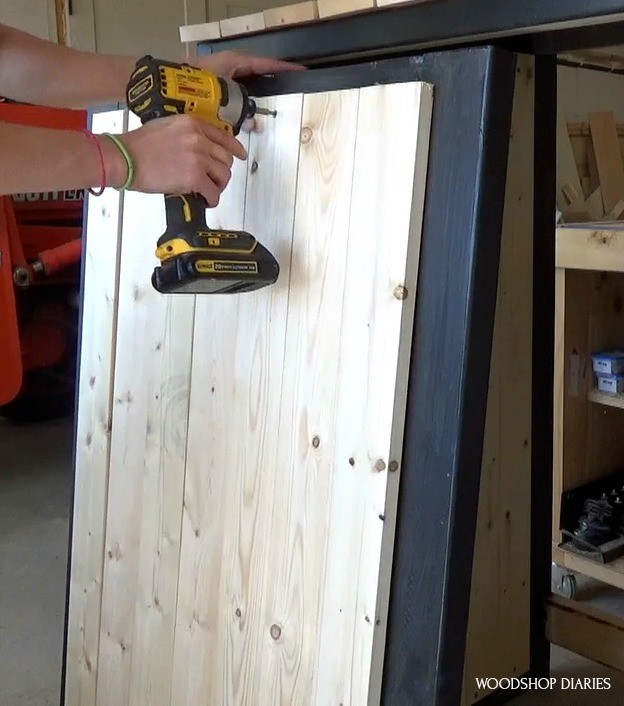
Once the paint was dry, I cut and installed 1×4 slats across the side panels.  I installed these with 1 ¼” decking screws at the top and bottom.  Since the sides were slanted, I cut each consecutive slat ½″ longer as I worked toward the back.

Attaching side slats to trash can cover frame on inside

Then, I did the same for the door. I centered these boards over the opening and screwed in place.

Installing door slats into door frame with 1 ¼" wood screws

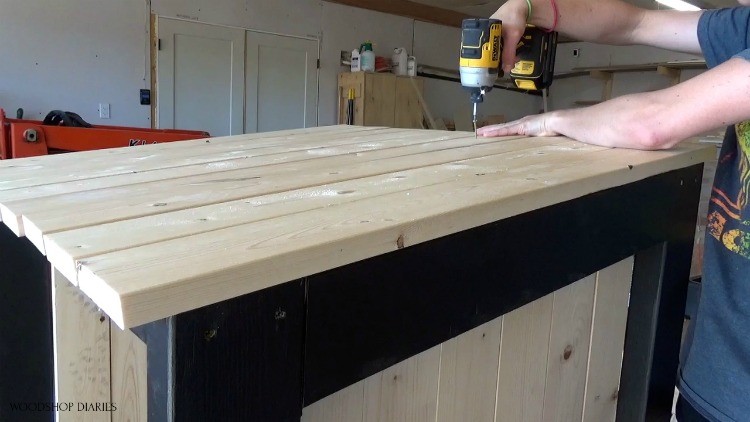
Finally, I added the roof slats the same way.  I left about 3/16″-¼” gaps between the roof slats to help with water drainage, although most of the water should run off since I slanted the top.

Screwing roof slats into trash can cover frame

I should have stained these before I installed them, but I couldn’t decide if I liked them better with just a clear coat or if I wanted to stain them.  After thinking way too long about it, I finally decided I thought it would look better stained.  So I stained the top boards and the door and side slats with Minwax Early American.

.

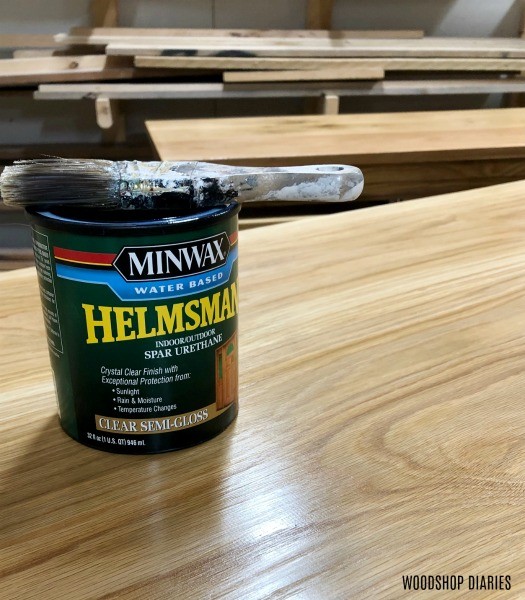
Then I brushed on some Minwax Helmsman clear coat over all of the unpainted wood—both inside and outside.  I clear coated everything to protect it from moisture.  Again, I know this will eventually rot, but if protected well, it will last as long as we probably need it to while we live here.

Step 6: Install Door Onto Trash Can Cover

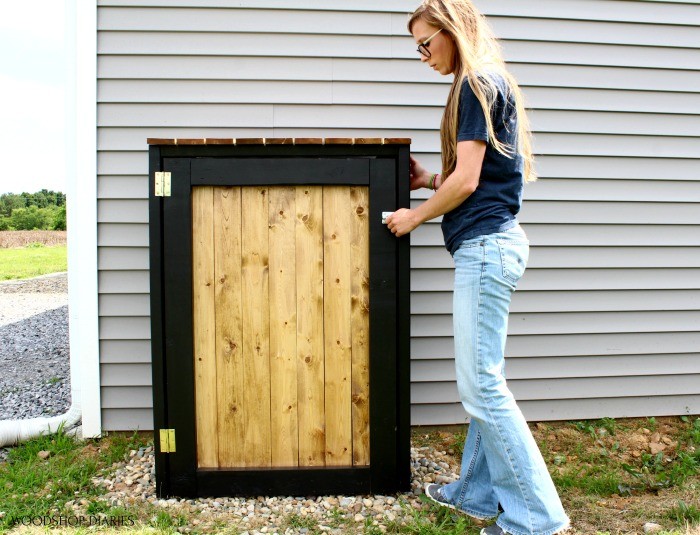
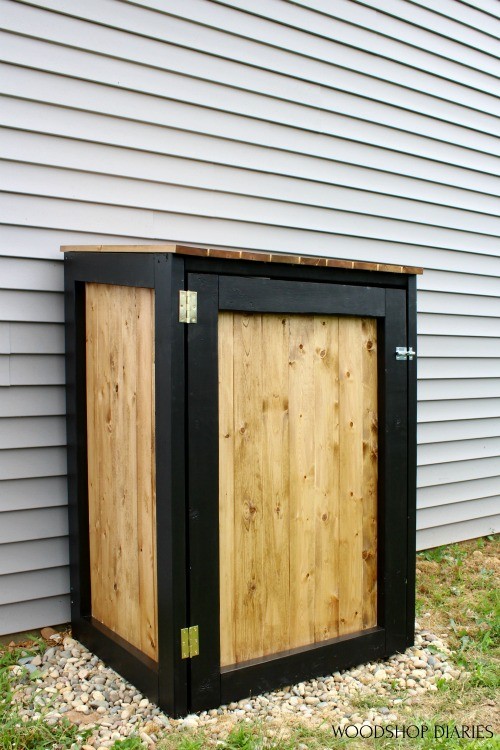
Once all the finish was dry, I brought it outside and set it in place.  We had some leftover landscape rock that we set it on.  It think this will help drain the water underneath it, and it also helped level this little area out some.  I attached the hinges on the door and added a little latch to keep the door shut.  And it was finished. 

Shara closing and latching trash can cover frame door

I’m glad to be able to hide the trash can, but I’m more glad I don’t have to be chasing it down in the windstorms anymore haha. 

Upright trash can cover image with door closed and latched

If you wanted, you could definitely make the top as one piece with hinges so it opened up, but I opted to just have a door.  I didn’t think we would use the lid much…mostly because I would have to rest it on my head or against the siding while I used both hands to open the trash can and toss the bag inside.  And I didn’t want to ruin my hair or my siding haha.  

.

So if you’d like to build your own, be sure to head over to Build Something for the free plans!  And if you want to save this for later, be sure to pin it!

Pinterest collage image of trash cab cover frame with Shara opening and closing door

Until next time, happy building! ????

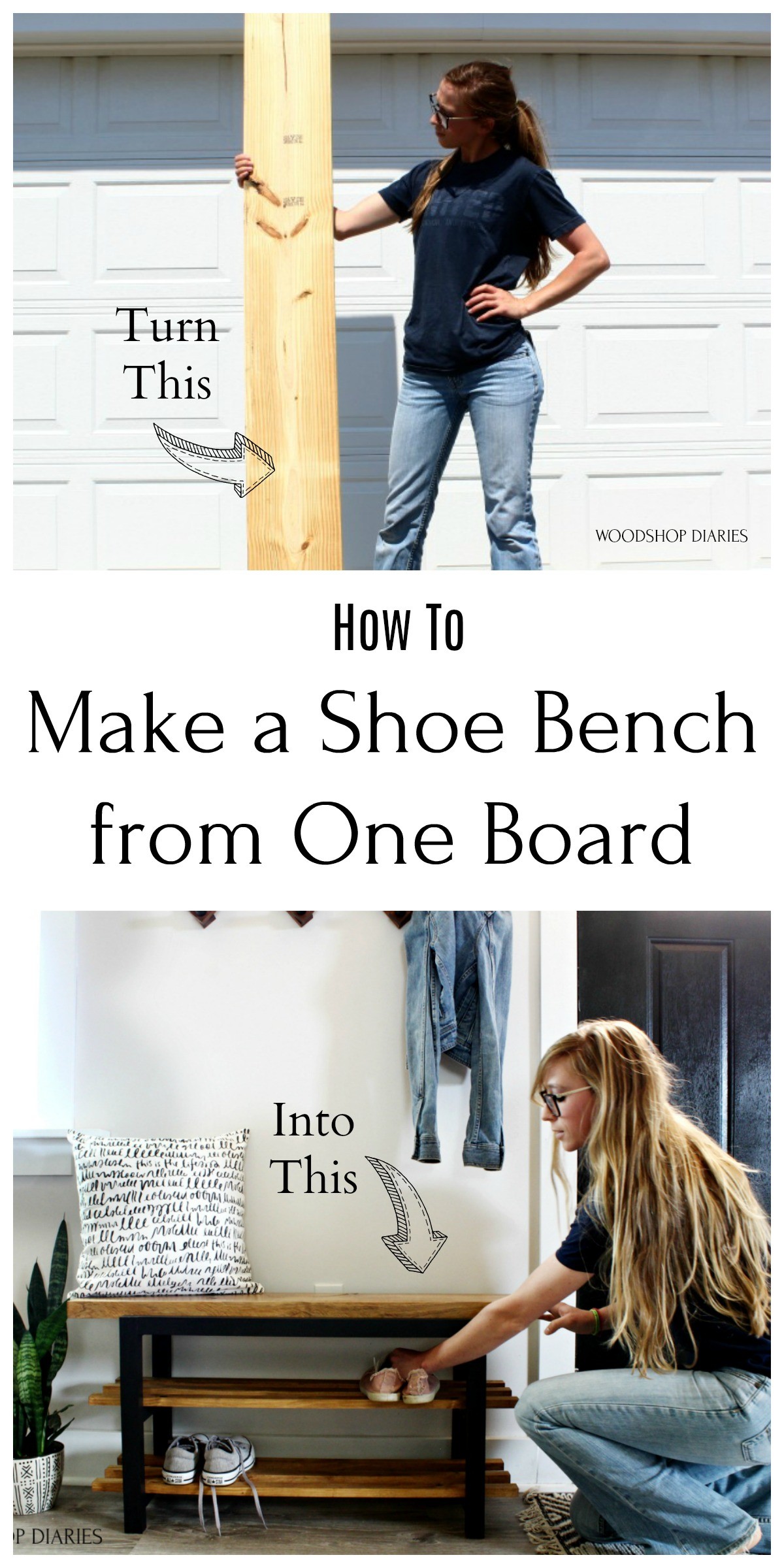
DIY Shoe Bench from One 2×10 Board

June 20, 2020 by Shara, Woodshop Diaries

Can you believe you can make a DIY shoe bench from a single 2x10x8 board?

I’m bringing you another ONE BOARD PROJECT!!

Shara Woodshop Diaries holding one board

I’ve got a scrap cart full of scraps that I could have used, but I’ve also got some random leftovers on my wood rack, too.

After a little digging, I found a whole 2x10x8 that I had purchased for a previous project, but ended up not using. 

A whole board may not “TECHNICALLY” be considered scrap wood, but in my case, it was close enough.

My friend, Lindi–from Love, Create, Celebrate, asked me to join her on her “Scraps Made Modern” series and challenged me to make something modern using only my scrap wood.

This actually isn’t the first time I made something completely from a single 2x10x8 board. 

A couple years ago, I actually made a really cool bar cart from a 2×10.  So I knew I could come up with something equality as cool to make with this one.

.

And I decided on this DIY shoe bench!  Can you believe this this whole bench was made from a 2x10x8 board?? 

That’s like only $7 (at the time I bought it)!! I’ve got the video tutorial here and the step by step below

This post contains affiliate links. See policies.

For this One Board Shoe Bench, You Will Need:

  • (1) 2x10x8
  • Table Saw
  • Miter Saw
  • Drill
  • Pocket hole jig
  • Nail Gun
  • 2 ½″ pocket hole screws
  • Wood Glue
Overall dimensions of shoe bench diagram

Grab the printable plans here!

Step 1: Cut Down the Board

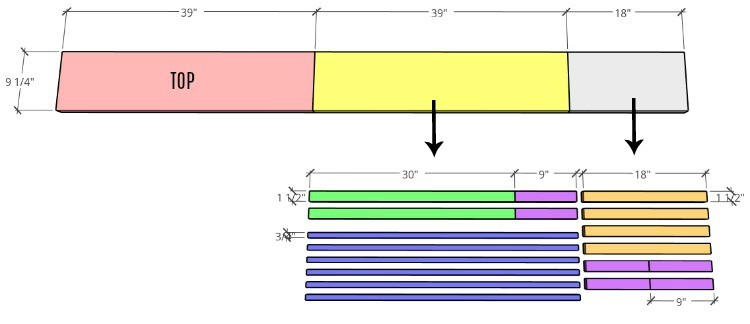
I took a few minutes to draw out all the cuts and pieces before I got to work.  I only had one shot at getting this right—I didn’t have second board—so I took a second to plan.

.

First, I cut it down into two 39” pieces and one 18” piece.  Then, I ran them through the planer before I moved on to make sure they were flat–that’s an optional step. 

One 2x10x8 cut breakdown

I set one 39” piece to the side to use as the top later.  And I ripped the other down on the table saw to make two 2x2s and six 1x2s. 

There was one small 1×2 ish sized strip leftover from that, but it actually went back into the scrap pile.

Then I ripped the 18” piece into six 2x2s.  Just a side note here…because of the blade thickness on these cuts, I recommend ripping the 2x2s only 1 ⅜” wide instead of the full 1 ½”. 

If you rip the full 1 ½”, the last piece will be too thin to really consider a 2×2.

Once everything was ripped down, I cut two of the 18” pieces in half (to get two 9″ pieces) and cut 9” off the two 39” 2x2s. 

I know that SOUNDS confusing, but this diagram spells it out pretty clear.

Cut diagram for shoe bench

If you want a printable version, check out the shoe bench printable plans!

Step 2: Assemble Frames of Shoe Bench

Now that everything was cut, all that’s left is the assembly.

.

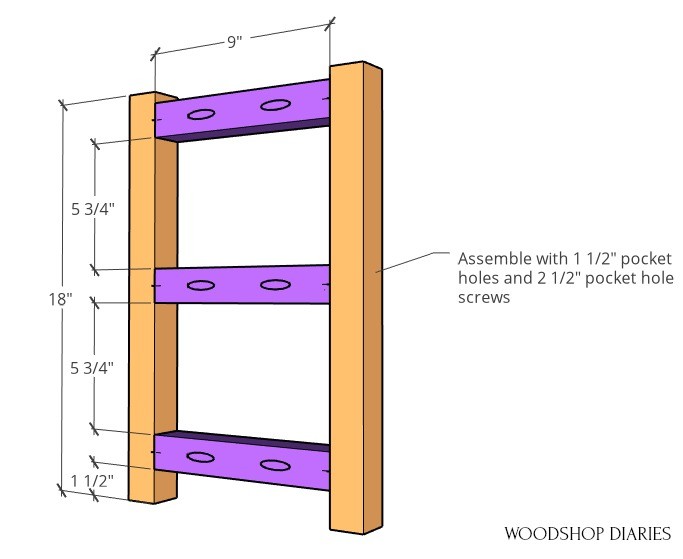
I used 1 ½″ pocket holes and 2 ½″ pocket hole screws to assemble the shoe bench frame—just trying to keep things simple. 

I attached the 9” pieces between the 18” pieces to make two bench sides.  As a subtle detail, I installed the top 2×2 slightly below the top of the leg. 

This will allow the top to sit down into the frame later vs. just sitting on top. 

Building Diagram of bench frame sides panels

Then, I installed the two long 2x2s between the frames at the top. 

Building diagram shoe bench complete base frame assembled

NOTE: When working with 2x2s, I find it easier to use wood glue and ONE pocket hole screw per joint. Using two pocket hole screws usually causes the ends to split.

Step 3: Cut Shoe Bench Top and Slats

While the glue dried, I trimmed a little of the top board. 

Because I typical 2×10 is 9 ¼” wide and I made my bench frame with 9” slats, I needed to trim about ¼” off the top to fit. 

I basically just ran it through the table saw on each side to clean up the factory edges until it fit down into the frame.

Dry fitting the top board into the shoe bench frame

Before I stained the slats, I trimmed about 3” off the ends. 

No reason for this really except I liked the look of them being not quite as long as the top.  To each their own haha.

Step 4: Finish and Install Top and Slats

I’ve recently been digging the black and wood trend—modern, industrial, or whatever style you want to call it…I’m here for it haha.

So I gave this frame a coat of black paint (Sherwin Williams Black Magic) and then I stained the top and the six 1×2 slats (Minwax Early American).

Shara painting the base of the shoe bench black

Once all the finish was dry, it was ready to install the slats and top.

I installed the slats first, then the top, but in hindsight, it’s easier to get into the tight spaces to drive the screws if the slats aren’t already there.

So I recommend screwing the top in place before attaching the slats. I used 2 ½″ woods screws to attach it.

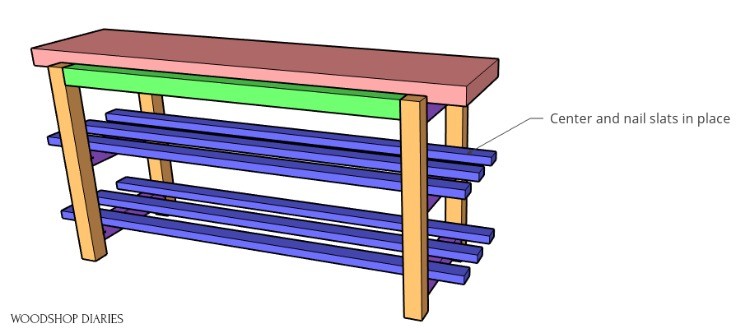
Building plan diagram installing the top into the bench frame

Then I used the nail gun to attach the slats. It was difficult to get into these tight places with a drill to screw the slats in place, so I ended up just using a nail gun. 

That was also somewhat difficult, but doable. 

building plan diagram installing the slats into the bench frame

And after a couple coats of clear coat poly on the top and slats, this DIY shoe bench was ready to use.

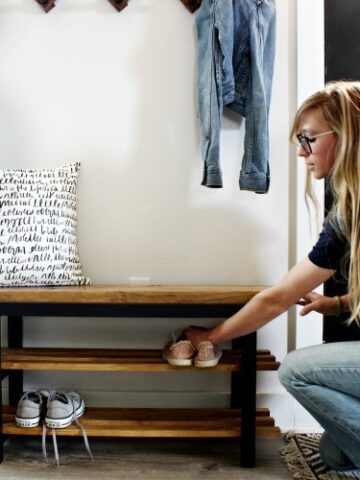
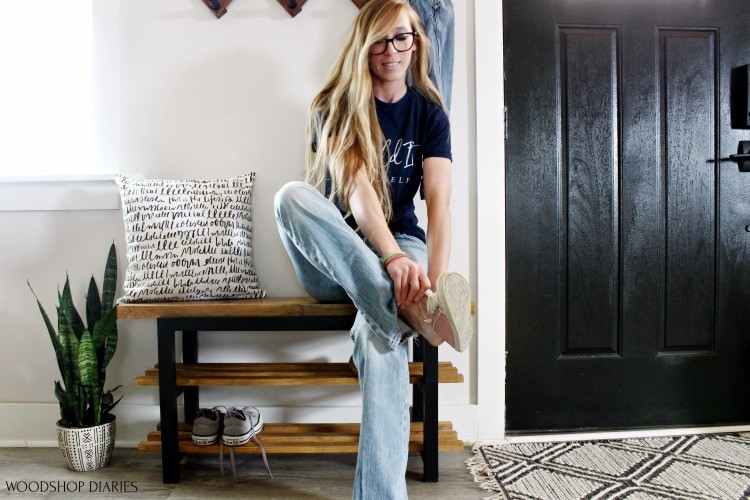
Shara sitting on shoe bench putting on her shoes

Want printable plans? Grab them here!

This project isn’t a huge, elaborate piece.  But I think it’s pretty cool it all came from a single board…and there was even a little piece leftover! 

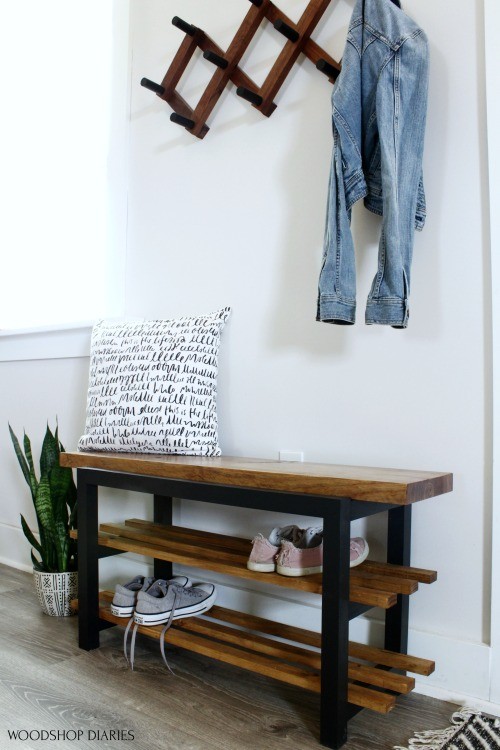
DIY shoe bench made from a single board staged in entryway

It’s amazing what you can make with a single board when you get a little creative. 

Don’t forget to check out my other 2×10 board bar cart project, too. It’s one of my all time favorites!

I hope you have enjoyed this simple scraps made modern DIY shoe bench project.  Check out plenty more scrap wood projects over here.

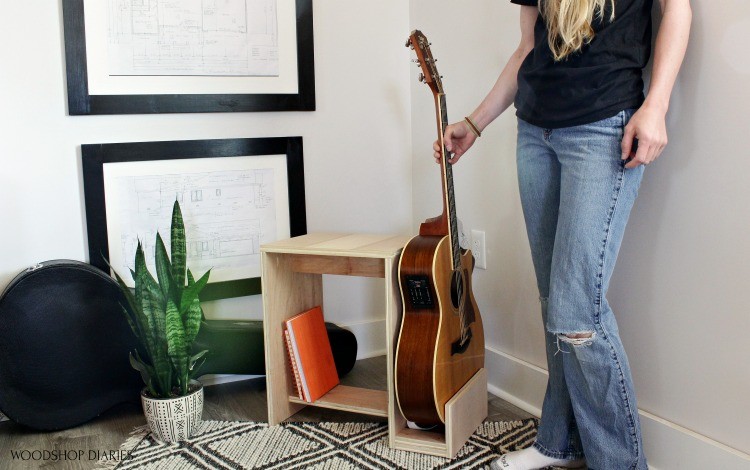
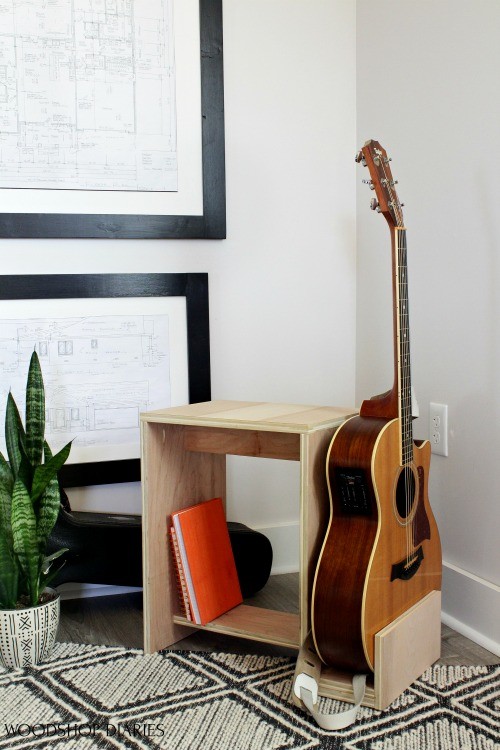
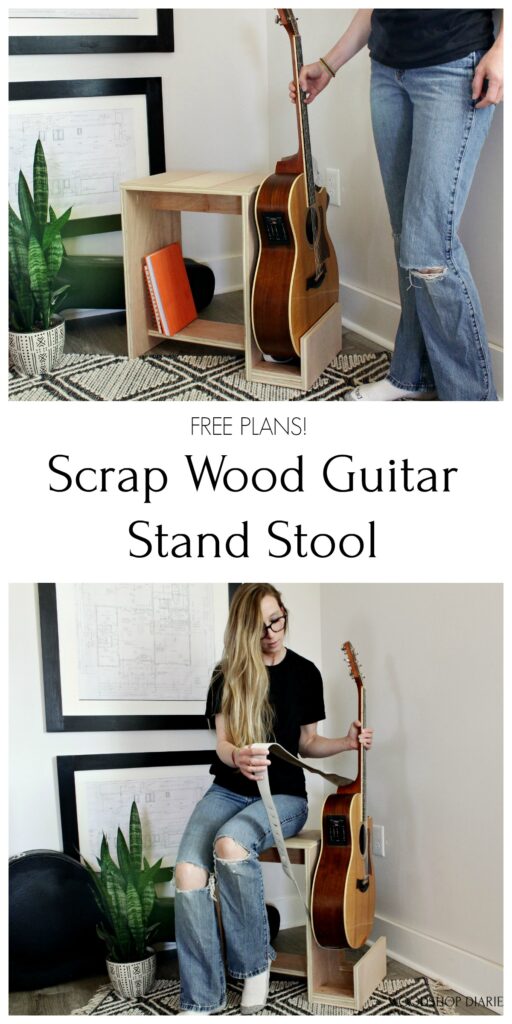
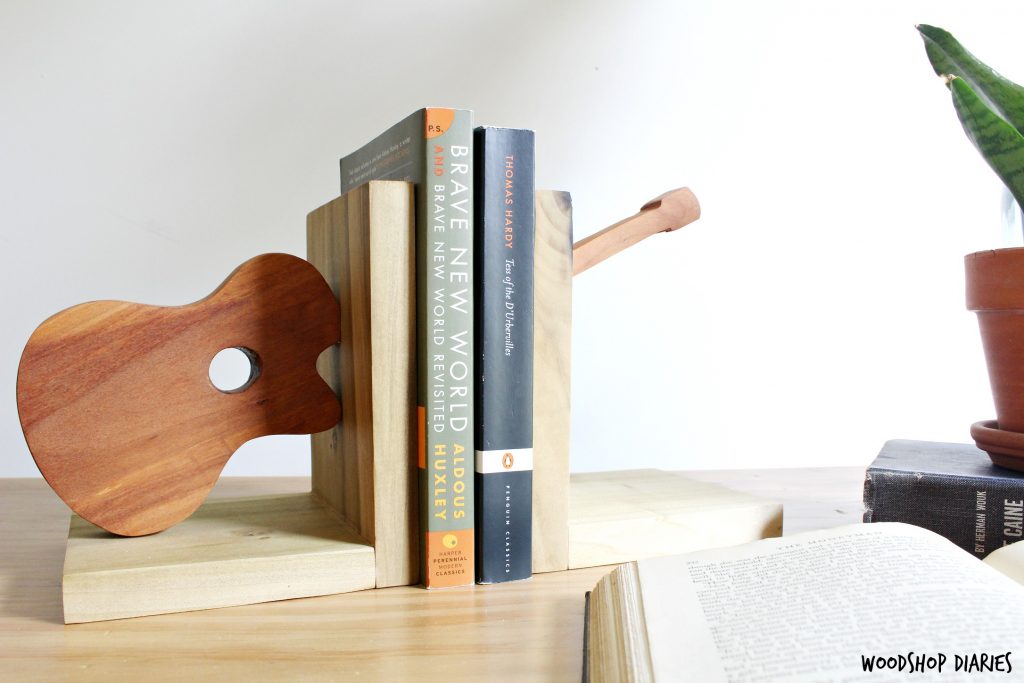
Guitar Stool Stand
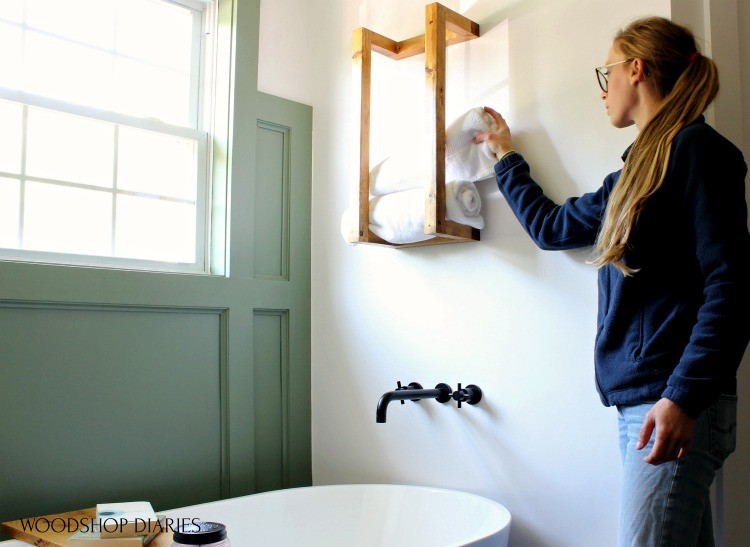
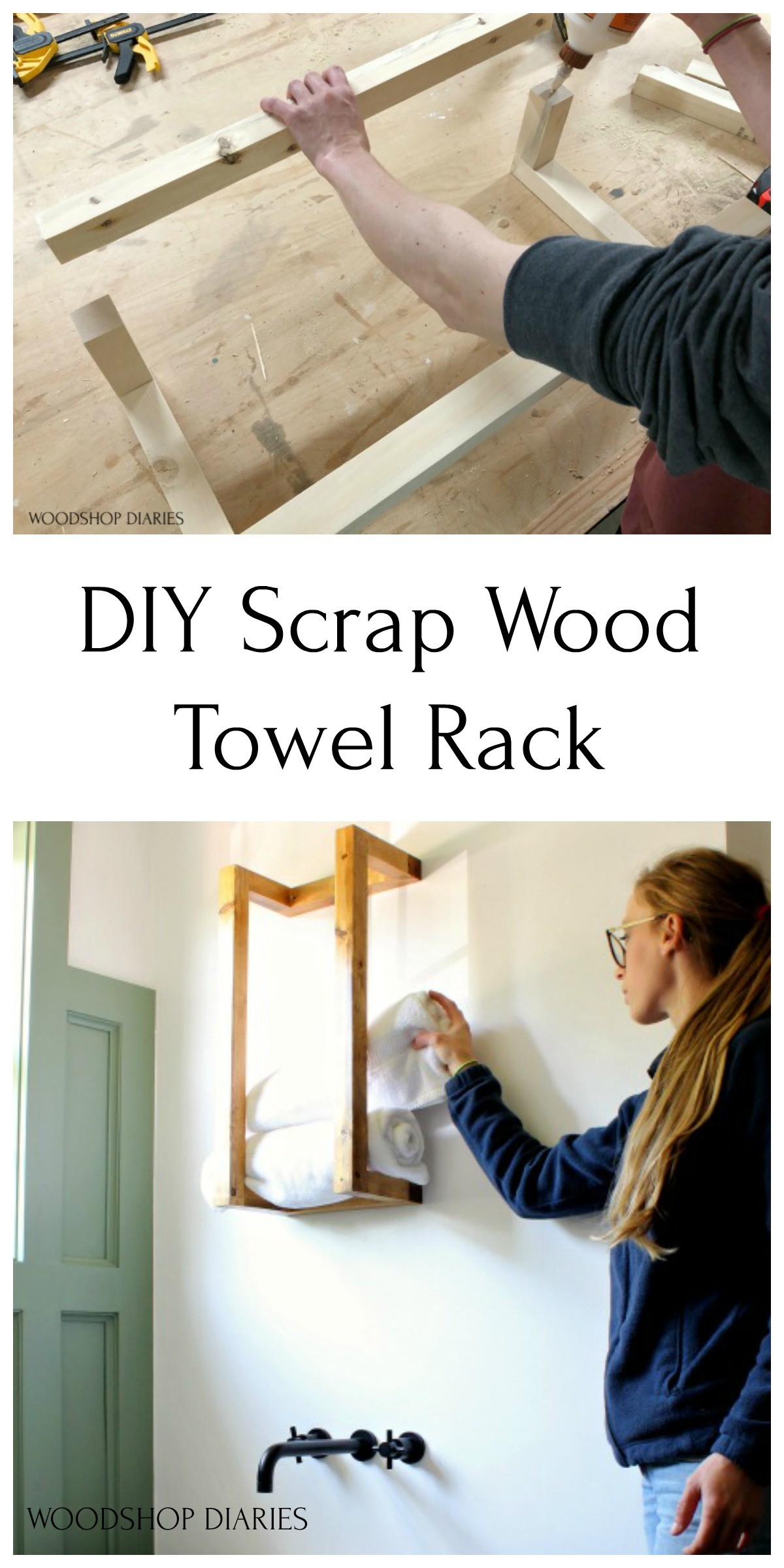
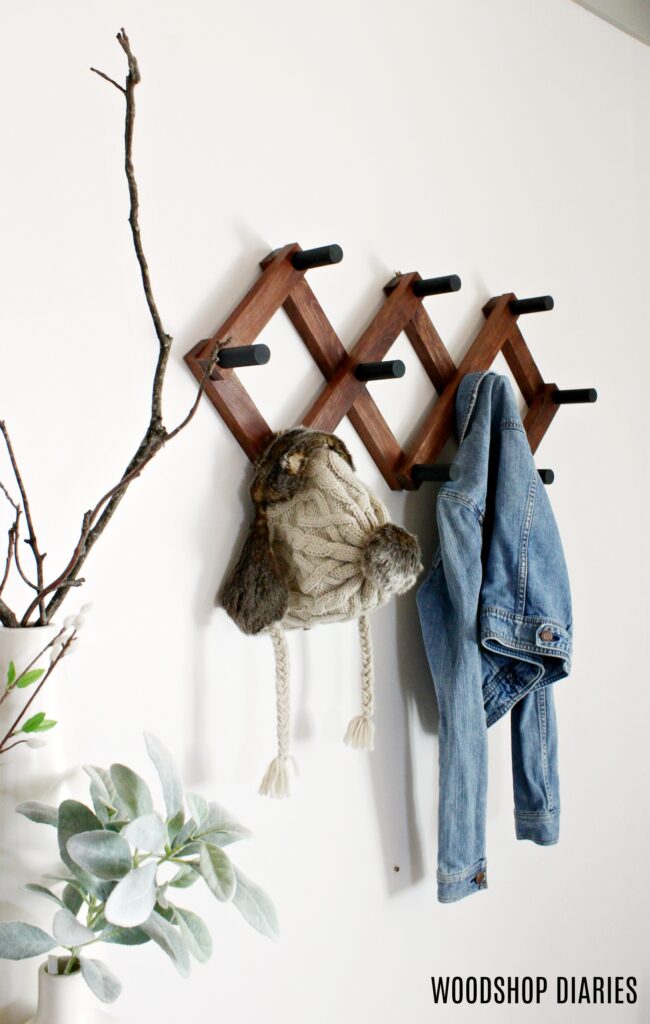
Scrap Wood Towel Rack
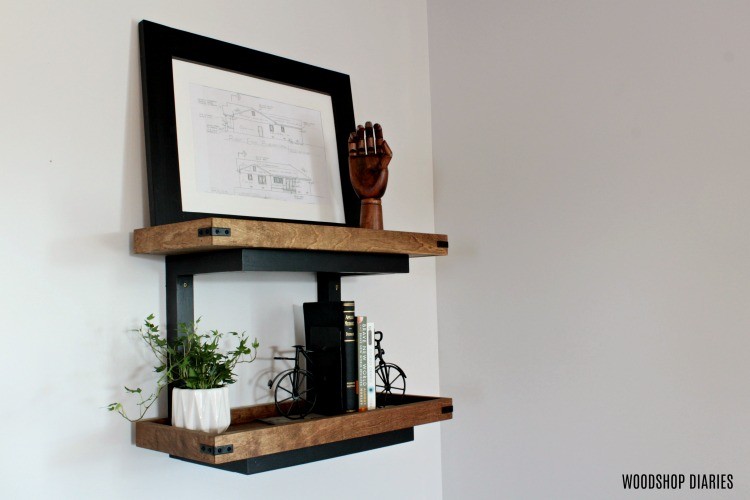
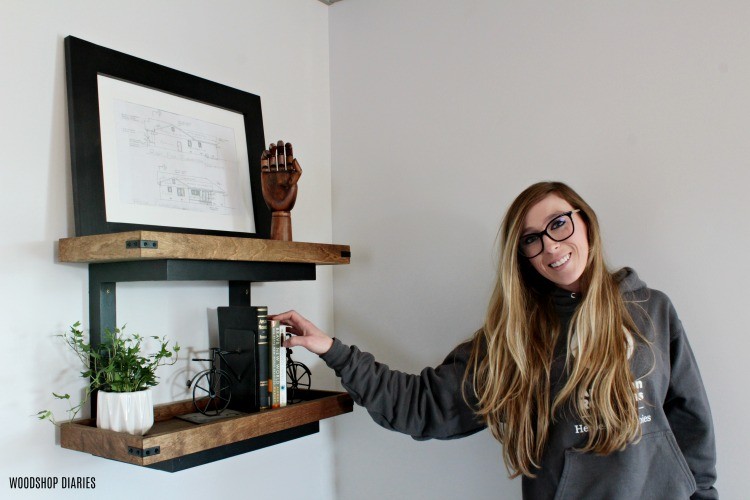
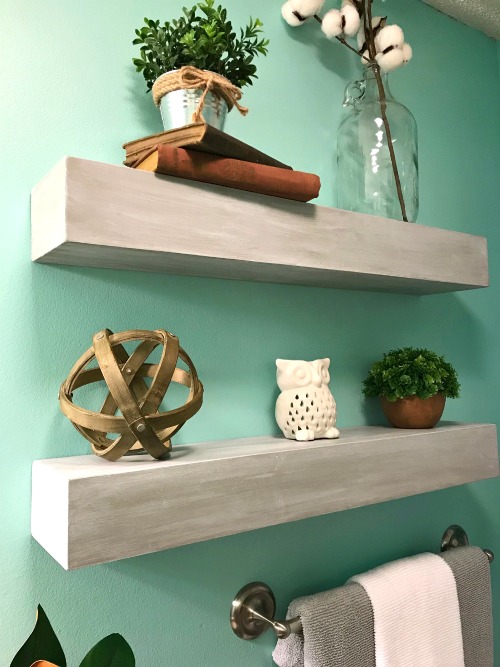
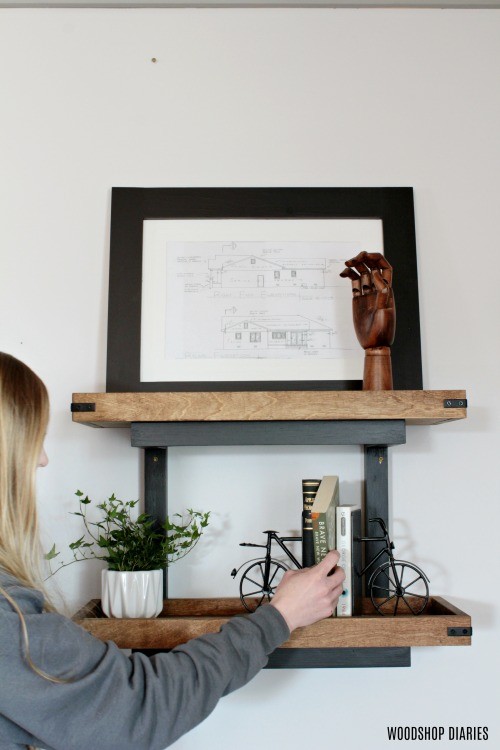
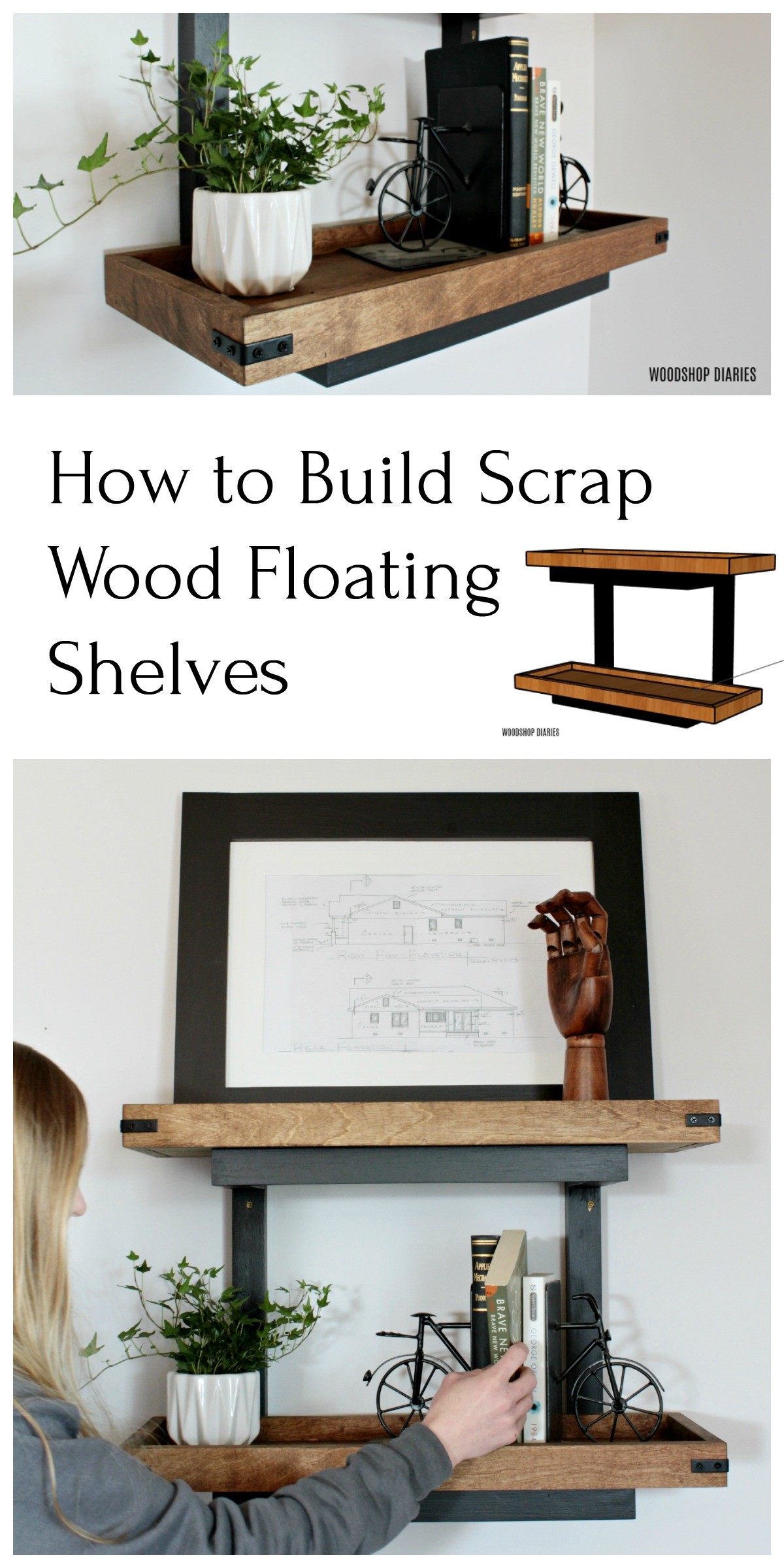
Floating wall shelves from scrap wood with industrial details
Scrap Wood Wall Shelves
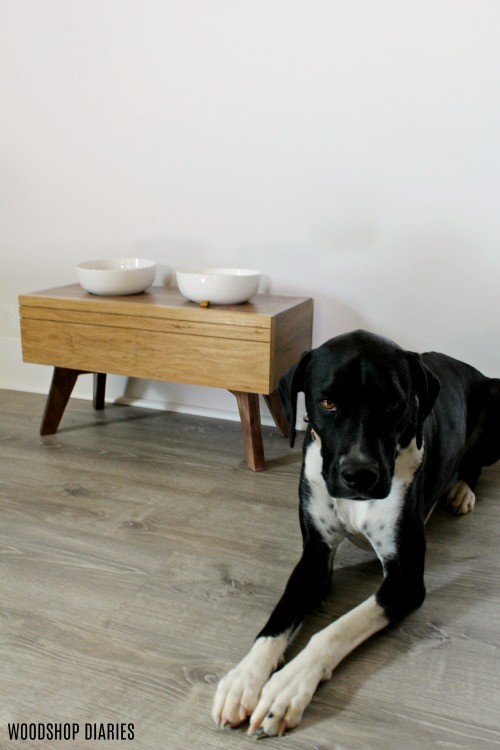
Scrap Wood Dog Food Stand
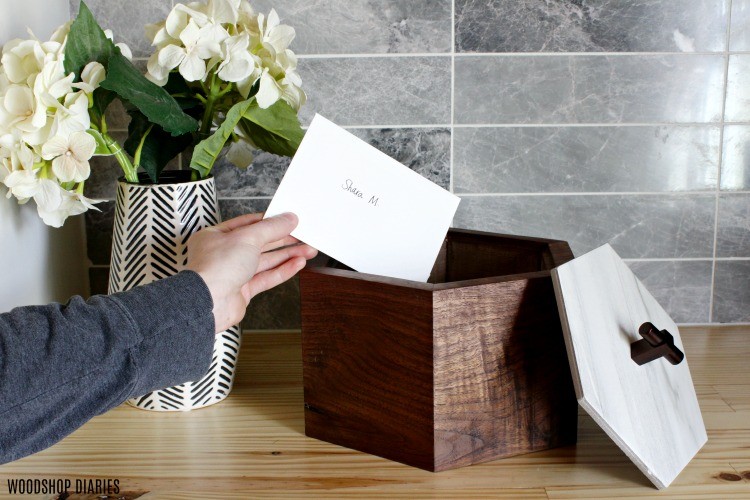
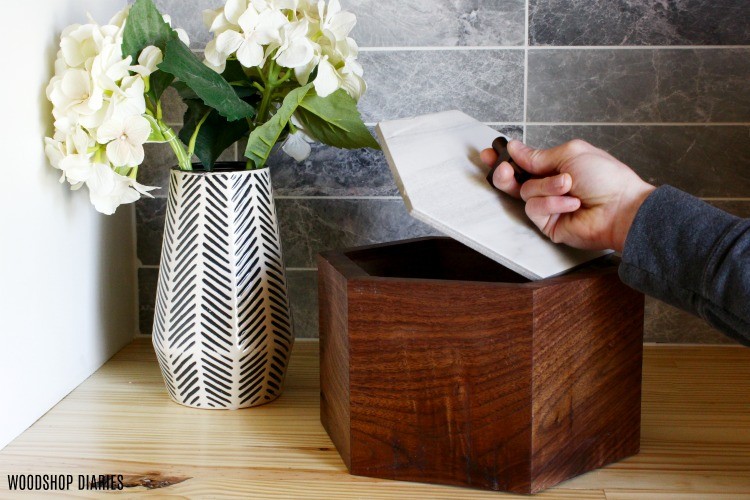
Hexagon Keepsake Box made from walnut and tile
Scrap Wood Keepsake Box

If you want to save this project for later, be sure to pin it!

Pinterest Collage image with Shara holding 2x10 board and placing shoes on bench

And don’t forget to subscribe to the newsletter below so you don’t miss out on what’s coming next!

Until next time, happy building ????

DIY Shoe Bench

DIY Shoe Bench

Yield: 1 shoe bench

Make a shoe bench with just one board! Use it in the entry or mudroom.

Materials

  • (1) 2x10x8
  • 2 ½" pocket hole screws
  • Wood Glue

Tools

  • Table Saw
  • Miter Saw
  • Drill
  • Pocket hole jig
  • Nail Gun

Instructions

  1. Cut the board according to the plans.
  2. Assemble the frames of the shoe bench using 1 ½" pocket holes and 2 ½" pocket hole screws.
  3. Cut shoe bench top and slats.
  4. Finish the top and slats in the stain or paint color of your choice and install using 2 ½" wood screws.
  5. Apply clear coat poly to top and slats and you're done!
© Shara, Woodshop Diaries
Project Type: DIY Home Decor / Category: DIY Furniture Plans

Master Bathroom Renovation Challenge–Week 3

June 17, 2020 by Shara, Woodshop Diaries

Hey friends!  Welcome to Week 3 of the All-Star Renovation Challenge with Jeffrey Court, FrogTape, and Behr Paint!  We are talking master bathroom renovation again, and I’m updating you on week THREE of our progress. This post contains affiliate links. See policies.

Master bathroom all star renovation challenge week 3 graphic

If you remember from last week, these three brands challenged eight bloggers from past renovation challenges (remember my kitchen renovation???) to take on another renovation challenge as the “All-Stars.”  I’m so excited to be included in this group and to share with you the journey as we transform my parents’ master bathroom! Check out all the designers and their spaces here.

Mood board for modern bathroom renovation design

This week begins fan voting…the winner of the challenge takes home the grand prize of $5,000 and, of course, bragging rights that they won the ALL STAR Challenge. The winner this time around will be determined solely by fan votes, so I’d be forever grateful if you’d click on over and cast your vote!

Cast your vote graphic for all star renovation challenge

Now let’s see some progress…So if you missed last weeks update, head over and check that out first.  But I’ll give you a quick recap of where we started this week. Here’s the original “before” photo of the space:

Master Bathroom before photo

At the end of week two, we had removed everything to the subfloor and taken out the garden tub and the shower stall.  We replumbed the shower water supplies and the shower drain and set the shower pan in place.  I also prepped the floor and shower for tile, laid the floor tile, and one wall of the shower. 

Floor tile started in master bathroom renovation

It doesn’t sound like a lot, but trust me…it was a busy first two weeks!  There was also some drywall patching in there somewhere, too, but you get the idea 🙂

So let’s talk about Master Bathroom Renovation Progress–Week 3

Shower Walls:

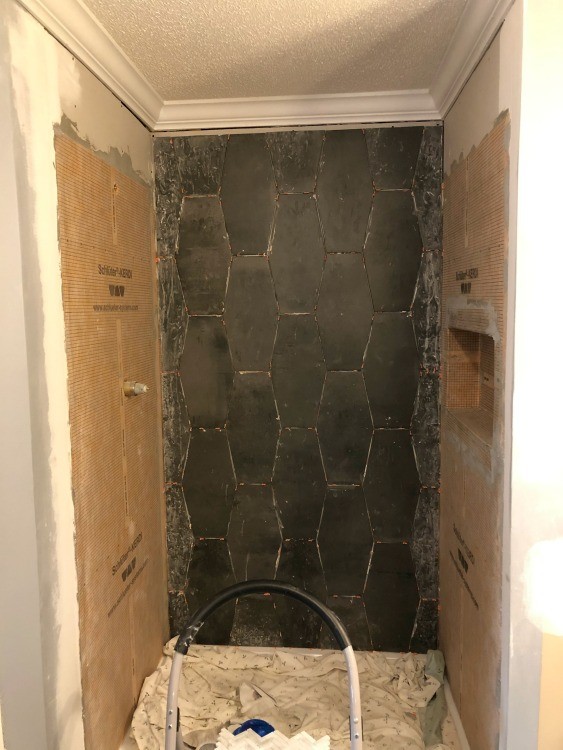
I installed the Jeffrey Court Castlerock tile along the back wall of the shower as sort of a continuation of the flooring.  But I had planned to put something a little lighter on the other two sides.

Shower tile on back wall of master bathroom shower nook

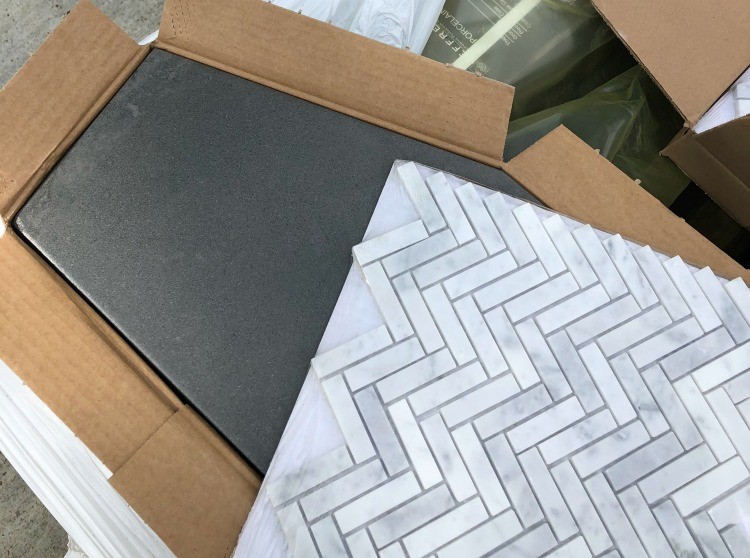
This Jeffrey Court Jetstream tile was SO pretty online, so I thought I’d order some and see how it worked with this darker tile.  As pretty as it is online, it definitely did not disappoint when I saw it in person.  I love the lighter color, but also the herringbone pattern.

Close up of Jeffrey Court tile used in this master bathroom renovation

To make things difficult try something different, I decided to lay this tile on its side vs. the traditional way.  In hindsight, I wish I hadn’t tried to “be cool” because it was really difficult to get the lines straight.  And it was really difficult to cut straight. 

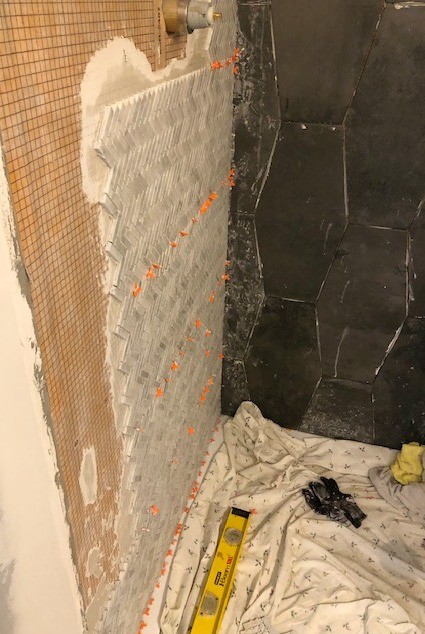
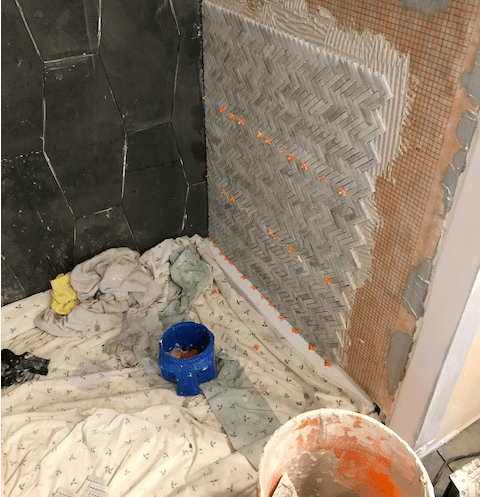
Herringbone tile installed on left side of shower wall

I got frustrated the first day of tiling these side walls and quit for the day about half way up both walls. 

Herringbone tile installed on right side of shower wall

So the next day, I focused on cutting straight and keeping things level.  It was easier once the tiles below were set in the mortar and weren’t moving anymore.  Again, I think this would have been MUCH easier to install the traditional way, but…live and learn 🙂

.

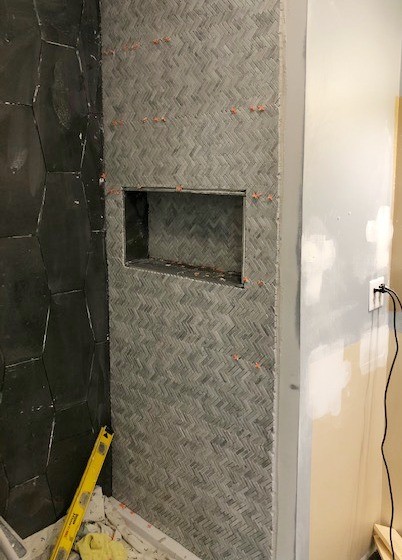
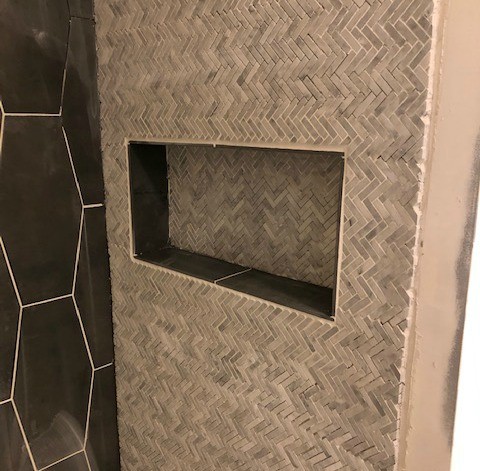
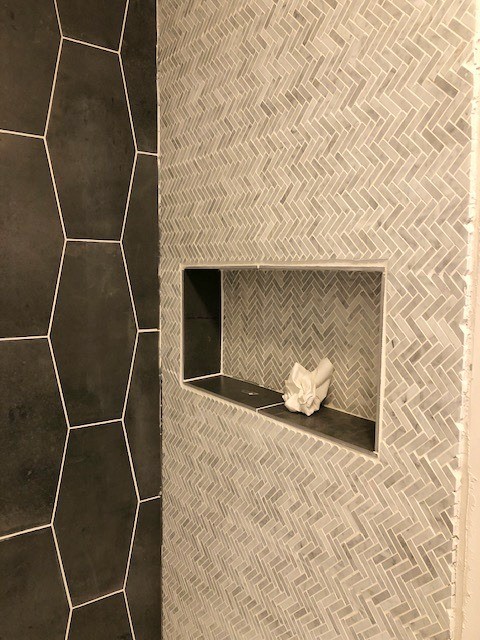
When we got to the shelf/niche, my dad wanted the inside framed out in the darker tile.  So we cut some pieces of the Castlerock tile we had leftover from the floor and placed them inside.  Then I laid the Jet Stream tile the traditional way inside the shelf.  I really loved how it looked, but the outside edge just looked…unfinished. 

Tile around shower niche before grout

I grouted everything the next day to see if the shelf edges looked any better.  NOPE.

Tile around shower niche in master bathroom after grout

So I brainstormed some options to frame it out to cover up some of these uneven cuts (again…all because I wanted to “be cool” and lay this side ways…) and pulled out some of my Tundra Grey tiles that I used from the kitchen renovation and in my laundry nook remodel.

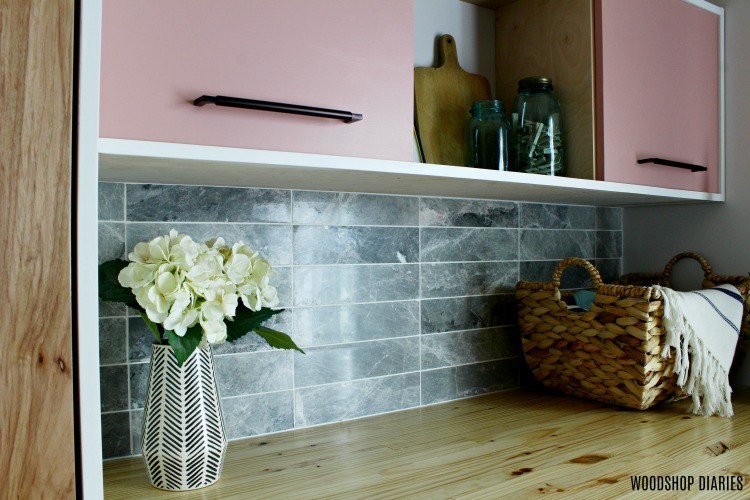
Tundra Grey tile installed as backsplash in laundry nook

After I had grouted the shower walls, I cut some of these Tundra Grey tiles down and stuck them in place.  I wasn’t 100% sure how was best to stick them at this point. 

Shower niche grouted and caulked--before trim

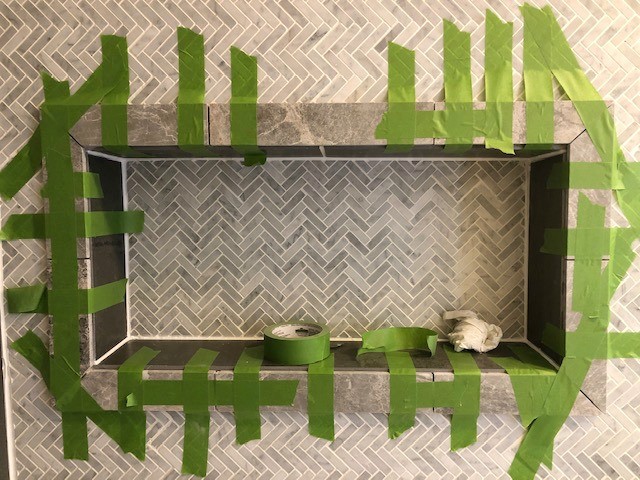
And this may not be the best option, but I used some silicone and plumber’s epoxy to attach them to the existing tile.  I applied the silicone and epoxy and used FrogTape to “clamp it” in place until it was cured.

Tundra Grey tile framed out shower niche--FrogTape holding pieces in place

I am hopeful they’ll hold up well over time, but it’s just a trim piece, so if it falls off someday, we can figure out another way to attach it.  It’s not vital…but I do really like how it looks with these tiles framing it out.

.

Once the grout was dry and these trim pieces were up, I caulked everything and moved onto trimming out the rest of the room.

Bathroom Tile Grout:

I waited to grout everything in one day…so once the shower tile was installed, I grouted the shower walls and the floor all in the same day. You can see in the images above where I had grouted the shower tile. 

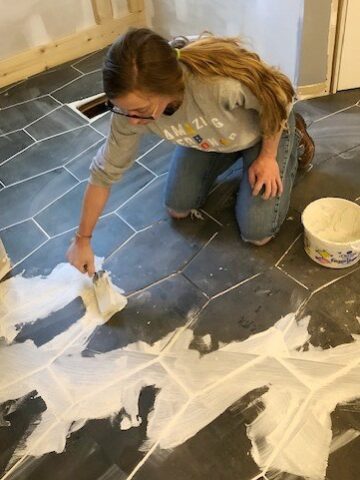
Shara Grouting master bathroom floors

I know I already mentioned grouting the shower walls, above, but all the things were happening at once, so it’s hard to keep things in order haha.

Bathroom renovation tiles grouted on floor and shower walls

I LOVE LOVE LOVE this large grey Castlerock tile with this white grout.  It really makes the floor pop. 

Bathroom Door, Window, Wall, Baseboard Trim:

I mentioned in the last post that I was doing a “feature wall” behind the tub.  It’s nothing fancy, but I had planned to put some trim detail here behind where the tub will go.  So I started working on that wall, installing the matching door trim, and the baseboards.

Unfinished door and window trim installed in master bathroom

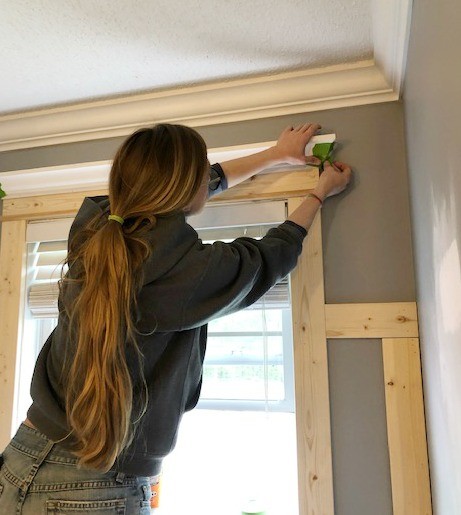
Also, just like I used the FrogTape to “clamp” the tile trim, I also use it A LOT in my trim work to hold glued pieces together until the glue dries…helpful hint *wink wink*

Shara taping crown molding around window trim on master bathroom feature wall

So if you remember from last week’s bathroom renovation post, I’m painting the main walls in here Behr Ambience White and this feature wall Behr Sage Green. Stay tuned for next week to see how it works together!

Behr paint color choices for main and feature walls

I got all the trim sanded, caulked, puttied, and wiped clean ready for paint.  And with the two shower walls, and this trimming and caulking, that was basically a full weeks worth of work.  Caulking and sanding and puttying is time consuming work!

Shower Edge Trim:

One last detail about the trim.  I mentioned that the tile was difficult to cut straight on its side.  So our shower edges ended up looking…well…not even close to my standards (again…not a good idea to lay these sideways).  So I had to find a way to be able to trim out these edges that would cover up the uneven lines. 

Shower tile installed, but not trimmed out yet

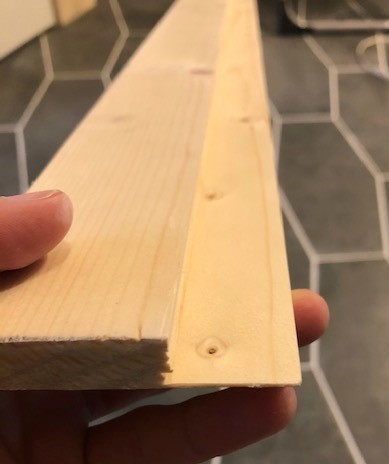
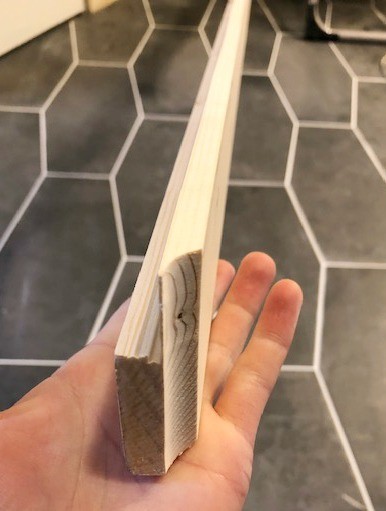
This isn’t ideal, but it worked really well and will look pretty seamless once its painted.  But I used a couple of 1x3s and cut a rabbet in one edge that can “lip” over the tile edge and I can nail into the wall as a trim piece. 

Close up of rabbet cut on shower edge trim piece

I used a router to cut a little cove detail in the top so it will meet the crown molding at the ceiling at the same depth.  This will be painted to match the trim, so I think it will look like it was intentional…but we will know the secret *wink wink*

Close up of routed edge on shower trim piece

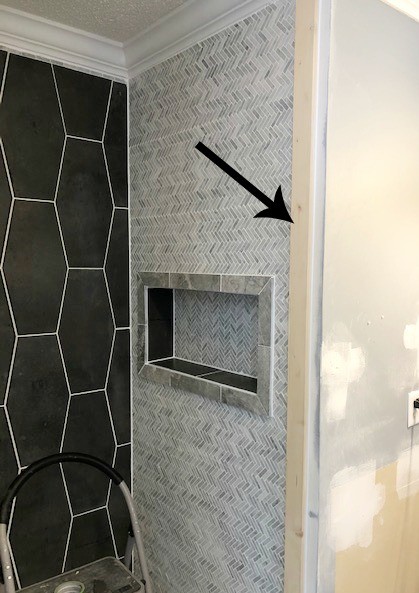
It makes the tile edges look SO much cleaner, too.  It’s on the outside of where the shower curtain will be, so it shouldn’t get wet, plus the paint should seal it from damage from occasional splashes as well. It’s not an IDEAL solution, but it’s a creative solution that worked in our situation.

Wooden shower trim piece installed on shower edge to cover tile edge

Also, one more detail to note…see the top of the tile along that back wall in the image above? When I ran the back wall tile up, I left a small gap between the last tile and the existing crown molding.

Back shower wall tile installed with small gap at top

It worked out best that way for how I was cutting the tiles. But, now I had this weird gap. So, to fill the gap, I used some little leftover pieces of the Jet Stream herringbone tile. I think it turned out pretty cool like that. It’s just a subtle detail I thought I’d point out 🙂

Close up of back shower wall tile with Jetstream tile filling in gap between castlerock tile and crown molding

Okay, so that was week 3 of this bathroom renovation.  Stay tuned because a few more details are left to finish up and I can finally gift this to my parents, pack up my tools, and get back in the workshop!  I think we will all be glad when that happens haha. 

.

It’s really coming together quickly.  I’ll update you again next week! Be sure to subscribe to the newsletter below so you don’t miss out on updates!

All Star Renovation challenge pin image collage--before, inspiration, and progress

Until then, happy bathroom renovating! 🙂

Dremel Blades Universal Oscillating Flush Cut

June 15, 2020 by Shara, Woodshop Diaries

This review of the Multi-Max Dremel Blades for Oscillating Saws is sponsored by the Home Depot and is part of the ProSpective Tool Review Program. It contains affiliate links. See policies.

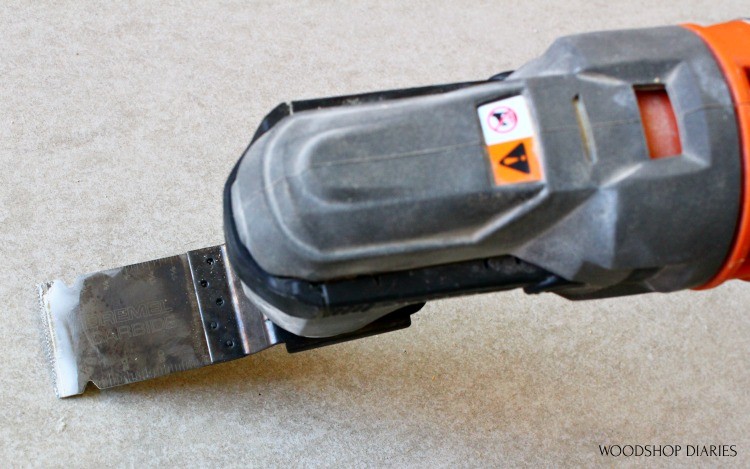
Dremel Blades for Multi Max Oscillating Saw Flush Cut

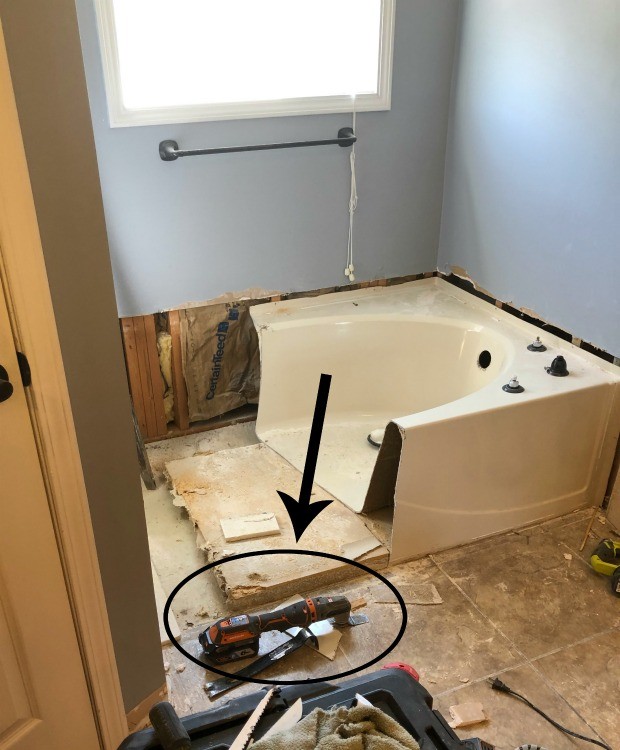
Last year, I added a battery powered oscillating saw to my shop. At the time, I knew I would use it for occasional (not very often) tasks like when we needed to trim door trim when installing new flooring.

.

RELATED: Check out how and why we installed vinyl plank flooring in our garage apartment in this post.

.

But over the last year or so, I’ve found myself grabbing it for SO MANY odds and end cuts. It’s really become a very (surprisingly) valuable tool in my tool box.

.

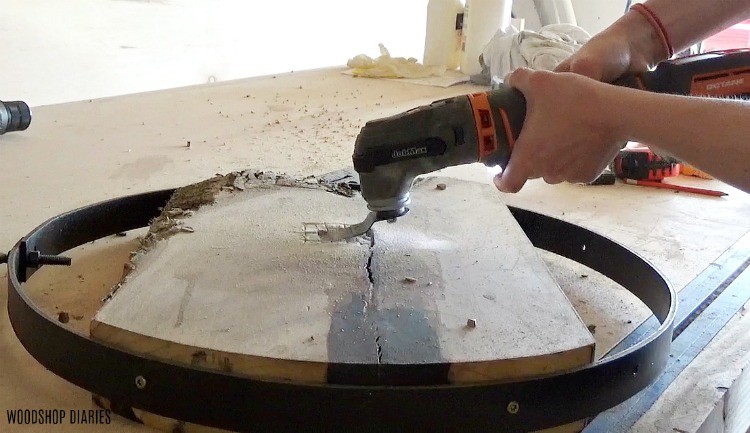
Check out how I used it to make this modern industrial wall clock here.

Oscillating saw used to cut out back of clock

I also used it to trim pocket hole plugs on my plywood bookshelf and to trim dowels from accidental holes I drilled in my recent dresser build (check out the video to see it in action).

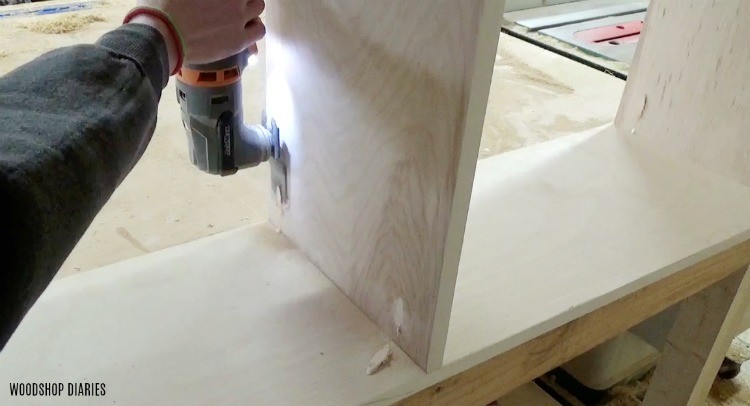
Oscillating saw used to flush cut pocket hole plugs

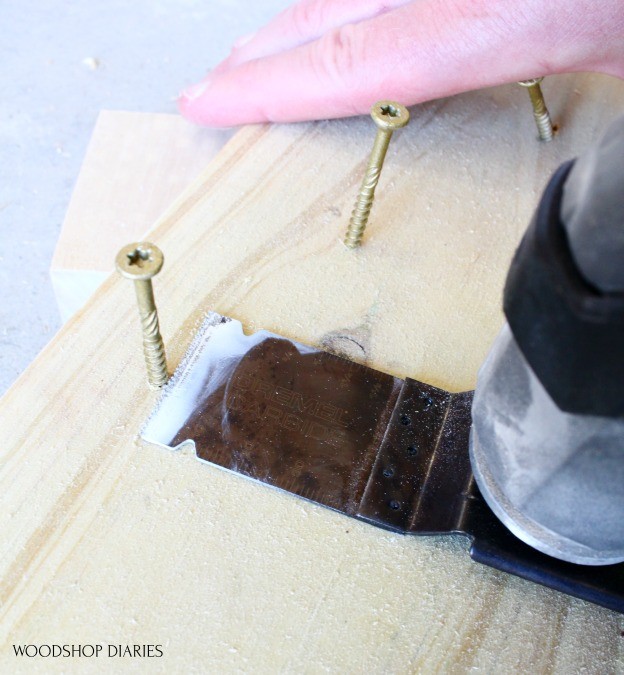
But, just like any cutting tool, the tool itself is only as good as the blades. Earlier this year I got some of these Dremel Universal Carbide Oscillating Tool Blades to replace my existing worn out one.

.

Although they are Dremel blades, they’re designed to fit most oscillating tool brands including Rockwell, FEIN, Makita, Ridgid, Milwaukee, Bosch, DEWALT and Porter Cable. These blades and tools have a handy quick change feature that makes changing and interchanging blades easy.

.

These blades are designed with carbide teeth material for high-performance hard material cutting applications–like wood, metal, and cement.

.

I’ve used them on metal–to cut proud or protruding nails or screws (both in the shop and in my parent’s recent bathroom remodel).

Dremel blades for oscillating saw cutting through metal screws

And I’ve used them to flush cut some wooden dowels and pocket hole plugs.

.

So I knew they could stand up to cutting through metal and wood. But, I’ll be honest, I was a bit skeptical this would cut through much more–especially cement….I mean…It’s CEMENT.

.

But, when we started remodeling my parents master bathroom recently, we put these to quite the test. We used these blades to cut through fiberglass tub to remove it during demo.

Oscillating saw used to cut through fiberglass tub during bathroom remodel demolition

We used it to cut plumbing pipes when we had to move some supply and drainage lines.

Shara using oscillating saw to cut pluming pipes under house in bathroom remodel

But it was the MOST valuable when it came time to cut the cement board for the shower and the floor. If you’ve ever cut cement board, you know that it’ll dull a good utility knife blade with just a couple scores and it’s brittle and challenging to cut holes if they’re not on the edge of the board.

Shara installing cement board into shower walls in bathroom remodel

These blades claimed they could cut through cement, so I put them to the test. I used them to cut out the cement board to go around the shower valve, and was thoroughly impressed with how easily it cut right through.

Dremel Blades for oscillating saw cutting through cement board

Then I used it again to cut the cement board out for the floor around the hole for the toilet, the tub drain, and around the air vent in the floor. So if you have any doubts about it cutting through cement, trust me, they aren’t lying. That said, this would also work really well for cutting drywall as well.

.

What I like about these blades is that it can cut through tough materials, but it’s also a really good all around blade…I don’t have to change it if I want to cut wood, metal, etc. This one blade covers all of those, so I can save time changing blades and spend that time actually working.

.

If you don’t already have an oscillating saw in your shop or tool box, I highly recommend picking one up as you won’t realize how handy it is until you have one. BUT, while you’re at it, make sure to pick up a pack of these blades...I think you’ll be as pleasantly surprised by them as I have been.

.

If you’re interested in checking out other tool reviews, head over to my tool review page here and if you’d like to know what other cutting blades I’m using in my shop, check out this post as well.

.

Stay tuned for more building projects coming soon! And be sure to follow along on the master bathroom remodel here, too.

Pinterest collage dremel universal multimax blades

Until next time, happy building 🙂

I acknowledge that The Home Depot is partnering with me to participate in the promotional program described above (the “Program”). As a part of the Program, I am receiving compensation in the form of products and services, for the purpose of promoting The Home Depot. All expressed opinions and experiences are my own words. My post complies with the Word Of Mouth Marketing Association (WOMMA) Ethics Code and applicable Federal Trade Commission guidelines.

DIY Modern Dresser with Open Shelf

June 12, 2020 by Shara, Woodshop Diaries

Today, I’m sharing a SECOND version of a DIY modern dresser to match my modern bedroom set! There are so many dresser styles, so I decided to share TWO different versions so you can take your pick…or build both 🙂

Close up view of DIY modern dresser with 4 drawers made from poplar

A couple weeks ago, I posted matching 5 drawer dresser plans.  I told you how I’d been waiting two years to build the matching dresser to complete my bedroom set.  See below–the nightstand, the bed, and the 5 drawer dresser.

Collage image of modern bedroom set with nightstand, bed, 5 drawer dresser

But I didn’t want to build just one dresser style.  Mostly because I’m super indecisive ha! So, I built two of them.  Last weeks was taller and skinnier and this time, I made it wider and shorter with an open shelf.

.

I’m sharing the printable plans for this build here and linked below. AND if you’re interested in the entire set, I’ve put together a complete bundle with the bed, nightstand, and both dresser plans here.

.

I’ve got the video for this build here and the step by step details follow 🙂 This post contains affiliate links. See policies for details.

Okay, now let’s get building. 

.

FYI, this entire bedroom set was built with poplar wood. You can use poplar, pine, or whatever type of wood you prefer.

For this DIY Modern Dresser, you will need:

  • (4) 2x2x8 boards
  • (1) 1x10x8 board
  • (3) 1x8x10 boards
  • (3) 1x3x8 boards (OR use scrap ¾″ plywood strips)
  • (1) sheet ¼″ plywood
  • (1) sheet ¾″ plywood
  • 1 ¼″ pocket hole screws
  • 2 ½″ pocket hole screws (if using pocket holes on frame)
  • Wood Dowels (if using dowels for joinery)
  • Wood Glue
  • (4) pair 16″ drawer slides (I buy these in a ten pack because it’s cheaper)
  • (4) large modern drawer pulls
  • Drill/Driver
  • Miter Saw
  • Circular Saw or Table Saw
  • Clamps
  • Router & Rabbeting bit (optional)
  • Pocket hole jig and/or doweling jig

Step 1: Assemble DIY Dresser Side Panels

If any of this looks familiar, it’s because it is.  I built the side panels for both of the dressers and the nightstands the same way (it is a matching set, after all), just with slightly different dimensions.  So if you saw the last dresser build, this part is the same—I glued up my own 2x2s to use for the frame and also glued up a middle panel to put inside.

Dry fit side panel together on workbench

However, this time I assembled the entire side panel using dowels and wood glue.  I used my Rockler ⅜″ doweling jig for this project.

Assemble side panel using dowels and wood glue

I used a combination of pocket holes and dowels on my last dresser, but this time, since part of the inside panel will be seen in the open cubby, I just went with dowels all the way so you wouldn’t see any pocket holes. 

Clamp glued up side panels

I glued and clamped the side panels and wiped away all the excess glue before setting them aside. 

Step 2: Assemble Dresser Frame

Once the glue was dry on the side panels, I drilled dowel holes along the top corners and back bottom corner of the side panels and assembled the frame together using dowels and wood glue. 

Glue dresser frame pieces using dowels and wood glue
Glue up side panel into frame using dowels and glue

This DIY modern dresser was a lot longer than the last one I built, so I had to double up on my clamps.

Doubling up clamps on DIY modern dresser frame

Okay, so up until this point, most of the build looked pretty much like the last dresser (except shorter and wider), but here things start to look a little different.

Step 3: Assemble and Install Dresser Open Shelf

Because this was going to have an open shelf, I needed to actually glue up that shelf.  I have a post here on how to glue up a panel. I built both of these dressers using rough sawn poplar.  So I found two boards that I could rip down and glue up to make the size piece I needed for the shelf. 

Gluing up open shelf for dresser

I cut this shelf to be about ¾” shallower than the overall width of the shelf.  The drawer fronts will overlay these later and I wanted everything to be flush across the front.

.

Once the shelf panel glue was dry, I cut the ends clean and drilled ¾” pocket holes using my Kreg 320 jig along the edges to install.  Up to this point, I used dowels, but I went with pocket holes here because it was quick, strong, and you wouldn’t see them on the underside of the shelf.

Drilling pocket holes into ends of open dresser shelf

I installed this into the shelf with pocket hole screws making sure that both sides were equally spaced down from the top.

screwing open dresser shelf in place using pocket holes and screws

Step 4: Install Dresser Drawer Supports

Now I had the main parts of the dresser together, BUT I needed to add the structural frame pieces to hold and support the drawer boxes. 

.

For this, I found three long scraps—about the size of a 1×3.  You could use anything for this really, scrap ¾” plywood, 1×2, 1×4.  I like to use as much of my scraps as possible, so I used some off cuts. 

Attaching bottom and back drawer frame supports using pocket holes and screws

I cut these to length and installed them in place using pocket holes and screws.  I put one in the back right under the shelf—this will help a little in preventing it from bowing in the middle, and then I attached two more at the bottom–even with the bottom of the side panels. Again, keeping the front one inset ¾″ so the drawer fronts can cover it later.

.

Once those were in place, I cut a piece of ¾” plywood to use as the drawer divider.  I placed this into the dresser frame and installed it in the center using pocket hole screws.  It’s important to get this piece in the very center of the dresser so that the drawer boxes on both sides will be equal size.

Shara screwing in drawer divider panel into dresser frame

Step 5: Install Dresser Drawer Slides and Boxes

Now it was time to add the slides.  I installed four pair of ball bearing slides (I buy the ten pack, because it’s cheaper) into the dresser.  I’ve got an entire post on how to install drawer slides and drawer boxes here.

Shara installing drawer slides onto modern dresser

Once the slides were in place, I moved on to building the drawers.  If you’ve noticed in past projects, I like to build my drawers from ¾” plywood, so I ripped strips from my plywood sheet to make the drawers from.  I have a post here about how I cut down my plywood sheets. I assembled the drawers using pocket holes and screws and using a ¼″ plywood bottom. I have a post here on exactly how I build drawer boxes.

Assembling drawer boxes with pocket holes and screws

Once the drawers were built, I installed them into the dresser. Again, I’ve got an entire post here on how to build drawer boxes and install them.

Shara installing drawer boxes into DIY modern dresser

Step 6: Attach Dresser Drawer Fronts

Now that the drawers are in, I was ready to add the drawer fronts.  I had gotten one really wide board when I picked up my lumber.   I thought it would look really cool to make these four fronts out of one board.  It was about ½” narrower than I needed, but I ended up using it anyway. 

Shara holding up wide board to use for drawer fronts

I thought the design element of the continuous grain fronts outweighed the fact that the drawer fronts wouldn’t come QUITE flush with the top of the shelf. Sometimes you compromise haha.

.

It was too wide to fit through the planer, so I ripped it first on the table saw into what would be the top drawer fronts and the bottom drawer fronts, then ran these boards through the planer. 

Once they were cut down to size, I flipped the dresser on it’s back and screwed the fronts in place making sure to keep the grain matching up across the front.

Laying out drawer fronts to check spacing on dresser drawers
Shara screwing drawer fronts onto drawer boxes from inside

Step 7: Attach DIY Dresser Top

Then, if you remember on the last dresser, I used my router to cut a small rabbet along the top edge for a subtle little design detail.  I did the same on this dresser, too.  The nightstands, and both dressers have this little detail and I don’t know why, but I love it.

Shara routing rabbet on edge of dresser

I glued up a top panel (here’s a post on how I glue up tops) to finish this up, and once the glue on the top was dry, I trimmed it down to fit the exact size of the dresser frame–so no overhang.

.

I finished both the dresser and the top with Walrus Oil Furniture Butter, then took them out to bake in the sun for a while. 

Walrus Oil Furniture butter can

The poplar had a green tint to it once it was finished. If you didn’t already know, if your poplar is green, you can leave it in the sun for a couple hours to turn it more brown and give it a warmer tone. 

.

Then, just like the last dresser, I glued and clamped the top in place. 

Apply wood glue  along dresser top

Again, I know this isn’t the “correct” way to do this because of potential issues with wood movement, BUT I’m taking my chances as my past experience doing it this way hasn’t caused any problems.

Setting dresser top onto base to attach

If you’re concerned about movement issues, you can attach using figure 8 tabs like I used on this table top.

clamping top of modern dresser onto base

I added these long modern pulls to match the same ones I used on my nightstands and just like that, DIY modern dresser number 2 was finished. 

Angled view of DIY modern 4 drawer dresser  made from poplar

I love love love the open shelf here. BUT, if you wanted, you could definitely skip the shelf and add two more drawers instead.

Front view of DIY modern dresser finished
Shara Pulling drawer out of DIY modern dresser to look inside

This piece is the last piece in my modern bedroom set collection and I’ve put together a plan bundle for the set here.

You can also check out all the tutorials and videos on this page for the whole set, too.

Image Collage of all four bedroom set pieces--bed, nightstand, two DIY modern dressers

I’ve got plenty more big builds coming soon, so be sure to subscribe below so you don’t miss out on all the upcoming shenanigans ???? In the mean time, if you liked this DIY modern dresser build, be sure to pin this for later.

Pinterest collage for modern dresser build--3D graphic overall dresser dimensions at top and Shara with finished dresser on bottom

Until next time, happy building!

Master Bathroom Renovation Challenge–Week 1 & 2

June 10, 2020 by Shara, Woodshop Diaries

I’m tackling another master bathroom renovation you don’t want to miss!! As much as I love building furniture, occasionally, I do like to tackle a renovation project just to change things up a little and keep my (limited) skills sharp. This post contains affiliate links. See policies.

.

Jeffrey Court is partnering with FrogTape and Behr Paint to present an All Star Renovation Challenge project this summer.  They asked participants from past renovation challenges to give it another go this summer. No pressure or anything *wink wink*. You can check out all the participants and their projects and progress here.

All Stat Renovation Challenge graphic week 1 & 2

Since building our garage apartment a while back, we don’t really have anything to update in our own home. But my parents have been wanting a some updates to their master bathroom for a few months now.  So I decided to start another (this isn’t my first master bathroom renovation—check out my other one here) DIY master bathroom renovation in their house. Here’s their before:

Master bathroom before tub and closet

If you remember from my garage apartment build, we used our kitchen as part of the Fall 2019 renovation challenge and we actually WON!  I’m still in shock about that. 

Kitchen renovation challenge before and after

This time, the winner will be picked solely on fan votes, so I’ll be asking for your help again in supporting the project and casting your votes!  But…not yet.  First, we have to lay out the back story here.  So let’s talk about the before and how far we’ve gotten in the first two weeks–A LOT happened in that time! 

.

Each week I’ll post an update and the fifth one will be the final reveal.  So be sure to tune in for updates (subscribe to our newsletter at the end of this post to get updates!).

The Before:

My parents built their house almost 20 years ago (I was in 3rd grade).  At the time, they didn’t want to spend a lot of money on the things they could change later—like flooring, paint, etc.  So they went with basic linoleum flooring, a built in shower stall, and a built in garden tub.  Standard contractor grade stuff.  The entire house also had tan walls.  I HATE TAN…but that’s neither here nor there.

.

Over the years, they painted (multiple times), added some crown molding, and installed some glue on vinyl floor tiles.  All was fine, but ultimately, not really what they wanted.

Master bathroom before--tub and closet

The bathroom is a good size with double closets on each side of the tub, a 3×4 shower, two single vanities, and a toilet behind a privacy wall in the back corner (which is always nice to have in the bathroom haha).

mom and dads bathroom before--closet, toilet, and vanity

But Dad has always dreamed of a tile shower and mom is ready for an update to the overall look.  So that’s where I came in.

Mom and dads master bathroom before--shower and vanity

The Master Bathroom Renovation Plan:

In a nutshell, the plan for this bathroom was to remove and replace the shower, tub, flooring, vanities, mirrors, lighting, and paint.  Of course, it’s a lot easier said than done, but that’s the basics.

.

The overall design included using Jeffrey Court Castlerock Hex tile along the floor and going up the back side of the shower wall.  The shower sides would be this lighter tile Jet Stream herringbone option.  We are replacing the existing garden tub with a modern freestanding tub, and those old oak vanities will be replaced with the console dressers I built recently to use in here. I’m not very good at “mood boards” but here’s the gist.

Mood board for master bathroom renovation

I’m also doing a feature wall behind the tub and using Behr Ambience White on the main walls and Sage Green on the feature.

Behr paint choices for master bathroom renovation

So that’s the master bathroom renovation PLAN.  Let’s talk about the PROGRESS ????

The Progress:

Bathroom Renovation Week 1:

Demo:

The renovation challenge has a six week time allotment.  I’m an overachiever and I was hoping to get this done in about three-four weeks so that my parents can have their master bathroom back and so that I can get my own work done at my home (someone has to pay the bills and my dog isn’t contributing much haha). So we worked quickly.

.

Demo is almost always easy…putting things back together is the hard part.  So, I tore out the vanities first.  I unhooked the faucet supply lines and the sink drain and removed the countertop.  Then, I pulled out the cabinets.

Old vanities removed from bathroom and cut off valves replaced

The cut off valves on the water supply lines were old and one was leaking, so I cut them off and replaced them before moving on.

.

Then, we removed the shower and the tub.  Because these were installed BEFORE the drywall when the house was built, they wouldn’t fit to come out in one piece now.  So we cut them in pieces using a reciprocating saw.  It was a total mess.  But it worked, so….

Shara and Dad removing old garden tub in sections
Shara and Dad carrying out old shower stall in pieces

Lastly, we removed the flooring…which was a PAIN.  I was planning on removing just the peel and stick vinyl and leaving the linoleum, but it all started peeling up together, so I just took it all the way down to the OSB subfloor.  I used a prybar, a hammer, and a utility knife.  It was slow going with a few painful blisters.  But it eventually all came up.

Pile of old linoleum flooring pulled off master bathroom floor

The Shower Pan:

Once the floor, shower and tub were removed we could have a look at any damage and drain locations to see what we needed to do to prepare for the new stuff.

.

I worked on the shower first.  I didn’t want to chance screwing up tiling a shower floor.  So I purchased a pan for the floor and just tiled the walls for this remodel.  But, in order for the pan to fit, the drain had to be moved back three inches and the supply lines needed to be run through the WALL, not the floor.

Plumbing lines running up through subfloor

I also noticed some water damage to this section of wood under the shower valve.  So I cut it out, replaced it with new framing (note: this was NOT a load bearing wall, so it wasn’t a big deal), reran the supply lines, replaced the shower valve and moved the drain. 

rotten boards replaced and plumbing re ran through wall plates

I know that sounds short and sweet, but it took an entire day and there was lots of crawling under the house to replumb things.  Guess who got to do that part??

Shara replumbing the shower valve

But eventually, we got the pan to fit in place and secured it to the studs.

Shower pan installed for master bathroom renovation

Drywall patching:

After removing the tub, I had to patch the drywall behind it. 

garden tub removed from tub nook between closets

It’s not the most exciting part of the project, but is worth mentioning that there is no longer a huge hole in the wall where the tub used to be haha.

Drywall patched behind previous garden tub

I installed a wall mounted faucet on the right side for the tub, here as well.  I puttied and sanded this in between other tasks I’ve been typing about.

Shower Wall Prep:

Mom and Dad have a built in bookshelf on the other side of their right shower wall.  So I guess whenever the framers built this out, they didn’t bother framing this side of the shower since the old stall didn’t require it and the bookcase hid it. 

Framing missing on right wall of shower nook in master bathroom renovation

But, in order to tile this, I had to install cement board on this wall, so I needed some framing to screw into.  While I was framing it out, I also decided to add a niche in this space to give them somewhere to store their shampoo and stuff in their new tiled shower.

Framing installing into right wall of shower area for niche

I cut and installed ½” cement board inside the shower area, and had hoped to be able to leave the existing drywall. 

Shara installing cement board into shower nook for tile walls

However, I was really unhappy with the unevenness of the walls once I got the cement board in place.  When you install shower stalls, you shim out the drywall to fit over the lip of the stall.  So when we removed the stall, the drywall was shimmed (pushed out).  But the cement board I installed wasn’t.  So there was a lump where the drywall met the cement board. 

Shower nook with upper drywall removed ready to replace

I thought long and hard about just leaving it, but decided to do the right thing and ended up cutting out the drywall around the shower (see above), removing the shims, and installing new drywall. 

Shower nook with cement board and drywall installed ready for tile

It was a time suck, but I feel better knowing I did it the right way.  Kind of haha.

Waterproofing the Shower:

Once that ordeal was finished, it was time to waterproof the shower so I could get ready to tile.  In our last bathroom remodel, we used Schluter Kerdi to line the shower walls as a waterproofing barrier.  As far as we could tell, it worked well.  So I did it again here.  You can read all about this stuff on their website, but in a nut shell, I applied mortar to the walls, and smoothed this waterproof membrane over it overlapping the joints.

Shara applying Schluter Kerdi to shower walls

They make premade niche inserts which probably would have been better to use here, but I wanted to be difficult and I just lined it with this stuff.  It seemed to work okay, but was quite a bit of work to get the corners nice and tight.  Live and learn.

Kerdi membrane installed in shower niche

Floor Prep:

I let the Kerdi cure on the walls for a few days while I moved on to working on the floor.  The floor was two layers of ¾” OSB, so I was able to lay ¼” cement board directly on top of it to prepare it for the tiles.   

Cement board laid on bathroom floor

This, again, was a tedious job, but not too difficult.  Once I got over by the tub, I had to determine where the new tub drain would be.  We unpacked the freestanding tub we bought for this space and saw that the drain was in the center, not on the right like the existing tub.  So I cut a new hole for the drain, and blocked up the old one to lay flooring over.

Old and new drain holes cut into master bathroom floor for tub

Bathroom Renovation Week 2:

Floor Tile:

Once all the cement board was in place, I taped the seams with mesh tape and mixed up the mortar.  It was go time (I was a little nervous haha).

.

My design idea was to run the floor tiles long ways down the floor, then straight up the back wall of the shower.  So I centered the tiles on the shower pan, so that when they go up the wall, the sides are equal and it doesn’t look offset.  So that’s where I started the floor tiles and worked my way out from there. 

First two and three rows of master bathroom renovation floor tile starting out from shower

We decided not to take the tile into the closets during this project for various reasons.  If we had unlimited money and time, we would have gone into the closets, but for now, it’s just a closet, so we will add floor transitions here later.  

Shara tiling master bathroom floor into back corner

I tiled the majority of the floor in one day. I kind of tiled myself into a corner and decided to quit for the day because the tiles needed to set up before I could walk across them back and forth to cut them as needed. I returned the next day and finished up the remaining floor and the area around the toilet.

Shower Wall Tiling:

Once all the flooring tile was laid, I worked on the back shower wall.  It went pretty smooth with these large tiles.  I followed the same flooring pattern up the back wall only. 

Bottom row of shower tile started to match the flooring

I used a tile saw to trim pieces as needed for both the floor and the back shower wall.  This tile was really easy to install and cut and I love dark grey color. I finished up the entire back shower wall and called it a week. (Actually a SECOND week haha)

Back of master bathroom shower tile complete floor to ceiling

And that wrapped up master bathroom renovation week two.  I’m still hopeful we can get this knocked out well before the six weeks is up! I can’t believe how much I got done in just two weeks so far. Crossing my fingers things keep going smoothly!

.

Next up on the to do list is tile the remainder of the shower, grout, install the feature wall, trim, paint, and install the tub, vanities and toilet.  I THINK things should go smoothly for the rest of the renovation.  I THINK haha.

.

Stay tuned for another master bathroom renovation update next week!

Pinterest collage of the before, inspiration, and the progress pictures of the master bathroom renovation all star challenge week 1 & 2

Until next time, happy renovating! ????

Milwaukee M12 Fuel Battery Ratchet Review

June 8, 2020 by Shara, Woodshop Diaries

This review of the Milwaukee M12 Fuel Battery Ratchet is sponsored by The Home Depot as part of the ProSpective tool review program. This post contains affiliate links. See policies.

Ratchet, charger, and battery in case

How many times have you busted your hand while tightening or loosening a bolt? When I worked in the factory, we installed and maintained machines on the assembly lines. We kept band-aids handy in the top drawer of the tool cart because at least one person was going to be bleeding by the end of the day from adjusting a bolt on a machine and busting a knuckle.

.

At the time, I didn’t even know battery powered ratchets existed!! WHO. EVEN. KNEW!? How life changing would that have been?

.

I recently had the opportunity to test out this Milwaukee M12 Fuel ⅜″ Long Reach Ratchet and was blown away at how awesome it was for easily working (without busted knuckles) in tight spaces.

Showing off tool with charger and case

Milwaukee Ratchet Specifications

This Milwaukee ⅜″ Extended Reach ratchet runs on the M12 battery platform. You can purchase the tool with or without a battery and charger.

.

If you’re already on the M12 platform (the Milwaukee M12 platform batteries are the small, somewhat cylinder shaped batteries) this is a great option to add to your collection.

Installing M12 battery into Milwaukee battery powered ratchet

But if you aren’t already on the M12 platform, it’s a platform that has 80+ tool options and takes up a very small footprint. It’s powerful and intelligent, but also very small…which is nice for small spaces, and people who want lighterweight, less bulky tools.

.

Milwaukee makes a couple different models of this tool, but I’m using the extended reach one. It’s capable of reaching further into tight spaces with its 11″+ overall reach. And with a slim head profile of slightly over ¾″, it can also fit in very narrow spaces as well.

Using milwaukee ratchet in tight spot to tighten nut on lawnmower motor

Milwaukee also makes this as a ¼″ and a ⅜″ ratchet size. Depending on the size sockets you keep on hand (¼″ vs. ⅜″) in your shop, this will probably determine which size ratchet you’d prefer.

.

The ⅜″ I’m using fits ⅜″ sockets and has a maximum torque of 55 ft-lbs. The ¼″ ratchet fits ¼″ sockets and has a maximum torque of 40 ft-lbs.

Installing ⅜" socket onto ratchet head

Milwaukee Battery Ratchet Helpful Features

This ratchet is a ratchet…it’s not a magical transforming tool with a ton of unexpected features. But the features this ratchet DOES have feels like they were well thought out and 100% practical.

.

The trigger to run the ratchet is located on the bottom of the tool towards the back. What’s nice about this trigger is that it’s in a comfortable location and it’s also a variable speed trigger for better control. But the problem with this trigger is it’s easy to press accidentally while in transport or simply by laying it down in just the right position. So they thoughtfully added a lock switch to keep the trigger locked off when not in use.

Milwaukee trigger lock button on bottom of case

Below you can see the trigger on the ratchet, but you’ll also notice the red lights. This is the battery indicator to show you how much charge you have left–which is handy to know when using the tool for long periods of time. This lights up when the trigger is pulled as well as a bright light on the front of the tool for better visibility when working.

ratchet with battery level lights indicated on side of case

The forward and reverse switch is located on the head of the ratchet (like most ratchets are), but it’s heavy duty and sits down below the surface of the ratchet. This is extremely helpful in preventing accidentally flipping the switch if it’s knocked or bumped while working.

Final Thoughts

The Milwaukee M12 Fuel ⅜″ Ratchet is a really nice, powerful, heavy duty tool. It’s solid, and has a durable metal housing with a powerful, long lasting brushless motor.

.

I’m impressed with the quality of the tool casing and the thoughtful features. Although this isn’t an often used tool in my WOODWORKING shop, having it handy for around the house–working on the lawnmower, tractor, and vehicles–could be helpful on occasion.

Using milwaukee ratchet to tighten bolt on tractor fender

However, it’s probably best fit for working on larger equipment. If you’re working on a farm, factory, or as a mechanic, I’d say this would be an excellent investment.

.

I hope you’ve enjoyed this review of the Milwaukee Extended Reach Ratchet and if you’d like to save it for later or share with a friend, feel free to pin this image for later.

Pintereste collage image of milwaukee ratchet inserting battery and using to tighten bolt on tractor

I’ll be back to the building projects soon, so stay tuned. In the mean time, check out more tool reviews here and more DIY projects here.

.

Until next time, happy building 🙂

Gifts for Dads {and DIYers}

June 1, 2020 by Shara, Woodshop Diaries

In this post, I’m sharing some top gifts for Dads, but these aren’t just for Father’s Day.

This gift guide is for Dads, DIYers, home renovators, shop tinker-ers and anyone who enjoys “shop toys” and handy tools.

Collage image of gift ideas for Dads and DIYers

I’ve been spending a lot of time with my dad recently while renovating my parents’ bathroom and that got me thinking about what things he might love to get for Father’s Day.

And that also got me thinking about the fact that, as a DIYer, I’d love to have most of those same things, too! So, while I may be sharing some gift ideas for Dads, that doesn’t mean it only applies to Dad.

These would also be great gifts for any DIYer for Christmas, Birthdays, or even Housewarmings or Weddings gifts for new couples just starting out on their own.

Here are my top gift ideas–most under $50! This post contains affiliate links. See policies for details.

Gifts For the Heavy Duty Dad

These are simple gifts for the heavy duty DIYer–the ones who work hard and need their tools to work hard too.

Tape Measure

I know a tape measure isn’t the most exciting gift in the world, BUT my Dad is not exactly…gentle…on his tools. So for the Dad or DIYer who is too busy getting things done to worry about being careful, this Milwaukee 25′ tape is a great gift idea.

Measuring tape--great gift idea for dads and DIYers

It’s practically indestructible with its ability to withstand an 80′ drop, and it’s tear resistant blade. It’s heavy duty!

Gifts For the Dad Who Has All The Tools

They may already have the tools, but those tools will always need new accessories and maintenance. Here are some ideas to help them keep their tools running smoothly.

Fresh Saw Blades

Every cutting tool will eventually need new blades. For the dad or DIYer who already has all the tools (plus some!), a fresh set of blades is like making an old tool brand new again.

Pick up a fresh blade or set of blades for their favorite tool so it’s ready to go the next time they need it.

Here are the go to blades I use in my own shop:

  • 12″ Fine Finish Blade (for the miter saw)
  • 10″ General Purpose Blade (for the table saw)
  • 7 ¼″ Plywood Blade (for the circular saw)
  • Fine Finish Jig Saw Blades
  • Dremel Universal Flush Cut Blades (for the oscillating saw)

Drill Bits

Just like saw blades, drill bits wear out and need to be replaced over time. A fresh set of drill bits is always great to have handy when one gets dull or breaks.

Here are a few different drill bit sets to check out:

  • Milwaukee Drill Bit Set
  • Bosh Spade Bit Set
  • Wen Forstner Bit Set

Router Bits

And again, just like blades and drill bits, router bits dull with use and also need replacing after a while.

Router bits come in many shapes, sizes and profiles, so you can gift them a back up bit of the most common types–like:

  • Flush Trim Bit
  • Straight Bit
  • Roundover Bit
  • Rabbeting Bit

OR, grab them a new unique profile bit they can use on their next project–like a Roman Ogee!

Gifts for Dads and DIYers Who Love Music

Working in the shop is always more fun with your favorite tunes playing!

Headphones

My Dad has a big yard so he mows a lot. He also sandblasts as a large part of his job He’s always wearing his noise cancelling headphones. They used to have AM/FM radio but they’re broke so now it’s just silence. How boring.

Shara wearing 3M Worktunes while using Miter Saw

So this year he’s getting an upgrade to these 3M WorkTunes Connect Hearing Protectors. I tried them out to see how they worked and he’s going to love them.

Simply connect your phone and listen to YouTube, Pandora, or your own playlists. And if you get an incoming call, you can pause and answer it. I’m gifting myself one, too. We can be twins 🙂

Shop Radio

If head phones aren’t going to cut it, how about a simple shop radio? Grab one with Bluetooth and maybe even a battery powered option so they can use it even during power outages.

Here are a few shop radio options to consider:

*For battery powered radios, make sure to get one that matches the batteries they already have for their tools. Batteries aren’t interchangeable between brands.

  • Ryobi Battery Powered Shop Radio
  • Milwaukee Battery Powered Shop Radio
  • Makita Battery Powered Shop Radio
  • DeWalt Battery Powered Shop Radio

Gifts for Dads on The Go

For the Dad or DIYer on the go, organization, storage, and ease of transport is key!

Tool Bags

My Dad runs a business that requires him to keep his tools handy in his truck when we goes out on jobs. If your Dad likes to take his tools with him, too, this handy backpack is easy to pack up and carry with you.

Shara packing on the go Husky Backpack with tools

Tool Organizer

And these small parts organizers snap together and allow you to easily carry several at a time full of screws, staples, pencils…all the small parts he may need.

Small parts organizers--gift ideas for dads on the go

Gifts for Dads Who Want to Build

For the Dad or DIYer who wants to build, here are a few basic tools that’ll help them kickstart their projects!

Pocket Hole Jig

If you’ve got a Dad who dabbles in building or one who is retiring and wanting to start woodworking, gift them a Kreg 320 pocket hole jig. It’s small, but gets the job done and makes building furniture and décor approachable.

Close up of Kreg 320 Jig bit--an excellent gift for Dads and DIYers who want to build

And when you gift it, share this guide with them–How to use a pocket hole jig for furniture making.

Kreg 320 Jig used to build cabinet panels

Cutting Guides

The Kreg Rip Cut may be my favorite tool in the whole workshop and if you know someone who is getting started in woodworking and furniture building, it’s a game changer.

How to Cut Plywood

This guide attaches to your circular saw to make cutting down large plywood sheets a breeze!

The Kreg AccuCut is a closet second favorite. The sled that attaches to your circ saw for the Rip Cut is the same sled that you use on the AccuCut–so you can swap back and forth without any adjustments.

The Rip Cut helps you rip up to 24″ wide, and the AccuCut allows you to cross cut large panels that are larger than 24″ wide.

How to Choose the Right Plywood

You can grab these guides separately, but or grab them both in this combo kit.

These were some great gift ideas for Dad (or the DIYer in your life…even if that’s you *wink wink*).

I hope this has been helpful as your doing your Father’s Day, birthday, holiday, or “just because” shopping.

If you’d like to check out some other gift ideas, check out my Shop my Workshop Page, and browse around my Workshop 101 series for helpful items I like to use around my shop.

And also check out these 10 practical gift ideas for new homeowners, and this Holiday Gift Guide as well. Also, you can check out my storefront here for building plans and fun woodworking tees!

If you’d like to save this for later, be sure to pin this.

Pinterest collage image of the 5 gifts for dads and diyers under $50

I’ll be back soon with more DIY furniture builds, but until next time, happy shopping! 🙂

Milwaukee Packout System & Radio Review

May 31, 2020 by Shara, Woodshop Diaries

This review of the Milwaukee PACKOUT system and stereo is sponsored by the Home Depot as part of the ProSpective Tool Review program. This post contains affiliate links. See policies.

Shara Woodshop Diaires standing next to Milwaukee PACKOUT system

My shop will never be the same.

.

My off site jobs will never be the same.

.

My neighborhood will never be the same.

.

This stereo has changed everything. I know that seems like an exaggeration, but I’m serious…let’s dive in.

Selecting mode button on stereo

The Milwaukee PACKOUT Stereo

My old, cheap shop radio died several months ago and I’ve been looking at getting a new one for a while. I played music pretty often for when we were working in the yard, hanging out outside and obviously when I was working in my shop. But half the buttons were broke on my old radio and if you turned it up very loud, the sound was really stat icky.

.

Since music was a pretty important part of my every day work, I wanted to make sure that, this time, when I got a new radio, I got a good one.

.

I got a Milwaukee PACKOUT Radio and I don’t think I’ll ever look back.

How Does it Sound?

This Milwaukee PACKOUT Radio with Built in Charger went above and beyond my expectations in a lot of areas, but sound quality is top notch. It has ten speakers around all sides for true 360 degree sound. And it gets loud…like, I mean LOUD. I’m sure my neighbors love that 🙂

Adjusting volume knob on PACKOUT radio charger

This stereo is even better than the one in my truck…totally honest. Clear, loud, and perfect for when you want ALL AROUND sound. You can even customize the settings for bass and treble how you like it.

.

Remember back in the late 90s and early 2000s when you’d buy those fancy looking stereo systems with the two speakers on each side and the controls in the middle? Remember how cool you were when you got one of those and set it out by the pool in the summer? Imagine how that would feel with TEN speakers. That’s what this is like.

Shara Woodshop Diaries dancing next to stereo set up

Batteries and Charging Abilities

It can run cordless on the Milwaukee M18 battery system, but can also be plugged into a standard wall outlet if you don’t want to bother with batteries all the time.

Outlet cord for radio--plug in or cordless option

But, speaking of batteries…when plugged in, it will charge your M18 battery, and also has a USB charging port to charge your phone or other devices as well. The chargers and battery input are located inside a weather tight compartment for protection from damage and weather.

Shara Installing battery pack into weather tight compartment of Milwaukee PACKOUT radio
Shara placing phone into weather tight compartment of PACKOUT radio charger

Input and Music Options

Just like most typical stereos, it’s got the option for AM/FM (with up to 18 available presets), AUX, and Bluetooth so you can play from your devices.

.

Now, this stereo can stand alone as just a stereo, but it’s also fully compatible with Milwaukee’s PACKOUT modular storage system–which is also pretty impressive.

Shara lifting Packout stereo from PACKOUT storage system to show it's able to stand alone

The Milwaukee PACKOUT Modular Storage System

I have here what I like to call the “basic starter kit” of the PACKOUT system. It’s like the foundation to the whole system. This particular set comes with the built in dolly on the large bottom compartment, then the two smaller compartments stack on top.

Shara with Milwaukee system three sections taken apart to open

Additional Add On Options

They’ve got a ton of additional accessories available with this system so you can add on as needed–large storage containers, small parts organizers, tool bags, and of course the stereo mentioned above. They simply snap and lock together.

Shara placing middle compartment back onto base

For kicks and giggles, I will share with you a “dumb blonde moment” I had when I first opened this system. In case anyone is wondering how these come apart, this took me an hour to figure out and the instructions didn’t say anything about it. So I’ll save you some dignity and show you here 🙂 haha

.

Pull up on this tab in the front and slide the box forward. Then lift it. I was looking all over this thing for latches that held them together and there weren’t any and I couldn’t figure out that you had to PULL IT FORWARD.

Press lever on front of top PACKOUT compartment box and pull forward to release
Lifting top compartment of system to remove it from the stack

It’s really nice, quick-lock, and very sturdy system, actually. I like the fact there aren’t latches to unbuckle everywhere. It just took me a minute to figure it out haha.

.

To snap back together, simply slide it from front to back until it clicks in place.

Durability and Mobility

This system, you can tell, is really heavy duty compared to others I have seen. The plastic is thick and the corners are reinforced. Overall, it just feels like it could take quite a beating.

Heavy duty handle on back side of packout system--press button to lift

I packed up all my tools in it when I went over to remodel my parents’ bathroom and it was really handy to have my stereo and all my tools handy and be able to roll them in and out of the way as needed.

Shara rolling Milwaukee PACKOUT system with stereo on top

If you do a lot of jobsite work and need a heavy duty way to transport your tools, this Milwaukee PACKOUT modular system is definitely a kit you want to look into. But don’t forget the most important part of it…the music 😉

Final Thoughts and Recommendations

I hope you’ve enjoyed this review of the Milwaukee PACKOUT system and stereo. I 100% honestly would recommend this system to anyone who works on job sites, does a lot of on the go jobs, or just needs some heavy duty tool storage in the garage.

.

And I’d recommend the stereo to anyone who sees value in listening to good music haha.

.

If you’d like to check out my other tool reviews, you can read them here.

.

And if you want to save this for later, be sure to pin it!

Pin Image collage Shara with PACKOUT system and stereo with prospective logo top corner

Until next time, friends, happy building 🙂

DIY Modern 5 Drawer Dresser

May 29, 2020 by Shara, Woodshop Diaries

Shara standing next to modern 5 drawer dresser with next to the bottom dresser open

Do you remember the Modern Bed and matching Modern 2 Drawer Nightstand from a while back? Well, I’m finally getting around to sharing the matching Modern 5 Drawer Dresser…and it’s a stunner!

Shara Woodshop Diaries pulling drawer of DIY modern 5 drawer dresser out to show it off

If you’ve been around for all the backstory of this entire DIY modern bedroom set, I’ll make this quick 🙂 But if you haven’t, there’s a lot you’ve missed out on…Two years ago, I sold our old bedroom suite and built a new one—just the bed and two nightstands. 

Matching Modern Bed frame and nightstand set

At the time, we were in the middle of moving, buying land, and building our garage apartment.  We really didn’t NEED a dresser and we really really didn’t have any room in the 750 sq ft garage apartment we were about to be living in. 

.

But I’d always kind of wanted to build a dresser to match the bed and nightstands–you know…just so I could share an entire DIY matching bedroom SET.

.

I’ve waited as long as I could and I finally just built it even though we didn’t have room…I can always sell it, right??  Sometimes you just have to build what makes you happy…even if you have nowhere to put it.

.

I’m sharing the link to the printable plans for this dresser below.  But, first, I’ve got a video for this build as well:

By the way, I’m planning a matching console for this set to come out soon so be sure to subscribe to the newsletter at the end of this post or my YouTube Channel so you don’t miss out on it.

.

Okay…time to get building.  This post contains affiliate links. See policies.

.

How to Build a Modern 5 Drawer Dresser

You Will Need:

  • (4) 2x2x8 boards
  • (1) 1x3x8 board
  • (2) 1x8x8 boards
  • (3) 1x10x8 boards
  • (1) sheet ¼″ plywood
  • (1) sheet ¾″ plywood
  • 1 ¼″ pocket hole screws
  • 2 ½″ pocket hole screws
  • 2″ wood screws
  • Wood Dowels (if using dowels for joinery)
  • Wood Glue
  • (5) pair 16″ drawer slides (I order 10 packs because they’re cheaper)
  • (8) large modern drawer pulls
  • Drill/Driver
  • Miter Saw
  • Circular Saw or Table Saw
  • Clamps
  • Router & Rabbeting bit (optional)
  • Pocket hole jig and/or doweling jig

NOTE: Just like the poplar bed and nightstands I built, I wanted this piece to match. So I built this from poplar wood.  It came rough sawn from my local sawmill for a little over $1 a board foot. To give some perspective, I bought enough for this dresser and a second one for about $100 in poplar lumber.

.

The downside to the wood being so cheap is that the boards come rough and in varying widths and lengths, so the first thing I did was run everything through the planer to get it smoothed out.

.

I had to cut my boards to “non standard sizes” as needed to glue up panels. But in the plans, I used standard board sizes to make things a little easier. 

Step 1: Assemble Side Panels of 5 Drawer Dresser

The frame of the dresser is made from 2x2s and the wood I got was only 1x.  So I had to laminate them.  I did the same thing on the nightstands I built.  I ripped strips from my board roughly 1 ¾” wide and glued them up in twos. 

.

Once the glue was dry, I ran them through the table saw again to clean up the glue joints and to get both sides 1 ½” thick. If you’re using 2x2s to start with, you get to skip that part.

2x2s glued up and squared off ready to assemble 5 drawer dresser frame with

Then, I cut them on the miter saw to their final lengths. You can get the cut list in the plans. Now it was time to make the side panels.  I ripped boards down on my table saw to glue up for the side panels.

Dresser side panel glued up in clamps

Once the glue was dry and everything was sanded, I assembled the dresser sides.  There’s a million ways to do this, but I used a combination of pocket holes and dowels. 

.

I used pocket holes at the top of the frame and for the panel and I used dowels at the bottom so you wouldn’t see any pocket holes.

Shara Woodshop Diaries Assembling 5 drawer dresser side panels using pocket holes and screws

I used a bar clamp to clamp the dowel joints tight, wiped off the squeeze-out, and set it aside while I made the second one. I let both get good and dry before moving on.

Step 2: Assemble DIY Modern Dresser Frame

After both sides were dry, I assembled the rest of the frame using dowels and glue.  I drilled what seemed like a million dowel holes into the side panels and the supports that will go between them.  You can also use pocket holes and screws instead if you prefer.

.

Then I glued it all together.  Because my workbench was so tall already, I grabbed a ladder for this part to help me reach.

Shara Placing dresser frame supports onto side panel--using dowels and wood glue to assemble
Shara installing side panel onto dresser frame on top of workbench--using wood glue and dowels to assemble

Also, if you aren’t working in rainboots, you’re missing out.  There’s something about the foot sweat mixed with sawdust HA!

Shara on ladder clamping dresser frame together

Okay, so once the dresser was clamped tight, I let the glue dry completely and came back the next day…without my boots 🙂

Step 3: Install Dresser Drawer Divider

Since the top two drawers were split in the middle, I needed some sort of divider to mount the inside slides onto. I cut some scrap plywood strips (or 1x3s work good here, too), a scrap 2×2 block, and a piece to use as a spacer. 

Shara installing 2x2 top frame block to add drawer divider into dresser frame

I drilled pocket holes into the ends of the plywood and 2×2 and started installing into the dresser.  I centered the 2×2 in the top of the frame and used a 6″ spacer block to help me install the plywood strips 6” down from the top piece. 

.

Because the drawer fronts are inset, I made sure the front piece was inset as well so the drawer front will cover it.

Shara Woodshop Diaries installing scrap plywood pieces to use as dresser drawer divider

I cut another scrap piece of plywood to place between the 2×2 and the plywood strips.  This piece had to be perfectly centered because this is where I will mount the slides. 

If it’s installed off center or off square, it’ll screw up the drawers. I double and triple checked it was centered and installed using wood screws through the top 2×2 and bottom plywood strips like shown here.

Screwing middle dresser drawer divider into place

Step 4: Install Dresser Drawer Slides

Now I could install the slides.  I used 5 pair of 16” ball bearing slides for this dresser (NOTE: I buy these in a ten pack because they’re cheaper that way…it never hurts to have some extras on hand for the next project). 

.

I installed them so that they would allow for the inset drawer fronts.  I won’t go into detail here because I’ve got a super detailed post I’ll link below for how to build drawers and install slides here.

Shara installing ball bearing drawer slides into dresser frame

At this point, all that’s left is the drawers and the top.

Step 5: Build and Install Dresser Drawer Boxes

Let’s go with the drawers first.  I cut down all my drawer box pieces from a ¾” sheet of plywood.  I’ve got a video about how I cut down my plywood sheets if you want more details on that. 

.

Then I cut my pieces down to size and cut a ¼” dado to place the bottom.  Check out the plans for exact dimensions for these drawers and check out my drawer building guide for details on how to build and install drawer boxes. You can skip the dadoes and simply staple the bottom on if you prefer.

Shara installing plywood drawer bottom into dresser drawer box

I assemble my drawer boxes with pocket holes and screws, so I drilled pocket holes and began putting the boxes together. 

Using pocket holes and screws to assemble dresser drawer box

Step 6: Install Drawer Boxes into Dresser Frame

Once I had all five drawers built, I installed them into the dresser frame.  I typically start at the bottom so I can use spacer blocks to install the drawers above it. 

.

It’s challenging to install a large bottom drawer with only two hands, so I used my foot and shin as additional support. 

Shara installing bottom dresser drawer into dresser frame using foot as support to hold drawer

Once the bottom was in, I could work my way up using scrap blocks to space them out.

Screwing drawer slides into top drawer box side on 5 drawer dresser
all 5 drawers installed on 5 drawer dresser

Step 7: Attach Dresser Drawer Fronts

I installed the drawer fronts the same way…working from the bottom up.  There are a lot of tricks to evenly space drawer fronts, but I’ll be honest…I just eyeball it. 

.

I held the bottom front up where it looked right (about ⅛″ gap on the sides), and screwed it in from the inside of the drawer.  Then I did the same all the way up leaving about ⅛″ space between drawer fronts.

Screwing drawer front onto drawer box from inside to hide the screws

At the top, I measured the space and ripped a board to the correct width to use as the top drawer front. Plans are great, but it’s always good practice to cut to fit pieces and just use plans as a loose guide.

Test fitting top drawer fronts in place in dresser frame

I cut it in two and installed it the same way using screws from the inside of the drawer box. 

5 drawer dresser with all drawer fronts installed

Step 8: Attach the Dresser Top

One little detail I added on my matching nightstand was a small rabbet along the top of the frame so that it looks like the top is kind of “floating” on the frame.  It’s a subtle detail, but it’s easy to add.  I installed a rabbeting bit into my router and ran it along the top of the frame.

Using rabbeting bit in router to add small "floating" detail to top of dresser frame

Now, I could add the top.  I glued up a top panel that would be the exact same size as the frame—so no overhang. 

.

Once the glue was dry and it was sanded down, I was ready to install it.  And here’s a disclaimer. I’m fully aware this isn’t technically the correct way to install a top like this.  I’m aware of the potential for splits and cracks as the wood moves.

Shara applying wood glue to top of dresser frame

However, I simply glued the top onto the frame.  If you’re concerned about it, you can definitely use figure 8 tabs or attach however makes you feel more comfortable. 

.

I used this method on my two year old nightstands and my current dining table—both about two years old and haven’t had even the hint of a crack or split.  So I’m okay with taking my chances. 

Placing dresser top on dresser frame

The beauty of building things yourself is that you can build them however works best for you.  And you’re allowed to take the chances you want to take.

Clamping top onto frame while glue dries

Step 9: Finish Dresser and Install Hardware

Once the glue was dry, I gave it a quick final sanding and finished it off with this Walrus Oil Furniture Butter.  I stuck the dresser in the sun while I was finishing it up because the poplar was a little green and the sun turns it browner and gives it a warmer tone.  

Walrus Oil Furniture butter container

I installed these simple modern handles because I felt like they matched the vibe I was going for here. (PSST…I used these same handles on this Modern Console Cabinet and they looked AMAZING!) And I stepped back and admired the dresser I’ve waited two years to build.

Close up of handles on 5 drawer dresser finished

Note that this dresser IS TOP HEAVY…It’s HIGHLY recommended to anchor it to the wall. If you pull the drawers out at the same time, it’ll definitely fall forward.

Shara looking into top drawer of finished Modern poplar dresser

I can now say that I’ve built a complete set—the bed, nightstand, and 5 drawer dresser.  I’ve got one final piece to add to the collection next week, so be sure to stay tuned, and subscribe below so you don’t miss it. 

Overall view of entire poplar Modern dresser

If you’re interested in exact dimensions for this 5 drawer dresser project, be sure to grab the plans available here. And if you enjoyed this project, I’d love it if you’d pin this for later.

How to Build a Modern Dresser Pinterest collage image with 3d graphic and Shara Woodshop Diaries opening dresser drawer

Until next time, happy building ????
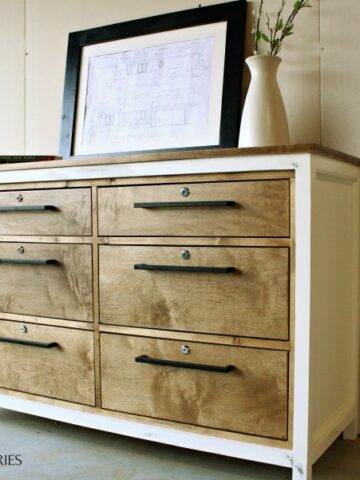
DIY Modern 5 Drawer Dresser

DIY Modern 5 Drawer Dresser

Yield: 1 Modern 5 Drawer Dresser

Step-by-step tutorial to build your own modern 5 drawer dresser.

Materials

  • (4) 2x2x8 boards
  • (1) 1x3x8 board
  • (2) 1x8x8 boards
  • (3) 1x10x8 boards
  • (1) sheet ¼" plywood
  • (1) sheet ¾" plywood
  • 1 ¼" pocket hole screws
  • 2 ½" pocket hole screws
  • 2" wood screws
  • Wood Dowels (if using dowels for joinery)
  • Wood Glue
  • (5) pair 16" drawer slides (I order 10 packs because they're cheaper)
  • (8) large modern drawer pulls
  • Drill/Driver
  • Miter Saw
  • Circular Saw
  • Clamps
  • Router & Rabbeting bit (optional)
  • Pocket hole jig OR
  • Doweling Jig

Instructions

    1. Assemble the side panels of the modern 5 drawer dresser.
    2. Assemble the frame using dowels or pocket holes.
    3. Install the dresser drawer divider. I used a scrap 2x2 block as a spacer.
    4. Install dresser drawer slides.
    5. Build and install dresser drawer boxes.
    6. Install dresser drawer boxes into the frame.
    7. Attach drawer fronts.
    8. Attach the dresser top.
    9. Finish the dresser and install hardware.
    10. Be sure to anchor it to the wall so it won't tip forward.
© Shara, Woodshop Diaries
Project Type: DIY Furniture Plans / Category: Woodworking

How We Installed a Plywood Ceiling

May 22, 2020 by Shara, Woodshop Diaries

Check out how we used inexpensive plywood and 1x4s to create a beautiful, simple plywood ceiling!

Kitchen with plywood ceilings and DIY cabinets

Several years ago, we started building our garage apartment. If you didn’t already know, I’ll make this backstory quick.

.

We sold our old house, bought some land, paid a garage builder to pour our foundation, put up four walls and a roof, and then we finished out the inside ourselves.

.

We lived in half of it and the other half was my workshop.

Shara Building garage apartment

The part we lived in was one big (it’s not that big) room and there’s a tiny bathroom in the back corner.

.

It’s a total of about 750-775 sq. ft. of finished space.

One room studio apartment living area

I have a whole series about the building process here.

.

After the walls were done, I decided to get creative and install ¼″ plywood on the ceiling instead of drywall and just trim it out to cover the seams.

Shara Woodshop Diaries Jeffrey Court final reveal of finished kitchen space with plywood ceiling

We did this years ago and at the time, I wasn’t planning to write a tutorial for it, but I’ve received a ton of questions, so I’m writing it now.

.

I don’t have a video or a ton of photos for this, but it’s a fairly easy project.

.

This post contains affiliate links. See policies page.

.

Now, our ceiling looked like this when we started–trusses placed on 2 ft centers.

.

So it was easy to see where to put the screws to attach the plywood.

one room garage apartment drywall on walls and trusses open on ceiling

BUT, if your ceiling is already finished with drywall, you can use a stud finder to find the joists or trusses and mark them on the drywall to screw the plywood into.

.

OR remove the old drywall and start clean.

.

But, personally, if I did this again, I’d do it OVER drywall, so the air is better sealed off (more energy efficient so lower heating bills 🙂 ).

.

So if you already have it, I don’t recommend removing it to install this–just put it on top.

.

DISCLAIMER: Every house/roof is built differently, and local codes vary.

Before adding plywood onto a ceiling structure, check with a professional to make sure your ceiling can hold the added weight and ensure local building codes allow it.

For this plywood ceiling, we used:

Materials:

  • ¼″ plywood (we used underlayment because it was about $15 for a 4×8 sheet at the time, but ¼″ hardwood plywood is nicer–it’s about $27 for a 4×8 sheet)
  • 1×4 boards
  • 1×3 boards
  • 1 ½″ wood screws
  • 9/16″ staples
  • 2″ brad nails

Tools:

  • Brad nailer
  • Drill
  • Stapler
  • Measuring Tape
  • Jig Saw
  • Circular saw (See this post for how to cut plywood sheets)
  • Miter Saw

NOTE: Lumber prices are always changing and vary greatly by location.

At the time we did this in 2018, it cost APPROXIMATELY $700 to cover, trim out, and paint/finish our 750 sq ft space.

Step 1: Find a Starting Point

Our plywood sheets were 4 ft x 8 ft. And our trusses were on 2 ft centers.

.

So we tried to lay things out in a way that would both look aesthetically pleasing, but also allow us to cut as few sheets as possible and still keep our plywood centered on the trusses.

.

The big thing here was making sure all the edges could be secured to a truss.

.

If you’ll notice, the kitchen window, here, we decided it would look best to start here and make this our “center.”

.

So we ran a row of sheets even with this window across the room first, then worked our way out from there.

Kitchen wall of unfinished garage apartment

You can pick a starting point however you want…just kind of sketch or plan it out so you waste as little plywood and cut as little plywood as possible.

.

Here you can kind of see how we ran them centered on the window.

.

We also centered them the other way so that the two end pieces ended up being the same size–notice the 2 ft gap above the window?

.

There’s also a two foot gap behind where I was standing when I took this picture.

Plywood ceiling layout direction

Note that we hung all our full sheets in the middle of the room, then finished up the outer edges last…see the edges missing above??

Step 2: Hang the Plywood

Once we had our game plan together for where we were starting and what direction we were laying them, we started hanging the sheets.

.

Now, the ¼″ plywood sheets are’t heavy, but they are flimsy, so this was definitely a three person job.

.

Two held each end of the sheet, climbed the ladder and screwed it in place.

.

And the third person stayed on the ground and used a stick or broom to push the center flat to the trusses.

.

The sheets tended to sag in the middle, so two of us screwed the sheets into the ceiling while the third person supported the center.

,

We used 1 ½″ wood screws along the outside edges to attach it into the trusses.

.

Since we were trimming the edges out later, these screws will be covered.

Shara screwing plywood panels into trusses on ceiling of garage apartment

But there wouldn’t be any trim in the center of the sheets. So for that, we used long staples because they are less noticeable.

Staples in plywood ceiling

As we installed each sheet of the first row, we constantly checked the distance from the edge of the sheet to the edge of the room to make sure we were putting these up straight.

.

We used a measuring tape, but this would have been ten times quicker and easier if we had one of these handy laser measurers at the time.

.

Once we had the first row straight, we knew we could work our way out and they’d stay straight.

.

For the light boxes, we held the sheet up where it needed to go, then marked around the light box where to cut with a pencil.

.

Then, we brought it back down and used a jig saw to cut that part out.

Shara cutting out light box in holes in plywood with jig saw

That was the worst part of the process. Just tedious. Trim pieces go into these light boxes to cover the edges later.

.

Once we got to the outside edges, we cut the sheets to fit. For a detailed guide on cutting plywood sheets, check out this post.

.

There were a few places where there was nothing to nail or screw into.

.

In those cases, we used some scrap 2x4s to add some bracing to attach the ceiling to.

.

You can see below in the hole above the sink I screwed some pieces into the existing framing to attach the plywood to here.

2x4 bracing on framing to attach plywood ceiling to

Once we had all the plywood on the ceiling, we finished it with a clear coat–Minwax Polycrylic.

.

We just used a paint roller and rolled it on.

.

At this point, I also had installed the DIY kitchen cabinets.

Plywood on ceiling before trim installed on seams

Step 3: Trim it Out

The final step was to trim the plywood ceiling out to cover the seams.

.

Because we installed all the seams along the trusses (remember how we made sure all the edges could screw into a truss??), we were able to nail 1×4 trim along all the edges into the trusses.

One room studio apartment with plywood ceiling installed

We haven’t had any issues with our trim falling down or anything, but looking back, it might have been better to use long screws instead of long brad nails.

.

But I didn’t want to putty all the screw holes so I took my chances. So far so good…but you may want to consider screws.

.

I first trimmed out all the outside corners of the room using 1x3s at the top and 1x4s at the bottom.

.

I nailed the two together, then installed as one piece along the edges.

Modern crown molding alternative--1x3s and 1x4s around ceiling joint

Once the outside edge was finished, I installed 1x4s along all the seams in the middle.

.

I used the longest boards I could buy (16 ft) so that I had as few seams as possible.

.

Then I cut to fit all the pieces between. I used 2″ brad nails and secured these into the trusses in several locations.

Trim installed on ceiling seams in kitchen

I highly recommend painting all the trim before installing it.

.

I painted some, but not all and it was a nightmare touching up all the little edges.

Trim installed on ceiling seams

Once the trim is up, you could (and probably should) caulk between the plywood and the trim to help seal it off from air leakage.

.

We didn’t…but our electric bill is low because we live in a tiny house and use a ductless Mr. Cool system.

.

If you’re worried about energy efficiency, definitely caulk.

.

Now, we did run into one instance where the seam was right on a light box.

.

That’s not ideal, but I used it as a design element. It kind of drives me crazy that it isn’t centered, but there wasn’t any way around it.

.

Either the light would be off center or the trim would be off center–so I left the light centered.

.

I used a scrap piece of plywood and cut out the center for the light box.

.

I installed this block onto the ceiling, then butted the trim up to it.

Trim detail around can light box in plywood ceiling--how we trimmed around the light with plywood

I was pleasantly surprised how nice it looks finished in our little laundry nook after the recent refresh I did in here.

Plywood ceiling details in laundry nook space

Once we installed the can light trim pieces, we were finished with the ceiling. HALLELUJAH!

.

We did have someone come and blow insulation on top of it in the attic space to help seal and insulate our living space. That’s pretty standard practice.

.

And that’s the story of our plywood ceiling! It was really a pretty simple project if you have a few people helping.

.

And although it was kind of a “lazy” idea because we only did it to avoid having to finish drywall, it’s actually the one thing about our little home that get’s the most compliments.

.

Here’s a peek at it in several of my other project photos.

Lucy in DIY modern dog crate with plywood ceiling in back ground
DIY Dog Crate
Shara Woodshop Diaries in refreshed laundry nook with new cabinets and plywood ceiling
Laundry Room Refresh
How to Build Your Own Stand Alone DIY Closet Cabinets With Clothes rod and adjustable shelves and even a shoe rack!
DIY Closet Cabinets

Before I go, I’ll go over a few Frequently Asked Questions about the plywood ceiling…because I’ve been asked A LOT of questions 🙂

Won’t the nails/screws come out over time?

I honestly don’t know. I mean, I’m not worried about it. The ceiling isn’t going to just one day all fall down on me or anything.

.

But if a piece comes loose at some point, the beauty of doing it yourself is that usually you know how to fix it if it breaks.

.

So I’ll just reattach the loose piece with another nail or screw and go on about my business. We had it for over three years and we didn’t have any issues.

What did you do at the trim seams?

Because this is a grid and the room is so long, I had to butt a lot of trim pieces up to each other.

.

We were in a HUGE hurry to get this finished because we were in a six week renovation challenge.

.

So I just nailed the pieces in place and didn’t putty or caulk the seams.

.

I may eventually go back and putty/smooth out the seams, but it will be a LOT of tedious work so I’m not super motivated to do it yet.

.

The reality is that even if I did, the putty will probably crack with seasonal changes and that will just be a lot of time wasted.

What kind of plywood did you use?

We tried to build this place on a tight budget.

.

I really really wanted to use ¼″ birch plywood, but it was almost double the price of the ¼″ underlayment.

.

So we used ¼″ underlayment plywood (also sometimes called luan).

.

It’s not high quality and sometimes it has a side that is pink or red…you don’t want that.

.

I recommend picking through your own sheets to make sure you get decent ones. They usually carry it at any building supply store that sells lumber.

Would you do a plywood ceiling again?

Totally. BUT…If I do it again, I’ll do it on top of drywall.

.

We’ve talked about doing something similar again in our real house (whenever we get around to building it), but if we do, we want to finish the ceiling drywall (well…have SOMEONE ELSE finish it) first so that the air is sealed off.

.

This just helps keep air from seeping through the ceiling and causing high heat and cooling bills.

.

In our tiny space now, it’s not a big deal. But an entire normal sized house might be a different story.

Did you stain the plywood?

No. We just rolled on a clear coat poly (Minwax Polycrylic). You could stain it if you wanted.

How much did your plywood ceiling cost?

Lumber prices vary by location and prices change all the time so your cost won’t necessarily be the same as mine.

.

But, when we did it in 2018, we spent about $700 to cover, trim out and paint/poly our 750 sq ft ceiling.

.

I hope you’ve enjoyed reading about our plywood ceiling process and if you want to save it for later, I’d love if you’d pin it and share with your friends 🙂

Pinterest collage of plywood ceiling in kitchen and Shara installing plywood into trusses

If you want to read more about our garge apartment and projects we’ve done in it, check out a few of these posts:

Vinyl Flooring
Closet Cabinets
Laundry Nook Refresh
Dream Kitchen with Hickory Cabinets and Black Stainless Appliances
DIY Kitchen Cabinets

And if you want to follow along and be the first to know about the latest projects and DIY tips shared on Woodshop Diaries, be sure to subscribe to our free newsletter!

Until next time, happy building! 🙂

Scrap Wood Guitar Stand and Stool

May 18, 2020 by Shara, Woodshop Diaries

I partnered with my friends at Build Something to bring you the free plans for this DIY guitar stand stool made from scrap plywood! This post contains affiliate links. See policies.

Shara Woodshop Diaries sitting on plywood stool picking up guitar out of stand to play

Our tiny garage apartment doesn’t have a lot of extra space.  But I’ve been tired of keeping my guitar stuck in its case in the corner all the time and wanted to get it out so it was more easily accessible for playing.

.

So when I started thinking of a way to make a guitar stand that didn’t take up a lot of space, I also started thinking about how to make it multipurpose and also allow me a small space to store my music books. 

.

So this simple scrap plywood stand worked perfectly and came together really quick.  I’m sharing the free printable plans over on BuildSomething.com and I’ve got the quick tutorial and video below.

For this project, you will need:

  • ¼ sheet ¾″ plywood (or browse your scrap pile!)
  • Miter Saw
  • Kreg Pocket Hole Jig
  • Drill
  • 1 ¼″ pocket hole screws
  • An hour of your time 😉

RELATED: Check out this mobile scrap and plywood cart idea to keep your lumber contained and organized!

.

To start this project, I browsed my shop for ¾” plywood scraps.  I love building with plywood, so I typically have lots of random off cuts and leftover pieces to pick from. 

.

RELATED: Check out my latest plywood project–one sheet plywood bookshelf!

.

I found a leftover panel of birch plywood in my plywood cart and a few pieces of leftover hickory plywood (from the kitchen cabinets and laundry room remodel) in my scrap bin. 

Looking through plywood scraps to use for guitar stand stool combo

But, if you don’t have scraps to pick from, you can purchase a ¼ sheet of plywood and that’s more than enough to complete the project. Check out the plans to see the cut diagram.

Step 1: Assemble Stool

I ripped my scraps down to 12″ wide on my table saw just to get everything consistent first. If you don’t have a table saw or are working with a large plywood piece, check out this tutorial for how to cut down plywood sheets quick and easy.

.

From these pieces, I cut two stool sides, a top, and two small pieces for the guitar stand on the miter saw.

Use miter saw to trim plywood scraps for guitar stand stool build

I wasn’t sure how deep to make the section that my guitar will go into.  So, I dry fit the pieces together and brought out my guitar to test fit before putting anything together. 

Test fit guitar into guitar stand stool combo

I assembled this project using pocket holes and screws, so I drilled ¾” pocket holes along the top ends of the stool sides using my Kreg pocket hole jig.

drilling pocket holes into guitar stand stool sides

Then, I used pocket hole screws to attach the stool sides into the top like shown.

Body of scrap plywood stool assembled on workbench

Once that part was together, I dug around the scrap piles some more and found two small pieces to use as a shelf and a seat support.

.

I drilled pocket holes into the ends of these pieces and installed into the stool base with pocket hole screws.  The top seat support here was basically just for looks, but I wanted this bottom shelf piece as a place to store my music books. 

Attach seat support and shelf to plywood stool

Step 2: Attach Guitar Stand to Stool

Once the stool was put together, I laid out the guitar stand pieces and attached them together first, then attached the whole section to the stool.

Attach guitar stand section to plywood stool

I thought at this point I was finished, but when I brought my guitar out again to test fit, I noticed it tended to rock side to side and wouldn’t stand on its own. 

Step 3: Install Guitar Stand Blocks to Prevent Rolling

So I ended up cutting two small pieces of ¾” plywood and screwed them into the bottom of the guitar stand edges.

Drive screws into scrap blocks in guitar stand to prevent it from rolling

This helped with the rocking and allowed the guitar to stand on its own in the stand.  I’ll probably go back at some point and add some felt or some sort of padding along these edges to protect the guitar.  But for now, I just want to play.

Shara sitting on scrap wood stool holding guitar in stand

I just love a good, practical, and quick scrap wood project. This may be my favorite one so far!

Scrap plywood guitar stand and stool sitting in corner of music room with acoustic guitar in place

If you’re interested in building one of these simple stands for your own guitar, be sure to head over to Build Something for the printable plans.  And check out a sample of my guitar playing in the video above as well 😉

.

For more scrap wood projects, check out some of my favorites:

  • Floating wall shelves from scrap wood with industrial details
    Scrap Wood Wall Shelves
  • How to make a super easy DIY scrap wood fall sign
    Scrap Wood Leaf Sign
  • DIY Guitar Bookends--And Easy and Quick Scrap Wood Project
    Scrap Wood Bookends

I hope you’ve enjoyed this super easy scrap wood project. Don’t forget to subscribe to my newsletter below so you don’t miss out on what’s coming next AND save this for later by pinning this graphic!

DIY scrap wood guitar stand and stool with shelf for books collage image for pinterest

Until next time, friends, happy building ????

DIY Trestle Table and Bench

May 15, 2020 by Shara, Woodshop Diaries

A friend of mine recently asked me to build her a DIY trestle table and bench.  This design would work great for an indoor OR outdoor table set, but in this case, I was building it to be used outdoors.

Close up of stained outdoor trestle table and bench design sitting out in front yard

Now, I’ve built an outdoor table with untreated lumber before and it will last a good while if it’s well maintained. But eventually, it will rot because standard pine construction lumber isn’t meant to be weather resistant. And we are okay with knowing it’ll have a short life span.

.

However, for this particular outdoor trestle table and bench project, I opted to use treated lumber so that my friend’s table will last a long while without damage from the elements outside.

.

Treated lumber presents its own challenges as it’s heavy, it’s wet, it’s green, and it smells a little…weird. I’ll speak more about treated lumber and pocket holes in the video below.

This table design works great for indoor OR outdoor use, so if you’re planning to keep it inside, you can use untreated wood and if you’re planning to use it outside and you want it to last a while, you can use treated wood.

.

Do note that you need to use exterior screws for exterior projects–they have a protective coating that prevents them from rusting or corroding.

.

And if you do plan to use this as an indoor table, be sure to check out this post for how to build table tops. Outdoor table tops need gaps for water drainage for rain.

.

Inside table tops are built differently and are usually attached as one solid piece. That’s the only difference in building this for outdoor vs. indoor use. Okay, sorry for the long intro. Let’s get to the build.

Overall dimension diagram for trestle table and bench plans

How to Build a Trestle Table and Bench

I’ve got the step by step tutorial below, and the printable building plans for the table and benches here:

For this Build, You Will Need:

  • (4) 2x10x8 boards
  • (3) 4x4x8 posts
  • (8) 2x4x8 boards
  • (4) 1x6x8 boards (these are called 5/4x6x8 boards if you’re using treated wood)
  • 2 ½″ pocket hole screws (use exterior kind if you are using this outdoors)
  • 2″, 2 ½″, 3″, and 4″ wood screws (use exterior kind if you are using outdoors)
  • Wood Glue
  • Pocket Hole Jig
  • Miter Saw
  • Drill/Driver
Click for printable plans button

Step 1: Attach Trestle Table Ends

So to get started, I cut down my table legs from my 4×4 posts.  I knew I wanted these to slant in at a slight angle, but wasn’t sure how much. 

.

I started with 5 degrees, but thought it needed a little more and I finally settled at 7 degrees.  So all my legs on both the table and the benches are mitered at 7 degrees. I cut these angles using my miter saw.

Using miter saw to cut table legs to length

Once the legs were cut down, I cut two top aprons and two bottom stretchers from 2x4s to go between them.

.

I used pocket holes to assemble this table.  I drilled pocket holes into the ends of these 2x4s and began assembling between the legs–one at the top and one about 4″ up from the bottom. 

.

I used some wood glue on these joints, but I’m 99% certain that was just a waste of glue.  Because the treated wood was so wet, it made the glue really runny and it was just squeezing out.

Trestle table short end assembled on workbench

Step 2: Add Decorative Ends to Table Base

Once I had my two sides assembled, I wanted to add a small detail to the ends before attaching the long apron pieces.  I wanted the finished table to LOOK like the long apron pieces extended through the legs. 

.

There are a million really fancy and really time-consuming ways to do this, but I cheated and used 4” wood screws.  I randomly came across four 4” wood screws in my assorted screw collection leftover from when we built our garage apartment. 

.

That meant I had one screw per piece for the table.  Ideally, you’d use two screws per piece, but this is all I had and these pieces were just decorative, so I just used one.

.

I cut these pieces with a 7 degree miter on one end and clamped this end onto the leg.  Then, I predrilled and drove the 4” wood screw to hold it tight. I did this for all four legs. 

Shara driving 4" wood screws to attach decorative end piece to table ends

Step 3: Finish Table Base Assembly

Now it was time to put everything together.  I cut two long apron boards to stretch between the two sides with 7 degree miters on each end.  And again, I assembled these with pocket holes and screws. 

Trestle table 3d sketch of long apron sides attaching between short table ends

I installed two stretchers in the top to give me another surface to screw the top boards to later.  You can attach these using pocket holes and screws if you want to hide the screw heads, OR if you don’t mind seeing them, you can install these using 2 ½″ wood screws through the apron.

Table middle top supports installed into base frame

Then I added a long stretcher between the two short table sides at the bottom.  I screwed these in place using 2 ½″ wood screws. You could also use pocket holes and screws as well.

Attaching long bottom trestle between table leg sides using 2 ½" wood screws

Step 4: Add Table Top

I carried the table base out to the yard so I could take some pictures when I got finished with it.  And I carried the top boards out there to attach them. 

.

Once they were attached, there was NO WAY I could carry that out there by myself. The treated wood was REALLY heavy. 

Shara carrying trestle table base and benches out into front yard

Now, if you are building this as an indoor table and want a really clean, nice looking table top, I suggest checking out this post. However, as an outdoor table, I did things a little differently.

.

I centered the boards on the table and left a very small gap (about ⅛″) between boards for water/rain drainage since it’ll be out in the weather and screwed them in place using 3” wood screws.

.

If you wanted to hide the screw heads, you could attach them from the underside instead. At this point, the table assembly was complete and I moved on to building the benches.

Attaching 2x10 treated boards to trestle table base frame using 3" wood screws

Step 5: Assemble Trestle Table Matching Bench Frame

The bench design was similar to the table, but since the spaces were so tight, I assembled them slightly differently.  In hindsight, there were probably easier ways to assemble this, but hindsight is useless once the project is finished, so it is what it is haha.

.

I cut my bench legs just like the table–from 4×4 posts and with a 7 degree miter…only the bench legs were shorter.  Then, I cut and attached the long aprons between the legs first. 

Two long trestle table matching bench sides assembled in workshop

Once the two long sides were together, I cut three short blocks to go between them.  I screwed the end pieces into the legs, then added another screw through the long apron pieces into the short blocks.

And I added a piece in the middle here to keep the long aprons from bowing out.

Installing center support block into bench frame

Step 6: Attach Bench Tops

Finally, I cut 1x6s—actually with treated lumber, they’re not actual 1x6s—they’re like 5/4 (which is a little thicker than 1″).  Anyway, I cut two of these for each bench top and screwed them into the base with 2″ wood screws. 

.

I left a small gap between the boards to allow water to drain off since they’ll be outside and exposed to the weather.

.

Again, if you’re building this to use indoors, you wouldn’t need a gap between boards and you can also follow the tutorial here for how to build tabletops, just make it smaller since it’s for a bench.

Using 2" wood screws to attach bench top boards to bench frame

Step 7: Install Bottom Bench Stretcher

Once the bench top was in place, I stepped back and realized the benches were missing something.  I debated whether or not to attach small braces at the bottom of the bench legs to match the table.  These pieces would be so small that I wasn’t sure they would be worth adding. 

.

In the end, I decided that it would add a nice detail, so I cut and attached 2x4s here by screwing them in at an angle through the bottom so you wouldn’t see the screws. 

.

You could also use pocket holes and screws, too. Again, there are a thousand ways to do this, and in hindsight, I wish I had notched out the legs to set this piece in place.  Maybe next time.

Toenailing leg braces at bottom of bench frame

Step 8: Finish Trestle Table and Bench Set

At this point, I went ahead and stained the table and benches with an outdoor stain and sealer.  The finish went on really splotchy because the wood was already so wet.  The wood is supposed to ABSORB the finish…but if it’s already saturated, it can’t absorb it, so it goes on uneven. 

.

If you’re finishing an INDOOR table, check out this post for some tips!

.

Since I was making this for a friend, I went ahead and finished it for her, but I’m recommending she come back this fall and apply another coat for better coverage and coloring.

Trestle table and matching benches staged out in front yard

I’m really happy with how this trestle table and bench set turned out, but I think for the foreseeable future, I’ll be sticking to indoor furniture and leaving the treated lumber at the store haha. 

.

For more furniture building projects, check out the projects page!

.

I hope you’ve enjoyed this project and check out the plans linked here to build one for yourself.  Don’t forget to pin this for later and subscribe below so you don’t miss out on what’s coming next!

DIY Trestle table and bench 3D diagram and close up pinterest graphic collage

Until next time, happy building ????
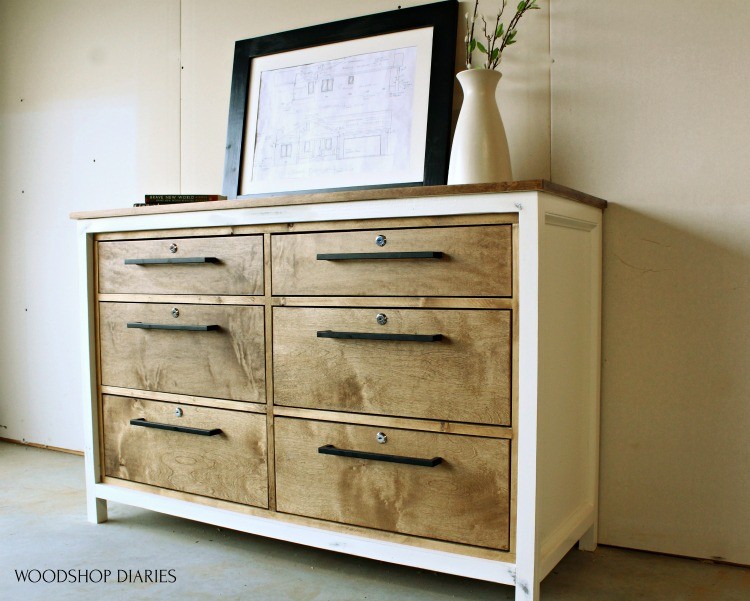
DIY Trestle Table and Benches

DIY Trestle Table and Benches

Yield: 1 trestle table with benches

Easy to build trestle table and benches. Great for indoors or out!

Materials

  • 4) 2x10x8 boards
  • (3) 4x4x8 posts
  • (8) 2x4x8 boards
  • (4) 1x6x8 boards
  • 2 ½" pocket hole screws
  • 2", 2 ½", 3", and 4" wood screws
  • Wood Glue

Tools

  • Pocket Hole Jig
  • Miter Saw
  • Drill/Driver

Instructions

  1. Make cuts according to the plans.
  2. Build two identical table sides using 4x4s for the legs and 2x4s for the top apron and bottom stretcher.
  3. Attach decorative end pieces on the outside of the table legs. This step is completely optional.
  4. Install long aprons using 2 ½" pocket hole screws.
  5. Install bottom stretcher using 2 ½" wood screws or pocket holes with pocket hole screws.
  6. Add inside stretchers.
  7. Assemble and install tabletop, leaving small gaps between the boards for water drainage. If building this for indoor use you don't have to leave a gap.
  8. Build long bench sides and install using 2 ½" pocket hole screws.
  9. Install short bench frame pieces using 2 ½" wood screws. The space is so small there isn't room for pocket holes.
  10. Add bench bottom stretcher using pocket holes.
  11. Install bench tops making sure to have a 3 ½ inch overhang of each leg.
  12. Stain or paint as desired.
© Shara, Woodshop Diaries
Project Type: DIY Furniture Plans / Category: DIY Outdoor Projects

Must Have Tools for Cabinet & Furniture Making

May 12, 2020 by Shara, Woodshop Diaries

In this post, I’ll sharing what must have tools you need for cabinet making (and furniture building)–for skill levels of any kind. 

One of the common misconceptions of cabinet building is that you have to have thousands of dollars worth of fancy tools to do it. That is 100% NOT true.

Shara Woodshop Diaries standing next to base cabinets opening door

I’ve built several sets of cabinets over the years and I’m telling you–you really only need a few common, inexpensive tools, and a couple of jigs. And, of course, a little bit of patience always helps, too.

In this post, I’ll share what simple tools you really need to build your own cabinets.

And I’ll break it down into which tools to use for cutting, which tools to use for joining, and which tools will help when adding doors, drawers, and shelves.

*This post contains affiliate links. See policies.

First, what exactly is a cabinet?

Cabinets are not just the boxes you store your dishes in the kitchen.  Cabinets can come in all shapes and sizes and are made for all rooms of the house–kitchens, bathrooms, laundry rooms, home offices, pantries, garages, etc.

Check out these various cabinet projects for example:

  • DIY Kitchen Cabinets
  • DIY Garage Cabinets
  • DIY Mudroom Cabinets
  • DIY Closet Cabinets
  • DIY Laundry Room Base Cabinets
Garage cabinets in workshop with doors open to reveal adjustable shelves

If we are defining a cabinet as “a storage box made of wood,” then cabinets can also be considered furniture pieces like vanities, dressers, consoles, end tables, and bookshelves.

So for this post, let’s think “outside the box” a little (see what I did there??) to encompass what tools are helpful in building both basic cabinets and furniture of all shapes and sizes. 

Let’s discuss what and why these various tools are essential and how you can use each of them.

Kreg Tool Jigs laid out on workbench--these are the tools needed to build cabinets

What tools do you need to build cabinets?

You can make good, solid cabinets and furniture with just a few key items. I’ve listed my recommended tools and guides below.

RELATED: Check out the 5 Tools You Need to Get Started Woodworking here.

Must Have Tools & Jigs:

  • Circular Saw
  • Miter Saw
  • Drill/Driver
  • Plywood Cutting Guides (Kreg Rip Cut and Kreg AccuCut)
  • Kreg Pocket Hole Jig (Check out this post about which Kreg Jig is best for you!)
  • Concealed Hinge Jig
  • Shelf Pin Jig

NOTE: If you want to cut all your pieces with a circular saw, a miter saw isn’t necessary. However, a miter saw is much more efficient when cutting boards and smaller pieces, so it’s highly recommended.

These additional tools and jigs can be helpful, but aren’t must haves:

  • Drawer Slide Jig
  • Cabinet Hardware Jig
  • Cabinet Door Mounting Jig
  • Kreg MultiMark Tool
  • Magnetic Stud Finder

But why do you need these particular tools and what are they used for?? Let’s break it down.

Are DIY projects your thing? Sign up for our newsletter for priority access to the latest projects and build plans!

Tools for Cutting Wood

The first part of any cabinet (or furniture) build is typically cutting down the plywood.  Not all cabinets and furniture are made from plywood.  You can build your cabinets from solid wood as well. 

But, plywood is a common choice for most cabinets and a large portion of furniture builds—mostly because it saves time, money, is readily available and has very minimal wood movement throughout the seasons to worry about.

RELATED: How to choose the right plywood for your cabinet and furniture builds

So how do you cut down plywood?

Circular Saw & Cutting Guides

I prefer to cut my plywood sheets down with a circular saw, a Kreg Rip Cut, and Kreg Accu-Cut.

NOTE: You can certainly use a table saw to cut plywood sheets, but if you’re like me and have a hard time maneuvering an 80 lb sheet of plywood through a saw, these cutting guides are life savers!

Shara Woodshop Diaries using Kreg Rip Cut to cut down plywood to assemble cabinets

The Kreg Rip Cut is a cutting guide that you use with your circular saw to “rip” your plywood sheet (or board—it’s not ONLY for plywood) into strips. It’s capable of cuts up to 24” wide–so you can rip a full sheet of plywood in half.

Shara Woodshop Diaries using Kreg Rip Cut to cut materials to build cabinets

Despite the name, you can also make cross cuts with the Rip Cut up to 24″ as well. If you need to cut a piece longer than 24″, that’s where the AccuCut comes in.

The Kreg AccuCut is a gutting guide that acts kind of like a track saw.  It’s great for cross cutting long pieces to the correct length. 

You use it with your circular saw to cut straight lines across your plywood panel.  I also use it often to cut down large table tops as well.

Shara Woodshop Diaries cutting plywood with Kreg AccuCut

The great thing about these cutting guides is that the blue sled that attaches to the circular saw plate is interchangeable between the two. So you can slide your saw right off the Rip Cut and right onto the Accu-Cut with no adjustments or having to swap anything out.

And since the sled simply tightens on to the saw plate, they work with almost any type, style and brand of circular saw.

I’ve shared a very detailed post over here on how I cut down plywood sheets using the Kreg Rip Cut and the Kreg AccuCut for more information.

Tools for Assembling Cabinets

Once the plywood is cut down, it’s time to join the boards together to create a box. 

I like to use pocket hole joinery in cabinet and furniture building because it’s quick, simple, and doesn’t require fancy tools or patience waiting for glue to dry. This simple joinery method works really well for basic cabinet construction.

Drill/Driver & Pocket Hole Jig

To assemble cabinets and furniture with pocket holes, you’ll need a basic drill and a pocket hole jig. A driver is also handy to drive the screws, but if you don’t have one, you can use the drill to drive as well.

A pocket hole jig is a drilling guide that allows you to drill a hole on the ends of a board so that you can drive a screw through to join it to another board. 

Drilling holes in plywood using Kreg 720 pocket hole jig

Pocket hole jigs come in many shapes and sizes. Check out this post to decide which is best for your shop! Personally, I love the Kreg 720.

Pocket holes can be used to join boards together in a panel (like a table top) OR on perpendicular surfaces. Here you see where I am using pocket holes to build my workshop cabinets.

Shara Woodshop Diaries assembling a cabinet using a driver and pocket holes on workbench

Once you use the jig to drill a pocket hole, you drive pocket hole screws through it to assemble the boards together. 

RELATED: How to use a pocket hole jig

Kreg pocket hole srews driving into a pocket hole in cabinet carcass

In most cases, you can place the pocket holes so that they are covered in the finished project so you don’t see them. But if or when they’re not covered, you can plug them!

RELATED: Learn 4 ways to plug pocket holes in this post!

Tools for Installing Cabinet Doors

Once the cabinet or furniture piece is assembled, you may choose to add doors on the front. First, you’ll need to determine what size to make your cabinet doors.

Once you know what size to make them, you can simply cut a piece of ¾″ plywood to use as a slab door (like I did for these garage cabinets). Or you could build shaker style cabinet doors.

Simple base cabinet with shaker style door

But once the doors are assembled, a concealed hinge jig and a drill make them easy to install.

Drill & Concealed Hinge Jig

The Kreg Concealed Hinge Jig is probably my most used shop jig after the pocket hole jig.  I use it all the time when adding doors to projects. 

Concealed hinges have a “cup” that is supposed to be recessed into the door–see image below. 

Shara Woodshop Diaries placing concealed hinge in hinge cup hole on cabinet door

This jig allows you to quickly and accurately drill out the hole for the hinge in the correct location.  Simply clamp it, and drill your holes–one for each hinge.

Shara Woodshop Diaries drilling concealed hinge cup holes with Kreg Concealed hinge jig

Then, install the hinges into these holes. Once the hinges are secure to the door, they’re ready to install onto the cabinet.

RELATED: How to use a concealed hinge jig

Shara Woodshop Diaries installing concealed hinge onto cabinet door

Cabinet Door Mounting Jig

The Kreg Cabinet Door Mounting Jig is not a MUST HAVE, but comes in very handy when trying to hang large or heavy cabinet doors by yourself.

It basically clamps onto the bottom of the cabinet to hold your door in position for you while you screw the hinge in place.

Shara Woodshop Diaries attaching door to cabinet with cabinet door mounting jig

Tools to Add Cabinet Shelving

Adjustable shelves in cabinets and furniture is a really nice touch and feels kind of like an upgrade. I’m pretty indecisive, so I like options to adjust the shelves as things change, I rearrange, etc. 

Adding adjustable shelves in cabinets a furniture is easy with a simple jig and a drill.

Drill & Shelf Pin Jig

The EASIEST way to install adjustable shelves (or, I would argue ANY shelves for that matter) is by using shelf pins.

Basically, you just place the pin in a hole drilled into the cabinet sides and set your shelf on top of the pins. 

Simple base cabinet with shaker style door open revealing adjustable shelf inside

BUT, first, you have to drill the holes.  The Kreg Shelf Pin Jig allows you to drill equally spaced holes for this without any set up or measuring. 

You literally just hold or clamp the jig, and drill into the slots. Learn how to use a shelf pin jig here.

Close up of drill drilling holes using a shelf pin jig in cabinet

Run these holes up both sides of the back and both sides of the front.  Insert the pins, install the shelves, and you’re done. 

QUICK TIP: When installing shelves, cut them about ¼” shorter than the inside width of the cabinet to allow for some wiggle room to install them. 

Note that Kreg sells two sizes of shelf pin jigs—a 5mm and a ¼”.  These measurements are the diameters of the pin holes. 

Keep in mind that 5mm is slightly smaller than ¼” and you need to know which jig you have so you know what size pins to use.  See below the difference between 5mm shelf pins and ¼” shelf pins. 

Close up comparison of ¼" shelf pins vs 5mm shelf pins

If you try to use ¼” shelf pins in a 5mm hole, they won’t fit.  And if you try to use 5mm pins in a ¼” hole, it’ll be very loose and fall out.  So be sure to order the correct pin size to fit your jig.

Tools for Adding Drawers to Cabinets

If you’re new to building drawers, check out this beginners guide to measuring, building and installing drawers.

Drill/Driver & Drawer Slide Jig

A drawer slide jig isn’t a must have. My preferred method for installing drawer slides is to turn the piece on its side to install them.  This allows gravity to help hold things in place.

Shara Woodshop Diaries installing drawer slides into cabinet laid on its side on workbench

But, when the piece cannot be easily flipped on its side (if it’s already installed on the wall, OR it’s too big to flip over), the drawer slide jig does come in handy to hold your slides in place while you install them. 

Driving screws to install drawer slide using Kreg drawer slide jig

First, determine where your slide should go. Learn how to determine where to mount your drawer slides here. Then, clamp the drawer slide jig onto the cabinet at that location and secure the slide.

Once the slides are in place, I can turn these around and clamp the opposite direction to hold my drawers still while I install them onto the slides. 

Installing drawer box into cabinet on top of drawer slide jigs clamped to cabinet carcass
Screw drawer slides into drawer slide box sitting on drawer slide jig

It’s like having an extra set of hands.

Tools for Installing Cabinet Hardware

Installing hardware is tedious and time consuming if you have to individually mark each and every hole for each and every handle or knob.

A simple cabinet hardware jig isn’t a must have tool, but it makes this task much quicker, especially if you’re installing several at a time.

Drill & Cabinet Hardware Jig

If you are installing new knobs and pulls onto your projects, the cabinet hardware jig can save a lot of time and headache.

It’s made for installing drawer pulls or knobs and allows you to set it up once, then simply clamp, and drill without having to measure over and over.

The only downside to this jig is that it’s not made for really long drawer/door pulls.  But, if you’re using pulls 5” center to center or smaller, this will save you a ton of time.

To set up, simply adjust the jig for the width of the handles you’re using, then, adjust the distance you want the pulls to be from the door edge, clamp in place and drill.

Clamp cabinet hardware jig on cabinet door to drill holes for door pulls

If you’re just installing a few pulls, this may not save a ton of time, but it will give you consistent results (like, not crooked door pulls haha). 

But if you are doing several, this jig is really helpful to save time and prevent crooked knob and drawer pull installations.

Tools for Measuring and Marking

Some of the most handy tools for cabinet making are also of the smallest. These optional tools aren’t necessary for building cabinets, but are practical additions to any toolbox.

Kreg MultiMark

The Kreg Multimark tool is useful for lots of things like adjusting the blade depths on various tools, checking offsets, marking consistent spacing and using as a square.

Using Kreg Multimark to place drawer slides on dresser

When I’m building cabinets and marking for toe kicks or bottom shelf height locations, this is a great little tool to keep my marks consistent.

You loosen the knob and adjust the measuring piece where you want it…in this case it’s 3 ½″.

And you can run this along the edge of a piece to make a smooth mark all the way across. This is also helpful for lining up the bottom panel during assembly.

Kreg Multimark tool used to draw toe kicks on cabinet sides

You can remove the knob and place the metal piece on the opposite side to adjust for various angles, too.

It’s a really handy measuring tool, but I use it often to make consistent and square marks on my pieces.

Magnetic Stud Finder

One of my biggest pet peeves about most of the stud finders I’ve used in the past is that they run on batteries–and every time I got to use it, the batteries are low.

This inexpensive magnetic stud finder doesn’t need any batteries and finds and locates studs in seconds. Simply swipe it over the wall in a zig zag motion until it “sticks” to a stud.

Using magnetic stud finder to install cabinet box

This makes finding and marking studs for cabinet installation a breeze–no batteries required!

Looking for more cabinet building basics?

We’ve covered tools for cutting, assembling, installing doors, drawers, shelves, and hardware. Plus, I added a few “bonus tools” for measuring and marking. And that’s pretty much all you need to build a basic cabinet.

Is it fewer tools than you originally thought? I hope this makes it a little less overwhelming!

If you’re looking to put these tools to use, here are a few basic cabinet projects to tackle:

How to Build Base Cabinets
How to Build Wall Cabinets
DIY Garage Cabinets
Workshop cabinets
How to Build Workshop Cabinet Boxes
Mudroom Built Ins

And, if you’re just getting started, check out the tutorials on my Getting Started page to learn some basic concepts and check out my tool guides.

Be sure to pin this post so you can save it for reference!

Must have tools for cabinet building pin image collage

Until next time, friends, happy building 🙂

DIY Scrap Wood Towel Rack

May 11, 2020 by Shara, Woodshop Diaries

In this post, I’m sharing how to build a Simple DIY Scrap Wood Towel Rack!

Shara Woodshop Diaries removing towel from scrap wood towel rack hanging on wall above tub

I always have an OVERABUNDANCE of scrap wood.

So when I have the chance, I try to use it up in a practical project.

This time, I was able to use up some 2×2 off cuts to build this scrap wood towel rack for my parents’ bathroom renovation.

As we were finishing up the last details on it, I wanted to add a little warmth to the walls that I had painted a VERY WHITE WHITE.

I was afraid with so much white, it might feel a little cold.

So I built a simple scrap wood towel rack to hang over the tub to add some texture and wood tones to the space.

And I’ll show you how I built it in this simple 3 step tutorial. Ready to get building??

For this Scrap Wood Towel Rack, You Will Need:

  • 2×2 scraps (see cut list below)
  • Wood glue
  • 2 ½″ and 3″ wood screws
  • Drill & Driver
  • Miter Saw
  • Wood Finish (I used a simple stain and poly)
  • Stud Finder
  • Clamps

Cut List for Scrap Wood Towel Rack:

  • (2) 2×2 @ 12″ long
  • (4) 2×2 @ 5″ long
  • (2) 2×2 @ 24″ long

Step 1: Assemble Back and Sides of Towel Rack

I rummaged through my scrap pile and found several random pieces of 2×2.

By the way, when I build with 2x2s, I make my own to ensure square edges. You can check out how to make 2x2s here.

I cut two pieces to 12″ long for the back pieces of the towel rack and four pieces of 2×2 to 5″ to use for the sides.

I also cut two pieces of 24″, but we won’t use that yet in this step.

Parts cut to assemble towel rack scrap wood project

Now, my towels were standard size and not super fluffy.

If you have oversized or really fluffy towels, you may want to make the 5″ pieces a little longer.

Roll up one of your towels and measure its width to see what you think would work best.

I applied wood glue to the ends of two of the 5″ pieces and placed a 12″ piece on them.

I predrilled and drove 2 ½″ wood screws through the 12″ piece to assemble two pairs of back/side assemblies like shown.

Applying glue to short towel rack pieces before adding screws
Driving screws into back/side scrap wood towel rack assembly
Two back and side towel rack assemblies complete

The screw holes here will go along the back side of the towel rack (along the wall).

Step 2: Attach Front Pieces of Towel Rack

Now, I applied some glue to the other side of the 5″ wood pieces and clamped the 24″ pieces onto the front like shown.

You can also drive 2 ½″ wood screws like in step 1 if you don’t mind seeing the screw heads.

Or, you can brad nail with 2″ or longer nails for extra holding power, too.

Applying glue to short pieces of scrap wood towel rack on front side
Towel rack assembly on workbench placing pieces before clamping
Close up of towel rack assembly--clamping front pieces while glue dries

Make sure the piece is square before allowing the glue to dry.

Step 3: Finish and Hang Scrap Wood Towel Rack

Once the glue was dry, I sanded any glue squeeze out off, and stained it with Minwax Early American Wood Stain.

Then I applied a couple coats of Minwax Polycrylic to seal it. You can finish however you wish.

To install, I used a stud finder to find a stud in the wall where I wanted to hang it and predrilled through the back 2×2 and used a 3″ wood screw to drive it into the stud.

I used one screw at the top and one at the bottom.

Shara attaching towel rack to wall using driver and 3" wood screws

I really wanted to hang this centered above the bathtub, but there was no stud there.

So I placed my screw on the very edge of the towel rack so that I could drive it into a stud and still get it kind of close to center.

However, if you can’t find a stud where you want to place your towel rack, you can also use a drywall anchor.

Close up of scrap wood towel rack hanging on wall above bathroom in renovated bathroom

And, that’s it! Three whole steps haha. This may be the easiest scrap wood project I’ve ever done!

.

But, it serves it’s purpose and looks great doing it 🙂

Freestanding tub in bathroom nook with scrap wood towel rack hanging above it with towels stacked

If you’re looking for scrap wood storage, check out this DIY scrap wood storage cart.

And if you’re looking for more scrap wood project ideas, here’s a few good ones!

Floating wall shelves from scrap wood with industrial details
Scrap Wood Wall Shelves
DIY Continuous grain walnut box with tile top
Scrap Wood Keepsake Box
up close chamfer edge on cutting board
Scrap Wood Cutting Board
How to make a super easy DIY scrap wood fall sign
Scrap Wood Leaf Sign
Quick and easy scrap wood bookends shaped like a guitar
Scrap Wood Guitar Bookends

Check out the full reveal of this bathroom here, but this simple little towel rack really stole the show in this corner.

It would be a great addition to hang above a toilet or beside a vanity as well.

You can see other projects from this bathroom in the floating shelf and mirror frame tutorial post I shared recently, and in the post about the vanities I built for them as well.

Floating Shelf & Mirror Frame
DIY Dresser/Vanity

.

If you enjoyed this project, be sure to pin this for later!

Be sure to subscribe to the newsletter below so you don’t miss out on what’s coming next!

Collage Pinterest Graphic of assembling scrap wood towel rack and Shara Woodshop Diaries placing towels in finished towel rack above tub

Until next time, happy building 🙂

DIY Garden Bed with Trellis

May 8, 2020 by Shara, Woodshop Diaries

Shara sitting on edge of DIY garden bed with trellis

Check out how I built my husband this raised garden bed with trellis in this post and video tutorial!

DIY Garden bed with trellis design sitting in yard with birdfeeders hanging on sides

My husband, Danny, loves tending a garden during the summer.  Last year he grew squash, zucchini, and lots of pumpkins so I had something to decorate the porch with.  Remember this simple DIY industrial wagon I filled with them??

DIY front porch wagon with pumpkins
DIY Front Porch Wagon

But we don’t have a functional tiller, and it was really difficult to work with this hard ground. 

Last years garden in the yard

This year, he asked me if I’d help him build a garden bed for his squash to make things a little easier. 

.

Looking for more outdoor project ideas?? Here are a few of my favorites!

How to make your own DIY concrete planter pot with wooden base
Modern Outdoor Chair
DIY Concrete Landscape Curb

I’m always up for building something practical, so we took a few hours this past weekend and put together this simple garden bed with a decorative trellis.  The trellis was, of course, my idea. 

.

He probably won’t use it, but I thought it was pretty.  So I’ll show you how it came together here in this video.  I’ve also got a step-by-step tutorial below as well. So, let’s get building

This post contains affiliate links. See policies for details.

How to Build a Garden Bed with Trellis

For this Build You Will Need:

  • (1) 2x12x10
  • (2) 2x12x8
  • (3) 2x4x10
  • (2) 2x4x8
  • (2) 2x2x8 (I make my own 2×2 using this tutorial)
  • (4) 1x4x8
  • Square dowels (amount depends on design–we used about 48 ft–see step 3)
  • Miter saw
  • Table Saw (optional)
  • Nail Gun
  • Drill/Driver
  • Jig Saw
  • Level
  • 2″, 2 ½″ and 3″ exterior wood screws

.

First of all, I want to address the wood type here.  I’m aware that typical untreated pine boards are not weather resistant.  But, we chose to use them here anyway. 

.

I didn’t want to build this with treated lumber because 1. I hate working with treated wood and 2. I’m not sure about the chemical stuff in my food. Some say it’s okay and some say it’s not. Who knows.

.

We built this knowing it’ll probably need to be replaced in a few years.  I’m okay with that because it cost less than $100 and about 4 hours to build. 

.

Cedar will last longer but will be much more expensive–and treated wood will last longer but is full of chemicals. Use what you wish–and may the odds be ever in your favor 🙂

.

Okay, NOW the steps…

Step 1: Assemble the Raised Garden Bed

We built this bed about 5 ft wide and 8 ft long.  Likely we will end up building another one because I’m not sure if it’ll fit very many large squash plants.  BUT, I’d say this would be perfect for tomatoes. 

Overall dimensions of garden bed with trellis design 3d graphic

I cut the 2x12x10 in half to make two 5 ft pieces and screwed the 2x12x8s into the ends of them to make a box. I used (2) 3″ exterior grade decking screws per corner. We assembled this out in the yard where we wanted it. Once it’s all together this will be heavy to move.

.

Close up of driving screws into garden bed box

Honestly, at this point, we could be finished.  Fill it with dirt and call it a day.  BUT, I wanted to add a trellis…because, well…why not make things difficult fun?

Simple garden bed box assembled in yard

Step 2: Add Trellis Frame to Garden Bed

I cut one of my 2x4x10s in half to make two 5 ft long boards and screwed them into the center of the garden bed’s 5 ft sides with 2 ½″ wood screws. Danny helped me make sure they were level.

Shara and Danny screwing trellis frame into garden bed

To save me several steps, I measured the distance between them and started assembling the parts that would go here on the floor of my shop.  Once I got everything cut and laid out, then I could take it back outside to attach it.

Basic diagram of garden bed with trellis frame

Step 3: Design and Lay Out Trellis

As far as the trellis design, I was totally winging it here. There’s no science to it…you could do any design you wanted.  Danny wasn’t picky, but he also wasn’t much design help…he just wanted the box haha.

.

I used 2x4s on the outsides, a 2×4 on the bottom, a 2×2 on the top, and another 2×2 about 4″ above the bottom 2×4. By the way, this only needed to be about 44 ½″ tall.

Overall dimensions of garden bed trellis

I ended up ripping two 1x4s down into square dowels on the table saw for the rest of this design (I ripped them to about 1″ wide so they weren’t SQUARE…but close to square). 

.

To make things easier if you didn’t want to rip a bunch of boards or you don’t have a table saw, they do sell square dowel rods at the big box stores…they’re just more expensive.

.

I had in my head that I wanted a diamond design on this trellis so I ended up putting a diamond in the center. I cut the top and bottom angles here with the miter saw at 60 degrees and cut my left and right angles with the miter saw set to 30 degrees. Then I fit pieces around the sides of it like shown.

Shara designing diamond shape for center of trellis on garden bed

Then I cut to fit pieces to line the side sections of the trellis. Use your creativity here.

Laying out trellis design on shop floor

Once I was happy with the design, I assembled the middle “diamond section and packed up everything to assemble on the garden bed. Again, I know this garden bed isn’t going to last forever, so to keep things simple, I just glued and nailed the middle diamond design together. 

Shara nailing center diamond design together for trellis on garden bed

Step 4: Install Trellis Onto Garden Bed Frame

Then we headed back outside to finish up.  We screwed the two vertical sides into the frame first using 2 ½″ wood screws. I made sure to screw these pieces about 3 ½″ down from the top of the outside 2x4s to leave room for the top boards later.

Shara screwing trellis frame into garden bed

Then we screwed the top, middle and bottom pieces into those boards.

Diagram of garden bed with trellis design frame

Once the frame was installed, I centered the diamond on them and nailed it in place.

Nailing center diamond design into trellis frame using nail gun

We evenly spaced the rest of the trellis design on each side and just nailed in place.  Since building and editing this video, this thing has withstood 60+ mph wind/thunderstorms on two separate occasions and nothing is loose, or damaged.  So I think nails are good enough here.

Nailing pieces of garden bed trellis in place with a nail gun

Once the trellis was in place, I freehanded a design on the ends of the 2×4 boards for the top and cut it out with a jigsaw.  We used 10′ long boards here to that it would overhang the sides some.

Using a jig saw to cut pergola design shape into top boards of decorative garden bed trellis

Then we took them out and screwed them into the top. 

Screw pergola shaped 2x4 boards into the top of the garden bed trellis frame with 2 ½" wood screws

Step 5: Add a “Lip” to Garden Bed

The last thing I did was add a “lip” around the top of the garden bed.  I intended for this to overhang the OUTSIDE of the bed, but I wasn’t thinking when we screwed the bed together that I bought 8 foot 1x4s and I used an 8 foot 2×12. 

.

There wasn’t enough length on the 1×4 to overhang any.  So I ended up overhanging the INSIDE of the bed. If you wanted it to overhang the outside, get two of your 1x4s ten foot long instead of eight.

.

This is just for looks and it made it look a little more finished, so it didn’t really matter.  But that’s something I wish I had thought of before this moment in time.  So I ended up having to notch out around the 2x4s on the short sides…again…not a big deal.  I just hadn’t originally planned for that.

.

Fit notch around 2x4 frame of garden bed with trellis

Once I had these cut to fit around the top, I screwed them in using 2″ wood screws.

Fill and Plant

Once these pieces were screwed around the top of the garden bed, Danny was eager to put the tractor to work.  When we built our garage house, we had some random piles of dirt left from when we put in the driveway. 

.

We left them there and eventually they grew grass and blended into the yard.  So Danny decided to dig into one of these piles to fill up the garden bed since we wouldn’t miss that dirt.  Now we just have a bare spot haha. 

Danny moving dirt with tractor to fill new garden bed

Now, my work here is done…Danny gets to take care of the gardening part.  I’m kind of a black thumb…mostly because I forget to water things ha.  So, I’m headed back to the shop ????

DIY Garden Bed with Trellis design angled view with birdfeeders hanging on sides

He’s going to plant this one and there may be another one added to the collection if he runs out of room.  Time will tell.  But in the meantime, I’ve got several more outdoor projects to finish up, so if you enjoyed this project and want to see more, be sure to subscribe to my newsletter so you don’t miss out on what’s coming next.

.

And also, if you enjoyed this DIY garden bed with trellis project, I’d love if you’d pin this for later 🙂

DIY Garden Bed with Trellis Design Pinterest collage--Sketchup drawing and Shara Woodshop Diaries with garden bed

Until next time, happy building ????
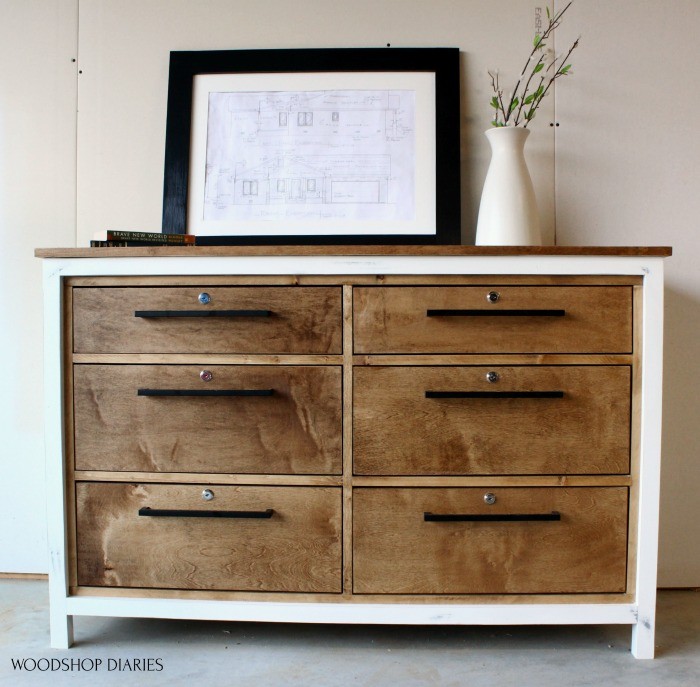
Shara sitting on edge of DIY garden bed with trellis

DIY Garden Bed with Trellis

Yield: 1 garden bed with trellis

Build your own raised garden bed with trellis design for less than $100 in material and in about 4 hours with this easy tutorial.

Materials

  • (1) 2x12x10
  • (2) 2x12x8
  • (3) 2x4x10
  • (2) 2x4x8
  • (2) 2x2x8 (I make my own 2x2 using this tutorial)
  • (4) 1x4x8
  • Square dowels (amount depends on design--we used about 48 ft--see step 3)
  • Miter saw
  • Table Saw (optional)
  • Nail Gun
  • Drill/Driver
  • Jig Saw
  • Level
  • 2", 2 ½" and 3" exterior wood screws

Instructions

  1. Assemble the raised garden bed according to the plans. Do this where you want it because it will be heavy to move later.
  2. Add the trellis frame to the garden bed.
  3. Design and lay out the trellis.
  4. Install the trellis onto the garden bed frame.
  5. Add a "lip" to the garden bed.
  6. Fill with soil and plant your garden!
© Shara, Woodshop Diaries
Project Type: DIY Outdoor Projects / Category: Woodworking

DIY Bathroom Floating Mirror Shelf

May 4, 2020 by Shara, Woodshop Diaries

Looking for an inexpensive way to update your bathroom? How about a scrap wood DIY bathroom floating mirror shelf!

Close up of floating mirror shelf corner with vase and flowers on shelf

My parents recently asked me to help them design and remodel their master bathroom.  And although remodels aren’t my FAVORITE DIY project, I do like a good before and after so I agreed 🙂 

.

You may also like…For more before and afters, check out some of my previous renovation projects:

  • Six Week Kitchen from Scratch
  • Laundry Nook Refresh
  • DIY Tiny Bathroom Renovation

If you remember recently when I posted this modern console dresser, I mentioned that these would soon become my parent’s vanities.  Well, once we got them installed, I needed to give them a nice modern mirror to complement its style.

Shara Woodshop Diaries showing off modern white oak vanity for parents master bathroom renovation

So I built a simple black frame to set on a simple floating mirror shelf and I’m honestly impressed with how scrap wood can look this high end. 

.

Now, this isn’t an earth shattering super amazing, never seen before project.  But if you need a inexpensive way to update your bathroom, this is legit one of the easiest projects I’ve ever done.  So if you’re ready to get building, let’s go.  I’ve got the tutorial and video below:

This post contains affiliate links. See policies page.

.

For this Floating Mirror Shelf, you will need:

  • Scrap plywood OR 1×3 boards for frame
  • 1×6 scrap for shelf
  • 24″ x 24″ (or other size) mirror–I purchased mine from my local glass store ⅛″ thick
  • Kreg Pocket Hole Jig
  • Drill
  • Nail Gun
  • Table Saw OR Router
  • Miter Saw
  • 2 ½″ pocket hole screws
  • Stud Finder
  • Edge Banding
  • L brackets

Step 1: Cut Dado for Mirror Frame Pieces

I had some leftover plywood strips in my scrap pile and since I was painting the frame, I decided this would be a good choice to use for it.  I was making two frames for two mirrors for the two vanities…so I ripped enough plywood strips to make two frames on my table saw.  I ripped these to about 2 ½” wide—or a 1×3 if you’d rather use solid wood for this.

Rip mirror frame boards to width on table saw

Then, I adjusted my table saw blade to ¼” high and moved my rip fence to 2” from the blade.  I cut a ¼″ deep dado in the strips and test fit the mirror.  (FYI, you can also use a router for this instead if you prefer.)

Cut dado in plywood mirror frame board on table saw

I had ordered 24” x 24” x ⅛” thick mirrors from my local glass shop. If you’re looking to purchase just a mirror, check local windshield or window repair places and see if they can cut you a mirror.

.

I tried to slide one of my mirrors in this dado and it was too small.  So I adjusted the rip fence about half a blade width further from the blade and ran it through again.  This time, the mirror fit and I was ready to cut these strips down.

Step 2: Cut Mirror Frame Pieces to Length

But before I cut anything, I went ahead and applied some edge banding across the front edge of these plywood strips.  This will give me a cleaner finish later when I paint.

Apply edge banding to plywood edges of mirror frame pieces

I double checked that my mirrors were, in fact, what I had ordered—24” x 24” (one should never assume haha) and took my plywood strips over to the miter saw.  I cut four pieces to make each frame—two 25” and two 23 ½”.

.

NOTE: I was butt jointing these boards. If you wanted mitered corners, miter the ends 45 degrees and all four should be 25″ long. Also note: if you have a different size mirror, to figure your lengths, cut two boards 1″ longer then the height and two boards ½″ shorter than your width 🙂

Use miter saw to trim mirror frame boards to length

I test fit the mirror into these pieces before painting.  There’s nothing worse than finishing something then realizing later that it doesn’t fit haha.

Test fit mirror into cut frame pieces to ensure fit

Step 3: Finish Mirror Frame Pieces

Once I verified everything should fit well, I primed and painted these boards.  Now, because I didn’t miter the corners of these boards, four of the edges will be exposed…but two will be sitting on a shelf unseen and two will be too high up the wall for anyone less than 7 ½’ tall to see.  So I was okay with that.  BUT, if you wanted to, you could miter the corners instead of doing a butt joint.

Step 4: Assemble Mirror Frame

Once the paint was dry, I glued and nailed three sides of the frame together.  Again, there are lots of ways to join this frame.  But in my opinion, the frame only has to be as strong as what’s inside of it and the mirror is pretty fragile.  So I wasn’t worried about this being super strong. If it fell and the frame broke, the mirror had to break, too, so you’d be remaking another anyway, so glue and nails here were fine with me.  But feel free to beef this up if you prefer something stronger.

Brad nail floating mirror frame together

I nailed the 25″ long pieces into the 23 ½″ long pieces. So when it’s assembled, its overall size will be 25″ x 25″.

Nail black modern floating mirror frame together

After assembling three sides, I slid the mirror into the dadoes and installed the last piece of the frame.  I touched up any paint scuffs and set it aside to dry.

Now, the bottom and top ends of the mirror have holes where the dadoes were cut.  Again, these will be hidden on the shelf and at the top of the mirror.  But, if you wanted, you could putty these holes, let dry, and paint to hide them. 

Step 5: Cut and Finish Floating Shelf

For the shelf, I wanted the wood to match the vanities.  So I pulled out a leftover piece of white oak I had after building these vanities and cut it in half.  Then I ripped it to 5 ½” wide on my table saw.  (You could also just use a 1×6 for this.)

.

These will be the shelves.  After sanding and applying a clear coat poly, I packed up a few tools and headed to install them in my parent’s bathroom.

Step 6: Install Floating Mirror Shelf

We already installed the vanities and the sinks, so all that as left was the floating mirror shelf.  So I measured down from the light fixture to make sure there would be enough room for the mirror and marked where I thought the shelf should go.  Then I used a stud finder to find and mark at least two studs. 

Mark stud locations on wall to install shelf

I marked these on the wall, then held the shelf up and transferred the marks to the board.  This is where I needed to drill the pocket holes so that they would hit a stud.

Mark stud locations on floating shelf board

So I took the board over to my pocket hole jig and drilled two ¾” pocket holes at these marks.  I started two 2 ½” pocket hole screws in these holes and brought it back to the bathroom.

.

Once these holes were lined up with the studs and the shelf was the height I wanted it, I drove one of the screws in.

Drive pocket hole screw through shelf into studs to secure it

Then, I leveled it, and drove the other.  I was hesitant that the pocket holes wouldn’t be sturdy enough with this just being a ¾” thick board, but with the 2 ½” screws, it wasn’t budging…I was actually pretty impressed.

Drive screw into floating mirror shelf to secure it to studs

It would easily hold the weight of the mirror frame, but I wanted to secure the mirror to the wall still to prevent it from tipping over or falling off the shelf.

.

So I set the mirror on the shelf and traced a line along the top of it. I used an L bracket and secured it to a stud at this mark. 

L bracket secured to wall to secure mirror in place

Then I set the mirror back in place and attached the other end of the bracket to the top of the frame.  Everything seemed to be snug and holding well, so I handed it over to mom and dad and headed back to my own shop to build the next project. 

This was such a simple project and while it could have been made a lot more complicated, it turned out pretty well for just a few hours of work.

Shara Woodshop Diaries in black framed floating shelf mirror
Floating shelf with black framed mirror over modern white oak vanity in modern bathroom remodel

I’m glad mom and dad have a nice new bathroom set up and I’m really happy with the design.  If you want to check out how that vanity dresser was built, be sure to head over to this post.

Modern black frame mirror with natural wood floating shelf

In the mean time, I’ll be working on my next project, so be sure to subscribe to my newsletter below so you don’t miss out on what’s coming next. 

.

And if you loved this project, I’d love it if you’d pin this for later

Pinterest collage how to build a floating mirror frame and shelf graphic

Until next time, happy building ????
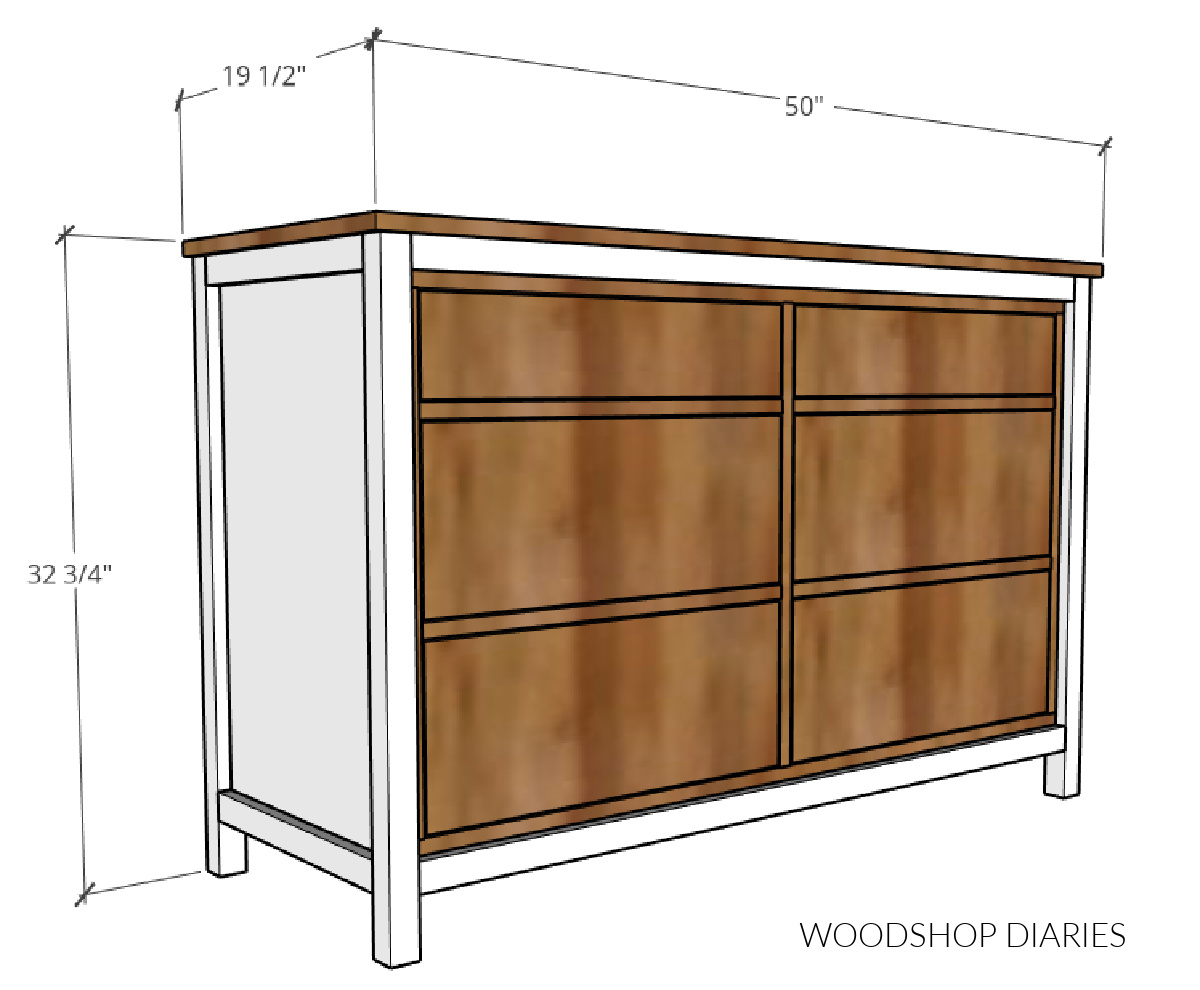
Shara Woodshop Diaries Sign Off

DIY Coffee Bar Table

April 30, 2020 by Shara, Woodshop Diaries

If you’re a frequent follower, you may notice that this DIY Coffee Bar Table isn’t really my typical “style” lately. I’m usually building more modern and clean lined pieces.

Close up of distressing on coffee bar table

But many times, that modern design style doesn’t leave a lot of room for imperfections. And I’m far from perfect, so that can be a little…stressful at times. So, when a friend recently asked me to build a rustic style coffee bar table, I thought it was a good opportunity to build something a little less stress inducing and just have some fun.

.

The good thing about a rustic finish is that things don’t have to line up perfect.  In fact, it’s actually helpful in the distressing process if there are a few uneven spots or ridges. 

Angled view of distressed farmhouse style coffee station table

So if you’re looking for an easy build without any pressure, this is the one 🙂 Keep reading to grab the FREE PLANS! PS Check out how to build that EASY serving tray on that bottom shelf in this post.

.

Before we get to the how to, if you’re looking for more DIY inspiration, check out a few of these small tables, as well!

  • How to Build a DIY Round Wooden Pedestal Coffee Table
    DIY Pedestal Coffee Table
  • How to build a simple little side table from a few boards and with a few simple tools.
    DIY Simple End Table
  • How to build a DIY X base console table with middle shelf for added storage--free building plans!
    DIY X Base Console–Large
  • Close up of left side of X base console table
    DIY X Base Console–Small
  • DIY Coffee Cabinet
  • DIY X Base Coffee Table

I’m sharing the free plans below and the video tutorial here as well:

This post contains affiliate links. See policies page.

Tools & Materials:

  • (3) 2x10x8 boards
  • (2) 2x2x8 boards (I make my own)
  • (2) 2x4x8 boards
  • 2 ½″ pocket hole screws
  • 2 ½″ wood screws
  • Wood Glue
  • Stain & Paint
  • Miter Saw
  • Table Saw (optional)
  • Circular Saw and Saw Guide
  • Drill
  • Pocket Hole Jig
  • Sander
Overall dimensions of coffee bar table graphic: 24" deep, 30" wide, 36" tall

Cut List for DIY Coffee Bar Table:

  • (4) 2×4 Legs @ 34 ½″
  • (6) 2×2 Frame Sides @ 20″
  • (2) 2×2 Frame Front & Back @ 21″
  • (9) 2×10 Top & Shelves @ 30-32″ (see step 1)

Now, let’s get to the build!

Step 1: Glue Up Top & Shelves

Some habits are hard to break, and although this table didn’t call for nice smooth edges, when working with construction lumber, I can’t help myself and I have to clean them up a little. Check out my post here about how to clean up edges on 2x material.

.

So after I rough cut my 2x10s to 9 pieces of about 30-32″ long for the top and shelves on the miter saw, I cleaned up the edges on the table saw to make a smoother glue up.  By the way, I have a great post here about how to maintain and clean a table saw top for smoother, safer cuts.

running 2x10 top shelf pieces through table saw to clean up and square off edges

I glued up three panels for this project—one for the top, and two for the shelves.  The overall size of the panels should be: top–24″ deep x 30″ wide & shelves: 23″ deep x 28″ wide.

.

It’s easiest to glue them up longer than you need, and trim the panel to the correct length once the glue is dry (see later steps). My longest panel is 30″ wide (for the top), so that’s why I cut my 2x10s roughly 30-32″ long.

.

For the width, I ripped my 2x10s down to the right widths to make my top 24” deep overall and my two shelves 23” deep overall.  But, if you don’t have a table saw to rip these boards down, you can glue them up full width and trim down later with a circular saw. I applied wood glue to the edges and clamped until dry.

Step 2: Build Coffee Bar Table Frame

While the glue dried on the panels, I moved on to building the base frame of the coffee bar table.

.

This was made from 2x4s and 2x2s.  So I trimmed the 2×4 legs down to 34 ½″ long and, again, ran them through the table saw to square and clean up the edges.  Rustic or not, this is something I just can’t not do haha.

Running edge of 2x4 through table saw to clean up and square off edges

I gave them a good sanding, then trimmed the 2x2s for the frame.  I drilled 1 ½″ pocket holes into the ends with my Kreg Jig and began assembling using wood glue and 2 ½″ pocket hole screws. NOTE: When using pocket holes in 2x2s, I find it helps prevent cracking to use one screw PLUS wood glue per joint vs two screws per joint.

Building Plans graphic of coffee bar table base frame

Notice that one of the middle shelf supports is missing. I installed it in mine at this point of the build and had issues later getting the shelf into the frame. See video for that ordeal. So in hindsight, it’s best to leave one middle support out until you’ve gotten the shelf placed in the frame.

Step 3: Trim Coffee Bar Table Top and Shelves to Final Size

While I let the glue dry on the base, I trimmed down the top and the shelves to the correct lengths using my circular saw.  By the way, if you’re interested in this track I’m using with my circular saw, check out my plywood cutting post for details on it.

Using circular saw to cut down shelves to correct length

The top needs to be 24″ x 30″ and the two shelves should be 23″ x 28″.

Graphic of coffee bar table top overall dimensions 24" x 30"
TOP OF COFFEE BAR TABLE

But, because the shelves will kind of “wrap” around the legs at the corners, I needed to notch them out so they will fit.  So I measured, marked, and used a jig saw to cut the corners of the bottom and middle shelf like shown.  It’s best to cut to fit your exact dimensions here, but this gives you a rough estimate:

Graphic of coffee bar table shelf with corners notched out

In hindsight, it might have been easier to make these shelves a variety of different ways…but hindsight is useless when your panels are already glued up haha.  So I continued on.

Step 4: Install Shelves into Coffee Bar Table

I gave the shelves and top a good sanding to get them nice and flat and smooth.  Then, I placed the bottom shelf in and it fit great.  So then I tried the middle shelf…and it DIDN’T fit because of that whole middle support thing from step 2 I mentioned.

.

So I ended up removing one of the middle supports so I could slide the shelf in place, then reattached the support.  That’s why I told you to leave one out in step 2 😉 It all makes sense now!

Coffee bar table building plans graphic showing to attach middle shelf support once shelf is in place

To attach these shelves, I screwed them in place through the bottom supports like shown. 

Coffee bar table building plans graphic--attaching shelves through shelf supports

Step 5: Install Coffee Bar Station Table Top

Then, I placed the top on and checked that the overhang was the same on the sides and the front (1″ overhang on both sides and the front–flush on the back side), then screwed this in place through the 2x2s on the base.

Coffee bar graphic showing top of project attachment location

Step 6: Finish with Farmhouse Distressed Look

Assembly was complete at this point, but it still needed to be finished.  When finishing a distressed piece, I stain the wood a dark color, so that when I sand the paint off in places later, the underneath is dark and shows up better than raw wood.  That’s just how I’ve always done it.

Angled view of coffee bar table with distressed finish

So I stained the entire piece in Varathane Smoke gray.  Once that was dry, I brushed on two light coats of white latex paint. 

.

I came back the next day and gave the entire piece a light sanding, then took a piece of 80 grit sandpaper and hand sanded the corners, joints, and in random places all over the piece to give it a “distressed farmhouse” look. 

Sanding corners of shelves to give it a farmhouse distressed look

And, once it’s wiped down to get all the sanding dust off, it’s ready to use.  My friend was using this as a coffee bar station table in her kitchen. 

Shara Woodshop Diaries with DIY coffee bar table

It would be great for something like that in the kitchen, or as a little entryway table to toss keys, etc on to when you walk in the front door. 

Front angle view of distressed coffee bar table staged for kitchen

Either way, it’s a super simple build I hope you’ve enjoyed seeing.  I’ve got several more fun builds coming out soon, so I’d love if you’d subscribe to my newsletter below for updates on new posts! And if you want to save this for later, feel free to pin this and share it!

Pinterest collage of DIY coffee bar table with 3D graphic of project plans

Until next time, happy building 🙂

How to Remove Rust From a Table Saw and Protect It

April 17, 2020 by Shara, Woodshop Diaries

A good table saw is a big investment. It’s likely the most expensive tool in most woodworkers’ shops! But with nice cast iron table saws, rust is an ever present enemy. So I’ll show you how I remove rust from my table saw and protect it from future damage in this post.

Before and after removing surface rust on table saw collage image

A while back I wrote a post about doing routine shop maintenance to tools and equipment in your workshop. This is another routine task to add to the checklist. You can never permanently remove rust…it will always come back.

.

But routinely removing rust and protecting metal tool surfaces is a critical task to keep your nice tools running at their best–not just table saws, but lathes, bandsaws, miter saws, etc.

.

This post contains affiliate links. See policies for details.

PS I’ve had SO many people lately ask me what kind of table saw I’m using. This is my current table saw set up. You can check out my workshop tour here.

Table saw and outfeed table set up

And if you’re looking for some cool shop carts, shop storage, or tool stand builds, check these out:

  • DIY Simple Mobile Tool Cart
    Mobile Tool Cart
  • How to build a mobile Miter Saw Stand with storage drawers, and fold down extension wings
    Mobile Miter Saw Stand
  • Mobile Lathe Stand
  • Mobile Workbench
  • How to Build a DIY Rolling Scrap Wood Cart
    Scrap and Plywood Storage Cart

There are many methods for cleaning and protecting metal surfaces, but this is what I’ve found works well for me.

.

To Remove Rust from Table Saw, I use:

  • Metal Rescue Rust Remover Gel
  • Gloves
  • Plastic Wrap
  • Old Rags
  • FINE grit sandpaper
  • Johnsons Paste Wax

Step 1: Clean Table Saw Top and Examine the Damage

I’ll be the first to admit that I don’t take good care of my tools. It’s a bad habit, I know. But at any given time, my table saw is usually covered up with sawdust and wood chunks.

Shara installing new blade onto table saw

So first, I wipe away all debris and sawdust and clean off my table saw surface so I can see what’s going on underneath.

Rusted table saw top

I live in a really humid part of the country and I like working with the garage door open. So my table saw can quickly get some surface rust like you see here. If left a long time like this, it can get a lot worse and need a little more elbow grease to clean it up.

Surface rust on table saw close up

That’s why it’s important not to let it go so long before cleaning it. I’ve let it get bad a few times and spent HOURS working on it. This time, I caught it early haha.

Step 2: Apply Rust Remover to Metal Surfaces of Table Saw

I’ve been using this Metal Rescue Rust Remover Gel and it works really well for me. I’d recommend applying it with a putty knife to get a more even coating, but every time I do this, I can’t find my putty knife and end up just using a gloved hand to smear it around.

Metal Rescue rust remover gel container

I simply dip out some gel and apply it to the exposed metal surfaces (the table top and the rail) about ⅛″ thick according to the instructions.

Rust remover gel smeared on table saw top surface

You’re not supposed to let the gel dry, so I cover it with plastic wrap while it works. For light surface rust, I leave it for an hour or two. But for heavier rust, you can leave it on for several hours. You just have to make sure the gel doesn’t dry out.

Plastic wrap on gel to keep it from drying out

Step 3: Remove Rust Gel and Clean Table Top Surface

The gel will turn a darker color as it works. After a few hours (or however long you want to wait), I take an old rag of old t-shirt and wipe away the gel. It may require a little scrubbing in some places, but the VAST majority of the rust should come off clean.

Rust remover gel wiped off table saw surface

Make sure to remove ALL the gel–on the table top around the edges, and anywhere else you put it.

.

You can see streaks on my table top above…I believe that is because I didn’t have an even layer because I used a glove and my fingers to spread the gel. That’s why it’s probably best to use a putty knife to evenly spread it.

.

For any places with a little rust still on it, I take some fine grit sandpaper (400 grit or higher) and lightly sand it. If there is still quite a bit of rust, I may apply another coat of gel and repeat. But usually a little sanding will take what’s left off.

Step 4: Protect Table Saw Surface

Rust will never be a defeated enemy. It will eventually always come back. But you can protect it from getting really bad really quick with a protective coating.

.

It also helps keep the top smooth for smooth cutting 🙂

Johnsons Paste wax on table saw top to protect it

I use a rag to apply some Johnson’s Paste Wax on the table saw surfaces. I get this in all the nooks and crannies and simply wax on…wax off. This will kind of “seal” the metal to help protect it from rust and also leave a smooth surface for easy cutting.

Rust free table saw top close up

And that’s how to remove rust from a table saw. Cleaning and protecting your tools isn’t the most enjoyable task to do in your shop. But it helps keep things running more smoothly–both literally and figuratively–and protects your investments.

Thumbs up for rust removed from table saw top

Don’t forget to check out my posts here on workshop 101 about maintenance, organization, and what items you shouldn’t skimp on.

I hope this has been helpful and I’d love if you’d pin this for later 🙂

Before and after collage of rust on table saw and rust removed from table saw surface

Until next time, happy building 🙂

How to Build a Simple Freestanding Bookshelf

April 5, 2020 by Shara, Woodshop Diaries

free standing bookshelf with decor displayed on shelves

How to build a bookshelf from a single sheet of plywood in just 5 steps! This beautiful DIY shelf is a great way to display pictures and trinkets. Build your own Freestanding Bookshelf with the plans and tutorial!

.

If you’ve followed along for very long, you’ll know that somehow I always agree to build my parents new furniture. Maybe it’s the whole “they brought me into this world” thing, so I figure it’s the least I can do haha.

.

This is another “mom project” that I’m excited to share. She wanted a simple stand alone bookshelf for her living room to display pictures and trinkets and such. This was a pretty simple build and I’m sharing the plans below.

Simple traditional freestanding bookshelf standing in living room

If you’re interested in the other projects I’ve built for my parents in the past, here are a few:

Outdoor Dining Table
Built In Benches
DIY Entertainment Center
Modern Dresser Vanity
Upholstered Bench
DIY X Base Dining Table
X Base Dining Table

This post contains affiliate links for your convenience.  Please see disclosure policy for more information.

How to Build a Bookshelf

Materials Needed to Build Freestanding Bookshelf:

  • 1 sheet ¾″ plywood
  • 1 sheet ¼″ plywood
  • (5) 1x3x8
  • (2) 1x2x8
  • Crown molding (8 ft stick is plenty)
  • Cove molding (Four 8ft sticks)
  • 4 cabinet feet (I used part #4003 from Osborne Wood)
  • 1 ¼″ pocket hole screws
  • Shelf pins

Tools Needed:

  • Drill and bits
  • Circular saw (or table saw)
  • Kreg Rip Cut (optional, but helpful to rip plywood)
  • Miter or chop saw
  • Nail gun
  • Kreg Pocket Hole Jig
  • Kreg Shelf Pin Jig

NOTE: This project required cutting down a plywood sheet in order to build. Check out my post here on how I quickly, and accurately cut down plywood sheets with a circular saw.

.

For more bookshelf projects, check out some of my favorite bookshelf projects here:

Linen Shelf
One Sheet Plywood Bookshelf
Modern Bookshelf
How to build a simple, little DIY bookshelf
Small Simple Bookshelf
Get the free building plans for this DIY Four Sided Spinning Kid's Bookshelf
Four Sided Bookshelf

Check out the downloadable plans for this freestanding bookshelf project here:

These plans include plywood cut diagrams, detailed measurements and instructions to build this simple stand alone bookshelf. But, below is the tutorial.

Step 1:  Build Bookshelf Carcass

To get started, I ripped my plywood sheet into two 16″ wide strips and one 15″ wide strip using my circular saw and Kreg Rip Cut. If you aren’t familiar with the Rip Cut, head over to this post to see how I use it to cut down plywood sheets.

.

I set the 15″ wide strip aside to use as shelves later and cut my 16″ wide strips into two long side panels and two short top and bottom panels. Find exact dimensions in the plans here.

Bookshelf carcass plywood pieces cut to size ready for assembly

I used a Kreg pocket hole jig to drill pocket holes in the ends of the short pieces to use as the top and bottom of the bookshelf.

Pocket holes drilled in top and bottom panels of bookshelf

To assemble the freestanding bookshelf carcass, I screwed the four pieces together with 1 ¼″ pocket hole screws so that I had a “box” like shown below.

.

NOTE: the bottom was screwed in so that the top of the bottom shelf is 2 ½″ from the bottom edge of the plywood.

Freestanding bookshelf assembled using pocket holes
DIY Bookshelf cabinet carcass assembled with back installed

I cut a piece of ¼″ plywood from the sheet and stapled it onto the back (as shown above).  And there I had a freestanding bookshelf carcass.  

.

Side note: I love building cabinets because I like to be able to say the word “carcass” as often as possible.  Try it 🙂 It’s fun.

Step 2: Add Trim to Bookshelf Sides

To trim out the side panels and give it a little visual interest, I glued and brad nailed 1x2s and 1x3s onto the sides.  Everything was 1x3s except the piece on the front.  I made this a 1×2 because the face frame will add some extra width later.

Side of DIY bookshelf trimmed out with 1xs for extra decoration

Then I lined the insides of the “boxes” with cove molding.

Side panel of bookshelf trimmed out with 1xs and cove molding

Step 3: Build and Attach Face Frame to Bookshelf

I built a face frame for the front and screwed it together with ¾″ pocket holes and 1 ¼″ pocket hole screws.  The overall frame dimensions should cover the entire front.

.

Don’t forget to check out the downloadable plans here for exact dimensions and details on this bookshelf project:

Bookshelf face frame assembled on workshop floor using pocket holes

I glued and brad nailed this piece onto the front and then added cove molding around the bottom and crown molding around the top for some added detail.

Molding added to bottom and top of bookshelf

Step 4: Add Feet to Bookshelf

I added feet to the bottom for a little extra interest.  I used these feet from Osborne Wood Products.  They will add the screw dowels for you (be sure to ask for this) so all you have to do is screw them in!

.

OR (if you check out the downloadable plans), you can use a scrap block attached in the corners and glue and screw these feet in on the back sides to hide the screw heads.

.

In this case, I ordered these feet with screw dowels, so I predrilled a hole into the plywood bottom on all four corners of the piece. I made sure to use a drill bit SMALLER THAN THE SCREW DOWEL to predrill here.

Predrilled hole on bottom of bookshelf to install screw dowel to attach feet

Then I screwed the feet into the hole.  Since the screws were already in the feet, it made it super easy.

Installing feet onto bookshelf using screw dowel
Close up of foot installed onto bottom of bookshelf
Feet attached to tall freestanding bookshelf--lying on its back in workshop

And now, it’s almost done!!! Deep breath everybody!!

Unfinished tall bookshelf in workshop before adding shelves--trimmed out on the sides with 1x3s and cove molding

Step 5: Add Adjustable Shelves

I used my Kreg shelf pin jig to drill holes in the sides to make the shelves adjustable.  I know my mom is even more indecisive than me (where do you think I got it from??), so I thought it would be good to allow the shelves to move.

Shelf pins drilled into sides of free standing bookshelf with Kreg shelf pin jig

So remember that leftover piece of ¾″ plywood from step 1?  I cut it into three pieces about 29 ¾″ long for the shelves.  You could add edge banding to the front to cover the plywood edges if desired.I put shelf pins in and placed the shelves where I thought they looked good.

.

PS…a note about shelf pins. Kreg makes a shelf pin jig for 5mm and ¼″ shelf pins. Make sure you purchase shelf pins to match the size jig you’re using. If you’re using a 5mm jig, purchase 5mm pins. If you’re using ¼″ jig, purchase ¼″ shelf pins. 5mm is slightly smaller than ¼″.

Unfinished stand alone tall bookshelf in workshop

Step 6: Finish Bookshelf as Desired

As with everything, putty, caulk, and sand as needed.  Then paint and/or stain.  I stained the shelves and mom painted the piece.  

.

We disagreed about the finish.  I said stained shelves and navy cabinet.  Mom said white distressed cabinet.  We compromised and ended up with this: grey cabinet, stained shelves.

DIY Freestanding bookshelf with light on top to illuminate top shelf

Dad added a light to the top…because he wanted to contribute something to the design haha.

Stand alone bookshelf in living room decorated with old books and vases

But I think I like it without the light. To each his own 🙂 If you’d like to build one for yourself, be sure to head over and grab these printable PDF plans.

Tall freestanding bookshelf--grey and natural wood finishes

I do really like the two-tone look here and I’m glad she went with the stained shelves.

DIY Bookshelf with adjustable shelves --grey painted cabinet, wood stained shelves

So if you’re looking for a simple addition to your living room, home office, bedroom, or entryway, this is a really simple build perfect for displaying trinkets, pictures, trophies, whatever makes your heart happy 🙂

.

I hope you’ve enjoyed this project and if you’d like to save it for later, don’t forget to pin this!

DIY Simple Freestanding Tall Bookshelf Pinterest collage

Until next time, happy building 🙂

How to Build a DIY Bookshelf

DIY Simple Freestanding Bookshelf

Yield: 1 freestanding bookshelf

How to build a bookshelf from a single sheet of plywood in just 5 steps! This beautiful DIY shelf is a great way to display pictures and trinkets.

Materials

  • 1 sheet ¾″ plywood
  • 1 sheet ¼″ plywood
  • (5) 1x3x8
  • (2) 1x2x8
  • Crown molding (8 ft stick is plenty)
  • Cove molding (Four 8ft sticks)
  • 4 cabinet feet (I used part #4003 from Osborne Wood)
  • 1 ¼″ pocket hole screws
  • Shelf pins

Tools

  • Drill
  • Circular saw (or table saw)
  • Kreg Rip Cut (optional, but helpful to rip plywood)
  • Miter saw
  • Nail gun
  • Kreg Pocket Hole Jig
  • Kreg Shelf Pin Jig

Instructions

  1. Build the bookshelf carcass
  2. Add trim to the bookshelf sides.
  3. Build and attach face frame to the bookshelf
  4. Add feet to the bookshelf.
  5. Add adjustable shelves.
  6. Finish bookshelf as desired.
© Shara, Woodshop Diaries
Project Type: DIY Furniture Plans / Category: Woodworking

DIY Dog Crate with Sliding Door

April 3, 2020 by Shara, Woodshop Diaries

I recently built our spoiled shop dog, Lucy, her own little hang out! She loves her new Modern Dog Crate with Sliding Door and I am excited to show you how it came together in this post!

This post is sponsored by The Home Depot as part of the ProSpective Tool Review Program.

Lucy sitting in her dog crate furniture with sliding door open

Living in a studio style (aka it’s all one big room…) home, sometimes Lou likes to escape the annoyances of her humans…that’s us…and get some peaceful alone time.  She spent a lot of time in her old black metal dog crate (with the door open), but it was an eyesore in the middle of our living room. 

Lucy in her black metal dog crate with door open

So, I thought we both might appreciate something a little more stylish and she might like something a little cozier to chill in. So I started thinking about a new design for a dog crate furniture piece.

.

If you’ve been following along for a while, you know that Lucy is pretty spoiled.  Last fall, she got a new dog bed, a few weeks ago, she got a new dog bowl stand, and a few years ago she even got a pretty sweet little dog house, too!

  • DIY Dog Bed
  • DIY Dog Food Stand
  • How to Build a Modern DIY Dog House
    DIY Dog House

Since I started working from home recently, Lucy rarely is ever left home alone, but for those occasional times that she is, I needed a way to close the dog crate, but really didn’t want the typical hinged or sliding door.  So I used a pair of drawer slides to be able to slide this entire section side to side. 

Close up of drawers slides on sliding door of dog crate
Dog crate kennel furniture with sliding door closed

I really love the modern feel of the slats and the large sliding door. I didn’t add a latch or a full back on this because Lucy is really good in her crate and never tries to get out. But, if you were worried about your furry friend escaping, you could definitely add a latch to the door and more slats along the back.

.

So if you’re ready to see how I built Lucy her new hang out, let’s get building. I’ve got the dog crate building plans below and the video tutorial right here:

This post contains affiliate links. See policies for details.

For this Dog Crate with Sliding Door, you will need:

  • ½ sheet ¾″ plywood
  • (11) 2x2x8 boards
  • 2 ½″ pocket hole screws
  • 2 ½″ wood screws
  • 1 ¼″ pocket hole screws
  • (1) pair 22″ drawer slides
  • Wood Glue
  • Kreg Pocket Hole Jig
  • Drill
  • Miter Saw
  • Circular Saw and saw guides (Kreg Rip Cut and AccuCut guides are good options)
  • Square clamps (optional, but helpful)
  • Edge banding (optional)

NOTE: I built this as a “LARGE” dog crate since Lucy is a large dog. However, feel free to adjust the height, width, and length of this crate to accommodate whatever size dog you have. I based my overall dimensions on a typical large metal dog crate size and the size of Lucy’s favorite dog bed.

Overall dimensions of dog crate kennel with sliding door closed

Step 1: Cut Boards for Side Panels of Wooden Dog Crate

This piece was made entirely of 2x2s and a half sheet of ¾” plywood.  I always make my own 2x2s from 2x4s because 1: they’re cheaper and 2: I want nice straight boards and square edges. 

How to get straight 2x2s to build DIY furniture with

So the first thing I did was cut down my 2x4s into several 2x2s.  I’ve got a blog post here explaining how to make your own 2x2s.

.

Once I had my 2x2s ripped down, I cut them to length on my miter saw to build the two identical side panels. I had seven 27″ vertical slats on each panel and two 27″ horizontal supports.

Trim down 2x2s to build side panels of dog crate with miter saw

To assemble the side panels, I drilled 1 ½″ pocket holes into one end of all the vertical slats, and used wood glue and 2 ½″ pocket hole screws to assemble them to one of the horizontal braces like shown.  I ended up spacing these ABOUT 2 ¾” apart, so I attached the two outside pieces first, then measured in, marked, and attached the next two, then repeated until they were all attached. The one in the center may not be EXACTLY 2 ¾″, but it’s close enough, no one will notice 😉

Vertical dog crate side panel slats attached to top brace with pocket holes

I attached the other end of the panel using 2 ½” wood screws through the bottom brace up into the slats (see video for more information).  I could have used pocket holes again here, but since this side of the panel will be the bottom, you won’t see the screws and this method saved a little time.  There is definitely more than one way to assemble this.

Dog Crate side panel assembly with bottom brace attached

Step 2: Attach Top Slats Between Dog Crate Side Panels

Once my two side panels were together, I needed to attach the top slats between them.  So I cut these to length and drilled a pocket hole into each end of all the slats.  By the way, when working with 2x2s, I’ve found it’s better to use one screw and wood glue than to use two screws to help avoid splitting. 

.

I used wood glue and pocket hole screws to assemble the slats to the top of each of the side panels like shown. 

Dog crate with top slats attached between side panels with pocket holes

I used some right angle clamps on the corners of the crate while the glue was drying to help ensure everything dried up square.

Step 3: Add Front Side Slats to Dog Crate

Once the glue was dry on the main part of the crate, I added a small section of slats on the front left side so that when the door is shut, the crate is still enclosed.

.

So I used a pocket hole and pocket hole screw to install a small bottom 2×2 and attached four slats between it and the top frame. 

Front left side brace on dog kennel furniture piece

I spaced these 2 ¾” apart as well so it would match the side panel.  I used pocket holes on the top and 2 ½” wood screws on the bottom just like I did with the sides. 

Vertical slats attached between top and bottom front left side brace

Again, you could use pocket holes and screws for all of these, but the simple butt joint and wood screw saves some time and it’ll be hidden on the bottom side anyway.

Overall dimensions of slatted part of dog crate furniture piece with sliding door

Step 4: Build Dog Crate Sliding Door

Now the crate is finished, but it’s time to add the door.  I used my Kreg Rip Cut and circular saw to rip this sheet in half down the middle.  If you’re interested in how I cut down full sheets of plywood, I have a post for it here.

Shara trimming down plywood sheet with circular saw to build sliding door of dog crate

Then, I used my AccuCut to trim down a front, top, and back panel to build the door. 

Exploded view of sliding door assembly for dog crate

In hindsight, it would have been really cool to do a water fall edge with this and miter the corners, but I didn’t think about it until after the fact.  Whoops. 

.

Side note: if you are modifying the height of your crate from the measurements I’m using in this project, measure the overall height of your crate from step 3 and add 1″ to give you the length for your front and back pieces. This will account for the height of the drawer slides in the next step and give you ¼″ wiggle room at the bottom so that the door doesn’t drag the ground. Your top should be about ½″-¾″ longer than the width of your crate to allow for some wiggle room in the front and back as well.

.

I applied some glue on edge banding to the sides of all the pieces and along the top edges of the front and back just to cover all the exposed plywood edges before assembling anything.

Sliding dog crate door assembled with pocket holes and screws

To assemble, I drilled pocket holes into the ends of the top piece and used wood glue and pocket hole screws to assemble it to the front and back like shown.  Once this was together, I used some corner clamps to hold it square while the glue dried.

Step 5: Attach Drawer Slides to Sliding Door

Then I test fit this door onto the crate to make sure it was going to work.  I needed to mount the drawer slides that allowed the door to slide back and forth to the top slats. So, I crawled into the crate and drew a line along the side of two slats onto the bottom side of the top piece.  

Shara marking where to install drawer slides on underside of top of sliding door

Then, I brought the door back over to the workbench, flipped it upside down, and installed the 22″ drawer slides along these lines. 

Installing drawer slides onto sliding door of dog crate

Once the slides were mounted on the top side of the door, I placed it on to the crate with the slides fully extended and the door where I wanted it to be when it’s fully closed. Then, I screwed the slides to the slats.

Screwing drawer slides into dog crate slats

Then I brought it in the house and put Lou’s bed inside.  I opted not to finish this piece…I don’t really have a good reason for that except that I was lazy and didn’t want to bother with it haha.  I may eventually go back and add a few coats of poly to seal it, but that’s another task for another day. 

Lucy asleep in her modern slatted sliding door dog crate with door open

You may notice the little Dremel tool in the DIY walnut tray on Lou’s crate. We keep it handy to trim her nails! This Dremel Pet Nail Grooming Tool has the first ever 45 degree paw guide to ensure the correct trimming angle and the attachment collects the nail dust and has a fur guard.

You can grab the tool PLUS the nail guard kit in one package or if you have an existing Dremel rotary tool, you can grab just the nail guard kit that is compatible with the Dremel 7300-PGT, 7700, 8100, 8220, 3000, 4000 and 4300 rotary tools. It takes some getting used to, some patience, and some practice, but once you get the hang of it, it works really well. But, even if you don’t want to use it for nail grooming, the rotary tool is handy for detailed grinding in the shop and around the house as well.

.

So back to the DIY dog crate…I’m so glad to have that metal crate out of the living room and I think Lucy is pretty fond of her new napping hide out. But don’t worry, she still spends most of her time in the shop with me so you’ll still be seeing her sneak into many of my future videos…so if you aren’t following along on YouTube, be sure to click over and subscribe!

Lucy asleep in slatted sides and top dog crate furniture piece with sliding door--mid century modern style dog crate

I really enjoyed building this simple dog crate with sliding door. And I’m really glad that it adds another functional piece of furniture to our living area.

Lucy looking out in slatted sides dog crate with sliding plywood door open

So if you’ve enjoyed this project, too, I’d LOVE if you’d do me a favor and pin this image for later 🙂

Slatted dog crate with sliding door pinterest collage image

Stay tuned for plenty more adventures with me and Lou in the shop haha. Until next time, happy building 🙂

Shara Woodshop Diaries Sign Off

DIY Little Linen Shelf Cabinet

April 1, 2020 by Shara, Woodshop Diaries

DIY Easy Storage Cabinet

If you haven’t noticed, I love building storage pieces.  Many of these storage builds are large armoires or hope chests.  But this little linen shelf cabinet is a change of scenery and is a great beginner build that is perfect for adding a little storage to a bathroom or laundry area.

I actually built this a few years ago for a friend, but I wanted to update this post with some better drawings and instructions and re share it with you!  So if you don’t recognize the shop space, it’s because it’s my old shop 😉  If you want to take a tour of my current shop, check out my workshop tour here.

.

I’m sharing the FREE plans for this little linen shelf cabinet below, so if you’re ready to get building, let’s get to it!

.

This post contains affiliate links.  See policies for details.

.

And if you’re looking for more shelving ideas, these are a few of my favorites!

One Sheet Plywood Shelf
Floating wall shelves from scrap wood with industrial details
Scrap Wood Wall Shelves
Modern Bookshelf
How to build a simple, little DIY bookshelf
Small Simple Bookshelf
How to build a DIY X Base Console Table--free building plans!! Minwax Early American stain makes this inexpensive console table look like a million bucks! Perfect for living room, bedroom, or dining room for displays and storage!
X Base Console Shelf

Tools and Materials to Build Linen Shelf Cabinet:

  • (1) sheet ¾″ plywood (you’ll use about ⅔ of the sheet)
  • 2’x2′ piece of ¼″ plywood (dig around in your scraps first–you only need a 12″ x 14″ piece)
  • (1) 8′ stick ¾″ cove molding
  • (1) 1x4x8 board
  • Wood Glue
  • 1 ¼″ pocket hole screws
  • Nail gun and 1 ¼″ brad nails
  • Drill
  • Kreg Pocket Hole Jig
  • Miter Saw
  • Circular Saw and Saw Guides (saw guides optional–See this post for how I cut down plywood sheets)
  • Jig saw (optional)

Cut List:

For Cabinet:

  • (2) ¾″ x 13″ x 40″ plywood
  • (5) ¾″ x 13″ x 14½” plywood
  • (1) ¾″ x 13″ x 16″ plywood
  • (2) 1″ x 4″ x 13″ (beveled 45 degrees on one end)
  • (1) 1″ x 4″ x 16″ (beveled on both ends)
  • Cove molding cut to fit

For Drawer:

  • (2) ¾″ x 5½” x 12″ plywood (for drawer sides)
  • (1) ¾″ x 5½” x 12¾” plywood (for drawer back)
  • (1) ¾″ x 7″ x 14¼” plywood (for drawer front)
  • (1) ¼″ x 12″ x 14” plywood (for drawer bottom)

.

Step 1: Cut Down Plywood and Build Linen Shelf Carcass

The body of the shelf is all cut from 13″ wide ¾″ plywood.  So, I ripped two pieces of 13″ wide plywood from my full sheet and cut two pieces down to 40″ long for the sides, one piece to 16″ long for the top, and five pieces 14 ½″ long for the shelves.

Boards cut stacked and ready to assemble tall linen shelf

I drilled ¾″ pocket holes into the TOP ends of the sides and into both ends of the 14 ½″ long shelves.

Linen shelf assembly exploded diagram of parts

Then, I assembled the shelf carcass like shown using wood glue and 1 ¼″ pocket hole screws through the pocket holes.

Linen shelf cabinet carcass assembled

Step 2: Add the Linen Shelf Cabinet Shelves

I installed four shelves into the cabinet like shown using ¾″ pocket holes and 1 ¼″ wood screws.  I spaced these out evenly, but if you wanted to leave out a shelf or space differently, that’s totally fine as well.

DIY Tall Linen cabinet shelf with shelves installed vertically

Step 3: Add Decorative Base to Linen Shelf

This step is optional, but I really liked adding this simple little decorative base to this piece.  I used a 1×4 and cut like shown (one 16″ piece and two 13″ pieces), mitering the front corners at 45 degrees.

Cabinet base design with two short pieces, one long piece and decorative curves cut

Before gluing and nailing together at the corners, I cut a little decorative design along the bottom.  I actually used a stain can to trace the curves, then connected a straight line between the peaks…but you can draw this out and cut it however you think easiest.  Once I had my design traced on it, I used a jig saw to cut it out.

Base boards for linen shelf cabinet cut and ready to assemble

Then I glued and brad nailed the corners.

Linen shelf base corners mitered, glued, and nailed together

Once the glue dried, I flipped the cabinet upside down and glued this base onto the bottom of the cabinet.

Cabinet carcass and decorative base assembled together

Step 4: Add Decorative Cove Molding

This is another optional step 🙂 But to cover the plywood edges on the bottom and to blend in the glue joint between the base and the shelf, I attached some ¾″ cove molding along the top and bottom like shown.  I mitered the corners 45 degrees on this trim.

Tall linen shelf cabinet with cove molding along top and bottom to cover plywood edges

Step 5: Build and Install Drawer Box into Top Shelf

Finally, I added a small drawer in the top.  I have a really detailed tutorial for how to build a drawer, but since this is just a tiny, little drawer in the top of the shelf, I skipped using drawer slides and just made it a pull out drawer.  Feel free to make it whichever way feels right to you haha.

.

For this project, to keep things simple, I just cut some plywood (or you can use 1×6 boards) and glued and nailed them together like shown to make the drawer box.

drawer box diagram for linen shelf cabinet

Then, I glued and stapled a piece of ¼″ plywood onto the bottom of the drawer box.

Bottom of linen shelf drawer box digram

I cut a piece for the drawer front and screwed it in through the front of the drawer box.  To give it a little extra detail, I also cut to fit and glued some ¼″ thick x 1 ½″ wide trim around the front of the drawer.

Attaching drawer front onto drawer for linen shelf diagram

Drawer box with trim glued on front

The box should slide into the top section of the shelf and have a little wiggle room on each side.  Since it’s not on slides, it is possible to pull the drawer all the way out and it will tilt down when pulled out.  But since it’s just a little drawer, I was okay with that.

Overall size of tall linen shelf storage cabinet

But, again, if you want to use slides, be sure to check out this drawer building and drawer slide guide to help you build it using slides instead.

DIY Tall Skinny Bathroom Storage Cabinet

And that’s it…give it some paint, or stain and a little knob on the drawer and it’s ready for use!  I really loved this project–years ago and still today.  It’s just a quick and easy build perfect for a tight space.

.

I really hope you enjoyed this fun little project and if you want to save it, be sure to pin this for later 🙂

Tall DIY Linen Shelf Cabinet Storage Idea Pinterest Collage Image

Until next time, happy building!!

One Sheet Plywood Bookshelf

March 30, 2020 by Shara, Woodshop Diaries

This one sheet plywood bookshelf is so easy, I almost feel silly sharing it….*ALMOST* 😉

This post is sponsored by Build Something. See policies page.

.

If you’ve followed along very long, you know that I LOVE LOVE LOVE building with plywood. It saves time, saves money, and is super easy to work with.

Shara Woodshop Diaries cutting down plywood sheet into strips

For more plywood project ideas, check out a few of my favorites:

  • DIY Modern Console Cabinet
  • How to Build a DIY Wardrobe Storage Cabinet with adjustable shelves!
    DIY Armoire Wardrobe Cabinet
  • How to Build Your Own Stand Alone DIY Closet Cabinets With Clothes rod and adjustable shelves and even a shoe rack!
    DIY Closet Cabinets
  • DIY Kitchen Cabinets

But building something awesome with a SINGLE SHEET–it doesn’t get much better than that.

One sheet plywood bookshelf vertical image

You can build this super simple bookshelf with as many adjustable shelves as you want from ONE SHEET of ¾″ plywood and two 2×2 boards. I’m sharing the FREE printable plans over on Build Something and I’ve got the video and tutorial below.

If you don’t already know, Build Something is a hub for free building plans for everything from small serving trays to large built ins. I’ve posted several plans over there I’d love for you to check out, including these.

.

For this bookshelf, you will need:

  • (1) ¾″ full sheet of plywood (you will have some leftover)
  • (2) 2x2x8 boards
  • ½ sheet ¼″ plywood (optional)
  • 1 ¼″ pocket hole screws
  • 2 ½″ pocket hole screws
  • 1 ¼″ wood screws
  • 2″ wood screws
  • Edge banding (optional)
  • Kreg pocket hole jig
  • Kreg Rip Cut
  • Kreg Accu-Cut
  • Miter Saw
  • Circular Saw
  • Drill
  • Kreg shelf pin jig
  • Shelf pins

Step 1: Cut Down One Plywood Sheet for Bookshelf Carcass

I’ve got a detailed post here about how to quickly, easily, and accurately cut down a plywood sheet. Please check it out as it will be helpful for not only this project, but any future plywood projects you tackle.

ripping down plywood sheet using Kreg rip cut and circular saw

I started by ripping my plywood sheet down into two 11″ wide and one 10″ wide strip using my circular saw and Kreg Rip Cut. The 11″ pieces will be for the bookshelf body and the 10″ piece will be for the shelves. What’s left can be kept for scraps, or used for additional shelves.

plywood cut diagram for bookshelf

Once the plywood was ripped into strips, I cut down two side panels, a top, bottom, and middle divider from the 11″ wide strips on the miter saw. For exact measurements, be sure to grab the plans over on Build Something.

Step 2: Assemble Bookshelf Carcass

I assembled this bookshelf carcass using wood glue and ¾″ pocket holes with 1 ¼″ pocket hole screws to make it quick and easy. I drilled pocket holes into the top ends of the side panels and the middle divider and into both ends of the bottom panel.

.

Before attaching, I applied iron on edge banding to the front edges of all these plywood pieces and both the front and sides of the top. Then, I glued and screwed the bottom panel between the sides, and screwed the sides into the top to make one large box.

If you have any corner clamps, it’s helpful to clamp everything square until the glue dries so you can make sure it doesn’t dry up crooked.

.

I centered the middle panel in place between the top and bottom and attached using pocket hole screws at the top and using 1 ¼″ wood screws through the bottom. You could use pocket holes in the bottom as well, I was just avoiding using another set of pocket holes to fill in later.

Step 3: Fill Pocket Holes in Plywood Bookshelf Carcass

This step is optional, but I’ve been using some of these pocket hole plugs lately and they’ve been working really well. Since the pocket holes at the top of the piece can be seen, I flipped it upside down and used some wood glue and glued these plugs into the holes.

These are kind of one size fits all, so they fit well in 1 ½″ pocket holes, but will need to be trimmed when put into ¾″ pocket holes. So once the glue dried, I used a oscillating saw and a flush cut blade to trim off the excess then sanded it smooth.

Flush cut pocket hole plugs in plywood bookshelf

Step 4: Build Bookshelf Base and Attach

The base in this project was made from 2×2 boards. I cut four legs, two short sides and two long sides on the miter saw (see plans for exact dimensions) and assembled the base together using 1 ½″ pocket holes and 2 ½″ pocket hole screws.

.

Two things to note here: You should assemble the short sides between the legs first, then attach the long sides between them. If you add the long sides first, you wont have room to get your drill or driver in to drive the screws on the short sides.

Also, I use wood glue and one screw per joint instead of two screws per joint. The wood glue, once dry, will keep the joint from twisting since there is only one screw. But putting two screws into a 2×2 end is likely to split, so I just use one.

.

Once the base was assembled, I flipped the carcass upside down and applied wood glue to the top of the base and clamped it onto the bookcase carcass like shown. I also used 2″ wood screws through the bottom of the base up into the cabinet to secure it, but at this moment, I was out of 2″ wood screws and had to run to the store to get them. So in the mean time, I just clamped it until the glue dried and added the screws later.

Step 5: Add Back to Plywood Bookshelf

This step is also optional. If you’re placing this shelf right up against the wall, you may opt not to install a back side. However, if you wish to, cut a back to fit over the carcass sides from a ½ sheet of ¼″ plywood. I used my circular saw and Kreg AccuCut for this. But you can cut this down however you find easiest. (Don’t forget my tutorial for how to cut down plywood sheets *wink wink*)

Using Kreg AccuCut to Rip plywood sheet in half

I sanded the edges and simple stapled in place with a hand stapler. Wood glue and a nail gun would work as well OR you can screw it in place, too.

Stapling ¼" backing onto plywood bookshelf

Step 6: Add Adjustable Shelves to One Sheet Plywood Bookshelf

When I add shelves to a furniture piece, I almost always make them adjustable because 1. I think it’s easier and 2. It gives you options later.

.

So using my Kreg Shelf Pin Jig, I drilled holes along the sides in the back and front to allow me to place shelf pins where I want to sit my shelves on. These shelf pins simply slide into the drilled holes and support shelves.

Drilling shelf pin holes into sides of plywood bookshelf

I trimmed four shelves from my 10″ wide piece of plywood from step 1 about ¼″ shorter than the openings I’m placing them in. That just allows a little wiggle room so it’s not scraping the sides when you put them in place. I cut four shelves, but you can cut more from the remaining plywood sheet (there will be a little 11″ wide plywood pieces left) if you want.

Close up of plywood bookshelf adjustable shelf pins

Now, it’s ready for whatever finish you want to apply. I built these for a friend and they were finishing them themselves, so I left them unfinished here, but I think they’d look cute with a black painted base and light wood stain shelf…similar to the style I used for these wall shelves.

Floating wall shelves from scrap wood with industrial details

But that’s just my own opinion. If you built it, you get to finish it however makes you most happy 🙂

Shara Woodshop Diaries with one sheet plywood bookshelf

Now, if you want to build some for yourself, head over to Build Something and download the plans for free and get building! Or if you’re looking for some more shelf ideas, these are some good ones:

  • How to build a DIY bookshelf that's simple, modern, and provides plenty of display storage
    Modern Bookshelf
  • How to build a simple, little DIY bookshelf
    Small Simple Bookshelf
  • Floating wall shelves from scrap wood with industrial details
    Scrap Wood Wall Shelves
  • How to build a DIY X Base Console Table--free building plans!! Minwax Early American stain makes this inexpensive console table look like a million bucks! Perfect for living room, bedroom, or dining room for displays and storage!
    X Base Console Shelf

I’d love if you’d pin this for later and share with your friends 🙂

One sheet plywood bookshelf collage pinterest image

Until next time, happy building 🙂

Shara Woodshop Diaries Sign Off

How to Make a Concrete Landscape Curb

March 27, 2020 by Shara, Woodshop Diaries

Last spring I spruced up the front of our garage apartment landscaping by adding some plants, some rock, and a nice concrete landscape curb. 

This post is sponsored by The Home Depot as part of the ProSpective Tool Review Program.

.

We did this a few years ago to the front of our last house and loved it so much, we wanted to do the same thing here.

So today, I’m excited to be showing you how I made this concrete landscape curb.  It’s not a difficult project, but it is a little exhausting digging, carrying heavy bags of concrete and mixing it all up. So make sure you eat your Wheaties the morning before 😉 You got this. I believe in you.

.

Want some more outdoor project ideas??
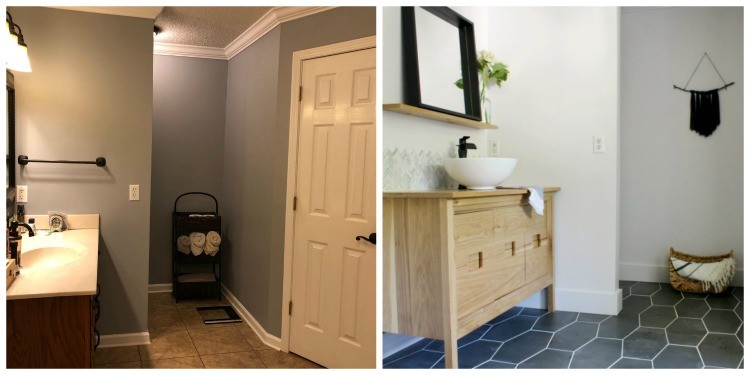
Outdoor Dining Table
How to make your own DIY concrete planter pot with wooden base
Modern Outdoor Chair
Black and Wood Planter
DIY Concrete planter pot with wooden base
Concrete Planter Pot
How to Build a Modern Planter Box from Wood scraps! Great beginner project
Mid Century Planter Box
DIY Front Porch Wagon

I made a video showing some of the process. Now, just a forewarning…I filmed this a year ago and didn’t get footage of the ENTIRE process. 

.

But, I’m sharing the step by step instructions written out below, and anything I wasn’t able to film, I’ll explain in detail in the video.

Now, let’s get to work. This post contains affiliate links. See policies page.

.

To Make Your Own Concrete Landscape Curb, First You Need:

  • ¼″ plywood
  • Wooden stakes (can use scrap wood 1x2s or thin wood strips to nail into the ground)
  • Stapler
  • Hammer
  • General Purpose Concrete (I used 7 or so 80 lb bags for this…you’ll have to determine how much you will need for yours)
  • Water
  • Shovels
  • Trowel
  • Safety stuff–gloves, dust mask, safety glasses…all those things

Step 1: Mark and Dig Out Your Curb Location

BEFORE YOU DIG: You guys know you’re supposed to call and have all utilities, and stuff marked before you ever dig anything right? Do that first. Even if you think you know…just do it so you aren’t fined for digging up a fiber optic line or something.
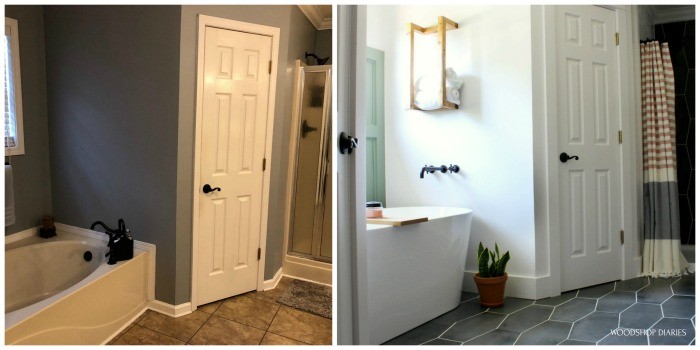
.

The first thing I did was dig out where I wanted to add the curb.  I wasn’t really technical with this. I just kind of dug out the general shape I wanted my curb to take in about the location I wanted it to be.  I was making my curb about 4 ½” wide, so I dug out about a 6” wide section about 4-5” deep.

Step 2: Install the Concrete Curb Form

To build the form, I used ¼” plywood and some scrap wood stakes.  I stapled the plywood to the stakes and drove the stakes into the ground. You can use 2x4s to make your forms as well or another kind of lumber, but because my curb was curved, ¼″ plywood is flexible enough to bend nice and pretty.

I cut my plywood strips about 4 ½″ wide and my stakes about 7-8″ long–I just used some scrap 1x2s and random thing strips I had in the shop, but you could also purchase actual wood stakes as well.

.

I laid the OUTSIDE form first along where I had dug out, then laid the inside form about 4 ½″ away from the outside. That will make my curb about 4 ½″ wide.

I just drove the stakes, then stapled the plywood onto them to make the shape. I didn’t want my entire curb below ground, so I left the forms sticking up out of the ground about an inch or so.

.

Also, I tried to keep the two sides of the form fairly level so the curb would be flat across the top and not tilted.

Step 3: Pour Concrete Landscape Curb

Once the forms were in place, I back filled some dirt around the outsides to help support the forms so that when I poured the concrete, they wouldn’t bow out.

.

Then, I grabbed all my concrete mixing and pouring supplies. 

A bucket. A couple bags of concrete—I think I used 7-8 bags for this project. Trowel. Shovels. Gloves. Some water. And a dust mask—you don’t want to be breathing in the concrete dust.

.

I mixed small batches at a time to pour because I only had a bucket.  Id suggest using a wheelbarrow if you have one to make this a little easier.

.

Once I had the concrete mixed to about the consistency of cake batter in the bucket, I used the shovel to shovel it into the form.  It’s important to tamp the concrete to release as many air bubbles as possible (by “tamp” I mean to kind of “stab” the concrete with the shovel to push it down into the form and fill any voids). 

.

I worked my way around the form and once I poured a few feet worth, I took a wet trowel and tried to smooth everything out.  I’m not a professional at this, so it wasn’t the best job…but it’s just a concrete curb. 

So I tapped and smoothed it out the best I could and tried to get it nice and flat. Here’s a photo from when we did this at our old house that shows how it smoothed out.

Updating Landscaping by adding a concrete edge

Once I had that section smooth, I mixed and poured another few feet then smoothed it out again.  I worked my way all the way around the form.  It was hot, dusty, and exhausting.  But it really didn’t take that long—a few hours I guess.

Once everything was smoothed out, I took the edge of the trowel and made small relief cuts by indenting the trowel about ¼″ into the semi wet concrete.

.

You can see the indentions in the photo above.  Concrete tends to crack over time.  Making these “relief cuts” kind of tells the concrete to crack here so it’s less noticeable.  It’s like cracking it ahead of time on purpose.

Step 4: Cure and Remove Form

I let it sit and cure for about 4 days.  It’s hard to be patient, I know.  But after four days, I carefully removed the forms from around the curb.  Some of the stakes were a little hard to pull out of the ground, but eventually I got all the form removed. 

.

I back filled dirt back around the front side of the curb to plant grass seed in later, and prepared the landscaping area for plants.

I planted a few hostas and a couple bushes in the landscape and covered everything inside the curb with landscaping mesh.  This helps prevent weeds from growing through the rocks.

.

I had to cut small holes to fit over the hostas and bushes.  Then I shoveled some Indiana river rock over the mesh to finish everything up. 

And that was it.  I really love adding concrete curbs to landscape.  I think it looks really clean and is quite a bit cheaper than adding a bunch of landscaping edging stones.

Although our grass is still pretty patchy, it did grow a little and I’ve been using this Makita cordless brushless motor weed trimmer to keep it looking nice around here.

It’s really nice to skip the gas mixing, and string pulling and just slip on a battery and start trimming. It also features an automatic torque drive setting that can automatically adjust the power needed to trim thick, tall grass vs short thin grass.

.

This helps save battery life and gives you a better, more precise cut. It’s perfect for trimming around the house and keeping my new landscape curb looking clean. Check out the trimmer kit here.

By the way, if you’d like a chair or a planter pot on the porch, you can grab the tutorials to make your own here:

How to make your own DIY concrete planter pot with wooden base
Modern Outdoor Chair
DIY Concrete planter pot with wooden base
Concrete Planter Pot

I hope this has inspired you to get out and get pouring (concrete, that is). If you liked this project, I’d love if you’d pin this for later.

Until next time, happy building 🙂

DIY Wooden Storage Trunk / Hope Chest

March 25, 2020 by Shara, Woodshop Diaries

In this post, I’m sharing how to build this DIY wooden storage trunk/hope chest!

You can also check it out here as a Christmas Tree Skirt Box!

.

It’s a versatile piece of furniture that looks great in any room. Build it in just 5 steps!

.

This post is sponsored by my friends at Kreg Tool and contains affiliate links. See policies for details.

DIY Wooden Storage Trunk/Hope Chest as Entryway Bench

So, okay, let’s be real. This DIY Wooden Storage Trunk is actually just a simple storage trunk. No hidden compartments, no fancy add ons. Just your standard DIY wooden storage chest that makes a great hope chest.

.

Except, that it has a soft-close hinged lid. No more trying to hold it up with one hand while you dig through the stuff inside to find what you’re looking for.

.I

It can also be used as extra seating. You know…because I live in a tiny garage apartment and multi-purpose furniture is always a plus in small spaces.

.

Traditionally a hope chest was used by young women to collect and store items to be used once they got married. In this day and age that tradition is a bit outdated and we use them for storing all kinds of stuff.

.

I could use it to store all the various holiday and seasonal decorations that are currently in my workshop because they are getting covered in sawdust…and that’s just not a good look haha.

.

Hey, by the way, if you are looking for more storage chest ideas, check out one of these:

Free building plans to make your own DIY Storage chest

So if you want to build your own DIY wooden storage trunk, I’m sharing the how-to video below along with the tutorial and you can find the printable plans here.

You can check out the full length YouTube video here.

How to Build a DIY Wooden Storage Trunk

For this wooden storage trunk build, you will need:

Tools:

  • Miter Saw
  • Drill
  • Table Saw (optional)
  • Pocket Hole Jig

Materials:

  • ¼ sheet ¾″ Plywood
  • (1) 1x3x10
  • (1) 1x2x8
  • (5) 2x4x8
  • (5) 1x4x8
  • (1) 1x6x10
  • Wood Glue
  • 1 ¼″ pocket hole screws
  • 1 ¼″ wood screws
  • 2 ½″ pocket hole screws
  • Lid Hinges
  • Soft close mechanisms
  • Chest Handles and Chest Latch

NOTE: Before getting started, I squared off the rounded edges of all my 2x material to make for cleaner joints. This is optional, but I think it makes the piece look cleaner when finished.

Step 1: Assemble the Wooden Trunk Frame

You can download the free printable plans from Build Something, with exact dimensions, but for this project, the first thing I did was assemble the frames for the side of the chest.

.

The entire frame was made from 2x4s and was assembled with 1 ½″ pocket holes and 2 ½″ pocket hole screws.

RELATED: Check out this post to learn how to set up and use a pocket hole jig!

Using pocket holes and screws to assemble side frame panels

Because I will be butting up another 2×4 to the side of these panels, for purely aesthetic purposes, I ripped the side pieces shown above to 2″ wide so that when the 2×4 is butted up to it, the width of this will match the full width of a regular 2×4.

Attaching frame together using pocket holes and screws

Once the small side frames were assembled, I assembled two larger frames for the front and back.

.

Once all four frames were together, I screwed them into a box like shown using 1 ½″ pocket holes and 2 ½″ pocket hole screws. Don’t worry about all the pocket holes in this project. They will all be covered up later.

Diagram of 2x4 frame assembly of storage trunk

Step 2: Install bottom of wooden storage trunk

To make installing the bottom easy, I trimmed down a ¼ sheet of ¾″ plywood to fit into the frame. You could also use wood slats for this, but it’s easier to work with a single piece of plywood vs several boards, so I opted for the plywood.

.

I drilled ¾″ pocket holes around the edges and installed into the bottom of the frame from step 1 using 1 ¼″ pocket hole screws.

Plywood bottom installed using pocket holes and screws into 2x4 wooden storage trunk/hope chest frame

Step 3: Install Slats into sides of Wooden Trunk

The slats on the sides are made from 1×4 boards. I trimmed several 1×4 pieces to line the sides of the chest like shown. You could use other sizes besides 1x4s if you wanted.

.

Starting with the long sides first, I just applied wood glue along the inside of the frame, placed these 1x4s in and used 1 ¼″ wood screws to secure into the top and bottom.

Place 1x4 slats along long side of hope chest frame

Once both long sides have slats, I installed the short sides the same way. You’ll notice I left a ¾″ lip along the top of the slats here. That’s optional.

.

I was going to use that as part of the design of the lid, but changed my mind, so it’s not a necessary part of the project.

Line short sides of storage chest with 1x4 slats

Step 4: Build Trunk Lid Frame

I built the trunk lid frame using 2x4s as well. So, I used 1 ½″ pocket holes and 2 ½″ pocket hole screws to assemble a frame like shown that would fit exactly over the trunk body.

Assembling hope trunk lid frame from 2x4s

Once the frame was together, I lined the inside with 1×3 boards like shown–I used 1 ¼″ wood screws to secure. The goal here was to install these ¾″ DOWN from the top of the frame.

.

I’ll be placing slats onto these ledges and want them to be flush across the top.

Screw wood liner supports into chest lid frame

To give a little more support to the lid slats, I cut and installed two 1x2s as shown into the lid frame keeping them flush to the top of the 1x3s.

Install middle slat supports into storage trunk lid

Finally, it was ready for the top slats. So I applied wood glue along the “1×3 liners” and the middle supports and placed 1×6 slats down into the frame. You can, again, use whatever size boards you wish.

.

In this case, I used 1x6s, but I had to trim the middle 1×6 to fit because the frame wasn’t wide enough to accommodate three of them side by side.

place wood slats into hope chest lid frame

Once the slats were in place, I flipped it over and secured them through the 1x2s using 1 ¼″ wood screws. I flipped it back over and clamped the slats down around the edges until the glue dried.

Step 5: Finish and Install Trunk Lid

It’s easier to finish the lid and chest separately, so I went ahead and stained it with Minwax Early American stain.

.

Then, I used a pair of non mortise hinges and attached the lid to the chest.

Installing storage trunk lid with non mortise hinges

In addition, I also added these soft close mechanisms to prevent any smashed fingers. These are a little tricky to install–the included instructions aren’t super helpful and I always end up installing and adjusting a little bit until it works right.

.

I’m sorry, I don’t have super helpful advice here…I’ve installed several of these and they are still frustrating to install. But, they work really well once you get them set.

Hope chest storage trunk with lid open

One note about the soft close mechanisms …they don’t allow the lid to open up all the way back. No worries. These soft close mechanisms install with two “knobby” looking parts for each end into the chest and the soft close cylinder simply snaps onto them.

.

If I want to open it all the way, I take a screwdriver and simply pop one end off the knob and when I’m ready to put it back on, I simply pop it back in place.

Hope chest storage trunk open with soft close mechanisms

As far as the other hardware on the chest, I added a latch, and handles to give it a little more visual interest. Also, I finished this with a couple coats of Helmsman Poly after the stain…just in case you were curious 🙂

.

I’ve built several storage chests and this one is BY FAR my favorite design. So simple, but so eye catching. Who knew 2x4s and 1x4s could look so nice? PS, if you need a storage coffee table, this also works nicely *wink wink*

DIY hope chest as a storage coffee table

So if you loved this project as much as I did, I’d love if you’d pin this for later and don’t forget to check out the video tutorial!

DIY Hope Chest pinterest collage

Until next time, friends, happy building 🙂

Shara Woodshop Diaries Sign Off
DIY Wooden Storage Trunk/Hope Chest

DIY Wooden Storage Trunk/Hope Chest

Yield: 1 wooden storage trunk/hope chest

How to build a DIY wooden storage trunk/hope chest in just five steps!

Materials

  • ¼ sheet ¾" Plywood
  • (1) 1x3x10
  • (1) 1x2x8
  • (5) 2x4x8
  • (5) 1x4x8
  • (1) 1x6x10
  • Miter Saw
  • Drill
  • Table Saw (optional)
  • Pocket Hole Jig
  • Wood Glue
  • 1 ¼" pocket hole screws
  • 1 ¼" wood screws
  • 2 ½" pocket hole screws
  • Lid Hinges
  • Soft close mechanisms
  • Chest Handles
  • Chest Latch

Instructions

  1. Assemble the wooden trunk frame using pocket hole screws.
  2. Install the bottom of the wooden storage trunk using pocket hole joinery.
  3. Install slats into the side of the wooden trunk.
  4. Build trunk lid frame.
  5. Finish and install trunk lid using non-mortise hinges and soft-close mechanisms.
© Shara, Woodshop Diaries
Project Type: Furniture / Category: Bedroom Furniture Plans

DIY Modern Dresser Console

March 20, 2020 by Shara, Woodshop Diaries

This DIY modern dresser console is actually going to soon become a master bathroom vanity.

DIY modern dresser console cabinet with notched drawer pulls and trim detail on the front

My parents and I are about to tackle their master bathroom remodel in a few short weeks, so I went ahead and put these together so they’ll be ready right after we tile the floor. But this design isn’t specifically a vanity.  It would make an excellent modern dresser or console as well, so that’s what we are calling it.

.

If you want to check out some other vanity or console projects, here’s a few favorites:

  • DIY Modern Console Cabinet
  • DIY Dresser
  • How to build a DIY Fake Drawer Apothecary Cabinet
    Faux Drawer Dresser
  • How to build your own DIY display media console cabinet and tv stand with drawer storage and glass panel doors!
    DIY Media Console
  • Free building plans to build your own modern DIY TV Console table. With plenty of storage, plus functionality, this modern TV Console is easy to build and stained in a gorgeous minwax provincial. Perfect for a living room, kids playroom, or even a bedroom.
    Floating TV Stand
  • Faux Drawer Vanity

Whatever you call it, my entire design was based off of a little trim detail I had seen recently on a piece of furniture online.  Basically I decided I was putting this trim around the front, and just built the plans backwards from there. 

Close up of trim detail added to the front of this DIY dresser

So I’m sharing the printable plans here, and the video and step by step tutorial below.

NOTE: For two of these identical DIY modern dresser builds, I purchased about 60 board foot of white oak from my local hardwood place in varying widths and lengths for these vanities.  So the first thing I did was pick through my pile and measure each piece and label it for what I would use it for to keep things semi organized.

stack of white oak to be used to build dresser cabinet

However, in the plans, I’ll show this as standard sized boards OR plywood to make it a little easier. Just be aware, there are different options for size combinations here depending on the type of lumber you are using.

.

This post contains affiliate links. See policies page.

For this build, you will need:

Materials Needed:

  • (1) sheet ¾” plywood (if using solid wood options…or 2 sheets if using plywood option)
  • ¼ sheet ¼” plywood
  • Lumber: 30 board foot of lumber OR
    • (4) 2x2x8 boards
    • (1) 1x8x8 board
    • (1) 1x3x8 board
    • (2) 1x2x8 boards
    • (2) 1x10x8 boards
    • (1) 1x12x8 board
  • Dowels and wood glue
  • 1 ¼” pocket hole screws
  • 1 ¼” wood screws
  • 2” wood screws
  • (4) pair 16” ball bearing drawer slides
  • (1) pair concealed hinges for frameless full overlay doors

Tools Needed:

  • Circular saw and cutting guide (cutting guides optional, but helpful)
  • Table saw
  • Router & ½” cove bit, chamfer bit, flush bit
  • Miter saw
  • Jig saw
  • Dowel jig OR pocket hole jig
  • Drill
  • Concealed Hinge Jig
  • Sander
  • Clamps

Step 1: Glue Up Side Panels of DIY Dresser Console

The legs and frame for this dresser console are made from 2x2s. But, the side panels could be either plywood, or could be a glued up panel made from 1x boards. I was building mine from solid white oak, so I glued up my own panel.

Clamping up side panels to build sides of dresser

In my case, since I was cutting the boards I purchased down to the widths I needed, the hardest part of this build was trying to make the most of the lumber I had.  Since these boards were all varying widths and lengths, I had to think through the most efficient way to cut and trim them to create the pieces I needed. However, in the printable plans for this build, I’ve suggested options for using standard board sizes to make things a little easier.

Computer drawn diagram of side panels if DIY console cabinet

Once all the glue was dry, I attached the legs on each side of the side panels using wood glue and dowels.  If you prefer, you can definitely use pocket holes and screws for assembly instead of dowels.

Dresser side panel assembled

Step 2: Assemble Dresser Console Frame

Once the glue was dry on the side assemblies, I used dowels and wood glue again to attach the horizontal frame pieces between the sides. Again, pocket holes and screws would work fine here, too.

Console cabinet frame assembled

Step 3: Add Bottom and Middle Dividers to Console

Once the glue was dry on the dresser console frame, I started installing the bottom and dividers.  Because hardwood is expensive, I built the INSIDE of this piece using plywood to save a few bucks—and some time from having to glue a bunch more panels together. Check out this post about how to cut plywood here.

.

So I cut a piece of plywood to install for the middle cabinet section and used pocket holes and screws to attach it in place.  I only need a bottom in the middle because the side sections are for drawer boxes.  But the middle section will be a cabinet.

Bottom of dresser console installed

After the bottom was in place, I cut two scrap pieces to add to the top to be able to screw the divider panels into.

Top supports of dresser console installed between top frame

Then, I installed two section divider panels.  I had to notch out a corner in the back for them to fit around the frame.  So I just marked where to cut and used a jig saw to trim that corner off. 

Middle divider panels installed into dresser console cabinet

I installed these divider panels with 1 ¼” wood screws through the bottom panel and the top supports. You can see all of this in the video above.  The key here was making sure to install these so that they were square and evenly spaced so that I didn’t run into issues installing the drawers later.

Step 4: Cut and Add Trim to Front

Now, this is where the trim I was talking about at the beginning comes in.  My whole design was built around this trim.  I usually buy my trim and molding pieces, but since this was white oak, I couldn’t find any trim to match—it’s mostly pine in my local stores—so I had to make it myself. 

.

I wanted it to LOOK LIKE a piece of solid wood on the outside and cove molding on the inside. 

Detailed view of DIY trim piece on front of dresser vanity frame

So first, I ripped down some 1 ½” strips to use for this trim.  I adjusted the table saw blade to about ⅝” high and adjusted the rip fence so that only a blade width would be trimmed off the edge of the piece.  Then I ran these pieces through to give me a little rabbet like shown here. 

dimensioned diagram of rabbet cut on diy trim detail

Next, I installed a ½” cove bit into my router and routed along the side I just cut.  I had to route a little depth off at a time because if I tried to take it all out at once, the oak kept splitting on me.  I did a few test pieces until I got it like I wanted. Check out my guide to using a router here.

Detailed view of trim detail with rabbet and cove molding all in one piece

Then, I cut enough trim to line the inside of the front of both vanities–about 12 ft worth. To install these, I adjusted my miter saw to 45 degrees and cut to fit these pieces around the inside of the front of the vanity. In order for the corners to match up, all ends had to be cut to 45 degree angles.

Glue and clamp trim detail along front of dresser vanity

Once I had all the pieces cut and checked that they fit well, I glued and clamped them in place.  I inset the trim pieces about ¼” from the front of the frame just for a little extra depth.

Step 5: Cut Drawer and Door Fronts for Dresser Console

For the drawer and door fronts, I wanted a continuous grain pattern.  So I measured the opening of the vanity INSIDE the trim and sorted through my boards to find the pieces I wanted to use for the fronts.

.

I glued up a panel the size of the opening using these boards. Once it was dry, I trimmed the edges clean and square using my Kreg AccuCut, then trimmed three equal size pieces for the drawer and door fronts.

Trim front panel into three sections

Thankfully, they fit.  So I removed the two outside pieces and cut them in half to make the four drawer fronts.  Because I wanted to make sure to keep these in that continuous grain pattern, I labeled each piece so I can keep up with which goes where.

Three sections of front panel laid out on dresser console vanity piece

For this vanity design, I didn’t want to add drawer pull hardware.  I wanted to use cut outs instead.  So I traced out on one of the drawer fronts where I wanted to cut. 

measure where to cut notches for front of drawers

I’m horrible with a jig saw, so I built a little template using some scrap plywood. 

Plywood template to cut notches for drawer fronts

This allowed me to use a jig saw to rough cut the notch, then clamp it into this template and use a flush cut bit with my router to get a clean, straight notch. You can see more of the template in the video above.

Use router and flush bit to clean up drawer pull notches

So now, the drawer fronts are cut, but I also had do something with the door.  I wanted it to LOOK like drawers here, even though it’s not. 

front pieces of vanity dresser laid out on workbench top

So, I cut a little dado along the middle to look like a gap between the drawers. 

dado cut in front of door for vanity dresser console

Then I used a jig saw to rough cut “notches” and the flush cut bit again to clean it up. 

Cut notches into front door of DIY dresser console

Now in a later step, I’ll be adding a piece of wood behind these notches.  So to give it a little place to grip to open it, I used a chamfer bit with my router as well to chamfer the back side of the notch.  Stay tuned…it’ll make more sense in a little bit. 

close up of notch with chamfer showing how to open

Step 6: Build and Install Drawer Boxes for Console

Because the trim piece doesn’t allow me to mount the drawer slide directly onto the side panels, I had to add some spacer blocks on the sides to mount the slides to.  So for this, I just cut some scrap plywood pieces and glued and screwed them in place like shown.

Drawer spacers installed so slides can clear front trim

I ripped some strips of plywood and cut them to length on the miter saw to build the drawer boxes with.  I’ve actually got a super detailed guide for how to build and install drawer boxes that may will show how to measure, build and install slides and drawer boxes.

Assembling drawer boxes for dresser vanity

I attached the slides to the vanity, then installed the drawers onto them.  Because of the notches on the drawer fronts, I made sure to install the top drawers almost all the way at the top of the cabinet. I didn’t want the drawer box covering any of the notch.

drawers installed into vanity dresser console cabinet

I went ahead and installed the door onto the cabinet before I installed the drawers because I was waiting on my drawer slides to be delivered haha. But you could install the door before or after the drawers.  I used overlay hinges for this door since it sits on the front of the divider panels. I’ve got a post here on how to install doors with concealed cabinet hinges.

screw drawer fronts in from inside of drawer box

Lastly, I needed to add the fronts.  So I flipped the vanity on its back and laid out my drawer fronts to get the spacing correct.  Then I screwed them on from the inside of the drawer boxes. 

Step 7: Add Backers Behind Drawer and Door Notches

I didn’t really like the big holes from the notches, so I cut some scrap pieces and glued them in place to cover the holes.  If I had a bandsaw, I would have resawn these pieces really thin, but I don’t…so just glued the whole ¾” thick piece on.  It is what it is haha.

close up of drawer pull notch

This is why the top drawers had to be mounted so high and why I cut a chamfer on the back of these notches. I didn’t want the drawer boxes covering the notches and the chamfer gives a little space to grip to help pull the drawers out. Make sense now??
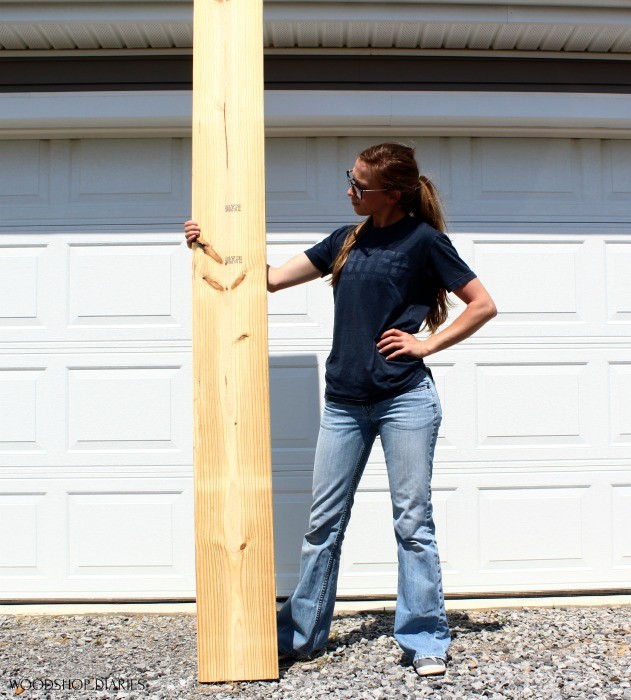
Step 8: Attach Top to DIY Dresser Console

The final step is to add the top.  So I glued up ANOTHER panel to use as the top.  There are a ton of ways to install the top and I’d recommend using figure 8 tabs or some other type of hardware to allow for wood movement.  However, I’m not installing this top until I have it in place in the bathroom (since I’m using it as a vanity) so I can see if or how I need to trim it down to fit after it’s shimmed up and screwed to the wall.  So for now, it’s just sitting on top. 

Shara Woodshop Diaries with Dresser Vanity Unfinished in workshop

But it looks good sitting there haha.  I gave everything a final sanding and finished it with Minwax Helmsman poly.  I’ve used this on my wooden kitchen countertops and wooden bathroom countertop as well and it’s held up really well.  So I used it here.  But, feel free to finish however you wish.  I’m not a finishing expert…it’s my least favorite part of any build haha.

Minwax Helmsman poly finish

And that’s it.  Vanity…console…dresser…use it however you wish.  I didn’t add a back since we will be installing plumbing in the middle section and the outside sections are just drawers. However, if I planned to use it as a dresser or console, I probably would staple or nail a ¼” plywood backer on.

Vanity console dresser middle door open

I really love how this trim detail looks on this piece and while it did add a little extra work with making it and having to add the drawer spacer blocks, I think it was definitely worth it.  This build was a little more involved than some of my other recent projects, so I’ve tried to cover everything between this post, the video and the printable plans.

DIY Modern dresser console vanity  with center door cabinet
Close up of cove molding detail on front of vanity dresser

I hope you enjoyed this project and if you want to see more, be sure to check out the YouTube video. And if you want to save this for later, please feel free to pin it for later 🙂

Modern DIY dresser console pin image collage

Until next time, happy building!

Shara Woodshop Diaries Sign Off

10 PRACTICAL Gift Ideas for New Homeowners

March 13, 2020 by Shara, Woodshop Diaries

This post about the best practical gift ideas for new homeowners is sponsored by The Home Depot as part of the ProSpective Program.

.

Buying a house is an exciting, stressful, and overwhelming experience. Buying your FIRST house is all of those same things…only on a much larger scale haha. (This was us in front of our first house–many many moons ago!)

Shara and Danny First Home

In our almost ten years of marriage, we’ve bought and sold two houses, bought land and built one…and also rented two places in between. So I’ve got a little insight into homeownership.

Shara Woodshop Diaries Building garage apartment house

So I wanted to share from my own experience the most PRACTICAL must haves and gift ideas for first time homeowners. These are the things I wish someone had given us when we embarked on our homeownership journey with nothing in hand but a couple boxes of dishes and a lamp or two.

.

This post contains affiliate links. See policies page.

.

Keep in mind, I’m a very practical person. So these may not be the most glamorous house warming gift ideas, but they’re the most useful 😉 Trust me, they will thank you for that when it comes time to hang a picture or fix an outlet.

New Homeowners Gift Idea #1: Measuring Tape

A measuring tape is a must have for any household. It’s helpful in measuring the square footage of a room, helping determine if and how your furniture will fit, and measuring for new appliances.

.

I’ve gone through several tape measures in my shop that I’ve liked, but this Milwaukee tape is pretty indestructible with it’s EXO360 rip and tear resistant technology and a case body that can withstand an 80 ft drop.

Measuring tape number one gift idea for new homeowner

New Homeowners Must Have #2: Drill

A drill is also a staple in a new (or old) homeowner’s tool box. A good general purpose drill/driver can be used to tighten up a loose door handle, swap out cabinet pulls, drill holes to install new house numbers, and drill holes in the wall to place wall anchors for hanging decor.

Using battery powered drill to drive screw to hang picture

This Milwaukee M12 drill/driver is reasonably priced, compact and lightweight and comes with two batteries to get a new homeowner started on a battery platform they can easily add onto later.

.

Check out other drill kits available at the Home Depot here.

New Homeowners Gift Idea #3: Drill Bits

While every new homeowner needs a good drill, it’s pretty much useless without drill bits. If they’re using a drill/driver, it’s helpful to include a set or two of some drill bits for drilling holes, but also some driving bits to help drive general purpose fasteners like small screws.

.

A good drill bit set with various sizes is a must-have. There are a ton of options for this. These Milwaukee Cobalt drill bits are a little pricier, but will last up to ten times longer than the cheaper black oxide bits and are great for drilling into all materials from drywall and wood, all the way up to stainless steel.

General purpose drill bits used in battery powered drill--gift ideas for new homeowners

For driving bits, it’s handy to get one that includes various size Phillips head bits, flat head bits, square and star head bits as well. Homeowners will encounter several style fasteners throughout the house and need to have a good variety of bits to fit whatever they run into.

New Homeowners Must Have #4: Screwdriver/Ratchet Kit

While a drill and drill bits have their place, there are other cases that may be a little more delicate and need a hand held screwdriver or ratchet. Things like tightening screws on outlet covers, taking covers off light fixtures to swap out bulbs, tightening hinges on cabinet doors, etc may require hand held tools to prevent excess force from a power tool from damaging anything.

Using screwdriver to tighten outlet covers in workshop

In this case, just like with driving bits, it’s handy to have an assortment of sizes and styles. This Husky screwdriver and ratchet kit comes with a variety of screwdriver bits and sockets to pick from and are a great starter kit for a new homeowner.

New Homeowners Gift Idea #5: Plier Set

When I worked in a factory, I could repair almost anything with a screwdriver and a pair of pliers. Pliers are an overlooked tool that can do SO many useful things. Need a faucet tightened? Pliers. Need a nut on a P-trap loosened? Pliers.
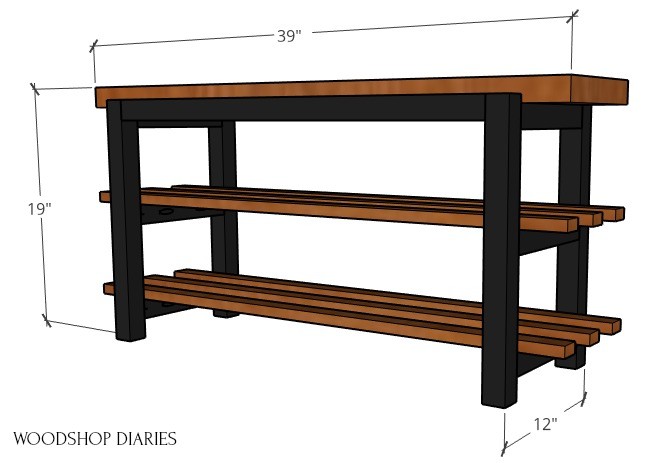
Using pliers to tighten shower fixture to fix leak--homeowner gift ideas for routine maintenance

I love this pair of pliers that I used to carry around in my back pocket at the factory. I’ve used these at home to make small plumbing repairs, tighten a shower faucet, and even tighten the nuts on the concrete anchors we used when putting up the walls inside our garage apartment. But for more variety, there are lots of kits you can find with various sizes as well.

Gift Idea #6: Work Gloves

Gloves are handy for anything from cleaning out the gutters to digging a hole, to working in the garden or loading up the moving trailer.

.

There are a million types and styles of gloves, but a couple good pair of general purpose work gloves are great to keep handy. Here are some good light duty work gloves for light demo work, moving, or work in the garden. But, for something a little tougher, these Milwaukee winter performance gloves are great for heavy duty work, not only in the winter, but also year round.

Winter work gloves use to load rough lumber into truck bed

Since they are water and windproof, they’re great for cleaning out gutters, pressure washing, and shoveling snow.

Homeowner Must Have #7: Hammer

A medium weight general purpose hammer is a great gift idea for a new homeowner. They are the perfect tool for driving nails or anchors to hang new pictures and wall art. They’re also great for opening and closing paint cans and pulling old nails out of the wall where previous owners hung their photos, etc.

Hammer decorative nail heads into DIY shutters

It’s also great for nailing decorative tacks into upholstery and DIY shutters *wink wink* A hammer is one of those things that you don’t realize how much you need it until you don’t have one.

Gift Idea #8: Flashlight

If the house has an attic or a crawl space…or electricity…I can guarantee at some point a flashlight or a headlamp…or both…will come in handy.

Battery flashlight gift idea for new homeowners

Flashlights are handy to have anywhere, but especially if you’re trying to check your breakers in the dark or checking for plumbing leaks under the house. Even tightening a faucet under a cabinet would be a nice time to have a headlamp or a flashlight. I’m currently loving this rechargeable 850 lumen flashlight kit and this rechargeable adjustable headlamp.

Headlamp excellent new homeowner gift idea used to check circuit breakers

Homeowner Must Have #9: Stud Finder

When it comes time to hang shelves, cabinets, wall art, heavy wall clocks, etc. it’s nice to have a stud finder handy to avoid making unnecessary holes in the wall looking for your closest wall stud. This particular stud finder is nice because it can also detect AC wires in the wall so you can avoid nicking one when drilling wall anchor holes, or driving screws.

Using stud finder to find studs to hang wall art and shelves--gift idea for new homeowner

Gift Idea #10: Ladder

A good ladder is a must have for a homeowner. It’s good for painting walls, changing out light bulbs, accessing the highest cabinets in the kitchen to change out the cabinet pulls 😉 This 10 ft podium ladder is great for taller ceilings or for extended periods of standing.

Using ladder to install cabinet hardware in kitchen cabinet doors--gift idea number 10 for new homeowners

But, this lightweight ladder has been super handy for our standard 8 ft ceilings, especially when we were building our home.

Shara Woodshop Diaries using small ladder to install drywall in laundry nook of garage apartment

Other gift ideas for new homeowners that could have made the list:

I had so many good gift ideas for new homeowners to list out in this post, but I narrowed it down to these ten. However, here are a few others that would be handy as well.

.

  • Wall putty repair kit–to repair small holes in the wall
  • Sandpaper–to smooth putty repairs
  • Utility knife–for general cutting
  • Level–helpful for hanging shelves, art, etc.

.

Buying a new home is an exciting time. It’s easy to focus on the “fun” stuff, but these gift ideas will prepare new homeowners for what’s to come and help them maintain and upkeep their investment.

.

I hope this has helped give you some great gift ideas 🙂 If you enjoyed this post, check out my other tool guides and reviews here. And, don’t forget to pin this for later!

Collage image of gift ideas for new homeowners

Until next time, happy building 🙂

Shara Woodshop Diaries Sign Off

Drill, Driver, Impact Wrench–What’s the difference?

March 9, 2020 by Shara, Woodshop Diaries

This post explains the difference between a drill, driver, and impact wrench and is sponsored by The Home Depot as part of the ProSpective Program. It contains affiliate links. See policies page.

.

Have you ever been in the tool section of Home Depot and been a little overwhelmed with the massive amounts of options for drills, drivers, and impact wrenches? It seems like there are twenty of the same thing…so what’s the difference?!

Shara Woodshop Diaries holding armful of drill, driver, and impact wrench

It’s a little confusing, I know. So, I’m going to try to break it down for you in simple terms here. And I’ll cover each in more detail below.

Basic Definitions: Drill vs. Driver vs. Impact Wrench

Impact wrench, driver, drill side by side comparison

Drill: A power tool with an adjustable chuck used for drilling holes into wood, metal, concrete, etc.

Impact Driver: A power tool with a hex collet used for driving screws and general fasteners.

Impact Wrench: A power tool with a square drive used with sockets to tighten or loosen large bolts and nuts

Now to make things way more complicated they they need to be, there are also drill/drivers, and hammer drills, too. But since these still fall into the drill category, I’ll discuss these in more detail in the drill section.

Drill/Driver: Basically a drill, but also capable of driving, too. Has an adjustable chuck, and typically has less torque than an impact driver. Most used and most versatile option in the woodworking, home improvement, and DIY world.

Hammer Drill: Basically a drill with a hammering feature that is helpful when drilling through hard surfaces like concrete and masonry.

So, let’s start with the most common and most used of the three, the drill.

Drill–For Making Holes

Drills are for DRILLING holes. So typically you would use drilling bits with them. You know…the kind that make holes of varying sizes. Sometimes these are spade bits, sometimes general purpose bits, sometimes maybe a hole saw. But the primary purpose of a drill is to produce a hole.

Using drill to drill a hole into wood

Most drills (with the exception of some specialized hammer drills) come with an adjustable chuck (keyless is most common, but some still use keys). This means the opening that holds the bits can open or close to fit the bit size you are using.

adjustable chuck on standard drill

MOST of the time, these days, when you are picking up a battery powered drill, it’s going to be a drill/driver. These are the most common “drills” available and the most versatile for use in the general purpose and DIY world. These are capable of not only drilling holes, but can also drive fasteners or screws.

Using drill to drive small screws into door hinges

However, they are not built for driving really long or large screws–they’re kind of a lightweight. They just don’t have the same amount of torque as, say, an impact driver, or impact wrench. But they do well with small screws in soft materials…like wood. It works fine for driving small screws like what you use to attach hinges to cabinet doors.

.

A drill/driver is a staple in any tool box. This is my current go to drill/driver.

predrill holes to attach clamp rack dividers

Another type of drill you may run into is a hammer drill. Hammer drills are kind of a specialized type of drill that is made for drilling into really hard material like concrete and masonry. They usually have the option to turn off the “hammer” and just use them as a regular drill, but they are pretty heavy and usually more expensive. So if you don’t need the hammer function, you’re probably better off with a regular drill/driver.

Using hammer drill to drill dowel holes in project

You can see this Ridgid hammer drill used in this DIY linen cabinet build.

Driver–For Driving Screws

Drivers are a little more specialized tool than drills, but still very common in the DIY world. Drivers (or also called impact drivers) are designed to drive fasteners–like screws or lag bolts–with a greater torque than a simple drill/driver can. This is my current go to impact driver.

Driver driving screw into wooden clock

Impact drivers typically come with a ¼″ hex collet to fit standard driving bits like the ones that come in this kit.

Driver has ¼" collet to accept ¼" hex shank bits

See these driving bits in action in my DIY small clamp rack post.

Using a driver to drive a screw into a plywood rack

They are usually a little more compact than a drill/driver. And a little less versatile since it’s made mostly for driving, not for drilling AND driving. You actually CAN drill holes with an impact driver using hex shank drill bits, BUT because of the impact motion, you will end up with irregularly shaped holes.

Dewalt Drill driver combo kit

It’s common to see kits available for sale with both a drill/driver and an impact driver. These are the two most common tools in a DIY or home owner’s garage. Although you can usually get away with just having a drill/driver for most small projects around the house, adding an impact driver takes your options up a notch.

.

You can use sockets with impact drivers (or drill drivers like shown below) using an adapter, but they are mostly used for small lag bolts. Drivers are more often used with hex shank bits for driving screws. For driving large or really long lag screws or lag bolts, you may need something a little more powerful, like an impact wrench.

Drill used with sockets require an adapter with a hex shank

Impact Wrench–For Powerful Tightening

If we rated the three–drill, driver, impact wrench–by strength, it would go in that order. Drill/drivers have a little tightening power, drivers have a lot of tightening power, and impact wrenches have a whole lot of tightening power. PS that’s called torque…So torque = tightening force.

.

Impact wrenches are even more specialized than an impact driver and are significantly more powerful, and bulky. Impact wrenches are designed for one thing–powerful loosening and tightening.

Milwaukee impact wrench with socket set

Drivers have higher speed, lower torque. Impact wrenches have lower speed, higher torque. Some impact wrenches, like this Milwaukee version, have different modes that vary the speed and power as needed for different applications.

Milwaukee impact wrench adjustable settings for speed and torque

Impact wrenches have a square drive–usually ⅜″ or ½″ and are designed to be used with impact rated sockets to loosen and tighten large bolts. They are used mostly in automotive applications–or use with work on machinery–not so much on wood projects.

Shara using impact wrench to loosen lug nuts on truck wheel

But, although this Milwaukee M18 ½″ Impact Wrench may not get a ton of use in my woodworking workshop, with 1400 lbs of nut loosening torque, I think it will come in pretty handy when working on our vehicles, lawn mowers, and tractor.

.

Many impact wrenches run on compressed air…but I hate air hoses, so I prefer battery powered instead. The particular Milwaukee Impact Wrench kit I’m using includes two M18 5.0ah batteries (which are surprisingly small and lightweight compared to other brand’s batteries), a charger, and a hard case.

Milwaukee impact wrench comes with two batteries, charger, and hard case

If you already have a drill and driver, the next step up as far as power goes, is an impact wrench for those times when you need a little more…impact ha. Just make sure you have impact rated sockets to use with it that fit. If you have a ⅜″ impact wrench, you need ⅜″ sockets. If you have a ½″ impact wrench, you need ½″ sockets.

Milwaukee impact wrench has square drive to accept sockets

Which drill, driver, impact wrench am I using?

If you’re in the market for any of the above, here’s what I’m currently using in my shop:

  • Drill/Driver: Dewalt Atomic 20V MAX Drill/Driver
  • Impact Driver: Dewalt Atomic 20V Max Impact Driver
  • Drill and Driver Combo Kit (drill/driver AND impact driver in one combo kit): Dewalt Atmoic 20V MAX Combo Kit
  • Impact Wrench: Milwaukee M18 ½″ Impact Wrench Kit

I hope this has cleared up the differences between drills, drivers, and impact wrenches. All of the many options can be confusing…but it’s really pretty simple when you lump them into one of three categories and determine what you need to use it for.

.

If you’re interested in other tools I’m using, check out my tool reviews. And stay tuned for more. If this has been helpful, be sure to save or pin this for later 🙂

Drill driver impact wrench collage image for pinterest

Until next time, happy building 🙂

Shara Woodshop Diaries Sign Off

I acknowledge that The Home Depot is partnering with me to participate in the promotional program described above (the “Program”). As a part of the Program, I am receiving compensation in the form of products and services, for the purpose of promoting The Home Depot. All expressed opinions and experiences are my own words. My post complies with the Word Of Mouth Marketing Association (WOMMA) Ethics Code and applicable Federal Trade Commission guidelines.

DIY Wall Shelves from Scrap Wood

March 6, 2020 by Shara, Woodshop Diaries

Shara Woodshop Diaries with DIY floating wall shelf project

If you’ve been looking for some DIY wall shelves, this is the post for you! These were built from scrap wood and you can hang these floating wall shelves without any bulky brackets or hardware!

Shara Woodshop Diaries with DIY floating wall shelf project

I love building large furniture, but every now and then it’s fun to tackle a smaller project and get rid of some of my scrap pile. 

.

So I grabbed some 2xs I had leftover after making the kid’s house bed I built recently and a few random pieces of plywood and brainstormed how I could make something useful from them. 

.

And this is what I came up with.

Floating wall shelves from scrap wood with industrial details

These DIY wall shelves came together SUPER easily and I’ve got the step by step for you in this post and the video tutorial here:

PS if you want another floating shelf idea, this one’s pretty popular, too!

DIY floating wall shelves on a light green wall over a towel bar.

How to Build DIY Wall Shelves

This post contains affiliate links. See policies page.

DIY Wall Shelves Tools and Materials:

.

  • Scrap 2x2s (about 75″ total)
  • Scrap ¾″ plywood (8″ x 24″ pieces)
  • Miter Saw
  • Drill
  • Nail Gun
  • Wood Glue
  • 1 ¼″ and 3″ wood screws
  • Decorative L brackets (optional)

Cut List:

  • (4) 2×2 @ 6″
  • (2) 2×2 @ 15″
  • (2) 2×2 @ 17 ½″
  • (2) 3×4″ plywood 8″ x 24″
  • 1x2s or thin strips of plywood cut to fit around shelves (optional)

Step 1: Build Shelf Frame

.

The first thing I did was cut down my boards into useful sizes.  Because I was using 2×6 boards leftover from the recent bed build, I squared off these 2×6 scraps, then ripped them down to make 2x2s to use for the shelf frames. 

2x2 boards used to build DIY floating wall shelf frame

Once I had them ripped down, I trimmed them to length on the miter saw.  The cut list is found above.

Trimming boards with miter saw to length to assemble floating shelf frame

You can use all kinds of fancy joinery techniques here, but since I was painting these frames and this is just a simple DIY wall shelf, I just used wood glue and 3” wood screws to attach the frame together. 

DIY wall shelf frame diagram

I made sure to predrill the holes before driving the screws though because 2x2s split really easily if you don’t predrill. 

.

You’ll notice that I made these frames so that the back pieces are spaced apart about 16” center so they can easily screw into the wall studs once they’re complete. This allows you to hang these shelves without brackets.

.

Once the frame was assembled and before the glue dried completely, I checked that the frame was square.  If it was a little off, it would be easy to kind of shift the frame one way or the other if the glue was still wet.  But, once it’s dry, it is what it is haha.

Checking wall shelf frame for square

Step 2: Cut Wall Shelves to Size

I puttied the screw holes in the frames with wood putty and while that dried, I moved on to making the actual shelf part of the project. 

I cut two ¾” plywood scraps to 24″long on my miter saw, then cut them down to 8″ wide on the table saw.  These measurements don’t have to be exact.

If you don’t have a table saw or you want to use a scrap size you already have, feel free to adjust your shelf size measurements here.

Step 3: Add Edges Around Wall Shelves

You could leave these shelves as is, just a flat board. However, I wanted to add a little lip around the edges to keep things from rolling off. 

Close up of industrial details of DIY scrap wood wall shelf

So I ripped down some thin strips of plywood to attach around the edges. You could use 1x2s for this, but I had plenty of thin strips of plywood I needed to get rid of.

Since these edges will be exposed around the top of the lip, I glued on some edge banding before cutting them to size.

.

Then, I moved back to my miter saw and adjusted the miter angle to 45 degrees.  I cut to fit pieces around the bottom shelf boards like shown here using mitered corners. 

.

Once I made sure all the pieces fit together well, I gave everything a good sanding before putting it together.

Exploded view of scrap wood floating wall shelf

Again, you could use fancy joinery methods here, but I just glued and brad nailed the lip pieces around the shelf.  It’s a scrap wood project, it’s not meant to be complicated. 

Brad nailing lip around wall shelves to prevent items from rolling off

Step 4: Finish Shelves as Desired

Once the shelves were assembled, I painted the frames black. Then I stained the shelves with Minwax Provincial wood stain between coats of paint.

.

To add a little industrial detail to this project, I attached these decorative L brackets on the front corners of the shelves.  This is totally optional, but I liked the look of them.

Attaching black L brackets for decorative touch to wall shelves

Step 5: Attach Shelves to Frame and Hang on Wall (WITHOUT Brackets)

Then, I centered the shelves on the frame and attached them through the top using some wood screws.

Attach shelf trays to wall shelf frame with wood screws diagram

Because I spaced the back frame pieces apart about 16”, these were super easy to hang on the wall. 

.

I found the studs with a stud finder, and lined the back pieces on two of them. Then I predrilled holes through the 2x2s, made sure it was level, and used 3” wood screws to drive them into the studs. No need for anchors and you don’t really notice the screws. 

How to attach wall shelf to studs without brackets
Shara Woodshop Diaries with scrap wood wall shelf

And that was it.  Scrap wood to DIY floating wall shelves in no time 😉

.

When you’re looking for a good weekend project or something to help you control your scrap wood pile, might I suggest building a set of two of these?

Floating wall shelves from scrap wood with industrial details

Looking for more scrap wood projects? Here are a few of my favorites:

DIY Continuous grain walnut box with tile top
up close chamfer edge on cutting board
DIY Scrap Wood Project--Simple Guitar Shaped Bookends made from scrap wood and a few simple tools! Build several shapes and sizes to make your own DIY bookends

Stick around for lots more projects coming soon. Until then, be sure to pin this for later!

How to Build Scrap Wood Floating Wall Shelves Pin Collage Image

Until next time, happy building 🙂

Shara Woodshop Diaries Sign Off
Close up of industrial details of DIY scrap wood wall shelf

DIY Wall Shelves from Scrap Wood

Yield: 1 DIY Wall Shelf

Are you looking for floating shelves you can DIY? This easy beginner woodworking project is the perfect DIY wall shelf project for any room in your house and can be made using scrap wood! Attach to the wall without brackets!!

Materials

  • Scrap 2x2s (about 75" total)
  • Scrap ¾" plywood (8" x 24" pieces)
  • Miter Saw
  • Drill
  • Nail Gun
  • Wood Glue
  • 1 ¼" and 3" wood screws
  • Decorative L brackets (optional)

Cut List

  • (4) 2x2 @ 6"
  • (2) 2x2 @ 15"
  • (2) 2x2 @ 17 ½"
  • (2) 3x4" plywood 8" x 24"
  • 1x2s or thin strips of plywood cut to fit around shelves (optional)

Instructions

  1. Build your shelf frame using wood glue and 3" wood screws.
  2. Cut wall shelves to size using a miter saw.
  3. Add edges around wall shelves to create a lip to keep items from falling off.
  4. Paint or stain the color of your choice. Add detail to the corners by attaching decorative L brackets (optional)
  5. Attach shelves to frame and hang on the wall.
© Shara, Woodshop Diaries
Project Type: home decor / Category: Woodworking

The Easiest Way to Cut Down Plywood Sheets

March 3, 2020 by Shara, Woodshop Diaries

In this post, I’m showing you how to quickly, easily and accurately cut down a plywood sheet without a table saw!

Plywood is a common material for DIY projects, cabinets, built-ins, storage projects and more. But, it can sometimes be challenging to work with because of its size and weight.

Birch plywood panel

A full sheet of ¾″ plywood can easily weigh over 80 lbs, making it quite difficult to run through a table saw by yourself. And sometimes, that full 4’x8′ sheet is too big to maneuver around the shop even if it wasn’t that heavy.

Since I use A LOT of plywood in my projects, I’ve had to figure out the easiest, most efficient way to cut down a plywood sheet by myself and without a table saw.

So in this post, I’m sharing how I use a basic circular saw and a couple inexpensive cutting guides to break down a full plywood sheet in just a few minutes.

*This post contains affiliate links. See policies page.

What to know before cutting plywood

Plywood is made with layers of thin wood veneer glued together into a sheet. The layers are called “plies,” hence the name plywood.

These thin layers are prone to tear out, but it’s preventable with a few extra precautions. I’ll share some quick tips below, but I go into more detail on how to prevent tear out here.

Close up of tear out on a plywood cut

NOTE: Tear out is basically when the saw blade tears the wood fibers instead of cuts them. So the cut ends look rough and “shredded.” See above.

Rip Cut vs Cross Cut

Plywood comes in sheets 4’x8′ in size. Sometimes you can purchase a partial sheet, depending on where you’re shopping.

You can buy hundreds of types of plywood in various thicknesses. See this post to learn more about choosing the right plywood for your project.

The grain on the face of the sheet runs along the 8′ span like shown below.

Plywood sheet showing arrows for grain direction and arrows points for a rip cut (along the grain) and cross cut (across the grain)

A rip cut is a cut that is made parallel to the grain–so it’s a cut along the length of the sheet. A cross cut is a cut that is made across the grain–so it’s a cut along the width of the sheet.

Cross cuts are FAR more likely to have tear out issues than rip cuts. So be most careful on these.

Types of Blades to Use with Plywood

The best way to prevent tear out with plywood is to use a good quality plywood blade–no matter what type of saw you’re using.

Make sure your saw blade says “plywood,” “finish,” or “fine finish.” This is the blade I use with my circular saw.

close up of finish/plywood blade on circular saw

These types of blade have a high tooth count, so they cut the wood much cleaner vs tearing it.

Additional Tips to Prevent Tear Out

When cutting with a circular saw, the blade rotates so that the teeth cut up, so the top side of the sheet is more prone to tear out than the bottom side.

If you flip your plywood sheet upside down so that the “good” side (the side you want to be seen) is on the bottom, then when you cut, any tear out that does occur will happen on the “bad” side.

So, for example, if you’re building a dresser, you can put this “bad side” facing the inside of the dresser, so the tear out will be hidden in the finished project.

painters tape on cut line to prevent tear out

Another tip to preventing tear out is to place painters tape across the cut line before cutting. Tape can help hold the wood fibers down as the saw cuts through it to prevent them from tearing (shown above).

Tools Needed for Cutting Plywood Sheets

I use these three tools for cutting down my plywood:

  • Circular Saw
  • Kreg Rip Cut
  • Kreg AccuCut

The Rip Cut and AccuCut are simple cutting guides that attach to your circular saw base plate. They not NECESSARY, but they are what I personally use for quick and accurate cuts.

You can use a long straight edge and some clamps instead, but each cut will require significantly more set up time.

Rip Cut vs Accu-Cut Guides

A common question I hear about these guides is: what’s the difference and do I need both? And that depends.

Both of these guides come with a universal sled that attaches to your saw’s base plate with set screws. Once this sled is attached to the saw, it can be used with either guide interchangeably.

This sled slides onto the rail of the Rip Cut and clamps in place. Then, you simply guide the straight edge along the edge of the plywood to make a cut parallel to the edge whatever width you need (up to 24″ wide).

Shara Woodshop Diaries cutting plywood panel on the ground using the Kreg Rip Cut

The Rip Cut is great for ripping plywood sheets into smaller strips, but since it can only make cuts up to 24″ wide, it is limited. That’s where the Accu-Cut comes in.

The Accu-Cut is basically a track saw that comes in 2′ track sections so you can make it longer or shorter as needed. (The basic Accu-Cut guide comes with 2 tracks for 4′ length, but you can purchase additional tracks to extend it up to 8′.)

This allows you to cut across a sheet of plywood at whatever length you need (so you’re not limited to only 24″ long cuts).

Shara Woodshop Diaries cutting plywood panel on the ground using Kreg Accu-Cut

Personally, I use the Rip Cut when ripping plywood and the Accu-Cut when cross cutting plywood. So, if possible, I recommend having both.

How to Cut Down Plywood Sheets

If you prefer to watch, I’ve got a video demonstrating how to cut plywood on my YouTube channel. But be advised–this is an older video, so I’m well aware the audio and video quality aren’t the best.

I’ve much improved since then, so don’t judge too harshly haha. You can also see a quick demo video on Instagram here.

But I’m sharing more details, photos, and tips in the step by step guide below.

Step 1: Setting Up Plywood Cutting “Station”

First, I like to set up a plywood cutting station. This doesn’t have to be anything fancy or complicated.

You simply need a place to lay the plywood so you have space to move around it to cut. This could be up on some sawhorses (these Kreg Trak Horses work great!), or on a workbench, or on the floor.

Shara Woodshop Diaries cutting plywood on Kreg Trak Horses

No matter where you choose to cut down your plywood, it needs to be sitting up on something sacrificial. I usually like to use some sacrificial scrap 2×4 blocks (see image above).

But a sheet of foam insulation is a popular choice, too, especially when working on the floor.

Shara Woodshop Diaries cutting plywood on foam insulation panel on ground

Having a sacrificial material underneath your plywood sheet allows you to lower the blade of your circular saw so that it will cut THROUGH the plywood, but you won’t cut into your workbench, sawhorses, or anything important.

Use scrap wood block under plywood sheet for cutting

Step 2: Setting Up Circular Saw

I mentioned earlier that I use a Kreg Rip Cut and a Kreg Accu-Cut to cut down my plywood sheets.

Both of these guides come with a universal sled that attaches to your saw’s base plate with set screws. Once this sled is attached to the saw, it can be used with either guide interchangeably.

Close up of blue sled from Rip Cut guide attaching onto saw plate

For this reason, I have a dedicated circular saw for cutting plywood in my workshop. I keep a fine finish/plywood blade on it and I never remove the sled.

That means I keep two circular saws–one for plywood and one for general purpose. And I know that isn’t always feasible for every workshop–that’s okay!

But, if you do a lot of plywood cutting, this can really save on set up time and keep cuts more accurate as you’re not having to readjust every time you use it.

Circular saw used to cut down plywood sheets

Either way, to set up the circular saw, I need to attach the sled to the base. Obviously the Rip Cut and AccuCut guides will have detailed set up instructions you should follow.

The instructions included with the guides will explain how to set up and dial in the guide(s) on your particular circular saw.

But essentially, you tighten the sled to the base plate using the two set screws at the top.

It’s important to make sure the sled is attached square on the saw base, and not crooked.

Close up using screwdriver to secure Kreg Rip Cut sled to base plate

NOTE: It takes a few practice cuts and adjustments to get the sled set up with both the Accu-Cut and Rip Cut the first time. I recommend setting the sled up with the Accu-Cut first, then the Rip Cut.

Step 3: Ripping Plywood Sheets to Desired Widths

You can rip and cross cut plywood in either order. But usually, I find it easiest to rip my sheet first, then cross cut those strips to the lengths I need.

For ripping plywood sheets, I use my circular saw with my Kreg Rip Cut guide. This guide is designed to rip plywood into strips by running the straight edge along the edge of the plywood while the circular saw cuts a certain distance away.

Using Kreg Rip Cut to cut plywood sheet on workbench

The Rip Cut guide has a built in “ruler” and the sled has a little clear indicator tab with a red line.

You’ll need to dial in the indicator tab according to the instructions included with the cutting guide. Basically, the red line needs to align with your saw blade.

Close up of Kreg Rip Cut line indicator

I slide my circular saw (with sled attached) onto the guide so that the indicator tab is on my desired width, then flip the grey tab over to clamp in place.

Double check with a tape measure that the distance from the BLADE to the guide matches the width you want.

Also keep in mind that the blade CUT (or kerf), should be on the WASTE side of the piece.

Before cutting, I make sure my blade depth is set to cut SLIGHTLY (1/16 – ⅛″) deeper than my plywood sheet.

Set cutting depth of circular saw for cutting plywood

Then, I cut from one end of the sheet to the other keeping the straight edge nice and tight along the plywood edge.

It’s important to keep it tight, but also square so that the blade cuts square. This should give you a plywood strip your desired width.

NOTE: If your plywood is moving while you are cutting, clamp it onto your saw horses/workbench where it won’t be in the way of your cutting.

Step 4: Cross Cutting Plywood Sheets to Desired Length

My miter saw can cut up to 16″ wide boards at a time. If my plywood strips are smaller than 16″ wide, I like to use my miter saw (again, with a fine tooth blade, or it may cause a lot of tear out), to cut my pieces to the desired length.

BUT, if my pieces are wider than 16″, I use my Accu-Cut. This has been a really handy guide to have not just for cutting plywood, but lots of other materials as well.

To use the Accu-Cut, I measure and mark the desired length I want to cut my plywood, and use a square to make a mark on each side like shown below.

Mark where to lay out accucut cutting guide on plywood sheet

Now, it’s important to make sure you have a support underneath where this cut will be made. If you only support the ends, the piece will sag at the cut and pinch the blade.

This could be dangerous and cause kickback, so make sure the wood is properly supported before cutting.

Once the cuts are marked and the wood is supported, I simply line up the cut edge of my Accu-Cut guide with the marks.

.

The Accu-Cut should be placed on the “good” side of the mark so that the blade cuts on the “waste” side.

Using Kreg Accu-Cut on plywood on workbench

Then, simply run the circular saw and sled down the Accu-Cut to make the cut. The rubber grips on the bottom of the Accu-Cut guide should hold it in place while you make your cut.

If you find it’s slipping, wipe the dust off the grips, and wipe the dust and debris off the plywood surface.

Rubber grips on underside of Kreg AccuCut guide

Step 5: Start Building

And that’s how I cut down my plywood sheets! It’s really that simple: set the sheet on scrap blocks, rip widths, cut lengths, start building.

If you’re intimidated by cutting down a full sheet (I know plywood can be expensive and you don’t want to mess it up–I get it!), try some practice cuts on scrap wood first.

Or pick up an inexpensive piece of ¼″ underlayment plywood (it’s usually under $20 a sheet) to try some cuts on to get a feel for it before cutting thicker materials.

If you’d like to see some project examples using plywood, here are a few of my favorites:

How to Build a Pantry Cabinet
DIY Mudroom Bench
How to Build Base Cabinets
Scrap Wood Cart
Simple Modern Nightstand
DIY Modern Console Cabinet

I hope this post gets you a little more comfortable and confident working with plywood.

Breaking down a full plywood sheet can seem overwhelming, but with these simple guides and a circular saw, you can have it cut down in minutes so you can move on to the fun part–building!

How to easily cut down a full sheet of plywood using a circular saw and a couple of cutting guides

If you’d like to check out some other helpful guides and beginner’s tips, head over to the Getting Started page for more.

Be sure to pin this for later and until next time, happy building!

Shara Woodshop Diaries Sign Off

DIY Dog Bowl Stand

February 27, 2020 by Shara, Woodshop Diaries

I spoiled our girl, Lucy, with another modern dog project to match her modern dog bed. It’s a DIY modern dog bowl stand!

Lucy posing next to modern elevated food bowl stand

Lucy is a pretty important part of the family these days. She’s my faithful shop dog, my sole co-worker now that I’m working at home full time, and my truck ride companion pretty much everywhere I go.

Shara Woodshop Diaries and Shop Dog, Lucy

Oh, and she keeps Danny company when I’m out of town haha.

.

So, obviously, she’s spoiled. She get’s all the good stuff…I made her a nice modern dog house a few years ago. But since she’s inside, she gets quite a bit more use out of the modern dog bed I built her last fall.

  • How to Build a Modern DIY Dog House

So, what do you make a dog who has it all? Well, this time, I made her a DIY dog bowl stand to match her modern bed! And I’m sharing the how to with you AND a video below 🙂

Simple Modern Elevated Dog Bowl Stand with White Bowls, White Oak, and Walnut

NOTE: the overall height of my stand ended up being about 15″ tall. If you want a taller or shorter one, simply adjust the height of the sides of the box or the height of the legs in this tutorial.

This post contains affiliate links. See policies page.

What you need to build a DIY dog bowl stand:

  • Wood scraps
  • Drill
  • Jig Saw
  • Nail Gun
  • 2″ wood screws
  • Wood Glue
  • Two Bowls

Step 1: Gather Wood Scraps to Build Bowl Stand

I had some leftover walnut scraps from when I built my recent walnut top dining table and I had some white oak left over from when I built my resin leg desk.

shara woodshop diaries searching scrap wood pile

Because Lucy’s dog bed was two toned with the darker body and the lighter front, I used these scraps to create the same color scheme as her bed. But, if I didn’t have these scraps, I could have/would have used plywood instead and stained it the same as I did her bed.

.

So, if you’re digging around in your scrap pile, just find whatever you’d prefer to use–but for my project, I needed:

  • (2) 9″ x 21″ boards for top and bottom
  • (2) 6″ x 10 ½″ boards for the sides
  • (1) 6″ x 21″ board for the back
  • (1) 6″ x 22 ½″ board for the front
  • (4) legs cut to template shape shown below in step 3
exploded diagram of elevated food bowl stand

Step 2: Cut Out Holes for Bowls

I ordered these simple white bowls to use with my dog bowl stand. The bottom lip measured 4″ diameter, so I wanted the holes I cut to sit these into to be slightly larger than 4″.

White food and water bowls sitting on top board of elevated food stand

I measured where I needed the center of my circles to be and found a 4 ½″ angle grinder sanding disc to draw as my template. If you don’t have a sanding disc, search around for a round object 4 ½″-5″ diameter to use instead. Small paint or stain cans could work for this as well.

diagram of where to cut holes for dog bowls in elevated food bowl stand

I used a drill and a large bit to drill a starter hole into each circle and used my jig saw to cut them out. My circles were far from perfect (my jig saw blade was really dull and wasn’t cutting well). But since the bowl sits down into, and kind of overlaps it, you don’t really notice. So cut as well as you can, but if it isn’t perfect, don’t worry too much.

Holes cut in top board for placing food and water bowls into

Step 3: Cut and Attach Bowl Stand Feet

Because I wanted this food bowl stand to match the bed I made Lucy a few months ago, I used the same template to cut out the legs so they’d be the same size and the same shape.

template for modern legs for dog bed and dog bowl stand

I drew out this template onto a piece of scrap wood and cut it out with a jig saw. Then I used this leg to trace out three more and cut those out so that I had four total legs.

four cut out legs to go on bottom of dog bowl stand

I flipped the board I was using for the bottom upside down and positioned these legs where I thought they looked best. Then, I predrilled two holes in the bottom of each leg and attached them using 2″ wood screws.

Screw modern legs into bottom board of dog food bowl stand

Step 4: Assemble Food Bowl Stand Box

Once the holes are cut for the top, and the legs attached at the bottom, it’s time to put everything together. To assemble, I simply glued and brad nailed using my nail gun. This stand won’t be holding a lot of weight, and I was using ¾″ thick boards, so I didn’t think it needed any heavy duty joinery, but feel free to use screws or dowels as well if you want extra strength.

.

I attached the bottom and top boards to the back piece first, then added the sides, and finally, added the front piece. NOTE: I forgot to draw in the legs…so just pretend they are there haha.

Because Lucy’s dog bed had a little detail on the front piece, I went ahead and added a little detail on the front of this food bowl stand as well before attaching it. I just set my table saw blade height to ¼″ and ran two strips across the front for some visual interest. That’s totally optional.

Simple DIY dog bowl stand with white bowls made from white oak and walnut wood

The last thing to finish everything up was to give it a good sanding and apply a finish. Because I was using walnut and white oak, I let the natural colors come out by just applying a couple coats of Minwax Polycrylic. But feel free to paint or stain as desired. I do advise applying a poly after stain, however, just to seal it in.

Lucy lying next to her modern dog bowl stand with white ceramic bowls

And easy as that, I made a cute little food bowl stand for my rotten little shop buddy 🙂 She was SO over this photoshoot…so just ignore her facial expressions haha. She was ready for her after dinner nap.

Lucy posing next to her DIY Modern Elevated Dog Food Bowl Stand

Lucy is a really well behaved girl, so I never have to worry about her chewing on things she’s not supposed to. But, if your furry friend has a habit of chewing, maybe just leave it unfinished so you don’t have to worry about them eating paint chips or anything haha.

.

Anyway, I’ve got a few more spoiled dog projects coming soon, but in the meantime, if you’re interested in a few more pet projects, be sure to check out a few of my favorites here:

  • DIY Modern Pet Photo Art
  • How to easily sew a DIY dog tent with striped or patterned fabric! Super easy sewing tutorial for beginners. Super cute pet bed idea!
    DIY Dog TeePee
  • DIY Dog Crate Nightstand
  • DIY Dog Bed
  • How to Build a Modern DIY Dog House
    DIY Dog House

And be sure to pin this for later!

DIY Elevated Dog Bowl Stand Pinterest collage image with Lucy posing next to food bowl

Until next time, happy building 🙂

5 Tools To Get Started Woodworking

February 18, 2020 by Shara, Woodshop Diaries

If you’ve ever wanted to get started woodworking, but are overwhelmed with what tools you REALLY need, this is the post for you. 

Today, we are talking tools–the five basic tools you need to get you started with woodworking. 

I’m going to share with you the exact tools I used to get started, the pros and cons, and what I’m using now.

Before I give you my list, I am assuming that you already have a tape measure, screwdriver and a hammer–those kind of basic tools everyone should have lying around the house. 

If you don’t have these, they are a few bucks each and WELL worth the investment.  Definitely grab those first, then proceed with the following 🙂

RELATED: Ten Tools Every Homeowner Should Have

In order of (in my own opinion) importance, here are the five basic tools that will give you the most bang for your buck when you are starting out. 

*This post contains affiliate links for your convenience.  See disclosure policy for more details.

1. Jigsaw

A jig saw is a cutting tool that allows you to cut shapes, curves, and straight lines. It’s a versatile and usually pretty inexpensive saw compared to other options.

The first power tool I ever purchased was a jigsaw. I have no regrets about that. 

If anyone ever asks what tool they should get first, I always recommend a jig saw. 

It’s cheap, versatile, and you’d be surprised what you can make with a hammer, nails, and a jig saw. 

I bought the cheapest one that I could find and it had good reviews.  This is the one I started out on and it served me well for many years.

It’s not quite as efficient as using a miter saw for straight line cuts, but it got me by for a while with sufficient results on a limited budget. 

Even now that I have a miter saw, I still use my jig saw A LOT to make notches, or to cut fun designs.

Any cuts that seem a little too dangerous for making on my miter saw, I will use my jigsaw.  It’s an EXCELLENT beginner tool and much safer than larger power saws.

Although I my first jig saw was great, I’ve since upgraded to a battery powered version and highly recommend it if you’re looking to upgrade or ditch the corded tools. 

I’m currently using the Ryobi HP 18V HP Cordless Jig saw and it’s really nice to not worry with a cord and it feels more powerful cutting through hardwoods and thicker material than my old one.

Here are a few fun projects using a jig saw:

How to make a super easy DIY scrap wood fall sign
mobile bbq cart prep table small
2 Tool Outdoor Grill Cart
Easy Charcuterie Board
DIY Guitar Bookends--And Easy and Quick Scrap Wood Project
Scrap Wood Bookends

2. A Good Drill/Driver Combo

If you aren’t familiar with the difference in a drill and a driver, a drill is intended for use in drilling out holes. And a driver is intended for use in driving hardware like screws and bolts.

Now, anymore, most “drills” come marketed as a “drill/driver” and drivers have settings that allow you to use them as a drill if necessary. So they’re interchangeable–kind of.

However, I recommend picking up a combo kit (where you get a drill and a driver with a couple batteries) and using them for their originally designed purpose–a drill for drilling and a driver for driving.

This is easier on your tools, is more efficient, and you won’t regret having both once you start using them more and more.

I started out on a SUPER cheap drill and quickly learned that this was not something to cheap out on. 

If you plan to do much woodworking, invest in a quality drill and/or driver. It doesn’t have to be the best of the best, but at least get a mid-grade drill.

I’m currently loving this Ryobi HP 18V Drill/Driver Combo. Now, I’ll warn you, I’ve used other Ryobi drills in the past and there is a HUGE difference between those and the newer “HP” (which stands for High Performance) tools.

If you’re shopping for one, make sure to grab the “HP” kit.

And while you’re picking up a drill and driver, don’t forget to grab a good set of drill bits and driving bits to use with them.

Projects that Use a Drill:

Scrap Wood Footed Tray
Scrap Wood Wall Shelf
Scrap Wood Drink Coasters

3. Kreg Jig for Pocket Holes

A pocket hole jig is a jig that allows you to drill what’s called a “pocket hole” at a precise angle into a board in order to join it to another board using screws.

This was actually not one of my first tools, but looking back, I wish it had been.

Once I got a Kreg Pocket Hole Jig and figured out how to use it, I was able to make a whole lot more projects than I was able to before.

There are a lot of options for Kreg Pocket Hole Jigs—from little bitty to large benchtop mounted jigs. The Kreg 720 is shown above.

I break down each option and the differences between them in this post about how to decide which Kreg Jig is best for you.

Kreg pocket hole jigs open up a ton of new building possibilities and allow you to dive into some larger, furniture type projects easily without a lot of fancy tools.

I use mine now on almost every project!

If you’re curious how pocket hole jigs work, check out this guide for how to use a pocket hole jig.

Projects To Build With a Pocket Hole Jig:

DIY Plant Stand
DIY Corner Shelf
DIY Coffee Table
DIY Outdoor Garden Cart

4. Miter Saw

Miter saws allow you to make quick, simple and accurate cross cuts–both square or at an angle.

You’ll likely be cutting mostly square cuts, but the option to accurately cut angles is always handy to have–especially when cutting crown molding and other trim.

Tool Guides

Miter saws come in different sizes and types. Some miter saws are sliding–meaning the saw runs on a type of rail so that it slides front to back.

This allows the saw to have a larger cutting capacity to cut wider boards.

Most (but not all) miter saws also come as “compound” miter saws. This means that the saw head both rotates and tilts, allowing it to cut both miter and bevel cuts–like shown below.

I highly recommend making sure you’re getting a compound miter saw. You may not use these features often, but they’re really handy to have when you need them.

Miter saws also come in different blade sizes. The most common sizes are 10″ and 12″ blades.

The thing about miter saws is that size matters. My original saw did not slide and had a 10″ blade and it could only cut 1×6 boards in one pass.

Any larger than that, and I had to flip the board over and cut again from the other side.  That means if I was making something from 1x8s or wider, I had to make twice as many cuts.

So, I personally recommend buying a sliding OR a 12″ (or both) miter saw if possible. This will allow you to cut wider boards in just one cut.

I currently have a 12″ sliding saw and while I do like it, the 12″ blades are quite pricey. So if you can get away with a 10″ sliding saw for what you need, that will save you some money on blades.

RELATED: Check out the miter saw stand I built for this larger miter saw

How to build a mobile Miter Saw Stand with storage drawers, and fold down extension wings

Each saw is different, so be sure to check the max cut capacity before purchasing to make sure it can handle what you plan to use it for.

Projects Using Miter Saw:

Tea Box with Mug Holder
DIY Continuous grain walnut box with tile top
DIY Wooden Snowflake
How to build a mobile Miter Saw Stand with storage drawers, and fold down extension wings

5. Nailer

Last but definitely not least is the nailer. As far as “fun factor” goes, this is probably my favorite. 

You may not use it on every project, but the ones you do use it on, you will be SUPER glad you have it.

Top 5 Tools to Get Started

I started out using a Bostitch combo kit with an air compressor, stapler, and 16 & 18 gauge nailers. 

It served me well for a while, but the compressor and cord and air hose were SUPER annoying to have to drag around all the time. 

So I upgraded to this Ryobi air strike and never looked back.  I HIGHLY recommend skipping the cord with this one and going straight to a battery nailer.  But, that’s just my two cents 🙂

I’ve collected a 16 gauge, 18 gauge and a stapler from the Ryobi Cordless AirStrike line and I use them often. I wouldn’t trade them for the world.

If you aren’t sure what the difference between the different types of nailers are, check out this post that breaks down the differences between brad, finish, and pin nailers.

Projects Using Nailers:

DIY Wooden Centerpiece Box
Tea Box with Mug Holder
DIY outdoor lanterns small
Scrap Wood Lanterns

So, let’s add up those costs:

Tools I’m Using Now: (prices valid as of Dec. 2022)

  • Jig Saw ($139–batteries not included)
  • Drill/Driver ($130)
  • Pocket Hole Jig ($129)
  • Miter Saw ($399)
  • Nailer ($189)
  • Total: $986

Exact Tools I Started On: (prices valid as of Dec. 2022)

  • Jig Saw ($90)
  • Drill ($99)
  • Pocket Hole Jig ($34)
  • Miter Saw ($99)
  • Nailer Kit ($249)
  • Total: $571

So, the tools I used to get started total around $570 today. And the tools I’m currently using total around $990.

Everyone’s budget is going to vary and you don’t have to buy everything to get started.

I highly recommend grabbing one tool at a time and getting comfortable with it and adding to your collection as you learn, grow, and figure out what types of things you like to do most.

You may figure out that you don’t need one of the tools on this list and you’d rather try something else instead…and that’s totally fine!

But the most important step is starting. So I encourage you to dive in and try SOMETHING 🙂 You’ll figure it out as you go.

Honestly, you’ll be surprised how much you can make with just a jigsaw,  hammer, nails and a screwdriver.  All you have to do is get started…where there is a will, there is a way. 🙂

These are just the basics and are definitely my most used tools.  If you already have all of the above tools, check out some of my tool reviews to see what you might want to pick up next.

Until next time, friends, happy building! 🙂

DIY Mudroom Built Ins–A Before and After

February 3, 2020 by Shara, Woodshop Diaries

Before and After: DIY Mudroom Built Ins

You won’t believe the transformation this DIY mudroom built ins project had on this simple entryway area!  I’ll show you how it came together in this post 🙂

.

Do you prefer starting from scratch or redoing what’s already there?  If you can’t already guess, I prefer a start from scratch project. I like to build my furniture from nothing, and I like to remodel by gutting it first.  It’s just more fun to start from a clean slate.

...

So when my friend asked me to help her with her completely empty mudroom to create some mudroom built ins, I was PUMPED. Complete freedom. Constrained only by the dimensions between the walls. It could be anything.  Here’s the before:

DIY Mudroom Built Ins--The blank slate before

.And this is what I came up with for it:

DIY Mudroom Built Ins Transformation--The After

Talk about a transformation, right??  I’ll show you the details on how I did it further down, but first, I really just want to show you some more pictures of the transformation.  By the way, if you’d like to see some other projects I made for her, here are a few:

Free building plans to make your own modern DIY Floating bathroom vanity. Plenty of storage, clean straight lines and stained in Minwax Provincial, this gorgeous bathroom vanity will really make a statement in any DIY Bathroom remodel!
Floating Vanity
How to build a modern DIY floating TV console
Floating TV Console
How to build your own DIY modern sliding door with mid century style frosted glass panes!
DIY Modern Sliding Door
How to build a combination toy storage cabinet
How to Build a Modern Farmhouse Dining Table
Modern Dining Table

.

The mudroom is fairly small (as you can tell because I can’t really back up enough to get a full picture of the whole thing), but one major eyesore in it was this duct sticking into the room.

DIY Mudroom Transformation Left side Before with Large Air Duct in corner

To work around this, I decided to build a “dummy cabinet” with “dummy drawers” to cover it up.  Obviously, nothing works (hence the “dummy”), but it made it flow and look better together with the rest of the built ins instead of just making a plain box around it.  I even hinged the fake drawer fronts so if she decided to change out the pulls later, she can open the door and switch them out then close it back.

Mudroom Before and After Left side dummy drawer cabinet covers large duct in corner

The other side of the room was just empty.  My friend wanted somewhere to put shoes and hang jackets and bags, so this bench and decorative accent wall was perfect.  The bench has two flip tops on the sides for storage and a shoe cubby in the middle.  Each decorative panel has two hanging hooks.

Mudroom before right side empty corner

Mudroom Transformation with built ins hook wall and shoe bench

PS she is remodeling her entire house, and she hasn’t gotten around to the paint yet, so just ignore the drywall patching.  I was too impatient and went ahead and took pictures before she finished it 🙂  I was really happy with how it turned out!

DIY Mudroom Built Ins Transformation--The After with show bench, wall hooks, and shelving

Because she lived about an hour away, I built it mostly at my shop and then installed it all at once when I was finished with it, so it came in basically four parts.  So this post will be broken down to show you how I built each part separately instead of going step by step.

..

This post contains affiliate links.  Please see disclosure policy for details.  Thank you for supporting this site!

The Built In Dummy Drawer Cabinet

As previously mentioned, there is a return air duct on the bottom left side of the room. It’s an eyesore that needed to be covered up, but whatever covered it needed to be seamlessly incorporated with the rest of the room design. We decided on a “dummy drawer” cabinet that would look like a set of drawers, but is actually fake.

.

So I simply cut a piece of ¾” plywood slightly larger than the side of the duct, made a face frame slightly larger than the front of the duct, and attached them together. I added some scrap 1x2s along the other side and back to screw into the wall during install to secure it in place.

.

Then, I simply cut a piece of plywood to fit in the opening of the face frame (with gaps around the edges like a drawer would have) and used my table saw to cut a groove in the middle to look like separate drawers.

DIY Mudroom built ins--dummy cabinet carcass to cover corner duct

Once these were painted, I attached the dummy drawer fronts with small brass hinges and added pulls. I used hinges so that if my friend later decided to change out the pulls, she can open the door and remove them.

Dummy drawer Cabinet in place to cover corner duct

Mudroom Built ins Shelves

To make everything flow, there needed to be something above the fake cabinet. Because of space constraints, we decided against a door, so we did open shelving. I simply screwed two pieces of plywood together with a top using pocket holes and screws and added a face frame with my nail gun.

Open shelving mudroom built ins cabinet carcass

I cut a 2x thick countertop to fit the dummy cabinet and stained it. Once the top shelf was painted, I used 2 ½″ screws to attach it to the counter through the bottom side. Then I drilled shelf pin holes with my Kreg shelf pin jig for adjustable shelves. Now all that was left, was to cut two shelves and set in place.

Open shelving cabinet carcass attached to countertop

Built In Mudroom Storage Bench

For the bench, I used ¾” plywood to build the carcass. The middle is for shoe storage and the sides will have flip tops. So I attached the plywood bottoms on the sides all the way to the ground, but attached the middle piece higher to be flush with the face frame when it’s added.

Mudroom built in shoe bench carcass

I screwed together a face frame using 1x4s and pocket holes and screws and nailed onto the front.

Face frame added to built in shoe bench carcass

For the chevron designs on the front, I stapled ¼” plywood into the openings on the inside of the bench, then glued and cut to fit the pieces in place. I cut my pieces at 30 degree angles with my miter saw.

Plywood panels added to shoe bench to attach chevron pattern

Chevron wood cut outs added to built in shoe bench fronts

Once the glue was dry, I stained the designs in Minwax Provincial.

.

Next, I glued together a bench top just like I make table tops. I trimmed it to fit, then cut out two pieces for the flip tops using my circular saw. Once the main piece was trimmed, I attached it to the bench using pocket holes and screws from the plywood underneath. (I had already moved these inside to paint before I took a picture.)

Mudroom shoe bench top with sides cut for flip tops

Then I painted the top and the frame in Sherwin Williams Extra White.

.

Once the paint was dry, I cut base cap molding (I always called it picture frame molding) and nailed it around the chevron designs. This helps hide all the messy paint you got all over the place…not that I did that…

Base cap molding added to front panels of built in shoe bench

A little putty and caulk in those seams and nail holes, and attach the flip tops using continuous hinges (also called piano hinges) and the bench is DONE.

Mudroom Built Ins Wall Hook Board

For the back, it’s just like making a really huge version of the bench design. I built a large frame from 1x4s and attached everything with pocket holes and screws.

Mudroom Wall Hook Backer Frame made from 1x4s

I did this next part in order to have a secure place to hold the hooks. I cut pieces as shown and attached with pocket holes and screws as shown. These are the pieces that the hooks will be screwed into, so I wanted to make sure they were secure to the part that is screwed into the wall during install.

Secure chevron boards into mudroom built in wall frame

Next, I glued and nailed this frame into a piece of ¾”plywood cut the same size and added the chevron pieces all the way down gluing and nailing as I went.

Chevron wood pieces added to Mudroom built in wall backer

Then, I stained the chevrons parts, and painted the frame. Once all the paint was dry, I cut and nailed on the base cap molding just like on the bench. I attached the vertical pieces before install, but the horizontal pieces I did after install to cover the screws we used to attach the back to the studs.

.

Here’s Danny helping me get an idea how things were going….he’s SOOOO excited as you can tell hahaha.

Test fitting mudroom built ins

Then I screwed in the hooks to the secure boards from earlier.

.

We took everything over to her house and attached all the pieces into the studs to secure them.  Once everything was in place in her mudroom and secured to the studs, I added the base and crown molding along the top and bottom of the built ins and the horizontal pieces of the base cap on the back (to cover the screws) and caulked any joints and gaps.

.

And that was it…mudroom went from a blank canvas, to a modern and functional space.

Mudroom Built Ins Transformation--The After with shoe bench, shelves, and wall hooks

Before and After: DIY Mudroom Built Ins

The flip top benches are perfect for hiding winter gloves, hats, and other accessories.

.

And the little counter looks like a good place to drop the mail on to prevent clutter to the kitchen table. I think I could use something like that…couldn’t you?

.

The only downside to building things for your friends is that after you’re done with it and it’s all theirs, you’re jealous because you want that yourself haha.  I know that was a super long post.  I didn’t go into too much detail as far as the building goes since the details will vary depending on your space size, but hopefully that gave you a good idea of how you could do something similar 🙂

.

I’m going to cut out now before this post gets any longer 🙂 But, before you go, I’d LOVE it if you’d pin this mudroom built ins project for later and share it on your favorite channel!

Before and After: DIY Mudroom Built Ins Transformation with Shoe Bench, Open Shelving, and Wall Hooks

Until next time, happy building! 🙂

Shara Woodshop Diaries Sign Off

How to Build a DIY Storage Console

January 28, 2020 by Shara, Woodshop Diaries

How to build a combination toy storage cabinet

Interested in adding a DIY Storage Console to your living room or play room area?  I’ve got the project for you! 

I’ve said it before, but I will say it again. You can never have enough storage.

.

But, here’s the dilemma. When we say “you can never have enough storage,” what does that mean? Do you need more drawers, more cubbies, doors to hide things behind, shelves to stack things on, baskets, boxes…what do you NEED?

.

I have good news!! You don’t have to pick just one. This DIY storage console has a combination of cubbies, shelves, baskets, and doors to hide things behind. And as always, I’ve got the how to to make your own right here 🙂

DIY Storage console with cabinets, shelves, and cubbies

BUT wait…there’s more!!! (I sound like a 3AM infomercial hahahaha) This isn’t the only combination storage piece I’ve made. So if you’re looking for more storage combos, check out these projects, too!

DIY Coffee Cabinet
How to build a Modern DIY Dresser Armoire
DIY Armoire Cabinet
Before and After: DIY Mudroom Built Ins
DIY Mudroom Built Ins

But if you’re ready to tackle this particular DIY storage console, let’s get started 🙂 By the way, the overall dimensions are 17 ½” deep, 40” tall, and 83” wide. So it really is a monster, but it would look awesome in a family room!

.

This post contains affiliate links for your convenience. If you purchase from these links, I may receive a small commission at NO extra cost to you. Please see disclosure policy for more information. Thank you for supporting this site!!

.

Tools and Materials:

(2) sheets ¾” cabinet grade plywood (I used birch)

(1) sheet ¼” plywood

(2) 8ft sticks of baseboard trim

(2) 8ft sticks of cove molding

(4) 1x2x8 boards

(3) 1x3x8 boards

Wood Putty

Wood Glue

1 ¼” pocket hole screws

1 ¼” brad nails (for nail gun)

Shelf pins (If you want adjustable shelves)

Storage Baskets

.

Circular Saw

Rip Cut (optional, but helpful)

Miter Saw

Kreg Jig for pocket holes

Kreg Shelf Pin Jig

Nail gun

Drill

Sander (unless you want to hand sand everything)

Step 1: Rip and cut plywood down to size

First, I ripped one sheet of ¾” plywood down to three 16” wide strips using my circular saw and Kreg rip cut. Then, I cut one other 16” strip from the second sheet of plywood. The Kreg rip cut is really helpful to rip all three pieces down quickly to consistent widths.

.

From these strips, I cut 4 pieces at 39 ¼” and 4 pieces at 31 ½”.

Plywood cuts to build DIY storage console cabinet

Step 2: Assemble the carcass of the DIY storage console

I drilled ¾” pocket holes in the ends of each of the four 31 ½” pieces like shown below above.

.

Then I attached them using 1 ¼” pocket hole screws to the 39 ¼” pieces to make two “carcasses” like shown below. The bottom shelf is attached so that the top of it is 3 ½” from the ground and the top shelf is attached so that the space between the shelves is 13” tall.

DIY storage console cabinet carcass boxes

Once the two sides were assembled, I cut two pieces from the 16” strips from step 1 to 15 ¼” long, drilled ¾” pocket holes in the ends and attached like shown below. All the shelves should be at the same heights.

Storage console cabinet carcass with middle shelves

Step 3: Add the top

From the remaining plywood that wasn’t ripped down to strips, I cut a piece that was 17 ½” wide and 83” long for the top.

.

I drilled ¾” pocket holes into the two cabinet sides and the two vertical middle pieces. I attached the top using these holes and 1 ¼” pocket hole screws. It’s vital that you make sure everything is square and that the overhang on each side of your top is the same on both sides at this point. You’ll also want to make sure that the back of the top is flush to the back of the cabinet carcass…there will be about 1 ½” overhang on the front.

Adding top of storage cabinet console using pocket holes and screws

Step 4: Add cubby dividers to storage console

I cut two pieces from the 16” plywood strips at 13” long. Then, I drilled ¾” pocket holes in the ends and attached in the center of the two bottom side pieces using 1 ¼” pocket hole screws.

Adding cubby dividers to bottom of storage console

Step 5: Add face frame

The face frame is made from 1x2s. You can add them different ways. One way would be to cut to fit and just nail in place so that each individual piece of the frame isn’t connected to the other pieces. That’s fine. But, I chose to use pocket holes and screws to assemble my frame then nail it on as one piece. Either way is fine.

Face frame for storage cabinet assembled with pocket holes and screws

Build your face frame to fit your exact measurements for your carcass. If you accidentally screwed your shelves in slightly off the measurements I gave you, it’s fine, just make sure your face frame matches your carcass and make sure the cubby openings are the same widths.

.

Once my frame was assembled, I used my nail gun to nail it onto the front making sure everything was lined up and square. (Note: I had already put the back on before I got the picture of the face frame.)

Face frame nailed in place on diy storage console cabinet

Step 6: Add back and trim

I cut ¼” plywood to fit over the two top outside openings. I left the cubbies and middle section open. You could add backing here, too, if you wanted. Just staple the plywood in place.

Staple plywood backer onto DIY storage console cabinet

Then as a finishing touch, I nailed on baseboard trim along the bottom and cove around the top. It’s easiest here to cut to fit and miter the corners at 45 degrees.

Add Cove molding and baseboard to trim out storage console

Step 7: Add doors to storage console

I usually make these simple shaker style doors for my cabinets. You can get my full tutorial for how to make them here.

Step 8: Finish

I puttied along the top edges and sanded smooth instead of using edge banding. If you prefer, you could edge band around the plywood top. I puttied the joints and all nail holes and sanded the whole piece. After painting everything (which took forever haha), I added the doors using these hinges.

Close up of shaker doors on DIY storage console cabinet

I also used my Kreg shelf pin jig to drill shelf pin holes on the inside of the cabinet on the sections behind the doors and the middle section for adjustable shelves. The adjustable shelves can be cut to fit from the remaining ¾” plywood if you decide to add them. And if you don’t want adjustable shelves, you can make them stationary by using pocket holes and screws on the ends of the shelves instead of the pins.

Storage console cabinet with open shelving in middle

And now it’s ready for filling up! I built this for a friend to store her kids’ toys in in their family room, but this would be good for any kind of storage…books, DVDs, blankets. You could even use it as a TV console.

DIY storage cabinet with cubbies at bottom

These baskets fit perfectly in these cubby holes. You can find a link to the baskets here in case you want the same ones to fit your own build.

Right side of DIY storage cabinet shaker doors

Combination storage is the best kind of storage 😉

How to build a combination toy storage cabinet

How to build a combination toy storage cabinet

How to build a combination toy storage cabinet

If you enjoyed this project, I’d love it if you’d pin this for later 🙂

DIY Storage console with cabinets, shelving, and cubbies!

Until next time, happy building! 🙂

How to Build Drawers–EVERYTHING You Need to Know

January 27, 2020 by Shara, Woodshop Diaries

DIY Storage Desk Plywood Drawers

I’m sharing my comprehensive guide with you here on how to build drawers for cabinets and furniture in this post!

.

I know I’m in the minority here, but I love to build drawers.  It never gets old and I love adding them to the furniture I build whenever I can.  But, I know for many, drawer making seems intimidating and frustrating.

DIY Storage desk with 9 drawers

I’m detailing EVERYTHING—from how to calculate your drawer size, to what holes on the slides to put your screws in.  EVERYTHING.  I’m showing you EXACTLY how I do it every single time.  So if you’re ready to start making drawers, let’s get to it.   Be warned, this is a long post, but it’s FULL of info.

.

As a general note, I will be talking about ball bearing, side mount drawer slides only in this post.  That’s the only kind I use in my projects.  I’ve found all others to be extremely frustrating. PS, if you like the desk and dresser I show in this post, be sure to check those posts out here: DIY Desk and DIY Dresser.

Installing drawer slides into DIY two drawer nightstand

Also, I make all my drawers using ¾” plywood for the box and ¼” plywood for the bottom.  A whole lot of making, installing and building drawers is making sure things are lined up and square.  I like to use plywood to build my drawers because then I don’t have to worry about twisted or warped boards causing me issues with alignment. 

DIY Storage Desk Plywood Drawers

Also, it looks SUPER CLEAN and because plywood doesn’t move nearly as much as solid wood with seasonal changes, it’s less likely to cause any stress pulling or pushing on slides, etc.

.

The following is the exact process I use to make, measure, and install drawer boxes.  It’s not necessarily right or wrong…it’s just what works for me.  If you’d like a printable version, you can grab one here:

[feast_advanced_jump_to]

Step 1: Determine Drawer Front Heights

Types of Drawer Fronts

Before we can figure out drawer front sizes, we need to cover the different scenarios for drawer fronts.  First, you need to determine whether your drawer fronts will be inset or overlay.  (See this post for information on inset vs. overlay) Then, you need to determine whether you have framed or a frameless drawers. 

.

Here are a few examples:

The top drawer of this desk is inset with a frame (notice it is surrounded on all sides by a frame).  Notice the drawers are inset because they set inside the front of the cabinet. The bottom drawers are inset without a frame (notice that the cabinet DOES have a face frame, but the individual drawers are not individually framed).

DIY Storage Desk with drawers and traditional trim

Then we have full overlay drawers that are not framed in this instance. Notice the drawers hang OVER the sides of the cabinet and are not individually framed. 

Frameless Overlay drawer front kitchen cabinet example

How to Determine Drawer Front Size?

Part of this involves math, but part of it involves personal preference.  I’ll show you two examples to help give you an idea how to calculate sizes. 

.

Measurements for Inset Framed Drawers

Inset framed drawers are by far the easiest to figure.  Simply measure the opening of the frame and subtract ¼” from both height and width to find your drawer front size.  Basically, the rule of thumb is allowing ⅛” space around all sides between the drawer front and the frame.

Drawer front spacing example for framed inset drawer fronts

Measurements for Frameless Drawers

However, if the drawers are not individually framed you have options.  And options complicate things.

.

Let’s look at this kitchen cabinet as an example.  I want three drawers, so I need three drawer fronts.  I want the two bottom ones equal size and the top one smaller.  I also want these drawer fronts full overlay (see this post for details on overlay/inset options).

.

Since these are full overlay, my drawer fronts will cover the entire front of the cabinet EXCEPT ⅛” on all sides (see this post for details).  There should also be ⅛” gap BETWEEN the drawer fronts as well. 

.

So my cabinet height is 31”, and I subtract the ⅛” top gap, ⅛” bottom gap, and two ⅛” gaps between drawer fronts and I have 30 ½” total in drawer front coverage.  If I want two fronts to be 12” tall, then 30 ½” – 12” – 12” = 6 ½” left for the top drawer front. 

Drawer front spacing example with kitchen cabinet

If you are doing inset drawer fronts, the idea is exactly the same except all your drawers would have to fit INSIDE the opening and not cover the sides…like on the bottom of this dresser shown here.

DIY Dresser with five drawers

If I wanted those drawers to all be equal, I would take 30 ½” and divide by 3 to get all the fronts need to be 10 ⅙”—so I’d probably round down to 10 ⅛” since that’s the closest number on my tape measure haha.

Step 2: Mount Drawer Slides

Now that I have my drawer front sizes figured out, I can figure out where to mount my slides. I use ball bearing slides for all my furniture and cabinets.  They are easy to use and easy to adjust.  So that’s what I’ll be showing in this post.  FYI you can purchase these from Home Depot, or online from Amazon, Rockler, tons of other retailers.

.

Ball bearing slides come in many sizes—usually in 2” increments, so, 10”, 12”, 14” and so on usually up to about 24” long.  You can buy these with or without soft close mechanisms.  You can choose whatever size slide you want as long as it’s the same length or shorter than the depth of whatever you are installing it into. 

.

If your drawer front will be inset into your cabinet, you also have to take into consideration that that will push your slide back the thickness of your drawer front.  So in that case, if I have a cabinet 22” deep and I have a ¾” thick inset drawer front, I can’t use a 22” slide anymore.  I have to go with a 20” or shorter slide.

How and Where Do I Install the Drawer Slides?

I get a lot of questions about jigs to mount the slides.  I don’t use any.  When at all possible, I turn my cabinets or piece of furniture on its side to install my slides instead of doing it while the piece is standing. It’s much easier to measure and install that way without anything moving while driving the screws.

Lay furniture piece over to install drawer slides easily

I lay the cabinet over, measure, mark, then use a square to draw a line at that mark square to the front of the cabinet.  Then, I line the slide up with the mark and screw in place.

.

I always start at the bottom and work my way up.  I mount the first slide all the way at the bottom of the cabinet. OR if it’s got a frame, I mount the slide so that the bottom is flush with the bottom opening of the frame.

.

Since I already know my drawer front height, I can figure out where to mount the slides pretty easy.  Let’s look again at this cabinet example.  I’ve greyed out the drawer fronts to give you a visual here. 

.

My bottom drawer front is 12”.  To make things easy and give me plenty of wiggle room, I measure up from the bottom of the cabinet about 1” higher than that drawer front—so 13”.  That’s where I mount the next slide.

Locations for where to install drawer slides on side of cabinet example

Then I do the same for the next slide above it, just add the two fronts below it plus an extra inch—so 12” + 12” +1” = 25”.  As long as you clear the drawer front below it, it’s not critical where you place your slide as long as it’s the same on both sides of the cabinet.

.

If this was for inset drawers, the same applies, just measure from the INSIDE of the opening vs the OUTSIDE of the cabinet.

Inset vs. Overlay Mounting

If you are using overlay drawer fronts, install your slides flush with the front of your cabinet. 

Install overlay drawer front drawer slides flush with the front of the cabinet

But, if you are using inset drawer fronts, install them the thickness of your front INSET from the front of your cabinet.  Typically, your front will be ¾” thick, so install it ¾” from the front edge of the cabinet.

Install inset drawer front drawer slides ¾" inset from the front of the cabinet

Typically, these ball bearing drawer slides have horizontally slotted holes on the piece that mounts to the cabinet and vertically slotted holes that mount to the drawer box. 

.

This offers you the ability to adjust the drawer box in both directions as needed.  I’ve never used the horizontal slots to adjust, so when I install these into the cabinet, I use the round holes to keep it held in place.

Lay furniture or cabinet on its side to install drawer slides

Simply extend the slide, and use ⅝” wood screws to attach the slides into the cabinet in at least three places.

Do I need spacer blocks?

Everything prior to this assumed frameless cabinets or that the inside of the cabinet was flush. 

.

But, if a cabinet or piece of furniture has a face frame that covers a portion of the inside of the cabinet like shown below on this storage desk, you’ll need to install a spacer block so that you can mount the drawer slide flush with the opening in the frame so it can slide in and out. 

Install spacer blocks before mounting slides on cabinets with face frames

You’ll mount the spacer blocks at the measurements discussed above, then mount the slides on top of them like shown.

Shara Woodshop Diaries installing drawer into top of DIY storage desk

Step 3: Build Drawer Boxes

So now that the slides are in place, now it’s time to actually build drawers. 

Drawer Box Height

Again, just like with the drawer front sizes, there are two main options that you may run into.  You either have a frame around the drawer or you don’t.  In this example with this desk, notice that the bottom cabinet drawers don’t have frames but the top ones do. 

DIY Storage desk shown with inset framed and frameless drawer fronts

For Framed Drawers: If my drawers have frames, I make sure that the height of my drawer box is at least 1”shorter than the height of my opening to make sure it’s got plenty of room to open and close.

.

For Unframed Drawers: If my drawers don’t have frames, I make them about 2-3” shorter than my drawer front.  This isn’t a “rule,” it’s just what I’ve found to work well for me.

Drawer Box Length & Widths

In order to figure the lengths to cut all the pieces to make a drawer, you only need two measurements. 

.

You need the length of your slides (ex. If you’re using 16” slides, the length is 16”…pretty straightforward), and the width of the opening in which you plan to put your drawer.  That gives you the LENGTHS to cut your pieces. 

.

Frameless Cabinets

So, let’s take this example again.  This is a frameless kitchen cabinet that I’m putting three drawers into.  I’m using 22” drawer slides, and the width of the opening is X (remember X from algebra class??).

Frameless cabinet opening measurement

My overall drawer box width should be 1” LESS than my opening—this allows room for the drawer slides.

measure cabinet opening to determine correct size to build drawers

Now, the drawer pieces should be cut as follows.  The sides are ¾” plywood and the bottom is ¼” plywood.  The ¼” plywood goes into dadoes cut into the drawers like shown once it’s assembled with pocket holes.  I’ll show that in detail later.

Exploded view of dimensions of pieces needed to build drawers

Face Frame Cabinets

I mentioned adding spacer blocks earlier into cabinets or furniture with face frames. This same thing applies in the case when you have spacer blocks for your slides, you just need to make sure you measure between the spacer blocks instead of the inside of the cabinet.

Appropriate measuring for drawers in cabinets with face frames

How to Build Drawers

I assemble my drawers using ¼” plywood in dadoes on the drawer box sides.  If you don’t want to cut dadoes, you can also, just glue and staple ¼” plywood into the bottom of the drawer box, HOWEVER, you need to keep in mind that that will add ¼” to the drawer box height, so you may need to adjust accordingly.

.

I found the dado method to be clean looking and strong, so I prefer that.  I adjust the height of my table saw blade ¼” and cut this dado ½” from the bottom side of the drawer box pieces. 

.

You can make multiple passes with a regular saw blade on the table saw to get the ¼” thickness, or use a ¼” dado blade and make one pass or use a router and ¼” straight bit.

Dado dimensions for building drawer boxes

I assemble the side pieces using ¾” pocket holes and 1 ¼” wood screws like shown.  You can check out any of my YouTube video tutorials (like this desk or this dresser) where I build something with a drawer to see the process. Once I have three pieces together, I slide the ¼” plywood piece in place and attach the last piece. 

Build drawers with ¼" plywood bottom--slide in place before attaching last drawer box side

You can use a corner clamp or square to hold pieces square when assembling them.  But, the best way to help ensure the drawer is square is to make sure the ¼” plywood bottom is square before putting it in.  It should be a pretty tight fit and should hold the pieces square if it is square, too.

Overall dimensions of DIY Drawers--dimensions for how to build drawers

Step 4: Install the Drawer Box Into Slides

There are plenty of ways to install the drawer boxes, but this is quick and works well.  I always start at the bottom and install the bottom drawer first.  I place ¼” plywood scraps underneath the drawer box and slightly extend the drawer box and the slides on both sides.

Use ¼" spacer block underneath first drawer

I extend the slide and drawer box so that the front edge of the slide is FLUSH along the front edge of the drawer box and put one ⅝” wood screw on each side in a vertical slotted hole.

Install initial screw to attach drawers to drawer slides

Then, keeping the drawer pushed down on the ¼” plywood scraps, I extend the drawer and add another screw on each side into a round hole. 

Install middle drawer slide screw into slides

Then, I remove the drawer from the slide and add another screw onto the back of the slide.  To remove the drawer, extend it fully and there will be two tabs on each slide.  One will push up and one will push down.  Simultaneously push these tabs and pull the drawer straight out. 

Press/pull tabs on drawer slides in order to remove it

Then add a screw into the end either in a round or slotted hole.

Remove drawer box from cabinet to attach back screw

Then, slide the drawer back in place and adjust as needed using the screws in the vertically slotted holes.  Usually it won’t need any adjustments, but if it does, that’s why the screw holes are slotted—simply loosen the screw, adjust, then tighten again.

adjusting tilt of drawer box on slides in dresser

To add the next drawer, I use scrap wood blocks stacked on top of the box below and follow this same procedure.  I stack the spacer blocks until the bottom of the drawer is higher than where the drawer front below it will be–basically the drawer box just has to clear the drawer front below it.

Installing drawer boxes onto drawer slides of diy storage desk

Step 5: Attach Drawer Fronts

There are a lot of methods for centering and attaching drawer fronts. But, I don’t use any of them (I know…I’m weird).

.

I’ve found the easiest way to attach drawer fronts is to lay the piece on it’s back, and set the fronts in place letting gravity hold them where you want them so you can get them centered.

.

However, if that’s not feasible, the next easiest way is to leave the top of the piece off so you can access the inside of the drawers like shown below.

Test fitting drawer fronts on middle top drawer of dresser

I hold my drawer fronts on, and eyeball the gaps around the edges trying to get them as even as possible–it should be about ⅛″ on all sides.

.

If I’m painting the piece, I’ll brad nail the drawers in place, then use a couple of 1 ¼″ wood screws to securely attach the fronts from the inside of the drawer box. I can putty over the nail holes and no one will know.

Nailing drawer fronts in place onto DIY storage desk

However, if I’m not painting, I avoid the brad nails and find a way to either hold the front in place or clamp it in place while I screw it from the inside. This is why it’s best to leave the top off when possible until after the drawers are finished.

Installing drawer box fronts by screwing in from the front of drawer box

And that’s how to measure for, install, and build drawers. I’ve tried to cram everything I’ve learned from experience in four years into one giant blog post tutorial. Whew…that’s a lot.

.

I’ll be 100% honest with you, though…this isn’t a science. Your measurements don’t have to be exactly what I showed you. In some of my images, you’ll even notice that I used to place my slides higher than I do now. And that worked fine! This post is meant to be a guide, but not the rule book 🙂

.

The best way to get comfortable with drawers is to try them!! Literally everything I’ve told you in this post, I learned on my own just by doing it. So I hope it’s been helpful, but now you’ve got to USE it and get comfortable with it. You can do this…I promise!

.

So if you enjoyed this post and want to save it for later, be sure to pin it!

Until next time, friends, happy building 🙂

  • « Previous Page
  • 1
  • …
  • 7
  • 8
  • 9
  • 10
  • 11
  • …
  • 16
  • Next Page »

Hi! I'm Shara, the designer, maker, and videographer behind Woodshop Diaries. Let's get building, friends :)

Learn more →

Woodworking Tips & Guides

  • How to make simple Shaker style cabinet doors!!
    DIY Simple Shaker Cabinet Doors
  • 5 Tools To Get Started Woodworking
  • DIY Kitchen Cabinets–From Only Plywood
  • How to Square Board Edges and Make Your Own 2x2s

Footer

↑ back to top

Tips to Take Your Projects to the Next Level

--5 Secrets to Professional Looking DIY Furniture

--How to Properly Paint Wood Furniture

--How to EASILY Cover Plywood Edges

--How to Sand Wood

--10 Must Have Tools for Furniture and Cabinet Building

Printable Building Plans

Check out our shop to browse printable PDF building plans!

Website Policies

This website is for entertainment purposes. Using any information provided is to be at your own risk.

This site uses cookies to provide you with a better experience.

All images and text on this site are property of Woodshop Diaries, LLC. Please be respectful and don't steal this content.

See Policies and Privacy page on this site for more information.

Want to get in touch? Contact Us Here

Copyright © 2026