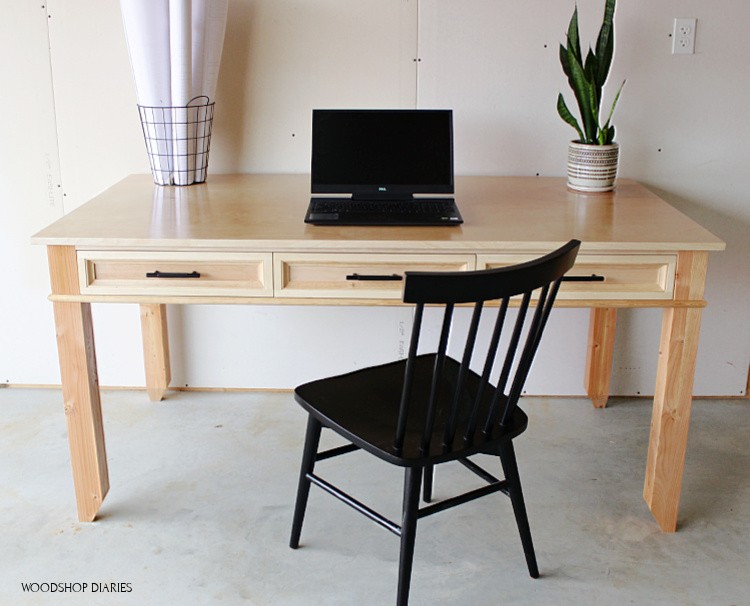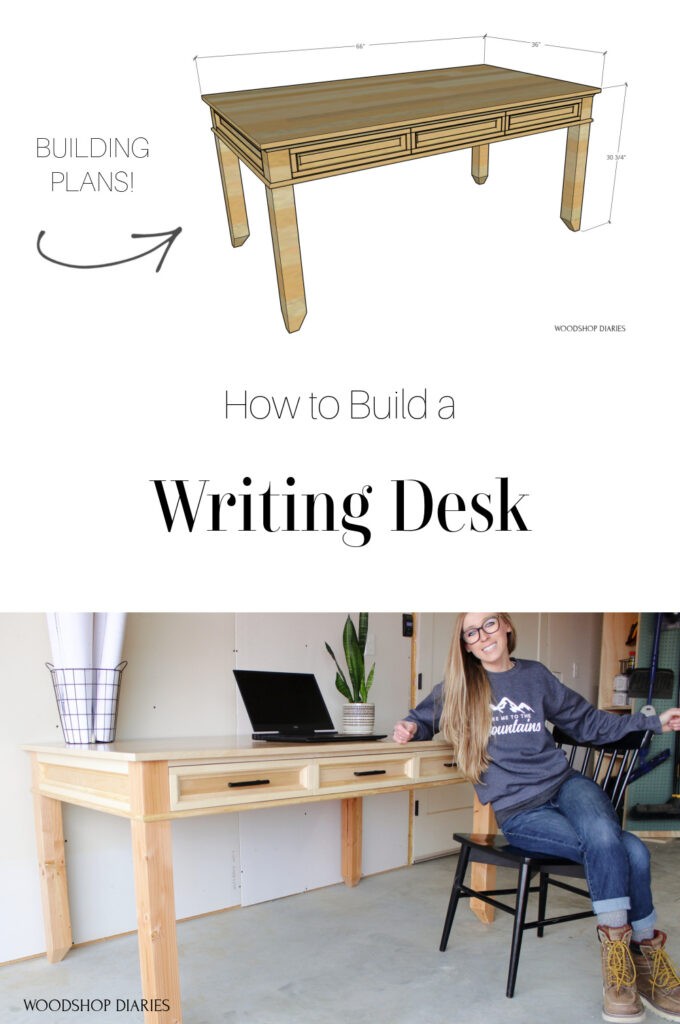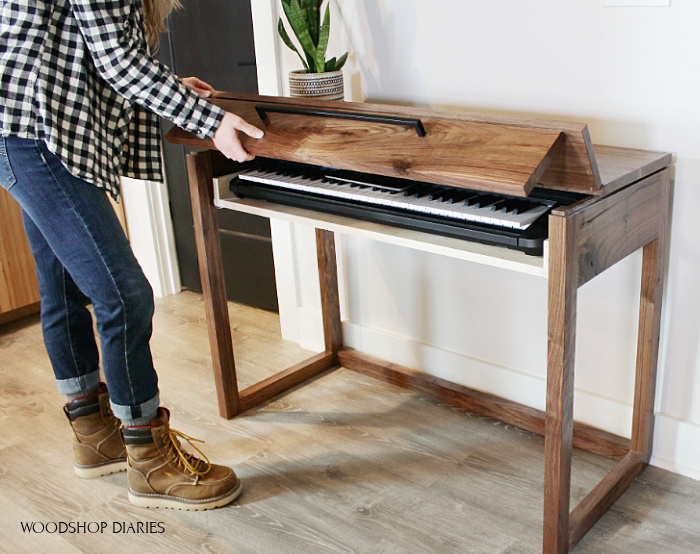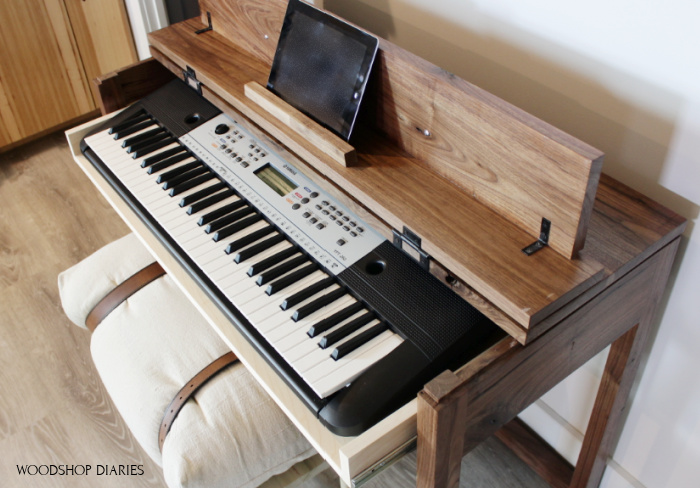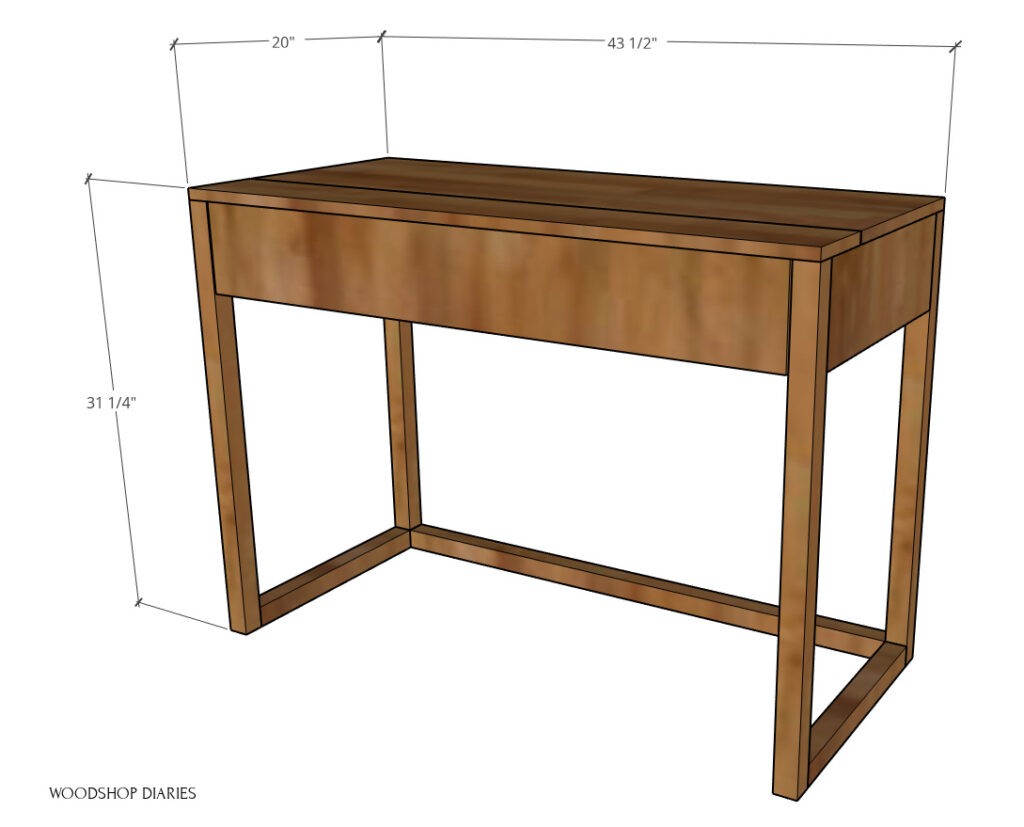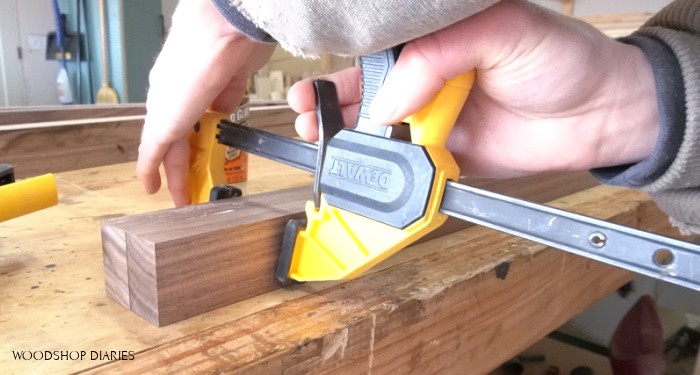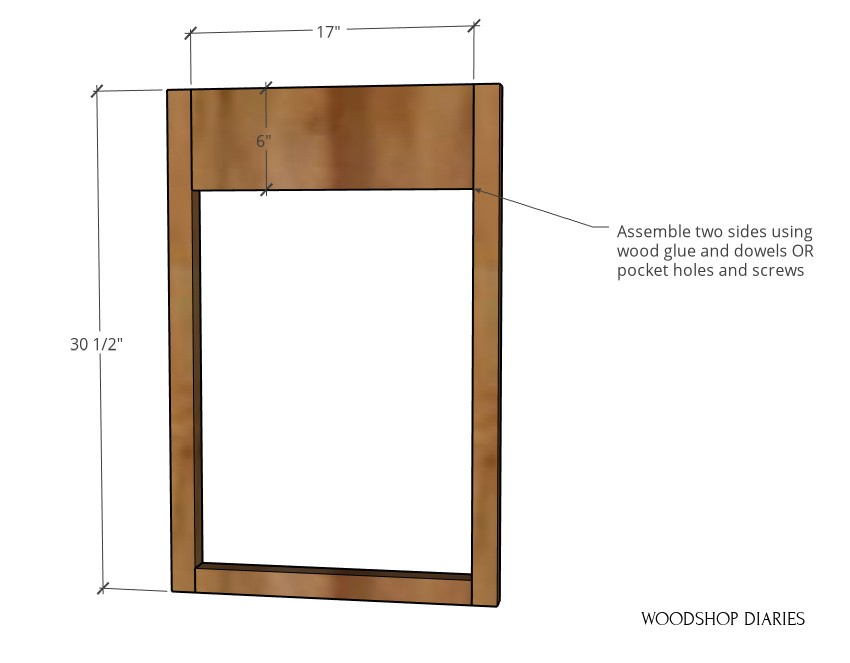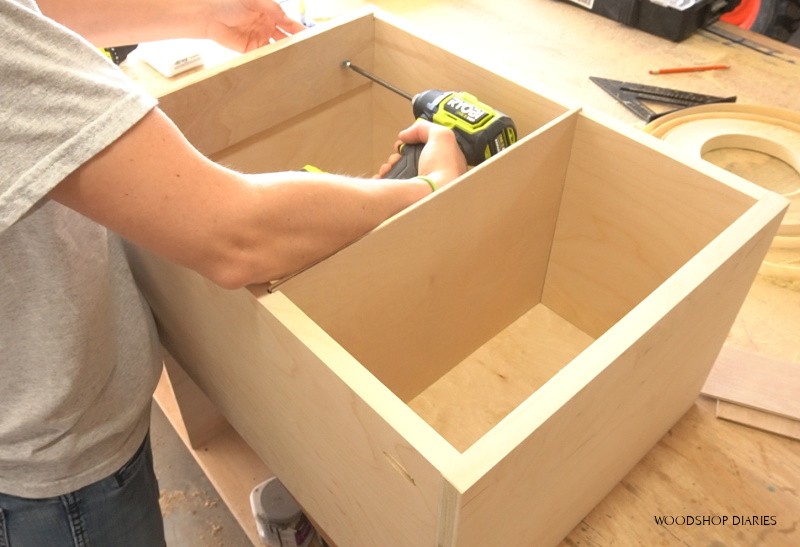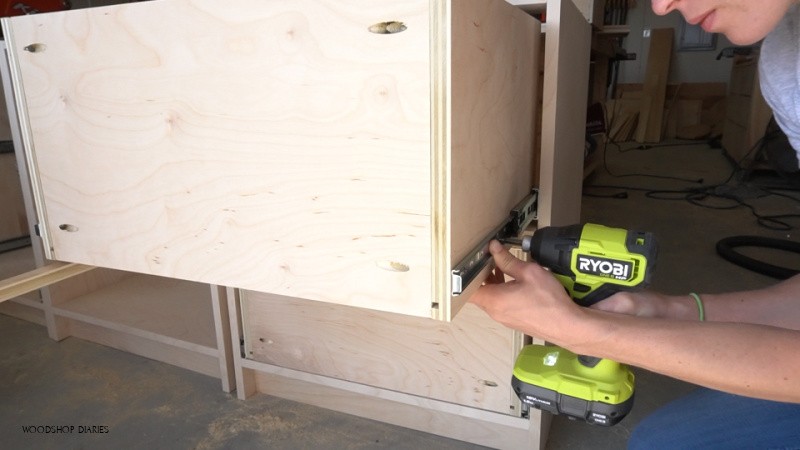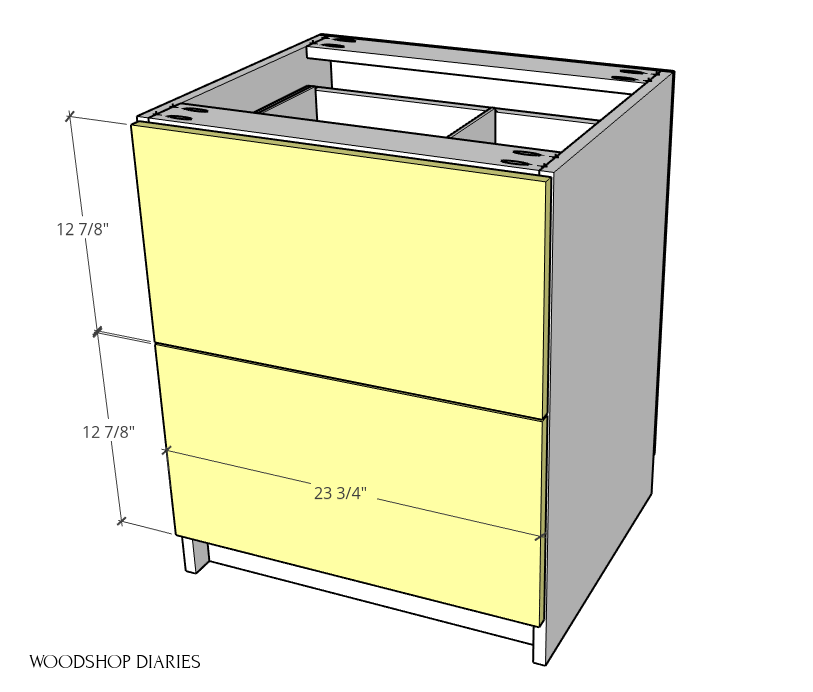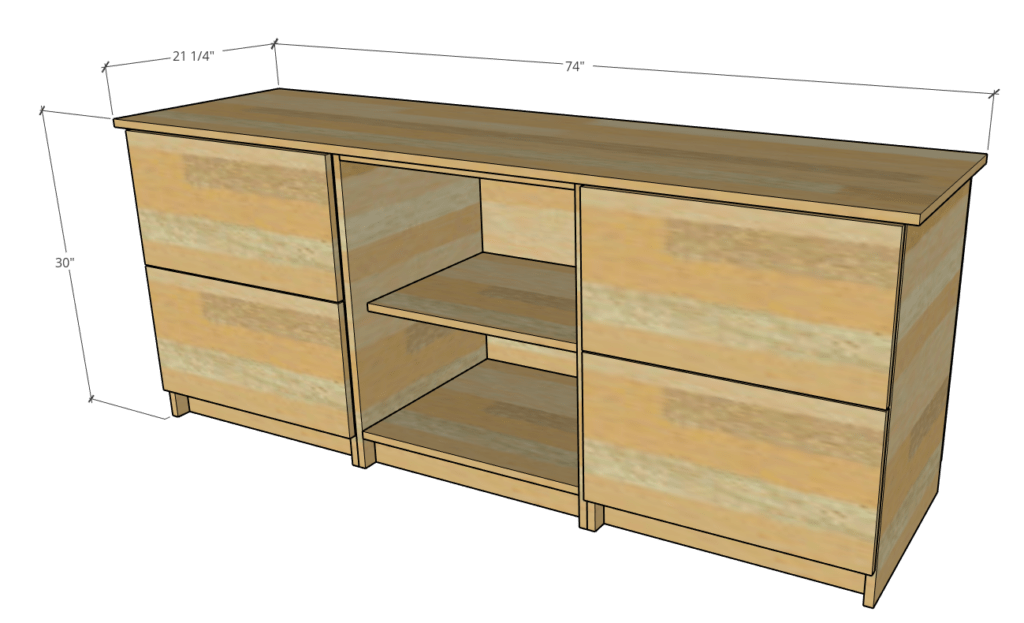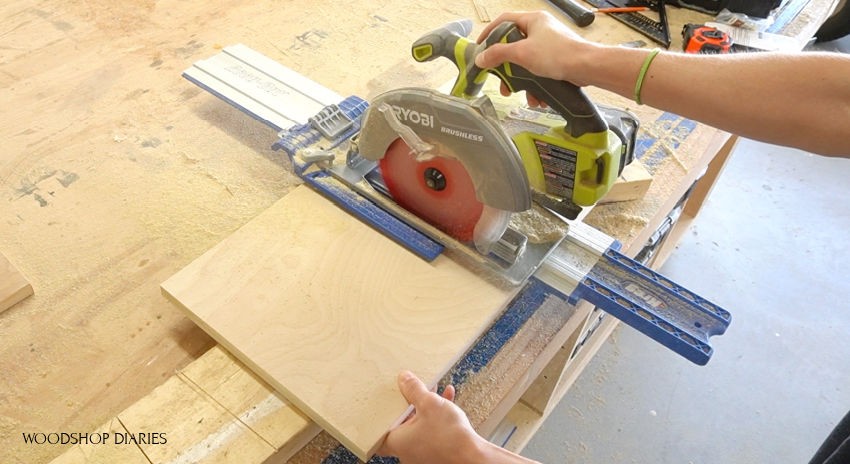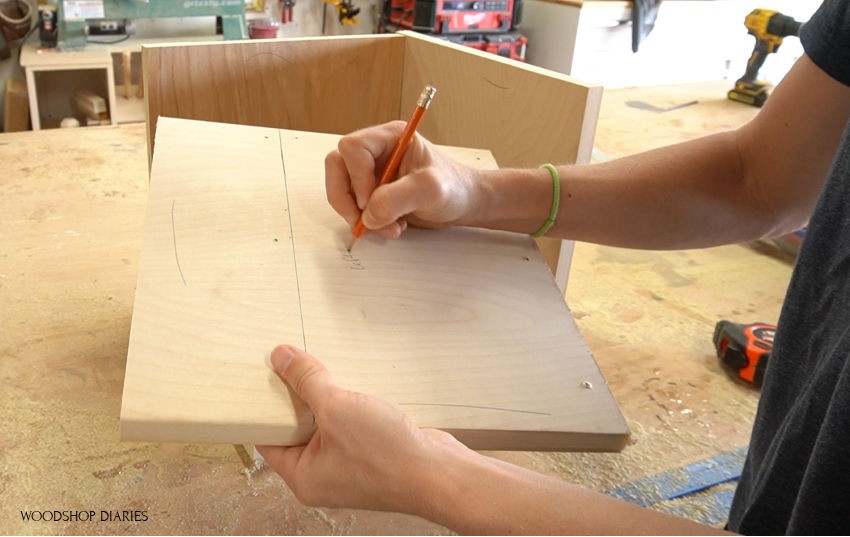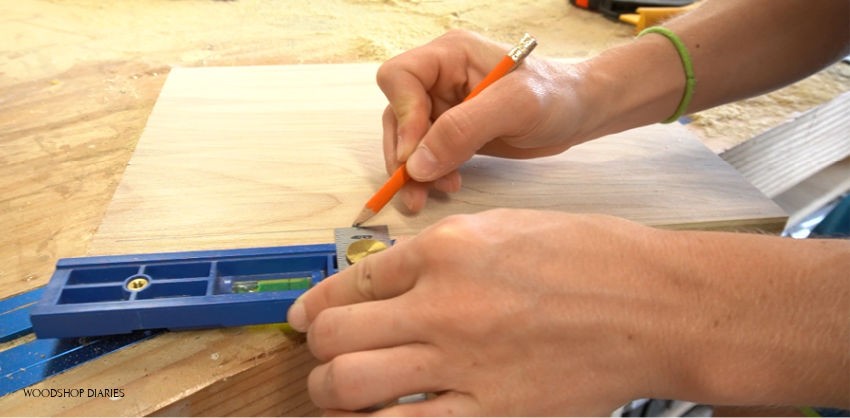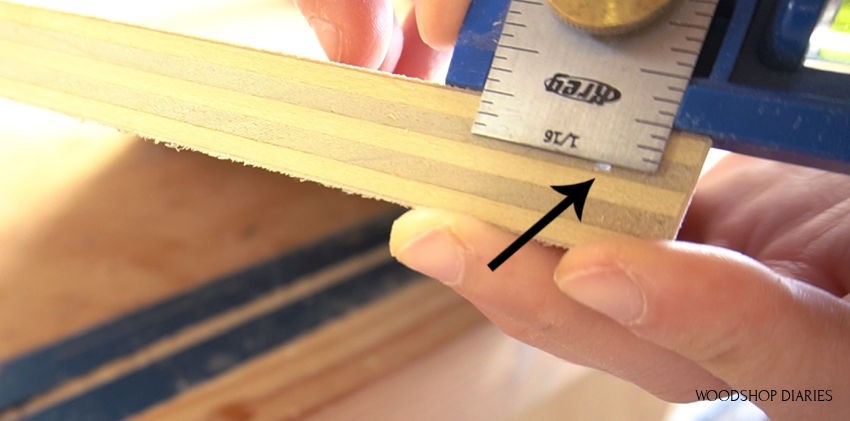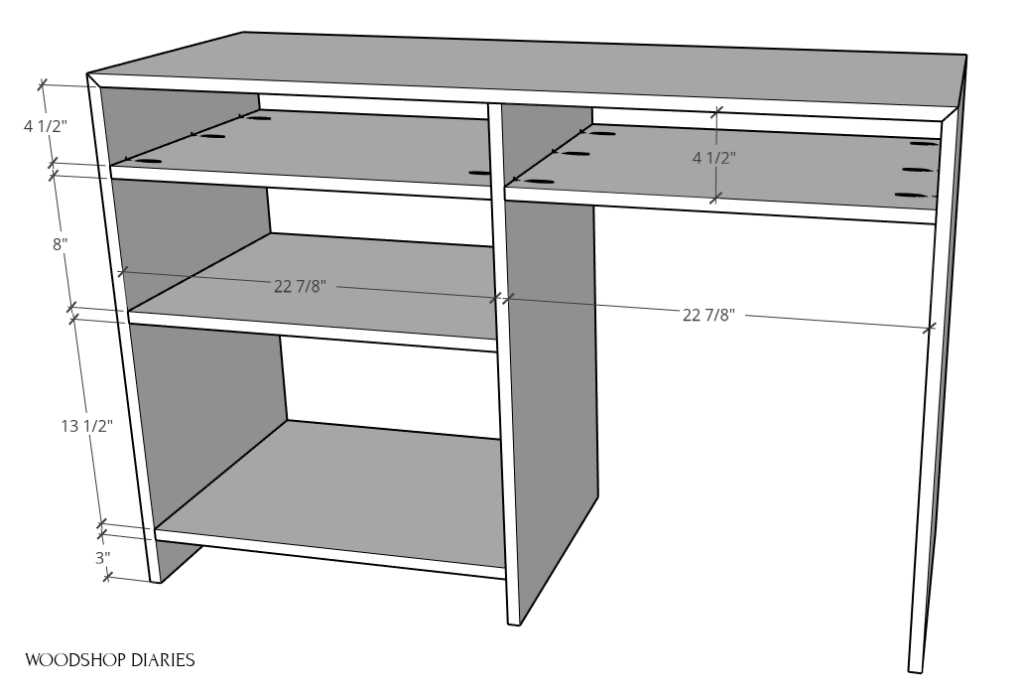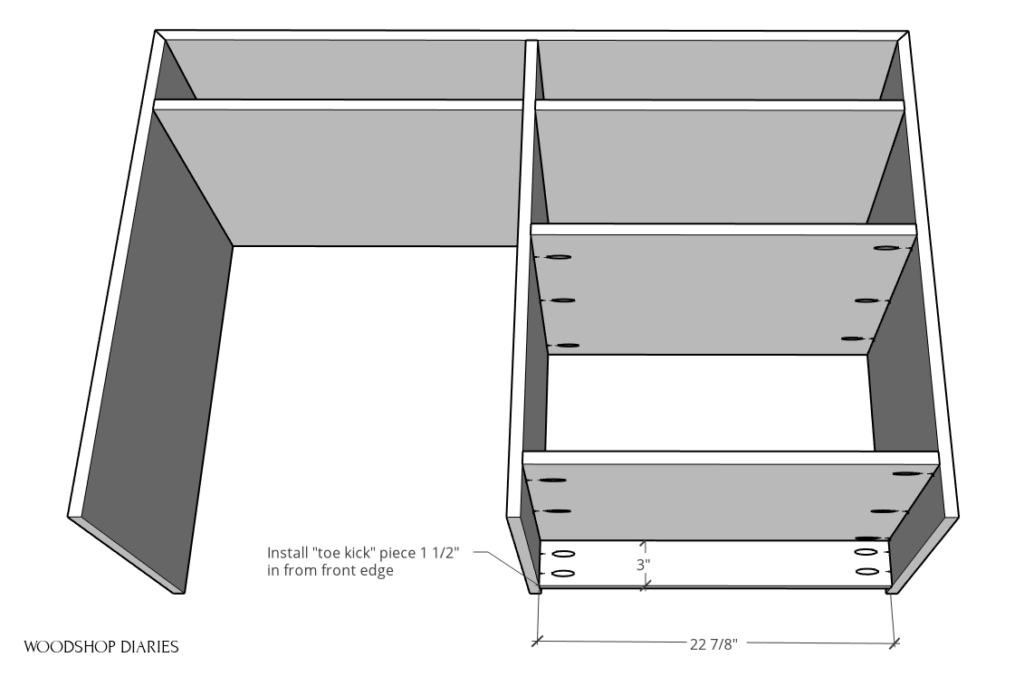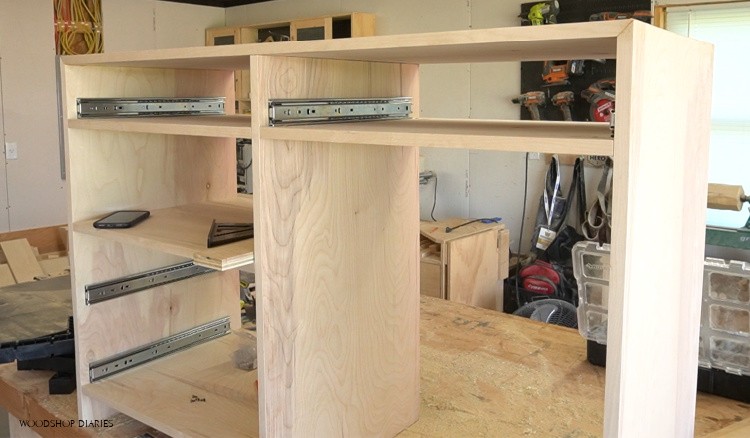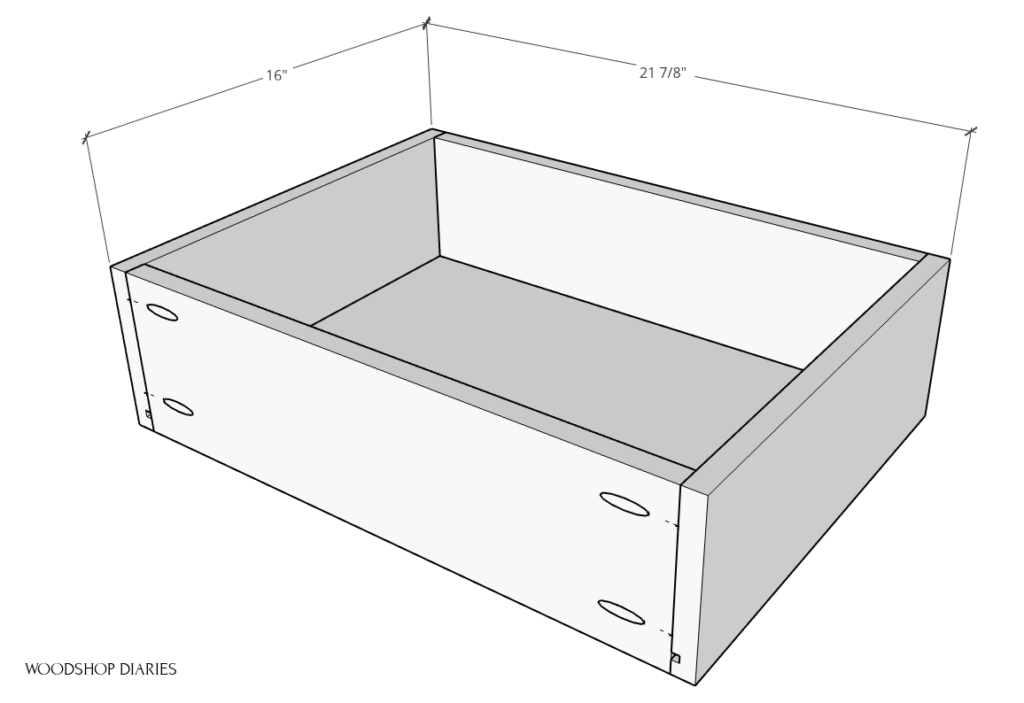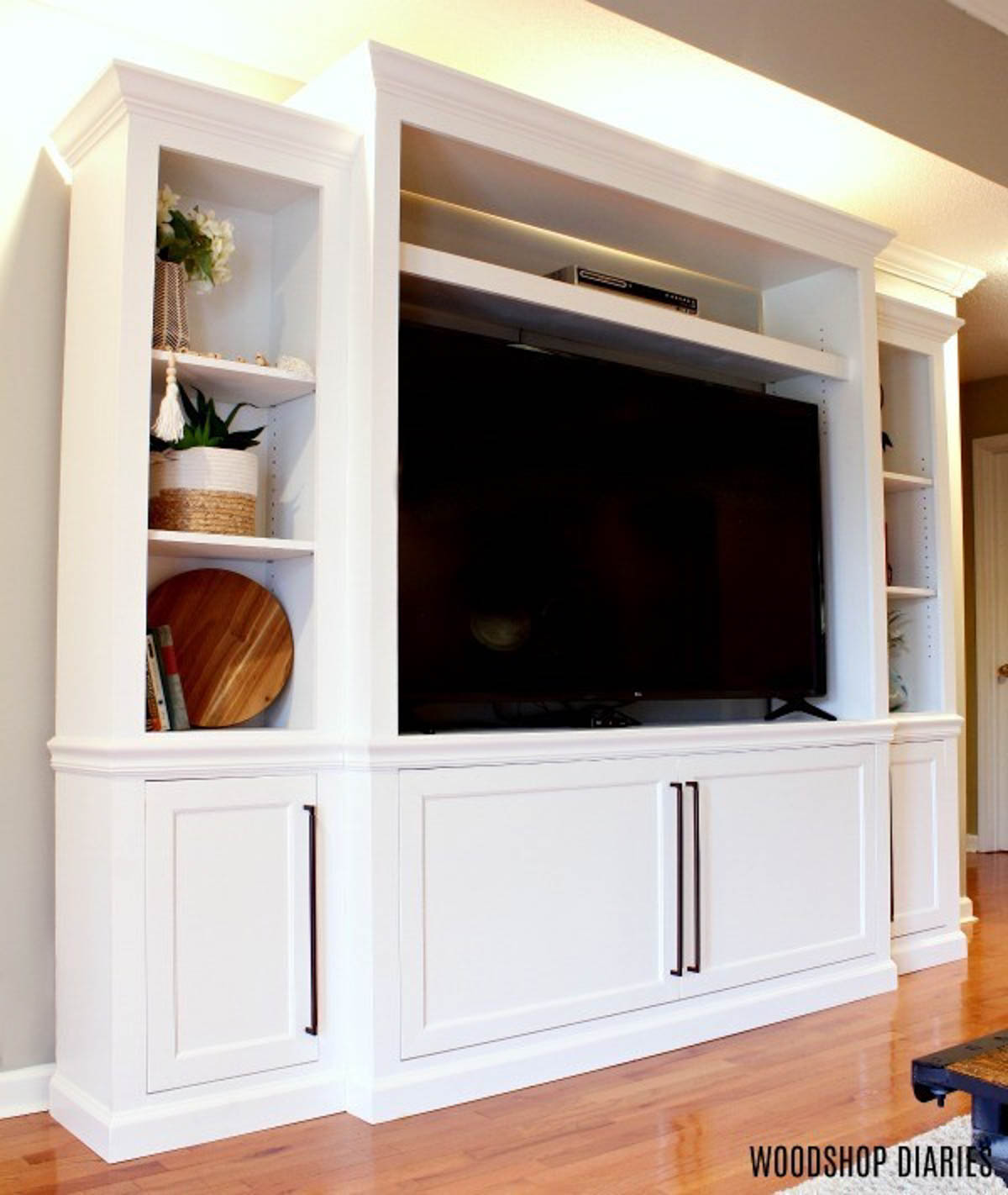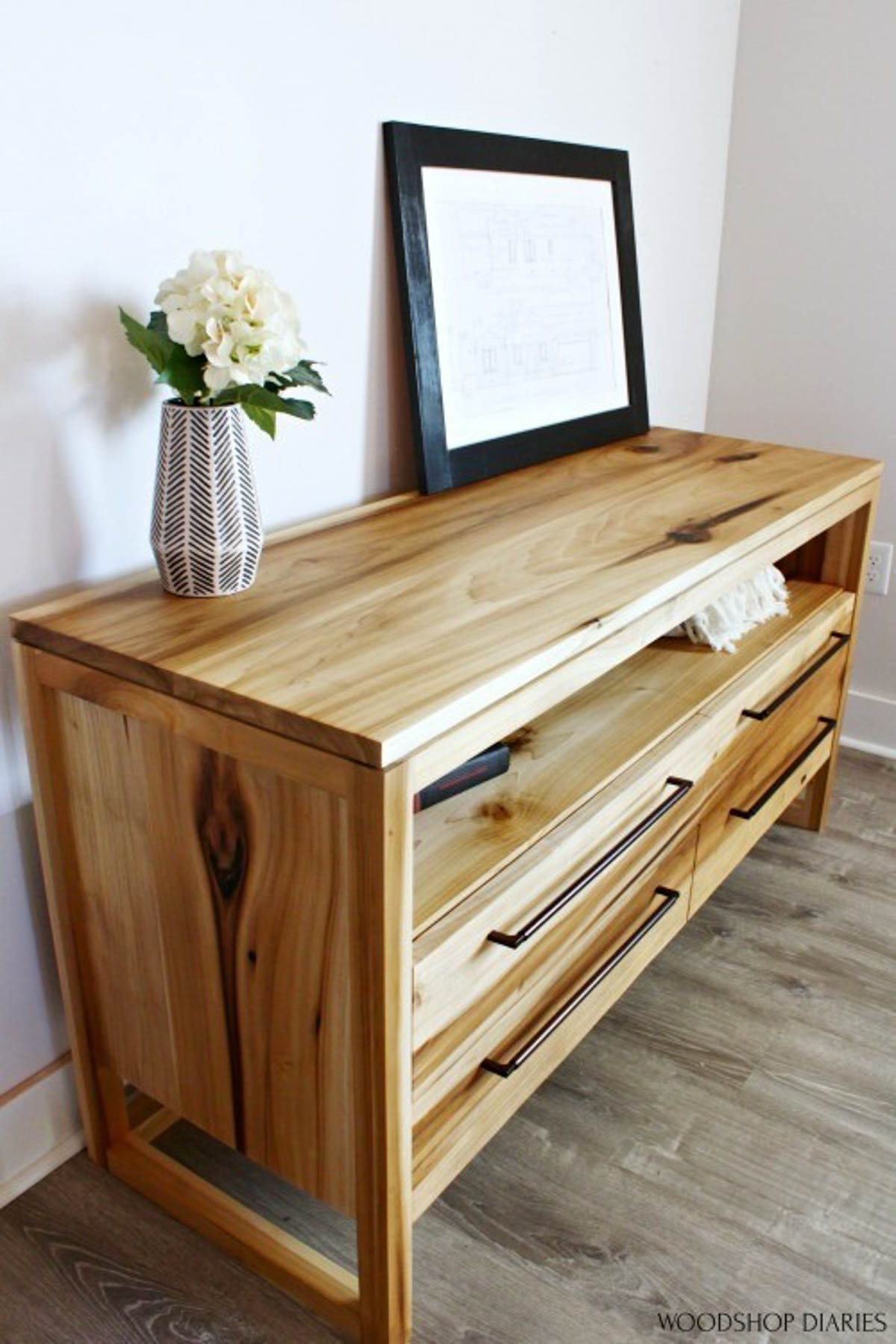
Woodshop Diaries

  • Shop
  • About
    • Work With Me
    • Frequently Asked Questions
  • DIY Projects
    • DIY Furniture Plans
      • DIY Bed Plans
      • DIY Dresser Plans
      • DIY Nightstand Plans
      • DIY Desk Plans
      • DIY TV Stand Plans
      • Coffee and Side Table Plans
      • Tables
      • Shelves and Bookcase Plans
      • DIY Storage Trunk Plans
      • DIY Bench Plans
      • DIY Storage Cabinet Plans
      • DIY Bathroom Vanity Plans
      • Kids Projects and Furniture
    • DIY Scrap Wood Projects
    • DIY Workshop Projects
    • DIY Home Decor Projects
  • Getting Started
    • Cabinet Building
    • Woodworking Basics
    • Furniture Finishing Tips
    • Tool Guides & Reviews
  • Blog
menu icon
go to homepage
  • Shop
  • About
    • Work With Me
    • Frequently Asked Questions
  • DIY Projects
    • DIY Furniture Plans
      • DIY Bed Plans
      • DIY Dresser Plans
      • DIY Nightstand Plans
      • DIY Desk Plans
      • DIY TV Stand Plans
      • Coffee and Side Table Plans
      • Tables
      • Shelves and Bookcase Plans
      • DIY Storage Trunk Plans
      • DIY Bench Plans
      • DIY Storage Cabinet Plans
      • DIY Bathroom Vanity Plans
      • Kids Projects and Furniture
    • DIY Scrap Wood Projects
    • DIY Workshop Projects
    • DIY Home Decor Projects
  • Getting Started
    • Cabinet Building
    • Woodworking Basics
    • Furniture Finishing Tips
    • Tool Guides & Reviews
  • Blog
search icon
Homepage link
  • Shop
  • About
    • Work With Me
    • Frequently Asked Questions
  • DIY Projects
    • DIY Furniture Plans
      • DIY Bed Plans
      • DIY Dresser Plans
      • DIY Nightstand Plans
      • DIY Desk Plans
      • DIY TV Stand Plans
      • Coffee and Side Table Plans
      • Tables
      • Shelves and Bookcase Plans
      • DIY Storage Trunk Plans
      • DIY Bench Plans
      • DIY Storage Cabinet Plans
      • DIY Bathroom Vanity Plans
      • Kids Projects and Furniture
    • DIY Scrap Wood Projects
    • DIY Workshop Projects
    • DIY Home Decor Projects
  • Getting Started
    • Cabinet Building
    • Woodworking Basics
    • Furniture Finishing Tips
    • Tool Guides & Reviews
  • Blog
×
Home

DIY End Table with Shelf (Using Only 2x2s!)

February 19, 2021 by Shara, Woodshop Diaries

In this post, I’ll show you how to make a simple DIY end table with a shelf using just 2x2s!
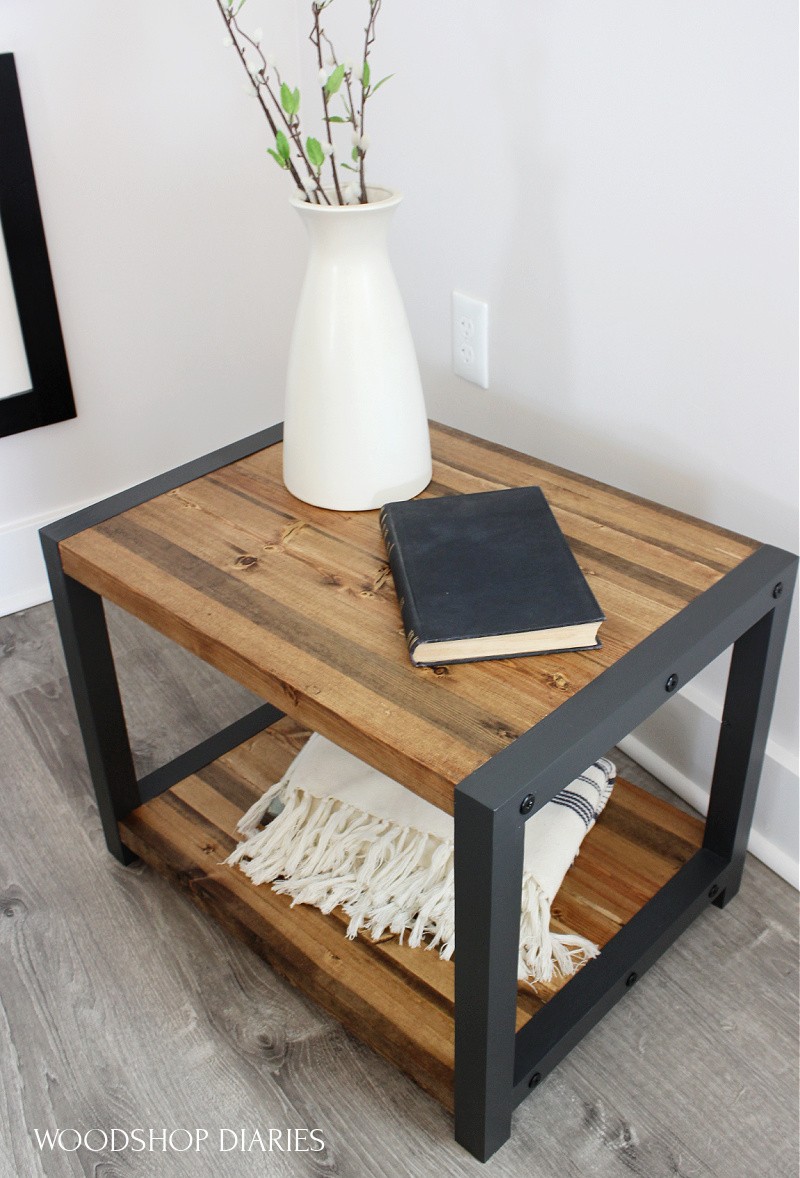
Angled view of DIY black and wood end table with timber screws on sides. Black frames and wood top and bottom shelves with vase and book on top

This simple side or end table is a great weekend build and only requires a few basic tools!

.

It’s got a modern industrial vibe going, but you can get creative and finish differently to match your own décor style.

.

So if you’re ready to get building, let’s go 🙂

How to Make a DIY End Table

This post contains affiliate links. See policies.

Tools and Materials

For this Basic DIY End Table, You Will Need:

  • (8) 2x2x8 (Or cut your own 2x2s from 2x4s with this tutorial)
  • Saw (can use jig, circular, or large miter saw for this)
  • Drill/Driver
  • Wood Glue
  • Clamps (long bar or pipe clamps are best)
  • 2 ½″ wood screws
  • Black timber screws (I used these–you need 12 screws per table)
  • Sander
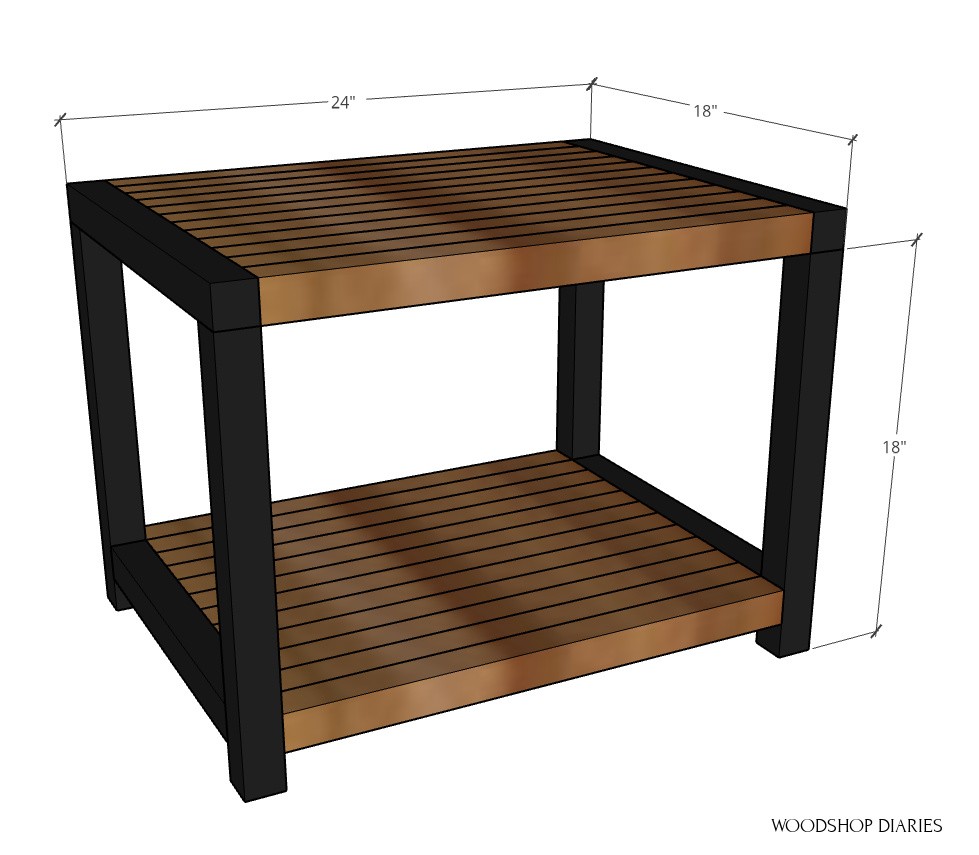
Overall dimensional diagram of end table--18" tall, 18" deep, 24" wide

Step 1: Assemble Top and Bottom DIY End Table Shelves

The top and the bottom shelf of this end table are made up of 2x2s glued together.

.

Obviously, you can use other lumber sizes here instead as you wish, but I just liked the “butcherblock” look of the 2x2s.
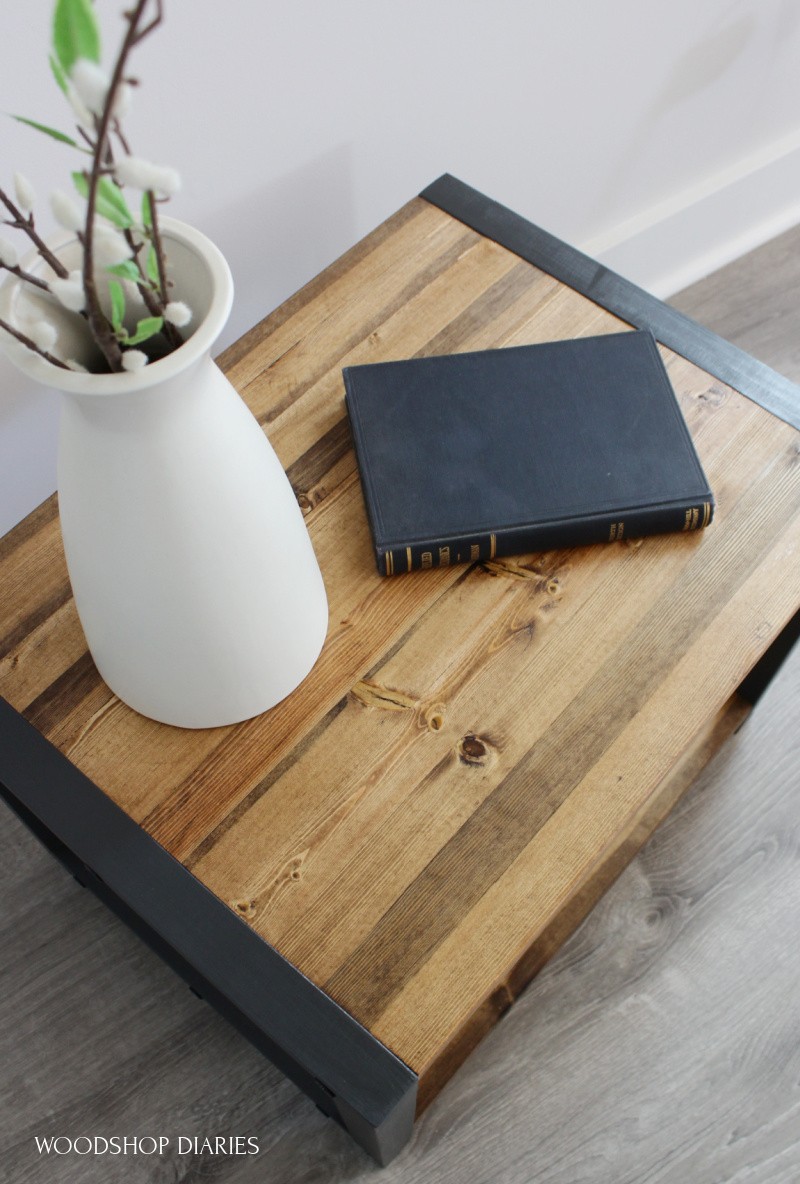
Overhead view of DIY end table--top made of 2x2s glued together

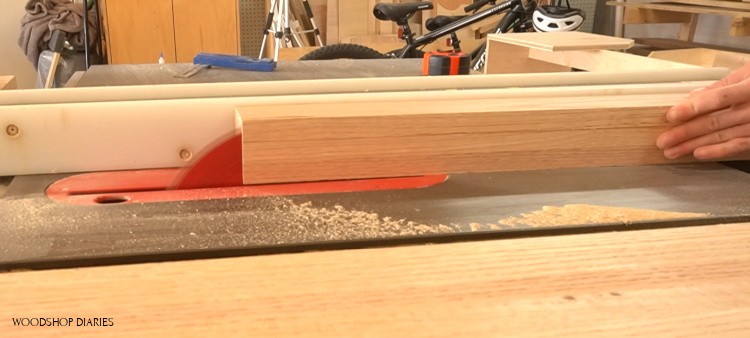
Now, I make my own 2x2s from 2x4s using my table saw. You can learn about how to make your own 2x2s in this post. BUT, if you don’t have a table saw, using 2x2s straight from the store is fine.

.

First, I cut 6 of my 2x2s in half to give me 12 total 2x2s about 48″ long–it doesn’t have to be EXACT. I’ll be trimming this down later.

.

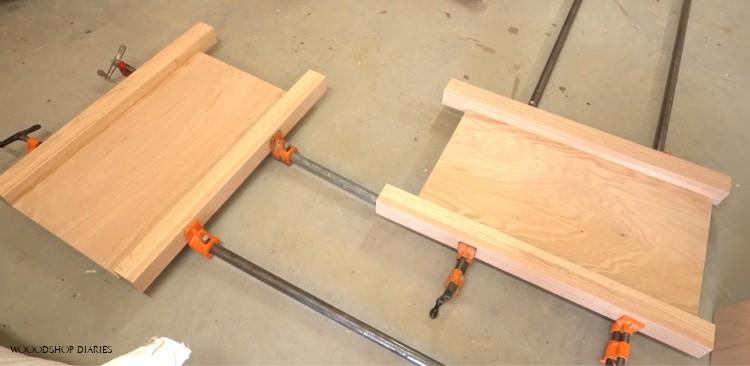
I separated these into two sections of 6 and glued up 6 at a time using wood glue and pipe clamps. You can glue up all 12 at once, but I think it’s easier to do it in sections.

RELATED: Check out this post for how to glue up panels for some helpful info about glue ups!
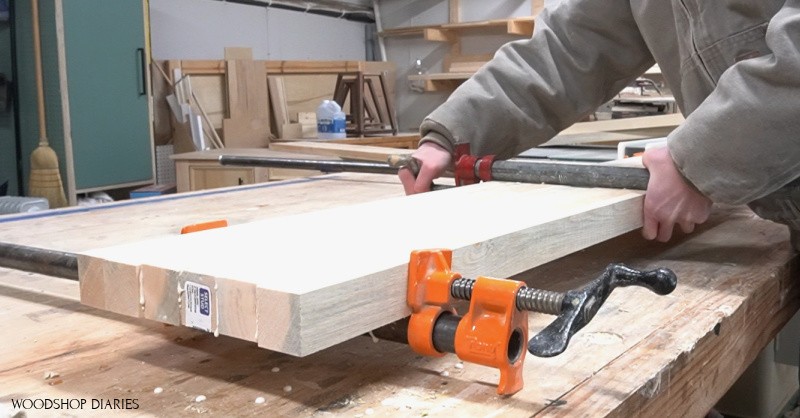
Shara using pipe clamps to glue six 2x2s together to make the first half of the shelf panel

This gave me two separate panels about 9″ wide and about 48″ long.
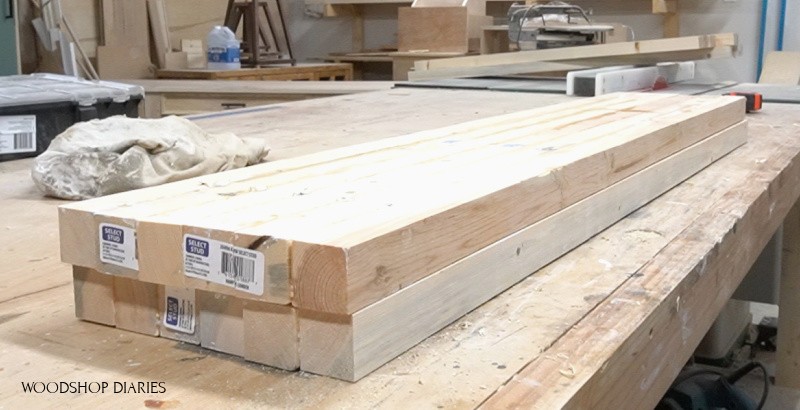
two sets of panels made of 2x2s glued together on workbench

Once the glue dried on each section of 6, I sanded the tops smooth. If you have a planer, you can plane each section smooth, but if not, a belt sander or orbital sander works, too.

.

Then, I glued these two panels together. This gives me one large panel about 18″ wide and 48″ long that is made up of twelve total 2x2s.
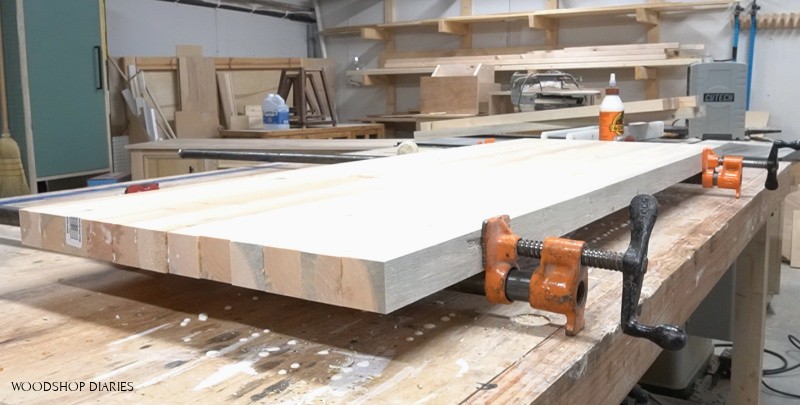
Panel in pipe clamps on workbench being glued together

Again, if you didn’t want to use 2x2s here, you could glue up another size here as long as you end up with it being 18″ wide at the end.

.

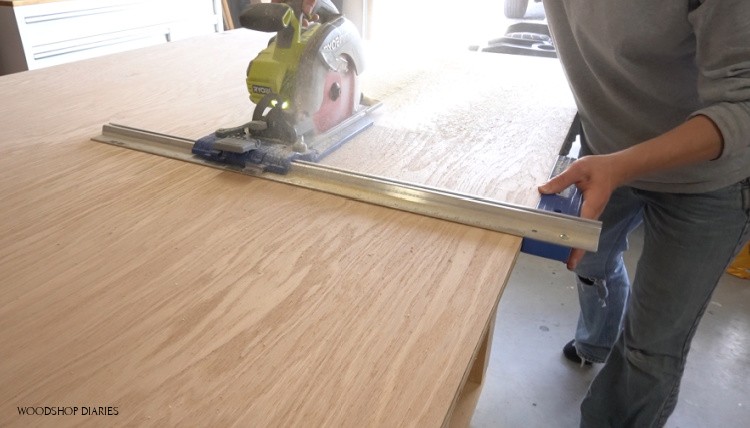
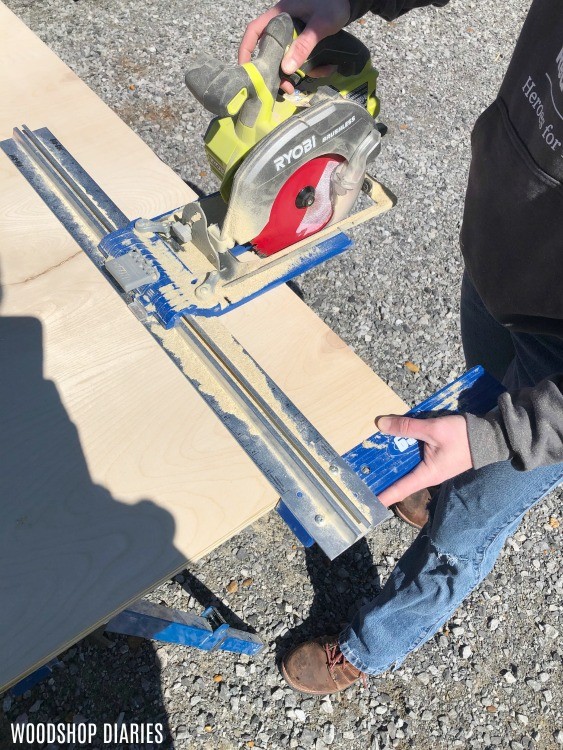
Once the glue dried on the whole panel, I used a circular saw and an AccuCut (or a straight edge works, too!) to cut two shelves.

RELATED: Check out how to use the AccuCut in this post!

.

You could also use a jigsaw here or a miter saw if yours is large enough.

.

I trimmed about 1″ off one edge to give me a smooth edge to start from first. Use a square to ensure you cut this 90 degrees.
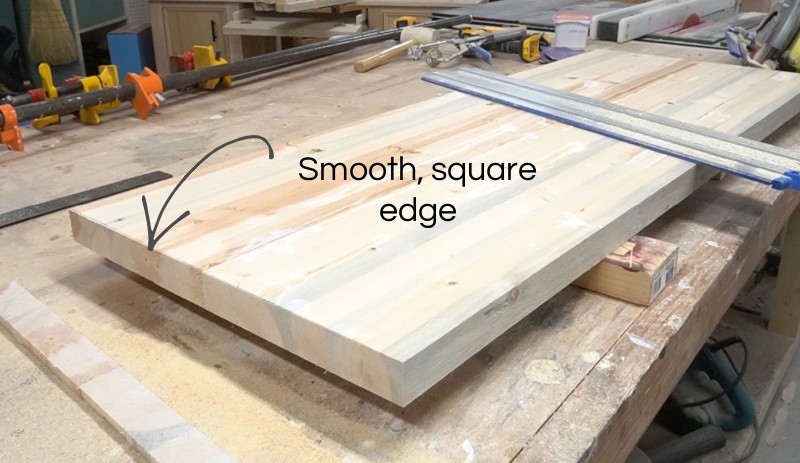
Smooth square edge cut off glued up panel

Then, I measured from the smooth edge and cut two pieces 21″ long to make the top and bottom shelves.
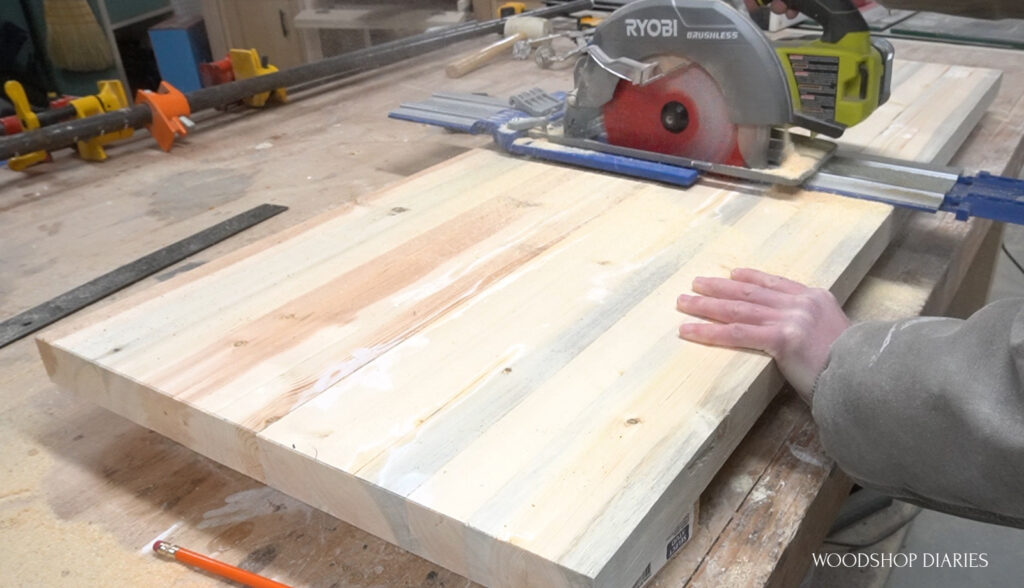
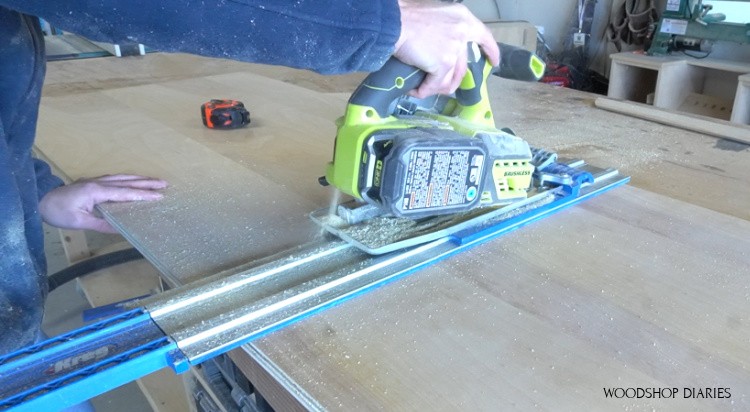
Shara using circular saw and AccuCut to trim shelf panel from slab

Sand well to remove all glue residue and, if desired, go ahead and stain/paint as desired. I stained these Minwax Provincial.
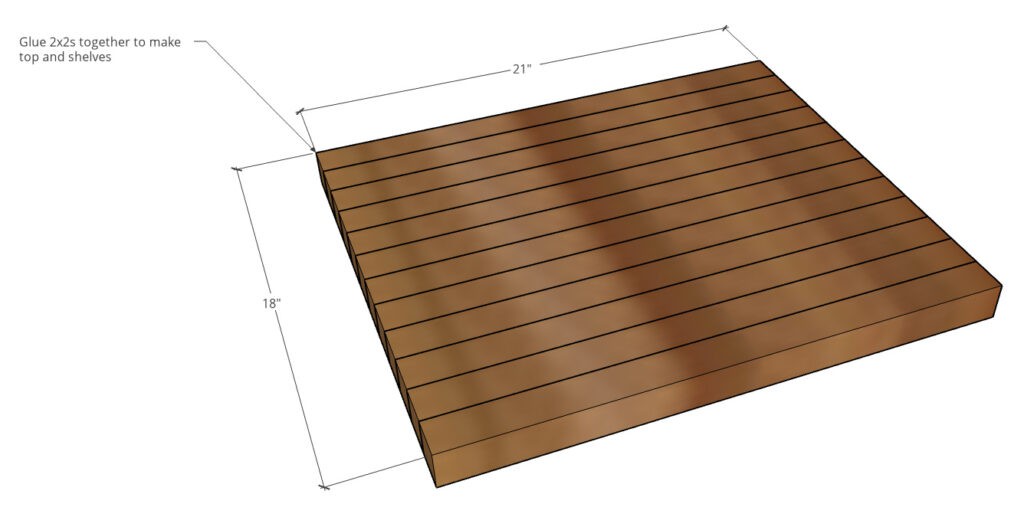
Dimensional diagram of top and bottom shelf panels--18" x 21"

Step 2: Assemble End Table Frames

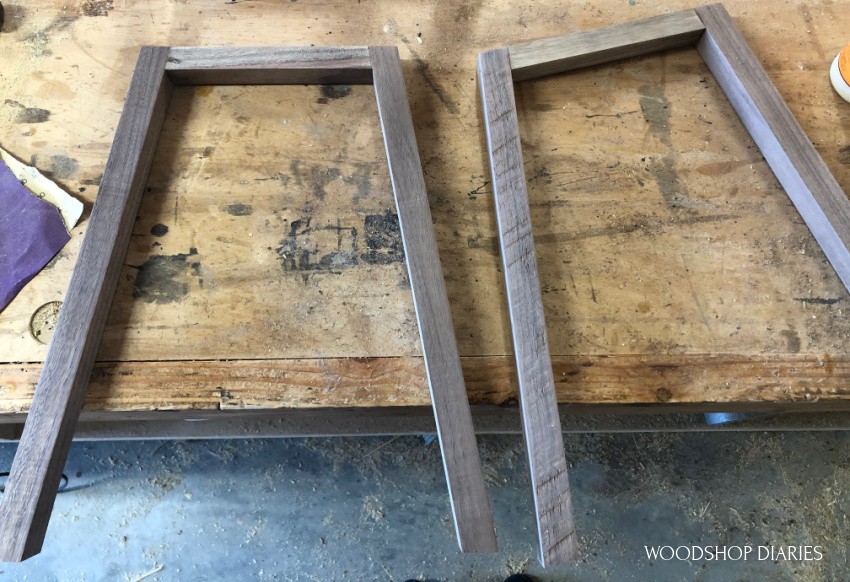
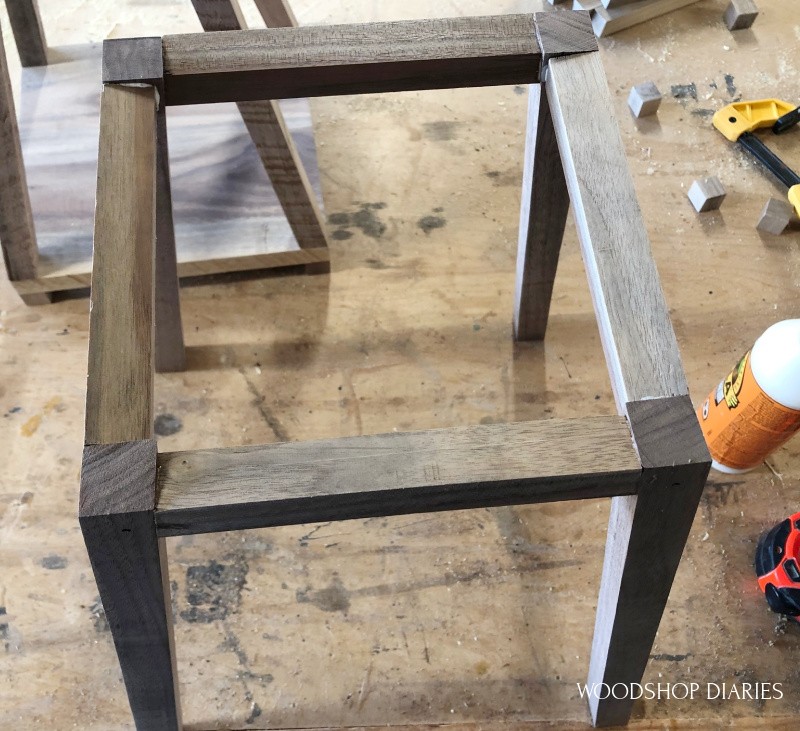
These frames were also made from 2x2s. Since they will be painted, I simply glued and screwed them together. Once it was assembled, I could putty over the screw holes.

.

However, if you plan to stain and don’t want to see the screw heads or the putty, you can use dowels or pocket holes instead.

.

I cut the 2×2 pieces and assembled two frames as shown using wood glue and a 2 ½″ wood screw at all the joints. NOTE: Don’t forget to predrill before driving the screws!
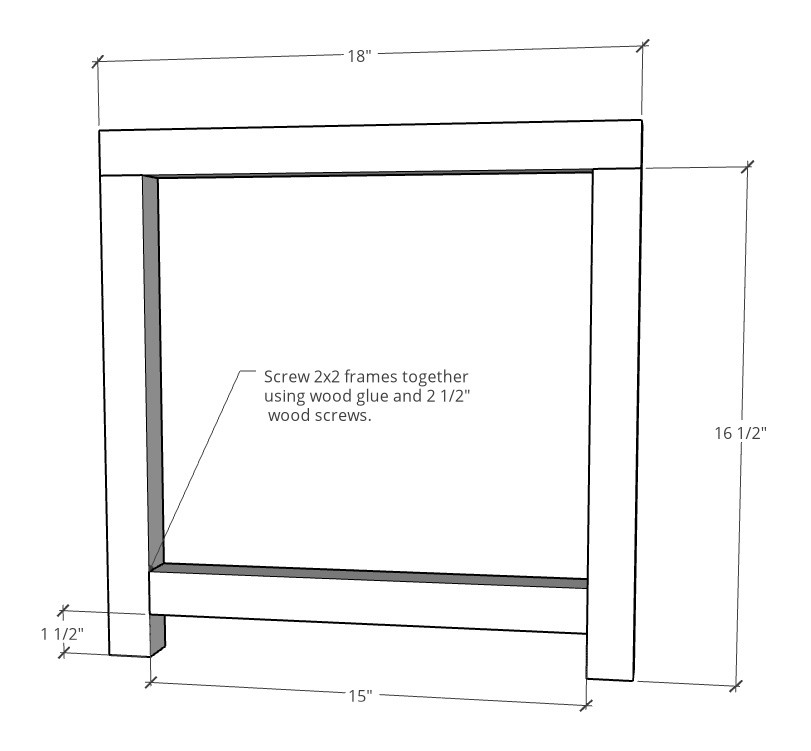
End table side frame dimensional diagram

Step 3: Drill Pilot Holes in Side Frames

To give this little DIY end table an industrial look, I used these black timber screws in the side frames to attach the top and bottom shelf.
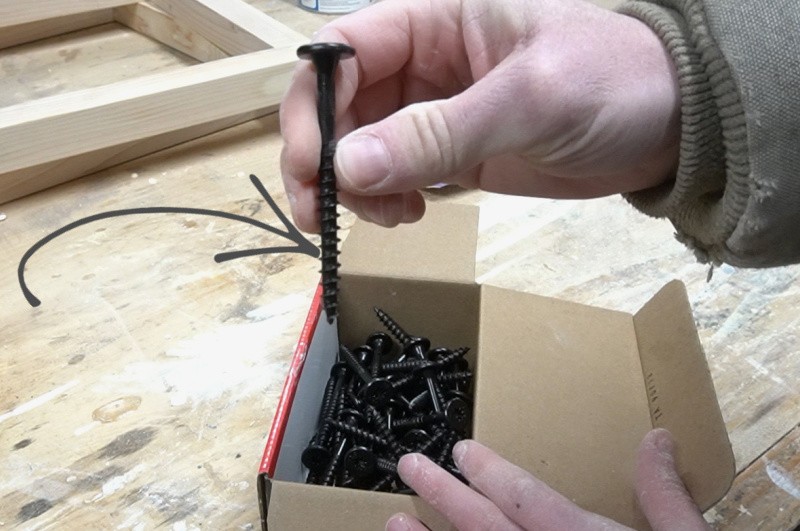
Close up of timber screws used to attach shelves on end table

But with changes in temperature and humidity over the seasons, the top and bottom shelf may expand and contract and cause a split.

.

So to help prevent this, I drilled pilot holes into the side frames to give the screw some “wiggle room” to move around as needed.

.

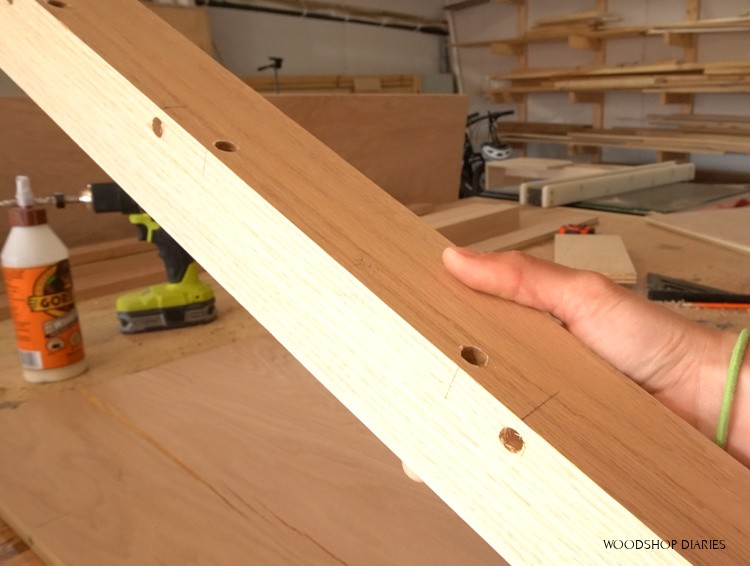
I marked these locations on the frames and used a small drill bit to drill a hole at each spot. NOTE: The holes on the bottom need to be at least 2 ¾″ from the edge to avoid hitting the wood screw from step 2 🙂
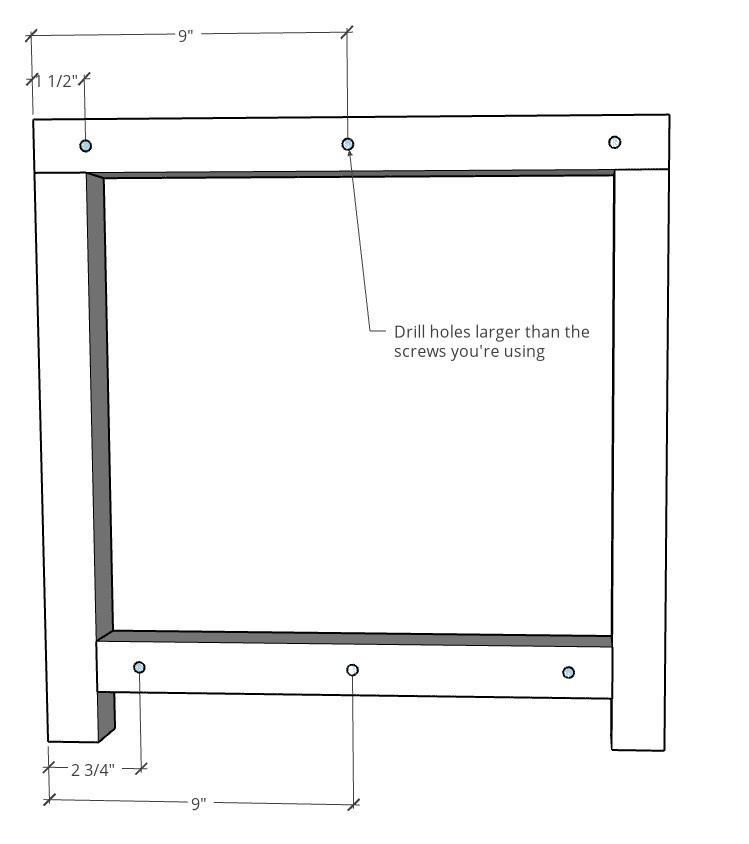
Diagram showing pilot hole locations on end table side frames

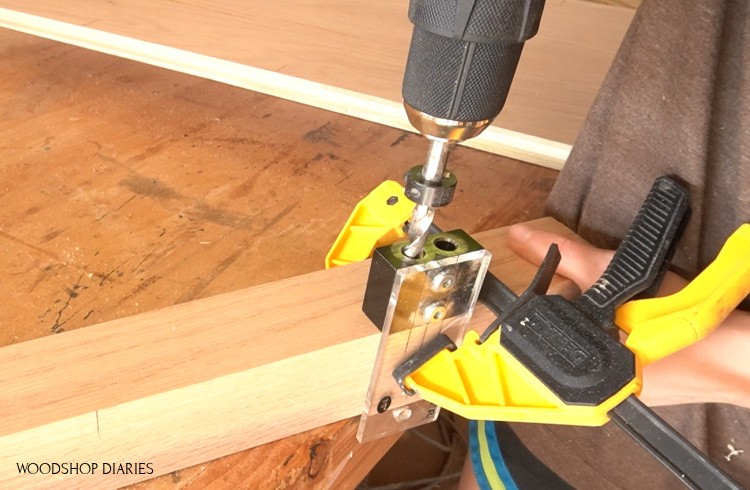
Then, I found a drill bit that was slightly larger than the screw (5/16″ seemed to work well) and drilled out these holes.
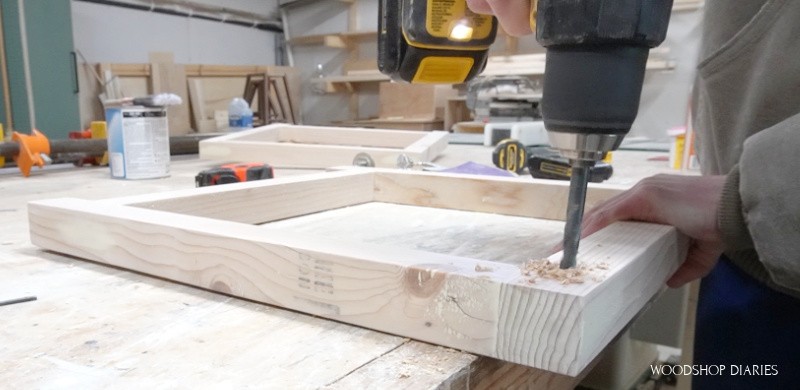
Using 5/16" drill bit to enlarge holes on side frames

Once all six holes were drilled in each frame, I puttied as needed, sanded well, then primed and painted them SW Iron Ore.

RELATED: Check out this post to learn more about how to finish raw wood furniture!

Step 4: Assemble End Table Together

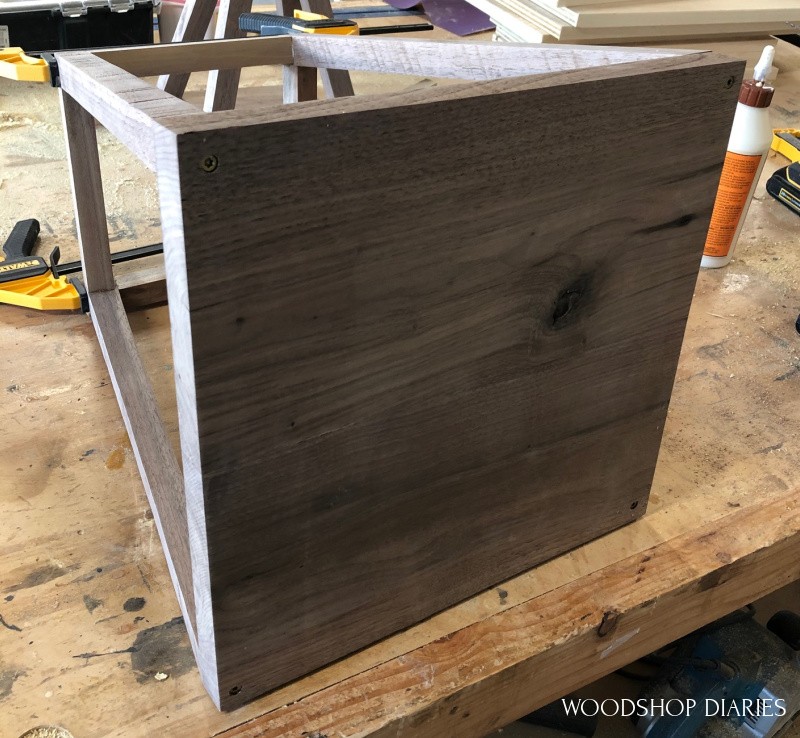
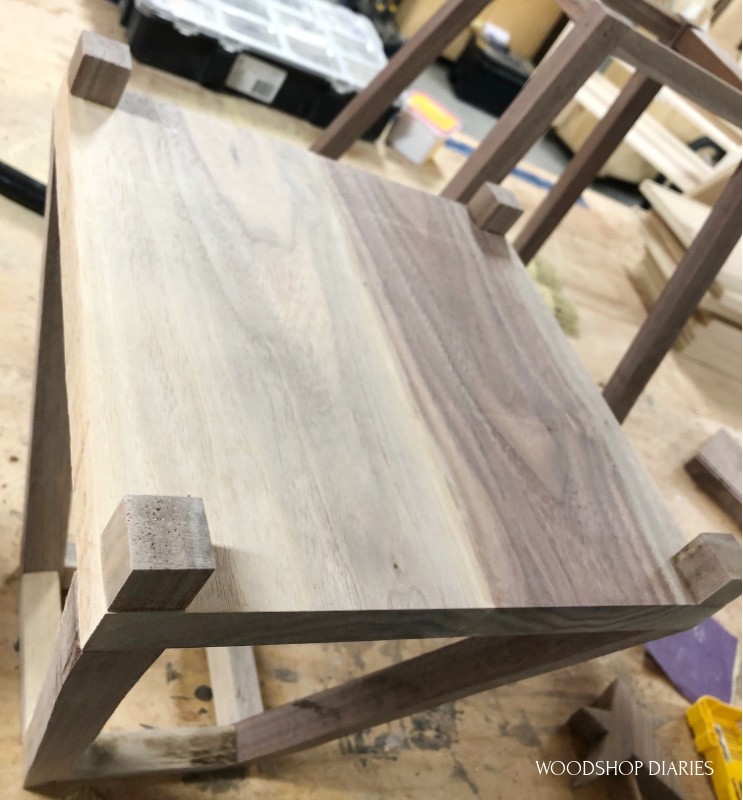
Once the paint and stain was dry, I attached the top and bottom shelves between the two side frames using the 2 ⅞″ black timber screws.
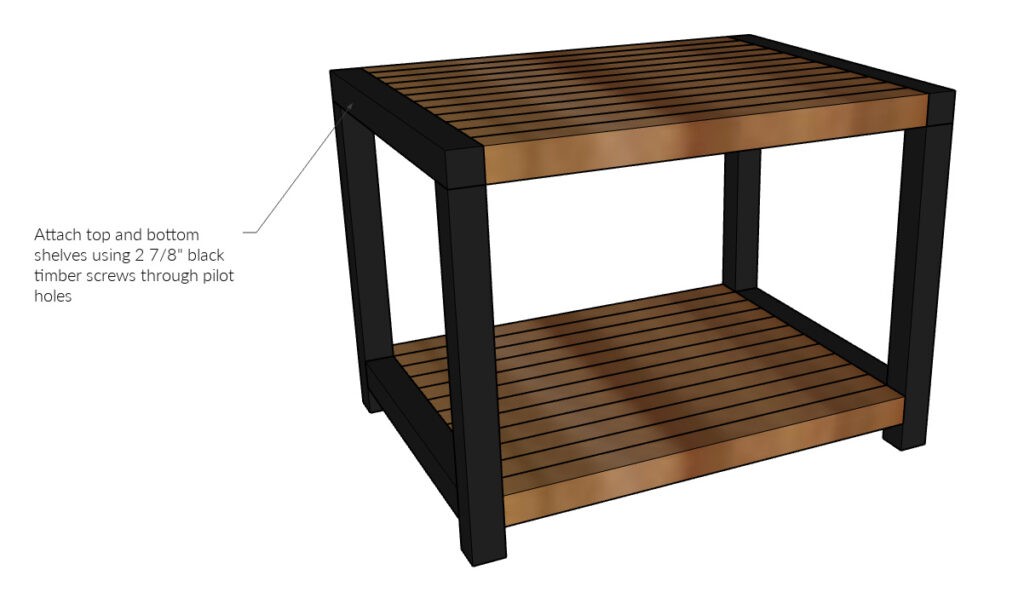
Graphic showing two shelves attached between two side frames

It’s important to predrill here as the top and shelves can split with these large screws.

.

It’s also important to assemble these pieces square. If you have some corner clamps, or a speed square, either clamp it square while you assemble or check for square after each screw.
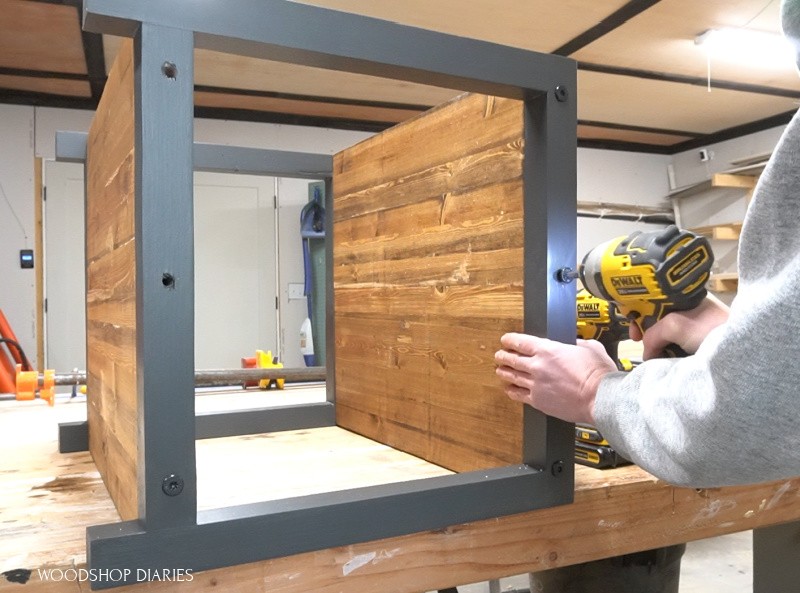
Shara Woodshop Diaries driving timber screw through end table frame to attach top shelf

You don’t want to end up with a lopsided or “leaning” end table 🙂

Step 5: Finish End Table

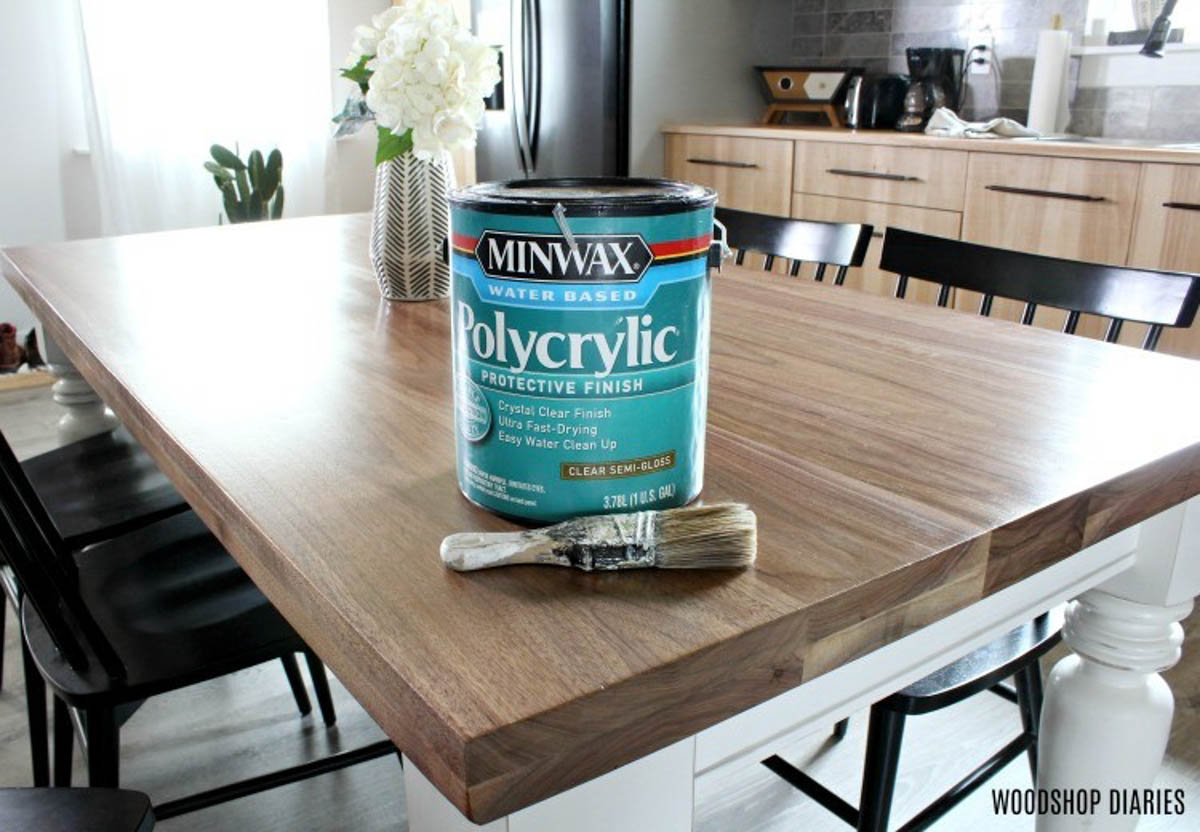
Once the table was assembled, I applied a couple coats of poly (I used Minwax Polycrylic) to seal it all and protect it, and then it was finished!
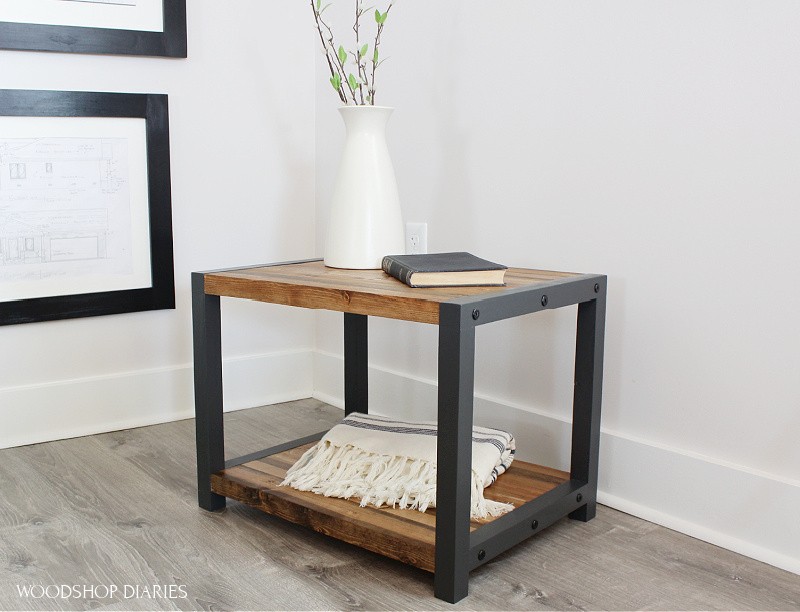
Modern industrial black and wood end table with timber screws on side--staged with vase and book

A simple DIY end table with a bottom shelf. The perfect addition for beside the couch, a recliner, or any seat in the house. You could even use it as a nightstand.

.

Do note that this table is 18″ tall. If you wanted a taller table, simply cut the legs on the side frames a little longer and everything else stays the same 🙂

.

I hope you’ve enjoyed this simple little weekend woodworking project and if you’d like to check out more end table ideas, here are a few of my favorites!
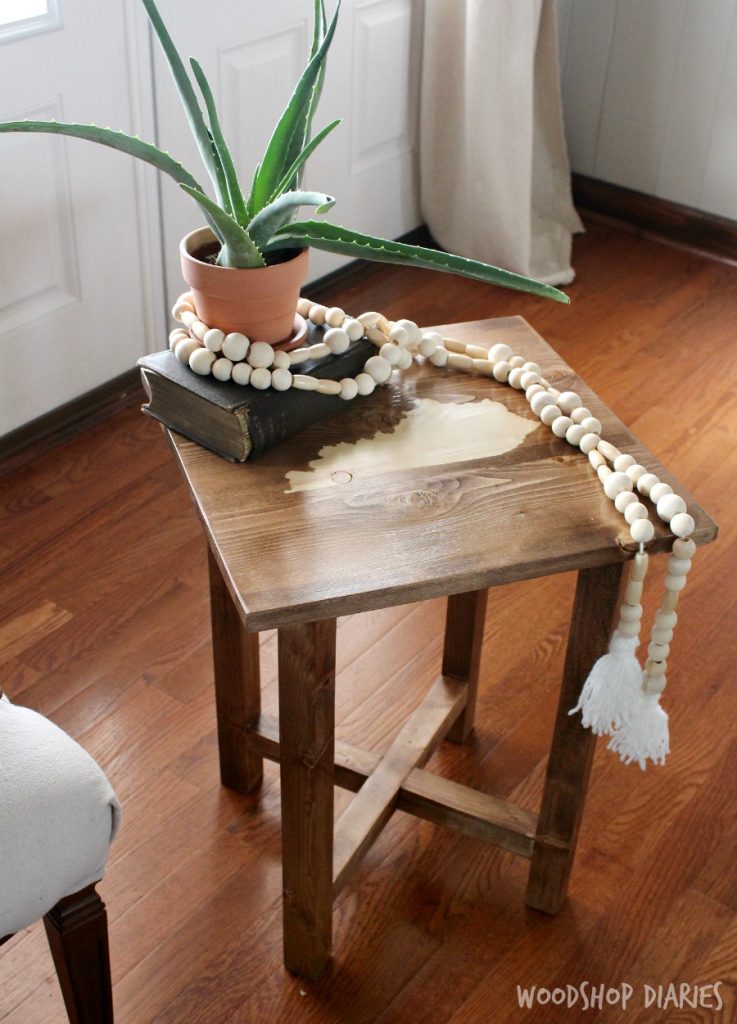
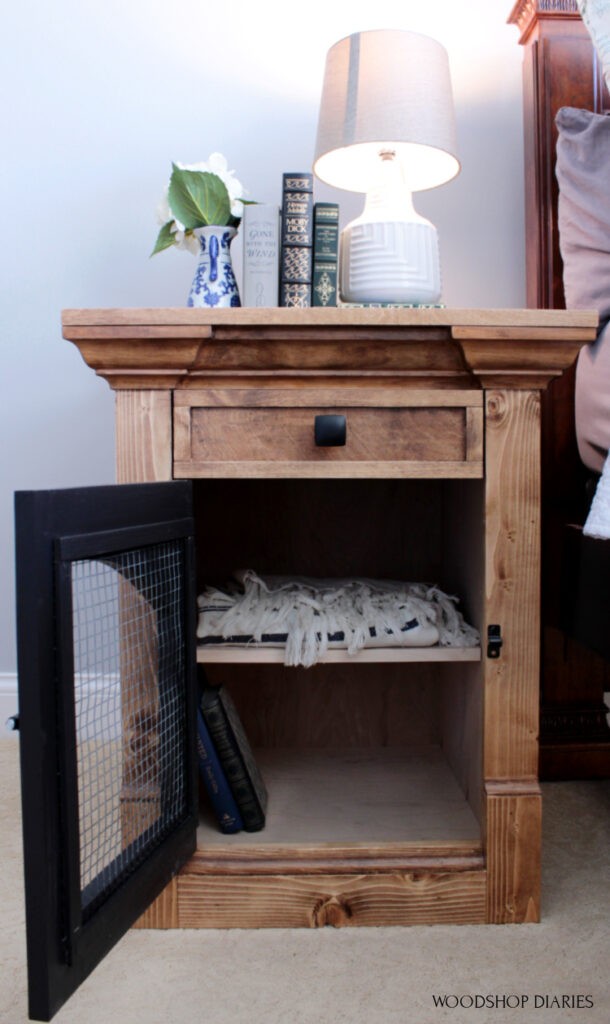
How to build a simple little side table from a few boards and with a few simple tools.
DIY Simple End Table
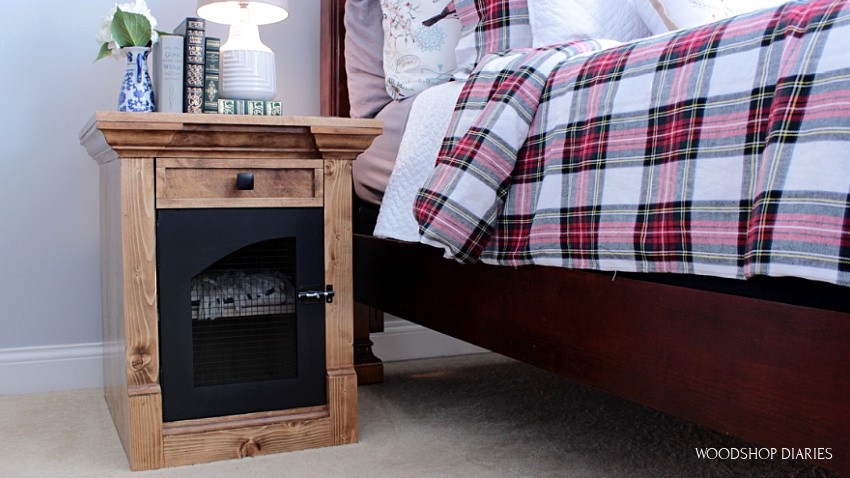
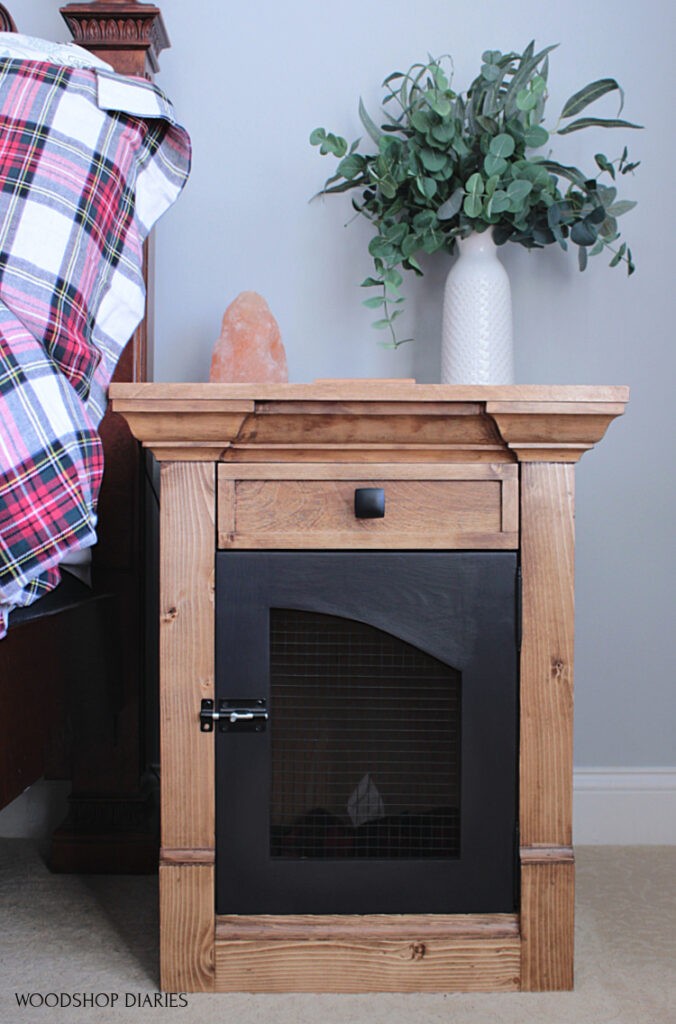
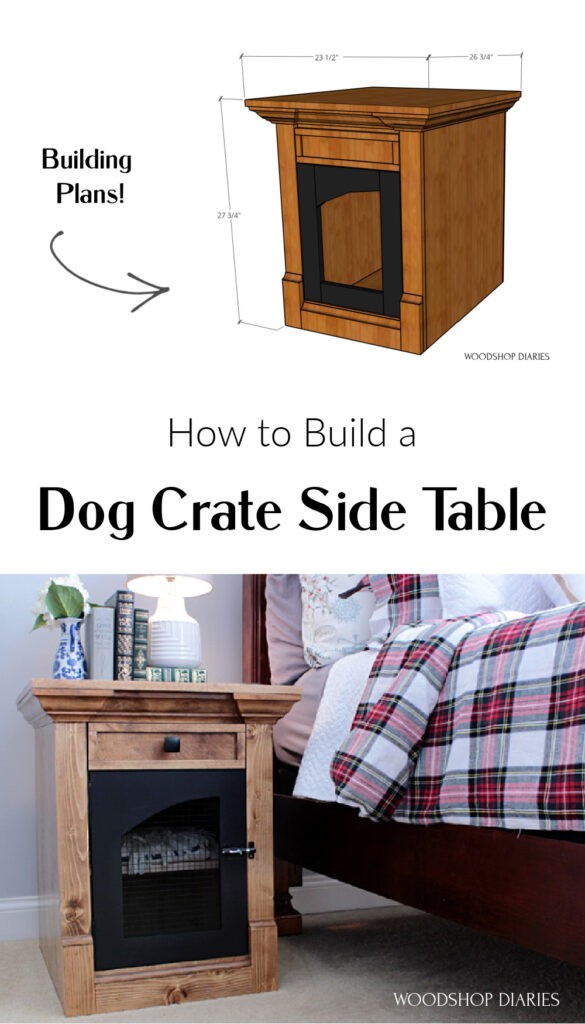
DIY Dog Crate Side Table
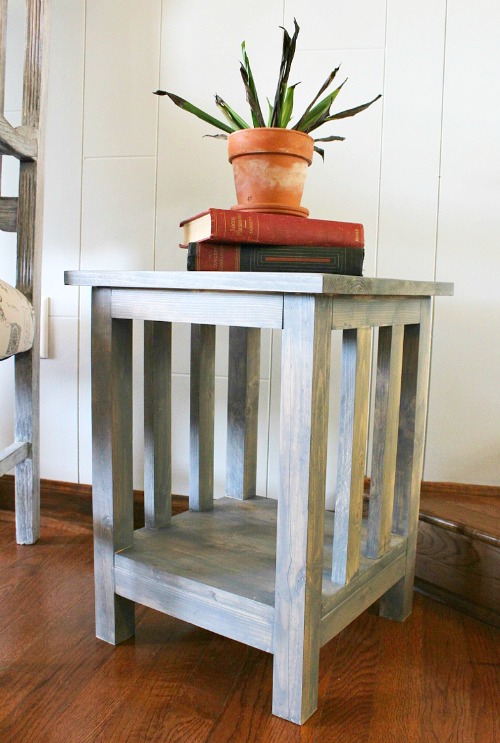
How to build a DIY Mission Style End Table
DIY Mission Style End Table

If you liked this project and want to see more, be sure to subscribe below to the newsletter when you will be the first to learn about new project posts, tips, and the latest happenings on Woodshop Diaries.

.

If you’d like to save this for later, don’t forget to pin it!
Pinterest graphic showing DIY modern industrial end table with white boxes over laid with text " Easy DIY end table building plans"

Until next time, friends, happy building 🙂
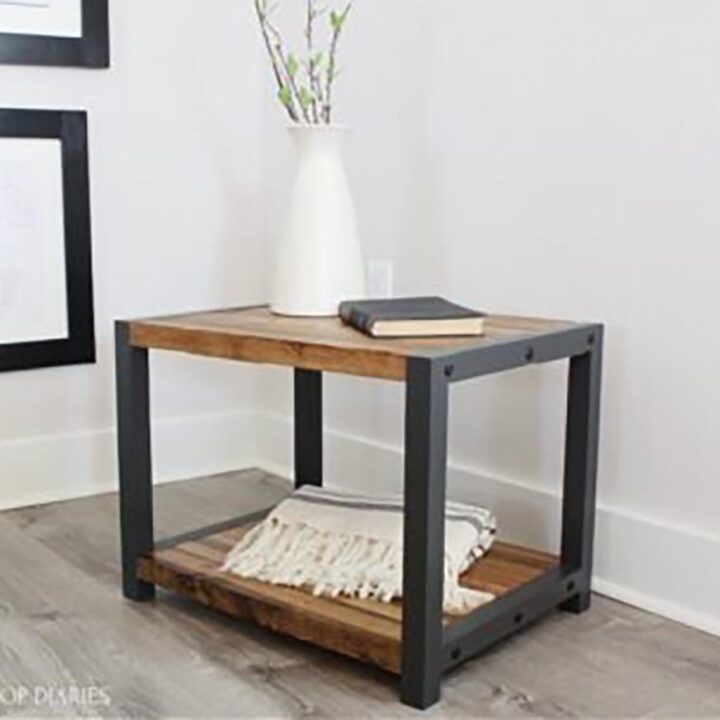
image of finished DIY end table

DIY End Table with Shelf

Yield: 1 DIY end table with shelf

Build your own EASY DIY end table with a shelf using just basic tools and 2x2s. This design has a modern industrial style to fit any room!

Materials

  • (8) 2x2x8
  • Saw (can use jig, circular, or large miter saw for this)
  • Drill/Driver
  • Wood Glue
  • Clamps
  • 2 ½" wood screws
  • Black timber screws
  • Sander

Instructions

  1. Assemble the top and bottom shelf from 2x2s.
  2. Assemble the DIY end table frame from 2x2s.
  3. Drill pilot holes in side frames.
  4. Put the end table together using 2 ⅞" black timber screws.
  5. Finish by applying a couple coats of polyacrylic to seal and protect.

Notes

Do note that this table is 18" tall. If you want a taller table, simply cut the legs on the side frames a little longer and everything else stays the same
© Shara, Woodshop Diaries
Project Type: Furniture / Category: Woodworking

How to Decide Which Kreg Jig to Buy

February 15, 2021 by Shara, Woodshop Diaries

In this post, I will cover the various sizes and styles of Kreg pocket hole jigs and the pros, cons and features of each.

At the end of the post, you’ll be able to determine which Kreg jig (or combination of jigs) is best for your budget, your projects, and your workshop!

My go to brand for all things pocket holes is Kreg Tool. I’ve been using Kreg pocket hole jigs for years.

But, they have several versions of pocket hole jigs and I know it can be a bit confusing to understand the differences between them all and when to use which.

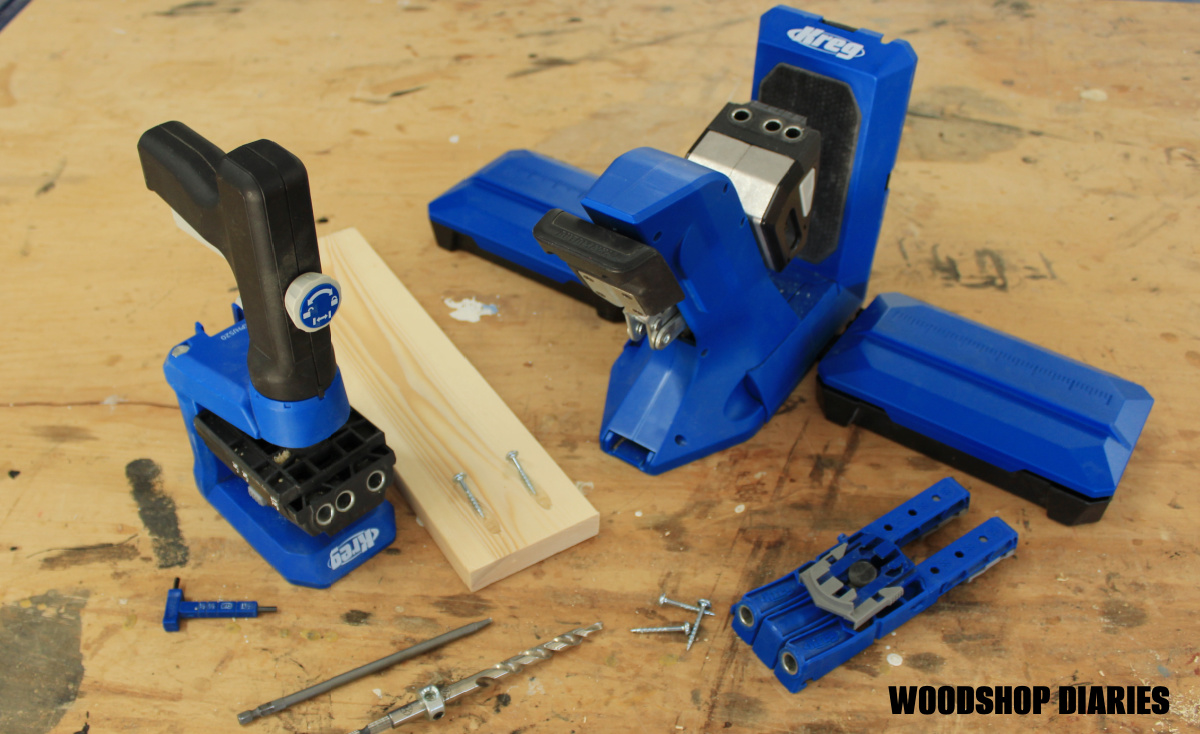
So first, let’s break down the seven versions of pocket holes jigs Kreg offers.

*This post contains affiliate links. See policies.

Kreg Pocket Hole Jig Models

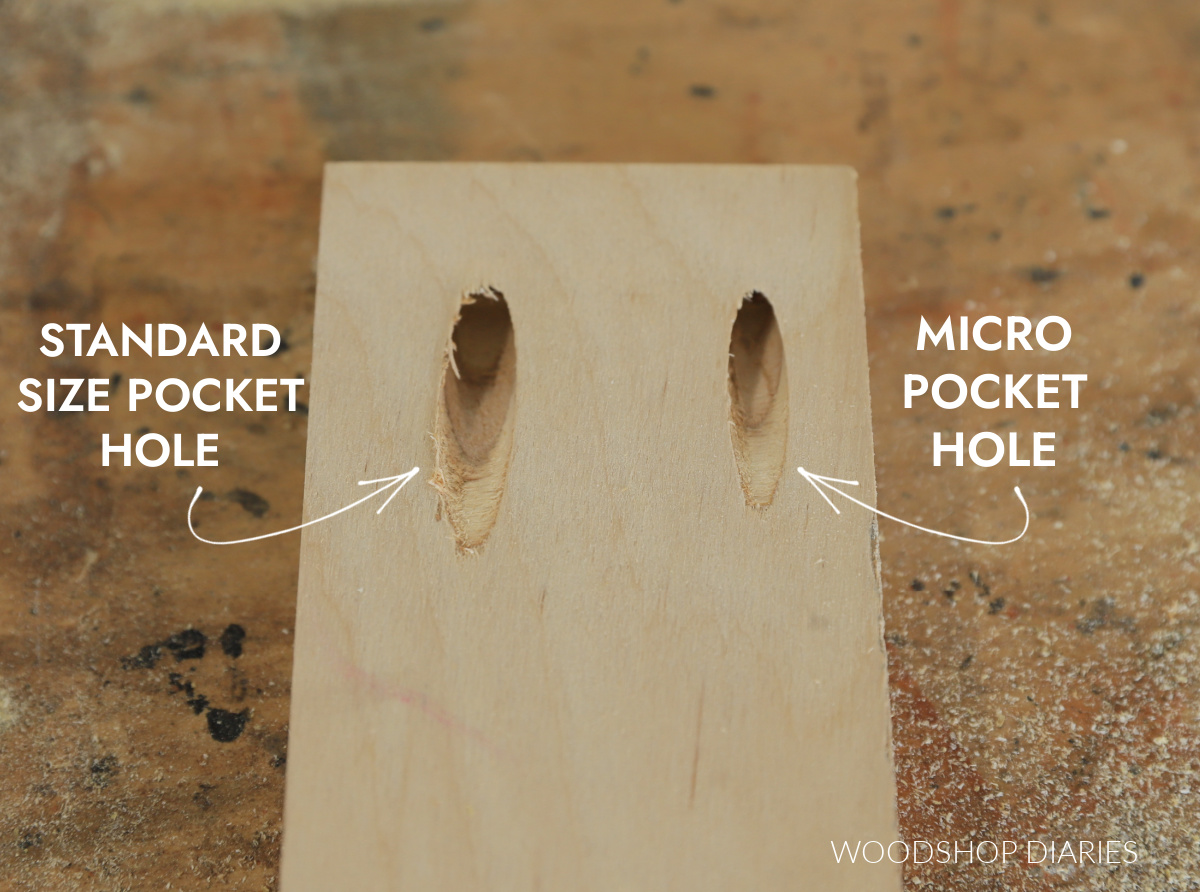
There are three “sizes” of pocket holes: micro, standard, and XL. The “sizes” are based on the diameter of the pocket hole.

The most commonly used pocket hole is ⅜″ diameter. This is what I’m referring to as the standard and are the most versatile. The micro pocket hole is smaller and the XL is larger.

Kreg makes one version of micro jig, 5 versions of standard size pocket hole jigs, and one version of XL jig. They’re listed below.

Kreg Pocket Hole Jig Models:

  • Kreg Micro
  • Kreg 320
  • Kreg 520
  • Kreg 720
  • Kreg K4
  • Kreg Foreman
  • Kreg XL

Back in 2020, Kreg came out with two new pocket hole jig options (the 520 and the 720) and discontinued one of their older models (the K5). The K4 is an older model that is still available for purchase, but I suspect it will eventually phase out.

So what’s the difference between the micro, standard, and XL jigs? The main differences are the size of the pocket holes they make and the thickness of material/type of screws it can be used with.

It makes sense that the smaller pocket holes are for thinner materials and use smaller screws and the larger pocket holes are for thicker materials and use larger screws.

The table below gives a quick overview. But I’ll discuss each jig in more detail below.

 Pocket Hole DiameterMaterial thicknessScrew Type
½”¾”1 ½”3 ½”
Micro19/64”√√  Pan head
320⅜”√√√ Washer head
520 
720 
K4 
Foreman 
XL½”  √√XL
Kreg Pocket Hole Jig Sizing Specifications

Here’s a quick comparison video, too, if you prefer to watch:

For more information on drilling pocket holes, check out this guide for how to use a pocket hole jig here.

Pocket Hole Jig Parts and Accessories

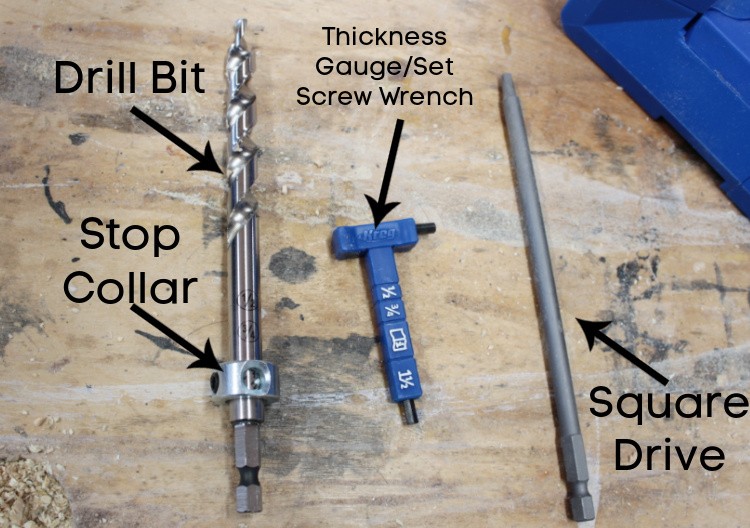
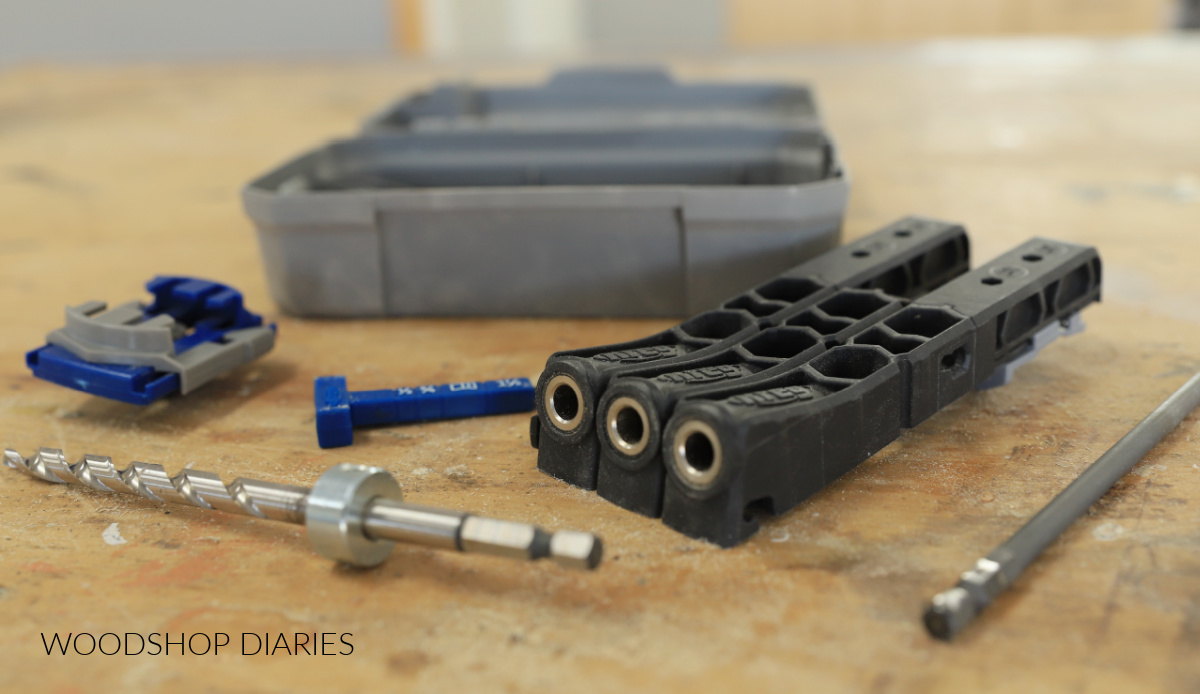
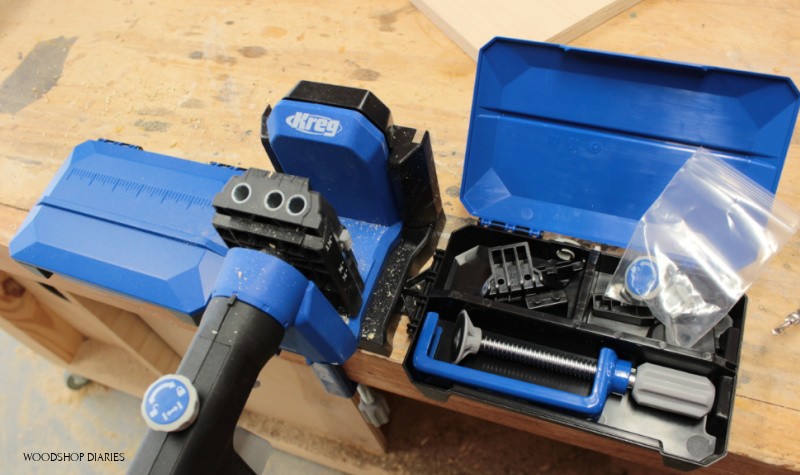
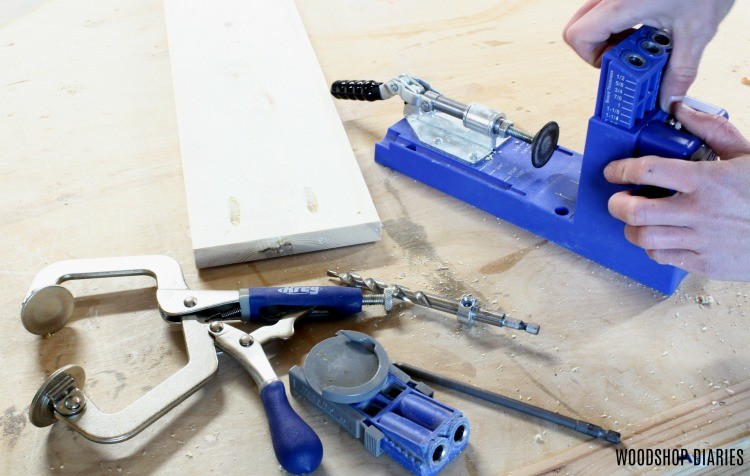
Just a quick FYI–each pocket hole jig comes with a drill bit, stop collar, square drive bit, and a thickness gauge that doubles as a hex wrench for the stop collar set screw.

You can also purchase these pieces individually as spares/replacements as well. Find the drill bit, stop collar and wrench here, and the square drive bit here.

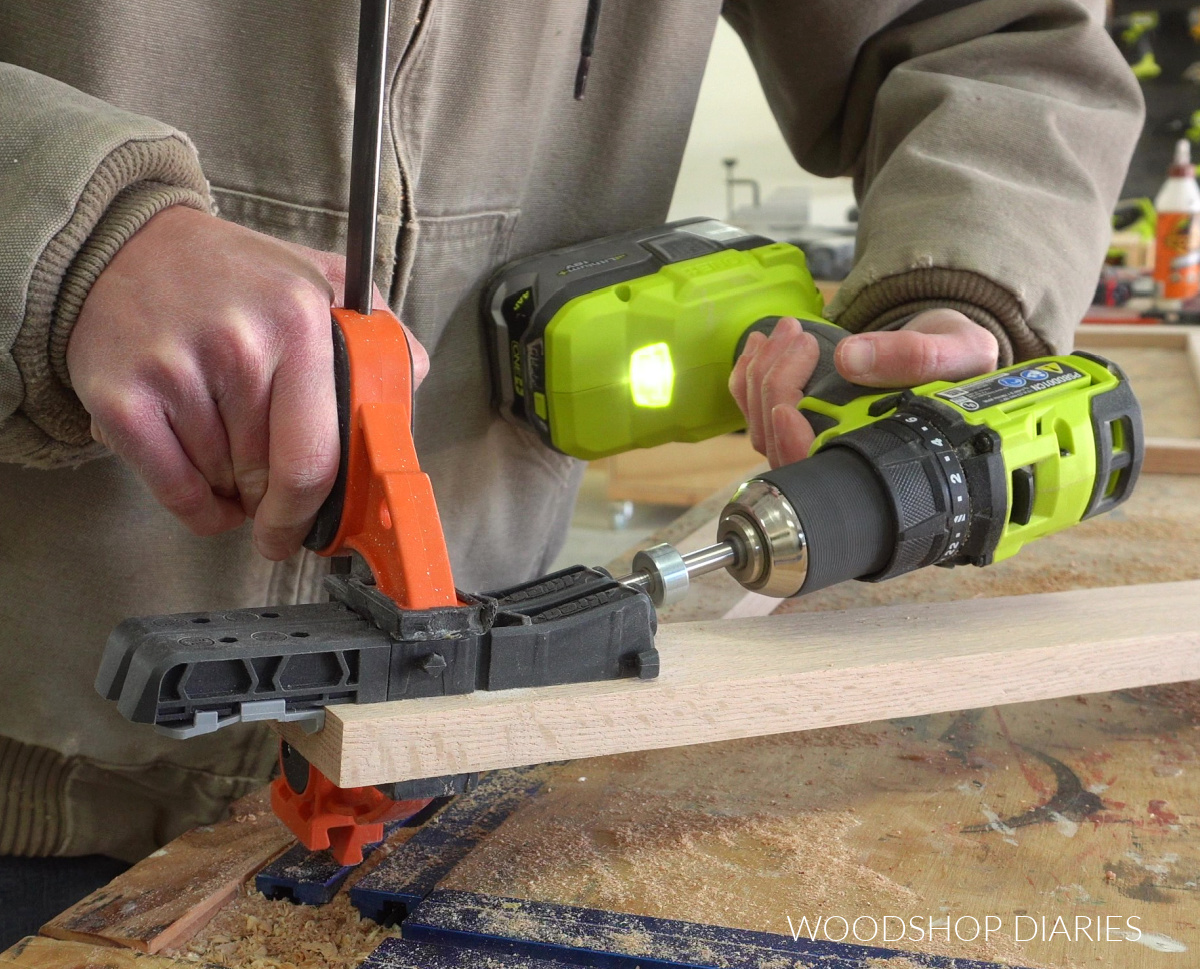
Close up of drill bit stop collage, thickness gauge and square drive

Keep in mind that the micro, standard and XL drill bits are different sizes, so you’ll need to make sure you’re using the right drill bit for the right jig.

[feast_advanced_jump_to]

The Kreg Micro Pocket Hole Jig

The Kreg Micro pocket hole jig is the smallest jig available. It’s the only stand alone jig that allows you to drill micro size pocket holes.

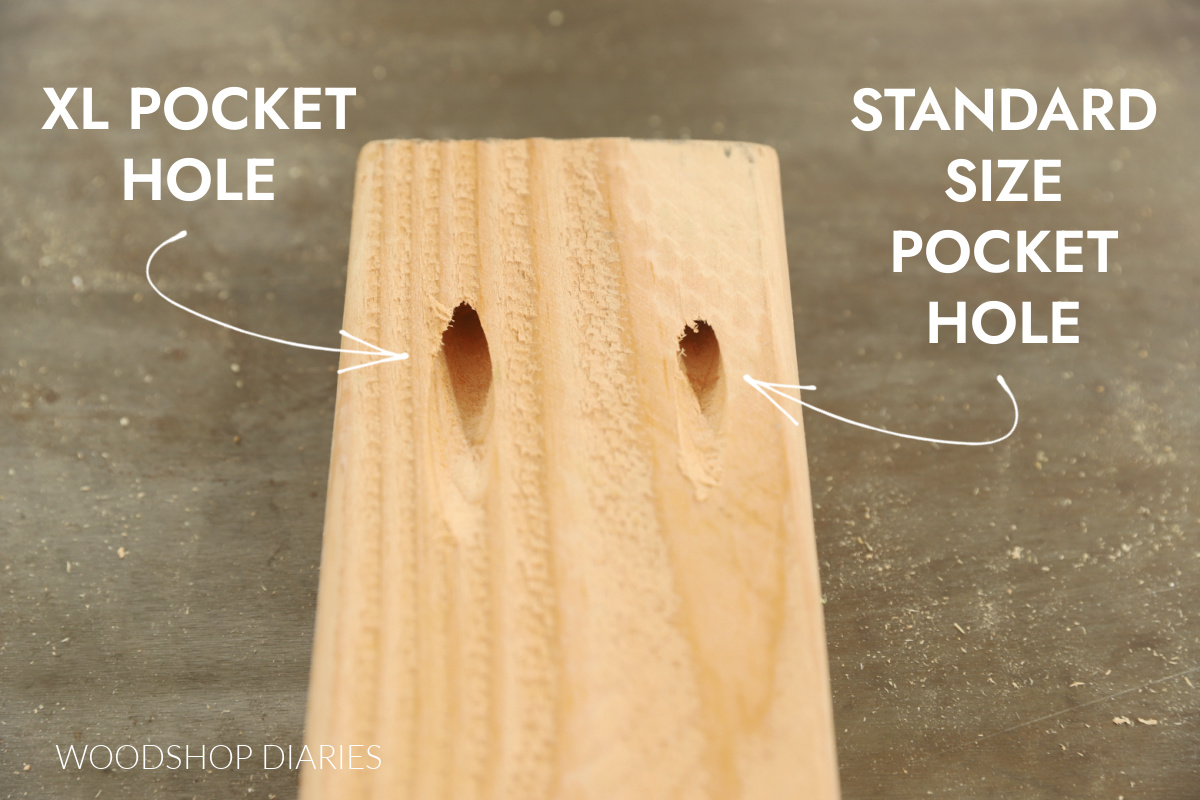
The micro jig is designed for use in ½″ and ¾″ material and makes pocket holes 33% smaller than standard–see image above for comparison.

It’s quick to set up, small, lightweight and easy to move around your workpiece in order to drill your pocket holes. But, you will need an additional clamp in order to use this jig.

You may be wondering what the advantage of this jig is over the standard size models because those jigs also work with the same material thickness. And that’s a good question!

These smaller pocket holes require you to use smaller pan head pocket hole screws and greatly reduce the risk of splitting or cracking on thin and narrow lumber.

That said, this is not the most versatile option and I don’t recommend it if you’re only looking to buy one pocket hole jig.

The micro makes a great addition to your toolbox if you routinely build with 1x2s or 1x3s or ½″ plywood, but it probably shouldn’t be your only jig. Learn more about how to use the Kreg Micro Jig here.

I recommend the Kreg Micro for

  • Someone who already has a standard size pocket hole jig
  • Workshops who use ½″ material regularly
  • Workshops who routinely build with 1×2 and 1×3 material (especially if it’s hardwood)

Kreg Micro Pros

  • Makes smaller pocket holes–less likely to split thin and narrow lumber
  • Inexpensive
  • Easy to set up and use

Kreg Micro Cons

  • Only works with ½″ and ¾″ lumber
  • Requires an additional clamp to use (not self clamping)
  • Has to be moved and repositioned between every hole (not the most efficient)

The Kreg 320 Pocket Hole Jig

The Kreg 320 pocket hole jig is the smallest standard size pocket hole jig available. It’s great for beginners who are just getting familiar with using pocket hole jigs and don’t want to make a large upfront investment (it’s only about $40).

Close up of 320 pocket hole jig in Shara's hand

It’s quick to set up, small, lightweight and easy to move around your workpiece in order to drill your pocket holes. But, you will need to purchase a clamp in order to use this jig.

The Kreg 320 is a standard size jig, so it works with lumber ½″, ¾″ and 1 ½″ thick and is made to be used with regular washer head pocket hole screws. Note that screw length will vary by application.

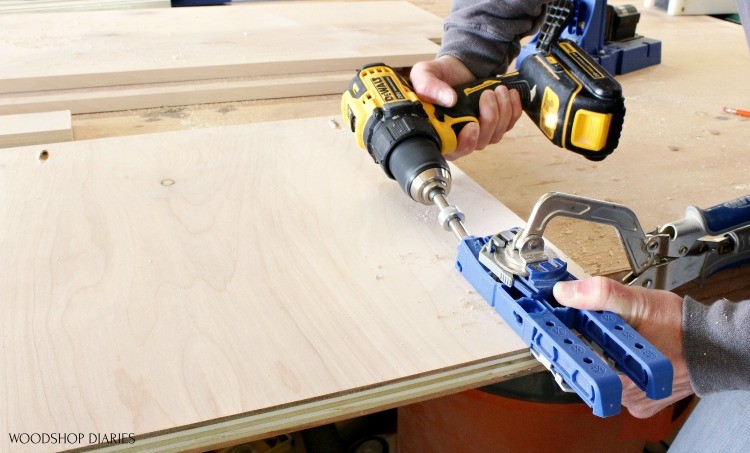
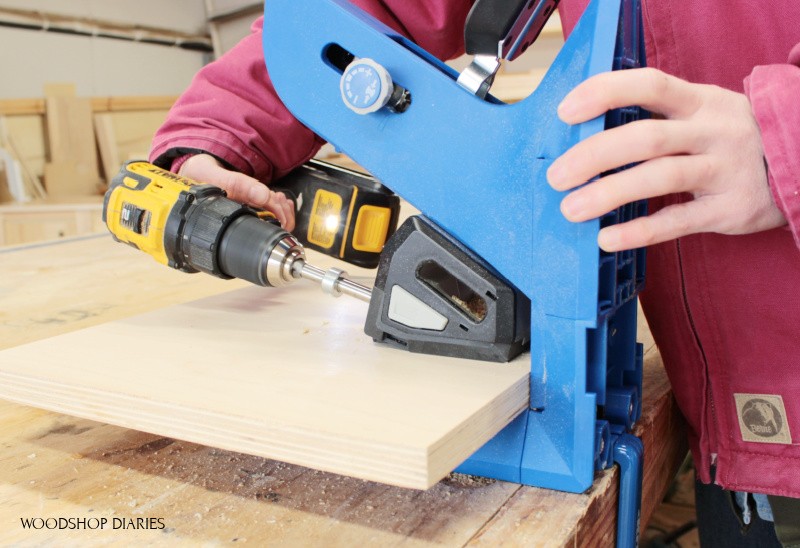
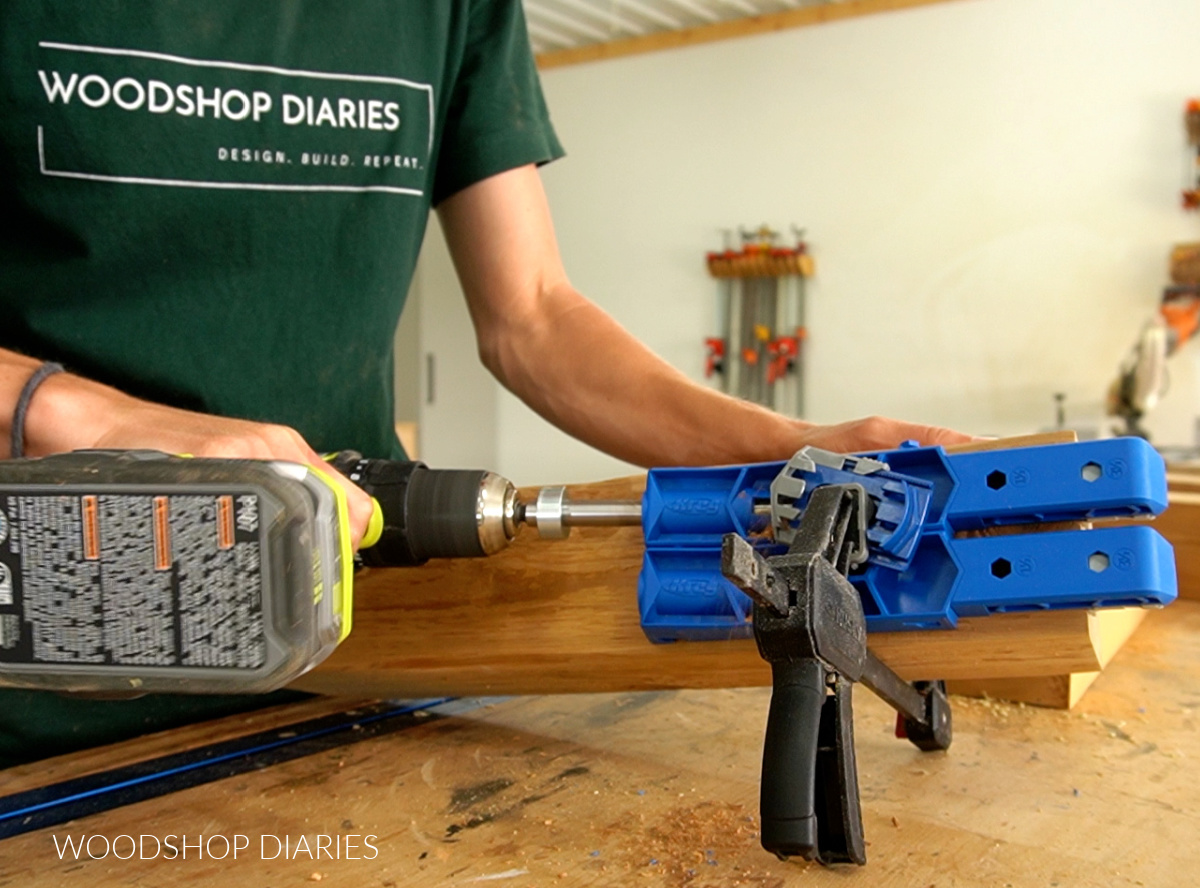
Kreg 320 jig clamped to plywood panel with drill drilling pocket hole

The Kreg 320 is a really handy jig to have in the shop, but it’s VERY basic. There are no bells and whistles. It’s more labor intensive than other jigs and more time consuming as you have to unclamp, move, re-clamp every time you drill a hole.

It’s not made to be stationed on the workbench, and drilling is usually done in a horizontal motion like you see above. Personally, this tires my arm out pretty quick, so I wouldn’t recommend it for drilling a ton of pocket holes at a time.

But for very long boards or large plywood panels that would be difficult to get into an upright jig, this is a pretty valuable jig to have on hand.

I’d recommend the 320 Kreg Jig for

  • Workshops that only use pocket holes occasionally
  • First time pocket hole jig users
  • Tight budgets
  • Workshops that need to drill pocket holes on large panels or long boards

Kreg 320 Pros

  • Inexpensive
  • Portable
  • Easy to set up and adjust for different materials
  • Great for large/long boards/panels that would be difficult to use on upright jigs

Kreg 320 Cons

  • Requires an additional clamp
  • Can’t be stationed on a workbench
  • Time consuming to move and re-clamp between each hole
  • Hard on your arm to drill horizontally over and over

Additional Kreg 320 Features to Take Note Of

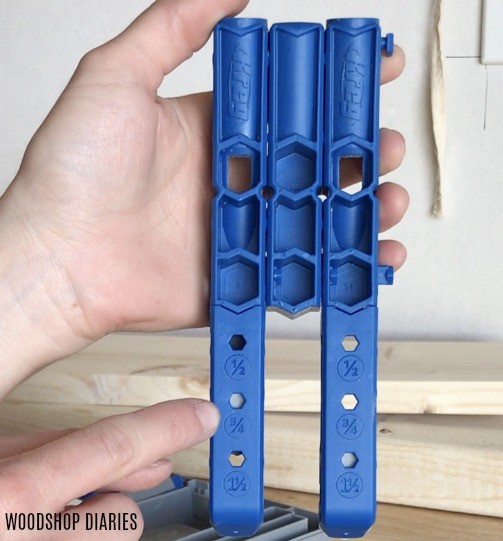
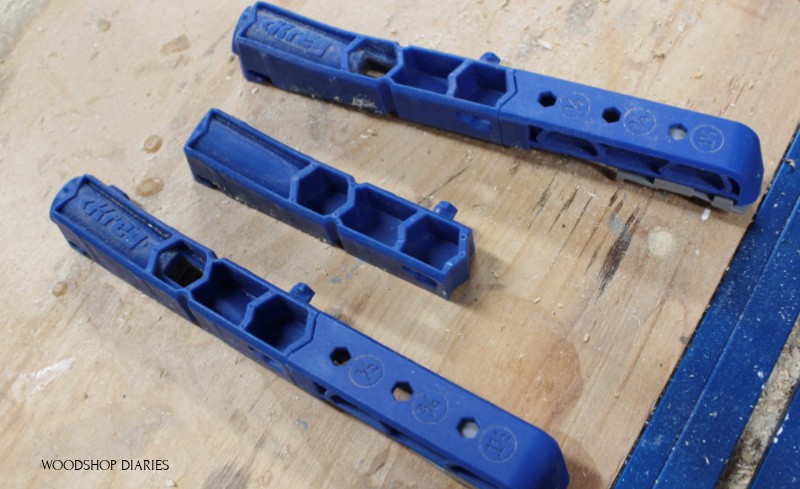
The 320 jig is designed to “break apart” and “add on to.” One of the cool features of the jig is that you can purchase additional drill guides to snap onto the jig to make it wider–or remove them to make it smaller.

The Kreg 520 Pocket Hole Jig

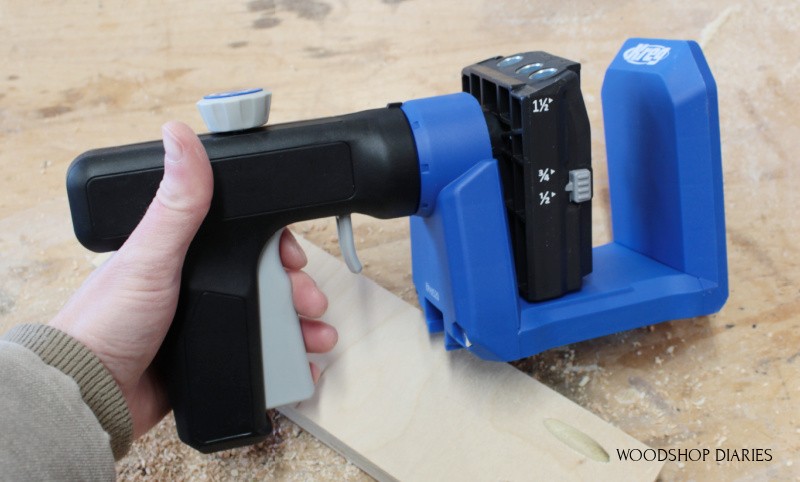
The Kreg 520 is a step up from the 320. It’s still fairly small, and portable, but it does come with its own built in trigger clamp–which is a really cool feature on this new jig.

Shara Woodshop Diaries holding the Kreg 520 pocket hole jig

It’s a little more expensive than the 320 (it’s about $100), but it is quicker and easier to move around your workpiece with the built in clamp function.

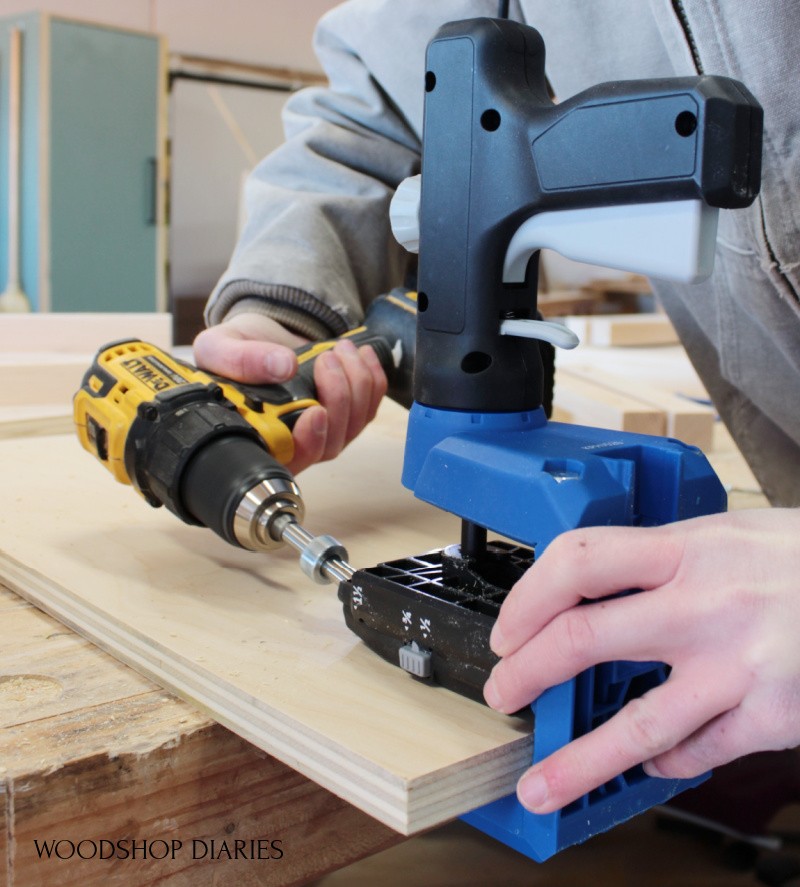
As hand held pocket hole jig, you clamp it where you want to drill your hole, then unclamp and move it around your piece.

The trigger clamp is a really nice feature they added to this series and it has a little lever for a quick release when you’re ready to move it.

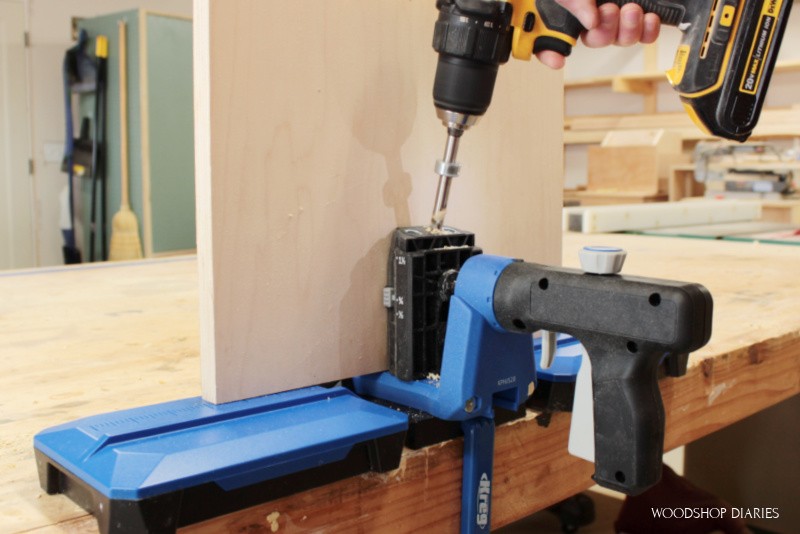
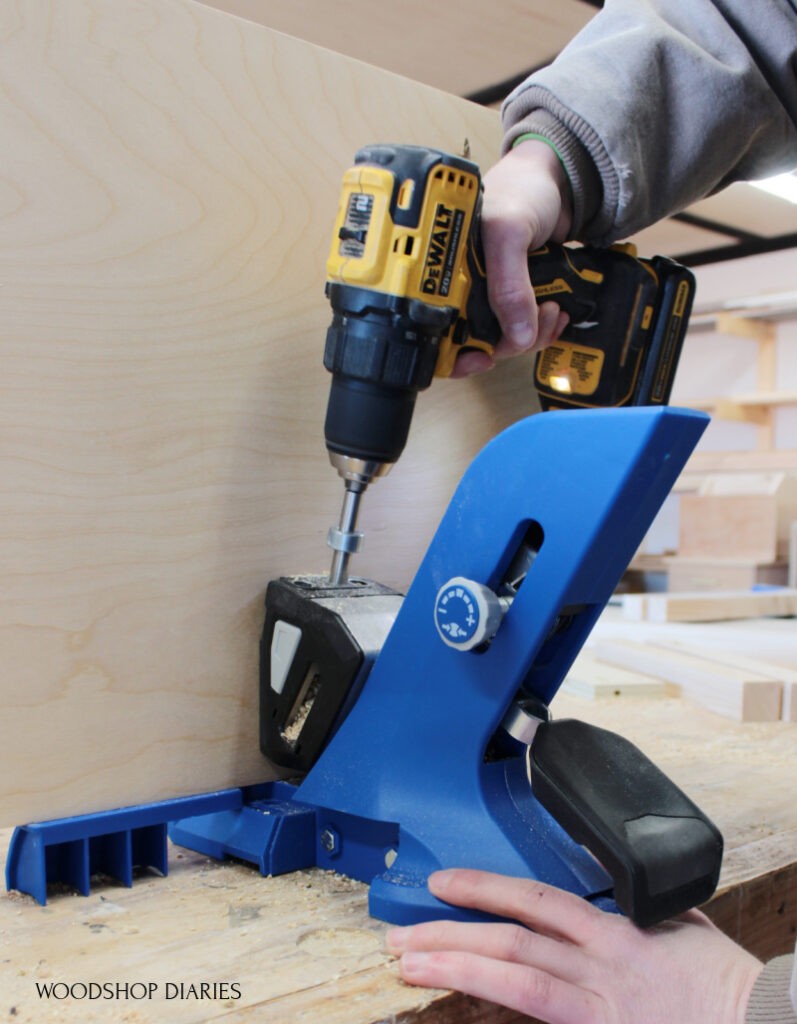
Shara Woodshop Diaries drilling pocket hole into plywood panel using the Kreg 520 jig

The 520 Kreg Jig is kind of like a “best of both worlds” pocket hole jig.

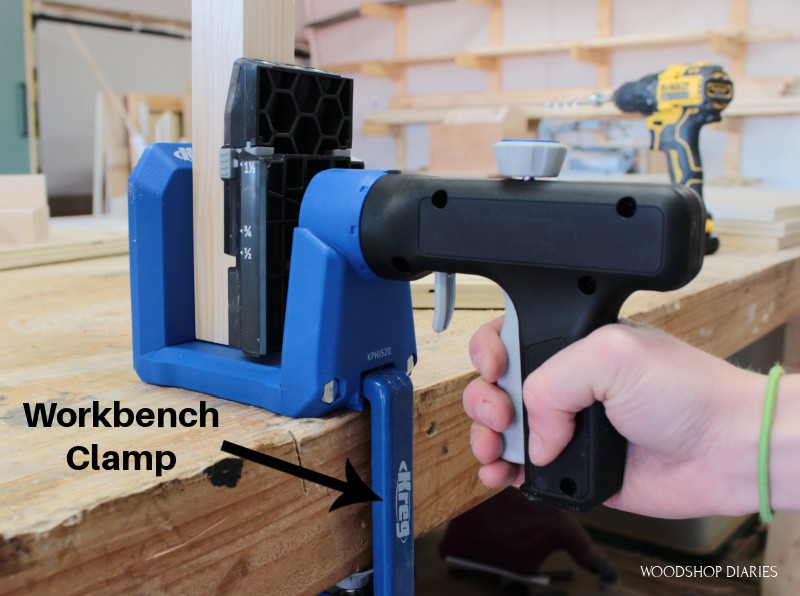
It is a portable, hand-held jig like the 320, but it has the capability of clamping onto a workbench similar to the 720 for upright clamping. But, for that, you do need to purchase the pocket hole clamp separate (but it’s only about $15, so it’s well worth the investment).

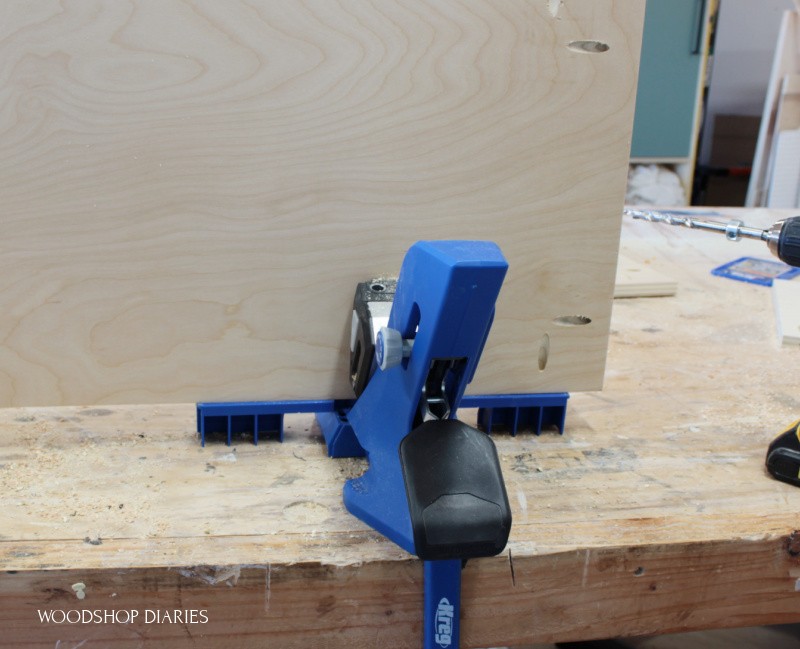
Kreg 520 clamped to workbench with pocket hole clamp and hand clamping the trigger

Just like with the 320, it’s a great option for beginners, small shops and for large panels that would be hard to maneuver around a workbench.

Personally, if you only buy ONE pocket hole jig for your shop, this is the one I’d suggest since it’s so versatile.

I recommend the Kreg 520 Pocket Hole Jig for

  • First time pocket hole jig users
  • Woodworkers looking for a step up from the 320
  • Small workshops that need the best bang for their buck and don’t have room or budget for large or multiple jigs

Kreg 520 Jig Pros

  • A “best of both worlds” option that allows for both hand held and workbench mounted drilling
  • Small and lightweight
  • Built in trigger clamp and quick release function
  • Budget friendly

Kreg 520 Jig Cons

  • Requires an additional clamp if you want to mount it to the workbench
  • Not as many bells, whistles and features as the larger 720

Additional Kreg 520 Features to Take Note Of

If you wanted to pick up a Kreg 520 pocket hole jig, but wanted to add a few extra bells and whistles, you can purchase the Docking Station (about $50) that is compatible with both the 520 and the 720 jigs.

This docking station includes the pocket hole clamp, some support wings (that double as storage boxes for the drill bits, clamp and accessories) to help support larger pieces during upright drilling, and an adjustable stop block.

This add-on just gives some extra functionality to the jig in the workbench mounted position.

The Kreg 720 Pocket Hole Jig

The 720 Kreg Jig is more of a “stationary” version. It’s larger and more expensive (about $130) but, it’s also quicker and more efficient. This is my personal favorite jig and the one I use in my shop the most.

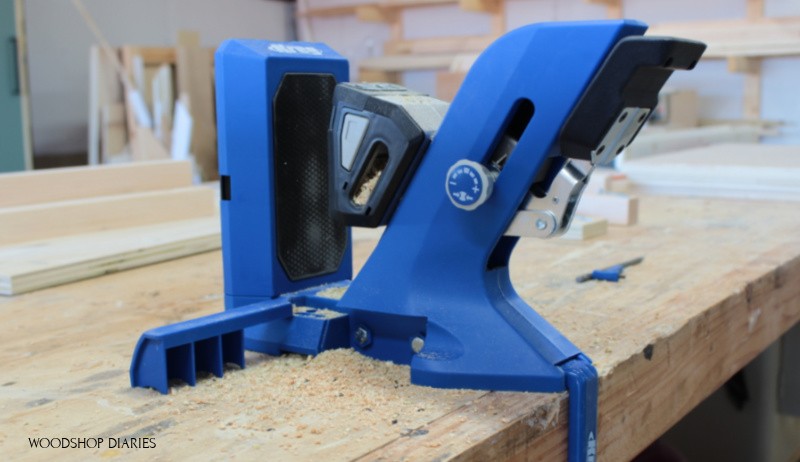
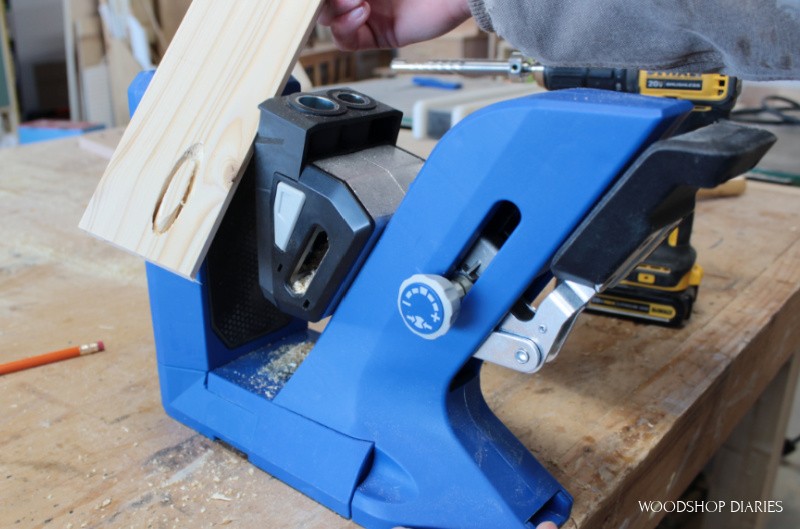
Side view of Kreg 720 pocket hole jig clamped to workbench

With the 720, instead of moving the jig around the piece, you move the piece around in the jig.

The 720 is a great option if you drill a lot of pocket holes and need a quick and efficient set up. Since you don’t have to unclamp and move the jig for every hole, it’s less labor intensive and much quicker for high production workshops.

This larger 720 jig comes with built in fold out/in extension wings for additional support for large boards or plywood panels.

Kreg 720 pocket hole jig with extension wings folded out supporting plywood panel

And just like with the 520, you can purchase a pocket hole clamp to clamp this jig to the workbench–or add on a docking station that includes the clamp, additional support wings and an adjustable stop block.

The Kreg 720 Jig also comes as a 720 Pro kit that includes the jig and the docking station together along with vacuum dust attachments at a discounted price than if you purchased them separately.

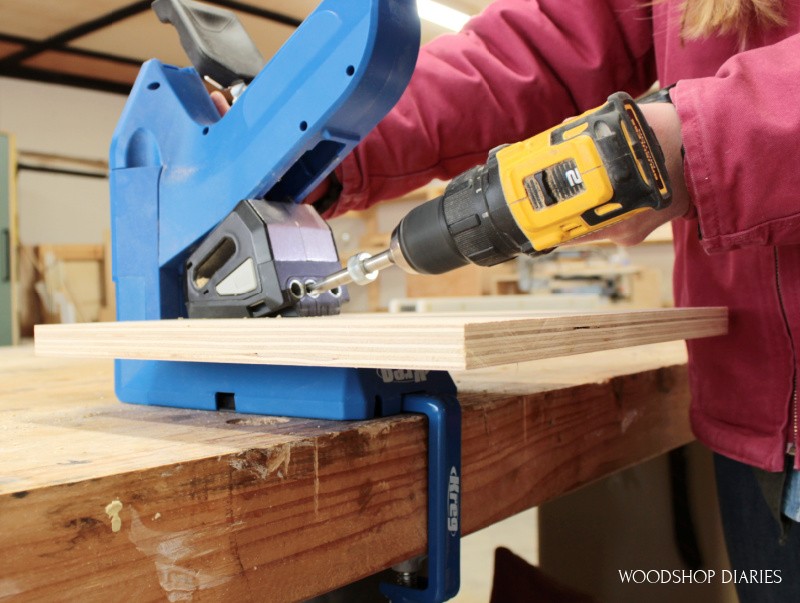
This jig actually can mount in multiple positions so you can drill both vertical (shown above) or horizontal (shown below in two directions).

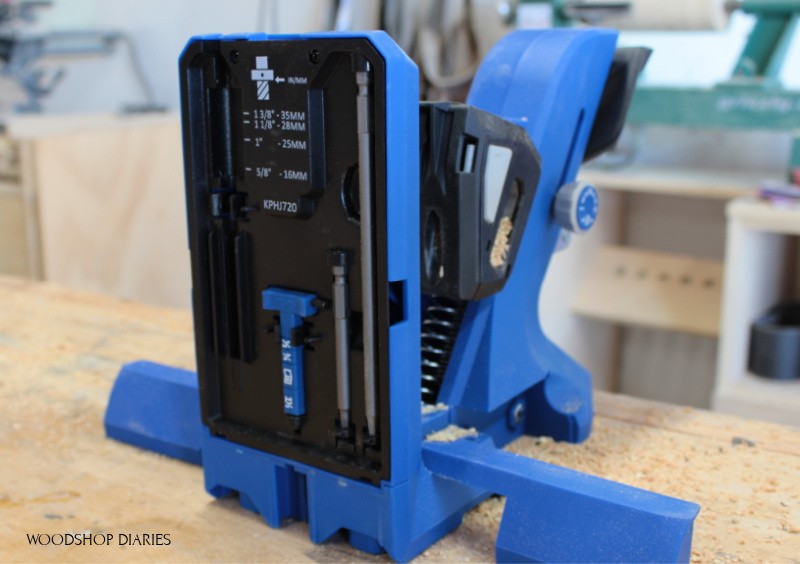
And, so you don’t lose all your accessories, it comes with onboard drill bit storage on the back side. The 720 has all its features built right into it, so it’s really an all-in-one package.

Onboard bit storage for Kreg 720 pocket hole

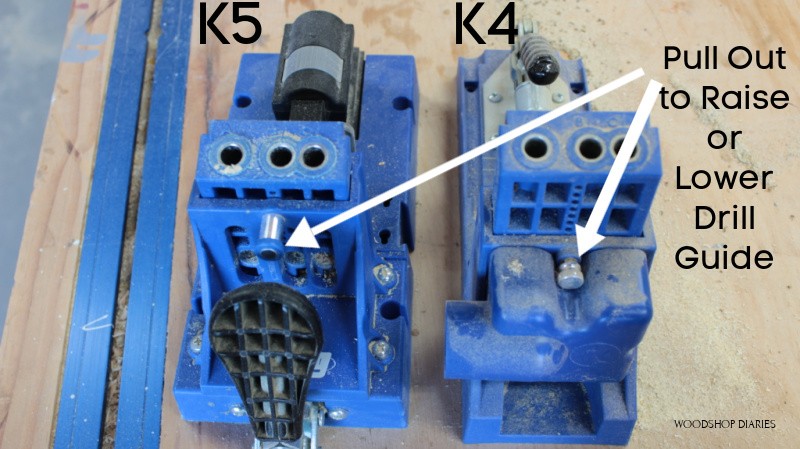
One of the coolest features of this new 700 series jig is that you don’t have to set it up for your board thickness. On the other jigs, you have to set BOTH your drill bit stop collar AND your jig up for the correct board thickness.

But, the new 720 AutoMaxx clamp feature sets the jig for you (for materials ½″ up to 1 ½″ thick), so all you have to do is adjust the stop collar on your drill bit.

RELATED: Check out this post to learn how to use a pocket hole jig and adjust the drill bit properly.

Drilling pocket holes into plywood panel using the 720 clamped to workbench

Personally, I only use ¾″ and 1 ½″ material with my pocket holes. So, I recommend purchasing an additional drill bit so you can keep one set up for ¾″ material and one for 1 ½″ material. Then, since this jig adjusts itself, you can just swap out the drill bit when you change materials and you’re good to go.

.

This pocket hole jig set up also allows you to swap out the drill guide for a plug cutting attachment (sold separately).

RELATED: Check out how to drill your own pocket hole plugs with the plug cutting kit here.

You can also swap the standard pocket hole size drill guide for a micro drill guide. But, honestly, for the price of the drill guide attachments and the pain it is to swap them, I’d prefer to just buy the separate micro jig than to buy the additional drill guide.

With all the bells and whistles this 720 jig offers, the biggest downside to it that I can see is that it’s fairly large and not quite as easy to move around if you needed to drill pocket holes in really long boards or large panels.

I recommend the Kreg 720 Jig for

  • Workshops that drill a lot of pocket holes
  • Shops with plenty of work surface space
  • Beginner to Advanced pocket hole users
  • Woodworkers looking for a jig for the long term
  • Anyone interested in cutting their own pocket hole plugs

Kreg 720 Jig Pros

  • Auto-adjusts for board thickness
  • Allows you to use plug cutting guide to cut your own pocket hole plugs
  • Quick and efficient for high production pocket hole drilling
  • Built in extension wings for large board support
  • Onboard bit storage
  • Can clamp in both vertical and horizontal positions

Kreg 720 Jig Cons

  • More expensive than the 320 and the 520
  • Takes up more work surface space
  • Doesn’t function as a portable hand held jig for large boards if needed

The Kreg K4 Jig

The Kreg K4 pocket hole jig is an older version that I actually didn’t use but just a few times.

Before Kreg came out with the 720, the K4 and K5 jigs were kind of the go-to pocket hole jig models. I used the K5 for most everything (I preferred it over the K4). Both of these jigs were very similar but, as I mentioned before, the K5 has been discontinued.

For some reason, the K4 is still available, but has lost much of it’s popularity to the 720.

The K4 has a built in clamp (a lot like the 720), but it doesn’t automatically adjust to different board thicknesses. You have to manually set the board thickness on the jig before clamping.

It’s SLIGHTLY less expensive than the 720 but around the same price as the 520. Personally, for the price, I’d opt for either of these newer options before I’d buy a K4–but of course, that’s just me.

The K4 has been around for a while and is definitely a tried and true, durable jig, but it just doesn’t offer some of the convenient features of the newer models.

So personally, I don’t recommend the K4–not that it’s a bad jig–but I think there are better options available for the price.

Kreg K4 Pros

  • Built in clamp
  • Durable, but still lightweight/easy to move around
  • Budget friendly

Kreg K4 Cons

  • Have to manually adjust board thickness on jig
  • Similar design, but not as many features as the 720
  • Not designed for multiple drilling orientations like the 520 and 720

The Kreg Foreman

Now, I can’t say a lot about the Foreman as I don’t personally use one. I had one for a brief time, but rarely used it. BUT, it’s an option I’d only recommend for high production pocket hole drilling.

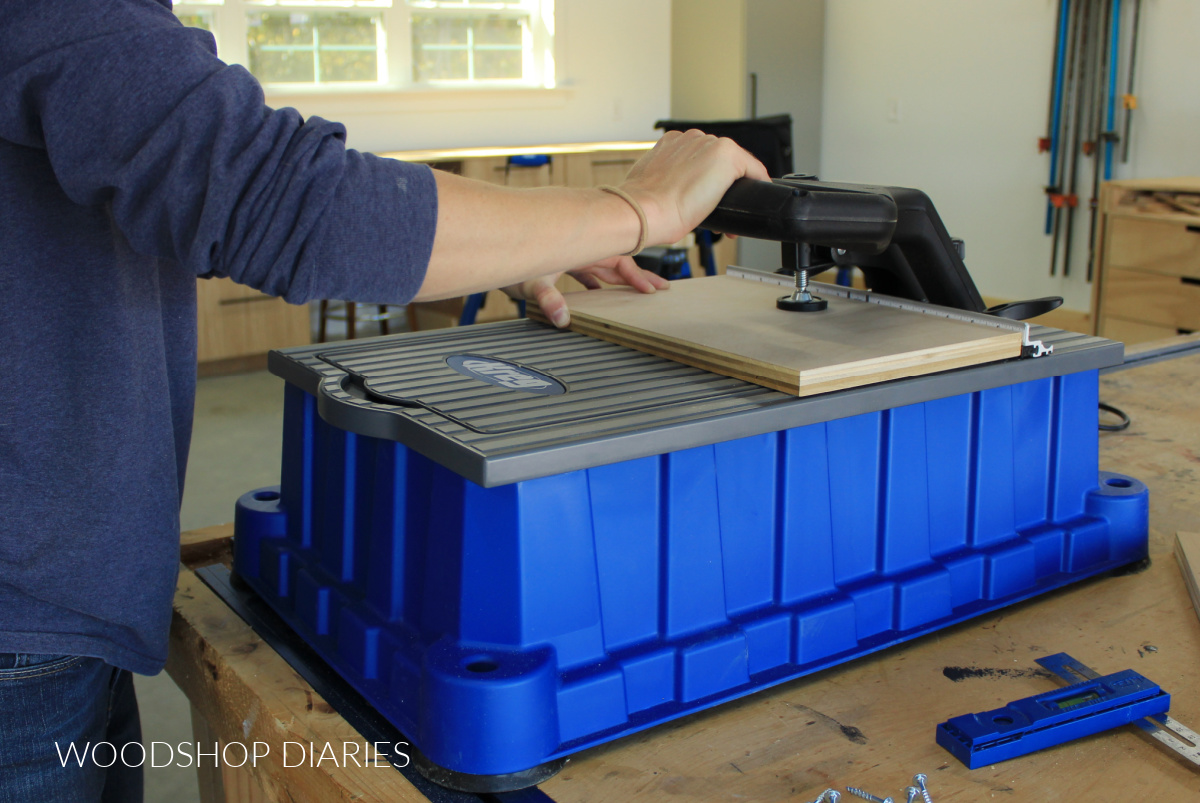
It’s pricey (about $450) and takes up a significant amount of space, and has to be plugged in (the drill is built into it, so it needs a power source). So it’s probably not a great option for anyone just starting out or for small workshops that only drill the occasional pocket hole.

But if you drill a lot of pocket holes, it’s worth considering and could be a really great investment and time saver for your shop.

You can check out more about the Foreman on Kreg’s website here.

The Kreg XL Pocket Hole Jig

The Kreg XL Pocket Hole Jig is the only stand alone jig that allows you to drill XL sized pocket holes.

The XL jig is designed for use in 1 ½″ and 3 ½″ material (which is 2x and 4x lumber) and makes pocket holes quite a bit larger than standard–see image above for comparison.

It’s quick to set up, small, lightweight and easy to move around your workpiece in order to drill your pocket holes. But, you will need an additional clamp in order to use this jig.

The XL pocket hole jig is the only option available that allows you to drill pocket holes in 3 ½″ thick material. So it’s a must have if you plan to use pocket holes in 4×4 lumber.

It’s made to be used with XL pocket hole screws, which are quite a bit larger than the standard washer head pocket hole screws. While this makes super strong joints in 4x4s, the larger screws do run a higher risk of splitting when used in 2x material.

Personally, I only use the XL jig when working with 4x4s and stick with standard pocket holes in 2x lumber. But if you need extra strength, it’s a great option to have.

Much like the Kreg Micro, it’s a great addition to the workshop, but isn’t the most versatile. So if you’re only getting one jig, the XL probably isn’t the best option. Learn more about how and when to use the Kreg XL pocket hole jig here.

I’d recommend the Kreg XL Jig for

  • Someone who already has a standard size pocket hole jig
  • Workshops that often use 2x and 4x lumber
  • Workshops that often build outdoor projects

Kreg XL Jig Pros

  • Inexpensive
  • Easy to set up and use
  • Best jig option for thick materials/large builds

Kreg XL Jig Cons

  • Requires an additional clamp (not self clamping)
  • Only works with 1 ½″ and 3 ½″ thick material
  • Requires larger, more expensive pocket hole screws

Final Thoughts About Choosing a Pocket Hole Jig

When you are looking at adding new tools to your workshop, I know it can be stressful when you aren’t sure what’s best for your situation.

I hope this helps clear up the difference between the Kreg jigs available and make a better, informed decision on which Kreg Jig to buy for you and your workshop.

If you’re interested in learning more about pocket holes, check out these posts you might find helpful:

  • How to use a pocket hole jig
  • 4 ways to fill your pocket holes
  • How, when, and why to use the Micro Pocket Hole Jig
  • How, when, and why to use the XL Pocket Hole Jig

Are DIY projects your thing? Sign up for our newsletter for priority access to the latest projects and build plans!

And if you’d like to save this guide for later, be sure to pin it or share to your favorite social channel!

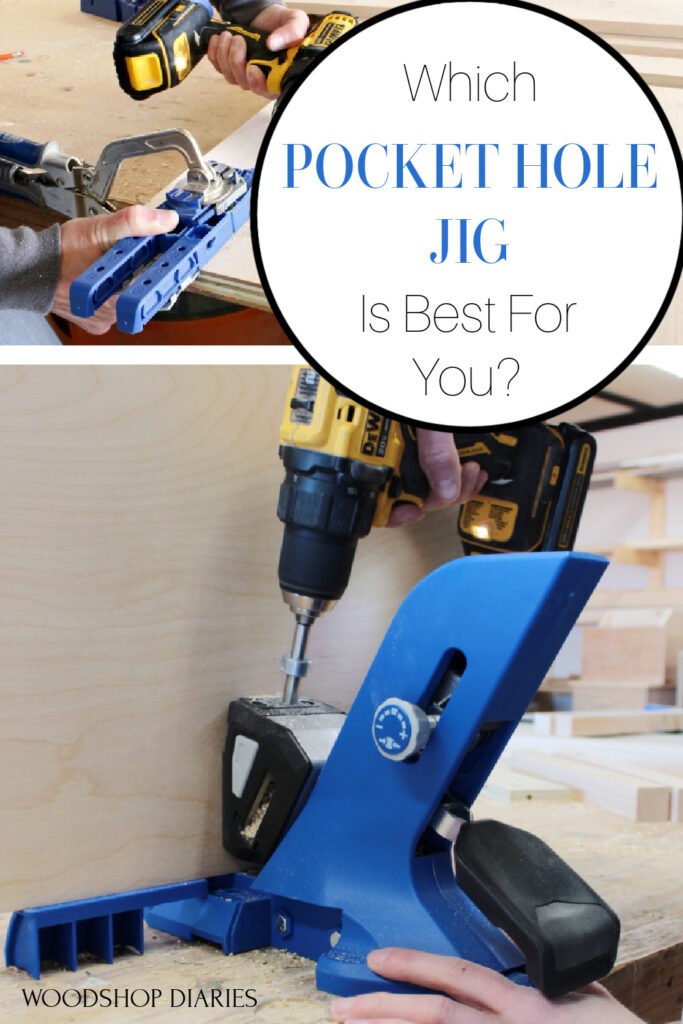
Pinterest collage image showing the Kreg 320 pocket hole jig at the top and the Kreg 720 pocket hole jig at the bottom with text "which pocket hole jig is best for you?"

Until next time, friends, happy building! 🙂

How to Build a DIY Computer Desk with Drawers

February 12, 2021 by Shara, Woodshop Diaries

In this post, I’ll show you how to build a DIY computer desk with drawers!

This post is sponsored by Kreg Tool and contains affiliate links. See policies for details.

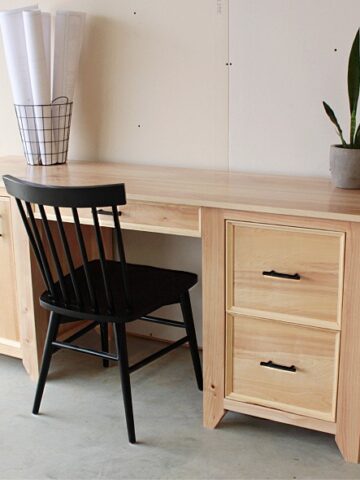
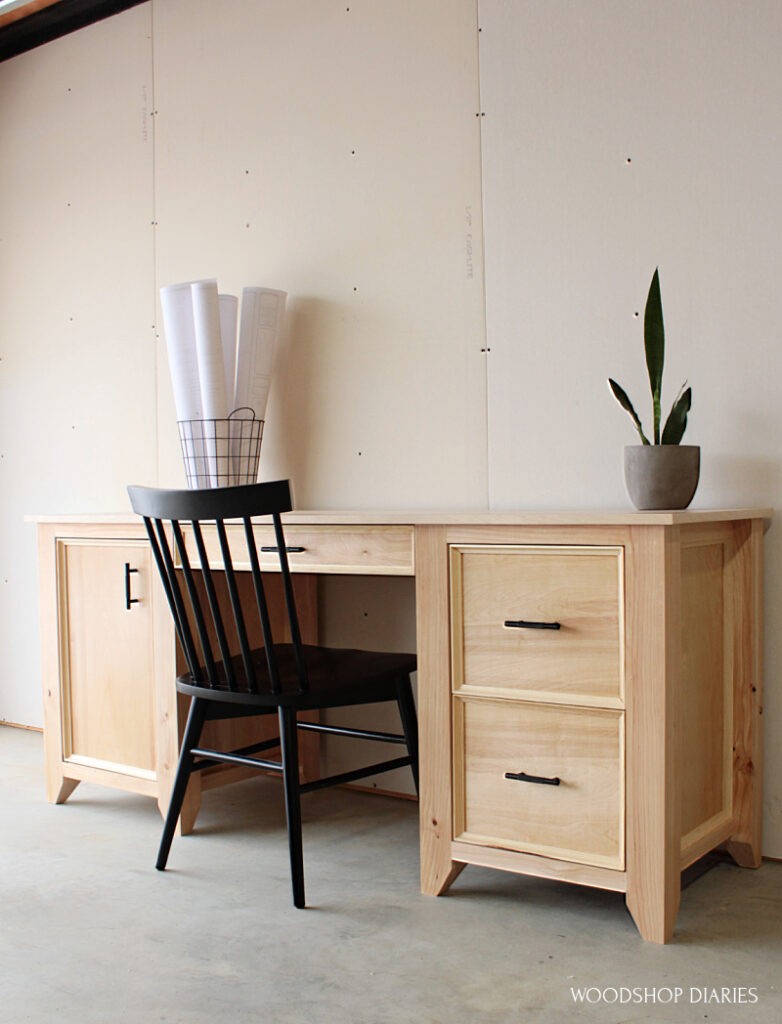
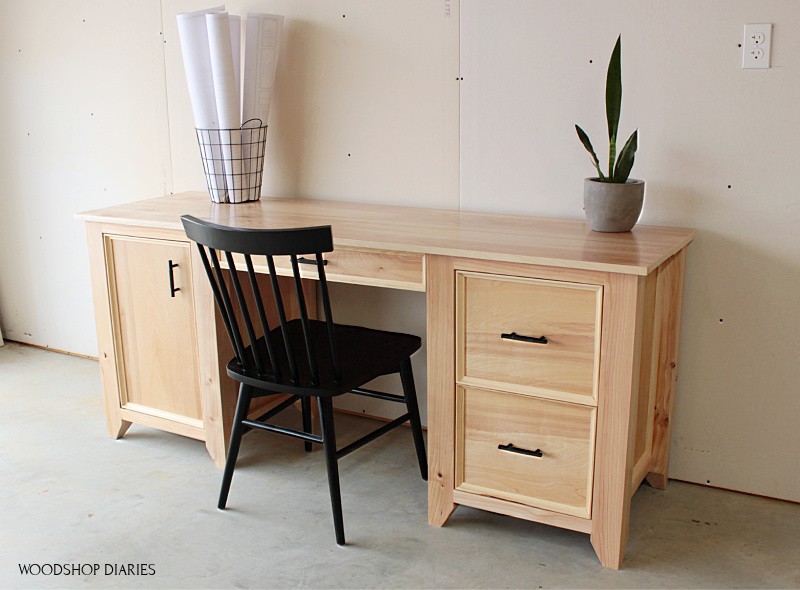
Finished DIY computer desk with two drawers on right, keyboard tray in center, and door on left side with black chair--made from 2x4s and plywood

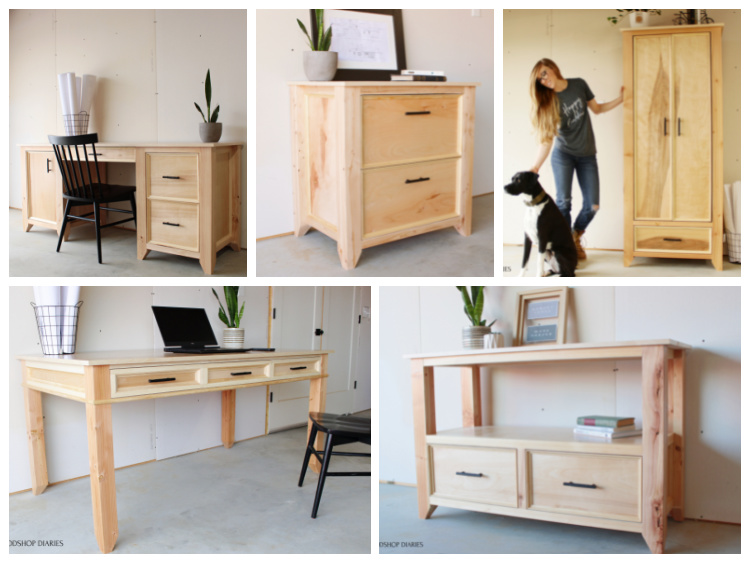
This computer desk design is part of my matching DIY home office furniture series that I’ve been building for my Dad’s business.

It’s been a lot of fun trying to build various pieces but keep a similar design style using the same basic tools and materials.

Check out the whole matching DIY office furniture series here.

Matching Office Furniture Series

This computer desk with drawers is definitely my favorite piece in the series and I’m excited to share how to build it in the plans below.

So, let’s dive in and get building.  Here’s what you’ll need.

Tools & Materials

Tools:

  • Circular Saw
  • Miter Saw
  • Drill/Driver
  • Kreg Pocket Hole Jig
  • Shelf Pin Jig
  • Concealed Hinge Jig
  • Brad Nailer OR Stapler

Materials:

  • (2) sheets ¾″ plywood
  • (6) 2x4x8 boards
  • (½) sheet ¼″ plywood
  • (3) 2x2x8 boards
  • (about 32 ft) Cove molding (optional)
  • 1 ¼″ pocket hole screws
  • 2 ½″ pocket hole screws
  • 2″ wood screws
  • Wood Glue
  • Edge banding (optional)
  • (3) pair 16″ drawer slides
  • (1) pair full overlay concealed hinges
  • (1) pair pivot hinges for cabinet door

What to Consider Before Building a DIY Computer Desk

This design is constructed of basically two identically sized base sections–one has a door and adjustable shelving and the other has two large drawers.

Custom Sizing Options

You can adjust the size of the desk by simply adjusting the size of these base cabinets as needed, then adjusting the top to fit.

If you wanted both sides of the desk to have drawers, you can skip the steps to add the door…and if you want both sides to have doors, you can skip the steps to add the drawers.

Feel free to customize your desk however you’d like.

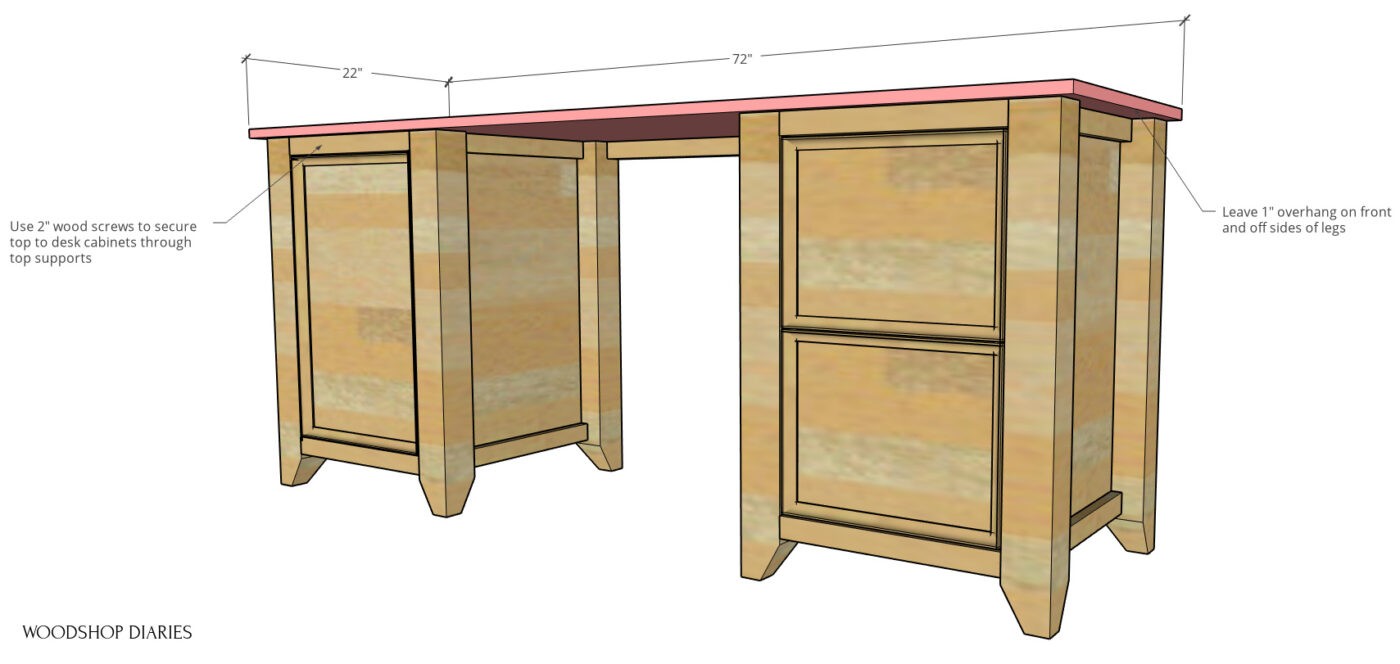
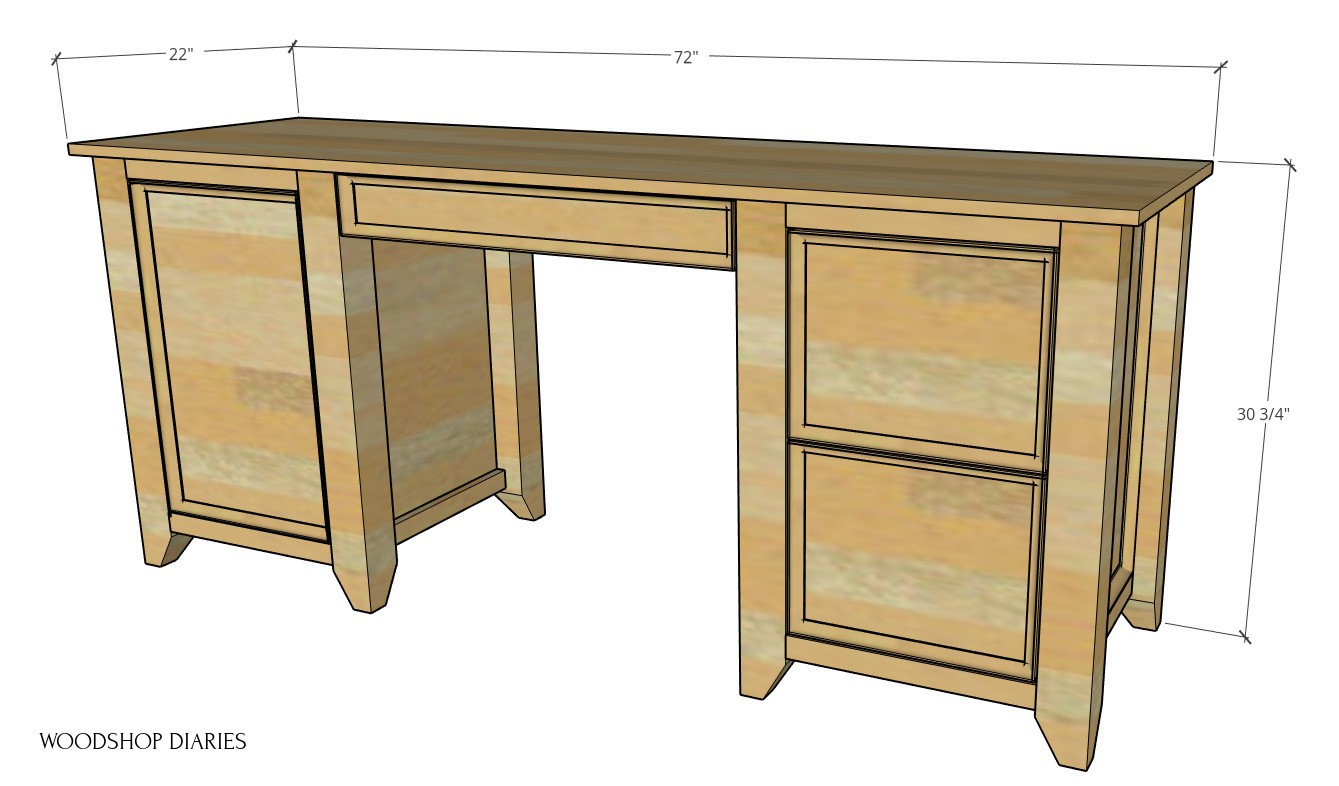
The overall dimensions of the desk as the plans lay out below is 22″ deep x 30 ¾″ tall x 72″ long.

DIY Computer desk overall dimensional diagram

Order of Building Steps

The video, plans, and following tutorial do not go in any specific order of steps once the two base cabinets are assembled.

You can mix and match the steps as you wish and go in what ever order makes sense to you.

Helpful Resources for this Building Project

You may find these posts and articles helpful throughout the building process:

  • How to cut plywood sheets
  • How to use a pocket hole jig
  • How to cover plywood edges
  • How to build and install drawers
  • How to install concealed hinges

How to Build a DIY Computer Desk with Drawers

This desk was assembled using basic construction techniques and simple pocket hole joinery. I’d consider this an intermediate level build.

I’ve got printable plans available below, a written step by step tutorial, and if you prefer to watch, I’d also got a tutorial video here:

Grab the printable building plans for this computer desk here. You can also find the printable plans for all of the matching pieces on the same site:

Step 1: Assemble Computer Desk Legs

I started this project out the same way I started the other matching pieces in this office furniture set—by making the legs.

I made identical legs for all of the matching pieces, so this process may look familiar if you’ve seen those projects already. 

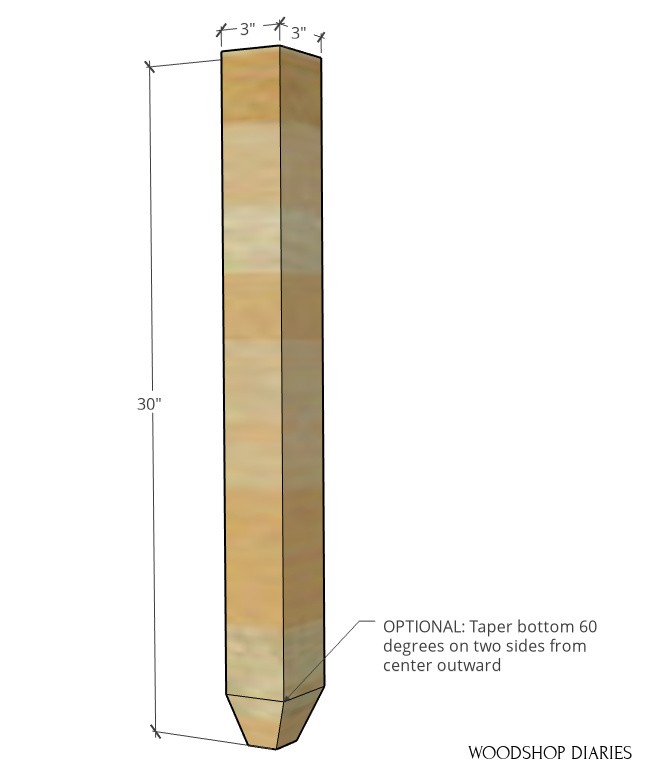
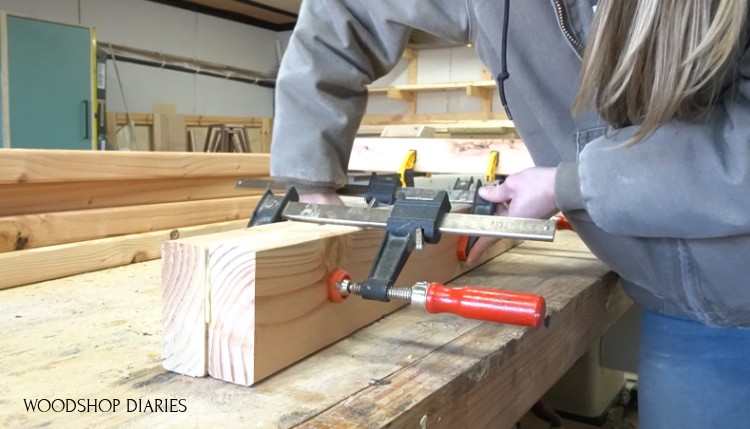
To create the leg posts, I trimmed down my 2×4 boards to 32”, then glued them together into 8 total pairs to make 8 total legs for this desk.

Shara Woodshop Diaries clamping legs together

Once the glue was dry, I trimmed about ¼” off each edge on the table saw to clean them up after the glue and to make them 3” square legs.

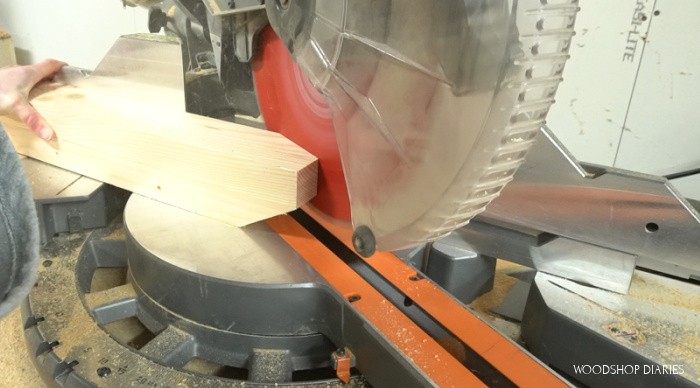
Then, I trimmed them to their final lengths (30″) on the miter saw.  And after they were trimmed down, I adjusted my miter saw angle to 60 degrees to taper two sides of each leg from the center out. 

This is an optional step, but adds a little extra detail to fancy things up a bit.

Step 2: Assemble Four Side Panels

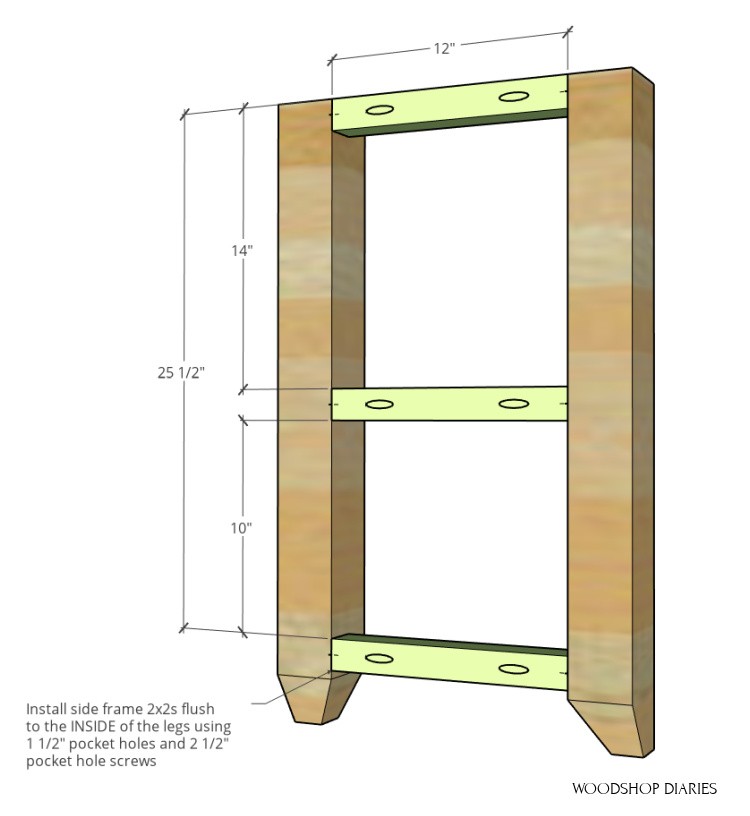
Next, I cut down some 2x2s and ¾” birch plywood to build the side panels for the two desk cabinets.  If you want to learn more about how I cut down plywood sheets, I have a detailed plywood cutting guide here.

Once the legs, plywood, and 2x2s were sanded well, I brought out my Kreg 720 pocket hole jig to drill pocket holes for assembly. 

Kreg 720 pocket hole jig with support wings extended and plywood panel clamped in place

NOTE: If you’re not sure which Kreg Jig is right for you, check out this post to help break down the options!

The Kreg 720 pocket hole jig is definitely my go to, personally. I love the onboard bit storage (so I can quit losing all my bits!), the fold out support wings for when you’re drilling into large panels (like you see in the image above).

Kreg 720 pocket hole jig onboard storage

And the AutoMAXX clamping feature automatically adjusts to different board thicknesses, so you don’t have to worry about it when switching from ¾″ material to 1 ½″ material, etc.

Not sure what I’m talking about with board thickness adjustments? Check out this guide how to set up and use a pocket hole jig to learn more.

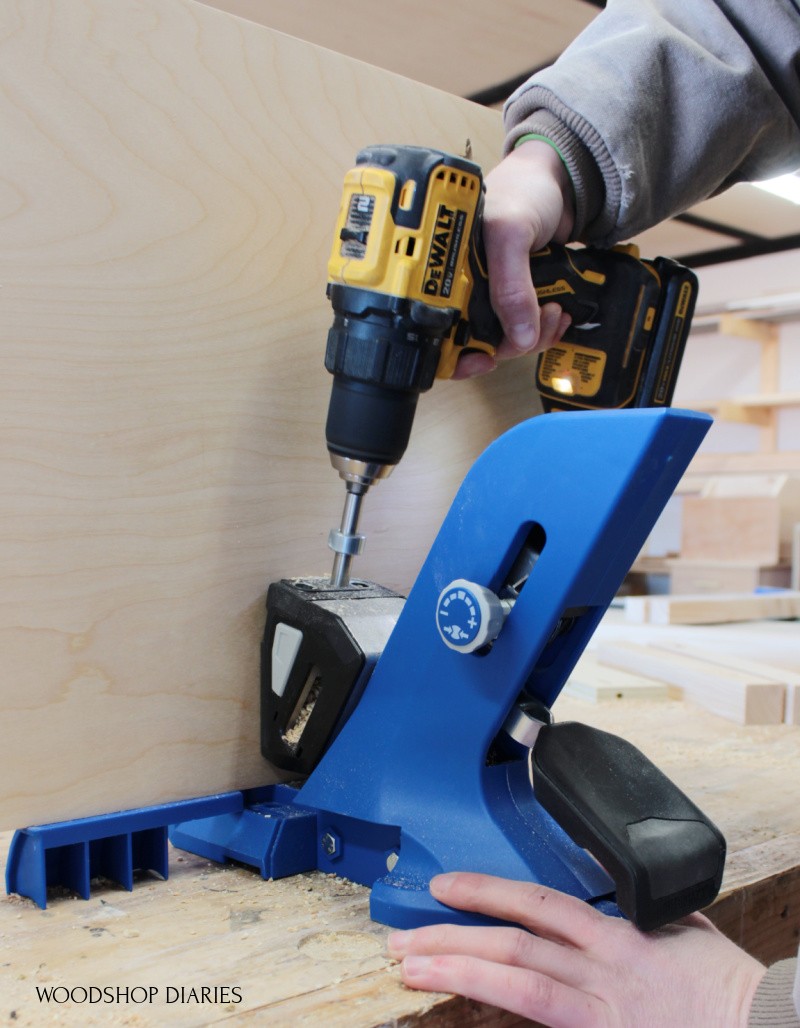
Kreg 720 pocket hole jig on workbench drilling holes into plywood panel

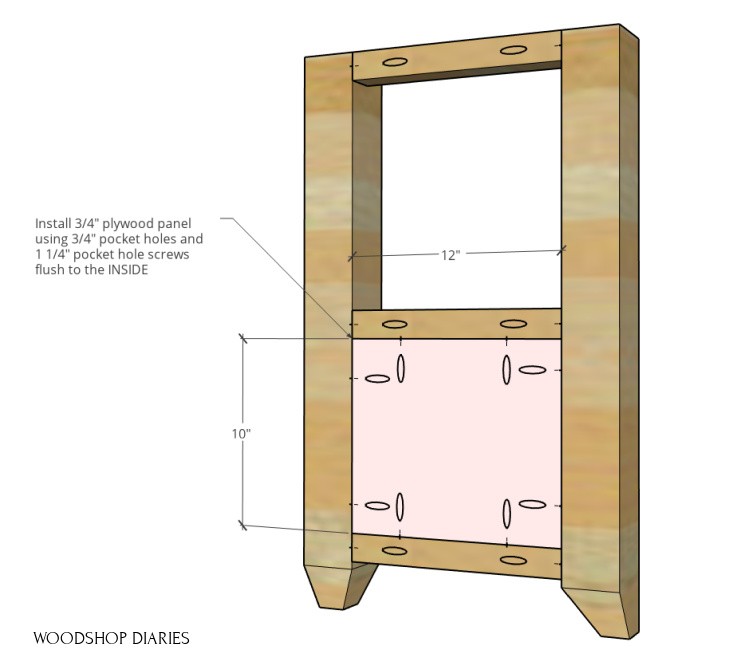
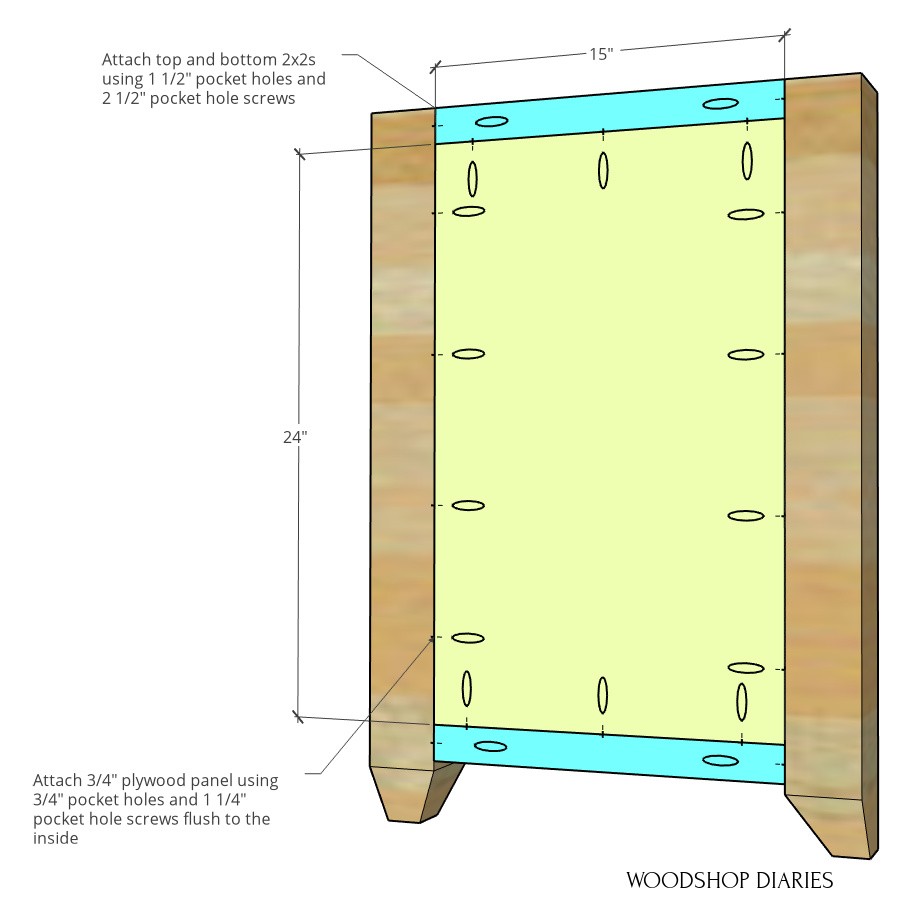
I drilled pocket holes into the 2×2 and the plywood pieces and began assembling the side panels using wood glue and pocket hole screws.

RELATED: If you want to learn more about how to use pocket holes, check out this detailed guide!

Computer desk side panel diagram with dimensions

I made sure to pay attention and face the tapers the right directions on the legs when assembling. They should face the INSIDE.

Step 3: Assemble Computer Desk Cabinets

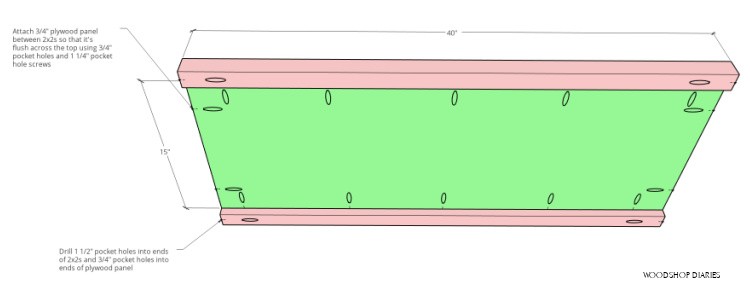
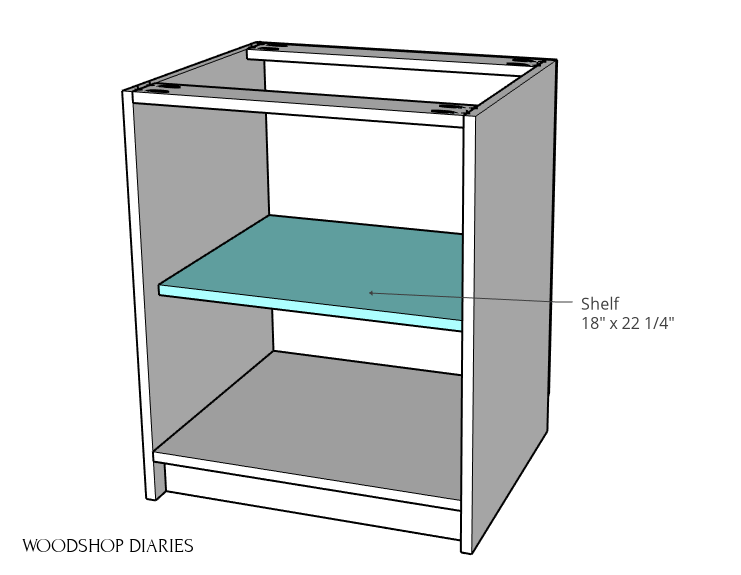
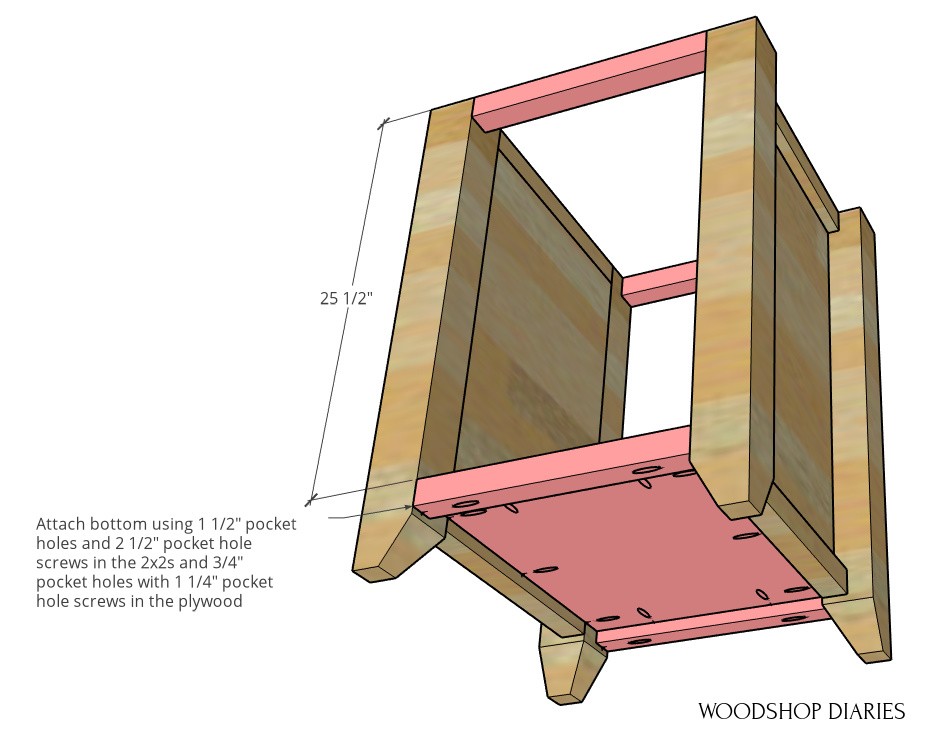
Once I had four identical side panels, I started building the two desk cabinets.  One of these cabinets will have a door and shelves.  So it needed a solid bottom. 

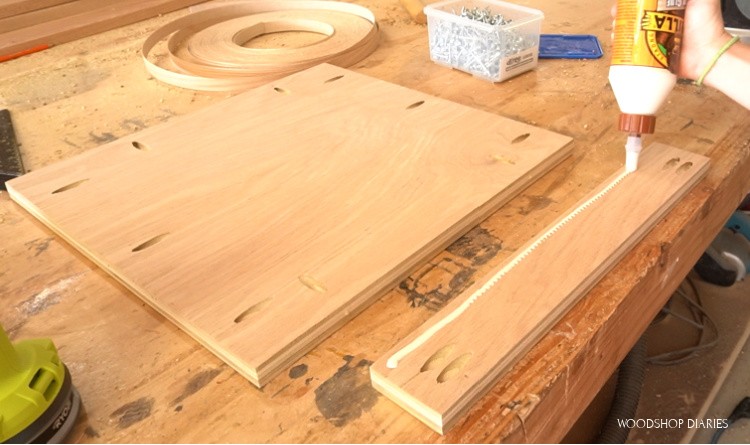
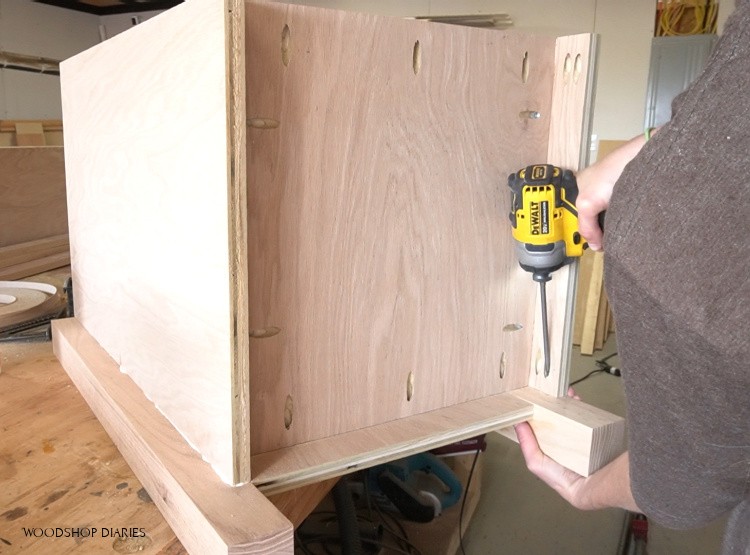
For this, I cut a ¾” plywood panel and attached it between two 2x2s using pocket hole screws to make this bottom shelf.

Then, I assembled the door cabinet using this bottom shelf on the bottom and 2x2s at the top.  It’s important here to attach the bottom panel equal distance from the top 2x2s to keep things square.

Diagram of desk cabinet with solid bottom installed

Once that cabinet was assembled, I repeated the process for the second cabinet, only this time, I just used 2x2s because there’s no need for a solid bottom since this cabinet will have drawers. 

However, if you wanted to make it solid, that’s fine, too. 

Now that both cabinets are built, it’s time to customize each one.  Because I love drawers, I started with the drawer cabinet first.

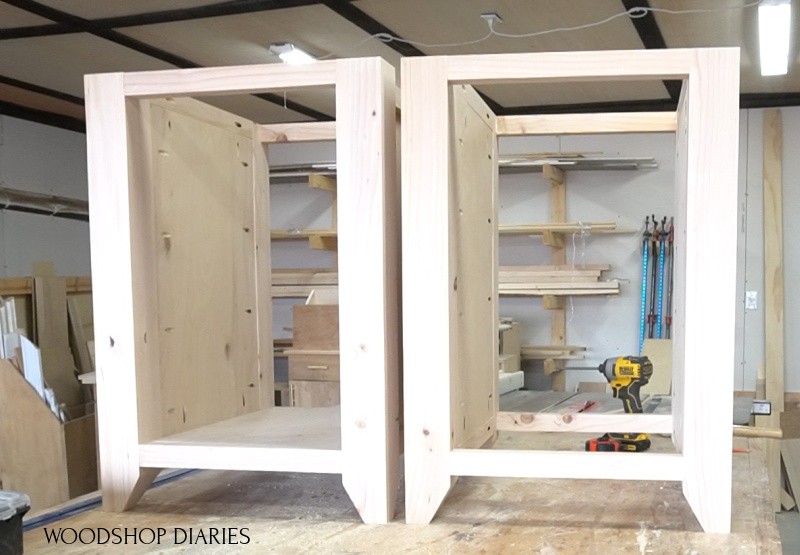
Left and right desk cabinets assembled on workbench--left cabinet with solid bottom and right cabinet with open bottom

Step 4: Add Drawers to One Cabinet

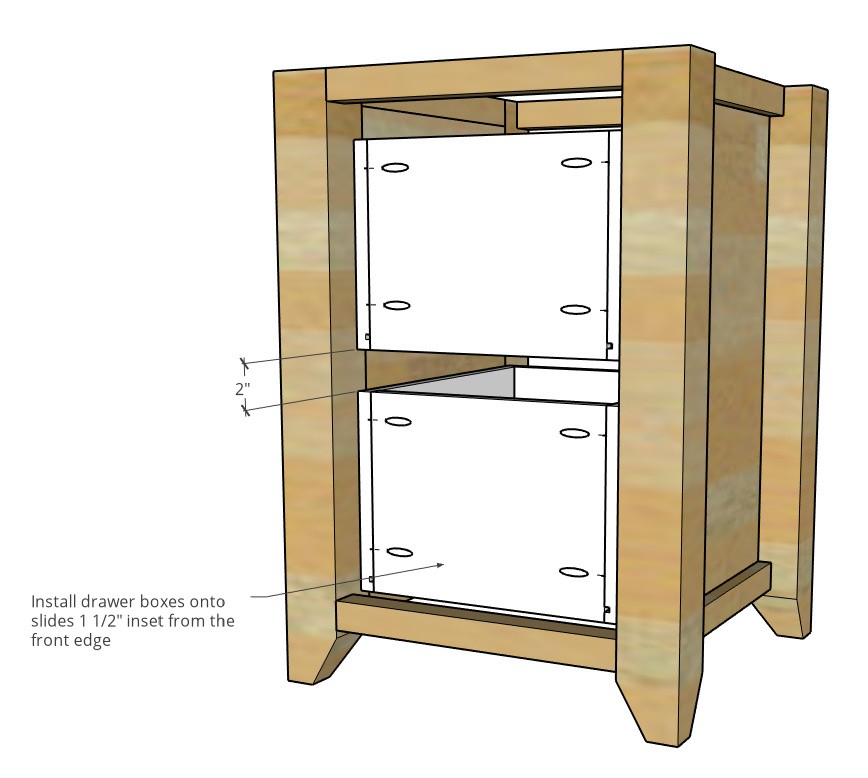
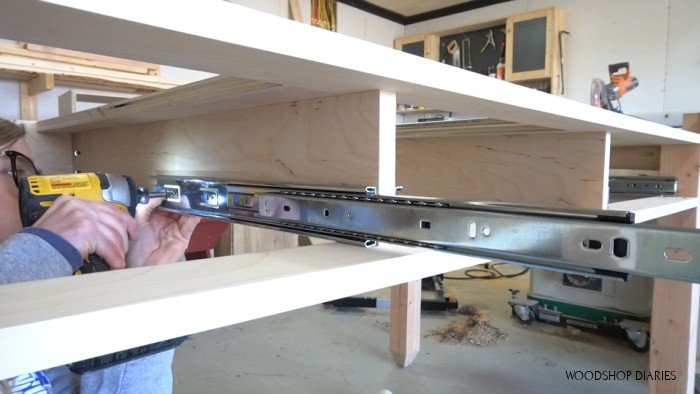
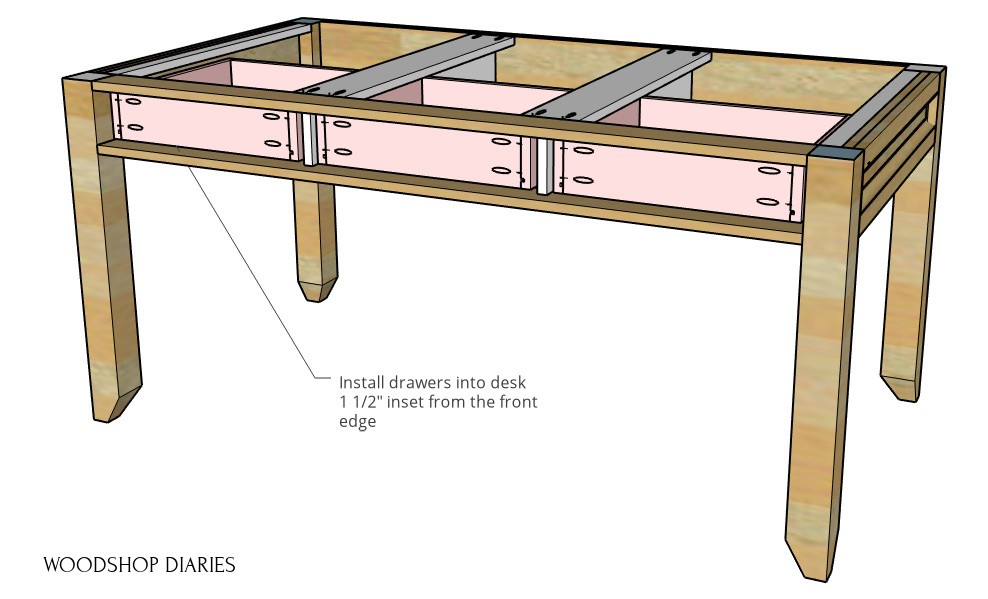
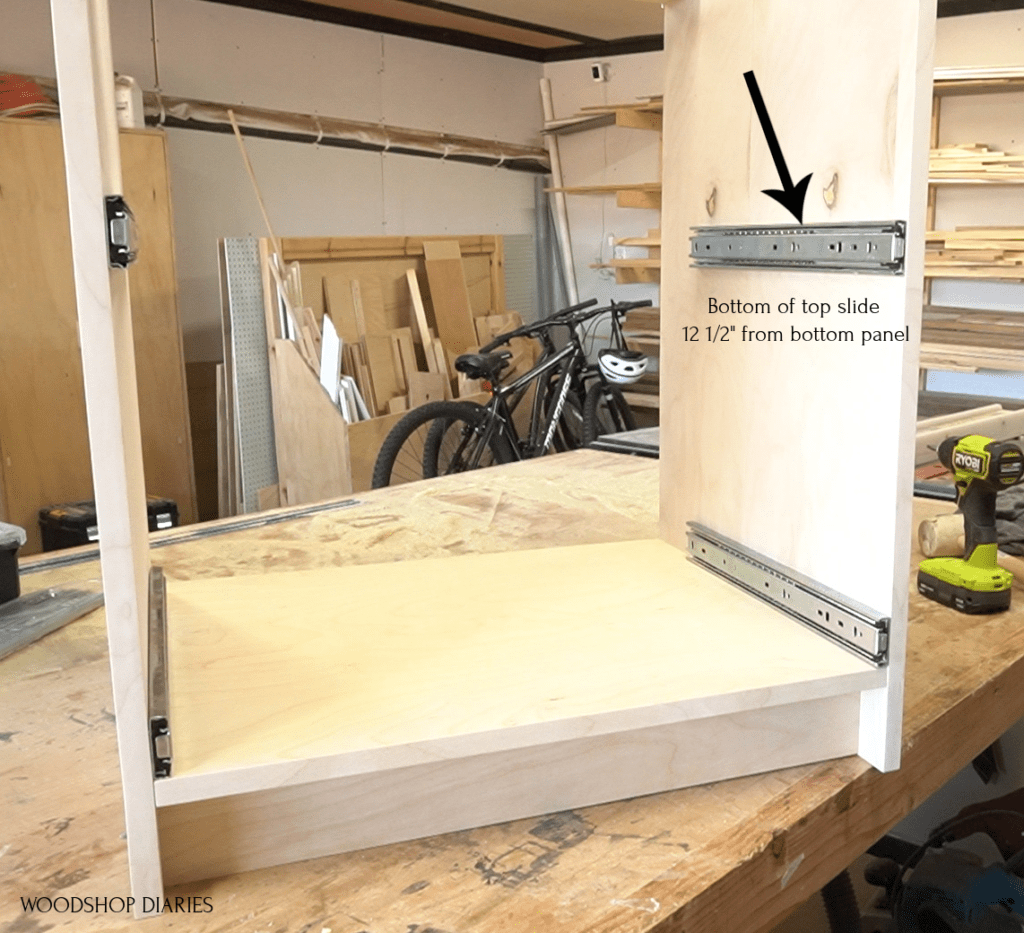
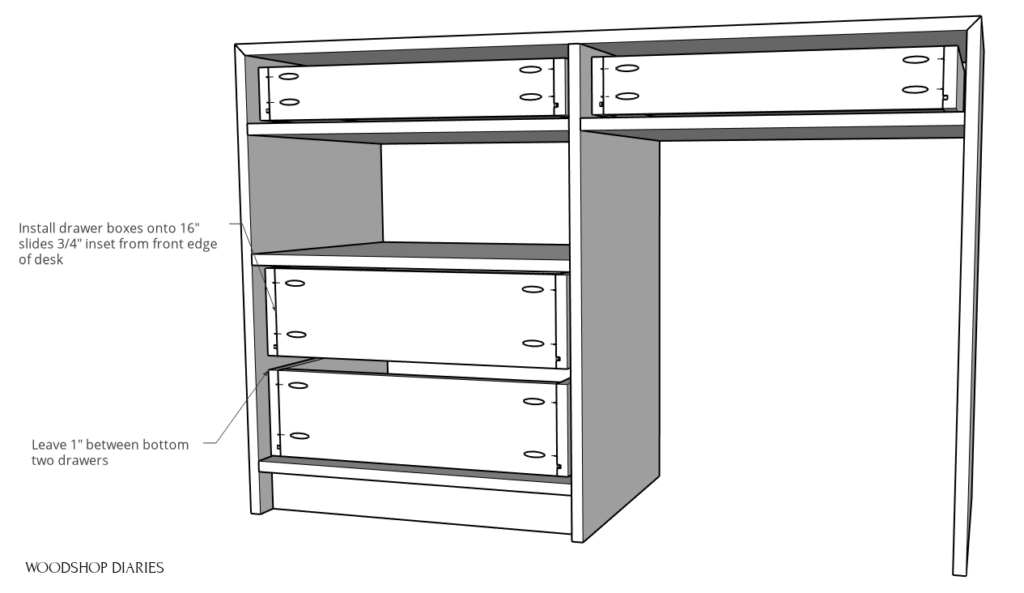
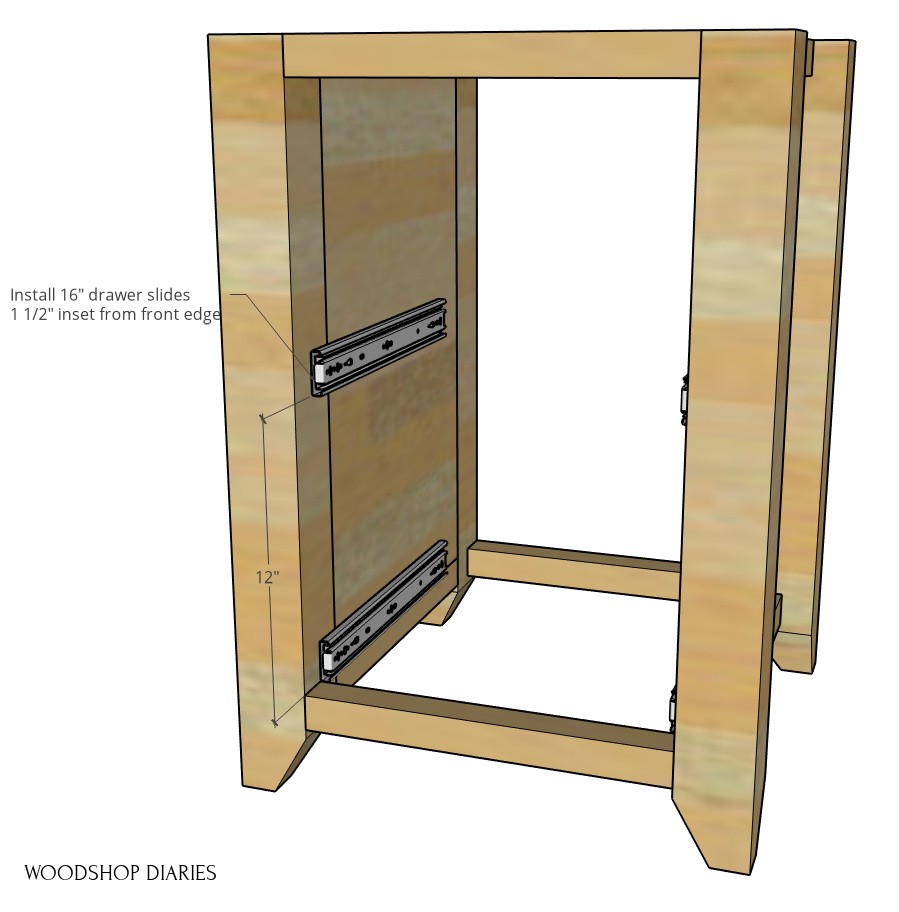
I installed two pair of 16” ball bearing drawer slides into this cabinet—one at the bottom and one 12” from the bottom. 

Drawer slides installed into desk cabinet

Because the drawer fronts will be 1 ½” thick, I inset these slides 1 ½”.  If you want to learn more about how to build and install drawers and drawer slides, check out my drawer building guide here.

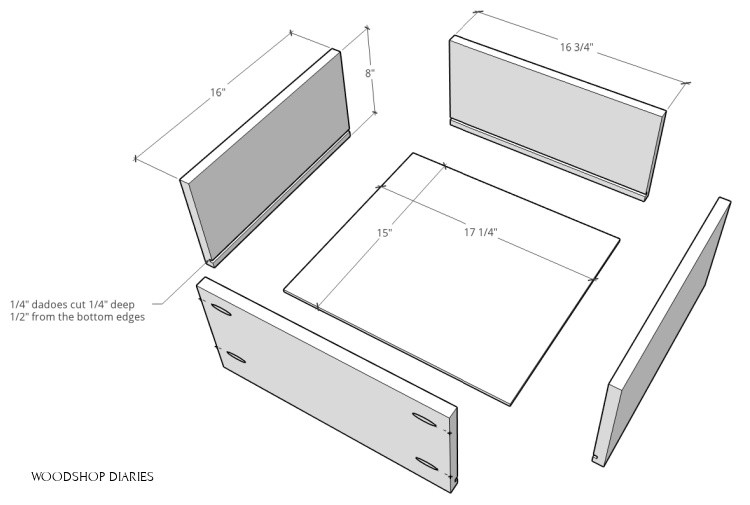
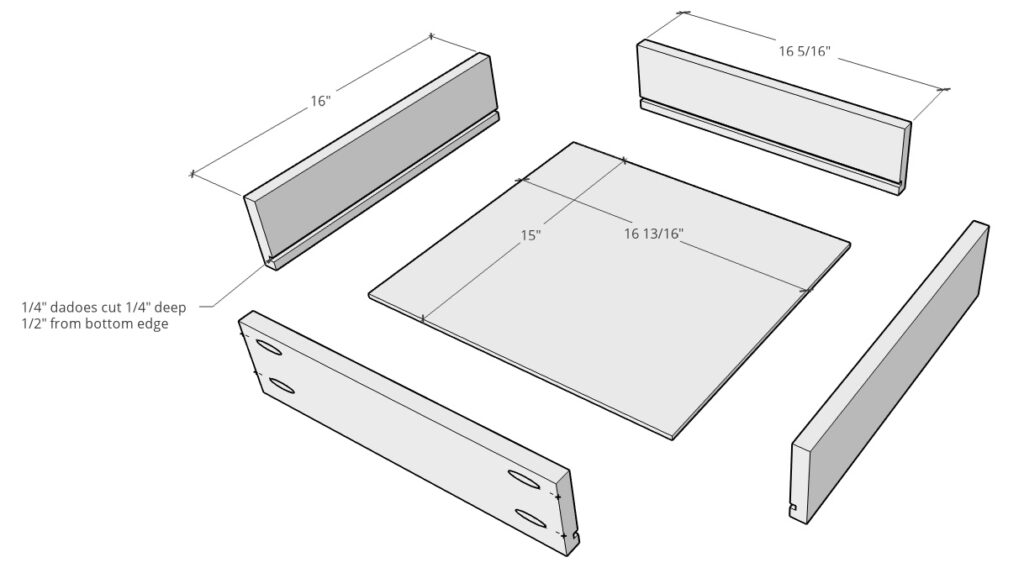
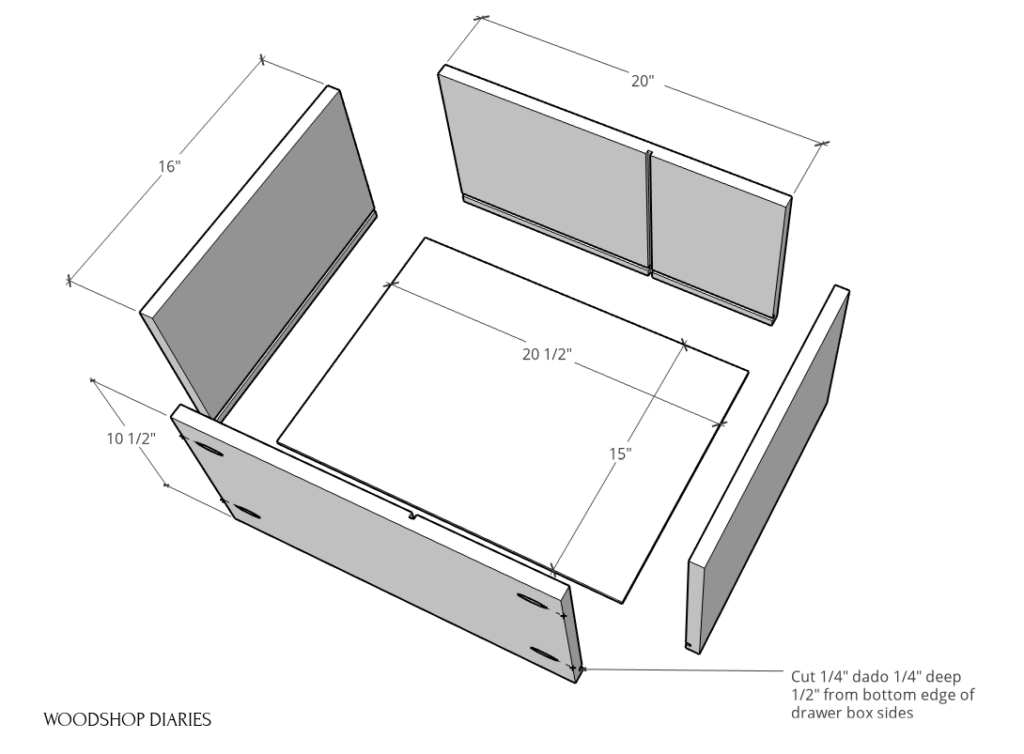
I ripped a piece of plywood off my sheet to build the drawer boxes from.  I trimmed the side pieces down to size on the miter saw and cut a dado in them for the ¼” plywood drawer bottom.

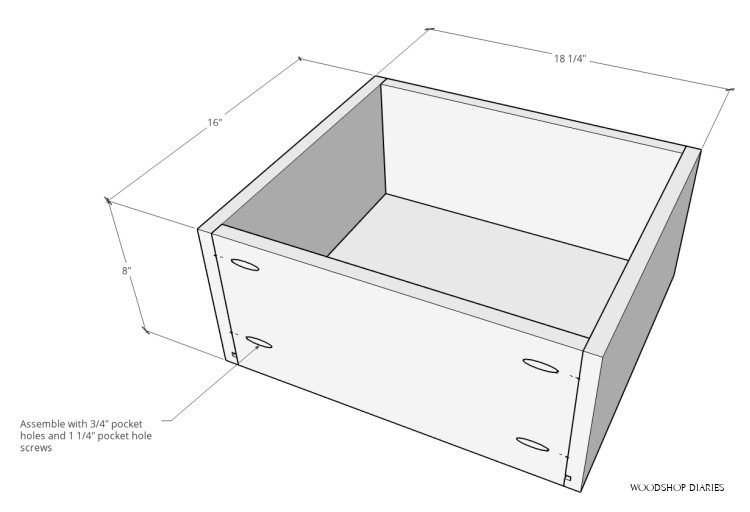
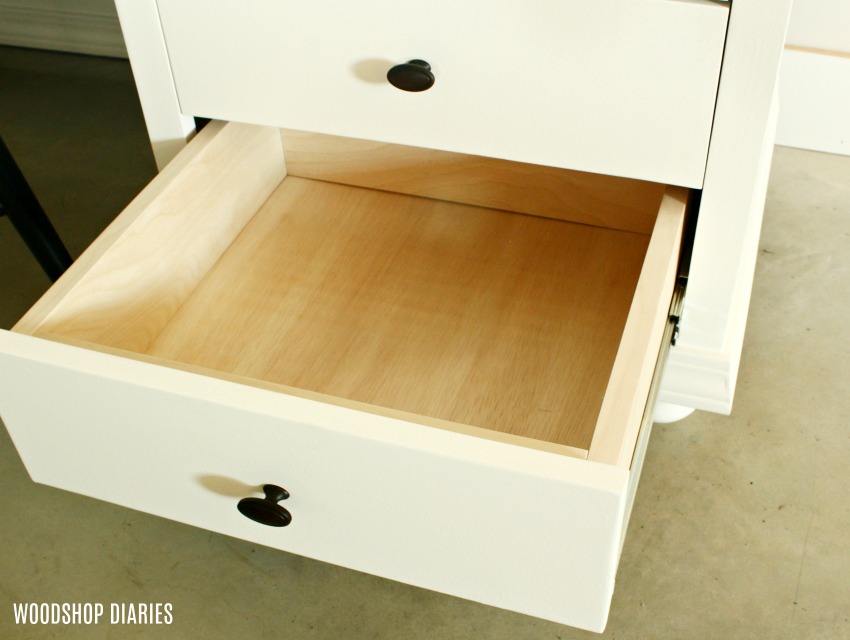
I edge banded the tops just to give it a cleaner look, and drilled pocket holes in the front and back pieces.

RELATED: How to apply iron on edge banding

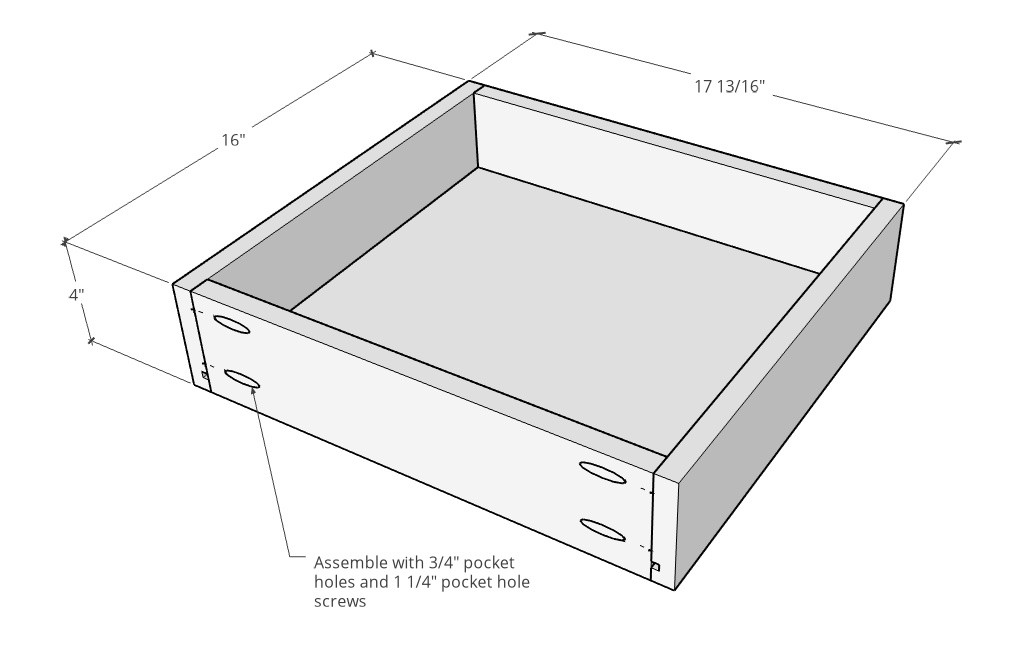
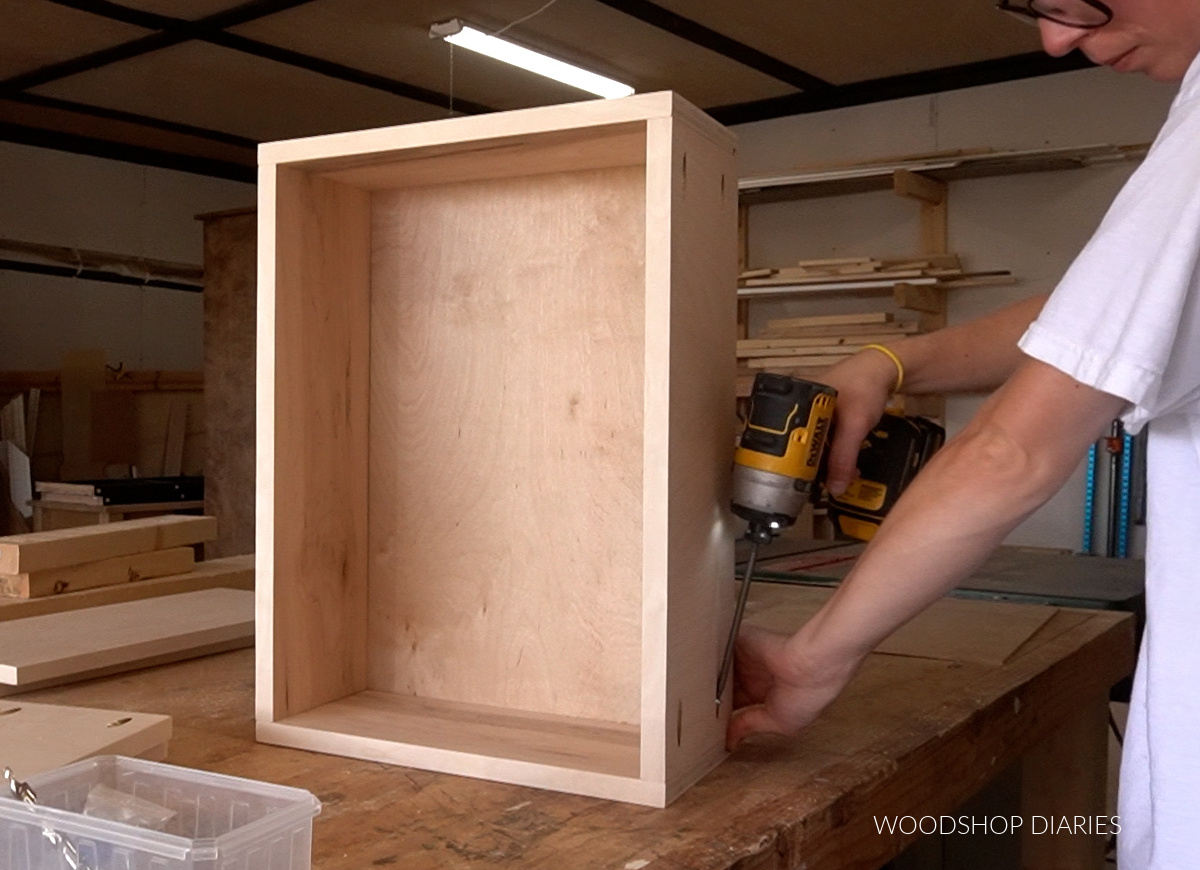
Then, I assembled using pocket hole screws and installed a ¼” bottom before adding the last piece.

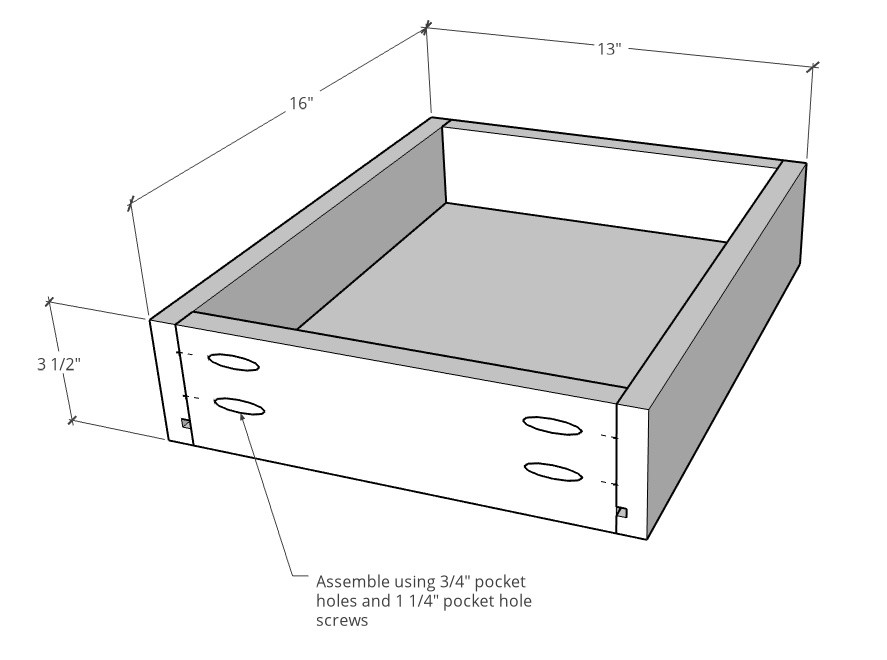
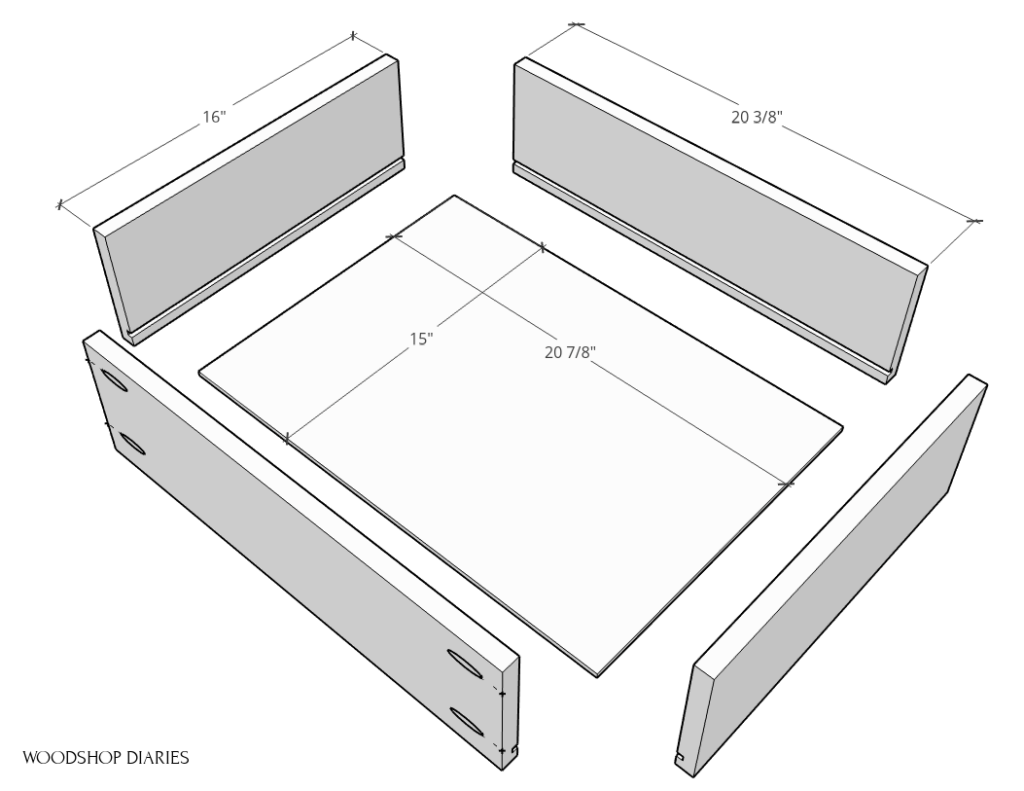
Overall drawer dimensions

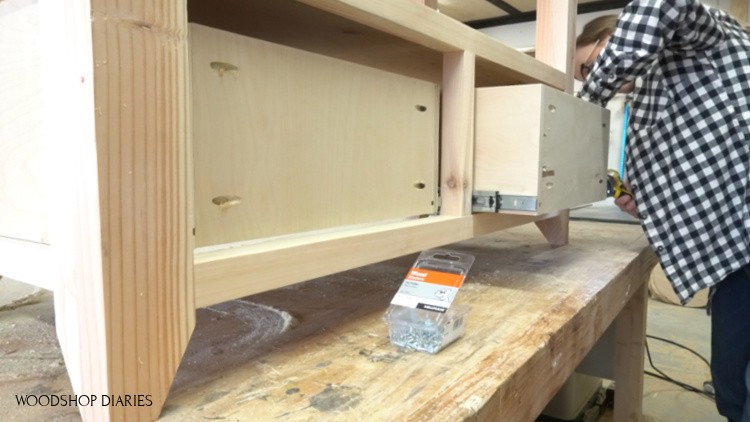
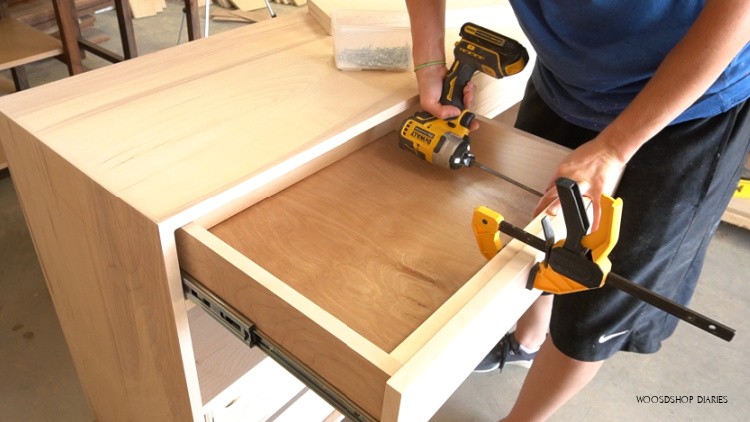
And finally, I installed these drawer boxes into the cabinet.  If you want to learn more about how to build and install drawers and drawer slides, check out my drawer building guide here.

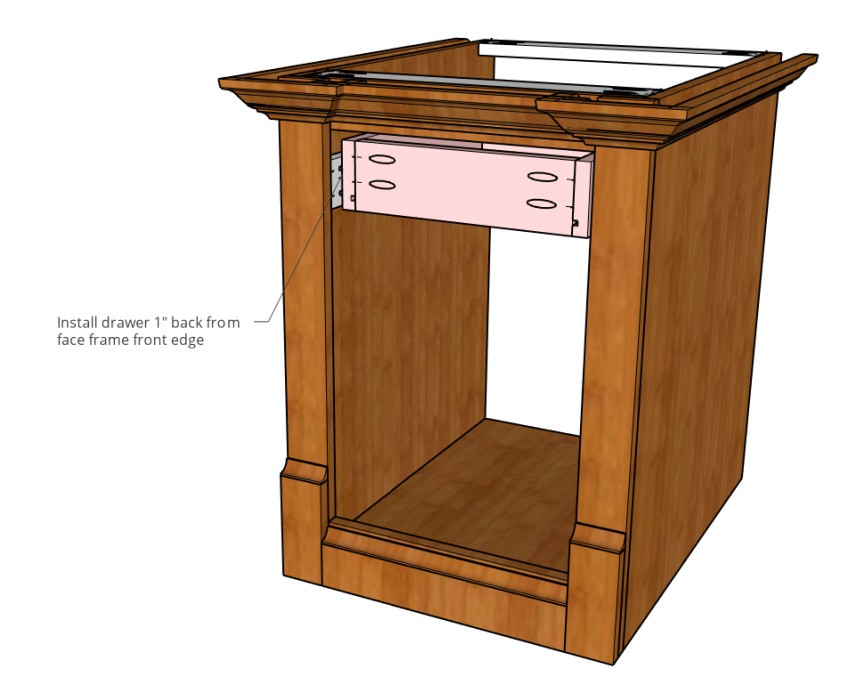
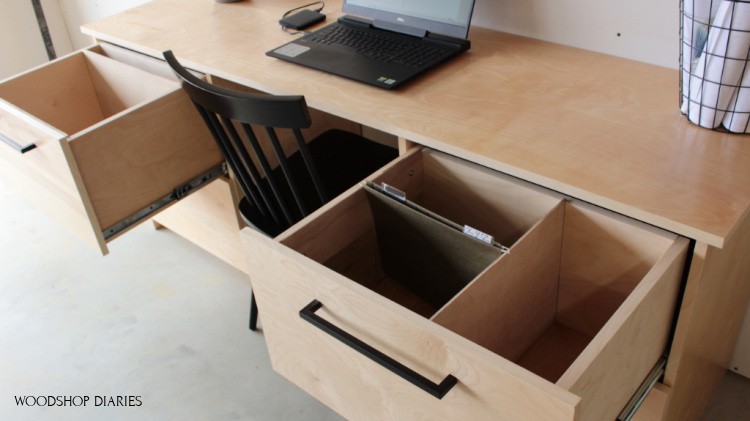
two identical drawer boxes installed into computer desk cabinet

Step 5: Build and Install Drawer Fronts

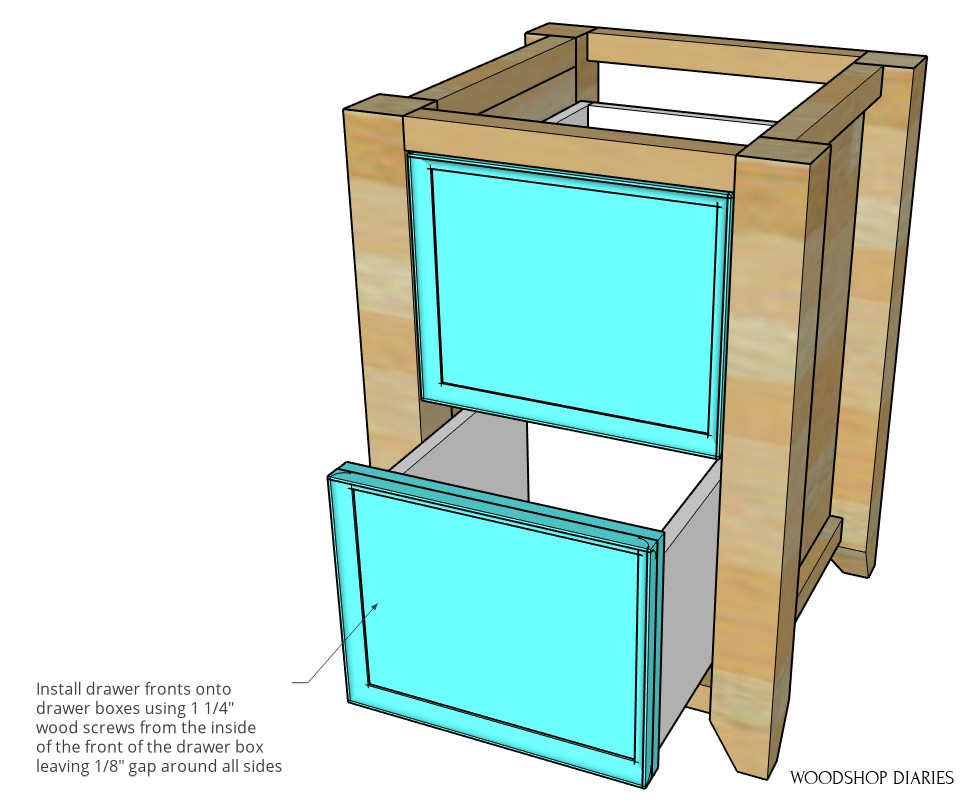
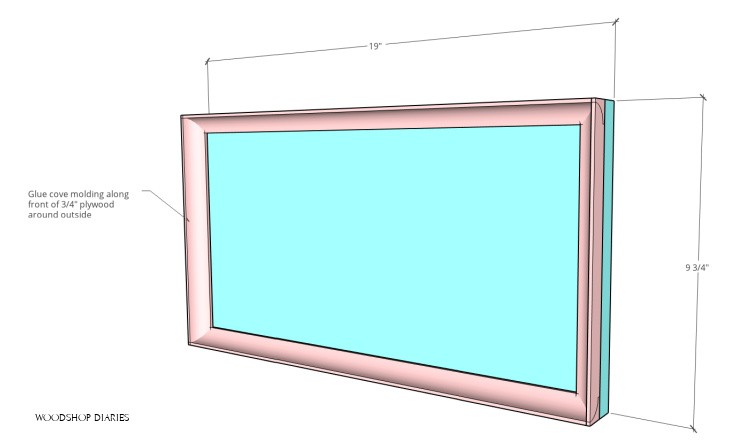
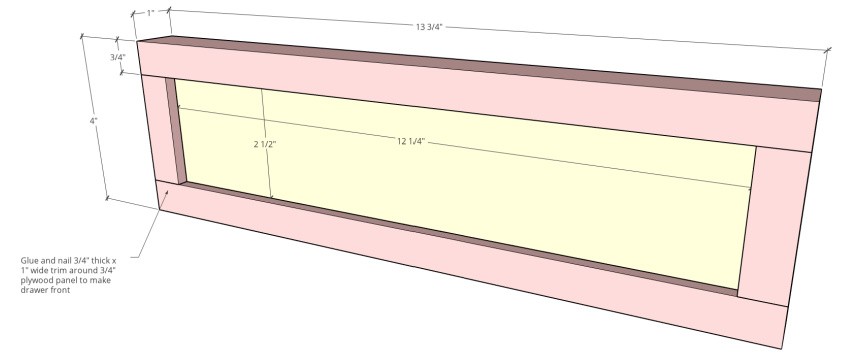
I built these drawer fronts the same way I built the drawer fronts on the matching shelf build. I cut ¾″ plywood and glued cove molding cut to fit along the edges.
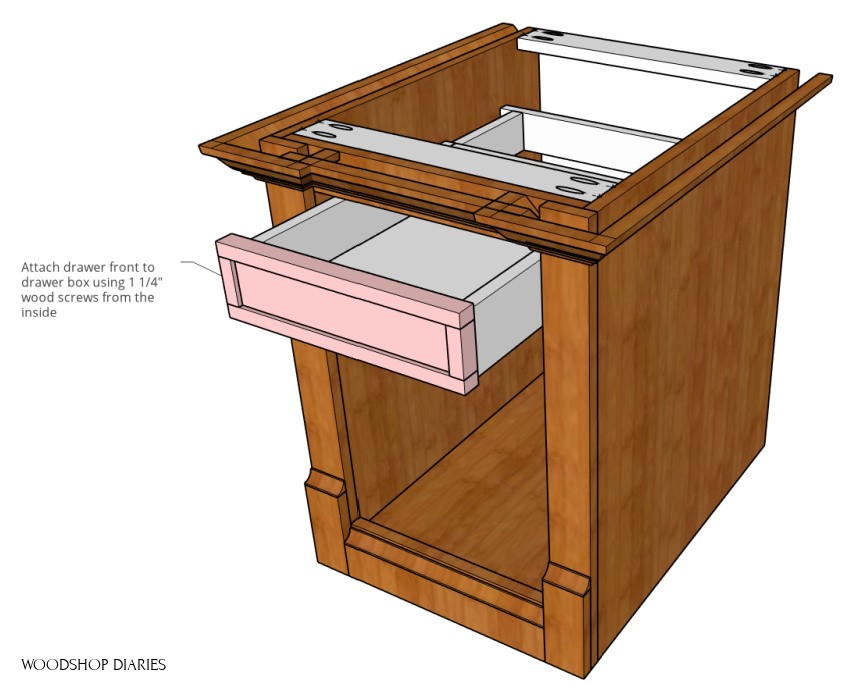
After the glue dried, I installed these onto the drawer boxes using 1 ¼″ wood screws through the inside of the drawer box to hold them in place.

Drawer fronts installed onto drawer boxes in computer desk cabinet

Step 6: Add Adjustable Shelves to Second Computer Desk Cabinet

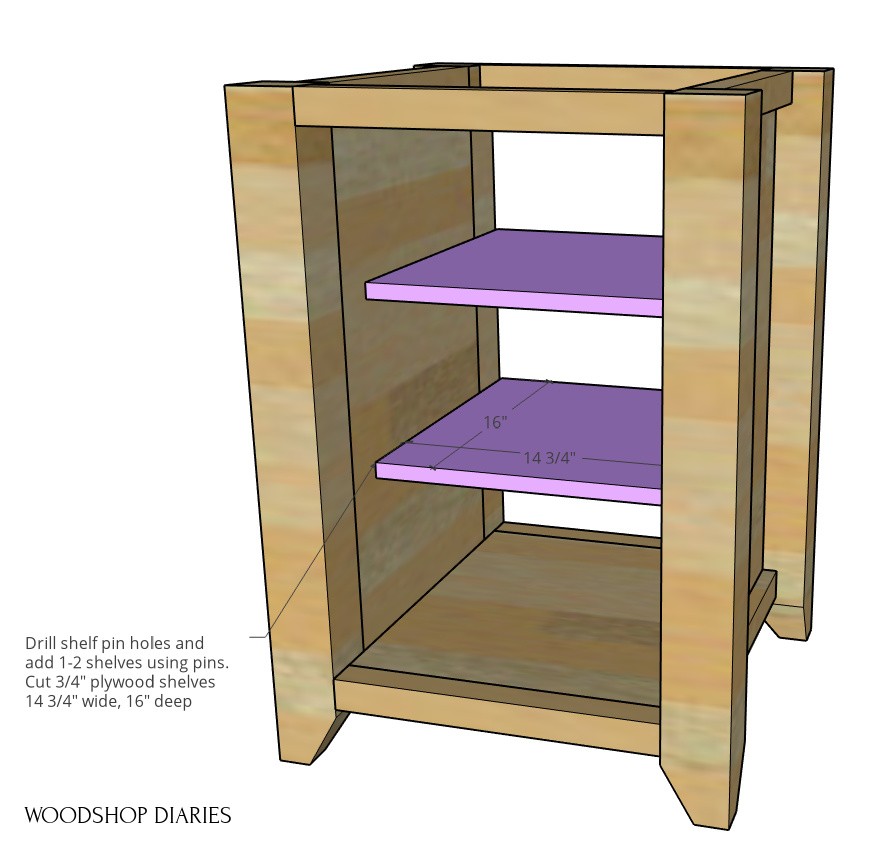
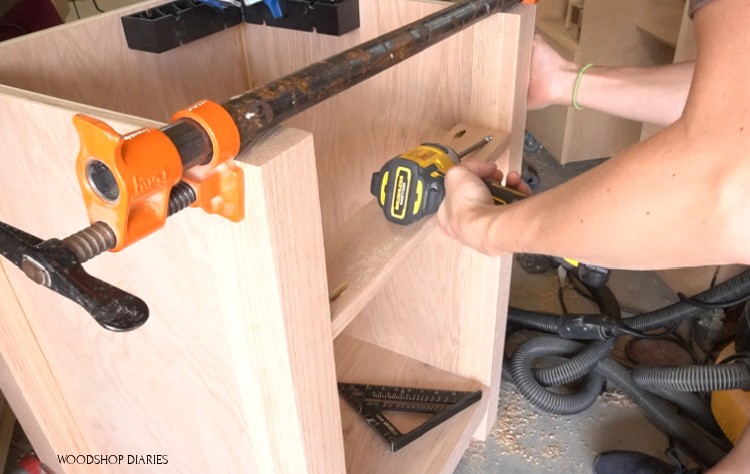
The door cabinet will have a shelf or two installed in it, so to give my dad some options, I used my Kreg shelf pin jig to drill shelf pin holes in this cabinet so he can have adjustable shelves.

RELATED: The shelf pin jig is one of the top 10 tools I recommend for basic cabinet and furniture building! Check out all ten here! 

Shara Woodshop Diaries drilling shelf pin holes

Once the holes were drilled, I used shelf pins to install adjustable shelves as needed. I only added one shelf, but you could add multiple depending on your needs.

I just cut the shelves from ¾″ plywood to fit inside the cabinet.

Shelves installed into left side computer desk cabinet

Step 7: Build and Install Door

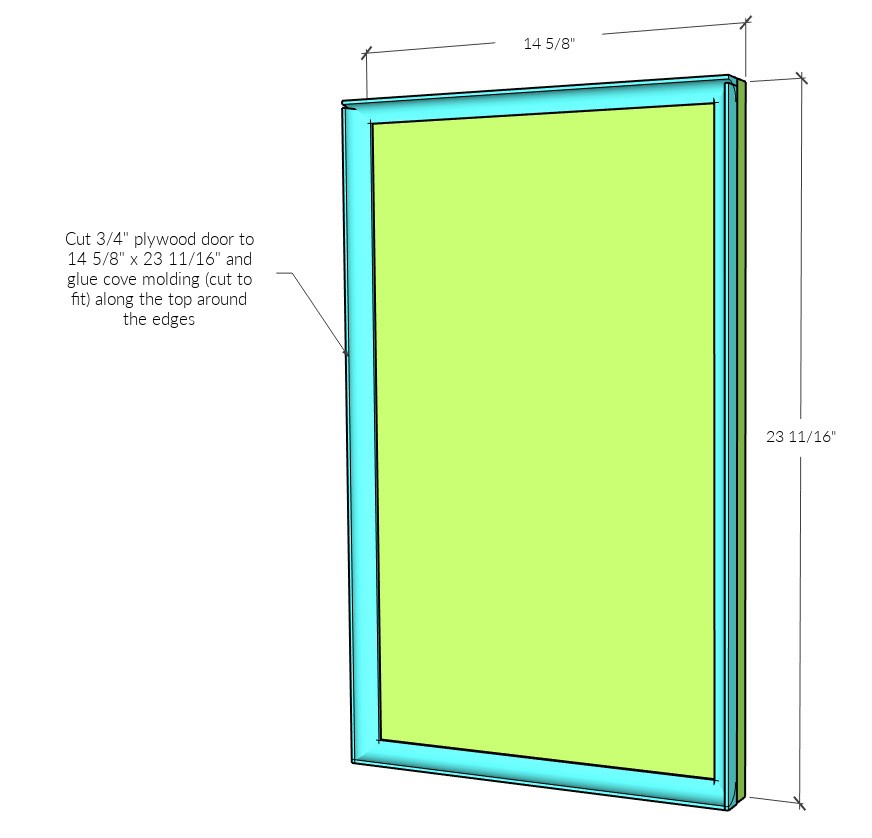
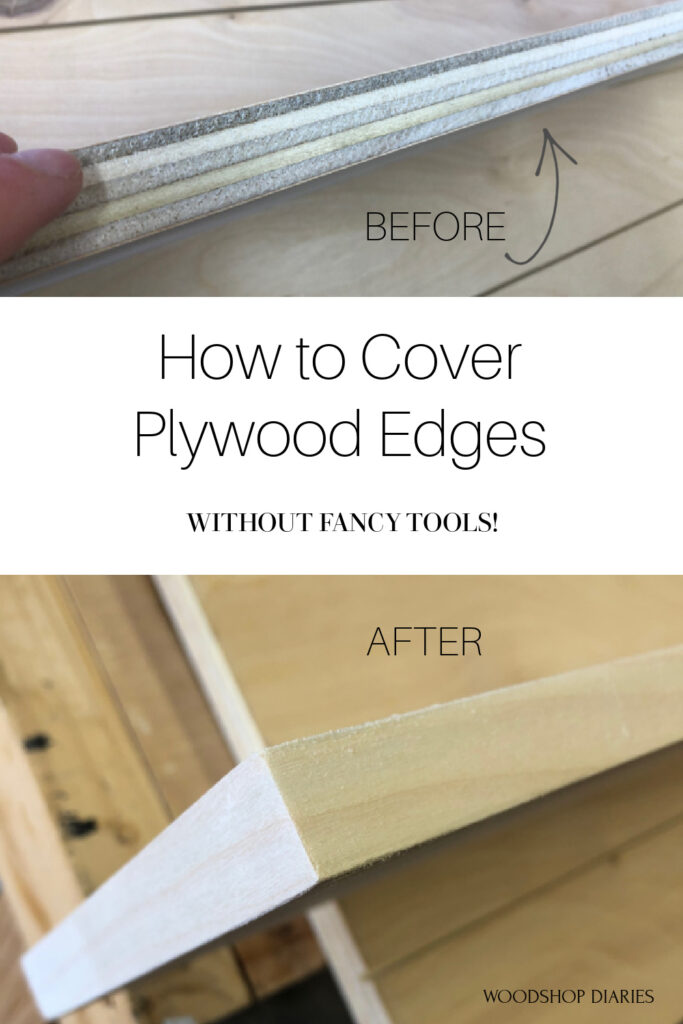
Next, it was time to add the cabinet door. I cut the door from ¾” plywood and edge banded the sides. 

Edge banding is always optional, but check out this post to see how easy it is to apply edge banding to your plywood projects!

Then, I cut to fit cove molding and glued it onto the front around the edges.

Left side computer desk door overall dimension diagram

Now, just a warning here…Adding the cove molding on the front side of this door complicated things a little.

Normally, I would make an inset door ¼″ narrower and ¼″ shorter than the cabinet opening (see this post about cabinet door sizing) and use concealed inset cabinet hinges to install them.

However, since this door was almost 1 ½″ thick, normal inset concealed hinges wouldn’t work. So instead, I used pivot hinges. Using pivot hinges required me to make my door slightly undersized.

So, if you are using pivot hinges in your project, you’ll need to make your door as shown above.  But if you build a different style door that is ¾″ thick and use normal concealed hinges, you can check this post for sizing details.

The pivot hinges were easier than I expected to install.

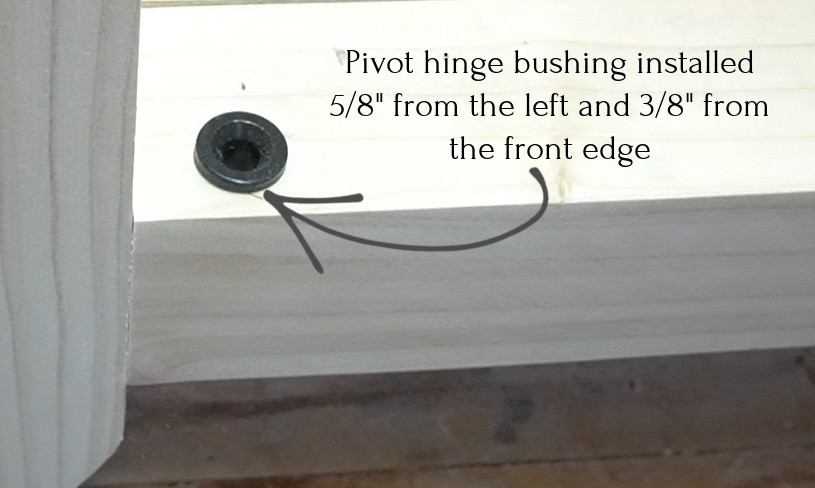
Check out the video above for installation details, but basically, I drilled a hole at the top and bottom of the cabinet ⅝″ from the side edge and ⅜″ from the front and tapped the bushing into it.

Pivot hinge bushing installed into cabinet

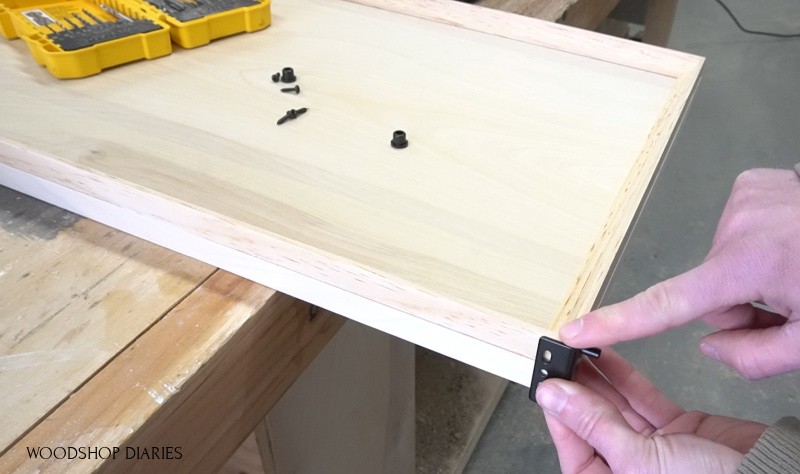
When I was ready to install the door onto the pivot hinges, I screwed the bottom hinge into the bottom corner of the door first.

pivot hinge placement at bottom corner of door

Then I dropped it into the bottom bushing and pushed the door into place into the top hinge.  I had to crawl through the back side of the cabinet to screw in the top…it was a tight fit haha.

Screwing top door corner into pivot hinges from the back side

And to my surprise, this worked out really well. I may be using pivot hinges more often after this!

Step 8: Add Back Support and Desk Top

While the glue dried, I screwed a 2×2 between the two cabinets at the top back corner to prepare to attach the top panel.

I cut the top from ¾” plywood, leaving an inch overhang on each side and the front.  I edge banded the sides and then centered it onto the cabinets.

I used 2” wood screws through all the top 2x2s in multiple places to secure the top.  I made sure to keep the space between the cabinets equal from front to back before attaching.

¾" plywood top installed onto computer desk base cabinets

Step 9: Add Keyboard Tray

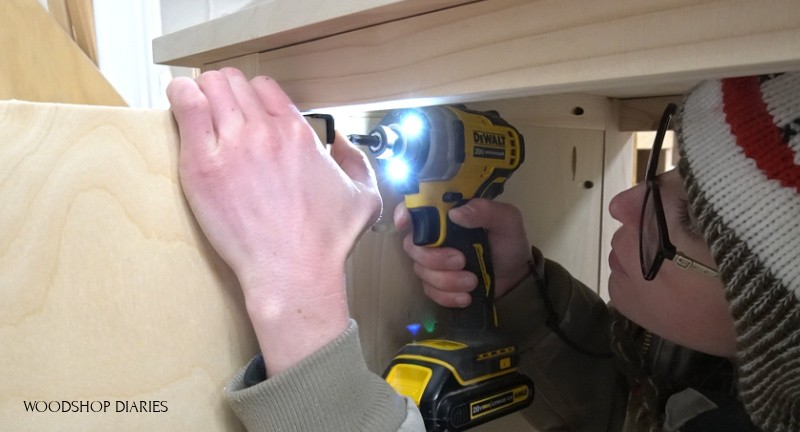
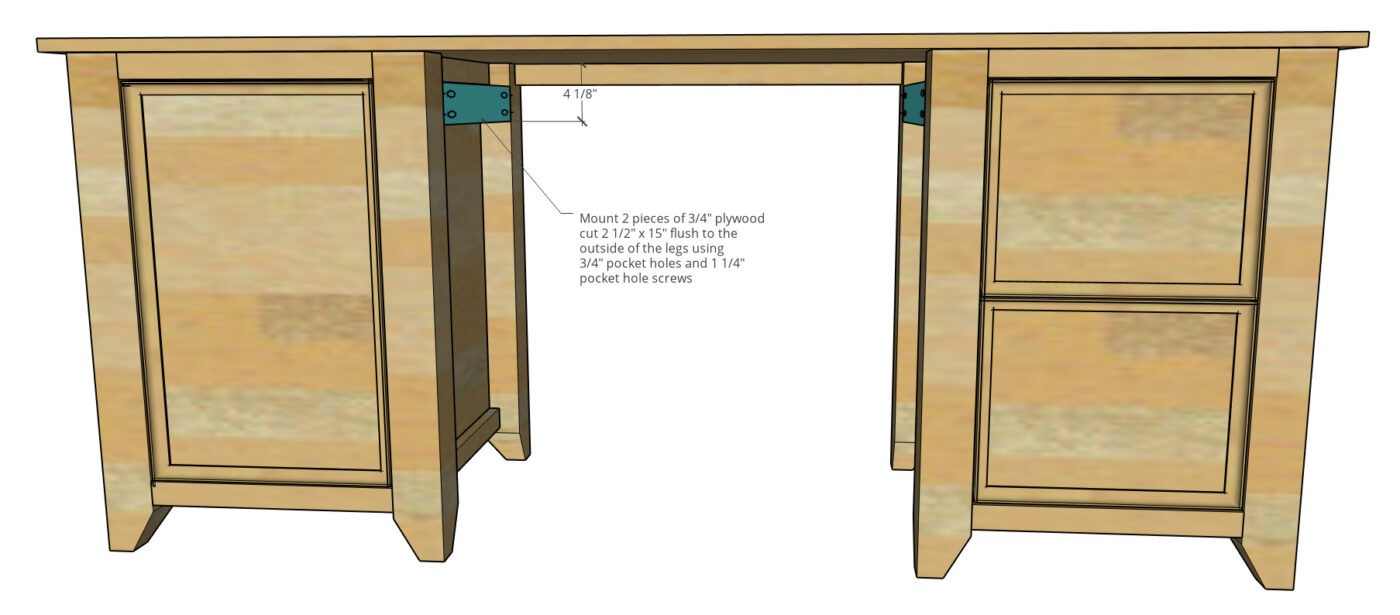
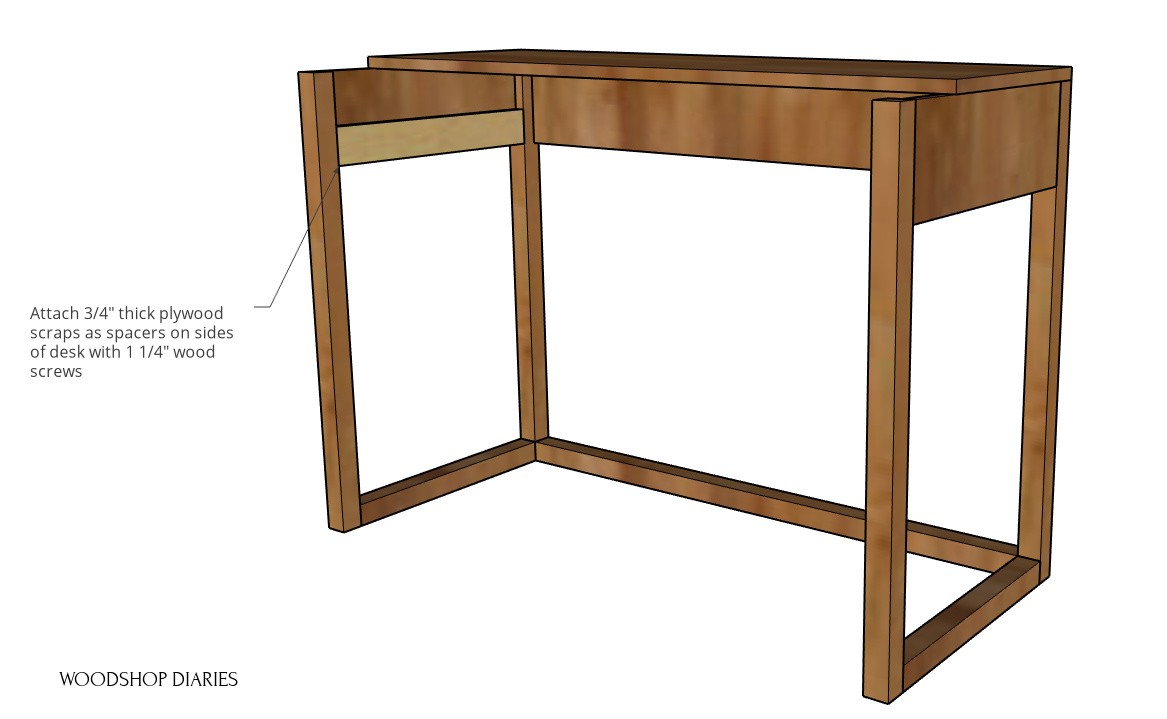
Now the middle of the desk has a keyboard tray.  So to give the drawer slides somewhere to mount to, I screwed some ¾” plywood scraps between the legs on each cabinet in the middle so that they were flush to the outside edge.

Scrap blocks installed into desk to mount middle drawer slides onto

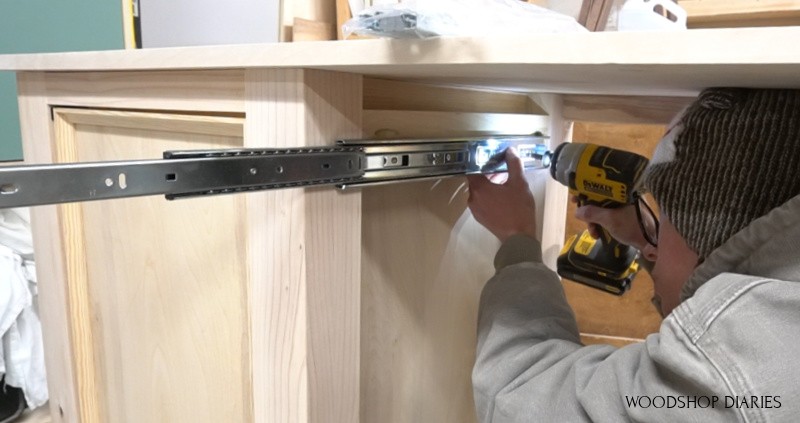
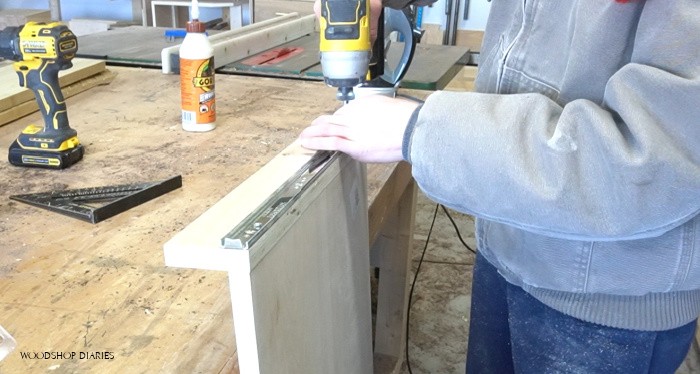
Then, I could mount the drawer slides onto these pieces.

Shara Woodshop Diaries installing drawer slides into center of desk

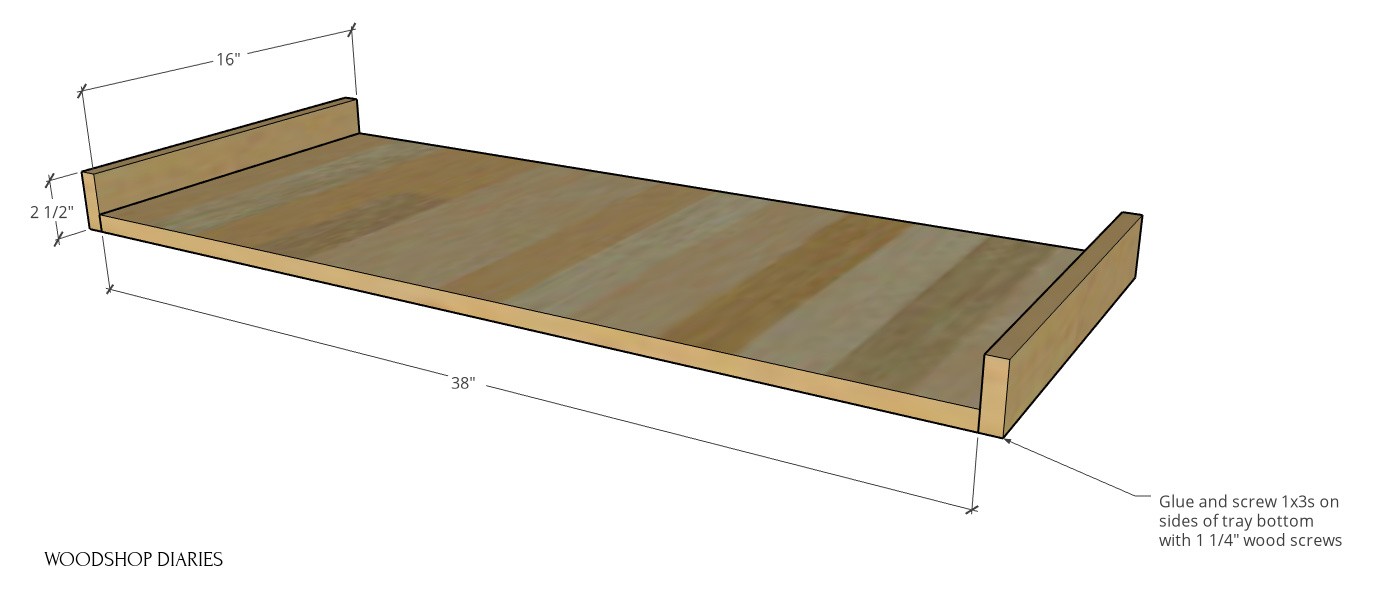
I rummaged through my scrap plywood pile and found some pieces I could cut down to build the tray and use as the tray front.

I edge banded the sides that would show, sanded everything well, then screwed the sides onto the bottom panel.

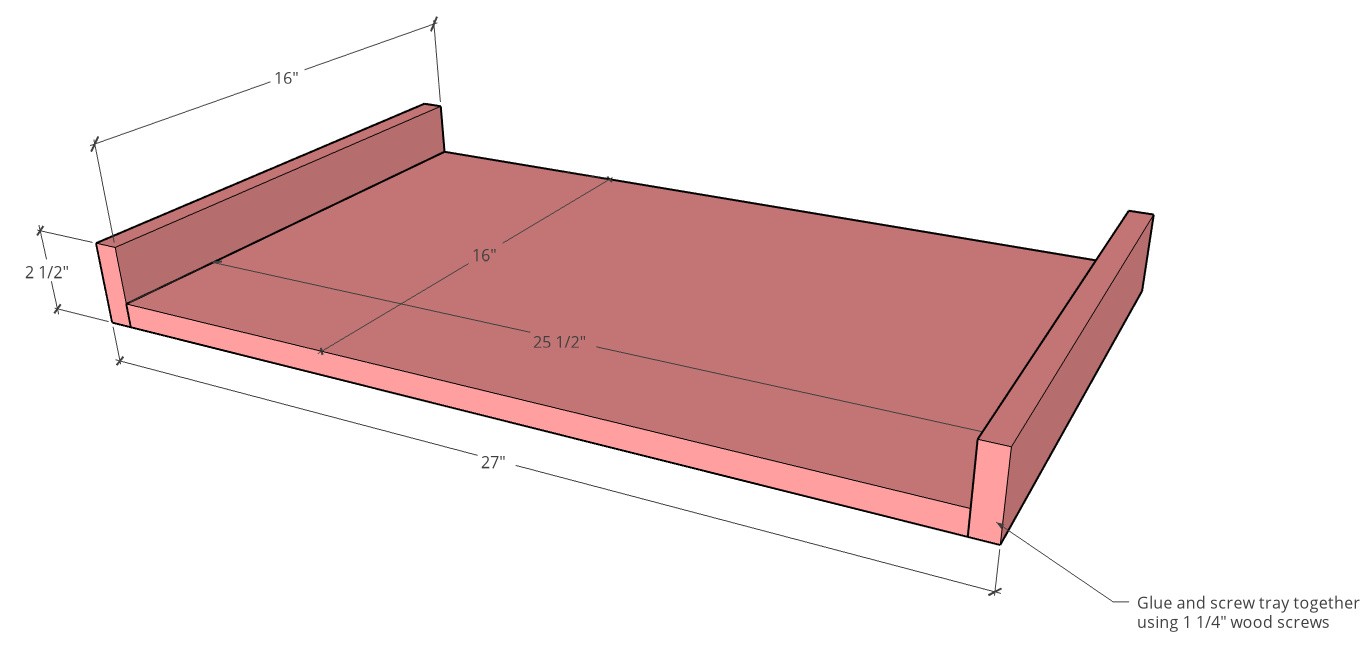
Keyboard tray overall dimensions

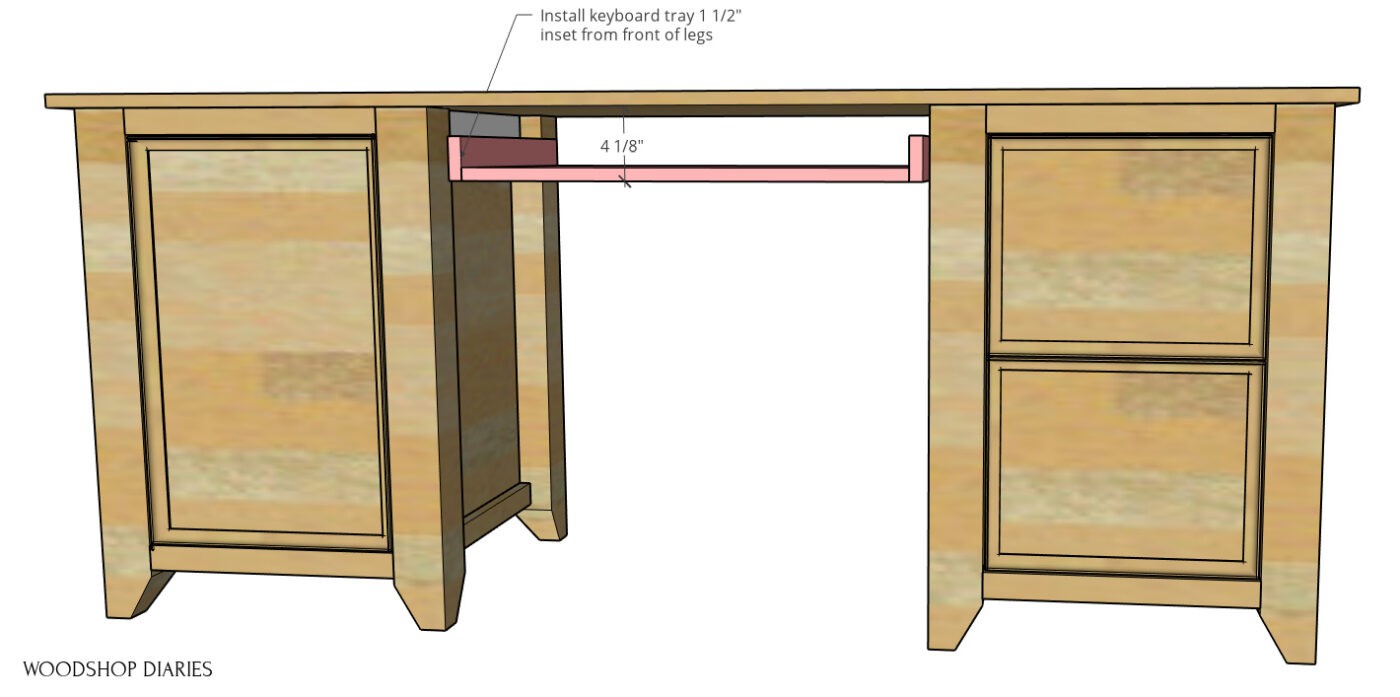
Now, I needed the bottom of this tray to be 4 ⅛” from the top edge.  So I cut some scrap blocks to help me clamp the tray in position while I screwed it onto the drawer slides. 

pull out computer desk keyboard tray installed onto middle drawer slides

Step 10: Add Computer Desk Keyboard Tray Front

For the tray front, I cut a piece of ¾″ plywood to size and glued cove molding around the edges just like the drawer fronts and door.

BUT, before I glued the cove molding on, I used my Kreg concealed hinge jig to drill out the cup holes to install the hinges.

RELATED: The Kreg Concealed Hinge Jig is one of my top 10 tools I recommend for cabinet and furniture building. Check out all ten here!

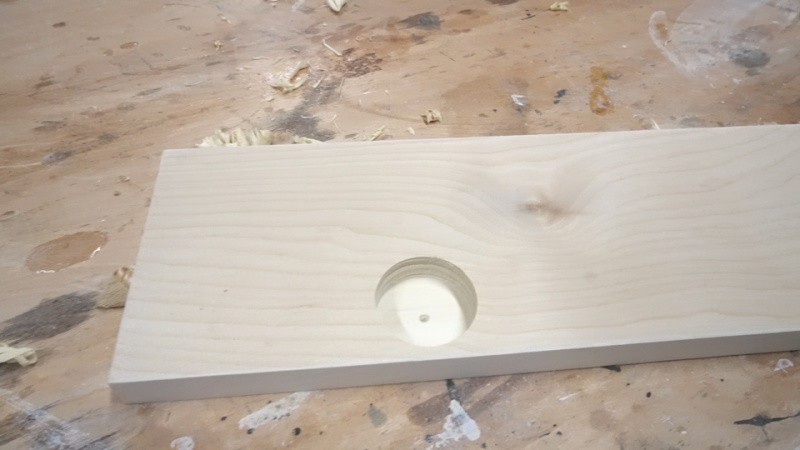
Close up of concealed hinge cup holes drilled out on keyboard tray front

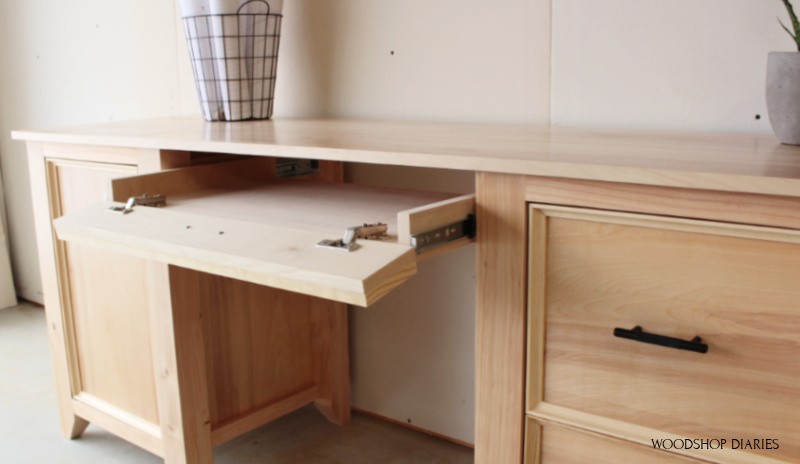
Then, I glued the cove molding on the front. Once it was dry and I installed concealed hinges for frameless inset doors to the keyboard tray front and the front onto the tray.  This will allow the front to fold open as needed for typing.

Close up image of pull out keyboard tray with flip down top

Step 11: Add Final Trim and Finish

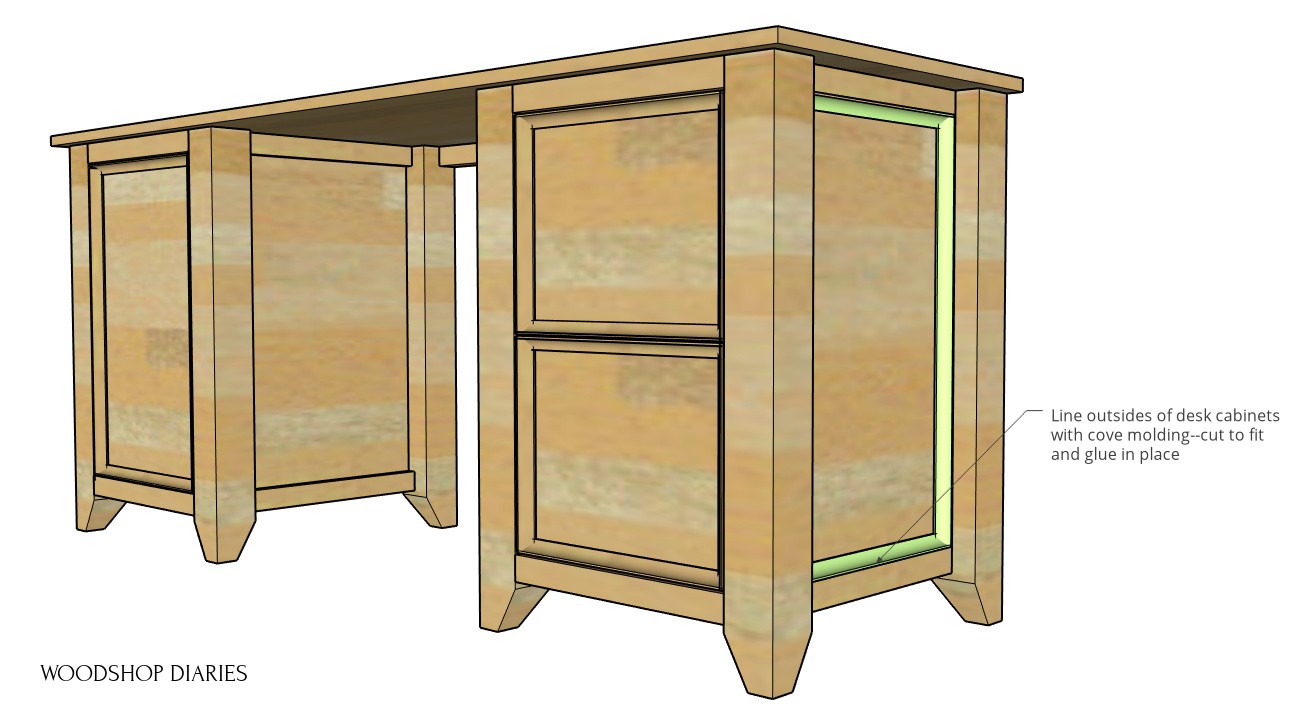
The last detail I added was just lining the left and right side of the desk with cove molding to match the drawer and door fronts.  I just glued this in place.

Sketchup graphic of computer desk with cove molding added to the sides

Once everything was dry and well sanded, I applied three coats of Minwax Polycrylic in semi gloss to the desk, and added some handles.

Step 12: Attach Back Panels to Computer Desk Cabinets

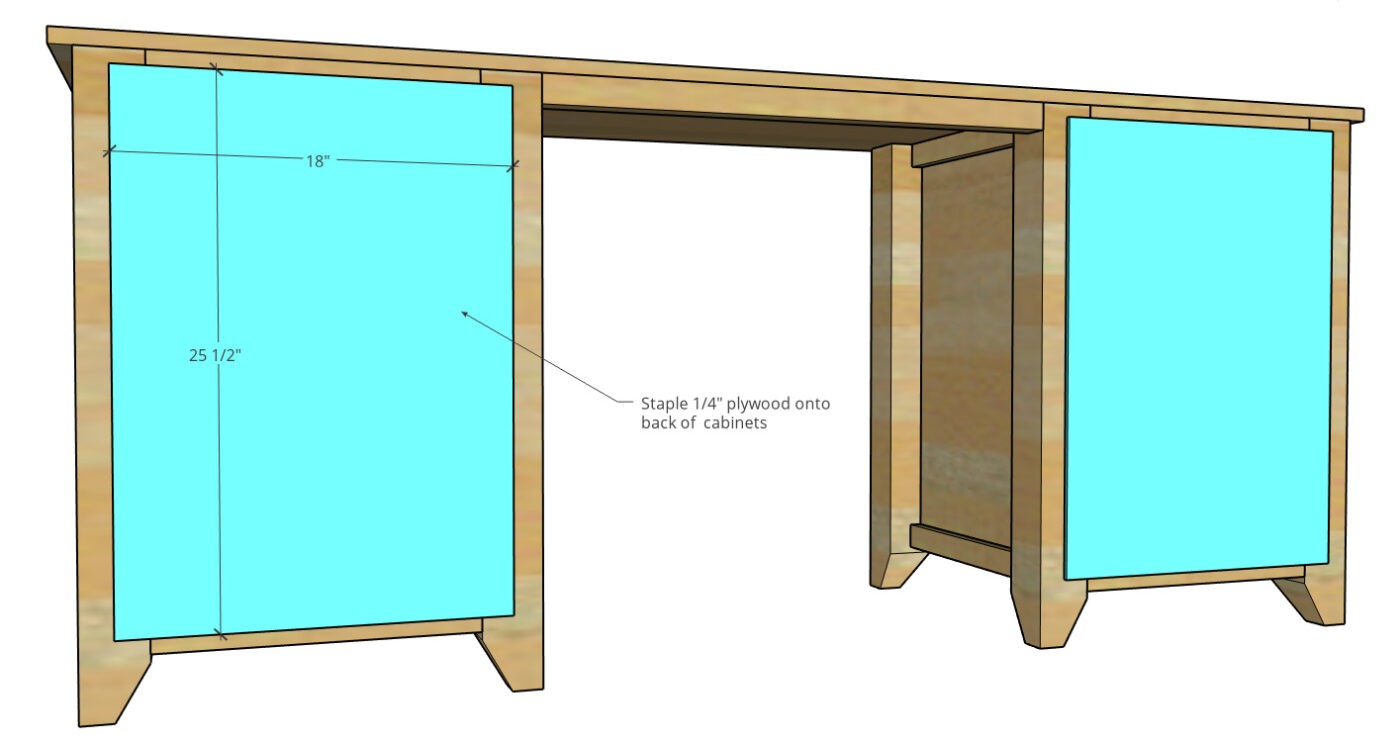
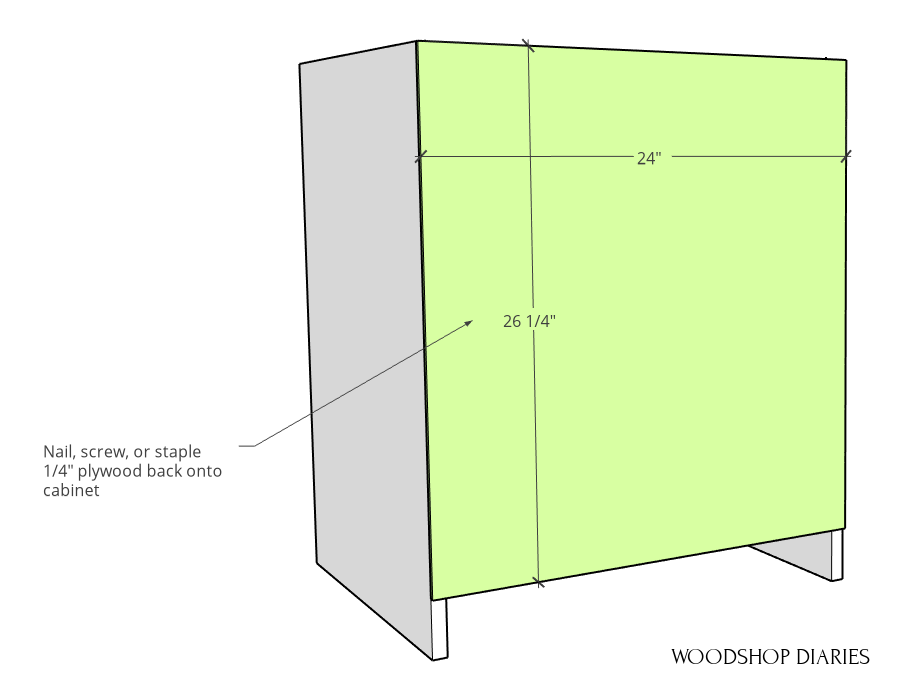
And finally, I cut two ¼” plywood panels to staple onto the back of each cabinet.  You could drill holes in these back panels for cords if you need to.

graphic showing the back side of the computer desk and dimensions of back panels

And FINALLY, this desk was complete! This project had several steps, and several details.

BUT, all in all, it was actually a fairly easy build if you have the patience to wait for all the glue to dry 🙂

Finished DIY computer desk with two drawers on right, keyboard tray in center and door on left

I really hope you’ve enjoyed this whole matching DIY home office furniture series and if you haven’t seen the others, be sure to check those out next:

  • Matching Writing Desk Table
  • Matching Open Shelf with Drawers
  • Matching File Cabinet
  • Matching Armoire Storage Cabinet

Looking for More DIY Desk Plans?

Here are a few more desk ideas you might be interested in!

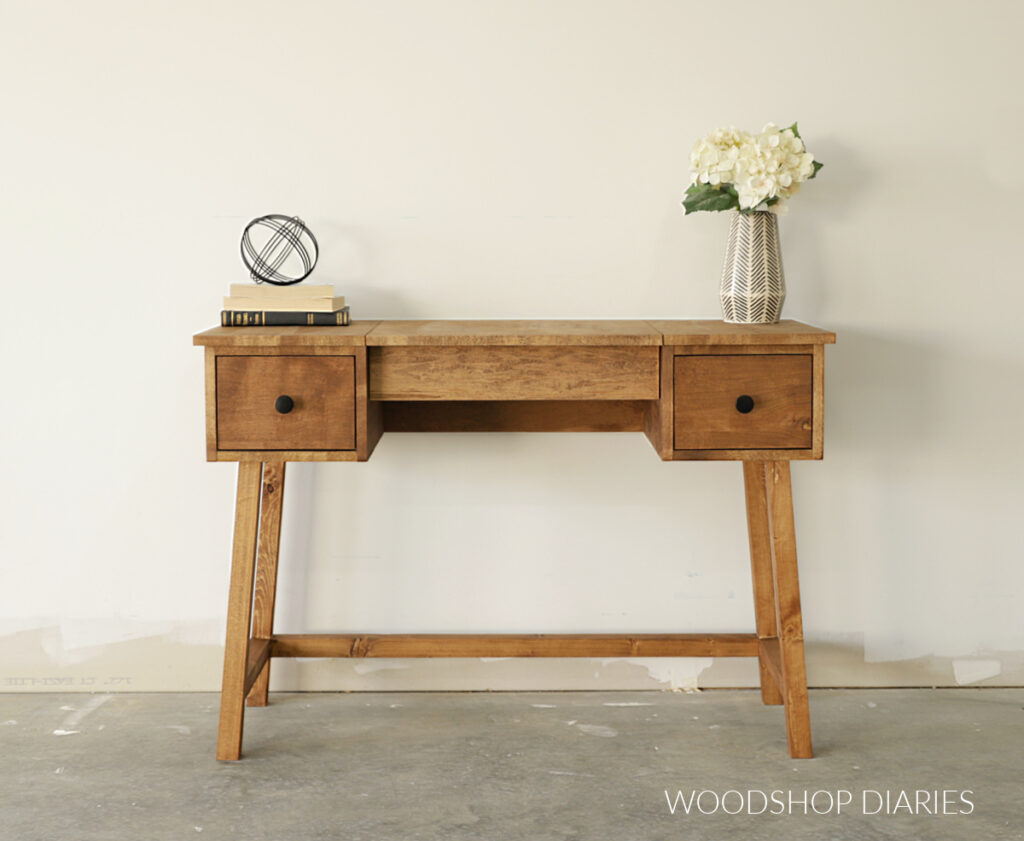
DIY Flip Top Desk with Drawers
DIY Modular Cabinet Desk
DIY Flip Top Desk
L Shaped Desk

If you enjoyed this project, and can’t wait to see what’s next, be sure to subscribe below for priority access to the latest plans and videos!

If you’d like to save this for later, be sure to pin it!

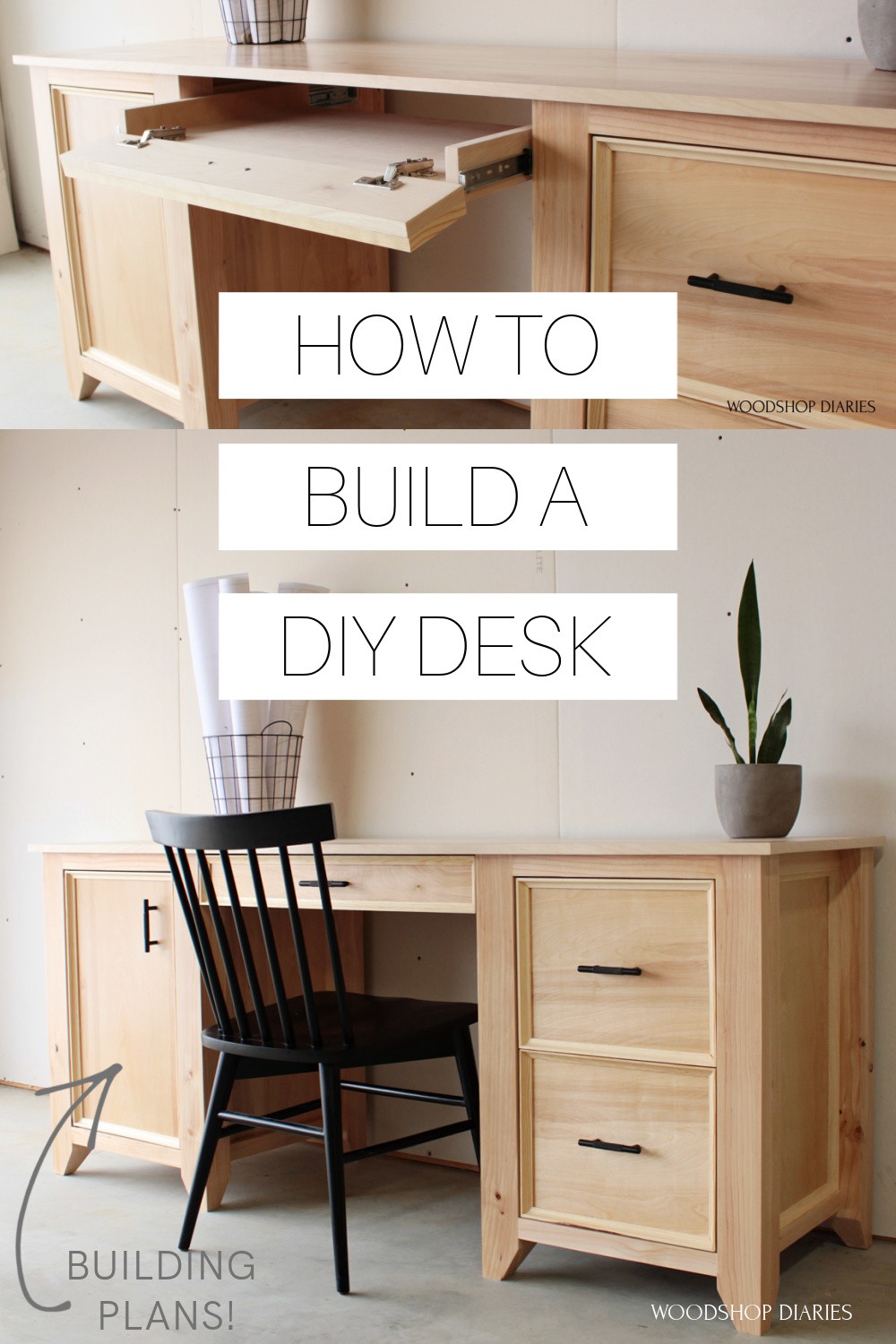
Pinterest collage with keyboard tray open at top and finished DIY computer desk on bottom with text "how to build a DIY desk"

Until next time, friends, happy building!

4 Ways to Fill a Pocket Hole

February 8, 2021 by Shara, Woodshop Diaries

In this post, I’ll show you four ways to fill in a pocket hole in your woodworking projects!

This post contains affiliate links. See policies for details.

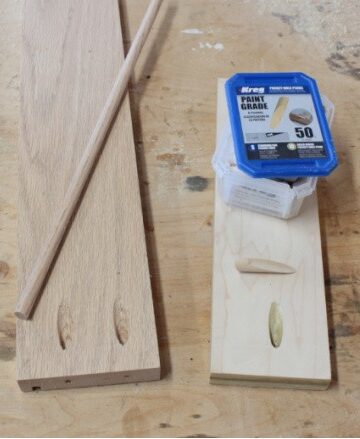
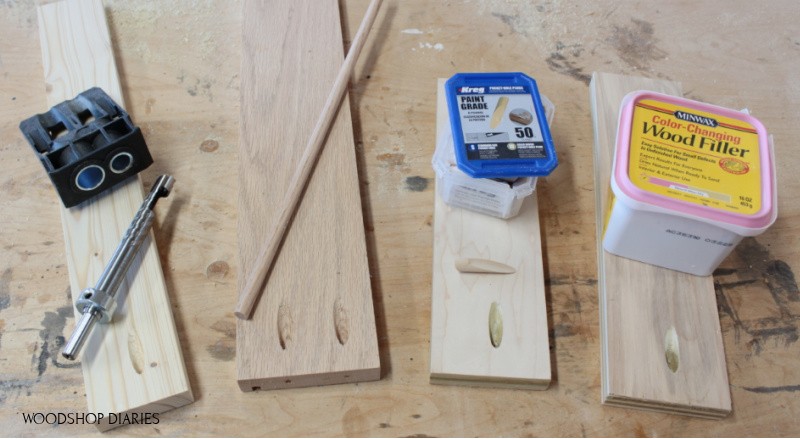
four boards with unfilled pocket holes laid out on workbench

Pocket holes are a really popular joinery method for both beginners and advanced woodworkers alike. But, if your pocket holes are showing in your finished project, they can pose a bit of an eye sore.

.

RELATED: If you want to learn more about pocket hole joinery, check out these posts on how to use a pocket hole jig and which pocket hole jig is best for you!

.

Hidden pocket holes don’t need to be filled (unless you’re really picky about it haha). So, if you get creative on your pocket hole placement, you may not need to fill them as hopefully, they are hidden already.

.

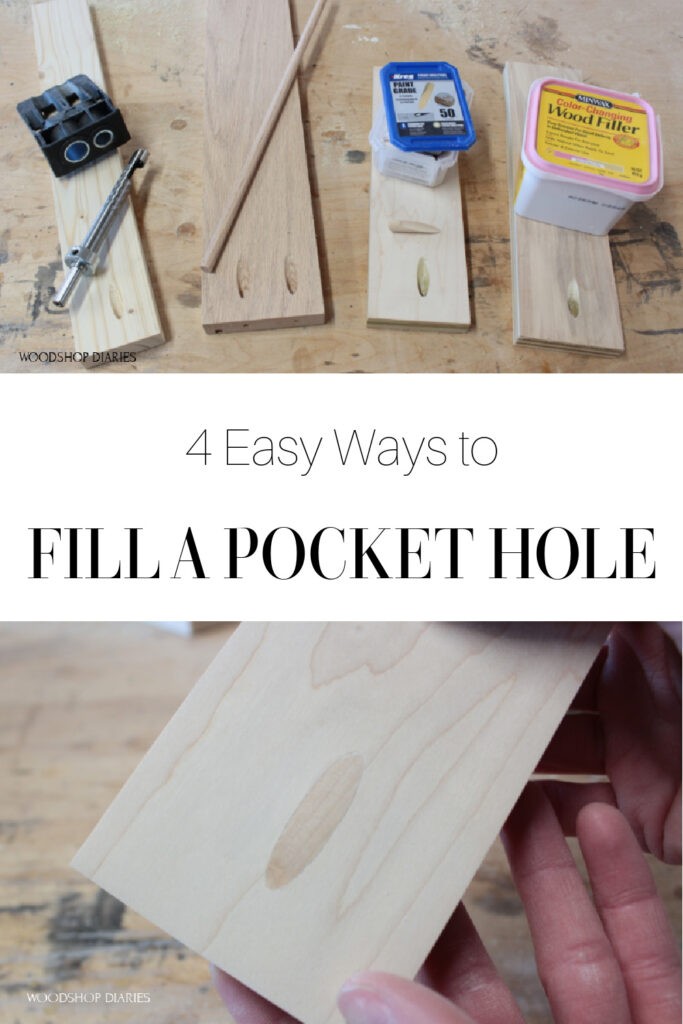
However, if you end up with some exposed pocket holes in your finished project, there are four easy ways to fill them!

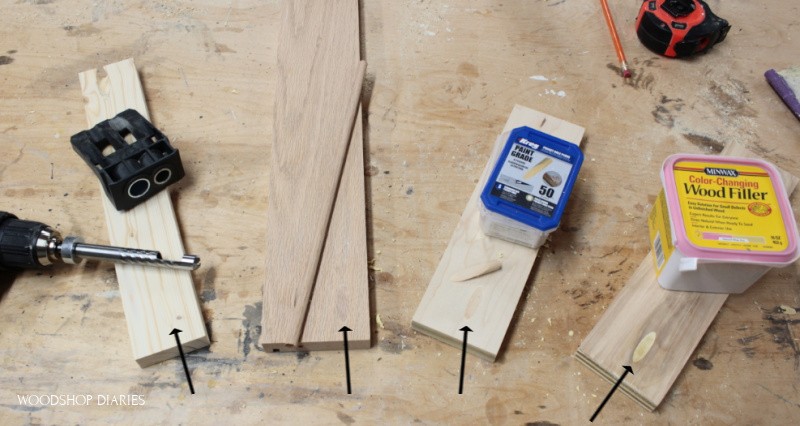
4 Easy Ways to Fill Pocket Holes

  1. Putty
  2. PreMade Plugs
  3. Dowel Rod
  4. Cut Your Own Plugs!

There are pros and cons to each method, but I’ll discuss them each in detail below and make suggestions about when to use each one!

4 ways to fill a pocket hole laid out on workbench already filled

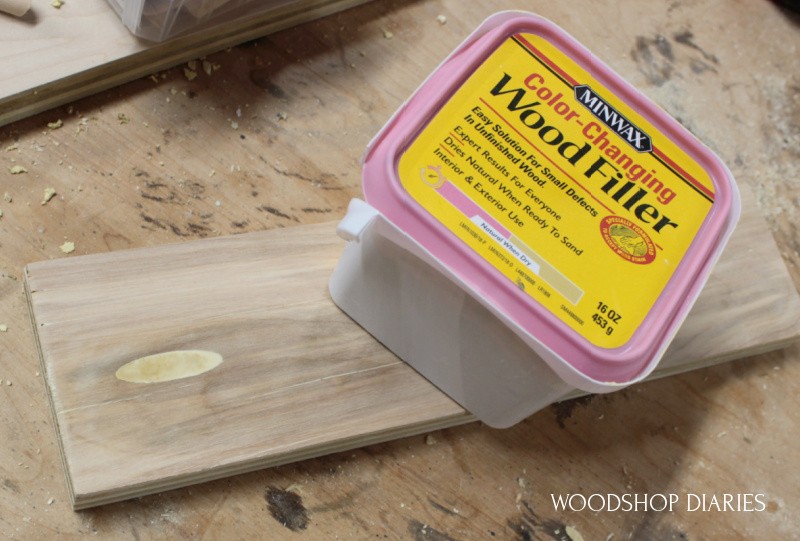
Method #1: Fill Pocket Holes with Putty

This is probably the cheapest and simplest option as it doesn’t require any special tools or materials besides regular ole wood putty.

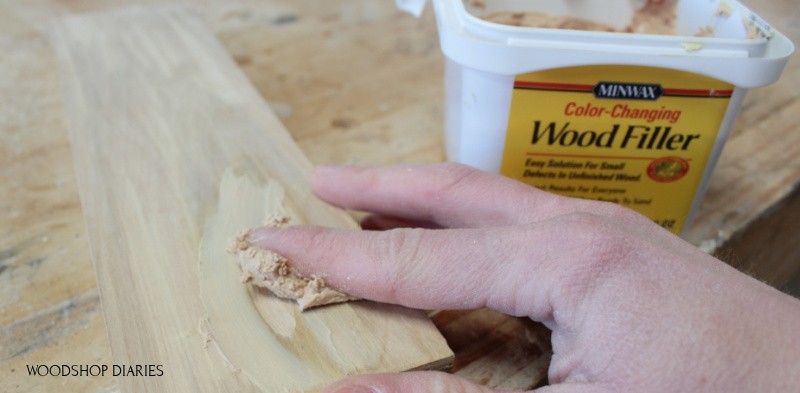
Pocket hole filled with wood filler

Now, this method is fairly time consuming as it usually requires multiple coats of putty since these are fairly big holes to fill. And, even with stainable wood filler, it will be pretty noticeable when stained.

.

For that reason, I recommend this method mainly for painted projects. BUT, definitely test out different stains or finishes with different types of putties–you might find one that matches well…but I haven’t yet.

How to Fill a Pocket Hole with Wood Putty

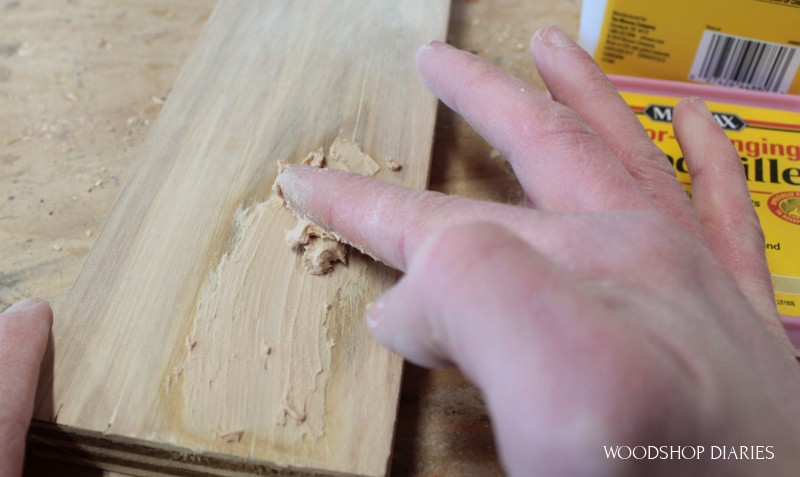
To fill a pocket hole with putty (any wood putty is fine, but I like this stuff), simply use your finger or a putty knife to press putty down into the hole. Fill the hole until the putty is slightly under surface level.

Applying first coat of wood putty to fill pocket hole

Let it dry completely, then come back and sand lightly to smooth out the surface.

.

Apply a second coat, this time making sure the putty is slightly over surface level.

Applying second coat of wood putty to fill pocket hole

Once that’s completely dry, sand smooth with 120-220 grit sandpaper. You can sand by hand or use an orbital sander.

.

If there are dimples or voids left, you may need to apply another coat to smooth it out completely.

Pros & Cons to Filling Pocket Holes with Putty

Pros:

  • Requires no special tools or materials
  • Easy to apply

Cons:

  • Time consuming (multiple coats)
  • Doesn’t look great on stained projects

Method #2: Plug Pocket Holes with Pre Made Plugs

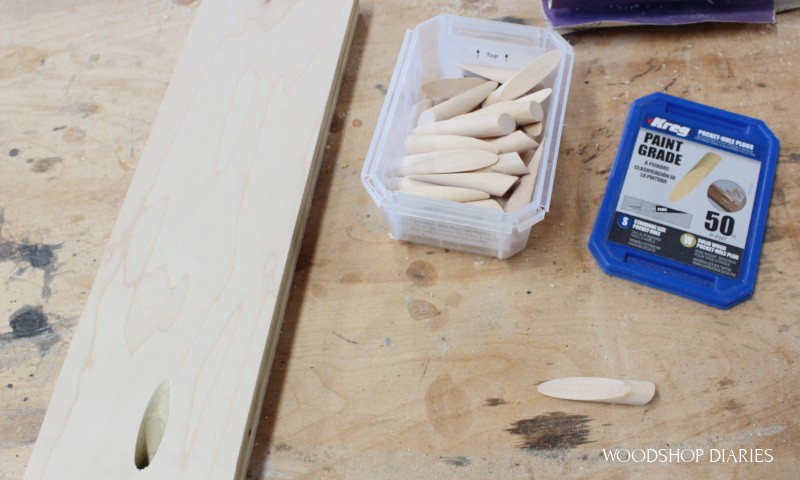
Kreg makes pre cut pocket hole plugs you can purchase to plug your pocket holes.

paint grade pocket hole plugs on workbench

They come in various wood types so you can buy them to match the wood type you’re using if you plan to stain or leave natural.

.

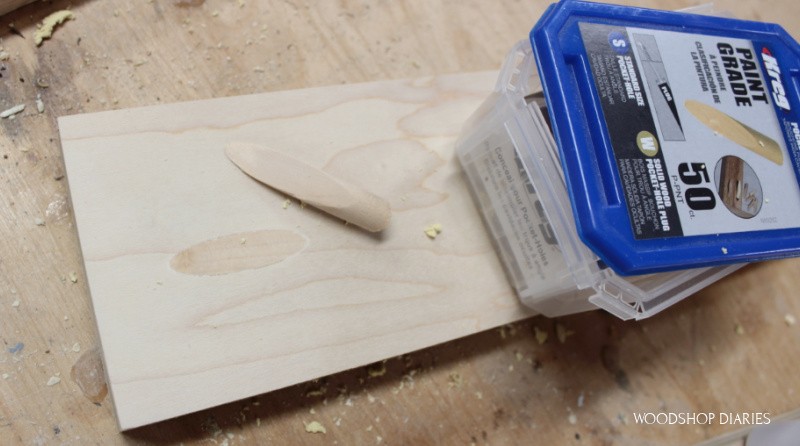
But if you plan to paint, you can save money by using the paint plugs and not trying to match your wood type. That’s what I did here.

Paint grade plugs container sitting on plywood board with pocket hole filled

They can be a little pricey if you’re going to need a lot of them, but they are really convenient since they are precut.

.

Since you can buy matching wood types of these, they are more likely to stain and finish nicer than putty. Although, do keep in mind that since they may be the same wood type, it’s not from the same board, so the grain patterns won’t match EXACTLY.
How to Fill a Pocket Hole with Pre-Cut Plugs

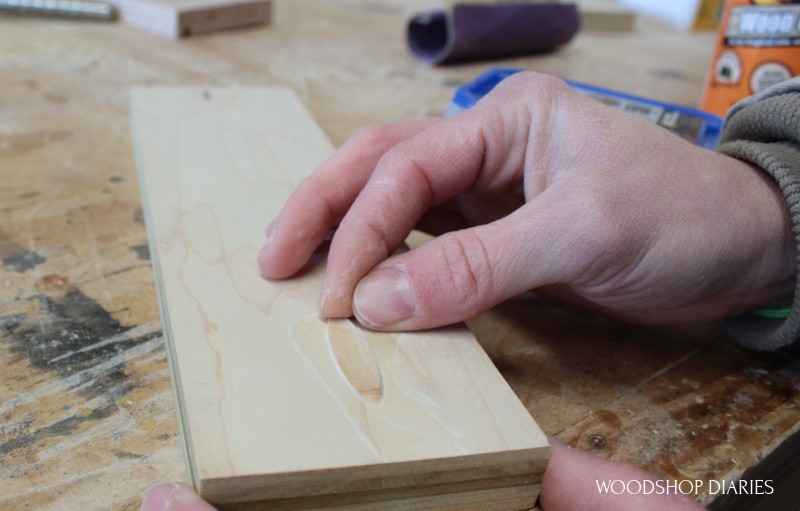
Roll a small piece of sandpaper and sand out the pocket hole a little to make sure it’s clean.

.

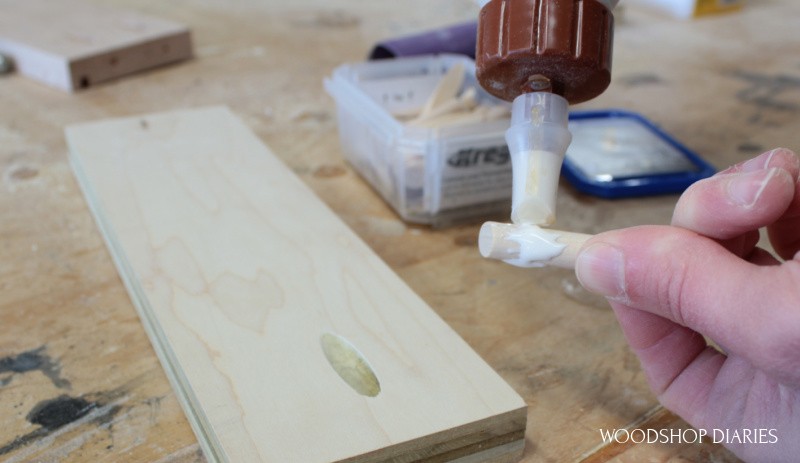
Apply wood glue around the pocket hole plug and slide it into the pocket hole with the flat side facing up.

Applying wood glue to pocket hole plug

If it’s difficult to slide in with your hands, use a hammer and a scrap block OR a rubber mallet to tap it in as far as you can or until the flat part is flush with the surface of the board.

Sliding glued up pocket hole plug into hole

NOTE: These are the perfect size for 1 ½″ pocket holes, but will stick out a little with ¾″ pocket holes (in my experience). If it’s sticking out a little, that’s okay.

.

Wipe away any glue squeeze out and let dry. Once the glue is dry, if it’s sticking up past the surface, you can either sand it flush, OR use a flush cut hand saw or a flush cut bit in an oscillating saw to trim it down.

.

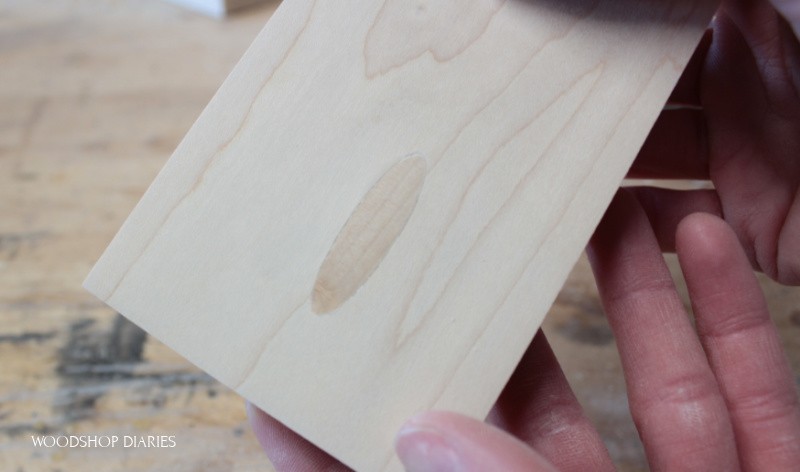
Sand off any remaining glue residue and if there are any small gaps or voids, you can fill with putty, then sand smooth.

Plywood with paint grade plug close up

Now it’s ready for whatever finish you want to apply.

Pros & Cons to Using Pre Cut Plugs to Fill Pocket Holes

Pros:

  • Comes in various wood types to match your project
  • Great for both painted AND stained projects
  • Easy to apply
  • Quick

Cons:

  • Can be a little pricey
  • May require a flush cut saw (depending on the thickness of wood you’re using)

Method #3: Plug Pocket Holes with Dowel Rod

Standard pocket holes are ⅜″ diameter. So instead of purchasing precut plugs, you can use ⅜″ dowel rods instead.

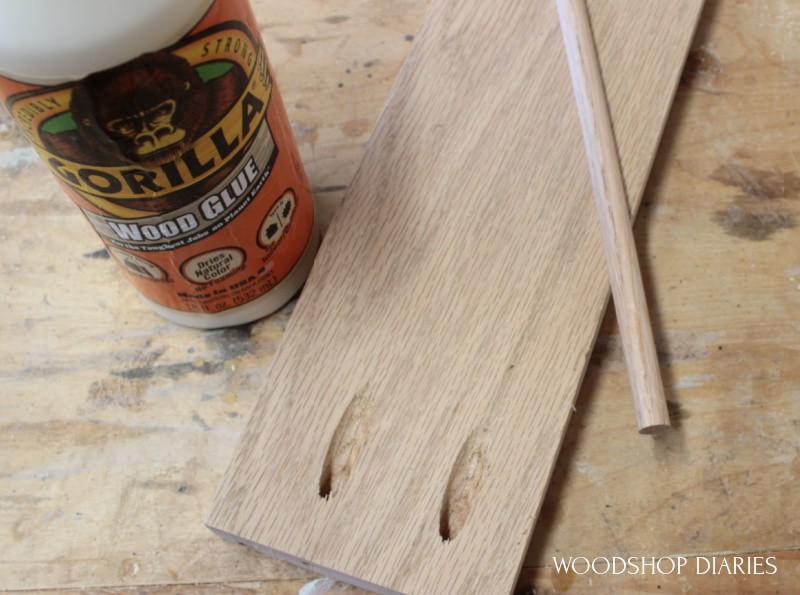
Pocket holes drilled in end of oak board with oak dowel rod lying on top

This is usually cheaper than buying pre cut plugs, BUT does require a flush cut hand saw or an oscillating saw with a flush cut blade.

.

Just like with plugs, if you plan to stain or leave natural, you need to use the same wood type dowel as you are using in your project. Use poplar dowels with poplar wood, oak dowel with oak wood, etc.
.

The downside to this is that not all wood types are readily available or easy to find as a dowel rod. Oak and poplar are usually kept in stock at the big box store, but walnut or maple may not be quite as easy to find.

How to Fill Pocket Holes with a Dowel Rod

Roll your sandpaper and sand out the hole to make sure it’s clean and smooth.

.

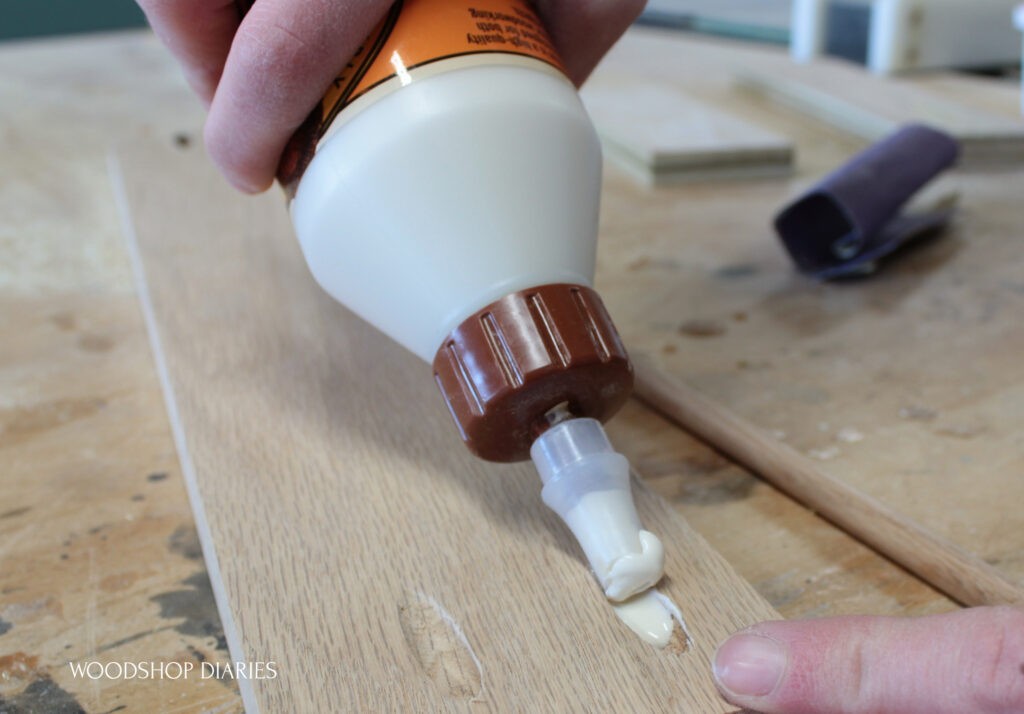
Apply glue into the hole.

applying glue to fill pocket hole

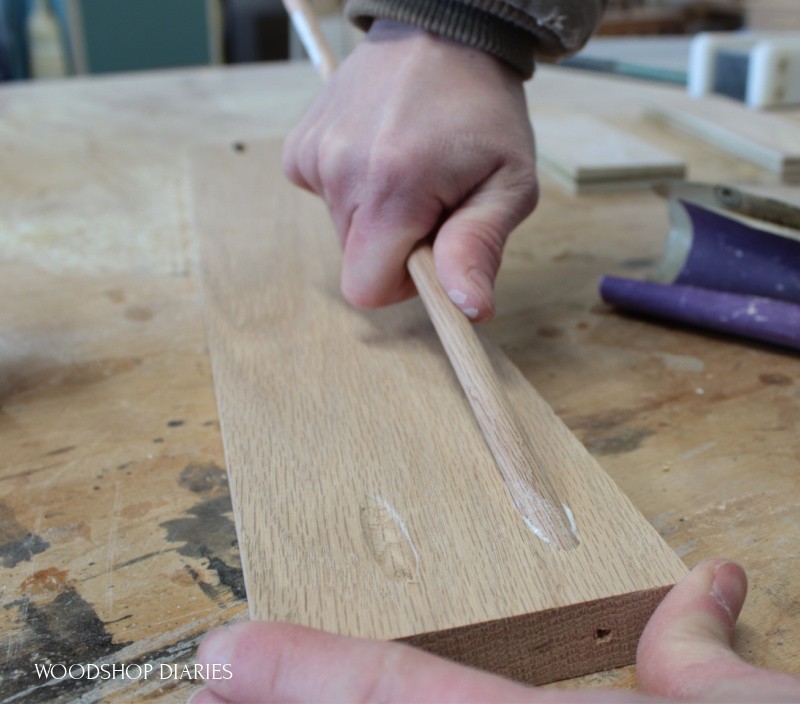
Slide the dowel rod into the pocket hole. This will be a tight fit. You may have to twist or wiggle it a little to work it down to the bottom of the hole.

Inserting dowel rod into pocket hole

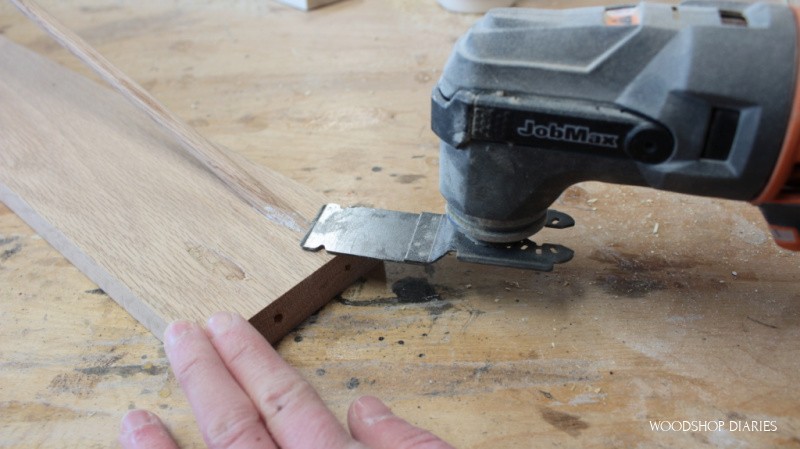
Leave until the glue is dry. Then, use a flush cut hand saw or oscillating saw with a flush cut blade and trim the dowel rod off flush.

Flush cut blade on oscillating saw cutting dowel rod flush

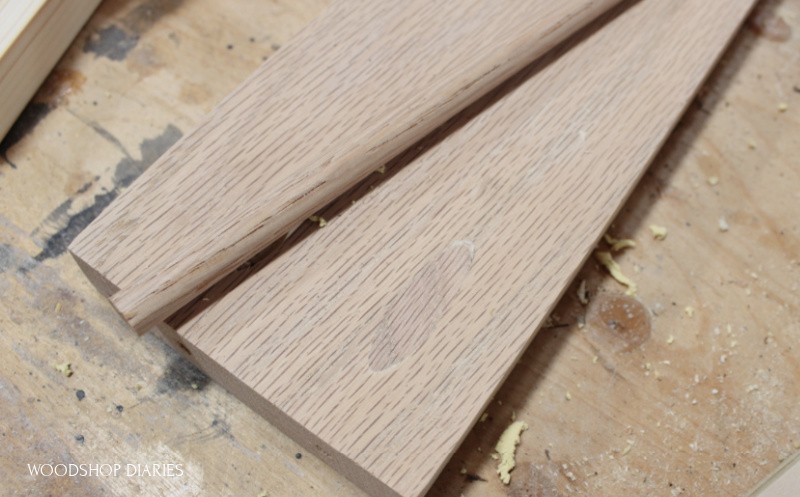
Sand smooth and fill any small gaps or voids with wood putty if needed.

Pocket hole filled using dowel rod complete

Pros & Cons to Using a Dowel Rod to Fill Pocket Holes

Pros:

  • Dowel rods are inexpensive
  • Quick and Easy
  • You can match the wood well

Cons:

  • Requires a flush cut saw of some kind
  • May be difficult to find dowel rods in some wood types

This method is great for stained projects as the color usually blends pretty well.

Method #4: Make Your Own Pocket Hole Plugs

This method is just like using precut pocket holes EXCEPT, this time, you cut your own plugs from your own lumber.

.

Now, this method involves some upfront investment to purchase a plug cutting kit, BUT if you use a lot of pocket hole plugs, it will pay for itself in the long run since you wont be buying plugs anymore.

.

Plus, it’s kind of fun to drill these out and since you’re cutting plugs from the same wood you’re using in your project, it should theoretically match really well.
.

Kreg makes plug cutting kits that can be used with the K4, K5, and new 720. Make sure the one you purchase will work with the jig you have. They come with a drill bit for plugs that fit standard pocket holes.

  • Plug cutting kit for K4 OR K5
  • Plug cutting kit for 720
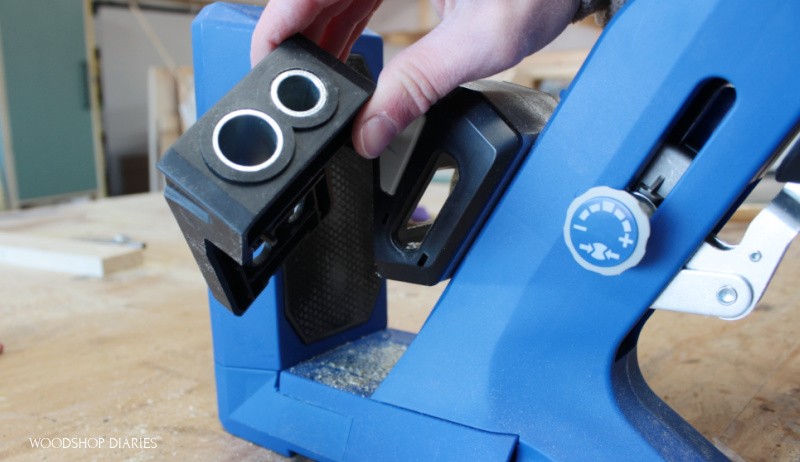
Close up of pocket hole plug cutting drill guide

If you want micro or HD sized plugs, you need to buy that specific drill bit. You can find the HD plug cutting bit here and the micro plug cutting bit here.

.

Learn more about the new 720 Kreg Pocket Hole Jig and other great pocket hole jig options for your workshop in this post!

.

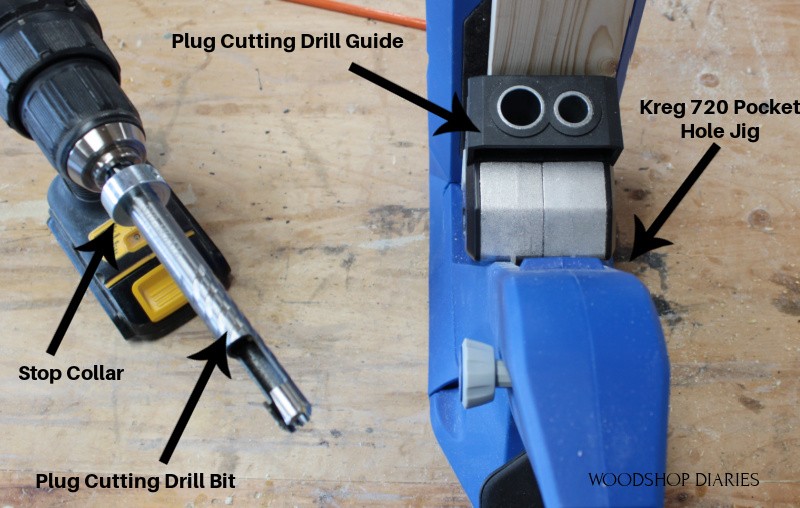
When you purchase the plug cutting kit, you get the drill guide (that fits on your existing K4, K5 or 720 pocket hole jigs), the plug cutting bit and a stop collar.

How to Make Your Own Pocket Hole Plugs

Simply remove the pocket hole drilling guide from your existing jig, and replace with the plug cutting drill guide. Shown here on the 720 Kreg Jig.

Parts to the plug cutting kit for filling in pocket holes

Install the stop collar on the bit as per the instructions included with the kit.

.

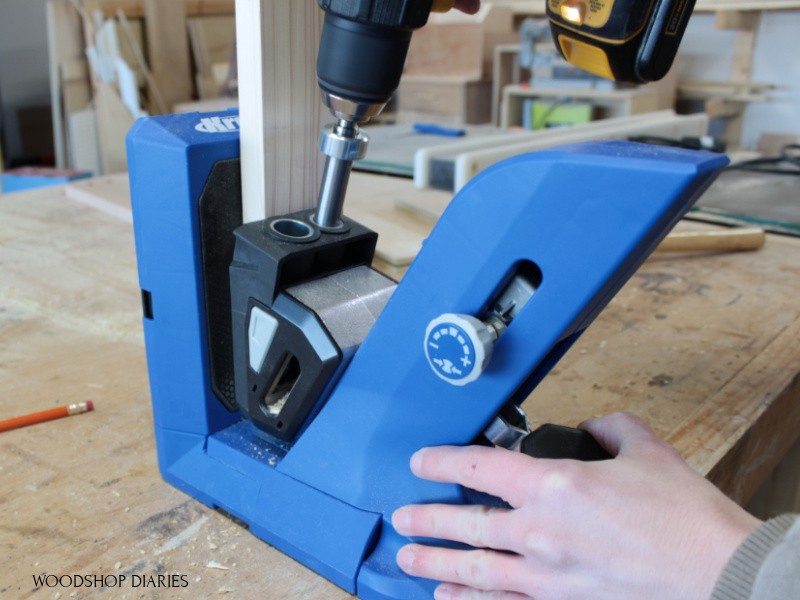
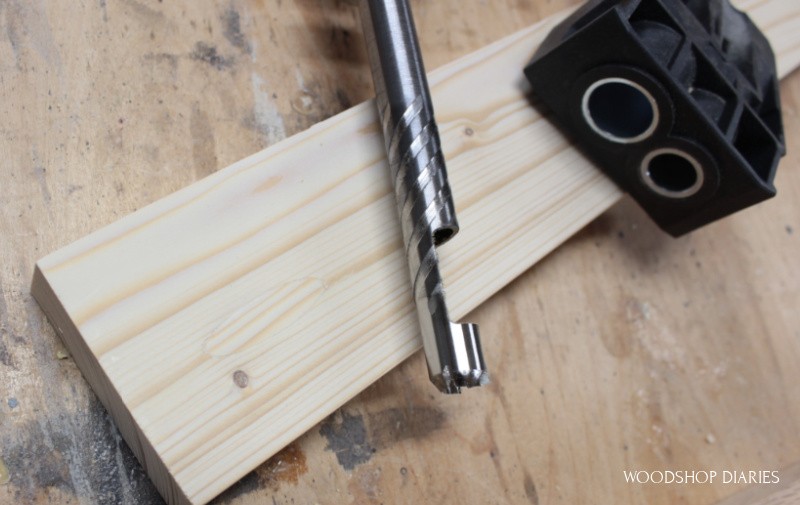
Clamp your wood into the jig and drill. Insert the bit into the correct hole (for standard and micro size, use the smaller hole and for HD size, use the larger hole) and bring it to full speed BEFORE contacting the wood. This will help prevent chipping and tear out.

Drill bit drilling out pocket hole plug

I recommend using ¾″ material for this.

.

It’s best to cut a piece from the same board you’re plugging (if possible) to use for this as it’s most likely to have the most similar grain patterns and match better. But, if that’s not possible, at least match the wood type.
Pocket hole drilled out using the plug cutter kit

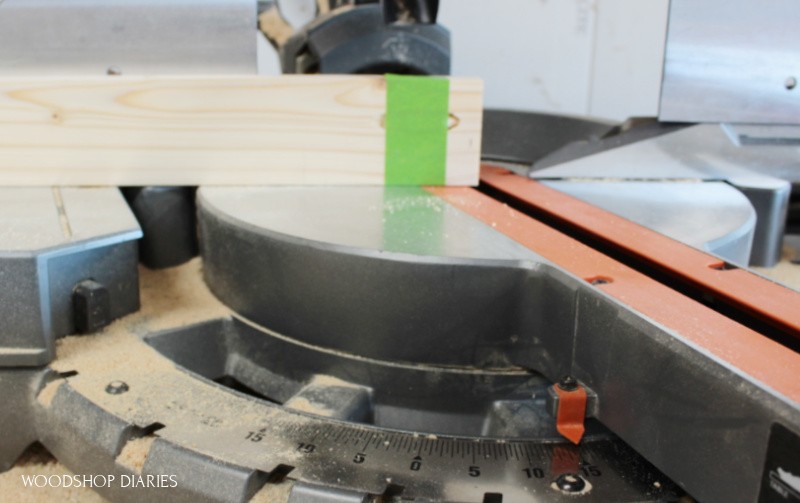
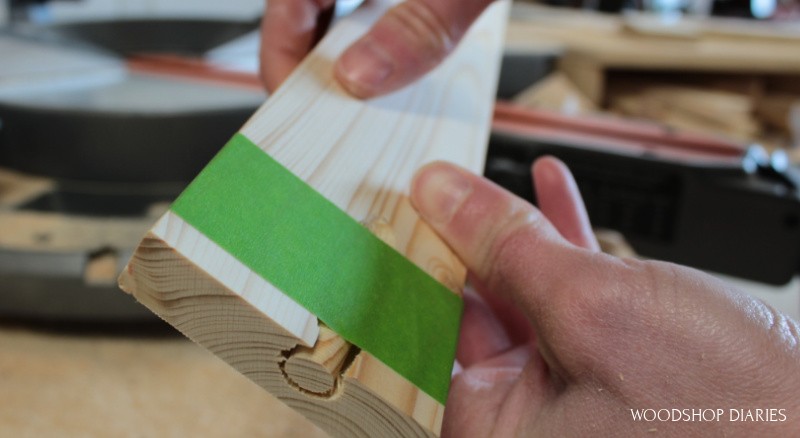
Once the plug(s) are cut, you need to cut them free at a 15 degree angle. Use painters tape to hold the plugs in place while you cut them free.

.

You can either cut these on a miter saw, table saw, band saw, or even a jig saw, but you need to angle the blade 15 degrees. Here, I used my miter saw set to miter 15 degrees.

Miter saw set to 15 degrees to cut pocket hole plug free

Cut the end of the board off to free the plugs. I like to cut a little at a time until they are free so as not to cut off too much.

Pocket hole plug cut free on end of board close up

Now, simply glue and plug just like Method #2 above.

Pros & Cons to Making Your Own Pocket Hole Plugs

Pros:

  • Can match wood type and grain patterns by cutting plugs from same board
  • Pays for itself if you use a lot of pocket hole plugs
  • Plug cutting kit attaches to existing pocket hole jigs (K4, K5, 720 jigs)
  • Can cut plugs as needed–no need to keep plugs or dowel rods on hand

Cons:

  • Requires upfront investment to purchase the plug cutting kit
  • Requires use of an existing pocket hole jig (if you don’t already have the K4, K5, or 720, that would be an additional investment you’d have to make to use the plug cutting kit)
  • Requires a saw to cut plugs free after they’re drilled out
Plug cutting drill guide and drill bit paid on board with filled in pocket hole

I’d recommend making your own plugs for workshops that already have a pocket hole jig compatible with a plug cutting kit and that use a lot of pocket hole plugs.

.

This is probably the best method for stained or natural wood finish projects as it will usually provide the closest match and blend in the best (see image above).

Final Thoughts on Plugging and Filling Pocket Holes

Plugging exposed pocket holes in your projects is one of those tasks that isn’t really exciting to do, but it will make a huge difference in your finished product.

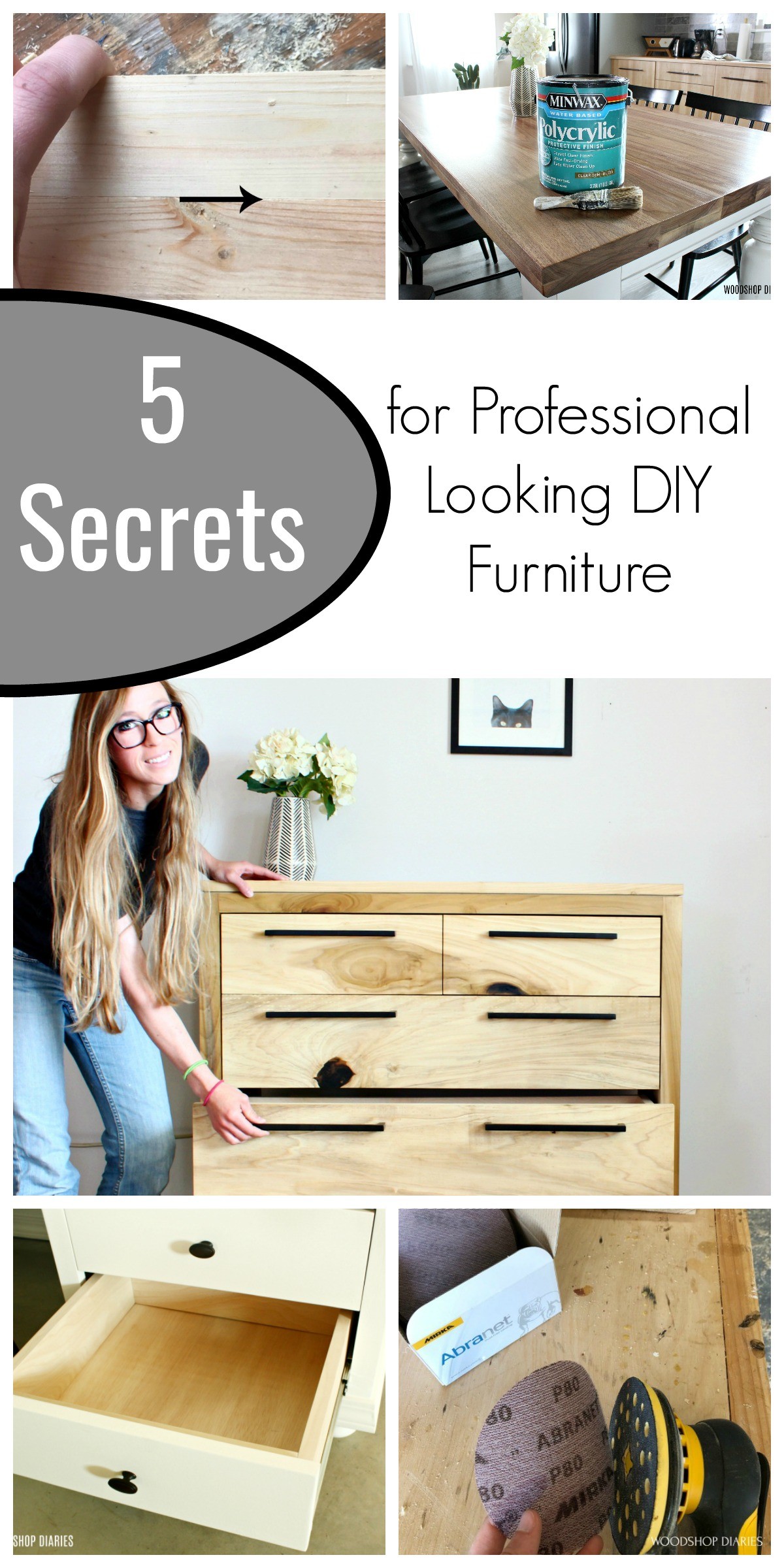
RELATED: Check out these 5 secrets to more professional looking DIY furniture!

.

For stained or natural finish projects, it’s best to use methods 1-3 (find pre cut matching plugs, matching wood type dowels, or cut your own plugs) as these will provide the best visual results.

.

But for painted projects, putty or paint grade plugs will save you a few bucks and give you a great result.

.

I hope you found this guide to filling pocket holes helpful and if you’re looking for more info on pocket holes, check out these posts:

  • How to use a pocket hole jig
  • Which pocket hole jig is best for your shop?
  • 7 common pocket hole mistakes you may be making

If you’d like to save this guide for later, don’t forget to pin it! And if you want to stay up to date on the latest projects and posts from Woodshop Diaries, be sure to sign up for our newsletter below!

Pinterest collage with image of unplugged pocket holes at top and plugged pocket hole at bottom with text "4 easy ways to fill a pocket hole"

Until next time, friends, happy building 🙂

Easy Indoor Garden DIY Plant Ladder Shelf

February 5, 2021 by Shara, Woodshop Diaries

In this post, I’ll show you how to create your own indoor garden with this DIY Plant Ladder Shelf!

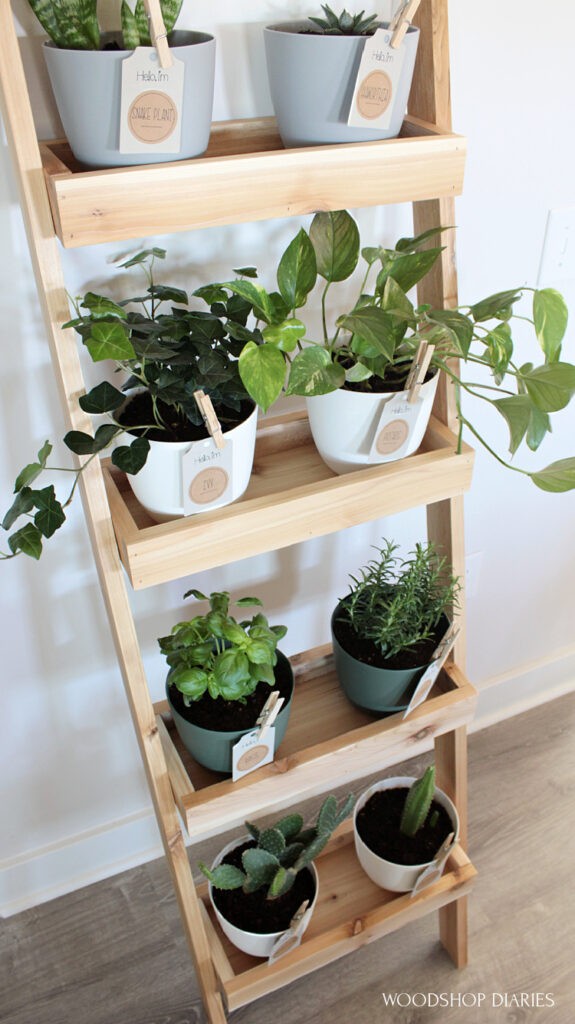
View from above looking down on DIY plant ladder shelf with four shelves of plants in multicolor pots

I have a terrible habit of collecting plants that I just don’t really have anywhere to actually set around my house. I know I’m not alone in this, right?? Plant hoarding is a real problem.

.

So I’ve been meaning to build somewhere to house all my little plants in one easy to water location.

.

But…the kicker was that I really didn’t want anything that I had to hang on the wall and since we live in a tiny garage apartment, floor space is pretty limited. So it had to take up very little square footage.

.

This plant ladder checked all the boxes and is the perfect *renter friendly* solution to give anyone with limited space a fun indoor garden.

.

I’m sharing the video tutorial here and the written step by step tutorial and plans below. I’m also sharing how to make these fun plant labels below as well 🙂

For this DIY Plant Ladder Shelf, You Will Need:

  • (1) 1x6x8 board
  • (4) 1x3x8 board
  • Miter Saw
  • Nail Gun
  • Drill/Driver
  • 1 ¼″ brad nails
  • 1 ¼″ wood screws
  • Wood Glue
  • Planter Pots

For Plant Tags:

  • Cricut Joy Machine (cutter and pen are included)
  • Cricut Joy Card Mat
  • Cardstock
  • Writable Sticker Paper

NOTES ABOUT THE BUILD: I built this ladder shelf using a 1×6 and a few 1x3s.  I splurged a little and used cedar for this, but any wood type would work fine.  All you need to assemble it is a saw, a nail gun, and a drill driver.

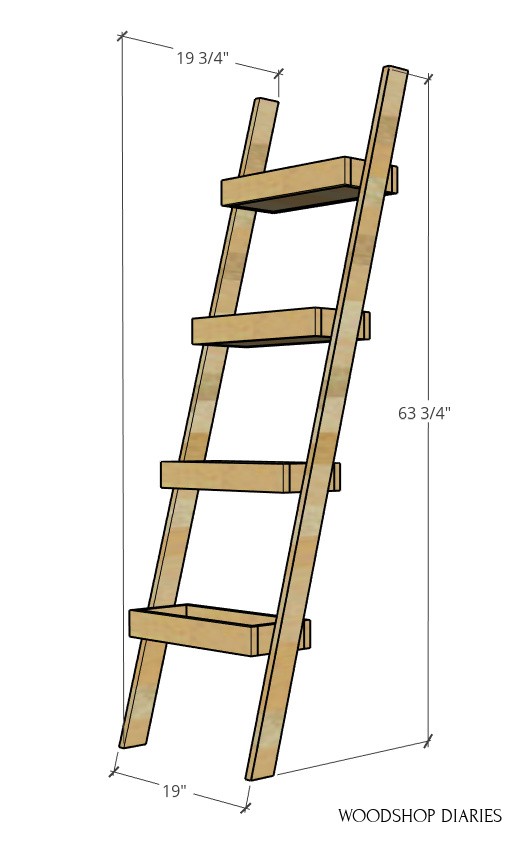
Overall dimension diagram of plant ladder shelf--63 ¾" tall, 19 ¾" deep, 19" wide

Looking for outdoor projects instead? Check out these outdoor and gardening projects and plans!

Step 1: Build Ladder Shelf Trays

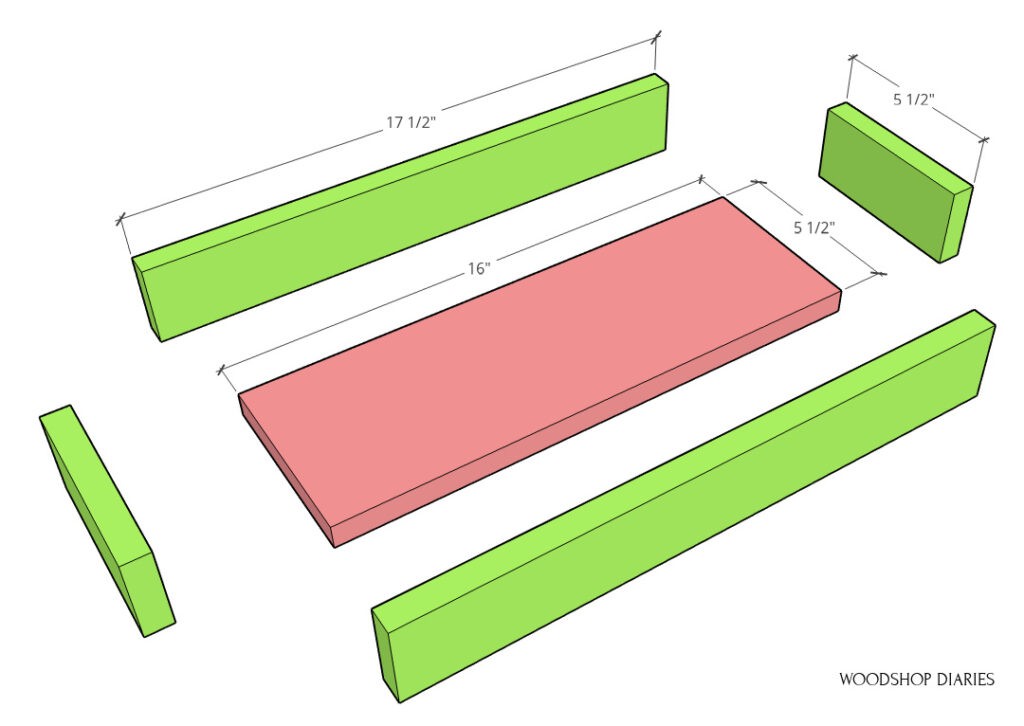
I began by cutting 4 pieces from the 1×6 to the length I wanted my shelves to be. I made mine about 16”, but you can definitely modify your sizing here if you need longer shelves.

.

These will be the bottom of each plant shelf (shown below in pink).

.

Once those pieces were cut, I cut 1×3 pieces (shown below in green) to wrap around the sides of each of these four shelves.

Exploded color coded diagram of shelf trays--bottom board pink, sides green

The cedar boards I used were smooth on one side and rough on the other, so I did give them a good sanding before assembly just to prevent splinters later.

.

Then, I just glued and nailed the 1x3s around the edges of the 1×6 boards to make four identical sized trays.  If you didn’t have a nail gun, screws would work fine here, too. Nails are just quicker.

Assembled plant ladder shelf tray overall dimension diagram--17 ½" wide, 7" deep, 2 ½" tall

Step 2: Cut Plant Ladder Sides

Once the four trays were together, I went back to the miter saw cut the sides of the ladder.  I wanted the bottom edge angled so it would lean back against the wall, so I adjusted my miter to about 15 degrees to make these cuts. 

.

I cut the two side pieces about 5 ½ foot long, but again, this project is easily customizable and you can cut them however long you wish. The longer you cut the sides, the taller your shelf will be.

Sides of plant ladder diagram with dimensions--ends mitered 15 degrees and 66" long

Now, I just had to attach the trays between the sides.

Step 3: Attach Trays to Ladder Sides

To make spacing easy, I used a scrap piece of plywood cut to about 10 ½” x 11 ½”.  I placed the bottom shelf 10 ½” from the bottom edge of the side using this scrap block.  (PS…if you don’t have scrap wood, a notebook would work well, too!)

Using spacer block to attach bottom shelf to ladder

I just centered it front to back (I didn’t measure, I just eyeballed it) on the side board and glued and nailed the tray in place for now.

Using nail gun to secure bottom shelf to ladder sides

Then, I turned my scrap piece the other way and spaced the trays 11 ½” apart.  This is totally customizable if you wanted to use different spacing or sizes. 

Using spacer block to space second shelf 11 ½" from bottom shelf

But, I do recommend using a scrap block for this as it made things really easy to keep the shelf angles and spacing consistent.

.

Once I had one side assembled, I flipped it over and repeated for the other side.  Keep in mind to match the angle direction on the bottom edge of the sides before attaching everything.

Dimensional diagram of plant ladder shelf--trays spaced 11 ½" apart starting 10 ½" from bottom

Now, once the glue dries, this should be plenty strong to hold a few plants, BUT just for a little extra security, I went back and added a 1 ¼” wood screw on each side of each tray. 

Using a driver to drive a screw through the sides of the tray to secure to the ladder sides

I gave it a clear coat poly and brought it inside to add my plants.

Step 4: Add Plants to Ladder Shelf and Create Plant Tags (Optional)

This DIY plant ladder shelf just leans against the wall and you can set your plants inside however you want.

.

To keep things visually consistent, I used these simple plastic planters for all my plants, but your planters don’t have to match–I’m just weird like that, so I wanted them the same size.
.

They were pretty inexpensive, so I ordered multiple colors (white, grey, dark green) and I’ve got plenty leftover to use outside this summer.

DIY plant ladder shelf finished and leaning against the wall with plants on each shelf

I really like that this plant ladder shelf doesn’t have to attach to the wall because I rearrange everything in our tiny house all the time and I don’t want to deal with puttying holes and rehanging it all the time.
.

Now, I’m a big believer in adding small, subtle details to dress up an otherwise basic project…Like adding these plant tags!

Close up of plant tag labels clipped onto each planter pot on the shelf--gray tag with brown name stickers

Cricut recently sent me their new Cricut Joy cutting machine to try out.  Now, full disclosure here…I’m not a super crafty person.  I don’t scrap book or get into small craft projects.

.

But, even to a non-crafty person, I have to admit, this little machine is pretty nifty.  I can see using this for personalizing projects or using the vinyl for some unique staining and painting details.

.

To make these tags, I just took the Cricut Joy out of the box, and designed some super basic labels in the Cricut Design Space software (it’s free, FYI).

Cricut Joy Design Space screenshot of design used to create plant tags

If you go to images on the left side and search “label,” you can find both the tag and the sticker labels that I used pretty close to the top. You can add text and size everything as needed. (NOTE: The names of the graphics and fonts I used here are all listed there on the right in the screen shot above.)

.

There are a TON of tutorials for how to use Design Space on Cricut’s website…so play around with it and check those out. It’s easy to figure out once you play around with it!

.

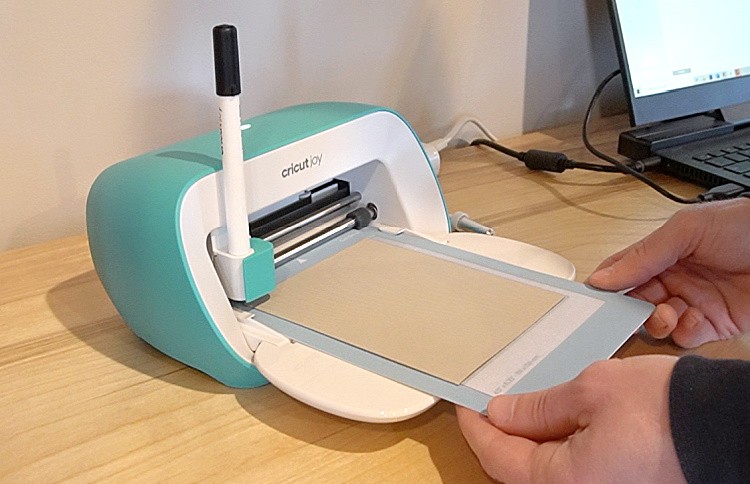
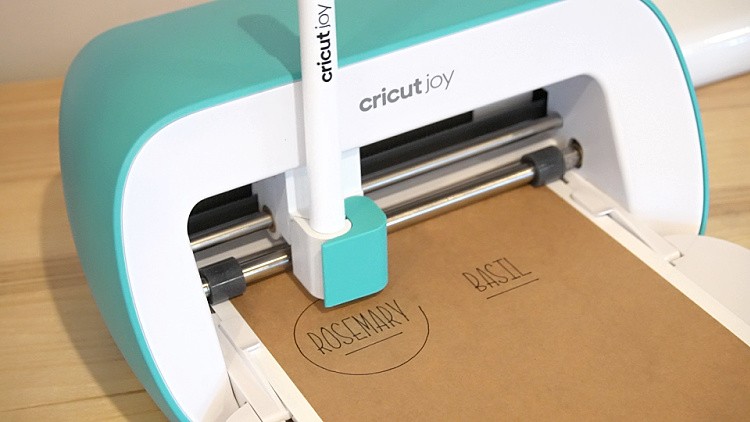
When I was ready to print, I loaded some cardstock onto my card mat and followed the prompts on the software to write “Hello, I’m” on the card.

Loading cardstock into Cricut Joy Machine on Card Mat

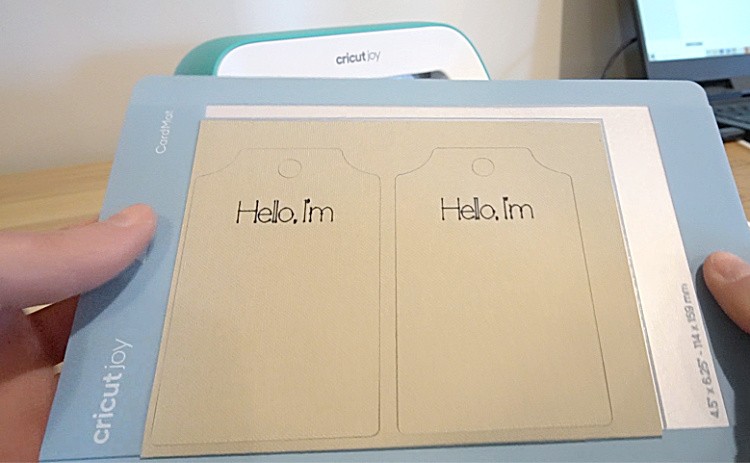
The software tells you when to swap out the pen for the cutter (both the pen and cutter are included with the Cricut Joy, FYI!) and then it cuts the tag shape out.

Close up of Cricut Joy cardstock plant name tags cut out on card mat

Then, I repeated the process on this writable adhesive backed paper and make labels with each plant’s name.

Close up of Cricut Joy drawing name stickers on writable paper

I peeled the stickers off and placed them on the tags.

Close up of cardstock tags with name stickers applied

Then, used a clothes pin to clip the tags on each planter pot.

.

Since I’m a black thumb, I may write watering and sunlight instructions on the back of the tags so I can hopefully keep them alive and well for a while haha.

Shara Woodshop Diaries clipping name tags onto planter pots

And now my indoor garden DIY plant ladder shelf is complete and in one easy to water location!  This is a great way to add an indoor garden to a small space or an apartment and one you can complete with limited tools in just a couple hours.

.

So I hope you’ve enjoyed this quick build and are looking forward to more projects coming at you soon.  Be sure to subscribe to my newsletter below if you aren’t already so you don’t miss out on what’s coming next!

.

If you’d like to save this project for later, don’t forget to pin it!

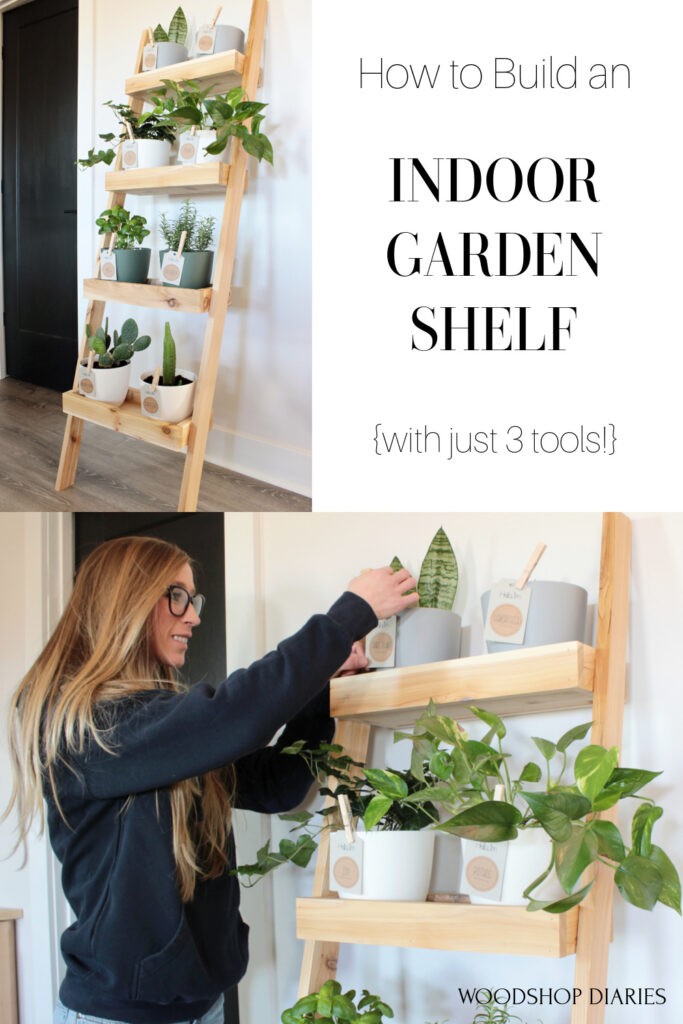
Pinterest collage of plant ladder shelf on top left and Shara clipping name tags onto planter pots on bottom with text: How to Build an Indoor Garden Shelf with just 3 tools!

Until next time, friends, happy building ????

How to Paint DIY Furniture Without a Sprayer

January 25, 2021 by Shara, Woodshop Diaries

In this post, I’m sharing how to paint your new DIY furniture projects WITHOUT a fancy sprayer!

Picture this: you just added the last piece to your brand new, beautifully built DIY project. You step back to admire it and are filled with joy! But now, it’s time for finish.

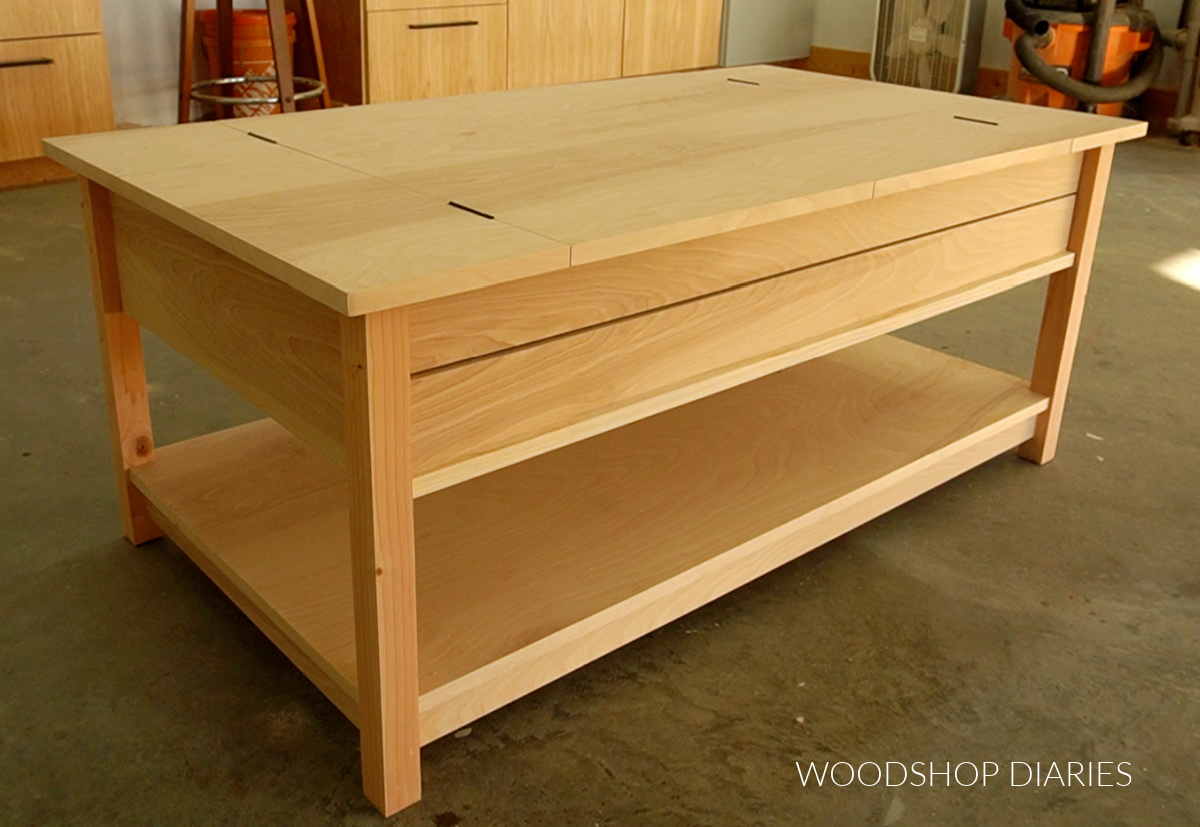
Unfinished DIY coffee table in workshop ready for paint or stain

A good finish job will enhance your build to make it even better. But a bad finish job can make an amazing piece, well…less than amazing.

I’ll be honest, painting, staining and finish are my least favorite parts of any project. That’s why I do it once, do it right, and keep it as simple as possible to get the best results.

Thankfully, achieving a nice paint finish doesn’t have to be complicated or difficult. I promise–I’ll show you below.

*This post contains affiliate links. See policies.

Do You Need a Sprayer to Paint Furniture?

Short answer: no. You definitely don’t need a paint sprayer to achieve a nice paint finish. I don’t use one.

Sprayers have their pros and cons just like anything else. Some people love them and they work great for finishing and make the process much quicker.

But they are pricey, require a lot of prep work, and are tedious to clean up. I used one a few times in the past and personally preferred to just brush and roll instead.

Types of Finish for Raw Wood Furniture

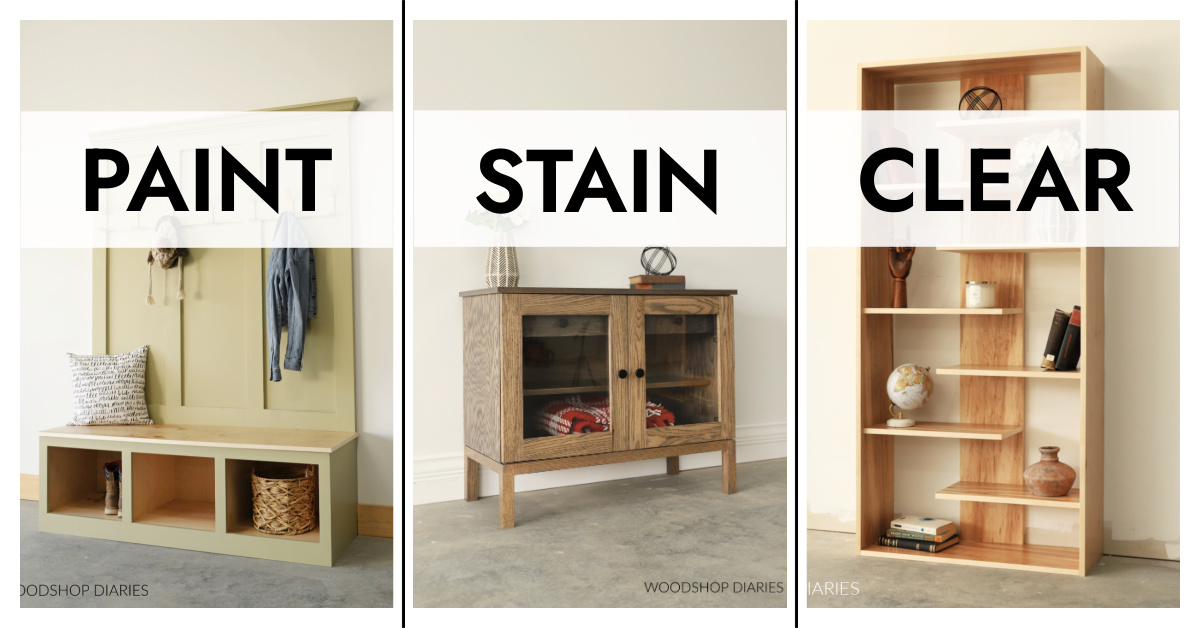
I mentioned already that I don’t necessarily enjoy the finishing process, so I keep it pretty simple. The three main types of finish I use on my projects are:

  • Paint
  • Stain
  • Clear Coat
collage showing painted project on left, stained project in middle and clear coat project on right with text "paint, stain, clear"

There are a TON of finishing products out there, glazes and top coats, complicated mixtures. You can get as fancy as you want. But in this post, I’m going to focus on how to achieve a simple, clean, basic paint finish.

If you’re interested in learning more about staining, check out this post on how to stain wood.

What You Need to Paint Furniture

Here is a basic list of the tools and materials I recommend when painting your DIY projects.

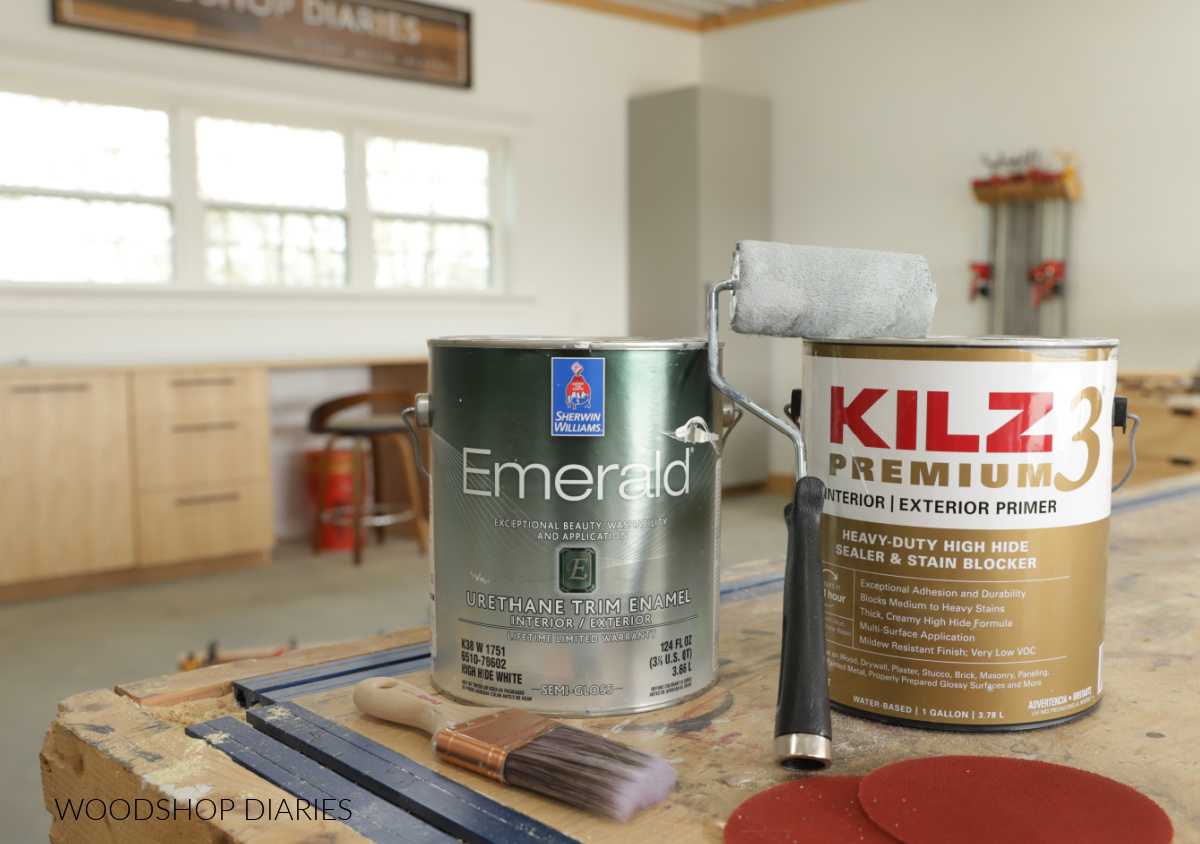
You don’t need anything “fancy,” but make sure you’re using high quality brushes, rollers, and paint. I personally recommend Wooster or Purdy brushes and Sherwin Williams Emerald Enamel Paint.

  • 220 & 400 grit sandpaper
  • Latex Primer
  • Paint
  • Paint trays
  • Trim Roller Frame
  • ⅜″ nap roller
  • Paint Brush
  • Paintable Trim Caulk

NOTE: The process for finishing interior vs. exterior furniture pieces is the same. However, the products are different.

If you’re painting an outdoor project, make sure to use an EXTERIOR primer, paint, putty and caulk. If it’s okay for use outdoors, the container will specify “exterior.”

How to Paint Raw Wood Furniture

Painting furniture and cabinets is really very simple. BUT, you need to be patient–which I know can be challenging sometimes.

My process for painting raw wood furniture can be summed up in three basic steps:

  1. Sand
  2. Prime
  3. Paint

I’ll go into detail about each part below.

Step 1: Sand

The number one step to getting a smooth paint finish is to start with a smooth surface. The way to achieve a smooth surface is by sanding. You cannot skip sanding and expect a smooth finish.

I hate sanding as much as the next person, but it’s a CRITICAL step not just for finish, but also throughout the entire building process.

I encourage you to check out this post to learn more about sanding and WHY it’s so important.

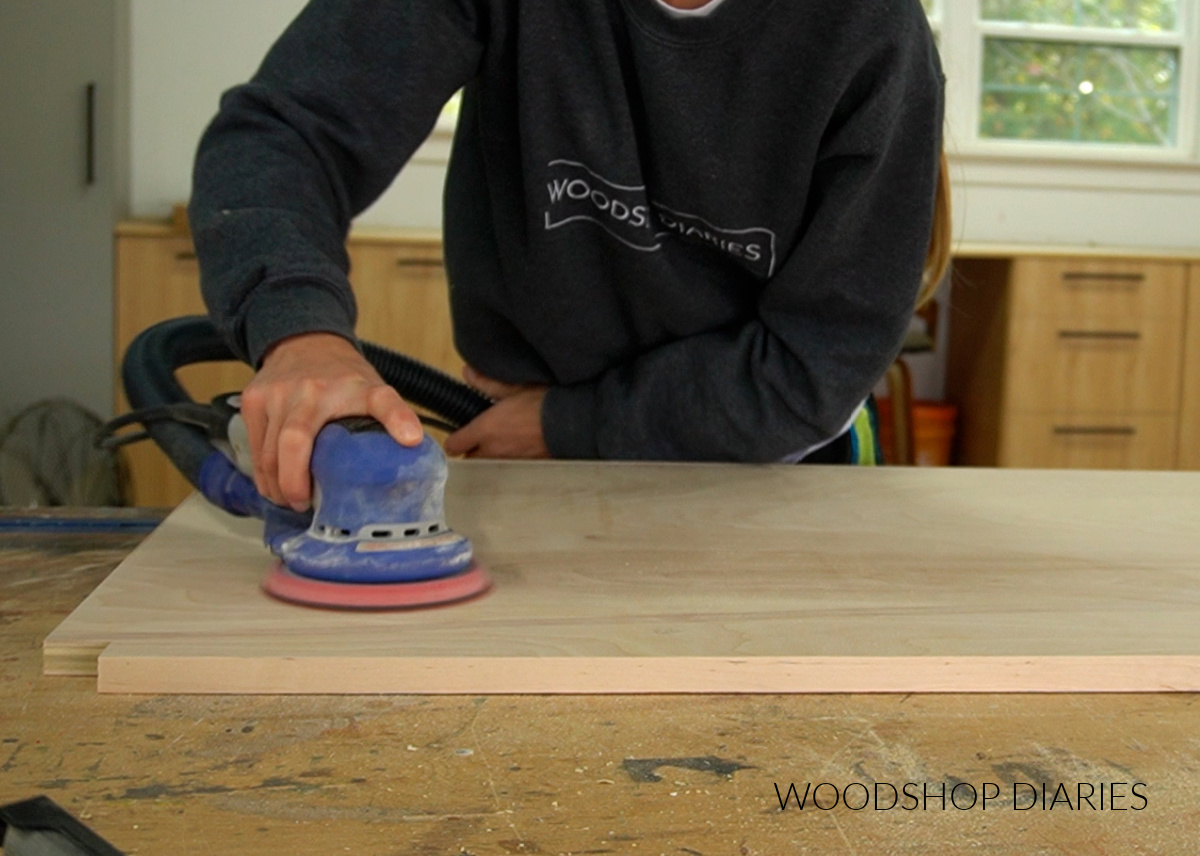
Shara Woodshop Diaries sanding plywood before painting

Before applying finish, sand the entire piece to at least 220 grit. Then wipe or blow away the dust. I like to keep some old t shirts and rags in my shop to wipe my projects clean before finish.

But if you have an air compressor, you can blow the dust off, too.

Step 2: Apply Primer

Raw wood is thirsty. It will “soak in” whatever you put on it. So if you are painting raw wood, do not skip the primer.

Primer helps to “seal” the raw wood so that it doesn’t soak in the paint when you apply it. This gives you a much smoother and less blotchy paint coat–and let’s you use a lot less paint.

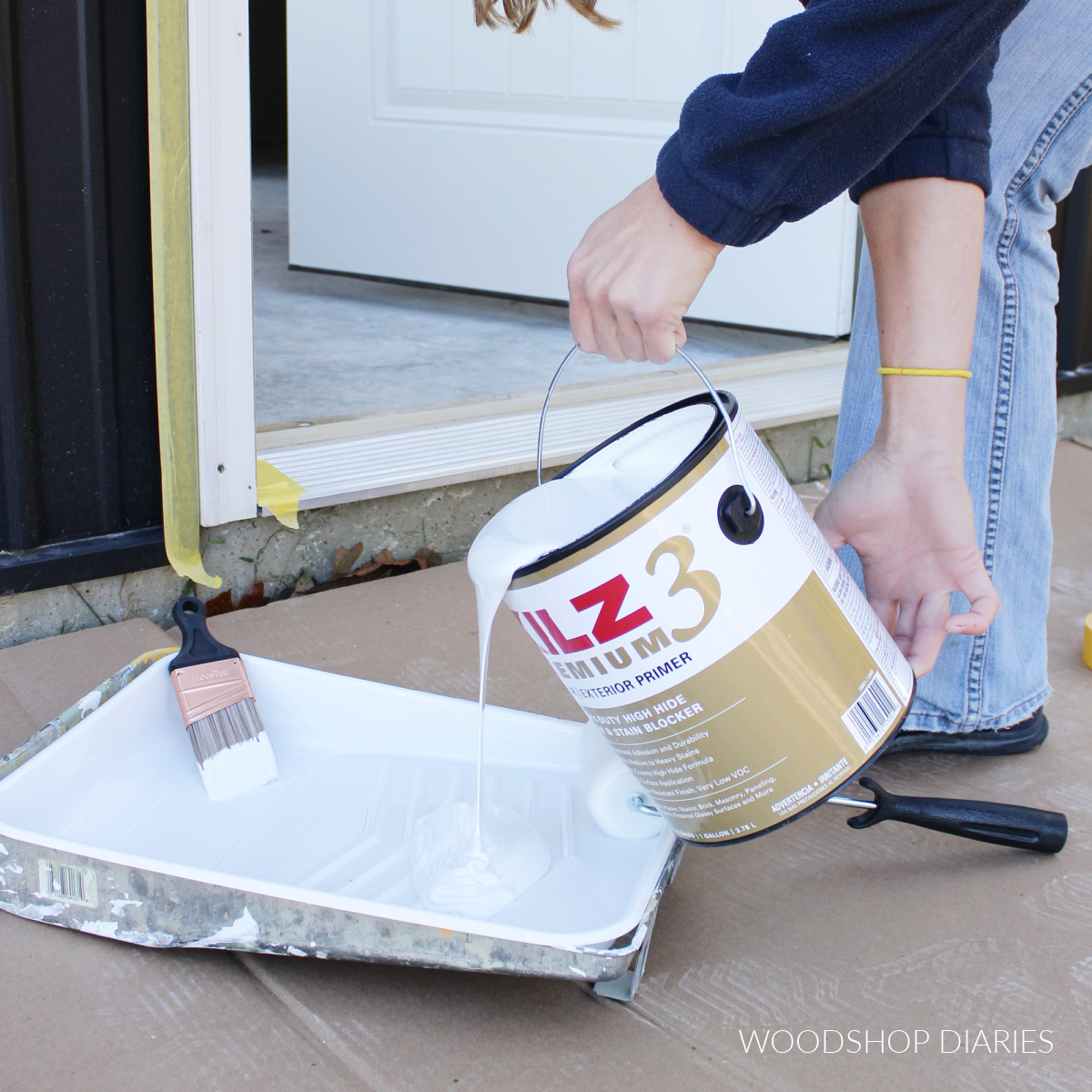
I like using Sherwin Williams Multi-Purpose Primer and I get them to tint it a light grey color (the exact color doesn’t matter, the grey just provides better coverage). But, I also use Kilz 2 and Kilz 3 Primer as well. All three work great.

Shara Woodshop Diaries pouring Kilz 3 primer into paint tray

To apply, first, I brush any inside corners or detailed pieces (like molding) that I won’t be able to get into with a roller. Make sure to use a HIGH QUALITY paint brush made for latex/water based paints. I like to use Wooster and Purdy brand brushes.

TIP: Make sure to brush away any globs or streaks–apply as smooth as you can.

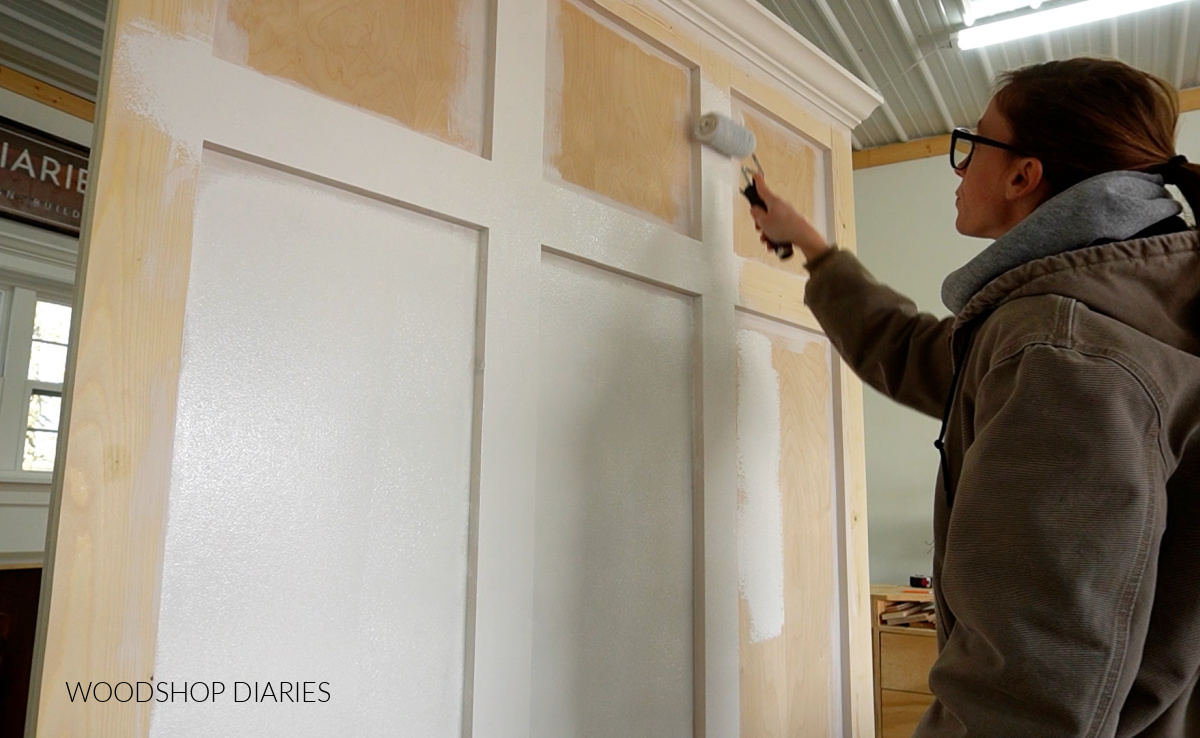
Then, I use a small roller frame and a ⅜″ nap roller to roll primer on the rest of the surfaces. Be careful to spread it evenly and don’t leave any streaks.

Shara Woodshop Diaries applying primer to DIY furniture piece in workshop with roller

NOTE: You can use foam rollers if you want, but I personally don’t like them.

Step 3: Sand Again

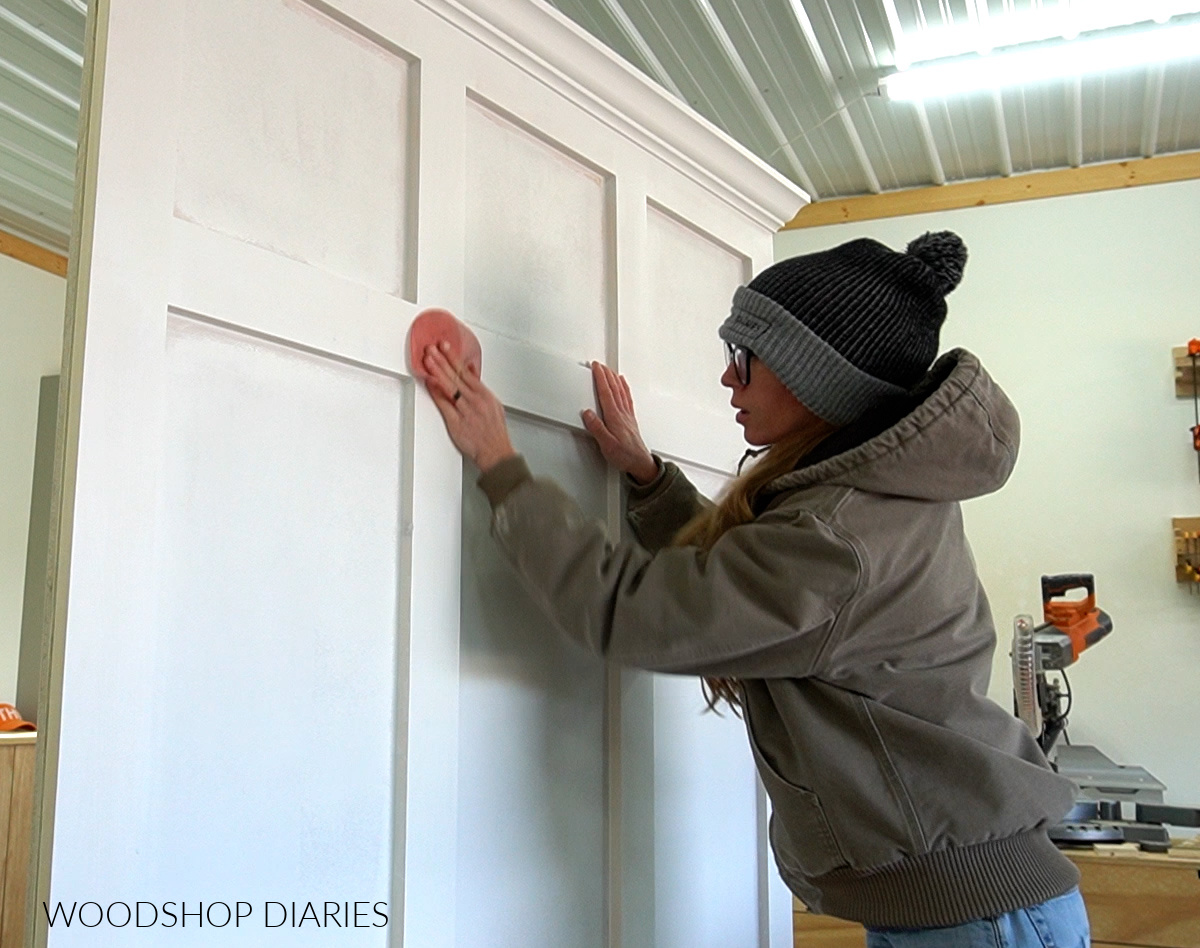
I allow the primer to dry according to the manufacturer’s instructions. Then, I hand sand all surfaces with 400 grit sandpaper.

RELATED: How to sand wood

Shara Woodshop Diaries hand sanding primed hall tree piece in workshop before applying paint

Water based (latex) finishes will soak into the wood and cause the grain to raise leaving a rough feel after it’s applied. You can run your hand across it to feel how it’s a little rough.

This is why you need to sand both before AND after primer. You only need a light sanding to smooth it back out. Use your hands to feel for any spots that are still a little rough.

Then I make sure to remove all the dust again.

Step 4: Caulk

Caulk is optional, but it really makes a big difference to give you a clean looking paint job to seal up any gaps or cracks.

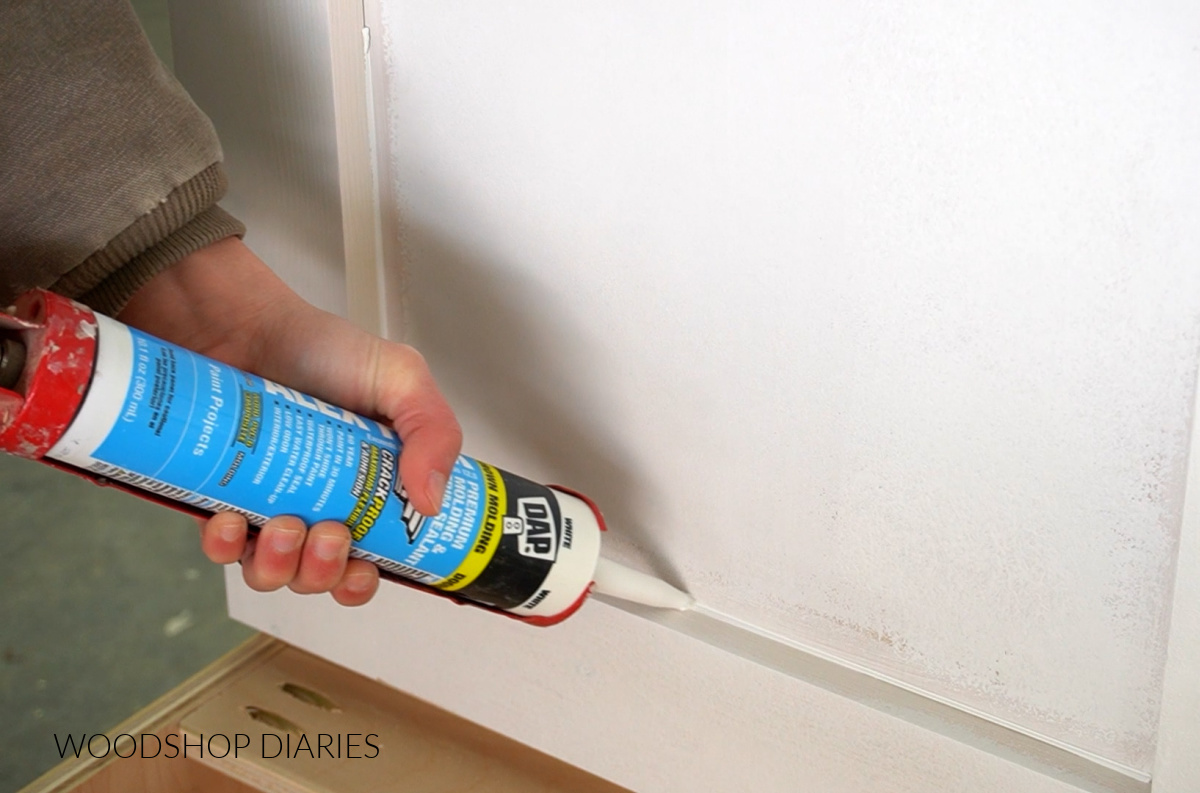
I apply paintable trim caulk into the inside corners where I plan to paint and smooth it out with my finger and a damp paper towel.

Close up of applying trim caulk to inside corners of DIY furniture project after primer and before paint

Step 5: Paint

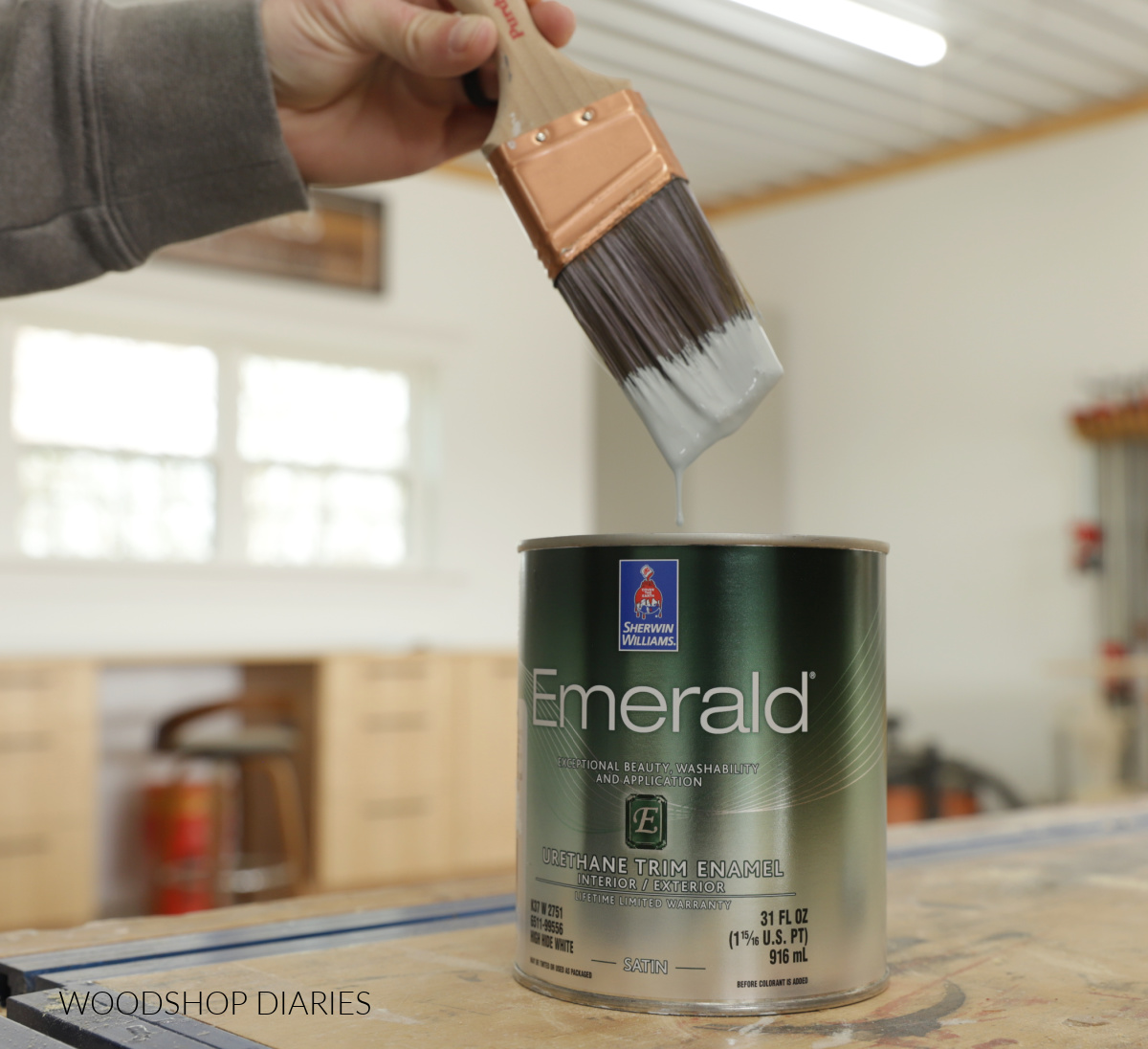
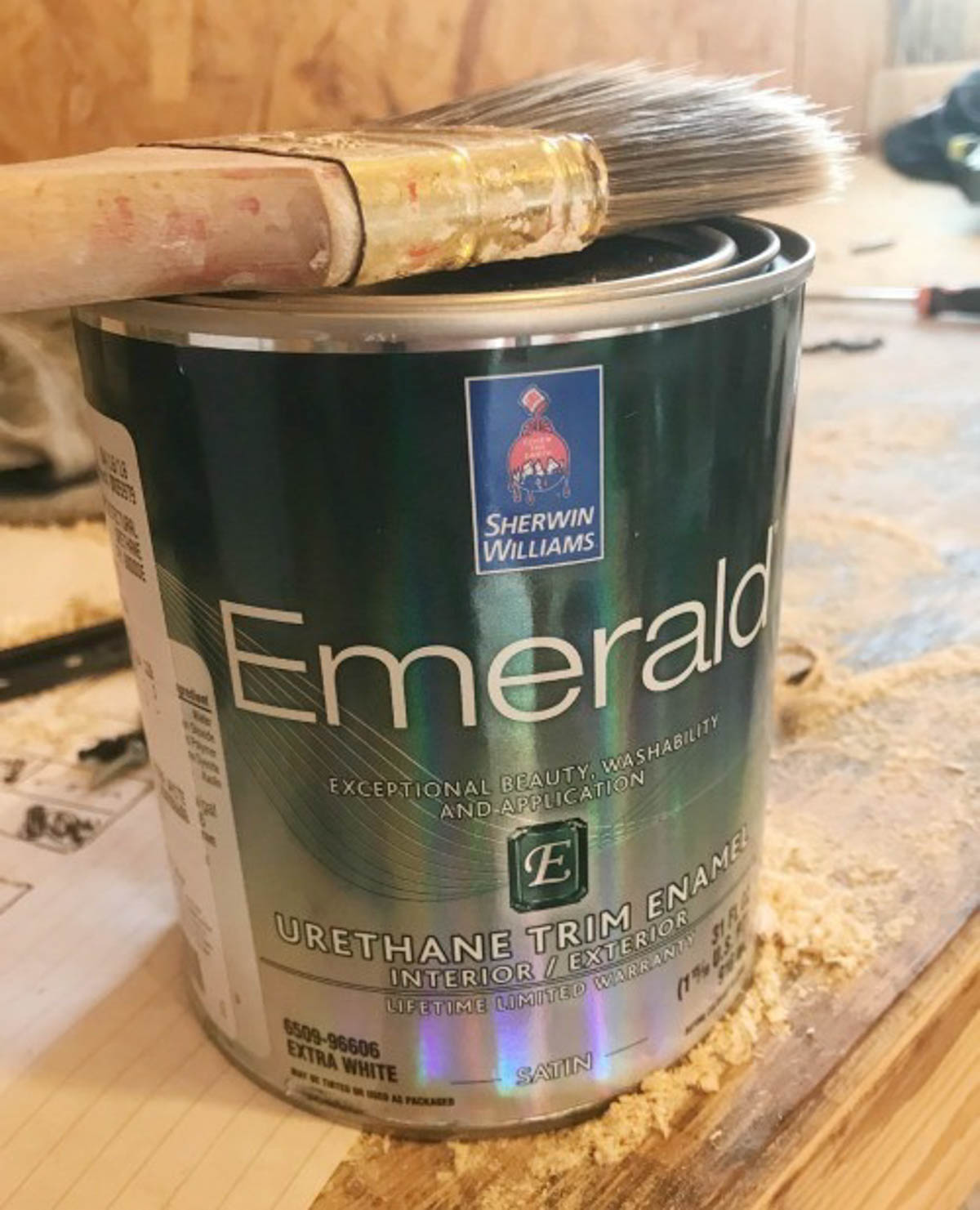
Personally, I recommend Sherwin Williams Emerald Paint for my furniture projects. I’ve used many kinds and this is my favorite. It’s thick, goes on smooth, and shows the lest amount of brush strokes once dry.

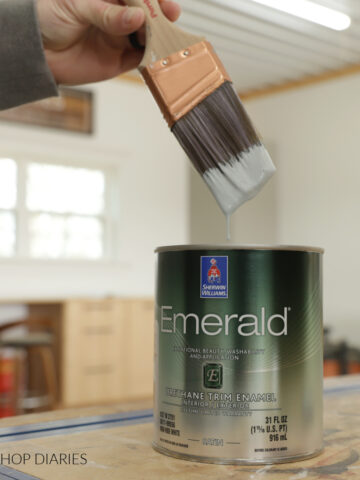
Close up image of paint brush dripping paint in Sherwin Williams Emerald Enamel paint can

Paint comes in different sheens–flat, satin, semi-gloss, and gloss. Personally, I’m a fan of satin or semi-gloss. BUT, sheen is just a personal preference.

The glossier the sheen, the easier it is to clean. But glossier sheens also show more imperfections. So you have to weight the pros and cons.

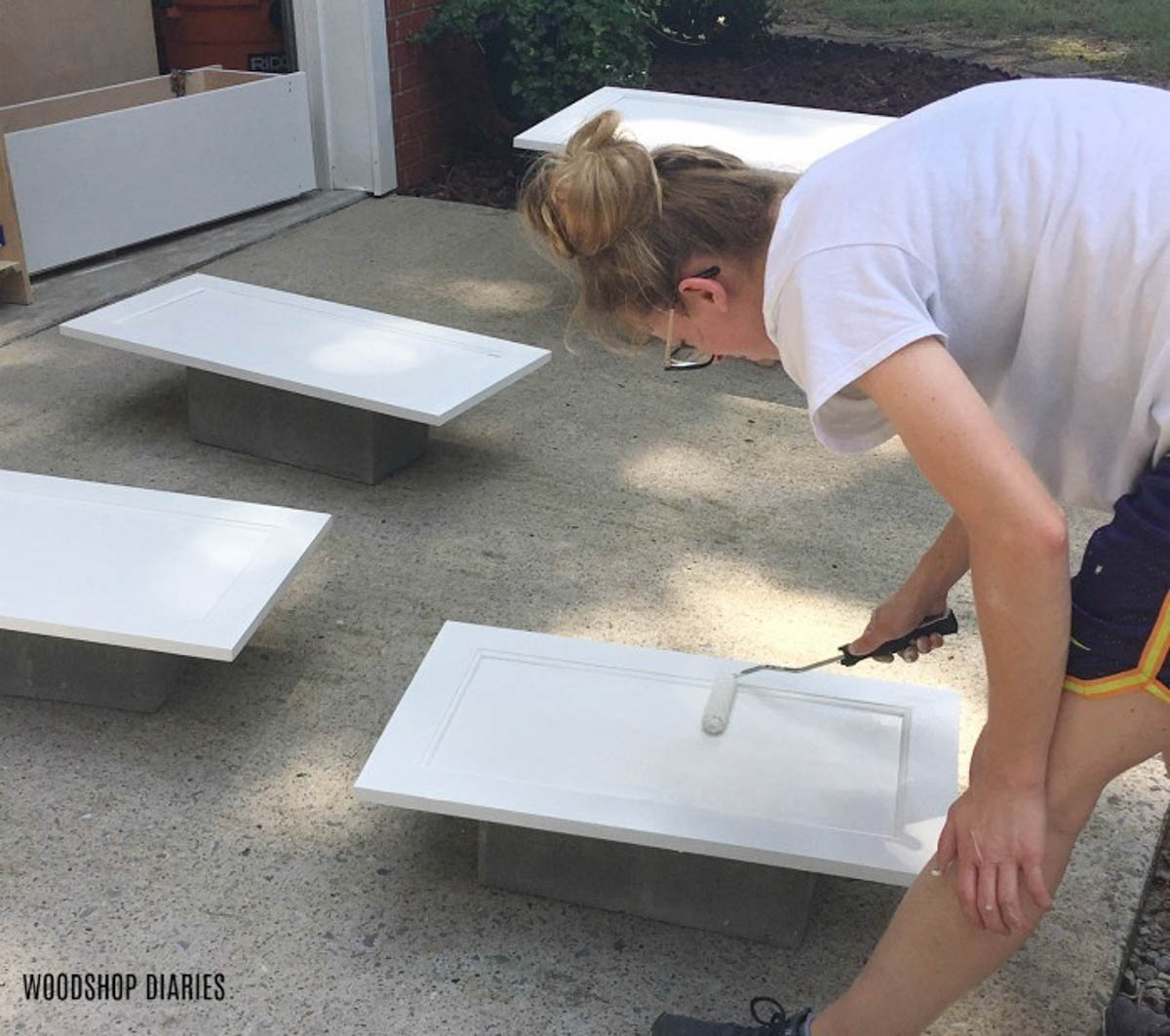
Once the primer is completely dry to the touch, I apply the paint just like the primer–with a high quality brush and a roller.

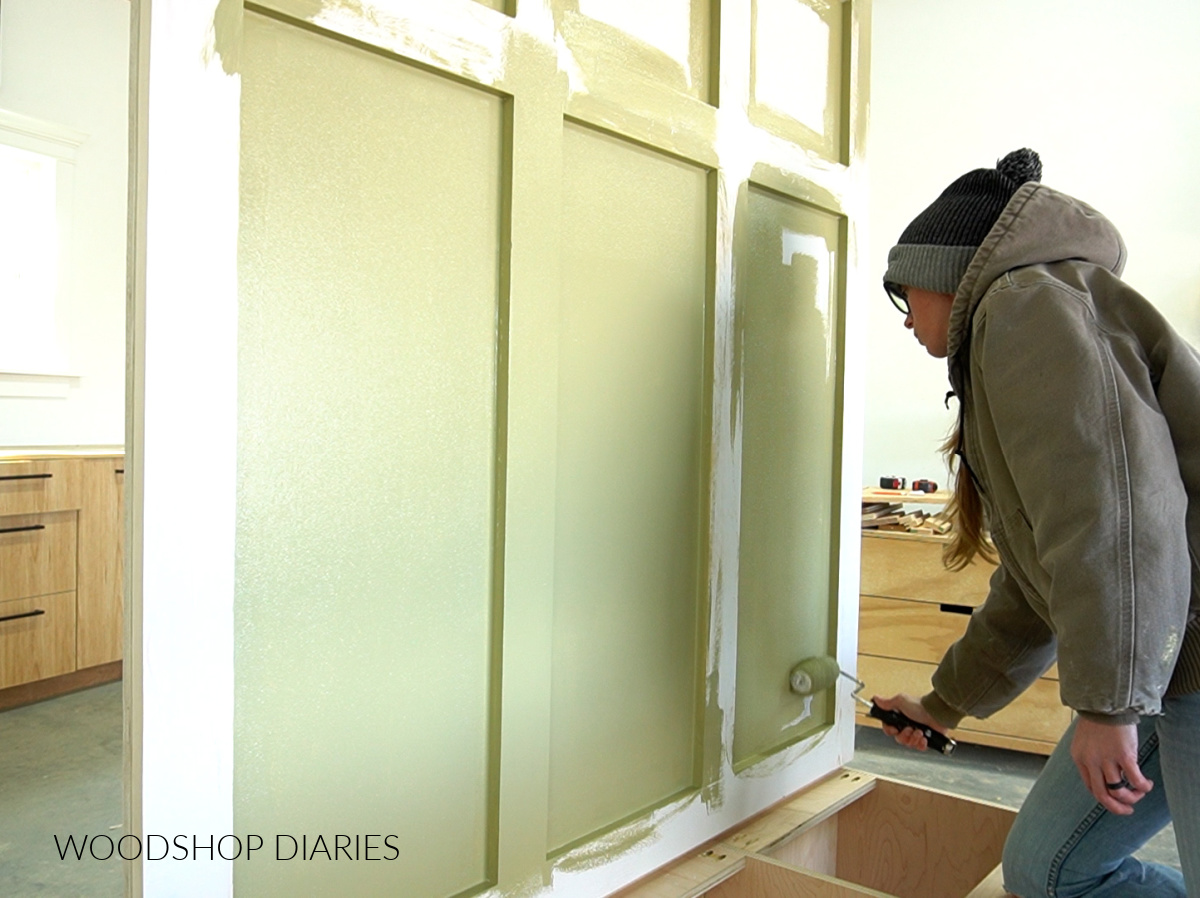
Shara Woodshop Diaries applying paint to DIY furniture project in workshop using a roller

I brush the hard to reach areas, inside corners, and decorative trim pieces first, then roll the rest. The roller helps smooth out brush strokes where it can reach.

For a smoother finish, it’s best to hand sand lightly between EACH coat using 400 grit sandpaper. This will help reduce brush strokes. Don’t sand after the final coat.

I usually apply 2-3 coats of paint (I apply the next coat when the previous coat is dry to the touch) then allow to completely cure according to the instructions on the label.

For an extra layer of protection, you can apply some clear furniture wax or a clear coat poly over the top of the paint if desired. I don’t usually do this, but it is an option if you wanted to.

MAKE SURE TO CHECK THE PAINT LABEL FOR CURE TIMES BEFORE APPLYING ANYTHING ON TOP OF IT.

Additional Tips on Painting Furniture

Keep in mind that while paint will cover a multitude of sins, it will also expose some “sins” in your project if you aren’t careful. Paint can’t fill in or hide gaps in your pieces. So, be sure to putty, and caulk as needed for a smoother, cleaner finish.

Another consideration when painting–cold or humid conditions will cause paint to dry slower, while warm or dry conditions will cause it to dry faster. It’s best to avoid extremes one way or the other.

Wash water based finishes from paint brushes with soap and water so you can reuse them again on your next project–don’t let paint dry on them.

You can place brushes and rollers in a Zip-Loc bag between coats so they don’t dry out and store them in the refrigerator overnight if you’re painting over multiple days.

If I’m painting something with doors and/or drawers, I recommend removing them from the cabinet, finishing all parts and pieces separately, then putting everything back together after the finish is dry.

Looking for DIY Projects to Build and Paint?

Here are a few DIY projects you might enjoy building to test out your new painting skills on!

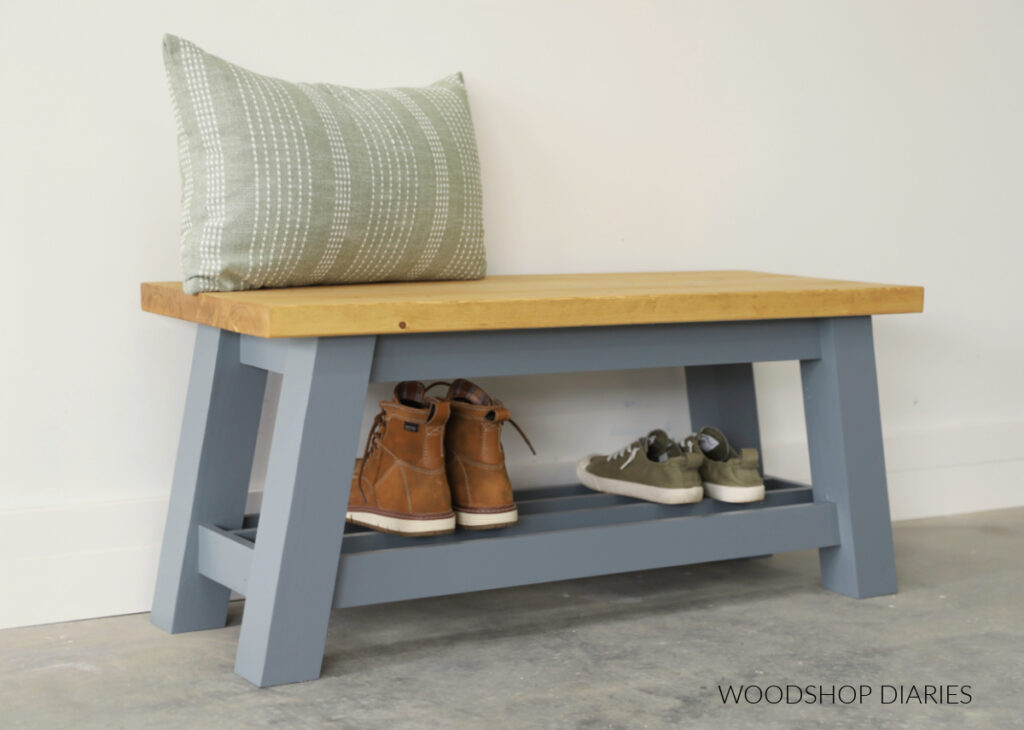
DIY Shoe Bench
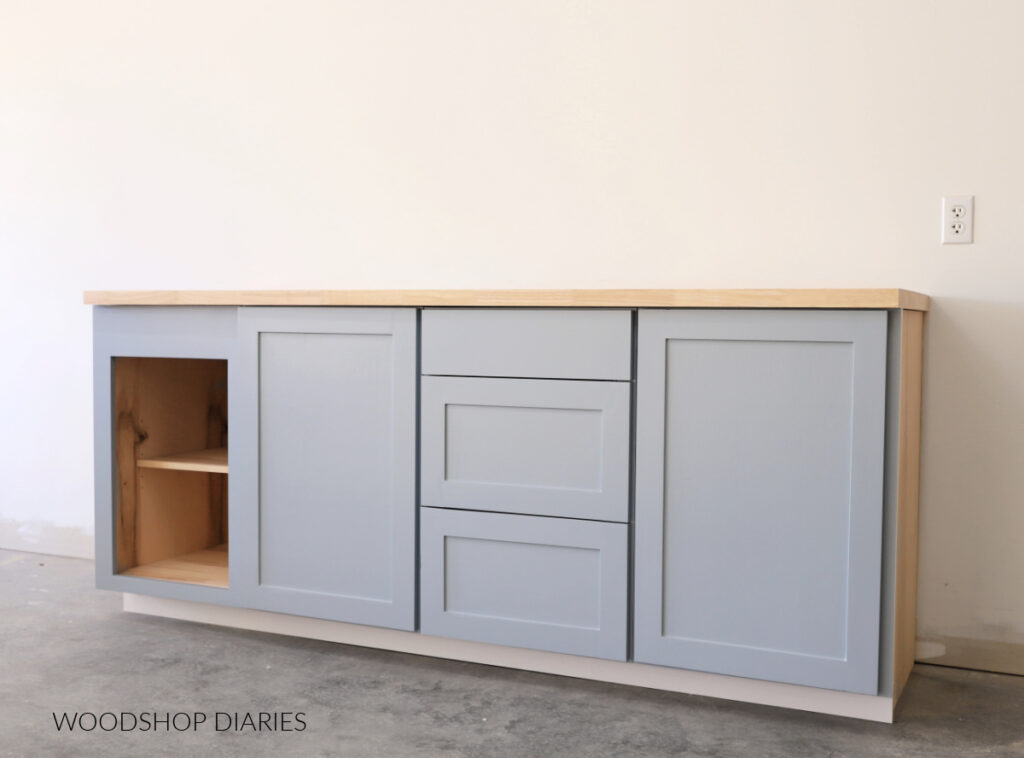
How to Build Base Cabinets
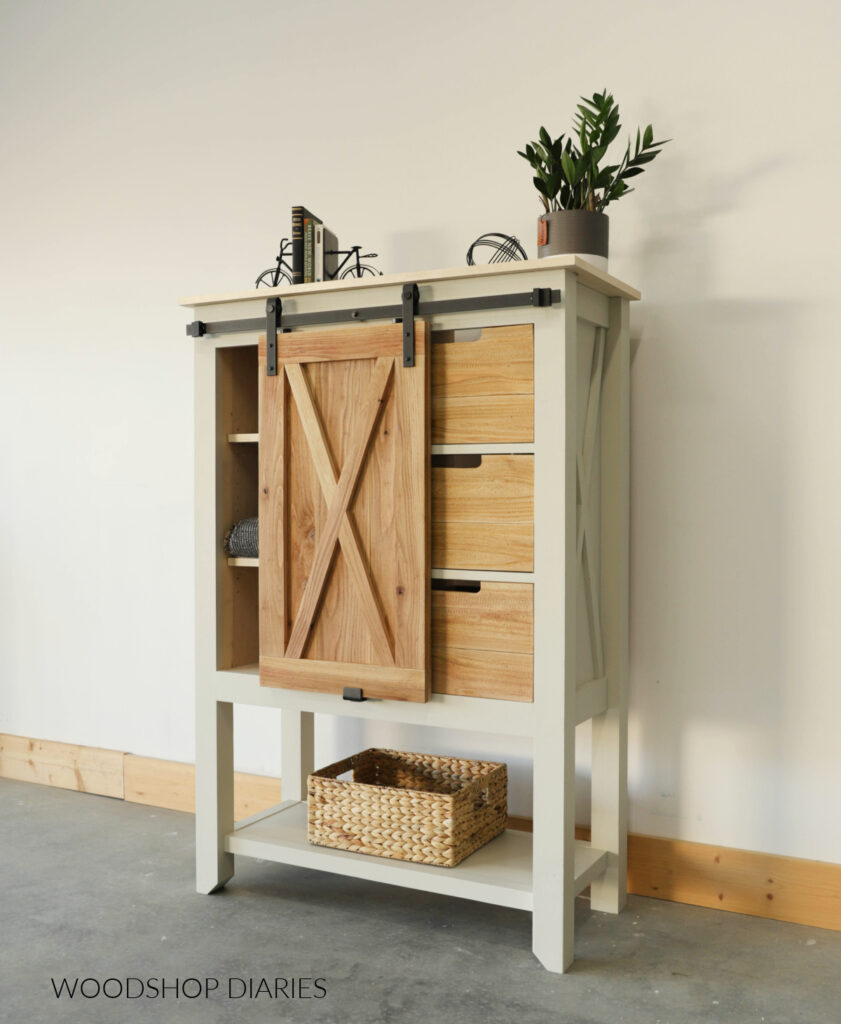
Sliding Door Storage Cabinet
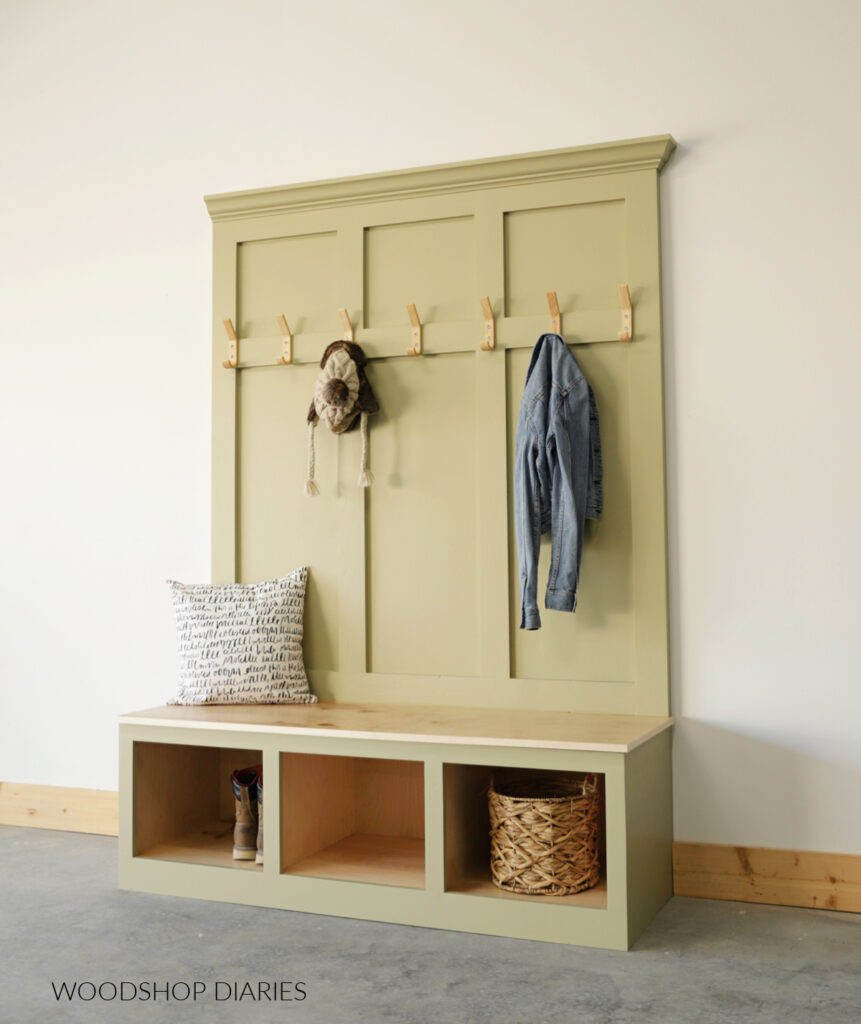
DIY Mudroom Bench
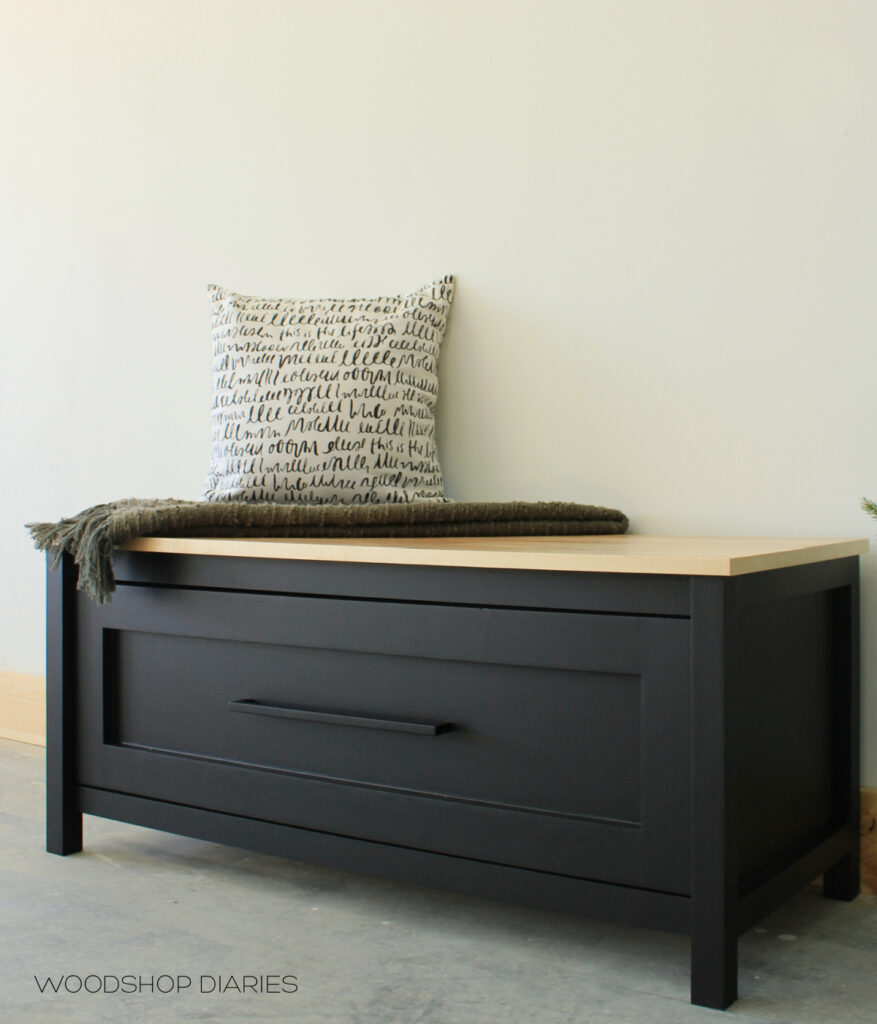
DIY Storage Bench

If you’d like to save this post for later, be sure to pin it or share to your favorite social channel!

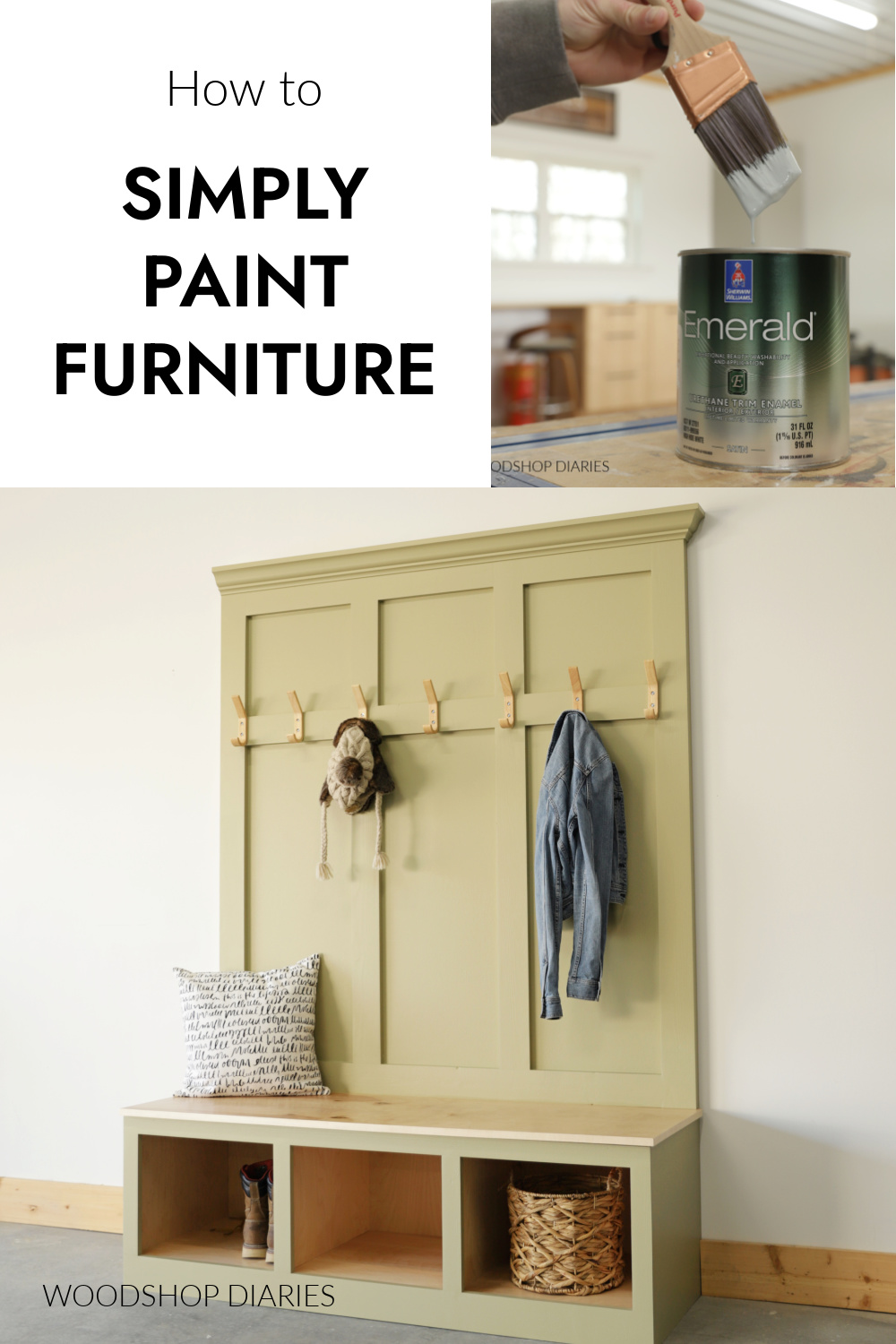
Pinterest collage image showing dripping paint brush at top right corner and painted hall tree project on bottom with text "how to simply paint furniture"

Until next time, friends, happy building 🙂

DIY Console Table with Drawers

January 22, 2021 by Shara, Woodshop Diaries

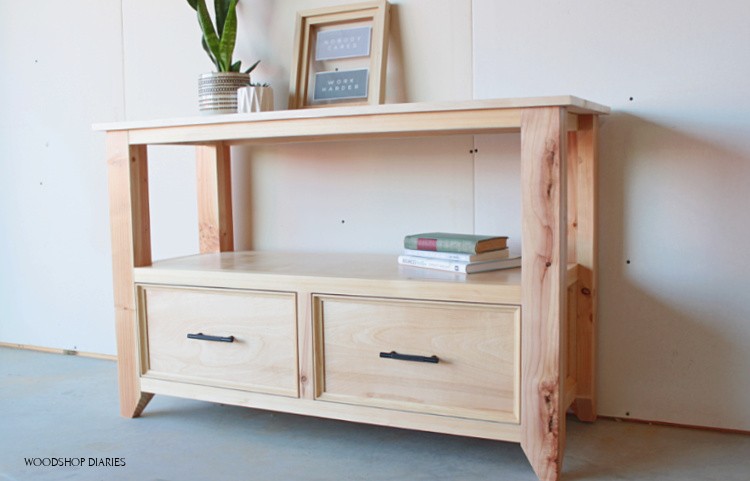
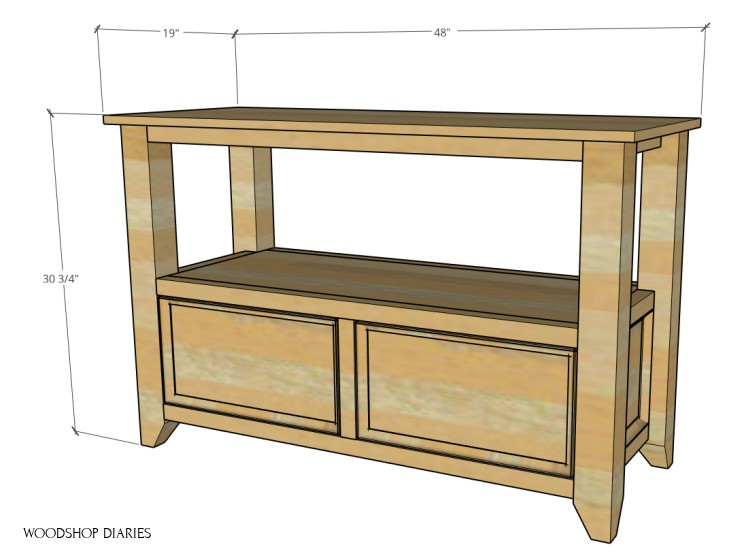
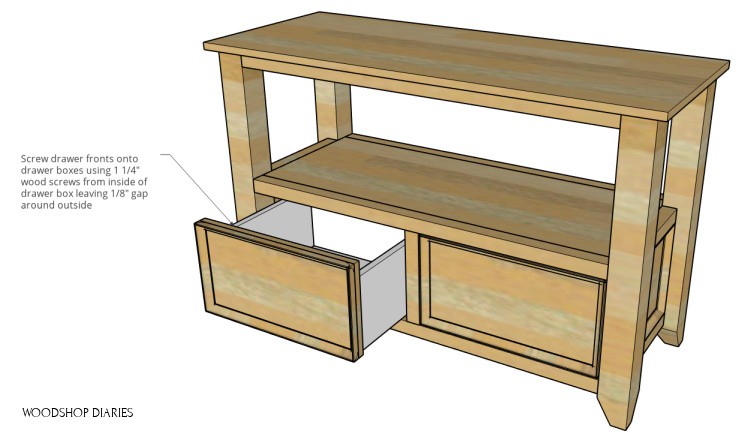
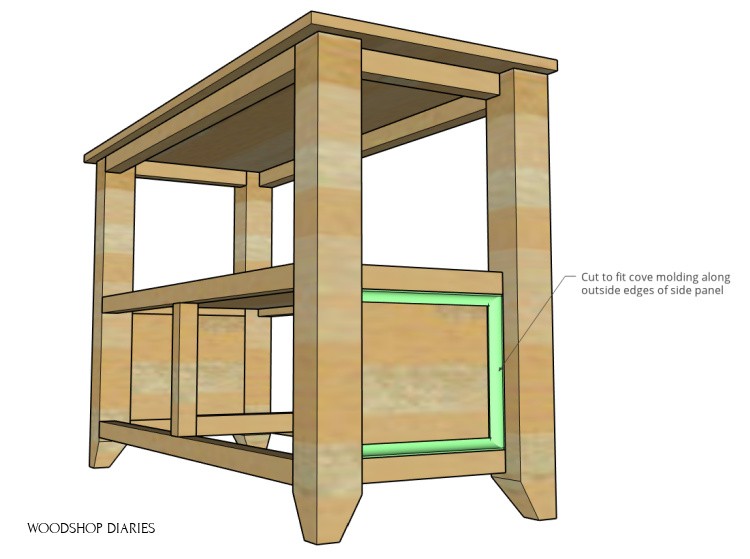
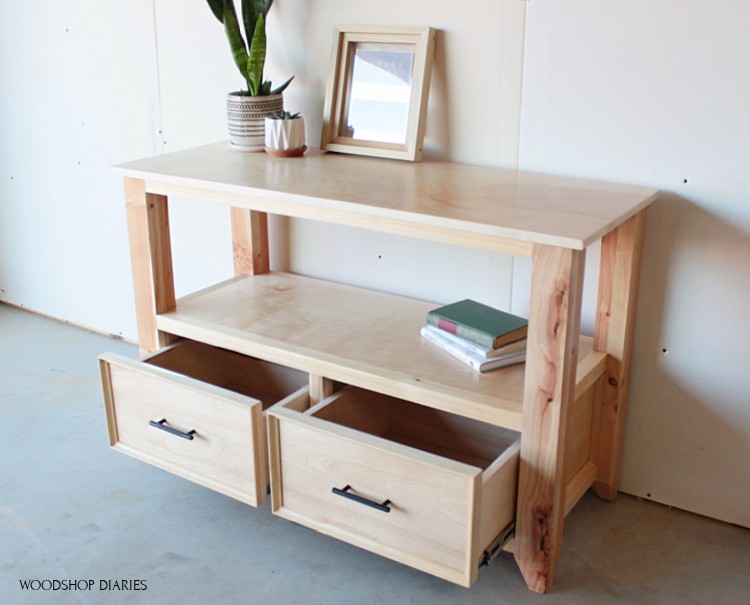
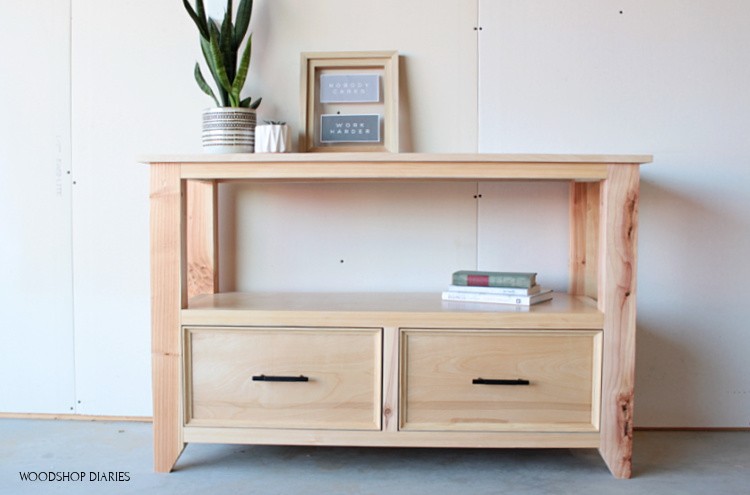
In this post, I’m sharing how to build a DIY console table with drawers using basic 2x4s and plywood!

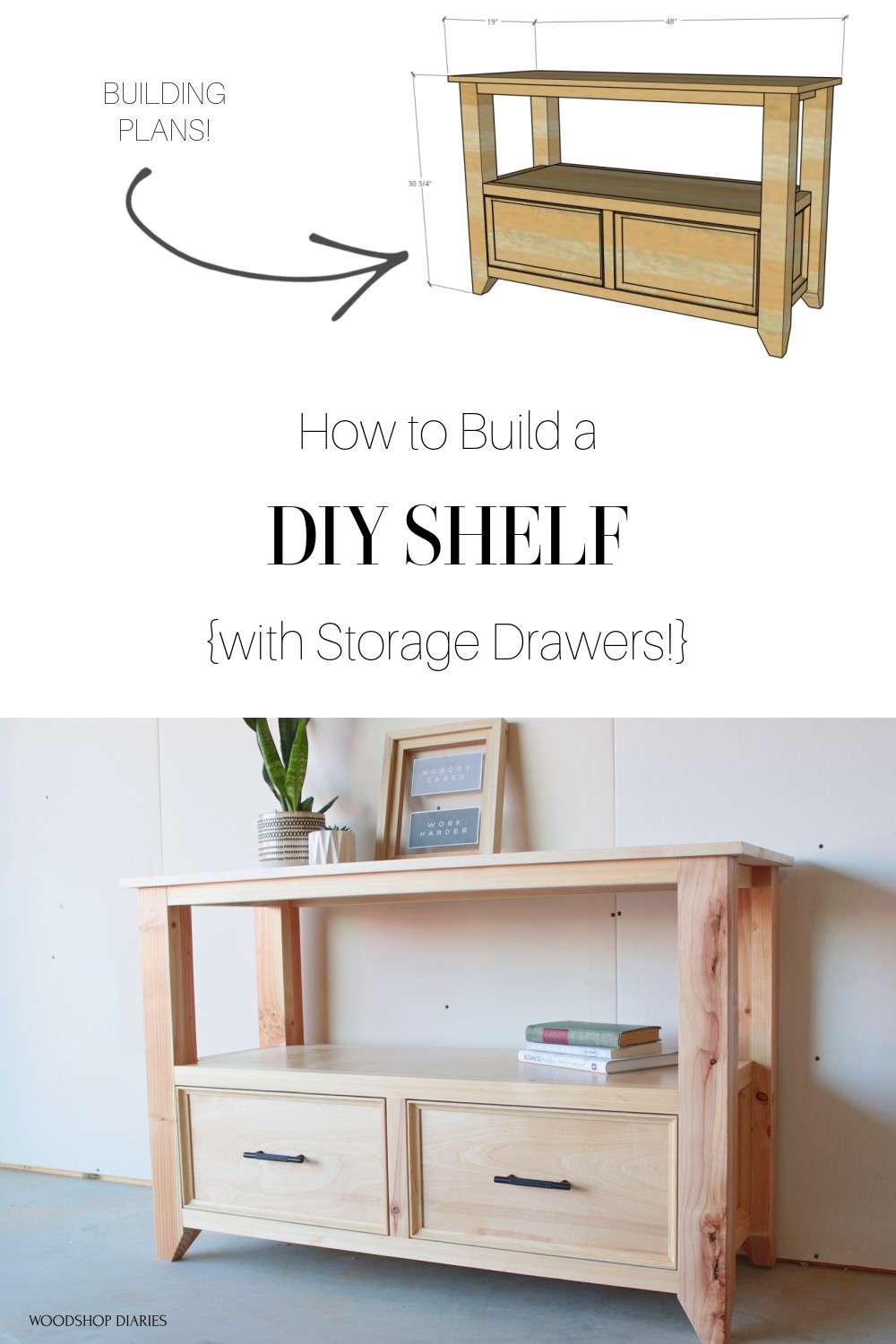
Finished DIY console table with drawers staged with plant and books on middle shelf

This DIY console table is actually one part of a five piece matching office furniture set that I built for my dad’s office.

He needed somewhere to store and display some of his product samples for his customers.

But if you didn’t need it for a storefront (because it’s probably rare that you would haha), it would also work great as an entryway table or a console table in a dining room, living room, or home office.

The design is somewhat unique with the two deep drawers at the bottom–great for storing books, dishes, toys, even shoes.

It’s almost like a dresser combined with a bookshelf which makes this build great for both storage and display.

If you want to build one of your own, I’m sharing the video tutorial and the DIY console table building plans below!

Tools & Materials

*This post contains affiliate links. See policies.

Tools:

  • Circular saw
  • Miter Saw
  • Drill
  • Pocket hole jig
  • Table saw (optional)

Materials:

  • (3) 2x4x8 boards
  • (4) 2x2x8 boards (or just add two more 2x4s and make your own 2x2s from that)
  • (1) sheet ¾″ plywood (I used birch)
  • ½ sheet ¼″ plywood
  • (3) 8 ft sticks cove molding (optional)
  • (2) pair 16″ ball bearing drawer slides
  • 2 ½″ pocket hole screws
  • 1 ¼″ pocket hole screws
  • 2″ wood screws
  • Wood Glue
  • Edge Banding

What to Know Before Building

I kept this build easy and inexpensive by using birch plywood and basic 2x4s from The Home Depot. 

But, obviously, you can use any wood type you wish for this project if you’re building it yourself.

Matching Office Furniture Pieces

This is one part of a five part series of matching office furniture that I built for my dad.

You can check out the whole matching series of pieces here.

collage of 5 matching home office furniture pieces
Matching Office Furniture Series

Building the Leg Posts

As part of this matching series, you’ll notice from the image above that I used large 3″ square posts for the legs of each piece.

I made these by gluing up 2x4s and trimming the edges down on the table saw.

You may already know this, but 2x4s are actually 1 ½″ x 3 ½″ (not 2″ x 4″) and they typically come with rounded corners.

So if you glue two of them together, you’ll have a post that is about 3″ x 3 ½″ but where the rounded corners meet, it won’t look all that great.

rounded board corners butted together

To clean those edges, I’ll run them through the table saw to remove about ¼″ on each side.

Then I’ll have nice, square 3″ posts.

Squaring table leg on table saw

However, if you don’t have a table saw, this isn’t absolutely necessary. You can definitely leave them as is.

Just note that your legs will be 3″ x 3 ½″, so you may have to make some minor adjustments to the measurements in the plans to accommodate.

Overall Dimensions

The overall dimensions of this two drawer console table is 19″ deep x 30 ¾″ tall x 48″ wide.

Overall dimensions of DIY console table with storage drawers--48" wide, 19" deep, 30 ¾" tall

Helpful Resources While Building

You may find these guides and articles helpful throughout the building process:

  • How to cut down plywood sheets
  • How to cut your own 2x2s
  • How to use a pocket hole jig
  • How to apply edge banding
  • How to build and install drawers

How to Build a DIY Console Table with Drawers

This is a great weekend project and is an intermediate level build. It uses basic joinery methods to keep assembly quick and simple.

If you prefer to watch, check out the video tutorial below.

I’m sharing the building plans for free in the post below, but if you prefer to print your plans, you can grab the printable building plans here.

Step 1: Assemble Console Table Legs

I started this project out by gluing up 2x4s to make the leg posts.  See notes in the “what to know before building” section above.

To glue up the legs, I trimmed down my 2x4s to roughly 32” long pieces and glued and clamped four sets of 2 together to make four leg posts.

Shara clamping two 2x4s together to make leg posts

Once the glue dried, I took them to the table saw to clean up the edges and trim them down to a square 3” x 3” post. 

Since 2x4s are about 1 ½” thick and 3 ½” wide, I had to remove about ½” from the width to match the thickness of 3”.

NOTE: if you don’t have a table saw, you can simply sand the edges clean and leave the posts as 3′ x 3 ½″. Just note that if you leave the width 3 ½″, make sure to assemble the frame with the legs oriented so the wider side is on the WIDTH of the piece and not the depth.

Once the posts were 3” square, I took them to the miter saw to trim them to 30” long.

I tapered the ends of these leg posts for some extra detail.  This is a totally optional step, but to do this, I adjusted my miter saw angle to 60 degrees and cut two adjacent sides from the center at the bottom out to the edge.

Diagram of tapered leg posts for DIY console table with drawers

Once the legs were trimmed and tapered, I could move on to the fun stuff—assembly.

Step 2: Assemble Console Table Side Panels

The main frame of this project was built with 2x2s.  You can purchase precut 2x2s at the lumber yard, but I like to cut my own from 2x4s.

RELATED: How to cut your own 2x2s

Either way, I just cut six pieces of 2×2 to 12″ long to build two identical side frames like shown below.

I assembled the pieces using 1 ½″ pocket holes and 2 ½″ pocket hole screws.

RELATED: How to use a pocket hole jig to drill pocket holes

Notice that the 2x2s are attached so they are flush across the INSIDE of the legs and the tapers face the inside corners.

Side panel frame assembled with 2x2 between the leg posts

I used wood glue at each pocket hole joint.  I find that using 2 pocket holes in a 2×2 will usually cause the wood to split, so I like to use wood glue with just one pocket hole screw with my 2x2s. 

However, feel free to use 2 if you’d rather.

Since the bottom of this piece has drawers, I wanted to install a solid panel at the bottom of both side frames so I could mount the slides to it. 

I cut two pieces of ¾″ plywood for this and installed then into the side frames using ¾″ pocket holes and 1 ¼″ pocket hole screws.

RELATED: How to cut plywood sheets

DIY console table side panel with 3x3 posts, 2x2 frame, and plywood panel installed at bottom

Notice that this panel is attached so it’s flush across the INSIDE of the legs and frame.

Step 3: Assemble Middle Shelf Panel

Once the two side panels were assembled, I was ready to build the rest of the frame, but first, I decided to attach the middle plywood panel between the two middle supports.

I cut a piece of ¾″ plywood to use as the middle shelf panel (cut to 15″ x 40″) and drilled ¾″ pocket holes around the edges.

Then, I cut six 2x2s to 40″ to use as the front and back frame pieces and drilled 1 ½″ pocket holes into the ends of each.

To make things easier, I “preassembled” this middle shelf by screwing the panel into two of the 2x2s like shown below using ¾″ pocket holes and 1 ¼″ pocket hole screws. 

Middle Shelf subassembly diagram

I attached the shelf so that it was flush across the top of the 2x2s and used a clamp to help hold the pieces together while I drove the screws.

Step 4: Assemble Console Table Frame

I secured the middle shelf between the side panels so that the top of the shelf was even with the top of the middle 2×2 pieces.

Then, I installed the other 2x2s in with wood glue and 2 ½″ pocket hole screws—two at the top and two at the bottom.

Keep in mind that for the 2x2s, you will use 1 ½″ pocket holes with 2 ½″ pocket hole screws and with the ¾″ plywood, you will use ¾″ pocket holes with 1 ¼″ pocket hole screws.

Diagram showing how to assemble DIY console table frame--2x2s in pink and ¾" plywood shelf in green

Then, I added some 2×2 pieces in the middle at the bottom to separate the two drawers. 

Since these pieces were small, I couldn’t get in to drive a pocket hole screw at the bottom, so I just did one at the top and used a 2 ½″ wood screw to attach these divider pieces at the bottom.

Diagram showing middle dividers installed on bottom of DIY console frame

Then, I screwed another 2×2 between them to give me somewhere to mount the drawer slides.

Graphic showing the middle divider drawer slide support on bottom of shelf frame in purple

Step 5: Attach Top to DIY Console with Drawers

I cut a piece of ¾″ plywood for the top to 19″ x 48″. 

I applied iron on edge banding to the sides of the top to clean up the edges a little before and gave it a good sanding before attaching.

RELATED: How to apply iron on edge banding

Then, I installed it onto the base using 2″ wood screws through the top 2x2s. I left 1” overhang on the front and on each side.

Diagram showing dimensions of top plywood piece and how to attach through top supports of shelf

NOTE: If you left your legs 3 ½″ wide in step 1, you will leave only ½″ overhang on the sides…not 1″. Or you can cut your top 49″ long and leave the full 1″.

Step 6: Build and Install Drawers

I installed two pair of 16” ball bearing drawer slides into the shelf so that they were 1 ½” inset from the front edge.

RELATED: How to install drawer slides

After the slides were installed, I cut ¾″ plywood pieces for the drawer boxes and some ¼″ plywood pieces for the drawer bottoms like shown here.

Exploded view of different pieces and cuts to build drawer boxes for console table

I cut the pieces needed to make two identical drawers.

I cut ¼″ dadoes ¼″ deep ½″ from the bottom edge of the drawer box sides to install the ¼″ plywood drawer bottom.

However, you don’t have to cut dadoes if you don’t want. You can simply glue and staple or screw the plywood bottom in place.

RELATED: How to Build Drawer Boxes

I edge banded the drawer box tops—which is an optional step, but looks really nice so I think it’s worth doing.

RELATED: 5 Secrets to Professional Looking DIY Furniture

Then I assembled the drawer boxes using ¾″ pocket holes and 1 ¼″ pocket hole screws.

Overall dimensions of drawer box assembled

Then, I installed the drawer boxes into the shelf so that the bottom of the boxes were about ¼″ up from the 2×2 frame piece below it.

RELATED: How to install drawer boxes

Shara Woodshop Diaries installing drawer boxes into DIY console table frame

Step 7: Build and Install Drawer Fronts to Shelf Drawers

To dress up the drawer fronts a little, I added some cove molding trim to the front edges.

First, I cut the the ¾″ plywood drawer fronts to size (9 ¾″ x 19″ shown in blue below).

Then, I cut to fit cove molding to frame out the front edges.

Close of of drawer front and dimensions with cove molding attached around edges

I just used a little wood glue on the molding and painters tape to hold the pieces in place until it dried. Once the glue dried, I removed the tape.

Then, I installed the drawer fronts onto the drawer boxes using 1 ¼″ wood screws from the inside of the drawer boxes leaving ⅛″ gap around all sides.

Diagram of DIY console table with one drawer open showing how to install drawer front from inside

Step 8: Add Trim on Sides (OPTIONAL) & Finish

I also added some cove molding around the side panels—I just glued these to avoid the nail holes, but you could also brad nail these pieces if you wanted.

Diagram showing cove molding installed onto side panels of shelf project--highlighted molding in green

To seal and finish this DIY console table, I simply gave it a couple coats of Minwax Helmsman Water Based Poly to keep its natural color, then added some simple black handles to the drawers.

Console table shelf with drawers staged for photos with drawers open to show storage inside

And now it’s ready to be put to good use. 

I’m loving the option for both storage and display with this DIY console table with drawers. It’s going to be perfect for my Dad’s office.

If you’re interested in all the matching pieces from his office builds check them out here.

Front view of DIY console shelf with drawers closed--finished in a clear coat poly

Looking for more Console Storage Table Ideas?

If you’re looking for more project ideas and inspiration, here are a few other storage and console style tables you will love!

Stenciled Door Console
Sliding Door Console
DIY Modern Console Cabinet
How to build a DIY X base console table with middle shelf for added storage--free building plans!
DIY X Base Console

So if you’ve enjoyed the past projects (and this one too!), be sure to subscribe to my newsletter below so you don’t miss the upcoming posts!

And if you’d like to save this for later, don’t forget to pin it or share to your favorite social media channel!

Pinterest Graphic showing the overall dimensional diagram of the console table and a finished shot of the shelf staged with drawers closed and text "how to build a DIY shelf with storage drawers"

Until next time, friends, happy building ????

DIY Coat Rack With Shelf

January 16, 2021 by Shara, Woodshop Diaries

In this post, I’m sharing how to build this DIY Coat Rack with Shelf–and faux shiplap!

Shara in front of garage door holding long DIY coat rack with shelf--wood back panel with black frame around outside

My friend had a long hallway in her home that lead to the garage where they had been kind of “dumping” their coats.

She was tired of coats, hats and gloves on the floor, so she asked me to make her a large coat rack to fit her long hallway.

She requested a coat rack with hooks, of course. But she also asked for a shelf to give them somewhere to place keys, gloves, and other trinkets.

So I built her this HUGE DIY coat rack with shelf.

BUT, don’t worry. If you need something a little smaller, you can definitely make this shorter to fit your own entryway.

It’s a really simple design and easy to customize.

So if you’re ready to get building, let’s dive in.

Tools & Materials

This post contains affiliate links. See policies.

Tools:

  • Circular saw
  • Miter Saw
  • Brad Nailer
  • Drill

Materials:

  • ¾″ plywood (amount depends on the size you want to make)
  • (2) 1x2x8 boards
  • (1) 1x3x8 board
  • (1) 1x6x8 board
  • (1) 8 ft stick cove molding
  • Coat Hooks
  • (2) corbels
  • 2″ & 2 ½″ wood screws
  • 1 ¼″ brad nails
  • Wood Glue

NOTE: Material amounts will vary based on the overall size coat rack you choose to build.

I encourage you to search your scrap pile as you may be able to find most of what you need there.

Additional Notes Before Getting Started

The overall dimensions of this project are approximately 80″ long, 18 ¼″ tall and 6 ¼″ deep.

Overall dimensional diagram of coat rack with shelf--80" long, 18 ¼" tall, 6 ¼" deep

However, you can easily modify the size to fit your needs by simply cutting the back panel to whatever size you’d like.

Securing DIY coat rack to the wall

To install this coat rack, you will need to secure it to wall studs or use heavy duty wall anchors.

The finished project is quite heavy (especially if you make it very large), so you’ll want to make sure it’s securely fastened to the wall once complete.

I recommend using a few (at least) 2 ½″-3″ screws through the back panel of the coat rack and into the wall studs behind it.

Check out the last step below for more details.

You may find these guides helpful in the building process:

  • How to cut plywood sheets
  • How to apply iron on edge banding
  • How to finish wood furniture

How to Build a Coat Rack with Shelf

This is an excellent weekend woodworking project as it only takes a couple hours to complete.

The steps below walk you through the process, but remember, feel free to adjust your sizing as desired.

Step 1: Cut Back Panel of DIY Coat Rack

To keep things simple in this case, I just used ¾″ plywood for the main panel of this coat rack.

a 16" x 76" piece of ¾" plywood laying on workbench

Here’s where you get to modify your sizing. I cut my piece to 16″ x 76″. Feel free to cut yours however large or small you want.

RELATED: Here’s how to cut down your plywood sheets!

Now, this part is totally optional, BUT I added a “faux slat” or “faux shiplap” detail on my back panel to give it a little more visual interest.

I used my table saw for this, but you could also use a circular saw and a straight edge as well.

First, I set my blade height to about ¼″ and took my panel width and divided by 5 (in my case, it was 16″ / 5 = 3.2″) to give me my faux slat widths.

I set my rip fence to APPROX 3.2″ (your measuring tape will very likely not have a 3.2″ mark haha…so just get it close).

Two dadoes cut along back plywood panel for faux shiplap

Then, I ran my piece through on each side to give me two “fake slats.” (See above.)

I used a similar method to cut the sides on this faux slat toy box.

I adjusted it over another 3.2″ and did the same to give me five total “slats.”

Faux shiplap cut into back panel to make five even slats

Now, if you don’t have a table saw and want to use a circular saw for this, you’d just set your saw’s cutting depth to about ¼″ deep.

Then, clamp a straight edge (or use a track or guide if you have one) to run your saw along the panel to cut your lines at the same locations.

Step 2: Frame Out Coat Rack Panel

Once the back panel was cut, I cut to fit 1x2s to frame around it.

I mitered my corners 45 degrees, but you could simply butt them together at 90 degrees as well.

Close up of mitered corner of frame around back coat rack panel

Basically, I just cut 1x2s to fit around the edges of the back panel like shown. But I didn’t attach them yet!

I painted these frame pieces black (SW Iron Ore) and stained the panel (Minwax Early American) before assembling to make finishing easier.

Back panel stained and frame pieces painted laying on workbench to dry

Once the stain and paint was dry, I glued and brad nailed this frame around the edges.

Close up off 1x2 frame piece nailed onto side of back coat rack panel
Stained back panel with black 1x2 frame nailed in place along sides

Once the frame was attached, I also cut a piece of 1×3 that was about 2″ longer than the overall width of the framed panel.

This piece will run along the top, flush to the back edge, and overhang each side 1″.

I painted this piece to match the frame, then glued and nailed it along the top of the framed panel.

1x3 board painted and nailed in place along top of frames

As an optional detail, I cut to fit some cove molding around the top between the 1×2 frame and the 1×3 board and nailed it in place.

This is totally optional, but it does dress it up a little if you like extra detail in your projects 🙂

I puttied the nail holes, then painted the molding to match the frame and top board.

Close up of cove molding attached around top ledge

Step 3: Attach Hooks to DIY Coat Rack

Once all the paint was dry, I installed these coat hooks onto the panel with the screws provided with them.

You can add as many or as few hooks as you wish. Just make sure to space them evenly.

Spacing will depend on how many hooks you want and how large you made your coat rack.

Large black hooks evenly spaced and attached along back coat rack panel

Step 4: Attach Shelf to DIY Coat Rack

I cut a piece of 1×6 to use as the shelf. I just cut this a few inches shorter than my back panel.

In my case, I cut it to 72″ long.

I was supporting this shelf with two small corbels and I stained everything to match the back panel before assembling.

Then, I applied wood glue to the back side of the corbels and placed them on the plywood panel so that they were at the same height from the bottom and the same distance in from the sides.

It doesn’t matter what this distance is as long as they’re both the same–I just fit mine between the hooks where I thought it looked good proportionally.

Corbels glued onto front of coat rack back panel

Once the glue had had time to cure enough to keep them in place, I used a couple 2″ wood screws from the back side to secure them in place.

Then, I centered the shelf on the corbels and used a couple 2″ screws to secure it to them.

Image showing screws used to attach shelf to corbels on coat rack

Step 5: Attach to the Wall

Now, I am giving this to my friend to install, so I don’t have a photo of it hanging to show you.

BUT, in order to hang this, locate at least two (three is better, especially for long coat racks) studs in the wall you’re hanging this on.

Use at least three 3″ wood screws through the back plywood panel to secure this piece to the studs. It’s heavy, so make sure it’s attached securely.

Now, it’s ready to hang up coats, keys, and hats, and the shelf can be a catch-all for mail and other odds and ends.

Angled view of Shara holding DIY coat rack with shelf in front of garage door

This is such an easy project that can be such a huge improvement and addition for your entryway or mudroom!

If you’re looking for more simple entryway projects, check out a few favorites:

DIY Storage Bench
One Board Shoe Bench
Simple Shoe/Book Rack
DIY EASY Coat Rack

For more DIY projects straight to your inbox, be sure to sign up for our newsletter below!

And if you enjoyed this DIY coat rack with shelf project and want to save it for later, don’t forget to pin it!

Pinterest image showing text "How to Build a Coat Rack with Shelf" on top and Shara Woodshop Diaries holding the coat rack on bottom

Until next time, happy building! 🙂

How to Cover Plywood Edges

January 13, 2021 by Shara, Woodshop Diaries

In this post, I’ll show you how to cover plywood edges quickly and easily without any special tools!

This post contains affiliate links. See policies.

Close up of exposed and covered plywood edges with text "before" and "after"

Plywood is useful in many furniture and cabinet building projects.

But the exposed plywood edges aren’t always a desired feature in the finished product.

So for those times you want to cover the plywood edges to make it to look like solid wood, I like to apply Iron On Edge Banding.

RELATED: If you’re new to working with plywood, check out this helpful guide for how to cut down your own plywood sheets!

What is Edge Banding?

Plywood iron on edge banding is a thin solid wood veneer that has a nice, smooth, sanded side.

Close up of wood side of iron on edge banding

And it has a rougher side with pre applied glue.

Close up of glue side of iron on edge banding

The glue will melt when heat is applied, which is how you get it to stick to the plywood.

But before we get to that part, let’s talk about types of edge banding.

What Type Do You Need to Cover Plywood Edges?

Edge banding comes in rolls in various sizes and types.

Personally, I use a lot of it, so I buy it in large rolls on Amazon (it’s cheaper that way).

But, you can usually find them in smaller rolls at your local Home Depot store if you won’t be needing a lot of it.

Glue on edge banding in a 250 ft roll

They come in almost every wood type you can think of and sizes varying from about ½″ wide to over 2″.

.

To make the colors match on your finished project, it’s important to chose the same wood type as the plywood you are using.

.

For example, if you are covering edges on birch plywood, use birch edge banding. If you’re using red oak plywood, use red oak edge banding, etc.

.

Here’s an example of where I used birch edge banding with birch plywood on this writing desk:

Birch plywood writing desk with birch edge banding covering plywood edges

And here’s an example of red oak edge banding used with red oak plywood on this modern console cabinet:

Close up of red oak plywood used in a console cabinet build with red oak edge banding at corner

And finally, here’s an example of hickory edge banding I used on my hickory plywood cabinet doors:

Shara hanging hickory plywood cabinet doors with edges covered using hickory edge banding

Now, it does also come in black or white that can be used with any wood type if you’re planning to paint your project.

As far as size, I find it easiest to chose a size SLIGHTLY wider than the thickness of plywood I’m covering.

For example, the ¾″ plywood I normally use is actually 23/32″. So I use ¾″ wide edge banding because it’s 1/32″ wider.

This just gives me a tiny bit of overhang on each edge once applied.

I can sand that off to give me a nice, clean edge (more on that in a minute).

HOWEVER, you don’t want too much overhang or you’ll be sanding a lot of unnecessary material off.

I recommend NOT using edge banding that is more than 1/16″ wider than your plywood thickness.

How to Cover Plywood Edge with Iron On Edge Banding

There are a TON of ways to “edge band” plywood. Many of them require fancy router bits or equipment.

.

But what I love about iron on edge banding is that literally all you need is an iron to apply it…like, legit…an iron–like you use on clothes.

.

NOTE: Don’t use a good iron for this–no matter how careful you are, you will eventually get glue on the iron and you won’t want to transfer that to your clothes.

.

Simply line the end of the roll up with the edge of the plywood.

Place edge banding at edge of plywood piece

Heat your iron to the cotton setting (no steam), and apply heat to the edging.

Using an iron to cover plywood edges with iron on edge banding

If you look really close, you can watch the glue start to melt between the edging and the plywood.

Once you see that, you can move the iron down and work your way down the piece.

Close up of iron melting glue on plywood edge banding

The most important part is that after the glue melts and you move the iron, you need to either use your fingers (it will be HOT!) or a scrap wood block to press the edging down while the glue cools (it’ll only take a couple seconds).

If you don’t press the edging after the glue melts, the edge can tend to cup upward and not stick well.

I like to work in small sections or 6-12″ at a time and melt the glue, then run my block along it, then move over and do the next 6-12″ section.

If for any reason the edge banding doesn’t stick well or gets out of position, just go back over it with heat again and reposition it as needed.

Once you reach the end of an edge, you need to cut or break the edge banding.

You can cut this with a utility knife, but I find it easier and cleaner to simply “break” it off.

Edge banding extended out at end of plywood piece

Just fold it over the edge like shown.

Folding edge banding over corner of exposed plywood edge

Then, fold it backwards.

bending veneer edge banding over to break off at end of plywood piece

And it should break off pretty easily, if not, keep folding back and forth and try again, or just use a knife.

tearing edge banding off on end of plywood piece
Clean break on plywood edge banding end

Repeat the process for the other exposed sides and when you come to a corner, let one side SLIGHTLY overlap the other–you can sand this down flush later.

Glue squeeze out and rough edges on plywood edge banding

Once the banding is applied and the glue has had a chance to cool, it’s time to sand–see those rough edges and glue squeeze out above?

.

You can hand sand if you prefer, but I like to use an orbital sander with 220 grit sandpaper and sand along these edges to get everything nice and smooth.

Close up of sanded corner of covered plywood edge

If for any reason there is some loose edge banding you find while sanding, reheat your iron and touch up anywhere the glue didn’t hold.

Just re-melt and press it in place good.

I’ll address a few other common issues you may encounter and how to fix them below.

But at this point, once you’re done sanding, it’s ready to use in your project and/or paint/stain as desired 🙂

Will Edge Banding Stain the Same Color?

Yes…IF you followed what I said earlier about matching your edge banding to the type of plywood you are using.

There is no special technique or procedure for staining or finishing edge banding.

Since it’s real wood veneer, it takes stain just like real wood.

Check out this modern console cabinet for an example.

The front edges, top, and doors were all edge banded plywood and they stained the same.

Red oak plywood modern console cabinet with red oak edge banding
DIY Modern Console Cabinet

Do You Need Edge Banding if You’re Painting?

No. You can use other methods to cover your plywood edges if you are painting, BUT, I usually still use edge banding for mine.

Some people prefer to putty the edges and sand well.

But I find that many times, if I’m looking at the right angle, I can still see the plys when I use this method.

So, I still edge band EVEN IF I’m painting.

But, I always encourage you to try it my way and try it your way, then pick which one you’d rather do 🙂 Whatever works for you…works.

Here’s an example of a drawer front I painted after applying edge banding to it.

DIY Storage Desk Plywood Drawers with plywood edges covered

What if the Edge Banding Bubbles?

Once thing I’ve noticed about iron on edge banding over the years is that applying a water based finish will expose any weaknesses in its application.

The water based finishes will cause bubbling anywhere that the glue didn’t properly adhere.

You will literally see like a bubble pop up underneath the edging.

DON’T FREAK OUT. This is fixable.

To fix this problem, first, try using a clean, but old rag (not your good stuff) over this area and use the iron over that to reheat the spot.

Press the bubbled spot down and try to get it to stick underneath.

If that doesn’t work, use a needle or a knife to make a SMALL incision or puncture on the bubble to allow air to escape and try again to heat the glue and press it in.

Then just putty and touch up the small hole if needed.

Won’t it Eventually Peel Off the Plywood Edges?

Maybe? To be honest, I can’t tell you how long glue on edge banding will last.

But what I can tell you is that I’ve been using it (A LOT) for about 5-6 years and haven’t had any issues that I’m aware of where it’s peeled off anything I’ve put it on.

How to Build Your Own Stand Alone DIY Closet Cabinets With Clothes rod and adjustable shelves and even a shoe rack!
DIY Closet Cabinets

If properly applied with good adhesion, I wouldn’t expect it to fail.

I’ve got it on all my kitchen cabinets and closet doors (seen above) that we use multiple times a day and haven’t had a single issue in well over 3 years.

If exposed to a lot of direct moisture or direct steam (like in a bathroom), it MIGHT have some issues in time.

But, if you have that much steam and moisture in your bathroom, the least of your concerns over time will probably be the edge banding on your cabinets haha.

As with most anything else, edge banding will become easier and easier the more you do it.

It’s not really a “fun” task, but it does make a HUGE difference to take your builds up a notch vs just leaving the exposed edges.

RELATED: Easy DIY Bookshelf Build

Close up of plywood bookshelf with covered edges
One Sheet Plywood Shelf

If you’re interested in learning a few more helpful tips to take your builds to the next level, I’m sharing 5 furniture building secrets here.

.

And if you’re interested in where to get your edge banding, this is my favorite brand and size I’ve been using for my ¾″ plywood for years.

.

I hope you found this post on how to cover plywood edges helpful and if you want to save it for later, be sure to pin it!

Pinterest graphic showing bare plywood edges on top and covered edges on bottom with text that reads "how to cover plywood edges without fancy tools"

And if you want to be the first to know about awesome new content on Woodshop Diaries, be sure to sign up for the newsletter below.

Until next time, happy building 🙂

DIY X Base Round Coffee Table

January 12, 2021 by Shara, Woodshop Diaries

In this post, I’ll show you how to build this DIY X base coffee table with a round top that looks like a clock!

Round coffee table with wood X base and white round top on rug in living room in front of couch

If you know me very well, you know that I LOVE geometry and basically all things math. #nerd

.

So this DIY X base coffee table has been one of my absolute favorite projects of all time–not just because it looks nice, BUT because it incorporated a few angles in the process of building it 🙂

.

But, don’t worry! I’ve broken it all down for you in the printable plans and I promise, it’s easier than you might think. So if you’d like to build your own, I’ve got all the info below!

.

My friend Jamison at Rogue Engineer actually made an x base table much like this–just a little taller and skinnier and using a concrete top for an outdoor side table. So check out his plans here for those. My version below is shorter and fatter, making for a nice sized coffee table.

Round coffee table overall dimensions

Note: This post contains affiliate links.  Please see disclosure policy for more details. 

For this DIY X Base Coffee Table, You Will Need:

  • (2) 2x4x8 boards
  • (2) 2x8x8 boards
  • 2 ½″ pocket hole screws
  • Pocket hole plugs
  • Wood glue
  • Clamps
  • Miter Saw
  • Drill
  • Router OR Jig Saw
  • Obviously, measuring tape, pencil, and level will all come in handy as well 🙂

You can grab the printable plans here:

Step 1: Assemble Main X of Coffee Table Base

I built this entire base for this coffee table using standard 2x4s from the lumber yard.

.

I’ve detailed all the dimensions and cuts in the printable plans for this project here, but basically, I cut three pieces of 2×4 to assemble like shown using 1 ½″ pocket holes and 2 ½″ pocket hole screws.

Main X of table base

Step 2: Assemble Coffee Table Base Half Xs

Then, I cut and assembled two “half Xs” using pocket holes the same way.
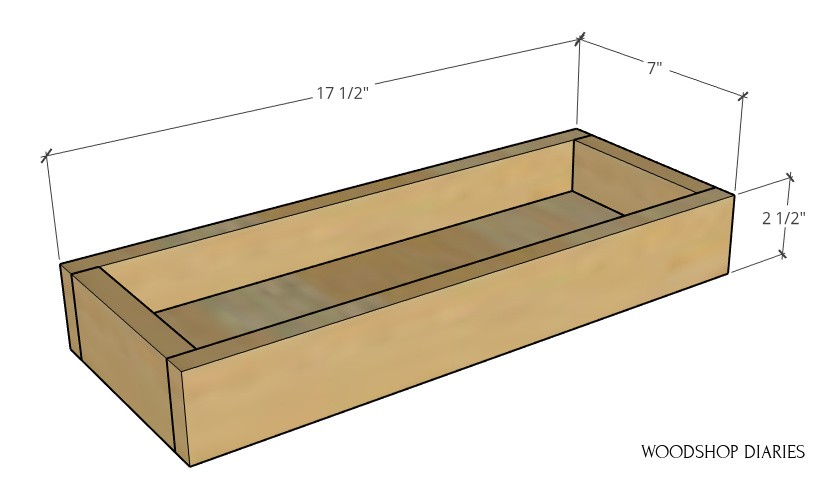
Diagram of half X to make coffee table base

Step 3: Assemble X Coffee Table Base

Then, I just attached the two halves to the main X using pocket holes and screws again to make the completed coffee table base.

X base coffee table base assembled with pocket holes diagram

At this point, it’s a good idea to either putty over the pocket holes OR use some wood glue and pocket hole plugs to plug all the pocket holes.

2x4 coffee table X base assembled and pocket holes plugged

Step 4: Assemble and Cut Round Table Top

I cut 5 pieces of 2×8 board to glue together to make the table top.  I ran them through the table saw to get a nice square edge. 

RELATED: Check out this post for how to square off board edges for cleaner glue ups.

.

Then, I glued the boards together and made sure the top was as flat as possible.  You can check out this post for how to glue up table tops.

Gluing up panel to use for coffee table top in workshop

As a side note: if you don’t have large clamps to glue up a top, you could definitely use pocket holes and screws to assemble a top. BUT…make sure not to place the pocket holes in a location where you will be cutting in this next part.

.

Once the glue was good and dry, I cut a 34″ diameter circle out of this panel. You can do this a few ways. You can cut this out with a simple jig saw OR a bandsaw if you have one.

.

But, I built a circle jig for my router and used the router with a straight bit to cut the top instead.

Using router and circle jig to cut round table top from glued up panel

RELATED: Check out this helpful router guide for more info on routers and what cool things they can do for you in the shop!

Step 5: Attach Top to Coffee Table Base

I drilled pocket holes in the top of the four legs of the base and used pocket hole screws to attach the top. 

.

I flipped the top upside down and centered the base upside down on top of it. Once the screws were in, I used plugs to plug the holes. 

Completed X base round coffee table assembled diagram

Then, it was ready to finish.  I stained the entire table with Minwax Provincial stain and once it was dry,  I dry brushed some white paint on the top.  Once the paint was dry, I gave it a light sanding to scuff it up a little.

Wood stain used on X base
Completed round coffee table with X base

Step 6: Add Roman Numerals on Top (OPTIONAL)

I had seen a cute coffee table top a while back that had Roman Numerals on it to make it look like a clock. I thought that was a neat idea, so to add some extra character to the top, I did the same.

.

I didn’t have any stencils the right font and size, so I got on Pinterest and found this tutorial for using paper and ink to transfer the numbers. Make sure to use INK (not toner) and MIRROR your letters before printing–don’t ask me how I know 🙂

Applying Roman Numerals to Coffee Table top using ink and water

I added a coat of polycrylic on top because the ink from the letters was wiping off on my hand if I touched it.  The poly sealed it in and prevents it from wiping off. 

.

After all the work I put into getting those letters on, I wanted to make sure they were sealed in!

Overhead view of DIY X base clock coffee table
X base coffee table with round top that looks like a clock

I love a “high end looking” low budget build. Total cost: about $20-$25 in lumber (plus a little patience ha!).  

.

So if you enjoyed this project and want to build your own, don’t forget to grab the printable plans here. And don’t forget to pin this to save it for later! 

You can make this adorable DIY coffee table for about $25 and a little time in the shop!--Woodshop Diaries

Until next time, happy building 🙂

How to Build a DIY Modern Sliding Door

January 11, 2021 by Shara, Woodshop Diaries

How to build your own DIY modern sliding door with mid century style frosted glass panes!

In this post, I’m sharing how to build a DIY modern sliding door with frosted glass panels!

How to build your own DIY modern sliding door with mid century style frosted glass panes!

Much like barn wood walls (remember this one??), DIY sliding doors are so in right now.  

.

They’ve been in for a while, actually.  I made my first set of DIY sliding doors over four years ago!  But I’m not sure they’re going to go away any time soon.

.

Not only do sliding doors LOOK nice, but they also save space and could save you a lot of money if you need to replace an odd shaped door that they don’t make standard anymore.  (Custom doors = $$$)

.

DIY Sliding Doors are a fairly easy DIY project and the possibilities are endless when it comes to style and size.

.

You can make them solid wood farmhouse style like these.  Or you can make them more of a traditional look with some frosted glass like these.  

.

But if you want to make a DIY Modern Sliding Door with glass panels, I’ve got the how to for you right here 🙂

.

This post contains affiliate links. See disclosure policy for details.

To make your own DIY modern sliding door, you will need:

  • Miter Saw
  • Kreg Jig for Pocket Hole Screws
  • Drill
  • Router
  • ⅜″ Rabbet Bit
  • Hammer and Chisel
  • Clamps
  • Tape Measure
  • Speed Square
  • (4) 1x4x8
  • (4) 1x6x8
  • (5) glass panels (for size, see step 4)
  • Wood Glue
  • 1 ¼″ pocket hole screws
  • Frosted Glass spray paint for glass panels
  • Sliding Door Hardware

OR, if you want to make your own DIY sliding door hardware, you’ll need:

  • ⅛″ x 2″ x 7′ steel flat bar
  • (2) ⅛″ x 1″ x 12″ steel flat bar
  • (4) ⅜″ x 4″ lag screws
  • (4) ⅜″ lock washers
  • ⅜″ flat washers (get several for spacing adjustments)
  • (4) ¼″ x 1 ¼″ lag screws
  • (4) ¼″ lock washers
  • (4) ¼″ flat washers
  • (2) garage door pulleys
  • Spray paint for hardware

Step 1: Cut Pieces for DIY Modern Sliding Door Frame

First, I need to figure out the size I need to build the door. So, I measure the door opening and if the door opening is trimmed, I like to include the trim in this measurement.  

.

Then, I add 2″ to the WIDTH.  You can add to the height if you want but you don’t have to.  This gives me the overall size the door needs to be.  

.

Once I have this measurement, I can cut 4 pieces of 1×4 the length of the height of the door. These will be used for the vertical pieces on the sides of the door.

.

Since I’m using 1x4s for the sides, I subtract 7″ (which is 2x the width of a 1×4) from the total width of the door and cut 12 pieces of 1×6 this length.  

In this project, I’m basically gluing two door frames together to make the finished door–each frame will use two 1x4s for the sides and six 1x6s for the horizontal slats.

Step 2: Assemble the DIY Modern Sliding Door Frames

Now that the pieces are cut, I will assemble two identical door frames with them. I drilled ¾″ pocket holes in both ends of all the 1×6 boards.

Then I assembled the frames using 1 ¼″ pocket hole screws making sure to space out the slats evenly.

.

Depending on the height of your door, your openings may be different than mine.  Take your door height and subtract 33″, then divide by 5 (the number of openings) and that is how much space should be between the slats.  

.

Make sure you space evenly!  And use a square to make sure you attach everything square.  This will be important once you get to inserting the glass panels.

Step 3: Route Out Rabbets for Glass Panels

I used a router and a ⅜″ rabbeting bit (you could use another size if you wish, I just use ⅜″) to cut some rabbets around the openings in one of the door frames to insert the glass panels.

RELATED: Check out this router guide for more info on using a router.

I adjusted the cutting depth of the bit to ⅛″ and routed the open panels of one door frame.  

.

This should be on the back side–the side with the pocket holes. The corners will be rounded, so square them out using a hammer and a sharp wood chisel.

Step 4: Insert Glass Panels in DIY Modern Sliding Door

Now they’re ready for the glass. I measured the opening in all the panels INCLUDING the rabbet grove.  Then I purchased ⅛″ thick glass panels to fit these openings.  

.

NOTE: Leave a little wiggle room (⅛″ or 1/16″) to make sure they’ll fit–better a little small than a little too big.  

.

I used glass panels in this project, BUT, if you wanted, you could also use plexiglass or acrylic and cut it yourself. Check out this post for how to cut plexiglass sheets.

.

I buy my glass from a local glass and windshield place, but sometimes big box home improvement stores will cut glass to size for you if you don’t have a local shop.

.

Once I got the glass panels, I checked to make sure they fit in the rabbet grooves cut from step 3, then spray painted them with frosted glass spray paint.

.

You don’t actually HAVE to do this, but it’s probably a good idea if you’re putting it on a bathroom and want some privacy.  NOTE: Don’t do this against your garage doors…I just set them here after I was finished to take a picture haha.

While the spray paint dried, I painted the two door frames.  I painted mine in Sherwin Williams Naval. But you could also stain if you’d rather. You only need to finish the fronts, not the sides with pocket holes.  

.

Once everything was dry, I laid the routed door frame face down on some saw horses and placed the glass panels in the openings.

Now, I didn’t use any adhesive on this to keep the glass in place. I’m not sure whether it’s a good idea or not because of wood movement.

.

However, I have had luck over the years using Clear Gorilla Glue to attach glass panels in a few pieces. If you wanted to glue them, you could try that or try some clear silicone.

Step 5: Glue on the Back Frame of the Sliding Door

Once the glass panels were in place, I applied wood glue along all the wood pieces–down the sides and across all the slats.  

.

Then, I placed the other door frame on top so I kind of “sandwiched the glass”. I made sure everything lined up well and clamped along the edges to hold in place while the glue dried.  

.

If you have a nail gun, you can shoot a few nails to hold it, but if you don’t, clamps or a heavy object to hold it down should work fine.

.

Putty the nail holes if you used any.  Once the glue was dry, I sanded and touched up the paint where I puttied.

Now the door is complete!

Step 6:  Prepare the Sliding Door Hardware

You can certainly purchase your own hardware kit to hang the door. But I like to save a few bucks and make my own.

.

To do this, I double the width of the door and add about 3-4″.  I purchase an ⅛″ thick x 2″ tall piece of steel flat stock this length from my local metal yard to use as the main sliding rail.  

.

And while I’m there, I grab 2 pieces of ⅛″ thick x 1″ wide x 12″ long steel flat stock to use for the pieces that attach the pulleys to the door.

.

You can follow the tutorial in this post for how to mount it to the wall.  The only difference will be that unless you have a large obstacle to clear behind the door, you shouldn’t need the long spacers and you also don’t have to have the wood piece on the back either.

.

As long as you can locate your studs, hanging the hardware isn’t too hard 🙂 

.

Once it’s hung, you have a gorgeous new DIY modern sliding door!

DIY Modern Sliding Door with DIY hardware instructions too! Glass panels make this mid century modern design unique

I love how the frosted glass lets the light through, but also provides privacy so it can still be used for this bathroom space.

DIY Modern sliding door with frosted glass panels painted in Sherwin Williams Naval
Modern Navy Sliding Door for bathroom--learn how to make your own!

If you didn’t need the privacy, you could totally skip the frosted glass and leave them clear.  That would be cute for an office space or dining room or even a kids playroom.

.

If you’d like to use this idea for a piece of furniture, check out this DIY sliding door entertainment center. And if you’d like to save this idea for later, I’d love if you’d pin it!

How to build a DIY modern sliding door with frosted glass

There are plenty more projects coming up, so don’t miss out on them!!  Sign up below to receive email updates on new projects!

.

Until next time, happy building!! 🙂

How to Build a Writing Desk

January 8, 2021 by Shara, Woodshop Diaries

Build your own DIY Writing Desk with this tutorial!

Shara Woodshop Diaries sitting at large writing desk on laptop in black chair

Towards the end of last year, I built several different types, sizes, and styles of desks, but I never built one quite like this.

RELATED: Check out more DIY Desk Ideas Here!

.

It’s a pretty basic build—nothing super fancy–but it’s nice because unlike my other desk designs, this one has a pretty large work surface and can be used as a writing desk or even as a craft or dining table (with or without drawers!).

Overall dimensional diagram of DIY writing desk

I actually built this for my Dad’s office to use when he meets with clients and customers and the large surface will be nice to lay out design ideas and look through portfolios.

.

So if you’re needing something similar for your home or office, I’ll show you how to build one in this post! Check out the video here and the step by step below:

I built this DIY writing desk using birch plywood and pine wood.  My parents and I didn’t care to make this more difficult or expensive than it needed to be, so we didn’t mind using cheap wood. 

.

However, if you’re not a fan of pine, feel free to use any type of wood you prefer for this.

.

This post contains affiliate links. See policies.

For this DIY Writing Desk, You Will Need:

  • (3) 2x4x8 boards
  • (2) sheets ¾″ plywood
  • (½) sheet ¼″ plywood
  • (3) 1x2x8 boards
  • ¾″ square dowels (about 16 ft)
  • Cove molding
  • Half round molding
  • Edge banding
  • Circular Saw
  • Miter Saw
  • Drill
  • Nail Gun
  • Pocket hole jig
  • 1 ¼″ pocket hole screws
  • Wood Glue
  • Table saw (optional)
  • (3) pair 16″ drawer slides

Free plans are available below in this blog post in the steps below. Printable copies are available in my store here:

Step 1: Assemble Writing Desk Legs

To get started, I needed to glue up the posts to use for the legs.  I laminated two pieces of 2×4 together to make each leg. (You could also use 4x4s instead.)

.

Before gluing them together, I trimmed them down to their rough length (about 32″) on the miter saw and cut about ⅛” off each edge to square them up on the table saw.

.

Check out this post for details on squaring off board edges. That is optional, but produces a cleaner looking finished project.

.

Then, I glued two together for each of the 4 desk legs.

.

Once the glue dried, I trimmed another ⅛” off each edge to clean up the glue joints and also give me four posts 3” x 3” overall.

Diagram of leg posts used for desk legs--showign 3" x 3" overall dimension and tapered end

Then, I trimmed these leg posts down to 30” on the miter saw. 

.

As an optional step, I added a taper to the ends of the legs. To do this, I adjusted my miter saw miter angle to 60 degrees and cut two sides so they tapered to the middle of the leg like shown here.

Miter saw set to 60 degrees cutting taper on end of desk leg

I did that for all four posts, then set them to the side.

Step 2: Assemble Writing Desk Frame

Now that the legs were ready, I needed to get the desk aprons ready to begin assembling the frame of the desk.

.

I used ¾″ plywood ripped to 6” wide for the side and back apron. (FYI–the “aprons” are basically just the panels between the legs.) For more information on cutting plywood, check out this post.

.

I used my pocket hole jig to drill ¾″ pocket holes into the ends of the aprons and began assembling the two sides using 1 ¼″ pocket hole screws.

Diagram of side panel assembly with 6" wide apron attached between 30" long legs

I was adding some trim to the desk in a later step, so I installed the aprons ¾” inset from the outside edge of the legs.  That way, when I add the trim later, it’ll be flush to the outside.

.

If you tapered your legs here, it’s important to make sure to face the tapers towards the inside of the desk.

.

Once the two sides were together, I added the back apron the same way—¾” inset from the outside edge of the legs.
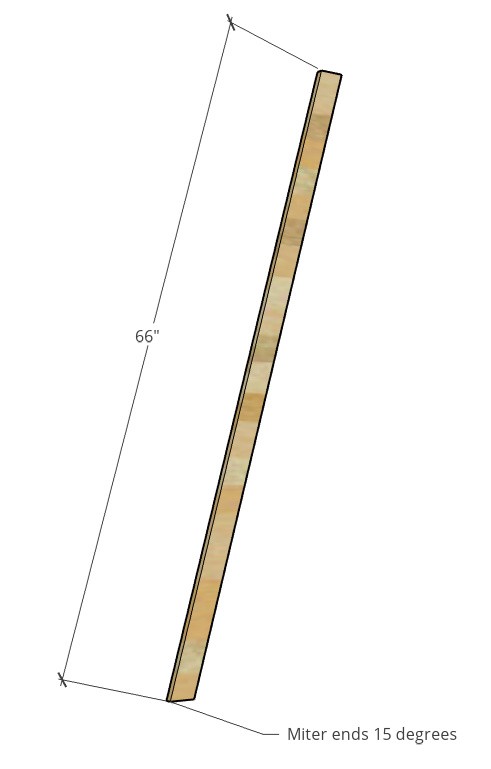
Writing desk aprons installed between side panels at back of desk

Now, since I was adding drawers to the front side, I didn’t install an apron here.  Instead, I ripped two strips of ¾” plywood to 3” wide and installed with pocket holes and screws. 

Front supports of DIY writing desk assembly diagram--pieces highlighted in purple

The top piece was added flush to the top of the legs, but the bottom piece should be installed so that there is 4 ½″ gap between them.

.

I edge banded the front edge of these pieces with iron on edge banding as they will be showing in the finished project.

Step 3: Install Drawer Box Bracing into Desk Frame

Once the main frame was together, I began adding the bracing for the drawer slides and drawers.

.

I used ¾″ plywood for all of these bracing pieces (but you could use 1x2s on the left and right pieces if you wanted) along the top and installed them using ¾″ pocket holes and 1 ¼″ pocket hole screws. 

DIY writing desk top supports shown in blue installed in 3D diagram

After the top bracing was attached, I added the bracing inside the desk.

.

I used scrap plywood for this part as well—the width of the pieces on the far left and far right aren’t too important here–they just need to be wide enough to mount a drawer slide onto.

.

I used pocket holes and screws to attach these two braces so they are mounted flush to the inside of the legs like shown here.

Close up diagram of left drawer bracing in writing desk build

But the middle two pieces do need to be ripped to the exact width that the front pieces are apart—in this case, it’s 4 ½”. 

Middle drawer bracing supports installed into desk frame diagram

I evenly spaced the two pieces in the middle and attached the back side to the back apron.  The front of these pieces should be 1 ½” inset from the front edge of the frame. 

Drawer divider spacing diagram

Once I ensured they were evenly spaced from the back to the front, I clamped in place and used some wood screws to secure the front to the frame pieces and added a couple along the top as well.

Step 4: Add Drawer Slides and Drawers to Desk

Now that the bracing is in place, it’s time to add the slides.  I installed 3 pair of 16” ball bearing drawer slides onto these braces keeping them 1 ½” inset from the front edge of the desk.

Shara Woodshop Diaries installing drawer slides into DIY writing desk

If you’re interested in learning more about building drawers and installing slides, I’ve got a super detailed guide I will link here.

.

Once the slides were in, it was time to build and install the boxes.

.

I went to my scrap plywood pile and dug out some pieces to use for the drawers.  I ripped them down to about 4” wide, cut a dado along the bottom, trimmed them to length, and cut some ¼” plywood bottoms to fit inside.

Exploded diagram of drawer box cuts and pieces

Then, I assembled the boxes using pocket holes and screws.

Assembled diagram of drawer box

Then, I installed them into the desk. Again, for more details on building and installing drawers and drawer slides, check out this post.

Drawers shown installed into desk frame diagram

Step 5: Add DIY Writing Desk Top

Next, I cut the top from a sheet of ¾” plywood.  I used my Kreg cutting guides and circular saw for this, but you could also just clamp a straight edge if you don’t want to use the guides.

.

RELATED: How to Cut Down Plywood Sheets–The Easy Way!

Using a circular saw to cut down plywood sheet

Before attaching the top, I applied iron on edge banding to cover the plywood edges, and sanded it well.

.

I placed the top upside down on the ground and flipped the desk over on top of it. 

Desk flipped upside down screwing base to top through supports

I checked all the corners to make sure I got it good and centered, then used wood screws to secure the top in several places through the top supports.

.

You will need to pull the drawers out a little to access the top support at the front to screw through.

3D diagram of top installed onto desk frame

Step 6: Add Trim Detail (OPTIONAL)

Now, all the trim I added here is optional, but I do think it adds a little extra visual interest and makes it look nice. 

Close up on finished desk of trim added to sides--half round and cove molding

First, I cut to fit 1×2 boards to glue and nail along the top and bottom edges of the sides and back of the desk (shown in purple below).

Diagram showing trim added to desk sides--1x2s in purple and cove molding in yellow

Then, I lined (glued and nailed in place) the inside of these frames with cove molding cut to fit on the sides and back (shown in yellow above).

.

And finally, I added some half round molding around the bottom edge all the way around.

Half round and cove molding highlighted in pink on writing desk diagram

I actually intended on adding more cove molding along the top edge (shown above) where the desk meets the top, but I ran out and didn’t go into town for more haha.  So if you wanted to add some this, I think it would look nice.

.

I puttied all the joints and nail holes on this trim and sanded it well.

Step 7: Install Drawer Fronts

And the last part is adding the drawer fronts.  Even though the front was drawers and the sides and back were solid, I wanted them to match. 

.

So for the drawer fronts, I cut ¾” plywood the size the fronts needed to be and added some trim on top.

.

I cut square ¾” square dowels to frame the edges and glued and nailed them on top.  Then, just like with the sides and back of the desk, I lined the inside with cove molding.  Below you can see the blue back piece is the plywood, the pink is the ¾″ square dowels, and the purple is cove molding.

Desk drawer front diagram showing plywood backing, with square dowels and cove molding on top

Then, I spaced them out on each drawer with ⅛” gap around the edges and screwed them in place with wood screws from the inside of each drawer.

Diagram showing drawer fronts added onto desk drawers

To finish it off, I gave it a few coats of clear poly (I used Minwax Helmsman Water Based in Semi Gloss) and some simple black handles. 

.

I actually had wanted to paint this DIY writing desk since the wood colors didn’t match exactly, but my mom and dad really wanted to leave it natural…and the customer is always right haha.

Basic DIY writing desk finished and staged with black chair and laptop--Simple pine desk

I do like the light colored wood, but I wish I had picked 2x4s that were a little less…pink. Oh well…I can always paint it later if they change their mind 🙂

.

I’m really happy with how this project turned out and think it would make a nice desk, but also a nice craft table, or you could even put some casters on it and make a rolling kitchen island as well.

Front view of simple writing desk made from plywood and 2x4s

If you’re interested in building your own DIY writing desk, be sure to check out the YouTube Video!

.

And if you enjoyed this project, I’d love if you’d pin it for later and subscribe to my newsletter below so you don’t miss out on the projects to come.

Pinterest collage image of overall dimension diagram on top and Shara sitting at desk on bottom with text in middle reading How to Build a Writing Desk

Until next time, friends, happy building!

DIY Keyboard Stand {Or Flip Top Writing Desk!}

December 30, 2020 by Shara, Woodshop Diaries

In this post, I’ll show you how to build this DIY keyboard stand that would also make a nice flip top desk with pull out drawer!

Shara Woodshop Diaries lifting flip up top on DIY walnut keyboard stand

I recently bought my husband a new keyboard because he’s been wanting to learn how to play the piano.

.

When I bought it, there were so many options that I found online for stands to purchase with it.

.

But they all looked cheap and flimsy and I really wanted to be able to close up and hide the keyboard when it wasn’t in use.

.

So I built him this desk with a flip up top and a pull out drawer that will hide the keyboard when he’s not using it and it will open up when he’s ready to practice.

DIY Keyboard stand opened up with pull out tray

This project works great as a keyboard stand, but also as a simple DIY writing desk as well.

.

Now, one thing that this piece is missing is a place to store music books and notes…but I’ll be building him a storage bench to go with this shortly, so be sure to subscribe to my newsletter below and stay tuned for that post soon.

.

But, for now, if you’re ready to see how this basic writing desk/keyboard stand came together, let’s get building ????

.

Check out the video below and the plans plus step by step tutorial following:

This post contains affiliate links. See website policies.

Some Notes About the Build:

For this build, I wanted to use what I already had in my shop and avoid buying any additional lumber. 

.

I’ve actually had a stack of rough sawn walnut that a friend gave me a while back that I’ve been holding on to and decided to dig into it for this project. 

.

However, plywood and/or typical lumber from the big box store would work fine for this as well.

.

The overall dimensions of this DIY keyboard stand were 43 ½″ wide, 20″ deep, and 31 ¾″ tall.

Overall dimensions diagram of DIY keyboard stand--43 ½" wide, 31 ¼" tall, 20" deep

NOTE: This project is made to fit a keyboard up to 38″ long and 16″ deep.

.

If your keyboard is this size or smaller, it should fit fine. This is the keyboard I used.

.

Some posts you might find helpful for this build:

  • How to apply iron on edge banding
  • How to cut plywood sheets
  • How to make your own 2x2s
  • How to Build and Install Drawers
  • How to use a router
  • How to glue up table tops

For this DIY Keyboard Stand Desk, You Will Need:

Materials:

  • (½ sheet) ¾″ plywood
  • (3) 2x2x8s
  • (2) 1x8x8s (ripped to 6″ wide–OR just use ¾″ plywood instead)
  • Dowels
  • Wood Glue
  • 1 ¼″ wood screws
  • (1) pair 16″ drawer slides
  • (1) long, modern drawer pull
  • (1) pair non mortise hinges
  • Corner brackets

Tools:

  • Circular Saw
  • Miter Saw
  • Drill
  • Dowel Jig
  • Router and Rabbeting Bit (OPTIONAL)
  • Pipe clamps

Grab the printable plans for this project here:

Step 1: Assemble Side Panels

Since I was dealing with rough 1x thick lumber, I had to plane and cut down some boards into 1 ½” strips.

.

Then, I could laminate (glue) them together to make the 2x2s I used for the frame.

clamping 1x2s together to make a 2x2 post

However, you can purchase precut 2x2s from the big box stores to use, or make your own with this tutorial.

.

I used 2x2s for the legs and bottom of the desk, but at the top, I used 1x (¾″ thick) material.

.

You can use ¾″ plywood OR solid 1x8s ripped down to 6″ wide.

.

NOTE: You could also use 1x6s–which are 5 ½″ wide.

Side panel diagram of keyboard stand

I assembled the frame of this project using wood glue and dowels. 

.

However, if I was using a cheaper wood or a plywood, I’d probably just use pocket holes and screws to make things easier. 

.

You can use whatever type of joinery method you prefer for this.

.

But if you’re using pocket holes, use ¾″ pocket holes and 1 ¼″ pocket hole screws on 1x material and 1 ½″ pocket holes with 2 ½″ pocket hole screws on 2x material.

RELATED: How to set up and use a pocket hole jig

.

I laid out my side panel pieces with a 6” board at the top and a 2×2 at the bottom and marked where to drill the dowel holes.

Mark where to drill dowel holes for assembly

Then, I used my dowel jig and drilled ⅜” dowel holes at all my marks and assembled with wood glue and dowels.

Drilling dowel holes for side panel assembly

I made two identical side panels like this making sure to keep the top pieces flush to the OUTSIDE of the legs. 

.

You could also install the top piece flush to the inside of the legs if you prefer, but I liked them on the outside.

.

I clamped the pieces until the glue was good and dry.

Side panels glued up in pipe clamps

Step 2: Assemble Keyboard Stand Frame

Once the side panels were dry, I marked the dowel holes for the back pieces making sure to label everything well so I didn’t screw up the orientation.

Assembling back panel with wood dowels

I drilled these dowel holes using my dowel jig and assembled the rest of the frame.

diagram of keyboard stand frame with back pieces assembled

Again, you could use pocket holes and screws instead if you prefer.

.

I used large pipe clamps to clamp the top and bottom pieces in place and also used some corner clamps to make sure that the side panels stayed square to the back.

Using corner clamps to secure glue up

These glue ups were extremely messy, so after everything was dry, I gave it all a good sanding to remove all the glue squeeze out, then decided to add a small detail before working on the top.

Step 3: Add Top Rabbet Detail (Optional)

I mentioned earlier about the nightstands and dressers that matched this design. 

.

I added a small detail at the top of those that I wanted to also add to this piece.

.

This is a totally optional detail, but I used a router and a rabbeting bit to make a small rabbet along the top edge of this piece.

Shara using router to rabbet top edge of keyboard stand

RELATED: Want to learn more about using routers? Check out this router guide!

close up of rabbeted edges of desk frame

Step 4: Install Stationary Keyboard Stand Top

For the top, this was basically made in two sections—the back piece that stays in place and the front piece that flips open.

.

I picked out three boards to use for the top—the back two I glued together to make a solid panel and the front I set to the side for now.

.

I simply glued and clamped the back two pieces of walnut to make a solid panel the size shown below, but you could also use ¾″ plywood as well if you preferred.

Top stationary panel dimension diagram

I tried to attach this top panel “properly” by using figure 8 tabs like I used in this table build that allow for wood movement.

.

BUT I ended up going back later and adding some corner brackets because they felt like they held tighter.

Corner brackets used to attach top panel

Feel free to do your own research and attach your top however you see fit. 

.

I actually recommend plywood so movement isn’t really a concern…BUT to each his own ????

.

Anyway, the hard part is done and it’s pretty smooth sailing from here.

Step 5: Assemble and Install Flip Top Piece

Now that the stationary top is installed, I moved to the flip part.

.

I trimmed my front pieces to the proper length (see below) and marked where I needed to cut a rabbet to match the rest of the desk frame. 

.

I cut this rabbet on the table saw.

.

But you could also use the router–it’s just a little challenging to find a good way to clamp it safely for this.

Using table saw to cut rabbet on front piece of flip top

I centered the front piece on the top piece and attached with some corner brackets. 

Front and top pieces to make flip top section

After attaching, I realized that this was pretty flimsy, so I went back and added some glue, then screwed the corner brackets back in.  I checked for square and let it cure well. 

Securing corner brackets on front and top flip top pieces to attach together

I used some non mortise hinges to install this flip up piece onto the stationary top like shown here.

Shara Woodshop Diaries Attaching flip top on keyboard stand with non mortise hinges

Since this was going to be used as a DIY keyboard stand, I wanted Danny to be able to set his music book or iPad on the flip top to see while he’s playing.

Unfinished flip top keyboard stand assembled

I used some scrap blocks and glued them onto the top at the center. 

.

I used a spacer block to get them placed, then removed the spacer block so I could clean up the glue squeeze out before it dried.

Glue book stopper onto top of keyboard stand to place music books

Step 6: Install Pull Out Tray

Since I installed the sides to the outside of the legs, I needed to attach some spacer blocks to mount the slides onto so the tray can slide in and out.

.

So I cut some plywood scraps and screwed them in place on both sides of the desk. 

.

Then, I attached the slides along the bottom edge of them.

RELATED: For more information on installing drawer slides, check out this drawer building guide.

Install plywood spacer blocks on keyboard stand to install drawer slides

For the tray, I cut down some ¾″ plywood using my circular saw, then trimmed it to length on the miter saw. 

.

I cut a tray bottom and two small pieces to go on the sides.

RELATED: Check out this guide for how to cut down plywood!

.

I glued and screwed these pieces together to make a tray that would fit the keyboard.

Keyboard stand tray dimensions

Once the tray was together, I removed the front part of the drawer slides (extend them fully, release the black tab on the side, and pull the inside piece out) and screwed these onto the tray at the bottom edge.

Installing drawer slides onto desk pull out tray

Then, I installed the tray back into the slides in the desk and made sure everything fit.

.

The last thing I did was use a hole saw to drill a hole in the back side to run the power cord through for the keyboard.  This is optional.

Drilling hole in back side of desk to run wires and cables through

Step 7: Finish DIY Keyboard Stand

Then, I applied three coats of Minwax Helmsman Poly to finish, added a handle, and placed the keyboard inside. Feel free to paint or stain as desired.

Walnut keyboard stand closed up to look like a typical desk

And now Danny has a new keyboard and a fancy new stand to play it on.  Now I just need to hurry up and build him a new storage bench to replace this little seat.

.

RELATED: If you’re looking for some matching pieces, this bedroom set with dressers, nightstands, and a bed matches this style, but is just made from poplar instead of walnut.

Matching modern bedroom set collage with bed, nightstands, and two dresser styles

.

I’m really happy with how this turned out and very happy to have this nice walnut keyboard stand vs a cheap plastic one. 

Shara Woodshop Diaries playing keyboard at flip top keyboard stand

It looks great in our tiny apartment and if he ever graduates to a larger keyboard or piano, we can reuse this stand as a nice desk or console table.

DIY Walnut keyboard stand with top flipped open and keyboard on drawer inside

If you enjoyed this DIY keyboard stand project, I’d love if you’d subscribe to my newsletter below so you don’t miss out on what’s coming next!

And if you’d like to save this for later, don’t forget to pin it!

Pinterest collage of flip top DIY keyboard stand--Shara at top opening stand and open stand with pull out drawer image in bottom

Until next time, friends, happy building ????

DIY Pet Keepsake Box or Pet Urn

December 15, 2020 by Shara, Woodshop Diaries

This DIY pet urn keepsake box project was sponsored by Green Meadow Memorials. See policies.

Walnut DIY pet urn keepsake box sitting on nightstand next to house plant

If you have pets, you know they’re family, too. And losing one is never easy.

.

So when it’s time to let them go, it’s nice to have a place to keep some items to take out and remember them by when they’re gone. You can keep a favorite toy, a collar, some photos–any keepsake item safely inside this DIY keepsake box.

Pet Keepsake box upside down with plywood bottom removed

They’re made of solid wood as the body and a thin, easy to remove plywood piece that screws on the bottom.

.

And with pet cremation becoming more common, these simple boxes would also make nice DIY pet urns as well.

.

If you do plan to use them as a pet urn, I’m sharing how to make two different sizes because not all pets are created equal–in size that is.

.

The small size fits pets up to 50 lbs. and the large size fits pets up to 120 lbs.

Large and small size pet urn overall dimensions

So if you’d like to make one, I’ve got a video tutorial showing all the details here:

And I’ve also included a step by step written tutorial on Green Meadows Memorial’s site here.

.

When you’re finished building the box, you can leave as is, but Green Meadow Memorial has some unique customizable plates you can add to the top or the side.

Large and small DIY pet urns with personalized plates

Some of them simply peel and stick, and the others come with small finish nails to attach them with.

.

Before you get building, I do want to recommend using a good quality hardwood for this DIY pet urn project.

.

I made the larger one shown in the photo above (on the right) using white oak, and the smaller one (on the left) using walnut.

.

Hardwoods are a little pricier than soft woods, but this project requires very little lumber, so it’s not a huge splurge.

.

Pine and softer woods will work, but it’s easier to get a nicer result and sometimes tighter joints with a hardwood.

Tight joints on DIY pet urn

I’m sharing the plans in this post here, for both sizes and don’t forget to check out the video as well.

.

If you want to save this for later, feel free to pin this:

Pet urn pin image with text graphic overlay

And if you are looking for more keepsake box ideas, check these out. Click on the image for the tutorial to make your own:

  • DIY Continuous grain walnut box with tile top
    Scrap Wood Keepsake Box
  • Picture Frame Keepsake Box
  • How to Make an Easy DIY Scrap Wood Keepsake Box
    DIY Keepsake Box

DIY Garage Storage Cabinet

December 12, 2020 by Shara, Woodshop Diaries

In this post, I’m sharing how to build a Lazy Susan DIY Garage Storage Cabinet!

* I’ve partnered with my friends at Kreg Tool to provide you the free plans for this project below! This post contains affiliate links. See policies.

Collage image lazy susan garage cabinet

When it comes to workshops and garages, they never have enough storage.

So since it’s impossible to have enough STORAGE SPACE, the key is ORGANIZATION *wink wink*

This Lazy Susan DIY Garage Storage Cabinet has a place for everything–with storage for larger items at the bottom, smaller items at the top, and pegboard for all kinds of items on the side.

What I love about this project is that the top cabinets are shallow and are the perfect size for storing away paint cans. Since they aren’t deep, you can’t stack one behind another and “lose” one–they’re all in plain view!

The larger bottom section is the perfect size for storing tool bags and socket sets. And the fact it all spins on a Lazy Susan is also an extra cool feature if I’m being 100% honest haha.

I’m sharing how to build your own DIY garage storage cabinet below with FREE PLANS and a video tutorial, so let’s dive in!

Tools & Materials

Tools:

  • Circular Saw
  • Cutting guides (Here’s a guide on what and how to use them)
  • Drill
  • Pocket Hole Jig
  • Shelf Pin Jig
  • Concealed Hinge Jig

Materials:

  • (2) sheets ¾″ plywood
  • (1) sheet pegboard
  • (1) pair concealed hinges
  • Shelf Pins
  • 12″ Lazy Susan Hardware
  • 1 ¼″ pocket hole screws
  • ⅝″ and 1 ¼″ long wood screws

How to Build a Lazy Susan Garage Storage Cabinet

This is a really fun build you can tackle over the weekend. Since it’s a workshop/garage project, you don’t have to worry about it being super perfect.

Feel free to customize your pegboard and shelves to fit whatever you’re storing.

I’m sharing the how to below with tons of tips along the way. And you can grab the free plans at the end of the post!

If you prefer to watch, I’ve also got a video tutorial here as well.

Step 1: Cut Down Plywood Sheets

So as I always start out my plywood projects, I pulled out my circular saw and Kreg Rip Cut and began cutting down my sheets.

RELATED: How to Cut Down Plywood Sheets

Using rip cut and circular saw to cut plywood

Since this was just a shop project and not a piece of furniture, I went with sanded pine plywood for this vs the birch plywood I normally use. 

This is not as high quality, but did save me a few bucks.

I ripped three 22” wide strips of plywood from my two sheets to use for the cabinet box, then adjusted my rip cut to cut ¼” smaller and ripped another strip. 

I labeled this narrower piece—it will be used for the door and the shelving.

plywood cut diagram

I set the leftover strips aside for now.

I used my circular saw and AccuCut to cut a top, bottom, middle, and two side panels from the 22” wide strips. 

Step 2: Build Garage Cabinet Box

Once the pieces were cut, I brought out my drill and Kreg pocket hole jig and began drilling pocket holes in the shelves and middle divider panel to assemble the cabinet.

RELATED: How to use a pocket hole jig

pocket holes drilled into ends of shelf panels for garage organization cabinet

For a little extra hold, I used glue along with my pocket hole screws to assemble the cabinet. 

I attached the top and bottom to one side panel, then added the middle divider. 

You could add this later, but I thought it was easier before adding the other side.

Middle divider installation in cabinet

This divider panel can technically go anywhere you want inside this cabinet, but I tried to keep it centered between the front and back. 

Before adding any screws, I double checked my measurements to make sure the panel was the correct distance from the edge.

Then, I added the middle shelf making sure to keep it square to the sides and the middle panel.

Pocket holes used to assemble middle shelf into cabinet

Once everything was secure, I placed the other side of the cabinet on and glued and screwed it in place.

Assemble garage storage organization cabinet

Now the main carcass of the cabinet is assembled and all that’s really left to do is add the door, shelves, and lazy Susan.

Step 3: Install Lazy Susan Hardware onto Garage Storage Cabinet

I cut a panel in step 1 to use as the “base plate.”  I used a 12” diameter Lazy Susan rated for 1000 lbs for this project.  I’ll link the one I used here.

I drew diagonal lines across this base plate and centered the lazy Susan on it.  There are some large ¾” diameter holes on the hardware that need to be drilled out on the base plate as access holes. 

Mark where to drill access holes onto base plate

Once the hardware was centered, I marked these holes and used a spade bit to drill them out.

Spade bit used to drill access holes onto base plate

Then, I placed the hardware back in the center, and attached in place with ⅝” wood screws.

Installing lazy susan onto cabinet bottom

I flipped the main cabinet upside down so I could work on the bottom side, climbed up on my workbench (a ladder works as well haha) and set the base plate and hardware on top.

I centered the base plate on the bottom of the cabinet with the lazy Susan hardware facing down and screwed the hardware onto the cabinet through the access holes I drilled earlier.

Access holes on base plate of lazy susan cabinet

You can see this better in the video. I spun the base plate around to find at least four screw holes to attach the lazy Susan onto the cabinet bottom.

Drilling through access holes in lazy susan to attach onto cabinet bottom

Then, I flipped it back over and tested it out by sitting in it and spinning around haha.

Step 4: Add Pegboard to DIY Garage Storage Cabinet

At this point, I added some optional accessories, so you can add or skip this part as you need or wish.

I wanted to add pegboard to the side of the cabinet to hang my brooms on, so I ripped a strip of pegboard I’ve had in my shop just waiting to use for literally 3 years haha. 

Then, trimmed it to length to fit on the side of my cabinet.

But you can’t mount pegboard directly on the side because then you cant get the pegs in the holes.  So, remember those leftover plywood strips from the beginning?

Screw spacer blocks onto cabinet sides

I ripped them in half, cut them to length, and just screwed them on one side of the cabinet at the front and back edges.

Then I test fit the peg board and decided to paint that as well haha.  I have no idea why I painted this, but whatever 🙂

And at this point, I decided not to waste the little piece I cut off my pegboard strip so I added it onto one of the insides of the cabinets as well.

Installing the scrap spacer blocks into the cabinet

I just added some spacer blocks like I did on the sides, then cut the pegboard to fit inside.

After letting the paint dry, I came back and attached the pegboard to the strips I installed using washer head screws to hold it in place.

You could also just use some washers with regular wood screws as well.

Install peg board panel onto side of cabinet onto spacer blocks
Screw peg board panel onto cabinet

Step 5: Add Shelves to Lazy Susan Storage Cabinet

And before adding the door, I went ahead and drilled shelf pin holes with my shelf pin jig on both sides of the cabinet to install the adjustable shelves.

Using shelf pin jig to drill holes into cabinet sides

RELATED: This shelf pin jig is one the the Ten Must Have Tools for Cabinet and Furniture Building!

I used the remaining plywood to cut down shelves for this cabinet.  I added three on the side I was putting the door and one on the open side underneath the pegboard. 

Garage cabinet with door open--storing paint cans inside

I just stuck shelf pins in the shelf pin holes on both sides of the cabinet where I wanted my shelves to go and placed them inside.

Step 6: Add Door to Garage Storage Cabinet

In step 1, I cut a door (shown in the diagram) panel. At this point, I made sure it fit into the cabinet opening with about ⅛″ gap on all sides.

Once I made sure it would fit, I painted it—which is a totally optional step haha. 

Honestly, I don’t know why I painted any of this, but I was in the mood to add some color, so here we are.

Using concealed hinge jig to drill hinge cup holes

I used a concealed hinge jig to install concealed hinges for an inset door onto the door panel, and screwed it onto the cabinet.

Installing door onto DIY garage cabinet

RELATED: How to Install Concealed Hinges

Adding the door is totally optional as well.  I just wanted to hide all my paint cans and block out some dust. 

If you wanted, you could skip it or even add it to both sides.

To finish it up, I loaded it up with paint cans, socket sets, tool bags, and other stuff I needed to find a good place for.

Shara Woodshop Diaries with lazy susan garage organization cabinet

On the blank side, I just added some screws and a large hook to hang my ladder and levels, but you could also install pegboard on both sides if you wanted. 

Pegboard on the side of DIY garage storage cabinet

This is a really simple project that you can customize how you need for your own workspace or garage.

I’m happy to have my tool boxes off the floor, and my paint cans organized so I can actually see what I have.

Shara Woodshop Diaries spinning lazy susan cabinet looking inside door

I hope you enjoyed this DIY garage storage cabinet project, too and if you’d like to build one yourself, be sure to head over and grab the printable plans on Kreg Tool!

If you’re looking for more, you can check out plenty more garage and workshop projects here.

Be sure to subscribe to my newsletter below so you don’t miss out on what’s coming next!

And if you want to save this for later, you can pin this image.

DIY Lazy Susan Garage Storage Cabinet Pinterest collage image with graphic

That’s all for now, friends…Until next time, happy building ????

DIY Wooden Lantern {with Curved Top}

December 11, 2020 by Shara, Woodshop Diaries

If you’ve got scrap wood, a few basic tools and about an hour, you’ve got everything you need to make this simple DIY wooden lantern with curved top. Oh…and you’ll need this tutorial, of course 😉

DIY wooden lantern with curved top made from wood scraps

I’ve been all about some scrap wood projects lately. Have you noticed? I actually just made a different DIY scrap wood lantern not long ago. But this one’s got a few extra details with the curved top.

.

So for this project, I whipped out my scraps again to see what I had on hand.

.

I already had a bottom panel glued up and ready to go because I accidentally made it the wrong size to use with my DIY Christmas Tree Nesting Shelf project.

.

And I also had some ¾″ square dowels leftover from that project as well. So all I needed was to grab some small pieces to cut the curves out of and add to the top.

.

This DIY wooden lantern project is easy to customize, so feel free to play with the measurements here to use whatever size lumber you’ve got handy.

This post contains affiliate links. See policies.

.

To Build this DIY Wooden Lantern with Curved Top, You Will Need:

  • Scrap wood
  • Miter Saw
  • Drill
  • Jig Saw
  • Sandpaper
  • Measuring tape
  • Wood Glue
  • 2″ wood screws

RELATED: Need some help organizing your scrap wood? This mobile scrap wood storage shop cart may help!

Step 1: Gather Your Wood Scraps

Now, you can use what you have on hand, but I used some scrap walnut.

.

I used a bottom panel about 12 ¾″ square. This was made by gluing up 1x boards into a small panel, then trimming the panel down to the size I wanted. BUT, you could also use some ¾″ plywood for this, too.

Materials--scrap wood--needed to build scrap wood lantern

I also used four ¾″ square dowels about 12″ long. If you have some 1x boards and a table saw, you can make your own ¾″ dowels. But if you don’t have a table saw, you can buy them already cut here.

.

Lastly, I used some 1x scraps to cut the curves and top plates. Plywood also works for this, but the edges won’t be as pretty.

.

Keep in mind, these measurements are rough, this is a scrap wood project, and you can modify as needed–this doesn’t have to be complicated.

Step 2: Cut Corner Posts for Wooden Lantern

I set my miter saw to cut a 5 degree miter.

Miter saw set to 5 degrees

Then, I cut four ¾″ square dowels to about 12″ long with mitered ends PARALLEL to each other.

.

When I say parallel to each other, I mean the long sides are opposite each other.

.

NOTE: Yours don’t have to be 12″, but whatever length you pick, make sure they’re all the same or your lantern will be lopsided.
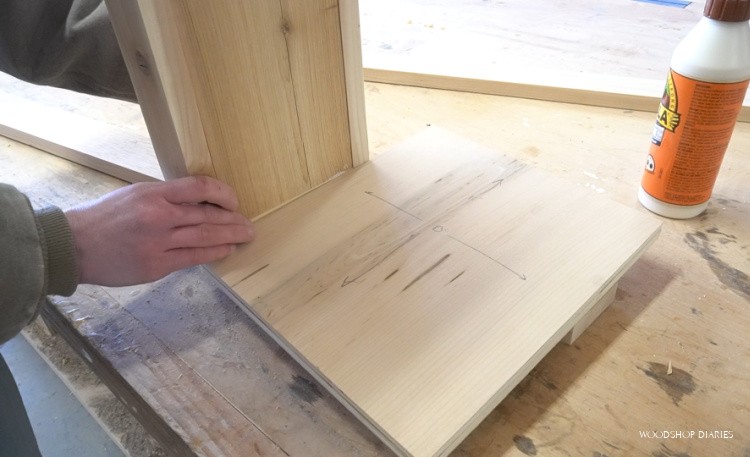
Corner posts and base plate ready to assemble with screws

Step 3: Attach Corner Posts to Lantern Base

Using 2″ wood screws through the bottom, attach the corner posts to the base so that they are slanted out at the top (the lantern gets wider at the top).

.

Be sure to predrill your holes to prevent splitting. Also note, these corner posts are turned 45 degrees from the base corner…you’ll see why when you attach the curves.

bottom side of wooden lantern with corner posts attached

Step 4: Cut Curved Pieces for Lantern Top

Now the base and corners are complete, but I still needed to add the top.

.

I grabbed a piece of scrap 1x board and marked 6″ down from the top left corner and 6″ over from the same corner and used a water bucket (you can use any round object) to trace a radius between these marks.
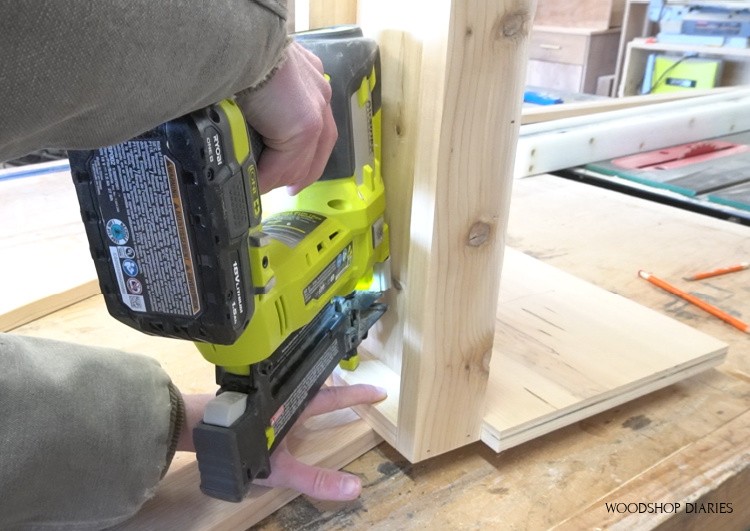
Used water bucket to trace radius onto board

Then, I marked 5 ¼″ from the corner and drew another radius to give me a curve about ¾″ thick.

Curve top lantern piece traced onto wood board

I used a jig saw to cut this out.

First curve cut out with jig saw

I traced this shape three more times on the board and cut out four total curves.

Curved tops traced onto boards
Four curves cut for lantern top

Step 5: Attach Curves onto Lantern

After a good sanding, I screwed these curves on the corner posts using 2″ wood screws.

Curved frame attached to corner posts of scrap wood lantern build

Be sure to predrill here to prevent splitting.

Step 6: Attach Top Plate to Wooden Lantern Frame

Now, I didn’t do any math here to figure out if this was 100% correct or not. But at this point, I just used a tape measure to get a rough idea of how large the top plate needed to be to cover the top ends of the curves.

.

I just measured outside corner to outside corner and figured that about a 6″ square plate would work well, so I cut a piece of 1x scrap 6″ square and attached with–you guessed it–2″ wood screws.

Top plate attached to curved frame of DIy wooden lantern

So if you modified these dimensions, just measure when you get the curves installed and cut your own size piece–see? This isn’t complicated 🙂

.

As a note: TECHNICALLY, these top curve ends need to be mitered for the top plate to sit flat on them. But I didn’t bother with it.

.

The angle here is pretty small and it would be difficult to cut these consistently on the miter saw. So there are some small gaps on the bottom side–but it’s the bottom so I didn’t mind.

small gaps between curved frame and top plate

And just for some extra detail, I added a little 4″ square piece on top of this. I just glued it in place.

Glue top piece onto lantern

To top it off, I added a small decorative piece. Do you remember the 3 tiered tray from a few posts ago? Well, for the top handle, I removed the ring from a towel rack I found at Hobby Lobby.

.

So the piece of that towel rack that was left is what I used for this.

Close up of DIY scrap wood lantern with vase and flower arrangement inside

It looks kind of funny, but did add some detail. I may replace it later–who knows haha.

.

To finish it up, I just applied some Walrus Oil Furniture Finish since this was walnut and I wanted to keep the natural color. But you could paint or stain as you wish.

DIY wooden lantern on kitchen table top staged as centerpiece

This project is fairly large, and would look just as good even smaller, too. This size could fit several large candles–or a flower arrangement haha.

.

Build a set in multiple sizes to set on a console or dresser. This would even look cute hanging from the wall or ceiling. Simple project…endless possibilities 🙂

.

I hope you’ve enjoyed this fun and easy DIY wooden lantern project and if you want to check out more scrap wood projects, I’ve got plenty more here.

.

And if you’d like to save this for later, be sure and pin it!

DIY Wooden Lantern with curved top made from scrap walnut wood--pinterest image with text

Until next time, happy building 🙂

DIY Wooden Christmas Tree Shelf

November 30, 2020 by Shara, Woodshop Diaries

In this post, I will show you how to build this adorable DIY Wooden Christmas Tree Shelf!

DIY wooden christmas tree shelf stackable--set up next to Christmas tree to display holiday decor

What’s so cool about this design is that, while it’s obviously, super cute to decorate for the holidays, it’s also easy to take apart and store away since the pieces all fit inside each other.

Stackable wooden Christmas tree pieces nested within themselves

This is such a fun weekend woodworking project to get you in the holiday spirit, but it’s also a great option for small spaces (like apartments or bedrooms) where you may not have space for a large tree.

.

Whether you add this next to your existing tree, or use it as your main Christmas tree, it’s sure to bring a little Christmas joy to your space this season.

.

I had so much fun building these and I’m sharing the plans and video with you here so you can make your own, too!

.

If you’re ready to get building, let’s go 🙂

This posts contains affiliate links. See policies for details.

For this DIY Wooden Christmas Tree Shelf, You Will Need:

Tools:

  • Miter Saw
  • Nail Gun
  • Drill
  • Jig saw (optional)

Materials:

  • (5) 1″ square dowels (36″ long)
  • (2) ¾″ square dowels (36″ long)
  • ¾″ plywood or 1x boards glued up into panels (see notes below)
  • Small round dowel rod (⅜″ or smaller…this is optional)
  • Wood Glue
  • 1 ¼″ brad nails
  • 2″ wood screws

What to Know Before Building

Dowel Sizing

You can make your own square dowels if you have a table saw–or you can purchase them from the big box store (links above).

You can make 1″ square dowels from 2x material and ¾″ square dowels from 1x material.

The 1″ dowels are used for the corner posts and the ¾″ dowels are used for the top frame pieces.

You may wonder why there are two different size square dowels and the short answer is “to keep things simple.”

If you used the same size for both parts, the top frame pieces would hit at the corners and require some complicated trimming.
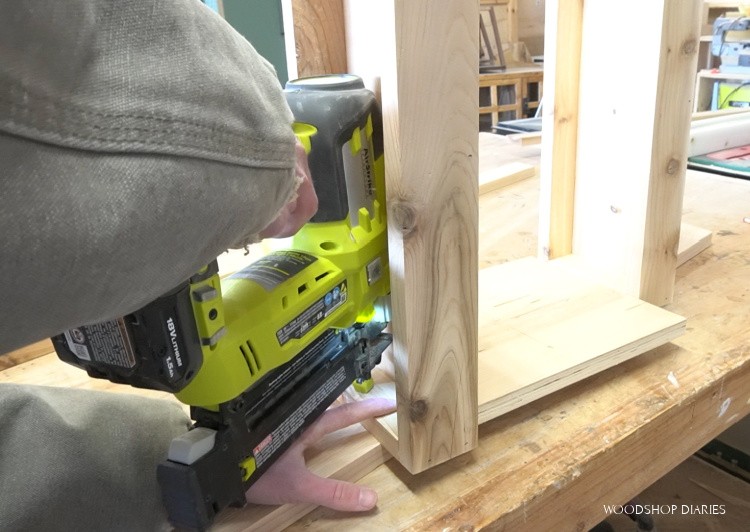
So making the top pieces smaller keeps the project a little simpler without some weird angle trimming on the corners.

Bottom Panel Options

The bottom panels of each section can be cut from ¾″ plywood OR you can glue and trim down solid 1x boards to create your own panels.

The very top piece is 3″ square and the top section bottom panel is 8″ square, the middle is 11″ square and the bottom is 14″ square.

Christmas tree bottom panel measurement diagram

The overall height of this stackable wooden Christmas tree is about 41 ½″ WITHOUT the star.

Angles by Section

This nesting tree shelf is made of three sections.

Each section has some angle cuts–all the angles on the bottom section are 9 degrees, all the angles on the middle section are 12 degrees, and all the angles on the top section are 15 degrees.

Three sections to make up stackable Christmas tree shelf

RELATED: Check out these other popular seasonal projects!

How to Build a Stackable Wooden Christmas Tree

Below I’m sharing the step by step tutorial and plans plus a video if you prefer to watch.

If you prefer to print your plans, you can check out the printable wooden Christmas Tree plans here:

Step 1: Cut and Assemble Bottom Section Frame of Tree Shelf

The four corner posts are made from 1″ square dowels (pink in the image below) and the top frame pieces and the “feet” are ¾″ square dowels (yellow in the image below).

Color coded diagram to show pieces of Christmas tree shelf--pink 1" square dowels, yellow ¾" square dowels, blue ¾" panels

The bottom panel can be cut from ¾″ plywood OR 1x material glued up and trimmed down to the size needed (blue in the image above).

I started with the 1″ square corner posts. I set up my miter saw to cut a 9 degree miter AND a 9 degree bevel (note: this is a compound angle).

I trimmed the end of the square dowel to get my angle, then just slid the piece down (without flipping it in any direction) and cut to length.

miter saw set up to cut compound angles for corner posts of wooden Christmas tree

The cuts need to be made in the same direction. These bottom tree shelf corner posts need to be about 16 ⅜″ long.
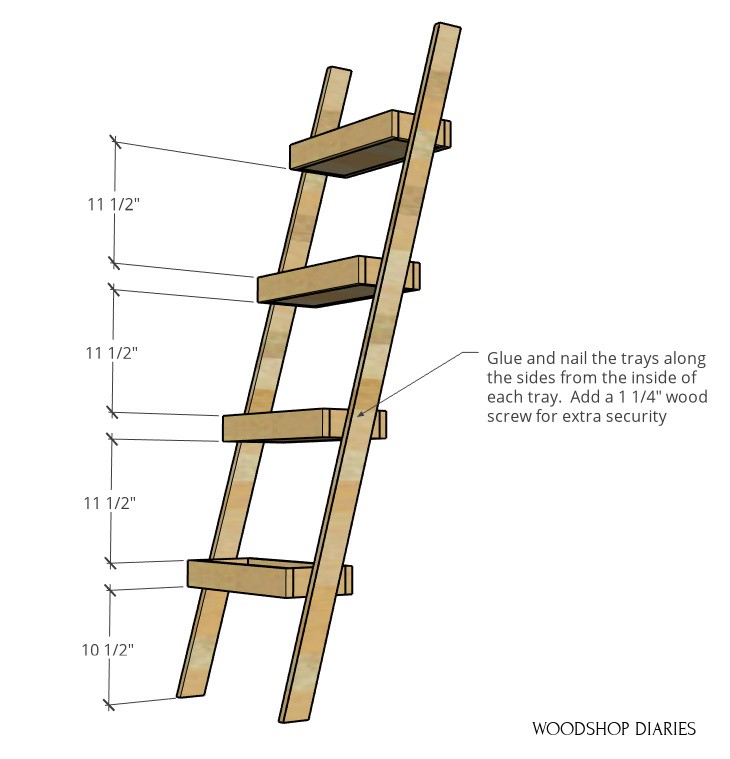
bottom section corner post diagram

Prefer to print? Grab the printable plans here.

Then, I adjusted my BEVEL (the head tilt) back to 0 degrees, left my miter angle at 9 degrees, and cut four pieces of ¾″ dowel like shown 7 ⅛″ long with mitered ends not parallel.

bottom section frame piece diagram

Once the four posts and the four top frame pieces were cut, I glued and brad nailed two top pieces between two posts like shown.

bottom wooden tree frame pieces glued and nailed together

Then, I glued and nailed the other two top pieces between them. Be careful to keep your fingers out of the way of the nailer!

Now, MATHEMATICALLY, these top pieces should have been compound angle cuts on the end. Just mitering them 9 degrees is close enough.

There may be some small gaps, but nothing MAJOR.

I’m just trying to keep this as simple as possible for you by minimizing the amount of compound angles 🙂 Sometimes “close enough” is okay.

Bottom Wooden Christmas tree frame assembled

Grab the printable cut list with diagrams in the building plans here.

If the frame is a little “wobbly” at this point, clamp along the top until the glue dries. It should sturdy up once the glue is cured.

Step 2: Attach Bottom Tree Shelf Panel

The bottom panels of all three of these sections can be cut from ¾″ plywood, or glued up 1x boards or project panels. I glued up solid boards for mine.

I predrilled and drove a 2″ wood screw on each corner into the four posts.

Screws work great but, wood glue and brad nails would also work as well if you preferred to skip the screws.

Bottom panel screwed into corner posts of bottom tree section frame

To finish it off, I cut four ¾″ long ¾″ square dowel pieces and just applied a little wood glue, and stuck them onto the bottom of each corner.

Feet glued onto bottom of stackable wooden Christmas tree sections

You can nail these in place if you don’t want to wait for the glue to dry.

I set it aside to dry then began the middle section.

Step 3: Cut and Assemble Middle Frame of Christmas Tree Shelf

Cut and assemble the middle section the same way as the bottom in step 1 except instead of using 9 degrees, make it 12 degrees for all the miters and bevels.
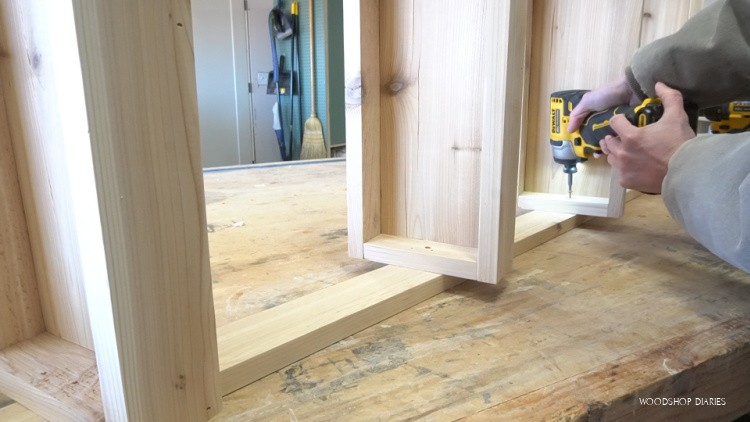
Miter AND bevel the ends of the 1″ square corner posts 12 degrees and cut 13″ long.

Middle nesting tree shelf corner post diagram

And just miter (no bevel) the ¾″ square dowel top pieces 12 degrees and cut 3 ⅞″ long.

Diagram of middle tree frame top pieces
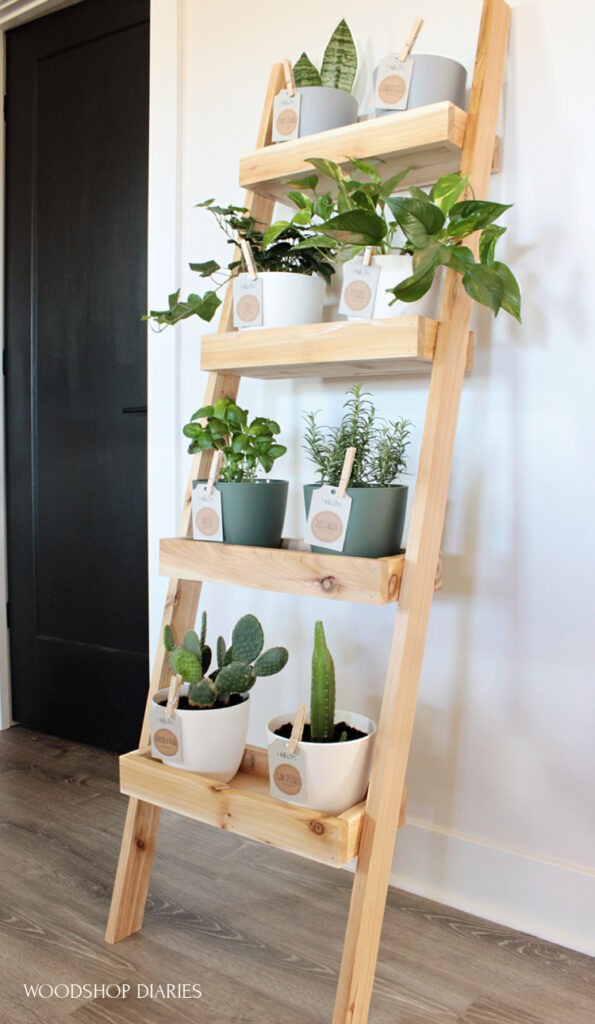
I assembled two pieces like shown using wood glue and brad nails.

Middle wooden Christmas tree sections glued and nailed together

Then, I glued and nailed the other two top pieces between them.

Middle wooden Christmas tree frame assembled
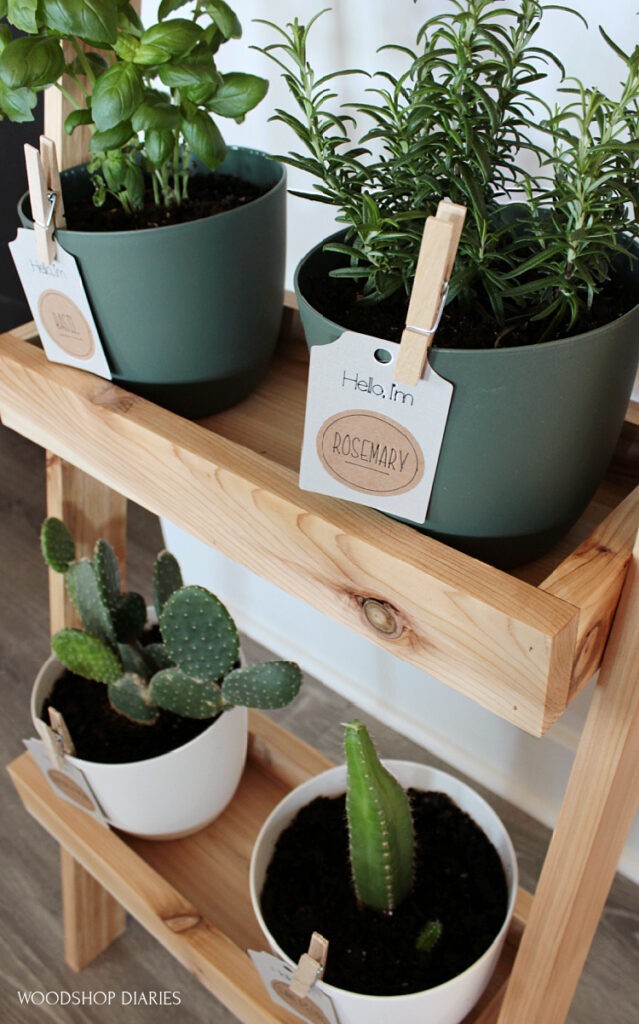
Now, again, MATHEMATICALLY, these top pieces should have been compound angles cuts on the end. Just mitering them 12 degrees is close enough.
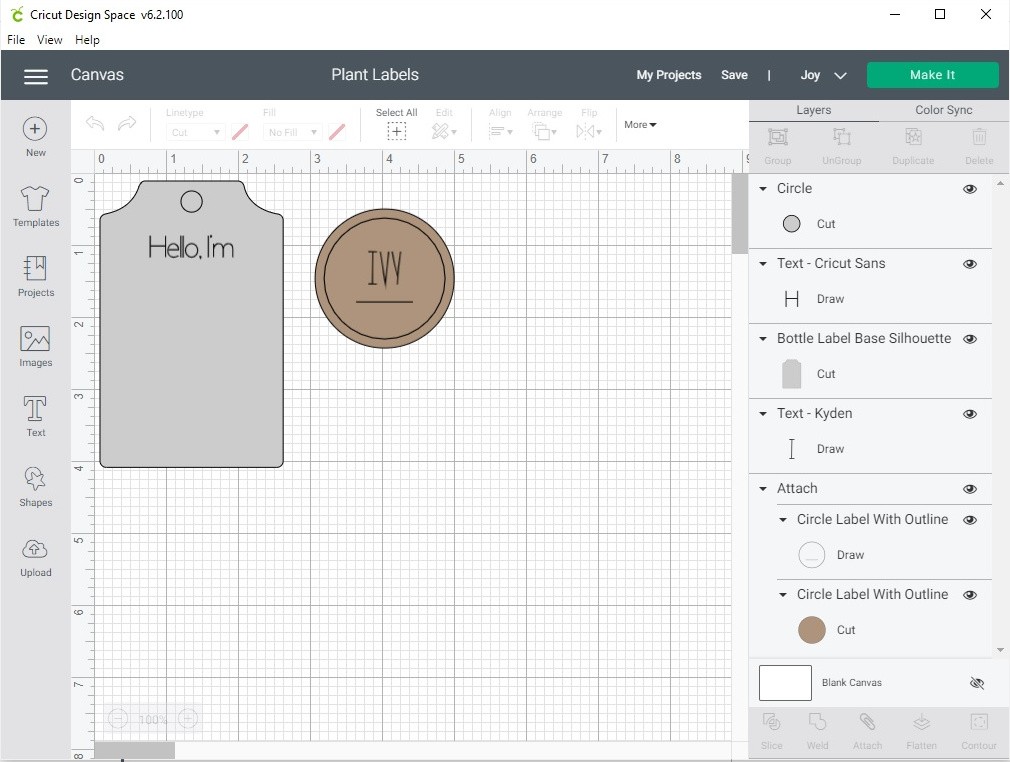
There may be some small gaps, but nothing MAJOR.

Be sure to use plenty of glue at these joints and clamp once assembled until the glue dries.

Step 4: Attach Middle Tree Shelf Panel

Cut a ¾″ plywood piece or glue up a ¾″ thick solid panel 11″ square for the middle section bottom panel.

I uses 2″ wood screws to attach onto the bottom of the corner posts just like step 2. But again, wood glue and brad nails would be fine, too.

Then, I glued ¾″ square cubes onto the bottom corners just like the bottom section.

Step 5: Assemble Top Section of Stackable Tree Shelf

The top section is made a little different. This time, I cut four 1″ square dowel corner posts with a bevel AND miter of 15 degrees and 10″ long.

Top section wooden christmas tree corner posts

I used 2″ wood screws to attach these posts into the corner of the bottom 8″ square panel.

Bottom panel screwed to corner posts of top tree section

Then, I cut a 3″ square, ¾″ thick piece (you can use plywood or solid wood) and screwed it into the top of the posts.

Glue and brad nails would be fine here as well.

3d Color coded diagram of top section of tree shelf--corner posts pink and top and bottom panels blue

Lastly, I glued ¾″ cubes on the bottom corners.

Step 6: Add a Tree Topper (OPTIONAL)

If desired, use a jig saw to cut a star shape.

star tree topper cut out with jig saw

Then, grab a ⅜″ round dowel and use a ⅜″ drill bit to drill a hole into the top square (don’t drill all the way through) and into the bottom of the star.

Holes drilled for dowel rod to attach star to top of stackable Christmas tree shelf

NOTE: You can use whatever size dowel you want, just match the drill bit size to the dowel size to drill the holes.

Cut the dowel however long you want and glue it into the hole in the star, but don’t glue it into the top piece of the shelf.

You need this to be removeable for when you take it apart to store it. Just stick into the hole, but don’t add glue.

Star and dowel stuck into top section of shelf

Step 7: Finish DIY Wooden Christmas Tree Shelf

At this point, it’s ready for finish, so you can paint or stain as desired!

Since I was using walnut for this, I chose to simply apply a clear coat and used Walrus Oil Furniture Finish to protect and deepen the natural wood color.

Watch the DIY Stackable Nesting Christmas Tree Video

If you prefer to watch the build, I’ve got a video tutorial on my YouTube channel here:

How to Use this Wooden Christmas Tree Project

I love that this DIY wooden Christmas tree shelf is easy to break down and it nests within itself so it’s easy to store away after the season is over.

Stackable Christmas tree shelf set up next to Christmas tree with decor sitting on it

So that means it’s also easy to set up when the season rolls around again.

Simply stack on each other and add the star on top for a great way to display some of your favorite holiday décor.

We like to use ours to display Christmas cards as they come in throughout the season.

But this would also be cute wrapped in lights, or you can add some battery powered candles, or display some of your favorite photos.

Once the season is over, you can nest them together for easy, compact storage, or give them a new purpose and continue using them.

I like to use the sections individually as little lanterns during the off season, but if you add a top, they’d make cute plant stands, too!

Stackable Christmas Tree shelf broken down in pieces

Personally I like it best for its intended purpose as a cute little Christmas tree shelf 🙂

If you’d like to build one for yourself, you can grab the printable building plans here.

Close up of DIY Christmas tree shelf from above looking down

Looking for more Holiday Themed DIY Projects?

Check out this list of 25+ easy handmade Christmas gifts you can make this weekend!

Snowflake shelf with decorations for Christmas and text overlay "DIY Snowflake Shelf"
DIY Wooden Snowflake
DIY Christmas Candy Tray
How to make your own DIY wooden Christmas village perfect for Scandinavian Christmas decor. Easy and free project tutorial
DIY Wooden Christmas Village

If you enjoyed this project and want to save it for later, I’d love it if you’d pin this!

Collage image of stackable Christmas tree shelf stacked together and nesting

Follow along on all the latest projects and plans, by subscribing to my newsletter below so you don’t miss out 🙂

Until next time, friends, Merry Christmas AND happy building 🙂

DIY Wooden Christmas Tree Shelf

DIY Wooden Christmas Tree Shelf

Yield: 1 wooden Christmas tree shelf

Build your own DIY wooden Christmas Tree Shelf! Stackable shelf pieces can be used to display your favorite seasonal decor!

Materials

  • (5) 1" square dowels (36" long)
  • (2) ¾" square dowels (36" long)
  • ¾" plywood or 1x boards glued up into panels
  • Small round dowel rod (⅜" or smaller...this is optional)
  • Wood Glue
  • 2" wood screws

Tools

  • Miter Saw
  • Nail Gun
  • Drill
  • Jig saw (optional)

Instructions

    1. Cut and assemble the bottom section frame of the tree shelf.
    2. Attach the bottom tree shelf panel using 2" wood screws.
    3. Cut and assemble the middle section frame of the tree shelf.
    4. Attach the middle tree shelf panel using 2" wood screws just like you did for the bottom section.
    5. Assemble top section of stackable tree shelf.
    6. Add a tree topper (optional)
    7. Finish with paint or stain in the color of your choice.
© Shara, Woodshop Diaries
Project Type: Seasonal Decor / Category: Christmas

DIY Dog Crate End Table or Nightstand

November 21, 2020 by Shara, Woodshop Diaries

In this post, I’m sharing how to build a DIY dog crate end table!

Matching DIY dog crate nightstand

If you remember back this summer, I built my sister a console with all the bells and whistles for them to use as both a dresser and a dog crate. See it below?? *heart eyes*

Dog crate console dresser

And today, I’m sharing how to build the matching nightstands.

.

What’s cool about this set is that you can use it as nightstands and a dresser in the bedroom, but it also works great as a TV console and end tables for the living room, too!

.

This end table/nightstand design obviously works fine as a dog crate, but if you don’t need the crate function, it works fine as a storage cabinet, too.

.

I’ve got the plans, materials list, and all the details below, and a video tutorial for you right here:

This post contains affiliate links. See policies.

For this DIY Dog Crate End Table, You Will Need:

  • (1) sheet ¾″ plywood
  • ¼ sheet ¼″ plywood
  • (2) 1x3x8
  • (1) 1x4x8
  • (1) 1x6x6 (only need small piece)
  • Crown molding
  • Cove molding
  • 1 pair 16″ ball bearing drawer slides
  • 1 pair butt hinges
  • 1 ¼″ pocket hole screws
  • Hardware mesh (optional)
  • Miter Saw
  • Circular Saw
  • Nail Gun
  • Jig saw (optional)
  • Drill
  • Pocket Hole Jig
  • Staple gun & 9 ⅙″ staples
Overall dimensional diagram of dog crate end table

Step 1: Cut Down Plywood Sheet

To get started, the first thing I did was start cutting down the ¾″ plywood sheet. 

.

I used my circular saw and Kreg Rip Cut to rip a 23 ¾″ strip from the full sheet to make the sides and the bottom. Save the rest of the plywood for the top later.

Rip cut to rip cut plywood

Then, I used my AccuCut and circular saw to cut these strips to their final size.

AccuCut to cross cut plywood

If you’re interested in how I cut down my plywood sheets, I’ve got a detailed guide here.

.

Each nightstand will have two 27″ long side panels and a 17 ½″ long bottom panel.

.

I didn’t bother edge banding these pieces since the edges will be covered with a face frame later.  I just sanded them a little and began assembly.

Step 2: Assemble End Table Cabinet Carcass

I used ¾″ pocket holes and 1 ¼″ pocket hole screws to attach the bottom panel between the side panels. 

cabinet carcass assembled

I attached these at the bottom just to give the dog a little more height once he’s inside the crate. 

.

If you aren’t using this as a dog crate or don’t need the extra height, you can install this panel 3 ½″ up from the bottom so that it’ll be flush across the bottom once the face frame is attached. Either way works fine.

Step 3: Add Face Frame and Support Pieces

Once the carcasses were together, I started working on the face frames and top support pieces.

.

The face frames on these nightstands were made using 1x3s for the sides and a 1×4 at the bottom.  I cut these to length on the miter saw and assembled using ¾″ pocket holes and 1 ¼″ pocket hole screws.

Face frame diagram assembled

RELATED: Check out the TOP 10 tools and gadgets I recommend using for cabinet and furniture building here.

.

Then, I applied wood glue and used brad nails to secure to the front.

Face frame attached to cabinet carcass

You may be wondering why there isn’t a top piece…yet.

.

So if you notice in the finished piece, the crown molding wraps around the 1×3 face frames.  This was a detail my sister wanted in the console I built her, so I wanted these nightstands to have the same matching detail.

Close up of crown molding trim added onto face frame

That meant the top piece of the “face frame” had to be installed behind the sides. If you don’t have the patience for cutting crown molding like this (it is a little tedious), feel free to attach a top to the face frame so that it’s flush instead of doing it this way.

.

But, I used pocket holes and screws to attach a 1×3 on the inside of the face frame like shown.

Inset face frame piece installed

Then, I added two scrap plywood supports (or you can also use 1x3s) on the top here to give me somewhere to attach the top and the back panel later.

Top support diagram of end table dog crate cabinet

Now for the fun little details.

Step 4: Add Trim and Molding to Dog Crate End Table

My sister loves details.  So whenever there’s an opportunity to add some, we do ????

.

Just like with the matching console, I added some 1x3s on the bottom of the face frame, cutting to fit, then gluing and nailing into place. 

Trim pieces added onto bottom of side table cabinet

To top them off, I also added little cove molding pieces to fancy things up a little.

Crown and cove molding diagram locations on DIY end table cabinet

And the last detail before I started working on what’s inside the cabinet was adding crown molding along the top.  I cut to fit pieces to fit around the top edge, wrapping around the face frame pieces and glued and nailed in place.

.

Now, it would make sense to attach the top before I did this, BUT I wanted to cut the top to fit perfectly over the molding, so I installed the molding first.

.

I used a scrap board laid on top to help me figure out how high to attach the crown. 

Attaching crown molding onto dog crate end table

Once it was attached, I puttied the nail holes and the joints and moved on to the doors while the putty dried.

Side Note: On the console, I did add even more detail by attaching another face frame on the inside of the cabinet. 

Dasher dog lying in dog crate--showing extra face frame detail on console

But this time, since this piece was much smaller, adding that detail would have made the door too small for Wally (my sister’s dog) to fit into, so we opted to skip that part to allow for a larger door.

Sometimes you have to choose function over looks.  This meant that I also wouldn’t be able to mount the cremone bolt hardware to this piece–which is why we opted for a different latch.

Step 5: Build DIY End Table Door

I built the doors similar to the console with 1x3s on the sides and bottom and a 1×6 at the top.  I used a round object and then kind of freehanded the rest of the curve on the top and cut it out with a jig saw. The curve is optional–you could just use another 1×3 piece to make a plain door.

.

NOTE: The diagram shows making this door 13 ¾″ wide overall. However, when I installed this into my cabinet using butt hinges, it was too wide to close and I had to trim a little off the side. I recommend (if you’re using butt hinges) to make this door slightly smaller than 13 ¾″ to make sure it fits.

Door dimension diagram

Then, I used dowels to assemble the frame.  You could use pocket holes here if you wanted, but I didn’t want to deal with plugging the holes, so that’s why I used dowels.

.

Once the glue was dry, I sanded them down and painted them black.

.

While that was drying, I cut some hardware mesh pieces to add to the middle of these doors.  I spray painted these black as well and once everything was good and dry, I stapled them onto the back.

Stapling hardware cloth onto back of door frame

I used some thin scrap strips to cover the rough edges.

Stapling thin trim strips onto back of door to cover rough edges

Step 6: Build and Install Drawer

Then, I moved on to the drawer.  Since this has a face frame, I needed to install some bracing to mount the drawer slides flush to the inside of the frame so they are able to slide in and out. 

Installing drawer slide bracing into side table cabinet

You can do this a thousand ways, but I added a piece that runs between the sides (see above), then installed stretchers between this piece and the front (see below). You can use scrap plywood or 1x3s for this.

Drawer slide bracing for face frame cabinet diagram

I installed 19 ¾″ up from the bottom panel and made sure that the stretchers were installed flush to the inside of the face frame. It’s important to keep that same spacing at the front and the back when you install it.

Drawer slide bracing for face frame cabinet

Now, I could mount the slides onto these stretchers and start building the drawer.  These drawer fronts will have a decorative edge that will make the overall thickness of the drawer front 1”, so I mounted these slides so that they were 1” in from the front of the face frame.

Close up of drawer slides installed into real life cabinet in workshop

For the drawer, I used some scrap plywood because I have a TON of scrap plywood.  But, you could also use 1x4s as well.

exploded view of small drawer for end table

I cut pieces to length, cut a dado in along the bottom edge, and assembled with pocket holes and screws.

Overall drawer dimension 3d diagram

I slid a ¼” plywood panel into the bottom of the drawer before adding the final piece of the box.

.

If you want to know more about building drawers, I have a super detailed guide for how to measure for, build and install drawers here.

.

Then, I installed it into the nightstand.

Drawer installed into side table with storage

Just like with the console, I made these drawer fronts so that they had a 1” wide trim piece glued and nailed around the edges of a ¾″ plywood center panel. I had to cut these trim pieces on the table saw.

Drawer front dimensional diagram

If you want to skip that detail, you can make the front completely from ¾″ plywood instead. The trim is totally optional.

.

Then, I installed this onto the drawer leaving about ⅛″ gap around all sides.

Attach drawer front onto drawer in storage end table

Step 7: Add Top, Back, and Finish

Finally, I cut, edge banded, and installed the top panel so that it fit over all the crown molding.  I encourage you to check your sizing before cutting your top piece and make any adjustments as needed.

.

I screwed this in place through the top supports of the nightstand and nailed the crown to it in a few places along the top.

Top panel dimensions for DIY side table

The last step was just stapling a ¼” plywood backer over the back side.

Back panel dimensions for dog crate

After all the putty was sanded well, I applied stain (I used Minwax Early American) to the nightstand, then polyed it, and installed the door using some small decorative butt hinges.

.

I ended up having to trim the side of my door slightly to fit–the butt hinges were a little thicker than I had planned when I ordered them. I took about a blade width off on the miter saw and it fit perfect. I’ve noted this above in step 5.

Add door using butt hinges--3D building plan diagram

Because we opted out of installing the matching cremone bolt door hardware that the dresser had on these nightstands, we decided to go with some simple knobs and a small latch here on the doors.

OPTIONAL: Add Shelf to Dog Crate End Table

If you weren’t wanting to use these as a dog crate, you could leave this large cabinet underneath for storing large items, OR, use a shelf pin jig and drill holes to add pins for adjustable shelves to make the most of your storage space.

Shelf inside side table cabinet for extra storage

I recommend drilling the shelf pin holes BEFORE adding the back panel because the front door is a tight squeeze to get into to drill the holes. It’s easier to drill them from the larger back opening.

.

And now, they’re finished and ready to use.

DIY End Table used as nightstand with storage and drawer

I’m really not much on traditional style furniture with all the fancy moldings, but I must say, this dresser and nightstand set is pretty slick. 

.

Dog crate or not, these are great for adding some style and storage to your bedroom or even to your living room as a TV console and side tables.

Front angle view of DIY dog crate nightstand end table with hardware mesh door and drawer

I hope you’ve enjoyed this project and be sure to head over and watch the video tutorial to see the build in action.

.

If you’d like to save this for later, I’d love if you’d pin it!

Pinterest collage of overall dog crate dimensions above and finished project below

Until next time, happy building ????

How to Build a Basic Shelf Cabinet

November 16, 2020 by Shara, Woodshop Diaries

Looking for a small, simple DIY shelf cabinet–just the basics and no fancy bells and whistles? I’ve got you covered with easy plans to build one in this post 🙂

Simple, easy DIY tv stand cabinet with shelf

A friend recently asked me for a small, simple TV stand for her living room. Nothing fancy, just a place to set her TV and a shelf underneath for DVD player and other odds and ends.

.

So I built her this simple shelf cabinet. This design is very basic, easy to build, and works great for a TV stand, a little console, or just a simple bookshelf in any room of the house.

.

So if you’re ready to build a versatile, yet simple DIY shelf cabinet/TV console, let’s get building 🙂

This post contains affiliate links. See policies.

For this DIY Shelf Cabinet, You Will Need:

  • (2) 1x2x8 boards
  • (2) 2x2x8 boards
  • 1 sheet ¾″ plywood
  • ¼ sheet ¼″ plywood
  • 1 ¼″ pocket hole screws
  • 2 ½″ pocket hole screws
  • Circular Saw
  • Miter Saw (optional–can use circular saw for all cuts if desired)
  • Drill
  • Pocket hole jig
  • Shelf pin jig (optional)
  • Shelf pins (optional)

RELATED: Check out this list of the 10 basic tools you need to build furniture and cabinets.

overall dimensions diagram of easy tv stand cabinet

NOTE: If you have some 1×2, 2×2, and/or plywood scraps, you may be able to make this project with scraps vs. buying new material–the pieces needed are fairly small.

.

I was able to build this entire project by shopping my scrap bins and using leftovers from previous projects…give it a try if you have a scrap stash 🙂

.

RELATED: Have a scrap stash and no where to put them? Build this DIY Scrap & Plywood Cart

.

Cut List:

  • (2) ¾″ plywood @ 16″ x 24″ (side panels)
  • (1) ¾″ plywood @ 16″ x 32″ (bottom panel)
  • (1) ¾″ plywood @ 15-16″ x 31 ¾″ (shelf)
  • (1) ¾″ plywood @ 19 ½″ x 36″ (OR glue up a panel this size of 1x or 2x material)
  • (1) ¼″ plywood @ 24″ x 35″ (back panel)
  • (4) 2x2s @ 27″ (legs)
  • (2) 2x2s @ 32″ (back supports)
  • (1) 1×2 @ 32″ (front bottom support)
  • (4) 1x2s cut to fit (side panel trim)

Step 1: Assemble Side Panels of Cabinet Shelf

The first step is assembling the sides of the cabinet shelf. I made these using 2x2s for the legs and ¾″ plywood for the middle panel.

.

RELATED: Want to know how to quickly and easily cut down plywood? This plywood cutting guide shows you how.

Side panel diagram of assembly dimensions

I used my pocket hole jig to drill ¾″ pocket holes along the edges of the panels and installed them flush to the INSIDE of the 2×2 legs with 1 ¼″ pocket hole screws.

.

I made two of these…one for each side 🙂

Step 2: Assemble Cabinet Shelf Frame

Now, here’s where I leave things up to you and whatever you like the look of better or whatever options you may find in your scrap wood pile 🙂

.

For the back supports, I used 2x2s, but I liked the bottom shelf kind of inset from the front edge or the legs, so I installed a 1×2 on the front so the bottom shelf will end up being ¾″ inset.

.

That’s totally up to you. Install like shown using pocket holes and screws. For 2x material, use 1 ½″ pocket holes and 2 ½″ pocket hole screws. For 1x material, use ¾″ pocket holes and 1 ¼″ pocket hole screws.

side stretcher supports installed between side panels to assemble cabinet

Face the pocket holes towards the back to hide them.

Step 3: Install Bottom Panel

Install a ¾″ plywood bottom panel like shown so that it is flush across the top of the bottom supports.

Bottom panel installed with pocket holes 3D diagram

Install using ¾″ pocket holes and 1 ¼″ pocket hole screws.

Step 4: Attach Side Panel Trim (optional)

Cut to fit some 1×2 pieces (if you want–no pressure, here!) and glue and nail (or just glue if you don’t have a nail gun) on the sides at the top and bottom for a little added detail.

Trim pieces attached on sides of cabinets highlighted in pink

Step 5: Install Back Panel

Cut ¼″ plywood backer to fit over the back side of the cabinet and staple, nail, or screw in place.

3 D diagram showing back panel dimensions

Step 6: Add Cabinet Shelf Top

Here’s somewhere else you can totally use what you have and get creative. You can cut a piece of ¾″ plywood to use as the top here.

3D diagram showing the dimensions of the top panel

OR, you can do what I did, and glue up your own panel with what you have in the shop 🙂

.

I followed this simple tutorial for making table tops and built a top for this project using 2×10 boards and a 1×2. I glued them together, trimmed to final size with my circular saw, and attached.

.

I used some small L brackets to attach the top at the front and 2 ½″ wood screws to attach at the back through the 2×2 frame. If using ¾″ plywood top, go with 2″ wood screws instead of 2 ½″.

Diagrams showing where to attach the top to the cabinet base

Step 7: Install Adjustable Shelf

I used a shelf pin jig to drill shelf pins for adjustable shelves into this cabinet. Although, if you didn’t care if they were adjustable or not, you could also install a shelf using pocket holes instead.

.

For more info on shelf pins and the jig I use to drill them, check out this post.

Shelf size diagram for cabinet shelf

NOTE: if you do install using pocket holes, cut it 32″ long instead of 31 ¾″ long.

.

The depth of the shelf here is up to you. I made mine 15″ deep, but you could make it shallower or deeper as you wish. Just make sure to drill the pin holes in far enough that she shelf will be able to sit on them.

Step 8: Finish

I plugged the visible pocket holes on the side panels with pocket hole plugs, but you could also leave as is, or just use wood putty to fill them in.

.

I also used a 2″ hole saw to drill a hole through the back panel to run cords for the TV and DVD player since this will be used as a TV stand. That’s totally optional.

Basic unfinished shelf cabinet for tv stand with hole cut in back

I installed some shelf pins where I wanted the shelf to go, placed it inside, and it was ready for paint or stain. My friend was planning to paint this herself, so my job was done here 🙂

.

And that’s how easy it is to build a simple little shelf cabinet/TV stand.

Vertical view of unfinished DIY cabinet shelf

Nothing fancy, nothing extra, just a classy little cabinet. If you wanted, you could also add some doors onto it to hide what’s inside. I have a tutorial for building cabinet doors here.

.

If you’ve enjoyed this DIY shelf cabinet project and want to save it for later, I’d love if you’d pin this!

DIY Simple shelf cabinet pinterest image collage

And if you can’t wait to see what the next project is, be sure to sign up for my newsletter below to be the first to know about new blog posts!

.

Until next time, friends, happy building 🙂

How to Build an Upholstered Storage Bench

November 13, 2020 by Shara, Woodshop Diaries

Need some stylish storage and a nice cushioned seat? Check out how to build your own DIY upholstered storage bench in this post!

.

This post was sponsored by Kreg Tool. It also contains affiliate links. See policies.

Shara Woodshop Diaries reaching into upholstered storage bench with lid open

I think I mention pretty often, that we are currently living in a pretty small space. It’s the reason I build the projects I keep for myself with the most efficient storage possible.

RELATED: Like when I built this 2-in-1 Dresser Desk

.

And this bench is no exception.  We needed more storage for pillows, blankets and clothes and the end of the bed happened to be empty.  So, I added this modern storage bench.

RELATED: PSST…Like this bedroom set? Check out plans for this entire matching bedroom set here!

.

This DIY upholstered storage bench is a really simple build and you’ll be surprised what I used to upholster it.  So stay tuned for that *wink wink*  In the mean time, let’s make some sawdust.

.

I’ve got the step by step tutorial to build your own and printable plans below. But, first, I’ve got a video for you right here:

For this DIY Upholstered Storage Bench, You Will Need:

  • (1) sheet ¾″ plywood
  • 2″ foam
  • Batting
  • Fabric (I used this for my fabric)
  • Spray Adhesive
  • Kreg Pocket Hole Jig (Check out this post to decide which Kreg Jig is best for your shop!)
  • Circular saw & Cutting guide (cutting guide optional)
  • Drill
  • Jig saw
  • Staple gun and 9/16″ staples
  • 1 ¼″ pocket hole screws
  • 2″ wood screws
  • Hinges
  • Chest Lid Supports
  • Wood Glue

NOTE: This project is assembled using pocket holes. Check out this post for how to use a pocket hole jig! And if you need help deciding which pocket hole jig you need, check out this post to help you decide which jig is best for you!

Now, let’s build this Upholstered Bench!

I’ve got details on the process as well as how to upholster below, but you can find the free printable building plans here as well.

overall dimensions of upholstered storage bench

Step 1: Cut Down Plywood to Build Bench Box

To get started, I brought out my Kreg Rip Cut and circular saw to cut down my plywood sheet.  I’ve got the printable plans with details, dimensions and cut list for this bench here. 

Using kreg rip cut to cut down plywood sheet

RELATED: Check out this guide for how I cut down my plywood sheets!

I built this entire DIY upholstered storage bench from plywood except for the legs.  You could cut those from plywood as well, but I used poplar to match the wood on my bed and nightstands.

.

Once I had a 16″ wide and two 9″ wide strips cut down from my plywood sheet, I took them to the miter saw to trim to length (you could use a circular saw as well). 

.

I cut four sides to make a box from the 9″ wide strips and two panels to make the top and bottom of the bench from the 16″ wide strips.

pieces cut to size to assemble storage bench

Save the remainder of the plywood sheet for the base frame and legs later.

Step 2: Assemble Upholstered Bench Storage Box

With all the pieces cut down, I began assembling using pocket holes and screws.  I drilled ¾” pocket holes into the ends of the front and back box panels and along the bottom edge of all four box pieces.

drilling pocket holes into ¾" plywood

Now, because I’m covering this bench with fabric, I attached this with 1 ¼″ pocket hole screws so that the pocket holes were on the outside of the box. 

Using pocket holes to assemble box

If you wanted to paint or stain this instead of upholster, I’d recommend facing these pocket holes toward the inside of the box leaving the outside smooth for finish. (And I’d also recommend edge banding the exposed plywood edges, too! Check out how to apply edge banding here!)

.

When assembling, make sure to keep the pocket holes that go along the bottom edge facing the bottom.  I accidentally installed one of the sides upside down and had to take it apart and redo it haha.

.

Side note: I used wood glue on the joints as well just for extra strength.

.

Once the sides were assembled, I screwed the bottom panel in place.  Then it was time to start upholstering.

Attaching bottom panel of bench storage box

Step 3: Attach Foam to Upholstered Bench Lid

If you’ve never upholstered before, it’s actually really fun.  I’m far from an expert, but I actually started upholstering before I started building things.  So I’m taking it back to my roots on this project haha.

.

So for the top, I used some 2” foam, placed the top on it and used a utility knife to cut it to size.  By the way, if you wanted a less fluffy top, you could use 1” foam instead.

Cutting foam to fit seat top panel

Then, I used spray adhesive and stuck the foam to the plywood.  Each type of spray adhesive is different, so be sure to follow the instructions on the can.

Step 4: Attach Batting to Upholstered Storage Bench

Once that was dry, I wrapped the top in batting. 

Stapling batting along bottom of bench seat to upholster

I used my staple gun to attach the batting around the top, stapling onto the bottom edge like seen here.  At the corners, I just kind of pulled it tight and tried to fold it in. 

.

After I had two edges attached, I could cut the batting to fit and set the rest aside for the bottom of the box later. I stapled the batting around the top until it was covered.

Upholstered bench seat finished

Then, I wrapped the plywood box in the leftover batting.

.

The batting will end up being cut into two strips to wrap all the way around the box. I stapled the edge of the batting along the top edge of the box and worked my way around. 

Stapling batting on top edge of upholstered storage bench

Once I got to the end of the batting, I cut it so that there was just enough to wrap around the bottom corner and stapled it in place.

.

This left me with a strip of batting just wide enough to repeat the same steps to cover the rest of the sides of the box.

Stapling batting onto bottom of upholstered storage bench

Step 5: Upholster Storage Bench with Fabric

Now, I basically repeated the process with the fabric.  I had a really hard time finding fabric I wanted to use for this project.  I ended up finding a Sherpa blanket to use for the top and a shower curtain to use for the bottom. 

.

As you’ll see, I ended up ditching the Sherpa and keeping things monotone, but if you’re into faux fur, using a Sherpa blanket as fabric is a pretty good idea that will save you a few bucks.

.

Anyway, I measured the height of my box and cut my fabric a couple inches more than the height to give me enough to be able to wrap around the edges. 

.

As a helpful tip, using fabric with lines or patterns helps you keep a straight line when cutting and stapling in place.

Cutting fabric shower curtain on workbench

This shower curtain had a waffle pattern, which made it REALLY nice to use for this.

.

Just like with the batting, I began at the top of the box and stapled in place.  This time, I wrapped it all the way around and stapled it to the inside of the box to make sure the batting was completely covered.

.

I used the waffle lines as a guide to keep my fabric straight along the top.

.

Then, I did the same along the bottom, keeping close eye on my waffle pattern to make sure things stayed straight.

Using staple gun to secure fabric on underside of bench storage box

When I got to the end of the fabric, I cut another strip and continued. 

.

It’s not perfect, but to help keep the seams from being super noticeable, I just tucked the second strip of fabric under the existing strip at the joints and stapled in place.

Stapling fabric overlap to hide seams

Once the box was covered, I worked on the top.  I did this exactly like the batting, except I folded over the edges to prevent rough edges from unraveling and to keep it a little cleaner. 

.

Again, I used the waffle pattern lines to keep things straight.

Close up of bottom of bench seat fabric stapled in place

For the top, you want to pull the fabric tight for a nicer shape, but not TOO tight that it makes bulges on the sides. 

.

And again, on the corners, fold and staple however you think looks best…this isn’t a science.

Step 6: Assemble Bench Base Frame

Now that that was finished, I built the bench base.  I used some scrap pieces of plywood for this, but you could also use 1x3s as well.  I cut pieces to length to assemble a frame the same size as the bottom of the box.

Base frame diagram made from 1x3s and pocket holes

I attached the frame together using pocket holes and screws.

Step 7: Add Legs to Storage Bench Base Frame

Last year about this same time, I built a dog bed with modern legs on it.  I used that same template to draw out legs that matched and cut 4 of them from some leftover poplar I had. 

Cutting modern leg designs out using jig saw

My bedroom set is made from poplar and I wanted this to match, but if you didn’t care, you could cut these from plywood or any leftover 1x scraps you wanted to.

.

You can find this leg template in the printable plans here.  I cut these out using a jig saw, then I edge banded the plywood frame and sanded everything smooth.

.

Then, I clamped the legs to the frame on each corner and attached so that they were at a 45 degree angle and inset equally from each corner.  I used two 2” wood screws per leg to attach.

Feet and legs attached to base frame at corners

Step 8: Attach Storage Bench to Base

Once the base was together, I could attach it to the bench seat.

Screw base onto storage box

I screwed the frame onto the bottom of the storage along all the sides.

Step 9: Attach and Finish Lid

And the last thing to do was attach the top.

.

I used two small hinges to attach the top—you could also use a piano hinge if you wanted.

.

I screwed these into the top, then into the box like shown here.

Screw hinges in to attach bench seat to bench box

And for some extra support, I added these chest lid supports, as well. 

Install chest lid supports into storage bench

At this point, it was finished…BUT I decided to add one more detail.  I had some decorative nail heads in my craft supply drawer and decided to use them to create a tufted top.

.

I simply used a hammer and nailed these where I wanted them to go.  And again, the waffle lines are super helpful here to keep things lined up and spaced out evenly.

Using a hammer to tuft upholstered bench top seat

And that was it…I brought it inside and filled it with all the things in our tiny home that I needed to find a place for haha.  PS…see those closet cabinets? You can build your own with these plans!

Modern DIY upholstered storage bench at end of bed

There’s room underneath to hide a few pair of shoes, and plenty of room inside for blankets, pillows, backpacks or clothes.

Storage bench with lid open full of blankets and clothes at end of bed

And if you aren’t as excited about upholstery as I am, this would be really nice simply stained or painted as well…I just prefer a nice, cushioned seat haha.

DIY tufted top upholstered storage bench in grey fabric at end of bed

So if you’re looking to add some storage to your home, be sure to grab the printable plans for this DIY upholstered storage bench and check out plenty more storage ideas here.

.

If you’d like to save this for later, I’d love if you’d pin it!

Pinterest collage of overall storage bench dimension diagram and finished bench placed at end of bed

Until next time, happy building! ????

Easy Wall Hanging DIY Firewood Rack

November 10, 2020 by Shara, Woodshop Diaries

In this post, I’ll show you how to build this EASY DIY firewood rack–that hangs on the wall!!–from some scrap 2x2s and plywood.

This post contains affiliate links. See policies.

Wood rack on wall behind christmas tree

FYI–ours is just for decoration–we don’t actually have a wood stove haha. But, we can dream, right??

.

If you’ve followed along for a while, you may remember that we are currently living in a small, one room garage apartment. Since this was supposed to be temporary, we didn’t bother putting in the “extras” (like a fireplace) when we built it.

.

But, our dream is to build a home (hopefully soon!) that will have a real wood stove. So while we are still dreaming (and waiting), I found this cute little electric fireplace to make do in the mean time.

DIY firewood rack hanging on wall next to electric fireplace and christmas tree

And although it doesn’t require actual firewood, I still wanted a cute firewood rack to hang on the wall to make it feel a little more real 🙂 Sometimes, you have to just pretend, ya know??

.

So whether you need an actual firewood rack or are just dreaming like me, I’ve got you covered with a super simple step by step to build this one below.

For this DIY firewood rack, You Will Need:

  • Firewood
  • Scrap 2x2s
  • Scrap ¾″ plywood or 1x board
  • 2 ½″ and 3″ wood screws
  • Wood Glue
  • Miter saw (or jig saw or circular saw–any saw that will cut wood)
  • Drill/Driver

RELATED: You may remember this simple scrap wood towel rack I made last spring for my parent’s bathroom remodel. This is almost identical except for the size and the back plywood piece.

DIY towel rack
Scrap Wood Towel Rack

Step 1: Gather Materials and Determine Size for Rack

The first thing I did was measure the length of my firewood pieces. You can grab a bundle of firewood prepackaged at a bunch of stores (I got mine at Home Depot), OR you may get them from someone local or even cut it yourself.

.

Either way, measure the length of your pieces so you know how wide to make the rack.

measure the length of firewood pieces

Mine was about 11″ long, so I made my rack about 8″ wide to give the pieces a little overhang on each side

.

Then, determine how tall you want your firewood rack to be. I made mine 30″ tall.

.

Gather up some 2x2s and ¾″ plywood about the size you want your rack to be.

Materials needed for scrap wood rack

Step 2: Cut Pieces to Assemble Firewood Rack

My rack ended up being 8″ wide x 30″ tall and 9 ½″ deep. For this size rack, I cut the following:

  • (2) 2x2s @ 30″ long
  • (4) 2x2s @ 8″ long
  • (2) 2x2s @ 5″ long
  • (1) ¾″ plywood 8″ x 27″
Cut list image of firewood rack pieces before assembly

As a side note: you could use 1x material for the back in place of plywood. It’s basically only there to protect the wall from being scratched by the firewood after it’s hung on the wall. So whatever you want to use is fine.

Step 3: Assemble Firewood Rack

Once all the pieces were cut and sanded, I used wood glue and 2 ½″ wood screws to assemble the rack.

.

First, I screwed the 30″ long pieces onto the 8″ long pieces of 2×2 at the ends. PREDRILL FIRST TO PREVENT SPLITTING!

Front rack slats attached to side supports of DIY firewood rack made of 2x2s

Then, I attached the 5″ long pieces between them at the top and bottom using wood glue and 2 ½″ wood screws.

Back stretcher pieces attached onto DIY firewood rack assembly

Last, I used 2 ½″ wood screws to attach the plywood piece between the top and bottom like shown.

Plywood back plate screwed in place between top and bottom 2x2s

Step 4: Finish and Hang Wood Rack

Once assembled, I puttied the joints and screw holes, sanded, primed and painted mine black (SW Black Magic is the color in case you wondered 🙂 ). But you can finish as you wish.

.

Then, I hung it on the wall. Note: you can sit on the floor as well…it doesn’t have to be screwed to the wall.

Finished wood rack attached to the wall into the studs

I used a stud finder to find a stud and used 3″ wood screws to secure it into the stud through both the top and bottom 5″ 2×2 of the rack.

.

Then, I set my firewood inside, flipped the switch on my electric fireplace, turned the Christmas tree lights on, and grabbed some hot chocolate to drink while I enjoyed the view.

Firewood rack hanging next to Christmas tree above fireplace

PS…see all the things in the photo above? Lots of them are DIYs I’ve shared already:

  • DIY Round Wooden Tray
  • DIY Round Coffee Table
  • DIY Accordion Rack/Stocking Hanger
  • DIY Modern Dresser (used above as the TV stand next to the tree)

.

We may dream of bigger and better things for our next home, but right now, I’m enjoying getting creative and making do with the one we have–which includes pretending we need firewood for our tiny electric heater HAHA!

DIY scrap wood firewood rack hanging on wall next to Christmas tree

I hope this is a little encouragement to get creative and don’t take life too seriously *wink wink*

.

If you’ve enjoyed this DIY firewood rack project, I hope you’ll save it for later by pinning it!

Pinterest collage of materials used and finished DIY firewood rack hanging on wall

And if you’re looking for more fun scrap wood projects, check out some good ones here.

.

Until next time, friends, happy building 🙂

How to Make a 3 Tier Wooden Tray

November 6, 2020 by Shara, Woodshop Diaries

In this post, I’m sharing how to make a 3 tier wooden tray!

The 3 tier tray–A staple in seasonal kitchen decor. You see them all over Pinterest and in the magazine decorated for every season.

How to Build a 3 tiered wooden tray with scrap wood finished with dark stain and a ring on the top

But, you could also just be super practical and use it as a fruit tray, too haha. Either way, every kitchen needs one of these and this one is really easy to make yourself!

.

So, let’s get building 🙂

This post contains affiliate links. See policies page.

For this DIY 3 Tier Wooden Tray, You Will Need:

  • (2) 1×2 boards
  • ¼ sheet ¼″ OR ½″ plywood
  • (1) 6″ Furniture Leg
  • (1) 9″ Furniture Leg
  • (1) 3 ¾″ Furniture Leg
  • Finial caps
  • Wood Glue
  • Drill
  • Miter saw

Step 1: Build Tier Tray Edges

To get started, I set my miter saw up to cut a 22.5 degree miter. Since the tray sides make an octagon (8 sides of equal length), the pieces need to be cut at 22.5 degrees.

Miter saw set to 22.5 degrees

Then, I began cutting the pieces for the tray edges. To figure out the length the sides needed to be, I took the diameter I wanted each tray and multiplied by 0.383.

.

My bottom diameter needed to be ABOUT 17″ (I wasn’t picky about being EXACT here…just kind of close). So, 17″ x 0.383 = about 6 ½″. So I cut 8 pieces of 1×2 at 6 ½″ long with mitered ends 22.5 degrees not parallel to each other.

cutting tray sides for octagon shapes

Then, I did the same for a 13″ and a 9″ diameter octagon. So I cut 8 more pieces 5″ long for the 13″ middle tray and 8 pieces 3 ½″ long for the 9″ top tray.

Dry fit octagon pieces together for 3 tiered tray

If you want different size trays than mine, it’s EASY to modify. Just multiply the size you want by 0.383 to figure out the length to cut your pieces.

.

Once I had my pieces cut, I glued the edges together to make 3 octagons.

Applying glue to octagon edges to assemble tray sides

To glue, just add a little glue on the ends of each piece and either clamp together with a ratchet strap clamp, OR you can also use some painters tape to hold it while the glue dries.

Using a ratchet strap clamp to assemble tiered tray edges

Step 2: Attach 3 Tier Tray Bottoms

Once the glue is dry on the octagons, it’s time to add the bottoms. Now, you could use either ¼″ or ½″ plywood for this. Quarter inch would probably look a little nicer on the edges, but I only had ½″ in the shop at the time I made these, so I just used ½″.

.

I laid the octagons out on the plywood, and traced around the edges.

Tracing out octagon bottom plates onto plywood

Then, I took it to the miter saw and cut the sides. You can cut four of the sides with the miter saw set to 0 degrees, and cut the other 4 with the miter saw set to 45 degrees.

Miter saw cutting bottom plywood at 45 degrees

OR, you can cut this out with a jig saw instead.

.

Once the bottoms were cut, I just applied some glue around the edges and clamped the pieces from step 1 onto them.

Step 3: Install 3 Tier Posts

After the glue had dried on all three trays, I gave them a good sanding and began attaching them together.

3 tiered trays unfinished on workbech ready to assemble into tiers

First, I glued on three small finial caps to the bottom tray like shown.

Glue applied to finial cap for tray feet
Finial caps glued onto bottom of tiered tray

Then, I drew lines across opposite points on the bottom side of each tray to find the center. Each furniture leg has a little bolt sticking out of one end. I found a drill bit the size of the shank (NOT THE THREADS, just the solid shank in the middle) of this bolt and drilled a hole on the center point.

Hole drilled in center of octagon tray for post insert

Then, I flipped it over, applied a little glue around the bottom of the leg, and screwed the legs in place.

Close up of screwing legs into trays to tier them

NOTE: The longer leg goes between the middle and bottom tray, the shorter leg goes between the middle and top tray, and the smallest leg goes on the top tray. Make sure you’re installing the correct leg into the correct tray.

.

I did this for all three trays.

Three wooden trays with posts installed

Also, ignore the fact that I stained the trays and not the posts here. I was making this for my sister and we were playing around with some ideas, but I ended up staining the entire thing later, so feel free to stain at any time in the process if you want.

Step 4: Put 3 Tier Trays Together

Once all the posts were installed, all that’s left is just to put them together.

.

I simply applied some wood glue to the top of the posts and set the tray above it on top.

Apply glue to top of posts to assemble trays together

I could have also used a screw, but unless you’re weighing the tray down a ton, glue should hold it pretty well.

.

Eyeball it from multiple angles to make sure you have the tray centered on the post, press firmly, then let it dry.

second tier added to bottom tier of 3 tier wooden tray assembly

After it’s dry, repeat for the top tray.

3 tier wooden tray assembled in workshop

Finish as desired–if you’re using this for food, make sure to apply a food safe finish. FYI…MOST clear coat polys are food safe once they’re fully cured, but check the label to make sure.

.

I just sprayed some Minwax Helsman Clear Coat after I stained it with Minwax Provincial. I’m not using it for food, so I wasn’t concerned whether it was food safe.

.

If you want, you could also install a ring through the top, or some sort of hardware. I actually used a “ring” from a towel rack.

Overhead look of DIY wooden 3 tier tray made from scrap wood and furniture legs

I removed it from the piece that attaches to the wall (it wasn’t a solid ring–there was a split in it, so I just pulled each end apart to remove it), drilled a hole through the top piece of the tray and stuck it in.

.

And, now you’ve got a practical serving tray, but also a fun seasonal decor holder *wink wink*

Octagon 3 tier wooden tray stained dark with ring on top--How to Build it

So, I hope you’ve enjoyed this simple project on how to make a 3 tier wooden tray! If you’re looking for more seasonal inspiration OR home decor DIYs, check more simple DIY ideas here.

.

And if you want to save this DIY for later, be sure to pin it!

Pinterest collage of How to make a 3 tier wooden tray--unfinished wood trays and posts on top and finished 3 tiered assembly on the bottom

Until next time, friends, happy building 🙂

How to Make an Easy Wooden Candle Lantern {From Scrap Wood!}

November 4, 2020 by Shara, Woodshop Diaries

In this post, I’ll show you how easy it is to make your own DIY Wooden Candle Lantern with just two tools and some scrap wood!

These make excellent handmade Christmas gifts, too!

Simple modern DIY scrap wood lantern with battery candle--great for centerpieces

I recently built a friend of mine a huge wooden lantern and while it was pretty, it was INVOLVED. I thought about sharing the tutorial with you guys, but I think halfway through, most people would be a little put off by all the details.

SO, instead, I decided to take a few minutes, make this easy little scrap wood lantern and share it with you instead.

RELATED: Check out a HUGE DIY wooden lantern tutorial from a few years ago here.

It’s tall, skinny, and the PERFECT size for a little battery powered candle or a small vase. Paired with some greenery, it would make a nice centerpiece lantern, too *wink wink*

RELATED: Check out how to make a Christmas Lantern Post here.

Anyway, the build is SUPER SIMPLE, so I’ll jump right in 🙂

For these Scrap Wood DIY Wooden Candle Lanterns, You Will Need:

This post contains affiliate links. See policies page for more information.

Materials:

  • ¾″ OR 1″ square dowels (you can make your own if you have a table saw, or buy them if you don’t)
  • 1×4 scraps
  • 1×6 scraps
  • 1×8 scraps
  • 2″ wood screws

Tools:

  • Wood Glue
  • Drill
  • Miter Saw OR Jig Saw
  • Router (optional)

Step 1: Shop Your Scrap Wood Pile for Supplies

I used some scrap walnut I had leftover from some past projects for this wooden lantern build, BUT, I cut them down to standard lumber sizes to make this easy.

scrap walnut pieces used to build easy scrap wood lantern for battery candle

So I took this pile above and cut it down into:

  • (2) 1×8 squares (7 ¼″ square)
  • (1) 1×6 square (5 ½″ square)
  • (1) 1×4 square (3 ½″ square)
  • (4) square dowels (cut to desired length)

So basically, if you have 1×8 scraps, you can cut two 7 ¼″ pieces. If you have 1×6 scraps, you can cut a 5 ½″ piece and if you have 1×4 scraps, you can cut a 3 ½″ long piece to get what you need.

Wood cut list pieces used to build easy DIY wooden lantern

If you have a table saw, you can rip your own square dowels (¾″ or 1″ square work well for this), or you can purchase some here. The length of your dowels depends on how tall you want your lantern.

I made mine about 16″ long, but if you wanted a taller lantern, you could cut them longer.

Step 2: Add Decorative Edges (OPTIONAL)

Before assembling anything, I used a router and a chamfer bit to cut a chamfer around the edges of all the square pieces.

This step is totally optional and you can leave them as is. BUT if you like the detail, but you don’t have a router, you can use a jig saw with blade tilted 45 degrees and cut along these edges OR bevel a miter saw blade 45 degrees and cut these edges, too.

RELATED: Want to know more about routers? Check out my detailed router guide here.

Edges of scrap wood lantern pieces chamfered

Another option is just to sand the corner edges kind of rounded instead of cutting them.

ALSO NOTE: the 1×4 block is fairly small, so be careful if/when cutting the edges. I ended up having to screw it to the workbench in order to route it because it was too small to clamp.

That’s why you see the screw holes in the top of it. I’ll cover those later.

Step 3: Attach Wooden Lantern Sides to Bottom

Now everything is ready for assembly. I simply used wood glue and 2″ wood screws to assemble this wooden lantern.

I was sure to predrill before driving the screws to avoid splitting the thin dowels. I lined the dowels up on the corners of one of the 1×8 squares inside the chamfer, and attached through the bottom like shown.

Attach wooden candle lantern posts onto bottom panel with screws

Step 4: Attach Wooden Candle Lantern Top

Once the bottom was attached, I flipped it over and did the same at the top with the other 1×8 square. (Side note: See that crack? I just left it to add some extra character.)

Attach top wooden candle lantern panel to posts

Now, how much the top needs to overhang the corner posts here depends on how much you routed or cut (if you routed or cut) from step 2.

This isn’t the most important thing in the world. You can measure the bottom overhang and match the top, or simply eye ball it. If you’re off ¼″, likely no one is going to notice.

Once the top piece is installed, I just glued the 1×6 on top.

Glue decorative top plates onto scrap wood lantern
Clamp top plate onto scrap wood lantern

And once that was dry, I glued the 1×4 on top of that. Side note: if you don’t have clamps, You can use painters tape to hold the pieces while the glue dries.

Glue top piece onto scrap wood candle lantern

Step 5: Finish DIY Wooden Candle Lantern

The last thing to do is finish and attempt to cover the screw holes I made at the top on the 1×4 piece haha.

I gave the lantern a coat of Walrus Oil Furniture Finish (you can stain, paint, poly, or use another type of finish as desired), then attached this little handle on the top. (I found it at Hobby Lobby.)

Finished wooden lantern with top handle attached

I threw (okay, I gently placed, I didn’t THROW haha) a simple candle in and now it’s ready to enjoy 🙂

How to build a simple modern DIY wooden candle lantern

This is literally one of the most satisfying and simple projects that works great for centerpieces, holiday decor, gift ideas, etc. I really enjoyed making it while waiting for the glue to dry on another project I was working on.

Battery powered candle in scrap wood lantern

So I really hope you enjoy making one (or a few), too 🙂 If you liked this project and want to save it for later, be sure to pin it!

And if you want to be the first to know about new projects as they are posted, be sure to subscribe to my newsletter below.

Scrap wood DIY lantern collage for pinterest

Until next time, friends, happy building 🙂

DIY L Shaped Desk with Shelves

October 30, 2020 by Shara, Woodshop Diaries

I know I’ve been sharing lots of desks lately, so this is probably the last one for a while.  BUT…This one is a little different. I’m going to show you how to build a DIY L Shaped Desk with shelves.

DIY L shaped desk with shelves and drawer--two tone corners with walnut board

A friend of mine requested this corner desk with shelves a few weeks ago when I was in the middle of posting back to back desk builds.

.

And, though I was kind of over building desks lately, (have you seen all the desk ideas I’ve shared??) I really enjoyed adding the little details on this one with its corner design, curved top, inset shelf cabinet, and two tone wood corners.

RELATED: Check out more DIY desk ideas here.

Close up of two tone--walnut and oak--corners on l shaped finished desk

Now, because lumber prices are insane right now (seriously…it’s nuts!), instead of using solid wood for this build, I used red oak plywood for the majority and only used solid oak for the legs and a few trim pieces.  That saved a TON of money, but still kept a nice look.

.

So if you’re ready to get building, I’ve got the DIY L shaped desk video tutorial here, printable plans linked below, and the full tutorial following 🙂

This post contains affiliate links. See policies.

For This DIY L Shaped Desk, You Will Need:

  • (2) sheets ¾” plywood
  • ¼ sheet ¼” plywood
  • (9) 1x3x8 boards
  • (1) 1x6x8 (or wider–for the top end boards)
  • 1 ¼” wood screws
  • 1 ¼” pocket hole screws
  • Dowels (if using dowel joinery)
  • (1) pair 16” drawer slides
  • Wood Glue
  • Flat brackets
  • Corner brackets
  • Circular Saw and Saw Guide for ripping down plywood
  • Miter Saw
  • Drill/Driver
  • Pocket hole jig
  • Dowel jig (optional…you can use pocket holes instead)
  • Shelf pin jig
  • Shelf pins
  • Table saw
  • Jig Saw
Corner L shaped desk overall dimensions

Grab the Printable Plans for this DIY L Shaped Desk Here:

Step 1: Glue Up L Shaped Desk Legs

To get started, I began gluing up the legs.  I trimmed down 1×3 oak boards to about 31” and glued them up in threes to make one leg.  I needed 8 legs total. 

Glued up L shaped desk legs for corner posts

After the glue was dry, I trimmed the legs to length on the miter saw.  Now, because four of the legs will go under the top, and the other four will come up flush with the top, I trimmed these legs accordingly.  Four will be 29 ¼” and the other four will be 30”. 

.

Once they were cut to their final lengths, I cut them to their final widths on the table saw.  Since gluing up three 1x3s gives me a 2 ¼” x 2 ½” post, I needed to trim ¼” off to make it 2 ¼” square. 

.

So I first ran it through to just barely cut one edge to clean up the glue lines.  Then, I adjusted my rip fence and cut the other edge off to make it 2 ¼”.

Trimming down desk legs on table saw to final dimensions

Step 2: Assemble Left Cabinet Side Panels

Each of the cabinets (left and right) needed two side panels, a back panel, a bottom panel, and a shelf. 

.

I’ve got detailed plans with dimensions, and a plywood cut diagram linked here so if you’re looking for all the exact measurements, check out these plans.

.

I used my Kreg Rip Cut to rip a couple strips from the first plywood sheet to begin making the desk base cabinets. Then, I cut these strips to length using my miter saw where I could and my AccuCut for the larger pieces. 

RELATED: Check out this helpful tutorial: How to Cut Down Plywood Sheets

Cutting plywood sheet to build desk panels

Now, finally, I could start assembling the side panels.

.

I wanted to attach both the sides and the back panel flush to the inside of the legs.  Since my dowel jig laps over the edge of the leg to clamp and drill, I needed to mark and drill the dowel holes for the sides AND back panel before assembling anything. 

Dowel jig clamped to corner desk post to drill dowel holes for assembly

I also wanted to make sure to make one side panel with the shorter legs, keeping it flush across the top, and the other side with the longer legs, letting them stick up ¾” on the top. The legs that stick up just add an extra detail on the top, but aren’t necessary.

Dowel holes drilled in corner desk leg post for assembly

It helps to label EVERTHING here to keep markings and pieces straight.

.

Once the dowel holes were all drilled, and everything was labeled, I started gluing things up. As a note, dowels aren’t necessary here. Pocket holes would be fine, too.

Two L shaped desk side panels glued up in clamps

I used dowels and wood glue to assemble the side plywood panels flush to the inside of the legs. 

Step 3: Install Left Desk Cabinet Back and Bottom Panels

I cut a bottom plywood panel and used a 1×3 for a front trim piece. I drilled pocket holes along the edges of the bottom panel and into the ends of the 1×3. 

Bottom panel for desk cabinet with pocket holes drilled ready for assembly

I glued and screwed the trim piece onto the front so it was ready to install after the glue dried on the sides.

.

Now things start to come together a little bit.  I glued the back panel into one side panel (using dowels and wood glue in the holes drilled from step 2), and placed the bottom panel assembly into the cabinet and screwed it in place with pocket hole screws. 

Screwing bottom panel into desk cabinet using pocket hole screws

Once one side was together, I added the other side, then clamped the back until the glue was dry.

Step 4: Add a Drawer to Desk Cabinet

While the glue was drying, I installed a little piece into the front of the cabinet here that will sit just below the drawer box I will add.  I just used some more plywood with edge banding (you could also use a 1×3) and attached with pocket holes and screws.

Installing drawer divider into desk cabinet

I installed a pair of 16” drawer slides to add an inset drawer, then built the drawer.  For details on how I build and install drawers and drawer slides, check out this super detailed drawer building guide.

Installing drawer slides into DIY L shaped desk cabinet

I built a single drawer here, cut dadoes in the bottom of the sides, and assembled using pocket holes and screws with ¼” plywood bottom in the dadoes.

Drawer box for corner desk assembled

Then, I installed it into the cabinet allowing for an inset drawer front.

.

I cut and edge banded a piece of oak plywood for this drawer front and screwed it in place through the front of the drawer.

Screwing drawer front onto drawer box

Step 5: Assemble Right Desk Shelf Side Panels

Now, this desk isn’t huge, and I wanted the user to have some extra leg room.  So, instead of bringing the entire shelf on the right side of the desk the full depth of the top, I built it inset.  So one side of this cabinet will be narrower than the other side.

.

Other than the difference in dimensions, I assembled these side panels with dowels and wood glue just like the other cabinet earlier.  The wider panel has the legs that stick up ¾” in this case.  And just like before, I predrilled all the dowel holes for the back panel before assembling the sides together.

Gluing up right L shaped desk cabinet side panel

Step 6: Install Right Shelf Back Panel

Once the sides were dry, I attached the back.  This time, I didn’t install the back and the bottom panel at the same time.  I just glued the back panel in with dowels, used some corner clamps to keep it square and came back later to add the bottom.

Using corner clamps to glue up right desk cabinet

As another side note: pocket holes work fine for all of this assembly process. Dowels are fun, but if you get frustrated lining everything up, pocket holes are a little easier.

Step 7: Install Desk Shelf Bottom Panel

I cut a piece for the bottom panel and a little trim/support piece to go underneath it and drilled pocket holes along the edges.

.

Instead of installing this trim piece on the front of the bottom panel like the other cabinet, this time, I installed it underneath to provide some additional support.

Installing bottom panel trim piece into cabinet

I screwed the trim piece in first, then applied some glue to the top of it and set the bottom panel in place.

Applying glue to assemble bottom panel into DIY L shaped desk right side cabinet

I clamped the panel on the trim piece until the glue dried and installed this panel into the sides and back of the cabinet using pocket hole screws. 

Using pocket holes to screw bottom panel in place in cabinet

Step 8: Install Trim and Desk Shelves

Using a shelf pin jig, I drilled shelf pin holes into both of the desk cabinets to install adjustable shelves.

Drill shelf pin holes for adjustable shelves in desk cabinets

Then, I added some 1×3 trim pieces to the bottom edge of the desk as an extra detail. I just glued and clamped these in place, but you could also brad nail them.

Glue trim pieces onto desk cabinets

Step 9: Cut L Shaped Desk Top

I cut the top from ¾” oak plywood and just for kicks and giggles, made the corner curve a little.  This is purely decorative.  I traced out where to cut to fit over the two cabinets and used a large round piece of wood I found in the shop to trace a curve. 

.

I cut this top out using a circular saw for the straight edges and a jig saw for the curve.

Using jig saw to cut curve in DIY L shaped desk top

Now, I test fit it and traced where to cut the corners on this plywood top so it would sit flush with the outside legs.  BUT, I ended up having some issues with the fit…the gaps were a little off.

.

Since this desk will be transported to another location once it’s complete, if I built the top as one solid piece of plywood, I couldn’t putty or epoxy the joints where the top meets the legs because the top needs to be able to be removed to get through a doorway. So large gaps or cracks around the legs here wasn’t going to be okay.

.

So I cut a scrap piece of walnut I had in the shop (I just used what I had–you don’t have to use walnut), traced and cut out the corners to fit around the legs, and glued these end pieces in place on both the left and right side cabinets.

Applying glue to glue end boards in place on corners
Walnut boards glued in place on desk corners

Then, I trimmed the ends of the plywood top the width of my walnut board so it would all fit together nicely. 

.

Now, I could putty and epoxy these joints and leave this piece in place and attach the plywood to it with brackets underneath without any big gaps to deal with. (NOTE: you don’t have to use epoxy…putty would work fine as well!)

Epoxy in joints between desk legs and end boards

Step 10: Finish L Shaped Desk and Assemble

I edge banded the plywood top for a cleaner look, and once the glue, epoxy, and edge banding on all parts of the desk were dry and sanded well, I gave everything a few coats of Minwax Helmsman poly, glued a piece of scrap onto the drawer for a drawer pull, and put everything together. 

.

To attach the plywood top to the walnut end piece, I just picked up some flat brackets and screwed them in from the bottom side. 

Using flat brackets to attach DIY L shaped desk top to end boards on cabinets

I’m sure there are plenty of other ways to do this, but this made it really easy to put together and take apart and kept it pretty sturdy.  I also added a couple small corner brackets on each cabinet to keep the top sitting flat.

Using corner brackets to secure L shaped desk top

Truthfully, I was somewhat concerned the middle would flex a little without any additional support, but it’s surprisingly strong with just a couple brackets. 

.

And now it’s ready to be put to good use.  I really like this DIY L shaped desk design.  It’s simple, but has a few unique, yet subtle details I enjoyed adding in.

Shara Woodshop Diaries sitting at DIY L shaped desk corner desk with shelves

The accidental two tone is probably my favorite part…even though it’s a reminder of a pretty significant mistake haha. 

.

So if you’re looking for a practical and unique DIY L shaped desk with shelves, I’ve got the printable plans here.  

.

If you enjoyed this post, I’d love if you’d pin it! And if you are looking forward to the next one, be sure to subscribe to my newsletter below to be the first to get updates when a new post comes out!

Pinterest collage image with 3D diagram of desk and actual desk set up in office

Until next time, happy building!

3 Easy DIY Floating Picture Frames {And How to Cut Plexiglass}

October 23, 2020 by Shara, Woodshop Diaries

This post about how to make 3 EASY DIY Floating Picture Frames {And How to Cut Plexiglass} is sponsored by The Home Depot as part of the #THDProSpective Program. It also contains affiliate links. See policies.

3 Easy DIY floating picture frame designs hanging on home office wall

Easy DIY picture frames are actually one of my most requested tutorials and oddly enough, until now, I didn’t have many to share!

.

I actually built my dad a huge DIY custom picture frame as a Christmas gift a couple years ago and shared the tutorial for it here. But it used dowels, and a router, and it may have been a little more involved than most people are looking for.

How to make your own Custom DIY Picture Frame for any size picture or print you want to frame. Save hundreds by making your own with these plans!

So, in this post, I’m going to show you how I made 3 different style SUPER EASY DIY floating picture frames with just two basic tools. I’ll also show you how easy it is to cut plexiglass for them, too!

.

So if you’re ready to get building, let’s go! I’ve got the video tutorial here and the step by step below:

Tools and Materials:

  • Miter saw (or any wood cutting saw is fine–doesn’t have to be a MITER saw)
  • Nail Gun (optional, just makes things quicker)
  • Wood Glue
  • ¾″ square dowels
  • 1×2 boards
  • ¼″ x 1 ⅛″ lattice trim
  • Thin Plexiglass Sheets
  • Ryobi ONE+ HP Cut Off Tool (used to cut plexiglass)
  • Clamps (also optional–if you don’t have clamps, you can use CA glue or painters tape in place of clamps to hold pieces while wood glue dries)
  • Turn buttons

A Note About FLOATING Picture Frames:

I’m sharing how to make 3 different style FLOATING picture frames in this tutorial, but the first step to making any of them is cutting the plexiglass to the size you want.

.

If you don’t want to use plexiglass for your frames, you can skip this step. But since the graphics/images I framed are “floating” inside the frame, they’re basically sandwiched between two pieces of plexiglass. So plexiglass/acrylic is necessary to be able to “float” your picture.

.

To make things easy to change out in these frames, I also used these turn buttons—or I call them twisty tabs–on the back to hold the plexiglass in place.  

easy DIY picture frame upside down with turn buttons and plexiglass

How to Cut Plexiglass

Normally, I have my local glass shop cut my glass and plexiglass pieces for my projects.  But since these plexiglass pieces will be small and various custom sizes, it would be much cheaper, quicker and easier to just cut them myself.

.

I used some (about) ⅛” acrylic sheets from Home Depot.  They come in various sizes, all the way up to a 4×8 sheet.  I just grabbed some 11x14s.

acrylic plexiglass sheets ready to cut for DIY picture frames

I designed some simple graphics on my computer (PicMonkey and Canva are great for this!) and also used a patch that I won a few years ago at a conference for these frames.  You can use a photo, a poster, fabric, whatever you want to frame for this.

.

I laid them out on my sheet how I liked the spacing, then marked where I wanted to cut–no measurements here…just eyeballing how I thought the spacing around the image looked good.

Mark where to cut plexiglass for middle of floating picture frame

Now, I’ve used the cheap little hand knife they claim will cut plexiglass before and it was a terrible experience with very poor results.  I’ve also used a jig saw to cut plexiglass and it melts, gets stuck, then chips or cracks the sheet.

.

So THIS time, I tried this new Ryobi ONE+ HP Compact Cut Off Tool with a plastic cutting blade and was thoroughly impressed with how quick and clean the cuts were.

Close up of Ryobi ONE+ HP cut off tool cutting plastic sheet

When I first saw this tool, I found it kind of strange looking.  But after I used it, I understood the concept. 

.

It’s basically a hybrid between a drill and an angle grinder. It cuts like an angle grinder, but it feels a drill with the head turned 90 degrees. 

.

It’s compact and lightweight and it’s got a forward and reverse switch to turn the blade both directions.  It’s also got a variable speed trigger—which is good for cutting plastic to help prevent melting. 

Ryobi ONE+ HP cut off tool with plastic, metal, and diamond blade

It comes with a plastic and drywall blade, a metal cut off wheel, and a diamond blade for cutting tile and cement board.  You can learn more about the new Ryboi ONE+ HP cut off tool at the link here if you’re interested.

.

For cutting straight lines on the plexiglass, I just lined up a straight edge (scrap piece of wood), clamped and ran the metal blade guard against it to make the cut.  You can skip the straight edge and freehand these cuts, too if you have a steady hand. (I don’t haha!)

Using Ryobi ONE+ HP cut off tool to cut plexiglass sheet

I did find it cut best in this case with the switch in reverse. It seemed to not melt that way.

.

I cut two pieces identical in size for each item I was framing. Then, I was ready to start making the actual floating picture frames.

Plexiglass sheets cut and ready to frame for floating DIY picture frame

Easy DIY Floating Picture Frame Style 1

Style 1 is my personal favorite, so I’ll start with it ????

Easy DIY floating picture frame sitting on shelf

This particular floating picture frame design requires ¾″ square dowels and 1×2 board. It is basically just a 1×2 wrapped around a square dowel frame.

.

I used ¾” square dowels for this and set up my miter saw to cut 45 degrees.  Now, you don’t have to miter these.  You can leave it on 90 and make butt joints.  You also don’t need a MITER saw for this.  Any saw that you can cut fairly straight with will work fine.

.

I basically trimmed four pieces of square dowel so that when fit together, they’d be just barely (like ⅛″) bigger than the plexiglass piece I was putting in it.

Diagram of inside square dowel frame sizing compared to plexiglass

I applied wood glue to the corners and nailed them together with brad nails.  If you are patient, and don’t have a nail gun, simply glue and clamp until dry.

.

After the glue had dried, I cut to fit 1×2 pieces with 45 degree mitered corners around this frame.  Again, butt joints are fine here if you want to skip the mitered corners.

.

I glued and nailed these 1x2s around the edges leaving about ¼” sticking out the back side of the plexiglass, so that when I install the two ⅛″ plexiglass pieces, it’ll be flush across the back side of the frame.

Wrapping 1x2 pieces around square dowel frame

Then, I screwed these twisty tabs into the back sides of the frame to hold the plexiglass in place.  I’ll go back and clean the sawdust off the plexiglass later, but for now, I set this off to the side to make the next frame.

Screwing turn buttons onto back of easy DIY floating picture frame

Easy DIY Floating Picture Frames Style 2

Style 2 is a little simpler and is made of 1x2s and ¼” thick by 1 ⅛″ wide lattice trim.

Simple 1x2 DIY picture frame idea

I began by cutting down the lattice pieces so it would make a frame that the plexiglass would fit INSIDE.  Again, just like before, the mitered corners are optional.

Lattice trim frame for floating picture frame

Once I had this lattice frame cut, I measured its overall size and cut 1×2 pieces to make a frame whose overall size matched that of the lattice frame. See below 1×2 frame laying on top of lattice frame–they’re the same size.

1x2 boards cut to fit floating picture frame lattice backing

I glued and nailed the 1×2 frame together and clamped until dry. Again, you can use super glue or painters tape if you don’t have a nail gun or clamps 🙂

.

Then, I flipped it upside down and glued the lattice frame onto the back.  I used a heavy object to hold it in place until it was dry, then, I screwed twisty tabs on the back to hold the plexiglass in place. 

Glue lattice onto back of 1x2 picture frame to install glass

Since the lattice is ¼” thick, and the plexiglass is ⅛” thick, when the two plexiglass pieces are placed inside, everything should sit flush across the back just like the last frame.

Screw turn buttons onto back side of picture frame

Again, I’ll go back and clean the sawdust off later, but for now, I moved on to the last style frame.

Easy DIY Floating Picture Frame Style 3

Style 3 is the same concept as style 1, but instead of using 1x2s, I used ¼″ x 1 ⅛″ lattice trim to keep the frame a little thinner and more minimalist looking.

3 ways to make an easy DIY picture frame--with square dowel and lattice trim

So, I cut ¾” square dowels to make a frame the same size or slightly bigger than the plexiglass I was framing and glued and nailed it together.

Easy DIY picture frame inside frame sizing compared to plexiglass piece

Then, I cut lattice trim to wrap around that frame. 

Lattice pieces to trim out picture frame

I glued the lattice trim on so that there was about ¼” sticking off the back side of the square dowel frame so that when the two pieces of ⅛” plexiglass are installed, it’ll all be flush across the back.

.

I didn’t have any brad nails short enough to nail this frame on, so I simply glued and clamped until it was dry.

lattice trim and square dowel picture frame diagram

If you don’t have clamps, you can use painters tape to kind of wrap around the pieces to hold until the glue dries OR simply use some super glue or CA glue to help hold pieces in place until the actual wood glue is cured.

.

Then, just like the last two frames, I installed twisty tabs to hold the plexiglass in place.

Install turn buttons onto back side of picture frames

Floating Picture Frame Hanging Options

The final step is clean up and hanging.  I used some glass cleaner to clean up all the saw dust, then used a piece of double sided tape on the back plexiglass piece to make sure the pictures stay in place, then put the frames back together.

.

To hang, you can use your standard sawtooth hangers for this.

Sawtooth hanger nailed onto back of DIY easy picture frame

Or simply place it on a shelf.

.

OR, use a drill to drill holes into the corners to run some paracord and hang it on a piece of wood dowel you screwed into the wall.

Drill hole at an angle on frame corners
run paracord through holes on picture frame and tie a knot to hang

As you can see, making picture frames doesn’t have to be complicated.  This is a great beginner project you can tackle with minimal tools and get as creative as you want. 

.

I actually hung these graphics up in my desk area to help keep me motivated while working alone from home right now. So, now that my desk space is complete, I guess I should probably get back to work ????

simple floating frames hanging on wall above office desk

I hope you’ve enjoyed this little project.  There are plenty more coming your way, so be sure to subscribe to my newsletter below so you don’t miss out on what’s coming next!

.

And don’t forget to pin this for later!

Pinterest collage image for 3 EASY DIY floating picture frame ideas

Until next time, happy building ????

DIY Cabinets and Modular Desk

October 16, 2020 by Shara, Woodshop Diaries

**This DIY cabinets and modular desk project was sponsored by The Home Depot as part of the #THDProSpective program. This post also contains affiliate links. See policies.

DIY Modular filing cabinet desk with file cabinet on left and shelving unit on right

I’m having a really hard time describing this project as one specific thing because it’s actually just a simple DIY cabinets tutorial. But, I made it into a MODULAR DIY Filing Cabinet Desk. And since it’s “modular,” it could be made into so many different things.

.

Since I’ve been building several desks lately, I thought I’d stick with that theme and share this idea as kind of a modular DIY filing cabinet desk. PS Have you see all the recent desks?? Check them out here.

.

But, I actually built this for my dad’s office space in three separate pieces–two filing cabinets and a shelf cabinet–so he can put them together as an office storage console…see how naming this project was so difficult? It doesn’t HAVE to be a desk.

This project is basically just building identical sized cabinet boxes, deciding how many you want and what you want to put inside. You could use them as garage cabinets, a desk, a console, or make them taller and use them as DIY kitchen cabinets as well.

.

So, in this post, I’m sharing how to 1. build the simple DIY cabinet boxes, and 2. how to turn them into either shelves or drawer (with optional supports for file folders) cabinets so you can mix and match as needed 🙂

.

I’ve got the plans, details and dimensions for these DIY cabinets and various options below and I’ll show you how they came together here in this video.

For this DIY Cabinet Desk, You Will Need:

  • ¾″ plywood (amount depends on how many and what style you’re building)
  • ¼″ plywood (amount depends on how many and what style you’re building)
  • 16″ drawer slides
  • Shelf Pins
  • Wood Glue
  • 1 ¼″ pocket hole screws
  • Circular Saw (cutting guides helpful, but not required)
  • Ryobi One+ HP 18V Compact Drill & Driver Kit
  • Pocket hole jig
  • Shelf Pin Jig
  • Nail gun (optional)
  • Edge banding (optional)

You may like: The Must Have Tools For Cabinet Building

Now, let’s get building ????

Step 1: Build Simple Cabinet Boxes

This project is basically made of three identical plywood cabinet boxes.  One has shelves and the other two have drawers.  So the first thing I did was build these three cabinet boxes identical in size.

Unfinished modular file cabinet desk assembled

I used my Rip Cut and circular saw to first rip my ¾″ plywood sheet down into strips 20″ wide. You can cut two (29 ¼″) sides and a (22 ½″) bottom from one strip, so you need one 20″ strip for each cabinet box you’re building.

.

NOTE: With a ¾″ top added, the overall height of this cabinet is 30″. If you wanted to use this design as DIY kitchen cabinets, they’d need to be taller. See this tutorial for kitchen cabinet sizing.

RELATED: If you’re interested in learning more about how I cut down my plywood sheets, I’ve got a detailed tutorial here.

.

Then, I ripped a 3″ strip from the remaining plywood sheet to give me a piece for the toe kick at the bottom and the two support strips at the top. I trimmed these down to 22 ½″ long on the miter saw, but you could also trim them on the circular saw if you’d rather.

.

I edge banded all the exposed plywood edges that will face the front once assembled, then I used a pocket hole jig to drill ¾″ pocket holes into the edges of the bottom panel and the ends of the top supports and toe kick.

.

Then, I assembled the cabinets with wood glue and 1 ¼″ pocket hole screws.

Bottom panel of modular desk cabinet assembly diagram
Toe kick attached to modular file cabinet desk cabinet diagram
Top supports attached on modular cabinet diagram

Lastly, I nailed (you could also just screw or staple) a ¼″ plywood back onto the cabinet. You’ll notice, these modular cabinets are 24″ wide overall. So if you want to fill a 6ft. space, you can just put three side by side, or 8ft, you can use four, etc.

Back panel attached to modular cabinet diagram

I repeated this process twice to give me three total cabinet carcasses. Build as many as you want, then decide how you want to fill them–shelves or drawers 🙂 For shelves, see step 2 and for drawers, skip to step 3.

A Note About the Drill & Driver 

For this DIY filing cabinet desk project I tried out the new Ryobi ONE+ HP 18V Brushless Compact Series Drill and Driver to see how they performed.  These are not the older Ryobi drill and driver you may be used to seeing.  Old in the back, new in the front below.

Old vs New Ryobi ONE+ HP drill driver sets side by side on workbench

The new Ryobi ONE+ HP (HP = high performance) line is brushless, compact, and packs a NOTICEABLE upgrade in performance in a 30% smaller and 23% lighter weight package. (Seriously…check out the YouTube video above for a close up side by side comparison.)

.

My super quick 100% honest personal opinion: When I say these aren’t the old Ryobi tools, I mean it. The Ryobi ONE+ HP drill & driver set is a VAST (do you see those all caps??) improvement over the older, heavier, and bulkier ONE+ set.

Ryobi ONE+ HP drill drilling holes for file cabinet drawer hardware

I honestly enjoyed using them on this project and you’ll definitely be seeing more of these in my future projects…keep an eye out in future projects so I can prove it to you 😉 These are legit.

Using Ryobi ONE+ HP driver to assemble modular cabinet for filing cabinet desk

You can check out all the details on the Ryobi ONE+ HP 18V Compact Drill and Driver Kit (comes with drill, driver, 2 batteries and a charger!) on the Home Depot website here.

Step 2: Add Shelves to Cabinets

Now back to the build 🙂 If you want to make one (or more) of your DIY cabinets from step 1 into a shelf, it’s pretty simple.

.

For the shelf cabinet, I used a shelf pin jig to drill holes along both sides to give me the option of an adjustable shelf. 

Using Ryobi ONE+ HP drill to drill shelf pin holes in modular desk cabinet

Then, I just used shelf pins to install a ¾″ plywood shelf. You can place this as low or high as you want. But I simply cut my shelf 18″ deep x 22 ¼″ wide.

.

Helpful tip: when cutting adjustable shelves like this, cut them about ¼″ shorter in length than the width of the inside of the cabinet to give you some wiggle room when sliding them in and out.

Modular desk cabinet with shelf installed diagram

At this point, the shelf cabinet is pretty much complete, so I set it to the side and began work on the drawers. If you don’t want drawers, skip to step 5.

.

NOTE: If you wanted to also add doors to this cabinet, check out this tutorial for cabinet door sizing and installation.

Step 3: Build File Cabinet Drawers

I installed two pair of ball bearing drawer slides into two of the cabinets with wood screws.  I’ve got a super detailed drawer building guide here if you’d like more info on exactly how I build drawers and install slides.

.

I installed the bottom slides all the way at the bottom of the cabinet and the top slides, 12 ½″ up from the bottom. This gives plenty of room above each drawer for the file folder tabs.

Modular cabinet with drawer slides installed

I ripped down some ¾″ plywood strips to use for the drawer boxes to 10 ½″ wide, trimmed them down to size (shown below), and cut a dado ½″ from the bottom to install the ¼” plywood drawer bottom. You can get more details in my drawer building guide here.

Exploded drawer box diagram

Once all the drawer pieces were cut down, I drilled pocket holes into the ends of the front and back pieces for assembly like shown above.

.

But, before attaching anything, I needed to cut dadoes to insert the file folder rails.  If you just want regular drawers, you can ignore this part.

.

I basically used ¼” plywood as the rails for the file folders like seen below.  I glued and screwed scrap ¼″ plywood onto one side of the drawer box, then cut a dado to slide the other piece in place for the other side of the file folder. 

front to back filing cabinet drawer pulled out of DIY filing cabinet desk

That way, if they decide they don’t need file drawers, they can remove the plywood in the dado and use the whole drawer for regular storage.

.

To do this, I measured out the file folder and marked where to cut to slide the plywood in place. In my particular case, I needed exactly 12″ gap between my two plywood rails. So here’s the dimensions for my dado (I cut out between 12 ¼″ to 12 ½″ from the edge to make a ¼″ dado).

Front to back filing cabinet drawer dado cut diagram

Do note that different style folders may require different measurements so double check yours before cutting.

.

To cut the dadoes, I used my AccuCut and circular saw (if you don’t have an AccuCut, you can just use a straight edge clamped to the piece to guide the saw) to make a cut ¼” deep on my marks.  I moved the track over slightly and cut again until I had a dado wide enough to accept the ¼” plywood. (I used a similar method in my DIY Pie Box Carrier project.)

Using AccuCut and Circular saw to cut dado for filing cabinet rails

Once one side was cut, I cut the opposite side of the drawer box, then, I assembled the box with ¾″ pocket holes and 1 ¼″ pocket hole screws, installing the ¼” plywood bottom into the dadoes cut earlier.

.

As a side note, I cut two drawers so the files will go side to side and two so they’ll go front to back.  I wasn’t sure which my parents wanted, so I mixed and matched.  Either way works fine…you can cut them whichever direction you prefer.

Close up of side to side filing cabinet drawer railing system using ¼" plywood

Here’s the dimensions for turning them the opposite way.

Side to side filing cabinet drawer dado cut dimension diagram

I cut the scrap piece of ¼” plywood to glue and screw into the side of the drawer box, leaving about ¼” sticking up for the folder to hang on. Then, I cut another piece of ¼″ plywood to slide into the dadoes, leaving ¼” sticking up from the top edge of the drawer.

Using Ryobi ONE+ HP Driver to install filing cabinet drawer rails

Step 4: Install Drawers into Cabinets

After all the drawers were together, I installed them into the two other filing cabinet carcasses. 

Ryobi ONE+ HP Driver installing filing cabinet drawers

As a note, since file folders can get heavy, I made sure to install the slides with several screws in holes that won’t allow for vertical movement.  That way, when they’re weighted down, they shouldn’t sag causing misalignment.

Check out my drawer building guide for more information.

.

Then, I cut and installed the ¾″ plywood drawer fronts using 1 ¼” wood screws from the inside of the drawer boxes, leaving ⅛″ space around all sides.

Drawer front sizing diagram for modular filing cabinet drawers

Step 5: Add Top to Cabinets

The last thing to do before finishing was cut the top.

.

Because these cabinets will be going side by side in my dad’s office, I cut a single top piece from ¾” plywood to stretch across the entire set.  However, if you are just building one cabinet or two, you can cut the top to fit your own needs.

Overall console cabinet dimensions with top and three bottom modular cabinets

I edge banded the top to cover the plywood edges–that’s an optional step.

.

To finish, I gave everything a couple coats of clear poly (but you could stain/paint as you wish), then installed some modern handles onto the drawers. 

Close up of Ryobi ONE+ HP driver installing drawer pulls in filing cabinet

Then I set it up to stage in my garage.  I didn’t attach everything together yet because I will be loading these up to take to my dad’s shop.  I just needed some quick pics to share 🙂 haha.

Modular home office storage cabinets--two filing cabinets and a shelving unit set up as a single console cabinet

But, once you get them where they are going, you can simply screw the cabinets together (if placing them side by side), center the top in place and secure through the top supports of the cabinets with 1 ¼″ screws.

DIY filing cabinet desk put together

NOTE: If you load these drawers down with file folders, they could potentially tip over if you pull both drawers out at the same time.  I’d recommend anchoring them to the wall if that’s a concern.

.

And now you have a modular desk or basic DIY cabinets idea that you can EASILY build and customize as you wish.  Shelves and drawers.  Just shelves.  Just drawers.  You could even cut some simple doors to go on those shelf cabinets, too to change things up even more.

.

If you enjoyed this easy modular cabinet project, be sure to subscribe to my newsletter below so you don’t miss out on what’s next.  And pin this project for later for easier reference 🙂

Collage image for pinterest showing DIY file cabinet drawers open, exploded cabinet graphic and desk set up with a shelf and filing cabinet

Until next time, happy building ????

How to Build a Blessing Box {Community Donation Box}

October 9, 2020 by Shara, Woodshop Diaries

Give back to your community by building a Blessing Box–or a community donation/share box.

.

You’ve probably seen these donation boxes pop up a lot recently in local communities.  Sometimes they’re called “little libraries” where people can share and trade books, sometimes they’re used as a food pantry for those in need. 

.

There are lots of ways to use them to give back to a community, but a friend of mine is using this one as a “blessing box” for new moms—stocking it full of diapers, baby food, formula and other newborn and baby supplies. 

Blessing box black and cedar with door open showing stock inside

As an ultrasound tech and new business owner (you can find her here) catering to new and soon to be mothers, this was something she could post up beside her studio allowing the community to help keep it stocked and place items inside. 

.

New moms can come and take what they need and hopefully pay it forward in helping to restock it later.

.

Obviously, you can get super creative as to how you want to use this project in your own community, but as always, I’m just here to show you how to put it together.  After that, its purpose is up to you.

.

So if you’re ready to get building, here we go ???? You can watch the video here and check out the plans below. This post contains affiliate links. See policies.

For this Community Donation Blessing Box Project, You Will Need:

  • 1 sheet ½″ exterior plywood
  • (1) 1x3x8 board (treated or cedar)
  • (2) 1x6x8 tongue and groove cedar OR regular 1x6s work, too
  • (1) 4x4x8 treated wood post
  • Circular saw and straight edge or cutting guides
  • Miter saw
  • Jig Saw
  • Drill
  • Wood glue
  • ⅝″, 1″, 1 ¼″ and 3″ exterior wood screws
  • Caulk
  • Paint/Finish
  • Plexiglass panel for door
  • Hinges and latch

Step 1: Cut Down Plywood to Build Blessing Box

I made this box simple—using only a single sheet of ½” exterior plywood, a treated 4×4 post, and a few cedar boards for the door and roof.

.

The first thing I did was cut two strips from my plywood sheet—one 16 ½” wide and the other 23 ½” wide.  I set the leftover strip off to the side for now. I’ll use part of it later.

Related: Check out this post for how to easily cut down a plywood sheet.

Plywood cut diagram of ½" plywood sheet

The 16 ½” wide strip will be used to make the sides and bottom of the box.  The wider piece will be used for the front, back , and roof.  For now, I’m focusing on the sides and bottom, so I set up my 16 ½” wide strip on some scrap blocks to cut down.

.

The top edge of the side pieces need to be beveled the same angle of the roof pitch.  I made this 30 degrees.

Side panel dimensions for blessing box

I set my circular saw’s bevel angle at 30 degrees, then set up a straight edge to run it along to cut this piece. See video above for details.

Shara using circular saw at beveled angle to make side panel cuts for blessing box

Normally, I’d use my Kreg AccuCut for this, but it’s hard to do with a bevel angle, so that’s why I’m using a straight edge instead.

.

Now, I had one side piece with a square bottom and 30 degree beveled top.  I used this piece to mark to cut the second piece the same size.  Since the ends are both beveled 30 degrees, I cut this line square to use as the bottom edge.

plywood cut diagram of narrow plywood strip

Then, I cut a simple bottom panel and sanded everything smooth.

Step 2: Assemble Sides and Bottom of Blessing Box

I kept assembly pretty simple here, using only wood glue and screws.  I attached the side panels to the bottom using wood glue and 1 ¼” exterior wood screws. 

Sides and bottom panel assembled with screws

It’s important here to make sure your beveled tops are both slanting to the outside.  AND make sure to predrill  as this plywood is fairly thin, it will split pretty easy if you don’t.

.

As a side note, you could definitely use ¾” plywood for this instead of ½”, but I was trying to find the happy medium between it being super heavy and super sturdy.  You don’t want the box to be too top heavy, so for this, I opted for ½”.  If you have doubts, you can use ¾” if you prefer.

Step 3: Attach Back and Front Panels

Once the sides and bottom were together, the next step was the front and back pieces.

.

I pulled my 23 ½” wide plywood strip back out from step 1 and cut two pieces slightly taller than the back panel needed to be.

Front and back panels cut from plywood strip

Then, I marked the roof lines like shown below and used my circular saw to cut along these lines. I needed two of these…one for the front and one for the back.

Shara Woodshop Diaries using circular saw to trim roof line of blessing birdhouse

I glued and screwed the back piece onto the back side of the box—making sure to predrill for each screw.

Back panel dimensions and roof line cut shape

Now, the front piece needs a cut out for the door.  You can make this door any size you want.  I played around with the sizing—just sketching until I thought the proportions looked right.  The main thing is just sketching your lines so that your final door is square.

dimensions for door opening cut out

Once I liked where my lines were and the size of the opening here, I used a drill on each corner to give me a hole to start my jig saw blade, and proceeded to cut as straight as possible along these lines.

Using a jig saw to trim hole for door opening on blessing box

Then, I glued and screwed this piece onto the front.  I’ll trim this opening out a little more later, so if the lines aren’t perfect, don’t worry.

Attach front of donation box with opening cut out for door

Step 4: Cut and Attach Roof

Just like the side panels, the top edges of these roof pieces need to be beveled 30 degrees.  So once again, I beveled my circular saw 30 degrees and used a straight edge clamped to the piece as a guide.

.

I cut these pieces from the 23 ½″ wide plywood strip again.

Roof panel cuts from plywood strip

I centered these boards onto the box and screwed them together, and screwed them in place using 1 ¼″ wood screws.

Roof dimension diagram and bevel cuts for donation box roof line

Step 5: Trim Out and Seal Blessing Box

I grabbed the leftover plywood strip from the very beginning of the project and cut off a 20″ piece of it to rip into smaller sections.  I ripped four 1 ½” wide strips of this to frame out the door. You can use a circular saw OR a table saw for this.

.

I cut to fit the pieces around the door opening, then glued them in place.

Diagram of door trim around blessing box door on front opening

While the glue dried, I caulked every crack of this box.  Since this will be out in the elements, I covered everything really well—especially the top of the roof.  I covered every crack on the in and outside of the box to help prevent any leaks.

Caulking all corners and gaps on blessing box to prevent leaks around roof

And once the glue and caulk was dry, I started painting.  I gave the box a couple coats of primer, then a couple coats of exterior paint.

Step 6: Add Shelf to Blessing Donation Box

Then I forgot I meant to add a shelf before this point.  Thankfully it wasn’t too late…just a little cramped haha. 

.

I glued and screwed two 1×3 blocks into the sides with 1″ wood screws and placed a piece of leftover plywood across them to give me a shelf.

Add scrap blocks and shelving to blessing box inside diagram

You can cut the shelf whatever depth you want from the remaining 16 ½″ strip. It just needs to be approx. 22 ¼″ wide to stretch across the box.

Step 7: Build Door for Blessing Box

Now all that’s left is the door, the roof and the post.  Let’s take care of the door first.

.

I made this door from 1×3 cedar boards.  I cut the pieces to allow ⅛” gap on all sides in the opening and assembled this frame using wood glue and dowels.

.

Pocket holes would work fine for this as well. OR simply use 3″ wood screws through the vertical pieces into the top and bottom frame pieces–just be sure to predrill.

Door frame dimensions for blessing box door

I had my local glass place cut me a piece of plexiglass to fit over the door frame opening and I predrilled holes in the corners.  Then I used some clear Gorilla Glue to help seal the edges and secure the plexiglass. 

Applying clear gorilla glue to door frame for blessing box

I used ⅝” wood screws on the predrilled holes as well.  If you don’t have a local glass place, by the way, the big box stores and many building supply stores can usually custom cut you a piece.

Screwing plexiglass panel to donation box door frame

Step 8: Install Roof Slats to Box (OPTIONAL)

Next, I installed the roof slats.  These are optional.  I thought they looked cute and added slightly more protection, but I really wish I hadn’t turned the tongue and groove cedar horizontally on the one I built. 

.

This stuff was pricey and since I had already cut it, I left it, but I’d recommend running them vertically instead.  So that’s what I’m showing here.

Roof slat diagram for adding roof pieces to blessing birdhouse box

If I had this to do over, I would cut the tongue and groove 1×6 slats like shown above with the top edge beveled 30 degrees, center them along the roof (front and back) and glue and screw them in place with 1″ wood screws.

.

NOTE: 1×6 tongue and groove isn’t necessary here, but if you’re buying cedar, it’s usually cheaper than regular 1×6 boards.

.

Once the roof was on, I gave the roof and the door both a couple coats of exterior grade poly for extra protection. And I caulked the top roof line where the boards bet to help prevent leaks.

Step 9: Attach Post to Blessing Box

Now, the last part was adding the post.  I cut this treated 4×4 post 5 ft long—it should go 2 ft in the ground so the box will be about 3 ft off the ground.

.

I glued and screwed this post into the center of the box—by the way—scrap blocks helped tremendously with this heavy post in this step. I laid it on its back and used scrap blocks to hold the post up while I screwed it into the center.

Post length and attachment diagram for blessing community donation box

I clamped the post to the workbench once the box was screwed on top to help hold it upright, then I added two braces on each side.  I just mitered these 4×4 piece corners 45 degrees and used wood glue and several 3″ screws to secure the support to the post and to secure the box to the support.

Diagram of how to attach post supports to community donation box

NOTE: Screw through bottom of box into the support below, not through the support into the box.

Step 10: Finish and Install

Then, I attached the door using a pair of simple butt hinges and a small latch to keep the door shut when it’s not in use. (Leave about ⅛″ gap around all sides of door.)

.

Now is the time to touch up paint, caulk anywhere you missed, and add any additional trim you wish.

.

All that was left at this point was putting it in the ground.  Thankfully I didn’t have to do any digging haha. My friend and her husband picked it up and installed it 2 ft in the ground with a little concrete mix in the hole and now, it’s fully stocked and ready for use.

Top to Bottom view of black and cedar blessing birdhouse donation box in front of studio building

I feel like this post seems a little long and a little detailed—I tried to be thorough.  But, I don’t want anyone to think this was a complicated project.  It’s really fairly simple, and definitely worth the effort it takes to be able to give something so unique back to the community. 

Blessing Box Little Library Donation Box with cedar door open showing it fully stocked inside

If you plan to build one, be sure to check out the video above or over on my YouTube channel for extra tips and details. And if you want to save this for later, I’d appreciate if you’d pin this 🙂

Pinterest collage with Blessing box door open image on top and full blessing box view on bottom

I hope this project has inspired you to create something that gives back.  And if you’d like to follow along so you don’t miss out on my latest projects, be sure to subscribe to my newsletter below!

.

Until next time, friends, happy building ????

DIY Cake & Pie Carrier Box

October 5, 2020 by Shara, Woodshop Diaries

Hey friends! Today, I’m sharing something a little different than usual. It’s a fun little project that combines a little bit of scrap wood with a little bit of plexiglass to make a DIY Pie Box!

.

This post is sponsored by Build Something and contains affiliate links. See policies page.

Build Something is Kreg Tool’s website for hundreds of free building plans and you can find the free plans for this project on their website here.

DIY Scrap Wood and plexiglass pie and cake carrier display box with front piece open and a slice of apple pie cut

This simple scrap wood project would make a great display case for a trophy or keepsake.  But I actually made it to be used as a DIY cake or pie carrier box to use when I bring food to family get togethers.

.

I’m not much of a chef, so when I bring food to family get togethers, I prefer to wow them with my projects rather than my cooking haha.  Side note: I always bring desserts because they’re hard to mess up *wink wink*

.

But, whatever you choose to use it for, it’s a really fun project that only requires a few tools. 

.

I’ve provided a quick video tutorial below, and a written tutorial following with some additional info. All the dimensions and the free printable plans can be found on BuildSomething.com here.

.

So if you’re ready to get building, let’s go ????

For this DIY Pie Carrier Box, You Will Need:

  • Scrap Plywood
  • Plexiglass
  • Circular Saw
  • Drill (optional)
  • Nail gun OR hammer and finish nails
  • Kreg AccuCut
  • Kreg Pocket Hole Jig (optional)
  • Kreg MultiMark
  • Wood Glue
  • Clear Gorilla Glue

Check out a few other easy projects great for the season!

  • Fall Leaf Tray
  • DIY Pumpkin Tray
  • Easy Charcuterie Board
  • Rose Gold Handle Serving Tray

Step 1: Cut Plywood Pieces for Carrier Box

A few projects ago, you may remember I built myself a new desk.  I had to remove the old desk in order to put in the new one and I brought those scrap pieces out to the shop to reuse them eventually.

.

Turns out, I didn’t have to wait too long to find the perfect use for some of those scraps.  I used the ¾” plywood top from my old desk to cut all the pieces for this project. If you don’t have scraps, you can purchase a quarter sheet of plywood because you won’t need much for this.

.

I’ve detailed all the dimensions in the plans linked here, but I first trimmed this top down to a 12” strip using my circular saw and Kreg Rip Cut.

RELATED: Check out this guide for How to Easily Cut Down Plywood

.

Once I had the 12” strip cut, I used my Kreg AccuCut to make the rest of the cuts.  I cut a bottom, a back, and 2 sides large enough to fit a pie dish into and tall enough to be able to fit a cake, too.

Using Kreg AccuCut and circular saw to cut plywood pieces to size for DIY pie box

Obviously, if you are using this for a display case, you can easily modify the size here to fit whatever you’re wanting to display.

Step 2: Cut Dado Grooves for Plexiglass Panels

Then, I dry fit all the pieces together and made a mark along the edges that I wanted the plexiglass to go so that I could cut some dado grooves for the plexiglass to slide into.  I also labeled each piece to make sure I knew which was which.

labeling pie box pieces in workshop

The first thing I did was use my Kreg Multimark tool set to ½” to make a straight mark along ½″ from all the edges I needed to cut.

Using Kreg MultiMark tool to mark ½" lines from edge

Then, I lined up my AccuCut along this line on one of the pieces and adjusted my circular saw depth so that it barely cut into the wood.  I gradually dropped the depth and repeated the cut until it was just a little deeper than ¼”.  I used my MultiMark tool again (this time, set to ¼″) to check it.

Checking cut depth of dadoes with Kreg MultiMark

After I had my blade depth set right, I adjusted my AccuCut over just to the edge of the cut and cut again.  This would give me a dado thickness of about 2 blade widths, which is a little over ⅛”. 

.

I was using ⅛” thick plexiglass for this, so I just needed the groove to be slightly wider, so it could easily slide in place.

Laying Kreg AccuCut out on pie box piece to cut dado for plexiglass
Using circular saw to cut dadoes

Once I had my first dado cut, I repeated this process on all the lines I had drawn where I needed dadoes–at the front of the bottom piece, the top of the back piece, and at the front and top of both side pieces.

.

Then, I dry fit everything to make sure it all lined up properly.

DIY Pie box display case wood pieces dry fit together

Step 3: Cut Handles for Pie Carrier Box

The last thing I needed to cut were the “handles” that will hold the plexiglass.

.

I used another piece of scrap plywood and made a mark on opposite sides ½” from the edge like I did on the other pieces previously.  I cut dadoes on these lines just like before as well. 

Using circular saw to cut dadoes on plexiglass handles

Then, I dropped my blade depth to cut through the plywood and cut ¾” in from the edge to give me a ¾” square dowel with a dado.

Cut off handle from piece of plywood

Once both were cut, I trimmed them to length to fit at the top corner of the box. I basically cut them about ⅛″ shorter than the inside width so there was some room to slide in and out.

Step 4: Cut and Test Fit Glass

I called my local glass shop to cut me two plexiglass pieces for the top and the front of this box.  I just placed the handles where they needed to go at the top front corner and measured both openings (top and front) and added ½” to each side so they’d slide into the ¼″ deep dadoes.

Gluing plexiglass pieces into wooden handle dadoes

Also, if you don’t know of a local glass shop, you can usually buy sheets from your local big box store and cut them yourself OR sometimes they will cut it for you as well.

.

I test fit the pieces to make sure everything would work before gluing it together, then applied edge banding to all the exposed edges for a cleaner look.

Step 5: Assemble the Pie Carrier Box

Because the bottom of the box will be holding the weight and they’ll be hidden, I chose to use ¾″ pocket holes and 1 ¼″ pocket hole screws on the bottom side.  BUT, you would probably be fine with just glue and nails, if you didn’t want to use pocket holes. 

Assembling pie box bottom and sides using pocket holes and screws

I assembled the bottom between the sides using wood glue and pocket hole screws, then used wood glue and nails to secure the back panel.

Glue and nailing back panel in place on DIY pie box

While the glue dried on those, I used some clear Gorilla Glue in the dadoes on the handles and centered the plexiglass panels into the grooves.

Applying clear glue to handle dado grooves

Then, I VERY CAREFULLY predrilled holes for some small ⅝” wood screws.

predrilling holes for plexiglass handles

I tried to get as close to the edge as I could so the screw would still hold.  Honestly, I think the clear Gorilla Glue would have held it just fine once it was dry, but a couple added screws don’t hurt. So those are optional.  I think if I was doing it over, I’d skip them.

.

I gave the wood components a couple coats of clear poly (food safe, if you’re using for food–note: MOST polys are food safe once they’re dry and cured), and headed inside to make a pie to stage this with haha.

Step 6: OPTIONAL: Make Apple Pie

Cooking and food are not really an interest of mine, but, for kicks and giggles, here is my recipe for EASY apple pie.

Apple pie ready to put into oven

Ingredients:

  • Double pie crust (one for bottom, one for top)
  • 6 cups sliced apples
  • 1 Tbsp lemon juice
  • 1 cup sugar
  • 2 Tbsp all-purpose flour
  • ½-1 tsp ground cinnamon
  • Dash nutmeg
  • 1 Tbsp butter

First, prepare one pie crust to line the bottom of the dish. Then, slice apples and sprinkle with lemon juice.

.

Combine sugar, flour, cinnamon, and nutmeg, then add to apples and mix well. Pour apple mixture into pie dish and dot with butter.

.

Cover with second pie crust and trim and flute edges. Cut slits in top pie crust and sprinkle with sugar.

.

Cover crust edges with foil and bake at 350 degrees F for 25-30 minutes. Remove foil and bake another 25-30 minutes.

Cool before serving.

.

Once the pie is done, just place it inside the DIY pie box, and carry it to the party 😉

Apple pie in DIY pie carrier display box with lids shut

It’s definitely not your typical pie or cake carrier, but if you haven’t noticed, I don’t prefer the typical stuff 🙂

.

This project was really fun to make and I’m honestly excited to use it for the upcoming holidays.

Apple pie in DIY pie carrier display box with front lid removed and a slice cut out

If you’d like to build your own DIY pie box, be sure to check out the free plans here and if you want to save this for later, be sure to pin it!

Pinterest collage of DIY scrap wood pie carrier display box with sketchup diagram on top and image on bottom

Want more creative and unexpected DIY projects?? Be sure to subscribe to the newsletter below so you don’t miss out on what’s coming next!

.

Until next time, friends, happy building ????

Simple DIY Louvered Planter Box

October 2, 2020 by Shara, Woodshop Diaries

If you saw my last post, you may have caught a glimpse at this simple louvered planter when I was sharing about how I covered up my ugly well house in the middle of the yard.

Louvered planter box at corner of faux fence well house cover with red mum sitting in it

These cedar planters looked so good against that cedar fence.  But they also look great on my front porch with my fall mums.  So now, I feel like I need to build two more. HA!

.

They’re simple enough, so maybe I can get around to that before the season ends, but in the mean time, let me show you how these first two DIY wooden planters came together.

.

I’ve got the plans linked below for these simple louvered planter boxes and a quick how to video for you here:

This post contains affiliate links. See policies page.

To Build These Louvered Planter Boxes, You Will Need:

(PER PLANTER POT)

  • (2) 2x2x8 boards
  • (2) 1x4x8 boards
  • (2) 1x2x8 boards
  • 2″ exterior wood screws
  • 2 ½″ exterior wood screws
  • Drill
  • Miter Saw (or any saw, really)
  • Exterior Grade Poly
Overall louvered planter box dimension diagram

NOTE: I built two matching planters using five cedar 1x4s and two cedar 2x4s (purchased from my local lumber yard).  Now, in my area, I couldn’t find cedar 1x2s and 2x2s. 

.

So, I had to rip the 2x4s into 2x2s and one of the 1x4s into 1x2s.  But if you don’t have a table saw, you can purchase 2x2s and 1x2s in other wood species, instead.

Related: Check out this post on how to make your own 2x2s.

.

Want more planter ideas? Check out a few of these:

  • How to make your own DIY concrete planter pot with wooden base
    DIY Concrete Planter Pot
  • DIY Raised Garden Bed
  • DIY Ladder Shelf Plant Stand

Step 1: Cut and Assemble Louvered Slat Panels

The first thing I did for EACH PLANTER was cut:

  • (16) 1x4s @ 10 ½″ long (these will be the slats)
  • (8) 1x2s @ 14 ¼″ long (you can rip 1x4s in half to make 1x2s)

.

Once I had 4 sets of 4 slats + two 1x2s, I began assembling four side panels.  (I’m only showing three sets below because I already put one together haha.)

Sets of boards trimmed to length for louvered panels

I lined up the corners of the top 1×4 with the edges of the 1×2 piece and attached using 2” wood screws.  DON’T FORGET TO PREDRILL!!

Lining up first board 1x4 corners with 1x2 edges

I only used one screw because I was running low on screws.  Two would be stronger, and you could also use wood glue as well. 

.

But I don’t plan on throwing these around the yard, so one screw will hold it good enough for me.

Driving first screw to secure first louvered board

Once the top 1×4 slat was in place, I worked my way down installing the next slat RIGHT below the one above it, keeping them angled about the same. 

.

I didn’t allow for any overlap here.  The next slat just barely touches the one above it.

all four louvered boards installed onto first 1x2 frame piece

Once all four slats were attached to the 1×2, I flipped it over and repeated, adding the other 1×2 on the other side.

Diagram with dimensions of louvered side panels

Once I had four of these panels together, I moved on to the next step.

Step 2: Add Top and Bottom to Louvered Panels

The rest of the pieces of this planter were made from 2x2s.  So, I cut:

  • (4) 2x2s @ 20″ (legs)
  • (8) 2x2x @ 12″ (frame pieces)

.

NOTE: Cut two 20″ legs and four 12″ top and bottom pieces from EACH 2x2x8 board to have enough lumber for all the cuts.

.

(Don’t cut all the 12″ pieces from one board, or the last one will be too short because of the blade kerf from the previous cuts…trust me 🙂 ).

.

I screwed two 2x2s onto the top and bottom of each of the four slat panels into the 1x2s on the sides using 2” wood screws until I had four completed panels. 

2x2s installed on side panels of louvered planter box diagram

All that’s left at this point is just attaching everything to the legs.

Step 3: Assemble Four Panels to Complete Planter Box

I screwed two 2×2 legs into one of the panels at the top and bottom 2x2s.  Now, clearly there are a million other ways to assemble these.  

.

I chose simple butt joints and screws because these are just outdoor planters and I wasn’t wanting to get fancy here.

Legs attached between one louvered planter pot panel

But if you didn’t want to see the screw heads, you can definitely use pocket holes or dowels, or whatever method you prefer.  Or you could just putty over the screws, too.

.

Once the legs were attached to one side, I worked my way around, adding panels and legs as I went. 

.

The main thing here is to make sure you assemble the slats with the slant the right way.  You want them slanted toward the outside and not the inside of the planter.

.

I assembled one leg to two other panels like shown here.

Legs attached on opposite sides of two louvered panels of planter box

Then I attached them to the panel with two legs already.

Three sides assembled of louvered planter box

Then, finally, screwed in the fourth louvered panel to complete the planter box.

Final side assembled on louvered planter box

Step 4: Add Support Slats to Inside of Planter Box

After all four sides are assembled, the final step is to add some slats to the inside to hold up whatever plant or pot you put inside. 

.

I cut some scrap 1×4 (you can use any scraps, really) and placed inside the planter across two of the slats.  Depending on how deep your pot is, you can place these along any of the slats to get it the height you wish.

.

These are fairly small, so I just really needed one slat, but you could add a couple if you wanted.

Slats installed to hold up planter pots for mums or other plants

I did give them a couple coats of exterior grade poly to deepen the cedar color and give them a little more protection.

.

I recommend giving your planter a good covering of outdoor sealant to protect it from water and sun to make it last a while.

RELATED: Check out this post for how to finish raw wood furniture!

.

Then I put them over by the well house cover. 

Planters sitting at corner of well house cover

Then I moved them to the front porch. 

DIY Louvered Cedar Planters on each side of black front door with red mums

And now I’m super indecisive about where I should keep them permanently…or if I should just make another pair.  Time will tell *wink wink*

.

So, if you’ve enjoyed this louvered planter box project and can’t wait for the next project, I’d love if you’d subscribe to my newsletter below so you don’t miss out on what’s coming next!

.

And be sure to save this by pinning for later!

Pinterest diagram collage of overall louvered planter box dimensions and final picture of them completed

Until next time, happy building ????

.

Check out more outdoor project ideas here:

  • DIY Concrete Landscape Curb
  • How to Cover Eye Sores in the Yard
  • DIY Trash Can Cover

Easy DIY Fall Project: Leaf Tray–With Just 2 Tools!

September 28, 2020 by Shara, Woodshop Diaries

Completed fall tray sitting on coffee table with orange and white pumpkins and fall greenery.

Want to make a SUPER easy and fun DIY fall project with just 2 tools?? I’ve got the idea for you!

Completed fall tray sitting on coffee table with orange and white pumpkins and fall greenery.

Last year, I made this ADORABLE (I know, I’m biased) little pumpkin tray from red oak. The finished color was orangey and the shape was perfect and I was in love with it.

.

And since I loved it so much, I had intentions of making another one, this time, a leaf shaped one. But, I never found the time before fall was over and it felt like a waste of time at that point.

DIY pumpkin tray with white pumpkin and cloth napkin sitting on it on top of coffee table.

So when fall rolled around this year, I was determined to make the leaf one even though it was a whole year later!

.

Turns out, that was a good thing. After a year of pondering on it, I realized that I made the pumpkin tray tutorial WAY harder than it had to be and was able to make this leaf one with JUST 2 TOOLS!

.

(FYI: For the pumpkin tray, I cut the outside edges first, then the inside. On this project, I cut the inside first, then cut the outsides together eliminating the need for a router.)

.

Since this project is EASY to modify for any shape, feel free to use this same method to recreate the pumpkin tray, too–just with fewer steps and fewer tools 🙂

.

Want more fall inspiration?? Check out this post on 5 EASY DIY Fall Project Ideas You Can Create This Weekend!

.

So if you’re ready to make your own DIY fall project leaf (or pumpkin) tray, here’s what you need:

*This post contains affiliate links. See policies.

How to Make a Fall Themed Leaf Tray

For This Fall Themed Leaf Tray, You Will Need:

  • Jig Saw
  • Drill
  • Wood scraps (see step 2)
  • Shape template (literally Google search “leaf” or “pumpkin” or whatever shape you want and print a shape you like–see step 1)
  • Wood Glue
  • Clamps
  • Sandpaper (80 grit and 220)
  • Wood Finish

Step 1: Prepare a Fall Project Shape Template

Obviously for this project, I used a leaf template. But for my pumpkin tray, I used a pumpkin template. You can literally use any shape you want for this.

.

I simple did a quick Google Search for “leaf clip art” and found a leaf shape I liked (it’s a maple leaf…which I know is weird because I made this out of walnut wood haha).

.

I copied and pasted this into a Word Document, resized as needed and printed it off. Because mine was larger than a single sheet of paper, I printed it on two sheets and taped them together.

Drawing out leaf shape on paper for DIY fall project leaf tray.

Then, I simply cut along the outline to give me a leaf template.

Template cut out of paper for DIY fall project leaf tray.

Step 2: Glue Up Panels for Fall Leaf Tray Cut Out

Now that the template is prepared, I needed to glue up two panels that were at least an inch larger than my template–so there was at least an inch of wood out from every tip if I placed my leaf on it.

.

I had some scrap walnut I used for this, but any 1x scraps will work.

Stack of scrap wood

I just arranged boards and made sure they were large enough, then simply applied glue to the edges and clamped until dry.

Leaf template laying on pieces of scrap wood.

Step 3: Cut Out Fall Shape in One Panel

Once the glue was dry, I traced my leaf shape onto ONE of the panels like shown here. I made sure to center it as best I could so that I could leave as much wood around the outside edges as possible.

Leaf drawn from template onto piece of scrap wood for DIY fall project.

Then, I used a drill and a large bit in the inside of the tracing to give me somewhere to start my jig saw blade.

Hole drilled inside leaf shape on scrap wood to use jigsaw

I used my jig saw to trim out the leaf shape out of the INSIDE of the tracing. Also note that I started to cut the stem and then realized I needed to leave the stem here…you’ll see why later.

Leaf shape cut out of scrap wood using a jigsaw

Step 4: Glue Fall Project Leaf Tray Panels Together

Now, I glued the two panels together leaving as much wood around the cut out edges as possible. I only applied glue around the edge here because I’ll be cutting most of the rest of it off anyway.

Glue applied around outer edge of of underside of leaf cut out.

I just clamped this onto the other panel and waited for the glue to dry.

Leaf cutout glued and clamped for DIY fall project leaf tray.

It’s important here to get out as much glue squeeze out as possible. I also recommend using Gorilla Wood Glue for this as it dries more natural, so if you miss some, it won’t look as noticeable.

.

I used an old t shirt wrapped around a chisel to try and get as much out as I could. Best advice I can give is maybe don’t use as much glue as I did haha. Live and learn.

Step 5: Cut Out Final Leaf Tray, Sand and Finish

Once the glue was dry, I traced around the cutout leaf shape about ¾″ from the edge. IT DOES NOT HAVE TO BE PERFECT!!!

.

I just kind of freehand sketched the outline of the leaf here. It’s not perfectly even everywhere and that is OKAY.

Sketch around leaf shape for final DIY fall project leaf tray.

I actually started cutting before the glue was dry…don’t do that haha. Do as I say and not as I do.

.

Once the glue was dry, I finished cutting out this shape–this time cutting around the stem, too. Since the stem was so narrow, I left it solid to give it more strength…that’s why I didn’t need to cut it in step 3. Notice I did the same thing on the pumpkin tray, too–I left the stem solid.

Cut around final shape to make DIY fall project leaf tray, including the stem.

The last part is sanding and finishing. Because of all the nooks and crannies, I just hand sanded most of these edges. I used 80 grit (shown above) to sand rough areas smooth, and then 220 grit to smooth out the scratch marks and prepare it for finish.

.

Finish was also kind of a nightmare with all these nooks and crannies, but eventually I got it all covered with a coat of Walrus Oil Furniture Butter. I’ve been using this a lot recently and really like it.

Check it out here on my poplar dresser builds.

Apply stain and sealer to finished fall leaf tray

Oh, and remember where I started cutting the stem, but stopped before I got too far? I used some wood glue and walnut sawdust mixed together to fill the cut line (see above?? Look really close) and once it was sanded and finished, it is almost unnoticeable.

.

My dad always says the difference between an amateur and a professional is that a professional knows how to cover up their mistakes *wink wink* I don’t know about that, but I was able to kind of cover up THIS mistake, at least 🙂 Maybe I’ll be a pro one day haha.

Completed fall tray sitting on coffee table with orange and white pumpkins and fall greenery.

And, now I have a pumpkin AND a leaf tray and I’m ready for fall. Who knows what shape I’ll try next year haha.

.

And if you’re looking for ways to use this cute little DIY tray, this would be great for serving snacks on, or to set on a table or nightstand to catch rings and keys.

.

So if you’ve enjoyed this DIY Fall Project, I’d LOVE it if you’d pin it for later 🙂

Image collage of DIY leaf tray with text overlay "How to Make a Fall Leaf Tray with only 2 tools."

Until next time, friends, happy building 🙂

Easy DIY Fall Project: Leaf Tray

Easy DIY Fall Project: Leaf Tray

Yield: 1 DIY fall project leaf tray

Make your own leaf-shaped tray for fall. This easy DIY fall project can be made using just two tools and for FREE using scrap wood!

Materials

  • Jig Saw
  • Drill
  • Wood scraps (see step 2)
  • Shape template (literally Google search "leaf" or "pumpkin" or whatever shape you want and print a shape you like--see step 1)
  • Wood Glue
  • Clamps
  • Sandpaper (80 grit and 220)
  • Wood Finish

Instructions

  1. Make your template by downloading a clip art leaf, resize as needed and print it onto a sheet of paper. You may need to do it in two pieces depending on how large you want your tray to be.
  2. Glue up scrap wood panels. One for the leaf cut out and one for the bottom of the tray.
  3. Cut out the fall shape in one panel.
  4. Glue the panels together using wood glue.
  5. Cut out the final leaf tray, sand, and finish in the stain color of your choice.
© Shara, Woodshop Diaries
Project Type: DIY Home Decor / Category: Seasonal Projects

How to Hide Eye Sores in Your Yard–{No Digging Required!}

September 25, 2020 by Shara, Woodshop Diaries

eye sore cover fence idea

I’d bet that every yard has at least one eye sore–a propane tank, AC unit, a well house…SOMETHING. I’m going to show you an easy way to hide your outdoor eye sore in today’s post! This project is sponsored by The Home Depot and contains affiliate links. See policies.

.

In our yard, it’s the well house.  When we built our home two years ago, based on the location of the septic tank, the underground power lines, and where the water supply would come into the house, the best place to put the well was right in the middle of the yard next to the house.

.

Not only is the actual metal cover just an ugly hot mess out here in the middle of the yard, but when they initially dug the well, they just dumped the rock, clay, and dirt in a big pile next to it for us to find a place to put it.

Ugly well house cover next to large rock pile

We’ve been slowly whittling away at this dirt and rock pile this summer filling random holes and such in the yard, but don’t really have a good place to spread it. 

.

So just ignore it for now.  We are still working on it and plan to spread the rest of it around our field once the harvest is over this fall…if the ground stays dry enough, that is 🙂

.

For now, my main focus is just covering up the outdoor eye sore that I can’t move later—the well house cover.  So, in this post (and video below), I’m sharing with you how I took the well house from this…to that.

Before and after covering up ugly well house outdoor eye sore with simple fence idea that's easy to move

And hopefully this project can give you some inspiration and ideas for how to hide your own outdoor eye sore—like trash cans, AC units, propane tanks, even your grill.

.

So, if you’re ready to cover up the ugly things in your yard, let’s get to it 🙂 Check out the video here and the step by step tutorial below:

For this Project, I Used:

  • Vigoro Weed Barrier
  • Vigoro Garden Staples
  • Vigoro No Dig Landscape Edging
  • Indiana River Rock (or other covering) for Landscapes
  • Cedar Lumber (2x4x8 boards and 1x8x8 boards)
  • Hinges

RELATED: You may also like this post…How to Build a Trash Can Cover with Door

Step 1: Clear Eye Sore Area You Want to Hide

To get started, the first thing I needed to do was clear out this area around the well house.  I moved the water hoses, and cords and covered the area I was working on with a thin layer of the clay and rock from the big pile. 

Covering grass in area around outdoor eye sore to prepare it for weed barrier

You could pull up or rake off all the grass here instead if you don’t happen to have a ginormous pile of dirt in your yard 🙂 Either way, the goal is to cover or clear the grass. It just helps the weed barrier better do its job.

Step 2: Landscape Around Outdoor Eye Sore

Once I had most of the grass covered, I installed a weed barrier over the area and secured in place using these Vigoro garden staples. 

Securing weed barrier around outdoor eye sore with Vigoro garden staples

After the weed barrier was secure, I installed an edging to keep the landscape rocks in their place around the well house.

.

Now one of the things about wells, is that you have to be careful what you put on top and around it.  We wanted to cause as little disturbance to the soil as possible, and avoid any chemicals, digging or planting.

Vigoro no dig landscape edging preparing to install

Because I didn’t want to dig around the well, I chose to use this Vigoro No Dig Landscape edging for this project.  I also used this edging around the trees we planted along our driveway, and was impressed with how quickly and easily it installed.

Hammering in stakes in Vigoro No Dig Landscape Edging around ugly well house

There’s literally no digging required, and you simply use the included stakes to secure the edging right on top of the weed barrier in whatever shape or design you want. 

.

That saves a ton of time and energy, but also keeps the area you’re working in clean without having to deal with mud and replanting grass when you’re done.

.

So at the end of the day, it looks really clean and professional—if you don’t have a gigantic rock pile, anyway haha.

Pouring landscape rock into edging around outdoor eye sore area--well house cover

You can check out the full instructions for installation and details on these Vigoro Landscape products here:

  • Vigoro Weed Barrier
  • Vigoro Garden Staples
  • Vigoro No Dig Edging

Once the edging and weed barrier was secured in place, I could fill it with landscape rock (or you could use mulch, if you wanted–we didn’t want mulch on top of our drinking water, so we went with rock). We went with Indiana River Rock (sometimes also called Illinois Rainbow…they all look pretty similar) to match the landscape around the front of the house.

Outdoor eye sore dressed up with landscaping

Now, while this already looked better, I still hadn’t actually hid the well house cover.

Step 3: Build Faux Fence to Hide Outdoor Eye Sore

So I picked up some cedar 2x4s and 1x8s to build a “fence” to wrap around the well house box.

.

This was SUPER SIMPLE.  I measured the well house and built two fences that I could use to cover the two main sides of the cover.  The other two sides face the back of the property, so I was mostly concerned with just covering the front.

.

I used three 2x4x8s and five 1x8x8s for this.  I built the short side as short as it could possibly be and still cover the box.

Short fence side dimensions in 3D diagram

I simply toenailed the top 2×4 piece into the “legs” of the panel using 2 ½″ wood screws (you could also use pocket holes), then screwed the 1×8 boards across the back side with 2″ wood screws.

.

Then, I built the long side the same way as long as it could possibly be with the length left on the 1x8x8s. 

Long fence side dimensions in diagram

The reason I did that was to be able to make both fences from just 8 ft long boards (since cedar is a little pricey) but give as much room in the back as possible to open the well house cover without having to move the fence.

.

We can lift the cover a little with this design–enough to check and make sure the heat lamp is on in the winter time and enough to be able to hook on the water hose when needed.

.

But I added hinges to the fences to be able to move it out of the way if and when we need to open it all the way to work on anything.  You’ll see that a little later.

.

Lastly, to deepen the color and give it a little more protection, I applied a few coats of exterior grade poly.

Step 4: Assemble Faux Fence Panels in Place

Now, I could easily just screw these together at the corner, but because we will eventually need to get inside the well house to work on something, I wanted to make this really easy to move out of the way.

Using hinges to secure two fence panels together so they can fold down easy when they need to be moved

So I installed hinges at the corner.  That way, I can swing the short side out, and lay this over when needed. Then, simply raise it back up, and swing it back in place.

Opening well house cover with fence lying on ground--easy to lay down or prop up as needed

The fence is fairly heavy and stands up fine on its own, but if you wanted, you could easily secure the loose ends to a T-post drove in the ground.  Or simply add an additional side, if you wanted.

.

I also built some cedar planters (post coming soon for that), and added them here just to give it some color since I can’t actually plant anything around the well.

Close up view of simple fence used to hide ugly well house in yard

RELATED: Check out more planter ideas here.

Lastly, I installed a simple corner bracket and got a brand new hose to hang on the corner—the ones I pulled out of the ground earlier were not in the best shape…HA!

Close up shot of easy solution to hide ugly eye sore in yard

For a few hours work, I’d say that’s a pretty good curb appeal improvement.  I think the passers by will appreciate seeing this much better than that old metal box 🙂

Wide angle view of simple fake fence used to cover and hide outdoor eye sore of a well house

Now, we just need to get that pile of rock gone…but that’s another project for another day.

.

So if you’re looking to hide your own outdoor eye sore, be sure to check out the video for this project, too! I hope this has been an inspiration. If you want to save it, be sure to pin this for later!

Before and after Pinterest Collage of Ugly well house above covered by simple faux fence below

Until next time, friends, happy building 🙂

13 Easy DIY Projects for Fall

September 14, 2020 by Shara, Woodshop Diaries

Fall is my absolute FAVORITE time of the year. So, I’ve put together this fun list of 13 Easy DIY Fall Projects to help get you in the seasonal spirit 🙂

.

I’ve even got some bonus projects I’ve added to this list since I first wrote it!

image collage of six DIY fall projects with text overlay "13 Easy DIY fall project ideas"

The air is getting crisp and the sun is setting sooner. I smell tobacco barns in the distance and see the farmers starting to harvest their corn and soybeans.

.

You know that that means, right?? It’s the most wonderful time of the year 🙂

.

So if you’re looking for some fun DIY fall project ideas, or wanting a little nudge to help get you in the seasonal spirit–or you simply just want a cool way to display your pumpkins and mums, here’s a great list of some EASY projects you can tackle in just a few hours.

.

This post contains affiliate links. See policies page.

Fall Project Idea #1: DIY Pumpkin Shaped Tray

This adorable pumpkin tray is a cute way to corral remotes on a coffee table or serve cookies and snacks at a get-together.

It’s made from red oak to give it a natural orange tone and can be made with a jig saw and a sander in just a few hours. You can find the YouTube video tutorial here.

.

Head over to the tutorial post for this Easy DIY Pumpkin Tray here to learn how to build your own.

.

Fall Project Idea #2: DIY Leaf Shaped Tray

But if pumpkins aren’t your thing, what about a leaf?? You can get creative and make your own shapes, but this leaf shaped tray is definitely one of my favorite fall time decor pieces!

Head over here to grab the tutorial to make your own DIY leaf tray.

.

Fall Project Idea #3: DIY Wooden Wagon

DIY Front Porch Wagon

How adorable is this little wagon? I actually built this to sit on my porch for just the fall and Christmas seasons, but ended up leaving it all year long because it was just so cute!

.

It’s the perfect size for a front porch and it can be built in just a few hours. The cute little wheels add some character but also make it functional if you wanted a real, working wagon.

.

Head over to the blog post here to learn how to build your own wooden wagon.

.

Fall Project Idea #4: Scrap Wood Leaf Sign

How to make a super easy DIY scrap wood fall sign
Scrap Wood Leaf Sign

This might literally be the most simple, but also my most favorite project I’ve ever done.

.

How cute is this little leaf sign?? It was made completely from scrap wood and you can easily make it whatever size you wish with whatever design you want in the middle.

.

I chose a leaf for a fallish feel, but a Christmas tree, or snowflake would be cute, too! Check out the next one on the list for how this project turned out using a pumpkin.

.

Head over to the easy tutorial to learn how to make your own.

.

Fall Project Idea #5 DIY Hello Pumpkin Wood Art

For this little project, I combined the fall element with scrap wood and brought out my new Cricut Explore 3 to bring it all together.

.

I made my pumpkin template using my Cricut Explore 3 and cut it out of scrap plywood using a jigsaw. This was such a fun project and you can make your own with the full tutorial.

.

Fall Project Idea #6: DIY Scrap Wood Pumpkin Sign

You guys know I love a huge furniture build, but sometimes these small scrap wood projects just fill my soul and make me smile.

.

I made this cute fall pumpkin sign using scrap maple plywood and scrap red oak. I did a google image search of pumpkins and found one I liked and printed it out to use as a template.

.

It was so easy and fun to put together, it took about an hour and I had this cute sign to show for it! You can see the full tutorial to make your own here.

.

Fall Project Idea #7: DIY Fall Pumpkin Banner

You can make this DIY fall pumpkin banner using scrap plywood or luan. It’s as easy as drawing a pumpkin shape onto paper and using it as a template. Cut them out with your jigsaw and string them together with some twine.

.

I started out just painting them a solid color, but decided to add pattern to them so they didn’t look so plain. See the full tutorial to make your own here.

.

Fall Project Idea #8: DIY Harvest Yard Sign

How to make a DIY Harvest Yard Sign with lights!

This fall project idea is an oldie, but a goodie. You can make it using scrap plywood. I love how it looks when it’s lit up at night.

.

Get the full tutorial to make your own in this post.

.

Fall Project Idea #9: DIY Charcuterie Board

Easy Charcuterie board DIY fall project with pumpkins and greenery on dining table

One of the easiest ways to kick off fall decorating is with a simple centerpiece on the dining room table.

.

A wooden “base” for your decor in a centerpiece makes it easy to remove when it’s time to actually eat at the table. And a wooden base also gives some warmth and a rustic feel to your decor set up.

.

Grab the tutorial for the simple DIY Charcuterie Board here.

.

Fall Project Idea #10: DIY Centerpiece Box

How to make a super easy fall wood centerpiece box

How about a simple one board centerpiece box filled with faux candles and leaves. It’s super easy to make using just one board!

Grab the tutorial for the one board centerpiece box here.

.

Fall Project Idea #11: DIY Wooden Planters with X Trim

I really do love decorating my porch for fall. Mums are my got to choice when it comes to outdoor fall decor.

This year I decided to make some new planters, so you have several designs to choose from when comes to making porch planters.

Get the plans and read the tutorial for these planters here.

.

Fall Project Idea #12: Simple DIY Planter Box

Fall project idea #5: a simple wood and black planter box with a mum by the front door

I don’t know about you, but my favorite part of fall is getting my mums and pumpkins set out by the front door.

.

This easy black and wood planter box is a fun project you can build to match the black and wood accents of the wagon I shared earlier in this post.

.

You can build it from just a few boards and it’s perfect for small to medium sized mums! Head over to the tutorial to learn how to make your own here.

.

Fall Project Idea #13: DIY Louvered Planter Boxes

Check out these DIY louvered planter boxes you can make using just TWO TOOLS!

These are my absolute favorites and I’ve been using them all year round to put Christmas trees in the winter and ferns in the spring and summer!

.

I legit LOVE fall time. I hope these DIY fall projects help you get in the mood to eat all the pumpkin muffins and go on all the hay rides 🙂

.

I also hope it inspires you to get out there and get building ha! If you’ve been inspired and want to share or save this post, be sure to pin it!

image collage of six DIY fall projects with text overlay "13 Easy DIY fall project ideas"

Until next time, happy building! 🙂

DIY Dresser Desk–With Pull Out Storage Seat

September 11, 2020 by Shara, Woodshop Diaries

DIY dresser desk with pull out storage cabinet seat

Need a dresser AND a desk?? Build an all-in-one with this genius DIY Dresser Desk with pull out storage seat! I’ll show you how below.

DIY dresser desk with rolling storage cart pulled out

If you’ve been following along for a while or you’ve heard me mention in some of my previous posts, you may know that we are currently living in a very small studio style garage apartment. 

.

Storage space is a constant issue as you can imagine.

.

When we first moved in, I threw together a simple little desk next to the stand alone closet cabinets that I built and just made it work.  It looks cute in the photo below, but trust me, it was not very efficient. But after two years of living here, I think it’s time to upgrade.

Old desk set up next to DIY closet cabinets
Closet Cabinets

The space where the chair is could be better utilized for storage, and since this was basically an extension off my closet cabinets, it might look better if it was more like a dresser than a desk.

.

So this is what I came up with.  Honestly, I’m pumped about my new workspace and all the extra storage I was able to build into it.  I can finally get my camera bags put away and get my printer off the floor haha.

DIY dresser desk shown as dresser with storage cart seat rolled up into place

So if you’re ready to see how this dresser desk came together, let’s get building ???? I’ve got the video below and the plans following. This post contains affiliate links. See policies.

For this DIY Dresser Desk, You Will Need:

  • (2) sheets ¾″ plywood
  • (½) sheet ¼″ plywood
  • 1 ¼″ pocket hole screws
  • 1 ¼″ wood screws
  • Edge Banding (optional)
  • Wood Glue
  • Circular Saw
  • Miter Saw
  • Clamps
  • Drill
  • Pocket Hole Jig
  • Painters Tape
  • (4) casters
  • (4) pair 16″ drawer slides (you only need four, but I buy the ten pack because they’re cheaper per pair–I use the extras on future projects)
  • Washers

NOTE: I built this entire project from plywood—I used a little under two sheets of ¾” and then I used some scrap ¼” for the drawer bottoms.  I have a post here on how I cut down my plywood sheets using the Kreg AccuCut and Rip Cut guides.

.

HOWEVER, you can make do for this project with a straight edge and clamps if you don’t have the guides.

Dresser desk overall dimensions

Step 1: Assemble Sides and Top of Desk

I began by cutting down my plywood sheets. I ripped two 18” wide strips from the first sheet, then took them to my workbench to miter the corners to assemble the desk sides and top.

.

I chose to miter the corners to assemble the top and sides.  You can definitely just butt join this if you’d rather, but I just wanted a cleaner look at the corners.  So I set up my circular saw to cut a 45 degree miter.

.

Normally for cross cuts like this, I use my Kreg AccuCut guide, but I couldn’t tilt the blade with the sled attached.  So I just used a straight edge and some clamps as a guide instead.

Circular saw running along straight edge clamped to work piece at 45 degree angle

I cut two sides—one end mitered 45 degrees and the other left at 90.  Then I cut a top with both ends mitered 45 degrees.

Diagram of desk top and side glue up

I laid these pieces out on the workbench and applied some painters tape along the joints. 

Applying painters tape to miter joints for desk glue up

Then I flipped it over and applied glue.  I used some corner clamps to hold everything together nice and square while the glue dried in the corners.

Securing glue up with corner clamps

Again, the whole mitered corner thing isn’t necessary.  Simply butt joining the top to the sides using dowels or pocket hole screws or whatever method you prefer works fine too. 

Step 2: Install Dresser Desk Divider and Shelves

While the glue dried, I began preparing the pieces for the middle divider and shelves.  I had one middle divider panel and four “shelf” panels.

.

Once the glue was dry on the top and sides, I used ¾″ pocket holes and 1 ¼″ screws to attach all the shelves in place and made sure to place the pocket holes where they wouldn’t be seen.

Drilling pocket holes into desk shelves

I installed the middle divider panel first.

Middle divider installed into dresser desk frame

My design called for caster wheels that were 3″ tall (see step 4), so the bottom panel is installed 3″ from the floor. Then, I installed the middle shelf so that it would be about 18″ off the floor. I did this so my rolling seat would be that high, too–18″ is a good seat height.

Shelves installed into desk--diagram of shelf locations

I made sure the open shelf section above the middle shelf was tall enough to fit my printer (about 8″) and left a small space at the top for two short drawer boxes.

.

You may want to modify your dimensions for your particular situation, but that’s what worked well for me.

.

Lastly, I attached this “toe kick” piece using pocket holes and screws from the inside so you wouldn’t see them. I installed this about 1 ½″ from the front edge.

Install toe kick piece into desk side

Step 3: Install Drawer Slides and Drawer Boxes

Next up was the drawers.  I installed 16” ball bearing drawer slides into the desk where the drawers will be placed. 

Drawer slides installed into dresser desk cubby holes

Then I proceeded to make the drawer boxes.  I love making drawers…I know a lot of people hate it, but it’s my absolute favorite part of any project!

.

I have a detailed guide here for how to build and install drawer slides and drawer boxes if you want to see the exact process I use.

.

I made four drawer boxes of equal size—except for the height.  The two top drawers were only 3 ½” tall and the two at the bottom were 6” tall.

Overall desk drawer box dimensions

I cut dadoes along the bottom of the drawer box sides to install the ¼” plywood bottom, then assembled them together with pocket holes and screws. 

Exploded view of drawer boxes with dimensions

Once all four drawer boxes were built, I installed them into the desk.  Note that these drawers are all ¾” inset to allow for the drawer fronts to be inset later.

Diagram of drawers installed into dresser desk

Next, I cut down the drawer fronts to allow for ⅛” gap along all sides and applied edge banding along the edges—just to make it look a little cleaner.

.

Then I installed the fronts onto the drawers using 1 ¼” wood screws from the inside of the drawer boxes.

Screw drawer fronts into place from inside of drawers

Step 4: Build Rolling Storage Desk Seat

Now all that’s left is the rolling seat. HOORAY!

.

Now, this seat rolls right into the outlet that is behind my desk.  The top of the seat hits right in the middle of the outlet (see below), so I made this rolling cart about 2” narrower than my actual desk.  That left about 2” space behind it for the cords to plug in without the cart hitting them. 

Shara Woodshop Diaries pulling storage cart seat out of desk

If you don’t have an outlet there, obviously, you could make your seat deeper.  My desk was 18” deep overall, so I made this cart 16” deep overall. I also made the overall width about ¼″ narrower than the opening just to give me some wiggle room to slide it in and out.

.

Now, this seat will look like two inset drawer fronts from the front side.  So the top and bottom sides will show, but the sides of the cart should be hidden by the fake drawer fronts.  So I cut those ¾” narrower than the bottom piece. 

Dimensions of side and back panels for storage cart box

I used wood glue and screws to assemble the sides and back of the cart, then glued and screwed the bottom in place.

Attach bottom panel of rolling storage cart seat

The bottom of this desk will have kind of like a toe kick. This will help hide the casters.  So, I attached a toe kick about ⅛” shorter than the height of the caster wheels about 1 ½” in from the front edge.  I just glued and clamped this piece.

Diagram of toe kick piece installed onto bottom of desk storage seat

Then I installed the caster wheels.  NOTE: The exact casters I used are no longer available. Here is the equivalent BUT instead of being 3″ tall, they’re 2.87″ tall. So, you will need to place a washer or two between the caster plate and the cart bottom to make the wheels “taller.”

.

I used washers with the screws because the holes were too large and I used longer screws on the outside, but shorter screws on the inside because I didn’t want screw points sticking up through the bottom into my storage cart.

Close up of casters screwed into the rolling seat cart

Now the top piece is the lid to the storage cart, so it won’t be attached, but the front of the cart will be fake drawer fronts. 

.

I love faking slats and drawer fronts using a small dado cut on the table saw (you can also use a circular saw for this, too!), so you may have seen me use this method before. 

RELATED: Check out this method used with a circular saw on this Fake Drawer Dresser. And check it out here on this DIY Faux Slat Toy Box.

.

But I cut a piece of plywood to fit over the front of the cart leaving ⅛” gap along the bottom and an ⅛” gap along the top.

Diagram of desk seat front panel dimensions

Then I set up the table saw to cut about ¼” deep down the middle of this piece. 

.

Ta-da—fake drawer fronts!

Dado cut in plywood panel to look like fake drawer fronts

I simply glued these onto the front of the cart leaving my ⅛” gaps at the top and bottom so it looks like real drawer fronts.

.

Then, to help the top sit in place, I glued and nailed two pieces of scrap plywood on the underside so that when it sits down in the cart, it stays in place.

Shara lifting lid on storage seat of dresser desk

As a note—I originally planned to upholster this top piece for a padded seat, but I decided I liked it better without the fabric.  BUT, if you want some padding on your seat, feel free to upholster the top.

Diagram of storage seat top dimensions

Step 5: Finish Dresser Desk

I gave it a couple coats of Minwax Polycrylic, then installed these simple black handles (you need six, but I buy the 10 pack to save money) into the drawers and the cart seat, and it was ready to bring inside.

.

I emptied out my old desk and removed it. Then I brought my new desk inside.  One thing to note about this is that I had a baseboard already installed here and I was lazy and didn’t want to cut it. 

.

So I just butted the desk up to it.  I actually like it better that way because I can run my cords through the gap between the desk and the wall instead of drilling holes into the actual desk to run my cords for my printer and laptop.

.

I got everything from my old desk organized and put away and I even had one drawer leftover that I didn’t have anything to put in it!  I mean, I’m not mad about it…I haven’t had a spare drawer since we moved in here two years ago haha. 

DIY Dresser desk finished image showing seat pushed in looking like a dresser

I’m sure eventually I’ll fill it with something, but for now, I’m thankful for all the extra storage space this project provided.

Shara Woodshop Diaries sitting at DIY dresser desk with storage seat pulled out

It blends right into my closet cabinets and I’m just really, really happy with how this turned out.  It’s simple, clean, a little unexpected, and a whole lot practical—at least for my situation.

.

So if you’ve enjoyed this build, I’d love if you’d subscribe below so you don’t miss out on all the fun to come.  And if you’d like some more desk ideas, feel free to browse them here.

.

Oh, and be sure to pin for later 🙂

Pinterest collage image showing dresser at top and desk seat pulled out on bottom

Until next time, happy building ????

Easy DIY Desk for $40

September 4, 2020 by Shara, Woodshop Diaries

This SUPER EASY DIY Desk design can be built with just $40 in lumber and is designed to be able to easily configure into a “desk pod” of 2, 3, or 4 desks–which is perfect for families!

Easy DIY desk for built for $40

I built these simple desks for a friend who has four kids that sometimes want to work in close quarters and sometimes want to work apart.  These desks are easy to arrange in different configurations of up to four—and in that case, it’s like everyone gets their own L shaped desk.

.

See later in this post for other configuration ideas!

Desks configured in 4 desk pod

Oh, and see those handy little book stands? There’s enough plywood leftover from the build that you can make one of those as well…and I’ll show you how 🙂

.

I’ve got the plans for this project below and a fun video here, too:

This post contains affiliate links. See policies.

To Build this Easy DIY Desk, You Will Need:

  • ½ sheet ¾″ plywood
  • (5) 2x2x8 boards
  • Circular Saw
  • Miter Saw
  • Drill
  • Pocket Hole Jig
  • 2 ½″ pocket hole screws
  • 2″ wood screws
  • Edge Banding (optional)
  • Wood Glue

RELATED: If you want a few more fun desk ideas, here’s a few of my favs 🙂

DIY Computer Desk
L Shaped Desk
DIY Modular Cabinet Desk
DIY Flip Top Desk

Okay, now here’s the step by step 🙂

Overall desk dimensions in 3D diagram

You can find all the details you need to build this project below, but if you want a printable copy to take with you to the shop, you can purchase this in printable form here:

Step 1: Cut 2x2s to Build DIY Desk Frame

To kick off this project, I began by ripping some 2x2s.  You can purchase precut 2x2s if you don’t have a table saw, but I like to make my own from 2x4s—they’re cheaper and usually a lot straighter. Here’s how I cut them.

.

By the way, I found out on TikTok that most people don’t know that a 2×2 is actually 1 ½” square.  So just in case, you didn’t know, now you do 🙂

.

And if you want to follow along over on TikTok, you can find me here. 

.

Anyway, once I had all my 2x4s trimmed to 2x2s, I cut the pieces to length on my miter saw. You’ll need:

  • (6) 2×2 @ 31″ long (legs)
  • (8) 2×2 @ 18″ long (rungs)
  • (3) 2×2 @ 19″ long (chair side frame)
  • (2) 2×2 @ 20 ½″ long (shelf side frame)
2x2s cut to length and ready to assemble on workbench

Step 2: Assemble Left, Middle, Right Side Desk Frames

I was trying to keep this desk as simple as possible, so I assembled the frame with wood glue and 1 ½″ pocket holes and 2 ½″ pocket hole screws.

.

I first assembled two identical side frame sets with three stretchers between two legs.  I installed the bottom rung 3” from the bottom, and centered the middle rung between the top and bottom.

Left, middle, and right side frame pieces assembled

I made two just like this—one will go on the left and the other in the middle.  The shelves will stretch between the rungs.

.

Then I made one set just like the other two except without the middle piece on it.  This will go on the right side.

Step 3: Assemble DIY Desk Frame

I attached three pieces between the right side—which will be the “chair side”—and the middle.  Then, I attached two pieces between the left and middle.

Install top desk frame pieces between left, middle, and right sides
Install 2x2 frame pieces on chair side of desk frame

Because this design is a bit tricky to get lined up perfectly, before I let the glue get dry, I moved the entire frame over to my table saw to ensure all the legs touched the table. 

.

I knew the table saw top was perfectly flat (you could also use a workbench for this), so I adjusted as needed to ensure the frame wasn’t twisted while the glue dried on the pocket hole joints.

Step 4: Cut Desk Top and Shelves

While the glue dried on the frames, I moved on to cutting the plywood for the tops and the shelves.  Each desk can be made from a half sheet of ¾″ plywood (48″ x 48″ piece). 

Plywood cut diagram for top and shelf pieces

Rip one 21 ½” strip to use for the top and one 17 ¾” strip to use for the shelves.

I’ve got a post here on how I cut down my plywood sheets using the Kreg Rip Cut and Kreg AccuCut, but if you don’t have cutting guides for this, a couple clamps and a straight edge works fine, too.

.

Once I had the two strips cut down, I trimmed the 21 ½” strip down to 45″ for the top and the 17 ¾’ strip down into two 23 ½″ pieces for the shelves.

.

Okay, now, to finish up the plywood part of the build, I applied glue on edge banding to make the edges look a little cleaner—which is totally optional.  Then, I gave everything a good sanding, and started staining. 

Step 5: Finish Desk Frame, Top, and Shelves

Once I stained the frame with Minwax Early American, I kind of hated the color, so I tried something different.

.

I gave the piece a black wash coat to darken up the color and it ended up looking really cool.  I just mixed some black latex paint 1-1 with water, then brushed on, let it sit about 5 minutes, then wiped it off.

Mixing black wash--50/50 water and black paint in bowl

It looked much better—at least I liked it much better and I was so happy I didn’t have to end up priming and painting over the whole thing haha.

Black wash finish on easy DIY desk frame

RELATED: I did this same thing only with white paint on this storage bed–you can check it out to see the difference in black and white washing.

.

I also gave the top and shelves a couple coats of Minwax Polycrylic and let them dry. You can finish however you wish, but if you are doing the top and frame two different finishes, it’s easiest to do it separately before attaching them all together.

Step 6: Attach Top and Shelves

After everything was dry, I applied glue along the top of the frame, and flipped it upside down onto the top. I screwed it into the top using 2” wood screws.

.

Then I installed the two shelves using 2” wood screws as well.  The middle shelf was easy to get to, but I flipped it over to screw in the bottom one.

Diagram showing how to attach shelves and top plywood onto DIY desk base frame

DIY Desk Pod Ideas

These desks were SO easy to build.  And I think my friend will be happy that her kids can put their desks together and work on the good days…and she can separate them out on the bad days haha.

.

Here’s an example of how to put them together into “pods:”

2 desk pod configuration
2 Desk Pod Example
3 desk pod configuration
3 Desk Pod Example
4 DIY Desk Pod Example Configuration diagram
4 Desk Pod Example

And if you wanted an EASY L shaped desk idea, you could put two of these together like shown below, too:

Easy DIY Desk in L shape configuration
L Shaped Desk Example

Leftover Plywood Book Stand

Oh, and I almost forgot to show you how these little book holders came together.  After I ripped the plywood, I had an 8 ¾” strip leftover.

.

So I cut two 14” long pieces from that strip.  I set one aside and cut the other one down into a 3” and a 2” wide piece.  Then I adjusted my miter saw to 30 degrees and cut two triangles.

plywood cut diagram for leftover scrap plywood book stand

I brought them all over to the workbench and grabbed my nail gun and glue.  I nailed the 3” piece along the bottom of the large board, then glued and nailed the 2” piece onto the front. 

Attach pieces together for book stand--3D diagram

The triangles go on the back side, but they needed to be trimmed a little first.

Mark where to cut back triangle supports for book stand

Once they were trimmed down, I could glue and nail these onto the edges at the back and ta da!  Super easy book stand.  Obviously that’s totally optional, but scrap plywood should never go to waste haha.

3D diagram for attaching back triangles to simple DIY book stand

And that’s it—desk and book stand in one easy weekend project.

Simple DIY desk view from the front with small black chair pushed up and laptop open on top of desk

I love that you can build this with just 4 tools and $40 in wood. But I also love that these make great desks for families with multiple kids who sometimes want to work together…and sometimes don’t 🙂 Just arrange as needed for the day and get to work.

.

So if you’re ready to get building or you need to save this for later, don’t forget to pin!

Pinterest collage with overall DIY desk dimensions at top and Shara sitting at desk on bottom--Easy DIY $40 Desk Text

And until next time, happy building ????

DIY Kid’s Nesting Table

August 28, 2020 by Shara, Woodshop Diaries

Shara sitting and writing on the kid's nesting table with four bench seats with storage

Build this adorable DIY Kid’s Nesting Table with four storage cubby seats from a single sheet of plywood, a few boards, and just 4 tools!

Shara Woodshop Diaries sitting at kids table on one of four storage cubby seats built to slide underneath table

With school starting back and everything this year looking a little different than normal, I wanted to share some fun desk projects in the coming weeks to help inspire some unique workspace ideas for the home.

.

And I’m kicking things off by showing the smallest little desk idea, this kid’s nesting table.

RELATED: Check out this Kids Play Table and Chair Post for more ideas!

.

This was such a fun little project that includes the table, four seats, plus cubby storage. All built from a single sheet of plywood and a few 1x3s using JUST FOUR TOOLS!

Overall dimension diagram of kids nesting table with four seats

I’ve got the plans detailed below and I’ll show you how this kid’s nesting table came together in this video.

This post contains affiliate links. See policies.

How to Build a Kid’s Nesting Table

Materials You Will Need:

  • (1) sheet ¾″ plywood
  • (3) 1x3x8 boards
  • Circular Saw (saw guides optional, but a straight edge works fine, too)
  • Miter Saw
  • Drill
  • Dowel Jig OR Pocket Hole Jig (either works fine for this project)
  • Wood Glue
  • 1 ¼″ wood screws
  • Dowels OR 1 ¼″ pocket hole screws (depending on whether you’re using pocket holes or dowel joinery)

Want more desk ideas?? Check out more here.

Resin Leg Desk
DIY Storage Desk
Build Your Own Corner Desk {That Looks Like A Pro}
DIY Corner Desk

Step 1: Cut Down Plywood Sheet

The first thing I did was start cutting down my plywood sheet. I’ve got a full tutorial on how I cut down my sheets here if you’re interested.

.

NOTE: I use the Kreg Rip Cut and AccuCut saw guides to cut down my plywood, BUT they’re totally optional. A straight edge or straight board works fine, too.

.

I’ve laid out the plywood cut diagram below. First, I ripped the 14″ wide strip off the left edge. I cut those pieces to length in step 3, so for now, I just set the whole strip to the side.

Plywood cut diagram for kids nesting table

Then, I cut a 30″ long piece from the remaining sheet and set it aside to be used later as the top.

.

I cut a 45″ piece from the remaining sheet, and ripped the two 5 ½″ wide strips from the edge to be used as the seat cubby fronts later. Then finally, cut two square pieces, one 22″ and one 23″. These will be the seat top and bottoms.

.

The remaining plywood left at that point (basically the bottom right section) will be cut later for two more seat sides.

Step 2: Cut Nesting Table Seat Triangles

Now that my sheet was cut down, I grabbed both the 22″ and the 23″ square and used a speed square to mark 45 degree lines at each corner.

.

Then I used my saw guide (or a straight edge) and circular saw to cut along these diagonal marks to make four equal size triangles.

.

The smaller triangles from the 22″ piece will be the bottoms and the larger triangles from the 23″ piece will be the tops.

22" square plywood cut diagram for seat bottom
Seat Bottom Triangles
23" square plywood cut diagram for seat tops
Seat Top Triangles

Step 3: Cut and Assemble Pieces for Nesting Table Seats

Once the triangles were cut, I began cutting the sides and front pieces to complete the four seats.

.

I measured the sides of the bottom triangle and cut two pieces from that 14″ plywood strip I ripped at the beginning to fit around the triangle.

.

Before assembling, I applied iron-on edge banding to the front edges, then attached these together using wood glue and 1 ¼″ wood screws.

Assemble seat sides diagram for nesting table seat corners

I set my miter saw bevel to 45 degrees and cut a piece for the front from one of the small strips I ripped earlier. Both edges should be beveled 45 degrees.

Assembly and cut diagram or seat bottom and front pieces

Once I had these pieces cut and dry fit, I edge banded the exposed plywood edges. That’s optional, I just like the look of the clean edges.

.

Then I glued and screwed the front piece to the bottom triangle as shown above. I attached the two subassemblies together with wood glue and 1 ¼″ wood screws along the bottom.

Nesting table cubby seat back attaches to bottom diagram

Once the bottom was attached to the sides, I flipped it back over and carefully drove a screw into each side of the front from the side pieces. I was super careful not to drill or drive all the way through.

Front view of seat assembled without top

And finally, I attached the top, sanded off any glue squeeze out, and set it off to the side. I did this for all four seats.

.

NOTE: Check the plywood diagram for cut examples in step 1. Notice that you can get six sides from the 14″ strip, but two more sides come from pieces cut from the rest of the sheet.

Top installed onto nesting table seat

Step 4: Assemble Kids Nesting Table Base

Next, it was time to move on to the table base. I built this from 1x3s and assembled the base pieces in the middle using wood glue and dowels, but you could also use pocket holes or more fancy joinery if you wish.

.

The top X on the table base is assembled with pieces laid flat like this. Once it was glued up, I clamped it and set it to the side.

Top table base X diagram with dimensions

The bottom X on the table base is assembled with pieces standing straight up like this. I also assembled this X using wood glue and dowels as well and clamped it. Again, pocket holes would work fine here as well.

Bottom table base X assembly with dimensions

Once the glue on both Xs was dry, I attached the legs. In the video, I attached the bottom X first, but here I’m showing attaching the top X first. Either is fine. I screwed the top X into the top of the legs using wood screws.

Table legs attached top top X of base

I wanted to attach the bottom X about 4″ from the bottom of the leg, so I used a spacer block to help get the first one installed, then measured off for the rest of them. Everything was attached using wood screws.

Kids nesting table base assembled

I was painting this base black so once it was complete, I just puttied over the screw holes. But you could definitely use another joinery method if you wanted to avoid seeing the screw heads.

.

I set this base aside, puttied and painted it, and while the paint dried, I prepared the top.

Step 5: Cut and Install Kids Nesting Table Top

I trimmed the top piece to be a perfect 30″ square, then applied edge banding around the plywood edges to make it look cleaner. Then I installed the table base into the top using 1 ¼″ wood screws.

Installing table base to table top diagram

I gave the top and the seats a couple of coats of clear poly then I had an idea…haha.

Step 6: Install Trim on Seat Corners (Optional)

Once assembled, the seats had this awkward little corner piece at the top (left side below). I wasn’t sure what to do with it, so I had planned on just leaving it.

.

But then I found some cove molding in my scrap wood pile and cut a tiny little corner piece and thought it looked better (right side below).

Close up of little cove trim placed on nesting table seat corners

I cut 8 tiny cove molding pieces with a 45 degree miter on my miter saw and glued them into these seat corners and then, once the glue dried, the kid’s table and chairs were finished.

Finished image of kids nesting table with seats pulled out and coloring materials on table

I thought this project was really neat with the seats that slide up under the table AND provide some extra storage for stuffed animals, notebooks, crayons, etc.

Kids nesting table with seats neatly tucked underneath

It’s definitely not the fanciest project I’ve ever built, but maybe one of the cutest? You can be the judge of that.

.

If you’re looking for a great weekend project to tackle this weekend, grab a sheet of plywood, and a couple of tools, and be sure to pin this for later so you can easily come back for the plans 🙂

Pinterest collage image of overall table dimensions at top and finished table on bottom

If you want to follow along to see more upcoming desk ideas, be sure to subscribe below or on my YouTube channel so you don’t miss out on what’s coming next.

.

Until next time, happy building 🙂

DIY Kid's Nesting Table with Storage Bench Seating

DIY Kid's Nesting Table with Storage Bench Seating

Yield: 1 kid's table with 4 bench seats

Build this adorable DIY Kid's Nesting Table with four storage cubby seats from a single sheet of plywood, a few boards, and just 4 tools!

Materials

  • 1) sheet ¾" plywood
  • (3) 1x3x8 boards
  • Wood Glue
  • 1 ¼" wood screws
  • Dowels OR
  • 1 ¼" pocket hole screws

Tools

  • Circular Saw
  • Miter Saw
  • Drill
  • Dowel Jig OR
  • Pocket Hole Jig

Instructions

  1. Cut down the plywood sheet according to the diagram. This will allow you to make all the cuts needed from just one sheet of plywood.
  2. Cut nesting table seat triangles using a speed square to mark the 45 degree lines at each corner.
  3. Cut and assemble the pieces for nesting table seats. Before assembling apply edge banding to the front edges.
  4. Assemble the kid's nesting table base using wood glue and dowels or you can also use pocket hole joinery.
  5. Cut and install the kid's nesting tabletop using 1 ¼" wood screws. Apply edge banding before installing.
  6. Install trim on seat corners ( optional). Cove molding will cover the awkward little corner piece at the top.
  7. Your kid's nesting table with storage benches is ready to use!
© Shara, Woodshop Diaries
Project Type: kids projects and furniture / Category: DIY Furniture Plans

5 Secrets to Professional Looking DIY Furniture

August 26, 2020 by Shara, Woodshop Diaries

In this post, I’m sharing my 5 DIY furniture tips to make your projects look professionally made! If you want to take your furniture building to the next level, keep reading!

Graphic for 5 secrets to professional looking DIY furntiure

When you think about building a piece of furniture, you may only think about the cutting and assembly process. If you can cut the pieces and attach them together, you got it, right?

.

That’s true…but it’s not going to get you great results. If you want to take it a step further, make your pieces look nicer, and keep them around for years to come, you need to take a few extra steps.

.

The following tips are the top five things that have made the biggest difference over the years taking my builds from “that looks home made” to “that looks professional.”

.

This post contains affiliate links. See policies.

BUT FIRST, A BOnuS TIP

When I first made this list, it didn’t occur to me to add this tip, BUT I’ve been asked so many times since writing this, I thought I’d go ahead and include it.

.

Start with good lumber!! That’s my top tip–my #1 number 1.

Check out this lumber buying guide for tips!

.

Now, that doesn’t mean you have to buy super expensive, fancy hardwoods, no. I build much of my stuff from pine, spruce, and construction lumber. BUT when building with plywood, trust me when I tell you to get the good stuff.

There are a TON of plywood types and I know it’s overwhelming. But when building furniture, I ALWAYS use hardwood cabinet grade plywood–birch or oak (usually birch because I’m not a huge fan of oak).

.

It’s a little more expensive than other types, but it makes a WORLD of difference if you’re building cabinets or furniture you want to look and finish nice. And it’s significantly stronger, too.

RELATED: How to choose the right plywood for your projects

.

Sanded pine is good if you can’t find hardwood cabinet grade plywood, but I only use sanded pine for shop projects (not furniture) as it’s not as strong and doesn’t finish as nicely as birch or oak.

Pro Tip #1: Don’t Skip Sanding

If I were to only give you one of the five DIY furniture tips, THIS. IS. THE. ONE. No one likes sanding. Trust me, I know.

.

But buying an orbital sander and making a point to sand every single surface of every single piece I put into a project was the NUMBER ONE thing that helped the overall quality of my projects.

.

Read More: Check out how to make an easy DIY Charcuterie board with just a little light sanding!

sander and sanding disk

RELATED: Check out this super old post from years ago when I realized sanding was such a game changer.

Okay, so sanding is important. But when should you sand?

  • After Cutting
  • Before Assembling
  • After Assembling
  • After Puttying
  • Between Coats of Finish (paint or poly)

Basically, when in doubt, sand 🙂 Now I know there is groaning, weeping, and gnashing of teeth. I understand that sanding will take you twice as long to complete a project and it’ll be boring.

.

But trust me when I say THIS is the one thing that separates the DIY from the pro-made projects.

Helpful note: Sandpaper is labeled with numbers called grits–you may hear 120 grit, 400 grit, etc. The higher the number, the finer the grit. Low number grit paper (60, 80, 100, 150) will leave pieces rougher, but will remove more material faster and is usually for sanding rough surfaces or leveling uneven spots.

sanding a piece of wood with a palm sander

Higher number grit is for finer finishes–for use between coats of finish or before applying finish. The higher the grit number, the smoother it will feel after sanding.

The most used sandpaper grit in my shop is 220. I sand pretty much everything to 220 before assembling and before finish. If I need to remove a lot of material or I’m working with rough lumber, I’ll use 120 or 150 grit first, then follow it with 220.

And I use 400 grit between coats of finish. This really helps give you a nice smooth finish and helps keep brush strokes minimal.

Check out this video about the difference in sanding grits!

Pro Tip #2: Remove Factory Edges & Square Boards

Much like sanding, this is another process that made a pretty significant impact on the quality of my projects.

.

Now, if you follow along, you probably notice that I use construction lumber for a lot of my projects–it’s readily available, inexpensive, and when finished properly, looks great. But there are pros and cons to using it.

.

One downside to construction lumber is that they typically come with rounded corners.

2x4 close up showing rounded edges

That’s fine until you start joining boards. If you butt a rounded edge up to a square edge, or (WORSE) butt a rounded edge to another rounded edge, you get an ugly gap. This does not look good.

DIY Furniture tips to get smooth joint--rounded edges show large gap

To make much cleaner joints, you must remove the factory edge and cut off these rounded corners. See how clean this looks?

squared edges pushed together to show no visible gap

I show you how to do sqare board edges in this post. And also, in this TikTok video 🙂

Pro Tip #3: Edge Band or Trim Plywood Edges

I know you’ve noticed, I use a lot of plywood in my projects. It’s a great material to work with.

Understanding Wood Sizing

RELATED: Check out this post for the easiest way to cut down plywood sheets!

A long time ago, I didn’t bother with trimming or covering the plywood edges. And occasionally, exposed plywood edges ARE, in fact, a design element that should be displayed.

But let’s not fool ourselves–MOST OF THE TIME, exposed plywood edges just look…unfinished and unprofessional. See below?

exposed plywood edges

So, take the time to cover these edges with either trim–like cove molding or half round molding–or iron on edge banding. Most of the time, I use iron on edge banding–just iron it on, and sand the edges. Here’s a helpful post about how to apply iron on edge banding!

image showing plywood edges before and after edge banding has been applied

Bonus DIY furniture tips: If you want to even take it a step FURTHER, apply edge banding to the top of your plywood drawer boxes, too. Now THAT looks professional 😉

open desk drawer with finished plywood edges

Pro Tip #4: Fill Gaps and Knots

Don’t skip filling small gaps with putty or large knots with epoxy. Not only will it smooth out the surface, but it’ll also prevent dust and debris from getting stuck in there over time.

.

For small gaps in joints or small knots, dimples, or nail holes, a high quality wood putty or filler works well–or caulk if you’re planning to paint. Make sure to cover all surface imperfections prior to painting.

.

While paint covers a multitude of sins, it also exposes all the gaps after its dry–especially with light colors.

entertainment center painted white for a professional finish

If you aren’t painting, or staining, but are leaving the wood a natural color, mix up some matching wood type sawdust and glue to make your own color matching putty. Check out this video for how to mix your own putty!

.

And finally, for those BIG knots or holes, opt for epoxy. A good all purpose epoxy works well and you can add coloring if you want, too. Although, I prefer clear so you can still see into the knot. I used clear epoxy to fill large knots in my DIY dresser–see at the top and sides??

Poplar dresser--DIY Furniture tips to fill large knots with epoxy shown on dresser side

Pro Tip #5: Apply Proper Finish

You didn’t spend hours building that brand new piece just to ruin it with a lousy finish job, did you?

.

Finishing raw wood is not difficult, but it is a little different than just repainting something you found at the local yard sale. Raw wood is thirsty. It will “soak in” whatever you put on it.

.

So if you are painting raw wood, do not skip the primer. Primer seals the raw wood so that it doesn’t soak in the paint when you apply it. This gives you a much smoother and less blotchy paint coat–and let’s you use a lot less of it.

Shara rolling primer onto cabinet doors--diy furniture tips--prime before painting raw wood

On that note, water-based finishes will soak into the wood and cause the grain to raise leaving a rough feel. So if you are using water-based primer, remember to sand down the grain with 220-400 grit sandpaper (I usually just do a quick hand sanding) before applying the paint coat.

.

What kind of paint should you use? There are a million opinions and a million products out there. Personally, I prefer Sherwin Williams Emerald paint for my nicer furniture pieces. But, no matter what brand or line of paint you choose, just don’t cheap out this far into the project…trust me 🙂

Sherwin williams Emerald paint can--diy furniture tip to use the correct type of finish

And a final note about finish–if you’re like me and prefer to stain or just clear coat your pieces, Minwax Polycrylic is a great clear coat option for indoor projects, Minwax Helmsman is a great clear coat for outdoor projects. Check out how to apply it in this post!

Polycrylic used to seal dining table top

And if you want a smooth, satin, buttery oil based finish you just buff on, I use Walrus Oil Furniture Butter. Check it out on this dresser.

Walrus oil furniture butter can

And those are my five DIY furniture tips to help you take your handmade furniture to the next level 🙂

.

I truly hope this has been helpful…I know that most of these tips aren’t the most exciting, but I promise if you start going the extra step, you will see a noticeable difference in the quality of your work. If you’re going to do it, do it right 🙂

.

If you’ve found this post about DIY furniture tips helpful, I’d love it if you’d pin it to save it for later!

pinterest collage image for 5 secrets  for professional looking DIY furniture

And until next time, happy building 🙂

Easy DIY Serving Board

August 19, 2020 by Shara, Woodshop Diaries

One board, two tools, one super easy, super awesome DIY Serving Board!

top end of serving board decorated with pumpkins and greenery

I love a ten minute project. I mean, I love a week long project, too. But there’s something satisfying with writing a project on the to do list and marking it off just ten minutes later.

.

It makes you feel like you have been super productive and can sit back for a minute before tackling those massive projects again 🙂

.

This is that ten minute project. It’s a decorative DIY serving board/charcuterie board/centerpiece board!

.

Whatever you want to call it, you can use it for cheese platters, seasonal decor, or just set it against the wall on your kitchen counter top and pretend you’re super fancy *wink wink* That seems to be a thing lately ha.

.

RELATED: For more serving platter ideas, check out some of these!

  • Marble and Walnut Cheese Board
  • X Cutting Board
  • DIY Pumpkin Tray
  • Rose Gold Handle Serving Tray
  • How to make a simple DIY wooden serving tray
    DIY Walnut Tray

So if you’re ready to get building, here’s what you’ll need. This post contains affiliate links. See policies.

To Make This DIY Serving Board, You Will Need:

  • (1) board (scraps are fine, too!) of whatever width you wish–I used a 1×10
  • Jig Saw
  • Drill
  • Jute or rope (optional)
  • Speed square or straight edge
  • Sander (not necessary, just optional)

Step 1: Cut Serving Board to Length

I rummaged through my wood rack and scrap bin to find a board to use for this. I found an old piece of rough sawn white oak roughly the size of a 1×10 board.

rough sawn board used to make serving tray board

You can use any size board you wish for this.

.

I was making this for my sister and she wanted it about 32″ long. So I cut it 32″ long (you can use a jig saw for this, but can also use a miter or circular saw).

mark 32" long on rough sawn wood

Step 2: Sand/Age the Board as Desired

I was using rough sawn lumber, so it was already a little beat up looking. To clean it up a little, but keep the saw marks, I used a sander with 80 grit sandpaper to sand off kind of the “top dirty layer.”

sticking 80 grit sand paper onto mirka sander

If you aren’t using rough sawn wood, but want a beat up look, try using a wire brush to scratch it up and maybe a hammer to make some dents.

Mirka sander used to sand serving board saw marks

Step 3: Cut Handle

You can cut a handle any shape or style you wish. You can see I originally drew a straight handle, but changed my mind and drew a triangle handle instead.

handle marked off on rough sawn oak board

The exact size doesn’t matter here, but just for reference, I made the handle about 5″ long. I found the center of the board and used a speed square to draw a 5″ line down the center.

.

Then I marked a handle shape keeping it centered on the center mark–unless you want your handle off center, then you can mark it off center.

.

Once I liked my shape, I used a jig saw to cut it out.

Jig saw used to cut handle into tray

Then I used a drill to drill a hole to tie the rope handle in.

Drill used to drill hole into handle of serving board

Step 4: Finish Serving Board

I gave it a final sanding and hand sanded some of the edges to make them a little uneven. The goal was to make the board look old and beat up, so I didn’t want crisp, clean lines.

unfinished rough sawn charcuterie board

Then, I applied some Walrus Oil Furniture Butter. My sister isn’t using this to serve food–it’s just for decoration–so I wasn’t concerned about a food safe finish. That said, I’m PRETTY SURE this is food safe, but do your own research, first.

Can of furniture butter sitting on finished serving board with rough saw marks

If you want a food safe finish, most polys are food safe once cured (again, do your own research), or Walrus Oil also has cutting board finish that’s food safe as well.

.

As a final detail, I cut some jute rope and tied it around the handle.

Close up of handle on DIY serving board decorated with pumpkins as a fall centerpiece idea

Then, load it up with pumpkins (if you’re setting a fall centerpiece) or ham and cheese (if you’re throwing a casual get together and need some snacks).

DIY Serving Board used as dining table centerpiece with pumpkins and greenery

This is literally a ten minute project and makes an excellent gift idea, centerpiece, or cheese board. You can even make three of these from a single 8 ft board!

.

So if you’ve enjoyed this project, be sure to pin it for later and share with your friends 🙂

Pinterest collage of finished serving board decorated with pumpkins and drill used to drill hole into handle

Until next time, happy building 🙂

DIY Fall Centerpiece Box

August 17, 2020 by Shara, Woodshop Diaries

Looking for a SUPER easy centerpiece box for your seasonal table decorations? I’ll show you how to make this DIY wooden centerpiece box from one board!

Pinterest graphic for fall wooden centerpiece box

It is officially fall!! And I have zero fall decoration in my house. *face palm* Seriously. I admit that I am an awful seasonal decorator.

.

Honestly, it’s hard enough for me to decorate for “all year”…let’s not even try the whole “change it up for every season and holiday” thing.  Luckily, my sister is good at that kind of thing so I will show you how she decorated her new fall dining table centerpiece box 🙂

.

And I’ll show you how easy it is to build your own FROM A SINGLE BOARD below!

.

PSSSST! For more easy one board project ideas, check out a few of these fun pieces:

  • How to Build a DIY Bar Cart from One Board
    One Board Bar Cart
  • One Board Shoe Bench
  • DIY Round Serving Tray

And for more DIY fall project ideas, here are a few favorites as well!

  • How to make a super easy DIY scrap wood fall sign
    Scrap Wood Leaf Sign
  • DIY Front Porch Wagon
  • Fall Leaf Tray

**This post may contain affiliate links. See policies page.

For this DIY Centerpiece Box, You Will Need:

  • (1) 1x6x8 board
  • Wood Glue
  • Nail Gun (OR you can use a hammer and some small trim nails)
  • Saw (any saw that can cut a straight line will work…I prefer a miter saw)

Step 1: Cut Boards to Length

To make this project from a single board, cut your 1×6 board into the following pieces:

  • (3) @ 28 ½″ long
  • (2) @ 4 ¾″ long
Boards cut for centerpiece box

Step 2: Assemble Centerpiece Box

Using wood glue and a nail gun (or hammer and nails), assemble the three 28 ½″ long pieces into a “U” shaped like shown so that the bottom piece is “sandwiched” between the side pieces.

Using nail gun to assemble centerpiece box sides
Wooden centerpiece box sides and bottom attached

A few nails per side should be plenty.

.

Then, place the two 4 ¾″ pieces in the ends of the centerpiece box and glue & nail in place through the sides and bottom boards.

Unfinished wooden centerpiece box

Step 3: Finish and Decorate

Wipe away any glue squeeze out and sand well. Then apply a stain or paint as desired. I stained this in Minwax Provincial.

.

And that’s it! This is so simple, you guys. By the way, you can use 1x4s instead of 1x6s for a shorter and narrower box or 1×8 for a larger one.

Easy one board DIY fall centerpiece box stained on workbench

Then, I gave the box to my sister and she worked her decorating magic.

.

Some dollar store leaves, a few candles, and some pumpkins and what do you know? It’s suddenly fall!! And on the cheap, too. Look at this centerpiece box!

How to make a gorgeous fall centerpiece box in just minutes!
Close up of fall centerpiece box with candles and pumpkins

This is such an easy project and makes such a statement–for fall or anytime of the year, really!!

Vertical centerpiece box with pumpkins, candles and leaves for fall

These also make really great inexpensive, homemade gift ideas! Christmas will be here before you know it *wink wink*

.

If you enjoyed this project and want to see more, I’d love if you’d subscribe to my newsletter to be the first to hear about the latest projects and DIY tricks!

And if you enjoyed this project, and want to save it for later, don’t forget to pin it!

.

Until next time, friends, happy building 🙂

DIY Dog Crate Console

August 14, 2020 by Shara, Woodshop Diaries

Check out this DIY dog crate console that would even make a cute faux fireplace, too!

Finished photo of DIY dog crate console cabinet that could also be a fake fireplace console, too

At first glance, this may look like a typical console cabinet.  And I guess technically it could be, but I actually made it for my sister’s dog. 

.

They wanted to give him a hang out spot for his bed, but also wanted to use this as a TV stand and storage console.

Dasher hanging out in his dog crate with doors open

RELATED: How to Build a Modern Slatted Dog Crate Console

And if you know my sister, you know this had to have a lot of fancy trim and time consuming details haha.

.

It did take some patience and a lot of unnecessary add ons because of those details.  But, no pain no gain, right? It was definitely worth it.

Overall dimensions of dog crate console diagram

The details make it pop, so despite the extra work, it did take things up a notch 😉 I think the doors make it look like a fireplace mantle.

.

PS if you want more faux fireplace console ideas, here’s a couple fan favorites 🙂

  • How to DIY a Faux Brick Fireplace and you'll never believe how easy it is!!
    Faux Brick Fireplace
  • Faux Fireplace with Storage

I’ve got the plans and step by step tutorial below and I’m sharing the video here as well. This post contains affiliate links. See policies.

For this Dog Crate Console, You Will Need:

  • 2 ½ sheets ¾″ plywood
  • 1 sheet ¼″ plywood
  • (1) 1x2x4 ft board
  • (8) 1x3x8 boards
  • (1) 1x4x8 boards
  • (1) 1x6x2 ft long board
  • Crown molding
  • Cove molding
  • Miter Saw
  • Circular Saw
  • Nail Gun
  • Jig Saw
  • Drill
  • Pocket Hole Jig
  • 1 ¼″ pocket hole screws
  • 1 ¼″ wood screws
  • (7) pair 16″ ball bearing drawer slides
  • (2) pair cabinet butt hinges
  • Cremone Bolt
  • Hardware mesh

NOTE: Overall cost to build this dog crate console cabinet was APPROX $300. Lumber costs vary by location, so your cost may vary.

Step 1: Build Middle Console Cabinet Box

The first thing I did was start cutting down my plywood.  I’ve got a detailed guide here for how I cut down my plywood sheets.

Shara cutting down plywood sheets

For this project, I ripped two 23″ wide strips for the middle cabinet and two 17″ wide strips for the side cabinets. Then cut them to length as needed.

.

Once my plywood was cut down, I began assembling the middle section of this console first.  This section was deeper and wider than the side cabinets since it would be the dog crate part of the project.  I assembled the sides and bottom together using my Kreg Jig ¾″ pocket holes and 1 ¼″ pocket hole screws.

Cabinet carcass of dog crate

Step 2: Add Face Frame and Top Supports

Once the carcass was together, it was time to add the face frame.  I used 1x3s on the sides and a 1×4 at the bottom and assembled a U-shaped frame using pocket holes and screws. 

.

Then I glued and nailed this onto the front of the middle cabinet section. 

Face Frame dimensions added onto middle console cabinet

Now here is where some of those unnecessary details come in.  I added another 1×3 at the top here on the inside of the face frame.  I used pocket holes and screws from the inside (see video for details.)

top bracing and support added to dog crate cabinet

This would have been easier if I’d added this as part of the face frame, but my sister wanted the crown molding that goes along the top to wrap around the 1x3s for some added detail.  See what I’m talking about??

Crown molding wrapped around face frame of console cabinet

Once that 1×3 was added, I also added some strips at the top front and back just to give me somewhere to attach the top later.  You could use ¾″ plywood strips or more 1x3s.

.

Now the main box was together, but here’s where another unnecessary detail was added.  I basically added a frame inside the face frame for the doors to  sit inside.  Again…this wasn’t necessary, but just added more detail and dimension…and work haha…to the project.

.

I simply cut to fit and screwed these pieces in place from the inside.

Face frame for dog crate doors added to inside of cabinet

Step 3: Add Dog Crate Side Cabinets

Now, it was time to add the side cabinets.  She wanted these cabinets to be shallower than the middle section, so I made these 17” deep.  And for these sections, there’s only one side, a bottom, and some bracing at the top.  I assembled it all with pocket holes and screws again.

.

Note there will be two identical in dimensions, but since one’s on the left and one on the right, they will be opposite orientation. The left one is shown below.

Diagram of side cabinet dimensions

I flipped the middle section on its side to install the first side cabinet.  I made sure that the top support was square (17″ from the back edge) before screwing it in place.

Installing side cabinets with pocket holes and screws

Then I flipped it on the other side to install the second cabinet. 

Side cabinets attached to dog crate

Once the sides were attached, I added a face frame to each one by assembling two “L” shaped face frames with a 1×3 on the side and a 1×4 on the bottom.  Then I glued and nailed these onto the side cabinets like shown.

L shaped face frame diagram added to side cabinets

Step 4: Add Trim Details to Console Cabinet

And now, more unnecessary details 🙂  I glued and nailed some 1×3 blocks at the bottom corners of the middle and side cabinets like shown.  And then I cut to fit more 1x3s to go between them.

1x3 trim blocks added to bottom of dog crate

To finish off the trim details, I added some cove molding along all the bottom 1x3s and crown around the top. It’s a lot of little trim pieces, and you can totally skip it.  But my sister wouldn’t be happy if I didn’t add literally as much trim detail as possible haha.

Cove and crown molding added along top and bottom edges of dog crate cabinet

I cut to fit crown molding all along the top and I used a scrap piece of wood laid on top to make sure I installed these at the right height so the top of the crown would touch the top panel once I install it later. Everything needs to be even across the top of the piece.

.

As a side note, you can add the crown after you add the top if you want, but I just did it backwards.

Step 5: Add Top to Dog Crate Console

Before I moved on to the drawer boxes, I went ahead and attached the top to make sure I didn’t run out of plywood for it.

.

I cut a piece of ¾” plywood about 1″ longer than the total width of the piece (including the crown molding) and set it on top.  NOTE: Depending on the size and style of the molding you used, your measurements may vary slightly. Double check your own sizing before cutting.

.

I needed to trim the front corners down to match the shape of the cabinet, so I measured and marked to allow for about ½” overhang off the crown molding.  I marked this off and put painters tap along the lines to help prevent splintering from the jig saw, then cut along these lines.

Using a jig saw to cut corners of top panel

I applied some glue on edge banding along the sides and front of this piece, sanded it smooth, and centered it on the cabinet. 

.

I attached through the top supports of the middle and side cabinets with wood screws from the bottom side.

top dimension diagram with corners cut out to fit around crown molding on console cabinet

Then, I used a few more nails to secure the top edge of the crown to the top panel as well.

Shara brad nailing crown molding into top of console cabinet

Step 6: Add Bracing for Drawers in Console Cabinet

Once the top was installed, it was time to move onto the drawers.  I LOVE building drawers.  But you know what I don’t like about drawers?? Adding bracing for drawer slides.

.

If you notice, I don’t use face frames often in my builds…because when you add face frames and then add drawers, you have to add a bunch of structural supports/spacer blocks in order to mount the slides onto. For more details, see my ULTIMATE Drawer Building Guide.

.

To add the framing structure to this dog crate console to mount the drawer slides, I used some leftover 1x3s and pocket holes to install kind of a “box within a box” into the middle cabinet.  I made sure to keep the pieces on the sides where the slides will mount equal distance from the side panel to keep things square.

.

Basically, you’re just mounting two slats flush to the inside of the face frame opening to install the drawer slides onto.

drawer slide bracing installed in middle section of dog crate

Then, I installed a 1×3 at the back of each side cabinet and added 1x3s between the face frame and this piece spacing them out about 12” or so starting at the bottom. 

.

Thankfully, I only needed to add this framing to the outside ends because the insides didn’t have a face frame. You can see this better in the video.

Drawer slide bracing installed into side cabinets of console

Step 7: Install Drawer Slides and Drawer Boxes

Once all the framing was added, I could mount the drawer slides.  I installed 16” ball bearing drawer slides onto these 1x3s and in corresponding locations opposite them. 

16" drawer slides mounted into dog crate cabinet

I made sure to keep the fronts of the slides about 1” inset from the front edge of the face frame to allow for inset drawer fronts later.

.

As a side note: for the slides not mounted on the framing pieces, it’s a little difficult to ensure the spacing is correct for the inset drawer fronts.  So I suggest using the horizontal slotted holes on the slides so that once the drawers are installed later, you can use the slots to adjust as needed.

.

For details on mounting drawer slides, see my ULTIMATE Guide to Drawers here.

.

Now it was time for the fun stuff…building the drawers.  I cut my drawer box pieces from ¾” plywood and cut a ¼” dado along the bottom to install the ¼” plywood drawer bottom.  Then I assembled them using pocket holes and screws to give me six identical drawer boxes like shown on the left and one like shown on the right.

drawer box dimensions for dog crate console

I used some scrap wood spacer blocks to install these drawers onto the slides.  Don’t forget to check out my drawer building guide for details on how to build and install these.

drawer boxes installed onto drawer slides of console cabinet dog crate

Step 8: Add Drawer Fronts to Console Cabinet

After the drawers were installed into the cabinet, next up was the drawer fronts.  And of course, these had to have some extra detail too. 

.

I ripped some 1x4s into 1” wide strips (note: if you don’t have a table saw, you can use other types of trim or molding instead–just make sure your overall drawer front size matches what’s shown below), and cut to fit these around each drawer front like shown. 

exploded view of drawer fronts for console cabinet with 1" trim added around edges

You can miter or butt the corners…I’m showing them butted here, but I actually mitered them in my project. I set my miter saw up to 45 degrees to cut these and cut each piece individually for a tight fit.

.

Then I glued and nailed these pieces around the edge of the plywood to make the drawer fronts. There should be about ¼″ lip around the front side.

overall drawer front dimensions diagram

Once the glue was dry, I brought them over and installed them to the drawer boxes.  I centered them in place and attached from the inside with wood screws.  It was easiest to remove the drawer above it to give you access to the inside. 

Drawer fronts installed onto dog crate console cabinet

But once I got to the top drawer, I was frustrated and it was blazing hot in the shop, so I cheated and just shot a nail in the front to hold it in place so I could open the drawer and drive the screws.  I’m hoping the hardware later will cover the nails haha.

.

And if not, whoops.

.

I’m also not going to lie to you here.  It was extremely difficult to ensure everything was square on these drawer fronts with these pieces added around the edge.  So after they were all installed, I brought out the belt sander and sanded to fit as needed. Don’t judge me…just keeping it real.

Step 9: Add Doors to Dog Crate Console

I stained everything I had built so far with Minwax Early American.

.

While the stain dried, I moved on to building the doors.  I made these doors from 1x3s except the piece at the top…for that I used a 1×6.  I wanted to curve the top inside of these doors—you know—for more unnecessary detail. 

.

So I laid out all the pieces and used a leftover thin piece I had after I ripped the 1x4s for the drawer fronts to make a nice even bow.  But since I was holding the bow, I needed an extra set of hands to trace it out.  So I let Danny trace, while I held the bow.

Holding scrap piece to trace out bow to make arched cabinet doors

Then I could cut the curve with a jig saw.

.

I assembled these doors using dowels and wood glue, but you could also use pocket holes or more fancy joinery if you wanted.

door sizing dimensions

Once the glue was dry, I sanded and painted the doors black. 

.

I measured the inside opening of the doors and found some leftover hardware cloth mesh (PS you can usually find this at your local garden center–and you don’t need much) to cover the hole.  I used some wire cutters to trim the cloth to size and spray painted it black to match the doors.

cutting hardware mesh for dog crate doors

Once the paint was all dry, I stapled the mesh to the back side of the doors, and used some thin leftover scrap to cover the rough edges.

Stapling hardware mesh cloth onto back of dog crate doors
Stapling scrap wood blocks on back side of door to cover mesh edges

Then I used some simple butt hinges to install these into the cabinet.

Diagram of doors installed onto dog crate console cabinet

No fancy build is complete without fancy hardware, so I added this cremone bolt latch to the door as well.  And to keep both doors closed with one latch, I glued and stapled a little scrap wood block to the back of the other door like shown.

Shara Stapling scrap block to double door on console cabinet
Scrap block to keep both doors closed on console

The final step was poly and drawer pulls.

Step 10: Attach the Back

And then I remembered I still had to attach the back haha.  So I cut some ¼” plywood to cover the back of the middle cabinet and stapled it in place. You could do this earlier in the build, I just forgot until this point. You could also cover the entire back if you wanted, but I only covered the middle cabinet.

Attach back panel to dog crate console cabinet project

And finally, it was finished!  This piece required so much of my patience with all the details, but I have to admit, the details really make it eye catching.

Dasher smiling in front of his new dog crate console cabinet with drawers

All in all, I’m really happy with how this turned out and I think Dasher is, too 🙂 

.

If you’re into traditional style furniture, this would also make a really nice console, or even a fake fireplace, too. 

.

If you enjoyed this build, be sure to subscribe below so you don’t miss out on what’s coming next.  And don’t forget to pin this for later.

Dog Crate graphic with overall dimensions collage with finished photo pin image

Until next time, happy building ????

DIY Sliding Door Entertainment Center

July 24, 2020 by Shara, Woodshop Diaries

It’s finally the grand finale of the Sliding Door Entertainment Center Series!! I built this enormous project in four pieces and I shared them each individually. Today I’m sharing the final piece of the puzzle–the top sliding door cabinet.

Shara Woodshop Diaries with Large DIY sliding door entertainment center with doors open

Two weeks ago, I shared how I built this bottom dresser piece.

RELATED: DIY 6 Drawer Dresser

6 drawer dresser used as bottom base of entertainment center build

And last week, I shared these two pocket door side cabinets.

RELATED: DIY Pocket Door Cabinet

Shara with pocket door cabinet that was used as base pieces of entertainment center cabinet

But, today, I’m tying everything together and finishing off this entertainment center series by showing you how I built this top sliding door cabinet.

Overall dimensions of top portion of large DIY sliding door entertainment center

I’ve got the free plans for this entire entertainment center in this blog post, and the two before it, but if you want a printable version of all three combined, I’ve provided a link to them below.

So, if you’re ready to get building, let’s go. The video is right here and the plans are following.

This post contains affiliate links. See policies for details.

For this Sliding Door Entertainment Center Top Cabinet, You Will Need:

  • (2 ½) sheets ¾″ plywood
  • (4) 1x3x8
  • (1) 1x6x8
  • (2) 1x2x8
  • (2) 8′ sticks crown molding
  • (9) tongue and groove 1×6 pine boards
  • (4) 1x4x8
  • 1 ¼″ pocket hole screws
  • 1 ¼″ wood screws
  • Wood Glue
  • Miter saw
  • Circular Saw
  • Drill
  • Pocket Hole Jig
  • Nail Gun
  • Shelf Pin Jig

And if making your own Sliding Door Hardware, you’ll also need:

  • ⅛″ x 1 ½″ x 96″ steel flat stock
  • (4) ⅛″ x 1″ x 9″ steel flat stock
  • (4) garage door pulleys
  • (5) ¼″ x 3″ lag bolts and nuts
  • SEVERAL washers
  • (8) 1 ¼″ long lag screws

And of course, you need the plans 🙂

Step 1: Assemble Entertainment Center Cabinet Carcass

This sliding door cabinet was actually the easiest, but also the largest part of this project to build. It’s basically just a big box with some trim and so I started out by cutting down the plywood I would use for the main carcass.

.

If you’re interested in how I cut down my plywood sheets, I have a post and video on it here.

Cutting down plywood sheets to build carcass of entertainment center cabinet

I drilled pocket holes into the ends of the top and bottom strips, and assembled the main box like shown here. I used pocket holes for the top and bottom panels and just used 1 ¼″ wood screws to attach the middle divider panels.

Diagram of cabinet carcass construction with plywood parts

Then I went ahead and stained the inside with Minwax Early American because it’s much easier to do now than to come back and do later.

Step 2: Add Back to Entertainment Center Cabinet

The original piece that we roughly based this design on had kind of a beadboard type back on it.

.

To give this that same look without looking like cheap beadboard, I used tongue and groove pine. In my local area, they call these rail car boards. I guess they used to use this in railroad cars as flooring.

.

Anyway, it’s basically tongue and groove 1x6s that are flat on one side and have a v cut in the middle on the other side. You could definitely use regular 1x6s or any 1x boards for this if you’d rather.

.

I cut these down and put the V cut sides on the inside of the cabinet. I went ahead and stained these boards individually before installing them to make things easier.

staining v groove boards with minwax early american wood stain

Then, starting at the center, I began attaching these boards to the carcass using 1 ¼″ wood screws. Once I got to the end, I measured and cut to fit two pieces to go on each end.

Backer boards installed onto cabinet carcass diagram for entertainment center top cabinet

I just ripped these down on the table saw, but you could also use a circular saw if you don’t have a table saw.

Step 3: Build and Attach Face Frame to Cabinet

I was installing sliding doors onto this frame and since the rail and the wheels would need about 5” of space, I used a 1×6 at the top, but used 1x3s everywhere else on the face frame. I screwed this together to cover the front using pocket holes and screws plus some glue.

Face Frame diagram for sliding door entertainment center

And once the entire face frame was assembled, I applied some wood glue to the cabinet and nailed the face frame in place.

face frame installed onto top cabinet of sliding door project

Step 4: Trim Out Sliding Door Entertainment Center

Then, I trimmed out the sides to match the bottom part of the entertainment center by gluing and nailing 1x2s on the sides, 1x3s at the top and bottom, then lining it with cove molding.

.

Finally, I added some crown molding along the top and painted everything that wasn’t already stained white.

Trim pieces added to top cabinet

Step 5: Build and Install Sliding Doors

I built the doors using ¾” plywood. So, I cut two identical doors large enough that when put together, it would cover the middle section of the cabinet and when opened up, they would cover the outside sections.

Large sliding door entertainment center piece with all doors open

Once the plywood was trimmed to size, I decided it would be cool to cut some grooves in it to give it some extra character. So I placed the doors side by side and drew a straight line across the middle of them.

Shara drawing center line on doors of sliding door cabinet with straight edge

Then, I drew diagonal lines from this center line to the corners of the door. I used a scrap 1×4 to draw parallel lines out from these diagonals.

Shara drawing diagonal lines on door pieces before cutting

Now, I needed to cut along all these lines. So I adjusted my circular saw to only cut about ¼” deep and used my Kreg AccuCut track to run it along. You could simply use a straight edge, but this worked super fast.

Cutting design into sliding doors for entertainment center cabinet

Once the grooves were cut, I glued and nailed some 1x4s along the edges and one in the middle to finish up the doors.

Overall size of sliding doors diagram

Step 6: Install Sliding Door Hardware onto Cabinet

You could buy a kit for the sliding doors, but I chose to save a ton of money by building my own.

.

You can check out my DIY Sliding Door Tutorial to see another instance where I did this same thing.

.

I purchased an ⅛″ x 1 ½″ x 96″ long piece of steel flat stock for the rail and four ⅛″ x 1″ x 9″ pieces for the doors. I got these from my local metal shop.

Sliding door hardware diagram explanation

I drilled a hole in the center of the rail, and two more equally spaced on each side (5 holes total), and centered this on the cabinet top about ¼″-½″ from the bottom of the face frame 1×6 board. Then I drilled through the holes into the face frame.

Install 1 ½" steel flat bar on top of cabinet for rail

I used (5) ¼″ x 3″ lag bolts to attach the rail. I placed SEVERAL washers between the rail and the face frame (enough so the door doesn’t rub) and tightened a nut on the inside of the cabinet to hold it all in place. See video for details.

Close up of washers between rail and face frame--enough to keep door from rubbing

Then, I drilled holes in the 9″ long pieces–one at the top and two towards the bottom. The two at the bottom will be used to attach to the door and the one at the top is to install the garage door pulley which will be used as the wheels.

Garage door pulleys for sliding door hardware wheels

I attached these bars to the door so that there was about 2″ between the wheel and the top of the door. I used 1 ¼″ lag screws.

Install onto door leaving 2" between wheel and door top

Check out the video for details, but I used some L brackets to prevent the doors from sliding off the rail at the ends.

Step 7: Add Shelves to Entertainment Center

The final step to the build is to add the shelves to the side cabinets. I used my shelf pin jig to drill shelf pin holes and installed a few shelves using ¾″ plywood and some shelf pins where I wanted.

Add adjustable shelves to cabinet diagram

Step 8: Install Door Locks (OPTIONAL)

If you remember from the last two projects, the library requested that all the doors and drawers on this piece lock. Because these doors slid instead of opened, it was a little challenging to find a lock that would work well for this.

.

But I found these locks that I could mount onto the doors. When you lower the lever, a metal rod drops down into a hole I drilled on the dresser below it. Once locked, the lever won’t raise back up. But once it’s unlocked, you can lift the lever, which lifts the rod, and allows the door to slide again.

.

Likely, you won’t be adding locks onto your build, but just in case, here’s the ones I used. Oh, and here are the door pulls I used as well.

.

And that completes the sliding door entertainment center build. It’s been a long one, friends. Thanks for sticking with me haha.

overall diy sliding door entertainment center project dimensions

What I really love about this design is that it is broken down into separate pieces so if you didn’t want to build the ENTIRE thing, you can still build each section as a stand alone piece. That also makes it easier to transport and move haha.

.

But if you’d like the whole thing, don’t forget to grab the full plans here.

close up shot of entire entertainment center

If you’ve missed the other two parts of the series, be sure to check those out as well. And if you want to save this for later or share with a friend, I’d love if you’d pin this!

Collage of 3D diagram and Shara with Entertainment center sliding door project pinterest image

Until next time, happy building ????

  • « Previous Page
  • 1
  • …
  • 6
  • 7
  • 8
  • 9
  • 10
  • …
  • 16
  • Next Page »

Hi! I'm Shara, the designer, maker, and videographer behind Woodshop Diaries. Let's get building, friends :)

Learn more →

Woodworking Tips & Guides

  • How to make simple Shaker style cabinet doors!!
    DIY Simple Shaker Cabinet Doors
  • 5 Tools To Get Started Woodworking
  • DIY Kitchen Cabinets–From Only Plywood
  • How to Square Board Edges and Make Your Own 2x2s

Footer

↑ back to top

Tips to Take Your Projects to the Next Level

--5 Secrets to Professional Looking DIY Furniture

--How to Properly Paint Wood Furniture

--How to EASILY Cover Plywood Edges

--How to Sand Wood

--10 Must Have Tools for Furniture and Cabinet Building

Printable Building Plans

Check out our shop to browse printable PDF building plans!

Website Policies

This website is for entertainment purposes. Using any information provided is to be at your own risk.

This site uses cookies to provide you with a better experience.

All images and text on this site are property of Woodshop Diaries, LLC. Please be respectful and don't steal this content.

See Policies and Privacy page on this site for more information.

Want to get in touch? Contact Us Here

Copyright © 2026