Woodshop Diaries

  • Shop
  • About
    • Work With Me
    • Frequently Asked Questions
  • DIY Projects
    • DIY Furniture Plans
      • DIY Bed Plans
      • DIY Dresser Plans
      • DIY Nightstand Plans
      • DIY Desk Plans
      • DIY TV Stand Plans
      • Coffee and Side Table Plans
      • Tables
      • Shelves and Bookcase Plans
      • DIY Storage Trunk Plans
      • DIY Bench Plans
      • DIY Storage Cabinet Plans
      • DIY Bathroom Vanity Plans
      • Kids Projects and Furniture
    • DIY Scrap Wood Projects
    • DIY Workshop Projects
    • DIY Home Decor Projects
  • Getting Started
    • Cabinet Building
    • Woodworking Basics
    • Furniture Finishing Tips
    • Tool Guides & Reviews
  • Blog
menu icon
go to homepage
  • Shop
  • About
    • Work With Me
    • Frequently Asked Questions
  • DIY Projects
    • DIY Furniture Plans
      • DIY Bed Plans
      • DIY Dresser Plans
      • DIY Nightstand Plans
      • DIY Desk Plans
      • DIY TV Stand Plans
      • Coffee and Side Table Plans
      • Tables
      • Shelves and Bookcase Plans
      • DIY Storage Trunk Plans
      • DIY Bench Plans
      • DIY Storage Cabinet Plans
      • DIY Bathroom Vanity Plans
      • Kids Projects and Furniture
    • DIY Scrap Wood Projects
    • DIY Workshop Projects
    • DIY Home Decor Projects
  • Getting Started
    • Cabinet Building
    • Woodworking Basics
    • Furniture Finishing Tips
    • Tool Guides & Reviews
  • Blog
search icon
Homepage link
  • Shop
  • About
    • Work With Me
    • Frequently Asked Questions
  • DIY Projects
    • DIY Furniture Plans
      • DIY Bed Plans
      • DIY Dresser Plans
      • DIY Nightstand Plans
      • DIY Desk Plans
      • DIY TV Stand Plans
      • Coffee and Side Table Plans
      • Tables
      • Shelves and Bookcase Plans
      • DIY Storage Trunk Plans
      • DIY Bench Plans
      • DIY Storage Cabinet Plans
      • DIY Bathroom Vanity Plans
      • Kids Projects and Furniture
    • DIY Scrap Wood Projects
    • DIY Workshop Projects
    • DIY Home Decor Projects
  • Getting Started
    • Cabinet Building
    • Woodworking Basics
    • Furniture Finishing Tips
    • Tool Guides & Reviews
  • Blog
×
Home

Simple Little DIY Bookshelf

March 12, 2018 by Shara, Woodshop Diaries

How to build a simple, little DIY bookshelf

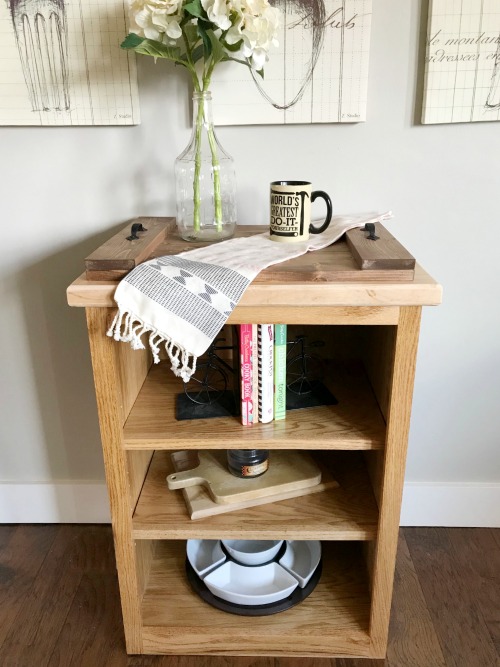
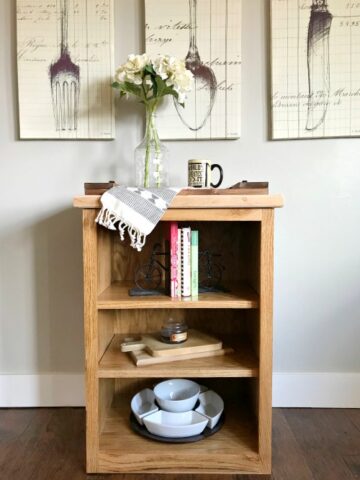
Sometimes you just need a little DIY bookshelf.  Nothing big.  Nothing fancy.  Nothing complicated.  Just a plain, little bookshelf.  Something simple…like this.
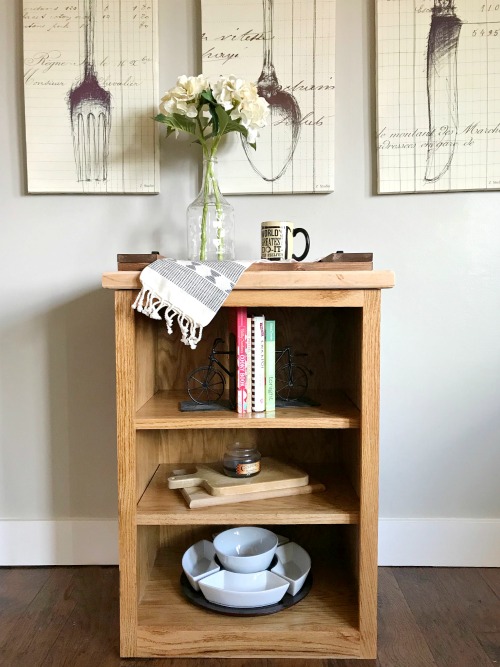
Simple little DIY stand alone bookshelf in kitchen with cookbooks

Isn’t it cute?  It’s so little.  Everything miniature is cuter than the full size, isn’t it?  Except for candy bars…those are always better full size, amiright? 😉

.

It’s not REALLY that little, though, I don’t guess.  But it’s smaller than some of my latest builds and it’s the perfect little size for a small nook or space that needs a little extra storage or a display piece.  The top is actually a leftover piece of butcher block counter top from when they cut out a hole for the sink.  It was made to butt up to the existing counter in a friend’s kitchen for some extra counter space.

.

But it would also work great in a bathroom for towels, or in an office for books, or in a kitchen for cookbooks, cutting boards, and dish storage…as seen here 🙂
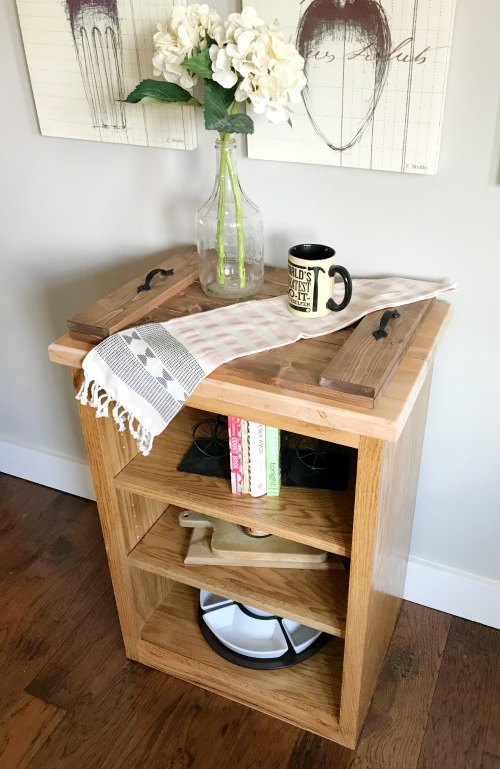
Small stand alone oak DIY bookshelf

If you’re looking for something a little bigger, though, check out some of these projects:
DIY Console Table Stacked Modern Bookshelf--Build your own with this tutorial
Modern Bookshelf
Get the free building plans for this DIY Four Sided Spinning Kid's Bookshelf
Four Sided Bookshelf
How to build a DIY X base console table with middle shelf for added storage--free building plans!
DIY X Base Console–Large
How to build a combination toy storage cabinet

But, if you’re ready for a quick and easy build for this versatile little shelf, let’s get started.

.

This post contains affiliate links.  Please see disclosure policy for details.

.

For this DIY Bookshelf, you’ll need:

¾″ oak plywood (you can get all the pieces cut from a half sheet (4’x4′), but the bottom piece’s grain direction will be the wrong way.  It still works fine, but I am picky about my grain direction, so I bought a whole sheet and will just use the leftovers for another project 🙂 )

¼ sheet (2’x4′) ¼″ oak plywood

(2) 1x2x6 oak board

(1) 1x3x2 oak board

Oak Edge Banding

Kreg Pocket Hole Jig

Drill

Circular Saw

Kreg Rip Cut (optional, but helpful)

Kreg AccuCut (optional, but helpful)

Miter Saw

Kreg Shelf Pin Jig

Shelf Pins

1 ¼″ pocket hole screws

Wood Glue

1 ¼″ brad nails

.

Step 1: Cut Plywood to Size for DIY Bookshelf

First, I cut my plywood pieces down to size.  You can cut all your pieces from a half sheet of plywood, but I used a whole so I could better control the grain direction of my pieces. I used my Kreg Rip Cut and circular saw to rip a piece of 16″ wide x 8 ft long from my sheet of plywood.  If you don’t have a Rip Cut, you can use a straight edge or a table saw.  This piece will become the sides and bottom of the shelf.
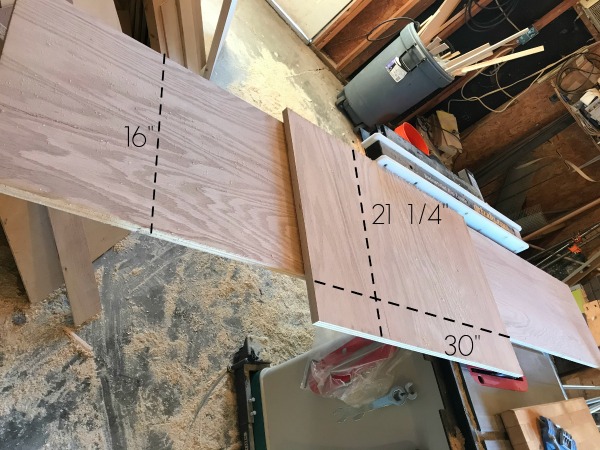
plywood cuts to build simple shelf cabinet

Then, I used my Kreg AccuCut and circular saw to cut another piece off the remaining sheet to 21 ¼″ x 30″ like shown above.  If you don’t have an AccuCut, you can also use a straight edge.  This piece will be the shelves.  I ripped it in half to create two pieces 21 ¼″ x 15″.

.

Finally, from the 16″ wide piece, I cut two pieces 32″ long and one piece 21 ½″ long.

.

SO, I ended up with the following:

(2) 16″ x 32″ side panels

(1) 16″ x 21 ½″ bottom

(2) 15″ x 21 ¼″ shelves

Step 2: Assemble the DIY Bookshelf Carcass

Have I mentioned how much I love using the word carcass when talking about cabinets? I use it every chance I get! Haha.

.

Okay, back to building. I used a pocket hole jig to drill ¾″ pocket holes into the sides of the 16″ x 21 ½″ piece from step 1.
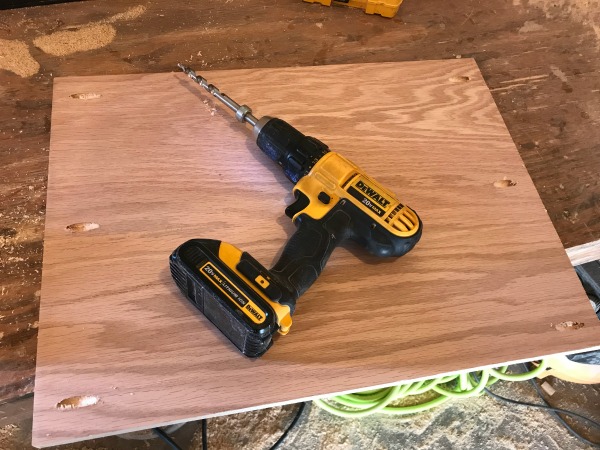
drill pocket holes into the bottom of the DIy shelf cabinet carcass

Then I attached between the two side pieces cut from step 1 like shown with 1 ¼″ pocket hole screws.  I attached so the top of the bottom piece is 2 ½″ from the bottom of the side pieces.
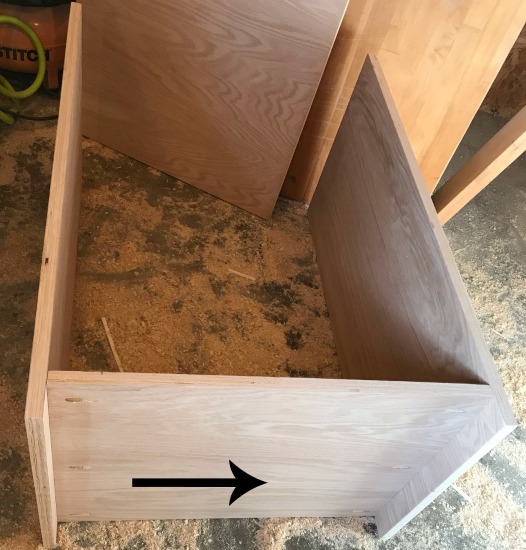
Assemble the DIY bookshelf cabinet carcass

Then, I used some scrap pieces (or you could cut some from the remaining plywood) 21 ½″ long.  Width doesn’t matter much here.  I drilled ¾″ pocket holes into the ends of the pieces and attached at the top of the cabinet carcass like shown using 1 ¼″ pocket hole screws.
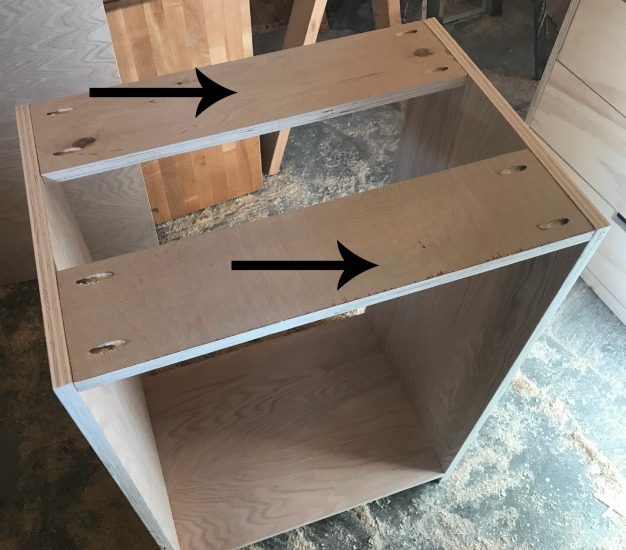
Attach top supports to shelf cabinet carcass

These will be used to attach the face frame, and backing later and for attaching the top.

Step 3: Drill Shelf Pin Holes on Shelf

This step is optional, but recommended.  You could use pocket holes and screws to attach stationary shelves, but I prefer adjustable shelves because I’m extremely indecisive, so I switch things around a lot haha.  If you do want stationary shelves, you can skip this part, but in step 1, cut your shelves 21 ½″ wide instead of 21 ¼″.

.

I drilled shelf pin holes using my Kreg shelf pin jig along the front and back of each cabinet side like shown.  I use shelf pins like these to hold my shelves in place when it’s finished.
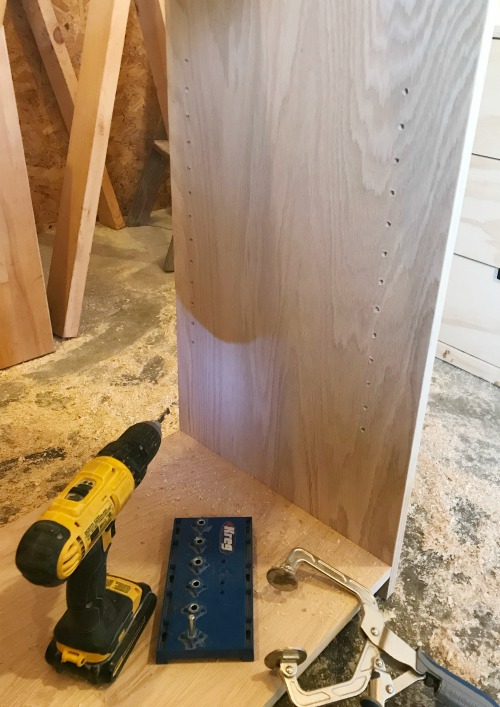
shelf pin holes drilled into side panels of diy bookshelf cabinet

Step 4:  Add Back to DIY Shelf Cabinet

I cut my ¼″ plywood to fit the back side of the cabinet (23″ x 31 ¼″) and stapled into place.  Make sure the cabinet is square when you attach.
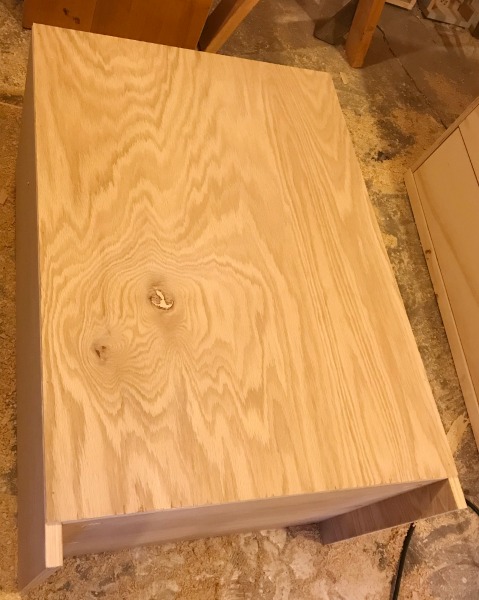
Staple back onto simple DIY shelf cabinet

Step 5: Build and Attach Face Frame to Bookshelf Cabinet

I cut two pieces of 1×2 oak 32″ long and one piece 1×2 oak 20″ long.  These will create the top and sides of the frame.  Then, I cut the 1×3 oak board 20″ long.  This will be the bottom of the shelf face frame.  I glued the frame together using wood glue and clamps like shown.
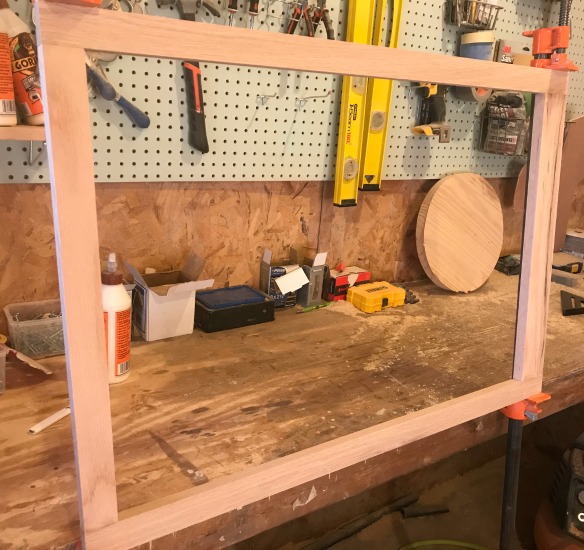
Build face frame for DIY Shelf Cabinet

Also, for a more finished look, you can add oak edge banding to the front edge of the shelves, or glue on some thin strips of oak wood.  I cut some 1″ wide strips of oak and glued them on.
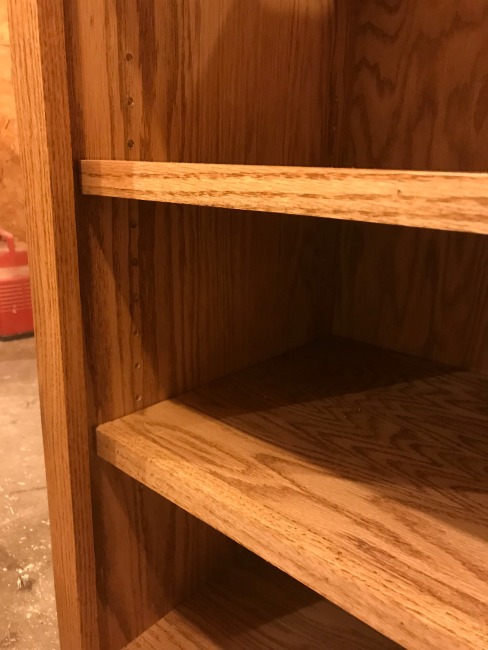
Finish oak shelf fronts with edge banding

Once the face frame glue was dry, I glued and nailed it onto the front of the cabinet like shown.  I stained the cabinet before I took the picture (whoops!).
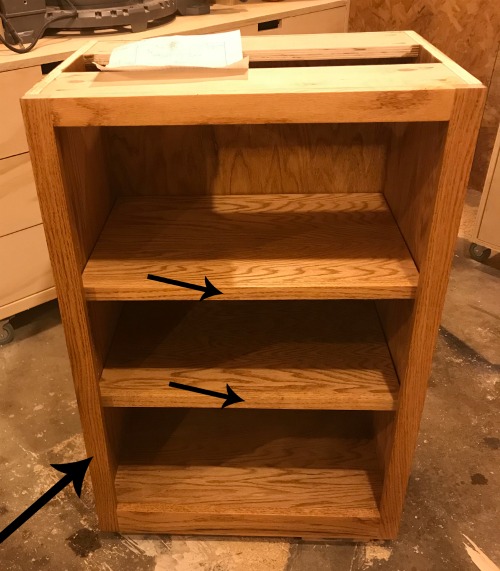
Face Frame and edge banding installed into little shelf cabinet

Step 6: Add Top and Finish

I said earlier that the top of this shelf was actually a leftover piece of maple butcherblock countertop.  But, if you don’t have any of that, you can make your own top from some 2x material or even use ¾″ plywood if you wish.  Since you have plenty of leftover plywood from the shelf if you got a full sheet, I would recommend using that for the top if you don’t want to glue one up.

.

Simply cut a piece about 17 ½″ x 25″ and apply edge banding for a more finished look.  Then center the top onto the shelf and screw in place through the top supports from step 2 using 1 ¼″ wood screws.  Then, finish as desired.

.

Since this was oak, I used Minwax Golden Oak stain with a top coat of semi-gloss Minwax Polycrylic for a natural oak look.  I set the shelves where I wanted using shelf pins and that was it.  A simple little DIY bookshelf.
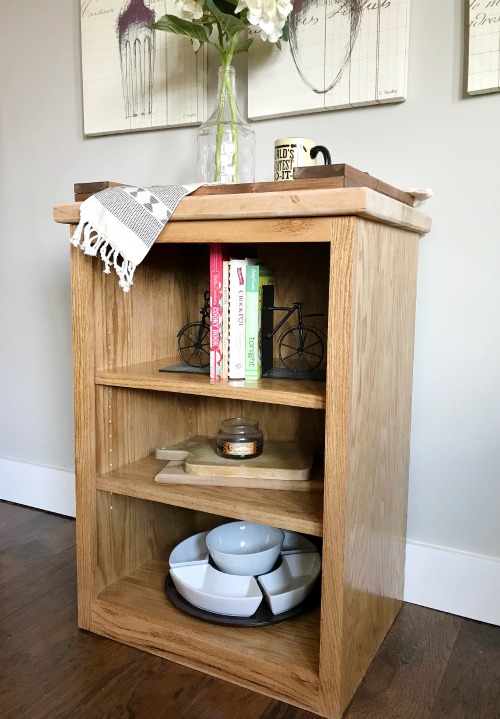
Simple oak DIY stand alone shelf with adjustable shelves

Simple DIY shelf with cookbooks and cutting boards

Sometimes, you don’t need anything fancy…just a little bookshelf.  This would be perfect for a kid’s room, kitchen, bathroom, office.  And if you’re like me (indecisive), it’s nice to have the option to switch up the shelves if I decide to use it for something else haha.

.

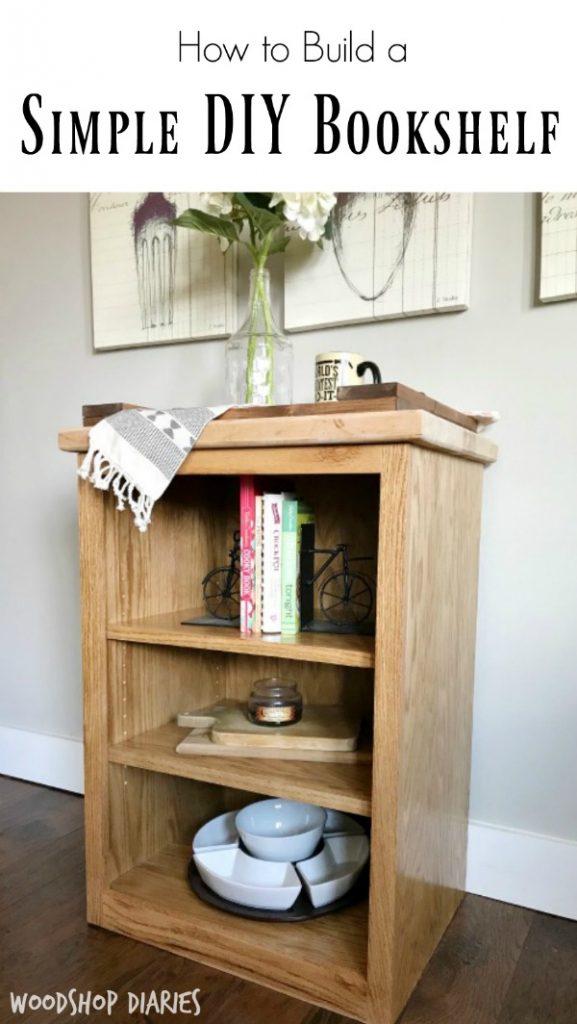
Be sure to check out my other shelf projects, and don’t forget to pin this for later 🙂How to build a simple DIY bookshelf pin image with top title banner
Until next time, happy building 🙂
DIY Retro Wooden Bluetooth Speaker Box

March 4, 2018 by Shara, Woodshop Diaries

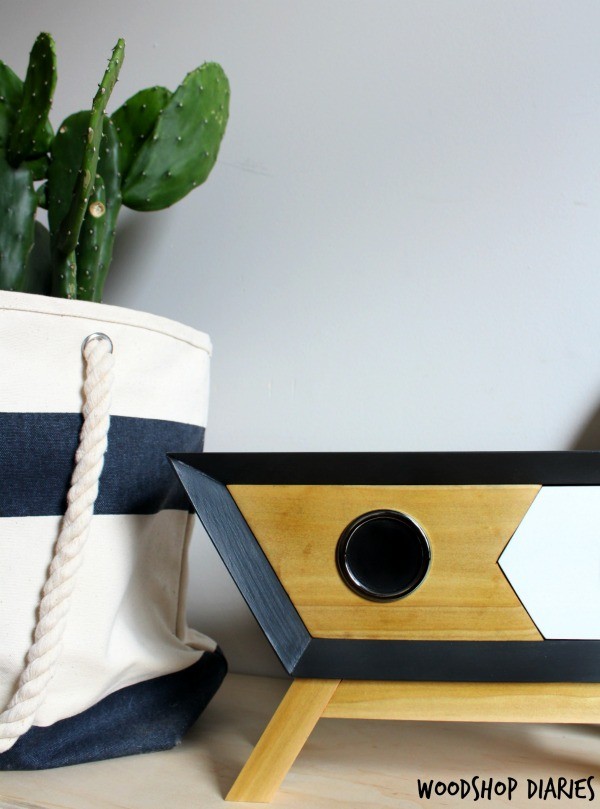
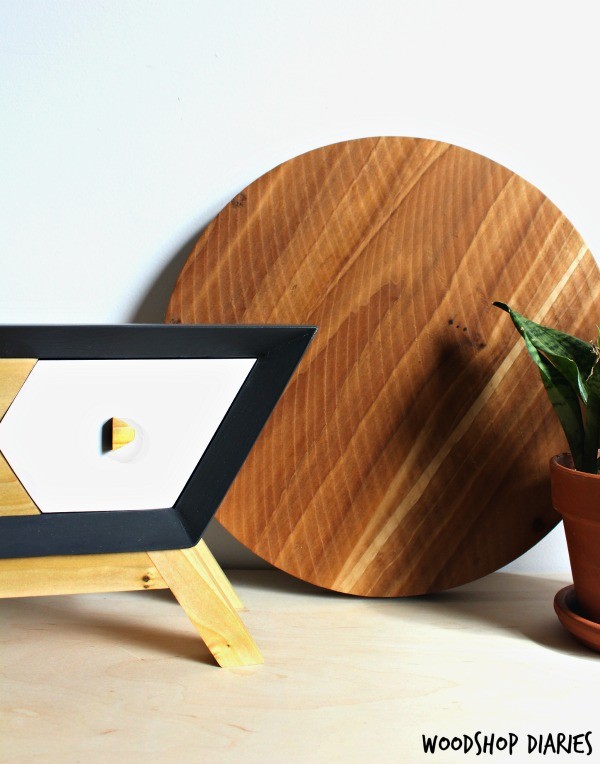
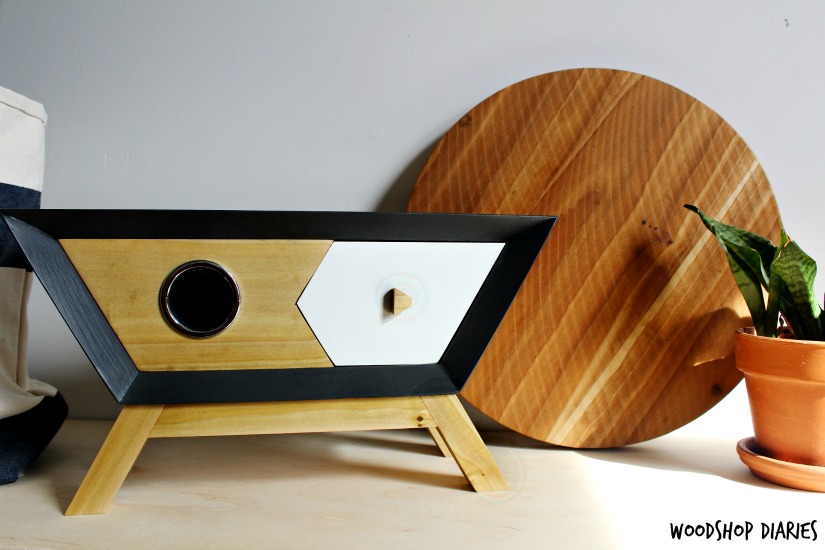
DIY Wireless Bluetooth Wooden Speaker Box--Looks like a retro mid century credenza and it's even got a hidden compartment for cord storage!

I’m not sure a day goes by that I don’t listen to at least a few hours’ worth of music.  Legit.  I wouldn’t survive the day without some tunes to get me through.  Now pair that with my love of woodworking, and you can understand why I’ve been eyeing one of these cool little speakers so I could make a cool little DIY wooden Bluetooth speaker box for it and get my jam on.

How to create a retro wireless DIY Bluetooth wooden speaker box

But I hesitated…because I wasn’t sure what kind of box to make.  I wanted something fairly simple, but not plain.  Something that would catch your eye, but not be too busy.  Something a little retro, a little modern, a little…different.  I’ve literally been thinking about box ideas for months, but never actually buying the speaker.  I kept thinking I’d eventually buy one and come up with some decent idea.

.

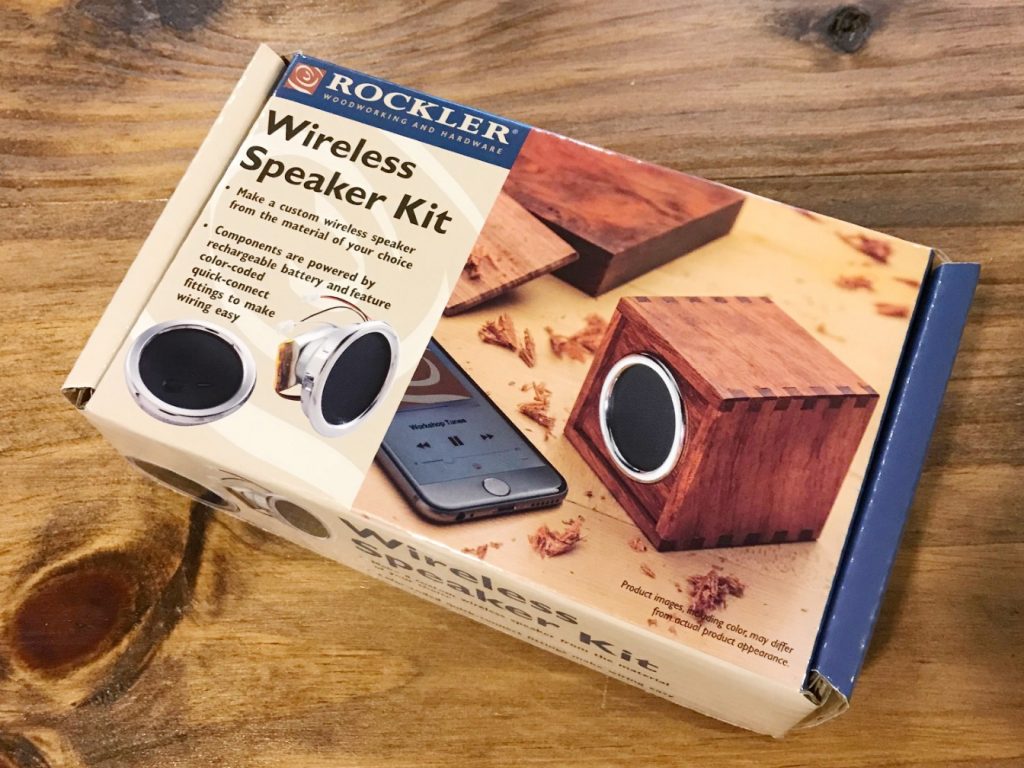
Then one day, the UPS man dropped off a package and I opened it to find this!  Rockler had sent me a speaker kit and I wasn’t even expecting it!

You have no idea the excitement that followed.  Squeals and screams and I even called my dad to tell him I got a little wireless Bluetooth speaker and I was going to make a speaker box.  Poor Dad…he thinks I’m crazy. HA.

.

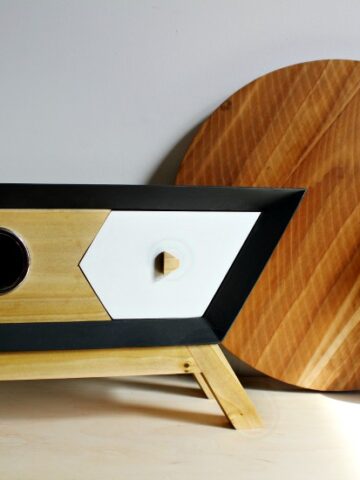
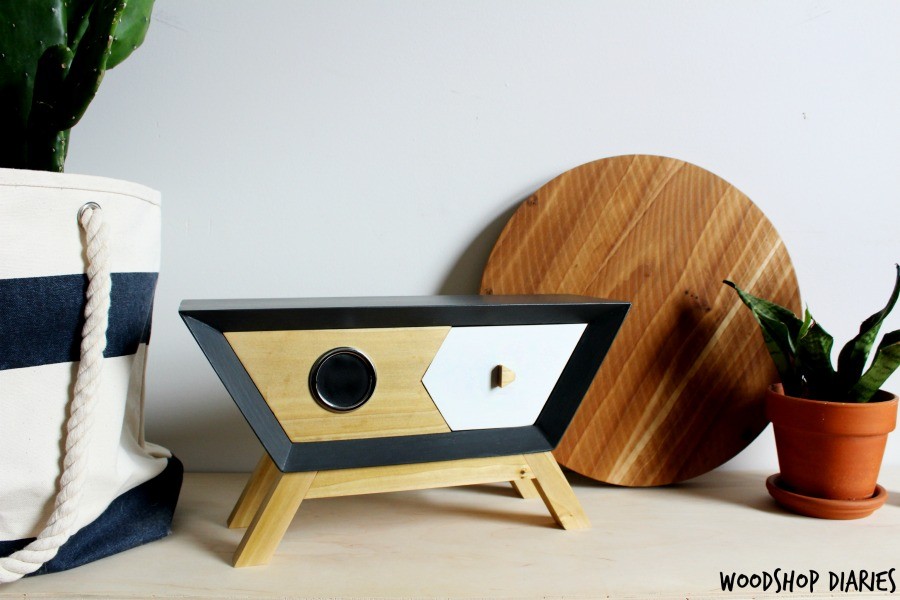
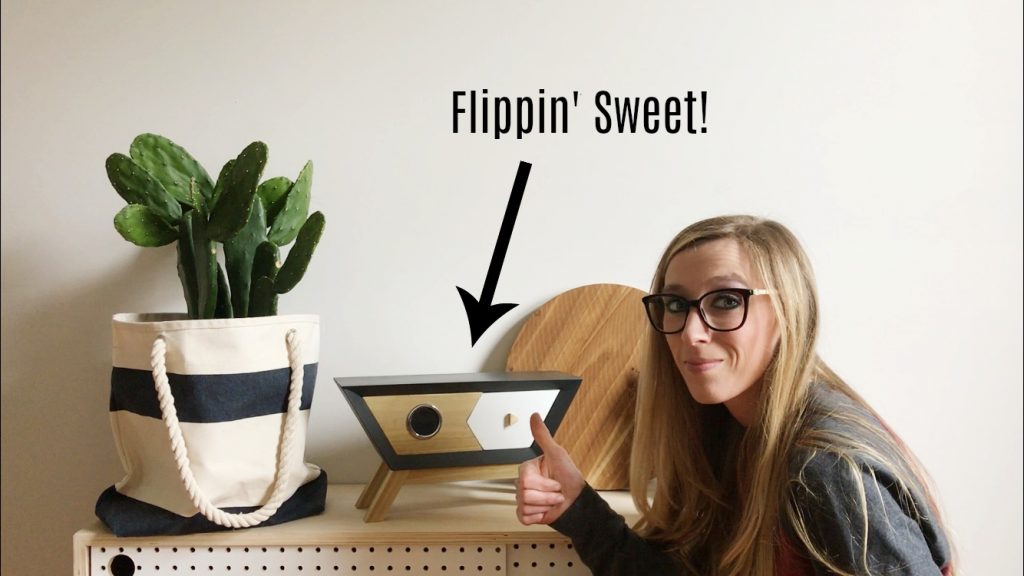
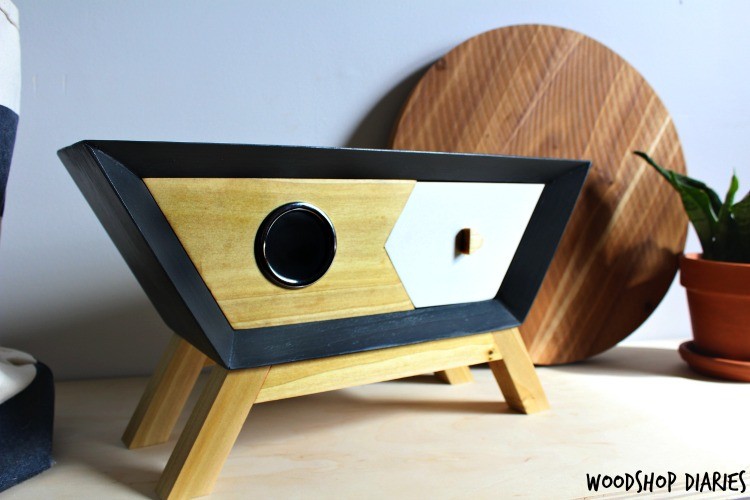
Then, I remembered….I didn’t have a box idea yet.  So I doodled and doodled and googled, then doodled some more until I had an idea that seemed like it would work and made my heart beat a little faster.  Something that fit my retro style.  Something like this 🙂

How to Build a Retro DIY Bluetooth Speaker Box

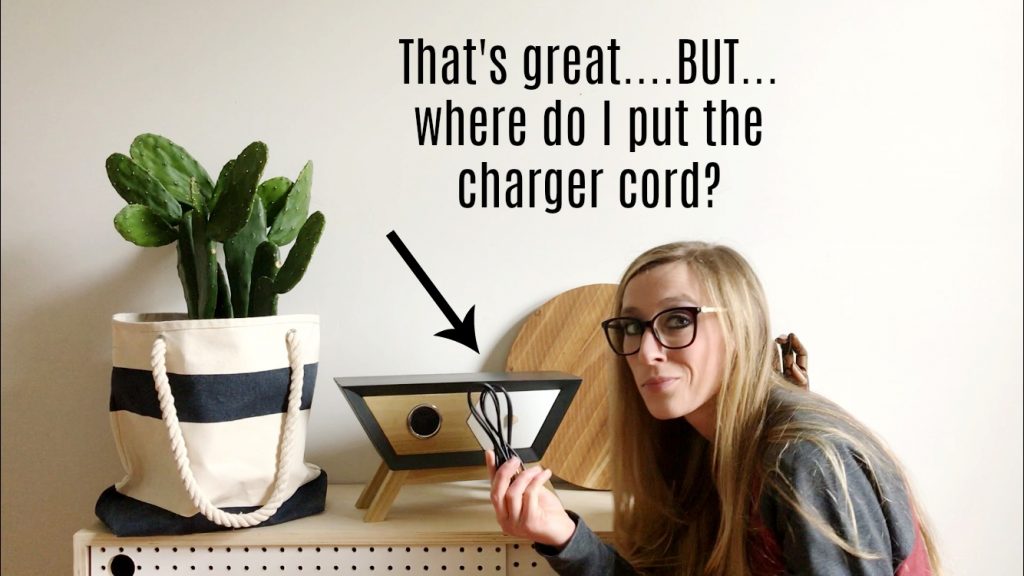
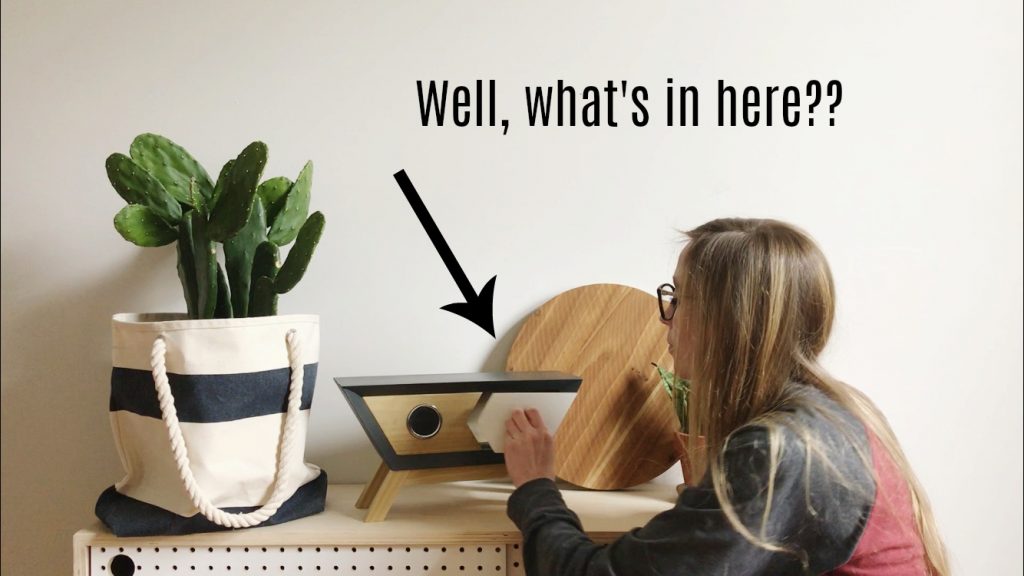
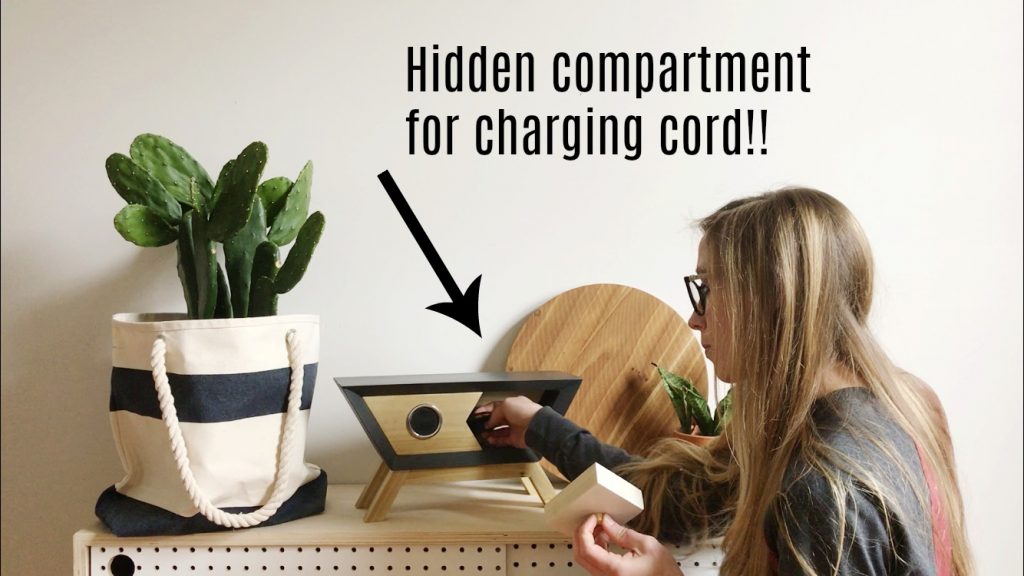
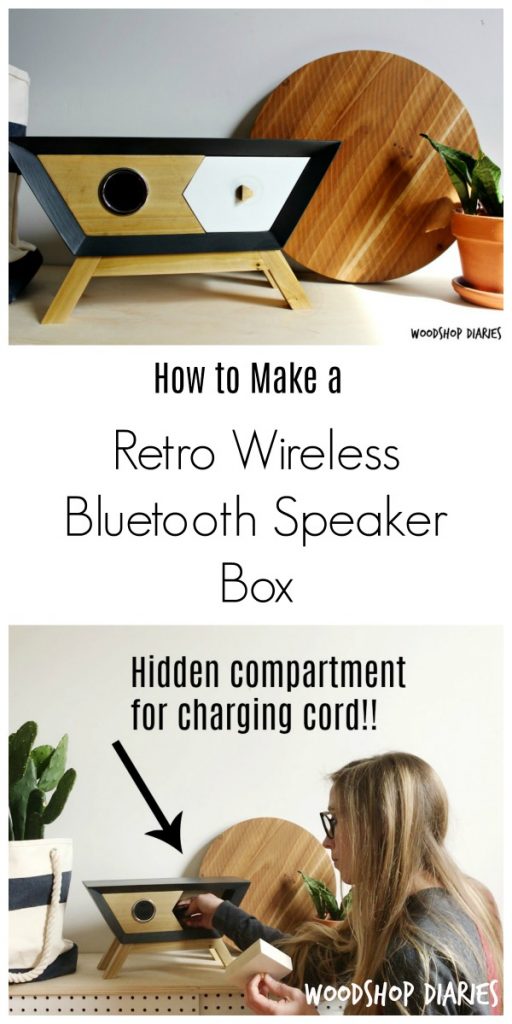
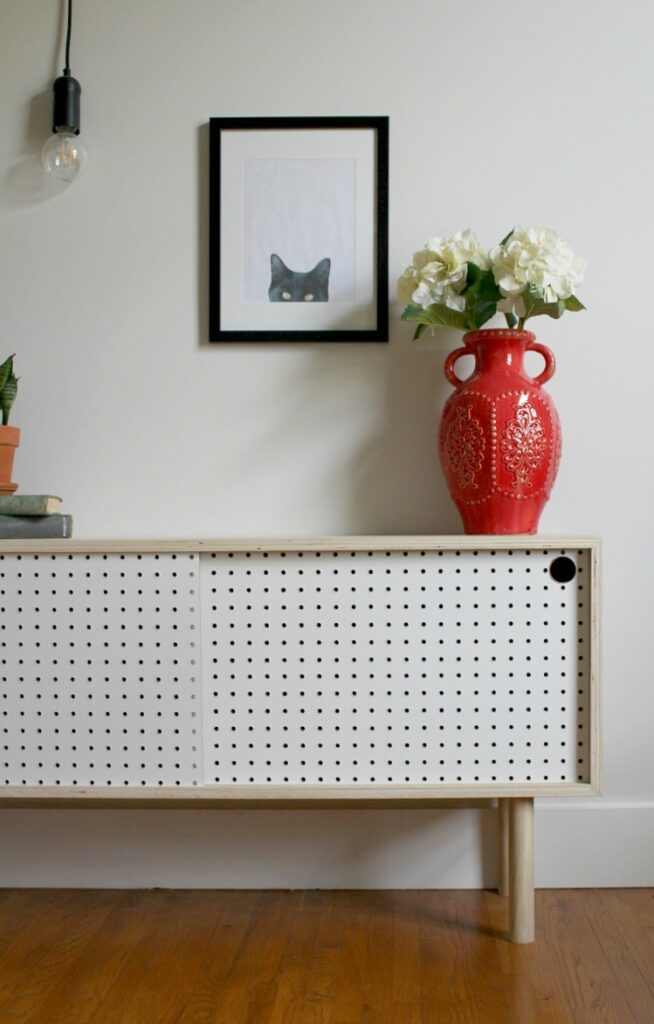
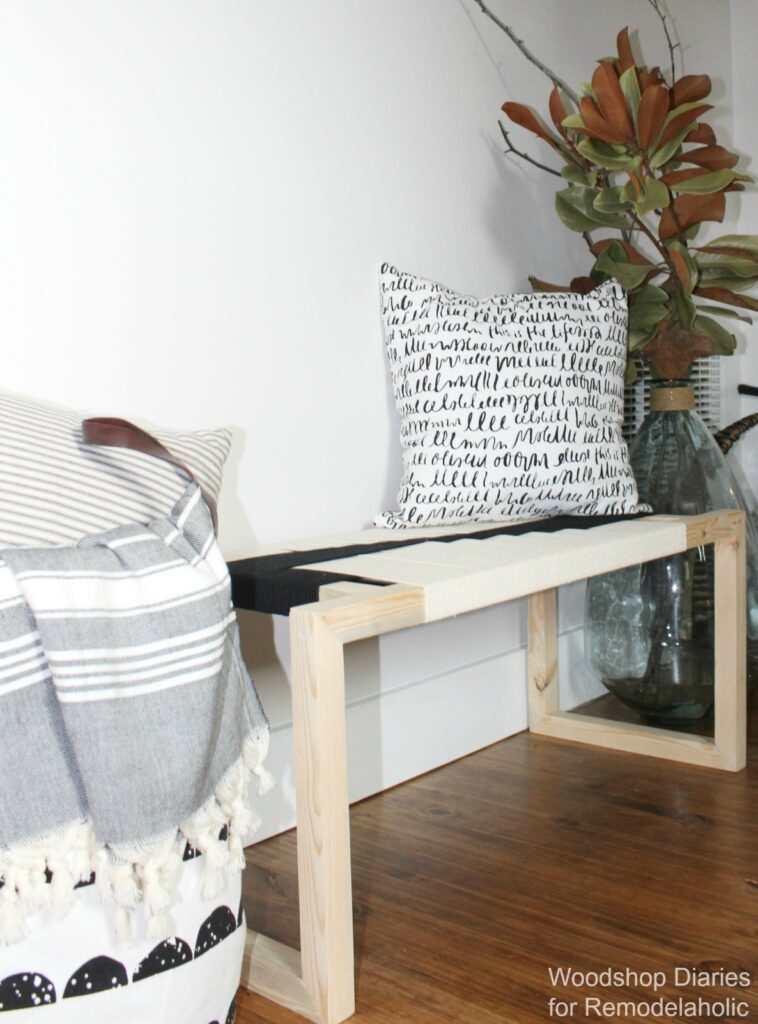
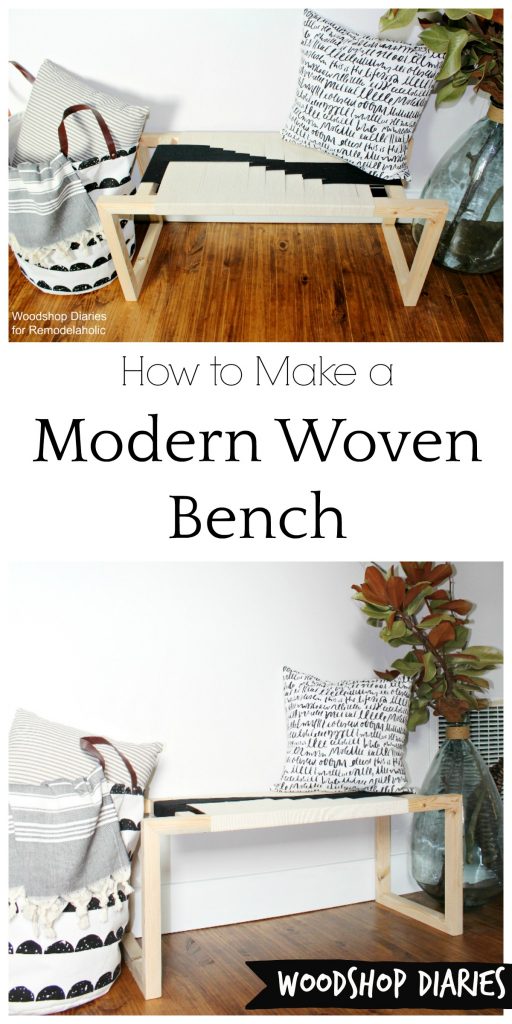
Isn’t it CUTE?  It reminds me of a mid century style credenza you’d find in like the Brady Bunch house or something.  I LOVE that….Danny, well, he’s not quite as into that as I am haha.  If you remember, I’ve made a few “retro” style pieces before if you’re into that too 😉  The Pegboard Cabinet was one of my favs, and there was the Mid Century Dresser, and the other Mid Century Dresser, the woven bench, and the modern sliding door and floating vanity.  But anyway…back to the speaker box–it’s even got a hidden compartment to hide the charging cord!  WHA?!

.

I made the whole thing from scraps and I’m going to show you how to make your own 🙂  Check out the video tutorial I posted for it below, then find the step by step after that.  Let’s get building!

This post contains affiliate links, please see disclosure for details.

.

You will need:

Miter saw

Table Saw

Jig Saw

1 ⅞″ forstner bit, OR 1 ⅞″ hole saw (or just use jig saw)

Drill

Ratchet Clamp

Wood Glue

Wireless Bluetooth Speaker

.

1×6 wood scraps (about 3-4 foot)

1×4 wood scraps (about 2 foot)

¾″ square wood dowels (or just rip your own on table saw)

.

Step 1: Bevel the Bluetooth speaker box sides

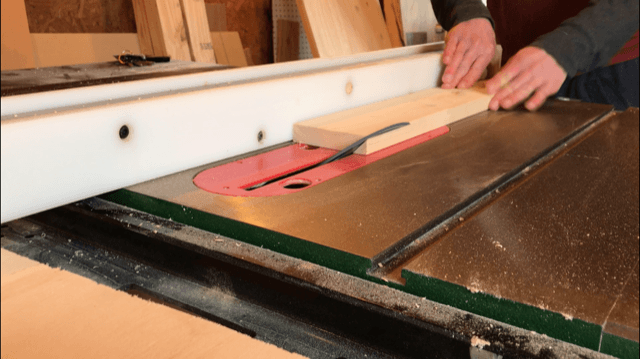
This is optional, but I think the bevel really gives it more of a retro feel.  I set up my table saw blade to cut a 45 degree bevel and ran my 1×6 boards through so that both ends were beveled towards the middle.  I actually ripped the boards to about 5″ wide during this process to help with cutting the miters later (see step 3).

Step 2: Cut the Front and Back of the Speaker Box

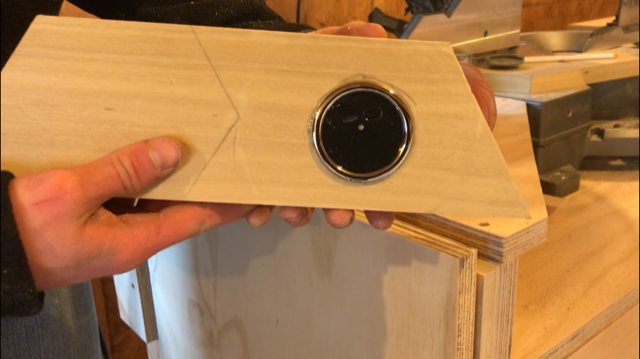
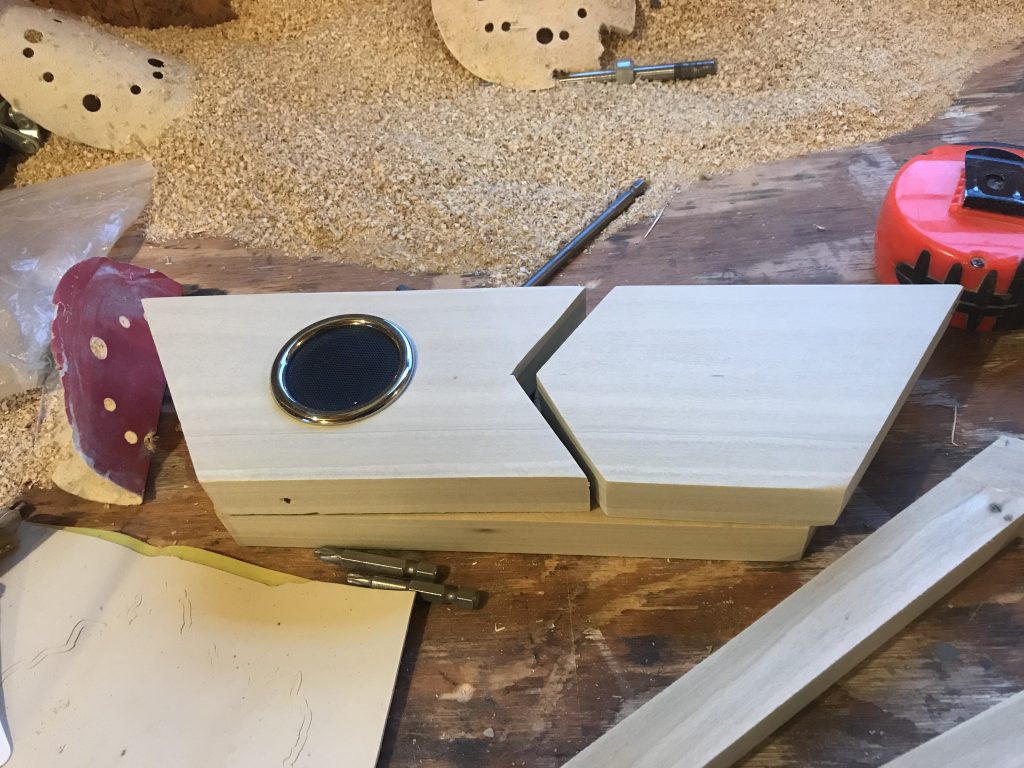
For the front and back, I used poplar wood.  I had some scraps, so I trimmed them down to 3 ½″ wide and cut two pieces exactly the same size.  They had both ends mitered 30 degrees NOT parallel to each other and about 12″ long at the longest points.  You can customize your size here if you want.  By the way, you will see my new miter saw stand in the pictures and video of this project.  It’s been a pretty popular post, so if you want your own stand, I’ve got the plans for you here 🙂

Step 3: Cut to fit speaker box sides

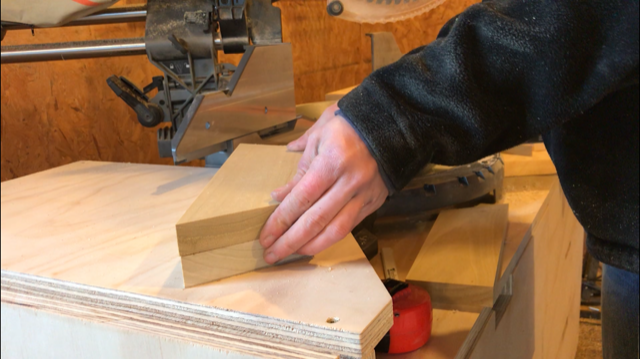
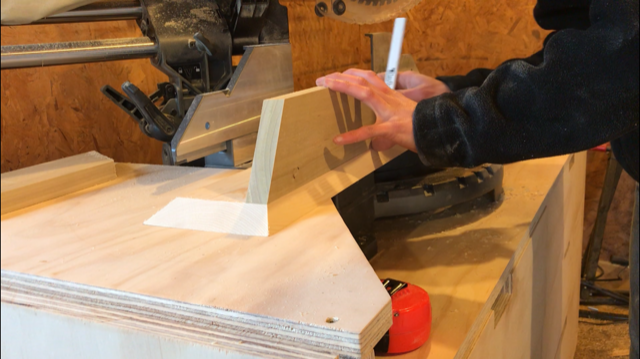
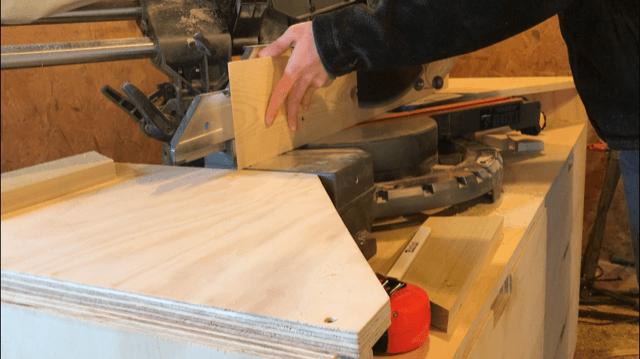
For the top of the speaker box, I mitered my corners at 60 degrees.  The easiest way to do this is with a miter saw that has at least a 60 degree capacity and the ability to cut a board at least 5 ” tall.  I made sure to miter the corners on the same side of the board as the bevels from step 1.  It’s best to cut to fit for a tight box.

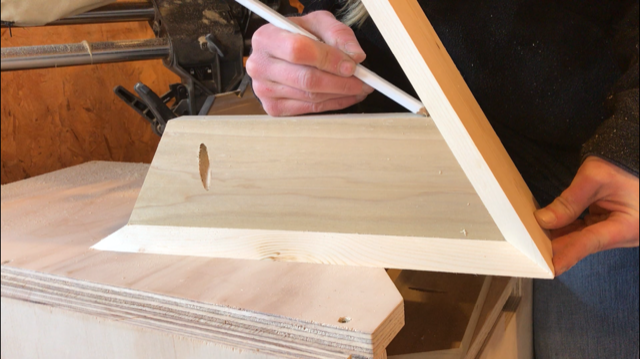
Once the top box piece was cut, I continued around the sides and bottom cutting to fit my pieces the same way.  The side pieces will need a 60 degree miter on top and 30 degree on the bottom.  The bottom piece will need both sides at 30 degrees.  For the short sides, it’s best to cut the 60 degree miter first on a longer piece, then switch the saw back to a 0 degree miter and set the bevel to 30 degrees.  The back rest on my saw wasn’t long enough to safely cut 60 degree miters on such a short piece.

I cut a little long so I could trim until I got a really tight fit.  Here I dry fitted the pieces around the box front before gluing.  Side note: the scrap poplar I used had a pocket hole drilled in it.  I didn’t use the pocket hole for this project…just in case you were wondering 🙂

Step 4: Glue Up DIY Bluetooth Speaker Box

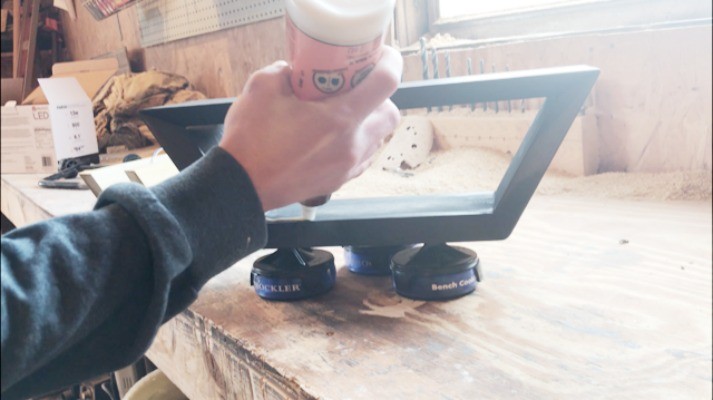
Now for the fun part.  I simply glued my box together.  No nails, no screws, just glue.  It worked out well.  I used a silicone brush and a silicone mat to keep my glue from getting all over the place and brushed glue onto the corners of the wood.

Then, I placed the pieces together and used a ratcheting band clamp to hold everything in place.

Step 5:  Prepare Front and Back of Bluetooth Speaker Box

While the glue was drying, I cut the speaker holes.  The instructions for the speakers say to use a scroll saw, 1 ⅞″ hole saw or 1 ⅞″ forstner bit to cut the hole for the speaker.  I didn’t have that size hole saw or forstner bit, and my scroll saw needs a new blade…so I just used a jig saw and it worked fine.

I used the top clamping piece of my little Kreg Jig to trace out the circle.  This piece was 2″ diameter, so I kept in mind that while cutting on the jig saw, to cut on the inside of the line and it would be pretty close to 1 ⅞″ diameter 😉  I drilled a hole to fit the blade in, then just cut the circle.

I did this on both the front and back pieces.  These holes need to be cut so that the speaker piece and the controller piece are back to back…so make sure they will both be on the same side of the box–left, right, or middle.

I also cut my front piece into two pieces–one to hold the speaker and the other to act as the door for the hidden compartment.

It’s best to finish BEFORE gluing these pieces in–especially if you are doing the two tone thing.  I oiled my poplar with mineral oil and painted the “door” piece white before the next steps.

Step 6: Glue Front and Back Pieces of Speaker Box in Place

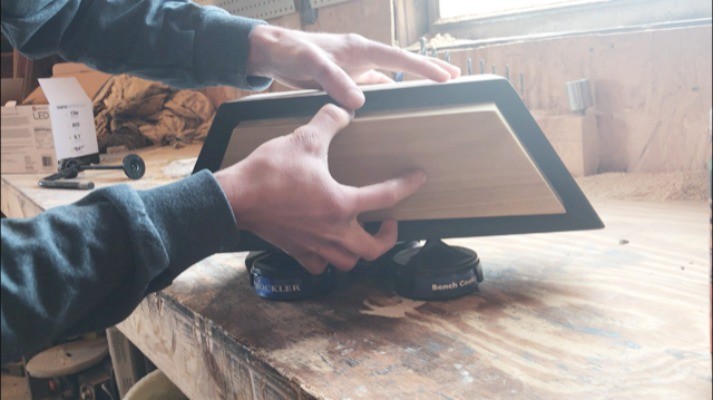
Once the glue was dry in the box, I puttied and sanded the corners for a clean look, painted it, then it was ready to finish assembly.  I lined the inside of the back side with glue and placed the back piece inside.

You may have to use a rubber mallet or a scrap piece of wood and a hammer.  Just be careful not to break your box in the process.

.

Then, I did the same for the front side, but only where the speaker part would go…I didn’t have to glue in the hidden compartment door.  The speaker has to be installed into the front and back pieces and connected according to the instructions before gluing the front piece in place.  It’s super easy…just slide the speaker and controller into their holes and plug in two little wires.

Step 7: Add Legs to Speaker Box

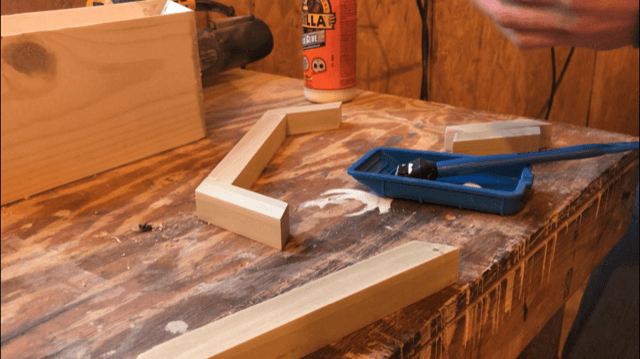
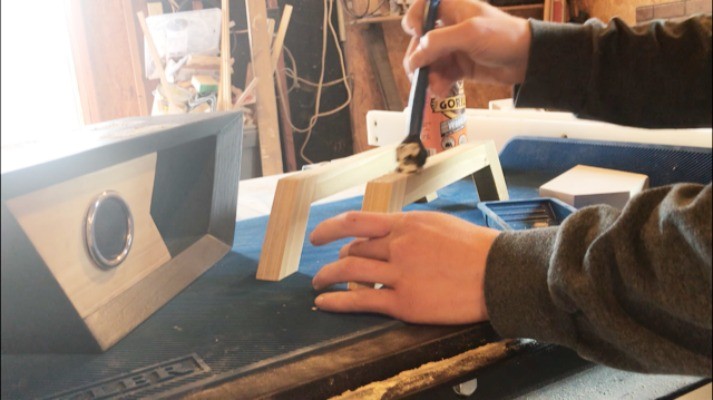
I ripped a couple strips of poplar to ¾″ square on my table saw and used these for legs.  I mitered everything to 30 degrees for the legs and made two sets of legs to fit onto the box.  I used wood glue to attach the legs together and to attach to the bottom of the box.

Finally, I added a little “knob” to my compartment door and it was ready to go!  I had to trim down my compartment door slightly for it to fit into the box loosely enough to easily remove.

.

The speakers come with a charging cord because the battery is rechargeable.  I love this because I hate buying batteries haha.  But I knew if it had cord, I would lose it because that’s just the kind of person that I am.  So I love the idea of having a “hidden compartment” to store it.

Nice graphics, huh? HAHA.  But seriously, neat, right?

How to make a mid century modern retro style DIY Bluetooth Wooden Speaker box with hidden compartment for cord storage!

I’m digging the vibe here.  And the speaker quality was surprisingly awesome!  I play my Pandora on it from my phone and dance around the house 🙂

DIY Wireless Bluetooth Wooden Speaker Box--Looks like a retro mid century credenza and it's even got a hidden compartment for cord storage!

How to build a retro wooden DIY Bluetooth Speaker box

Now, get out there and get building so you can get your jam on….right after you pin this for later 🙂

How to make a retro mid century modern style DIY wireless Bluetooth speaker box with hidden compartment for storing the charging cord!

Until next time, happy building 🙂
 

DIY Miter Saw Stand on Wheels

February 26, 2018 by Shara, Woodshop Diaries

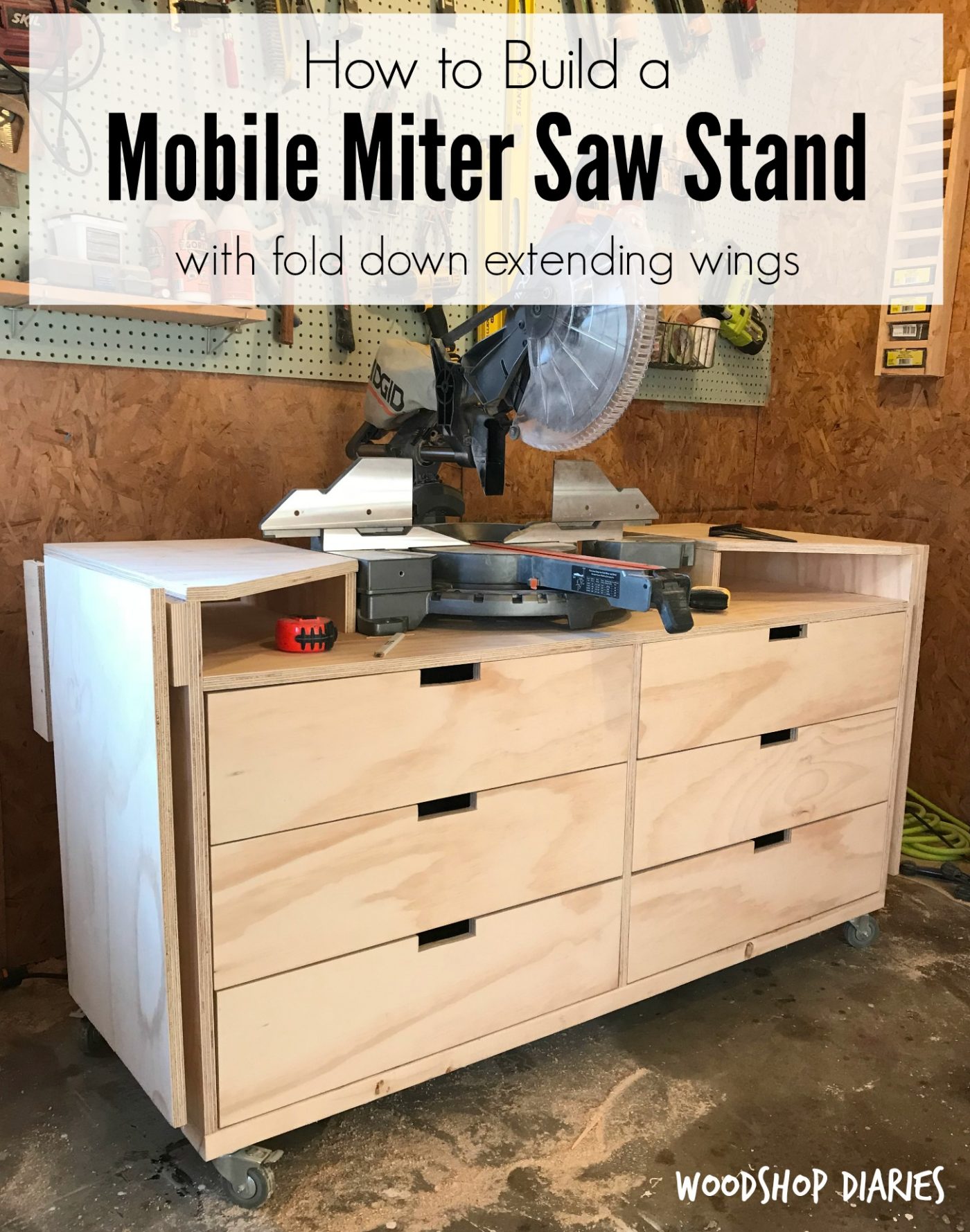
How to build a mobile Miter Saw Stand with storage drawers, and fold down extension wings

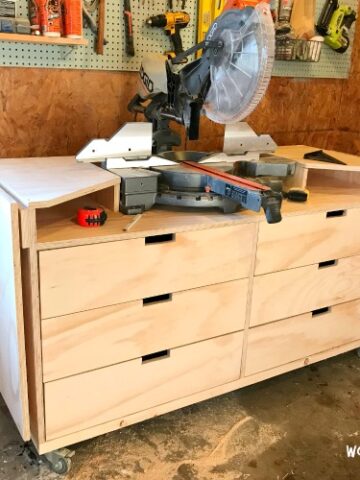
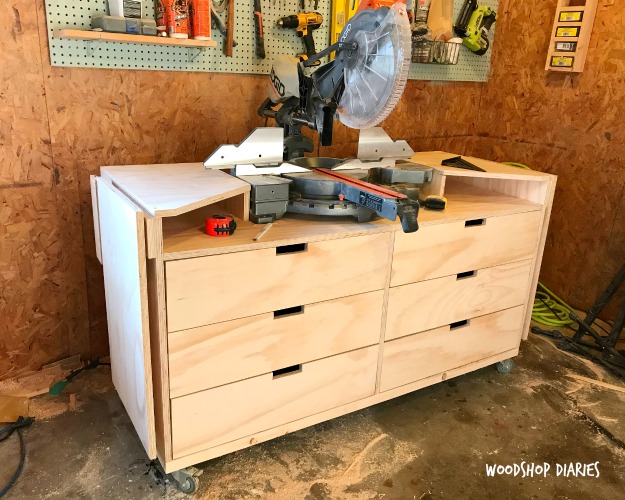
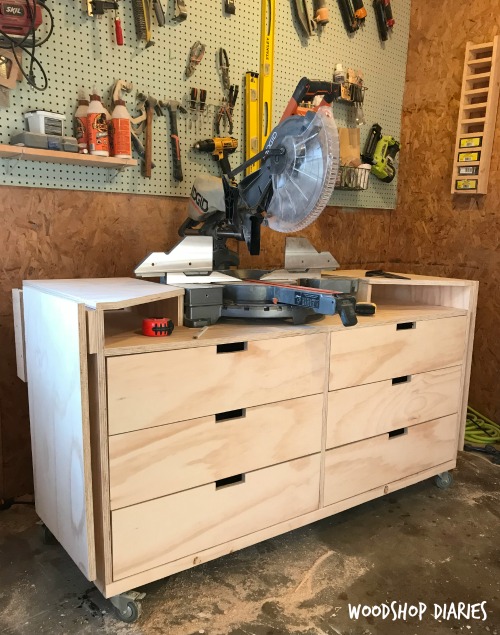
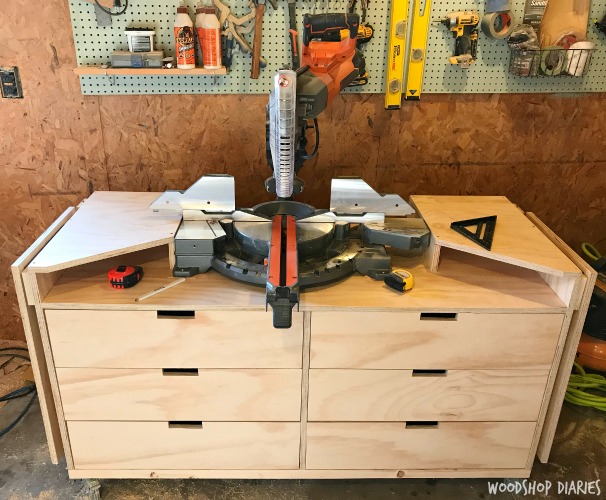
In this post, I’m sharing how to build a DIY miter saw stand with foldable wings that’s on wheels so it can roll around the shop and out of the way!

DIY miter saw stand with large storage drawers on wheels with 12" Ridgid miter saw

Miter saws are often the most used saw in a woodworking shop. That may not be the case in EVERY shop, but it’s true for many, including my own!

Because of this, often times, miter saws are placed in the center of a workshop, in elaborate built-in stations that take up a whole wall.

And that’s a great option if you have a huge dedicated woodworking shop (and don’t change your layout often like I tend to do).

But when I decided to build a miter saw stand for my own shop, I actually went with a smaller mobile option with foldable wings instead!

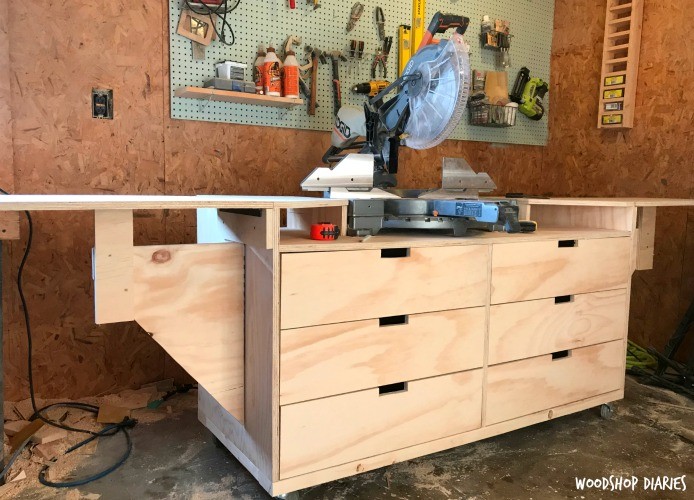
DIY mobile miter saw stand with folding wings extended on each side with large storage drawers

This allowed me to roll it out and expand it to cut long boards if needed, then fold it back down and tuck it into the corner when not in use.

If this looks like the perfect addition to your workshop, I’ve got the mobile miter saw stand building plans below.

What to Consider Before Building a Miter Saw Stand

There are a few things to consider when building your own miter saw station, table, or stand for your workshop.

Think about your work space layout and how often you use your miter saw. How much space can you realistically dedicate to your miter saw? Do you need your miter saw stand to be able to move? Will it need storage space built into it?

This will help you determine how to design or even if you need a miter saw stand at all.

Do I really need a miter saw stand?

Of course you can use your miter saw without a stand. But having one is a helpful upgrade, especially if you use it very often.

A miter saw stand allows you to raise your saw to a comfortable working height and provides support for the pieces you are cutting.

This makes your miter saw cuts more efficient, more enjoyable, and safer.

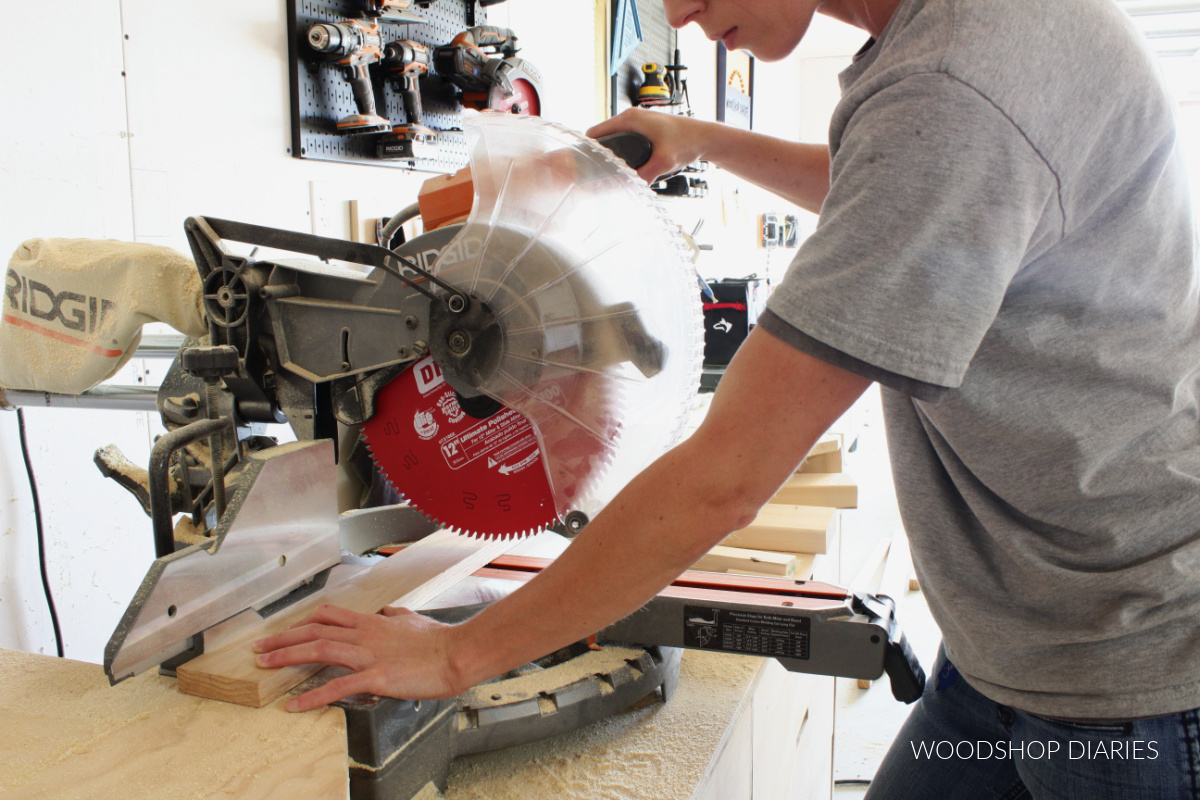
Shara Woodshop Diaries using miter saw on miter saw stand

There are lots of options for stands out there from inexpensive general use miter saw stands to elaborate custom built-in miter saw stations.

Most miter saw manufacturers offer various stand options that you can purchase along with your saw to at least raise it to a nice working level and provide some support for your pieces.

These types of stands are great for on the go as they typically fold up easily and can be carried around.

However, if you are normally using your saw in your workshop and not moving it around various job sites, building your own custom DIY miter saw stand is a great option that allows you add storage or dust collection to it as needed.

Benefits of having a mobile miter saw station

In this case, I built a custom miter saw station, but I made it mobile and with expandable support wings.

There were several reasons why I chose this particular set up and some key benefits I’ve gained from using it:

  • It’s great in small work spaces. When folded down, the stand only takes up approximately 24″ x 64″ so it can be easily stored away when not in use.
  • It provides lots of storage. The six large drawers provide plenty of room to store saw blades, screws, tools, and other accessories to keep the shop organized.
  • Expandable wings make cutting long boards easier. Cutting long pieces on a miter saw can be tough when you don’t have enough support far enough from the blade. The expandable wings on this stand provide support up to approximately 60″ from the blade.
  • Mobility = Versatility. Since this miter saw station is on wheels, it’s easy to move it around and use the expandable wings as an additional workbench surface anywhere I need it.
  • Safer cutting and better ergonomics. Making cuts at a comfortable working height vs on the floor allows for better control and saves on knee and back strain from bending over and squatting.

Is a fence on a miter saw station necessary?

Miter saws come with their own built in fences. These are the raised parts toward the back of the saw base that you push your pieces against when making your cuts.

However, the length of the fence is typically limited to the width of the saw base…which isn’t usually very long.

Many people will add an additional fence onto their saw stations to add stop blocks and other accessories.

This is certainly an option and can be helpful. But it’s not a necessity. I don’t personally use a fence extension beyond what’s included on my miter saw.

But this stand allows for that option if you want to add one onto the foldable wings and the top of the cubbies.

Dust Collection Options

Dust collection is always a topic of interest. I do not use a dust collection system with this set up.

I allow the dust bag on the saw to catch what it can. And after each building project, I vacuum off the stand, roll it out of the way and sweep up the dust.

That’s just another benefit of it being mobile–it’s easy to roll out of the way and sweep under.

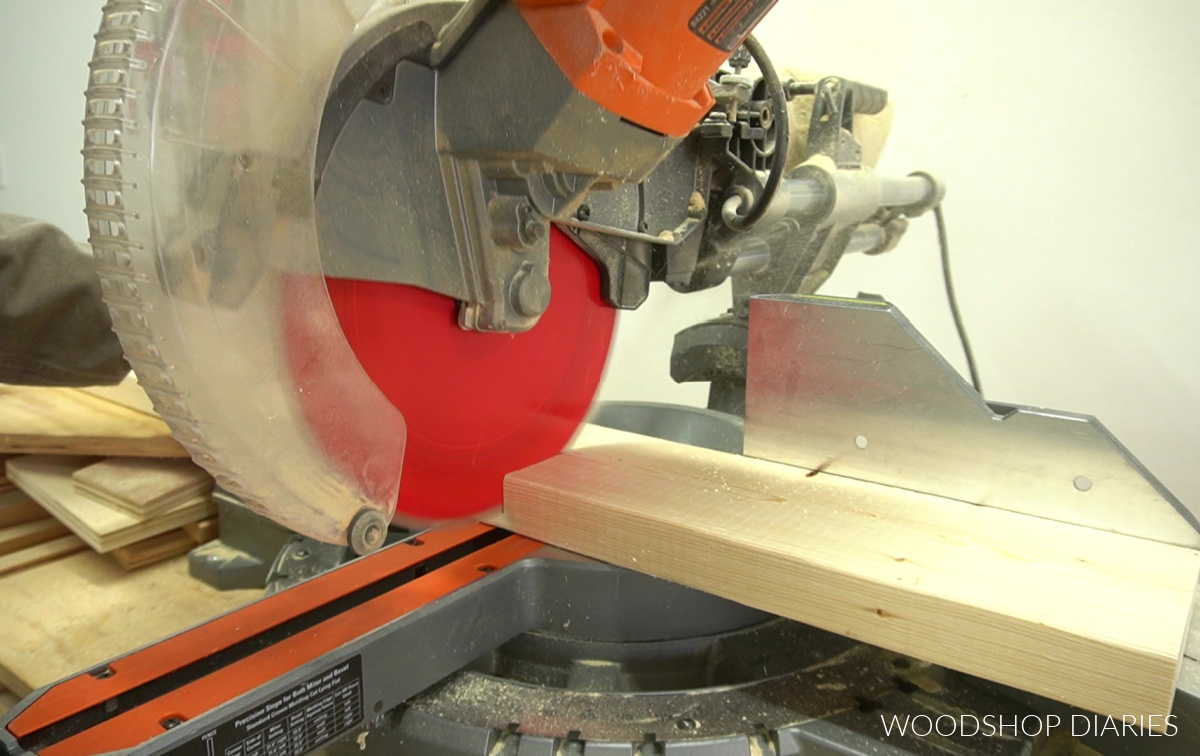
Close up of miter saw cutting board

To be honest, this hasn’t really bothered me in the 6 or so years that I’ve used it. It only takes about 5 minutes to sweep up every week or so.

However, if you can’t stand the dust, you can roll it away from the wall a foot or two, slide in a shop vacuum behind it and hook it up while making your cuts. Again…just another benefit of it being on wheels.

You could also leave the drawers out of one side of the stand and use that space to store a designated vacuum inside to collect the dust.

DIY Miter Saw Stand Overall Dimensions

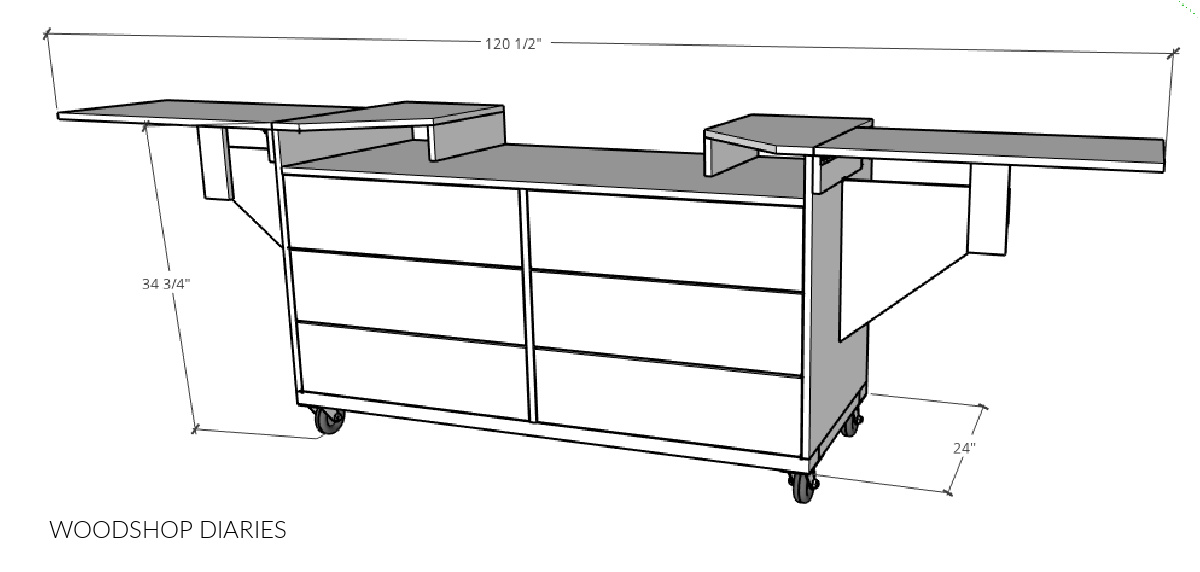
With wings fully extended, the overall dimensions of this miter saw stand are approximately 34 ¾″ tall (may vary depending on caster wheels used) x 120 ½″ wide x 24″ deep.

Dimensional diagram of DIY miter saw stand with wings expanded on each side

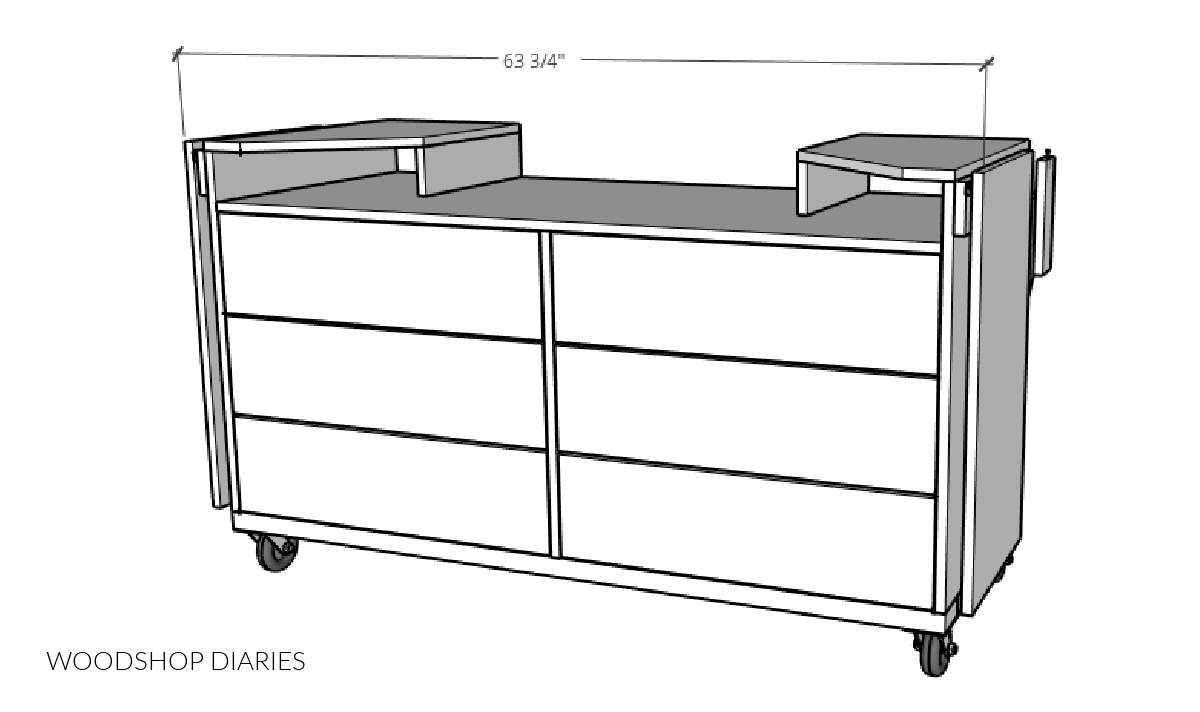
With wings folded down, the height and depth remains the same, but the width is 63 ¾″ wide.

dimensional diagram of mobile miter saw stand with extension wings folded down

Helpful resources for this build

You may find these posts and guides helpful during the building process:

  • How to cut plywood sheets
  • How to use a pocket hole jig
  • How to build and install drawers

Tools & Materials

This post contains affiliate links.  Please see disclosure policy for details.

Tools:

  • Jig Saw
  • Circular Saw
  • Kreg Rip Cut (optional, but helpful)
  • Kreg Accucut (optional, but helpful)
  • Kreg Pocket Hole Jig
  • Drill/Driver
  • Miter Saw
  • Table Saw (optional)
  • Tape measure
  • Speed square

Materials:

  • (3) sheets ¾″ plywood
  • (3) 2x4x8 boards
  • (1) sheet ¼″ plywood
  • (6) pair 22″ ball bearing drawer slides (buying the 10 pack saves a ton of $)
  • (4) 12″ piano hinges
  • 1 ¼″ wood screws
  • 1 ¼″ pocket hole screws
  • 2 ½″ pocket hole screws

How to Build a Miter Saw Stand with Extension Wings

This is a great intermediate build that utilizes basic materials and simple construction.

The great thing about building projects for the workshop is that you don’t have to spend a lot of time sanding and applying edge banding. These builds don’t have to be pretty, they just have to be strong.

I’ve got the step by step walk through detailed in the post below, but if you prefer to watch, I’ve also got a video tutorial here.

(Please don’t judge too harshly. This is an old video and things have much improved since then ha!)

If you prefer to print your plans, you can grab the mobile miter saw station printable building plans, too.

This printable PDF including cut list, plywood cut diagrams, and step by step instructions.

Step 1:  Cut Plywood Down to Size

Since this DIY miter saw stand was built almost entirely from plywood, the first step was cutting down the sheets into manageable pieces to build with.

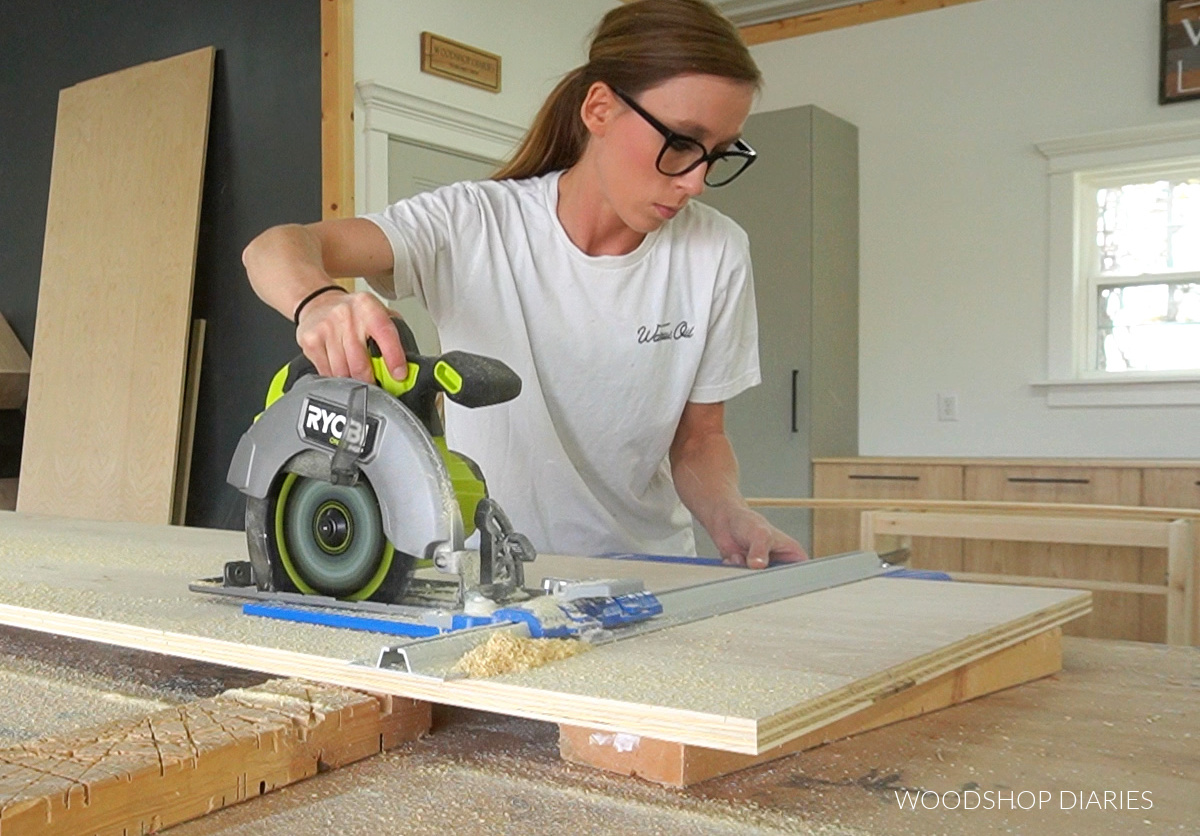
First, I ripped one sheet down the middle into 2 ft x 8 ft strips using my circular saw and Kreg Rip Cut.

RELATED: How to cut plywood sheets

Shara Woodshop Diaries using Kreg Rip Cut and Circular saw to cut plywood on workbench

Then, from one strip, I cut a 58 ½″ and a 29 ½″ piece. And from the second strip, I cut another 29 ½″ piece. The 29 ½″ pieces will the the side panels.

I cut these using a circular saw and Kreg AccuCut. The complete cut diagram can be found in the printable building plans.

I drilled ¾″ pocket holes along the bottom edge of the two side panels and along both ends of the 58 ½″ long piece. 

RELATED: How to use a pocket hole jig

Step 2: Measure and Mark for Saw Height

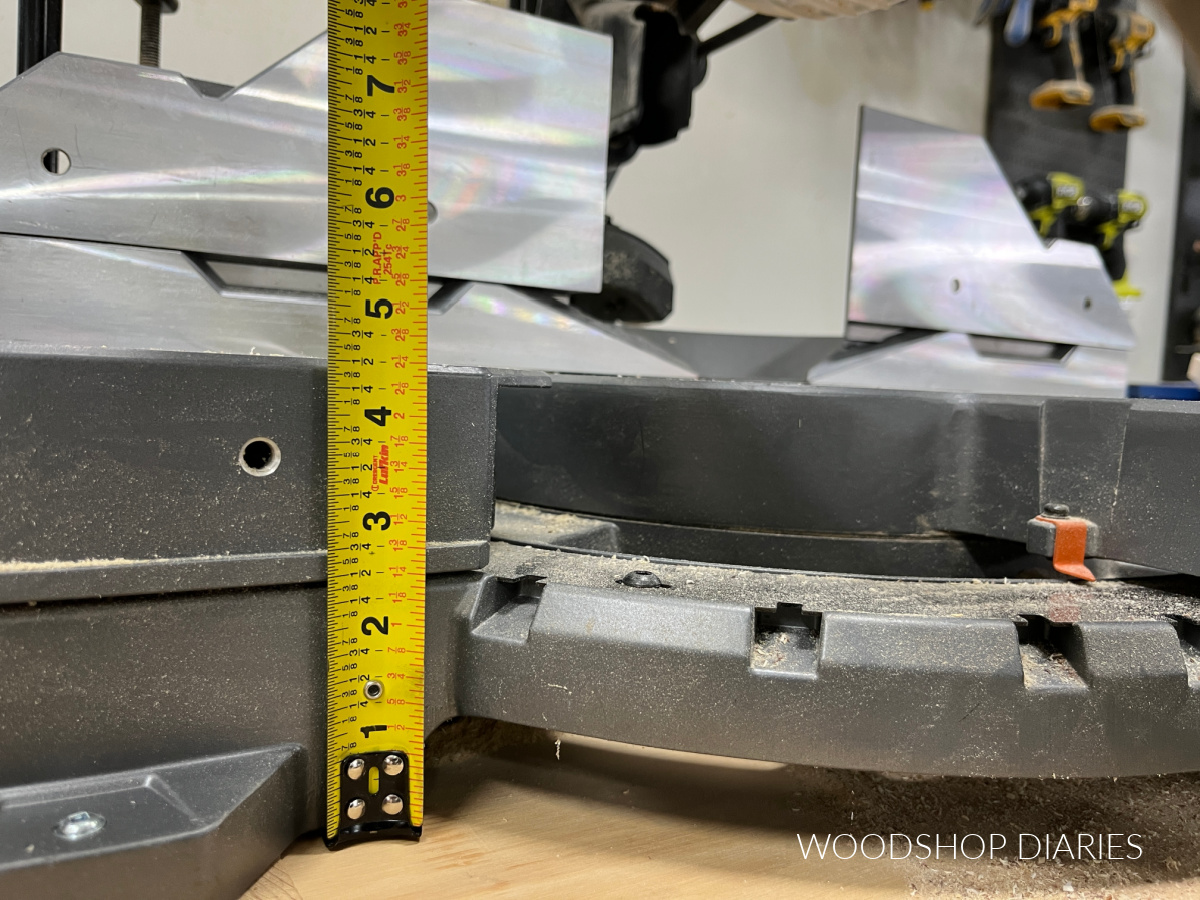
Before assembling, I placed my miter saw on a flat surface and measured the height of the saw base. 

Mine was about 4 ½″ tall. But different saw models will vary so check yours before building and adjust as needed.

Close up of measuring tape against miter saw base to determine height

Once I had the height, I subtracted ¾″ (the thickness of the plywood) to get 3 ¾″.

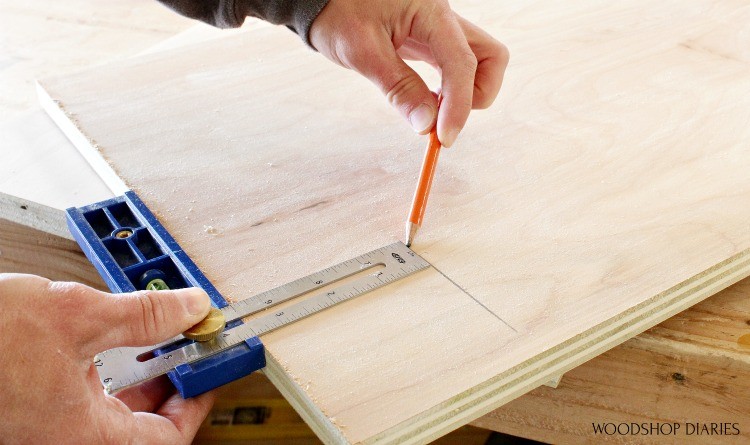
This is the distance from the top that I need to install the shelf that the saw will sit on. So I marked 3 ¾″ from the TOP EDGE of the two side panels.

Close up of using Kreg multimark tool to mark height on edge of plywood

Step 3: Assemble the Carcass

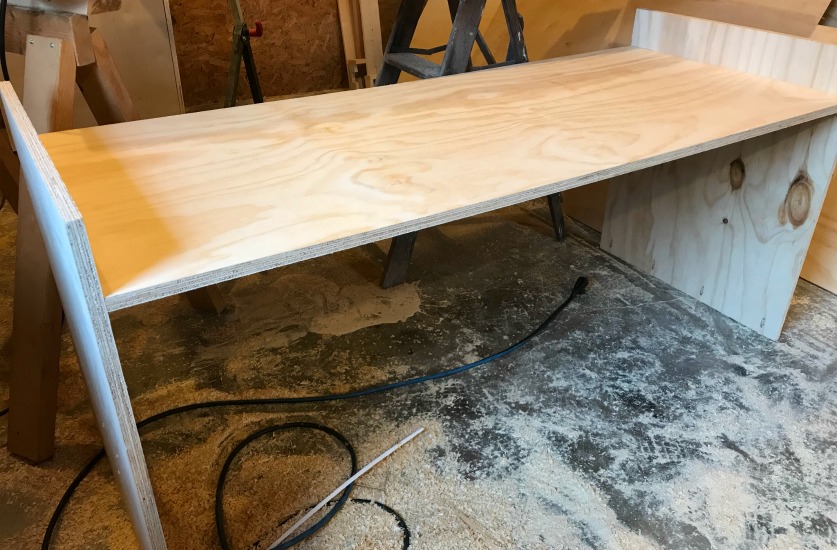
I attached the long piece from step 1 between the two side panels using 1 ¼″ pocket hole screws so the top lined up with the mark I just made.

It’s important that this long shelf is installed the height of saw base – ¾″ from the top.

Miter saw stand top and sides assembled in workshop

Note that the pocket holes on the side panels should face the INSIDE and be toward the bottom like shown in the image above.

Step 4:  Assemble Miter Saw Stand Base

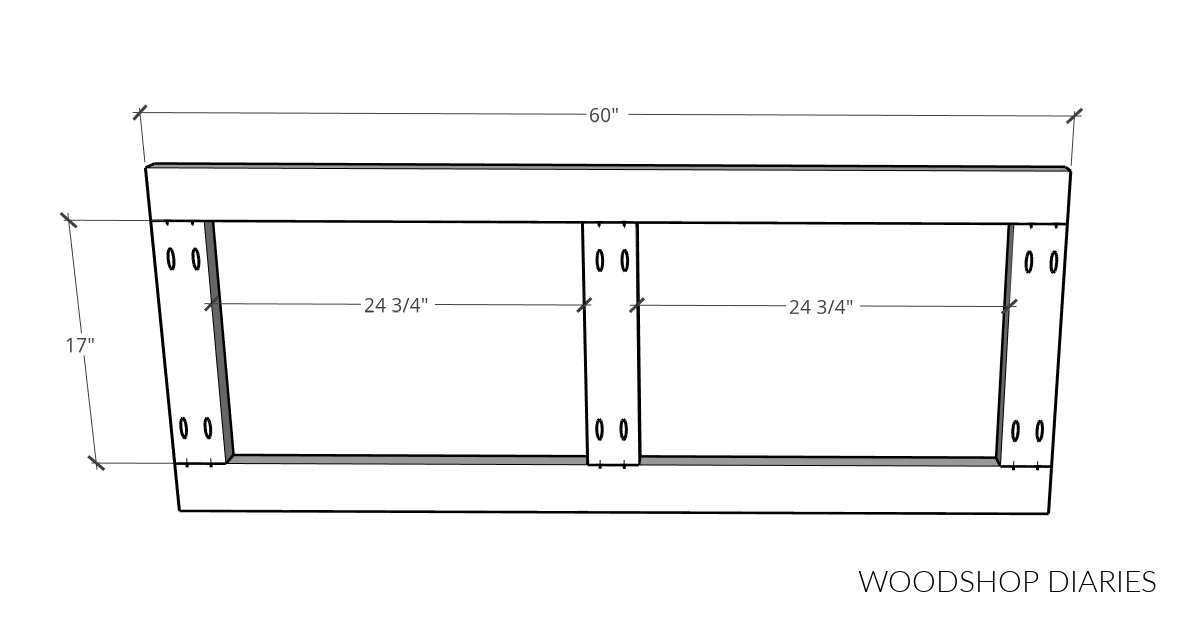
The base of the miter saw station is made from 2x4s. I cut two pieces of 2×4 to 60″ long and three pieces to 17″ long.

Then, I assembled a frame like shown using 1 ½″ pocket holes and 2 ½″ pocket hole screws.

dimensional diagram of miter saw stand base

Make sure the middle one is, in fact, in the middle.

Step 5: Attach Carcass of DIY Miter Saw Stand to Base

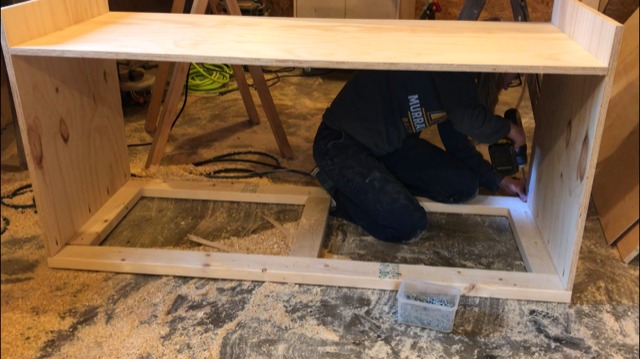
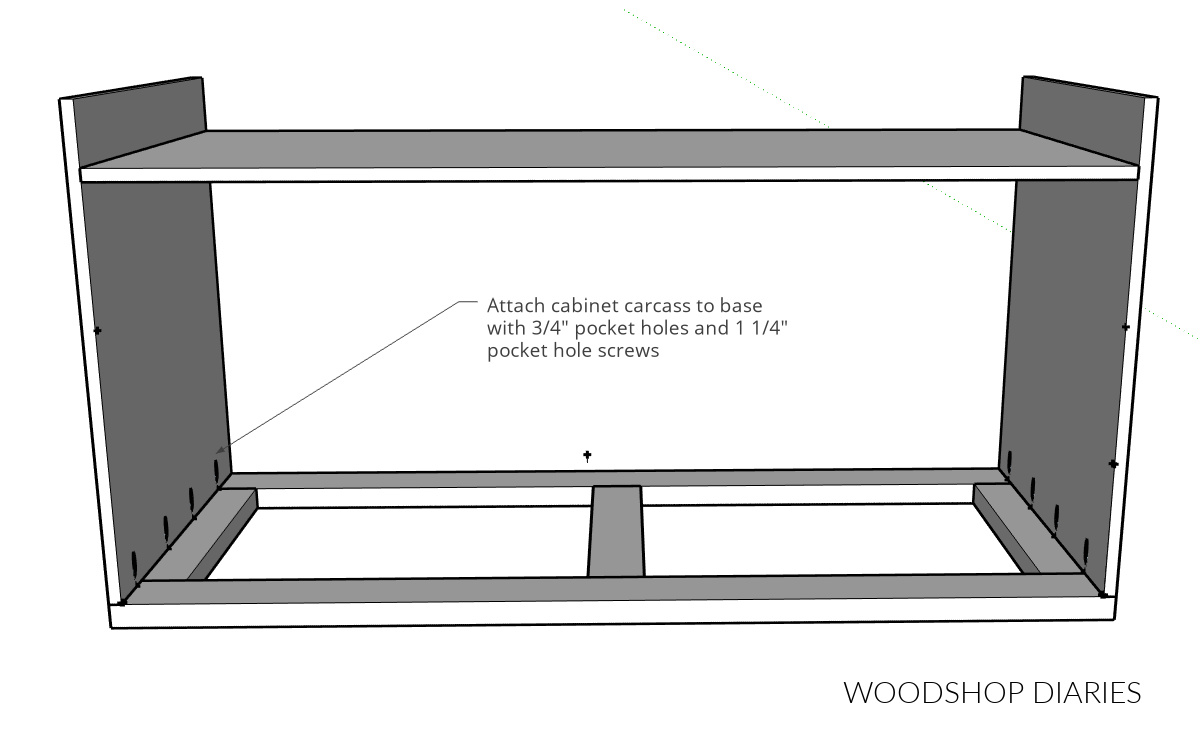
Next, I attached the saw stand carcass to the base using 1 ¼″ pocket hole screws through the side panels.

Shara Woodshop Diaries installing miter saw stand side panels to 2x4 base using pocket hole screws
Computer drawn diagram showing how to install miter saw side panels to 2x4 base

Step 6: Add Middle Divider to Miter Saw Stand

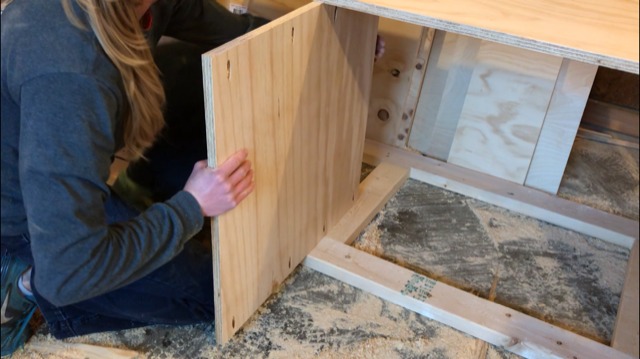
To support the long span of the top and to give me somewhere to mount drawer slides later, I added a middle divider panel.

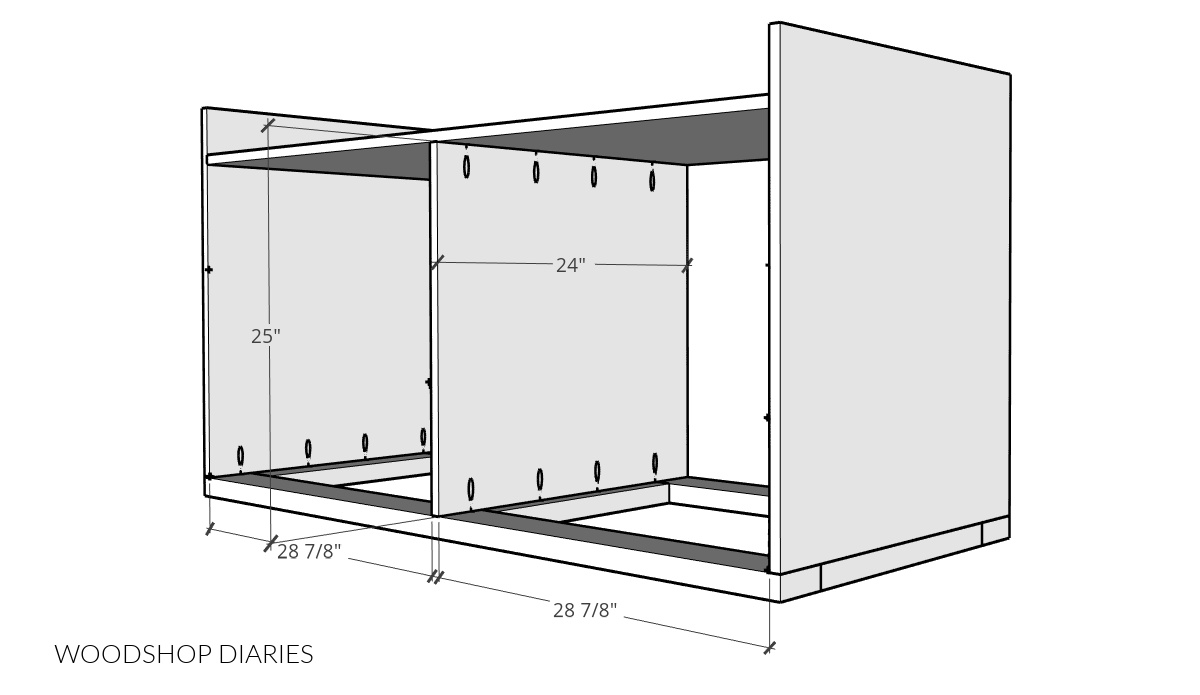
This piece was 24″ wide x 25″ tall. But depending on the height of your saw base, your panel height may vary.

Measure the distance between the top panel and the base to figure out what the length of your divider panel should be.

Shara Woodshop Diaries installing divider panel into DIY miter saw stand cabinet carcass

From this point, depending on your saw size, measurements may vary, so yours may be different than mine. 

I drilled ¾″ pocket holes into the ends of this piece and attached it at the center using 1 ¼″ pocket hole screws.

Dimensional diagram showing where and how to install divider panel using pocket holes and screws

Step 7: Attach Top “Cubbies” to Miter Saw Stand

I cut two pieces of ¾″ plywood to the height of the saw base MINUS ¾″ (the measurement from step 2) x 15″ long. In my case, these were 3 ¾″ x 15″, but you’ll need to adjust based on your own saw height.

Then, I measured the WIDTH of my saw base and placed these pieces on the top like shown so that my miter saw would fit between them with about ¼″ wiggle room.

Dimensional diagram showing where to install cubby side panels for top of miter saw stand

Again, your measurements may differ depending on your saw base size.

I used 1 ¼″ wood screws to secure these through the bottom side of the top panel like shown below.

Shara Woodshop Diaries installing cubby supports on top of mobile saw station

Before moving on, I double checked that my miter saw would fit between these pieces. Adjust as needed to ensure it fits.

Then, I cut two pieces of ¾″ plywood to fit over these outside sections to make “cubbies” and screwed them on using 1 ¼″ wood screws.

Placing plywood cubby top panels onto miter saw station
Miter saw station cabinet assembled with two cubbies at top

I placed my miter saw onto the stand and checked that the top of the base is flush to the top of the cubbies. You can use a long straight edge or level to check for gaps.

Shim and adjust as needed to make sure the saw base is level with the top, then remove the saw to continue with the build.

Step 8: Add Drawer Slides to Miter Saw Stand

The drawers are where it gets a little tricky. Because if you don’t have the same saw as I do, your measurements may vary.  However, don’t panic! It’s easy to adjust.

Check out this drawer building guide for helpful tips on measuring and determining drawer box sizing.

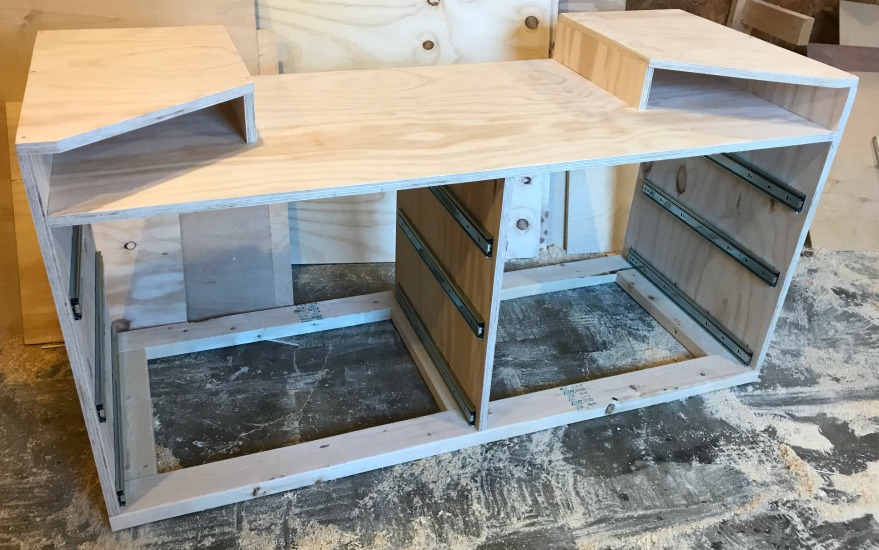
I installed 6 pair of 22″ drawer slides to fit three equally sized drawers on each side of the cabinet stand.

Drawer slides installed (6 pair) into miter saw stand cabinet

RELATED: How to measure for and install drawer slides

Step 9: Build and Install Drawers

Your drawer height may differ from mine slightly, but the overall width and depth should be the same.

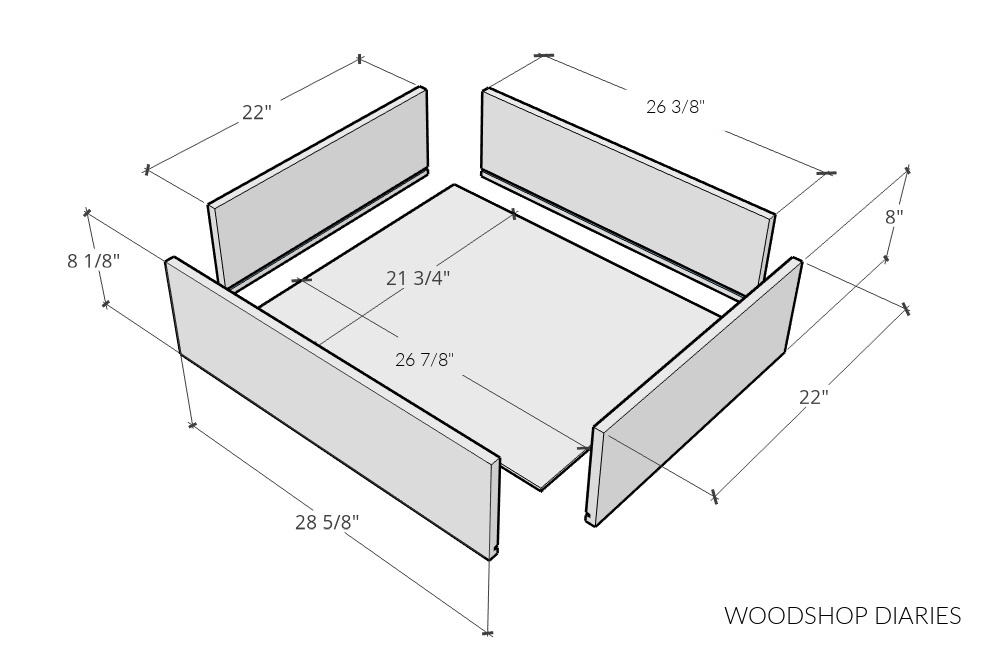
I ripped several strips of ¾″ plywood to the height I wanted my drawer boxes. I made my drawer box sides and back 8″ tall and my drawer fronts 8 ⅛″ tall.

The printable plans have the plywood cut diagrams.

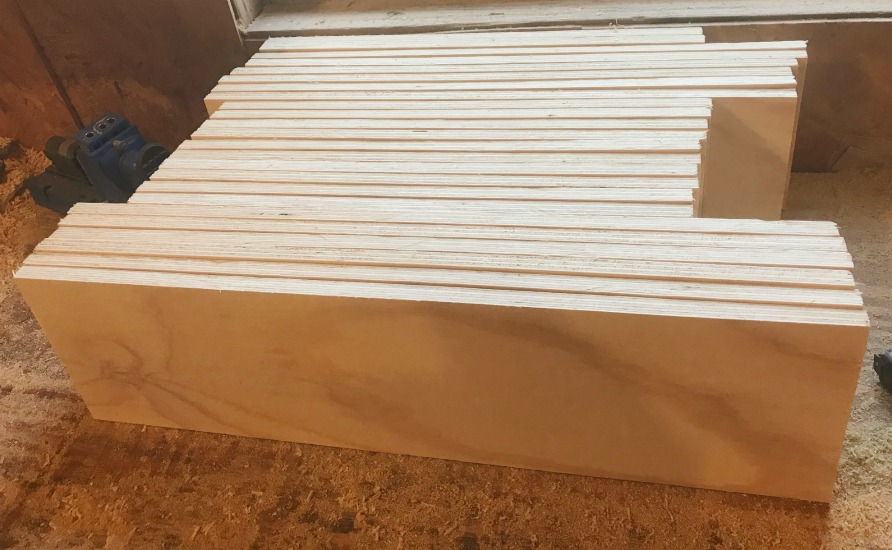
Then I cut these strips to length to make 6 drawer boxes. These lengths are:

  • (12) 22″ long pieces (drawer box sides)
  • (6) 28 ⅝″ long pieces (drawer fronts)
  • (6) 26 ⅜″ long pieces (drawer backs)
Drawer box plywood pieces cut to size laid out on workbench

Now, if you check out my drawer building guide, I usually build my drawer boxes separately from my drawer fronts. However, this method uses more lumber and is largely for cosmetic purposes.

Since this is a workshop project, I built this a little “cheaper” to save on wood. So you may notice this is a slightly different method.

To assemble these boxes, I cut ¼″ dados ¼″ deep ½″ up from the bottom edge of each drawer box piece. This allows me to install the ¼″ plywood bottom.

exploded dimensional diagram of drawer box

NOTE: You can skip the dados and just staple the plywood onto the bottom of the boxes if you want, but I just like cutting dados.

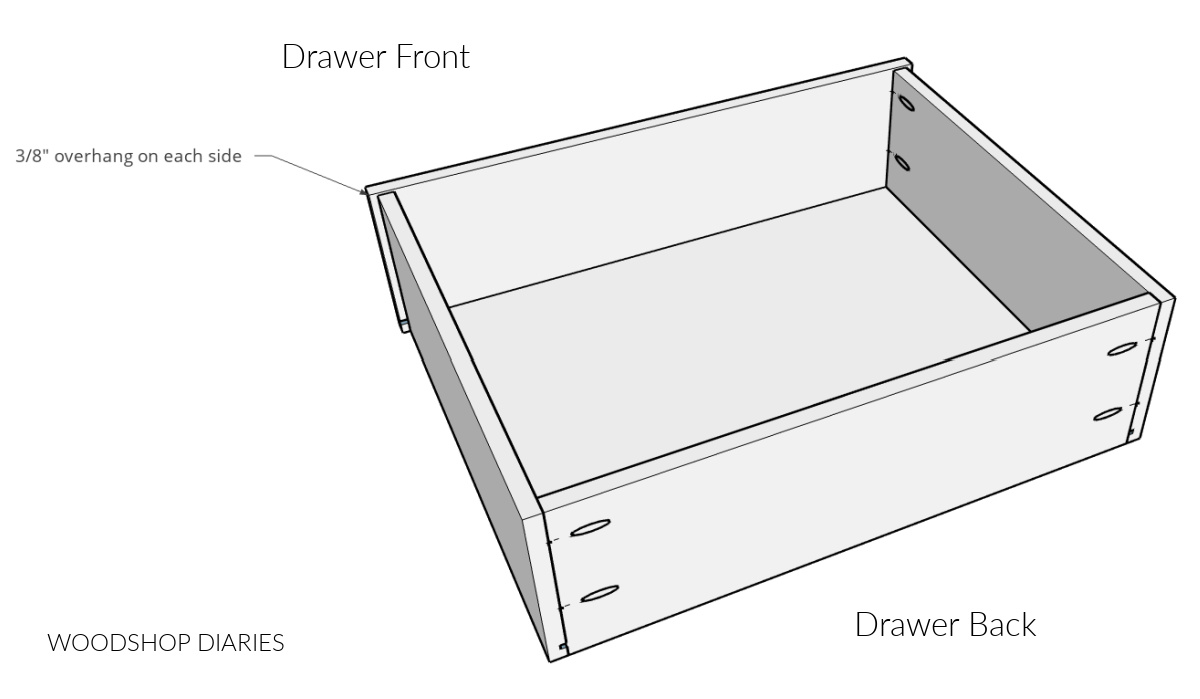
I drilled ¾″ pocket holes into both ends of the drawer back piece and into the FRONT ends of the drawer box sides.

Then, I screwed the six drawer boxes together using 1 ¼″ pocket hole screws. Note that the sides screw directly to the front, leaving ⅜″ overhang on each side.

drawer box assembled computer drawn diagram

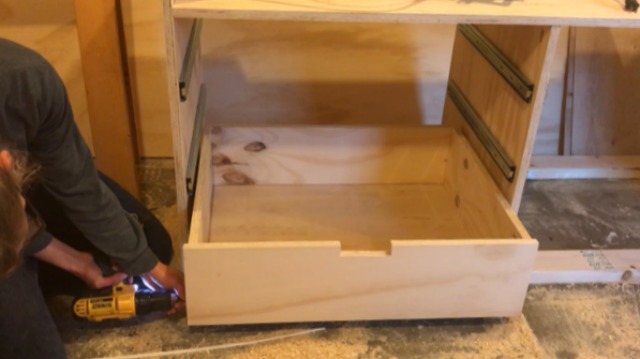
Instead of adding handles, I used a jig saw to simply notch out a section of the top of each drawer front to be able to open them. This is optional, but I found it easiest to do before installing them.

I installed the drawers into the drawer slides in the stand making sure to keep approximately ⅛″ gap around all sides of the drawer fronts.

RELATED: How to install drawer boxes

Shara Woodshop Diaries installing drawer boxes into miter saw stand

Step 10: Add Caster Wheels to Saw Stand

I flipped the miter saw stand on its back and installed 4 heavy duty caster wheels–one on each corner.

If you wanted, you could also add two more to the center–one at the front and one at the back–to prevent sagging over time. I didn’t in this case.

I recommend using casters that swivel and that lock so that you can easily roll the cart around and lock it in place when you’re ready to cut.

Shara Woodshop Diaries installing caster wheels onto saw station base frame

Then I CAREFULLY flipped the cart back over once the wheels were secured.

Step 11: Cut and Attach Side Support Wings

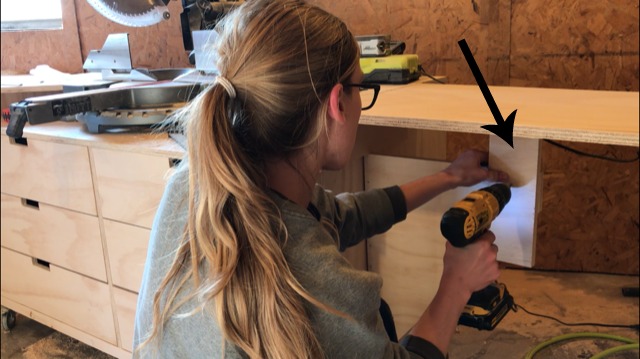
To allow the extension wings of the cart to fold up and down properly, I needed to add a spacer block to the sides.

So I cut and attached a piece of ¾″ plywood cut to 3 ½″ x 16″ on each side of the stand using 1 ¼″ wood screws.

These should be flush to the front and ¾″ DOWN from the top.

Close up installing spacer blocks to side panels of miter saw stand

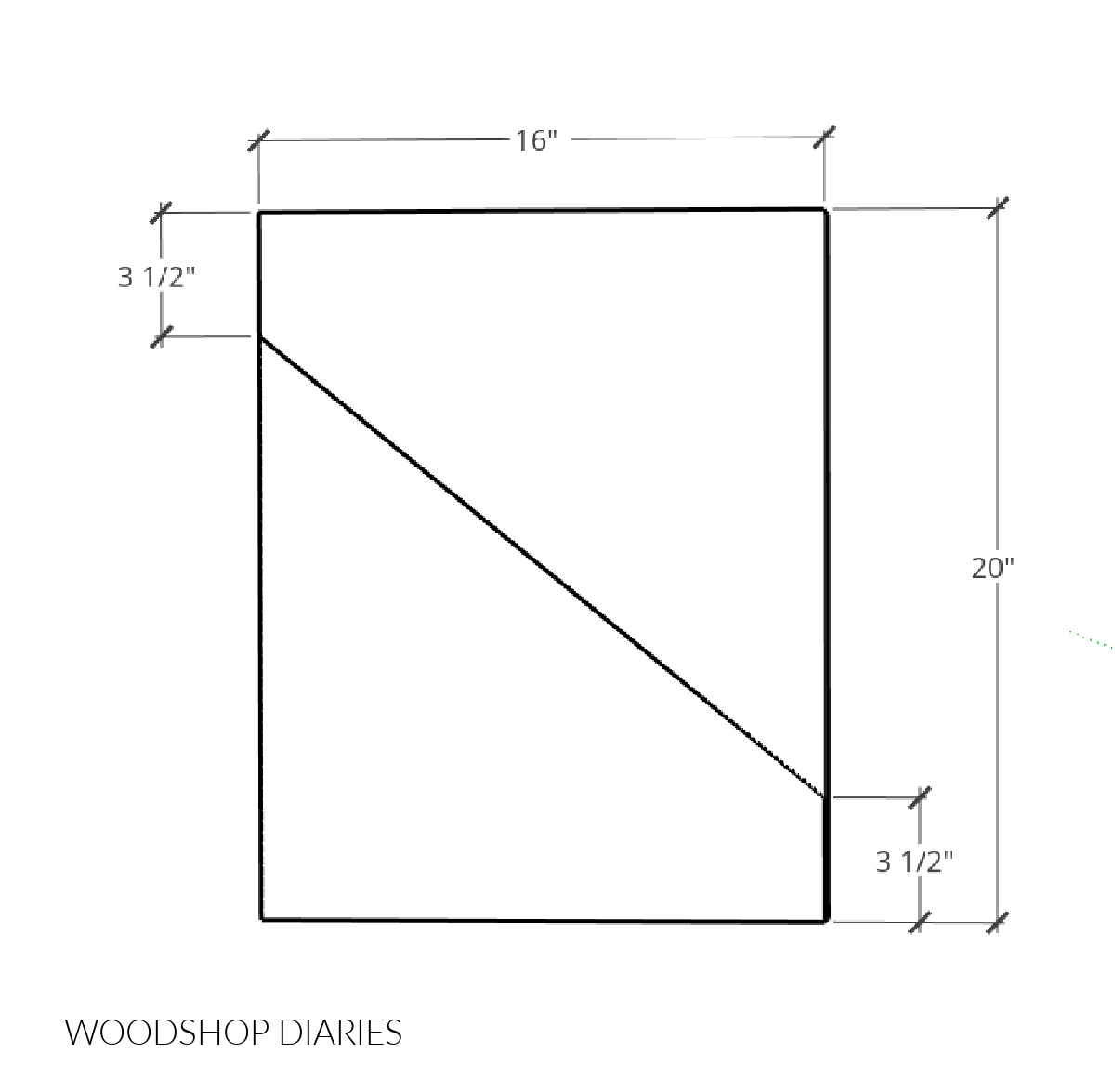
Then, I cut a piece of ¾″ plywood to 16″ x 20″ and used a jig saw to cut a diagonal like shown to give me two supports for each side of the miter saw stand.

Dimensional diagram of side wing supports

I used piano hinges to install these so they could rotate and “swing” in and out as needed.

So, I screwed a 12″ piano hinge (also called continuous hinge) onto the long ends of each support wing like shown.

installing piano or continuous hinges onto side wing supports

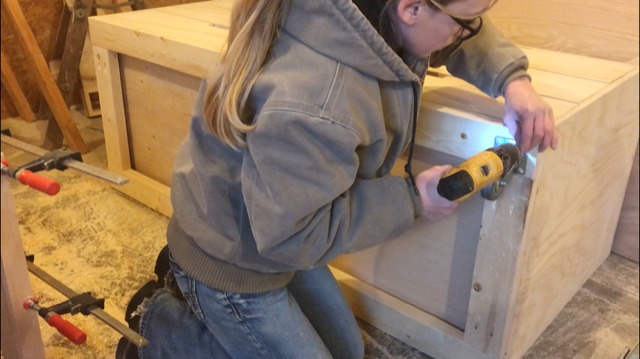
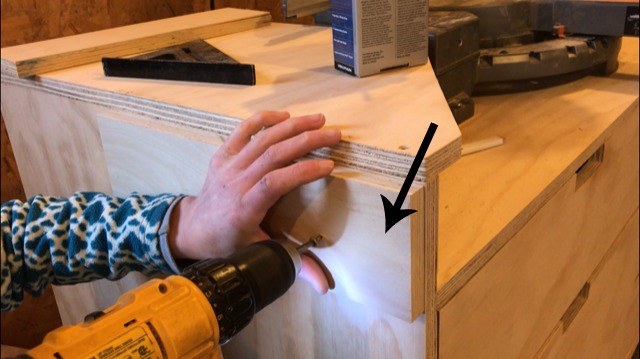
Then, I secured the other side of the hinge onto the cabinet. One support wing will mount to EACH side of the miter saw stand.

Note that the supports should be installed about 16″ from the back edge of the cabinet and approximately ⅛″ down from the spacer block.

Installing the foldable wing supports onto side of miter saw stand

Step 12:  Attach Side Extension Wings to Saw Stand

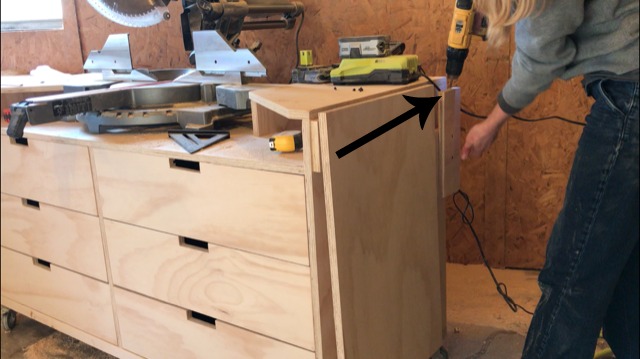
Then, I attached two more 12″ continuous hinges to the spacer blocks on the sides. These will be for the actual extension wings.

Shara Woodshop Diaries installing piano hinge to spacer block

I cut two extension wings from ¾″ plywood to 16″ x 30″ and secured these to the other side of the hinge.

It helps to have an extra set of hands here, or you can just balance it on your head while you screw it in place haha.

Shara Woodshop Diaries installing foldable wings onto miter saw stand through piano hinges

You may notice that at this point the supports aren’t really “supporting” the wings yet.

So I added another piece to each support. These are simply pieces of ¾″ plywood that run from the supports up to the wings.

HOWEVER, to allow room for adjustments, I installed this so that when the wings rested on it, they slanted down slightly.

Shara Woodshop Diaries installing adjustable brace onto side wing supports

That way, I could install a screw into the top of this piece and use it to get my wings perfectly level.

Installing screw into adjustment block

Step 13: Level Foldable Extension Wings

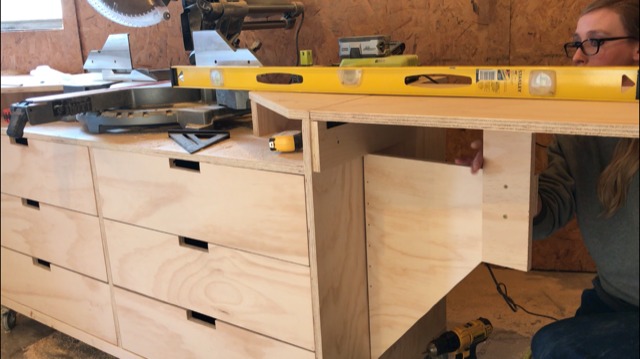
You want to make sure that everything is nice and level before cutting anything for safer and more accurate cuts.

So I placed my saw into the stand and extended the wings on each side.

I used a long straight edge across the saw base and onto the wings to check for high or low spots.

Shara Woodshop Diaries using a level to adjust foldable wings to make sure they are flat

Adjust the screw in the support wing to raise/lower the wing as needed. Back the screw out to raise the wing. Drive the screw in a little further to lower the wing.

Shim up the saw, the cubby top and the wings as needed to get everything nice and flat.

Step 14: Secure Miter Saw To Stand

I secured my saw to the stand using a few screws (see manufacturer’s instructions for how to secure your saw base) to make sure it doesn’t move and then it was ready to get building!

DIY mobile miter saw stand with folding wings and storage drawers in workshop

If you want to add a long fence, stop blocks, or additional accessories, go ahead! Feel free to customize however you’d like.

Miter saw mounted to mobile saw stand with 6 drawers and expanding wings

Looking for more workshop projects?

If you enjoyed this project and are looking for more workshop projects and ideas, here are a few favorites from my own shop!

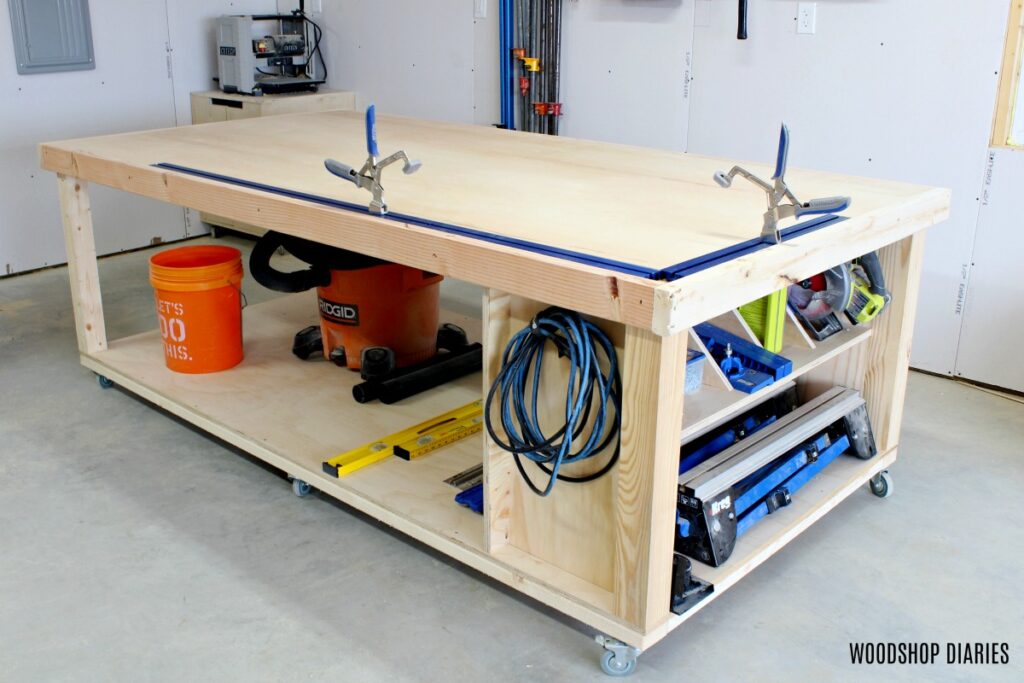
Mobile Workbench
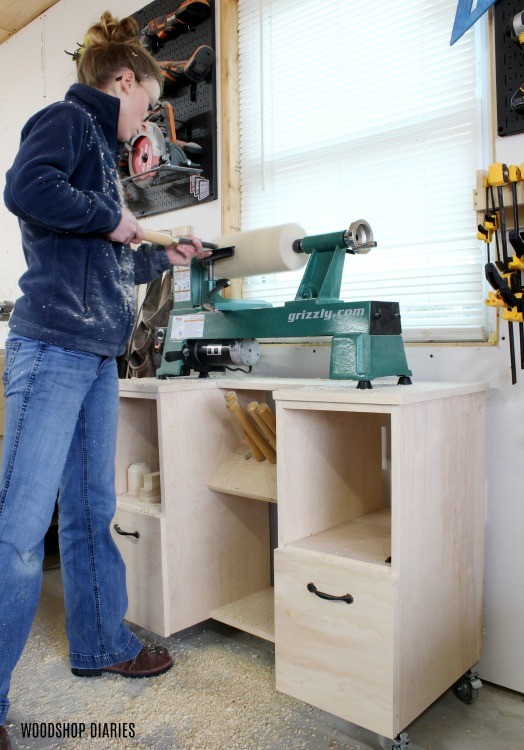
Mobile Lathe Stand
How to Build a DIY Rolling Scrap Wood Cart
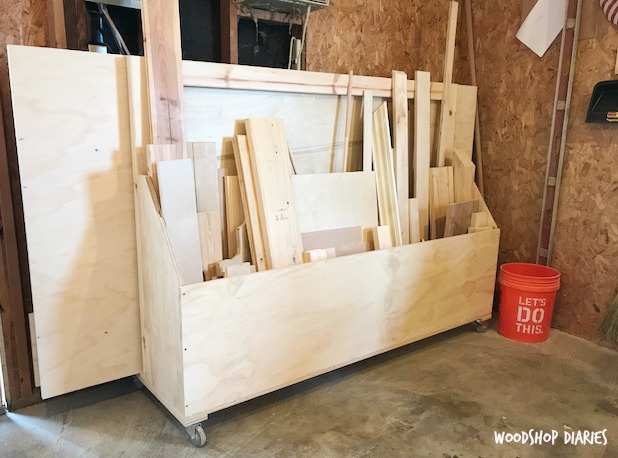
Scrap and Plywood Storage Cart
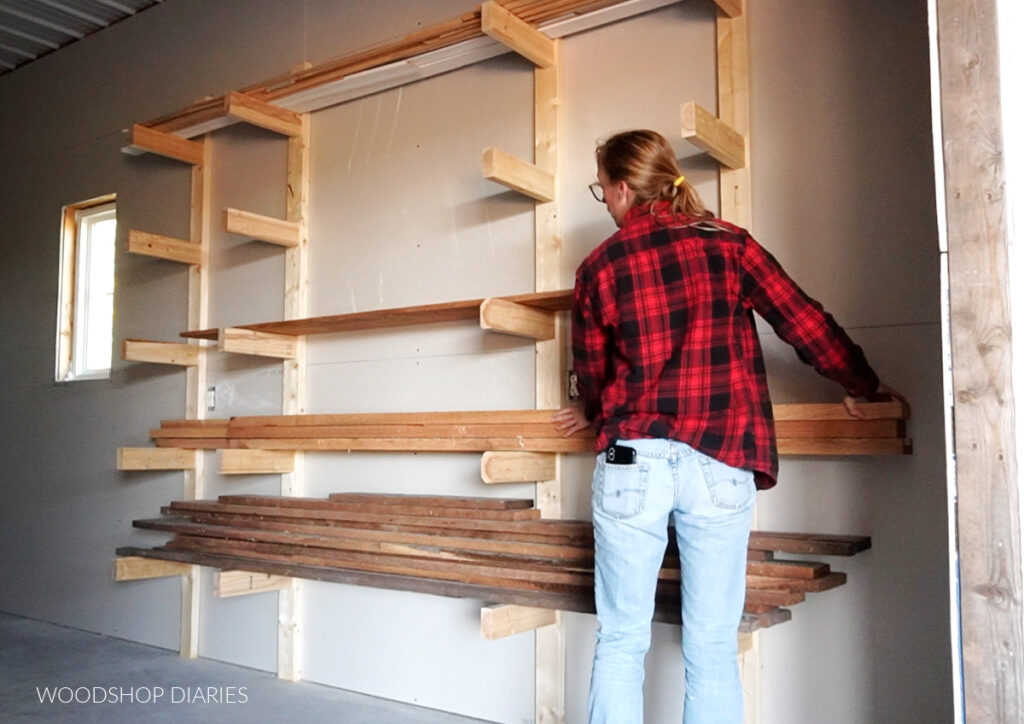
EASY DIY Lumber Rack
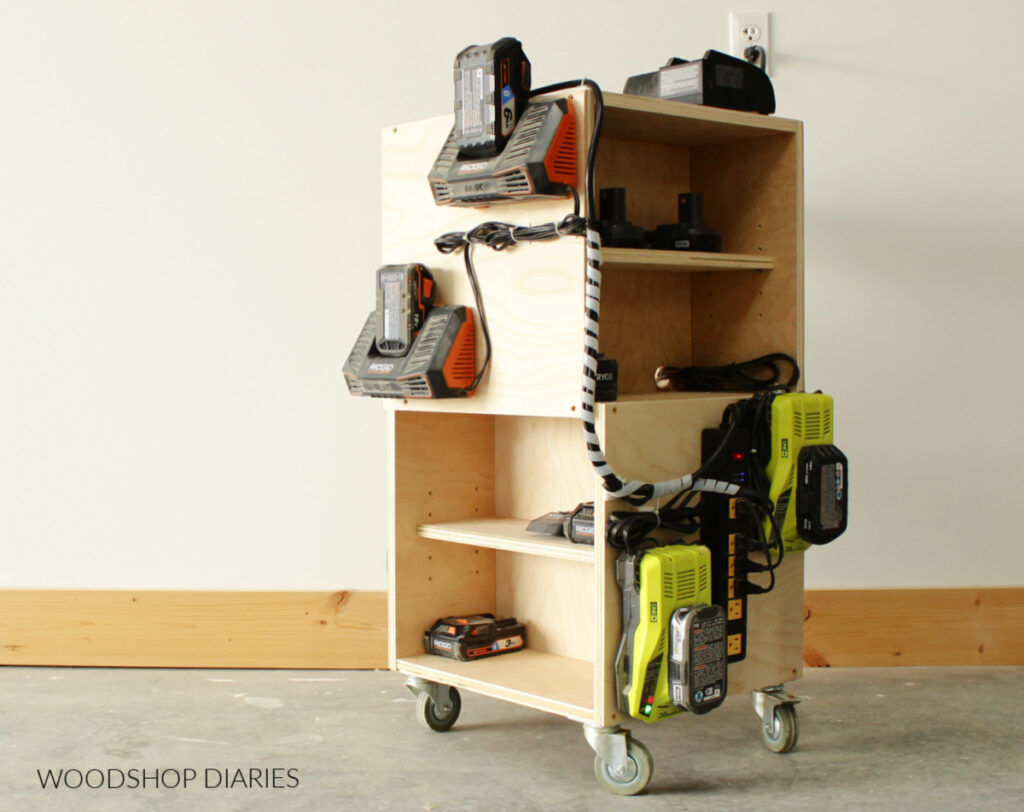
Battery Charging Station
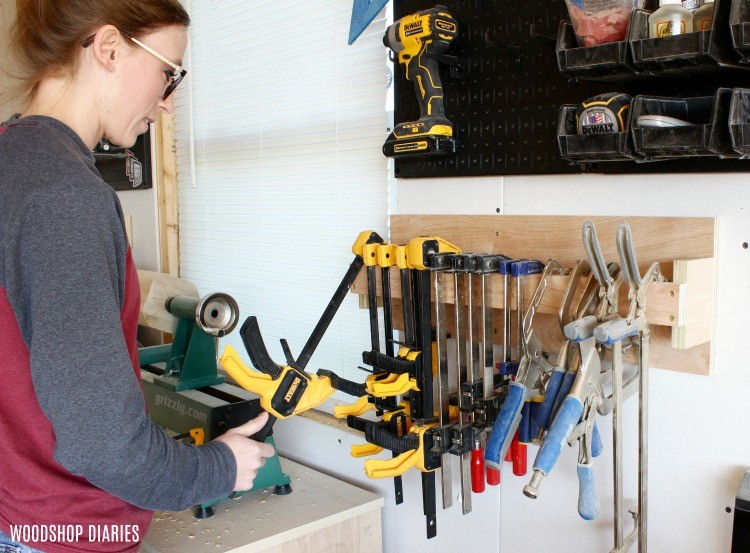
Scrap Wood Clamp Rack

If you want to follow along for more projects and plans, join the newsletter for priority access to all the latest posts and videos!

Be sure to save this for later by pinning it or sharing to your favorite social channel!

Mobile miter saw stand in workshop with text overlay: how to build a mobile miter saw stand with fold down extending wings

Until next time, happy building 🙂
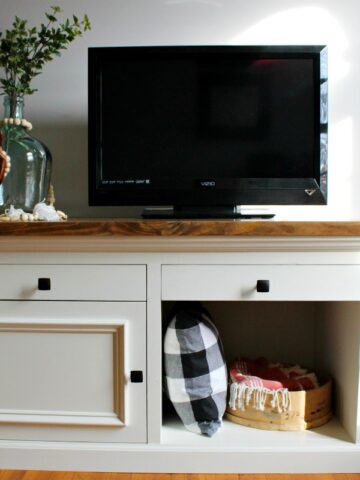
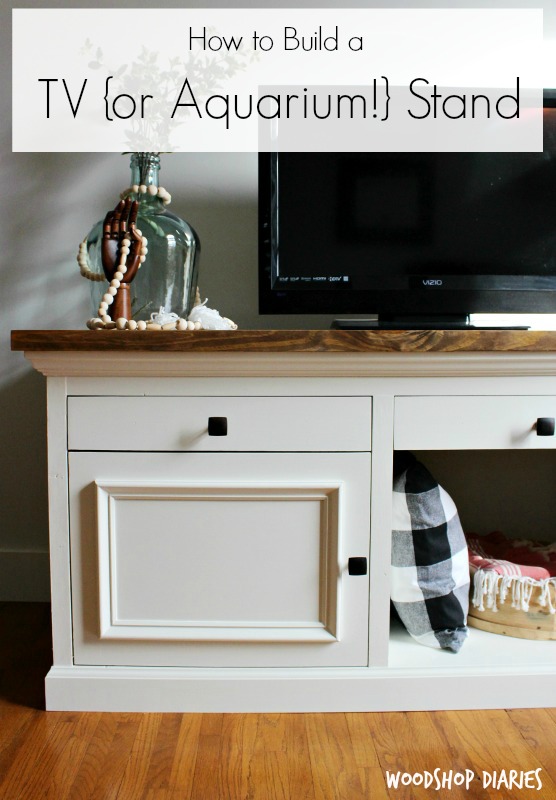
How to Build a TV {or Aquarium!} Stand

February 19, 2018 by Shara, Woodshop Diaries

How to build a STURDY TV stand that could be used for an aquarium stand, console cabinet, desk, nightstand, etc. It's pretty either way!

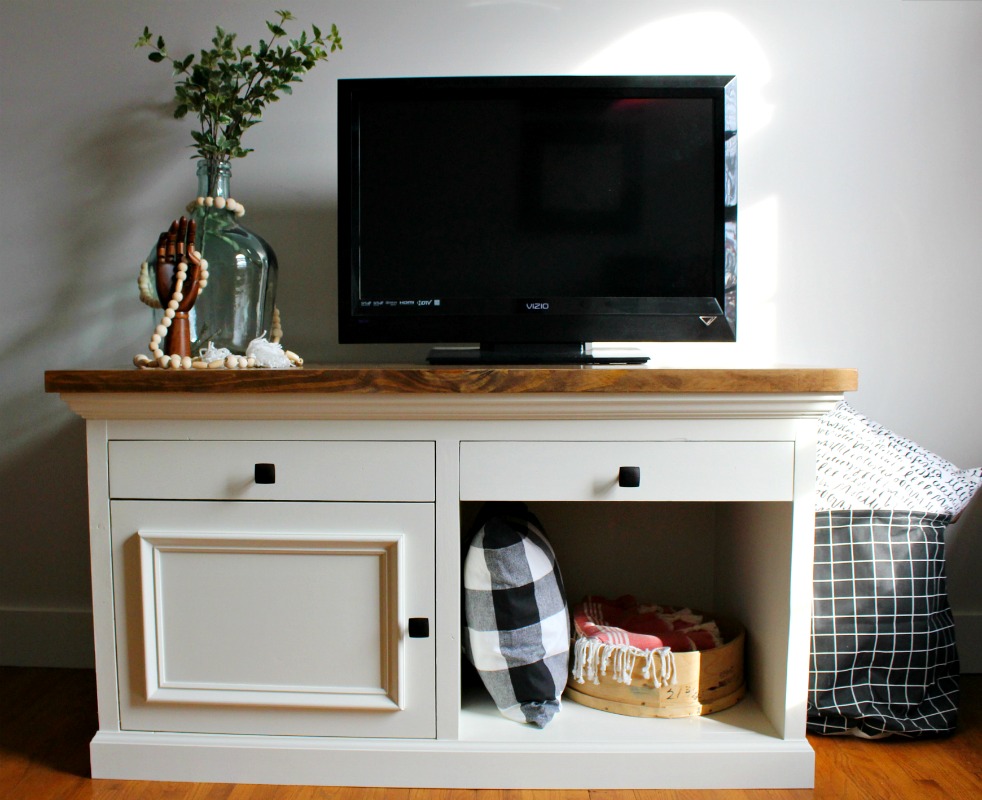
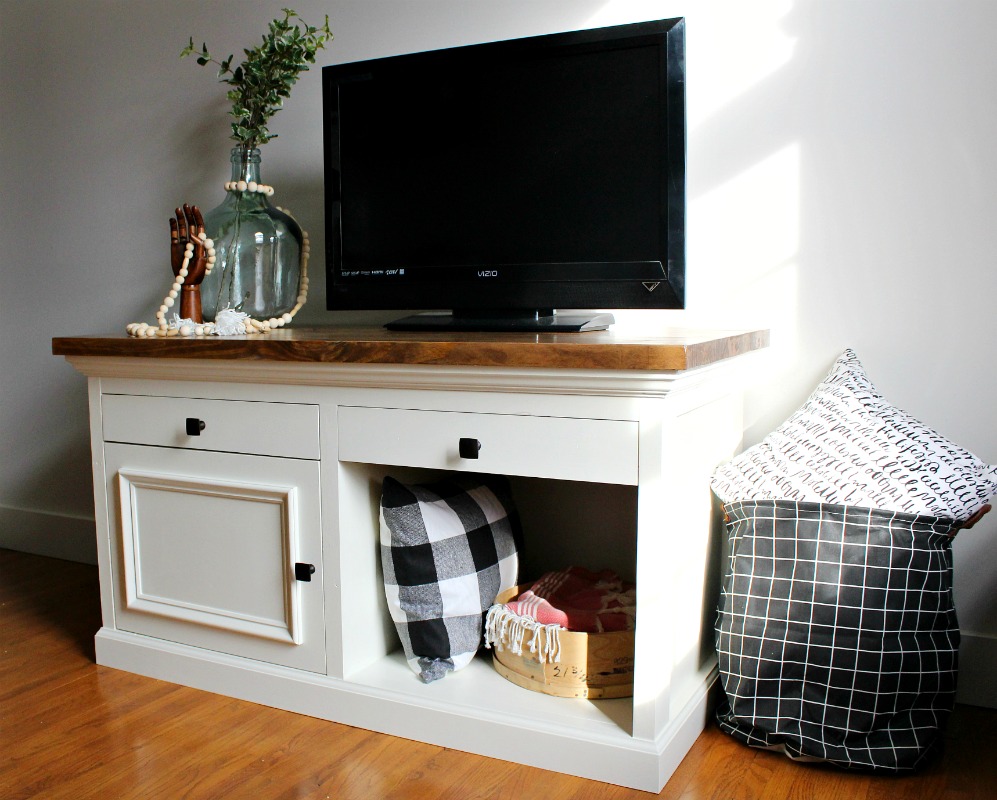
It’s a TV cabinet, it’s an aquarium stand, it’s a console cabinet.  It’s…whatever you want to use it for??  It’s actually–in real life–a nightstand that I made for my brother in law who wants to put an 60 gallon aquarium on it.  But, I thought it looked best in my pictures staged as a DIY TV stand….so let’s just go with that.  But hey, nightstand, console cabinet, desk…it all looks good 😉  I’m not going to tell you how you have to use it.  You do you, boo 🙂

How to build a DIY TV Cabinet Stand that's sturdy enough for an aquarium stand! Free Woodworking plans and video tutorial

This post is sponsored by Build Something.  Build Something is Kreg Tools website for free building plans from small to large project types.  They’ve got hundreds of free plans posted for you to build something for every room inside (and outside) your home.

.

If you remember from not so long ago, I recently built a DIY media console and a DIY aquarium stand.  So I felt a little redundant building another one…of both…kind of.  But this design is totally different and trust me when I say it’s STURDY.  It’s designed to hold well over 500 lbs of aquarium!

How to build a STURDY TV stand that could be used for an aquarium stand, console cabinet, desk, nightstand, etc. It's pretty either way!

It’s made from mostly 2xs and hardwood plywood.  If you’ve shopped around for 2x construction material, you know that usually it’s not that pretty.  But, it’s strong.  So since 2x material is a necessary evil when you want strong DIY furniture, you CAN do a few things to make it look nice.  So, before you get building, be sure to check out this post where I show you how to get your 2x material to look a little nicer and come out a little cleaner. 

.

Then, while you’re at it, check out this bar cart made from a single 2×10 board--it’ll prove to you that furniture made from construction lumber really CAN be pretty 😉

DIY TV Stand that's strong enough to hold an aquarium! Sturdy and stylish, this DIY tutorial will show you how to build your own. Grab the free woodworking plans here

Of course, this project proves that, too.  I love the option of drawers, cabinet or open storage all in one piece.  It’s kind of like the combination storage cabinet I built a while back.  Or the modern dresser armoire…or the faux drawer dresser.  Now that I think about it, I really, really like pieces with versatile storage options haha.

How to Build a Combination Storage Cabinet TV Stand

Anyway, back to  the cabinet…I’ve got the free plans for you over on Build Something so be sure to click over to grab those, but I’ve also got the video tutorial posted on YouTube and I’d love it so much if you’d check that out.  I’m really working hard to make some videos for my channel lately and I’d love it if you’d subscribe!

I’ve made it a goal of mine to grow my YouTube channel this year and add at least one video per month.  I’ve got several in the works, so stay tuned!

.

This post contains affiliate links.  See disclosure policy for details.

How to Build a DIY TV Cabinet--Free Woodworking Plans and Tutorial

As usual, I used a few tools in this build that came in quite handy that I highly recommend having around in your shop.  These are:

Kreg Pocket Hole Jig

Kreg AccuCut

Kreg RipCut

Kreg Concealed Hinge Jig

Circular Saw

Miter Saw

Drill

.

You could build this entire cabinet with only these tools.  Of course, a table saw is handy, but a circular saw will do the trick for a fraction of the cost.

.

Cutting down 4×8 sheets of plywood is hard for a scrawny girl like me.  I can barely even reach each edge across the 4 ft span.  There’s no way I could run a full sheet through the table saw by myself.  The Kreg RipCut makes this job so much easier.  And, now that I have the AccuCut, too, I think the AccuCut and my circular saw are the most used tools in my shop!  It’s SO easy to use, accurate, and fast.  You may have seen me using this on Instagram and in my last YouTube video for the mobile tool cart.  It takes seconds to get a straight, clean cut on plywood.

.

Of course, the Kreg Pocket Hole Jig makes building so quick and easy and is great for DIYers, weekend woodworkers, and beginners.  There are more advanced methods of joinery, but for those without fancy tools, who just want a fun, quick project or who are just learning how to build you can’t beat the pocket hole jig.

.

And, as I’ve told you before, now that I’ve used concealed hinges on my doors, I will never go back to any other kind of hinge.  These things are AWESOME.  The only drawback is that you have to drill out a “cup” to place your hinge.  But the Kreg Concealed Hinge Jig is made specifically for this task and is SO easy to use.  You just line it up, clamp in place, and drill.  You can see this done in the video above.  Concealed hinges make adjusting and aligning your doors a breeze!

How to Build an Easy DIY TV Stand--makes a great aquarium stand, nightstand, console cabinet, entryway table, etc. Free woodworking plans and video tutorial

People always ask me what tools I recommend to get started woodworking.  The tools listed above are PERFECT for getting started.

.

So head on over to Build Something and grab the free plans, and be sure to check out the video tutorial as well.

.

Until next time, happy building! 🙂

DIY Simple Side Table

February 12, 2018 by Shara, Woodshop Diaries

How to Build a Simple X base side table

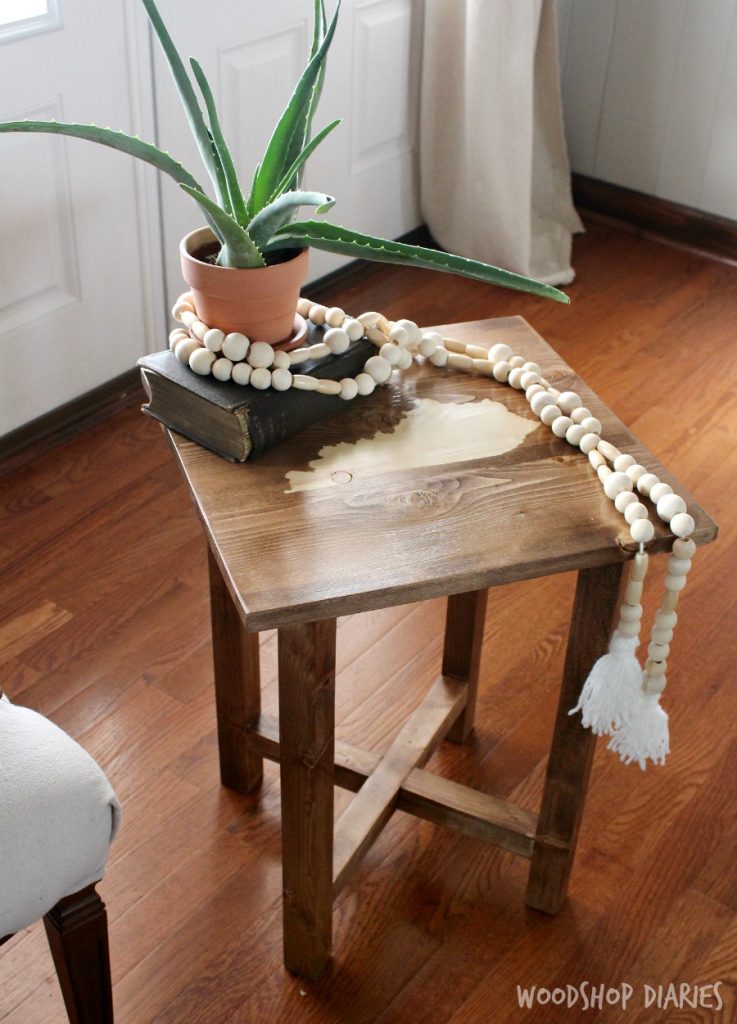
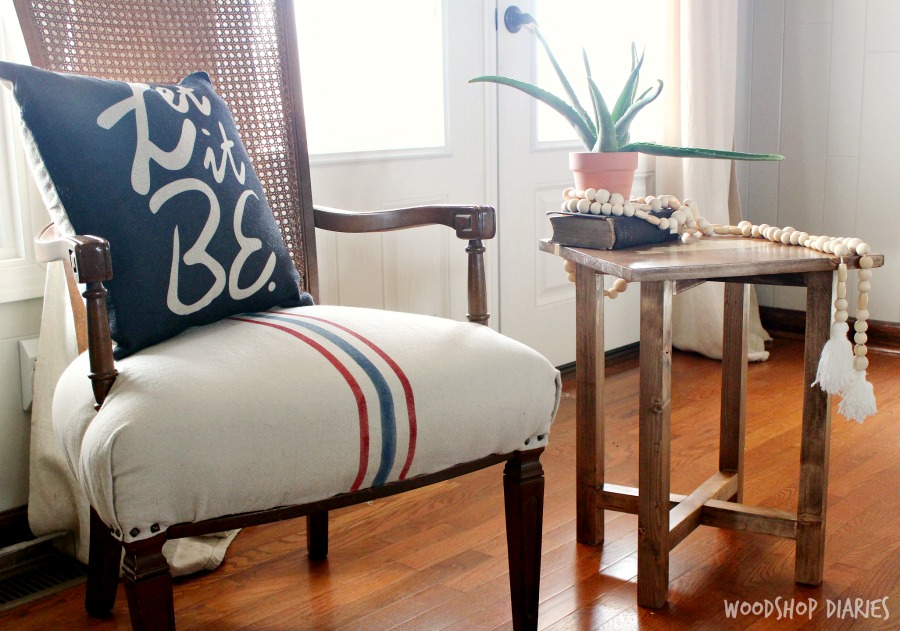
I know I keep saying this, but I’m still thinking/feeling it.  This year, I just haven’t been off to a great, productive start.  Lots of good things have happened, and I’ve got lots of to dos on my list that I’m excited about, but I’m just kind of stuck in a slump.  Sometimes when you get stuck building big, time consuming projects, it’s nice to take a break and make something quick and easy…like this simple little side table.

How to build a simple little side table from a few boards and with a few simple tools.

You can make it from just a couple boards and a few tools that you probably already have on hand.

.

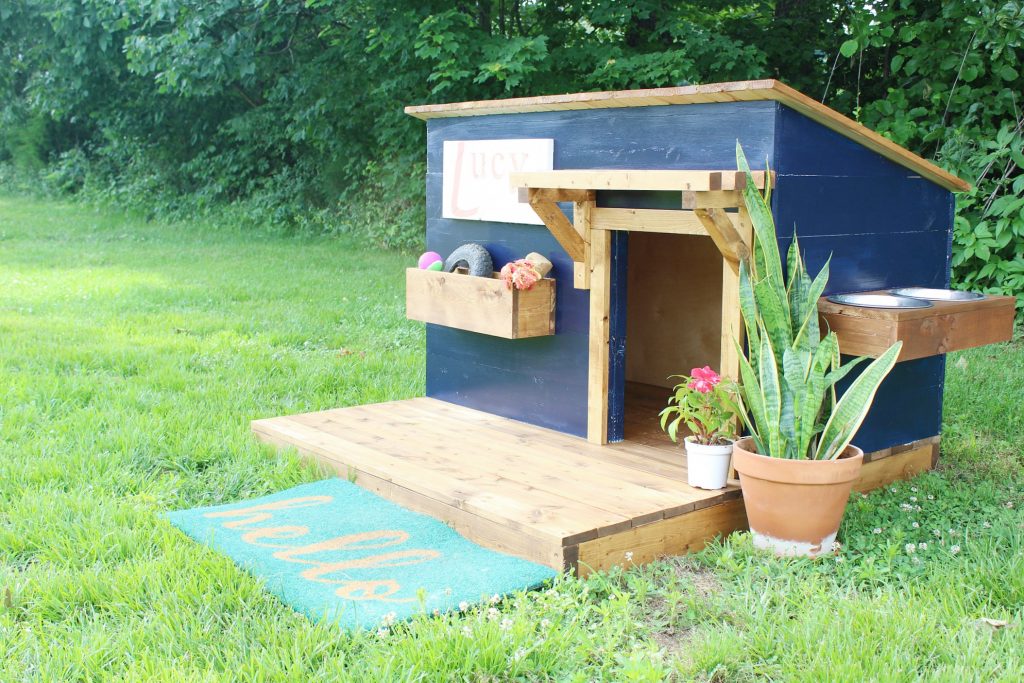
I’ve got the how to for you over at The House of Wood…which if you didn’t already know, that’s Jen Woodhouse’s blog.  If you remember, way back last summer, I collaborated with Jen to build our new dog, Lucy, a fancy new dog house.  She drew the plans, and I built the house and created the video tutorial.  She is super talented and I’m so excited to be a new contributor to her blog!

.

So I’d love it if you’d click over and check out this side table project I’ve posted over there!!

How to Build a Simple X base side table

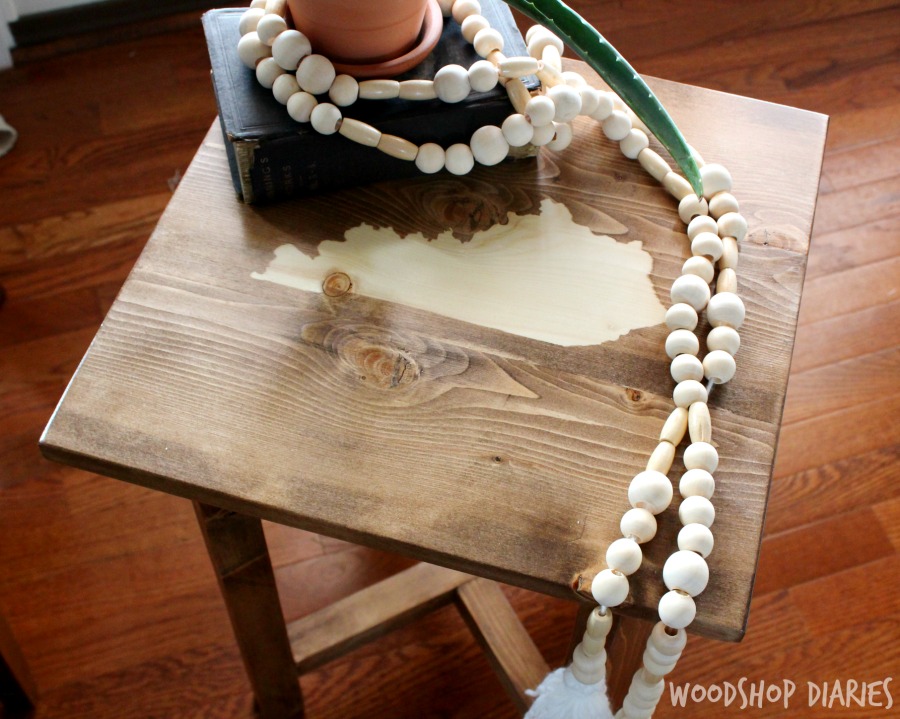
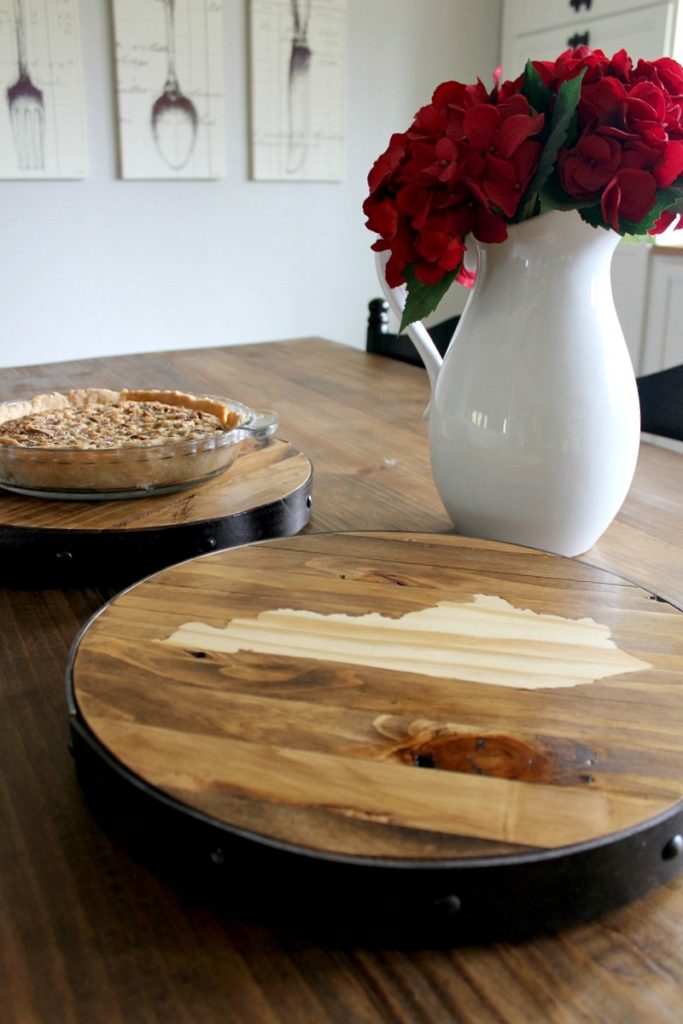
If you like the personalization that I did on the top, I did this the same way I did my Kentucky lazy Susan’s last year.  That was one of my favorite projects!

.

So anyway, if you are in a bit of a slump too (and I hear from several sources that that is common this time of the year, so I’m making bets you may be in the same boat with me), and you are looking for something small, quick and easy to build so you can check something off your to do list, or just feel like you’ve accomplished something (speaking to myself here!), this is a great option.  But, I’ve also got some other quick, easy builds to help get your motivated and out of that rut.

.

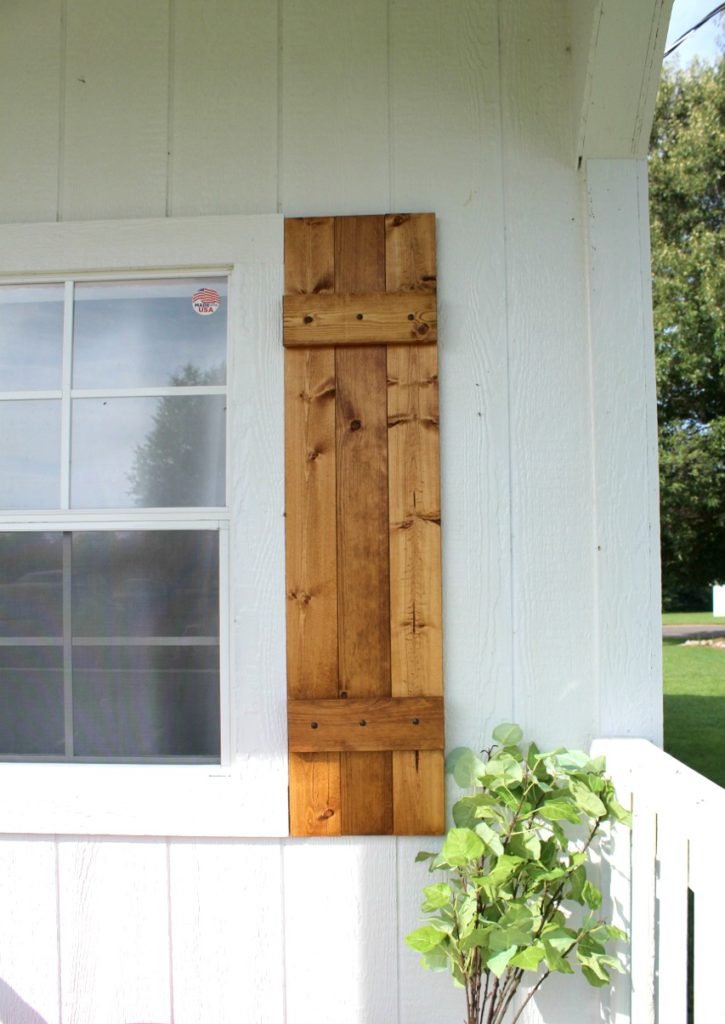
These easy DIY wooden shutters are SO easy to build and you don’t even have to use them outside!  You can hang them on your wall for decoration!

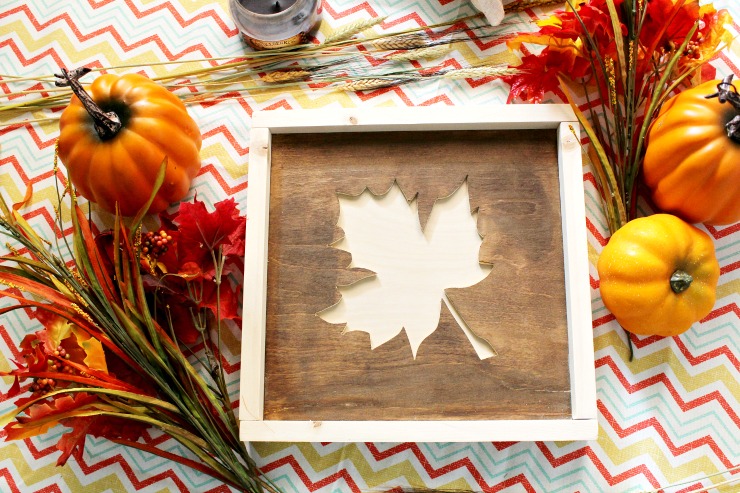
I know it’s not even close to fall or Christmas, but you can use your imagination and do hearts for valentines day, or a flower for spring, or even an egg or cross for Easter on these cute wooden signs.  They are SO easy to make and you can customize any shape inside that you want.

Super easy DIY fall leaf sign from wood scraps

Or, even this little keepsake box made from scraps.  You can have this made in just a few minutes!

How to Make an Easy DIY Scrap Wood Keepsake Box


But, if you aren’t in a slump and you are ready for more builds, don’t worry…there are PLENTY in the works including a super sturdy TV stand, a king size storage bed, bookshelves, and more.  It’s going to be another busy year and I’m so glad you are following along on all these adventures!

.

Don’t forget to click over to Jen’s blog for the tutorial for this simple side table!  Oh, and to pin this for later! Until next time, happy building! 🙂

How to build a simple DIY side table


How to Build Floating Shelves

February 5, 2018 by Shara, Woodshop Diaries

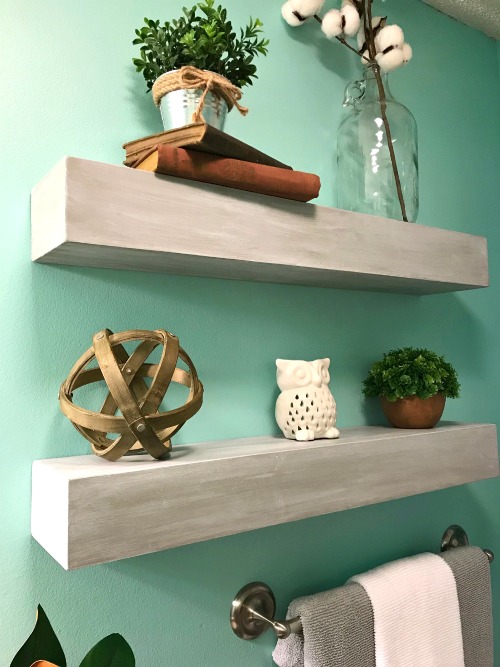
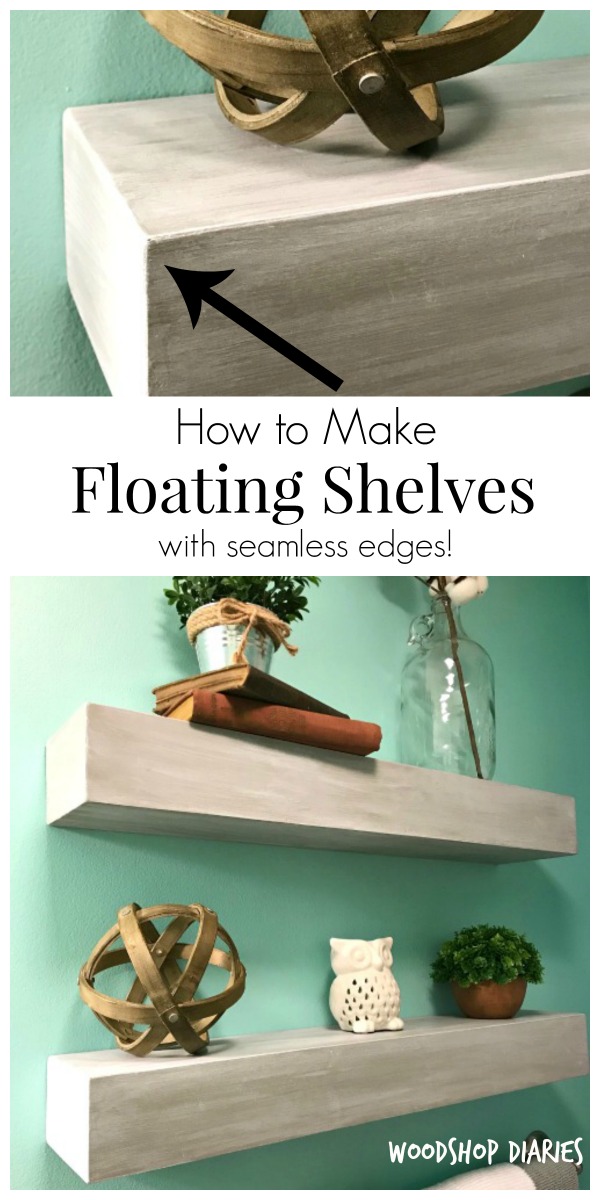
How to make seamless DIY floating shelves! Great for a bathroom!

In this post, I’ll show you how to build your own floating shelves!

How to make seamless DIY floating shelves! Great for a bathroom!

DIY floating shelf tutorials are nothing new.  By now, you’ve probably read a million of them….mostly the same thing, maybe just with varying board sizes.  But what about SEAMLESS floating shelves?

.

I am hoping to take it up a notch and show you a way of making them that looks a little more professional and gets you thinking a little more outside the box. 

.

I think this way of making floating shelves just looks a little more professional and looks like you are hanging one solid piece of wood on the wall instead of a hollow box…even though it is, actually, a hollow box 🙂 

.

So if you want to take your DIY floating shelf game up a notch, let’s get building.

RELATED: Looking for corner floating shelves? Check out this creative way to make them!

.

This post contains affiliate links.  Please see disclosure policy for details.

To Build DIY Floating Shelves, you will need:

  • 1×6 boards (length based on your shelf size)
  • 1×4 boards (length based on your shelf size)
  • 2×2 boards (length based on your shelf size)
  • Drill
  • Miter Saw
  • Table Saw
  • Nail Gun
  • Orbital Sander
  • Wood Glue
  • 1 ¼″ Brad nails
  • 2 ½″ wood screws
  • Clamps
  • Wood Putty

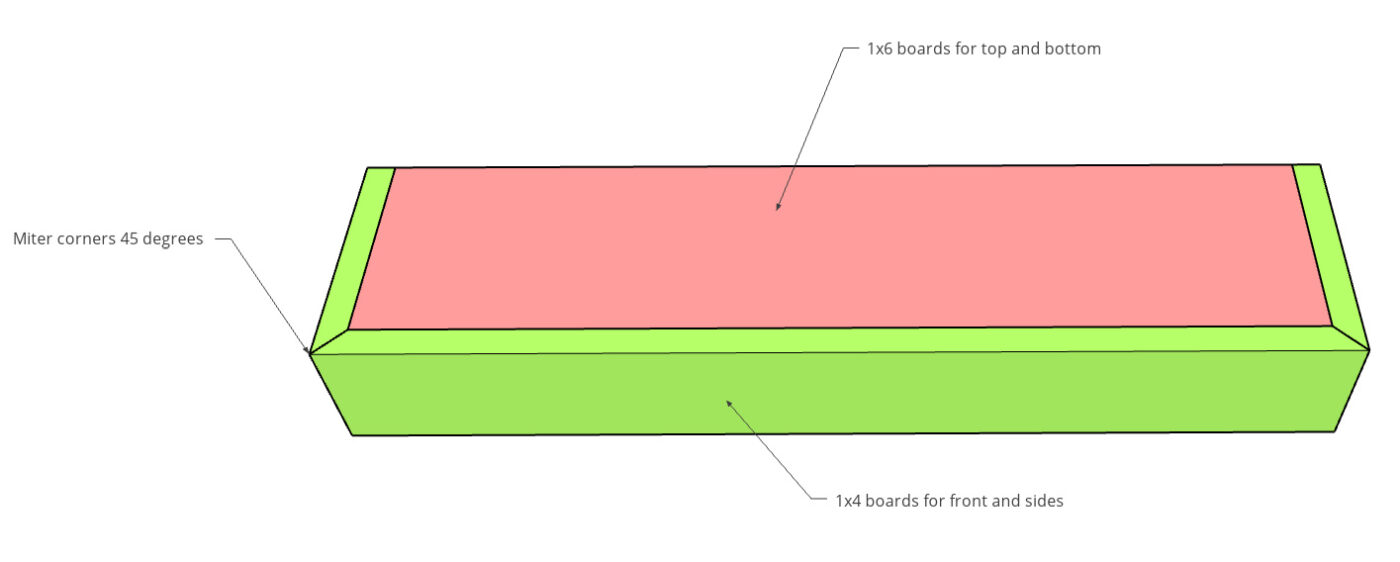
TAKE NOTE: This tutorial is basically building hollow shelf boxes to fit over supports that will hang them on the wall. I’ll show you two different ways to build these hollow boxes–one with and one without a table saw.

Step 1: Bevel Top and Bottom Shelf Board Edges

I used a table saw for step 1 & 2–BUT, if you don’t have a table saw, don’t check out yet! You can skip these steps and still get some really nice results. Head to step 3 and I’ll show you.

.

First, I determined the length I wanted my shelves and cut a piece of 1×6 to 3-4″ more than twice that length. So, for example, if I wanted 24″ shelves, I cut a piece about 52″ long (24 + 24 + 4 = 52).

.

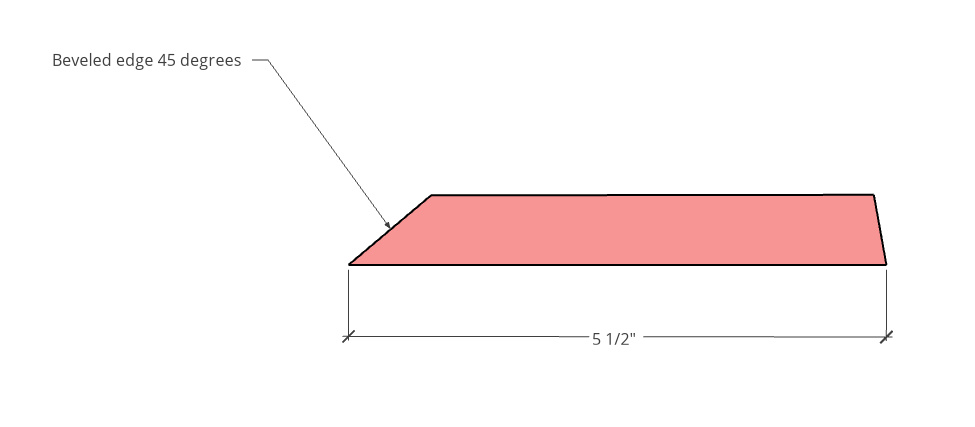
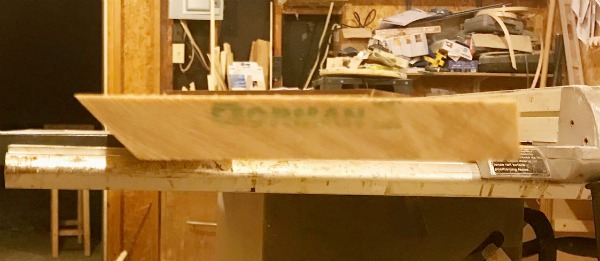
Then, I beveled one edge of that board 45 degrees.

Diagram of top and bottom shelf pieces with one beveled edge

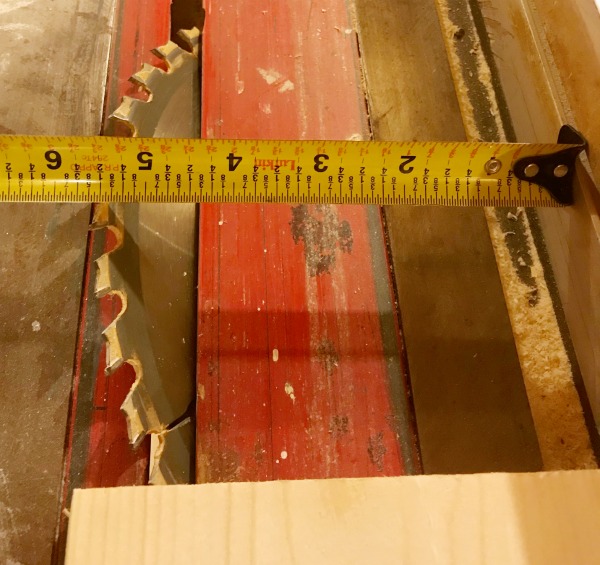
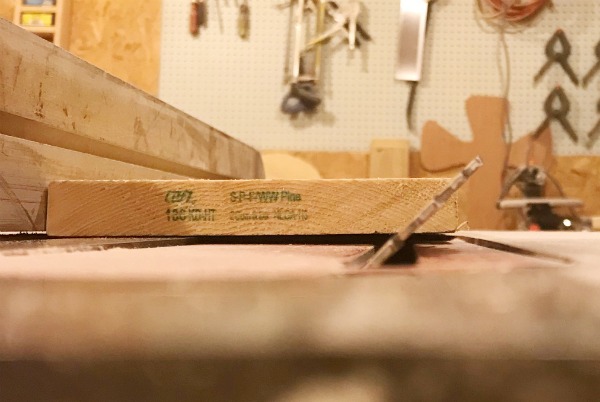
For this project, I used 1×6 boards.  If you want deeper shelves, you can use wider boards.  But since I used 1x6s (which are actually only 5 ½″ wide), I tilted my table saw blade 45 degrees and adjusted the rip fence about 5 ½″ from the tilted tip of the blade. 

Bevel table saw blade to miter corners of seamless shelf boards

You just want to barely cut off the corner, but not take off much width.

Adjust table saw rip fence to cut seamless floating shelves boards

I ran the board through to get one beveled edge. This will be the shelf top and bottom pieces. I set this aside for now.

Mitered edges of seamless floating shelf box boards

Step 2: Bevel Front and Side Edges

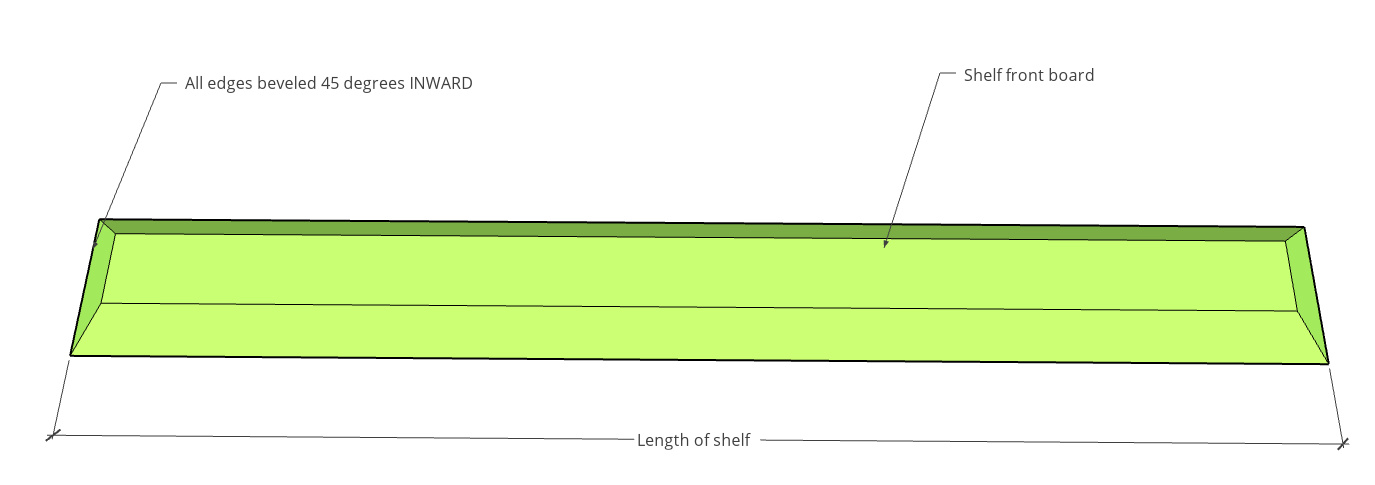
After the top and bottom shelf pieces were beveled, I used a 1×4 board cut to the length of the shelf PLUS about 12″ and repeated step 1 to bevel one edge of the board.

.

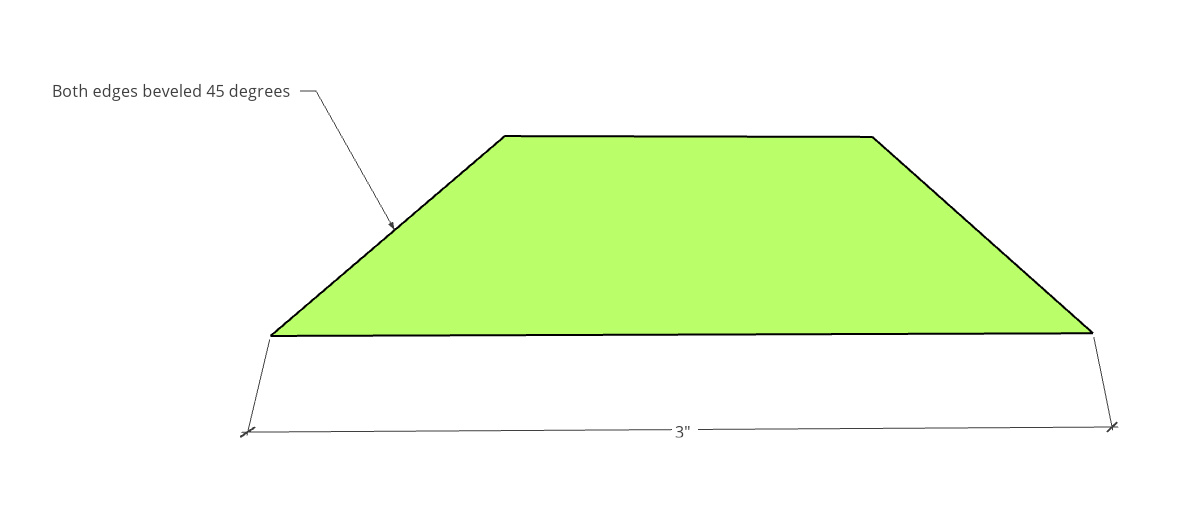
Then, I adjusted my rip fence 3″ from the blade and flipped it over and cut the other side until the widest part of the board was 3″. 

Diagram of front board with beveled edges 3" wide

This will become the front and side pieces of the shelf box.

Step 3:  Cut Board Ends and Trim to Size

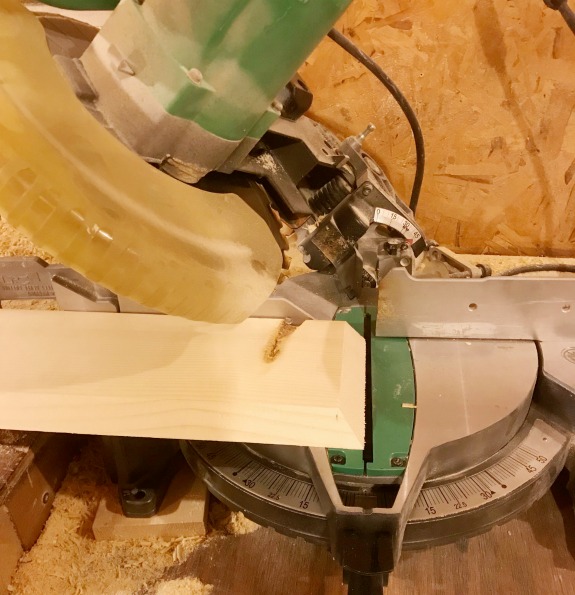
Now my work at the table saw was finished, so I moved over to the miter saw.  I adjusted the miter saw to MITER 0 degrees, but BEVEL 45 degrees.  Notice that the blade is square to the back fence, but is TILTED 45 degrees.

Use miter saw to miter ends of floating shelf box boards to 45 degrees

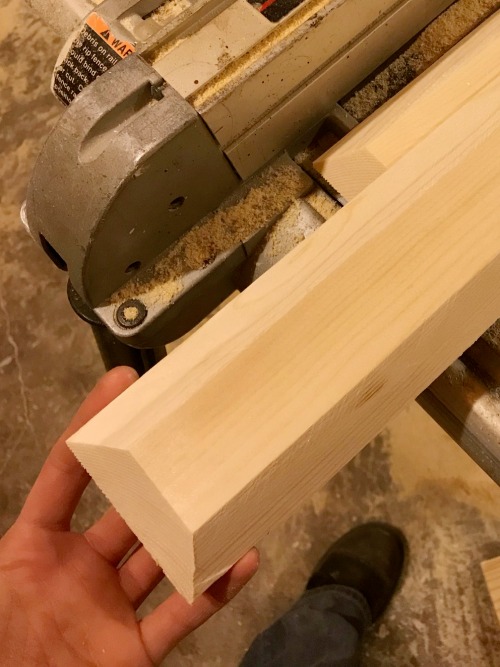
I beveled the ends of the 1×6 boards from step 1 like shown so that the total length of the boards is the length I wanted my shelf.  I needed two of these pieces–one for the top and one for the bottom of the shelf.

.

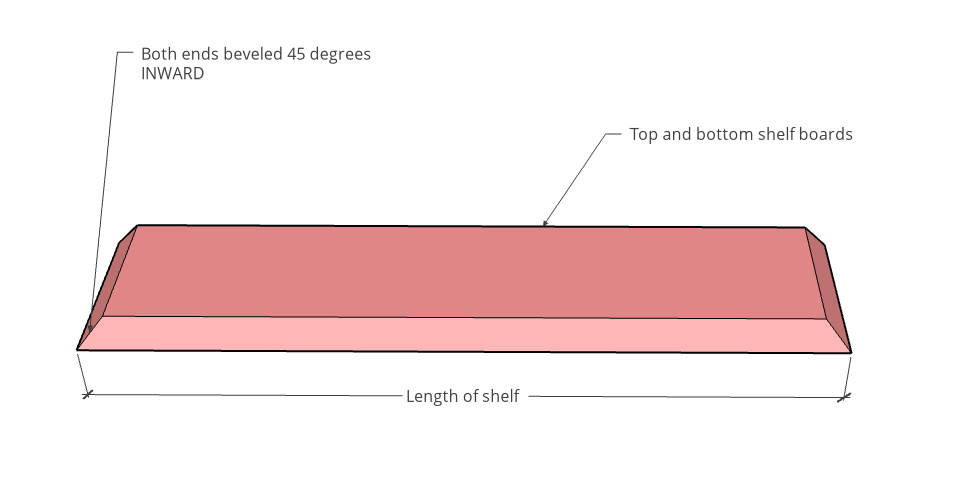
For this, I wanted all my bevels to go toward the INSIDE of the board.

Diagram of top and bottom board cut

Then, I beveled the ends of the 3″ wide piece, too, the same way so that the total length is the length of the shelf. This will be the front of the shelf

Diagram of front board cut
Mitered edges along front piece of floating shelf box

I cut two more pieces of the 3″ wide boards like shown 5 ½″ long.  One end should be flat and the other beveled 45 degrees. These will be the sides.

Floating shelf box side pieces cut with beveled edges and one square end

NOW, IF YOU SKIPPED THE TABLE SAW WORK FROM STEPS 1 & 2,

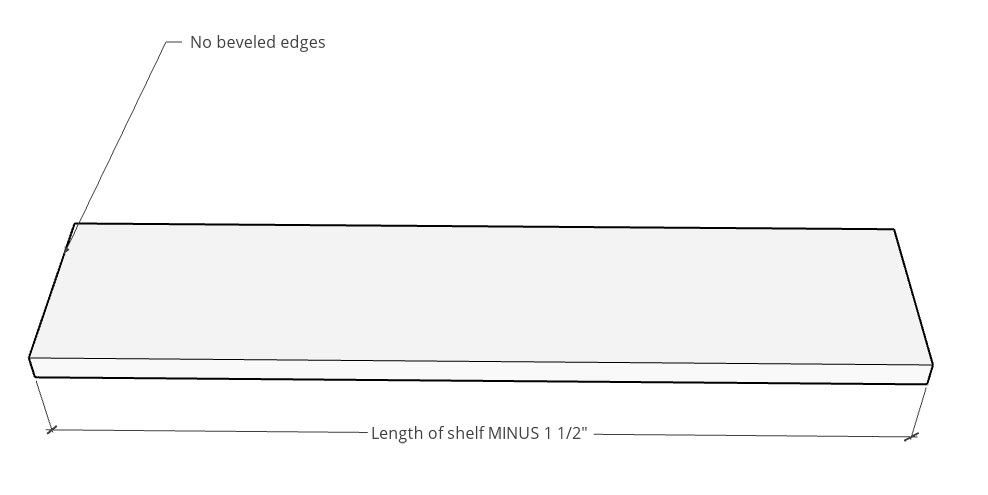
Don’t worry…you can still make these shelves! In this case, you will simply cut two top and bottom 1×6 shelf boards down to the total length you want your shelf MINUS 1 ½″.

Top and bottom 1x6 boards cut to length

Then, use your miter saw like shown above to bevel the ends of your 1×4 pieces 45 degrees at the corners to simply wrap around these top and bottom boards.

Diagram showing 1x4 boards wrapped around 1x6 board to build hollow floating shelves

Using this method, you can still get a nice, clean result 🙂

Step 4: Assemble Floating Shelf Boxes

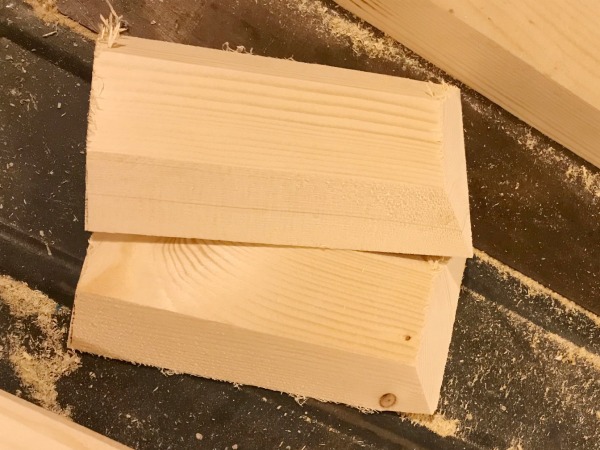
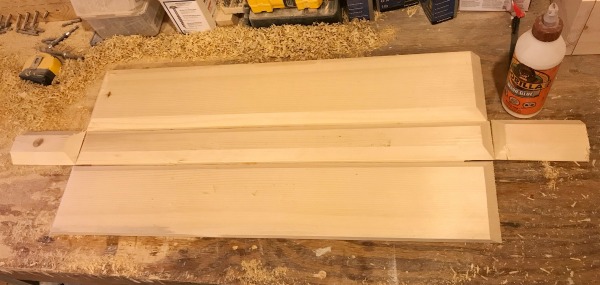
At this point, I had pieces that will fit together like this:

Pieces cut for floating shelf box laid out on workbench

If you fold all these pieces up together, you will get a hollow box.  So that’s what we will do 🙂

.

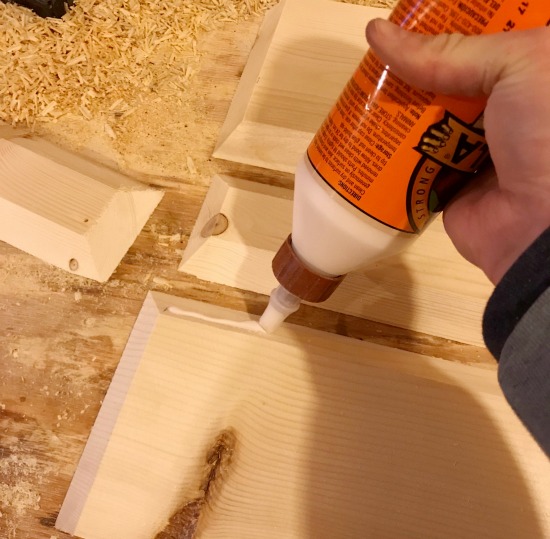
Whether you beveled the edges in step 3 or not, the assembly is the same–just glue and nail the floating shelf box together!

.

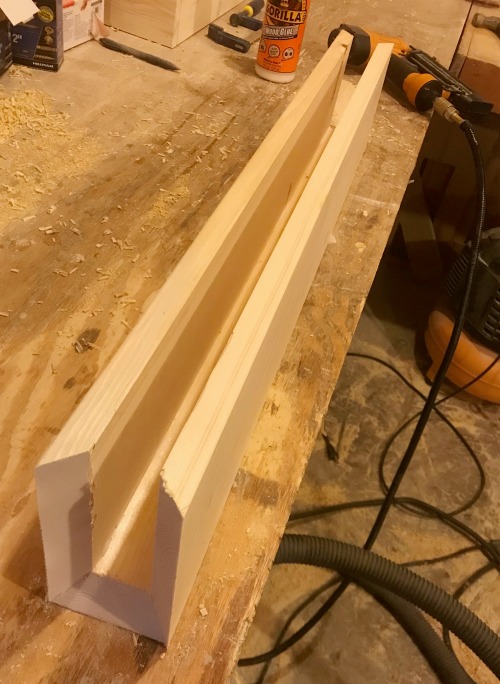
I used wood glue and a nail gun to first assemble the top and bottom shelf boards to the front piece.

Using glue to assemble floating shelves
Top, front and bottom floating shelf boards glued and nailed together

Then, I glued along the edges of the small side pieces and attached like shown.  I just nailed these pieces in place as well.

Floating shelf side pieces ready to attach with glue and brad nails
Seamless floating shelf assembled as hollow box ready to finish

Use clamps to make any adjustments or pull any pieces square as needed.  While the glue dries, move onto the next steps.

Step 5: Build Floating Shelf Support Hangers

In order to hang the shelves, I needed to build the shelf support.  It’s made from 2x2s.  If you bevel everything like I’ve shown, a 2×2 (which is actually 1 ½″ x 1 ½″) should fit perfectly into the hollow box opening.

RELATED: Check out how to make your own 2x2s in this post!

.

So, I cut one 2×2 the length of my shelf MINUS about 1 ¾″ and cut three more pieces 3″ long.  I glued and screwed (using 2 ½″ wood screws) the support together like shown with one piece on each end and one in the center.

Screwing together 2x2s to make floating shelf bracket for hanging
Floating shelf support bracket assembled from 2x2s

Step 6: Finish and Hang Floating Shelves

I puttied all corners of the shelf box and sanded them smooth.  Putty is a life saver on projects like this.  It can really help smooth out and get those perfect looking corners.

.

Helpful Tip: If you plan to stain, use stainable putty OR you can also mix some sawdust and wood glue to make your own matching wood putty as well.

.

Finish the shelf before hanging.  You can stain or paint as desired.

.

To hang, I found the studs in the wall and screwed the support from step 5 into the studs using 2 ½″ or longer wood screws.  Make sure it’s level!

.

Then, I slid the shelf box over the support.  It should fit snug.  If you want, you can add a few screws  through the top to hold in place, but I don’t advise nails.  If you ever want to remove them, it’s much easier to remove a screw than a nail 🙂

DIY Floating Shelves built like you haven't seen before! These easy to build floating shelves have invisible seams!

I really like building my shelves like this because it looks more like one solid chunk of wood vs several nailed together…even though that’s really what it is.

How to build a floating shelf without seams--take your DIY floating shelves up a notch!

These style floating shelves will take a little more time and require a little more effort to build than some I’ve seen, but I really think the little extra is totally worth it. 

.

Want more shelving ideas?? Check out some of these!

  • Floating wall shelves from scrap wood with industrial details
    Scrap Wood Wall Shelves
  • DIY Coat Rack Shelf
  • Corner Floating Shelves

.

So, if you want to take your floating shelves up a notch and try making them this way, be sure to pin this for later! 🙂

How to make seamless floating shelves collage pinterest image

Until next time, happy building!! 🙂

DIY Simple Mobile Shop Cart Planer Stand

January 29, 2018 by Shara, Woodshop Diaries

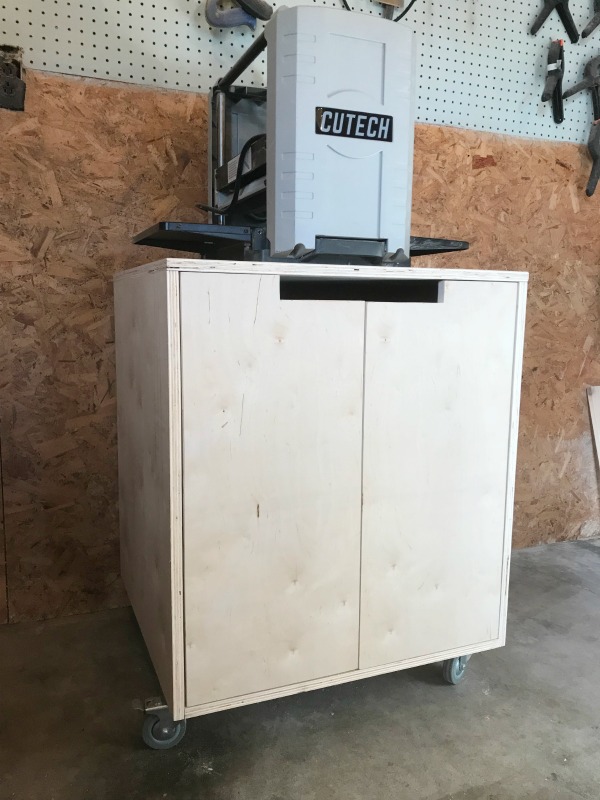
DIY Mobile Tool Cart Used For Planer Stand

So, here we are.  The end of January 2018.  And….I’m just now setting any “goals” for the year.  I’m really setting the bar high this year, huh?  Don’t worry, this DIY mobile tool cart build ties into this somehow.  I’ll get to it.

DIY Simple Mobile Tool Cart

So, goals.  I have two main goals (with a few others I don’t want to say out loud for fear I won’t make them and all of you will know that I failed…HA).  One goal is to make at least one YouTube video a month.  So far, with this post, I’m on track…although I did wait until last minute…

.

And my second goal is to “redo” my shop.  We are currently trying to sell our house.  I had hoped it would have sold by now and I’d have a new shop.  But, things don’t always go as planned, and we are still in our house.  I’m tired of waiting, so I’m going ahead and making my shop as efficient as it can be since it appears we will be here a little longer.

.

I redid my shop once a couple years ago…added some workbenches and pegboard and a lumber rack.

It’s worked okay, but I’ve gotten a few new tools since then that I didn’t accommodate for in my original design.  And, with the (hopefully soon) eventual move, I’m wanting my workbenches to be mobile so I can just transplant them to wherever we go next and I won’t have to take time off to rebuild.  (If you want some AWESOME and cheap casters for your tool carts, I used these (affiliate link for mobile tool cart casters) and they worked GREAT and were the cheapest around that I’ve seen.)

.

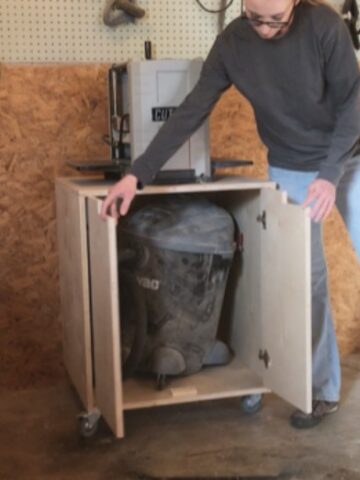
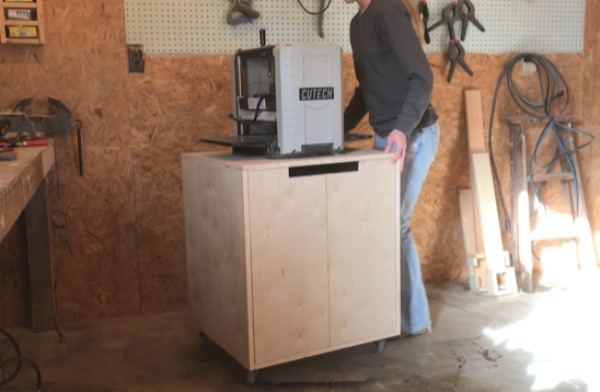
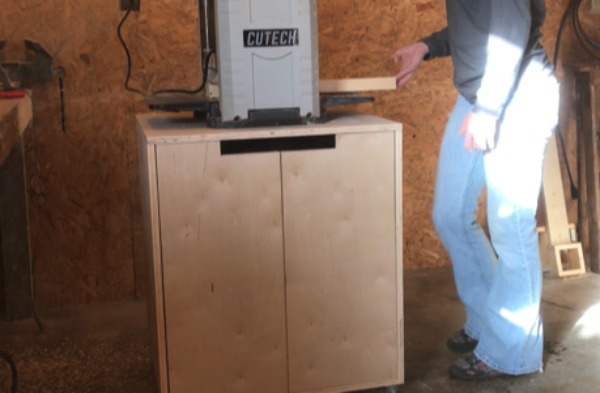
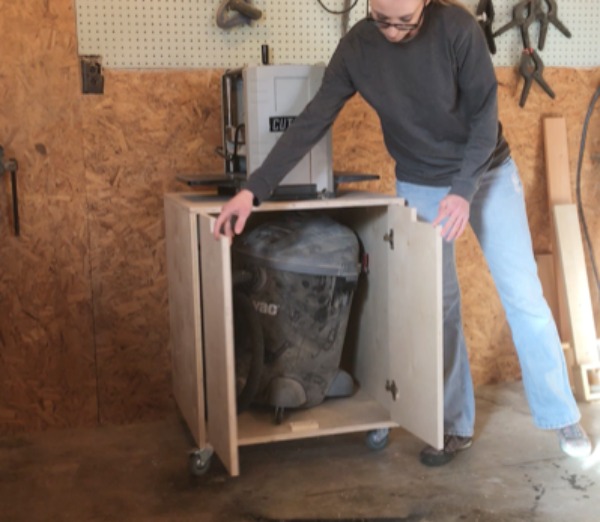
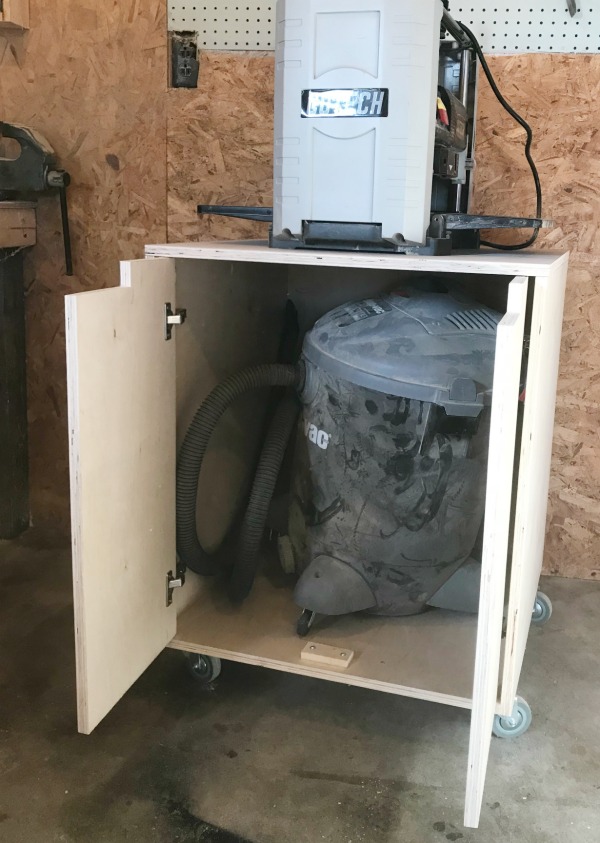
That brings me to this post.  One of those new tools I’ve gotten since the first shop redo is my planer.  Side note: that was an anniversary gift from the hubs…isn’t that romantic?? HA.  Its home is under my workbench and it’s a pain to drag it out when I need it then put it back.  So I FINALLY got around to building it a mobile stand with a place to house my shop vac underneath because planing makes a LOT of sawdust.

DIY Mobile Planer Stand

DIY Mobile Tool Cart Used For Planer Stand

But, even if you don’t have a planer, this simple mobile tool cart is perfect for other tools too…scroll saw, band saw, miter saw, you can even mount your Kreg Pocket Hole Jig to it if you wanted.  And the cabinet space can be used for air compressor, shop vac, or even add adjustable shelves.

DIY Mobile Tool Cart from a single sheet of plywood and a few tools!

It’s pretty versatile and a super quick, easy build.  It only takes one sheet of plywood and a few tools.  (Speaking of one piece of wood…this storage bench was only made from one sheet of plywood and this bar cart was made from only one board!)

DIY Mobile Tool Cart from a single sheet of plywood!

And as always, I’ve got the how to for you 🙂  Oh, and PS I know you are supposed to hook the shop vac to the planer when you use it…but 1. I’m not quite sure I’ve got enough power to run both at once.  And 2. I need a bigger dust port to go from vacuum to planer.  Just in case you were wondering why.

.

This post was sponsored by Build Something, Kreg Tools website with hundreds of free building plans for every room in your home, or shop. This post also contains affiliate links.  See disclosure policy for details.

.

You can head over to Build Something to grab the free building plans for this super simple DIY mobile tool cart.  And, be sure to check out my tutorial video below…the first video of the year 🙂  I’ve also mentioned a few tips and tricks for this build down below.

For this DIY mobile tool cart build, you only need a few tools:

Circular Saw

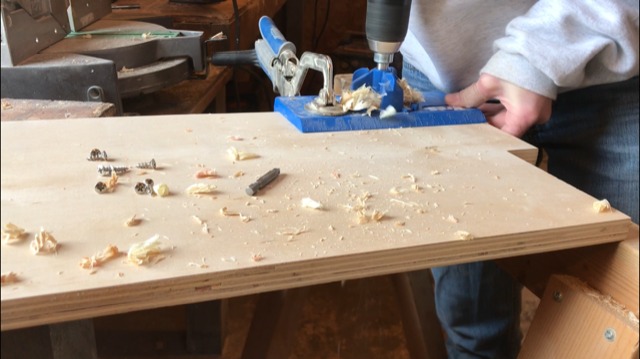
Kreg Pocket hole jig

Kreg Rip Cut (optional, but SUPER helpful)

Kreg AccuCut (optional, but SUPER helpful as well)

Kreg Concealed Hinge Jig (also…say it together now…optional, but SUPER helpful)

Drill

.

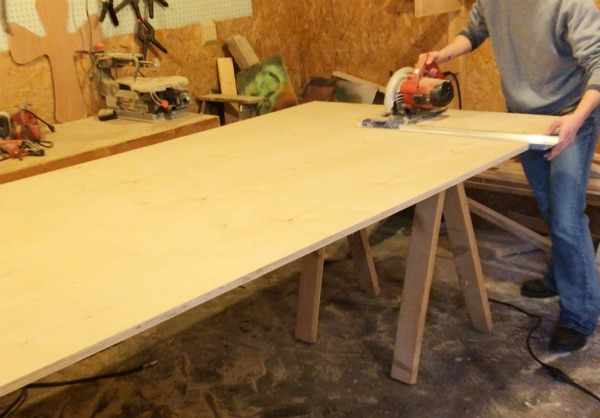
The Kreg Rip Cut and the AccuCut aren’t REQUIRED, but I’m being 100% honest with you, it saved me about an hour on this simple project.  It’s absolutely worth the small investment to save you so much time.  I cut down all my plywood pieces (which is my least favorite part) in less than 15 minutes and using straight edges and clamps would have easily taken me well over an hour.  Highly recommended, ESPECIALLY if you use a lot of plywood.

Also, the concealed hinge jig…I sung it’s praises in my faux drawer dresser post a couple months ago and I’m still singing them.  LOVE this thing.  Also, once you try concealed hinges, you will never go back.  They have so many adjustments to help you get your doors perfectly lined up…and that’s helpful for people like me who never seem to get the door to be perfectly square to the opening.

These tools just make your job easier and save you time.  Although they aren’t required, they are really helpful for beginners and experts alike.

.

Now, head over to Build Something, grab your saw, and your plywood and get out there and get building 🙂  Stay tuned for some more shop builds–tools carts, storage and organization–coming soon.  And eventually, a shop tour 🙂

.

Oh, and if you aren’t already subscribed to my YouTube channel, be sure to subscribe.  I’ll have more videos coming soon…I promise, I will get better at them…I mean at this point, the only thing I can do is improve, right?  It can’t get much worse haha.

.

Thanks so much for your support.  Until next time, happy building 🙂
DIY Barn Wood Table–From Tobacco Barn to Dining Table

January 15, 2018 by Shara, Woodshop Diaries

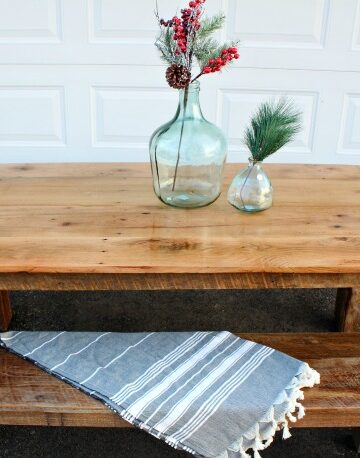
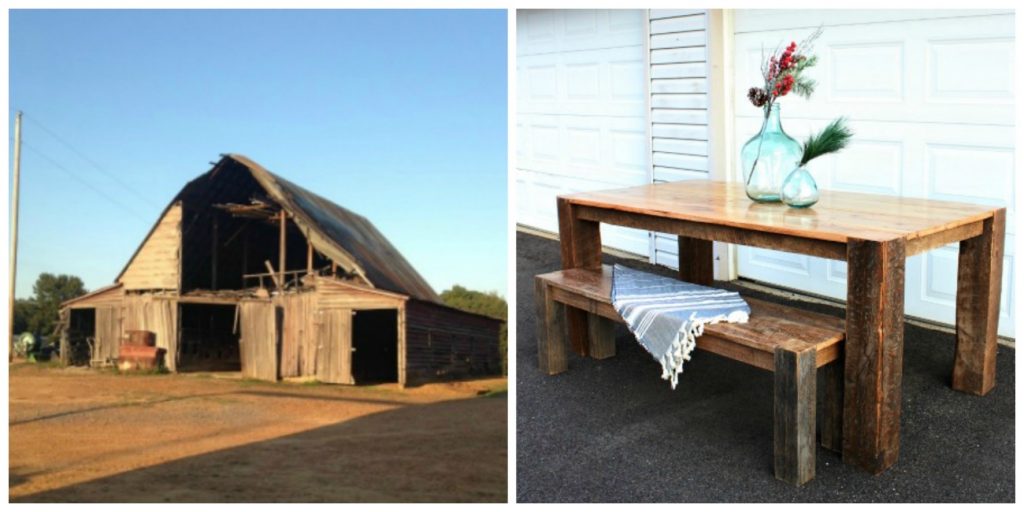
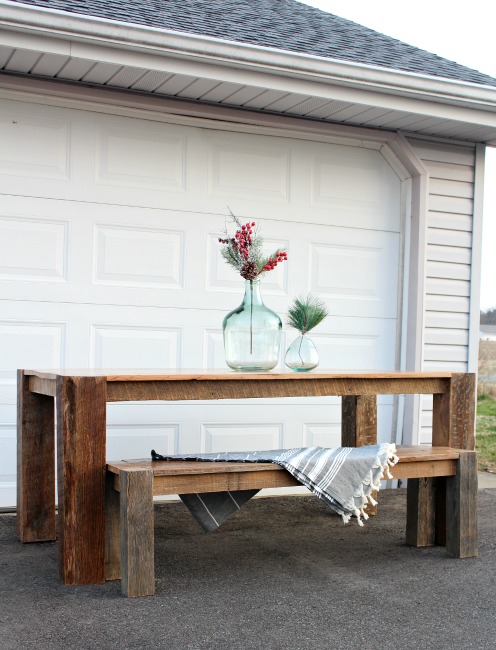
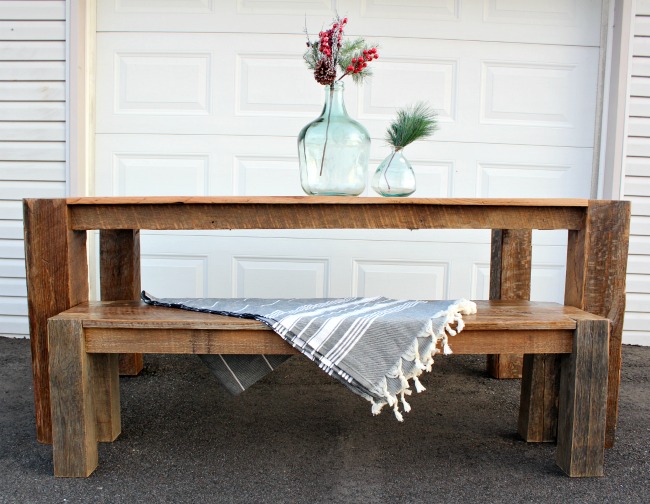
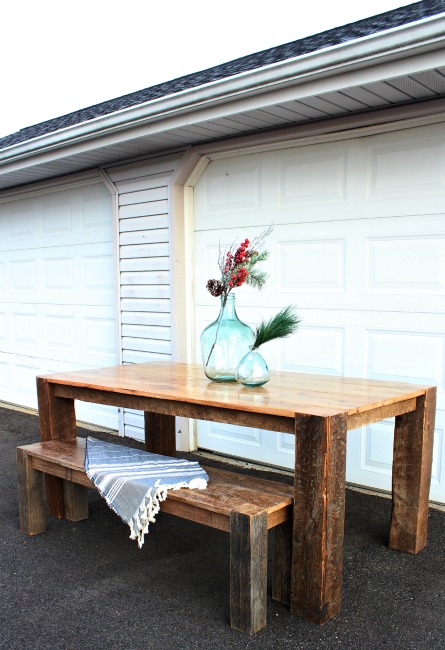
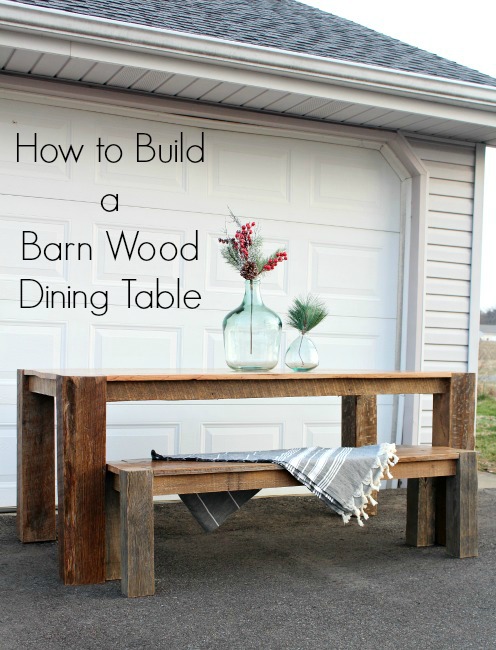
Remember those DIY barn wood picture frames from a couple weeks ago?  Well, there’s more where that barn came from! (Get it?? More barn…more wood…more projects??)  So today, I’m showing you how to turn this old tobacco barn wood into this beautiful DIY barn wood table and bench.

old tobacco barn to new gorgeous dining tableBut first, a little back story:  A friend of ours from college contacted me several months ago asking if I could use some of his family’s barn wood and build him and his wife a new dining table.  I was a little hesitant because this wood and this barn was pretty sentimental to the family.  I didn’t want to be the one to screw it up haha.

how to turn an old tobacco barn into a gorgeous barn wood table

They decided to tear this old barn down after many years of use.  My friend’s great grandfather taught his father how to climb up the stairs when he was just a very yound kid.  My friend’s father also cured his first crop of tobacco in that barn when he was only 15 years old!  So finally, after many years of helping put food on that family’s table, it’s become the table they can sit together and enjoy that food from.

.

So, if you are ready to see how it was done, then let’s get to it.

.

This post contains affiliate links.  See disclosure policy for details.

.

For this DIY barn wood table build, I used:

Planer

Miter Saw

Table Saw

Belt Sander

Orbital Sander

Jig Saw

Drill

Gorilla Wood Glue

Gorilla Glue Epoxy

Pipe Clamps

Measuring Tape

Square

.

First, I picked out the lumber for each section of the DIY barn wood table

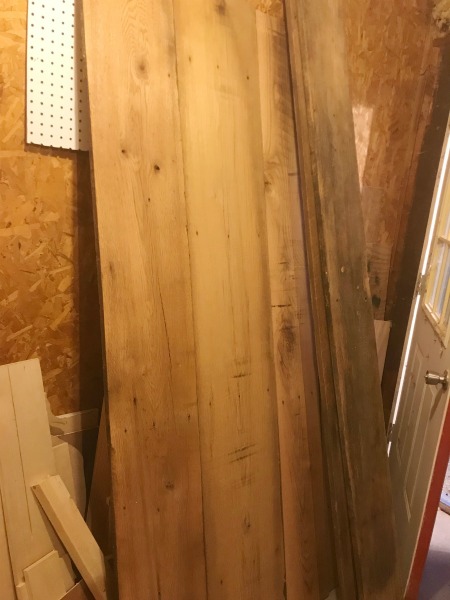
Several months ago, we took a trip with our friends to the barn to take a look at what wood would be salvageable and what they would need for the table.  Then, after they tore the barn down, we took a trip again to pick through all the lumber and get the best boards.  We got way more than we needed to build the table just so I would have plenty of extra in case I ran into a not so great board…which I did…multiple times.

.

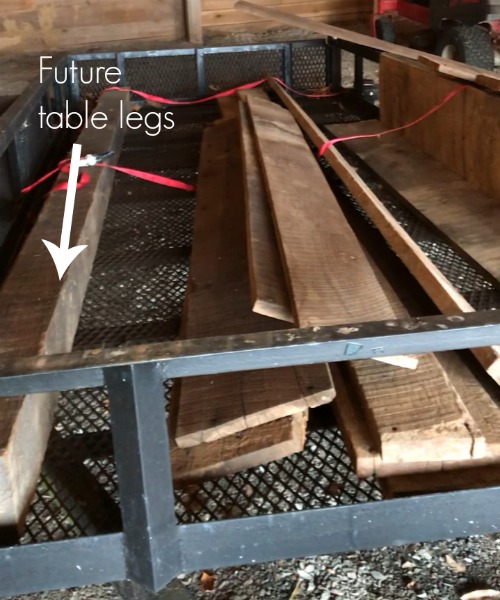
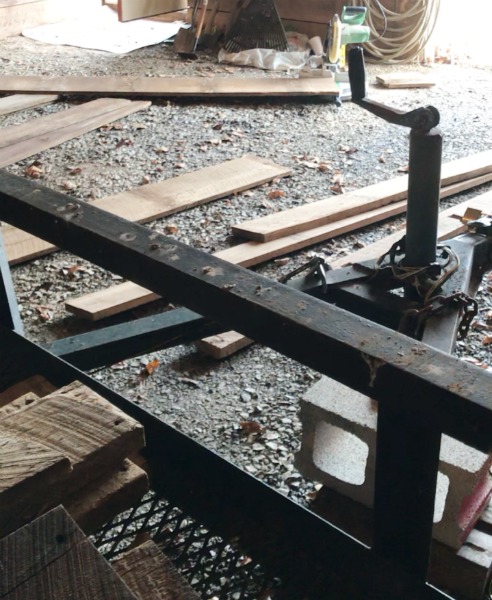
I dug through all the boards on the trailer and separated the ones to be used for the table and bench tops (they were thinner and didn’t have any huge holes…because who wants a gigantic hole in their table top?), and the thicker boards, I set aside to be used as the table aprons and supports.  The enormous beam on the trailer was to be used as the legs.  I laid it all out on the barn floor at my house and cut them down to manageable sizes before I brought them into the shop.

Then, I cleaned the barn wood up so it was ready to use

This stuff was filthy.  Covered in dirt, and rusty nails  and year and years of….who knows what (?!).  Originally, my friends wanted the table to be totally rough (not planed)…so basically, like this.

reclaimed barn wood table

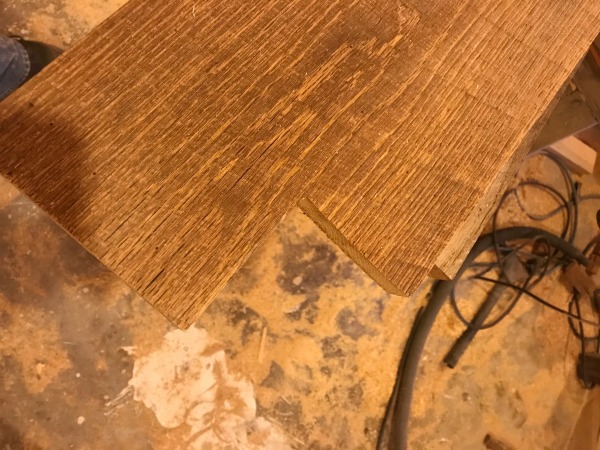
But after I showed them this picture, I suggested we plane the boards for the top and leave the other boards rough cut (sanded some, but still with saw marks) because underneath all that age is some really beautiful lumber.

.

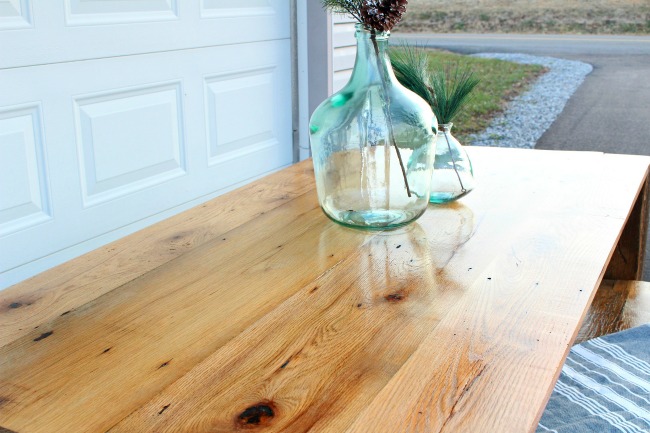
So I washed them first with a water hose and a deck brush and let everything dry out a few days.  Then, I planed the table top boards with my planer and I’m so glad I did…check out that gorgeousness (apparently that’s a word because spellcheck didn’t correct me hahaha).

planed reclaimed lumber boards for dining table top

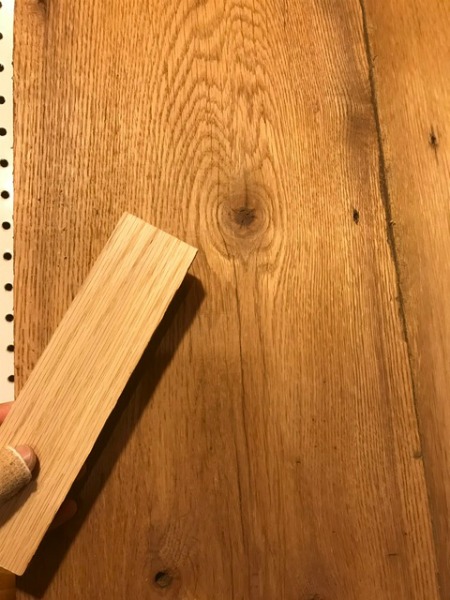
Check out the comparison between this brand new piece of oak and these aged ones.  The color is so pretty.

old barn wood vs new oak board

PS see that bandage on my thumb?  I got my first stitches right after Thanksgiving.  It was from a drill bit on a metal lathe at work.  It wasn’t even a good story…the machine wasn’t even on.  Apparently, I’m just a goober who can’t hold onto a chuck key.  I always thought my first stitches would be from fighting off some vicious animal or doing something awesomely heroic.  Nope, just a drill bit, not even spinning…  Anyway, back to the table.

.

Then, I assembled the top of the barn wood dining table.

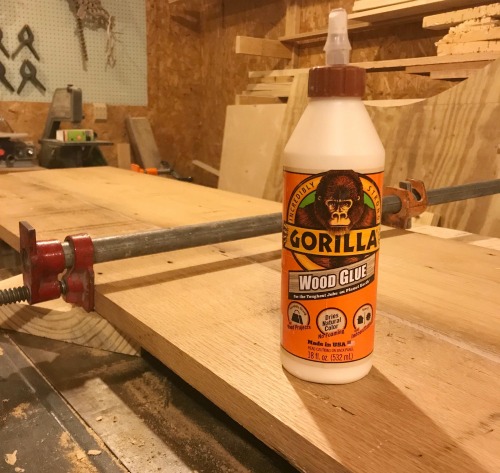
You can see my post here on how I make table tops.  For this, I simply squared the edges, and glued the boards together.

gluing up barn wood table top

Once the glue was dry, I trimmed it to size (again, all the details for how to do this are in this post), then sanded…and sanded….and sanded.  I sanded until my boogers (even with a mask on) were brown and my face was covered in dust everywhere except where my glasses and my mask was.  Sanding sucks, but it sure makes a nice top.  Once it was sanded smooth, I set it aside to build the base.

.

Next, I built the table base.

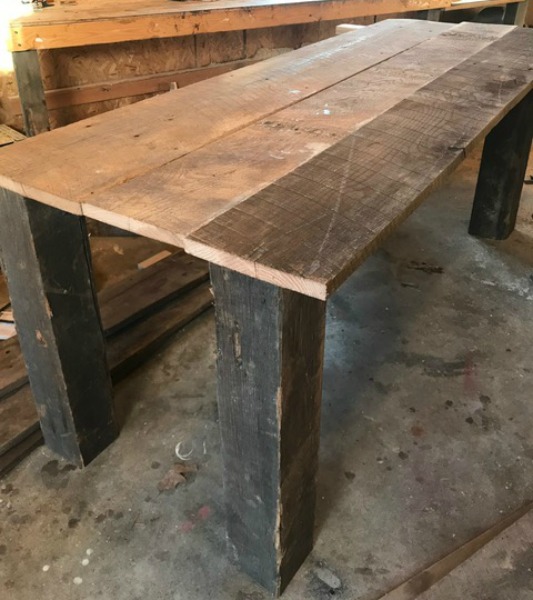
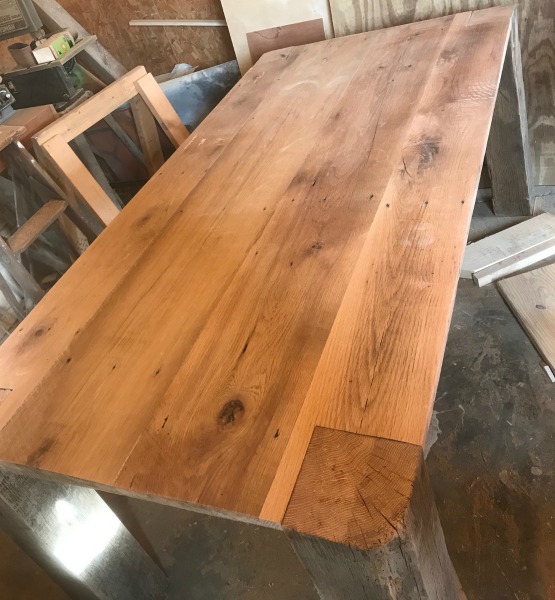
Now, the table design is a little different than a standard table.  This is very similar in style to the modern dining table I built last year.  The legs are flush with the table top.  To do this, I built the table base to match the exact dimensions of the table top (measuring from outside of each leg to outside of adjacent legs).  You’ll understand once you see the pictures.

.

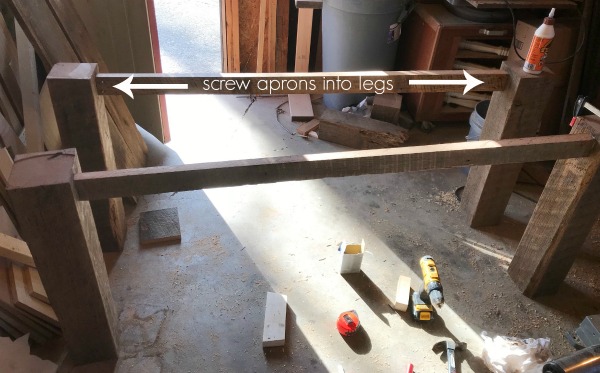
The table top (after planing was ⅞″ thick.  So I measured the length of my table top, and subtracted the width of BOTH legs and cut a support piece this length.  I glued and screwed the supports into the leg making sure it was ⅞″ down from the top of the legs.  I just toenailed the screws here.

building barn wood table base

Then, I did the same for the width of the table, and added these supports as well.  Now it was time to cut out the leg notches in the table top.  I flipped the top upside down and set the table base upside down on it and lined everything up.  I traced around the legs at the corners and used a jig saw to cut along these lines.  The picture below is just an example, not the actual table.

cut notches in barn wood top for table legs

Once the top notches were cut, I flipped the table base over, then laid the top on and made sure everything fit.

test fit barn wood table top to base

Lastly, I added the table top supports.

You can see a video of my screwing in the supports on my Facebook and Instagram pages, but in hindsight, I could have done this easily without rolling around on the floor in sawdust if I had planned it out better.  Oh well.  Everyone needs a little sawdust in their undergarments, right?  Give it a try 😉

screw table supports in place in barn wood table

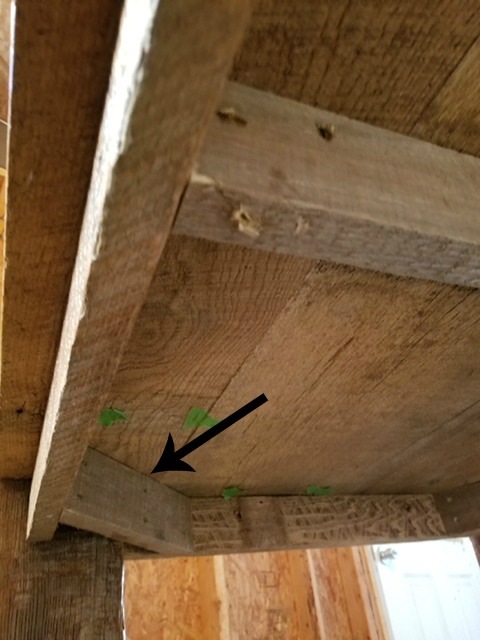
So I cut 4 pieces of support wood at 45 degree angles on each end to place like shown under the table and around each leg.  I simply glued and screwed these in place to help hold the legs in place and just as extra support.  I also added two more supports evenly spaced running the length of the table width like shown.  Again, gluing and screwing these in place.

barn wood dining table support boards

Once the supports were all in, I screwed the top in place through these supports.  I was worried it wasn’t going to be very sturdy with this type of design and using a thinner top than I usually do on tables, but I was really surprised how strong it was.

.

Finally, I finished the barn wood dining table

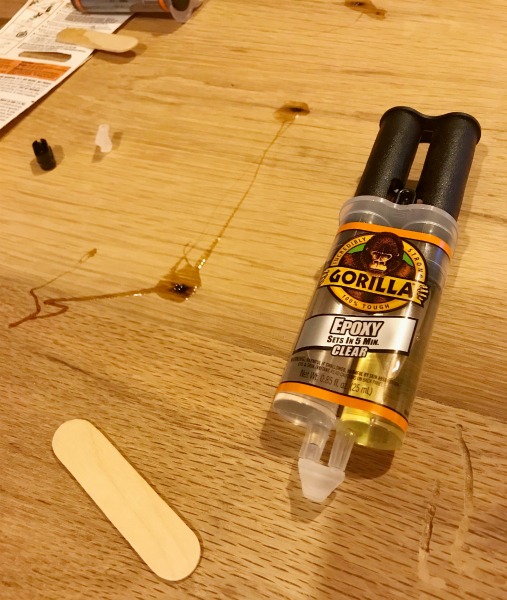
The wood was a little cracked and had some hail holes and knots.  I used Gorilla Glue Epoxy to fill these.  Did you see the tape on the underside in the picture above?  That was where there were nail holes I was filling with epoxy and didn’t want it to drip through.

.epoxy nail holes in reclaimed wood table top

This was my first experience with epoxy and it was really simple.  Just follow the instructions on the back to mix the epoxy, then use the provided stick to “putty over” the holes.  Once it was dry, I sanded it smooth and applied several coats of Minwax Semi Gloss Polycrylic to the whole table.

.

Without making this post even longer, I think it suffices to say that the bench was built exactly the same way, just on a smaller scale 🙂  This post is REALLY long already.

.

So there you have it…how an old barn was turned into a beautiful DIY barn wood dining table.

DIY barn wood dining table tutorial--how to turn old tobacco barn into gorgeous dining table

Look at that top…WOULD YOU LOOK AT IT?!  All the heart eyes!

Barn wood table top--reclaimed oak wood--how to build a barn wood table

DIY reclaimed barn wood table top--reclaimed oak wood

DIY barn wood dining table and bench set--reclaimed barn wood table

Building this table from reclaimed barn wood was a little tricky and was quite the learning experience.  Reclaimed wood is imperfect and it wasn’t consistent in dimension and shape.  That’s why this isn’t a one size fits all type of tutorial.  Hopefully this gives you a good overview, though, of how you could do it with your own reclaimed wood.

Reclaimed barn wood dining table--a how to to build your own dining table from old barn wood

Side note: this old tobacco barn wood smelled so interesting in my shop.  If you’re into those candles that smell like tobacco barns, you should totally just set a block of wood from an old barn around in your house.  HEAVEN.

.

Anyway, I know this post was really long, but if you have any questions that I didn’t cover very well in the post, comment below and I’ll do my best to answer.  Also, I would LOVE if you’d pin this for later 🙂

How to build a barn wood dining table from reclaimed tobacco barn wood! Build your own DIY dining table with this tutorial.

Until next time, happy building! 🙂

DIY Kids Rocking Horse Dog

January 13, 2018 by Shara, Woodshop Diaries

How to build a DIY rocking horse for toddler or small child--dog shaped rocking horse with template to make your own

I’m not good with kids.  Like, legit…I try.  Then it just gets awkward.  Like I’m trying to talk to a 10 year old and I ask if they can write their name yet.  Then I ask a 3 year old what they think about the stock market lately.  Like, I just…I’m not good.

.

I’ve not been around a lot of kids in my life, so I’m not sure how to interact.  But, while I may be bad at talking to kids on the appropriate age level, I can build kids’ toys and that’s really what they want anyway, right?  Toys > conversation.  Totally agree with that.

.

Side note: I mean, I’m not a real social person (like REALLY NOT), so almost anything is better than conversation in my opinion….HA.

.

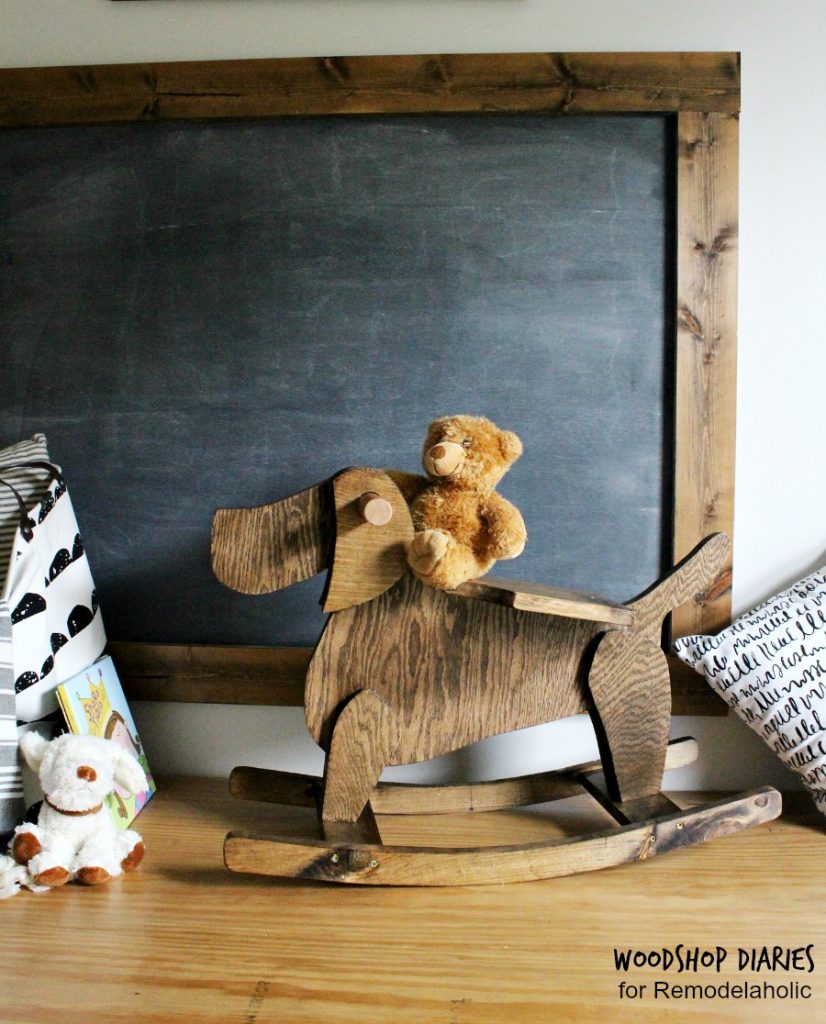
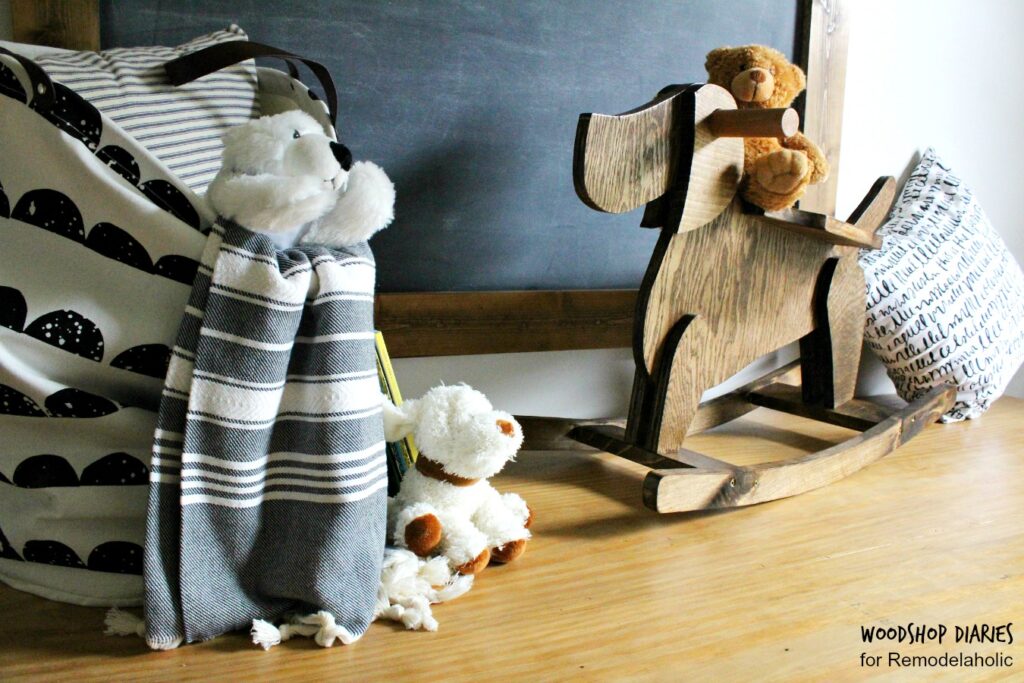
So anyway…back to making kids’ toys.  Like this DIY rocking horse…that’s actually a DIY rocking DOG, not a horse.  Isn’t it fun?  (Speaking of kid’s toys, if you need some good toy storage, check out this DIY storage chest and this DIY toy storage cabinet. And if you need somewhere to hide diapers, check out this DIY diaper hiding cabinet, too!)

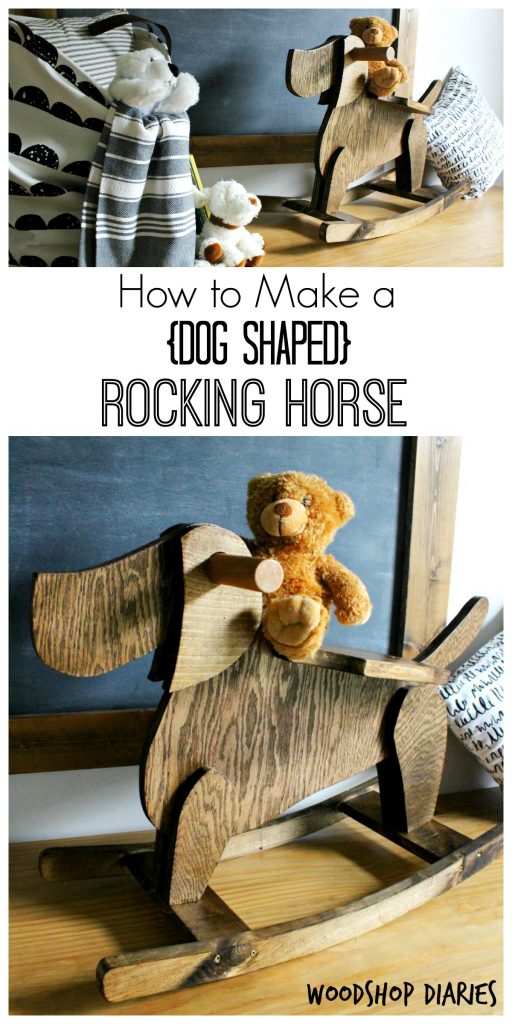
How to build a kids rocking horse that's shaped like a dog--super cute diy kids toy tutorial

I built this recently for a friend’s new baby and I loved that it was a different take on the standard “rocking horse” because this one is a dog shape.  The cool part is that you could tweak the design a little to look like different breeds if you wanted.  Kid’s favorite toy can match kid’s best friend 🙂

.

The build was simple and required only a few tools (mainly a jig saw and a drill).  I actually made the whole thing from scraps, too.

How to build a DIY rocking horse for toddler or small child--dog shaped rocking horse with template to make your own

So, if you are like me and don’t know what to do around kids (or even if you do), here’s a great ice breaker.  Just hand it to them, smile, and let them enjoy themselves 🙂

.

You can grab the whole tutorial PLUS the template for all the shapes and cut outs over on Remodelaholic here.

How to build a DIY kid's rocking horse that's dog shaped--easy to follow tutorial with template for shape cut outs. Great DIY kids project and perfect size for toddlers

And in case you are wondering how sturdy this is, I’ll go ahead and let you know that I sat on it and it held me up just fine 🙂  I didn’t get a picture, but I’m sure it was interesting considering this thing is small enough for a small toddler.  I was only able to get one cheek on the seat…if you know what I mean HA.

.

Stay tuned for a few more kid’s projects coming soon…just in case you need some more ideas!  Be sure to head over to Remodelaholic to grab the plans for this build and also I’d love if you’d pin this for later 🙂

How to build a dog shaped DIY rocking horse for a child--super cute diy kids toy and easy to follow tutorial to make your own!

Until next time, happy building! 🙂

DIY Sawhorse Console Table

January 8, 2018 by Shara, Woodshop Diaries

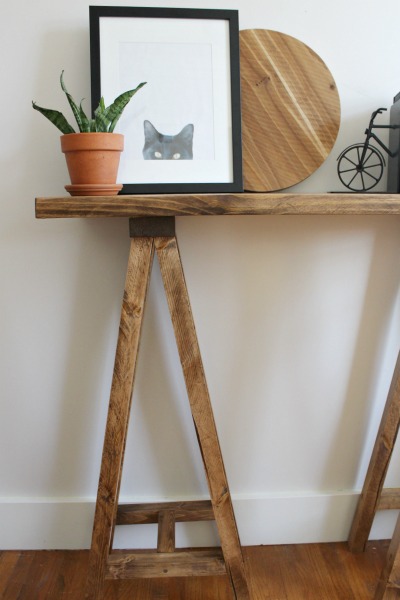
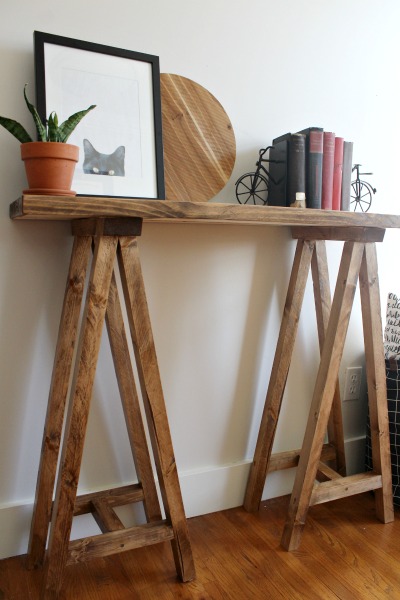
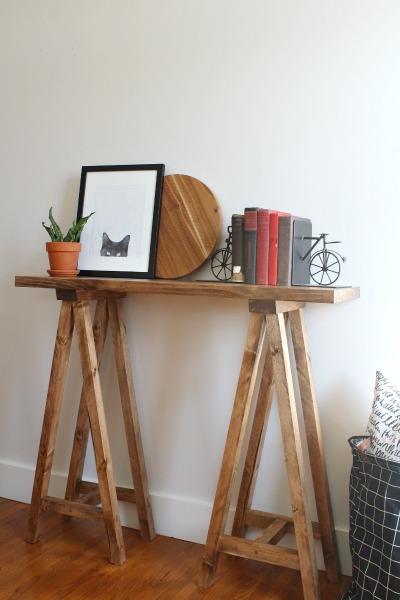
How to build a simple DIY sawhorse console table

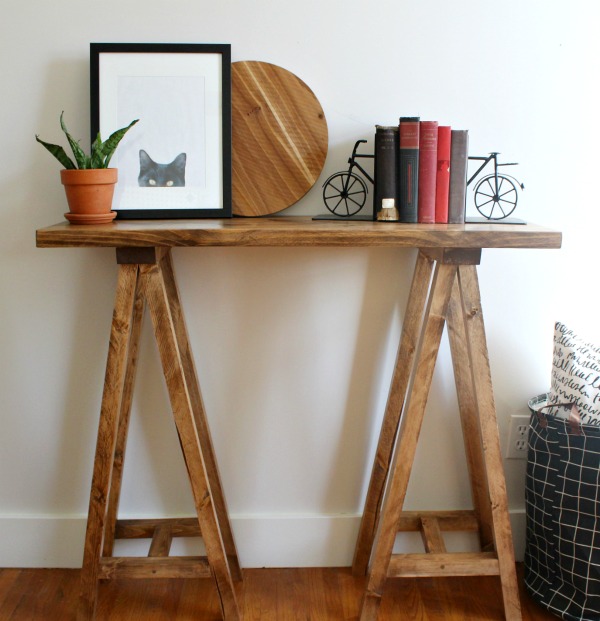
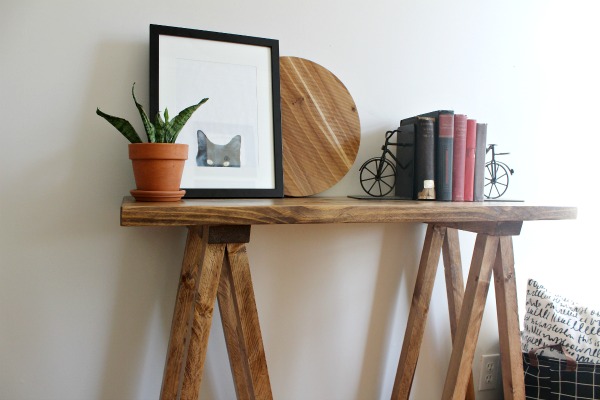
I love a piece of furniture that is simple in design, easy to build, but is not lacking in style.  This DIY sawhorse console table checks all of those boxes and gives me all the heart eyes!

How to build a simple DIY sawhorse console table

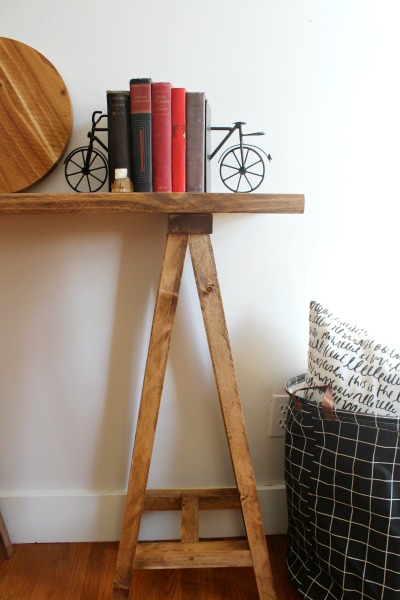
I love how simple the design is with these skinny 2x2s for the base and just a plain flat board across the top.  But sometimes, the simplest designs can be the prettiest, amiright??

.

I’m calling this a console table, but it can be used for so many things–entryway, behind the couch, for a TV stand, or make a shorter version to be used for a bench!  It’s a very simple table that can be used for whatever you need a table for 🙂

DIY Sawhorse Table

So, if you’re ready for a quick and easy build, let’s get started 🙂

.

This post contains affiliate links.  If you purchase from one of these links, I may receive a small commission at no extra cost to you.  See disclosure policy for details.

.

You will need:

(4) 2x2x8 boards (or two 2x4s if you make your own from this tutorial)

(1) 2x4x8 boards

(1) 2x8x8

2 ½″ wood screws

Wood Glue

.

Miter Saw

Drill

Orbital Sander

Clamps

Measuring Tape

.

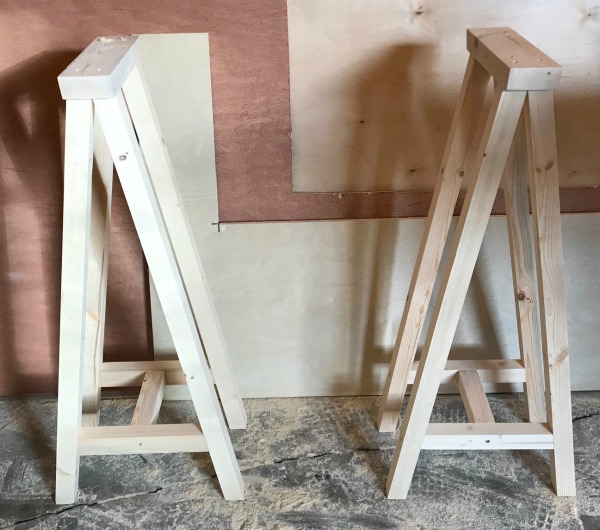
First, cut and assemble sawhorse console table legs…

Cut 8 legs from the 2×2 boards.  By the way, if you want to make your own straight, square 2x2s, check out this tutorial.  It makes a world of difference to build with straight, square 2x2s 😉

.

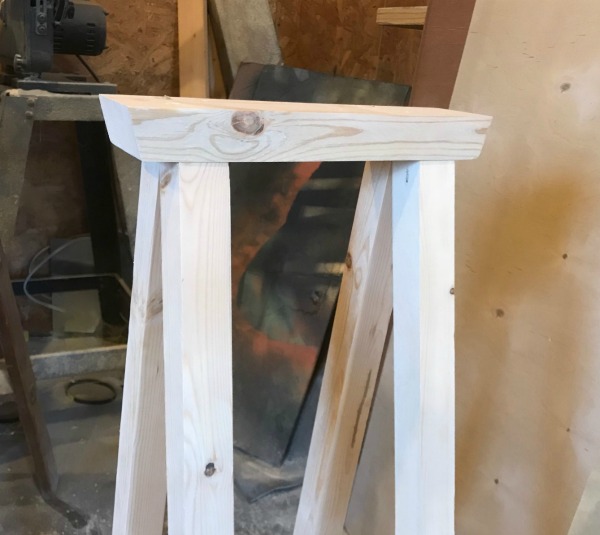
Anyway, cut each leg with 10 degree bevels parallel to each other, about 31″ long.

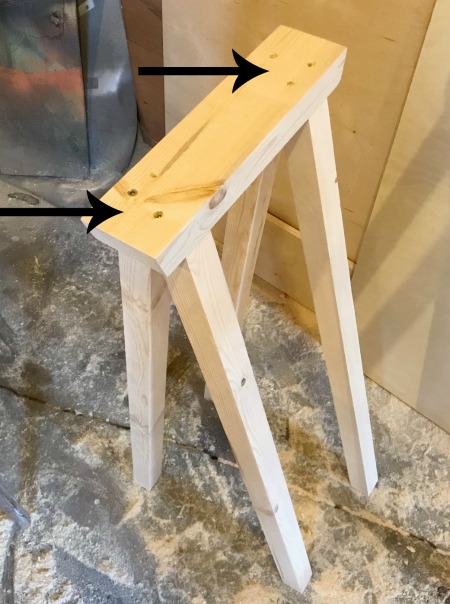
Then, cut two 2x4s 13″ long with ends beveled 15 degrees NOT parallel to each other.  Glue and screw (using 2 ½″ wood screws) the legs and 2×4 pieces together like shown.  Space the legs 6 ½″ apart from the front to back.

Next, cut and assemble the bottom braces for the DIY sawhorse table base…

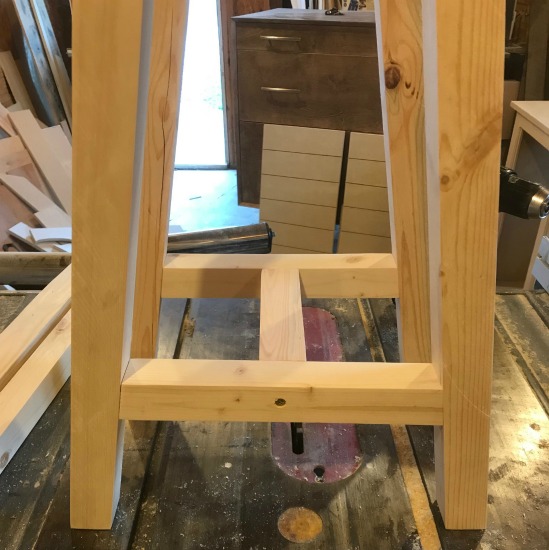
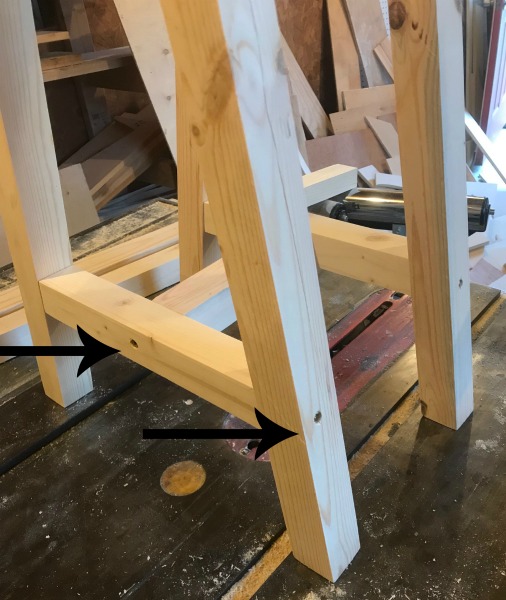
Cut 4 pieces of 2×2 board 9 ½″ long with ends mitered 10 degrees not parallel to each other and 2 pieces of 2×2 board 6 ½″ long.  Glue and screw the pieces together like shown.  The horizontal braces should be ABOUT 4 ⅞″ up from the bottom.

Then, build the top for the DIY sawhorse console table…

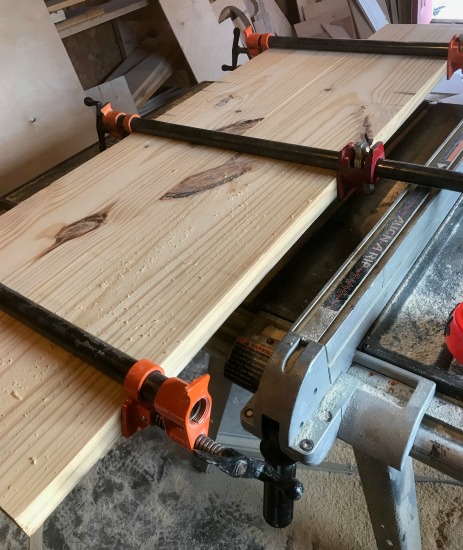
You can read my post here on how I build table tops.  For this, just cut two pieces of your 2×8 the length you want your top to be (I made this one about 40″ long).  Square off the edge (if desired), then glue together.  Sand down, then it’s ready to attach.

To attach the top, use wood glue and screws to glue and screw through the 2×4 tops of the base pieces into the top of the table.  Space the bases about 7″ from the ends of the top and centered from the front and back edge of the top.

.

Lastly, finish the sawhorse table as desired…

Putty the screw holes and sand the piece smooth.  Stain and poly (or paint) the table and it’s ready to go!  I stained this in Minwax Special Walnut and polyed it with Minwax Polycrylic.

How to build a DIY Sawhorse Console Table--simple and modern Minwax Special Walnut

If you like the DIY pet art, I’ve got a super easy tutorial to make your own from your own pet photo here.

How to build a simple, modern sawhorse console table

Don’t you love the simple design?  Plus, you can have this built in no time!

DIY Sawhorse Console Table--Modern Farmhouse Decor--Stained in Minwax Special Walnut

How to build a modern style sawhorse console table

DIY Console Table--Simple Modern Farmhouse Style sawhorse table

So what do you think of the simple, modern console table??  I love the sawhorse base 🙂 It’s really easy to customize the size here, especially the length.  So if you’re ready to build, I’d love if you’d pin this so you can reference it again later! 🙂

How to build a simple modern DIY sawhorse console table--minwax special walnut

Until next time, happy building 🙂
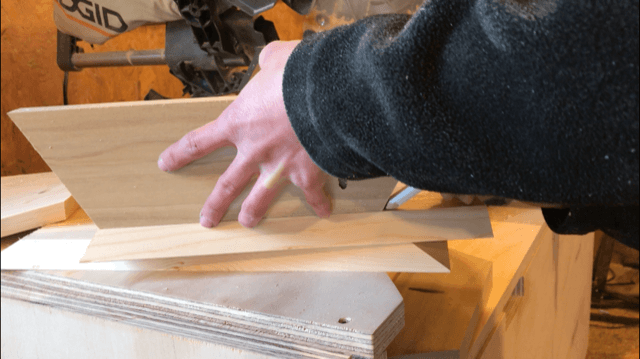
Woodshop Diaries Best of 2017 {and plans for 2018}

January 1, 2018 by Shara, Woodshop Diaries

Is anyone else ready to wave goodbye to 2017 and bring in a new year and try this thing all over?  Or is it just me?  I feel exhausted haha.

.

My 2017 (much like most of yours, I’m sure) has been full of lots of ups….and lots of downs–both in blog life and in real life.

.

I feel like this year, I’ve had so much going on outside of “blog world,” that I kind of started to separate the real world and the blog world and distanced myself a little from my readers (that’s YOU!).  So if you noticed that as the year went on, I became a little less sarcastic and a little less funny or “real” with you, it’s because I felt a little disconnected.  And even if you didn’t notice, I did.  Whoops.

.

So as we start with 2018, I vow to do my best to be myself again and bring back some of the humor and the sarcasm and the “real life.” I also vow to start doing more videos, trying to share some woodworking tips and tricks, and do more shop related projects–because that’s what many of you have said you wanted.  So, if you’ve got something you’d like to see or learn, shoot me an email 🙂  Because my idea tank is running low haha.

.

Anyway…back to 2017.  My 2017 brought about several difficult decisions.  I decided to leave my good paying job without another one lined up.  It was scary, but it was time to move on.  Then, I decided a month later to take a job closer to home but making less money than before, but that I enjoyed more.  It’s been a transition for both Danny and I.  We also decided to put what we thought was our forever home on the market this fall due to some circumstances beyond our control.

.

As far as the blog world goes, this last summer I also decided to attend my first blogging conference despite my heavy feelings of inadequacy.  I took on my first sponsored posts, and had the opportunity to join some blogger contributor teams.   I also took the leap and started a YouTube Channel and made my first tutorial videos.  (Lucy’s dog house video was by far the favorite.)

.

So it’s been somewhat of a wild emotional roller coaster ride this year.  I’m hoping next year may be a little more….stable?? Haha.

.

With all the ups and downs, though, this past year has been a productive one with lots of projects and builds.  I posted over 50 building projects (not including sewing or simple DIY projects)!  That doesn’t include the projects I built, but didn’t post about here.  I would have never thought that was possible!

.

So to sum up the best and worst of Woodshop Diaries in 2017, of those more than 50 builds, here are the top five most popular.  Are any of these your favorites??

DIY Faux Brick Fireplace

How to DIY a Faux Brick Fireplace and you'll never believe how easy it is!!

DIY Ballard Designs Knock Off Pantry Cabinet

DIY Ballard Designs Knock Off Pantry Cabinet

DIY Storage Chest

How to Build a Simple DIY storage chest for toys, blankets, and keepsakes

DIY Bar Cart from a Single Board

How to Build a DIY Bar Cart from One Board

DIY Faux Drawer Dresser

How to build a DIY Fake Drawer Apothecary Cabinet

Even though these were the “fan favorites,” my personal favorites were a little different.  Here is a quick look at what MY top six favorites were:

DIY Pegboard Cabinet

How to build a Mid Century Modern Pegboard Cabinet

DIY Modern Dog House

How to Build a Modern DIY Dog House

DIY Personalized Lazy Susan

How to make a Personalized DIY Lazy Susan

DIY Upholstered Couch

How to upholster a DIY couch--free building plans and upholstery tutorial

DIY Herringbone Barn Wood Wall

How to install herringbone pattern barn wood wall to create beautiful accent wall.

DIY Built in Mudroom

Before and After: DIY Mudroom Built Ins

And the five least popular posts??  Just for kicks and giggles, here they are:

DIY Modern Christmas Wreath

How to to make a DIY Modern Christmas Wreath with macrame hoop and a few floral stems--so easy and cheap and can be changed up for the seasons

DIY Business Card Holder

Scrap wood business card holder shaped like a house! Perfect for realtor, interior designer, contractor, etc. How cute are these?

DIY Mid Century Dresser

How to build a Mid Century Modern Dresser with Rounded Leg Base

DIY Scrap Wood Carrying Caddy

How to build a Scrap Wood Carrying Caddy for Cleaning Supplies

DIY Pineapple Wooden Spoon

How to carve a wooden pineapple spoon

So after such a busy year of awesome (and some not so awesome) projects, what is next for 2018??  Well, wood shop organization is on the top of my list of things to do.  I plan to have (very soon) several tool cart builds and tips for shop organization and storage on the blog.

.

I also have lots of furniture builds planned (as usual) and plan to start doing some Facebook live videos (so if you aren’t following along on Facebook, do that now!), and making some more tutorial project videos for YouTube.  This will be the year of the videos (I hope ha!).  I’m really wanting to focus my attention this year on growth as a woodworker–learning new techniques and methods–and on working to provide my readers with good, helpful tips and content.  I’m wanting to focus my attention more on you guys and how I can help you!

.

So as we start 2018, I wish you all a happy new year, thank you for following along, and hope that we can both grow and learn together as we go into this new year 🙂

Until next time, happy DIYing 🙂

DIY Barn Wood Picture Frame

December 27, 2017 by Shara, Woodshop Diaries

DIY Barn wood picture frame--could also be made from pallets!

If you have watched HGTV, have been on Pinterest, or walked around any home decor store anytime in the last few years, you know that reclaimed wood is all the rage.  I don’t do a lot of projects with it, though, because it’s hard to find any around here.  So when a friend of mine told me his family was tearing down one of their old tobacco barns and his mom wanted me to make her some barn wood picture frames from it, I was pumped!

.

On a related note, I also made a table and bench from that old wood and it turned out AWESOME, and I’ll be sharing that with you soon 🙂  But in the mean time, I’ll share the how to for these frames:

DIY barn wood picture frame--could also be made from pallet wood--easy to follow tutorial for making these rustic looking picture frames

Also, if you don’t have access to any real barn wood, these frames would look just as pretty using some old pallet wood, too!

.

Oh, and in case you were wondering, the barn wood from an old tobacco barn smells very interesting.  It’s an odd combination of dirt, tobacco burning, and whatever wood you are using…in my case, these were oak and poplar boards.  I totally recommend trying out the smell at least once.  It’s not exactly something you would want to make a candle of, but it’s an interesting experience HA!

.

So, I’ve got the whole how to for you over on Pretty Handy Girl today, but first, I want to give you a few tips about the clamp and glue that I used in the build.

.

This post contains affiliate links.  Please see disclosure policy for details.

.

I put the frame together using mostly wood glue.  Because of this, I wanted to make sure I clamped my corners really well so the glue would dry nice and tight.  I used this corner clamp to help with this.  Danny bought me this for my birthday and it’s designed specifically for this type of application and clamps all the corners with even pressure.  I highly recommend it!

how to make a pallet wood picture frame with a corner clamp

It would have come in handy when I made my mid century style dresser.  It’s perfect for this type of glue up.

.

Speaking of wood glue, I used Gorilla Wood Glue for gluing the wood pieces together.  I’ve been using it lately and I really like it because it dries a more natural color that most other glues I have used.  Since these old weathered boards had some cracks and was pretty rough, it would have been impossible to sand all the glue off from the squeeze out.  So since this dried more of a natural color (instead of bright yellow), you couldn’t tell all the glue wasn’t sanded off 🙂

How to build a barn wood picture frame--DIY pallet wood picture frame

I also used Clear Gorilla Glue to attach glass panels into the frame.  I used this stuff in my DIY display console cabinet to attach the glass panels into the doors and it worked great!  This glue is nice for gluing glass to wood.  It’s strong and dries completely clear.

Use Clear Gorilla Glue to glue glass panels into barn wood picture frame

The build is really easy, especially with these two glues and the corner clamp.  You can have it done in no time.  So head on over to Pretty Handy Girl’s blog to grab the tutorial and get started :).

DIY Barn wood picture frame--could also be made from pallets!

And even if you don’t like the rough wood look, the tutorial would work for fresh, new wood, too 🙂

I can’t wait to show you the barn wood table I made soon, too, so stay tuned!!

.

In the mean time, I would love it if you’d pin this for later 🙂

How to make a barn wood picture frame--can also be made of pallet wood! Free and easy tutorial for making a reclaimed wood frame

Until next time, happy building 🙂
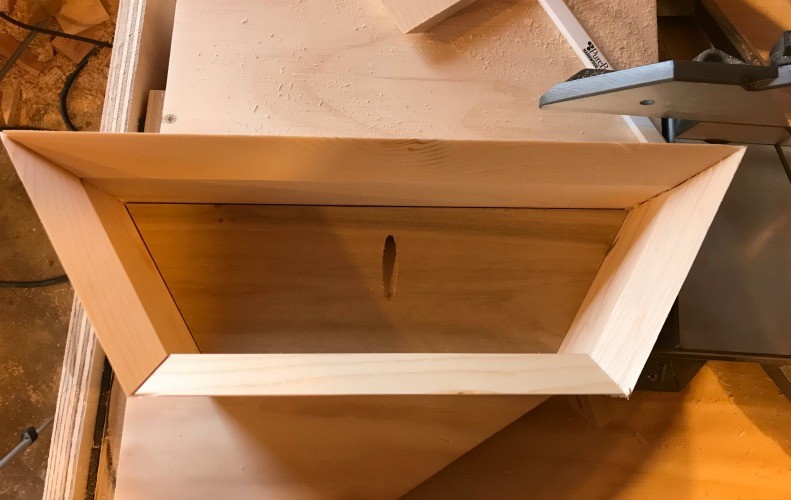
DIY Modern Woven Bench

December 16, 2017 by Shara, Woodshop Diaries

DIY Modern Woven Boho Style Bench

It’s no secret I am loving the return of the mid century modern style.  But if you mix in a little boho, I’m digging that even more!  So that makes this super simple DIY modern woven bench a perfect combination of my favorite things–modern, boho, AND easy to build 😉

How to build your own DIY modern woven bench with a few simple tools, a couple boards and some black and white string!

If you’ve got a few simple tools, a couple 2x2s and some string, you can knock this project out.

.

This bench may be small and simple, but it packs a big style punch.  And you can get as creative as you want with the seat design.  I’m pretty plain and boring (ha!), so I went with a super simple black and white design.

DIY Modern Woven Bench with black and white woven seat--super easy building tutorial

I highly recommend the twine that I used–it was easy to use and stronger than I expected.  Plus, it was kind of thick, so that made it easier and faster to weave.  You can find affiliate links to the black twine here and the white twine here.

.

Weaving is super easy, so don’t be intimidated.  It’s a little time consuming and monotonous though, so just turn on your Pandora music and get to work.  With the music playing, you’ll be done before you know it 🙂 haha.

.

Not only is the weave part really simple, but so is the build.  It’s just a few boards, a few cuts, a few screws and some glue.  If you wanted, you could even beef up the frame some and use 2x4s instead of 2x2s, but I liked the minimalist look of the thinner 2x2s.  Danny sits on this all the time to put his shoes on and it holds him up fine. .DIY Modern Woven Boho Style Bench

Oh and FYI, if you’ve noticed this black and white basket in the pictures, here’s the affiliate link for it.  I use it ALL THE TIME for staging and I LOVE the modern style.

.

If you’re ready to build our own DIY modern woven bench, click over to Remodelaholic for the step by step tutorial and video for the build and the weave 🙂

.

But before you go, don’t forget to pin this for later AND check out links to a few more of my favorite modern and mid century builds at the links below  🙂

How to make your own DIY modern woven bench from just a few 2x2 boards and some twine! Get that modern boho look for cheap with this easy DIY tutorial!

Mid Century Modern Dresser

Mid Century Pegboard Cabinet

Modern Dresser Armoire

Modern Floating Vanity

Modern DIY Couch

.

Until next time, happy building!

DIY Dog Tent

December 13, 2017 by Shara, Woodshop Diaries

How to sew a super easy DIY dog tent with pillow and striped fabric!

You may wonder why I’m showing a tutorial on how to sew a DIY dog tent.  I could see where you may wonder because 1. I mostly do woodworking projects and 2. there are already a million tutorials on Pinterest for this.

.

BUT, I have good reason (besides the fact it’s just so stinking cute!) so hear me out 🙂

How to sew a super easy DIY dog tent with pillow and striped fabric!

1. Actually, despite the fact I primarily post about woodworking projects, one of my most popular posts is this DIY Grinch pillow tutorial, which is a super easy sewing project.

. 

AND

.

2. Even though there are a million tent tutorials on Pinterest already, I couldn’t find a single one that would allow me to sew this striped fabric so that all the stripes would line up perfectly and wouldn’t bother my OCD.  So, if you want a super easy way to make a DIY dog tent with striped (or any patterned) fabric so that it will all line up correctly, I’ve got you covered 🙂

.

Oh and by the way, I’m the worlds worst with a sewing machine, so if you are intimidated, trust me…if I can do it you can too.  Plus, it’s for the dog, so it doesn’t have to be perfect, right? 😉

.

This post contains affiliate links.  Please see disclosure policy for details.

.

For this project you’ll need:

2 yards of tent teepee fabric

1 yard of pillow fabric (optional)

Thin pillow or batting

(4) ¾″ dowel rods 32″ long

Fabric scissors

Measuring tape

Thread

Pins

Sewing Machine (you don’t need anything fancy, it just makes sewing much faster)

Jute string

.

Oh, and just in case you’d like a large worktable to sew on like I’ve got in these pictures, check out how to build this rolling craft table here 🙂

.

Step 1: Cut DIY Dog Tent Teepee Panels

Cut 4 pieces of fabric like shown from your tent teepee fabric.  If you’re using striped or patterned fabric, make sure to cut so that all the stripes will line up.

DIY Dog Tent Teepee striped fabric panels

Take one panel and fold in half (right sides together) like shown.  Pin 2″ from the edge of the fabric.  Trace out with a pencil or pen an opening for the front like shown.  You can draw the opening as large as you want, but make sure not to go past the pins 2″ from the edge.

draw and pin diy dog tent teepee door

Now, cut along the line.

Step 2: Hem the DIY Dog Tent Teepee Fabric Panels

Cut a strip of fabric from the tent panel fabric scraps and use it to hem along the opening for the door.  Also hem along the bottom and top of the panel.

Hemmed edges of DIY dog tent teepee

Also hem along the top and bottom of the other three panels.

Step 3: Stitch Together the DIY Dog Tent Panels

Place one regular panel on top of the front panel with right sides together and pin along one edge making sure the stripes line up.

How to sew diy dog tent panels together

Stitch along this pinned edge. Make sure the stripes stay lined up just right as you are sewing.  PS side note: There is absolutely no doubt that I am my father’s child…we literally have identical looking man hands.  Of all the things I wanted to inherit, I got Dad’s hands…awesome. HAHA

Continue around stitching the other two panels the same way.

Once you have all four panels sewn up, you are almost done!!

Step 4: Sew Up DIY Dog Tent Dowel Rod Slots

Cut (if not already the correct size) ¾″ dowel rods to about 32″ long.  PS, you can’t cut these with scissors….even though the scissors are in the picture haha.

Place a rod along one of the seams and pin.  Make sure the seam is centered on the OUTSIDE of the dowel rod.  You want equal sized pieces of each panel wrapped around the rod .

Remove the rod, then stitch along the pinned line.  Do this on all four seams.

Step 5:  Tie DIY Dog Tent Rods Together

Slip the rods into the slots you just stitched in step 4 and use jute twine to tie them together.  I honestly have no idea if there is a right or wrong way to do this, but I just wrapped around and around and through and around again.  There was no pattern.  Once it kind of stays in place, tie it off and cut the string.

Step 6: Sew a Pillow for the DIY Dog Tent

This part is optional, but I wanted a thin little pillow to place inside the tent.  I used a different fabric and stitched up a simple envelope style pillow cover 18×18 inches.  You can find a simple envelope pillow cover tutorial here.  You can stuff this with a thin pillow form, stuffing, or do what I did and use a few layers of batting.  I just cut two pieces of batting 18×18 and stuffed inside.  Easy peesy 🙂

Now, just add a dog and you’re done 🙂

.

This is Rufus, my oldest doggie nephew.  He’s the most photogenic dog I’ve ever seen.  He just poses, doesn’t move, and looks cute 🙂

How to easily sew a DIY dog tent with striped or patterned fabric! Super easy sewing tutorial for beginners. Super cute pet bed idea!

See how in the picture below the stripes line up perfect all the way around the corners??  All the tutorials I found had you wrap the fabric around the poles separately and (the math nerd within me knows) that means that mathematically, the stripes will not be equal widths all the way up on the sides vs on the poles, so they will not line up.  Sewing it this way makes certain that the stripes are even around the entire tent.  And that’s good for the math nerdiness and the OCD haha.

Super easy tutorial for how to sew a DIY dog tent with striped or patterned fabric!

How to make a DIY dog tent from a little fabric and some dowel rods! Super easy sewing tutorial--great beginner project!

Isn’t little Roo cute in his new doggie tent??

How to easily sew a DIY dog tent with striped or patterned fabric! Super easy sewing tutorial for beginners. Super cute pet bed idea!

If you like to incorporate some fabric and sewing into your building here and there (like me!), be sure to go check out how I built and upholstered a couch for Danny’s man cave in this post.  Don’t be afraid of the sewing machine!  It can really add a lot to some of your building projects 😉

.

So what do you think about this little project??  Would you give it a try??  I’d love to hear your thoughts in the comments!

.

And I’d also love it if you’d pin this for later 🙂

How to sew a super easy DIY dog tent with pillow and striped fabric!

Until next time, happy DIYing! 🙂


DIY Wooden Christmas Village

December 9, 2017 by Shara, Woodshop Diaries

DIY Wooden Christmas Village Display perfect for a simple Scandinavian Christmas Mantle

Learn how to make a DIY wooden Christmas village for your mantle this holiday season with this step-by-step tutorial.

.

How to make a DIY wooden Christmas village perfect for Scandinavian style Christmas decor

How cute are these DIY wooden Christmas village houses??!

.

I LOVE Scandinavian Christmas decor!  I can’t get enough of that simple black, white, natural wood and green garland combination. 

.

So, to incorporate a little Scandi into my decor this year, I built a Scandinavian style DIY wooden Christmas village for my fake brick fireplace mantle!

.

It’s obviously a very simple style, but I LOVE the natural wood colors and the option to use them all year long since they aren’t specifically just for Christmas.  These would be cute decorated up for any holiday or season, or just left natural for some modern shelf decor 🙂

..

Oh, and did I mention that this whole project cost less than $20??  You couldn’t even buy one tiny piece of a regular Christmas village for that price!  But, the real reward isn’t the dollar saved…it’s the fact you can say “I made that,” amiright??

..

Okay, so let’s get to the how to, shall we?  First, let me explain a little something.  I’ll show you a very general way of how I made the tall skinny house.  You can customize whatever size or window/door design you want…there is no right or wrong way of doing this.

.

The two houses on the left and right are made exactly the same as far as procedure, but with different dimensions and window placement.  The house in the middle is made the same way as well, just with different dimensions and I added a little piece on the front.  Feel free to get creative with it 🙂

.

This post contains affiliate links. Please see this disclosure policy for details.

How to Make a DIY Wooden Christmas Village

.D

For These DIY Wooden Christmas Village houses, you will need:

Tools:

  • Sander
  • Jig Saw
  • Miter Saw
  • Table Saw (optional)
  • Drill

Materials:

  • ¼ plywood (I used birch–one of these sheets will be more than enough to make one house)
  • 2×2 scraps (just need a little piece for the chimney)
  • Wood Glue
  • Clamps (varying sizes)
  • Wood Putty
  • Square
  • Polycrylic

.

Step 1: Decide on the Sizing for Houses

First, you need to decide how large you want your Christmas village house.  I made mine fairly large.  The tall one is 16″ tall x 6″ wide and 6 ½″ deep.  But you can make yours however large or small you want.

.

Once you decide on your sizing, use a jig saw and a straight edge, or a table saw if you have one, to rip your ¼″ plywood to the correct widths. 

.

To make it easy, I just did 6″ wide for the fronts and sides of my house so I only had to rip one size.  Then cut two pieces the height you want your house.  So in my case, it was 16″.

How to build a Scandinavian DIY wooden Christmas village

Step 2:  Cut Pieces for DIY Wooden Christmas Village

Mark the center of the top of both pieces and use a square to draw a 45 degree angle to cut for the roof.

center marked on board

Using a miter saw (or jig saw), trim the top corners 45 degrees from the center mark down.  Then measure from the bottom of the piece to the point where the miter starts on the side and cut your house side pieces this long. 

.

NOTE: this length for the house sides should be: height of front piece – (½*width of side piece).  So in my case: 16 – (½*6)=13″.

boards cut in house shape for DIY wooden Christmas village

Use a square and tape measure to lay out your windows and doors in whatever design you wish.

window and door shapes drawn on wood to be cut out for DIY wooden Christmas village house

Use a drill and large bit to drill a hole in each window so you can get your jig saw blade in it to cut–just like with this fall leaf sign and these modern Christmas ornament signs.

Christmas tree drawn on piece of wood with hole drilled to be cut out using jigsaw

Use a jig saw to cut out all the windows and doors you want on all four sides of the house.

all four sides of house with windows and door cut out

Step 3: Glue House Sides Together

Use some wood glue and clamps to glue the house together like shown. OR use super glue if you don’t have clamps and need a quicker hold.

DIY Scandinavian Christmas village house glued and clamped together to dry.

Once the glue is dry, putty and sand the edges.

Step 4: Add the Roof and Chimney

Cut two pieces of ¼″ plywood to cover the roof.  You can make your roof as large or small as  you wish, but I cut mine about ½″ longer than the width of my house (so 7″) and about 4 ½″ wide. 

.

Simply glue these two pieces on, butting them at the top.  You can use masking tape to hold in place until the glue dries.

.

If desired, you can use a piece of scrap 2×2 to glue to the roof as well for the chimney.  I did this on two of mine, but it’s totally optional.

.

Then, just putty any spots you missed, give it a good sanding, and finish as desired.  I really loved the natural wood look, so I just sealed mine with a Polycrylic clear coat.

Fireplace with DIY wooden Christmas village sitting on mantle

I cut a little branch from the garland to make a little wreath for one of the houses.

Close up of house in DIY wooden Christmas village.

The other two houses were made the same way, but with different dimensions and the middle one, I added a little extra “box” on the front. 

.

The far right house I made only 12″ tall, 8″ wide, and 6 ½″ deep.  The middle house is 12″ long, 9″ tall, and 6 ½″ deep (without the front door “box”).  You can flip flop the roof direction and change up the sizes pretty easily.

DIY Wooden Christmas Village Display perfect for a simple Scandinavian Christmas Mantle
DIY Wooden Christmas village with natural wood makes the perfect Scandinavian style Christmas decor
Scandi Style DIY Wooden Christmas village sitting on mantle

I love this simple little project.  Luckily, even though Christmas is coming quickly, you still have time to whip up a few of these for your mantle or centerpiece. They will only take you a few hours including the glue dry time 🙂

.

Pin this first, then go get building 🙂

How to make your own DIY wooden Christmas village perfect for Scandinavian Christmas decor. Easy and free project tutorial

Until next time, happy building 🙂
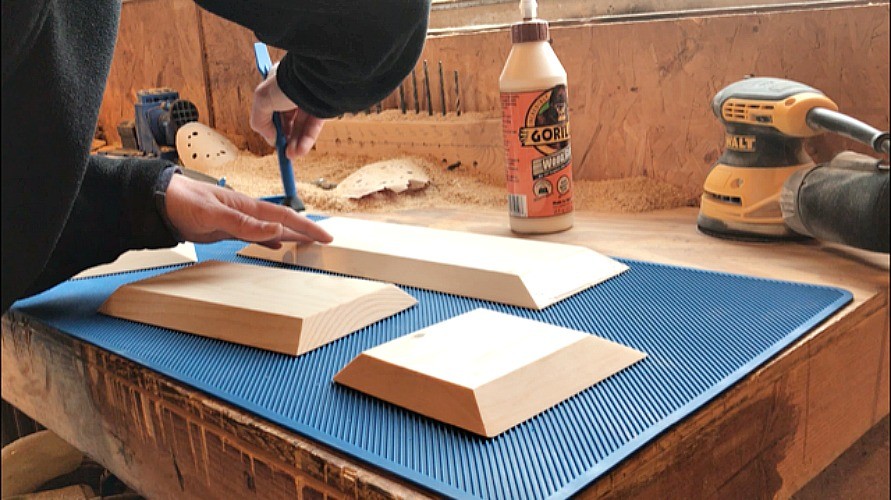
How to make your own DIY wooden Christmas village perfect for Scandinavian Christmas decor. Easy and free project tutorial

DIY Wooden Christmas Village

Yield: 1 wooden Christmas village

How to make your own DIY wooden Christmas village perfect for Scandinavian Christmas decor. Easy and free project tutorial

Materials

  • ¼ plywood
  • 2x2 scraps
  • Wood Glue
  • Clamps (varying sizes)
  • Wood Putty
  • Square
  • Polycrylic

Tools

  • Sander
  • Jig Saw
  • Miter Saw
  • Table Saw (optional)
  • Drill

Instructions

  1. Decide on the sizes of your houses.
  2. Cut wood for DIY Christmas village houses. Cut out doors and windows using a jigsaw.
  3. Glue house sides together.
  4. Add the roof and chimney.
  5. Sand and finish as desired.
© Shara, Woodshop Diaries
Project Type: Seasonal Decor / Category: Christmas

DIY Modern Christmas Wreath

December 6, 2017 by Shara, Woodshop Diaries

When the weather gets chilly, I start to get a little crafty.  I’m a wimp in the cold weather, so I have to find something to keep my hands busy inside where it’s warm when I can’t stand the cold out in the shop.  Sometimes I turn to sewing, but many times, I start making wreaths.  Wreaths are, after all, where my “making” all started.  This year, I wanted something kind of small and simple to hang on the wall, or above my fireplace, so I made this DIY modern Christmas wreath.

How to make a simple modern Christmas Wreath with a Macrame hoop

I’ve been seeing people use macrame hoops to make wreaths and LOVE the simple, minimalist look.  So, while this isn’t a totally original idea, I’m going to show you how I made mine 🙂

.

This post contains affiliate links.  Please see disclosure policy for details.

.

To make this DIY Modern Christmas Wreath, you will need:

Macrame hoop

Cotton string

Scissors

Floral wire

Small floral stems (2 of one larger kind, 2 of a smaller kind, and one small center pick)

First, attach the macrame to the DIY modern Christmas wreath…

Decide how long you want the string to hang from your wreath.  Double that length and cut several pieces of cotton string this length.  So for example, if you want your string to hang down about 12″, then cut SEVERAL pieces about 24″ long.  Tie these strings onto the loop using a larks head knot like shown.

Next, attach the larger stems to the wreath…

Using floral wire, tie the larger floral stems onto the hoop like shown.  You can place wherever you want, but I did mine so that the intersection of the two stems was about the center of where I had my macrame strings.

.

You will need to use the floral wire to tie each stem in at least two places or it won’t stay put.  I just wrapped my wire around the stem and the hoop and twisted several times to tie.

How to make a DIY Modern Christmas Wreath from a macrame hoop

Then, add the remaining floral stems to the DIY Modern Christmas Wreath…

Layer the smaller stems on top of the larger stems and attach with floral wire like you did earlier.  Just wrap the wire around the hoop and twist together around the floral stems to tie in place.

Once you have your smaller stems in place, add a little decorative floral pick in the middle to hide the stems and the wire.  Again, just tie it in place using floral wire.  Tuck any remaining wire towards the back to hide it.

Lastly, trim the macrame string…

Lay your wreath on a table or counter top  and let the string hang off like shown.  Straighten the strings and trim off even (or you could do a V shape or something different).

Now, just tie another string to the top (if you want…if not, you can hang still hang it without the string) and it’s ready to hang!

.

I love the simplicity of this style wreath.  Plus, since you only have to buy a few small stems, it’s really inexpensive to make!

How to to make a DIY Modern Christmas Wreath with macrame hoop and a few floral stems--so easy and cheap and can be changed up for the seasons

And when Christmas is over, it’s still cute for winter, too!

And when spring rolls around, keep the macrame string and just change out a few of your stems for hydrangeas or other colorful flowers and you’re good to go.  This is great for your front door, but also hanging above the bed, or over a fireplace, or just on a blank wall that needs some life 😉

So how do you feel about the modern, minimalist look of this style wreath?  Would you give it a try??  If you’re looking for more wreath ideas, be sure to check out this super easy 5 minute Christmas wreath and this super easy magnolia and cotton wreath, too!

.

But, first, be sure to pin this for later 🙂

How to make your own DIY Modern Christmas Wreath from macrame hoop and a few floral stems! Very easy DIY wreath for Scandinavian style Christmas decor

Be sure to check out these other fun Christmas projects:

DIY Snowflake Pillow

DIY Grinch Pillow

DIY Scrap Wood Ornament Signs

DIY Christmas Lantern Post

DIY Wooden Christmas Truck

DIY Christmas Swags

DIY Snowflake Shelf

.

Until next time, happy DIYing! 🙂

DIY Modern Farmhouse Faux Drawer Dresser

December 4, 2017 by Shara, Woodshop Diaries

Raise your hand if you love fake stuff??  I’m guessing most people aren’t huge fans of “fake.”  I can smell fake from a mile away…fake wood, fake people, fake sugar…and I don’t like it.  Even still, today I’m bringing you a faux drawer dresser build.  I know…FAKE!  But I promise, it’s for a really good reason…

.

Because sometimes, fake is actually REALLY STINKIN’ PRETTY!

How to build a farmhouse dresser with faux drawers and cabinet storage space

Can you believe these “drawers” in this dresser are totally 100% fake?!  Well, ACTUALLY, I lie.  There are drawers in here, but it’s not exactly how it appears.  See what I mean?

PS, if you’re into really pretty fake things, check out this fake storage fireplace, and this fake brick fireplace 😉

.

Storage pieces with a million drawers are so pretty!  But, seriously, who wants to make a million drawers??  Plus, drawer slides aren’t the cheapest things in the world…and we all know, I’m cheap haha.

.

So, this fake drawer dresser cabinet simplifies (and saves some $$ on) this build, but doesn’t take away the beauty or the storage space 🙂  Plus, it makes lining up your “drawers” a piece of cake haha.  Side note: see that cute kitty art??  You can make your own personalized pet art from your own pictures with this tutorial 🙂

DIY Fake Drawer Cabinet Dresser

This post was sponsored by Build Something, Kreg Tool‘s site for free DIY building plans for everything from small decor pieces to dressers, cabinets, and beds.  This post also contains affiliate links.  Thank you for supporting this site and the brands that support this site.  Please see disclosure policy for details.

.

You can click on over to Build Something to grab the free plans for this faux drawer dresser cabinet, BUT first, let me give you some tips and recommendations 🙂

.

For this build, I used a few specific tools and products that I will highly recommend for this project AND that will be HIGHLY useful in future projects:

.

Kreg AccuCut

Kreg Concealed Hinge Jig

Kreg Shelf Pin Jig

Kreg Pocket Hole Jig

Kreg Rip Cut

MLCS Router Bit Set

D Lawless Country Store Drawer Cup Pulls

.

One of my favorite tools I used on this build was the Kreg AccuCut.  This is like a track saw that you can use with your circular saw.  It made cutting the little slots in the doors and drawer fronts a breeze.  The AccuCut has a rubber backing that stays in place without clamps, so you just slap it down where you want to cut, and run your saw along it.

How to use a Kreg AccuCut to cut fake drawer slots

When I made my fake drawer cabinet doors and drawer fronts, I measured down each side of the door where I wanted my slots, then set my circular saw in the track of the AccuCut, and set my blade depth to about ¼″.  Then, I lined up the AccuCut with my marks and ran my saw through it.  Then, just moved it to the next set of marks, and repeated.  This was much faster than having to line up and clamp straight edges, or having to adjust rip fences on my table saw for each mark.

DIY Fake Drawer Dresser Cabinet--Faux DIY apothecary cabinet

The Kreg Concealed Hinge Jig was SUPER helpful with this build as well.  I’ve never used concealed hinges before.  Normally, when I want inset doors and don’t want you to see the hinges, I’ll use little butt hinges.  They are really small, so you don’t notice them too bad, but you can still see them and they are really hard to adjust if everything isn’t lined up perfect.

.

So, since I really wanted this cabinet to look like it had a bunch of for real, legit drawers, I didn’t want to use the butt hinges.  I needed concealed hinges.  Concealed hinges are 100% concealed (so you won’t see any part of them), and they have endless adjustment options to get your door to sit perfectly in the opening, BUT they also have this “cup” that sits in the door.  This requires you to drill out this hole in the door for the cup.  Always pros and cons…

How to build a DIY Fake Drawer Apothecary Cabinet

But, the concealed hinge jig makes this SO easy.  It was my first time ever using this type of hinge and this jig and I had my doors installed in about 15 minutes.  With butt hinges, it usually takes me three times that long!  I highly recommend using concealed hinges (I don’t think I’ll ever go back to butt hinges now!), and if you don’t have a fancy drill press, this jig is a must have.

How to use Kreg Concealed Hinge Jig to make Faux Drawer Dresser

Okay, so now let’s talk about the Kreg Shelf Pin Jig.  Stationary shelves are great, but adjustable shelves are usually better.  Indecisive people (like me) have a hard time deciding where they want their shelves, so giving them the option of adjusting when they change their mind a million times is a great idea 🙂

.

This jig makes it easy to drill evenly spaced holes for shelf pins without having to have a drill press and make a million measurements.  I use it all the time!  Just place your shelf pins in the holes you want and slide your shelf in place.  Then take it back out, move your pins, and repeat a thousand times when you change your mind 😉 haha

How to use a Kreg Shelf Pin Jig to make a faux drawer dresser cabinet

The pocket hole jig and the rip cut are two of my favorite (and most used) tools because it makes assembling and cutting down huge pieces of plywood so much easier on this scrawny builder.  You will see these tools used in almost all my projects 🙂

.

One more detail in this build that you might have noticed is the routed detail around the doors and drawers.

It’s not a huge feature, but I think it really adds a nice detailed touch to the cabinet.  I recently got this router bit set for my birthday and have really enjoyed putting it to use lately.  I gave the Roman Ogee bit a run on the door and drawer openings on this piece and really loved the added detail.  It only took a few minutes to do.

Add Roman Ogee decorative edge to fake drawer cabinet door opening

If you are looking for a good beginner router bit set, I love this one and highly recommend it.  Once you add a decorative edge to one thing, you’ll want to do it to everything…like this DIY Christmas Lantern Post!

.

Finally, let’s talk about these GORGEOUS cup pulls.

All the heart eyes, amiright??  I love D. Lawless Hardware–they have a million options and the prices are outstanding.  I’ve never been disappointed with any of the door or drawer pulls I’ve gotten from them and these pulls are no exception.  These country store cup pulls are excellent quality.  They are heavy and very easy to install.  And since you’ll have to buy 18 for this build, it’s also nice that the price is less than $2 each.  Not. Even. Kidding.

.

How to build a faux drawer dresser cabinet--DIY farmhouse dresser apothecary cabinet

So, if you are ready to get building, click over to Build Something for the free plans and don’t forget to pin this for later 🙂

How to Build a DIY Faux Drawer Dresser Cabinet that looks like a DIY apothecary cabinet--free building plans and tutorial!

Until next time, happy building 🙂
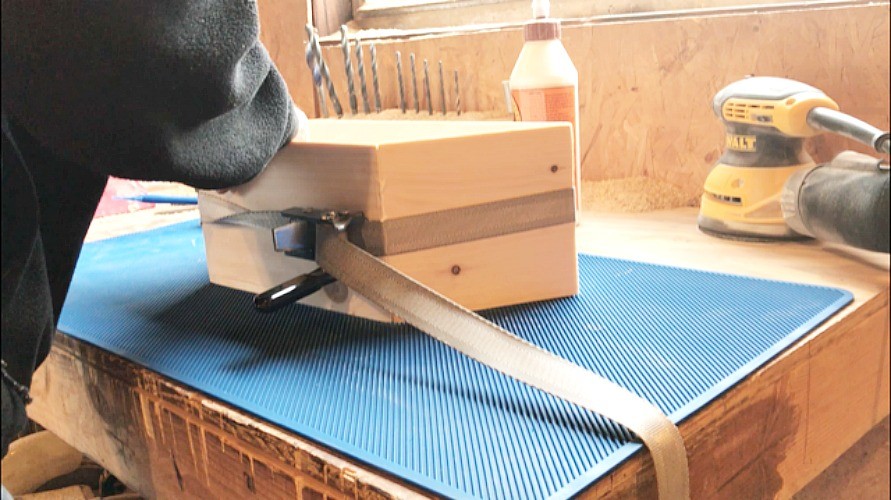
 

DIY Christmas Lantern Post

December 2, 2017 by Shara, Woodshop Diaries

How to Build a DIY Christmas Lantern Posts from Scrap Wood and Old Spindles--Easy Christmas Craft

I know the feeling.  It’s Christmas already?!  One part of you is excited because, you know, it’s the most wonderful time of the year, right?  But then the other part of you is like, oh no, I’ve got to drag out the decorations and make the lists and cook the food and buy the presents!

.

With all the hustle and bustle of the season, though, I know you don’t have a whole lot of shop time.  Luckily, this DIY Christmas Lantern Post won’t take much time to build and can also help you clean up that scrap pile!

How to Build a DIY Christmas Lantern Post from Scrap Wood and Old Spindles--Easy Christmas Craft and scrap wood project

I’m teaming up with 11 other talented builder bloggers to bring you one fun Christmas themed project each day and we are calling it the 12 Days of a DIY Christmas.  You can find the other 11 projects linked below 🙂

.

I’m seriously so excited about this little lantern post!  Isn’t it so cute wrapped in garland and lights??  It’s actually really cute without the garland and lights, too, so once the holidays are over, you can still keep it around 😉

.

So let’s get started on the how to, shall we??

.

This post contains affiliate links.  If you purchase from these links, I may receive a small commission at no extra cost to you.  This helps support this site to keep the content free.  Please see disclosure policy for details.

.

Tools and Materials:

Wood scraps (for sizes, see tutorial)

Wood Spindle

Table Saw

Miter Saw

Router (optional)

Drill

Wood Glue

Nail Gun

Measuring Tape

2 ½” wood screws

.

Step 1:  Cut DIY Christmas Lantern Pieces

Using a table saw, I ripped down a scrap 1×6 board to pieces a few pieces ¾” wide.  This gave me several square pieces to use to make the lantern.  If you don’t have a table saw, you can use wider boards as well.  There are no “rules” to this.

How to build a scrap wood DIY Christmas Lantern Post

Then, using a miter saw, I trimmed down these ¾” square pieces to four 8” long pieces and eight 3” long pieces.  If you don’t have enough, rip down some more ¾” wide strips.

How to build a DIY Christmas Lantern Post from scrap wood

Step 2:  Assemble the Lantern

Using wood glue and a nail gun, I assembled two rectangle frames like shown.

Scrap Wood Christmas lantern

Then, I used wood glue and a nail gun to attach the remaining 3″ pieces between them to make a lantern.

Scrap Wood DIY Christmas Lantern Post

For the top and bottom, I used scrap 1×6 and 2×6 boards. In hindsight, I should probably have used both 1x6s instead of the 2x on the bottom.  But whatever works is fine.  I just cut squares.  So, since 1x6s and 2x6s are 5 ½″ wide, I cut my pieces 5 ½″ long to make 5 ½″ squares.

.

For some added detail, I used a Roman Ogee router bit from my new kit to go around the edges.  Then just glued and nailed them on the top and bottom.

Roman Ogee detail on DIY Christmas Lantern Post

Oh, and I cut a piece off an old scrap spindle for the top as you can see below.

DIY Christmas Lantern Post

Now you have a lantern!!!

Step 3: Build the DIY Christmas Lantern Base

For the base, I used some scrap ¾″ plywood, but you could also use some 1x6s again.  Basically, I just built a box like shown below that was 12″ tall and 5 ½″ square.  So, cut 2 pieces 5 ½″ wide x 12″ tall and 2 pieces 4″ wide x 12″ tall and glue and nail together 🙂

DIY Christmas Lantern Post Base

Then, I cut a scrap piece of 2×8 square.  So it was 7 ¼″ x 7 ¼″.  I also routed these edges, too.  You don’t have to route anything, I just like the detail 🙂  Plus, I just got new router bits for my birthday so I want to use them on EVERYTHING!!!  I just glued and screwed this base piece to the base box from the bottom side with 2 ½″ screws.

DIY Christmas Lantern Posts using scrap wood

PS, ignore that extra hole…I missed the first time HA!

Step 4:  Attach the DIY Christmas Lantern to the Base

My sister and brother in law just cleaned out their shed and found a bunch of random wood (and possibly some critters…but that’s neither here nor there…).  They gave me some old spindles that worked PERFECT for this.

.

If you don’t have an old spindle lying around, they aren’t expensive at the big box store, or you could also check around some thrift or junk stores as people are re purposing them a lot lately!  Either way, get yourself a spindle!

Turn an old spindle into a DIY Christmas Lantern Post

I trimmed off one flat end of mine (totally up to you).  Then, I screwed my lantern into the top using a 2 ½″ wood screw.

For the bottom, I cut one more piece of 1×6 to make another 5 ½″ square and routed the edges.  Then, I screwed this into the other end of the spindle.

Finally, I glued and nailed the spindle part to the base box like shown.  (ps I know my terminology here is terrible!)

Step 5:  Putty and Finish the DIY Christmas Lantern Post

Putty the nail holes and sand smooth.  Then paint as desired.  Also, if you wanted, you could add a little sign with your leftover ¾″ square pieces and some plywood.

.

I just screwed two ¾″ pieces together to make an L shape, then screwed it to the top of the spindle.  Much like I did with my DIY Christmas Truck, I designed a picture in PicMonkey, printed it and modge podged it onto a piece of scrap plywood. I nailed on a 1×2 frame and used eye hooks and cup screws to attach it to the post.

DIY Christmas Lantern Post with Merry Christmas Sign

You can add a little battery powered candle and some garland and lights and look how festive you are!! 😉

How to Build a DIY Christmas Lantern Posts from Scrap Wood and Old Spindles--Easy Christmas Craft

If you like the little truck, you can find the tutorial for it here.  And that snowflake pillow tutorial is here, too!  If you like pillow covers, also check out my very popular DIY Grinch Pillow tutorial here.

DIY Christmas Lantern Post from Wood Scraps and an Old Spindle--great way to repurpose an old spindle

DIY Christmas Lantern Post from Wood Scraps!

If you want some more Christmas inspiration, check out my Paper Sack Christmas Decor, 5 minute Christmas wreath, easy swags, and Christmas home tour.

.

I’d also love it if you’d pin this for later!

How to make a DIY Christmas Lantern Post from scrap wood and an old spindle! Great Christmas decor idea!

Be sure to check out the other 12 Days of a DIY Christmas projects below:

Her Tool Belt Sleigh Rides Sign

Build It Craft It Love It

The Kim Six Fix Scrap 2×4 Trees and Santas

Anika’s DIY Life Picture Frames

The Handyman’s Daughter Christmas Tree Yard Decoration

The Painted Key Christmas Moose

My Love 2 Create Wooden Reindeer Puzzle

Hazel & Gold Designs Decorative Ladder

The Created Home Dining Table

Uncookie Cutter Modern Christmas Sign

Handmade by Ashley 

Until next time, happy building!! 🙂

Scrap Wood DIY Christmas Ornament Signs

November 29, 2017 by Shara, Woodshop Diaries

I know this is crazy, but one of my favorite projects I’ve ever done was this super simple scrap wood leaf sign.  So, for the upcoming Christmas season, I wanted to make something similar to decorate with…and to get rid of my scrap wood pile with.  So, I made some of these cute, simple scrap wood DIY Christmas ornament signs.

How to make scrap wood Christmas ornament signs

I am loving the black, white, and gold Christmas decor trend this year so that’s the color scheme I went with, but you could easily customize them by using different colors.

.

And, if you aren’t a big fan of the ornament shapes, you could do pretty much any shape you want.  I actually started out doing a Christmas tree shape (as you will see), then changed my mind and decided on ornaments instead.  PS…If you know me at all, you know I’m super indecisive haha.

.

So, grab your scraps, and a few simple tools and let’s get these signs made 🙂

.

This post contains affiliate links for your convenience.  Please see disclosure policy for details.

.

For these DIY Christmas Ornament Signs, you will need:

Scrap ¾″ plywood

Scrap ¼″ plywood

1×2 scraps (for frame)

Shape Templates (see step 1)

Jig Saw

Drill and large bit

Nail Gun (optional, but helpful)

Painters Tape

Spray paint

Wood Glue

Clamps

Measuring Tape

Step 1: Find Templates for DIY Christmas Signs

As I said before, you can choose whatever shape you want.  I went with three different style ornaments.  You can do a quick Google search and find some shapes you like.  Copy and paste into a Word document to size however large you want, then print and cut them out.

.

As you can see, I started out with a Christmas tree, then changed my mind and went with modern shaped ornaments.

DIY Scrap Wood Christmas Ornament Signs

Step 2: Cut Scrap Plywood to size

Just like with my fall leaf sign, I grabbed a couple pieces of ¾″ plywood and ¼″ plywood.  I made each sign a different size, but however large or small you make them, you will need one ¾″ piece and one ¼″ piece cut exactly the same size for EACH sign.  See image above.

Step 3:  Cut Out and Paint Ornament Shapes

Trace your template shape(s) onto your ¼″ plywood piece(s).  Using a drill and large bit, drill a hole in the middle of your shape.

Then, use a jig saw and start your blade in this hole.  Cut out your shape(s).   I spray painted mine before I took the picture.  I painted the ¾″ plywood pieces black and the cut outs white.  You can make them whatever color you want 🙂

Step 4: Paint on Your Design

For this part, I used Frog Tape to add a little more detail to my signs.  I wanted some gold touches, so I taped off where I wanted to leave black.  I left my ornament cut out sitting on the background while I placed the tape, then removed it and stuck down the ends.

Place your cut out back on to make sure your tape is where you want it.

Then remove the cut out and spray paint the background piece(s) gold.  For one of mine, I did diagonal stripes, one I did a “gold dipped” design, and the other, I did polka dots using a scrap piece of pegboard.

Step 5:  Glue DIY Christmas Ornament Signs Together

Remove the tape once the paint is dry, then glue the cut out pieces to the back pieces using wood glue.  Clamp to hold in place.

Step 6: Add a Frame

Cut pieces of 1×2 scraps to fit around the edges of the sign once the glue is dry.  You can paint or stain, but I left mine natural.  Use wood glue and clamps OR a nail gun to attach these pieces around the edge, just like with the leaf sign (shown below).

Now, you have some super cute, super easy modern Christmas ornament (or whatever shape you chose) signs!

modern black and gold christmas ornament signs from scrap wood

DIY Scrap Wood Christmas Signs with black and white and gold ornament shapes

I love the Scandinavian Christmas feel this black, white, gold and natural wood gives.  This year I was really feeling the more simple style 🙂

.

So, if you need something cute to do with your scrap wood pile, hurry up and get building before the season is over!  Pin this for later so you don’t forget 😉

How to make these DIY Christmas Signs with black, white, and gold Christmas Ornament shapes from scrap wood. Perfect for modern or Scandinavian Christmas decor

If you want some more Christmas inspiration, check these fun projects out!

DIY Wood Christmas Truck and Trailer Stocking Hanger Box

DIY Snowflake Shelf

DIY Snowflake Pillow 

DIY Grinch Pillow

DIY Christmas Lantern Post (coming soon)

.

Until next time, happy building 🙂
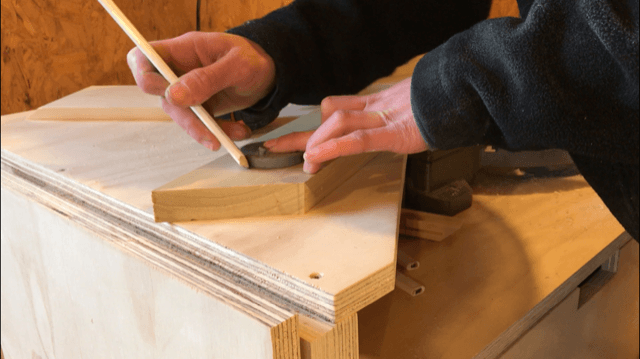


How to Make a DIY Snowflake Pillow

November 25, 2017 by Shara, Woodshop Diaries

How to make an easy DIY Snowflake pillow for Christmas!

I love pillows.  On the couch, in the baskets, on the shelves, on the bed.  You can’t have too many pillows.  But, when it comes time to switch it up for the holidays, I don’t want to have to replace all those everyday pillows with cute Christmas ones….because 1. I’m lazy and 2. I’m cheap.

.

But, pillow covers can save the day!!  And this cute DIY snowflake pillow cover can last you all through winter.  And that’s awesome because, you know….the whole too lazy to change out pillows all the time thing 🙂

How to make a DIY Snowflake pillow for Christmas decor! Easy DIY Christmas project and great for beginners!

Oh and if sewing isn’t your thing, I totally get it.  It’s not my thing either.  I actually do enjoy it, I’m just terrible at it.  But, that should encourage you because if I can do it, anyone can.  That means you 🙂  so grab some scissors, some fabric, and an old pillow and let’s get started.

.

This post contains affiliate links.  If you purchase from one of these links, I may receive a small commission at no extra cost to you.  This helps support this site and keeps the content free.  Please see disclosure policy for details.

.

For this DIY Snowflake Pillow, you will need:

Two contrasting fabrics (½ yard of main fabric per pillow, ¼ yard of snowflake fabric)

Fabric Scissors

Snowflake Template (see Step 1)

Pins

White thread

Sewing Machine

Measuring Tape

Supplies for diy snowflake pillow

Step 1:  Cut a Template for DIY Snowflake Pillow

To get the snowflake shape for the pillow, you can do a quick Google search for snowflake clipart and find a design you like.  Keep in mind you probably don’t want anything super detailed or it will be difficult to sew on.

.

Once you find one you like, copy the image into a Word document and size it however large you want it.  It’s helpful to use the rulers on the top and sides in Word for this.  I made my pillow 18″ square and my snowflake about 10″ diameter.  But you can make it whatever size you want.

.

If it wont fit on one page (and it probably won’t), then just fit it so that at least half the snowflake will fit on one page to print.  Then print it and cut it out.

.

Fold your snowflake fabric in half and pin your template onto the fabric like shown.  Make sure the inside edge of the snowflake sits on the fold so when you open it up, you get the whole flake 🙂

How to make a DIY snowflake pillow with a paper template

Use fabric scissors to CAREFULLY cut the fabric out around the snowflake template.

Step 2:  Pin the Snowflake Fabric in Place

Cut a piece of the primary pillow fabric about 18″ square.  Center the snowflake on this piece and pin it in place.

DIY Snowflake Pillow Cover

Step 3: Stitch Snowflake onto DIY Snowflake Pillow

Using white thread and a sewing machine, carefully stitch around the edge of the snowflake fabric.  Get close to the edge, but it doesn’t have to be perfect.

.

If you aren’t used to sewing, it’s helpful to stop pressing the pedal to sew (assuming you have a foot pedal) while the needle is still in the fabric, then lift the foot, turn the fabric, then press the foot back down and sew again.  This keeps the fabric in place so your stitches don’t get out of line.

Stitch snowflake onto DIY snowflake pillow

Don’t worry if some of the fabric frays.  It adds to the look 😉

Step 4:  Sew the Envelope Cover

Cut another piece of primary fabric about 18″x20″.  Then cut this piece in half.  Place the pieces down like this with right sides facing and the top pieces overlapping in the middle.

How to sew a DIY snowflake pillow cover

Pin around the edges of the pillow cover and sew with a small (¼″ or so) seam.

diy Christmas snowflake pillow

Then, flip inside out and stuff with an old 18″ square pillow (or a new one….but I bet you have an old one somewhere you can use 😉 ).

.

Tada!  Easy Peasy!

How to make an easy DIY Snowflake pillow for Christmas!

Is that cute or what??  I actually made this one for my mom, but I’m making my own with the black and white buffalo fabric from the picture further up at the top….when I get some time between other projects HA.

How to make a DIY Christmas Snowflake Pillow cover--Great beginner sewing project for Christmas

Speaking of other projects, check out this DIY Christmas lantern post.  It’s made totally from wood scraps! The post will be out next week so stay tuned!

How to make a DIY Snowflake pillow for Christmas decor! Easy DIY Christmas project and great for beginners!

Oh and let me also remind you of the DIY Grinch Pillow from last year in case you missed it.  It’s my most popular pin and has been one of my most popular blog posts!  So when you’re done here, click over and check that out too!

.

But before you go, I’d love if you’d pin this for later! 🙂

How to make a DIY Snowflake Pillow--Great DIY Christmas pillow idea that will last all winter. Great beginner sewing project too!


Until next time, Merry Christmas and happy DIYing! 🙂

How to Square Board Edges and Make Your Own 2x2s

November 21, 2017 by Shara, Woodshop Diaries

In this post, I’m sharing how to make your own 2x2s and square off the edges of your boards for cleaner joints in your woodworking and building projects!

DIY Side Table-from 2x2s

I love building with construction lumber–it’s easy to find, inexpensive, and can look really nice if finished correctly.

BUT, most of the boards you find at the lumber yard are going to have rounded corners which can cause some issues when using it to build furniture.

In this post, I’ll show you how to deal with this and how to cut your own lumber (in some cases) to avoid this issue and make cleaner, nicer looking DIY projects.

What is “Construction Lumber?”

Construction lumber (at least in the Midwest of the United States) is typically pine, spruce, or fir wood and is sometimes referred to as “dimensional lumber.” They are cut to specific dimensions (discussed below).

This is the lumber you typically find at your local big box stores like The Home Depot that are used in building houses and other structures–think: 2x4s and 2x6s.

Why does dimensional lumber have rounded corners?

These boards come with rounded corners because their main purpose is construction. The rounded corners are easier to work with–less splinters and injuries.

But they are also more forgiving when installing drywall and other finishes when studs aren’t perfectly square and plumb.

Nominal Sizing vs Actual Sizing

Construction or dimensional lumber are found in common nominal sizes–2×4, 2×6, 2×8, 2×10, and 2×12.

The “2x” reference is the thickness–but it’s not actually 2″ thick. The term 2x is a nominal measurement–it’s actually 1 ½″ thick.

In addition to 2x, there is also 1x material which is ¾″ thick.

Nominal vs Actual Board Thickness

  • 1x = ¾″
  • 2x = 1 ½″
  • 4x = 3 ½″

Just like the thickness, the widths of these boards have nominal references as well, but these aren’t the actual dimensions.

Nominal vs Actual Board Widths

  • x4 = 3 ½″
  • x6 = 5 ½″
  • x8 = 7 ¼″
  • x10 = 9 ¼″
  • x12 = 11 ¼″

So, for example, a 2×4 is actually 1 ½″ thick x 3 ½″ wide. A 1×6 is actually ¾″ thick x 5 ½″ wide, etc.

Why is is important to square board edges before building?

Now, you may be wondering…okay, that’s cool, but why do I care about rounded vs square board edges?

And truth be told, in some cases, it doesn’t matter–so you shouldn’t care.

But in other cases, those rounded edges can cause some really ugly joints in your project that not only look bad, but can also cause some serious issues over time.

One of those issues is caused when building table tops using lumber with rounded corners. Butting two rounded edges next to each other leaves a crack like shown below.

Close up of valley between two boards side by side caused by rounded edges

This is what I call a crumb hoarding crack. You can get crumbs and spills stuck in these cracks and they’re impossible to clean. Over time, this can cause damage to the wood and bacteria and/or mold growth.

You don’t want that on your table top!

But even if you aren’t creating a table top, squaring off board edges will make any joint where you attach two boards together look a lot cleaner as you can see below.

Clean joints on two boards pressed together

When should you remove the rounded edges?

It’s not crucial to square the edges of every board on every project. Sometimes the small gaps are desired (like in rustic style pieces) and that’s totally fine. 

For workshop projects and things that aren’t built to “look nice,” it may not be worth the extra effort to square the board edges.

Sometimes the construction of the project isn’t done in a way that would reveal the rounded corners in any of the joints.

So, ultimately, it comes down to your personal preference and your discretion whether it’s beneficial for your particular project.

Think of how the pieces of your project will come together and note if there are any places where two rounded edges will butt together or where one square and one rounded edge will join.

In these cases, if you want a clean, nice looking joint, it’s best to square those edges.

However, in every case where assembling a table top of some kind, I ALWAYS square my board edges to avoid cracks for food, spills, etc to get stuck in.

How to Square Edges on Construction Lumber Boards

To square board edges, I like to use a table saw. You don’t need a specific type of blade. A general purpose saw blade will work just fine.

NOTE: Be very careful when using a table saw.  They are dangerous if you aren’t familiar with them.  Be sure to use a push stick and not get your fingers close to the blade.

For this example, we will use 2x4s.  If you want to square off wider boards, the process is the same, but the numbers will be different. 

Step 1: Measure Board Width

I explained earlier about the different sizes of construction lumber. In this example, I am squaring a 2×4.

This should be 1 ½″ x 3 ½″, however, keep in mind that the tolerances for these boards is pretty large, so it’s not always EXACTLY the correct dimension.

In this case, you can see that my board was actually a little narrower than 3 ½″.

So the first step is to actually measure the board you are wanting to square to find out its exact width.

Step 2: Adjust Table Saw Rip Fence

Once I have my board width, I subtract ⅛″ – ¼″ and adjust my table saw rip fence this distance from the blade.

In my example here, I took 3 ½″ MINUS ¼″ and got 3 ¼″. So I moved my rip fence 3 ¼″ from the blade.

Step 3: Cut Board Edge

Once the rip fence is adjusted about ¼″ narrower than the board width, I run my board(s) through the table saw.

This removes ¼″ of material off the edge of the board, so the rounded edges are gone and the edge that’s left is nice and square.

TIP: Make sure your table saw blade is square to the table. If you do this and your blade isn’t exactly 90 degrees, your “square end” will not actually be SQUARE, it will have a bevel.

Step 4: Square Opposite Edge

Now that one edge is square, I can simply repeat step 2 & 3 to adjust the rip fence ¼″ closer to the blade.

Then, I can flip the board over and run it through again to cut an additional ¼″ off the opposite edge to square that side as well.

This gives me a board that has nice, square, crisp edges. And now it’s ready to use in my project.

Considerations When Squaring Board Edges

Keep in mind that if you squared your board’s edges, that it’s no longer a “full width” board.

So if a plan you’re following calls for 2x4s and you cut yours to 3″ wide, you may have to adjust some other measurements as you build the project.

It will just depend on what you are building, so pay close attention.

But, What About 2x2s?

If you were to take a trip to the big box store right now and look at their 2×2 boards, you will likely notice that many of them are twisted, warped, bent, and they also have those rounded corners.  So, obviously, that’s no good.

You can follow the steps above to trim the edges, but by the time you remove ½″ of material, they’re likely too small to be worth using in your project.

Remember…2x2s are ACTUALLY 1 ½″ x 1 ½″. So they’re already fairly small.

For this reason, I prefer to cut my own 2x2s vs buying them precut from the store.

This allows me to make sure my 2x2s are nice and straight AND that they have square corners even at full size–1 ½″ square. It also saves quite a bit of money, too.

How to Cut Your Own 2x2s

You can cut your own 2x2s from any width 2x boards–2x4s, 2x6s, 2x8s, etc.

I prefer to cut 2x2s from 2x4s as this creates minimal wasted material.

Keep in mind that a 2×2 board is 1 ½″ x 1 ½″ and 2x material is already 1 ½″ thick. So you only have to worry with trimming the widths here. The thickness is already correct.

Step 1: Square One Board Edge

This step is exactly the same as step 1, 2, and 3 from above. Simply square one edge of the board by removing ¼″ from one side.

This gives you a square edge to start from.

Step 2: Adjust Rip Fence to Cut 2x2s

After one board edge is square, I adjust my table saw rip fence 1 ½″ from the blade.

Step 3: Rip Boards to Size

With the squared edge AGAINST THE FENCE, I run my board through the saw to cut a strip off the board 1 ½″ wide.

2x4 board on table saw with square edge against rip fence set to cut 1 ½"

Once one 2×2 is cut, I run the board through again (again with the square edge AGAINST THE FENCE) to cut a second 2×2.

If I’m cutting these from a 2×4, I can only rip two 2x2s before I run out of material. But if I’m cutting from a wider board, I can continue cutting strips until there’s not enough material left to cut.

And this gives me full size 2x2s (1 ½″ square) with nice, square edges ready to put to use!

If you are wondering what you can build with 2×2 lumber, I’ve got TONS of project ideas.

Here are some great projects you can build with 2x2s and other construction lumber:

  • DIY End Table Made from 2x2s
  • DIY Corner Shelf
  • DIY Tiered Plant Stand
  • DIY Ladder Bookshelf
  • DIY X Base Console Table

I hope you found this post helpful!  This is a really great habit to get into doing if you make a lot of table tops, use a lot of 2x2s or just want some cleaner joints.

For more tips on building awesome DIY woodworking projects, check out these 5 secrets to professional looking DIY furniture.

If you want to stay up to date on the latest projects, tips, and plans, be sure to subscribe to the newsletter!

Don’t forget to pin this to save it for later! 

Pinterest graphic showing before and after squaring edges with text "A simple tip for cleaner woodworking joints"

Until next time, happy building!

DIY Christmas Stocking Hanger Box–DIH Workshop Virtual Party

November 13, 2017 by Shara, Woodshop Diaries

**This post is sponsored by The Home Depot.

.

Remember last week when I told you how excited I was about the upcoming DIH Stocking Holder Box Workshop at your local Home Depot?  And how I told you I couldn’t wait to show you my version of the project??  Well, the time is here and here it is!

How to make a Truck and Trailer DIY Stocking Holder Box

PS In the spirit of transparency, I totally drug out my Christmas decorations the weekend before Halloween just to take these pictures…then put them all back up because the hubs couldn’t stomach Christmas decorations out before Halloween haha!  But….isn’t it pretty?!?  I LOVE Christmas.

DIY Stocking Holder Box--DIY Christmas Truck and Trailer decoration you can make yourself!

AND, what’s even better is that you don’t have to have a fireplace mantle to have a stocking holder box.  You can build your own fake brick fireplace just like this one with these free plans here 🙂

.

But anyway, on Thursday, November 16 at 6:30pm, your local Home Depot will be offering an in store DIH (Do It Herself–although, it is NOT limited to only ladies ? men can join in on the fun, too!) workshop showing how to make your own stocking hanger box!!  You definitely won’t want to miss out on that, so be sure to get registered at the link below! ?

.

CLICK HERE TO REGISTER FOR THE DIH STOCKING HANGER BOX WORKSHOP AT YOUR LOCAL HOME DEPOT.

And if you need some inspiration on how to customize your own DIY stocking hanger box, be sure to check out the links at the bottom of this post to several other super talented bloggers’ versions of this project.

.

But, first, let me show you how to created my own truck and Christmas tree trailer version 🙂

.

For this DIY Stocking Hanger Box, you will need:

(2) 1x6x8 boards

(1) 2×2 piece of ¾″ plywood

Jig Saw

Miter Saw

Nail Gun

Sander

Wood Glue

Wood Filler/Putty

Drill

Speed Square

.

Step 1: Cut Pieces For Trailer Stocking Hanger Box

Cut a piece of 1×6 board as long as you want your trailer to be. (I used about 22″.)  Using a speed square, mark the center of the board and draw 45 degree angles out from the center like shown.  Using a miter or jig saw, cut along these lines.

How to make a truck and trailer DIY stocking hanger box

Then, cut pieces of 1×6 like shown to make the rest of the box.

Step 2:  Assemble Trailer Stocking Hanger Box

Using a nail gun, assemble the pieces to form a box.


Step 3: Finish the Stocking Hanger Box

Paint or stain as desired, then attach some hooks for hanging your stockings on.  I stained my box in Minwax Special Walnut.  We will add wheels later.

Step 4: Cut Out Wooden Truck Profile

I don’t have a template for this, so you can freehand it however you want.  But, cut two truck shapes from your plywood using a jig saw.  Use a drill and large bit to drill a hole in the window to get your jig saw blade in to cut out the window.  For size, I made mine about 22″ long and about 10″ tall, but you can change that up if you want.

DIY Wooden Truck for Christmas Stocking Hanger Box

NOTE:  The next steps will be MUCH easier if you make your truck shape less “curvy” and more “boxy” with straight edges instead of curved ones.  I found this out the hard way.  However, if you’re up for a challenge and a whole lot of sanding, make it curvy 😉

Step 5: Assemble Truck Pieces

First, cut a piece of 1×6 the same length as your truck pieces.  This will be the bottom of your truck.  Use a nail gun to nail the truck shapes to each side of the 1×6.  Then, cut to fit a piece of 1×6 to run up the back side of the truck cab.  Use a drill and jig saw to cut out a window like shown.

Work your way around the truck, cutting to fit pieces of 1×6 as you go. Don’t worry about an exact fit…you can sand it down later. Mark and miter where you can.

For the really curvy part of the hood, I used a scrap piece of 2×6 and cut it on a band saw.  It would have also worked to cut smaller pieces of 1×6 and sand down to get the curve.  This is why I say it would be easier to make it more boxy.

.

As you cut to fit, go ahead and nail and/or glue the pieces in place.

.

Don’t forget to add a tailgate, too!

.

Once it’s all assembled, putty that thing up and sand it down 🙂  Putty is your friend here.  And so is a belt sander.  A belt sander will help you smooth out those curves, but an orbital sander and lots of patience will work too.

Step 6: Add Fenders

From your remaining plywood and 1×6 boards, cut out some fender shapes and nail them on.

How to build a DIY stocking hanger box that looks like a Christmas truck and trailer!

Step 7:  Add Wheels and Headlights to DIY Christmas Truck and Trailer

I used a stain can to trace out wheel shapes on my leftover pieces of plywood and 1×6 boards.  Cut out 8 circles using your jig saw.  While you’re at it, cut out two small circles for the headlights too.  OR, if you have a scrap dowel rod, cut some slices…that works too.  Before attaching, it’s easiest to go ahead and paint/stain your truck and wheels  and lights separately.  Then, once everything is dry, nail on the wheels and lights.

.

One note about placement of the wheels–attach your trailer wheels slightly higher or lower (whichever you prefer) than you do your truck.  Then, you can add a little “hitch” from scrap wood to your truck and your trailer will sit above or below it…like a real truck and trailer does.

Step 8: Add Decal to Truck

I designed a little decal to add to my truck using PicMonkey.  Then, I printed out the design and glued it onto the truck using Modge Podge.

.

And that’s it!  Fancy up your fireplace with some garland, stockings, and these super cute red and white lanterns that I found at The Home Depot, add your truck and stocking hanger box and tada!  Christmas ready!

How to build a truck and trailer shaped DIY stocking hanger box

And if you like the wooden lantern, I have a tutorial for it here 🙂

.

But seriously, how cute is this little truck and trailer stocking hanger box??  Danny and I dream of owning a Christmas tree farm one day, so it was a fun way of making our dream feel a little bit closer with the little McCuiston Christmas Tree Farm decal on the side 🙂

DIY Christmas stocking hanger box wooden truck and trailer


How to build a DIY wooden truck and trailer DIY christmas stocking hanger box

So if you are ready to make your own stocking hanger box, be sure to register for the DIH Stocking Hanger Box Workshop at your local Home Depot store.  You can register at the link below.

.

CLICK HERE TO REGISTER FOR THE DIH STOCKING HANGER BOX WORKSHOP AT YOUR LOCAL HOME DEPOT.

.

Be sure to pin this for later 🙂  Then check out the links to the other talented bloggers who are sharing their own versions of the stocking hanger box today, too!


.How to build a Christmas truck and trailer DIY stocking hanger box! Decorate your mantle with this adorable DIY Christmas tree truck!

Check out other awesome versions of the project by:

House of Wood

That’s My Letter

All Things Thrifty

Lolly Jane

Refresh Restyle

Reality Daydream

Simply Designing

The Crafting Chicks

Home Made by Carmona

.

By the way, if you are wanting more information about these workshops, The Home Depot offers several in store workshops throughout the year for people of all ages and experience levels including Do-It-Yourself Workshops, Do-It-Herself Workshops, and Kids’ Workshops!  They offer step by step instructions and demonstrations for how to make decor projects, home repairs, and how to operate tools.  You can learn more about the workshops offered at The Home Depot at this link here.

.

Also, if you have previously attended any workshop at The Home Depot and would like to provide feedback, please use this form.  Your response helps The Home Depot make improvements for a better future experience.

.

Until next time, happy building!! 🙂

.

*I acknowledge that The Home Depot is Partnering with me to participate in this Workshops Program.  As a part of the program, I am receiving compensation in the form of products and services, for the purpose of promoting The Home Depot.  All expressed opinions and experiences are my own words.  My post complies with the Word Of Mouth Marketing Association (WOMMA) Ethics Code and applicable Federal Trade Commission Guidelines.

.


The Home Depot DIH Holiday Workshop

November 6, 2017 by Shara, Woodshop Diaries

**This post was sponsored by The Home Depot.

.

It’s that time again!

.

What time you ask?  It’s that time of year again where you pull out the hoodies and sweaters from their summertime hibernation.  You start thinking about the upcoming holidays, what food and gifts to buy and planning out your Black Friday strategy (don’t act like you don’t do that…).  And you start to hoard your scrap wood for bonfires and wood stoves to keep you warm on those chilly nights.

.

It’s THAT time again.

.

BUT…it’s also time again for another Home Depot DIH Workshop!  And this time, they are helping you with your decorating by making a stocking hanger box!  How cute is this??

Lucky for you, on Thursday, November 16 at 6:30pm, your local Home Depot will be offering an in store DIH (Do It Herself–although, it is NOT limited to only ladies 🙂 men can join in on the fun, too!) workshop showing how to make your own stocking hanger box!!  You definitely won’t want to miss out on that, so be sure to get registered at the link below! ?

.

CLICK HERE TO REGISTER FOR THE DIH STOCKING HANGER BOX WORKSHOP AT YOUR LOCAL HOME DEPOT STORE!!

.

And don’t miss the blog post next Monday where I will post my own customized version of this project and link to the other bloggers who will post theirs too!  That should give you some inspiration and ideas to take with you to the workshop ?  But seriously, I’m SOOOOO excited about showing you what I came up with!!  I. Can’t. Wait!!

.

If you are wanting more information about these workshops, The Home Depot offers several in store workshops throughout the year for people of all ages and experience levels including Do-It-Yourself Workshops, Do-It-Herself Workshops, and Kids’ Workshops!  They offer step by step instructions and demonstrations for how to make decor projects, home repairs, and how to operate tools.  You can learn more about the workshops offered at The Home Depot at this link here.

.

Also, if you have previously attended any workshop at The Home Depot and would like to provide feedback, please use this form.  Your response helps The Home Depot make improvements for a better future experience.

.

Now, stay tuned for next week when I show you my own version of this stocking hanger box (and I’m super excited about it!!) and in the mean time, don’t forget to register so you can claim your spot to get some hands on learning and experience building your own stocking hanger box!

.

CLICK HERE TO REGISTER FOR THE DIH STOCKING HANGER BOX WORKSHOP AT YOUR LOCAL HOME DEPOT STORE!!

.

And don’t forget to pin this for later so you don’t forget!

Until next time, happy DIYing! ?

.

*I acknowledge that The Home Depot is Partnering with me to participate in this Workshops Program.  As a part of the program, I am receiving compensation in the form of products and services, for the purpose of promoting The Home Depot.  All expressed opinions and experiences are my own words.  My post complies with the Word Of Mouth Marketing Association (WOMMA) Ethics Code and applicable Federal Trade Commission Guidelines.

DIY Mid Century Dresser Cabinet

November 1, 2017 by Shara, Woodshop Diaries

How to build a mid century modern dresser--how to miter corner cabinets and build a round leg furniture base Stained in Minwax special walnut and build from plywood.

If you’ve been following along for very long, you may remember that I’ve already built a DIY Mid Century Dresser once before.  But, don’t run off just yet.  It wasn’t anything like this one I’m showing you now.

How to build a Mid Century Modern Dresser

Nope, for this one, I went a little bit further and wanted to be as authentic and realistic as I could.

.

Have you ever looked at a dresser from places like West Elm?  They’ve got some extra details that maybe you’ve noticed, or maybe you haven’t.  But those details make the piece.  I’ve stayed away from trying those details for fear of screwing up and wasting wood.  (Remember…I’m cheap.)  But for this particular piece, it needed those details or it was just going to be one super plain looking dresser.

How to build a mid century modern dresser--how to miter corner cabinets and build a round leg furniture base Stained in Minwax special walnut and build from plywood..So, I took on a couple new challenges and learned a few things along the way, and ended up with a really fun looking DIY Mid Century Dresser that I’m really excited to show you 🙂

How to build a Mid Century Modern Dresser with Rounded Leg Base

For this build, I learned a new technique for making a criss cross base with round legs, tried out a new way of gluing up mitered corners on cabinets, and I also tried out a new design for the front edges of the cabinet carcass.

.

If you are ready to take on a few new challenges, too, let’s get started.

.

This post contains affiliate links.  Please see disclosure policy for details.

.

For this DIY Mid Century Dresser build, you will need:

(2) sheets ¾″ birch plywood

(1) sheet ¼″ plywood

1 ½″ dowel rod

(2) 1x3x8 boards

1″ edge banding

¾″ edge banding

(3) sets 20″ ball bearing drawer slides

Circular saw

Miter Saw

Router and Table

Drill

Pocket Hole Jig

1 ¼″ pocket hole screws

Clamps

Tape Measure

Wood Glue

.

Step 1: Cut Cabinet Sides for DIY Mid Century Dresser

To give the dresser a little more detail, I set my circular saw blade to a 45 degree angle and ripped 2 strips of ¾″ plywood about 22″ wide–each with one side cut with a 45 degree angle and one side flat–so cut one strip off each side of the plywood.

.

Keeping the saw blade beveled, from these strips, I cut two sides 40″ long with beveled ends (45 degrees still) not parallel to each other.  Then, cut two sides 33″ long with beveled ends not parallel to each other.

.

Before moving on to assembly, use the 1″ edge banding to cover the edges of the cabinet sides that face the front.  These should all be angled 45 degrees.  To give you a better visual (because I’m the worst and forgot to take more pictures of this), imagine you are piecing the cabinet sides together with the mitered corners and all the front edges angle into the middle of the cabinet.  You want to edge band these front edges that angle into the cabinet.

Step 2:  Glue Up the Cabinet Carcass

I wrote a whole post about this process over on the Sawdust Girl website. You can check it out here.  But, basically, you glue up the mitered corners to create your cabinet carcass.  Notice that the front edges are mitered into the cabinet 45 degrees.

glue up diy mid century dresser carcass

how to build a DIY mid century modern dresser

Step 3: Add the DIY Mid Century Dresser Base

You can see the mid century style dresser base in the picture above.  That’s the next step in the process here.  This base isn’t hard to too, but requires some explanation.  So I wrote a detailed post about how to build a DIY mid century dresser base here.

how to make a mid century modern dresser base

Once you’ve made the base, flip your cabinet carcass upside down and place the base on the bottom like shown above at the end of step 2.  Add some wood glue to the base and center it on the cabinet.  Using 1 ¼″ wood screws, screw the base on through the bottom side of the cabinet like shown.  Notice again the 45 degree angle and edge banding on the front side.

how to build a DIY mid century modern dresser

Step 4: Add Drawers to DIY Mid Century Dresser

For this particular dresser, I made the bottom shelf large for a printer, the middle drawer large enough to file papers, and the top drawer small for odds and ends.  You can make your drawers whatever size you want.  Depending on the size you choose, you can lay out your drawer slides differently.  But attach them at this point.

how to build a DIY mid century modern dresser cabinet

I forgot to take a picture until after I had already attached the first “drawer.”  Ignore that 😉  By the way, make sure you attach the slides ¾″ from the front edge to leave room for the drawer front to still be inset.

.


To make your drawers, check out this post here on how I build drawers.  I made the top two drawers like the post, but for this bottom drawer, I wanted a pull out shelf for a printer.  So I used my pocket hole jig to drill pocket holes into the sides of the 20″x36″ plywood bottom and used 1 ¼″ pocket hole screws to attach the 20″ long 1×3 sides.  I also drilled pocket holes along the bottom front of the shelf to attach the drawer front.  When I had the shelf installed, I cut the drawer front and attached using these pocket holes, pocket hole screws, and wood glue.

Once you build your other two drawers, install these as well.  If you want to use your middle drawer for files like I did, you can use a router or table saw to cut small grooves (dados) to slide in some ¼″ plywood dividers.

diy mid century modern dresser

For a cleaner look, use ¾″ edge banding around the drawer fronts to cover the plywood edges.

how to build a diy mid century dresser

Step 5: Add Backing to Dresser

Cut a ¼″ piece of plywood 40″x33″ and nail or staple onto the back.

Step 6: Finish your DIY Mid Century Dresser

All that’s left is to finish the dresser now.  To give it that nice modern look, I stained it in Minwax Special Walnut wood stain and polyed in Minwax Polycrylic.  Then I added these long modern drawer pulls I found at The Home Depot.

.

And it’s done!

How to build a Mid Century Modern Dresser with Rounded Leg Base

How to add detail to a DIY mid century modern dresser with mitered corners and round leg base

DIY Mid Century Dresser with Mitered Corners and a DIY round leg base--free building plans What do you think of the details?  I really think the mitered front edges and the mitered corners make the piece look extra cool.  It’s a little extra work, but totally doable.

DIY Mid century modern dresser base with round angled legs

Let me know what you think in the comments below!!  And I would also LOVE it if you’d pin for later 🙂

How to build your own DIY Mid Century Dresser with these free building plans! Don't wait to find vintage--just make your own! Stained in Minwax Special Walnut, this DIY piece looks like an authentic mid century dresser!

Stay tuned for lots more awesome furniture builds coming soon!

.

Until next time, happy building! 🙂


How to Make a DIY Mid Century Dresser Base {with round legs!!}

October 31, 2017 by Shara, Woodshop Diaries

How to build a mid century modern furniture base with round angled legs

If you’ve been around very long, you know that I love mid century style furniture.  That retro look brings out my inner hippie and makes me want to grab my bell bottoms and my guitar and turn on some 70s rock.

.

But, I’ve struggled a little bit trying to figure out how to get that fun looking retro mid century style furniture base with the round, angled legs.  I just couldn’t figure out how to connect a straight board end to a round, angled leg.  Flat ends just don’t work with round edges, know what I mean??

How to build a Mid Century Modern Dresser with Rounded Leg Base

Last year, I built a Mid Century Style Dresser and wanted so bad for my legs to be round, but instead went with a tapered straight leg because I was too scared to try something new.

But, this year, I built another one and was determined to make the round legs work.  There was a bit of trial and error, but I got a technique that worked and wasn’t too difficult.

.

So if you’re ready for a bit of a challenge….and an AWESOME looking piece of DIY mid century furniture, let’s get to it 🙂

.

This post contains affiliate links. Please see disclosure policy for more details.

.

You will need….

.

Tools and Materials:

1 ½″ dowel rod (length depends on your application)

1×3 boards (length depends on your application)

Scraps to make jig

1 ¼″ wood screw

Wood Glue

Hand Saw

Speed Square

Chisel and Hammer

Router and router table

Straight Router Bit

Tape Measure

Miter Saw

Drill

.

Step 1: Make a Jig to Hold the Mid Century Legs

First, I needed to make a jig to hold the round legs so it stays in the same place while you cut and route.  I grabbed some scraps and made something like this:

How to make a round leg base for a DIY mid century dresser base

I used a 1×4 piece for the bottom and two 2x scraps for the sides.  It doesn’t matter the exact measurements as long as the height of the sides matches the height of the dowel and the width between the sides matches the width of the dowel.  If you use 1 ½″ dowels like I did, then the width and height should be 1 ½″.  Use screws to attach the sides like shown.  Make sure the length of this jig is greater than or equal to the length you want your legs.  I made mine about 10″ long.

Step 2: Miter the Ends of the Jig

Because I wanted my round legs to be angled in, I needed to miter them.  So I first mitered the ends of my jig at 7 degrees parallel to each other using my miter saw.

how to build a mid century style furniture base

Now, I can cut a piece of dowel rod slightly longer than the jig.  I don’t want it to move within the jig while I was making the cuts, so I used a small wood screw to screw the piece in place from the bottom side of the jig.

diy mid century furniture base

Also, notice here that on the bottom side of the jig, I marked 2 ½″ from one end (you want to mark the end that is longer on the bottom than the top…if that makes sense.  Also, ignore the extra mark…I mismeasured the first time).  I planned to use 1x3s for the bottom cross pieces of the base and these are 2 ½″ wide.  So I went ahead and marked how far I needed to cut the groove for the next step.

,

Anyway, now you should have your first leg in the jig.

mid century modern furniture base diy

Now, trim your leg down to the same size and miters as the jig.  Be careful not to trim the jig itself, but just miter the dowel rod to the same length as the jig.

How to make a mid century modern furniture base

Step 3: Route Out Grooves In Legs

Don’t remove the piece from the jig yet!  Leaving the leg in the jig, I then set up my router table.  I don’t have a fancy table, just a little table top hand me down.  You could easily rig up something like this for this application.  Also, for this, I made three swipes with a ¼″ straight router bit.  It would be much easier if you had a ¾″ straight bit or something larger than ¼″, but if not, ¼″ works okay.

.

First, I set my bit height above the table at ½″.  Then I measured from one side of my jig to the center of my dowel and set up my fence this distance plus ¼″  from the center of my router bit.  I also used a piece of tape to mark the edge of the bit so I know where to stop pushing the piece through (remember that mark from step 2?).

diy mid century style furniture base tutorial

Make sure you route the right side of the leg.  Try to visualize it.  You need to route out the end that will face towards the middle of the piece of furniture you are building.  I screwed up a piece before I got it right…sometimes you just have to test it out before you know 🙂

.

I ran my piece through until my mark on the fence matched the mark on the jig.

mid century furniture base diy tutorial

I double checked my measurements to make sure that I was routing 2 ½″ down the leg.  Then, I adjusted anything as needed.

,

Once I was ready to go, I adjusted my fence another ¼″ closer from the bit and ran it through again.

mid century modern furniture legs

Then, I adjusted the fence once more another ¼″ closer and made one more pass.

Mid century modern furniture base

Now I had a ¾″ groove cut 2 ½″ down in to my leg.

Step 4: Clean It Up

I used a ¾″ wood chisel and a hammer and cleaned up the rounded end at the bottom.  I also tried to chisel at a slight angle down into the leg.  This is to compensate for the 7 degree mitered end.

chisel out mid century modern furniture leg

mid century modern furniture leg

Then, I removed the screw on the bottom of the jig and removed my first leg.  I followed the same process to make four legs total.

Step 5:  Cut the Mid Century Modern Furniture Base Cross Supports

As I stated before, I used 1x3s for my cross supports, but you could use something else if you wanted, you just have to make adjustments to the depth of your routed groove.  I determined the length of the pieces I needed based on the size of the dresser I was building (plans coming soon!).  I made mine about 33″ long.

.

Once I had my length determined, I cut two supports.  Then, I trimmed the ends to a 7 degree miter not parallel to each other.

mid century furniture base

These should fit into the leg grooves like shown and the tops should be flush.  Or at least close enough that you can sand it down flush 🙂

mid century modern furniture base tutorial

Step 6:  Glue Legs to Supports

Now, it’s time for a glue up.  I used wood glue in the grooves of the legs and placed the supports in.  It was a tight fit, so I didn’t use clamps, but you could clamp if needed.

DIY mid century modern furniture base

how to build a mid century modern furniture base with round legs

Step 7:  Cross the Two Mid Century Modern Furniture Supports

Now, all that’s left is to attach these two pieces to finish up the base.  Once the glue was dry, I marked the centers of each piece and situated them together on the centers so that they would be the right width and depth to fit under the dresser I planned to make for it.  The exact angles will depend on your application, but there’s no need to measure them.  Just fit them together where you want and make marks where they will intersect.

.

Then, I clamped the board down to the workbench and used a hand saw to cut HALFWAY through the top of one piece on the marks and the bottom of the other.

lap joints on diy mid century modern furniture base

I double checked to make sure I cut them the right direction.  Then used a chisel to knock the cut piece out.  They should then fit together like shown.  This is called a lap joint.

dry fit laps for diy mid century modern dresser base

I screwed up and cut one a little too wide as you can see below.  But, I cut a small shim to fit in the gap and after everything was glued, you’ll never notice it 🙂

how to build a mid century modern furniture base

Step 8: Final Glue Up

Finally, glue up the two pieces.  Add some glue in the cuts and clamp together.  Once it’s dry, you are ready to go!

how to make a mid century modern dresser base

Putty the screw holes in the legs leftover from the jig and sand smooth.

.

And that’s it!  It’s a little more difficult than when you use straight legs and pocket holes, but what a fun look, right??

How to build a mid century modern furniture base with round angled legs.

Now, that’s how you build the base…you can build a top for it a million different ways and styles, but for the tutorial on this particular piece, stay tuned.  It’ll be posted in the next couple days!  If you aren’t already signed up, feel free to sign up below for email updates when new posts come out!

DIY Mid century modern dresser base with round angled legs

If you’d like to try this on a build, don’t forget to pin it for later 🙂

How to build a mid century modern furniture base to use with cabinets, dressers, desks, or tables.  This technique uses round legs and straight supports to make that mid century modern look

Until next time, happy building! 🙂

DIY Display Media Console

October 27, 2017 by Shara, Woodshop Diaries

How to build your own DIY display media console cabinet and tv stand with drawer storage and glass panel doors! Get the free building plans here

**This post is sponsored by The Home Depot.

.

I have a terrible habit of getting tired of things really quickly.  So, it’s kind of surprising to think that I’ve had my current TV stand for seven years.  It’s been painted a couple times…just to keep me from going crazy with the same old same.

.

There’s really nothing wrong with it except I was ready for something new.  You can see it here all decorated last year for fall.

But, finally, after seven long years, I decided to replace my old one with a new DIY display media console cabinet!  I’ve been slowly trying to convert my furniture over to a more simple, modern, clean style and I think this did just the trick.

.

If you haven’t noticed, from some of my recent builds like the DIY Modern Dresser Armoire, the DIY Modern Floating TV Console, and the Modern DIY Couch, I’m really loving those clean lines and modern vibes 🙂  And lucky for you, that stuff is easy to build!

How to build a gorgeous display media console with glass panel door--free building plans!

One thing I had always regretted doing was painting my old media console.  Once it’s painted, it’s hard to strip and stain.  I always thought (after the fact) that it would have looked better stained.  So this time, I chose to stain my console instead of paint so I can finally know what a stained console would look like with my other furniture.  I have to say, I like it a lot better 🙂

.

But then again, I always pick stain over paint…just personal preference.  Also, it’s a million times easier to stain than paint and I’m all for whatever is easy 😉

.

I had also never attempted glass panel doors before in my furniture, but after seeing a media console with glass doors in a magazine recently, I knew I had to try it.  I used a router and a rabbet bit to do it, but you actually don’t have to have either of those to get your own glass panel doors.

.

Thanks to some clear Gorilla Glue, you can have glass panel doors in no time and without any fancy tools.

DIY Display Media Console Cabinet--free building plans and how to make glass panel doors!

I’ve got the free plans (including cut and supply lists!) and step by step tutorial over on The Home Depot blog today so be sure to click on over and check it out!  I’ll show you how to create these glass panel doors, and give you all the details to build your own new TV stand…just in case you have had yours for seven years, too,  and are ready for something new 😉

.

PS, is it just me or does everyone change out their furniture like every couple years for something new???  That’s totally normal, right???

How to build your own DIY display media console cabinet and tv stand with drawer storage and glass panel doors!

Going back to the glass doors…you could actually leave the glass out and make the doors just open, OR if you’d rather have solid, just slide some thin plywood in instead of glass.  I really like the glass option though.  You can see in enough to make it feel more open, but with glares from the lighting, and the wooden pane dividers, it’s not just a clean shot into your media console…in case you want to hide a few things in there 😉

How to build a modern DIY media console cabinet with glass doors, and drawers for storage!

Plus, it looks fancy and you can display whatever you want 😉

.

So if you’re ready to get building, pop on over to The Home Depot Blog and find the plans for this fun build 🙂

How to build your own DIY display media console cabinet and tv stand with drawer storage and glass panel doors! Get the free building plans here


Before you go, I’d love it if you’d pin this for later!!


How to build a DIY display media console cabinet or tv stand! Get the free building plans here and make your own TV stand with glass doors and drawers for extra storage. Stained in Minwax Early American with mission style hardware

Until next time, happy building! 🙂


Super Simple DIY Bar Stool

October 25, 2017 by Shara, Woodshop Diaries

How to make a super simple DIY bar stool--free building tutorial!

It’s been almost two years since I remodeled the random spare room in our house into a fun home office.  And I can’t tell you how many times people ask if I have plans for the simple little DIY bar stool when I post a picture of the remodeled space.

And for TWO YEARS I’ve had to say no, I never did a post about it.

Until now 🙂

.

When I first made the stool, I wasn’t real sure it was going to turn out very well so I didn’t take pictures along the way to write a tutorial.  Luckily, it did turn out well!  But, unfortunately, I still didn’t have those pictures…

.

So I decided to make another stool just like it, so I could take pictures and provide the tutorial.  You asked for it, you got it 🙂

It’s so super simple and only costs a few bucks in lumber.  And actually, if you have some scrap 2x2s laying around, likely you could make this entire thing from scraps!

.

These are great to use as actual bar stools, desk stools (like I use with my own large craft desk), plant stands, side tables, or even make a shorter version to use as a step stool.  (PS, in case you were wondering, I used my new one that I made for this tutorial for a plant stand 😉 it works perfect.)

.

I’ve got the full tutorial over on Pretty Handy Girl today so be sure to click over for all the deets!

How to make a super simple DIY bar stool--free building tutorial!

By the way, if you are using 2x2s in your projects, I HIGHLY recommend buying 2x4s and using a table saw to make your own 2x2s for a much cleaner looking edge.  2x4s are actaully 1 ½″ thick x 3 ½″ wide.  I know…2×4 is misleading, huh?  And 2x2s are actaully 1 ½″ square.

.

So, if you buy a 2×4, you can use a table saw to square off the rounded edge (trim off ⅛ to ¼″ of an inch off the edge), then rip two 1 ½″ wide strips from the board and you end up with 2 nice clean 2x2s from a single 2×4.  Those nice crisp corners make your projects look awesome…plus, one 2×4 is cheaper than buying two 2x2s 😉  Just a little tip…that extra information won’t cost you anything 🙂 HA!

Great beginner woodworking project--super simple modern DIY bar stool!

So, if you are ready to get building, click over to Pretty Handy Girl for the tutorial and stay tuned for some really fun upcoming builds I’ve got for you coming soon 🙂

.

Don’t forget to pin this for later!  I’d love it if you would 🙂

How to build a super simple modern DIY bar stool from some scraps and 2x2 boards! Free building plans and super easy tutorial. Great beginner woodworking project and could be used for bar stool, plant stand, desk stool, step stool, whatever you want!

AND, if you’re looking for some more fun builds to tackle, check out a few of my favorites here:

DIY Modern Upholstered Couch

DIY Huge Wall Clock

DIY Bar Cart from a Single Board

DIY Storage Trunk

.

Until next time, happy building! 🙂

How to Make a DIY Wooden Wall Clock

October 16, 2017 by Shara, Woodshop Diaries

Personalized DIY wooden wall clock--make your own with this tutorial

Guess what time it is!!  It’s time to show you how to make your own DIY wooden wall clock!  So then you always know what time it is 🙂

.

I know, that was a super cheesy introduction.  I apologize.  That was worse than that pick up line about did it hurt when you fell from heaven?  Have you heard that one before?  Yeah, that never worked for anyone hahaha.

How to make a DIY Rustic Wooden Clock--full plans and tutorial to make your own with a personalized touch

So anyway, isn’t this clock gorgeous?!  I mean, I know I am a little biased, but I really wanted to keep it.  Unfortunately, I made it for some friends and it had their name on it, so it just made sense to give it up haha.

DIY Wooden wall clock with personalization--make your own with this free tutorial

Does it look familiar, though?  Does it remind you of my DIY clock coffee table??  It’s basically the same thing with different functions!

So, if you’re ready to get to making one, here’s what you need:

.

This post contains affiliate links for your convenience.  If you purchase from these links, I may receive a small commission at no extra cost to you.  This helps support this site and keeps the content free.  Please see disclosure policy for details.  Thank you for your support!

.

Tools and Materials:

.

(2) 1x10x8 boards

Wood Glue

Miter saw

Drill

Kreg Jig for pocket holes (optional)

1 ¼″ pocket hole screws (optional)

Large Clamps (I use pipe clamps)

Router and straight bit

Jig Saw

Stain

Paint

Sandpaper

High Torque Clock Movement

Large Clock Hands

.

Step 1: Assemble DIY Wooden Clock Dial

Cut four 1×10 boards a little longer than you want your clock diameter.  I made my clock about 34″ diameter, so I cut pieces about 36″ long.

.

My clock boards are glued together.  You could also use ¾″ pocket holes and 1 ¼″ pocket hole screws to attach the boards instead.  This piece was actually left from when I attempted to make a round wooden mirror frame for our bathroom remodel, but instead went with the floating mirror shelf.

.

This was the middle piece leftover from this frame.

After gluing and clamping the boards together, I cut the middle out using a router and a circle jig.  But it might actually be easier to just draw the circle and use a jig saw.

Either way you do it, just get the circle cut 🙂

DIY Rustic Wooden wall clock unfinished

Step 2: Finish the DIY clock with paint or stain

Sand the wood round and finish as desired.  I stained mine in Minwax Provincial, then dry brushed on white paint and used sandpaper to distress some spots.

Stain the DIY wood clock round

Step 3: Add Roman Numerals to the DIY Clock

I used this technique for applying the numbers to the clock.  This is also how I did my letters on the clock coffee table.  Just print out your numbers MIRRORED on an ink jet printer and follow this tutorial.  I made my letters about 3″ tall.

.

To make sure your numbers are lined up correctly, use a speed square and a straight edge to line everything up so there are 30 degrees between all the numbers.  Drill a small hole in the middle of the clock for reference then line up the straight edge of speed square with the joint in the middle of the clock and the center hole.  Mark on the clock with a pencil the 30, 60, and 90 degree mark on the square.  Then use a straight edge to line up the center hole and each mark and place the middle of your number along this line.  Tape it in place using masking or painters tape.

Add numbers to DIY rustic wood wall clock

Once your numbers are on, you can add a personal touch by adding your name or some other wording using the same technique.  This is your own personal preference.

Step 4: Route out hole for clock movement

Take the clock back out to the shop and flip it upside down.  Drill a larger hole in the center that will accommodate the shaft in the clock movement.

Drill center hole in DIY wood clock

Place the shaft in the hole and trace around the movement.

Trace clock movement onto DIY wood clock

Put a straight bit in your router and set the depth to the thickness of the movement.  It should be about ½″ thick.  Route out the wood inside the traced shape.

Route out hold for clock movement

Place the clock movement in the hole and make sure it fits.

Set DIY clock movement in place

Step 5:  Add clock hands

Follow the instructions with the clock movement to attach the clock hands onto the front of the wood clock.

Add clock hands to DIY wood clock

The movement itself has a hanger included to make hanging on the wall very easy.  But, it also looks good just resting on a console table leaning against the wall.  By the way, here’s a sneak peek at another project I will be posting soon 😉

How to make a DIY rustic wooden wall clock with personalization

I love how the dark clock hands contrast against the distressed white clock and the numbers are somewhere in the middle with that grey touch 🙂

DIY Wooden wall clock with personalized last name and marriage date

How to make a rustic DIY wooden wall clock

How to build your own personalized DIY wooden wall clock with this free tutorial

You could distress it more or less depending on your own preference.  And you could add whatever words or letters you wanted on the body as well.  I think it would be cool with a large monogram, too!

Personalized DIY wooden wall clock--make your own with this tutorial


How to make your own personalized wood wall clock with free tutorial

What do you guys think about this wall clock?  How would you personalize yours?

.

Keep your eyes out for that console table post soon 😉  And before you go, I would love it if you’d pin this for later!!

How to make your own rustic wooden wall clock with this easy DIY tutorial

Until next time, happy DIYing! 🙂


Build Your Own DIY Upholstered Couch

October 9, 2017 by Shara, Woodshop Diaries

How to make a DIY upholstered couch in man cave room

One of those projects I never imagined would be on my to do list was a upholstered DIY couch.  

.

But here we are…I built a couch! Actually…a sectional. #fancy

Modern and masculine style DIY couch for a man cave--free building plans and upholstery tutorial

My husband, Danny, wanted a comfortable place to sit in his man cave–which was actually just the small back bedroom at the end of a narrow hallway of our old house.  And that made it just about impossible to get a traditional couch into the room.  Trust me….we tried.

.

So I had an idea to make him a smaller sectional in two pieces to make it easier to get into the room and still provide him plenty of seating space. I built this with a little more modern feel with straight lines, modern legs, and with quite a bit of exposed wood frame.  

DIY Upholstered couch free building plans and upholstery tutorial

Since this was going in a man cave, the wood really gave it more of a masculine feel, but also saved a ton of money on extra foam and fabric.  You could always add some more foam and fabric around the frame, though if you wanted a more traditional and softer look.

.

For more seating and upholstery projects, check out these favorites:

  • How to make your own DIY concrete planter pot with wooden base
    Modern Outdoor Chair
  • DIY Modern Woven Boho Style Bench
    DIY Woven Bench
  • Built In Bench Seating
  • DIY Upholstered Bench

I partnered with Build Something to bring you the free build plans for this DIY upholstered couch.  This post also contains affiliate links.  See policies page.

.

I’m sharing free plans for how I BUILT the couch frame over here on Build Something. And I’m sharing how I upholstered it here in this post. 

.

By the way, for this couch build, I used 8 of these legs (part # 6001) from Osborne Wood Products.  The style of the legs fit perfect with the look I was going for and they were super easy to screw into the couch frame (see plans on Build Something).

How to upholster a wood frame couch--free building plans to build your own couch and upholstery tutorial

Before I upholstered this couch, I stained the it in Minwax Golden Oak, but you could also paint if you wish.  You only have to stain/paint the sections that will be exposed.  We will cover up those plywood panels on the inside of the couch and the plywood seat so don’t worry about staining or painting that.

.

Now, let’s get to the upholstery 🙂

.

What you’ll need to upholster your DIY couch:

  • Upholstery fabric (I used about 7 yards of 54″ wide fabric)
  • Sewing machine–nothing fancy, just a standard machine will work fine.  This is the one I use, but there are cheaper options if you don’t do a lot of sewing and just want something simple.
  • 4″ Upholstery Foam
  • 3 standard pillows
  • Upholstery Batting
  • Upholstery Thread
  • Spray adhesive
  • Nailheads (I got mine from Hobby Lobby)
  • Hammer
  • staple gun and staples
  • Ruler or measuring tape

.

Step 1: Cut DIY Couch Foam Down to Size

Once you have your couch frame built (free building plans are found here), the first step is cutting down the seat cushions. To do this, I cut my 4″ foam down to fit on the frame.  You can use scissors, or even a pocket knife and a straight edge.

.

The foam comes in a roll, so I just measured off how much I needed for each cushion and cut. Notice there are two smaller cushions on the left and one large cushion for the sectional piece on the right.

I used standard bed pillows for the back, so no need to cut anything for the back 🙂

Step 2: Cover Foam with Batting

This step just helps to smooth out the sharp edges of the foam.  You can check out this tutorial for how to cover foam cushions with batting.  Basically, you use spray adhesive to attach the batting to the foam cushions and trim off the excess.

Step 3: Sew DIY Couch Cushion Covers

Most couch cushions have zippers in the covers.  I am just not that fancy…or that good on a sewing machine.  So I sewed my cushion covers as simple envelope covers–you know, the kind where there’s a slit in the back or bottom for you to insert the foam or pillow into?  Then I sewed up the corners to make it a “box cushion” cover.  I promise, it’s easy.

.

Instead of reinventing the wheel and writing the tutorial, I’m going to point you to the tutorials I used for this.

.

FIRST, sew plain envelope cushion covers following this tutorial.  This will show you how to sew an envelope pillow cover for a decorative pillow.  To determine the size your cushion covers need to be, it’s easiest to wrap the fabric around the seat cushion and cut so you make sure it will cover it.  There actually isn’t any measuring required 🙂

.

Once you get your envelope cover sewn, follow the second part of this tutorial to show you how to make it a box cover.  Basically, you just sew up the two front corners to give it a “box” shape.  Who knew it was that easy?!

Once you’ve got your cushion cover sewn, simply slip your batting covered foam cushion into the cover and set in place.

.

Continue sewing cushions the same way for the other two seat cushions to finish up the seat part of the upholstery. I threw a few pillows in here to get an idea of how it was looking…sorry, I was anxious.

Step 4: Upholster Couch Sides

If you followed the build plans here, you will have pocket holes in the couch frame sides.  You can easily cover these (and add some extra cushion) by covering the plywood panel with one layer of batting and fabric.

.

To do this, I cut a piece of batting slightly larger than the plywood panel on one side.  Then, I trimmed a piece of fabric the same size.  I placed the fabric over the batting and folded over the edges of one corner to hide the cut edges. Then, I used decorative nail heads to secure it in place on one corner of the panel.  

I worked my way around the edges folding over and nailing in place making sure to use a ruler or measuring tape to get all the edges of the fabric equal distance from the edge of the frame.  You don’t want it to be nailed on crooked. See image above.

.

I repeated for both inside panels and the back panels as well. Ignore the fabric on the seat in this picture…that’s the next step 🙂

Step 5: Use Fabric To Cover the Plywood Edges on the Couch Seat

Have you been wondering what to do about those ugly plywood edges on the seat?  Here’s where we cover them.  

.

I cut some strips of fabric a few inches wide and folded over an edge.  Using decorative nail heads, I secured these strips to the couch frame making sure it completely covers the plywood edges.  Once I got around to the outside corners where the two couch sections will meet, I used staples instead of nailheads.  That way, you wont have large gaps between the two pieces since the nail heads protrude out.

I stapled the excess fabric in place around the seat edge like shown.

Step 6: Sew Back Cushion Covers

Sew envelope covers for the standard size pillows that will be the back cushions.  Follow the same tutorial from step 1 to make envelope covers.  These will not need to be boxed, just normal envelope style.

.

Set all the cushions in place and move the couch sections together.  If you wish, you could screw the frame pieces together on the bottom side.  I left mine as is to make it easy to move if we choose to.

DIY Upholstered couch free building plans and upholstery tutorial

I sewed a few more envelope pillow covers with some fabric Danny picked out to make some throw pillows.  But I also bought him this modern throw pillow cover because I thought it matched well.

How to upholster a DIY couch--free building plans and upholstery tutorial
How to upholster a wood frame couch--free building plans to build your own couch and upholstery tutorial

So I know this might have been a little intimidating if you have never upholstered anything. I promise it was sooooo much easier to build a couch than I thought it would be, so DO NOT be intimidated.  You CAN DO THIS!

How to build and upholster your own couch--free building plans and upholstery tutorial to make your own custom couch

Upholstery is not too difficult. What I like about sewing and upholstery is that if you make a mistake, fabric is pretty forgiving 😉 Plus, with all those pillows, you can either cover up or distract from any mistakes 😉

.

It was difficult when making the plans to determine the best size for this couch. It’s not a huge couch, but it’s the perfect size for this small man cave room and will easily seat four people sitting, or two people laying down.

DIY Upholstered modern couch perfect for small man cave--free building plans and upholstery tutorial for this DIY couch

If you’re interested in more sewing or pillow projects, here’s a few:

  • How to sew a super easy DIY dog tent with pillow and striped fabric!
    DIY Dog Tent
  • Snowflake Pillow Cover
  • Check out this awesome Grinch Pillow--a Pottery Barn Knock Off!
    Grinch Pillow Cover

Don’t forget to check out how to build that aquarium cabinet and that DIY coffee table, too!

How to make a DIY upholstered couch in man cave room

If you’re ready to build your own DIY couch, don’t forget to grab those build plans over on Build Something!

.

I would LOVE it if you’d pin this for later 🙂

How to build your own DIY Couch--free building plans and upholstery tutorial to make your own modern upholstered couch. Perfect for small, modern spaces and easy to customize. Stained in Minwax Golden Oak and finished in grey upholstery fabric, this is a classic looking couch that is easy to build yourself!

Until next time, happy building! 🙂

How to Install a DIY Herringbone Barn Wood Wall

October 3, 2017 by Shara, Woodshop Diaries

How to install a barn wood wall with herringbone pattern to make a gorgeous accent wall in your living room

*This post is sponsored by The Home Depot.

.

If you haven’t already noticed, barn wood walls are totally in right now.  And for good reason.  They can fit into farmhouse, rustic, modern and eclectic style decor.  And they make such a HUGE statement on an accent wall in any home.

How to Install a Herringbone Barn Wood Wall

I mean, how eye catching is this wall??  Don’t you love the color variation and the pattern here?  It’s like you just can’t look away, right??  Or is that just me?? HA.

.

Herringbone is one of my favorite patterns.  I love it on walls, in tiles, in graphics, in furniture, I just love herringbone.  But I hear a lot of people who are a little scared of herringbone.  I don’t want that to be you! It really isn’t hard to do, especially if you start out with boards already cut down to the same size.  Lucky for you, The Home Depot’s Weathered Wood Wall Boards are already cut down to size for you AND come in varying colors already which saves you a ton of time staining and a ton of money buying a million stain colors.  And that makes this project even easier 😉

I’m sharing the step by step tutorial along with some helpful tricks and tips for how to install your own herringbone barn wood wall using these weathered wall boards over on The Home Depot Blog today.  I’d love for you to check it out and let me know what you think!  You can have your entire wall done in just a few hours and with just a couple tools!  Pinky promise 😉

How to install a barn wood wall in a herringbone pattern. Gorgeous accent wall and it's so easy to do!

I really loved working with these weathered wall boards.  Normally, I would probably have purchased my own boards and tried to beat them up a little, then stain them different colors, then trim them down to the same size pieces.  But when I saw that these did all that work for you already, I was sold!  They come already stained, already “beat up” and rustic looking, and already milled to the same size.   You literally pull them out of the box and get to work.  HECK YES, RIGHT?!  A lot of the boards still had some saw marks on them (which I loved!).   You can see some above.  That’s what I like to call “character” 😉

How to install a barn wood wall with herringbone pattern to make a gorgeous accent wall in your living room

I also liked that these boards were fairly thin–they were about ⅜″ thick vs ¾″ for a normal 1x board.  This made them super easy to work with and really lightweight. Now, with that being said, not every board is EXACTLY the same size.  Some are a little thinner than others.  This is just due to the natural variation in the wood and this is what gives it that rustic look.  It also makes it very forgiving, so not everything has to be absolutely perfect 🙂 that’s my kind of project right there haha.

.

Oh and do you recognize that X base console table in these pictures?  That’s an easy build to do once you’re finished with your wall 😉

How to install herringbone pattern barn wood wall to create beautiful accent wall.

So what do you think??  Is this something you would do in your home??  Where would you want to put your barn wood accent wall?  I think I’d want one in every room!  I’m pretty sure I’m going to grab a box or two of this stuff for some upcoming furniture builds, too, so keep your eyes out for that 😉

DIY Herringbone Barn Wood Wall--give your wall a rustic feel with these weathered wall boards

Don’t forget to click over to The Home Depot Blog to check out my step by step tutorial for how to install your own herringbone barn wood wall!  And I would love it so much if you would pin this for later 🙂

How to install a DIY Herringbone Barn Wood Wall! Easy step by step tutorial and it makes a gorgeous barn wood accent wall for any room in the house!

Until next time, happy DIYing! 🙂

.

*I acknowledge that The Home Depot is partnering with me to participate in The Home Depot Appearance Boards Campaign Program.  As a part of the program, I am receiving compensation in the form of products and services, for the purpose of promoting The Home Depot.  All expressed opinions and experiences are my own words.  My post complies with the Word Of Mouth Marketing Association (WOMMA) Ethics Code and applicable Federal Trade Commission guidelines. 

Super Easy DIY Business Card Holder

October 2, 2017 by Shara, Woodshop Diaries

How to make a DIY house shaped business card holder

I am not the most professional person ever.   I’m very casual and somehow always manage to make a fool of myself in any type of professional or social situation.  It’s a gift.  A talent, really.

.

But for those of you that own it when it comes to business and professionalism, you need business card holders…you know…the kind that sit on your fancy, professional desk.  The desk that most likely doesn’t look like mine all covered in papers and receipts from months ago…and that random cheese stick wrapper I forgot to throw away…ha.

.

I recently made this house shaped business card holder for my real estate agent (PS more on this later, but we are selling our house for any of you locals who are interested 😉 )from some scrap 1×2 boards and how cute is this?!

How to make a scrap wood DIY business card holder shaped like a house! Great gift for real estate agent, contractor, designer, interior decorator, etc. Would make great cheap gifts and so easy to make!

It would be really cute for builders, interior decorators, contractors, designers, home bloggers, whoever has anything to do with houses…or who doesn’t, but likes them anyway 🙂

.

And it’s a SUPER quick, easy DIY project.  So either grab your scrap wood or go pick up a cheap 1×2 and let’s do this thing!

.

This post contains affiliate links.  If you purchase from these links, I may receive a small commission at no extra cost to you.  Please see disclosure policy for details.

.

You will need:

Scrap 1x2s (or just a short 1×2 board if you buy one)

Router

¼″ straight bit for router

Wood glue

Miter Saw

Nail gun (or hammer and nails)-optional

Clamps (if you don’t use nail gun)

.

Step 1:  Cut the Business Card Holder Slot

If you have a router table, that’s the way to go.  But, if you don’t, you can set up a jig like I did.

.

I grabbed a piece of 2x scrap wood and screwed a piece of scrap 2×2 onto the top like shown in the picture.  Then, I took a piece of my 1×2 scrap (longer than you actually need so that you can trim the screw holes off the ends later) and screwed it into the top of the 2x scrap like shown.  You want to space these apart so that when you run the router along the 2×2, the bit will cut down the center of the 1×2 to make the slot.  Make a mark where you want your slot to be.  Make sure the space between your marks is large enough for a card to fit.

How to make a simple DIY business card holder

Now, use the router to cut your slot between these lines.  Clamp the 2x piece to the work bench so it doesn’t move while routing. Also, set your router bit depth to about ¼″.  I did ½″ the first time and it was WAY too deep.  If, after you cut, you want your slot wider, adjust your 1×2 slightly further out on the jig and route another slot right next to the first one to make it wider.

Cut business card holder slot

Step 2: Trim Down your Business Card Slotted Board

Now, unscrew the 1×2 from the jig and use a miter saw to trim down to the desired length.  Mine was about 6″ long.

Business card holder with slot

Step 3: Add House Sides for Business Card Holder

Cut two pieces of 1×2 at 4 ½″ long.  Bevel one end of each at about 15 degrees like shown.

DIY business card holder house shaped sides

Sand well and using glue and a nail gun, attach these sides to the slotted piece like shown.  Make sure the angles are slanted down toward the OUTSIDE of the house shape.

Step 4: Add Business Card Holder House Top Pieces

Cut 2 pieces of 1×2 at 4 ½″ long with 15 degree bevels cut on each side parallel to each other.  These will be the roof of the house.  Glue the pieces together.  You can lightly clamp or hold them together until the glue somewhat dries.  Then place them (centered) onto the house and glue and nail in place.

add roof of house shaped business card holder

Step 5: Finish the House Shaped Business Card Holder

Putty the nail holes and sand.  Then stain or paint as desired.  I left mine natural 🙂

How to make a DIY house shaped business card holder

Scrap wood business card holder shaped like a house! Perfect for realtor, interior designer, contractor, etc. How cute are these?

Isn’t this cute??  Such a simple card holder, but so cute, right??

How to make a house shaped business card holder

How to make a scrap wood DIY house shaped business card holder

I love scrap wood projects!  What do you think?? Would you make one?  Would you use one?  Who else can you think of that would love a house shaped business card holder??

DIY House Shaped Business Card Holder from Scrap wood! Makes a great gift for real estate agent, interior decorator, designer, or even contractor!

What other shapes could you make a business card holder in??  I’ve been trying to think of more ideas haha.

.

If you are looking for more scrap wood projects, check out these:

Scrap Wood Carrying Caddy

Scrap Wood Fall Leaf Sign

Scrap Wood Keepsake Box

Scrap Wood Cake Box

.

But before you go, I’d love if you’d pin this for later!

How to make a scrap wood DIY business card holder shaped like a house! Great gift for real estate agent, contractor, designer, interior decorator, etc. Would make great cheap gifts and so easy to make!

Until next time, happy DIYing!! 🙂


DIY Floating TV Shelf

September 27, 2017 by Shara, Woodshop Diaries

How to Build a Simple Floating TV Shelf with just enough storage!

Sometimes you want storage.  You want all the doors, cubbies, drawers, and shelves you can get.  Like with this toy storage cabinet.  And other times, you just want something small and simple that doesn’t take up a lot of space but just does its job.  Like this DIY floating TV shelf.

How to build a simple modern easy DIY Floating TV Shelf with storage cubbies for DVD players and accessories--free building plans and tutorial. Great beginner woodworking project!


It’s just enough to hold a TV, a DVD player and a few accessories, like a modem and wireless router.  Nothing fancy, nothing extra, just exactly what is needed.  It leaves your floor space open, and doesn’t allow you that extra cabinet space to hoard junk (you know what I’m talking about…the junk cabinet 😉 don’t act like you don’t have one haha).

How to Build a Simple Floating TV Shelf with just enough storage!

The build is super simple and just requires a few standard tools, a 2×4 and ¼ sheet of plywood.  You’ll have it built, finished, and hung on the wall in no time.  Pinky promise 🙂

.

Oh, and you know what’s nice about open floor space?  That’s less places for your dust bunnies to hide and it’s easy to vacuum.  It’s sad that I know this….from experience….

How to Build a Floating Shelf for your TV--free building plans and tutorial to make this modern floating TV Shelf

Anyway, I’ve got the how to for you for this super easy DIY floating TV shelf over on Pretty Handy Girl today so be sure to click over and check it out!

.

I just love how simple and clean this space looks with just this floating shelf to hold the TV.  It’s even got holes to run all the cords you’ll ever need!

How to build an easy DIY Floating TV Stand

Even if you don’t want to use this for a TV, it’s a great little storage shelf that you could use for a small bedside table, or even for a small entryway for a place to set your keys or hide your mail.  It’s super easy to make to whatever size you need.  I’m actually thinking about making another one of these for my entryway and add some shallow drawers in the cubbies.  How cute, right?!

Free Building plans to make this super easy DIY Floating TV Shelf that could also be used an a simple floating bedside table or as an entryway table

So, if you are ready to get building your own, click over to Pretty Handy Girl for the tutorial 🙂

.

But first, don’t forget to pin this for later 🙂  Oh, and let me know how you could use one of these open floating shelves in the comments below!

How to build a simple modern easy DIY Floating TV Shelf with storage cubbies for DVD players and accessories--free building plans and tutorial. Great beginner woodworking project!.

And if you love the modern, clean, floating furniture style, but can’t commit to something so small, check out this modern vanity that also doubles as a TV console.  It’s got a large open shelf and two large drawers!

Free building plans to build your own modern DIY TV Console table. With plenty of storage, plus functionality, this modern TV Console is easy to build and stained in a gorgeous minwax provincial. Perfect for a living room, kids playroom, or even a bedroom.

I have a feeling I may be building some more floating pieces soon, so if you’re a fan, keep an eye out 😉

.

Until next time, happy building! 🙂

DIY Four Sided Kid’s Bookshelf

September 18, 2017 by Shara, Woodshop Diaries

Get the free building plans for this DIY Four Sided Spinning Kid's Bookshelf

You know those spinning magazine racks and birthday card displays you see at the old fashioned pharmacies sometimes??  Ever thought it would be fun to have one for your kid’s books?  If you hadn’t already had that thought, I bet you have now, haven’t you? 😉

Get the free building plans for this DIY Four Sided Spinning Kid's Bookshelf

I mean, I would have LOVED one of these as a kid!  Not only could I display my favorite toys, but there’s plenty of room for book storage, AND to top it off, it spins!!  That’s like an added bonus for pure entertainment 😉

.

I wish I had kid’s books and toys to stage this with, but I don’t.  So just pretend that my college math books, classic literature from high school, and home decor magazines are children’s books, okay??  Nothing like a “Real Analysis” math book to say “this looks like a kid’s bookshelf”…HA

This easy to build four sided Kid's bookshelf is a really fun way to add functional storage to your kid's playroom. Get the free building plans to build your own DIY version of a spinning bookshelf here!

I actually built this for a friend of mine to use in her kid’s room.  But, just in case you’re like me and think this is the coolest thing, but don’t have kids, you can still use one for a million other purposes.

.

It could also be used in an office or waiting room for magazines and books. Or in the kitchen for cookbooks and spices.  Or even in the shop or craft room to hold manuals, paint cans, craft supplies, etc.  So many possibilities!

.

Nothing like a multi functional piece of furniture, right? If you get tired of it, just use it for something else haha.  It’s like giving it a brand new life!

Build your own DIY Kid's four sided spinning bookshelf with these free plans! Perfect size for a kid's playroom to storage all those toys and books

And as always, I’ve got the how to for you to build your own for whatever you want to use it for!

.

This post is sponsored by Build Something, Kreg Tools’ awesome website where they share all kinds of free building plans for pieces for every room in the house…and outside the house and in the shop, too! I’ve teamed up with Build Something to bring you the plans for this build.

.

Just click over here to get the free building plans for this four sided bookshelf.

Get these free building plans for how to build this DIY Four Sided Kid's Bookshelf!

Also, this post contains affiliate links for your convenience. Please see disclosure policy for more details.

.

The four sided bookshelf is a pretty simple build that doesn’t require many fancy tools. It’s easy to customize to fit however many shelves you want.  I made mine so that one deep and one shallow side had three shelves total and the other two sides had 2 shelves total.  That way, it can accommodate both larger and smaller children’s books.

.

I also really like how it’s got both deep and shallow shelves.  So large, thin books can go on the shallow shelves and bulkier, heavier books can go on the deep shelves.  And with this particular design, no space is wasted 🙂

.

And once it was all put together, I added this lazy susan hardware to the bottom to make it spin. How fun!!!  I’m so easily amused…

Lazy susan hardware for kid's four sided spinning bookshelf

Also, since this is made mostly of plywood, I used this edge banding to finish the edges and I have to say, it really made it look good.  It’s easy iron on edge banding and with the straight edges, it’s easy to apply and really makes your finished product look nice.  Buying it in bulk saves you quite a bit in the long run.  You always need more than you think.

.

So, what do you think of this spinning 4 sided bookshelf??  What would you use it for??  Would you make it on a smaller scale and use it on a countertop for makeup or finger nail polish?  Or on a larger scale to display trophies and awards?  Tell me in the comment section below!

.

Don’t forget to click over to Build Something to get the free plans and while you’re there, be sure and browse through all the other awesome builds they’re sharing.

.

But before you go, I’d love it if you would pin this for later 🙂

How to build a four sided Kid's bookshelf with these free building plans! Perfect for a kid's room, or even to use in an office for magazines! Great DIY project!

For more bookshelf and storage ideas, be sure to check out these:

How to Build a Tall Bookshelf with Feet

How to Build a Coffee Shelf/Cabinet

How to Build a Toy Storage Cabinet

How to Make a Corner Shelf from One Board

.

Until next time, happy building! 🙂

DIY Harvest Yard Sign Virtual Party

September 18, 2017 by Shara, Woodshop Diaries

How to make a DIY Harvest Yard Sign with lights!

*This post is sponsored by The Home Depot.

.

Today is the day!!  Last week I told you about how excited I was to partner with The Home Depot to bring you a virtual party and tell you about the upcoming in store DIH Workshop to build a Harvest Yard Sign like the ones below.

If you are wanting more information about these workshops, The Home Depot offers several in store workshops throughout the year for people of all ages and experience levels including Do-It-Yourself Workshops, Do-It-Herself Workshops, and Kids’ Workshops!  They offer step by step instructions and demonstrations for how to make decor projects, home repairs, and how to operate tools.  You can learn more about the workshops offered at The Home Depot at this link here.

.

So, if you haven’t already, you should definitely get registered to reserve your spot at your local Home Depot to participate in this workshop to build one of these fun signs!  You won’t want to miss it!!  Plus, how cute are these signs?!  The workshop is on Thursday, September 21 at 6:30pm.

.

CLICK HERE TO REGISTER FOR THE DIH WORKSHOP: HARVEST YARD SIGNS

.

Also, if you have previously attended any workshop at The Home Depot and would like to provide feedback, please use this form.  Your response helps The Home Depot make improvements for a better future experience.

.

Today, though, me along with several other bloggers are hosting a virtual party to show you our own customized version to give you some inspiration for when you get ready to make your own.  Links to all the projects can be found at the end of this post, but first let me show you mine and tell you how I did it 🙂

How to make this super cute DIY Harvest Yard Sign

First, you will need:

(1) 2×2 piece of ¾″ plywood

(1) 1x2x18″ yard stake

(1) Set 100 Mini lights (whatever color you wish, but I chose clear)

Jig Saw

Drill

1 ¼″ woods screws

Spray paint

Scrap ¼″ plywood (optional)

.

Step 1: Cut out your shape

First, draw out your shape on your 2×2 piece of plywood. I just sketched a pumpkin shape with a stem.  Then, use a jig saw to cut the shape.  You don’t have to cut it perfect.

For the small curly Q at the top, instead of cutting out the hole with a jig saw, I just drilled a hole.

Step 2: Paint your sign

Next, paint or finish as desired.  I painted my pumpkin orange and the stem green.  You can use painters tape to protect other parts when you are spraying each color.

Step 3: Attach yard stake

Center the stake on the back of the sign and leave half hanging off the bottom and put half on the wood.  Use 1 ¼″ wood screws to attach the stake.

Step 4: Add personalization

You can hand paint whatever you want or use stencils as well.  But, I chose to use some scrap ¼″ plywood and cut out “hi” for the center of my pumpkin.  I spray painted it to stand out.

Then just add some wood glue and set in place.

Step 5: Drill holes for lights

Drill holes into the harvest sign for the lights to go into.  You can space them as close or far away as you want, but make sure the lights will reach from hole to hole.

After drilling the holes, you may have to touch up a little paint if you have a dull drill bit and it causes some tear out (whoops!).

.

Slip the lights into the holes and staple on the back to hold in place if you wish.

.

Then, just stick your yard sign in the ground, plug it in, and grab some hay bales and mums and you are ready to go!

How to make a DIY Harvest Yard Sign with lights!

How fun for outdoor fall decor, right??

DIY Harvest Sign Virtual Party

So if you are ready to make one, be sure to sign up for The Home Depot’s DIH Workshop on Thursday!

.

CLICK HERE TO REGISTER FOR THE DIH WORKSHOP: HARVEST YARD SIGN

.

Don’t forget to pin this for later!

DIY Harvest Yard Sign Virtual Party--How to make this harvest yard sign

And be sure to check out all these other awesome customized projects from some of my other favorite bloggers!

.

House of Wood

That’s My Letter

All Things Thrifty

Lolly Jane

Refresh Restyle

Reality Daydream

Simply Designing

The Crafting Chicks

Homemade by Carmona

f.k

*I acknowledge that The Home Depot is partnering with me to participate in this Workshop Program.  As a part of the Program, I am receiving compensation in the form of products and services, for the purpose of promoting The Home Depot.  All expressed opinions and experiences are my own words.  My post complies with the Word Of Mouth Marketing Association (WOMMA) Ethics Code and applicable Federal Trade Commission Guidelines.


Home Depot DIH Workshop: Harvest Yard Sign

September 11, 2017 by Shara, Woodshop Diaries

*This post was sponsored by The Home Depot.

.

It’s fall you guys!!  Well, it’s not TECHNICALLY fall.  But it’s basically fall…I mean, it’s September.  And the mornings are cool and crisp.  And the dust is flying around from the harvest.  Sweatshirts are acceptable attire again.  And hot chocolate is calling my name!  Before you know it, it’ll be Halloween!

.

So now is the perfect time to get started on your outdoor fall decorating and I’m so excited to announce that I am partnering with The Home Depot to bring you a DIY Workshop Virtual Party next week where myself and several other awesome bloggers will all present a customized version of these adorable Harvest Yard Signs!

It’s even got lights!!  How perfect for Halloween and for those nights when it starts to get darker earlier and earlier?

.

But what’s awesome about that is that on Thursday, September 21 at 6:30pm, your local Home Depot will be offering an in store DIH (Do It Herself) workshop showing how to make your own harvest wood sign!!  You definitely won’t want to miss out on that, so be sure to get registered at the link below! 🙂

.

CLICK HERE TO REGISTER FOR THE DIH HARVEST YARD SIGN WORKSHOP AT YOUR LOCAL STORE!!

.

And don’t miss the blog post next Monday where I will post my own customized version of this project and link to the other bloggers who will post theirs too!  That should give you some inspiration and ideas to take with you to the workshop 🙂

.

If you are wanting more information about these workshops, The Home Depot offers several in store workshops throughout the year for people of all ages and experience levels including Do-It-Yourself Workshops, Do-It-Herself Workshops, and Kids’ Workshops!  They offer step by step instructions and demonstrations for how to make decor projects, home repairs, and how to operate tools.  You can learn more about the workshops offered at The Home Depot at this link here.

.

Also, if you have previously attended any workshop at The Home Depot and would like to provide feedback, please use this form.  Your response helps The Home Depot make improvements for a better future experience.

.

Now, stay tuned for next week when I show you my own version of this fall sign and in the mean time, don’t forget to register so you can claim your spot to get some hands on learning and experience building your own harvest yard sign!

.

CLICK HERE TO REGISTER FOR THE DIH HARVEST YARD SIGN WORKSHOP!

.

Pin this for later so you don’t forget!

Get registered for the DIH Home Depot Workshop to make this super fun Harvest Yard Sign!

Until next time, happy DIYing! 🙂

.

*I acknowledge that The Home Depot is Partnering with me to participate in this Workshops Program.  As a part of the program, I am receiving compensation in the form of products and services, for the purpose of promoting The Home Depot.  All expressed opinions and experiences are my own words.  My post complies with the Word Of Mouth Marketing Association (WOMMA) Ethics Code and applicable Federal Trade Commission Guidelines.


Simple DIY Storage Chest

September 4, 2017 by Shara, Woodshop Diaries

Free building plans to make your own DIY Storage chest

In this post, I’ll share how to build a simple DIY storage chest–with printable building plans!

DIY Storage Chest with lid open and blankets and pillows inside

I do a lot of storage builds…but, the truth is, you can just never have enough storage.

And some of these storage builds have been so pretty that it doesn’t matter what atrociousness you hide inside of it, it still looks nice 😉  

Is there a stack of VHS tapes behind that door that we should have thrown away years ago?? Maybe.

Is there a bunch of boxes and cables from old cell phones and printers and tvs in that drawer that we don’t even know what all they do or go to? Could be.

Are we hiding a pile of old dirty socks in that cubby because we keep forgetting to wash the whites? Possibly.

But it doesn’t matter, because the storage itself is pretty *wink wink*

Well, now here is another pretty storage build to add to your DIY collection and as always, it’s super versatile!

DIY storage trunk with lid closed

This DIY storage chest is the PERFECT size to use as a small coffee table, entryway bench storage, end of the bed storage, toy box storage, or just for keepsake storage.

I love a good pretty AND functional piece of furniture, don’t you?

If you’re ready to get to it, then here we go. 

This post contains affiliate links for your convenience. Thank you for your support!  Please see disclosure policy for more details.

.

Tools & Materials

Tools:

  • Circular Saw
  • Kreg Rip Cut (optional, but helpful)
  • Drill
  • Kreg Jig for Pocket Holes
  • Miter saw

Materials:

  • 1 sheet ¾” plywood (you only will use a little over half, so you could get a half sheet plus a 2×2 piece if you wanted to save on scraps)
  • (3) 2x2x8s
  • Edge banding
  • 2 ½” pocket hole screws
  • 1 ¼” pocket hole screws
  • 2 ½” wood screws
  • Stain or finish of your choice

How to Build a DIY Storage Chest

You can find the complete cut list available in the printable plans, but I’m sharing the process plus tips and tricks in the tutorial below.

Prefer to print, grab the printable version of the plans here:

Step 1: Build Storage Chest Frame

First, I cut the frame pieces for the front and back of the wooden chest. The entire frame is made from 2x2s. 

So, I cut four legs, and four 30″ long front and back pieces. The complete cut list can be found in the plans above.

NOTE: You can certainly purchase precut 2x2s, but I like to cut my own 2x2s using this tutorial. This gives you straighter, cleaner 2x2s and saves a few bucks in the process.

DIY Storage Chest legs and frame pieces

Once these 2x2s for the storage chest frame are cut, I drilled 1 ½” pocket holes into the ends of the 30″ long pieces.

RELATED: How to use a pocket hole jig

Drill pocket holes in frame pieces for Storage chest

Then, I assembled two simple frames like shown below using 2 ½″ pocket hole screws.

TIP: I’ve learned over the years that drilling 2 pocket holes in the end of 1×2 and 1×2 boards can tend to cause splits. If you have issue with this, feel free to use one pocket hole per joint, BUT do not skip the wood glue!

I attached the bottom 2×2 so that it was about 1 ½″ off the ground.

DIY Storage Chest Frame assembled

Then, I cut four pieces of 2×2 to 12″ long for the sides and drilled 1 ½” pocket holes into the ends of each of them.

I assembled these between the front and the back frames to create a “box frame” for the storage chest.

And just like with the front and back, I made sure the bottom 2x2s on the sides are were 1 ½″ from the bottom of the legs.

DIY Storage chest frame assembled together

Step 2: Add Divider Pieces to Chest Frame

This step is optional, but it added a little more visual interest to the piece.

I cut 2 pieces of 2×2 and centered them on the front and back between the top and bottom pieces.

Add middle divider to the storage chest frame

You could certainly use pocket holes to attach these, but I just used 2 ½” wood screws through the top and bottom supports.

Either way works fine, but if you just screws through the frame like I did, be sure to predrill to help prevent splitting.

Screw middle dividers into DIY storage chest frame

Step 3: Add Side Panels to Frame

I cut ¾″ plywood panels to fit in all the holes around the sides of the trunk frame.

These panels will need to be a pretty tight fit to look as clean as possible, so be sure to measure and cut carefully for them to fit well.

RELATED: How to cut plywood sheets

Prefer to print? Don’t forget to check out the printable PDF plans here.

Once I cut and made sure the panels fit well, I drilled ¾” pocket holes around the edges of each piece.

RELATED: How to drill pocket holes

Then, I installed them in place inside the frame using 1 ¼” pocket hole screws. They should be flush to the inside of the frame.

Add side panels to the DIY storage chest frame
Side panels on storage chest

Step 4: Install Bottom Panel

Once the main body of the chest was together, I cut a piece of plywood for the bottom.

Just like with the sides, I drilled ¾” pocket holes around the edges and installed to the frame using 1 ¼” pocket hole screws.

I installed this flush to the top edge of the 2×2 frame, but you could install it flush along the bottom edge as well…either would be fine.

Add bottom to DIY Storage Chest

Now it’s ALMOST DONE!

How to build a DIY Storage trunk add the bottom piece

Step 5: Add Top to Storage Chest

For the top, I cut a piece of ¾″ plywood approximately 1″ wider and 1″ deeper than the frame of the chest.

This will allow for ½″ overhang on all sides once installed.

How to build a DIY Storage Chest with plywood top

For a cleaner look, I applied edge banding to the plywood edges, but that’s totally optional.

RELATED: How to apply iron on edge banding

Speaking of cleaner look, since there are quite a few pocket holes on the inside of this chest, if you’d like to fill them, you certainly can.

Here are 4 ways to fill pocket holes.

Before attaching the top, I went ahead and finished it. It’s a little easier to do separately.

I stained the body and the top of the DIY storage chest with Minwax Dark Walnut and used Minwax Polycrylic to seal it. However, you can finish however you’d like.

RELATED: How to finish raw wood furniture

Once the finish was dry, I attached the top using a piano hinge on the back. Either a 24″ or 30″ hinge would work and you can also install some soft close braces as well if you’d like.

And there you have a simple, stylish, and functional storage trunk 🙂

DIY Storage Chest perfect for blanket storage

I love the clean lines on this piece. Nothing fancy, just simple and clean.

If you wanted to get fancier, you could add some cove molding around the edges of the panels for a more traditional look.

DIY Simple Easy Storage Chest building plans

This is the perfect little piece for an entryway bench, toy box, or end of the bed trunk. And it also makes a great gift!

Storage Trunk perfect for end of the bed storage, or entryway storage
building plans to make your own hope chest

What would you use it for? Build your own with these printable PDF plans!

Want more storage ideas? Here are a few favorites!

DIY Hope Chest
DIY Display Shelf with Storage
DIY Storage Bench

If you enjoyed this build and want to stay up to date on all the latest projects and plans, be sure to subscribe to the newsletter below!

As always, I’d love if you’d pin this for later 🙂

How to build a simple DIY Storage Chest. Get the free building plans for this easy to make trunk that you could use for toy storage, a coffee table, entryway bench, or even a keepsake box!

Until next time, happy building!

How to Build a DIY Modern Floating Vanity or TV Console

August 28, 2017 by Shara, Woodshop Diaries

Free building plans to make your own modern DIY Floating bathroom vanity. Plenty of storage, clean straight lines and stained in Minwax Provincial, this gorgeous bathroom vanity will really make a statement in any DIY Bathroom remodel!

Have I mentioned to you before how I am really digging the modern furniture style lately?  And modern FLOATING furniture is really becoming popular, too! So in this post, I’m sharing how to build a modern floating vanity that could also make a great floating TV stand as well!

.

Besides the look of it, another thing that modern furniture has going for it is that the clean, straight lines are easy to replicate when you are building your own DIY furniture!

.

So, when my friend wanted a modern floating vanity, I knew it would make a great DIY project! The straight clean lines and boxy shape make it an easy build. And I’ll show you how to tackle it right here.

Wooden Bathroom Vanity with concrete counter tops

What’s cool about this design, is that it doesn’t have to be a vanity at all. I actually made her two (with one small difference I will explain later) and she used one as a TV console!

Modern TV Console with drawers

Because the space your vanity/TV console/whatever else you want to use this piece for will go may vary slightly in size, these plans are easily adjustable. However, these plans are for a vanity that is 21” deep and 22” tall and 59” wide (61″ wide with top added).

.

This post contains affiliate links for your convenience.  If you purchase from these links, I may receive a small commission at NO extra cost to you.  Thank you for supporting this site to help keep the content free.  Please see disclosure policy for more details.

Tools & Materials:

Circular saw

Kreg Rip Cut (optional, but helpful)

Miter Saw

Drill

Kreg Jig for pocket holes

Measuring tape

(4) 2x2x8

(3) 2x4x8

1 sheet ¾” plywood

½” sheet ¼” plywood

2 ½” pocket hole screws

1 ¼” pocket hole screws

Wood Glue

2 ball bearing drawer slides (16” is what I used and I buy the 10 pack because it’s cheaper)

.

Step 1: Assemble the floating vanity sides

The sides are made of 2x2s with a 2×4 on the top. First, I cut 4 pieces of 2×2 at 22” long. These are the outside “legs.” Then I cut two 2x2s and one 2×4 at 18” long. I drilled 1 ½” pocket holes in both ends of the 18” long pieces and assembled like shown in the picture below using 2 ½” pocket hole screws. The middle 2×2 is screwed in so that there is an 8” opening between the bottom 2x2s.

Diagram of side panels of vanity

Step 2: Assemble the front of vanity frame

Now that the sides are together, I could continue with the rest of the frame. I cut one 2×4 and two 2x2s at 56” long. I drilled 1 ½” pocket holes in the ends of all these pieces and assembled like shown below using 2 ½” pocket hole screws.

How to assemble console frame with 2x4s and 2x2s.

Step 3: Add vanity shelf

Cut two 2x4s at 56″ and attach with 1 ½″ pocket holes and 2 ½″ pocket hole screws like shown.

Floating vanity assembly diagram showing back frame

Cut a piece of ¾” plywood to fit in as the middle shelf. It should be about 18” x 56”. Drill ¾” pocket holes long the edge and attach using 1 ¼” pocket hole screws so that the top is flush with the 2xs on the top.

Floating console with plywood shelf assembly diagram

Step 4: Add side panels

Cut pieces of ¾” plywood to fit in the openings in the side—they should be 8”x18”. Drill ¾” pocket holes around the edge and attach in place using 1 ¼” pocket hole screws like shown. Make sure the plywood pieces are flush to the INSIDE of the 2x2s. This makes installing the drawer slides easier.

Assemble side panels into floating vanity frame

Step 5: Add drawers to floating vanity frame

Here is where the vanity for my friend and the TV console for her differ. For the TV console, the middle drawer divider was only on the bottom, but for the vanity, it went from the top to the bottom.

.

You can decide which you like better. But attach a 2×2 in the center at the bottom to separate the drawers. If you want, attach another at the top going from the shelf to the top 2×4. You can do this using pocket holes and screws. If your drill can’t get in the tight spaces for the pocket holes, use wood screws through the top or bottom support—you can either “toenail” it in from the back side, or drill straight through the supports. If you do a top support in the front, you could also do one in the back for added support or just to be consistent.

Install middle divider for drawers in floating console.

However you do it, you should have a 2×2 in the center to separate the drawers. Once this is in place, cut a 2×4 at 18” and using pocket holes and screws, attach it between this 2×2 and the back middle 2×4. This is to attach the drawer slides onto.

Attach drawer slide runner into floating vanity frame

Now you can attach the drawer slides and build your drawers. You can see my post here on how to make drawers for more information.  Attach 16″ drawer slides 5 ¼″ from the bottom frame like shown.

Install drawer slides into floating vanity

Build two drawers like shown.  Again, refer to my post on how to build a drawer for more information.

Exploded drawer box diagram dimensions

Floating vanity drawer box dimensions

Install drawers into the vanity and add the drawer fronts to fit.

Install drawers into floating vanity frame

Floating vanity with drawer fronts

Step 6: Finish Floating Vanity

Once the drawers are in place, all that’s left is to give it a sanding and stain and poly it. I stained it in Minwax Provincial and used Minwax Polycrylic to finish it off.

Modern bathroom with floating vanity and concrete countertops

If you wanted to make this a TV console or something else with a wood top, check out my post here on how to make table tops. I added a wood top to the TV console like shown.  I trimmed down 2x12s to 11″ wide, glued them together, then attached to the top of the frame from underneath. You can attach using pocket holes, toenailing screws, or using L brackets.

Floating vanity top

Floating TV Console with drawers

But for the vanity, she had concrete countertops installed.  In case you wondered about the sinks she used, you can find them here.

.

I recommend you consult a professional on how much support you will need based on the weight you plan to set on the vanity/console. For this concrete top, my friend used some very heavy duty supports along the bottom.

DIY Floating bathroom vanity with concrete countertops and vessel sink. Clean modern style bathroom

But for the floating TV stand, she simply used 3-4″ wood screws through the back 2x4s into the studs on the wall.  This has worked well so far, but I recommend several screws in several studs to hold the weight.

As an added feature, I made a small floating drawer for her to use as a little makeup vanity to go beside the main vanity. If you’d like the how to for that, it’s actually made the same way as I made these washer and dryer stands, except it’s hung on the wall.

Floating bathroom vanity, Concrete counters, vessel sinks, and a small floating vanity for makeup too. Gorgeous modern style bathroom remodel

What do you think about this modern bathroom vanity that doubles as a TV console?? I LOVE it! It’s such a simple style, but also so functional!

modern DIY TV console

By the way, here is a link to these adorable storage baskets that I also used in my recent toy storage cabinet build.  They are so cute!  And this blanket storage bag fits in perfectly with the modern style.  And finally, if you like these towels I used to stage with, you can find the small towels here and the larger towels here.  I LOVE how they fit in just perfect with the style.  Plus, they are super soft.

Modern Bathroom with concrete counter tops, vessel sinks, and silver finishes. Gorgeous modern style bathroom

Floating furniture is really coming into style, so I don’t think this will be my only floating project 😉  Stay tuned for what’s to come *wink wink*

.

In the mean time, if you like this project, don’t forget to save it for later.  I’d love it if you’d pin it 🙂

Modern DIY bathroom vanity pin image

Until next time, happy building! 🙂

Shara Woodshop Diaries Sign Off

How to Make a DIY Jewelry Organizer

August 22, 2017 by Shara, Woodshop Diaries

How to make a DIY Jewelry Organizer

I’ve never really been much of a girly girl.   The only bracelets I wear are hair ties. I got my ears pierced in elementary school because my friend did and then when I started playing sports, I took them out and never put them back in until high school prom. After years of no ear rings, trying to put some in an hour before prom pictures was definitely not a good idea.

.

But, basically everyone else I know owns boxes full of jewelry. So I figured this would be a fun and useful project to show you all. (PS I borrowed my sister’s jewelry to stage this with…just in case you wondered 😉 )

How to make a DIY Jewelry Organizer

In our remodeled bathroom, I had my DIY pet art hanging here, but when I hung this up, I’m kind of liking the colors. I don’t need the jewelry organization, really, but just the frame with fabric in the middle would make really cute wall art…you know…if you’re like me and not into the jewelry thing either.

.

Plus the middle is foam, so you could even use it as a mini bulletin board if you wanted to pin a picture or notes on it.

DIY Jewelry Organizer with Foam Board Insert

I’ve got the video and picture tutorial for you guys over on Remodelaholic.

.

Oh and I forgot to tell you guys, I’m a new contributor to Remodelaholic and I’m so excited! I hope you guys will follow me over there as well and I’d love your feedback and comments! So many of my favorite bloggers to follow are contributing over there as well, so I’m really excited to be in the group!  I know you guys will love them too!

.

If you remember, Remodelaholic has hosted a couple fun challenges that I’ve participated in recently. They’re actually the ones that challenged me to start trying videos. If you haven’t seen my challenge project posts, you can check out my DIY Entryway Bench from the #plywoodpretty Challenge here.

.

And you can check out how I made this DIY Bar Cart from a single 2x board for the 2×4 and More Challenge here.

.

Both posts include video tutorials…take it easy on me, though, I’m still learning 😉 I’d love it if you would subscribe to my YouTube channel as I try to add a few more fun videos soon.   I always appreciate your support on my new “adventures.” 🙂

.

Anyway, be sure to click over for the how to to make your own jewelry organizer (or cute wall art) in the link here…right after you pin this 🙂

.How to Build a Jewelry Organizer wtih foam board insert. Free plans for how to make your own

Until next time, happy building!


Improving Our Curb Appeal–A DIY Landscape Project

August 14, 2017 by Shara, Woodshop Diaries

How a little concrete can improve curb appeal and update a worn out landscape

How a DIY Landscape Renovation can Improve Your Curb AppealI know it’s August, so I’m a little behind here to be showing you landscape ideas to improve your curb appeal.

.

Or am I?

.

Actually, the fall is a GREAT time to be thinking about that! Just to prove it, here is a great article that will explain why you should be planning your landscape project for the fall!  So since it’s August, that gives you a couple months to get your ideas together and get started.

.

So, looks like I’m just in time then, huh? 😉

.

If you remember, several months ago, I painted my front door and built some wooden planters for my front porch.

Spring Front Door Refresh Worthy of All the Heart Eyes

I mentioned that we were finally improving our curb appeal after living in our house for 3 years.  We DIYed all of it, saved a ton of money, and really improved the look of our front yard.  And I’ll show you exactly what we did 🙂

.

But first, the before.

DIY Landscape Renovation with concrete curbing and white rock

The old landscape was a hot mess. Ignore the cat rolling around on the sidewalk.  Also, don’t these bushes scream “WATCH OUT FOR SNAKES HIDING IN THIS JUNGLE!?”

Landscape Redo with concrete sidewalk and edging

What do you see here? A million plants.  There are flowers, bushes, more bushes, more flowers, a couple hostas.  WAY too much going on here.  PLUS, those four massive bushes right in the front of the house only have little leaves on them about 3 months of the year.  THREE MONTHS.  They just look like huge dead prickly bushes the other 9 months.  NICE.

.

The mulch had washed away and the edging blocks were all sunk into the ground. It just needed some updating.

.

So we decided that in order to keep things simpler, we would minimize the bushes and get rid of all the flowers along the walkway. We would do something besides mulch (too much maintenance), and cut back on how many weeds we would have to deal with.  SOOOOO, here’s what happened.

.

Danny got to play with his tractor to pull out the old bushes. (Side note: Why do I feel the need to find a way to somehow throw in the words “bush whacker” somewhere in here??)

How to Increase curb appeal and a DIYlandscape redo

Removing old bushes to improve curb appeal and update landscaping

Once the bushes were gone, we dug up the flowers and replanted them around the back or in flower pots that we can move around. I wanted a clear path to walk up to the house on because I was always afraid a snake was going to come out of those flowers and bushes one day!  I WOULD DIE.

.

We also cut down a Crepe Mertle that was dying on the other side of the house. Once it was all cleared out, we removed the old edging blocks and used some luan (cheap ¼” plywood) strips and stakes to outline where we wanted to new edging to go and used Quikrete concrete to install a new concrete edge.

How to improve curb appeal--adding a concrete landscape edging

Dad let us borrow his concrete mixer for the project, but even still we were worn out by the time it was over. If you ever want to feel old, carry around 80 lb concrete bags all day.

Adding a concrete landscape edge to improve curb appeal

Updating Landscaping by adding a concrete edge

Once the edging was done, we laid down garden mesh (to keep weeds out) and planted a few small bushes (hopefully they will grow bigger soon!) to replace the basically dead ones. Then we added some Indiana river rock from the local nursery.

Update your landscape and improve curb appeal with concrete edging and new boxwood bushes

Finally, we replaced the sidewalk. I would have liked to do a tutorial on this, but we were pressed for time and I didn’t get all the pictures I needed of the process, but it’s pretty straight forward.

.

The old sidewalk pavers were uneven and had a lot of grass growing between them and just looked bad. We pulled up all the pavers and outlined the shape we wanted for the sidewalk using luan and stakes.  There was an old sidewalk under the pavers on part of it so we just laid the new one on top of it.

.

We mixed up the concrete according to the instructions on the bag and worked in sections. The first day, we did the section around the porch.  We decided to make this large and kind of “funnel” into the rest of the sidewalk.  This would be a good place to set planter boxes, chairs, or pumpkins (I’m already thinking about fall 🙂 ).

Adding a concrete sidewalk to improve curb appeal and update landscape

A few days later (once that was cured), we did the straight part of the sidewalk one evening after work. I gave it one last “smoothing” to make sure it was nice and even before I went to bed, but of course, the cats left their marks in it and by the time I woke up, it was too hard to fix it.  STUPID CATS.  Adds character, right? HAHAHA

Improve curb appeal with new sidewalk

Once it fully cured, you don’t notice the prints too bad anymore. THANK GOODNESS!

.

And now, this is what our new landscape and front yard looks like!

Updating your landscape with concrete sidewalk and concrete edging

What a change! And I’m not scared to walk to my front door now because a snake may be hiding in a bush haha.

How a little concrete can improve curb appeal and update a worn out landscape

I love how much cleaner it looks and how much easier it is to maintain.   River rock is more expensive than mulch, but it should last a long time and with the mesh underneath, there is no grass or weeds to spray!

Modern landscape with concrete edging and Indiana river rock really improves home's curb appeal

What do you think of the concrete edging? Danny was unsure at first, but I really like the look.  It was a lot of work, but it’s a lot cheaper than buying new edging blocks if you don’t already have some.

Indiana river rock and concrete edging update this home's worn out landscape

DIY Landscape update really improves curb appeal

You notice here that we also paved our driveway.  It’s a long story, but we made a spur of the moment decision to pave it and it really made a huge difference in our front yard.  But even without the driveway, the landscape is still a huge improvement that I am SO happy to finally have finished!

Clean, modern, and simple landscape update with Indiana river rock and concrete edging

I’m hoping our baby sized boxwoods will grow soon so the house doesn’t look so naked, but this is much better than the huge dead bushes.

.

The project took us several weeks to complete. We worked on it off and on, but it was definitely worth the time and effort.

.

I would love to know what your favorite part of the transformation is in the comments below.

.

PS I’d also love it if you’d pin this for later!!

How a DIY Landscape Renovation can Improve Your Curb Appeal

If you have any questions on how we did anything, feel free to ask 🙂

.

Until next time, happy DIYing.

How to Build an X Base Console Table

August 8, 2017 by Shara, Woodshop Diaries

How to Build an X Base Console Table

How to Build an X Base Console Table

It’s hotter than blue blazes in the shop lately, but I’ve been busier than ever!! When the sweat starts running, the sawdust just soaks it right up for me. It’s a good system I have going on.

.

Just kidding…it’s really itchy.  It’s basically like covering yourself in a sweaty sawdust paste. Air conditioning would be a much better system HA…for real.

.

Anyway, let me get back on topic here…I’ve got another fun and easy furniture build for you today that won’t take you too long to do so hopefully, you can avoid the sweaty sawdust paste situation.

.

It’s a simple X base console table! The size is easily adjustable with these plans, but this one measures 34” tall, 16” deep, and 35” long. Ready to make your own?? Let’s get to it.

This post contains affiliate links for your convenience. If you purchase through some of these links, I may receive a small commission at NO extra cost to you. Thank you for supporting this site to help keep content free! See disclosure policy for more details.

.

For this build, you will need:

Tools and Materials

Miter Saw

Circular Saw

Drill

Kreg Jig for pocket holes

2 ½” pocket hole screws

1 ¼ pocket hole screws

2 ½” wood screws (you need some that you can drive in flush to the wood)

1 ¼” wood screws (you need some that you can drive in flush to the wood)

Wood Glue

Wood Putty

Measuring tape

.

(5) 2x2x8

¼ sheet ¾” plywood

(1) 2x10x8

.

Step 1: Cut X Base frame pieces

For the legs, cut 4 pieces of 2×2 at 32 ½” long. For the side supports, cut 4 pieces of 2×2 at 12” long. For the front and back supports, cut 4 pieces of 2×2 at 30” long.

How to Build an X Base Console Table

Step 2: Assemble the X base frame

Drill 1 ½” pocket holes into both ends of the side and front and back supports. Using 2 ½” pocket hole screws, assemble two side “panels” using the legs and side supports like shown. The bottom support is screwed in so that there is 4” between it and the bottom of the leg.

How to Build an X Base Console Table

Once the side panels are together, attach the front and back supports like shown using 2 ½” pocket hole screws. Again, the bottom support is attached so that there is 4” between it and the bottom of the leg.

How to Build an X Base Console Table

Step 3: Add the Xs

Here, it is easiest to mark and cut instead of me giving you the measurements. Hold a 2×2 up on the side making sure to line it up with the corners and mark where to cut. Mine ended up being ABOUT a 24 degree cut on both ends to fit. It’s easiest to cut long and trim off some to get a really tight fit.

.

Once you get your main “cross” piece cut (on both sides), screw it in place with 2 ½” wood screws through the top and bottom side support pieces. You could use pocket hole screws, but this way is much cleaner so you don’t have to see holes. (Ignore that the whole X is screwed in here…imagine it’s only the one long piece.)

How to Build an X Base Console Table

For the remaining “cross” piece, cut the same angle you cut for the main piece. In my case, it was about 24 degrees, and hold in place and mark the length it needs to be to meet the main X. You will cut this end at 45 degrees. Cut to fit the 4 pieces (2 on each side) just like this to make the rest of the X.

.

Screw the first piece in like shown with 2 ½” screws through the top or bottom support (like shown above). Then use another 2 ½” screw to screw the other end like shown through the main X piece.

How to Build an X Base Console Table

For the last piece of the X, screw one end with a 2 ½” screw through the top or bottom support like shown. Then, use a 1 ¼” screw to screw FROM THE BACK SIDE (the side that wont be shown) into the main X. Putty over the screw

How to Build an X Base Console Table

How to Build an X Base Console Table

Step 4: Add Bottom Shelf

Cut a piece of ¾” plywood to fit the opening in the bottom and drill ¾” pocket hole screws along the edges. Using 1 ¼” pocket hole screws, attach so the top of the shelf is flush with the 2×2 supports.

How to Build an X Base Console Table

Step 5: Add Top

Check out my post here on how I make table tops. Cut two pieces of 2×10 at 35” and either glue together (like I do in my post here) or use 2 ½” pocket hole screws to attach them. Once they are attached, trim down with circular saw (or table saw) to 16” wide.

.

Center the top on the base and using 2 ½” wood screws, screw the top on through the 2×2 supports along the top of the base.

How to Build an X Base Console Table

How to Build an X Base Console Table

Step 5: Finish the X Base Table

Putty and sand as needed. I let my friend finish this table since I made it for her. Plus, you know how I hate finishing (remember from this console cabinet post??).

How to Build an X Base Console Table

This little table is the perfect size for an entryway table, or for a small kitchen or dining room to store décor or plates, etc. on. You could even stack some blankets or baskets on the bottom shelf for a living or bedroom. It’s super versatile.

How to Build an X Base Console Table

How to Build an X Base Console Table

How to Build an X Base Console Table

How to Build an X Base Console Table

How to Build an X Base Console Table

So what do you think?? Is this a project you think you’ll tackle? If so, I’d love it if you’d pin this for later so you can find it when you’re ready to get building!

How to Build an X Base Console Table

Let me know what you think in the comments below and what other kinds of projects you’d like to see plans for 🙂

…..

Until next time, happy building 🙂
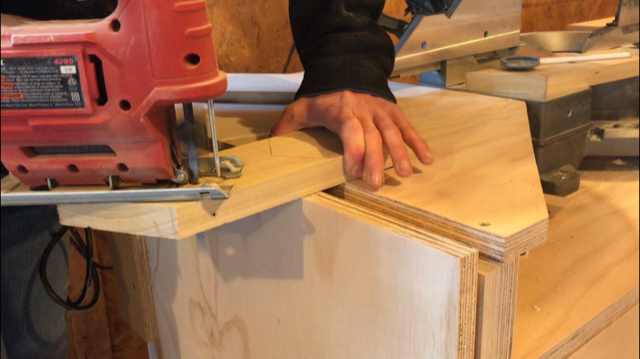
 

  • « Previous Page
  • 1
  • …
  • 10
  • 11
  • 12
  • 13
  • 14
  • …
  • 16
  • Next Page »

Hi! I'm Shara, the designer, maker, and videographer behind Woodshop Diaries. Let's get building, friends :)
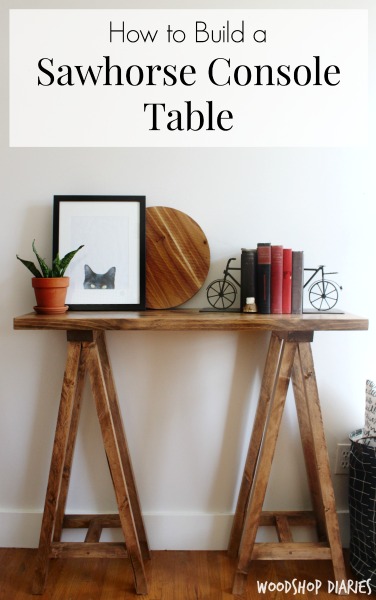
Learn more →

Woodworking Tips & Guides

  • How to make simple Shaker style cabinet doors!!
    DIY Simple Shaker Cabinet Doors
  • 5 Tools To Get Started Woodworking
  • DIY Kitchen Cabinets–From Only Plywood
  • How to Square Board Edges and Make Your Own 2x2s

Footer

↑ back to top

Tips to Take Your Projects to the Next Level

--5 Secrets to Professional Looking DIY Furniture

--How to Properly Paint Wood Furniture

--How to EASILY Cover Plywood Edges

--How to Sand Wood

--10 Must Have Tools for Furniture and Cabinet Building

Printable Building Plans

Check out our shop to browse printable PDF building plans!

Website Policies

This website is for entertainment purposes. Using any information provided is to be at your own risk.
This site uses cookies to provide you with a better experience.

All images and text on this site are property of Woodshop Diaries, LLC. Please be respectful and don't steal this content.

See Policies and Privacy page on this site for more information.

Want to get in touch? Contact Us Here

Copyright © 2026